EP1495066B1 - Organic silicate polymer and insulation film comprising the same - Google Patents
Organic silicate polymer and insulation film comprising the same Download PDFInfo
- Publication number
- EP1495066B1 EP1495066B1 EP03713057A EP03713057A EP1495066B1 EP 1495066 B1 EP1495066 B1 EP 1495066B1 EP 03713057 A EP03713057 A EP 03713057A EP 03713057 A EP03713057 A EP 03713057A EP 1495066 B1 EP1495066 B1 EP 1495066B1
- Authority
- EP
- European Patent Office
- Prior art keywords
- silane
- insulation film
- organic
- mixture
- hydrosilane
- Prior art date
- Legal status (The legal status is an assumption and is not a legal conclusion. Google has not performed a legal analysis and makes no representation as to the accuracy of the status listed.)
- Expired - Lifetime
Links
Classifications
-
- C—CHEMISTRY; METALLURGY
- C09—DYES; PAINTS; POLISHES; NATURAL RESINS; ADHESIVES; COMPOSITIONS NOT OTHERWISE PROVIDED FOR; APPLICATIONS OF MATERIALS NOT OTHERWISE PROVIDED FOR
- C09D—COATING COMPOSITIONS, e.g. PAINTS, VARNISHES OR LACQUERS; FILLING PASTES; CHEMICAL PAINT OR INK REMOVERS; INKS; CORRECTING FLUIDS; WOODSTAINS; PASTES OR SOLIDS FOR COLOURING OR PRINTING; USE OF MATERIALS THEREFOR
- C09D183/00—Coating compositions based on macromolecular compounds obtained by reactions forming in the main chain of the macromolecule a linkage containing silicon, with or without sulfur, nitrogen, oxygen, or carbon only; Coating compositions based on derivatives of such polymers
- C09D183/04—Polysiloxanes
-
- C—CHEMISTRY; METALLURGY
- C08—ORGANIC MACROMOLECULAR COMPOUNDS; THEIR PREPARATION OR CHEMICAL WORKING-UP; COMPOSITIONS BASED THEREON
- C08G—MACROMOLECULAR COMPOUNDS OBTAINED OTHERWISE THAN BY REACTIONS ONLY INVOLVING UNSATURATED CARBON-TO-CARBON BONDS
- C08G77/00—Macromolecular compounds obtained by reactions forming a linkage containing silicon with or without sulfur, nitrogen, oxygen or carbon in the main chain of the macromolecule
- C08G77/04—Polysiloxanes
- C08G77/06—Preparatory processes
-
- H—ELECTRICITY
- H10—SEMICONDUCTOR DEVICES; ELECTRIC SOLID-STATE DEVICES NOT OTHERWISE PROVIDED FOR
- H10W—GENERIC PACKAGES, INTERCONNECTIONS, CONNECTORS OR OTHER CONSTRUCTIONAL DETAILS OF DEVICES COVERED BY CLASS H10
- H10W74/00—Encapsulations, e.g. protective coatings
- H10W74/40—Encapsulations, e.g. protective coatings characterised by their materials
- H10W74/47—Encapsulations, e.g. protective coatings characterised by their materials comprising organic materials, e.g. plastics or resins
- H10W74/476—Organic materials comprising silicon
Definitions
- the present invention relates to an organic silicate polymer having superior mechanical property and low dielectric property, and more particularly to a method for preparing organic silicate polymer having superior mechanical property and low dielectric property, an organic silicate polymer prepared therefrom, a composition for forming insulation film of semiconductor devices, a method for preparing insulation film using the composition, and a semiconductor device comprising the insulation film.
- the speed of semiconductor devices is proportional to switching rate of transistors and signal transfer rate.
- the signal transfer rate is determined by the RC (Resistance-Capacitance) delay, which is the product of resistance of a wiring material and capacitance of an insulation film in semiconductor devices.
- RC Resistance-Capacitance
- the speed of high-density chips is mainly determined by the RC delay rather than by the switching rate. Accordingly, High-speed chips employ conductors having low resistance and insulators having low dielectric constant. In addition, the chips employing the materials having low dielectric constant prevent power consumption and cross-talk between the metal wires.
- polyimide resin polyarylene ether resin and resin containing aromatic hydrocarbon or perfluorocyclobutane are known. These resins may or may not contain fluorine. While most of these organic polymers have dielectric constant lower than 3.0, they have poor elasticity at high temperature due to low glass transition temperature, and very high linear expansion coefficients. In particular, these problems are more severe in the fluorine-containing organic polymers. Because high temperature of 200°C to 450°C is associated with semiconductor manufacturing and packaging processes, organic polymers having poor thermal stability and elasticity and high linear expansion coefficient may deteriorate reliability of semiconductor devices or circuit boards.
- organic silicate polymers using alkoxy silanes have been developed to solve the thermal stability problem.
- the organic silicate polymers are formed by hydrolyzing, condensing and hardening organic silanes.
- the organic silicate polymers for example, methylsilsesquioxane and hydrosilsesquioxane have rather low dielectric constant below 3.0 and are thermally stable at 450°C.
- these polysilsesquioxanes are vulnerable to cracks if the thickness of these polymers is larger than 1 ⁇ m due to the condensation stress during the hardening process.
- additional processing to reduce the dielectric constant below 2.5 lowers the mechanic property.
- US-A-5548053 discloses a process for preparation of organo polysiloxanes resins by hydrolyzing and condensation of silanes. Organic solvents are added not before the second step.
- the present invention provides a material having low dielectric constant that can be used for an insulation film, which is capable of offering high speed to semiconductor devices, lowering power consumption and greatly reducing cross-talk of metal wires.
- the present invention provides an organic silicate polymer having superior mechanic property and low dielectric property, a preparation method thereof, a composition for forming an insulation film of a semiconductor device using the same, an insulation film prepared by using the composition, and a semiconductor device comprising the insulation film.
- the present invention provides a method for preparing organic silicate polymer comprising: mixing silane compound with organic solvent to prepare a first mixture, the silane compound being selected from a group consisting of a) oxidized hydrosilane; b) cyclic siloxane; c) a second mixture of oxidized hydrosilane and silane or silane oligomer; and d) a third mixture of cyclic siloxane and silane or silane oligomer; and hydrolyzing and condensing the first mixture by adding water and catalyst.
- the present invention also provides an organic silicate polymer prepared by said method.
- the present invention also provides a composition for forming an insulation film of a semiconductor device.
- the composition comprises organic silicate polymer and organic solvent.
- the organic silicate polymer is prepared by mixing silane compound with the organic solvent to prepare a first mixture and hydrolyzing and condensing the first mixture by adding water and catalyst.
- the silane compound is selected from a group consisting of i) oxidized hydrosilane; ii) cyclic siloxane; iii) a second mixture of oxidized hydrosilane and silane or silane oligomer; and iv) a third mixture of cyclic siloxane and silane or silane oligomer.
- the present invention also provides a method for preparing an insulation film of a semiconductor device.
- the method comprises a)mixing silane compound with organic solvent to prepare a first mixture and condensing the first mixture by adding water and catalyst to obtain an organic silicate polymer, the silane compound being selected from a group consisting of i ) oxidized hydrosilane; ii) cyclic siloxane; iii) a second mixture of oxidized hydrosilane and silane or silane oligomer; and iv) a third mixture of cyclic siloxane and silane or silane oligomer ; b) dissolving the organic silicate polymer in solvent; c) coating the dissolved organic silicate polymer on a substrate of a semiconductor device; and d) drying and hardening the substrate on which the organic silicate polymer is coated.
- the present invention also provides an insulation film of a semiconductor device prepared by said method.
- the present invention also provides a semiconductor device comprising the insulation film prepared by said method.
- an organic silicate polymer is prepared by mixing silane compound with organic solvent to prepare a first mixture and hydrolyzing and condensing the first mixture by adding water and catalyst.
- the silane compound is selected from a group consisting of oxidized hydrosilane, cyclic siloxane, a second mixture of oxidized hydrosilane and silane or silane oligomer, and a third mixture of cyclic siloxane and silane or silane oligomer with organic solvent.
- the organic silicate polymer has superior mechanic property and low dielectric property.
- an insulation film prepared by the polymer has good insulation property, uniform film thickness, desirable dielectric constant and superior film mechanic property.
- the oxidized hydrosilane used for preparing the organic silicate polymer of the present invention is prepared by oxidizing hydrosilane in the presence of water or alcohol.
- hydrosilane any organic silane oligomer containing hydrogen can be used.
- hydrosilane oligomer represented by the following Chemical Formula 1 or cyclic hydrosilane oligomer represented by the following Chemical Formula 2 is preferable.
- R 1 n Si(OSi) m H (2m-n+4) [Chemical Formula 1] In Chemical Formula 1:
- the hydrosilane does not have hydroxy or alkoxy functional group. However, it may have such functional groups.
- Catalyst or oxidizing agent can be added to aid the oxidation of the hydrosilane.
- metal catalyst like Pd, Pt or Rh can be used, and for the oxidizing agent, peroxide can be used. Any peroxide can be used. Examples of the peroxide are oxiranes like dimethyldioxirane.
- the cyclic siloxane used for preparing the organic silicate polymer of the present invention is preferably the compound represented by the following Chemical Formula 3.
- Chemical Formula 3 In Chemical Formula 3:
- silanes represented by the following Chemical Formula 4 or Chemical Formula 5 or dimers or oligomers prepared therefrom are preferred.
- the organic solvent used for preparing the organic silicate polymer of the present invention may comprise a mixture of silane, water and catalyst or any organic solvent as long as the solvent does not restrict hydrolysis and condensation in phase-separated state.
- organic solvent are aliphatic hydrocarbon solvents like n -pentane, i -pentane, n -hexane, i -hexane, 2,2,4-trimethylpentane, cyclohexane or methylcyclohexane; aromatic hydrocarbon solvents like benzene, toluene, xylene, trimethylbenzene, ethylbenzene or methylethylbenzene; alcoholic solvents like methyl alcohol, ethyl alcohol, n -propanol, i -propanol, n -butanol, i -butanol, sec -butanol, t -butanol, 4-methyl 2-pentan
- the organic solvent is removed after hydrolysis and condensation to obtain the organic silicate polymer in oil or powder state, the organic silicate polymer may be dissolved in the organic solvent and the dissolved organic silicate polymer is coated on a substrate to form a insulation film. Otherwise, the organic silicate polymer is coated on a substrate without being dissolved in the organic solvent after removing the organic solvent (that adversely affects the coating property), water and reaction byproducts.
- the organic solvent can be used alone or in combination.
- the catalyst used for preparing the organic silicate polymer of the present invention promotes hydrolysis and condensation of the silane or silane oligomer.
- acid catalyst or alkali catalyst can be used.
- the acid catalyst is not particularly restricted.
- the alkali catalyst is not particularly restricted. However, in case the formed insulation film is used for semiconductor devices, the alkali catalyst that does not contain metal ions like sodium or potassium is preferable. It is because the metal ions may adversely affect the semiconductor devices. Ammonia water or organic amine is preferable. Also, in case inorganic base is used, a composition for forming an insulation film that does not contain metal ions is used.
- the acid catalyst or alkali catalyst can be used alone or in combination.
- An amount of the catalyst is different depending on the reaction condition. Preferably, 0.000001 mol to 2 mol is used for 1 mol of silane or silane oligomer. If the amount of the catalyst exceeds 2 mol, the reaction proceeds too fast even at low concentration, thereby making molecular weight control difficult and causing gel formation.
- the composition can be hydrolyzed and condensed gradually using acid catalyst or alkali catalyst
- the composition may be hydrolyzed and condensed using acid, and then reacted with base.
- the composition may be hydrolyzed and condensed using base, and then reacted with acid.
- the composition can be reacted with the acid catalyst and the alkali catalyst respectively, and the condensate can be mixed.
- the reaction temperature of hydrolysis and condensation is not particularly limited. However, 0°C to 100°C is preferable, and 15°C to 80 °C is more preferable.
- the polystyrene-converted weight average molecular weight of the prepared organic silicate polymer is over 500. When it is used for an insulation film, 500 to 1,000,000 of polystyrene-converted weight average molecular weight is preferable.
- the present invention also provides a coating composition of an insulation film, which comprises the organic silicate polymer and organic solvent.
- the coating composition of an insulation film further comprises organic molecules, organic polymers, dendrimers, etc. to reduce density of the insulation film.
- the organic material is not limited particularly. A material that can be pyrolyzed in the temperature range of 200°C to 450°C can be added in the coating composition of an insulation film during or after preparation of the organic silicate polymer.
- the coating composition of an insulation film may include additives like pH adjuster, colloidal silica and surfactant additionally.
- Total concentration of solid components of the coating composition of an insulation film of the present invention is preferably 2wt% to 60wt%, and more preferably 5wt% to 40wt%, considering film thickness and stability of the insulation film.
- the concentration of solid components can be controlled by the kind and amount of said organic solvents.
- the present invention also provides an insulation film prepared by coating the coating composition on a substrate, and drying and hardening the same.
- the insulation film may be formed by spin coating, dipping, roll coating or spraying. Using these coating methods, it is possible to form a film having uniform thickness. Among these coating methods, a spin coating method is preferred when an insulation film for multiple circuits of semiconductor devices is prepared.
- Thickness of the insulation film can be controlled by viscosity of the composition and revolution rate of the spin coater. In general, 0.05 ⁇ m to 2 ⁇ m of film thickness is appropriate when it is used for multiple circuits of semiconductor devices.
- an organic silicate polymer insulation film of three-dimensional structure can be formed through drying and hardening processes.
- the drying process includes pre-bake and soft-bake processes.
- the organic solvent is slowly evaporated, and during the soft-bake process, some of the functional groups are cross-linked.
- the remaining functional groups are reacted.
- the drying is carried out at 30°C to
- the hardening is carried out at the temperature over 350°C.
- the hardening temperature is preferred to be carried out in the temperature range of 350 °C to 500°C. ff the hardening temperature is below 350°C, the insulation film may be not strong enough due to insufficient condensation of free silicate polymers, and the dielectric property may be poor due to the presence of remaining functional groups.
- the upper limit of the hardening temperature depends on thermal stability of the organic silicate insulation film of the present invention and semiconductor devices prepared therefrom.
- the drying and hardening processes may proceed continuously or intermittently. When the processes proceed intermittently, each of drying and hardening is preferably carried out for 1 min to 5 hr. Heating may be performed with a hot plate, oven or furnace in inter gas like nitrogen, argon or helium, in oxygen (e.g., air), in vacuum, or in ammonia- or hydrogen-containing gas. The heating method may be the same or different for the drying process and the hardening process.
- surface treatment may be carried out to minimize hydroxy groups of the insulation film, if required.
- the surface treatment can be carried out using a silyl compound like hexamethyl disilazane , alkyl-alkoxy silane or alkyl-acetoxy silane or in reduction gas like hydrogen or in fluorine-containing gas.
- Silylation of the insulation film can be carried out as follows. The insulation film is dipped or spin-coated with silyl compound, which may be diluted with solvent, or silylated in silyl compound vapor. After silylation, the insulation film may be heated to the temperature of 100°C to 400°C.
- the present invention also provides an insulation film that is prepared as above and a semiconductor device comprising the insulation film.
- the prepared insulation film has superior dielectric property and mechanical strength. So, the insulation film of the invention can be used as an insulation film, a capping layer, a hard mask layer, an etch stop layer and a protection film like a surface coating film of semiconductor devices like LSI, System LSI, DRAM, SDRAM, RDRAM and D-RDRAM, an insulation film of multiple circuit boards, a protection film of liquid crystal display devices and an insulating protection film.
- the obtained organic silicate polymer was dissolved in propyleneglycol monomethyl ether acetate.
- the solution was spin-coated on a silicon wafer to form a thin film. Then, it was hardened at 425°C for 1 hr under nitrogen atmosphere to obtain an insulation film.
- An insulation film was prepared by the same method of Example 1.
- the obtained oxidation product was dissolved in 30g of tetrahydrofuran. 108mg of hydrogen chloride dissolved in 5.3g of distilled water was slowly added to the solution. The reaction chamber was heated to 70°C and let alone for 12 hr. After the reaction was completed, the reaction solution was diluted with ether and washed with distilled water until the pH becomes neutral. Moisture was removed from the organic layer using drying agent. Then, the organic solvent was removed in vacuum to obtain powdery product.
- insulation films of the present invention (Examples 1 to 3) have lower dielectric constant and superior mechanic property to the insulation film of Comparative Example 1.
- the obtained organic silicate polymer was dissolved in propyleneglycol monomethyl ether acetate.
- the solution was spin-coated on a silicon wafer to form a thin film. Then, it was hardened at 425°C for 1 hr under nitrogen atmosphere to obtain an insulation film.
- An insulation film was prepared by the same method of Example 5.
- An insulation film was prepared by the same method of Example 5.
- An insulation film was prepared by the same method of Example 5.
- insulation films of the present invention (Example. 5) have lower dielectric constant and superior mechanic property than those of Comparative Examples 2 and 3.
- the semiconductor device when organic silicate polymers of the present invention are used in an insulation film of a semiconductor device, the semiconductor device has higher speed, lower power consumption and reduced cross-talk of metal wires. And, the insulation film including the organic silicate polymer has superior insulating property, uniform film thickness, desirable dielectric constant and superior mechanic property.
Landscapes
- Chemical & Material Sciences (AREA)
- Organic Chemistry (AREA)
- Chemical Kinetics & Catalysis (AREA)
- Materials Engineering (AREA)
- Polymers & Plastics (AREA)
- Medicinal Chemistry (AREA)
- Life Sciences & Earth Sciences (AREA)
- Engineering & Computer Science (AREA)
- Health & Medical Sciences (AREA)
- Wood Science & Technology (AREA)
- Formation Of Insulating Films (AREA)
- Silicon Polymers (AREA)
- Paints Or Removers (AREA)
- Compositions Of Macromolecular Compounds (AREA)
- Laminated Bodies (AREA)
- Polymers With Sulfur, Phosphorus Or Metals In The Main Chain (AREA)
Abstract
Description
- The present invention relates to an organic silicate polymer having superior mechanical property and low dielectric property, and more particularly to a method for preparing organic silicate polymer having superior mechanical property and low dielectric property, an organic silicate polymer prepared therefrom, a composition for forming insulation film of semiconductor devices, a method for preparing insulation film using the composition, and a semiconductor device comprising the insulation film.
- As the degree of integrity of semiconductor devices has been increased, linewidth of conducting wires that connect the devices has been rapidly reduced. In the year 2003, it is expected that high-density devices using 0.1 µm will be developed.
- Generally, the speed of semiconductor devices is proportional to switching rate of transistors and signal transfer rate. The signal transfer rate is determined by the RC (Resistance-Capacitance) delay, which is the product of resistance of a wiring material and capacitance of an insulation film in semiconductor devices. With the increase of degree of integrity of semiconductor devices, gaps between metal wires inside the devices become narrow. Also, while thickness of the metal wires becomes small, their lengths increases rapidly. And, the speed of high-density chips is mainly determined by the RC delay rather than by the switching rate. Accordingly, High-speed chips employ conductors having low resistance and insulators having low dielectric constant. In addition, the chips employing the materials having low dielectric constant prevent power consumption and cross-talk between the metal wires.
- Recently, International Business Machines Corporation has released semiconductor products using copper wires instead of conventional aluminum wires. The new products offer more than 20% of speed improvement. Semiconductor devices using the materials having low dielectric constant, however, are not on the market, due to the lack of suitable materials.
- Most of the conventional semiconductor devices like ICs and LSIs use SiO2 as insulators. The dielectric constant of SiO2 is 4.0. And, fluorine-doped silicate (F-SiO2), which has lower dielectric constant, is used for some devices. However, if the fluorine content of F-SiO2 is larger than 6%, it becomes thermally unstable. Therefore, it is difficult to lower the dielectric constant of F-SiO2 below 3.5. In order to solve this problem, many organic and inorganic polymers thermally stable and having low polarity have been proposed.
- For organic polymers having low dielectric constant, polyimide resin, polyarylene ether resin and resin containing aromatic hydrocarbon or perfluorocyclobutane are known. These resins may or may not contain fluorine. While most of these organic polymers have dielectric constant lower than 3.0, they have poor elasticity at high temperature due to low glass transition temperature, and very high linear expansion coefficients. In particular, these problems are more severe in the fluorine-containing organic polymers. Because high temperature of 200°C to 450°C is associated with semiconductor manufacturing and packaging processes, organic polymers having poor thermal stability and elasticity and high linear expansion coefficient may deteriorate reliability of semiconductor devices or circuit boards.
- Recently, organic silicate polymers using alkoxy silanes have been developed to solve the thermal stability problem. The organic silicate polymers are formed by hydrolyzing, condensing and hardening organic silanes. The organic silicate polymers, for example, methylsilsesquioxane and hydrosilsesquioxane have rather low dielectric constant below 3.0 and are thermally stable at 450°C. However, these polysilsesquioxanes are vulnerable to cracks if the thickness of these polymers is larger than 1 µm due to the condensation stress during the hardening process. Also, while these polysilsesquioxanes have relatively higher mechanical strength than that of organic polymers, additional processing to reduce the dielectric constant below 2.5 lowers the mechanic property.
- Therefore, organic silicate having low dielectric constant and superior mechanic property is needed.
US-A-5548053 discloses a process for preparation of organo polysiloxanes resins by hydrolyzing and condensation of silanes. Organic solvents are added not before the second step. - The present invention provides a material having low dielectric constant that can be used for an insulation film, which is capable of offering high speed to semiconductor devices, lowering power consumption and greatly reducing cross-talk of metal wires.
- The present invention provides an organic silicate polymer having superior mechanic property and low dielectric property, a preparation method thereof, a composition for forming an insulation film of a semiconductor device using the same, an insulation film prepared by using the composition, and a semiconductor device comprising the insulation film.
- The present invention provides a method for preparing organic silicate polymer comprising: mixing silane compound with organic solvent to prepare a first mixture, the silane compound being selected from a group consisting of a) oxidized hydrosilane; b) cyclic siloxane; c) a second mixture of oxidized hydrosilane and silane or silane oligomer; and d) a third mixture of cyclic siloxane and silane or silane oligomer; and hydrolyzing and condensing the first mixture by adding water and catalyst.
- The present invention also provides an organic silicate polymer prepared by said method.
- The present invention also provides a composition for forming an insulation film of a semiconductor device. The composition comprises organic silicate polymer and organic solvent. The organic silicate polymer is prepared by mixing silane compound with the organic solvent to prepare a first mixture and hydrolyzing and condensing the first mixture by adding water and catalyst. The silane compound is selected from a group consisting of i) oxidized hydrosilane; ii) cyclic siloxane; iii) a second mixture of oxidized hydrosilane and silane or silane oligomer; and iv) a third mixture of cyclic siloxane and silane or silane oligomer.
- The present invention also provides a method for preparing an insulation film of a semiconductor device. The method comprises a)mixing silane compound with organic solvent to prepare a first mixture and condensing the first mixture by adding water and catalyst to obtain an organic silicate polymer, the silane compound being selected from a group consisting of i ) oxidized hydrosilane; ii) cyclic siloxane; iii) a second mixture of oxidized hydrosilane and silane or silane oligomer; and iv) a third mixture of cyclic siloxane and silane or silane oligomer ; b) dissolving the organic silicate polymer in solvent; c) coating the dissolved organic silicate polymer on a substrate of a semiconductor device; and d) drying and hardening the substrate on which the organic silicate polymer is coated.
- The present invention also provides an insulation film of a semiconductor device prepared by said method.
- The present invention also provides a semiconductor device comprising the insulation film prepared by said method.
- The present invention will now be explained in more detail.
- According to exemplary embodiments of the invention, an organic silicate polymer is prepared by mixing silane compound with organic solvent to prepare a first mixture and hydrolyzing and condensing the first mixture by adding water and catalyst. The silane compound is selected from a group consisting of oxidized hydrosilane, cyclic siloxane, a second mixture of oxidized hydrosilane and silane or silane oligomer, and a third mixture of cyclic siloxane and silane or silane oligomer with organic solvent. The organic silicate polymer has superior mechanic property and low dielectric property. Also, an insulation film prepared by the polymer has good insulation property, uniform film thickness, desirable dielectric constant and superior film mechanic property.
- The oxidized hydrosilane used for preparing the organic silicate polymer of the present invention is prepared by oxidizing hydrosilane in the presence of water or alcohol.
- For the hydrosilane, any organic silane oligomer containing hydrogen can be used. Especially, hydrosilane oligomer represented by the following Chemical Formula 1 or cyclic hydrosilane oligomer represented by the following Chemical Formula 2 is preferable.
R1 nSi(OSi)mH(2m-n+4) [Chemical Formula 1]
In Chemical Formula 1: - R1 is hydrogen, fluorine, aryl, vinyl, allyl, or linear or branched C1-4 alkyl substituted or unsubstituted with fluorine;
- m is independently an integer of 1 to 20; and
- n is independently an integer of 1 to 20.
- R2 is hydrogen, fluorine, aryl, vinyl, allyl, or linear or branched C1-4 alkyl substituted or unsubstituted with fluorine; and
- k and l are independently an integer of 3 to 10.
- In general, the hydrosilane does not have hydroxy or alkoxy functional group. However, it may have such functional groups.
- Catalyst or oxidizing agent can be added to aid the oxidation of the hydrosilane. For the catalyst, metal catalyst like Pd, Pt or Rh can be used, and for the oxidizing agent, peroxide can be used. Any peroxide can be used. Examples of the peroxide are oxiranes like dimethyldioxirane.
- The cyclic siloxane used for preparing the organic silicate polymer of the present invention is preferably the compound represented by the following Chemical Formula 3.

- R3 is hydrogen, fluorine, aryl, vinyl, allyl, or linear or branched C1-4, alkyl substituted or unsubstituted with fluorine;
- R4 is hydrogen or linear or branched C1-4 alkyl; and
- x and y are independently an integer of 3 to 10.
- Especially, silanes represented by the following Chemical Formula 4 or Chemical Formula 5 or dimers or oligomers prepared therefrom are preferred.
SiR5 pR6 4-p [Chemical Formula 4]
In Chemical Formula 4: - R5 is hydrogen, aryl, vinyl, allyl, or linear or branched C1-4 alkyl substituted or unsubstituted with fluorine;
- R6 is acetoxy, hydroxy, or linear or branched C1-4 alkoxy; and p is independently an integer of 0 to 2.
- R7 and R9 are hydrogen, aryl, vinyl, allyl, or linear or branched C1-4 alkyl substituted or unsubstituted with fluorine, respectivley;
- R8 and R10 are acetoxy, hydroxy, or linear or branched C1-4 alkoxy;
- M is C1-6 alkylene or phenylene; and
- q and r are independently an integer of 0 to 2.
- The organic solvent used for preparing the organic silicate polymer of the present invention may comprise a mixture of silane, water and catalyst or any organic solvent as long as the solvent does not restrict hydrolysis and condensation in phase-separated state. Examples of such organic solvent are aliphatic hydrocarbon solvents like n-pentane, i-pentane, n-hexane, i-hexane, 2,2,4-trimethylpentane, cyclohexane or methylcyclohexane; aromatic hydrocarbon solvents like benzene, toluene, xylene, trimethylbenzene, ethylbenzene or methylethylbenzene; alcoholic solvents like methyl alcohol, ethyl alcohol, n-propanol, i-propanol, n-butanol, i-butanol, sec-butanol, t-butanol, 4-methyl 2-pentanol, cyclohexanol, methylcyclohexanol or glycerol; ketonic solvents like acetone, methyl ethyl ketone, methyl-n-propyl ketone, methyl-n-butyl ketone, methyl-i-butyl ketone, diethyl ketone, cyclohexanone, methylcyclohexanone or acetylacetone; ethereal solvents like tetrahydrofuran, 2-methyltetrahydrofuran, ethyl ether, n-propyl ether, i-propyl ether, n-butyl ether, diglyme, dioxin, dimethyldioxin, ethylene glycol monomethyl ether, ethylene glycol monoethyl ether, ethylene glycol-n-propyl ether, ethylene glycol dimethyl ether, ethylene glycol diethyl ether, propyleneglycol monomethyl ether, propyleneglycol monoethyl ether, propyleneglycol monopropyl ether, propyleneglycol dimethyl ether, propyleneglycol diethyl ether or propyleneglycol dipropyl ether; ester solvents like diethyl carbonate, methyl acetate, ethyl acetate, n-propyl acetate, i-propyl acetate, n-butyl acetate, ethyl lactate, ethylene glycol monomethyl ether acetate, ethylene glycol monoethyl ether acetate, propyleneglycol monomethyl ether acetate, propyleneglycol monoethyl ether acetate, propyleneglycol monopropyl ether acetate, ethylene glycol diacetate or propyleneglycol diacetate; and amide solvents like N-methylpyrrolidone, formamide, N-methylformamide, N-ethylformamide, N,N-dimethylformamide, N,N-diethylformamide, N-methylacetamide, N-ethylacetamide, N,N-dimethylacetamide or N,N-diethylacetamide.
- The organic solvent is removed after hydrolysis and condensation to obtain the organic silicate polymer in oil or powder state, the organic silicate polymer may be dissolved in the organic solvent and the dissolved organic silicate polymer is coated on a substrate to form a insulation film. Otherwise, the organic silicate polymer is coated on a substrate without being dissolved in the organic solvent after removing the organic solvent (that adversely affects the coating property), water and reaction byproducts. The organic solvent can be used alone or in combination.
- The catalyst used for preparing the organic silicate polymer of the present invention promotes hydrolysis and condensation of the silane or silane oligomer.
- For the catalyst, acid catalyst or alkali catalyst can be used. The acid catalyst is not particularly restricted. For example, hydrochloric acid, nitric acid, sulfuric acid, phosphoric acid, fluoric acid, formic acid, acetic acid, propionic acid, butanoic acid, pentanoic acid, hexanoic acid, monochloroacetic acid, dichloroacetic acid, trichloroacetic acid, trifluoroacetic acid, oxalic acid, malonic acid, sulfonic acid, phthalic acid, fumaric acid, citric acid, maleic acid, oleic acid, methylmalonic acid, adipic acid, p-aminobenzoic acid or p-toluenesulfonic acid can be used. The alkali catalyst is not particularly restricted. However, in case the formed insulation film is used for semiconductor devices, the alkali catalyst that does not contain metal ions like sodium or potassium is preferable. It is because the metal ions may adversely affect the semiconductor devices. Ammonia water or organic amine is preferable. Also, in case inorganic base is used, a composition for forming an insulation film that does not contain metal ions is used. The acid catalyst or alkali catalyst can be used alone or in combination.
- An amount of the catalyst is different depending on the reaction condition. Preferably, 0.000001 mol to 2 mol is used for 1 mol of silane or silane oligomer. If the amount of the catalyst exceeds 2 mol, the reaction proceeds too fast even at low concentration, thereby making molecular weight control difficult and causing gel formation.
- The composition can be hydrolyzed and condensed gradually using acid catalyst or alkali catalyst For example, the composition may be hydrolyzed and condensed using acid, and then reacted with base. The composition may be hydrolyzed and condensed using base, and then reacted with acid. Also, the composition can be reacted with the acid catalyst and the alkali catalyst respectively, and the condensate can be mixed.
- The reaction temperature of hydrolysis and condensation is not particularly limited. However, 0°C to 100°C is preferable, and 15°C to 80 °C is more preferable.
- The polystyrene-converted weight average molecular weight of the prepared organic silicate polymer is over 500. When it is used for an insulation film, 500 to 1,000,000 of polystyrene-converted weight average molecular weight is preferable.
- The present invention also provides a coating composition of an insulation film, which comprises the organic silicate polymer and organic solvent.
- The coating composition of an insulation film further comprises organic molecules, organic polymers, dendrimers, etc. to reduce density of the insulation film. The organic material is not limited particularly. A material that can be pyrolyzed in the temperature range of 200°C to 450°C can be added in the coating composition of an insulation film during or after preparation of the organic silicate polymer.
- Also, the coating composition of an insulation film may include additives like pH adjuster, colloidal silica and surfactant additionally.
- Total concentration of solid components of the coating composition of an insulation film of the present invention is preferably 2wt% to 60wt%, and more preferably 5wt% to 40wt%, considering film thickness and stability of the insulation film. The concentration of solid components can be controlled by the kind and amount of said organic solvents.
- The present invention also provides an insulation film prepared by coating the coating composition on a substrate, and drying and hardening the same.
- For the substrate, silicon wafer, SiO2 wafer, SiN wafer, compound semiconductor, etc. can be used. And, the insulation film may be formed by spin coating, dipping, roll coating or spraying. Using these coating methods, it is possible to form a film having uniform thickness. Among these coating methods, a spin coating method is preferred when an insulation film for multiple circuits of semiconductor devices is prepared.
- Thickness of the insulation film can be controlled by viscosity of the composition and revolution rate of the spin coater. In general, 0.05µm to 2µm of film thickness is appropriate when it is used for multiple circuits of semiconductor devices.
- After coating, an organic silicate polymer insulation film of three-dimensional structure can be formed through drying and hardening processes. Normally, the drying process includes pre-bake and soft-bake processes. During the pre-bake process, the organic solvent is slowly evaporated, and during the soft-bake process, some of the functional groups are cross-linked. During the hardening process, the remaining functional groups are reacted. Preferably, the drying is carried out at 30°C to
- 350°C, and the hardening is carried out at the temperature over 350°C. Especially, the hardening temperature is preferred to be carried out in the temperature range of 350 °C to 500°C. ff the hardening temperature is below 350°C, the insulation film may be not strong enough due to insufficient condensation of free silicate polymers, and the dielectric property may be poor due to the presence of remaining functional groups. The upper limit of the hardening temperature depends on thermal stability of the organic silicate insulation film of the present invention and semiconductor devices prepared therefrom.
- The drying and hardening processes may proceed continuously or intermittently. When the processes proceed intermittently, each of drying and hardening is preferably carried out for 1 min to 5 hr. Heating may be performed with a hot plate, oven or furnace in inter gas like nitrogen, argon or helium, in oxygen (e.g., air), in vacuum, or in ammonia- or hydrogen-containing gas. The heating method may be the same or different for the drying process and the hardening process.
- After the drying and hardening processes, surface treatment may be carried out to minimize hydroxy groups of the insulation film, if required. The surface treatment can be carried out using a silyl compound like hexamethyl disilazane , alkyl-alkoxy silane or alkyl-acetoxy silane or in reduction gas like hydrogen or in fluorine-containing gas. Silylation of the insulation film can be carried out as follows. The insulation film is dipped or spin-coated with silyl compound, which may be diluted with solvent, or silylated in silyl compound vapor. After silylation, the insulation film may be heated to the temperature of 100°C to 400°C.
- The present invention also provides an insulation film that is prepared as above and a semiconductor device comprising the insulation film. The prepared insulation film has superior dielectric property and mechanical strength. So, the insulation film of the invention can be used as an insulation film, a capping layer, a hard mask layer, an etch stop layer and a protection film like a surface coating film of semiconductor devices like LSI, System LSI, DRAM, SDRAM, RDRAM and D-RDRAM, an insulation film of multiple circuit boards, a protection film of liquid crystal display devices and an insulating protection film.
- Hereinafter, the present invention is described more in detail through Examples and Comparative Examples. However, the following Examples are only for the understanding of the present invention, and the present invention is not limited to the following Examples.
- 15g of distilled water, 30g of tetrahydrofuran and 500mg of Pd/C (10%) powder were mixed in a reaction chamber and the temperature of the chamber was maintained at 0°C. 10g of tetramethylcyclotetrasiloxane was slowly added to this solution and the reaction chamber was let alone overnight. After the reaction was completed, the solution was filtered to remove the metal catalyst. Then, the organic solvent was removed in vacuum to obtain 19g of oxidized hydrosiloxane containing 11g of tetrahydroxy tetramethyl cyclotetrasiloxane.
- 8.3g of the obtained oxidized hydrosiloxane and 12g of tetrahydrofuran were put in a reaction chamber. 72mg of hydrogen chloride dissolved in 1.4g of distilled water was slowly added to the solution. The reaction chamber was heated to 70°C and let alone overnight. After the reaction was completed, the reaction solution was diluted with ether and washed with distilled water until the pH becomes neutral. Moisture was removed from the organic layer using drying agent. Then, the organic solvent was removed to obtain powdery product.
- The obtained organic silicate polymer was dissolved in propyleneglycol monomethyl ether acetate. The solution was spin-coated on a silicon wafer to form a thin film. Then, it was hardened at 425°C for 1 hr under nitrogen atmosphere to obtain an insulation film.
- 100g of methanol and 300mg of Pd/C (10%) powder were mixed in a reaction chamber and the temperature of the chamber was maintained at 0°C. 50g of tetramethylcyclotetrasiloxane was slowly added to this solution and the reaction chamber was let alone overnight. After the reaction was completed, the solution was filtered to remove the catalyst. Then, the organic solvent was removed in vacuum to obtain 72g of oxidized hydrosiloxane.
- 6.5g of the obtained oxidized hydrosiloxane, 16g of tetrahydrofuran and 4.6g of methanol were put in a reaction chamber. 75mg of hydrogen chloride dissolved in 6.5g of distilled water was slowly added to the solution. The reaction chamber was heated to 70°C and let alone overnight. After the reaction was completed, the reaction solution was diluted with ether and washed with distilled water until the pH becomes neutral. Moisture was removed from the organic layer using drying agent. Then, the organic solvent was removed to obtain powdery product.
- An insulation film was prepared by the same method of Example 1.
- 10g of methyldimethoxysilane, 1.2g of methanol and 8.36g of tetrahydrofuran were mixed in a reaction chamber. 34mg of hydrogen chloride dissolved in 1.4g of distilled water was slowly added to the solution at 0°C. The reaction chamber was let alone for 12 hr at room temperature. After the reaction was completed, moisture, solvent and acid catalyst were removed to obtain 5.3g of partially hydrolyzed hydrosilane condensate. 8g of distilled water, 16g of tetrahydrofuran and 300mg of Pd/C (10%) powder were mixed with this hydrolyzed hydrosilane condensate, and let alone overnight. After the reaction was completed, the solution was filtered to remove the catalyst. Then, the organic solvent was removed in vacuum to obtain 8.4g of oxidation product.
- The obtained oxidation product was dissolved in 30g of tetrahydrofuran. 108mg of hydrogen chloride dissolved in 5.3g of distilled water was slowly added to the solution. The reaction chamber was heated to 70°C and let alone for 12 hr. After the reaction was completed, the reaction solution was diluted with ether and washed with distilled water until the pH becomes neutral. Moisture was removed from the organic layer using drying agent. Then, the organic solvent was removed in vacuum to obtain powdery product.
- An insulation film was prepared under the same condition as that of Example 1.
- 5.1g (including moisture) of oxidized hydrosiloxane obtained in Example 1, 1.5g of tetramethoxysilane and 9g of tetrahydrofuran were put in a reaction chamber. 256mg of malonic acid dissolved in 2.1 g of distilled water was slowly added to the solution. The reaction chamber was heated to 70°C and let alone overnight. After the reaction was completed, the reaction solution was diluted with ether and washed with distilled water until the pH becomes neutral. Moisture was removed from the organic layer using drying agent. Then, the organic solvent was removed in vacuum to obtain powdery product.
- An insulation film was prepared under the same method as that of Example 1.
- 10g of methyltrimethoxysilane and 16.3g of tetrahydrofuran were put in a reaction chamber. 80mg of hydrogen chloride dissolved in 7.93g of distilled water was slowly added to the solution. The reaction chamber was heated to 70°C and let alone overnight. After the reaction was completed, the reaction solution was diluted with ether and washed with distilled water until the pH becomes neutral. Moisture was removed from the organic layer using drying agent. Then, the organic solvent was removed in vacuum to obtain powdery product.
- An insulation film was prepared under the same method as that of Example 1.
- Dielectric property and mechanic property of insulation films prepared in Examples 1 to 3 and Comparative Example 1 were determined. The result is shown in Table 1 below.
- a) Dielectric property - Dielectric constant was determined according to the MIS (Metal/Insulator/Semiconductor) method.
- b) Mechanic property - Elasticity and strength were determined using Tribolndenter of the Hysitron, Inc.
- As shown in Table 1, insulation films of the present invention (Examples 1 to 3) have lower dielectric constant and superior mechanic property to the insulation film of Comparative Example 1.
- 4.7g of tetramethyltetramethoxycyclotetrasiloxane was added to 9g of tetrahydrofuran in a reaction chamber. 55mg of hydrogen chloride dissolved in 1.8g of distilled water was slowly added to the solution. The reaction chamber was let alone overnight at 60°C. After the reaction was completed, the reaction solution was diluted with ether and washed with distilled water until the pH becomes neutral. Moisture was removed from the organic layer using drying agent. Then, the organic solvent was removed in vacuum to obtain powdery product.
- The obtained organic silicate polymer was dissolved in propyleneglycol monomethyl ether acetate. The solution was spin-coated on a silicon wafer to form a thin film. Then, it was hardened at 425°C for 1 hr under nitrogen atmosphere to obtain an insulation film.
- 3.65g of tetramethyltetramethoxycyclotetrasiloxane and 1.54g of tetramethoxysilane were added to 9g of tetrahydrofuran in a reaction chamber. 2.65mg of malonic acid dissolved in 2.91g of distilled water was added to the solution, and the reaction chamber was let alone overnight at 60°C. After the reaction was completed, the reaction solution was diluted with ether and washed with distilled water until the pH becomes neutral. Moisture was removed from the organic layer using drying agent. Then, the organic solvent was removed in vacuum to obtain powdery product.
- An insulation film was prepared by the same method of Example 5.
- 6.9g of methyltrimethoxysilane was added to 9g of tetrahydrofuran in a reaction chamber. 55mg of hydrogen chloride dissolved in 5.5g of distilled water was added to the solution, and the reaction chamber was let alone overnight at 60°C. After the reaction was completed, the reaction solution was diluted with ether and washed with distilled water until the pH becomes neutral. Moisture was removed from the organic layer using drying agent. Then, the organic solvent was removed in vacuum to obtain powdery product.
- An insulation film was prepared by the same method of Example 5.
- 5.5g of methyltrimethoxysilane and 1.54g of tetramethoxysilane were added to 9g of tetrahydrofuran in a reaction chamber. 2.63mg of malonic acid dissolved in 5.8g of distilled water was added to the solution, and the reaction chamber was let alone overnight at 60°C. After the reaction was completed, the reaction solution was diluted with ether and washed with distilled water until the pH becomes neutral. Moisture was removed from the organic layer using drying agent. Then, the organic solvent was removed in vacuum to obtain powdery product.
- An insulation film was prepared by the same method of Example 5.
- For the insulation films prepared in Example 5 and Comparative Examples 2 to 3, dielectric property and mechanic property were examined as in Experimental Example 1. The result is shown in Table 2 below.
[Table 2] Classification Example 5 Comparative Example 2 Comparative Example 3 Dielectric constant 2.73 2.74 2.80 Mechanical property E = 4.6 Gpa E = 3.6 Gpa E = 6.7 Gpa - As shown in Table 2, insulation films of the present invention (Example. 5) have lower dielectric constant and superior mechanic property than those of Comparative Examples 2 and 3.
- As described above, when organic silicate polymers of the present invention are used in an insulation film of a semiconductor device, the semiconductor device has higher speed, lower power consumption and reduced cross-talk of metal wires. And, the insulation film including the organic silicate polymer has superior insulating property, uniform film thickness, desirable dielectric constant and superior mechanic property.
- While the present invention has been described in detail with reference to the preferred embodiments, those skilled in the art will appreciate that a variety of modifications and substitutions can be made thereto without departing from the spirit and scope of the present invention as set forth in the appended claims.

R7 qR8 3-qSi-M-SIR9 rR10 3-r [Chemical Formula 5]
In Chemical Formula 5:
| Classification | Example 1 | Example 2 | Example 3 | Comp. Example 1 |
| Dielectric constant | 2.72 | 2.73 | 2.73 | 2.74 |
| Mechanical property | E=4.7Gpa | E=4.6Gpa | E=4.3Gpa | E=3.4Gpa |
Claims (16)
- A method for preparing organic silicate polymer, comprising:mixing silane compound with organic solvent to form a first mixture, the silane compound being selected from a group consisting of:a) oxidized hydrosilane;b) cyclic siloxane;c) a second mixture of oxidized hydrosilane and silane or silane oligomer, andd) a third mixture of cyclic siloxane and silane or silane oligomer, andhydrolyzing and condensing the first mixture by adding water and catalyst.
- The method according to Claim 1, wherein the oxidized hydrosilane of a) is prepared by preparing hydrosilane compound and oxidizing the hydrosilane compound in the presence of water or alcohol.
- The method according to Claim 2, wherein the hydrosilane compound is hydrosilane oligomer represented by the following Chemical Formula 1 or cyclic hydrosilane oligomer represented by the following Chemical Formula 2:
R1 nSi(OSi)mH(2m-n+4) [Chemical Formula 1]
wherein:R1 is hydrogen, fluorine, aryl, vinyl, allyl, or linear or branched C1-4 alkyl substituted or unsubstituted with fluorine;m is independently an integer of 1 to 20; andn is independently an integer of 1 to 20; and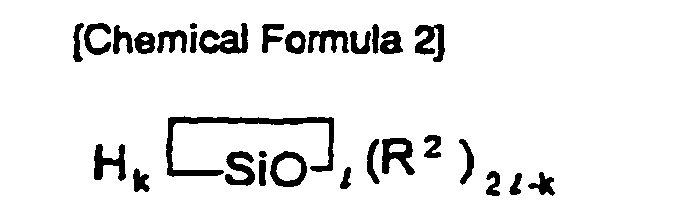 R2 is hydrogen, fluorine, aryl, vinyl, allyl, or linear or branched C1-4 alkyl substituted or unsubstituted with fluorine; andk and l are independently an integer of 3 to 10.
 - The method according to Claim 2, wherein oxidizing the hydrosilane compound is carried out by adding at least one the catalyst or a peroxide oxidizing agent, the catalyst being selected from a group consisting of Pd, Pt and Rh.
- The method according to Claim 1, wherein the cyclic siloxane of b) is a compound represented by the following Chemical Formula 3:
 R3 is hydrogen, fluorine, aryl, vinyl, allyl, or linear or branched C1-4 alkyl substituted or unsubstituted with fluorine;R1 is hydrogen or linear or branched C1-4 alkyl; andx and y are independently an integer of 3 to 10.
 - The method according to Claim 1, wherein the silane or silane oligomer of c) and d) is a silane compound represented by the following Chemical Formula 4 or Chemical Formula 5:
SiR6 pR6 4-p [Chemical Formula 4]
, wherein:R5 is hydrogen, aryl, vinyl, allyl, or linear or branched C1-4 alkyl substituted or unsubstituted with fluorine;R6 is acetoxy, hydroxy, or linear or branched C1-4 alkoxy; andP is independently an integer of 0 to 2;
R7R8 3-qSi-M-SiR9 rR10 3-r [Chemical Formula 5]
, wherein:R7 and R9 are hydrogen, aryl, vinyl, allyl, or linear or branched C1-4 alkyl substituted or unsubstituted with fluorine, respectively,R8 and R10 are acetoxy, hydroxy, or linear or branched C1-4 alkoxy, respectively:M is C1-6 alkylene or phenylene; andq and r are independently an integer of 0 to 2. - The method according to Claim 1, wherein an amount of the catalyst is between 0.000001 mol to 2 mol, based on 1 mol of the silane compound.
- The method according to Claim 1, wherein hydrolyzing and condensing the first mixture are performed at a temperature of 15°C to 80°C.
- A composition for forming an insulation film of a semiconductor device, comprising:organic silicate polymer and organic solvent,the organic silicate polymer being prepared by mixing silane compound with the organic solvent to prepare a first mixture and hydrolyzing and condensing the first mixture by adding water and catalyst, the silane compound being selected from a group consisting of :i) oxidized hydrosilane;ii) cyclic siloxane;iii) a second mixture of oxidized hydrosilane and silane or silane oligomer, andiv) a third mixture of cyclic siloxane and silane or silane oligomer.
- The composition for forming an insulation film according to Claim 9., further comprising one or more additives selected from a group consisting of organic molecules, organic polymers, organic dendrimers, pH adjuster, colloidal organic silica and surfactant and where the organic molecules, organic polymers and organic dendrimers can be be pyrolyzed in the temperature range of 200°C to 450°C.
- A method for preparing an insulation film of a semiconductor device, comprising:a) mixing silane compound with organic solvent to prepare a first mixture and hydrolyzing and condensing the first mixture by adding water and catalyst to obtain an organic silicate polymer, the silane compound being selected from a group consisting of:i ) oxidized hydrosilane;ii) cyclic siloxane;iii) a second mixture of oxidized hydrosilane and silane or silane oligomer; andiv) a third mixture of cyclic siloxane and silane or silane oligomer;b) dissolving the organic silicate polymer in solvent;c) coating the dissolved organic silicate polymer on a substrate of a semiconductor device; andd) drying and hardening the coated insulation film.
- The method according to Claim 11, wherein coating the dissolved organic silicate polymer is performed by a spin coating, a dipping, a roll coating or a spraying.
- The method according to Claim 11 , wherein drying the coated insulation film is carried out at a temperature of 30°C to 350°C, and hardening the coated insulation film is carried out at a temperature of 350°C to 500°C.
- An insulation film of a semiconductor device prepared by the method of Claim 11.
- The insulation film according to Claim 14 , wherein the insulation film has a thickness of 0.05 µm to 2µm.
- A semiconductor device that comprises the insulation film prepared by the method of Claim 11.
Applications Claiming Priority (5)
| Application Number | Priority Date | Filing Date | Title |
|---|---|---|---|
| KR2002021141 | 2002-04-18 | ||
| KR10-2002-0021141A KR100508901B1 (en) | 2002-04-18 | 2002-04-18 | Organic silicate polymer and insulation film comprising the same |
| KR10-2002-0021140A KR100508900B1 (en) | 2002-04-18 | 2002-04-18 | Organic silicate polymer and insulation film comprising the same |
| KR2002021140 | 2002-04-18 | ||
| PCT/KR2003/000634 WO2003104305A1 (en) | 2002-04-18 | 2003-03-28 | Organic silicate polymer and insulation film comprising the same |
Publications (2)
| Publication Number | Publication Date |
|---|---|
| EP1495066A1 EP1495066A1 (en) | 2005-01-12 |
| EP1495066B1 true EP1495066B1 (en) | 2008-07-16 |
Family
ID=29738503
Family Applications (1)
| Application Number | Title | Priority Date | Filing Date |
|---|---|---|---|
| EP03713057A Expired - Lifetime EP1495066B1 (en) | 2002-04-18 | 2003-03-28 | Organic silicate polymer and insulation film comprising the same |
Country Status (9)
| Country | Link |
|---|---|
| US (1) | US7834119B2 (en) |
| EP (1) | EP1495066B1 (en) |
| JP (1) | JP4142643B2 (en) |
| CN (1) | CN100381483C (en) |
| AT (1) | ATE401364T1 (en) |
| AU (1) | AU2003218816A1 (en) |
| DE (1) | DE60322202D1 (en) |
| TW (1) | TWI328017B (en) |
| WO (1) | WO2003104305A1 (en) |
Families Citing this family (21)
| Publication number | Priority date | Publication date | Assignee | Title |
|---|---|---|---|---|
| KR100645682B1 (en) * | 2003-04-17 | 2006-11-13 | 주식회사 엘지화학 | Organosiloxane Resin and Insulating Film Using the Same |
| JP4465233B2 (en) * | 2003-06-30 | 2010-05-19 | 三星電子株式会社 | Polyfunctional cyclic siloxane compound, siloxane-based polymer produced from this compound, and method for producing insulating film using this polymer |
| US8053159B2 (en) | 2003-11-18 | 2011-11-08 | Honeywell International Inc. | Antireflective coatings for via fill and photolithography applications and methods of preparation thereof |
| JP5110238B2 (en) | 2004-05-11 | 2012-12-26 | Jsr株式会社 | Insulating film forming composition and method for producing the same, and silica-based insulating film and method for forming the same |
| JP5110239B2 (en) * | 2004-05-11 | 2012-12-26 | Jsr株式会社 | Method for forming organic silica film, composition for film formation |
| EP1746123A4 (en) * | 2004-05-11 | 2012-03-21 | Jsr Corp | PROCESS FOR FORMING ORGANIC SILICA FILM, ORGANIC SILICA FILM, WIRING STRUCTURE, SEMICONDUCTOR DEVICE, AND COMPOSITION FOR FILM FORMATION |
| US8642246B2 (en) | 2007-02-26 | 2014-02-04 | Honeywell International Inc. | Compositions, coatings and films for tri-layer patterning applications and methods of preparation thereof |
| US8557877B2 (en) | 2009-06-10 | 2013-10-15 | Honeywell International Inc. | Anti-reflective coatings for optically transparent substrates |
| US8864898B2 (en) | 2011-05-31 | 2014-10-21 | Honeywell International Inc. | Coating formulations for optical elements |
| JP5814209B2 (en) * | 2012-10-24 | 2015-11-17 | 信越化学工業株式会社 | Coating agent composition, surface treatment agent containing the composition, and article surface-treated with the surface treatment agent |
| US10544329B2 (en) | 2015-04-13 | 2020-01-28 | Honeywell International Inc. | Polysiloxane formulations and coatings for optoelectronic applications |
| JP6875063B2 (en) * | 2015-10-16 | 2021-05-19 | 信越化学工業株式会社 | Method for Producing Hydrosilyl Group-Containing Organosilicon Resin |
| JP7312701B2 (en) | 2017-08-16 | 2023-07-21 | 旭化成株式会社 | Silanol composition, cured product, adhesive, method for curing silanol composition |
| JP6844506B2 (en) | 2017-11-15 | 2021-03-17 | 信越化学工業株式会社 | Polysiloxane and its manufacturing method |
| JP6931324B2 (en) * | 2017-12-18 | 2021-09-01 | 旭化成株式会社 | Hardened product |
| JP7201430B2 (en) * | 2018-12-28 | 2023-01-10 | 旭化成株式会社 | Curable composition for ultraviolet light emitting device, parts for ultraviolet light emitting device, and ultraviolet light emitting device |
| JP7144331B2 (en) * | 2019-01-17 | 2022-09-29 | 旭化成株式会社 | Silanol composition, cured product, adhesive, composite film, and curing method |
| JP7195692B2 (en) | 2019-02-20 | 2022-12-26 | 旭化成株式会社 | Silanol composition, cured product, and adhesive |
| TWI742534B (en) | 2019-02-20 | 2021-10-11 | 日商旭化成股份有限公司 | Cured product, cured product modified product and curing method |
| JP7377765B2 (en) * | 2020-05-21 | 2023-11-10 | 信越化学工業株式会社 | Organopolysiloxane and composition containing the same |
| CN116157552B (en) * | 2020-07-24 | 2025-10-17 | 弗萨姆材料美国有限责任公司 | Cyclosiloxanes and films made therefrom |
Family Cites Families (14)
| Publication number | Priority date | Publication date | Assignee | Title |
|---|---|---|---|---|
| GB632955A (en) | 1946-03-21 | 1949-12-05 | British Thomson Houston Co Ltd | Improvements in and relating to polysiloxanes |
| GB627800A (en) | 1946-07-08 | 1949-08-16 | Dow Chemical Co | Improvements in or relating to the manufacture of new organofluoro-siloxane products |
| GB746193A (en) | 1952-11-06 | 1956-03-14 | Metallgesellschaft Ag | Method of producing organo-silicon polymers |
| CA1204527A (en) * | 1982-08-13 | 1986-05-13 | Theodore F. Retajczyk, Jr. | Polymeric films for electronic circuits |
| US4618665A (en) * | 1986-01-13 | 1986-10-21 | Dow Corning Corporation | Process to prepare 2-phenylpropyl containing polydiorganosiloxanes |
| JP3268818B2 (en) | 1992-04-23 | 2002-03-25 | 住友ベークライト株式会社 | Semiconductor sealing composition |
| US5548053A (en) | 1992-05-15 | 1996-08-20 | Wacker-Chemie Gmbh | Process for the preparation of organopolysiloxane resin |
| JP3427412B2 (en) | 1993-02-25 | 2003-07-14 | 富士通株式会社 | Fluorinated polysiloxanes and method for producing the same |
| US5656555A (en) * | 1995-02-17 | 1997-08-12 | Texas Instruments Incorporated | Modified hydrogen silsesquioxane spin-on glass |
| EP1026213B1 (en) * | 1998-09-01 | 2014-11-05 | JGC Catalysts and Chemicals Ltd. | Coating fluid for forming low-permittivity silica-based coating film and substrate with low-permittivity coating film |
| JP2000309753A (en) | 1999-04-27 | 2000-11-07 | Jsr Corp | Composition for forming film and material for forming insulating film |
| US6696538B2 (en) * | 1999-07-27 | 2004-02-24 | Lg Chemical Ltd. | Semiconductor interlayer dielectric material and a semiconductor device using the same |
| KR100382702B1 (en) * | 2000-09-18 | 2003-05-09 | 주식회사 엘지화학 | Method for preparing organic silicate polymer |
| CA2463584C (en) * | 2001-10-16 | 2011-06-21 | The University Of Akron | Poly(cyclosiloxane) composition and synthesis |
-
2003
- 2003-03-28 EP EP03713057A patent/EP1495066B1/en not_active Expired - Lifetime
- 2003-03-28 AT AT03713057T patent/ATE401364T1/en not_active IP Right Cessation
- 2003-03-28 JP JP2004511371A patent/JP4142643B2/en not_active Expired - Lifetime
- 2003-03-28 DE DE60322202T patent/DE60322202D1/en not_active Expired - Lifetime
- 2003-03-28 CN CNB038087138A patent/CN100381483C/en not_active Expired - Fee Related
- 2003-03-28 WO PCT/KR2003/000634 patent/WO2003104305A1/en not_active Ceased
- 2003-03-28 US US10/511,639 patent/US7834119B2/en not_active Expired - Lifetime
- 2003-03-28 AU AU2003218816A patent/AU2003218816A1/en not_active Abandoned
- 2003-04-02 TW TW092107963A patent/TWI328017B/en not_active IP Right Cessation
Also Published As
| Publication number | Publication date |
|---|---|
| CN100381483C (en) | 2008-04-16 |
| JP4142643B2 (en) | 2008-09-03 |
| DE60322202D1 (en) | 2008-08-28 |
| AU2003218816A1 (en) | 2003-12-22 |
| US20070088144A1 (en) | 2007-04-19 |
| EP1495066A1 (en) | 2005-01-12 |
| TW200401795A (en) | 2004-02-01 |
| WO2003104305A1 (en) | 2003-12-18 |
| ATE401364T1 (en) | 2008-08-15 |
| CN1646605A (en) | 2005-07-27 |
| JP2005523377A (en) | 2005-08-04 |
| US7834119B2 (en) | 2010-11-16 |
| TWI328017B (en) | 2010-08-01 |
Similar Documents
| Publication | Publication Date | Title |
|---|---|---|
| US7834119B2 (en) | Organic silicate polymer and insulation film comprising the same | |
| US6806161B2 (en) | Process for preparing insulating material having low dielectric constant | |
| US6696538B2 (en) | Semiconductor interlayer dielectric material and a semiconductor device using the same | |
| US7648894B2 (en) | Coating composition for insulating film production, preparation method of insulation film by using the same, insulation film for semi-conductor device prepared therefrom, and semi-conductor device comprising the same | |
| EP1328571B1 (en) | A process for preparing organic silicate polymer | |
| JP4049775B2 (en) | Organosilicate polymer and insulating film containing the same | |
| US6933360B2 (en) | Organosilicate polymer and insulating film therefrom | |
| US7470636B2 (en) | Semiconductor interlayer dielectric material and a semiconductor device using the same | |
| KR20040068274A (en) | Method for Production of Dielectric Layers Using Polyfunctional Carbosilanes | |
| KR100508901B1 (en) | Organic silicate polymer and insulation film comprising the same | |
| KR100508900B1 (en) | Organic silicate polymer and insulation film comprising the same | |
| KR100440488B1 (en) | Organic silicate polymer for insulation film of the semiconductor device and low dielectric insulation film comprising the same | |
| KR100515584B1 (en) | Organic silicate polymer and insulation film comprising the same | |
| KR20030000709A (en) | Organic silicate polymer and low dielectric insulation film comprising the same | |
| KR100508902B1 (en) | Organic silicate polymer and insulation film comprising the same | |
| KR20040018710A (en) | Method for preparing organic silicate polymer |
Legal Events
| Date | Code | Title | Description |
|---|---|---|---|
| PUAI | Public reference made under article 153(3) epc to a published international application that has entered the european phase |
Free format text: ORIGINAL CODE: 0009012 |
|
| 17P | Request for examination filed |
Effective date: 20041015 |
|
| AK | Designated contracting states |
Kind code of ref document: A1 Designated state(s): AT BE BG CH CY CZ DE DK EE ES FI FR GB GR HU IE IT LI LU MC NL PT RO SE SI SK TR |
|
| AX | Request for extension of the european patent |
Extension state: AL LT LV MK |
|
| RIN1 | Information on inventor provided before grant (corrected) |
Inventor name: MOON, MYUNG-SUN Inventor name: KANG, JUNG-WON Inventor name: KIM, BYUNG-RO Inventor name: SHIN, DONG-SEOK Inventor name: KIM, YOUNG-DUK Inventor name: CHOI, BUM-GYU Inventor name: PARK, SANG-MIN Inventor name: KO, MIN-JIN Inventor name: KWON, WON-JONG Inventor name: NAM, HAE-YOUNG306-1306 GAESHINJUGONG APT. Inventor name: KANG, GWI-GWON |
|
| 17Q | First examination report despatched |
Effective date: 20070809 |
|
| GRAP | Despatch of communication of intention to grant a patent |
Free format text: ORIGINAL CODE: EPIDOSNIGR1 |
|
| GRAS | Grant fee paid |
Free format text: ORIGINAL CODE: EPIDOSNIGR3 |
|
| GRAA | (expected) grant |
Free format text: ORIGINAL CODE: 0009210 |
|
| AK | Designated contracting states |
Kind code of ref document: B1 Designated state(s): AT BE BG CH CY CZ DE DK EE ES FI FR GB GR HU IE IT LI LU MC NL PT RO SE SI SK TR |
|
| REG | Reference to a national code |
Ref country code: GB Ref legal event code: FG4D |
|
| REG | Reference to a national code |
Ref country code: CH Ref legal event code: EP |
|
| REF | Corresponds to: |
Ref document number: 60322202 Country of ref document: DE Date of ref document: 20080828 Kind code of ref document: P |
|
| REG | Reference to a national code |
Ref country code: IE Ref legal event code: FG4D |
|
| NLV1 | Nl: lapsed or annulled due to failure to fulfill the requirements of art. 29p and 29m of the patents act | ||
| PG25 | Lapsed in a contracting state [announced via postgrant information from national office to epo] |
Ref country code: ES Free format text: LAPSE BECAUSE OF FAILURE TO SUBMIT A TRANSLATION OF THE DESCRIPTION OR TO PAY THE FEE WITHIN THE PRESCRIBED TIME-LIMIT Effective date: 20081027 Ref country code: PT Free format text: LAPSE BECAUSE OF FAILURE TO SUBMIT A TRANSLATION OF THE DESCRIPTION OR TO PAY THE FEE WITHIN THE PRESCRIBED TIME-LIMIT Effective date: 20081216 Ref country code: NL Free format text: LAPSE BECAUSE OF FAILURE TO SUBMIT A TRANSLATION OF THE DESCRIPTION OR TO PAY THE FEE WITHIN THE PRESCRIBED TIME-LIMIT Effective date: 20080716 |
|
| PG25 | Lapsed in a contracting state [announced via postgrant information from national office to epo] |
Ref country code: FI Free format text: LAPSE BECAUSE OF FAILURE TO SUBMIT A TRANSLATION OF THE DESCRIPTION OR TO PAY THE FEE WITHIN THE PRESCRIBED TIME-LIMIT Effective date: 20080716 Ref country code: BG Free format text: LAPSE BECAUSE OF FAILURE TO SUBMIT A TRANSLATION OF THE DESCRIPTION OR TO PAY THE FEE WITHIN THE PRESCRIBED TIME-LIMIT Effective date: 20081016 Ref country code: AT Free format text: LAPSE BECAUSE OF FAILURE TO SUBMIT A TRANSLATION OF THE DESCRIPTION OR TO PAY THE FEE WITHIN THE PRESCRIBED TIME-LIMIT Effective date: 20080716 Ref country code: SI Free format text: LAPSE BECAUSE OF FAILURE TO SUBMIT A TRANSLATION OF THE DESCRIPTION OR TO PAY THE FEE WITHIN THE PRESCRIBED TIME-LIMIT Effective date: 20080716 |
|
| PG25 | Lapsed in a contracting state [announced via postgrant information from national office to epo] |
Ref country code: BE Free format text: LAPSE BECAUSE OF FAILURE TO SUBMIT A TRANSLATION OF THE DESCRIPTION OR TO PAY THE FEE WITHIN THE PRESCRIBED TIME-LIMIT Effective date: 20080716 |
|
| PG25 | Lapsed in a contracting state [announced via postgrant information from national office to epo] |
Ref country code: DK Free format text: LAPSE BECAUSE OF FAILURE TO SUBMIT A TRANSLATION OF THE DESCRIPTION OR TO PAY THE FEE WITHIN THE PRESCRIBED TIME-LIMIT Effective date: 20080716 Ref country code: EE Free format text: LAPSE BECAUSE OF FAILURE TO SUBMIT A TRANSLATION OF THE DESCRIPTION OR TO PAY THE FEE WITHIN THE PRESCRIBED TIME-LIMIT Effective date: 20080716 |
|
| PLBE | No opposition filed within time limit |
Free format text: ORIGINAL CODE: 0009261 |
|
| STAA | Information on the status of an ep patent application or granted ep patent |
Free format text: STATUS: NO OPPOSITION FILED WITHIN TIME LIMIT |
|
| PG25 | Lapsed in a contracting state [announced via postgrant information from national office to epo] |
Ref country code: SK Free format text: LAPSE BECAUSE OF FAILURE TO SUBMIT A TRANSLATION OF THE DESCRIPTION OR TO PAY THE FEE WITHIN THE PRESCRIBED TIME-LIMIT Effective date: 20080716 Ref country code: CZ Free format text: LAPSE BECAUSE OF FAILURE TO SUBMIT A TRANSLATION OF THE DESCRIPTION OR TO PAY THE FEE WITHIN THE PRESCRIBED TIME-LIMIT Effective date: 20080716 Ref country code: RO Free format text: LAPSE BECAUSE OF FAILURE TO SUBMIT A TRANSLATION OF THE DESCRIPTION OR TO PAY THE FEE WITHIN THE PRESCRIBED TIME-LIMIT Effective date: 20080716 |
|
| 26N | No opposition filed |
Effective date: 20090417 |
|
| PG25 | Lapsed in a contracting state [announced via postgrant information from national office to epo] |
Ref country code: IT Free format text: LAPSE BECAUSE OF FAILURE TO SUBMIT A TRANSLATION OF THE DESCRIPTION OR TO PAY THE FEE WITHIN THE PRESCRIBED TIME-LIMIT Effective date: 20080716 |
|
| PG25 | Lapsed in a contracting state [announced via postgrant information from national office to epo] |
Ref country code: MC Free format text: LAPSE BECAUSE OF NON-PAYMENT OF DUE FEES Effective date: 20090331 |
|
| REG | Reference to a national code |
Ref country code: CH Ref legal event code: PL |
|
| GBPC | Gb: european patent ceased through non-payment of renewal fee |
Effective date: 20090328 |
|
| REG | Reference to a national code |
Ref country code: IE Ref legal event code: MM4A |
|
| PG25 | Lapsed in a contracting state [announced via postgrant information from national office to epo] |
Ref country code: SE Free format text: LAPSE BECAUSE OF FAILURE TO SUBMIT A TRANSLATION OF THE DESCRIPTION OR TO PAY THE FEE WITHIN THE PRESCRIBED TIME-LIMIT Effective date: 20081016 Ref country code: LI Free format text: LAPSE BECAUSE OF NON-PAYMENT OF DUE FEES Effective date: 20090331 Ref country code: IE Free format text: LAPSE BECAUSE OF NON-PAYMENT OF DUE FEES Effective date: 20090328 Ref country code: CH Free format text: LAPSE BECAUSE OF NON-PAYMENT OF DUE FEES Effective date: 20090331 |
|
| PG25 | Lapsed in a contracting state [announced via postgrant information from national office to epo] |
Ref country code: GB Free format text: LAPSE BECAUSE OF NON-PAYMENT OF DUE FEES Effective date: 20090328 |
|
| PGFP | Annual fee paid to national office [announced via postgrant information from national office to epo] |
Ref country code: FR Payment date: 20100324 Year of fee payment: 8 |
|
| PGFP | Annual fee paid to national office [announced via postgrant information from national office to epo] |
Ref country code: DE Payment date: 20100429 Year of fee payment: 8 |
|
| PG25 | Lapsed in a contracting state [announced via postgrant information from national office to epo] |
Ref country code: GR Free format text: LAPSE BECAUSE OF FAILURE TO SUBMIT A TRANSLATION OF THE DESCRIPTION OR TO PAY THE FEE WITHIN THE PRESCRIBED TIME-LIMIT Effective date: 20081017 |
|
| PG25 | Lapsed in a contracting state [announced via postgrant information from national office to epo] |
Ref country code: LU Free format text: LAPSE BECAUSE OF NON-PAYMENT OF DUE FEES Effective date: 20090328 |
|
| PG25 | Lapsed in a contracting state [announced via postgrant information from national office to epo] |
Ref country code: HU Free format text: LAPSE BECAUSE OF FAILURE TO SUBMIT A TRANSLATION OF THE DESCRIPTION OR TO PAY THE FEE WITHIN THE PRESCRIBED TIME-LIMIT Effective date: 20090117 |
|
| PG25 | Lapsed in a contracting state [announced via postgrant information from national office to epo] |
Ref country code: TR Free format text: LAPSE BECAUSE OF FAILURE TO SUBMIT A TRANSLATION OF THE DESCRIPTION OR TO PAY THE FEE WITHIN THE PRESCRIBED TIME-LIMIT Effective date: 20080716 |
|
| PG25 | Lapsed in a contracting state [announced via postgrant information from national office to epo] |
Ref country code: CY Free format text: LAPSE BECAUSE OF FAILURE TO SUBMIT A TRANSLATION OF THE DESCRIPTION OR TO PAY THE FEE WITHIN THE PRESCRIBED TIME-LIMIT Effective date: 20080716 |
|
| REG | Reference to a national code |
Ref country code: FR Ref legal event code: ST Effective date: 20111130 |
|
| PG25 | Lapsed in a contracting state [announced via postgrant information from national office to epo] |
Ref country code: FR Free format text: LAPSE BECAUSE OF NON-PAYMENT OF DUE FEES Effective date: 20110331 Ref country code: DE Free format text: LAPSE BECAUSE OF NON-PAYMENT OF DUE FEES Effective date: 20111001 |
|
| REG | Reference to a national code |
Ref country code: DE Ref legal event code: R119 Ref document number: 60322202 Country of ref document: DE Effective date: 20111001 |