EP1488775A1 - Cleansing preparation - Google Patents
Cleansing preparation Download PDFInfo
- Publication number
- EP1488775A1 EP1488775A1 EP03715385A EP03715385A EP1488775A1 EP 1488775 A1 EP1488775 A1 EP 1488775A1 EP 03715385 A EP03715385 A EP 03715385A EP 03715385 A EP03715385 A EP 03715385A EP 1488775 A1 EP1488775 A1 EP 1488775A1
- Authority
- EP
- European Patent Office
- Prior art keywords
- fatty acid
- water
- preparation
- acid ester
- nonionic surfactant
- Prior art date
- Legal status (The legal status is an assumption and is not a legal conclusion. Google has not performed a legal analysis and makes no representation as to the accuracy of the status listed.)
- Granted
Links
Classifications
-
- A—HUMAN NECESSITIES
- A61—MEDICAL OR VETERINARY SCIENCE; HYGIENE
- A61K—PREPARATIONS FOR MEDICAL, DENTAL OR TOILETRY PURPOSES
- A61K8/00—Cosmetics or similar toiletry preparations
- A61K8/18—Cosmetics or similar toiletry preparations characterised by the composition
- A61K8/30—Cosmetics or similar toiletry preparations characterised by the composition containing organic compounds
- A61K8/33—Cosmetics or similar toiletry preparations characterised by the composition containing organic compounds containing oxygen
- A61K8/37—Esters of carboxylic acids
-
- A—HUMAN NECESSITIES
- A61—MEDICAL OR VETERINARY SCIENCE; HYGIENE
- A61K—PREPARATIONS FOR MEDICAL, DENTAL OR TOILETRY PURPOSES
- A61K8/00—Cosmetics or similar toiletry preparations
- A61K8/18—Cosmetics or similar toiletry preparations characterised by the composition
- A61K8/30—Cosmetics or similar toiletry preparations characterised by the composition containing organic compounds
- A61K8/31—Hydrocarbons
-
- A—HUMAN NECESSITIES
- A61—MEDICAL OR VETERINARY SCIENCE; HYGIENE
- A61K—PREPARATIONS FOR MEDICAL, DENTAL OR TOILETRY PURPOSES
- A61K8/00—Cosmetics or similar toiletry preparations
- A61K8/18—Cosmetics or similar toiletry preparations characterised by the composition
- A61K8/30—Cosmetics or similar toiletry preparations characterised by the composition containing organic compounds
- A61K8/33—Cosmetics or similar toiletry preparations characterised by the composition containing organic compounds containing oxygen
- A61K8/34—Alcohols
- A61K8/342—Alcohols having more than seven atoms in an unbroken chain
-
- A—HUMAN NECESSITIES
- A61—MEDICAL OR VETERINARY SCIENCE; HYGIENE
- A61K—PREPARATIONS FOR MEDICAL, DENTAL OR TOILETRY PURPOSES
- A61K8/00—Cosmetics or similar toiletry preparations
- A61K8/18—Cosmetics or similar toiletry preparations characterised by the composition
- A61K8/30—Cosmetics or similar toiletry preparations characterised by the composition containing organic compounds
- A61K8/33—Cosmetics or similar toiletry preparations characterised by the composition containing organic compounds containing oxygen
- A61K8/37—Esters of carboxylic acids
- A61K8/375—Esters of carboxylic acids the alcohol moiety containing more than one hydroxy group
-
- A—HUMAN NECESSITIES
- A61—MEDICAL OR VETERINARY SCIENCE; HYGIENE
- A61K—PREPARATIONS FOR MEDICAL, DENTAL OR TOILETRY PURPOSES
- A61K8/00—Cosmetics or similar toiletry preparations
- A61K8/18—Cosmetics or similar toiletry preparations characterised by the composition
- A61K8/30—Cosmetics or similar toiletry preparations characterised by the composition containing organic compounds
- A61K8/33—Cosmetics or similar toiletry preparations characterised by the composition containing organic compounds containing oxygen
- A61K8/39—Derivatives containing from 2 to 10 oxyalkylene groups
-
- A—HUMAN NECESSITIES
- A61—MEDICAL OR VETERINARY SCIENCE; HYGIENE
- A61K—PREPARATIONS FOR MEDICAL, DENTAL OR TOILETRY PURPOSES
- A61K8/00—Cosmetics or similar toiletry preparations
- A61K8/18—Cosmetics or similar toiletry preparations characterised by the composition
- A61K8/72—Cosmetics or similar toiletry preparations characterised by the composition containing organic macromolecular compounds
- A61K8/84—Cosmetics or similar toiletry preparations characterised by the composition containing organic macromolecular compounds obtained by reactions otherwise than those involving only carbon-carbon unsaturated bonds
- A61K8/86—Polyethers
-
- A—HUMAN NECESSITIES
- A61—MEDICAL OR VETERINARY SCIENCE; HYGIENE
- A61Q—SPECIFIC USE OF COSMETICS OR SIMILAR TOILETRY PREPARATIONS
- A61Q19/00—Preparations for care of the skin
- A61Q19/10—Washing or bathing preparations
-
- C—CHEMISTRY; METALLURGY
- C11—ANIMAL OR VEGETABLE OILS, FATS, FATTY SUBSTANCES OR WAXES; FATTY ACIDS THEREFROM; DETERGENTS; CANDLES
- C11D—DETERGENT COMPOSITIONS; USE OF SINGLE SUBSTANCES AS DETERGENTS; SOAP OR SOAP-MAKING; RESIN SOAPS; RECOVERY OF GLYCEROL
- C11D1/00—Detergent compositions based essentially on surface-active compounds; Use of these compounds as a detergent
- C11D1/66—Non-ionic compounds
- C11D1/825—Mixtures of compounds all of which are non-ionic
-
- C—CHEMISTRY; METALLURGY
- C11—ANIMAL OR VEGETABLE OILS, FATS, FATTY SUBSTANCES OR WAXES; FATTY ACIDS THEREFROM; DETERGENTS; CANDLES
- C11D—DETERGENT COMPOSITIONS; USE OF SINGLE SUBSTANCES AS DETERGENTS; SOAP OR SOAP-MAKING; RESIN SOAPS; RECOVERY OF GLYCEROL
- C11D3/00—Other compounding ingredients of detergent compositions covered in group C11D1/00
- C11D3/16—Organic compounds
- C11D3/18—Hydrocarbons
-
- C—CHEMISTRY; METALLURGY
- C11—ANIMAL OR VEGETABLE OILS, FATS, FATTY SUBSTANCES OR WAXES; FATTY ACIDS THEREFROM; DETERGENTS; CANDLES
- C11D—DETERGENT COMPOSITIONS; USE OF SINGLE SUBSTANCES AS DETERGENTS; SOAP OR SOAP-MAKING; RESIN SOAPS; RECOVERY OF GLYCEROL
- C11D1/00—Detergent compositions based essentially on surface-active compounds; Use of these compounds as a detergent
- C11D1/66—Non-ionic compounds
- C11D1/667—Neutral esters, e.g. sorbitan esters
-
- C—CHEMISTRY; METALLURGY
- C11—ANIMAL OR VEGETABLE OILS, FATS, FATTY SUBSTANCES OR WAXES; FATTY ACIDS THEREFROM; DETERGENTS; CANDLES
- C11D—DETERGENT COMPOSITIONS; USE OF SINGLE SUBSTANCES AS DETERGENTS; SOAP OR SOAP-MAKING; RESIN SOAPS; RECOVERY OF GLYCEROL
- C11D1/00—Detergent compositions based essentially on surface-active compounds; Use of these compounds as a detergent
- C11D1/66—Non-ionic compounds
- C11D1/72—Ethers of polyoxyalkylene glycols
Definitions
- This invention relates to a cleansing preparation, and in more detail, to a cleansing preparation which is presented in a clear and beautiful liquid form, has excellent cleansing power, and causes no white turbidity even when applied to the skin wetted with water.
- cleansing preparations that have conventionally been used to remove a makeup by washing away with water or by wiping off
- various forms such as creams, emulsions, gels and solutions, all of which contain an oil ingredient added therein.
- These are generally produced by emulsifying or solubilizing the oil ingredient and water with a nonionic surfactant (for example, JP-A-3-161428, etc.).
- the present invention provides a water-resistant cleansing preparation presented in a clear liquid form, which develops neither a viscosity increase nor white turbidity upon contact with water, and which is neither lowered in cleansing power nor deteriorated in external appearance or feeling upon use.
- the present inventors have found that the designing of an oil-based clear liquid preparation, which becomes neither turbid nor considerably viscous due to emulsification or suspension even when mixed with a significant amount of water, makes it possible to provide a cleansing preparation which is usable with wet hands and face in the bath room or at the washstand or in a similar setting.
- the cleansing composition is expected to develop neither a reduction in cleaning power nor a deterioration in external appearance or sensation upon application, and such a preparation can be achieved by combining specific surfactants with an oil.
- the present invention provides a clear liquid cleansing preparation containing the following ingredients (A) to (D):
- the ingredient (A) for use in the present invention is selected from the above-described compounds (a) to (d).
- the monoglycerol fatty acid ester (a) having a C 12-18 fatty acid residue one in which the C 12-18 fatty acid residue has an unsaturated bond or a branched structure is preferred to inhibit its precipitation at low temperatures.
- glycerol monooleate, glycerol monolinoleate or glycerol monoisostearate is preferred.
- polyglycerol fatty acid ester (b) having a C 12-18 fatty acid residue an ester formed of a polyglycerol having a polymerization degree of from 2 to 6 glycerol units and a fatty acid is preferred, with a monoester formed by a polyglycerol having a polymerization degree of 2 and a fatty acid being more preferred from the standpoint of providing higher water resistance.
- diglyceryl monolaurate, diglyceryl monooleate or diglyceryl monoisostearate is preferred.
- the liquid nonionic surfactant (d) having polyalkylene glycol chains and an IOB of from 0.75 to 1.05 is preferably one having an IOB of from 0.80 to 0.95 and containing polyalkylene glycol chains as hydrophilic groups.
- One having a liquid form at room temperature is preferredbecause it hardly precipitates at any low temperature.
- IOB inorganic/organic balance
- nonionic surfactant (d) examples include polyoxyethylene (hereinafter referred to as "POE") fatty acid esters, POE alkyl ethers, fatty acid POE alkyl ethers, POE sorbitan fatty acid esters, POE sorbitol fatty acid esters, POE glycerol fatty acid esters, POE hydrogenated castor oils, and polyoxyethylene-polyoxypropylene alkyl ethers.
- POE polyoxyethylene
- one or more compounds selected from the above-described compounds (a) to (d) can be used in combination.
- the compounds (a) and (b) are used in combination, it is preferred to use them in such a way that weight ratio of (a) to (b) ranges of from 20:80 to 80:20, preferably from 25:75 to 50:50. Insofar as they are used in this range, no slimy touch lasts during rinsing, and moreover, a precipitate is hardly formed even at low temperatures.
- the ingredient (A) one or more of the compounds can be used. It is preferred to contain the ingredient (A) in a proportion of from 1 to 15 wt.% in the whole preparation. With respect to the compounds (a), (b) and (c), it is especially preferred to contain each of them in proportions of from 3 to 8 wt.%, for achievement of sufficient water resistance as well as good feeling upon use. As far as the compound (d) is concerned, it is preferred to contain it in a proportion of from 8 to 15 wt.% for achievement of sufficient water resistance.
- the ingredient (B) for use in the present invention is a nonionic surfactant other than the ingredient (A), which is soluble in water and has an IOB of 1.1 or higher, preferably of from 1.2 to 2.0. In case IOB is lower than 1.1, it is not possible to provide either sufficient water resistance or refreshing wash-away property.
- POE mono fatty acid esters examples include POE mono fatty acid esters, POE glycerol fatty acid esters (esters between glycerol, on which POE chains are added, and fatty acids), POE glyceryl mono fatty acid esters (POE chains are added on a glycerol mono fatty acid ester), alkyl glycosides, and POE sorbitan fatty acid esters. More preferred are POE mono fatty acid esters, POE glycerol fatty acid esters, POE glyceryl mono fatty acid esters and alkyl glycosides, as they can contribute to give a low viscosity and an excellent water resistance to the preparations.
- the addition of these ingredients makes it possible to obtain an oil-based cleansing preparation having a high water resistance and excellent cleansing power for a wide variety of makeups.
- the ingredient (B) two or more nonionic surfactants can also be used. It is preferred to contain the ingredient (B) in a proportion of from 5 to 30 wt.%, more preferably from 7 to 16 wt.% in the whole preparation for achievement of sufficient water resistance and good wash-away property.
- the liquid oil ingredient as the ingredient (C) shows fluidity at 25°C.
- liquid oil ingredient No particular limitation is imposed on such a liquid oil ingredient, insofar as it is commonly used in cosmetics.
- Usable examples include hydrocarbon oils such as liquid paraffin, liquid isoparaffin, polyisobutene, and squalane; ether oils such as hexadecyl-1,3-dimethyl butyl ether (see JP-A-9-87223); monoesters such as isopropyl palmitate, isopropyl myristate, cetyl 2-ethylhexanoate, and tridecyl isononanoate; triesters such as glyceryl tri-2-ethylhexanoate and glyceryl tri-caprylate/caprate; vegetable oils such as olive oil, jojoba oil, and macadamia nut oil; and silicone oils such as decamethyl cyclopentasiloxane and methylphenyl polysiloxane.
- inorganic value means a value which is determined by Organic Conceptional Diagram employed upon determination of the above-described IOBs.
- oils which have from 20 to 30 carbon atoms and an inorganic value of 75 or smaller, include liquid paraffin having 20 ta 30 carbon atoms on average (e.g., "HICALL® K230", product of KANEDACo .
- liquid oil ingredients can be used as the ingredient (C) . It is preferred to contain the ingredient (C) in a proportion of from 50 to 85 wt.%, more preferably from 70 to 85 wt.% in the whole preparation for achievement of excellent cleansing power against oil-based makeups. Among such liquid oil ingredients, it is more preferred to contain decamethyl cyclopentasiloxane and/or an oil having 20 to 30 carbon atoms and an inorganic value of 75 or smaller in a proportion of from 40 to 85 wt.% in the whole preparation.
- Water as the ingredient (D) can be contained in a proportion of from 0 to 12 wt.%, preferably from 2 to 7 wt.% in the whole preparation. Containing water at a proportion greater than 12 wt.% may result in reduced clarity or phase separation with time, and therefore, is not preferred.
- a nonionic surfactant higher alcohol, higher fatty acid or glycerol derivative, all of which has an IOB value of 0.6 or lower, can be additionally included as an ingredient (E).
- these compounds have an IOB of from 0.6 or lower, preferably from 0.25 to 0.6, more preferably from 0.3 to 0.6.
- the inclusion of the ingredient (E) can retain even higher water resistance, and can also reduce sliminess on skin upon rinsing.
- the ingredient (E) two or more compounds can also be used.
- the ingredient (E) may be contained preferably in a proportion of from 0.5 to 15 wt.% in the whole amount of the preparation, within which from 2 to 8 wt. % is more preferred for achievement of excellent feeling upon rinsing.
- the cleansing preparation according to the present invention can also contain a polyhydric alcohol such as 1, 3-butylene glycol, propylene glycol or glycerol, a glycol ether such as ethyl carbitol or an alcohol such as ethanol to adjust the solubility of the nonionic surfactants and to improve the sensation upon application. It is preferred to control the content of such an alcohol ingredient below 5 wt.%, more preferably below 2 wt. % to obtain stable clear preparation, which does not undergo a phase separation with time.
- a polyhydric alcohol such as 1, 3-butylene glycol, propylene glycol or glycerol
- a glycol ether such as ethyl carbitol
- an alcohol such as ethanol
- a viscosity increasing agent to adjust the viscosity, such as ultrafine silica particles, dextrin palmitate or organic bentonite; an organic acid or inorganic acid such as citric acid or phosphoric acid; and/or an inorganic salt, an anionic surfactant, a cationic surfactant, an amphoteric surfactant, a high molecular compound, an antimicrobial agent, an ultraviolet light absorber, an antioxidant, a chelating agent, a fragrance, a colorant, an extract, a medicament and/or the like.
- a viscosity increasing agent to adjust the viscosity, such as ultrafine silica particles, dextrin palmitate or organic bentonite
- an organic acid or inorganic acid such as citric acid or phosphoric acid
- an inorganic salt an anionic surfactant, a cationic surfactant, an amphoteric surfactant, a high molecular compound, an antimicrobial agent, an ultraviolet light absorber, an
- the cleansing preparation according to the present invention can be obtained by appropriately mixing the predetermined ingredients together. Concerning raw materials which are solid at room temperature, the production can be facilitated by dissolving them beforehand and then combining all the ingredients into a homogeneous mixture.
- the cleansing preparation according to the present invention is in a clear liquid form.
- the term "clear” as used herein indicates a state that a transmittance measured at a wavelength of 530 nm by a turbidity meter while using purified water as a reference is higher than the transmittance of a 0.001 wt.% aqueous suspension of titanium oxide.
- the cleansing preparation shall be included within the scope of the present invention insofar as it is clear when measured without the colorant, powder or the like.
- liquid indicates a state that a viscosity at 25°C is 1,000 mPa ⁇ s or lower (Brookfield rotational viscometer, Rotor No. 2, 30 rpm).
- the viscosity of the preparation is preferably 300 mPa ⁇ s or lower, more preferably 100 mPa ⁇ s or lower.
- the viscosity at 25°C remains preferably 2, 000 mPa ⁇ s or lower, more preferably 1,000 mPa ⁇ s or lower when water is added to and mixed with the preparation up to 50 parts by weight per 100 parts by weight of the preparation.
- the cleansing preparation according to the present invention does not get turbid when 50 parts by weight of water is added to 100 parts by weight of the preparation.
- turbid as used herein means a state caused by emulsification or suspension. Transmittance of a cleansing preparation as measured at from 28 to 30°C and a wavelength of 530 nm by a turbiditymeter (digital colorimeter "mini photo® 5"; equipped with a glass cell of 10 mm in diameter; manufactured by Sanshin Kogyo Co., Ltd.) while using purified water as a reference is compared with the transmittance of a 0.02 wt.% aqueous suspension of titanium oxide ("Titanium Oxide JA-C", particle size: 0.1 to 0.5 ⁇ m or so; product of Tayca Corporation). When the transmittance of the cleansing preparation is lower than that of a 0.02 wt.% aqueous suspension of titanium oxide, the cleansing preparation is determined to be turbid.
- a temperature at which the preparation presents a clear or semi-clear form when up to 50 parts by weight of water is added to and mixed with 100 parts by weight of the preparation exists within a range of from 25 to 35°C. It is more preferred that the temperature at which the preparation takes a clear or semi-clear form when up to 100 parts by weight of water is added to and mixed with 100 parts by weight of the preparation lie within a range of from 28 to 32°C. It is even more preferred that the preparation take a clear or semi-clear form over the entire temperature range of from 28 to 32°C when up to 100 parts by weight of water is added to and mixed with 100 parts by weight of the preparation.
- clear or semi-clear form means a state in which no white turbidity is present in the sense described above.
- a facial cleansing oil for example, about 1 g of water mixes in 2 g of the oil when the hands are lightly wet, and about 2 g of water mixes in 2 g of the oil when the hands are water-soaked.
- a body cleansing oil assuming that 3 g of the oil is applied to each arm, from about 1 to 1.5 g of water mixes in when the arm is lightly wet, and from about 2.5 to 3 g of water mixes in when the arm is water-soaked.
- the surface temperature of the skin is about 30°C (as measured by a surface thermometer)
- the temperature range in which the oil solubilizes water does not exist within from 25 to 35°C and the clear or semi-clear form cannot be maintained, the use of the preparation on the wet skin develops turbidity, leading to deteriorations in massage feeling and external appearance. Further, the ability to dissolve oil impurities is reduced when the preparation turns to an O/W emulsion, and the rinsability is deteriorated when the preparation turns to a W/O emulsion.
- the Mixed IOB can preferably be in a range of from 0.8 to 1.2, with a range of from 0.9 to 1.1 being more preferred. If the mixed IOB is lower than 0.8, the preparation turns to a W/O emulsion when it is used on the wet skin and is mixed with water. As a consequence, the massage feeling and external appearance are deteriorated, and moreover, the rinsability is deteriorated. Therefore, a mixed IOB lower than 0.8 is not preferred.
- the preparation turns to an O/W emulsion and develops turbidity when it is used on the wet skin and is mixed with water.
- the massage feeling and external appearance are deteriorated, and moreover, the ability to dissolve oil dirts and the massage feelingspecifictooilarelost. Therefore, amixedIOBhigher than 1.2 is not preferred.
- the mixed IOB substantially takes a constant value provided that the total amount and kinds of the ingredients (A) , (B) and (E) and the kindof theoil ingredient are determined.
- An appropriate mixed IOB can be determined by adjusting the proportions of the ingredients (A), (B) and (E) such that the overall system does not get turbid at about 30°C when 50 parts by weight of water is added to and mixed with 100 parts by weight of the preparation, and then by conducting a calculation based on the specific IOBs and proportions of the individual ingredients at the thus-selected mixing ratio.
- the fraction of the ingredient (d) based on the total amount of the ingredients (d) and (B), that is, the weight ratio, the ingredient (d)/ ⁇ the ingredient (d) + the ingredient (B) ⁇ is preferably from 0.25 to 0. 65, with from 0.35 to 0.45 being preferred. If this ratio becomes greater than the above-described range, the proportion of the surfactant ingredient (d), the rinsability of which is not very good, becomes greater compared with that of the water-soluble surfactant ingredient (B) which acts to improve the rinsability, so that a slimy feeling caused by the ingredient (d) tends to become stronger. If the ratio becomes smaller than the above-described range, it becomes difficult to provide the resulting preparation with sufficient water resistance.
- the viscosity of the preparation remains below 300 mPa ⁇ s when from 50 parts by weight to 100 parts by weight of water is added to 100 parts by weight of the preparation.
- a viscosity higher than the above-described upper limit leads to a substantial difference in massage feeling between the use on the wet skin and the use on the dry skin, so that the preparation can hardly be used with comfort.
- the cleansing preparation according to the present invention can be applied as a makeup remover by adding water thereto.
- water can be added to the cleansing preparation before its application; the cleansing preparation can be dispensed onto the hand which has been moistened with water in advance; or the cleansing preparation can be applied to the wet face or hand in the bath room.
- the amount of water to be added may preferably range from 20 to 100 parts by weight based on 100 parts by weight of the cleansing preparation.
- the cleansing preparation according to the present invention does not lose its cleansing power even when mixed with water, but on the contrary, its mixing with water provides an adequate massage feeling and reduces stickiness on the skin during massaging.
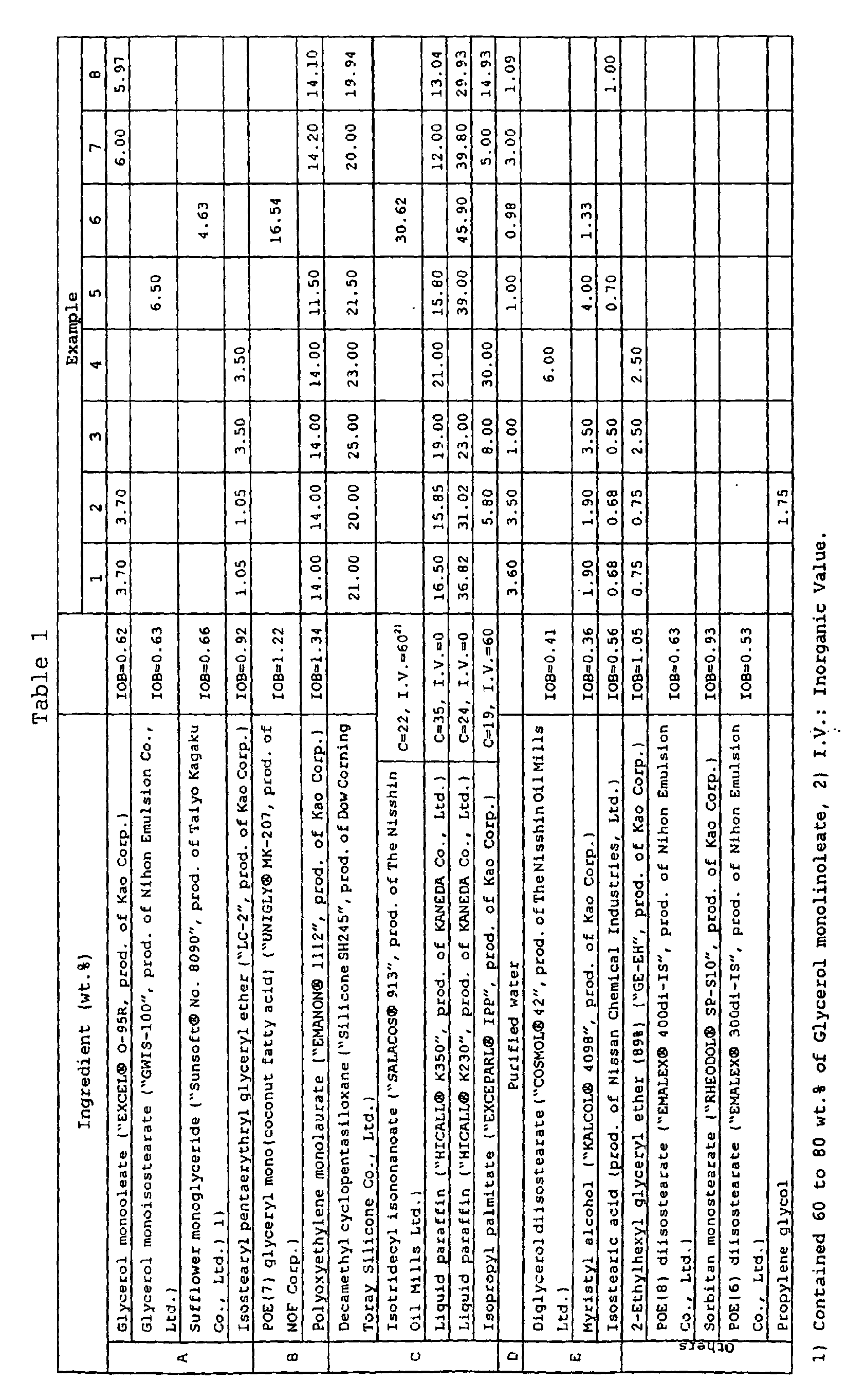
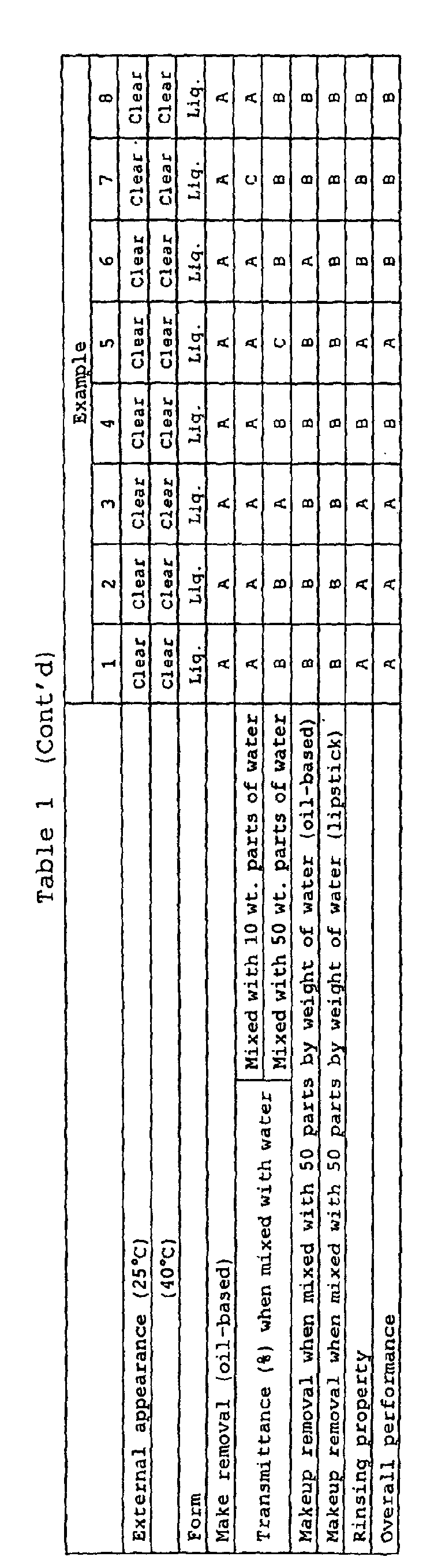
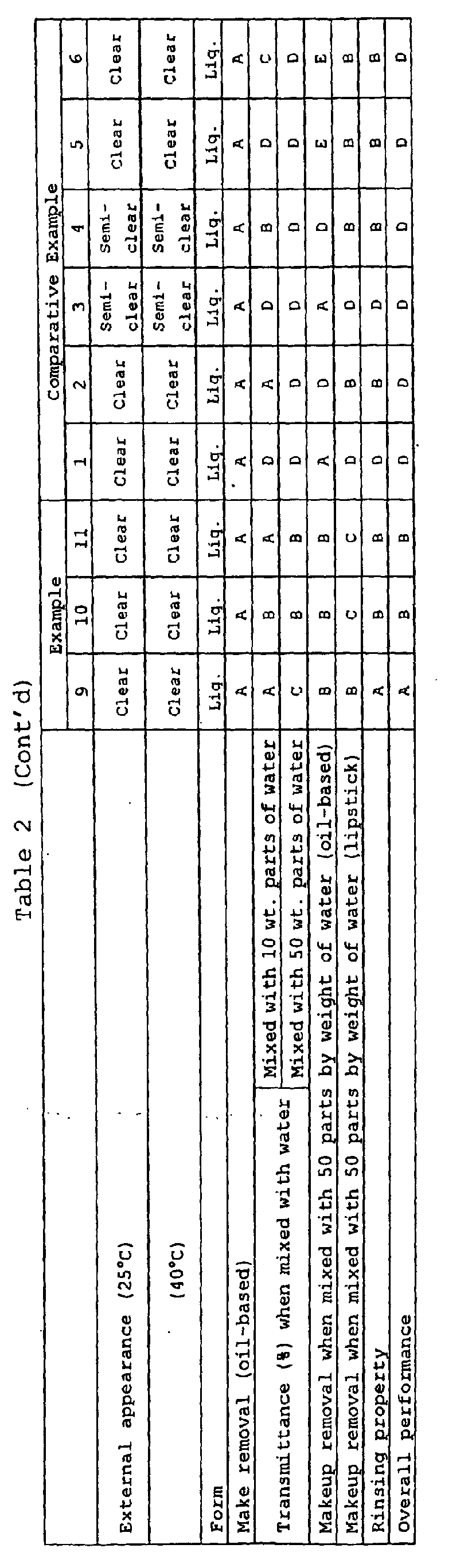
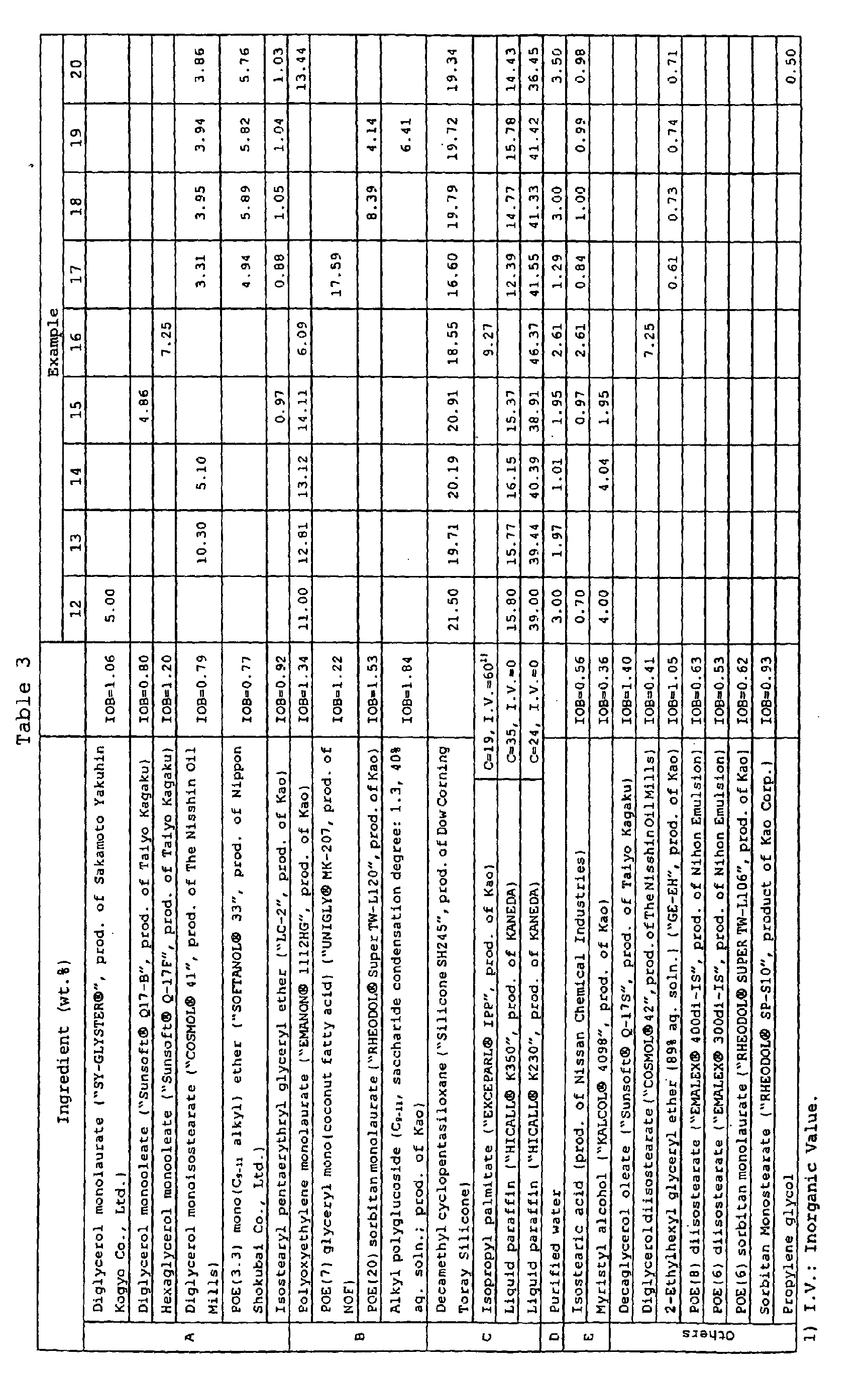
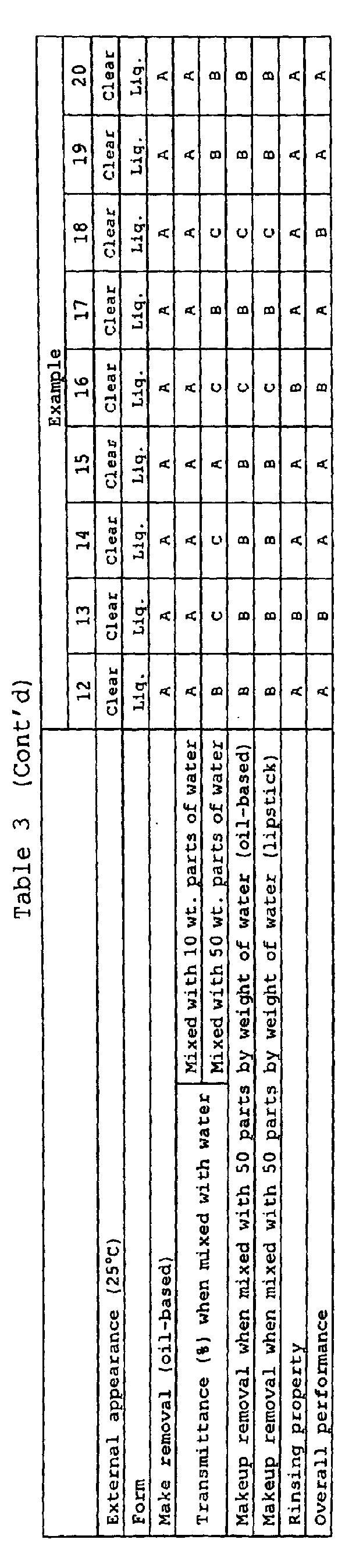
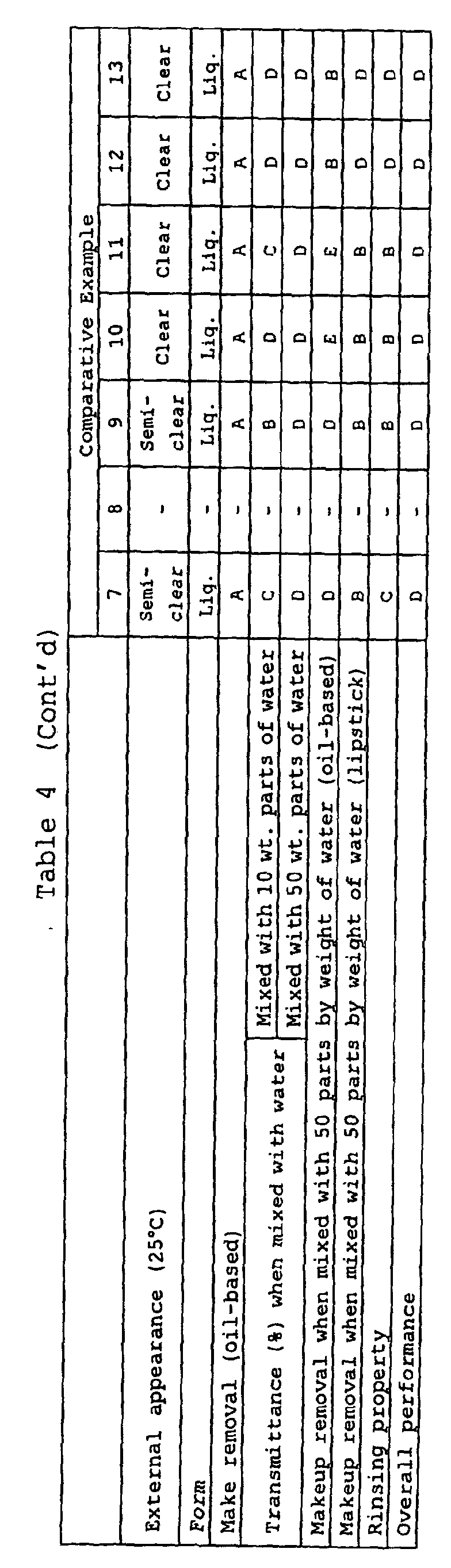
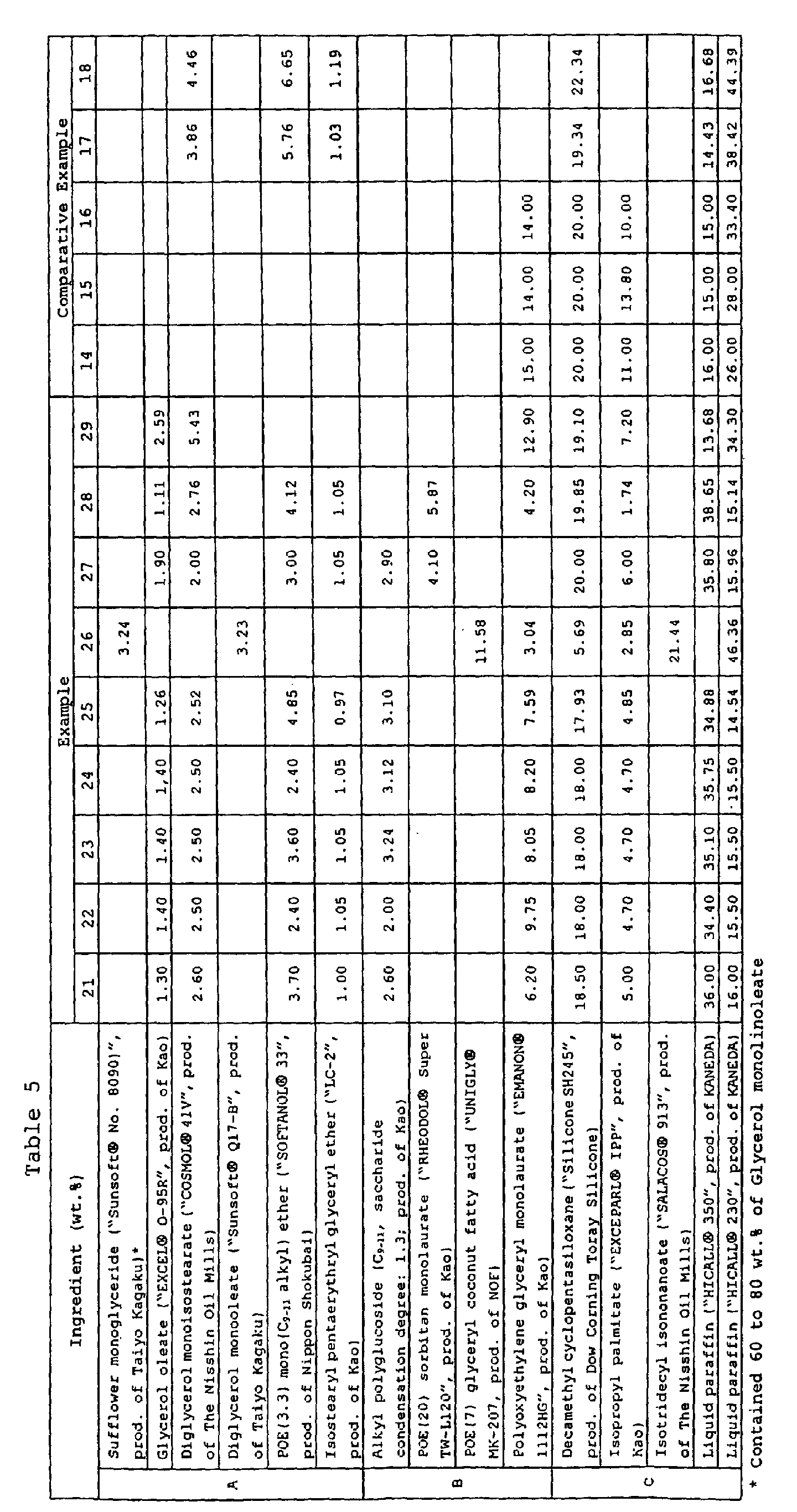
- Cleansing preparations of the formulations presented in Table 1 to Table 6 were produced, and the resultant cleansing preparations were ranked in external appearance, form, makeup removal, transmittance andmakeup removal whenmixedwithwater, rinsing property, and overall performance. The results are presented in Table 1 to Table 6.
- Each cleansing preparation was produced by completely dissolving with heating the ingredients (A) and (E) and other ingredients in the ingredient (C), adding the ingredients (B) and (D), and then stirring them into a uniform mixture.
- a transmittance of each cleansing preparation was measured at 25°C and/or 40°C and a wavelength of 530 nm by a turbidity meter (digital colorimeter "mini photo® 5"; equipped with a glass cell of 10 mm in diameter; manufactured by Sanshin Kogyo Co., Ltd.) while using purified water as a reference.
- a turbidity meter digital colorimeter "mini photo® 5"; equipped with a glass cell of 10 mm in diameter; manufactured by Sanshin Kogyo Co., Ltd.
- the transmittance was determined to indicate "clear” when it was higher than the transmittance of a 0.001 wt.% aqueous suspension of titanium oxide, while the transmittance was determined to indicate "semi-clear" when it was lower than the transmittance of the 0.001 wt.% aqueous suspension of titanium oxide but was higher than the transmittance of a 0.02 wt.% aqueous suspension of titanium oxide.
- Each cleansing preparation was determined to be "liquid” when its viscosity as measured at 25°C by a Brookfield rotational viscometer (Rotor No. 2, 30 rpm) was 1,000 mPa ⁇ s or lower.
- Amascara (“DialMascara®", product of MAYBELLINE LLC) was applied thinly over areas of 1.5 cm in diameter on the forearm, and was left for 3 hours to dryness. About 25 mg of the cleansing preparations (or their mixtures with 50 parts by weight of water) were placed on the areas, respectively, and each area was lightly massaged 30 times with a finger. The area was then rinsed with running water, and the result was visually observed as to how much of the mascara stays at each of the areas. The observation results were ranked in accordance with the below-described standards.
- a lipstick (“AUBE Rouge Livelish® RS415", product of Kao Corporation) was applied thinly over areas of 1.5 cm in diameter on the forearm, and was left for 3 hours to dryness. About 25 mg of the cleansing preparations (or their mixtures with 50 parts by weight of water) were placed on the areas, respectively, and each area was lightly massaged 30 times with a finger. The area was then rinsed with running water, and the result was visually observed as to how much of the lipstick stays at each of the areas. The observation results were ranked in accordance with the following standards.
- each cleansing preparation it was mixed with 10 parts by weight or 50 parts by weight of water to obtain a sample. Its transmittance was measured at a wavelength of 530 nm by a turbidity meter (digital colorimeter "mini photo® 5"; equippedwitha glass cell of 10 mm in diameter; manufactured by Sanshin Kogyo Co., Ltd.) while using purified water as a reference. The transmittance was compared with the transmittances of aqueous suspensions of titanium oxide ("Titanium Oxide JA-C", particle size: 0.1 to 0.5 ⁇ m or so; product of Tayca Corporation) , and ranked in accordance with the following standards.
- titanium oxide titanium oxide
- each cleansing preparation it is preferred for each cleansing preparation to include, within a range of from 25 to 35°C that corresponds to an environment on the palm and face, a range in which the cleaning preparation does not get turbid even when water is mixed in as much as 50 wt.% of the own weight of the cleansing preparation.
- Each measurement was conducted shortly after adjusting the temperature of a mixture, which hadbeen obtained by combining 10 parts by weight or 50 parts by weight of purified water with 100 parts by weight of the relevant cleaning preparation, to from 28 to 30°C and then stirring the mixture into a uniform mixture.
- each cleansing preparation was ranked when it was applied as much as about 2 g to the forearm and then washed away with tepid water.
- Each cleaning preparation was used and ranked by ten expert panelists. Firstly, a lipstick and an oil-based mascara were applied to the face, and were then left for about 3 hours to dryness. About 2 g of the cleansing preparation was dispensed onto a hand from which water had been gently swished off after soaking it well with water once. The cleansing preparation was spread over the entire face while looking at herself in a mirror. After the cleansing preparation was interfused with the makeup, it was washed away with tepid water. Overall ranking of the appearance, makeup removal and rinsing property was conducted in accordance with the following standards.
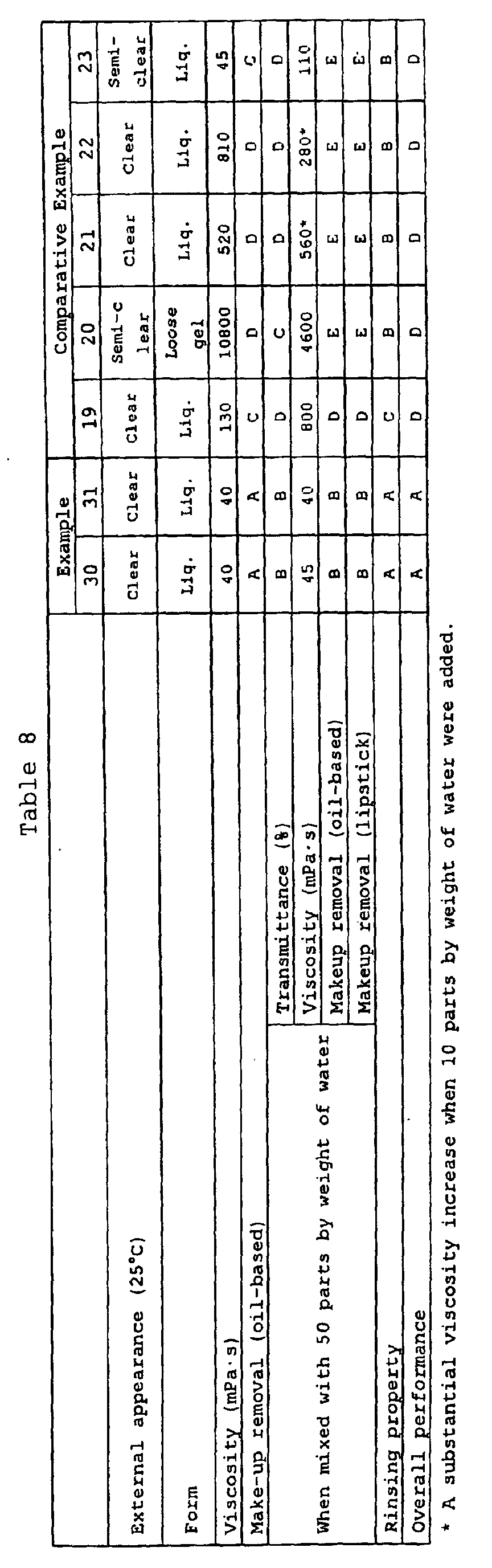
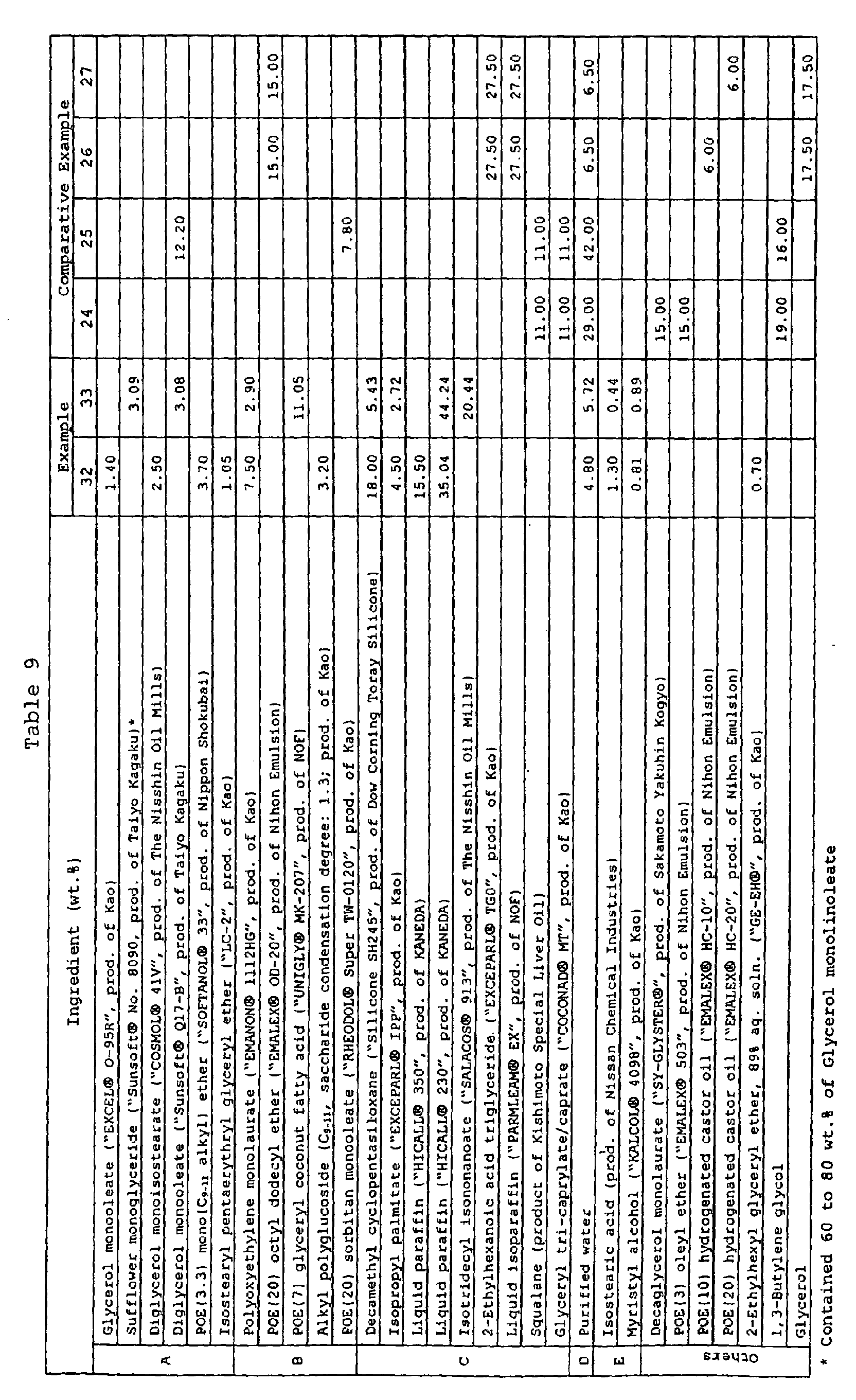
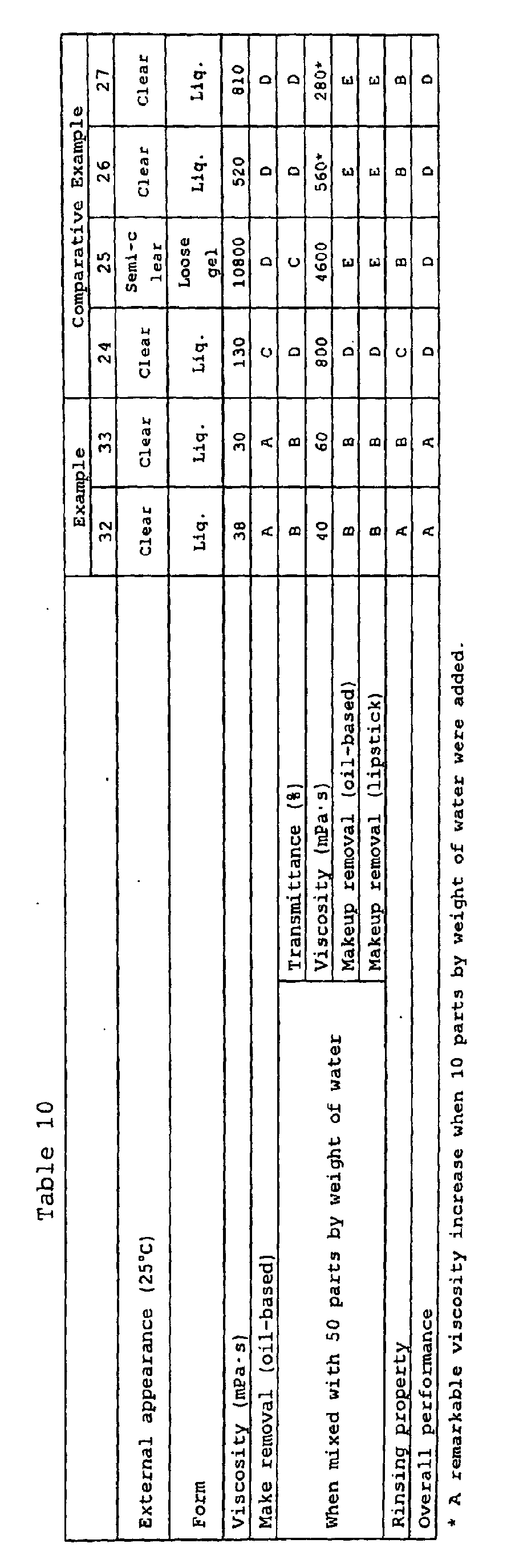
- Cleansing preparations of the formulations presented in Table 7 and Table 9 were produced as in Examples 1-29, and the resultant cleansing preparations were similarly ranked in external appearance, form, makeup removal, transmittance and makeup removal when mixed with water, rinsing property, and overall performance. Further, the viscosities of the cleansing preparations were measured by the below-described method. The results are presented in Table 8 and Table 10.
- the viscosity of each cleansing preparation was measured at 25°C by a Brookfield rotational viscometer (Rotor No. 2, 30 rpm). When the pointer shows a value over the highest limit , Rotor No. 3 or No. 4 was used as needed.
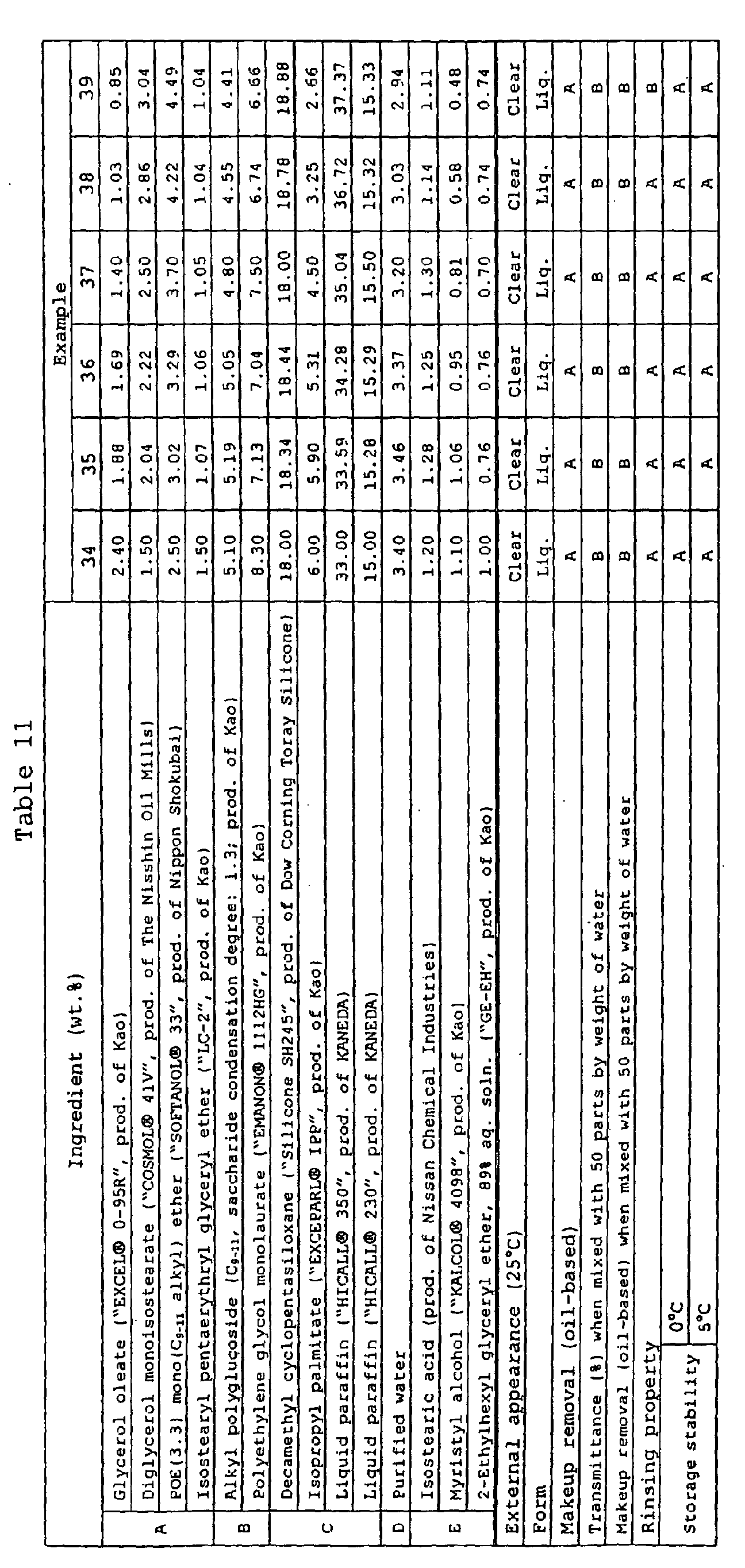
- Cleansing preparations of the formulations presented in Table 11 were produced as in Examples 1-29, and the resultant cleansing preparations were similarly ranked in external appearance, form, makeup removal, transmittance and make-up removal when mixed with water, rinsing property, and overall performance. Further, the cleansing preparations were measured on its storage stability by the below-describedmethod. The results are presented in Table 11.
- Each cleansing preparation (50 g) was stored at 0°C and 5°C. Its external appearance was visually ranked one week later, and its storage stability was indicated in accordance with the following standards.
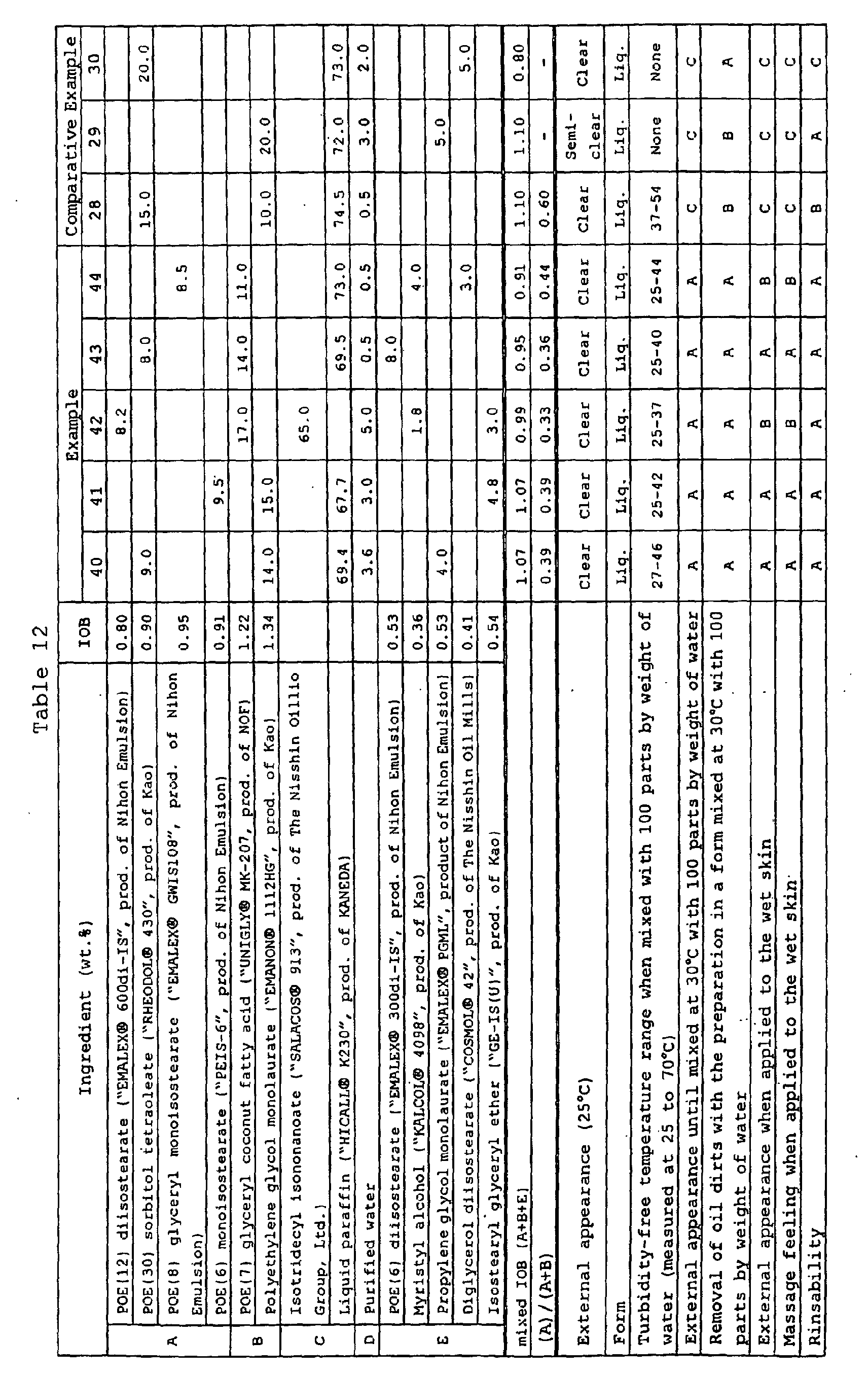
- Cleansing preparations of the formulations presented in Table 12 and Table 13 were produced as in Examples 1-29.
- the resultant cleansing preparations were similarly ranked in external appearance and form as in Examples 1-29, and in addition, they were also ranked in a temperature range in which no turbidity took place even when mixed with water, external appearance and removal of oily dirts when mixed with water, external appearance and massage property when applied to the wet skin, and rinsability.
- the results are also presented in Table 12 and Table 13.
- Turbidity-free temperature range 25 to 70°C in a form mixed with 100 parts by weight of water
- the transmittance was measured at a wavelength of 530 nm by a turbiditymeter (digital colorimeter "mini photo® 5"; equipped with a glass cell of 10 mm in diameter; manufactured by Sanshin Kogyo Co., Ltd.) in the course of addition of water, whereby 10 parts each by weight of water was added stepwise, up to 100 parts by weight in total of 100 parts by weight of the preparation, while using purified water as a reference.
- the transmittance was ranked in accordance with the below-described standards by comparing it with the transmittance of an aqueous suspension of titanium oxide ("Titanium Oxide JA-C", particle size: 0.1 to 0.5 ⁇ m or so; product of Tayca Corporation).
- a lipstick (“Lipfinity® Color Liquid Base”, product of Max Factor) was applied thinly over areas of 0.5 cm in diameter on the forearm, and was left for 15 minutes to dryness. About 25 mg of the cleansing preparations were placed on the areas, respectively, and each area was lightly massaged 30 times with a finger. The area was then rinsed with running water, and the result was visually observed as to how much of the lipstick was remaining at each of the areas. The observation results were ranked in accordance with the following standards.
- the preparation (2 g) was dispensed on the palms from which water had not been swished off subsequent to soaking of the palms with tepid water of about 36°C.
- the preparation was spread well by rubbing both hands together. Ranking was then performed as to the external appearance of the preparation spread over the palms.
- the preparation (2 g) was dispensed on the palms from which water had not been swished off subsequent to soaking of the palms with water.
- the preparation was spread well by rubbing both hands together. Organoleptic ranking was then performed as to slide feeling.
- the preparation (2 g) was dispensed on the palms from which water had not been swished off subsequent to soaking of the palms withwater.
- the preparation was spreadover the forearm.
- ranking was performed as to its rinsability and the feeling of the skin after it was washed away.
- the cleansing preparation according to the present invention presents a clear and beautiful liquid form, and even when water is mixed in, retains a solubilized form and remains free of turbidity during use, and assures good sensation upon application without any reduction in cleansing power. Therefore, it can be applied to the wet skin, and is suited especially for use in the bath room.
Landscapes
- Health & Medical Sciences (AREA)
- Life Sciences & Earth Sciences (AREA)
- General Health & Medical Sciences (AREA)
- Veterinary Medicine (AREA)
- Public Health (AREA)
- Animal Behavior & Ethology (AREA)
- Epidemiology (AREA)
- Birds (AREA)
- Emergency Medicine (AREA)
- Chemical & Material Sciences (AREA)
- Engineering & Computer Science (AREA)
- Chemical Kinetics & Catalysis (AREA)
- Oil, Petroleum & Natural Gas (AREA)
- Wood Science & Technology (AREA)
- Organic Chemistry (AREA)
- Dermatology (AREA)
- Cosmetics (AREA)
Abstract
Description
- A:
- Makeup removal was good with quick lifting.
- B:
- Makeup removal was good.
- C:
- Makeup removal was fair.
- D:
- Makeup removal was relatively poor.
- E:
- Makeup removal was poor.
- A:
- Higher than the transmittance of the 0.001 wt.% aqueous suspension of titanium oxide.
- B:
- Higher than the transmittance of the 0.008 wt.% aqueous suspension of titanium oxide, but lower than the transmittance of the 0.001 wt.% aqueous suspension of titanium oxide.
- C:
- Higher than the transmittance of the 0.02 wt. % aqueous suspension of titanium oxide, but lower than the transmittance of the 0.008 wt.% aqueous suspension of titanium oxide.
- D:
- Lower than the transmittance of the 0.02 wt.% aqueous suspension of titanium oxide.
- A:
- Easily washed away, and no slimy feeling remained.
- B:
- Easily washed away.
- C:
- Hardly washed away.
- D:
- Oil remained on the skin despite its removal was attempted for a long time, and unable to wash it away.
- A:
- Eight or more out of 10 answered "good".
- B:
- Six to seven out of 10 answered "good".
- C:
- Four to five out of 10 answered "good".
- D:
- Three or fewer out of 10 answered "good".




- A:
- Clear without any precipitate.
- B:
- A precipitate is settled, or the whole cleansing preparation is turbid by a precipitate.
- A:
- Constantly higher than the transmittance of a 0.02 wt.% aqueous suspension of titanium oxide in the course of mixing of water up to 100 parts by weight.
- B:
- Became lower than the transmittance of a 0.02 wt.% aqueous suspension of titanium oxide in the course of mixing with 50 to 100 parts by weight of water.
- C:
- Became lower than the transmittance of a 0.02 wt.% aqueous suspension of titanium oxide in the course of mixing with 10 to 40 parts by weight of water.
- A:
- Good removal of the lipstick
- B:
- Poor removal of the makeup
- A:
- The palms did not become white.
- B:
- The palms looked white at some area.
- C:
- The palms looked white in their entirety.
- A:
- Smoothly slid well with good massage property.
- B:
- Smoothly slid with good massage property.
- C:
- Slide feeling was weak as sliding was too heavy or too light, and massage property was poor.
- A:
- Rinsed clean and refreshed.
- B:
- Easily rinsable, but not refreshed.
- C:
- A slimy touch remained on the skin even after rinsed for a long time, and hence, the preparation was hardly rinsable.

Claims (11)
- A clear liquid cleansing preparation comprising the following ingredients (A) to (D):(A) at least one nonionic surfactant selected from:(a) a monoglycerol fatty acid ester having a C12-18 fatty acid residue,(b) a polyglycerol fatty acid ester having a C12-18 fatty acid residue,(c) isostearyl pentaerythryl glyceryl ether, or(d) a liquid nonionic surfactant having polyalkylene glycol chains and exhibiting IOB value of from 0.75 to 1.05,(B) a nonionic surfactant other than the first-mentioned nonionic surfactant (A), and exhibiting IOB value of at least 1.1,(C) a liquid oil ingredient, and(D) at most 12 wt.% of water,
wherein said preparation is free of white turbidity when 50 parts by weight of water is added to 100 parts by.weight of said preparation. - The cleansing preparation according to claim 1, wherein said nonionic surfactant (B) is at least one nonionic surfactant selected from a polyoxyethylene mono fatty acid ester, a polyoxyethylene glycerol fatty acid ester, a polyoxyethylene glyceryl mono fatty acid ester, an alkyl glucoside or a polyoxyethylene sorbitan fatty acid ester.
- The cleansing preparation according to claim 1 or 2, which comprises from 1 to 15 wt.% of said ingredient (A) and from 5 to 30 wt.% of said ingredient (B).
- The cleansing preparation according to any one of claims 1-3, which comprises from 50 to 85wt. % of said ingredient (C).
- The cleansing preparation according to any one of claims 1-4, further comprising the following ingredient (E):(E) a nonionic surfactant, higher alcohol, higher fatty acid or glycerol derivative, each having IOB value not greater than 0.6.
- The cleansing preparation according to any one of claims 1-5, wherein said monoglycerol fatty acid ester (a) in said ingredient (A) is selected from glycerol monooleate, glycerol monolinoleate or glycerol monoisostearate.
- The cleansing preparation according to any one of claims 1-6, wherein said polyglycerol fatty acid ester (b) in said ingredient (A) is an ester of a C12-18 fatty acid with a polyglycerol having a polymerization degree of from 2 to 6.
- The cleansing preparation according to any one of claims 1-7, which comprises, as said ingredient (A), said monoglycerol fatty acid ester (a) and said polyglycerol fatty acid ester (b) in a range of from 20 : 80 to 80:20 (weight ratio) .
- The cleansing preparation according to any one of claims 1-8, wherein said liquid nonionic surfactant (d) in said ingredient (A) is selected from a polyoxyethylene fatty acid ester, a polyoxyethylene alkyl ether, a fatty acid polyoxyethylene alkyl ether, a polyoxyethylene sorbitan fatty acid ester, a polyoxyethylene sorbitol fatty acid ester, a polyoxyethylene glycerol fatty acid ester, a polyoxyethylene hydrogenated castor oil, or a polyoxyethylene-polyoxypropylene alkyl ether.
- The cleansing preparation according to any one of claims 1-9, wherein a temperature at which said preparation takes a clear or semi-clear form when up to 100 parts by weight of water is added to and mixed with 100 parts by weight of said preparation lies within a range of from 28 to 32°C.
- A cleansing preparation comprising:wherein a temperature at which said preparation takes a clear or semi-clear form when up to 100 parts by weight of water is added to and mixed with 100 parts by weight of said preparation lies within a range of from 28 to 32°C.(d) a liquid nonionic surfactant having a polyalkylene glycol chain and IOB value of from 0.75 to 1.05,(B) a nonionic surfactant having IOB value of at least 1.1,(C) a liquid oil ingredient,(D) at most 12 wt.% of water, and(E) a nonionic surfactant, higher alcohol, higher fatty acid or glycerol derivative, each having IOB value of 0.6 or lower,
Applications Claiming Priority (13)
| Application Number | Priority Date | Filing Date | Title |
|---|---|---|---|
| JP2002085194 | 2002-03-26 | ||
| JP2002085194 | 2002-03-26 | ||
| JP2002128364 | 2002-04-30 | ||
| JP2002128364 | 2002-04-30 | ||
| JP2002234763A JP3964760B2 (en) | 2002-08-12 | 2002-08-12 | Cleansing cosmetics |
| JP2002234763 | 2002-08-12 | ||
| JP2002366766A JP3532910B2 (en) | 2002-03-26 | 2002-12-18 | Cleansing cosmetics |
| JP2002366767A JP3586682B2 (en) | 2002-04-30 | 2002-12-18 | Cleansing cosmetics |
| JP2002366766 | 2002-12-18 | ||
| JP2002366767 | 2002-12-18 | ||
| JP2003032078A JP4373103B2 (en) | 2003-02-10 | 2003-02-10 | Transparent liquid oily composition |
| JP2003032078 | 2003-02-10 | ||
| PCT/JP2003/003412 WO2003080004A1 (en) | 2002-03-26 | 2003-03-20 | Cleansing preparation |
Publications (3)
| Publication Number | Publication Date |
|---|---|
| EP1488775A1 true EP1488775A1 (en) | 2004-12-22 |
| EP1488775A4 EP1488775A4 (en) | 2008-06-11 |
| EP1488775B1 EP1488775B1 (en) | 2012-04-25 |
Family
ID=28458045
Family Applications (1)
| Application Number | Title | Priority Date | Filing Date |
|---|---|---|---|
| EP03715385A Expired - Lifetime EP1488775B1 (en) | 2002-03-26 | 2003-03-20 | Cleansing preparation |
Country Status (7)
| Country | Link |
|---|---|
| US (1) | US20050180942A1 (en) |
| EP (1) | EP1488775B1 (en) |
| KR (1) | KR100978433B1 (en) |
| CN (1) | CN100381112C (en) |
| AU (1) | AU2003227189A1 (en) |
| TW (1) | TWI348380B (en) |
| WO (1) | WO2003080004A1 (en) |
Cited By (6)
| Publication number | Priority date | Publication date | Assignee | Title |
|---|---|---|---|---|
| WO2008052956A1 (en) * | 2006-11-04 | 2008-05-08 | Unilever Plc | Make-up remover cosmetic compositions |
| WO2010019727A1 (en) * | 2008-08-15 | 2010-02-18 | The Procter & Gamble Company | Benefit compositions comprising polyglycerol esters |
| US7879779B2 (en) * | 2004-01-09 | 2011-02-01 | Shiseido Co., Ltd. | Oil-cleansing composition |
| WO2011098311A1 (en) * | 2010-02-12 | 2011-08-18 | Evonik Goldschmidt Gmbh | Cosmetic composition containing polyglycerol partial ester |
| WO2016131687A1 (en) * | 2015-02-19 | 2016-08-25 | Unilever Plc | Fast rinsing cleansing composition |
| WO2018034664A1 (en) * | 2016-08-18 | 2018-02-22 | The Procter & Gamble Company | Fabric care composition comprising glyceride copolymers |
Families Citing this family (25)
| Publication number | Priority date | Publication date | Assignee | Title |
|---|---|---|---|---|
| JP4145238B2 (en) * | 2003-12-04 | 2008-09-03 | 太陽化学株式会社 | Polyglycerin medium chain fatty acid ester-containing composition |
| JP4719575B2 (en) * | 2006-01-13 | 2011-07-06 | 花王株式会社 | Hair cosmetic and method for producing the same |
| JP4602999B2 (en) * | 2007-01-29 | 2010-12-22 | 花王株式会社 | Cleansing composition |
| JP5368021B2 (en) * | 2008-07-16 | 2013-12-18 | 株式会社ダイセル | Cleansing cosmetics |
| JP2010090111A (en) * | 2008-09-10 | 2010-04-22 | L'oreal Sa | Cleansing composition |
| JP5368035B2 (en) * | 2008-09-10 | 2013-12-18 | 株式会社ダイセル | Oil composition and cleansing cosmetics comprising the oil composition |
| JP4993793B2 (en) * | 2009-03-19 | 2012-08-08 | 株式会社 資生堂 | Solvent composition for diverting makeup cosmetics |
| KR20140015499A (en) * | 2011-05-18 | 2014-02-06 | 가부시끼가이샤 다이셀 | Oil composition for cosmetic material |
| WO2013005422A1 (en) | 2011-07-04 | 2013-01-10 | 花王株式会社 | Skin cleansing agent composition |
| DE102012200402A1 (en) * | 2012-01-12 | 2013-07-18 | Henkel Ag & Co. Kgaa | Detergents and cleaners containing glycerol esters |
| CN104302751A (en) * | 2012-04-23 | 2015-01-21 | 巴斯夫欧洲公司 | Tear free baby cleanser |
| JP5998000B2 (en) * | 2012-09-30 | 2016-09-28 | ユニ・チャーム株式会社 | Nonwoven fabric and absorbent article |
| JP6560194B2 (en) * | 2014-04-11 | 2019-08-14 | 花王株式会社 | Skin cleanser composition |
| JP6540101B2 (en) * | 2014-04-17 | 2019-07-10 | 日油株式会社 | Cleansing fee |
| AU2015337532A1 (en) | 2014-10-31 | 2017-04-20 | Shiseido Company, Ltd. | Oil-in-water emulsified sunblock cosmetic |
| MX2017010934A (en) | 2015-02-25 | 2018-01-23 | Procter & Gamble | Fibrous structures comprising a surface softening composition. |
| EP3320143B1 (en) | 2015-07-10 | 2019-11-13 | The Procter and Gamble Company | Fabric care composition comprising metathesized unsaturated polyol esters |
| JP6684648B2 (en) * | 2016-05-17 | 2020-04-22 | 株式会社ファンケル | Oily cleansing cosmetics |
| US10894932B2 (en) | 2016-08-18 | 2021-01-19 | The Procter & Gamble Company | Fabric care composition comprising glyceride copolymers |
| CN106580745B (en) * | 2016-11-29 | 2018-06-29 | 广州市禾基生物科技有限公司 | A kind of composition of solubilising animal fat and its application and cosmetics prepared therefrom |
| JP7222897B2 (en) * | 2017-09-13 | 2023-02-15 | 株式会社 資生堂 | oily detergent |
| WO2019204016A1 (en) * | 2018-04-16 | 2019-10-24 | Lonza Inc. | Cleaning concentrate composition |
| JP6758663B2 (en) * | 2018-08-18 | 2020-09-23 | ジェイオーコスメティックス株式会社 | Oily solid cleansing cosmetics |
| EP3878934A4 (en) | 2018-11-09 | 2022-06-29 | Shiseido Company, Ltd. | Transparent liquid composition |
| US12140539B2 (en) * | 2019-11-29 | 2024-11-12 | Conopco, Inc. | Method for determining rinse properties |
Family Cites Families (14)
| Publication number | Priority date | Publication date | Assignee | Title |
|---|---|---|---|---|
| JP2977568B2 (en) * | 1989-11-17 | 1999-11-15 | 鐘紡株式会社 | Cleansing cosmetics |
| JPH045213A (en) * | 1990-04-23 | 1992-01-09 | Kao Corp | Cleansing composition |
| JP2935904B2 (en) * | 1990-12-25 | 1999-08-16 | 株式会社コーセー | Transparent gel composition |
| JPH06219923A (en) * | 1993-01-26 | 1994-08-09 | Nippon Zetotsuku Kk | Transparent liquid composition |
| CA2168543A1 (en) * | 1993-07-03 | 1995-02-09 | George Endel Deckner | Personal cleansing compositions |
| JPH0840827A (en) * | 1994-08-03 | 1996-02-13 | Pola Chem Ind Inc | Gel cleansing agent |
| EP0758641B1 (en) * | 1995-08-11 | 2000-08-30 | Daicel Chemical Industries, Ltd. | A fatty acid esters composition of a polyglycerine, a process for the preparation thereof, a process for the preparation of a highly-purified fatty acid esters composition of a polyglycerine, a highly-purified fatty acid esters composition of a polyglycerine, an additive for food-stuffs, a resin composition, and a composition for cosmetics or detergents |
| JP3559675B2 (en) * | 1997-03-14 | 2004-09-02 | ポーラ化成工業株式会社 | Cosmetics |
| JP3545574B2 (en) * | 1997-07-17 | 2004-07-21 | 株式会社資生堂 | Liquid oily skin cleanser |
| JP3684874B2 (en) * | 1998-10-30 | 2005-08-17 | 味の素株式会社 | Cleansing cosmetics |
| JP4570705B2 (en) * | 1999-03-04 | 2010-10-27 | 株式会社資生堂 | Makeup removal cosmetic |
| AU2001276913B2 (en) * | 2000-07-14 | 2005-09-01 | Johnson And Johnson Consumer Companies, Inc. | Self foaming cleansing gel |
| JP5057611B2 (en) * | 2001-02-15 | 2012-10-24 | 株式会社 資生堂 | Oil cleansing cosmetic |
| JP2003012456A (en) * | 2001-07-06 | 2003-01-15 | Sakamoto Yakuhin Kogyo Co Ltd | Cleansing preparation |
-
2003
- 2003-03-20 KR KR1020047015137A patent/KR100978433B1/en not_active Expired - Fee Related
- 2003-03-20 WO PCT/JP2003/003412 patent/WO2003080004A1/en not_active Ceased
- 2003-03-20 CN CNB038069016A patent/CN100381112C/en not_active Expired - Lifetime
- 2003-03-20 EP EP03715385A patent/EP1488775B1/en not_active Expired - Lifetime
- 2003-03-20 AU AU2003227189A patent/AU2003227189A1/en not_active Abandoned
- 2003-03-20 US US10/508,013 patent/US20050180942A1/en not_active Abandoned
- 2003-03-26 TW TW092106759A patent/TWI348380B/en not_active IP Right Cessation
Cited By (13)
| Publication number | Priority date | Publication date | Assignee | Title |
|---|---|---|---|---|
| US7879779B2 (en) * | 2004-01-09 | 2011-02-01 | Shiseido Co., Ltd. | Oil-cleansing composition |
| WO2008052956A1 (en) * | 2006-11-04 | 2008-05-08 | Unilever Plc | Make-up remover cosmetic compositions |
| US8466100B2 (en) | 2008-08-15 | 2013-06-18 | The Procter & Gamble Company | Benefit compositions comprising polyglycerol esters |
| WO2010019727A1 (en) * | 2008-08-15 | 2010-02-18 | The Procter & Gamble Company | Benefit compositions comprising polyglycerol esters |
| WO2011098311A1 (en) * | 2010-02-12 | 2011-08-18 | Evonik Goldschmidt Gmbh | Cosmetic composition containing polyglycerol partial ester |
| CN102781417A (en) * | 2010-02-12 | 2012-11-14 | 赢创高施米特有限公司 | Cosmetic composition containing polyglycerol partial ester |
| EP2359802A1 (en) * | 2010-02-12 | 2011-08-24 | Evonik Goldschmidt GmbH | Cosmetic composition containing polyglycerol partial ester |
| US8703159B2 (en) | 2010-02-12 | 2014-04-22 | Evonik Goldschmidt Gmbh | Cosmetic composition containing polyglycerol partial ester |
| CN102781417B (en) * | 2010-02-12 | 2017-06-20 | 赢创德固赛有限公司 | Cosmetic composition comprising polyglycerol partial ester |
| WO2016131687A1 (en) * | 2015-02-19 | 2016-08-25 | Unilever Plc | Fast rinsing cleansing composition |
| CN107427445A (en) * | 2015-02-19 | 2017-12-01 | 荷兰联合利华有限公司 | The Cleasing compositions got express developed |
| US10751271B2 (en) | 2015-02-19 | 2020-08-25 | Conopco, Inc. | Fast rinsing cleansing composition |
| WO2018034664A1 (en) * | 2016-08-18 | 2018-02-22 | The Procter & Gamble Company | Fabric care composition comprising glyceride copolymers |
Also Published As
| Publication number | Publication date |
|---|---|
| EP1488775A4 (en) | 2008-06-11 |
| KR100978433B1 (en) | 2010-08-26 |
| CN100381112C (en) | 2008-04-16 |
| US20050180942A1 (en) | 2005-08-18 |
| WO2003080004A1 (en) | 2003-10-02 |
| AU2003227189A1 (en) | 2003-10-08 |
| EP1488775B1 (en) | 2012-04-25 |
| TW200306210A (en) | 2003-11-16 |
| TWI348380B (en) | 2011-09-11 |
| KR20040101360A (en) | 2004-12-02 |
| CN1642519A (en) | 2005-07-20 |
Similar Documents
| Publication | Publication Date | Title |
|---|---|---|
| EP1488775B1 (en) | Cleansing preparation | |
| EP1952795B1 (en) | Cleansing composition | |
| CN101234070B (en) | Cleansing composition | |
| JPH0616524A (en) | Cleansing composition | |
| KR102694014B1 (en) | Cosmetic Composition Containing Water-Soluble Surfactant and Oil-Soluble Surfactant for Removing Make-Up Cosmetics | |
| JP6456612B2 (en) | Skin cleanser composition | |
| EP2438902B1 (en) | Cleansing method | |
| EP1952794B1 (en) | Cleansing composition | |
| JP4373103B2 (en) | Transparent liquid oily composition | |
| JP3964760B2 (en) | Cleansing cosmetics | |
| JP3586682B2 (en) | Cleansing cosmetics | |
| JP6456613B2 (en) | Skin cleanser composition | |
| JP3532910B2 (en) | Cleansing cosmetics | |
| CN114983868A (en) | Composition and cleansing oil applying same | |
| JP2003055128A (en) | Transparent cosmetic composition | |
| JP2004115467A (en) | Cleansing method | |
| JP3881953B2 (en) | Liquid oily skin cleanser | |
| JP2004161631A (en) | Pore cleaning composition | |
| JP4034210B2 (en) | Liquid transparent skin cleanser | |
| JP6456825B2 (en) | Transparent cleansing composition | |
| KR102525475B1 (en) | Suspension-type cleansing cosmetic composition | |
| KR100777592B1 (en) | Washable Cleansing Cosmetic | |
| KR20050087061A (en) | Water-free typed wash-off cleansing cosmetics composition | |
| TW202432085A (en) | Detergent ingredients | |
| HK40031600A (en) | Cosmetic composition for makeup removal comprising water-soluble surfactant and oil-soluble surfactant |
Legal Events
| Date | Code | Title | Description |
|---|---|---|---|
| PUAI | Public reference made under article 153(3) epc to a published international application that has entered the european phase |
Free format text: ORIGINAL CODE: 0009012 |
|
| 17P | Request for examination filed |
Effective date: 20040924 |
|
| AK | Designated contracting states |
Kind code of ref document: A1 Designated state(s): AT BE BG CH CY CZ DE DK EE ES FI FR GB GR HU IE IT LI LU MC NL PT RO SE SI SK TR |
|
| AX | Request for extension of the european patent |
Extension state: AL LT LV MK |
|
| A4 | Supplementary search report drawn up and despatched |
Effective date: 20080515 |
|
| 17Q | First examination report despatched |
Effective date: 20090402 |
|
| REG | Reference to a national code |
Ref country code: DE Ref legal event code: R079 Ref document number: 60340722 Country of ref document: DE Free format text: PREVIOUS MAIN CLASS: A61K0007020000 Ipc: A61K0008310000 |
|
| GRAP | Despatch of communication of intention to grant a patent |
Free format text: ORIGINAL CODE: EPIDOSNIGR1 |
|
| RIC1 | Information provided on ipc code assigned before grant |
Ipc: A61K 8/86 20060101ALI20111018BHEP Ipc: A61K 8/39 20060101ALI20111018BHEP Ipc: A61K 8/31 20060101AFI20111018BHEP Ipc: C11D 3/18 20060101ALI20111018BHEP Ipc: A61Q 19/10 20060101ALI20111018BHEP Ipc: A61K 8/37 20060101ALI20111018BHEP Ipc: A61K 8/34 20060101ALI20111018BHEP Ipc: C11D 1/825 20060101ALI20111018BHEP |
|
| GRAS | Grant fee paid |
Free format text: ORIGINAL CODE: EPIDOSNIGR3 |
|
| GRAA | (expected) grant |
Free format text: ORIGINAL CODE: 0009210 |
|
| AK | Designated contracting states |
Kind code of ref document: B1 Designated state(s): DE FR GB |
|
| REG | Reference to a national code |
Ref country code: GB Ref legal event code: FG4D |
|
| REG | Reference to a national code |
Ref country code: DE Ref legal event code: R096 Ref document number: 60340722 Country of ref document: DE Effective date: 20120621 |
|
| PLBE | No opposition filed within time limit |
Free format text: ORIGINAL CODE: 0009261 |
|
| STAA | Information on the status of an ep patent application or granted ep patent |
Free format text: STATUS: NO OPPOSITION FILED WITHIN TIME LIMIT |
|
| 26N | No opposition filed |
Effective date: 20130128 |
|
| REG | Reference to a national code |
Ref country code: DE Ref legal event code: R097 Ref document number: 60340722 Country of ref document: DE Effective date: 20130128 |
|
| REG | Reference to a national code |
Ref country code: FR Ref legal event code: PLFP Year of fee payment: 13 |
|
| REG | Reference to a national code |
Ref country code: FR Ref legal event code: PLFP Year of fee payment: 14 |
|
| REG | Reference to a national code |
Ref country code: FR Ref legal event code: PLFP Year of fee payment: 15 |
|
| REG | Reference to a national code |
Ref country code: FR Ref legal event code: PLFP Year of fee payment: 16 |
|
| PGFP | Annual fee paid to national office [announced via postgrant information from national office to epo] |
Ref country code: DE Payment date: 20190305 Year of fee payment: 17 Ref country code: GB Payment date: 20190320 Year of fee payment: 17 |
|
| PGFP | Annual fee paid to national office [announced via postgrant information from national office to epo] |
Ref country code: FR Payment date: 20190213 Year of fee payment: 17 |
|
| REG | Reference to a national code |
Ref country code: DE Ref legal event code: R119 Ref document number: 60340722 Country of ref document: DE |
|
| PG25 | Lapsed in a contracting state [announced via postgrant information from national office to epo] |
Ref country code: DE Free format text: LAPSE BECAUSE OF NON-PAYMENT OF DUE FEES Effective date: 20201001 Ref country code: FR Free format text: LAPSE BECAUSE OF NON-PAYMENT OF DUE FEES Effective date: 20200331 |
|
| GBPC | Gb: european patent ceased through non-payment of renewal fee |
Effective date: 20200320 |
|
| PG25 | Lapsed in a contracting state [announced via postgrant information from national office to epo] |
Ref country code: GB Free format text: LAPSE BECAUSE OF NON-PAYMENT OF DUE FEES Effective date: 20200320 |