EP1486882A2 - Change-Point Erkennung - Google Patents
Change-Point Erkennung Download PDFInfo
- Publication number
- EP1486882A2 EP1486882A2 EP04013895A EP04013895A EP1486882A2 EP 1486882 A2 EP1486882 A2 EP 1486882A2 EP 04013895 A EP04013895 A EP 04013895A EP 04013895 A EP04013895 A EP 04013895A EP 1486882 A2 EP1486882 A2 EP 1486882A2
- Authority
- EP
- European Patent Office
- Prior art keywords
- time
- change
- point
- complexity
- series
- Prior art date
- Legal status (The legal status is an assumption and is not a legal conclusion. Google has not performed a legal analysis and makes no representation as to the accuracy of the status listed.)
- Withdrawn
Links
Images



Classifications
-
- G—PHYSICS
- G06—COMPUTING OR CALCULATING; COUNTING
- G06F—ELECTRIC DIGITAL DATA PROCESSING
- G06F17/00—Digital computing or data processing equipment or methods, specially adapted for specific functions
- G06F17/10—Complex mathematical operations
- G06F17/18—Complex mathematical operations for evaluating statistical data, e.g. average values, frequency distributions, probability functions, regression analysis
Definitions
- This invention relates to a change-point detection method, apparatus and program therefor. More particularly, the invention relates to a change-point detection apparatus, method and program whereby a point in time at which a sudden change occurs in time-series data can be detected.
- V. Guralnik and J. Stivastava An example of a change-point detection apparatus according to the prior art is described by V. Guralnik and J. Stivastava (see V. Guralnik and J. Stivastava, "Event Detection from Time Series Data", Proceedings of the Fifth ACM SIGKDD International Conference on Knowledge Discovery and Data Mining, pp. 33 - 42, ACM Press, 1999).
- the scheme according to V. Guralnik and J. Stivastava calculates the sum total of fitting errors in a case where curve fitting has been performed on the assumption that there are no change points and the sum total of fitting errors in a case where curve fitting has been performed separately before and after change-point candidates, and deciding that a change point has occurred if the difference between the sum totals exceeds a certain value.
- an object of the present invention is to provide a change-point detection apparatus and method and a program therefor whereby change-point detection is performed efficiently by calculating fitting and complexity corresponding to fitting error online with respect to time-series data, and change points can be detected effectively by performing model fitting in conformity with model discontinuity.
- a change-point detection apparatus for reading in time-series data sequentially as an input and detecting a change point which is a time point where the input time-series data changes suddenly while it is being read in, comprises: a time-series model learning unit (11) for learning parameters of a time-series model sequentially while the time-series data is read in; a storage device (14) for storing the parameters of the time-series model, which have been learned by the time-series model learning unit, and complexity as fitting error that results when the time-series model is fit to the input time-series data; a loss-function calculating unit (13) for reading parameters from the storage device and calculating loss of the time-series model with regard to each item of the input time-series data one at a time; a complexity calculating unit (12) for reading parameters and complexity from the storage device, calculating complexity of a partial series of the input time-series data sequentially while updating the same, and updating content stored in the storage device;
- a change-point detection apparatus for reading in time-series data sequentially as an input and detecting a change point which is a time point where the input time-series data changes suddenly while it is being read in, comprises: a time-series model learning unit (21) for learning parameters of a time-series model sequentially while the time-series data is being read in; a storage device (24) for storing the parameters of the time-series model, which have been learned by the time-series model learning means, and complexity as fitting error that results when the time-series model is fit to the input time-series data; a loss-function calculating unit (23) for reading parameters from the storage device and calculating loss of the time-series model with regard to each item of the input time-series data one at a time; a complexity calculating unit (22) for sequentially adding a loss value calculated by the loss-function calculating unit to complexity read in from the storage device, thereby calculating complexity as fitting error of the time-series model
- a change-point detection method for reading in time-series data sequentially as an input and detecting a change point which is a time point where the input time-series data changes suddenly while it is being read in comprises: a step of reading in time-series data sequentially; a step of learning parameters of a time-series model sequentially from the input time-series data; a loss-function calculating step of calculating loss of the time-series model with regard to each item of the input time-series data one at a time; a complexity calculating step of sequentially calculating complexity as fitting error that results when the time-series model is fit to the input time-series data; and a change-point searching step of calculating complexity with regard to time-series data before and after change-point candidates with respect to all change-point candidates of the input time-series data and comparing the sum of the complexities before and after the change-time candidates with complexity when a change point is assumed to be absent, thereby calculating change
- a change-point detection method for reading in time-series data sequentially as an input and detecting a change point which is a time point where the input time-series data changes suddenly while it is being read in comprises: a step of reading in time-series data sequentially; a step of learning parameters of a time-series model sequentially from the input time-series data; a loss-function calculating step of calculating loss of the time-series model with regard to each item of the input time-series data one at a time; a complexity calculating step of sequentially adding a loss value calculated at the loss-function calculating step, thereby calculating complexity as a fitting error that results when the time-series model is fit to a partial series of the input time-series data; and a change-point determination step of reading in, from a storage device, complexity with regard to time-series data before and after change-point candidates with respect to all change-point candidates of the input time-series data and comparing the
- a computer program for change-point detection for causing a computer to operate as: time-series model learning means for learning parameters of a time-series model sequentially while the time-series data is being read in; a storage device for storing parameters of the time-series model, which have been learned by the time-series model learning means, and complexity as fitting error that results when the time-series model is fit to the input time-series data; loss-function calculating means for reading in parameters from the storage device and calculating loss of the time-series model with regard to each item of the input time-series data one at a time; complexity calculating means for reading in parameters and complexity from the storage device, calculating complexity of a partial series of the input time-series data sequentially while updating the same, and updating content stored in the storage device; and change-point searching means for reading in complexity with regard to time-series data before and after change-point candidates from the storage device with respect to all change-point candidates of the input time-series data
- a computer program for change-point detection for causing a computer to operate as: time-series model learning means for learning parameters of a time-series model sequentially while the time-series data is being read in; a storage device for storing the parameters of the time-series model, which have been learned by the time-series model learning means, and complexity as fitting error that results when the time-series model is fit to the input time-series data; loss-function calculating means for reading in parameters from the storage device and calculating loss of the time-series model with regard to each item of the input time-series data one at a time; complexity calculating means for sequentially adding a loss value calculated by the loss-function calculating means to complexity read in from the storage device, thereby calculating complexity as fitting error that results when the time-series model is fit to a partial series of the input time-series data, and updating content stored in the storage device; and change-point determination means for reading in complexity with regard to time-series data before
- Fig. 1 is a block diagram illustrating the structure of a change-point detection apparatus according to a first embodiment of the present invention.
- the change-point detection apparatus comprises a time-series model learning unit 11, a complexity calculating unit 12, a loss-function calculating unit 13, a complexity and parameter storage device 14, and a change-point searching unit 15.
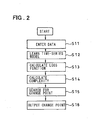
- Fig. 2 is a flowchart illustrating operation of the change-point detection apparatus shown in Fig. 1. The operation of the change-point detection apparatus will now be described.
- the time-series model learning unit 11 provides a parametric time-series model and updates parameters while time-series data is sequentially loaded.
- each item of data is n-dimensional, where n is a given positive integer, and that each element of the n-dimensional data takes on a real-number value.
- An auto-regression model (referred to as an "AR model” below), for instance, can be used as an example of the probability density function.
- ⁇ represents a parameter
- a k-order AR model where k is a given positive integer is a model decided by the past k-number of items of data and expressed by the following equation (2):
- x i w i + ⁇
- the change-point detection apparatus of the present invention is not limited to the AR model, and other time-series models may be used, examples of which are an auto-regression moving average (ARMA) model and a moving average (MA) model.
- ARMA auto-regression moving average
- MA moving average
- Fig. 3 is a block diagram illustrating in detail the structure of the time-series model learning unit 11.
- the time-series model learning unit 11 comprises a forgetting-type statistic calculation unit 101, a parameter updating unit 102 and a data, parameter and statistic storage device 103.
- Fig. 4 is a flowchart illustrating the operation of the time-series model learning unit 11 shown in Fig. 3.
- the time-series model learning unit 11 of Fig. 3 operates as follows:
- the time-series model learning unit 11 While sequentially reading in a data sequence, the time-series model learning unit 11 updates parameters sequentially based upon the data read. We write ⁇ (t) for a parameter value obtained as a result of learning using data from x 1 to x t .
- the parameter value ⁇ (t) can be updated. This will be outlined in the below.
- step S101 the value of each parameter that has been stored in the data, parameter and statistic storage device 103 is initialized before data is read in (step S101).
- step S102 When the data x t is input to the forgetting-type statistic calculation unit 101 and to the data, parameter and statistic storage device 103 (step S102), the data, parameter and statistic storage device 103 erases the oldest of the data stored therein, stores the latest data xt instead and obtains the data sequence x t , x t-1 , ⁇ , x t-k+1 .
- the parameter updating unit 102 sends the parameter value ⁇ to the data, parameter and statistic storage device 103, where the parameter value is stored.
- the time-series model learning unit 11 is a device for updating the estimated parameter value by adopting a forgetting parameter that takes on values of 0 to 1 as ⁇ , multiplying the past sufficient statistic by a factor of (1- ⁇ ), multiplying the new sufficient statistic by a factor of ⁇ and updating the sufficient statistic by a weighted mean.
- the time-series model learning unit 11 has the effect of gradually forgetting the influence of old data. If we write 1/t for the forgetting parameter ⁇ with regard to the t th item of data x t in the input data sequence, this will correspond to sequential execution of the usual maximum likelihood estimation.
- the parameter value ⁇ calculated by the time-series model learning unit 11 is supplied to the complexity and parameter storage device 14.
- the loss-function calculating unit 13 reads in the parameter value ⁇ (t-1) of the previous point in time from the time-series model learning unit 11 or complexity and parameter storage device 14 with respect to the input data x t at each time t and calculates loss as follows (step S 13): -logp[x t
- the loss value calculated has the meaning of a fitting error that is the result of fitting the time-series model to the data.
- the loss value is sent to the complexity calculating unit 12, which proceeds to calculate the following equations (14), (15) and (16) as complexities at each time r (step S14):
- This value also is calculated by the time-series model learning unit 11 and the result is supplied to and stored in the complexity and parameter storage device 14.
- the result of calculation by the complexity calculating unit 12 is supplied to the complexity and parameter storage device 14.
- the change-point score SCORE(r) represents the magnitude of the possibility that time point r is a change point.
- SC(x N ) calculated with the equation (14) is the predictive probabilistic complexity when the data sequence x N is described by a simple model, whereas the sum of SC(x r ) and SC (i-1) / r+1 respectively calculated with the equations (15) and (16) is the sum total of predictive probabilistic complexities when the model is fit discontinuously about the time point r as the boundary.
- the change-point searching unit 15 provides a certain threshold value ⁇ , searches time points at which the value of SCORE(r) exceeds the threshold value ⁇ for the largest value of SCORE(r), regards this time point r as a change point and outputs the same (step S 16).
- One change point can be found in the input data sequence x N with this method. Iteration of this method makes it possible to find a plurality of change points.
- code length is adopted as the loss function.
- expression (21) which is a quadratic loss function, can also be used, where x and t is adopted as a predicted value with respect to data x t as time point t: ( x t - x t ) 2
- Fig. 5 is a block diagram illustrating the structure of a change-point detection apparatus according to a second embodiment of the present invention.
- the change-point detection apparatus according to this embodiment comprises a time-series model learning unit 21, a complexity calculating unit 22, a loss-function calculating unit 23, a complexity and parameter storage device 24, and a change-point determination unit 25.
- the change-point detection apparatus reads in data sequentially and detects change points in a data sequence that has been read in the past.
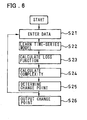
- Fig. 6 is a flowchart illustrating operation of the change-point detection apparatus according to the second embodiment.
- steps S21 to S24 basically is the same as that of steps S11 to S 14 in Fig. 2. Operation differs only in that (a) as data is input sequentially, the point in time at which calculation is started is the time at a change point detected last by the change-point determination unit 25, and (b) an end point is a time point t that changes and is not a fixed N.
- the time-series model learning unit 21 loads data prevailing at the present time point in order to estimate parameters (step S21), inputs the time of the change point detected last by the change-point determination unit 25, adopts this point as a starting point and sequentially calculates parameters up to the present point in time in a manner similar to that of the time-series model learning unit 11 (step S22).
- the value calculated is sent to and stored in the complexity and parameter storage device 24.
- the loss-function calculating unit 23 calculates the value of the loss function in a manner similar to that of the loss-function calculating unit 13 using the input data and the parameter value supplied from the complexity and parameter storage device 24, and sends the calculated value to the complexity calculating unit 22 (step S23).
- the complexity calculating unit 22 receives inputs from the loss-function calculating unit 23 and complexity and parameter storage device 24, adopts the time of the change point detected last by the complexity and parameter storage device 24 as an input, adopts this as a starting point, adopts the present point in time as an end point and calculates the value of complexity in a manner similar to that of the time-series model learning unit 11 (step S24).
- the change-point determination unit 25 searches for a change point over a range in which this time point is the starting point. That is, if we let v i represent the last detected change point in the past, then the change-point determination unit 25 calculates change-point SCORE (r;v i ,t) at time r (v i ⁇ r ⁇ t).
- step S25 if the score exceeds the predetermined threshold value ⁇ , taking into consideration the minimization relating to time r as expressed by the following expression (25), then it is decided that a change point has occurred at time r that gives the minimum value of the Score (r;v i ,t) (step S25) and this change point is output (step S26).
- the change-point determination unit 25 is capable of calculating Score (r;v i ,t) given by the equation (24) efficiently.
- the method of calculation will now be described.
- the calculation procedure, which is performed upon reading in one item of data, shall be referred to as one iteration.
- the time-series model is the AR model
- the value is obtained without using past data if the sufficient statistic also is stored at the same time as the estimation parameter value. In other words, it is unnecessary to store old data in advance.
- the search range of time point r to a value obtained by dividing by an integer I
- the number stored and the number updated can be reduced to 1/I.
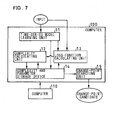
- Fig. 7 is a block diagram illustrating the structure of a change-point detection apparatus according to a third embodiment of the present invention.
- the change-point detection apparatus according to this embodiment differs only in that a change-point detection program 110 is added to a computer 100 that implements the change-point detection apparatus according to the first embodiment shown in Fig. 1. Accordingly, other components not specifically mentioned are designated by like reference characters and are not described again in detail.
- the change-point detection program 110 is read into the computer 100 and controls the computer 100 as the change-point detection apparatus comprising the time-series model learning unit 11, complexity calculating unit 12, loss-function calculating unit 13, complexity and parameter storage device 14 and change-point searching unit 15. Since the operation of the computer 100 under the control of the change-point detection program 110 is exactly the same as the operation of the change-point detection apparatus in the first embodiment, the operation need not be described in detail again.
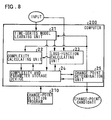
- Fig. 8 is a block diagram illustrating the structure of a change-point detection apparatus according to a fourth embodiment of the present invention.
- the change-point detection apparatus according to this embodiment differs only in that a change-point detection program 210 is added to a computer 200 that implements the change-point detection apparatus according to the second embodiment shown in Fig. 5. Accordingly, other components not specifically mentioned are designated by like reference characters and are not described again in detail.
- the change-point detection program 210 is read into the computer 200 and controls the computer 200 as the change-point detection apparatus comprising the time-series model learning unit 21, complexity calculating unit 22, loss-function calculating unit 23, complexity and parameter storage device 24 and change-point searching unit 25. Since the operation of the computer 200 under the control of the change-point detection program 210 is exactly the same as the operation of the change-point detection apparatus in the second embodiment, the operation need not be described in detail again.
- a first effect of the present invention is that fitting and fitting error can be calculated online and change-point detection can be performed efficiently.
- fitting error is calculated using as a criterion a predictive probabilistic complexity capable of being calculated sequentially, and a change point can be detected based upon the fitting error.
- a second effect of the present invention is that change points can be detected efficiently by performing model fitting in conformity with model discontinuity. The reason for this is that a change point is detected by fitting a different model before and after a change point, calculating the fitting error using predictive probabilistic complexity and comparing this error with fitting error of a model when it is assumed that no change point is present.
Landscapes
- Engineering & Computer Science (AREA)
- Physics & Mathematics (AREA)
- Data Mining & Analysis (AREA)
- General Physics & Mathematics (AREA)
- Mathematical Optimization (AREA)
- Pure & Applied Mathematics (AREA)
- Theoretical Computer Science (AREA)
- Mathematical Physics (AREA)
- Computational Mathematics (AREA)
- Mathematical Analysis (AREA)
- Databases & Information Systems (AREA)
- Operations Research (AREA)
- Probability & Statistics with Applications (AREA)
- Bioinformatics & Cheminformatics (AREA)
- Algebra (AREA)
- Evolutionary Biology (AREA)
- Life Sciences & Earth Sciences (AREA)
- Software Systems (AREA)
- General Engineering & Computer Science (AREA)
- Bioinformatics & Computational Biology (AREA)
- Information Retrieval, Db Structures And Fs Structures Therefor (AREA)
- Complex Calculations (AREA)
- Management, Administration, Business Operations System, And Electronic Commerce (AREA)
Applications Claiming Priority (2)
| Application Number | Priority Date | Filing Date | Title |
|---|---|---|---|
| JP2003169986 | 2003-06-13 | ||
| JP2003169986A JP4265296B2 (ja) | 2003-06-13 | 2003-06-13 | 変化点検出装置,変化点検出方法および変化点検出用プログラム |
Publications (2)
| Publication Number | Publication Date |
|---|---|
| EP1486882A2 true EP1486882A2 (de) | 2004-12-15 |
| EP1486882A3 EP1486882A3 (de) | 2009-09-30 |
Family
ID=33296916
Family Applications (1)
| Application Number | Title | Priority Date | Filing Date |
|---|---|---|---|
| EP04013895A Withdrawn EP1486882A3 (de) | 2003-06-13 | 2004-06-14 | Change-Point Erkennung |
Country Status (3)
| Country | Link |
|---|---|
| US (1) | US7016797B2 (de) |
| EP (1) | EP1486882A3 (de) |
| JP (1) | JP4265296B2 (de) |
Cited By (3)
| Publication number | Priority date | Publication date | Assignee | Title |
|---|---|---|---|---|
| CN101675195B (zh) * | 2007-08-09 | 2012-02-15 | 日立建机株式会社 | 工程机械的机器诊断装置及机器诊断系统 |
| CN104915568A (zh) * | 2015-06-24 | 2015-09-16 | 哈尔滨工业大学 | 基于dtw的卫星遥测数据异常检测方法 |
| CN105046203A (zh) * | 2015-06-24 | 2015-11-11 | 哈尔滨工业大学 | 基于夹角dtw距离的卫星遥测数据自适应层次聚类方法 |
Families Citing this family (14)
| Publication number | Priority date | Publication date | Assignee | Title |
|---|---|---|---|---|
| US20050283337A1 (en) * | 2004-06-22 | 2005-12-22 | Mehmet Sayal | System and method for correlation of time-series data |
| JP4170315B2 (ja) | 2005-05-30 | 2008-10-22 | インターナショナル・ビジネス・マシーンズ・コーポレーション | 異常判断装置、制御方法、自動車およびプログラム |
| JP2007148890A (ja) * | 2005-11-29 | 2007-06-14 | Hitachi Ltd | 機器診断装置 |
| WO2009107313A1 (ja) * | 2008-02-28 | 2009-09-03 | 日本電気株式会社 | 確率モデル選択装置、確率モデル選択方法、およびプログラム |
| US20130173215A1 (en) * | 2012-01-04 | 2013-07-04 | Honeywell International Inc. | Adaptive trend-change detection and function fitting system and method |
| WO2016111240A1 (ja) | 2015-01-07 | 2016-07-14 | 日本電気株式会社 | 情報処理システム、変化点検出方法、および記録媒体 |
| US10108978B2 (en) | 2015-03-31 | 2018-10-23 | Adobe Systems Incorporated | Methods and systems for collaborated change point detection in time series |
| US11100108B2 (en) | 2017-04-12 | 2021-08-24 | International Business Machines Corporation | Inflationary segment approach to temporal data partitioning for optimized model scoring |
| US10715393B1 (en) | 2019-01-18 | 2020-07-14 | Goldman Sachs & Co. LLC | Capacity management of computing resources based on time series analysis |
| KR102446854B1 (ko) * | 2019-08-30 | 2022-09-27 | 울산과학기술원 | 데이터 예측 방법 및 장치 |
| KR102952338B1 (ko) | 2019-11-25 | 2026-04-15 | 삼성전자주식회사 | 반도체 공정 시뮬레이션 시스템 및 그것의 시뮬레이션 방법 |
| CN112985350B (zh) * | 2021-03-02 | 2023-04-11 | 佛山科学技术学院 | 一种用于桥梁施工的标高读取方法及读取装置 |
| CN113722650A (zh) * | 2021-07-13 | 2021-11-30 | 山西三友和智慧信息技术股份有限公司 | 一种基于时间序列变点检测的改进方法 |
| JP2023013078A (ja) * | 2021-07-15 | 2023-01-26 | パナソニックIpマネジメント株式会社 | 情報処理装置、情報処理方法、及び、プログラム |
Family Cites Families (2)
| Publication number | Priority date | Publication date | Assignee | Title |
|---|---|---|---|---|
| JP3506068B2 (ja) * | 1999-09-29 | 2004-03-15 | 日本電気株式会社 | 外れ値度計算装置 |
| JP2005141601A (ja) * | 2003-11-10 | 2005-06-02 | Nec Corp | モデル選択計算装置,動的モデル選択装置,動的モデル選択方法およびプログラム |
-
2003
- 2003-06-13 JP JP2003169986A patent/JP4265296B2/ja not_active Expired - Lifetime
-
2004
- 2004-06-09 US US10/863,274 patent/US7016797B2/en not_active Expired - Lifetime
- 2004-06-14 EP EP04013895A patent/EP1486882A3/de not_active Withdrawn
Cited By (5)
| Publication number | Priority date | Publication date | Assignee | Title |
|---|---|---|---|---|
| CN101675195B (zh) * | 2007-08-09 | 2012-02-15 | 日立建机株式会社 | 工程机械的机器诊断装置及机器诊断系统 |
| CN104915568A (zh) * | 2015-06-24 | 2015-09-16 | 哈尔滨工业大学 | 基于dtw的卫星遥测数据异常检测方法 |
| CN105046203A (zh) * | 2015-06-24 | 2015-11-11 | 哈尔滨工业大学 | 基于夹角dtw距离的卫星遥测数据自适应层次聚类方法 |
| CN104915568B (zh) * | 2015-06-24 | 2017-09-29 | 哈尔滨工业大学 | 基于dtw的卫星遥测数据异常检测方法 |
| CN105046203B (zh) * | 2015-06-24 | 2018-03-30 | 哈尔滨工业大学 | 基于夹角dtw距离的卫星遥测数据自适应层次聚类方法 |
Also Published As
| Publication number | Publication date |
|---|---|
| EP1486882A3 (de) | 2009-09-30 |
| US20040254760A1 (en) | 2004-12-16 |
| JP4265296B2 (ja) | 2009-05-20 |
| JP2005004658A (ja) | 2005-01-06 |
| US7016797B2 (en) | 2006-03-21 |
Similar Documents
| Publication | Publication Date | Title |
|---|---|---|
| US7016797B2 (en) | Change-point detection apparatus, method and program therefor | |
| US20220076150A1 (en) | Method, apparatus and system for estimating causality among observed variables | |
| Wan et al. | Simulation-based optimization with surrogate models—application to supply chain management | |
| CA1232687A (en) | Probabilistic learning element employing context driven searching | |
| Särkkä et al. | Rao-Blackwellized particle filter for multiple target tracking | |
| US4620286A (en) | Probabilistic learning element | |
| JP5362823B2 (ja) | 無限次元を用いた高速行列因子分解による推薦システム | |
| KR101159340B1 (ko) | 지수적 모델의 적응 | |
| EP1530149A2 (de) | Vorrichtung zur Detektion eines dynamischen Modells | |
| US9292801B2 (en) | Sparse variable optimization device, sparse variable optimization method, and sparse variable optimization program | |
| WO2005008365A2 (en) | A fast feature selection method and system for maximum entropy modeling | |
| US20250077960A1 (en) | Feature selection for reinforcement learning models | |
| US6697769B1 (en) | Method and apparatus for fast machine training | |
| CN113283671B (zh) | 一种预测补货量的方法、装置、计算机设备及存储介质 | |
| Elsayed et al. | Streaming deep reinforcement learning finally works | |
| Finke et al. | Approximate smoothing and parameter estimation in high-dimensional state-space models | |
| US12093816B1 (en) | Initialization of values for training a neural network with quantized weights | |
| Owen | Data squashing by empirical likelihood | |
| Meng et al. | Combined global and local search for optimization with Gaussian process models | |
| Poluri et al. | Adaptive Gaussian filters for nonlinear state estimation with one‐step randomly delayed measurements | |
| Bird et al. | Backpropagation through time for networks with long-term dependencies | |
| US20250148279A1 (en) | Initialization of values for training a neural network with quantized weights | |
| CN120216561A (zh) | 面向esn查询的分解重构与优化算法的系统访问量预测方法及相关装置 | |
| Morad et al. | Rectification of plant measurements using a statistical framework | |
| CN116894169A (zh) | 基于动态特征聚类和粒子群优化的在线流特征选择方法 |
Legal Events
| Date | Code | Title | Description |
|---|---|---|---|
| PUAI | Public reference made under article 153(3) epc to a published international application that has entered the european phase |
Free format text: ORIGINAL CODE: 0009012 |
|
| AK | Designated contracting states |
Kind code of ref document: A2 Designated state(s): AT BE BG CH CY CZ DE DK EE ES FI FR GB GR HU IE IT LI LU MC NL PL PT RO SE SI SK TR |
|
| AX | Request for extension of the european patent |
Extension state: AL HR LT LV MK |
|
| PUAL | Search report despatched |
Free format text: ORIGINAL CODE: 0009013 |
|
| AK | Designated contracting states |
Kind code of ref document: A3 Designated state(s): AT BE BG CH CY CZ DE DK EE ES FI FR GB GR HU IE IT LI LU MC NL PL PT RO SE SI SK TR |
|
| AX | Request for extension of the european patent |
Extension state: AL HR LT LV MK |
|
| 17P | Request for examination filed |
Effective date: 20090901 |
|
| 17Q | First examination report despatched |
Effective date: 20091020 |
|
| AKX | Designation fees paid |
Designated state(s): DE FR GB |
|
| STAA | Information on the status of an ep patent application or granted ep patent |
Free format text: STATUS: THE APPLICATION IS DEEMED TO BE WITHDRAWN |
|
| 18D | Application deemed to be withdrawn |
Effective date: 20100302 |