EP1486192A1 - High-temperature-sterilizable instillator - Google Patents
High-temperature-sterilizable instillator Download PDFInfo
- Publication number
- EP1486192A1 EP1486192A1 EP03710348A EP03710348A EP1486192A1 EP 1486192 A1 EP1486192 A1 EP 1486192A1 EP 03710348 A EP03710348 A EP 03710348A EP 03710348 A EP03710348 A EP 03710348A EP 1486192 A1 EP1486192 A1 EP 1486192A1
- Authority
- EP
- European Patent Office
- Prior art keywords
- container
- eyedrops
- instilling
- eyedrops container
- forming
- Prior art date
- Legal status (The legal status is an assumption and is not a legal conclusion. Google has not performed a legal analysis and makes no representation as to the accuracy of the status listed.)
- Withdrawn
Links
Images


Classifications
-
- B—PERFORMING OPERATIONS; TRANSPORTING
- B65—CONVEYING; PACKING; STORING; HANDLING THIN OR FILAMENTARY MATERIAL
- B65D—CONTAINERS FOR STORAGE OR TRANSPORT OF ARTICLES OR MATERIALS, e.g. BAGS, BARRELS, BOTTLES, BOXES, CANS, CARTONS, CRATES, DRUMS, JARS, TANKS, HOPPERS, FORWARDING CONTAINERS; ACCESSORIES, CLOSURES, OR FITTINGS THEREFOR; PACKAGING ELEMENTS; PACKAGES
- B65D51/00—Closures not otherwise provided for
- B65D51/18—Arrangements of closures with protective outer cap-like covers or of two or more co-operating closures
- B65D51/20—Caps, lids, or covers co-operating with an inner closure arranged to be opened by piercing, cutting, or tearing
- B65D51/22—Caps, lids, or covers co-operating with an inner closure arranged to be opened by piercing, cutting, or tearing having means for piercing, cutting, or tearing the inner closure
- B65D51/221—Caps, lids, or covers co-operating with an inner closure arranged to be opened by piercing, cutting, or tearing having means for piercing, cutting, or tearing the inner closure a major part of the inner closure being left inside the container after the opening
- B65D51/222—Caps, lids, or covers co-operating with an inner closure arranged to be opened by piercing, cutting, or tearing having means for piercing, cutting, or tearing the inner closure a major part of the inner closure being left inside the container after the opening the piercing or cutting means being integral with, or fixedly attached to, the outer closure
-
- A—HUMAN NECESSITIES
- A61—MEDICAL OR VETERINARY SCIENCE; HYGIENE
- A61J—CONTAINERS SPECIALLY ADAPTED FOR MEDICAL OR PHARMACEUTICAL PURPOSES; DEVICES OR METHODS SPECIALLY ADAPTED FOR BRINGING PHARMACEUTICAL PRODUCTS INTO PARTICULAR PHYSICAL OR ADMINISTERING FORMS; DEVICES FOR ADMINISTERING FOOD OR MEDICINES ORALLY; BABY COMFORTERS; DEVICES FOR RECEIVING SPITTLE
- A61J1/00—Containers specially adapted for medical or pharmaceutical purposes
- A61J1/05—Containers specially adapted for medical or pharmaceutical purposes for collecting, storing or administering blood, plasma or medical fluids ; Infusion or perfusion containers
-
- A—HUMAN NECESSITIES
- A61—MEDICAL OR VETERINARY SCIENCE; HYGIENE
- A61F—FILTERS IMPLANTABLE INTO BLOOD VESSELS; PROSTHESES; DEVICES PROVIDING PATENCY TO, OR PREVENTING COLLAPSING OF, TUBULAR STRUCTURES OF THE BODY, e.g. STENTS; ORTHOPAEDIC, NURSING OR CONTRACEPTIVE DEVICES; FOMENTATION; TREATMENT OR PROTECTION OF EYES OR EARS; BANDAGES, DRESSINGS OR ABSORBENT PADS; FIRST-AID KITS
- A61F9/00—Methods or devices for treatment of the eyes; Devices for putting in contact-lenses; Devices to correct squinting; Apparatus to guide the blind; Protective devices for the eyes, carried on the body or in the hand
- A61F9/0008—Introducing ophthalmic products into the ocular cavity or retaining products therein
-
- A—HUMAN NECESSITIES
- A61—MEDICAL OR VETERINARY SCIENCE; HYGIENE
- A61L—METHODS OR APPARATUS FOR STERILISING MATERIALS OR OBJECTS IN GENERAL; DISINFECTION, STERILISATION OR DEODORISATION OF AIR; CHEMICAL ASPECTS OF BANDAGES, DRESSINGS, ABSORBENT PADS OR SURGICAL ARTICLES; MATERIALS FOR BANDAGES, DRESSINGS, ABSORBENT PADS OR SURGICAL ARTICLES
- A61L2/00—Disinfection or sterilisation of materials or objects, in general; Accessories therefor
- A61L2/02—Disinfection or sterilisation of materials or objects, in general; Accessories therefor using physical processes
- A61L2/04—Heat
- A61L2/06—Hot gas
- A61L2/07—Steam
-
- B—PERFORMING OPERATIONS; TRANSPORTING
- B29—WORKING OF PLASTICS; WORKING OF SUBSTANCES IN A PLASTIC STATE IN GENERAL
- B29C—SHAPING OR JOINING OF PLASTICS; SHAPING OF MATERIAL IN A PLASTIC STATE, NOT OTHERWISE PROVIDED FOR; AFTER-TREATMENT OF THE SHAPED PRODUCTS, e.g. REPAIRING
- B29C49/00—Blow-moulding, i.e. blowing a preform or parison to a desired shape within a mould; Apparatus therefor
- B29C49/02—Combined blow-moulding and manufacture of the preform or the parison
- B29C49/04—Extrusion blow-moulding
-
- B—PERFORMING OPERATIONS; TRANSPORTING
- B29—WORKING OF PLASTICS; WORKING OF SUBSTANCES IN A PLASTIC STATE IN GENERAL
- B29C—SHAPING OR JOINING OF PLASTICS; SHAPING OF MATERIAL IN A PLASTIC STATE, NOT OTHERWISE PROVIDED FOR; AFTER-TREATMENT OF THE SHAPED PRODUCTS, e.g. REPAIRING
- B29C49/00—Blow-moulding, i.e. blowing a preform or parison to a desired shape within a mould; Apparatus therefor
- B29C49/42—Component parts, details or accessories; Auxiliary operations
- B29C49/48—Moulds
- B29C49/482—Moulds with means for moulding parts of the parisons in an auxiliary cavity, e.g. moulding a handle
-
- B—PERFORMING OPERATIONS; TRANSPORTING
- B29—WORKING OF PLASTICS; WORKING OF SUBSTANCES IN A PLASTIC STATE IN GENERAL
- B29C—SHAPING OR JOINING OF PLASTICS; SHAPING OF MATERIAL IN A PLASTIC STATE, NOT OTHERWISE PROVIDED FOR; AFTER-TREATMENT OF THE SHAPED PRODUCTS, e.g. REPAIRING
- B29C51/00—Shaping by thermoforming, i.e. shaping sheets or sheet like preforms after heating, e.g. shaping sheets in matched moulds or by deep-drawing; Apparatus therefor
- B29C51/26—Component parts, details or accessories; Auxiliary operations
- B29C51/261—Handling means, e.g. transfer means, feeding means
-
- B—PERFORMING OPERATIONS; TRANSPORTING
- B29—WORKING OF PLASTICS; WORKING OF SUBSTANCES IN A PLASTIC STATE IN GENERAL
- B29C—SHAPING OR JOINING OF PLASTICS; SHAPING OF MATERIAL IN A PLASTIC STATE, NOT OTHERWISE PROVIDED FOR; AFTER-TREATMENT OF THE SHAPED PRODUCTS, e.g. REPAIRING
- B29C57/00—Shaping of tube ends, e.g. flanging, belling or closing; Apparatus therefor, e.g. collapsible mandrels
-
- B—PERFORMING OPERATIONS; TRANSPORTING
- B65—CONVEYING; PACKING; STORING; HANDLING THIN OR FILAMENTARY MATERIAL
- B65D—CONTAINERS FOR STORAGE OR TRANSPORT OF ARTICLES OR MATERIALS, e.g. BAGS, BARRELS, BOTTLES, BOXES, CANS, CARTONS, CRATES, DRUMS, JARS, TANKS, HOPPERS, FORWARDING CONTAINERS; ACCESSORIES, CLOSURES, OR FITTINGS THEREFOR; PACKAGING ELEMENTS; PACKAGES
- B65D1/00—Rigid or semi-rigid containers having bodies formed in one piece, e.g. by casting metallic material, by moulding plastics, by blowing vitreous material, by throwing ceramic material, by moulding pulped fibrous material or by deep-drawing operations performed on sheet material
- B65D1/02—Bottles or similar containers with necks or like restricted apertures, designed for pouring contents
- B65D1/0207—Bottles or similar containers with necks or like restricted apertures, designed for pouring contents characterised by material, e.g. composition, physical features
-
- B—PERFORMING OPERATIONS; TRANSPORTING
- B65—CONVEYING; PACKING; STORING; HANDLING THIN OR FILAMENTARY MATERIAL
- B65D—CONTAINERS FOR STORAGE OR TRANSPORT OF ARTICLES OR MATERIALS, e.g. BAGS, BARRELS, BOTTLES, BOXES, CANS, CARTONS, CRATES, DRUMS, JARS, TANKS, HOPPERS, FORWARDING CONTAINERS; ACCESSORIES, CLOSURES, OR FITTINGS THEREFOR; PACKAGING ELEMENTS; PACKAGES
- B65D51/00—Closures not otherwise provided for
- B65D51/18—Arrangements of closures with protective outer cap-like covers or of two or more co-operating closures
- B65D51/20—Caps, lids, or covers co-operating with an inner closure arranged to be opened by piercing, cutting, or tearing
-
- B—PERFORMING OPERATIONS; TRANSPORTING
- B29—WORKING OF PLASTICS; WORKING OF SUBSTANCES IN A PLASTIC STATE IN GENERAL
- B29C—SHAPING OR JOINING OF PLASTICS; SHAPING OF MATERIAL IN A PLASTIC STATE, NOT OTHERWISE PROVIDED FOR; AFTER-TREATMENT OF THE SHAPED PRODUCTS, e.g. REPAIRING
- B29C49/00—Blow-moulding, i.e. blowing a preform or parison to a desired shape within a mould; Apparatus therefor
- B29C49/42—Component parts, details or accessories; Auxiliary operations
- B29C49/48—Moulds
- B29C2049/4879—Moulds characterised by mould configurations
- B29C2049/4887—Mould halves consisting of an independent neck and main part
-
- B—PERFORMING OPERATIONS; TRANSPORTING
- B29—WORKING OF PLASTICS; WORKING OF SUBSTANCES IN A PLASTIC STATE IN GENERAL
- B29C—SHAPING OR JOINING OF PLASTICS; SHAPING OF MATERIAL IN A PLASTIC STATE, NOT OTHERWISE PROVIDED FOR; AFTER-TREATMENT OF THE SHAPED PRODUCTS, e.g. REPAIRING
- B29C49/00—Blow-moulding, i.e. blowing a preform or parison to a desired shape within a mould; Apparatus therefor
- B29C49/42—Component parts, details or accessories; Auxiliary operations
- B29C49/48—Moulds
- B29C49/54—Moulds for undercut articles
- B29C2049/542—Moulds for undercut articles having means to facilitate the removal of the blow moulded articles
- B29C2049/543—Moulds for undercut articles having means to facilitate the removal of the blow moulded articles at the neck portion
-
- B—PERFORMING OPERATIONS; TRANSPORTING
- B29—WORKING OF PLASTICS; WORKING OF SUBSTANCES IN A PLASTIC STATE IN GENERAL
- B29C—SHAPING OR JOINING OF PLASTICS; SHAPING OF MATERIAL IN A PLASTIC STATE, NOT OTHERWISE PROVIDED FOR; AFTER-TREATMENT OF THE SHAPED PRODUCTS, e.g. REPAIRING
- B29C2793/00—Shaping techniques involving a cutting or machining operation
- B29C2793/0045—Perforating
-
- B—PERFORMING OPERATIONS; TRANSPORTING
- B29—WORKING OF PLASTICS; WORKING OF SUBSTANCES IN A PLASTIC STATE IN GENERAL
- B29C—SHAPING OR JOINING OF PLASTICS; SHAPING OF MATERIAL IN A PLASTIC STATE, NOT OTHERWISE PROVIDED FOR; AFTER-TREATMENT OF THE SHAPED PRODUCTS, e.g. REPAIRING
- B29C49/00—Blow-moulding, i.e. blowing a preform or parison to a desired shape within a mould; Apparatus therefor
- B29C49/42—Component parts, details or accessories; Auxiliary operations
- B29C49/4273—Auxiliary operations after the blow-moulding operation not otherwise provided for
- B29C49/428—Joining
- B29C49/42802—Joining a closure or a sealing foil to the article or pincing the opening
-
- B—PERFORMING OPERATIONS; TRANSPORTING
- B29—WORKING OF PLASTICS; WORKING OF SUBSTANCES IN A PLASTIC STATE IN GENERAL
- B29C—SHAPING OR JOINING OF PLASTICS; SHAPING OF MATERIAL IN A PLASTIC STATE, NOT OTHERWISE PROVIDED FOR; AFTER-TREATMENT OF THE SHAPED PRODUCTS, e.g. REPAIRING
- B29C49/00—Blow-moulding, i.e. blowing a preform or parison to a desired shape within a mould; Apparatus therefor
- B29C49/42—Component parts, details or accessories; Auxiliary operations
- B29C49/4273—Auxiliary operations after the blow-moulding operation not otherwise provided for
- B29C49/42808—Filling the article
-
- B—PERFORMING OPERATIONS; TRANSPORTING
- B29—WORKING OF PLASTICS; WORKING OF SUBSTANCES IN A PLASTIC STATE IN GENERAL
- B29C—SHAPING OR JOINING OF PLASTICS; SHAPING OF MATERIAL IN A PLASTIC STATE, NOT OTHERWISE PROVIDED FOR; AFTER-TREATMENT OF THE SHAPED PRODUCTS, e.g. REPAIRING
- B29C51/00—Shaping by thermoforming, i.e. shaping sheets or sheet like preforms after heating, e.g. shaping sheets in matched moulds or by deep-drawing; Apparatus therefor
- B29C51/02—Combined thermoforming and manufacture of the preform
-
- B—PERFORMING OPERATIONS; TRANSPORTING
- B29—WORKING OF PLASTICS; WORKING OF SUBSTANCES IN A PLASTIC STATE IN GENERAL
- B29L—INDEXING SCHEME ASSOCIATED WITH SUBCLASS B29C, RELATING TO PARTICULAR ARTICLES
- B29L2031/00—Other particular articles
- B29L2031/712—Containers; Packaging elements or accessories, Packages
- B29L2031/7158—Bottles
-
- B—PERFORMING OPERATIONS; TRANSPORTING
- B29—WORKING OF PLASTICS; WORKING OF SUBSTANCES IN A PLASTIC STATE IN GENERAL
- B29L—INDEXING SCHEME ASSOCIATED WITH SUBCLASS B29C, RELATING TO PARTICULAR ARTICLES
- B29L2031/00—Other particular articles
- B29L2031/753—Medical equipment; Accessories therefor
-
- B—PERFORMING OPERATIONS; TRANSPORTING
- B65—CONVEYING; PACKING; STORING; HANDLING THIN OR FILAMENTARY MATERIAL
- B65D—CONTAINERS FOR STORAGE OR TRANSPORT OF ARTICLES OR MATERIALS, e.g. BAGS, BARRELS, BOTTLES, BOXES, CANS, CARTONS, CRATES, DRUMS, JARS, TANKS, HOPPERS, FORWARDING CONTAINERS; ACCESSORIES, CLOSURES, OR FITTINGS THEREFOR; PACKAGING ELEMENTS; PACKAGES
- B65D2251/00—Details relating to container closures
- B65D2251/0003—Two or more closures
- B65D2251/0006—Upper closure
- B65D2251/0015—Upper closure of the 41-type
-
- B—PERFORMING OPERATIONS; TRANSPORTING
- B65—CONVEYING; PACKING; STORING; HANDLING THIN OR FILAMENTARY MATERIAL
- B65D—CONTAINERS FOR STORAGE OR TRANSPORT OF ARTICLES OR MATERIALS, e.g. BAGS, BARRELS, BOTTLES, BOXES, CANS, CARTONS, CRATES, DRUMS, JARS, TANKS, HOPPERS, FORWARDING CONTAINERS; ACCESSORIES, CLOSURES, OR FITTINGS THEREFOR; PACKAGING ELEMENTS; PACKAGES
- B65D2251/00—Details relating to container closures
- B65D2251/0003—Two or more closures
- B65D2251/0068—Lower closure
- B65D2251/0071—Lower closure of the 17-type
Definitions
- This invention relates to a medical eyedrops container (hereinafter simply called an eyedrops container) and an eyedropper for containing medical eyedrops.
- FIG. 6 An existing eyedrops container filled up with medical eyedrops is as shown in Fig. 6 or 7, for example.
- a three-piece type eyedrops container (Fig. 6) including a main container body 10 in the form of a hollow cylinder, with a stopper 11 mounted thereon, and with a cap included to make three components forming a whole eyedropper
- a bottle pack eyedrops container which may be an integral molding type container (Fig. 7) with an instilling tube and a main container body formed integrally by blow molding technique are in wide use.
- This bottle pack eyedrops container is filled up with a predetermined quantity of medical fluid and sealed simultaneously with a blow molding or vacuum forming process.
- a cap B having a needle-like projection 9 formed integral therewith for perforating and forming an instilling bore in a tip end of the main container body A is removably screwed.
- This container forms an instilling bore 6c in an instilling portion at the tip end of the main container body A with the needle-like projection 9 of the cap B by screwing the cap B to a deeper screw-in position than a normal closing position.
- an open bottle pack eyedrops container has been considered as shown in Japanese Patent Application Laid-open No. 2001-120639, with the tip end of the above bottle pack eyedrops container made into a tip configuration having a stopper function, and an instilling bore 6c formed there in advance.
- the above three-piece type eyedrops container is made by filling it with a medical fluid after sterilizing each component with EO gas, electron beams or gamma rays.
- the bottle pack eyedrops container or open bottle pack eyedrops container is integrally molded under heated condition by the blow molding method or the like.
- a medical fluid may be filled without requiring sterilization of the container.
- the medical fluid needs to be filled into the eyedrops container in a sterilized state.
- an aseptic filling is carried out in an aseptic room meeting strict conditions.
- a filling operation is complicated and working efficiency becomes low, and moreover a massive equipment investment is needed.
- the sterilizing operation can be carried out all at once and the aseptic filling will no longer be required. In this case, the massive equipment investment noted above can also be omitted. Conventionally, a careful inspection also is required of the sterile condition for every sterilizing operation. Where heat sterilization is performed all at once, such an inspecting operation may be carried out only after a final sterilizing operation, and this improves working efficiency.
- the main container body and stopper are formed of resins different in the quality of material. That is, the main container body is formed of a soft resin in order to facilitate discharge of the medical fluid.
- the stopper is formed from of a relatively hard resin in order to ensure discharge of the medical fluid in a fixed quantity.
- the main container body and stopper are formed of different materials, and the resin materials have different coefficients of heat contraction. Heat sterilization carried out after assembling them together will make it difficult to secure liquid-tightness, with the stopper falling off the main container body, or joints of the assembly becoming loose.
- the main container body and stopper are formed of a relatively hard material, the accuracy of dimensions presents a problem in time of fitting and assembling the two, again tending to pose a problem in securing liquid-tightness. Further, where the main container body is hard, a strong force is needed to discharge the medical fluid, which is a factor to lower operability.
- an integral molding such as the bottle pack eyedrops container or open bottle pack eyedrops container, is free from the problem of falling off the stopper since there is no stopper. It is usually made of a soft resin in order to facilitate discharge of the medical fluid and to maintain molding efficiency.
- the container formed of a soft resin tends to undergo a melting deformation in time of heat sterilization. This therefore poses a problem of being unfit for medical or other use, with the shape of instilling bore 6c becoming unstable to vary the quantity of medical fluid discharged.
- the object of this invention is to provide an eyedrops container which is easy to manufacture and easy to sterilize, ensures a sterile guarantee, and moreover is excellent in instilling operability.
- An eyedrops container according to this invention is characterized in that it is integrally formed of a resin material that does not substantially melt or deform in time of sterilization performed under a condition of 121°C for 20 minutes.
- said resin material is polypropylene-polyethylene random copolymer.
- polypropylene polyethylene-random copolymer contains 1 to 10%, particularly 3 to 5%, of polyethylene.
- hollows are formed on a flexible barrel portion in form of a hollow cylinder to be capable of being held by tips of two digits.
- an eyedropper using such an eyedrops container for medical use with a cap for screwing thereto, is characterized in that a bottomed conical recess having an inside diameter increased toward a tip end is formed in an instilling tube formed on a tip region of said eyedrops container for medical use, the recess having an instilling portion formed in a bottom thereof.
- the conventional eyedrops container requires the main container body and stopper, for example, to be sterilized separately and assembled under sterile conditions, with a sterilized medical fluid filled aseptically.
- the eyedrops container according to this invention is integrally formed of a resin material that does not substantially melt or deform in time of sterilization performed under a condition of 121°C for 20 minutes, it may be sterilized under the condition of 121°C for 20 minutes after being filled with a medical fluid.
- the conventional complicated process can now be completed in one sterilizing operation after making the eyedrops container and filling it with a medical fluid, thereby achieving simplification of the manufacture process.
- Such a sterilizing process is a strict sterilizing process said to kill all ordinary bacteria, and therefore a sterile guarantee can be ensured by one sterilizing operation.
- said resin material is polypropylene-polyethylene random copolymer, not only its heat resistance is high and the above sterilizing process is possible, but since it is material soft enough to allow a relatively easy instilling operation, though it is a hard material, its processability is high, and the eyedrops container having the main container body and stopper formed integrally can be manufactured with sufficient workability, and instilling operability also is maintained excellent.
- the resin material has hardness to realize the processability and instilling workability at the same time without spoiling the above heat resistance.
- hollows are formed on a flexible barrel portion in form of a hollow cylinder to be capable of being held by tips of two digits
- the hollows formed on the barrel portion of the container is gripped by the tips of two digits when applying the medical fluid in the container.
- stable holding positions are provided for the digit-tips.
- the hollows already formed in the parts of the barrel portion in contact with the digit-tips can reduce the pressing force, compared with the case of depressing and deforming parts of the barrel portion in the form of a cylinder against its elastic restoring force.
- an eyedropper using said eyedrops container has a cap for screwing to the eyedrops container
- switching may be made between an attached state where the cap is screwed to the eyedrops container for sanitarily storage, and a detached state where the cap is removed to allow an instilling operation.
- a bottomed conical recess having an inside diameter increased toward a tip end is formed in the instilling tube formed on the tip region of said eyedrops container for medical use.
- the recess has an instilling portion formed in the bottom thereof to act as a stopper. The quantity of one drop in time of instillation may be adjusted uniform.
- Figs. 1-5 show an eyedropper according to this invention which is mainly used for medical application.
- This eyedropper includes a flexible eyedrops container A formed of a thermoplastic material and filled with a predetermined quantity of medical fluid simultaneously with a blow molding or vacuum forming process, and a cap B removably screwed to the male screw 5a formed on the threaded tube 5 of the eyedrops container A.
- Fig. 1 is a view showing an outline of the eyedropper according to this invention.
- Fig. 2 is a front sectional view of a tip portion of the eyedrops container, with the cap and the eyedrops container separated.
- Fig. 3 is a front sectional view of the tip portion of the eyedrops container, with the cap and the eyedrops container screwed together.
- Fig. 4 is an overall side view of the eyedrops container.
- Fig. 5 is a view showing a use state in time of distillation.
- the eyedrops container A includes a circular bottom 1 curved inward, a barrel portion 2 in the form of a hollow cylinder continuous from edges thereof, a cylindrical neck 3 continuous from a shoulder 2a of the barrel portion 2, an annular step 4 bulging diametrically outward from the top of the neck 3, the threaded tube 5 continuous upward therefrom and having the male screw 5a, and an instilling tube 6 continuous upward therefrom and having an instilling opening 6a.
- the eyedrops container A is formed of a resin material that does not melt or deform in time of sterilization performed under the condition of 121°C for 20 minutes, which may be polypropylene-polyethylene random copolymer, polypropylene or the like.
- the entire container A formed is elastically deformable.
- MI may be cited.
- Preferred MI is 0.2 to 2.5, and more preferably 0.3 to 1.5.
- polypropylene-polyethylene random copolymer a random polymer of propylene containing 1 to 10%, particularly 3 to 5%, of ethylene is applicable, which has sufficient forming processability, and well withstands the above sterilizing condition, and thus suitable for manufacture of eyedrops containers.
- the instilling tube 6 of the eyedrops container A has a bottomed conical recess 6b formed therein with an inside diameter progressively increasing toward the instilling opening 6a (i.e. toward the tip).
- a small-diameter instilling bore 6c is formed in an instilling position formed in the bottom of this recess 6b.
- the depth of the recess 6b is in the range of 2 to 7mm, desirably in the range of 5 to 7mm, and most desirably 6mm.
- the bore diameter (opening diameter) of the instilling opening 6a is adjusted to the range of f2mm to f4mm according to the property of the medical fluid.
- the bore diameter of the instilling opening 6a is reduced where the fluid has high surface tension, and the bore diameter of the instilling opening 6a is enlarged where the fluid has low surface tension.
- the instilling bore 6c is formed by using a needle with a diameter in the range of f0.1mm to f0.8mm.
- An excessively small diameter causes a technically difficult situation, and therefore a needle in the range of f0.4mm to f0.6mm is used in practice.
- the quantity of drops pushed out of the eyedrops container A by a finger pressure applied to the barrel portion 2 may be controlled to a set quantity.
- the barrel portion 2 of eyedrops container A has hollows 7 formed thereon that can be held by tips of two digits.
- These hollows 7 are in the form of a pair of flat or approximately flat pinching surfaces 7a formed as depressed in two positions circumferentially of the barrel portion 2, and opposed to each other across an axis X of the container.
- Each of the pinching surfaces 7a is gently curved with a curvature smaller than the curvature of other parts of the barrel portion 2 as seen in the direction of the container axis X, and formed to have an intermediate portion excluding opposite end portions in the direction of the container axis X extending straight parallel to the container axis X as seen radially (seen from the front) perpendicular to the direction of the container axis X.
- this surface may be curved as a whole.
- the cap B has a first sealing projection 15 formed integrally therewith for fitting in and sealing the recess 6b of the eyedrops container A when the cap B is screwed to the male screw 5a of the eyedrops container A.
- the amount of projection of the first sealing projection 15 is about 0.6 to 1.0mm.
- the cap B may be screwed effectively to the eyedrops container A to be joined together.
- the material of this cap B is polypropylene-polyethylene random copolymer.
- a pair of main forming dies 21 having a first cavity 20 for forming a portion ranging from the annular step 4 to the bottom 1 of the eyedrops container A, and a pair of auxiliary forming dies 23 having a second cavity 22 for forming the threaded tube 5 and instilling tube 6 of the eyedrops container A, are opened and, from an extruding head 24 disposed above, a barison 25 having a predetermined length which is a half-melted thermoplastic material in the form of a long and thin hollow tube is pushed out vertically through a space between the dies 21 and 23.
- a liquid (medical fluid) is filled in a predetermined quantity from a medicine supply pipe 26.
- Fig. 8(c) After this liquid filling step, as shown in Fig. 8(c), the auxiliary forming dies 23 are closed, and the barison 25 is expanded and shaped along die surfaces of the auxiliary forming dies 23 by compressed air blow-in action or vacuum action. Simultaneously with this formation, the liquid filled in is sealed (encapsulated). Then, the step of Fig. 8(d) is executed to complete the operation.
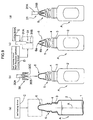
- a manufacturing method of a first mode shown in Figs. 9 (a) - (d) uses a projecting metallic forming die 30 for forming the bottomed conical recess 6b, and a needle-like metallic forming die 31 for forming the instilling bore 6c.
- the projecting forming die 30 includes, formed on a distal end of a mounting shaft 30A, a conical forming projection 30B for forming the bottomed conical recess 6b, and a bowl-shaped (bell-shaped) die surface 30C for forming an outer peripheral surface of the instilling tube 6 of the eyedrops container A.
- the needle-like forming die 31 has a needle-like forming projection 31B formed on a distal end of a mounting shaft 31A for forming the small instilling bore.
- part of the instilling tube 6 at the tip end of the eyedrops container A is heated to room temperature or 70°C to 150°C by a first heating device C such as warm air, a halogen lamp or laser beams.
- a first heating device C such as warm air, a halogen lamp or laser beams.
- the heating temperature preferably is a temperature for slightly softening the tip end of the eyedrops container A.
- thermoplastic material of the eyedrops container A is a soft resin material such as polyethylene
- the tip end will buckle unless heated. It is therefore necessary to heat, with the first heating device C, the part to be shaped by the projecting forming die 30 at least to a buckle-avoiding temperature before a shaping process.
- the shaping may be performed even at room temperature.
- the projecting forming die 30 is pressed in the direction of the container axis X before the part of the instilling tube 6 of the eyedrops container A heated by the first heating device C cools down, thereby forming, in the instilling tube 6 of the eyedrops container A, the bottomed conical recess 6b with the inside diameter increasing toward the instilling bore 6a.
- the bowl-shaped die surface 30C of the projecting forming die 30 can remove burrs formed in time of blow molding and projecting from the outer peripheral surface of the instilling tube 6 of the eyedrops container A.
- the projecting forming die 30 itself carries out a temperature control in a range from room temperature to 150°C in accordance with the shape and wall thickness of the instilling tube 6 of the eyedrops container A to be molded.
- the heating temperature preferably, is the lowest possible temperature, taking into consideration a cooling solidification at the tip end of the instilling tube 6.
- the projecting forming die 30 is arranged readily changeable according to the property of the liquid to be filled.
- a small instilling bore is formed to be capable of controlling to a set quantity the quantity of droplets pushed out of the eyedrops container A as the barrel portion 2 is pressed by tips of digits.
- the step of forming the instilling bore 6c by the needle-like projection 31B of this needle-like forming die 31 a method of operating the needle-like projection 31B at room temperature, and a method of operating the needlelike projection 31B after heating it, are proposed.
- the method to be adopted is selected according to conditions such as the shape of the instilling bore 6c to be formed, the shape of recess 6b, further the shapes and materials of the container and others, manufacturing cost and so on.
- the heating temperature where heating is required, it is advantageous to heat at least the needle-like projection 31B of the needle-like forming die 31 to a temperature for fusing the resin material of the container, i.e. to a range of 130°C to 180°C.
- a second heating device D such as high frequency induction heating, a halogen lamp or warm air is used to heat the needle-like forming die 31.
- the mounting shaft 31A acting as the root of the needle-like forming die 31 is constructed to be cooled by a cooling device E such as a water jacket, compressed air or the like.
- the needle-like forming die 31 is extracted along the direction of the container axis X from the instilling tube 6 of the eyedrops container A molded to the predetermined shape.
- the needle-like forming die 31 may be given a surface treatment such as plating, fluororesin coating, or special plating in order to improve separabiltiy and releasability of the resin.
- This surface treatment preferably, is what can withstand high temperature and does not separate easily.
- the cap B used in this application is formed and obtained beforehand in the predetermined shape so far described.
- the cap is initially attached to the main container body A, i.e. for the first time.
- the cap B is screwed to the main container body A in a state that the thermoplastic material of the main container body A retains plasticity, and a certain degree of plasticity so that an outline configuration of the main container body A does not collapse as a result of screwing of the cap B.
- the first sealing projection 15 is placed in tight contact with the recess 6b to secure an airtight condition.
- the eyedrops container obtained has an excellent sealing performance and is convenient in use.
- the eyedrops container with a capacity of 5ml has been obtained under various molding conditions and sterilizing temperature conditions according to the above embodiment.
- the hollows 7 provide medical fluid press-out performances as set out in Table 1.
- PP resin sterilizing conditions total amount of resin average pressing force (N) 1
- PP random copolymer (Sun Allomer PB222A) contains 4% of PE 121°C 20min. 2.2g 18.73 2 2.0g 13.82 3 1.8g 12.11 4 115°C 20min. 2.2g 17.79 5 2.0g 13.23 6 1.8g 11.30 7 110°C 20min. 2.2g 18.17 8 2.0g 13.08 9 1.8g 10.87 10 105°C 20min.
- PP random copolymer (Novatec PP EG8) contains 3% of PE 121°C 20min. 2.2g 14.96 14 2.0g 13.90 15 1.8g 11.09 16 115°C 20min. 2.2g 14.58 17 2.0g 14.95 18 1.8g 10.64 19 110°C 20min. 2.2g 15.31 20 2.0g 14.87 21 1.8g 11.45 22 105°C 20min. 2.2g 15.68 23 2.0g 14.06 24 1.8g 10.36
- the eyedrops container A containing water is held, with the instilling tube 6 facing down, and to be capable of pressing central parts of outer side surfaces of the hollows 7 of the eyedrops container A.
- the spacing with which the eyedrops container held is narrowed and the hollows 7 are pressed.
- a pressing force needed for one drop of the water to fall from the instilling opening 6a of the eyedrops container made as noted above is measured with a digital force gauge.
- the press-out force it is preferred to set it to 15N or less since the user will feel a strong resistance against the digit-tips in time of instillation operation if the press-out force reaches or exceeds 20N.
- An eyedrops container has been formed of the same resin material as above, that withstands the same sterilizing conditions and has no hollows. This results in a press-out force of about 35.3N (3.64kgf).
- the product according this invention is extremely excellent in instilling operability.
- the eyedrops container has been described, in which the bottomed conical recess 6b with the inside diameter enlarging toward the instilling opening 6a, and the small instilling bore 6c capable of controlling to a set quantity the quantity of droplets pushed out of the eyedrops container A as the barrel portion 2 is pressed by tips of digits, are formed beforehand in the instilling tube 6 of the main container body A blow-molded or vacuum formed.
- the present invention is not limited to such an eyedrops container. As shown in Fig.
- a cap B having a needle-like projection 9 formed integrally therewith for penetrating and forming an instilling bore in a tip end of a main container body A may be removably screwed to a male screw 5a of a flexible main container body A formed of a thermoplastic material with a predetermined quantity of medical fluid filled and sealed simultaneously with a blow molding or vacuum forming process.
- An instilling bore 6c is formed in an instilling portion at the tip end of the main container body A with the needle-like projection 9 of cap B by a screwing operation to a deeper screw-in position than a normal closing position of the cap B.
- the eyedrops container with hollows has been described.
- the present invention is not limited to this shape, but is applicable also to one having no hollows formed therein. Further, not only of the cylindrical shape, but various shapes may be employed such as elliptical, which are set based on the resin material used, application and so on.
- An eyedrops container which is easy to manufacture and easy to sterilize, ensures a sterile guarantee, and moreover is excellent in instilling operability may be provided.
Landscapes
- Engineering & Computer Science (AREA)
- Mechanical Engineering (AREA)
- Health & Medical Sciences (AREA)
- Veterinary Medicine (AREA)
- Animal Behavior & Ethology (AREA)
- Manufacturing & Machinery (AREA)
- Public Health (AREA)
- General Health & Medical Sciences (AREA)
- Life Sciences & Earth Sciences (AREA)
- Vascular Medicine (AREA)
- Ophthalmology & Optometry (AREA)
- Heart & Thoracic Surgery (AREA)
- Biomedical Technology (AREA)
- Epidemiology (AREA)
- Ceramic Engineering (AREA)
- Hematology (AREA)
- Pharmacology & Pharmacy (AREA)
- Medical Preparation Storing Or Oral Administration Devices (AREA)
Abstract
Description
is characterized in that a bottomed conical recess having an inside diameter increased toward a tip end is formed in an instilling tube formed on a tip region of said eyedrops container for medical use, the recess having an instilling portion formed in a bottom thereof.
| PP resin | sterilizing conditions | total amount of resin | average pressing force (N) | |
| 1 | PP random copolymer (Sun Allomer PB222A) contains 4% of PE | 121°C 20min. | 2.2g | 18.73 |
| 2 | 2.0g | 13.82 | ||
| 3 | 1.8g | 12.11 | ||
| 4 | 115°C 20min. | 2.2g | 17.79 | |
| 5 | 2.0g | 13.23 | ||
| 6 | 1.8g | 11.30 | ||
| 7 | 110°C 20min. | 2.2g | 18.17 | |
| 8 | 2.0g | 13.08 | ||
| 9 | 1.8g | 10.87 | ||
| 10 | 105°C 20min. | 2.2g | 17.09 | |
| 11 | 2.0g | 13.22 | ||
| 12 | 1.8g | 12.54 | ||
| 13 | PP random copolymer (Novatec PP EG8) contains 3% of PE | 121°C 20min. | 2.2g | 14.96 |
| 14 | 2.0g | 13.90 | ||
| 15 | 1.8g | 11.09 | ||
| 16 | 115°C 20min. | 2.2g | 14.58 | |
| 17 | 2.0g | 14.95 | ||
| 18 | 1.8g | 10.64 | ||
| 19 | 110°C 20min. | 2.2g | 15.31 | |
| 20 | 2.0g | 14.87 | ||
| 21 | 1.8g | 11.45 | ||
| 22 | 105°C 20min. | 2.2g | 15.68 | |
| 23 | 2.0g | 14.06 | ||
| 24 | 1.8g | 10.36 |
Claims (5)
- An eyedrops container for medical use integrally formed of a resin material that does not melt or deform in time of sterilization performed under a condition of 121°C for 20 minutes.
- An eyedrops container for medical use as defined in claim 1, wherein said resin material is polypropylene-polyethylene random copolymer.
- An eyedrops container for medical use as defined in claim 2 wherein said polypropylene polyethylene-random copolymer contains 3 to 5% of polyethylene.
- An eyedrops container for medical use as defined in claim 1 wherein hollows are formed on a flexible barrel portion in form of a hollow cylinder to be capable of being held by tips of two digits.
- An eyedropper having an eyedrops container A as defined in any one of claims 1 to 4, with a cap B for screwing thereto,
wherein a bottomed conical recess (6b) having an inside diameter increased toward a tip end (6a) is formed in an instilling tube (6) formed on a tip region of said eyedrops container for medical use, the recess (6b) having an instilling portion formed in a bottom thereof.
Applications Claiming Priority (3)
| Application Number | Priority Date | Filing Date | Title |
|---|---|---|---|
| JP2002074205 | 2002-03-18 | ||
| JP2002074205 | 2002-03-18 | ||
| PCT/JP2003/003036 WO2003077824A1 (en) | 2002-03-18 | 2003-03-13 | High-temperature-sterilizable instillator |
Publications (2)
| Publication Number | Publication Date |
|---|---|
| EP1486192A1 true EP1486192A1 (en) | 2004-12-15 |
| EP1486192A4 EP1486192A4 (en) | 2010-07-14 |
Family
ID=28035288
Family Applications (1)
| Application Number | Title | Priority Date | Filing Date |
|---|---|---|---|
| EP03710348A Withdrawn EP1486192A4 (en) | 2002-03-18 | 2003-03-13 | INSTILLATOR, STERILIZABLE AT HIGH TEMPERATURE |
Country Status (8)
| Country | Link |
|---|---|
| US (1) | US20050159715A1 (en) |
| EP (1) | EP1486192A4 (en) |
| KR (1) | KR101014638B1 (en) |
| CN (1) | CN100475175C (en) |
| AU (1) | AU2003221379A1 (en) |
| CA (1) | CA2477418A1 (en) |
| TW (1) | TWI287980B (en) |
| WO (1) | WO2003077824A1 (en) |
Cited By (1)
| Publication number | Priority date | Publication date | Assignee | Title |
|---|---|---|---|---|
| WO2008068775A3 (en) * | 2006-12-07 | 2008-07-31 | Sun Pharmaceutical Ind Ltd | Metered drop bottle for dispensing microliter amounts of a liquid in the form of a drop |
Families Citing this family (10)
| Publication number | Priority date | Publication date | Assignee | Title |
|---|---|---|---|---|
| US7178703B2 (en) * | 2004-11-23 | 2007-02-20 | Allergan, Inc. | Autoclaveable small-volume dropper bottle |
| USD543118S1 (en) * | 2006-04-03 | 2007-05-22 | R.P. Scherer Technologies, Inc. | Drop dispenser |
| US20080039807A1 (en) * | 2006-08-08 | 2008-02-14 | Jerrold Scott Pine | Ophthalmic Drug Dispensing Tip |
| US20140350492A1 (en) * | 2013-05-26 | 2014-11-27 | Ever Rojas Escalante | Eyedrop dispenser |
| CN105233397A (en) * | 2015-10-14 | 2016-01-13 | 广东三蓝药业股份有限公司 | Novel eye drop bottle |
| USD834950S1 (en) | 2016-08-06 | 2018-12-04 | Chubby Gorilla, Inc. | Dispensing bottle and cap in combination |
| USD826068S1 (en) | 2016-11-13 | 2018-08-21 | Eyad Aboabdo | Dispensing bottle kit |
| WO2018206386A1 (en) * | 2017-05-06 | 2018-11-15 | Novaliq Gmbh | Drop dispenser |
| CA179103S (en) | 2017-07-13 | 2019-06-12 | Chubby Gorilla Inc | Bottle |
| CN108464928A (en) * | 2018-05-09 | 2018-08-31 | 赵金巧 | Disposably rushing formula tear in advance rushes device |
Family Cites Families (13)
| Publication number | Priority date | Publication date | Assignee | Title |
|---|---|---|---|---|
| JPS6055005A (en) | 1983-09-07 | 1985-03-29 | Showa Denko Kk | Radiation-resistant molding |
| JPS60125628A (en) * | 1983-12-13 | 1985-07-04 | Mitsui Toatsu Chem Inc | Blow-molded container superior in transparency |
| US5425480A (en) * | 1992-12-17 | 1995-06-20 | Ryder International Corporation | Dose dispenser having a molded plastic housing with a cavity and a metallic foil wall covering the cavity |
| DE69922916T2 (en) | 1998-07-14 | 2005-06-09 | Alcon Manufacturing Ltd., Fort Worth | POLYPROPYLENE BASED CONTAINERS FOR PROSTAGLANDIN CONTAINING PRODUCTS |
| JP2000202002A (en) * | 1998-11-13 | 2000-07-25 | Tosoh Corp | Medical heat-resistant container |
| KR100635292B1 (en) * | 1998-12-07 | 2006-10-19 | 미쓰이 가가쿠 가부시키가이샤 | Hollow vessel for heat sterilization |
| DE60005817T2 (en) * | 1999-05-28 | 2004-07-29 | Novartis Ag | PACKAGING FOR A PHARMACEUTICAL PRODUCT AND METHOD FOR STERILIZING THE PACKAGING |
| US6875201B1 (en) * | 1999-08-17 | 2005-04-05 | Santen Pharmaceutical Co., Ltd. | Recessed part forming instillation container |
| JP3694446B2 (en) | 1999-08-17 | 2005-09-14 | 参天製薬株式会社 | Open eye drop container and manufacturing method thereof |
| KR100544221B1 (en) * | 1999-08-17 | 2006-01-23 | 산텐 세이야꾸 가부시키가이샤 | Method of manufacturing open instillation container |
| AR029768A1 (en) * | 1999-10-18 | 2003-07-16 | Novartis Ag | PLASTIC PACKAGE FOR A PHARMACEUTICAL PRODUCT AND METHOD TO MANUFACTURE AND STERILIZE A PHARMACEUTICAL PACKAGE |
| JP2001181344A (en) * | 1999-12-27 | 2001-07-03 | Sumitomo Chem Co Ltd | Propylene polymer resin and container |
| JP2002202002A (en) * | 2000-12-28 | 2002-07-19 | Sawafuji Electric Co Ltd | Automotive control device |
-
2003
- 2003-03-13 KR KR1020047012514A patent/KR101014638B1/en not_active Expired - Fee Related
- 2003-03-13 US US10/508,289 patent/US20050159715A1/en not_active Abandoned
- 2003-03-13 WO PCT/JP2003/003036 patent/WO2003077824A1/en not_active Ceased
- 2003-03-13 CN CNB038062518A patent/CN100475175C/en not_active Expired - Fee Related
- 2003-03-13 AU AU2003221379A patent/AU2003221379A1/en not_active Abandoned
- 2003-03-13 CA CA002477418A patent/CA2477418A1/en not_active Abandoned
- 2003-03-13 EP EP03710348A patent/EP1486192A4/en not_active Withdrawn
- 2003-03-14 TW TW092105679A patent/TWI287980B/en not_active IP Right Cessation
Cited By (2)
| Publication number | Priority date | Publication date | Assignee | Title |
|---|---|---|---|---|
| WO2008068775A3 (en) * | 2006-12-07 | 2008-07-31 | Sun Pharmaceutical Ind Ltd | Metered drop bottle for dispensing microliter amounts of a liquid in the form of a drop |
| US8328775B2 (en) | 2006-12-07 | 2012-12-11 | Sun Pharma Advanced Research Company Limited | Metered drop bottle for dispensing microliter amounts of a liquid in the form of a drop |
Also Published As
| Publication number | Publication date |
|---|---|
| CN100475175C (en) | 2009-04-08 |
| EP1486192A4 (en) | 2010-07-14 |
| TWI287980B (en) | 2007-10-11 |
| US20050159715A1 (en) | 2005-07-21 |
| CN1642511A (en) | 2005-07-20 |
| CA2477418A1 (en) | 2003-09-25 |
| AU2003221379A1 (en) | 2003-09-29 |
| KR101014638B1 (en) | 2011-02-16 |
| KR20040093056A (en) | 2004-11-04 |
| WO2003077824A1 (en) | 2003-09-25 |
| TW200304805A (en) | 2003-10-16 |
Similar Documents
| Publication | Publication Date | Title |
|---|---|---|
| CA2464482C (en) | Eyedropper with step portion | |
| EP1213003B1 (en) | Recessed part forming instillation container | |
| US20050159715A1 (en) | High-temperature-sterilizable instillator | |
| US5121856A (en) | Sleeved dispensing vial | |
| US7114635B2 (en) | Contamination preventive cap | |
| JP6198492B2 (en) | Formulation container | |
| KR102590903B1 (en) | Delamination container | |
| KR20160030548A (en) | Ampoule for a medical liquid, and method for producing an ampoule | |
| US20070145076A1 (en) | Liquid storage container with bottom filter | |
| US11613399B2 (en) | Container and method of producing container | |
| US7621897B1 (en) | Ophthalmic fluid applicator and method | |
| JP3628242B2 (en) | Recessed part eye drop container | |
| JP2003339822A (en) | High temperature sterilizable eye dropper | |
| TWI707665B (en) | Diaphragm set for stethoscope | |
| JPH09276369A (en) | Infusion bag and manufacturing method thereof | |
| CN107416351B (en) | Combined packaging system for puncture outfit | |
| CN207015855U (en) | A kind of assembly packaging system for puncture outfit | |
| JP4253870B2 (en) | Manufacturing method of molded filling container | |
| JPH10156929A (en) | Molding method for synthetic resin bottles | |
| CN101228075B (en) | Perforable closure for a container, mould and method for manufacturing said closure | |
| JP4371773B2 (en) | Anti-contamination cap |
Legal Events
| Date | Code | Title | Description |
|---|---|---|---|
| PUAI | Public reference made under article 153(3) epc to a published international application that has entered the european phase |
Free format text: ORIGINAL CODE: 0009012 |
|
| 17P | Request for examination filed |
Effective date: 20040902 |
|
| AK | Designated contracting states |
Kind code of ref document: A1 Designated state(s): AT BE BG CH CY CZ DE DK EE ES FI FR GB GR HU IE IT LI LU MC NL PT RO SE SI SK TR |
|
| AX | Request for extension of the european patent |
Extension state: AL LT LV MK |
|
| A4 | Supplementary search report drawn up and despatched |
Effective date: 20100615 |
|
| RIC1 | Information provided on ipc code assigned before grant |
Ipc: A61J 1/00 20060101AFI20031003BHEP Ipc: A61F 9/00 20060101ALI20100609BHEP |
|
| 17Q | First examination report despatched |
Effective date: 20100831 |
|
| GRAP | Despatch of communication of intention to grant a patent |
Free format text: ORIGINAL CODE: EPIDOSNIGR1 |
|
| STAA | Information on the status of an ep patent application or granted ep patent |
Free format text: STATUS: GRANT OF PATENT IS INTENDED |
|
| INTG | Intention to grant announced |
Effective date: 20171005 |
|
| RAP1 | Party data changed (applicant data changed or rights of an application transferred) |
Owner name: SANTEN PHARMACEUTICAL CO., LTD. |
|
| RIN1 | Information on inventor provided before grant (corrected) |
Inventor name: KUSU, YUKIO |
|
| STAA | Information on the status of an ep patent application or granted ep patent |
Free format text: STATUS: THE APPLICATION IS DEEMED TO BE WITHDRAWN |
|
| 18D | Application deemed to be withdrawn |
Effective date: 20180216 |
|
| RIC1 | Information provided on ipc code assigned before grant |
Ipc: A61J 1/00 20060101AFI20031003BHEP Ipc: A61F 9/00 20060101ALI20100609BHEP |