EP1486143A1 - Air conditioning seat device - Google Patents
Air conditioning seat device Download PDFInfo
- Publication number
- EP1486143A1 EP1486143A1 EP03712739A EP03712739A EP1486143A1 EP 1486143 A1 EP1486143 A1 EP 1486143A1 EP 03712739 A EP03712739 A EP 03712739A EP 03712739 A EP03712739 A EP 03712739A EP 1486143 A1 EP1486143 A1 EP 1486143A1
- Authority
- EP
- European Patent Office
- Prior art keywords
- air
- dehumidifier
- seat device
- air conditioning
- conditioning seat
- Prior art date
- Legal status (The legal status is an assumption and is not a legal conclusion. Google has not performed a legal analysis and makes no representation as to the accuracy of the status listed.)
- Granted
Links
Images





Classifications
-
- B—PERFORMING OPERATIONS; TRANSPORTING
- B60—VEHICLES IN GENERAL
- B60N—SEATS SPECIALLY ADAPTED FOR VEHICLES; VEHICLE PASSENGER ACCOMMODATION NOT OTHERWISE PROVIDED FOR
- B60N2/00—Seats specially adapted for vehicles; Arrangement or mounting of seats in vehicles
- B60N2/56—Heating or ventilating devices
- B60N2/5607—Heating or ventilating devices characterised by convection
- B60N2/5621—Heating or ventilating devices characterised by convection by air
- B60N2/5635—Heating or ventilating devices characterised by convection by air coming from the passenger compartment
-
- A—HUMAN NECESSITIES
- A47—FURNITURE; DOMESTIC ARTICLES OR APPLIANCES; COFFEE MILLS; SPICE MILLS; SUCTION CLEANERS IN GENERAL
- A47C—CHAIRS; SOFAS; BEDS
- A47C7/00—Parts, details, or accessories of chairs or stools
- A47C7/62—Accessories for chairs
- A47C7/72—Adaptations for incorporating lamps, radio sets, bars, telephones, ventilation, heating or cooling arrangements or the like
- A47C7/74—Adaptations for incorporating lamps, radio sets, bars, telephones, ventilation, heating or cooling arrangements or the like for ventilation, heating or cooling
- A47C7/742—Adaptations for incorporating lamps, radio sets, bars, telephones, ventilation, heating or cooling arrangements or the like for ventilation, heating or cooling for ventilating or cooling
- A47C7/744—Adaptations for incorporating lamps, radio sets, bars, telephones, ventilation, heating or cooling arrangements or the like for ventilation, heating or cooling for ventilating or cooling with active means, e.g. by using air blowers or liquid pumps
-
- A—HUMAN NECESSITIES
- A47—FURNITURE; DOMESTIC ARTICLES OR APPLIANCES; COFFEE MILLS; SPICE MILLS; SUCTION CLEANERS IN GENERAL
- A47C—CHAIRS; SOFAS; BEDS
- A47C7/00—Parts, details, or accessories of chairs or stools
- A47C7/62—Accessories for chairs
- A47C7/72—Adaptations for incorporating lamps, radio sets, bars, telephones, ventilation, heating or cooling arrangements or the like
- A47C7/74—Adaptations for incorporating lamps, radio sets, bars, telephones, ventilation, heating or cooling arrangements or the like for ventilation, heating or cooling
- A47C7/748—Adaptations for incorporating lamps, radio sets, bars, telephones, ventilation, heating or cooling arrangements or the like for ventilation, heating or cooling for heating
-
- B—PERFORMING OPERATIONS; TRANSPORTING
- B60—VEHICLES IN GENERAL
- B60H—ARRANGEMENTS OF HEATING, COOLING, VENTILATING OR OTHER AIR-TREATING DEVICES SPECIALLY ADAPTED FOR PASSENGER OR GOODS SPACES OF VEHICLES
- B60H1/00—Heating, cooling or ventilating devices
- B60H1/00271—HVAC devices specially adapted for particular vehicle parts or components and being connected to the vehicle HVAC unit
- B60H1/00285—HVAC devices specially adapted for particular vehicle parts or components and being connected to the vehicle HVAC unit for vehicle seats
-
- B—PERFORMING OPERATIONS; TRANSPORTING
- B60—VEHICLES IN GENERAL
- B60H—ARRANGEMENTS OF HEATING, COOLING, VENTILATING OR OTHER AIR-TREATING DEVICES SPECIALLY ADAPTED FOR PASSENGER OR GOODS SPACES OF VEHICLES
- B60H1/00—Heating, cooling or ventilating devices
- B60H1/24—Ventilating devices where the heating or cooling is irrelevant
- B60H1/247—Disposition of several air-diffusers in a vehicle for ventilation-air circulation in a vehicle cabin
-
- B—PERFORMING OPERATIONS; TRANSPORTING
- B60—VEHICLES IN GENERAL
- B60H—ARRANGEMENTS OF HEATING, COOLING, VENTILATING OR OTHER AIR-TREATING DEVICES SPECIALLY ADAPTED FOR PASSENGER OR GOODS SPACES OF VEHICLES
- B60H1/00—Heating, cooling or ventilating devices
- B60H1/32—Cooling devices
- B60H1/3202—Cooling devices using evaporation, i.e. not including a compressor, e.g. involving fuel or water evaporation
-
- B—PERFORMING OPERATIONS; TRANSPORTING
- B60—VEHICLES IN GENERAL
- B60H—ARRANGEMENTS OF HEATING, COOLING, VENTILATING OR OTHER AIR-TREATING DEVICES SPECIALLY ADAPTED FOR PASSENGER OR GOODS SPACES OF VEHICLES
- B60H3/00—Other air-treating devices
- B60H3/02—Moistening ; Humidity control
- B60H3/024—Moistening ; Humidity control for only dehumidifying the air
-
- B—PERFORMING OPERATIONS; TRANSPORTING
- B60—VEHICLES IN GENERAL
- B60N—SEATS SPECIALLY ADAPTED FOR VEHICLES; VEHICLE PASSENGER ACCOMMODATION NOT OTHERWISE PROVIDED FOR
- B60N2/00—Seats specially adapted for vehicles; Arrangement or mounting of seats in vehicles
- B60N2/56—Heating or ventilating devices
- B60N2/5607—Heating or ventilating devices characterised by convection
- B60N2/5621—Heating or ventilating devices characterised by convection by air
- B60N2/5657—Heating or ventilating devices characterised by convection by air blown towards the seat surface
-
- A—HUMAN NECESSITIES
- A61—MEDICAL OR VETERINARY SCIENCE; HYGIENE
- A61B—DIAGNOSIS; SURGERY; IDENTIFICATION
- A61B90/00—Instruments, implements or accessories specially adapted for surgery or diagnosis and not covered by any of the groups A61B1/00 - A61B50/00, e.g. for luxation treatment or for protecting wound edges
- A61B90/08—Accessories or related features not otherwise provided for
- A61B2090/0804—Counting number of instruments used; Instrument detectors
-
- A—HUMAN NECESSITIES
- A61—MEDICAL OR VETERINARY SCIENCE; HYGIENE
- A61B—DIAGNOSIS; SURGERY; IDENTIFICATION
- A61B90/00—Instruments, implements or accessories specially adapted for surgery or diagnosis and not covered by any of the groups A61B1/00 - A61B50/00, e.g. for luxation treatment or for protecting wound edges
- A61B90/08—Accessories or related features not otherwise provided for
- A61B2090/0804—Counting number of instruments used; Instrument detectors
- A61B2090/0805—Counting number of instruments used; Instrument detectors automatically, e.g. by means of magnetic, optical or photoelectric detectors
-
- B—PERFORMING OPERATIONS; TRANSPORTING
- B60—VEHICLES IN GENERAL
- B60H—ARRANGEMENTS OF HEATING, COOLING, VENTILATING OR OTHER AIR-TREATING DEVICES SPECIALLY ADAPTED FOR PASSENGER OR GOODS SPACES OF VEHICLES
- B60H1/00—Heating, cooling or ventilating devices
- B60H1/00271—HVAC devices specially adapted for particular vehicle parts or components and being connected to the vehicle HVAC unit
- B60H2001/003—Component temperature regulation using an air flow
Definitions
- the present invention relates to an air conditioning seat device, used for a chair in an automobile, an office, and the like, that provides a sense of comfortable seating even at a high environmental temperature and for a long-time seating.
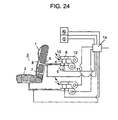
- Main fan 11 and auxiliary fan 12 convey airflow to main heat exchanger 5 and waste-heat heat exchanger 6, each connected to Peltier module 4, respectively.
- Temperature sensor 13 is mounted to Peltier module 4 at the side of main heat exchanger 5.
- Peltier module 4, main fan 11, and auxiliary fan 12 are activated.
- airflow conveyed by main fan 11 is cooled by heat transfer from Peltier module 4, in main heat exchanger 5, is conveyed through air duct 9, and blows out as cool air through holes 8.
- Waste-heat airflow is warmed by heat transfer from Peltier module 4, in waste-heat heat exchanger 6, and blows out as waste heat through waste-heat air duct 10.
- airflow conveyed by main fan 11 is warmed by heat transfer from Peltier module 4, in main heat exchanger 5, is conveyed through air duct 9, and blows out as warm air through holes 8.
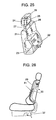
- Japanese Patent Application Unexamined Publication No. S60-193412 discloses the following as shown in Fig. 25.
- This seat air-conditioning apparatus has a built-in air bag 23 in the main part of seat 21, that forcibly sucks outside air through skin cloth 22, a part of the main part of seat 21, which touches a human back.
- the apparatus has built-in dehumidifier/dryer 26 in the headrest, which dehumidifies and dries outside air sucked by air bag 23, and exhausts it through air bag 23 to the human back.
- Dehumidifier/dryer 26 includes cooler/dehumidifier 24 and heater/dryer 25.
- Inlet air duct 27 and outlet air duct 28 allows dehumidifier/dryer 26 and air bag 23 to communicate.
- the outside air on the human back surface is sucked to air bag 23 through skin cloth 22.
- This outside air has a temperature of 32° C and humidity of 80% (hereinafter, indicated as "80%RH"), for example.
- the outside air enters cooler/dehumidifier 24 through inlet air duct 27 to be cooled and dehumidified (condensing).
- the air after the process is in 15°C and 100%RH, for example, which is further sent to heater/dryer 25 to be heated and dried.
- the air after the process is in 30°C and 50%RH.
- the air processed in this way enters air bag 23 through outlet air duct 28, and blows out through skin cloth 22 toward the human back. This suppresses a sense of steaminess, preventing the body temperature from being lowered due to the cooled air.
- a third conventional example is disclosed, where an absorbent material (a hygroscopic material) is used.
- backrest 29 has air duct 30 therein.
- moisture-permeable layer 31 is arranged that permeates according to the gradient of a vapor partial pressure, and also that is air-impermeable.
- the vapor that permeates from backrest 29 flows into air duct 30 through moisture-permeable layer 31.
- the air dried by air dryer unit 32 having a moisture-absorbing material flows into air duct 30. Accordingly, the vapor outside backrest 29 permeates moisture-permeable layer 31, and is absorbed in the dried air.
- the temperature-rise value at this time is determined by the warming heat quantity by Peltier module 4 and the airflow volume.
- the blowout temperature is determined by the ambient temperature with the temperature-rise value added, however, does not rise to a temperature at which the vehicle occupant feels warm if the ambient temperature is low.
- dehumidifier 51 dehumidifies the air sent by blower 50.
- the dehumidified air passes from dehumidifier 51, through air duct 53, to pad 55, and then blows out through holes 57 of skin 56.
- a vehicle occupant is seated on seat 54, where the dehumidified air is blown on his/her back, buttocks, and lower legs. In this way, the dehumidified air is blown on a region where the surface of a human body touches.
- Air duct 53 is desirably made of an unabsorbent material such as an urethane resin. This causes high-temperature, low-humidity air generated in the dehumidifier to be sent to a human body without absorbing moisture in the air duct. Therefore, the vaporization heat loss owing to vaporization of sweat on a human surface gives coolness to the human body, as well as suppressing steaminess.
- an unabsorbent material such as an urethane resin.
- air duct 53 is desirably branched at pad 55 as shown in Fig. 1. This causes the dehumidified air to be uniformly supplied widely over the back and buttocks of a vehicle occupant, increasing comfort.
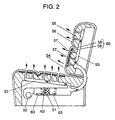
- Fig. 2 is a block diagram of an air conditioning seat device according to a second exemplary embodiment of the present invention. This embodiment differs from the first embodiment in having heater unit 62 for heating dehumidifier 51 owing to convection, radiation, or conduction, made of an electrical resistance heating element for example, and sealing part 63 for sealing dehumidifier 51.
- This recycle mode operation is performed while a vehicle occupant is not seated, in parking for example. This allows dehumidified air to be supplied through holes 57 without requiring the adsorbent included in dehumidifier 51 to be changed over a long period. Additionally, the air conditioning seat device can be operated with a maximum absorbability of dehumidifier 51, without requiring dew condensation water in dehumidifier 51 to be disposed.
- Heater unit 62 is desirably made of an expand-metal which is a lacinia-processed and expanded metal thin plate such as a stainless steel; a wire mesh which is a netted stainless-steel metal wire; or a porous member such as a punched stainless-steel thin plate.
- specifications of notch for lacinia of an expand-metal, elemental wire thickness and interval of weave pattern of a wire mesh, or punching specifications for hole diameter and pitch of punching metal can be easily changed. These changes allow the resistance value of the metallic body to be adjusted with ease and high accuracy, and thus a desired heating element can be easily obtained.
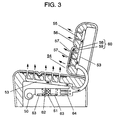
- Fig. 3 is a block diagram of an air conditioning seat device according to a third exemplary embodiment of the present invention. This embodiment differs from the second embodiment in providing cooling heat exchanger 64 for cooling air having passed through dehumidifier 51.
- heat exchanger 64 is not limited, generally a plate-fin heat exchanger finned on partition walls heat-exchanges and cools the dehumidified air heated by the air inside the cabin. Also, the dehumidified air may be heat-exchanged with the seat bone and cooled. Still, a fan (Refer to Fig. 12. ) for cooling heat exchanger 64 may be provided. The blow volume may be changed by controlling the blow volume according to the amount of heat generated. Further, heat exchanger 64 may be cooled by the blowout air from an air-conditioning device (not illustrated) for the cabin, for example.
- heat may be transferred to an automobile body for example, which has a higher heat capacity, from heat exchanger 64, by providing a heat conduction material that has a relation of heat transfer with heat exchanger 64.
- a heat storage material having a higher heat capacity than heat exchanger 64 may be arranged so that it has a relation of heat transfer with heat exchanger 64.
- Heat exchanger 64 may be cooled by a Peltier element. Heat exchanger 64 may be cooled by providing a pipe through which a coolant passes, and a device for cooling the coolant. Still, cooling air duct 53 in itself by blowing air, heat transfer, and the like is also effective in the same way as heat exchanger 64.
- the air conditioning seat device in the above-mentioned makeup operates and works.
- the moisture of the air in the cabin sent to dehumidifier 51 by blower 50 is absorbed in dehumidifier 51, and the humidity of the air is reduced.
- the air is heated by the adsorption heat and enters a state of approximately 48°C and 18%RH.
- This high-temperature, low-humidity air is introduced to heat exchanger 64, cooled by the cabin air, and becomes a low-humidity air with 37°C and 33%RH, for example.
- the human body has a small heat transmission from the dehumidified air, and vaporization heat loss owing to vaporization of the sweat on the body surface gives coolness to the human body.
- Fig. 4 is a block diagram for illustrating the recycle mode in an air conditioning seat device according to a fourth exemplary embodiment of the present invention.
- Fig. 5 is a block diagram for illustrating the dehumidification mode.
- Fig. 6 is a time chart for the actions of each mode.
- Fig. 7 is a time chart for the actions of each mode in another mode set.
- This embodiment differs from the first embodiment in having vent 65 communicating from dehumidifier 51 to the outside of the main body of the seat, and an outlet air duct selector (hereinafter, "selector") 66.
- Selector 66 opens a duct to vent 65 and closes air duct 53 in the recycle mode shown in Fig. 4. Meanwhile, in the dehumidification mode shown in Fig. 5, selector 66 closes the duct to vent 65, and opens air duct 53.
- Selector 66 is a damper for example, driven by such as stepping motor 67.
- the recycle mode operation is first performed.
- dehumidifier 51 regains its dehumidification capability.
- Selector 66 switches to the position for opening the duct to vent 65, heater unit 62 is activated, and stops blower 50 at first for "t1" and then activates for "t2" with a flow rate of 0.2 m 3 /min. for example.
- dehumidifier 51 has an adsorbent of silica gel, vapor starts desorbing off the adsorbent when the adsorbent is heated to 120°C.
- blower 50 emits the generated vapor from vent 65 to inside the cabin.
- the heat generated in heater unit 62 transmits to the surface of adsorbent 61.
- the surface temperature of adsorbent 61 quickly rises and the vapor quickly desorbs off adsorbent 61.
- sending air intermittently causes a higher surface temperature of the adsorbent than sending a low air-volume (for example, a flow rate of 0.02 m 3 /min.) continuously. Therefore, the volume of heat transfer to the inside of adsorbent 61 becomes large according to Fourier's law, and the recycle time is reduced.
- adjusting the blow volume is unnecessary, and thus the makeup of the apparatus can be simplified.
- the dehumidification mode operation is performed.
- the dehumidification mode is shown in Fig. 5, its description is omitted, because it is the same as the second embodiment except for switching selector 66.
- sealing part 63 seals dehumidifier 51. While in this embodiment, a sealing part is not provided. Therefore, after a long time since the previous operation, adsorbent 61 absorbs moisture with diffusion, decreasing the dehumidification capacity. Even in such a case, this type of operation allows absorbability of adsorbent 61 to be regained, and moisture-absorption capacity providing a human body with coolness when the dehumidification mode operation is performed for a long time, to be ensured.
- the heater unit operating time in the initial recycle mode, "ts1”, may be shorter than "ts2" and “ts3", the heater unit operating times in the next recycle mode and after.
- the operating time in the initial dehumidification mode, "tj1”, may be shorter than "tj2" and "tj3", the operating times in the next dehumidification mode and after.
- these values hold ts1 ⁇ ts2 ⁇ ts3, and tj1 ⁇ tj2 ⁇ tj3.
- Short ts1 allows the dehumidification operation to start early. Then, the time intervals between recycle modes and dehumidification modes are gradually extended to start a steady operation. This ensures an immediate effect and reduces discomfort due to changing to a steady state. In midsummer, the temperature in a cabin is high, so a request for rapid coolness is satisfied.
- Fig. 8 is a time chart for the actions of each mode according to a fifth exemplary embodiment.
- the basic makeup for an air conditioning seat device according to this embodiment is the same as in Fig. 4 and Fig. 5 in the fourth embodiment.
- a cooling mode operation is performed after the recycle mode for regaining dehumidification capability of dehumidifier 51, until entering the dehumidification mode.
- heater unit 62 stops and blower 50 is activated to decrease the temperature of adsorbent 61.
- selector 66 closes vent 65 and blower 50 is activated to perform the dehumidification mode operation.
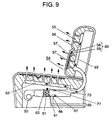
- Fig. 9 is a block diagram for illustrating the dehumidification mode in an air conditioning seat device according to a sixth exemplary embodiment of the present invention.
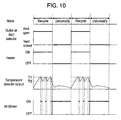
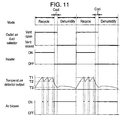
- Fig. 10 is a time chart for the actions of each mode.
- temperature detector 70 for detecting the temperature of dehumidifier 51 is provided to control the actions of blower 50, heater unit 62, and selector 66.
- selector 66 opens the duct to vent 65 and heater unit 62 is activated in the recycle mode.
- the temperature measured by temperature detector 70 is the set value "T1" or higher, blower 50 is activated, and the temperature falls to "T2" or lower, blower 50 stops.
- adsorbent 61 is silica gel
- the hydroxyl group of silica gel is destroyed at a temperature higher than 180°C, decreasing the adsorption capability. Therefore, when the output from temperature detector 70 is going to exceed 180°C, it is desirable to continuously operate blower 50, or to stop activating heater unit 62. In this way, deterioration of adsorbent 61 can be suppressed.
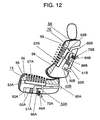
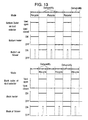
- Fig. 12 is a sectional block diagram of an air conditioning seat device according to a seventh exemplary embodiment of the present invention, and Fig. 13 shows time charts for the actions of dehumidifier in the bottom and back parts in each mode.
- seat 54 has bottom part 71 and back part 72.
- Cooling air blowers (hereinafter, "blowers") 73A and 73B send in-cabin air to heat exchangers 64A and 64B for cooling the dehumidified air, respectively.
- components with the same numbers as in the fourth embodiment through the sixth embodiment act in the same way.
- a subscript A is attached to symbols for the air-conditioning unit and its parts of bottom part 71
- subscript B is attached to those of back part 72 for identification.
- air-conditioning unit 52A in the bottom part performs the recycle mode operation.
- outlet duct selector 66A opens a duct to vent 65A, heater unit 62A is activated, and air blower 51A stops for the first 20 seconds and then is activated for one second at a flow rate of 0.2 m 3 /min. for example. From then on, these series of operations are performed in the recycle mode.
- the adsorbent of dehumidifier 51 is silica gel, vapor starts to desorb off the adsorbent when the adsorbent is heated to 120°C.
- Blower 50A emits the generated vapor from vent 65A to the inside of the cabin.
- air-conditioning unit 52B of the back part performs the dehumidification mode operation first.
- bottom part air-conditioning unit 52A performs the dehumidification mode operation
- back part air-conditioning unit 52B performs the recycle mode operation. Detail description for this operation is omitted because it is just one with the operations of bottom part air-conditioning unit 52A and back part air-conditioning unit 52B exchanged in the above-mentioned description.
- bottom part air-conditioning unit 52A and back part air-conditioning unit 52B are arranged at bottom part 71 and back part 72, respectively in Fig. 12, both of them may be arranged at either bottom part 71 or back part 72.
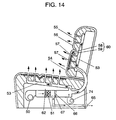
- Fig. 14 is a sectional view of an air conditioning seat device in the recycle mode according to an eighth exemplary embodiment of the present invention.
- This embodiment differs from the fourth embodiment in that second air blower 74 is provided, and sends air to air duct 53 at least in the recycle mode.
- second air blower 74 is provided, and sends air to air duct 53 at least in the recycle mode.
- stepping motor 67 is activated, and outlet duct selector 66 opens the duct to vent 65.
- heater unit 62 is activated, and dehumidifier 51 regains its absorbability.
- second air blower 74 is activated to introduce the in-cabin air to air duct 53 and blows it out through holes 57, giving coolness to a vehicle occupant.
- coolness can be achieved even in the recycle mode.
- switching the dehumidification mode and recycle mode repeatedly sends the dry air and the in-cabin air to a human body alternately.
- the clothes absorb moisture, and next, when the dry air is sent, vaporization latent heat loss of the clothes continuously gives a stronger coolness to a vehicle occupant, also in synergy with a fluctuation effect.
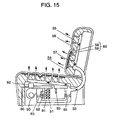
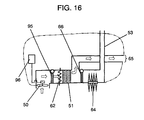
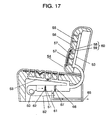
- Fig. 15 is a sectional view of an air conditioning seat device in the recycle mode according to a ninth exemplary embodiment of the present invention.
- This embodiment differs from the second embodiment in that branch duct 91 is provided, which comes out from blower 50, branches in parallel with dehumidifier 51, and converges with air duct 53.
- sealing part 63 switches the air sent from blower 50 to one of branch duct 91 and dehumidifier 51.
- the dehumidification capacity of dehumidifier 51 decreases during the dehumidification mode operation, sealing part 63 switches so that the air from blower 50 passes through branch duct 91, without flowing in dehumidifier 51.
- the air sent by blower 50 is dehumidified and also cooled by low-temperature dehumidifier 51, in the dehumidification mode, the low-temperature and low-humidity air is introduced to air duct 53 and blows out through holes 57, giving a strong coolness to a vehicle occupant owing to the send air.
- blower 50 is activated to introduce the in-cabin air to air duct 53, and then the air blows out through holes 57 in the recycle mode, giving coolness to a vehicle occupant owing to the send air. Therefore, this makeup provides coolness even in the recycle mode.
- dehumidifier 51 By doing so, the temperature rise of dehumidifier 51 by heater unit 62 is accelerated, and at the same time, the vapor desorbed off dehumidifier 51 is removed by the send air. Accordingly, the adsorbent in dehumidifier 51 can be recycled quickly. In other words, the operating time in the dehumidification mode becomes relatively long and coolness is intensified.
- the duct to vent 65 is arranged at a position higher than dehumidifier 51.
- the air including the vapor generated in the recycle mode is in a high temperature, and thus in such a makeup, the discharged air becomes a rising air current, generating a current in which air from the cabin flows into the adsorbent.
- the send air by blower 50 is feeble as mentioned above, the air including vapor is easily discharged owing to this rising air current, shortening the recycle time of dehumidifier 51.
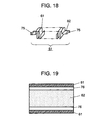
- dehumidifier 51 has a makeup where the surface of heater unit 62 has undercoat layer 76, and also supports adsorbent 61 thereon.
- Undercoat layer 76 made of oxide sintered and oxidized of such as aluminum hydroxide, or cerium nitrate, chemically bonds with adsorbent 61, improving adhesion.
- undercoat layer 76 has a makeup where glass frit is coated and sintered, the surface of undercoat layer 76 becomes bumpy. Accordingly, in addition to the above-mentioned chemical bond, a physical anchor effect further improves adhesion. With such undercoat layer 76, repeated heating and cooling does not cause adsorbent 61 to exfoliate, and thus increasing the durability.
- dehumidifier 51 includes heater unit 62 therein, and thus the heat from heater unit 62 directly transfers to dehumidifying agent 61 in the recycle mode, increasing the temperature-rise speed of the adsorbent. In other words, even for a short recycle time, most of the adsorbed vapor is discharged. Consequently, air-conditioning unit 82 according to this embodiment regains its absorbability in a short time, and thus even if the dehumidification mode and recycle mode are repeated intermittently, sufficient dehumidification capacity is delivered. Accordingly, a drastic downsizing of dehumidifier 51 is achieved, facilitating installation of dehumidifier 51 in the main body of a seat.
- adsorbent 61 is directly heated, which means air itself is less heated and the power consumption is small in the recycle mode. Still, even after a long time with no use, the absorbability of dehumidifier 51 can be recycled in a short time, dispensing with a strict sealing structure for preventing adsorption of vapor in the atmospheric air, and achieving a downsizing of an air-conditioning unit.
- Heater unit 62 is pleating-processed in a form of a corrugated plate, increasing the area where adsorbent 61 contacts air, decreasing the space occupied by adsorbent 61, and downsizing air-conditioning unit 82 as a whole.
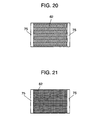
- Figs. 20 through 22 are schematic diagrams of heater unit 62 with terminals 75 at both ends.
- heater unit 62 is made of an expand-metal which is a lacinia-processed and expanded metal thin plate such as stainless-steel.
- heater unit 62 is made of a wire mesh which is a netted stainless-steel metal wire.
- heater unit 62 is made of a porous member such as a punched stainless-steel thin plate.
- specifications of notch for lacinia of an expand-metal, elemental wire thickness and interval of weave pattern of a wire mesh, or punching specifications for hole diameter and pitch of punching metal can be easily changed.
- heater unit 62 a porous member
- heater unit 62 can easily support adsorbent 61 by dipping, for example.
- the mesh of heater unit 62 made of such as an expand-metal, is open, and thus air widely contacts adsorbent 61 in the dehumidification mode. Accordingly, the adsorption speed per unit volume of dehumidifier 51 is increased, downsizing air-conditioning unit 82. Further, such a heater unit 62, a porous member, reduces the pressure loss of the send air.
- heater unit 62 is heated with power applied to terminal 75, which is welded so that terminal 75 contacts the whole end surface of such as an expand-metal.
- An expand-metal, a wire mesh, or a punched plate is a thin plate with lacinia or thin wire, has a low heat-capacity with a same electrical resistance as compared with a regular thin plate, decreasing the recycle time.
- heater unit 62 is covered therearound with an electric insulator, a metal can be used for the dehumidification duct with dehumidifier 51 arranged therein without an electric leak. This results in protecting heater unit 62, preventing adsorbent 61 on the surface from being damaged in conveying and assembling.
- heater unit 62 is surrounded by a heat insulating material, the heat caused by heater unit 62 is prevented from transferring to somewhere other than dehumidifier 51, to the ambient air for example, allowing dehumidifier 51 to be efficiently heated.
- the airflow near adsorbent 61 becomes a turbulent flow, facilitating a contact of the airflow and adsorbent 61. This encourages dehumidifier 51 to adsorb moisture, improving absorbability, and to reduce the recycle time.
- the declared value of coolness reaches the level "a little cool,” which means the vehicle occupant feels a strong coolness.
- the body temperature slightly rises in the recycle mode, and slightly falls in the dehumidification mode. As this situation repeats, the body temperature gradually rises to return to the steady state.
- the declared value of coolness sustains "a little cool,” because of feeling a strong coolness owing to fluctuation effect, and reduction of moisture on the back.
- the intermittent interval is 30 seconds or shorter, a vehicle occupant does not feel uneasy about a sense of warmth while the dehumidification air is not blown out.
- the blow out air is heated by the heat of skin 56 when an air-conditioning unit starts its operation in which low-temperature, high-humidity air is blown out. Therefore, it takes some time until coolness is given to a vehicle occupant. Meanwhile, in the embodiment of the present invention, coolness can be quickly given to vehicle occupant because dry air is directly applied. Still, the capacity to remove moisture is high.
- the blow volume of blower 50 is 0.2 m 3 /min., the present invention is not limited to this condition.
- the present invention may be applied to a seat in an office, for example.
- the air sent by a dehumidifying air blower is dehumidified by a dehumidifier, and then the dehumidified air blows out through the blow-out holes on the seat skin.
- a dehumidifier the air sent by a dehumidifying air blower is dehumidified by a dehumidifier, and then the dehumidified air blows out through the blow-out holes on the seat skin.
- the sweat on the body surface and in the clothes is rapidly vaporized, causing a large amount of vaporization heat loss. Accordingly, the human body feels coolness, and steaminess on the skin is suppressed owing to the sweat vaporization.
- the present invention does not need to process dew condensation water, generates dry air quickly, and allows continuous operation. In such a way, a comfortable air conditioning seat device is provided.
Landscapes
- Engineering & Computer Science (AREA)
- Mechanical Engineering (AREA)
- Physics & Mathematics (AREA)
- Thermal Sciences (AREA)
- Aviation & Aerospace Engineering (AREA)
- Transportation (AREA)
- Power Engineering (AREA)
- Chair Legs, Seat Parts, And Backrests (AREA)
- Air-Conditioning For Vehicles (AREA)
- Drying Of Gases (AREA)
Abstract
Description
- 1
- Backrest
- 2
- Seating part
- 3
- Seat
- 4
- Peltier module
- 5
- Main heat exchanger
- 6
- Waste-heat heat exchanger
- 7
- Surface cover
- 8
- Airflow blow-out hole
- 9
- Air duct
- 10
- Waste-heat air duct
- 11
- Main fan
- 12
- Auxiliary fan
- 13
- Temperature sensor
- 14
- Controller
- 21
- Main body of seat
- 22
- Skin cloth
- 23
- Air bag
- 24
- Cooler/dehumidifier
- 25
- Heater/dryer
- 26
- Dehumidifier/dryer
- 27
- Inlet air duct
- 28
- Outlet air duct
- 29
- Backrest
- 30
- Air duct
- 31
- Moisture-permeable layer
- 32
- Air dryer
- 34
- Air flap
- 35, 36
- Reaction box
- 37, 38
- Air inlet
- 39,40
- Air outlet
- 41, 42
- Electric heater
- 43
- Fan
- 50, 50A, 50B
- Dehumidifying blower
- 51, 51A, 51B
- Dehumidifier
- 52, 52A, 52B, 82
- Air-conditioning unit
- 53, 53A, 53B
- Air duct
- 54
- Seat
- 55
- Pad
- 56
- Skin
- 57, 57A, 57B
- Blow-out hole
- 58
- Seat
- 59
- Heater wire
- 60
- Heater
- 61
- Absorbent material
- 62, 62A, 62B
- Heater unit
- 63
- Sealing part
- 64, 64A, 64B
- Heat exchanger
- 65, 65A, 65B
- Vent
- 66, 66A,
- 66B,93 Outlet air duct selector
- 67
- Stepping motor
- 68
- Outlet air duct
- 70
- Temperature detector
- 71
- Bottom
- 72
- Back
- 73A, 73B
- Cooling air blower
- 74
- Air blower
- 75
- Terminal
- 76
- Undercoat layer
- 77
- Humidity detector
- 91
- Branch duct
- 92
- Decompression unit
- 95
- Air volume adjuster
- 96
- Controller
Claims (15)
- An air conditioning seat device comprising:a first air blower;a dehumidifier for dehumidifying air sent by the dehumidifying air blower owing to adsorption;a main body of a seat having a hole through which the air dehumidified by the dehumidifier blows out, on the surface thereof; andan air duct for sending the air dehumidified by the dehumidifier, from the dehumidifier to the hole on the main body of the seat.
- The air conditioning seat device according to claim 1, further comprising:a heater unit for heating the dehumidifier.
- The air conditioning seat device according to claim 1, further comprising:a heat exchanger for cooling the air dehumidified by the dehumidifier.
- The air conditioning seat device according to claim 2, further comprising:a vent communicating from the dehumidifier to an outside of the main body of the seat; anda selector for opening and closing the vent.
- The air conditioning seat device according to claim 2,
wherein the heater unit is activated, and the blow volume of the first air blower is reduced in a recycle mode, in which the dehumidification capability of the dehumidifier is regained; and
the heater unit stops, and the first air blower is operated in a dehumidification mode, in which the air dehumidified by the dehumidifier is blown out through the hole. - The air conditioning seat device according to claim 2,
wherein the heater unit stops and the first air blower is operated until the dehumidifier reaches a set temperature from when the heater unit is activated for recycling the dehumidifier in a recycle mode, in which the dehumidification capability of the dehumidifier is regained, by when entering a dehumidification mode, in which the air dehumidified by the dehumidifier is blown out through the hole. - The air conditioning seat device according to one of claims 5 and 6,
wherein the dehumidifier is one of dehumidifiers, at least one of the dehumidifiers performs an operation of the dehumidification mode; and at the same time, at least another of the dehumidifiers performs an operation of the recycle mode. - The air conditioning seat device according to claim 2, further comprising:a second air blower for sending air to the air duct.
- The air conditioning seat device as claimed in claim 8,
wherein the second air blower is operated at least in a recycle mode, in which the dehumidification capability of the dehumidifier is regained. - The air conditioning seat device according to claim 2,
wherein a surface of the heater unit supports an adsorbent included in the dehumidifier. - The air conditioning seat device according to claim 2,
wherein the heater unit includes one of:and generates heat by applying a current to one of the expand-metal, the wire mesh, and the porous member.an expand-metal that is a lacinia-processed and expanded metal thin plate;a wire mesh which is a netted metal wire; anda porous member that is a hole-punched metal thin plate, - The air conditioning seat device according to claim 1,
wherein the air duct is made of a unabsorbent material. - The air conditioning seat device according to claim 1, further comprising:wherein air from the air duct passes through the moisture-absorbing member and then blows out through the hole.a moisture-absorbing member between a pad of the main body of the seat and a skin,
- The air conditioning seat device according to claim 1, further comprising:a heater between a pad of the main body of the seat and a skin.
- The air conditioning seat device according to claim 1, further comprising:a sealing part for sealing the dehumidifier; anda decompression unit for decompressing and drying the dehumidifier.
Applications Claiming Priority (11)
| Application Number | Priority Date | Filing Date | Title |
|---|---|---|---|
| JP2002075747 | 2002-03-19 | ||
| JP2002075725 | 2002-03-19 | ||
| JP2002075747 | 2002-03-19 | ||
| JP2002075725 | 2002-03-19 | ||
| JP2002106160 | 2002-04-09 | ||
| JP2002106160 | 2002-04-09 | ||
| JP2002246526 | 2002-08-27 | ||
| JP2002246525 | 2002-08-27 | ||
| JP2002246526 | 2002-08-27 | ||
| JP2002246525 | 2002-08-27 | ||
| PCT/JP2003/003233 WO2003077710A1 (en) | 2002-03-19 | 2003-03-18 | Air conditioning seat device |
Publications (3)
| Publication Number | Publication Date |
|---|---|
| EP1486143A1 true EP1486143A1 (en) | 2004-12-15 |
| EP1486143A4 EP1486143A4 (en) | 2010-10-06 |
| EP1486143B1 EP1486143B1 (en) | 2014-12-24 |
Family
ID=28046864
Family Applications (1)
| Application Number | Title | Priority Date | Filing Date |
|---|---|---|---|
| EP03712739.6A Expired - Lifetime EP1486143B1 (en) | 2002-03-19 | 2003-03-18 | Air conditioning seat device |
Country Status (6)
| Country | Link |
|---|---|
| US (1) | US7581584B2 (en) |
| EP (1) | EP1486143B1 (en) |
| JP (1) | JP4140525B2 (en) |
| AU (1) | AU2003221045A1 (en) |
| CA (1) | CA2482406C (en) |
| WO (1) | WO2003077710A1 (en) |
Cited By (12)
| Publication number | Priority date | Publication date | Assignee | Title |
|---|---|---|---|---|
| WO2009056112A1 (en) * | 2007-10-29 | 2009-05-07 | W.E.T. Automotive Systems Ag | Air conditioning device for seats |
| ITRM20110681A1 (en) * | 2011-12-22 | 2013-06-23 | Icun Nuovi Stadi S R L | ARMCHAIR FOR SPORTS FACILITIES WHICH AS EXAMPLE STAGES AND SPORTS HALLS |
| CN105857024A (en) * | 2016-05-23 | 2016-08-17 | 爱唯科环境科技股份有限公司 | Automobile device comprising air purifier |
| EP3135532A1 (en) * | 2014-10-07 | 2017-03-01 | C.R.F. Società Consortile per Azioni | Motor vehicle having a seat provided with a system for supplying conditioned air |
| CN109733161A (en) * | 2019-02-28 | 2019-05-10 | 广州小鹏汽车科技有限公司 | A kind of air conditioning for automobiles intelligent control method and onboard system |
| CN110027454A (en) * | 2008-02-01 | 2019-07-19 | 金瑟姆股份公司 | Condensation and humidity sensor for thermoelectric device |
| CN110432684A (en) * | 2019-06-28 | 2019-11-12 | 浙江想能睡眠科技股份有限公司 | A kind of adjustable inflated sofa |
| US11639816B2 (en) | 2014-11-14 | 2023-05-02 | Gentherm Incorporated | Heating and cooling technologies including temperature regulating pad wrap and technologies with liquid system |
| US11857004B2 (en) | 2014-11-14 | 2024-01-02 | Gentherm Incorporated | Heating and cooling technologies |
| US11993132B2 (en) | 2018-11-30 | 2024-05-28 | Gentherm Incorporated | Thermoelectric conditioning system and methods |
| US12552223B2 (en) | 2021-03-18 | 2026-02-17 | Gentherm Incorporated | Optimal control of convective thermal devices |
| US12611909B2 (en) | 2021-03-18 | 2026-04-28 | Gentherm Incorporated | Preconditioning surfaces using intelligent thermal effectors |
Families Citing this family (66)
| Publication number | Priority date | Publication date | Assignee | Title |
|---|---|---|---|---|
| US6893086B2 (en) | 2002-07-03 | 2005-05-17 | W.E.T. Automotive Systems Ltd. | Automotive vehicle seat insert |
| US6857697B2 (en) | 2002-08-29 | 2005-02-22 | W.E.T. Automotive Systems Ag | Automotive vehicle seating comfort system |
| DE10259648B4 (en) | 2002-12-18 | 2006-01-26 | W.E.T. Automotive Systems Ag | Air-conditioned seat and air conditioning device for a ventilated seat |
| DE10259621B4 (en) | 2002-12-18 | 2005-12-01 | W.E.T. Automotive Systems Ag | Vehicle seat and associated air conditioning device |
| US7274007B2 (en) | 2003-09-25 | 2007-09-25 | W.E.T. Automotive Systems Ltd. | Control system for operating automotive vehicle components |
| US7356912B2 (en) | 2003-09-25 | 2008-04-15 | W.E.T. Automotive Systems, Ltd. | Method for ventilating a seat |
| US7425034B2 (en) | 2003-10-17 | 2008-09-16 | W.E.T. Automotive Systems Ag | Automotive vehicle seat having a comfort system |
| US7370911B2 (en) | 2003-10-17 | 2008-05-13 | W.E.T. Automotive Systems, Ag | Automotive vehicle seat insert |
| US7461892B2 (en) | 2003-12-01 | 2008-12-09 | W.E.T. Automotive Systems, A.C. | Valve layer for a seat |
| EP1723876B2 (en) * | 2004-03-09 | 2022-06-15 | Panasonic Holdings Corporation | Air conditioned seat device and air conditioning system using the same |
| GB0412998D0 (en) * | 2004-06-11 | 2004-07-14 | Statham John | Environmental conditioning |
| US20060076427A1 (en) * | 2004-10-12 | 2006-04-13 | Schneider Joseph L Jr | Lift truck with heating system |
| US7743614B2 (en) | 2005-04-08 | 2010-06-29 | Bsst Llc | Thermoelectric-based heating and cooling system |
| DE102005018445B3 (en) | 2005-04-20 | 2006-06-29 | W.E.T. Automotive Systems Ag | Air conditioning device for e.g. vehicle seat has air-conditioning zones, which are connected to recess by connecting device whereby recess allows the air to pass through it partially in transverse direction inspite of cover |
| DE202005012394U1 (en) * | 2005-08-06 | 2005-12-08 | Microhellix Systems Gmbh | Electric heating module for airflow warming especially in vehicles, has heat emission section constructed in ring-form and especially circular, with heat conducting vanes arranged to extend radially |
| US7478869B2 (en) | 2005-08-19 | 2009-01-20 | W.E.T. Automotive Systems, Ag | Automotive vehicle seat insert |
| DE102007006058B4 (en) * | 2007-02-02 | 2009-11-26 | Microhellix Systems Gmbh | Electric heating module for air flow heating, in particular for heating and ventilation of seats |
| CN110254159A (en) | 2007-05-25 | 2019-09-20 | 詹思姆公司 | Distribution formula thermoelectricity heating and cooling system and method |
| KR101169257B1 (en) | 2007-12-10 | 2012-08-02 | 베.에.테. 오토모티브 시스템스 아게 | Improved seat conditioning module and method |
| EP2082919B2 (en) * | 2008-01-24 | 2018-08-15 | Eberspächer catem GmbH & Co. KG | Electric additional heating for a motor vehicle |
| DE102008017965B4 (en) | 2008-04-08 | 2011-06-01 | W.E.T. Automotive Systems Ag | aerator |
| DE102009058996B4 (en) | 2008-12-21 | 2012-12-06 | W.E.T. Automotive Systems Ag | aerator |
| DE102009030491A1 (en) | 2009-03-18 | 2010-09-23 | W.E.T. Automotive Systems Ag | Air conditioning device for an air-conditioned object in a vehicle interior |
| JP5289170B2 (en) * | 2009-04-30 | 2013-09-11 | 三菱電機株式会社 | Dehumidifying dryer |
| JP5289171B2 (en) * | 2009-05-01 | 2013-09-11 | 三菱電機株式会社 | Dehumidifying dryer |
| CN104914896B (en) | 2009-05-18 | 2017-06-13 | 詹思姆公司 | temperature control system with thermoelectric device |
| JP5586973B2 (en) * | 2010-02-02 | 2014-09-10 | トヨタ紡織株式会社 | Vehicle seat |
| CN103097155B (en) * | 2010-09-09 | 2016-04-06 | 渡边琢昌 | Anti-fog and air-conditioning system, dehumidification unit, dehumidification box, and dehumidification member for electric vehicles |
| KR101219967B1 (en) * | 2010-09-28 | 2013-01-08 | 현대자동차주식회사 | Car heating system using PTC heater and method thereof |
| IT1402714B1 (en) * | 2010-10-28 | 2013-09-18 | Delphi Italia Automotive Systems S R L | AIR-CONDITIONED SEAT FOR A CAB OF A VEHICLE |
| JP6059712B2 (en) * | 2011-05-23 | 2017-01-11 | コーニンクレッカ フィリップス エヌ ヴェKoninklijke Philips N.V. | Multi-zone mattress support with temperature control |
| KR101343736B1 (en) * | 2011-11-22 | 2013-12-19 | 갑을오토텍(주) | Condensing water removing appatarus of airconditioner |
| DE102012020516A1 (en) | 2011-12-09 | 2013-06-13 | W.E.T. Automotive Systems Ag | Temperature control device for an electrochemical voltage source |
| DE102011121980A1 (en) | 2011-12-26 | 2013-06-27 | W.E.T. Automotive Systems Ag | Air conveyor |
| US9682608B2 (en) * | 2013-01-30 | 2017-06-20 | Hanon Systems | Supplemental heating and cooling sources for a heating, ventilation and air conditioning system |
| KR101428362B1 (en) * | 2013-02-18 | 2014-08-13 | 김수권 | Coldness and warmth seat |
| CN105324272B (en) * | 2013-07-02 | 2017-07-21 | 松下知识产权经营株式会社 | Heating used for vehicle |
| US9090187B2 (en) * | 2013-09-27 | 2015-07-28 | Ford Global Technologies, Llc | Button-tufted trim style for climate comfort seat |
| WO2015066477A1 (en) * | 2013-10-31 | 2015-05-07 | Faurecia Automotive Seating, Llc | Air supply component for use with a seat |
| US9434325B2 (en) * | 2014-04-23 | 2016-09-06 | Toyota Motor Engineering & Manufacturing North America, Inc. | Radiant barrier for automotive vehicle |
| WO2016100697A1 (en) | 2014-12-19 | 2016-06-23 | Gentherm Incorporated | Thermal conditioning systems and methods for vehicle regions |
| JP6423732B2 (en) * | 2015-02-13 | 2018-11-14 | 株式会社タチエス | Vehicle seat |
| DE112016000722T5 (en) * | 2015-02-13 | 2017-11-02 | Tachi-S Co., Ltd. | VEHICLE SEAT |
| CN104856491A (en) * | 2015-05-22 | 2015-08-26 | 金陵科技学院 | Multifunctional intelligent chair |
| KR101655209B1 (en) * | 2015-06-15 | 2016-09-07 | 현대자동차 주식회사 | Cooling structure of seat and electronic module |
| DE102015211116A1 (en) * | 2015-06-17 | 2016-12-22 | Volkswagen Aktiengesellschaft | Method and device for operating a seat ventilation device, seat ventilation device |
| JP6582068B2 (en) | 2015-07-21 | 2019-09-25 | ジェンサーム オートモーティブ システムズ チャイナリミテッド | Connector for temperature-controlled support device |
| US9452769B1 (en) * | 2015-09-15 | 2016-09-27 | George Williams | Infant stroller with air conditioner and heater |
| WO2017065847A1 (en) | 2015-10-14 | 2017-04-20 | Gentherm Incorporated | Systems and methods for controlling thermal conditioning of vehicle regions |
| EP3202616B1 (en) * | 2016-02-03 | 2020-09-02 | Sensirion Automotive Solutions AG | Climate control by in-seat humidity sensor module |
| US10442328B2 (en) * | 2016-06-21 | 2019-10-15 | Kongsberg Automotive Ab | Assembly, system, and circuit with combined heating and occupancy detecting for a vehicle seat |
| WO2019080957A1 (en) * | 2017-10-27 | 2019-05-02 | Gentherm Gmbh | SURFACE tempering |
| KR200485529Y1 (en) * | 2017-11-15 | 2018-01-23 | 재단법인 노틀담수녀회 | Back seat of wheelchair |
| KR102303396B1 (en) * | 2019-08-14 | 2021-09-24 | 김영덕 | Method for fabricating beauty salon chair |
| KR102814379B1 (en) * | 2019-09-09 | 2025-05-29 | 현대자동차주식회사 | Hvac system of vehicle |
| CN111923689A (en) * | 2020-08-18 | 2020-11-13 | 李培金 | Energy-saving environment-friendly novel agricultural machine heating device and using method thereof |
| JP7443219B2 (en) * | 2020-11-18 | 2024-03-05 | 本田技研工業株式会社 | vehicle dehumidifier |
| JP7464515B2 (en) * | 2020-12-23 | 2024-04-09 | 本田技研工業株式会社 | Vehicle dehumidifier |
| US11678748B2 (en) | 2021-03-10 | 2023-06-20 | Pure-Development 1 B.V. | Upholstery support arrangement, including airflow arrays for conditioned furniture, and associated systems and methods |
| US11744378B2 (en) | 2021-03-10 | 2023-09-05 | Pure-Development 1 B.V. | Support construction for conditioned furniture, and associated systems and methods |
| US12022955B2 (en) | 2021-03-10 | 2024-07-02 | Pure-Development 1 B.V. | Environmentally conditioned furniture, and associated systems and methods |
| US11779127B2 (en) | 2021-03-10 | 2023-10-10 | Pure-Development 1 B.V. | Air handling unit for environmentally conditioned furniture, and associated systems and methods |
| US20250222841A1 (en) * | 2021-10-28 | 2025-07-10 | Charles J Cauchy | Weather resistant air flow distribution system for seats |
| KR20240100686A (en) * | 2022-12-23 | 2024-07-02 | 현대자동차주식회사 | Seat ventilation device for vehicle |
| WO2025144828A1 (en) * | 2023-12-27 | 2025-07-03 | Gentherm Incorporated | Thermoelectric systems and methods with varying fluid flow |
| WO2026084709A1 (en) * | 2024-10-17 | 2026-04-23 | Cauchy Charles J | Comfort temperature regulating component system |
Family Cites Families (24)
| Publication number | Priority date | Publication date | Assignee | Title |
|---|---|---|---|---|
| JPS60193412A (en) | 1984-03-16 | 1985-10-01 | 池田物産株式会社 | Seat |
| US4896514A (en) * | 1987-10-31 | 1990-01-30 | Kabushiki Kaisha Toshiba | Air-conditioning apparatus |
| US4926618A (en) * | 1989-01-03 | 1990-05-22 | Charles Ratliff | Industrial dehumidifier |
| AU641083B2 (en) * | 1991-03-05 | 1993-09-09 | Matsushita Electric Industrial Co., Ltd. | Humidity control apparatus |
| JPH05111419A (en) * | 1991-10-21 | 1993-05-07 | Masakuni Tanaka | Car seat cushion |
| US5524439A (en) | 1993-11-22 | 1996-06-11 | Amerigon, Inc. | Variable temperature seat climate control system |
| US5626021A (en) * | 1993-11-22 | 1997-05-06 | Amerigon, Inc. | Variable temperature seat climate control system |
| US5450594A (en) * | 1993-12-22 | 1995-09-12 | Tut Systems, Inc. | Enhanced collision detection for ethernet network |
| US5873256A (en) * | 1994-07-07 | 1999-02-23 | Denniston; James G. T. | Desiccant based humidification/dehumidification system |
| US5526651A (en) * | 1994-07-15 | 1996-06-18 | Gas Research Institute | Open cycle desiccant cooling systems |
| DE19628698C1 (en) * | 1996-07-17 | 1997-10-09 | Daimler Benz Ag | Ventilated seat for use in vehicle |
| DE19703516C1 (en) * | 1997-01-31 | 1998-05-07 | Daimler Benz Ag | Vehicle seat with upholstery heating and cooling |
| JP3637395B2 (en) * | 1997-04-28 | 2005-04-13 | 本田技研工業株式会社 | Vehicle air conditioner and seat heating / cooling device |
| US6064037A (en) * | 1997-06-03 | 2000-05-16 | W.E.T. Automotive System A.G. | Air-permeable heating device for a seat |
| DE19830797B4 (en) * | 1997-07-14 | 2007-10-04 | Denso Corp., Kariya | Vehicle seat air conditioner |
| DE19737636A1 (en) | 1997-08-28 | 1999-03-11 | Aisin Seiki | Climate-controlled for vehicle seats or bed |
| JP3794132B2 (en) | 1997-10-23 | 2006-07-05 | 株式会社デンソー | Air conditioner for vehicles |
| JP3814987B2 (en) * | 1997-10-23 | 2006-08-30 | 株式会社デンソー | Air conditioner for vehicles |
| JPH11137371A (en) * | 1997-11-10 | 1999-05-25 | Aisin Seiki Co Ltd | Ventilation sheet device |
| US6105667A (en) * | 1998-03-12 | 2000-08-22 | Denso Corporation | Air conditioning apparatus for vehicle seat |
| JP2000257960A (en) | 1999-03-08 | 2000-09-22 | Matsushita Electric Ind Co Ltd | Regenerative electric air heater |
| CA2329475A1 (en) * | 2000-12-11 | 2002-06-11 | Andrea Gibbs | Fast cycle psa with adsorbents sensitive to atmospheric humidity |
| US7040710B2 (en) * | 2001-01-05 | 2006-05-09 | Johnson Controls Technology Company | Ventilated seat |
| JP2002228189A (en) * | 2001-02-06 | 2002-08-14 | Denso Corp | Dehumidifying / humidifying device |
-
2003
- 2003-03-18 AU AU2003221045A patent/AU2003221045A1/en not_active Abandoned
- 2003-03-18 WO PCT/JP2003/003233 patent/WO2003077710A1/en not_active Ceased
- 2003-03-18 JP JP2003575770A patent/JP4140525B2/en not_active Expired - Fee Related
- 2003-03-18 EP EP03712739.6A patent/EP1486143B1/en not_active Expired - Lifetime
- 2003-03-18 US US10/507,759 patent/US7581584B2/en not_active Expired - Lifetime
- 2003-03-18 CA CA002482406A patent/CA2482406C/en not_active Expired - Lifetime
Cited By (15)
| Publication number | Priority date | Publication date | Assignee | Title |
|---|---|---|---|---|
| CN101795893A (en) * | 2007-10-29 | 2010-08-04 | W.E.T.汽车系统股份公司 | The air conditioning equipment that is used for seat |
| WO2009056112A1 (en) * | 2007-10-29 | 2009-05-07 | W.E.T. Automotive Systems Ag | Air conditioning device for seats |
| CN110027454A (en) * | 2008-02-01 | 2019-07-19 | 金瑟姆股份公司 | Condensation and humidity sensor for thermoelectric device |
| ITRM20110681A1 (en) * | 2011-12-22 | 2013-06-23 | Icun Nuovi Stadi S R L | ARMCHAIR FOR SPORTS FACILITIES WHICH AS EXAMPLE STAGES AND SPORTS HALLS |
| EP3135532A1 (en) * | 2014-10-07 | 2017-03-01 | C.R.F. Società Consortile per Azioni | Motor vehicle having a seat provided with a system for supplying conditioned air |
| US11639816B2 (en) | 2014-11-14 | 2023-05-02 | Gentherm Incorporated | Heating and cooling technologies including temperature regulating pad wrap and technologies with liquid system |
| US11857004B2 (en) | 2014-11-14 | 2024-01-02 | Gentherm Incorporated | Heating and cooling technologies |
| CN105857024A (en) * | 2016-05-23 | 2016-08-17 | 爱唯科环境科技股份有限公司 | Automobile device comprising air purifier |
| US11993132B2 (en) | 2018-11-30 | 2024-05-28 | Gentherm Incorporated | Thermoelectric conditioning system and methods |
| US12459335B2 (en) | 2018-11-30 | 2025-11-04 | Gentherm Incorporated | Thermoelectric conditioning system and methods |
| CN109733161A (en) * | 2019-02-28 | 2019-05-10 | 广州小鹏汽车科技有限公司 | A kind of air conditioning for automobiles intelligent control method and onboard system |
| CN109733161B (en) * | 2019-02-28 | 2020-10-20 | 广州小鹏汽车科技有限公司 | A kind of automobile air conditioning intelligent control method and vehicle-mounted system |
| CN110432684A (en) * | 2019-06-28 | 2019-11-12 | 浙江想能睡眠科技股份有限公司 | A kind of adjustable inflated sofa |
| US12552223B2 (en) | 2021-03-18 | 2026-02-17 | Gentherm Incorporated | Optimal control of convective thermal devices |
| US12611909B2 (en) | 2021-03-18 | 2026-04-28 | Gentherm Incorporated | Preconditioning surfaces using intelligent thermal effectors |
Also Published As
| Publication number | Publication date |
|---|---|
| CA2482406C (en) | 2009-10-06 |
| JPWO2003077710A1 (en) | 2005-07-14 |
| WO2003077710A1 (en) | 2003-09-25 |
| US20050188849A1 (en) | 2005-09-01 |
| EP1486143B1 (en) | 2014-12-24 |
| AU2003221045A1 (en) | 2003-09-29 |
| CA2482406A1 (en) | 2003-09-25 |
| JP4140525B2 (en) | 2008-08-27 |
| EP1486143A4 (en) | 2010-10-06 |
| US7581584B2 (en) | 2009-09-01 |
Similar Documents
| Publication | Publication Date | Title |
|---|---|---|
| EP1486143B1 (en) | Air conditioning seat device | |
| EP1723876B2 (en) | Air conditioned seat device and air conditioning system using the same | |
| JP3064016B2 (en) | Air conditioning sheet | |
| JPH11123959A (en) | Human body holding device | |
| JP2009274587A (en) | Dehumidifying and humidifying device for vehicle | |
| JP6413680B2 (en) | Humidifier | |
| JP4062952B2 (en) | Air-conditioning seat device | |
| JP4513363B2 (en) | Air-conditioning seat device | |
| JP2004313491A (en) | Air conditioning seat device | |
| JP4211441B2 (en) | Air-conditioning seat device | |
| JP4674442B2 (en) | Air-conditioning seat device | |
| JP4561130B2 (en) | Air-conditioning seat device | |
| JP2003299550A (en) | Air conditioning seat device | |
| JPH0427843B2 (en) | ||
| JP2005245494A (en) | Air-conditioning seat device | |
| JP2005027731A (en) | Air-conditioning seat device | |
| JP4195973B2 (en) | Air-conditioning seat device | |
| JP2005254954A (en) | Vehicle air conditioner | |
| JP2004224115A (en) | Air conditioning seat device | |
| JP2005245493A (en) | Air-conditioning seat device | |
| JP4195972B2 (en) | Air-conditioning seat device | |
| JP2005021483A (en) | Air-conditioning seat device | |
| JP2005021425A (en) | Air-conditioning seat device | |
| JP2005253490A (en) | Air-conditioning seat device | |
| JP2005030613A (en) | Air conditioner |
Legal Events
| Date | Code | Title | Description |
|---|---|---|---|
| PUAI | Public reference made under article 153(3) epc to a published international application that has entered the european phase |
Free format text: ORIGINAL CODE: 0009012 |
|
| 17P | Request for examination filed |
Effective date: 20040916 |
|
| AK | Designated contracting states |
Kind code of ref document: A1 Designated state(s): AT BE BG CH CY CZ DE DK EE ES FI FR GB GR HU IE IT LI LU MC NL PT RO SE SI SK TR |
|
| AX | Request for extension of the european patent |
Extension state: AL LT LV MK |
|
| RAP1 | Party data changed (applicant data changed or rights of an application transferred) |
Owner name: PANASONIC CORPORATION |
|
| A4 | Supplementary search report drawn up and despatched |
Effective date: 20100907 |
|
| 17Q | First examination report despatched |
Effective date: 20140912 |
|
| GRAP | Despatch of communication of intention to grant a patent |
Free format text: ORIGINAL CODE: EPIDOSNIGR1 |
|
| RIC1 | Information provided on ipc code assigned before grant |
Ipc: B60N 2/56 20060101ALI20141003BHEP Ipc: B60H 3/02 20060101ALI20141003BHEP Ipc: A47C 7/74 20060101AFI20141003BHEP Ipc: B60H 1/24 20060101ALI20141003BHEP Ipc: B60H 1/00 20060101ALI20141003BHEP Ipc: B60H 1/32 20060101ALI20141003BHEP |
|
| INTG | Intention to grant announced |
Effective date: 20141023 |
|
| GRAS | Grant fee paid |
Free format text: ORIGINAL CODE: EPIDOSNIGR3 |
|
| GRAA | (expected) grant |
Free format text: ORIGINAL CODE: 0009210 |
|
| AK | Designated contracting states |
Kind code of ref document: B1 Designated state(s): AT BE BG CH CY CZ DE DK EE ES FI FR GB GR HU IE IT LI LU MC NL PT RO SE SI SK TR |
|
| REG | Reference to a national code |
Ref country code: GB Ref legal event code: FG4D |
|
| REG | Reference to a national code |
Ref country code: CH Ref legal event code: EP |
|
| REG | Reference to a national code |
Ref country code: IE Ref legal event code: FG4D |
|
| REG | Reference to a national code |
Ref country code: AT Ref legal event code: REF Ref document number: 702674 Country of ref document: AT Kind code of ref document: T Effective date: 20150115 |
|
| REG | Reference to a national code |
Ref country code: DE Ref legal event code: R096 Ref document number: 60347132 Country of ref document: DE Effective date: 20150219 |
|
| REG | Reference to a national code |
Ref country code: FR Ref legal event code: PLFP Year of fee payment: 13 |
|
| REG | Reference to a national code |
Ref country code: NL Ref legal event code: VDEP Effective date: 20141224 |
|
| PG25 | Lapsed in a contracting state [announced via postgrant information from national office to epo] |
Ref country code: FI Free format text: LAPSE BECAUSE OF FAILURE TO SUBMIT A TRANSLATION OF THE DESCRIPTION OR TO PAY THE FEE WITHIN THE PRESCRIBED TIME-LIMIT Effective date: 20141224 |
|
| PG25 | Lapsed in a contracting state [announced via postgrant information from national office to epo] |
Ref country code: GR Free format text: LAPSE BECAUSE OF FAILURE TO SUBMIT A TRANSLATION OF THE DESCRIPTION OR TO PAY THE FEE WITHIN THE PRESCRIBED TIME-LIMIT Effective date: 20150325 Ref country code: SE Free format text: LAPSE BECAUSE OF FAILURE TO SUBMIT A TRANSLATION OF THE DESCRIPTION OR TO PAY THE FEE WITHIN THE PRESCRIBED TIME-LIMIT Effective date: 20141224 |
|
| REG | Reference to a national code |
Ref country code: AT Ref legal event code: MK05 Ref document number: 702674 Country of ref document: AT Kind code of ref document: T Effective date: 20141224 |
|
| PG25 | Lapsed in a contracting state [announced via postgrant information from national office to epo] |
Ref country code: NL Free format text: LAPSE BECAUSE OF FAILURE TO SUBMIT A TRANSLATION OF THE DESCRIPTION OR TO PAY THE FEE WITHIN THE PRESCRIBED TIME-LIMIT Effective date: 20141224 |
|
| PG25 | Lapsed in a contracting state [announced via postgrant information from national office to epo] |
Ref country code: ES Free format text: LAPSE BECAUSE OF FAILURE TO SUBMIT A TRANSLATION OF THE DESCRIPTION OR TO PAY THE FEE WITHIN THE PRESCRIBED TIME-LIMIT Effective date: 20141224 Ref country code: SK Free format text: LAPSE BECAUSE OF FAILURE TO SUBMIT A TRANSLATION OF THE DESCRIPTION OR TO PAY THE FEE WITHIN THE PRESCRIBED TIME-LIMIT Effective date: 20141224 Ref country code: EE Free format text: LAPSE BECAUSE OF FAILURE TO SUBMIT A TRANSLATION OF THE DESCRIPTION OR TO PAY THE FEE WITHIN THE PRESCRIBED TIME-LIMIT Effective date: 20141224 Ref country code: RO Free format text: LAPSE BECAUSE OF FAILURE TO SUBMIT A TRANSLATION OF THE DESCRIPTION OR TO PAY THE FEE WITHIN THE PRESCRIBED TIME-LIMIT Effective date: 20141224 Ref country code: CZ Free format text: LAPSE BECAUSE OF FAILURE TO SUBMIT A TRANSLATION OF THE DESCRIPTION OR TO PAY THE FEE WITHIN THE PRESCRIBED TIME-LIMIT Effective date: 20141224 |
|
| PG25 | Lapsed in a contracting state [announced via postgrant information from national office to epo] |
Ref country code: AT Free format text: LAPSE BECAUSE OF FAILURE TO SUBMIT A TRANSLATION OF THE DESCRIPTION OR TO PAY THE FEE WITHIN THE PRESCRIBED TIME-LIMIT Effective date: 20141224 |
|
| REG | Reference to a national code |
Ref country code: DE Ref legal event code: R097 Ref document number: 60347132 Country of ref document: DE |
|
| PG25 | Lapsed in a contracting state [announced via postgrant information from national office to epo] |
Ref country code: LU Free format text: LAPSE BECAUSE OF FAILURE TO SUBMIT A TRANSLATION OF THE DESCRIPTION OR TO PAY THE FEE WITHIN THE PRESCRIBED TIME-LIMIT Effective date: 20150318 Ref country code: MC Free format text: LAPSE BECAUSE OF FAILURE TO SUBMIT A TRANSLATION OF THE DESCRIPTION OR TO PAY THE FEE WITHIN THE PRESCRIBED TIME-LIMIT Effective date: 20141224 Ref country code: DK Free format text: LAPSE BECAUSE OF FAILURE TO SUBMIT A TRANSLATION OF THE DESCRIPTION OR TO PAY THE FEE WITHIN THE PRESCRIBED TIME-LIMIT Effective date: 20141224 |
|
| REG | Reference to a national code |
Ref country code: CH Ref legal event code: PL |
|
| PLBE | No opposition filed within time limit |
Free format text: ORIGINAL CODE: 0009261 |
|
| STAA | Information on the status of an ep patent application or granted ep patent |
Free format text: STATUS: NO OPPOSITION FILED WITHIN TIME LIMIT |
|
| 26N | No opposition filed |
Effective date: 20150925 |
|
| PG25 | Lapsed in a contracting state [announced via postgrant information from national office to epo] |
Ref country code: IT Free format text: LAPSE BECAUSE OF FAILURE TO SUBMIT A TRANSLATION OF THE DESCRIPTION OR TO PAY THE FEE WITHIN THE PRESCRIBED TIME-LIMIT Effective date: 20141224 |
|
| REG | Reference to a national code |
Ref country code: IE Ref legal event code: MM4A |
|
| PG25 | Lapsed in a contracting state [announced via postgrant information from national office to epo] |
Ref country code: LI Free format text: LAPSE BECAUSE OF NON-PAYMENT OF DUE FEES Effective date: 20150331 Ref country code: IE Free format text: LAPSE BECAUSE OF NON-PAYMENT OF DUE FEES Effective date: 20150318 Ref country code: CH Free format text: LAPSE BECAUSE OF NON-PAYMENT OF DUE FEES Effective date: 20150331 |
|
| PG25 | Lapsed in a contracting state [announced via postgrant information from national office to epo] |
Ref country code: SI Free format text: LAPSE BECAUSE OF FAILURE TO SUBMIT A TRANSLATION OF THE DESCRIPTION OR TO PAY THE FEE WITHIN THE PRESCRIBED TIME-LIMIT Effective date: 20141224 |
|
| REG | Reference to a national code |
Ref country code: FR Ref legal event code: PLFP Year of fee payment: 14 |
|
| PG25 | Lapsed in a contracting state [announced via postgrant information from national office to epo] |
Ref country code: BE Free format text: LAPSE BECAUSE OF FAILURE TO SUBMIT A TRANSLATION OF THE DESCRIPTION OR TO PAY THE FEE WITHIN THE PRESCRIBED TIME-LIMIT Effective date: 20141224 |
|
| REG | Reference to a national code |
Ref country code: GB Ref legal event code: 746 Effective date: 20170208 |
|
| REG | Reference to a national code |
Ref country code: DE Ref legal event code: R084 Ref document number: 60347132 Country of ref document: DE |
|
| REG | Reference to a national code |
Ref country code: FR Ref legal event code: PLFP Year of fee payment: 15 |
|
| PG25 | Lapsed in a contracting state [announced via postgrant information from national office to epo] |
Ref country code: HU Free format text: LAPSE BECAUSE OF FAILURE TO SUBMIT A TRANSLATION OF THE DESCRIPTION OR TO PAY THE FEE WITHIN THE PRESCRIBED TIME-LIMIT; INVALID AB INITIO Effective date: 20030318 Ref country code: BG Free format text: LAPSE BECAUSE OF FAILURE TO SUBMIT A TRANSLATION OF THE DESCRIPTION OR TO PAY THE FEE WITHIN THE PRESCRIBED TIME-LIMIT Effective date: 20141224 |
|
| PG25 | Lapsed in a contracting state [announced via postgrant information from national office to epo] |
Ref country code: CY Free format text: LAPSE BECAUSE OF FAILURE TO SUBMIT A TRANSLATION OF THE DESCRIPTION OR TO PAY THE FEE WITHIN THE PRESCRIBED TIME-LIMIT Effective date: 20141224 |
|
| PG25 | Lapsed in a contracting state [announced via postgrant information from national office to epo] |
Ref country code: PT Free format text: LAPSE BECAUSE OF FAILURE TO SUBMIT A TRANSLATION OF THE DESCRIPTION OR TO PAY THE FEE WITHIN THE PRESCRIBED TIME-LIMIT Effective date: 20150424 |
|
| PG25 | Lapsed in a contracting state [announced via postgrant information from national office to epo] |
Ref country code: TR Free format text: LAPSE BECAUSE OF FAILURE TO SUBMIT A TRANSLATION OF THE DESCRIPTION OR TO PAY THE FEE WITHIN THE PRESCRIBED TIME-LIMIT Effective date: 20141224 |
|
| REG | Reference to a national code |
Ref country code: FR Ref legal event code: PLFP Year of fee payment: 16 |
|
| PGFP | Annual fee paid to national office [announced via postgrant information from national office to epo] |
Ref country code: FR Payment date: 20210429 Year of fee payment: 20 |
|
| PGFP | Annual fee paid to national office [announced via postgrant information from national office to epo] |
Ref country code: GB Payment date: 20220321 Year of fee payment: 20 Ref country code: DE Payment date: 20210429 Year of fee payment: 20 |
|
| REG | Reference to a national code |
Ref country code: DE Ref legal event code: R071 Ref document number: 60347132 Country of ref document: DE |
|
| REG | Reference to a national code |
Ref country code: GB Ref legal event code: PE20 Expiry date: 20230317 |
|
| PG25 | Lapsed in a contracting state [announced via postgrant information from national office to epo] |
Ref country code: GB Free format text: LAPSE BECAUSE OF EXPIRATION OF PROTECTION Effective date: 20230317 |