EP1485899B1 - Verfahren zum plazieren einer sichtbaren werbung - Google Patents
Verfahren zum plazieren einer sichtbaren werbung Download PDFInfo
- Publication number
- EP1485899B1 EP1485899B1 EP03742476.9A EP03742476A EP1485899B1 EP 1485899 B1 EP1485899 B1 EP 1485899B1 EP 03742476 A EP03742476 A EP 03742476A EP 1485899 B1 EP1485899 B1 EP 1485899B1
- Authority
- EP
- European Patent Office
- Prior art keywords
- advertising
- zone
- road
- lane
- traffic
- Prior art date
- Legal status (The legal status is an assumption and is not a legal conclusion. Google has not performed a legal analysis and makes no representation as to the accuracy of the status listed.)
- Expired - Lifetime
Links
Images





Classifications
-
- G—PHYSICS
- G09—EDUCATION; CRYPTOGRAPHY; DISPLAY; ADVERTISING; SEALS
- G09F—DISPLAYING; ADVERTISING; SIGNS; LABELS OR NAME-PLATES; SEALS
- G09F19/00—Advertising or display means not otherwise provided for
- G09F19/22—Advertising or display means on roads, walls or similar surfaces, e.g. illuminated
-
- G—PHYSICS
- G06—COMPUTING OR CALCULATING; COUNTING
- G06Q—INFORMATION AND COMMUNICATION TECHNOLOGY [ICT] SPECIALLY ADAPTED FOR ADMINISTRATIVE, COMMERCIAL, FINANCIAL, MANAGERIAL OR SUPERVISORY PURPOSES; SYSTEMS OR METHODS SPECIALLY ADAPTED FOR ADMINISTRATIVE, COMMERCIAL, FINANCIAL, MANAGERIAL OR SUPERVISORY PURPOSES, NOT OTHERWISE PROVIDED FOR
- G06Q99/00—Subject matter not provided for in other groups of this subclass
Definitions
- the present invention relates to advertising and in particular to a method of placing visible advertising.
- the invention has been developed primarily to subsidise road maintenance and will be described hereafter with reference to that application. However, it will be appreciated that the invention is not limited to that particular field of use and is also suitable for advertising in general.
- Advertising is well known and many and varied forms are used to market products and services to target markets.
- One known form includes road signage such as signs mounted at the side of roads, dedicated billboards, walls of buildings, static and dynamic displays, truck mounted displays and the like.
- a further disadvantage of existing advertisements is that the information is not accessible in a majority of conditions. While a portion of the viewers of an advertisement may have ample opportunity to locate and read roadside advertising in daylight hours in agreeable weather conditions, a large portion of the viewing population does not. Likewise, even if roadside advertising is noticed in darkness, it is difficult to discern the relevant information with a sufficient degree of accuracy.
- Road signage can also be seen as aesthetically displeasing and obtrusive, particularly to those who live near such signage. This is particularly the case with large dedicated billboard, which generally require considerable support structures.
- AU2001100126A describes road surface advertising which has been spray painted or adhered.
- XP008097421 (a document from the Awdal Roads Building Company) describes selling space next to roads or on the road surface itself for future advertisement purposes.
- CN-A-1357869 describes advertising located on, for example, a pavement, walking street or parking lot.
- a method of selecting a portion of a road lane for placing visible advertising including:
- a method of placing visible advertising on a surface of a road including:
- the road is subject to a maximum speed limit and the method includes the step of calculating predetermined minimum distance in response to that limit.
- method includes:
- the method includes multiplying the maximum allowable speed by a constant time factor. More preferably, the time factor is three seconds, In other embodiments, such as for lanes where the maximum allowable speed is high, longer time factors are used.
- method includes:
- the method includes the step of defining a trailing zone that extends from the upstream zone toward the downstream zone and that terminates at a second predetermined distance from the upstream zone. More preferably, the first and the second predetermined distances are about equal. In other embodiments, however, the first and the second predetermined distances are not equal. In this event, it is preferred that the first predetermined distance is greater than the second predetermine distance.
- the direction of travel is constant.
- the direction of travel varies with time.
- the method includes the step of applying the visible advertising to the selected portion. More preferably, the portion includes a surface and the method includes the step of applying the advertising by modifying the surface. Even more preferably, the method includes modifying the surface by applying to the surface one or more of: a paint; adhesive tape; reflective material; textured material; and light.
- the road lane is one of a plurality of coextending like road lanes.
- the road lane comprises a road.
- the method includes orientating the visible advertising within the lane for preferential viewing by a user progressing along the lane in the direction of travel. More preferably, the method includes the steps of:
- the decision zones are traffic control signals. More preferably, the signals are applied to the lane. In other embodiments, however, the signals are applied adjacent to the lane. Examples of the latter include traffic control signs such as road side signage and overhead signs such as traffic lights.
- a road for placing visible advertising where the road includes a plurality of lanes, the method including:
- the first and second portions are adjacent to each other. More preferably, the first and second portions are aligned and contiguous. Even more preferably, the method includes the step of applying an advertisement that overlies both the first and the second portions.
- first and second portions are spaced apart.
- the direction of travel in the first one of the lanes is opposite to the direction of travel in the other one of the lanes.
- a method of placing visible advertising including:
- the step of modifying the surface includes applying one or more coats of paint to the surface.
- that step includes one or more of:
- Some of the preferred embodiments make use of one or more passive materials that are applied to or which are embedded within the surface to provide light reflective properties for allowing images and indicia to be presented to an occupant of the vehicle.
- use is made of active devices, such as LEDs embedded in the surface.
- the method includes orienting the display in response to the direction of travel.
- a method of advertising on a road surface including:
- the order information contains data indicative of one or more of:
- the method is performed at a predetermined time after the placement of the application of the advertisements. More preferably, if, during the repeated performance, the advertising information varies from the preceding performance, then the method also includes applying correspondingly varied advertisements to the relevant zones. Even more preferably, the method includes removing the earlier applied advertisements prior to applying the varied advertisements.
- the location criterion includes data indicative of one or more of the following: global coordinates for the zone; the suburb in which the zone is located; the city in which the zone is located; the postcode of the area in which the zone is located; an intersection that is adjacent to the zone; and other landmarks adjacent to or near the zone.
- the premium criterion includes a weighting for determining the cost to the respective party of placing the advertising in the respective zone for a predetermined unit of time. More preferably, the weighting is also responsive to one or more of the location criterion.
- a method for funding a first party to maintain a road including:
- the third party provides the order information to the second party.
- the payment to the first party is calculated in response to one or more of:
- the characteristics of the zone include one or more of:
- a seventh aspect of the invention there is provided a method of placing visible advertising on a surface of a road, the method including:
- a method for providing advertising to an advertiser including:
- weighting is obtained prior to the application of the advertising to the surface.
- the weighting is obtained following the application of the advertising to the surface.
- a method of advertising including applying advertising information to the surface of a road.
- the advertising information is applied to the surface as a coating. More preferably, the coating is of paint. Even more preferably, the advertising information is applied to the surface as a plurality of coatings, where the coatings are of visually distinct colours.
- the coatings are semi-permanent.
- a method for funding a first party to create a road including:
- a method of advertising including:
- the selection of the advertising zones is done in accordance with the second aspect of the invention.
- the zones in adjacent lanes are offset from each other.
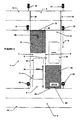
- FIG. 1 there is illustrated a road 1 that extends between a first end 2 that is adjacent to a first intersection 3 and a second end 4 that is adjacent to a second intersection 5 that is spaced apart from intersection 3.
- Intersections 3 and 5 define respective decision zones, in that the driver of a vehicle on the road approaching either of these intersections must make a decision about the direction and/or the timing of subsequent travel.
- Road 1 includes two coextending and coextensive lanes 7 and 8 that are divided by a broken line marking 9.
- Road 1 is intended for use by vehicular traffic such as motor cars, trucks, buses and motorcycles. However, in other embodiments the road is for other traffic such a bicycles, horse drawn conveyances and, in some cases, foot traffic.
- Intersection 3 defines the interface between road 1 and a road 13 that is normal to road 1.
- Intersection 5 is an interface between road 1 and a road 14 that is also normal to road 1. In other embodiments the angle between road 1 and roads 13 and 14 is other than 90°.
- Intersection 3 is collectively defined by three unbroken lines 18, 19 and 20.
- Lines 18 and 20 are parallel with each other and extend across road 13, while line 19 is normal to lines 18 and 20 and extends across end 2 of road 1.
- the traffic flow through the intersection is controlled by traffic lights 21 and a traffic control sign in the form of a left arrow 22.
- the arrow is painted to the surface of lane 7, adjacent to end 2, and indicates to the traffic in lane 7 that is approaching intersection 3 that only a left turn is permitted at the intersection.
- Intersection 5 includes a single set of double unbroken lines 23 that extend across lane 5 at end 4. Adjacent to end 4 are two traffic control signs in the form of stop signs 24 that are posted on the side of road 1. Signs 24 indicate to the traffic in lane 8 that, upon approaching intersection 5 there is a need, in addition to giving way to any traffic travelling on road 14, to come to a complete halt prior to entering intersection 5.
- Lane 8 also includes a traffic control sign in the form of a stop sign 25 that is painted to the surface of the lane. This provides the traffic with additional warning of the nature of the decision making that will soon be required.
- a preferred embodiment of the invention provides a method of placing visible advertising on the upper surface of road 1.
- This method includes determining the location of the traffic control signs that are applied to the surface of the road. In this case, that includes determining the location of signs 22 and 25. Following from this, two exclusion zones are defined, as indicated by circles 31 and 32. These zones extend from the respective signs and terminate at a predetermined minimum distance from the signs. Advertising is then applied to the surface such that it overlies neither the signs nor the exclusion zones.
- the advertising has been placed in the areas bounded by rectangles 33 and 34, which are respectively disposed within lanes 7 and 8. In other embodiments the advertising is placed in one of the lanes only. However, in further embodiments, rectangles 33 and 34 are adjacent to each other - as opposed to being offset - and a single advertisement extends across both rectangles.
- the predetermined minimum distance is 50 metres, which equates to about three seconds of travel at the posting speed limit. That is, in this embodiment, the posted limit is 60 km/hr. In other embodiments the minimum distance is defined by five seconds of travel at the posted limit, while in further embodiments the minimum distance is set at a fixed amount of 100 metres.
- the exclusion zones provide a sufficient interval between the advertising and any traffic control signs to ensure that the person controlling the relevant vehicle will have adequate time to react to those signs. More over, the absence of the advertising will act as a reminder to the person to undertake a review of the motoring environment.
- the rectangles 33 and 34 bound those areas in which the advertising is placed. However, the advertising itself need not be rectangular in shape. Each rectangle 33 and 34 contains one or more separate advertisements depending upon the size of those advertisements and the rectangles.
- exclusion zones extend only in the lane in which the sign is applied and are designated as zones 35 and 36. Moreover, those zones extend only in the opposite direction to the direction of travel in that lane. Accordingly, it is possible to have a larger area 33 and 34 available to bear advertisements.
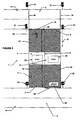
- FIG. 3 A further embodiment of the invention is illustrated in Figure 3 , where corresponding features are denoted by corresponding reference numerals.
- the exclusion zones 37 and 38 extend from decisions zones -that is, from intersections 3 and 5 - and in a direction opposite to the direction of travel in a lane. That is, the marking on the lanes that provides the reference point for the minimum distance is now the double lines 19 and 23 respectively.
- the predetermined minimum distance is larger than for the earlier described embodiments to ensure that any traffic control signs applied to the lanes fall within the respective exclusion zones.
- area 33 is broken into a plurality of like sub-areas that are equally spaced apart along lane 7 in the direction of travel. This allows a number of different advertisements to be provided in the respective sub-areas or, alternatively, a single advertisement to be repeated. It also allows an advertiser to place a sequence of advertisements.
- Area 34 is also sub-divided, although into only two sub-areas. In other embodiments different degrees of sub-division are used.
- This aspect provides a method of selecting portions of road lanes 7 and 8 for placing visible advertising.
- the method includes:
- the first step of determining the direction of travel is easily achieved.
- the direction of travel in lane 7 is indicated by arrow 11.
- the next step is to determine the location of two consecutive decision zones along lane 7. In this case, those zones are defined by intersections 3 and 5.
- the intersections are spaced apart in the direction of travel and define an upstream zone - that being intersection 5 - and a downstream zone - that being intersection 3.
- Zone 41 extends from intersection 3 toward intersection 5 and which terminates at a first predetermined distance from intersection 3.
- the first predetermined distance is indicated by arrow 42 and is calculated in accordance with the posted speed limit.
- intersection 3 and 5 define the upstream zone and downstream zone respectively. This being due to the opposite direction of travel in the two lanes. This results in the portion denoted by reference numeral 34 being selected. Similarly, there is a lead zone 43 and a predetermined distance 44.
- Areas 33 and 34 are smaller than the available area between the zones 41 and 43. However, in other embodiments the areas and the zones are equal in size.
- FIG. 5 A further embodiment, similar to that of Figure 4 , is shown in Figure 5 .
- the lead zones extend across the entirety of road 1 and not just the respective lane. Accordingly, there is less total area of advertising 33 and 34. However, in some circumstances this is preferred due to local conditions.
- the method also includes determining a trailing zone 45 that extends from intersection 5 toward intersection 3 and terminates at a second predetermined distance - denoted by arrow 46 - from intersection 5.
- the area within zone 45 is excluded from selection for the placement of advertising.
- Distance 46 is less than distance 42 and distance 44 as it follows, not precedes an intersection. In some embodiments, however, distance 46 is equal to distances 42 and 44.
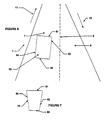
- Figures 7 and 8 illustrate an embodiment of the invention that relates to perspective correction of the advertisement. That is, most viewers of the advertisements will have a perspective view that is at only a small angle to the surface to which that advertisement is applied. To provide ease of viewing of that advertisement, the preferred embodiments include a correction to the advertising image to account for the typical viewing angle. Accordingly, the advertisement 33, when viewed from directly above, and as best shown in Figure 7 , will have a wide end 51 and a narrow end 52 that are joined by inclined sides 53 and 54. When this advertisement is applied to the road, as best shown in Figure 8 , it will be perceived by a viewer in a much more linear form.
- inductive loop sensors At many intersections, particularly those that are controlled by traffic lights, it is usual for inductive loop sensors to be installed within the road to detect the presence or absence of cars. Accordingly, use is made of these sensors to provide an indication of the traffic density and, hence, the exposure gained by the advertisements placed in accordance with the preferred embodiments. This allows the advertiser to gain quantifiable feedback on the effectiveness or otherwise of the advertising.
- While the preferred embodiments are targeted toward main road with traffic flows in the order of 5,000 to 100,000 cars a day, it is equally applicable to niches such as slower traffic zones - particularly adjacent to shopping centres - taxi ranks such as those at airports and hotels, and other transport interchanges.
- the advertising is applied to the surface byway of painting.
- use is made of adhesive films, other films such as electrostatic films, coloured articles embedded in the surface such as glass or concrete beads, amongst other things.
- other embodiments make use of coatings that reflect light back toward the source of that light Accordingly, in the preferred embodiments, more than one advertisement is able to be placed in one area, in that viewers from one direction will perceive an image differing from viewers from the opposite direction.
- Other embodiments make use of active devices to provide the advertising image on the road surface. For example, the use of an array of LED's that are embedded in the surface and which include a protective cover.
- use is made of a light source that interacts specifically with the passive coating to provide the desire visual affect. For example, ultraviolet lighting and fluorescent paint that is responsive to such lighting.
- the advertising does not include any visual representation of numbers to minimise any confusion with the speed limit that applies to the road. Additionally, the embodiments are visually and spatially distinguished from road control signs and decision zones to minimise confusion on behalf of the motorist.
- a further preferred embodiment of the invention is schematically illustrated in Figure 10 , and includes a method of advertising on a road surface.
- the method includes a central coordinator 81 obtaining a plurality of advertising information parcels in electronic form that are indicative of corresponding visual advertisements from one or more or a plurality of parties 82.
- parties are typically either providers of goods and/or services, or advertising agents acting on behalf of such providers.
- parties 81 desire to have advertisements placed upon the road surface to advertise respective products and/or services.
- Each information parcel includes an image file of a predetermined format, and this varies between jurisdictions. In all cases, the resolution of provided by the format must be sufficient to allow the image to be replicated by the equipment that is ultimately used to place the advertisement on the road.
- Coordinator 81 confirms receipt of the respective parcels and conducts an initial quality control review of the information parcel to ensure that the image contains subject matter that is suitable for application to a road. For example, if the image is complex and contains significant amounts of information or writing, it is less likely to be cognised by a driver. In such cases, coordinator 81 provides feedback to the respective party.
- Parties 82 communicate with coordinator 81 by a secure internet link (not shown).
- a secure internet link not shown.
- use is made of other media be that electronic, paper based, voice, or a combination.
- the information parcels are accompanied by order information from the respective parties for placement of the visual advertisements.
- the order information contains data fields for allowing the parties 82 to indicate one or more of: the expenditure that the party 82 has budgeted for the advertising; the number of advertisements required; the geographic area in which the advertisements are to be placed; and the geographic spread of the advertisements. These fields are processed by coordinator 81 to formulate a road advertising campaign for party 82, as will be discussed further below.
- Coordinator 81 has available a predefined quantum of road surface that is available to bear advertisements such as those desired by parties 82.
- This road surfaces is defined as a plurality of zones (not shown)for receiving respective advertisements.
- Each zone is characterised by coordinator 81 by the following criterion: location; size; maximum allowable speed; time period; and premium. In other embodiments, less criterion are used, while in other embodiments additional or different criterion are used.
- the location criterion includes data indicative of: global coordinates for the zone; the suburb in which the zone is located; the city in which the zone is located; the postcode of the area in which the zone is located; an intersection that is adjacent to the zone; and other landmarks adjacent to or near the zone.
- the premium criterion includes a weighting for determining the cost to the respective party 82 of placing the advertising in the respective zone for a predetermined unit of time. More preferably, the weighting is also responsive to one or more of the location criterion.
- zones characterised in this way it is possible to create a database of available zones to automate the allocation of those zones in response to the order information from parties 82.
- coordinator 81 undertakes further processing to identify an alternative zone that best satisfies the requirements of that party. For some parties 82, if a desired zone is not immediately available, it is reserved for use when it does so become available.
- Coordinator 81 undertakes the above processing electronically and automatically through use of a computer network (not shown) that is interfaced with parties 82 via the internet. That processing results in a confirmation of an order and invoice being electronically delivered to the respective party wishing to place the advertisements. This confirmation includes all the relevant information about the location of the advertisement, the content of the advertisement, the timing and duration of the placement and the cost to the party of that placement. Simultaneously or contemporaneously with the delivery of the confirmation being sent to a respective party 82, coordinator 81 also automatically generates an electronic instruction to a contractor 83 who is charged to physically place the advertisement or advertisements in the agreed location. Accordingly, the electronic instruction is response to the advertising information parcels and the allocation of those parcels.
- this confirmation includes a field containing a digitised image of the advertisement.
- Coordinator 81 is responsive to this confirmation for undertaking a selective quality review of the advertisements, and for providing the image to the respective party 82.
- the above method is performed repeatedly at predetermined times after the placement and application of the advertisements. If, during one of these repeated performances, the advertising information varies from the preceding performance, then the method also includes applying correspondingly varied advertisements to the relevant zones. More preferably, the method includes removing the earlier applied advertisements prior to applying the varied advertisements. Ultimately, this will depend upon the actual form of the modification that is provided to the road surface to effect the advertisements.
- Coordinator 81 gathers data indicative of the traffic densities at least selected ones of the zones, and uses this as a means of determining the quantum of the charges levied to respective parties 82 who place advertisements within those zones.
- the advertisers will be prepared to pay a premium for high volume exposure, in addition to certain geographic factors.
- the data is historical, and is provided by manual estimates or counts. However, it is preferred that the data is gathered from the period in which the advertisement is placed, and is gathered automatically. For example, through use of inductive loop or other sensors near or within the road itself. This allows the advertiser with greater objectivity of exposure, and to allow another measure to correlate with the results of a marketing campaign involving the advertisements.
- the above method also includes additional steps that involve the owner of the road.
- this embodiment is has been assumed there is only one owner 84, although it will be appreciated that in other embodiments there is more than one owner.
- Coordinator 81 generates revenues from the placement of advertising on the road surface and pays contractor 84 to place those advertisements. Additionally, the coordinator provides payments to owner 84 which are then able to be used to contribute to the ongoing maintenance of the roads under the control of owner 84. It is in the interests of coordinator 81 to have a road surface in good repair, as otherwise parties 82 will be less inclined to place advertisements. Accordingly, coordinator 81, in addition to the above steps, makes use of contractor 83 to gain information about the state of the roads where advertisements are desired to be placed. This information is provided to coordinator 81 in an electronic form and, in cases where maintenance or preventative maintenance is warranted, the required information is electronically and automatically sent to owner 84. As the coordinator has accurate records of the zones, it is possible for the owner to be easily informed of the timing and location of any potential sites of wear or disrepair.
- this embodiment provides a method for funding a first party - that is, owner 84 - to maintain a road.
- the method includes having a second party in the form of coordinator 81 obtain an advertising information parcel that is indicative of a visual advertisement.
- a third party, in the form of party 82, provides order information to the second party to place the visual advertisement.
- an account is credited with a payment from the third party to the second party.
- a zone is defined on a surface of the road for receiving the advertisement, and the surface is modified in accordance with the parcel to provide the visual advertisement.
- the account is debited with a payment to the first party.
- the third party provides the order information to the second party, and the payment to the first party is calculated in response to one or more of:
- the characteristics of the zone include one or more of;
- a method of advertising including applying advertising information to the surface of a road.
- the advertising information is applied to the surface as a coating and, preferably, as a coating of paint.
- the advertising information is applied to the surface as a plurality of coatings, where the coatings are of visually distinct colours.
- the coatings are semi-permanent.
- Preferential use is made of passive materials such as paint due to cost and safety considerations.
- the material used has to be sufficiently robust to withstand that wear of vehicle traffic, but also be removable to allow the application of a fresh or different advertisement. It is possible to use active devices such as LED's embedded in the surface of the road.
- a method for funding a first party to create a road including:
- the zones in adjacent lanes are offset from each other.
- the resultant multi-lane advertisement is large enough for the motorist in each lane to view the advertisement without being distracted or diverted from the traffic or traffic conditions.
- the method of application includes the use of a template.
- the template is a sheet of laminate material that has had portions removed to define windows through the material.
- the shape and spacing of the windows correspond to the shape and spacing of the desired information contained within the advertising.
- the windows define a negative of the desired information contained within the advertising.
- the template is placed upon the selected road surface and the paint or other coating applied over the template.
- the paint will pass through the windows and onto the road below to provide the appropriate representation.
- the image need not fully cover all of the surface, and the underlying road colour is able to be used as a background colour.
- the preference is to include less rather than more detail to better ensure cognisance of the information being advertised. This tends to favour the use of logos and trademark devices over text. Notwithstanding, text is able to be used either alone or in combination with a logo.
- a number of templates are used in sequence in the same selected road surface to allow the use of paints of more than one colour. While it is usual for the windows of different templates to be offset, in other embodiments, some of the windows overlap to allow mixing of the paints in selected areas and therefore a greater number of colours are achieved with the same number of paint colours.
- the templates are provided by the advertiser to the party applying the advertising.
- the advertiser provides advertising information that is subsequently converted into templates.
- the paint or paints used with the templates is intended to be removed at the end of a predetermined period - which is, in this embodiment, a calendar month - and is chosen to be easily removable after that length of application to the road.
- Some paints are removed through abrasion such as brushing or scaping, while other paints are removed with solvents.
- a combination of abrasion techniques and solvents are used.
- Alternative embodiments simply apply the new advertisement over the old or, in other cases, paint over the old with a background colour upon which the new advertisement is then painted.
- the preferred embodiments have been described above with particular reference to use in built up areas where the decision zones and traffic control zones are closely spaced. However, it is also applicable to open roads such as country roads and freeways where the decision zones and traffic control zones are spaced further apart.
- the area selected to apply the advertisements is on a multi-lane freeway 61. While only one side of the freeway is illustrated, it will be appreciated that the other side will support traffic flows in the opposite direction. That is, all the traffic in the three lanes 62, 63 and 64 travels in the direction shown by arrow 65.
- multi-lane roads such as freeway 61, it is possible to have a single advertisement, such as advertisement 66, overlapping a number of lanes.
- Freeway 61 also includes two opposite shoulders 67 and 68 that run adjacent to lanes 62 and 64 respectively. These shoulders also have respective advertisements 69 and 70 applied to their surfaces. It will be noted that these advertisements are other than rectangular.
- lane 64 is shown to include an advertisement 71 that is elongate in the direction of travel and which only occupies less than half the width of the lane.
- Other alternatives include a series of inclined advertisements 72 that are placed within lane 63.
- Many other shapes, configurations and orientations are available, including irregular and compound shapes that present an image of a logo or other distinctive device.
- the advertising is applicable to all road surfaces, be they bitumen, concrete, or other materials.
- the advertising is applied as a coating or film that has high grip levels.
- the coating is a coloured particulate material and a binder for adhering the material to the surface of the road.
- the texture of this material is usually coarser than the underlying road surface and allows better grip, especially in the wet.
- Alternative materials for modifying the road surface to provide the advertisements include concrete, coloured or textured gravels, or adhesive tapes.
- One particularly preferred material is a high friction skid resistance surface treatment sold under the trademark TYREGRIP AS by an Australian company Safe T Surfaces Pty Ltd.
- Other treatments provided by this entity are also suitable. At the date of lodgement of this specification the details of those products were included on the website www.tyregrip.com.au.
- the actual treatment, coating, or other material used to ensure the road surface provides a predetermined visual image to the desire viewer is dependent upon a variety of physical factors such as the nature of the surface, the prevailing weather conditions and the traffic density, amongst others. However, it is also dependent upon the regional laws about what forms of surface modifications to roads is permissible. There is considerably variety between jurisdictions and, typically, is administered and regulated by a government or semi-government body. For example, in the state of New South Wales, Australia, the relevant body is known as the Roads and Traffic Authority. This leads, in some cases, to the relevant body specifying or indeed supplying the permissible materials for treating the road surface.
- the information to displayed is of a relatively permanent nature.
- that coating is designed to degrade with time. This is in recognition of the changing needs of the parties wishing to advertise, and the fact that they will not wish to indefinitely pay for an advertisement in a given location. It therefore also allows the use of less expensive materials, as permanence is not required. It usually also facilitates the removal of the material, should that be required, say, prior to placing a new advertisement in the same location.
- an advertisement is designed to have an effective lifetime of about three months.
- the degradation of the material is dependent upon the density, speed and size of the traffic on the road, the prevailing whether conditions and the material used in the coating. Accordingly, the rate of degradation is determined individually for different roads and different coatings. Once the advertisements are placed it will progressively decay. In some embodiments, such as the particulate example used above, the binder breaks down with exposure to air and, as such, the particulate will remain tolerant to traffic flows for some time, but then will quickly be removed by the traffic once the binder fails.
- advertisements placed in accordance with the invention will have preferential areas for wear, where underlying that area is a further image or information. That is, the advertisement will change with time to reveal the underlying advertisement.
- the surface is modified by the projection of light through a filter.
- the end result being a predetermined image being formed on the surface, where that image is an advertisement.
- This is particularly advantageous in areas where snow, water, leaves or other matter is known to periodically or regularly lie on the surface and thereby render directly surface mounted advertising ineffective.
- the "road" includes the intervening
- a road usually terminates at its transverse edges in respective opposite gutters. Extending transversely beyond the gutters are footpaths that are also typically sealed surfaces. As will be appreciated by those skilled in the art, these footpaths are intended to bear predominantly pedestrian traffic. Notwithstanding, the advertising and method of advertising of the invention is applicable also to these surfaces.
- the term "road” is intended to refer to a path travelled by vehicular or other traffic. This includes a street, a footpath or sidewalk, a carriageway, dual or otherwise, a thoroughfare, a highway, a freeway, an artery, a bridge, an alley, a cul-de-sac and the like.
- the surface of the road is preferably sealed to facilitate the application of the advertisement.
- the preferred embodiments make use of a load bearing surface of the road to also display advertising information to the party travelling on that surface. This dual functionality provides many advantages and benefits, as enunciated above.
Landscapes
- Business, Economics & Management (AREA)
- Physics & Mathematics (AREA)
- General Physics & Mathematics (AREA)
- Engineering & Computer Science (AREA)
- Theoretical Computer Science (AREA)
- General Business, Economics & Management (AREA)
- Accounting & Taxation (AREA)
- Marketing (AREA)
- Management, Administration, Business Operations System, And Electronic Commerce (AREA)
- Road Signs Or Road Markings (AREA)
Claims (15)
- Verfahren zum Auswählen eines Teils einer Straßenfahrbahn (7, 8) zum Platzieren sichtbarer Werbung (33, 34), wobei die Fahrbahn für den Fahrzeugverkehr verwendet wird und das Verfahren Folgendes aufweist:Bestimmen einer Fahrtrichtung des Fahrzeugverkehrs entlang der Fahrbahn (7, 8),Bestimmen der Lage zweier aufeinanderfolgender Entscheidungsbereiche entlang der Fahrbahn (7, 8), wobei die Bereiche in die Fahrtrichtung beabstandet sind, um einen stromaufwärtigen Bereich (5) und einen stromabwärtigen Bereich (3) zu definieren,Definieren eines Führungsbereichs (41, 43), der sich von dem stromabwärtigen Bereich (3) zu dem stromaufwärtigen Bereich (5) erstreckt und an einer ersten vorbestimmten Entfernung (44) von dem stromabwärtigen Bereich (3) endet,Auswahl des Abschnitts, der zwischen dem stromaufwärtigen Bereich (5) und dem Führungsbereich (41, 43) liegen soll,Auftragen einer Beschichtung auf die Oberfläche des ausgewählten Abschnitts, um die Werbung (33, 34) zu definieren, wobei die Werbung (33, 34) beim Gebrauch Abnutzung durch den Fahrzeugverkehr unterliegt, undin einer vorbestimmten Periode nach dem Auftragen der Beschichtung, Entfernen von der Oberfläche im Wesentlichen die gesamte restliche Beschichtung oder Auftragen einer neuen Beschichtung über die restliche Beschichtung.
- Verfahren nach Anspruch 1, das Folgendes aufweist:Bestimmen der maximal zulässigen Geschwindigkeit des Verkehrs entlang der Fahrbahn (7, 8) undReagieren auf die maximal zulässige Geschwindigkeit zum Berechnen der vorbestimmten Entfernung (44).
- Verfahren nach Anspruch 2, bei dem zum Berechnen der vorbestimmten Entfernung (44) das Verfahren das Multiplizieren der maximal zulässigen Geschwindigkeit mit einem konstanten Geschwindigkeitsfaktor aufweist.
- Verfahren nach Anspruch 3, bei dem der Zeitfaktor zwischen etwa drei und fünf Sekunden liegt.
- Verfahren nach einem der vorhergehenden Ansprüche, das Folgendes aufweist:Bestimmen der maximal zulässigen Geschwindigkeit des Verkehrs entlang der Fahrbahn undReagieren auf die maximal zulässige Geschwindigkeit zum Berechnen einer vorbestimmten Länge der sichtbaren Werbung (33, 34) in die Fahrtrichtung.
- Verfahren nach Anspruch 5, wobei die vorbestimmte Länge eine Mindestlänge ist.
- Verfahren nach einem der vorhergehenden Ansprüche, das den Schritt des Definierens eines Nachschleppbereichs (45) aufweist, der sich von dem stromaufwärtigen Bereich (5) zu dem stromabwärtigen Bereich (3) erstreckt, und der in einer zweiten vorbestimmten Entfernung (46) von dem stromaufwärtigen Bereich (5) endet.
- Verfahren nach Anspruch 7, wobei die erste und die zweite vorbestimmte Entfernung (44 und 46) in etwa gleich sind.
- Verfahren nach Anspruch 7, wobei die erste und die zweite vorbestimmte Entfernung (44 und 46) nicht gleich sind.
- Verfahren nach Anspruch 9, wobei die erste vorbestimmte Entfernung (44) größer ist als die zweite vorbestimmte Entfernung (46).
- Verfahren nach einem der vorhergehenden Ansprüche, wobei die Fahrtrichtung konstant ist.
- Verfahren nach einem der vorhergehenden Ansprüche, wobei die Beschichtung ein Anstrich, ein Klebeband, ein reflektierendes Material und/oder ein strukturiertes Material ist.
- Verfahren nach einem der vorhergehenden Ansprüche, wobei das Verfahren ferner einen Schritt des Ausrichtens der Werbung (33, 34) innerhalb der Fahrbahn (7, 8) für das bevorzugte Ansehen durch einen Benutzer, der entlang der Fahrbahn in Fahrtrichtung fährt, aufweist.
- Verfahren nach einem der vorhergehenden Ansprüche, wobei der ausgewählte Abschnitt eine Oberfläche aufweist, und das Verfahren den Schritt des Auftragens der Werbung durch Ändern der Oberfläche aufweist.
- Verfahren nach einem der vorhergehenden Ansprüche, wobei die Entscheidungsbereiche Verkehrssignale (21, 22, 24, 25) sind.
Applications Claiming Priority (3)
| Application Number | Priority Date | Filing Date | Title |
|---|---|---|---|
| AUPS0658A AUPS065802A0 (en) | 2002-02-20 | 2002-02-20 | A method of placing visible advertising |
| AUPS065802 | 2002-02-20 | ||
| PCT/AU2003/000227 WO2003071510A1 (en) | 2002-02-20 | 2003-02-20 | A method of placing visible advertising |
Publications (3)
| Publication Number | Publication Date |
|---|---|
| EP1485899A1 EP1485899A1 (de) | 2004-12-15 |
| EP1485899A4 EP1485899A4 (de) | 2008-01-23 |
| EP1485899B1 true EP1485899B1 (de) | 2013-10-16 |
Family
ID=3834257
Family Applications (1)
| Application Number | Title | Priority Date | Filing Date |
|---|---|---|---|
| EP03742476.9A Expired - Lifetime EP1485899B1 (de) | 2002-02-20 | 2003-02-20 | Verfahren zum plazieren einer sichtbaren werbung |
Country Status (6)
| Country | Link |
|---|---|
| US (5) | US20050084329A1 (de) |
| EP (1) | EP1485899B1 (de) |
| CN (1) | CN100580749C (de) |
| AU (3) | AUPS065802A0 (de) |
| WO (1) | WO2003071510A1 (de) |
| ZA (1) | ZA200407542B (de) |
Families Citing this family (14)
| Publication number | Priority date | Publication date | Assignee | Title |
|---|---|---|---|---|
| JP2007529765A (ja) * | 2004-03-18 | 2007-10-25 | トザー、ジョン | 舗道広告のシステム並びに方法 |
| US20060242015A1 (en) * | 2005-04-26 | 2006-10-26 | Mark Thompson | Method of bridge advertising |
| US20100153311A1 (en) * | 2006-08-28 | 2010-06-17 | Mccormick Raelene Denyce | Planar advertising system and method |
| US20090099910A1 (en) * | 2007-10-11 | 2009-04-16 | International Business Machines Corporation | System and method for managing electronic advertising responsive to traffic congestion |
| US8781968B1 (en) * | 2008-08-25 | 2014-07-15 | Sprint Communications Company L.P. | Dynamic display based on estimated viewers |
| US9666068B2 (en) * | 2015-03-16 | 2017-05-30 | International Business Machines Corporation | Synchronized traffic warning signal system |
| JP6430908B2 (ja) * | 2015-07-21 | 2018-11-28 | 株式会社 ゼネテック | 商品提案サーバー |
| CN109905452B (zh) * | 2017-12-09 | 2021-07-16 | 长沙聚通电子科技有限公司 | 一种基于地理位置的网格广告智能推送系统 |
| US11403938B2 (en) | 2019-04-04 | 2022-08-02 | Geotab Inc. | Method for determining traffic metrics of a road network |
| US10699564B1 (en) | 2019-04-04 | 2020-06-30 | Geotab Inc. | Method for defining intersections using machine learning |
| US11335191B2 (en) | 2019-04-04 | 2022-05-17 | Geotab Inc. | Intelligent telematics system for defining road networks |
| US11335189B2 (en) | 2019-04-04 | 2022-05-17 | Geotab Inc. | Method for defining road networks |
| US11341846B2 (en) | 2019-04-04 | 2022-05-24 | Geotab Inc. | Traffic analytics system for defining road networks |
| CN111696457B (zh) * | 2020-05-22 | 2022-06-10 | 蔡德伟 | 汽车后视镜投影仪的投影系统与投影方法 |
Family Cites Families (25)
| Publication number | Priority date | Publication date | Assignee | Title |
|---|---|---|---|---|
| US1732869A (en) * | 1926-01-27 | 1929-10-22 | Eugene F Wambach | Fabricated sign |
| US1830319A (en) * | 1928-07-05 | 1931-11-03 | Melvin E Hartzler | Pavement marker |
| US2503574A (en) * | 1947-05-06 | 1950-04-11 | Walkolite Company Inc | Combined pedestrian traffic signal and advertising device |
| US3188927A (en) * | 1958-08-28 | 1965-06-15 | Allan M Woods | Traffic control means |
| US3626896A (en) * | 1968-11-01 | 1971-12-14 | Frank W Preeshl | Highway sign |
| DE2833709A1 (de) * | 1978-07-28 | 1980-02-07 | Juergen Czarnetzki | Anordnung zur leitung des strassenverkehrs in kreuzungsbereichen mit spuraenderungen |
| SE434286B (sv) * | 1980-06-04 | 1984-07-16 | Sven Runo Vilhelm Gebelius | Forfarande for astadkommande av fordelning av vegbaneslitage astadkommet av passerande fordon |
| US4888896A (en) * | 1987-06-29 | 1989-12-26 | Sanchez Richard E | Utility cut patch identification tag |
| FI80286C (fi) * | 1987-08-27 | 1990-05-10 | O Pinomaa Ky | Ny, faergbar gatubelaeggning. |
| US5150116A (en) * | 1990-04-12 | 1992-09-22 | West Harold B | Traffic-light timed advertising center |
| MY140917A (en) | 1991-06-04 | 2010-02-12 | Mitsubishi Electric Corp | Multiple data surface data storage system and method |
| WO1993022507A1 (en) * | 1992-05-04 | 1993-11-11 | Reliable Racing Supply, Inc. | Yielding delineator post |
| CN1097518A (zh) * | 1993-07-16 | 1995-01-18 | 冯志忠 | 分段组合式路标广告牌系统的设计方法 |
| US5654705A (en) * | 1996-09-06 | 1997-08-05 | Houten; Ronald Van | Apparatus for prompting pedestrians |
| US5947635A (en) * | 1997-11-03 | 1999-09-07 | Wilson, Sr.; Jack H. | Method for sealing and marking pavement with recognizable indicia |
| CN1227377A (zh) * | 1999-01-28 | 1999-09-01 | 张道军 | 广告媒体 |
| AU2941700A (en) * | 1999-03-11 | 2000-09-28 | Sony Corporation | Information receiver and information receiving method |
| US6444077B1 (en) * | 1999-05-03 | 2002-09-03 | Global Trade Enterprises, Ltd. | Concrete display device and method of making |
| CA2276943A1 (en) * | 1999-07-12 | 2001-01-12 | Bibhuti Bhusan Bardhan | Safer amber traffic light |
| CN1357869A (zh) * | 2000-12-13 | 2002-07-10 | 褚衍福 | 地面广告的制作方法 |
| US6576074B1 (en) * | 2001-01-09 | 2003-06-10 | Avery Dennison Corporation | Pavement marking system |
| CN1319828A (zh) * | 2001-02-08 | 2001-10-31 | 张道军 | 广告媒体 |
| US6524412B2 (en) * | 2001-03-12 | 2003-02-25 | Phillip L. Smith | Method for forming and applying a roadside display system |
| AU2001100126A4 (en) * | 2001-06-29 | 2001-08-16 | Tozer, John Wilson | Road surface advertising |
| US6914540B2 (en) * | 2002-03-04 | 2005-07-05 | Christopher Gongolas | Traffic area signage systems |
-
2002
- 2002-02-20 AU AUPS0658A patent/AUPS065802A0/en not_active Abandoned
-
2003
- 2003-02-20 WO PCT/AU2003/000227 patent/WO2003071510A1/en not_active Ceased
- 2003-02-20 EP EP03742476.9A patent/EP1485899B1/de not_active Expired - Lifetime
- 2003-02-20 CN CN03808823A patent/CN100580749C/zh not_active Expired - Fee Related
- 2003-02-20 US US10/505,081 patent/US20050084329A1/en not_active Abandoned
- 2003-02-20 AU AU2003247267A patent/AU2003247267B2/en not_active Ceased
-
2004
- 2004-09-20 ZA ZA200407542A patent/ZA200407542B/xx unknown
-
2007
- 2007-04-20 US US11/737,874 patent/US20070192260A1/en not_active Abandoned
-
2008
- 2008-04-01 US US12/060,667 patent/US20080199255A1/en not_active Abandoned
-
2010
- 2010-02-26 AU AU2010200723A patent/AU2010200723A1/en not_active Abandoned
- 2010-05-19 US US12/783,213 patent/US20100290836A1/en not_active Abandoned
-
2012
- 2012-06-13 US US13/495,122 patent/US8517627B2/en not_active Expired - Fee Related
Also Published As
| Publication number | Publication date |
|---|---|
| WO2003071510A1 (en) | 2003-08-28 |
| AU2003247267B2 (en) | 2009-11-26 |
| EP1485899A1 (de) | 2004-12-15 |
| AUPS065802A0 (en) | 2002-03-14 |
| AU2003247267A1 (en) | 2003-09-09 |
| AU2010200723A1 (en) | 2010-03-18 |
| CN1647143A (zh) | 2005-07-27 |
| EP1485899A4 (de) | 2008-01-23 |
| US20070192260A1 (en) | 2007-08-16 |
| US20050084329A1 (en) | 2005-04-21 |
| US8517627B2 (en) | 2013-08-27 |
| CN100580749C (zh) | 2010-01-13 |
| US20100290836A1 (en) | 2010-11-18 |
| ZA200407542B (en) | 2009-12-30 |
| US20080199255A1 (en) | 2008-08-21 |
| US20120251240A1 (en) | 2012-10-04 |
Similar Documents
| Publication | Publication Date | Title |
|---|---|---|
| US8517627B2 (en) | Method of placing visible advertising | |
| US7124526B2 (en) | Overhead highway billboard and marketing method | |
| Finley et al. | Traffic Control Device Analysis, Testing, and Evaluation Program: FY2020 Activities | |
| AU2010257461A1 (en) | System and Method of Pavement Advertising | |
| Fitzsimmons | The effectiveness of Iowa's automated red light running enforcement programs | |
| Brewer et al. | Identification and testing of measures to improve work zone speed limit compliance | |
| Meyer | Evaluation of data from test application of optical speed bars to highway work zones | |
| Dougald | Best Practices in Traffic Operations and Safety: Phase II: Zig-zag Pavement Markings | |
| Schroeder et al. | Crosswalk Marking Selection Guide | |
| Barr et al. | Select bus service on bx12 in new york city: Bus rapid transit partnership of new york city dot and metropolitan transportation authority new york city transit | |
| Oršić et al. | Geospatial Analysis of Bicycle Infrastructure in the Function of Traffic Safety: The Case of the City of Zagreb | |
| Dougald et al. | Safer Midblock Environments for Pedestrian and Bicycle Crossings: Experiment with Zigzag Pavement Markings | |
| Neuman | A Guide for Reducing speeding-related Crashes | |
| Bagdade et al. | Michigan's Senior Driver Showcase Corridor: Implementation of Low-Cost Safety Improvements for Senior Drivers | |
| Wainwright | Synthesis of Non-MUTCD Traffic Signing | |
| Zwahlen et al. | Human Factors Opportunities to Improve Ohio’s Transportation System | |
| Hunter et al. | Evaluation Of The Blue Bike Lane Treatment Used In Bicycle-Motor Vehicle Conflicts Areas In Portland, Oregon | |
| Ezell | Bringing US Roads into the 21 st Century | |
| Briganti et al. | Design and information requirements for travel and tourism needs on scenic byways. | |
| HALABO | TRAFFIC SIGNS DAMAGE CAUSED BY HUMANS AND PERSONAL CHARACTERISTICS OF LOCAL DRIVERS: A CASE STUDY IN WOLAITA SODO | |
| Jeng et al. | Pedestrian Safety and Mobility Aids for Crossings at Bus Stops | |
| Deakin | Intelligent transportation systems: A compendium of technology summaries | |
| Zwahlen et al. | Human factors opportunities to improve Ohio’s transportation system: final report, June 2005. | |
| Amarasingha et al. | A study on pedestrian crossings in colombo suburbs | |
| Vandemark | Who Should Be Funding Intelligent Transportation Systems (ITS)? |
Legal Events
| Date | Code | Title | Description |
|---|---|---|---|
| PUAI | Public reference made under article 153(3) epc to a published international application that has entered the european phase |
Free format text: ORIGINAL CODE: 0009012 |
|
| 17P | Request for examination filed |
Effective date: 20040920 |
|
| AK | Designated contracting states |
Kind code of ref document: A1 Designated state(s): AT BE BG CH CY CZ DE DK EE ES FI FR GB GR HU IE IT LI LU MC NL PT SE SI SK TR |
|
| AX | Request for extension of the european patent |
Extension state: AL LT LV MK RO |
|
| A4 | Supplementary search report drawn up and despatched |
Effective date: 20071221 |
|
| 17Q | First examination report despatched |
Effective date: 20091117 |
|
| GRAP | Despatch of communication of intention to grant a patent |
Free format text: ORIGINAL CODE: EPIDOSNIGR1 |
|
| GRAS | Grant fee paid |
Free format text: ORIGINAL CODE: EPIDOSNIGR3 |
|
| GRAA | (expected) grant |
Free format text: ORIGINAL CODE: 0009210 |
|
| AK | Designated contracting states |
Kind code of ref document: B1 Designated state(s): AT BE BG CH CY CZ DE DK EE ES FI FR GB GR HU IE IT LI LU MC NL PT SE SI SK TR |
|
| REG | Reference to a national code |
Ref country code: GB Ref legal event code: FG4D |
|
| REG | Reference to a national code |
Ref country code: CH Ref legal event code: EP |
|
| REG | Reference to a national code |
Ref country code: IE Ref legal event code: FG4D |
|
| REG | Reference to a national code |
Ref country code: AT Ref legal event code: REF Ref document number: 636825 Country of ref document: AT Kind code of ref document: T Effective date: 20131115 |
|
| REG | Reference to a national code |
Ref country code: DE Ref legal event code: R096 Ref document number: 60345091 Country of ref document: DE Effective date: 20131205 |
|
| REG | Reference to a national code |
Ref country code: NL Ref legal event code: VDEP Effective date: 20131016 |
|
| REG | Reference to a national code |
Ref country code: AT Ref legal event code: MK05 Ref document number: 636825 Country of ref document: AT Kind code of ref document: T Effective date: 20131016 |
|
| PG25 | Lapsed in a contracting state [announced via postgrant information from national office to epo] |
Ref country code: FI Free format text: LAPSE BECAUSE OF FAILURE TO SUBMIT A TRANSLATION OF THE DESCRIPTION OR TO PAY THE FEE WITHIN THE PRESCRIBED TIME-LIMIT Effective date: 20131016 Ref country code: BE Free format text: LAPSE BECAUSE OF FAILURE TO SUBMIT A TRANSLATION OF THE DESCRIPTION OR TO PAY THE FEE WITHIN THE PRESCRIBED TIME-LIMIT Effective date: 20131016 Ref country code: SE Free format text: LAPSE BECAUSE OF FAILURE TO SUBMIT A TRANSLATION OF THE DESCRIPTION OR TO PAY THE FEE WITHIN THE PRESCRIBED TIME-LIMIT Effective date: 20131016 Ref country code: NL Free format text: LAPSE BECAUSE OF FAILURE TO SUBMIT A TRANSLATION OF THE DESCRIPTION OR TO PAY THE FEE WITHIN THE PRESCRIBED TIME-LIMIT Effective date: 20131016 |
|
| PG25 | Lapsed in a contracting state [announced via postgrant information from national office to epo] |
Ref country code: AT Free format text: LAPSE BECAUSE OF FAILURE TO SUBMIT A TRANSLATION OF THE DESCRIPTION OR TO PAY THE FEE WITHIN THE PRESCRIBED TIME-LIMIT Effective date: 20131016 Ref country code: CY Free format text: LAPSE BECAUSE OF FAILURE TO SUBMIT A TRANSLATION OF THE DESCRIPTION OR TO PAY THE FEE WITHIN THE PRESCRIBED TIME-LIMIT Effective date: 20131016 Ref country code: ES Free format text: LAPSE BECAUSE OF FAILURE TO SUBMIT A TRANSLATION OF THE DESCRIPTION OR TO PAY THE FEE WITHIN THE PRESCRIBED TIME-LIMIT Effective date: 20131016 |
|
| PG25 | Lapsed in a contracting state [announced via postgrant information from national office to epo] |
Ref country code: PT Free format text: LAPSE BECAUSE OF FAILURE TO SUBMIT A TRANSLATION OF THE DESCRIPTION OR TO PAY THE FEE WITHIN THE PRESCRIBED TIME-LIMIT Effective date: 20140217 |
|
| REG | Reference to a national code |
Ref country code: DE Ref legal event code: R097 Ref document number: 60345091 Country of ref document: DE |
|
| PG25 | Lapsed in a contracting state [announced via postgrant information from national office to epo] |
Ref country code: EE Free format text: LAPSE BECAUSE OF FAILURE TO SUBMIT A TRANSLATION OF THE DESCRIPTION OR TO PAY THE FEE WITHIN THE PRESCRIBED TIME-LIMIT Effective date: 20131016 |
|
| PLBE | No opposition filed within time limit |
Free format text: ORIGINAL CODE: 0009261 |
|
| STAA | Information on the status of an ep patent application or granted ep patent |
Free format text: STATUS: NO OPPOSITION FILED WITHIN TIME LIMIT |
|
| PG25 | Lapsed in a contracting state [announced via postgrant information from national office to epo] |
Ref country code: SK Free format text: LAPSE BECAUSE OF FAILURE TO SUBMIT A TRANSLATION OF THE DESCRIPTION OR TO PAY THE FEE WITHIN THE PRESCRIBED TIME-LIMIT Effective date: 20131016 Ref country code: CZ Free format text: LAPSE BECAUSE OF FAILURE TO SUBMIT A TRANSLATION OF THE DESCRIPTION OR TO PAY THE FEE WITHIN THE PRESCRIBED TIME-LIMIT Effective date: 20131016 Ref country code: IT Free format text: LAPSE BECAUSE OF FAILURE TO SUBMIT A TRANSLATION OF THE DESCRIPTION OR TO PAY THE FEE WITHIN THE PRESCRIBED TIME-LIMIT Effective date: 20131016 |
|
| 26N | No opposition filed |
Effective date: 20140717 |
|
| PG25 | Lapsed in a contracting state [announced via postgrant information from national office to epo] |
Ref country code: MC Free format text: LAPSE BECAUSE OF FAILURE TO SUBMIT A TRANSLATION OF THE DESCRIPTION OR TO PAY THE FEE WITHIN THE PRESCRIBED TIME-LIMIT Effective date: 20131016 Ref country code: LU Free format text: LAPSE BECAUSE OF FAILURE TO SUBMIT A TRANSLATION OF THE DESCRIPTION OR TO PAY THE FEE WITHIN THE PRESCRIBED TIME-LIMIT Effective date: 20140220 Ref country code: DK Free format text: LAPSE BECAUSE OF FAILURE TO SUBMIT A TRANSLATION OF THE DESCRIPTION OR TO PAY THE FEE WITHIN THE PRESCRIBED TIME-LIMIT Effective date: 20131016 |
|
| REG | Reference to a national code |
Ref country code: CH Ref legal event code: PL |
|
| REG | Reference to a national code |
Ref country code: DE Ref legal event code: R097 Ref document number: 60345091 Country of ref document: DE Effective date: 20140717 |
|
| PG25 | Lapsed in a contracting state [announced via postgrant information from national office to epo] |
Ref country code: LI Free format text: LAPSE BECAUSE OF NON-PAYMENT OF DUE FEES Effective date: 20140228 Ref country code: CH Free format text: LAPSE BECAUSE OF NON-PAYMENT OF DUE FEES Effective date: 20140228 |
|
| REG | Reference to a national code |
Ref country code: IE Ref legal event code: MM4A |
|
| PG25 | Lapsed in a contracting state [announced via postgrant information from national office to epo] |
Ref country code: IE Free format text: LAPSE BECAUSE OF NON-PAYMENT OF DUE FEES Effective date: 20140220 |
|
| REG | Reference to a national code |
Ref country code: FR Ref legal event code: PLFP Year of fee payment: 13 |
|
| PG25 | Lapsed in a contracting state [announced via postgrant information from national office to epo] |
Ref country code: SI Free format text: LAPSE BECAUSE OF FAILURE TO SUBMIT A TRANSLATION OF THE DESCRIPTION OR TO PAY THE FEE WITHIN THE PRESCRIBED TIME-LIMIT Effective date: 20131016 |
|
| PGFP | Annual fee paid to national office [announced via postgrant information from national office to epo] |
Ref country code: DE Payment date: 20150224 Year of fee payment: 13 |
|
| PGFP | Annual fee paid to national office [announced via postgrant information from national office to epo] |
Ref country code: GB Payment date: 20150227 Year of fee payment: 13 Ref country code: FR Payment date: 20150223 Year of fee payment: 13 |
|
| PG25 | Lapsed in a contracting state [announced via postgrant information from national office to epo] |
Ref country code: BG Free format text: LAPSE BECAUSE OF FAILURE TO SUBMIT A TRANSLATION OF THE DESCRIPTION OR TO PAY THE FEE WITHIN THE PRESCRIBED TIME-LIMIT Effective date: 20131016 |
|
| PG25 | Lapsed in a contracting state [announced via postgrant information from national office to epo] |
Ref country code: GR Free format text: LAPSE BECAUSE OF FAILURE TO SUBMIT A TRANSLATION OF THE DESCRIPTION OR TO PAY THE FEE WITHIN THE PRESCRIBED TIME-LIMIT Effective date: 20140117 |
|
| PG25 | Lapsed in a contracting state [announced via postgrant information from national office to epo] |
Ref country code: HU Free format text: LAPSE BECAUSE OF FAILURE TO SUBMIT A TRANSLATION OF THE DESCRIPTION OR TO PAY THE FEE WITHIN THE PRESCRIBED TIME-LIMIT; INVALID AB INITIO Effective date: 20030220 Ref country code: TR Free format text: LAPSE BECAUSE OF FAILURE TO SUBMIT A TRANSLATION OF THE DESCRIPTION OR TO PAY THE FEE WITHIN THE PRESCRIBED TIME-LIMIT Effective date: 20131016 |
|
| REG | Reference to a national code |
Ref country code: DE Ref legal event code: R119 Ref document number: 60345091 Country of ref document: DE |
|
| GBPC | Gb: european patent ceased through non-payment of renewal fee |
Effective date: 20160220 |
|
| REG | Reference to a national code |
Ref country code: FR Ref legal event code: ST Effective date: 20161028 |
|
| PG25 | Lapsed in a contracting state [announced via postgrant information from national office to epo] |
Ref country code: GB Free format text: LAPSE BECAUSE OF NON-PAYMENT OF DUE FEES Effective date: 20160220 Ref country code: DE Free format text: LAPSE BECAUSE OF NON-PAYMENT OF DUE FEES Effective date: 20160901 Ref country code: FR Free format text: LAPSE BECAUSE OF NON-PAYMENT OF DUE FEES Effective date: 20160229 |