EP1484924A2 - Verfahren zur Bestimmung von Bewegungsvektoren und Macroblöckentypen - Google Patents
Verfahren zur Bestimmung von Bewegungsvektoren und Macroblöckentypen Download PDFInfo
- Publication number
- EP1484924A2 EP1484924A2 EP20040008259 EP04008259A EP1484924A2 EP 1484924 A2 EP1484924 A2 EP 1484924A2 EP 20040008259 EP20040008259 EP 20040008259 EP 04008259 A EP04008259 A EP 04008259A EP 1484924 A2 EP1484924 A2 EP 1484924A2
- Authority
- EP
- European Patent Office
- Prior art keywords
- macroblock
- frame
- type
- motion vector
- skipped
- Prior art date
- Legal status (The legal status is an assumption and is not a legal conclusion. Google has not performed a legal analysis and makes no representation as to the accuracy of the status listed.)
- Withdrawn
Links
- 239000013598 vector Substances 0.000 title claims abstract description 130
- 238000000034 method Methods 0.000 title claims abstract description 72
- 238000006243 chemical reaction Methods 0.000 description 15
- 230000005540 biological transmission Effects 0.000 description 8
- 241000630329 Scomberesox saurus saurus Species 0.000 description 2
- 238000010586 diagram Methods 0.000 description 2
- 230000006978 adaptation Effects 0.000 description 1
- 238000010295 mobile communication Methods 0.000 description 1
- 230000002123 temporal effect Effects 0.000 description 1
Images



Classifications
-
- A—HUMAN NECESSITIES
- A62—LIFE-SAVING; FIRE-FIGHTING
- A62B—DEVICES, APPARATUS OR METHODS FOR LIFE-SAVING
- A62B1/00—Devices for lowering persons from buildings or the like
- A62B1/06—Devices for lowering persons from buildings or the like by making use of rope-lowering devices
- A62B1/18—Other single parts for rope lowering-devices, e.g. take-up rollers for ropes, devices for shooting ropes
-
- H—ELECTRICITY
- H04—ELECTRIC COMMUNICATION TECHNIQUE
- H04N—PICTORIAL COMMUNICATION, e.g. TELEVISION
- H04N19/00—Methods or arrangements for coding, decoding, compressing or decompressing digital video signals
- H04N19/10—Methods or arrangements for coding, decoding, compressing or decompressing digital video signals using adaptive coding
- H04N19/102—Methods or arrangements for coding, decoding, compressing or decompressing digital video signals using adaptive coding characterised by the element, parameter or selection affected or controlled by the adaptive coding
- H04N19/103—Selection of coding mode or of prediction mode
- H04N19/107—Selection of coding mode or of prediction mode between spatial and temporal predictive coding, e.g. picture refresh
-
- H—ELECTRICITY
- H04—ELECTRIC COMMUNICATION TECHNIQUE
- H04N—PICTORIAL COMMUNICATION, e.g. TELEVISION
- H04N19/00—Methods or arrangements for coding, decoding, compressing or decompressing digital video signals
- H04N19/10—Methods or arrangements for coding, decoding, compressing or decompressing digital video signals using adaptive coding
- H04N19/102—Methods or arrangements for coding, decoding, compressing or decompressing digital video signals using adaptive coding characterised by the element, parameter or selection affected or controlled by the adaptive coding
- H04N19/132—Sampling, masking or truncation of coding units, e.g. adaptive resampling, frame skipping, frame interpolation or high-frequency transform coefficient masking
-
- H—ELECTRICITY
- H04—ELECTRIC COMMUNICATION TECHNIQUE
- H04N—PICTORIAL COMMUNICATION, e.g. TELEVISION
- H04N19/00—Methods or arrangements for coding, decoding, compressing or decompressing digital video signals
- H04N19/10—Methods or arrangements for coding, decoding, compressing or decompressing digital video signals using adaptive coding
- H04N19/134—Methods or arrangements for coding, decoding, compressing or decompressing digital video signals using adaptive coding characterised by the element, parameter or criterion affecting or controlling the adaptive coding
- H04N19/157—Assigned coding mode, i.e. the coding mode being predefined or preselected to be further used for selection of another element or parameter
- H04N19/159—Prediction type, e.g. intra-frame, inter-frame or bidirectional frame prediction
-
- H—ELECTRICITY
- H04—ELECTRIC COMMUNICATION TECHNIQUE
- H04N—PICTORIAL COMMUNICATION, e.g. TELEVISION
- H04N19/00—Methods or arrangements for coding, decoding, compressing or decompressing digital video signals
- H04N19/10—Methods or arrangements for coding, decoding, compressing or decompressing digital video signals using adaptive coding
- H04N19/169—Methods or arrangements for coding, decoding, compressing or decompressing digital video signals using adaptive coding characterised by the coding unit, i.e. the structural portion or semantic portion of the video signal being the object or the subject of the adaptive coding
- H04N19/17—Methods or arrangements for coding, decoding, compressing or decompressing digital video signals using adaptive coding characterised by the coding unit, i.e. the structural portion or semantic portion of the video signal being the object or the subject of the adaptive coding the unit being an image region, e.g. an object
- H04N19/176—Methods or arrangements for coding, decoding, compressing or decompressing digital video signals using adaptive coding characterised by the coding unit, i.e. the structural portion or semantic portion of the video signal being the object or the subject of the adaptive coding the unit being an image region, e.g. an object the region being a block, e.g. a macroblock
-
- H—ELECTRICITY
- H04—ELECTRIC COMMUNICATION TECHNIQUE
- H04N—PICTORIAL COMMUNICATION, e.g. TELEVISION
- H04N19/00—Methods or arrangements for coding, decoding, compressing or decompressing digital video signals
- H04N19/50—Methods or arrangements for coding, decoding, compressing or decompressing digital video signals using predictive coding
- H04N19/503—Methods or arrangements for coding, decoding, compressing or decompressing digital video signals using predictive coding involving temporal prediction
- H04N19/51—Motion estimation or motion compensation
-
- H—ELECTRICITY
- H04—ELECTRIC COMMUNICATION TECHNIQUE
- H04N—PICTORIAL COMMUNICATION, e.g. TELEVISION
- H04N19/00—Methods or arrangements for coding, decoding, compressing or decompressing digital video signals
- H04N19/50—Methods or arrangements for coding, decoding, compressing or decompressing digital video signals using predictive coding
- H04N19/503—Methods or arrangements for coding, decoding, compressing or decompressing digital video signals using predictive coding involving temporal prediction
- H04N19/51—Motion estimation or motion compensation
- H04N19/56—Motion estimation with initialisation of the vector search, e.g. estimating a good candidate to initiate a search
-
- H—ELECTRICITY
- H04—ELECTRIC COMMUNICATION TECHNIQUE
- H04N—PICTORIAL COMMUNICATION, e.g. TELEVISION
- H04N19/00—Methods or arrangements for coding, decoding, compressing or decompressing digital video signals
- H04N19/50—Methods or arrangements for coding, decoding, compressing or decompressing digital video signals using predictive coding
- H04N19/587—Methods or arrangements for coding, decoding, compressing or decompressing digital video signals using predictive coding involving temporal sub-sampling or interpolation, e.g. decimation or subsequent interpolation of pictures in a video sequence
-
- H—ELECTRICITY
- H04—ELECTRIC COMMUNICATION TECHNIQUE
- H04N—PICTORIAL COMMUNICATION, e.g. TELEVISION
- H04N19/00—Methods or arrangements for coding, decoding, compressing or decompressing digital video signals
- H04N19/60—Methods or arrangements for coding, decoding, compressing or decompressing digital video signals using transform coding
- H04N19/61—Methods or arrangements for coding, decoding, compressing or decompressing digital video signals using transform coding in combination with predictive coding
Definitions
- the present invention relates to a method for determining a motion vector and a macroblock type, and in particular to a method for determining a motion vector and a macroblock type of a frame transmitted without being skipped in a frame-rate conversion transcoder.
- Video on Demand (VOD) or video streaming service is for transmitting requested video contents selectively by storing video contents as compressed file formats in a transmission server.
- VOD Video on Demand
- video streaming service is for transmitting requested video contents selectively by storing video contents as compressed file formats in a transmission server.
- Servicing video contents in a mobile communication network with low channel bandwidth or the Internet having variable channel bandwidth is challenging because channel bandwidth can be sharply reduced or congestion can occur.
- a moving picture such as a moving picture experts group (MPEG) is compressed through predictive encoding.
- MPEG moving picture experts group
- a signal value of a certain pixel is obtained by using difference between image signal values in different times.
- Each frame of moving picture has temporal correlation with each other.
- the frame is constructed with plural macroblocks.
- the macroblocks can be divided into inter type or intra type macroblocks.
- the frame-rate conversion video transcoder 10 includes a frame skipper 11 for skipping a frame in order to convert high frame-rate bit sequences into low frame-rate bit sequences; and an estimator 12 for allocating a new motion vector and a macroblock type of a following frame by using the frame skipped in the frame skipper 11 as a prediction reference.
- the following frame uses the skipped frame as a reference for prediction.
- a new motion vector and a new macroblock type have to be determined.
- Figure 2 shows a current FDVS method.
- the FDVS method will be described with reference to an example skipping a frame N-1 in transmission.
- a motion vector of the macroblock having the greatest overlapped portion with a macroblock to be predicted is defined as a dominant motion vector.
- the dominant motion vector is defined as a motion vector of the macroblock of the skipped frame.
- a macroblock having the greatest overlapped portion with a macroblock predicted by a motion vector MV N allocated to a macroblock MB N of a frame N is called MB N-1
- a motion vector allocated to the macroblock MB N-1 is called MV N-1 .
- a new motion vector MV' N of the macroblock MB N of a frame N following after a skipped frame N-1 can be calculated by adding the motion vector MV N allocated to the macroblock MB N to the motion vector MB N-1 allocated to the macroblock MV N-1 . Equation 1, below, shows calculating the new motion vector MV' N of the macroblock MB N of the frame N.
- MV' N MV N + MV N-1
- Equation 1 in the current FDVS, the previously obtained motion vector is utilized to determine a new motion vector about a frame to be transmitted after the skipped frame.
- Equation 1 by applying Equation 1 without considering a macroblock type of the macroblock MB N of the frame N, the following problems may occur.
- a newly allocated motion vector MV' N is defined by Equation 2, provided below.
- a macroblock of the 'intra type' does not have a motion vector
- a motion vector MV N-1 to be allocated to the macroblock MB N-1 is (0,0).
- Equation 2 the macroblock predicted by the motion vector MV N in the frame N-2 is matched so as to be the most similar to the macroblock predicted by the motion vector MV N in the frame N-1. However, since the frame N-1 and the frame N-2 have different characteristics, an optimum matching is not achieved.
- the macroblock MB N of the frame N is a 'skipped type'
- the macroblock MB N is determined as the 'skipped type'.
- the macroblock MB N is not coincided with a macroblock type of the frame N-1.
- a reproduced image of the macroblock MB N decoded by using the frame N-2 as a reference image is different from actual image data of the macroblock MB N .
- a motion vector and macroblock type determining method comprises receiving a high frame-rate video stream having N frames; skipping a frame N-1; allocating a motion vector to a macroblock of frame N according to a macroblock type of the skipped frame N-1; allocating a macroblock type to a macroblock type of frame N according to a macroblock type of the skipped frame N-1; and outputting a low frame-rate video stream.
- the macroblock type of the frame N is divided into an inter type and a skipped type.
- the motion vector of the macroblock of the frame N is determined according to a macroblock type of the skipped frame N-1 when the macroblock of the frame N is an inter type.
- the macroblock type of the frame N is determined according to a macroblock type of the frame N-1 located at approximately similar position with the macroblock of the frame N when the macroblock of the frame N is a skipped type.
- the method further comprises determining a new motion vector of the macroblock of the frame N when the new macroblock is an inter type.
- the new motion vector of the macroblock of the frame N is determined so as to be same with a motion vector of the macroblock of the frame N-1 located at approximately a similar position with the macroblock of the frame N.
- a motion vector and macroblock type determining method comprises determining whether a macroblock of a frame N transmitted after a skipped frame N-1 is an inter type or a skipped type; allocating a new motion vector for the frame N according to a macroblock type of the skipped frame N-1 when a macroblock of the frame N is an intra type; and determining a new macroblock type for the frame N according to a macroblock type of the frame N-1 located at approximately a similar position with the macroblock of the frame N when the macroblock of the frame N is a skipped type.
- the method further comprises determining a macroblock type for the frame N-1 located at approximately a similar position with the macroblock of the frame N when the macroblock of the frame N is a skipped type; determining the macroblock of the frame N as an intra type when the macroblock of the frame N-1 is an intra type; determining the macroblock of the frame N as a skipped type when the macroblock of the frame N-1 is a skipped type; and determining the macroblock of the frame N as an inter type when the macroblock of the frame N-1 is an inter type.
- a motion vector is allocated about the macroblock of the frame N when the macroblock of the frame N is an inter type.
- the motion vector is allocated so as to be similar to the motion vector of the macroblock of the frame N-1 located at approximately a same position with the macroblock of the frame N.
- a motion vector and macroblock type determining method comprises examining a macroblock of a frame N transmitted after a skipped frame N-1 is an inter type; determining a macroblock type of a frame N-1; and allocating a new motion vector for a macroblock of the frame N, according to the macroblock type of the frame N-1.
- the macroblock type of the frame N-1 is divided into an intra type, a skipped type and an inter type.
- MV N-1 has an approximately infinite value when the macroblock of the frame N-1 is an intra type.
- MV N-1 has an approximately 0 value when the macroblock of the frame N-1 is a skipped type.
- the new motion vector allocating step comprises allocating an infinite motion vector to a macroblock of the frame N when the macroblock of the skipped frame N-1 is an intra type; allocating a motion vector of the macroblock of the frame N when the macroblock of the skipped frame N-1 is a skipped type; and allocating approximately sum of a motion vector allocated to the macroblock of the frame N and a motion vector allocated to the macroblock of the frame N-1 as a new motion vector for the macroblock of the frame N when the macroblock of the skipped frame N-1 is an inter type.
- a motion vector and macroblock type determining method comprises examining a macroblock of a frame N transmitted after a skipped frame N-1; examining a macroblock type of a frame N-1 located at approximately a similar position with the macroblock of the frame N; and determining if the macroblock type of the frame N is same as the macroblock type of the frame N-1.
- the macroblock of the frame N is determined as an intra type, when the macroblock of the frame N-1 is an intra type.
- the macroblock of the frame N is determined as a skipped type, when the macroblock of the frame N-1 is a skipped type.
- the macroblock of the frame N is determined as an inter type, when the macroblock of the frame N-1 is an inter type; and a new motion vector of the macroblock of the frame N is allocated.
- a motion vector of the macroblock of the frame N-1 located at approximately same position with the macroblock of the frame N is allocated as a new motion vector of the macroblock of the frame N.
- the method for determining a motion vector and a macroblock type in accordance with the present invention can solve the problems associated with the current FDVS method.
- a motion vector (0, 0) is allocated to the intra type macroblock.
- an infinite motion vector is allocated to the macroblock MB N of the frame N and the macroblock MB N is determined as the intra type.
- a macroblock of the frame N transmitted after the skipped frame N-1 is a skipped type
- newly allocated macroblock type and motion vector are determined.
- a macroblock of the frame N is determined as a skipped type.
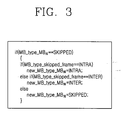
- a macroblock type and a motion vector of the macroblock MB N are determined according to a macroblock type of the frame N-1 located at the same position with the macroblock MB N .
- a newly allocated macroblock MB N is an intra type.
- a macroblock type of the frame N-1 is an inter type
- a newly allocated macroblock MB N is an inter type.
- a macroblock type of the frame N-1 is a skipped type
- a newly allocated macroblock MB N is a skipped type.
- MB_type_ MB N is a type of the macroblock MB N
- MB_type_skipped_frame is a type of a macroblock located at the same position with the macroblock MB N in the frame N-1.
- a method for determining a motion vector and a macroblock type in accordance with one embodiment of the present invention is provided.
- frame N-1 is skipped in the video stream inputted to the frame-rate conversion video transcoder (step S11)
- a motion vector and a macroblock type of the frame N as the reference frame for predicting the frame N-1 are reallocated.
- step S12 It is judged whether the macroblock MB N of the frame N is an inter type or a skipped type (step S12).
- the macroblock MB N is an inter type, a motion vector reallocating process is performed.
- the macroblock MB N is a skipped type, a process for allocating a pertinent macroblock type and a motion vector is performed.
- the macroblock MB N is an intra type, it is considered that the operation has no correlation with a previous frame (i.e., when a scene conversion is performed). Accordingly there is no need to perform the motion vector reallocating process.
- step S15 When the macroblock MB N-1 of the skipped frame N-1 is not an intra type, it is judged whether the macroblock MB N-1 is a skipped type (step S15). When the macroblock MB N-1 is the skipped type, by applying Equation 2, a new motion vector about the macroblock MB N-1 is determined (step S16). In more detail, when the macroblock MB N-1 is the skipped type, because the macroblock does not have a motion vector, a motion vector MV N allocated to the macroblock MB N and the newly allocated motion vector are the same.
- a new motion vector about the macroblock MB N is determined (step S17). If the macroblock MB N of the frame N is an inter type, in consideration of the macroblock type of the macroblock MB N-1 of the skipped frame N-1, a type of the macroblock MB N is allocated.
- a macroblock located at the same position with the macroblock MB N in the skipped frame N-1 is an intra type (step S18).
- the macroblock MB N is determined as an intra type (step S19).
- the macroblock of the frame N-1 is a skipped type (step S20)
- the macroblock MB N is determined as a skipped type (step S21).
- the macroblock MB N is determined as an inter type (step S22).
- a motion vector corresponded to the macroblock of the frame N-1 is allocated as a motion vector of the macroblock MB N (step S23). That is, when the macroblock MB N is the intra type or the skipped type, there is no need to allocate a new motion vector. However, when the macroblock MB N is an inter type, a motion vector allocated to the macroblock of the frame N-1 is allocated as a new motion vector.
- a type of the new macroblock MB N is determined.
- a macroblock of a frame transmitted without being skipped through the frame-rate conversion video transcoder is an intra type or a skipped type
- the motion vector and macroblock type determining method in accordance with the present invention can be applied.
- the present invention is capable of reducing generated bit quantity in a video stream and improving picture quality in reproducing of images.
- Tables 1 and 2 are for comparing performance of the FDVS method with that of an improved FDVS method in accordance with the present invention.
- video bit sequence MPEG-1 encoded as 30 frames per second is respectively converted into 15 frames and 7.5 frames.
- a conventional FDVS method is compared with the improved FDVS method in accordance with the present invention in the bit generated quantity and picture quality aspects.
- a measure of the picture quality comparison is PSNR, for example.
- table tennis images as MPEG-1 encoded 120 frames by 1.5Mbps are used as test images, and the test images are converted into 15 frames per second through the frame-rate conversion video transcoder, for example.
- Sequence conversion occurs in the 68th frame and the 98th frame of the test images.
- sequence conversion occurs, many macroblocks in a P-frame are determined as intra types due to performance lowering of predictive encoding.
- Figure 5A is a graph for comparing PSNR by each frame when the test images are converted into 15 frames per second.
- picture quality is lowered sharply at the 69th frame and the 99th frame, for example.
- the improved FDVS method in accordance with the present invention the same picture quality can be maintained at the 69th frame and the 99th frame.
- Figure 5B is a graph showing the number of intra type macroblocks and the number of skipped type macroblocks generated at each frame of the test sequences.
- the number of intra type macroblocks is increased sharply. Accordingly, the motion vector and macroblock type determining method considering not only inter type macroblocks but also intra type and skipped type macroblocks is required. As such, by applying the present invention considering a type of each macroblock, picture quality can be improved.
- motion vector and macroblock type determining method in accordance with the present invention it is possible to reallocate accurately a motion vector and a macroblock type of a frame transmitted without being skipped through a frame-rate conversion video transcoder.
- performance of predictive encoding such as sequence conversion is lowered, it is possible to improve picture quality and reduce generated bit quantity.
Landscapes
- Engineering & Computer Science (AREA)
- Multimedia (AREA)
- Signal Processing (AREA)
- Health & Medical Sciences (AREA)
- General Health & Medical Sciences (AREA)
- Business, Economics & Management (AREA)
- Emergency Management (AREA)
- Compression Or Coding Systems Of Tv Signals (AREA)
- Television Systems (AREA)
- Compression, Expansion, Code Conversion, And Decoders (AREA)
Applications Claiming Priority (2)
| Application Number | Priority Date | Filing Date | Title |
|---|---|---|---|
| KR10-2003-0035724A KR100533028B1 (ko) | 2003-06-03 | 2003-06-03 | 모션벡터 및 매크로블록 타입 결정방법 |
| KR2003035724 | 2003-06-03 |
Publications (2)
| Publication Number | Publication Date |
|---|---|
| EP1484924A2 true EP1484924A2 (de) | 2004-12-08 |
| EP1484924A3 EP1484924A3 (de) | 2005-10-26 |
Family
ID=33157375
Family Applications (1)
| Application Number | Title | Priority Date | Filing Date |
|---|---|---|---|
| EP04008259A Withdrawn EP1484924A3 (de) | 2003-06-03 | 2004-04-05 | Verfahren zur Bestimmung von Bewegungsvektoren und Macroblöckentypen |
Country Status (4)
| Country | Link |
|---|---|
| EP (1) | EP1484924A3 (de) |
| JP (1) | JP2004364265A (de) |
| KR (1) | KR100533028B1 (de) |
| CN (1) | CN1622471A (de) |
Families Citing this family (5)
| Publication number | Priority date | Publication date | Assignee | Title |
|---|---|---|---|---|
| KR101044934B1 (ko) * | 2003-12-18 | 2011-06-28 | 삼성전자주식회사 | 움직임 벡터 추정방법 및 부호화 모드 결정방법 |
| JP5271271B2 (ja) * | 2006-11-03 | 2013-08-21 | サムスン エレクトロニクス カンパニー リミテッド | 動きベクトル・トラッキングを利用した映像の符号化、復号化方法及び装置 |
| WO2010070809A1 (ja) * | 2008-12-16 | 2010-06-24 | パナソニック株式会社 | 撮像装置 |
| JP6775558B2 (ja) * | 2018-09-18 | 2020-10-28 | キヤノン株式会社 | 画像伸長装置及びその制御方法及びプログラム |
| EP3739503B1 (de) * | 2019-05-14 | 2023-10-25 | Nokia Technologies Oy | Videoverarbeitung |
-
2003
- 2003-06-03 KR KR10-2003-0035724A patent/KR100533028B1/ko not_active Expired - Fee Related
-
2004
- 2004-04-05 EP EP04008259A patent/EP1484924A3/de not_active Withdrawn
- 2004-04-13 JP JP2004118433A patent/JP2004364265A/ja active Pending
- 2004-05-13 CN CNA2004100431653A patent/CN1622471A/zh active Pending
Non-Patent Citations (3)
| Title |
|---|
| KWANG-DEOK SEO ET AL: "Dynamic bit-rate reduction based on frame-skipping and requantization for MPEG-1 to MPEG-4 transcoder" PROCEEDINGS OF THE 2003 IEEE INTERNATIONAL SYMPOSIUM ON CIRCUITS AND SYSTEMS, ISCAS 2003 (CAT. NO.03CH37430), BANGKOK, THAILAND, 25-28 MAY 2003, vol. 2, May 2003 (2003-05), pages II-372-II-375, XP002342873 IEEE PISCATAWAY, NJ, USA ISBN: 0-7803-7761-3 * |
| KWANG-DEOK SEO ET AL: "Fast motion vector refinement for MPEG-1 to MPEG-4 transcoding with spatial down-sampling in DCT domain" PROCEEDINGS 2001 INTERNATIONAL CONFERENCE ON IMAGE PROCESSING (CAT. NO.01CH37205) IEEE PISCATAWAY, NJ, USA, vol. 1, 2001, pages 469-472 vol.1, XP002342874 ISBN: 0-7803-6725-1 * |
| SEO K ET AL: "DYNAMIC BIT-RATE REDUCTION BASED ON REQUANTIZATION AND FRAME-SKIPPING FOR MPEG-1 TO MPEG-4 TRANSCODER" IEICE TRANSACTIONS ON FUNDAMENTALS OF ELECTRONICS, COMMUNICATIONS AND COMPUTER SCIENCES, INSTITUTE OF ELECTRONICS INFORMATION AND COMM. ENG. TOKYO, JP, vol. E87-A, no. 4, April 2004 (2004-04), pages 903-911, XP001193272 ISSN: 0916-8508 * |
Also Published As
| Publication number | Publication date |
|---|---|
| CN1622471A (zh) | 2005-06-01 |
| KR20040104193A (ko) | 2004-12-10 |
| JP2004364265A (ja) | 2004-12-24 |
| KR100533028B1 (ko) | 2005-12-02 |
| EP1484924A3 (de) | 2005-10-26 |
Similar Documents
| Publication | Publication Date | Title |
|---|---|---|
| US7330509B2 (en) | Method for video transcoding with adaptive frame rate control | |
| US8514933B2 (en) | Adaptive frame skipping techniques for rate controlled video encoding | |
| US9088776B2 (en) | Scalability techniques based on content information | |
| US7170938B1 (en) | Rate control method for video transcoding | |
| US8837602B2 (en) | Content adaptive video encoder and coding method | |
| KR100927083B1 (ko) | 예측에 의한 유사 고정 품질 레이트 제어 | |
| KR100950743B1 (ko) | 화상 정보 부호화 장치 및 방법, 및 화상 정보 복호 장치및 방법 | |
| US20020154698A1 (en) | Method and apparatus for motion estimation for high performance transcoding | |
| US8542733B2 (en) | Multipass video rate control to match sliding window channel constraints | |
| KR20080015831A (ko) | 다층 비디오 설계를 위한 레이트 제어 | |
| JP2001145113A (ja) | 画像情報変換装置及び方法 | |
| US20080137741A1 (en) | Video transcoding | |
| US20050089098A1 (en) | Data processing apparatus and method and encoding device of same | |
| US7463686B2 (en) | Method for determining motion vector and macroblock type | |
| EP1484924A2 (de) | Verfahren zur Bestimmung von Bewegungsvektoren und Macroblöckentypen | |
| KR100929607B1 (ko) | 엠펙-2 메인 프로파일에서 h.264/avc 베이스라인프로파일로의 트랜스코딩 방법 | |
| US6040875A (en) | Method to compensate for a fade in a digital video input sequence | |
| US20070014364A1 (en) | Video coding method for performing rate control through frame dropping and frame composition, video encoder and transcoder using the same | |
| US9137537B2 (en) | Dynamic reference frame decision method and system | |
| JP4082025B2 (ja) | 圧縮動画像の再符号化方法及び装置 | |
| EP1204279A2 (de) | Verfahren und Vorrichtung für die adaptive Kodierung von eingerahmten Datensequenzen | |
| Liu et al. | MPEG video transcoding with joint temporal-spatial rate control | |
| JPH11196423A (ja) | 画像処理装置および方法、並びに提供媒体 | |
| US20060256860A1 (en) | Transcoding with look-ahead | |
| JP4539661B2 (ja) | 圧縮動画像の再符号化方法及び装置 |
Legal Events
| Date | Code | Title | Description |
|---|---|---|---|
| PUAI | Public reference made under article 153(3) epc to a published international application that has entered the european phase |
Free format text: ORIGINAL CODE: 0009012 |
|
| 17P | Request for examination filed |
Effective date: 20040405 |
|
| AK | Designated contracting states |
Kind code of ref document: A2 Designated state(s): AT BE BG CH CY CZ DE DK EE ES FI FR GB GR HU IE IT LI LU MC NL PL PT RO SE SI SK TR |
|
| AX | Request for extension of the european patent |
Extension state: AL HR LT LV MK |
|
| PUAL | Search report despatched |
Free format text: ORIGINAL CODE: 0009013 |
|
| AK | Designated contracting states |
Kind code of ref document: A3 Designated state(s): AT BE BG CH CY CZ DE DK EE ES FI FR GB GR HU IE IT LI LU MC NL PL PT RO SE SI SK TR |
|
| AX | Request for extension of the european patent |
Extension state: AL HR LT LV MK |
|
| AKX | Designation fees paid |
Designated state(s): AT BE BG CH CY CZ DE DK EE ES FI FR GB GR HU IE IT LI LU MC NL PL PT RO SE SI SK TR |
|
| 17Q | First examination report despatched |
Effective date: 20060628 |
|
| STAA | Information on the status of an ep patent application or granted ep patent |
Free format text: STATUS: THE APPLICATION IS DEEMED TO BE WITHDRAWN |
|
| 18D | Application deemed to be withdrawn |
Effective date: 20061109 |