EP1484756A1 - Optical information medium - Google Patents
Optical information medium Download PDFInfo
- Publication number
- EP1484756A1 EP1484756A1 EP03744026A EP03744026A EP1484756A1 EP 1484756 A1 EP1484756 A1 EP 1484756A1 EP 03744026 A EP03744026 A EP 03744026A EP 03744026 A EP03744026 A EP 03744026A EP 1484756 A1 EP1484756 A1 EP 1484756A1
- Authority
- EP
- European Patent Office
- Prior art keywords
- meth
- acrylate
- optical information
- information medium
- urethane
- Prior art date
- Legal status (The legal status is an assumption and is not a legal conclusion. Google has not performed a legal analysis and makes no representation as to the accuracy of the status listed.)
- Granted
Links
Classifications
-
- G—PHYSICS
- G11—INFORMATION STORAGE
- G11B—INFORMATION STORAGE BASED ON RELATIVE MOVEMENT BETWEEN RECORD CARRIER AND TRANSDUCER
- G11B7/00—Recording or reproducing by optical means, e.g. recording using a thermal beam of optical radiation by modifying optical properties or the physical structure, reproducing using an optical beam at lower power by sensing optical properties; Record carriers therefor
- G11B7/24—Record carriers characterised by shape, structure or physical properties, or by the selection of the material
- G11B7/241—Record carriers characterised by shape, structure or physical properties, or by the selection of the material characterised by the selection of the material
- G11B7/252—Record carriers characterised by shape, structure or physical properties, or by the selection of the material characterised by the selection of the material of layers other than recording layers
-
- G—PHYSICS
- G11—INFORMATION STORAGE
- G11B—INFORMATION STORAGE BASED ON RELATIVE MOVEMENT BETWEEN RECORD CARRIER AND TRANSDUCER
- G11B7/00—Recording or reproducing by optical means, e.g. recording using a thermal beam of optical radiation by modifying optical properties or the physical structure, reproducing using an optical beam at lower power by sensing optical properties; Record carriers therefor
- G11B7/24—Record carriers characterised by shape, structure or physical properties, or by the selection of the material
- G11B7/241—Record carriers characterised by shape, structure or physical properties, or by the selection of the material characterised by the selection of the material
- G11B7/252—Record carriers characterised by shape, structure or physical properties, or by the selection of the material characterised by the selection of the material of layers other than recording layers
- G11B7/254—Record carriers characterised by shape, structure or physical properties, or by the selection of the material characterised by the selection of the material of layers other than recording layers of protective topcoat layers
- G11B7/2542—Record carriers characterised by shape, structure or physical properties, or by the selection of the material characterised by the selection of the material of layers other than recording layers of protective topcoat layers consisting essentially of organic resins
-
- G—PHYSICS
- G03—PHOTOGRAPHY; CINEMATOGRAPHY; ANALOGOUS TECHNIQUES USING WAVES OTHER THAN OPTICAL WAVES; ELECTROGRAPHY; HOLOGRAPHY
- G03F—PHOTOMECHANICAL PRODUCTION OF TEXTURED OR PATTERNED SURFACES, e.g. FOR PRINTING, FOR PROCESSING OF SEMICONDUCTOR DEVICES; MATERIALS THEREFOR; ORIGINALS THEREFOR; APPARATUS SPECIALLY ADAPTED THEREFOR
- G03F7/00—Photomechanical, e.g. photolithographic, production of textured or patterned surfaces, e.g. printing surfaces; Materials therefor, e.g. comprising photoresists; Apparatus specially adapted therefor
- G03F7/004—Photosensitive materials
- G03F7/09—Photosensitive materials characterised by structural details, e.g. supports, auxiliary layers
- G03F7/11—Photosensitive materials characterised by structural details, e.g. supports, auxiliary layers having cover layers or intermediate layers, e.g. subbing layers
-
- G—PHYSICS
- G03—PHOTOGRAPHY; CINEMATOGRAPHY; ANALOGOUS TECHNIQUES USING WAVES OTHER THAN OPTICAL WAVES; ELECTROGRAPHY; HOLOGRAPHY
- G03F—PHOTOMECHANICAL PRODUCTION OF TEXTURED OR PATTERNED SURFACES, e.g. FOR PRINTING, FOR PROCESSING OF SEMICONDUCTOR DEVICES; MATERIALS THEREFOR; ORIGINALS THEREFOR; APPARATUS SPECIALLY ADAPTED THEREFOR
- G03F7/00—Photomechanical, e.g. photolithographic, production of textured or patterned surfaces, e.g. printing surfaces; Materials therefor, e.g. comprising photoresists; Apparatus specially adapted therefor
- G03F7/004—Photosensitive materials
- G03F7/027—Non-macromolecular photopolymerisable compounds having carbon-to-carbon double bonds, e.g. ethylenic compounds
-
- G—PHYSICS
- G11—INFORMATION STORAGE
- G11B—INFORMATION STORAGE BASED ON RELATIVE MOVEMENT BETWEEN RECORD CARRIER AND TRANSDUCER
- G11B7/00—Recording or reproducing by optical means, e.g. recording using a thermal beam of optical radiation by modifying optical properties or the physical structure, reproducing using an optical beam at lower power by sensing optical properties; Record carriers therefor
- G11B7/24—Record carriers characterised by shape, structure or physical properties, or by the selection of the material
- G11B7/241—Record carriers characterised by shape, structure or physical properties, or by the selection of the material characterised by the selection of the material
- G11B7/252—Record carriers characterised by shape, structure or physical properties, or by the selection of the material characterised by the selection of the material of layers other than recording layers
- G11B7/257—Record carriers characterised by shape, structure or physical properties, or by the selection of the material characterised by the selection of the material of layers other than recording layers of layers having properties involved in recording or reproduction, e.g. optical interference layers or sensitising layers or dielectric layers, which are protecting the recording layers
- G11B2007/25705—Record carriers characterised by shape, structure or physical properties, or by the selection of the material characterised by the selection of the material of layers other than recording layers of layers having properties involved in recording or reproduction, e.g. optical interference layers or sensitising layers or dielectric layers, which are protecting the recording layers consisting essentially of inorganic materials
- G11B2007/2571—Record carriers characterised by shape, structure or physical properties, or by the selection of the material characterised by the selection of the material of layers other than recording layers of layers having properties involved in recording or reproduction, e.g. optical interference layers or sensitising layers or dielectric layers, which are protecting the recording layers consisting essentially of inorganic materials containing group 14 elements except carbon (Si, Ge, Sn, Pb)
-
- G—PHYSICS
- G11—INFORMATION STORAGE
- G11B—INFORMATION STORAGE BASED ON RELATIVE MOVEMENT BETWEEN RECORD CARRIER AND TRANSDUCER
- G11B7/00—Recording or reproducing by optical means, e.g. recording using a thermal beam of optical radiation by modifying optical properties or the physical structure, reproducing using an optical beam at lower power by sensing optical properties; Record carriers therefor
- G11B7/24—Record carriers characterised by shape, structure or physical properties, or by the selection of the material
- G11B7/241—Record carriers characterised by shape, structure or physical properties, or by the selection of the material characterised by the selection of the material
- G11B7/252—Record carriers characterised by shape, structure or physical properties, or by the selection of the material characterised by the selection of the material of layers other than recording layers
- G11B7/257—Record carriers characterised by shape, structure or physical properties, or by the selection of the material characterised by the selection of the material of layers other than recording layers of layers having properties involved in recording or reproduction, e.g. optical interference layers or sensitising layers or dielectric layers, which are protecting the recording layers
- G11B2007/25705—Record carriers characterised by shape, structure or physical properties, or by the selection of the material characterised by the selection of the material of layers other than recording layers of layers having properties involved in recording or reproduction, e.g. optical interference layers or sensitising layers or dielectric layers, which are protecting the recording layers consisting essentially of inorganic materials
- G11B2007/25713—Record carriers characterised by shape, structure or physical properties, or by the selection of the material characterised by the selection of the material of layers other than recording layers of layers having properties involved in recording or reproduction, e.g. optical interference layers or sensitising layers or dielectric layers, which are protecting the recording layers consisting essentially of inorganic materials containing nitrogen
-
- G—PHYSICS
- G11—INFORMATION STORAGE
- G11B—INFORMATION STORAGE BASED ON RELATIVE MOVEMENT BETWEEN RECORD CARRIER AND TRANSDUCER
- G11B7/00—Recording or reproducing by optical means, e.g. recording using a thermal beam of optical radiation by modifying optical properties or the physical structure, reproducing using an optical beam at lower power by sensing optical properties; Record carriers therefor
- G11B7/24—Record carriers characterised by shape, structure or physical properties, or by the selection of the material
- G11B7/241—Record carriers characterised by shape, structure or physical properties, or by the selection of the material characterised by the selection of the material
- G11B7/242—Record carriers characterised by shape, structure or physical properties, or by the selection of the material characterised by the selection of the material of recording layers
- G11B7/243—Record carriers characterised by shape, structure or physical properties, or by the selection of the material characterised by the selection of the material of recording layers comprising inorganic materials only, e.g. ablative layers
- G11B7/2433—Metals or elements of Groups 13, 14, 15 or 16 of the Periodic Table, e.g. B, Si, Ge, As, Sb, Bi, Se or Te
-
- G—PHYSICS
- G11—INFORMATION STORAGE
- G11B—INFORMATION STORAGE BASED ON RELATIVE MOVEMENT BETWEEN RECORD CARRIER AND TRANSDUCER
- G11B7/00—Recording or reproducing by optical means, e.g. recording using a thermal beam of optical radiation by modifying optical properties or the physical structure, reproducing using an optical beam at lower power by sensing optical properties; Record carriers therefor
- G11B7/24—Record carriers characterised by shape, structure or physical properties, or by the selection of the material
- G11B7/241—Record carriers characterised by shape, structure or physical properties, or by the selection of the material characterised by the selection of the material
- G11B7/242—Record carriers characterised by shape, structure or physical properties, or by the selection of the material characterised by the selection of the material of recording layers
- G11B7/243—Record carriers characterised by shape, structure or physical properties, or by the selection of the material characterised by the selection of the material of recording layers comprising inorganic materials only, e.g. ablative layers
- G11B7/2437—Non-metallic elements
-
- G—PHYSICS
- G11—INFORMATION STORAGE
- G11B—INFORMATION STORAGE BASED ON RELATIVE MOVEMENT BETWEEN RECORD CARRIER AND TRANSDUCER
- G11B7/00—Recording or reproducing by optical means, e.g. recording using a thermal beam of optical radiation by modifying optical properties or the physical structure, reproducing using an optical beam at lower power by sensing optical properties; Record carriers therefor
- G11B7/24—Record carriers characterised by shape, structure or physical properties, or by the selection of the material
- G11B7/241—Record carriers characterised by shape, structure or physical properties, or by the selection of the material characterised by the selection of the material
- G11B7/252—Record carriers characterised by shape, structure or physical properties, or by the selection of the material characterised by the selection of the material of layers other than recording layers
- G11B7/253—Record carriers characterised by shape, structure or physical properties, or by the selection of the material characterised by the selection of the material of layers other than recording layers of substrates
- G11B7/2533—Record carriers characterised by shape, structure or physical properties, or by the selection of the material characterised by the selection of the material of layers other than recording layers of substrates comprising resins
-
- G—PHYSICS
- G11—INFORMATION STORAGE
- G11B—INFORMATION STORAGE BASED ON RELATIVE MOVEMENT BETWEEN RECORD CARRIER AND TRANSDUCER
- G11B7/00—Recording or reproducing by optical means, e.g. recording using a thermal beam of optical radiation by modifying optical properties or the physical structure, reproducing using an optical beam at lower power by sensing optical properties; Record carriers therefor
- G11B7/24—Record carriers characterised by shape, structure or physical properties, or by the selection of the material
- G11B7/241—Record carriers characterised by shape, structure or physical properties, or by the selection of the material characterised by the selection of the material
- G11B7/252—Record carriers characterised by shape, structure or physical properties, or by the selection of the material characterised by the selection of the material of layers other than recording layers
- G11B7/253—Record carriers characterised by shape, structure or physical properties, or by the selection of the material characterised by the selection of the material of layers other than recording layers of substrates
- G11B7/2533—Record carriers characterised by shape, structure or physical properties, or by the selection of the material characterised by the selection of the material of layers other than recording layers of substrates comprising resins
- G11B7/2534—Record carriers characterised by shape, structure or physical properties, or by the selection of the material characterised by the selection of the material of layers other than recording layers of substrates comprising resins polycarbonates [PC]
-
- G—PHYSICS
- G11—INFORMATION STORAGE
- G11B—INFORMATION STORAGE BASED ON RELATIVE MOVEMENT BETWEEN RECORD CARRIER AND TRANSDUCER
- G11B7/00—Recording or reproducing by optical means, e.g. recording using a thermal beam of optical radiation by modifying optical properties or the physical structure, reproducing using an optical beam at lower power by sensing optical properties; Record carriers therefor
- G11B7/24—Record carriers characterised by shape, structure or physical properties, or by the selection of the material
- G11B7/241—Record carriers characterised by shape, structure or physical properties, or by the selection of the material characterised by the selection of the material
- G11B7/252—Record carriers characterised by shape, structure or physical properties, or by the selection of the material characterised by the selection of the material of layers other than recording layers
- G11B7/256—Record carriers characterised by shape, structure or physical properties, or by the selection of the material characterised by the selection of the material of layers other than recording layers of layers improving adhesion between layers
-
- G—PHYSICS
- G11—INFORMATION STORAGE
- G11B—INFORMATION STORAGE BASED ON RELATIVE MOVEMENT BETWEEN RECORD CARRIER AND TRANSDUCER
- G11B7/00—Recording or reproducing by optical means, e.g. recording using a thermal beam of optical radiation by modifying optical properties or the physical structure, reproducing using an optical beam at lower power by sensing optical properties; Record carriers therefor
- G11B7/24—Record carriers characterised by shape, structure or physical properties, or by the selection of the material
- G11B7/241—Record carriers characterised by shape, structure or physical properties, or by the selection of the material characterised by the selection of the material
- G11B7/252—Record carriers characterised by shape, structure or physical properties, or by the selection of the material characterised by the selection of the material of layers other than recording layers
- G11B7/258—Record carriers characterised by shape, structure or physical properties, or by the selection of the material characterised by the selection of the material of layers other than recording layers of reflective layers
- G11B7/2585—Record carriers characterised by shape, structure or physical properties, or by the selection of the material characterised by the selection of the material of layers other than recording layers of reflective layers based on aluminium
Definitions
- the present invention relates to an optical information medium such as a read-only optical disk and recordable optical disk, more specifically, to an optical information medium having a light transmission layer transparent particularly for blue light, obtained by curing an active energy ray-curable composition capable of forming a transparent cured substance layer excellent in mechanical strength.
- Optical information media such as a read-only optical disk and recordable optical disk are recently significantly used as an information recording medium recording and preserving a large amount of information such as a motion picture information.
- a compact disk among these media generally has a structure in which a reflection layer is formed of a metal thin film on a transparent substrate made of a polycarbonate on which fine grooves, embossed pit trains have been formed, and an organic protective layer having a thickness of about 5 to 20 ⁇ m is provided for preventing deterioration of this reflective layer.
- JP-A Japanese Patent Application Laid-Open
- DVDs digital video disk or digital versatile disk
- This high density type optical disk is an optical information medium obtained by forming a recording layer on a transparent or opaque supporting substrate formed of plastic, then, laminating a light transmission layer having a thickness of about 100 ⁇ m on the recording layer, which is used by being irradiated with recording light and/or reading light through the light transmission layer.
- a high density type optical disk there is suggested further increase in density by short wavelength recording utilizing laser light having wavelength shorter than red laser, for example, having a wavelength of 400 nm, used for recording and/or reading of conventional optical information media such as a compact disk and DVD, as described in JP-A No. 11-273147.
- a method of forming a light transmission layer there are listed, for example, (1) a method of bonding a film of a thermoplastic material such as a polycarbonate or a glass plate on a recording layer using an ultraviolet-curable resin, (2) a method of applying an ultraviolet-curable resin on a recording layer by a spin coat method, then, irradiating with ultraviolet to obtain a light transmission layer, as described in JP-A No. 08-235638.
- thermoplastic transparent plastic film When a thermoplastic transparent plastic film is used in the above-mentioned light transmission layer forming method (1) described in JP-A No. 08-235638, there is a problem of deterioration in its scratch resistance, and when a glass plate is pasted, there is a problem that weight is large and handling is inferior though scratch resistance is superior. There is also a problem that a light transmission layer made of glass cracks easily by impact from outside.
- ultraviolet-curable resins usable in the above-mentioned light transmission layer forming method (2) there are mentioned ultraviolet-curable resins described in JP-A No. 03-131605.
- a light transmission layer is formed using this curable resin, its scratch resistance is more excellent than that of a transparent film made of plastic as described above, however, since transmittance for light having a wavelength of about 400 nm is low, short wavelength recording is difficult, and since the curable resin shows high volume shrinkage in curing, significant skew occurs on an optical disk, these being practical problems.
- an object of the present invention is to provide an optical information medium equipped with a light transmission layer having excellent transparency and having excellent abrasion resistance, recording film protective ability and mechanical property.
- the present inventors have intensively studied to solve the above-mentioned problems, and resultantly found that it is very effective to use a cured substance having elastic modulus and light transmittance in given ranges obtained by curing a specific active energy ray-curable composition, as a light transmission layer, and then completed the present invention.
- the present invention is an optical information medium comprising a supporting substrate, an information recording surface on the supporting substrate, and a light transmission layer on the information recording surface which is used by being irradiated with recording light and/or reading light through the light transmission layer, wherein the light transmission layer is a cured substance of an active energy ray-curable composition containing a urethane di(meth)acrylate compound (A) of the following general formula (I) and a urethane di(meth)acrylate compound (B) other than the compound (A), and the cured substance has a tensile elastic modulus of 600 MPa or more and 1300 MPa or less at 25°C and a light transmittance of 80% or more at wavelength of 400 nm: wherein, R 1 represents an alicyclic diisocyanate residue, R 2 represents an alkylene group or an organic group containing a cycloalkyl group or ester bond, and R 3 represents a hydrogen atom or methyl group.
- the light transmission layer is a
- (meth)acrylate is a generic term of acrylate and methacrylate.
- the optical information medium of the present invention has a structure comprising a supporting substrate, an information recording surface on the supporting substrate, and a light transmission layer on the information recording surface, and it is used by being irradiated with recording light and/or reading light through the light transmission layer.
- the supporting substrate used in the present invention preferable are substrates for which optical properties such as light transmittance and birefringence are not required and which can transfer information pits or guide grooves correctly and have sufficient mechanical strength.
- materials such as metal, glass, ceramics and plastic can be used.
- thermoplastic resins such as polymethyl methacrylate, polycarbonate and amorphous polyolefin are suitable since conventional optical disk production processes can be utilized for these materials.
- the optical information medium of the present invention has a recording layer as an information recording surface.
- the material of this recording layer is not particularly restricted, and materials applicable to a read-only type medium, phase change type recording medium, pit-formed type recording medium and magneto-optical recording medium may be used if necessary.
- gold, silver, silver alloy, aluminum, aluminum alloy, silver•In•Te•Sb alloy, silver•In•Te•Sb•Ge alloy, Ge•Sb•Te alloy, Ge•Sn•Sb•Te alloy, Sb•Te alloy, Tb•Fe•Co alloy and dye can be used.
- a dielectric such as SiN, ZnS and SiO 2 on at least one side of a recording layer for the purpose of protecting the recording layer and obtaining optical effects.
- the optical information medium of the present invention has a light transmission layer on an information recording surface.
- This light transmission layer is a cured substance of an active energy ray-curable composition containing a urethane di(meth)acrylate compound (A) of the following general formula (I): wherein, R 1 represents an alicyclic diisocyanate residue, R 2 represents an alkylene group or an organic group containing a cycloalkyl group or ester bond, and R 3 represents a hydrogen atom or methyl group. and a urethane di(meth)acrylate compound (B) other than the compound (A).
- This cured substance has a tensile elastic modulus of 600 MPa or more and 1300 MPa or less at 25°C and a light transmittance of 80% or more at a wavelength of 400 nm.
- the urethane di(meth)acrylate compound (A) of the general formula (I) is a component for enhancing the strength of a cured substance of a curable composition.
- This urethane di(meth)acrylate compound (A) can be synthesized, for example, by adding a hydroxyl group-containing (meth)acrylate to an alicyclic diisocyanate compound.
- Examples of the alicyclic diisocyanate compound include isophorone diisocyanate, bis(4-isocyanatocyclohexyl)methane, 1,2-hydrogenated xylylene diisocyanate, 1,4-hydrogenated xylylene diisocyanate, hydrogenated tetramethylxylylene diisocyanate and norbornane diisocyanate.
- isophorone diisocyanate and bis(4-isocyanatocyclohexyl)methane are preferable due to excellent strength of a cured substance. These can be used singly or in combination of two or more.
- the hydroxyl group-containing (meth)acrylate to be added to an alicyclic diisocyanate compound may be specifically a hydroxyl group-containing (meth)acrylate having one (meth)acryloyloxy group in the molecule and at least one hydroxyl group in the molecule and is not particularly restricted.
- Specific examples thereof include hydroxyalkyl (meth)acrylates such as 2-hydroxyethyl (meth)acrylate, 2-hydroxypropyl (meth)acrylate, 4-hydroxybutyl (meth)acrylate, 6-hydroxyhexyl (meth)acrylate and cyclohexane dimethanol mono(meth)acrylate, and caprolactone adducts thereof. These can be used singly or in combination of two or more.
- 2-hydroxyethyl (meth)acrylate, 2-hydroxypropyl (meth)acrylate and 4-hydroxybutyl (meth)acrylate are particularly preferable due to low viscosity.
- a method of adding a hydroxyl group-containing (meth)acrylate to an alicyclic diisocyanate compound is not particularly restricted, and conventionally known urethane (meth)acrylate synthesis methods can be used. Specifically, it may be advantageous that 2 to 2.2 mol of a hydroxyl group-containing (meth)acrylate and a known catalyst such as dibutyltin dilaurate is mixed in a flask in catalyst concentration of 100 to 300 ppm based on the total charge amount, and 1 mol of a diisocyanate is dropped using a dropping funnel over a period of 2 to 6 hours while keeping the temperature in the flask at 40 to 60°C.
- a known catalyst such as dibutyltin dilaurate
- the use proportion of the component (A) is preferably 5 parts by weight or more based on 100 parts by weight of the total amount of the components (A), (B) and (C) for enhancing the mechanical strength of a cured substance, and preferably 30 parts by weight or less from the standpoint of skew of an optical information medium.
- the lower limit is particularly preferably 10 parts by weight or more
- the upper limit is particularly preferably 25 parts by weight or less.
- the urethane di(meth)acrylate compound (B) used in the present invention is a urethane di(meth)acrylate compound other than the urethane di(meth)acrylate compound (A) of the above-mentioned general formula (I).
- This component (B) is a component for allowing a curable composition to manifest low shrinkage, and a component which is cured by co-use with the component (A) to give toughness to the resulting light transmission layer.
- urethane di(meth)acrylate usable as the component (B)
- compounds synthesized from an isocyanate compound, poly-hydric alcohol and hydroxyl group-containing (meth)acrylate there are mentioned compounds synthesized from an isocyanate compound, poly-hydric alcohol and hydroxyl group-containing (meth)acrylate.
- Examples of the isocyanate compound used for synthesizing the component (B) include diisocyanates such as hexamethylene diisocyanate, isophorone diisocyanate, bis(4-isocyanatocyclohexyl)methane, bis(4-isocyanatophenyl)methane, bis(3-chloro-4-isocyanatophenyl)methane, 2,4-tolylene diisocyanate, 2,6-tolylene diisocyanate, tris(4-isocyanatophenyl)methane, 1,2-xylylene diisocyanate, 1,4-xylylene diisocyanate, 1,2-hydrogenated xylylene diisocyanate, 1,4-hydrogenated xylylene diisocyanate, tetramethylxylylene diisocyanate, hydrogenated tetramethylxylylene diisocyanate, naphthalene diisocyanate, hex
- diisocyanate compounds having an alicyclic skeleton such as isophorone diisocyanate, bis(4-isocyanatocyclohexyl)methane, 1,2-hydrogenated xylylene diisocyanate, 1,4-hydrogenated xylylene diisocyanate, hydrogenated tetramethylxylylene diisocyanate and norbomane diisocyanate are preferable since excellent toughness and hard yellowing property can be imparted to a layer of a cured substance.
- the poly-hydric alcohol used for synthesizing the component (B) is not particularly restricted and for example, various poly-hydric alcohols conventionally marketed can be used. Specific examples thereof include polyether polyols such as polyethylene glycol, polypropylene glycol, polybutylene glycol and 1-methylbutylene glycol; alcohols such as neopentyl glycol, ethylene glycol, diethylene glycol, propylene glycol, 1,6-hexane diol, 1,4-butane diol, 1,9-nonane diol, 1,10-decane diol, 3-methylpentane diol, 2,4-diethylpentane diol, tricyclodecane dimethanol, 1,4-cyclohexane dimethanol, 1,2-cyclohexane dimethanol, 1,3-cyclohexane dimethanol, cyclohexane diol, hydrogenated bisphenol A, bisphenol A, trimethylolpropane and pentaerith
- the poly-hydric alcohol has a weight-average molecular weight preferably of 400 or more from the standpoint of low shrinkage and preferably of 2000 or less from the standpoint of low viscosity.
- Particularly preferable are polybutylene glycol, polycaprolactone polyols, polyester polyols and polycarbonate diols due to excellent strong ductility balance.
- the hydroxyl group-containing (meth)acrylate used for synthesizing the component (B) may be specifically a hydroxyl group-containing (meth)acrylate having one (meth)acryloyloxy group in the molecule and at least one hydroxyl group in the molecule and is not particularly restricted.
- (meth)acrylates such as 2-hydroxyethyl (meth)acrylate, 2-hydroxypropyl (meth)acrylate, 4-hydroxybutyl (meth)acrylate, 6-hydroxyhexyl (meth)acrylate, cyclohexane dimethanol mono(meth)acrylate, trimethylolpropane di(meth)acrytate and pentaerithritol (meth)acrylate, and caprolactone adducts thereof.
- 2-hydroxyethyl (meth)acrylate, 2-hydroxypropyl (meth)acrylate and 4-hydroxybutyl (meth)acrylate are particularly preferable due to low viscosity.
- a method of synthesizing a urethane di(meth)acrylate compound (B) is not particularly restricted, and conventionally known urethane (meth)acrylate synthesis methods can be used. Specifically, it may be advantageous that 2 mol of a diisocyanate and a known catalyst such as dibutyltin dilaurate is mixed in a flask in catalyst concentration of 100 to 300 ppm based on the total charge amount, and 1 mol of a diol compound is dropped using a dropping funnel over a period of 2 to 4 hours while keeping the temperature in the flask at 40 to 60°C.
- a known catalyst such as dibutyltin dilaurate
- the urethane di(meth)acrylate compound (B) has a weight-average molecular weight preferably of 1000 or more from the stand point of low shrinkage of a curable composition and preferably 10000 or less for lowering the viscosity of a curable composition and enhancing application workability. Further, the lower limit is preferably 2000 or more and the upper limit is 7000 or less.
- the use proportion of the component (B) is preferably 30 parts by weight or more based on 100 parts by weight of the total amount of the components (A), (B) and (C) from the standpoint of the low shrinkage of a curable composition and preferably 90 parts by weight or less for lowering the viscosity of a curable composition and enhancing application workability.
- the lower limit is particularly preferably 40 parts by weight or more
- the upper limit is particularly preferably 80 parts by weight or less.
- an ethylenically unsaturated compound (C) other than the components (A) and (B), in addition to the components (A) and (B).
- this ethylenically unsaturated compound (C) include poly-valent (meth)acrylates such as trimethylolpropane tri(meth)acrylate, trisethoxylated methylolpropane tri(meth)acrylate, ditrimethylolpropane tetra(meth)acrylate, pentaerithritol tri(meth)acrytate, pentaerithritol tetra(meth)acrylate, ethoxylated pentaerithritol tri(meth)acrylate, ethoxylated pentaerithritol tetra(meth)acrylate, dipentaerithritol penta(meth)acrylate, dipentaerithritol hexa(meth)- acrylate, bis(2-acryloyloxyethyl)hydroxyethyl isocyanurate, bis(2-methacryloyloxyethyl)hydroxyeth
- this preferable compound include tricyclodecane dimethanol di(meth)acrylate, polyethoxylated bisphenol A di(meth)acrylate, polypropoxylated bisphenol A di(meth)acrylate, polyethoxylated hydrogenated bisphenol A di(meth)acrylate, polypropoxylated hydrogenated bisphenol A di(meth)acrylate, polyethoxylated cyclohexane dimethanol di(meth)acrylate, polypropoxylated cyclohexane dimethanol di(meth)acrylate, bis(2-acryloyloxyethyl)hydroxyethyl isocyanutate, tris(2-acryloyloxyethyl) isocyanurate, tetrahydrofuryl (meth)acrylate, phenoxyethyl (meth)acrylate, cyclohexyl (meth)acrylate, isoborny
- the use proportion of the component (C) is preferably 5 parts by weight or more based on 100 parts by weight of the total amount of the components (A), (B) and (C) since then the viscosity of the resulting composition is low and workability of application to an optical disk is excellent, and preferably 40 parts by weight or less because of low shrinkage in curing of a composition.
- the lower limit is particularly preferably 10 parts by weight or more
- the upper limit is particularly preferably 35 parts by weight or less.
- a photo-polymerization initiator (D) can be further contained in a curable composition to obtain a cured substance efficiently by an ultraviolet curing method.
- photo-polymerization initiator (D) examples include benzophenone, 4,4,-bis(diethylamino)benzophenone, 2,4,6-trimethylbenzophenone, methylorthobenzoylbenzoate, 4-phenylbenzophenone, t-butylanthraquinone, 2-ethylanthraquinone, diethoxyacetophenone, 2-hydroxy-2-methyl-1-phenylpropan-1-one, benzyl dimethyl ketal, 1-hydroxycyclohexyl-phenyl ketone, benzoin methyl ether, benzoin ethyl ether, benzoyl isopropyl ether, benzoin isobutyl ether, 2-methyl-[4-(methylthio)phenyl]-2-morpholino-1-propanone, 2-benzyl-2-dimethylamino-1-(4-morpholinophenyl)-butanone-1, diethylthioxantone, is
- the kind and use amount of a photo-polymerization initiator are appropriately selected so that laser light necessary for reading permeates sufficiently through a cured substance layer (light transmission layer). It is particularly preferable to use a short wavelength sensitive photo-polymerization initiator so that the resulted cured substance layer does not absorb blue laser light.
- this short wavelength sensitive photo-polymerization initiator examples include benzophenone, 2,4,6-trimethylbenzophenone, methylorthobenzoyl benzoate, 4-phenylbenzophenone, diethoxyacetophenone, 2-hydroxy-2-methyl-1-phenylpropan-1-one, benzyl dimethyl ketal, 1-hydroxycyclohexyl-phenyl ketone, benzoin methyl ether, benzoin ethyl ether, benzoin isopropyl ether, benzoin isobutyl ether and methylbenzoyl formate.
- benzophenone, diethoxyacetophenone, 2-hydroxy-2-methyl-1-phenylpropan-1-one, 1-hydroxycyclohexyl-phenylketone and methylbenzoyl formate are preferable from the standpoint of hard yellowing property of a cured substance.
- photo-polymerization initiators can be used singly or in combination of two or more.
- the use amount of the photo-polymerization initiator (D) is not particularly restricted and preferably 0.001 part by weight or more based on 100 parts by weight of the total amount of the components (A), (B) and (C) from the standpoint of curing property and preferably 5 parts by weight or less from the standpoint of deep part curing property and hard yellowing property.
- the lower limit is particularly preferably 0.01 part by weight or more
- the upper limit is particularly preferably 3 parts by weight or less.
- thermoplastic polymer such as polyethylene glycol dimethacrylate copolymer
- slipping agent such as polyethylene glycol
- leveling agent such as polyethylene glycol
- antioxidant such as polypropylene glycol
- light stabilizer such as sodium bicarbonate
- ultraviolet absorber such as sodium bicarbonate
- silane coupling agent such as silane coupling agent
- inorganic filler such as silane coupling agent
- organic filler and inorganic filler subjected to surface organizing treatment may be appropriately compounded, if necessary, in an amount in the range not deteriorating its performance.
- an antioxidant and light stabilizer so as to prevent yellowing of a cured substance in use for a long period of time and so as not to cause disturbance in reading or writing of an optical information medium by blue laser.
- this antioxidant and light stabilizer include commercially available various compounds such as SUMILIZER BHT, SUMILIZER S, SUMILIZER BP-76, SUMILIZER MDP-S, SUMILIZER GM, SUMILIZER BBM-S, SUMILIZER WX-R, SUMILIZER NW, SUMILIZER BP-179, SUMILIZER BP-101, SUMILIZER GA-80, SUMILIZER TNP, SUMILIZER TPP-R and SUMILIZER P-16 manufactured by Sumitomo Chemical Co., Ltd., ADEKASTAB AO-20, ADEKASTAB AO-30, ADEKASTAB AO-40, ADEKASTAB AO-50, ADEKASTAB AO-60, ADEKASTAB AO-70, ADEKASTAB AO-80, ADEKASTAB AO-330, ADEKASTAB PEP-4C, ADEKASTAB PEP-8, ADEKASTAB PEP-4
- an antioxidant and light stabilizer is not particularly restricted, and preferably in the range from 0.001 to 2 parts by weight, further preferably in the range from 0.01 to 1 part by weight based on 100 parts by weight of the total amount of components (A), (B) and (C).
- the viscosity of a composition at 25°C is preferably 1000 mPa•s or more for obtaining a film thickness of 100 ⁇ m by spin coat in a short period of time, and preferably 10000 mPa•s or less from the standpoint of easy liquid transportation. Further, the lower limit is 2000 mPa•s or more and the upper limit is 8000 mPa•s or less.
- this viscosity is 1000 mPa•s or more, it is easy to form a uniform film thickness of about 100 ⁇ m by once application, and it is not necessary to apply repeatedly twice or three times, giving a tendency of increase in productivity.
- the viscosity is 10000 mPa•s or less, filtration of a composition needs no longer time, it is not necessary to elongate overshoot rotation time for forming a uniform film thickness of about 100 ⁇ m by spin coat, and it is not necessary to remarkably increase overshooting revolution for shortening overshooting time, therefore, defects such as irregular application do not occur easily and productivity tends to increase.
- a method of forming a light transmission layer using a curable composition is not particularly restricted, and an application method according to a spin coat method excellent in productivity is preferable.
- the optical information medium of the present invention has as a light transmission layer a cured substance obtained by curing the above-described active energy ray-curable composition until the elastic modulus at 25°C is 600 MPa or more.
- this elastic modulus is below 600 MPa, a light transmission layer tends to be inferior in scratch resistance, and when scratched, this scratch causes an error of recording/reading by laser light.
- this light transmission layer has an elastic modulus of 1300 MPa or less.
- this elastic modulus is increased to a high value over 1300 MPa for enhancing scratch resistance, curing shrinkage tends to increase, and skew of the resulting optical information medium easily increases, and when this skew is large, there occurs an error of recording/reading by laser light.
- a cured substance constituting this light transmission layer has a tensile yield strength of preferably 20 MPa or more from the standpoint of preservation stability.
- the tensile yield strength is 20 MPa or more, if stress is applied, plastic deformation does not occur easily, and mechanical properties such as tilt angle do not deteriorate easily. Further, this tensile yield strength is particularly preferably 30 MPa or more.
- a curable composition is irradiated with an active energy ray such as ⁇ , ⁇ and ⁇ rays by a known method.
- an active energy ray such as ⁇ , ⁇ and ⁇ rays
- ultraviolet ray is preferably used.
- ultraviolet lamps generally used are preferably used from the practical and economical standpoints. Specific examples of the ultraviolet lamps include a chemical lamp, low pressure mercury lamp, high pressure mercury lamp, super high pressure mercury lamp, xenon lamp, metal halide lamp and micro wave lamp.
- the atmosphere for light energy irradiation may be air, or an inert gas such as nitrogen and argon.
- reaction ratio 91% or more. More preferable, the reaction ratio is 95% or more. This reaction ratio can be measured by known means such as gel fraction measurement and infrared spectroscopy.
- the thickness of a light transmission layer is preferably 30 ⁇ m or more for suppressing an optical influence by dust adhering on the surface of the layer.
- the thickness of a light transmission layer is preferably 300 ⁇ m or less.
- laser light is usually used as this light.
- the wavelength of laser light is not particularly restricted, and preferably selected in the range of 300 to 800 nm. From the standpoint of recording density, it is preferable that wavelength is as short as possible, and when light in ultraviolet range is utilized, a light transmission layer tends to deteriorate by yellowing. From the standpoint of balance of recording density and durability of a light transmission layer, it is preferable to utilize laser light around 400 nm as recording light and/or reading light.
- the transmittance against light having wavelength of around 400 nm is preferably 80% or more for suppressing an error in recording and/or reading, and more preferably 85% or more.
- the optical information medium of the present invention is preferably used in an optical recording and reading system in which recording and reading wavelength or reading wavelength ⁇ and the numerical aperture NA of an objective lens for recording and reading show a relation of ⁇ /NA ⁇ 680.
- This relation of wavelength ⁇ and numerical aperture NA is particularly preferably ⁇ /NA ⁇ 580.
- the optical information medium of the present invention has a tilt angle of preferably within ⁇ 0.35°, more preferably within ⁇ 0.3°.
- an optical information medium having a light transmission layer is produced using each compound obtained in Synthesis Examples 1 to 4.
- “parts” are by weight.
- a polycarbonate resin was injection-molded, to obtain a transparent disk-shaped polycarbonate base plate (diameter 12 cm, plate thickness 1.1 mm) having a hole of a diameter of 15 mm at the center and carrying information.
- aluminum was sputtered to give a film thickness of 50 nm, forming a mirror surface aluminum reflection film.
- the curable composition prepared previously was applied using a spin coater to give an average film thickness of 100 ⁇ m.
- This applied film was cured by a high pressure mercury lamp (120 w/cm) having a lamp height of 10 cm at energy amount of an accumulated light quantity of 1000 mJ/cm 2 , to obtain an optical information medium having a cured substance layer (light transmission layer).
- tilt angle at each position was calculated based on moved amount from previous measurement position and positional difference from the standard surface, at 8 positions (5 mm interval) along radial direction from a radius of 23 mm to 58 mm, using LM-1200 manufactured by Ono Sokki K.K. under an atmosphere of 20°C and 50% RH, and the maximum value was selected as tilt angle.
- This tilt angle was -0.2°.
- this optical information medium was aged for 50 hours under an atmosphere of 80°C and 80% RH, then, removed and aged for 48 hours under an atmosphere of 20°C and 50% RH, and the tilt angle was again measured to find a value of 0°, showing excellent mechanical property.
- the tilt angle was tolerated in a range of -0.35 to 0.35°, both after the initial test and after the durability test.
- the aluminum reflection film was observed by a microscope at a magnification of 800 to find no generation corrosion such as whitening and pinhole, revealing excellent protective ability.
- a cured substance layer was peeled from an aluminum reflection film of an optical information medium obtained in the same manner, and the resulted transparent film was subjected to a tensile test using a tester (manufactured by OrienTech, trade name: TRM-100 type Tensilon).
- the size of a specimen was 0.1 mm x 60 mm x 10 mm, and evaluated by a test method based on JIS 7127-1989 at an atmosphere temperature of 25°C, to find a tensile elastic modulus of 720 MPa and a tensile yield strength of 49 MPa. When apparent yield point was not observed in this tensile test, tensile yield strength was regarded as a tensile yield strength. Permanent deformation for determining this tensile yield strength was 0.5%.
- the light transmittance at a wavelength of 400 nm of a transparent film obtained in the same manner was measured by a spectrophotometer (manufactured by Hitachi, Ltd., trade name: U-3400) using air as reference to find a value of 88%, showing excellent light transmittance.
- the light transmittance was tolerated in the range of 80% or more.
- An optical information medium having a cured substance layer was produced in the same manner as in the above-mentioned procedure (2) excepting that a reflection film was not provided, and the scratch resistance test of a cured substance layer was conducted using a Taber abraser.
- CS10F was used as a Taber abrasion ring, and the test was conducted under conditions of a load of 500 g and a revolution of 100.
- the initial haze value and haze value after the test were measured by a haze meter, and a difference thereof was evaluated as a delta haze to find a value of 8%, showing excellent scratch resistance.
- the delta haze was tolerable in the range of 15% or less.
- Curable compositions and optical information media were produced in the same manner as in Example 1 excepting curable compositions shown in columns of Examples 2 to 5 and Comparative Examples 1 to 4 in Table 1 were used, and they were evaluated. The results are shown in Table 1.
- the same transparent disk-shaped polycarbonate base plate as in (2) of Example 1 was prepared, and a reflection film was not provided, and on this base plate, a polycarbonate sheet having a thickness of 70 ⁇ m (a polycarbonate having a molecular weight of 40000 had been formed into a sheet by casting method) was adhered via an acrylic adhesive layer having a thickness of 30 ⁇ m, to obtain an optical information medium having a light transmission layer having a total film thickness of 100 ⁇ m
- the scratch resistance of the sheet of this optical information medium was evaluated in the same manner as in (4) of Example 1, to find that the delta haze thereof was 30%, and the sheet was very easily scratched and was not practical.
- Comparative Examples 1, 2 and 4 the tensile elastic modulus of a cured substance (light transmission layer) was over 1300 MPa, curing shrinkage was too large, and the initial tilt angle of an optical information medium was too large. Further, when a protective test was effected under high temperature and high humidity, a cured substance shifted to shrinkage, and tilt angle increased. In Comparative Example 3, the tensile elastic modulus of a cured substance (light transmission layer) was below 600 MPa, and the initial tilt angle was small, however, the scratch resistance was inferior.
- the tensile yield strength was below 20 MPa, and when protective test was conducted under high temperature and high humidity, plastic deformation was caused, and an optical information medium changed significantly toward the side of a polycarbonate base material.
- Comparative Example 5 a conventional polycarbonate sheet was used, and it was found that the sheet was scratched very easily and was not practical.
- an optical information medium equipped with a light transmission layer (cured substance layer) having excellent transparency and having excellent abrasion resistance, recording film protective ability and mechanical properties can be provided.
- the optical information medium of the present invention is useful as various optical information media such as a read-only optical disk and recordable optical disk, and for example, extremely useful as a high density type optical information medium having a light transmission layer of about 100 ⁇ m and as an optical information medium effecting reading and/or writing using blue laser.
Landscapes
- Engineering & Computer Science (AREA)
- Architecture (AREA)
- Structural Engineering (AREA)
- Physics & Mathematics (AREA)
- General Physics & Mathematics (AREA)
- Macromonomer-Based Addition Polymer (AREA)
- Optical Record Carriers And Manufacture Thereof (AREA)
- Holo Graphy (AREA)
- Optical Head (AREA)
- Polyurethanes Or Polyureas (AREA)
Abstract
Description
wherein the light transmission layer is a cured substance of an active energy ray-curable composition containing a urethane di(meth)acrylate compound (A) of the following general formula (I) and a urethane di(meth)acrylate compound (B) other than the compound (A), and the cured substance has a tensile elastic modulus of 600 MPa or more and 1300 MPa or less at 25°C and a light transmittance of 80% or more at wavelength of 400 nm:

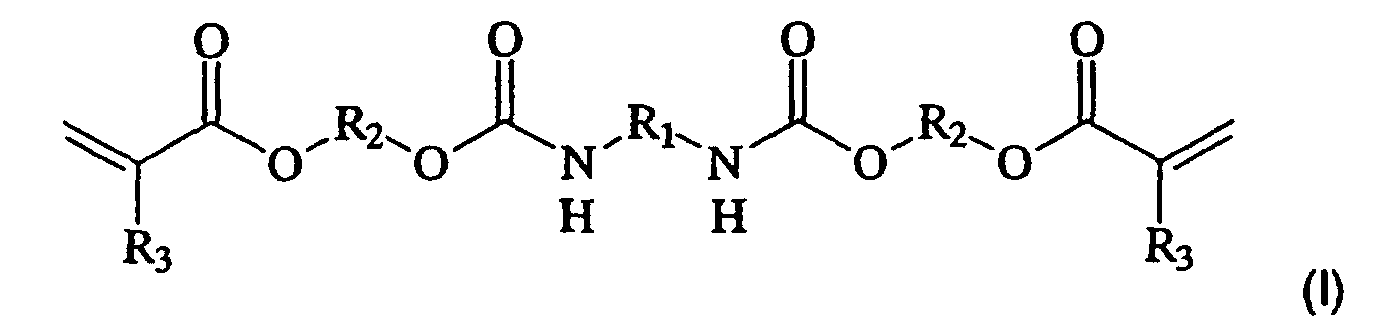
and a urethane di(meth)acrylate compound (B) other than the compound (A). This cured substance has a tensile elastic modulus of 600 MPa or more and 1300 MPa or less at 25°C and a light transmittance of 80% or more at a wavelength of 400 nm.
di(meth)acrylates such as ethylene glycol di(meth)acrylate, 1,3-butylene glycol di(meth)acrylate, 1,4-butanediol di(meth)acrylate, 1,6-hexanediol di(meth)acrylate, nonanediol di(meth)acrylate, neopentyl glycol di(meth)acrylate, methylpentanediol di(meth)acrylate, diethylpentanediol di(meth)acrylate, neopentyl glycol hydroxypivalate di(meth)acrylate, tetraethylene glycol di(meth)acrylate, tripropylene glycol di(meth)acrylate, polybutylene glycol di(meth)acrylate, tricyclodecanedimethanol di(meth)acrylate, cyclohexanedimethanol di(meth)acrylate, polyethoxylated cyclohexanedimethanol di(meth)acrylate, polypropoxylated cyclohexanedimethanol di(meth)acrylate, polyethoxylated bisphenol A di(meth)acrylate, polypropoxylated bisphenol A di(meth)acrylate, hydrogenated bisphenol A di(meth)acrylate, polyethoxylated hydrogenated bisphenol A di(meth)acrylate, polypropoxylated hydrogenated bisphenol A di(meth)acrylate, bisphenoxyfluorene ethanol di(meth)acrylate, neopentyl glycol-modified trimethylolpropane di(meth)acrylate, di(meth)acrylate of ε-caprolactone adduct (n+m = 2 to 5) of neopentyl glycol hydroxypivalate, di(meth)acrylate of γ-butyrolactone adduct (n+m = 2 to 5) of neopentyl glycol hydroxypivalate, di(meth)acrylate of caprolactone adduct (n+m = 2 to 5) of neopentyl glycol, di(meth)acrylate of caprolactone adduct (n+m = 2 to 5) of butylenes glycol, di(meth)acrylate of caprolactone adduct (n+m = 2 to 5) of cyclohexanedimethanol, di(meth)acrylate of caprolactone adduct (n+m = 2 to 5) of dicyclopentanediol, di(meth)acrylate of caprolactone adduct (n+m = 2 to 5) of bisphenol A, di(meth)acrylate of caprolactone adduct (n+m = 2 to 5) of hydrogenated bisphenol A, and di(meth)acrylate of caprolactone adduct (n+m = 2 to 5) of bisphenol F;
(meth)acrylates such as 2-hydroxyethyl (meth)acrylate, 2-hydroxypropyl (meth)acrylate, 4-hydroxybutyl (meth)acrylate, tetrahydrofurfuryl (meth)acrylate, phenoxyethyl (meth)acrylate, cyclohexyl (meth)acrylate, isoborny (meth)acrylate, norbornyl (meth)acrylate, 2-(meth)acryloyloxymethyl-2-methylbicycloheptane, trimethylolpropane formal (meth)acrylate, 2-methyl-2-ethyl-1,3-dioxolanyl (meth)acrylate, adamantly (meth)acrylate, benzyl (meth)acrytate, phenyl (meth)acrylate, dicyclopentenyl (meth)acrylate, dicyclopentanyl (meth)acrylate, tetracyclododecanyl (meth)acrylate, cyclohexanedimethanol mono(meth)acrylate, 2-methoxyethyl (meth)acrylate, 3-methoxybutyl (meth)acrylate, methoxytriethylene glycol (meth)acrylate, butoxyethyl (meth)acrylate and methoxydipropylene glycol (meth)acrylate;
vinyl ether monomers such as vinyl acetate, vinyl butyrate, N-vinylformamide, N-vinylacetamide, N-vinyl-2-pyrrolidone, N-vinylcaprolactam and divinyl adipate; vinyl ethers such as ethyl vinyl ether and phenyl vinyl ether;
acrylamides such as acrylamide, N,N-dimethylacrylamide, N,N-dimethylmethacrylamide, N-methylolacrylamide, N-methoxymethylacrylamide, N-butoxymethylacrylamide, N-t-butylacrylamide, acryloylmorpholine, hydroxyethylacrylamide and methylenebisacrylamide;
polyester poly(meth)acrylates obtained by reaction of a poly-basic acid such as phthalic acid, succinic acid, hexahydrophthalic acid, tetrahydrophthalic acid, terephthalic acid, azelaic acid and adipic acid, a poly-hydric alcohol such as ethylene glycol, hexanediol, polyethylene glycol and polytetramethylene glycol, and (meth)acrylic acid or its derivative;
epoxy (meth)acrylates obtained by reacting (meth)acrylic acid or its derivative with a bisphenol type epoxy resin obtained by a condensation reaction of bisphenols such as bisphenol A, bisphenol F, bisphenol S and tetrabromobisphenol A with epichlorohydrin.

Claims (7)
- An optical information medium comprising a supporting substrate, an information recording surface on the supporting substrate, and a light transmission layer on the information recording surface which is used by being irradiated with recording light and/or reading light through the light transmission layer,
wherein the light transmission layer is a cured substance of an active energy ray-curable composition containing a urethane di(meth)acrylate compound (A) of the following general formula (I) and a urethane di(meth)acrylate compound (B) other than the compound (A), and the cured substance has a tensile elastic modulus of 600 MPa or more and 1300 MPa or less at 25°C and a light transmittance of 80% or more at wavelength of 400 nm:wherein, R1 represents an alicyclic diisocyanate residue, R2 represents an alkylene group or an organic group containing a cycloalkyl group or ester bond, and R3 represents a hydrogen atom or methyl group.
- The optical information medium according to Claim 1, wherein the cured substance has a tensile yield strength of 20 MPa or more at 25°C.
- The optical information medium according to Claim 1, wherein the urethane di(meth)acrylate compound (B) has a weight-average molecular weight of 1000 to 10000.
- The optical information medium according to Claim 1, wherein the content of the urethane di(meth)acrylate compound (A) of the general formula (I) is 5 to 30 parts by weight, the content of a urethane di(meth)acrylate compound (B) other than (A) is 30 to 90 parts by weight, and the content of an ethylenically unsaturated compound (C) which is not either urethane di(meth)acrylate compound (A) or (B) is 5 to 40 parts by weight [total amount of components (A), (B) and (C) is 100 parts by weight] in the active energy ray-curable composition.
- The optical information medium according to Claim 1, wherein the active energy ray-curable composition contains at least one photo-polymerization initiator (D) selected from the group consisting of benzophenone, diethoxyacetophenone, 2-hydroxy-2-methyl-1-phenylpropane-1-one, 1-hydroxycyclohexyl-phenylketone and methyl benzoylformate.
- The optical information medium according to Claim 1, wherein the light transmission layer has a thickness of 30 to 300 µm.
- The optical information medium according to Claim 1, which is used in an optical recording and reading system wherein the wavelength λ used in the recording and/or reading and the numerical aperture NA of the objective lens for recording and reading show a relation of λ/NA ≦ 680.
Applications Claiming Priority (3)
| Application Number | Priority Date | Filing Date | Title |
|---|---|---|---|
| JP2002065212A JP4860884B2 (en) | 2002-03-11 | 2002-03-11 | Optical information medium |
| JP2002065212 | 2002-03-11 | ||
| PCT/JP2003/002763 WO2003077243A1 (en) | 2002-03-11 | 2003-03-10 | Optical information medium |
Publications (3)
| Publication Number | Publication Date |
|---|---|
| EP1484756A1 true EP1484756A1 (en) | 2004-12-08 |
| EP1484756A4 EP1484756A4 (en) | 2005-07-27 |
| EP1484756B1 EP1484756B1 (en) | 2006-10-18 |
Family
ID=27800227
Family Applications (1)
| Application Number | Title | Priority Date | Filing Date |
|---|---|---|---|
| EP03744026A Expired - Lifetime EP1484756B1 (en) | 2002-03-11 | 2003-03-10 | Optical information medium |
Country Status (9)
| Country | Link |
|---|---|
| US (1) | US7374806B2 (en) |
| EP (1) | EP1484756B1 (en) |
| JP (1) | JP4860884B2 (en) |
| KR (1) | KR100607311B1 (en) |
| CN (1) | CN1310234C (en) |
| AT (1) | ATE343205T1 (en) |
| DE (1) | DE60309138T2 (en) |
| TW (1) | TWI253073B (en) |
| WO (1) | WO2003077243A1 (en) |
Cited By (1)
| Publication number | Priority date | Publication date | Assignee | Title |
|---|---|---|---|---|
| WO2008011374A3 (en) * | 2006-07-19 | 2008-03-13 | Gen Electric | Optical data storage medium possessing transparent protective layer |
Families Citing this family (22)
| Publication number | Priority date | Publication date | Assignee | Title |
|---|---|---|---|---|
| JP2005023194A (en) * | 2003-07-02 | 2005-01-27 | Mitsubishi Rayon Co Ltd | Active energy ray-curable composition and article having the cured product layer |
| JP4526056B2 (en) * | 2003-08-26 | 2010-08-18 | 三菱レイヨン株式会社 | Active energy ray-curable composition |
| WO2005045818A1 (en) * | 2003-11-07 | 2005-05-19 | Matsushita Electric Industrial Co. Ltd. | Optical information recording medium, optical information recording medium recording/reproducing method, and recording/reproducing apparatus |
| US20060072445A1 (en) * | 2004-09-28 | 2006-04-06 | Imation Corp. | Optical recording medium having abrasion resistance and antistatic properties |
| JP2007283520A (en) * | 2006-04-13 | 2007-11-01 | Mitsubishi Kagaku Media Co Ltd | Thermal printing layer and optical recording medium using the thermal printing layer |
| CN101548323A (en) * | 2007-02-13 | 2009-09-30 | Dic株式会社 | Ultraviolet curable composition for light transmission layer and optical disk |
| WO2009025302A1 (en) | 2007-08-22 | 2009-02-26 | Mitsubishi Kagaku Media Co., Ltd. | Optical recording medium |
| JP5284723B2 (en) * | 2007-08-24 | 2013-09-11 | 三菱化学メディア株式会社 | Radiation curable composition for back layer of optical recording medium, cured product thereof, and optical recording medium using the same |
| JP2009070515A (en) * | 2007-09-14 | 2009-04-02 | Mitsubishi Chemicals Corp | Optical recording medium |
| JP2009158026A (en) * | 2007-12-27 | 2009-07-16 | Dic Corp | Ultraviolet curable composition for optical disc and optical disc |
| JP5478836B2 (en) * | 2008-05-01 | 2014-04-23 | ソニー株式会社 | Optical recording medium, liquid active energy ray-curable reactive cross-linked resin composition |
| JP5196432B2 (en) | 2008-09-17 | 2013-05-15 | 東洋アルミニウム株式会社 | Resin-coated metallic pigment, water-based paint containing the same, coated material coated with the same, and method for producing the same |
| WO2010064610A1 (en) * | 2008-12-02 | 2010-06-10 | 株式会社日本触媒 | Curable resin composition for optical disk, and optical disk |
| WO2010109615A1 (en) * | 2009-03-25 | 2010-09-30 | 株式会社日本触媒 | Curable resin composition for optical disks, and optical disk |
| JP5527753B2 (en) * | 2009-05-25 | 2014-06-25 | 東洋アルミニウム株式会社 | Surface-coated metallic pigment, water-based paint containing the same, and coated product on which the same is applied |
| US9244204B2 (en) * | 2009-10-27 | 2016-01-26 | Dai Nippon Printing Co., Ltd. | Image source unit and image display unit |
| US9563004B2 (en) * | 2009-10-27 | 2017-02-07 | Dai Nippon Printing Co., Ltd. | Image source unit and image display unit |
| WO2012157566A1 (en) * | 2011-05-16 | 2012-11-22 | 三井化学株式会社 | Dental material, dental material composition, dental repair material, and cured product |
| CN103492446B (en) | 2011-05-16 | 2016-07-27 | 三井化学株式会社 | Compound, composition comprising same and cured product |
| JP6733266B2 (en) * | 2016-03-31 | 2020-07-29 | 日立化成株式会社 | Photosensitive resin composition, photosensitive resin film, method for producing cured product, laminate, and electronic component |
| JP2022020989A (en) * | 2020-07-21 | 2022-02-02 | Dicグラフィックス株式会社 | Active energy ray-curable coating agent and coated building material using the same |
| US20240085609A1 (en) * | 2021-01-13 | 2024-03-14 | Sony Group Corporation | Hologram recording medium, hologram optical element, optical device, optical component, and method for forming hologram diffraction grating |
Family Cites Families (22)
| Publication number | Priority date | Publication date | Assignee | Title |
|---|---|---|---|---|
| EP0153949A1 (en) * | 1983-08-31 | 1985-09-11 | DeSOTO, INC. | Magnetic recording structure and process |
| US4785064A (en) * | 1984-07-10 | 1988-11-15 | Minnesota Mining And Manufacturing Company | Ultra-violet light curable compositions for abrasion resistant articles |
| JPS6190343A (en) * | 1984-10-09 | 1986-05-08 | Polyplastics Co | optical disk |
| US5053288A (en) * | 1987-11-20 | 1991-10-01 | Teijin Limited | Optical recording medium |
| JP2555181B2 (en) | 1988-03-14 | 1996-11-20 | 帝人株式会社 | Optical recording medium |
| JPH04261418A (en) | 1991-02-16 | 1992-09-17 | Dainippon Ink & Chem Inc | Hard coat resin composition for light information recording medium |
| CA2065092A1 (en) | 1991-04-05 | 1992-10-06 | Masayoshi Kurisu | Curable coating resin composition and information recording medium using the same |
| JPH05132534A (en) | 1991-11-13 | 1993-05-28 | Dainippon Ink & Chem Inc | UV curable resin composition |
| JPH05140254A (en) * | 1991-11-19 | 1993-06-08 | Dainippon Ink & Chem Inc | UV curable resin composition |
| JP3241560B2 (en) * | 1995-02-24 | 2001-12-25 | ソニー株式会社 | Optical recording medium and method for manufacturing the same |
| JPH107751A (en) | 1996-06-26 | 1998-01-13 | Nippon Kayaku Co Ltd | Resin composition, its cured item, and its article |
| CN1252136A (en) * | 1997-02-13 | 2000-05-03 | Dsm有限公司 | Photocurable resin composition |
| JPH1166618A (en) * | 1997-08-21 | 1999-03-09 | Sony Corp | Optical recording medium and manufacturing method thereof |
| JP3338660B2 (en) * | 1998-01-21 | 2002-10-28 | ソニー株式会社 | optical disk |
| JP2002501556A (en) | 1998-02-12 | 2002-01-15 | ディーエスエム エヌ.ブイ. | Photocurable resin composition |
| JPH11279240A (en) * | 1998-03-30 | 1999-10-12 | Hitachi Chem Co Ltd | Photo-curing resin composition and coating material |
| JP2000339761A (en) | 1999-03-19 | 2000-12-08 | Tdk Corp | Optical information medium and method for manufacturing the same |
| JP2001307381A (en) * | 2000-04-24 | 2001-11-02 | Sony Corp | Optical recording medium |
| JP2002230834A (en) | 2000-06-26 | 2002-08-16 | Tdk Corp | Optical information medium, method of manufacturing for the same, recording or reproducing method for the same and method of inspecting the same |
| JP2002109785A (en) | 2000-09-28 | 2002-04-12 | Dainippon Ink & Chem Inc | Optical disc and ultraviolet-curable composition used therein |
| JP2002230837A (en) * | 2001-01-30 | 2002-08-16 | Asahi Glass Co Ltd | Blue laser disk having a hard coat layer (registered trademark) and method for producing the same |
| TW200307733A (en) * | 2002-02-01 | 2003-12-16 | Natoco Co Ltd | Composition curable with actinic energy ray and use thereof |
-
2002
- 2002-03-11 JP JP2002065212A patent/JP4860884B2/en not_active Expired - Fee Related
-
2003
- 2003-03-10 CN CNB038057611A patent/CN1310234C/en not_active Expired - Fee Related
- 2003-03-10 AT AT03744026T patent/ATE343205T1/en not_active IP Right Cessation
- 2003-03-10 KR KR1020047014149A patent/KR100607311B1/en not_active Expired - Fee Related
- 2003-03-10 TW TW092105110A patent/TWI253073B/en not_active IP Right Cessation
- 2003-03-10 EP EP03744026A patent/EP1484756B1/en not_active Expired - Lifetime
- 2003-03-10 US US10/506,605 patent/US7374806B2/en not_active Expired - Lifetime
- 2003-03-10 DE DE60309138T patent/DE60309138T2/en not_active Expired - Lifetime
- 2003-03-10 WO PCT/JP2003/002763 patent/WO2003077243A1/en not_active Ceased
Cited By (1)
| Publication number | Priority date | Publication date | Assignee | Title |
|---|---|---|---|---|
| WO2008011374A3 (en) * | 2006-07-19 | 2008-03-13 | Gen Electric | Optical data storage medium possessing transparent protective layer |
Also Published As
| Publication number | Publication date |
|---|---|
| EP1484756B1 (en) | 2006-10-18 |
| ATE343205T1 (en) | 2006-11-15 |
| CN1643586A (en) | 2005-07-20 |
| US20050118380A1 (en) | 2005-06-02 |
| KR20040097161A (en) | 2004-11-17 |
| TWI253073B (en) | 2006-04-11 |
| JP2003263780A (en) | 2003-09-19 |
| EP1484756A4 (en) | 2005-07-27 |
| US7374806B2 (en) | 2008-05-20 |
| DE60309138D1 (en) | 2006-11-30 |
| JP4860884B2 (en) | 2012-01-25 |
| WO2003077243A1 (en) | 2003-09-18 |
| TW200304136A (en) | 2003-09-16 |
| CN1310234C (en) | 2007-04-11 |
| KR100607311B1 (en) | 2006-07-31 |
| DE60309138T2 (en) | 2007-08-16 |
Similar Documents
| Publication | Publication Date | Title |
|---|---|---|
| US7374806B2 (en) | Optical information medium | |
| US7341771B2 (en) | Active energy ray curable composition for coating optical disk and optical disk | |
| JP2003119231A (en) | Active energy ray-curable composition for optical disk and optical disk | |
| JP4187566B2 (en) | Active energy ray-curable composition for optical disc, and optical disc | |
| JP3989259B2 (en) | Active energy ray-curable composition for hardened layer of optical disc having silver or silver alloy recording film, and optical disc | |
| JP2004217879A (en) | Active energy ray-curable composition for optical disk and optical disk | |
| JP3720759B2 (en) | Active energy ray-curable composition for optical disc, and optical disc | |
| JP4526056B2 (en) | Active energy ray-curable composition | |
| JP3610336B2 (en) | Protective coating material composition for optical disc and optical disc | |
| JP4323279B2 (en) | Curable composition for intermediate layer of optical recording medium, and optical recording medium | |
| JP5294533B2 (en) | Curable composition and article having the cured product | |
| JP2004035715A (en) | Active energy ray-curable composition for optical disk and optical disk | |
| JP2004185653A (en) | Active energy ray-curable composition for optical disk and optical disk | |
| JP2005023194A (en) | Active energy ray-curable composition and article having the cured product layer | |
| JP2006016500A (en) | Compositions and articles | |
| JP2007080448A (en) | Optical information medium | |
| JP3964215B2 (en) | optical disk | |
| JP2010044812A (en) | Optical information medium | |
| JP2008088382A (en) | Curable composition, cured product thereof and optical information medium | |
| JPWO2006134990A1 (en) | Optical disc resin composition and cured product thereof | |
| JP2008069308A (en) | Curable composition, cured product thereof and optical information medium | |
| JP2007213744A (en) | Optical information medium | |
| JP2009179703A (en) | Active energy ray-curable composition, cured product, and optical disc |
Legal Events
| Date | Code | Title | Description |
|---|---|---|---|
| PUAI | Public reference made under article 153(3) epc to a published international application that has entered the european phase |
Free format text: ORIGINAL CODE: 0009012 |
|
| 17P | Request for examination filed |
Effective date: 20040914 |
|
| AK | Designated contracting states |
Kind code of ref document: A1 Designated state(s): AT BE BG CH CY CZ DE DK EE ES FI FR GB GR HU IE IT LI LU MC NL PT RO SE SI SK TR |
|
| AX | Request for extension of the european patent |
Extension state: AL LT LV MK |
|
| A4 | Supplementary search report drawn up and despatched |
Effective date: 20050613 |
|
| GRAP | Despatch of communication of intention to grant a patent |
Free format text: ORIGINAL CODE: EPIDOSNIGR1 |
|
| GRAS | Grant fee paid |
Free format text: ORIGINAL CODE: EPIDOSNIGR3 |
|
| GRAA | (expected) grant |
Free format text: ORIGINAL CODE: 0009210 |
|
| AK | Designated contracting states |
Kind code of ref document: B1 Designated state(s): AT BE BG CH CY CZ DE DK EE ES FI FR GB GR HU IE IT LI LU MC NL PT RO SE SI SK TR |
|
| PG25 | Lapsed in a contracting state [announced via postgrant information from national office to epo] |
Ref country code: IT Free format text: LAPSE BECAUSE OF FAILURE TO SUBMIT A TRANSLATION OF THE DESCRIPTION OR TO PAY THE FEE WITHIN THE PRESCRIBED TIME-LIMIT;WARNING: LAPSES OF ITALIAN PATENTS WITH EFFECTIVE DATE BEFORE 2007 MAY HAVE OCCURRED AT ANY TIME BEFORE 2007. THE CORRECT EFFECTIVE DATE MAY BE DIFFERENT FROM THE ONE RECORDED. Effective date: 20061018 Ref country code: SK Free format text: LAPSE BECAUSE OF FAILURE TO SUBMIT A TRANSLATION OF THE DESCRIPTION OR TO PAY THE FEE WITHIN THE PRESCRIBED TIME-LIMIT Effective date: 20061018 Ref country code: AT Free format text: LAPSE BECAUSE OF FAILURE TO SUBMIT A TRANSLATION OF THE DESCRIPTION OR TO PAY THE FEE WITHIN THE PRESCRIBED TIME-LIMIT Effective date: 20061018 Ref country code: RO Free format text: LAPSE BECAUSE OF FAILURE TO SUBMIT A TRANSLATION OF THE DESCRIPTION OR TO PAY THE FEE WITHIN THE PRESCRIBED TIME-LIMIT Effective date: 20061018 Ref country code: CH Free format text: LAPSE BECAUSE OF FAILURE TO SUBMIT A TRANSLATION OF THE DESCRIPTION OR TO PAY THE FEE WITHIN THE PRESCRIBED TIME-LIMIT Effective date: 20061018 Ref country code: CZ Free format text: LAPSE BECAUSE OF FAILURE TO SUBMIT A TRANSLATION OF THE DESCRIPTION OR TO PAY THE FEE WITHIN THE PRESCRIBED TIME-LIMIT Effective date: 20061018 Ref country code: BE Free format text: LAPSE BECAUSE OF FAILURE TO SUBMIT A TRANSLATION OF THE DESCRIPTION OR TO PAY THE FEE WITHIN THE PRESCRIBED TIME-LIMIT Effective date: 20061018 Ref country code: SI Free format text: LAPSE BECAUSE OF FAILURE TO SUBMIT A TRANSLATION OF THE DESCRIPTION OR TO PAY THE FEE WITHIN THE PRESCRIBED TIME-LIMIT Effective date: 20061018 Ref country code: FI Free format text: LAPSE BECAUSE OF FAILURE TO SUBMIT A TRANSLATION OF THE DESCRIPTION OR TO PAY THE FEE WITHIN THE PRESCRIBED TIME-LIMIT Effective date: 20061018 Ref country code: LI Free format text: LAPSE BECAUSE OF FAILURE TO SUBMIT A TRANSLATION OF THE DESCRIPTION OR TO PAY THE FEE WITHIN THE PRESCRIBED TIME-LIMIT Effective date: 20061018 |
|
| REG | Reference to a national code |
Ref country code: GB Ref legal event code: FG4D |
|
| REG | Reference to a national code |
Ref country code: CH Ref legal event code: EP Ref country code: IE Ref legal event code: FG4D |
|
| REF | Corresponds to: |
Ref document number: 60309138 Country of ref document: DE Date of ref document: 20061130 Kind code of ref document: P |
|
| PG25 | Lapsed in a contracting state [announced via postgrant information from national office to epo] |
Ref country code: BG Free format text: LAPSE BECAUSE OF FAILURE TO SUBMIT A TRANSLATION OF THE DESCRIPTION OR TO PAY THE FEE WITHIN THE PRESCRIBED TIME-LIMIT Effective date: 20070118 Ref country code: SE Free format text: LAPSE BECAUSE OF FAILURE TO SUBMIT A TRANSLATION OF THE DESCRIPTION OR TO PAY THE FEE WITHIN THE PRESCRIBED TIME-LIMIT Effective date: 20070118 Ref country code: DK Free format text: LAPSE BECAUSE OF FAILURE TO SUBMIT A TRANSLATION OF THE DESCRIPTION OR TO PAY THE FEE WITHIN THE PRESCRIBED TIME-LIMIT Effective date: 20070118 |
|
| PG25 | Lapsed in a contracting state [announced via postgrant information from national office to epo] |
Ref country code: ES Free format text: LAPSE BECAUSE OF FAILURE TO SUBMIT A TRANSLATION OF THE DESCRIPTION OR TO PAY THE FEE WITHIN THE PRESCRIBED TIME-LIMIT Effective date: 20070129 |
|
| PG25 | Lapsed in a contracting state [announced via postgrant information from national office to epo] |
Ref country code: PT Free format text: LAPSE BECAUSE OF FAILURE TO SUBMIT A TRANSLATION OF THE DESCRIPTION OR TO PAY THE FEE WITHIN THE PRESCRIBED TIME-LIMIT Effective date: 20070319 |
|
| REG | Reference to a national code |
Ref country code: CH Ref legal event code: PL |
|
| EN | Fr: translation not filed | ||
| PLBE | No opposition filed within time limit |
Free format text: ORIGINAL CODE: 0009261 |
|
| STAA | Information on the status of an ep patent application or granted ep patent |
Free format text: STATUS: NO OPPOSITION FILED WITHIN TIME LIMIT |
|
| 26N | No opposition filed |
Effective date: 20070719 |
|
| GBPC | Gb: european patent ceased through non-payment of renewal fee |
Effective date: 20070310 |
|
| PG25 | Lapsed in a contracting state [announced via postgrant information from national office to epo] |
Ref country code: IE Free format text: LAPSE BECAUSE OF NON-PAYMENT OF DUE FEES Effective date: 20070312 Ref country code: MC Free format text: LAPSE BECAUSE OF NON-PAYMENT OF DUE FEES Effective date: 20070331 |
|
| PG25 | Lapsed in a contracting state [announced via postgrant information from national office to epo] |
Ref country code: FR Free format text: LAPSE BECAUSE OF FAILURE TO SUBMIT A TRANSLATION OF THE DESCRIPTION OR TO PAY THE FEE WITHIN THE PRESCRIBED TIME-LIMIT Effective date: 20070601 Ref country code: GB Free format text: LAPSE BECAUSE OF NON-PAYMENT OF DUE FEES Effective date: 20070310 Ref country code: GR Free format text: LAPSE BECAUSE OF FAILURE TO SUBMIT A TRANSLATION OF THE DESCRIPTION OR TO PAY THE FEE WITHIN THE PRESCRIBED TIME-LIMIT Effective date: 20070119 |
|
| PG25 | Lapsed in a contracting state [announced via postgrant information from national office to epo] |
Ref country code: FR Free format text: LAPSE BECAUSE OF FAILURE TO SUBMIT A TRANSLATION OF THE DESCRIPTION OR TO PAY THE FEE WITHIN THE PRESCRIBED TIME-LIMIT Effective date: 20061018 |
|
| PG25 | Lapsed in a contracting state [announced via postgrant information from national office to epo] |
Ref country code: EE Free format text: LAPSE BECAUSE OF FAILURE TO SUBMIT A TRANSLATION OF THE DESCRIPTION OR TO PAY THE FEE WITHIN THE PRESCRIBED TIME-LIMIT Effective date: 20061018 |
|
| PG25 | Lapsed in a contracting state [announced via postgrant information from national office to epo] |
Ref country code: CY Free format text: LAPSE BECAUSE OF FAILURE TO SUBMIT A TRANSLATION OF THE DESCRIPTION OR TO PAY THE FEE WITHIN THE PRESCRIBED TIME-LIMIT Effective date: 20061018 Ref country code: LU Free format text: LAPSE BECAUSE OF NON-PAYMENT OF DUE FEES Effective date: 20070310 |
|
| PG25 | Lapsed in a contracting state [announced via postgrant information from national office to epo] |
Ref country code: TR Free format text: LAPSE BECAUSE OF FAILURE TO SUBMIT A TRANSLATION OF THE DESCRIPTION OR TO PAY THE FEE WITHIN THE PRESCRIBED TIME-LIMIT Effective date: 20061018 Ref country code: HU Free format text: LAPSE BECAUSE OF FAILURE TO SUBMIT A TRANSLATION OF THE DESCRIPTION OR TO PAY THE FEE WITHIN THE PRESCRIBED TIME-LIMIT Effective date: 20070419 |
|
| PGFP | Annual fee paid to national office [announced via postgrant information from national office to epo] |
Ref country code: NL Payment date: 20150210 Year of fee payment: 13 |
|
| PGFP | Annual fee paid to national office [announced via postgrant information from national office to epo] |
Ref country code: DE Payment date: 20150305 Year of fee payment: 13 |
|
| REG | Reference to a national code |
Ref country code: DE Ref legal event code: R119 Ref document number: 60309138 Country of ref document: DE |
|
| REG | Reference to a national code |
Ref country code: NL Ref legal event code: MM Effective date: 20160401 |
|
| PG25 | Lapsed in a contracting state [announced via postgrant information from national office to epo] |
Ref country code: NL Free format text: LAPSE BECAUSE OF NON-PAYMENT OF DUE FEES Effective date: 20160401 Ref country code: DE Free format text: LAPSE BECAUSE OF NON-PAYMENT OF DUE FEES Effective date: 20161001 |