EP1484352A1 - Thioepoxy based polymerizable composition and method for production thereof - Google Patents
Thioepoxy based polymerizable composition and method for production thereof Download PDFInfo
- Publication number
- EP1484352A1 EP1484352A1 EP03710295A EP03710295A EP1484352A1 EP 1484352 A1 EP1484352 A1 EP 1484352A1 EP 03710295 A EP03710295 A EP 03710295A EP 03710295 A EP03710295 A EP 03710295A EP 1484352 A1 EP1484352 A1 EP 1484352A1
- Authority
- EP
- European Patent Office
- Prior art keywords
- compound
- formula
- epithiopropyl
- polymerizable composition
- bis
- Prior art date
- Legal status (The legal status is an assumption and is not a legal conclusion. Google has not performed a legal analysis and makes no representation as to the accuracy of the status listed.)
- Withdrawn
Links
- 0 C*[C@@]1[C@@]2[C@]1CCCC2 Chemical compound C*[C@@]1[C@@]2[C@]1CCCC2 0.000 description 2
- XLCKWFNPZYSPBO-UHFFFAOYSA-N CNNN1N(C)NN1 Chemical compound CNNN1N(C)NN1 XLCKWFNPZYSPBO-UHFFFAOYSA-N 0.000 description 1
Classifications
-
- C—CHEMISTRY; METALLURGY
- C08—ORGANIC MACROMOLECULAR COMPOUNDS; THEIR PREPARATION OR CHEMICAL WORKING-UP; COMPOSITIONS BASED THEREON
- C08L—COMPOSITIONS OF MACROMOLECULAR COMPOUNDS
- C08L63/00—Compositions of epoxy resins; Compositions of derivatives of epoxy resins
-
- C—CHEMISTRY; METALLURGY
- C08—ORGANIC MACROMOLECULAR COMPOUNDS; THEIR PREPARATION OR CHEMICAL WORKING-UP; COMPOSITIONS BASED THEREON
- C08G—MACROMOLECULAR COMPOUNDS OBTAINED OTHERWISE THAN BY REACTIONS ONLY INVOLVING UNSATURATED CARBON-TO-CARBON BONDS
- C08G65/00—Macromolecular compounds obtained by reactions forming an ether link in the main chain of the macromolecule
- C08G65/02—Macromolecular compounds obtained by reactions forming an ether link in the main chain of the macromolecule from cyclic ethers by opening of the heterocyclic ring
- C08G65/04—Macromolecular compounds obtained by reactions forming an ether link in the main chain of the macromolecule from cyclic ethers by opening of the heterocyclic ring from cyclic ethers only
- C08G65/22—Cyclic ethers having at least one atom other than carbon and hydrogen outside the ring
-
- C—CHEMISTRY; METALLURGY
- C08—ORGANIC MACROMOLECULAR COMPOUNDS; THEIR PREPARATION OR CHEMICAL WORKING-UP; COMPOSITIONS BASED THEREON
- C08G—MACROMOLECULAR COMPOUNDS OBTAINED OTHERWISE THAN BY REACTIONS ONLY INVOLVING UNSATURATED CARBON-TO-CARBON BONDS
- C08G75/00—Macromolecular compounds obtained by reactions forming a linkage containing sulfur with or without nitrogen, oxygen, or carbon in the main chain of the macromolecule
- C08G75/02—Polythioethers
- C08G75/06—Polythioethers from cyclic thioethers
-
- C—CHEMISTRY; METALLURGY
- C08—ORGANIC MACROMOLECULAR COMPOUNDS; THEIR PREPARATION OR CHEMICAL WORKING-UP; COMPOSITIONS BASED THEREON
- C08G—MACROMOLECULAR COMPOUNDS OBTAINED OTHERWISE THAN BY REACTIONS ONLY INVOLVING UNSATURATED CARBON-TO-CARBON BONDS
- C08G75/00—Macromolecular compounds obtained by reactions forming a linkage containing sulfur with or without nitrogen, oxygen, or carbon in the main chain of the macromolecule
- C08G75/02—Polythioethers
- C08G75/06—Polythioethers from cyclic thioethers
- C08G75/08—Polythioethers from cyclic thioethers from thiiranes
-
- C—CHEMISTRY; METALLURGY
- C08—ORGANIC MACROMOLECULAR COMPOUNDS; THEIR PREPARATION OR CHEMICAL WORKING-UP; COMPOSITIONS BASED THEREON
- C08L—COMPOSITIONS OF MACROMOLECULAR COMPOUNDS
- C08L81/00—Compositions of macromolecular compounds obtained by reactions forming in the main chain of the macromolecule a linkage containing sulfur with or without nitrogen, oxygen or carbon only; Compositions of polysulfones; Compositions of derivatives of such polymers
-
- G—PHYSICS
- G02—OPTICS
- G02B—OPTICAL ELEMENTS, SYSTEMS OR APPARATUS
- G02B1/00—Optical elements characterised by the material of which they are made; Optical coatings for optical elements
- G02B1/04—Optical elements characterised by the material of which they are made; Optical coatings for optical elements made of organic materials, e.g. plastics
- G02B1/041—Lenses
Definitions
- the present invention relates to thioepoxy compounds and cured resins obtained therefrom, which thioepoxy compounds are preferably used in resin fields of optical materials or the like which are required to have a high refractive index and high transparence.
- plastic lenses Since being lighter and less brittle than inorganic lenses, and being dyeable, in recent years, plastic lenses have been increasingly in demands for optical elements such as glass lenses and camera lenses.
- a polythiourethane resin which contains sulfur atoms therein has been known. Since having a high refractive index, superior impact resistance, and the like, the polythiourethane resin has been regarded as a well-balanced resin (for example, referred to Japanese Unexamined Patent Application Publication No. 63-46213).
- a method using a thioepoxy compound may be a typical proposal (for example, referred to WO-89/10575 and Japanese Unexamined Patent Application Publication No. 9-110979).
- the resin while having a relatively high Abbe number, the resin is able to have a high refractive index.
- resins formed by the methods described above may have unstable refractive indexes or hues in some cases, and in addition, optical strain may be liable to be generated in some cases.
- the refractive index varies
- a problem may arise in that when a resin is used for a lens, power of lens may vary.
- the hue varies
- a problem may arise in that when a resin is used for glass lenses, a pair of lenses may be formed which have different colors from each other.
- a polymerizable composition having at least one structure represented by formula (1) according to the present invention an industrial manufacturing method have been studied so that the total of the thioepoxy compound A and the thioepoxy compound B is 4 mass percent or less with respect to the total mass of the polymerizable composition.
- the total of the thioepoxy compound A and the thioepoxy compound B contained in an obtained polymerizable composition can be decreased; however, this can only be performed experimentally, and from an industrial point of view, separation performed by chromatography is not preferable in terms of cost and efficiency.
- the amount of a thiation agent, which is used in forming a compound having at least one structure represented by formula (1), is limited that is, the amount of a thiation agent used for forming a known polythioepoxy compound is set in the range of from 0.9 to 1.3 equivalents with respect to one epoxy equivalent of the polythioepoxy compound
- a method in which the amount of an acid or the anhydride thereof is limited that is, the amount of an acid or the anhydride thereof is set to 0.2 equivalents or less with respect to one epoxy equivalent of the polythioepoxy compound
- the reaction temperature is controlled in the range of from 0°C to 50°C.
- the present invention is as follows.
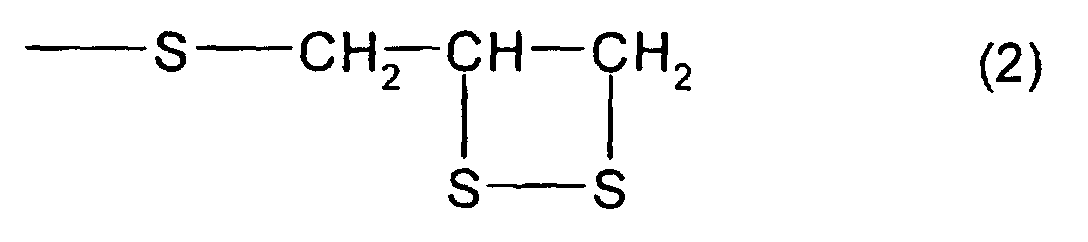
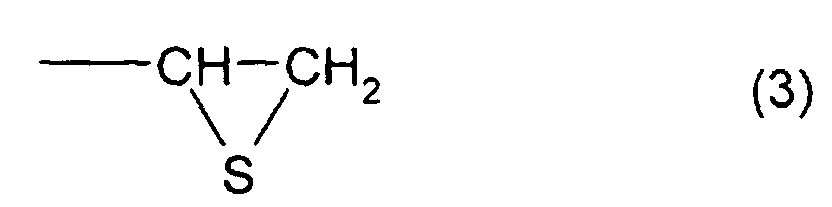
- the total content of a thioepoxy compound A, which has at least one structure represented by formula (2) and at least one structure represented by formula (3), and a thioepoxy compound B, which has at least one structure represented by formula (4) and at least one structure represented by formula (3) is 4 mass percent or less with respect to the total mass of the polymerizable composition, and preferably, 2 mass percent or less.
- the total content is 1.5 mass percent or less, it is more preferable.
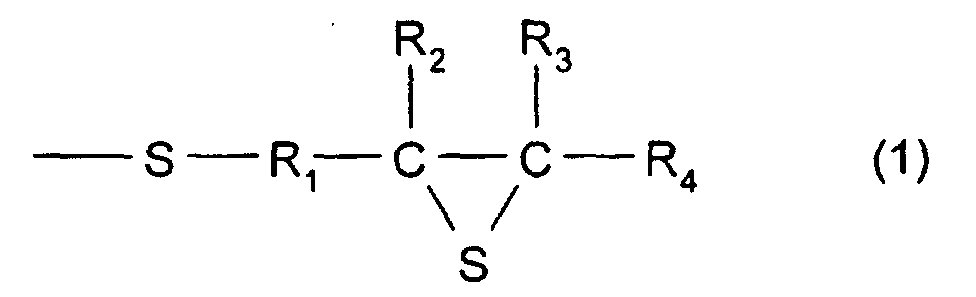
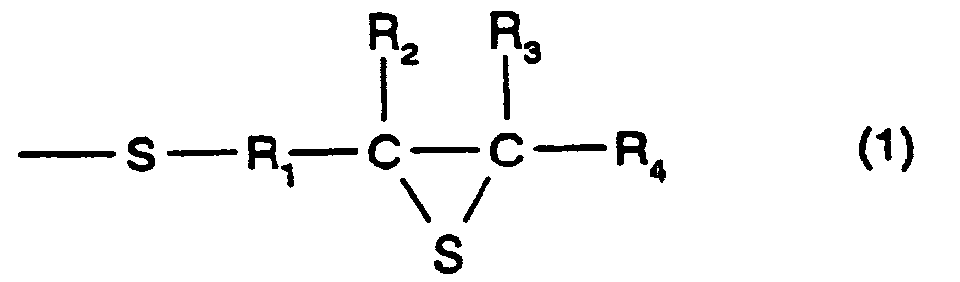
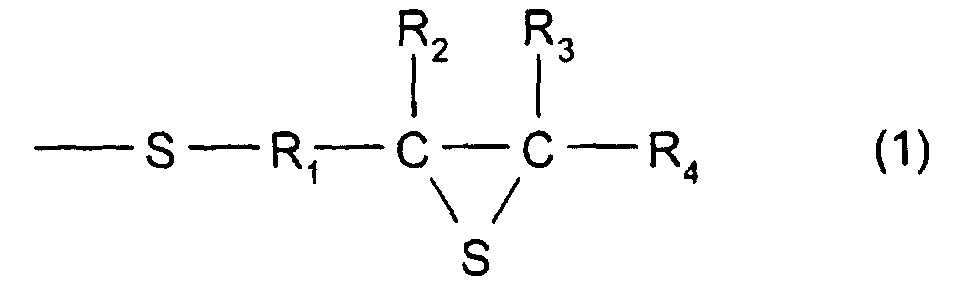
- R 1 represents a divalent hydrocarbon group having 1 to 10 carbon atoms, and in particular, there may be mentioned a linear, branched, or cyclic alkylene group having 1 to 10 carbon atoms; an arylene group having 6 to 10 carbon atoms such as phenylene, alkyl substituted phenylene, and naphthalene; or an aralkylene group having 7 to 10 carbon atoms, which is a combination of an alkylene group and an arylene group.
- an alkylene group having 1 to 10 carbon atoms is preferable. When methylene or ethylene is used, it is more preferable. When methylene is used, it is even more preferable.
- R 2 , R 3 , and R 4 each represent a hydrogen atom or a monovalent hydrocarbon group having 1 to 10 carbon atoms, and as the monovalent hydrocarbon having 1 to 10 carbon atoms, for example, a linear, branched, or cyclic alkyl group having 1 to 10 carbon atoms, an aryl group having 6 to 10 carbon atoms, or an aralkyl group having 7 to 10 carbon atoms may be mentioned.
- a hydrogen atom or an alkylene group having 1 to 10 carbon atoms is preferable. When a hydrogen atom or a methyl group is used, it is more preferable. When a hydrogen atom is used, it is even more preferable.
- R 5 to R 10 each represent a hydrocarbon group having 1 to 10 carbon atoms or hydrogen.
- Y represents a substituted or unsubstituted, linear, branched, or cyclic divalent aliphatic hydrocarbon having 1 to 10 carbon atoms, a substituted or unsubstituted 1,4-dithiane group, an arylene group, or an aralkylene group.
- m represents an integer of 0 to 2
- n represents an integer of 0 to 4.
- R 5 to R 10 each have the same meaning as that of R 2 to R 4 described above and, in particular, are each preferably a hydrogen atom.
- Y represents a substituted or unsubstituted, linear, branched, or cyclic divalent aliphatic hydrocarbon having 1 to 10 carbon atoms, a substituted or unsubstituted 1,4-dithiane group, an arylene group, or an aralkylene group.
- the divalent aliphatic hydrocarbon having 1 to 10 carbon atoms a linear, branched, or cyclic alkylene group having 1 to 10 carbon atoms is preferable, and a linear alkylene group is particularly preferable.
- Y may have a substituent group, and the substituent group is not specifically limited as long as properties (such as transparence, uniformity, refractive index, and heat resistance) of a resin manufactured from the compound described above are not adversely influenced thereby, and the substituent group may comprise a reactive group.
- a compound having the structure represented by formula (1), and, in particular, a compound may be used which has at least three functionalities and which comprises a 2,3-epithiopropylthio group as a substituent group; however, a compound having two functionalities is more preferable.
- the thioepoxy compound having at least one intramolecular structure represented by formula (1), according to the present invention, such as a polythioepoxy compound represented by formula (7), can be derived from a polyepoxy compound having at least two functionalities.
- the polyepoxy compound can be easily obtained by a known method.
- an alkyl sulfide type epoxy compound represented by formula (8) is obtained. (Where, Y, m, and n are the same as those described above.)
- a polythioepoxy compound represented by formula (9) is obtained.
- thiation agents used in this step thiocyanic acid salts and thioureas are preferable. In consideration of reaction performance and cost, thiourea is more preferable. (Where, Y, m, and n are the same as those described above.)
- polythiol compounds used as a starting material for example, there may be mentioned aliphatic thiols such as 1,1-methanedithiol, 1,2-ethanedithiol, 1,2-propanedithiol, 1,3-propanedithiol, 2,2-propanedithiol, 1,4-butanedithiol, 1,2,3-trimercaptopropane, tetrakis(mercaptomethyl)methane, 1,2-dimercaptocyclohexane, bis(2-mercaptoethyl)sulfide, 2,3-dimercapto-1-propanol, ethylene glycol bis(3-mercaptopropionate), diethylene glycol bis(3-mercaptopropionate), diethylene glycol bis(2-mercaptoglycolate), pentaerythritol tetrakis(2-mercaptothioglycolate), pentaerythritol tetrakis(2-
- polythioepoxy compounds which are represented by formula (5), obtained by thiation of polyepoxy compounds
- acyclic aliphatic 2,3-epithiopropylthio compounds such as bis(2,3-epithiopropyl)sulfide, bis(2,3-epithiopropyl)disulfide, bis(2,3-epithiopropylthio)methane, 1,2-bis(2,3-epithiopropylthio)ethane, 1,2-bis(2,3-epithiopropylthio)propane, 1,3-bis(2,3-epithiopropylthio)propane, 1,3-bis(2,3-epithiopropylthio)-2-methylpropane, 1,4-bis(2,3-epithiopropylthio)butane, 1,4-bis(2,3-epithiopropylthio)butane, 1,4-bis
- polythioepoxy compounds are not limited to those compounds mentioned above.
- bis(2,3-epithiopropyl)sulfide and bis(2,3-epithiopropyl)disulfide are preferable compounds, and bis(2,3-epithiopropyl)sulfide is more preferable compound.
- a method for manufacturing a polymerizable composition comprising a compound which has at least one structure represented by formula (1), according to the present invention, in which the total of the thioepoxy compound A and the thioepoxy compound B is 4 mass percent or less with respect to the total mass of the polymerizable composition
- a method for limiting the amounts of a thiation agent and an acid or its anhydride is effective, and a method for limiting temperature conditions in addition to the amounts mentioned above is most effective.
- a method may be mentioned in which the amounts of a thiation agent and an acid or its anhydride for use are limited in consideration of epoxy equivalents of the polyepoxy compound and are then fed for reaction.
- the amounts are not generally limited because of various structures and properties of epoxy compounds used as a starting material, a thiation agent in an amount of 0.9 to 1.3 equivalents may be used with respect to one epoxy equivalent of a polyepoxy compound having the structure represented by formula (8).
- an amount of 0.95 to 1.25 equivalents is preferably used.
- an amount of 0.975 to 1.21 equivalents is more preferable.
- an acid or its anhydride 0.2 equivalents or less may be used with respect to one epoxy equivalent of a polyepoxy compound having the structure represented by formula (8). In this case, an amount of 0.15 equivalents or less is preferable. In addition, an amount of 0.1 equivalents or less is more preferable.
- the reaction temperature may be in the range of from 0 to 50°C, and preferably, in the range of from 5 to 45°C. A reaction temperature of 10 to 40°C is more preferable.
- one of a composition containing the polyepoxy compound and a composition containing a thiation agent is preferably allowed to drip to the other composition.
- the composition containing a polyepoxy compound it is more preferable that after the composition containing a thiation agent is placed still, the composition containing a polyepoxy compound be allowed to drip thereto.
- the composition which still contains a solvent is preferably allowed to drip in terms of reaction efficiency, temperature control, and quality of an obtained thioepoxy compound.
- polar solvents for example, there may be mentioned alcohols such as water, methanol, and ethanol; ketones such as acetone, methyl ethyl ketone, and methyl isobutyl ketone; esters such as methyl acetate, ethyl acetate, propyl acetate, and butyl acetate; ethers such as tetrahydrofuran; aprotic polar solvents such as dimethylformamide, dimethylimidazolidinone, and dimethyl sulfoxide.
- alcohols such as water, methanol, and ethanol
- ketones such as acetone, methyl ethyl ketone, and methyl isobutyl ketone
- esters such as methyl acetate, ethyl acetate, propyl acetate, and butyl acetate
- ethers such as tetrahydrofuran
- aprotic polar solvents such as dimethylformamide, dimethylimi
- the polar solvents are not limited to those mentioned above.
- nonpolar solvents for example, there may be mentioned aromatic hydrocarbons, such as benzene, toluene, and xylene, and halogen-substituted compound thereof; alicyclic hydrocarbons such as hexane and cyclohexane; and halogenated hydrocarbons such as dichloromethane, chloroform, and tetrachloromethane.
- the nonpolar solvents are not limited to those mentioned above.
- thiation agents used in this case as is the case described above, for example, there may be mentioned thiocyanic acid salts, thioureas, and triphenylphosphine sulfide, and among those mentioned above, thiocyanic acid salts and thioureas are preferable. In consideration of reaction performance and cost, thiourea is more preferable.
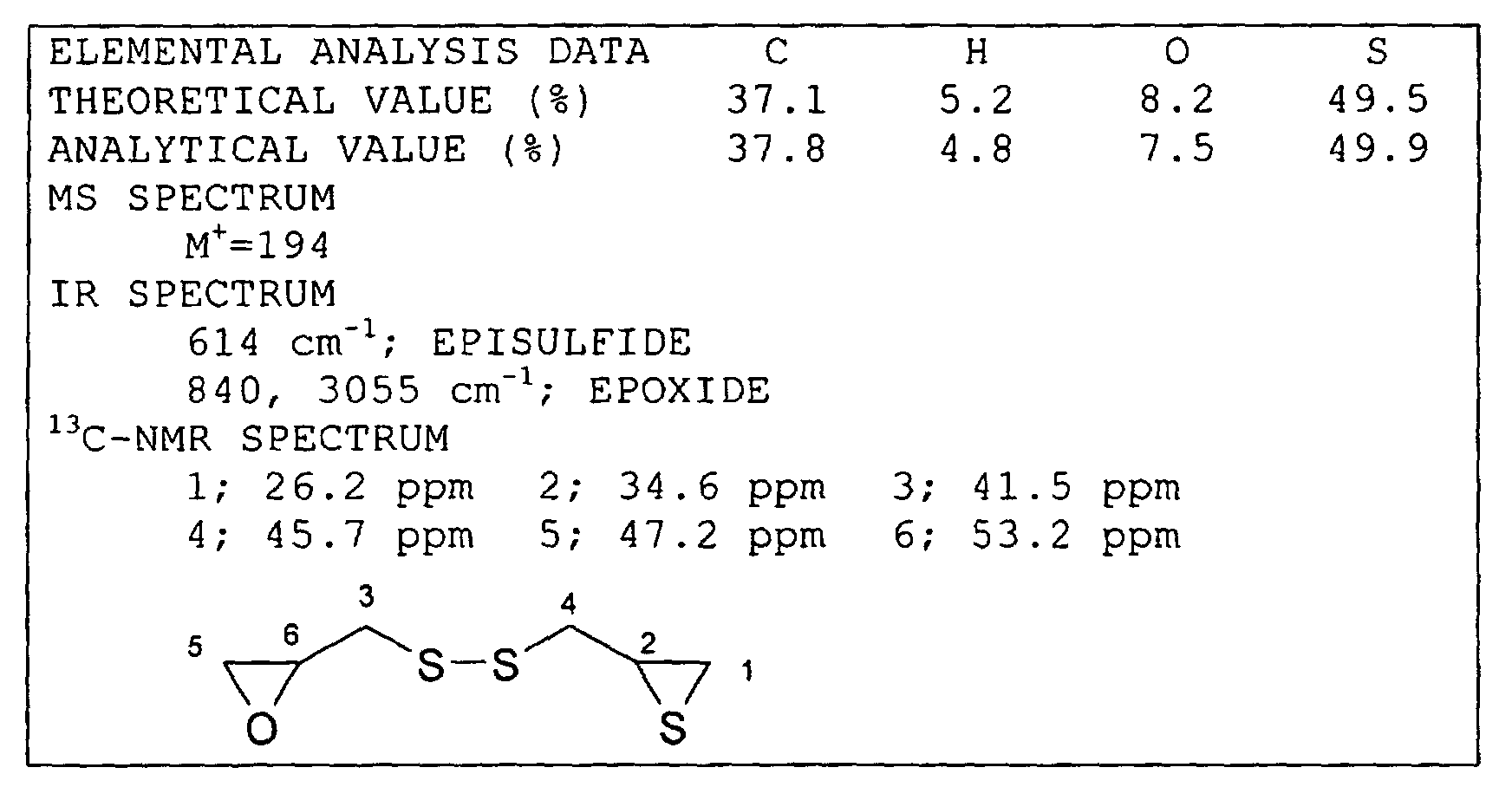
- a compound represented by formula (5) shown below may be mentioned as the thioepoxy compound A, the content of which is limited to a certain level. (Where Y, m, n are the same as those described above)
- thioepoxy compound A there may be mentioned acyclic aliphatic (2,3-epithiopropyl)thio compounds having a (2,3-epidithiopropylthio group) structure represented by formula (2), such as 2,3-epidithiopropyl(2,3-epithiopropyl)sulfide, 2,3-epidithiopropyl(2,3-epithiopropyl)disulfide, 2,3-epidithiopropyl(2,3-epithiopropyl)thiomethane, 1-(2,3-epidithiopropylthio)-2-(2,3-epithiopropyl)thioethane, 1-(2,3-epidithiopropylthio)-2-(2,3-epithiopropyl)thiopropane, 1-(2,3-epidithiopropylthio)-3-(2,3-epit
- thioepoxy compound B for example, a compound represented by formula (6) may be mentioned. (Where Y, m, and n are the same as those described above)
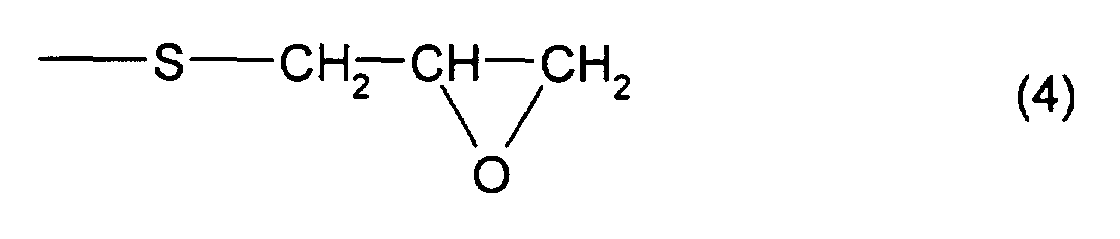
- thioepoxy compound B there may be mentioned acyclic aliphatic (2,3-epithiopropyl)thio compounds having a (2,3-epoxypropylthio group) structure represented by formula (4), such as 2,3-epoxypropyl(2,3-epithiopropyl)sulfide, 2,3-epoxypropyl(2,3-epithiopropyl)disulfide, 2,3-epoxypropylthio(2,3-epithiopropyl)thiomethane, 1-(2,3-epoxypropylthio)-2-(2,3-epithiopropyl)thioethane, 1-(2,3-epoxypropylthio)-2-(2,3-epithiopropyl)thiopropane, 1-(2,3-epoxypropylthio)-3-(2,3-epithiopropyl)thiopropane,
- the polymerizable composition according to the present invention which comprises a compound having at least one structure represented by formula (1), is a polymerizable composition in which the total of the thioepoxy compound A and the thioepoxy compound B is 4 mass percent or less with respect to the total mass of the polymerizable composition, and in this polymerizable composition, polysulfide oligomers such as dimmers, trimers, tetramers of the compound mentioned above; inorganic acids and organic acids added as a polymerization inhibitor; organic compounds such as a solvent and other by-products; and inorganic compounds may be contained as long as they may not cause any problems.
- the polymerizable composition according to the present invention may be used for a resin having an intermediate refractive index in addition to a resin having a high refractive index, and in order to primarily control various properties of an obtained resin, such as impact resistance and specific gravity, and/or to control monomer viscosity and other handling properties, a resin modifier may be added for improvement of the resin.
- resin modifiers in addition to the components added to the polymerizable composition of the present invention, for example, there may be mentioned thioepoxy compounds, thiol compounds, iso(thio)cyanates, mercapto organic acids, organic acids and anhydrides thereof, amino acids and mercaptoamines, amines, and olefins containing (meth)acrylates.
- thiol compounds used as a resin modifier for example, there may be mentioned aliphatic thiols such as methyl mercaptan, ethyl mercaptan, 1,1- methanedithiol, 1,2-ethanedithiol, 1,2-propanedithiol, 1,3-propanedithiol, 2,2-propanedithiol, 1,4-butanedithiol, 1,2,3-trimercaptopropane, tetrakis(mercaptomethyl)methane, 1,2-dimercaptocyclohexane, bis(2-mercaptoethyl)sulfide, 2,3-dimrcapto-1-propanol, ethylene glycol bis(3-mercaptopropionate), diethylene glycol bis(3-mercaptopropionate), diethylene glycol bis(2-mercaptoglycolate), pentaerythritol tetrakis(2-mercaptothiothiol
- iso(thio)cyanate compounds used as a resin modifier for example, there may be mentioned monofunctional isocyanates such as methyl isocyanate, ethyl isocyanate, n-propyl isocyanate, isopropyl isocyanate, n-butyl isocyanate, sec-butyl isocyanate, tert-butyl isocyanate, pentyl isocyanate, hexyl isocyanate, heptyl isocyanate, octyl isocyanate, decyl isocyanate, lauryl isocyanate, myristyl isocyanate, octadecyl isocyanate, 3-pentyl isocyanate, 2-ethylhexyl isocyanate, 2,3-dimethylcyclohexyl isocyanate, 2-methoxyphenyl isocyanate, 4-methoxyphenyl isocyanate, ⁇ -
- the iso(thio)cyanate compounds are not limited to the compounds mentioned above.
- halogen-substituted compounds such as chlorine-substituted or bromine-substituted compounds, alkyl-substituted compounds, alkoxy-substituted compounds, nitro-substituted compounds, prepolymer-type modified compounds formed with polyols, carbodiimide modified compounds, urea modified compounds, biuret-modified compounds, and products obtained by dimerization and trimerization reactions.
- isothiocyanate compounds for example, there may be mentioned monofunctional isothiocyanate compounds such as methyl isothiocyanate, ethyl isothiocyanate, n-propyl thioisocyanate, isopropyl isothiocyanate, n-butyl isothiocyanate, sec-butyl isothiocyanate, tert-butyl isothiocyanate, pentyl isothiocyanate, hexyl isothiocyanate, heptyl isothiocyanate, octyl isothiocyanate, decyl isothiocyanate, lauryl isothiocyanate, myristyl isothiocyanate, octadecyl isothiocyanate, 3- pentyl isothiocyanate, 2- ethylhexyl isothiocyanate, 2,3-dimethylcyclohexy
- isothiocyanate compounds containing at least one sulfur atom in addition to an isothiocyanate group for example, there may be mentioned sulfur-containing aliphatic isothiocyanate compounds such as thiobis(3-isothiocyanatopropane), thiobis(2-isothiocyanatoethane), and dithiobis(2-isothiocyanatoethane); sulfur-containing aromatic isothiocyanate compounds such as 1-isothiocyanato-9-[(2-isothiocyanato)sulfonyl]benzene, thiobis(4-isothiocyanatobenzene), sulfonylbis(4-isothiocyanatobenzene), and dithiobis(4-isothiocyanatobenzene); and sulfur-containing heterocyclic isothiocyanate compounds such as 2,5-diisothiocyanatothiophene and 2,5-diisothiocyana
- halogen-substituted compounds such as chlorine-substituted or bromine-substituted compounds, alkyl-substituted compounds, alkoxy-substituted compounds, nitro-substituted compounds, prepolymer-type modified compounds formed with polyols, carbodiimide modified compounds, urea modified compounds, biuret-modified compounds, and products obtained by dimerization and trimerization reactions.
- isothiocyanate compounds having an isocyanate group may also be mentioned.
- aliphatic and alicyclic compounds such as 1-isocyanato-6-isothiocyanatohexane and 1-isocyanato-4-isothiocyanatocyclohexane; aromatic compounds such as 1-isocyanato-4-isothiocyanatobenzene and 4-methyl-3-isocyanato-1-isothiocyanatobenzene; and heterocyclic compounds such as 2-isocyanato-4,6-diisothiocyanato-1,3,5-triazine; and sulfur-containing compounds in addition to an isothiocyanate group, such as 4-isocyanato-4'-isothiocyanatodiphenyl sulfide and 2-isocyanato-2'-isothiocyanatodiethyl disulfide.
- the isothiocyanate compounds having an isocyanate group are not limited to those
- halogen-substituted compounds such as chlorine-substituted or bromine-substituted compounds, alkyl-substituted compounds, alkoxy-substituted compounds, nitro-substituted compounds, prepolymer-type modified compounds formed with polyols, carbodiimide modified compounds, urea modified compounds, biuret-modified compounds, and products obtained by dimerization and trimerization reactions.
- mercapto organic acids for example, there may be mentioned thioglycolic acid, 3-mercaptopropionic acid, thioacetic acid, thiolactic acid, thiomalic acid, and thiosalicylic acid, and as particular examples of organic acids and anhydrides thereof, for example, there may be mentioned, in addition to the polymerization inhibitors mentioned above, thiodiglycolic acid, thiodipropionic acid, dithiodipropionic acid, phthalic anhydride, hexahydrophthalic anhydride, methylhexahydrophthalic anhydride, methyltetrahydrophthalic anhydride, methylnorbornenic anhydride, methylnorbornanic anhydride, maleic anhydride, trimellitic anhydride, and pyromellitic anhydride.
- the mercapto organic acids and the organic acids and the anhydrides thereof are not limited to those compounds mentioned above.
- amine compounds for example, there may be mentioned monofunctional primary amine compounds such as ethylamine, n-propylamine, isopropylamine, n-butylamine, sec-butylamine, tert-butylamine, pentylamine, hexylamine, heptylamine, octylamine, decylamine, laurylamine, myristylamine, 3-pentylamine, 2-ethyl-hexylamine, 1,2-dimethylhexylamine, allylamine, aminomethylbicycloheptane, cyclopentylamine, cyclohexylamine, 2,3-dimethylcyclohexylamine, aminomethylcyclohexane, aniline, benzylamine, phenetylamine, 2-, 3-, or 4-methylbenzylamine, o-, m-, or p-methylaniline, o-, m-, or
- (meth)acrylate compounds such as benzyl acrylate, benzyl methacrylate, butyxyethyl acrylate, butoxymethyl methacrylate, cyclohexyl acrylate, cyclohexyl methacrylate, 2-hydroxyethyl acrylate, 2-hydroxymethyl methacrylate, glycidyl acrylate, glycidyl methacrylate, phenoxyethyl acrylate, phenoxyethyl methacrylate, phenyl methacrylate, 3-phenoxy-2-hydroxypropyl acrylate, ethylene glycol diacrylate, ethylene glycol dimethacrylate, diethylene glycol diacrylate, diethylene glycol dimethacrylate, triethylene glycol diacrylate, triethylene glycol dimethacrylate, tetraethylene glycol diacrylate, tetraethylene glycol dimethacrylate, polyethylene glycol diacrylate,
- the resin modifiers mentioned above may be used alone or in combination.
- curing catalysts used in this invention for example, tertiary amines, phosphines, quaternary ammonium salts, quaternary phosphonium salts, Lewis acids, radical polymerization catalysts, and cationic polymerization catalysts are generally used.
- tertiary amines such as triethylamine, tri-n-butylamine, tri-n-hexylamine, N,N-diisopropylethylamine, triethylenediamine, triphenylamine, N,N-dimethylethanolamine, N,N-diethylethanolamine, N,N-dibutylethanolamine, N,N-dimethylbenzylamine, diethylbenzylamine, N,N-dimethylcyclohexylamine, N,N-diethylcyclohexylamine, N-methyldicyclohexylamine, N-methylmorpholine, N-isopropylmorpholine, pyridine, N,N-dimethylaniline, ⁇ -picoline, N,N'-dimethylpiperazine, N-methylpiperizine, 2,2'-bipyridyl, hexamethylenetetra
- the curing catalysts mentioned above may be used alone or in combination.
- an amount of the curing catalyst of 0.001 to 1 mass percent is used with respect to the total mass of a polymerizable composition containing a thioepoxy compound, preferable pot life and properties of an obtained resin, such as transparence, optical properties, and weatherability may be obtained.
- an amount of 0.01 to 5 mass percent is more preferably used.
- a typical polymerization method for obtaining a resin (plastic lens or the like) of the present invention for example, cast polymerization may be mentioned. That is, a polymerizable composition containing a thioepoxy compound and a curing catalyst is poured between mold plates held by a gasket or a tape. In this step, defoaming or the like may be performed whenever necessary and it may not cause any problems at all.
- heating is performed in a heating device, that is, in an oven or in water, for curing, and the resin can then be demolded.
- heating conditions for polymerizing the polymerizable composition of the present invention poured into a cast mold largely depend on the type of thioepoxy compound, the type of curing catalyst, the shape of the mold, and the like, they cannot be generally determined; however, heating is performed at approximately -50 to 200°C for 1 to 100 hours.
- Preferable results may be obtained in some cases when the temperature is held or is gradually increased in the range of from 10°C to 150°C for 1 to 80 hours for polymerization.
- the polymerizable composition of the present invention when the polymerizable composition of the present invention is irradiated with energy rays such as ultraviolet rays or electron beams, the polymerization time can be decreased.
- a curing catalyst such as a radical polymerization catalyst or a cationic polymerization catalyst may be required in some cases.
- a resin of the present invention is molded, in accordance with individual purposes, as is the case of known molding methods, various materials such as chain extenders, cross-linking agents, photostabilizers, UV absorbers, antioxidants, anti-coloring agents, dyes, fillers, external and internal mold release agents, and adhesion improvers may be added.
- various materials such as chain extenders, cross-linking agents, photostabilizers, UV absorbers, antioxidants, anti-coloring agents, dyes, fillers, external and internal mold release agents, and adhesion improvers may be added.
- a demolded resin may be processed by annealing or the like whenever necessary.
- a resin obtained by curing the polymerizable composition of the present invention is a very superior transparent resin in which variations in hue and refractive index are not observed and the optical strain does not exist.
- Various forms of the resin described above can be obtained as a molded substance by changing a mold used for cast molding, and the molded substance can be used as a transparent resin for various applications, such as a material for optical elements, which require stable refractive indices, including glass lenses, camera lenses, and light-emitting diodes (LED).
- a material for optical elements which require stable refractive indices, including glass lenses, camera lenses, and light-emitting diodes (LED).
- LED light-emitting diodes
- they can be preferably used as an optical material for glass lenses, camera lenses, and the like.
- lenses obtained from the resin of the present invention can be processed by physical or chemical treatment such as surface polishing, antistatic treatment, hard coating, non-reflection coating, or dyeing.
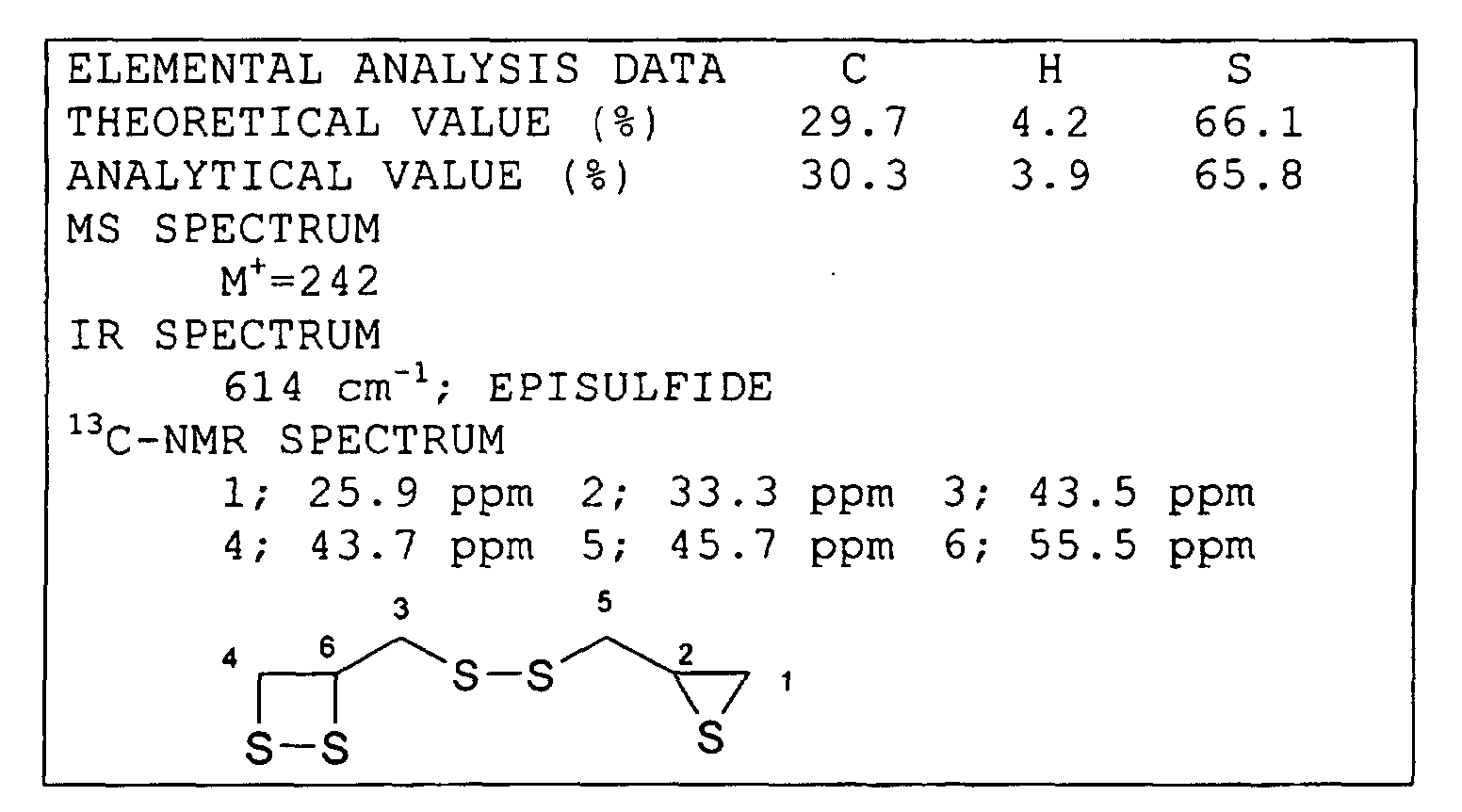
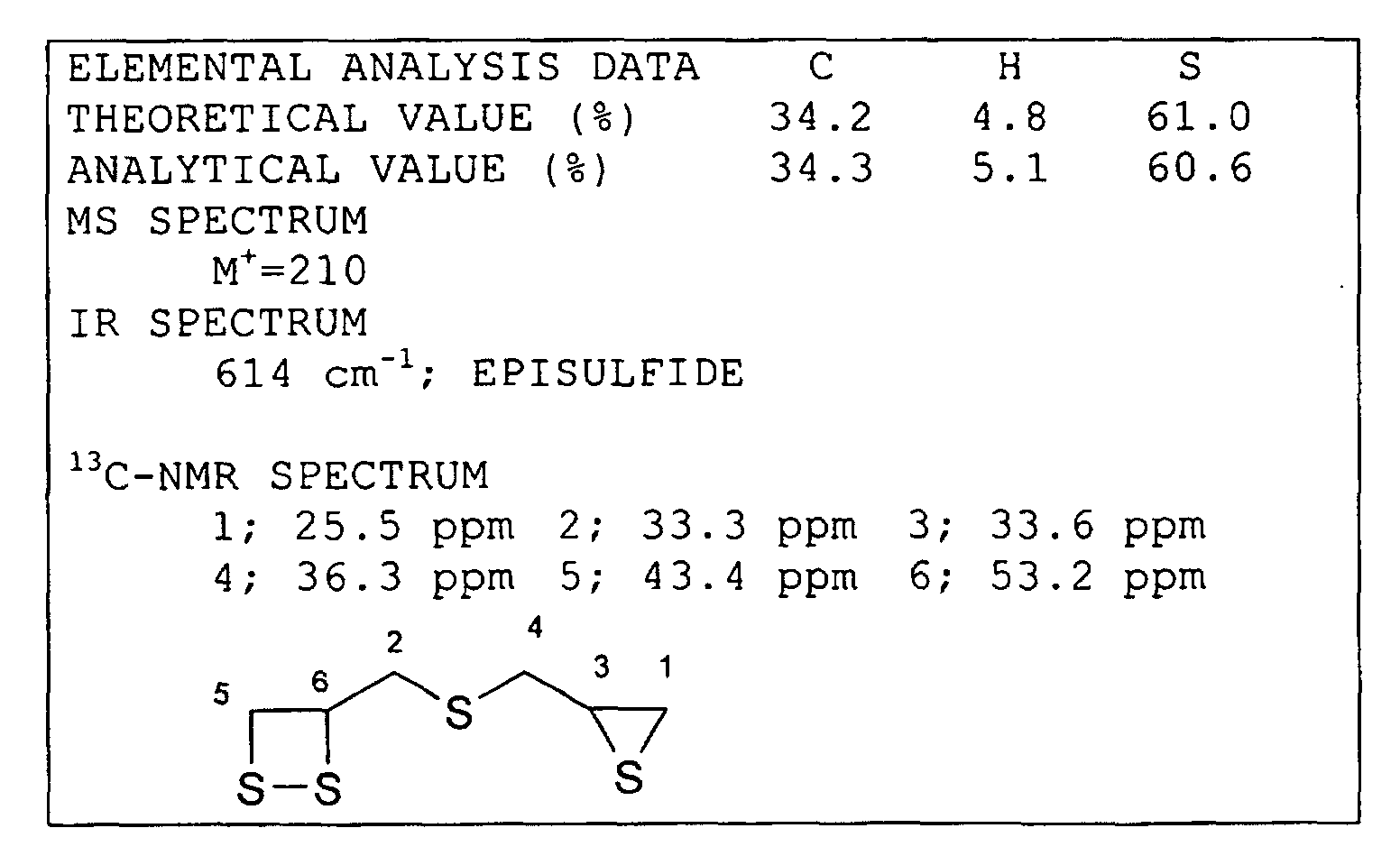
- a thioepoxy compound having at least one structure represented by formula (1) bis(2,3-epithiopropyl)disulfide (called a compound (a)) and bis(2,3-epithiopropyl)sulfide (called a compound (b)) were used; as by-produced impurities, that is, as the thioepoxy compound having at least one intramolecular structure represented by formula (2) and at least one intramolecular structure represented by formula (3), 2,3-epidithiopropyl(2,3-epithiopropyl)disulfide (called a compound (c)) and 2,3-epidithiopropyl(2,3-epithiopropyl)sulfide (called a compound (d)) were used; and as the thioepoxy compound having at least one intramolecular structure represented by formula (4) and at least one intramolecular structure represented by formula (3), 2,3-epoxypropy
- particles of solid iodine were added stepwise to a mixture of 250 g of this distillated material, water, methanol, and 180 g of sodium bicarbonate.
- toluene and 350 g of a sodium hydroxide solution at a concentration of 25% were added, the mixture thus formed was held for 3 hours for aging.
- an organic layer obtained through the aging was washed with water twice, 130 g of thiourea, 5 g of acetic acid, and methanol were added thereto, and the mixture thus formed was stirred for 16 hours at a temperature of 25°C.
- particles of solid iodine were added stepwise to a mixture of 250 g of this distillated material, water, methanol, and 180 g of sodium bicarbonate.
- toluene and 350 g of a sodium hydroxide solution at a concentration of 25% were added, the mixture thus formed was held for 3 hours for aging.
- an organic layer obtained through the aging was washed with water twice, 70 g of thiourea, 5 g of acetic acid, and methanol were added thereto, and the mixture thus formed was stirred for 8 hours at a temperature of 25°C.
- the resultant residue thus obtained was a polymerizable composition in which the compound (a) was contained, and the total of the compound (c) and the compound (e) was 0.8 mass percent. After this polymerizable compound was passed through a silica gel column for chromatographic purification using chloroform and hexane as a developing solvent, the total of the compound (c) and the compound (e) in the resultant polymerizable composition was 0 mass percent.
- Synthesis was performed in a manner equivalent to that in Example 1, in which thiourea in an amount of 1.05 equivalents was used as a thiation agent with respect to one epoxy group of bis(2,3-epoxypropyl)disulfide.
- the compound (a) was contained, and in addition, the total of the compound (c) and the compound (e) was 0.8 mass percent.
- 0.1 g of N,N-dimethylcyclohexylamine was added as a curing catalyst to 100 g of this resultant composition, followed by stirring, and after defoamed under vacuum for 0.1 hours, the resultant composition was cast in a molding tool formed of a glass mold and a gasket.
- This mold was gradually heated from 30°C to 120°C, and polymerization was performed for 24 hours. After this polymerization, the mold was gradually cooled, and the resin was then recovered from the mold.
- the properties of the resultant resin are shown in Table-1. The resultant resin was superior having no optical strain.
- reaction was performed except that thiourea in an amount of 1.15 equivalents was used with respect to one epoxy group, and a polymerizable composition was obtained.
- the compound (a) was contained, and in addition, the total of the compound (c) and the compound (e) was 0.7 mass percent.
- 0.1 g of N,N-dimethylcyclohexylamine was added as a curing catalyst to 100 g of this polymerizable composition, followed by stirring, and after defoamed under vacuum for 0.1 hours, the resultant composition was cast in a molding tool formed of a glass mold and a gasket.
- This mold was gradually heated from 30°C to 120°C, and polymerization was performed for 24 hours. After this polymerization, the mold was gradually cooled, and the resin was then recovered from the mold.
- the properties of the resultant resin are shown in Table-1. The resultant resin was superior having no optical strain.
- reaction was performed except that a thiation agent in an amount of 1.15 equivalents was used with respect to one epoxy group and that the reaction temperature was set to 25°C.
- the compound (b) was contained, and in addition, the total of the compound (d) and the compound (f) was 0.9 mass percent.
- 0.1 g of N,N-dimethylcyclohexylamine was added as a curing catalyst to 100 g of this polymerizable composition, followed by stirring, and after defoamed under vacuum for 0.1 hours, the resultant composition was cast in a molding tool formed of a glass mold and a gasket.
- This mold was gradually heated from 30°C to 120°C, and polymerization was performed for 24 hours. After this polymerization, the mold was gradually cooled, and the resin was then recovered from the mold.
- the properties of the resultant resin are shown in Table-1. The resultant resin was superior having no optical strain.
- reaction was performed except that a thiation agent in an amount of 1.20 equivalents was used with respect to one epoxy group.
- the compound (b) was contained, and in addition the total of the compound (d) and the compound (f) was 1.2 mass percent.
- 0.1 g of N,N-dimethylcyclohexylamine was added as a curing catalyst to 100 g of this polymerizable composition, followed by stirring, and after defoamed under vacuum for 0.1 hours, the resultant composition was cast in a molding tool formed of a glass mold and a gasket. This mold was gradually heated from 30°C to 120°C, and polymerization was performed for 24 hours. After this polymerization, the mold was gradually cooled, and the resin was then recovered from the mold.
- Table-1 The properties of the resultant resin was shown in Table-1. The resultant resin was superior having no optical strain.
- reaction was performed except that a thiation agent in an amount of 1.28 equivalents was used with respect to one epoxy group and that the reaction temperature was set to 35°C.
- the compound (b) was contained, and in addition, the total content of the compound (d) and the compound (f) was 1.4 mass percent.
- 0.1 g of N,N-dimethylcyclohexylamine was added as a curing catalyst to 100 g of this polymerizable composition, followed by stirring, and after defoamed under vacuum for 0.1 hours, the resultant composition was cast in a molding tool formed of a glass mold and a gasket.
- This mold was gradually heated from 30°C to 120°C, and polymerization was performed for 24 hours. After this polymerization, the mold was gradually cooled, and the resin was then recovered from the mold.
- the properties of the resultant resin are shown in Table-1. The resultant resin was superior having no optical strain.
- reaction was performed except that a thiation agent in an amount of 1.28 equivalents was used with respect to one epoxy group, that the reaction temperature was set to 35°C, and that a composition containing a polyepoxy compound was added dropwise to a composition containing the thiation agent.
- the compound (b) was contained, and the total content of the compound (d) and the compound (f) was 1.2 mass percent.
- reaction was performed except that a thiation agent in an amount of 3.5 equivalents was used with respect to one epoxy group.
- the compound (a) was contained, and in addition, the total of the compound (c) and the compound (e) was 4.2 mass percent.
- This polymerizable composition had a strong yellow hue which could be easily observed by visual inspection.
- 0.1 g of N,N-dimethylcyclohexylamine was added as a curing catalyst to 100 g of this polymerizable composition, followed by stirring, and after defoamed under vacuum for 0.1 hours, the resultant composition was cast in a molding tool formed of a glass mold and a gasket.
- This mold was gradually heated from 30°C to 120°C, and polymerization was performed for 24 hours. After this polymerization, the mold was gradually cooled, and the resin was then recovered from the mold.
- the properties of the resultant resin are shown in Table-1.
- the resultant resin had a high YI value and also had optical strain, and the refractive index thereof was different from that in Example 1.
- reaction was performed except that a thiation agent in an amount of 0.8 equivalents was used with respect to one epoxy group.
- the compound (b) was contained, and in addition, the total content of the compound (d) and the compound (f) was 5.6 mass percent.
- 0.1 g of N,N-dimethylcyclohexylamine was added as a curing catalyst to 100 g of this polymerizable composition, followed by stirring, and after defoamed under vacuum for 0.1 hours, the resultant composition was cast in a molding tool formed of a glass mold and a gasket. This mold was gradually heated from 30°C to 120°C, and polymerization was performed for 24 hours.
- the mold was gradually cooled, and the resin was then recovered from the mold.
- the properties of the resultant resin are shown in Table-1.
- the resultant resin had a high YI value and also had optical strain, and the refractive index thereof was different from that in Example 6.
- reaction was performed except that a thiation agent in an amount of 3.5 equivalents was used with respect to one epoxy group, and that the reaction temperature was set to 60°C.
- the compound (b) was contained, and in addition, the total content of the compound (d) and the compound (f) was 5.2 mass percent.
- 0.1 g of N,N-dimethylcyclohexylamine was added as a curing catalyst to 100 g of this polymerizable composition, followed by stirring, and after defoamed under vacuum for 0.1 hours, the resultant composition was cast in a molding tool formed of a glass mold and a gasket.
- This mold was gradually heated from 30°C to 120°C, and polymerization was performed for 24 hours. After this polymerization, the mold was gradually cooled, and the resin was then recovered from the mold.
- the properties of the resultant resin are shown in Table-1.
- the resultant resin had a high YI value and also had optical strain, and the refractive index thereof was different from that in Example 4.
- Example 1 0 mass percent of compounds (c) and (e) contained in polymerizable composition 1.744 Blank ⁇ (good)
- Example 2 0.8 mass percent of compounds (c) and (e) contained in polymerizable composition 1.744 ⁇ (good) ⁇ (good)
- Example 4 0.7 mass percent of compounds (c) and (e) contained in polymerizable composition 1.744 ⁇ (good) ⁇ (good)
- Example 6 0 mass percent of compounds (d) and (f) contained in polymerizable composition 1.705 Blank ⁇ (good)
- Example 7 0.9 mass percent of compounds (d) and (f) contained in polymerizable composition 1.705 ⁇ (good) ⁇ (good)
- Example 9 1.2 mass percent of compounds (d) and (f) contained in polymerizable composition 1.705 ⁇ (good) ⁇ (good)
- Example 11 1.4 mass percent of compounds (d) and (f) contained in polymerizable composition 1.705 ⁇ (good) ⁇ (
- a transparent cured resin used as an optical material in the field of ultra high refractive index application can be obtained in which variation in refractive index and variation in optical strain are suppressed, and as a result, in the field of glass lenses, the yield of lenses can be improved.
Landscapes
- Chemical & Material Sciences (AREA)
- Health & Medical Sciences (AREA)
- Chemical Kinetics & Catalysis (AREA)
- Medicinal Chemistry (AREA)
- Polymers & Plastics (AREA)
- Organic Chemistry (AREA)
- Physics & Mathematics (AREA)
- General Physics & Mathematics (AREA)
- Optics & Photonics (AREA)
- Polymers With Sulfur, Phosphorus Or Metals In The Main Chain (AREA)
- Epoxy Resins (AREA)
Abstract




Description










aromatic thiols such as 1,2-dimercaptobenzene, 1,3-dimercaptobenzene, 1,4-dimercaptobenzene, 1,2-bis(mercaptomethyl)benzene, 1,3-bis(mercaptomethyl)benzene, 1,4-bis(mercaptomethyl)benzene, 2,2'-dimercaptobiphenyl, 4,4'-dimercaptobiphenyl, bis(4-mercaptophenyl)methane, bis(4-mercaptophenyl)sulfide, bis(4-mercaptophenyl)sulfone, 2,2-bis(4-mercaptophenyl)propane, 1,2,3-trimercaptobenzene, 1,2,4-trimercaptobenzene, and 1,2,5-trimercaptobenzene. However, the thiols are not limited to those compounds mentioned above.
alicyclic 2,3-epithiopropylthio compounds such as 1,3-bis(2,3-epithiopropylthio)cyclohexane, 1,4-bis(2,3-epithiopropylthio)cyclohexane, 1,3-bis(2,3-epithiopropylthiomethyl)cyclohexane, 1,4-bis(2,3-epithiopropylthiomethyl)cyclohexane, 2,5-bis(2,3-epithiopropylthiomethyl)-1,4-dithiane, 2,5-bis[{2-(2,3-epithiopropylthio)ethyl}thiomethyl]-1,4-dithiane, and 2,5-bis(2,3-epithiopropylthiomethyl)-2,5-dimethyl-1,4-dithiane; and
aromatic 2,3-epithiopropylthio compounds such as 1,2-bis(2,3-epithiopropylthio)benzene, 1,3-bis(2,3-epithiopropylthio)benzene, 1,4-bis(2,3-epithiopropylthio)benzene, 1,2-bis(2,3-epithiopropylthiomethyl)benzene, 1,3-bis(2,3-epithiopropylthiomethyl)benzene, 1,4-bis(2,3-epithiopropylthiomethyl)benzene, bis{4-(2,3-epithiopropylthio)phenyl}methane, 2,2-bis{4-(2,3-epithiopropylthio)phenyl}propane, bis{4-(2,3-epithiopropylthio)phenyl}sulfide, bis{4-(2,3-epithiopropylthio)phenyl}sulfone, and 4,4'-bis(2,3-epithiopropylthio)biphenyl. However, the polythioepoxy compounds are not limited to those compounds mentioned above. Among the compounds mentioned above, bis(2,3-epithiopropyl)sulfide and bis(2,3-epithiopropyl)disulfide are preferable compounds, and bis(2,3-epithiopropyl)sulfide is more preferable compound.

alicyclic (2,3-epithiopropyl)thio compounds having a (2,3-epidithiopropylthio group) structure represented by formula (2), such as 1-(2,3-epidithiopropylthio)-3-(2,3-epithiopropyl)thiocyclohexane, 1-(2,3-epidithiopropylthio)-4-(2,3-epithiopropyl)thiocyclohexane, 1-(2,3-epidithiopropylthiomethyl)-3-(2,3-epithiopropyl)thiomethylcyclohexane, 1-(2,3-epidithiopropylthiomethyl)-4-(2,3-epithiopropyl)thiomethylcyclohexane, 2-(2,3-epidithiopropylthiomethyl)-5-(2,3-epithiopropyl)thiomethyl-1,4-dithiane, 2-{(2-(2,3-epidithiopropylthioethyl)thio)ethyl}-5-{2-(2,3-epithiopropyl)thioethyl}thiomethyl-1,4-dithiane, and 2-(2,3-epidithiopropylthiomethyl)-5-(2,3-epithiopropyl)thiomethyl-2,5-dimethyl-1,4-dithiane; and
aromatic (2,3-epithiopropyl)thio compounds having a (2,3-epidithiopropylthio group) structure represented by formula (2), such as 1-(2,3-epidithiopropylthio)-2-(2,3-epithiopropyl)thiobenzene, 1-(2,3-epidithiopropylthio-)3-(2,3-epithiopropyl)thiobenzene, 1-(2,3-epidithiopropylthio)-4-(2,3-epithiopropyl)thiobenzene, 1-(2,3-epidithiopropylthiomethyl)-2-(2,3-epithiopropyl)thiomethylbenzene, 1-(2,3-epidithiopropylthiomethyl)-3-(2,3-epithiopropyl)thiomethylbenzene, 1-(2,3-epidithiopropylthiomethyl)-4-(2,3-epithiopropyl)thiomethylbenzene, {4-(2,3-epithiopropylthio)phenyl-4'-(2,3-epidithiopropylthio)phenyl}methane, 2,2-{4-(2,3-epithiopropylthio)phenyl-4'-(2,3-epidithiopropylthio)phenyl}propane, {4-(2,3-epithiopropyl)thiophenyl-4'-(2,3-epidithiopropylthio)phenyl}sulfide, {4-(2,3-epithiopropylthio)phenyl-4'-(2,3-epidithiopropylthio)phenyl}sulfone, 4-(2,3-epithiopropylthio)-4'-(2,3-epidithiopropylthio)biphenyl, and 4-(2,3-epithiopropylthio)-4'-(2,3-epidithiopropylthio)phenyl sulfide. However, the thioepoxy compound A is not limited to the compounds mentioned above.

alicyclic (2,3-epithiopropyl)thio compounds having a (2,3-epoxypropylthio group) structure represented by formula (4), such as 1-(2,3-epoxypropylthio)-3-(2,3-epithiopropyl)thiocyclohexane, 1-(2,3-epoxypropylthio)-4-(2,3-epithiopropyl)thiocyclohexane, 1-(2,3-epoxypropylthiomethyl)-3-(2,3-epithiopropyl)thiomethylcyclohexane, 1-(2,3-epoxypropylthiomethyl)-4-(2,3-epithiopropyl)thiomethylcyclohexane, 2-(2,3-epoxypropylthiomethyl)-5-(2,3-epithiopropyl)thiomethyl-1,4-dithiane, 2-{(2-(2,3-epoxypropylthioethyl)thio)ethyl}-5-{2-(2,3-epithiopropyl)thioethyl)thiomethyl-1,4-dithiane, and 2-(2,3-epoxypropylthiomethyl)-5-(2,3-epithiopropyl)thiomethyl-2,5-dimethyl-1,4-dithiane; and
aromatic (2,3-epithiopropyl)thio compounds having a (2,3-epoxypropylthio group) structure represented by formula (4), such as 1-(2,3-epoxypropylthio)-2-(2,3-epithiopropyl)thiobenzene, 1-(2,3-epoxypropylthio-)3-(2,3-epithiopropyl)thiobenzene, 1-(2,3-epoxypropylthio)-4-(2,3-epithiopropyl)thiobenzene, 1-(2,3-epoxypropylthiomethyl)-2-(2,3-epithiopropyl)thiomethylbenzene, 1-(2,3-epoxypropylthiomethyl)-3-(2,3-epithiopropyl)thiomethylbenzene, 1-(2,3-epoxypropylthiomethyl)-4-(2,3-epithiopropyl)thiomethylbenzene, {4-(2,3-epithiopropylthio)phenyl-4'-(2,3-epoxypropylthio)phenyl}methane, 2,2-(4-(2,3-epithiopropyl)thiophenyl-4'-(2,3-epoxypropylthio)phenyl}propane, {4-(2,3-epithiopropyl)thiophenyl-4'-(2,3-epoxypropylthio)phenyl}sulfide, {4-(2,3-epithiopropylthio)phenyl-4'-(2,3-epoxypropylthio)phenyl}sulfone, 4-(2,3-epithiopropylthio)-4'-(2,3-epoxypropylthio)biphenyl, and 4-(2,3-epithiopropylthio)-4'-(2,3-epoxypropylthio)phenyl sulfide. However, the thioepoxy compound B is not limited to the compounds mentioned above.
aromatic thiols such as benzylthiol, thiophenol, 1,2-dimercaptobenzene, 1,3-dimercaptobenzene, 1,4-dimercaptobenzene, 1,2-bis(mercaptomethyl)benzene, 1,3-bis(mercaptomethyl)benzene, 1,4-bis(mercaptomethyl)benzene, 2,2'-dimercaptobiphenyl, 4,4'-dimercaptobiphenyl, bis(4-mercaptophenyl)methane, bis(4-mercaptophenyl)sulfide, bis(4-mercaptophenyl)sulfone, 2,2-bis(4-mercaptophenyl)propane, 1,2,3-trimercaptobenzene, 1,2,4-trimercaptobenzene, and 1,2,5-trimercaptobenzene. However, the thiol compounds are not limited to the compounds mentioned above.
aliphatic polyisocyanate compound such as hexamethylene diisocyanate, 2,2-dimethylpentane diisocyanate, 2,2,4-trimethylhexane diisocyanate, butene diisocyanate, 1,3-butadiene-1,4-diisocyanate, 2,4,4-trimethylhexamethylene diisocyanate, 1,6,11-undecane triisocyanate, 1,3,6-hexamethylene triisocyanate, 1,8-diisocyanato-4-isocyanatomethyloctane, bis(isocyanatoethyl)carbonate, bis(isocyanatoethyl)ether, lysine diisocyanatomethyl ester, lysine triisocyanate, xylylene diisocyanate, bis(isocyanatoethyl)benzene, bis(isocyanatopropyl)benzene, α,α,α',α'-tetramethylxylylene diisocyanate, bis(isocyanatobutyl)benzene, bis(isocyanatomethyl)naphthalene, bis(isocyanatomethyl)diphenyl ether, bis(isocyanatoethyl)phthalate, mesitylylene triisocyanate, and 2,6-di(isocyanatomethyl)furan;
alicyclic polyisocyanate compounds such as isophorone diisocyanate, bis(isocyanatomethyl)cyclohexane, dicyclohexylmethane diisocyanate, cyclohexane diisocyanate, methylcyclohexane diisocyanate, dicyclohexyldimethylmethane diisocyanate, 2,2-dimethyldicyclohexylmethane diisocyanate, 2,5-bis(isocyanatomethyl)bicyclo-[2,2,1]-heptane, 2,6-bis(isocyanatomethyl)bicyclo-[2,2,1]-heptane, 3,8-bis (isocyanatomethyl)tricyclodecane, 3,9-bis(isocyanatomethyl) tricyclodecane, 4,8-bis(isocyanatomethyl)tricyclodecane, and 4,9-bis(isocyanatomethyl)tricyclodecane;
aromatic polyisocyanate compounds such as phenylene diisocyanate, tolylene diisocyanate, ethylphenylene diisocyanate, isopropylphenylene diisocyanate, dimethylphenylene diisocyanate, diethylphenylene diisocyanate, diisopropylphenylene diisocyanate, trimethylbenzene triisocyanate, benzene triisocyanate, biphenyl diisocyanate, toluidine diisocyanate, 4,4-diphenylmethane diisocyanate, 3,3-dimethyldiphenylmethane-4,4-diisocyanate, bibenzyl-4,4-diisocyanate, bis(isocyanatophenyl)ethylene, 3,3-dimethoxybiphenyl-4,4-diisocyanate, phenylisocyanatoethyl isocyanate, hexahydrobenene diisocyanate, and hexahydrodiphenylmethane-4,4-diisocyanate;
sulfur-containing aliphatic polyisocyanate compounds such as bis(isocyanatomethyl)sulfide, bis(isocyanatoethyl)sulfide, bis(isocyanatopropyl)sulfide, bis(isocyanatehexyl)sulfide, bis(isocyanatomethyl)sulfone, bis(isocyanatomethyl)disulfide, bis(isocyanatoethyl)disulfide, bis(isocyanatopropyl)disulfide, bis(isocyanatomethylthio) methane, bis(isocyanatoethylthio)methane, bis(isocyanatoethylthio)ethane, bis(isocyanatomethylthio)ethane, and 1,5-diisocyanato-2-isocyanatomethyl-3-thiapentane;
aromatic sulfide-type polyisocyanate compounds such as diphenylsulfide-2,4-diisocyanate, diphenylsulfide-4,4-diisocyanate, 3,3-dimethoxy-4,4-diisocyanatodibenzyl thioether, bis(4-isocyanatomethylbenzene)-sulfide, and 4,4-methoxybenzene-thioethyleneglycol-3,3-diisocyanate;
aromatic disulfide-type polyisocyanates such as diphenyldisulfide-4,4-diisocyanate, 2,2-dimethyldiphenyldisulfide-5,5-diisocyanate, 3,3-dimethyldiphenyldisulfide-5,5-diisocyanate, 3,3-dimethyldiphenyldisulfide-6,6-diisocyanate, 4,4-dimethyldiphenyldisulfide-5,5-diisocyanate, 3,3-dimethoxydiphenyldisulfide-4,4-diisocyanate, and 4,4-dimethoxydiphenyldisulfide-3,3-diisocyanate;
sulfur-containing heterocyclic compounds such as 2,5-diisocyanatothiophene and 2,5-bis(isocyanatomethyl)thiophene; and
others such as 2,5-diisocyanatotetrahydrothiophene, 2,5-bis(isocyanatomethyl)tetrahydrothiophene, 3,4-bis(isocyanatomethyl)tetrahydrothiophene, 2,5-diisocyanato-1,4-dithiane, 2,5-bis(isocyanatomethyl)-1,4-dithiane, 4,5-diisocyanato-1,3-dithiolane, 4,5-bis(isocyanatomethyl)-1,3-dithiolane, and 4,5-bis(isocyanatomethyl)-2-methyl-1,3-dithiolane. However, the iso(thio)cyanate compounds are not limited to the compounds mentioned above. In addition, as usable materials based on the compounds mentioned above, for example, there may be mentioned halogen-substituted compounds such as chlorine-substituted or bromine-substituted compounds, alkyl-substituted compounds, alkoxy-substituted compounds, nitro-substituted compounds, prepolymer-type modified compounds formed with polyols, carbodiimide modified compounds, urea modified compounds, biuret-modified compounds, and products obtained by dimerization and trimerization reactions.
aliphatic polyisothiocyanate compounds such as 1,6-diisothiocyanatohexane and p-phenyleneisopropylidene diisothiocyanate; alicyclic polyisothiocyanate compounds such as cyclohexane diisothiocyanate and (diisothiocyanato)methylbicycloheptane;
aromatic isothiocyanate compounds such as 1,2-diisothiocyanatobenzene, 1,3-diisothiocyanatobenzene, 1,4-diisothiocyanatobenzene, 2,4-diisothiocyanatotoluene, 2,5-diisothiocyanato-m-xylene, 4,4-diisathiocyanato-1,1-biphenyl, 1,1-methylene-bis(4-isothiocyanatobenzene), 1,1-methylene-bis(4-isothiocyanato-2-methylbenzene), 1,1-methylene-bis(4-isothiocyanato-3-methylbenzene), 1,1-(1,2-ethanediyl)bis(isothiocyanatobenzene), 4,4-diisothiocyanatobenzophenone, 4,4-diisothiocyanato-3,3-dimethylbenzophenone, diphenyl ether-4,4-diisothiocyanate, and diphenylamine-4,4-diisothiocyanate; and
furthermore, carbonylisothiocyanate compounds such as 1,3-benzenedicarbonyl diisothiocyanate, 1,4-benzenedicarbonyl diisothiocyanate, and (2,2-pyridine)-4,4-dicarbonyl diisothiocyanate. However, the isothiocyanate compounds are not limited to the compounds mentioned above.
sulfur-containing compounds in addition to an isothiocyanate group, such as 4-isocyanato-4'-isothiocyanatodiphenyl sulfide and 2-isocyanato-2'-isothiocyanatodiethyl disulfide. However, the isothiocyanate compounds having an isocyanate group are not limited to those compounds mentioned above.
primary polyamine compounds such as ethylenediamine, 1,2- or 1,3-diaminopropane, 1,2-, 1,3- or 1,4-diaminobutane, 1,5-diaminopentane, 1,6-diaminohexane, 1,7-diaminoheptane, 1,8-diaminooctane, 1,10-diaminodecane, 1,2-, 1,3- or 1,4-diaminocyclohexane, o-, m- or p-diaminobenzene, 3,4- or 4,4'-diaminobenzophenone, 3,4- or 4,4'-diaminodiphenylether, 4,4'-diaminodiphenylmethane, 4,4'-diaminodiphenylsulfide, 3,3'- or 4,4'-diaminodiphenylsulfone, 2,7-diaminofluorene, 1,5-, 1,8- or 2,3-diaminonaphthalene, 2,3-, 2,6- or 3,4-diaminopyridine, 2,4- or 2,6-diaminotoluene, m-, or p-xylylenediamine, isophoronediamine, diaminomethylbicycloheptane, 1,3- or 1,4-diaminomethylcyclohexane, 2- or 4-aminopiperidine, 2- or 4-aminomethylpiperidine, 2- or 4-aminoethylpiperidine, N-aminoethylmorpholine, and N-aminopropylmorpholine; and
monofunctional secondary amine compounds such as diethylamine, dipropylamine, di-n-butylamine, di-sec-butylamine, diisobutylamine, di-n-pentylamine, di-3-pentylamine, dihexylamine, dioctylamine, di(2-ethylhexyl)amine, methylhexylamine, diallylamine, N-methylallylamine, piperidine, pyrrolidine, diphenylamine, N-methylamine, N-ethylamine, dibenzylamine, N-methylbenzylamine, N-ethylbenzylamine, dicyclohexylamine, N-methylaniline, N-ethylaniline, dinaphthylamine, 1-methylpiperazine, and morpholine; and
secondary polyamine compounds such as N,N'-dimethylethylenediamine, N,N'-dimethyl-1,2-diaminopropane, N,N'-dimethyl-1,3-diaminopropane, N,N'-dimethyl-1,2-diaminobutane, N,N'-dimethyl-1,3-diaminobutane, N,N'-dimethyl-1,4-diaminobutane, N,N'-dimethyl-1,5-diaminopentane, N,N'-dimethyl-1,6-diaminohexane, N,N'-dimethyl-1,7-diaminoheptane, N,N'-diethylethylenediamine, N,N'-diethyl-1,2-diaminopropane, N,N'-diethyl-1,3-diaminopropane, N,N'-diethyl-1,2-diaminobutane, N,N'-diethyl-1,3-diaminobutane, N,N'-diethyl-1,4-diaminobutane, N,N'-diethyl-1,5-diaminopentane, N,N'-diethyl-1,6-diaminohexane, N,N'-diethyl-1,7-diaminoheptane, piperazine, 2-methylpiperazine, 2,5-dimethylpiperazine, 2,6-dimethylpiperazine, homopiperazine, 1,1-di(4-piperidyl)methane, 1,2-di(4-piperidyl)ethane, 1,3-di(4-piperidyl)propane, 1,4-di(4-piperidyl)butane, and tetramethylguanidine. However, the amine compounds are not limited to those mentioned above.
- Refractive Index (ne): Measurement was performed at a temperature of 20°C using a Pulfrich refractometer.
- Hue: When a YI value of a resin, measured by a colorimeter, was different by ±1 or more from a value (described in Examples 1 and 4) obtained by curing a specific polymerizable composition, the resin was regarded as x( not good), and when the YI value is less than that, the resin is regarded as o( good). The specific polymerizable composition mentioned above was a polymerizable composition containing a compound which has at least one structure represented by formula (1), in which the total content of a thioepoxy compound, which has at least one intramolecular structure represented by formula (2) and at least one intramolecular structure represented by formula (3), and a thioepoxy compound, which has at least one intramolecular structure represented by formula (4) and at least one intramolecular structure represented by formula (3), was 0 with respect to the total amount of the polymerizable composition.
- Optical strain: Observation was performed by visual inspection using a high pressure mercury lamp. A resin having an optical strain was represented by x( not good), and a resin having no strain was represented by o( good).

| Polymerizable Composition | Refractive Index ne | Hue | Optical Strain | |
| Example 1 | 0 mass percent of compounds (c) and (e) contained in polymerizable composition | 1.744 | Blank | ○ (good) |
| Example 2 | 0.8 mass percent of compounds (c) and (e) contained in polymerizable composition | 1.744 | ○ (good) | ○ (good) |
| Example 4 | 0.7 mass percent of compounds (c) and (e) contained in polymerizable composition | 1.744 | ○ (good) | ○ (good) |
| Example 6 | 0 mass percent of compounds (d) and (f) contained in polymerizable composition | 1.705 | Blank | ○ (good) |
| Example 7 | 0.9 mass percent of compounds (d) and (f) contained in polymerizable composition | 1.705 | ○ (good) | ○ (good) |
| Example 9 | 1.2 mass percent of compounds (d) and (f) contained in polymerizable composition | 1.705 | ○ (good) | ○ (good) |
| Example 11 | 1.4 mass percent of compounds (d) and (f) contained in polymerizable composition | 1.705 | ○ (good) | ○ (good) |
| Example 13 | 1.2 mass percent of compounds (d) and (f) contained in polymerizable composition | 1.705 | ○ (good) | ○ (good) |
| Comparative Example 1 | 4.2 mass percent of compounds (c) and (e) contained in polymerizable composition | 1.747 | × (not good) | × (not good) |
| Comparative Example 3 | 5.6 mass percent of compounds (d) and (f) contained in polymerizable composition | 1.702 | × (not good) | × (not good) |
| Comparative Example 5 | 5.2 mass percent of compounds (d) and (f) contained in polymerizable composition | 1.708 | × (not good) | × (not good) |
Claims (12)
- A polymerizable composition comprising a compound which has at least one structure represented by formula (1):(Where R1 represents a hydrocarbon having 1 to 10 carbon atoms, R2, R3, and R4 each represent a hydrocarbon group having 1 to 10 carbon atoms or a hydrogen atom.), wherein the total of a thioepoxy compound A, which has at least one structure represented by formula (2) and at least one structure represented by formula (3), and a thioepoxy compound B, which has at least one structure represented by formula (4) and at least one structure represented by formula (3), is 4 mass percent or less with respect to the total mass of the polymerizable composition.

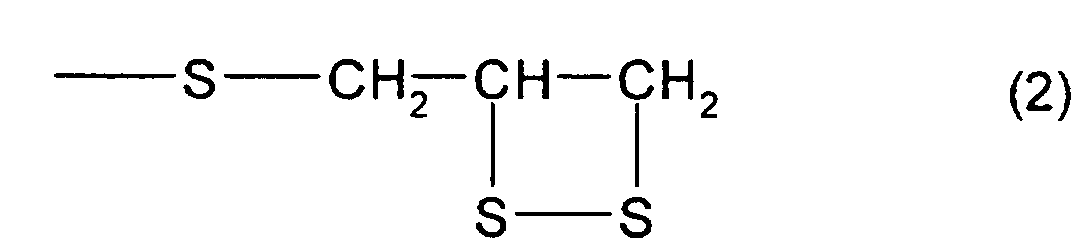
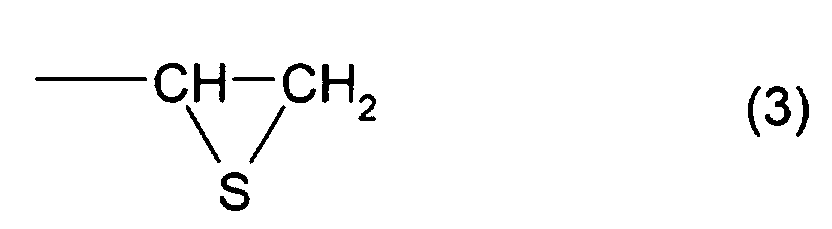

- The polymerizable composition according to Claim 1, wherein the thioepoxy compound A is a compound represented by formula (5), the thioepoxy compound B is a compound represented by formula (6), and the compound having at least one structure represented by formula (1) is a compound represented by formula (7).
 (where Y represents a substituted or unsubstituted, linear, branched, or cyclic divalent aliphatic hydrocarbon group having 1 to 10 carbon atoms, a substituted or unsubstituted 1,4-dithiane group, an arylene group, or an aralkylene group. m represents an integer of 0 to 2, and n represents an integer of 0 to 4.)
 (where R5 to R10 each represent a hydrocarbon group having 1 to 10 carbon atoms or hydrogen. Y represents a substituted or unsubstituted, linear, branched, or cyclic divalent hydrocarbon group having 1 to 10 carbon atoms, a substituted or unsubstituted 1,4-dithiane group, an arylene group, or an aralkylene group. m represents an integer of 0 to 2, and n represents an integer of 0 to 4.)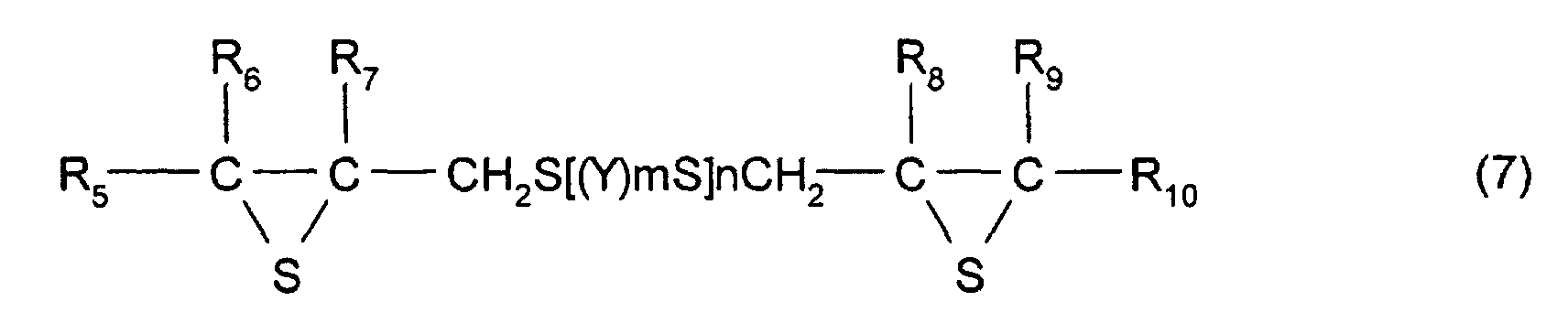
- The polymerizable composition according to Claim 1 or 2, wherein the thioepoxy compound A comprises 2,3-epidithiopropyl(2,3-epithiopropyl)disulfide and/or 2,3-epidithiopropyl(2,3-epithiopropyl)sulfide, the thioepoxy compound B comprises 2,3-epoxypropyl(2,3-epithiopropyl)disulfide and/or 2,3-epoxypropyl(2,3-epithiopropyl)sulfide, and the compound having at least one structure represented by formula (1) comprises bis(2,3-epithiopropyl)disulfide and/or bis(2,3-epithiopropyl)sulfide.
- A method for manufacturing a polymerizable composition, comprising forming a polythioepoxy compound from a polyepoxy compound, wherein a thiation agent in an amount of 0.9 to 1.3 equivalents is used with respect to one epoxy equivalent of the polyepoxy compound so that the total of a thioepoxy compound A and a thioepoxy compound B, which are in formula (1), is 4 mass percent or less with respect to the total mass of the polymerizable composition.
- A method for manufacturing a polymerizable composition, comprising forming a polythioepoxy compound from a polyepoxy compound, wherein a thiation agent in an amount of 0.9 to 1.3 equivalents is used with respect to one epoxy equivalent of the polyepoxy compound, and the reaction temperature is set to 0°C to 50°C so that the total of a thioepoxy compound A and a thioepoxy compound B, which are in formula (1), is 4 mass percent or less with respect to the total mass of the polymerizable composition.
- A method for manufacturing a polymerizable composition, comprising forming a polythioepoxy compound from a polyepoxy compound, wherein a thiation agent in an amount of 0.9 to 1.3 equivalents is used with respect to one epoxy equivalent of the polyepoxy compound, an acid or its anhydride in an amount of 0.2 equivalents or less is used with respect to one epoxy equivalent of the polyepoxy compound, and the reaction temperature is set to 0°C to 50°C so that the total of a thioepoxy compound A and a thioepoxy compound B, which are in formula (1), is 4 mass percent or less with respect to the total mass of the polymerizable composition.
- The manufacturing method according to one of Claims 4 to 6, wherein the thioepoxy compound A is a compound represented by formula (5), the thioepoxy compound B is a compound represented by formula (6), and a compound having at least one structure represented by formula (1) is represented by formula (7).
 (where Y represents a substituted or unsubstituted, linear, branched, or cyclic divalent aliphatic hydrocarbon group having 1 to 10 carbon atoms, a substituted or unsubstituted 1,4-dithiane group, an arylene group, or an aralkylene group. m represents an integer of 0 to 2, and n represents an integer of 0 to 4.)
 (where R5 to R10 each represent a hydrocarbon group having 1 to 10 carbon atoms or hydrogen. Y represents a substituted or unsubstituted, linear, branched, or cyclic divalent hydrocarbon group having 1 to 10 carbon atoms, a substituted or unsubstituted 1,4-dithiane group, an arylene group, or an aralkylene group. m represents an integer of 0 to 2, and n represents an integer of 0 to 4.)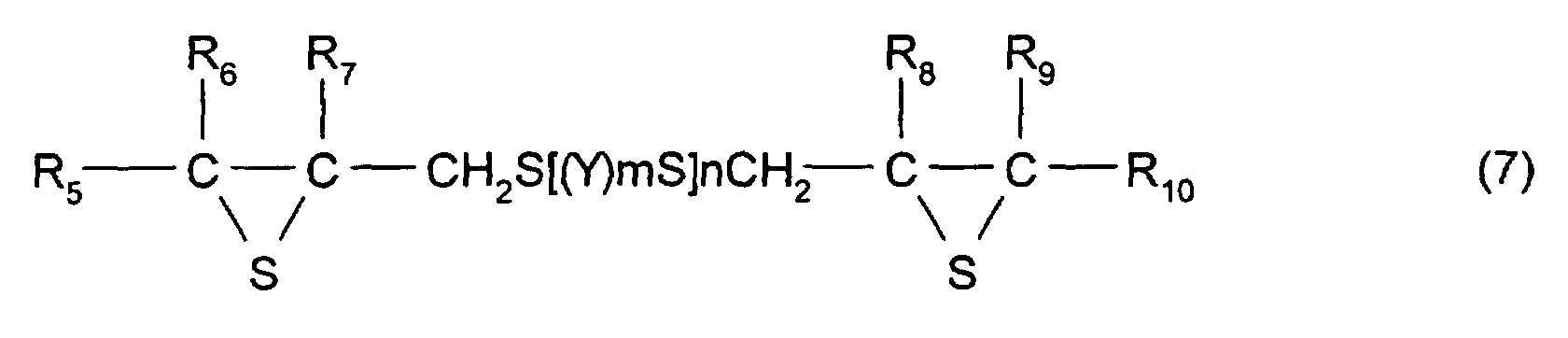
- The manufacturing method according to Claim 7, wherein the thioepoxy compound A comprises 2,3-epidithiopropyl(2,3-epithiopropyl)disulfide and/or 2,3-epidithiopropyl(2,3-epithiopropyl)sulfide, the thioepoxy compound B comprises 2,3-epoxypropyl(2,3-epithiopropyl)disulfide and/or 2,3-epoxypropyl(2,3-epithiopropyl)sulfide, and the compound having at least one structure represented by formula (1) comprises bis(2,3-epithiopropyl)disulfide and/or bis(2,3-epithiopropyl)sulfide.
- A method for manufacturing an optical material, wherein the optical material is obtained using the polymerizable composition according to one of Claims 1 to 3 and/or the polymerizable composition obtained by the method according to one of Claims 4 to 8.
- The manufacturing method according to Claim 9, wherein the optical material comprises a lens.
- The manufacturing method according to Claim 10, wherein cast polymerization is performed.
- A lens obtained by the method according to Claim 11.
Applications Claiming Priority (3)
| Application Number | Priority Date | Filing Date | Title |
|---|---|---|---|
| JP2002067015 | 2002-03-12 | ||
| JP2002067015 | 2002-03-12 | ||
| PCT/JP2003/002836 WO2003076496A1 (en) | 2002-03-12 | 2003-03-11 | Thioepoxy based polymerizable composition and method for production thereof |
Publications (2)
| Publication Number | Publication Date |
|---|---|
| EP1484352A1 true EP1484352A1 (en) | 2004-12-08 |
| EP1484352A4 EP1484352A4 (en) | 2005-11-16 |
Family
ID=27800267
Family Applications (1)
| Application Number | Title | Priority Date | Filing Date |
|---|---|---|---|
| EP03710295A Withdrawn EP1484352A4 (en) | 2002-03-12 | 2003-03-11 | Thioepoxy based polymerizable composition and method for production thereof |
Country Status (6)
| Country | Link |
|---|---|
| US (1) | US7354989B2 (en) |
| EP (1) | EP1484352A4 (en) |
| KR (2) | KR100716487B1 (en) |
| CN (1) | CN1578802A (en) |
| AU (1) | AU2003221343A1 (en) |
| WO (1) | WO2003076496A1 (en) |
Cited By (10)
| Publication number | Priority date | Publication date | Assignee | Title |
|---|---|---|---|---|
| TWI570112B (en) * | 2012-06-26 | 2017-02-11 | Mitsubishi Gas Chemical Co | Preparation of bis (β-epoxypropyl) sulfide and bis (β-epoxypropyl) polysulfide |
| EP3088441A4 (en) * | 2013-12-26 | 2017-08-02 | Mitsubishi Gas Chemical Company, Inc. | Optical material composition and method for producing same |
| US11529230B2 (en) | 2019-04-05 | 2022-12-20 | Amo Groningen B.V. | Systems and methods for correcting power of an intraocular lens using refractive index writing |
| US11564839B2 (en) | 2019-04-05 | 2023-01-31 | Amo Groningen B.V. | Systems and methods for vergence matching of an intraocular lens with refractive index writing |
| US11583388B2 (en) | 2019-04-05 | 2023-02-21 | Amo Groningen B.V. | Systems and methods for spectacle independence using refractive index writing with an intraocular lens |
| US11583389B2 (en) | 2019-04-05 | 2023-02-21 | Amo Groningen B.V. | Systems and methods for correcting photic phenomenon from an intraocular lens and using refractive index writing |
| US11678975B2 (en) | 2019-04-05 | 2023-06-20 | Amo Groningen B.V. | Systems and methods for treating ocular disease with an intraocular lens and refractive index writing |
| US11944574B2 (en) | 2019-04-05 | 2024-04-02 | Amo Groningen B.V. | Systems and methods for multiple layer intraocular lens and using refractive index writing |
| US12357509B2 (en) | 2019-04-05 | 2025-07-15 | Amo Groningen B.V. | Systems and methods for improving vision from an intraocular lens in an incorrect position and using refractive index writing |
| US12377622B2 (en) | 2019-04-05 | 2025-08-05 | Amo Groningen B.V. | Systems and methods for vergence matching with an optical profile and using refractive index writing |
Families Citing this family (28)
| Publication number | Priority date | Publication date | Assignee | Title |
|---|---|---|---|---|
| WO2010013420A1 (en) * | 2008-07-28 | 2010-02-04 | 三井化学株式会社 | Compound, polymerizable composition, resin, and use of the composition and the resin |
| US8541513B2 (en) * | 2011-03-18 | 2013-09-24 | Prc-Desoto International, Inc. | Terminal-modified difunctional sulfur-containing polymers, compositions thereof and methods of use |
| WO2013089538A1 (en) * | 2011-12-15 | 2013-06-20 | 주식회사 케이오씨솔루션 | Template polymerization method of thioepoxy-based optical material, and polymerizable composition thereof |
| WO2013103277A1 (en) * | 2012-01-06 | 2013-07-11 | 주식회사 케이오씨솔루션 | Polymeric composition for thioepoxy-based optical material and method of manufacturing thioepoxy-based optical material |
| JP2013142073A (en) * | 2012-01-11 | 2013-07-22 | Mitsubishi Gas Chemical Co Inc | Sulfur-containing epoxy compound and method for producing the same |
| WO2013109118A1 (en) * | 2012-01-20 | 2013-07-25 | 주식회사 케이오씨솔루션 | Method for preparing thioepoxy-based optical material and polymerizable composition thereof |
| KR101400358B1 (en) * | 2012-05-23 | 2014-05-27 | 주식회사 케이오씨솔루션 | Method of producing polythiol compound for optical material and polymerizable composition for optical material comprising the polythiol compound |
| KR20140029251A (en) | 2012-08-28 | 2014-03-10 | 주식회사 케이오씨솔루션 | A method of preparing thioepoxy based optical material |
| WO2014035165A1 (en) | 2012-08-29 | 2014-03-06 | 주식회사 케이오씨솔루션 | Method for manufacturing thioepoxy-based optical material |
| US9447226B2 (en) * | 2012-09-10 | 2016-09-20 | Mitsubishi Gas Chemical Company, Inc. | Composition for optical material, and method for producing same |
| WO2014046523A1 (en) | 2012-09-24 | 2014-03-27 | 주식회사 케이오씨솔루션 | Method for storing episulfide compound and method for preparing thioepoxy-based optical material using said episulfide compound |
| WO2014133111A1 (en) * | 2013-02-27 | 2014-09-04 | 三井化学株式会社 | Optical material, composition for use therein, and use thereof |
| KR20160100422A (en) | 2015-02-13 | 2016-08-24 | 주식회사 케이오씨솔루션 | Method of Producing Thioepoxy Compound for Optical Material and Polymerizable Composition for Thioepoxy based Optical Material Comprising the Compound |
| KR20160139798A (en) | 2015-05-28 | 2016-12-07 | 주식회사 케이오씨솔루션 | Composition for thioepoxy based optical material having superhigh refractive index and method of preparing the optical material |
| KR101893558B1 (en) * | 2017-02-03 | 2018-08-30 | 에스케이씨 주식회사 | Polymerizable composition for plastic lens |
| KR102502637B1 (en) | 2018-05-14 | 2023-02-22 | 미쓰이 가가쿠 가부시키가이샤 | Method for injecting episulfide based monomer in mold for manufacturing optical material |
| KR20200106729A (en) | 2019-03-05 | 2020-09-15 | 주식회사 케이오씨솔루션 | Internal Mold Release Agent For Optical Lens and Epoxy Acryl Based Optical Lens comprising it |
| KR20210105221A (en) | 2020-02-18 | 2021-08-26 | 주식회사 케이오씨솔루션 | Heat stabilizer for episulfide-based optical material, composition for optical material and manufacturing method of optical material |
| KR20210105224A (en) | 2020-02-18 | 2021-08-26 | 주식회사 케이오씨솔루션 | Composition for improving light resistance and thermal stability of episulfide optical material, composition for optical material and manufacturing method of optical material |
| KR20210106823A (en) | 2020-02-21 | 2021-08-31 | 주식회사 케이오씨솔루션 | Composition for improving light resistance and thermal stability of episulfide optical material, composition for optical material and manufacturing method of optical material |
| KR20210107444A (en) | 2020-02-24 | 2021-09-01 | 주식회사 케이오씨솔루션 | Composition for episulfide-based high refractive optical material with improved light resistance and manufacturing method of optical material |
| KR20210117080A (en) | 2020-03-18 | 2021-09-28 | 주식회사 엠엘텍 | Polymerization regulator for episulfide optical material, composition for optical material comprising same and method for manufacturing optical material |
| CN113088067B (en) * | 2021-04-30 | 2023-02-17 | 江苏可奥熙光学材料科技有限公司 | High-refraction episulfide modified resin and preparation method thereof |
| KR102881600B1 (en) * | 2021-08-25 | 2025-11-11 | 동우 화인켐 주식회사 | Photosensitive Resin Composition, Protrusion Pattern and Display Device Using the Same |
| JP7660689B2 (en) * | 2021-09-01 | 2025-04-11 | 三井化学株式会社 | Episulfide composition, polymerizable composition, cured product, and optical material |
| CN114273085B (en) * | 2022-01-04 | 2024-03-29 | 沈阳有研矿物化工有限公司 | Sulfide ore flotation collector, preparation method, application and flotation collecting method |
| CN114605639B (en) * | 2022-03-08 | 2023-06-02 | 益丰新材料股份有限公司 | Cyclothio compound composition and optical material thereof |
| CN116478124B (en) * | 2023-03-31 | 2023-12-01 | 益丰新材料股份有限公司 | Novel episulfide compound and optical material composition thereof |
Family Cites Families (12)
| Publication number | Priority date | Publication date | Assignee | Title |
|---|---|---|---|---|
| JPS6346213A (en) | 1986-03-01 | 1988-02-27 | Mitsui Toatsu Chem Inc | Resin for high-refractive index plastic lens |
| AU573471B2 (en) | 1986-03-01 | 1988-06-09 | Mitsui Chemicals, Inc. | Polythiocarbamate lense material |
| CN1040810A (en) | 1988-04-30 | 1990-03-28 | 三井东圧化学株式会社 | Polysulfide base resin lens and preparation method thereof |
| US5807975A (en) | 1995-08-16 | 1998-09-15 | Mitsubishi Gas Chemical Company,Inc. | Alkyl sulfide type episulfide compound |
| JP3491660B2 (en) | 1995-08-16 | 2004-01-26 | 三菱瓦斯化学株式会社 | Novel linear alkyl sulfide type episulfide compound |
| US6204311B1 (en) * | 1998-03-13 | 2001-03-20 | Mitsui Chemicals, Inc. | Polymerizable composition |
| JP3315090B2 (en) * | 1998-03-13 | 2002-08-19 | 三井化学株式会社 | Polymerizable composition |
| JP2000186087A (en) | 1998-10-15 | 2000-07-04 | Mitsubishi Gas Chem Co Inc | Method for producing episulfide compound |
| JP3366604B2 (en) * | 1999-12-08 | 2003-01-14 | 三井化学株式会社 | Method for producing episulfide compound |
| JP2001163873A (en) * | 1999-12-09 | 2001-06-19 | Mitsui Chemicals Inc | Method for purifying episulfide compound |
| JP2001288181A (en) | 2000-04-07 | 2001-10-16 | Mitsubishi Gas Chem Co Inc | Episulfide compound and method for producing the same |
| JP4076760B2 (en) | 2001-11-28 | 2008-04-16 | Hoya株式会社 | Episulfide compound and method for producing the same |
-
2003
- 2003-03-11 KR KR1020067016097A patent/KR100716487B1/en not_active Expired - Lifetime
- 2003-03-11 WO PCT/JP2003/002836 patent/WO2003076496A1/en not_active Ceased
- 2003-03-11 US US10/506,033 patent/US7354989B2/en not_active Expired - Lifetime
- 2003-03-11 CN CNA038014394A patent/CN1578802A/en active Pending
- 2003-03-11 EP EP03710295A patent/EP1484352A4/en not_active Withdrawn
- 2003-03-11 AU AU2003221343A patent/AU2003221343A1/en not_active Abandoned
- 2003-03-11 KR KR1020047006668A patent/KR100681218B1/en not_active Expired - Lifetime
Cited By (13)
| Publication number | Priority date | Publication date | Assignee | Title |
|---|---|---|---|---|
| TWI570112B (en) * | 2012-06-26 | 2017-02-11 | Mitsubishi Gas Chemical Co | Preparation of bis (β-epoxypropyl) sulfide and bis (β-epoxypropyl) polysulfide |
| EP3088441A4 (en) * | 2013-12-26 | 2017-08-02 | Mitsubishi Gas Chemical Company, Inc. | Optical material composition and method for producing same |
| US11529230B2 (en) | 2019-04-05 | 2022-12-20 | Amo Groningen B.V. | Systems and methods for correcting power of an intraocular lens using refractive index writing |
| US11564839B2 (en) | 2019-04-05 | 2023-01-31 | Amo Groningen B.V. | Systems and methods for vergence matching of an intraocular lens with refractive index writing |
| US11583388B2 (en) | 2019-04-05 | 2023-02-21 | Amo Groningen B.V. | Systems and methods for spectacle independence using refractive index writing with an intraocular lens |
| US11583389B2 (en) | 2019-04-05 | 2023-02-21 | Amo Groningen B.V. | Systems and methods for correcting photic phenomenon from an intraocular lens and using refractive index writing |
| US11678975B2 (en) | 2019-04-05 | 2023-06-20 | Amo Groningen B.V. | Systems and methods for treating ocular disease with an intraocular lens and refractive index writing |
| US11931296B2 (en) | 2019-04-05 | 2024-03-19 | Amo Groningen B.V. | Systems and methods for vergence matching of an intraocular lens with refractive index writing |
| US11944574B2 (en) | 2019-04-05 | 2024-04-02 | Amo Groningen B.V. | Systems and methods for multiple layer intraocular lens and using refractive index writing |
| US12357449B2 (en) | 2019-04-05 | 2025-07-15 | Amo Groningen B.V. | Systems and methods for treating ocular disease with an intraocular lens and refractive index writing |
| US12357509B2 (en) | 2019-04-05 | 2025-07-15 | Amo Groningen B.V. | Systems and methods for improving vision from an intraocular lens in an incorrect position and using refractive index writing |
| US12377622B2 (en) | 2019-04-05 | 2025-08-05 | Amo Groningen B.V. | Systems and methods for vergence matching with an optical profile and using refractive index writing |
| US12409028B2 (en) | 2019-04-05 | 2025-09-09 | Amo Groningen B.V. | Systems and methods for correcting photic phenomenon from an intraocular lens and using refractive index writing |
Also Published As
| Publication number | Publication date |
|---|---|
| KR100681218B1 (en) | 2007-02-09 |
| WO2003076496A1 (en) | 2003-09-18 |
| CN1578802A (en) | 2005-02-09 |
| US7354989B2 (en) | 2008-04-08 |
| KR100716487B1 (en) | 2007-05-10 |
| EP1484352A4 (en) | 2005-11-16 |
| KR20060105051A (en) | 2006-10-09 |
| KR20040060966A (en) | 2004-07-06 |
| US20050124783A1 (en) | 2005-06-09 |
| AU2003221343A1 (en) | 2003-09-22 |
Similar Documents
| Publication | Publication Date | Title |
|---|---|---|
| US7354989B2 (en) | Thioepoxy based polymerizable composition and method for production thereof | |
| EP0942027B1 (en) | A polymerizable composition | |
| JP4377143B2 (en) | Polymerizable composition comprising novel sulfur-containing cyclic compound and resin obtained by curing the polymerizable composition | |
| KR100469318B1 (en) | Polythiol, polymerizable composition, resin and lens, and process for preparing thiol compound | |
| KR100763091B1 (en) | Optical material composition | |
| KR100680033B1 (en) | Resin formed by curing a polymerizable composition and a double-composite composition comprising a novel sulfur-containing cyclic compound | |
| JP2000256435A (en) | Novel optical resin | |
| JP4477393B2 (en) | Episulfide compound stabilizer | |
| JP3563006B2 (en) | (Thio) epoxy polymerizable composition | |
| JP4087740B2 (en) | Method for producing polymerizable composition | |
| JP4124678B2 (en) | Method for producing thioepoxy polymerizable composition | |
| JP3973617B2 (en) | (Thio) epoxy polymerizable composition | |
| JP2007327060A (en) | Thioepoxy-based polymerizable composition | |
| JP4250116B2 (en) | High refractive index episulfide compound | |
| JP4599038B2 (en) | Method for improving the polymerizability of episulfide compositions | |
| JP4520776B2 (en) | High refractive index thietane compound | |
| JP4799471B2 (en) | Lens manufacturing method | |
| JP5170936B2 (en) | Polymerizable composition comprising a chain-containing sulfur-containing cyclic compound | |
| JP4684426B2 (en) | Polythiol and polymerizable composition containing the polythiol | |
| JP4550446B2 (en) | Method for producing high refractive index episulfide compound | |
| JP5236713B2 (en) | Method for producing sulfur-containing cyclic compound | |
| JP4596851B2 (en) | High refractive index thietane compound |
Legal Events
| Date | Code | Title | Description |
|---|---|---|---|
| PUAI | Public reference made under article 153(3) epc to a published international application that has entered the european phase |
Free format text: ORIGINAL CODE: 0009012 |
|
| 17P | Request for examination filed |
Effective date: 20040920 |
|
| AK | Designated contracting states |
Kind code of ref document: A1 Designated state(s): AT BE BG CH CY CZ DE DK EE ES FI FR GB GR HU IE IT LI LU MC NL PT RO SE SI SK TR |
|
| AX | Request for extension of the european patent |
Extension state: AL LT LV MK |
|
| RIC1 | Information provided on ipc code assigned before grant |
Ipc: 7C 08G 75/06 B Ipc: 7C 08G 65/22 B Ipc: 7G 02B 1/04 B Ipc: 7G 02C 7/02 B Ipc: 7C 08G 75/08 A |
|
| A4 | Supplementary search report drawn up and despatched |
Effective date: 20050929 |
|
| STAA | Information on the status of an ep patent application or granted ep patent |
Free format text: STATUS: THE APPLICATION IS DEEMED TO BE WITHDRAWN |
|
| 18D | Application deemed to be withdrawn |
Effective date: 20081204 |