EP1482300A1 - Concentration measurement device - Google Patents
Concentration measurement device Download PDFInfo
- Publication number
- EP1482300A1 EP1482300A1 EP03710237A EP03710237A EP1482300A1 EP 1482300 A1 EP1482300 A1 EP 1482300A1 EP 03710237 A EP03710237 A EP 03710237A EP 03710237 A EP03710237 A EP 03710237A EP 1482300 A1 EP1482300 A1 EP 1482300A1
- Authority
- EP
- European Patent Office
- Prior art keywords
- measurement
- concentration
- concentration measuring
- light
- polarized light
- Prior art date
- Legal status (The legal status is an assumption and is not a legal conclusion. Google has not performed a legal analysis and makes no representation as to the accuracy of the status listed.)
- Withdrawn
Links
Images



Classifications
-
- G—PHYSICS
- G01—MEASURING; TESTING
- G01N—INVESTIGATING OR ANALYSING MATERIALS BY DETERMINING THEIR CHEMICAL OR PHYSICAL PROPERTIES
- G01N21/00—Investigating or analysing materials by the use of optical means, i.e. using sub-millimetre waves, infrared, visible or ultraviolet light
- G01N21/17—Systems in which incident light is modified in accordance with the properties of the material investigated
- G01N21/55—Specular reflectivity
- G01N21/552—Attenuated total reflection
-
- A—HUMAN NECESSITIES
- A61—MEDICAL OR VETERINARY SCIENCE; HYGIENE
- A61B—DIAGNOSIS; SURGERY; IDENTIFICATION
- A61B5/00—Measuring for diagnostic purposes; Identification of persons
- A61B5/145—Measuring characteristics of blood in vivo, e.g. gas concentration or pH-value ; Measuring characteristics of body fluids or tissues, e.g. interstitial fluid or cerebral tissue
- A61B5/1455—Measuring characteristics of blood in vivo, e.g. gas concentration or pH-value ; Measuring characteristics of body fluids or tissues, e.g. interstitial fluid or cerebral tissue using optical sensors, e.g. spectral photometrical oximeters
- A61B5/14558—Measuring characteristics of blood in vivo, e.g. gas concentration or pH-value ; Measuring characteristics of body fluids or tissues, e.g. interstitial fluid or cerebral tissue using optical sensors, e.g. spectral photometrical oximeters by polarisation
-
- G—PHYSICS
- G01—MEASURING; TESTING
- G01N—INVESTIGATING OR ANALYSING MATERIALS BY DETERMINING THEIR CHEMICAL OR PHYSICAL PROPERTIES
- G01N21/00—Investigating or analysing materials by the use of optical means, i.e. using sub-millimetre waves, infrared, visible or ultraviolet light
- G01N21/17—Systems in which incident light is modified in accordance with the properties of the material investigated
- G01N21/21—Polarisation-affecting properties
-
- G—PHYSICS
- G01—MEASURING; TESTING
- G01N—INVESTIGATING OR ANALYSING MATERIALS BY DETERMINING THEIR CHEMICAL OR PHYSICAL PROPERTIES
- G01N21/00—Investigating or analysing materials by the use of optical means, i.e. using sub-millimetre waves, infrared, visible or ultraviolet light
- G01N21/17—Systems in which incident light is modified in accordance with the properties of the material investigated
- G01N21/21—Polarisation-affecting properties
- G01N2021/217—Measuring depolarisation or comparing polarised and depolarised parts of light
Definitions
- the present invention relates to a concentration measuring instrument of measuring concentrations of glucose, cholesterol, ethanol, etc.
- ATR attenuated total reflectance
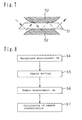
- Japanese Patent Laid-Open No. 9-113439 there is proposed a method of measuring the blood sugar level using a transparent ATR device 51 having a pair of parallel reflecting surfaces opposing each other in which measurement is made with upper and lower lips 52, as a specimen, brought into tight contact with the ATR device 51, as shown in Figure 7.
- the measurement of the blood sugar level is made through the following procedures: inserting an ATR device 51 between upper and lower lips, and getting the same to be hold firmly by the lips; entering light into the ATR device 51 so that the light is allowed to undergo total reflection repeatedly at the interface between each reflection surface of the ATR device 51 and the lips 52, as shown by the broken line in Figure 7; and analyzing the light that oozes out of the ATR device 51.
- the entire disclosure of Japanese Patent Laid-Open No. 9-113439 is incorporated herein by reference in its entirety.
- BME BME, Vol. 5, No. 8 (Japan ME Society, 1991)
- a method which measures the blood sugar level, the concentration of ethanol in blood, etc. using an ATR device made up of ZnSe optical crystal etc.
- measurements are made through the following procedures: bringing the ATR device into tight contact with lip mucosa; entering a laser light with a wavelength of 9 to 11 microns into the ATR device and allowing the light to undergo multiple reflection inside the ATR device; and analyze the absorbed and scattered light.
- concentrations of specific components such as glucose, ethanol and cholesterol can be measured non-invasively and in real time.
- This method is to apply evanescent light (known as ooze-out light) to a quantitative analysis. Only a very small quantity of the light traveling in the ATR device actually enters lips, and the light having entered the lips is affected by components in the body fluid existing in the lips.
- the concentration of the component can be obtained.
- the measurement of background is made by entering light emitted by a light source into the ATR device, carrying out spectrometry of a reference, such as air or deionized water, while keeping the ATR device out of contact with a sample as a subject of measurement, and storing the measured results in a memory (S4).
- a reference such as air or deionized water
- the reasons for the background measurement are to correct the wavelength characteristics of a light source and a photodetector and to ensure an accurate absorbance measurement or concentration calculation even after their characteristics have changed with time.
- the sample as a subject of measurement is set so that it comes in contact with the ATR device (S5) and measurement is made for the sample (S6).
- the present invention has been made in the light of the above described problem. Accordingly, the object of the invention is to provide a concentration measuring apparatus which enables stable and highly accurate concentration measurement while avoiding the step of making background measurement.
- a first invention of the present invention is a concentration measuring apparatus, comprising:
- a second invention of the present invention is the concentration measuring apparatus according to the first invention of the present invention, wherein the calculating means (8) calculates the concentration of the specific component utilizing correspondence information (9) obtained in advance that allows the determined results to have a one-to-one correspondence with the concentrations of the specific component.
- a third invention of the present invention is the concentration measuring apparatus according to the first invention of the present invention, wherein the concentration measuring contact (2) is an attenuated total reflection device and the light entered into the subject of measurement is evanescent light that oozes from the attenuated total reflection device.
- a fourth invention of the present invention is the specific component concentration measuring method according to the first invention of the present invention, wherein the subject of measurement is a living body tissue and the specific component is glucose, ethanol, cholesterol or a derivative of cholesterol.
- a fifth invention of the present invention is the concentration measuring apparatus according to the first invention of the present invention, wherein the calculating means (8) carries out calculation according to the equation, log10 (Is/Ip) or log10 (Ip/Is), where Ip represents the measured value of the quantity of the p-polarized light component and Is represents the measured value of the quantity of the s-polarized light component, and obtains the concentration of the specific component based on the calculated value.
- a sixth invention of the resent invention is the concentration measuring apparatus according to the first invention of the present invention, wherein the calculating means (8) carries out calculation according to the equation, Ip/Is or Is/Ip, where Ip represents the measured value of the quantity of the p-polarized light component and Is represents the measured value of the quantity of the s-polarized light component and obtains the concentration of the specific component based on the calculated value.
- a seventh invention of the present invention is the concentration measuring apparatus according to the first invention of the present invention, wherein the photodetector (6) measures the quantities of the p-polarized light component and the s-polarized light component alternately at least one time or more for each, the calculating means (8) selects, from among the measured values measured by the photo detector, the measured value of Ip, the quantity of the p-polarized light component, and the measured value of Is, the quantity of the s-polarized light component, the values being obtained at the respective measurement time points in immediate proximity to each other, carries out calculation using the selected Ip and Is values, and obtains the concentration of the specific component based on the calculated value.
- the first invention is also a concentration measuring method of measuring a specific component contained in a subject of measurement including:
- the second invention is also a concentration measuring contact apparatus including:
- the third invention is also a concentration measuring calculating apparatus including:
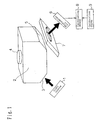
- Figure 1 is a schematic diagram of a concentration measuring contact which is used in a method of measuring the concentration of concentrations of specific components in subjects of measurement in accordance with one embodiment of the invention.
- a light source that emits mid-infrared light is used.
- a SiC light source is used as the light source 1.
- the SiC light source is particularly suitable for making concentration measurements for substances whose absorption wave number is in the fingerprint region (mid-infrared region) of, for example, 1080 cm -1 and 1033 cm -1 .
- a material for a concentration measuring contact 2 is preferably used a material which is capable of transmitting mid-infrared light, chemically stable and excellent in mechanical strength.
- germanium is used as the material for the concentration measuring contact 2.
- a contact portion 4 is brought into contact with a subject of measurement. For example, when measuring the concentration of a glucose solution, the glucose solution is dropped onto the contact portion 4 so that the solution covers the entire surface of the contact portion 4. The glucose solution never overflows the contact portion 4, due to the effect of its surface tension, and a suitable amount of solution required for the concentration measurement is kept on the contact portion 4, which allows stable measurement of the glucose concentration in the solution.
- the living body When the subject of measurement is a living body, the living body is brought into tight contact with the contact portion 4.
- the area of the portion which is in tight contact with the living body is preferably 2 cm 2 or less.
- the contact portion eats deeper into the living body and its contact with the living body becomes much tighter, which allows stable measurements.
- the portion of the living body which is brought into tight contact with the contact portion 4 the portion whose stratum corneum is thin is preferable, specifically proximal nail wall at the base of a finger-nail, lips and oral mucosa are preferable.
- the shape of the contact portion 4 is, but not limited to, approximately circular. The reason is that when the subject of measurement is a living body, the circular shape lessens the pain the subject suffers at the time of measurement. More preferably the periphery of the contact portion 4 is provided with a chamfered portion or a rounded portion, because providing such portions much lessens the pain of the subject.
- an MCT photodetector is used in this embodiment.
- a polarizer 7 functions to take out a specific component of polarized light.
- a wire grid polarizer is used in which a plurality of fine slits are provided. Rotating the polarizer 7 makes it possible to arbitrarily set the component of polarized light that reaches the photodetector 6 to s-polarized light or p-polarized light.
- the position of the polarizer 7 is not limited to the position shown in Figure 1, it has only to be positioned on the optical path between the light source 1 and the photodetector 6.
- the direction shown by the solid line on the polarizer 7 denotes the vibration direction of the s-polarized light component and the direction shown by the broken line the vibration direction of the p-polarized light component.
- the polarizer 7 transmits light in the same vibration direction alone; therefore, measurement of the p-polarized light component, after measurement of the s-polarized light component in which the component of polarized light is set to the direction shown by the solid line, needs to rotate the polarizer 7 at an angle of 90 degrees.
- spectroscopic means (not shown in the figure) between the light source 1 and the concentration measuring contact 2 is preferable, because it allows the measurement of the wavelength-spectral characteristics of the specific component and obtaining the absorption characteristics of the same at different wavelengths.
- the spectroscopy, FT-IR method, which uses an interferometer is particularly preferable as spectroscopic means, because it allows highly sensitive measurement.
- Calculating means 8 calculates the concentration of a glucose solution from the measurements obtained by the photodetector 6 utilizing correspondence information 9.
- a microcomputer or a personal computer made up of a CPU and a memory is used as the calculating means 8.
- the calibration curve 9 is a collection of data obtained through the following procedures: measuring in advance concentrations of glucose solutions, whose concentrations are already known, by the method of measuring the concentration of specific components in analytes in accordance with the embodiment of the present invention; and getting the measured results to have one to one correspondence to the known concentrations of glucose solutions.
- the calibration curve 9 is stored in, for example, the above described microcomputer or personal computer in advance.
- the calibration curve 9 of this embodiment is one example of correspondence information of this invention.
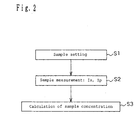
- a glucose solution as a subject of measurement is set on the contact portion of a concentration measuring contact (S1).
- background measurement using air or deionized water which has been required for the conventional concentration measuring method, is not needed.
- spectral characteristics of the glucose solution to polarized light are measured with the glucose solution set on the contact portion (S2).
- the spectral characteristics to polarized light for example, spectral characteristics to s-polarized light and p-polarized light are measured.
- the calculating means 8 calculation is carried out using the measured value of the polarized light components and the concentration of glucose in the glucose solution is calculated based on the obtained value (S3).
- the value, Ip/Is where Is represents the measured value of the s-polarized light component and Ip the measured value of the p-polarized value component, is calculated.
- a glucose solution as a subject of measurement, is dropped on the surface of the contact portion 4 so that the entire contact portion 4 is filled with the solution.
- Light emitted by the light source 1 is entered into the contact portion 4 at an incident angle of ⁇ so that it undergoes total reflection.
- evanescent light is oozed from the contact portion 4, transmitted in the glucose solution, returned to the contact portion 4, passed through a light output portion 5 to its outside, and allowed to reach the photodetector 6 through the polarizer 7.
- the spectral characteristics of the glucose solution to the s-polarized light component is measured while setting the polarizer 7 in such a manner as to allow the light having a plane of vibration in the direction shown by the solid line in the figure, that is, the s-polarized light to pass through the polarizer 7. Then the polarizer 7 is rotated at an angle of 90 degrees and the spectral characteristics of the glucose solution to the p-polarized light component are measured. The measurement is completed at this point.
- the value, Ip/Is is calculated using the measured values Ip, Is at the respective wave numbers and the concentration of glucose is calculated using the above values and the calibration curve 9 obtained in advance.
- the refractive index nc of the glucose solution, as the subject of measurement for the light with a wavelength of about 9.6 microns is 1.24
- germanium, whose refractive index nf is 4 is used for the contact portion
- The. concentration of a specific component can be detected by the difference in absorbance created depending on whether the incident light is the s-polarized light or the p-polarized light.
- the s-polarized light oozes into the subject of measurement only to a shallower portion, whereas the p-polarized light oozes into the subject of measurement to a deeper portion.
- the s-polarized light is hardly affected by the concentration of the specific component contained in the subj ect of measurement.
- the measurement of the quantity of the s-polarized light corresponds to the measurement of background in the prior art and the measurement of the quantity of the p-polarized light corresponds to the measurement for the sample in the prior art.
- the concentration of the specific component can be detected by measuring the quantities of the s-polarized light and the p-polarized light.
- This method is effective when the incident angle of the light entered into the contact portion is 45 degrees or less, but preferably the incident angle is larger than critical angle. If the incident angle is smaller than critical angle, the light does not satisfy the total reflection requirements; as a result, the light is scattered in the subject of measurement, which decreases the quantity of light returned to the contact portion, and in addition, the optical path difference between the p-polarized light and the s-polarized light is decreased.
- z/ ⁇ 0.9 or more, in other words, when using germanium for the contact portion and setting the incident angle to 21 degrees or 20 degrees, particularly satisfactory results were obtained, and when setting the incident angle to 19 degrees, much more satisfactory results were obtained.
- measuring operation is repeated several times while scanning the wavelength and the average measured value is calculated.
- This invention is also effective in such a measuring method. Fore xample, it is preferable to make measurement for each polarized light component several times and then calculate the average measured value.
- the operations of measuring an s-polarized light component and measuring a p-polarized light component may be carried out alternately.
- tungsten is preferably used as the light source 1.
- a quantum cascade laser is more preferably used as the light source 1.
- These light sources are particularly suitable for measuring the concentrations of substances, such as glucose, whose absorption wave numbers are in the fingerprint region (mid-infrared region) of about 1080 cm -1 to 1033 cm -1 , like the case where a SiC light source is used.
- a silicon single crystal substrate which is transparent to light with a wavelength of 1.1 to 10 microns.
- Silicon having small content of impurities , such as boron and phosphorus, and having resistivity of 100 ⁇ cm or more is particularly preferable.
- Silicon having resistivity of 1500 ⁇ cm or more is much more preferable.
- the silicon having such high resistivity has high transmissivity at infrared wavelength of about 9 to 10 microns, and it is preferably used when measuring the concentration of substances, such as glucose, whose absorption region is in this wavelength band.
- an antireflection film is provided on the surface of the light input portion 3.
- a material for the antireflection film diamond-like carbon (DLC) or ZnSe is used.
- the thickness of the antireflection film is preferably 1.1 to 1.3 microns, more preferably about 1.2 microns.
- an antireflection film is provided on the surface of the light output portion 5, like the light input portion 3.
- the calibration curve 9 may be a table in which the measured results are allowed to have one to one correspondence to the known concentrations of glucose solutions or a mathematical equation by which the measured results are allowed to have one to one correspondence to the known concentrations of glucose solutions.
- this embodiment has been described taking a case where a wire grid polarizer is used as the polarizer 7, but the polarizer is not limited to this.
- an interference filter type of polarizer can also be used which transmits a p-polarized light component and reflects an s-polarized light component.
- FIG. 6 is a schematic diagram of a concentration measuring contact which uses a polarizer 7a, as an interference filter type of polarizer, instead of the polarizer 7 and is used in a concentration measuring method of measuring a specific component in a subject of measurement.
- a polarizer 7a as an interference filter type of polarizer, instead of the polarizer 7 and is used in a concentration measuring method of measuring a specific component in a subject of measurement.
- Figure 6 the same parts as those of Figure 1 are denoted by the same reference numerals and detailed description thereof will be omitted.
- the polarizer 7a functions to take out specific polarized light components just like the polarizer 7 of Figure 1.
- the difference between the polarizer 7a and the polarizer 7 is in that the polarizer 7a reflects an s-polarized light component and transmits a p-polarized light component, as described above.
- a photodetector 6a of detecting the quantity of a p-polarized light component, that is, light transmitted in the polarizer 7a and a photodetector 6b of detecting the quantity of an s-polarized light component light, that is, light reflected by the polarizer 7a are arranged.
- a photodetector 6a, 6b pyroelectric sensors are used.
- MCT photodetectors may also be used.
- this embodiment has been described taking the case where a glucose solution is used as a subject of measurement, the subject of measurement is not limited to this.
- the concentration measuring contact in accordance with this embodiment is useful for measuring the concentration of glucose not only in a glucose solution, as a subject of measurement, but also in blood plasma and in a living body.
- the specific component in a subject of measurement is a component other than glucose, such as cholesterol, ethanol or the derivative of cholesterol, this embodiment can be effectively applied.
- the specific component in a subject of measurement is changed, the wavelength of light to be measured is also changed.
- the specific component of a subject of measurement is cholesterol or the derivative of cholesterol
- a light source that emits light with such a wavelength should be used as a light source 1 or a photodetector that detects light with such a wavelength
- the specific component of a subject of measurement is ethanol
- the absorption wave number of ethanol is 1240 cm -1 or 1400 cm -1
- a light source that emits light with such a wave number should be used as a light source or a photodetector that detects light with such a wave number should be used.
- the concentration of the specific component in the subject of measurement can be measured, like the above described components.
- a concentration measuring method of measuring specific component in a subject of measurement which enables stable and highly accurate concentration measurement while avoiding the step of carrying out background measurement.
- the concentration measuring method of measuring a specific component of this invention is useful for measuring the concentration of glucose not only in a glucose solution, but also in blood plasma, in a living body, etc.
- FIG. 3 illustrates characteristic curves showing incident light wave number dependency of the values, Ip/Is, which were obtained by making measurement for glucose solutions with different concentrations. In the measurement, glucose solutions with different concentrations, 50, 100 and 200 mg/dl, were used. And baseline correction was made so that the values, Ip/Is, become zero at wave numbers of 1135 cm -1 and 1000 cm -1 .
- Figure 4 shows the relationbetween the values, Ip/Is, and the glucose concentration at a wavelength of 1033 cm -1 . It is seen from the figure that there is straight line relationship and satisfactory correlation between the values, Ip/Is, and the glucose concentration. Thus, even when background measurement, which is a step included in the conventional concentration measuring method, was not carried out, the glucose concentration could be calculated easily only by obtaining the value, Ip/Is, using the measured values Ip and Is. And the relation between the values, Ip/Is, and the glucose concentration shown in Figure 4 can be used as a calibration curve 9, which should obtained in advance.
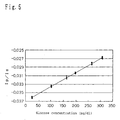
- Figure 5 shows the relation between the values, Ip/Is, and the glucose concentration which are obtained using a light source whose quantity of light is decreased by 10% compared with that of the light source with which the relation between the value, Ip/Is, and the glucose concentration shown in Figure 4 is obtained. Comparing Figure 4 with Figure 5, it is seen that the Ip/Is - glucose concentration relations of both cases are substantially the same straight line. Thus, it is apparent that obtaining the value, Ip/Is, like in this embodiment, makes it possible to obtain glucose concentration with a high accuracy, even when the quantity of light from the light source is decreased due to its change with time
- a concentration measuring apparatus can be provided which enables stable and highly accurate concentration measurement while avoiding the step of carrying out background measurement.
Landscapes
- Physics & Mathematics (AREA)
- Health & Medical Sciences (AREA)
- Life Sciences & Earth Sciences (AREA)
- Pathology (AREA)
- General Health & Medical Sciences (AREA)
- Analytical Chemistry (AREA)
- Chemical & Material Sciences (AREA)
- Immunology (AREA)
- General Physics & Mathematics (AREA)
- Biochemistry (AREA)
- Optics & Photonics (AREA)
- Medical Informatics (AREA)
- Surgery (AREA)
- Animal Behavior & Ethology (AREA)
- Biophysics (AREA)
- Public Health (AREA)
- Veterinary Medicine (AREA)
- Molecular Biology (AREA)
- Spectroscopy & Molecular Physics (AREA)
- Heart & Thoracic Surgery (AREA)
- Biomedical Technology (AREA)
- Engineering & Computer Science (AREA)
- Investigating Or Analysing Materials By Optical Means (AREA)
- Measurement Of The Respiration, Hearing Ability, Form, And Blood Characteristics Of Living Organisms (AREA)
Abstract
Description
the calculating means (8) selects, from among the measured values measured by the photo detector, the measured value of Ip, the quantity of the p-polarized light component, and the measured value of Is, the quantity of the s-polarized light component, the values being obtained at the respective measurement time points in immediate proximity to each other, carries out calculation using the selected Ip and Is values, and obtains the concentration of the specific component based on the calculated value.
- 1
- Light Source
- 2
- Concentration Measuring Contact
- 3
- Light Input Portion
- 4
- Contact Portion
- 5
- Light Output Portion
- 6
- Photodetector
- 7
- Polarizer
- 51
- ATR device
- 52
- Lips
Claims (7)
- A concentration measuring apparatus, comprising:a concentration measuring contact that is brought into contact with a subject of measurement;a light source that emits light and enters the light into the concentration measuring contact;a polarizer that takes out p-polarized and s-polarized light components from the light which is passed through the concentration measuring contact into the subject of measurement, transmitted in the subject of measurement, and returned to the concentration measuring contact;a photodetector that determines at least the quantities of the p-polarized and s-polarized light components taken out by the photodetector; andcalculating means that calculates the concentration of a specific component contained in the subject of measurement based on the determined results.
- The concentration measuring apparatus according to claim 1, wherein the calculating means calculates the concentration of the specific component utilizing correspondence information obtained in advance that allows the determined results to have a one-to-one correspondence with the concentrations of the specific component.
- The concentration measuring apparatus according to claim 1, wherein the concentration measuring contact is an attenuated total reflection device and the light entered into the subject of measurement is evanescent light that oozes from the attenuated total reflection device.
- The specific component concentration measuring apparatus according to claim 1, wherein the subject of measurement is a living body tissue and the specific component is glucose, ethanol, cholesterol or a derivative of cholesterol.
- The concentration measuring apparatus according to claim 1, wherein the calculating means carries out calculation according to the equation, log10 (Is/Ip) or log10 (Ip/Is), where Ip represents the measured value of the quantity of the p-polarized light component and Is represents the measured value of the quantity of the s-polarized light component, and obtains the concentration of the specific component based on the calculated value.
- The concentration measuring apparatus according to claim 1, wherein the calculating means carries out calculation according to the equation, Ip/Is or Is/Ip, where Ip represents the measured value of the quantity of the p-polarized light component and Is represents the measured value of the quantity of the s-polarized light component and obtains the concentration of the specific component based on the calculated value.
- The concentration measuring apparatus according to claim 1, wherein the photodetector measures the quantities of the p-polarized light component and the s-polarized light component alternately at least one time or more for each,
the calculating means selects, from among the measured values measured by the photo detector, the measured value of Ip, the quantity of the p-polarized light component, and the measured value of Is, the quantity of the s-polarized light component, the values being obtained at the respective measurement time points in immediate proximity to each other, carries out calculation using the selected Ip and Is values, and obtains the concentration of the specific component based on the calculated value.
Applications Claiming Priority (3)
| Application Number | Priority Date | Filing Date | Title |
|---|---|---|---|
| JP2002059915 | 2002-03-06 | ||
| JP2002059915 | 2002-03-06 | ||
| PCT/JP2003/002534 WO2003074993A1 (en) | 2002-03-06 | 2003-03-05 | Concentration measurement device |
Publications (2)
| Publication Number | Publication Date |
|---|---|
| EP1482300A1 true EP1482300A1 (en) | 2004-12-01 |
| EP1482300A4 EP1482300A4 (en) | 2007-04-25 |
Family
ID=27784771
Family Applications (1)
| Application Number | Title | Priority Date | Filing Date |
|---|---|---|---|
| EP03710237A Withdrawn EP1482300A4 (en) | 2002-03-06 | 2003-03-05 | CONCENTRATION MEASURING DEVICE |
Country Status (5)
| Country | Link |
|---|---|
| US (1) | US7110112B2 (en) |
| EP (1) | EP1482300A4 (en) |
| JP (1) | JPWO2003074993A1 (en) |
| CN (1) | CN1243965C (en) |
| WO (1) | WO2003074993A1 (en) |
Families Citing this family (69)
| Publication number | Priority date | Publication date | Assignee | Title |
|---|---|---|---|---|
| US6036924A (en) | 1997-12-04 | 2000-03-14 | Hewlett-Packard Company | Cassette of lancet cartridges for sampling blood |
| US6391005B1 (en) | 1998-03-30 | 2002-05-21 | Agilent Technologies, Inc. | Apparatus and method for penetration with shaft having a sensor for sensing penetration depth |
| US8641644B2 (en) | 2000-11-21 | 2014-02-04 | Sanofi-Aventis Deutschland Gmbh | Blood testing apparatus having a rotatable cartridge with multiple lancing elements and testing means |
| DE10057832C1 (en) | 2000-11-21 | 2002-02-21 | Hartmann Paul Ag | Blood analysis device has syringe mounted in casing, annular mounting carrying needles mounted behind test strip and being swiveled so that needle can be pushed through strip and aperture in casing to take blood sample |
| US7981056B2 (en) | 2002-04-19 | 2011-07-19 | Pelikan Technologies, Inc. | Methods and apparatus for lancet actuation |
| ATE485766T1 (en) | 2001-06-12 | 2010-11-15 | Pelikan Technologies Inc | ELECTRICAL ACTUATING ELEMENT FOR A LANCET |
| AU2002312521A1 (en) | 2001-06-12 | 2002-12-23 | Pelikan Technologies, Inc. | Blood sampling apparatus and method |
| ATE497731T1 (en) | 2001-06-12 | 2011-02-15 | Pelikan Technologies Inc | DEVICE FOR INCREASING THE SUCCESS RATE OF BLOOD YIELD OBTAINED BY A FINGER PICK |
| US9226699B2 (en) | 2002-04-19 | 2016-01-05 | Sanofi-Aventis Deutschland Gmbh | Body fluid sampling module with a continuous compression tissue interface surface |
| US7041068B2 (en) | 2001-06-12 | 2006-05-09 | Pelikan Technologies, Inc. | Sampling module device and method |
| ES2336081T3 (en) | 2001-06-12 | 2010-04-08 | Pelikan Technologies Inc. | SELF-OPTIMIZATION PUNCTURE DEVICE WITH MEANS OF ADAPTATION TO TEMPORARY VARIATIONS IN CUTANEOUS PROPERTIES. |
| US9795747B2 (en) | 2010-06-02 | 2017-10-24 | Sanofi-Aventis Deutschland Gmbh | Methods and apparatus for lancet actuation |
| US8337419B2 (en) | 2002-04-19 | 2012-12-25 | Sanofi-Aventis Deutschland Gmbh | Tissue penetration device |
| AU2002348683A1 (en) | 2001-06-12 | 2002-12-23 | Pelikan Technologies, Inc. | Method and apparatus for lancet launching device integrated onto a blood-sampling cartridge |
| CA2448681C (en) | 2001-06-12 | 2014-09-09 | Pelikan Technologies, Inc. | Integrated blood sampling analysis system with multi-use sampling module |
| US9427532B2 (en) | 2001-06-12 | 2016-08-30 | Sanofi-Aventis Deutschland Gmbh | Tissue penetration device |
| US7344894B2 (en) | 2001-10-16 | 2008-03-18 | Agilent Technologies, Inc. | Thermal regulation of fluidic samples within a diagnostic cartridge |
| WO2003083458A2 (en) * | 2002-04-03 | 2003-10-09 | Johann Wolfgang Goethe-Universität Frankfurt am Main | Infrared measuring device, especially for the spectrometry of aqueous systems, preferably multiple component systems |
| US9248267B2 (en) | 2002-04-19 | 2016-02-02 | Sanofi-Aventis Deustchland Gmbh | Tissue penetration device |
| US7901362B2 (en) | 2002-04-19 | 2011-03-08 | Pelikan Technologies, Inc. | Method and apparatus for penetrating tissue |
| US7229458B2 (en) | 2002-04-19 | 2007-06-12 | Pelikan Technologies, Inc. | Method and apparatus for penetrating tissue |
| US8221334B2 (en) | 2002-04-19 | 2012-07-17 | Sanofi-Aventis Deutschland Gmbh | Method and apparatus for penetrating tissue |
| US7141058B2 (en) | 2002-04-19 | 2006-11-28 | Pelikan Technologies, Inc. | Method and apparatus for a body fluid sampling device using illumination |
| US7226461B2 (en) | 2002-04-19 | 2007-06-05 | Pelikan Technologies, Inc. | Method and apparatus for a multi-use body fluid sampling device with sterility barrier release |
| US7909778B2 (en) | 2002-04-19 | 2011-03-22 | Pelikan Technologies, Inc. | Method and apparatus for penetrating tissue |
| US7291117B2 (en) | 2002-04-19 | 2007-11-06 | Pelikan Technologies, Inc. | Method and apparatus for penetrating tissue |
| US7410468B2 (en) | 2002-04-19 | 2008-08-12 | Pelikan Technologies, Inc. | Method and apparatus for penetrating tissue |
| US9314194B2 (en) | 2002-04-19 | 2016-04-19 | Sanofi-Aventis Deutschland Gmbh | Tissue penetration device |
| US8784335B2 (en) | 2002-04-19 | 2014-07-22 | Sanofi-Aventis Deutschland Gmbh | Body fluid sampling device with a capacitive sensor |
| US7374544B2 (en) | 2002-04-19 | 2008-05-20 | Pelikan Technologies, Inc. | Method and apparatus for penetrating tissue |
| US7892183B2 (en) | 2002-04-19 | 2011-02-22 | Pelikan Technologies, Inc. | Method and apparatus for body fluid sampling and analyte sensing |
| US7976476B2 (en) | 2002-04-19 | 2011-07-12 | Pelikan Technologies, Inc. | Device and method for variable speed lancet |
| US7331931B2 (en) | 2002-04-19 | 2008-02-19 | Pelikan Technologies, Inc. | Method and apparatus for penetrating tissue |
| US7717863B2 (en) | 2002-04-19 | 2010-05-18 | Pelikan Technologies, Inc. | Method and apparatus for penetrating tissue |
| US7563232B2 (en) | 2002-04-19 | 2009-07-21 | Pelikan Technologies, Inc. | Method and apparatus for penetrating tissue |
| US9795334B2 (en) | 2002-04-19 | 2017-10-24 | Sanofi-Aventis Deutschland Gmbh | Method and apparatus for penetrating tissue |
| US7582099B2 (en) | 2002-04-19 | 2009-09-01 | Pelikan Technologies, Inc | Method and apparatus for penetrating tissue |
| US7297122B2 (en) | 2002-04-19 | 2007-11-20 | Pelikan Technologies, Inc. | Method and apparatus for penetrating tissue |
| US7371247B2 (en) | 2002-04-19 | 2008-05-13 | Pelikan Technologies, Inc | Method and apparatus for penetrating tissue |
| US8267870B2 (en) | 2002-04-19 | 2012-09-18 | Sanofi-Aventis Deutschland Gmbh | Method and apparatus for body fluid sampling with hybrid actuation |
| US7175642B2 (en) | 2002-04-19 | 2007-02-13 | Pelikan Technologies, Inc. | Methods and apparatus for lancet actuation |
| US7481776B2 (en) | 2002-04-19 | 2009-01-27 | Pelikan Technologies, Inc. | Method and apparatus for penetrating tissue |
| US7524293B2 (en) | 2002-04-19 | 2009-04-28 | Pelikan Technologies, Inc. | Method and apparatus for penetrating tissue |
| US7674232B2 (en) | 2002-04-19 | 2010-03-09 | Pelikan Technologies, Inc. | Method and apparatus for penetrating tissue |
| US7232451B2 (en) | 2002-04-19 | 2007-06-19 | Pelikan Technologies, Inc. | Method and apparatus for penetrating tissue |
| US7547287B2 (en) | 2002-04-19 | 2009-06-16 | Pelikan Technologies, Inc. | Method and apparatus for penetrating tissue |
| US8579831B2 (en) | 2002-04-19 | 2013-11-12 | Sanofi-Aventis Deutschland Gmbh | Method and apparatus for penetrating tissue |
| US7648468B2 (en) | 2002-04-19 | 2010-01-19 | Pelikon Technologies, Inc. | Method and apparatus for penetrating tissue |
| US8702624B2 (en) | 2006-09-29 | 2014-04-22 | Sanofi-Aventis Deutschland Gmbh | Analyte measurement device with a single shot actuator |
| US7491178B2 (en) | 2002-04-19 | 2009-02-17 | Pelikan Technologies, Inc. | Method and apparatus for penetrating tissue |
| US8574895B2 (en) | 2002-12-30 | 2013-11-05 | Sanofi-Aventis Deutschland Gmbh | Method and apparatus using optical techniques to measure analyte levels |
| EP1633235B1 (en) | 2003-06-06 | 2014-05-21 | Sanofi-Aventis Deutschland GmbH | Apparatus for body fluid sampling and analyte sensing |
| WO2006001797A1 (en) | 2004-06-14 | 2006-01-05 | Pelikan Technologies, Inc. | Low pain penetrating |
| US7604592B2 (en) | 2003-06-13 | 2009-10-20 | Pelikan Technologies, Inc. | Method and apparatus for a point of care device |
| EP1671096A4 (en) | 2003-09-29 | 2009-09-16 | Pelikan Technologies Inc | METHOD AND APPARATUS FOR AN IMPROVED SAMPLING INTERFERENCE DEVICE |
| US9351680B2 (en) | 2003-10-14 | 2016-05-31 | Sanofi-Aventis Deutschland Gmbh | Method and apparatus for a variable user interface |
| EP1706026B1 (en) | 2003-12-31 | 2017-03-01 | Sanofi-Aventis Deutschland GmbH | Method and apparatus for improving fluidic flow and sample capture |
| US7822454B1 (en) | 2005-01-03 | 2010-10-26 | Pelikan Technologies, Inc. | Fluid sampling device with improved analyte detecting member configuration |
| WO2006011062A2 (en) | 2004-05-20 | 2006-02-02 | Albatros Technologies Gmbh & Co. Kg | Printable hydrogel for biosensors |
| WO2005120365A1 (en) | 2004-06-03 | 2005-12-22 | Pelikan Technologies, Inc. | Method and apparatus for a fluid sampling device |
| EP1754443A4 (en) * | 2004-06-10 | 2008-10-22 | Matsushita Electric Industrial Co Ltd | LIVING ORGANISM INFORMATION MEASURING INSTRUMENT, STANDARD ELEMENT, AND METHOD FOR USING LIVING ORGANISM INFORMATION MEASURING INSTRUMENT |
| US7236814B2 (en) * | 2004-08-20 | 2007-06-26 | Matsushita Electric Industrial Co., Ltd. | Optical member for biological information measurement, biological information calculation apparatus, biological information calculation method, computer-executable program, and recording medium |
| US8652831B2 (en) | 2004-12-30 | 2014-02-18 | Sanofi-Aventis Deutschland Gmbh | Method and apparatus for analyte measurement test time |
| JP4546861B2 (en) * | 2005-03-23 | 2010-09-22 | 住友ゴム工業株式会社 | Contact interface area evaluation method and contact interface area evaluation apparatus |
| WO2009126900A1 (en) | 2008-04-11 | 2009-10-15 | Pelikan Technologies, Inc. | Method and apparatus for analyte detecting device |
| US9375169B2 (en) | 2009-01-30 | 2016-06-28 | Sanofi-Aventis Deutschland Gmbh | Cam drive for managing disposable penetrating member actions with a single motor and motor and control system |
| US8965476B2 (en) | 2010-04-16 | 2015-02-24 | Sanofi-Aventis Deutschland Gmbh | Tissue penetration device |
| JP5820396B2 (en) * | 2010-12-28 | 2015-11-24 | テルモ株式会社 | Blood glucose measuring device |
| PL236747B1 (en) * | 2012-05-29 | 2021-02-08 | Airoptic Spolka Z Ograniczona Odpowiedzialnoscia | Method and apparatus for remote detection of the alcohol vapor in the atmosphere |
Family Cites Families (13)
| Publication number | Priority date | Publication date | Assignee | Title |
|---|---|---|---|---|
| US4704029A (en) * | 1985-12-26 | 1987-11-03 | Research Corporation | Blood glucose monitor |
| CN1007014B (en) | 1987-04-18 | 1990-02-28 | 湖南省技术物理研究所 | Specific light intensity determination method with optical rotation and high-speed sugar-inspection apparatus |
| DE4128458C2 (en) * | 1991-08-28 | 1994-02-10 | Siemens Ag | Method and device for determining the concentration of a component, in particular glucose, a liquid optically active substance, in particular the body fluid of a patient, by polarimetry |
| JPH0933427A (en) * | 1994-12-16 | 1997-02-07 | Toto Ltd | Biosensor and concentration measuring device therewith |
| JPH09113439A (en) * | 1995-10-20 | 1997-05-02 | Kdk Corp | Method and apparatus for measuring organic component |
| EP0805347A3 (en) | 1996-04-30 | 1998-08-05 | Fuji Photo Film Co., Ltd. | Surface plasmon sensor |
| JP3578187B2 (en) | 1996-06-04 | 2004-10-20 | 富士写真フイルム株式会社 | Evanescent ellipso sensor |
| JPH1038694A (en) | 1996-07-23 | 1998-02-13 | Nikon Corp | Ellipsometer |
| US5926284A (en) * | 1997-04-30 | 1999-07-20 | Fuji Photo Film Co., Ltd. | Surface plasmon sensor |
| JPH11101739A (en) | 1997-09-26 | 1999-04-13 | Mitsubishi Heavy Ind Ltd | Ellipsometry apparatus |
| DE10030920C2 (en) * | 2000-06-24 | 2003-01-02 | Glukomeditech Ag | Measuring device for the simultaneous refractometric and ATR spectrometric measurement of the concentration of liquid media and use of this device see |
| DE10030927C1 (en) * | 2000-06-24 | 2002-05-23 | Glukomeditech Ag | Refractometric method for long-term stable precise measurement of the concentrations of dissolved substances as well as a miniaturizable device for its implementation |
| JPWO2003021239A1 (en) * | 2001-08-28 | 2004-12-16 | 松下電器産業株式会社 | Information measuring device for specific components |
-
2003
- 2003-03-05 US US10/479,758 patent/US7110112B2/en not_active Expired - Fee Related
- 2003-03-05 WO PCT/JP2003/002534 patent/WO2003074993A1/en not_active Ceased
- 2003-03-05 CN CNB038007002A patent/CN1243965C/en not_active Expired - Fee Related
- 2003-03-05 EP EP03710237A patent/EP1482300A4/en not_active Withdrawn
- 2003-03-05 JP JP2003573404A patent/JPWO2003074993A1/en not_active Withdrawn
Also Published As
| Publication number | Publication date |
|---|---|
| WO2003074993A1 (en) | 2003-09-12 |
| JPWO2003074993A1 (en) | 2005-06-30 |
| CN1533502A (en) | 2004-09-29 |
| US7110112B2 (en) | 2006-09-19 |
| CN1243965C (en) | 2006-03-01 |
| EP1482300A4 (en) | 2007-04-25 |
| US20040233433A1 (en) | 2004-11-25 |
Similar Documents
| Publication | Publication Date | Title |
|---|---|---|
| US7110112B2 (en) | Concentration measuring instrument, concentration measuring contact apparatus, concentration measuring calculating apparatus, and concentration measuring method | |
| US7167735B2 (en) | Concentration measuring instrument, and method of measuring the concentration of a specific component in a subject of measurement | |
| US7215982B2 (en) | Method and device for measuring concentration of specific component | |
| EP1627596B1 (en) | Optical member for biological information measurement, biological information calculation apparatus, biological information calculation method, program, and recording medium | |
| JP3686422B2 (en) | Measurement of tissue analyte by infrared rays | |
| JP4936203B2 (en) | Glucose concentration determination device | |
| JP4472794B2 (en) | Glucose concentration determination device | |
| JP2011519635A (en) | Optical microneedle spectrometer | |
| CN101969838B (en) | Device and method for the non-invasive measurement of the concentration of a substance in the blood of a subject | |
| US7391516B2 (en) | Optical element for measuring information of living body and device for measuring information of living body using the optical element | |
| EP1422512A1 (en) | Apparatus for measuring information on particular component | |
| CN101969837A (en) | Apparatus and method using light retro-reflected from a retina to non-invasively measure the blood concentration of a substance | |
| US7262836B2 (en) | Apparatus for measuring biological information and method for measuring biological information | |
| JP2003240709A (en) | Method for measuring concentration of specific component and contact for concentration measurement used therefor | |
| US20080062400A1 (en) | Optical Element for Measuring Bioinformation and Bioinformation Measuring Device Using the Same |
Legal Events
| Date | Code | Title | Description |
|---|---|---|---|
| PUAI | Public reference made under article 153(3) epc to a published international application that has entered the european phase |
Free format text: ORIGINAL CODE: 0009012 |
|
| 17P | Request for examination filed |
Effective date: 20040602 |
|
| AK | Designated contracting states |
Kind code of ref document: A1 Designated state(s): AT BE BG CH CY CZ DE DK EE ES FI FR GB GR HU IE IT LI LU MC NL PT RO SE SI SK TR |
|
| A4 | Supplementary search report drawn up and despatched |
Effective date: 20070323 |
|
| RIC1 | Information provided on ipc code assigned before grant |
Ipc: A61B 5/00 20060101ALI20070319BHEP Ipc: G01N 21/21 20060101AFI20070319BHEP Ipc: G01N 21/55 20060101ALI20070319BHEP |
|
| STAA | Information on the status of an ep patent application or granted ep patent |
Free format text: STATUS: THE APPLICATION HAS BEEN WITHDRAWN |
|
| 18W | Application withdrawn |
Effective date: 20070803 |