EP1482134A2 - Oil pan structure for an engine - Google Patents
Oil pan structure for an engine Download PDFInfo
- Publication number
- EP1482134A2 EP1482134A2 EP04253169A EP04253169A EP1482134A2 EP 1482134 A2 EP1482134 A2 EP 1482134A2 EP 04253169 A EP04253169 A EP 04253169A EP 04253169 A EP04253169 A EP 04253169A EP 1482134 A2 EP1482134 A2 EP 1482134A2
- Authority
- EP
- European Patent Office
- Prior art keywords
- bosses
- connecting piece
- vertical wall
- oil pan
- outwardly extending
- Prior art date
- Legal status (The legal status is an assumption and is not a legal conclusion. Google has not performed a legal analysis and makes no representation as to the accuracy of the status listed.)
- Granted
Links
Images




Classifications
-
- F—MECHANICAL ENGINEERING; LIGHTING; HEATING; WEAPONS; BLASTING
- F01—MACHINES OR ENGINES IN GENERAL; ENGINE PLANTS IN GENERAL; STEAM ENGINES
- F01M—LUBRICATING OF MACHINES OR ENGINES IN GENERAL; LUBRICATING INTERNAL COMBUSTION ENGINES; CRANKCASE VENTILATING
- F01M11/00—Component parts, details or accessories, not provided for in, or of interest apart from, groups F01M1/00 - F01M9/00
- F01M11/0004—Oilsumps
-
- F—MECHANICAL ENGINEERING; LIGHTING; HEATING; WEAPONS; BLASTING
- F02—COMBUSTION ENGINES; HOT-GAS OR COMBUSTION-PRODUCT ENGINE PLANTS
- F02F—CYLINDERS, PISTONS OR CASINGS, FOR COMBUSTION ENGINES; ARRANGEMENTS OF SEALINGS IN COMBUSTION ENGINES
- F02F7/00—Casings, e.g. crankcases
- F02F7/0065—Shape of casings for other machine parts and purposes, e.g. utilisation purposes, safety
- F02F7/0073—Adaptations for fitting the engine, e.g. front-plates or bell-housings
-
- F—MECHANICAL ENGINEERING; LIGHTING; HEATING; WEAPONS; BLASTING
- F01—MACHINES OR ENGINES IN GENERAL; ENGINE PLANTS IN GENERAL; STEAM ENGINES
- F01M—LUBRICATING OF MACHINES OR ENGINES IN GENERAL; LUBRICATING INTERNAL COMBUSTION ENGINES; CRANKCASE VENTILATING
- F01M11/00—Component parts, details or accessories, not provided for in, or of interest apart from, groups F01M1/00 - F01M9/00
- F01M11/0004—Oilsumps
- F01M2011/002—Oilsumps with means for improving the stiffness
Definitions
- This invention relates to an oil pan structure in an engine.
- bosses are formed integral with a vertical wall in an oil pan made by casting and an engine component is supported on the bosses.
- the conventional oil pan structure in an engine described above includes a system shown in JP-A-H06-108919.
- the oil pan comprises a bottom plate, a vertical wall integrally protruding upwardly from the outer edge of the bottom plate, an outwardly extending flange formed integral with the vertical wall at the protruding end and fixed to the lower end of the crankcase, a pair of bosses located below the outwardly extending flange and integrally projecting laterally outwardly from the outside surface of the vertical wall for supporting an engine component, and a connecting piece disposed between these two bosses and formed integral with the vertical wall in the vertical middle portion thereof for integrally connecting the two bosses; and the bottom plate, vertical wall, outwardly extending flange, bosses and connecting piece are formed by casting. Oil retained in the oil pan is supplied to engine portions, for lubrication.
- the two bosses are reinforced by the connecting piece, thereby improving supporting strength of the two bosses to support the engine component.
- a connecting piece is formed integral with the vertical wall, together with a pair of bosses, so that the overall volume of these bosses and connecting piece is fairly large compared with the middle portion of the vertical wall to be integrated with these parts. Therefore, shrinkage cavities are apt to be produced during casting of the oil pan on the inside surface of the middle portion of the vertical wall to be integrated with the bosses and the connecting piece. This is unfavorable to the strength of the vertical wall.
- an object of examples of this invention is to prevent shrinkage cavities from being produced when a pair of bosses are provided on the outside surface of a vertical wall of an oil pan made by casting and these bosses are reinforced.
- Another object of examples of this invention is to facilitate machining work when the projecting ends of the bosses are machined flat.
- an oil pan structure in an engine of aspects of this invention is as follows. Symbols attached to the technical terms in this section should not be construed as limiting the technical scope of this invention to the contents of the described embodiment of the invention to be described later, or limiting in any other way.
- an oil pan structure in an engine comprising a bottom plate 26, a vertical wall 27 integrally protruding upwardly from outer edges of the bottom plate 26, an outwardly extending flange 28 formed integral with the vertical wall 27 at the protruding end and fixed to the lower end of a crankcase 2, a pair of bosses 21, 21 located below the outwardly extending flange 28 and integrally projecting laterally outwardly from the outside surface of the vertical wall 27 for supporting a component 14 of an engine 1, and a connecting piece 29 disposed between these two bosses 21, 21 for connecting the two bosses 21, 21 integrally, and said bottom plate 26, vertical wall 27, outwardly extending flange 28, bosses 21, 21 and connecting piece 29 being formed by casting, wherein;
- the inner edge 29a of said connecting piece 29 on the side of said vertical wall 27 is formed integral with said outwardly extending flange 28.
- said inner edge 29a of said connecting piece 29 is thinner than the outer edge 29b of said connecting piece 29 in the projecting direction of said bosses 21, 21.
- a broad aspect of the invention provides an oil pan structure for an engine comprising a bottom plate, a wall protruding upwardly from the bottom plate, an outwardly extending flange extending from the wall, a pair of bosses located below the flange and projecting from the wall for supporting an engine component, and a connecting piece arranged between the two bosses wherein an edge of the connecting piece is formed integrally with the flange.
- the connecting piece is not in contact with the wall.
- a further aspect provides an oil pan structure for an engine comprising a wall and a support member extending from the wall for supporting an engine component, the member being arranged such that, when the wall and support member are formed by casting, casting deformities in the wall are substantially avoided.
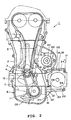
- reference numeral 1 designates a multiple-cylinder (four-cylinder), four-stroke engine (internal combustion engine) mounted on a vehicle such as an automobile.
- the engine 1 comprises a crankcase 2 supported on a body of the vehicle, and a crankshaft 4 supported on the crankcase 2 for rotation about an axial center 3 extending approximately in the horizontal direction, a cylinder 5 supported on the crankcase 2 at its upper end, and an oil pan 8 supported on the crankcase 2 at its lower end with a fastening member 6, for retaining oil 7 inside.
- an oil pump 11 Inside the oil pan 8 is disposed an oil pump 11, and the oil pump 11 is supported on the crankcase 2 at the under surface and connected drivably to the crankshaft 4 by chain-wound type power transmission means 12. Also, a component 14 of an engine 1, or an auxiliary machine 15, specifically an air compressor for air conditioning, is supported by a support device 16, extending between side surfaces of the crankcase 2 and the oil pan 8. The auxiliary machine 15 is connected drivably to the crankshaft 4 by timing belt-wound type power transmission means 17.
- the oil pump 11 When the engine 1 is operated, the oil pump 11 is operated in association with the crankshaft 4, and oil 7 in the oil pan 8 is supplied to portions to be lubricated in the engine 1, for given lubrication. Also, the auxiliary machine 15 is operated in association with the crankshaft 4, for given air conditioning.
- the support device 16 comprises a boss 20 provided integrally on the outside surface of the crankcase 2, a pair of bosses 21, 21 provided integrally on the outside surface of the oil pan 8, screw holes 23 formed in the bosses 20, 21 and having their axial centers 22 approximately perpendicular to the outside surface of the oil pan 8, and bolts 24 to be screwed in the screw holes 23; and the bosses 21, 21 are disposed in line in the axial direction of the crankshaft 4.
- the auxiliary machine 15 is supported on the bosses 20, 21 with bolts 24 screwed in the screw holes 23.
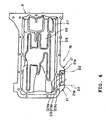
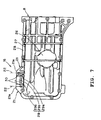
- the oil pan 8 comprises a bottom plate 26, a vertical wall 27 integrally protruding upwardly from the outer edges of the bottom plate 26 and having a rectangular frame shape viewed in plan, and an outwardly extending flange 28 formed integral with the vertical wall 27 at the protruding end to be fixed to the lower end of the crankcase 2 with the fastening members 6.
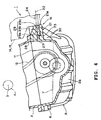
- the oil pan 8 comprises a pair of bosses 21, 21 integrally projecting laterally outwardly from the vertical middle portion of the outside surface of the vertical wall 27 such that the axial centers 22 are approximately perpendicular to the outside surface of the vertical wall 27 and located below the outwardly extending flange 28, a connecting piece 29 disposed between the bosses 21, 21, as viewed in profile of the oil pan 8 (Fig. 1), and extending on a line connecting the axial centers 22, 22 for integrally connecting the bosses 21, 21, and a pair of ribs 30, 30 provided integrally between the bosses 21, 21 and portions of the vertical wall 27 below the bosses 21, 21 for reinforcing the bosses 21, 21.
- the bottom plate 26, vertical wall 27, outwardly extending flange 28, bosses 21, 21, connecting piece 29 and ribs 30, 30 of the oil pan 8 are formed integral with each other by casting with aluminum material.
- each boss 21 is formed integral with the outwardly extending flange 28, so that the boss 21 is reinforced by the outwardly extending flange 28.
- the oil pan 8 When the oil pan 8 is viewed in profile (Fig. 1), the upper surface and the lower surface of one boss 21 are each inclined such that it heads upwardly as they are apart from the other boss 21, and the inclination is approximately 40-50°.
- the oil pan 8 When the oil pan 8 is viewed in plan (Fig. 6), the outside surface of one boss 21 opposite the other boss 21 is inclined such that it is apart from the other boss 21 as it approaches the vertical wall 27, and the inclination is approximately 40-50°.
- the protruding edge of each rib 30 from the vertical wall 27 is inclined such that it approaches the vertical wall 27 as it heads downwardly, and the inclination is approximately 40-50°.
- the connecting piece 29 is not integrated with the vertical wall 27 at the vertical middle portion as in the prior art, so that a shrinkage cavity is prevented from being produced in the inside surface of the middle portion of the vertical wall 27 during casting of the oil pan 8, preventing the problem with a strength to the vertical wall 27.
- the outwardly extending flange 28 has a sufficiently large thickness compared with the vertical wall 27, so that even if a shrinkage cavity is to be produced in the outwardly extending flange 28, this doesn't raise any problem with a strength when the outer edge of the outwardly extending flange 28 and the inner edge 29a of the connecting piece 29 are formed integral with each other.
- the whole of the inner edge 29a of the connecting piece 29 is integrated with the outer edge of the outwardly extending flange 28 and no vertical through-opening is provided between the outwardly extending flange 28 and the inner edge 29a.
- removal work is generally required for eliminating burrs produced on the opening edge of this opening by casting.
- the outwardly extending flange 28 and the inner edge 29a of the connecting piece 29 are wholly integrated, so that removal work of eliminating burrs is dispensed with because of no opening between them.
- the outer edge 29b of the connecting piece 29 in the projecting direction of the boss 21 has a thick plate shape extending approximately in the horizontal direction as a whole, and the inner edge 29a is thinner than the outer edge 29b.
- the outwardly extending flange 28 and the inner edge 29a of the connecting piece 29 are integrated, as described above, the volume of the inner edge 29a of the connecting piece 29 is suppressed to a small value, so that shrinkage cavities are prevented more reliably from being produced in the outward extending flange 28 or portions of the vertical wall 27 in the vicinity of the outwardly extending flange 28.
- the projecting end faces 21a, 21a of the bosses 21, 21, and the end face 29c of the outer edge 29b of the connecting piece 29 in the projecting direction of the bosses 21, 21 are flush with each other and constitute a continuous flat surface (21a, 29c) extending in the direction perpendicular to the axial center 22 of the screw hole 23.
- machining work for flattening the projecting end faces 21a of the bosses 21 can be carried out continuously and in a short time because of the end face 29c of the connecting piece 29 being included in the machining range.
- machining work for flattening the projecting end faces 21a of the bosses 21 can be performed easily.
- bosses 21 are not limited to a pair of bosses, but three or more bosses may be provided.
- An aspect of the present invention provides an oil pan structure in an engine comprising a bottom plate, a vertical wall integrally protruding upwardly from outer edges of the bottom plate, an outwardly extending flange formed integral with the vertical wall at the protruding end and fixed to the lower end of a crankcase, a pair of bosses located below the outwardly extending flange and integrally projecting laterally outwardly from the outside surface of the vertical wall for supporting a component of an engine, and a connecting piece disposed between these two bosses for connecting the two bosses integrally, and said bottom plate, vertical wall, outwardly extending flange, bosses and connecting piece being formed by casting, wherein;
- the inner edge of said connecting piece on the side of said vertical wall is formed integral with said outwardly extending flange.
- the connecting piece is not integrated with the vertical wall at the vertical middle portion as in the prior art, so that a shrinkage cavity is prevented from being produced in the inside surface of the middle portion of the vertical wall during casting of the oil pan, preventing the problem with a strength to the vertical wall.
- outwardly extending flange has a sufficiently large thickness compared with the vertical wall, so that even if a shrinkage cavity is to be produced in the outwardly extending flange, this doesn't raise any problem with strength when the outer edge of the outwardly extending flange and the inner edge of the connecting piece are formed integral with each other.
- said inner edge of said connecting piece is thinner than the outer edge of said connecting piece in the projecting direction of said bosses.
- the outwardly extending flange and the inner edge of the connecting piece are integrated, as described above, the volume of the inner edge of the connecting piece is suppressed to a small value, so that shrinkage cavities are prevented more reliably from being produced in the outward extending flange or portions of the vertical wall in the vicinity of the outwardly extending flange.
- machining work is performed individually to these faces, but by contrast, according to the present invention, machining work for flattening the projecting end faces of the bosses can be carried out continuously and in a short time because of the end face of the connecting piece being included in the machining range.
- machining work for flattening the projecting end faces of the bosses can be performed easily.
- an oil pan 8 comprises a bottom plate 26, a vertical wall 27 integrally protruded upwardly from outer edges of the bottom plate 26, an outwardly extending flange 28 formed integral with the vertical wall 27 at the protruded end and fixed to the lower end of a crankcase 2, a pair of bosses 21, 21 located below the outwardly extending flange 28 and integrally projecting laterally outwardly from the outside surface of the vertical wall 27 for supporting a component 14 of an engine 1, and a connecting piece 29 disposed between these two bosses 21, 21 for connecting the two bosses 21, 21 integrally.
- the bottom plate 26, vertical wall 27, outwardly extending flange 28, bosses 21, 21 and connecting piece 29 are formed by casting.
- the inner edge 29a of the connecting piece 29 on the side of the vertical wall 27 is formed integral with the outwardly extending flange 28.
- Such an arrangement can prevent shrinkage cavities from being produced when a pair of bosses are provided on the outside surface of a vertical wall of an oil pan made by casting and these bosses are reinforced.
Landscapes
- Engineering & Computer Science (AREA)
- Mechanical Engineering (AREA)
- General Engineering & Computer Science (AREA)
- Chemical & Material Sciences (AREA)
- Combustion & Propulsion (AREA)
- Cylinder Crankcases Of Internal Combustion Engines (AREA)
- Lubrication Details And Ventilation Of Internal Combustion Engines (AREA)
Abstract
Description
Preferably said
Claims (7)
- An oil pan structure for an engine comprising a bottom plate, a substantially vertical wall integrally protruding upwardly from outer edges of the bottom plate, an outwardly extending flange formed integral with the vertical wall at the protruding end and fixed to the lower end of a crankcase, a pair of bosses located below the outwardly extending flange and integrally projecting laterally outwardly from the outside surface of the vertical wall for supporting an engine component, and a connecting piece disposed between these two bosses for connecting the two bosses integrally, and said bottom plate, vertical wall, outwardly extending flange, bosses and connecting piece being formed by casting, wherein
the inner edge of said connecting piece on the side of said vertical wall is formed integral with said outwardly extending flange. - The oil pan structure for an engine as set forth in Claim 1, wherein said inner edge of said connecting piece is thinner than the outer edge of said connecting piece in the projecting direction of said bosses.
- The oil pan structure for an engine as set forth in Claim 1 or 2, wherein projecting end faces of said bosses and the end face of said connecting piece at the outer edge are formed flush with each other.
- An oil pan structure for an engine comprising a bottom plate, a wall protruding upwardly from the bottom plate, an outwardly extending flange extending from the wall, a pair of bosses located below the flange and projecting from the wall for supporting an engine component, and a connecting piece arranged between the two bosses wherein an edge of the connecting piece is formed integrally with the flange.
- An engine comprising a wall and a support member extending from the wall for supporting an engine component, the member being arranged such that, when the wall and support member are formed by casting, casting deformities in the wall are substantially avoided.
- A mould for use in casting an oil pan structure according to any of claims 1 to 5.
- A method of casting an oil pan structure according to any of claims 1 to 5.
Applications Claiming Priority (2)
| Application Number | Priority Date | Filing Date | Title |
|---|---|---|---|
| JP2003150311A JP2004353507A (en) | 2003-05-28 | 2003-05-28 | Oil pan structure for engine |
| JP2003150311 | 2003-05-28 |
Publications (3)
| Publication Number | Publication Date |
|---|---|
| EP1482134A2 true EP1482134A2 (en) | 2004-12-01 |
| EP1482134A3 EP1482134A3 (en) | 2005-08-31 |
| EP1482134B1 EP1482134B1 (en) | 2009-11-04 |
Family
ID=32677677
Family Applications (1)
| Application Number | Title | Priority Date | Filing Date |
|---|---|---|---|
| EP04253169A Expired - Lifetime EP1482134B1 (en) | 2003-05-28 | 2004-05-28 | Oil pan structure for an engine |
Country Status (6)
| Country | Link |
|---|---|
| EP (1) | EP1482134B1 (en) |
| JP (1) | JP2004353507A (en) |
| CN (1) | CN100567709C (en) |
| DE (1) | DE602004023893D1 (en) |
| GB (1) | GB2402710B (en) |
| MY (1) | MY141602A (en) |
Cited By (2)
| Publication number | Priority date | Publication date | Assignee | Title |
|---|---|---|---|---|
| US20110073062A1 (en) * | 2009-09-30 | 2011-03-31 | Mazda Motor Corporation | Oil pan structure |
| GB2562785A (en) * | 2017-05-26 | 2018-11-28 | Jaguar Land Rover Ltd | A sump assembly, comprising a sump and a drive unit, and a vehicle comprising a sump |
Families Citing this family (3)
| Publication number | Priority date | Publication date | Assignee | Title |
|---|---|---|---|---|
| JP4451437B2 (en) * | 2006-12-28 | 2010-04-14 | 本田技研工業株式会社 | Power unit for motorcycle |
| DE102016215191A1 (en) * | 2016-08-16 | 2018-02-22 | Zf Friedrichshafen Ag | Gear arrangement with a housing made of die-cast |
| JP6615254B2 (en) * | 2018-03-20 | 2019-12-04 | 本田技研工業株式会社 | Internal combustion engine |
Family Cites Families (10)
| Publication number | Priority date | Publication date | Assignee | Title |
|---|---|---|---|---|
| JPH0354248U (en) * | 1989-10-02 | 1991-05-24 | ||
| JP2561829Y2 (en) * | 1992-02-12 | 1998-02-04 | ダイハツ工業株式会社 | Structure of oil pan in slant type internal combustion engine |
| JP3203068B2 (en) * | 1992-09-29 | 2001-08-27 | マツダ株式会社 | Engine oil pan structure |
| US5218938A (en) * | 1992-11-02 | 1993-06-15 | General Motors Corporation | Structural oil pan for internal combustion engine |
| JP2880075B2 (en) * | 1994-05-27 | 1999-04-05 | 本田技研工業株式会社 | Oil pan mounting structure |
| TW376426B (en) * | 1996-10-16 | 1999-12-11 | Honda Motor Co Ltd | Engine for vehicle |
| JPH11117807A (en) * | 1997-10-20 | 1999-04-27 | Nissan Motor Co Ltd | Engine with balancer shaft |
| EP1207277B1 (en) * | 2000-11-16 | 2005-12-21 | Honda Giken Kogyo Kabushiki Kaisha | Oil pump mounting structure for engine |
| JP4068819B2 (en) * | 2001-05-17 | 2008-03-26 | 本田技研工業株式会社 | Oil pan structure |
| JP3741362B2 (en) * | 2001-05-17 | 2006-02-01 | 本田技研工業株式会社 | Oil pump mounting structure |
-
2003
- 2003-05-28 JP JP2003150311A patent/JP2004353507A/en active Pending
-
2004
- 2004-05-27 MY MYPI20042026A patent/MY141602A/en unknown
- 2004-05-28 DE DE602004023893T patent/DE602004023893D1/en not_active Expired - Lifetime
- 2004-05-28 EP EP04253169A patent/EP1482134B1/en not_active Expired - Lifetime
- 2004-05-28 GB GB0412044A patent/GB2402710B/en not_active Expired - Fee Related
- 2004-05-28 CN CNB2004100488064A patent/CN100567709C/en not_active Expired - Fee Related
Cited By (3)
| Publication number | Priority date | Publication date | Assignee | Title |
|---|---|---|---|---|
| US20110073062A1 (en) * | 2009-09-30 | 2011-03-31 | Mazda Motor Corporation | Oil pan structure |
| US8567566B2 (en) * | 2009-09-30 | 2013-10-29 | Mazda Motor Corporation | Oil pan structure |
| GB2562785A (en) * | 2017-05-26 | 2018-11-28 | Jaguar Land Rover Ltd | A sump assembly, comprising a sump and a drive unit, and a vehicle comprising a sump |
Also Published As
| Publication number | Publication date |
|---|---|
| DE602004023893D1 (en) | 2009-12-17 |
| JP2004353507A (en) | 2004-12-16 |
| EP1482134A3 (en) | 2005-08-31 |
| CN100567709C (en) | 2009-12-09 |
| MY141602A (en) | 2010-05-31 |
| GB2402710B (en) | 2006-06-28 |
| CN1590722A (en) | 2005-03-09 |
| GB2402710A (en) | 2004-12-15 |
| EP1482134B1 (en) | 2009-11-04 |
| GB0412044D0 (en) | 2004-06-30 |
Similar Documents
| Publication | Publication Date | Title |
|---|---|---|
| JP4084563B2 (en) | Oil pan for automobile engines | |
| CN100460655C (en) | engine cylinder block | |
| EP1482134B1 (en) | Oil pan structure for an engine | |
| JPS6316893Y2 (en) | ||
| US11746723B2 (en) | Cylinder block for engine | |
| US7131419B2 (en) | Crankshaft supporter | |
| EP1482135A2 (en) | Oil pan structure for an engine | |
| US20090057064A1 (en) | Oil pan structure and internal combustion engine | |
| EP1482157B1 (en) | Lower casing of engine crankcase | |
| US11199156B2 (en) | Bearing cap, internal combustion engine, and manufacturing method of internal combustion engine | |
| JP2007032410A (en) | Oil pan | |
| JP3597984B2 (en) | Structure of oil pan in slant type internal combustion engine | |
| JPH1182166A (en) | Oil pan for internal combustion engine | |
| JP3734218B2 (en) | Bearing cap structure | |
| US10655513B2 (en) | Oil pan | |
| JP2561829Y2 (en) | Structure of oil pan in slant type internal combustion engine | |
| JPH08303295A (en) | Engine cylinder block | |
| JP2004286000A (en) | Engine cylinder block | |
| JPH07119483A (en) | Cooler compressor mounting structure for vehicle engine | |
| EP2362929A1 (en) | High-pressure pump bearing member of an internal combustion engine | |
| JP4735846B2 (en) | Oil pan structure | |
| JPH0639083Y2 (en) | Engine damping structure | |
| KR101071815B1 (en) | Reinforcing member of cylinder block for automobile | |
| JPS6128513Y2 (en) | ||
| JPH10159531A (en) | Engine oil level gauge mounting structure |
Legal Events
| Date | Code | Title | Description |
|---|---|---|---|
| PUAI | Public reference made under article 153(3) epc to a published international application that has entered the european phase |
Free format text: ORIGINAL CODE: 0009012 |
|
| AK | Designated contracting states |
Kind code of ref document: A2 Designated state(s): AT BE BG CH CY CZ DE DK EE ES FI FR GB GR HU IE IT LI LU MC NL PL PT RO SE SI SK TR |
|
| AX | Request for extension of the european patent |
Extension state: AL HR LT LV MK |
|
| PUAL | Search report despatched |
Free format text: ORIGINAL CODE: 0009013 |
|
| AK | Designated contracting states |
Kind code of ref document: A3 Designated state(s): AT BE BG CH CY CZ DE DK EE ES FI FR GB GR HU IE IT LI LU MC NL PL PT RO SE SI SK TR |
|
| AX | Request for extension of the european patent |
Extension state: AL HR LT LV MK |
|
| 17P | Request for examination filed |
Effective date: 20060224 |
|
| AKX | Designation fees paid |
Designated state(s): DE GB |
|
| 17Q | First examination report despatched |
Effective date: 20060515 |
|
| 17Q | First examination report despatched |
Effective date: 20060515 |
|
| GRAP | Despatch of communication of intention to grant a patent |
Free format text: ORIGINAL CODE: EPIDOSNIGR1 |
|
| GRAS | Grant fee paid |
Free format text: ORIGINAL CODE: EPIDOSNIGR3 |
|
| GRAA | (expected) grant |
Free format text: ORIGINAL CODE: 0009210 |
|
| AK | Designated contracting states |
Kind code of ref document: B1 Designated state(s): DE GB |
|
| REG | Reference to a national code |
Ref country code: GB Ref legal event code: FG4D |
|
| REF | Corresponds to: |
Ref document number: 602004023893 Country of ref document: DE Date of ref document: 20091217 Kind code of ref document: P |
|
| PLBE | No opposition filed within time limit |
Free format text: ORIGINAL CODE: 0009261 |
|
| STAA | Information on the status of an ep patent application or granted ep patent |
Free format text: STATUS: NO OPPOSITION FILED WITHIN TIME LIMIT |
|
| 26N | No opposition filed |
Effective date: 20100805 |
|
| REG | Reference to a national code |
Ref country code: DE Ref legal event code: R082 Ref document number: 602004023893 Country of ref document: DE Representative=s name: FRIESE GOEDEN PATENTANWAELTE PARTGMBB, DE Ref country code: DE Ref legal event code: R082 Ref document number: 602004023893 Country of ref document: DE Representative=s name: ANDRAE WESTENDORP PATENTANWAELTE PARTNERSCHAFT, DE |
|
| REG | Reference to a national code |
Ref country code: DE Ref legal event code: R082 Ref document number: 602004023893 Country of ref document: DE Representative=s name: FRIESE GOEDEN PATENTANWAELTE PARTGMBB, DE |
|
| PGFP | Annual fee paid to national office [announced via postgrant information from national office to epo] |
Ref country code: GB Payment date: 20180329 Year of fee payment: 15 |
|
| PGFP | Annual fee paid to national office [announced via postgrant information from national office to epo] |
Ref country code: DE Payment date: 20180515 Year of fee payment: 15 |
|
| REG | Reference to a national code |
Ref country code: DE Ref legal event code: R119 Ref document number: 602004023893 Country of ref document: DE |
|
| GBPC | Gb: european patent ceased through non-payment of renewal fee |
Effective date: 20190528 |
|
| PG25 | Lapsed in a contracting state [announced via postgrant information from national office to epo] |
Ref country code: DE Free format text: LAPSE BECAUSE OF NON-PAYMENT OF DUE FEES Effective date: 20191203 Ref country code: GB Free format text: LAPSE BECAUSE OF NON-PAYMENT OF DUE FEES Effective date: 20190528 |