EP1478340B1 - Pharmaceutical formulation comprising an aqueous suspension of an androstane derivative for the treatment of inflammatory and allergic conditions - Google Patents
Pharmaceutical formulation comprising an aqueous suspension of an androstane derivative for the treatment of inflammatory and allergic conditions Download PDFInfo
- Publication number
- EP1478340B1 EP1478340B1 EP03737365.1A EP03737365A EP1478340B1 EP 1478340 B1 EP1478340 B1 EP 1478340B1 EP 03737365 A EP03737365 A EP 03737365A EP 1478340 B1 EP1478340 B1 EP 1478340B1
- Authority
- EP
- European Patent Office
- Prior art keywords
- pharmaceutical formulation
- compound
- formulation according
- formula
- agent
- Prior art date
- Legal status (The legal status is an assumption and is not a legal conclusion. Google has not performed a legal analysis and makes no representation as to the accuracy of the status listed.)
- Expired - Lifetime
Links
- 239000008194 pharmaceutical composition Substances 0.000 title claims description 37
- 238000011282 treatment Methods 0.000 title claims description 18
- 230000002757 inflammatory effect Effects 0.000 title claims description 8
- 206010027654 Allergic conditions Diseases 0.000 title claims description 7
- 239000007900 aqueous suspension Substances 0.000 title claims description 3
- 150000001440 androstane derivatives Chemical class 0.000 title 1
- 150000001875 compounds Chemical class 0.000 claims description 131
- 239000000203 mixture Substances 0.000 claims description 91
- 238000009472 formulation Methods 0.000 claims description 77
- 239000002245 particle Substances 0.000 claims description 30
- 239000003814 drug Substances 0.000 claims description 20
- 239000012453 solvate Substances 0.000 claims description 17
- 239000003795 chemical substances by application Substances 0.000 claims description 16
- KCXVZYZYPLLWCC-UHFFFAOYSA-N EDTA Chemical group OC(=O)CN(CC(O)=O)CCN(CC(O)=O)CC(O)=O KCXVZYZYPLLWCC-UHFFFAOYSA-N 0.000 claims description 14
- 229960000686 benzalkonium chloride Drugs 0.000 claims description 14
- CADWTSSKOVRVJC-UHFFFAOYSA-N benzyl(dimethyl)azanium;chloride Chemical compound [Cl-].C[NH+](C)CC1=CC=CC=C1 CADWTSSKOVRVJC-UHFFFAOYSA-N 0.000 claims description 14
- 239000000080 wetting agent Substances 0.000 claims description 14
- WQZGKKKJIJFFOK-GASJEMHNSA-N Glucose Natural products OC[C@H]1OC(O)[C@H](O)[C@@H](O)[C@@H]1O WQZGKKKJIJFFOK-GASJEMHNSA-N 0.000 claims description 12
- VEXZGXHMUGYJMC-UHFFFAOYSA-N Hydrochloric acid Chemical compound Cl VEXZGXHMUGYJMC-UHFFFAOYSA-N 0.000 claims description 12
- 235000010482 polyoxyethylene sorbitan monooleate Nutrition 0.000 claims description 12
- 229920000053 polysorbate 80 Polymers 0.000 claims description 12
- 239000003755 preservative agent Substances 0.000 claims description 12
- 239000000375 suspending agent Substances 0.000 claims description 12
- 238000004519 manufacturing process Methods 0.000 claims description 11
- 239000008121 dextrose Substances 0.000 claims description 10
- 230000002335 preservative effect Effects 0.000 claims description 8
- 210000003928 nasal cavity Anatomy 0.000 claims description 7
- 229920000168 Microcrystalline cellulose Polymers 0.000 claims description 6
- HEMHJVSKTPXQMS-UHFFFAOYSA-M Sodium hydroxide Chemical compound [OH-].[Na+] HEMHJVSKTPXQMS-UHFFFAOYSA-M 0.000 claims description 6
- 230000003266 anti-allergic effect Effects 0.000 claims description 6
- 235000019813 microcrystalline cellulose Nutrition 0.000 claims description 6
- 239000008108 microcrystalline cellulose Substances 0.000 claims description 6
- 229940016286 microcrystalline cellulose Drugs 0.000 claims description 6
- DPXJVFZANSGRMM-UHFFFAOYSA-N acetic acid;2,3,4,5,6-pentahydroxyhexanal;sodium Chemical compound [Na].CC(O)=O.OCC(O)C(O)C(O)C(O)C=O DPXJVFZANSGRMM-UHFFFAOYSA-N 0.000 claims description 5
- 229920003123 carboxymethyl cellulose sodium Polymers 0.000 claims description 5
- 229940063834 carboxymethylcellulose sodium Drugs 0.000 claims description 5
- 239000013543 active substance Substances 0.000 claims description 4
- 201000010105 allergic rhinitis Diseases 0.000 claims description 4
- 230000001387 anti-histamine Effects 0.000 claims description 4
- 239000000739 antihistaminic agent Substances 0.000 claims description 4
- 239000012530 fluid Substances 0.000 claims description 4
- GUGOEEXESWIERI-UHFFFAOYSA-N Terfenadine Chemical group C1=CC(C(C)(C)C)=CC=C1C(O)CCCN1CCC(C(O)(C=2C=CC=CC=2)C=2C=CC=CC=2)CC1 GUGOEEXESWIERI-UHFFFAOYSA-N 0.000 claims description 3
- QXNVGIXVLWOKEQ-UHFFFAOYSA-N Disodium Chemical compound [Na][Na] QXNVGIXVLWOKEQ-UHFFFAOYSA-N 0.000 claims 1
- 206010039085 Rhinitis allergic Diseases 0.000 claims 1
- 229940097496 nasal spray Drugs 0.000 claims 1
- 239000007922 nasal spray Substances 0.000 claims 1
- XEKOWRVHYACXOJ-UHFFFAOYSA-N Ethyl acetate Chemical compound CCOC(C)=O XEKOWRVHYACXOJ-UHFFFAOYSA-N 0.000 description 46
- XLYOFNOQVPJJNP-UHFFFAOYSA-N water Substances O XLYOFNOQVPJJNP-UHFFFAOYSA-N 0.000 description 39
- 238000000034 method Methods 0.000 description 29
- -1 fluticasone ester Chemical class 0.000 description 27
- ZMANZCXQSJIPKH-UHFFFAOYSA-N Triethylamine Chemical compound CCN(CC)CC ZMANZCXQSJIPKH-UHFFFAOYSA-N 0.000 description 22
- WMWTYOKRWGGJOA-CENSZEJFSA-N fluticasone propionate Chemical compound C1([C@@H](F)C2)=CC(=O)C=C[C@]1(C)[C@]1(F)[C@@H]2[C@@H]2C[C@@H](C)[C@@](C(=O)SCF)(OC(=O)CC)[C@@]2(C)C[C@@H]1O WMWTYOKRWGGJOA-CENSZEJFSA-N 0.000 description 22
- 229960000289 fluticasone propionate Drugs 0.000 description 22
- 239000002904 solvent Substances 0.000 description 22
- 239000000047 product Substances 0.000 description 20
- 239000000725 suspension Substances 0.000 description 20
- CSCPPACGZOOCGX-UHFFFAOYSA-N Acetone Chemical compound CC(C)=O CSCPPACGZOOCGX-UHFFFAOYSA-N 0.000 description 18
- OKKJLVBELUTLKV-UHFFFAOYSA-N Methanol Chemical compound OC OKKJLVBELUTLKV-UHFFFAOYSA-N 0.000 description 18
- WYURNTSHIVDZCO-UHFFFAOYSA-N Tetrahydrofuran Chemical compound C1CCOC1 WYURNTSHIVDZCO-UHFFFAOYSA-N 0.000 description 18
- YXFVVABEGXRONW-UHFFFAOYSA-N Toluene Chemical compound CC1=CC=CC=C1 YXFVVABEGXRONW-UHFFFAOYSA-N 0.000 description 18
- 230000008569 process Effects 0.000 description 17
- 150000003839 salts Chemical class 0.000 description 17
- 235000019439 ethyl acetate Nutrition 0.000 description 16
- KFZMGEQAYNKOFK-UHFFFAOYSA-N Isopropanol Chemical compound CC(C)O KFZMGEQAYNKOFK-UHFFFAOYSA-N 0.000 description 14
- 239000002253 acid Substances 0.000 description 14
- 238000006243 chemical reaction Methods 0.000 description 14
- 229940093499 ethyl acetate Drugs 0.000 description 14
- 239000000243 solution Substances 0.000 description 14
- 239000003862 glucocorticoid Substances 0.000 description 12
- 210000004027 cell Anatomy 0.000 description 11
- JGFZNNIVVJXRND-UHFFFAOYSA-N N,N-Diisopropylethylamine (DIPEA) Chemical compound CCN(C(C)C)C(C)C JGFZNNIVVJXRND-UHFFFAOYSA-N 0.000 description 10
- 239000000543 intermediate Substances 0.000 description 10
- SMNDYUVBFMFKNZ-UHFFFAOYSA-N 2-furoic acid Chemical class OC(=O)C1=CC=CO1 SMNDYUVBFMFKNZ-UHFFFAOYSA-N 0.000 description 9
- YLQBMQCUIZJEEH-UHFFFAOYSA-N tetrahydrofuran Natural products C=1C=COC=1 YLQBMQCUIZJEEH-UHFFFAOYSA-N 0.000 description 9
- 230000003110 anti-inflammatory effect Effects 0.000 description 8
- 239000012296 anti-solvent Substances 0.000 description 8
- RKTYLMNFRDHKIL-UHFFFAOYSA-N copper;5,10,15,20-tetraphenylporphyrin-22,24-diide Chemical compound [Cu+2].C1=CC(C(=C2C=CC([N-]2)=C(C=2C=CC=CC=2)C=2C=CC(N=2)=C(C=2C=CC=CC=2)C2=CC=C3[N-]2)C=2C=CC=CC=2)=NC1=C3C1=CC=CC=C1 RKTYLMNFRDHKIL-UHFFFAOYSA-N 0.000 description 8
- 229940009662 edetate Drugs 0.000 description 8
- 230000006870 function Effects 0.000 description 8
- 238000001990 intravenous administration Methods 0.000 description 8
- 239000002207 metabolite Substances 0.000 description 8
- 210000001331 nose Anatomy 0.000 description 8
- 239000000244 polyoxyethylene sorbitan monooleate Substances 0.000 description 8
- 229940068968 polysorbate 80 Drugs 0.000 description 8
- 239000008213 purified water Substances 0.000 description 8
- ZMXDDKWLCZADIW-UHFFFAOYSA-N N,N-Dimethylformamide Chemical compound CN(C)C=O ZMXDDKWLCZADIW-UHFFFAOYSA-N 0.000 description 7
- 102000011017 Type 4 Cyclic Nucleotide Phosphodiesterases Human genes 0.000 description 7
- 108010037584 Type 4 Cyclic Nucleotide Phosphodiesterases Proteins 0.000 description 7
- 230000000694 effects Effects 0.000 description 7
- 229940037128 systemic glucocorticoids Drugs 0.000 description 7
- MSYGAHOHLUJIKV-UHFFFAOYSA-N 3,5-dimethyl-1-(3-nitrophenyl)-1h-pyrazole-4-carboxylic acid ethyl ester Chemical compound CC1=C(C(=O)OCC)C(C)=NN1C1=CC=CC([N+]([O-])=O)=C1 MSYGAHOHLUJIKV-UHFFFAOYSA-N 0.000 description 6
- IAZDPXIOMUYVGZ-UHFFFAOYSA-N Dimethylsulphoxide Chemical compound CS(C)=O IAZDPXIOMUYVGZ-UHFFFAOYSA-N 0.000 description 6
- 102000003676 Glucocorticoid Receptors Human genes 0.000 description 6
- 108090000079 Glucocorticoid Receptors Proteins 0.000 description 6
- XBDQKXXYIPTUBI-UHFFFAOYSA-M Propionate Chemical group CCC([O-])=O XBDQKXXYIPTUBI-UHFFFAOYSA-M 0.000 description 6
- 241000700159 Rattus Species 0.000 description 6
- HEDRZPFGACZZDS-MICDWDOJSA-N Trichloro(2H)methane Chemical compound [2H]C(Cl)(Cl)Cl HEDRZPFGACZZDS-MICDWDOJSA-N 0.000 description 6
- KXKVLQRXCPHEJC-UHFFFAOYSA-N acetic acid trimethyl ester Natural products COC(C)=O KXKVLQRXCPHEJC-UHFFFAOYSA-N 0.000 description 6
- 238000007906 compression Methods 0.000 description 6
- 230000006835 compression Effects 0.000 description 6
- 150000002148 esters Chemical class 0.000 description 6
- 239000004615 ingredient Substances 0.000 description 6
- 230000000144 pharmacologic effect Effects 0.000 description 6
- 238000003756 stirring Methods 0.000 description 6
- OFTKFKYVSBNYEC-UHFFFAOYSA-N 2-furoyl chloride Chemical compound ClC(=O)C1=CC=CO1 OFTKFKYVSBNYEC-UHFFFAOYSA-N 0.000 description 5
- 239000006227 byproduct Substances 0.000 description 5
- 210000003494 hepatocyte Anatomy 0.000 description 5
- 238000000338 in vitro Methods 0.000 description 5
- 150000007530 organic bases Chemical class 0.000 description 5
- 239000007800 oxidant agent Substances 0.000 description 5
- 238000007254 oxidation reaction Methods 0.000 description 5
- 239000003444 phase transfer catalyst Substances 0.000 description 5
- 239000004033 plastic Substances 0.000 description 5
- 229920003023 plastic Polymers 0.000 description 5
- 229920001983 poloxamer Polymers 0.000 description 5
- 238000005406 washing Methods 0.000 description 5
- 208000035285 Allergic Seasonal Rhinitis Diseases 0.000 description 4
- LCGLNKUTAGEVQW-UHFFFAOYSA-N Dimethyl ether Chemical compound COC LCGLNKUTAGEVQW-UHFFFAOYSA-N 0.000 description 4
- 229940123932 Phosphodiesterase 4 inhibitor Drugs 0.000 description 4
- 206010039094 Rhinitis perennial Diseases 0.000 description 4
- 208000036284 Rhinitis seasonal Diseases 0.000 description 4
- UIIMBOGNXHQVGW-UHFFFAOYSA-M Sodium bicarbonate Chemical compound [Na+].OC([O-])=O UIIMBOGNXHQVGW-UHFFFAOYSA-M 0.000 description 4
- 208000006673 asthma Diseases 0.000 description 4
- 230000008901 benefit Effects 0.000 description 4
- 239000003153 chemical reaction reagent Substances 0.000 description 4
- 238000004821 distillation Methods 0.000 description 4
- 239000011521 glass Substances 0.000 description 4
- 238000001727 in vivo Methods 0.000 description 4
- 230000005764 inhibitory process Effects 0.000 description 4
- 210000004072 lung Anatomy 0.000 description 4
- 238000002156 mixing Methods 0.000 description 4
- 239000012074 organic phase Substances 0.000 description 4
- KHIWWQKSHDUIBK-UHFFFAOYSA-N periodic acid Chemical compound OI(=O)(=O)=O KHIWWQKSHDUIBK-UHFFFAOYSA-N 0.000 description 4
- 239000000546 pharmaceutical excipient Substances 0.000 description 4
- 239000002587 phosphodiesterase IV inhibitor Substances 0.000 description 4
- 229920000642 polymer Polymers 0.000 description 4
- 230000002829 reductive effect Effects 0.000 description 4
- HJORMJIFDVBMOB-UHFFFAOYSA-N rolipram Chemical compound COC1=CC=C(C2CC(=O)NC2)C=C1OC1CCCC1 HJORMJIFDVBMOB-UHFFFAOYSA-N 0.000 description 4
- 229950005741 rolipram Drugs 0.000 description 4
- 239000007858 starting material Substances 0.000 description 4
- ZWEHNKRNPOVVGH-UHFFFAOYSA-N 2-Butanone Chemical compound CCC(C)=O ZWEHNKRNPOVVGH-UHFFFAOYSA-N 0.000 description 3
- WEVYAHXRMPXWCK-UHFFFAOYSA-N Acetonitrile Chemical compound CC#N WEVYAHXRMPXWCK-UHFFFAOYSA-N 0.000 description 3
- WVDDGKGOMKODPV-UHFFFAOYSA-N Benzyl alcohol Chemical compound OCC1=CC=CC=C1 WVDDGKGOMKODPV-UHFFFAOYSA-N 0.000 description 3
- 206010014950 Eosinophilia Diseases 0.000 description 3
- LFQSCWFLJHTTHZ-UHFFFAOYSA-N Ethanol Chemical compound CCO LFQSCWFLJHTTHZ-UHFFFAOYSA-N 0.000 description 3
- 101000979342 Homo sapiens Nuclear factor NF-kappa-B p105 subunit Proteins 0.000 description 3
- NTIZESTWPVYFNL-UHFFFAOYSA-N Methyl isobutyl ketone Chemical compound CC(C)CC(C)=O NTIZESTWPVYFNL-UHFFFAOYSA-N 0.000 description 3
- UIHCLUNTQKBZGK-UHFFFAOYSA-N Methyl isobutyl ketone Natural products CCC(C)C(C)=O UIHCLUNTQKBZGK-UHFFFAOYSA-N 0.000 description 3
- BZLVMXJERCGZMT-UHFFFAOYSA-N Methyl tert-butyl ether Chemical compound COC(C)(C)C BZLVMXJERCGZMT-UHFFFAOYSA-N 0.000 description 3
- 108700008625 Reporter Genes Proteins 0.000 description 3
- VYPSYNLAJGMNEJ-UHFFFAOYSA-N Silicium dioxide Chemical compound O=[Si]=O VYPSYNLAJGMNEJ-UHFFFAOYSA-N 0.000 description 3
- FAPWRFPIFSIZLT-UHFFFAOYSA-M Sodium chloride Chemical compound [Na+].[Cl-] FAPWRFPIFSIZLT-UHFFFAOYSA-M 0.000 description 3
- 239000013566 allergen Substances 0.000 description 3
- 150000001413 amino acids Chemical class 0.000 description 3
- 239000004599 antimicrobial Substances 0.000 description 3
- LHMHCLYDBQOYTO-UHFFFAOYSA-N bromofluoromethane Chemical group FCBr LHMHCLYDBQOYTO-UHFFFAOYSA-N 0.000 description 3
- 150000001732 carboxylic acid derivatives Chemical class 0.000 description 3
- 230000003197 catalytic effect Effects 0.000 description 3
- 238000002425 crystallisation Methods 0.000 description 3
- ZBCBWPMODOFKDW-UHFFFAOYSA-N diethanolamine Chemical compound OCCNCCO ZBCBWPMODOFKDW-UHFFFAOYSA-N 0.000 description 3
- 229940079593 drug Drugs 0.000 description 3
- 238000010438 heat treatment Methods 0.000 description 3
- 238000011534 incubation Methods 0.000 description 3
- 239000003112 inhibitor Substances 0.000 description 3
- 239000000463 material Substances 0.000 description 3
- 230000004060 metabolic process Effects 0.000 description 3
- 229940043265 methyl isobutyl ketone Drugs 0.000 description 3
- 230000003647 oxidation Effects 0.000 description 3
- 238000010951 particle size reduction Methods 0.000 description 3
- 208000022719 perennial allergic rhinitis Diseases 0.000 description 3
- 230000003285 pharmacodynamic effect Effects 0.000 description 3
- 229920001223 polyethylene glycol Polymers 0.000 description 3
- 238000002360 preparation method Methods 0.000 description 3
- 230000009467 reduction Effects 0.000 description 3
- 206010039083 rhinitis Diseases 0.000 description 3
- 208000017022 seasonal allergic rhinitis Diseases 0.000 description 3
- 230000001932 seasonal effect Effects 0.000 description 3
- 239000002002 slurry Substances 0.000 description 3
- 239000007921 spray Substances 0.000 description 3
- 239000000126 substance Substances 0.000 description 3
- 230000009885 systemic effect Effects 0.000 description 3
- 238000012360 testing method Methods 0.000 description 3
- 210000001541 thymus gland Anatomy 0.000 description 3
- 210000001519 tissue Anatomy 0.000 description 3
- RYHBNJHYFVUHQT-UHFFFAOYSA-N 1,4-Dioxane Chemical compound C1COCCO1 RYHBNJHYFVUHQT-UHFFFAOYSA-N 0.000 description 2
- BWZVCCNYKMEVEX-UHFFFAOYSA-N 2,4,6-Trimethylpyridine Chemical compound CC1=CC(C)=NC(C)=C1 BWZVCCNYKMEVEX-UHFFFAOYSA-N 0.000 description 2
- WRMNZCZEMHIOCP-UHFFFAOYSA-N 2-phenylethanol Chemical compound OCCC1=CC=CC=C1 WRMNZCZEMHIOCP-UHFFFAOYSA-N 0.000 description 2
- CFKMVGJGLGKFKI-UHFFFAOYSA-N 4-chloro-m-cresol Chemical compound CC1=CC(O)=CC=C1Cl CFKMVGJGLGKFKI-UHFFFAOYSA-N 0.000 description 2
- FJKROLUGYXJWQN-UHFFFAOYSA-N 4-hydroxybenzoic acid Chemical compound OC(=O)C1=CC=C(O)C=C1 FJKROLUGYXJWQN-UHFFFAOYSA-N 0.000 description 2
- 102000002260 Alkaline Phosphatase Human genes 0.000 description 2
- 108020004774 Alkaline Phosphatase Proteins 0.000 description 2
- 101100129922 Caenorhabditis elegans pig-1 gene Proteins 0.000 description 2
- 208000006545 Chronic Obstructive Pulmonary Disease Diseases 0.000 description 2
- 201000004624 Dermatitis Diseases 0.000 description 2
- 101100520057 Drosophila melanogaster Pig1 gene Proteins 0.000 description 2
- 108090000331 Firefly luciferases Proteins 0.000 description 2
- BDAGIHXWWSANSR-UHFFFAOYSA-N Formic acid Chemical compound OC=O BDAGIHXWWSANSR-UHFFFAOYSA-N 0.000 description 2
- NHTMVDHEPJAVLT-UHFFFAOYSA-N Isooctane Chemical compound CC(C)CC(C)(C)C NHTMVDHEPJAVLT-UHFFFAOYSA-N 0.000 description 2
- GUBGYTABKSRVRQ-QKKXKWKRSA-N Lactose Natural products OC[C@H]1O[C@@H](O[C@H]2[C@H](O)[C@@H](O)C(O)O[C@@H]2CO)[C@H](O)[C@@H](O)[C@H]1O GUBGYTABKSRVRQ-QKKXKWKRSA-N 0.000 description 2
- 102100023050 Nuclear factor NF-kappa-B p105 subunit Human genes 0.000 description 2
- 108010058846 Ovalbumin Proteins 0.000 description 2
- 108010052090 Renilla Luciferases Proteins 0.000 description 2
- 229920002472 Starch Polymers 0.000 description 2
- NINIDFKCEFEMDL-UHFFFAOYSA-N Sulfur Chemical compound [S] NINIDFKCEFEMDL-UHFFFAOYSA-N 0.000 description 2
- 239000005864 Sulphur Substances 0.000 description 2
- 108060008682 Tumor Necrosis Factor Proteins 0.000 description 2
- 102000000852 Tumor Necrosis Factor-alpha Human genes 0.000 description 2
- 230000009471 action Effects 0.000 description 2
- OIRDTQYFTABQOQ-KQYNXXCUSA-N adenosine Chemical compound C1=NC=2C(N)=NC=NC=2N1[C@@H]1O[C@H](CO)[C@@H](O)[C@H]1O OIRDTQYFTABQOQ-KQYNXXCUSA-N 0.000 description 2
- 229960004784 allergens Drugs 0.000 description 2
- 239000002260 anti-inflammatory agent Substances 0.000 description 2
- 239000011260 aqueous acid Substances 0.000 description 2
- 239000012736 aqueous medium Substances 0.000 description 2
- 239000008346 aqueous phase Substances 0.000 description 2
- 238000010936 aqueous wash Methods 0.000 description 2
- 238000003556 assay Methods 0.000 description 2
- QVGXLLKOCUKJST-UHFFFAOYSA-N atomic oxygen Chemical compound [O] QVGXLLKOCUKJST-UHFFFAOYSA-N 0.000 description 2
- 230000009286 beneficial effect Effects 0.000 description 2
- VJGNLOIQCWLBJR-UHFFFAOYSA-M benzyl(tributyl)azanium;chloride Chemical compound [Cl-].CCCC[N+](CCCC)(CCCC)CC1=CC=CC=C1 VJGNLOIQCWLBJR-UHFFFAOYSA-M 0.000 description 2
- 230000017531 blood circulation Effects 0.000 description 2
- 239000012267 brine Substances 0.000 description 2
- 150000001720 carbohydrates Chemical class 0.000 description 2
- 235000014633 carbohydrates Nutrition 0.000 description 2
- PFKFTWBEEFSNDU-UHFFFAOYSA-N carbonyldiimidazole Chemical compound C1=CN=CN1C(=O)N1C=CN=C1 PFKFTWBEEFSNDU-UHFFFAOYSA-N 0.000 description 2
- OSASVXMJTNOKOY-UHFFFAOYSA-N chlorobutanol Chemical compound CC(C)(O)C(Cl)(Cl)Cl OSASVXMJTNOKOY-UHFFFAOYSA-N 0.000 description 2
- HVYWMOMLDIMFJA-DPAQBDIFSA-N cholesterol Chemical compound C1C=C2C[C@@H](O)CC[C@]2(C)[C@@H]2[C@@H]1[C@@H]1CC[C@H]([C@H](C)CCCC(C)C)[C@@]1(C)CC2 HVYWMOMLDIMFJA-DPAQBDIFSA-N 0.000 description 2
- 238000011109 contamination Methods 0.000 description 2
- 239000013078 crystal Substances 0.000 description 2
- JVSWJIKNEAIKJW-UHFFFAOYSA-N dimethyl-hexane Natural products CCCCCC(C)C JVSWJIKNEAIKJW-UHFFFAOYSA-N 0.000 description 2
- 208000037265 diseases, disorders, signs and symptoms Diseases 0.000 description 2
- 239000006185 dispersion Substances 0.000 description 2
- 231100000673 dose–response relationship Toxicity 0.000 description 2
- 239000003995 emulsifying agent Substances 0.000 description 2
- 238000002474 experimental method Methods 0.000 description 2
- 229960002714 fluticasone Drugs 0.000 description 2
- TVFIYRKPCACCNL-UHFFFAOYSA-N furan-2-carboxamide Chemical compound NC(=O)C1=CC=CO1 TVFIYRKPCACCNL-UHFFFAOYSA-N 0.000 description 2
- 239000000499 gel Substances 0.000 description 2
- 230000014509 gene expression Effects 0.000 description 2
- 150000004676 glycans Chemical class 0.000 description 2
- 230000002440 hepatic effect Effects 0.000 description 2
- 230000010224 hepatic metabolism Effects 0.000 description 2
- 230000004968 inflammatory condition Effects 0.000 description 2
- 208000027866 inflammatory disease Diseases 0.000 description 2
- 239000003456 ion exchange resin Substances 0.000 description 2
- 229920003303 ion-exchange polymer Polymers 0.000 description 2
- 239000008101 lactose Substances 0.000 description 2
- 239000007788 liquid Substances 0.000 description 2
- 238000004895 liquid chromatography mass spectrometry Methods 0.000 description 2
- HQKMJHAJHXVSDF-UHFFFAOYSA-L magnesium stearate Chemical compound [Mg+2].CCCCCCCCCCCCCCCCCC([O-])=O.CCCCCCCCCCCCCCCCCC([O-])=O HQKMJHAJHXVSDF-UHFFFAOYSA-L 0.000 description 2
- 238000005259 measurement Methods 0.000 description 2
- 229940092253 ovalbumin Drugs 0.000 description 2
- 239000001301 oxygen Substances 0.000 description 2
- 229910052760 oxygen Inorganic materials 0.000 description 2
- 150000003904 phospholipids Chemical class 0.000 description 2
- 230000036470 plasma concentration Effects 0.000 description 2
- 229920001282 polysaccharide Polymers 0.000 description 2
- 239000005017 polysaccharide Substances 0.000 description 2
- 230000023603 positive regulation of transcription initiation, DNA-dependent Effects 0.000 description 2
- 239000000843 powder Substances 0.000 description 2
- 238000000634 powder X-ray diffraction Methods 0.000 description 2
- 108090000623 proteins and genes Proteins 0.000 description 2
- 239000011541 reaction mixture Substances 0.000 description 2
- 238000001953 recrystallisation Methods 0.000 description 2
- 230000004044 response Effects 0.000 description 2
- 229910000030 sodium bicarbonate Inorganic materials 0.000 description 2
- 239000011780 sodium chloride Substances 0.000 description 2
- JQWHASGSAFIOCM-UHFFFAOYSA-M sodium periodate Chemical compound [Na+].[O-]I(=O)(=O)=O JQWHASGSAFIOCM-UHFFFAOYSA-M 0.000 description 2
- HPALAKNZSZLMCH-UHFFFAOYSA-M sodium;chloride;hydrate Chemical compound O.[Na+].[Cl-] HPALAKNZSZLMCH-UHFFFAOYSA-M 0.000 description 2
- 239000007787 solid Substances 0.000 description 2
- 239000008107 starch Substances 0.000 description 2
- 235000019698 starch Nutrition 0.000 description 2
- 239000004094 surface-active agent Substances 0.000 description 2
- 208000024891 symptom Diseases 0.000 description 2
- NHGXDBSUJJNIRV-UHFFFAOYSA-M tetrabutylammonium chloride Chemical compound [Cl-].CCCC[N+](CCCC)(CCCC)CCCC NHGXDBSUJJNIRV-UHFFFAOYSA-M 0.000 description 2
- 230000001225 therapeutic effect Effects 0.000 description 2
- 230000009974 thixotropic effect Effects 0.000 description 2
- 238000011200 topical administration Methods 0.000 description 2
- 230000035903 transrepression Effects 0.000 description 2
- HPRZMZVRGNSDEC-WPVJXYFRSA-N (5S,8S,9S,10R,13S,14S)-10,13-dimethyl-2,3,4,5,6,7,8,9,11,12,14,15,16,17-tetradecahydro-1H-cyclopenta[a]phenanthrene-4-carbothioic S-acid Chemical class [C@@H]12CCC[C@@]1(C)CC[C@H]1[C@H]2CC[C@H]2C(CCC[C@]12C)C(O)=S HPRZMZVRGNSDEC-WPVJXYFRSA-N 0.000 description 1
- GLAJUXBOZSWZMM-IDIDPBNYSA-N (6s,8s,9r,10s,11s,13s,14s,16r,17r)-6,9-difluoro-11,17-dihydroxy-10,13,16-trimethyl-3-oxo-6,7,8,11,12,14,15,16-octahydrocyclopenta[a]phenanthrene-17-carbothioic s-acid Chemical compound C1([C@@H](F)C2)=CC(=O)C=C[C@]1(C)[C@]1(F)[C@@H]2[C@@H]2C[C@@H](C)[C@@](C(S)=O)(O)[C@@]2(C)C[C@@H]1O GLAJUXBOZSWZMM-IDIDPBNYSA-N 0.000 description 1
- JCIIKRHCWVHVFF-UHFFFAOYSA-N 1,2,4-thiadiazol-5-amine;hydrochloride Chemical compound Cl.NC1=NC=NS1 JCIIKRHCWVHVFF-UHFFFAOYSA-N 0.000 description 1
- CHHHXKFHOYLYRE-UHFFFAOYSA-M 2,4-Hexadienoic acid, potassium salt (1:1), (2E,4E)- Chemical compound [K+].CC=CC=CC([O-])=O CHHHXKFHOYLYRE-UHFFFAOYSA-M 0.000 description 1
- SMNDYUVBFMFKNZ-UHFFFAOYSA-M 2-furoate Chemical compound [O-]C(=O)C1=CC=CO1 SMNDYUVBFMFKNZ-UHFFFAOYSA-M 0.000 description 1
- 229940090248 4-hydroxybenzoic acid Drugs 0.000 description 1
- 244000215068 Acacia senegal Species 0.000 description 1
- 235000006491 Acacia senegal Nutrition 0.000 description 1
- 241000238876 Acari Species 0.000 description 1
- USFZMSVCRYTOJT-UHFFFAOYSA-N Ammonium acetate Chemical compound N.CC(O)=O USFZMSVCRYTOJT-UHFFFAOYSA-N 0.000 description 1
- 239000005695 Ammonium acetate Substances 0.000 description 1
- 241000416162 Astragalus gummifer Species 0.000 description 1
- 239000002126 C01EB10 - Adenosine Substances 0.000 description 1
- ZIRAYRJWCCANBW-UHFFFAOYSA-N CCNCCC(=O)C1=CC=CO1 Chemical compound CCNCCC(=O)C1=CC=CO1 ZIRAYRJWCCANBW-UHFFFAOYSA-N 0.000 description 1
- 108010059108 CD18 Antigens Proteins 0.000 description 1
- QOANMINPJDURAZ-OIEIFHJGSA-N C[C@H](CC(C(C[C@@H](C([C@]1(C)C=C2)=CC2=O)F)[C@@]11F)[C@]2(C)C[C@@H]1O)[C@@]2(C(O)=O)OC(c1ccc[o]1)=O Chemical compound C[C@H](CC(C(C[C@@H](C([C@]1(C)C=C2)=CC2=O)F)[C@@]11F)[C@]2(C)C[C@@H]1O)[C@@]2(C(O)=O)OC(c1ccc[o]1)=O QOANMINPJDURAZ-OIEIFHJGSA-N 0.000 description 1
- UXVMQQNJUSDDNG-UHFFFAOYSA-L Calcium chloride Chemical compound [Cl-].[Cl-].[Ca+2] UXVMQQNJUSDDNG-UHFFFAOYSA-L 0.000 description 1
- 229920002134 Carboxymethyl cellulose Polymers 0.000 description 1
- 208000002177 Cataract Diseases 0.000 description 1
- LZZYPRNAOMGNLH-UHFFFAOYSA-M Cetrimonium bromide Chemical compound [Br-].CCCCCCCCCCCCCCCC[N+](C)(C)C LZZYPRNAOMGNLH-UHFFFAOYSA-M 0.000 description 1
- 229920002101 Chitin Polymers 0.000 description 1
- 229920001661 Chitosan Polymers 0.000 description 1
- GHXZTYHSJHQHIJ-UHFFFAOYSA-N Chlorhexidine Chemical compound C=1C=C(Cl)C=CC=1NC(N)=NC(N)=NCCCCCCN=C(N)N=C(N)NC1=CC=C(Cl)C=C1 GHXZTYHSJHQHIJ-UHFFFAOYSA-N 0.000 description 1
- FBPFZTCFMRRESA-FSIIMWSLSA-N D-Glucitol Natural products OC[C@H](O)[C@H](O)[C@@H](O)[C@H](O)CO FBPFZTCFMRRESA-FSIIMWSLSA-N 0.000 description 1
- GSNUFIFRDBKVIE-UHFFFAOYSA-N DMF Natural products CC1=CC=C(C)O1 GSNUFIFRDBKVIE-UHFFFAOYSA-N 0.000 description 1
- DBAKFASWICGISY-DASCVMRKSA-N Dexchlorpheniramine maleate Chemical compound OC(=O)\C=C/C(O)=O.C1([C@H](CCN(C)C)C=2N=CC=CC=2)=CC=C(Cl)C=C1 DBAKFASWICGISY-DASCVMRKSA-N 0.000 description 1
- 239000004375 Dextrin Substances 0.000 description 1
- 229920001353 Dextrin Polymers 0.000 description 1
- RWSOTUBLDIXVET-UHFFFAOYSA-N Dihydrogen sulfide Chemical compound S RWSOTUBLDIXVET-UHFFFAOYSA-N 0.000 description 1
- CTKXFMQHOOWWEB-UHFFFAOYSA-N Ethylene oxide/propylene oxide copolymer Chemical compound CCCOC(C)COCCO CTKXFMQHOOWWEB-UHFFFAOYSA-N 0.000 description 1
- 229930091371 Fructose Natural products 0.000 description 1
- RFSUNEUAIZKAJO-ARQDHWQXSA-N Fructose Chemical compound OC[C@H]1O[C@](O)(CO)[C@@H](O)[C@@H]1O RFSUNEUAIZKAJO-ARQDHWQXSA-N 0.000 description 1
- 239000005715 Fructose Substances 0.000 description 1
- 108010010803 Gelatin Proteins 0.000 description 1
- 208000010412 Glaucoma Diseases 0.000 description 1
- 229940123127 Glucocorticoid agonist Drugs 0.000 description 1
- 229920000084 Gum arabic Polymers 0.000 description 1
- 101000622123 Homo sapiens E-selectin Proteins 0.000 description 1
- 101000613610 Homo sapiens Monocyte to macrophage differentiation factor Proteins 0.000 description 1
- DGAQECJNVWCQMB-PUAWFVPOSA-M Ilexoside XXIX Chemical compound C[C@@H]1CC[C@@]2(CC[C@@]3(C(=CC[C@H]4[C@]3(CC[C@@H]5[C@@]4(CC[C@@H](C5(C)C)OS(=O)(=O)[O-])C)C)[C@@H]2[C@]1(C)O)C)C(=O)O[C@H]6[C@@H]([C@H]([C@@H]([C@H](O6)CO)O)O)O.[Na+] DGAQECJNVWCQMB-PUAWFVPOSA-M 0.000 description 1
- ROHFNLRQFUQHCH-YFKPBYRVSA-N L-leucine Chemical compound CC(C)C[C@H](N)C(O)=O ROHFNLRQFUQHCH-YFKPBYRVSA-N 0.000 description 1
- 241000254158 Lampyridae Species 0.000 description 1
- ROHFNLRQFUQHCH-UHFFFAOYSA-N Leucine Natural products CC(C)CC(N)C(O)=O ROHFNLRQFUQHCH-UHFFFAOYSA-N 0.000 description 1
- FXHOOIRPVKKKFG-UHFFFAOYSA-N N,N-Dimethylacetamide Chemical compound CN(C)C(C)=O FXHOOIRPVKKKFG-UHFFFAOYSA-N 0.000 description 1
- HTLZVHNRZJPSMI-UHFFFAOYSA-N N-ethylpiperidine Chemical compound CCN1CCCCC1 HTLZVHNRZJPSMI-UHFFFAOYSA-N 0.000 description 1
- 108010057466 NF-kappa B Proteins 0.000 description 1
- 102000003945 NF-kappa B Human genes 0.000 description 1
- 102100029438 Nitric oxide synthase, inducible Human genes 0.000 description 1
- 101710089543 Nitric oxide synthase, inducible Proteins 0.000 description 1
- CBENFWSGALASAD-UHFFFAOYSA-N Ozone Chemical compound [O-][O+]=O CBENFWSGALASAD-UHFFFAOYSA-N 0.000 description 1
- 206010035664 Pneumonia Diseases 0.000 description 1
- RVGRUAULSDPKGF-UHFFFAOYSA-N Poloxamer Chemical compound C1CO1.CC1CO1 RVGRUAULSDPKGF-UHFFFAOYSA-N 0.000 description 1
- 108010040201 Polymyxins Proteins 0.000 description 1
- 239000004372 Polyvinyl alcohol Substances 0.000 description 1
- 208000003251 Pruritus Diseases 0.000 description 1
- 108091027981 Response element Proteins 0.000 description 1
- 208000036071 Rhinorrhea Diseases 0.000 description 1
- 206010039101 Rhinorrhoea Diseases 0.000 description 1
- 206010040799 Skin atrophy Diseases 0.000 description 1
- 241000282887 Suidae Species 0.000 description 1
- 229920001963 Synthetic biodegradable polymer Polymers 0.000 description 1
- 229920001615 Tragacanth Polymers 0.000 description 1
- 102000040945 Transcription factor Human genes 0.000 description 1
- 108091023040 Transcription factor Proteins 0.000 description 1
- 102000001400 Tryptase Human genes 0.000 description 1
- 108060005989 Tryptase Proteins 0.000 description 1
- 102000018594 Tumour necrosis factor Human genes 0.000 description 1
- 108050007852 Tumour necrosis factor Proteins 0.000 description 1
- 238000002441 X-ray diffraction Methods 0.000 description 1
- 235000010489 acacia gum Nutrition 0.000 description 1
- 230000004913 activation Effects 0.000 description 1
- 239000004480 active ingredient Substances 0.000 description 1
- 239000011149 active material Substances 0.000 description 1
- 229960005305 adenosine Drugs 0.000 description 1
- 239000000443 aerosol Substances 0.000 description 1
- 238000013019 agitation Methods 0.000 description 1
- 239000000556 agonist Substances 0.000 description 1
- 230000001476 alcoholic effect Effects 0.000 description 1
- GZCGUPFRVQAUEE-SLPGGIOYSA-N aldehydo-D-glucose Chemical compound OC[C@@H](O)[C@@H](O)[C@H](O)[C@@H](O)C=O GZCGUPFRVQAUEE-SLPGGIOYSA-N 0.000 description 1
- 230000029936 alkylation Effects 0.000 description 1
- 238000005804 alkylation reaction Methods 0.000 description 1
- 230000000172 allergic effect Effects 0.000 description 1
- 150000001408 amides Chemical class 0.000 description 1
- 150000001412 amines Chemical class 0.000 description 1
- 235000019257 ammonium acetate Nutrition 0.000 description 1
- 229940043376 ammonium acetate Drugs 0.000 description 1
- 238000004458 analytical method Methods 0.000 description 1
- 150000001441 androstanes Chemical class 0.000 description 1
- 229940089206 anhydrous dextrose Drugs 0.000 description 1
- 239000005557 antagonist Substances 0.000 description 1
- 239000003242 anti bacterial agent Substances 0.000 description 1
- 230000000844 anti-bacterial effect Effects 0.000 description 1
- 229940121363 anti-inflammatory agent Drugs 0.000 description 1
- 239000000043 antiallergic agent Substances 0.000 description 1
- 229940088710 antibiotic agent Drugs 0.000 description 1
- 229940125715 antihistaminic agent Drugs 0.000 description 1
- 229960005475 antiinfective agent Drugs 0.000 description 1
- 229940027983 antiseptic and disinfectant quaternary ammonium compound Drugs 0.000 description 1
- 239000003443 antiviral agent Substances 0.000 description 1
- 229940121357 antivirals Drugs 0.000 description 1
- 239000013011 aqueous formulation Substances 0.000 description 1
- 239000007864 aqueous solution Substances 0.000 description 1
- 208000010668 atopic eczema Diseases 0.000 description 1
- 239000000440 bentonite Substances 0.000 description 1
- 229910000278 bentonite Inorganic materials 0.000 description 1
- SVPXDRXYRYOSEX-UHFFFAOYSA-N bentoquatam Chemical compound O.O=[Si]=O.O=[Al]O[Al]=O SVPXDRXYRYOSEX-UHFFFAOYSA-N 0.000 description 1
- 229960001950 benzethonium chloride Drugs 0.000 description 1
- UREZNYTWGJKWBI-UHFFFAOYSA-M benzethonium chloride Chemical compound [Cl-].C1=CC(C(C)(C)CC(C)(C)C)=CC=C1OCCOCC[N+](C)(C)CC1=CC=CC=C1 UREZNYTWGJKWBI-UHFFFAOYSA-M 0.000 description 1
- 235000019445 benzyl alcohol Nutrition 0.000 description 1
- 229960004217 benzyl alcohol Drugs 0.000 description 1
- UDYGXWPMSJPFDG-UHFFFAOYSA-M benzyl(tributyl)azanium;bromide Chemical compound [Br-].CCCC[N+](CCCC)(CCCC)CC1=CC=CC=C1 UDYGXWPMSJPFDG-UHFFFAOYSA-M 0.000 description 1
- CHQVQXZFZHACQQ-UHFFFAOYSA-M benzyl(triethyl)azanium;bromide Chemical compound [Br-].CC[N+](CC)(CC)CC1=CC=CC=C1 CHQVQXZFZHACQQ-UHFFFAOYSA-M 0.000 description 1
- WQZGKKKJIJFFOK-VFUOTHLCSA-N beta-D-glucose Chemical compound OC[C@H]1O[C@@H](O)[C@H](O)[C@@H](O)[C@@H]1O WQZGKKKJIJFFOK-VFUOTHLCSA-N 0.000 description 1
- 229920002988 biodegradable polymer Polymers 0.000 description 1
- 239000004621 biodegradable polymer Substances 0.000 description 1
- 230000004071 biological effect Effects 0.000 description 1
- 230000015572 biosynthetic process Effects 0.000 description 1
- 239000008280 blood Substances 0.000 description 1
- 210000004369 blood Anatomy 0.000 description 1
- 210000001124 body fluid Anatomy 0.000 description 1
- 239000010839 body fluid Substances 0.000 description 1
- 230000037396 body weight Effects 0.000 description 1
- 230000037182 bone density Effects 0.000 description 1
- 230000008468 bone growth Effects 0.000 description 1
- 238000011685 brown norway rat Methods 0.000 description 1
- 239000000872 buffer Substances 0.000 description 1
- 239000001110 calcium chloride Substances 0.000 description 1
- 229910001628 calcium chloride Inorganic materials 0.000 description 1
- 239000001506 calcium phosphate Substances 0.000 description 1
- 235000011010 calcium phosphates Nutrition 0.000 description 1
- 239000001768 carboxy methyl cellulose Substances 0.000 description 1
- 235000010948 carboxy methyl cellulose Nutrition 0.000 description 1
- 239000008112 carboxymethyl-cellulose Substances 0.000 description 1
- 229940105329 carboxymethylcellulose Drugs 0.000 description 1
- 235000010980 cellulose Nutrition 0.000 description 1
- 229920002678 cellulose Polymers 0.000 description 1
- 239000001913 cellulose Substances 0.000 description 1
- 229960002798 cetrimide Drugs 0.000 description 1
- 229960001927 cetylpyridinium chloride Drugs 0.000 description 1
- YMKDRGPMQRFJGP-UHFFFAOYSA-M cetylpyridinium chloride Chemical compound [Cl-].CCCCCCCCCCCCCCCC[N+]1=CC=CC=C1 YMKDRGPMQRFJGP-UHFFFAOYSA-M 0.000 description 1
- 230000008859 change Effects 0.000 description 1
- 239000002738 chelating agent Substances 0.000 description 1
- 229920001429 chelating resin Polymers 0.000 description 1
- 239000007795 chemical reaction product Substances 0.000 description 1
- 229960003260 chlorhexidine Drugs 0.000 description 1
- 229960004926 chlorobutanol Drugs 0.000 description 1
- 229960002242 chlorocresol Drugs 0.000 description 1
- 235000012000 cholesterol Nutrition 0.000 description 1
- 238000004587 chromatography analysis Methods 0.000 description 1
- 208000027744 congestion Diseases 0.000 description 1
- 239000000470 constituent Substances 0.000 description 1
- 238000001816 cooling Methods 0.000 description 1
- 239000007822 coupling agent Substances 0.000 description 1
- 230000002939 deleterious effect Effects 0.000 description 1
- 238000009795 derivation Methods 0.000 description 1
- 238000004807 desolvation Methods 0.000 description 1
- 230000001627 detrimental effect Effects 0.000 description 1
- 235000019425 dextrin Nutrition 0.000 description 1
- 235000014113 dietary fatty acids Nutrition 0.000 description 1
- HPNMFZURTQLUMO-UHFFFAOYSA-N diethylamine Chemical compound CCNCC HPNMFZURTQLUMO-UHFFFAOYSA-N 0.000 description 1
- 150000002016 disaccharides Chemical class 0.000 description 1
- 201000010099 disease Diseases 0.000 description 1
- 208000035475 disorder Diseases 0.000 description 1
- 238000009826 distribution Methods 0.000 description 1
- 230000002222 downregulating effect Effects 0.000 description 1
- 238000001035 drying Methods 0.000 description 1
- 239000000428 dust Substances 0.000 description 1
- 239000003602 elastase inhibitor Substances 0.000 description 1
- 238000010828 elution Methods 0.000 description 1
- 230000007613 environmental effect Effects 0.000 description 1
- 210000002919 epithelial cell Anatomy 0.000 description 1
- 230000032050 esterification Effects 0.000 description 1
- 238000005886 esterification reaction Methods 0.000 description 1
- BEFDCLMNVWHSGT-UHFFFAOYSA-N ethenylcyclopentane Chemical compound C=CC1CCCC1 BEFDCLMNVWHSGT-UHFFFAOYSA-N 0.000 description 1
- 150000002170 ethers Chemical class 0.000 description 1
- 230000007717 exclusion Effects 0.000 description 1
- 238000000605 extraction Methods 0.000 description 1
- 239000000194 fatty acid Substances 0.000 description 1
- 229930195729 fatty acid Natural products 0.000 description 1
- 150000004665 fatty acids Chemical class 0.000 description 1
- 150000002191 fatty alcohols Chemical class 0.000 description 1
- 239000012065 filter cake Substances 0.000 description 1
- 238000001914 filtration Methods 0.000 description 1
- 239000010419 fine particle Substances 0.000 description 1
- 238000010579 first pass effect Methods 0.000 description 1
- MGNNYOODZCAHBA-GQKYHHCASA-N fluticasone Chemical compound C1([C@@H](F)C2)=CC(=O)C=C[C@]1(C)[C@]1(F)[C@@H]2[C@@H]2C[C@@H](C)[C@@](C(=O)SCF)(O)[C@@]2(C)C[C@@H]1O MGNNYOODZCAHBA-GQKYHHCASA-N 0.000 description 1
- 238000005187 foaming Methods 0.000 description 1
- 210000001214 frontal sinus Anatomy 0.000 description 1
- 238000002825 functional assay Methods 0.000 description 1
- 239000007789 gas Substances 0.000 description 1
- 239000008273 gelatin Substances 0.000 description 1
- 229920000159 gelatin Polymers 0.000 description 1
- 235000019322 gelatine Nutrition 0.000 description 1
- 235000011852 gelatine desserts Nutrition 0.000 description 1
- QFWPJPIVLCBXFJ-UHFFFAOYSA-N glymidine Chemical compound N1=CC(OCCOC)=CN=C1NS(=O)(=O)C1=CC=CC=C1 QFWPJPIVLCBXFJ-UHFFFAOYSA-N 0.000 description 1
- 230000012010 growth Effects 0.000 description 1
- 125000005843 halogen group Chemical group 0.000 description 1
- 239000008240 homogeneous mixture Substances 0.000 description 1
- 230000004179 hypothalamic–pituitary–adrenal axis Effects 0.000 description 1
- 238000000099 in vitro assay Methods 0.000 description 1
- 230000002779 inactivation Effects 0.000 description 1
- 238000002664 inhalation therapy Methods 0.000 description 1
- 230000003993 interaction Effects 0.000 description 1
- 238000011835 investigation Methods 0.000 description 1
- 239000000787 lecithin Substances 0.000 description 1
- 235000010445 lecithin Nutrition 0.000 description 1
- 239000003199 leukotriene receptor blocking agent Substances 0.000 description 1
- 230000000670 limiting effect Effects 0.000 description 1
- 238000001294 liquid chromatography-tandem mass spectrometry Methods 0.000 description 1
- 210000004185 liver Anatomy 0.000 description 1
- 229960003088 loratadine Drugs 0.000 description 1
- JCCNYMKQOSZNPW-UHFFFAOYSA-N loratadine Chemical compound C1CN(C(=O)OCC)CCC1=C1C2=NC=CC=C2CCC2=CC(Cl)=CC=C21 JCCNYMKQOSZNPW-UHFFFAOYSA-N 0.000 description 1
- 229920001684 low density polyethylene Polymers 0.000 description 1
- 235000019359 magnesium stearate Nutrition 0.000 description 1
- 230000014759 maintenance of location Effects 0.000 description 1
- 238000001819 mass spectrum Methods 0.000 description 1
- 210000004086 maxillary sinus Anatomy 0.000 description 1
- 230000007246 mechanism Effects 0.000 description 1
- HNJJXZKZRAWDPF-UHFFFAOYSA-N methapyrilene Chemical compound C=1C=CC=NC=1N(CCN(C)C)CC1=CC=CS1 HNJJXZKZRAWDPF-UHFFFAOYSA-N 0.000 description 1
- 229960001869 methapyrilene Drugs 0.000 description 1
- 229920000609 methyl cellulose Polymers 0.000 description 1
- 239000001923 methylcellulose Substances 0.000 description 1
- 125000004170 methylsulfonyl group Chemical group [H]C([H])([H])S(*)(=O)=O 0.000 description 1
- XKBGEWXEAPTVCK-UHFFFAOYSA-M methyltrioctylammonium chloride Chemical compound [Cl-].CCCCCCCC[N+](C)(CCCCCCCC)CCCCCCCC XKBGEWXEAPTVCK-UHFFFAOYSA-M 0.000 description 1
- 230000000813 microbial effect Effects 0.000 description 1
- 230000003278 mimic effect Effects 0.000 description 1
- 239000003595 mist Substances 0.000 description 1
- 230000004048 modification Effects 0.000 description 1
- 238000012986 modification Methods 0.000 description 1
- 150000002772 monosaccharides Chemical class 0.000 description 1
- 230000000420 mucociliary effect Effects 0.000 description 1
- 238000002472 multi-metal deposition Methods 0.000 description 1
- 239000000041 non-steroidal anti-inflammatory agent Substances 0.000 description 1
- 229940021182 non-steroidal anti-inflammatory drug Drugs 0.000 description 1
- 239000002736 nonionic surfactant Substances 0.000 description 1
- 231100000252 nontoxic Toxicity 0.000 description 1
- 230000003000 nontoxic effect Effects 0.000 description 1
- 229920001542 oligosaccharide Polymers 0.000 description 1
- 150000002482 oligosaccharides Chemical class 0.000 description 1
- 239000003960 organic solvent Substances 0.000 description 1
- 238000007911 parenteral administration Methods 0.000 description 1
- 229940067107 phenylethyl alcohol Drugs 0.000 description 1
- 229940096826 phenylmercuric acetate Drugs 0.000 description 1
- PDTFCHSETJBPTR-UHFFFAOYSA-N phenylmercuric nitrate Chemical compound [O-][N+](=O)O[Hg]C1=CC=CC=C1 PDTFCHSETJBPTR-UHFFFAOYSA-N 0.000 description 1
- 238000013310 pig model Methods 0.000 description 1
- 239000013612 plasmid Substances 0.000 description 1
- 229920001993 poloxamer 188 Polymers 0.000 description 1
- 229940044519 poloxamer 188 Drugs 0.000 description 1
- 239000004626 polylactic acid Substances 0.000 description 1
- 229920005862 polyol Polymers 0.000 description 1
- 150000003077 polyols Chemical class 0.000 description 1
- 229920002451 polyvinyl alcohol Polymers 0.000 description 1
- 235000010241 potassium sorbate Nutrition 0.000 description 1
- 239000004302 potassium sorbate Substances 0.000 description 1
- 229940069338 potassium sorbate Drugs 0.000 description 1
- 239000002244 precipitate Substances 0.000 description 1
- 239000002243 precursor Substances 0.000 description 1
- 150000003141 primary amines Chemical class 0.000 description 1
- 238000012545 processing Methods 0.000 description 1
- 238000011321 prophylaxis Methods 0.000 description 1
- 230000001681 protective effect Effects 0.000 description 1
- 102000004169 proteins and genes Human genes 0.000 description 1
- 238000000425 proton nuclear magnetic resonance spectrum Methods 0.000 description 1
- 238000000746 purification Methods 0.000 description 1
- 150000003856 quaternary ammonium compounds Chemical class 0.000 description 1
- 230000005855 radiation Effects 0.000 description 1
- 238000011552 rat model Methods 0.000 description 1
- 102000005962 receptors Human genes 0.000 description 1
- 108020003175 receptors Proteins 0.000 description 1
- 238000010992 reflux Methods 0.000 description 1
- 238000011160 research Methods 0.000 description 1
- 208000023504 respiratory system disease Diseases 0.000 description 1
- 239000004576 sand Substances 0.000 description 1
- 150000003335 secondary amines Chemical class 0.000 description 1
- 239000000741 silica gel Substances 0.000 description 1
- 229910002027 silica gel Inorganic materials 0.000 description 1
- 206010041232 sneezing Diseases 0.000 description 1
- 229910052708 sodium Inorganic materials 0.000 description 1
- 235000017557 sodium bicarbonate Nutrition 0.000 description 1
- 239000001488 sodium phosphate Substances 0.000 description 1
- 235000011008 sodium phosphates Nutrition 0.000 description 1
- 235000010199 sorbic acid Nutrition 0.000 description 1
- 239000004334 sorbic acid Substances 0.000 description 1
- 229940075582 sorbic acid Drugs 0.000 description 1
- 239000000600 sorbitol Substances 0.000 description 1
- 238000005507 spraying Methods 0.000 description 1
- 230000000638 stimulation Effects 0.000 description 1
- 238000003860 storage Methods 0.000 description 1
- 230000001629 suppression Effects 0.000 description 1
- 229920001059 synthetic polymer Polymers 0.000 description 1
- JRMUNVKIHCOMHV-UHFFFAOYSA-M tetrabutylammonium bromide Chemical compound [Br-].CCCC[N+](CCCC)(CCCC)CCCC JRMUNVKIHCOMHV-UHFFFAOYSA-M 0.000 description 1
- CZDYPVPMEAXLPK-UHFFFAOYSA-N tetramethylsilane Chemical compound C[Si](C)(C)C CZDYPVPMEAXLPK-UHFFFAOYSA-N 0.000 description 1
- 229940124597 therapeutic agent Drugs 0.000 description 1
- 231100001274 therapeutic index Toxicity 0.000 description 1
- 238000002560 therapeutic procedure Methods 0.000 description 1
- RTKIYNMVFMVABJ-UHFFFAOYSA-L thimerosal Chemical compound [Na+].CC[Hg]SC1=CC=CC=C1C([O-])=O RTKIYNMVFMVABJ-UHFFFAOYSA-L 0.000 description 1
- 229940033663 thimerosal Drugs 0.000 description 1
- 230000000699 topical effect Effects 0.000 description 1
- 125000002088 tosyl group Chemical group [H]C1=C([H])C(=C([H])C([H])=C1C([H])([H])[H])S(*)(=O)=O 0.000 description 1
- 235000010487 tragacanth Nutrition 0.000 description 1
- 239000000196 tragacanth Substances 0.000 description 1
- 229940116362 tragacanth Drugs 0.000 description 1
- 238000001890 transfection Methods 0.000 description 1
- 229940046536 tree pollen allergenic extract Drugs 0.000 description 1
- IPILPUZVTYHGIL-UHFFFAOYSA-M tributyl(methyl)azanium;chloride Chemical compound [Cl-].CCCC[N+](C)(CCCC)CCCC IPILPUZVTYHGIL-UHFFFAOYSA-M 0.000 description 1
- QORWJWZARLRLPR-UHFFFAOYSA-H tricalcium bis(phosphate) Chemical class [Ca+2].[Ca+2].[Ca+2].[O-]P([O-])([O-])=O.[O-]P([O-])([O-])=O QORWJWZARLRLPR-UHFFFAOYSA-H 0.000 description 1
- 239000002750 tryptase inhibitor Substances 0.000 description 1
- 210000001944 turbinate Anatomy 0.000 description 1
- 238000003828 vacuum filtration Methods 0.000 description 1
- 238000009736 wetting Methods 0.000 description 1
Images
Classifications
-
- A—HUMAN NECESSITIES
- A61—MEDICAL OR VETERINARY SCIENCE; HYGIENE
- A61K—PREPARATIONS FOR MEDICAL, DENTAL OR TOILETRY PURPOSES
- A61K9/00—Medicinal preparations characterised by special physical form
- A61K9/0012—Galenical forms characterised by the site of application
- A61K9/007—Pulmonary tract; Aromatherapy
- A61K9/0073—Sprays or powders for inhalation; Aerolised or nebulised preparations generated by other means than thermal energy
- A61K9/0078—Sprays or powders for inhalation; Aerolised or nebulised preparations generated by other means than thermal energy for inhalation via a nebulizer such as a jet nebulizer, ultrasonic nebulizer, e.g. in the form of aqueous drug solutions or dispersions
-
- A—HUMAN NECESSITIES
- A61—MEDICAL OR VETERINARY SCIENCE; HYGIENE
- A61K—PREPARATIONS FOR MEDICAL, DENTAL OR TOILETRY PURPOSES
- A61K31/00—Medicinal preparations containing organic active ingredients
- A61K31/56—Compounds containing cyclopenta[a]hydrophenanthrene ring systems; Derivatives thereof, e.g. steroids
-
- A—HUMAN NECESSITIES
- A61—MEDICAL OR VETERINARY SCIENCE; HYGIENE
- A61K—PREPARATIONS FOR MEDICAL, DENTAL OR TOILETRY PURPOSES
- A61K31/00—Medicinal preparations containing organic active ingredients
- A61K31/56—Compounds containing cyclopenta[a]hydrophenanthrene ring systems; Derivatives thereof, e.g. steroids
- A61K31/58—Compounds containing cyclopenta[a]hydrophenanthrene ring systems; Derivatives thereof, e.g. steroids containing heterocyclic rings, e.g. danazol, stanozolol, pancuronium or digitogenin
-
- A—HUMAN NECESSITIES
- A61—MEDICAL OR VETERINARY SCIENCE; HYGIENE
- A61K—PREPARATIONS FOR MEDICAL, DENTAL OR TOILETRY PURPOSES
- A61K45/00—Medicinal preparations containing active ingredients not provided for in groups A61K31/00 - A61K41/00
- A61K45/06—Mixtures of active ingredients without chemical characterisation, e.g. antiphlogistics and cardiaca
-
- A—HUMAN NECESSITIES
- A61—MEDICAL OR VETERINARY SCIENCE; HYGIENE
- A61K—PREPARATIONS FOR MEDICAL, DENTAL OR TOILETRY PURPOSES
- A61K9/00—Medicinal preparations characterised by special physical form
- A61K9/0012—Galenical forms characterised by the site of application
- A61K9/0043—Nose
-
- A—HUMAN NECESSITIES
- A61—MEDICAL OR VETERINARY SCIENCE; HYGIENE
- A61P—SPECIFIC THERAPEUTIC ACTIVITY OF CHEMICAL COMPOUNDS OR MEDICINAL PREPARATIONS
- A61P11/00—Drugs for disorders of the respiratory system
- A61P11/02—Nasal agents, e.g. decongestants
-
- A—HUMAN NECESSITIES
- A61—MEDICAL OR VETERINARY SCIENCE; HYGIENE
- A61P—SPECIFIC THERAPEUTIC ACTIVITY OF CHEMICAL COMPOUNDS OR MEDICINAL PREPARATIONS
- A61P29/00—Non-central analgesic, antipyretic or antiinflammatory agents, e.g. antirheumatic agents; Non-steroidal antiinflammatory drugs [NSAID]
-
- A—HUMAN NECESSITIES
- A61—MEDICAL OR VETERINARY SCIENCE; HYGIENE
- A61P—SPECIFIC THERAPEUTIC ACTIVITY OF CHEMICAL COMPOUNDS OR MEDICINAL PREPARATIONS
- A61P37/00—Drugs for immunological or allergic disorders
- A61P37/08—Antiallergic agents
-
- A—HUMAN NECESSITIES
- A61—MEDICAL OR VETERINARY SCIENCE; HYGIENE
- A61P—SPECIFIC THERAPEUTIC ACTIVITY OF CHEMICAL COMPOUNDS OR MEDICINAL PREPARATIONS
- A61P5/00—Drugs for disorders of the endocrine system
- A61P5/38—Drugs for disorders of the endocrine system of the suprarenal hormones
- A61P5/44—Glucocorticosteroids; Drugs increasing or potentiating the activity of glucocorticosteroids
-
- A—HUMAN NECESSITIES
- A61—MEDICAL OR VETERINARY SCIENCE; HYGIENE
- A61K—PREPARATIONS FOR MEDICAL, DENTAL OR TOILETRY PURPOSES
- A61K47/00—Medicinal preparations characterised by the non-active ingredients used, e.g. carriers or inert additives; Targeting or modifying agents chemically bound to the active ingredient
- A61K47/30—Macromolecular organic or inorganic compounds, e.g. inorganic polyphosphates
- A61K47/36—Polysaccharides; Derivatives thereof, e.g. gums, starch, alginate, dextrin, hyaluronic acid, chitosan, inulin, agar or pectin
- A61K47/38—Cellulose; Derivatives thereof
Definitions
- the present invention relates to pharmaceutical formulations containing an anti-inflammatory and anti-allergic compound of the androstane series and to processes for their preparation.
- the present invention also relates to therapeutic uses thereof, particularly for the treatment of inflammatory and allergic conditions.
- Glucocorticoids which have anti-inflammatory properties are known and are widely used for the treatment of inflammatory disorders or diseases such as asthma and rhinitis.
- US Patent 4335121 discloses 6 ⁇ , 9 ⁇ -Difluoro-17 ⁇ -(1-oxopropoxy)-11 ⁇ -hydroxy-16 ⁇ -methyl-3-oxo-androsta-1,4-diene-17 ⁇ -carbothioic acid S-fluoromethyl ester (known by the generic name of fluticasone propionate) and derivatives thereof.
- fluticasone propionate known by the generic name of fluticasone propionate
- glucocorticoids include suppression of the Hypothalamic-Pituitary-Adrenal (HPA) axis, effects on bone growth in children and on bone density in the elderly, ocular complications (cataract formation and glaucoma) and skin atrophy.
- HPA Hypothalamic-Pituitary-Adrenal
- Certain glucocorticoid compounds also have complex paths of metabolism wherein the production of active metabolites may make the pharmacodynamics and pharmacokinetics of such compounds difficult to understand.
- Seasonal allergic rhinitis is commonly known as 'hay fever'. It is caused by allergens which are present in the air at specific times of the year, for example tree pollen during Spring and Summer. Perennial allergic rhinitis is caused by allergens which are present in the environment during the entire year, for example dust mites, mould, mildew and pet dander.
- the medicament To formulate an effective pharmaceutical nasal composition, the medicament must be delivered readily to all portions of the nasal cavities (the target tissues) where it performs its pharmacological function. Additionally, the medicament should remain in contact with the target tissues for relatively long periods of time. The longer the medicament remains in contact with the target tissues, the medicament must be capable of resisting those forces in the nasal passages that function to remove particles from the nose. Such forces, referred to as 'mucociliary clearance', are recognised as being extremely effective in removing particles from the nose in a rapid manner, for example, within 10-30 minutes from the time the particles enter the nose.
- a nasal composition must not contain ingredients which cause the user discomfort, that it has satisfactory stability and shelf-life properties, and that it does not include constituents that are considered to be detrimental to the environment, for example ozone depletors.
- glucocorticoids the potential for any undesirable side effects should preferably be minimised.
- US4,335,121 describes anti-inflammatory androstane carbothioates and formulations thereof.
- WO00/38811 describes a process and apparatus for producing fine crystalline particles of pharmaceuticals or carrier agents suitable for inhalation therapy.
- WO00/33892 refers to stabilized suspension aerosol formulations comprising a particulate medicament, inter alia a fluticasone ester.
- WO03/0666656 relates to crystalline complexes of fluticasone 2-furoate.
- the formulations of the present invention may be stabilised by appropriate selection of pH.
- the pH will be adjusted to between 4.5 and 7.5, preferably between 5.0 and 7.0, especially around 6.0.
- Examples of pharmaceutically acceptable materials which can be used to adjust the pH of the formulation include hydrochloric acid and sodium hydroxide.
- the pH of the formulation will be adjusted using hydrochloric acid.
- the aqueous component is preferably a high grade quality of water, most preferably purified water.
- the active compound of formula (I) or solvate thereof will suitably have a mass mean diameter (MMD) of less than 20 ⁇ m, preferably between 0.5-10 ⁇ m, especially between 1-5 ⁇ m. If particle size reduction is necessary, this may be achieved by techniques such as micronisation and/or microfluidisation.
- MMD mass mean diameter
- Particularly preferred MMDs are between 2-4 ⁇ m.
- particle size reduction may be achieved by micronisation.
- particle size reduction may be achieved by microfluidisation.
- the particles will be crystalline, prepared for example by a process which comprises mixing in a continuous flow cell in the presence of ultrasonic radiation a flowing solution of compound of formula (I) or solvate thereof as medicament in a liquid solvent with a flowing liquid antisolvent for said medicament (as described in International Patent Application PCT.GB99.04368 ).
- a pharmaceutically effective amount of particulate compound of formula (I) or solvate thereof is present within the formulation, in an amount which is preferably between 0.005% and 1% (w/w), preferably between 0.01% and 0.5% (w/w), especially 0.05-0.1% (w/w) based on the total weight of the formulation.
- 50 ⁇ l of suspension will contain 50 ⁇ g of compound of formula (I) or solvate thereof.
- suspending agents examples include carboxymethylcellulose, veegum, tragacanth, bentonite, methylcellulose and polyethylene glycols.
- the suspending agent will be microcrystalline cellulose and carboxy methylcellulose sodium, most preferably used as the branded product Avicel RC591 (which typically contains 87-91% microcrystalline cellulose and 9 -13% carboxy methylcellulose sodium).
- Particulate microcrystalline cellulose will preferably have a particle size in the range 1 to 100 ⁇ m.
- Avicel RC591 acts as a suspending agent by imparting thixotropic properties to the formulation, wherein the formulation may become a stable suspension upon being stirred, shaken or otherwise disturbed.
- the thixotropic nature of the suspending agent will ensure that the formulation assumes a gel like appearance at rest, wherein the particulate medicament is dispersed and suspended substantially uniformly, characterised by a high viscosity value.
- the viscosity of the formulation will preferably decrease to such a level to enable it to flow readily through the spray device and exit as a spray of fine particles in a mist. These particles will then be capable of infiltrating the mucosal surfaces of the anterior regions of the nose (frontal nasal cavities), the frontal sinus, the maxillary sinuses and the turbinates which overlie the conchas of the nasal cavities.
- the viscosity of the formulation will preferably increase to a sufficient level to assume its gel-like form and resist being cleared from the nasal passages by the inherent mucocillary forces that are present in the nasal cavities.
- a suspending agent will be desirably added in a suitable amount to achieve this function, preferably the suspending agent will be present within the formulation in an amount of between 0.1 and 5% (w/w), especially 1.5% (w/w), based on the total weight of the formulation.
- the formulation of the present invention should be protected from microbial contamination and growth by inclusion of a preservative.
- pharmaceutically acceptable anti-microbial agents or preservatives that can be used in the formulation include quaternary ammonium compounds (eg. benzalkonium chloride, benzethonium chloride, cetrimide and cetylpyridinium chloride), mercurial agents (eg. phenylmercuric nitrate, phenylmercuric acetate and thimerosal), alcoholic agents (eg. chlorobutanol, phenylethyl alcohol and benzyl alcohol), antibacterial esters (eg. esters of para-hydroxybenzoic acid), chelating agents such as disodium edetate (EDTA) and other anti-microbial agents such as chlorhexidine, chlorocresol, sorbic acid and its salts and polymyxin.
- quaternary ammonium compounds eg. benzalkonium chloride, benzethon
- the preservative will comprise disodium edetate (EDTA), which will preferably be present within the formulation in an amount of between 0.001 and 1% (w/w), especially around 0.015% (w/w), based on the total weight of the formulation.
- EDTA disodium edetate
- the preservative will comprise benzalkonium chloride (BKC), which will preferably be present within the formulation in an amount of between 0.001 and 1% (w/w), especially around 0.015% (w/w), based on the total weight of the formulation.
- BKC benzalkonium chloride
- the preservative comprises disodium edetate and benzalkonium chloride or disodium edetate and potassium sorbate, particularly disodium edetate and benzalkonium chloride.
- Formulations eg nasal formulations which contain a suspended medicament (such as a compound of formula (I) or a solvate thereof) will contain a pharmaceutically acceptable wetting agent which functions to wet the particles of medicament to facilitate dispersion thereof in the aqueous phase of the composition.
- a pharmaceutically acceptable wetting agent which functions to wet the particles of medicament to facilitate dispersion thereof in the aqueous phase of the composition.
- the amount of wetting agent used will not cause foaming of the dispersion during mixing.
- wetting agents any agent which is effective in wetting the particles and which is pharmaceutically acceptable can be used.
- wetting agents that can be used are fatty alcohols, esters and ethers.
- the wetting agent will be a hydrophilic, non-ionic surfactant, most preferably polyoxyethylene (20) sorbitan monooleate (supplied as the branded product Polysorbate 80).
- the formulation of the present invention comprises a wetting agent which will be desirably added in a sufficient quantity to achieve this function, preferably the wetting agent will be present within the formulation in an amount of between 0.001 and 0.05% (w/w), especially 0.025% (w/w), based on the total weight of the formulation.
- an isotonicity adjusting agent is to achieve isotonicity with body fluids eg fluids of the nasal cavity, resulting in reduced levels of irritancy associated with many nasal formulations.
- suitable isotonicity adjusting agents are sodium chloride, dextrose and calcium chloride.
- the isotonicity adjusting agent will be dextrose, most preferably used as anhydrous dextrose.
- the formulation of the present invention comprises an isotonicity adjusting agent which will be desirably added in a sufficient quantity to achieve this function, preferably the isotonicity adjusting agent will be present within the formulation in an amount of between 0.1 and 10% (w/w), especially 5.0% w/w, based on the total weight of the formulation.
- the compound of formula (I) or solvate thereof is present within the formulation in an amount between 0.005% and 1% (w/w), based on the total weight of the formulation.
- the suspending agent is microcrystalline cellulose and carboxy methylcellulose sodium
- the preservative is EDTA and benzalkonium chloride
- the wetting agent is polyoxyethylene (20) sorbitan monooleate
- the isotonicity adjusting agent is dextrose.
- the compound of formula (I) or a solvate thereof and formulations thereof have potentially beneficial anti-inflammatory or anti-allergic effects, particularly upon topical administration to the nose, demonstrated by, for example, its ability to bind to the glucocorticoid receptor and to illicit a response via that receptor, with long acting effect.
- formulations according to the invention are useful in the treatment of inflammatory and/or allergic disorders of the nose, especially in once-per-day therapy.
- Formulations according to the invention may be prepared by combining the ingredients in water. If necessary the pH may be adjusted as a final step. Formulations so prepared may then be filled into the receptacle.
- Aqueous formulations of the invention may also be employed for rectal, aural, otic, oral, topical or parenteral administration or administration by inhalation for the treatment of other local inflammatory conditions (eg dermatitis, asthma, chronic obstructive pulmonary disease (COPD) and the like).
- formulations of the invention may be administered to the lung by nebulisation.
- Such formulations may employ excipients (eg preservatives, buffers and the like) appropriate for the route of administration.
- Examples of disease states in which the compound of formula (I) has utility include inflammatory and/or allergic conditions of the nasal passages such as rhinitis eg seasonal and perennial rhinitis as well as other local inflammatory conditions such as asthma, COPD and dermatitis.
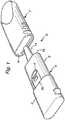
- Preferable means for applying the formulation of the present invention to the nasal passages is by use of a pre-compression pump, such as a VP3, VP7 or modifications, model manufactured by Valois SA.
- a pre-compression pump such as a VP3, VP7 or modifications, model manufactured by Valois SA.
- Advantages of pumps of this type are beneficial as they will ensure that the formulation is not released or atomised until a sufficient force has been applied, otherwise smaller doses may be applied.
- these pre-compression pumps may be used with a bottle (glass or plastic) capable of holding 8-50ml of a formulation. Each spray will typically deliver 50-100 ⁇ l of such a formulation, therefore, the device is capable of providing at least 100 metered doses.
- a suitable dosing regime for the formulation of the present invention when administered to the nose would be for the patient to inhale slowly through the nose subsequent to the nasal cavity being cleared. During inhalation the formulation would be applied to one nostril while the other is manually compressed. This procedure would then be repeated for the other nostril.
- one or two inhalations per nostril would be administered by the above procedure up to three times each day, ideally once daily.
- formulations comprising a compound of formula (I) or solvate thereof are useful in human or veterinary medicine, in particular as an anti-inflammatory and anti-allergic agent.
- a formulation comprising the compound of formula (I) or solvate thereof for use in human or veterinary medicine, particularly in the treatment of patients with inflammatory and/or allergic conditions.
- a formulation comprising the compound of formula (I) or solvate thereof for the manufacture of a medicament for the treatment of patients with inflammatory and/or allergic conditions.
- the compound of formula (I) is long-acting, therefore preferably the compound will be delivered once-per-day and the dose will be selected so that the compound has a therapeutic effect in the treatment of respiratory disorders (eg rhinitis) over 24 hours or more.
- respiratory disorders eg rhinitis
- compositions according to the invention may also be used in combination with another therapeutically active agent, for example, an anti-histamine or an anti-allergic.
- another therapeutically active agent for example, an anti-histamine or an anti-allergic.
- the invention thus provides, in a further aspect, a combination comprising a compound of formula (I) or a physiologically acceptable salt or solvate thereof together with another therapeutically active agent, for example, an anti-histamine or an anti-allergic.
- anti-histamines examples include methapyrilene or loratadine.
- NSAIDs eg. PDE4 inhibitors, leukotriene antagonists, iNOS inhibitors, tryptase and elastase inhibitors, beta-2 integrin antagonists and adenosine 2a agonists
- antiinfective agents eg. antibiotics, antivirals
- the PDE4-specific inhibitor useful in this aspect of the invention may be any compound that is known to inhibit the PDE4 enzyme or which is discovered to act as a PDE4 inhibitor, and which are only PDE4 inhibitors, not compounds which inhibit other members of the PDE family as well as PDE4.
- a PDE4 inhibitor which has an IC 50 ratio of about 0.1 or greater as regards the IC 50 for the PDE4 catalytic form which binds rolipram with a high affinity divided by the IC 50 for the form which binds rolipram with a low affinity.
- the cAMP catalytic site which binds R and S rolipram with a low affinity is denominated the "low affinity” binding site (LPDE 4) and the other form of this catalytic site which binds rolipram with a high affinity is denominated the "high affinity” binding site (HPDE 4).
- LPDE 4 low affinity binding site
- HPDE 4 high affinity binding site
- the pharmaceutical formulation according to the invention may further comprise one or more excipients.
- excipient as used herein, it is meant to mean substantially inert materials that are nontoxic and do not interact with other components of a composition in a deleterious manner including, but not limited to, pharmaceutical grades of: carbohydrates, organic and inorganic salts, polymers, amino acids, phospholipids, wetting agents, emulsifiers, surfactants, poloxamers, pluronics, and ion exchange resins, and combinations thereof, a non-exhaustive list of examples of which are provided below:
- the individual compounds of such combinations may be administered either sequentially in separate pharmaceutical compositions as well as simultaneously in combined pharmaceutical formulations.
- Preferably additional therapeutically active ingredients are suspended in the formulation together with the compound of formula (I).
- Appropriate doses of known therapeutic agents will be readily appreciated by those skilled in the art.
- a process for preparing a compound of formula (I) comprises alkylation of a thioacid of formula (II) or a salt thereof.
- the compound of formula (II) may be reacted with a compound of formula FCH 2 L wherein L represents a leaving group (eg a halogen atom, a mesyl or tosyl group or the like) for example, an appropriate fluoromethyl halide under standard conditions.
- L represents a leaving group (eg a halogen atom, a mesyl or tosyl group or the like) for example, an appropriate fluoromethyl halide under standard conditions.
- the fluoromethyl halide reagent is bromofluoromethane.
- the compound of formula (II) is employed as a salt, particularly the salt with diisopropylethylamine.
- the compound of formula (II) or a salt thereof is treated with bromofluoromethane optionally in the presence of a phase transfer catalyst.
- a preferred solvent is methylacetate, or more preferably ethylacetate, optionally in the presence of water. The presence of water improves solubility of both starting material and product and the use of a phase transfer catalyst results in an increased rate of reaction.
- phase transfer catalysts examples include (but are not restricted to) tetrabutylammonium bromide, tetrabutylammonium chloride, benzyltributylammonium bromide, benzyltributylammonium chloride, benzyltriethylammonium bromide, methyltributylammonium chloride and methyltrioctylammonium chloride.
- THF has also successfully been employed as solvent for the reaction wherein the presence of a phase transfer catalyst again provides a significantly faster reaction rate.
- the product present in an organic phase is washed firstly with aqueous acid eg dilute HCl in order to remove amine compounds such as triethylamine and diisopropylethylamine and then with aqueous base eg sodium bicarbonate in order to remove any unreacted precursor compound of formula (II).
- aqueous acid eg dilute HCl
- amine compounds such as triethylamine and diisopropylethylamine
- aqueous base eg sodium bicarbonate
- Compound of formula (I) in unsolvated form may be prepared by a process comprising:
- step (b) the desolvation will generally be performed at a temperature exceeding 50°C preferably at a temperature exceeding 100°C. Generally heating will be performed under vacuum.
- Unsolvated polymorph Form 1 appears likely to be the thermodynamically most stable form since Forms 2 and 3 are converted into Form 1 on heating. Polymorph Form 1 is preferred.
- the compound of formula (I) in unsolvated polymorph Form 1 substantially to be in the form of equant or substantially equant particles.
- Substantially equant particles have dimensions in the X, Y and Z dimensions which are similar in length.
- the equant particles will be in the form of tetragonal bipyramidal or substantially tetragonal bipyramidal particles.
- Tetragonal bipyramidal particles of Form 1 polymorph have surprisingly been found to produce relatively consistent sized particles after micronisation, which appears to be independent of the drying process prior to micronisation.
- the tetragonal bipyramidal particles possess good flow properties, good bulk density, and are easily isolated from suspension by filtration.
- the compound of formula (I) in unsolvated polymorph Form 1 to be in the form of acicular particles.
- Acicular particles are needle-like in shape.
- Acicular particles of Form 1 have surprisingly been found to produce relatively varying sized particle distribution after micronisation, and particle sizes which, on average, are larger than those produced from micronisation of tetragonal bipyramidal particles. In certain circumstances where this size profile of micronised product is preferred, then acicular particles will be preferred. It may be that the micronised product produced from acicular particles will result in lower systemic exposure to the active compound.
- a process for preparing a compound of formula (I) as unsolvated Form 1 polymorph comprises dissolving compound of formula (I) in methylisobutylketone, ethyl acetate or methyl acetate and producing compound of formula (I) as unsolvated Form 1 by addition of a non-solvating anti-solvent such as iso-octane or toluene.
- the compound of formula (I) may be dissolved in ethyl acetate and compound of formula (I) as unsolvated Form 1 polymorph may be obtained by addition of toluene as anti-solvent.
- the ethyl acetate solution is hot and once the toluene has been added the mixture is distilled to reduce the content of ethyl acetate.
- the compound of formula (I) may be dissolved in methylisobutylketone and compound of formula (I) as unsolvated Form 1 polymorph may be obtained by addition of isooctane as anti-solvent
- Compound of formula (I) in solvated form may be prepared by crystallising the compound of formula (I) from a solvating solvent such as acetone, propan-2-ol, ethylacetate or tetrahydrofuran (THF).
- a solvating solvent such as acetone, propan-2-ol, ethylacetate or tetrahydrofuran (THF).
- the compound of formula (I) will be employed in unsolvated form, typically unsolvated Form 1.
- a process for the preparation of a compound of formula (I), substantially in the form of equant or substantially equant particles comprises dissolving a compound of formula (I) in a suitable solvating solvent and crystallising the compound
- Preferred solvating agents are acetone, propan-2-ol, ethylacetate or tetrahydrofuran, more preferably acetone or propan-2-ol.
- the compound of formula (I) is preferably substantially in the form of tetragonal bipyramidel particles.
- Compounds of formula (II) may be prepared from the corresponding 17 ⁇ -hydroxyl derivative of formula (III): using for example, the methodology described by G. H. Phillipps et al., (1994) Journal of Medicinal Chemistry, 37, 3717-3729 .
- the step typically comprises the addition of a reagent suitable for performing the esterification eg an activated derivative of 2-furoic acid such as an activated ester or preferably a 2-furoyl halide eg 2-furoyl chloride (employed in at least 2 times molar quantity relative to the compound of formula (III)) in the presence of an organic base eg triethylamine.
- the second mole of 2-furoyl chloride reacts with the thioacid moiety in the compound of formula (III) and needs to be removed eg by reaction with an amine such as diethylamine.
- the activated derivative of 2-furoic acid may be an activated ester of 2-furoic acid, but is more preferably a 2-furoyl halide, especially 2-furoyl chloride.
- a suitable solvent for this reaction is ethylacetate or methylacetate (preferably methylacetate) (when step (c1) may be followed) or acetone (when step (c2) may be followed).
- an organic base eg triethylamine will be present.
- the organic base is diethanolamine.
- the base may suitably be dissolved in a solvent eg methanol.
- steps (a) and (b) will be performed at reduced temperature eg between 0 and 5 °C.
- the aqueous wash may be water, however the use of brine results in higher yields and is therefore preferred.
- the aqueous medium is for example a dilute aqueous acid such as dilute HCl.
- the activated derivative of 2-furoic acid may be an activated ester of 2-furoic acid, but is more preferably a 2-furoyl halide, especially 2-furoyl chloride.
- a suitable solvent for this step is acetone. Normally an organic base eg triethylamine will be present.
- a suitable solvent is DMF or dimethylacetamide. Normally an organic base eg triethylamine will be present.
- steps (a) and (b) will be performed at reduced temperature eg between 0 and 5°C. The product may be isolated by treatment with acid and washing with water.
- the compound of formula (II) may advantageously be isolated in the form of a solid crystalline salt.
- the preferred salt is a salt formed with a base such as triethylamine, 2,4,6-trimethylpyridine, diisopropylethylamine or N-ethylpiperidine.
- Such salt forms of compound of formula (II) are more stable, more readily filtered and dried and can be isolated in higher purity than the free thioacid.
- the most preferred salt is the salt formed with diisopropylethylamine.
- the triethylamine salt is also of interest.
- Compounds of formula (III) may be prepared in accordance with procedures described in GB 2088877B . Compounds of formula (III) may also be prepared by a process comprising the following steps:
- Step (a) comprises oxidation of a solution containing the compound of formula (V).
- step (a) will be performed in the presence of a solvent comprising methanol, water, tetrahydrofuran, dioxan or diethylene glygol dimethylether.
- a solvent comprising methanol, water, tetrahydrofuran, dioxan or diethylene glygol dimethylether.
- preferred solvents are methanol, water or tetrahydrofuran, and more preferably are water or tetrahydrofuran, especially water and tetrahydrofuran as solvent.
- Dioxan and diethylene glygol dimethylether are also preferred solvents which may optionally (and preferably) be employed together with water.
- the solvent will be present in an amount of between 3 and 10vol relative to the amount of the starting material (1wt.), more preferably between 4 and 6 vol., especially 5 vol.
- the oxidising agent is present in an amount of 1-9 molar equivalents relative to the amount of the starting material.
- the oxidising agent may be present in an amount of between 1.1 and 10wt. relative to the amount of the starting material (1wt.), more preferably between 1.1 and 3wt., especially 1.3wt.
- the oxidation step will comprise the use of a chemical oxidising agent.
- the oxidising agent will be periodic acid or iodic acid or a salt thereof. Most preferably, the oxidising agent will be periodic acid or sodium periodate, especially periodic acid.
- the oxidation step may comprise any suitable oxidation reaction, eg one which utilises air and/or oxygen. When the oxidation reaction utilises air and/or oxygen, the solvent used in said reaction will preferably be methanol.
- step (a) will involve incubating the reagents at room temperature or a little warmer, say around 25°C eg for 2 hours.
- the compound of formula (IV) may be isolated by recrystallisation from the reaction mixture by addition of an anti-solvent.
- a suitable anti-solvent for compound of formula (IV) is water. Surprisingly we have discovered that it is highly desirable to control the conditions under which the compound of formula (IV) is precipitated by addition of anti-solvent eg water. When the recrystallisation is performed using chilled water (eg water/ice mixture at a temperature of 0-5°C) although better anti-solvent properties may be expected we have found that the crystalline product produced is very voluminous, resembles a soft gel and is very difficult to filter. Without being limited by theory we believe that this low density product contains a large amount of solvated solvent within the crystal lattice.
- Step (b) will typically comprise the addition of a reagent suitable for converting a carboxylic acid to a carbothioic acid eg using hydrogen sulphide gas together with a suitable coupling agent eg carbonyldiimidazole (CDI) in the presence of a suitable solvent eg dimethylformamide.
- a suitable coupling agent eg carbonyldiimidazole (CDI)
- CDI carbonyldiimidazole
- the advantages of the formulation of the compound of formula (I) according to the invention may include the fact that the formulations demonstrate excellent anti-inflammatory properties, with predictable pharmacokinetic and pharmacodynamic behaviour, with an attractive side-effect profile, rapid onset of action, long duration of action, and are compatible with a convenient regime of treatment in human patients, in particular being amendable to once-per day dosing. Further advantages may include the fact that the formulation has desirable physical and chemical properties which allow for ready manufacture and storage.
- a container comprising a pharmaceutical formulation according to the invention.
- a device adapted for intranasal delivery of a pharmaceutical formulation comprising such a container
- the formulation will be dispensed from a vessel fitted with a suitable pre-compression pump and nasal actuator, adapted to dispense 50 or 100 ⁇ l per actuation, preferably 50 ⁇ l
- LCMS was conducted on a Supelcosil LCABZ+PLUS column (3.3 cm x 4.6 mm ID) eluting with 0.1% HCO 2 H and 0.01 M ammonium acetate in water (solvent A), and 0.05% HCO 2 H 5% water in acetonitrile (solvent B), using the following elution gradient 0-0.7 min 0%B, 0.7-4.2 min 100%B, 4.2-5.3 min 0%B, 5.3-5.5 min 0%B at a flow rate of 3 ml/min.
- the mass spectra were recorded on a Fisons VG Platform spectrometer using electrospray positive and negative mode (ES+ve and ES-ve).
- a stirred suspension of 6 ⁇ , 9 ⁇ -difluoro-11 ⁇ , 17 ⁇ -dihydroxy-16 ⁇ -methyl-3-oxo-androsta-1,4-diene-17 ⁇ -carbothioic acid (prepared in accordance with the procedure described in GB 2088877B ) (49.5g) in methylacetate (500ml) is treated with triethylamine (35ml) maintaining a reaction temperature in the range 0-5°C.
- 2-Furoyl chloride 25ml is added and the mixture stirred at 0-5°C for 1 hour.
- a solution of diethanolamine (52.8g) in methanol (50ml) is added and the mixture stirred at 0-5°C for at least 2 hours.
- Dilute hydrochloric acid (approx 1M, 550ml) is added maintaining a reaction temperature below 15°C and the mixture stirred at 15°C.
- the organic phase is separated and the aqueous phase is back extracted with methyl acetate (2x250ml). All of the organic phases are combined, washed sequentially with brine (5 x 250ml) and treated with di-isopropylethylamine (30ml).
- the reaction mixture is concentrated by distillation at atmospheric pressure to an approximate volume of 250ml and cooled to 25-30°C (crystallisation of the desired product normally occurs during distillation/subsequent cooling).
- TBME Tertiary butyl methyl ether
- a mobile suspension of Intermediate 1 (12.61g, 19.8mmol) in ethyl acetate (230ml) and water (50ml) is treated with a phase transfer catalyst (benzyltributylammonium chloride, 10mol%), cooled to 3°C and treated with bromofluoromethane (1.10ml, 19.5mmol, 0.98 equivalents), washing in with prechilled (0°C) ethyl acetate (EtOAc) (20ml). The suspension is stirred overnight, allowing to warm to 17°C.
- a phase transfer catalyst benzyltributylammonium chloride, 10mol
- the aqueous layer is separated and the organic phase is sequentially washed with 1M HCl (50ml), 1%w/v NaHCO 3 solution (3x50ml) and water (2x50ml).
- the ethylacetate solution is distilled at atmospheric pressure until the distillate reaches a temperature of approximately 73°C at which point toluene (150ml) is added. Distillation is continued at atmospheric pressure until all remaining EtOAc has been removed (approximate distillate temperature 103°C).
- the resultant suspension is cooled and aged at ⁇ 10°C and filtered off.
- the solution is seeded with the propan-2-ol solvate of 6 ⁇ , 9 ⁇ -Difluoro-17 ⁇ -[(2-furanylcarbonyl)oxy]-11 ⁇ -hydroxy-16 ⁇ -methyl-3-oxo-androsta-1,4-diene-17 ⁇ -carbothioic acid S-fluoromethyl ester (0.01wt) suspended in propan-2-ol ( ca 0.03vols).
- the suspension is adjusted to 50 ⁇ 5° and aged for ca 5 mins (until crystallisation is established).
- the suspension is concentrated once again to ca 10vols. Further propan-2-ol (10vols) is added and the suspension concentrated to ca 10vols for a third time (note: pot temp at this point ca 80°).
- the propan-2-ol is removed by the following process: The product is heated under vacuum at 105 to 115°C for at least 12 hours to give tetragonal bipyramidal particles of unsolvated Form 1 of the active compound.
- Pharmacological activity was assessed in a functional in vitro assay of glucocorticoid agonist activity which is generally predictive of anti-inflammatory or anti-allergic activity in vivo.
- the functional assay was based on that described by K.P.Ray et al., Biochem J. (1997), 328, 707-715 .
- A549 cells stably transfected with a reporter gene containing the NF- ⁇ B responsive elements from the ELAM gene promoter coupled to sPAP (secreted alkaline phosphatase) were treated with test compounds at appropriate doses for 1 hour at 37°C.
- the cells were then stimulated with tumour necrosis factor (TNF, 10ng/ml) for 16 hours, at which time the amount of alkaline phosphatase produced is measured by a standard colourimetric assay.
- TNF tumour necrosis factor
- Dose response curves were constructed from which EC 50 values were estimated.
- the glucocorticoid receptor can function in at least two distinct mechanisms, by upregulating gene expression through the direct binding of GR to specific sequences in gene promotors, and by downregulating gene expression that is being driven by other transcription factors (such as NF ⁇ B or AP-1) through their direct interaction with GR.
- the first cell line contains the firefly luciferase reporter gene under the control of a synthetic promoter that specifically responds to activation of the transcription factor NF ⁇ B when stimulated with TNF ⁇ .
- the second cell line contains the renilla luciferase reporter gene under the control of a synthetic promotor that comprises 3 copies of the consensus glucocorticoid response element, and which responds to direct stimulation by glucocorticoids.
- Anaesthetised pigs (2) were dosed intra-tracheally with a homogenous mixture of compound (I) (1mg) and fluticasone propionate (1mg) as a dry powder blend in lactose (10% w/w). Serial blood samples were taken for up to 8h following dosing. Plasma levels of compound (I) and fluticasone propionate were determined following extraction and analysis using LC-MS/MS methodology, the lower limits of quantitation of the methods were 10 and 20pg/mL for compound (I) and fluticasone propionate respectively. Using these methods compound (I) was quantifiable up to 2 hours after dosing and fluticasone propionate was quantifiable up to 8 hours after dosing.
- Plasma half-life data obtained from IV dosing (0.1 mg/kg) was used to calculate AUC (0-inf) values for compound (I). This compensates for the plasma profile of Compound (I) only being defined up to 2 hours after an IT dose and removes any bias due to limited data between compound (I) and fluticasone propionate.
- C max and AUC (0-inf) values show markedly reduced systemic exposure to compound (I) compared to fluticasone propionate:- Cmax (pg/mL) AUC (0-inf) (hr.pg/mL) Pig 1 Pig 2 Pig 1 Pig 2 Compound of Formula (I) 117 81 254 221 Fluticasone propionate 277 218 455 495
- Example 1 Nasal formulation containing 6 ⁇ , 9 ⁇ -Difluoro-17 ⁇ -[(2-furanylcarbonyl)oxy]-11 ⁇ -hydroxy-16 ⁇ -methyl-3-oxo-androsta-1,4-diene-17 ⁇ -carbothioic acid S-fluoromethyl ester
- a formulation for intranasal delivery was prepared with ingredients as follows: 6 ⁇ , 9 ⁇ -Difluoro-17 ⁇ -[(2-furanylcarbonyl)oxy]-11 ⁇ -hydroxy-16 ⁇ -methyl-3-oxo-androsta-1,4-diene-17 ⁇ -carbothioic acid S-fluoromethyl ester (prepared according to Intermediate 3, micronised to MMD 3 ⁇ m) 0.05% w/w Polysorbate 80 0.025% w/w Avicel RC591 1.5% w/w Dextrose 5.0% w/w BKC 0.015% w/w EDTA 0.015% w/w water to 100%
- the formulation was filled into a bottle (plastic or glass) fitted with a suitable pre-compression pump and nasal actuator, adapted to dispense 50 or 100 ⁇ l per actuation, preferably 50 ⁇ l
- the formulation was prepared following the following protocol:
- Example 2 Nasal formulation containing 6 ⁇ , 9 ⁇ -Difluoro-17 ⁇ -[(2-furanylcarbonyl)oxy]-11 ⁇ -hydroxy-16 ⁇ -methyl-3-oxo-androsta-1,4-diene-17 ⁇ -carbothioic acid S -fluoromethyl ester
- a formulation for intranasal delivery was prepared with ingredients as follows: 6 ⁇ , 9 ⁇ -Difluoro-17 ⁇ -[(2-furanylcarbonyl)oxy]-11 ⁇ -hydroxy-16 ⁇ -methyl-3-oxo-androsta-1,4-diene-17 ⁇ -carbothioic acid S -fluoromethyl ester (prepared according to Intermediate 3, micronised to MMD 3 ⁇ m) 0.1% w/w Polysorbate 80 0.025% w/w Avicel RC591 1.5% w/w Dextrose 5.0% w/w BKC 0.015% w/w EDTA 0.015% w/w water to 100%
- a suitable pre-compression pump and nasal actuator adapted to dispense 50 or 100 ⁇ l per actuation, preferably 50 ⁇ l.
- Example 3 Nasal formulation containing 6 ⁇ , 9 ⁇ -Difluoro-17 ⁇ -[(2-furanylcarbonyl)oxy]-11 ⁇ -hydroxy-16 ⁇ -methyl-3-oxo-androsta-1,4-diene-17 ⁇ -carbothioic acid S -fluoromethyl ester
- a formulation for intranasal delivery was prepared with ingredients as follows: 6 ⁇ , 9 ⁇ -Difluoro-17 ⁇ -[(2-furanylcarbonyl)oxy]-11 ⁇ -hydroxy-16 ⁇ -methyl-3-oxo-androsta-1,4-diene-17 ⁇ -carbothioic acid S -fluoromethyl ester (prepared according to intermediate 3, micronised to MMD ,1.5 ⁇ m) 0.1% w/w Polysorbate 80 0.025% w/w Avicel RC591 1.5% w/w Dextrose 5.0% w/w BKC 0.015% w/w EDTA 0.015% Water to 100% in a total amount suitable for 120 actuations and the formulation was filled into a bottle (plastic or glass) fitted with a suitable pre-compression pump and nasal actuator, adapted to dispense 50 or 100 ⁇ l per actuation. Preferably 50 ⁇ l.
- the formulation was prepared following the different protocol below:
- Example 3 Stability studies on Example 3 showed it to be stable up to 3 months at 40°C (measurements were not taken beyond this time). The particle size of the active material has also been observed not to change significantly.
- Fig. 1 shows an exploded view of a nasal inhaler suitable for use in accord with the invention
- a nasal inhaler device 5 comprising a body 6 a container 3 and a nasal pump 8.
- the device further comprises a protective end cap 7 having an inner surface 4 for engagement with the body 6 to protect the dispensing nozzle 11.
- the body 6 is made from a plastic material and defines a housing 9 and a dispensing nozzle 11.
- the housing 9 defines a cavity formed by a side wall and a first end wall and a second end wall 14.
- the dispensing nozzle 11 is connected to and extends away from the second end wall 14 and has an external tapering form.
- the dispensing nozzle 11 has a longitudinally extending orifice defined by an outlet tube extending towards the cavity.
- An annular abutment is formed within the orifice part way along the outlet tube.
- the annular abutment defines a small aperture through which fluid can flow in use.
- the nasal pump 8 comprises a hollow casing 30 defining a reservoir containing several doses of the fluid nasal formulation to be dispensed and a plunger slidably engaged within the hollow casing 30.
- a suitable nasal pump is described in US-A-4,964,069 .
Landscapes
- Health & Medical Sciences (AREA)
- Chemical & Material Sciences (AREA)
- Public Health (AREA)
- Veterinary Medicine (AREA)
- Medicinal Chemistry (AREA)
- Animal Behavior & Ethology (AREA)
- General Health & Medical Sciences (AREA)
- Pharmacology & Pharmacy (AREA)
- Life Sciences & Earth Sciences (AREA)
- Bioinformatics & Cheminformatics (AREA)
- Engineering & Computer Science (AREA)
- Epidemiology (AREA)
- Otolaryngology (AREA)
- Chemical Kinetics & Catalysis (AREA)
- Nuclear Medicine, Radiotherapy & Molecular Imaging (AREA)
- General Chemical & Material Sciences (AREA)
- Organic Chemistry (AREA)
- Pulmonology (AREA)
- Dispersion Chemistry (AREA)
- Diabetes (AREA)
- Rheumatology (AREA)
- Pain & Pain Management (AREA)
- Immunology (AREA)
- Endocrinology (AREA)
- Pharmaceuticals Containing Other Organic And Inorganic Compounds (AREA)
- Steroid Compounds (AREA)
- Medicinal Preparation (AREA)
Description
- The present invention relates to pharmaceutical formulations containing an anti-inflammatory and anti-allergic compound of the androstane series and to processes for their preparation. The present invention also relates to therapeutic uses thereof, particularly for the treatment of inflammatory and allergic conditions.
- Glucocorticoids which have anti-inflammatory properties are known and are widely used for the treatment of inflammatory disorders or diseases such as asthma and rhinitis. For example,
US Patent 4335121 discloses 6α, 9α-Difluoro-17α-(1-oxopropoxy)-11β-hydroxy-16α-methyl-3-oxo-androsta-1,4-diene-17β-carbothioic acid S-fluoromethyl ester (known by the generic name of fluticasone propionate) and derivatives thereof. The use of glucocorticoids generally, and especially in children, has been limited in some quarters by concerns over potential side effects. The side effects that are feared with glucocorticoids include suppression of the Hypothalamic-Pituitary-Adrenal (HPA) axis, effects on bone growth in children and on bone density in the elderly, ocular complications (cataract formation and glaucoma) and skin atrophy. Certain glucocorticoid compounds also have complex paths of metabolism wherein the production of active metabolites may make the pharmacodynamics and pharmacokinetics of such compounds difficult to understand. Whilst the modern glucocorticoids are very much safer than those originally introduced, it remains an object of research to produce new molecules and formulations of old and new molecules which have excellent anti-inflammatory properties, with predictable pharmacokinetic and pharmacodynamic properties, with an attractive side effect profile, and with a convenient treatment regime. - In
PCT.GB01.03495 WO02/12265 - Many millions of individuals suffer from seasonal and perennial allergic rhinitis worldwide. Symptoms of seasonal and perennial allergic rhinitis include nasal itch, congestion, runny nose, sneezing and watery eyes. Seasonal allergic rhinitis is commonly known as 'hay fever'. It is caused by allergens which are present in the air at specific times of the year, for example tree pollen during Spring and Summer. Perennial allergic rhinitis is caused by allergens which are present in the environment during the entire year, for example dust mites, mould, mildew and pet dander.
- To formulate an effective pharmaceutical nasal composition, the medicament must be delivered readily to all portions of the nasal cavities (the target tissues) where it performs its pharmacological function. Additionally, the medicament should remain in contact with the target tissues for relatively long periods of time. The longer the medicament remains in contact with the target tissues, the medicament must be capable of resisting those forces in the nasal passages that function to remove particles from the nose. Such forces, referred to as 'mucociliary clearance', are recognised as being extremely effective in removing particles from the nose in a rapid manner, for example, within 10-30 minutes from the time the particles enter the nose.
- Other desired characteristics of a nasal composition are that it must not contain ingredients which cause the user discomfort, that it has satisfactory stability and shelf-life properties, and that it does not include constituents that are considered to be detrimental to the environment, for example ozone depletors. In the case of administration of glucocorticoids, the potential for any undesirable side effects should preferably be minimised.
-
US4,335,121 describes anti-inflammatory androstane carbothioates and formulations thereof. - WO00/38811 describes a process and apparatus for producing fine crystalline particles of pharmaceuticals or carrier agents suitable for inhalation therapy.
-
WO00/33892 -
WO03/0666656 - Thus, according to one aspect of the invention, there is provided a pharmaceutical formulation comprising
- (i) an aqueous suspension of particulate compound of formula (I)

- (ii) one or more suspending agents;
- (iii) one or more preservatives;
- (iv) one or more wetting agents; and
- (v) one or more isotonicity adjusting agents.
- The formulations of the present invention may be stabilised by appropriate selection of pH. Typically, the pH will be adjusted to between 4.5 and 7.5, preferably between 5.0 and 7.0, especially around 6.0.
- Examples of pharmaceutically acceptable materials which can be used to adjust the pH of the formulation include hydrochloric acid and sodium hydroxide. Preferably, the pH of the formulation will be adjusted using hydrochloric acid.
- The aqueous component is preferably a high grade quality of water, most preferably purified water.
- The active compound of formula (I) or solvate thereof will suitably have a mass mean diameter (MMD) of less than 20µm, preferably between 0.5-10µm, especially between 1-5µm. If particle size reduction is necessary, this may be achieved by techniques such as micronisation and/or microfluidisation.
- Particularly preferred MMDs are between 2-4µm.
- In some preferred embodiments, if necessary, particle size reduction may be achieved by micronisation.
- In other preferred embodiments, particle size reduction may be achieved by microfluidisation.
- Preferably, the particles will be crystalline, prepared for example by a process which comprises mixing in a continuous flow cell in the presence of ultrasonic radiation a flowing solution of compound of formula (I) or solvate thereof as medicament in a liquid solvent with a flowing liquid antisolvent for said medicament (as described in International Patent Application
PCT.GB99.04368 - A pharmaceutically effective amount of particulate compound of formula (I) or solvate thereof is present within the formulation, in an amount which is preferably between 0.005% and 1% (w/w), preferably between 0.01% and 0.5% (w/w), especially 0.05-0.1% (w/w) based on the total weight of the formulation. Typically, 50µl of suspension will contain 50µg of compound of formula (I) or solvate thereof.
- Examples of suspending agents include carboxymethylcellulose, veegum, tragacanth, bentonite, methylcellulose and polyethylene glycols. Preferably, the suspending agent will be microcrystalline cellulose and carboxy methylcellulose sodium, most preferably used as the branded product Avicel RC591 (which typically contains 87-91% microcrystalline cellulose and 9 -13% carboxy methylcellulose sodium). Particulate microcrystalline cellulose will preferably have a particle size in the range 1 to 100µm. We believe that Avicel RC591 acts as a suspending agent by imparting thixotropic properties to the formulation, wherein the formulation may become a stable suspension upon being stirred, shaken or otherwise disturbed.
- Preferably, the thixotropic nature of the suspending agent will ensure that the formulation assumes a gel like appearance at rest, wherein the particulate medicament is dispersed and suspended substantially uniformly, characterised by a high viscosity value. Once the composition is subjected to shear forces, such as those caused by agitation prior to spraying, the viscosity of the formulation will preferably decrease to such a level to enable it to flow readily through the spray device and exit as a spray of fine particles in a mist. These particles will then be capable of infiltrating the mucosal surfaces of the anterior regions of the nose (frontal nasal cavities), the frontal sinus, the maxillary sinuses and the turbinates which overlie the conchas of the nasal cavities. Once deposited, the viscosity of the formulation will preferably increase to a sufficient level to assume its gel-like form and resist being cleared from the nasal passages by the inherent mucocillary forces that are present in the nasal cavities.
- A suspending agent will be desirably added in a suitable amount to achieve this function, preferably the suspending agent will be present within the formulation in an amount of between 0.1 and 5% (w/w), especially 1.5% (w/w), based on the total weight of the formulation.
- For stability purposes, the formulation of the present invention should be protected from microbial contamination and growth by inclusion of a preservative. Examples of pharmaceutically acceptable anti-microbial agents or preservatives that can be used in the formulation include quaternary ammonium compounds (eg. benzalkonium chloride, benzethonium chloride, cetrimide and cetylpyridinium chloride), mercurial agents (eg. phenylmercuric nitrate, phenylmercuric acetate and thimerosal), alcoholic agents (eg. chlorobutanol, phenylethyl alcohol and benzyl alcohol), antibacterial esters (eg. esters of para-hydroxybenzoic acid), chelating agents such as disodium edetate (EDTA) and other anti-microbial agents such as chlorhexidine, chlorocresol, sorbic acid and its salts and polymyxin.
- Preferably, the preservative will comprise disodium edetate (EDTA), which will preferably be present within the formulation in an amount of between 0.001 and 1% (w/w), especially around 0.015% (w/w), based on the total weight of the formulation.
- Preferably, the preservative will comprise benzalkonium chloride (BKC), which will preferably be present within the formulation in an amount of between 0.001 and 1% (w/w), especially around 0.015% (w/w), based on the total weight of the formulation.
- More preferably, the preservative comprises disodium edetate and benzalkonium chloride or disodium edetate and potassium sorbate, particularly disodium edetate and benzalkonium chloride.
- Formulations, eg nasal formulations which contain a suspended medicament (such as a compound of formula (I) or a solvate thereof) will contain a pharmaceutically acceptable wetting agent which functions to wet the particles of medicament to facilitate dispersion thereof in the aqueous phase of the composition. Preferably, the amount of wetting agent used will not cause foaming of the dispersion during mixing.
- It will be appreciated that any agent which is effective in wetting the particles and which is pharmaceutically acceptable can be used. Examples of wetting agents that can be used are fatty alcohols, esters and ethers. Preferably, the wetting agent will be a hydrophilic, non-ionic surfactant, most preferably polyoxyethylene (20) sorbitan monooleate (supplied as the branded product Polysorbate 80).
- The formulation of the present invention comprises a wetting agent which will be desirably added in a sufficient quantity to achieve this function, preferably the wetting agent will be present within the formulation in an amount of between 0.001 and 0.05% (w/w), especially 0.025% (w/w), based on the total weight of the formulation.
- The presence of an isotonicity adjusting agent is to achieve isotonicity with body fluids eg fluids of the nasal cavity, resulting in reduced levels of irritancy associated with many nasal formulations. Examples of suitable isotonicity adjusting agents are sodium chloride, dextrose and calcium chloride. Preferably, the isotonicity adjusting agent will be dextrose, most preferably used as anhydrous dextrose.
- The formulation of the present invention comprises an isotonicity adjusting agent which will be desirably added in a sufficient quantity to achieve this function, preferably the isotonicity adjusting agent will be present within the formulation in an amount of between 0.1 and 10% (w/w), especially 5.0% w/w, based on the total weight of the formulation.
- In the pharmaceutical formulation of the invention, the compound of formula (I) or solvate thereof is present within the formulation in an amount between 0.005% and 1% (w/w), based on the total weight of the formulation.
- In the pharmaceutical formulation of the invention, preferably the suspending agent is microcrystalline cellulose and carboxy methylcellulose sodium, the preservative is EDTA and benzalkonium chloride, the wetting agent is polyoxyethylene (20) sorbitan monooleate and the isotonicity adjusting agent is dextrose.
- The compound of formula (I) or a solvate thereof and formulations thereof have potentially beneficial anti-inflammatory or anti-allergic effects, particularly upon topical administration to the nose, demonstrated by, for example, its ability to bind to the glucocorticoid receptor and to illicit a response via that receptor, with long acting effect. Hence, formulations according to the invention are useful in the treatment of inflammatory and/or allergic disorders of the nose, especially in once-per-day therapy.
- Formulations according to the invention may be prepared by combining the ingredients in water. If necessary the pH may be adjusted as a final step. Formulations so prepared may then be filled into the receptacle.
- Aqueous formulations of the invention may also be employed for rectal, aural, otic, oral, topical or parenteral administration or administration by inhalation for the treatment of other local inflammatory conditions (eg dermatitis, asthma, chronic obstructive pulmonary disease (COPD) and the like). For example formulations of the invention may be administered to the lung by nebulisation. Such formulations may employ excipients (eg preservatives, buffers and the like) appropriate for the route of administration.
- The particularly desirable biological properties of the compound of formula (I) are now explained below:
- Compound of formula (I) undergoes highly efficient hepatic metabolism to yield the 17-β carboxylic acid (X) as the sole major metabolite in rat and human in vitro systems. This metabolite has been synthesised and demonstrated to be >1000 fold less active than the parent compound in in vitro functional glucocorticoid assays.

- This efficient hepatic metabolism is reflected by in vivo data in the rat, which have demonstrated plasma clearance at a rate approaching hepatic blood flow and an oral bioavailability of <1%, consistent with extensive first-pass metabolism.
- In vitro metabolism studies in human hepatocytes have demonstrated that compound (I) is metabolised in a similar manner to fluticasone propionate but that conversion of (I) to the inactive acid metabolite occurs approximately 5-fold more rapidly than with fluticasone propionate. This very efficient hepatic inactivation would be expected to minimise systemic exposure in man leading to an improved safety profile.
- Examples of disease states in which the compound of formula (I) has utility include inflammatory and/or allergic conditions of the nasal passages such as rhinitis eg seasonal and perennial rhinitis as well as other local inflammatory conditions such as asthma, COPD and dermatitis.
- It will be appreciated by those skilled in the art that reference herein to treatment extends to prophylaxis as well as the treatment of established conditions.
- Preferable means for applying the formulation of the present invention to the nasal passages is by use of a pre-compression pump, such as a VP3, VP7 or modifications, model manufactured by Valois SA. Advantages of pumps of this type are beneficial as they will ensure that the formulation is not released or atomised until a sufficient force has been applied, otherwise smaller doses may be applied. Typically, these pre-compression pumps may be used with a bottle (glass or plastic) capable of holding 8-50ml of a formulation. Each spray will typically deliver 50-100µl of such a formulation, therefore, the device is capable of providing at least 100 metered doses.
- A suitable dosing regime for the formulation of the present invention when administered to the nose would be for the patient to inhale slowly through the nose subsequent to the nasal cavity being cleared. During inhalation the formulation would be applied to one nostril while the other is manually compressed. This procedure would then be repeated for the other nostril.
- Typically, one or two inhalations per nostril would be administered by the above procedure up to three times each day, ideally once daily.
- It will be appreciated that the above dosing regime should be adjusted according to the patient's age, body weight and/or symptom severity.
- As mentioned above, formulations comprising a compound of formula (I) or solvate thereof are useful in human or veterinary medicine, in particular as an anti-inflammatory and anti-allergic agent.
- There is thus provided as a further aspect of the invention a formulation comprising the compound of formula (I) or solvate thereof for use in human or veterinary medicine, particularly in the treatment of patients with inflammatory and/or allergic conditions.
- According to another aspect of the invention, there is provided the use of a formulation comprising the compound of formula (I) or solvate thereof for the manufacture of a medicament for the treatment of patients with inflammatory and/or allergic conditions.
- The compound of formula (I) is long-acting, therefore preferably the compound will be delivered once-per-day and the dose will be selected so that the compound has a therapeutic effect in the treatment of respiratory disorders (eg rhinitis) over 24 hours or more.
- The pharmaceutical compositions according to the invention may also be used in combination with another therapeutically active agent, for example, an anti-histamine or an anti-allergic. The invention thus provides, in a further aspect, a combination comprising a compound of formula (I) or a physiologically acceptable salt or solvate thereof together with another therapeutically active agent, for example, an anti-histamine or an anti-allergic.
- Examples of anti-histamines include methapyrilene or loratadine.
- Other suitable combinations include, for example, other anti-inflammatory agents eg. NSAIDs (eg. PDE4 inhibitors, leukotriene antagonists, iNOS inhibitors, tryptase and elastase inhibitors, beta-2 integrin antagonists and adenosine 2a agonists)) or antiinfective agents (eg. antibiotics, antivirals).
- Of particular interest is use of the compounds of formula (I) in combination with a phosphodiesterase 4 (PDE4) inhibitor. The PDE4-specific inhibitor useful in this aspect of the invention may be any compound that is known to inhibit the PDE4 enzyme or which is discovered to act as a PDE4 inhibitor, and which are only PDE4 inhibitors, not compounds which inhibit other members of the PDE family as well as PDE4. Generally it is preferred to use a PDE4 inhibitor which has an IC50 ratio of about 0.1 or greater as regards the IC50 for the PDE4 catalytic form which binds rolipram with a high affinity divided by the IC50 for the form which binds rolipram with a low affinity. For the purposes of this disclosure, the cAMP catalytic site which binds R and S rolipram with a low affinity is denominated the "low affinity" binding site (LPDE 4) and the other form of this catalytic site which binds rolipram with a high affinity is denominated the "high affinity" binding site (HPDE 4). This term "HPDE4" should not be confused with the term "hPDE4" which is used to denote human PDE4.
- The pharmaceutical formulation according to the invention may further comprise one or more excipients. By the term "excipient", as used herein, it is meant to mean substantially inert materials that are nontoxic and do not interact with other components of a composition in a deleterious manner including, but not limited to, pharmaceutical grades of: carbohydrates, organic and inorganic salts, polymers, amino acids, phospholipids, wetting agents, emulsifiers, surfactants, poloxamers, pluronics, and ion exchange resins, and combinations thereof, a non-exhaustive list of examples of which are provided below:
- Carbohydrates, including: monosaccharides, such as, but not limited to, fructose; disaccharides, such as, but not limited to lactose, and combinations and derivatives thereof; polysaccharides, such as, but not limited to, cellulose and combinations and derivatives thereof; oligosaccharides, such as, but not limited to, dextrins, and combinations and derivatives thereof; polyols, such as but not limited to sorbitol, and combinations and derivatives thereof;
- Organic and inorganic salts, including but not limited to sodium or calcium phosphates, magnesium stearate, and combinations and derivatives thereof;
- Polymers, including: natural biodegradable protein polymers including, but not limited to, gelatin and combinations and derivatives thereof;
- Natural biodegradable polysaccharide polymers including, but not limited to, chitin and starch, crosslinked starch, and combinations and derivatives thereof;
- Semisynthetic biodegradable polymers including, but not limited to, derivatives of chitosan;
- Synthetic biodegradable polymers including but not limited to polyethylene glycols (PEG), polylactic acid (PLA), synthetic polymers including but not limited to polyvinyl alcohol and combinations and derivatives thereof;
- Amino acids including but not limited to including non-polar amino acids, such as leucine and combinations and derivatives thereof;
- Phospholipids, including lecithins and combinations and derivatives thereof;
- Wetting agents/ Surfactants/Emulsifiers, including, but not limited to gum acacia, cholesterol, fatty acids including, combinations and derivatives thereof;
- Poloxamers/ Pluronics: including but not limited to poloxamer 188, Pluronic® F-108, and combinations and derivations thereof;
- Ion exchange resins: including but not limited to amberlite IR120 and combinations and derivatives thereof;
- and combinations of the noted excipients.
- Further, there is provided a process for the preparation of such pharmaceutical compositions which comprises mixing the ingredients.
- The individual compounds of such combinations may be administered either sequentially in separate pharmaceutical compositions as well as simultaneously in combined pharmaceutical formulations. Preferably additional therapeutically active ingredients are suspended in the formulation together with the compound of formula (I). Appropriate doses of known therapeutic agents will be readily appreciated by those skilled in the art.
- A process for preparing a compound of formula (I) comprises alkylation of a thioacid of formula (II)

- In this process the compound of formula (II) may be reacted with a compound of formula FCH2L wherein L represents a leaving group (eg a halogen atom, a mesyl or tosyl group or the like) for example, an appropriate fluoromethyl halide under standard conditions. Preferably, the fluoromethyl halide reagent is bromofluoromethane. Preferably the compound of formula (II) is employed as a salt, particularly the salt with diisopropylethylamine.
- In a preferred process for preparing the compound of formula (I), the compound of formula (II) or a salt thereof is treated with bromofluoromethane optionally in the presence of a phase transfer catalyst. A preferred solvent is methylacetate, or more preferably ethylacetate, optionally in the presence of water. The presence of water improves solubility of both starting material and product and the use of a phase transfer catalyst results in an increased rate of reaction. Examples of phase transfer catalysts that may be employed include (but are not restricted to) tetrabutylammonium bromide, tetrabutylammonium chloride, benzyltributylammonium bromide, benzyltributylammonium chloride, benzyltriethylammonium bromide, methyltributylammonium chloride and methyltrioctylammonium chloride. THF has also successfully been employed as solvent for the reaction wherein the presence of a phase transfer catalyst again provides a significantly faster reaction rate. Preferably the product present in an organic phase is washed firstly with aqueous acid eg dilute HCl in order to remove amine compounds such as triethylamine and diisopropylethylamine and then with aqueous base eg sodium bicarbonate in order to remove any unreacted precursor compound of formula (II).
- Compound of formula (I) in unsolvated form may be prepared by a process comprising:
- (a) Crystallising the compound of formula (I) in the presence of a non-solvating solvent such as ethanol, methanol, water, ethyl acetate, toluene, methylisobutylketone or mixtures thereof; or
- (b) Desolvating a compound of formula (I) in solvated form (eg in the form of a solvate with acetone, isopropanol, methylethylketone, DMF or tetrahydrofuran) eg by heating.
- In step (b) the desolvation will generally be performed at a temperature exceeding 50°C preferably at a temperature exceeding 100°C. Generally heating will be performed under vacuum.
- Compound of formula (I) in unsolvated form has been found to exist in 3 crystalline polymorphic forms, Forms 1, 2 and 3. The Forms are characterised by their X-ray diffraction (XRPD) patterns Broadly speaking the Forms are characterised in their XRPD profiles as follows:
- Form 1: Peak at around 18.9 degrees 2Theta
- Form 2: Peaks at around 18.4 and 21.5 degrees 2Theta
- Form 3: Peaks at around 18.6 and 19.2 degrees 2Theta.
- Unsolvated polymorph Form 1 appears likely to be the thermodynamically most stable form since Forms 2 and 3 are converted into Form 1 on heating. Polymorph Form 1 is preferred.
- In some embodiments we prefer the compound of formula (I) in unsolvated polymorph Form 1 substantially to be in the form of equant or substantially equant particles. Substantially equant particles have dimensions in the X, Y and Z dimensions which are similar in length.
- Preferably, the equant particles will be in the form of tetragonal bipyramidal or substantially tetragonal bipyramidal particles.
- Tetragonal bipyramidal particles of Form 1 polymorph have surprisingly been found to produce relatively consistent sized particles after micronisation, which appears to be independent of the drying process prior to micronisation. The tetragonal bipyramidal particles possess good flow properties, good bulk density, and are easily isolated from suspension by filtration.
- In other embodiments we prefer the compound of formula (I) in unsolvated polymorph Form 1 to be in the form of acicular particles. Acicular particles are needle-like in shape.
- Acicular particles of Form 1 have surprisingly been found to produce relatively varying sized particle distribution after micronisation, and particle sizes which, on average, are larger than those produced from micronisation of tetragonal bipyramidal particles. In certain circumstances where this size profile of micronised product is preferred, then acicular particles will be preferred. It may be that the micronised product produced from acicular particles will result in lower systemic exposure to the active compound.
- A process for preparing a compound of formula (I) as unsolvated Form 1 polymorph comprises dissolving compound of formula (I) in methylisobutylketone, ethyl acetate or methyl acetate and producing compound of formula (I) as unsolvated Form 1 by addition of a non-solvating anti-solvent such as iso-octane or toluene.
- According to a first preferred embodiment of this process the compound of formula (I) may be dissolved in ethyl acetate and compound of formula (I) as unsolvated Form 1 polymorph may be obtained by addition of toluene as anti-solvent. In order to improve the yield, preferably the ethyl acetate solution is hot and once the toluene has been added the mixture is distilled to reduce the content of ethyl acetate.
- According to a second preferred embodiment of this process the compound of formula (I) may be dissolved in methylisobutylketone and compound of formula (I) as unsolvated Form 1 polymorph may be obtained by addition of isooctane as anti-solvent
- Compound of formula (I) in solvated form may be prepared by crystallising the compound of formula (I) from a solvating solvent such as acetone, propan-2-ol, ethylacetate or tetrahydrofuran (THF).
- Preferably in processes for preparing formulations of the invention, the compound of formula (I) will be employed in unsolvated form, typically unsolvated Form 1.
- Thus, a process for the preparation of a compound of formula (I), substantially in the form of equant or substantially equant particles comprises dissolving a compound of formula (I) in a suitable solvating solvent and crystallising the compound
- Preferred solvating agents are acetone, propan-2-ol, ethylacetate or tetrahydrofuran, more preferably acetone or propan-2-ol.
- The compound of formula (I) is preferably substantially in the form of tetragonal bipyramidel particles.
- Compounds of formula (II) may be prepared from the corresponding 17α-hydroxyl derivative of formula (III):

- This method suffers disadvantages, however, in that the resultant compound of formula (II) is not readily purified of contamination with the by-product 2-furoyldiethylamide. We have therefore described several improved processes for performing this conversion.
- In a first such improved process we have discovered that by using a more polar amine such as diethanolamine, a more water soluble by-product is obtained (in this case 2-furoyldiethanolamide) which permits compound of formula (II) or a salt thereof to be produced in high purity since the by-product can efficiently be removed by water washing.
- Thus we provide a process for preparing a compound of formula (II) which comprises:
- (a) reacting a compound of formula (III) with an activated derivative of 2-furoic acid as in an amount of at least 2 moles of the activated derivative per mole of compound of formula (III) to yield a compound of formula (IIA);

- (b) removal of the sulphur-linked 2-furoyl moiety from compound of formula (IIA) by reaction of the product of step (a) with an organic primary or secondary amine base capable of forming a water soluble 2-furoyl amide.
- In two particularly convenient embodiments of this process we also provide methods for the efficient purification of the end product which comprise either
- (c1)when the product of step (b) is dissolved in a substantially water immiscible organic solvent, purifying the compound of formula (II) by washing out the amide by-product from step (b) with an aqueous wash, or
- (c2) when the product of step (b) is dissolved in a water miscible solvent, purifying the compound of formula (II) by treating the product of step (b) with an aqueous medium so as to precipitate out pure compound of formula (II) or a salt thereof.
- In step (a) preferably the activated derivative of 2-furoic acid may be an activated ester of 2-furoic acid, but is more preferably a 2-furoyl halide, especially 2-furoyl chloride. A suitable solvent for this reaction is ethylacetate or methylacetate (preferably methylacetate) (when step (c1) may be followed) or acetone (when step (c2) may be followed). Normally an organic base eg triethylamine will be present. In step (b) preferably the organic base is diethanolamine. The base may suitably be dissolved in a solvent eg methanol. Generally steps (a) and (b) will be performed at reduced temperature eg between 0 and 5 °C. In step (c1) the aqueous wash may be water, however the use of brine results in higher yields and is therefore preferred. In step (c2) the aqueous medium is for example a dilute aqueous acid such as dilute HCl.
- We also provide an alternative process for preparing a compound of formula (II) which comprises:
- (a) reacting a compound of formula (III) with an activated derivative of 2-furoic acid in an amount of at least 2 moles of activated derivative per mole of compound of formula (III) to yield a compound of formula (IIA); and
- (b) removal of the sulphur-linked 2-furoyl moiety from compound of formula (IIA) by reaction of the product of step (a) with a further mole of compound of formula (III) to give two moles of compound of formula (II).
- In step (a) preferably the activated derivative of 2-furoic acid may be an activated ester of 2-furoic acid, but is more preferably a 2-furoyl halide, especially 2-furoyl chloride. A suitable solvent for this step is acetone. Normally an organic base eg triethylamine will be present. In step (b) a suitable solvent is DMF or dimethylacetamide. Normally an organic base eg triethylamine will be present. Generally steps (a) and (b) will be performed at reduced temperature eg between 0 and 5°C. The product may be isolated by treatment with acid and washing with water.
- This aforementioned process is very efficient in that it does not produce any furoylamide by-product (thus affording inter alia environmental advantages) since the excess mole of furoyl moiety is taken up by reaction with a further mole of compound of formula (II) to form an additional mole of compound of formula (II).
- Further general conditions for the conversion of compound of formula (III) to compound of formula (II) in the two processes just described will be well known to persons skilled in the art.
- According to a preferred set of conditions, however, we have found that the compound of formula (II) may advantageously be isolated in the form of a solid crystalline salt. The preferred salt is a salt formed with a base such as triethylamine, 2,4,6-trimethylpyridine, diisopropylethylamine or N-ethylpiperidine. Such salt forms of compound of formula (II) are more stable, more readily filtered and dried and can be isolated in higher purity than the free thioacid. The most preferred salt is the salt formed with diisopropylethylamine. The triethylamine salt is also of interest.
- Compounds of formula (III) may be prepared in accordance with procedures described in
GB 2088877B 
- Step (a) comprises oxidation of a solution containing the compound of formula (V). Preferably, step (a) will be performed in the presence of a solvent comprising methanol, water, tetrahydrofuran, dioxan or diethylene glygol dimethylether. So as to enhance yield and throughput, preferred solvents are methanol, water or tetrahydrofuran, and more preferably are water or tetrahydrofuran, especially water and tetrahydrofuran as solvent. Dioxan and diethylene glygol dimethylether are also preferred solvents which may optionally (and preferably) be employed together with water. Preferably, the solvent will be present in an amount of between 3 and 10vol relative to the amount of the starting material (1wt.), more preferably between 4 and 6 vol., especially 5 vol. Preferably the oxidising agent is present in an amount of 1-9 molar equivalents relative to the amount of the starting material. For example, when a 50% w/w aqueous solution of periodic acid is employed, the oxidising agent may be present in an amount of between 1.1 and 10wt. relative to the amount of the starting material (1wt.), more preferably between 1.1 and 3wt., especially 1.3wt. Preferably, the oxidation step will comprise the use of a chemical oxidising agent. More preferably, the oxidising agent will be periodic acid or iodic acid or a salt thereof. Most preferably, the oxidising agent will be periodic acid or sodium periodate, especially periodic acid. Alternatively (or in addition), it will also be appreciated that the oxidation step may comprise any suitable oxidation reaction, eg one which utilises air and/or oxygen. When the oxidation reaction utilises air and/or oxygen, the solvent used in said reaction will preferably be methanol. Preferably, step (a) will involve incubating the reagents at room temperature or a little warmer, say around 25°C eg for 2 hours. The compound of formula (IV) may be isolated by recrystallisation from the reaction mixture by addition of an anti-solvent. A suitable anti-solvent for compound of formula (IV) is water. Surprisingly we have discovered that it is highly desirable to control the conditions under which the compound of formula (IV) is precipitated by addition of anti-solvent eg water. When the recrystallisation is performed using chilled water (eg water/ice mixture at a temperature of 0-5°C) although better anti-solvent properties may be expected we have found that the crystalline product produced is very voluminous, resembles a soft gel and is very difficult to filter. Without being limited by theory we believe that this low density product contains a large amount of solvated solvent within the crystal lattice. By contrast when conditions of around 10°C or higher are used (eg around ambient temperature) a granular product of a sand like consistency which is very easily filtered is produced. Under these conditions, crystallisation typically commences after around 1 hour and is typically completed within a few hours (eg 2 hours). Without being limited by theory we believe that this granular product contains little or no solvated solvent within the crystal lattice.
- Step (b) will typically comprise the addition of a reagent suitable for converting a carboxylic acid to a carbothioic acid eg using hydrogen sulphide gas together with a suitable coupling agent eg carbonyldiimidazole (CDI) in the presence of a suitable solvent eg dimethylformamide.
- The advantages of the formulation of the compound of formula (I) according to the invention may include the fact that the formulations demonstrate excellent anti-inflammatory properties, with predictable pharmacokinetic and pharmacodynamic behaviour, with an attractive side-effect profile, rapid onset of action, long duration of action, and are compatible with a convenient regime of treatment in human patients, in particular being amendable to once-per day dosing. Further advantages may include the fact that the formulation has desirable physical and chemical properties which allow for ready manufacture and storage.
- According to another aspect of the invention there is provided a container comprising a pharmaceutical formulation according to the invention.
- There is also described a device adapted for intranasal delivery of a pharmaceutical formulation comprising such a container
Suitably the formulation will be dispensed from a vessel fitted with a suitable pre-compression pump and nasal actuator, adapted to dispense 50 or 100 µl per actuation, preferably 50µl - The following non-limiting Examples illustrate the invention:
- 1H-nmr spectra were recorded at 400 MHz and the chemical shifts are expressed in ppm relative to tetramethylsilane. The following abbreviations are used to describe the multiplicities of the signals: s (singlet), d (doublet), t (triplet), q (quartet), m (multiplet), dd (doublet of doublets), ddd (doublet of doublet of doublets), dt (doublet of triplets) and b (broad). Biotage refers to prepacked silica gel cartridges containing KP-Sil run on flash 12i chromatography module. LCMS was conducted on a Supelcosil LCABZ+PLUS column (3.3 cm x 4.6 mm ID) eluting with 0.1% HCO2H and 0.01 M ammonium acetate in water (solvent A), and 0.05% HCO2H 5% water in acetonitrile (solvent B), using the following elution gradient 0-0.7 min 0%B, 0.7-4.2 min 100%B, 4.2-5.3 min 0%B, 5.3-5.5 min 0%B at a flow rate of 3 ml/min. The mass spectra were recorded on a Fisons VG Platform spectrometer using electrospray positive and negative mode (ES+ve and ES-ve).
- A stirred suspension of 6α, 9α-difluoro-11β, 17α-dihydroxy-16α-methyl-3-oxo-androsta-1,4-diene-17β-carbothioic acid (prepared in accordance with the procedure described in
GB 2088877B - A mobile suspension of Intermediate 1 (12.61g, 19.8mmol) in ethyl acetate (230ml) and water (50ml) is treated with a phase transfer catalyst (benzyltributylammonium chloride, 10mol%), cooled to 3°C and treated with bromofluoromethane (1.10ml, 19.5mmol, 0.98 equivalents), washing in with prechilled (0°C) ethyl acetate (EtOAc) (20ml). The suspension is stirred overnight, allowing to warm to 17°C. The aqueous layer is separated and the organic phase is sequentially washed with 1M HCl (50ml), 1%w/v NaHCO3 solution (3x50ml) and water (2x50ml). The ethylacetate solution is distilled at atmospheric pressure until the distillate reaches a temperature of approximately 73°C at which point toluene (150ml) is added. Distillation is continued at atmospheric pressure until all remaining EtOAc has been removed (approximate distillate temperature 103°C). The resultant suspension is cooled and aged at <10°C and filtered off. The bed is washed with toluene (2x30ml) and the product oven dried under vacuum at 60°C to constant weight to yield the title compound (8.77g, 82%) LCMS retention time 3.66min, m/z 539 MH+, NMR δ (CDCl3) includes 7.60 (1H, m), 7.18 - 7.11 (2H, m), 6.52 (1H, dd, J 4.2Hz), 6.46 (1H, s), 6.41 (1H, dd, J 10, 2Hz), 5.95 and 5.82 (2H dd, J 51, 9Hz), 5.48 and 5.35 (1H, 2m), 4.48 (1H, m), 3.48 (1H, m), 1.55 (3H, s), 1.16 (3H, s), 1.06 (3H, d, J 7Hz).
- A sample of Intermediate 2 (Iwt) is suspended in a mixture of propan-2-ol (2vols), water (1vol), ethyl acetate (13vols). The suspension is heated to reflux to give a solution. The solution is clarified by passing a 5-micron line filter, following with a line wash of ethyl acetate (2vols). The solution is concentrated to ca 10vols via distillation at atmospheric pressure. Propan-2-ol (10vols) is added. The solution is seeded with the propan-2-ol solvate of 6α, 9α-Difluoro-17α-[(2-furanylcarbonyl)oxy]-11β-hydroxy-16α-methyl-3-oxo-androsta-1,4-diene-17β-carbothioic acid S-fluoromethyl ester (0.01wt) suspended in propan-2-ol (ca 0.03vols). The suspension is adjusted to 50± 5° and aged for ca 5 mins (until crystallisation is established). The suspension is concentrated once again to ca 10vols. Further propan-2-ol (10vols) is added and the suspension concentrated to ca 10vols for a third time (note: pot temp at this point ca80°). The suspension is cooled to 0-5°C over ca 120mins and aged for at least 60mins. The white precipitate is isolated by vacuum filtration washing the filter cake with chilled propan-2-ol and dried in vacuo to afford the propan-2-ol solvate as an off-white to grey solid.
Stoichiometry of compound of formula (I) : propan-2-ol = 1:1 from 1H nmr (CDCl3) - The propan-2-ol is removed by the following process:
The product is heated under vacuum at 105 to 115°C for at least 12 hours to give tetragonal bipyramidal particles of unsolvated Form 1 of the active compound. - Pharmacological activity was assessed in a functional in vitro assay of glucocorticoid agonist activity which is generally predictive of anti-inflammatory or anti-allergic activity in vivo.
- For the experiments in this section, compound of formula (I) was used as unsolvated Form 1 (Intermediate 2)
- The functional assay was based on that described by K.P.Ray et al., Biochem J. (1997), 328, 707-715. A549 cells stably transfected with a reporter gene containing the NF-κB responsive elements from the ELAM gene promoter coupled to sPAP (secreted alkaline phosphatase) were treated with test compounds at appropriate doses for 1 hour at 37°C. The cells were then stimulated with tumour necrosis factor (TNF, 10ng/ml) for 16 hours, at which time the amount of alkaline phosphatase produced is measured by a standard colourimetric assay. Dose response curves were constructed from which EC50 values were estimated.
- In this test the compound of formula (I) showed an EC50 value of <1nM.
- The glucocorticoid receptor (GR) can function in at least two distinct mechanisms, by upregulating gene expression through the direct binding of GR to specific sequences in gene promotors, and by downregulating gene expression that is being driven by other transcription factors (such as NFκB or AP-1) through their direct interaction with GR.
- In a variant of the above method, to monitor these functions, two reporter plasmids have been generated and introduced separately into A549 human lung epithelial cells by transfection. The first cell line contains the firefly luciferase reporter gene under the control of a synthetic promoter that specifically responds to activation of the transcription factor NFκB when stimulated with TNFα. The second cell line contains the renilla luciferase reporter gene under the control of a synthetic promotor that comprises 3 copies of the consensus glucocorticoid response element, and which responds to direct stimulation by glucocorticoids. Simultaneous measurement of transactivation and transrepression was conducted by mixing the two cell lines in a 1:1 ratio in 96 well plate (40,000 cells per well) and growing overnight at 37°C. Test compounds were dissolved in DMSO, and added to the cells at a final DMSO concentration of 0.7%. After incubation for 1h 0.5ng/ml TNFα (R&D Systems) was added and after a further 15 hours at 37°C, the levels of firefly and renilla luciferase were measured using the Packard Firelite kit following the manufacturers' directions. Dose response curves were constructed from which EC50 values were determined.
Transactivation (GR) ED50 (nM) Transrepression (NFκB) ED50 (nM) Compound of Formula (I) 0.06 0.20 Metabolite (X) >250 >1000 Fluticasone propionate 0.07 0.16 - Pharmacological activity in vivo was assessed in an ovalbumin sensitised Brown Norway rat eosinophilia model. This model is designed to mimic allergen induced lung eosinophilia, a major component of lung inflammation in asthma.
- For the experiments in this section, compound of formula (I) was used as unsolvated Form 1.
- Compound of formula (I) produced dose dependant inhibition of lung eosinophilia in this model after dosing as an intra-tracheal (IT) suspension in
saline 30 min prior to ovalbumin challenge. Significant inhibition is achieved after a single dose of 30µg of compound of formula (I) and the response was significantly (p=0.016) greater than that seen with an equivalent dose of fluticasone propionate in the same study (69% inhibition with compound of formula (I) vs 41% inhibition with fluticasone propionate). - In a rat model of thymus involution 3 daily IT doses of 100µg of compound (I) induced significantly smaller reductions in thymus weight (p= 0.004) than an equivalent dose of fluticasone propionate in the same study (67% reduction of thymus weight with compound (I) vs 78% reduction with fluticasone propionate).
- Taken together these results indicate a superior therapeutic index for compound (I) compared to fluticasone propionate.
- Incubation of compound (I) with rat or human hepatocytes shows the compound to be metabolised in an identical manner to fluticasone propionate with the 17-β carboxylic acid (X) being the only significant metabolite produced. Investigation of the rate of appearance of this metabolite on incubation of compound (I) with human hepatocytes (37°C, 10µM drug concentration, hepatocytes from 3 subjects, 0.2 and 0.7 million cells/mL) shows compound (I) to be metabolised ca. 5-fold more rapidly than fluticasone propionate:-
Subject number Cell density (million cells/mL) 17-β acid metabolite production (pmol/h) Compound (I) Fluticasone propionate 1 0.2 48.9 18.8 1 0.7 73.3 35.4 2 0.2 118 9.7 2 0.7 903 23.7 3 0.2 102 6.6 3 0.7 580 23.9 - Median metabolite production 102-118 pmol/h for compound (I) and 18.8-23.0 pmol/h for fluticasone propionate.
- Compound (I) was dosed orally (0.1mg/kg) and IV (0.1 mg/kg) to male Wistar Han rats and pharmacokinetic parameters determined. Compound (I) showed negligible oral bioavailability (0.9%) and plasma clearance of 47.3 mL/min/kg, approaching liver blood flow (plasma clearance of fluticasone propionate = 45.2 mL/min/kg).
- Anaesthetised pigs (2) were dosed intra-tracheally with a homogenous mixture of compound (I) (1mg) and fluticasone propionate (1mg) as a dry powder blend in lactose (10% w/w). Serial blood samples were taken for up to 8h following dosing. Plasma levels of compound (I) and fluticasone propionate were determined following extraction and analysis using LC-MS/MS methodology, the lower limits of quantitation of the methods were 10 and 20pg/mL for compound (I) and fluticasone propionate respectively. Using these methods compound (I) was quantifiable up to 2 hours after dosing and fluticasone propionate was quantifiable up to 8 hours after dosing. Maximum plasma concentrations were observed for both compounds within 15min after dosing. Plasma half-life data obtained from IV dosing (0.1 mg/kg) was used to calculate AUC (0-inf) values for compound (I). This compensates for the plasma profile of Compound (I) only being defined up to 2 hours after an IT dose and removes any bias due to limited data between compound (I) and fluticasone propionate.
- Cmax and AUC (0-inf) values show markedly reduced systemic exposure to compound (I) compared to fluticasone propionate:-
Cmax (pg/mL) AUC (0-inf) (hr.pg/mL) Pig 1 Pig 2 Pig 1 Pig 2 Compound of Formula (I) 117 81 254 221 Fluticasone propionate 277 218 455 495 - The pharmacokinetic parameters for both compound (I) and fluticasone propionate were the same in the anaesthetised pig following intravenous administration of a mixture of the two compounds at 0.1mg/kg. The clearance of these two glucocorticoids is similar is this experimental pig model.
-
A formulation for intranasal delivery was prepared with ingredients as follows: 6α, 9α-Difluoro-17α-[(2-furanylcarbonyl)oxy]-11β-hydroxy-16α-methyl-3-oxo-androsta-1,4-diene-17β-carbothioic acid S-fluoromethyl ester (prepared according to Intermediate 3, micronised to MMD 3µm) 0.05% w/w Polysorbate 80 0.025% w/w Avicel RC591 1.5% w/w Dextrose 5.0% w/w BKC 0.015% w/w EDTA 0.015% w/w water to 100% - in a total amount suitable for 120 actuations and the formulation was filled into a bottle (plastic or glass) fitted with a suitable pre-compression pump and nasal actuator, adapted to dispense 50 or 100 µl per actuation, preferably 50µl
The formulation was prepared following the following protocol: - Part A
- 1. Dissolve dextrose in purified water
- 2. Dissolve EDTA in dextrose solution
- 3. Add Avicel RC591 while stirring
- 4. Allow suspension to hydrate
- Part B (separately)
- 1. Dissolve polysorbate 80 in purified water at 50-60 °C.
- 2. Prepare slurry of drug in Polysorbate 80 solution
- Part C
- 1. Combine suspension of A4 with suspension of B2 and stir
- 2. Add solution of BKC in purifed water and stir
- 3. Adjust pH with 1N HCl
- 4. Add purified water to correct weight
-
A formulation for intranasal delivery was prepared with ingredients as follows: 6α, 9α-Difluoro-17α-[(2-furanylcarbonyl)oxy]-11β-hydroxy-16α-methyl-3-oxo-androsta-1,4-diene-17β-carbothioic acid S-fluoromethyl ester (prepared according to Intermediate 3, micronised to MMD 3µm) 0.1% w/w Polysorbate 80 0.025% w/w Avicel RC591 1.5% w/w Dextrose 5.0% w/w BKC 0.015% w/w EDTA 0.015% w/w water to 100% - in a total amount suitable for 120 actuations and the formulation was filled into a bottle (plastic or glass) fitted with a suitable pre-compression pump and nasal actuator, adapted to dispense 50 or 100 µl per actuation, preferably 50µl.
- A formulation for intranasal delivery was prepared with ingredients as follows: 6α, 9α-Difluoro-17α-[(2-furanylcarbonyl)oxy]-11β-hydroxy-16α-methyl-3-oxo-androsta-1,4-diene-17β-carbothioic acid S-fluoromethyl ester (prepared according to
intermediate 3, micronised to MMD ,1.5µm) 0.1% w/w Polysorbate 80 0.025% w/w Avicel RC591 1.5% w/w Dextrose 5.0% w/w BKC 0.015% w/w EDTA 0.015% Water to 100% - The formulation was prepared following the different protocol below:
- Part A
- 5. Dissolve dextrose in purified water
- 6. Dissolve EDTA in dextrose solution
- 7. Add Avicel RC591 while stirring
- 8. Allow suspension to hydrate
- Part B (separately)
- 3. Dissolve polysorbate 80 in purified water at 50-60°C
- 4. Prepare slurry of drug in polysorbate 80 solution using a suitable micronfluidizer, e.g. Microfluidics 110S, ensuring suitable processing to attain target MMD of ,1.5µm
- Part C
- 5. Combine suspension of A4 with suspension of B2 and stir
- 6. Add solution of BKC in purified water and stir
- 7. Adjust pH with 1N HCl
- 8. Add purified water to correct weight.
- Stability studies on Example 3 showed it to be stable up to 3 months at 40°C (measurements were not taken beyond this time). The particle size of the active material has also been observed not to change significantly.
- A device for dispensing the formulation of the invention will now be described, by way of example only, with reference to the accompanying drawing in which:
Fig. 1 shows an exploded view of a nasal inhaler suitable for use in accord with the invention; - With reference to
Figure 1 , there is shown a nasal inhaler device 5 comprising a body 6 a container 3 and anasal pump 8. The device further comprises a protective end cap 7 having aninner surface 4 for engagement with the body 6 to protect the dispensingnozzle 11. - The body 6 is made from a plastic material and defines a housing 9 and a dispensing
nozzle 11. The housing 9 defines a cavity formed by a side wall and a first end wall and asecond end wall 14. The dispensingnozzle 11 is connected to and extends away from thesecond end wall 14 and has an external tapering form. - The dispensing
nozzle 11 has a longitudinally extending orifice defined by an outlet tube extending towards the cavity. An annular abutment is formed within the orifice part way along the outlet tube. The annular abutment defines a small aperture through which fluid can flow in use. - The
nasal pump 8 comprises ahollow casing 30 defining a reservoir containing several doses of the fluid nasal formulation to be dispensed and a plunger slidably engaged within thehollow casing 30. One detailed example of a suitable nasal pump is described inUS-A-4,964,069 . - Throughout the specification and the claims which follow, unless the context requires otherwise, the word 'comprise', and variations such as 'comprises' and 'comprising', will be understood to imply the inclusion of a stated integer or step or group of integers but not to the exclusion of any other integer or step or group of integers or steps.
Claims (27)
- A pharmaceutical formulation which comprises:(i) an aqueous suspension of particulate compound of formula (I)
 (ii) one or more suspending agents;(iii) one or more preservatives;(iv) one or more wetting agents; and(v) one or more isotonicity adjusting agents.
 - A pharmaceutical formulation according to claim 1 wherein the suspending agent is microcrystalline cellulose and carboxy methylcellulose sodium.
- A pharmaceutical formulation according to claim 1 or claim 2 wherein the suspending agent is present in an amount of between 0.1 and 5% (w/w), based on the total weight of the formulation.
- A pharmaceutical formulation according to any of claims 1 to 3 wherein the preservative comprises benzalkonium chloride.
- A pharmaceutical formulation according to claim 4 wherein the benzalkonium chloride is present within the formulation in an amount of between 0.001 and 1% (w/w), based on the total weight of the formulation.
- A pharmaceutical formulation according to any one of claims 1 to 5 wherein the preservative comprises disodium edatate.
- A pharmaceutical formulation according to any of claims 1 to 6 wherein the wetting agent comprises polyoxyethylene (20) sorbitan monooleate.
- A pharmaceutical formulation according to any one of the preceding claims wherein the wetting agent is present within the formulation in an amount of between 0.001 and 0.05% (w/w), based on the total weight of the formulation.
- A pharmaceutical formulation according to any one of the preceding claims wherein the isotonicity adjusting agent comprises dextrose.
- A pharmaceutical formulation according to any one of the preceding claims wherein the isotonicity adjusting agent is present within the formulation in an amount of between 0.1 and 10% (w/w), based on the total weight of the formulation.
- A pharmaceutical formulation according to any one of the preceding claims characterised in that it is isotonic with fluids of the nasal cavity.
- A pharmaceutical formulation according to any one of the preceding claims which is pH adjusted to between 5 and 7.
- A pharmaceutical formulation according to claim 12 which is pH adjusted using hydrochloric acid and/or sodium hydroxide
- A pharmaceutical formulation according to any one of the preceding claims wherein the compound of formula (I) or solvate thereof is present within the formulation in an amount between 0.005% and 1% (w/w), based on the total weight of the formulation.
- A pharmaceutical formulation according to any one of the preceding claims wherein the particles of the compound of formula (I) have a mass mean diameter of between 0.5 and 10µm.
- A pharmaceutical formulation according to claim 15 wherein the particles of the compound of formula (I) have a mass mean diameter of between 1 and 5µm.
- A pharmaceutical formulation according to any one of the preceding claims wherein the compound of formula (I) is in the form of unsolvated Form 1 polymorph.
- A pharmaceutical formulation according to any one of the preceding claims wherein the suspending agent is microcrystalline cellulose and carboxy methylcellulose sodium, the preservative is EDTA and benzalkonium chloride, the wetting agent is polyoxyethylene (20) sorbitan monooleate and the isotonicity adjusting agent is dextrose.
- A pharmaceutical formulation according to any one of the preceding claims which comprises another therapeutically active agent.
- A pharmaceutical formulation according to claim 19, wherein the other therapeutically active agent is an anti-histamine or an anti-allergic.
- A container comprising a pharmaceutical formulation according to any one of the preceding claims suitable for delivering it in the form of a nasal spray.
- A pharmaceutical formulation according to any one of claims 1 to 20 for use in the treatment of allergic rhinitis..
- The pharmaceutical formulation for use according to claim 22 wherein the administration is once-per-day.
- A pharmaceutical formulation as claimed in any one of claims 1 to 20 for use in human or veterinary medicine in the treatment of patients with an inflammatory and/or an allergic condition.
- A pharmaceutical formulation for use according to claim 24 wherein said use is for treatment once-per-day.
- The use of a formulation according to any one of claims 1 to 20 for the manufacture of a medicament for the treatment of patients with an inflammatory and/or allergic condition.
- The use according to claim 26 for treatment once-per-day.
Priority Applications (1)
| Application Number | Priority Date | Filing Date | Title |
|---|---|---|---|
| EP18193195.7A EP3510994A1 (en) | 2002-02-04 | 2003-02-04 | Pharmaceutical formulation comprising an aqueous suspension of an androstane derivative for the treatment of inflammatory and allergic conditions |
Applications Claiming Priority (3)
| Application Number | Priority Date | Filing Date | Title |
|---|---|---|---|
| US10/067,020 US6858596B2 (en) | 2000-08-05 | 2002-02-04 | Formulation containing anti-inflammatory androstane derivative |
| US67020 | 2002-02-04 | ||
| PCT/GB2003/000504 WO2003066024A1 (en) | 2002-02-04 | 2003-02-04 | Pharmaceutical formulation comprising an aqueous suspension of an androstane derivative for the treatment of inflammatory and allergic conditions |
Related Child Applications (1)
| Application Number | Title | Priority Date | Filing Date |
|---|---|---|---|
| EP18193195.7A Division EP3510994A1 (en) | 2002-02-04 | 2003-02-04 | Pharmaceutical formulation comprising an aqueous suspension of an androstane derivative for the treatment of inflammatory and allergic conditions |
Publications (2)
| Publication Number | Publication Date |
|---|---|
| EP1478340A1 EP1478340A1 (en) | 2004-11-24 |
| EP1478340B1 true EP1478340B1 (en) | 2018-09-12 |
Family
ID=27732225
Family Applications (2)
| Application Number | Title | Priority Date | Filing Date |
|---|---|---|---|
| EP18193195.7A Withdrawn EP3510994A1 (en) | 2002-02-04 | 2003-02-04 | Pharmaceutical formulation comprising an aqueous suspension of an androstane derivative for the treatment of inflammatory and allergic conditions |
| EP03737365.1A Expired - Lifetime EP1478340B1 (en) | 2002-02-04 | 2003-02-04 | Pharmaceutical formulation comprising an aqueous suspension of an androstane derivative for the treatment of inflammatory and allergic conditions |
Family Applications Before (1)
| Application Number | Title | Priority Date | Filing Date |
|---|---|---|---|
| EP18193195.7A Withdrawn EP3510994A1 (en) | 2002-02-04 | 2003-02-04 | Pharmaceutical formulation comprising an aqueous suspension of an androstane derivative for the treatment of inflammatory and allergic conditions |
Country Status (6)
| Country | Link |
|---|---|
| US (5) | US6858596B2 (en) |
| EP (2) | EP3510994A1 (en) |
| JP (1) | JP4838493B2 (en) |
| AU (1) | AU2003244506A1 (en) |
| ES (1) | ES2699507T3 (en) |
| WO (1) | WO2003066024A1 (en) |
Families Citing this family (30)
| Publication number | Priority date | Publication date | Assignee | Title |
|---|---|---|---|---|
| US6787532B2 (en) * | 2000-08-05 | 2004-09-07 | Smithkline Beecham Corporation | Formulation containing anti-inflammatory androstane derivatives |
| US6777399B2 (en) * | 2000-08-05 | 2004-08-17 | Smithkline Beecham Corporation | Anti-inflammatory androstane derivative compositions |
| US6858596B2 (en) * | 2000-08-05 | 2005-02-22 | Smithkline Beecham Corporation | Formulation containing anti-inflammatory androstane derivative |
| EP2067784A3 (en) * | 2000-08-05 | 2012-08-22 | Glaxo Group Limited | 17.beta.-carbothioate 17.alpha.-arylcarbonyloxyloxy androstane derivatives as anti-inflammatory agents |
| US6759398B2 (en) * | 2000-08-05 | 2004-07-06 | Smithkline Beecham Corporation | Anti-inflammatory androstane derivative |
| GB0019172D0 (en) * | 2000-08-05 | 2000-09-27 | Glaxo Group Ltd | Novel compounds |
| UA77656C2 (en) | 2001-04-07 | 2007-01-15 | Glaxo Group Ltd | S-fluoromethyl ester of 6-alpha, 9-alpha-difluoro-17-alpha-[(2-furanylcarbonyl)oxy]-11-beta-hydroxy-16- alpha-methyl-3-oxoandrosta-1,4-dien-17-beta-carbothioacid as anti-inflammatory agent |
| DE10119718A1 (en) * | 2001-04-21 | 2002-10-31 | Boehringer Ingelheim Pharma | Process for the continuous production of inhalable medicinal substances, device for carrying out the process and medicinal substance produced by this process |
| WO2002088167A1 (en) * | 2001-04-30 | 2002-11-07 | Glaxo Group Limited | Anti-inflammatory 17.beta.-carbothioate ester derivatives of androstane with a cyclic ester group in position 17.alpha |
| ATE399174T1 (en) * | 2001-06-12 | 2008-07-15 | Glaxo Group Ltd | NEW ANTI-INFLAMMATORY 17.ALPHA.-HETEROCYCLIC ESTERS OF 17.BETA.-CARBOTHIOATE ANDROSTANE DERIVATIVES |
| GB0125259D0 (en) * | 2001-10-20 | 2001-12-12 | Glaxo Group Ltd | Novel compounds |
| US20050175545A1 (en) * | 2002-02-04 | 2005-08-11 | Keith Biggadike | Formulation for inhalation comprising a glucocorticoid and a beta 2-adrenoreceptor agonist |
| GB0202635D0 (en) * | 2002-02-05 | 2002-03-20 | Glaxo Wellcome Mfg Pte Ltd | Formulation containing novel anti-inflammatory androstane derivative |
| GB2389530B (en) * | 2002-06-14 | 2007-01-10 | Cipla Ltd | Pharmaceutical compositions |
| GB0507165D0 (en) * | 2005-04-08 | 2005-05-18 | Glaxo Group Ltd | Novel crystalline pharmaceutical product |
| GB0615108D0 (en) * | 2006-07-28 | 2006-09-06 | Glaxo Group Ltd | Novel formulations |
| WO2009150101A1 (en) * | 2008-06-09 | 2009-12-17 | Glaxo Group Limited | Pharmaceutical compositions comprising n-[2-((2r)-2-{[4-[(4-chlorophenyl)methyl]-l-oxo-2(ih)-phthalaz inyl]methyl}-l- pyrrolidinyl)ethyl]-4-(methyloxy)butanamide |
| WO2010025236A1 (en) * | 2008-08-27 | 2010-03-04 | Alexander Goldin | Composition and method for treating colds |
| PT2599778T (en) | 2009-04-23 | 2017-06-06 | Theravance Respiratory Co Llc | Diamide compounds having muscarinic receptor antagonist and beta 2 adrenergic receptor agonist activity |
| WO2012009609A1 (en) | 2010-07-15 | 2012-01-19 | Battelle Memorial Institute | Biobased polyols for potential use as flame retardants in polyurethane and polyester applications |
| AR083115A1 (en) | 2010-09-30 | 2013-01-30 | Theravance Inc | CRYSTAL OXALATE SALTS OF A DIAMID COMPOUND |
| US8658676B2 (en) | 2010-10-12 | 2014-02-25 | The Medicines Company | Clevidipine emulsion formulations containing antimicrobial agents |
| WO2012051116A1 (en) * | 2010-10-12 | 2012-04-19 | The Medicines Company | Clevidipine emulsion formulations containing antimicrobial agents |
| DE102011103347B4 (en) * | 2011-05-27 | 2014-10-30 | Meda Pharma Gmbh & Co. Kg | Nasal pharmaceutical formulation |
| AR091006A1 (en) | 2012-05-09 | 2014-12-30 | Univ Western Health Sciences | PROLIPOSOMAL TESTOSTERONE FORMULATIONS |
| JP6294893B2 (en) * | 2012-12-17 | 2018-03-14 | グラクソ グループ リミテッドGlaxo Group Limited | Combination of levocabastine and fluticasone furan carboxylate to treat inflammatory and / or allergic conditions |
| WO2015008205A2 (en) * | 2013-07-13 | 2015-01-22 | Mahesh Kandula | Compositions and methods for the treatment of respiratory diseases |
| CA3036356A1 (en) | 2016-09-09 | 2018-03-15 | Cutispharma, Inc. | Suspensions and diluents for metronidazole and baclofen |
| SG11202012005VA (en) | 2018-06-08 | 2021-01-28 | Toko Yakuhin Kogyo Co Ltd | Fluticasone furoate nasal preparation composition |
| JP7470646B2 (en) | 2018-06-14 | 2024-04-18 | アストラゼネカ・ユーケイ・リミテッド | Methods for treating and preventing asthma symptoms with corticosteroid pharmaceutical compositions - Patents.com |
Citations (2)
| Publication number | Priority date | Publication date | Assignee | Title |
|---|---|---|---|---|
| WO2000033892A1 (en) * | 1998-12-10 | 2000-06-15 | Aeropharm Technology Incorporated | A medicinal aerosol formulation |
| WO2003066656A1 (en) * | 2002-02-04 | 2003-08-14 | Glaxo Group Limited | Crystalline complexes of fluticasone 2-furoate |
Family Cites Families (153)
| Publication number | Priority date | Publication date | Assignee | Title |
|---|---|---|---|---|
| FR580494A (en) | 1923-07-10 | 1924-11-07 | Const Metalliques Schiltigheim | Method of establishing ventilation nozzles or other pipes |
| US2837464A (en) * | 1955-01-11 | 1958-06-03 | Schering Corp | Process for production of dienes by corynebacteria |
| DE1059906B (en) | 1954-10-05 | 1959-06-25 | Scherico Ltd | Process for the production of 1,4-pregnadienes |
| US3067197A (en) * | 1961-04-26 | 1962-12-04 | Pfizer & Co C | 11-oxygenated 6alpha-fluoro-16-methylene-delta-pregnenes and derivatives |
| GB1047518A (en) * | 1963-06-11 | 1966-11-02 | Glaxo Lab Ltd | 17ª-monoesters of 11,17,21-trihydroxy steroid compounds |
| GB1158492A (en) * | 1966-02-09 | 1969-07-16 | Boots Pure Drug Co Ltd | Improvements in Acylated Steroids |
| US3639434A (en) * | 1967-02-02 | 1972-02-01 | Boots Pure Drug Co Ltd | 17-acyloxysteroids and their manufacture |
| IT1061787B (en) | 1967-03-01 | 1983-04-30 | Vismara Francesco Spa | IMPROVEMENTS RELATING TO THE PREPARATION OF 17 BETAMETHEZONE BENZOATE |
| GB1227992A (en) * | 1968-01-23 | 1971-04-15 | Koninklijke Gist Spiritus | |
| US3557694A (en) * | 1969-04-21 | 1971-01-26 | Burroughs Corp | Print head latching mechanism |
| IT1034011B (en) * | 1969-06-26 | 1979-09-10 | Vister Vismara Terapeutici S P | PROCESS FOR THE PREPARATION OF 17 MONOESTERS OF 17 TO 21 DIOXYSTEROIDS FOR HYDROLYSIS OF CORPISPONDENT DIES 17 21 CYCLIC ORTHOESTERS WITH PH CONTROL SIDE |
| GB1384372A (en) | 1971-01-20 | 1975-02-19 | Glaxo Lab Ltd | Dereivatives of 17alpha-hydroxyandrost-4-ene-17beta-carboxylic acids |
| US3828080A (en) * | 1972-01-20 | 1974-08-06 | Glaxo Lab Ltd | Androstane-17beta-carboxylic acids and processes for the preparation thereof |
| US3989686A (en) | 1972-06-15 | 1976-11-02 | Glaxo Laboratories Limited | Anaesthetic steroids of the androstane series and process for preparing same |
| GB1438940A (en) | 1972-07-19 | 1976-06-09 | Glaxo Lab Ltd | 17beta-haloalkoxycarbonyl-17alpha-oxysteroids |
| GB1440063A (en) * | 1972-08-11 | 1976-06-23 | Glaxo Lab Ltd | 17alpha-esters of 17alpha,21-dihydroxy-20-oxo-steroids |
| US3881894A (en) * | 1972-10-05 | 1975-05-06 | George R Onufer | Vapor emission control system and method |
| DE2336693A1 (en) | 1973-07-19 | 1975-02-06 | Nassheuer Ind Ofenbau Jean | Radiant heating pipe with igniter and flame monitor - has electrode eccentrically outside gas feed pipe |
| GB1517278A (en) | 1974-08-30 | 1978-07-12 | Glaxo Lab Ltd | Alkyl and haloalkyl androsta-1,4,15-triene and-4,15-diene-17beta-carboxylates |
| US4093721A (en) * | 1974-08-30 | 1978-06-06 | Glaxo Laboratories Limited | Pharmaceutical compositions of 6α,9α-difluoro-androst-4-ene-17β-carboxylates and derivatives thereof |
| US3969686A (en) * | 1975-03-26 | 1976-07-13 | Xerox Corporation | Beam collimation using multiple coupled elements |
| YU54476A (en) * | 1975-03-31 | 1982-05-31 | Taisho Pharmaceutical Co Ltd | Process for obtaining 17-ester 21-halo-pregnane |
| DE2538569A1 (en) | 1975-08-29 | 1977-03-03 | Siemens Ag | Metallising thermosetting plastics contg. reinforcing fibres - after preliminary etching with chromosulphuric acid |
| CH628355A5 (en) * | 1976-02-24 | 1982-02-26 | Ciba Geigy Ag | METHOD FOR PRODUCING NEW ANDROSTADIEN-17BETA-CARBONIC ACIDS AND THEIR ESTERS AND SALTS. |
| US4221787A (en) * | 1978-03-28 | 1980-09-09 | Interx Research Corporation | Esteramide prodrugs of anti-inflammatory corticosteroids |
| US4261984A (en) * | 1978-04-05 | 1981-04-14 | Syntex (U.S.A.) Inc. | 17β-thiocarboxylic acid esters of 3-oxo-4-halo-16β-methylandrost-4-enes |
| US4263289A (en) * | 1978-04-05 | 1981-04-21 | Syntex (U.S.A.) Inc. | Thio etianic acid derivatives |
| US4187301A (en) * | 1978-04-05 | 1980-02-05 | Syntex (U.S.A.) Inc. | 17 Beta-thiocarboxylic acid esters of 6 alpha, 6 beta-difluoro-3-oxoandrost-4-enes |
| US4198403A (en) * | 1978-04-05 | 1980-04-15 | Syntex (U.S.A.) Inc. | 17 Beta-thiocarboxylic acid esters of 4-halo-3-oxoandrost-4-enes |
| US4188385A (en) * | 1978-04-05 | 1980-02-12 | Syntex (U.S.A.) Inc. | Thioetianic acid derivatives |
| DE2817988A1 (en) * | 1978-04-25 | 1979-11-08 | Hoechst Ag | CORTICOID 17-ALKYLCARBONATE AND METHOD FOR THE PRODUCTION THEREOF |
| US4310466A (en) * | 1979-08-31 | 1982-01-12 | Syntex (U.S.A.) Inc. | Thio etianic acid derivatives |
| US4267173A (en) * | 1979-11-05 | 1981-05-12 | Schering Corporation | Use of 6β-fluoro-7α-halogenocorticoids as topical anti-inflammatories and pharmaceutical formulations useful therefor |
| US4377389A (en) | 1979-12-12 | 1983-03-22 | Foster Grant Corporation | Dip dyeing of plastic articles and the dye bath composition thereof |
| GB2088877B (en) | 1980-02-15 | 1984-07-04 | Glaxo Group Ltd | Androstane 17 carbothioates |
| BE887518A (en) | 1980-02-15 | 1981-08-13 | Glaxo Group Ltd | ANDROSTAN CARTOTHIOATES |
| ZA814440B (en) | 1980-07-10 | 1982-10-27 | Otsuka Pharma Co Ltd | Soft steroids having anti-inflammatory activity |
| US4710495A (en) * | 1980-07-10 | 1987-12-01 | Otsuka Pharmaceutical Co., Ltd. | Soft steroids having anti-inflammatory activity |
| US4996335A (en) * | 1980-07-10 | 1991-02-26 | Nicholas S. Bodor | Soft steroids having anti-inflammatory activity |
| SE449106B (en) | 1980-07-10 | 1987-04-06 | Otsuka Pharma Co Ltd | STEROID WITH ANTI-INFLAMMATORY EFFECT AND COMPOSITION CONTAINING THIS |
| CY1359A (en) | 1981-02-02 | 1987-08-07 | Schering Corp | Aromatic heterocyclic esters of steroids, their preparation and pharmaceutical compositions containing them |
| ZW6584A1 (en) * | 1983-04-18 | 1985-04-17 | Glaxo Group Ltd | Phenethanolamine derivatives |
| US4607028A (en) * | 1983-08-18 | 1986-08-19 | Ciba-Geigy Corporation | Novel carboxylic acid esters |
| EP0179583A1 (en) | 1984-10-04 | 1986-04-30 | Merck & Co. Inc. | A system for enhancing the water dissolution rate and solubility of poorly soluble drugs |
| US4861765A (en) * | 1985-06-26 | 1989-08-29 | Jouveinal | 21-alkyl-, cycloalkyl- or aryl-substituted thio steroids and pharmaceutical compositions containing them |
| ZA872389B (en) | 1987-04-02 | 1987-11-25 | Advanced Polymer Systems Inc | Composition and method for delivering a steroid active ingredient |
| US4964069A (en) | 1987-05-12 | 1990-10-16 | International Business Machines Corporation | Self adjusting video interface |
| DE3786174T2 (en) | 1987-10-13 | 1993-10-21 | Nicholas S Bodor | SOFT STEROIDS WITH ANTI-INFLAMMATION EFFECT. |
| US4994439A (en) * | 1989-01-19 | 1991-02-19 | California Biotechnology Inc. | Transmembrane formulations for drug administration |
| US5202316A (en) * | 1989-03-22 | 1993-04-13 | Roussel Uclaf | N,N,N',N'-6-(1-piperazinyl)-2,5-pyridinediamines |
| FR2644788B1 (en) * | 1989-03-22 | 1995-02-03 | Roussel Uclaf | NOVEL 3-CETO STEROIDS COMPRISING AN AMINO-SUBSTITUTED 17-CHAIN, THEIR PREPARATION METHOD AND THE INTERMEDIATES THEREOF, THEIR APPLICATION AS MEDICAMENTS AND THE PHARMACEUTICAL COMPOSITIONS CONTAINING THEM |
| JPH07116215B2 (en) * | 1989-04-19 | 1995-12-13 | エスエス製薬株式会社 | Novel steroid compound |
| WO1990015816A1 (en) | 1989-06-16 | 1990-12-27 | The Upjohn Company | Suramin type compounds and angiostatic steroids to inhibit angiogenesis |
| IL95590A (en) | 1989-09-08 | 1996-06-18 | Glaxo Group Ltd | Pharmaceutical compositions comprising salmeterol and fluticasone propionate |
| DE3931041C2 (en) | 1989-09-16 | 2000-04-06 | Boehringer Ingelheim Kg | Esters of thienyl carboxylic acids with amino alcohols, their quaternization products, processes for their preparation and medicaments containing them |
| DE4025342A1 (en) * | 1990-08-10 | 1992-02-13 | Hoechst Ag | CORTICOID-17-ALKYLCARBONATE SUBSTITUTED IN 17-POSITION, METHOD FOR THE PRODUCTION THEREOF, AND MEDICINAL PRODUCTS CONTAINING THE SAME |
| JP3087763B2 (en) | 1990-11-30 | 2000-09-11 | 三井化学株式会社 | Novel heterocyclic compound and pharmaceutical composition containing the same |
| DK0572549T3 (en) | 1991-02-21 | 2003-01-06 | Smithkline Beecham Corp | Treatment of non-small cell lung carcinoma |
| GB9103764D0 (en) | 1991-02-22 | 1991-04-10 | Glaxo Group Ltd | Compositions |
| US5250293A (en) * | 1991-04-22 | 1993-10-05 | Gleich Gerald J | Method for the treatment of hypersensitivity diseases by administration of anionic polymers |
| TW247878B (en) | 1991-07-02 | 1995-05-21 | Takeda Pharm Industry Co Ltd | |
| US6127353A (en) | 1991-09-06 | 2000-10-03 | Schering Corporation | Mometasone furoate monohydrate, process for making same and pharmaceutical compositions |
| US5658549A (en) | 1991-12-12 | 1997-08-19 | Glaxo Group Limited | Aerosol formulations containing propellant 134a and fluticasone propionate |
| US5569450A (en) | 1993-03-17 | 1996-10-29 | Minnesota Mining And Manufacturing Company | Aerosol formulation containing an ester-, amide-, or mercaptoester-derived dispersing aid |
| DE4328819A1 (en) | 1993-08-27 | 1995-03-02 | Hoechst Ag | Corticosteroid-17-alkylcarbonate-21/0 / -carboxylic acid and carbonic acid esters, process for their preparation and medicaments containing them |
| DE4333920A1 (en) | 1993-10-05 | 1995-04-13 | Hoechst Ag | Corticoid-17,21-dicarboxylic acid esters and corticosteroid-17-carboxylic acid ester-21-carbonic acid esters, processes for their preparation and medicaments containing them |
| US5420120A (en) * | 1993-12-17 | 1995-05-30 | Alcon Laboratories, Inc. | Anti-inflammatory glucocorticoid compounds for topical ophthalmic use |
| US5837699A (en) | 1994-01-27 | 1998-11-17 | Schering Corporation | Use of mometasone furoate for treating upper airway passage diseases |
| IL109656A (en) | 1994-05-15 | 1998-02-22 | Chemagis Ltd | Process for the manufacture of androstane - 17 - carbothioates and androstane - 17 - carbothioates prepared thereby |
| GB9410222D0 (en) | 1994-05-21 | 1994-07-06 | Glaxo Wellcome Australia Ltd | Medicaments |
| GB9419536D0 (en) * | 1994-09-28 | 1994-11-16 | Glaxo Inc | Medicaments |
| SA95160463B1 (en) | 1994-12-22 | 2005-10-04 | استرا أكتيبولاج | powders for inhalation |
| JPH08291072A (en) | 1995-04-22 | 1996-11-05 | Kissei Pharmaceut Co Ltd | Crystal for inhaling powder preparation and its production |
| JPH08291073A (en) | 1995-04-22 | 1996-11-05 | Kissei Pharmaceut Co Ltd | Medicinal composition and its production |
| DE19528145A1 (en) | 1995-08-01 | 1997-02-06 | Boehringer Ingelheim Kg | New drugs and their use |
| GB9521696D0 (en) | 1995-10-23 | 1996-01-03 | Bayer Ag | Combination of LTD4 receptor antagonists with glucocorticosteriods |
| US5766620A (en) | 1995-10-23 | 1998-06-16 | Theratech, Inc. | Buccal delivery of glucagon-like insulinotropic peptides |
| US5707984A (en) * | 1995-12-08 | 1998-01-13 | G. D. Searle & Co. | Steroid nitrite/nitrate ester derivatives useful as anti-inflammatory drugs |
| US5792758A (en) | 1995-12-08 | 1998-08-11 | G. D. Searle & Co. | Steroid nitrite ester derivatives useful as anti-inflammatory drugs |
| SK89198A3 (en) | 1995-12-29 | 1999-03-12 | Glaxo Group Ltd | Lactone derivatives of 17.beta.-carboxy, carbothio and amide androstane derivatives |
| US5985862A (en) | 1996-05-02 | 1999-11-16 | G.D. Searle & Co. | Pharmaceutical compositions having steroid nitrate ester derivatives useful as anti-inflammatory drugs |
| US5981517A (en) * | 1996-05-09 | 1999-11-09 | Soft Drugs, Inc. | Androstene derivatives |
| JPH11511758A (en) | 1996-06-04 | 1999-10-12 | ザ、プロクター、エンド、ギャンブル、カンパニー | Intranasal spray containing nasal steroids and antihistamines |
| GB9622173D0 (en) | 1996-10-24 | 1996-12-18 | Glaxo Group Ltd | Particulate Products |
| US5919776A (en) * | 1996-12-20 | 1999-07-06 | Merck & Co., Inc. | Substituted aminoquinolines as modulators of chemokine receptor activity |
| WO1998034598A2 (en) | 1997-02-07 | 1998-08-13 | Gist-Brocades B.V. | Homogeneous granulated formulations for dose sipping technology |
| US6126919A (en) | 1997-02-07 | 2000-10-03 | 3M Innovative Properties Company | Biocompatible compounds for pharmaceutical drug delivery systems |
| EP2305235A1 (en) | 1997-04-02 | 2011-04-06 | The Brigham And Women's Hospital, Inc. | Means of ascertaining an individual's risk profile for atherosclerotic disease |
| DE69822164T2 (en) | 1997-06-30 | 2005-04-14 | Glaxo Group Ltd., Greenford | METHOD OF IDENTIFYING COMPOUNDS WITH REDUCED SYSTEMIC ACTIVITY |
| SE9704186D0 (en) | 1997-11-14 | 1997-11-14 | Astra Ab | New composition of matter |
| SE9704833D0 (en) | 1997-12-22 | 1997-12-22 | Astra Ab | New formulation |
| US5972920A (en) * | 1998-02-12 | 1999-10-26 | Dermalogix Partners, Inc. | Formulation containing a carrier, active ingredient, and surfactant for treating skin disorders |
| US6506766B1 (en) | 1998-02-13 | 2003-01-14 | Abbott Laboratories | Glucocortiocoid-selective antinflammatory agents |
| US6136294C1 (en) | 1998-09-22 | 2002-09-24 | Aeropharm Technology Inc | Amino acid stabilized medical aerosol formulation |
| US6458338B1 (en) * | 1998-09-22 | 2002-10-01 | Aeropharm Technology Incorporated | Amino acid stabilized medicinal aerosol formulations |
| WO2000036588A1 (en) * | 1998-12-17 | 2000-06-22 | Sony Computer Entertainment Inc. | Apparatus and method for generating music data |
| GB9828721D0 (en) | 1998-12-24 | 1999-02-17 | Glaxo Group Ltd | Novel apparatus and process |
| WO2000049993A2 (en) | 1999-02-24 | 2000-08-31 | Nitromed, Inc. | Nitrosated and nitrosylated steroids for the treatment of cardiovascular diseases and disorders |
| WO2000057401A1 (en) | 1999-03-24 | 2000-09-28 | Glenayre Electronics, Inc. | Computation and quantization of voiced excitation pulse shapes in linear predictive coding of speech |
| HK1042889B (en) | 1999-04-30 | 2006-12-29 | 辉瑞产品公司 | Glucocorticoid receptor modulators |
| US6395300B1 (en) * | 1999-05-27 | 2002-05-28 | Acusphere, Inc. | Porous drug matrices and methods of manufacture thereof |
| ES2165768B1 (en) | 1999-07-14 | 2003-04-01 | Almirall Prodesfarma Sa | NEW DERIVATIVES OF QUINUCLIDINE AND PHARMACEUTICAL COMPOSITIONS THAT CONTAIN THEM. |
| GB9918559D0 (en) * | 1999-08-07 | 1999-10-06 | Glaxo Wellcome Kk | Novel pharmaceutical formulation |
| US20020081266A1 (en) * | 1999-08-20 | 2002-06-27 | Norton Healthcare Ltd. | Spray dried powders for pulmonary or nasal administration |
| WO2001015744A1 (en) | 1999-08-31 | 2001-03-08 | The Brigham And Women's Hospital, Inc. | Systemic inflammatory markers as diagnostic tools in the prevention of atherosclerotic diseases |
| WO2001020331A1 (en) | 1999-09-14 | 2001-03-22 | Xenoport, Inc. | Substrates and screening methods for transport proteins |
| US6596261B1 (en) | 2000-01-25 | 2003-07-22 | Aeropharm Technology Incorporated | Method of administering a medicinal aerosol formulation |
| JP2004501067A (en) | 2000-01-28 | 2004-01-15 | ローム アンド ハース カンパニー | Pharmaceuticals with enhanced properties |
| US20020133032A1 (en) | 2000-02-25 | 2002-09-19 | Jufang Barkalow | Method for the preparation of fluticasone and related 17beta-carbothioic esters using a novel carbothioic acid synthesis and novel purification methods |
| GB0009583D0 (en) | 2000-04-18 | 2000-06-07 | Glaxo Group Ltd | Respiratory formulations |
| GB0009606D0 (en) | 2000-04-18 | 2000-06-07 | Glaxo Group Ltd | Therapeutic combinations |
| GB0009592D0 (en) | 2000-04-18 | 2000-06-07 | Glaxo Group Ltd | Respiratory combinations |
| GB0009591D0 (en) | 2000-04-18 | 2000-06-07 | Glaxo Group Ltd | Medical combinations |
| GB0015876D0 (en) * | 2000-06-28 | 2000-08-23 | Novartis Ag | Organic compounds |
| GB0016040D0 (en) | 2000-06-29 | 2000-08-23 | Glaxo Group Ltd | Novel process for preparing crystalline particles |
| GB0017988D0 (en) | 2000-07-21 | 2000-09-13 | Glaxo Group Ltd | Novel process |
| JP2004504357A (en) | 2000-07-26 | 2004-02-12 | アルコン,インコーポレイテッド | Pharmaceutical suspension compositions containing no polymeric suspending agent |
| US6858596B2 (en) | 2000-08-05 | 2005-02-22 | Smithkline Beecham Corporation | Formulation containing anti-inflammatory androstane derivative |
| US6777400B2 (en) * | 2000-08-05 | 2004-08-17 | Smithkline Beecham Corporation | Anti-inflammatory androstane derivative compositions |
| US6750210B2 (en) | 2000-08-05 | 2004-06-15 | Smithkline Beecham Corporation | Formulation containing novel anti-inflammatory androstane derivative |
| US6858593B2 (en) * | 2000-08-05 | 2005-02-22 | Smithkline Beecham Corporation | Anti-inflammatory androstane derivative compositions |
| EP2067784A3 (en) | 2000-08-05 | 2012-08-22 | Glaxo Group Limited | 17.beta.-carbothioate 17.alpha.-arylcarbonyloxyloxy androstane derivatives as anti-inflammatory agents |
| US6787532B2 (en) * | 2000-08-05 | 2004-09-07 | Smithkline Beecham Corporation | Formulation containing anti-inflammatory androstane derivatives |
| US6759398B2 (en) | 2000-08-05 | 2004-07-06 | Smithkline Beecham Corporation | Anti-inflammatory androstane derivative |
| AR032362A1 (en) | 2000-08-14 | 2003-11-05 | Glaxo Group Ltd | STABLE TOPICAL FORMULATION OF A WATER OIL EMULSION AND PROCESS FOR PREPARATION |
| CZ20031194A3 (en) | 2000-09-29 | 2003-08-13 | Glaxo Group Limited | Urea derivatives |
| AU2002210575A1 (en) | 2000-10-31 | 2002-05-15 | Boehringer Ingelheim Pharma Gmbh & Co. Kg | Novel medicament compositions based on anticholinergics and corticosteroids |
| DE10062712A1 (en) | 2000-12-15 | 2002-06-20 | Boehringer Ingelheim Pharma | New drug compositions based on anticholinergics and corticosteroids |
| CA2438799C (en) | 2000-12-22 | 2009-09-01 | Ssp Co., Ltd. | Preventative of therapeutic agent for inflammatory respiratory tract disease |
| US20020132803A1 (en) | 2001-01-05 | 2002-09-19 | Mahendra Dedhiya | Fluticasone suspension formulation, spray pattern method, and nasal spray apparatus |
| GB0103630D0 (en) | 2001-02-14 | 2001-03-28 | Glaxo Group Ltd | Chemical compounds |
| JP2004526720A (en) | 2001-03-08 | 2004-09-02 | グラクソ グループ リミテッド | β-adrenergic receptor agonist |
| WO2002076933A1 (en) | 2001-03-22 | 2002-10-03 | Glaxo Group Limited | Formailide derivatives as beta2-adrenoreceptor agonists |
| UA77656C2 (en) | 2001-04-07 | 2007-01-15 | Glaxo Group Ltd | S-fluoromethyl ester of 6-alpha, 9-alpha-difluoro-17-alpha-[(2-furanylcarbonyl)oxy]-11-beta-hydroxy-16- alpha-methyl-3-oxoandrosta-1,4-dien-17-beta-carbothioacid as anti-inflammatory agent |
| WO2002085296A2 (en) | 2001-04-24 | 2002-10-31 | Epigenesis Pharmaceuticals, Inc. | Composition, formulations and kit for treatment of respiratory and lung disease with non-glucocorticoid steroids and/or ubiquinone and a bronchodilating agent |
| WO2002088167A1 (en) | 2001-04-30 | 2002-11-07 | Glaxo Group Limited | Anti-inflammatory 17.beta.-carbothioate ester derivatives of androstane with a cyclic ester group in position 17.alpha |
| ATE399174T1 (en) | 2001-06-12 | 2008-07-15 | Glaxo Group Ltd | NEW ANTI-INFLAMMATORY 17.ALPHA.-HETEROCYCLIC ESTERS OF 17.BETA.-CARBOTHIOATE ANDROSTANE DERIVATIVES |
| US20030018019A1 (en) * | 2001-06-23 | 2003-01-23 | Boehringer Ingelheim Pharma Kg | Pharmaceutical compositions based on anticholinergics, corticosteroids and betamimetics |
| AU2002321884A1 (en) | 2001-08-03 | 2003-02-24 | Smithkline Beecham Corporation | A method for preparing fluticasone derivatives |
| GB0124523D0 (en) | 2001-10-12 | 2001-12-05 | Glaxo Group Ltd | Pharmaceutical combination |
| GB0125259D0 (en) | 2001-10-20 | 2001-12-12 | Glaxo Group Ltd | Novel compounds |
| WO2003035688A2 (en) | 2001-10-26 | 2003-05-01 | Novartis Pharma Gmbh | Targeted thrombosis by tissue factor polypeptides |
| WO2003040691A2 (en) | 2001-11-05 | 2003-05-15 | The Brigham And Women's Hospital, Inc. | Soluble cd40l(cd154) as a prognostic marker of atherosclerotic diseases |
| WO2003042229A1 (en) | 2001-11-12 | 2003-05-22 | Glaxo Group Limited | Non-aromatic heterocyclic esters of furan-2-one-esters of 17.beta.-carboxyl or 17.beta.-carbothio glucocorticoids |
| GB0127160D0 (en) | 2001-11-12 | 2002-01-02 | Glaxo Group Ltd | Novel compounds |
| AU2002356759A1 (en) | 2001-12-01 | 2003-06-17 | Glaxo Group Limited | 17.alpha. -cyclic esters of 16-methylpregnan-3,20-dione as anti-inflammatory agents |
| AU2003202044A1 (en) | 2002-01-15 | 2003-09-09 | Glaxo Group Limited | 17.alpha-cycloalkyl/cycloylkenyl esters of alkyl-or haloalkyl-androst-4-en-3-on-11.beta.,17.alpha.-diol 17.beta.-carboxylates as anti-inflammatory agents |
| AU2003201693A1 (en) | 2002-01-21 | 2003-09-02 | Glaxo Group Limited | Non-aromatic 17.alpha.-esters of androstane-17.beta.-carboxylate esters as anti-inflammatory agents |
| GB0202216D0 (en) | 2002-01-31 | 2002-03-20 | Glaxo Group Ltd | Novel compounds |
| DE10216429A1 (en) | 2002-04-12 | 2003-10-23 | Boehringer Ingelheim Pharma | Synergistic medicaments for treating inflammatory or obstructive respiratory tract diseases, containing quaternized scopine ester anticholinergic agent and steroid, e.g. budesonide |
| JP3691459B2 (en) * | 2002-06-14 | 2005-09-07 | 久光メディカル株式会社 | Powder inhalant composition |
| GB0217504D0 (en) | 2002-07-29 | 2002-09-04 | Novartis Ag | Organic compounds |
| US7244742B2 (en) * | 2002-08-17 | 2007-07-17 | Boehringer Ingelheim Pharma Gmbh & Co Kg | Pharmaceutical compositions for inhalation containing an anticholinergic, corticosteroid and betamimetic |
-
2002
- 2002-02-04 US US10/067,020 patent/US6858596B2/en not_active Expired - Lifetime
-
2003
- 2003-02-04 WO PCT/GB2003/000504 patent/WO2003066024A1/en not_active Ceased
- 2003-02-04 EP EP18193195.7A patent/EP3510994A1/en not_active Withdrawn
- 2003-02-04 US US10/502,902 patent/US20050164996A1/en not_active Abandoned
- 2003-02-04 AU AU2003244506A patent/AU2003244506A1/en not_active Abandoned
- 2003-02-04 EP EP03737365.1A patent/EP1478340B1/en not_active Expired - Lifetime
- 2003-02-04 ES ES03737365T patent/ES2699507T3/en not_active Expired - Lifetime
- 2003-02-04 JP JP2003565449A patent/JP4838493B2/en not_active Expired - Lifetime
-
2004
- 2004-08-13 US US10/918,779 patent/US7541350B2/en not_active Expired - Lifetime
-
2010
- 2010-08-18 US US12/858,940 patent/US20100311706A1/en not_active Abandoned
-
2012
- 2012-02-10 US US13/370,493 patent/US20120142651A1/en not_active Abandoned
Patent Citations (2)
| Publication number | Priority date | Publication date | Assignee | Title |
|---|---|---|---|---|
| WO2000033892A1 (en) * | 1998-12-10 | 2000-06-15 | Aeropharm Technology Incorporated | A medicinal aerosol formulation |
| WO2003066656A1 (en) * | 2002-02-04 | 2003-08-14 | Glaxo Group Limited | Crystalline complexes of fluticasone 2-furoate |
Also Published As
| Publication number | Publication date |
|---|---|
| EP1478340A1 (en) | 2004-11-24 |
| JP2005521673A (en) | 2005-07-21 |
| JP4838493B2 (en) | 2011-12-14 |
| US6858596B2 (en) | 2005-02-22 |
| US20100311706A1 (en) | 2010-12-09 |
| US7541350B2 (en) | 2009-06-02 |
| AU2003244506A1 (en) | 2003-09-02 |
| US20120142651A1 (en) | 2012-06-07 |
| US20050020549A1 (en) | 2005-01-27 |
| ES2699507T3 (en) | 2019-02-11 |
| US20050164996A1 (en) | 2005-07-28 |
| US20020165211A1 (en) | 2002-11-07 |
| EP3510994A1 (en) | 2019-07-17 |
| WO2003066024A1 (en) | 2003-08-14 |
Similar Documents
| Publication | Publication Date | Title |
|---|---|---|
| EP3510994A1 (en) | Pharmaceutical formulation comprising an aqueous suspension of an androstane derivative for the treatment of inflammatory and allergic conditions | |
| EP1471884B1 (en) | Pharmaceutical formulation comprising an androstane derivative and a solubilising agent in an aqueous liquid carrier | |
| EP1471896B1 (en) | Formulations for inhalation | |
| US6777400B2 (en) | Anti-inflammatory androstane derivative compositions | |
| EP2363121A1 (en) | Pharmaceutical formulation for administration by inhalation comprising an androstane derivative and a beta-2-adrenoreceptor agonist for the treatment of inflammatory and allergic conditions | |
| EP1539796B1 (en) | Anti-inflammatory or anti-allergic androstane complexes | |
| US20120321565A1 (en) | Pharmaceutical compositions comprising 17alpha-furanylesters of 17beta-carbothiate androstanes with a muscarinic receptor antagonist | |
| EP1472272B1 (en) | Crystalline complexes of fluticasone 2-furoate | |
| US7531528B2 (en) | Formulation containing anti-inflammatory androstane derivatives |
Legal Events
| Date | Code | Title | Description |
|---|---|---|---|
| PUAI | Public reference made under article 153(3) epc to a published international application that has entered the european phase |
Free format text: ORIGINAL CODE: 0009012 |
|
| 17P | Request for examination filed |
Effective date: 20040727 |
|
| AK | Designated contracting states |
Kind code of ref document: A1 Designated state(s): AT BE BG CH CY CZ DE DK EE ES FI FR GB GR HU IE IT LI LU MC NL PT SE SI SK TR |
|
| AX | Request for extension of the european patent |
Extension state: AL LT LV MK RO |
|
| RAP1 | Party data changed (applicant data changed or rights of an application transferred) |
Owner name: GLAXO GROUP LIMITED |
|
| 17Q | First examination report despatched |
Effective date: 20150813 |
|
| TPAC | Observations filed by third parties |
Free format text: ORIGINAL CODE: EPIDOSNTIPA |
|
| STAA | Information on the status of an ep patent application or granted ep patent |
Free format text: STATUS: EXAMINATION IS IN PROGRESS |
|
| REG | Reference to a national code |
Ref country code: DE Ref legal event code: R079 Ref document number: 60351467 Country of ref document: DE Free format text: PREVIOUS MAIN CLASS: A61K0009100000 Ipc: A61K0009000000 |
|
| GRAP | Despatch of communication of intention to grant a patent |
Free format text: ORIGINAL CODE: EPIDOSNIGR1 |
|
| STAA | Information on the status of an ep patent application or granted ep patent |
Free format text: STATUS: GRANT OF PATENT IS INTENDED |
|
| RIC1 | Information provided on ipc code assigned before grant |
Ipc: A61K 47/38 19900101ALI20180306BHEP Ipc: A61K 9/00 19680901AFI20180306BHEP Ipc: A61K 31/56 19850101ALI20180306BHEP Ipc: A61P 5/44 20000101ALI20180306BHEP Ipc: A61K 31/58 19850101ALI20180306BHEP Ipc: A61P 11/02 20000101ALI20180306BHEP |
|
| INTG | Intention to grant announced |
Effective date: 20180328 |
|
| GRAJ | Information related to disapproval of communication of intention to grant by the applicant or resumption of examination proceedings by the epo deleted |
Free format text: ORIGINAL CODE: EPIDOSDIGR1 |
|
| STAA | Information on the status of an ep patent application or granted ep patent |
Free format text: STATUS: EXAMINATION IS IN PROGRESS |
|
| GRAR | Information related to intention to grant a patent recorded |
Free format text: ORIGINAL CODE: EPIDOSNIGR71 |
|
| GRAS | Grant fee paid |
Free format text: ORIGINAL CODE: EPIDOSNIGR3 |
|
| STAA | Information on the status of an ep patent application or granted ep patent |
Free format text: STATUS: GRANT OF PATENT IS INTENDED |
|
| GRAA | (expected) grant |
Free format text: ORIGINAL CODE: 0009210 |
|
| STAA | Information on the status of an ep patent application or granted ep patent |
Free format text: STATUS: THE PATENT HAS BEEN GRANTED |
|
| INTC | Intention to grant announced (deleted) | ||
| AK | Designated contracting states |
Kind code of ref document: B1 Designated state(s): AT BE BG CH CY CZ DE DK EE ES FI FR GB GR HU IE IT LI LU MC NL PT SE SI SK TR |
|
| AX | Request for extension of the european patent |
Extension state: LT LV RO |
|
| INTG | Intention to grant announced |
Effective date: 20180806 |
|
| REG | Reference to a national code |
Ref country code: GB Ref legal event code: FG4D |
|
| REG | Reference to a national code |
Ref country code: CH Ref legal event code: EP |
|
| REG | Reference to a national code |
Ref country code: IE Ref legal event code: FG4D |
|
| REG | Reference to a national code |
Ref country code: DE Ref legal event code: R096 Ref document number: 60351467 Country of ref document: DE |
|
| REG | Reference to a national code |
Ref country code: AT Ref legal event code: REF Ref document number: 1039732 Country of ref document: AT Kind code of ref document: T Effective date: 20181015 |
|
| REG | Reference to a national code |
Ref country code: NL Ref legal event code: MP Effective date: 20180912 |
|
| REG | Reference to a national code |
Ref country code: LT Ref legal event code: MG9D |
|
| PG25 | Lapsed in a contracting state [announced via postgrant information from national office to epo] |
Ref country code: SE Free format text: LAPSE BECAUSE OF FAILURE TO SUBMIT A TRANSLATION OF THE DESCRIPTION OR TO PAY THE FEE WITHIN THE PRESCRIBED TIME-LIMIT Effective date: 20180912 Ref country code: FI Free format text: LAPSE BECAUSE OF FAILURE TO SUBMIT A TRANSLATION OF THE DESCRIPTION OR TO PAY THE FEE WITHIN THE PRESCRIBED TIME-LIMIT Effective date: 20180912 Ref country code: GR Free format text: LAPSE BECAUSE OF FAILURE TO SUBMIT A TRANSLATION OF THE DESCRIPTION OR TO PAY THE FEE WITHIN THE PRESCRIBED TIME-LIMIT Effective date: 20181213 Ref country code: BG Free format text: LAPSE BECAUSE OF FAILURE TO SUBMIT A TRANSLATION OF THE DESCRIPTION OR TO PAY THE FEE WITHIN THE PRESCRIBED TIME-LIMIT Effective date: 20181212 |
|
| REG | Reference to a national code |
Ref country code: CH Ref legal event code: PK Free format text: BERICHTIGUNGEN |
|
| REG | Reference to a national code |
Ref country code: ES Ref legal event code: FG2A Ref document number: 2699507 Country of ref document: ES Kind code of ref document: T3 Effective date: 20190211 |
|
| RIC2 | Information provided on ipc code assigned after grant |
Ipc: A61P 11/02 20060101ALI20180306BHEP Ipc: A61K 47/38 20060101ALI20180306BHEP Ipc: A61P 5/44 20060101ALI20180306BHEP Ipc: A61K 31/58 20060101ALI20180306BHEP Ipc: A61K 31/56 20060101ALI20180306BHEP Ipc: A61K 9/00 20060101AFI20180306BHEP |
|
| REG | Reference to a national code |
Ref country code: AT Ref legal event code: MK05 Ref document number: 1039732 Country of ref document: AT Kind code of ref document: T Effective date: 20180912 |
|
| PG25 | Lapsed in a contracting state [announced via postgrant information from national office to epo] |
Ref country code: EE Free format text: LAPSE BECAUSE OF FAILURE TO SUBMIT A TRANSLATION OF THE DESCRIPTION OR TO PAY THE FEE WITHIN THE PRESCRIBED TIME-LIMIT Effective date: 20180912 Ref country code: AT Free format text: LAPSE BECAUSE OF FAILURE TO SUBMIT A TRANSLATION OF THE DESCRIPTION OR TO PAY THE FEE WITHIN THE PRESCRIBED TIME-LIMIT Effective date: 20180912 Ref country code: NL Free format text: LAPSE BECAUSE OF FAILURE TO SUBMIT A TRANSLATION OF THE DESCRIPTION OR TO PAY THE FEE WITHIN THE PRESCRIBED TIME-LIMIT Effective date: 20180912 Ref country code: CZ Free format text: LAPSE BECAUSE OF FAILURE TO SUBMIT A TRANSLATION OF THE DESCRIPTION OR TO PAY THE FEE WITHIN THE PRESCRIBED TIME-LIMIT Effective date: 20180912 |
|
| PG25 | Lapsed in a contracting state [announced via postgrant information from national office to epo] |
Ref country code: PT Free format text: LAPSE BECAUSE OF FAILURE TO SUBMIT A TRANSLATION OF THE DESCRIPTION OR TO PAY THE FEE WITHIN THE PRESCRIBED TIME-LIMIT Effective date: 20190112 Ref country code: SK Free format text: LAPSE BECAUSE OF FAILURE TO SUBMIT A TRANSLATION OF THE DESCRIPTION OR TO PAY THE FEE WITHIN THE PRESCRIBED TIME-LIMIT Effective date: 20180912 |
|
| REG | Reference to a national code |
Ref country code: DE Ref legal event code: R097 Ref document number: 60351467 Country of ref document: DE |
|
| PLBE | No opposition filed within time limit |
Free format text: ORIGINAL CODE: 0009261 |
|
| STAA | Information on the status of an ep patent application or granted ep patent |
Free format text: STATUS: NO OPPOSITION FILED WITHIN TIME LIMIT |
|
| PG25 | Lapsed in a contracting state [announced via postgrant information from national office to epo] |
Ref country code: DK Free format text: LAPSE BECAUSE OF FAILURE TO SUBMIT A TRANSLATION OF THE DESCRIPTION OR TO PAY THE FEE WITHIN THE PRESCRIBED TIME-LIMIT Effective date: 20180912 |
|
| 26N | No opposition filed |
Effective date: 20190613 |
|
| PG25 | Lapsed in a contracting state [announced via postgrant information from national office to epo] |
Ref country code: SI Free format text: LAPSE BECAUSE OF FAILURE TO SUBMIT A TRANSLATION OF THE DESCRIPTION OR TO PAY THE FEE WITHIN THE PRESCRIBED TIME-LIMIT Effective date: 20180912 |
|
| REG | Reference to a national code |
Ref country code: CH Ref legal event code: PL |
|
| PG25 | Lapsed in a contracting state [announced via postgrant information from national office to epo] |
Ref country code: MC Free format text: LAPSE BECAUSE OF FAILURE TO SUBMIT A TRANSLATION OF THE DESCRIPTION OR TO PAY THE FEE WITHIN THE PRESCRIBED TIME-LIMIT Effective date: 20180912 Ref country code: LU Free format text: LAPSE BECAUSE OF NON-PAYMENT OF DUE FEES Effective date: 20190204 |
|
| REG | Reference to a national code |
Ref country code: BE Ref legal event code: MM Effective date: 20190228 |
|
| REG | Reference to a national code |
Ref country code: IE Ref legal event code: MM4A |
|
| PG25 | Lapsed in a contracting state [announced via postgrant information from national office to epo] |
Ref country code: LI Free format text: LAPSE BECAUSE OF NON-PAYMENT OF DUE FEES Effective date: 20190228 Ref country code: CH Free format text: LAPSE BECAUSE OF NON-PAYMENT OF DUE FEES Effective date: 20190228 |
|
| PG25 | Lapsed in a contracting state [announced via postgrant information from national office to epo] |
Ref country code: IE Free format text: LAPSE BECAUSE OF NON-PAYMENT OF DUE FEES Effective date: 20190204 |
|
| PG25 | Lapsed in a contracting state [announced via postgrant information from national office to epo] |
Ref country code: BE Free format text: LAPSE BECAUSE OF NON-PAYMENT OF DUE FEES Effective date: 20190228 |
|
| PG25 | Lapsed in a contracting state [announced via postgrant information from national office to epo] |
Ref country code: TR Free format text: LAPSE BECAUSE OF FAILURE TO SUBMIT A TRANSLATION OF THE DESCRIPTION OR TO PAY THE FEE WITHIN THE PRESCRIBED TIME-LIMIT Effective date: 20180912 |
|
| PG25 | Lapsed in a contracting state [announced via postgrant information from national office to epo] |
Ref country code: CY Free format text: LAPSE BECAUSE OF FAILURE TO SUBMIT A TRANSLATION OF THE DESCRIPTION OR TO PAY THE FEE WITHIN THE PRESCRIBED TIME-LIMIT Effective date: 20180912 |
|
| PG25 | Lapsed in a contracting state [announced via postgrant information from national office to epo] |
Ref country code: HU Free format text: LAPSE BECAUSE OF FAILURE TO SUBMIT A TRANSLATION OF THE DESCRIPTION OR TO PAY THE FEE WITHIN THE PRESCRIBED TIME-LIMIT; INVALID AB INITIO Effective date: 20030204 |
|
| PGFP | Annual fee paid to national office [announced via postgrant information from national office to epo] |
Ref country code: GB Payment date: 20220119 Year of fee payment: 20 Ref country code: DE Payment date: 20220119 Year of fee payment: 20 |
|
| PGFP | Annual fee paid to national office [announced via postgrant information from national office to epo] |
Ref country code: IT Payment date: 20220119 Year of fee payment: 20 Ref country code: FR Payment date: 20220120 Year of fee payment: 20 Ref country code: ES Payment date: 20220301 Year of fee payment: 20 |
|
| REG | Reference to a national code |
Ref country code: DE Ref legal event code: R071 Ref document number: 60351467 Country of ref document: DE |
|
| REG | Reference to a national code |
Ref country code: GB Ref legal event code: PE20 Expiry date: 20230203 |
|
| REG | Reference to a national code |
Ref country code: ES Ref legal event code: FD2A Effective date: 20230426 |
|
| PG25 | Lapsed in a contracting state [announced via postgrant information from national office to epo] |
Ref country code: GB Free format text: LAPSE BECAUSE OF EXPIRATION OF PROTECTION Effective date: 20230203 |
|
| P01 | Opt-out of the competence of the unified patent court (upc) registered |
Effective date: 20230413 |
|
| PG25 | Lapsed in a contracting state [announced via postgrant information from national office to epo] |
Ref country code: ES Free format text: LAPSE BECAUSE OF EXPIRATION OF PROTECTION Effective date: 20230205 |