EP1478096A1 - Dispositif et procédé de réjection d'interférences auto-adaptatif - Google Patents
Dispositif et procédé de réjection d'interférences auto-adaptatif Download PDFInfo
- Publication number
- EP1478096A1 EP1478096A1 EP04102079A EP04102079A EP1478096A1 EP 1478096 A1 EP1478096 A1 EP 1478096A1 EP 04102079 A EP04102079 A EP 04102079A EP 04102079 A EP04102079 A EP 04102079A EP 1478096 A1 EP1478096 A1 EP 1478096A1
- Authority
- EP
- European Patent Office
- Prior art keywords
- signal
- interference
- amplitude
- sample
- phase
- Prior art date
- Legal status (The legal status is an assumption and is not a legal conclusion. Google has not performed a legal analysis and makes no representation as to the accuracy of the status listed.)
- Granted
Links
Images


Classifications
-
- H—ELECTRICITY
- H04—ELECTRIC COMMUNICATION TECHNIQUE
- H04B—TRANSMISSION
- H04B1/00—Details of transmission systems, not covered by a single one of groups H04B3/00 - H04B13/00; Details of transmission systems not characterised by the medium used for transmission
- H04B1/06—Receivers
- H04B1/10—Means associated with receiver for limiting or suppressing noise or interference
- H04B1/12—Neutralising, balancing, or compensation arrangements
- H04B1/123—Neutralising, balancing, or compensation arrangements using adaptive balancing or compensation means
- H04B1/126—Neutralising, balancing, or compensation arrangements using adaptive balancing or compensation means having multiple inputs, e.g. auxiliary antenna for receiving interfering signal
Definitions
- the invention relates to a device and a rejection method interference of a signal.
- the first technique known as the "Limiter Frequency Selective Limiter (FSL) consists of to process the signal in blocks which, in general, overlap. For each block, the Signal Transform is calculated and it is then compared to the value theoretical that she should have.
- the following treatment consists, for each complex value of the said transform, to modify the amplitude (and not the phase) so that the effects of interference are as low as possible.
- Such an amendment may consist in giving all the points the theoretical amplitude, to zero those whose amplitude is "too strong” or use any other appropriate treatment.
- Fourier transform inverse reconstitutes the signal in principle free from interference.
- the second technique is "Adaptive Filtering" which consists of continuously adjust the coefficients of a so-called “predictor” filter to minimize the mean squared error between the signal it predicts and the samples of previous signal.
- the inverse filter of the predictor is then used to filter the signal to remove the majority of interference or interference that it is affected.
- the third technique called "Rejector Filter” consists in to estimate the long-term frequency spectrum of the interference, to calculate a filter that attenuates the signal received in the frequency band (s) and apply the filter before demodulation.
- the subject of the invention concerns in particular a new approach allowing to reject the interference of a parasitic signal in particular when it is likely to hinder the detection of useful information.
- the interference phase is for example evaluated using a parabolic law and the amplitude of interference is evaluated by the method of least squares.
- the invention also relates to an interference rejection system a signal comprising at least one decision-making device using the coefficients A, B of the complex amplitudes of the interference and a signal processing device in connection with the decision means, the processing device being adapted to remove from a selected sample of the signal, interference estimated from neighboring samples and previous samples from the chosen sample.
- it comprises a selection device making it possible to select as the chosen sample, the central sample of the signal.
- the processing device comprises, for example, a device of estimating the phase of the signal by means of a parabolic law, a device estimation of the complex amplitude of the signal, in order to determine the ratio the decision threshold.
- the system may include an automatic control device of gain arranged before the correction means and a clipping device after the signal correction means.
- the invention has the particular advantage of correcting the signal only when necessary.
- the wanted signal must be able to be received correctly (i.e. extremely low error rate) with a low signal-to-noise ratio, typically less than 0 dB (noise more powerful than the signal).
- a low signal-to-noise ratio typically less than 0 dB (noise more powerful than the signal).
- the method works for example from a signal sample received noted r (0) and its previous neighbors r (-n) ... r (-1) and its neighbors following r (1) ... r (n).
- the locally parabolic law can also be used with Interference or interference whose frequency changes discretely (interference FSK, 2 or more tones) because, during transitions between two tones, the filters necessarily used in the receiver tend to make "continuous" the variation of frequency.
- Quadratic regression then consists in minimizing the total error E given by:
- the method estimates its average power. For this estimate we consider samples of decorrelated signal, so that two successive values of k concern two received signal samples spaced for example from the inverse of the rhythm modulation in bauds.
- A0 and B0 the true values of the components of the complex amplitude of the interference
- dA and dB the errors A - A0 and B - B0
- x (k) + jy (k) the useful signal itself.
- r (k) (A0 + j B0) (cos (teta (k)) + j sin (teta (k))) + (x (k) + jy (k))
- the errors of the components of the complex amplitude of the interference are then expressed by the following relations: the mean squared error of estimation of A + j B (complex amplitude of the interference) is given by the following relation:
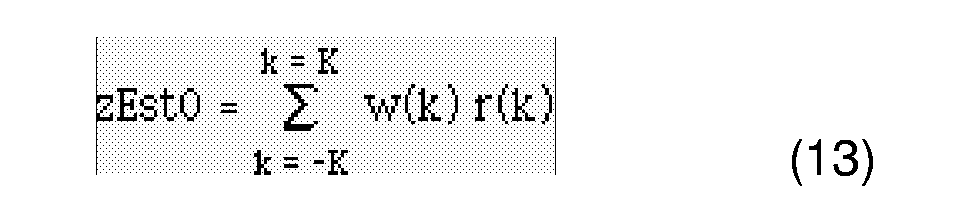
- the method comprises a step where the rejector tries to best estimate the central signal sample by linear combination of itself and its 2 K neighbors left and right. This linear combination is optimized to minimize the square of the module of the estimation error.
- the estimated signal is noted zEst0, we ask: either, considering the true value of the amplitude of the interference:
- the complex weights w (k) are adjusted to minimize the expectation of the mean squared error of estimation, namely: The solution that minimizes this quantity leads to complex weighting coefficients: To obtain the solution we can consider that w (0) is necessarily real not to change the phase of the useful signal (in the center) and that w (k) all have the same importance and must subtract and "straighten" the sample interference that is affected to them.
- the decision step of correcting the received signal is performed by example as described below.
- the method comprises a step of comparing the value of the ratio r to a threshold r0 leading to a decision to use the rejector when r is smaller than r0.
- the value r0 is for example adjusted experimentally according to the system. For example, it is chosen equal to 0001.
- the decision to use the Rejector is performed on a filtered version of r.
- This filtered version is by example the average calculated on the 2 M neighboring samples of the sample current.
Landscapes
- Engineering & Computer Science (AREA)
- Computer Networks & Wireless Communication (AREA)
- Signal Processing (AREA)
- Noise Elimination (AREA)
- Cable Transmission Systems, Equalization Of Radio And Reduction Of Echo (AREA)
- Radar Systems Or Details Thereof (AREA)
- Soundproofing, Sound Blocking, And Sound Damping (AREA)
Abstract
Description


- La figure 1 un exemple d'architecture d'un dispositif de réjection selon l'invention,
- La figure 2 le détail du système de calcul des exponentielles complexes de la figure 1,
- La figure 3 un système de multiplication et de sommation de la figure 1,
- La figure 4 le détail du système de traitement de la figure 1,
- La figure 5 le détail du système de lissage et de décision de la figure 1.
- faire phi(-n) = atan2(lm(r(-n), Re(r(-n))
- pour i = 1 - n ... n, fai re :
- phi(i) = atan2(Im(r(i), Re(r(i))
- si phi(i) est supérieur à phi(i - 1) + PI faire phi(i) = phi(i) + 2 PI
- si phi(i) est inférieur à phi(i - 1) - PI faire phi(i) = phi(i) - 2 PI



On note teta(k) la suite de ces phases lissées.
Estimation de l'amplitude de l'interférence ou du brouilleur






Si le signal estimé est noté zEst0, on pose :


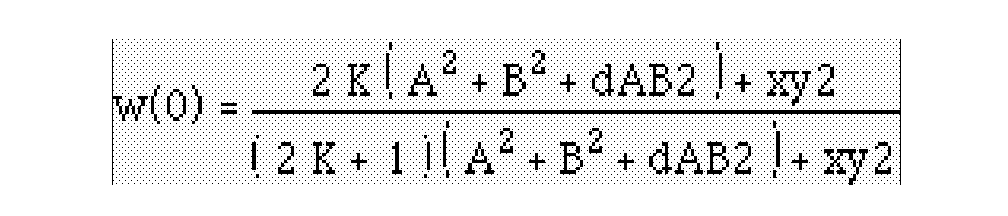


Dans l'autre cas limite, où l'interférence ou le brouillage est très puissant, les coefficients de pondération sont :
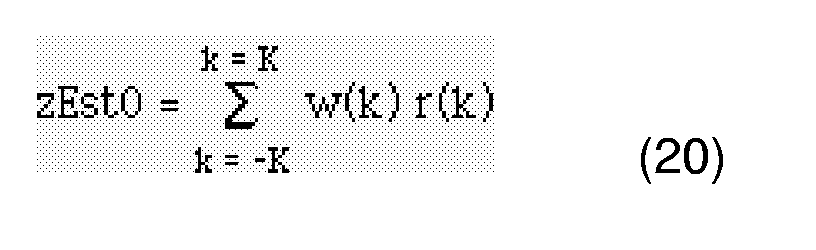
Ces coefficients sont utilisés pour obtenir la valeur corrigée du signal en utilisant la formule
Le procédé selon l'invention utilise par exemple deux dispositifs disposés par exemple en cascade :
- un contrôle automatique de gain (CAG) rapide sur le signal avant le réjecteur, le temps de réaction du CAG étant court comparé à la durée minimale des impulsions de l'interférence, et long comparé à l'inverse de la largeur de bande du signal
- un écrêteur, après le réjecteur, réglé de telle sorte que :
- le signal seul ou le signal traité en présence d'une interférence forte ne soit jamais écrêté (ou suffisamment peu pour que cela n'ait aucune influence sur les performances)
- lors des transitoires, l'écrêtage transforme les impulsions de l'interférence résiduelles en impulsions (à amplitude constante) beaucoup plus faibles afin de perturber au minimum la réception.
- un contrôle automatique de gain rapide 100 en entrée, recevant le signal à traiter (signal composé du signal utile et de l'interférence),
- un système de calcul des exponentielles complexes 200 mettant en oeuvre les processus de calcul de la phase du signal, de sa correction, de la régression quadratique et du calcul des exponentielles complexes exposées précédemment (dans l'étape d'estimation de la phase),
- une ligne à retard 300 pour le signal régulé, correspondant à 2 K + 1 échantillons décorrélés, avec une sortie particulière pour l'échantillon central ; un retard initial supplémentaire est prévu pour compenser le retard introduit par le dispositif 200 (détaillé plus loin),
- une ligne à retard "phases" 400 pour les exponentielles complexes, de la même longueur que la précédente, dont la sortie centrale correspond à la phase de l'échantillon centrale et est notée E0,
- un système de multiplication et sommation 500 qui génère deux sorties S0 et S1 correspondant respectivement à l'échantillon de signal central et à ses voisins dans le passé et dans le futur,
- un système 600 qui calcule le carré du module du signal S2,
- un système de traitement 700 qui, à partir des quantités S0, S1, S2 et Po se charge d'élaborer l'échantillon de signal central corrigé et la quantité r à partir de laquelle se fera la commutation réjection / non réjection, avec Po représentant la phase de l'échantillon central,
- le système 800 de lissage qui décide de la commutation, il lisse la quantité r,
- deux lignes à retard 900 et 1000 destinées à synchroniser l'échantillon central non corrigé, l'échantillon central corrigé, et la décision prise de commutation ou de non commutation,
- un commutateur 1100 permettant de choisir l'échantillon corrigé ou non corrigé en fonction de la décision,
- un écrêteur 1200 qui supprime les impulsions de l'interférence résultant des transitoires lors des changements brusques de la fréquence de l'interférence.
Le dispositif 200 comporte, dans l'ordre :
- un système de calcul de la phase des échantillons du signal supposé être de la forme Re + j lm soit par logiciel (fonction atan2 à 2 arguments) soit par d'autres moyens, par exemple l'algorithme connu sous le nom de CORDIC décrit dans les livres connus de l'Homme du métier en traitement du signal; il est à noter que, le signal étant généralement à faible rapport signal/bruit, une évaluation relativement grossière de la phase peut être acceptée (par exemple, 1/256 ème de tour). La phase est donnée entre -Pi et +Pi,
- le système de correction 202 effectue les corrections de +2 Pi ou -2 Pi assurant le maximum de continuité de phase,
- le dispositif 203 se charge du calcul itératif des coefficients a, b, c de l'approximation locale quadratique de la phase et fournit en sortie la phase estimée au centre de la plage de calcul,
- le système 204 calcule l'exponentielle complexe associée à la dite phase, par exemple en lisant une table à l'adresse adéquate.
- Le système 500 de sommation effectue au moyen des multiplieurs 501.-K ... 501.0 ... 501.+K les multiplications des échantillons de sortie des lignes à retard signal 300 et "phases" 400.
- La sortie du multiplieur 501.0 fournit le signal de sortie SO.
- Les sorties des autres multiplieurs sont sommées pour générer le signal S2, somme des produits des échantillons voisins de l'échantillon central corrigés de leurs phases estimées respectives.
- Le système 700 calcule l'échantillon de signal central corrigé et la quantité r à partir de laquelle se fera la commutation réjection / non réjection à partir des quantités S0, S1, S2 et Po.
- Les quantités S0 et S1 sont sommées dans l'additionneur 701, et la somme multipliée par 1/(2 K + 1) dans le multiplieur 702 et par le conjugué de Po (Po*, calculé par le conjugateur 703) dans le multiplieur 704 pour fournir la quantité Z = A + j B utilisée dans l'exposé précédent.
- Le carré du module de Z (amplitude complexe du l'interférence) est calculé par le dispositif 705 et la quantité r dans le dispositif 706.
- Le reste du système 700 est destiné à calculer l'échantillon de signal central corrigé.
- La moyenne des carrés des modules du signal est calculée à partir du signal S2 renormalisé par le multiplieur 707 au moyen de la ligne à retard 708, de l'additionneur / soustracteur 709 et de l'accumulateur 710.
- La ligne à retard 708 comporte elle aussi un retard initial pour compenser celui du système 200.
- Le procédé soustrait alors de la sortie de l'accumulateur le carré du module de Z par le soustracteur 711 pour obtenir la quantité delta citée plus haut.
- Le dispositif 712 calcule le poids w(0) à appliquer à l'échantillon central et le module commun des poids voisins |w(k)| (appliqué aux autres échantillons) lesquels pondèrent respectivement le signal S0 dans le multiplieur 713 et le signal S1 dans le multiplieur 714 avant addition dans le sommateur 715.
- La sortie du sommateur 715 est finalement multipliée par l'exponentielle complexe conjuguée Po* par le multiplieur 716 qui fournit finalement l'échantillon central de signal corrigé, avec la bonne phase.
- Il est aussi possible de multiplier directement S0 et S1 par Po* et ne pas faire la multiplication finale, et/ou intégrer les multiplications par des constantes dans le système de calcul 712.
- une ligne à retard 801 dont on somme les sorties dans le sommateur 802.
- La sortie du sommateur est renormalisée par le multiplieur 803 et comparée à un seuil r0 dans le comparateur 804.
- Si l'entrée du comparateur, correspondant à la valeur du rapport r est en dessous de r0, le comparateur donne en sortie la valeur 1, sinon il donne la valeur 0.
- Il est possible d'éviter l'utilisation du multiplieur 803 en prenant un seuil r0 (2 M + 1) fois plus élevé que sa valeur théorique.
Claims (9)
- Procédé de réjection d'interférence d'un signal utile caractérisé en ce qu'il comporte au moins les étapes suivantes :a) évaluer la phase de l'interférence et évaluer l'amplitude instantanée de l'interférence par la méthode des moindres carrés,b) former le rapport r=(B2/(A2+B2)) où A est la partie réelle de l'amplitude de l'interférence et B la partie complexe de l'amplitude de l'interférence,c) si r est inférieur à une valeur seuil r0, corriger le signal en remplaçant l'échantillon central du signal par une somme pondérée formée de lui-même et des échantillons voisins.
- Procédé selon la revendication 1 caractérisé en ce que la phase de l'interférence est évaluée en utilisant une loi parabolique et l'amplitude de l'interférence est évaluée par la méthode des moindres carrés.
- Procédé selon la revendication 1 caractérisé en ce que l'on utilise les coefficients de pondération suivant :

 où K est le nombre d'échantillons considéré, k l'indice de l'échantillon,A et B les amplitudes complexes de l'interférence,dAB2 l'erreur quadratique moyenne d'estimation de A+jB,xy2 la puissance moyenne du signal,teta(k) la suite des phases lissées.
 - Procédé selon la revendication 1 caractérisé en ce que la valeur de r est filtrée et correspond à la moyenne calculée sur les 2M échantillons voisins de l'échantillon central.
- Procédé selon la revendication 1 caractérisé en ce qu'il comporte une étape de contrôle automatique du gain du signal avant l'étape de correction et une étape de transformation des impulsions de l'interférence résiduelles en impulsions beaucoup plus faibles sur le signal corrigé.
- Système de réjection de l'interférence d'un signal selon la revendication 1 comportant au moins un dispositif (800, 1100) de prise de décision utilisant les coefficients A, B des amplitudes complexes de l'interférence et un dispositif de traitement (700) du signal en liaison avec les moyens de décision, le dispositif de traitement étant adapté à éliminer d'un échantillon choisi du signal, l'interférence estimée à partir des échantillons voisins et des échantillons précédents de l'échantillon choisi.
- Système selon la revendication 6 caractérisé en ce qu'il comporte un dispositif de sélection (400) permettant de sélectionner comme échantillon choisi, l'échantillon central du signal.
- Système selon la revendication 6 caractérisé en ce que le dispositif de traitement comporte un dispositif d'estimation de la phase du signal à l'aide d'une loi parabolique, un dispositif d'estimation de l'amplitude complexe du signal, afin de déterminer le rapport du seuil de décision.
- Système selon la revendication 6 caractérisé en ce qu'il comporte un dispositif de contrôle automatique de gain (100) disposé avant le dispositif de traitement (700) et un dispositif d'écrêtage (1200) disposé après le dispositif de traitement du signal.
Applications Claiming Priority (2)
| Application Number | Priority Date | Filing Date | Title |
|---|---|---|---|
| FR0305910A FR2854994B1 (fr) | 2003-05-16 | 2003-05-16 | Dispositif et procede de rejection d'interferences auto-adaptatif |
| FR0305910 | 2003-05-16 |
Publications (2)
| Publication Number | Publication Date |
|---|---|
| EP1478096A1 true EP1478096A1 (fr) | 2004-11-17 |
| EP1478096B1 EP1478096B1 (fr) | 2010-06-30 |
Family
ID=33017186
Family Applications (1)
| Application Number | Title | Priority Date | Filing Date |
|---|---|---|---|
| EP04102079A Expired - Lifetime EP1478096B1 (fr) | 2003-05-16 | 2004-05-13 | Dispositif et procédé de réjection d'interférences auto-adaptatif |
Country Status (5)
| Country | Link |
|---|---|
| US (1) | US7477874B2 (fr) |
| EP (1) | EP1478096B1 (fr) |
| AT (1) | ATE472857T1 (fr) |
| DE (1) | DE602004027863D1 (fr) |
| FR (1) | FR2854994B1 (fr) |
Families Citing this family (2)
| Publication number | Priority date | Publication date | Assignee | Title |
|---|---|---|---|---|
| US8023921B2 (en) * | 2008-12-03 | 2011-09-20 | Bae Systems Information And Electronic Systems Integration Inc. | Quadratic amplitude control circuit for cosite interference cancellation |
| CN112188181B (zh) * | 2019-07-02 | 2023-07-04 | 中强光电股份有限公司 | 图像显示设备、立体图像处理电路及其同步信号校正方法 |
Citations (2)
| Publication number | Priority date | Publication date | Assignee | Title |
|---|---|---|---|---|
| US4501004A (en) * | 1982-01-30 | 1985-02-19 | Nippon Electric Co., Ltd. | Device for eliminating FM or like interference from a digital microwave signal |
| US5410750A (en) * | 1992-02-24 | 1995-04-25 | Raytheon Company | Interference suppressor for a radio receiver |
Family Cites Families (7)
| Publication number | Priority date | Publication date | Assignee | Title |
|---|---|---|---|---|
| FR2431229A1 (fr) | 1978-07-12 | 1980-02-08 | Thomson Csf | Dispositif de demodulation de signaux modules en deplacement de frequence et systeme de transmission comportant un tel dispositif |
| FR2604318B1 (fr) | 1986-09-23 | 1989-03-31 | Thomson Csf | Procede et dispositif de synchronisation symbole et leur application a la demodulation symbole de messages numeriques |
| US5572249A (en) * | 1994-07-07 | 1996-11-05 | Philips Electronics North America Corporation | Method and apparatus for optimal NTSC rejection filtering and transmitter and receiver comprising same |
| FR2756686B1 (fr) | 1996-11-29 | 1999-02-19 | Thomson Csf | Procede et dispositif de radiodiffusion mixte analogique et numerique d'emission radiophonique diffusee par un meme emetteur |
| US6094408A (en) * | 1998-06-26 | 2000-07-25 | Philips Electronics North America Corporation | Adaptive and selective cancellation of inter-symbol interference of a read channel in storage technologies |
| DE19925216C1 (de) * | 1999-06-01 | 2001-01-04 | Siemens Ag | Verfahren zur störsignalfreien Auswertung von Radarsignalen |
| FI19992694A7 (fi) * | 1999-12-15 | 2001-06-16 | Nokia Networks Oy | Menetelmä hajaspektrisignaalin vastaanottamiseksi ja vastaanotin |
-
2003
- 2003-05-16 FR FR0305910A patent/FR2854994B1/fr not_active Expired - Fee Related
-
2004
- 2004-05-13 DE DE602004027863T patent/DE602004027863D1/de not_active Expired - Lifetime
- 2004-05-13 AT AT04102079T patent/ATE472857T1/de not_active IP Right Cessation
- 2004-05-13 EP EP04102079A patent/EP1478096B1/fr not_active Expired - Lifetime
- 2004-05-14 US US10/845,511 patent/US7477874B2/en not_active Expired - Fee Related
Patent Citations (2)
| Publication number | Priority date | Publication date | Assignee | Title |
|---|---|---|---|---|
| US4501004A (en) * | 1982-01-30 | 1985-02-19 | Nippon Electric Co., Ltd. | Device for eliminating FM or like interference from a digital microwave signal |
| US5410750A (en) * | 1992-02-24 | 1995-04-25 | Raytheon Company | Interference suppressor for a radio receiver |
Also Published As
| Publication number | Publication date |
|---|---|
| ATE472857T1 (de) | 2010-07-15 |
| FR2854994A1 (fr) | 2004-11-19 |
| US20040266353A1 (en) | 2004-12-30 |
| DE602004027863D1 (de) | 2010-08-12 |
| US7477874B2 (en) | 2009-01-13 |
| EP1478096B1 (fr) | 2010-06-30 |
| FR2854994B1 (fr) | 2005-07-01 |
Similar Documents
| Publication | Publication Date | Title |
|---|---|---|
| EP0932964B1 (fr) | Procede et dispositif d'egalisation aveugle des effets d'un canal de transmission sur un signal de parole numerique | |
| EP0130263B1 (fr) | Procédé d'initialisation d'un filtre annuleur d'écho et système de communication utilisant ledit procédé | |
| FR2904168A1 (fr) | Systeme d'estimation de la qualite de reception d'une transmission numerique. | |
| FR2814011A1 (fr) | Procede d'estimation optimale d'un canal de propagation reposant uniquement sur les symboles pilotes et estimateur correspondant | |
| EP0576359B1 (fr) | Procédé et dispositif égaliseur à retour de décisions pour la transmission par blocs de symboles d'information | |
| FR2646978A1 (fr) | Procede et installation a codage de signaux sonores | |
| EP2908155B1 (fr) | Procédé de traitement antibrouillage d'un signal radioélectrique, module et programme d'ordinateur associés | |
| EP0140809B1 (fr) | Dispositif de correction d'échos, notamment pour système de télédiffusion de données | |
| FR2825552A1 (fr) | Dispositif et procede de demodulation numerique d'un signal recu par selection d'un filtre et recepteur de communication numerique le comportant | |
| EP1482648B1 (fr) | Récepteur de signal ultra large bande et procédé de réception associé | |
| EP1478096B1 (fr) | Dispositif et procédé de réjection d'interférences auto-adaptatif | |
| EP0970562B1 (fr) | Filtre numerique pour retards fractionnaires | |
| EP0127544B1 (fr) | Annuleur d'écho à filtre numérique adaptatif pour système de transmission | |
| EP2077057B1 (fr) | Détection de bande de fréquences libre | |
| EP1438815B1 (fr) | Annuleur d interferences entre symboles | |
| FR2859336A1 (fr) | Ameliorations se rapportant au traitement d'un signal code par saut de frequence | |
| EP1155497B1 (fr) | Procede et systeme de traitement de signaux d'antenne | |
| FR2825550A1 (fr) | Dispositif et procede de demodulation numerique d'un signal recu par selection d'un filtre et recepteur de communication numerique le comportant | |
| EP1246373A1 (fr) | Procédé et dispositif pour le traitement d'interferences dans des signaux reçus par un réseau de capteurs | |
| EP0831626B1 (fr) | Procédé et dispositif pour déterminer l'erreur sur la fréquence d'une porteuse | |
| WO2006024712A1 (fr) | Procede de conception d'un filtre de reception numerique et dispositif de reception correspondant | |
| EP2175599A1 (fr) | Procédé d'annulation de bruits impulsifs | |
| EP0975126B1 (fr) | Procédé d'estimation d'erreur de fréquence d'un d'émodulateur QPSK | |
| FR2625856A1 (fr) | Procede et dispositif de demodulation de donnees numeriques transmises en evasion de frequence sur un canal de transmission ionospherique | |
| FR2783121A1 (fr) | Procede et dispositif de recuperation de porteuse d'un signal numerique |
Legal Events
| Date | Code | Title | Description |
|---|---|---|---|
| PUAI | Public reference made under article 153(3) epc to a published international application that has entered the european phase |
Free format text: ORIGINAL CODE: 0009012 |
|
| AK | Designated contracting states |
Kind code of ref document: A1 Designated state(s): AT BE BG CH CY CZ DE DK EE ES FI FR GB GR HU IE IT LI LU MC NL PL PT RO SE SI SK TR |
|
| AX | Request for extension of the european patent |
Extension state: AL HR LT LV MK |
|
| AKX | Designation fees paid | ||
| 17P | Request for examination filed |
Effective date: 20050406 |
|
| RAX | Requested extension states of the european patent have changed |
Extension state: AL Payment date: 20050406 Extension state: HR Payment date: 20050406 Extension state: MK Payment date: 20050406 Extension state: LV Payment date: 20050406 |
|
| RBV | Designated contracting states (corrected) |
Designated state(s): AT BE BG CH CY CZ DE DK EE ES FI FR GB GR HU IE IT LI LU MC NL PL PT RO SE SI SK TR |
|
| REG | Reference to a national code |
Ref country code: DE Ref legal event code: 8566 |
|
| GRAP | Despatch of communication of intention to grant a patent |
Free format text: ORIGINAL CODE: EPIDOSNIGR1 |
|
| RIN1 | Information on inventor provided before grant (corrected) |
Inventor name: LAURENT, PIERRE-ANDRE |
|
| GRAS | Grant fee paid |
Free format text: ORIGINAL CODE: EPIDOSNIGR3 |
|
| GRAA | (expected) grant |
Free format text: ORIGINAL CODE: 0009210 |
|
| AK | Designated contracting states |
Kind code of ref document: B1 Designated state(s): AT BE BG CH CY CZ DE DK EE ES FI FR GB GR HU IE IT LI LU MC NL PL PT RO SE SI SK TR |
|
| AX | Request for extension of the european patent |
Extension state: AL HR LV MK |
|
| REG | Reference to a national code |
Ref country code: GB Ref legal event code: FG4D Free format text: NOT ENGLISH Ref country code: CH Ref legal event code: EP |
|
| REG | Reference to a national code |
Ref country code: IE Ref legal event code: FG4D Free format text: LANGUAGE OF EP DOCUMENT: FRENCH |
|
| REF | Corresponds to: |
Ref document number: 602004027863 Country of ref document: DE Date of ref document: 20100812 Kind code of ref document: P |
|
| REG | Reference to a national code |
Ref country code: DE Ref legal event code: R096 Ref document number: 602004027863 Country of ref document: DE Effective date: 20100812 |
|
| REG | Reference to a national code |
Ref country code: NL Ref legal event code: VDEP Effective date: 20100630 |
|
| PG25 | Lapsed in a contracting state [announced via postgrant information from national office to epo] |
Ref country code: SE Free format text: LAPSE BECAUSE OF FAILURE TO SUBMIT A TRANSLATION OF THE DESCRIPTION OR TO PAY THE FEE WITHIN THE PRESCRIBED TIME-LIMIT Effective date: 20100630 |
|
| PG25 | Lapsed in a contracting state [announced via postgrant information from national office to epo] |
Ref country code: FI Free format text: LAPSE BECAUSE OF FAILURE TO SUBMIT A TRANSLATION OF THE DESCRIPTION OR TO PAY THE FEE WITHIN THE PRESCRIBED TIME-LIMIT Effective date: 20100630 Ref country code: SI Free format text: LAPSE BECAUSE OF FAILURE TO SUBMIT A TRANSLATION OF THE DESCRIPTION OR TO PAY THE FEE WITHIN THE PRESCRIBED TIME-LIMIT Effective date: 20100630 Ref country code: AT Free format text: LAPSE BECAUSE OF FAILURE TO SUBMIT A TRANSLATION OF THE DESCRIPTION OR TO PAY THE FEE WITHIN THE PRESCRIBED TIME-LIMIT Effective date: 20100630 |
|
| PG25 | Lapsed in a contracting state [announced via postgrant information from national office to epo] |
Ref country code: PL Free format text: LAPSE BECAUSE OF FAILURE TO SUBMIT A TRANSLATION OF THE DESCRIPTION OR TO PAY THE FEE WITHIN THE PRESCRIBED TIME-LIMIT Effective date: 20100630 Ref country code: GR Free format text: LAPSE BECAUSE OF FAILURE TO SUBMIT A TRANSLATION OF THE DESCRIPTION OR TO PAY THE FEE WITHIN THE PRESCRIBED TIME-LIMIT Effective date: 20101001 |
|
| PG25 | Lapsed in a contracting state [announced via postgrant information from national office to epo] |
Ref country code: NL Free format text: LAPSE BECAUSE OF FAILURE TO SUBMIT A TRANSLATION OF THE DESCRIPTION OR TO PAY THE FEE WITHIN THE PRESCRIBED TIME-LIMIT Effective date: 20100630 Ref country code: EE Free format text: LAPSE BECAUSE OF FAILURE TO SUBMIT A TRANSLATION OF THE DESCRIPTION OR TO PAY THE FEE WITHIN THE PRESCRIBED TIME-LIMIT Effective date: 20100630 |
|
| REG | Reference to a national code |
Ref country code: IE Ref legal event code: FD4D |
|
| PG25 | Lapsed in a contracting state [announced via postgrant information from national office to epo] |
Ref country code: RO Free format text: LAPSE BECAUSE OF FAILURE TO SUBMIT A TRANSLATION OF THE DESCRIPTION OR TO PAY THE FEE WITHIN THE PRESCRIBED TIME-LIMIT Effective date: 20100630 Ref country code: SK Free format text: LAPSE BECAUSE OF FAILURE TO SUBMIT A TRANSLATION OF THE DESCRIPTION OR TO PAY THE FEE WITHIN THE PRESCRIBED TIME-LIMIT Effective date: 20100630 Ref country code: PT Free format text: LAPSE BECAUSE OF FAILURE TO SUBMIT A TRANSLATION OF THE DESCRIPTION OR TO PAY THE FEE WITHIN THE PRESCRIBED TIME-LIMIT Effective date: 20101102 Ref country code: CZ Free format text: LAPSE BECAUSE OF FAILURE TO SUBMIT A TRANSLATION OF THE DESCRIPTION OR TO PAY THE FEE WITHIN THE PRESCRIBED TIME-LIMIT Effective date: 20100630 Ref country code: CY Free format text: LAPSE BECAUSE OF FAILURE TO SUBMIT A TRANSLATION OF THE DESCRIPTION OR TO PAY THE FEE WITHIN THE PRESCRIBED TIME-LIMIT Effective date: 20100630 |
|
| PG25 | Lapsed in a contracting state [announced via postgrant information from national office to epo] |
Ref country code: IE Free format text: LAPSE BECAUSE OF FAILURE TO SUBMIT A TRANSLATION OF THE DESCRIPTION OR TO PAY THE FEE WITHIN THE PRESCRIBED TIME-LIMIT Effective date: 20100630 Ref country code: DK Free format text: LAPSE BECAUSE OF FAILURE TO SUBMIT A TRANSLATION OF THE DESCRIPTION OR TO PAY THE FEE WITHIN THE PRESCRIBED TIME-LIMIT Effective date: 20100630 |
|
| PLBE | No opposition filed within time limit |
Free format text: ORIGINAL CODE: 0009261 |
|
| STAA | Information on the status of an ep patent application or granted ep patent |
Free format text: STATUS: NO OPPOSITION FILED WITHIN TIME LIMIT |
|
| 26N | No opposition filed |
Effective date: 20110331 |
|
| PG25 | Lapsed in a contracting state [announced via postgrant information from national office to epo] |
Ref country code: ES Free format text: LAPSE BECAUSE OF FAILURE TO SUBMIT A TRANSLATION OF THE DESCRIPTION OR TO PAY THE FEE WITHIN THE PRESCRIBED TIME-LIMIT Effective date: 20101011 |
|
| REG | Reference to a national code |
Ref country code: DE Ref legal event code: R097 Ref document number: 602004027863 Country of ref document: DE Effective date: 20110330 Ref country code: DE Ref legal event code: R097 Ref document number: 602004027863 Country of ref document: DE Effective date: 20110331 |
|
| BERE | Be: lapsed |
Owner name: THALES Effective date: 20110531 |
|
| PG25 | Lapsed in a contracting state [announced via postgrant information from national office to epo] |
Ref country code: MC Free format text: LAPSE BECAUSE OF NON-PAYMENT OF DUE FEES Effective date: 20110531 |
|
| REG | Reference to a national code |
Ref country code: CH Ref legal event code: PL |
|
| PG25 | Lapsed in a contracting state [announced via postgrant information from national office to epo] |
Ref country code: LI Free format text: LAPSE BECAUSE OF NON-PAYMENT OF DUE FEES Effective date: 20110531 Ref country code: CH Free format text: LAPSE BECAUSE OF NON-PAYMENT OF DUE FEES Effective date: 20110531 |
|
| PG25 | Lapsed in a contracting state [announced via postgrant information from national office to epo] |
Ref country code: BE Free format text: LAPSE BECAUSE OF NON-PAYMENT OF DUE FEES Effective date: 20110531 |
|
| PG25 | Lapsed in a contracting state [announced via postgrant information from national office to epo] |
Ref country code: LU Free format text: LAPSE BECAUSE OF NON-PAYMENT OF DUE FEES Effective date: 20110513 |
|
| PG25 | Lapsed in a contracting state [announced via postgrant information from national office to epo] |
Ref country code: TR Free format text: LAPSE BECAUSE OF FAILURE TO SUBMIT A TRANSLATION OF THE DESCRIPTION OR TO PAY THE FEE WITHIN THE PRESCRIBED TIME-LIMIT Effective date: 20100630 Ref country code: BG Free format text: LAPSE BECAUSE OF FAILURE TO SUBMIT A TRANSLATION OF THE DESCRIPTION OR TO PAY THE FEE WITHIN THE PRESCRIBED TIME-LIMIT Effective date: 20100930 |
|
| PG25 | Lapsed in a contracting state [announced via postgrant information from national office to epo] |
Ref country code: HU Free format text: LAPSE BECAUSE OF FAILURE TO SUBMIT A TRANSLATION OF THE DESCRIPTION OR TO PAY THE FEE WITHIN THE PRESCRIBED TIME-LIMIT Effective date: 20100630 |
|
| REG | Reference to a national code |
Ref country code: FR Ref legal event code: PLFP Year of fee payment: 13 |
|
| REG | Reference to a national code |
Ref country code: FR Ref legal event code: PLFP Year of fee payment: 14 |
|
| REG | Reference to a national code |
Ref country code: FR Ref legal event code: PLFP Year of fee payment: 15 |
|
| PGFP | Annual fee paid to national office [announced via postgrant information from national office to epo] |
Ref country code: DE Payment date: 20190430 Year of fee payment: 16 Ref country code: IT Payment date: 20190527 Year of fee payment: 16 |
|
| PGFP | Annual fee paid to national office [announced via postgrant information from national office to epo] |
Ref country code: GB Payment date: 20190429 Year of fee payment: 16 |
|
| REG | Reference to a national code |
Ref country code: DE Ref legal event code: R119 Ref document number: 602004027863 Country of ref document: DE |
|
| GBPC | Gb: european patent ceased through non-payment of renewal fee |
Effective date: 20200513 |
|
| PG25 | Lapsed in a contracting state [announced via postgrant information from national office to epo] |
Ref country code: GB Free format text: LAPSE BECAUSE OF NON-PAYMENT OF DUE FEES Effective date: 20200513 |
|
| PG25 | Lapsed in a contracting state [announced via postgrant information from national office to epo] |
Ref country code: DE Free format text: LAPSE BECAUSE OF NON-PAYMENT OF DUE FEES Effective date: 20201201 |
|
| PG25 | Lapsed in a contracting state [announced via postgrant information from national office to epo] |
Ref country code: IT Free format text: LAPSE BECAUSE OF NON-PAYMENT OF DUE FEES Effective date: 20200513 |
|
| P01 | Opt-out of the competence of the unified patent court (upc) registered |
Effective date: 20230517 |
|
| PGFP | Annual fee paid to national office [announced via postgrant information from national office to epo] |
Ref country code: FR Payment date: 20230421 Year of fee payment: 20 |