EP1477527A1 - Aromatic polycarbonate resins for optical disk substrates - Google Patents
Aromatic polycarbonate resins for optical disk substrates Download PDFInfo
- Publication number
- EP1477527A1 EP1477527A1 EP03705154A EP03705154A EP1477527A1 EP 1477527 A1 EP1477527 A1 EP 1477527A1 EP 03705154 A EP03705154 A EP 03705154A EP 03705154 A EP03705154 A EP 03705154A EP 1477527 A1 EP1477527 A1 EP 1477527A1
- Authority
- EP
- European Patent Office
- Prior art keywords
- aromatic polycarbonate
- polycarbonate resin
- optical disc
- disc substrates
- mass
- Prior art date
- Legal status (The legal status is an assumption and is not a legal conclusion. Google has not performed a legal analysis and makes no representation as to the accuracy of the status listed.)
- Granted
Links
Classifications
-
- C—CHEMISTRY; METALLURGY
- C08—ORGANIC MACROMOLECULAR COMPOUNDS; THEIR PREPARATION OR CHEMICAL WORKING-UP; COMPOSITIONS BASED THEREON
- C08K—Use of inorganic or non-macromolecular organic substances as compounding ingredients
- C08K5/00—Use of organic ingredients
- C08K5/04—Oxygen-containing compounds
- C08K5/10—Esters; Ether-esters
- C08K5/101—Esters; Ether-esters of monocarboxylic acids
- C08K5/103—Esters; Ether-esters of monocarboxylic acids with polyalcohols
-
- G—PHYSICS
- G11—INFORMATION STORAGE
- G11B—INFORMATION STORAGE BASED ON RELATIVE MOVEMENT BETWEEN RECORD CARRIER AND TRANSDUCER
- G11B7/00—Recording or reproducing by optical means, e.g. recording using a thermal beam of optical radiation by modifying optical properties or the physical structure, reproducing using an optical beam at lower power by sensing optical properties; Record carriers therefor
- G11B7/24—Record carriers characterised by shape, structure or physical properties, or by the selection of the material
- G11B7/241—Record carriers characterised by shape, structure or physical properties, or by the selection of the material characterised by the selection of the material
- G11B7/252—Record carriers characterised by shape, structure or physical properties, or by the selection of the material characterised by the selection of the material of layers other than recording layers
- G11B7/253—Record carriers characterised by shape, structure or physical properties, or by the selection of the material characterised by the selection of the material of layers other than recording layers of substrates
- G11B7/2533—Record carriers characterised by shape, structure or physical properties, or by the selection of the material characterised by the selection of the material of layers other than recording layers of substrates comprising resins
- G11B7/2534—Record carriers characterised by shape, structure or physical properties, or by the selection of the material characterised by the selection of the material of layers other than recording layers of substrates comprising resins polycarbonates [PC]
-
- G—PHYSICS
- G11—INFORMATION STORAGE
- G11B—INFORMATION STORAGE BASED ON RELATIVE MOVEMENT BETWEEN RECORD CARRIER AND TRANSDUCER
- G11B7/00—Recording or reproducing by optical means, e.g. recording using a thermal beam of optical radiation by modifying optical properties or the physical structure, reproducing using an optical beam at lower power by sensing optical properties; Record carriers therefor
- G11B7/24—Record carriers characterised by shape, structure or physical properties, or by the selection of the material
- G11B7/241—Record carriers characterised by shape, structure or physical properties, or by the selection of the material characterised by the selection of the material
- G11B7/252—Record carriers characterised by shape, structure or physical properties, or by the selection of the material characterised by the selection of the material of layers other than recording layers
- G11B7/253—Record carriers characterised by shape, structure or physical properties, or by the selection of the material characterised by the selection of the material of layers other than recording layers of substrates
- G11B7/2533—Record carriers characterised by shape, structure or physical properties, or by the selection of the material characterised by the selection of the material of layers other than recording layers of substrates comprising resins
- G11B7/2535—Record carriers characterised by shape, structure or physical properties, or by the selection of the material characterised by the selection of the material of layers other than recording layers of substrates comprising resins polyesters, e.g. PET, PETG or PEN
Definitions
- the present invention relates to an aromatic polycarbonate resin product for producing a high-recording-density optical recording medium which performs writing in, writing in/reading out, reading out, deleting, etc. of information through collection of optical beams. More particularly, the present invention relates to an aromatic polycarbonate resin product having excellent moldability and physical properties for producing optical disc substrates such as compact discs (audio CD, CD-ROM, CD-R, and CD-RW), MOs, MDs, and digital versatile discs (DVD-ROM, DVD-R, DVD-RW, and DVD-RAM).
- compact discs audio CD, CD-ROM, CD-R, and CD-RW
- MOs MOs
- MDs digital versatile discs
- DVD-ROM, DVD-R, DVD-RW, and DVD-RAM digital versatile discs
- Optical disc substrates are produced from a material such as aromatic polycarbonate resin, acrylic resin, epoxy resin, or glass.
- plastic resins are generally employed, for reasons such as easy formation of fine molded articles through injection molding and adaptability to large-scale production.
- polycarbonate resin is preferably employed, in that it satisfies properties required of optical disc substrates such as strength (e.g., impact strength), transparency, heat resistance, and low water absorption.
- Japanese Patent Application Laid-Open ( kokai ) No. Heisei 10(1998)-60105 discloses an aromatic polycarbonate resin for optical disc substrates, containing a C 14 -C 30 fatty acid monoglyceride in an amount of 0.06 to 0.1 mass%.
- an essential task of optical discs serving as a recording medium is to store its recorded data for a long period of time.
- the present inventors have made the accelerated deterioration test of optical disc sample through keeping the sample under temperature of 90°C and 90% relative humidity, so as to check the reliability of the optical disc sample.
- the test results indicate that, when the amount of the C 14 -C 30 fatty acid monoglyceride added into an aromatic polycarbonate resin is more than 0.05 mass%, the generation of polarizing opaque defects through hydrolysis of an aromatic polycarbonate resin is not prone to be promoted, but the molecular weight of the resin is prone to be lowered, thereby the reliability of recording medium may be also reduced.
- the amount of the C 14 -C 30 fatty acid monoglyceride added into an aromatic polycarbonate resin should be as small as possible, up to the minimum level required as necessary and sufficient level.
- nebulous marks may appear on the surface of optical disc substrates due to poor mold releasing.
- the marks adversely affect signals (i.e., generate the noises), or flashes may generate, as mentioned above, thereby increasing optical defects.
- the amount of of the C 14 -C 30 fatty acid monoglyceride should be controlled within a certain allowable range.
- the C 14 -C 30 fatty acid monoglyceride serving as a mold release agent is degraded to form a fatty acid monoglyceride carbonate, a fatty acid diglyceride, and a fatty acid triglyceride, thereby decreasing releasability of an optical disc substrate upon molding.
- a fatty acid monoglyceride carbonate, a fatty acid diglyceride or a fatty acid triglyceride might sometimes generate due to denaturing of the C 14 -C 30 fatty acid monoglyceride serving as a mold-releasing agent during the process for producing resin pellets through extruding melted powder of aromatic polycarbonate resin by using an extruder; thereby decreasing the releasing-ability of optical disc substrates in molding.
- the present inventors have found that denaturing of the C14-C30 fatty acid monoglyceride is effectively prevented by adding water to an aromatic polycarbonate resin.
- the effect varies depending on a certain quality of water added.
- the accelerated deterioration test of optical disc sample is made through keeping the sample under temperature of 90°C and 90% relative humidity; for example, if water added to an aromatic polycarbonate resin has a certain quality, the generation of polarizing opaque defects through hydrolysis of an aromatic polycarbonate resin is prone to be promoted.
- an object of the present invention is to provide a polycarbonate resin for producing an optical disc substrate which has high reliability and high yield in molding.
- the present inventors have carried out extensive studies in order to attain the above object, and have found that the aforementioned problems can be solved by adding a C 14 -C 30 fatty acid monoglyceride to an aromatic polycarbonate resin in an amount falling within a specific range, adding water having a specific electric conductivity to the resin, controlling the water content of the resin so as to fall within a specific range, and extruding the water-added mixture.
- the present invention has been accomplished on the basis of this finding.
- the present invention is directed to the following.
- an aromatic polycarbonate resin having terminal groups in which p-cumylphenoxy group and/or p-tert-octylphenoxy group account 30 mol% or more and having a viscosity average molecular weight (Mv) of 10,000 to 20,000 is preferably employed.
- the viscosity average molecular weight (Mv) is preferably 11,000 to 18,000, more preferably 12,000 to 16,000.
- an aromatic polycarbonate which is produced through reaction of a dihydric phenol and a carbonate precursor can be employed.
- an aromatic polycarbonate produced through reaction of a dihydric phenol and a carbonate precursor such as phosgene in a solution can be employed.
- an aromatic polycarbonate produced through transesterification between a dihydric phenol and diphenyl carbonate or a similar substance can be employed.
- dihydric phenols may be used. Specific examples include 2,2-bis(4-hyroxyphenyl)propane [bisphenol A], bis(4-hydroxyphenyl)methane, 1,1-bis(4-hydroxyphenyl)ethane, 2,2-bis(4-hydroxy-3,5-dimethylphenyl)propane, 4,4'-dihydroxydiphenyl, bis(4-hydroxyphenyl)cycloalkane, bis(4-hydroxyphenyl) oxide, bis(4-hydroxyphenyl) sulfide, bis(4-hydroxyphenyl) sulfone, bis(4-hydroxyphenyl) sulfoxide, bis(4-hydroxyphenyl) ether, and bis(4-hydroxyphenyl) ketone.
- bisphenol A 2,2-bis(4-hyroxyphenyl)propane
- bisphenol A bis(4-hydroxyphenyl)methane
- 1,1-bis(4-hydroxyphenyl)ethane 1,1-
- dihydric phenols examples include hydroquinone, resorcin, and catechol.
- dihydric phenols may be used singly or in combination of two or more species.
- dihydric phenols bis(hydroxyphenyl)alkane compounds are preferred as dihydric phenols, with bisphenol A and a compound produced from bisphenol A as a predominant starting material being particularly preferred.
- Examples of the carbonate precursor include carbonyl halides, carbonyl esters, and haloformates. Specific examples include phosgene, dihydric phenol dihaloformates, diphenyl carbonate, dimethyl carbonate, and diethyl carbonate.
- the polycarbonate resin may have a branch structure.
- branch-forming agents include 1,1,1-tris(4-hydroxyphenyl)ethane, ⁇ , ⁇ ', ⁇ ''-tris(4-hydroxyphenyl)-1,3,5-triisopropylbenzene, phloroglucin, trimellitic acid, and isatinbis(o-cresol).
- the aromatic polycarbonate resin employed in the present invention may be a copolymer having a polycarbonate moiety and a polyorganosiloxane moiety or an aromatic polycarbonate resin including the copolymer.
- the aromatic polycarbonate resin may be a polyester-polycarbonate resin which is produced through polymerization for forming polycarbonate in the presence of a bi-functional carboxylic acid such as terephthalic acid or an ester precursor such as an ester derivative of the bi-functional carboxylic acid.
- a bi-functional carboxylic acid such as terephthalic acid or an ester precursor such as an ester derivative of the bi-functional carboxylic acid.
- the aromatic polycarbonate resin employed in the present invention preferably has a specific terminal group and a viscosity average molecular weight (Mv) within a specific range.
- Modification of terminal groups of the aromatic polycarbonate resin may be performed generally by use of any of a variety of phenols, which serve as end-capping agent in the polymerization for polycarbonate resin.
- phenols include phenol, dimethylphenol, p-tert-butylphenol, 2,6-dimethyl-4-tert-butylphenol, p-tert-octylphenol, and p-cumylphenol.
- the aromatic polycarbonate resin has a terminal group formed through reaction with an end-capping agent and a terminal group of bisphenol A serving as a dihydric phenol moiety.
- the terminal groups are preferably composed of p-cumylphenoxy group and/or p-tert-octylphenoxy group in an amount of 30 mol% or more, based on the total terminal groups, more preferably 70 mol% or more, most preferably 90 mol% or more, the p-cumylphenoxy group and the p-tert-octylphenoxy group being formed through reaction with p-cumylphenoxy group and/or p-tert-octylphenoxy group.
- the aromatic polycarbonate resin employed in the present invention is an aromatic polycarbonate resin having a p-cumylphenoxy group, an aromatic polycarbonate resin having a p-tert-octylphenoxy group, or a mixture thereof with an aromatic polycarbonate resin having another phenoxy group.
- the amount of p-cumylphenoxy groups and/or p-tert-octylphenoxy groups is preferably controlled to 30 mol% or more, based on the total terminal groups in the aromatic polycarbonate resin.
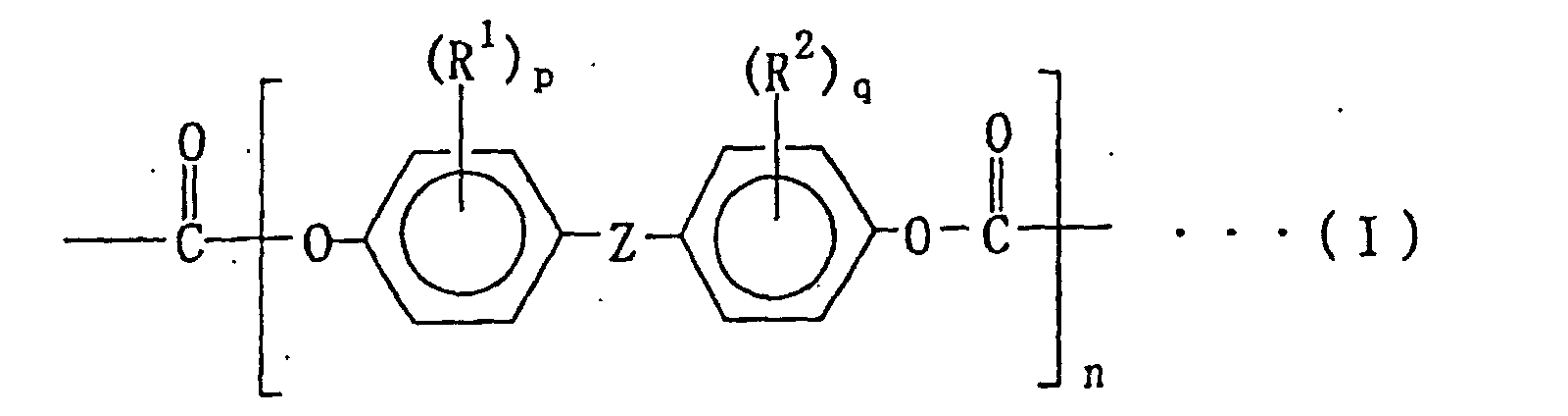
- One preferred aromatic polycarbonate resin employed in the present invention has a main chain represented by formula (I): (wherein each of R 1 and R 2 , which may be identical to or different from each other, represents a halogen atom, a C 1 -C 6 alkyl group, or a phenyl group; Z represents a single bond, a C 1 -C 20 alkylene or alkylidene group, a C 5 -C 20 cycloalkylene or cycloalkylidene group, -O-, -S-, -SO-, SO 2 -, or -CO-; each of p and q is an integer of 0 to 4, and n is the number of repeated units), as well as a hydroxyl group or a terminal group represented by formula (II): (wherein R 3 represents a halogen atom, a C 1 -C 20 alkyl group, or a C 6 -C 20 aryl group, and r is an integer of 0 to 5
- each R 1 and R 2 is preferably a halogen atom, a C 1 -C 6 alkyl group, or a phenyl group.
- halogen atom examples include chlorine, bromine, fluorine, and iodine.
- the C 1 -C 6 alkyl group may be linear, branched, or cyclic, and examples include methyl, ethyl, n-propyl, isopropyl, n-butyl, isobutyl, tert-butyl, amyl, isoamyl, hexyl, isohexyl, and cyclohexyl.
- R 1 and R 2 may be identical to or different from each other.
- R 1 s may be identical to or different from one another, and R 2 s may be identical to or different from one another.
- Each of p and q is an integer of 0 to 4.
- Z represents a single bond, a C 1 -C 20 alkylene or alkylidene group, a C 5 -C 20 cycloalkylene or cycloalkylidene group, -O-, -S-, -SO-, SO 2 -, or -CO-; each of p and q is an integer of 0 to 4, and n is the number of repeated units.
- Examples of the C1-C20 alkylene or alkylidene group include methylene, ethylene, propylene, butylene, pentylene, hexylene, ethylidene, and isopropylidene.
- Examples of the C 4 -C 20 cycloalkylene or cycloalkylidene group include cyclopentylene, cyclohexylene, and cyclohexylidene.
- the "n” is a number for imparting the aromatic polycarbonate resin to a viscosity average molecular weight of 10,000 to 20,000.
- the aromatic polycarbonate resin employed in the present invention has a hydroxyl group or a terminal group represented by formula (II).
- R 3 is preferably a halogen atom, a C 1 -C 20 alkyl group, or a C 6 -C 20 aryl group.
- the C 1 -C 20 alkyl group may be linear, branched, or cyclic, and examples include methyl, ethyl, n-propyl, isopropyl, n-butyl, isobutyl, sec-butyl, tert-butyl, pentyl, hexyl, octyl, decyl, dodecyl, cyclopentyl, and cyclohexyl.
- the C 6 -C 20 aryl group may have no substituent on the aromatic ring or may have an appropriate substituent such as a lower alkyl group.
- aryl group examples include phenyl, tolyl, xylyl, naphthyl, and methylnaphthyl.
- R 3 is an integer of 0 to 5.
- R 3 s may be identical to or different from one another.
- the aromatic polycarbonate resin may have a single species or a plurality of species of terminal groups represented by formula (II).
- p-cumylphenoxy groups and/or p-tert-octylphenoxy groups represented by formula (III) or (IV) preferably account 30 mol% or more, based on the total terminal groups.
- a p-tert-butylphenoxy group and/or a phenoxy group is preferred.
- a small amount of hydroxyl groups may be included.
- the aromatic polycarbonate resin employed in the present invention suitably has a viscosity average molecular weight (Mv) of 10,000 to 20,000, preferably 11,000 to 18,000, more preferably 12,000 to 16,000.
- Mv viscosity average molecular weight
- the viscosity average molecular weight (Mv) of the aromatic polycarbonate resin employed in the present invention is determined in accordance with the following procedure.
- An aromatic polycarbonate resin (about 0.7 g) is dissolved in methylene chloride (100 cc) at 20°C, and the specific viscosity ( ⁇ sp ) of the solution is determined by means of an Ubbelohde viscometer.
- the viscosity average molecular weight (Mv) of the aromatic polycarbonate resin is preferably lowered, so long as substrate characteristics such as impact strength are satisfied.
- the aromatic polycarbonate resin having a specific terminal group which resin is employable in the present invention, maintains sufficiently high falling ball impact strength at a considerably low viscosity average molecular weight, as confirmed from the relationship between viscosity average molecular weight (i.e., melt viscosity) and falling ball impact strength (practical physical property).
- optical disc substrate of excellent optical characteristics can be molded under high cycle conditions.
- the aromatic polycarbonate resin employed in the present invention preferably contains hydroxyl groups accounting for 1 mol% or less the total terminal groups, more preferably 0.3 mol% or less.
- Chlorine, sodium, and other micro-particulate impurities (substances not dissolved in methylene chloride) contained in the aromatic polycarbonate resin are preferably decreased to as small an amount as possible through purification/removal means such as washing, filtration, and centrifugation, through a step such as melt-kneading degassing, or similar means.
- the aromatic polycarbonate resin preferably contains a low-molecular-weight component (Soxhlet extraction component in acetone), generally in an amount of 10 mass% or lower.
- Soxhlet extraction component in acetone a low-molecular-weight component
- the aromatic polycarbonate resin product for optical disc substrates of the present invention must contain a C 14 -C 30 fatty acid monoglyceride in an amount falling within a specific range.
- the C 14 -C 30 fatty acid monoglyceride is a monoester compound formed from a C 14 -C 30 fatty acid and glycerin.
- Examples of the monoglyceride include palmitic acid monoglyceride, stearic acid monoglyceride, arachic acid monoglyceride, behenic acid monoglyceride, and montanic acid monoglyceride. A mixture thereof may also be employed.
- the fatty acid monoglyceride is preferably stearic acid monoglyceride or behenic acid monoglyceride, from the viewpoint of the releasing-ability of optical disc substrates in molding. Of these, stearic acid monoglyceride is particularly preferred.
- the fatty acid monoglyceride preferably has a low impurity (e.g., sodium or chlorine) content, from the viewpoint of long-term reliability of recording medium produced from the aromatic polycarbonate resin particularly under high temperature and high humidity conditions.
- a low impurity e.g., sodium or chlorine
- the sodium content is preferably 30 ppm by mass or less, more preferably 20 ppm by mass or less.
- the fatty acid monoglyceride is contained in an amount of 0.015 to 0.05 parts by mass, preferably 0.020 to 0.04 parts by mass.
- the amount of fatty acid monoglyceride is in excess of 0.05 parts by mass, the molecular weight of the aromatic polycarbonate resin may be decreased during molding, thereby sacrificing the reliability of recording medium.
- the aromatic polycarbonate resin product for optical disc substrates of the present invention is required to be added water of a specific quality and to contain water in a specific amount for carrying out melt-extrusion.
- the water has an electric conductivity, as measured at 25°C, of 1 ⁇ S/cm or less.
- the aromatic polycarbonate resin product contains water having an electric conductivity, as measured at 25°C, of 1 ⁇ S/cm or less in an amount of 0.05 to 0.3 mass%, preferably 0.05 to 0.2 mass%.
- a fatty acid monoglyceride carbonate, a fatty acid diglyceride or a fatty acid triglyceride generates due to denaturing of the C 14 -C 30 fatty acid monoglyceride serving as a mold-releasing agent, thereby sacrificing the releasing-ability of optical disc substrates in molding.
- the hydrolysis of the polycarbonate resin may be sometimes promoted, or the melt-extrusion process may become unstable, thereby sacrificing the production-capacity.
- the aromatic polycarbonate resin product for optical disc substrate of the present invention may further contain additional additives such as stabilizers and colorants in accordance with needs, in amounts being within a range so as not to sacrifice the scope of the present invention.
- a phosphorus-containing stabilizer such as a phosphite ester or a phosphate ester is preferably employed as the stabilizer.
- phosphite ester examples include phosphite triesters, phosphite diesters, and phosphite monoesters. Specific examples include triphenyl phosphite, tris(nonylphenyl) phosphite, tris(2,4-di-tert-butylphenyl) phosphite, trinonyl phosphite, tridecyl phosphite, trioctyl phosphite, trioctadecyl phosphite, distearylpentaerythritol diphosphite, tricyclohexyl phosphite, monobutyl diphenyl phosphite, monooctyl diphenyl phosphite, bis(2,6-di-tert-butyl-4-methylphenyl)pentaerythritol diphosphite, 2,2-
- tris(nonylphenyl) phosphite tris(2,4-di-tert-butylphenyl) phosphite, distearylpentaerythritol diphosphite, etc. are preferred.
- phosphate ester examples include trimethyl phosphate, triethyl phosphate, tributyl phosphate, trioctyl phosphate, triphenyl phosphate, tricresyl phosphate, tri(nonylphenyl) phosphate, and 2-ethylphenyl diphenyl phosphate.
- phosphorus-containing stabilizers may be used singly or in combination of two or more species.
- the phosphorus-containing stabilizer content appropriately falls within a range of 0.001 to 0.02 mass% as reduced to phosphorus atom content.
- the stabilizer content is less than 0.001 mass%, the stabilization effects on the polycarbonate resin become poor, whereas when the content is in excess of 0.02 mass%, the reliability of recording medium for long period of time may be sacrificed.
- the phosphorus-containing stabilizer content is preferably limited to a minimum level for assuring thermal stability of the resin during production of pellets and during molding of optical disc substrates.
- the aromatic polycarbonate resin product for optical disc substrates of the present invention is produced by adding, to a aromatic polycarbonate resin, a specific amount of a C 14 -C 30 fatty acid monoglyceride and, if required, an optional additive to an aromatic polycarbonate resin, adding water having an electric conductivity, as measured at 25°C, of 1 ⁇ S/cm or less to the resin, and melt-kneading the water-added mixture while the water content of the resin is controlled to 0.05 to 0.3 mass%, to thereby obtain pellets.
- the pellets as raw materials are melt-extruded, to thereby form an aromatic polycarbonate resin product for optical disc substrates.
- ultrasound may be applied to a mold.
- Molding conditions include resin temperature of 340 to 400°C, preferably 350 to 390°C, and mold temperature of 80 to 140°C, preferably 90 to 130°C.
- the molten resin is injection-molded by use of a mold having a cavity (diameter: 120 mm, thickness: 0.6 mm) and a stamper.
- the molding cycle is generally 3 to 10 sec, preferably 3 to 9 sec.
- Bisphenol A 60 kg was dissolved in a 5 mass% aqueous sodium hydroxide solution (400 L), to thereby prepare an aqueous bisphenol A sodium hydroxide solution.
- the aqueous bisphenol A sodium hydroxide solution maintained at room temperature and methylene chloride were fed to a tube reactor (inner diameter: 10 mm, tube length: 10 m) through an orifice plate at a flow of 138 L/hour and 69 L/hour, respectively.
- phosgene was fed into the reactor at a flow of 10.7 kg/hour. The reaction was continuously carried out for three hours.
- the temperature of the discharged reaction mixture was adjusted to at 25°C, and the pH of the discharged liquid was adjusted at 10 to 11.
- the thus-obtained reaction mixture was allows to stand, and the water phase was removed from the mixture.
- the methylene chloride phase (220 L) was collected, to thereby yield a polycarbonate oligomer.
- p-Cumylphenol (166.7 g) was dissolved in the above polycarbonate oligomer (10 L). Subsequently, an aqueous sodium hydroxide solution (sodium hydroxide 75 g and water 1.0 L) and triethylamine (1.17 mL) were added to the solution, and the mixture was stirred at 300 rpm for 30 minutes at ambient temperature.
- aqueous sodium hydroxide solution sodium hydroxide 75 g and water 1.0 L
- triethylamine (1.17 mL
- the collected organic phase was sequentially washed with an alkali medium (0.03N aqueous NaOH) (5 L), an acid (0.2N aqueous hydrochloric acid) (5 L), water (5 L), and water (5 L). Through evaporation of methylene chloride and drying, an aromatic polycarbonate resin (A) in the form of flakes was produced.
- Aromatic polycarbonate resin PC-A was blended with stearic acid monoglyceride (hereinafter may be abbreviated as SM) (0.028 parts by mass), tris(2,4-di-tert-butylphenyl) phosphite (0.004 mass%), and a predetermined amount of water having an electric conductivity, as measured at 25°C, of 0.9 ⁇ S/cm.
- SM stearic acid monoglyceride
- tris(2,4-di-tert-butylphenyl) phosphite 0.004 mass
- the mixture was melt-kneaded by means of a twin-screw extruder at 255°C, to thereby produce aromatic polycarbonate resin pellets for molding optical disc substrates.
- the pellets were molded by use of a mold [diameter: 120 mm, thickness: 0.6 mm, pit depth of DVD-ROM stamper: 140 nm] under the following conditions: resin temperature of 370°C, mold temperature of 100°C, and molding cycle of 5.3 sec, to thereby produce optical disc substrates.
- Experimental conditions are shown in Table 1-1.
- optical disc substrates produced by molding the aromatic polycarbonate resin product were evaluated in terms of the following properties. The results are shown in Table 1-2.
- stearic acid monoglyceride was confirmed to form degraded products such as stearoyloxyethylene carbonate, stearic acid diglyceride, and stearic acid triglyceride.
- the rating "released with some problem” refers to the state that a robot failed to remove an optical disc substrate from a mold due to poor releasability of the optical disc substrate or a sprue, causing the molding machine to stop.
- the produced optical disc substrates were subjected to an accelerated deterioration test (1,000 h) under the following constant conditions: a temperature of 90°C and 90% humidity. Thereafter, the discs were evaluated in terms of viscosity average molecular weight.
- the above discs have excellent resistance to heat and moisture. Since the aromatic polycarbonate resin does not undergo hydrolysis, high reliability of information recording is clearly assured.
- Example 1 The procedure of Example 1 was repeated, except that aromatic polycarbonate resin PC-B was used instead of aromatic polycarbonate resin PC-A, to thereby produce aromatic polycarbonate resin pellets. Optical disc substrates were molded from the pellets.
- Example 1 The procedure of Example 1 was repeated, except that aromatic polycarbonate resin PC-C was used instead of aromatic polycarbonate resin PC-A, to thereby produce aromatic polycarbonate resin pellets. Optical disc substrates were molded from the pellets.
- Aromatic polycarbonate resin PC-A was employed, but no stearic monoglyceride was added to the resin.
- Resin pellets for producing optical disc substrates were produced in a manner similar to that of Example 1.
- thermo-moisture-stat bath product of TABAI-ESPEC
- each optical disc substrate was observed under an optical polarizing microscope so as to count the number of polarizing opaque defects generated through hydrolysis of aromatic polycarbonate resin.
- molding conditions upon melt extrusion can be selected from a wider range, molding cycle and productivity (improvement of molding yield) are enhanced, thereby lowering costs.
Landscapes
- Chemical & Material Sciences (AREA)
- Health & Medical Sciences (AREA)
- Chemical Kinetics & Catalysis (AREA)
- Medicinal Chemistry (AREA)
- Polymers & Plastics (AREA)
- Organic Chemistry (AREA)
- Compositions Of Macromolecular Compounds (AREA)
- Optical Record Carriers And Manufacture Thereof (AREA)
- Polyesters Or Polycarbonates (AREA)
- Processes Of Treating Macromolecular Substances (AREA)
Abstract
Description


| Composition of raw material | Water content of PC before addition of water | Water added to PC | |||
| Polycarbonate (PC) | SM content | ||||
| Type | Mol. wt. | ppm | ppm | ppm | |
| Ex. 1 | PC-A | 14,200 | 280 | 400 | 1,000 |
| Ex. 2 | PC-B | 14,200 | 280 | 400 | 1,000 |
| Ex. 3 | PC-C | 14,200 | 280 | 400 | 1,000 |
| Ex. 4 | PC-A | 14,000 | 280 | 400 | 800 |
| Comp. Ex. 1 | PC-A | 14,200 | 280 | 400 | - |
| Comp. Ex. 2 | PC-B | 14,200 | 280 | 400 | - |
| Comp. Ex. 3 | PC-C | 14,200 | 280 | 400 | - |

| Electric conductivity of water added | No. of polarizing opaque defects generated in substrate (n = 5) | |
| Ex. 5 | 0.9 µS/cm | 10 |
| Comp. Ex. 4 | 11 µS/cm | 100 |
| Comp. Ex. 5 | 100 µS/cm | 1,000 |
| Comp. Ex. 6 | 1 mS/cm | 10,000 |
| Comp. Ex. 7 | 100 mµS/cm | many, not measurable |
Claims (8)
- An aromatic polycarbonate resin product for optical disc substrates, the product being produced by adding 0.015 to 0.05 parts by mass of a C14-C30 fatty acid monoglyceride to 100 parts by mass of an aromatic polycarbonate resin, adding water having an electric conductivity, as measured at 25°C, of 1 µS/cm or less to the resin, the water content of the resin being controlled so as to fall within the range of 0.05 to 0.3 mass%, melt-extruding the water-added resin, cooling, and cutting to form pellets, the resin having a viscosity average molecular weight (Mv) of 10,000 to 20,000.
- An aromatic polycarbonate resin product for optical disc substrates according to claim 1, wherein the melt-extruded aromatic polycarbonate resin is cooled by use of water having an electric conductivity, as measured at 25°C, of 1 µS/cm or less.
- An aromatic polycarbonate resin product for optical disc substrates according to claim 1, wherein the aromatic polycarbonate resin has terminal groups in which p-cumylphenoxy group and/or p-tert-octylphenoxy group account for 30 mol% or more.
- An aromatic polycarbonate resin product for optical disc substrates according to any of claims 1 to 3, wherein the aromatic polycarbonate resin has a viscosity average molecular weight (Mv) of 11,000 to 18,000.
- An aromatic polycarbonate resin product for optical disc substrates according to any of claims 1 to 3, wherein the aromatic polycarbonate resin has a viscosity average molecular weight (Mv) of 12,000 to 16,000.
- An aromatic polycarbonate resin product for optical disc substrates according to any of claims 1 to 3, which contains a fatty acid monoglyceride in an amount of 0.02 to 0.04 parts by mass.
- An aromatic polycarbonate resin product for optical disc substrates according to any of claims 1 to 3, wherein the fatty acid monoglyceride is stearic acid monoglyceride.
- An aromatic polycarbonate resin product for optical disc substrates according to any of claims 1 to 3, wherein the water content of the resin is controlled so as to fall within the range of 0.05 to 0.2 mass%.
Applications Claiming Priority (3)
| Application Number | Priority Date | Filing Date | Title |
|---|---|---|---|
| JP2002039757A JP3992508B2 (en) | 2002-02-18 | 2002-02-18 | Method for producing aromatic polycarbonate resin composition for optical disk substrate |
| JP2002039757 | 2002-02-18 | ||
| PCT/JP2003/001544 WO2003068863A1 (en) | 2002-02-18 | 2003-02-14 | Aromatic polycarbonate resins for optical disk substrates |
Publications (3)
| Publication Number | Publication Date |
|---|---|
| EP1477527A1 true EP1477527A1 (en) | 2004-11-17 |
| EP1477527A4 EP1477527A4 (en) | 2007-01-03 |
| EP1477527B1 EP1477527B1 (en) | 2009-01-14 |
Family
ID=27678267
Family Applications (1)
| Application Number | Title | Priority Date | Filing Date |
|---|---|---|---|
| EP03705154A Expired - Lifetime EP1477527B1 (en) | 2002-02-18 | 2003-02-14 | Aromatic polycarbonate resins for optical disk substrates |
Country Status (9)
| Country | Link |
|---|---|
| US (1) | US7122614B2 (en) |
| EP (1) | EP1477527B1 (en) |
| JP (1) | JP3992508B2 (en) |
| CN (1) | CN1325536C (en) |
| AT (1) | ATE420919T1 (en) |
| DE (1) | DE60325832D1 (en) |
| ES (1) | ES2316724T3 (en) |
| TW (1) | TWI255822B (en) |
| WO (1) | WO2003068863A1 (en) |
Cited By (1)
| Publication number | Priority date | Publication date | Assignee | Title |
|---|---|---|---|---|
| EP3388463A4 (en) * | 2015-12-11 | 2019-01-16 | Mitsubishi Chemical Corporation | Polycarbonate resin composition for thin optical component, and method for producing thin optical component |
Families Citing this family (6)
| Publication number | Priority date | Publication date | Assignee | Title |
|---|---|---|---|---|
| ATE500590T1 (en) | 2004-09-02 | 2011-03-15 | Teijin Chemicals Ltd | OPTICAL PLATE |
| JP5283883B2 (en) * | 2007-10-18 | 2013-09-04 | 出光興産株式会社 | Aromatic polycarbonate resin composition for resin stamper, method for producing resin stamper, and resin stamper |
| JP5337365B2 (en) * | 2007-10-18 | 2013-11-06 | 出光興産株式会社 | Aromatic polycarbonate resin composition for resin stamper, method for producing resin stamper, and resin stamper |
| KR101504380B1 (en) * | 2007-12-07 | 2015-03-19 | 테이진 카세이 가부시키가이샤 | Resin composition,molded article therof,and key of terminal device |
| CN108291081B (en) * | 2015-11-20 | 2021-03-23 | 出光兴产株式会社 | Polycarbonate resin composition and molded article thereof |
| US11208552B2 (en) | 2015-11-20 | 2021-12-28 | Idemitsu Kosan Co., Ltd. | Method of manufacturing polycarbonate resin pellets |
Family Cites Families (11)
| Publication number | Priority date | Publication date | Assignee | Title |
|---|---|---|---|---|
| EP0622393B1 (en) * | 1993-04-27 | 1999-07-07 | Teijin Chemicals, Ltd. | Modified aromatic polycarbonate resin and modified phenol for preparing it |
| US5620765A (en) * | 1995-05-02 | 1997-04-15 | Eastman Kodak Company | Aqueous backing for digital optical media |
| US5717055A (en) * | 1995-06-20 | 1998-02-10 | Mitsubishi Gas Chemical Company, Ltd. | Production method of polycarbonate resin pellets |
| JPH11342510A (en) * | 1998-04-03 | 1999-12-14 | Teijin Chem Ltd | Optical molding materials |
| JP2000001608A (en) * | 1998-06-15 | 2000-01-07 | Mitsubishi Chemicals Corp | Polycarbonate resin composition, and optical recording medium substrate and optical recording medium formed therefrom |
| JP2000182276A (en) * | 1998-12-11 | 2000-06-30 | Teijin Chem Ltd | Optical polycarbonate resin molding material and optical disk substrate |
| JP2000268404A (en) | 1999-03-12 | 2000-09-29 | Idemitsu Petrochem Co Ltd | Substrate for digital versatile disk and its production |
| JP4361192B2 (en) * | 2000-03-30 | 2009-11-11 | 帝人株式会社 | Stabilized aromatic polycarbonate composition |
| JP4093703B2 (en) * | 2000-04-27 | 2008-06-04 | 出光興産株式会社 | Polycarbonate resin for optical disk substrate and optical disk substrate |
| TW583266B (en) | 2000-04-27 | 2004-04-11 | Idemitsu Petrochemical Co | Polycarbonate resin composition for optical disk substrate |
| JP2001316467A (en) * | 2000-05-09 | 2001-11-13 | Mitsubishi Gas Chem Co Inc | Method for producing polycarbonate resin |
-
2002
- 2002-02-18 JP JP2002039757A patent/JP3992508B2/en not_active Expired - Lifetime
-
2003
- 2003-02-14 US US10/501,926 patent/US7122614B2/en not_active Expired - Lifetime
- 2003-02-14 AT AT03705154T patent/ATE420919T1/en not_active IP Right Cessation
- 2003-02-14 DE DE60325832T patent/DE60325832D1/en not_active Expired - Lifetime
- 2003-02-14 CN CNB038041073A patent/CN1325536C/en not_active Expired - Lifetime
- 2003-02-14 ES ES03705154T patent/ES2316724T3/en not_active Expired - Lifetime
- 2003-02-14 WO PCT/JP2003/001544 patent/WO2003068863A1/en not_active Ceased
- 2003-02-14 EP EP03705154A patent/EP1477527B1/en not_active Expired - Lifetime
- 2003-02-17 TW TW092103221A patent/TWI255822B/en not_active IP Right Cessation
Cited By (1)
| Publication number | Priority date | Publication date | Assignee | Title |
|---|---|---|---|---|
| EP3388463A4 (en) * | 2015-12-11 | 2019-01-16 | Mitsubishi Chemical Corporation | Polycarbonate resin composition for thin optical component, and method for producing thin optical component |
Also Published As
| Publication number | Publication date |
|---|---|
| EP1477527B1 (en) | 2009-01-14 |
| TW200303325A (en) | 2003-09-01 |
| WO2003068863A1 (en) | 2003-08-21 |
| ATE420919T1 (en) | 2009-01-15 |
| US20050165204A1 (en) | 2005-07-28 |
| JP2003238791A (en) | 2003-08-27 |
| DE60325832D1 (en) | 2009-03-05 |
| EP1477527A4 (en) | 2007-01-03 |
| TWI255822B (en) | 2006-06-01 |
| JP3992508B2 (en) | 2007-10-17 |
| US7122614B2 (en) | 2006-10-17 |
| ES2316724T3 (en) | 2009-04-16 |
| CN1325536C (en) | 2007-07-11 |
| CN1633470A (en) | 2005-06-29 |
Similar Documents
| Publication | Publication Date | Title |
|---|---|---|
| CN1266205C (en) | Cycloolefin copolymer resins having improved optical properties | |
| JP4204464B2 (en) | Polycarbonate resin molding material and optical disk substrate | |
| JP4056645B2 (en) | Optical polycarbonate resin composition | |
| US20030195329A1 (en) | Aromatic polycarbonate, composition thereof , and use | |
| CN107636075A (en) | Polycarbonate resin composition and optical molded article | |
| EP1275694A1 (en) | Aromatic polycarbonate composition, process for producing the same, and molded article thereof | |
| JP5568094B2 (en) | High-speed optical disk substrate material | |
| US7122614B2 (en) | Aromatic polycarbonate resins for optical disk substrates | |
| US6316071B1 (en) | Substrate for digital versatile disk and process for producing the same | |
| JP2000109669A (en) | Aromatic polycarbonate resin composition and optical molded article | |
| JPH1060247A (en) | Optical molding materials | |
| JP3866934B2 (en) | Optical polycarbonate and its use | |
| JP2007238959A (en) | Aromatic polycarbonate resin composition for optical disk substrate | |
| JPH11166113A (en) | Polycarbonate material for optical disk substrate | |
| JP3442556B2 (en) | Aromatic polycarbonate resin and method for producing the same | |
| US5726228A (en) | Use of carbonates as demoulding agents for thermoplastic polycarbonates | |
| KR100598750B1 (en) | New Polymer Mixtures with Release Agents | |
| KR20010110775A (en) | Method for holding polycarbonate pellets | |
| JP4455508B2 (en) | Method for producing optical polycarbonate resin composition | |
| JP2000001608A (en) | Polycarbonate resin composition, and optical recording medium substrate and optical recording medium formed therefrom | |
| JP5393706B2 (en) | Optical disk substrate manufacturing method and optical disk substrate molding material | |
| JP4674000B2 (en) | Highly precise transferable polycarbonate resin optical molding material and optical disk substrate formed therefrom | |
| JP2003525332A (en) | Polymer mixtures with phosphate | |
| JP2001167473A (en) | Optical information board | |
| JP2004118966A (en) | Optical disk |
Legal Events
| Date | Code | Title | Description |
|---|---|---|---|
| PUAI | Public reference made under article 153(3) epc to a published international application that has entered the european phase |
Free format text: ORIGINAL CODE: 0009012 |
|
| 17P | Request for examination filed |
Effective date: 20040728 |
|
| AK | Designated contracting states |
Kind code of ref document: A1 Designated state(s): AT BE BG CH CY CZ DE DK EE ES FI FR GB GR IE IT LI LU MC NL PT SE SI SK TR |
|
| RAP1 | Party data changed (applicant data changed or rights of an application transferred) |
Owner name: IDEMITSU KOSAN CO., LTD. |
|
| RIC1 | Information provided on ipc code assigned before grant |
Ipc: C08K 5/103 20060101AFI20061122BHEP |
|
| A4 | Supplementary search report drawn up and despatched |
Effective date: 20061204 |
|
| 17Q | First examination report despatched |
Effective date: 20070326 |
|
| GRAP | Despatch of communication of intention to grant a patent |
Free format text: ORIGINAL CODE: EPIDOSNIGR1 |
|
| GRAS | Grant fee paid |
Free format text: ORIGINAL CODE: EPIDOSNIGR3 |
|
| GRAA | (expected) grant |
Free format text: ORIGINAL CODE: 0009210 |
|
| AK | Designated contracting states |
Kind code of ref document: B1 Designated state(s): AT BE BG CH CY CZ DE DK EE ES FI FR GB GR IE IT LI LU MC NL PT SE SI SK TR |
|
| REG | Reference to a national code |
Ref country code: GB Ref legal event code: FG4D |
|
| REG | Reference to a national code |
Ref country code: CH Ref legal event code: EP |
|
| REG | Reference to a national code |
Ref country code: IE Ref legal event code: FG4D |
|
| REF | Corresponds to: |
Ref document number: 60325832 Country of ref document: DE Date of ref document: 20090305 Kind code of ref document: P |
|
| REG | Reference to a national code |
Ref country code: ES Ref legal event code: FG2A Ref document number: 2316724 Country of ref document: ES Kind code of ref document: T3 |
|
| PG25 | Lapsed in a contracting state [announced via postgrant information from national office to epo] |
Ref country code: SI Free format text: LAPSE BECAUSE OF FAILURE TO SUBMIT A TRANSLATION OF THE DESCRIPTION OR TO PAY THE FEE WITHIN THE PRESCRIBED TIME-LIMIT Effective date: 20090114 Ref country code: FI Free format text: LAPSE BECAUSE OF FAILURE TO SUBMIT A TRANSLATION OF THE DESCRIPTION OR TO PAY THE FEE WITHIN THE PRESCRIBED TIME-LIMIT Effective date: 20090114 |
|
| PG25 | Lapsed in a contracting state [announced via postgrant information from national office to epo] |
Ref country code: PT Free format text: LAPSE BECAUSE OF FAILURE TO SUBMIT A TRANSLATION OF THE DESCRIPTION OR TO PAY THE FEE WITHIN THE PRESCRIBED TIME-LIMIT Effective date: 20090615 Ref country code: SE Free format text: LAPSE BECAUSE OF FAILURE TO SUBMIT A TRANSLATION OF THE DESCRIPTION OR TO PAY THE FEE WITHIN THE PRESCRIBED TIME-LIMIT Effective date: 20090414 Ref country code: AT Free format text: LAPSE BECAUSE OF FAILURE TO SUBMIT A TRANSLATION OF THE DESCRIPTION OR TO PAY THE FEE WITHIN THE PRESCRIBED TIME-LIMIT Effective date: 20090114 |
|
| PG25 | Lapsed in a contracting state [announced via postgrant information from national office to epo] |
Ref country code: MC Free format text: LAPSE BECAUSE OF NON-PAYMENT OF DUE FEES Effective date: 20090228 |
|
| REG | Reference to a national code |
Ref country code: CH Ref legal event code: PL |
|
| PG25 | Lapsed in a contracting state [announced via postgrant information from national office to epo] |
Ref country code: CH Free format text: LAPSE BECAUSE OF NON-PAYMENT OF DUE FEES Effective date: 20090228 Ref country code: DK Free format text: LAPSE BECAUSE OF FAILURE TO SUBMIT A TRANSLATION OF THE DESCRIPTION OR TO PAY THE FEE WITHIN THE PRESCRIBED TIME-LIMIT Effective date: 20090114 Ref country code: CZ Free format text: LAPSE BECAUSE OF FAILURE TO SUBMIT A TRANSLATION OF THE DESCRIPTION OR TO PAY THE FEE WITHIN THE PRESCRIBED TIME-LIMIT Effective date: 20090114 Ref country code: EE Free format text: LAPSE BECAUSE OF FAILURE TO SUBMIT A TRANSLATION OF THE DESCRIPTION OR TO PAY THE FEE WITHIN THE PRESCRIBED TIME-LIMIT Effective date: 20090114 Ref country code: LI Free format text: LAPSE BECAUSE OF NON-PAYMENT OF DUE FEES Effective date: 20090228 |
|
| PLBE | No opposition filed within time limit |
Free format text: ORIGINAL CODE: 0009261 |
|
| STAA | Information on the status of an ep patent application or granted ep patent |
Free format text: STATUS: NO OPPOSITION FILED WITHIN TIME LIMIT |
|
| REG | Reference to a national code |
Ref country code: IE Ref legal event code: MM4A |
|
| REG | Reference to a national code |
Ref country code: FR Ref legal event code: ST Effective date: 20091030 |
|
| PG25 | Lapsed in a contracting state [announced via postgrant information from national office to epo] |
Ref country code: SK Free format text: LAPSE BECAUSE OF FAILURE TO SUBMIT A TRANSLATION OF THE DESCRIPTION OR TO PAY THE FEE WITHIN THE PRESCRIBED TIME-LIMIT Effective date: 20090114 |
|
| 26N | No opposition filed |
Effective date: 20091015 |
|
| GBPC | Gb: european patent ceased through non-payment of renewal fee |
Effective date: 20090414 |
|
| PG25 | Lapsed in a contracting state [announced via postgrant information from national office to epo] |
Ref country code: BG Free format text: LAPSE BECAUSE OF FAILURE TO SUBMIT A TRANSLATION OF THE DESCRIPTION OR TO PAY THE FEE WITHIN THE PRESCRIBED TIME-LIMIT Effective date: 20090414 Ref country code: IE Free format text: LAPSE BECAUSE OF NON-PAYMENT OF DUE FEES Effective date: 20090214 |
|
| PG25 | Lapsed in a contracting state [announced via postgrant information from national office to epo] |
Ref country code: GB Free format text: LAPSE BECAUSE OF NON-PAYMENT OF DUE FEES Effective date: 20090414 Ref country code: FR Free format text: LAPSE BECAUSE OF NON-PAYMENT OF DUE FEES Effective date: 20090316 |
|
| PG25 | Lapsed in a contracting state [announced via postgrant information from national office to epo] |
Ref country code: GR Free format text: LAPSE BECAUSE OF FAILURE TO SUBMIT A TRANSLATION OF THE DESCRIPTION OR TO PAY THE FEE WITHIN THE PRESCRIBED TIME-LIMIT Effective date: 20090415 |
|
| PG25 | Lapsed in a contracting state [announced via postgrant information from national office to epo] |
Ref country code: IT Free format text: LAPSE BECAUSE OF FAILURE TO SUBMIT A TRANSLATION OF THE DESCRIPTION OR TO PAY THE FEE WITHIN THE PRESCRIBED TIME-LIMIT Effective date: 20090114 |
|
| PG25 | Lapsed in a contracting state [announced via postgrant information from national office to epo] |
Ref country code: LU Free format text: LAPSE BECAUSE OF NON-PAYMENT OF DUE FEES Effective date: 20090214 |
|
| PG25 | Lapsed in a contracting state [announced via postgrant information from national office to epo] |
Ref country code: TR Free format text: LAPSE BECAUSE OF FAILURE TO SUBMIT A TRANSLATION OF THE DESCRIPTION OR TO PAY THE FEE WITHIN THE PRESCRIBED TIME-LIMIT Effective date: 20090114 |
|
| PG25 | Lapsed in a contracting state [announced via postgrant information from national office to epo] |
Ref country code: CY Free format text: LAPSE BECAUSE OF FAILURE TO SUBMIT A TRANSLATION OF THE DESCRIPTION OR TO PAY THE FEE WITHIN THE PRESCRIBED TIME-LIMIT Effective date: 20090114 |
|
| PGFP | Annual fee paid to national office [announced via postgrant information from national office to epo] |
Ref country code: DE Payment date: 20211230 Year of fee payment: 20 |
|
| PGFP | Annual fee paid to national office [announced via postgrant information from national office to epo] |
Ref country code: NL Payment date: 20220118 Year of fee payment: 20 Ref country code: ES Payment date: 20220301 Year of fee payment: 20 Ref country code: BE Payment date: 20220118 Year of fee payment: 20 |
|
| REG | Reference to a national code |
Ref country code: DE Ref legal event code: R071 Ref document number: 60325832 Country of ref document: DE |
|
| REG | Reference to a national code |
Ref country code: NL Ref legal event code: MK Effective date: 20230213 |
|
| REG | Reference to a national code |
Ref country code: BE Ref legal event code: MK Effective date: 20230214 |
|
| REG | Reference to a national code |
Ref country code: ES Ref legal event code: FD2A Effective date: 20230426 |
|
| P01 | Opt-out of the competence of the unified patent court (upc) registered |
Effective date: 20230522 |
|
| PG25 | Lapsed in a contracting state [announced via postgrant information from national office to epo] |
Ref country code: ES Free format text: LAPSE BECAUSE OF EXPIRATION OF PROTECTION Effective date: 20230215 |