EP1477477A1 - Process for preparation of carotenoids - Google Patents
Process for preparation of carotenoids Download PDFInfo
- Publication number
- EP1477477A1 EP1477477A1 EP03705138A EP03705138A EP1477477A1 EP 1477477 A1 EP1477477 A1 EP 1477477A1 EP 03705138 A EP03705138 A EP 03705138A EP 03705138 A EP03705138 A EP 03705138A EP 1477477 A1 EP1477477 A1 EP 1477477A1
- Authority
- EP
- European Patent Office
- Prior art keywords
- general formula
- represented
- compound represented
- above general
- compound
- Prior art date
- Legal status (The legal status is an assumption and is not a legal conclusion. Google has not performed a legal analysis and makes no representation as to the accuracy of the status listed.)
- Granted
Links
- 0 CC1(C)C(C(CC(C)=CC)S(C)(=O)=O)=C(C)C(*)CC1 Chemical compound CC1(C)C(C(CC(C)=CC)S(C)(=O)=O)=C(C)C(*)CC1 0.000 description 3
Classifications
-
- C—CHEMISTRY; METALLURGY
- C07—ORGANIC CHEMISTRY
- C07C—ACYCLIC OR CARBOCYCLIC COMPOUNDS
- C07C403/00—Derivatives of cyclohexane or of a cyclohexene or of cyclohexadiene, having a side-chain containing an acyclic unsaturated part of at least four carbon atoms, this part being directly attached to the cyclohexane or cyclohexene or cyclohexadiene rings, e.g. vitamin A, beta-carotene, beta-ionone
- C07C403/24—Derivatives of cyclohexane or of a cyclohexene or of cyclohexadiene, having a side-chain containing an acyclic unsaturated part of at least four carbon atoms, this part being directly attached to the cyclohexane or cyclohexene or cyclohexadiene rings, e.g. vitamin A, beta-carotene, beta-ionone having side-chains substituted by six-membered non-aromatic rings, e.g. beta-carotene
-
- C—CHEMISTRY; METALLURGY
- C07—ORGANIC CHEMISTRY
- C07C—ACYCLIC OR CARBOCYCLIC COMPOUNDS
- C07C317/00—Sulfones; Sulfoxides
- C07C317/14—Sulfones; Sulfoxides having sulfone or sulfoxide groups bound to carbon atoms of six-membered aromatic rings
-
- C—CHEMISTRY; METALLURGY
- C07—ORGANIC CHEMISTRY
- C07C—ACYCLIC OR CARBOCYCLIC COMPOUNDS
- C07C317/00—Sulfones; Sulfoxides
- C07C317/24—Sulfones; Sulfoxides having sulfone or sulfoxide groups and doubly-bound oxygen atoms bound to the same carbon skeleton
-
- C—CHEMISTRY; METALLURGY
- C07—ORGANIC CHEMISTRY
- C07C—ACYCLIC OR CARBOCYCLIC COMPOUNDS
- C07C403/00—Derivatives of cyclohexane or of a cyclohexene or of cyclohexadiene, having a side-chain containing an acyclic unsaturated part of at least four carbon atoms, this part being directly attached to the cyclohexane or cyclohexene or cyclohexadiene rings, e.g. vitamin A, beta-carotene, beta-ionone
- C07C403/22—Derivatives of cyclohexane or of a cyclohexene or of cyclohexadiene, having a side-chain containing an acyclic unsaturated part of at least four carbon atoms, this part being directly attached to the cyclohexane or cyclohexene or cyclohexadiene rings, e.g. vitamin A, beta-carotene, beta-ionone having side-chains substituted by sulfur atoms
-
- C—CHEMISTRY; METALLURGY
- C07—ORGANIC CHEMISTRY
- C07F—ACYCLIC, CARBOCYCLIC OR HETEROCYCLIC COMPOUNDS CONTAINING ELEMENTS OTHER THAN CARBON, HYDROGEN, HALOGEN, OXYGEN, NITROGEN, SULFUR, SELENIUM OR TELLURIUM
- C07F9/00—Compounds containing elements of Groups 5 or 15 of the Periodic Table
- C07F9/02—Phosphorus compounds
- C07F9/28—Phosphorus compounds with one or more P—C bonds
- C07F9/54—Quaternary phosphonium compounds
- C07F9/5435—Cycloaliphatic phosphonium compounds
-
- C—CHEMISTRY; METALLURGY
- C07—ORGANIC CHEMISTRY
- C07B—GENERAL METHODS OF ORGANIC CHEMISTRY; APPARATUS THEREFOR
- C07B2200/00—Indexing scheme relating to specific properties of organic compounds
- C07B2200/09—Geometrical isomers
-
- C—CHEMISTRY; METALLURGY
- C07—ORGANIC CHEMISTRY
- C07C—ACYCLIC OR CARBOCYCLIC COMPOUNDS
- C07C2601/00—Systems containing only non-condensed rings
- C07C2601/12—Systems containing only non-condensed rings with a six-membered ring
- C07C2601/16—Systems containing only non-condensed rings with a six-membered ring the ring being unsaturated
Definitions
- the present invention relates to a process for preparation of carotenoids which are important in the fields of medicine, feed additives, food additives and the like, and to intermediates thereof.
- the present inventors have studies intensively so as to develop a process for industrially advantageous preparation of carotenoids without passing through unstable intermediates.
- the present inventors have found a method wherein a carotenoid is derived from coupling of two molecules of a C15 compound, which can be readily synthesized from a relatively cheap C10 compound such as myrcene or linalool, with a C10 compound to obtain a relatively stable C40 disulfone compound, followed by reacting the resultant compound with a basic compound.
- a carotenoid is derived from coupling of two molecules of a C15 compound, which can be readily synthesized from a relatively cheap C10 compound such as myrcene or linalool, with a C10 compound to obtain a relatively stable C40 disulfone compound, followed by reacting the resultant compound with a basic compound.
- Examples of the aryl group of the optionally substituted aryl group represented by the substituents Ar, Ar' and R" in the compounds represented by the formulas (1), (2), (3), (6), (7), (8), (9), (11), (12) and (13) include a phenyl group, a naphthyl group, etc.
- the substituent there are a C 1 -C 5 alkyl group, a C 1 -C 5 alkoxy group, a halogen, a nitro group, and the like.
- the straight- or branched-chain lower alkyl represented by the substituents R' and R" in the compounds represented by the general formula (1), (2), (10) and (11) is the group having 1 to 5 carbon atoms, and specific examples thereof include methyl group, ethyl group, n-propyl group, isopropyl group, n-butyl group, isobutyl group, t-butyl group, n-pentyl group, and the like.
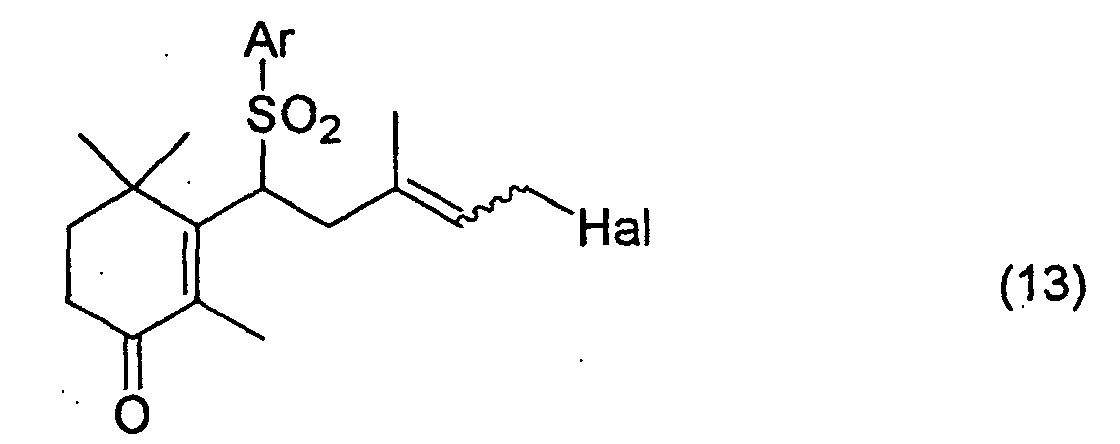
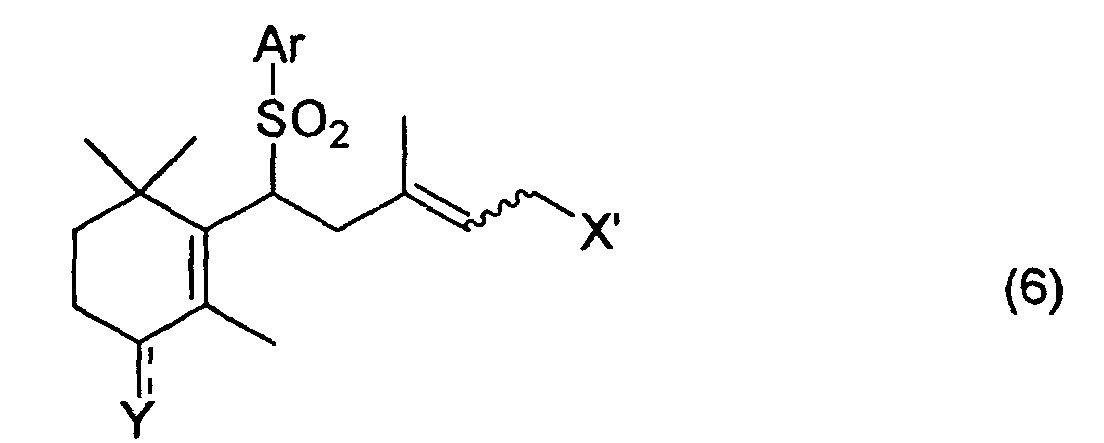
- the halogen represented by the substituents X, X' and Hal in the compounds represented by the general formula (2), (6), (10) and (13) includes a chlorine atom, a bromine atom and an iodine atom.
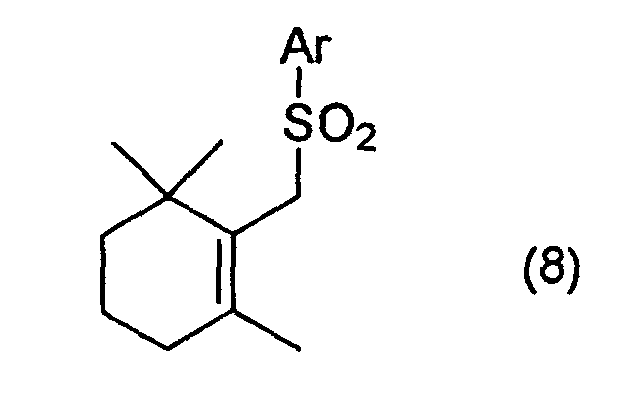
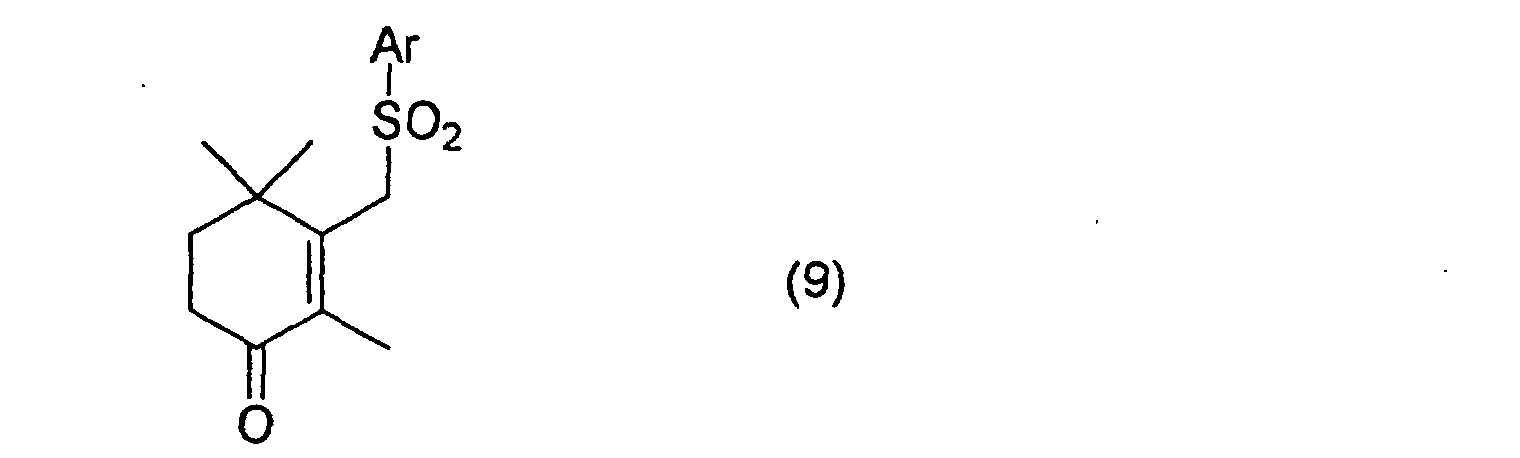
- the cyclic ketosulfone compound (9) in the present invention can be obtained by subjecting the cyclic sulfone compound (8) to an oxidation reaction.
- the oxidizing agent metallic oxidizing agents such as chromium, manganese, selenium, and the like have been heretofore known (JP 2000-80073 A).
- a N-halogeno compound can also be used as the oxidizing agent in the presence of water. Examples of the N-halogeno compound include N-halogenosuccinimide, trihalogenoisocyanuric acid, 1,3-dihalogeno-5,5-dimethylhydantoin, and the like.
- N-bromosuccinimide N-chlorosuccinimide, N-iodosuccinimide, tribromoisocyanuric acid, trichloroisocyanuric acid, triidoisocyanuric acid, 1,3-dibromo-5,5-dimethylhydantoin, 1,3-dichloro-5,5-dimethylhydantoin, 1,3-diiodo-5,5-diemthylhydantoin, chloroamine, chloramine T, chloramine B, N-chlorourea, N-bromoacetamide, and the like.
- the amount of the N-halogeno compound to be used is usually 1 to 10 moles preferably 1 to 4 moles to 1 mole of the cyclic sulfone compound (8).
- an organic solvent is used in the above oxidation reaction.
- the solvent include aprotic polar solvents such as acetonitrile, N,N-dimethylformamide, dimethyl sulfoxide, N,N-dimethylacetamide, hexamethylphosphoric triamide, etc.; ether solvents such as 1,4-dioxane, tetrahydrofuran, etc.; hydrocarbon solvents such as n-hexane, cyclohexane, n-pentane, n-heptane, toluene, xylene, etc.; halogenated solvents such as chloroform, dichloromethane, 1,2-dichloroethane, monochlorobenzene, o-dichlorobenzene, etc.; and the like. These solvents can be used alone or in a combination of two or more thereof.
- the above oxidation reaction is performed by addition of water to the above organic solvent.
- the amount of water to be added is 1 equivalent or more to the cyclic sulfone compound (8) and, usually, 5 to 50% by weight based on the solvent to be used.
- the reaction temperature is usually within the range of 0°C to the boiling point of the solvent to be used. Further, the reaction time varies depending upon the kind of oxidizing agent used in the reaction and the reaction temperature, but is usually within the range of about 1 hour to 24 hours.
- the cyclic ketosulfone compound (9) can be obtained by performing a conventional post-treatment operation. Further, if necessary, it can be purified by silica gel chromatography, etc.
- the ester compound (11) in the present invention can be obtained by reacting the cyclic ketosulfone compound (9) with the allyl halide (10) in the presence of a base.
- Examples of the base to be used in the above reaction include alkyllithium, Grignard reagents, alkali metal hydroxides, alkaline earth metal hydroxides, alkali metal hydrides, alkaline earth metal hydrides, alkali metal alkoxides, alkaline earth metal alkoxides, and the like.
- the amount of the base to be used is usually about 0.1 to 20 moles to 1 mole of the cyclic ketosulfone compound (9).
- phase-transfer catalyst is preferably used to accelerate the reaction.
- phase-transfer catalyst examples include quaternary ammonium salts, quaternary phosphonium salts, sulfonium salts, and the like.
- ammonium halides having alkyl and/or aralkyl groups containing 1 to 24 carbon atoms.
- ammonium halides having alkyl and/or aralkyl groups containing 1 to 24 carbon atoms. Examples thereof include tetramethylammonium chloride, tetraethylammonium chloride, tetrapropylammonium chloride, tetrabutylammonium chloride, tetrapentylammonium chloride, tetrahexylammonium chloride, tetraheptylammonium chloride, teteraoctylammonium chloride, tetrahexadecylammonium chloride, tetraoctadecylammonium chloride, benzyltrimethylammonium chloride, benzyltriethylammonium chloride, benzyltributylammonium chloride, 1-methylpyridinium chlor
- Examples of the quaternary phosphonium salt include tributylmethylphosphonium chloride, triethylmethylphosphonium chloride, methyltriphenoxyphosphonium chloride, butyltriphenylphosphonium chloride, tetrabutylphosphonium chloride, benzyltriphenylphosphonium chloride, hexadecyltrimethylphosphonium chloride, hexadecyltributylphosphonium chloride, hexadecyldimethylethylphosphonium chloride, tetraphenylphosphonium chloride, tributylmethylphosphonium bromide, triethylmethylphosphonium bromide, methyltriphenoxyphosphonium bromide, butyltriphenylphosphonium bromide, tetrabutylphosphonium bromide, benzyltriphenylphosphonium bromide, hexadecyltrimethylphosphonium bromide,
- sulfonium salt examples include dibutylmethylsulfonium chloride, trimethylsulfonium chloride triethylsulfonium chloride, dibutylmethylsulfonium bromide, trimethylsulfonium bromide, triethylsulfonium bromide dibutylmethylsulfonium iodide, trimethylsulfonium iodide, triethylsulfonium iodide, and the like.
- the preferred catalysts are the quaternary ammonium salts, in particular, ammonium halides having alkyl and/or aryl groups containing 1 to 24 carbon atoms.
- the amount of the phase-transfer catalyst to be used is 0.01 to 0.2 mole, preferably 0.02 to 0.1 mole to 1 mole of the cyclic ketosulfone compound (9).
- an organic solvent is used, and examples of the solvent include ether solvents such as diethyl ether, 1,4-dioxane, tetrahydrofuran, anisole, etc.; hydrocarbon solvents such as n-hexane, cyclohexane, n-pentane, n-heptane, toluene, xylene, etc.; or aprotic polar solvents such as N,N-dimethylformamide, dimethyl sulfoxide, N,N-dimethylacetamide, hexamethylphosphoric triamide, etc.
- ether solvents such as diethyl ether, 1,4-dioxane, tetrahydrofuran, anisole, etc.
- hydrocarbon solvents such as n-hexane, cyclohexane, n-pentane, n-heptane, toluene, xylene, etc.
- the reaction temperature is usually within the range of -78°C to the boiling point of the solvent to be used. Further, the reaction time varies depending on the kind of base and the catalyst used in the reaction and the reaction temperature, but is usually within the range of about 0.5 hour to 24 hours.
- the ester compound (11) can be obtained by performing a conventional post-treatment operation. At this time, the alcohol compound (12) is sometimes formed in the post-treatment step.
- the alcohol compound (12) can be readily derived from the above-obtained ester compound (11) by conventional hydrolysis.
- the hydrolysis reaction is not specifically limited and, for example, there is the method described in Comprehensive Organic Transformation, R.C. Larock, VCH publishers Inc., p 981 (1988). If necessary, the alcohol compound (12) thus obtained can be purified by silica gel chromatography, etc.
- the halogen compound (13) of the present invention can be obtained by subjecting the alcohol compound (12) to a halogenation reaction.
- halogenation reaction examples include a halogenation reaction using a halide of a group 4 transition metal, a halogenation reaction using a halide of sulfur, phosphorus or boron or an acid chloride, a halogenation reaction using these halogenating agents together with formamides, a halogenation reaction using hydrogen chloride, hydrochloric acid, hydrogen bromide, or hydrobromic acid, and the like.
- halide of the group 4 transition metal examples include titanium tetrachloride, titanium tetrabromide, titanium tetraiodide, dichlorotitanium isopropoxide, chlorotitanium triisopropoxide, zirconium tetrachloride, hafnium tetrachloride, and the like.
- the preferred halide is titanium tetrachloride and, in case of using titanium tetrachloride, preferably, it is used in the presence of an ether compound such as ethylene glycol dimethyl ether, etc. or a ketone compound such as acetone, methyl isobutyl ketone, etc.
- halide of sulfur, phosphorus or boron examples include thionyl chloride, thionyl bromide, phosphorus trichloride, phosphorus pentachloride, phosphorus oxychlordie, phosphorus tribromide, phosphorus pentabromide, phosphorus triiodide, boron trichloride, boron tribromide, and the like.
- acid chloride examples include phosgene, oxalyl chloride, and the like.
- These halogenating agents can be used alone. Alternatively, they can be used in the presence of formamides such as N,N-dimethylformamide to form Vilsmeier agents, which can be utilized as the halogenating agents.
- an organic solvent is used for the above reaction and examples thereof include ether solvents such as diethyl ether, 1,4-dioxane, tetrahydrofuran, anisole, etc.; hydrocarbon solvents such as n-hexane, cyclohexane, n-pentane, n-heptane, toluene, xylene, etc.; halogenated solvents such as chloroform, dichloromethane, 1,2-dichloroethane, monochlorobenzene, etc.; ketone solvents such as acetone, methyl isopropyl ketone, etc.; or aprotic polar solvents such as acetonitrile, N,.N-dimethylformamide, dimethyl sulfoxide, N,N-dimethylacetamide, hexamethylphosphoric triamide, etc.
- ether solvents such as diethyl ether, 1,4-dioxane, t
- the reaction temperature can arbitrarily be selected within the range of -78°C to the boiling point of the solvent to be used, preferably within the range of about -20°C to 80°C.
- the reaction time varies depending on the kind of halogenating agent and the reaction temperature but, usually, is within the range of about 0.5 hour to 24 hours.
- the halogen compound (13) can be obtained by performing a conventional post-treatment operation.
- the phosphonium salt (2) of the present invention can be obtained. by reacting the sulfone compound (6) with the triarylphosphine (7) or a hydrohalogenic acid salt or sulfonate thereof.
- Examples of the triarylphosphine to be used in the above triarylphosphine-formation reaction include triphenylphosphine, tri-o-tolylphosphine, tri-m-tolylphosphine, tri-p-tolylphosphine, tris(3-methoxyphenyl)phosphine, tris(4-methoxyphenyl)phosphine, and the like.
- hydrohalogenic acid salt or sulfonate thereof examples include hydrochloride, hydrobromide, hydroiodide, methanesulfonate, ethanesulfonate, benzenesulfonate, p-toluenesulfonate, trifluoromethanesulfonate, and the like.
- the amount of the triarylphosphine or a hydrohalogenic acid salt or sulfonate thereof to be used is usually about 0.7 to 2 moles to 1 mole of the sulfone compound (6).
- an organic solvent is used for the above triarylphosphine-formation reaction.
- the solvent include ether solvents such as diethyl ether, tetrahydrofuran, dimethoxyethane, 1,4-dioxane, anisole, etc.; aprotic polar solvents such as N,N-dimethylformamide, dimethyl sulfoxide, N,N-dimethylacetamide, sulfolane, hexamethylphosphoric triamide, etc.; hydrocarbon solvents such as n-hexane, cyclohexane, n-pentane, n-heptane, benzene, toluene, xylene, etc.; ketone solvents such as acetone, diisopropyl ketone, methyl isobutyl ketone, etc.; halogenated solvents such as chloroform, dichloromethane, 1,2-dichloroethane, monochlor
- the reaction temperature is within the range of about 10°C to 50°C.
- the reaction time is about 1 hour to 24 hours.
- the compound can be produced by the process described in EP 1 199 303 A1.
- the sulfone compound can be produced by subjecting the corresponding sulfone compound wherein X is a hydrogen atom and X' is a hydroxy group to the same halogenation reaction as that described above.
- the disulfone compound (3) of the present invention can be obtained by reacting the above phosphonium compound (2) with the C10 dialdehyde (5) in the presence of a base.
- the amount of the phosphonium compound (2) to be used is about 2 to 3 moles to 1 mole of the C10 dialdehyde (5).
- any base can be used in so far as it can be used for a conventional Wittig reaction.
- alkali metal alkoxides such as potassium methoxide, potassium ethoxide, potassium n-butoxide, potassium t-butoxide, sodium methoxide, sodium ethoxide, sodium n-butoxide, sodium t-butoxide, etc.
- alkali metal hydroxides such as potassium hydroxide, sodium hydroxide; lithium hydroxide, etc.
- epoxides such as ethylene oxide, 1,2-butene oxide, etc., can be used instead of the base.
- the amount of such a base is usually about 1 to 5 moles to 1 mole of the phosphonium salt (2).
- an organic solvent is used for the above reaction.
- these solvents there are hydrocarbon solvents such as n-hexane, cyclohexane, n-pentane, n-heptane, toluene, xylene, etc.; ether solvents such as diethyl ether, tetrahydrofuran, dimethoxyethane, anisole, etc.; halogenated solvents such as chloroform, dichloromethane, 1,2-dichloromethane, monochlorobenzene, o-dichlorobenzene, etc.; or aprotic polar solvents such as N,N-dimethylformamide, dimethyl sulfoxide, N,N-dimethylacetamide, hexamethylphosphoric triamide, etc. Sometimes, a mixed solvent thereof with water can also be used.
- the reaction temperature is within the range of about -10°C to 150°C, preferably about 0°C to 100°C.
- the reaction time varies depending on the kind of solvent used and the reaction temperature but, usually, it is within about 5 hours to 48 hours.
- the disulfone compound (3) can be obtained by performing a conventional post-treatment operation. However, if necessary, it can be purified by extraction, washing, various chromatographic techniques, and the like.
- the carotenoid (4) can be derived from the resultant disulfone compound (3) by reaction thereof with a basic compound.
- the basic compound to be used in the above reaction include alkali metal hydroxides, alkali metal hydrides, and alkali metal alkoxides.
- the basic compound to be used in the above reaction include alkali metal hydroxides, alkali metal hydrides, and alkali metal alkoxides.
- the amount of the basic compound is usually about 2 to 30 moles, preferably about 4 to 25 moles to 1 mole of the disulfone compound (3).
- an organic solvent is used for the above reaction.
- the solvent include ether solvents such as diethyl ether, tetrahydrofuran, 1,4-dioxane, anisole, etc.; hydrocarbon solvents such as n-hexane, cyclohexane, n-pentane, n-heptane, toluene, xylene, etc.; alcohol solvents such as methanol, ethanol, isopropanol, t-butanol, etc.; and aprotic polar solvents such as acetonitrile, N,N-dimethylformamide, dimethyl sulfoxide, N,N-dimethylacetamide, hexamethylphosphoric triamide, etc.
- ether solvents such as diethyl ether, tetrahydrofuran, 1,4-dioxane, anisole, etc.
- hydrocarbon solvents such as n-hexane, cyclohex
- the reaction temperature is within -78°C to the boiling point of the solvent to be used. Further, the reaction temperature varies depending on the kind of basic compound used in the reaction and the reaction temperature, but it is usually within the range of about 1 hour to 24 hours.
- the carotenoid (4) can be obtained by performing a conventional post-treatment operation. If necessary, it can be purified by crystallization, various chromatographic techniques, and the like. However, since the carotenoid (4) is liable to be oxidized, desirably, these operations are performed under an atmosphere of inert gas such as nitrogen, argon, etc., and an antioxidant such as BHT, etc., is added to the solvent to be used.
- the above starting material i.e., the cyclic sulfone compound (8) can be synthesized from myrcene or linalool by a known method (e.g., Chem. Lett., 479 (1975); Japanese Patent 2558275, etc.).
- the allyl halide (10) can be synthesized by a known method (e.g., JP 6-345689 A; EP 1 231 197 A1, etc.).
- the C10 dialdehyde (5) can be synthesized by a known method (e.g., DE 1 092 472; Pure & Appl. Chem. Vol. 47, 173 (1976), etc.).
- the cyclic sulfone compound (XIV) (18.28 g, 62.5 mmol) was dissolved in a mixed solvent of acetonitrile (300 ml) and water (30 ml). To this solution was added N-bromosuccinimide (16.7 g, 93.8 mmol) at room temperature. After stirring the mixture at the same temperature for 30 minutes, N-bromosuccinimide (11.1 g, 62.4 mmol) was further added thereto and the mixture was stirred for 7 hours. After addition of N,N-diethylaniline (25 ml), an aqueous 5% sodium sulfite solution (150 ml) was added and the mixture was extracted three times with diethyl ether.
- the resultant organic layer was washed with successive, 1 M hydrochloric acid, water and saturated saline, dried over MgSO 4 and concentrated to obtain a crude product.
- the crude product was purified by silica gel column chromatography to obtain the cyclic ketosulfone compound (I) in a yield of 49%.
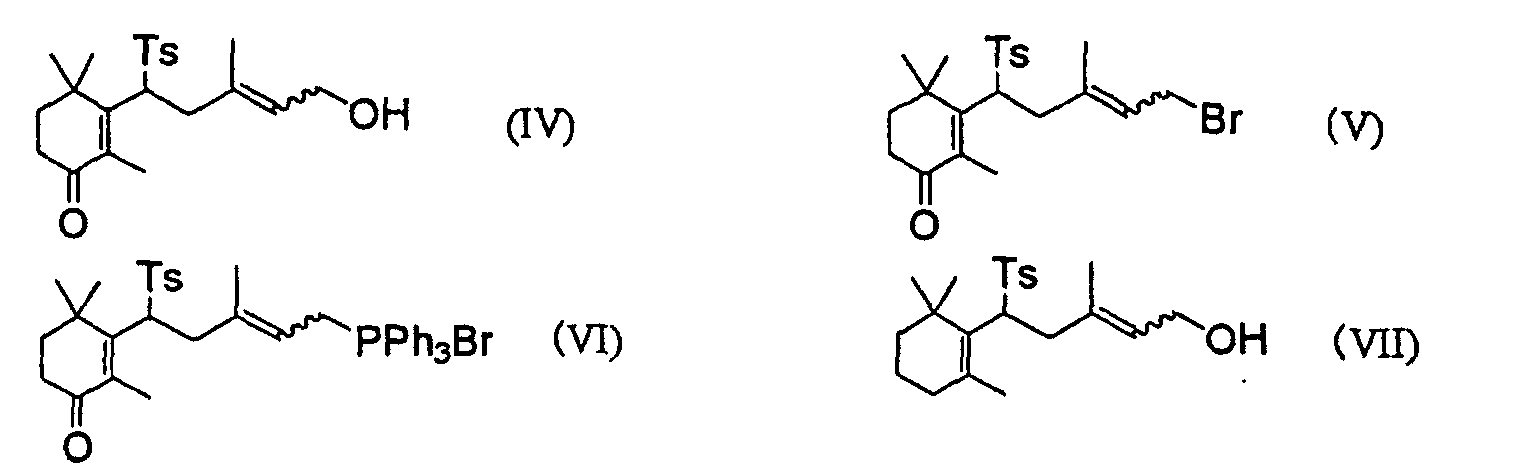
- the ester compound (III) (1.3715 g, 3.2 mmol) was dissolved in methanol (20 ml), an aqueous 2 M NaOH solution (2 ml, 6 mmol) was added thereto at room temperature and the mixture was stirred as such for 5.5 hours. After completion of the reaction, extraction was performed by addition of water and Et 2 O. The resultant organic layer was washed with saturated saline, dried over MgSO 4 , and concentrated to obtain the alcohol compound (IV) (1.1366 g, 2.91 mmol, yield: 91%).
- the alcohol compound (IV) (1.0790 g, 2.76 mmol) was dissolved in diethyl ether (9 ml) and cooled with ice-water to 0°C. Then, pyridine (15 mg) and PBr 3 (92 ⁇ L, 263 mg, 0.97 mmol) were added thereto and the mixture was stirred for 2.5 hours. After completion of the reaction, extraction was performed by addition of water and AcOEt and the resultant organic layer was washed with saturated saline, dried over MgSO 4 and concentrated to obtain the halogen compound (V) (1.1869 g, 2.62 mmol, yield: 95%).
- the halogen compound (V) (1.1200 g, 2.47 mmol) was dissolved in anhydrous acetone (20 ml) and PPh 3 (647.9 mg, 2.47 mmol) were added thereto. The mixture was heated under reflux for 7.5 hours. After completion of the reaction, the reaction mixture was concentrated to obtain the phosphonium salt (VI) (1.8891 g).
- the alcohol compound (VII) (1.8945 g, 5 mmol) was dissolved in diethyl ether (5 ml) and, after cooling with ice-water to 0°C, pyridine (25 mg) and PBr 3 (158 ⁇ L, 451 mg, 1.67 mmol) were added thereto and the mixture was stirred for 3.5 hours. Two drops of PBr 3 were added by a pipette and the mixture was further stirred for 4 hours. After completion of the reaction, extraction was performed by addition of water and Et 2 O and the organic layer was washed with saturated saline, dried over MgSO 4 and concentrated to obtained the halogen compound (VIII) (2.083 g, 4.53 mmol, yield: 95%).
- the halogen compound (VIII) (883 mg, 2 mmol) was dissolved in anhydrous acetone (15 ml), PPh 3 (524.6 mg, 2 mmol) was added thereto and the mixture was stirred at room temperature for 1.5 hours. Then, the temperature was raised to 40°C and the mixture was stirred for 15 hours and further heated under reflux for 5 hours. After completion of the reaction, the reaction mixture was concentrated and washed with hexane, and diethyl ether was added thereto. After separation into two layers, the diethyl ether layer was separated and the residual solution was concentrated to obtain a crude product (1.4572 g). According to NMR analysis, the product was the phosphonium salt (IX) containing some impurities.
- IX phosphonium salt
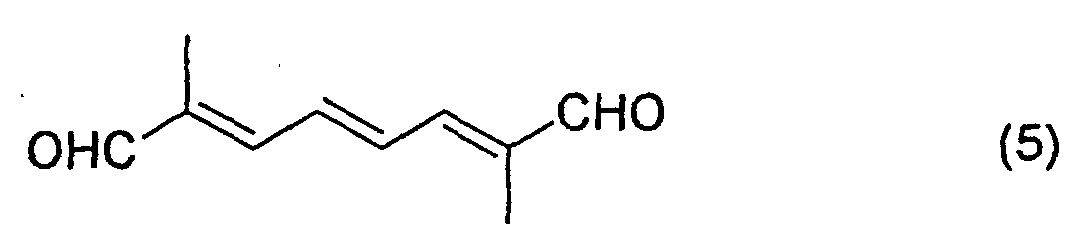
- the C10 dialdehyde (X) (172. 4 mg, 1.05 mmol) was dissolved in CH 2 Cl 2 (3 ml) and an aqueous 2 M NaOH solution (2 ml) was added thereto at room temperature.
- a solution of the phosphonium compound (VI) dissolved in CH 2 Cl 2 in an amount corresponding to 2.29 mmol and then the mixture was stirred for 7 hours. After completion of the reaction, the aqueous layer was separated and the organic layer was washed several times with water.
- the C10 dialdehyde (X) (82 mg, 0.5 mmol) was dissolved in CH 2 Cl 2 (1.5 ml) and an aqueous 2 M NaOH solution (1.5 ml) was added thereto at room temperature.
- a CH 2 Cl 2 solution of the phosphonium salt (IX) in an amount corresponding to 1 mmol and then the mixture was stirred for 10 hours.
- the aqueous layer was separated and the organic layer was was washed several times with water.
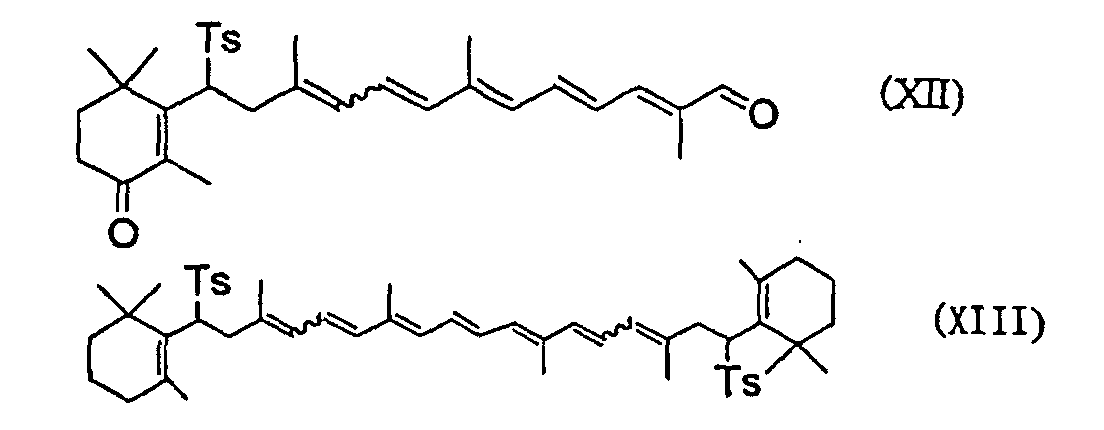
- the organic layer was dried over MgSO4 and concentrated and the product was isolated and purified by silica gel chromatography to obtain the disulfone compound (XIII) (0.41588 g, 98%).
- the disulfone compound (XIII) (346.9 mg, 0.4 mmol) was dissolved in THF (2 ml). To the solution was added KOMe (112 mg, 1.6 mmol) and the mixture was stirred at 40°C for 4.5 hours. After completion of the reaction, THF was distilled off and the concentrate was isolated by silica gel chromatography to obtain ⁇ -carotene (141.1 mg, 0.263 mmol, yield: 66%).
- carotenoids which are important in the fields of medicine, feed additives and food additives can be prepared from readily available myrcene and linalool through relatively stable intermediates, industrially and advantageously.
Landscapes
- Chemical & Material Sciences (AREA)
- Organic Chemistry (AREA)
- Health & Medical Sciences (AREA)
- Life Sciences & Earth Sciences (AREA)
- Biochemistry (AREA)
- General Health & Medical Sciences (AREA)
- Molecular Biology (AREA)
- Organic Low-Molecular-Weight Compounds And Preparation Thereof (AREA)
Abstract

Description


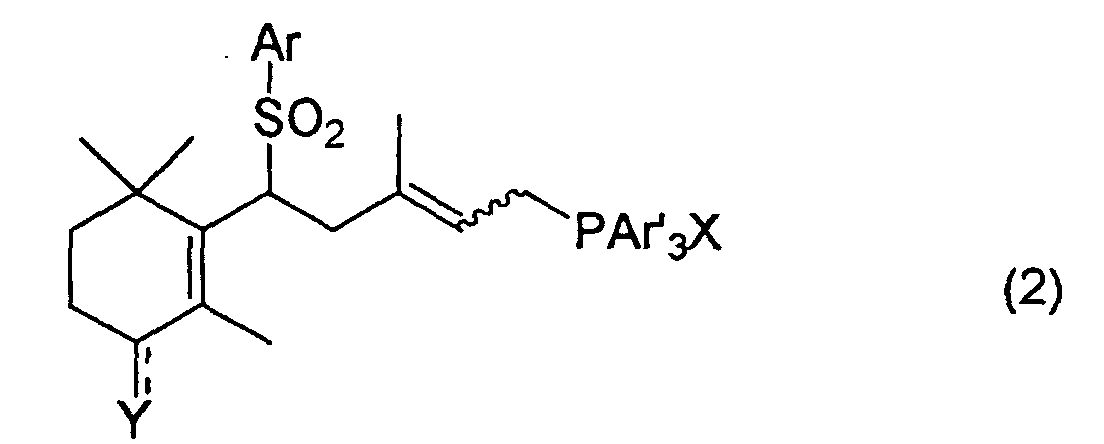


A phosphonium salt represented by the general formula (2):

A disulfone compound represented by the general formula (3) :

1H-NMR: δ (CDCl3) 0.98 (3H), 1.27 (3H), 1.34 (3H), 1. 70-2.10 (2H), 2.04 (3H), 2.17 (3H), 2.47 (3H), 2.40-2.65 (2H), 2.65-2.85 (1H), 2.95-3.20 (1H), 4.00-4.20 (1H), 4.20-4.60 (2H), 5.30-5.50 (1H), 7.30-7.50 (2H), 7.70-7.90 (2H)
1H-NMR: δ (CDCl3) 1.00 (3H), 1.26(3H), 1.33(3H), 1.60-2.05 (3H), 2.17 (3H), 2.46 (3H), 2.30-2.60 (2H), 2.65-2.75 (1H), 2.95-3.10 (1H), 4.00-4.10 (1H), 4.10-4.30 (2H), 5.30-5.60 (1H), 7.30-7.40 (2H), 7.70-7.90 (2H)
1H-NMR: δ (CDCl3) 1.00 (3H), 1.26 (3H), 1.33 (3H), 1.60-2.10 (2H), 2.17 (3H), 2.47 (3H), 2.30-2.60 (2H), 2.65-2.75 (1H), 2.95-3.20 (1H), 3.75-3.90 (2H), 4.00-4.25 (1H), 5.30-5.65 (1H), 7.30-7.45 (2H), 7.70-7.90 (2H)
1H-NMR: δ (CDCl3) 0.90-1.10 (3H), 1.10-1.20 (3H), 1.25 (3H), 1.20-1.40 (2H), 1.60-1.90 (2H), 2.10-2.20 (3H), 2.46 (3H), 2.30-2.60 (1H), 2.90-3.20 (1H), 4.00-4.20 (1H), 4.30-4.90 (2H), 5.10-5.60 (1H), 7.20-7.90 (19H)
1H-NMR: δ (CDCl3) 0.72-0.87 (6H), 1.26 (3H), 1.15-1.60 (5H), 1.80-2.10 (1H), 2.17-2.19 (3H), 2.44 (3H), 2.30-2.50 (1H), 3.00-3.20 (1H), 3.80-3.90 (1H), 4.30-4.90 (2H), 5.10-5.50 (1H), 7.20-7.90 (19H)
1H-NMR: δ (CDCl3) 0.80-0.83 (6H), 1.05-1.09 (6H), 1.30-1.70 (16H), 1.80-2.20 (18H), 2.43-2.44 (6H), 2.60-2.80 (2H), 2.90-3.20 (2H), 3.60-4.00 (4H), 5.80-6.00 (1H), 6.10-6.80 (3H), 7.20-7.40 (4H), 7.60-7.90 (4H)




Claims (17)
- A disulfone compound represented by the general formula (3):wherein Ar is an optionally substituted aryl group; Y is a hydrogen atom or an oxo group; and each wavy line represents either of E/Z geometrical isomers or a mixture thereof.

- A ketosulfone compound represented by the general formula (1):wherein R is a hydroxy group, -OCOR' group or a halogen, wherein R' is a straight- or branched-chain lower alkyl group; and Ar and the wavy line are as defined above.

- A phosphonium salt represented by the general formula (2):wherein each of Ar and Ar' is an optionally substituted aryl group; X is a halogen or -OSO2R" group, wherein R" is an optionally substituted aryl group, a straight- or branched-chain lower alkyl group or a trifluoromethyl group; and Y and the wavy line are as defined above.

- A process for preparation of the disulfone compound represented by the above general formula (3), which comprises reacting the phosphonium salt represented by the above general formula (2) with a C10 dialdehyde represented by the formula (5) :in the presence of a base.

- A process for preparation of the disulfone compound represented by the above general formula (3), which comprises reacting a sulfone compound represented by the general formula (6):wherein X' is a hydroxy group or a halogen; and Ar, Y and the wavy line are as defined above, with a triarylphosphine represented by the general formula (7):
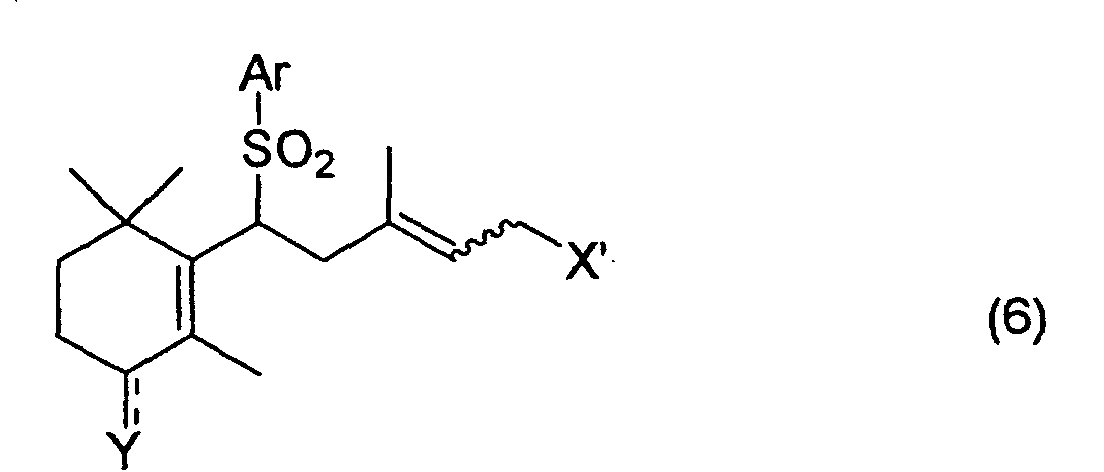
- A process for preparation of the phosphonium salt represented by the above general formula (2), which comprises reacting the sulfone compound represented by the above general formula (6) with the triarylphosphine represented by the above general formula (7) or a hydrohalogenic acid salt or sulfonate thereof.
- A process for preparation of a cyclic ketosulfone compound represented by the general formula (9):wherein Ar is as defined above, which comprises reacting a cyclic sulfone compound represented by the general formula (8) :
 wherein Ar is as defined above, with a N-halogeno compound in the presence of water.
- The process for preparation of the cyclic ketosulfone compound represented by the above general formula (9), wherein the N-halogeno compound is a N-halogenosuccinimide.
- A process for preparation of an ester compound represented by the general formula (11):wherein Ar, R' and the wavy line are as defined above; which comprises reacting the cyclic ketosulfone compound of the above general formula (9) with an allyl halide represented by the general formula (10):
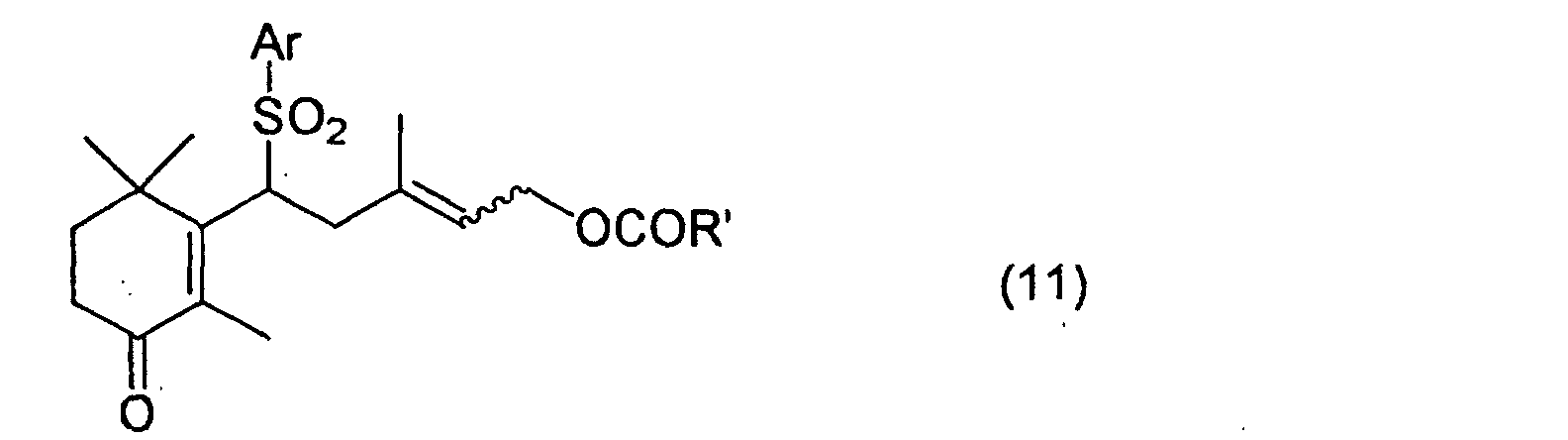 wherein Hal is a halogen; R' is a straight- or branched-chain lower alkyl group; and the wavy line is as defined above, in the presence of a base.
- A process for preparation of an alcohol compound represented by the general formula (12):wherein Ar and the wavy line are as defined above, which comprises hydrolyzing the ester compound represented by the above general formula (11).

- A process for preparation of the alcohol compound represented by the above general formula (12), which comprises reacting the cyclic ketosulfone compound represented by the above general formula (9) with the allyl halide represented by the above general formula (10) in the presence of a base, followed by hydrolyzing the resultant ester compound represented by the above general formula (11).
- A process for preparation of a halogen compound represented by the general formula (13):wherein Ar, Hal and the wavy line are as defined above, which comprises reacting the alcohol compound represented by the above general formula (12) with a halogenating agent.

- A process for preparation of the halogen compound represented by the above general formula (13), which comprises reacting the alcohol compound represented by the above general formula (12), which has been obtained by hydrolysis of the ester compound represented by the above general formula (11), with a halogenating agent.
- The process for preparation of the halogen compound according to claim 13, wherein the ester compound represented by the above general formula (11) is a compound obtained by reacting the ketosulfone compound represented by the above general formula (9) with the ally halide represented by the above general formula (10) in the presence of a base.
- A process for preparation of a carotenoid represented by the general formula (4):wherein Y and each wavy line are as defined above, which comprises reacting the disulfone compound represented by the above general formula (3) with a basic compound.
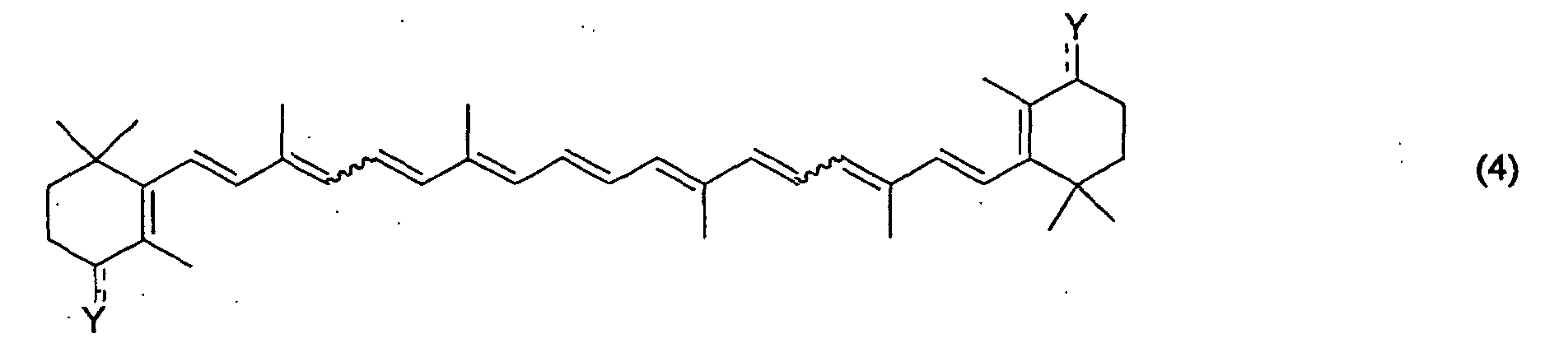
- A process for preparation of the carotenoid represented by the above general formula (4), which comprises reacting the phosphonium salt represented by the above general formula (2) with the C10 dialdehyde represented by the above formula (5) in the presence of a base, followed by reacting the resulting disulfone compound represented by the above general formula (3) with a basic compound.
- A process for preparation of the carotenoid represented by the above general formula (4), which comprises reacting the sulfone compound represented by the above general formula (6) with the triarylphosphine represented by the above general formula (7) or a hydrohalogenic acid salt or sulfonate thereof, reacting the resultant phosphonium salt represented by the above general formula (2) with the C10 dialdehyde represented by the above formula (5) in the presence of a base, and reacting the resultant disulfone compound represented by the above general formula (3) with a basic compound.
Applications Claiming Priority (5)
| Application Number | Priority Date | Filing Date | Title |
|---|---|---|---|
| JP2002041247A JP4045814B2 (en) | 2002-02-19 | 2002-02-19 | Method for producing ketosulfone derivative |
| JP2002041247 | 2002-02-19 | ||
| JP2002347572 | 2002-11-29 | ||
| JP2002347572A JP4232446B2 (en) | 2002-11-29 | 2002-11-29 | Method for producing carotenoid |
| PCT/JP2003/001520 WO2003070698A1 (en) | 2002-02-19 | 2003-02-14 | Process for preparation of carotenoids |
Publications (3)
| Publication Number | Publication Date |
|---|---|
| EP1477477A1 true EP1477477A1 (en) | 2004-11-17 |
| EP1477477A4 EP1477477A4 (en) | 2006-04-19 |
| EP1477477B1 EP1477477B1 (en) | 2010-12-22 |
Family
ID=27759634
Family Applications (1)
| Application Number | Title | Priority Date | Filing Date |
|---|---|---|---|
| EP03705138A Expired - Lifetime EP1477477B1 (en) | 2002-02-19 | 2003-02-14 | Process for preparation of carotenoids |
Country Status (5)
| Country | Link |
|---|---|
| US (1) | US20040204612A1 (en) |
| EP (1) | EP1477477B1 (en) |
| CN (1) | CN1291974C (en) |
| DE (1) | DE60335451D1 (en) |
| WO (1) | WO2003070698A1 (en) |
Cited By (1)
| Publication number | Priority date | Publication date | Assignee | Title |
|---|---|---|---|---|
| EP1426357A4 (en) * | 2001-09-10 | 2006-03-01 | Sumitomo Chemical Co | PROCESS FOR THE PREPARATION OF ALLYL SULFONE DERIVATIVES AND INTERMEDIATE PRODUCTS USED IN THE PREPARATION OF THESE DERIVATIVES |
Families Citing this family (4)
| Publication number | Priority date | Publication date | Assignee | Title |
|---|---|---|---|---|
| GB0501365D0 (en) * | 2005-01-21 | 2005-03-02 | Promar As | Compositions |
| CN101037449B (en) * | 2007-04-09 | 2010-04-07 | 广州巨元生化有限公司 | New quaternary phosphonium salt and synthesizing method applied for carotenoids |
| US20110015441A1 (en) * | 2008-03-04 | 2011-01-20 | Sumitomo Chemical Company, Limited | Sulfone compound and process for producing carotenoid using the same compound |
| CN101977895A (en) * | 2008-03-17 | 2011-02-16 | 住友化学株式会社 | Sulfone compound and method for producing the same |
Family Cites Families (9)
| Publication number | Priority date | Publication date | Assignee | Title |
|---|---|---|---|---|
| DE1092472B (en) | 1958-10-02 | 1960-11-10 | Basf Ag | Process for the preparation of symmetrically substituted conjugated hexatriene compounds and their vinyl analogs |
| JPH029857A (en) * | 1988-06-27 | 1990-01-12 | Kuraray Co Ltd | Production of halosulfone |
| US5237102A (en) * | 1990-06-14 | 1993-08-17 | Kuraray Company Ltd. | Sulfone aldehydes useful for producing β-carotene |
| JPH06345689A (en) | 1993-06-14 | 1994-12-20 | Takeda Chem Ind Ltd | Production of aldehyde derivative |
| CH694126A5 (en) * | 1998-06-18 | 2004-07-30 | Sumitomo Chemical Co | Ketosulfonderivate and methods for their preparation. |
| JP2001114756A (en) * | 1999-10-12 | 2001-04-24 | Sumitomo Chem Co Ltd | Method for producing β-carotene |
| KR20010078067A (en) * | 2000-01-28 | 2001-08-20 | 고사이 아끼오 | Dihalo-compound and process for producing vitamin a derivative |
| CN1660799A (en) * | 2000-10-18 | 2005-08-31 | 住友化学株式会社 | Retinol compounds |
| EP1231197A1 (en) | 2001-02-07 | 2002-08-14 | Sumitomo Chemical Company, Limited | Process for producing allyl halide compound |
-
2003
- 2003-02-14 CN CNB038042134A patent/CN1291974C/en not_active Expired - Fee Related
- 2003-02-14 EP EP03705138A patent/EP1477477B1/en not_active Expired - Lifetime
- 2003-02-14 US US10/488,237 patent/US20040204612A1/en not_active Abandoned
- 2003-02-14 DE DE60335451T patent/DE60335451D1/en not_active Expired - Lifetime
- 2003-02-14 WO PCT/JP2003/001520 patent/WO2003070698A1/en not_active Ceased
Cited By (1)
| Publication number | Priority date | Publication date | Assignee | Title |
|---|---|---|---|---|
| EP1426357A4 (en) * | 2001-09-10 | 2006-03-01 | Sumitomo Chemical Co | PROCESS FOR THE PREPARATION OF ALLYL SULFONE DERIVATIVES AND INTERMEDIATE PRODUCTS USED IN THE PREPARATION OF THESE DERIVATIVES |
Also Published As
| Publication number | Publication date |
|---|---|
| WO2003070698A1 (en) | 2003-08-28 |
| EP1477477A4 (en) | 2006-04-19 |
| CN1291974C (en) | 2006-12-27 |
| US20040204612A1 (en) | 2004-10-14 |
| DE60335451D1 (en) | 2011-02-03 |
| EP1477477B1 (en) | 2010-12-22 |
| CN1635994A (en) | 2005-07-06 |
Similar Documents
| Publication | Publication Date | Title |
|---|---|---|
| EP1477477B1 (en) | Process for preparation of carotenoids | |
| US6297402B1 (en) | Ketosulfone derivatives and process for producing the same | |
| EP1072589B1 (en) | Process for producing lycopene and intermediate thereof | |
| US6211411B1 (en) | Process for producing retinal and intermediate for producing the same | |
| US6355841B1 (en) | Process for producing β-carotene | |
| JP4232446B2 (en) | Method for producing carotenoid | |
| US6444857B1 (en) | Process for producing vitamin A aldehyde and intermediate for producing the same | |
| US20020107422A1 (en) | Process for producing allyl halide compound | |
| EP1199303B1 (en) | Process for producing retinol and intermediate compounds for producing the same | |
| JP3799875B2 (en) | Sulfone derivative and process for producing the same | |
| US20040034257A1 (en) | Novel sulfone derivatives and process for producing these | |
| JP4196669B2 (en) | Method for producing allyl halide derivative | |
| US6388124B2 (en) | Dihalo-compound and process for producing vitamin A derivative | |
| EP0983998B1 (en) | Tetraene derivative and process for producing the same | |
| US6348622B1 (en) | Vitamin a related compounds and process for producing the same | |
| US6806387B2 (en) | Process for preparation of allyl sulfone derivatives and intermediates for the preparation | |
| JP2000063351A (en) | Method for producing retinal, intermediate and method for producing the same | |
| JP4158451B2 (en) | Method for producing allyl sulfone derivative | |
| JP3747656B2 (en) | Sulfone derivative and process for producing the same | |
| RU2196133C2 (en) | Method of synthesis of polyene alcohol derivative (variants), sulfone compound and method of its synthesis | |
| JP2000143615A (en) | Tetraene derivative and method for producing the same | |
| JP2000344738A (en) | Retinal manufacturing methods and intermediates | |
| JP2003212838A (en) | Method for producing sulfone derivative | |
| US20110015441A1 (en) | Sulfone compound and process for producing carotenoid using the same compound | |
| JP2002308846A (en) | Method for producing retinoid intermediate |
Legal Events
| Date | Code | Title | Description |
|---|---|---|---|
| PUAI | Public reference made under article 153(3) epc to a published international application that has entered the european phase |
Free format text: ORIGINAL CODE: 0009012 |
|
| 17P | Request for examination filed |
Effective date: 20040413 |
|
| AK | Designated contracting states |
Kind code of ref document: A1 Designated state(s): AT BE BG CH CY CZ DE DK EE ES FI FR GB GR HU IE IT LI LU MC NL PT SE SI SK TR |
|
| RAP1 | Party data changed (applicant data changed or rights of an application transferred) |
Owner name: SUMITOMO CHEMICAL COMPANY, LIMITED |
|
| A4 | Supplementary search report drawn up and despatched |
Effective date: 20060303 |
|
| 17Q | First examination report despatched |
Effective date: 20080318 |
|
| GRAP | Despatch of communication of intention to grant a patent |
Free format text: ORIGINAL CODE: EPIDOSNIGR1 |
|
| GRAS | Grant fee paid |
Free format text: ORIGINAL CODE: EPIDOSNIGR3 |
|
| GRAA | (expected) grant |
Free format text: ORIGINAL CODE: 0009210 |
|
| AK | Designated contracting states |
Kind code of ref document: B1 Designated state(s): CH DE FR LI |
|
| REG | Reference to a national code |
Ref country code: CH Ref legal event code: NV Representative=s name: BOHEST AG Ref country code: CH Ref legal event code: EP |
|
| REF | Corresponds to: |
Ref document number: 60335451 Country of ref document: DE Date of ref document: 20110203 Kind code of ref document: P |
|
| REG | Reference to a national code |
Ref country code: DE Ref legal event code: R096 Ref document number: 60335451 Country of ref document: DE Effective date: 20110203 |
|
| PGFP | Annual fee paid to national office [announced via postgrant information from national office to epo] |
Ref country code: CH Payment date: 20110225 Year of fee payment: 9 Ref country code: FR Payment date: 20110119 Year of fee payment: 9 |
|
| PGFP | Annual fee paid to national office [announced via postgrant information from national office to epo] |
Ref country code: DE Payment date: 20110429 Year of fee payment: 9 |
|
| PLBE | No opposition filed within time limit |
Free format text: ORIGINAL CODE: 0009261 |
|
| STAA | Information on the status of an ep patent application or granted ep patent |
Free format text: STATUS: NO OPPOSITION FILED WITHIN TIME LIMIT |
|
| 26N | No opposition filed |
Effective date: 20110923 |
|
| REG | Reference to a national code |
Ref country code: DE Ref legal event code: R097 Ref document number: 60335451 Country of ref document: DE Effective date: 20110923 |
|
| REG | Reference to a national code |
Ref country code: CH Ref legal event code: PL |
|
| PG25 | Lapsed in a contracting state [announced via postgrant information from national office to epo] |
Ref country code: CH Free format text: LAPSE BECAUSE OF NON-PAYMENT OF DUE FEES Effective date: 20120229 Ref country code: LI Free format text: LAPSE BECAUSE OF NON-PAYMENT OF DUE FEES Effective date: 20120229 |
|
| REG | Reference to a national code |
Ref country code: FR Ref legal event code: ST Effective date: 20121031 |
|
| REG | Reference to a national code |
Ref country code: DE Ref legal event code: R119 Ref document number: 60335451 Country of ref document: DE Effective date: 20120901 |
|
| PG25 | Lapsed in a contracting state [announced via postgrant information from national office to epo] |
Ref country code: FR Free format text: LAPSE BECAUSE OF NON-PAYMENT OF DUE FEES Effective date: 20120229 |
|
| PG25 | Lapsed in a contracting state [announced via postgrant information from national office to epo] |
Ref country code: DE Free format text: LAPSE BECAUSE OF NON-PAYMENT OF DUE FEES Effective date: 20120901 |