EP1477277A1 - Two-leg walking humanoid robot - Google Patents
Two-leg walking humanoid robot Download PDFInfo
- Publication number
- EP1477277A1 EP1477277A1 EP03703264A EP03703264A EP1477277A1 EP 1477277 A1 EP1477277 A1 EP 1477277A1 EP 03703264 A EP03703264 A EP 03703264A EP 03703264 A EP03703264 A EP 03703264A EP 1477277 A1 EP1477277 A1 EP 1477277A1
- Authority
- EP
- European Patent Office
- Prior art keywords
- motion
- robot
- data
- posture
- command
- Prior art date
- Legal status (The legal status is an assumption and is not a legal conclusion. Google has not performed a legal analysis and makes no representation as to the accuracy of the status listed.)
- Withdrawn
Links
Images




Classifications
-
- B—PERFORMING OPERATIONS; TRANSPORTING
- B25—HAND TOOLS; PORTABLE POWER-DRIVEN TOOLS; MANIPULATORS
- B25J—MANIPULATORS; CHAMBERS PROVIDED WITH MANIPULATION DEVICES
- B25J13/00—Controls for manipulators
-
- B—PERFORMING OPERATIONS; TRANSPORTING
- B62—LAND VEHICLES FOR TRAVELLING OTHERWISE THAN ON RAILS
- B62D—MOTOR VEHICLES; TRAILERS
- B62D57/00—Vehicles characterised by having other propulsion or other ground- engaging means than wheels or endless track, alone or in addition to wheels or endless track
- B62D57/02—Vehicles characterised by having other propulsion or other ground- engaging means than wheels or endless track, alone or in addition to wheels or endless track with ground-engaging propulsion means, e.g. walking members
- B62D57/032—Vehicles characterised by having other propulsion or other ground- engaging means than wheels or endless track, alone or in addition to wheels or endless track with ground-engaging propulsion means, e.g. walking members with alternately or sequentially lifted supporting base and legs; with alternately or sequentially lifted feet or skid
-
- B—PERFORMING OPERATIONS; TRANSPORTING
- B25—HAND TOOLS; PORTABLE POWER-DRIVEN TOOLS; MANIPULATORS
- B25J—MANIPULATORS; CHAMBERS PROVIDED WITH MANIPULATION DEVICES
- B25J5/00—Manipulators mounted on wheels or on carriages
-
- B—PERFORMING OPERATIONS; TRANSPORTING
- B62—LAND VEHICLES FOR TRAVELLING OTHERWISE THAN ON RAILS
- B62D—MOTOR VEHICLES; TRAILERS
- B62D57/00—Vehicles characterised by having other propulsion or other ground- engaging means than wheels or endless track, alone or in addition to wheels or endless track
- B62D57/02—Vehicles characterised by having other propulsion or other ground- engaging means than wheels or endless track, alone or in addition to wheels or endless track with ground-engaging propulsion means, e.g. walking members
Definitions
- the present invention relates to a biped(two-footed) walking humanoid robot, and more specifically to a biped(two-footed) walking humanoid robot capable of conducting various motions smoothly and continually.
- a conventional biped walking humanoid robot generates the pre-designed walk pattern (hereinafter to be called "gait") data, conducts walk control according to the gait data, moves leg portions by the pre-designed walk pattern, and thereby realizes biped walking.
- gait the pre-designed walk pattern
- ZMP Compensation what is called ZMP Compensation
- biped walking humanoid robot are in many cases operated by an operator with outside control system for convenience and real time motions, for which menu display, operation buttons, or joysticks are provided to the control system for choosing motion, and the motion for the robot to conduct is chosen by using said parts. Therefore, when the operator chooses next motion for the robot to conduct and the robot conducts the chosen next motion, the robot may tumble down by unbalancing, or the drive means to drive its each part may be overloaded by unnatural posture. Thus, it has so far been difficult for a biped walking humanoid robot to conduct various motions continually and smoothly.
- the biped walking humanoid robot which comprises a body portion, a pair of leg portions attached at both sides of the lower part of said body portion each pivotally movable, each of the leg portions having a knee portion in its midway and a foot portion at its lower end, a pair of arm portions attached at both sides of the upper part of said body portion each pivotally movable, each of the arm portions having an elbow portion in its midway and a hand portion at its lower end, and a head portion attached on top of said body portion, the drive means to pivotally move the pivotally movable joint portions of the foot, lower thigh, and thigh portions of said leg portions, and the hand, lower arm, and upper arm portions of said arm portions, and the motion control apparatus to drive-control each drive means, characterized in that said motion control apparatus, together with a detector to detect the robot's current posture and others, compares the robot's current posture and others detected by said detector with next motion command input from outside,
- a biped walking humanoid robot in accordance with the present invention is preferably such that said motion control apparatus compares the robot's current posture and others detected by the detector and next motion command input from outside, and if next motion command is within the range of stability limit with respect to the robot's current posture and others, then complementary data with respect to the intermediate motions from the robot's current posture till the initial posture of said next motion command and motion data corresponding to next motion command are generated, and each drive means is drive-controlled based on said complementary and motion data.
- a robot with its motion control apparatus drive-controlling its each part based on said complementary and motion data, conducts the motion by next motion command from the current posture via the intermediate motion. Therefore, since a robot conducts the motion by next motion command from the terminal position of the previous motion via the intermediate motion by complementary motion, continuous motion can be conducted smoothly and stably.
- a biped walking humanoid robot in accordance with the present invention is preferably such that said motion control apparatus is provided with a motion library storing any combination of time-series data of basic motions, and posture data generating algorithm, as the elements of the robot's motions, and, upon generating complementary and motion data with respect to the intermediate motion from the robot's current posture till the initial posture of next motion command, reads out the corresponding posture data from the motion library, and generates complementary and motion data as the combined motion sequence.
- the motion control apparatus can, upon generating complementary and motion data, generate desired complementary and motion data by reading out on real time and combining posture data from motion library as the elements of basic motions.
- desired complementary and motion data by reading out on real time and combining posture data from motion library as the elements of basic motions.
- a biped walking humanoid robot in accordance with the present invention is preferably such that said motion control apparatus is provided with memory means to memorize the motion commands from outside, and, with respect to the frequently designated specific continuous motion command, stores its posture data as new basic data into motion library.
- said motion control apparatus is provided with memory means to memorize the motion commands from outside, and, with respect to the frequently designated specific continuous motion command, stores its posture data as new basic data into motion library.
- the posture data corresponding to said group of motion command stored in motion library can be read out, and can be made motion data as it is. Therefore, the calculation of the combined sequence of basic motions becomes unnecessary, and the motion data corresponding to a group of said motion command can be generated easily and quickly.
- a biped walking humanoid robot in accordance with the present invention is preferably such that said motion control apparatus does not generate motion data based on next motion command, and does not conduct said motion, if next motion command is outside of the range of stability limit with respect to the robot's current posture and others.
- said motion control apparatus does not generate motion data based on next motion command, and does not conduct said motion, if next motion command is outside of the range of stability limit with respect to the robot's current posture and others.
- a biped walking humanoid robot in accordance with the present invention is preferably such that said motion control apparatus, if next motion command is outside of the range of stability limit with respect to the robot's current posture and others, indicates another motion to outside within the range of stability limit with respect to the robot's current posture and others. Therefore, in case that next motion command input from outside is outside of the range of stability limit with respect to the robot's current posture and others so that said motion is not conducted, by indicating another motion possible, for example, to the robot operator, said operator can choose appropriate motion out of the indicated motions for substitution, and input new next motion command to the robot.
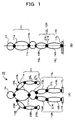
- Fig.1 and Fig.2 show the makeup of an embodiment of a biped walking humanoid robot in accordance with the present invention.
- a biped walking humanoid robot 10 includes a body portion 11, a pair of leg portions 12L and 12R attached to both sides of the lower part of the body portion 11, a pair of arm portions 13L and 13R attached to both sides of the upper part of the body portion, and a head portion 14 attached to the top of the body portion.
- the body portion 11 is divided to a breast portion 11a as an upper part and a waist portion 11b as a lower part, and the breast portion 11a is supported at a forward bending portion 11c pivotally movably in the forth and back direction with respect to the waist portion 11b, and especially forward direction, and rotationally left and right. Further, in the breast portion 11a of the body portion 11, a walk control apparatus 50 is contained as described below.
- the forward bending portion 11c is provided with a joint portion 11d for forth and back pivotal movement and a joint portion 11e for rotation left and right, and each joint portion 11d and 11e comprises a joint drive motor (See Fig.2.), respectively.
- the leg portions 12L, 12R are made up with thigh portions 15L, 15R, lower thigh portions 16L, 16R, and foot portions 17L, 17R.
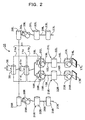
- the leg portions 12L, 12R are provided, as shown in Fig.2, with six joint portions, respectively, in the order from upper side, joint portions 18L, 18R for the rotation of the leg portions with respect to the waist portions 11b of the body portion 11, joint portions 19L, 19R in the roll direction (around x axis) of the leg portions, joint portions 20L, 20R in the pitch direction (around y axis) of the leg portions, joint portions 22L, 22R in the pitch direction of knee portions 21L, 21R connecting thigh portions 15L, 15R and lower thigh portions 16L, 16R, joint portions 23L, 23R in the pitch direction of ankle portions with respect to the foot portions 17L, 17R, and joint portions 24L, 24R in the roll direction of the ankle portions.
- each joint portion 18L, 18R to 24L, 24R comprises a
- a waist joint is made up with the joint portions 11d, 11e
- a hip joint is made up with the joint portions 18L, 18R, 19L, 19R, 20L, and 20R
- foot joints are made up with the joint portions 23L, 23R, 24L, and 24R.
- the leg portions 12L, 12R on both sides, left and right, of the biped walking humanoid robot 10 have six degrees of freedom, respectively, and it is made capable of walking at will in a three dimensional space by drive-controlling these twelve joint portions during various motions with respective drive motors at appropriate angles, and by giving desired motions to whole leg portions 12L, 12R.
- the arm portions 13L, 13R are made up with upper arm portions 25L, 25R, lower arm portions 26L, 26R, and hand, portions 27L, 27R, respectively.
- the upper arm portions 25L, 25R of the arm portions 13L, 13R, the lower arm portions 26L, 26R, and the hand portions 27L, 27R are provided, as shown in Fig.2 like above-mentioned the leg portions 12L, 12R, with five joint portions, respectively, in the order from upper side, joint portions 28L, 28R for the pitch direction of the upper arm portions 25L, 25R at shoulder parts with respect to the body portion 11, joint portions 29L, 29R in the roll direction of the upper arm portions 25L, 25R at shoulder parts, joint portions 30L, 30R in the left and right direction of the upper arm portions 25L, 25R at shoulder parts, joint portions 32L, 32R in the pitch direction of elbow portions 31L, 31R connecting the upper arm portions 25L, 25R and the lower arm portions 26L, 26R, and joint portions 33L, 33R in
- the arm portions 13L, 13R on both sides, left and right, of the biped walking humanoid robot 10 have five degrees of freedom, respectively, and it is made capable of drive-controlling these twelve joint portions during various motions with respective drive motors at appropriate angles, and giving desired motions to whole arm portions 13L, 13R.
- the rotation axis of the joint portions 28L, 28R in the pitch direction at said shoulder parts is set misaligned forward with respect to the joint portions 29L, 29R in the roll direction and the joint portions 30L, 30R in the left and right direction, and the swing angle forward of the arm portions 13L, 13R is designed larger.
- the head portion 14 is attached on to the top end of the upper portion 11a of the body portion 11, and is provided, for example, with a camera as visual perception and a microphone as auditory perception.
- the head portion 14 comprises, as shown in Fig.2, a joint portion 35 in the pitch direction of a neck and a joint portion 36 in the left and right direction.
- each joint portion 35, 36 are made up with respective joint drive motor.
- the head portion 14 of the biped walking humanoid robot 10 has two degrees of freedom, and it is made capable of moving in the left and right and forth and back directions by drive-controlling these two joint portions 35, 36 during various motions with respective drive motors at appropriate angles.
- the rotation axis of the joint portion 35 in the pitch direction is set misaligned forward with respect to the joint portion 36 in the left and right direction, and the pivotal angle forward of the head portion 14 is designed larger.
- the joint portion 11d of the forward bending portion 11e of the body portion 11, joint portions in the forth and back direction of the leg portions 12L, 12R, that is, the joint portions 20L, 20R of the hip joint, the joint portions 22L, 22R of the knee portions, and the joint portions 23L, 23R of the ankle portions are supported pivotally movably in the angle range shown in Fig.3 and Fig.4.
- the joint portions 23L, 23R of the ankle portions are capable of pivotally moving in the angle range where its pivotal angle ⁇ 1 is -20 to +20 degrees or more.
- the joint portions 22L, 22R of the knee portions are capable of pivotally moving in the angle range where its pivotal angle ⁇ 2 is -120 to 0 degrees or more.
- the joint portions 20L, 20R of the waist portions are capable of pivotally moving in the angle range where its pivotal angle ⁇ 3 is -45 to +60 degrees or more.
- the forward bending portion 11c of the body portion 11 is also capable of pivotally moving in the angle range where its pivotal angle ⁇ 4 is -10 to +60 degrees or more.
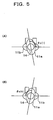
- the joint portion 11e of the forward bending portion 11c of the body portion 11 is supported pivotally movably in the angle range as shown in Fig.5.
- the joint portion 11e of the forward bending portion 11c of the body portion 11 is capable of pivotally moving in the angle range where its pivotal angle ⁇ 5 is -45 degrees or more in the left-side direction shown in Fig.5(A), and +45 degrees or more in the right-side direction shown in Fig.5 (B).
- Fig.6 shows the electrical makeup of the biped walking humanoid robot 10 shown in Fig.1 to Fig.5.
- the biped walking humanoid robot 10 is provided with a drive means, that is, a motion control apparatus 40 to drive-control the above-mentioned respective joint portions, that is, the joint drive motors 11d, 11e, 18L, 18R to 36.
- the motion control apparatus 40 is provided with a motion planner 41, a motion generator 42, a compensator 43, a controller 44, an angle measurement unit 45 as a detector to detect angles of respective joint portions of the robot, a ZMP detection sensor (not shown in the figure) provided to the foot portions 17L, 17R, and a motion monitor 46.
- a coordinate system of the biped walking robot 10 xyz coordinate system is used in which the forth and back direction is defined as x direction (forth as +), the horizontal direction as y direction (inward as +), and the vertical direction as z direction (upward as +).
- the motion planner 41 plans the motions corresponding to the motion commands based on next motion command input from outside. That is, the motion planner 41 calculates the angular momentum of each portion of the robot required for the motion corresponding to said motion command, and makes up a robot's motion path, that is, the motion plan.
- a robot's current posture and others are input from the motion monitor 46 as described below, and the robot's current posture and others are referred to upon making up of the motion plan.
- arbitrary motion command can be chosen by the operator, for example, using a joystick, a mouse, or an operation button in the external control system 47.
- the motion planner 41 preferably displays, as described below, the motion to be currently chosen by the screen display or others on the external control system 47, referring to the robot's current posture and others.
- the motion planner 41 is provided with a motion library 41a.
- the motion library 41a stores in advance the posture data and others of basic motions as the elements of a robot's motion as the database according to classifications.
- the posture data is the program to generate the time-series data and motion of a robot's joint parameters.
- the posture data includes the auxiliary description about motion, for example, the time to be spent, a robot's part on which the motion is applied, and the basic object of use of the motion, and others, and accordingly, a robot can judge the additional information which is essentially understood by humans.
- the posture data also includes the surrounding conditions (for example, the hindrance in front during walk forward, and the like) required to conduct motions, and the stability indices (for example, ZMP and the position of center of gravity, and the like) upon start and finish of a robot's motions.
- the posture data further includes main parameter and its variable range and other, if the motion is not fixed motion but the output is variable by adjusting the parameter.
- the auxiliary description means, for example, standup motion, rotational motion, and stepping motion, and others as possible motions in currently sitting down state.
- the motion planner 41 chooses and reads out various necessary posture data and others from the motion library 41a upon the above-mentioned motion planning, generates motion plan as the sequence of combined motions, and outputs posture data of each sequence as motion plan to the motion generator 42.
- a robot's current posture and others are input from the motion monitor 46, and the motion planner 41 compares the robot's current posture and next motion command upon conducting motion plan, and judges if it is possible to conduct the motion by next motion command within the stability range from the robot's current posture and others.
- the motion planner 41 can easily judge by referring to the auxiliary description of respective motion data stored in the motion library 41a.
- the motion planner 41 does not conduct the motion plan based on the next motion command, but denotes the motion to be chosen by the robot's current posture and others to the outside control system, for example, on screen display or others. If, on the other hand, the motion by next motion command is within stability range, then the motion planner 41 judges whether transfer is possible to the motion by next motion command from the robot's current posture. In this case, too, the motion planner 41 can easily judge likewise by referring to the auxiliary description of respective motion data stored in the motion library 41a.
- the motion planner 41 reads out the corresponding posture data from the motion library 41a based on next motion command, and generates motion plan.
- the motion planner 41 conducts complementary calculation with respect to the intermediate motion from the robot's current posture till the initial state of the motion by next motion command, or reads out the posture data corresponding to the intermediate motion from the motion library 41a, and generates motion plan for complementary motion, as well as reads out the corresponding posture data from the motion library 41a based on the motion by next motion command and generates motion plan, and outputs the motion plan for both complementary motion and the motion by next motion command to the motion generator 42.
- the posture data about the above-mentioned complementary motion includes auxiliary description as to whether usable for, for example, the transfer from certain posture to another posture.
- the motion planner 41 records the motion command from outside into a history filter 41b as a memory device. Accordingly, the history filter 41b, upon inputting a group of motion commands about a plurality of frequently continuing motions, registers the motion by such group of motion commands into the motion library 41a as a new basic motion.
- the motion generator 42 generates angle data, as motion data, of respective joint portions 15L, 15R to 36 required for the motion of the biped walking humanoid robot 10.
- the motion generator 42 modifies internal parameters and angle data base on the command, as described later, from the compensator 43.
- the compensator 43 calculates ZMP target value based on the angle data ⁇ ref of respective joint portions from the motion generator 42, as well as ZMP real value based on the posture information from an angle measurement unit 45 and the detected output from the ZMP detection sensor. And the compensator 43 compares the ZMP real value with ZMP target value, calculates ZMP compensation based on their difference, and outputs it to the motion generator 42.
- the motion generator 42 with ZMP compensation fed back from the compensator 43, modifies motion data based on said ZMP compensation, and outputs it to the controller 44.
- the controller 44 generates the control signals for respective joint drive motors based on the modified motion data from the motion generator 42, and drive-controls respective joint drive motors.
- the angle measurement unit 45 with the angle information of respective joint drive motors input by, for example, a rotary encoder or the like provided to joint drive motors of respective joint portions 11d, 11e, 18L, 18R to 36, measures the angle positions of respective joint drive motors, that is, the state information about angle, angle velocity, and rotation moment, that is, the posture information ⁇ real of the robot 10, and outputs it to the compensator 43 and the motion monitor 46.
- the motion monitor 46 with motion plan from the motion planner 41, ZMP target value from the compensator 43, and the angle information as ZMP real value (including angle and angle moment) from angle measurement unit 45 and ZMP detection sensor input thereinto, always monitors the state of the biped walking humanoid robot 10 based on these data. And the motion monitor 46 feeds back motion plan, the deviation of a robot's real motion from ZMP target value, and a robot's current posture and others to the motion planner 41. Further, the motion monitor 46, when a robot's state becomes unstable, commands compensation or termination of motion for stabilization to the motion planner 41.
- the biped walking humanoid robot 10 in accordance with embodiments of the present invention is made up as described above, and moves as shown in the flowchart of Fig.7.
- the motion planner 41 takes up a robot's current posture and others from the motion monitor 46, takes up practicable motion corresponding to a robot's current posture and others from the motion library 41a at step ST2, and denotes these motions to the controller 47.
- the motion planner 41 takes up at step ST3 the motion command about next motion input from a controller 47 by an operator, and the motion planner 41 judges at step ST4 if said next motion command is practicable within the stability range in comparison with a robot's current posture and others.
- the motion planner 41 registers at step ST5 said next motion command to the history filter 41b, and at step ST6, judges whether said next motion command is the motion frequently applied. If the next motion command is the motion frequently applied, the motion planner 41 registers additionally at step ST7 said next motion command which was registered to the history filter 41b to the motion library 41a as a new basic motion. After that, the motion planner 41 proceeds on to step ST8. On the other hand, if the next motion command is not the motion frequently applied, the motion planner 41 proceeds on to step ST8. The motion planner 41 judges at step ST8 if the robot can stably transfer to the motion by next motion command from a robot's current posture.
- the motion planner 41 applies complementary motion at step ST9, and after generating complementary motion plan as intermediate motion from a robot's current posture till the initial posture by next motion command, or if stably transferable, then proceeds on to step ST10 and generates motion plan of the motion by next motion command.
- the motion generator 42 After the motion planner 41 generates motion plan and complementary motion plan, the motion generator 42 generates motion data and complementary motion data based on said motion plan and complementary motion plan, and the controller 43 drive-controls the joint drive motors of a robot's respective joint portions according to said motion data and complementary motion data.
- the motion monitor 46 predicts the robot's state based on the robot's posture and the observed ZMP value at step ST10, and judges at step ST11 if acting stably. If acting stably, the robot continues the motion, and the motion monitor 46 judges whether to finish motion or not at step ST12. And said step ST10 to ST12 are repeated till the motion is finished.
- the motion monitor 46 controls at step ST13 the motion planner 41, the motion generator 42, and the controller 43, and finishes motion. On the other hand, if not acting stably at step ST11, the motion monitor 46 proceeds on to step ST13, instantly outputs motion termination command to the motion planner 41, and the motion planner 41 stops motion plan, and the robot's motion is finished.
- the motion planner 41 retrieves the posture data corresponding to the intermediate motion from a robot's current posture till the initial posture of the motion by next motion command from the motion library 41a. And at step ST15, if there is not such posture data corresponding to the intermediate motion, the motion planner 41 proceeds on to step ST13, instantly stops motion plan, and the robot's motion is finished. On the other hand, if there is such posture data corresponding to the intermediate motion, the motion planner 41 denotes such intermediate motion by screen display or others on the controller 47 at step ST16, and returns to step ST3.
- the biped walking humanoid robot 10 in accordance with embodiments of the present invention, when a motion is conducted by next motion command referring to the robot's current posture and others, such motion impossible to be continuous is not conducted, thereby the robot's various motions are made possible without damaging the robot's stability. Accordingly, a biped walking humanoid robot's continuous, smooth, stable, and firm motion is made possible.
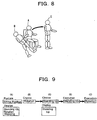
- the motion planner 41 preferentially denotes the motion previously chosen by an operator on a screen display or others of the controller 47, based on the robot's current posture "sitting position" as shown in Fig.9(A), as next motion from complementary explanation registered about the robot's sitting position A (See Fig.8.) from the motion library 41a, then followed by "stand up motion, rotational motion, stepping motion" originally registered in the motion library 41a.
- the motions impossible to conduct are included, and are possible to be chosen forcibly by an operator.
- the motion planner 41 retrieves the posture data about rotational motion in the motion library 41a based on next motion from the controller 47.
- the motion planner 41 since standing position C is the prerequisite for rotational motion B from complementary explanation of said posture data, the motion planner 41 does not accept this next motion command, and since, for example, stand up motion is required as complementary motion with respect to rotational motion B from sitting position A, the motion planner 41 outputs, as shown in Fig.9(C), said stand up motion to the controller 47 as complementary motion, and denotes it to its screen display and others.
- the motion planner 41 records into the history filter 41b stand up motion and rotational motion as a series of basic motions about rotational motion from sitting position, and conducts in series stand up motion as shown in Fig.9(D), and rotational motion as shown in Fig.9(E).
- a complementary motion may be preferably automatically chosen after a certain time in the preferential order pre-determined in advance by off-line.
- the motion planner 41 cancels next motion command, and stops conduction of motion.
- leg portions 12L, 12R have six degrees of freedom
- arm portions 13L, 13R have five degrees of freedom, but not limited as such, they may have less or more degrees of freedom.
- the controller 47 is operated by an operator, but not limited as such, input operation to the controller 47 may be conducted by program command by generic program controlling said controller 47.
- a motion control apparatus detects the robot's current posture and others, and only when next motion command is within the range of stability limit, motion data is generated corresponding to next motion command. Consequently, a motion control apparatus drive-controls the robot's respective portions based on said complementary and motion data, thereby the robot conducts the motion by next motion command from its current posture.
- the robot can conduct motions in series smoothly and stably.
- next motion command is within the range of stability limit
- the robot conducts the motion corresponding to next motion command, and even if an operator to operate the robot is unaccustomed, the suitability and unsuitability of each continued motion are not required to be judged by the operator by combination of various motions by the robot operation, therefore easy operation of complex continuous motion is possible, and thereby conduction of unsuitable motion by wrong operation by the operator can be prevented.
- said motion control apparatus is provided with a motion library storing the posture data of basic motions as the elements of the robot's motions, since various motions are realized by real time combination of basic motions, in case that a robot is actually operated under the same circumstance as human beings, that is, the circumstance where the predicted conditions and reality do not necessarily agree because the circumstance varies irrelevantly with the robot operation, and also it varies due to the robot's own action, the robot can react flexibly to the condition of the case. Further, the volume of calculation by the motion control apparatus is reduced, thereby quick generation of complementary and motion data is possible.
- biped walking humanoid robot which can conduct various motions in series easily and smoothly.
Landscapes
- Engineering & Computer Science (AREA)
- Mechanical Engineering (AREA)
- Chemical & Material Sciences (AREA)
- Combustion & Propulsion (AREA)
- Transportation (AREA)
- Robotics (AREA)
- Manipulator (AREA)
Abstract
Description
Claims (12)
- A biped walking humanoid robot comprising;
a main body, a pair of leg portions attached thereto at both sides of its lower part so as to be each pivotally movable, each of the leg portions having a knee portion in its midway and a foot portion at its lower end, a pair of arm portions attached to said main body at both sides of its upper part so as to be each pivotally movable, each of the arm portions having an elbow portion in its midway and a hand portion at its lower end, and a head portion attached to the top end of said main body,
drive means pivotally moving the pivotally movable joint portions of foot, lower thigh, and thigh portions of said leg portions, and hand, lower arm, and upper arm portions of said arm portions, and
a motion control apparatus drive-controlling respective drive means,
characterized in that;
said motion control apparatus compares the robot's current posture and others, such as the robot's current posture and dynamic state, detected by a detector with next motion command input from outside, and if next motion command is within the range of stability limit with respect to the robot's current posture and others, then motion data is generated corresponding to next motion command, and each drive means is drive-controlled based on said motion data. - A biped walking humanoid robot as set forth in Claim 1, characterized in that;
said motion control apparatus compares the robot's current posture and others detected by a detector with next motion command input from outside, and if next motion command is within the range of stability limit with respect to the robot's current posture and others, then the complementary data with respect to the intermediate motion from the robot's current posture till the initial posture of said next motion command, and motion data corresponding to next motion command are generated, and each drive means is drive-controlled based on said complementary and motion data. - A biped walking humanoid robot as set forth in Claim 1 or Claim 2, characterized in that;
said motion control apparatus is provided with a motion library storing any combination of time-series data of basic motions, and posture data generating algorithm, as the elements of the robot's motions, and,
said motion control apparatus, upon generating complementary and motion data with respect to the intermediate motion from the robot's current posture till the initial posture of next motion command, reads out the corresponding posture data from the motion library, and generates complementary and motion data as the combined motion sequence. - A biped walking humanoid robot as set forth in Claim 3, characterized in that;
said motion control apparatus is provided with memory means to memorize the motion commands from outside, and,
said motion control apparatus, with respect to the frequently designated specific continuous group of motion commands, stores its posture data as new basic data into the motion library. - A biped walking humanoid robot as set forth in any one of Claims 1 to 4, characterized in that;
said motion control apparatus does not generate motion data based on next motion command, and does not conduct said motion, if next motion command is outside of the range of stability limit with respect to the robot's current posture and others. - A biped walking humanoid robot as set forth in Claim 5, characterized in that;
said motion control apparatus, if next motion command is outside of the range of stability limit with respect to the robot's current posture and others, denotes to outside the substituting motion within the range of stability limit with respect to the robot's current posture and others. - A biped walking humanoid robot comprising;
a main body, a pair of leg portions attached thereto at both sides of its lower part so as to be each pivotally movable, each of the leg portions having a knee portion in its midway and a foot portion at its lower end, a pair of arm portions attached to said main body at both sides of its upper part so as to be each pivotally movable, each of the arm portions having an elbow portion in its midway and a hand portion at its lower end, and a head portion attached to the top end of said main body,
joint drive motors pivotally moving the pivotally movable joint portions of foot, lower thigh, and thigh portions of said leg portions, and hand, lower arm, and upper arm portions of said arm portions, and
a motion control apparatus drive-controlling respective joint drive motors,
characterized in that;
said motion control apparatus comprises;
a motion planner planning the motion corresponding to a motion command based on the next motion command input from outside;
a motion generator generating angle data of respective joint portions required for a robot's motion;
a compensator calculating ZMP target value based on said angle data, and ZMP real value based on the posture information from an angle measurement unit and the detected output from ZMP detection sensor, comparing said ZMP real value with said ZMP target value, and outputting ZMP compensation to said motion generator;
a controller drive-controlling said respective motors based on the modified motion data from said motion generator; and
a motion monitor monitoring the robot's state based on said motion plan, ZMP target value, and ZMP real value. - A biped walking humanoid robot as set forth in Claim 7, characterized in that;
the motion command input into said motion control apparatus is conducted with arbitrary motion command chosen by an operator by an outside control system. - A biped walking humanoid robot as set forth in Claim 7 or Claim 8, characterized in that;
said motion planner is provided with a motion library which stores in advance posture data and others of basic motions as the elements of a robot's motion as database based on classification, and
said posture data is time-series data of a robot's joint parameters and the program to generate motion. - A biped walking humanoid robot as set forth in any one of Claims 7 to 9, characterized in that;
said motion planner is further provided with a history filter as the memory device which records and stores motion commands from outside. - A biped walking humanoid robot as set forth in Claim 7, characterized in that;
the angle information of the respective motors for said joint portion driving is input to said angle measurement unit to measure the angles and the angle velocities of said respective motors, and a robot's posture information which is state information about rotational moment. - A biped walking humanoid robot as set forth in Claim 7, characterized in that;
said motion monitor feeds back motion plan, the deviation of a robot's real motion from ZMP target value, and a robot's current posture and others to said motion planner, and further, when a robot's state becomes unstable, commands compensation or termination of motion for stabilization to said motion planner.
Applications Claiming Priority (3)
| Application Number | Priority Date | Filing Date | Title |
|---|---|---|---|
| JP2002040839A JP3731118B2 (en) | 2002-02-18 | 2002-02-18 | Biped walking humanoid robot |
| JP2002040839 | 2002-02-18 | ||
| PCT/JP2003/001326 WO2003068454A1 (en) | 2002-02-18 | 2003-02-07 | Two-leg walking humanoid robot |
Publications (2)
| Publication Number | Publication Date |
|---|---|
| EP1477277A1 true EP1477277A1 (en) | 2004-11-17 |
| EP1477277A4 EP1477277A4 (en) | 2008-09-10 |
Family
ID=27678323
Family Applications (1)
| Application Number | Title | Priority Date | Filing Date |
|---|---|---|---|
| EP03703264A Withdrawn EP1477277A4 (en) | 2002-02-18 | 2003-02-07 | ANDROID ROBOT WALKING ON TWO LEGS |
Country Status (7)
| Country | Link |
|---|---|
| US (1) | US7057367B2 (en) |
| EP (1) | EP1477277A4 (en) |
| JP (1) | JP3731118B2 (en) |
| KR (1) | KR100585421B1 (en) |
| CN (1) | CN100344419C (en) |
| TW (1) | TWI220661B (en) |
| WO (1) | WO2003068454A1 (en) |
Cited By (3)
| Publication number | Priority date | Publication date | Assignee | Title |
|---|---|---|---|---|
| GB2451083A (en) * | 2007-07-17 | 2009-01-21 | Triple One Co Ltd | Figure toy with moving head, body and limbs |
| US20120150321A1 (en) * | 2009-08-20 | 2012-06-14 | Vanderbilt University | Control system for jointed mechanical devices |
| US9265625B2 (en) | 2009-08-20 | 2016-02-23 | Vanderbilt University | Jointed mechanical devices |
Families Citing this family (32)
| Publication number | Priority date | Publication date | Assignee | Title |
|---|---|---|---|---|
| JP2005193331A (en) * | 2004-01-06 | 2005-07-21 | Sony Corp | Robot apparatus and emotion expression method thereof |
| JP4559803B2 (en) * | 2004-09-14 | 2010-10-13 | 敏男 福田 | Robot walking using passive change of joint angle and its control method |
| US8265793B2 (en) | 2007-03-20 | 2012-09-11 | Irobot Corporation | Mobile robot for telecommunication |
| WO2008154228A1 (en) * | 2007-06-08 | 2008-12-18 | Honda Motor Co., Ltd. | Multi-modal push planner for humanoid robots |
| JP4392037B2 (en) * | 2007-09-12 | 2009-12-24 | トヨタ自動車株式会社 | Legged robot and control method thereof |
| JP4440956B2 (en) * | 2007-09-12 | 2010-03-24 | トヨタ自動車株式会社 | Legged robot and control method thereof |
| TWI416071B (en) * | 2008-06-06 | 2013-11-21 | Chi Mei Comm Systems Inc | System and method for controlling a biped robot through a mobile phone |
| JP5464406B2 (en) * | 2009-04-27 | 2014-04-09 | 独立行政法人科学技術振興機構 | Posture data input device |
| KR20110016521A (en) * | 2009-08-12 | 2011-02-18 | 삼성전자주식회사 | Whole body motion control device and method for humanoid robot |
| TWI478798B (en) * | 2010-06-18 | 2015-04-01 | Compal Electronics Inc | Automatic mechanical device and control method thereof |
| CN102310406B (en) * | 2010-06-30 | 2013-12-18 | 华宝通讯股份有限公司 | Automatic mechanical device and control method thereof |
| US20120283746A1 (en) * | 2011-05-02 | 2012-11-08 | Hstar Technologies | Mobile Medical Robotic System |
| KR101985790B1 (en) * | 2012-02-21 | 2019-06-04 | 삼성전자주식회사 | Walking robot and control method thereof |
| US20140039675A1 (en) * | 2012-08-03 | 2014-02-06 | Nimer Mohammed Ead | Instructional humanoid robot apparatus and a method thereof |
| CN102873685A (en) * | 2012-10-10 | 2013-01-16 | 浙江环球滤清器有限公司 | Mechanical error compensation method of robot |
| TWI547355B (en) | 2013-11-11 | 2016-09-01 | 財團法人工業技術研究院 | Human-machine symbiosis safety monitoring system and method thereof |
| CN103770116B (en) * | 2014-01-13 | 2016-08-17 | 西北农林科技大学 | A kind of ten seven freedom anthropomorphic robots |
| JP6228097B2 (en) * | 2014-10-06 | 2017-11-08 | 本田技研工業株式会社 | Mobile robot |
| US9555846B1 (en) | 2015-03-20 | 2017-01-31 | Google Inc. | Pelvis structure for humanoid robot |
| CN105345822B (en) * | 2015-12-17 | 2017-05-10 | 成都英博格科技有限公司 | Intelligent robot control method and device |
| US10179619B1 (en) * | 2016-03-30 | 2019-01-15 | Schaft Inc. | Robotic foot sensor |
| CN105751220A (en) * | 2016-05-13 | 2016-07-13 | 齐鲁工业大学 | Walking human-shaped robot and fusion method for multiple sensors thereof |
| WO2017199565A1 (en) * | 2016-05-20 | 2017-11-23 | シャープ株式会社 | Robot, robot operation method and program |
| CN109605367B (en) * | 2018-11-13 | 2021-01-26 | 上海鲸鱼机器人科技有限公司 | Robot programming method, device and equipment and storage medium |
| CN110125924B (en) * | 2019-06-11 | 2021-06-04 | 哈尔滨工业大学 | Soft bionic foot type robot |
| US11691292B2 (en) * | 2019-10-14 | 2023-07-04 | Boston Dynamics, Inc. | Robot choreographer |
| CN111496803A (en) * | 2019-12-16 | 2020-08-07 | 山东大学 | Tai Chi Push Hand Robot |
| CN111487972B (en) * | 2020-04-24 | 2024-04-26 | 深圳市优必选科技股份有限公司 | A gait planning method, device, readable storage medium and robot for kicking a ball |
| CN114227699B (en) * | 2022-02-10 | 2024-06-11 | 乐聚(深圳)机器人技术有限公司 | Robot motion adjustment method, device and storage medium |
| CN114661057B (en) * | 2022-05-23 | 2022-08-26 | 武汉跨克信息技术有限公司 | Intelligent bionic biped inspection robot |
| US20250100139A1 (en) * | 2023-09-22 | 2025-03-27 | Universal City Studios Llc | Systems and methods for controlling a robot |
| CN118305813B (en) * | 2024-06-12 | 2024-08-09 | 苏州远昌智能科技有限公司 | Teleoperation control method and system for humanoid robot |
Family Cites Families (21)
| Publication number | Priority date | Publication date | Assignee | Title |
|---|---|---|---|---|
| JPH0562363A (en) * | 1991-08-30 | 1993-03-12 | Victor Co Of Japan Ltd | Recording and reproducing method |
| JPH05233052A (en) * | 1992-02-20 | 1993-09-10 | Tokico Ltd | Teaching device for robot |
| US5432417A (en) * | 1992-04-30 | 1995-07-11 | Honda Giken Kogyo Kabushiki Kaisha | Locomotion control system for legged mobile robot |
| JP3026276B2 (en) * | 1992-05-22 | 2000-03-27 | 本田技研工業株式会社 | Emergency stop control device for legged mobile robot |
| FI93631C (en) * | 1993-01-11 | 1995-05-10 | Kone Oy | Counterbalanced lift motor |
| JP3429048B2 (en) * | 1993-12-30 | 2003-07-22 | 本田技研工業株式会社 | Walking control device for legged mobile robot |
| JPH09193060A (en) * | 1996-01-16 | 1997-07-29 | Honda Motor Co Ltd | Robot speed control device for teaching |
| JP3658147B2 (en) * | 1996-07-25 | 2005-06-08 | 本田技研工業株式会社 | Gait generator for legged mobile robot |
| DE69725764T2 (en) * | 1996-07-25 | 2004-08-05 | Honda Giken Kogyo K.K. | DEVICE FOR IMPLEMENTING THE GEAR FOR A DOUBLE-LEGED ROBOT |
| JP3672406B2 (en) * | 1997-01-31 | 2005-07-20 | 本田技研工業株式会社 | Gait generator for legged mobile robot |
| US6243623B1 (en) * | 1997-01-31 | 2001-06-05 | Honda Giken Kogyo Kabushiki Kaisha | Leg type mobile robot control apparatus |
| JP3442996B2 (en) * | 1998-05-06 | 2003-09-02 | 三菱重工業株式会社 | Control system for a static walking robot |
| JP3443077B2 (en) * | 1999-09-20 | 2003-09-02 | ソニー株式会社 | Robot motion pattern generation device and motion pattern generation method, and robot |
| JP3555107B2 (en) * | 1999-11-24 | 2004-08-18 | ソニー株式会社 | Legged mobile robot and operation control method for legged mobile robot |
| JP3615702B2 (en) * | 1999-11-25 | 2005-02-02 | ソニー株式会社 | Motion control device and motion control method for legged mobile robot, and legged mobile robot |
| JP2001277163A (en) * | 2000-04-03 | 2001-10-09 | Sony Corp | Robot control device and control method |
| TW499349B (en) * | 2000-11-17 | 2002-08-21 | Sony Corp | Legged mobile robot, leg structure of legged mobile robot, and mobile leg unit for legged mobile robot |
| WO2002045913A1 (en) * | 2000-11-20 | 2002-06-13 | Sony Corporation | Device and method for controlling operation of legged robot, and robot device |
| JP3682525B2 (en) * | 2001-06-07 | 2005-08-10 | 独立行政法人科学技術振興機構 | Biped walking humanoid robot |
| JP3760186B2 (en) * | 2001-06-07 | 2006-03-29 | 独立行政法人科学技術振興機構 | Biped walking type moving device, walking control device thereof, and walking control method |
| EP2415998B1 (en) * | 2009-04-01 | 2016-07-06 | Toyota Jidosha Kabushiki Kaisha | Internal combustion engine control apparatus |
-
2002
- 2002-02-18 JP JP2002040839A patent/JP3731118B2/en not_active Expired - Fee Related
-
2003
- 2003-02-07 WO PCT/JP2003/001326 patent/WO2003068454A1/en not_active Ceased
- 2003-02-07 CN CNB038040743A patent/CN100344419C/en not_active Expired - Fee Related
- 2003-02-07 US US10/504,693 patent/US7057367B2/en not_active Expired - Fee Related
- 2003-02-07 KR KR1020047012583A patent/KR100585421B1/en not_active Expired - Fee Related
- 2003-02-07 EP EP03703264A patent/EP1477277A4/en not_active Withdrawn
- 2003-02-13 TW TW092102952A patent/TWI220661B/en active
Cited By (6)
| Publication number | Priority date | Publication date | Assignee | Title |
|---|---|---|---|---|
| GB2451083A (en) * | 2007-07-17 | 2009-01-21 | Triple One Co Ltd | Figure toy with moving head, body and limbs |
| US20120150321A1 (en) * | 2009-08-20 | 2012-06-14 | Vanderbilt University | Control system for jointed mechanical devices |
| US8840680B2 (en) * | 2009-08-20 | 2014-09-23 | Vanderbilt University | Control system for jointed mechanical devices |
| US9265625B2 (en) | 2009-08-20 | 2016-02-23 | Vanderbilt University | Jointed mechanical devices |
| US10172725B2 (en) | 2009-08-20 | 2019-01-08 | Vanderbuilt University | Jointed mechanical devices |
| US10835391B2 (en) | 2009-08-20 | 2020-11-17 | Vanderbilt University | Jointed mechanical devices |
Also Published As
| Publication number | Publication date |
|---|---|
| WO2003068454A1 (en) | 2003-08-21 |
| US7057367B2 (en) | 2006-06-06 |
| KR100585421B1 (en) | 2006-06-07 |
| CN1633348A (en) | 2005-06-29 |
| EP1477277A4 (en) | 2008-09-10 |
| CN100344419C (en) | 2007-10-24 |
| JP2003236780A (en) | 2003-08-26 |
| KR20040086378A (en) | 2004-10-08 |
| TW200303256A (en) | 2003-09-01 |
| TWI220661B (en) | 2004-09-01 |
| US20050151496A1 (en) | 2005-07-14 |
| JP3731118B2 (en) | 2006-01-05 |
Similar Documents
| Publication | Publication Date | Title |
|---|---|---|
| US7057367B2 (en) | Two-leg walking humanoid robot | |
| JP3667914B2 (en) | Remote control system for legged mobile robot | |
| KR100476644B1 (en) | Apparatus walking with two legs, walking control apparatus, and walking control method thereof | |
| JP3672406B2 (en) | Gait generator for legged mobile robot | |
| JP4513320B2 (en) | Robot apparatus and motion control method of robot apparatus | |
| KR100816134B1 (en) | Legged mobile robot and control device therefor | |
| WO2007069401A1 (en) | Gait creation device of leg-type mobile robot | |
| WO2004071719A1 (en) | Abnormality detector of moving robot | |
| JP2004223712A (en) | Walking robot and its position moving method | |
| JP2010042069A (en) | Control device and control method of walking aid device | |
| US8483876B2 (en) | Controller of mobile robot | |
| JP3628826B2 (en) | Remote control system for legged mobile robot | |
| US7383717B2 (en) | Force sensor abnormality detection system for legged mobile robot | |
| JP2003039349A (en) | Travel control device for traveling robot | |
| JP3627057B2 (en) | Biped humanoid robot | |
| JP3649852B2 (en) | Remote control system for biped robot | |
| JP2004017178A (en) | Biped humanoid robot and its hand storage mechanism | |
| JPH04122585A (en) | Walk control device for leg type mobile robot | |
| JP3183557B2 (en) | Walking control device for legged mobile robot | |
| JP3936991B2 (en) | Remote control device for humanoid robot | |
| JP2004017181A (en) | Walking robot | |
| JP7807736B2 (en) | Robot Control System | |
| KR102503568B1 (en) | Surgical robot appartus | |
| JP2004188530A (en) | Walking-type moving device, and its operation control device and operation control method | |
| JP2007319939A (en) | Leg-type walking type moving body and leg-type walking type moving body control system |
Legal Events
| Date | Code | Title | Description |
|---|---|---|---|
| PUAI | Public reference made under article 153(3) epc to a published international application that has entered the european phase |
Free format text: ORIGINAL CODE: 0009012 |
|
| 17P | Request for examination filed |
Effective date: 20040825 |
|
| AK | Designated contracting states |
Kind code of ref document: A1 Designated state(s): AT BE BG CH CY CZ DE DK EE ES FI FR GB GR HU IE IT LI LU MC NL PT SE SI SK TR |
|
| AX | Request for extension of the european patent |
Extension state: AL LT LV MK RO |
|
| RIN1 | Information on inventor provided before grant (corrected) |
Inventor name: KITANO, HIROAKI Inventor name: OKUMURA, YU Inventor name: TAWARA, TETSUO Inventor name: FURUTA, TAKAYUKI |
|
| A4 | Supplementary search report drawn up and despatched |
Effective date: 20080808 |
|
| 17Q | First examination report despatched |
Effective date: 20090326 |
|
| GRAP | Despatch of communication of intention to grant a patent |
Free format text: ORIGINAL CODE: EPIDOSNIGR1 |
|
| STAA | Information on the status of an ep patent application or granted ep patent |
Free format text: STATUS: THE APPLICATION IS DEEMED TO BE WITHDRAWN |
|
| 18D | Application deemed to be withdrawn |
Effective date: 20110607 |