EP1475101A1 - Antibody-containing solution pharmaceuticals - Google Patents
Antibody-containing solution pharmaceuticals Download PDFInfo
- Publication number
- EP1475101A1 EP1475101A1 EP03705166A EP03705166A EP1475101A1 EP 1475101 A1 EP1475101 A1 EP 1475101A1 EP 03705166 A EP03705166 A EP 03705166A EP 03705166 A EP03705166 A EP 03705166A EP 1475101 A1 EP1475101 A1 EP 1475101A1
- Authority
- EP
- European Patent Office
- Prior art keywords
- antibody
- sample
- multimers
- solution
- sugar
- Prior art date
- Legal status (The legal status is an assumption and is not a legal conclusion. Google has not performed a legal analysis and makes no representation as to the accuracy of the status listed.)
- Granted
Links
Classifications
-
- A—HUMAN NECESSITIES
- A61—MEDICAL OR VETERINARY SCIENCE; HYGIENE
- A61K—PREPARATIONS FOR MEDICAL, DENTAL OR TOILETRY PURPOSES
- A61K47/00—Medicinal preparations characterised by the non-active ingredients used, e.g. carriers or inert additives; Targeting or modifying agents chemically bound to the active ingredient
- A61K47/30—Macromolecular organic or inorganic compounds, e.g. inorganic polyphosphates
- A61K47/34—Macromolecular compounds obtained otherwise than by reactions only involving carbon-to-carbon unsaturated bonds, e.g. polyesters, polyamino acids, polysiloxanes, polyphosphazines, copolymers of polyalkylene glycol or poloxamers
-
- C—CHEMISTRY; METALLURGY
- C07—ORGANIC CHEMISTRY
- C07K—PEPTIDES
- C07K16/00—Immunoglobulins [IGs], e.g. monoclonal or polyclonal antibodies
- C07K16/44—Immunoglobulins [IGs], e.g. monoclonal or polyclonal antibodies against material not provided for elsewhere, e.g. haptens, metals, DNA, RNA, amino acids
-
- A—HUMAN NECESSITIES
- A61—MEDICAL OR VETERINARY SCIENCE; HYGIENE
- A61K—PREPARATIONS FOR MEDICAL, DENTAL OR TOILETRY PURPOSES
- A61K39/00—Medicinal preparations containing antigens or antibodies
- A61K39/395—Antibodies; Immunoglobulins; Immune serum, e.g. antilymphocytic serum
-
- A—HUMAN NECESSITIES
- A61—MEDICAL OR VETERINARY SCIENCE; HYGIENE
- A61K—PREPARATIONS FOR MEDICAL, DENTAL OR TOILETRY PURPOSES
- A61K39/00—Medicinal preparations containing antigens or antibodies
- A61K39/395—Antibodies; Immunoglobulins; Immune serum, e.g. antilymphocytic serum
- A61K39/39591—Stabilisation, fragmentation
-
- A—HUMAN NECESSITIES
- A61—MEDICAL OR VETERINARY SCIENCE; HYGIENE
- A61K—PREPARATIONS FOR MEDICAL, DENTAL OR TOILETRY PURPOSES
- A61K47/00—Medicinal preparations characterised by the non-active ingredients used, e.g. carriers or inert additives; Targeting or modifying agents chemically bound to the active ingredient
- A61K47/06—Organic compounds, e.g. natural or synthetic hydrocarbons, polyolefins, mineral oil, petrolatum or ozokerite
- A61K47/08—Organic compounds, e.g. natural or synthetic hydrocarbons, polyolefins, mineral oil, petrolatum or ozokerite containing oxygen, e.g. ethers, acetals, ketones, quinones, aldehydes, peroxides
- A61K47/10—Alcohols; Phenols; Salts thereof, e.g. glycerol; Polyethylene glycols [PEG]; Poloxamers; PEG/POE alkyl ethers
-
- A—HUMAN NECESSITIES
- A61—MEDICAL OR VETERINARY SCIENCE; HYGIENE
- A61K—PREPARATIONS FOR MEDICAL, DENTAL OR TOILETRY PURPOSES
- A61K47/00—Medicinal preparations characterised by the non-active ingredients used, e.g. carriers or inert additives; Targeting or modifying agents chemically bound to the active ingredient
- A61K47/06—Organic compounds, e.g. natural or synthetic hydrocarbons, polyolefins, mineral oil, petrolatum or ozokerite
- A61K47/08—Organic compounds, e.g. natural or synthetic hydrocarbons, polyolefins, mineral oil, petrolatum or ozokerite containing oxygen, e.g. ethers, acetals, ketones, quinones, aldehydes, peroxides
- A61K47/12—Carboxylic acids; Salts or anhydrides thereof
-
- A—HUMAN NECESSITIES
- A61—MEDICAL OR VETERINARY SCIENCE; HYGIENE
- A61K—PREPARATIONS FOR MEDICAL, DENTAL OR TOILETRY PURPOSES
- A61K47/00—Medicinal preparations characterised by the non-active ingredients used, e.g. carriers or inert additives; Targeting or modifying agents chemically bound to the active ingredient
- A61K47/06—Organic compounds, e.g. natural or synthetic hydrocarbons, polyolefins, mineral oil, petrolatum or ozokerite
- A61K47/26—Carbohydrates, e.g. sugar alcohols, amino sugars, nucleic acids, mono-, di- or oligo-saccharides; Derivatives thereof, e.g. polysorbates, sorbitan fatty acid esters or glycyrrhizin
-
- A—HUMAN NECESSITIES
- A61—MEDICAL OR VETERINARY SCIENCE; HYGIENE
- A61K—PREPARATIONS FOR MEDICAL, DENTAL OR TOILETRY PURPOSES
- A61K9/00—Medicinal preparations characterised by special physical form
- A61K9/0012—Galenical forms characterised by the site of application
- A61K9/0019—Injectable compositions; Intramuscular, intravenous, arterial, subcutaneous administration; Compositions to be administered through the skin in an invasive manner
-
- A—HUMAN NECESSITIES
- A61—MEDICAL OR VETERINARY SCIENCE; HYGIENE
- A61K—PREPARATIONS FOR MEDICAL, DENTAL OR TOILETRY PURPOSES
- A61K9/00—Medicinal preparations characterised by special physical form
- A61K9/08—Solutions
-
- A—HUMAN NECESSITIES
- A61—MEDICAL OR VETERINARY SCIENCE; HYGIENE
- A61P—SPECIFIC THERAPEUTIC ACTIVITY OF CHEMICAL COMPOUNDS OR MEDICINAL PREPARATIONS
- A61P37/00—Drugs for immunological or allergic disorders
- A61P37/02—Immunomodulators
- A61P37/04—Immunostimulants
-
- C—CHEMISTRY; METALLURGY
- C07—ORGANIC CHEMISTRY
- C07K—PEPTIDES
- C07K16/00—Immunoglobulins [IGs], e.g. monoclonal or polyclonal antibodies
-
- C—CHEMISTRY; METALLURGY
- C07—ORGANIC CHEMISTRY
- C07K—PEPTIDES
- C07K16/00—Immunoglobulins [IGs], e.g. monoclonal or polyclonal antibodies
- C07K16/18—Immunoglobulins [IGs], e.g. monoclonal or polyclonal antibodies against material from animals or humans
- C07K16/28—Immunoglobulins [IGs], e.g. monoclonal or polyclonal antibodies against material from animals or humans against receptors, cell surface antigens or cell surface determinants
- C07K16/30—Immunoglobulins [IGs], e.g. monoclonal or polyclonal antibodies against material from animals or humans against receptors, cell surface antigens or cell surface determinants from tumour cells
- C07K16/3061—Blood cells
-
- C—CHEMISTRY; METALLURGY
- C07—ORGANIC CHEMISTRY
- C07K—PEPTIDES
- C07K16/00—Immunoglobulins [IGs], e.g. monoclonal or polyclonal antibodies
- C07K16/40—Immunoglobulins [IGs], e.g. monoclonal or polyclonal antibodies against enzymes
-
- A—HUMAN NECESSITIES
- A61—MEDICAL OR VETERINARY SCIENCE; HYGIENE
- A61K—PREPARATIONS FOR MEDICAL, DENTAL OR TOILETRY PURPOSES
- A61K39/00—Medicinal preparations containing antigens or antibodies
- A61K2039/505—Medicinal preparations containing antigens or antibodies comprising antibodies
Definitions
- the present invention relates to stable antibody-containing solution formulations.
- anti-IL-6 receptor antibodies have a therapeutic effect on immature myeloma cells (JPA HEI 8-99902) and succeeded in mass-producing a reshaped humanized antibody, hPM-1 antibody, as an anti-IL-6 receptor antibody, and we have tried to formulate this purified anti-IL-6 receptor antibody into pharmaceutical products.
- the humanized anti-IL-6 receptor antibody is an unstable protein liable to physical or chemical changes such as association or aggregation under the stresses of filtration, concentration, heat and light for removing viruses and other microbials during purification processes.
- antibody-producing cells are cultured in bulk and purified to give an antibody-containing solution, which is then stored frozen and thawed before formulation.
- the antibody content remaining in such a solution decreased as antibody dimers or insoluble particles were formed during repeated freeze/thaw cycles or antibodies were degraded to form degradation products during long-term storage.
- Freeze-dried antibody formulations stabilized with sugars or amino sugars, amino acids and surfactants have also been reported (JPA HEI2001-503781).
- An object of the present invention is to provide antibody-containing solution formulations in which the antibody content remains high, and which are stable even after long-term storage by inhibiting the formation of insoluble particles and multimers during the preparation or storage of the antibody-containing solution formulations and further inhibiting the formation of degradation products.
- the present invention provides:
- antibody-containing solution formulation means a solution formulation containing an antibody as an active ingredient and prepared for administration to animals such as humans, preferably without including any freeze-drying steps in the preparation process.
- antibody-containing solution may be a solution containing any antibody, whether biologically derived or recombinant, preferably a culture medium in which mammalian cells such as CHO cells containing an antibody have been cultured, or a solution obtained by subjecting such a medium to a given treatment such as partial purification (bulk solution), or the solution formulation prepared for administration to animals such as humans as defined above.
- insoluble particles means insoluble particulate matters of 10 ⁇ m or more as defined in the section of Insoluble Particulate Matter Test for Injections in the part of General Tests, Processes and Apparatus in the Japanese Pharmacopoeia. Insoluble particles can be measured by using microscopes, insoluble particle-collecting filters and analytical membrane filters, or conveniently using automatic light obscuration particle counters.
- insoluble matters mean readily detectable insoluble matters from which injections must be free and clear when inspected in containers with the unaided eye with a light intensity of approximately 1000 luxes under an incandescent lamp as defined in the section of Foreign Insoluble Matter Test for Injections in the part of General Tests, Processes and Apparatus in the Japanese Pharmacopoeia.
- multimers and degradation products mean multimers and degradation products respectively of antibody molecules constituting active ingredients of formulations, and their contents can be determined by the peak area percentage method based on gel permeation chromatography described later.
- Antibodies used in solution formulations of the present invention are not specifically limited so far as they bind to a desired antigen, and mouse antibodies, rat antibodies, rabbit antibodies, sheep antibodies, chimeric antibodies, humanized antibodies, human antibodies and the like can be used as appropriate.
- the antibodies may be polyclonal or monoclonal, but preferably monoclonal because homogeneous antibodies can be stably produced. Polyclonal and monoclonal antibodies can be prepared by processes well known to those skilled in the art.
- Hybridomas producing monoclonal antibodies can be basically constructed by known techniques as follows. A desired antigen or a cell expressing a desired antigen is used as an immunizing antigen to immunize host cells according to a standard immunization technique, and the resulting immunized cells are fused to known parent cells by a standard cell fusion technique, and then the fused cells are screened for monoclonal antibody-producing cells (hybridomas) by a standard screening method. Construction of hybridomas can be performed according to the method of e.g. Milstein et al. (Kohler. G. and Milstein, C., Methods Enzymol. (1981) 73: 3-46). If the antigen has low immunogenicity, it can be bound to an immunogenic macromolecule such as albumin and used for immunization.
- an immunogenic macromolecule such as albumin and used for immunization.
- Recombinant antibodies can be used, which are produced by transforming a host with a suitable vector containing an antibody gene cloned from a hybridoma using genetic engineering techniques (see e.g. Carl, A. K. Borrebaeck, James, W. Larrick, THERAPEUTIC MONOCLONAL ANTIBODIES, Published in the United Kingdom by MACMILLAN PUBLISHERS LTD, 1990).
- a suitable vector containing an antibody gene cloned from a hybridoma using genetic engineering techniques (see e.g. Carl, A. K. Borrebaeck, James, W. Larrick, THERAPEUTIC MONOCLONAL ANTIBODIES, Published in the United Kingdom by MACMILLAN PUBLISHERS LTD, 1990).
- V regions variable regions
- DNA sequences encoding the V regions of the antibody of interest may be linked to the DNA sequences encoding the constant regions (C regions) of the antibody of interest and integrated into an expression vector.
- the DNA sequences encoding the V regions of the antibody may be integrated into an expression vector containing the DNA sequences for the C regions of the antibody. They are integrated into the expression vector in such a manner that they can be expressed under the control of regulatory regions such as enhancers and promoters. Then, a host cell can be transformed with this expression vector to express the antibody.
- recombinant antibodies i.e. antibodies artificially modified to reduce antigenicity in humans or to attain other purposes
- chimeric antibodies and humanized antibodies can be used.
- modified antibodies can be prepared by known processes.
- Chimeric antibodies consist of the heavy and light chain variable regions of an antibody from a non-human mammal such as a mouse and the heavy and light chain constant regions of a human antibody and can be obtained by linking the DNA sequences encoding the variable regions of the mouse antibody to the DNA sequences for the constant regions of the human antibody and transforming a host with an expression vector containing the linked sequences to allow it to produce a chimeric antibody.
- Humanized antibodies are also called reshaped human antibodies and obtained by grafting the complementarity-determining regions (CDRs) of an antibody from a non-human mammal such as a mouse into the complementarity-determining regions of a human antibody and typical gene recombination techniques for preparing them are also known.
- CDRs complementarity-determining regions
- DNA sequences designed to link the CDRs of a mouse antibody to the framework regions (FRs) of a human antibody are synthesized by PCR from several oligonucleotides prepared to have terminal overlapping regions.
- the resulting DNA sequences are linked to the DNA sequences encoding the constant regions of the human antibody and then integrated into an expression vector, which is transformed into a host to allow it to produce a reshaped antibody (see European Patent Publication No.
- the FRs of the human antibody linked by the CDRs are selected in such a manner that the complementarity-determining regions form an appropriate antigen-binding site. If necessary, reshaped humanized antibodies may have some amino acid changes in the framework regions of the variable regions so that the complementarity-determining regions form an appropriate antigen-binding site (Sato, K. et al., Cancer Res. (1993) 53, 851-856).
- a desired human antibody having a binding activity for a desired antigen can be obtained by in vitro immunizing human lymphocytes with the desired antigen or a cell expressing the desired antigen and fusing the immunized lymphocytes to human myeloma cells such as U266 (see JPB No. HEI1-59878).
- a desired human antibody can also be obtained by immunizing a transgenic animal having all human antibody gene repertoires with an antigen (see International Publications Nos. WO 93/12227, WO 92/03918, WO 94/02602, WO 94/25585, WO 96/34096, WO 96/33735).
- phages binding to an antigen can be selected by expressing the variable regions of a human antibody as single chain antibody fragments (scFv) on phage surfaces by a phage display method.
- the DNA sequences encoding the variable regions of the human antibody binding to the antigen can be determined by analyzing the genes of the selected phages.
- a whole human antibody can be obtained by preparing a suitable expression vector on the basis of the determined DNA sequences of the scFv fragments binding to the antigen.
- a suitable host can be used in combination with an expression vector.
- Suitable eukaryotic cells used as hosts include animal cells, plant cells and fungal cells.
- animal cells include (1) mammal cells such as CHO, COS, myeloma, BHK (baby hamster kidney), HeLa and Vero cells; (2) amphibian cells such as Xenopus oocytes; or (3) insect sells such as sf9, sf21 and Tn5.
- Known plant cells include cells of Nicotiana such as Nicotiana tabacum, which can be used as callus cultures.
- yeasts such as Saccharomyces spp., e.g. Saccharomyces serevisiae and filamentous fungi such as Aspergillus spp., e.g. Aspergillus niger.
- Prokaryotic cells can be used as producing systems using bacterial cells.
- Known bacterial cells include E. coli and Bacillus subtilis.
- Antibodies can be obtained by transforming these cells with an antibody gene of interest and culturing the transformed cells in vitro.
- Antibodies contained in stabilized formulations of the present invention include, but not limited to, anti-IL-6 receptor antibodies, anti-HM1.24 antigen monoclonal antibodies, anti-parathyroid hormone related peptide antibodies (anti-PTHrP antibodies), etc.
- Preferred reshaped humanized antibodies for use in the present invention include humanized anti-IL-6 receptor antibodies (hPM-1) (see International Publication No. WO92-19759), humanized anti-HM1.24 antigen monoclonal antibodies (see International Publication No. WO98-14580) and humanized anti-parathyroid hormone related peptide antibodies (anti-PTHrP antibodies) (see International Publication No. WO98-13388).
- hPM-1 humanized anti-IL-6 receptor antibodies
- humanized anti-HM1.24 antigen monoclonal antibodies see International Publication No. WO98-14580
- anti-PTHrP antibodies humanized anti-parathyroid hormone related peptide antibodies
- Antibodies contained in solution formulations of the present invention may belong to any immunoglobulin class, preferably IgG such as IgGl, IgG2, IgG3 and IgG4, more preferably IgGl.
- immunoglobulin class preferably IgG such as IgGl, IgG2, IgG3 and IgG4, more preferably IgGl.
- Antibody-containing solution formulations in the present invention preferably show no increase in multimers and contain 50 or less insoluble particles per mL after freeze/thaw cycling.
- the formation of dimers during freeze/thaw cycles can be inhibited by adding sugars.
- the sugars that can be used include nonreducing oligosaccharides, e.g. nonreducing disaccharides such as sucrose and trehalose or nonreducing trisaccharides such as raffinose, and especially preferred are nonreducing oligosaccharides.
- Preferred nonreducing oligosaccharides are nonreducing disaccharides, more preferably sucrose and trehalose.
- the formation of multimers and degradation products during long-term storage can be inhibited by adding sugars.
- the sugars that can be used include sugar alcohols such as mannitol and sorbitol; and nonreducing oligosaccharides, e.g. nonreducing disaccharides such as sucrose and trehalose or nonreducing trisaccharides such as raffinose, among which nonreducing oligosaccharides are especially preferred.
- Preferred nonreducing oligosaccharides are nonreducing disaccharides, more preferably sucrose and trehalose.
- the sugars should be added at 0.1-500 mg/mL, preferably 10-300 mg/mL, more preferably 25-100 mg/mL.
- surfactants include:
- the amount of surfactants to be added varies with the type of the particular surfactant used, but it is typically 0.001-100 mg/mL, preferably 0.003-50 mg/mL, more preferably 0.005-2 mg/mL in the case of Polysorbate 20 or Polysorbate 80.
- antibody-containing solution formulations of the present invention are substantially free from proteins such as human serum albumin or purified gelatin as stabilizers.
- Antibody formulations of the present invention preferably have a pH of 4-8, more preferably 5-7, still more preferably 6-6.5.
- the pH depends on the antibody contained and is not limited to these values.
- Formulations of the present invention may further contain isotonizing agents, e.g., polyethylene glycol; and sugars such as dextran, mannitol, sorbitol, inositol, glucose, fructose, lactose, xylose, mannose, maltose, sucrose, trehalose and raffinose.
- isotonizing agents e.g., polyethylene glycol
- sugars such as dextran, mannitol, sorbitol, inositol, glucose, fructose, lactose, xylose, mannose, maltose, sucrose, trehalose and raffinose.
- Antibody-containing solution formulations of the present invention may further contain diluents, solubilizing agents, excipients, pH-modifiers, soothing agents, buffers, sulfur-containing reducing agents, antioxidants or the like, if desired.
- sulfur-containing reducing agents include N-acetylcysteine, N-acetylhomocysteine, thioctic acid, thiodiglycol, thioethanolamine, thioglycerol, thiosorbitol, thioglycolic acid and salts thereof, sodium thiosulfate, glutathione, and sulfhydryl-containing compounds such as thioalkanoic acid having 1 to 7 carbon atoms.
- Antioxidants include erythorbic acid, dibutylhydroxytoluene, butylhydroxyanisole, ⁇ -tocopherol, tocopherol acetate, L-ascorbic acid and salts thereof, L-ascorbyl palmitate, L-ascorbyl stearate, sodium bisulfite, sodium sulfite, triamyl gallate, propyl gallate or chelating agents such as disodium ethylenediamine tetraacetate (EDTA), sodium pyrophosphate and sodium metaphosphate.
- EDTA disodium ethylenediamine tetraacetate
- additives may also be contained, e.g., inorganic salts such as sodium chloride, potassium chloride, calcium chloride, sodium phosphate, potassium phosphate and sodium bicarbonate; and organic salts such as sodium citrate, potassium citrate and sodium acetate.
- inorganic salts such as sodium chloride, potassium chloride, calcium chloride, sodium phosphate, potassium phosphate and sodium bicarbonate
- organic salts such as sodium citrate, potassium citrate and sodium acetate.
- Formulations of the present invention can be prepared by dissolving these components in an aqueous buffer known in the field of solution formulations such as a phosphate buffer (preferably sodium monohydrogen phosphate - sodium dihydrogen phosphate system) and/or a citrate buffer (preferably sodium citrate buffer) and/or an acetate buffer to prepare a solution formulation.
- a phosphate buffer preferably sodium monohydrogen phosphate - sodium dihydrogen phosphate system
- a citrate buffer preferably sodium citrate buffer
- an acetate buffer preferably sodium citrate buffer
- Antibody-containing solution formulations of the present invention are normally administered via parenteral routes such as injection (e.g. subcutaneous, intravenous, intramuscular or intraperitoneal injection) or percutaneous, mucosal, nasal or pulmonary administration, but may also be orally administered.
- parenteral routes such as injection (e.g. subcutaneous, intravenous, intramuscular or intraperitoneal injection) or percutaneous, mucosal, nasal or pulmonary administration, but may also be orally administered.
- Antibody-containing solution formulations of the present invention can be normally supplied in sealed and sterilized plastic or glass containers having a defined volume such as vials, ampules or syringes or a large volume such as bottles. In terms of convenience, prefilled syringes are preferred.
- the amount of antibodies contained in formulations of the present invention is typically 0.1-200 mg/ml, preferably 1-120 mg/ml, more preferably 2-22.5 mg/mL, depending on the type of the disease to be treated, the severity of the disease, the age of the patient and other factors.
- insoluble particles especially during freeze/thaw cycles could be remarkably inhibited and the formation of insoluble matters during long-term stability tests could also be remarkably inhibited by adding surfactants, as shown in the examples below. It was also found that the formation of multimers such as dimers as well as the formation of degradation products could be remarkably inhibited and remaining antibody monomer contents could be increased by adding sugars.
- hPM-1 antibody was used as a humanized anti-IL-6 receptor antibody.
- the hPM-1 antibody was a humanized hPM-1 antibody prepared by the method described in Reference example 2 of JPA HEI 8-99902 using the human elongation factor I ⁇ promoter described in Example 10 of International Patent Publication No. WO92/19759.
- anti-HM1.24 antibody An antibody prepared by the method described in Reference example 2 of International Patent Publication No. WO98-35698 (hereinafter referred to as anti-HM1.24 antibody) was used as a humanized anti-HM1.24 antigen monoclonal antibody.
- the hPM-1 antibody and anti-HM1.24 antibody used in the following examples are both IgG1 class antibodies.
- Each sample is diluted with the mobile phase to contain hPM-1 in an amount equivalent to about 1 mg in 1 mL and tested under the following HPLC conditions in 30-60 ⁇ L.
- Stability to freeze/thaw cycling (2 cycles of storage at -20°C for 8 hours and then 5°C for 8 hours) was evaluated from the number of insoluble particles per mL as measured by an automatic light obscuration particle counter (HIAC). The presence or absence of insoluble matters was evaluated by automated visual inspection.
- HIAC automatic light obscuration particle counter
- Example 4 Influence of sucrose on heat stability and freeze/thaw stability
- sucrose The influence of sucrose on heat stability and freeze/thaw stability was tested. Samples containing sucrose at various concentrations shown in Table 4 were prepared and tested as follows.
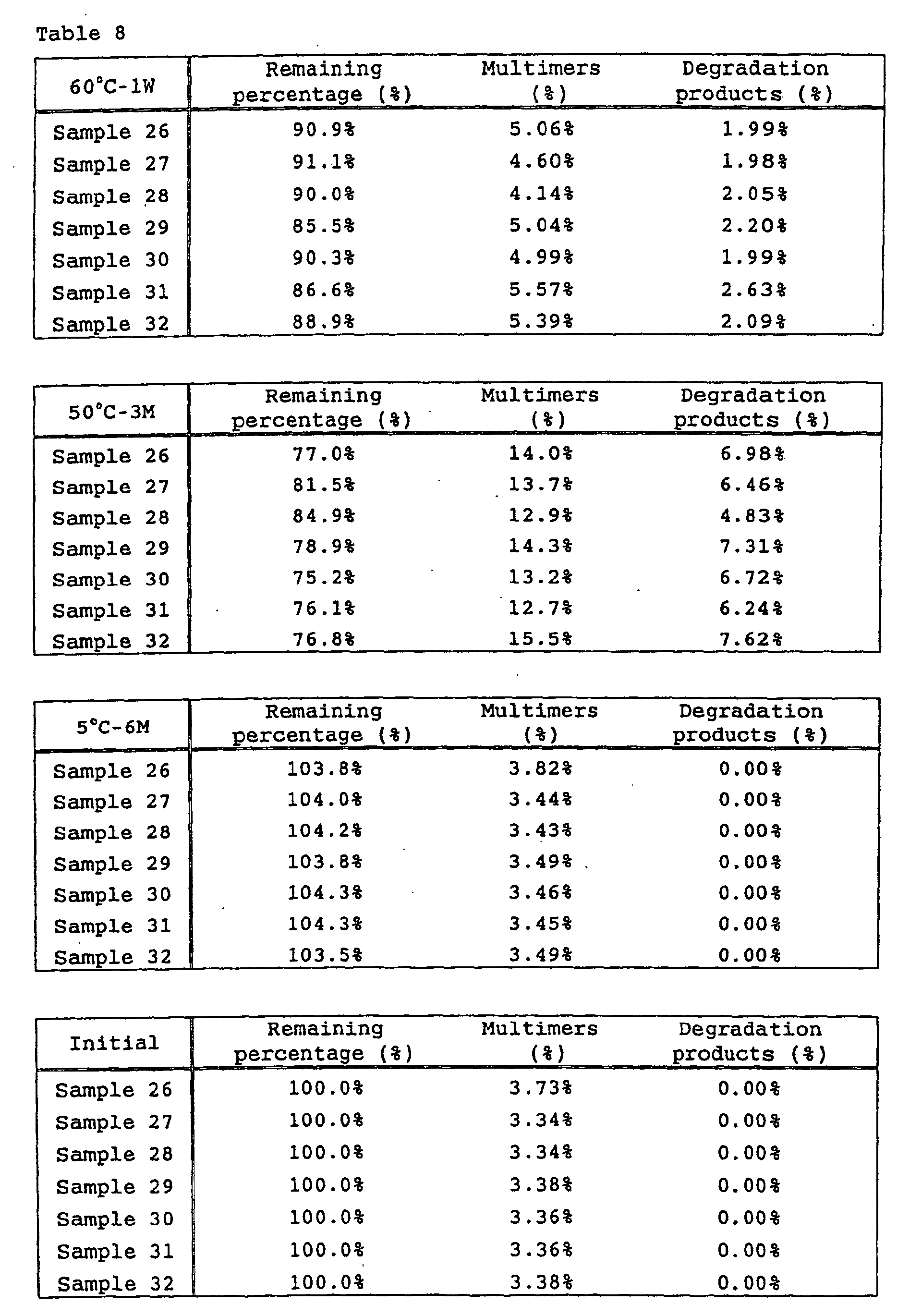
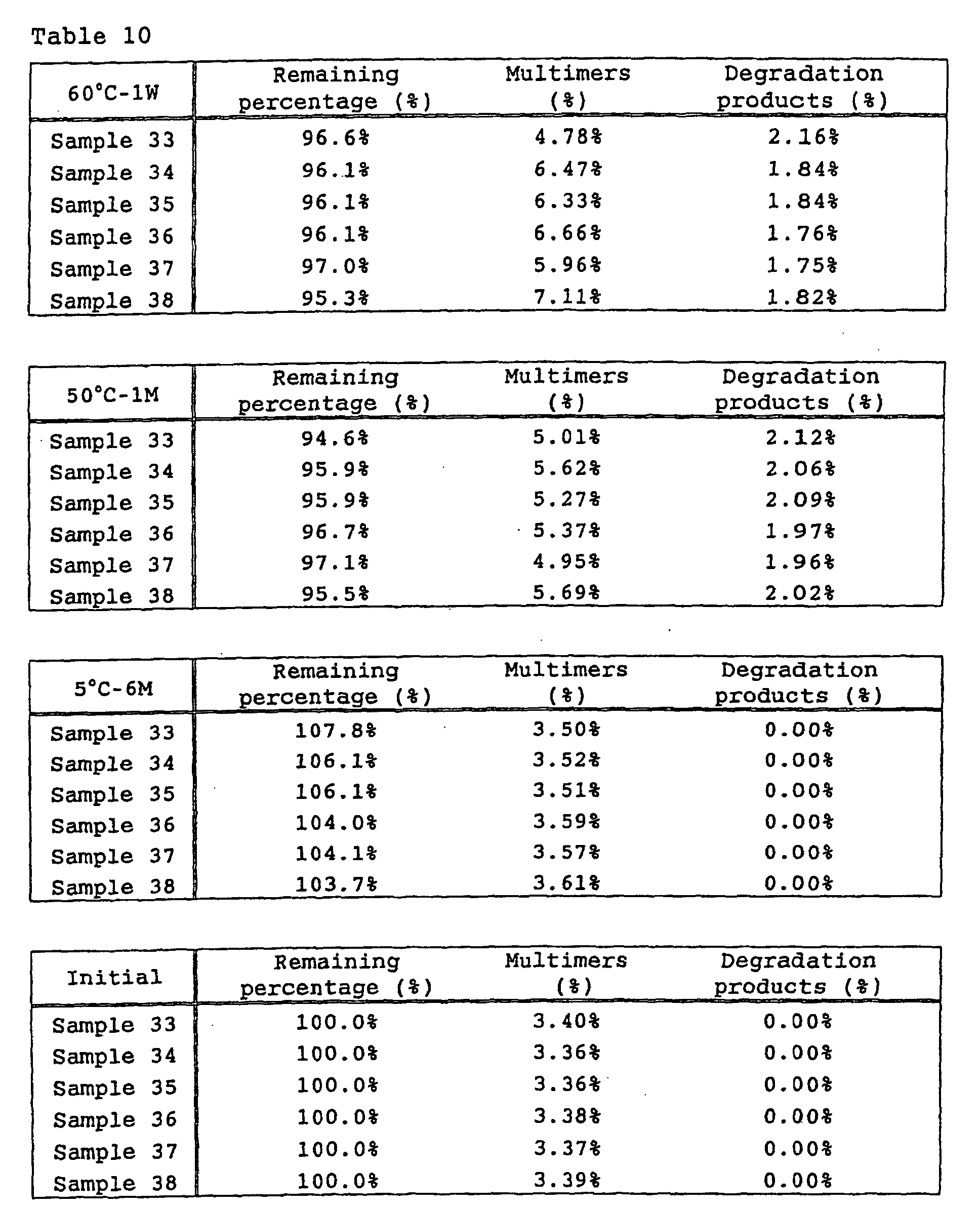
- Test formulations of low-concentration preparations and the results are shown in Tables 7 and 8, while test formulations of high-concentration preparations and the results are shown in Tables 9 and 10.
- Sample 26 Sample 27
- Sample 28 Sample 29
- Sample 31 Sample 32
- Sucrose (mg/mL) 10 50 100 - - - - Mannitol (mg/mL) - - - 10 50 100 - NaCl (mM) 100 100 100 100 100 100 100 100 100 100 100 100 100 100 100 100 100 100 100 100 100 100 100 100 100 100 100 100 100 100 100 100 100 100 100 100 100 100 100 100 100 100 100 100 100 100 100 100 100 100 100 100 100 100 100 100 100 100 100 100 100 100 100 100 100 100 100 100 100 100 100 100 100 100 100 100 100 100 100 100 100 100 100 100 100 100 100 100 100 100 100 100 100 100 100 100 100 100 100 100 100 100 100 100 100 100 100 100 100 100 100 100 100 100 100
- sucrose is effective for inhibiting the formation of multimers of anti-HM1.24 antibody.
- N.D. N.D. N.D. N.D. Total amount of multimers (%) 0.7 0.4 0.5 0.8 7 freeze/thaw cycles Dimers (%) 0.8 0.5 0.4 1.0
- Other multimers (%) N.D. N.D. N.D. N.D. Total amount of multimers (%) 0.8 0.5 0.4 1.0 21 freeze/thaw cycles Dimers (%) 1.0 0.4 0.5 1.3
- Other multimers %) N.D. N.D. N.D. N.D. Total amount of multimers (%) 1.0 0.4 0.5 1.3
Landscapes
- Health & Medical Sciences (AREA)
- Chemical & Material Sciences (AREA)
- Life Sciences & Earth Sciences (AREA)
- Medicinal Chemistry (AREA)
- General Health & Medical Sciences (AREA)
- Organic Chemistry (AREA)
- Immunology (AREA)
- Veterinary Medicine (AREA)
- Animal Behavior & Ethology (AREA)
- Public Health (AREA)
- Pharmacology & Pharmacy (AREA)
- Epidemiology (AREA)
- Engineering & Computer Science (AREA)
- Biochemistry (AREA)
- Molecular Biology (AREA)
- Proteomics, Peptides & Aminoacids (AREA)
- Biophysics (AREA)
- Genetics & Genomics (AREA)
- Chemical Kinetics & Catalysis (AREA)
- General Chemical & Material Sciences (AREA)
- Oil, Petroleum & Natural Gas (AREA)
- Cell Biology (AREA)
- Bioinformatics & Cheminformatics (AREA)
- Microbiology (AREA)
- Mycology (AREA)
- Dermatology (AREA)
- Hematology (AREA)
- Nuclear Medicine, Radiotherapy & Molecular Imaging (AREA)
- Inorganic Chemistry (AREA)
- Medicines Containing Antibodies Or Antigens For Use As Internal Diagnostic Agents (AREA)
- Medicinal Preparation (AREA)
- Peptides Or Proteins (AREA)
Abstract
Description
| <Test samples and results> | Sample 1 | Sample 2 | Sample 3 | Sample 4 | |
| hPM-1 (mg/mL) | 20 | 20 | 20 | 20 | |
| Polysorbate 80 (mg/mL) | 0 | 0.25 | 0.5 | 0.75 | |
| Sodium Phosphate (mM) | 15 | 15 | 15 | 15 | |
| pH | 6.5 | 6.5 | 6.5 | 6.5 | |
| Initial | hPM-1 content (mg/mL) | 20.1 | 20.3 | 20.3 | 20.4 |
| Dimers (%) | 0.21 | 0.22 | 0.22 | 0.23 | |
| Other multimers (%) | 0 | 0 | 0 | 0 | |
| Degradation products (%) | 0 | 0 | 0 | 0 | |
| Number of particles of 10µm or more (particles/mL) | 0 | 0 | 2 | 0 | |
| Number of particles of 25µm or more (particles /mL) | 0 | 0 | 0 | 0 | |
| Thermal acceleration (50°C-2W) | Remaining hPM-1 (%) | 99.4 | 98.2 | 98.1 | 98.0 |
| Dimers (%) | 1.38 | 1.39 | 1.39 | 1.41 | |
| Other multimers (%) | 0 | 0 | 0 | 0 | |
| Degradation products (%) | 0.91 | 0.91 | 0.90 | 0.90 | |
| Number of particles of 10µm or more (particles/mL) | 0 | 0 | 0 | 0 | |
| Number of particles of 25µm or more (particles /mL) | 0 | 0 | 0 | 0 | |
| Freeze/thaw (-20°C→5°C, 3 cycles) | Remaining hPM-1 (%) | 99.7 | 99.6 | 99.4 | 99.3 |
| Dimers (%) | 0.60 | 0.56 | 0.52 | 0.49 | |
| Other multimers (%) | 0 | 0 | 0 | 0 | |
| Degradation products (%) | 0 | 0 | 0 | 0 | |
| Number of particles of 10µm or more (particles/mL) | 3287 | 7 | 1 | 4 | |
| Number of particles of 25µm or more (particles /mL) | 539 | 3 | 0 | 0 |
| <Test samples and results> | |||||||
| Sample 5 | Sample 6 | Sample 7 | Sample 8 | Sample 9 | Sample 10 | ||
| hPM-1(mg/mL) | 20 | 20 | 20 | 20 | 20 | 20 | |
| Polysorbate 80(mg/mL) | 0 | 0.005 | 0.05 | 0.25 | 0.5 | 0.75 | |
| Sucrose (mg/mL) | 50 | 50 | 50 | 50 | 50 | 50 | |
| Sodium Phosphate(mM) | 15 | 15 | 15 | 15 | 15 | 15 | |
| pH | 6.5 | 6.5 | 6.5 | 6.5 | 6.5 | 6.5 | |
| Initial | Number of particles of 10 µm or more (particles/mL) | 10 | 0 | 0 | 0 | 0 | 0 |
| Number of particles of 25 µm or more (particles /mL) | 2 | 0 | 0 | 0 | 0 | 0 | |
| Insoluble matters | Yes | No | No | No | No | No | |
| Freeze/ thaw (-20°C→5°C, 2 cycles) | Number of particles of 10 µm or more (particles/mL) | 7020 | 8 | 0 | 0 | 0 | 1 |
| Number of particles of 25 µm or more (particles /mL) | 601 | 0 | 0 | 0 | 0 | 0 | |
| Insoluble matters | Yes | Yes | No | No | No | No |
| <Test samples and results> | ||||||
| Sample 11 | Sample 12 | Sample 13 | Sample 14 | Sample 15 | ||
| hPM-1(mg/mL) | 20 | 20 | 20 | 20 | 20 | |
| Sucrose (mg/mL) | 0 | 50 | 0 | 0 | 0 | |
| Mannitol (mg/mL) | 0 | 0 | 50 | 94 | 0 | |
| Trehalose (mg.mL) | 0 | 0 | 0 | 0 | 50 | |
| Polysorbate 80(mg/mL) | 0.5 | 0.5 | 0.5 | 0.5 | 0.5 | |
| Sodium Phosphate(mM) | 15 | 15 | 15 | 15 | 15 | |
| pH | 6.5 | 6.5 | 6.5 | 6.5 | 6.5 | |
| Initial | Dimers (%) | 0.42 | 0.43 | 0.41 | 0.38 | 0.42 |
| Freeze/thaw (-20°C→5°C, 22 cycles) | Dimers (%) | 0.67 | 0.43 | 0.89 | 2.60 | 0.41 |
| <Test samples and results> | |||||
| Sample 16 | Sample 17 | Sample 18 | Sample 19 | ||
| hPM-1(mg/mL) | 20 | 20 | 20 | 20 | |
| Sucrose (mg/mL) | 0 | 25 | 50 | 100 | |
| Polysorbate 80(mg/mL) | 0.5 | 0.5 | 0.5 | 0.5 | |
| Sodium Phosphate(mM) | 15 | 15 | 15 | 15 | |
| pH | 6.5 | 6.5 | 6.5 | 6.5 | |
| Initial | hPM-1 content (mg/mL) | 19.2 | 19.2 | 19.3 | 19.3 |
| Dimers (%) | 0.18 | 0.16 | 0.15 | 0.15 | |
| Other multimers (%) | 0 | 0 | 0 | 0 | |
| Degradation products (%) | 0 | 0 | 0 | 0 | |
| Number of particles of 10µm or more (particles/mL) | 0 | 0 | 12 | 0 | |
| Number of particles of 25µm or more (particles /mL) | 0 | 0 | 1 | 0 | |
| Thermal acceleration (50°C-2W) | Remaining hPM-1 (%) | 98.2 | 98.5 | 97.8 | 97.8 |
| Dimers (%) | 1.37 | 1.47 | 1.36 | 1.41 | |
| Other multimers (%) | 0 | 0 | 0 | 0 | |
| Degradation products (%) | 0.92 | 0.89 | 0.89 | 0.89 | |
| Number of particles of 10µm or more (particles/mL) | 0 0 | 0 | 0 | 0 | |
| Number of particles of 25µm or more (particles /mL) | 0 | 0 | 0 | 0 | |
| Freeze/thaw (-20°C→5°C, 3 cycles) | Remaining hPM-1 (%) | 100.2 | 100.8 | 100.4 | 100.2 |
| Dimers (%) | 0.36 | 0.18 | 0.17 | 0.15 | |
| Other multimers (%) | 0 | 0 | 0 | 0 | |
| Degradation products (%) | 0 | 0 | 0 | 0 | |
| Number of particles of 10µm or more (particles/mL) | 1 | 3 | 5 | 2 | |
| Number of particles of 25µm or more (particles /mL) | 1 | 0 | 0 | 0 |
| <Test samples and results> | ||||
| Sample 20 | Sample 21 | Sample 22 | ||
| hPM-1(mg/mL) | 17.5 | 20 | 22.5 | |
| Sucrose (mg/mL) | 50 | 50 | 50 | |
| Polysorbate 80(mg/mL) | 0.5 | 0.5 | 0.5 | |
| Sodium Phosphate(mM) | 15 | 15 | 15 | |
| pH | 6.5 | 6.5 | 6.5 | |
| Initial | hPM-1 content (mg/mL) | 17.0 | 19.3 | 21.4 |
| Dimers (%) | 0.16 | 0.16 | 0.18 | |
| Other multimers (%) | 0 | 0 | 0 | |
| Degradation products (%) | 0 | 0 | 0 | |
| Number of particles of 10µm or more (particles/mL) | 0 | 0 | 0 | |
| Number of particles of 25µm or more (particles /mL) | 0 | 0 | 0 | |
| Thermal acceleration (50°C-2W) | Remaining hPM-1 (%) | 99.6 | 100.2 | 99.8 |
| Dimers (%) | 1.26 | 1.35 | 1.45 | |
| Other multimers (%) | 0 | 0 | 0 | |
| Degradation products (%) | 0.95 | 0.93 | 0.99 | |
| Number of particles of 10µm or more (particles/mL) | 0 | 3 | 0 | |
| Number of particles of 25µm or more (particles /mL) | 0 | 0 | 0 |
| <Test samples and results> | ||||
| Sample 23 | Sample 24 | Sample 25 | ||
| hPM-1(mg/mL) | 20 | 20 | 20 | |
| Sucrose (mg/mL) | 50 | 50 | 50 | |
| Polysorbate 80(mg/mL) | 0.5 | 0.5 | 0.5 | |
| Sodium Phosphate(mM) | 10 | 15 | 20 | |
| pH | 6.5 | 6.5 | 6.5 | |
| Initial | hPM-1 content (mg/mL) | 19.3 | 19.4 | 19.4 |
| Dimers (%) | 0.17 | 0.18 | 0.18 | |
| Other multimers (%) | 0 | 0 | 0 | |
| Degradation products (%) | 0 | 0 | 0 | |
| Number of particles of 10 µm or more (particles/mL) | 0 | 0 | 0 | |
| Number of particles of 25 µm or more (particles /mL) | 0 | 0 | 0 | |
| Thermal acceleration (50°C-2W) | Remaining hPM-1 (%) | 100.1 | 99.0 | 99.2 |
| Dimers (%) | 1.37 | 1.43 | 1.45 | |
| Other multimers (%) | 0 | 0 | 0 | |
| Degradation products (%) | 0.94 | 0.95 | 0.94 | |
| Number of particles of 10 µm or more (particles/mL) | 0 | 0 | 0 | |
| Number of particles of 25 µm or more (particles /mL) | 0 | 0 | 0 |
| Sample 26 | Sample 27 | Sample 28 | Sample 29 | Sample 30 | Sample 31 | Sample 32 | |
| Anti-H.M1.24 antibody (mg/mL) | 2.5 | 2.5 | 2.5 | 2.5 | 2.5 | 2.5 | 2.5 |
| Sucrose (mg/mL) | 10 | 50 | 100 | - | - | - | - |
| Mannitol (mg/mL) | - | - | - | 10 | 50 | 100 | - |
| NaCl (mM) | 100 | 100 | 100 | 100 | 100 | 100 | 100 |
| pH | 6.0 | 6.0 | 6.0 | 6.0 | 6.0 | 6.0 | 6.0 |

| Sample 39 | Sample 40 | Sample 41 | Sample 42 | |
| Anti-H.M1.24 antibody (mg/mL) | 10 | 10 | 10 | 10 |
| Polysorbate 80 (%) | 0.05 | 0.05 | 0.05 | 0.05 |
| Acetate (mmol/L) | 10 | 10 | 10 | 10 |
| NaCl (mmol/L) | 100 | 100 | 100 | 100 |
| pH | 6.0 | 6.0 | 6.0 | 6.0 |
| Sucrose (mg/mL) | 0 | 25 | 50 | 75 |
| Remaining percentage (%) | Multimers (%) | |||
| Initial | 50°C-1M | Initial | 50°C-1M | |
| Sample 39 | 100.0% | 83.3% | 3.6% | 12.2% |
| Sample 40 | 100.0% | 86.4% | 3.6% | 9.7% |
| Sample 41 | 100.0% | 87.8% | 3.5% | 8.4% |
| Sample 42 | 100.0% | 87.2% | 3.5% | 8.9% |
| <Test conditions> | |
| Thaw: -20°C → 5°C (1 hour) | Hold: 5°C (6 hours) |
| Freeze: 5°C → -20°C (1 hour) | :-20°C (16 hours) |
| <Test samples and results> | |||||
| Sample 43 | Sample 44 | Sample 45 | Sample 46 | ||
| hPM-1 (mg/mL) | 20 | 20 | 20 | 20 | |
| Polysorbate 80 (mg/mL) | 0.5 | 0.5 | 0.5 | 0.5 | |
| Sodium Phosphate (mM) | 15 | 15 | 15 | 15 | |
| pH | 6.5 | 6.5 | 6.5 | 6.5 | |
| Additive (mM) | - | Sucrose 145 | Trehalose 145 | Raffinose 145 | |
| initial | Dimers (%) | 0.4 | 0.4 | 0.4 | 0.4 |
| Other multimers (%) | N.D. | N.D. | N.D. | N.D. | |
| Total amount of multimers (%) | 0.4 | 0.4 | 0.4 | 0.4 | |
| 3 freeze/thaw cycles | Dimers (%) | 0.7 | 0.4 | 0.5 | 0.8 |
| Other multimers (%) | N.D. | N.D. | N.D. | N.D. | |
| Total amount of multimers (%) | 0.7 | 0.4 | 0.5 | 0.8 | |
| 7 freeze/thaw cycles | Dimers (%) | 0.8 | 0.5 | 0.4 | 1.0 |
| Other multimers (%) | N.D. | N.D. | N.D. | N.D. | |
| Total amount of multimers (%) | 0.8 | 0.5 | 0.4 | 1.0 | |
| 21 freeze/thaw cycles | Dimers (%) | 1.0 | 0.4 | 0.5 | 1.3 |
| Other multimers (%) | N.D. | N.D. | N.D. | N.D. | |
| Total amount of multimers (%) | 1.0 | 0.4 | 0.5 | 1.3 |
| <Test samples and results> | |||||
| Sample 47 | Sample 48 | Sample 49 | Sample 50 | ||
| hPM-1 (mg/mL) | 20 | 20 | 20 | 20 | |
| Polysorbate 80 (mg/mL) | 0.5 | 0.5 | 0.5 | 0.5 | |
| Sodium Phosphate (mM) | 15 | 15 | 15 | 15 | |
| pH | 6.5 | 6.5 | 6.5 | 6.5 | |
| Additive (mM) | - | Sucrose 145 | Trehalose 145 | Raffinose 145 | |
| Initial | Dimers (%) | 0.4 | 0.4 | 0.4 | 0.4 |
| Other multimers (%) | N.D. | N.D. | N.D. | N.D. | |
| Total amount of multimers (%) | 0.4 | 0.4 | 0.4 | 0.4 | |
| Heat stress test 60°C-14 days | Dimers (%) | 5.2 | 6.0 | 5.6 | 6.9 |
| Other multimers (%) | 6.1 | 4.5 | 4.5 | 4.7 | |
| Total amount of multimers (%) | 11.2 | 10.5 | 10.0 | 11.7 |
| Sample 51 | Sample 52 | Sample 53 | Sample 54 | ||
| Anti-HM1.24 antibody (mg/mL) | 10 | 10 | 10 | 10 | |
| Polysorbate 80 (mg/mL) | 0.25 | 0.25 | 0.25 | 0.25 | |
| Acetate (mM) | 30 | 30 | 30 | 30 | |
| pH | 6.0 | 6.0 | 6.0 | 6.0 | |
| Additive (mM) | - | Sucrose 145 | Trehalose 145 | Raffinose 145 | |
| Initial | Dimers (%) | 2.8 | 2.8 | 2.8 | 2.8 |
| Other multimers (%) | 0.5 | 0.5 | 0.5 | 0.5 | |
| Total amount of multimers (%) | 3.3 | 3.3 | 3.3 | 3.3 | |
| Heat stress test 60°C-14 days | Dimers (%) | 9.2 | 10.4 | 9.5 | 9.9 |
| Other multimers (%) | 5.6 | 2.9 | 4.1 | 4.3 | |
| Total amount of multimers (%) | 14.8 | 13.3 | 13.6 | 14.2 |
| <Test samples and results> | |||||
| Sample 55 | Sample 56 | Sample 57 | Sample 58 | ||
| hPM-1 (mg/mL) | 20 | 20 | 20 | 20 | |
| Polysorbate 80 (mg/mL) | 0.5 | 0.5 | 0.5 | 0.5 | |
| Sodium Phosphate (mM) | 15 | 15 | 15 | 15 | |
| pH | 6.5 | 6.5 | 6.5 | 6.5 | |
| Additive (mM) | - | Sucrose 145 | Trehalose 145 | Raffinose 145 | |
| Initial | Dimers (%) | 0.4 | 0.4 | 0.4 | 0.4 |
| Other multimers (%) | N.D. | N.D. | N.D. | N.D. | |
| Total amount of multimers (%) | 0.4 | 0.4 | 0.4 | 0.4 | |
| Light acceleration test 1,200,000 Lux.hr | Dimers (%) | 3.5 | 2.5 | 3.2 | 3.5 |
| Other multimers (%) | N.D. | N.D. | N.D. | N.D. | |
| Total amount of multimers (%) | 3.5 | 2.5 | 3.2 | 3.5 |
| Sample 59 | Sample 60 | Sample 61 | Sample 62 | ||
| Anti-HM1.24 antibody (mg/mL) | 10 | 10 | 10 | 10 10 | |
| Polysorbate 80 (mg/mL) | 0.25 | 0.25 | 0.25 | 0.25 | |
| Acetate (mM) | 30 | 30 | 30 | 30 | |
| pH | 6.0 | 6.0 | 6.0 | 6.0 | |
| Additive (mM) | - | Sucrose 145 | Trehalose 145 | Raffinose 145 | |
| Initial | Dimers (%) | 2.8 | 2.8 | 2.8 | 2.8 |
| Other multimers (%) | 0.5 | 0.5 | 0.5 | 0.5 | |
| Total amount of multimers (%) | 3.3 | 3.3 | 3.3 | 3.3 | |
| Light acceleration test 1,200,000 Lux.hr | Dimers (%) | 3.8 | 4.1 | 3.4 | 3.1 |
| Other multimers (%) | 2.8 | 0.8 | 2.8 | 2.9 | |
| Total amount of multimers (%) | 6.6 | 4.9 | 6.2 | 6.0 |
| <Test samples and results> | |||||||||||||
| Sample 63 | Sample 64 | Sample 65 | Sample 66 | Sample 67 | Sample 68 | Sample 69 | Sample 70 | Sample 71 | Sample 72 | Sample 73 | Sample 74 | ||
| HPM-1 (mg/mL) | 4 | 4 | 4 | 4 | 4 | 4 | 4 | 4 | 4 | 4 | 4 | 4 | |
| NaCl (mM) | 250 | 250 | 250 | 250 | 250 | 250 | 250 | 250 | 250 | 250 | 250 | 250 | |
| Sodium Phosphate (mM) | 20 | 20 | 20 | 20 | 20 | 20 | 20 | 20 | 20 | 20 | 20 | 20 | |
| pH | 7.0 | 7.0 | 7.0 | 7.0 | 7.0 | 7.0 | 7.0 | 7.0 | 7.0 | 7.0 | 7.0 | 7.0 | |
| Polysorbate80 (mg/mL) | 0 | 0.005 | 0.01 | 0.05 | 0.1 | 0 | 0 | 0 | 0 | 0 | 0 | 0 | |
| Polysorbate20 (mg/mL) | 0 | 0 | 0 | 0 | 0 | 0.01 | 0.05 | 0.1 | 0 | 0 | 0 | 0 | |
| Poloxamer188 (mg/mL) | 0 | 0 | 0 | 0 | 0 | 0 | 0 | 0 | 0.1 | 0.5 | 1 | 2 | |
| Freeze/thaw (-25°C→4°C, 3 cycles) | Number of particles of 10 µm or more (particles/mL) | 290 | 49 | 22 | 9 | 9 | 14 | 15 | 8 | 7 | 6 | 4 | 5 |
| Number of particles of 25 µm or more (particles /mL) | 13 | 0 | 1 | 1 | 0 | 2 | 3 | 3 | 2 | 2 | 0 | 2 |
Claims (19)
- An antibody-containing solution formulation including a sugar as a stabilizer.
- The solution formulation of claim 1 further including a surfactant as a stabilizer.
- The solution formulation of claim 1 or 2 wherein the sugar is a sugar alcohol or a nonreducing oligosaccharide.
- The solution formulation of claim 1 or 2 wherein the sugar is a nonreducing oligosaccharide.
- The solution formulation of claim 1 or 2 wherein the sugar is mannitol, sucrose, trehalose or raffinose.
- The solution formulation of claim 1 or 2 wherein the sugar is sucrose, trehalose or raffinose.
- The solution formulation of claim 1 or 2 wherein the sugar is sucrose or trehalose.
- The solution formulation of claim 1 or 2 wherein the sugar is sucrose.
- The solution formulation of any one of claims 2 to 8 wherein the surfactant is Polysorbate 80 or 20.
- The solution formulation of any one of claims 1 to 9 wherein the antibody is a recombinant antibody.
- The solution formulation of claim 10 wherein the antibody is a chimeric antibody, humanized antibody or human antibody.
- The solution formulation of any one of claims 1 to 11 wherein the antibody is an IgG class antibody.
- The solution formulation of claim 12 wherein the IgG class antibody is an IgG1 class antibody.
- The solution formulation of any one of claims 1 to 13 wherein the antibody is an anti-interleukin-6 receptor antibody or anti-HM1.24 antibody.
- A method for inhibiting the formation of antibody multimer molecules in an antibody-containing solution formulation, comprising adding a sugar into the solution.
- A method for inhibiting the formation of antibody multimer molecules during freeze/thaw cycles of an antibody-containing solution, comprising adding a nonreducing oligosaccharide into the solution.
- A method for inhibiting the formation of antibody multimer molecules during freeze/thaw cycles of an antibody-containing solution, comprising adding a nonreducing disaccharide or nonreducing trisaccharide into the solution.
- A method for inhibiting the formation of insoluble particles during freeze/thaw cycles of an antibody-containing solution, comprising adding a surfactant.
- A method for stabilizing an antibody during freeze/thaw cycles of a solution containing the antibody, comprising adding a nonreducing sugar and a surfactant.
Priority Applications (4)
| Application Number | Priority Date | Filing Date | Title |
|---|---|---|---|
| EP19157205.6A EP3578168A1 (en) | 2002-02-14 | 2003-02-14 | Formulation of antibody-containing solutions comprising a sugar as a stabilizer |
| EP10010404.1A EP2311489A3 (en) | 2002-02-14 | 2003-02-14 | Formulation of antibody-containing solutions comprising a sugar as a stabilizer |
| EP17155264.9A EP3192528A1 (en) | 2002-02-14 | 2003-02-14 | Formulation of anti-il6r antibody-containing solutions comprising a sugar as a stabilizer |
| SI200331916T SI1475101T1 (en) | 2002-02-14 | 2003-02-14 | Antibody-containing solution pharmaceuticals |
Applications Claiming Priority (3)
| Application Number | Priority Date | Filing Date | Title |
|---|---|---|---|
| JP2002036244 | 2002-02-14 | ||
| JP2002036244 | 2002-02-14 | ||
| PCT/JP2003/001563 WO2003068260A1 (en) | 2002-02-14 | 2003-02-14 | Antibody-containing solution pharmaceuticals |
Related Child Applications (2)
| Application Number | Title | Priority Date | Filing Date |
|---|---|---|---|
| EP17155264.9A Division EP3192528A1 (en) | 2002-02-14 | 2003-02-14 | Formulation of anti-il6r antibody-containing solutions comprising a sugar as a stabilizer |
| EP19157205.6A Division EP3578168A1 (en) | 2002-02-14 | 2003-02-14 | Formulation of antibody-containing solutions comprising a sugar as a stabilizer |
Publications (3)
| Publication Number | Publication Date |
|---|---|
| EP1475101A1 true EP1475101A1 (en) | 2004-11-10 |
| EP1475101A4 EP1475101A4 (en) | 2005-05-25 |
| EP1475101B1 EP1475101B1 (en) | 2010-10-27 |
Family
ID=27678080
Family Applications (5)
| Application Number | Title | Priority Date | Filing Date |
|---|---|---|---|
| EP17155264.9A Withdrawn EP3192528A1 (en) | 2002-02-14 | 2003-02-14 | Formulation of anti-il6r antibody-containing solutions comprising a sugar as a stabilizer |
| EP19157205.6A Withdrawn EP3578168A1 (en) | 2002-02-14 | 2003-02-14 | Formulation of antibody-containing solutions comprising a sugar as a stabilizer |
| EP03705166A Expired - Lifetime EP1475101B1 (en) | 2002-02-14 | 2003-02-14 | Antibody-containing solution pharmaceuticals |
| EP20030705165 Expired - Lifetime EP1475100B1 (en) | 2002-02-14 | 2003-02-14 | Use of acetic acid for suppressing Fe ion induced problems in formulations of anti-HM1.24 or anti-IL6R antibodies |
| EP10010404.1A Ceased EP2311489A3 (en) | 2002-02-14 | 2003-02-14 | Formulation of antibody-containing solutions comprising a sugar as a stabilizer |
Family Applications Before (2)
| Application Number | Title | Priority Date | Filing Date |
|---|---|---|---|
| EP17155264.9A Withdrawn EP3192528A1 (en) | 2002-02-14 | 2003-02-14 | Formulation of anti-il6r antibody-containing solutions comprising a sugar as a stabilizer |
| EP19157205.6A Withdrawn EP3578168A1 (en) | 2002-02-14 | 2003-02-14 | Formulation of antibody-containing solutions comprising a sugar as a stabilizer |
Family Applications After (2)
| Application Number | Title | Priority Date | Filing Date |
|---|---|---|---|
| EP20030705165 Expired - Lifetime EP1475100B1 (en) | 2002-02-14 | 2003-02-14 | Use of acetic acid for suppressing Fe ion induced problems in formulations of anti-HM1.24 or anti-IL6R antibodies |
| EP10010404.1A Ceased EP2311489A3 (en) | 2002-02-14 | 2003-02-14 | Formulation of antibody-containing solutions comprising a sugar as a stabilizer |
Country Status (25)
| Country | Link |
|---|---|
| US (4) | US20050118163A1 (en) |
| EP (5) | EP3192528A1 (en) |
| JP (4) | JP3792698B2 (en) |
| KR (3) | KR101080021B1 (en) |
| CN (3) | CN1638798A (en) |
| AT (1) | ATE485835T1 (en) |
| AU (3) | AU2003211990A1 (en) |
| BR (1) | BRPI0307702B8 (en) |
| CA (1) | CA2474943C (en) |
| CO (1) | CO5611163A2 (en) |
| CY (2) | CY1111073T1 (en) |
| DE (1) | DE60334678D1 (en) |
| DK (1) | DK1475101T3 (en) |
| ES (2) | ES2536709T3 (en) |
| HR (1) | HRP20040710B1 (en) |
| IL (1) | IL163354A (en) |
| MX (1) | MXPA04007924A (en) |
| NO (1) | NO333553B1 (en) |
| NZ (1) | NZ534542A (en) |
| PL (1) | PL213311B1 (en) |
| PT (1) | PT1475101E (en) |
| RU (1) | RU2335299C2 (en) |
| SI (1) | SI1475101T1 (en) |
| WO (2) | WO2003068260A1 (en) |
| ZA (1) | ZA200406230B (en) |
Cited By (19)
| Publication number | Priority date | Publication date | Assignee | Title |
|---|---|---|---|---|
| WO2011104381A2 (en) | 2010-02-26 | 2011-09-01 | Novo Nordisk A/S | Stable antibody containing compositions |
| US8043617B2 (en) | 2006-06-02 | 2011-10-25 | Regeneron Pharmaceuticals, Inc. | Human antibodies to human IL-6 receptor |
| US8080248B2 (en) | 2006-06-02 | 2011-12-20 | Regeneron Pharmaceuticals, Inc. | Method of treating rheumatoid arthritis with an IL-6R antibody |
| EP1908482A4 (en) * | 2005-06-10 | 2012-12-19 | Chugai Pharmaceutical Co Ltd | STABILIZER FOR PROTEIN PREPARATION CONTAINING MEGLUMIN AND USE THEREOF |
| US8613919B1 (en) | 2012-08-31 | 2013-12-24 | Bayer Healthcare, Llc | High concentration antibody and protein formulations |
| US9173880B2 (en) | 2010-01-08 | 2015-11-03 | Regeneron Pharmaceuticals, Inc. | Stabilized formulations containing anti-interleukin-6 receptor (IL-6R) antibodies |
| US9309316B2 (en) | 2005-12-20 | 2016-04-12 | Bristol-Myers Squibb Company | Stable subcutaneous protein formulations and uses thereof |
| US9574005B2 (en) | 2011-07-19 | 2017-02-21 | Chugai Seiyaku Kabushiki Kaisha | Stable Protein-containing preparation containing argininamide or analogous compound thereof |
| US9592297B2 (en) | 2012-08-31 | 2017-03-14 | Bayer Healthcare Llc | Antibody and protein formulations |
| US9777066B2 (en) | 2005-06-10 | 2017-10-03 | Chugai Seiyaku Kabushiki Kaisha | Pharmaceutical compositions containing sc(Fv)2 |
| USRE47150E1 (en) | 2010-03-01 | 2018-12-04 | Bayer Healthcare Llc | Optimized monoclonal antibodies against tissue factor pathway inhibitor (TFPI) |
| US10307483B2 (en) | 2016-10-21 | 2019-06-04 | Amgen Inc. | Pharmaceutical formulations and methods of making the same |
| US10835602B2 (en) | 2010-05-28 | 2020-11-17 | Novo Nordisk A/S | Stable multi-dose compositions comprising an antibody and a preservative |
| US10927435B2 (en) | 2011-10-11 | 2021-02-23 | Sanofi Biotechnology | Compositions for the treatment of rheumatoid arthritis and methods of using same |
| US11498969B2 (en) | 2019-01-31 | 2022-11-15 | Sanofi Biotechnology | Compositions and methods for treating juvenile idiopathic arthritis |
| US11571466B2 (en) | 2009-07-28 | 2023-02-07 | Takeda Pharmaceutical Company Limited | Compositions and methods for treating Gaucher disease |
| US11607451B2 (en) | 2005-06-14 | 2023-03-21 | Amgen Inc. | Self-buffering antibody formulations |
| US12297279B2 (en) | 2019-06-04 | 2025-05-13 | Sanofi Biotechnology | Compositions and methods for treating pain in subjects with rheumatoid arthritis |
| US12440561B2 (en) | 2019-04-24 | 2025-10-14 | Sanofi Biotechnology | Method of diagnosis and treatment of rheumatoid arthritis |
Families Citing this family (105)
| Publication number | Priority date | Publication date | Assignee | Title |
|---|---|---|---|---|
| DK2011514T3 (en) | 1997-03-21 | 2012-03-26 | Chugai Pharmaceutical Co Ltd | Preventive or therapeutic agent for sensitized T cell mediated diseases comprising IL-6 antagonist as an active ingredient |
| UA80091C2 (en) | 2001-04-02 | 2007-08-27 | Chugai Pharmaceutical Co Ltd | Remedies for infant chronic arthritis-relating diseases and still's disease which contain an interleukin-6 (il-6) antagonist |
| DE60334678D1 (en) | 2002-02-14 | 2010-12-09 | Chugai Pharmaceutical Co Ltd | ANTIBODY-CONTAINING PHARMACEUTICAL SOLUTIONS |
| US20160279239A1 (en) | 2011-05-02 | 2016-09-29 | Immunomedics, Inc. | Subcutaneous administration of anti-cd74 antibody for systemic lupus erythematosus and autoimmune disease |
| US20040033228A1 (en) | 2002-08-16 | 2004-02-19 | Hans-Juergen Krause | Formulation of human antibodies for treating TNF-alpha associated disorders |
| KR101119448B1 (en) | 2002-09-11 | 2012-03-15 | 추가이 세이야쿠 가부시키가이샤 | Method of purifying protein |
| EP1561759B9 (en) * | 2002-10-11 | 2009-08-26 | Chugai Seiyaku Kabushiki Kaisha | Cell death-inducing agent |
| MY150740A (en) * | 2002-10-24 | 2014-02-28 | Abbvie Biotechnology Ltd | Low dose methods for treating disorders in which tnf? activity is detrimental |
| EP1592440A4 (en) | 2003-02-10 | 2007-07-11 | Elan Pharm Inc | Immunoglobulin formulation and method of preparation thereof |
| JP4607010B2 (en) * | 2003-02-28 | 2011-01-05 | 中外製薬株式会社 | Protein-containing stabilized preparation |
| GB2401040A (en) * | 2003-04-28 | 2004-11-03 | Chugai Pharmaceutical Co Ltd | Method for treating interleukin-6 related diseases |
| WO2005033143A1 (en) | 2003-10-01 | 2005-04-14 | Kyowa Hakko Kogyo Co., Ltd. | Method of stabilizing antibody and stabilized solution-type antibody preparation |
| EP1710255A4 (en) * | 2003-12-12 | 2008-09-24 | Chugai Pharmaceutical Co Ltd | Modified antibodies recognising receptor trimers or higher multimers |
| TW200530269A (en) * | 2003-12-12 | 2005-09-16 | Chugai Pharmaceutical Co Ltd | Anti-Mpl antibodies |
| AU2004297109A1 (en) * | 2003-12-12 | 2005-06-23 | Chugai Seiyaku Kabushiki Kaisha | Cell death inducing agent |
| JPWO2005056602A1 (en) * | 2003-12-12 | 2008-03-06 | 中外製薬株式会社 | Screening method for modified antibodies having agonist activity |
| WO2005063291A1 (en) * | 2003-12-25 | 2005-07-14 | Kirin Beer Kabushiki Kaisha | Stable water-based medicinal preparation containing antibody |
| JPWO2005090405A1 (en) | 2004-03-24 | 2008-04-17 | 中外製薬株式会社 | Subtype of humanized antibody against interleukin-6 receptor |
| JP4799405B2 (en) * | 2004-04-09 | 2011-10-26 | 中外製薬株式会社 | Cell death inducer |
| JP2006045162A (en) * | 2004-08-06 | 2006-02-16 | Takeda Chem Ind Ltd | Composition containing peptide for injection |
| JO3000B1 (en) * | 2004-10-20 | 2016-09-05 | Genentech Inc | Antibody Formulations. |
| US20160355591A1 (en) | 2011-05-02 | 2016-12-08 | Immunomedics, Inc. | Subcutaneous anti-hla-dr monoclonal antibody for treatment of hematologic malignancies |
| WO2006096490A2 (en) * | 2005-03-08 | 2006-09-14 | Pharmacia & Upjohn Company Llc | ANTI-MAdCAM ANTIBODY COMPOSITIONS |
| WO2006106903A1 (en) | 2005-03-31 | 2006-10-12 | Chugai Seiyaku Kabushiki Kaisha | sc(Fv)2 STRUCTURAL ISOMERS |
| EP1927367A4 (en) * | 2005-05-18 | 2009-08-12 | Univ Tokushima | NOVEL PHARMACEUTICAL AGENT BASED ON AN ANTI-HLA ANTIBODY |
| WO2006125207A2 (en) * | 2005-05-19 | 2006-11-23 | Amgen Inc. | Compositions and methods for increasing the stability of antibodies |
| NZ564098A (en) * | 2005-06-15 | 2010-04-30 | Schering Corp | Anti-IGF1R antibody formulations |
| WO2007033230A2 (en) * | 2005-09-12 | 2007-03-22 | Novimmune S.A. | Anti-cd3 antibody formulations |
| KR101378194B1 (en) * | 2005-12-20 | 2014-03-27 | 브리스톨-마이어스 스큅 컴퍼니 | Stable protein formulations |
| US9084777B2 (en) | 2005-12-28 | 2015-07-21 | Chugai Seiyaku Kabushiki Kaisha | Stabilized antibody-containing formulations |
| WO2007095337A2 (en) * | 2006-02-15 | 2007-08-23 | Imclone Systems Incorporated | Antibody formulation |
| BRPI0714209A2 (en) * | 2006-07-13 | 2014-06-24 | Chugai Pharmaceutical Co Ltd | CELL DEATH INDUCER |
| CL2008000719A1 (en) * | 2007-03-12 | 2008-09-05 | Univ Tokushima Chugai Seiyaku | THERAPEUTIC AGENT FOR CANCER RESISTANT TO CHEMOTHERAPEUTIC AGENTS THAT UNDERSTAND AN ANTIBODY THAT RECOGNIZES IT CLASS I AS ACTIVE INGREDIENT; PHARMACEUTICAL COMPOSITION THAT INCLUDES SUCH ANTIBODY; AND METHOD TO TREAT CANCER RESISTANT TO |
| BRPI0809112A2 (en) * | 2007-03-22 | 2014-08-26 | Imclone Llc | STABLE ANTIBODY FORMULATIONS |
| AU2008233173B2 (en) | 2007-03-29 | 2013-09-19 | Abbvie Inc. | Crystalline anti-human IL-12 antibodies |
| EP2036577A1 (en) * | 2007-09-14 | 2009-03-18 | mivenion GmbH | Diagnostic materials for optical image-forming investigation based on nanoparticulate formulations |
| CN101855336B (en) | 2007-09-14 | 2019-07-30 | 赛诺菲巴斯德生物制剂有限责任公司 | Pharmaceutical compositions containing Clostridium difficile toxoids A and B |
| TWI543768B (en) * | 2007-11-30 | 2016-08-01 | 艾伯維生物技術有限責任公司 | Protein formulation and method of making same |
| US8883146B2 (en) | 2007-11-30 | 2014-11-11 | Abbvie Inc. | Protein formulations and methods of making same |
| PE20091174A1 (en) | 2007-12-27 | 2009-08-03 | Chugai Pharmaceutical Co Ltd | LIQUID FORMULATION WITH HIGH CONCENTRATION OF ANTIBODY CONTENT |
| TWI440469B (en) * | 2008-09-26 | 2014-06-11 | Chugai Pharmaceutical Co Ltd | Improved antibody molecules |
| AU2009316592B2 (en) * | 2008-11-20 | 2016-01-07 | Genentech, Inc. | Therapeutic protein formulations |
| EP2350649A4 (en) * | 2008-11-28 | 2012-11-14 | Abbott Lab | Stable antibody compositions and methods for stabilizing same |
| FR2944448B1 (en) * | 2008-12-23 | 2012-01-13 | Adocia | STABLE PHARMACEUTICAL COMPOSITION COMPRISING AT LEAST ONE MONODONAL ANTIBODY AND AT LEAST ONE AMPHIPHILIC POLYSACHARIDE COMPRISING SUBSTITUENTS DERIVED FROM HYDROFOB ALCOHOLS OR HYDROPHOBIC AMINES. |
| SG10201405582YA (en) | 2008-12-31 | 2014-10-30 | Revance Therapeutics Inc | Injectable Botulinum Toxin Formulations |
| AR075908A1 (en) * | 2009-03-19 | 2011-05-04 | Chugai Pharmaceutical Co Ltd | PHARMACEUTICAL FORMULATION CONTAINING IMPROVED ANTIBODY MOLECULES, POLYPEPTIDES. METHOD FOR STABILIZING SOLUTION, ANTIBODY. |
| WO2010129469A1 (en) * | 2009-05-04 | 2010-11-11 | Abbott Biotechnology Ltd. | Stable high protein concentration formulations of human anti-tnf-alpha-antibodies |
| KR102192618B1 (en) * | 2009-06-25 | 2020-12-17 | 레반스 테라퓨틱스, 아이엔씨. | Albumin-free botulinum toxin formulations |
| US9345661B2 (en) | 2009-07-31 | 2016-05-24 | Genentech, Inc. | Subcutaneous anti-HER2 antibody formulations and uses thereof |
| US8221753B2 (en) | 2009-09-30 | 2012-07-17 | Tracon Pharmaceuticals, Inc. | Endoglin antibodies |
| AR078161A1 (en) | 2009-09-11 | 2011-10-19 | Hoffmann La Roche | VERY CONCENTRATED PHARMACEUTICAL FORMULATIONS OF AN ANTIBODY ANTI CD20. USE OF THE FORMULATION. TREATMENT METHOD |
| ES2622366T3 (en) | 2009-10-26 | 2017-07-06 | F. Hoffmann-La Roche Ag | Procedure for the production of a glycosylated immunoglobulin |
| NZ600978A (en) * | 2009-12-22 | 2014-08-29 | Celldex Therapeutics Inc | Vaccine compositions |
| FR2958646B1 (en) | 2010-04-07 | 2012-05-18 | Adocia | POLYSACCHARIDES COMPRISING FUNCTIONAL CARBOXYL GROUPS SUBSTITUTED WITH A HYDROPHOBIC ACID DERIVATIVE. |
| TWI505838B (en) | 2010-01-20 | 2015-11-01 | Chugai Pharmaceutical Co Ltd | Stabilized antibody |
| EP2542221A4 (en) * | 2010-03-01 | 2013-10-23 | Cytodyn Inc | PROTEIN CONCENTRATED FORMULATIONS AND USES THEREOF |
| JP2013531679A (en) * | 2010-07-02 | 2013-08-08 | メディミューン,エルエルシー | Antibody preparation |
| CN102375056A (en) * | 2010-08-27 | 2012-03-14 | 烟台赛尔斯生物技术有限公司 | Immobilized bio-macromolecular stabilizer as well as preparation method and application thereof |
| CN103282042B (en) * | 2010-09-17 | 2014-12-10 | 巴克斯特国际公司 | Immunoglobulins stabilized at mildly acidic to neutral pH by aqueous formulations with histidine |
| RU2013126477A (en) | 2010-11-08 | 2014-12-20 | Дженентек, Инк. | INTEGRATED SCAN ANTIBODIES AGAINST IL-6 RECEPTOR |
| JP5919606B2 (en) | 2010-11-11 | 2016-05-18 | アッヴィ バイオテクノロジー リミテッド | Improved high concentration anti-TNF alpha antibody liquid formulation |
| CA2831572C (en) * | 2011-05-02 | 2019-11-26 | Immunomedics, Inc. | Ultrafiltration concentration of allotype selected antibodies for small-volume administration |
| AU2012279205B2 (en) * | 2011-07-01 | 2017-08-31 | Biogen Ma Inc. | Arginine - free TNFR : Fc- fusion polypeptide compositions and methods of use |
| HK1198689A1 (en) | 2011-10-25 | 2015-05-29 | Prothena Biosciences Limited | Antibody formulations and methods |
| US9592289B2 (en) | 2012-03-26 | 2017-03-14 | Sanofi | Stable IgG4 based binding agent formulations |
| JP6265970B2 (en) * | 2012-03-26 | 2018-01-24 | サノフイ | Formulation of a stable IgG4-based binder |
| CN104271600B (en) | 2012-05-14 | 2018-09-14 | 诺和诺德股份有限公司 | stabilized protein solution |
| CA2873646C (en) | 2012-05-18 | 2022-04-26 | Genentech, Inc. | High-concentration monoclonal antibody formulations |
| AR092325A1 (en) | 2012-05-31 | 2015-04-15 | Regeneron Pharma | STABILIZED FORMULATIONS CONTAINING ANTI-DLL4 ANTIBODIES AND KIT |
| WO2014021387A1 (en) * | 2012-07-31 | 2014-02-06 | 積水メディカル株式会社 | Latex agglutination inhibition immunoassay |
| UA115789C2 (en) * | 2012-09-05 | 2017-12-26 | Трейкон Фармасутікалз, Інк. | Antibody formulations and uses thereof |
| CA2913687C (en) | 2013-07-04 | 2022-12-13 | F. Hoffmann-La Roche Ag | Interference-suppressed immunoassay to detect anti-drug antibodies in serum samples |
| US9017678B1 (en) | 2014-07-15 | 2015-04-28 | Kymab Limited | Method of treating rheumatoid arthritis using antibody to IL6R |
| EP2960252A1 (en) * | 2014-06-26 | 2015-12-30 | Institut Pasteur | Phospholipase for treatment of immunosuppression |
| TW201628649A (en) | 2014-10-09 | 2016-08-16 | 再生元醫藥公司 | Method for reducing microscopic particles in a pharmaceutical formulation |
| US9926375B2 (en) | 2014-11-12 | 2018-03-27 | Tracon Pharmaceuticals, Inc. | Anti-endoglin antibodies and uses thereof |
| US10155820B2 (en) | 2014-11-12 | 2018-12-18 | Tracon Pharmaceuticals, Inc. | Anti-endoglin antibodies and uses thereof |
| MX2017009759A (en) * | 2015-01-28 | 2017-10-27 | Pfizer | Stable aqueous anti- vascular endothelial growth factor (vegf) antibody formulation. |
| CN118667011A (en) | 2015-01-30 | 2024-09-20 | 动量制药公司 | FcRN antibodies and methods of use thereof |
| EP3053572A1 (en) * | 2015-02-06 | 2016-08-10 | Ares Trading S.A. | Liquid pharmaceutical composition |
| BR112017014067B1 (en) | 2015-02-27 | 2021-01-12 | Chugai Seiyaku Kabushiki Kaisha | uses of an il-6 receptor antibody to treat il-6-related diseases |
| DK3347031T3 (en) * | 2015-09-11 | 2021-04-26 | Nutrition & Biosciences Usa 1 Llc | COMPOSITION INCLUDING A PROTEIN AND A POLYALCOXY FAT COMPOUND |
| CN108026264B (en) | 2015-09-11 | 2021-03-02 | 陶氏环球技术有限责任公司 | Polyalkoxy aliphatics |
| WO2017147169A1 (en) | 2016-02-22 | 2017-08-31 | Ohio State Innovation Foundation | Chemoprevention using controlled-release formulations of anti-interleukin 6 agents, synthetic vitamin a analogues or metabolites, and estradiol metabolites |
| US10961314B2 (en) | 2016-09-27 | 2021-03-30 | Fresenius Kabi Deutschland Gmbh | Liquid pharmaceutical composition comprising an anti-IL-6 receptor antibody |
| BR112019006853B1 (en) | 2016-10-31 | 2021-08-24 | Fresenius Kabi Deutschland Gmbh | LIQUID PHARMACEUTICAL COMPOSITION, ITS MANUFACTURING METHOD, ITS USE, KIT AND DRUG RELEASE DEVICE INCLUDING IT AND MANUFACTURING METHOD OF SUCH DEVICE |
| WO2018170405A1 (en) | 2017-03-17 | 2018-09-20 | Ohio State Innovation Foundation | Nanoparticles for delivery of chemopreventive agents |
| WO2018179138A1 (en) * | 2017-03-29 | 2018-10-04 | 持田製薬株式会社 | Antibody-containing liquid preparation |
| EP3606964A4 (en) | 2017-04-03 | 2020-12-09 | Immunomedics, Inc. | Subcutaneous administration of antibody-drug conjugates for cancer therapy |
| JP7185884B2 (en) | 2017-05-02 | 2022-12-08 | 国立研究開発法人国立精神・神経医療研究センター | METHOD FOR PREDICTING AND DETERMINING THERAPEUTIC EFFECT OF IL-6 AND NEUTROPHIL-RELATED DISEASE |
| US12042538B2 (en) * | 2017-09-19 | 2024-07-23 | Regeneron Pharmaceuticals, Inc. | Methods of reducing particle formation and compositions formed thereby |
| CN107966567B (en) * | 2017-11-21 | 2018-12-18 | 浙江夸克生物科技有限公司 | A kind of haptoglobin assay kit |
| AU2018386193B2 (en) | 2017-12-13 | 2025-04-24 | Momenta Pharmaceuticals, Inc. | FcRn antibodies and methods of use thereof |
| WO2019126133A1 (en) * | 2017-12-20 | 2019-06-27 | Alexion Pharmaceuticals, Inc. | Liquid formulations of anti-cd200 antibodies |
| WO2019126536A1 (en) | 2017-12-20 | 2019-06-27 | Alexion Pharmaceuticals Inc. | Humanized anti-cd200 antibodies and uses thereof |
| CR20210088A (en) * | 2018-07-20 | 2021-09-02 | Momenta Pharmaceuticals Inc | Compositions of fcrn antibodies and methods of use thereof |
| KR102735988B1 (en) | 2019-02-18 | 2024-12-03 | 일라이 릴리 앤드 캄파니 | therapeutic antibody preparations |
| JP2022527972A (en) | 2019-04-02 | 2022-06-07 | アンスティチュ ナショナル ドゥ ラ サンテ エ ドゥ ラ ルシェルシュ メディカル | How to predict and prevent cancer in patients with premalignant lesions |
| US20210284743A1 (en) * | 2020-03-10 | 2021-09-16 | Tiziana Life Sciences Plc | Compositions of il-6/il-6r antibodies and methods of use thereof |
| WO2021194865A1 (en) | 2020-03-23 | 2021-09-30 | Genentech, Inc. | Method for treating pneumonia, including covid-19 pneumonia, with an il6 antagonist |
| CN115867577A (en) | 2020-03-23 | 2023-03-28 | 基因泰克公司 | Biomarkers for predicting response to IL-6 antagonists in COVID-19 pneumonia |
| JP2023518812A (en) | 2020-03-23 | 2023-05-08 | ジェネンテック, インコーポレイテッド | Combination of tocilizumab and remdesivir to treat COVID19 pneumonia |
| KR20220028972A (en) * | 2020-08-31 | 2022-03-08 | (주)셀트리온 | Stable Pharmaceutical Formulation |
| CN116685351A (en) | 2020-09-17 | 2023-09-01 | 基因泰克公司 | Results from EMPACTA: A Randomized, Double-Blind, Placebo-Controlled, Multicenter Study to Evaluate the Efficacy and Safety of Tocilizumab in Hospitalized Patients with COVID-19 Pneumonia |
| EP4493592A1 (en) | 2022-03-14 | 2025-01-22 | LamKap Bio gamma AG | Bispecific gpc3xcd28 and gpc3xcd3 antibodies and their combination for targeted killing of gpc3 positive malignant cells |
Family Cites Families (118)
| Publication number | Priority date | Publication date | Assignee | Title |
|---|---|---|---|---|
| US4186192A (en) * | 1978-12-18 | 1980-01-29 | Cutter Laboratories, Inc. | Stabilized immune serum globulin |
| US4396608A (en) | 1981-08-24 | 1983-08-02 | Cutter Laboratories | Intravenously injectable immune serum globulin |
| JPS58201994A (en) | 1982-05-21 | 1983-11-25 | Hideaki Hagiwara | Method for producing antigen-specific human immunoglobulin |
| US4482483A (en) | 1983-04-06 | 1984-11-13 | Armour Pharmceutical Company | Composition of intravenous immune globulin |
| JPH0825901B2 (en) | 1984-01-05 | 1996-03-13 | 株式会社ミドリ十字 | IgG monomer |
| JPH0677019B2 (en) | 1984-01-17 | 1994-09-28 | 株式会社ヤトロン | Enzyme-labeled antibody stabilization method |
| JPH0825902B2 (en) | 1985-02-21 | 1996-03-13 | 株式会社ミドリ十字 | Method for heat treatment of γ-globulin |
| ATE78278T1 (en) | 1985-11-25 | 1992-08-15 | Shell Oil Co | BUTENE-1/PROPYLENE COPOLYMER BLENDS. |
| GB8607679D0 (en) | 1986-03-27 | 1986-04-30 | Winter G P | Recombinant dna product |
| JPS6388197A (en) * | 1986-09-30 | 1988-04-19 | Tosoh Corp | Stabilizing method for monoclonal antibody |
| JP2547556B2 (en) | 1987-02-06 | 1996-10-23 | 株式会社 ミドリ十字 | Liquid formulation of r-globulin |
| CA1341152C (en) | 1988-01-22 | 2000-12-12 | Tadamitsu Kishimoto | Receptor protein for human b cell stimulatory factor-2 |
| US5670373A (en) | 1988-01-22 | 1997-09-23 | Kishimoto; Tadamitsu | Antibody to human interleukin-6 receptor |
| US6428979B1 (en) | 1988-01-22 | 2002-08-06 | Tadamitsu Kishimoto | Receptor protein for human B cell stimulatory factor-2 |
| US5945098A (en) * | 1990-02-01 | 1999-08-31 | Baxter International Inc. | Stable intravenously-administrable immune globulin preparation |
| GB9015198D0 (en) | 1990-07-10 | 1990-08-29 | Brien Caroline J O | Binding substance |
| ES2139598T3 (en) | 1990-07-10 | 2000-02-16 | Medical Res Council | PROCEDURES FOR THE PRODUCTION OF SPECIFIC UNION COUPLE MEMBERS. |
| WO1993012227A1 (en) | 1991-12-17 | 1993-06-24 | Genpharm International, Inc. | Transgenic non-human animals capable of producing heterologous antibodies |
| JP2938569B2 (en) | 1990-08-29 | 1999-08-23 | ジェンファーム インターナショナル,インコーポレイティド | Method for producing xenogeneic immunoglobulin and transgenic mouse |
| JP3145696B2 (en) | 1990-10-05 | 2001-03-12 | 日本ケミカルリサーチ株式会社 | Method for producing secretory immunoglobulin A preparation |
| US5795965A (en) | 1991-04-25 | 1998-08-18 | Chugai Seiyaku Kabushiki Kaisha | Reshaped human to human interleukin-6 receptor |
| JP2966592B2 (en) | 1991-07-20 | 1999-10-25 | 萩原 義秀 | Stabilized human monoclonal antibody preparation |
| US6165467A (en) * | 1991-07-20 | 2000-12-26 | Yoshihide Hagiwara | Stabilized human monoclonal antibody preparation |
| EP0605522B1 (en) | 1991-09-23 | 1999-06-23 | Medical Research Council | Methods for the production of humanized antibodies |
| GB9122820D0 (en) * | 1991-10-28 | 1991-12-11 | Wellcome Found | Stabilised antibodies |
| WO1993011236A1 (en) | 1991-12-02 | 1993-06-10 | Medical Research Council | Production of anti-self antibodies from antibody segment repertoires and displayed on phage |
| US5777085A (en) * | 1991-12-20 | 1998-07-07 | Protein Design Labs, Inc. | Humanized antibodies reactive with GPIIB/IIIA |
| CH684164A5 (en) | 1992-01-10 | 1994-07-29 | Rotkreuzstiftung Zentrallab | Immunoglobulin solution which can be administered intravenously |
| JP3507073B2 (en) | 1992-03-24 | 2004-03-15 | ケンブリッジ アンティボディー テクノロジー リミティド | Methods for producing members of a specific binding pair |
| IT1254359B (en) * | 1992-05-11 | 1995-09-14 | Serono Cesare Ist Ricerca | PHARMACEUTICAL COMPOSITIONS CONTAINING IL-6 |
| SG48760A1 (en) | 1992-07-24 | 2003-03-18 | Abgenix Inc | Generation of xenogenetic antibodies |
| CA2161351C (en) | 1993-04-26 | 2010-12-21 | Nils Lonberg | Transgenic non-human animals capable of producing heterologous antibodies |
| US5354580A (en) * | 1993-06-08 | 1994-10-11 | Cvd Incorporated | Triangular deposition chamber for a vapor deposition system |
| GB9313509D0 (en) | 1993-06-30 | 1993-08-11 | Medical Res Council | Chemisynthetic libraries |
| US5888510A (en) | 1993-07-21 | 1999-03-30 | Chugai Seiyaku Kabushiki Kaisha | Chronic rheumatoid arthritis therapy containing IL-6 antagonist as effective component |
| FR2708467B1 (en) * | 1993-07-30 | 1995-10-20 | Pasteur Merieux Serums Vacc | Stabilized immunoglobulin preparations and process for their preparation. |
| EP0731842A1 (en) | 1993-12-03 | 1996-09-18 | Medical Research Council | Recombinant binding proteins and peptides |
| US8017121B2 (en) | 1994-06-30 | 2011-09-13 | Chugai Seiyaku Kabushika Kaisha | Chronic rheumatoid arthritis therapy containing IL-6 antagonist as effective component |
| DE69535243T2 (en) | 1994-07-13 | 2007-05-10 | Chugai Seiyaku K.K. | AGAINST HUMAN INTERLEUKIN-8 DIRECTED, RECONSTITUTED HUMAN ANTIBODY |
| JP3630453B2 (en) | 1994-09-30 | 2005-03-16 | 中外製薬株式会社 | A therapeutic agent for immature myeloma cells comprising an IL-6 receptor antibody as an active ingredient |
| EP0783893B1 (en) | 1994-10-07 | 2012-04-04 | Chugai Seiyaku Kabushiki Kaisha | Inhibition of abnormal growth of synovial cells using il-6 antagonist as active ingredient |
| CA2203182C (en) | 1994-10-21 | 2009-11-24 | Asao Katsume | Remedy for diseases caused by il-6 production |
| ATE214602T1 (en) | 1994-12-29 | 2002-04-15 | Chugai Pharmaceutical Co Ltd | ANTI-TUMOR AGENT AMPLIFIER INCLUDING AN IL-6 ANTAGONIST |
| EP0811384B1 (en) | 1995-02-13 | 2006-06-21 | Chugai Seiyaku Kabushiki Kaisha | Muscle protein decomposition inhibitor containing il-6 receptor antibody |
| US5656730A (en) * | 1995-04-07 | 1997-08-12 | Enzon, Inc. | Stabilized monomeric protein compositions |
| DE69637481T2 (en) | 1995-04-27 | 2009-04-09 | Amgen Fremont Inc. | Human antibodies to IL-8 derived from immunized Xenomae |
| EP0823941A4 (en) | 1995-04-28 | 2001-09-19 | Abgenix Inc | Human antibodies derived from immunized xenomice |
| US6267958B1 (en) * | 1995-07-27 | 2001-07-31 | Genentech, Inc. | Protein formulation |
| US6685940B2 (en) * | 1995-07-27 | 2004-02-03 | Genentech, Inc. | Protein formulation |
| DK1516628T3 (en) | 1995-07-27 | 2013-09-08 | Genentech Inc | Stable, isotonic lyophilized protein formulation |
| GB9610992D0 (en) * | 1996-05-24 | 1996-07-31 | Glaxo Group Ltd | Concentrated antibody preparation |
| AU3276297A (en) | 1996-06-27 | 1998-01-14 | Chugai Seiyaku Kabushiki Kaisha | Remedies for myeloma to be used together with nitrogen mustard antitumor agents |
| US6903194B1 (en) | 1996-09-26 | 2005-06-07 | Chungai Seiyaku Kabushiki Kaisha | Antibody against human parathormone related peptides |
| UA76934C2 (en) | 1996-10-04 | 2006-10-16 | Chugai Pharmaceutical Co Ltd | Reconstructed human anti-hm 1.24 antibody, coding dna, vector, host cell, method for production of reconstructed human antibody, pharmaceutical composition and drug for treating myeloma containing reconstructed human anti-hm 1.24 antibody |
| AT412600B (en) | 1996-10-29 | 2005-04-25 | Bernhard Dipl Ing Rzepa | CIRCUIT ARRANGEMENT FOR HYSTERESIZED THRESHOLD DETECTION OF THE PEAK VALUE OF A PERIODIC INPUT SIGNAL |
| EP0852951A1 (en) | 1996-11-19 | 1998-07-15 | Roche Diagnostics GmbH | Stable lyophilized monoclonal or polyclonal antibodies containing pharmaceuticals |
| CA2280875C (en) * | 1997-02-12 | 2005-07-05 | Chugai Seiyaku Kabushiki Kaisha | Remedies for lymphocytic tumors |
| CA2232420A1 (en) * | 1997-03-19 | 1998-09-19 | The Green Cross Corporation | Immunoglobulin preparation and preparation process thereof |
| GB9705810D0 (en) * | 1997-03-20 | 1997-05-07 | Common Services Agency | Intravenous immune globulin |
| DK2011514T3 (en) | 1997-03-21 | 2012-03-26 | Chugai Pharmaceutical Co Ltd | Preventive or therapeutic agent for sensitized T cell mediated diseases comprising IL-6 antagonist as an active ingredient |
| EP0999853B1 (en) | 1997-06-13 | 2003-01-02 | Genentech, Inc. | Stabilized antibody formulation |
| US6171586B1 (en) * | 1997-06-13 | 2001-01-09 | Genentech, Inc. | Antibody formulation |
| US20020187150A1 (en) | 1997-08-15 | 2002-12-12 | Chugai Seiyaku Kabushiki Kaisha | Preventive and/or therapeutic agent for systemic lupus erythematosus comprising anti-IL-6 receptor antibody as an active ingredient |
| JPH1192399A (en) | 1997-09-24 | 1999-04-06 | Chugai Pharmaceut Co Ltd | Myeloma medicine |
| CN1520885A (en) * | 1997-10-23 | 2004-08-18 | ������ҩ��ʽ���� | Intravenous immunoglobulin formulations that can be stored at room temperature |
| ES2299241T3 (en) | 1998-03-17 | 2008-05-16 | Chugai Seiyaku Kabushiki Kaisha | PREVENTIVES OR REMEDIES FOR INFLAMMATORY INTESTINAL DISEASES CONTAINING ANTAGONIST ANTIBODIES OF THE IL-6 RECEIVER. |
| DE69932235T2 (en) * | 1998-04-02 | 2007-06-14 | Genentech, Inc., South San Francisco | TREATMENT OF HEART HYPERTROPHY |
| US6537782B1 (en) | 1998-06-01 | 2003-03-25 | Chugai Seiyaku Kabushiki Kaisha | Media for culturing animal cells and process for producing protein by using the same |
| KR20010083069A (en) | 1998-06-26 | 2001-08-31 | 나가야마 오사무 | Remedies For Hypercalcemic Crisis |
| US6406909B1 (en) | 1998-07-10 | 2002-06-18 | Chugai Seiyaku Kabushiki Kaisha | Serum-free medium for culturing animal cells |
| EP1108435B1 (en) | 1998-08-24 | 2007-01-03 | Chugai Seiyaku Kabushiki Kaisha | Preventives or remedies for pancreatitis containing anti-il-6 receptor antibodies as the active ingredient |
| CA2362533A1 (en) | 1999-02-22 | 2000-08-31 | Variagenics, Inc. | Gene sequence variations with utility in determining the treatment of disease |
| WO2000066160A1 (en) * | 1999-04-28 | 2000-11-09 | Yamanouchi Pharmaceutical Co., Ltd. | Parenteral medicinal composition containing humanized monoclonal antibody fragment and method for stabilizing the same |
| US20020165178A1 (en) * | 2000-06-28 | 2002-11-07 | Christian Schetter | Immunostimulatory nucleic acids for the treatment of anemia, thrombocytopenia, and neutropenia |
| FR2811869B1 (en) | 2000-07-21 | 2002-12-13 | Salomon Sa | TIGHTENING DEVICE FOR FOOTWEAR |
| JP4812228B2 (en) | 2000-08-10 | 2011-11-09 | 中外製薬株式会社 | Method for suppressing aggregate formation or cloudiness of antibody-containing solution |
| EP2311492B1 (en) | 2000-08-11 | 2017-10-04 | Chugai Seiyaku Kabushiki Kaisha | Antibody-containing stabilized preparations |
| US7320792B2 (en) | 2000-10-25 | 2008-01-22 | Chugai Seiyaku Kabushiki Kaisha | Preventives or remedies for psoriasis containing as the active ingredient IL-6 antagonist |
| AU2000279625A1 (en) | 2000-10-27 | 2002-05-15 | Chugai Seiyaku Kabushiki Kaisha | Blood mmp-3 level-lowering agent containing il-6 antgonist as the active ingredient |
| JP4391086B2 (en) | 2001-03-09 | 2009-12-24 | 中外製薬株式会社 | Protein purification method |
| UA80091C2 (en) | 2001-04-02 | 2007-08-27 | Chugai Pharmaceutical Co Ltd | Remedies for infant chronic arthritis-relating diseases and still's disease which contain an interleukin-6 (il-6) antagonist |
| DE60334678D1 (en) | 2002-02-14 | 2010-12-09 | Chugai Pharmaceutical Co Ltd | ANTIBODY-CONTAINING PHARMACEUTICAL SOLUTIONS |
| JP3822137B2 (en) | 2002-05-20 | 2006-09-13 | 中外製薬株式会社 | Additive for animal cell culture medium and method for producing protein using the same |
| WO2004019861A2 (en) * | 2002-08-28 | 2004-03-11 | Pharmacia Corporation | Stable ph optimized formulation of a modified antibody |
| KR101119448B1 (en) | 2002-09-11 | 2012-03-15 | 추가이 세이야쿠 가부시키가이샤 | Method of purifying protein |
| HRP20050837A2 (en) | 2003-02-24 | 2005-12-31 | Keio University Chugai Seiyaku Kabushiki Kaisha | Remedy for spinal injury containing interleukin-6 antagonists |
| GB2401040A (en) | 2003-04-28 | 2004-11-03 | Chugai Pharmaceutical Co Ltd | Method for treating interleukin-6 related diseases |
| BRPI0415505A (en) | 2003-10-17 | 2006-12-12 | Chugai Pharmaceutical Co Ltd | mesothelioma therapeutic agent |
| US8617550B2 (en) | 2003-12-19 | 2013-12-31 | Chugai Seiyaku Kabushiki Kaisha | Treatment of vasculitis with IL-6 antagonist |
| JPWO2005090405A1 (en) | 2004-03-24 | 2008-04-17 | 中外製薬株式会社 | Subtype of humanized antibody against interleukin-6 receptor |
| AR048335A1 (en) | 2004-03-24 | 2006-04-19 | Chugai Pharmaceutical Co Ltd | THERAPEUTIC AGENTS FOR INTERNAL EAR DISORDERS CONTAINING AN IL-6 ANTAGONIST AS AN ACTIVE INGREDIENT |
| JP4818936B2 (en) | 2005-01-05 | 2011-11-16 | 中外製薬株式会社 | Cell culture method and use thereof |
| NZ564098A (en) * | 2005-06-15 | 2010-04-30 | Schering Corp | Anti-IGF1R antibody formulations |
| WO2007043641A1 (en) | 2005-10-14 | 2007-04-19 | Fukuoka University | Inhibitor of transplanted islet dysfunction in islet transplantation |
| AU2006305119B2 (en) | 2005-10-21 | 2012-12-20 | Chugai Seiyaku Kabushiki Kaisha | Agents for treating cardiopathy |
| AR057582A1 (en) | 2005-11-15 | 2007-12-05 | Nat Hospital Organization | AGENTS TO DELETE INDUCTION OF CYTOTOXIC T LYMPHOCYTES |
| US20090269335A1 (en) | 2005-11-25 | 2009-10-29 | Keio University | Therapeutic agent for prostate cancer |
| US9084777B2 (en) | 2005-12-28 | 2015-07-21 | Chugai Seiyaku Kabushiki Kaisha | Stabilized antibody-containing formulations |
| CA2637917C (en) | 2006-01-27 | 2015-11-24 | Keio University | Therapeutic agents for diseases involving choroidal neovascularization |
| JP5754875B2 (en) | 2006-04-07 | 2015-07-29 | 国立大学法人大阪大学 | Muscle regeneration promoter |
| JP5330829B2 (en) | 2006-08-04 | 2013-10-30 | 憲弘 西本 | Prediction method for treatment prognosis in patients with rheumatoid arthritis |
| TW200831528A (en) * | 2006-11-30 | 2008-08-01 | Astrazeneca Ab | Compounds |
| JP2010095445A (en) | 2006-12-27 | 2010-04-30 | Tokyo Medical & Dental Univ | Therapeutic agent for inflammatory myopathy containing il-6 antagonist as active ingredient |
| ES2564392T3 (en) | 2007-01-23 | 2016-03-22 | Shinshu University | IL-6 inhibitors for the treatment of chronic rejection |
| EP3246045B1 (en) | 2007-07-26 | 2025-09-03 | Osaka University | Therapeutic agents for ocular inflammatory disease comprising interleukin 6 receptor inhibitor as active ingredient |
| AU2008304756B8 (en) | 2007-09-26 | 2015-02-12 | Chugai Seiyaku Kabushiki Kaisha | Anti-IL-6 receptor antibody |
| MX2010003139A (en) | 2007-10-02 | 2010-04-07 | Chugai Pharmaceutical Co Ltd | Remedy for graft-versus-host disease comprising interleukin-6 receptor inhibitor as the active ingredient. |
| JP2009092508A (en) | 2007-10-09 | 2009-04-30 | Norihiro Nishimoto | Prediction method for the effect of rheumatic agents |
| US8227195B2 (en) | 2007-12-15 | 2012-07-24 | Hoffman-La Roche Inc. | Distinguishing assay |
| PE20091174A1 (en) | 2007-12-27 | 2009-08-03 | Chugai Pharmaceutical Co Ltd | LIQUID FORMULATION WITH HIGH CONCENTRATION OF ANTIBODY CONTENT |
| US10717781B2 (en) | 2008-06-05 | 2020-07-21 | National Cancer Center | Neuroinvasion inhibitor |
| SG178190A1 (en) | 2009-07-31 | 2012-03-29 | Shin Maeda | Cancer metastasis inhibitor |
| ES2622366T3 (en) | 2009-10-26 | 2017-07-06 | F. Hoffmann-La Roche Ag | Procedure for the production of a glycosylated immunoglobulin |
| WO2011128096A1 (en) | 2010-04-16 | 2011-10-20 | Roche Diagnostics Gmbh | Polymorphism markers for predicting response to interleukin-6 receptor-inhibiting monoclonal antibody drug treatment |
| US20130149302A1 (en) | 2010-05-28 | 2013-06-13 | Chugai Seiyaku Kabushiki Kaisha | Therapeutic agents for pancreatic cancer |
| ES2932398T3 (en) | 2010-05-28 | 2023-01-18 | Chugai Pharmaceutical Co Ltd | Antitumor T cell response enhancer |
| CN103119176A (en) | 2010-06-07 | 2013-05-22 | 霍夫曼-拉罗奇有限公司 | Gene expression markers for predicting response to interleukin-6 receptor-inhibiting monoclonal antibody drug treatment |
| RU2013126477A (en) | 2010-11-08 | 2014-12-20 | Дженентек, Инк. | INTEGRATED SCAN ANTIBODIES AGAINST IL-6 RECEPTOR |
-
2003
- 2003-02-14 DE DE60334678T patent/DE60334678D1/en not_active Expired - Lifetime
- 2003-02-14 AU AU2003211990A patent/AU2003211990A1/en not_active Abandoned
- 2003-02-14 JP JP2003567440A patent/JP3792698B2/en not_active Expired - Lifetime
- 2003-02-14 KR KR1020107005331A patent/KR101080021B1/en not_active Expired - Lifetime
- 2003-02-14 MX MXPA04007924A patent/MXPA04007924A/en active IP Right Grant
- 2003-02-14 EP EP17155264.9A patent/EP3192528A1/en not_active Withdrawn
- 2003-02-14 EP EP19157205.6A patent/EP3578168A1/en not_active Withdrawn
- 2003-02-14 KR KR1020117017489A patent/KR20110091822A/en not_active Withdrawn
- 2003-02-14 EP EP03705166A patent/EP1475101B1/en not_active Expired - Lifetime
- 2003-02-14 WO PCT/JP2003/001563 patent/WO2003068260A1/en not_active Ceased
- 2003-02-14 US US10/504,025 patent/US20050118163A1/en not_active Abandoned
- 2003-02-14 PT PT03705166T patent/PT1475101E/en unknown
- 2003-02-14 JP JP2003567439A patent/JP4364645B2/en not_active Expired - Lifetime
- 2003-02-14 HR HR20040710 patent/HRP20040710B1/en not_active IP Right Cessation
- 2003-02-14 CN CNA038050528A patent/CN1638798A/en active Pending
- 2003-02-14 BR BRPI0307702A patent/BRPI0307702B8/en not_active IP Right Cessation
- 2003-02-14 DK DK03705166.1T patent/DK1475101T3/en active
- 2003-02-14 WO PCT/JP2003/001562 patent/WO2003068259A1/en not_active Ceased
- 2003-02-14 CN CNA2007101051496A patent/CN101066450A/en active Pending
- 2003-02-14 ES ES03705165.3T patent/ES2536709T3/en not_active Expired - Lifetime
- 2003-02-14 AT AT03705166T patent/ATE485835T1/en active
- 2003-02-14 SI SI200331916T patent/SI1475101T1/en unknown
- 2003-02-14 CN CN200910253760.2A patent/CN101721362B/en not_active Expired - Lifetime
- 2003-02-14 RU RU2004127446/15A patent/RU2335299C2/en active Protection Beyond IP Right Term
- 2003-02-14 AU AU2003211991A patent/AU2003211991B2/en not_active Expired
- 2003-02-14 NZ NZ534542A patent/NZ534542A/en not_active IP Right Cessation
- 2003-02-14 KR KR10-2004-7012494A patent/KR20040085185A/en not_active Ceased
- 2003-02-14 PL PL372097A patent/PL213311B1/en unknown
- 2003-02-14 EP EP20030705165 patent/EP1475100B1/en not_active Expired - Lifetime
- 2003-02-14 CA CA2474943A patent/CA2474943C/en not_active Expired - Lifetime
- 2003-02-14 EP EP10010404.1A patent/EP2311489A3/en not_active Ceased
- 2003-02-14 US US10/503,720 patent/US8840884B2/en not_active Expired - Lifetime
- 2003-02-14 ES ES03705166T patent/ES2353496T3/en not_active Expired - Lifetime
-
2004
- 2004-04-14 JP JP2004119277A patent/JP4601989B2/en not_active Expired - Lifetime
- 2004-08-04 IL IL163354A patent/IL163354A/en active IP Right Grant
- 2004-08-04 ZA ZA200406230A patent/ZA200406230B/en unknown
- 2004-08-12 NO NO20043353A patent/NO333553B1/en not_active IP Right Cessation
- 2004-09-10 CO CO04090189A patent/CO5611163A2/en not_active Application Discontinuation
-
2008
- 2008-08-01 US US12/184,551 patent/US8921527B2/en not_active Expired - Lifetime
- 2008-11-11 AU AU2008243208A patent/AU2008243208B2/en not_active Expired
-
2009
- 2009-01-07 US US12/349,986 patent/US9051384B2/en not_active Expired - Lifetime
-
2010
- 2010-05-17 JP JP2010113308A patent/JP5280401B2/en not_active Expired - Lifetime
-
2011
- 2011-01-04 CY CY20111100012T patent/CY1111073T1/en unknown
- 2011-03-22 CY CY2011003C patent/CY2011003I1/en unknown
Cited By (38)
| Publication number | Priority date | Publication date | Assignee | Title |
|---|---|---|---|---|
| EP1908482A4 (en) * | 2005-06-10 | 2012-12-19 | Chugai Pharmaceutical Co Ltd | STABILIZER FOR PROTEIN PREPARATION CONTAINING MEGLUMIN AND USE THEREOF |
| US9777066B2 (en) | 2005-06-10 | 2017-10-03 | Chugai Seiyaku Kabushiki Kaisha | Pharmaceutical compositions containing sc(Fv)2 |
| US11607451B2 (en) | 2005-06-14 | 2023-03-21 | Amgen Inc. | Self-buffering antibody formulations |
| US10265401B2 (en) | 2005-12-20 | 2019-04-23 | Bristol-Myers Squibb Company | Stable subcutaneous protein formulations and uses thereof |
| US9309316B2 (en) | 2005-12-20 | 2016-04-12 | Bristol-Myers Squibb Company | Stable subcutaneous protein formulations and uses thereof |
| US8183014B2 (en) | 2006-06-02 | 2012-05-22 | Regeneron Pharmaceuticals, Inc. | High affinity antibodies to human IL-6 receptor |
| US8568721B2 (en) | 2006-06-02 | 2013-10-29 | Regeneron Pharmaceuticals, Inc. | Method of treating rheumatoid arthritis with an anti-IL-6R antibody |
| US10584173B2 (en) | 2006-06-02 | 2020-03-10 | Regeneron Pharmaceuticals, Inc. | Nucleic acids encoding high affinity antibodies to human IL-6 receptor |
| US11370843B2 (en) | 2006-06-02 | 2022-06-28 | Regeneron Pharmaceuticals, Inc. | High affinity antibodies to human IL-6 receptor |
| US8192741B2 (en) | 2006-06-02 | 2012-06-05 | Regeneron Pharmaceuticals, Inc. | Method of treating rheumatoid arthritis with an anti-IL-6R antibody |
| US9308256B2 (en) | 2006-06-02 | 2016-04-12 | Regeneron Pharmaceuticals, Inc. | Method of treating rheumatoid arthritis with an anti-IL-6R antibody |
| US8080248B2 (en) | 2006-06-02 | 2011-12-20 | Regeneron Pharmaceuticals, Inc. | Method of treating rheumatoid arthritis with an IL-6R antibody |
| US8043617B2 (en) | 2006-06-02 | 2011-10-25 | Regeneron Pharmaceuticals, Inc. | Human antibodies to human IL-6 receptor |
| US9884916B2 (en) | 2006-06-02 | 2018-02-06 | Regeneron Pharmacueuticals, Inc. | High affinity antibodies to human IL-6 receptor |
| US11571466B2 (en) | 2009-07-28 | 2023-02-07 | Takeda Pharmaceutical Company Limited | Compositions and methods for treating Gaucher disease |
| US10072086B2 (en) | 2010-01-08 | 2018-09-11 | Regeneron Pharmaceuticals, Inc. | Stabilized formulations containing anti-interleukin-6 receptor (IL-6R) antibodies |
| US11098127B2 (en) | 2010-01-08 | 2021-08-24 | Regeneron Pharmaceuticals, Inc. | Stabilized formulations containing anti-interleukin-6 receptor (IL-6R) antibodies |
| US9173880B2 (en) | 2010-01-08 | 2015-11-03 | Regeneron Pharmaceuticals, Inc. | Stabilized formulations containing anti-interleukin-6 receptor (IL-6R) antibodies |
| US12077593B2 (en) | 2010-01-08 | 2024-09-03 | Regeneron Pharmaceuticals, Inc. | Stabilized formulations containing anti-interleukin-6 receptor (IL-6R) antibodies |
| US9795674B2 (en) | 2010-02-26 | 2017-10-24 | Novo Nordisk A/S | Stable antibody containing compositions |
| EP3216462A2 (en) | 2010-02-26 | 2017-09-13 | Novo Nordisk A/S | Stable antibody containing compositions |
| WO2011104381A2 (en) | 2010-02-26 | 2011-09-01 | Novo Nordisk A/S | Stable antibody containing compositions |
| EP3409289A2 (en) | 2010-02-26 | 2018-12-05 | Novo Nordisk A/S | Stable antibody containing compositions |
| US10709782B2 (en) | 2010-02-26 | 2020-07-14 | Novo Nordisk A/S | Stable antibody containing compositions |
| EP3708190A1 (en) | 2010-02-26 | 2020-09-16 | Novo Nordisk A/S | Stable antibody containing compositions |
| USRE47150E1 (en) | 2010-03-01 | 2018-12-04 | Bayer Healthcare Llc | Optimized monoclonal antibodies against tissue factor pathway inhibitor (TFPI) |
| US10835602B2 (en) | 2010-05-28 | 2020-11-17 | Novo Nordisk A/S | Stable multi-dose compositions comprising an antibody and a preservative |
| US10898572B2 (en) | 2011-07-19 | 2021-01-26 | Chugai Seiyaku Kabushiki Kaisha | Stable protein-containing preparation containing argininamide or analogous compound thereof |
| US9574005B2 (en) | 2011-07-19 | 2017-02-21 | Chugai Seiyaku Kabushiki Kaisha | Stable Protein-containing preparation containing argininamide or analogous compound thereof |
| US10927435B2 (en) | 2011-10-11 | 2021-02-23 | Sanofi Biotechnology | Compositions for the treatment of rheumatoid arthritis and methods of using same |
| US9592297B2 (en) | 2012-08-31 | 2017-03-14 | Bayer Healthcare Llc | Antibody and protein formulations |
| US8613919B1 (en) | 2012-08-31 | 2013-12-24 | Bayer Healthcare, Llc | High concentration antibody and protein formulations |
| US10307483B2 (en) | 2016-10-21 | 2019-06-04 | Amgen Inc. | Pharmaceutical formulations and methods of making the same |
| US11491223B2 (en) | 2016-10-21 | 2022-11-08 | Amgen Inc. | Pharmaceutical formulations and methods of making the same |
| US12214013B2 (en) | 2016-10-21 | 2025-02-04 | Amgen Inc. | Methods of treatment of arthritis and/or psoriasis with pharmaceutical formulations of etanercept |
| US11498969B2 (en) | 2019-01-31 | 2022-11-15 | Sanofi Biotechnology | Compositions and methods for treating juvenile idiopathic arthritis |
| US12440561B2 (en) | 2019-04-24 | 2025-10-14 | Sanofi Biotechnology | Method of diagnosis and treatment of rheumatoid arthritis |
| US12297279B2 (en) | 2019-06-04 | 2025-05-13 | Sanofi Biotechnology | Compositions and methods for treating pain in subjects with rheumatoid arthritis |
Also Published As
Similar Documents
| Publication | Publication Date | Title |
|---|---|---|
| US8840884B2 (en) | Antibody-containing solution pharmaceuticals | |
| AU2004216298B2 (en) | Stabilized protein-containing formulations | |
| HK1069547A (en) | Antibody-containing solution pharmaceuticals | |
| HK1144178A (en) | Antibody-containing solution pharmaceuticals | |
| HK1144178B (en) | Antibody-containing solution pharmaceuticals | |
| HK1078027A (en) | Stabilized preparation containing protein |
Legal Events
| Date | Code | Title | Description |
|---|---|---|---|
| PUAI | Public reference made under article 153(3) epc to a published international application that has entered the european phase |
Free format text: ORIGINAL CODE: 0009012 |
|
| 17P | Request for examination filed |
Effective date: 20040903 |
|
| AK | Designated contracting states |
Kind code of ref document: A1 Designated state(s): AT BE BG CH CY CZ DE DK EE ES FI FR GB GR HU IE IT LI LU MC NL PT SE SI SK TR |
|
| AX | Request for extension of the european patent |
Extension state: AL LT LV MK RO |
|
| A4 | Supplementary search report drawn up and despatched |
Effective date: 20050413 |
|
| RIC1 | Information provided on ipc code assigned before grant |
Ipc: 7A 61K 47/26 B Ipc: 7A 61K 9/08 B Ipc: 7A 61K 47/12 B Ipc: 7A 61K 39/395 A Ipc: 7A 61K 47/10 B Ipc: 7A 61K 47/04 B Ipc: 7A 61K 47/34 B |
|
| REG | Reference to a national code |
Ref country code: HK Ref legal event code: DE Ref document number: 1069547 Country of ref document: HK |
|
| 17Q | First examination report despatched |
Effective date: 20050701 |
|
| GRAP | Despatch of communication of intention to grant a patent |
Free format text: ORIGINAL CODE: EPIDOSNIGR1 |
|
| GRAS | Grant fee paid |
Free format text: ORIGINAL CODE: EPIDOSNIGR3 |
|
| GRAA | (expected) grant |
Free format text: ORIGINAL CODE: 0009210 |
|
| AK | Designated contracting states |
Kind code of ref document: B1 Designated state(s): AT BE BG CH CY CZ DE DK EE ES FI FR GB GR HU IE IT LI LU MC NL PT SE SI SK TR |
|
| AX | Request for extension of the european patent |
Extension state: AL LT LV MK RO |
|
| REG | Reference to a national code |
Ref country code: GB Ref legal event code: FG4D |
|
| REG | Reference to a national code |
Ref country code: CH Ref legal event code: EP |
|
| REG | Reference to a national code |
Ref country code: IE Ref legal event code: FG4D |
|
| REG | Reference to a national code |
Ref country code: CH Ref legal event code: NV Representative=s name: E. BLUM & CO. AG PATENT- UND MARKENANWAELTE VSP |
|
| REF | Corresponds to: |
Ref document number: 60334678 Country of ref document: DE Date of ref document: 20101209 Kind code of ref document: P |
|
| REG | Reference to a national code |
Ref country code: PT Ref legal event code: SC4A Free format text: AVAILABILITY OF NATIONAL TRANSLATION Effective date: 20101215 |
|
| REG | Reference to a national code |
Ref country code: DK Ref legal event code: T3 |
|
| REG | Reference to a national code |
Ref country code: NL Ref legal event code: T3 |
|
| REG | Reference to a national code |
Ref country code: SE Ref legal event code: TRGR |
|
| REG | Reference to a national code |
Ref country code: ES Ref legal event code: FG2A Effective date: 20110218 |
|
| REG | Reference to a national code |
Ref country code: FI Ref legal event code: SPCF Spc suppl protection certif: C20110006 |
|
| REG | Reference to a national code |
Ref country code: EE Ref legal event code: FG4A Ref document number: E005031 Country of ref document: EE Effective date: 20110105 |
|
| REG | Reference to a national code |
Ref country code: SK Ref legal event code: T3 Ref document number: E 8929 Country of ref document: SK |
|
| REG | Reference to a national code |
Ref country code: EE Ref legal event code: FG1Y Ref document number: E005031 Country of ref document: EE Free format text: PRODUCT NAME: ROACTEMRA - TOCILIZUMAB; REG NO/DATE: C(2009)232 16.01.2009 Spc suppl protection certif: C20110005 00039 Filing date: 20110420 Extension date: 20240116 Ref country code: EE Ref legal event code: AA1Y Ref document number: E005031 Country of ref document: EE Free format text: PRODUCT NAME: ROACTEMRA - TOCILIZUMAB; REG NO/DATE: C(2009)232 16.01.2009 Spc suppl protection certif: C20110005 Filing date: 20110420 |
|
| REG | Reference to a national code |
Ref country code: SK Ref legal event code: SPCF Free format text: PRODUCT NAME: TOCILIZUMAB; REGISTRATION NO/DATE: EU/1/08/492/001 - EU/1/08/492/006 20090116 Spc suppl protection certif: 5005-2011 Filing date: 20110328 |
|
| PLBE | No opposition filed within time limit |
Free format text: ORIGINAL CODE: 0009261 |
|
| STAA | Information on the status of an ep patent application or granted ep patent |
Free format text: STATUS: NO OPPOSITION FILED WITHIN TIME LIMIT |
|
| REG | Reference to a national code |
Ref country code: HK Ref legal event code: WD Ref document number: 1069547 Country of ref document: HK |
|
| 26N | No opposition filed |
Effective date: 20110728 |
|
| REG | Reference to a national code |
Ref country code: DE Ref legal event code: R097 Ref document number: 60334678 Country of ref document: DE Effective date: 20110728 |
|
| REG | Reference to a national code |
Ref country code: HU Ref legal event code: AG4A Ref document number: E011634 Country of ref document: HU |
|
| REG | Reference to a national code |
Ref country code: SK Ref legal event code: SPCG Free format text: PRODUCT NAME: TOCILIZUMAB; REGISTRATION NO/DATE: EU/1/08/492/001 - EU/1/08/492/006 20090116 Spc suppl protection certif: 100 5005-2011 Filing date: 20110328 Expiry date: 20230215 Extension date: 20240116 |
|
| REG | Reference to a national code |
Ref country code: FR Ref legal event code: PLFP Year of fee payment: 14 |
|
| REG | Reference to a national code |
Ref country code: GR Ref legal event code: EP Ref document number: 20110400068 Country of ref document: GR Effective date: 20110218 |
|
| REG | Reference to a national code |
Ref country code: FR Ref legal event code: PLFP Year of fee payment: 15 |
|
| REG | Reference to a national code |
Ref country code: FI Ref legal event code: SPCL Spc suppl protection certif: C20110006 |
|
| REG | Reference to a national code |
Ref country code: FR Ref legal event code: PLFP Year of fee payment: 16 |
|
| PGFP | Annual fee paid to national office [announced via postgrant information from national office to epo] |
Ref country code: GB Payment date: 20200206 Year of fee payment: 18 |
|
| GBPC | Gb: european patent ceased through non-payment of renewal fee |
Effective date: 20210214 |
|
| PG25 | Lapsed in a contracting state [announced via postgrant information from national office to epo] |
Ref country code: GB Free format text: LAPSE BECAUSE OF NON-PAYMENT OF DUE FEES Effective date: 20210214 |
|
| PGFP | Annual fee paid to national office [announced via postgrant information from national office to epo] |
Ref country code: SE Payment date: 20211229 Year of fee payment: 20 Ref country code: PT Payment date: 20211227 Year of fee payment: 20 Ref country code: BG Payment date: 20211230 Year of fee payment: 20 |
|
| PGFP | Annual fee paid to national office [announced via postgrant information from national office to epo] |
Ref country code: LU Payment date: 20220114 Year of fee payment: 20 |
|
| PGFP | Annual fee paid to national office [announced via postgrant information from national office to epo] |
Ref country code: IE Payment date: 20220110 Year of fee payment: 20 Ref country code: HU Payment date: 20220109 Year of fee payment: 20 Ref country code: FI Payment date: 20220216 Year of fee payment: 20 Ref country code: DK Payment date: 20220209 Year of fee payment: 20 Ref country code: DE Payment date: 20211230 Year of fee payment: 20 Ref country code: CH Payment date: 20220114 Year of fee payment: 20 Ref country code: AT Payment date: 20220103 Year of fee payment: 20 |
|
| PGFP | Annual fee paid to national office [announced via postgrant information from national office to epo] |
Ref country code: TR Payment date: 20220209 Year of fee payment: 20 Ref country code: SK Payment date: 20220125 Year of fee payment: 20 Ref country code: NL Payment date: 20220118 Year of fee payment: 20 Ref country code: MC Payment date: 20220120 Year of fee payment: 20 Ref country code: IT Payment date: 20220111 Year of fee payment: 20 Ref country code: GR Payment date: 20220223 Year of fee payment: 20 Ref country code: FR Payment date: 20220118 Year of fee payment: 20 Ref country code: ES Payment date: 20220301 Year of fee payment: 20 Ref country code: EE Payment date: 20220111 Year of fee payment: 20 Ref country code: CZ Payment date: 20220125 Year of fee payment: 20 Ref country code: CY Payment date: 20220110 Year of fee payment: 20 Ref country code: BE Payment date: 20220221 Year of fee payment: 20 |
|
| PGFP | Annual fee paid to national office [announced via postgrant information from national office to epo] |
Ref country code: SI Payment date: 20220104 Year of fee payment: 20 |
|
| REG | Reference to a national code |
Ref country code: DE Ref legal event code: R071 Ref document number: 60334678 Country of ref document: DE |
|
| REG | Reference to a national code |
Ref country code: CH Ref legal event code: PL Ref country code: NL Ref legal event code: MK Effective date: 20230213 |
|
| REG | Reference to a national code |
Ref country code: BE Ref legal event code: MK Effective date: 20230214 Ref country code: DK Ref legal event code: EUP Expiry date: 20230214 |
|
| REG | Reference to a national code |
Ref country code: LT Ref legal event code: MM9A Effective date: 20230214 |
|
| REG | Reference to a national code |
Ref country code: SK Ref legal event code: MK4A Ref document number: E 8929 Country of ref document: SK Expiry date: 20230214 |
|
| REG | Reference to a national code |
Ref country code: SE Ref legal event code: EUG |
|
| REG | Reference to a national code |
Ref country code: IE Ref legal event code: MK9A |
|
| REG | Reference to a national code |
Ref country code: AT Ref legal event code: MK07 Ref document number: 485835 Country of ref document: AT Kind code of ref document: T Effective date: 20230214 |
|
| PG25 | Lapsed in a contracting state [announced via postgrant information from national office to epo] |
Ref country code: PT Free format text: LAPSE BECAUSE OF EXPIRATION OF PROTECTION Effective date: 20230222 Ref country code: IE Free format text: LAPSE BECAUSE OF EXPIRATION OF PROTECTION Effective date: 20230214 Ref country code: CZ Free format text: LAPSE BECAUSE OF EXPIRATION OF PROTECTION Effective date: 20230214 |
|
| REG | Reference to a national code |
Ref country code: ES Ref legal event code: FD2A Effective date: 20230428 |
|
| PG25 | Lapsed in a contracting state [announced via postgrant information from national office to epo] |
Ref country code: SK Free format text: LAPSE BECAUSE OF EXPIRATION OF PROTECTION Effective date: 20230214 Ref country code: SI Free format text: LAPSE BECAUSE OF EXPIRATION OF PROTECTION Effective date: 20230215 |
|
| P01 | Opt-out of the competence of the unified patent court (upc) registered |
Effective date: 20230515 |
|
| PG25 | Lapsed in a contracting state [announced via postgrant information from national office to epo] |
Ref country code: ES Free format text: LAPSE BECAUSE OF EXPIRATION OF PROTECTION Effective date: 20230215 |