EP1474359B1 - Procede de preparation d'un produit a base de phosphate de thorium et/ou d'actinide(s) - Google Patents
Procede de preparation d'un produit a base de phosphate de thorium et/ou d'actinide(s) Download PDFInfo
- Publication number
- EP1474359B1 EP1474359B1 EP03739522A EP03739522A EP1474359B1 EP 1474359 B1 EP1474359 B1 EP 1474359B1 EP 03739522 A EP03739522 A EP 03739522A EP 03739522 A EP03739522 A EP 03739522A EP 1474359 B1 EP1474359 B1 EP 1474359B1
- Authority
- EP
- European Patent Office
- Prior art keywords
- solution
- thorium
- phosphate
- actinide
- product
- Prior art date
- Legal status (The legal status is an assumption and is not a legal conclusion. Google has not performed a legal analysis and makes no representation as to the accuracy of the status listed.)
- Expired - Lifetime
Links
- 150000001255 actinides Chemical class 0.000 title claims description 60
- 229910052768 actinide Inorganic materials 0.000 title claims description 54
- 238000000034 method Methods 0.000 title claims description 38
- ZSLUVFAKFWKJRC-IGMARMGPSA-N 232Th Chemical compound [232Th] ZSLUVFAKFWKJRC-IGMARMGPSA-N 0.000 title claims description 27
- 229910052776 Thorium Inorganic materials 0.000 title claims description 27
- NBIIXXVUZAFLBC-UHFFFAOYSA-K phosphate Chemical compound [O-]P([O-])([O-])=O NBIIXXVUZAFLBC-UHFFFAOYSA-K 0.000 title claims description 18
- 229910019142 PO4 Inorganic materials 0.000 title claims description 16
- 239000010452 phosphate Substances 0.000 title claims description 11
- 239000000243 solution Substances 0.000 claims description 95
- NBIIXXVUZAFLBC-UHFFFAOYSA-N Phosphoric acid Chemical compound OP(O)(O)=O NBIIXXVUZAFLBC-UHFFFAOYSA-N 0.000 claims description 62
- 238000010438 heat treatment Methods 0.000 claims description 33
- 229910000147 aluminium phosphate Inorganic materials 0.000 claims description 30
- QPGUBBOJWZHLEO-UHFFFAOYSA-J [O-]P([O-])(=O)OP(=O)([O-])[O-].P(=O)(O)(O)O.[Th+4] Chemical compound [O-]P([O-])(=O)OP(=O)([O-])[O-].P(=O)(O)(O)O.[Th+4] QPGUBBOJWZHLEO-UHFFFAOYSA-J 0.000 claims description 22
- 239000000843 powder Substances 0.000 claims description 21
- 229910052770 Uranium Inorganic materials 0.000 claims description 20
- JFALSRSLKYAFGM-UHFFFAOYSA-N uranium(0) Chemical compound [U] JFALSRSLKYAFGM-UHFFFAOYSA-N 0.000 claims description 20
- IPIGTJPBWJEROO-UHFFFAOYSA-B thorium(4+);tetraphosphate Chemical compound [Th+4].[Th+4].[Th+4].[O-]P([O-])([O-])=O.[O-]P([O-])([O-])=O.[O-]P([O-])([O-])=O.[O-]P([O-])([O-])=O IPIGTJPBWJEROO-UHFFFAOYSA-B 0.000 claims description 18
- 239000000203 mixture Substances 0.000 claims description 17
- 150000001768 cations Chemical class 0.000 claims description 13
- 235000021317 phosphate Nutrition 0.000 claims description 13
- VEXZGXHMUGYJMC-UHFFFAOYSA-N Hydrochloric acid Chemical compound Cl VEXZGXHMUGYJMC-UHFFFAOYSA-N 0.000 claims description 12
- 238000002360 preparation method Methods 0.000 claims description 12
- YMURPAJPLBCAQW-UHFFFAOYSA-N thorium(4+) Chemical compound [Th+4] YMURPAJPLBCAQW-UHFFFAOYSA-N 0.000 claims description 11
- GRYLNZFGIOXLOG-UHFFFAOYSA-N Nitric acid Chemical compound O[N+]([O-])=O GRYLNZFGIOXLOG-UHFFFAOYSA-N 0.000 claims description 10
- 229910017604 nitric acid Inorganic materials 0.000 claims description 10
- XLYOFNOQVPJJNP-UHFFFAOYSA-N water Substances O XLYOFNOQVPJJNP-UHFFFAOYSA-N 0.000 claims description 10
- 230000002285 radioactive effect Effects 0.000 claims description 9
- 239000006104 solid solution Substances 0.000 claims description 9
- HNVACBPOIKOMQP-UHFFFAOYSA-N uranium(4+) Chemical group [U+4] HNVACBPOIKOMQP-UHFFFAOYSA-N 0.000 claims description 9
- -1 thorium Chemical class 0.000 claims description 8
- 229910052778 Plutonium Inorganic materials 0.000 claims description 7
- 229910052747 lanthanoid Inorganic materials 0.000 claims description 7
- 150000002602 lanthanoids Chemical class 0.000 claims description 7
- XLPNRFXSYBURJM-UHFFFAOYSA-H [U+6].[O-]P([O-])([O-])=O.[O-]P([O-])([O-])=O Chemical compound [U+6].[O-]P([O-])([O-])=O.[O-]P([O-])([O-])=O XLPNRFXSYBURJM-UHFFFAOYSA-H 0.000 claims description 6
- OYEHPCDNVJXUIW-UHFFFAOYSA-N plutonium atom Chemical compound [Pu] OYEHPCDNVJXUIW-UHFFFAOYSA-N 0.000 claims description 6
- 229910000163 uranium phosphate Inorganic materials 0.000 claims description 6
- 229910052781 Neptunium Inorganic materials 0.000 claims description 5
- NBSLIVIAZBZBFZ-UHFFFAOYSA-N [Np+4] Chemical group [Np+4] NBSLIVIAZBZBFZ-UHFFFAOYSA-N 0.000 claims description 4
- 239000002131 composite material Substances 0.000 claims description 4
- LFNLGNPSGWYGGD-UHFFFAOYSA-N neptunium atom Chemical compound [Np] LFNLGNPSGWYGGD-UHFFFAOYSA-N 0.000 claims description 4
- 150000003013 phosphoric acid derivatives Chemical class 0.000 claims description 3
- 238000005406 washing Methods 0.000 claims description 3
- 238000005202 decontamination Methods 0.000 claims description 2
- 230000003588 decontaminative effect Effects 0.000 claims description 2
- 238000001035 drying Methods 0.000 claims description 2
- 238000002156 mixing Methods 0.000 claims description 2
- 238000000926 separation method Methods 0.000 claims description 2
- IYQHAABWBDVIEE-UHFFFAOYSA-N [Pu+4] Chemical group [Pu+4] IYQHAABWBDVIEE-UHFFFAOYSA-N 0.000 claims 2
- 238000011109 contamination Methods 0.000 claims 1
- WEQHQGJDZLDFID-UHFFFAOYSA-J thorium(iv) chloride Chemical compound Cl[Th](Cl)(Cl)Cl WEQHQGJDZLDFID-UHFFFAOYSA-J 0.000 claims 1
- HPICRATUQFHULE-UHFFFAOYSA-J uranium(4+);tetrachloride Chemical compound Cl[U](Cl)(Cl)Cl HPICRATUQFHULE-UHFFFAOYSA-J 0.000 claims 1
- 239000000047 product Substances 0.000 description 30
- 239000002244 precipitate Substances 0.000 description 13
- 239000002243 precursor Substances 0.000 description 11
- 239000002253 acid Substances 0.000 description 8
- 238000001704 evaporation Methods 0.000 description 8
- 230000008020 evaporation Effects 0.000 description 7
- 239000008367 deionised water Substances 0.000 description 6
- 229910021641 deionized water Inorganic materials 0.000 description 6
- 239000007787 solid Substances 0.000 description 5
- 238000002441 X-ray diffraction Methods 0.000 description 4
- 238000001354 calcination Methods 0.000 description 4
- 238000002329 infrared spectrum Methods 0.000 description 4
- 239000007788 liquid Substances 0.000 description 4
- 238000001556 precipitation Methods 0.000 description 4
- 239000006228 supernatant Substances 0.000 description 4
- CRDOZBYSWAMMCX-UHFFFAOYSA-B uranium(4+);tetraphosphate Chemical compound [U+4].[U+4].[U+4].[O-]P([O-])([O-])=O.[O-]P([O-])([O-])=O.[O-]P([O-])([O-])=O.[O-]P([O-])([O-])=O CRDOZBYSWAMMCX-UHFFFAOYSA-B 0.000 description 4
- AAORDHMTTHGXCV-UHFFFAOYSA-N uranium(6+) Chemical compound [U+6] AAORDHMTTHGXCV-UHFFFAOYSA-N 0.000 description 4
- IKNAJTLCCWPIQD-UHFFFAOYSA-K cerium(3+);lanthanum(3+);neodymium(3+);oxygen(2-);phosphate Chemical compound [O-2].[La+3].[Ce+3].[Nd+3].[O-]P([O-])([O-])=O IKNAJTLCCWPIQD-UHFFFAOYSA-K 0.000 description 3
- 238000010790 dilution Methods 0.000 description 3
- 239000012895 dilution Substances 0.000 description 3
- WYICGPHECJFCBA-UHFFFAOYSA-N dioxouranium(2+) Chemical compound O=[U+2]=O WYICGPHECJFCBA-UHFFFAOYSA-N 0.000 description 3
- 238000001914 filtration Methods 0.000 description 3
- JAOZQVJVXQKQAD-UHFFFAOYSA-K gadolinium(3+);phosphate Chemical compound [Gd+3].[O-]P([O-])([O-])=O JAOZQVJVXQKQAD-UHFFFAOYSA-K 0.000 description 3
- 230000009257 reactivity Effects 0.000 description 3
- 238000003756 stirring Methods 0.000 description 3
- 238000003786 synthesis reaction Methods 0.000 description 3
- 239000002699 waste material Substances 0.000 description 3
- 229910052695 Americium Inorganic materials 0.000 description 2
- 229910052685 Curium Inorganic materials 0.000 description 2
- 229910052688 Gadolinium Inorganic materials 0.000 description 2
- UEZVMMHDMIWARA-UHFFFAOYSA-N Metaphosphoric acid Chemical compound OP(=O)=O UEZVMMHDMIWARA-UHFFFAOYSA-N 0.000 description 2
- 239000004809 Teflon Substances 0.000 description 2
- 229920006362 Teflon® Polymers 0.000 description 2
- 239000003929 acidic solution Substances 0.000 description 2
- 150000007513 acids Chemical class 0.000 description 2
- 229910000322 actinide phosphate Inorganic materials 0.000 description 2
- LXQXZNRPTYVCNG-UHFFFAOYSA-N americium atom Chemical compound [Am] LXQXZNRPTYVCNG-UHFFFAOYSA-N 0.000 description 2
- 238000005119 centrifugation Methods 0.000 description 2
- 230000003750 conditioning effect Effects 0.000 description 2
- 238000010908 decantation Methods 0.000 description 2
- 238000010586 diagram Methods 0.000 description 2
- UIWYJDYFSGRHKR-UHFFFAOYSA-N gadolinium atom Chemical compound [Gd] UIWYJDYFSGRHKR-UHFFFAOYSA-N 0.000 description 2
- 150000002500 ions Chemical class 0.000 description 2
- 238000002386 leaching Methods 0.000 description 2
- 239000000463 material Substances 0.000 description 2
- 229910052751 metal Inorganic materials 0.000 description 2
- 239000002184 metal Substances 0.000 description 2
- 229910052590 monazite Inorganic materials 0.000 description 2
- 239000007800 oxidant agent Substances 0.000 description 2
- 230000001590 oxidative effect Effects 0.000 description 2
- 239000012071 phase Substances 0.000 description 2
- 239000004576 sand Substances 0.000 description 2
- 239000000126 substance Substances 0.000 description 2
- VGBPIHVLVSGJGR-UHFFFAOYSA-N thorium(4+);tetranitrate Chemical compound [Th+4].[O-][N+]([O-])=O.[O-][N+]([O-])=O.[O-][N+]([O-])=O.[O-][N+]([O-])=O VGBPIHVLVSGJGR-UHFFFAOYSA-N 0.000 description 2
- GGZZISOUXJHYOY-UHFFFAOYSA-N 8-amino-4-hydroxynaphthalene-2-sulfonic acid Chemical compound C1=C(S(O)(=O)=O)C=C2C(N)=CC=CC2=C1O GGZZISOUXJHYOY-UHFFFAOYSA-N 0.000 description 1
- 241001508691 Martes zibellina Species 0.000 description 1
- 241000206607 Porphyra umbilicalis Species 0.000 description 1
- 229910052774 Proactinium Inorganic materials 0.000 description 1
- 241001080024 Telles Species 0.000 description 1
- 150000001218 Thorium Chemical class 0.000 description 1
- NQWBRNZJTCHSNF-UHFFFAOYSA-B [Np+4].[Np+4].[Np+4].[O-]P([O-])([O-])=O.[O-]P([O-])([O-])=O.[O-]P([O-])([O-])=O.[O-]P([O-])([O-])=O Chemical compound [Np+4].[Np+4].[Np+4].[O-]P([O-])([O-])=O.[O-]P([O-])([O-])=O.[O-]P([O-])([O-])=O.[O-]P([O-])([O-])=O NQWBRNZJTCHSNF-UHFFFAOYSA-B 0.000 description 1
- DMGNHLNWVDLPLI-UHFFFAOYSA-B [Pu+4].[Pu+4].[Pu+4].[O-]P([O-])([O-])=O.[O-]P([O-])([O-])=O.[O-]P([O-])([O-])=O.[O-]P([O-])([O-])=O Chemical compound [Pu+4].[Pu+4].[Pu+4].[O-]P([O-])([O-])=O.[O-]P([O-])([O-])=O.[O-]P([O-])([O-])=O.[O-]P([O-])([O-])=O DMGNHLNWVDLPLI-UHFFFAOYSA-B 0.000 description 1
- 230000002378 acidificating effect Effects 0.000 description 1
- 239000007864 aqueous solution Substances 0.000 description 1
- 239000012300 argon atmosphere Substances 0.000 description 1
- 239000012298 atmosphere Substances 0.000 description 1
- 239000002585 base Substances 0.000 description 1
- 230000015572 biosynthetic process Effects 0.000 description 1
- 150000003842 bromide salts Chemical class 0.000 description 1
- 238000012512 characterization method Methods 0.000 description 1
- 238000006243 chemical reaction Methods 0.000 description 1
- 150000001805 chlorine compounds Chemical class 0.000 description 1
- 238000000975 co-precipitation Methods 0.000 description 1
- 150000001875 compounds Chemical class 0.000 description 1
- 230000006835 compression Effects 0.000 description 1
- 238000007906 compression Methods 0.000 description 1
- 239000000356 contaminant Substances 0.000 description 1
- 238000001816 cooling Methods 0.000 description 1
- 230000007423 decrease Effects 0.000 description 1
- 238000007865 diluting Methods 0.000 description 1
- 239000006185 dispersion Substances 0.000 description 1
- 238000004090 dissolution Methods 0.000 description 1
- 229940082150 encore Drugs 0.000 description 1
- 239000007789 gas Substances 0.000 description 1
- 239000011521 glass Substances 0.000 description 1
- 238000001033 granulometry Methods 0.000 description 1
- IXCSERBJSXMMFS-UHFFFAOYSA-N hcl hcl Chemical compound Cl.Cl IXCSERBJSXMMFS-UHFFFAOYSA-N 0.000 description 1
- ARIIVIISHWCFKL-UHFFFAOYSA-J hydrogen phosphate thorium(4+) Chemical compound [Th+4].P(=O)(O)([O-])[O-].P(=O)(O)([O-])[O-] ARIIVIISHWCFKL-UHFFFAOYSA-J 0.000 description 1
- JEIPFZHSYJVQDO-UHFFFAOYSA-N iron(III) oxide Inorganic materials O=[Fe]O[Fe]=O JEIPFZHSYJVQDO-UHFFFAOYSA-N 0.000 description 1
- 229910052746 lanthanum Inorganic materials 0.000 description 1
- FZLIPJUXYLNCLC-UHFFFAOYSA-N lanthanum atom Chemical compound [La] FZLIPJUXYLNCLC-UHFFFAOYSA-N 0.000 description 1
- 230000014759 maintenance of location Effects 0.000 description 1
- 238000004519 manufacturing process Methods 0.000 description 1
- 239000011159 matrix material Substances 0.000 description 1
- 150000002823 nitrates Chemical class 0.000 description 1
- 150000003891 oxalate salts Chemical class 0.000 description 1
- 238000004806 packaging method and process Methods 0.000 description 1
- 239000008188 pellet Substances 0.000 description 1
- 125000002467 phosphate group Chemical group [H]OP(=O)(O[H])O[*] 0.000 description 1
- BRFMYUCUGXFMIO-UHFFFAOYSA-N phosphono dihydrogen phosphate phosphoric acid Chemical compound OP(O)(O)=O.OP(O)(=O)OP(O)(O)=O BRFMYUCUGXFMIO-UHFFFAOYSA-N 0.000 description 1
- UXBZSSBXGPYSIL-UHFFFAOYSA-N phosphoric acid;yttrium(3+) Chemical compound [Y+3].OP(O)(O)=O UXBZSSBXGPYSIL-UHFFFAOYSA-N 0.000 description 1
- 239000002574 poison Substances 0.000 description 1
- 231100000614 poison Toxicity 0.000 description 1
- 230000001376 precipitating effect Effects 0.000 description 1
- 239000002901 radioactive waste Substances 0.000 description 1
- 150000003839 salts Chemical class 0.000 description 1
- 239000007790 solid phase Substances 0.000 description 1
- 241000894007 species Species 0.000 description 1
- 238000003860 storage Methods 0.000 description 1
- 150000003467 sulfuric acid derivatives Chemical class 0.000 description 1
- 229910002007 uranyl nitrate Inorganic materials 0.000 description 1
- 229910000164 yttrium(III) phosphate Inorganic materials 0.000 description 1
Images


Classifications
-
- C—CHEMISTRY; METALLURGY
- C01—INORGANIC CHEMISTRY
- C01B—NON-METALLIC ELEMENTS; COMPOUNDS THEREOF; METALLOIDS OR COMPOUNDS THEREOF NOT COVERED BY SUBCLASS C01C
- C01B25/00—Phosphorus; Compounds thereof
- C01B25/16—Oxyacids of phosphorus; Salts thereof
- C01B25/26—Phosphates
- C01B25/45—Phosphates containing plural metal, or metal and ammonium
-
- C—CHEMISTRY; METALLURGY
- C01—INORGANIC CHEMISTRY
- C01B—NON-METALLIC ELEMENTS; COMPOUNDS THEREOF; METALLOIDS OR COMPOUNDS THEREOF NOT COVERED BY SUBCLASS C01C
- C01B25/00—Phosphorus; Compounds thereof
- C01B25/16—Oxyacids of phosphorus; Salts thereof
- C01B25/26—Phosphates
- C01B25/38—Condensed phosphates
-
- C—CHEMISTRY; METALLURGY
- C04—CEMENTS; CONCRETE; ARTIFICIAL STONE; CERAMICS; REFRACTORIES
- C04B—LIME, MAGNESIA; SLAG; CEMENTS; COMPOSITIONS THEREOF, e.g. MORTARS, CONCRETE OR LIKE BUILDING MATERIALS; ARTIFICIAL STONE; CERAMICS; REFRACTORIES; TREATMENT OF NATURAL STONE
- C04B35/00—Shaped ceramic products characterised by their composition; Ceramics compositions; Processing powders of inorganic compounds preparatory to the manufacturing of ceramic products
- C04B35/01—Shaped ceramic products characterised by their composition; Ceramics compositions; Processing powders of inorganic compounds preparatory to the manufacturing of ceramic products based on oxide ceramics
- C04B35/447—Shaped ceramic products characterised by their composition; Ceramics compositions; Processing powders of inorganic compounds preparatory to the manufacturing of ceramic products based on oxide ceramics based on phosphates, e.g. hydroxyapatite
-
- C—CHEMISTRY; METALLURGY
- C04—CEMENTS; CONCRETE; ARTIFICIAL STONE; CERAMICS; REFRACTORIES
- C04B—LIME, MAGNESIA; SLAG; CEMENTS; COMPOSITIONS THEREOF, e.g. MORTARS, CONCRETE OR LIKE BUILDING MATERIALS; ARTIFICIAL STONE; CERAMICS; REFRACTORIES; TREATMENT OF NATURAL STONE
- C04B35/00—Shaped ceramic products characterised by their composition; Ceramics compositions; Processing powders of inorganic compounds preparatory to the manufacturing of ceramic products
- C04B35/622—Forming processes; Processing powders of inorganic compounds preparatory to the manufacturing of ceramic products
- C04B35/624—Sol-gel processing
-
- C—CHEMISTRY; METALLURGY
- C02—TREATMENT OF WATER, WASTE WATER, SEWAGE, OR SLUDGE
- C02F—TREATMENT OF WATER, WASTE WATER, SEWAGE, OR SLUDGE
- C02F1/00—Treatment of water, waste water, or sewage
- C02F1/52—Treatment of water, waste water, or sewage by flocculation or precipitation of suspended impurities
- C02F1/5236—Treatment of water, waste water, or sewage by flocculation or precipitation of suspended impurities using inorganic agents
-
- C—CHEMISTRY; METALLURGY
- C02—TREATMENT OF WATER, WASTE WATER, SEWAGE, OR SLUDGE
- C02F—TREATMENT OF WATER, WASTE WATER, SEWAGE, OR SLUDGE
- C02F2101/00—Nature of the contaminant
- C02F2101/006—Radioactive compounds
-
- C—CHEMISTRY; METALLURGY
- C04—CEMENTS; CONCRETE; ARTIFICIAL STONE; CERAMICS; REFRACTORIES
- C04B—LIME, MAGNESIA; SLAG; CEMENTS; COMPOSITIONS THEREOF, e.g. MORTARS, CONCRETE OR LIKE BUILDING MATERIALS; ARTIFICIAL STONE; CERAMICS; REFRACTORIES; TREATMENT OF NATURAL STONE
- C04B2235/00—Aspects relating to ceramic starting mixtures or sintered ceramic products
- C04B2235/02—Composition of constituents of the starting material or of secondary phases of the final product
- C04B2235/30—Constituents and secondary phases not being of a fibrous nature
- C04B2235/32—Metal oxides, mixed metal oxides, or oxide-forming salts thereof, e.g. carbonates, nitrates, (oxy)hydroxides, chlorides
-
- C—CHEMISTRY; METALLURGY
- C04—CEMENTS; CONCRETE; ARTIFICIAL STONE; CERAMICS; REFRACTORIES
- C04B—LIME, MAGNESIA; SLAG; CEMENTS; COMPOSITIONS THEREOF, e.g. MORTARS, CONCRETE OR LIKE BUILDING MATERIALS; ARTIFICIAL STONE; CERAMICS; REFRACTORIES; TREATMENT OF NATURAL STONE
- C04B2235/00—Aspects relating to ceramic starting mixtures or sintered ceramic products
- C04B2235/02—Composition of constituents of the starting material or of secondary phases of the final product
- C04B2235/30—Constituents and secondary phases not being of a fibrous nature
- C04B2235/32—Metal oxides, mixed metal oxides, or oxide-forming salts thereof, e.g. carbonates, nitrates, (oxy)hydroxides, chlorides
- C04B2235/3224—Rare earth oxide or oxide forming salts thereof, e.g. scandium oxide
-
- C—CHEMISTRY; METALLURGY
- C04—CEMENTS; CONCRETE; ARTIFICIAL STONE; CERAMICS; REFRACTORIES
- C04B—LIME, MAGNESIA; SLAG; CEMENTS; COMPOSITIONS THEREOF, e.g. MORTARS, CONCRETE OR LIKE BUILDING MATERIALS; ARTIFICIAL STONE; CERAMICS; REFRACTORIES; TREATMENT OF NATURAL STONE
- C04B2235/00—Aspects relating to ceramic starting mixtures or sintered ceramic products
- C04B2235/02—Composition of constituents of the starting material or of secondary phases of the final product
- C04B2235/50—Constituents or additives of the starting mixture chosen for their shape or used because of their shape or their physical appearance
- C04B2235/54—Particle size related information
- C04B2235/5409—Particle size related information expressed by specific surface values
-
- C—CHEMISTRY; METALLURGY
- C04—CEMENTS; CONCRETE; ARTIFICIAL STONE; CERAMICS; REFRACTORIES
- C04B—LIME, MAGNESIA; SLAG; CEMENTS; COMPOSITIONS THEREOF, e.g. MORTARS, CONCRETE OR LIKE BUILDING MATERIALS; ARTIFICIAL STONE; CERAMICS; REFRACTORIES; TREATMENT OF NATURAL STONE
- C04B2235/00—Aspects relating to ceramic starting mixtures or sintered ceramic products
- C04B2235/02—Composition of constituents of the starting material or of secondary phases of the final product
- C04B2235/50—Constituents or additives of the starting mixture chosen for their shape or used because of their shape or their physical appearance
- C04B2235/54—Particle size related information
- C04B2235/5418—Particle size related information expressed by the size of the particles or aggregates thereof
- C04B2235/5436—Particle size related information expressed by the size of the particles or aggregates thereof micrometer sized, i.e. from 1 to 100 micron
-
- C—CHEMISTRY; METALLURGY
- C04—CEMENTS; CONCRETE; ARTIFICIAL STONE; CERAMICS; REFRACTORIES
- C04B—LIME, MAGNESIA; SLAG; CEMENTS; COMPOSITIONS THEREOF, e.g. MORTARS, CONCRETE OR LIKE BUILDING MATERIALS; ARTIFICIAL STONE; CERAMICS; REFRACTORIES; TREATMENT OF NATURAL STONE
- C04B2235/00—Aspects relating to ceramic starting mixtures or sintered ceramic products
- C04B2235/65—Aspects relating to heat treatments of ceramic bodies such as green ceramics or pre-sintered ceramics, e.g. burning, sintering or melting processes
- C04B2235/658—Atmosphere during thermal treatment
-
- C—CHEMISTRY; METALLURGY
- C04—CEMENTS; CONCRETE; ARTIFICIAL STONE; CERAMICS; REFRACTORIES
- C04B—LIME, MAGNESIA; SLAG; CEMENTS; COMPOSITIONS THEREOF, e.g. MORTARS, CONCRETE OR LIKE BUILDING MATERIALS; ARTIFICIAL STONE; CERAMICS; REFRACTORIES; TREATMENT OF NATURAL STONE
- C04B2235/00—Aspects relating to ceramic starting mixtures or sintered ceramic products
- C04B2235/70—Aspects relating to sintered or melt-casted ceramic products
- C04B2235/74—Physical characteristics
- C04B2235/77—Density
Definitions
- the object of the present invention is to obtain products based on thorium phosphate and / or actinides which can be used for the packaging and treatment of radioactive waste such as liquid effluents.
- thorium phosphate-diphosphate of formula Th 4 (PO 4 ) 4 P 2 O 7 (PDT) or of formula Th 4 - X M X (PO 4 ) 4 P 2 O 7 wherein M is a tetravalent actinide such as Pa, U, Np and Pu.
- the syntheses relate to various environments. For the syntheses which take place in liquid medium, they mention a mixture of aqueous solutions of chemicals (thorium salts, compounds containing nuclear waste, acids, bases) which always leads to concentrated solutions.
- chemicals thorium salts, compounds containing nuclear waste, acids, bases
- the subject of the present invention is precisely a process for the preparation of a product based on thorium phosphate and / or actinide (s) which can easily be converted into thorium phosphate diphosphate, without requiring an evaporation step. aggressive solutions.
- Solutions containing thorium and / or one or more actinides which can be used in this process can be prepared for example from salts such as chlorides, bromides, nitrates, sulphates and oxalates.
- They can also be prepared by any method for introducing actinide ions (IV) in solution, for example by dissolving the metal or oxide.
- thorium phosphate diphosphate of formula Th 4 (PO 4 ) 4 P 2 O 7 using in step a) a solution containing thorium and phosphoric acid, and subjecting the precipitated thorium phosphate product (IV) to heat treatment at least in part at a temperature of 700 to 1300 ° C.
- the method of the invention can also be used to prepare a solid solution of thorium phosphates and at least one tetravalent actinide, using in step a) a solution containing thorium and at least one tetravalent actinide, and phosphoric acid, and subjecting the product based on thorium (IV) phosphates and actinide (s) (IV) obtained to a heat treatment carried out at least in part at a temperature of 700 to 1300 ° C.
- the heat treatment is carried out in two stages, a first precalcination stage carried out at a temperature of 300 to 500 ° C., for 1 to 5 hours, and a second calcination stage carried out at a temperature of 1100 to 1300 ° C. , for 3 to 15 hours.
- the process of the invention makes it possible to obtain a sintered product under better conditions (temperature, time, pressure) than in the case of the document [1], because of the better physicochemical properties (granulometry, specific surface) of the precipitated product.
- a solution of ThCl 4 in hydrochloric acid or a solution of thorium nitrate in nitric acid may be used, for example as thorium solution.
- the solution of ThCl 4 can be obtained by dissolving solid ThCl 4 in a solution of 0.5 M hydrochloric acid to obtain a solution of ThCl 4 0.5 to 2 M.
- the solution of thorium in medium nitric can be obtained by dissolving Th (NO 3 ) 4 , 5H 2 O in a 0.5 to 5 M solution of HNO 3 , in order to obtain a solution of 0.5 to 2M Th.
- the uranium (IV) solution may be a solution of UCl 4 in hydrochloric acid, obtained for example by dissolving UCl 4 in 0.5 to 6 M HCl , or by dissolving uranium metal in 6M HCl then fed at the desired concentration, for example 0.5 to 1.5 M U, by dilution with deionized water.
- the neptunium solution (IV) may be a solution of neptunium in nitric acid, obtained for example by dissolving solid NpO 2 in HNO 3 4 at 5 M and dilution with deionized water to have a nitric acid concentration of 1 to 4 M and a Np concentration of 0.1 to 0.3 M.
- the plutonium solution may be a solution of plutonium in nitric acid, obtained for example by dissolving PuO 2 in a nitric acid solution HNO 3 4 at 5 M and dilution with deionized water to obtain a nitric acid concentration of 1 to 4 M and a Pu concentration of 0.2 to 0.6 M.
- the process of the invention makes it possible to prepare phosphate-thorium diphosphate when it is used with a solution of thorium to which a solution of phosphoric acid in the desired molar ratio is added.
- a gel is thus formed which, in the closed container, is then converted by heating into a precipitate formed of a crystallized powder.
- This powder can then be converted to thorium phosphate diphosphate (TTP) by heat treatment.
- the process of the invention can also be used to prepare an actinide phosphate, for example uranium (IV), by first forming a precipitate of uranium phosphate which is then converted by heat treatment in a phosphate structure different from that of phosphate-thorium diphosphate, corresponding to a polyphase system.
- an actinide phosphate for example uranium (IV)
- a solution containing uranium and phosphoric acid is used in step a), and the precipitated product is subjected to a heat treatment carried out at least in part at a temperature of 700 to 1300 ° C. .
- the acid solution of uranium must not contain an oxidant because in the presence of an oxidant such as nitric acid, for example, tetravalent uranium is oxidized to hexavalent uranium in the form of uranyl ion UO 2 2 + which do not form precipitate under the conditions of the inventive method.
- an oxidant such as nitric acid
- tetravalent uranium is oxidized to hexavalent uranium in the form of uranyl ion UO 2 2 + which do not form precipitate under the conditions of the inventive method.
- the process can also be used to form solid solutions of tetravalent actinides from a mixture of acid solutions containing several actinides (IV), and phosphoric acid, which is then subjected to heating in a closed container. a temperature of 50 to 250 ° C to precipitate a product containing actinide phosphates.
- thorium and actinide When starting from a solution of thorium and actinide (s), is obtained by precipitation followed by heating in the closed chamber, a very homogeneous powder consisting of grains smaller than 3 microns, which can be transformed by heat treatment into a phosphate-thorium diphosphate and uranium (IV).
- trivalent elements or other elements in this phosphate-thorium diphosphate and / or tetravalent actinide (s). tetravalent by performing coprecipitation of the trivalent elements with the tetravalent elements, during heating in closed enclosure.
- a two-phase or multiphase system consisting of phosphate-thorium diphosphate and / or tetravalent actinide (s) and a phosphate containing the trivalent lanthanide elements such as gadolinium and lanthanum, and / or or trivalent actinides such as americium and curium.
- a composite material including at least one actinide (III) and / or at least one lanthanide (III) in the form of phosphate such as monazite M III PO 4 , xenotime M III PO 4 and brabantite M II X M IV X M III (2-2x ) (PO 4 ) 2 .
- This material can be prepared by dispersing a powder of phosphate (s) previously formed in the precipitate of the product containing a thorium (IV) phosphate and / or actinide (s) (IV), and then subjecting the assembly to a heat treatment optionally preceded by compression, carried out at least in part at a temperature of 700 to 1300 ° C.
- the invention further relates to a process for separating uranium (VI), in the form of uranyl ion UO 2 2+ , present in a solution with other cations including thorium, according to which is added to the solution of the phosphoric acid in an amount such that the phosphoric acid / other cations molar ratio is from 1.4 to 2, the solution thus obtained is heated to a temperature of 50 to 250 ° C. in a closed container to precipitate a product containing the other cations than uranium, and the solution containing the uranium (VI) is recovered.
- VI uranium
- uranyl phosphate (UO 2 ) 3 (PO 4 ) 2 , 5H 2 O more soluble than the phosphates of trivalent and tetravalent cations, such as actinides and lanthanides, may not precipitate under certain operating conditions. . It is therefore possible to separate the uranium from the other cations by varying the concentrations of the species in solution and the acidity of the medium, so as to form a precipitate containing the other cations and to leave the uranium in solution.
- Another subject of the invention is a process for the decontamination of radioactive aqueous effluents by precipitating a thorium phosphate-based product in the effluent by adding thorium and then phosphoric acid to the effluent in quantities such that the ratio molar P / Th is from 1.4 to 2, and heating in a closed container at a temperature of 50 to 250 ° C, to precipitate a product containing thorium phosphate in the effluent thereby causing the radioactive contaminants cations.
- a solution of thorium is prepared by dissolving 4 g of solid ThCl 4 in a 2M hydrochloric acid solution to obtain a concentration of thorium of 0.7 M. This solution is added gradually, with stirring. a solution of phosphoric acid H 3 PO 4 5M obtained by diluting the concentrated acid 14 M approximately with deionized water, to obtain a molar ratio phosphoric acid / thorium equal to 3/2 with an excess of acid phosphoric content of 2%. Stirring is then stopped, the vessel is closed and heated at a temperature of 150 ° C. on a sand bank for 21 days. The initially formed gel is transformed under these conditions into a precipitate. The reaction that occurs leads to obtaining a crystallized thorium phosphate.
- the vessel is cooled and the precipitate is allowed to settle until a clear supernatant is obtained.
- the supernatant is removed by pipette and replaced with deionized water.
- the whole is suspended by stirring and then the precipitate is allowed to settle and the operation is repeated until a supernatant of pH close to that of the deionized water is obtained.
- the precipitate is then filtered through a sintered glass under vacuum and dried at 120 ° C.
- the figure 1 represents the X-ray diffraction pattern of the dried product.
- the figure 2 represents the infrared spectrum of this same product.
- TDP Thorium Phosphate Diphosphate
- the previously obtained precursor can be converted to phosphate thorium diphosphate by first subjecting it to precalcination at 400 ° C. for 2 hours and then calcining at a temperature of 1150 ° C. for 10 hours.
- a solution of uranium (IV) is first prepared by dissolving 4 g of UCl 4 in a solution of 4 M hydrochloric acid HCl to obtain a solution of 0.7M concentration of uranium.
- This solution is mixed with a 5M phosphoric acid solution in the molar ratio phosphoric acid / uranium (IV) equal to 3/2 with an excess of 2% of phosphoric acid.
- the mixture is made in a container which is then closed and heated, as in Example 1, at a temperature of 150 ° C., on a sandbank, for 1 week. Under these conditions, the initial gel is converted by heating to crystallized powder.
- Example 1 The powder is separated and washed, and then dried as in Example 1.
- the figure 3 represents the X-ray diffraction pattern of the product obtained.
- the figure 4 represents the infrared spectrum of this product.
- Example 2 The product obtained previously is subjected to precalcination and calcination as in Example 1, and thus a polyphase uranium phosphate system is obtained.
- Protactinium (IV) phosphate, neptunium (IV) phosphate or plutonium phosphate (IV) products can be prepared in the same way using the same acid molar ratio phosphoric acid / actinide (IV) and preparing the mixture from an acid solution of protactinium (IV), neptunium (IV) or plutonium (IV).
- a solution of thorium and actinide (IV) is prepared in proportions which make it possible to obtain a phosphate diphosphate of formula Th 4-x M x (PO 4 ) 4 P 2 O 7 in which M represents 1 actinide (IV), with x having the following values: x ⁇ 3 , 75 for Pa (IV) x ⁇ 3 for U (IV) x ⁇ 2 , 14 for Np (IV) x ⁇ 1 , 67 for Pu (IV)
- the thorium solution obtained in Example 1 is mixed with an actinide solution and mixed with a 5 M phosphoric acid solution as in the previous examples.
- the amounts of thorium, actinide M and phosphoric acid are such that the molar ratio of phosphoric acid / Th + M is 3/2 with an excess of phosphoric acid of 2%.
- This mixture is then subjected to heating in a closed container at a temperature of 150 ° C., on a sandbank, for 1 week.
- the initially formed gel turns into powder.
- the powder is separated, washed and dried as in Example 1.
- the dried powder is very homogeneous, consisting of grains smaller than 3 microns.
- the corresponding surface area is around 10 m 2 / g, which gives it a higher reactivity.
- the powder is then subjected to a heat treatment at a temperature of 1250 ° C for 10 h to form the solid solution of thorium phosphate phosphate and actinide (IV) of formula Th 4-x M x (PO 4 ) 4 P 2 O 7 .
- the specific surface area of the powder decreases significantly for heat treatment temperatures greater than or equal to 800 ° C.
- the grain size increases to 10 to 20 ⁇ m at 1250 ° C.
- the density of the product reaches 95% of that calculated, after only 5 hours of heat treatment, which corresponds to approximately 5% of total porosity, approximately almost equally between open porosity and closed porosity.
- the specific surface area of the pellets is between 750 and 1500 cm 2 / g, which makes it possible to reduce by a factor of close to 6 the dissolution rate of the solid relative to that of the powder, during the tests of leaching.
- the studies undertaken confirm the very good Physicochemical properties of containment of the solid solution of phosphate-thorium diphosphate and tetravalent actinide such as uranium (IV).
- a gadolinium phosphate powder is prepared by precipitation (or dry evaporation) heated to 150 ° C, filtered, dried, ground and then treated at 1250 ° C for 10 hours.
- the GdPO 4 powder then crystallizes in the monazite structure. It is homogeneous, single-phase and characterized by a specific surface area of 1 to 3 m 2 / g and an average grain size of less than 2 ⁇ m, which gives it a high reactivity.
- This powder is dispersed in thorium and uranium (IV) phosphate in the mass ratio: thorium phosphate and uranium (IV): 70% -gadolinium phosphate: 30%.
- the mixture is crushed, pressed to 500 MPa then treated at 1250 ° C. for 10 hours under an inert atmosphere (for example, under an argon atmosphere).
- an inert atmosphere for example, under an argon atmosphere.
- Gadolinium (used as a neutron poison) may be partially substituted by americium and / or curium, while uranium (IV) may be substituted with neptunium (IV) and / or plutonium (IV), which allows then to prepare composite samples containing, at the same time, trivalent and tetravalent actinides.
- Example 5 Separation of uranium (VI) from divalent, trivalent and tetravalent ions in solution
- Uranium (VI) can thus be recovered by decantation, filtration and washing.
- the solution contains other divalent cations such as Ca 2+ , Ba 2+ and Sr 2+ , and other trivalent cations such as La 3+ , Gd 3+ and Ce 3+ , these are entrained with the thorium phosphate as a precipitate while uranium (VI) remains in solution.
- divalent cations such as Ca 2+ , Ba 2+ and Sr 2+
- trivalent cations such as La 3+ , Gd 3+ and Ce 3+
Landscapes
- Chemical & Material Sciences (AREA)
- Engineering & Computer Science (AREA)
- Organic Chemistry (AREA)
- Ceramic Engineering (AREA)
- Inorganic Chemistry (AREA)
- Manufacturing & Machinery (AREA)
- Materials Engineering (AREA)
- Structural Engineering (AREA)
- Dispersion Chemistry (AREA)
Description
- La présente invention a pour objet l'obtention de produits à base de phosphate de thorium et/ou d'actinides, utilisables pour le conditionnement et le traitement de déchets radioactifs tels que des effluents liquides.
- De façon plus précise, elle se rapporte à la préparation de produits précurseurs du phosphate-diphosphate de thorium de formule Th4(PO4)4P2O7 (PDT) ou de formule Th4-XMX(PO4)4P2O7 dans laquelle M est un actinide tétravalent tel que Pa, U, Np et Pu.
- Dans le document
WO 96/30300 - Les synthèses portent sur divers milieux. Pour les synthèses qui ont lieu en milieu liquide, elles font état d'un mélange de solutions aqueuses de produits chimiques (sels de thorium, composés contenant des déchets nucléaires, acides, bases) qui conduit toujours à des solutions concentrées.
- C'est à partir de ces solutions concentrées que l'on obtient principalement par évaporation des matières volatiles (eau et acides, par exemple), un résidu sec et amorphe, lequel aboutira par calcination à 850-1300°c au phosphate-diphosphate de thorium Th4(PO4)4P2O7 parfaitement cristallisé qui possède alors les propriétés requises pour une bonne rétention des déchets nucléaires qui y sont incorporés.
- Dans ce procédé, le stade qui consiste à réaliser l'évaporation de solutions concentrées est tout à fait réalisable mais dans des conditions extrêmes. En effet, il s'agit d'évaporer des solutions très agressives chimiquement (acides ou basiques) contenant des taux de radioactivité très élevés. Cette voie est donc techniquement possible mais délicate.
- La présente invention a précisément pour objet un procédé de préparation d'un produit à base de phosphate de thorium et/ou d'actinide(s) qui peut être aisément converti en phosphate-diphosphate de thorium, sans nécessiter d'étape d'évaporation de solutions agressives.
- Selon l'invention, le procédé de préparation d'un produit contenant un phosphate d'au moins un élément M(IV) choisi parmi le thorium (IV) et les actinides (IV), se caractérise en ce qu'il comprend les étapes suivantes :
- a) mélanger une solution contenant du thorium (IV) et/ou au moins un actinide (IV) avec une solution d'acide phosphorique en quantités telles que le rapport molaire

- b) chauffer le mélange des solutions dans un récipient fermé à une température de 50 à 250°C pour précipiter un produit contenant un phosphate d'au moins un élément M choisi parmi le thorium (IV) et les actinides (IV) ayant un rapport molaire P/M égal à 1,5, et
- c) séparer le produit précipité de la solution.
Ainsi, selon ce procédé, on part de solutions exclusivement acides, ayant une composition chimique sensiblement identique à celle décrite auparavant, et l'on obtient par chimie douce un précurseur cristallisé, c'est-à-dire par un chauffage modéré du mélange en récipient clos pour éviter cette fois-ci l'évaporation et favoriser la précipitation de ce précurseur. Ce dernier sera ensuite facilement séparé par décantation, filtration ou centrifugation, à température ambiante, de la solution qui lui a donné naissance. Ce procédé évite ainsi l'étape d'évaporation et le traitement des effluents gazeux inhérents au procédé décrit dansWO 96/30300
Ceci est particulièrement intéressant lorsque l'on utilise le procédé pour le traitement d'effluents liquides, car on évite ainsi d'avoir à évaporer des solutions acides radioactives et de traiter les effluents gazeux résultant de l'évaporation.
Selon l'invention, on réalise le chauffage en enceinte fermée à une température modérée (50 à 250°C), pendant une durée variable qui dépend de la température utilisée et de la nature de M(IV). Cette durée peut aller par exemple de 1 heure à 1 mois, pour obtenir un solide finement cristallisé qui peut être facilement séparé de la solution, après refroidissement de celle-ci.
La durée de chauffage est un paramètre important car elle a une influence directe sur la qualité du précité formé.
Pour ce chauffage, le mélange des solutions de M(IV) et d'acide phosphorique est introduit par exemple dans un récipient en téflon avec bouchon à vis, très étanche.
Le chauffage du récipient peut être effectué par tout moyen, par exemple dans un four à résistance électrique, dans un four à micro-ondes, dans un bain de sable, dans un bain d'huile, ou encore en utilisant une lampe infra-rouge ou un courant de gaz chaud.
Selon une caractéristique avantageuse, le procédé de l'invention comprend de plus les étapes suivantes : - d) laver avec de l'eau le produit précipité ainsi séparé, et
- e) sécher le produit lavé, par exemple en étuve.
- Les solutions contenant du thorium et/ou un ou des actinides utilisables dans ce procédé peuvent être préparées par exemple à partir des sels tels que des chlorures, des bromures, des nitrates, des sulfates et des oxalates.
- On peut aussi les préparer par toute méthode permettant d'introduire des ions actinides (IV) en solution, par exemple par dissolution du métal ou de l'oxyde.
- Le procédé décrit ci-dessus peut être utilisé pour préparer du phosphate-diphosphate de thorium de formule Th4(PO4)4P2O7 en utilisant dans l'étape a) une solution contenant du thorium et de l'acide phosphorique, et en soumettant le produit à base de phosphate de thorium (IV) séparé par précipitation, à un traitement thermique effectué au moins en partie à une température de 700 à 1300°C.
- On peut aussi utiliser le procédé de l'invention pour préparer une solution solide de phosphates de thorium et d'au moins un actinide tétravalent, en utilisant dans l'étape a) une solution contenant du thorium et au moins un actinide tétravalent, et de l'acide phosphorique, et en soumettant le produit à base de phosphates de thorium (IV) et d'actinide(s) (IV) obtenu à un traitement thermique effectué au moins en partie à une température de 700 à 1300°C.
- Par exemple, le traitement thermique est effectué en deux étapes, une première étape de précalcination réalisée à une température de 300 à 500°C, pendant 1 à 5 h, et une seconde étape de calcination réalisée à une température de 1100 à 1300°C, pendant 3 à 15 h.
- On peut aussi effectuer une compression à froid de la poudre avant d'effectuer le traitement thermique, pour obtenir un produit fritté.
- Ainsi, le procédé de l'invention permet d'obtenir un produit fritté dans de meilleures conditions (température, durée, pression) que dans le cas du document [1], en raison des meilleures propriétés physico-chimiques (granulométrie, surface spécifique) du produit précipité.
- On peut ainsi préparer des solutions solides de phosphates répondant à la formule :
Th4-xMx(PO4)4P2O7
dans laquelle M est un élément choisi parmi Pa (IV), U (IV), Np (IV) et Pu (IV), et x satisfait aux conditions suivantes :

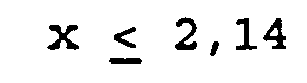

- Pour la mise en oeuvre du procédé de l'invention, on peut utiliser par exemple comme solution de thorium, une solution de ThCl4 dans de l'acide chlorhydrique, ou une solution de nitrate de thorium dans l'acide nitrique. La solution de ThCl4 peut être obtenue par dissolution de ThCl4 solide dans une solution d'acide chlorhydrique 0,5 à 2 M, afin d'obtenir une solution de ThCl4 0,5 à 2 M. La solution de thorium en milieu nitrique peut être obtenue par dissolution de Th(NO3)4, 5H2O dans une solution 0,5 à 5 M de HNO3, afin d'obtenir une solution de Th 0,5 à 2 M.
- Lorsque l'actinide est l'uranium (IV), la solution d'uranium (IV) peut être une solution de UCl4 dans de l'acide chlorhydrique, obtenue par exemple par dissolution de UCl4 dans HCl 0,5 à 6 M, ou par dissolution d'uranium métal dans HCl 6 M amenée ensuite à la concentration voulue, par exemple 0,5 à 1,5 M de U, par dilution avec de l'eau désionisée.
- Lorsque l'actinide est le neptunium (IV), la solution de neptunium (IV) peut être une solution de neptunium dans l'acide nitrique, obtenue par exemple par dissolution de NpO2 solide dans HNO3 4 à 5 M et dilution avec de l'eau désionisée pour avoir une concentration en acide nitrique de 1 à 4 M et une concentration en Np de 0,1 à 0,3 M.
- Lorsque l'actinide est le plutonium (IV), la solution de plutonium peut être une solution de plutonium dans l'acide nitrique, obtenue par exemple par dissolution de PuO2 dans une solution d'acide nitrique HNO3 4 à 5 M et dilution avec de l'eau désionisée pour obtenir une concentration en acide nitrique de 1 à 4 M et une concentration en Pu de 0,2 à 0,6 M.
- Ainsi, le procédé de l'invention permet de préparer du phosphate-diphosphate de thorium lorsqu'il est mis en oeuvre avec une solution de thorium à laquelle on ajoute une solution d'acide phosphorique dans le rapport molaire voulu. On forme ainsi un gel qui, dans le récipient fermé, se transforme ensuite par chauffage en un précipité formé d'une poudre cristallisée. Cette poudre peut être ensuite transformée en phosphate-diphosphate de thorium (PDT) par traitement thermique.
- Le procédé de l'invention peut être aussi utilisé pour préparer un phosphate d'actinide, par exemple d'uranium (IV), en formant tout d'abord un précipité de phosphate d'uranium que l'on transforme ensuite par traitement thermique en un phosphate de structure différente de celle du phosphate-diphosphate de thorium, correspondant à un système polyphasé.
- Pour cette préparation, on utilise dans l'étape a) une solution contenant de l'uranium et de l'acide phosphorique, et on soumet le produit précipité à un traitement thermique effectué au moins en partie à une température de 700 à 1300°C.
- Dans ce cas, la solution acide d'uranium ne doit pas comporter d'oxydant car en présence d'un oxydant comme l'acide nitrique par exemple, l'uranium tétravalent est oxydé en uranium hexavalent sous forme d'ion uranyle UO2 2+ qui ne formera pas de précipité dans les conditions du procédé de l'invention.
- Le procédé peut aussi être utilisé pour former des solutions solides d'actinides tétravalents en partant d'un mélange de solutions acides contenant plusieurs actinides (IV), et d'acide phosphorique, que l'on soumet ensuite à un chauffage en récipient fermé à une température de 50 à 250°C pour précipiter un produit contenant des phosphates d'actinides.
- Lorsqu'on part d'une solution de thorium et d'actinide(s), on obtient par précipitation suivie d'un chauffage dans l'enceinte fermée, une poudre très homogène constituée de grains de taille inférieure à 3 µm, qui peut être transformée par traitement thermique en un phosphate-diphosphate de thorium et d'uranium (IV).
- On peut aussi inclure dans ce phosphate-diphosphate de thorium et/ou d'actinide(s) tétravalent des éléments trivalents ou d'autres éléments tétravalents en réalisant une coprécipitation des éléments trivalents avec les éléments tétravalents, lors du chauffage en enceinte fermée. On obtient en fin d'opération un système biphasé ou polyphasé constitué de phosphate-diphosphate de thorium et/ou d'actinide(s) tétravalent, et d'un phosphate contenant les éléments lanthanides trivalents tels que le gadolinium et le lanthane, et/ou d'actinides trivalents tels que l'américium et le curium.
- On peut aussi préparer à partir du produit à base de phosphate de thorium (IV) et/ou d'actinide(s) (IV) obtenu par précipitation à la suite des étapes a) à c), un matériau composite incluant au moins un actinide (III) et/ou au moins un lanthanide (III) sous forme de phosphate tel que la monazite MIIIPO4, la xénotime MIIIPO4 et la brabantite MII XM'IV XM"III (2-2x)(PO4)2.
- Ce matériau peut être préparé en dispersant une poudre du (des) phosphate(s) préalablement formé(s) dans le précipité du produit contenant un phosphate de thorium (IV) et/ou d'actinide(s) (IV), et en soumettant ensuite l'ensemble à un traitement thermique précédé éventuellement d'une compression, effectué au moins en partie à une température de 700 à 1300°C.
- L'invention a encore pour objet un procédé de séparation de l'uranium (VI), sous forme d'ion uranyle UO2 2+, présent dans une solution avec d'autres cations y compris du thorium, selon lequel on ajoute à la solution de l'acide phosphorique en quantité telle que le rapport molaire acide phosphorique/autres cations soit de 1,4 à 2, on chauffe la solution ainsi obtenue à une température de 50 à 250°C dans un récipient fermé pour précipiter un produit contenant les autres cations que l'uranium, et on récupère la solution contenant l'uranium (VI).
- En effet, le phosphate d'uranyle (UO2)3(PO4)2, 5H2O plus soluble que les phosphates de cations trivalents et tétravalents, comme par exemple les actinides et les lanthanides, peut ne pas précipiter dans certaines conditions opératoires. I1 est donc possible de séparer l'uranium des autres cations en jouant sur les concentrations des espèces en solution et sur l'acidité du milieu, de façon à former un précipité contenant les autres cations et à laisser l'uranium en solution.
- L'invention a encore pour objet un procédé de décontamination d'effluents aqueux radioactifs consistant à précipiter un produit à base de phosphate de thorium dans l'effluent par addition de thorium puis d'acide phosphorique à l'effluent en quantités telles que le rapport molaire P/Th soit de 1,4 à 2, et chauffage dans un récipient fermé à une température de 50 à 250°C, pour précipiter un produit contenant du phosphate de thorium dans l'effluent entraînant ainsi les cations radioactifs contaminants.
- D'autres caractéristiques et avantages de l'invention apparaîtront mieux à la lecture de la description qui suit d'exemples donnés bien entendu à titre illustratif et non limitatif, en référence aux dessins annexés.
-
- la
figure 1 est un diagramme de diffraction des rayons X du précurseur de phosphate-diphosphate de thorium obtenu dans l'exemple 1 ; - la
figure 2 est le spectre infrarouge de ce même précurseur ; - la
figure 3 est un diagramme de diffraction des rayons X du phosphate d'uranium (IV) obtenu dans l'exemple 2 ; - la
figure 4 est le spectre infrarouge de ce phosphate d'uranium (IV). - Dans un récipient en téflon, on prépare une solution de thorium en dissolvant 4 g de ThCl4 solide dans une solution d'acide chlorhydrique 2 M pour obtenir une concentration en thorium de 0,7 M. On ajoute à cette solution progressivement, sous agitation, une solution d'acide phosphorique H3PO4 5M obtenue par dilution de l'acide concentré 14 M environ avec de l'eau désionisée, pour obtenir un rapport molaire acide phosphorique/thorium égal à 3/2 avec un excès d'acide phosphorique de 2%. On arrête alors l'agitation, on ferme le récipient et on le chauffe à une température de 150°C, sur un banc de sable, pendant 21 jours. Le gel initialement formé se transforme dans ces conditions en précipité. La réaction qui se produit conduit à l'obtention d'un phosphate de thorium cristallisé.
- On refroidit le récipient et on laisse le précipité décanter jusqu'à l'obtention d'un surnageant limpide.
- On élimine le surnageant au moyen d'une pipette et on le remplace par de l'eau désionisée. On met le tout en suspension par agitation puis on laisse le précipité décanter et on répète l'opération jusqu'à l'obtention d'un surnageant de pH voisin de celui de l'eau désionisée. On filtre alors le précipité sur un verre fritté sous vide puis on le sèche à 120°C.
- La
figure 1 représente le diagramme de diffraction de rayons X du produit séché. - La
figure 2 représente le spectre infrarouge de ce même produit. - Si l'on compare le diagramme de la
figure 1 au diagramme du phosphate-diphosphate de thorium (PDT) illustré enfigure 1 deWO 96/30300 - On peut transformer le précurseur obtenu précédemment en phosphate-diphosphate de thorium en le soumettant tout d'abord à une précalcination à 400°C pendant 2 h puis à une calcination à une température de 1150°C, pendant 10 h.
- Les caractéristiques du produit calciné correspondent bien à celles du phosphate-diphosphate de thorium du document [1].
- On suit le même mode opératoire que dans l'exemple 1. Ainsi, on prépare tout d'abord une solution d'uranium (IV) par dissolution de 4 g de UCl4 dans une solution d'acide chlorhydrique HCl 4 M pour obtenir une concentration en uranium de 0,7 M. On mélange cette solution avec une solution 5 M d'acide phosphorique dans le rapport molaire acide phosphorique/uranium (IV) égale à 3/2 avec un excès de 2% d'acide phosphorique. Le mélange est effectué dans un récipient que l'on ferme ensuite et que l'on chauffe, comme dans l'exemple 1, à une température de 150°C, sur banc de sable, pendant 1 semaine. Dans ces conditions, le gel initial est transformé par chauffage en poudre cristallisée.
- On sépare la poudre et on la lave, puis on la sèche comme dans l'exemple 1.
- La
figure 3 représente le diagramme de diffraction de rayons X du produit obtenu. - La
figure 4 représente le spectre infrarouge de ce produit. - On soumet le produit obtenu précédemment à une précalcination et à une calcination comme dans l'exemple 1, et on obtient ainsi un système polyphasé de phosphate d'uranium.
- On peut préparer de la même façon des produits à base de phosphate de protactinium (IV), de phosphate de neptunium (IV) ou de phosphate de plutonium (IV), en utilisant le même rapport molaire acide phosphorique/actinide (IV) et en préparant le mélange à partir d'une solution acide de protactinium (IV), de neptunium (IV) ou de plutonium (IV).
- Dans ce cas, on prépare une solution de thorium et d'actinide (IV) dans des proportions permettant d'obtenir un phosphate-diphosphate de formule Th4-xMx(PO4)4P2O7 dans laquelle M représente l'actinide (IV), avec x présentant les valeurs suivantes :


- On mélange la solution de thorium obtenue dans l'exemple 1 avec une solution d'actinide et on mélange avec une solution d'acide phosphorique 5 M comme dans les exemples précédents. Les quantités de thorium, d'actinide M et d'acide phosphorique sont telles que le rapport molaire acide phosphorique/Th+M soit de 3/2 avec un excès d'acide phosphorique de 2%. On soumet ensuite ce mélange à un chauffage dans un récipient fermé à une température de 150°C, sur banc de sable, pendant 1 semaine.
- Le gel initialement formé se transforme en poudre. On sépare la poudre, on la lave et on la sèche comme dans l'exemple 1. La poudre séchée est très homogène, constituée de grains de taille inférieure à 3 µm. La surface spécifique correspondante avoisine 10 m2/g, ce qui lui confère une plus forte réactivité.
- Cette forte réactivité de la poudre la rend très intéressante pour le conditionnement des actinides radioactifs introduits dans le phosphate-diphosphate de thorium.
- En effet, on obtient une poudre ayant de meilleures propriétés physicochimiques que celles de la poudre obtenue dans le document [1].
- On soumet ensuite la poudre à un traitement thermique à une température de 1250°C pendant 10 h pour former la solution solide de phosphate-diphosphate de thorium et d'actinide (IV) de formule Th4-xMx(PO4)4P2O7.
- La surface spécifique de la poudre diminue de manière importante pour des températures de traitement thermique supérieures ou égales à 800°C. Corrélativement, la taille des grains augmente jusqu'à atteindre 10 à 20 µm à 1250°C.
- Si, préalablement au traitement thermique, on effectue une compression de la poudre à 500 MPa, la densité du produit atteint 95% de celle calculée, après seulement 5 heures de traitement thermique, ce qui correspond à 5% environ de porosité totale, à peu près à part égale entre porosité ouverte et porosité fermée.
- De plus, la surface spécifique des pastilles est comprise entre 750 et 1500 cm2/g, ce qui permet de réduire d'un facteur proche de 6, la vitesse de dissolution du solide par rapport à celle de la poudre, lors des tests de lixiviation. Outre l'influence de la surface spécifique sur la vitesse de lixiviation, les études entreprises confirment les très bonnes propriétés physicochimiques de confinement de la solution solide de phosphate-diphosphate de thorium et d'actinide tétravalent tel que l'uranium (IV).
- On mélange des solutions de thorium (0,7 M) et d'uranium (IV) (0,6 M) en milieu chlorhydrique, comme cela est décrit dans les exemples précédents de manière à respecter un rapport molaire Th/U égal à 1,5 puis on ajoute une solution d'acide phosphorique 5 M dans le rapport molaire PO4/(Th+U)=1,5. On place ce mélange, dans un récipient clos, et on le chauffe, sur banc de sable, à 150°C pendant 2 jours. Le précipité cristallisé de phosphate de thorium et d'uranium (IV) ainsi obtenu, est filtré, lavé puis séché comme cela est décrit dans l'exemple 3.
- Préalablement, une poudre de phosphate de gadolinium est préparée par précipitation (ou évaporation à sec) chauffée à 150°C, filtrée, séchée, broyée, puis traitée à 1250°C pendant 10 heures. La poudre de GdPO4 cristallise alors dans la structure monazite. Elle est homogène, monophasée et caractérisée par une surface spécifique de 1 à 3 m2/g et une taille moyenne de grains inférieure à 2 µm, ce qui lui confère une forte réactivité.
- Cette poudre est dispersée dans le phosphate de thorium et d'uranium (IV) dans le rapport massique : phosphate de thorium et d'uranium (IV) : 70% -phosphate de gadolinium : 30%. Le mélange est broyé, pressé à 500 MPa puis traité à 1250°C pendant 10 heures sous atmosphère inerte (par exemple, sous atmosphère d'argon). Après traitement thermique à 1250°C, on obtient ainsi un fritté dense de solution solide de phosphate-diphosphate de thorium et d'uranium (IV) de formule Th2,4U1,6(PO4)4P2O7 contenant, en dispersion, du phosphate de gadolinium GdPO4 de structure de type monazite.
- Le gadolinium (utilisé comme poison neutronique) peut être partiellement substitué par de l'américium et/ou du curium alors que l'uranium (IV) peut être substitué par du neptunium (IV) et/ou du plutonium (IV), ce qui permet alors de préparer des échantillons composites contenant, à la fois, des actinides trivalents et tétravalents.
- On part d'une solution comprenant du nitrate de thorium 0,1 M, du nitrate d'uranyle 0,1 M, dans l'acide nitrique 2 M, et on y ajoute une solution d'acide phosphorique H3PO4 5 M pour avoir un rapport stoechiométrique acide phosphorique/thorium de 1,5 avec 2% d'excès d'acide phosphorique. On forme ainsi un gel qui renferme les ions, puis on chauffe le gel dans un récipient fermé à une température de 150°C, jusqu'à l'obtention d'un précipité qui comporte le précurseur du phosphate-diphosphate de thorium alors que l'ion uranyle reste dans le surnageant.
- On peut ainsi récupérer l'uranium (VI) par décantation, filtration et lavage.
- Si la solution comporte d'autres cations divalents tels que Ca2+, Ba2+ et Sr2+, et d'autres cations trivalents tels que La3+, Gd3+ et Ce3+, ceux-ci sont entraînés avec le phosphate de thorium sous forme de précipité alors que l'uranium (VI) reste en solution.
- Il en est de même si la solution comprend d'autres actinides tétravalents qui seront entraînés dans la phase solide avec le thorium.
- On peut suivre le même mode opératoire pour décontaminer des effluents liquides radioactifs.
- [1]
WO 96/30300
Claims (15)
- Procédé de préparation d'un produit contenant un phosphate d'au moins un élément M (IV) choisi parmi le thorium (IV) et les actinides (IV), caractérisé en ce qu'il comprend les étapes suivantes :a) mélanger une solution contenant du thorium (IV) et/ou au moins un actinide (IV) avec une solution d'acide phosphorique en quantités telles que le rapport molaire
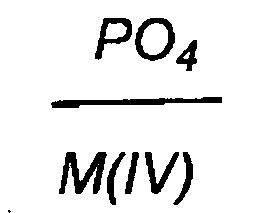
où M(IV) représente la concentration totale en thorium (IV) et/ou actinide(s) (IV), soit de 1,4 à 2,b) chauffer le mélange des solutions dans un récipient fermé à une température de 50 à 250°C pour précipiter un produit contenant un phosphate d'au moins un élément M choisi parmi le thorium (IV) et les actinides (IV) ayant un rapport molaire P/M égal à 1,5,c) séparer le produit précipité de la solution. - Procédé selon la revendication 1, qui comprend de plus les étapes suivantes :d) laver avec de l'eau le produit précipité ainsi séparé, ete) sécher le produit lavé.
- Procédé selon la revendication 1 ou 2, le produit préparé étant du phosphate-diphosphate de thorium de formule Th4(PO4)4P2O7,
dans lequel dans l'étape (a) on mélange une solution contenant du thorium et de l'acide phosphorique, et dans lequel on soumet le produit obtenu à l'étape (c) ou (e) à un traitement thermique effectué au moins en partie à une température de 700 à 1300°C. - Procédé selon la revendication 1 ou 2, le produit préparé étant du phosphate d'uranium,
dans lequel dans l'étape (a) on mélange une solution contenant de l'uranium et de l'acide phosphorique, et dans lequel on soumet le produit obtenu à l'étape (c) ou (e) à un traitement thermique effectué au moins en partie à une température de 700 à 1300°C de façon à obtenir du phosphate d'uranium. - Procédé selon la revendication 1 ou 2, le produit préparé étant une solution solide de phosphate de thorium et d'au moins un actinide tétravalent,
dans lequel dans l'étape (a) on mélange une solution contenant du thorium et au moins un actinide, et de l'acide phosphorique, et dans lequel on soumet le produit obtenu à l'étape (c) ou (e) à un traitement thermique effectué au moins en partie à une température de 700 à 1300°C. - Procédé selon la revendication 5, dans lequel la solution solide de phosphates répond à la formule :
Th4-xMx(PO4)4P2O7
dans laquelle M est un élément choisi parmi Pa(IV), U (IV), Np (IV) et Pu (IV), et x satisfait aux conditions suivantes :


- Procédé selon l'une quelconque des revendications 1, 3, 5 et 6, dans lequel la solution de thorium est une solution de ThCl4 dans de l'acide chlorhydrique.
- Procédé selon l'une quelconque des revendications 1, 2 et 4 à 6, dans lequel l'actinide est l'uranium (IV) et la solution d'uranium (IV) est une solution de UCl4 dans de l'acide chlorhydrique.
- Procédé selon l'une quelconque des revendications 1, 2, 5 et 6, dans lequel l'actinide est le neptunium (IV) et la solution de neptunium (IV) est une solution de neptunium dans l'acide nitrique.
- Procédé selon l'une quelconque des revendications 1, 2, 5 et 6, dans lequel l'actinide est le plutonium (IV) et la solution de plutonium (IV) est une solution de plutonium dans l'acide nitrique.
- Procédé selon l'une quelconque des revendications 3 à 5,
dans lequel le traitement thermique est réalisé en deux étapes qui sont respectivement :- une première étape effectuée à une température de 300 à 500°C pendant 1h à 5h, et- une seconde étape effectuée à une température de 1100 à 1300°C pendant 3 à 15h. - Procédé selon l'une quelconque des revendications 1 à 11, dans lequel dans l'étape (a), on ajoute de plus au mélange au moins un élément choisi parmi les actinides trivalents et les lanthanides trivalents pour inclure le(s) actinide(s) trivalent(s) et/ou le(s) lanthanide(s) trivalent(s) dans le produit précipité dans l'étape (b).
- Procédé selon la revendication 1, dans lequel le produit préparé étant un matériau composite incluant au moins un actinide (III) et/ou au moins un lanthanide (III),
dans lequel dans l'étape (a) on mélange une solution contenant du thorium et/ou au moins un actinide, et de l'acide phosphorique,
dans lequel on disperse dans le produit obtenu à l'étape (c) ou (e) une poudre d'au moins un actinide (III) et/ou d'au moins un lanthanide (III) sous forme de phosphate, et on soumet l'ensemble à un traitement thermique, précédé éventuellement d'une compression, effectué au moins en partie à une température de 700 à 1300°C. - Procédé de séparation de l'uranium (VI), sous forme d'ion uranyle UO2 2+, présent dans une solution avec d'autres cations y compris du thorium, caractérisé en ce que l'on ajoute à la solution de l'acide phosphorique en quantité telle que le rapport molaire

- Procédé de décontamination d'un effluent aqueux radioactif, la contamination étant formée de cations radioactifs,
dans lequel on précipite dans l'effluent un produit à base de phosphate de thorium par addition de thorium puis d'acide phosphorique à l'effluent en quantités telles que le rapport molaire P/Th, soit de 1,4 à 2, puis on chauffe dans un récipient fermé à une température de 50 à 250°C, pour précipiter un produit contenant du phosphate de thorium et les cations radioactifs contaminants.
Applications Claiming Priority (3)
| Application Number | Priority Date | Filing Date | Title |
|---|---|---|---|
| FR0201760 | 2002-02-13 | ||
| FR0201760A FR2835823B1 (fr) | 2002-02-13 | 2002-02-13 | Procede de preparation d'un produit a base de phosphate de thorium et/ou d'actinides |
| PCT/FR2003/000426 WO2003068675A1 (fr) | 2002-02-13 | 2003-02-11 | Procede de preparation d'un produit a base de phosphate de thorium et/ou d'actinide(s) |
Publications (2)
| Publication Number | Publication Date |
|---|---|
| EP1474359A1 EP1474359A1 (fr) | 2004-11-10 |
| EP1474359B1 true EP1474359B1 (fr) | 2009-11-04 |
Family
ID=27620155
Family Applications (1)
| Application Number | Title | Priority Date | Filing Date |
|---|---|---|---|
| EP03739522A Expired - Lifetime EP1474359B1 (fr) | 2002-02-13 | 2003-02-11 | Procede de preparation d'un produit a base de phosphate de thorium et/ou d'actinide(s) |
Country Status (6)
| Country | Link |
|---|---|
| US (1) | US7195745B2 (fr) |
| EP (1) | EP1474359B1 (fr) |
| AU (1) | AU2003226875A1 (fr) |
| DE (1) | DE60329900D1 (fr) |
| FR (1) | FR2835823B1 (fr) |
| WO (1) | WO2003068675A1 (fr) |
Families Citing this family (10)
| Publication number | Priority date | Publication date | Assignee | Title |
|---|---|---|---|---|
| AU2007363064B2 (en) | 2007-12-26 | 2014-02-13 | Thorium Power Inc. | Nuclear reactor (variants), fuel assembly consisting of driver-breeding modules for a nuclear reactor (variants) and a fuel cell for a fuel assembly |
| US8116423B2 (en) | 2007-12-26 | 2012-02-14 | Thorium Power, Inc. | Nuclear reactor (alternatives), fuel assembly of seed-blanket subassemblies for nuclear reactor (alternatives), and fuel element for fuel assembly |
| JP5755568B2 (ja) | 2008-12-25 | 2015-07-29 | トリウム・パワー、インクThorium Power,Inc. | 軽水炉核燃料集合体および軽水炉 |
| US10170207B2 (en) | 2013-05-10 | 2019-01-01 | Thorium Power, Inc. | Fuel assembly |
| WO2011143172A1 (fr) | 2010-05-11 | 2011-11-17 | Thorium Power, Inc. | Assemblage de combustible à noyau d'alliage de combustibles métalliques et son procédé de fabrication |
| US10192644B2 (en) | 2010-05-11 | 2019-01-29 | Lightbridge Corporation | Fuel assembly |
| DE102013211942A1 (de) * | 2013-06-24 | 2014-12-24 | Siemens Aktiengesellschaft | Verfahren zum Einbringen von radioaktiven Elementen in eine phosphathaltige Kristallstruktur |
| DE102013211938A1 (de) * | 2013-06-24 | 2014-12-24 | Siemens Aktiengesellschaft | Verfahren zum Einbringen von radioaktiven Elementen in eine phosphathaltige Kristallstruktur |
| CN104844190B (zh) * | 2015-04-08 | 2017-03-01 | 西南科技大学 | 一种氟磷灰石陶瓷固化体的制备方法 |
| CN114767715B (zh) * | 2022-04-29 | 2023-06-23 | 苏州大学 | 一种双功能杂多酸类促排剂 |
Family Cites Families (6)
| Publication number | Priority date | Publication date | Assignee | Title |
|---|---|---|---|---|
| US3351436A (en) * | 1964-12-28 | 1967-11-07 | Gen Electric | Preparation of thorium pyrophosphate |
| US3764553A (en) * | 1972-08-18 | 1973-10-09 | Atomic Energy Commission | Removal of radioisotopes from waste solutions |
| FR2697010B1 (fr) * | 1992-10-19 | 1995-02-24 | Rhone Poulenc Chimie | Procédé de traitement des composés solubles du thorium et nouveau phosphate de thorium ainsi obtenu. |
| US5490079A (en) * | 1994-08-19 | 1996-02-06 | Texas Instruments Incorporated | System for automated toll collection assisted by GPS technology |
| FR2732326B1 (fr) | 1995-03-29 | 1997-05-30 | Centre Nat Rech Scient | Nouveaux phosphates de thorium, leur procede de preparation et leur utilisation pour le stockage de produits radioactifs |
| US7127413B1 (en) * | 1998-01-23 | 2006-10-24 | Toyota Jidosha Kabushiki Kaisha | Charge processing device charge processing system and charge processing card |
-
2002
- 2002-02-13 FR FR0201760A patent/FR2835823B1/fr not_active Expired - Fee Related
-
2003
- 2003-02-11 WO PCT/FR2003/000426 patent/WO2003068675A1/fr not_active Ceased
- 2003-02-11 AU AU2003226875A patent/AU2003226875A1/en not_active Abandoned
- 2003-02-11 DE DE60329900T patent/DE60329900D1/de not_active Expired - Lifetime
- 2003-02-11 EP EP03739522A patent/EP1474359B1/fr not_active Expired - Lifetime
- 2003-02-11 US US10/504,052 patent/US7195745B2/en not_active Expired - Lifetime
Also Published As
| Publication number | Publication date |
|---|---|
| US7195745B2 (en) | 2007-03-27 |
| FR2835823A1 (fr) | 2003-08-15 |
| DE60329900D1 (de) | 2009-12-17 |
| AU2003226875A1 (en) | 2003-09-04 |
| US20050145833A1 (en) | 2005-07-07 |
| FR2835823B1 (fr) | 2004-04-09 |
| WO2003068675A1 (fr) | 2003-08-21 |
| EP1474359A1 (fr) | 2004-11-10 |
Similar Documents
| Publication | Publication Date | Title |
|---|---|---|
| EP2327077B1 (fr) | Procede de preparation d'un combustible nucleaire mixte comprenant de l'uranium et au moins un actinide et/ou lanthanide mettant en oeuvre une resine echangeuse de cations | |
| Popa et al. | A low-temperature synthesis method for AnO 2 nanocrystals (An= Th, U, Np, and Pu) and associate solid solutions | |
| US8940256B2 (en) | Method for recycling of rare earth and zirconium oxide materials | |
| KR101868185B1 (ko) | 핵 연료 제조에 유용한 우라늄 및 몰리브덴계의 합금 분말 및 방사성동위원소 생산을 위한 타겟 | |
| EP3094595B1 (fr) | Procédé de préparation d'une poudre d'oxyde métallique, procédé de fabrication d'une pastille d'oxyde métallique, poudre et pastille telles qu'obtenues selon ces procédés et leurs utilisations | |
| WO2003068675A1 (fr) | Procede de preparation d'un produit a base de phosphate de thorium et/ou d'actinide(s) | |
| EP0143726A1 (fr) | Procédé de préparation d'oxydes métalliques pulvérulents à partir de solutions aqueuses ou de mélanges solides de nitrates métalliques | |
| EP2760794B1 (fr) | Procede de preparation d'un oxychlorure et/ou oxyde d ' actinide ( s ) et/ou de lanthanide (s) a partir d'un milieu comprenant au moins un sel fondu | |
| US2905528A (en) | Method for preparation of uo2 particles | |
| CH649978A5 (fr) | Procede de conversion conjointe d'une solution aqueuse contenant des nitrates de metaux lourds. | |
| EP0817757B1 (fr) | Nouveaux phosphates de thorium, leur procede de preparation et leur utilisation pour le stockage de produits radioactifs | |
| JPH11505329A (ja) | 使用済み核燃料から稀土類を除去する方法 | |
| JP4183539B2 (ja) | 酸化ニオブおよびその製造方法 | |
| FR2920424A1 (fr) | Procede de conversion de chlorures de metaux alcalino-terreux en tungstates et molybdates et ses applications. | |
| Luca et al. | Cesium extraction from Cs0. 8Ba0. 4Ti8O16 hollandite nuclear waste form ceramics in nitric acid solutions | |
| WO2015091753A1 (fr) | Procédé de synthèse d'un peroxyde ou hydroxoperoxyde mixte d'un actinyle et d'au moins un cation métallique di-, tri- ou tétrachargé, peroxyde ou hydroxoperoxyde mixte ainsi obtenu et leurs applications | |
| US3228748A (en) | Process for the preparation of a uranium compound in powder form | |
| Hedberg et al. | Studies on plutonium-zirconium co-precipitation and carbothermal reduction in the internal gelation process for nitride fuel preparation | |
| RU1777311C (ru) | Способ получения карбида молибдена | |
| Hérès et al. | Molybdenum behaviour during U-Al research reactor spent fuel dissolution | |
| Clavier et al. | Study of Actinides Incorporation in Thorium Phosphate-Diphosphate/Monazite Based Ceramics | |
| Ruehle et al. | PROCESS DEVELOPMENT QUARTERLY REPORT. PART I | |
| Chourasia et al. | Studies related to Preparation of High Surface area Niobium oxide and low Temperature Calcination | |
| RU2176115C1 (ru) | СПОСОБ ПОЛУЧЕНИЯ ТОПЛИВНОЙ КОМПОЗИЦИИ BaPuO3 ДЛЯ ЯДЕРНЫХ РЕАКТОРОВ | |
| Wick et al. | VOLATILIZATION OF MOLYBDENUM DURING THE PREPARATION OF UF $ sub 4$ AND U $ sub 3$ O $ sub 8$ FROM UO $ sub 3$ |
Legal Events
| Date | Code | Title | Description |
|---|---|---|---|
| PUAI | Public reference made under article 153(3) epc to a published international application that has entered the european phase |
Free format text: ORIGINAL CODE: 0009012 |
|
| 17P | Request for examination filed |
Effective date: 20040712 |
|
| AK | Designated contracting states |
Kind code of ref document: A1 Designated state(s): AT BE BG CH CY CZ DE DK EE ES FI FR GB GR IE IT LI LU MC NL PT SE SI SK TR |
|
| AX | Request for extension of the european patent |
Extension state: AL LT LV MK RO |
|
| 17Q | First examination report despatched |
Effective date: 20070116 |
|
| GRAP | Despatch of communication of intention to grant a patent |
Free format text: ORIGINAL CODE: EPIDOSNIGR1 |
|
| GRAS | Grant fee paid |
Free format text: ORIGINAL CODE: EPIDOSNIGR3 |
|
| GRAA | (expected) grant |
Free format text: ORIGINAL CODE: 0009210 |
|
| AK | Designated contracting states |
Kind code of ref document: B1 Designated state(s): DE FR GB |
|
| REG | Reference to a national code |
Ref country code: GB Ref legal event code: FG4D Free format text: NOT ENGLISH |
|
| REF | Corresponds to: |
Ref document number: 60329900 Country of ref document: DE Date of ref document: 20091217 Kind code of ref document: P |
|
| PLBE | No opposition filed within time limit |
Free format text: ORIGINAL CODE: 0009261 |
|
| STAA | Information on the status of an ep patent application or granted ep patent |
Free format text: STATUS: NO OPPOSITION FILED WITHIN TIME LIMIT |
|
| 26N | No opposition filed |
Effective date: 20100805 |
|
| REG | Reference to a national code |
Ref country code: FR Ref legal event code: PLFP Year of fee payment: 14 |
|
| REG | Reference to a national code |
Ref country code: FR Ref legal event code: PLFP Year of fee payment: 15 |
|
| REG | Reference to a national code |
Ref country code: FR Ref legal event code: PLFP Year of fee payment: 16 |
|
| PGFP | Annual fee paid to national office [announced via postgrant information from national office to epo] |
Ref country code: GB Payment date: 20200219 Year of fee payment: 18 Ref country code: DE Payment date: 20200211 Year of fee payment: 18 |
|
| PGFP | Annual fee paid to national office [announced via postgrant information from national office to epo] |
Ref country code: FR Payment date: 20200228 Year of fee payment: 18 |
|
| REG | Reference to a national code |
Ref country code: DE Ref legal event code: R119 Ref document number: 60329900 Country of ref document: DE |
|
| GBPC | Gb: european patent ceased through non-payment of renewal fee |
Effective date: 20210211 |
|
| PG25 | Lapsed in a contracting state [announced via postgrant information from national office to epo] |
Ref country code: DE Free format text: LAPSE BECAUSE OF NON-PAYMENT OF DUE FEES Effective date: 20210901 Ref country code: FR Free format text: LAPSE BECAUSE OF NON-PAYMENT OF DUE FEES Effective date: 20210228 Ref country code: GB Free format text: LAPSE BECAUSE OF NON-PAYMENT OF DUE FEES Effective date: 20210211 |