EP1473954A1 - Dispositif et procédé de contrôle de charge avec contrôle de puissance - Google Patents
Dispositif et procédé de contrôle de charge avec contrôle de puissance Download PDFInfo
- Publication number
- EP1473954A1 EP1473954A1 EP04291062A EP04291062A EP1473954A1 EP 1473954 A1 EP1473954 A1 EP 1473954A1 EP 04291062 A EP04291062 A EP 04291062A EP 04291062 A EP04291062 A EP 04291062A EP 1473954 A1 EP1473954 A1 EP 1473954A1
- Authority
- EP
- European Patent Office
- Prior art keywords
- mobile
- station
- elementary
- mobiles
- threshold
- Prior art date
- Legal status (The legal status is an assumption and is not a legal conclusion. Google has not performed a legal analysis and makes no representation as to the accuracy of the status listed.)
- Granted
Links
- 238000000034 method Methods 0.000 title claims description 43
- 238000004891 communication Methods 0.000 claims abstract description 32
- 238000004364 calculation method Methods 0.000 claims description 16
- 230000004048 modification Effects 0.000 claims description 3
- 238000012986 modification Methods 0.000 claims description 3
- 230000009467 reduction Effects 0.000 claims description 3
- 238000013475 authorization Methods 0.000 claims description 2
- 230000006870 function Effects 0.000 description 22
- 238000010586 diagram Methods 0.000 description 8
- 238000012360 testing method Methods 0.000 description 4
- CIWBSHSKHKDKBQ-JLAZNSOCSA-N Ascorbic acid Chemical compound OC[C@H](O)[C@H]1OC(=O)C(O)=C1O CIWBSHSKHKDKBQ-JLAZNSOCSA-N 0.000 description 3
- 102100034243 Solute carrier family 12 member 2 Human genes 0.000 description 3
- 230000008901 benefit Effects 0.000 description 3
- 230000005540 biological transmission Effects 0.000 description 3
- 230000001413 cellular effect Effects 0.000 description 3
- 230000014509 gene expression Effects 0.000 description 3
- 230000008569 process Effects 0.000 description 3
- 108091006621 SLC12A1 Proteins 0.000 description 2
- 108091006620 SLC12A2 Proteins 0.000 description 2
- 230000001174 ascending effect Effects 0.000 description 2
- 230000002238 attenuated effect Effects 0.000 description 2
- 230000000295 complement effect Effects 0.000 description 2
- 230000006855 networking Effects 0.000 description 2
- 235000012830 plain croissants Nutrition 0.000 description 2
- 230000003595 spectral effect Effects 0.000 description 2
- FPQQSJJWHUJYPU-UHFFFAOYSA-N 3-(dimethylamino)propyliminomethylidene-ethylazanium;chloride Chemical compound Cl.CCN=C=NCCCN(C)C FPQQSJJWHUJYPU-UHFFFAOYSA-N 0.000 description 1
- 230000010267 cellular communication Effects 0.000 description 1
- 238000011217 control strategy Methods 0.000 description 1
- 238000001514 detection method Methods 0.000 description 1
- 238000005516 engineering process Methods 0.000 description 1
- 230000010262 intracellular communication Effects 0.000 description 1
- 239000011159 matrix material Substances 0.000 description 1
- 230000000116 mitigating effect Effects 0.000 description 1
- 230000004044 response Effects 0.000 description 1
- 230000007480 spreading Effects 0.000 description 1
- 238000012546 transfer Methods 0.000 description 1
- 238000012795 verification Methods 0.000 description 1
Images




Classifications
-
- H—ELECTRICITY
- H04—ELECTRIC COMMUNICATION TECHNIQUE
- H04W—WIRELESS COMMUNICATION NETWORKS
- H04W52/00—Power management, e.g. Transmission Power Control [TPC] or power classes
- H04W52/04—Transmission power control [TPC]
- H04W52/30—Transmission power control [TPC] using constraints in the total amount of available transmission power
- H04W52/34—TPC management, i.e. sharing limited amount of power among users or channels or data types, e.g. cell loading
Definitions
- the invention relates to wireless communication networks.
- Wireless communication networks include base stations in conjunction with mobiles.
- a base station is adapted, at the request of a mobile, to establish a communication with this mobile. This communication allows an exchange of words or digital data between users.
- Such communication may be made by "downlink”, in which case the communication is established from the base station to the mobile.
- base stations provide services to mobile.
- a mobile requires a certain service which consists of data to be transmitted under certain conditions (for example debit or delay).
- An "active" mobile is a mobile that receives such service.
- the mobile can require two types of services, namely real-time services with predefined debits and deferred services with elastic debits.
- Load control allows access management (also called “control ”) from a mobile to a given base station, as well as load management of a given base station (also called “congestion control”) to guarantee a quality of service (QoS). More specifically, admission control helps determine for a given base station if a new mobile can be served by the base station while the congestion control allows to control the load induced by the whole mobiles served by the base station (so-called "active" mobiles).
- charge control is based on a comparison between a charge indicator calculated for a given base station, and a threshold value, called load threshold.
- the admission control authorizes the access of a new mobile to a given base station if it can be served without push the charge indicator beyond the charge threshold.
- load threshold In communication networks downlink, such a load indicator generally depends on the power transmitting from the base station which fluctuates over time. The load threshold must therefore be chosen with a significant safety margin.
- the additional charge induced by a new mobile is estimated approximately.
- test load control In the realizations with "test load control", the admission control authorizes temporarily accessing a new user to a base station until a decision be made.
- Test load controls have the advantage of ensuring that none cut will not occur, at least at the time of the decision, but have the disadvantage of being excessively long, so that they are rarely used in practice.
- French patent application N ° 03 02 017 proposes a method and a control device load based on a comparison between a load indicator calculated for a station given base, and a threshold value, called load threshold, as in the embodiments with direct charge control.
- the charge indicator depends only on the attenuations between users and antennas, and signal-to-noise thresholds and interference (SINR). Thus, they do not depend on the transmission powers.
- SINR signal-to-noise thresholds and interference
- charge control is carried out without taking into account the power limitations. Such power limitations are generally imposed by a standard which fixes the maximum power that a base is authorized to transmit.
- the invention improves the situation.
- step c) comprises the calculation of the difference between the limit of total power emitted by the serving antenna and the power of the channels common, which provides the load threshold.
- step c) is applied to the value resulting from the summation of step b).
- step b) further comprises an iteration of steps b1) and b2) for the next elementary product, according to the chosen order, with a starting value taken equal to the current sum obtained in step b1) above.
- step b) further comprises an interruption of the summons and a prohibition access to the server station for the mobile associated with the last elementary product added and for the mobiles associated with the following elementary products, in accordance with the order selected.
- the summation of the elementary products can be carried out in ascending order of elementary products.
- the summation of elementary products can also be carried out in an order random elementary products.
- the summation of the elementary products can be carried out in an order chosen according to predefined priorities between the associated mobiles.
- the starting value is zero at the first iteration of step b1).
- the mobiles have a request for fixed speed and the method further includes access control to the server station for a "candidate" mobile.
- the predefined set of mobiles also includes the "candidate" mobile.
- step b) may comprise memorizing the value resulting from the summons.
- Access control includes authorization to access the server station for the mobile candidate if the comparison in step c) indicates that the sum is less than or equal to the load threshold.
- Access control includes a ban on access to the waiter station by mobile candidate if the comparison in step c) indicates that the sum is greater than said threshold of charge.
- step ii) comprises the calculation of a quantity representing the needs of the mobile with respect to its station from the threshold of the signal-to-interference-and-noise ratio and the orthogonality factor between the channels of the waitress station.
- Step ii) then includes the multiplication of the quantity representing the needs of the mobile with respect to its station by the attenuation between the mobile and its station, which provides the second elementary quantity.
- the threshold of the signal-to-interference-and-noise ratio can be calculated from the bit rate assigned to the mobile.
- the device is also able to calculate products respective elementary for a predefined set of mobiles belonging to a station given waitress.
- the device further comprises a summing function interacting with the elementary load calculator, the summation function being suitable for summing the elementary products calculated by the elementary load calculator, which provides a charge indicator relating to the waiter station.
- the device also includes a comparator interacting with the function of summation, the comparator being able to compare the load indicator calculated by the summation function for a given server station with a load threshold relating to the total power limit transmitted by the server station.
- the threshold calculator suitable for calculating the difference between the total power limit transmitted by the waiter station and the power of the common channels of the waiter station, which provides said load threshold.
- the first function is able to divide the total power limit emitted by a station neighbor given by the attenuation of the mobile vis-à-vis the neighboring station, and to be multiplied the value resulting from the division by the orthogonality factor between the server station and the neighboring station, which provides an intermediate quantity.
- the first function is then able to calculate the value of the intermediate quantity for each neighboring station, summing the values of the intermediate quantities thus obtained, and add the external noise to the value resulting from the summation, which provides the first elementary quantity for the given mobile.
- the device includes a charge reduction function specific to reduce the number of mobiles in the predefined set of mobiles, if the comparator indicates that the charge indicator is greater than the charge threshold.
- the mobiles have a request for fixed speed and the device further comprises an access controller for controlling access to a mobile candidate for a waiter station according to the result provided by the comparator.
- the predefined set of mobiles then also includes the "candidate" mobile.
- the access controller is able to authorize access to the server station for the mobile candidate if the result provided by the comparator indicates that the charge indicator is less than or equal to the load threshold.
- the access controller is able to prohibit access to the server station for the mobile candidate if the result provided by the comparator indicates that the charge indicator is higher than the load threshold.
- the second function is able to calculate a quantity representing the mobile needs vis-à-vis its server station from the threshold of signal-to-interference-and-noise ratio and the orthogonality factor between the channels of the waitress stations.
- the second function is able to multiply the quantity representing the needs of the mobile with respect to its server station by the attenuation between the mobile and its station, which provides the second elementary quantity.
- the threshold of the signal-to-interference-and-noise ratio is calculated from the bit rate assigned to the mobile.
- the mobiles have a speed request variable and the device includes a charge regulator.
- the regulator is able to modify the bit rate value assigned to the mobiles if the result provided by the comparator indicates that the charge indicator is less than or equal to the charge threshold.
- Annex 1 includes the mathematical formulas used in the embodiments of the invention.
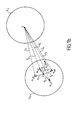
- Figure 1a shows a wireless communication network or cellular network comprising two base stations u and v.
- a base station which can be shortened to "station” or “antenna”, comprises a network antenna which can be directional or omnidirectional and the electronic assembly associated with it.
- Each base station serves mobiles located in a certain geographical area called cell.
- user station or “user equipment” or “mobile” or even “user” means any device capable of wireless communication, and possibly susceptible to mobility.
- the base station u serves the mobiles m u1 , m u2 and m u3 located in the cell C u and the base station v serves the mobiles m v1 , m v2 , m v3 and m v4 located in cell C v .
- the notation m x will denote below a mobile served by a base station x.
- the cells are represented by rectangles, by way of example, but can have any other shape. The cells can have an intersection called a "handover" zone.
- a mobile is characterized by a geographic position, a certain required service and a waitress base station, e.g. u or v. These characteristics constitute a configuration of mobiles.
- Figure 1b shows an example of the configuration of mobiles served by a base station u.
- the cell base station u of cell Cu establishes a communication with the mobiles m u1 , m u2 , m u3 and m u4 which it serves.
- These paths from the server station u to the mobiles served are designated by t1, t2, t3, t4 and t5 in FIG. 1b.
- the paths from the neighboring station v to the mobiles served by the base station u are designated by t'1, t'2, t'3, t'4 and t'5 in FIG. 1b.
- Load control is based in part on propagation losses along these paths, called mitigations.
- a station is said to be a "waitress" for a mobile if it provides a service to this mobile.
- the expression “waitress station” will also be used to designate a station for which a mobile admission control is carried out.
- a station is said to be “neighboring" for a mobile if the mobile can measure its attenuation vis opposite this station.
- FIG. 1 c represents a communication network comprising three base stations u, v and w.
- a mobile m u is served by the base station u.
- the mobile m u sends the values of the attenuations L v, mu and L w, mu to its server station u.
- the base stations u, v and w can be fitted with a CALC computer to perform the charge control.
- the charge control is carried out by a station controller basic BSC1 or BSC2.
- Each base station is in fact linked to a base station controller, which can be common to several stations.
- base stations u and v are linked to the base station controller BSC 1 and the base station w is connected to the station controller basic BSC2.
- a base station controller is generally responsible for all functions related to radio transmission, such as maintaining communication when the mobile is moves from one cell to another called “handover", managing network resources and cell configuration data.
- Wireless communication networks include a transmission layer between the network and the client controlled by a protocol, for example the CDMA ("Code Division Multiple Access") protocol.
- This protocol notably allows each mobile to use the same broad frequency band.
- this CDMA protocol uses orthogonal or pseudo-orthogonal codes to filter the signal intended for it from the superposition of all the signals transmitted by the base stations.
- the signals transmitted by the base stations are attenuated so as to form a noise for the mobile m u such that the threshold of the ratio of the signal emitted by the serving base station u to the noise is greater than a threshold ⁇ m u , which represents the threshold of the signal signal on interference-and-noise necessary for the reception by the mobile m u of the signal emitted by the station u.
- This threshold is defined according to the bit rate (in bits per second) or "bit rate" that the mobile wishes.
- the total power P u, mu of the signal dedicated to a mobile m u by a base station u must be sufficient to cover the noise of the communications. with other mobiles and to be able to be received by the mobile m u considered.
- This constraint corresponds to a problem of power allocation on the downlink. There are situations where the allocation of power is impracticable.
- Load control aims to ensure the feasibility of power allocation.
- French patent application N ° 03 02 017 proposes a method and a device allowing to check whether the power control problem is feasible or not, without trying to resolve, in a decentralized way.
- French patent application N ° 03 02 017 is based on a comparison between a charge indicator, and a charge threshold, the charge indicator taking into account the attenuations between mobiles and base stations, and the signal-to-noise thresholds and interference (SNIR).
- SNIR signal-to-noise thresholds and interference
- the feasibility criterion for power allocation defined in the request for French patent N ° 03 02 017 is based on the verification of SINR thresholds only. It is not therefore more suitable in environments where the power emitted by each base station is limited by a standard.
- the invention proposes a decentralized criterion of feasibility of allocating own power to take into account the power limits of base stations and the power of common channels, as well as a load control based on this criterion.
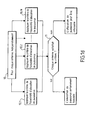
- Figure 1d is a flowchart representing the decentralized feasibility criterion power allocation.
- the charge controller performs in parallel the operations 10.1 to 10.N to individually check whether each base station u1 to uN meets the feasibility criterion for power allocation (operation 11). If all base stations meet the criterion, power allocation is certainly feasible and if at least one base station does not meet the criterion, the power allocation can be infeasible.
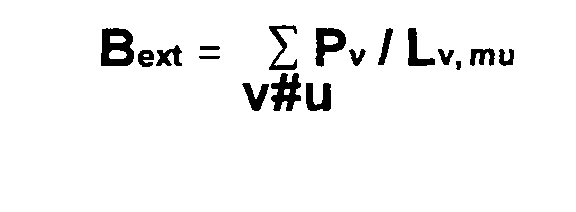
- All of the interference includes noise outside the network N received by the mobile in question, noise from intra-cellular communications B int and noise from extra-cellular communications B ext .
- the noise coming from intra or extra cellular communications is defined according to the total powers of the base stations.
- Equations 1.222 to 1.23 provide the different terms of this inequality.
- the left side of the inequality represents the Ich charge indicator (u) of a station base u and the member on the right represents the load threshold.
- This inequality defines a feasibility criterion for power allocation. So when the criterion is satisfied, the power allocation may be feasible. A search for these powers, for example by iteration, will then prove fruitful.
- FIGS 2a to 2c are block diagrams showing a device for controlling charge according to the invention.
- the charge control device according to the invention designated below by “charge controller” can be included in the computer of the base station network, for example "Node-B” in UMTS.
- the load control device is included in the computer of the network base station controller, for example "RNC” in UMTS.
- the charge controller 20 comprises a charge indicator calculator 21 suitable for calculating a charge indicator Ich (u) for a given base station u serving a predefined set of mobiles ⁇ m u ⁇ .
- the charge controller further comprises a threshold calculator 22 capable of calculating a charge threshold S (u) for the antenna u, from the total power limit P lim (u) of the base station u and from the power Pu 'of the common channels of the base station.
- the power limit P lim (u) of a base station u here designates the total power limit transmitted by the base station u possibly reduced by a safety margin.
- the power limit P lim (u) of the base station u and the power Pu 'of the common channels of the base station can take account of the antenna gain G.
- the charge controller also includes a comparator 23 capable of comparing the load indicator Ich (u) of the antenna u at the threshold S (u) and provide a response Rep (u) from which the charge controller can modify certain parameters of the mobile configuration.
- the charge controller may include a charge reduction function specific to reduce the number of mobiles asking to be served by a given station according to the result Rep (u) provided by the comparator.
- the charge controller may further comprise an access controller suitable for carrying out admission control of a mobile.
- the access controller is able to authorize a access to a given server station u for a "candidate” or “arriving” mobile in function of the result Rep (u) provided by the comparator, in accordance with the flow diagram of the figure 4.
- the charge controller may also include a charge controller specific to perform congestion control.
- the charge regulator is capable of modifying the flow of bits of the mobiles as a function of the result Rep (u) provided by the comparator, in accordance to the flowchart in Figure 5.
- Figures 2b and 2c are block diagrams showing the structure of the computer of the charge indicator 21 of FIG. 2a.
- the load indicator calculator 21 comprises an elementary load calculator suitable for calculating the elementary load EDPAP mu induced by a mobile on a given server station.
- the elementary load calculator comprises a first function PA1 for calculating a first elementary quantity G 1 (u, m u ) for each mobile m u served the base station u.
- This first elementary quantity takes into account the attenuation Lv, m u of the mobile with respect to each neighboring base station v, and the power limit P lim (v) of each of these neighboring antennas.
- Each mobile m u u back to its server measures attenuations Lv, m u vis-à-vis the neighboring stations v.
- the elementary load calculator according to the invention also includes a second function PA2 for calculating a second elementary quantity G2 (u, m u ) for the mobile m u served by the base station u.
- This second elementary quantity takes into account the attenuation Lu, m u between the mobile m u and its server station u, and the needs of the mobile ⁇ 'm u with respect to the server station u.
- the elementary load calculator according to the invention comprises a third function PA3 suitable for performing the product of the first elementary quantity G1 (u, m u ) by the second elementary quantity G2 (u, m u ) for the mobile m u served by the station u.
- the load indicator calculator 21 is able to calculate respective elementary products for a predefined set of mobiles ⁇ m u ⁇ belonging to a given server station u, which provides a set of elementary products ⁇ EDPAP mu ⁇ .
- Each EDPAP mu elementary product thus represents the charge induced by a mobile m u on the base station u.
- the EDPAP mu charges for the base station u can be stored in a memory MEM as and when they are calculated.
- FIG. 2c is a diagram complementary to the diagram of FIG. 2b.
- the memory MEM is represented in a state such that all the elementary charges EDPAP mu1 , EDPAP mu2 , etc., of the mobiles served by the base station u have been calculated and stored.
- the charge indicator calculator 21 includes a summation function ⁇ suitable for summing the various additional charges stored in the memory MEM, which provides the charge indicator Ich (u).
- FIG. 2d is a flowchart representing the steps for calculating the elementary load EDPAP mu induced by a mobile m u on an antenna u.
- step 100 the charge controller receives a mobile m u and a server station u to calculate the elementary load EDPAP mu induced by this mobile on the station u.
- step 102 the charge controller calculates a first elementary quantity G 1 (u, m u ) taking into account the attenuation Lv, m u between the mobile m u and each neighboring station v and the limit power Pv of each of these neighboring stations c.
- This elementary calculation is carried out for each neighboring station.
- the values g1 (u, mu, v) obtained for the various neighboring stations v are then summed, which provides a value G'1 (u, m u .
- the noise outside the network N transmitted to the mobile m u by the station u is then added to the value G'1 (u, m u ), which provides said first elementary quantity G1 (u, m u ) for the mobile m u , in accordance with equation 1.222.
- the charge controller then calculates the second elementary quantity G2 (u, mu) from the attenuation Lu, m u between the mobile m u and the server station u and the needs of the user represented. by the threshold of the modified signal-to-noise-and-interference ratio ⁇ 'm u .
- the modified signal-to-noise-and-interference ratio (SNIR) threshold ⁇ 'm u depends on the signal-to-noise-and-interference ratio threshold ⁇ m u and the orthogonality factor ⁇ of the station u.
- G2 (u, m u ) includes the SNIR multiplication modified by the attenuation Lu, m u between the mobile m u and the server station u, in accordance with equation 1.224 of appendix 1.
- step 104 the charge controller then multiplies the first elementary quantity G1 (u, m u ) by the second elementary quantity G2 (u, m u ), which provides an elementary product associated with the mobile m u .
- This elementary product represents the elementary charge EDPAP mu induced by the mobile m u on the base station u.
- Figure 3 is a flowchart showing the operations performed by the controller load to control the traffic of a base station u, according to the feasibility criterion power allocation of the invention.
- step 200 the charge controller selects a mobile m u from a predefined set of mobile including the mobiles served by the station u.
- the charge controller performs the operation 202 for calculating the elementary product EDPAP mu , representing the elementary charge induced by the mobile m u on the base station u.
- the calculation of the EDPAP mu load is detailed in Figure 2d.
- the charge controller repeats the operations 202 to 204 for another mobile m u served by the base station u.
- the charge controller then performs the summation of all the EDPAP mu charges calculated for a predefined set of mobiles.
- the set of mobiles comprises the various mobiles m u served by the base station u, in step 206.
- step 208 the sum SOM (u) calculated in step 206 is compared with the threshold S (u) representing the difference between the limit power P lim (u) of the base station u and the power P '( u) common channels of the base station u.
- the sum SOM (u) represents the charge indicator Ich (u) of the station u. If the sum SOM (u) is less than or equal to the threshold S (u), then the signal traffic of station u is acceptable. Otherwise, the base station u has too much traffic.
- the traffic makes it possible to characterize an overload state of the station of the base station u.
- the method described in FIG. 3 makes it possible to detect an overload state for an assembly predefined mobiles served by a base station u.
- the charge controller can apply this process to perform admission and / or congestion control.
- the power allocation process Figure 3 is used to perform a global admission control.
- the overall admission control aims to reduce the population of mobiles served by a given station so that condition 1.23 is satisfied and thus control of downlink power is feasible.
- the charge controller first assesses whether a set predefined mobiles for a base station u checks the inequality of step 208 of the figure 3.
- the predefined set of mobiles includes the population of mobiles asking to be served by the station u.
- the mobile population ⁇ mu ⁇ of the base station u does not check this inequality, an overload state of the station u is detected.
- the charge controller can correct this overload by reducing the mobile population ⁇ m u ⁇ of the station u considered so that the inequality of step 208 is verified.
- the charge controller is able to determine for the station u considered a subset of mobiles E ( ⁇ m u ⁇ ) contained in the predefined set of mobiles ⁇ m u ⁇ such as for this subset of mobiles , the problem of power control for station j on the downlink is feasible, ie such that the inequality of step 208 is verified.
- the station u can calculate the subset E ( ⁇ m u ⁇ ) independently of the other stations. More specifically, upon detection of an overload in step 208 of FIG. 3 for a given mobile population ⁇ mu ⁇ having a request for a fixed bit rate with respect to a station u, the population of of the station is reduced to E ( ⁇ m u ⁇ ) and the decentralized criterion of power allocation feasibility of Figure 3 is repeated for station u and for the new population of mobiles E ( ⁇ m u ⁇ ) until 'until we find a population of mobiles E' ( ⁇ m u ⁇ ) which checks the inequality of step 208.
- the mobile population E '( ⁇ m u ⁇ ) is then correctly served by the station u and the traffic is acceptable.
- step 3 If the condition is not verified in step 3), the summation is interrupted and the mobiles for which the elementary charge has been summed previously in step 2) are included in the population of mobiles E '( ⁇ m u ⁇ ) accepted by the station u. On the other hand, the mobile m u and other mobiles are not authorized to access the station.
- step 1) to 3) are repeated with a starting value taken equal to SOM court (u).
- the starting value is zero.
- the ascending order makes it possible to obtain a maximum mobile population served by the station but does not allow mobiles distant from the station to be in communication with it.
- the random order allows mobiles further away from the station to depend on it. This order ensures good mobility robustness.
- the traffic state is acceptable for station u.
- new mobile "candidates” or “arriving” may request a access to the station u.
- the charge controller can then perform an admission control individual or access control. This additional embodiment is represented by the flowchart in Figure 4.
- step 300 a new mobile "arriving" m requests admission to a station u.
- step 301 the additional charge EDPAP m induced by the mobile m on the station u is calculated in accordance with the flow diagram of FIG. 2d.
- the charge controller calculates the elementary load EDPAP mu induced by each mobile mu served by the station u in steps 302 to 304 and then performs a summation of these elementary charges EDPAP mu in step 306, which provides the sum SOM (u) representing the current charge indicator Ich (u) of the station u.
- the current charge indicator Ich (u) for station u represents the charge induced on station u by active mobiles.
- Steps 300 to 304 are equivalent to steps 200 to 206 of Figure 3 applied to a predefined set of mobiles including active mobiles and incoming mobile.
- the current charge indicator Ich (u) may have been memorized beforehand, by example in an iteration of step 206 of FIG. 3 for active mobiles, during the global admission control.
- the current charge indicator Ich (u) for station u represents the charge induced on the station u by active mobiles.
- the current charge indicator Ich (u) is then added to the additional charge of the mobile "arriving" calculated in step 301, which provides a new charge indicator Ich '(u) for the station u.
- the new charge indicator Ich '(u) for station u represents the charge which would be induced on the station u if it served a set of mobiles including the active mobiles and the incoming mobile.
- step 308 the charge controller determines whether the new charge indicator Ich '(u) is less than the charge threshold S (u) representing the difference between the limit power P lim (u) of the station u and the power of the common channels P '(u) of the station u.
- the base station u can accept mobile m while maintaining acceptable traffic and therefore access to the station u by the mobile m is authorized, in step 310. Otherwise, in step 312, access to station u by mobile m is refused.
- a mobile m not accepted by station u can be reallocated to another station v for which the additional EDAP load mv induced by mobile m on station v is lower or for which the new load indicator Ich '(v ) is the lowest among the new load indicators for the different stations.
- each base station u can communicate its charge indicator to the other base stations of the network in wide broadcast mode.
- step 308, for a mobile “arriving” can be carried out in parallel for all base stations at any given time.
- the charge controller determines the base station for which the value of the new charge indicator Ich '(u) is the lowest. Access to this station is then accepted for the mobile m.
- the method for detecting an overload state for a station u described in reference to figure 3 can be used to perform congestion control to avoid traffic for which the allocation of power is infeasible, according to a second mode of realization of the invention.
- FIG. 5 is a flowchart showing the steps of a congestion control according to the second embodiment of the invention.
- the method of FIG. 5 can be applied in parallel for each base station of the network.
- the charge controller selects a mobile m u served by the station u and calculates the threshold of the signal-to-interference-and-noise ratio ⁇ m u in step 502 from the bit rate D bit , of the bit-rate D chip and of the energy-per-bit-to-noise-ratio Eb / No, in accordance with equation 1.25.
- the flow-chip D chip defines a flow rate related to the period of a carrier or subcarrier used for spectral spreading.
- step 504 the charge controller then calculates the quantity representing the needs of the mobile or threshold of the signal-to-interference-and-noise ratio modified ⁇ 'm u from the threshold of the signal-to-interference-ratio and -noise ⁇ m u and the orthogonality factor ⁇ , in accordance with equation 1.24 of appendix 1.
- step 506 the charge controller then calculates the elementary load EDPAP mu of the mobile m u for the value of the threshold of the modified signal-to-interference-and-noise ratio ⁇ 'm u calculated.
- step 508 the charge controller repeats steps 500 to 508 for the other mobiles active from station u until all have been processed.
- step 510 the charge controller then calculates the charge indicator Ich (u) (or SOM (u)) of the base station u by summation of the elementary charges calculated at steps 500 to 510.
- step 512 the charge controller determines whether this charge indicator Ich (u) of the base station u is less than or equal to the threshold S (u).
- the charge controller calculates a new value of the bit rate D ' bit less than D bit , in step 514 , and repeats steps 500 to 512 with a bit rate value D bit taken equal to D ' bit , in step 216.
- the device and method of the invention therefore allow charge control decentralized capable of handling the mobile populations served by each base station, independently of other stations.
- the load indicators according to the invention have the advantage of depending only on the attenuations between mobiles and base stations, signal-on-interference-and-noise thresholds while taking into account the power limits of the base stations and the powers of the common channels for the downward direction. Consequently, they do not fluctuate.
- the parameters required to calculate the indicators charge are available.
- the additional charge induced by a new user on a base station is calculated with precision, according to the different embodiments of the invention.
- the invention has an industrial application in the field of wireless telephony and relates to a method for controlling the charge of an already established wireless telephone network or planned.
- the method can also be used in tools for simulating these networks.
- ⁇ mu D bit D chip * Eb NOT 0
- ⁇ ' mu ⁇ mu 1 + ⁇ mu
Landscapes
- Engineering & Computer Science (AREA)
- Computer Networks & Wireless Communication (AREA)
- Signal Processing (AREA)
- Mobile Radio Communication Systems (AREA)
- Control Of Eletrric Generators (AREA)
- Dc-Dc Converters (AREA)
- Charge And Discharge Circuits For Batteries Or The Like (AREA)
Abstract
Description
- une première fonction propre à calculer une première grandeur élémentaire prenant en compte l'atténuation entre le mobile et chaque station voisine et la limite de puissance totale émise par chaque station voisine,
- une deuxième fonction propre à calculer une deuxième grandeur élémentaire prenant en compte les besoins du mobile vis à vis de sa station et l'atténuation entre le mobile et sa station,
- les figures 1a et 1b représentent des cellules d'un réseau de communication sans fil,
- la figure le est un schéma représentant un réseau de communication sans fil,
- la figure 1d illustre la faisabilité du contrôle de puissance,
- les figures 2a à 2c sont des schémas fonctionnels du dispositif de contrôle de charge selon l'invention,
- la figure 2d est un ordinogramme représentant les étapes de calcul de la charge élémentaire induite par un mobile sur une station de base,
- la figure 3 est un ordinogramme représentant les étapes de l'allocation de puissance décentralisée dans une cellule du réseau selon l'invention,
- la figure 4 est un ordinogramme représentant les étapes d'un contrôle d'admission d'un nouveau mobile à une station de base selon l'invention, et
- la figure 5 est un ordinogramme représentant les étapes d'un contrôle de congestion dans une cellule du réseau, selon l'invention.
- la division de la limite de puissance totale émise par ladite station voisine Plim(v) par l'atténuation du mobile vis-à-vis de la station voisine Lv,mu,
- la multiplication de la valeur obtenue par le facteur d'orthogonalité αuv, entre la station serveuse et ladite station voisine v, ce qui donne une grandeur intermédiaire, g1(u, mu,v), conformément à l'équation 1.223.
- un nombre trop important de mobiles à demande de débit fixe pour la station et dans ce cas l'étape 208 de la figure 3 n'est pas vérifiée pour cette station, et/ou
- un état de congestion détecté pour la station u et dans ce cas l'étape 208 de la figure 3 n'est pas vérifiée pour cette station après calcul des seuils du rapport signal-sur-bruit-et-interférence en fonction des débits de bit demandés par chaque mobile de la station. Lors de l'application du contrôle de congestion, les seuils du rapport signal-sur-bruit-et-interférence peuvent alors être calculés pour éviter cet état de congestion.
- l'ordre croissant des valeurs des charges élémentaires, appelé ordre croissant, ou
- un ordre aléatoire, et
- un ordre déduit d'une priorité prédéfinie entre les mobiles.
- mu : mobile servi par une station de base u.
- Lv,m: atténuation entre une antenne v et un utilisateur m.
- N : bruit externe.
- α : facteur d'orthogonalité (α = 0 pour parfaitement orthogonal).
- αuv = 1 si v# u αuv =α si v=u.
- ξmu : seuil du rapport-signal-sur-interférence-et-bruit (signal-to-interference-and-noise-ratio SINR) pour l'utilisateur mu.
- ξ'mu : SINR modifié.
- P'v : puissance des canaux communs pour une station de base v.
- Pv,mv : puissance du canal dédié au mobile mv.
- Pv : puissance totale émise par l'antenne v avec Pv = P'v +Σmv Pv,mv.
- Plim(v): limite de la puissance totale émise par l'antenne v.


Claims (41)
- Procédé de contrôle d'un réseau de communication sans fil, ledit réseau étant constitué de stations communiquant avec des mobiles, par voie descendante,
caractérisé en ce que ledit réseau comporte pour un mobile donné relevant d'une station serveuse:i) le calcul d'une première grandeur élémentaire prenant en compte l'atténuation entre le mobile et chaque station voisine (Lv, mu) et la limite de puissance totale émise par chaque station voisine (Plim(v)), etii) le produit de la première grandeur élémentaire par une deuxième grandeur élémentaire prenant en compte les besoins du mobile vis à vis de sa station (ξmu') et l'atténuation entre le mobile et sa station (Lu,mu). - Procédé selon la revendication 1, caractérisé en ce qu'il comprend en outre, pour un ensemble prédéfini de mobiles comprenant les mobiles servis par ladite station serveuse:a) l'application des étapes i) et ii) à chaque mobile de l'ensemble, ce qui fournit des produits élémentaires,b) la sommation des produits élémentaires obtenues à l'étape a), etc) la comparaison d'une somme résultant de l'étape b) à un seuil de charge relatif à la limite de puissance totale émise par la station serveuse (Plim(u)).
- Procédé selon l'une des revendications 1 et 2, caractérisé en ce que l'étape i) comprend pour une station voisine donnée:i01) la division de la limite de puissance totale émise par ladite station voisine (Plim(v)) par l'atténuation du mobile vis-à-vis de la station voisine (Lv,mu), eti02) la multiplication de la valeur obtenue à l'étape i01) par le facteur d'orthogonalité entre la station serveuse et ladite station voisine (αuv).
- Procédé selon la revendication 3, caractérisé en ce que l'étape i) comprend :i0) l'application des étapes i01) et i02) à chaque station voisine,i1) la sommation des valeurs obtenues à l'étape i0),i2) l'ajout le bruit externe (N) à la valeur obtenue à l'étape i1), ce qui fournit ladite première grandeur élémentaire pour ledit mobile donné.
- Procédé selon l'une des revendications 2 à 4, caractérisé en ce que l'étape c) comprend le calcul de la différence entre la limite de puissance totale émise par l'antenne serveuse et la puissance des canaux communs, ce qui fournit ledit seuil de charge.
- Procédé selon l'une des revendications 2 à 5, caractérisé en ce que l'étape c) est appliquée à la valeur résultant de la sommation de l'étape b).
- Procédé selon la revendication 6, caractérisé en ce que les mobiles ont une demande de débit fixe et en ce qu'il comprend en outre, si la comparaison de l'étape c) indique que la somme est supérieure au seuil de charge :d) la réduction du nombre de mobiles de l'ensemble prédéfini de mobiles,e) une itération des étapes a) à c) appliquée à l'ensemble réduit obtenu à l'étape d).
- Procédé selon l'une des revendications 2 à 5, caractérisé en ce que les mobiles ont une demande de débit fixe et en ce que la sommation des produits élémentaires à l'étape b) est effectuée pas à pas selon un ordre choisi et comprend, pour une valeur de départ donnée:b1) l'ajout d'un produit élémentaire, associé à un mobile donné de l'ensemble prédéfini, à ladite valeur de départ, ce qui fournit une somme courante,b2)une itération de l'étape c) appliquée à la somme courante.
- Procédé selon la revendication 8, caractérisé en ce l'étape b) comprend en outre, si la comparaison de l'étape b2) indique que la somme courante est inférieure ou égale au seuil de charge, une itération des étapes b1) et b2) pour le produit élémentaire suivant, conformément à l'ordre choisi, avec une valeur de départ prise égale à la somme courante obtenue à l'étape b1) précédente.
- Procédé selon la revendication 9, caractérisé en ce l'étape b) comprend en outre, si la comparaison de l'étape b2) indique que la somme courante est supérieure au seuil de charge, une interruption de la sommation et une interdiction d'accès à la station serveuse pour le mobile associé au dernier produit élémentaire ajouté et pour les mobiles associés aux produits élémentaires suivants, conformément à l'ordre choisi.
- Procédé selon l'une des revendications 8 à 10, caractérisé en ce que la sommation des produits élémentaires est effectuée selon un ordre croissant des produits élémentaires.
- Procédé selon l'une des revendications 8 à 10, caractérisé en ce que la sommation des produits élémentaires est effectuée selon un ordre aléatoire des produits élémentaires.
- Procédé selon l'une des revendications 8 à 10, caractérisé en ce que la sommation des produits élémentaires est effectuée selon un ordre choisi en fonction de priorités prédéfinies entre les mobiles associés.
- Procédé selon l'une des revendications 8 à 13, caractérisé en ce que la valeur de départ est nulle à la première itération de l'étape b1).
- Procédé selon l'une des revendications 2 à 5, caractérisé en ce que les mobiles ont une demande de débit fixe et en ce qu'il comprend en outre un contrôle d'accès à la station serveuse pour un mobile "candidat".
- Procédé selon la revendication 15, caractérisé en ce que l'ensemble de mobiles prédéfini comprend en outre le mobile "candidat".
- Procédé selon la revendication 15, caractérisé en ce que l'étape b) comprend la mémorisation de la valeur résultant de la sommation.
- Procédé selon la revendication 17, caractérisé en ce que le contrôle d'accès comprend en outre:j1) une itération des étapes i) et ii) pour ledit mobile candidat, ce qui fournit un produit élémentaire associé au mobile candidat,j2) l'ajout de ce produit élémentaire à la somme mémorisée, etj3) une itération de l'étape c) appliquée à la somme obtenue à l'étape j2).
- Procédé selon l'une des revendications 16 et 18, caractérisé en ce que le contrôle d'accès comprend une autorisation d'accès à la station serveuse pour le mobile candidat si la comparaison de l'étape c) indique que la somme est inférieure ou égale au seuil de charge.
- Procédé selon l'une des revendications 16 et 18, caractérisé en ce que le contrôle d'accès comprend une interdiction d'accès à la station serveuse par le mobile candidat si la comparaison de l'étape c) indique que la somme est supérieure audit seuil de charge.
- Procédé selon l'une des revendications précédentes, caractérisé en ce que l'étape ii) comprend le calcul d'une grandeur représentant les besoins du mobile vis à vis de sa station serveuse (ξmu') à partir du seuil du rapport-signal-sur-interférence-et-bruit (ξmu) et du facteur d'orthogonalité entre les canaux de la station serveuse (α).
- Procédé selon la revendication 21, caractérisé en ce que l'étape ii) comprend la multiplication de la grandeur représentant les besoins du mobile vis à vis de sa station (ξmu') par l'atténuation entre le mobile et sa station serveuse (Lu,mu), ce qui fournit la deuxième grandeur élémentaire.
- Procédé selon l'une des revendications 21 et 22, caractérisé en ce que le seuil du rapport-signal-sur-interférence-et-bruit (ξmu) est calculé à partir du débit de bits (Dbit) attribué au mobile.
- Procédé selon la revendication 23 prise en combinaison avec la revendication 6, caractérisé en ce que les mobiles ont une demande de débit variable et en ce que l'étape i) comprend au préalable,le procédé comprenant en outre, si la comparaison de l'étape c) indique que la somme est supérieure au seuil de charge, une modification de la valeur de départ du débit de bits et une itération des étapes a) à c) pour la nouvelle valeur de départ du débit.i'01) le calcul du seuil du rapport-signal-sur-interférence-et-bruit (ξmu) en fonction d'une valeur de départ de débit de bits,i'02) le calcul de la grandeur (ξmu' ) représentant les besoins du mobile en fonction du seuil du rapport-signal-sur-interférence-et-bruit (ξmu) obtenu à l'étape i'01),
- Dispositif de contrôle pour réseau de communication sans fil, comprenant des stations communiquant avec des mobiles, par voie descendante, ledit réseau comportant un calculateur de charge élémentaire propre à calculer la charge induite par un mobile donné sur une station serveuse,
caractérisé en ce que le calculateur de charge élémentaire comprend :une première fonction propre à calculer une première grandeur élémentaire prenant en compte l'atténuation entre le mobile et chaque station voisine (Lv, mu) et la limite de puissance totale émise par chaque station voisine (Plim(v)),une deuxième fonction propre à calculer une deuxième grandeur élémentaire prenant en compte les besoins du mobile vis à vis de sa station (ξmu') et l'atténuation entre le mobile et sa station (Lu,mu),le calculateur de charge élémentaire étant apte à calculer le produit de la première grandeur élémentaire par la deuxième grandeur élémentaire, ce qui fournit un produit élémentaire représentant la charge induite par le mobile (EDPAPmu). - Dispositif selon la revendication 25, caractérisé en ce qu'il est apte à calculer des produits élémentaires respectifs pour un ensemble prédéfini de mobiles relevant d'une station serveuse donnée.
- Dispositif selon la revendication 26, caractérisé en ce qu'il comprend en outre une fonction de sommation interagissant avec le calculateur de charge élémentaire, la fonction de sommation (Σ) étant propre à sommer les produits élémentaires calculés par le calculateur de charge élémentaire, ce qui fournit un indicateur de charge relatif à ladite station serveuse.
- Dispositif selon la revendication 27, caractérisé en ce qu'il comprend en outre un comparateur (23) interagissant avec la fonction de sommation, le comparateur étant apte à comparer l'indicateur de charge calculé par la fonction de sommation pour une station serveuse donnée avec un seuil de charge relatif à la limite de puissance totale émise par la station serveuse (Plim(u)).
- Dispositif selon la revendication 27, caractérisé en ce qu'il comprend un calculateur de seuil propre à calculer la différence entre la limite de puissance totale émise par la station serveuse (Plim(u)) et la puissance des canaux communs de la station serveuse (P'(u), ce qui fournit ledit seuil de charge.
- Dispositif selon l'une des revendications 25 à 29, caractérisé en ce que la première fonction est apte à diviser la limite de puissance totale émise par une station voisine donnée (Plim(v)) par l'atténuation du mobile vis-à-vis de la station voisine (Lv,mu), et à multiplier la valeur résultant de la division par le facteur d'orthogonalité entre la station serveuse et ladite station voisine (αuv), ce qui fournit une grandeur intermédiaire.
- Dispositif selon la revendication 30, caractérisé en ce que la première fonction est apte à calculer la valeur de la grandeur intermédiaire pour chaque station voisine, à sommer les valeurs des grandeurs intermédiaires ainsi obtenues, et à ajouter le bruit externe (N) à la valeur résultant de la sommation, ce qui fournit la première grandeur élémentaire pour ledit mobile donné.
- Dispositif selon la revendication 30, caractérisé en ce que la première fonction est apte à calculer la valeur de la grandeur intermédiaire pour chaque station voisine, à sommer les valeurs des grandeurs intermédiaires ainsi obtenues, et à ajouter le bruit externe (N) à la valeur résultant de la sommation, ce qui fournit la première grandeur élémentaire pour ledit mobile donné.
- Dispositif selon l'une des revendications 27 à 32, caractérisé en ce qu'il comprend une fonction de réduction de charge propre à réduire le nombre de mobiles de l'ensemble prédéfini de mobiles, si le comparateur indique que l'indicateur de charge est supérieure au seuil de charge.
- Dispositif selon l'une des revendications 27 à 32, caractérisé en ce que les mobiles ont une demande de débit fixe et en ce qu'il comprend en outre un contrôleur d'accès pour contrôler l'accès d'un mobile candidat à une station serveuse en fonction du résultat fourni par le comparateur.
- Dispositif selon la revendication 2 prise en combinaison avec la revendication 36, caractérisé en ce que, l'ensemble de mobiles prédéfini comprend en outre le mobile "candidat".
- Dispositif selon la revendication 35, caractérisé en ce que le contrôleur d'accès est apte à autoriser un accès à la station serveuse pour le mobile candidat si le résultat fourni par le comparateur indique que l'indicateur de charge est inférieure ou égale au seuil de charge.
- Dispositif selon la revendication 35, caractérisé en ce que le contrôleur d'accès est apte à interdire l'accès à la station serveuse pour le mobile candidat si le résultat fourni par le comparateur indique que l'indicateur de charge est supérieure au seuil de charge.
- Dispositif selon l'une des revendications 25 à 37, caractérisé en ce que la deuxième fonction est apte à calculer une grandeur représentant les besoins du mobile vis à vis de sa station serveuse (ξmu') à partir du seuil du rapport-signal-sur-interférence-et-bruit (ξmu) et du facteur d'orthogonalité entre les canaux de la stations serveuse (α).
- Dispositif selon la revendication 38, caractérisé en ce que la deuxième fonction est apte à multiplier la grandeur représentant les besoins du mobile vis à vis de sa station serveuse (ξmu') par l'atténuation entre le mobile et sa station (Lu,mu), ce qui fournit la deuxième grandeur élémentaire.
- Dispositif selon l'une des revendications 39 et 38, caractérisé en ce que le seuil du rapport-signal-sur-interférence-et-bruit (ξmu) est calculé à partir du débit de bits (Dbit) attribué au mobile.
- Dispositif selon la revendication 40, caractérisé en ce que les mobiles ont une demande de débit variable et en ce qu'il comprend un régulateur de charge, ledit régulateur étant apte à modifier la valeur de débit de bits attribuée aux mobiles si le résultat fourni par le comparateur indique que l'indicateur de charge est inférieure ou égale au seuil de charge.
Applications Claiming Priority (2)
| Application Number | Priority Date | Filing Date | Title |
|---|---|---|---|
| FR0305354A FR2854533B1 (fr) | 2003-04-30 | 2003-04-30 | Dispositif et procede de controle de charge avec controle de puissance |
| FR0305354 | 2003-04-30 |
Publications (2)
| Publication Number | Publication Date |
|---|---|
| EP1473954A1 true EP1473954A1 (fr) | 2004-11-03 |
| EP1473954B1 EP1473954B1 (fr) | 2006-11-02 |
Family
ID=32982344
Family Applications (1)
| Application Number | Title | Priority Date | Filing Date |
|---|---|---|---|
| EP04291062A Expired - Lifetime EP1473954B1 (fr) | 2003-04-30 | 2004-04-23 | Dispositif et procédé de contrôle de charge avec contrôle de puissance |
Country Status (7)
| Country | Link |
|---|---|
| US (1) | US7363005B2 (fr) |
| EP (1) | EP1473954B1 (fr) |
| CN (1) | CN1551647A (fr) |
| AT (1) | ATE344606T1 (fr) |
| DE (1) | DE602004002983T2 (fr) |
| ES (1) | ES2276244T3 (fr) |
| FR (1) | FR2854533B1 (fr) |
Families Citing this family (14)
| Publication number | Priority date | Publication date | Assignee | Title |
|---|---|---|---|---|
| US7236896B2 (en) * | 2003-09-30 | 2007-06-26 | Hewlett-Packard Development Company, L.P. | Load management in a power system |
| US7336960B2 (en) * | 2004-10-26 | 2008-02-26 | Cisco Technology, Inc. | Method and apparatus for balancing wireless access based on centralized information |
| DE102007050708B4 (de) * | 2007-10-22 | 2009-08-06 | Phoenix Contact Gmbh & Co. Kg | System zum Betreiben wenigstens eines nicht-sicherheitskritischen und wenigstens eines sicherheitskritischen Prozesses |
| EP2371168B1 (fr) * | 2008-12-29 | 2013-08-28 | Unwired Planet, LLC | Procédé et station de base pour l'économie d'énergie |
| US8982750B2 (en) * | 2009-01-16 | 2015-03-17 | Qualcomm Incorporated | Method and apparatus for transmitting overload indicator over the air |
| US8660600B2 (en) * | 2009-03-12 | 2014-02-25 | Qualcomm Incorporated | Over-the-air overload indicator |
| US11487985B2 (en) | 2016-12-14 | 2022-11-01 | Trackonomy Systems, Inc. | Vehicle centric logistics management |
| CN111049158B (zh) * | 2019-12-16 | 2022-07-01 | 中国电力科学研究院有限公司 | 基于谱半径确定电力系统宽频振荡稳定性的方法及系统 |
| US11741822B2 (en) | 2020-05-25 | 2023-08-29 | Trackonomy Systems, Inc. | System and method of intelligent node detecting events for border protection and security |
| AU2021278937A1 (en) | 2020-05-25 | 2023-01-05 | Trackonomy Systems, Inc. | Detecting tampering in assets and authenticating authorized users |
| US12475339B2 (en) | 2020-05-25 | 2025-11-18 | Trackonomy Systems, Inc. | System and method for enhanced asset tracking and security for border protection and other applications |
| US11954639B2 (en) | 2021-01-25 | 2024-04-09 | Trackonomy Systems, Inc. | Method for detecting and tracking groups of assets and system thereof |
| EP4268479A4 (fr) | 2021-01-25 | 2024-11-27 | Trackonomy Systems, Inc. | Bandes de suivi sans fil pour suivi d'actifs |
| US11776380B2 (en) | 2021-02-19 | 2023-10-03 | Trackonomy Systems, Inc. | Client device interactions and asset monitoring at checkpoint locations in an IOT device network |
Citations (4)
| Publication number | Priority date | Publication date | Assignee | Title |
|---|---|---|---|---|
| EP1028543A1 (fr) * | 1999-02-12 | 2000-08-16 | Lucent Technologies Inc. | Procédé pour allouer de la puissance électromagnétique pour la liaison descendante dans des réseaux sans fil |
| US20020098847A1 (en) * | 1996-04-18 | 2002-07-25 | Mathilde Benveniste | Method for self-calibration of a wireless communication system |
| FR2827098A1 (fr) * | 2001-07-05 | 2003-01-10 | Nortel Networks Ltd | Procede de controle de ressources radio affectees a une communication entre un terminal mobile et une infrastructure cellulaire a etalement de spectre, et equipements pour la mise en oeuvre du procede |
| FR2828621A1 (fr) * | 2001-08-10 | 2003-02-14 | Radiotelephone Sfr | Procede et dispositif de creation de matrices de contraintes |
Family Cites Families (17)
| Publication number | Priority date | Publication date | Assignee | Title |
|---|---|---|---|---|
| KR0176103B1 (ko) * | 1996-05-02 | 1999-05-15 | 양승택 | Cdma 이동국 시스템에서의 과부하 셀 제어방법 |
| JP2734448B2 (ja) * | 1996-07-31 | 1998-03-30 | 日本電気株式会社 | 基地局送信電力制御方式 |
| US6072778A (en) * | 1996-08-14 | 2000-06-06 | Motorola, Inc. | Method of controlling a communication system |
| US6259927B1 (en) * | 1997-06-06 | 2001-07-10 | Telefonaktiebolaget Lm Ericsson | Transmit power control in a radio communication system |
| FI114060B (fi) * | 1998-04-03 | 2004-07-30 | Nokia Corp | Menetelmä ja laitteet tehon säätöön matkaviestinjärjestelmässä |
| EP1142154B1 (fr) * | 1998-12-18 | 2004-10-06 | Nokia Corporation | Procede de commande d'une charge de trafic dans un reseau de telecommunications |
| KR100299038B1 (ko) * | 1999-04-03 | 2001-10-29 | 윤종용 | 이동통신 기지국에서의 순방향 호제한 방법 및 송신전력 예측방법 |
| US7194280B2 (en) * | 2000-01-12 | 2007-03-20 | Telefonaktiebolaget Lm Ericsson (Publ) | Mobile station assisted forward link open loop power and rate control in a CDMA system |
| FR2808158B1 (fr) * | 2000-04-19 | 2002-06-07 | Mitsubishi Electric Inf Tech | Methode de controle de puissance dans un systeme de telecommunication |
| US6690939B1 (en) * | 2000-09-18 | 2004-02-10 | Telefonaktiebolaget Lm Ericsson (Publ) | Increased radio communication capacity using transmit power balancing |
| US6985739B2 (en) * | 2000-12-15 | 2006-01-10 | Telefonaktiebolaget Lm Ericsson (Publ) | Admission and congestion control in a CDMA-based mobile radio communications system |
| JP3844968B2 (ja) * | 2001-02-01 | 2006-11-15 | 株式会社エヌ・ティ・ティ・ドコモ | 呼受付制御装置及び方法 |
| US6970716B2 (en) * | 2001-02-22 | 2005-11-29 | Telefonaktiebolaget Lm Ericsson (Publ) | Power control for downlink shared channel in radio access telecommunications network |
| EP1261147A1 (fr) * | 2001-05-21 | 2002-11-27 | Motorola, Inc. | Procédé et système pour la communication sans fil simultanée et bi-directionnelle entre une station utilisateur et une première et seconde station de base |
| DE60132564T2 (de) * | 2001-05-25 | 2009-01-29 | Lucent Technologies Inc. | Sendeleistungsregelung für die Abwärtsrichtung |
| EP1481491A1 (fr) * | 2002-02-25 | 2004-12-01 | Nokia Corporation | Procede et element de reseau permettant de reguler la puissance et/ou la charge d'un reseau |
| US7313167B2 (en) * | 2002-09-30 | 2007-12-25 | Telefonaktiebolaget Lm Ericsson (Publ) | Signal-to-noise ratio estimation of CDMA signals |
-
2003
- 2003-04-30 FR FR0305354A patent/FR2854533B1/fr not_active Expired - Fee Related
-
2004
- 2004-04-16 US US10/825,691 patent/US7363005B2/en not_active Expired - Fee Related
- 2004-04-23 EP EP04291062A patent/EP1473954B1/fr not_active Expired - Lifetime
- 2004-04-23 ES ES04291062T patent/ES2276244T3/es not_active Expired - Lifetime
- 2004-04-23 DE DE602004002983T patent/DE602004002983T2/de not_active Expired - Lifetime
- 2004-04-23 AT AT04291062T patent/ATE344606T1/de not_active IP Right Cessation
- 2004-04-29 CN CNA200410042031XA patent/CN1551647A/zh active Pending
Patent Citations (4)
| Publication number | Priority date | Publication date | Assignee | Title |
|---|---|---|---|---|
| US20020098847A1 (en) * | 1996-04-18 | 2002-07-25 | Mathilde Benveniste | Method for self-calibration of a wireless communication system |
| EP1028543A1 (fr) * | 1999-02-12 | 2000-08-16 | Lucent Technologies Inc. | Procédé pour allouer de la puissance électromagnétique pour la liaison descendante dans des réseaux sans fil |
| FR2827098A1 (fr) * | 2001-07-05 | 2003-01-10 | Nortel Networks Ltd | Procede de controle de ressources radio affectees a une communication entre un terminal mobile et une infrastructure cellulaire a etalement de spectre, et equipements pour la mise en oeuvre du procede |
| FR2828621A1 (fr) * | 2001-08-10 | 2003-02-14 | Radiotelephone Sfr | Procede et dispositif de creation de matrices de contraintes |
Non-Patent Citations (2)
| Title |
|---|
| KNUTSSON J ET AL: "Downlink admission control strategies for CDMA systems in a Manhattan environment", VEHICULAR TECHNOLOGY CONFERENCE, 1998. VTC 98. 48TH IEEE OTTAWA, ONT., CANADA 18-21 MAY 1998, NEW YORK, NY, USA,IEEE, US, 18 May 1998 (1998-05-18), pages 1453 - 1457, XP010287985, ISBN: 0-7803-4320-4 * |
| ZANDER J: "PERFORMANCE OF OPTIMUM TRANSMITTER POWER CONTROL IN CELLULAR RADIO SYSTEMS", IEEE TRANSACTIONS ON VEHICULAR TECHNOLOGY, IEEE INC. NEW YORK, US, vol. 41, no. 1, 1 February 1992 (1992-02-01), pages 57 - 62, XP000297041, ISSN: 0018-9545 * |
Also Published As
| Publication number | Publication date |
|---|---|
| CN1551647A (zh) | 2004-12-01 |
| DE602004002983T2 (de) | 2007-05-10 |
| ATE344606T1 (de) | 2006-11-15 |
| ES2276244T3 (es) | 2007-06-16 |
| US7363005B2 (en) | 2008-04-22 |
| FR2854533B1 (fr) | 2005-09-30 |
| FR2854533A1 (fr) | 2004-11-05 |
| US20040224640A1 (en) | 2004-11-11 |
| EP1473954B1 (fr) | 2006-11-02 |
| DE602004002983D1 (de) | 2006-12-14 |
Similar Documents
| Publication | Publication Date | Title |
|---|---|---|
| EP1473954B1 (fr) | Dispositif et procédé de contrôle de charge avec contrôle de puissance | |
| FR2821515A1 (fr) | Procede de gestion de ressources de traitement dans un systeme de radiocommunications mobiles | |
| FR2779311A1 (fr) | Procede et systeme d'estimation de la qualite d'un mode de communication dans un systeme de communication sans fil | |
| EP1860902A1 (fr) | Procédé d'optimisation de la capacité d'un réseau de téléphonie mobile pour la création de services dont le flux est majoritairement descendant | |
| EP1722585B1 (fr) | Procédé et système de planification de puissance des porteuses dans un réseau cellulaire de télécommunication | |
| EP0969682A1 (fr) | Procédé d'adaptation de l'interface air dans un système de radiocommunication avec des mobiles, station de bases, station mobile et mode transmission correspondants | |
| EP0984653A1 (fr) | Passage de la couche microcellulaire à la couche macrocellulaire dans un système à deux couches d'un réseau de télécommunications | |
| EP1148658A1 (fr) | Méthode de contrôle de puissance dans un système de télécommunication | |
| EP1223782B1 (fr) | Procédé de gestion de ressources de traitement dans un système de radiocommunications mobiles | |
| FR2827110A1 (fr) | Procede de traitement d'appels umts dans un reseau de transmission de paquets, et noeud pour reseau umts, pour la mise en oeuvre de ce procede | |
| EP1233642A1 (fr) | Méthode d'allocation de ressources de transmission | |
| EP1383354A1 (fr) | Procédé pour la mise en oeuvre d'un algorithme de controle d'admission dans un système de telecommunications | |
| EP1271980A1 (fr) | Procédé de gestion de resources de traitement dans un système de radiocommunications mobiles | |
| FR2851401A1 (fr) | Dispositif et methode de controle d'admission et de congestion de la configuration d'un reseau de communication sans fil | |
| US7512068B1 (en) | Call admission control for a wireless network | |
| EP4364489B1 (fr) | Procede de communication entre une station de base et au moins un equipement de communication, station de base, equipement de communication et programme d'ordinateur correspondants | |
| EP1526751A1 (fr) | Procédé de gestion de ressources de traitement dans un système de radiocommunications mobiles | |
| FR2768289A1 (fr) | Procede de transfert de communication entre deux cellules d'un reseau de radio-communication cellulaire numerique | |
| EP3692741B1 (fr) | Procédé de mutation d'un terminal mobile entre stations d'accès dans un contexte multi-opérateurs | |
| EP1473955B1 (fr) | Contrôle de charge dans le sens montant pour un système de communication sans fil avec contrôle de puissance | |
| FR2887714A1 (fr) | Procede pour garantir un debit moyen en acces hsdpa dans un reseau cedma | |
| WO2012052683A1 (fr) | Procede, dispositifs et programme d'ordinateur de selection dynamique de bandes de frequences pour la communication montante de terminaux de type ofdma ou sc-fdma controles en puissance | |
| EP3039921B1 (fr) | Procédé de détermination de valeurs de paramètres pour le contrôle de la puissance d'émission d'un équipement d'utilisateur | |
| EP1223783B1 (fr) | Procédé de gestion de ressources de traitement dans un système de radiocommunications mobiles | |
| Kelif | Modèle fluide de réseaux sans fils |
Legal Events
| Date | Code | Title | Description |
|---|---|---|---|
| PUAI | Public reference made under article 153(3) epc to a published international application that has entered the european phase |
Free format text: ORIGINAL CODE: 0009012 |
|
| AK | Designated contracting states |
Kind code of ref document: A1 Designated state(s): AT BE BG CH CY CZ DE DK EE ES FI FR GB GR HU IE IT LI LU MC NL PL PT RO SE SI SK TR |
|
| AX | Request for extension of the european patent |
Extension state: AL HR LT LV MK |
|
| 17P | Request for examination filed |
Effective date: 20041218 |
|
| AKX | Designation fees paid |
Designated state(s): AT BE BG CH CY CZ DE DK EE ES FI FR GB GR HU IE IT LI LU MC NL PL PT RO SE SI SK TR |
|
| GRAP | Despatch of communication of intention to grant a patent |
Free format text: ORIGINAL CODE: EPIDOSNIGR1 |
|
| GRAS | Grant fee paid |
Free format text: ORIGINAL CODE: EPIDOSNIGR3 |
|
| GRAA | (expected) grant |
Free format text: ORIGINAL CODE: 0009210 |
|
| AK | Designated contracting states |
Kind code of ref document: B1 Designated state(s): AT BE BG CH CY CZ DE DK EE ES FI FR GB GR HU IE IT LI LU MC NL PL PT RO SE SI SK TR |
|
| PG25 | Lapsed in a contracting state [announced via postgrant information from national office to epo] |
Ref country code: AT Free format text: LAPSE BECAUSE OF FAILURE TO SUBMIT A TRANSLATION OF THE DESCRIPTION OR TO PAY THE FEE WITHIN THE PRESCRIBED TIME-LIMIT Effective date: 20061102 Ref country code: RO Free format text: LAPSE BECAUSE OF FAILURE TO SUBMIT A TRANSLATION OF THE DESCRIPTION OR TO PAY THE FEE WITHIN THE PRESCRIBED TIME-LIMIT Effective date: 20061102 Ref country code: SK Free format text: LAPSE BECAUSE OF FAILURE TO SUBMIT A TRANSLATION OF THE DESCRIPTION OR TO PAY THE FEE WITHIN THE PRESCRIBED TIME-LIMIT Effective date: 20061102 Ref country code: PL Free format text: LAPSE BECAUSE OF FAILURE TO SUBMIT A TRANSLATION OF THE DESCRIPTION OR TO PAY THE FEE WITHIN THE PRESCRIBED TIME-LIMIT Effective date: 20061102 Ref country code: SI Free format text: LAPSE BECAUSE OF FAILURE TO SUBMIT A TRANSLATION OF THE DESCRIPTION OR TO PAY THE FEE WITHIN THE PRESCRIBED TIME-LIMIT Effective date: 20061102 Ref country code: CZ Free format text: LAPSE BECAUSE OF FAILURE TO SUBMIT A TRANSLATION OF THE DESCRIPTION OR TO PAY THE FEE WITHIN THE PRESCRIBED TIME-LIMIT Effective date: 20061102 Ref country code: FI Free format text: LAPSE BECAUSE OF FAILURE TO SUBMIT A TRANSLATION OF THE DESCRIPTION OR TO PAY THE FEE WITHIN THE PRESCRIBED TIME-LIMIT Effective date: 20061102 Ref country code: IE Free format text: LAPSE BECAUSE OF FAILURE TO SUBMIT A TRANSLATION OF THE DESCRIPTION OR TO PAY THE FEE WITHIN THE PRESCRIBED TIME-LIMIT Effective date: 20061102 Ref country code: NL Free format text: LAPSE BECAUSE OF FAILURE TO SUBMIT A TRANSLATION OF THE DESCRIPTION OR TO PAY THE FEE WITHIN THE PRESCRIBED TIME-LIMIT Effective date: 20061102 |
|
| REG | Reference to a national code |
Ref country code: GB Ref legal event code: FG4D Free format text: NOT ENGLISH |
|
| REG | Reference to a national code |
Ref country code: IE Ref legal event code: FG4D Free format text: LANGUAGE OF EP DOCUMENT: FRENCH |
|
| REG | Reference to a national code |
Ref country code: CH Ref legal event code: EP |
|
| REF | Corresponds to: |
Ref document number: 602004002983 Country of ref document: DE Date of ref document: 20061214 Kind code of ref document: P |
|
| PG25 | Lapsed in a contracting state [announced via postgrant information from national office to epo] |
Ref country code: BG Free format text: LAPSE BECAUSE OF FAILURE TO SUBMIT A TRANSLATION OF THE DESCRIPTION OR TO PAY THE FEE WITHIN THE PRESCRIBED TIME-LIMIT Effective date: 20070202 Ref country code: DK Free format text: LAPSE BECAUSE OF FAILURE TO SUBMIT A TRANSLATION OF THE DESCRIPTION OR TO PAY THE FEE WITHIN THE PRESCRIBED TIME-LIMIT Effective date: 20070202 Ref country code: SE Free format text: LAPSE BECAUSE OF FAILURE TO SUBMIT A TRANSLATION OF THE DESCRIPTION OR TO PAY THE FEE WITHIN THE PRESCRIBED TIME-LIMIT Effective date: 20070202 |
|
| GBT | Gb: translation of ep patent filed (gb section 77(6)(a)/1977) |
Effective date: 20070206 |
|
| PG25 | Lapsed in a contracting state [announced via postgrant information from national office to epo] |
Ref country code: PT Free format text: LAPSE BECAUSE OF FAILURE TO SUBMIT A TRANSLATION OF THE DESCRIPTION OR TO PAY THE FEE WITHIN THE PRESCRIBED TIME-LIMIT Effective date: 20070402 |
|
| NLV1 | Nl: lapsed or annulled due to failure to fulfill the requirements of art. 29p and 29m of the patents act | ||
| REG | Reference to a national code |
Ref country code: ES Ref legal event code: FG2A Ref document number: 2276244 Country of ref document: ES Kind code of ref document: T3 |
|
| REG | Reference to a national code |
Ref country code: IE Ref legal event code: FD4D |
|
| PLBE | No opposition filed within time limit |
Free format text: ORIGINAL CODE: 0009261 |
|
| STAA | Information on the status of an ep patent application or granted ep patent |
Free format text: STATUS: NO OPPOSITION FILED WITHIN TIME LIMIT |
|
| 26N | No opposition filed |
Effective date: 20070803 |
|
| BERE | Be: lapsed |
Owner name: INRIA INSTITUT NATIONAL DE RECHERCHE EN INFORMATI Effective date: 20070430 Owner name: FRANCE TELECOM Effective date: 20070430 |
|
| PG25 | Lapsed in a contracting state [announced via postgrant information from national office to epo] |
Ref country code: BE Free format text: LAPSE BECAUSE OF NON-PAYMENT OF DUE FEES Effective date: 20070430 |
|
| PG25 | Lapsed in a contracting state [announced via postgrant information from national office to epo] |
Ref country code: GR Free format text: LAPSE BECAUSE OF FAILURE TO SUBMIT A TRANSLATION OF THE DESCRIPTION OR TO PAY THE FEE WITHIN THE PRESCRIBED TIME-LIMIT Effective date: 20070203 |
|
| REG | Reference to a national code |
Ref country code: CH Ref legal event code: PL |
|
| PG25 | Lapsed in a contracting state [announced via postgrant information from national office to epo] |
Ref country code: LI Free format text: LAPSE BECAUSE OF NON-PAYMENT OF DUE FEES Effective date: 20080430 Ref country code: EE Free format text: LAPSE BECAUSE OF FAILURE TO SUBMIT A TRANSLATION OF THE DESCRIPTION OR TO PAY THE FEE WITHIN THE PRESCRIBED TIME-LIMIT Effective date: 20061102 Ref country code: CH Free format text: LAPSE BECAUSE OF NON-PAYMENT OF DUE FEES Effective date: 20080430 |
|
| PG25 | Lapsed in a contracting state [announced via postgrant information from national office to epo] |
Ref country code: MC Free format text: LAPSE BECAUSE OF NON-PAYMENT OF DUE FEES Effective date: 20070430 |
|
| PGFP | Annual fee paid to national office [announced via postgrant information from national office to epo] |
Ref country code: ES Payment date: 20090528 Year of fee payment: 6 |
|
| PG25 | Lapsed in a contracting state [announced via postgrant information from national office to epo] |
Ref country code: CY Free format text: LAPSE BECAUSE OF FAILURE TO SUBMIT A TRANSLATION OF THE DESCRIPTION OR TO PAY THE FEE WITHIN THE PRESCRIBED TIME-LIMIT Effective date: 20061102 Ref country code: LU Free format text: LAPSE BECAUSE OF NON-PAYMENT OF DUE FEES Effective date: 20070423 |
|
| PG25 | Lapsed in a contracting state [announced via postgrant information from national office to epo] |
Ref country code: TR Free format text: LAPSE BECAUSE OF FAILURE TO SUBMIT A TRANSLATION OF THE DESCRIPTION OR TO PAY THE FEE WITHIN THE PRESCRIBED TIME-LIMIT Effective date: 20061102 Ref country code: HU Free format text: LAPSE BECAUSE OF FAILURE TO SUBMIT A TRANSLATION OF THE DESCRIPTION OR TO PAY THE FEE WITHIN THE PRESCRIBED TIME-LIMIT Effective date: 20070503 |
|
| PGFP | Annual fee paid to national office [announced via postgrant information from national office to epo] |
Ref country code: IT Payment date: 20100426 Year of fee payment: 7 |
|
| REG | Reference to a national code |
Ref country code: ES Ref legal event code: FD2A Effective date: 20110711 |
|
| PG25 | Lapsed in a contracting state [announced via postgrant information from national office to epo] |
Ref country code: ES Free format text: LAPSE BECAUSE OF NON-PAYMENT OF DUE FEES Effective date: 20110629 |
|
| PG25 | Lapsed in a contracting state [announced via postgrant information from national office to epo] |
Ref country code: ES Free format text: LAPSE BECAUSE OF NON-PAYMENT OF DUE FEES Effective date: 20100424 |
|
| PG25 | Lapsed in a contracting state [announced via postgrant information from national office to epo] |
Ref country code: IT Free format text: LAPSE BECAUSE OF NON-PAYMENT OF DUE FEES Effective date: 20110423 |
|
| REG | Reference to a national code |
Ref country code: FR Ref legal event code: PLFP Year of fee payment: 13 |
|
| REG | Reference to a national code |
Ref country code: FR Ref legal event code: PLFP Year of fee payment: 14 |
|
| PGFP | Annual fee paid to national office [announced via postgrant information from national office to epo] |
Ref country code: FR Payment date: 20170426 Year of fee payment: 14 Ref country code: GB Payment date: 20170428 Year of fee payment: 14 Ref country code: DE Payment date: 20170428 Year of fee payment: 14 |
|
| REG | Reference to a national code |
Ref country code: DE Ref legal event code: R119 Ref document number: 602004002983 Country of ref document: DE |
|
| GBPC | Gb: european patent ceased through non-payment of renewal fee |
Effective date: 20180423 |
|
| PG25 | Lapsed in a contracting state [announced via postgrant information from national office to epo] |
Ref country code: DE Free format text: LAPSE BECAUSE OF NON-PAYMENT OF DUE FEES Effective date: 20181101 |
|
| PG25 | Lapsed in a contracting state [announced via postgrant information from national office to epo] |
Ref country code: GB Free format text: LAPSE BECAUSE OF NON-PAYMENT OF DUE FEES Effective date: 20180423 |
|
| PG25 | Lapsed in a contracting state [announced via postgrant information from national office to epo] |
Ref country code: FR Free format text: LAPSE BECAUSE OF NON-PAYMENT OF DUE FEES Effective date: 20180430 |