EP1473344A1 - Formation of functional coating and functional coated article - Google Patents
Formation of functional coating and functional coated article Download PDFInfo
- Publication number
- EP1473344A1 EP1473344A1 EP04252445A EP04252445A EP1473344A1 EP 1473344 A1 EP1473344 A1 EP 1473344A1 EP 04252445 A EP04252445 A EP 04252445A EP 04252445 A EP04252445 A EP 04252445A EP 1473344 A1 EP1473344 A1 EP 1473344A1
- Authority
- EP
- European Patent Office
- Prior art keywords
- radical
- substrate
- aliphatic unsaturated
- coating
- radicals
- Prior art date
- Legal status (The legal status is an assumption and is not a legal conclusion. Google has not performed a legal analysis and makes no representation as to the accuracy of the status listed.)
- Withdrawn
Links
- 238000000576 coating method Methods 0.000 title claims abstract description 48
- 239000011248 coating agent Substances 0.000 title claims abstract description 45
- 230000015572 biosynthetic process Effects 0.000 title claims description 9
- 239000000758 substrate Substances 0.000 claims abstract description 68
- 125000001931 aliphatic group Chemical group 0.000 claims abstract description 45
- 239000000463 material Substances 0.000 claims abstract description 41
- 229930195735 unsaturated hydrocarbon Natural products 0.000 claims abstract description 34
- 238000000034 method Methods 0.000 claims abstract description 26
- 239000005871 repellent Substances 0.000 claims abstract description 23
- 150000003961 organosilicon compounds Chemical class 0.000 claims abstract description 22
- 239000011521 glass Substances 0.000 claims abstract description 9
- 125000004432 carbon atom Chemical group C* 0.000 claims description 22
- BLRPTPMANUNPDV-UHFFFAOYSA-N Silane Chemical compound [SiH4] BLRPTPMANUNPDV-UHFFFAOYSA-N 0.000 claims description 13
- 229910000077 silane Inorganic materials 0.000 claims description 13
- 239000004215 Carbon black (E152) Substances 0.000 claims description 8
- 229930195733 hydrocarbon Natural products 0.000 claims description 8
- 229910052739 hydrogen Inorganic materials 0.000 claims description 8
- 239000001257 hydrogen Substances 0.000 claims description 8
- 238000006459 hydrosilylation reaction Methods 0.000 claims description 8
- 230000003301 hydrolyzing effect Effects 0.000 claims description 7
- XUIMIQQOPSSXEZ-UHFFFAOYSA-N Silicon Chemical group [Si] XUIMIQQOPSSXEZ-UHFFFAOYSA-N 0.000 claims description 6
- 125000004435 hydrogen atom Chemical class [H]* 0.000 claims description 6
- 229910052710 silicon Inorganic materials 0.000 claims description 4
- UFHFLCQGNIYNRP-UHFFFAOYSA-N Hydrogen Chemical compound [H][H] UFHFLCQGNIYNRP-UHFFFAOYSA-N 0.000 claims description 3
- 239000005357 flat glass Substances 0.000 claims description 3
- 229910052799 carbon Inorganic materials 0.000 claims description 2
- 239000000413 hydrolysate Substances 0.000 claims 1
- XLYOFNOQVPJJNP-UHFFFAOYSA-N water Substances O XLYOFNOQVPJJNP-UHFFFAOYSA-N 0.000 abstract description 28
- 230000002940 repellent Effects 0.000 abstract description 18
- 238000010186 staining Methods 0.000 abstract description 10
- 238000006243 chemical reaction Methods 0.000 abstract description 9
- 229910052751 metal Inorganic materials 0.000 abstract description 9
- 239000002184 metal Substances 0.000 abstract description 9
- 239000000919 ceramic Substances 0.000 abstract description 4
- 150000002739 metals Chemical class 0.000 abstract description 4
- 229920003023 plastic Polymers 0.000 abstract description 4
- 239000004033 plastic Substances 0.000 abstract description 4
- 150000003254 radicals Chemical class 0.000 description 69
- -1 pottery Substances 0.000 description 48
- 239000003054 catalyst Substances 0.000 description 19
- 239000003795 chemical substances by application Substances 0.000 description 17
- BASFCYQUMIYNBI-UHFFFAOYSA-N platinum Chemical group [Pt] BASFCYQUMIYNBI-UHFFFAOYSA-N 0.000 description 17
- 230000000052 comparative effect Effects 0.000 description 10
- VYPSYNLAJGMNEJ-UHFFFAOYSA-N Silicium dioxide Chemical compound O=[Si]=O VYPSYNLAJGMNEJ-UHFFFAOYSA-N 0.000 description 9
- 239000004205 dimethyl polysiloxane Substances 0.000 description 9
- 235000013870 dimethyl polysiloxane Nutrition 0.000 description 9
- 229920000435 poly(dimethylsiloxane) Polymers 0.000 description 9
- 229920001296 polysiloxane Polymers 0.000 description 9
- 238000002360 preparation method Methods 0.000 description 9
- LFQSCWFLJHTTHZ-UHFFFAOYSA-N Ethanol Chemical compound CCO LFQSCWFLJHTTHZ-UHFFFAOYSA-N 0.000 description 8
- 150000001875 compounds Chemical class 0.000 description 8
- 239000000243 solution Substances 0.000 description 8
- KFZMGEQAYNKOFK-UHFFFAOYSA-N Isopropanol Chemical compound CC(C)O KFZMGEQAYNKOFK-UHFFFAOYSA-N 0.000 description 7
- 238000003786 synthesis reaction Methods 0.000 description 7
- ZWEHNKRNPOVVGH-UHFFFAOYSA-N 2-Butanone Chemical compound CCC(C)=O ZWEHNKRNPOVVGH-UHFFFAOYSA-N 0.000 description 6
- CSCPPACGZOOCGX-UHFFFAOYSA-N Acetone Chemical compound CC(C)=O CSCPPACGZOOCGX-UHFFFAOYSA-N 0.000 description 6
- VEXZGXHMUGYJMC-UHFFFAOYSA-N Hydrochloric acid Chemical compound Cl VEXZGXHMUGYJMC-UHFFFAOYSA-N 0.000 description 6
- YXFVVABEGXRONW-UHFFFAOYSA-N Toluene Chemical compound CC1=CC=CC=C1 YXFVVABEGXRONW-UHFFFAOYSA-N 0.000 description 6
- SWXVUIWOUIDPGS-UHFFFAOYSA-N diacetone alcohol Chemical compound CC(=O)CC(C)(C)O SWXVUIWOUIDPGS-UHFFFAOYSA-N 0.000 description 6
- ZXEKIIBDNHEJCQ-UHFFFAOYSA-N isobutanol Chemical compound CC(C)CO ZXEKIIBDNHEJCQ-UHFFFAOYSA-N 0.000 description 6
- 238000002156 mixing Methods 0.000 description 6
- 239000003921 oil Substances 0.000 description 6
- 229910052697 platinum Inorganic materials 0.000 description 6
- 235000019441 ethanol Nutrition 0.000 description 5
- 239000000203 mixture Substances 0.000 description 5
- 239000004925 Acrylic resin Substances 0.000 description 4
- 229920000178 Acrylic resin Polymers 0.000 description 4
- 239000002253 acid Substances 0.000 description 4
- 238000001723 curing Methods 0.000 description 4
- DCAYPVUWAIABOU-UHFFFAOYSA-N hexadecane Chemical compound CCCCCCCCCCCCCCCC DCAYPVUWAIABOU-UHFFFAOYSA-N 0.000 description 4
- 239000002904 solvent Substances 0.000 description 4
- XBIUWALDKXACEA-UHFFFAOYSA-N 3-[bis(2,4-dioxopentan-3-yl)alumanyl]pentane-2,4-dione Chemical compound CC(=O)C(C(C)=O)[Al](C(C(C)=O)C(C)=O)C(C(C)=O)C(C)=O XBIUWALDKXACEA-UHFFFAOYSA-N 0.000 description 3
- GDDNTTHUKVNJRA-UHFFFAOYSA-N 3-bromo-3,3-difluoroprop-1-ene Chemical compound FC(F)(Br)C=C GDDNTTHUKVNJRA-UHFFFAOYSA-N 0.000 description 3
- QTBSBXVTEAMEQO-UHFFFAOYSA-N Acetic acid Chemical compound CC(O)=O QTBSBXVTEAMEQO-UHFFFAOYSA-N 0.000 description 3
- XEKOWRVHYACXOJ-UHFFFAOYSA-N Ethyl acetate Chemical compound CCOC(C)=O XEKOWRVHYACXOJ-UHFFFAOYSA-N 0.000 description 3
- OKKJLVBELUTLKV-UHFFFAOYSA-N Methanol Chemical compound OC OKKJLVBELUTLKV-UHFFFAOYSA-N 0.000 description 3
- NIXOWILDQLNWCW-UHFFFAOYSA-N acrylic acid group Chemical group C(C=C)(=O)O NIXOWILDQLNWCW-UHFFFAOYSA-N 0.000 description 3
- 239000007864 aqueous solution Substances 0.000 description 3
- NKSJNEHGWDZZQF-UHFFFAOYSA-N ethenyl(trimethoxy)silane Chemical compound CO[Si](OC)(OC)C=C NKSJNEHGWDZZQF-UHFFFAOYSA-N 0.000 description 3
- 229940035429 isobutyl alcohol Drugs 0.000 description 3
- 125000002496 methyl group Chemical group [H]C([H])([H])* 0.000 description 3
- VLKZOEOYAKHREP-UHFFFAOYSA-N n-Hexane Chemical compound CCCCCC VLKZOEOYAKHREP-UHFFFAOYSA-N 0.000 description 3
- 150000004756 silanes Chemical class 0.000 description 3
- RMAQACBXLXPBSY-UHFFFAOYSA-N silicic acid Chemical compound O[Si](O)(O)O RMAQACBXLXPBSY-UHFFFAOYSA-N 0.000 description 3
- 239000000377 silicon dioxide Substances 0.000 description 3
- 239000000126 substance Substances 0.000 description 3
- CPUDPFPXCZDNGI-UHFFFAOYSA-N triethoxy(methyl)silane Chemical compound CCO[Si](C)(OCC)OCC CPUDPFPXCZDNGI-UHFFFAOYSA-N 0.000 description 3
- 125000000391 vinyl group Chemical group [H]C([*])=C([H])[H] 0.000 description 3
- 229920002554 vinyl polymer Polymers 0.000 description 3
- ORGHESHFQPYLAO-UHFFFAOYSA-N vinyl radical Chemical group C=[CH] ORGHESHFQPYLAO-UHFFFAOYSA-N 0.000 description 3
- 125000003903 2-propenyl group Chemical group [H]C([*])([H])C([H])=C([H])[H] 0.000 description 2
- 239000005046 Chlorosilane Substances 0.000 description 2
- XMSXQFUHVRWGNA-UHFFFAOYSA-N Decamethylcyclopentasiloxane Chemical compound C[Si]1(C)O[Si](C)(C)O[Si](C)(C)O[Si](C)(C)O[Si](C)(C)O1 XMSXQFUHVRWGNA-UHFFFAOYSA-N 0.000 description 2
- CTQNGGLPUBDAKN-UHFFFAOYSA-N O-Xylene Chemical compound CC1=CC=CC=C1C CTQNGGLPUBDAKN-UHFFFAOYSA-N 0.000 description 2
- KDLHZDBZIXYQEI-UHFFFAOYSA-N Palladium Chemical compound [Pd] KDLHZDBZIXYQEI-UHFFFAOYSA-N 0.000 description 2
- GWEVSGVZZGPLCZ-UHFFFAOYSA-N Titan oxide Chemical compound O=[Ti]=O GWEVSGVZZGPLCZ-UHFFFAOYSA-N 0.000 description 2
- MCMNRKCIXSYSNV-UHFFFAOYSA-N Zirconium dioxide Chemical compound O=[Zr]=O MCMNRKCIXSYSNV-UHFFFAOYSA-N 0.000 description 2
- 150000001298 alcohols Chemical class 0.000 description 2
- 150000005840 aryl radicals Chemical class 0.000 description 2
- 125000001797 benzyl group Chemical group [H]C1=C([H])C([H])=C(C([H])=C1[H])C([H])([H])* 0.000 description 2
- 125000000484 butyl group Chemical group [H]C([*])([H])C([H])([H])C([H])([H])C([H])([H])[H] 0.000 description 2
- 230000003197 catalytic effect Effects 0.000 description 2
- 229920001577 copolymer Polymers 0.000 description 2
- KPUWHANPEXNPJT-UHFFFAOYSA-N disiloxane Chemical class [SiH3]O[SiH3] KPUWHANPEXNPJT-UHFFFAOYSA-N 0.000 description 2
- 125000001495 ethyl group Chemical group [H]C([H])([H])C([H])([H])* 0.000 description 2
- 125000005843 halogen group Chemical group 0.000 description 2
- 125000006038 hexenyl group Chemical group 0.000 description 2
- 125000004051 hexyl group Chemical group [H]C([H])([H])C([H])([H])C([H])([H])C([H])([H])C([H])([H])C([H])([H])* 0.000 description 2
- 230000001050 lubricating effect Effects 0.000 description 2
- 239000000178 monomer Substances 0.000 description 2
- 229920000620 organic polymer Polymers 0.000 description 2
- 239000003960 organic solvent Substances 0.000 description 2
- 125000001997 phenyl group Chemical group [H]C1=C([H])C([H])=C(*)C([H])=C1[H] 0.000 description 2
- 239000004417 polycarbonate Substances 0.000 description 2
- 125000001436 propyl group Chemical group [H]C([*])([H])C([H])([H])C([H])([H])[H] 0.000 description 2
- 235000012239 silicon dioxide Nutrition 0.000 description 2
- 125000003944 tolyl group Chemical group 0.000 description 2
- 239000008096 xylene Substances 0.000 description 2
- QYXVDGZUXHFXTO-UHFFFAOYSA-L 3-oxobutanoate;platinum(2+) Chemical compound [Pt+2].CC(=O)CC([O-])=O.CC(=O)CC([O-])=O QYXVDGZUXHFXTO-UHFFFAOYSA-L 0.000 description 1
- DKPFZGUDAPQIHT-UHFFFAOYSA-N Butyl acetate Natural products CCCCOC(C)=O DKPFZGUDAPQIHT-UHFFFAOYSA-N 0.000 description 1
- ZAMOUSCENKQFHK-UHFFFAOYSA-N Chlorine atom Chemical compound [Cl] ZAMOUSCENKQFHK-UHFFFAOYSA-N 0.000 description 1
- 229920000742 Cotton Polymers 0.000 description 1
- 239000004420 Iupilon Substances 0.000 description 1
- 229920003171 Poly (ethylene oxide) Polymers 0.000 description 1
- BOTDANWDWHJENH-UHFFFAOYSA-N Tetraethyl orthosilicate Chemical compound CCO[Si](OCC)(OCC)OCC BOTDANWDWHJENH-UHFFFAOYSA-N 0.000 description 1
- ATJFFYVFTNAWJD-UHFFFAOYSA-N Tin Chemical compound [Sn] ATJFFYVFTNAWJD-UHFFFAOYSA-N 0.000 description 1
- RTAQQCXQSZGOHL-UHFFFAOYSA-N Titanium Chemical compound [Ti] RTAQQCXQSZGOHL-UHFFFAOYSA-N 0.000 description 1
- 238000005299 abrasion Methods 0.000 description 1
- 125000002777 acetyl group Chemical group [H]C([H])([H])C(*)=O 0.000 description 1
- 125000003668 acetyloxy group Chemical group [H]C([H])([H])C(=O)O[*] 0.000 description 1
- 150000007513 acids Chemical class 0.000 description 1
- 230000001476 alcoholic effect Effects 0.000 description 1
- 150000001336 alkenes Chemical class 0.000 description 1
- RMRFFCXPLWYOOY-UHFFFAOYSA-N allyl radical Chemical group [CH2]C=C RMRFFCXPLWYOOY-UHFFFAOYSA-N 0.000 description 1
- 229910052782 aluminium Inorganic materials 0.000 description 1
- XAGFODPZIPBFFR-UHFFFAOYSA-N aluminium Chemical compound [Al] XAGFODPZIPBFFR-UHFFFAOYSA-N 0.000 description 1
- 239000003945 anionic surfactant Substances 0.000 description 1
- 239000003125 aqueous solvent Substances 0.000 description 1
- 239000012298 atmosphere Substances 0.000 description 1
- 125000004369 butenyl group Chemical group C(=CCC)* 0.000 description 1
- 125000004063 butyryl group Chemical group O=C([*])C([H])([H])C([H])([H])C([H])([H])[H] 0.000 description 1
- 239000007795 chemical reaction product Substances 0.000 description 1
- 229910052801 chlorine Inorganic materials 0.000 description 1
- 239000000460 chlorine Substances 0.000 description 1
- 125000000113 cyclohexyl group Chemical group [H]C1([H])C([H])([H])C([H])([H])C([H])(*)C([H])([H])C1([H])[H] 0.000 description 1
- 125000002704 decyl group Chemical group [H]C([H])([H])C([H])([H])C([H])([H])C([H])([H])C([H])([H])C([H])([H])C([H])([H])C([H])([H])C([H])([H])C([H])([H])* 0.000 description 1
- 238000007598 dipping method Methods 0.000 description 1
- 229920006351 engineering plastic Polymers 0.000 description 1
- 239000003822 epoxy resin Substances 0.000 description 1
- 239000003759 ester based solvent Substances 0.000 description 1
- 125000001301 ethoxy group Chemical group [H]C([H])([H])C([H])([H])O* 0.000 description 1
- 125000002485 formyl group Chemical group [H]C(*)=O 0.000 description 1
- LNEPOXFFQSENCJ-UHFFFAOYSA-N haloperidol Chemical compound C1CC(O)(C=2C=CC(Cl)=CC=2)CCN1CCCC(=O)C1=CC=C(F)C=C1 LNEPOXFFQSENCJ-UHFFFAOYSA-N 0.000 description 1
- 238000013007 heat curing Methods 0.000 description 1
- 125000000268 heptanoyl group Chemical group O=C([*])C([H])([H])C([H])([H])C([H])([H])C([H])([H])C([H])([H])C([H])([H])[H] 0.000 description 1
- DBFFAGQMEMIOQB-UHFFFAOYSA-N hexadecane;hydrate Chemical compound O.CCCCCCCCCCCCCCCC DBFFAGQMEMIOQB-UHFFFAOYSA-N 0.000 description 1
- FUZZWVXGSFPDMH-UHFFFAOYSA-N hexanoic acid Chemical compound CCCCCC(O)=O FUZZWVXGSFPDMH-UHFFFAOYSA-N 0.000 description 1
- 230000007062 hydrolysis Effects 0.000 description 1
- 238000006460 hydrolysis reaction Methods 0.000 description 1
- 239000005453 ketone based solvent Substances 0.000 description 1
- 125000000956 methoxy group Chemical group [H]C([H])([H])O* 0.000 description 1
- 239000011356 non-aqueous organic solvent Substances 0.000 description 1
- 239000012454 non-polar solvent Substances 0.000 description 1
- 125000002801 octanoyl group Chemical group C(CCCCCCC)(=O)* 0.000 description 1
- 125000002347 octyl group Chemical group [H]C([*])([H])C([H])([H])C([H])([H])C([H])([H])C([H])([H])C([H])([H])C([H])([H])C([H])([H])[H] 0.000 description 1
- 229910052763 palladium Inorganic materials 0.000 description 1
- 125000002255 pentenyl group Chemical group C(=CCCC)* 0.000 description 1
- 125000000286 phenylethyl group Chemical group [H]C1=C([H])C([H])=C(C([H])=C1[H])C([H])([H])C([H])([H])* 0.000 description 1
- 229920000515 polycarbonate Polymers 0.000 description 1
- 238000006068 polycondensation reaction Methods 0.000 description 1
- 229920000647 polyepoxide Polymers 0.000 description 1
- 229920000642 polymer Polymers 0.000 description 1
- 238000006116 polymerization reaction Methods 0.000 description 1
- 239000000843 powder Substances 0.000 description 1
- 238000002203 pretreatment Methods 0.000 description 1
- 125000001501 propionyl group Chemical group O=C([*])C([H])([H])C([H])([H])[H] 0.000 description 1
- 230000009257 reactivity Effects 0.000 description 1
- 239000011347 resin Substances 0.000 description 1
- 229920005989 resin Polymers 0.000 description 1
- 239000010948 rhodium Substances 0.000 description 1
- 229910052703 rhodium Inorganic materials 0.000 description 1
- MHOVAHRLVXNVSD-UHFFFAOYSA-N rhodium atom Chemical compound [Rh] MHOVAHRLVXNVSD-UHFFFAOYSA-N 0.000 description 1
- 239000005368 silicate glass Substances 0.000 description 1
- OLRJXMHANKMLTD-UHFFFAOYSA-N silyl Chemical compound [SiH3] OLRJXMHANKMLTD-UHFFFAOYSA-N 0.000 description 1
- HUAUNKAZQWMVFY-UHFFFAOYSA-M sodium;oxocalcium;hydroxide Chemical compound [OH-].[Na+].[Ca]=O HUAUNKAZQWMVFY-UHFFFAOYSA-M 0.000 description 1
- 238000004528 spin coating Methods 0.000 description 1
- 238000005507 spraying Methods 0.000 description 1
- 229910001220 stainless steel Inorganic materials 0.000 description 1
- 239000010935 stainless steel Substances 0.000 description 1
- 125000005504 styryl group Chemical group 0.000 description 1
- FBEIPJNQGITEBL-UHFFFAOYSA-J tetrachloroplatinum Chemical compound Cl[Pt](Cl)(Cl)Cl FBEIPJNQGITEBL-UHFFFAOYSA-J 0.000 description 1
- 229910052718 tin Inorganic materials 0.000 description 1
- 239000010936 titanium Substances 0.000 description 1
- 229910052719 titanium Inorganic materials 0.000 description 1
- 125000003774 valeryl group Chemical group O=C([*])C([H])([H])C([H])([H])C([H])([H])C([H])([H])[H] 0.000 description 1
Classifications
-
- C—CHEMISTRY; METALLURGY
- C03—GLASS; MINERAL OR SLAG WOOL
- C03C—CHEMICAL COMPOSITION OF GLASSES, GLAZES OR VITREOUS ENAMELS; SURFACE TREATMENT OF GLASS; SURFACE TREATMENT OF FIBRES OR FILAMENTS MADE FROM GLASS, MINERALS OR SLAGS; JOINING GLASS TO GLASS OR OTHER MATERIALS
- C03C17/00—Surface treatment of glass, not in the form of fibres or filaments, by coating
- C03C17/28—Surface treatment of glass, not in the form of fibres or filaments, by coating with organic material
- C03C17/30—Surface treatment of glass, not in the form of fibres or filaments, by coating with organic material with silicon-containing compounds
-
- C—CHEMISTRY; METALLURGY
- C03—GLASS; MINERAL OR SLAG WOOL
- C03C—CHEMICAL COMPOSITION OF GLASSES, GLAZES OR VITREOUS ENAMELS; SURFACE TREATMENT OF GLASS; SURFACE TREATMENT OF FIBRES OR FILAMENTS MADE FROM GLASS, MINERALS OR SLAGS; JOINING GLASS TO GLASS OR OTHER MATERIALS
- C03C17/00—Surface treatment of glass, not in the form of fibres or filaments, by coating
- C03C17/34—Surface treatment of glass, not in the form of fibres or filaments, by coating with at least two coatings having different compositions
- C03C17/3405—Surface treatment of glass, not in the form of fibres or filaments, by coating with at least two coatings having different compositions with at least two coatings of organic materials
-
- C—CHEMISTRY; METALLURGY
- C09—DYES; PAINTS; POLISHES; NATURAL RESINS; ADHESIVES; COMPOSITIONS NOT OTHERWISE PROVIDED FOR; APPLICATIONS OF MATERIALS NOT OTHERWISE PROVIDED FOR
- C09D—COATING COMPOSITIONS, e.g. PAINTS, VARNISHES OR LACQUERS; FILLING PASTES; CHEMICAL PAINT OR INK REMOVERS; INKS; CORRECTING FLUIDS; WOODSTAINS; PASTES OR SOLIDS FOR COLOURING OR PRINTING; USE OF MATERIALS THEREFOR
- C09D183/00—Coating compositions based on macromolecular compounds obtained by reactions forming in the main chain of the macromolecule a linkage containing silicon, with or without sulfur, nitrogen, oxygen, or carbon only; Coating compositions based on derivatives of such polymers
- C09D183/04—Polysiloxanes
-
- Y—GENERAL TAGGING OF NEW TECHNOLOGICAL DEVELOPMENTS; GENERAL TAGGING OF CROSS-SECTIONAL TECHNOLOGIES SPANNING OVER SEVERAL SECTIONS OF THE IPC; TECHNICAL SUBJECTS COVERED BY FORMER USPC CROSS-REFERENCE ART COLLECTIONS [XRACs] AND DIGESTS
- Y10—TECHNICAL SUBJECTS COVERED BY FORMER USPC
- Y10T—TECHNICAL SUBJECTS COVERED BY FORMER US CLASSIFICATION
- Y10T428/00—Stock material or miscellaneous articles
- Y10T428/31504—Composite [nonstructural laminate]
- Y10T428/31551—Of polyamidoester [polyurethane, polyisocyanate, polycarbamate, etc.]
- Y10T428/31609—Particulate metal or metal compound-containing
- Y10T428/31612—As silicone, silane or siloxane
-
- Y—GENERAL TAGGING OF NEW TECHNOLOGICAL DEVELOPMENTS; GENERAL TAGGING OF CROSS-SECTIONAL TECHNOLOGIES SPANNING OVER SEVERAL SECTIONS OF THE IPC; TECHNICAL SUBJECTS COVERED BY FORMER USPC CROSS-REFERENCE ART COLLECTIONS [XRACs] AND DIGESTS
- Y10—TECHNICAL SUBJECTS COVERED BY FORMER USPC
- Y10T—TECHNICAL SUBJECTS COVERED BY FORMER US CLASSIFICATION
- Y10T428/00—Stock material or miscellaneous articles
- Y10T428/31504—Composite [nonstructural laminate]
- Y10T428/31652—Of asbestos
- Y10T428/31663—As siloxane, silicone or silane
Definitions
- This invention relates to a method for forming a coating for modifying surfaces of substrates e.g. of plastics, metals, ceramics, pottery, glass or the like for imparting functional properties such as water repellent, hydrophilic, anti-staining and electroconductive properties thereto, and corresponding coated articles.
- substrates e.g. of plastics, metals, ceramics, pottery, glass or the like for imparting functional properties such as water repellent, hydrophilic, anti-staining and electroconductive properties thereto, and corresponding coated articles.
- coatings of organic polysiloxanes on substrates impart various properties to the substrate surface.
- coatings of dimethylpolysiloxane present surfaces having satisfactory surface lubricating, water repellent and anti-staining properties.
- Copolymers of polyoxyalkylene with dimethylpolysiloxane impart anti-fogging property to the surface.
- Dimethylpolysiloxane modified with fluoroalkyl radicals imparts oil repellent property in addition to surface lubricating, water repellent and anti-staining properties.
- organic polysiloxanes merely wet the substrate surface simply after they are applied to the substrate surface. They are readily removed from the surface by abrasion or under the influence of solvents. A method of fixing them as a functional coating which is thin and durable has not been established.
- JP-B 6-49597 discloses water repellent glass comprising a glass substrate, an intermediate layer of silicon dioxide lying on the substrate surface and having a thickness of at least 1,000 A, and a water-repellent layer lying on the intermediate layer.
- the bond between the intermediate layer of silicon dioxide and the water-repellent layer is so weak that the water-repellent layer may be gradually peeled off by repeated wiping.
- Japanese Patent No. 3,007,436 discloses that a substrate is immersed in a solution of a silicone compound having a chlorosilane radical at one end or both ends in a non-aqueous organic solvent, thereby producing a siloxane-base monomolecular film having siloxane bonds formed between the silicone and the substrate.
- chlorosilane radicals are highly reactive with water and prone to hydrolysis with water which is contained in traces in the non-aqueous solvent or the atmosphere where coating operation is carried out.
- polycondensation of silicone compound molecules inevitably occurs, which is inconvenient in effectively forming strong bonds between the substrate and the silicone compound.
- JP-A 9-157635 describes that a mixture of an anionic surfactant and a copolymer of polyoxyalkylene with dimethylpolysiloxane imparts a highly durable, anti-fogging surface. On actual use in a bath room, a coating of this mixture remained durable a few days at most.
- JP-A 2002-97192 describes that an organopolysiloxane having a polyfluoroalkyl radical at one end and a hydrolyzable silyl radical at the other end is effective for removing water droplets on glass.
- these organic polysiloxanes suffer from a problem of durability because of insufficient orientation of terminal hydrolyzable silyl radicals to the substrate surface.
- JP-A 5-169011 describes a treated structure having an anti-staining surface.
- a substrate is surface treated with a pre-treating composition primarily comprising an organic polymer having first reactive functional radicals.
- an anti-staining composition primarily comprising a water repellent, anti-staining agent having second reactive functional radicals capable of reacting with the first reactive functional radicals is applied thereon to induce reaction with the pre-treating layer.
- a substrate is pre-treated with an allyl radical-bearing acrylic resin, and a hydrogenpolysiloxane having SiH radicals only on side chains of the siloxane (KF-99 by Shin-Etsu Chemical Co., Ltd.) is applied thereon whereby reaction takes place by way of hydrosilylation.
- this method makes use of a hydrogenpolysiloxane having SiH radicals only on side chains, resulting in shortage of reactivity on account of steric hindrance.
- the pre-treatment makes use of an acrylic resin which is less wettable to the siloxane compound so that fixation due to the reaction between them is insufficient.
- An aim herein is to provide new and useful methods of affixing an organic polysiloxane capable of imparting desired surface properties to a substrate surface as a functional coating which is thin and durable. Another object is to provide a functional coated article obtained thereby.
- the inventors have found that when a hydrosilyl radical-bearing organosilicon compound is applied to a substrate which has been surface coated with a material having aliphatic unsaturated hydrocarbon radicals, whereby hydrosilylation reaction takes place between the coating of aliphatic unsaturated hydrocarbon radical-bearing material and the hydrosilyl radical-bearing organosilicon compound, a functional coating which is thin and durable is formed on the surface of the substrate.
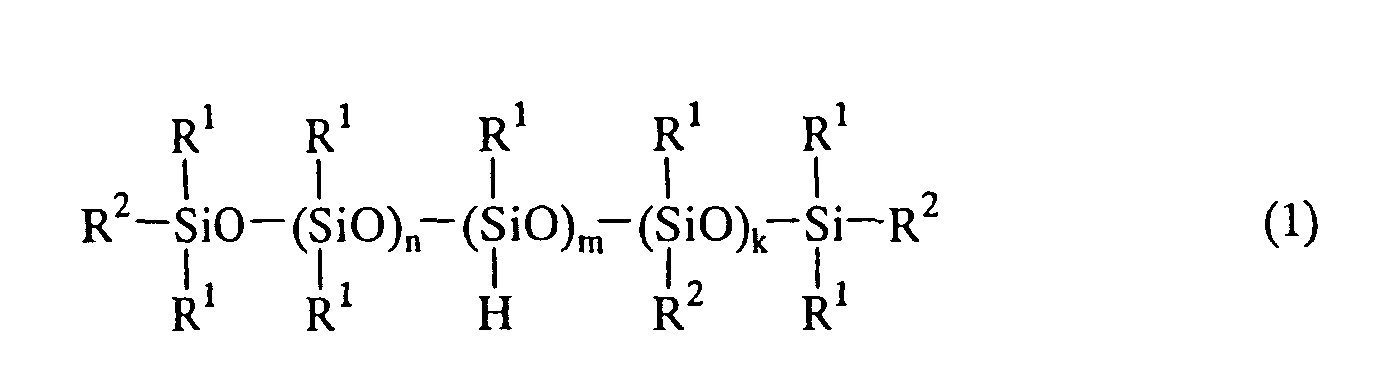
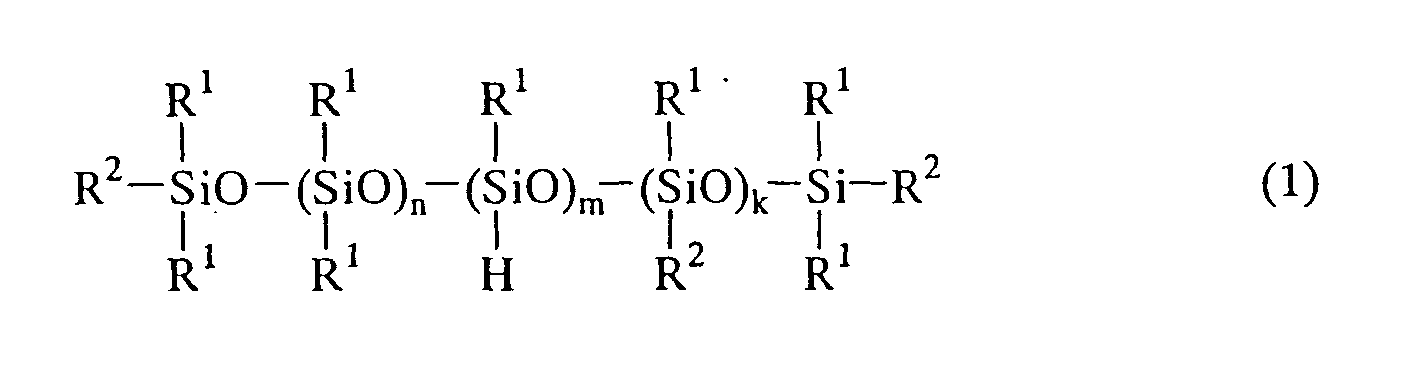
- the invention provides a method for forming a coating, comprising the steps of furnishing a substrate which is surface coated with a material having aliphatic unsaturated hydrocarbon radicals, applying to the coating on the substrate at least one organosilicon compound having the general formula (1) below, and effecting hydrosilylation reaction between the coating of the material having aliphatic unsaturated hydrocarbon radicals and the organosilicon compound, thereby forming a functional coating on the outermost surface of the substrate.
- R 1 is independently at each occurrence a monovalent hydrocarbon radical of 1 to 12 carbon atoms
- R 2 is independently at each occurrence hydrogen or a monovalent organic radical having a functional property
- at least one of R 2 at opposite ends is hydrogen
- k is an integer of 0 to 100
- m is an integer of 0 to 100
- n is an integer of 0 to 100.
- the invention also provides a functional coated article comprising a functional coating formed on a substrate surface by the above method.
- the method for forming a functional coating according to the invention starts with a substrate which is surface coated with a material having aliphatic unsaturated hydrocarbon radicals.
- One or more hydrosilyl radical-bearing organosilicon compound having the general formula (1) is applied to the coating on the substrate.
- hydrosilylation reaction takes place between the coating of aliphatic unsaturated hydrocarbon radical-bearing material and the hydrosilyl radical-bearing organosilicon compound.
- a functional coating is formed on the outermost surface of the substrate.
- the material having aliphatic unsaturated hydrocarbon radicals is a compound having aliphatic unsaturated hydrocarbon radicals such as vinyl, allyl, hexenyl and styryl radicals.
- the term "material” embraces a monomer and a polymer resulting from polymerization of the monomer.
- the unsaturated hydrocarbon radicals are preferably monovalent aliphatic unsaturated hydrocarbon radicals of 2 to 20 carbon atoms, preferably 2 to 12 carbon atoms, even more preferably 2 to 8 carbon atoms, having a carbon-to-carbon double bond at least at an end.
- the material is preferably at least one member selected from the group consisting of a silane containing at least one radical having an aliphatic unsaturated bond and at least one hydrolyzable radical directly bonded to a silicon atom in a molecule, a partial hydrolyzate thereof, and a hydrolytic condensate thereof.
- the silanes used herein include those having the formula: R 3 (4-a-b) R 4 b SiX a wherein R 3 is a monovalent radical free of aliphatic unsaturation, R 4 is a monovalent radical having an aliphatic unsaturated bond, X is a hydrolyzable radical, "a” is an integer of 1 to 3, "b” is an integer of 1 to 3, and a+b is an integer of 2 to 4.
- the monovalent radicals free of aliphatic unsaturation represented by R 3 are preferably monovalent hydrocarbon radicals of 1 to 10 carbon atoms, especially 1 to 8 carbon atoms, for example, alkyl radicals such as methyl, ethyl, propyl, butyl, hexyl and decyl, cycloalkyl radicals such as cyclohexyl, aryl radicals such as phenyl and tolyl, and aralkyl radicals such as benzyl.
- alkyl radicals such as methyl, ethyl, propyl, butyl, hexyl and decyl
- cycloalkyl radicals such as cyclohexyl
- aryl radicals such as phenyl and tolyl
- aralkyl radicals such as benzyl.
- R 4 is selected from monovalent radicals of 2 to 20 carbon atoms, more preferably 2 to 12 carbon atoms, especially 2 to 8 carbon atoms, having an aliphatic unsaturated bond, for example, alkenyl radicals such as vinyl, allyl, butenyl, pentenyl, hexenyl and heptenyl, styryl, (meth)acrylic and (meth)acryloyl radicals.
- Examples of the hydrolyzable radical represented by X include alkoxy radicals of 1 to 4 carbon atoms, especially 1 to 2 carbon atoms, such as methoxy and ethoxy, halogen atoms such as chlorine, and acyloxy radicals such as acetoxy. Inter alia, alkoxy radicals are preferred.
- the subscript "a” is an integer of 1 to 3, preferably 2 or 3
- "b" is an integer of 1 to 3, preferably 1
- a+b is an integer of 2 to 4, preferably 3 or 4.
- the material having aliphatic unsaturated hydrocarbon radicals may also be a mixture of the aforementioned hydrolyzable silane having an aliphatic unsaturated bond and a hydrolyzable silane free of an aliphatic unsaturated hydrocarbon radical, or a co-hydrolyzate of these silanes.
- the material having aliphatic unsaturated hydrocarbon radicals comprises (i) at least one member selected from the group consisting of a silane containing at least one radical having an aliphatic unsaturated bond and at least one hydrolyzable radical directly bonded to a silicon atom in a molecule, a partial hydrolyzate thereof, and a hydrolytic condensate thereof, and (ii) at least one member selected from the group consisting of a silane in which all radicals bonded to silicon atoms have hydrolyzable radicals, specifically a silane of SiX 4 wherein X is as defined above, a partial hydrolyzate thereof, and a hydrolytic condensate thereof, or a co-hydrolyzate of these silanes.
- the material having aliphatic unsaturated hydrocarbon radicals may comprise organic resins containing such radicals e.g. acrylic or epoxy resins filled with inorganic powder (e.g. silica, titania, zirconia or the like) which has been surface treated with an aliphatic unsaturated radical-bearing silane, or organic polymers such as unreacted, aliphatic unsaturated radical-bearing acrylic resins.
- organic resins containing such radicals e.g. acrylic or epoxy resins filled with inorganic powder (e.g. silica, titania, zirconia or the like) which has been surface treated with an aliphatic unsaturated radical-bearing silane, or organic polymers such as unreacted, aliphatic unsaturated radical-bearing acrylic resins.
- the material having aliphatic unsaturated hydrocarbon radicals is preferably diluted with an organic solvent in which the material is soluble.
- organic solvent in which the material is soluble include alcoholic solvents such as methanol, ethanol and isopropanol, non-polar solvents such as toluene, xylene, hexane and industrial gasoline, ketone solvents such as acetone and methyl ethyl ketone, and ester solvents such as ethyl acetate and butyl acetate.
- the substrate which is coated with the material having aliphatic unsaturated hydrocarbon radicals is not particularly limited. It may be selected from among glass, plastics, metals, ceramics and pottery. Preferred is glass, especially automobile window glass.
- any well-known coating techniques including brush coating, spraying, roll coating, dipping, and spin coating may be used.
- the coverage of the material having aliphatic unsaturated hydrocarbon radicals is not particularly limited as long as the material covers the substrate surface.
- the preferred coverage is such an amount as to provide a coating thickness of 0.001 to 1,000 ⁇ m, especially 0.1 to 100 ⁇ m, although it varies with the substrate and the intended application.
- the material is a silane, a partial hydrolyzate or a hydrolytic condensate thereof as described above, it is preferably cured.
- the cure method is selected depending on the type of material. For example, room temperature cure is employed for a room temperature curable material, and heat cure is employed for a heat curable material.
- a curing catalyst may be added to the material.
- the curing catalyst which varies with a particular cure type may be selected from well-known catalysts, for example, acids such as hydrochloric acid and acetic acid, and metal base catalysts such as titanium, tin and aluminum base catalysts.
- the curing catalyst is added in a catalytic amount, desirably an amount of 0.01 to 5 parts by weight per 100 parts by weight of the material having aliphatic unsaturated hydrocarbon radicals.
- a primer Prior to coating with the material, a primer may be applied to the substrate to enhance the adhesion between the substrate and the material.
- R 1 is independently at each occurrence a monovalent hydrocarbon radical of 1 to 12 carbon atoms
- R 2 is independently at each occurrence hydrogen or a monovalent organic radical which may have a functional property
- at least one terminal R 2 is hydrogen
- k is an integer of 0 to 100
- m is an integer of 0 to 100
- n is an integer of 0 to 100.
- R 1 is a monovalent hydrocarbon radical of 1 to 12 carbon atoms, especially 1 to 8 carbon atoms, preferably free of aliphatic unsaturation.
- alkyl radicals such as methyl, ethyl, propyl, butyl, hexyl and octyl, aryl radicals such as phenyl and tolyl, aralkyl radicals such as benzyl and phenylethyl, and substituted forms of the foregoing in which one or more or all hydrogen atoms are substituted with halogen atom, namely halogenated hydrocarbon radicals such as 3,3,3-trifluoropropyl.
- methyl is preferred for a water-repellent coating.
- the monovalent organic radicals R 2 having or conferring a functional property are selected in accordance with desired coating properties. They may differ from the groups R 1 ' especially where the latter are the same as or similar to one another. More specifically, groups R 2 may be alkyl radicals of 1 to 15 carbon atoms, especially 1 to 8 carbon atoms, organic radicals having fluoroalkyl radicals of 1 to 15 carbon atoms, and organic radicals having oxyalkylene radicals.
- the organic radicals having fluoroalkyl radicals are able to impart water repellency and oil repellency whereas the organic radicals having oxyalkylene radicals are able to impart hydrophilic and anti-staining properties.
- the subscript k is an integer of 0 to 100, preferably 0 to 10
- m is an integer of 0 to 100, preferably 0 to 10
- n is an integer of 0 to 100, preferably 0 to 60.
- the organosilicon compound should contain at least one, especially 1 to 10 hydrosilyl radicals (Si-H radicals) in a molecule.
- the organic radicals having fluoroalkyl radicals of 1 to 15 carbon atoms include those of the formula: -(CH 2 ) p -(CF 2 ) q -CF 3 wherein p is an integer of 0 to 14 and q is an integer of 0 to 14.
- the organic radicals having oxyalkylene radicals include those of the formula: -(CH 2 ) r -O-(C 2 H 4 O) t (C 3 H 6 O) u R wherein R is hydrogen, a monovalent C 1 -C 10 hydrocarbon radical or C 1 -C 10 acyl radical, r is an integer of 0 to 10, t is an integer of 0 to 50, u is an integer of 0 to 50, and t+u is an integer of 1 to 100.
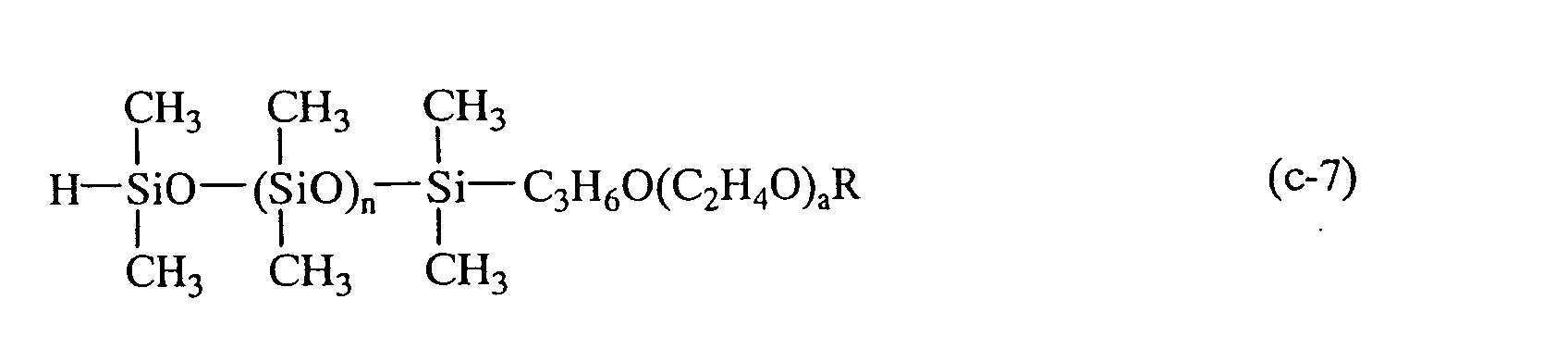
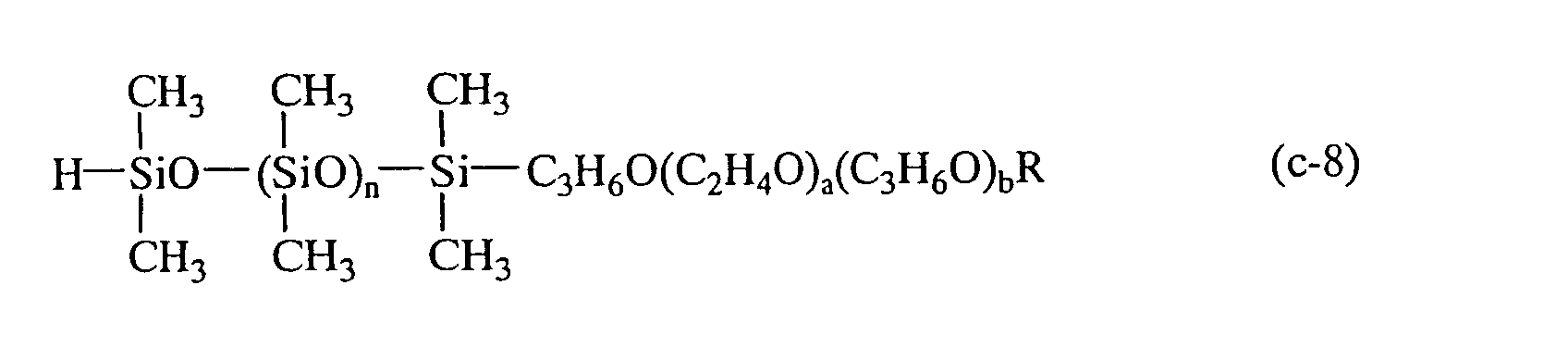
- organosilicon compound is given below.
- R is hydrogen, a monovalent C 1 -C 10 hydrocarbon radical or C 1 -C 10 acyl radical
- a is an integer of 0 to 50, preferably 1 to 30
- b is an integer of 0 to 50, preferably 0 to 20, and a+b > 1
- n and m are as defined above.
- k may be as defined above.
- Examples of the monovalent hydrocarbon radical represented by R are the same as exemplified for R 1 , and examples of the acyl radical include formyl, acetyl, propionyl, butyryl, valeryl, caproyl, heptanoyl and octanoyl.
- the organosilicon compound of formula (1) is dissolved in a solvent together with a platinum group metal catalyst to form a solution, after which the solution is applied to the substrate surface.
- platinum group metal catalysts used herein are those catalysts known to catalyze hydrosilylation reaction including platinum base catalysts such as platinum black, platinum (IV) chloride, chloroplatinic acid, reaction products of chloroplatinic acid with monohydric alcohols, complexes of chloroplatinic acid with olefins, and platinum bisacetoacetate, palladium base catalysts, and rhodium base catalysts.
- platinum base catalysts such as platinum black, platinum (IV) chloride, chloroplatinic acid, reaction products of chloroplatinic acid with monohydric alcohols, complexes of chloroplatinic acid with olefins, and platinum bisacetoacetate, palladium base catalysts, and rhodium base catalysts.
- the platinum group metal catalyst is added in a catalytic amount, preferably in such an amount as to give 0.1 to 2,000 ppm, especially 1 to 500 ppm of platinum group metal based on the weight of the organosilicon compound of formula (1).
- Examples of the solvent in which the organosilicon compound and the catalyst are dissolved include alcohols such as ethanol and isopropanol.
- the coating thickness generally ranges from a monomolecular film to 100 ⁇ m, and preferably from a monomolecular film to 10 ⁇ m, with a monomolecular film being especially preferred.
- the method of applying the organosilicon compound is not particularly limited. Any well-known coating methods may be used. After application, the coating is desirably held at room temperature to 250°C, more desirably 50 to 150°C for driving the hydrosilylation reaction to completion.
- the method for forming a functional coating according to the invention is capable of modifying surfaces of substrates of glass, especially automobile window glass, plastics, metals, ceramics, pottery or the like for imparting functional properties such as water repellent, hydrophilic, anti-staining or electroconductive properties thereto.
- the functional coating is thin and durable.
- a 3-liter four-necked flask equipped with a stirrer, thermometer, and water cooled condenser was charged in order with 178 g of methyltriethoxysilane, 148 g of vinyltrimethoxysilane, 250 g of isobutyl alcohol, 250 g of diacetone alcohol, 10 g of aluminum acetylacetonate, 1 g of ammonium perchlorate, and 1200 g of a 20% aqueous solution of silica sol (trade name Snowtex O by Nissan Chemical Industries, Ltd.). Reaction was effected at 40°C for 3 hours. The resulting vinyl radical-bearing compound solution is designated treating agent a-1.
- a 3-liter four-necked flask equipped with a stirrer, thermometer, and water cooled condenser was charged in order with 356 g of methyltriethoxysilane, 148 g of vinyltrimethoxysilane, 250 g of isobutyl alcohol, 250 g of diacetone alcohol, 10 g of aluminum acetylacetonate, 1 g of ammonium perchlorate, and 1200 g of a 20% aqueous solution of silica sol (Snowtex O by Nissan Chemical Industries, Ltd.). Reaction was effected at 40°C for 3 hours. The resulting vinyl radical-bearing compound solution is designated treating agent a-2.
- a 3-liter four-necked flask equipped with a stirrer, thermometer, and water cooled condenser was charged in order with 98 g of ethyl alcohol, 0.3 g of tetraethoxysilane and 0.04 g of vinyltrimethoxysilane. With 2 g of conc. hydrochloric acid added, reaction was effected at 25°C for 1 hour. The resulting vinyl radical-bearing compound solution is designated treating agent a-3.
- a 3-liter four-necked flask equipped with a stirrer, thermometer, and water cooled condenser was charged in order with 356 g of methyltriethoxysilane, 250 g of isobutyl alcohol, 250 g of diacetone alcohol, 10 g of aluminum acetylacetonate, 1 g of ammonium perchlorate, and 1200 g of a 20% aqueous solution of silica sol (Snowtex O by Nissan Chemical Industries, Ltd.). Reaction was effected at 40°C for 3 hours. The resulting vinyl radical-free compound solution is designated treating agent a-4.
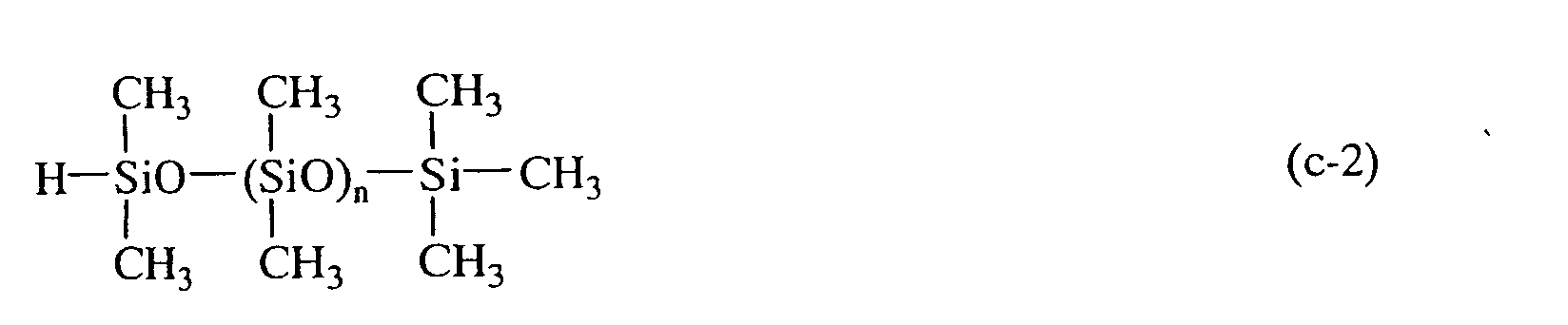
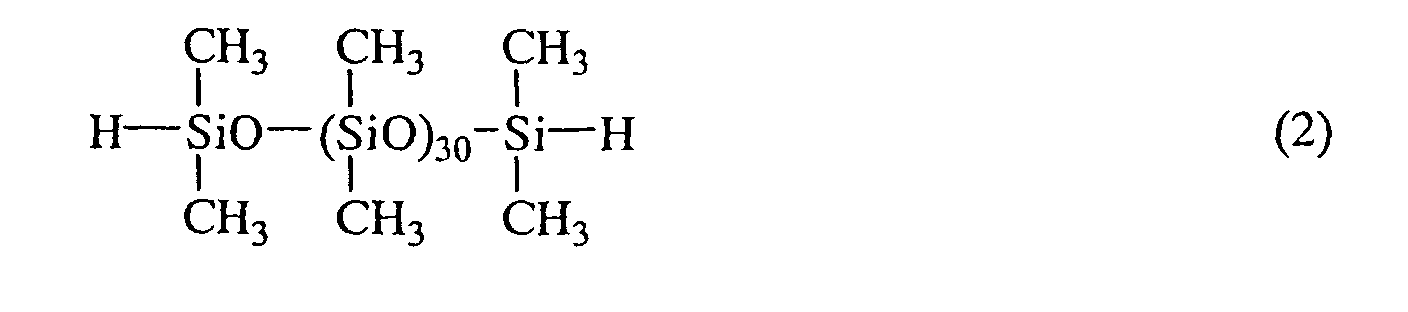
- a treating agent b-1 was prepared by mixing 2 g of a hydrosilyl radical-bearing dimethylpolysiloxane of formula (2) below, 0.1 g of a platinum catalyst (trade name CAT-PL-50T by Shin-Etsu Chemical Co., Ltd.) and 98 g of decamethylcyclopentasiloxane.
- a treating agent b-2 was prepared by mixing 2 g of a hydrosilyl radical-bearing dimethylpolysiloxane of formula (3) below, 0.1 g of a platinum catalyst (CAT-PL-50T by Shin-Etsu Chemical Co., Ltd.) and 98 g of decamethylcyclopentasiloxane.
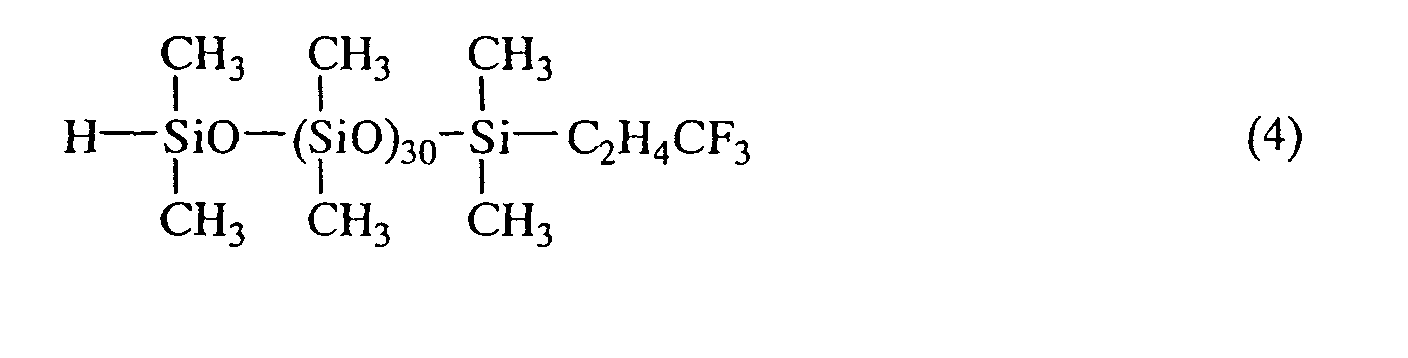
- a treating agent b-3 was prepared by mixing 2 g of a dimethylpolysiloxane containing a trifluoropropyl radical and a hydrosilyl radical represented by formula (4) below, 0.1 g of a platinum catalyst (CAT-PL-50T by Shin-Etsu Chemical Co., Ltd.) and 98 g of toluene.
- a treating agent b-4 was prepared by mixing 2 g of a dimethylpolysiloxane containing a polyoxyethylene radical and a hydrosilyl radical represented by formula (5) below, 0.1 g of a platinum catalyst (CAT-PL-50T by Shin-Etsu Chemical Co., Ltd.) and 98 g of methyl ethyl ketone.
- a (comparative) treating agent b-5 was prepared by mixing 2 g of a trialkoxysilyl radical-bearing dimethylpolysiloxane represented by formula (6) below, 1 g of 0.1N hydrochloric acid and 98 g of isopropyl alcohol.
- a (comparative) treating agent b-6 was prepared by mixing 2 g of a dimethylhydrogenpolysiloxane represented by formula (7) below, 0.1 g of a platinum catalyst (CAT-PL-50T by Shin-Etsu Chemical Co., Ltd.) and 98 g of decamethylcyclopolysiloxane.
- any of treating agents a-1 to a-4 obtained in Synthesis Examples was applied by the coating procedure shown below, and any of treating agents b-1 to b-6 obtained in Preparation Examples was then applied by the coating procedure shown below.
- a contact angle was measured by the test described below. The results are shown in Table 1.
- a transparent polycarbonate sheet (trade name Iupilon NF-2000U by Mitsubishi Engineering-Plastics Corp.), an acrylic primer (trade name Primer PC-7A by Shin-Etsu Chemical Co., Ltd.) was flow coated and heat cured at 120°C for one hour.
- the coated PC sheet is designated substrate 1.
- a stainless steel strip (SUS316) having a gage of 1 mm, a width of 100 mm and a length of 200 mm was degreased and cleaned with acetone. This is substrate 2.
- a soda-lime silicate glass plate having a gage of 3.4 mm, a width of 150 mm and a length of 150 mm was degreased and cleaned with acetone. This is substrate 3.
- Each of treating agents a-1 to a-4 was flow coated onto the substrate and heated at 130°C for one hour for curing.
- Each of treating agents b-1 to b-6 was flow coated onto the substrate having treating agent "a” coated and cured thereto, then heated at 100°C for one hour, wiped with ethanol-impregnated tissue paper, and dried at room temperature for one hour.
- a contact angle with water was measured using a contact angle meter CA-X150 by Kyowa Interface Science Co., Ltd. (droplet method).
- a contact angle with hexadecane was measured using a contact angle meter CA-X150.
- Substrate Initial contact angle (deg) Durable contact angle (deg) Function Water Hexadecane Water Hexadecane
- Example 1 Substrate 1 a-1 b-1 112 61 113 62 water repellent
- Example 2 Substrate 1 a-2 b-1 116 63 115 62 water repellent
- Example 3 Substrate 1 a-1 b-2 110 62 103 61 water repellent
- Substrate 1 a-1 b-3 115 72 114 73 water/oil repellent
- Example 6 Substrate 1 a-1 b-4 11 - 14 - hydrophilic
- Example 7 Substrate 3 a-3 b-1 103 60 101 60 water repellent
- Example 8 Substrate 3 a-3 b-3 103 103 60 101 60 water repellent
- Example 8 Substrate 3 a-3 b-3 103 103
Landscapes
- Chemical & Material Sciences (AREA)
- Chemical Kinetics & Catalysis (AREA)
- Life Sciences & Earth Sciences (AREA)
- Engineering & Computer Science (AREA)
- Materials Engineering (AREA)
- Organic Chemistry (AREA)
- General Chemical & Material Sciences (AREA)
- Geochemistry & Mineralogy (AREA)
- Wood Science & Technology (AREA)
- Application Of Or Painting With Fluid Materials (AREA)
- Surface Treatment Of Glass (AREA)
Abstract
Description
| Substrate | Initial contact angle (deg) | Durable contact angle (deg) | Function | |||||
| Water | Hexadecane | Water | Hexadecane | |||||
| Example 1 | Substrate 1 | a-1 | b-1 | 112 | 61 | 113 | 62 | water repellent |
| Example 2 | Substrate 1 | a-2 | b-1 | 116 | 63 | 115 | 62 | water repellent |
| Example 3 | Substrate 1 | a-1 | b-2 | 110 | 62 | 103 | 61 | water repellent |
| Example 4 | Substrate 1 | a-1 | b-3 | 115 | 72 | 114 | 73 | water/oil repellent |
| Example 5 | Substrate 2 | a-1 | b-3 | 104 | 71 | 104 | 71 | water/oil repellent |
| Example 6 | Substrate 1 | a-1 | b-4 | 11 | - | 14 | - | hydrophilic |
| Example 7 | Substrate 3 | a-3 | b-1 | 103 | 60 | 101 | 60 | water repellent |
| Example 8 | Substrate 3 | a-3 | b-3 | 104 | 72 | 102 | 71 | water/oil repellent |
| Example 9 | Substrate 3 | a-3 | b-4 | 10 | - | 14 | - | hydrophilic |
| Comparative Example 1 | Substrate 1 | a-4 | b-5 | 115 | 62 | 84 | 59 | water repellent |
| Comparative Example 2 | Substrate 2 | - | b-5 | 102 | 64 | 65 | 58 | water repellent |
| Comparative Example 3 | Substrate 3 | a-3 | b-6 | 104 | 60 | 65 | 56 | water repellent |
Claims (11)
- A method for forming a coating, comprising the steps of :wherein groups R1 are, independently, monovalent hydrocarbon radicals of 1 to 12 carbon atoms, groups R2 are, independently, hydrogen or monovalent organic radical having a functional property, at least one of the terminal groups R2 being hydrogen, k is an integer of 0 to 100, m is an integer of 0 to 100, and n is an integer of 0 to 100, andfurnishing a substrate having a surface, e.g. coating,of a material having aliphatic unsaturated hydrocarbon radicals,
effecting hydrosilylation reaction between the surface material having aliphatic unsaturated hydrocarbon radicals and the organosilicon compound, thereby forming a functional coating on the outermost surface of the substrate. - The method of claim 1, wherein said material having aliphatic unsaturated hydrocarbon radicals comprises at least one of a silane containing at least one radical having an aliphatic unsaturated bond and at least one hydrolysable radical directly bonded to a silicon atom in a molecule, a partial hydrolysate of such silane, and a hydrolytic condensate of such silane.
- The method of claim 1 or 2, wherein said material having aliphatic unsaturated hydrocarbon radicals comprises
at least one member selected from the group consisting of a silane containing at least one radical having an aliphatic unsaturated bond and at least one hydrolyzable radical directly bonded to a silicon atom in a molecule, a partial hydrolyzate thereof, and a hydrolytic condensate thereof, and
at least one member selected from the group consisting of a silane in which all radicals bonded to silicon atoms have hydrolyzable radicals, a partial hydrolyzate thereof, and a hydrolytic condensate thereof. - The method of any one of claims 1 to 3, wherein in said material having aliphatic unsaturated hydrocarbon radicals, the aliphatic unsaturated hydrocarbon radical is an aliphatic unsaturated hydrocarbon radical of 2 to 20 carbon atoms having a carbon-to-carbon double bond at least at an end.
- The method of any one of claims 1 to 4, wherein in formula (1), the monovalent organic radical having a functional property represented by R2 is an alkyl radical of 1 to 15 carbon atoms.
- The method of any one of claims 1 to 4, wherein in formula (1), the monovalent organic radical having a functional property represented by R2 is an organic radical having a fluoroalkyl radical of 1 to 15 carbon atoms.
- The method of any one of claims 1 to 4, wherein in formula (1), the monovalent organic radical having a functional property represented by R2 is an organic radical having an oxyethylene radical.
- A method according to any one of the preceding claims comprising as an initial step the formation of a said coating of said material on the surface of the substrate.
- A method according to any one of the preceding claims wherein the substrate is glass.
- A functional coated article comprising a substrate having functional coating formed on the substrate surface by a method of any one of claims 1 to 9.
- A functional coated article of claim 10 which is a water-repellent automobile window glass.
Applications Claiming Priority (2)
| Application Number | Priority Date | Filing Date | Title |
|---|---|---|---|
| JP2003123195 | 2003-04-28 | ||
| JP2003123195A JP4217881B2 (en) | 2003-04-28 | 2003-04-28 | Method for forming functional coating and functional coated article |
Publications (1)
| Publication Number | Publication Date |
|---|---|
| EP1473344A1 true EP1473344A1 (en) | 2004-11-03 |
Family
ID=32985547
Family Applications (1)
| Application Number | Title | Priority Date | Filing Date |
|---|---|---|---|
| EP04252445A Withdrawn EP1473344A1 (en) | 2003-04-28 | 2004-04-28 | Formation of functional coating and functional coated article |
Country Status (3)
| Country | Link |
|---|---|
| US (1) | US20040214015A1 (en) |
| EP (1) | EP1473344A1 (en) |
| JP (1) | JP4217881B2 (en) |
Cited By (2)
| Publication number | Priority date | Publication date | Assignee | Title |
|---|---|---|---|---|
| WO2008088407A1 (en) * | 2006-12-20 | 2008-07-24 | Dow Corning Corporation | Glass substrates coated or laminated with multiple layers of cured silicone resin compositions |
| WO2016189082A1 (en) * | 2015-05-28 | 2016-12-01 | Carl Zeiss Vision International Gmbh | Method for producing an optical glass having an antifog coating |
Families Citing this family (15)
| Publication number | Priority date | Publication date | Assignee | Title |
|---|---|---|---|---|
| US20100273011A1 (en) * | 1996-12-20 | 2010-10-28 | Bianxiao Zhong | Silicone Composition, Silicone Adhesive, Coated and Laminated Substrates |
| JP5201821B2 (en) * | 2005-12-13 | 2013-06-05 | 東洋インキScホールディングス株式会社 | Coloring composition and color filter using the same |
| EP1911791A1 (en) * | 2006-10-03 | 2008-04-16 | Institut Curie | Method for treating surfaces containing Si-H groups |
| CN101563300B (en) * | 2006-12-20 | 2012-09-05 | 陶氏康宁公司 | Glass substrates coated or laminated with cured silicone resin compositions |
| US7732068B2 (en) * | 2007-08-28 | 2010-06-08 | Alcoa Inc. | Corrosion resistant aluminum alloy substrates and methods of producing the same |
| US8309237B2 (en) * | 2007-08-28 | 2012-11-13 | Alcoa Inc. | Corrosion resistant aluminum alloy substrates and methods of producing the same |
| US20090162544A1 (en) * | 2007-12-20 | 2009-06-25 | Garesche Carl E | Method of surface coating to enhance durability of aesthetics and substrate component fatigue |
| WO2009111199A1 (en) * | 2008-03-04 | 2009-09-11 | Dow Corning Corporation | Silicone composition, silicone adhesive, coated and laminated substrates |
| CN101959939B (en) * | 2008-03-04 | 2013-02-06 | 陶氏康宁公司 | Borosiloxane compositions, borosiloxane adhesives, coated and laminated substrates |
| CN102046371B (en) * | 2008-05-27 | 2013-11-06 | 陶氏康宁公司 | Adhesive tape and laminated glass |
| TW201004795A (en) * | 2008-07-31 | 2010-02-01 | Dow Corning | Laminated glass |
| JP2014500897A (en) | 2010-11-09 | 2014-01-16 | ダウ コーニング コーポレーション | Hydrosilylation-cured silicone resin plasticized with organophosphate compounds |
| CN104106390B (en) * | 2013-04-18 | 2017-02-08 | 南京意陶纳米科技有限公司 | Impermeable and breathable pottery basin and preparation method |
| WO2016171086A1 (en) * | 2015-04-24 | 2016-10-27 | ダイキン工業株式会社 | Surface treatment method |
| CN108779382B (en) * | 2016-03-11 | 2021-09-28 | 松下知识产权经营株式会社 | Antistatic material, method for producing same, and antistatic film |
Citations (7)
| Publication number | Priority date | Publication date | Assignee | Title |
|---|---|---|---|---|
| US4517238A (en) * | 1982-03-25 | 1985-05-14 | Toray Silicone Company, Ltd. | Method of making integral molded silicone products with different phases and the molded products prepared therefrom |
| WO1992005433A1 (en) * | 1990-09-19 | 1992-04-02 | Robert Kerr | Continuous positive charge capillary columns used in capillary electrophoresis |
| US5599445A (en) * | 1994-02-04 | 1997-02-04 | Supelco, Inc. | Nucleophilic bodies bonded to siloxane and use thereof for separations from sample matrices |
| JPH10292151A (en) * | 1997-04-17 | 1998-11-04 | Ito Kogaku Kogyo Kk | Water-repellent treatment optical element |
| WO2001030512A2 (en) * | 1999-10-27 | 2001-05-03 | Novartis Ag | Coating process |
| US6344104B1 (en) * | 1998-01-09 | 2002-02-05 | Shin-Etsu Chemical Co., Ltd. | Method of reducing surface tackiness of low-hardness thermally conductive silicone rubber sheet |
| US20020150766A1 (en) * | 1999-09-24 | 2002-10-17 | General Electric Co. | Low temperature curable organopolysiloxane coatings |
-
2003
- 2003-04-28 JP JP2003123195A patent/JP4217881B2/en not_active Expired - Fee Related
-
2004
- 2004-04-27 US US10/832,292 patent/US20040214015A1/en not_active Abandoned
- 2004-04-28 EP EP04252445A patent/EP1473344A1/en not_active Withdrawn
Patent Citations (8)
| Publication number | Priority date | Publication date | Assignee | Title |
|---|---|---|---|---|
| US4517238A (en) * | 1982-03-25 | 1985-05-14 | Toray Silicone Company, Ltd. | Method of making integral molded silicone products with different phases and the molded products prepared therefrom |
| WO1992005433A1 (en) * | 1990-09-19 | 1992-04-02 | Robert Kerr | Continuous positive charge capillary columns used in capillary electrophoresis |
| US5599445A (en) * | 1994-02-04 | 1997-02-04 | Supelco, Inc. | Nucleophilic bodies bonded to siloxane and use thereof for separations from sample matrices |
| US5630937A (en) * | 1994-02-04 | 1997-05-20 | Supelco, Inc. | Nucleophilic bodies bonded to siloxane and use thereof for separations from sample matrices |
| JPH10292151A (en) * | 1997-04-17 | 1998-11-04 | Ito Kogaku Kogyo Kk | Water-repellent treatment optical element |
| US6344104B1 (en) * | 1998-01-09 | 2002-02-05 | Shin-Etsu Chemical Co., Ltd. | Method of reducing surface tackiness of low-hardness thermally conductive silicone rubber sheet |
| US20020150766A1 (en) * | 1999-09-24 | 2002-10-17 | General Electric Co. | Low temperature curable organopolysiloxane coatings |
| WO2001030512A2 (en) * | 1999-10-27 | 2001-05-03 | Novartis Ag | Coating process |
Non-Patent Citations (1)
| Title |
|---|
| PATENT ABSTRACTS OF JAPAN vol. 1999, no. 02 26 February 1999 (1999-02-26) * |
Cited By (6)
| Publication number | Priority date | Publication date | Assignee | Title |
|---|---|---|---|---|
| WO2008088407A1 (en) * | 2006-12-20 | 2008-07-24 | Dow Corning Corporation | Glass substrates coated or laminated with multiple layers of cured silicone resin compositions |
| KR101361593B1 (en) * | 2006-12-20 | 2014-02-21 | 다우 코닝 코포레이션 | Glass substrates coated or laminated with multiple layers of cured silicone resin compositions |
| WO2016189082A1 (en) * | 2015-05-28 | 2016-12-01 | Carl Zeiss Vision International Gmbh | Method for producing an optical glass having an antifog coating |
| CN107407745A (en) * | 2015-05-28 | 2017-11-28 | 卡尔蔡司光学国际有限公司 | Method for producing the optical mirror slip with antifogging coating |
| US10259744B2 (en) | 2015-05-28 | 2019-04-16 | Carl Zeiss Vision International Gmbh | Process for producing an optical glass with an anti-fog coating |
| CN107407745B (en) * | 2015-05-28 | 2019-10-01 | 卡尔蔡司光学国际有限公司 | For producing the method and optical mirror slip of the optical mirror slip with anti-fog coating |
Also Published As
| Publication number | Publication date |
|---|---|
| JP4217881B2 (en) | 2009-02-04 |
| JP2004322014A (en) | 2004-11-18 |
| US20040214015A1 (en) | 2004-10-28 |
Similar Documents
| Publication | Publication Date | Title |
|---|---|---|
| US20040214015A1 (en) | Formation of functional coating and functional coated article | |
| JP6642309B2 (en) | Organosilicon compound and surface treatment composition | |
| US6506496B1 (en) | Composition for providing a non-wettable coating, articles coated therewith, and methods for preparing the same | |
| JP3588364B2 (en) | Surface treated substrate and surface treatment method for substrate | |
| EP1584664B1 (en) | Antifouling coating compositons and coated articles | |
| JP7676902B2 (en) | ORGANOPOLYSILOXANE AND COATING COMPOSITION CONTAINING SAME | |
| JP2007524732A (en) | Durable hydrophobic surface paint using silicone resin | |
| KR20080104979A (en) | Scratch Resistant Coating Compositions and Covered Articles | |
| CN1513032A (en) | Silicone composition for water-repellent coating | |
| EP1523455A1 (en) | Hydrophobic surface treatment composition and method of making and using same | |
| JP2019112540A (en) | Organosilicon compound and surface treatment agent composition | |
| EP0482480B1 (en) | Surface-treating agent and surface-treated EPDM article | |
| JP4502112B2 (en) | Antifouling coating agent and coated article | |
| WO2019130998A1 (en) | Surface treating agent composition | |
| JP3987505B2 (en) | Surface treatment agent, surface treatment method, and article treated by the method | |
| JP3104567B2 (en) | Organopolysiloxane composition and rubber part | |
| JP2000144121A (en) | Surface treatment agent, water-drop sliding base material using the same, and method for producing the same | |
| WO2025142717A1 (en) | Reactive silicon group-containing organopolysiloxane and surface treatment agent | |
| JP6638604B2 (en) | Organosilicon compound-modified copolymer and surface treatment composition using the same | |
| JPH09255941A (en) | Water repellent treatment agent and method for producing the same | |
| JP4608239B2 (en) | Coating surface treatment method and article treated by the method | |
| JP4014538B2 (en) | High durability water slidable coating and method for forming the same | |
| TWI921502B (en) | Organopolysiloxane and coating composition containing organopolysiloxane | |
| JP4093987B2 (en) | Method for producing surface-treated substrate | |
| JP4152769B2 (en) | Method for producing highly durable water slidable coating |
Legal Events
| Date | Code | Title | Description |
|---|---|---|---|
| PUAI | Public reference made under article 153(3) epc to a published international application that has entered the european phase |
Free format text: ORIGINAL CODE: 0009012 |
|
| AK | Designated contracting states |
Kind code of ref document: A1 Designated state(s): AT BE BG CH CY CZ DE DK EE ES FI FR GB GR HU IE IT LI LU MC NL PL PT RO SE SI SK TR |
|
| AX | Request for extension of the european patent |
Extension state: AL HR LT LV MK |
|
| 17P | Request for examination filed |
Effective date: 20050307 |
|
| AKX | Designation fees paid |
Designated state(s): DE FR GB |
|
| RAP1 | Party data changed (applicant data changed or rights of an application transferred) |
Owner name: SHIN-ETSU CHEMICAL CO., LTD. |
|
| 17Q | First examination report despatched |
Effective date: 20081208 |
|
| STAA | Information on the status of an ep patent application or granted ep patent |
Free format text: STATUS: THE APPLICATION IS DEEMED TO BE WITHDRAWN |
|
| 18D | Application deemed to be withdrawn |
Effective date: 20090421 |