EP1473324A1 - Biodegradable resin composition and molded object thereof - Google Patents
Biodegradable resin composition and molded object thereof Download PDFInfo
- Publication number
- EP1473324A1 EP1473324A1 EP03703115A EP03703115A EP1473324A1 EP 1473324 A1 EP1473324 A1 EP 1473324A1 EP 03703115 A EP03703115 A EP 03703115A EP 03703115 A EP03703115 A EP 03703115A EP 1473324 A1 EP1473324 A1 EP 1473324A1
- Authority
- EP
- European Patent Office
- Prior art keywords
- acid
- component
- aliphatic
- resin composition
- weight
- Prior art date
- Legal status (The legal status is an assumption and is not a legal conclusion. Google has not performed a legal analysis and makes no representation as to the accuracy of the status listed.)
- Withdrawn
Links
Classifications
-
- C—CHEMISTRY; METALLURGY
- C08—ORGANIC MACROMOLECULAR COMPOUNDS; THEIR PREPARATION OR CHEMICAL WORKING-UP; COMPOSITIONS BASED THEREON
- C08L—COMPOSITIONS OF MACROMOLECULAR COMPOUNDS
- C08L67/00—Compositions of polyesters obtained by reactions forming a carboxylic ester link in the main chain; Compositions of derivatives of such polymers
- C08L67/02—Polyesters derived from dicarboxylic acids and dihydroxy compounds
-
- C—CHEMISTRY; METALLURGY
- C08—ORGANIC MACROMOLECULAR COMPOUNDS; THEIR PREPARATION OR CHEMICAL WORKING-UP; COMPOSITIONS BASED THEREON
- C08G—MACROMOLECULAR COMPOUNDS OBTAINED OTHERWISE THAN BY REACTIONS ONLY INVOLVING UNSATURATED CARBON-TO-CARBON BONDS
- C08G69/00—Macromolecular compounds obtained by reactions forming a carboxylic amide link in the main chain of the macromolecule
- C08G69/40—Polyamides containing oxygen in the form of ether groups
-
- C—CHEMISTRY; METALLURGY
- C08—ORGANIC MACROMOLECULAR COMPOUNDS; THEIR PREPARATION OR CHEMICAL WORKING-UP; COMPOSITIONS BASED THEREON
- C08J—WORKING-UP; GENERAL PROCESSES OF COMPOUNDING; AFTER-TREATMENT NOT COVERED BY SUBCLASSES C08B, C08C, C08F, C08G or C08H
- C08J5/00—Manufacture of articles or shaped materials containing macromolecular substances
- C08J5/18—Manufacture of films or sheets
-
- C—CHEMISTRY; METALLURGY
- C08—ORGANIC MACROMOLECULAR COMPOUNDS; THEIR PREPARATION OR CHEMICAL WORKING-UP; COMPOSITIONS BASED THEREON
- C08L—COMPOSITIONS OF MACROMOLECULAR COMPOUNDS
- C08L101/00—Compositions of unspecified macromolecular compounds
-
- C—CHEMISTRY; METALLURGY
- C08—ORGANIC MACROMOLECULAR COMPOUNDS; THEIR PREPARATION OR CHEMICAL WORKING-UP; COMPOSITIONS BASED THEREON
- C08L—COMPOSITIONS OF MACROMOLECULAR COMPOUNDS
- C08L67/00—Compositions of polyesters obtained by reactions forming a carboxylic ester link in the main chain; Compositions of derivatives of such polymers
-
- C—CHEMISTRY; METALLURGY
- C08—ORGANIC MACROMOLECULAR COMPOUNDS; THEIR PREPARATION OR CHEMICAL WORKING-UP; COMPOSITIONS BASED THEREON
- C08L—COMPOSITIONS OF MACROMOLECULAR COMPOUNDS
- C08L67/00—Compositions of polyesters obtained by reactions forming a carboxylic ester link in the main chain; Compositions of derivatives of such polymers
- C08L67/06—Unsaturated polyesters
-
- C—CHEMISTRY; METALLURGY
- C08—ORGANIC MACROMOLECULAR COMPOUNDS; THEIR PREPARATION OR CHEMICAL WORKING-UP; COMPOSITIONS BASED THEREON
- C08L—COMPOSITIONS OF MACROMOLECULAR COMPOUNDS
- C08L77/00—Compositions of polyamides obtained by reactions forming a carboxylic amide link in the main chain; Compositions of derivatives of such polymers
-
- C—CHEMISTRY; METALLURGY
- C08—ORGANIC MACROMOLECULAR COMPOUNDS; THEIR PREPARATION OR CHEMICAL WORKING-UP; COMPOSITIONS BASED THEREON
- C08J—WORKING-UP; GENERAL PROCESSES OF COMPOUNDING; AFTER-TREATMENT NOT COVERED BY SUBCLASSES C08B, C08C, C08F, C08G or C08H
- C08J2367/00—Characterised by the use of polyesters obtained by reactions forming a carboxylic ester link in the main chain; Derivatives of such polymers
- C08J2367/04—Polyesters derived from hydroxy carboxylic acids, e.g. lactones
-
- C—CHEMISTRY; METALLURGY
- C08—ORGANIC MACROMOLECULAR COMPOUNDS; THEIR PREPARATION OR CHEMICAL WORKING-UP; COMPOSITIONS BASED THEREON
- C08K—Use of inorganic or non-macromolecular organic substances as compounding ingredients
- C08K5/00—Use of organic ingredients
-
- C—CHEMISTRY; METALLURGY
- C08—ORGANIC MACROMOLECULAR COMPOUNDS; THEIR PREPARATION OR CHEMICAL WORKING-UP; COMPOSITIONS BASED THEREON
- C08K—Use of inorganic or non-macromolecular organic substances as compounding ingredients
- C08K5/00—Use of organic ingredients
- C08K5/04—Oxygen-containing compounds
- C08K5/14—Peroxides
-
- C—CHEMISTRY; METALLURGY
- C08—ORGANIC MACROMOLECULAR COMPOUNDS; THEIR PREPARATION OR CHEMICAL WORKING-UP; COMPOSITIONS BASED THEREON
- C08L—COMPOSITIONS OF MACROMOLECULAR COMPOUNDS
- C08L1/00—Compositions of cellulose, modified cellulose or cellulose derivatives
- C08L1/08—Cellulose derivatives
- C08L1/10—Esters of organic acids, i.e. acylates
- C08L1/12—Cellulose acetate
-
- C—CHEMISTRY; METALLURGY
- C08—ORGANIC MACROMOLECULAR COMPOUNDS; THEIR PREPARATION OR CHEMICAL WORKING-UP; COMPOSITIONS BASED THEREON
- C08L—COMPOSITIONS OF MACROMOLECULAR COMPOUNDS
- C08L2201/00—Properties
- C08L2201/06—Biodegradable
-
- C—CHEMISTRY; METALLURGY
- C08—ORGANIC MACROMOLECULAR COMPOUNDS; THEIR PREPARATION OR CHEMICAL WORKING-UP; COMPOSITIONS BASED THEREON
- C08L—COMPOSITIONS OF MACROMOLECULAR COMPOUNDS
- C08L29/00—Compositions of homopolymers or copolymers of compounds having one or more unsaturated aliphatic radicals, each having only one carbon-to-carbon double bond, and at least one being terminated by an alcohol, ether, aldehydo, ketonic, acetal or ketal radical; Compositions of hydrolysed polymers of esters of unsaturated alcohols with saturated carboxylic acids; Compositions of derivatives of such polymers
- C08L29/02—Homopolymers or copolymers of unsaturated alcohols
- C08L29/04—Polyvinyl alcohol; Partially hydrolysed homopolymers or copolymers of esters of unsaturated alcohols with saturated carboxylic acids
-
- C—CHEMISTRY; METALLURGY
- C08—ORGANIC MACROMOLECULAR COMPOUNDS; THEIR PREPARATION OR CHEMICAL WORKING-UP; COMPOSITIONS BASED THEREON
- C08L—COMPOSITIONS OF MACROMOLECULAR COMPOUNDS
- C08L67/00—Compositions of polyesters obtained by reactions forming a carboxylic ester link in the main chain; Compositions of derivatives of such polymers
- C08L67/04—Polyesters derived from hydroxycarboxylic acids, e.g. lactones
Definitions
- the present invention relates to a resin composition with improvements in physical properties such as flexibility and transparency and in particular to a biodegradable resin composition.
- Biodegradable plastics are plastics, which can, similar tousual plastics, beused as thermo plastic resinand are decomposed into water and carbon dioxide after use by the action of microorganisms etc. As consciousness of environmental problems is increased in recent years, many biodegradable plastics have been developed. For example, a resin composition based on polylactic acid or a lactic acid/other hydroxycarboxylic acid copolymer is disclosed as biodegradable plastics in JP-A6-340753.
- biodegradable plastics including polylactic acid exhibit high strength, modulus of elasticity, and rigidity, but suffer from a disadvantage of lack of flexibility. Accordingly, the biodegradable plastics were not suitable for uses requiring flexibility where polyethylene, polypropylene, soft polyvinyl chloride, etc. are widely used.
- a method of adding a plasticizer is known as a method of rendering resin flexible.
- JP-A 4-335060 discloses a composition having a plasticizer added to polylactic acid.
- the plasticizer include diisobutyl adipate, dioctyl sebacate etc.
- the plasticizing effect of these plasticizers is low and cannot achieve sufficient flexibility.
- the plasticizers are bled just after molding or with time to change flexibility and transparency.
- the biodegradable plastics are polylactic acid of particularly high rigidity
- a method of rendering the plastics flexible by blending other relatively flexible biodegradable plastics is also disclosed.
- JP-A 8-245866 and JP-A 9-111107 disclose a method of blending polybutylene succinate, polyethylene succinate, polylactone etc. as relatively flexible biodegradable plastics with polylactic acids.
- JP-A 2001-26658 discloses a composition having a plasticizer and a radical generating agent added to polylactic acid.
- a large amount of the biodegradable plastics should be added to confer sufficient flexibility on polylactic acid, resulting in deterioration of heat resistance and transparency as features of polylactic acid.
- the object of the present invention is to provide a resin composition usable preferably as a biodegradable material having excellent flexibility, heat resistance and transparency and hardly changing physical properties with time without bleeding low-molecular compounds such as a plasticizer.
- biodegradable plastics can be rendered flexible effectively by mixing them with an aliphatic polyester having a glass transition temperature of 25°C or less and containing a radial generating agent and its decomposed product, preferably an aliphatic unsaturated polybasic acid as a polymer constituent, and further reacting an unsaturated bond of the aliphatic polyester, and the present invention was thereby arrived at.
- a resin composition comprising an aliphatic polyester or aliphatic polyamide (component (A)), a plastic having a melting point or glass transition temperature (Tg) of -10°C or more (component (B)) and a radical generating agent (C), wherein the compounding ratio of the aliphatic polyester or aliphatic polyamide (component (A)), the plastic having a melting point or glass transition temperature (Tg) of -10°C or more (component (B)) and the radical generating agent (C), based on the total weight thereof, is:
- the present invention relates to:
- the present invention relates to a resin composition (AA) comprising an aliphatic polyester or aliphatic polyamide (component (A)), a plastic having a melting point or glass transition temperature (Tg) of -10°C or more (component (B)) and a radical generating agent (C), wherein the compounding ratio of the component (A), the component (B) and the radical generating agent (C), based on the total weight thereof, is:
- the component (A) comprises an aliphatic polyester or an aliphatic polyamide and may be a mixture of the aliphatic polyester and aliphatic polyamide.
- the glass transition temperature (Tg) of the component (A) is 25 to -90°C, preferably 0 to -80°C, more preferably -30 to -80°C.
- Tm melting point
- the compounding ratio of total repeating units in the aliphatic polyester (component (A)) molecule, based on the number of total repeating units in the molecule, is:
- the aliphatic polyester having an aliphatic unsaturated bond is the one having 0 to 50 mol% repeating unit having an aliphatic unsaturated bond, based on total repeating units in the molecule, and having a glass transition temperature (Tg) of 25 to -90°C, preferably 0 to -80°C, more preferably -30 to -80°C, and having a weight-average molecular weight (Mw) of 1000 to 300, 000.
- Tg glass transition temperature
- Mw weight-average molecular weight
- the aliphatic polyester having an aliphatic unsaturated bond is desirably an amorphous one whose melting point cannot be measured at a temperature substantially higher than room temperature.
- the crystallinity of the aliphatic polyester is high, the compatibility thereof with biodegradable plastics is lowered and no sufficient plasticizing effect maybe obtained.
- the presence or absence of crystallinity can be confirmed by measurement means such as X-ray diffraction or a differential scanning calorimeter.
- a too low molecular weight of the aliphatic polyester having an aliphatic unsaturated bond is not preferable because physical properties of the resin composition are changed with time after molding, or bleeding of the aliphatic polyester occurs easily.
- a too high molecular weight is not preferable either because melt viscosity is increased so that the aliphatic polyester is hardly mixed with biodegradable plastics.
- the weight-average molecular weight of the aliphatic polyester having an aliphatic unsaturated bond is preferably 1,000 to 300,000, more preferably 2,000 to 100,000, as determined by GPC (for example in a chloroform solvent system).
- the method of producing the aliphatic polyester preferably the aliphatic polyester having an aliphatic unsaturated bond (component (A)) is not particularly limited.
- the method is described for example in JP-A 10-1536 and JP-A 11-60662.
- the aliphatic polyester can be produced by reaction of lactones, lactide, glycollide and hydroxycarboxylic acids, by reaction of polyvalent alcohols with polybasic acids, etc., preferably by reaction of polyvalent alcohols with polybasic acids.
- An aliphatic unsaturated bond can be contained in the aliphatic polyester by the coexistence of lactones, hydroxycarboxylic acids, polyvalent alcohols or polybasic acids having an aliphatic unsaturated bond, as at least one component of the lactones, hydroxycarboxylic acids, polyvalent alcohols, and polybasic acids used in the reaction.
- polybasic acids having an aliphatic unsaturated bond are particularly preferable.
- the aliphatic polyester (aliphatic polyester, component (A)) having the aliphatic hydroxy carboxylic acid (d) can be produced preferably by using an aliphatic unsaturated polybasic acid as the repeating unit (a) having an aliphatic unsaturated bond, to obtain a copolymer (ab) of the aliphatic unsaturated polybasic acid and the aliphatic hydroxycarboxylic acid (d), and then copolymerizing the copolymer (ab) with the polyvalent alcohol unit (b) and the saturated polybasic acid unit (c).
- the compound having an aliphatic unsaturated bond is preferably an aliphatic unsaturated polybasic acid.
- aliphatic unsaturated polybasic acid used in the present invention include fumaric acid, maleic acid, maleic anhydride, itaconic acid, itaconican hydride, citraconic acid and citraconic anhydride.
- the amount of the aliphatic unsaturated polybasic acid in the aliphatic polyester (component (A) ) molecule in the present invention is 0 to 50 mol%, preferably 0.1 to 20 mol%, more preferably 0.5 to 10 mol%.
- the aliphatic polyester having an aliphatic unsaturated bond may contain a small amount of urethane bond. The content of the urethane bond is less than about 10 mol% based on total repeating units in the molecule.
- the aliphatic polyester having an aliphatic unsaturated bond may be obtained by extending the aliphatic polyester obtained by the method described above, by a binding agent such as diisocyanate compound.
- the aliphatic polyvalent alcohol used in the present invention is preferably an aliphatic divalent alcohol.
- the polyvalent alcohol used in the present invention include, for example, ethylene glycol, diethylene glycol, triethylene glycol, polyethylene glycol, propylene glycol, dipropylene glycol,ethylene glycol/propylene glycol copolymer, 1,3-butane diol, 1,4-butane diol, 3-methyl-1,5-pentane diol, 1,6-hexane diol, 1,9-nonane diol, neopentyl glycol, polytetramethylene glycol etc.
- a small amount of a multifunctional (trivalent or more) alcohol such as glycerin, trimethylol propane etc. may also be contained.
- the polyethylene glycol represented by the chemical formula (1) and/or the polytetramethylene glycol represented by the chemical formula (2) are preferable. HO-(-CH 2 CH 2 O-) n -H (2 ⁇ n ⁇ 10) HO-(-CH 2 CH 2 CH 2 CH 2 O-) n -H (1 ⁇ n ⁇ 10)
- the amount of the polyvalent alcohol in the aliphatic polyester (component (A)) molecule is 0 to 51 mol%, preferably 10 to 51 mol%, more preferably 20 to 51 mol%.
- the aliphatic saturated polybasic acid used in the present invention is preferably an aliphatic dibasic acid.
- the aliphatic saturated polybasic acid include, for example, oxalic acid, malonic acid, succinic acid, glutaric acid, adipic acid, pimelic acid, suberic acid, azelaic acid, sebacic acid, and esters and anhydrides thereof.
- a small amount of a trifunctional or more polybasic acid such as butane tetracarboxylic acid may also be contained.
- the amount of the saturated polybasic acid in the aliphatic polyester (component (A) ) molecule in the present invention is 0 to 51 mol%, preferably 10 to 51 mol%, more preferably 20 to 51 mol%.
- the aliphatic hydroxycarboxylic acid used in the present invention is not particularly limited insofar as it is a hydroxy-containing carboxylic acid and/or lactone compound.
- Specific examples include aliphatic hydroxycarboxylic acids such as glycolic acid (2-hydroxyethanoic acid), lactic acid (2-hydroxypropanoic acid), tartaric acid, citric acid, malic acid, 2-hydroxybutanoic acid, 2-hydroxypentanoic acid, 2-hydroxyhexanoic acid, 2-hydroxyheptanoic acid, 2-hydroxyoctanoic acid, 2-hydroxy-2-methylpropanoic acid, 2-hydrdoxy-2-methylbutanoic acid, 2-hydroxy-2-ethylbutanoic acid, 2-hydroxy-2-methylpentanoic acid, 2-hydroxy-2-ethylpentanoic acid, 2-hydroxy-2-propylpentanoic acid, 2-hydroxy-2-butylpentanoic acid, 2-hydroxy-2-methylhexanoic acid, 2-hydroxy-2-
- cyclic lactones include cyclic ester intermediates of hydroxycarboxylic acids, for example lactide as a cyclic lactic acid dimer, glycollide as a cyclic glycolic acid dimer, and ⁇ -caprolactone as cyclic 6-hydroxy caprolate, as well as ⁇ -propiolactone, ⁇ -butyrolactone, ⁇ -valerolactone etc.
- Preferable examples include lactic acid, glycolic acid, 3-hydroxybutyric acid, 4-hydroxybutyric acid, 4-hydroxyvaleric acid, 5-hydroxyvaleric acid and 6-hydroxycapronic acid, among which lactic acid is preferable for the transparency of the resulting polyhydroxy carboxylic acid. Two or more of these hydroxycarboxylic acids may be simultaneously used.
- a hydroxycarboxylic acid having asymmetric carbon in the molecule such as lactic acid
- a mixture of equal amounts of D- and L-hydroxycarboxylic acids (racemate) occurs, and either D- or L-hydroxycarboxylic acid can be used.
- L-lactic acid is particularly preferable.
- the amount of the aliphatic hydroxycarboxylic acid in the aliphatic polyester (component (A)) molecule in the invention is 0 to 80 mol%, preferably 10 to 70 mol%, more preferably 30 to 60 mol%.
- the aliphatic polyamide (component(A)) includes polyamides such as polycapramide (nylon-6), poly- ⁇ -aminoheptanoic acid (nylon-7), poly- ⁇ -aminonanoic acid (nylon-9), polylauryllactam (nylon-12), polyethylene diamine adipamide (nylon-2, 6), polytetramethylene adipamide (nylon-4, 6), polyhexamethylene adipamide (nylon-6, 6), polyhexamethylene sebacamide (nylon-6, 10), polyhexamethylene dodecamide (nylon-6, 12), polyoctamethylene adipamide (nylon-8, 6), polydecamethylene adipamide (nylon-10, 8), or caprolactam/lauryllactam copolymer (nylon-6/12), caprolactam/ ⁇ -aminononanoic acid copolymer (nylon 6/9), caprolactam/hexamethylene diammonium adipate copoly
- the polyamide includes polyamino acids and derivatives thereof, for example polymers based on amino acids, such as polysuccinic imide, polyaspartic acid, polyglutamic acid and polylysine, crosslinked products of these polymers, and derivatives chemically modified with a pendant group etc.
- the repeating unit in the main-chain fundamental skeleton of the polyamino acid derivative may be a copolymer composed of two or more amino acid structural units.
- the copolymer may be a block copolymer, a random copolymer or a graft copolymer.
- the polyamino acid derivative is for example a polymer containing at least one member selected from the group consisting of polysuccinic imide, polyaspartic acid (salt), polyglutamic acid (salt), crosslinked polysuccinic imide, crosslinked poly as partic acid (salt) and cross linked polyglutamic acid (salt).
- the "acid (salt)” means an acid and/or a salt.
- the starting material of the polyamino acid derivative includes, for example, aspartic acid, 19 kinds of essential amino acids excluding aspartic acid, as well as amino acids and amino acid derivatives such as L-ornithine, a series of ⁇ -amino acids, ⁇ -alanine, ⁇ -aminobutyric acid, neutralamino acids, acid icamino acids, ⁇ -esters of acidic amino acid, basic amino acids, N-substituted basic amino acids, and aspartic acid-L-phenyl alanine dimer (aspartame), and aminosulfonic acids such as L-cysteine.
- Isomers of these starting materials are not particularly limited.
- ⁇ -amino acid may be L-, D-or DL-amino acid.
- the structure of the main-chain moiety of the polyamino acid derivative may have a linear structure or a branched structure.
- the amide bond in the main chain is an ⁇ - or ⁇ -bond.
- both ⁇ - and ⁇ -bonds occur in the polyaspartic acid structure, and in the present invention, the mode of binding is not particularly limited.
- the plastic having a melting point or glass transition temperature (Tg) of -10°C or more (component (B)) in the present invention refers to thermoplastic resin having a melting point or glass transition point (Tg) of preferably 25°C or more and a weight-average molecular weight (Mw) of 1000 or more and exhibiting the highest decomposition degree of 60% or more in a biodegradation test such as OECD301C, JIS K6950, JIS K6951, or JIS K6953, as well as a resin composition based thereon.
- the component (B) may have an aliphatic unsaturated bond.
- polylactic acid polyglycolic acid, lactic acid-glycolic acid copolymer, polyhydroxy butyrate, polybutylene succinate, polyvinyl alcohol, cellulose acetate, polyethylene succinate, polycaprolactone, polybutylene succinate adipate modification, polybutylene succinate carbonate modification, polybutyrene adipate/terephthalate, starch etc.
- lactic acid-based polyesters containing at least 5 mol% lactic acid unit as a polymer constituent are preferably used.
- polylactic acid is particularly preferably used.
- the radical generating initiator (C) used in the present invention includes known benzoyl peroxides, for example peroxides such as p-chlorobenzoyl peroxide, lauroyl peroxide, acetyl peroxide, di-t-butyl peroxide, 2,5-dimethyl-2,5-bis(t-butylperoxy)hexane, 1, 1-t-butylperoxy-3,3,5-trimethyl cyclohexane, t-butyl peroxy pivalate, t-butylperoxy-2-ethyl hexanoate, t-butyl peroxy benzoate, bis(4-t-butyl cyclohexyl)peroxy dicarbonate, diisopropyl peroxy dicarbonate and t-butyl peroxy isopropyl carbonate, as well asazo compounds such asazo bis isobutyronitrile.
- peroxides such as p-chlorobenzoy
- radical generating agents are used singly or as a mixture of two or more thereof. These radical generating agents are used in a ratio of 0.005-5 parts by weight, preferably 0.01-3 parts by weight, to 100 parts by weight of the aliphatic polyester or aliphatic polyamide having an aliphatic unsaturated bond.
- the temperature and time for the crosslinking reaction are selected suitably depending on the amount of the biodegradable plastics mixed, the type of the radical generating agent used, etc.
- a crosslinking aid can also be used in combination with the radical generating agent.
- the crosslinking aid can be exemplified by allyl compounds such as triallyl cyanurate and triallyl isocyanurate, methacrylate compounds such as ethylene glycol dimethacrylate and trimethylol propane trimethacrylate, and vinyl-containing compounds such as divinyl benzene.
- allyl compounds such as triallyl cyanurate and triallyl isocyanurate
- methacrylate compounds such as ethylene glycol dimethacrylate and trimethylol propane trimethacrylate
- vinyl-containing compounds such as divinyl benzene.
- the resin composition (AA) comprises an aliphatic polyester or aliphatic polyamide (component (A)), a plastic having a melting point or glass transition temperature (Tg) of -10°C or more (component (B)), and a radical generating agent (C), wherein the compounding ratio thereof, based on the total weight thereof, is 1 to 98.995%, preferably 20 to 80%, more preferably 40 to 60% by weight of the component (A), 98.995 to 1%, preferably 20 to 80%, more preferably 40 to 60% by weight of the component (B), and 0.005 to 5%, preferably 0.02 to 2%, more preferably 0.05 to 0.5% by weight of the radical generating agent (C).
- the resin composition (AA) of the present invention can be obtained by mixing the aliphatic polyester or aliphatic polyamide (component (A)), the plastic having a melting point or glass transition temperature (Tg) of -10°C or more (component (B)) and the radical generating agent (C), and can be made excellently compatible by a crosslinking reaction with the radical generating agent during or after mixing.
- the crosslinking reaction occurs not only in the component (A) or (B) but also between the components (A) and (B).
- the component (A) and/or the component (B) has an aliphatic unsaturated bond
- the crosslinking reaction occurs mainly in the unsaturated bond contained in the structure of the component (A) or (B).
- the biodegradable plastic is a lactic acid-based polyester
- a crosslinking reaction involving withdrawal of methine hydrogen in the lactic acid unit easily occurs.
- crosslinking occurs between the components (A) and (B)
- a copolymer having both the components (A) and (B) is formed, and this copolymer enhances the ability of both the components to be compatible with each other in the resin composition.
- the method of crosslinking the resin composition (AA) in the present invention is not particularly limited.
- the crosslinking reaction is caused mainly by heat, light, ultraviolet rays and electron rays.
- An initiator generating radicals and/or a sensitizer can be used to cause the crosslinking reaction easily.
- the initiator and sensitizer can be those known in the art.
- For crosslinking by heating a method of granulation with a single- or twin-screw extruder is preferable, and a crosslinking aid can be used together with the radical generating agent.
- the sensitizer used is not particularly limited.
- Examples include known 4-phenoxydichloroacetophenone, 4-t-butyl-dichloroacetophenone, 4-t-butyl-trichloroacetophenone, diethoxyacetophenone, 2-hydroxy-2-methyl-1-phenylpropan-1-one, 1-(4-dodecylphenyl)-2-hydroxy-2-methylpropan-1-one, 1-hydroxycyclohexyl phenyl ketone, 2-methyl-1-[4-(methylthio)phenyl]-2-morpholinopropane-1, benzoin, benzoin methyl ether, benzoin ethyl ether, benzoin isopropyl ether, benzoin isobutyl ether, benzyl methyl ketal, benzophenone, benzoylbenzoic acid, methyl benzoyl benzoate, 4-phenyl benzophenone, hydroxybenzyl, 4-phenoxydichloroaceto
- sensitizers are used singly or as a mixture of two or more thereof.
- These sensitizers are used in a ratio of 0.005-5 parts by weight, preferably 0.01-3 parts by weight, to 100 parts by weight of the aliphatic polyester or aliphatic polyamide having an aliphatic unsaturated bond.
- the above-mentioned radical generating initiator can also be used in combination.
- the crosslinking reaction with gamma rays does not particularly require the radial generating agent.
- the resin composition (AA) comprises the components (A) and (B) and the radical generating agent (C), wherein the amount of the component (A) is preferably 20 to 80% by weight, more preferably 40 to 60% by weight, the amount of the component (B) is preferably 20 to 80% by weight, more preferably 40 to 60% by weight, and the amount of the radical generating agent (C) is preferably 0.02 to 2% by weight, more preferably 0.05 to 0.5% by weight, based on the total weight.
- the resin composition (BB) comprises 1 to 50%, preferably 10 to 45%, more preferably 20 to 40% by weight of the resin composition (AA) and 50 to 99%, preferably 55 to 90%, more preferably 60 to 80% by weight of the biodegradable resin (D).
- the resin composition (AA) is used as a resin modifier for the biodegradable resin (D), and upon addition to the biodegradable resin (D), improves flexibility, heat resistance and transparency.
- the biodegradable resin (D) is used in the same meaning as that of the component (B) and may be the same as or different from the component (B) constituting the resin composition (AA).
- the resin composition (BB) contains at least 50% by weight of polylactic acid, more preferably at least 60% by weight of polylactic acid.
- the MFR 190°C, loading 2.16 kg
- swellratio(SR)oftheresincomposition(BB) satisfythefollowing relationship (relationship 3) when the MFR (190°C, loading 2.16 kg) is lower than 50 g/10 min.
- additives plasticizers, antioxidants, UV absorbers, heat stabilizers, flame retardants, internal releasing agents, inorganic additives, antistatic agents, surface wetting improvers, combustion aids, pigments, lubricants, natural products etc.
- inorganic additives and lubricants aliphatic carboxylic amides
- the inorganic additives include silica, calcium carbonate, talc, kaolin, kaolinite, titanium oxide, zinc oxide etc., among which silica and calcium carbonate are particularly preferable. These can be used singly or as a mixture of two or more thereof.
- the organic additives include starch, derivatives thereof, cellulose and derivatives thereof, pulp and derivatives thereof, paper and derivatives thereof, wheat flour, soybean fiber, bran, coconut shell, coffee grounds, protein etc. These can also be used singly or as a mixture of two or more thereof.
- the method of mixing and kneading the lactic acid-based resin (component B), the aliphatic polyester having an aliphatic unsaturated bond (component A), a polymerization initiator and/or a sensitizer, and if necessary another modifier includes, for example, a method that involves uniform mixing with a high- or low-speed stirrer and subsequent melt-kneading with a single- or multi-screw extruder having sufficient kneading performance, and a method of mixing and kneading at the time of melting.
- Mixing and kneading may be carried before molding of a molded article, or mixing and kneading may be carried out at the same time of molding.
- the resin composition is usually preferably in the form of pellets, bar, powder etc.
- the resin composition used in the present invention comprises the components A and B crosslinked to increase melt tension.
- a molded article requiring high melt tension at the time of molding can be preferably obtained.
- the molded article include an inflation film, a molded laminate product (paper lamination, aluminum lamination etc.), foam etc.
- the molded article obtained in the present invention is stretched or not, the molded article is stretched in 1.1- to 15-fold particularly in at least a monoaxial direction, whereby not only flexibility but also heat resistance and strength can be improved.
- the resin composition used in the present invention has improved compatibility between the component (A) (for example the aliphatic polyester having an aliphatic unsaturated bond) and the component (B) (for example the lactic acid-based resin) by crosslinking reaction, and is thus excellent in moldability in stretching orientation crystallization and prevents bleeding of the component (B) during and after stretching.
- Stretching is carried out at a temperature of from the glass transition temperature (Tg) to the melting point of the lactic acid-based resin, preferably at a temperature of (Tg + 5°C) to (Tm - 20°C), more preferably at a temperature of (Tg + 10°C) to (Tm - 40°C).
- Tg glass transition temperature
- Tm melting point
- Examples of the molded article stretched in at least a monoaxial direction include a film, sheet, tape yarn, (mono, multi) filament, nonwoven fabric, and stretched blow molded article, and any of these molded articles can be produced stably according to the present invention.
- the method of producing the molded article according to the present invention is not particularly limited and can use a known molding method.
- the film and sheet obtained in the present invention have the following physical properties.
- the haze of the film or sheet is 5% or less, preferably 3% or less, more preferably 2% or less.
- the tensile modulus of elasticity is 3000 MPa or less, preferably 2500 MPa or less, more preferably 2000 MPa or less.
- the breaking strength is 50 MPa or more, preferably 70 MPa or more, more preferably 80 MPa or more.
- the elongation at breakage is 100% or more, preferably 150% or more, more preferably 200% or more.
- Molded articles produced by the invention such as film, sheet, tape yarn, (mono, multi) filament, nonwoven fabric, stretched blow molded article, inflation film, laminate molded article and foam can be used preferably as various packaging films for food, electronics, medicine, chemicals, cosmetics etc.
- wrapping film for pharmaceutical preparations wrapping films for chemicals, wrapping film for application of chemicals for stiff neck and sprain, agricultural/horticultural film, wrapping film for agrochemicals, film for greenhouse, fertilizer bag, wrapping band, packaging film for magnetic tape cassettes such as video tape and audio tape, packaging film for flexible disk (FD), plate-making film, adhesive tape, waterproof sheet, sandbag, building film, weed controlling sheet, plant net, etc.
- the weight-average molecular weight of the aliphatic polyester having an aliphatic unsaturated bond was evaluated by gel permeation chromatography (GPC) with polystyrene as standard under the following conditions.
- a 1000-ml container was charged with 800 ml water and then dropped from a height of 1.5 m to a floor of concrete under the condition of an atmospheric temperature of 20°C, and the number of times the container was dropped until it was broken was determined. The dropping was conducted 10 times at the maximum.
- a film of 10 cm in machine direction and 10 cm in width direction was left at 23°C in 40% RH atmosphere for 30 days, and bleeding of a plasticizer on the surface of the film was visually checked. Evaluation criteria are as follows:
- a separable flask equipped with a stirrer, a heater, a thermometer and a nitrogen line was charged with 151.7 g triethylene glycol, 141.8 g adipic acid and 3.5 g maleic acid.
- the compounding ratio of the respective components was 50 mol% triethylene glycol, 47 mol% adipic acid and 3 mol% maleic acid.
- 0.07 g titanium tetraisopropoxide and 0.1 g hydroquinone were added thereto and reacted at 150°C for 3 hours in a nitrogen stream, and while water was distilled away under reduced pressure at 2 kPa in the system, the mixture was further reacted at 150°C for 20 hours.
- the weight-average molecular weight of the resulting aliphatic polyester was 21000.
- the glass transition point (Tg) was -45°C.
- a separable flask equipped with a stirrer, a heater, a thermometer and a nitrogen line was charged with 151.7 g triethylene glycol and 150.9 g adipic acid.
- the compounding ratio of the respective components was 50 mol% triethylene glycol and 50 mol% adipic acid.
- 0.07 g titanium tetraisopropoxide and 0.1 g hydroquinone were added thereto and reacted at 150°C for 3 hours in a nitrogen stream, and while water was distilled away under reduced pressure at 2 kPa in the system, the mixture was further reacted at 150°C for 20 hours.
- the weight-average molecular weight of the resulting aliphatic polyester was 19000.
- the glass transition point (Tg) was -50°C.
- a separable flask equipped with a stirrer, a heater, a thermometer and a nitrogen line was charged with 150.2 g triethylene glycol, 141.8 g adipic acid and 3.9 gitaconic acid.
- the compounding ratio of the respective components was 50 mol% triethylene glycol, 48.5 mol% adipic acid and 1.5 mol% itaconic acid.
- 0.02 g titanium tetraisopropoxide and 0.2 g hydroquinone were added thereto and reacted at 180°C for 3 hours in a nitrogen stream, and while water was distilled away under reduced pressure at 2 kPa in the system, the mixture was further reacted at 180°C for 20 hours.
- the weight-average molecular weight of the resulting aliphatic polyester was 21000.
- the glass transition point (Tg) was -54°C.
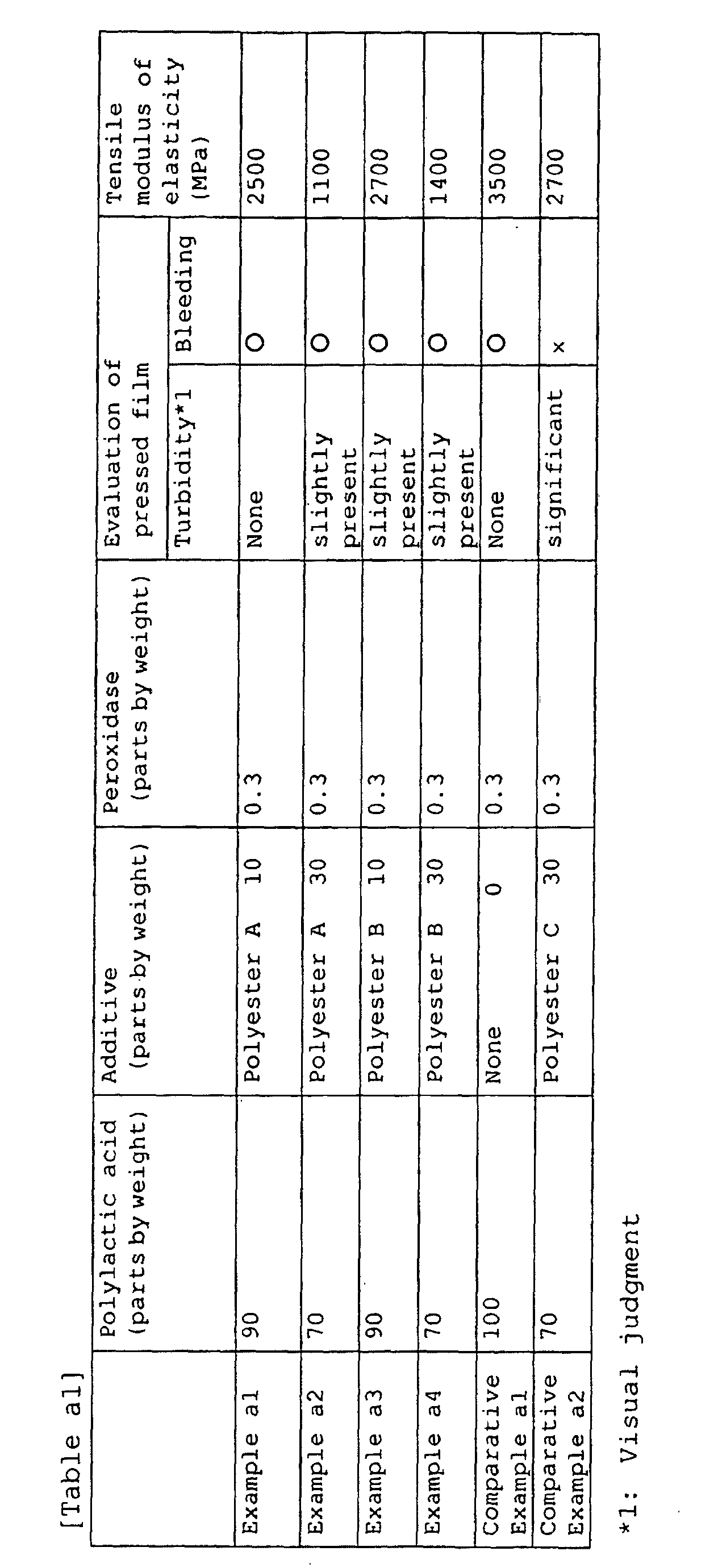
- the aliphatic polyester (polyester PA or polyester PB) having an aliphatic unsaturated bond obtained in Preparation Example a1 or a2 was added in an amount shown in Table a1 to polylacticacid manufactured by Mitsui Chemicals, Inc. (registered trademark LACEA, grade H-100, Mw 150000) and then kneaded at 200°C for 5 minutes with a twin-screw kneader (Laboplast Mill 80C100 manufactured by TOYOSEIKIKOGYO CO.,LTD).
- Polylactic acid manufactured by Mitsui Chemicals, Inc. (registered trademark LACEA, grade H-100, Mw 150000) was kneaded at 200°C for 5 minutes with a twin-screw kneader without adding the aliphatic polyester having an aliphatic unsaturated bond. Kneading was terminated, and 2,5-dimethyl-2,5-bis(t-butylperoxy) hexane (trade name Perhexa 25B manufactured by Nippon Oil and Fats Co., Ltd.) was added as a radical-generating peroxide in an amount of 0.3 part by weight based on the total amount of the resin, and then the mixture was kneaded again at 200°C for 5 minutes.
- LACEA 2,5-dimethyl-2,5-bis(t-butylperoxy) hexane
- the resulting polylactic acid was pressed at 200°C at 20 atmospheric pressure in a heat pressing machine to give a film of 200 ⁇ m in thickness.
- the film was a transparent and hard film having high modulus of elasticity. The results are shown in Table a1.
- Example a3 The same procedure as in Example a2 was conducted except that the saturated aliphatic polyester (polyester PC) obtained in Preparation Example a3 was used in place of the aliphatic polyester having an aliphatic unsaturated bond. During kneading after addition of the peroxide, an apparent increase in temperature and viscosity was not observed.
- the resulting resin composition was pressed at 200°C at 20 atmospheric pressure in a heat pressing machine to give a film of 200 ⁇ m in thickness. The film was opaque. When the modulus of elasticity of the film was measured, measurements were significantly varied. The surface of the film was sticky, and bleeding of the added polyester was observed. The results are shown in Table a1.
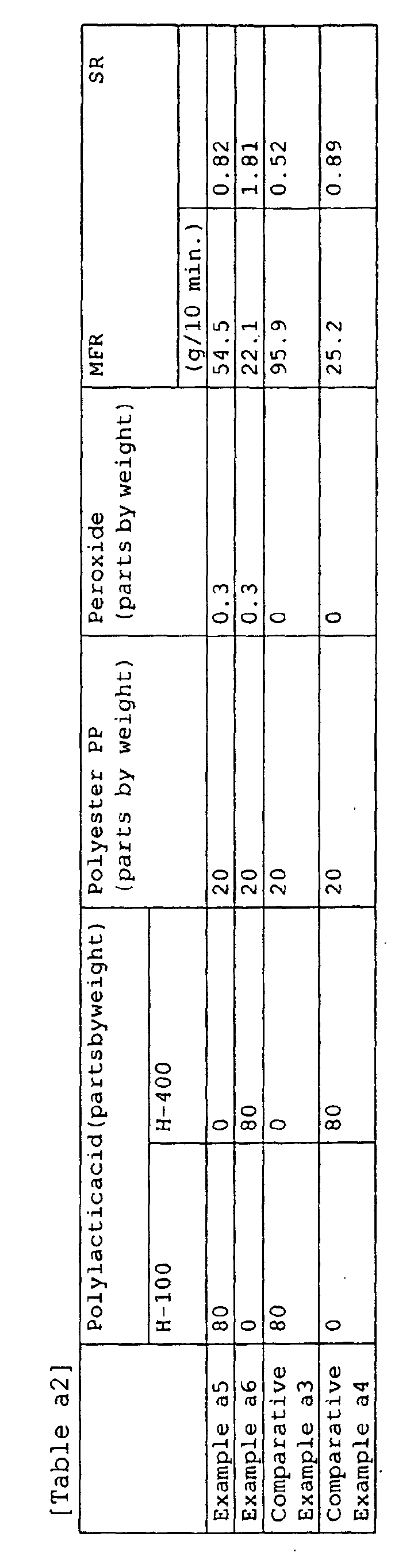
- the aliphatic polyester (polyester PP) having an aliphatic unsaturated bond obtained in Preparation Example a4 was added in an amount shown in Table a2 to polylactic acid manufactured by Mitsui Chemicals, Inc. (registered trademark LACEA, grade H-100, Mw 150000, grade H-400, Mw 200000) and then kneaded at 200°C for 5 minutes with a twin-screw kneader (Laboplast Mill 80C100 manufactured by TOYOSEIKIKOGYO CO.,LTD).
- a resin composition was obtained in the same manner as in Examples 5a and a6 except that the radical generating initiator was not used.
- the MFR and SR of the resulting resin composition are shown in Table a2.
- a separable flask equipped with a stirrer, a heater, a thermometer and a nitrogen line was charged with 750.7 g of 90% L-lactic acid and 48.8 g itaconic acid.
- the compounding ratio of the respective components was 95.2 mol% L-lactic acid and 4.8 mol% itaconic acid.
- the mixture was reacted at 140°C for 2 hours in a nitrogen stream, and the pressure in the system was reduced gradually over 1 hour to 6.6 kPa, and while water was distilled away under reduced pressure at 6. 6 kPa for 2 hours and then at a pressure reduced to 1.3 kPa in the system, the mixture was reacted for 7 hours.
- the weight-average molecular weight of the resulting it aconic acid-containing lactic acid oligomer was 2100.
- the mixture was reacted at 160°C for 3 hours in a nitrogen stream, then feeding of nitrogen was terminated, and while water and ethylene glycol were distilled away at a pressure reduced to 1.3 kPa at 160°C for 8 hours, then at 180°C for 6 hours, at 190°C for 17 hours and at 200°C for 5 hours. After cooling, the resulting aliphatic polyester (polyester PE) had a weight-average molecular weight of 22000.
- a separable flask equipped with a stirrer, a heater, a thermometer and a nitrogen line was charged with 750. 7 g of 90% L-lactic acid and 24.4 g itaconic acid.
- the compounding ratio of the respective components was 97.6 mol% L-lactic acid and 2.4 mol% itaconic acid.
- the mixture was reacted at 140°C for 2 hours in a nitrogen stream, and the pressure in the system was reduced gradually over 1 hour to 6.6 kPa, and while water was distilled away under reduced pressure at 6.6 kPa for 2 hours and then at a temperature increased to 160°C at a pressure reduced to 1.3 kPa in the system, the mixture was reacted for 12 hours.
- the weight-average molecular weight of the resulting itaconic acid-containing lactic acid oligomer was 3500.
- polyester PF obtained in Preparation Example b3 was charged with 225.3 g triethylene glycol, 4.7 g ethylene glycol, 212.6 g adipic acid, 0.3 g hydroquinone and 0.03 g titanium tetraisopropoxide.
- the compounding ratio of the respective components was 46.8 mol% L-lactic acid, 1.2 mol% itaconic acid, 26.4 mol% triethylene glycol and 25.6 mol% adipic acid.
- the mixture was reacted at 160°C for 4 hours in a nitrogen stream, and while water and ethylene glycol were distilled away at 200°C at a pressure reduced to 1.3 kPa in the system, the mixture was reacted for 18 hours. After cooling, the resulting aliphatic polyester (polyester PG) had a weight-average molecular weight of 22000.
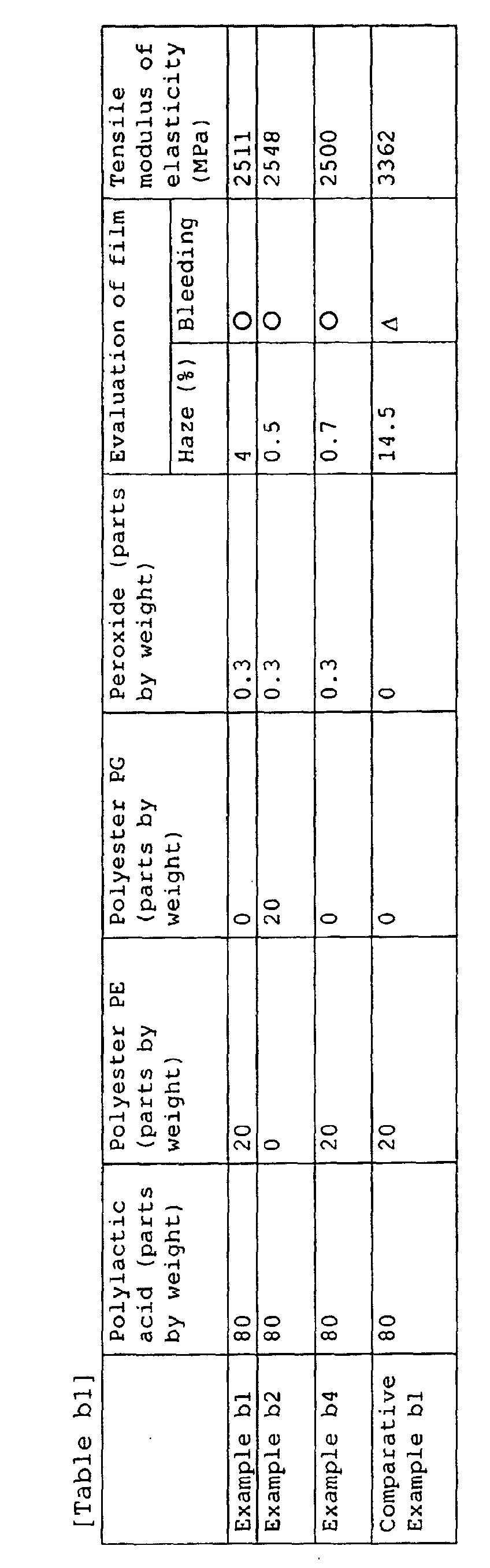
- the aliphatic polyester (polyester PE or polyester PG) having an aliphatic unsaturated bond obtained in Preparation Example b2 or Preparation Example b4 was added in an amount shown in Table b1 to polylactic acid manufactured by Mitsui Chemicals, Inc. (registered trademark LACEA, grade H-100, Mw 150000) and then kneaded at 200°C for 5 minutes with a twin-screw kneader (Laboplast Mill 80C100 manufactured by TOYOSEIKIKOGYO CO., LTD).
- each film was transparent. When the surface of the film was visually checked, no bleeding of polyesters PE and PG was recognized. When the modulus of elasticity of the film was measured by a method prescribed under JIS K-7127, the modulus of elasticity was lower than that of the film composed exclusively of polylactic acid (Comparative Example a1), indicating that the film was evidently softened.
- polylactic acid manufactured by Mitsui Chemicals, Inc. (registered trademark LACEA, grade H-100, Mw 150000) and then kneaded at 200°C for 5 minutes with a twin-screw kneader (Laboplast Mill 80C100 manufactured by TOYOSEIKIKOGYO CO.,LTD).
- Example b3 40 parts by weight of the resin composition after crosslinking reaction (polyester PH) obtained in Example b3 were added to 60 parts by weight of polylactic acid manufactured by Mitsui Chemicals, Inc. (registered trademark LACEA, grade H-100, Mw 150000) and then kneaded at 200°C for 5 minutes with a twin-screw kneader (Laboplast Mill 80C100 manufactured by TOYOSEIKIKOGYO CO.,LTD). The resulting resin composition was pressed at 200°C, 10 MPa, with a heat pressing machine MP-WCH (manufactured by TOYOSEIKIKOGYO CO.,LTD) to give a film of 150 ⁇ m in thickness.
- MP-WCH manufactured by TOYOSEIKIKOGYO CO.,LTD
- the film was transparent. When the surface of the film was visually checked, no bleeding of polyesters PE and PH was recognized. When the modulus of elasticity of the film was measured by a method prescribed under JIS K-7127, the modulus of elasticity was lower than that of the film composed exclusively of polylactic acid (Comparative Example a1), indicating that the film was evidently softened. (Haze, 0.7%; bleeding, ⁇ ; tensile modulus of elasticity, 2500 MPa).
- the aliphatic polyester (polyester PE) having an aliphatic unsaturated bond obtained in Preparation Example b2 was added in an amount shown in Table b1 to polylactic acid manufactured by Mitsui Chemicals, Inc. (registered trademark LACEA, grade H-100, Mw 150000) and then kneaded at 200°C for 5 minutes with a twin-screw kneader (Laboplast Mill 80C100 manufactured by TOYOSEIKIKOGYO CO.,LTD).
- the resulting resin composition was pressed at 200°C, 10 MPa, with a heat pressing machine MP-WCH (manufactured by TOYOSEIKIKOGYO CO.,LTD) to give a film of 150 ⁇ m in thickness.
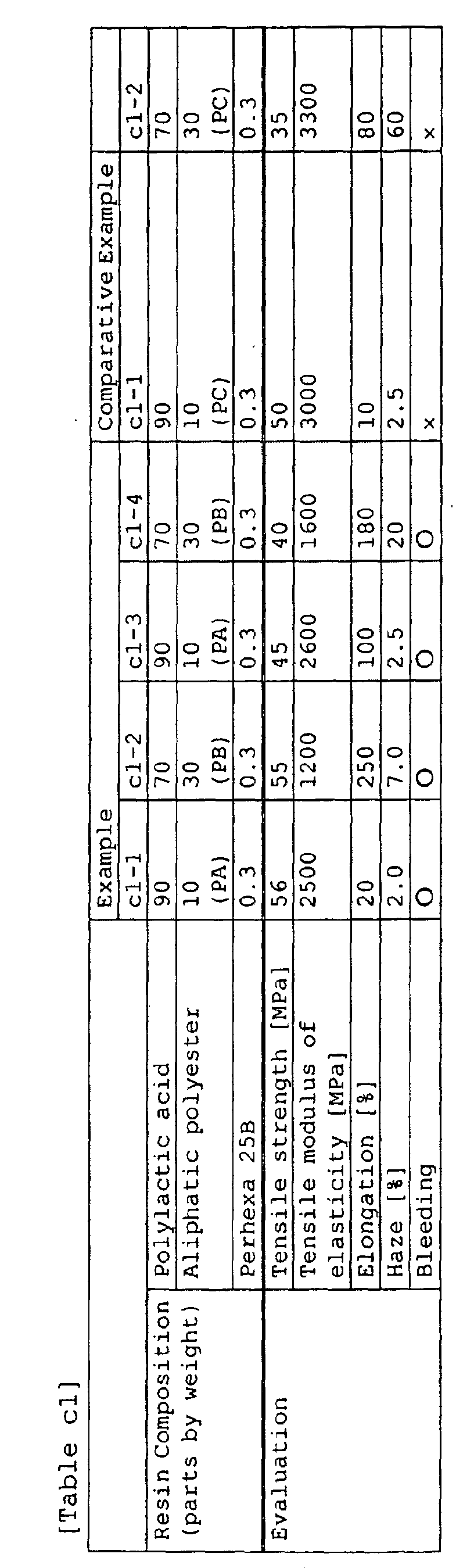
- Polylactic acid (LACEA H-100PL, Mw 150000, manufactured by Mitsui Chemicals, Inc.), polyester PA, and 2,5-dimethyl-2,5-bis(t-butylperoxy) hexane (Perhexa 25B manufactured by Nippon Oil and Fats Co., Ltd.) were mixed in a weight ratio of 90 : 10 : 0.3 by a Henschel mixer and then pelleted with a twin-screw kneader at a cylinder temperature set at 180 to 210°C. The pellets were used to form a film with an extruder equipped with a dryer to give a film of 200 ⁇ m in thickness.
- this film was stretched 2.5-fold in length and 2.5-fold in width in an oven set at a temperature of 65 to 75°C.
- the sample was excellent in both film manufacturability and stretchability to give a film stably.
- the physical properties of the resulting film are shown in Table c1.
- a stretched film was obtained by the same method as in Examplec 1-1 except that polylactic acid (LACEAH-100PL, Mw 150000, manufactured by Mitsui Chemicals, Inc.), polyester PA, and 2,5-dimethyl-2,5-bis(t-butylperoxy) hexane (Perhexa 25B manufactured by Nippon Oil and Fats Co., Ltd.) were used in a weight ratio of 70 : 30 : 0.3.
- the sample was excellent in both film manufacturability and stretchability to give a film stably.
- the physical properties of the resulting film are shown in Table c1.
- a stretched film was obtained by the same method as in Example c1-1 except that polylactic acid (LACEAH-100PL, Mw 150000, manufactured by Mitsui Chemicals, Inc.), polyester PB, and 2,5-dimethyl-2,5-bis(t-butylperoxy) hexane (Perhexa 25B manufactured by Nippon Oil and Fats Co., Ltd.) were used in a weight ratio of 90 : 10 : 0.3.
- the sample was excellent in both film manufacturability and stretchability to give a film stably.
- the physical properties of the resulting film are shown in Table c1.
- a stretched film was obtained by the same method as in Example c1-1 except that polylactic acid (LACEAH-100PL, Mw 150000, manufactured by Mitsui Chemicals, Inc.), polyester PB, and 2,5-dimethyl-2,5-bis(t-butylperoxy) hexane (Perhexa 25B manufactured by Nippon Oil and Fats Co., Ltd.) were used in a weight ratio of 70 : 30 : 0.3.
- the sample was excellent in both film manufacturability and stretchability to give a film stably.
- the physical properties of the resulting film are shown in Table c1.
- Polylactic acid (LACEA H-400, Mw 200000, manufactured by Mitsui Chemicals, Inc.), polyester PF obtained in Preparation Example b3, and 2,5-dimethyl-2,5-bis(t-butylperoxy) hexane (Perhexa 25B manufactured by Nippon Oil and Fats Co., Ltd.) were mixed in a weight ratio of 80 : 20 : 0.3 and pelleted at 200°C with a twin-screw kneader. The pellets were used to form a film of 500 ⁇ m in thickness with an extruder equipped with a nitrogen gas line (180 to 210°C).
- this film was stretched 3-fold in length and 3-fold in width with a batch twin-screw co-stretching machines et at a temperature of 70°C and heat-treated at a temperature of 120°C for 1 minute.
- the sample was excellent in both film manufacturability and stretchability to give a film stably.
- a transparent film with improvement inflexibility having a tensile modulus of elasticity of 2300 MPa, an elongation of 115%, a breaking strength of 102 MPa, and 0.7% haze was obtained.
- the evaluation of bleeding was ⁇ .
- a stretched film was obtained by the same method as in Examplec 1-1 except that polylactic acid (LACEAH-100 PL, Mw 150000, manufactured by Mitsui Chemicals, Inc.), polyester PC, and 2,5-dimethyl-2,5-bis(t-butylperoxy) hexane (Perhexa 25B manufactured by Nippon Oil and Fats Co., Ltd.) were used in a weight ratio of 90 : 10 : 0.3.
- polylactic acid LACEAH-100 PL, Mw 150000, manufactured by Mitsui Chemicals, Inc.
- polyester PC 2,5-dimethyl-2,5-bis(t-butylperoxy) hexane
- Perhexa 25B manufactured by Nippon Oil and Fats Co., Ltd.
- a stretched film was obtained by the same method as in Example c1-1 except that polylactic acid (LACEAH-100 PL, Mw 150000, manufactured by Mitsui Chemicals, Inc.), polyester PC, and 2,5-dimethyl-2,5-bis(t-butylperoxy) hexane (Perhexa 25B manufactured by Nippon Oil and Fats Co., Ltd.) were used in a weight ratio of 70 : 30 : 0. 3.
- polylactic acid LACEAH-100 PL, Mw 150000, manufactured by Mitsui Chemicals, Inc.
- polyester PC 2,5-dimethyl-2,5-bis(t-butylperoxy) hexane
- Table c1 The physical properties of the resulting film are shown in Table c1.
- a stretched film composed exclusively of polylactic acid was obtained by pelleting, film-making and stretching in the same manner as in Example c1-5 except that polylactic acid (LACEA H-400, Mw 200000, manufactured by Mitsui Chemicals, Inc.) only was used.
- the resulting film was a transparent but hard film with a tensile modulus of elasticity of 3500 MPa, an elongation of 109%, a breaking strength of 120 MPa, and 1.0% haze.
- Polylactic acid (LACEA H-100PL, Mw 150000, manufactured by Mitsui Chemicals, Inc.), polyester PA, and 2,5-dimethyl-2,5-bis(t-butylperoxy) hexane (Perhexa 25B manufactured by Nippon Oil and Fats Co., Ltd.) were mixed in a weight ratio of 70 : 30 : 0.3 by a Henschel mixer and then pelleted with a twin-screw extruder under the condition of a cylinder temperature set at 180 to 210°C.
- Table c2 The physical properties of the resulting film are shown in Table c2.
- a monofilament was obtained by the same method as in Example c2-1 except that polylactic acid (LACEA H-100PL, Mw 150000, manufactured by Mitsui Chemicals, Inc.), polyester PB, and 2,5-dimethyl-2,5-bis(t-butylperoxy) hexane (Perhexa 25B manufactured by Nippon Oil and Fats Co., Ltd.) were used in a weight ratio of 70 : 30 : 0.3. Spinning was stable, and troubles such as filament cutting did not occur. The physical properties of the resulting filament are shown in Table c2.
- a monofilament was obtained by the same method as in Example c2-1 except that polylactic acid (LACEA H-100PL, Mw 150000, manufactured by Mitsui Chemicals, Inc.), polyester PC, and 2,5-dimethyl-2,5-bis(t-butylperoxy) hexane (Perhexa 25B manufactured by Nippon Oil and Fats Co., Ltd.) were used in a weight ratio of 70 : 30 : 0.3. At the time of spinning, filament cutting occurred, and monofilament could not be produced stably. Bleeding of polyester PC was recognized. The physical properties of the resulting filament are shown in Table c2.
- Polylactic acid (LACEA H-100PL, Mw 150000, manufactured by Mitsui Chemicals, Inc.), polyester PA, and 2,5-dimethyl-2,5-bis(t-butylperoxy) hexane (Perhexa 25B manufactured by Nippon Oil and Fats Co., Ltd.) were mixed in a weight ratio of 70 : 30 : 0.3 by a Henschel mixer and then pelleted under the condition of a cylinder temperature set at 180 to 210°C in a twin-screw extruder.
- the pellets were dried at 80°C for 10 hours and then spun at a temperature of 230°C with a dice having 20 openings having a diameter of 0.2 mm with a dry spinning machine equipped with a dryer, to give a semi-stretched filament.
- the resulting filament was stretched at a temperature of 80 to 100°C and thermally fixed at a temperature of 120 to 140°C. Spinning was stable, and troubles such as filament cutting did not occur.
- the diameter of the resulting filament was 5d, and the strength was 4.0 g/d.
- a multifilament was obtained by the same method as in Example c2-1 except that polylactic acid (LACEA H-100PL, Mw 150000, manufactured by Mitsui Chemicals, Inc.), polyester PB, and 2,5-dimethyl-2,5-bis(t-butylperoxy) hexane (Perhexa 25B manufactured by Nippon Oil and Fats Co., Ltd.) were used in a weight ratio of 70 : 30 : 0.3. Spinning was stable, and troubles such as filament cutting did not occur. The diameter of the resulting filament was 5d, and the strength was 4.1 g/d.
- a multifilament was obtained by the same method as in Example b2-1 except that polylactic acid (LACEA H-100PL, Mw 150000, manufactured by Mitsui Chemicals, Inc.), polyester PC, and 2,5-dimethyl-2,5-bis(t-butylperoxy) hexane (Perhexa 25B manufactured by Nippon Oil and Fats Co., Ltd.) were used in a weight ratio of 70 : 30 : 0.3. At the time of spinning, filament cutting occurred, and multifilament could not be stably produced. The diameter of the resulting filament was 5d, and the strength was 3.8 g/d.
- Polylactic acid (LACEA H-100PL, Mw 150000, manufactured by Mitsui Chemicals, Inc.), polyester PA, and 2,5-dimethyl-2,5-bis(t-butylperoxy) hexane (Perhexa 25B manufactured by Nippon Oil and Fats Co., Ltd.) were mixed in a weight ratio of 70 : 30 : 0.3 by a Henschel mixer and then pelleted with a twin-screw kneader at a cylinder temperature set at 180 to 210°C.
- the pellets were dried at 80°C for 10 hours, then melted at 210°C, melt-spun thorough a spinneret having 90 spinning openings having a diameter of 0.35 mm, taken off with an air sucker arranged 1300 mmbelow the spinneret and accumulated on a moving capturing surface to form a web thereon.
- the take-off speed was about 3500 m/min.
- the resulting web was passed between a metal embossing roll heated at a temperature of 80 to 100°C and a smooth metal roll heated at the same temperature, and heat-fused to give a nonwoven fabric.
- the fineness of short fiber of the resulting nonwoven fabric was 2.5 d, and the basis weight of the nonwoven fabric was 30 g/m 2 .
- a nonwoven fabric was obtained in the same manner as in Example c2-1 except that polylactic acid (LACEAH-100 PL, Mw 150000, manufactured by Mitsui Chemicals, Inc.), polyester PB, and 2,5-dimethyl-2,5-bis(t-butylperoxy) hexane (Perhexa 25B manufactured by Nippon Oil and Fats Co., Ltd.) were mixed in a weight ratio of 70 : 30 : 0.3. The fineness of short fiber of the resulting nonwoven fabric was 2.5 d, and the basis weight of the nonwoven fabric was 30 g/m 2 .
- polylactic acid LACEAH-100 PL, Mw 150000, manufactured by Mitsui Chemicals, Inc.
- polyester PB 2,5-dimethyl-2,5-bis(t-butylperoxy) hexane
- Perhexa 25B manufactured by Nippon Oil and Fats Co., Ltd.
- a nonwoven fabric was obtained in the same manner as in Example c2-1 except that polylactic acid (LACEAH-100 PL, Mw 150000, manufactured by Mitsui Chemicals, Inc.), polyester PC, and 2,5-dimethyl-2,5-bis(t-butylperoxy) hexane (Perhexa 25B manufactured by Nippon Oil and Fats Co., Ltd.) were mixed in a weight ratio of 70 : 30 : 0. 3. At the time of spinning, filament cutting occurred, and spinning could not be conducted well under the condition of a take-off speed of about 3500 m/min.
- polylactic acid LACEAH-100 PL, Mw 150000, manufactured by Mitsui Chemicals, Inc.
- polyester PC 2,5-dimethyl-2,5-bis(t-butylperoxy) hexane
- Perhexa 25B manufactured by Nippon Oil and Fats Co., Ltd.
- the take-off speed was reduced to about 2600 m/min., and as a result, spinning could be achieved without filament cutting, and a nonwoven fabric having a short-fiber fineness of 3.0 d and a basis weight of 30 g/m 2 was obtained.
- Polylactic acid (LACEA H-100PL, Mw 150000, manufactured by Mitsui Chemicals, Inc.), polyester PA, and 2,5-dimethyl-2,5-bis(t-butylperoxy) hexane (Perhexa 25B manufactured by Nippon Oil and Fats Co., Ltd.) were mixed in a weight ratio of 70 : 30 : 0.3 by a Henschel mixer and then pelleted with a twin-screw kneader at a cylinder temperature set at 180 to 210°C.
- the pellets were dried at 80°C for 10 hours and then formed into a film of 100 ⁇ m in thickness with a 90 mm extruder of 1200 m in dice width and 0.8 mm in lip gap at a temperature of 150 to 210°C, equipped with a dryer. Then, the film was slitted into a tape of 6 mm in width, then stretched 5-fold at a temperature of 65 to 80°C on a hot plate, and thermally fixed on a hot plate at 100 to 120°C. At the time of stretching, no bleeding of the polyester PA component on the surface of the tape was recognized. The resulting tape had a width of 3.5 mm, a thickness of 30 ⁇ m and a strength of 5.5 g/d.
- a tape was obtained in the same manner as in Example c2-1 except that polylactic acid (LACEAH-100 PL, Mw 150000, manufactured by Mitsui Chemicals, Inc.), polyester PB, and 2,5-dimethyl-2,5-bis(t-butylperoxy) hexane (Perhexa 25B manufactured by Nippon Oil and Fats Co., Ltd.) were mixed in a weight ratio of 70 : 30 : 0.3. At the time of stretching, no bleeding of the polyester PB component on the surface of the tape was recognized. The resulting tape had a width of 3.5 mm, a thickness of 30 ⁇ m and a strength of 5.4 g/d.
- polylactic acid LACEAH-100 PL, Mw 150000, manufactured by Mitsui Chemicals, Inc.
- polyester PB 2,5-dimethyl-2,5-bis(t-butylperoxy) hexane
- Perhexa 25B manufactured by Nippon Oil and Fats Co., Ltd.
- a tape was obtained in the same manner as in Example c2-1 except that polylactic acid (LACEAH-100PL, Mw 150000, manufactured by Mitsui Chemicals, Inc.), polyester PC, and 2,5-dimethyl-2,5-bis(t-butylperoxy) hexane (Perhexa 25B manufactured by Nippon Oil and Fats Co., Ltd.) were mixed in a weight ratio of 70 : 30 : 0.3. At the time of stretching, bleeding of the polyester PC component on the surface of the tape was recognized. The resulting tape had a width of 3.5 mm, a thickness of 30 ⁇ m and a strength of 5.0 g/d.
- polylactic acid LACEAH-100PL, Mw 150000, manufactured by Mitsui Chemicals, Inc.
- polyester PC 2,5-dimethyl-2,5-bis(t-butylperoxy) hexane
- Perhexa 25B manufactured by Nippon Oil and Fats Co., Ltd.
- Polylactic acid (LACEA H-100PL, Mw 150000, manufactured by Mitsui Chemicals, Inc.), polyester PA, and 2,5-dimethyl-2,5-bis(t-butylperoxy) hexane (Perhexa 25B manufactured by Nippon Oil and Fats Co., Ltd.) were mixed in a weight ratio of 70 : 30 : 0.3 by a Henschel mixer and then pelleted with a twin-screw kneader at a cylinder temperature set at 180 to 210°C.
- the pellets were dried at 80°C for 10 hours, then melted at a cylinder temperature of 140 to 250°C and injection-molded into a mold set at 0 to 50°C in an injection stretching blowing molding machine, to give 40 g cold parison.
- the resulting parison was softened by heating at 100°C and transferred in to a bottle-shaped mold and blow-stretched 3.5-fold in length and 3-fold in width with blown pressurized air at 1 MPa, to give a cylindrical bottle having an aperture of 75 mm, a height of 100 mm and an internal volume of 1000ml. The thickness of the wall was 0.2 mm.
- This blown bottle was charged with 800 ml water and dropped 10 times from a height of 1.5 m to a floor of concrete under the condition of an ambient temperature of 20°C, but the bottle was not broken.
- a bottle was obtained in the same manner as in Example c2-1 except that polylactic acid (LACEA H-100PL, Mw 150000, manufactured by Mitsui Chemicals, Inc.), polyester PB, and 2,5-dimethyl-2,5-bis(t-butylperoxy) hexane (Perhexa 25B manufactured by Nippon Oil and Fats Co., Ltd.) were mixed in a weight ratio of 70 : 30 : 0.3. The thickness of the wall was 0.2 mm.
- This blown bottle was charged with 800 ml water and dropped 10 times from a height of 1.5 m to a floor of concrete under the condition of an ambient temperature of 20°C, but the bottle was not broken.
- a bottle was obtained in the same manner as in Example c2-1 except that polylactic acid (LACEA H-100PL, Mw 150000, manufactured by Mitsui Chemicals, Inc.), polyester PC, and 2,5-dimethyl-2,5-bis(t-butylperoxy) hexane (Perhexa 25B manufactured by Nippon Oil and Fats Co., Ltd.) were mixed in a weight ratio of 70 : 30 : 0.3. The thickness of the wall was 0.2 mm.
- This blown bottle was charged with 800 ml water and dropped 10 times from a height of 1.5 m to a floor of concrete under the condition of an ambient temperature of 20°C, and the bottle was not broken in the 3rd dropping.
- Polylactic acid (LACEA H-100PL, Mw 150000, manufactured by Mitsui Chemicals, Inc.), polyester PA, and 2,5-dimethyl-2,5-bis(t-butylperoxy) hexane (Perhexa 25B manufactured by Nippon Oil and Fats Co., Ltd.) were mixed in a weight ratio of 70 : 30 : 0.3 by a Henschel mixer and then pelleted with a twin-screw kneader at a cylinder temperature set at 180 to 210°C.
- the pellets were dried at 80°C for 10 hours, then kneaded and melted at 235°C with an extruder equipped with a dryer and fit with a T die of 1300 mm in width and 0.8 mm in lip width, and extruded onto a craft paper (basis weight of 75 g/m 2 ) at a take-off speed of 120m/min.
- the filmmanufacturability was excellent without film cutting.
- the thickness of the resin layer of the resulting paper laminate was 20 ⁇ 2 ⁇ m and the layer was excellent in thickness accuracy.
- a paper laminate was obtained in the same manner as in Example c7-1 except that polylactic acid (LACEAH-100 PL, Mw 150000, manufactured by Mitsui Chemicals, Inc.), polyester PB, and 2,5-dimethyl-2,5-bis(t-butylperoxy)hexane (Perhexa 25B, manufactured by Nippon Oil and Fats Co., Ltd.) were used in the weight ratio of 70 : 30 : 0.3.
- the film manufacturability was excellent without film cutting.
- the thickness of the resin layer of the resulting paper laminate was 20 ⁇ 2 ⁇ m and the layer was excellent in thickness accuracy.
- a paper laminate was obtained in the same manner as in Example c7-1 except that polylactic acid (LACEAH-100PL, Mw 150000, manufactured by Mitsui Chemicals, Inc.), polyester PC, and 2,5-dimethyl-2,5-bis(t-butylperoxy)hexane (Perhexa 25B, manufactured by Nippon Oil and Fats Co., Ltd.) were used in the weight ratio of 70:30:0.3.
- polylactic acid LACEAH-100PL, Mw 150000, manufactured by Mitsui Chemicals, Inc.
- polyester PC 2,5-dimethyl-2,5-bis(t-butylperoxy)hexane
- Perhexa 25B manufactured by Nippon Oil and Fats Co., Ltd.
- Polylactic acid (LACEA H-100PL, Mw 150000, manufactured by Mitsui Chemicals, Inc.), polyester PA, and 2,5-dimethyl-2,5-bis(t-butylperoxy) hexane (Perhexa 25B manufactured by Nippon Oil and Fats Co., Ltd.) were mixed in a weight ratio of 70 : 30 : 0.3 by a Henschel mixer, then molded at a resin extrusion temperature of 160 to 170°C in an expansion ratio of about 2.4 in a 40 mm inflation molding machine (dice diameter 40 mm) to form an inflation film having a lay-flat width of 150 mm and a thickness of 30 ⁇ m, and taken off. During and after molding, there was no bleeding of the polyester PA, and there was no blocking between the films.
- An inflation film was obtained in the same manner as in Example c7-1 except that polylactic acid (LACEAH-100 PL, Mw 150000, manufactured by Mitsui Chemicals, Inc.), polyester PB, and 2,5-dimethyl-2,5-bis(t-butylperoxy) hexane (Perhexa 25B manufactured by Nippon Oil and Fats Co., Ltd.) were mixed in a weight ratio of 70 : 30 : 0.3.
- the film manufacturability was excellent without film cutting. During and after molding, there was no bleeding of the polyester PB, and there was no blocking between the films.
- An inflation film was obtained in the same manner as in Example c7-1 except that polylactic acid (LACEAH-100PL, Mw 150000, manufactured by Mitsui Chemicals, Inc.), polyester PC, and 2,5-dimethyl-2,5-bis(t-butylperoxy) hexane (Perhexa 25B manufactured by Nippon Oil and Fats Co., Ltd.) were mixed in a weight ratio of 70 : 30 : 0.3. During and after molding, bleeding of the polyester PC occurred, and blocking between the films was recognized.
- polylactic acid LACEAH-100PL, Mw 150000, manufactured by Mitsui Chemicals, Inc.
- polyester PC 2,5-dimethyl-2,5-bis(t-butylperoxy) hexane
- a resin composition suitable as a starting material of biodegradable material maintaining transparency, free of bleeding of a plasticizer and endowed with flexibility.
- the molded article of the invention is a molded article excellent in flexibility, mechanical strength, safety and decomposition and free of bleeding of a plasticizing component and can thus be preferably used as a material widely in various packaging films for food, electronics, medicine, chemicals, cosmetics etc. and in various materials used in agriculture, civil engineering, buildings, marine products industry, and compost materials. Even if the molded article is disposed of after use, it is not accumulated as industrial waste or domestic waste.
Landscapes
- Chemical & Material Sciences (AREA)
- Health & Medical Sciences (AREA)
- Chemical Kinetics & Catalysis (AREA)
- Medicinal Chemistry (AREA)
- Polymers & Plastics (AREA)
- Organic Chemistry (AREA)
- Engineering & Computer Science (AREA)
- Manufacturing & Machinery (AREA)
- Materials Engineering (AREA)
- Compositions Of Macromolecular Compounds (AREA)
- Biological Depolymerization Polymers (AREA)
- Macromonomer-Based Addition Polymer (AREA)
Abstract
wherein the compounding ratio of the component (A), the component (B) and the radical generating agent (C), based on the total weight thereof, is:
Description
wherein the compounding ratio of the aliphatic polyester or aliphatic polyamide (component (A)), the plastic having a melting point or glass transition temperature (Tg) of -10°C or more (component (B)) and the radical generating agent (C), based on the total weight thereof, is:
- 0 to 50 mol% repeating unit (a) having an aliphatic unsaturated bond,
- 0 to 51 mol% polyvalent alcohol unit (b),
- 0 to 51 mol% saturated polybasic acid unit (c), and
- 0 to 80 mol% aliphatic hydroxycarboxylic acid or lactone compound unit (d).
wherein the compounding ratio of the component (A), the component (B) and the radical generating agent (C), based on the total weight thereof, is:
(2≤n≤10)
(1≤n≤10)
- : no bleeding. Δ: slightbleeding. ×: bleeding on the whole surface.

Claims (9)
- A resin composition (AA) comprising an aliphatic polyester or aliphatic polyamide (component (A)), a plastic having a melting point or glass transition temperature (Tg) of -10°C or more (component (B)) and a radical generating agent (C),
wherein the compounding ratio of the component (A), the component (B) and the radical generating agent (C), based on the total weight thereof, is:an aliphatic unsaturated polybasic acid (a) is contained in the polymer constituent of the component (A) and/or the component (B).1 to 98.995% by weight of the component (A),98.995 to 1% by weight of the component (B), and0.005 to 5% by weight of the radical generating agent (C), and - The resin composition (AA) according to claim 1, wherein the component (A) is an aliphatic polyester containing in the polymer constituent of the component an aliphatic unsaturated polybasic acid (a), an aliphatic polyvalent alcohol (b) and an aliphatic saturated polybasic acid (c).
- The resin composition (AA) according to claim 1 or 2, wherein the component (A) is an aliphatic polyester containing in the polymer constituent of the component 0.1 to 10 mol% aliphatic unsaturated polybasic acid (a), 10 to 50 mol% aliphatic polyvalent alcohol (b), 0 to 49.9 mol% aliphatic saturated polybasic acid (c) and 0 to 80 mol% aliphatic hydroxycarboxylic acid (d).
- The resin composition (AA) according to claims 1 to 3, wherein the component (B) is at least one member selected from the group consisting of polylactic acid, polyglycolic acid, lactic acid-glycolic acid copolymer, polyhydroxybutyrate, polyhydroxyalkanoate,polybutylenesuccinate,polyvinylalcohol, cellulose acetate, polyethylene succinate, polycaprolactone, polybutylene succinate adipate modification, polybutylene succinate carbonate modification, polybutyrene adipate/terephthalate, and copolymers and mixtures thereof.
- A resin modifier comprising the resin composition (AA) described in claims 1 to 4.
- A resin composition (BB) comprising 1 to 50% by weight of the resin composition (AA) described in claims 1 to 4 and 50 to 99% by weight of a biodegradable resin (D).
- The resin composition (AA) or (BB) according to claims 1 to 4 or claim 6, which comprises a component subj ected to crosslinking reaction.
- A molded article comprising the resin composition (AA) or (BB) described in claims 1 to 4 or claim 6.
- A film having a haze of 2% or less, a tensile modulus of elasticity of 2600 MPa or less, a breaking strength of 70 MPa or more and an elongation at breakage of 100% or more, comprising a resin composition containing at least 50% by weight of polylactic acid.
Applications Claiming Priority (5)
| Application Number | Priority Date | Filing Date | Title |
|---|---|---|---|
| JP2002028546 | 2002-02-05 | ||
| JP2002028546 | 2002-02-05 | ||
| JP2002116585 | 2002-04-18 | ||
| JP2002116585 | 2002-04-18 | ||
| PCT/JP2003/000973 WO2003066733A1 (en) | 2002-02-05 | 2003-01-31 | Biodegradable resin composition and molded object thereof |
Publications (2)
| Publication Number | Publication Date |
|---|---|
| EP1473324A1 true EP1473324A1 (en) | 2004-11-03 |
| EP1473324A4 EP1473324A4 (en) | 2005-07-06 |
Family
ID=27736438
Family Applications (1)
| Application Number | Title | Priority Date | Filing Date |
|---|---|---|---|
| EP03703115A Withdrawn EP1473324A4 (en) | 2002-02-05 | 2003-01-31 | Biodegradable resin composition and molded object thereof |
Country Status (5)
| Country | Link |
|---|---|
| US (1) | US20050107505A1 (en) |
| EP (1) | EP1473324A4 (en) |
| JP (1) | JP4133387B2 (en) |
| CN (1) | CN1628151A (en) |
| WO (1) | WO2003066733A1 (en) |
Cited By (15)
| Publication number | Priority date | Publication date | Assignee | Title |
|---|---|---|---|---|
| WO2009094365A1 (en) * | 2008-01-23 | 2009-07-30 | Tate And Lyle Ingredients Americas, Inc. | Lactic acid based compositions with enhanced properties |
| CN101747476A (en) * | 2008-12-15 | 2010-06-23 | 山东省意可曼科技有限公司 | Polyhydroxy alkanoates graft polymer and preparation method thereof |
| US8206796B2 (en) | 2006-04-27 | 2012-06-26 | Cryovac, Inc. | Multilayer film comprising polylactic acid |
| US8877862B2 (en) | 2011-07-15 | 2014-11-04 | Saudi Basic Industries Corporation | Method for color stabilization of poly(butylene-co-adipate terephthalate |
| US8889820B2 (en) | 2012-02-15 | 2014-11-18 | Saudi Basic Industries Corporation | Amorphous, high glass transition temperature copolyester compositions, methods of manufacture, and articles thereof |
| US8895660B2 (en) | 2012-03-01 | 2014-11-25 | Saudi Basic Industries Corporation | Poly(butylene-co-adipate terephthalate), method of manufacture, and uses thereof |
| US8901273B2 (en) | 2012-02-15 | 2014-12-02 | Saudi Basic Industries Corporation | Amorphous, high glass transition temperature copolyester compositions, methods of manufacture, and articles thereof |
| US8901243B2 (en) | 2012-03-30 | 2014-12-02 | Saudi Basic Industries Corporation | Biodegradable aliphatic-aromatic copolyesters, methods of manufacture, and articles thereof |
| US8933162B2 (en) | 2011-07-15 | 2015-01-13 | Saudi Basic Industries Corporation | Color-stabilized biodegradable aliphatic-aromatic copolyesters, methods of manufacture, and articles thereof |
| US8946345B2 (en) | 2011-08-30 | 2015-02-03 | Saudi Basic Industries Corporation | Method for the preparation of (polybutylene-co-adipate terephthalate) through the in situ phosphorus containing titanium based catalyst |
| US8969506B2 (en) | 2012-02-15 | 2015-03-03 | Saudi Basic Industries Corporation | Amorphous, high glass transition temperature copolyester compositions, methods of manufacture, and articles thereof |
| US9034983B2 (en) | 2012-03-01 | 2015-05-19 | Saudi Basic Industries Corporation | Poly(butylene-co-adipate terephthalate), method of manufacture and uses thereof |
| US9163141B2 (en) | 2006-04-27 | 2015-10-20 | Cryovac, Inc. | Polymeric blend comprising polylactic acid |
| US9334360B2 (en) | 2011-07-15 | 2016-05-10 | Sabic Global Technologies B.V. | Color-stabilized biodegradable aliphatic-aromatic copolyesters, methods of manufacture, and articles thereof |
| US9828461B2 (en) | 2012-03-01 | 2017-11-28 | Sabic Global Technologies B.V. | Poly(alkylene co-adipate terephthalate) prepared from recycled polyethylene terephthalate having low impurity levels |
Families Citing this family (42)
| Publication number | Priority date | Publication date | Assignee | Title |
|---|---|---|---|---|
| AU778081B2 (en) * | 1999-03-25 | 2004-11-11 | Tepha, Inc. | Medical devices and applications of polyhydroxyalkanoate polymers |
| PT1638615E (en) | 2003-05-08 | 2015-02-04 | Tepha Inc | Polyhydroxyalkanoate medical textiles and fibers |
| JP2007528853A (en) * | 2003-07-08 | 2007-10-18 | テファ, インコーポレイテッド | Poly-4-hydroxybutyrate matrix for sustained release drug delivery |
| EP1663017A1 (en) * | 2003-08-22 | 2006-06-07 | Tepha, Inc. | Polyhydroxyalkanoate nerve regeneration devices |
| EP1564235B1 (en) * | 2004-02-16 | 2007-04-11 | Nippon Shokubai Co., Ltd. | Biodegradable film |
| EP1564153A1 (en) * | 2004-02-16 | 2005-08-17 | Nippon Shokubai Co., Ltd. | Packaging material |
| ES2395464T3 (en) * | 2004-08-03 | 2013-02-12 | Tepha, Inc. | Non-curly polyhydroxyalkanoate sutures |
| JP2006143772A (en) * | 2004-11-16 | 2006-06-08 | Unitika Ltd | Resin composition |
| US20060177513A1 (en) * | 2005-01-28 | 2006-08-10 | Tepha, Inc. | Embolization using poly-4-hydroxybutyrate particles |
| GB0508883D0 (en) * | 2005-04-29 | 2005-06-08 | Unilever Plc | Polymers for laundry applications |
| US7423080B2 (en) * | 2006-03-03 | 2008-09-09 | Sabic Innovative Plastics Ip B.V. | Radiation crosslinking of halogen-free flame retardant polymer |
| WO2008056737A1 (en) * | 2006-11-09 | 2008-05-15 | Dainichiseika Color & Chemicals Mfg. Co., Ltd. | Polyester resin composition, process for production of the composition, agent for promotion of crystallization of polyester resin, and molded article |
| US7943683B2 (en) | 2006-12-01 | 2011-05-17 | Tepha, Inc. | Medical devices containing oriented films of poly-4-hydroxybutyrate and copolymers |
| US20080230954A1 (en) * | 2007-03-20 | 2008-09-25 | Green Harvest Technologies, Llc | Injection Stretch Blow Molded Polylactide Bottle and Process For Making Same |
| US8834753B2 (en) * | 2007-10-22 | 2014-09-16 | Magictex Apparel Corporation | Process of making yarns with coffee residue |
| TWI338729B (en) * | 2007-10-19 | 2011-03-11 | Singtex Ind Co Ltd | Yarns with coffee residue and preparation thereof |
| KR20110008312A (en) | 2008-05-06 | 2011-01-26 | 메타볼릭스 인코포레이티드 | Biosynthetic Polyester Blend |
| CN101402794B (en) * | 2008-11-19 | 2010-08-25 | 中国科学院遗传与发育生物学研究所 | A multifunctional degradable liquid mulch film, its preparation method and application |
| ES2688444T3 (en) * | 2009-06-26 | 2018-11-02 | Cj Cheiljedang Corporation | Method of manufacturing an article from a composition comprising PHA and PBS |
| IL218083A0 (en) * | 2012-02-13 | 2012-03-29 | Nilit Ltd | Polyamide fabric enhancing body warming |
| EP2844791B1 (en) * | 2012-04-29 | 2017-10-18 | NatureWorks LLC | Process for making non-woven fabrics using polylactide resin blends |
| US10113060B2 (en) | 2012-06-05 | 2018-10-30 | Cj Cheiljedang Corporation | Biobased rubber modified biodegradable polymer blends |
| CN104755538B (en) | 2012-08-17 | 2018-08-31 | Cj 第一制糖株式会社 | Bio-Based Rubber Modifiers for Polymer Blends |
| BR102012024569B1 (en) * | 2012-09-27 | 2021-01-05 | Universidade Federal De Pernambuco | polymeric film, based on oil extracted from coffee grounds, stable to ionizing radiation |
| EP3004225A1 (en) | 2013-05-30 | 2016-04-13 | Metabolix, Inc. | Recyclate blends |
| CN103804660B (en) * | 2014-03-04 | 2016-02-03 | 中国科学院长春应用化学研究所 | A kind of unsaturated aliphatic-polylactic-acid block copolymer and preparation method thereof |
| WO2015149029A1 (en) | 2014-03-27 | 2015-10-01 | Metabolix, Inc. | Highly filled polymer systems |
| CN104017339A (en) * | 2014-06-17 | 2014-09-03 | 四川大学 | High-toughness polylactic acid alloy and preparation method thereof |
| US10500303B2 (en) | 2014-08-15 | 2019-12-10 | Tepha, Inc. | Self-retaining sutures of poly-4-hydroxybutyrate and copolymers thereof |
| US10626521B2 (en) | 2014-12-11 | 2020-04-21 | Tepha, Inc. | Methods of manufacturing mesh sutures from poly-4-hydroxybutyrate and copolymers thereof |
| EP3230500B1 (en) | 2014-12-11 | 2025-06-18 | Tepha, Inc. | Methods of orienting multifilament yarn and monofilaments of poly-4-hydroxybutyrate and copolymers thereof |
| US11091632B2 (en) | 2015-11-17 | 2021-08-17 | Cj Cheiljedang Corporation | Polymer blends with controllable biodegradation rates |
| CN107936186B (en) * | 2016-10-13 | 2020-06-09 | 中国石油化工股份有限公司 | 3D printing wire and preparation method thereof |
| US10308790B2 (en) * | 2017-02-13 | 2019-06-04 | Fuji Xerox Co., Ltd. | Resin composition and resin molding |
| CN107987438B (en) * | 2017-12-18 | 2020-07-07 | 四川妙顺环保科技有限公司 | Composition for packaging film, method for producing same, and packaging film |
| FI20185381A1 (en) * | 2018-04-23 | 2019-10-24 | Welmu Int Oy | POLYMER COMPOSITION, PROCEDURE RELATED TO IT AND USE THEREOF |
| CN110452511A (en) * | 2019-08-23 | 2019-11-15 | 南京茂宇医疗器械科技有限公司 | A kind of low temperature shape memory high molecule material and preparation method thereof |
| US12447051B2 (en) * | 2020-08-24 | 2025-10-21 | University Of Utah Research Foundation | Multi-functional analgesic-releasing wound dressing |
| US12098265B2 (en) * | 2020-12-14 | 2024-09-24 | Cocotaps | Method of forming a biodegradable and/or compostable spout |
| CN114456335A (en) * | 2022-03-11 | 2022-05-10 | 中国医学科学院生物医学工程研究所 | Biodegradable elastomer material and preparation method thereof |
| WO2023210177A1 (en) * | 2022-04-28 | 2023-11-02 | Dic株式会社 | Biodegradable resin degradation accelerator, biodegradable resin composition, molded body, and method for degrading biodegradable resin |
| WO2024063149A1 (en) | 2022-09-22 | 2024-03-28 | 日清紡ケミカル株式会社 | Biodegradable resin composition |
Family Cites Families (11)
| Publication number | Priority date | Publication date | Assignee | Title |
|---|---|---|---|---|
| US3597383A (en) * | 1969-02-10 | 1971-08-03 | American Cyanamid Co | Process for making a granular,dry polyester resin molding composition and the product produced thereby |
| BR9106821A (en) * | 1990-09-06 | 1993-07-13 | Battelle Memorial Institute | PACKING THERMOPLASTICS FROM LATIC ACID |
| US5910520A (en) * | 1993-01-15 | 1999-06-08 | Mcneil-Ppc, Inc. | Melt processable biodegradable compositions and articles made therefrom |
| JPH08152743A (en) * | 1994-11-25 | 1996-06-11 | Tomoegawa Paper Co Ltd | Electrophotographic toner and manufacturing method thereof |
| JP3348752B2 (en) * | 1995-03-09 | 2002-11-20 | トヨタ自動車株式会社 | Plasticized polylactic acid composition and molded article thereof |
| DE69623214T2 (en) * | 1995-09-29 | 2003-04-30 | Dainippon Ink And Chemicals, Inc. | Process for the production of polyester mixtures based on polylactides |
| FI105040B (en) * | 1996-03-05 | 2000-05-31 | Neste Oy | The polylactide film |
| US6124384A (en) * | 1997-08-19 | 2000-09-26 | Mitsui Chemicals, Inc. | Composite resin composition |
| JP2001026658A (en) * | 1999-07-13 | 2001-01-30 | Mitsui Chemicals Inc | Polylactic acid-based resin composition and preparation thereof |
| JP2001064379A (en) * | 1999-08-31 | 2001-03-13 | Shimadzu Corp | Method for producing compatible aliphatic polyester and composition thereof |
| JP2001072727A (en) * | 1999-09-01 | 2001-03-21 | Kao Corp | Molding composition |
-
2003
- 2003-01-31 CN CN03803193.0A patent/CN1628151A/en active Pending
- 2003-01-31 EP EP03703115A patent/EP1473324A4/en not_active Withdrawn
- 2003-01-31 WO PCT/JP2003/000973 patent/WO2003066733A1/en not_active Ceased
- 2003-01-31 US US10/503,225 patent/US20050107505A1/en not_active Abandoned
- 2003-02-03 JP JP2003025475A patent/JP4133387B2/en not_active Expired - Fee Related
Cited By (18)
| Publication number | Priority date | Publication date | Assignee | Title |
|---|---|---|---|---|
| US9163141B2 (en) | 2006-04-27 | 2015-10-20 | Cryovac, Inc. | Polymeric blend comprising polylactic acid |
| US8206796B2 (en) | 2006-04-27 | 2012-06-26 | Cryovac, Inc. | Multilayer film comprising polylactic acid |
| US8071690B2 (en) | 2008-01-23 | 2011-12-06 | Tate & Lyle Ingredients Americas Llc | Lactic acid based compositions with enhanced properties |
| WO2009094365A1 (en) * | 2008-01-23 | 2009-07-30 | Tate And Lyle Ingredients Americas, Inc. | Lactic acid based compositions with enhanced properties |
| CN101747476A (en) * | 2008-12-15 | 2010-06-23 | 山东省意可曼科技有限公司 | Polyhydroxy alkanoates graft polymer and preparation method thereof |
| US8933162B2 (en) | 2011-07-15 | 2015-01-13 | Saudi Basic Industries Corporation | Color-stabilized biodegradable aliphatic-aromatic copolyesters, methods of manufacture, and articles thereof |
| US9334360B2 (en) | 2011-07-15 | 2016-05-10 | Sabic Global Technologies B.V. | Color-stabilized biodegradable aliphatic-aromatic copolyesters, methods of manufacture, and articles thereof |
| US8877862B2 (en) | 2011-07-15 | 2014-11-04 | Saudi Basic Industries Corporation | Method for color stabilization of poly(butylene-co-adipate terephthalate |
| US9487621B2 (en) | 2011-08-30 | 2016-11-08 | Sabic Global Technologies B.V. | Method for the preparation of (polybutylene-co-adipate terephthalate) through the in situ phosphorus containing titanium based catalyst |
| US8946345B2 (en) | 2011-08-30 | 2015-02-03 | Saudi Basic Industries Corporation | Method for the preparation of (polybutylene-co-adipate terephthalate) through the in situ phosphorus containing titanium based catalyst |
| US8901273B2 (en) | 2012-02-15 | 2014-12-02 | Saudi Basic Industries Corporation | Amorphous, high glass transition temperature copolyester compositions, methods of manufacture, and articles thereof |
| US8889820B2 (en) | 2012-02-15 | 2014-11-18 | Saudi Basic Industries Corporation | Amorphous, high glass transition temperature copolyester compositions, methods of manufacture, and articles thereof |
| US8969506B2 (en) | 2012-02-15 | 2015-03-03 | Saudi Basic Industries Corporation | Amorphous, high glass transition temperature copolyester compositions, methods of manufacture, and articles thereof |
| US9034983B2 (en) | 2012-03-01 | 2015-05-19 | Saudi Basic Industries Corporation | Poly(butylene-co-adipate terephthalate), method of manufacture and uses thereof |
| US8895660B2 (en) | 2012-03-01 | 2014-11-25 | Saudi Basic Industries Corporation | Poly(butylene-co-adipate terephthalate), method of manufacture, and uses thereof |
| US9487625B2 (en) | 2012-03-01 | 2016-11-08 | Sabic Global Technologies B.V. | Poly(butylene-co-adipate terephthalate), method of manufacture and uses thereof |
| US9828461B2 (en) | 2012-03-01 | 2017-11-28 | Sabic Global Technologies B.V. | Poly(alkylene co-adipate terephthalate) prepared from recycled polyethylene terephthalate having low impurity levels |
| US8901243B2 (en) | 2012-03-30 | 2014-12-02 | Saudi Basic Industries Corporation | Biodegradable aliphatic-aromatic copolyesters, methods of manufacture, and articles thereof |
Also Published As
| Publication number | Publication date |
|---|---|
| CN1628151A (en) | 2005-06-15 |
| JP2004002683A (en) | 2004-01-08 |
| US20050107505A1 (en) | 2005-05-19 |
| WO2003066733A1 (en) | 2003-08-14 |
| EP1473324A4 (en) | 2005-07-06 |
| JP4133387B2 (en) | 2008-08-13 |
Similar Documents
| Publication | Publication Date | Title |
|---|---|---|
| US20050107505A1 (en) | Biodegradable resin composition and molded object thereof | |
| CN111801385B (en) | Shaped objects, sheets, and containers, as well as tubes, straws, cotton swabs, and balloon stems | |
| KR100994150B1 (en) | Biodegradable plastic composition, molded article thereof and method of controlling biodegradation rate using the composition | |
| JP4842501B2 (en) | Three-component mixture of biodegradable polyesters and products obtained therefrom | |
| US8513341B2 (en) | Polylactic acid resin composition and molded article thereof | |
| ES2661949T3 (en) | Biodegradable aliphatic-aromatic polyesters | |
| JP7106936B2 (en) | Molded body, sheet and container | |
| JPH08501584A (en) | Degradable polymer composition | |
| JPH04504731A (en) | Degradable lactide thermoplastic | |
| JP6866722B2 (en) | Resin composition and resin molded products molded using it | |
| JP2022157778A (en) | Biodegradable resin composition and molding | |
| WO2002094935A1 (en) | Biodegradable resin composition with controlled biodegradation rate, film, and agricultural mulch film | |
| JP2001323056A (en) | Aliphatic polyester resin and molded products | |
| JPH11241009A (en) | Polylactate resin composition | |
| JP5067825B2 (en) | Molded article made of polylactic acid polymer and plasticizer for polylactic acid | |
| JP3905896B2 (en) | Biodegradable film with improved water vapor barrier property and method for controlling water vapor barrier property | |
| JP4511099B2 (en) | Lactic acid-based resin composition, sheet-like product thereof, and bag-like product | |
| JP2000327847A (en) | Resin composition | |
| JP2005126701A (en) | Molded product comprising polylactic acid polymer composition | |
| JP4246523B2 (en) | Lactic acid resin composition | |
| JP7218650B2 (en) | Polyester resin composition and molded article | |
| JP2000345012A (en) | Resin composition | |
| JP2001240731A (en) | Resin composition | |
| JP2000129035A (en) | Resin composition and molded article thereof | |
| JP2007284595A (en) | Aliphatic polyester film |
Legal Events
| Date | Code | Title | Description |
|---|---|---|---|
| PUAI | Public reference made under article 153(3) epc to a published international application that has entered the european phase |
Free format text: ORIGINAL CODE: 0009012 |
|
| 17P | Request for examination filed |
Effective date: 20040804 |
|
| AK | Designated contracting states |
Kind code of ref document: A1 Designated state(s): AT BE BG CH CY CZ DE DK EE ES FI FR GB GR HU IE IT LI LU MC NL PT SE SI SK TR |
|
| RAP1 | Party data changed (applicant data changed or rights of an application transferred) |
Owner name: MITSUI CHEMICALS, INC. |
|
| RIC1 | Information provided on ipc code assigned before grant |
Ipc: 7C 08L 67/00 A Ipc: 7C 08L 77/00 B Ipc: 7C 08J 5/18 B Ipc: 7C 08L 101/16 B |
|
| A4 | Supplementary search report drawn up and despatched |
Effective date: 20050523 |
|
| STAA | Information on the status of an ep patent application or granted ep patent |
Free format text: STATUS: THE APPLICATION IS DEEMED TO BE WITHDRAWN |
|
| 18D | Application deemed to be withdrawn |
Effective date: 20050802 |