EP1473150A1 - Releasing material and release agent - Google Patents
Releasing material and release agent Download PDFInfo
- Publication number
- EP1473150A1 EP1473150A1 EP03703164A EP03703164A EP1473150A1 EP 1473150 A1 EP1473150 A1 EP 1473150A1 EP 03703164 A EP03703164 A EP 03703164A EP 03703164 A EP03703164 A EP 03703164A EP 1473150 A1 EP1473150 A1 EP 1473150A1
- Authority
- EP
- European Patent Office
- Prior art keywords
- release
- silicone
- substrate
- layer
- material according
- Prior art date
- Legal status (The legal status is an assumption and is not a legal conclusion. Google has not performed a legal analysis and makes no representation as to the accuracy of the status listed.)
- Granted
Links
Images
Classifications
-
- C—CHEMISTRY; METALLURGY
- C09—DYES; PAINTS; POLISHES; NATURAL RESINS; ADHESIVES; COMPOSITIONS NOT OTHERWISE PROVIDED FOR; APPLICATIONS OF MATERIALS NOT OTHERWISE PROVIDED FOR
- C09D—COATING COMPOSITIONS, e.g. PAINTS, VARNISHES OR LACQUERS; FILLING PASTES; CHEMICAL PAINT OR INK REMOVERS; INKS; CORRECTING FLUIDS; WOODSTAINS; PASTES OR SOLIDS FOR COLOURING OR PRINTING; USE OF MATERIALS THEREFOR
- C09D183/00—Coating compositions based on macromolecular compounds obtained by reactions forming in the main chain of the macromolecule a linkage containing silicon, with or without sulfur, nitrogen, oxygen, or carbon only; Coating compositions based on derivatives of such polymers
- C09D183/04—Polysiloxanes
-
- B—PERFORMING OPERATIONS; TRANSPORTING
- B32—LAYERED PRODUCTS
- B32B—LAYERED PRODUCTS, i.e. PRODUCTS BUILT-UP OF STRATA OF FLAT OR NON-FLAT, e.g. CELLULAR OR HONEYCOMB, FORM
- B32B27/00—Layered products comprising a layer of synthetic resin
-
- B—PERFORMING OPERATIONS; TRANSPORTING
- B32—LAYERED PRODUCTS
- B32B—LAYERED PRODUCTS, i.e. PRODUCTS BUILT-UP OF STRATA OF FLAT OR NON-FLAT, e.g. CELLULAR OR HONEYCOMB, FORM
- B32B27/00—Layered products comprising a layer of synthetic resin
- B32B27/28—Layered products comprising a layer of synthetic resin comprising synthetic resins not wholly covered by any one of the sub-groups B32B27/30 - B32B27/42
-
- C—CHEMISTRY; METALLURGY
- C09—DYES; PAINTS; POLISHES; NATURAL RESINS; ADHESIVES; COMPOSITIONS NOT OTHERWISE PROVIDED FOR; APPLICATIONS OF MATERIALS NOT OTHERWISE PROVIDED FOR
- C09J—ADHESIVES; NON-MECHANICAL ASPECTS OF ADHESIVE PROCESSES IN GENERAL; ADHESIVE PROCESSES NOT PROVIDED FOR ELSEWHERE; USE OF MATERIALS AS ADHESIVES
- C09J7/00—Adhesives in the form of films or foils
- C09J7/40—Adhesives in the form of films or foils characterised by release liners
-
- C—CHEMISTRY; METALLURGY
- C09—DYES; PAINTS; POLISHES; NATURAL RESINS; ADHESIVES; COMPOSITIONS NOT OTHERWISE PROVIDED FOR; APPLICATIONS OF MATERIALS NOT OTHERWISE PROVIDED FOR
- C09K—MATERIALS FOR MISCELLANEOUS APPLICATIONS, NOT PROVIDED FOR ELSEWHERE
- C09K3/00—Materials not provided for elsewhere
-
- C—CHEMISTRY; METALLURGY
- C09—DYES; PAINTS; POLISHES; NATURAL RESINS; ADHESIVES; COMPOSITIONS NOT OTHERWISE PROVIDED FOR; APPLICATIONS OF MATERIALS NOT OTHERWISE PROVIDED FOR
- C09J—ADHESIVES; NON-MECHANICAL ASPECTS OF ADHESIVE PROCESSES IN GENERAL; ADHESIVE PROCESSES NOT PROVIDED FOR ELSEWHERE; USE OF MATERIALS AS ADHESIVES
- C09J2433/00—Presence of (meth)acrylic polymer
- C09J2433/005—Presence of (meth)acrylic polymer in the release coating
-
- C—CHEMISTRY; METALLURGY
- C09—DYES; PAINTS; POLISHES; NATURAL RESINS; ADHESIVES; COMPOSITIONS NOT OTHERWISE PROVIDED FOR; APPLICATIONS OF MATERIALS NOT OTHERWISE PROVIDED FOR
- C09J—ADHESIVES; NON-MECHANICAL ASPECTS OF ADHESIVE PROCESSES IN GENERAL; ADHESIVE PROCESSES NOT PROVIDED FOR ELSEWHERE; USE OF MATERIALS AS ADHESIVES
- C09J2483/00—Presence of polysiloxane
- C09J2483/005—Presence of polysiloxane in the release coating
-
- Y—GENERAL TAGGING OF NEW TECHNOLOGICAL DEVELOPMENTS; GENERAL TAGGING OF CROSS-SECTIONAL TECHNOLOGIES SPANNING OVER SEVERAL SECTIONS OF THE IPC; TECHNICAL SUBJECTS COVERED BY FORMER USPC CROSS-REFERENCE ART COLLECTIONS [XRACs] AND DIGESTS
- Y10—TECHNICAL SUBJECTS COVERED BY FORMER USPC
- Y10T—TECHNICAL SUBJECTS COVERED BY FORMER US CLASSIFICATION
- Y10T156/00—Adhesive bonding and miscellaneous chemical manufacture
- Y10T156/10—Methods of surface bonding and/or assembly therefor
-
- Y—GENERAL TAGGING OF NEW TECHNOLOGICAL DEVELOPMENTS; GENERAL TAGGING OF CROSS-SECTIONAL TECHNOLOGIES SPANNING OVER SEVERAL SECTIONS OF THE IPC; TECHNICAL SUBJECTS COVERED BY FORMER USPC CROSS-REFERENCE ART COLLECTIONS [XRACs] AND DIGESTS
- Y10—TECHNICAL SUBJECTS COVERED BY FORMER USPC
- Y10T—TECHNICAL SUBJECTS COVERED BY FORMER US CLASSIFICATION
- Y10T428/00—Stock material or miscellaneous articles
- Y10T428/14—Layer or component removable to expose adhesive
-
- Y—GENERAL TAGGING OF NEW TECHNOLOGICAL DEVELOPMENTS; GENERAL TAGGING OF CROSS-SECTIONAL TECHNOLOGIES SPANNING OVER SEVERAL SECTIONS OF THE IPC; TECHNICAL SUBJECTS COVERED BY FORMER USPC CROSS-REFERENCE ART COLLECTIONS [XRACs] AND DIGESTS
- Y10—TECHNICAL SUBJECTS COVERED BY FORMER USPC
- Y10T—TECHNICAL SUBJECTS COVERED BY FORMER US CLASSIFICATION
- Y10T428/00—Stock material or miscellaneous articles
- Y10T428/14—Layer or component removable to expose adhesive
- Y10T428/1452—Polymer derived only from ethylenically unsaturated monomer
- Y10T428/1457—Silicon
-
- Y—GENERAL TAGGING OF NEW TECHNOLOGICAL DEVELOPMENTS; GENERAL TAGGING OF CROSS-SECTIONAL TECHNOLOGIES SPANNING OVER SEVERAL SECTIONS OF THE IPC; TECHNICAL SUBJECTS COVERED BY FORMER USPC CROSS-REFERENCE ART COLLECTIONS [XRACs] AND DIGESTS
- Y10—TECHNICAL SUBJECTS COVERED BY FORMER USPC
- Y10T—TECHNICAL SUBJECTS COVERED BY FORMER US CLASSIFICATION
- Y10T428/00—Stock material or miscellaneous articles
- Y10T428/14—Layer or component removable to expose adhesive
- Y10T428/1476—Release layer
-
- Y—GENERAL TAGGING OF NEW TECHNOLOGICAL DEVELOPMENTS; GENERAL TAGGING OF CROSS-SECTIONAL TECHNOLOGIES SPANNING OVER SEVERAL SECTIONS OF THE IPC; TECHNICAL SUBJECTS COVERED BY FORMER USPC CROSS-REFERENCE ART COLLECTIONS [XRACs] AND DIGESTS
- Y10—TECHNICAL SUBJECTS COVERED BY FORMER USPC
- Y10T—TECHNICAL SUBJECTS COVERED BY FORMER US CLASSIFICATION
- Y10T428/00—Stock material or miscellaneous articles
- Y10T428/26—Web or sheet containing structurally defined element or component, the element or component having a specified physical dimension
- Y10T428/263—Coating layer not in excess of 5 mils thick or equivalent
- Y10T428/264—Up to 3 mils
- Y10T428/265—1 mil or less
-
- Y—GENERAL TAGGING OF NEW TECHNOLOGICAL DEVELOPMENTS; GENERAL TAGGING OF CROSS-SECTIONAL TECHNOLOGIES SPANNING OVER SEVERAL SECTIONS OF THE IPC; TECHNICAL SUBJECTS COVERED BY FORMER USPC CROSS-REFERENCE ART COLLECTIONS [XRACs] AND DIGESTS
- Y10—TECHNICAL SUBJECTS COVERED BY FORMER USPC
- Y10T—TECHNICAL SUBJECTS COVERED BY FORMER US CLASSIFICATION
- Y10T428/00—Stock material or miscellaneous articles
- Y10T428/31504—Composite [nonstructural laminate]
- Y10T428/31652—Of asbestos
- Y10T428/31663—As siloxane, silicone or silane
-
- Y—GENERAL TAGGING OF NEW TECHNOLOGICAL DEVELOPMENTS; GENERAL TAGGING OF CROSS-SECTIONAL TECHNOLOGIES SPANNING OVER SEVERAL SECTIONS OF THE IPC; TECHNICAL SUBJECTS COVERED BY FORMER USPC CROSS-REFERENCE ART COLLECTIONS [XRACs] AND DIGESTS
- Y10—TECHNICAL SUBJECTS COVERED BY FORMER USPC
- Y10T—TECHNICAL SUBJECTS COVERED BY FORMER US CLASSIFICATION
- Y10T428/00—Stock material or miscellaneous articles
- Y10T428/31504—Composite [nonstructural laminate]
- Y10T428/31855—Of addition polymer from unsaturated monomers
-
- Y—GENERAL TAGGING OF NEW TECHNOLOGICAL DEVELOPMENTS; GENERAL TAGGING OF CROSS-SECTIONAL TECHNOLOGIES SPANNING OVER SEVERAL SECTIONS OF THE IPC; TECHNICAL SUBJECTS COVERED BY FORMER USPC CROSS-REFERENCE ART COLLECTIONS [XRACs] AND DIGESTS
- Y10—TECHNICAL SUBJECTS COVERED BY FORMER USPC
- Y10T—TECHNICAL SUBJECTS COVERED BY FORMER US CLASSIFICATION
- Y10T428/00—Stock material or miscellaneous articles
- Y10T428/31504—Composite [nonstructural laminate]
- Y10T428/31971—Of carbohydrate
- Y10T428/31993—Of paper
-
- Y—GENERAL TAGGING OF NEW TECHNOLOGICAL DEVELOPMENTS; GENERAL TAGGING OF CROSS-SECTIONAL TECHNOLOGIES SPANNING OVER SEVERAL SECTIONS OF THE IPC; TECHNICAL SUBJECTS COVERED BY FORMER USPC CROSS-REFERENCE ART COLLECTIONS [XRACs] AND DIGESTS
- Y10—TECHNICAL SUBJECTS COVERED BY FORMER USPC
- Y10T—TECHNICAL SUBJECTS COVERED BY FORMER US CLASSIFICATION
- Y10T442/00—Fabric [woven, knitted, or nonwoven textile or cloth, etc.]
- Y10T442/20—Coated or impregnated woven, knit, or nonwoven fabric which is not [a] associated with another preformed layer or fiber layer or, [b] with respect to woven and knit, characterized, respectively, by a particular or differential weave or knit, wherein the coating or impregnation is neither a foamed material nor a free metal or alloy layer
- Y10T442/2311—Coating or impregnation is a lubricant or a surface friction reducing agent other than specified as improving the "hand" of the fabric or increasing the softness thereof
- Y10T442/2328—Organosilicon containing
Definitions
- the present invention relates to release materials such as release paper, release film, releasable cloth and the like, which are used in items such as adhesive tape and Kraft tape, and also used in items such as adhesive sheet boards and adhesive labels. Also, the present invention relates to a release agent used in the production thereof.
- release materials as represented by release paper are widely used.
- Such release materials can be produced using a method of directly coating a release agent solution consisting mainly of a solvent type, a non-solvent type or an emulsion type silicone resin onto a substrate such as paper.
- this method has the problem that the amount of silicone resin used is large, because in case that the substrate is permeable (for example, paper), the coating solution permeates into the substrate.
- the coating solution permeates into the substrate.
- the need to recycle paper for transformation into recycled paper has developed from the standpoint of resource and environmental concerns.
- a writable, printable release material wherein permanent ink, aqueous ink, an inkjet printer, a thermal-transfer printer and the like can be used on a release surface of Kraft tape, tack paper and the like.
- a silicone resin as the release agent provide good releasability, their writing and printing properties are insufficient.
- excellent writability and printability can be achieved when a non-silicone compound such as a compound containing long chain alkyl groups is used as the release agent, the releasability is insufficient.
- a release material satisfying releasability together with writability and printability.
- the present inventors as a result of various investigations to solve the above problem, accomplished the present invention by finding that the release material disclosed below, which comprises, in a release layer, a neutralized resin obtained from a specific emulsion copolymer, and a silicone emulsion and/or a silicone dispersion. That is, the present invention relates to:
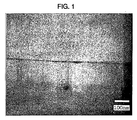
- FIG. 1 is a transmission electron microscope photograph (magnified 250,000 times) of a release layer cross-section for a release test piece.
- the lower side of the middle is the release layer, wherein a silicone layer having an average thickness of 5 nm is present on the surface layer of the release layer.
- a release layer is provided on a surface of the release material.
- the release layer according to the present invention can be provided directly on the substrate.
- a polyethylene laminate layer, an undercoating layer or etc. may be provided on the substrate and the release layer can be provided thereon.
- the release material according to the present invention comprises a substrate and a release layer thereon.
- the surface layer portion of the release layer preferably comprises a silicone layer having a thickness of from 1 to 100 nm. More preferably the thickness of the silicone layer is from 1 to 50 nm and still more preferably from 1 to 20 nm.
- the thickness of the silicone layer is the average value as determined by a transmission electron microscope. The above range is preferable because when the thickness of the silicone layer is within such a range, releasability as well as writability and printability are good. According to the present invention, a release material in which the silicone layer is unevenly distributed or localized on such a release layer surface can be obtained.
- the release layer of the release material according to the present invention may comprise a silicone constituent other than the silicone layer of the surface layer portion of the release layer.
- a continuous layer of a polymer having a carboxylate group which will be described below, is present in the layer of the surface portion other than the silicone layer. More preferable is a configuration in which the silicone is dispersed in the continuous layer.
- the amount of expensive silicone can be reduced, and the writability and printability are good, which is preferable.
- the release material according to the present invention has preferably from 10 to 30 atom% of surface layer silicon atomic concentration of the release layer as measured by an XPS (X-ray Photoelectron Spectroscope), has more preferably from 10 to 25 atom%, and has still more preferably from 15 to 25 atom%. Especially preferable is from 22 to 25 atom%.
- XPS X-ray Photoelectron Spectroscope
- the average silicon atomic concentration of the release layer as calculated from the silicone content ratio of the total solids content of the release layer is preferably from 0.2 to 4 atom%.
- the surface layer silicon atomic concentration as measured by an XPS (X-ray Photoelectron Spectroscope) is preferably at least 5 times greater than the average silicon atomic concentration of the release layer, and more preferably at least 10 times greater. When the concentration is within such a range, a release material can be obtained that is excellent in releasability as well as writability and printability even if the amount of silicone used is small.
- the silicone content ratio of the total solids content of the release layer is low i.e., 1 to 20 by mass%
- a release material having a surface layer silicon atomic concentration of 13 to 24 atom%, which is far greater than the average silicon atomic concentration of from 0.2 to 4 atom% in the release layer as calculated from said silicone content can be obtained, and as a result releasability becomes good. Since a material having good releasability in the present invention can be obtained even if a small amount of expensive silicone is used, the economical efficiency is advantageous. Further, because of excellent writability and printability, the present invention is particularly superior to the conventional art.
- the atom% which shows the silicon atomic concentration in the present invention represents the percentage of silicon atoms on the basis of the total of all of the number of atomic quantitative values having an atomic number greater than or equal to the atomic number of a carbon atom as measured by an XPS (X-ray Photoelectron Spectroscope).
- the XPS X-ray Photoelectron Spectroscope used for measuring irradiates X-rays at a test sample and then analyzes the kinetic energy of photoelectrons emitted from the surface.
- an ESCALAB 250 made by Thermo VG can be shown as an example.
- the release layer preferably comprises a polymer having a carboxylate group and a silicone.
- a polymer having a carboxylate group Compared with the use of a water-soluble resin such as polyvinyl alcohol, using a polymer having a carboxylate group achieves superior releasability, suppression of change with time, improved residual adherence, writability and printability on the release surface.
- the polymer having a carboxylate group used in the present invention is not particularly restricted, a totally or partially neutralized polymer which contains a carboxylic acid group obtained by polymerizing a monomer composition which contains an unsaturated carboxylic acid monomer can be shown as an example.
- the release layer is preferably the release material which comprises (A) a totally or partially neutralized product of a polymer having a carboxylic acid group, and (B) a silicone emulsion and/or silicone dispersion.
- the release material which comprises (A) a totally or partially neutralized product of a polymer having a carboxylic acid group, and (B) a silicone emulsion and/or silicone dispersion.
- a water-soluble resin such as polyvinyl alcohol
- the use of a polymer neutralized product according to the present invention in the release agent layer can achieve superior releasability, suppression of change with time, improved residual adherence, writability and printability on the release surface.
- the polymer having a carboxylic acid group used in the present invention is not particularly restricted, the emulsion copolymer of a monomer composition which contains an
- the ratio of silicone content to the total solids content of the release layer is not particularly restricted, from 1 to 90 mass% is preferable.
- a silicone content of 1 mass% or more is preferable in terms of development releasability, 5 mass% or more is further preferable and 10 mass% or more is still further preferable.
- a content of 90 mass% or less is economically preferable because the amount of expensive silicone used is lower, while a content of 50 mass% or less is more preferable in terms of writability and printability, 30 mass% or less is still more preferable and 20 mass% or less is especially preferable.
- the present invention is excellent in release properties with a lower silicone content as compared to the prior art, and is characterized in being superior in writability and printability.
- the content of the polymer having a carboxylate group used in the present invention is preferably from 10 to 99 mass%. More preferable is 95 mass% or less and 90 mass% or less is still more preferable. A content of 10 mass% or more is preferable, more preferable is 50 mass% or more, 70 mass% or more is still more preferable and 80 mass% or more is especially preferable. When the content of the polymer having a carboxylate group is within such a range, releasability as well as writability and printability are good, and so is preferable.
- the release agent according to the present invention comprises a polymer having a carboxylate group and silicone.
- the release agent according to the present invention can be preferably used to produce the release material according to the present invention.
- the release agent according to the present invention preferably comprises a neutralized resin which can be obtained from the neutralization reaction of an emulsion copolymer of a monomer composition containing from 5 to 80 mass% of an unsaturated carboxylic acid monomer with a basic substance.
- a neutralized resin which can be obtained from the neutralization reaction of an emulsion copolymer of a monomer composition containing from 5 to 80 mass% of an unsaturated carboxylic acid monomer with a basic substance.
- the polymer having a carboxylate group used in the present invention preferably has from 5 to 80 mass% of a mass fraction of the unsaturated carboxylate monomer based on all the monomers used in polymerization, more preferably from 10 to 60 mass% and still more preferably from 15 to 50 mass%.
- the mass fraction of the unsaturated carboxylate monomer is preferably within this range because emulsion stability as well as water solubility and swelling property of the resin constituent obtained from the neutralization reaction of the emulsion are good.
- the polymer having a carboxylate group used in the present invention can be obtained, for example, by means of the total or partial neutralization of a product prepared from an unsaturated carboxylic acid monomer, and if necessary, a monomer composition containing other polymerizable monomers according to an ordinary emulsion polymerization method.
- the emulsion copolymer used in the present invention preferably has a mass fraction of the unsaturated carboxylic acid monomer based on all the monomers used in the polymerization of from 5 to 80 mass%, more preferably from 10 to 60 mass% and still more preferably from 15 to 50 mass%.
- mass fraction of the unsaturated carboxylic acid monomer is within this range, emulsion stability as well as water solubility and swelling property of the neutralized resin obtained from the neutralization reaction of the emulsion are good and so is preferable.
- the emulsion copolymer used in the present invention can be prepared according to an ordinary emulsion polymerization method from an unsaturated carboxylic acid monomer and optionally, a monomer composition containing other polymerizable monomers.
- the unsaturated carboxylic acid monomer used in the present invention is not particularly restricted as long as it has a carboxylic acid group and polymerizable double bonds, examples include an unsaturated monocarboxylic acid monomer such as acrylic acid and methacrylic acid; an unsaturated polycarboxylic acid monomer such as itaconic acid, fumaric acid and maleic acid; and an ester which maintains one or more of these carboxylic acid groups. From the standpoint of development of releasability and coating properties, acrylic acid or methacrylic acid is preferably used. These unsaturated carboxylic acid monomers can be used in a combination of two or more.
- the polymer having a carboxylic acid group, the polymer having a carboxylate group and other polymerizable monomers used in the emulsion copolymer, all of which are used in the present invention, are not particularly restricted as long as they can copolymerize with the unsaturated carboxylic acid monomer.
- acrylic ester and methacrylic ester are preferably used. These polymerizable monomers can be used singly or in combination.
- the glass transition point temperature for the polymer having a carboxylic acid group, the polymer having a carboxylate group and the emulsion copolymer, all of which are used in the present invention is not particularly restricted, from the standpoint of coating properties such as coating strength and releasability, it is preferably from -35°C to 140°C and more preferably from -25°C to 100°C.
- the release agent according to the present invention contains a neutralized resin (A) which is obtainable by the neutralization of the emulsion copolymer with a basic substance.
- A a neutralized resin
- the emulsion copolymer emulsifies and disperses in water in particle form under acidic conditions of a pH of less than 3, it dissolves or swells in water, when the pH is raised by adding a basic substance.
- the neutralized resin used in the present invention is water-soluble or a substance that has water-swelling properties.
- the basic substance used in the present invention is not particularly restricted as long as it dissolves or swells the emulsion copolymer in water by the neutralization reaction of the unsaturated carboxylic acid moiety of the emulsion copolymer.
- the basic substance examples include metal hydroxides such as lithium hydroxide, sodium hydroxide and potassium hydroxide; fatty amine compounds such as ammonia, ethylamine, diethylamine, triethylamine, cyclohexylamine, allylamine, ethylenediamine, triethylenetetramine, and ethanol amine; and aromatic amines such as an aniline.
- metal hydroxides such as lithium hydroxide, sodium hydroxide and potassium hydroxide
- fatty amine compounds such as ammonia, ethylamine, diethylamine, triethylamine, cyclohexylamine, allylamine, ethylenediamine, triethylenetetramine, and ethanol amine
- aromatic amines such as an aniline.
- ammonia or fatty amine compounds are preferably used, and ammonia is especially preferably used.
- Releasability and residual adhesion can be improved by dissolving or swelling the emulsion copo
- the pH of the neutralized resin after the neutralization reaction of the emulsion copolymer with a basic substance is not particularly limited, from 3 to 13 is preferable, 5 to 12 is more preferable and 6 to 10 is still more preferable.
- the pH is preferably within this range because releasability, residual adhesion and water solubility and swelling property of the resin constituent obtained by the emulsion neutralization reaction are good.
- the method of neutralization reaction in the present invention is not particularly limited, a method of adding and stirring an aqueous solution of a basic substance to the emulsion copolymer until the defined pH is reached can be shown as an example.
- the concentration of the aqueous solution of the basic substance to be added is not particularly restricted, but is preferably from 1 to 20 mass%, more preferably from 2 to 10 mass% in order to obtain a suitable release agent concentration and to avoid thickening and gelling due to localized neutralization reactions.
- the emulsion copolymer concentration in the release agent according to the present invention is not particularly limited, in order to obtain a suitable release agent viscosity, from 1 to 50 mass% is preferably used, and from 5 to 40 mass% is more preferably used.
- the release agent according to the present invention preferably comprises (B) a silicone emulsion and/or a silicone dispersion.
- the release agent preferably comprises (B) a silicone emulsion and/or a silicone dispersion (when only one of them is used, this means the individual number average particle diameter, and when a mixture of them is used, this means the number average particle diameter of the mixture) having a number average particle diameter of 200 nm or less as measured by dynamic light scattering.
- the silicone compound used in the release agent according to the present invention is preferably in an emulsion or dispersion state and preferably has a number average particle diameter for (B) the silicone emulsion and/or silicone dispersion as measured by dynamic light scattering of 200 nm or less. Further, the number average particle diameter for (B) the silicone emulsion and/or silicone dispersion is preferably from 1 to 200 nm. The number average particle diameter is preferably 200 nm or less because the peel strength becomes very low compared with the case when the particle diameter is large. The number average particle diameter is preferably 1 nm or more because preparation of (B) the silicone emulsion and/or silicone dispersion is made easy.
- the number average particle diameter is especially preferably from 1 to 100 nm because releasability is further improved. It is not clear why the peel strength gets smaller when the number average particle diameter is 200 nm or less, but it is conjectured that releasability improves because the silicone constituent tends to become localized on the surface during release layer formation when the number average particle diameter of the silicone emulsion and/or silicone dispersion is 200 nm or less.
- the silicone emulsion used in the present invention is obtained by emulsifying a silicone compound in a solvent using a surfactant such as a nonionic type emulsifier.
- the silicone dispersion is obtained by dispersing a silicone compound in a solvent using modification due to a hydrophilic group and the like without the use of a surfactant.
- silicone oils such as a Si-H group-containing silicone, dimethylpolysiloxane, methylphenyl polysiloxane, alkoxy group-containing silicone, silanol group-containing silicone, octamethylcyclotetrasiloxane, and decamethylcyclopentasiloxane; and modified silicones such as vinyl silicone, polyether modified silicone, polyglycerin modified silicone, amino modified silicone, epoxy modified silicone, mercapto modified silicone, methacrylic modified silicone, carboxylic-acid modified silicone, fatty-acid-ester modified silicone, alcoholic modified silicone, alkyl modified silicone, fluoroalkyl modified silicone and photopolymerizable functional group modified silicone. These silicones may be present individually, or two types or more may coexist together.
- the silicone used in the present invention preferably is a curable silicone.
- a curable silicone improves releasability, allows the change'in peel strength over time to be suppressed, and increases the residual adhesion ratio.
- the curable silicone is not particularly limited as long as it can cure by heat, ultraviolet rays, an electron beam and the like. Examples include addition type curing from a Si-H group-containing silicone and a vinyl silicone, condensation type curing from a Si-H group-containing silicone and a silanol group-containing silicone, and UV curing from a photopolymerizable functional group modified silicone. Especially, addition type curing from a Si-H group-containing silicone and a vinyl silicone is preferable from the point of curability.
- Si-H group-containing silicone used in the present invention is not particularly restricted, but polymethyl hydrogen siloxane is preferably used.
- the group VIII metal compound used in the present invention is not particularly restricted.
- Examples include platinum group compounds, namely the compounds of ruthenium, rhodium, palladium, osmium, iridium and platinum are suitable, and in particular compounds of platinum and palladium are preferable.
- platinum compounds include platinum chloride (II), platinum chloride (IV), chloroplatinic acids such as tetrachloroplatinic acid (II) and hexachloroplatinic acid (IV), ammonium hexachloroplatinate (IV), potassium hexachloroplatinate (IV), platinum hydroxide (II), platinum dioxide (IV), dichloro-dicyclopentadienyl-platinum (II), a platinum-vinylsiloxane complex, a platinum-phosphine complex, a platinum-olefin complex, a chloroplatinic acid-olefin complex, elemental platinum and a material carrying solid platinum on alumina, silica or active carbon.
- chloroplatinic acids such as tetrachloroplatinic acid (II) and hexachloroplatinic acid (IV), ammonium hexachloroplatinate (IV), potassium hexachloroplatinate (IV),
- the palladium compound examples include palladium (II) chloride, ammonium tetraammine-chloropalladate (II) and palladium (II) oxide.
- a chloroplatinic acid and a chloroplatinic acid-olefin complex can be more preferably used.
- the amount of group VIII metal compound used is usually from 5 to 1000 ppm of the total silicone amount.
- a reaction inhibitor can be added to the release agent according to the present invention.
- examples include organic nitrogen compounds such as a hydrazine or a triazole; organic phosphorous compounds such as a phosphine; organic sulfur compounds such as a mercaptan; and acetylene compounds such as an acetylene alcohol, cyclic methylvinylsiloxane and a siloxane modified acetylene alcohol.
- the ratio of the Si-H group-containing silicone to the vinyl silicone is not particularly restricted, usually it is from 0.5 to 10 of the ratio given by (number of Si-H mols)/(number of vinyl group mols). From a standpoint of curability, from 1.0 to 3.0 is preferably used.
- silicone compound having such a ratio of (number of Si-H mols)/(number of vinyl group mols) silicone emulsions such as SLJ1519 A/B, DEHESIVE 400 E/V20, DEHESIVE 39005VP/39006VP made by the Wacker Asahi Kasei Silicone Co., Ltd. can be shown as examples.
- the ratio of silicone content to the total solids content of the release agent is not particularly restricted, but is preferably from 1 to 90 mass%.
- a silicone content of 1 mass% or more is preferable from the point of releasability development, 5 mass% or more is more preferable and 10 mass% or more is still more preferable.
- a silicone content of 90 mass% or less is economically preferable because a lower amount of expensive silicone is used, while a content of 50 mass% or less is more preferable in terms of writability and printability expression, 30 mass% or less is still more preferable and 20 mass% or less is especially preferable.
- the present invention is characterized in being excellent in release properties while having a lower silicone content than the conventional art, and superior in writability and printability.
- the polymer content having a carboxylate group used in the present invention is preferably from 10 to 99 mass%. More preferable is 95 mass% or less and 90 mass% or less is still more preferable. A content of 10 mass% or more is preferable, more preferable is 50 mass% or more, 70 mass% or more is still more preferable and 80 mass% or more is especially preferable.
- the content of the polymer having a carboxylate group is within such a range, releasability as well as writability and printability are good, and therefore is preferable.
- the production method of the release agent according to the present invention is not particularly limited, a method in which the agent can be produced by, for example, mixing and stirring the silicone emulsion and/or silicone dispersion according to the present invention into the neutralized resin according to the present invention can be cited as an example.
- the addition type curing reaction is conducted during the course of heating and drying using a Si-H group-containing silicone and vinyl silicone as the silicone emulsion and/or silicone dispersion, from the standpoint of shelf-life and stability of the release solution, it is preferable to, immediately before coating, mix the silicone emulsion and/or silicone dispersion comprising a Si-H group-containing silicone and the silicone emulsion and/or silicone dispersion comprising a vinyl silicone and a curing catalyst such as a platinum group compound, and then mix and stir by adding the liquid mixture to the neutralized resin according to the present invention for preparation.
- a curing catalyst such as a platinum group compound
- the release agent according to the present invention by mixing and stirring release stock solution C, obtained by (C) mixing and stirring the silicone emulsion and/or silicone dispersion comprising a vinyl silicone, the curing catalyst such as a platinum group compound and the neutralized resin according to the present invention, with release stock solution D, which comprises (D) the silicone emulsion and/or silicone dispersion comprising a Si-H group-containing silicone, just before coating.
- release stock solution D which comprises (D) the silicone emulsion and/or silicone dispersion comprising a Si-H group-containing silicone, just before coating.
- the mixing and stirring method is not particularly restricted, but it is preferable in terms of releasability development to uniformly disperse the silicone emulsion and/or silicone dispersion.
- the mixing style and mixing time are preferably selected so as to achieve uniform dispersion.
- solvents other than water in the release agent according to the present invention for improving film formability and the like.
- solvents include water-soluble solvents such as alcohols, for example, ethylene glycol monobutyl ether, propylene glycol monobutyl ether, 2,2,4-trimethyl-1,3-pentanediol monoisobutyrate, and benzyl alcohol; esters, for example, diethylene glycol monobutyl ether acetate; and ketones.
- the release agent according to the present invention may comprise, as needed, a polymer emulsion such as SB latex and acrylic latex; a water-soluble resin such as polyvinyl alcohol, silanol modified polyvinyl alcohol, carboxyl modified polyvinyl alcohol, cation modified polyvinyl alcohol, acetoacetyl modified polyvinyl alcohol, acetal modified polyvinyl alcohol, polyvinyl pyrrolidone, polyacrylic acid, polyacrylate, polyacrylamide, starch, casein, gelatin, carboxymethyl cellulose and hydroxyethyl cellulose; a release control agent such as a polymer resin or an elastomer; pigments such as a cross linking agent, a silica, clay, and calcium carbonate; a lubricant; a silane coupling agent; a wetting agent; a defoaming agent; a thickener; a pigment dispersion agent, and an additive.
- a polymer emulsion such as SB late
- examples include permeable substrates, for example paper such as fine quality paper, Kraft paper, glassine and coated paper, cloth such as woven or non-woven fabric, timber, concrete, mortar, cement plate, brick, tile and stone; and non-permeable substrates, for example resin laminated paper such as polyethylene laminated paper, resin coated paper which has polyvinyl alcohol, starch, SB latex or the like coated on fine quality paper, resin films such as polypropylene and polyethylene terephthalate, resin tape, resin sheets, plastic plates, metal plates, and metallic foil. While all of these may be used, usually, paper, cloth, resin laminated paper, resin coated paper, resin film, resin tape and resin sheets are preferably used.
- permeable substrates for example paper such as fine quality paper, Kraft paper, glassine and coated paper, cloth such as woven or non-woven fabric, timber, concrete, mortar, cement plate, brick, tile and stone
- non-permeable substrates for example resin laminated paper such as polyethylene laminated paper, resin coated paper which has polyvinyl alcohol,
- a permeable substrate for example paper such as fine quality paper, Kraft paper, glassine paper, coated paper, or cloth such as woven or non-woven fabric
- a permeable substrate for example paper such as fine quality paper, Kraft paper, glassine paper, coated paper, or cloth such as woven or non-woven fabric
- This substrate is especially preferable as releasability can be brought about with a lower amount of silicon than that in the conventional art.
- release paper, adhesive sheets, tack paper, labels, stickers, emblems, delivery receipts, adhesive tape, Kraft tape, process paper and the like can be preferably produced.
- the surface substrate used for the adhesive sheet according to the present invention is not particularly restricted, examples include paper such as fine quality paper, coated paper, cast coated paper, thermosensitive paper and inkjet paper, cloth such as woven or non-woven fabric, resin films such as polyvinyl chloride, synthetic paper, polyethyleneterephthalate, polypropylene, polyethylene, cellulose triacetate, cellulose diacetate, polystyrene, polycarbonate, nylon, polyvinyl alcohol, ethylene-vinyl acetate copolymer and polyamide, porous resin films such as porous polypropylene film, metallized films such as PET or polyolefin having a metal such as aluminum deposited thereon and metal foil.
- paper such as fine quality paper, coated paper, cast coated paper, thermosensitive paper and inkjet paper
- cloth such as woven or non-woven fabric
- resin films such as polyvinyl chloride, synthetic paper, polyethyleneterephthalate, polypropylene, polyethylene, cellulose triacetate, cellulose diacetate, polys
- the adhesive used for the adhesive layer in the adhesive tape or the adhesive sheet according to the present invention is not particularly restricted, examples include natural rubber adhesives, synthetic rubber adhesives such as a styrene-isoprene-styrene block copolymer, a styrene-ethylene-butadiene-styrene copolymer, a styrene-butadiene-styrene block copolymer, water and alkaline-insoluble types such as acrylic adhesives, and water-soluble or water-dispersible adhesives and alkali-soluble or alkali-dispersible adhesives excellent in solubility and dispersibility in the course of paper recycling.
- natural rubber adhesives such as a styrene-isoprene-styrene block copolymer, a styrene-ethylene-butadiene-styrene copolymer, a styrene-butadiene-styrene block
- a water-soluble or water-dispersible adhesive an alkali-soluble or alkali-dispersible adhesive is preferably used.
- a water-soluble or water-dispersible adhesive include acrylic acid-containing polymers such as polyvinyl alcohol, polyacrylamide, polyvinylmethylether, ethylacrylate-acrylic acid copolymer, dextrin and polyvinylpyrrolidone.
- alkali-soluble or alkali-dispersible adhesives include metal chelate crosslinked substances of the carboxyl group or hydroxyl group-containing monomer copolymers disclosed in JP-A-6-184508.
- an adhesive resin examples include rosins, coumarone-indenes, terpenes, petroleum, styrenes, phenols and xylenes.
- an adhesive resin examples include rosins, coumarone-indenes, terpenes, petroleum, styrenes, phenols and xylenes.
- a softener examples include polybutene, polyisobutylene, polyisoprene, process oil and naphthene oils.
- an antioxidant examples include phenols and amines.
- a filler examples include calcium carbonate and carbon black.
- the release material according to the present invention can be produced by applying the release agent onto a substrate and drying it.
- the application method is not particularly restricted, and a size press, blade coater, air knife coater, roll coater, brush coater, curtain coater, bar coater, gravure coater, sprayer and the like can be used.
- the drying method and drying temperature are not particularly restricted; air drying, hot-air drying, ultraviolet radiation drying and the like can be cited as examples, wherein the drying temperature employed is preferably from 80 to 250°C, more preferably from 100 to 250°C and especially preferable is from 120 to 200°C. A drying temperature within this range is preferable because releasability and productivity of the drying process are good.
- a silicone application amount of from 0.01 to 10 g/m 2 is preferable, 0.05 to 5 g/m 2 is more preferable and 0.1 to 1 g/m 2 is still more preferable.
- the amount of silicone application is within this range, releasability is sufficient and the amount of silicone used is low, and so this amount is economically preferable.
- smoothness can be adjusted by a supercalender, a gloss calendar and the like.
- the application method for the adhesive used on the adhesive tape or adhesive sheet according to the present invention is not particularly restricted, a blade coater, air knife coater, roll coater, brush coater, bar coater, gravure coater, reverse coater, comma coater, kiss coater and the like can be used.
- the amount of the adhesive agent is not particularly restricted, from 5 to 100 g/m 2 is preferably used and from 10 to 50 g/m 2 is more preferably used in view of the adhesive property and the fact that protrusion of the adhesion from the tape or sheet does not occur.
- the transmission electron microscope photograph was taken using a transmission electron microscope H-7100 manufactured by Hitachi, Ltd. at an acceleration voltage of 75 kV to obtain a photograph of a release layer cross-section, wherein an ultra-thin section had been prepared using an ultra-microtome after embedding a test piece on an epoxy resin and curing.
- the surface layer silicon atomic concentration of the release layer according to an XPS was measured using an ESCALAB 250 (takeoff angle of 90 degrees) made by Thermo VG.
- Number average particle diameter according to dynamic light scattering was measured using a Microtrac UPA particle size analyzer manufactured by Leeds & Northrup.
- Evaluation of the release material was carried out by sticking adhesive tape (Nitto Denko 31B, width 5 cm) on a test piece, wherein the initial peel strength was measured at a pulling direction of 180° and a pulling speed of 0.3 m/min using a pulling testing machine.
- the change in peel strength over time was measured in the same manner, after a test piece that had adhesive tape stuck thereto had been stored at 23°C, 50% RH for 14 days.
- the residual adhesion ratio was expressed as the percentage of a peel strength which was measured by sticking an adhesive tape of which the 14-day peel strength had been measured, to an aluminum sheet, based on a peel strength which was measured by sticking an unused adhesive tape to an aluminum sheet.
- the peel strength of the unused adhesive tape was 11.8 N/5 cm.
- Evaluation of writability was determined by writing on a test piece using a permanent marker, then wiping off with tissue paper and visually observing any writing traces. Evaluation of printability was determined by printing on a test piece using a commercially available inkjet printer (PM-950C manufactured by Epson Corp.), then wiping off with tissue paper and visually observing any printing traces. The evaluation standards are shown below.
- Test pieces were obtained in the same manner as those in Example 1, except for the silicon emulsion being changed to a silicon emulsion SLJ1519 A/B (manufactured by Wacker Asahi Kasei Silicone Co., Ltd., number average particle diameter 100 nm, silicone constituent 50 mass%, a mixture of Si-H group-containing silicone, vinyl silicone and a platinum compound).
- the evaluation results of the test pieces are shown in Table 1.
- Test pieces were obtained in the same manner as those in Example 2, except for the alkaline used in the neutralization reaction being changed from 10 mass% aqueous ammonia to 10 mass% aqueous sodium hydroxide. The evaluation results of the test pieces are shown in Table 1.
- Test pieces were obtained in the same manner as those in Example 1, except for the silicone emulsion being changed to a silicone emulsion DEHESIVE 400 E/V20 (manufactured by Wacker Asahi Kasei Silicone Co., Ltd., number average particle diameter 180 nm, silicone constituent 48 mass%, a mixture of Si-H group-containing silicone, vinyl silicone and a platinum compound).
- the evaluation results of the test pieces are shown in Table 1.
- the evaluation results of the test pieces are shown in Table 1.
- the evaluation results of the test pieces are shown in Table 1.
- the evaluation results of the test pieces are shown in Table 1.
- Test pieces were obtained in the same manner as those in Example 1, except for the acrylic latex being used as is, without neutralization with aqueous ammonia. The evaluation results of the test pieces are shown in Table 1.
- Example 7 A transmission electron microscope photograph of a test piece cross-section of Example 7 is shown in FIG. 1.
- Test pieces were obtained in the same manner as those in Example 7, except for the silicon emulsion being changed to a silicon emulsion DEHESIVE 400 E/V20 (manufactured by Wacker Asahi Kasei Silicone Co., Ltd., number average particle diameter 180 nm, silicone constituent 48 mass%, a mixture of Si-H group-containing silicone, vinyl silicone and a platinum compound).
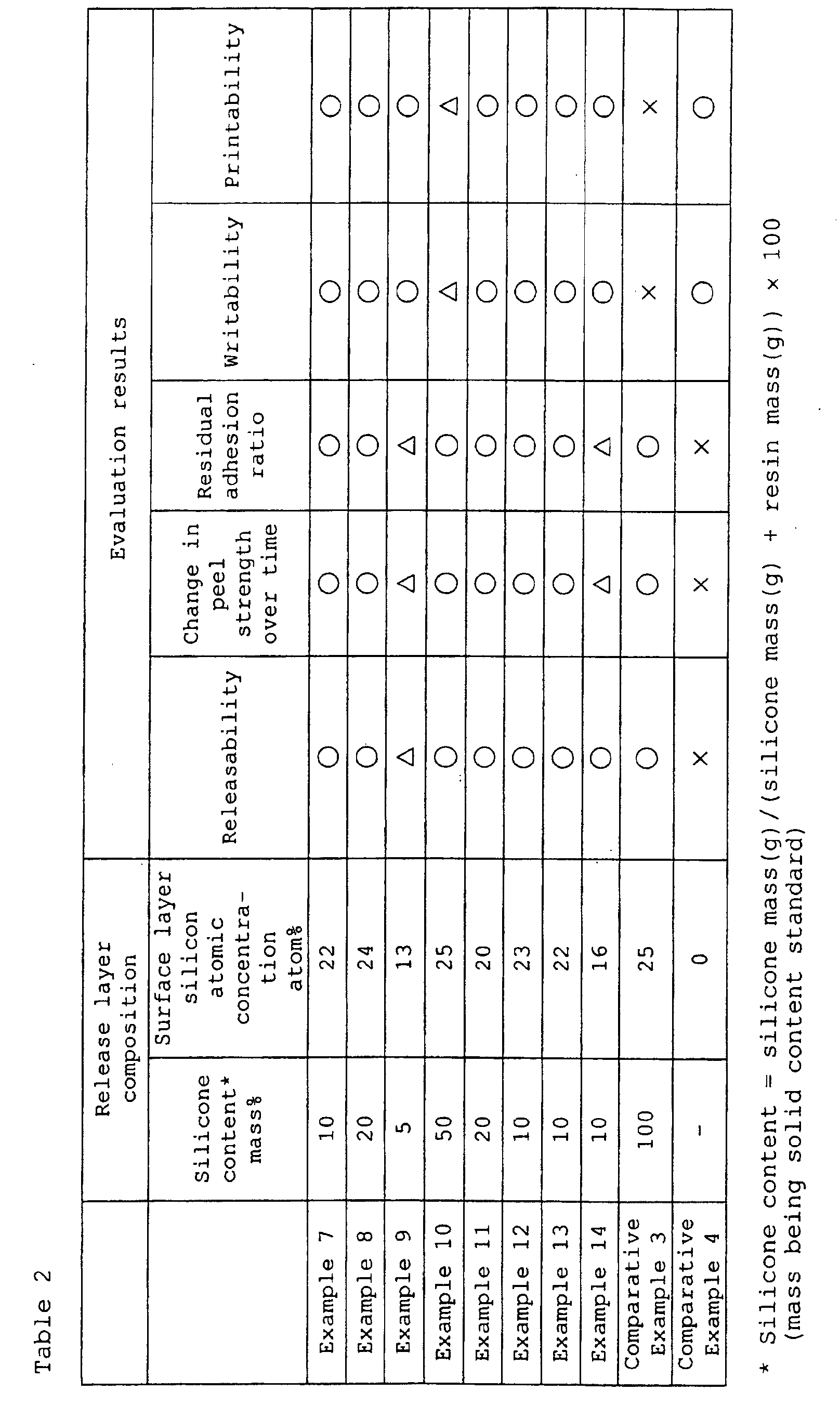
- the evaluation results of the test pieces are shown in Table 2.
- the evaluation results of the test pieces are shown in Table 2.
- This release stock solution was stored at 23°C for 30 days, then added to a silicon emulsion SLJ1519A (manufactured by Wacker Asahi Kasei Silicone Co., Ltd., number average particle diameter 150 nm, silicone constituent 50 mass%, Si-H group-containing silicone) to give the silicone content as shown in Table 2. Water was added to give a solids content concentration of 15%, then the solution was mixed and stirred to prepare a release agent solution. This release agent solution was used to obtain test pieces in the same manner as those in Example 7. The evaluation results for these test pieces are shown in Table 2.
- Test pieces were obtained in the same manner as those in Example 7, except for the drying temperature after application of the release agent solution to the Kraft paper being changed from 140°C to 100°C. The evaluation results for these test pieces are shown in Table 2.
- Test pieces having a silicone application amount of 0.5 g/m 2 were obtained in the same manner as those of Example 7, except that a substrate that was laminated (film thickness 15 microns) by melt extrusion of low-density polyethylene (manufactured by Asahi Kasei) onto Kraft paper was used as the release substrate, and that a mixture of an addition-reaction type silicone SD7220 and a curing catalyst SRX212CAT (manufactured by Dow Corning Toray Silicone Co., Ltd., toluene solution, silicone constituent 30 mass%) was used as the release agent solution.
- the evaluation results for these test pieces are shown in Table 2.
- Test pieces having a silicone application amount of 0.5 g/m 2 were obtained in the same manner as those of Example 7, except that a long chain alkyl pendant type polymer - pyyrole 1010 (manufactured by Ipposha Oil Industries Co., Ltd., toluene solution) was used as the release agent solution.
- the evaluation results for these test pieces are shown in Table 2.
- the release material according to the present invention allows for production using direct coating onto a substrate without requiring the application of an undercoating material even when using a permeable substrate such as paper.
- This material has excellent releasability even when the amount of silicone used is small, has a low change in peel strength over time, has a high residual adhesion ratio for an adhesive tape, seal and the like after release from a release material, and is excellent in writability and printability to the release surface.
Landscapes
- Chemical & Material Sciences (AREA)
- Organic Chemistry (AREA)
- Engineering & Computer Science (AREA)
- Materials Engineering (AREA)
- Chemical Kinetics & Catalysis (AREA)
- Life Sciences & Earth Sciences (AREA)
- Wood Science & Technology (AREA)
- Laminated Bodies (AREA)
- Adhesive Tapes (AREA)
- Adhesives Or Adhesive Processes (AREA)
- Paper (AREA)
- Paints Or Removers (AREA)
Abstract
Description
- ○:
- 0 ≤ (initial peel strength) ≤ 0.20 N/5 cm
- Δ:
- 0.20 < (initial peel strength) ≤ 0.98 N/5 cm
- ×:
- 0.98 N/5 cm < (initial peel strength)
- ○:
- 0 ≤ (peel strength) ≤ 0.20 N/5 cm
- Δ:
- 0.20 < (peel strength) ≤0.98 N/5 cm
- ×:
- 0.98 N/5 cm < (peel strength)
- ○:
- 85% ≤ (residual adherence) ≤ 100%
- Δ:
- 65% ≤ (residual adherence) < 85%
- ×:
- (residual adherence) < 65%
- ○:
- generally completely remaining
- Δ:
- partially remaining
- ×:
- nothing remaining
- ○:
- generally completely remaining
- Δ:
- partially remaining
- × :
- nothing remaining

Claims (39)
- A release material comprising a substrate and a release layer on said substrate, wherein a surface portion of said release layer has a silicone layer having a thickness of from 1 to 100 nm.
- The release material according to claim 1, wherein the silicone layer of the surface portion of said release layer has a thickness of from 1 to 50 nm.
- A release material comprising a substrate and a release layer on said substrate, wherein said release layer comprises a polymer having a carboxylate group and a silicone.
- A release material comprising a substrate and a release layer on said substrate, wherein said release layer is prepared using:(A) a neutralized resin obtained from a neutralization reaction of an emulsion copolymer of a monomer composition containing from 5 to 80 mass% of an unsaturated carboxylic acid monomer with a basic substance; and(B) a silicone emulsion and/or a silicone dispersion.
- The release material according to claim 4, wherein said (B) silicone emulsion and/or a silicone dispersion has a number average particle diameter of 200 nm or less as measured by dynamic light scattering.
- The release material according to any one of claims 4 - 5, wherein the neutralized resin is water-soluble.
- The release material according to any one of claims 4 to 6, wherein the unsaturated carboxylic acid monomer is acrylic acid and/or methacrylic acid.
- The release material according to any one of claims 4 to 7, wherein the basic substance is ammonia.
- The release material according to any one of claims 4 to 8, wherein the neutralized resin has a pH of from 3 to 13.
- The release material according to any one of claims 4 to 9, wherein said release layer has a surface portion silicone layer having a thickness of from 1 to 100 nm.
- The release material according to claim 10, wherein said release layer has a surface portion silicone layer having a thickness of from 1 to 50 nm.
- A release material comprising a substrate and a release layer on said substrate, wherein the surface silicon atomic concentration of said release layer as measured by an XPS (X-ray Photoelectron Spectroscope) is from 10 to 30 atom%.
- The release material according to any one of claims 1 to 11, wherein the surface silicon atomic concentration of said release layer as measured by an XPS (X-ray Photoelectron Spectroscope) is from 10 to 30 atom%.
- The release material according to claim 12 or 13, wherein the silicone content of the release layer is from 1 to 90 mass%.
- The release material according to claim 14, wherein the silicone content of the release layer is from 1 to 50 mass%.
- A release material comprising a substrate and a release layer on said substrate, wherein the surface silicon atomic concentration of said release layer as measured by an XPS (X-ray Photoelectron Spectroscope) is at least 5 times greater than the average silicon atomic concentration of the release layer as calculated from the silicone content of said release layer.
- The release material according to any one of claims 1 to 15, wherein the surface silicon atomic concentration of said release layer as measured by an XPS (X-ray Photoelectron Spectroscope) is at least 5 times greater than the average silicon atomic concentration of the release layer as calculated from the silicone content of said release layer.
- The release material according to claim 16 or 17, wherein the average silicon atomic concentration of the release layer as calculated from the silicone content of said release layer is from 0.2 to 4 atom%.
- The release material according to any one of claims 1 to 18, wherein the silicone in said release layer is a curable silicone.
- The release material according to any one of claims 1 to 19, wherein the silicone in said release layer substantially comprises a cured material obtained from an Si-H group-containing silicone and a vinyl silicone.
- The release material according to any one of claims 1 to 20, wherein the substrate is selected from the group consisting of paper, cloth, resin laminated paper, resin coated paper, a resin film, a resin tape and a resin sheet.
- The release material according to claim 21, wherein the substrate is either paper or cloth.
- A release agent comprising a polymer having a carboxylate group and a silicone.
- The release agent according to claim 23, wherein the silicone comprises a silicone in the state of a silicone emulsion and/or silicone dispersion.
- A release agent comprising:(A) a neutralized resin obtained from a neutralization reaction of an emulsion copolymer of a monomer composition containing from 5 to 80 mass% of an unsaturated carboxylic acid monomer with a basic substance; and(B) a silicone emulsion and/or a silicone dispersion.
- The release agent according to claim 24 or 25, wherein said (B) silicone emulsion and/or a silicone dispersion has a number average particle diameter of 200 nm or less as measured by dynamic light scattering.
- The release material according to any one of claims 23 to 26, wherein the silicone content is from 1 to 90 mass% based on the total solids content of the release agent.
- The release agent according to claim 27, wherein the silicone content is from 1 to 50 mass% based on the total solids content of the release agent.
- The release agent according to any one of claims 25 to 28, wherein the neutralized resin is water-soluble.
- The release agent according to any one of claims 25 to 29, which is prepared by mixing:(C) a release agent stock solution C, which comprises (c-1) a neutralized resin obtained from a neutralization reaction of an emulsion copolymer of a monomer composition containing from 5 to 80 mass% of an unsaturated carboxylic acid monomer with a basic substance: and (c-2) a silicone emulsion and/or a silicone dispersion containing the vinyl silicone and a group VIII metal compound; with(D) a release agent stock solution D, which comprises a silicone emulsion and/or silicone dispersion containing a Si-H group-containing silicone.
- A method of producing a release material, comprising the steps of applying the release agent according to any one of claims 23 to 30 onto a substrate and drying it.
- The method of producing a release material according to claim 31, wherein said drying is carried out at a temperature of from 100 to 250°C.
- The method of producing a release material according to claim 31 or 32, wherein the substrate is selected from the group consisting of paper, cloth, resin laminated paper, resin coated paper, a resin film, a resin tape and a resin sheet.
- The method of producing a release material according to claim 33, wherein the substrate is either paper or cloth.
- An adhesive tape comprising a substrate, a release layer on one side of said substrate and an adhesive layer on the other side thereof, wherein said substrate and said release layer constitute the release material according to any one of claims 1 to 22.
- A method of producing an adhesive tape, which comprises a substrate, a release layer on one side of said substrate and an adhesive layer on the other side thereof, wherein the release material comprising said release layer and said substrate are produced according to the production methods of a release material according to any one of claims 31 to 34.
- The adhesive tape according to claim 35 or the method of producing an adhesive tape according to claim 36, wherein the adhesive layer is a water-soluble or water-dispersible adhesive, or an alkali-soluble or alkali-dispersible adhesive.
- An adhesive sheet comprising a release substrate; a release layer on said release substrate; and an adhesive layer and a surface substrate laminated on said release layer in that order, wherein said release layer and said release substrate constitute the release material according to any one of claims 1 to 22.
- A method of producing an adhesive sheet, which comprises a release substrate; a release layer on said release substrate; and an adhesive layer and a surface substrate laminated on said release layer in that order; wherein the release material comprising said release layer and said release substrate are produced according to the production methods of a release material according to any one of claims 31 to 34.
Applications Claiming Priority (3)
| Application Number | Priority Date | Filing Date | Title |
|---|---|---|---|
| JP2002026934 | 2002-02-04 | ||
| JP2002026934 | 2002-02-04 | ||
| PCT/JP2003/001129 WO2003066327A1 (en) | 2002-02-04 | 2003-02-04 | Releasing material and release agent |
Publications (3)
| Publication Number | Publication Date |
|---|---|
| EP1473150A1 true EP1473150A1 (en) | 2004-11-03 |
| EP1473150A4 EP1473150A4 (en) | 2006-05-24 |
| EP1473150B1 EP1473150B1 (en) | 2012-08-08 |
Family
ID=27677826
Family Applications (1)
| Application Number | Title | Priority Date | Filing Date |
|---|---|---|---|
| EP20030703164 Expired - Lifetime EP1473150B1 (en) | 2002-02-04 | 2003-02-04 | Releasing material and release agent |
Country Status (7)
| Country | Link |
|---|---|
| US (1) | US7579060B2 (en) |
| EP (1) | EP1473150B1 (en) |
| JP (1) | JP4386734B2 (en) |
| KR (1) | KR100793129B1 (en) |
| CN (2) | CN1628029B (en) |
| AU (1) | AU2003207202A1 (en) |
| WO (1) | WO2003066327A1 (en) |
Cited By (1)
| Publication number | Priority date | Publication date | Assignee | Title |
|---|---|---|---|---|
| EP2965306A4 (en) * | 2013-03-07 | 2016-01-27 | Ricoh Co Ltd | ADHESIVE LABEL FOR INKJET RECORDING |
Families Citing this family (18)
| Publication number | Priority date | Publication date | Assignee | Title |
|---|---|---|---|---|
| US20080102240A1 (en) * | 2006-10-27 | 2008-05-01 | Covalence Specialty Materials Corp. | Polymeric composite adhesive tape |
| US20080318010A1 (en) * | 2007-06-20 | 2008-12-25 | Wozniak John C | Release liner having print receptive surface and methods for manufacturing and using |
| CN103147354B (en) * | 2008-03-20 | 2015-01-21 | 耐恒有限责任公司 | Paper substrates useful as universal release liners |
| JP5174092B2 (en) * | 2009-08-31 | 2013-04-03 | 日東電工株式会社 | Adhesive film with dicing sheet and method for producing the same |
| JP5479484B2 (en) * | 2009-10-05 | 2014-04-23 | 日東電工株式会社 | Release agent, release material, and adhesive tape |
| US9861719B2 (en) | 2010-04-15 | 2018-01-09 | Ppg Industries Ohio, Inc. | Microporous material |
| US8435631B2 (en) * | 2010-04-15 | 2013-05-07 | Ppg Industries Ohio, Inc. | Microporous material |
| US20120082791A1 (en) * | 2010-10-04 | 2012-04-05 | Robert Richard Liversage | Coating Composition Amenable to Elastomeric Substrates |
| CA2811429A1 (en) * | 2010-10-05 | 2012-04-12 | Eco-Friendly Solutions, LLC | Release coating |
| JP5921154B2 (en) * | 2011-11-09 | 2016-05-24 | 日東電工株式会社 | Optical film, image display device, and method of manufacturing image display device |
| US10245135B2 (en) | 2013-07-08 | 2019-04-02 | Bg Medical, Llc | Segmented skirted surgical mesh |
| JP6884979B2 (en) * | 2016-03-09 | 2021-06-09 | 株式会社スリーボンド | Curable resin composition, fuel cell and sealing method |
| US10865297B2 (en) * | 2016-07-14 | 2020-12-15 | Threebond Co., Ltd. | Curable resin composition, cured product, fuel cell, and sealing method |
| JP2020153022A (en) * | 2019-03-18 | 2020-09-24 | リンテック株式会社 | Process paper for synthetic leather, and manufacturing method of synthetic leather |
| US11896472B2 (en) * | 2019-10-28 | 2024-02-13 | Grant Technologies Llc | Surgical mesh having ingrowth-preventing coating on one side thereof, and method for making the same |
| KR102263434B1 (en) * | 2020-08-27 | 2021-06-10 | 라이프앤어스 주식회사 | A paper tape with excellent writability and recyclability |
| JP2022176897A (en) | 2021-05-17 | 2022-11-30 | 日東電工株式会社 | Coating film protective coat material and coating composition |
| CN117779460A (en) * | 2023-12-28 | 2024-03-29 | 上海沥高科技股份有限公司 | Peelable cloth for composite material molding and preparation method and application thereof |
Family Cites Families (19)
| Publication number | Priority date | Publication date | Assignee | Title |
|---|---|---|---|---|
| JPS6040379B2 (en) * | 1979-01-16 | 1985-09-10 | 三井化学株式会社 | laminate |
| GB8815162D0 (en) | 1988-06-25 | 1988-08-03 | Avery International Corp | Improvements relating to release liners |
| GB8919918D0 (en) * | 1989-09-04 | 1989-10-18 | Ici Plc | Polymeric film |
| JPH04370150A (en) * | 1991-06-20 | 1992-12-22 | Nippon Paint Co Ltd | Silicone oil-containing organic resin particle and production thereof |
| JP3008317B2 (en) | 1992-03-30 | 2000-02-14 | 王子製紙株式会社 | Method for producing glassine release paper |
| US5492599A (en) * | 1994-05-18 | 1996-02-20 | Minnesota Mining And Manufacturing Company | Treated substrate having improved release properties |
| US5811183A (en) * | 1995-04-06 | 1998-09-22 | Shaw; David G. | Acrylate polymer release coated sheet materials and method of production thereof |
| US5728469A (en) * | 1995-06-06 | 1998-03-17 | Avery Dennison Corporation | Block copolymer release surface for pressure sensitive adhesives |
| US5858545A (en) * | 1996-03-26 | 1999-01-12 | Minnesota Mining And Manufacturing Company | Electrosprayable release coating |
| US6057041A (en) * | 1996-10-03 | 2000-05-02 | Teijin Limited | Polyester releasing film containing a silicone resin layer |
| US6020412A (en) * | 1997-12-04 | 2000-02-01 | Mitsubishi Polyester Film, Llc | Controlled release coating comprising blend of silicone polymer and adhesion promoter |
| JPH11170440A (en) * | 1997-12-05 | 1999-06-29 | Unitika Ltd | Release polyester film |
| JP3500060B2 (en) | 1998-02-19 | 2004-02-23 | 三洋電機株式会社 | Mobile communication method and mobile communication device |
| KR100646147B1 (en) * | 1998-10-15 | 2006-11-14 | 데이진 가부시키가이샤 | Release film |
| JP4678913B2 (en) | 1999-04-19 | 2011-04-27 | 旭化成ケミカルズ株式会社 | Latex for release paper undercoat |
| JP4375763B2 (en) | 2000-02-15 | 2009-12-02 | 東セロ株式会社 | Polylactic acid release film |
| JP4375764B2 (en) * | 2000-02-15 | 2009-12-02 | 東セロ株式会社 | Aromatic polyester resin release film |
| JP3675314B2 (en) * | 2000-07-26 | 2005-07-27 | 株式会社島津製作所 | Diffraction grating |
| JP2002121075A (en) * | 2000-10-06 | 2002-04-23 | Murata Mfg Co Ltd | Method of producing ceramic green sheet and multilayer ceramic electronic component |
-
2003
- 2003-02-04 EP EP20030703164 patent/EP1473150B1/en not_active Expired - Lifetime
- 2003-02-04 CN CN038032880A patent/CN1628029B/en not_active Expired - Lifetime
- 2003-02-04 JP JP2003565733A patent/JP4386734B2/en not_active Expired - Fee Related
- 2003-02-04 AU AU2003207202A patent/AU2003207202A1/en not_active Abandoned
- 2003-02-04 US US10/503,477 patent/US7579060B2/en not_active Expired - Lifetime
- 2003-02-04 KR KR1020047011950A patent/KR100793129B1/en not_active Expired - Lifetime
- 2003-02-04 CN CNA2008101662738A patent/CN101381585A/en active Pending
- 2003-02-04 WO PCT/JP2003/001129 patent/WO2003066327A1/en not_active Ceased
Cited By (1)
| Publication number | Priority date | Publication date | Assignee | Title |
|---|---|---|---|---|
| EP2965306A4 (en) * | 2013-03-07 | 2016-01-27 | Ricoh Co Ltd | ADHESIVE LABEL FOR INKJET RECORDING |
Also Published As
| Publication number | Publication date |
|---|---|
| JP4386734B2 (en) | 2009-12-16 |
| US7579060B2 (en) | 2009-08-25 |
| KR100793129B1 (en) | 2008-01-10 |
| CN1628029A (en) | 2005-06-15 |
| WO2003066327A1 (en) | 2003-08-14 |
| KR20040086329A (en) | 2004-10-08 |
| US20050123704A1 (en) | 2005-06-09 |
| EP1473150A4 (en) | 2006-05-24 |
| CN101381585A (en) | 2009-03-11 |
| CN1628029B (en) | 2012-12-12 |
| AU2003207202A1 (en) | 2003-09-02 |
| EP1473150B1 (en) | 2012-08-08 |
| JPWO2003066327A1 (en) | 2005-05-26 |
Similar Documents
| Publication | Publication Date | Title |
|---|---|---|
| US7579060B2 (en) | Releasing material and release agent | |
| KR960010124B1 (en) | Improvement method of adhesive surface | |
| US5318815A (en) | Abherent surfaces | |
| CN104693927A (en) | Printable coating | |
| KR20130010503A (en) | Release coating with low friction coefficient | |
| JP5511042B2 (en) | Masking tape and masker with excellent solvent penetration resistance | |
| JP4021646B2 (en) | Release material and release agent | |
| JP2017128651A (en) | Peelable pressure-sensitive adhesive sheet | |
| CN106189901A (en) | A kind of fixing protection one side pressure-sensitive tape of vehicle glass encapsulation | |
| JP2003292874A (en) | Release material and release agent | |
| JP2010042659A (en) | Sticky note | |
| JP2005036044A (en) | Recyclable curing sheet fixing adhesive tape | |
| JP2004210823A (en) | Adhesive tape | |
| JP2009122219A (en) | Silicone label | |
| JP2826352B2 (en) | paint remover | |
| JPH10264331A (en) | Release paper | |
| JP2004210824A (en) | Adhesive sheet | |
| JPH0248439B2 (en) | ||
| JP2006104269A (en) | Adhesive sheet | |
| JP2002012839A (en) | Masking tape excellent in followingness | |
| JP2001115111A (en) | Peelable sheet and adhesive tape | |
| JP2001066995A (en) | Material for display sheet, production of display sheet and display sheet | |
| JP2000109772A (en) | Adhesive tape | |
| JP2001081422A (en) | Adhesive sheet | |
| JP2002067519A (en) | Thermal transfer sheet and manufacturing method thereof |
Legal Events
| Date | Code | Title | Description |
|---|---|---|---|
| PUAI | Public reference made under article 153(3) epc to a published international application that has entered the european phase |
Free format text: ORIGINAL CODE: 0009012 |
|
| 17P | Request for examination filed |
Effective date: 20040803 |
|
| AK | Designated contracting states |
Kind code of ref document: A1 Designated state(s): AT BE BG CH CY CZ DE DK EE ES FI FR GB GR HU IE IT LI LU MC NL PT SE SI SK TR |
|
| AX | Request for extension of the european patent |
Extension state: AL LT LV MK RO |
|
| RAP1 | Party data changed (applicant data changed or rights of an application transferred) |
Owner name: ASAHI KASEI CHEMICALS CORPORATION |
|
| A4 | Supplementary search report drawn up and despatched |
Effective date: 20060410 |
|
| 17Q | First examination report despatched |
Effective date: 20070927 |
|
| GRAP | Despatch of communication of intention to grant a patent |
Free format text: ORIGINAL CODE: EPIDOSNIGR1 |
|
| GRAS | Grant fee paid |
Free format text: ORIGINAL CODE: EPIDOSNIGR3 |
|
| GRAA | (expected) grant |
Free format text: ORIGINAL CODE: 0009210 |
|
| AK | Designated contracting states |
Kind code of ref document: B1 Designated state(s): AT BE BG CH CY CZ DE DK EE ES FI FR GB GR HU IE IT LI LU MC NL PT SE SI SK TR |
|
| REG | Reference to a national code |
Ref country code: GB Ref legal event code: FG4D |
|
| REG | Reference to a national code |
Ref country code: CH Ref legal event code: EP Ref country code: AT Ref legal event code: REF Ref document number: 569520 Country of ref document: AT Kind code of ref document: T Effective date: 20120815 |
|
| REG | Reference to a national code |
Ref country code: IE Ref legal event code: FG4D |
|
| REG | Reference to a national code |
Ref country code: DE Ref legal event code: R096 Ref document number: 60341734 Country of ref document: DE Effective date: 20121011 |
|
| REG | Reference to a national code |
Ref country code: SE Ref legal event code: TRGR |
|
| REG | Reference to a national code |
Ref country code: NL Ref legal event code: VDEP Effective date: 20120808 |
|
| REG | Reference to a national code |
Ref country code: AT Ref legal event code: MK05 Ref document number: 569520 Country of ref document: AT Kind code of ref document: T Effective date: 20120808 |
|
| PG25 | Lapsed in a contracting state [announced via postgrant information from national office to epo] |
Ref country code: FI Free format text: LAPSE BECAUSE OF FAILURE TO SUBMIT A TRANSLATION OF THE DESCRIPTION OR TO PAY THE FEE WITHIN THE PRESCRIBED TIME-LIMIT Effective date: 20120808 Ref country code: CY Free format text: LAPSE BECAUSE OF FAILURE TO SUBMIT A TRANSLATION OF THE DESCRIPTION OR TO PAY THE FEE WITHIN THE PRESCRIBED TIME-LIMIT Effective date: 20120808 Ref country code: AT Free format text: LAPSE BECAUSE OF FAILURE TO SUBMIT A TRANSLATION OF THE DESCRIPTION OR TO PAY THE FEE WITHIN THE PRESCRIBED TIME-LIMIT Effective date: 20120808 |
|
| PG25 | Lapsed in a contracting state [announced via postgrant information from national office to epo] |
Ref country code: BE Free format text: LAPSE BECAUSE OF FAILURE TO SUBMIT A TRANSLATION OF THE DESCRIPTION OR TO PAY THE FEE WITHIN THE PRESCRIBED TIME-LIMIT Effective date: 20120808 Ref country code: PT Free format text: LAPSE BECAUSE OF FAILURE TO SUBMIT A TRANSLATION OF THE DESCRIPTION OR TO PAY THE FEE WITHIN THE PRESCRIBED TIME-LIMIT Effective date: 20121210 Ref country code: SI Free format text: LAPSE BECAUSE OF FAILURE TO SUBMIT A TRANSLATION OF THE DESCRIPTION OR TO PAY THE FEE WITHIN THE PRESCRIBED TIME-LIMIT Effective date: 20120808 Ref country code: GR Free format text: LAPSE BECAUSE OF FAILURE TO SUBMIT A TRANSLATION OF THE DESCRIPTION OR TO PAY THE FEE WITHIN THE PRESCRIBED TIME-LIMIT Effective date: 20121109 |
|
| PG25 | Lapsed in a contracting state [announced via postgrant information from national office to epo] |
Ref country code: NL Free format text: LAPSE BECAUSE OF FAILURE TO SUBMIT A TRANSLATION OF THE DESCRIPTION OR TO PAY THE FEE WITHIN THE PRESCRIBED TIME-LIMIT Effective date: 20120808 |
|
| PG25 | Lapsed in a contracting state [announced via postgrant information from national office to epo] |
Ref country code: EE Free format text: LAPSE BECAUSE OF FAILURE TO SUBMIT A TRANSLATION OF THE DESCRIPTION OR TO PAY THE FEE WITHIN THE PRESCRIBED TIME-LIMIT Effective date: 20120808 Ref country code: DK Free format text: LAPSE BECAUSE OF FAILURE TO SUBMIT A TRANSLATION OF THE DESCRIPTION OR TO PAY THE FEE WITHIN THE PRESCRIBED TIME-LIMIT Effective date: 20120808 Ref country code: ES Free format text: LAPSE BECAUSE OF FAILURE TO SUBMIT A TRANSLATION OF THE DESCRIPTION OR TO PAY THE FEE WITHIN THE PRESCRIBED TIME-LIMIT Effective date: 20121119 Ref country code: CZ Free format text: LAPSE BECAUSE OF FAILURE TO SUBMIT A TRANSLATION OF THE DESCRIPTION OR TO PAY THE FEE WITHIN THE PRESCRIBED TIME-LIMIT Effective date: 20120808 |
|
| PG25 | Lapsed in a contracting state [announced via postgrant information from national office to epo] |
Ref country code: SK Free format text: LAPSE BECAUSE OF FAILURE TO SUBMIT A TRANSLATION OF THE DESCRIPTION OR TO PAY THE FEE WITHIN THE PRESCRIBED TIME-LIMIT Effective date: 20120808 Ref country code: IT Free format text: LAPSE BECAUSE OF FAILURE TO SUBMIT A TRANSLATION OF THE DESCRIPTION OR TO PAY THE FEE WITHIN THE PRESCRIBED TIME-LIMIT Effective date: 20120808 |
|
| PLBE | No opposition filed within time limit |
Free format text: ORIGINAL CODE: 0009261 |
|
| STAA | Information on the status of an ep patent application or granted ep patent |
Free format text: STATUS: NO OPPOSITION FILED WITHIN TIME LIMIT |
|
| 26N | No opposition filed |
Effective date: 20130510 |
|
| PG25 | Lapsed in a contracting state [announced via postgrant information from national office to epo] |
Ref country code: BG Free format text: LAPSE BECAUSE OF FAILURE TO SUBMIT A TRANSLATION OF THE DESCRIPTION OR TO PAY THE FEE WITHIN THE PRESCRIBED TIME-LIMIT Effective date: 20121108 |
|
| REG | Reference to a national code |
Ref country code: DE Ref legal event code: R097 Ref document number: 60341734 Country of ref document: DE Effective date: 20130510 |
|
| PG25 | Lapsed in a contracting state [announced via postgrant information from national office to epo] |
Ref country code: MC Free format text: LAPSE BECAUSE OF NON-PAYMENT OF DUE FEES Effective date: 20130228 |
|
| REG | Reference to a national code |
Ref country code: CH Ref legal event code: PL |
|
| PG25 | Lapsed in a contracting state [announced via postgrant information from national office to epo] |
Ref country code: CH Free format text: LAPSE BECAUSE OF NON-PAYMENT OF DUE FEES Effective date: 20130228 Ref country code: LI Free format text: LAPSE BECAUSE OF NON-PAYMENT OF DUE FEES Effective date: 20130228 |
|
| REG | Reference to a national code |
Ref country code: IE Ref legal event code: MM4A |
|
| PG25 | Lapsed in a contracting state [announced via postgrant information from national office to epo] |
Ref country code: IE Free format text: LAPSE BECAUSE OF NON-PAYMENT OF DUE FEES Effective date: 20130204 |
|
| PG25 | Lapsed in a contracting state [announced via postgrant information from national office to epo] |
Ref country code: TR Free format text: LAPSE BECAUSE OF FAILURE TO SUBMIT A TRANSLATION OF THE DESCRIPTION OR TO PAY THE FEE WITHIN THE PRESCRIBED TIME-LIMIT Effective date: 20120808 |
|
| PG25 | Lapsed in a contracting state [announced via postgrant information from national office to epo] |
Ref country code: LU Free format text: LAPSE BECAUSE OF NON-PAYMENT OF DUE FEES Effective date: 20130204 Ref country code: HU Free format text: LAPSE BECAUSE OF FAILURE TO SUBMIT A TRANSLATION OF THE DESCRIPTION OR TO PAY THE FEE WITHIN THE PRESCRIBED TIME-LIMIT; INVALID AB INITIO Effective date: 20030204 |
|
| REG | Reference to a national code |
Ref country code: FR Ref legal event code: PLFP Year of fee payment: 14 |
|
| REG | Reference to a national code |
Ref country code: FR Ref legal event code: PLFP Year of fee payment: 15 |
|
| REG | Reference to a national code |
Ref country code: FR Ref legal event code: PLFP Year of fee payment: 16 |
|
| PGFP | Annual fee paid to national office [announced via postgrant information from national office to epo] |
Ref country code: SE Payment date: 20211229 Year of fee payment: 20 Ref country code: GB Payment date: 20211230 Year of fee payment: 20 |
|
| PGFP | Annual fee paid to national office [announced via postgrant information from national office to epo] |
Ref country code: DE Payment date: 20211230 Year of fee payment: 20 |
|
| PGFP | Annual fee paid to national office [announced via postgrant information from national office to epo] |
Ref country code: FR Payment date: 20220118 Year of fee payment: 20 |
|
| REG | Reference to a national code |
Ref country code: DE Ref legal event code: R071 Ref document number: 60341734 Country of ref document: DE |
|
| REG | Reference to a national code |
Ref country code: GB Ref legal event code: PE20 Expiry date: 20230203 |
|
| REG | Reference to a national code |
Ref country code: SE Ref legal event code: EUG |
|
| PG25 | Lapsed in a contracting state [announced via postgrant information from national office to epo] |
Ref country code: GB Free format text: LAPSE BECAUSE OF EXPIRATION OF PROTECTION Effective date: 20230203 |