EP1473093A1 - Method of purifying contaminated soil using microorganism - Google Patents
Method of purifying contaminated soil using microorganism Download PDFInfo
- Publication number
- EP1473093A1 EP1473093A1 EP02788822A EP02788822A EP1473093A1 EP 1473093 A1 EP1473093 A1 EP 1473093A1 EP 02788822 A EP02788822 A EP 02788822A EP 02788822 A EP02788822 A EP 02788822A EP 1473093 A1 EP1473093 A1 EP 1473093A1
- Authority
- EP
- European Patent Office
- Prior art keywords
- soil
- contaminated soil
- improving material
- microbes
- silt
- Prior art date
- Legal status (The legal status is an assumption and is not a legal conclusion. Google has not performed a legal analysis and makes no representation as to the accuracy of the status listed.)
- Granted
Links
Images


Classifications
-
- B—PERFORMING OPERATIONS; TRANSPORTING
- B09—DISPOSAL OF SOLID WASTE; RECLAMATION OF CONTAMINATED SOIL
- B09C—RECLAMATION OF CONTAMINATED SOIL
- B09C1/00—Reclamation of contaminated soil
- B09C1/10—Reclamation of contaminated soil microbiologically, biologically or by using enzymes
Definitions
- the present invention relates to a method of purifying contaminated soil by purifying contaminants such as a chlorinated organic compound contained in such contaminated soil.
- Soil may contain chlorinated organic compounds such as trichloroethylene, and petroleum hydrocarbons such as heavy oil, gasoline or the like. If such soil is left as it is, there is a concern that contaminants including the above-described chlorinated organic compounds and the like may spread throughout the environment via underground water and the like. Hence, such contaminated soil must be treated with certain purification steps.
- chlorinated organic compounds such as trichloroethylene
- petroleum hydrocarbons such as heavy oil, gasoline or the like.
- Bioremediation is technology used to degrade contaminants in the environment and to make them harmless utilizing the activity of microorganisms. Bioremediation has so far been applied to the purification of marine pollution or the like resulting from crude oil, and it is currently being applied in the purification of contaminated soil.
- General procedures to purify contaminants in contaminated soil using bioremediation comprise digging out contaminated soil, transferring the dug-out contaminated soil to a temporary site, degrading the contaminants within the dug-out contaminated soil by microorganisms at the temporary site, and then returning the treated soil to its original location after the contaminants have been degraded.
- contaminated soil rich in fine grains such as silt or clay contains a low proportion of the gas phase, because such soil is rich in pore water, in addition to having fewer vacant spaces. Since the barely existing vacant spaces do not have any continuity, the gas permeability of such contaminated soil is extremely poor.
- a method that has been studied and developed comprises mixing burnt lime with contaminated soil, agitating the soil to generate heat of hydration along with the chemical reaction of water contained in the contaminated soil with the burnt lime, and treating the contaminants by evaporation utilizing the heat of hydration (see JP Patent Publication (Kokai) No. 7-275837 A (1995)).
- contaminated soil is strongly alkalized by burnt lime.
- the alkaline component thereof would spread to underground water or the like, or adversely affect ecological systems.
- An object of the present invention is to provide a method of purifying contaminated soil by microorganisms, which allows efficient purification even when the soil is highly viscous, without affecting the environment or necessitating the performance of any post-treatments such as pH adjustment that would be used to prevent environmental impact.
- the method of purifying contaminated soil by microorganisms comprises adding a soil-improving material having water-absorbing properties and being capable of maintaining a non-swelling property and non-viscosity after water absorption to contaminated soil containing clay or silt, and then mixing the soil by agitation, so as to cause the soil-improving material to absorb pore water contained in the aforementioned clay or silt, while adding microbes that degrade contaminants contained in the aforementioned contaminated soil to the aforementioned contaminated soil, or utilizing degradation microbes inhabiting the aforementioned contaminated soil, thereby microbially degrading the aforementioned contaminants.
- the aforementioned degradation microbes are added to the aforementioned contaminated soil, while not being contained by the aforementioned soil-improving material.
- aeration is performed for the aforementioned contaminated soil when the aforementioned contaminant is microbially degraded.
- the aforementioned soil-improving material is an inorganic soil-improving material.
- the aforementioned inorganic soil-improving material is perlite.
- the soil-improving material is added to contaminated soil containing clay or silt, and then the soil is mixed by agitation, thereby causing the soil-improving material to absorb pore water contained in the aforementioned clay or silt.
- Contaminated soil containing clay or silt particularly contaminated soil that mainly comprises clay or silt or consists only of clay or silt, has few vacant spaces that often contain pore water, so that such soil has generally a high water content ratio.
- the water content ratio of fine-grained soil such as clay or silt is gradually decreased from that of the same in the form of slurry, the consistency of the soil against deformation changes along with the decrease. Specifically, the nature of the soil changes sequentially from being a liquid sludge, to being plastic body, to being a semisolid, and to being a solid.
- the fine-grained soil changes from being a liquid sludge at the liquid limit to being in a state showing plasticity, and further changes from being in a state showing plasticity at the plastic limit to a state showing a semisolid nature.
- the soil reaches a state having a water content ratio at the plastic limit or less, it shows a high shear strength, but becomes non-plastic.
- plasticity means the ability of soil to remain deformed when an external force acting on the soil is removed.
- a soil-improving material having water-absorbing properties and being capable of maintaining a non-swelling property and non-viscosity after water absorption is added to contaminated soil containing clay or silt, and then mixed by agitation so as to cause the soil-improving material to absorb pore water contained in the clay or silt.
- the water content ratio of the entire soil does not change, the water content ratio of the clay or silt itself in the contaminated soil decreases because the pore water contained in the clay or silt transfers to the soil-improving material.
- the clay or silt changes from having the property of a plastic body to having the property of a non-plastic semisolid.
- clods of the clay or silt are peptized apart by mixing the soil by agitation under such circumstances, so that the soil structure changes from an initial small crumbed structure to a larger crumbed structure. Along with this change, larger voids come to be formed. Together with the above-described vacant spaces secured by the absorbance of pore water, the gas phase rate within the clay or silt is greatly improved.
- microbes which degrade contaminants contained in the above contaminated soil are added to the above contaminated soil, or degradation microbes inhabiting the above contaminated soil are used, thereby microbially degrading the above contaminants.
- the gas phase rate within the clay or silt is improved by the above method.
- an aerobic environment is formed within the contaminated soil, so that contaminants contained in the contaminated soil are rapidly degraded by degradation microbes with the thus enhanced activity or degradation enzymes previously accumulated in the soil.
- the degradation microbes when added to contaminated soil, it is preferred that the degradation microbes are uniformly distributed within the contaminated soil, and the soil is mixed by agitation even after the addition of the degradation microbes to enhance the contact with contaminants.
- the soil-improving material and degradation microbes are added to contaminated soil at any time. They may be added simultaneously or either one of them may be added earlier. For example, the soil-improving material may be added, and then the soil may be mixed by agitation, so as to form an aerobic environment first. Next, the degradation microbes may be added, followed by mixing by agitation.
- the gas phase rate begins to increase after the start of mixing by agitation, but it reaches a peak at some point and then decreases again, depending on conditions such as the water content ratio. Accordingly, depending on the situation, it is preferred that after the simultaneous addition of the soil-improving material and the degradation microbes, the contaminated soil be mixed by agitation, and then the mixing be terminated at the time when the gas phase rate reaches the maximum rate.
- the soil-improving material may be any material, as long as it has water-absorbing properties and is capable of maintaining a non-swelling property and non-viscosity after water absorption as described above.
- Examples of the soil-improving material include perlite materials such as perlite, fluolite perlite or expanded hard rhyolite; ceramic materials such as the baked grains of diatomaceous earth, baked clay mineral or charcoal/regenerated wood coal; and baked rocks materials such as vermiculite or rock wool.
- a non-swelling property is a requirement herein is that vacant spaces secured by water absorption are canceled by the volume increased through the swelling of the soil-improving material.
- a material for which the increase in volume due to swelling is smaller than the volume of the vacant spaces secured by water absorption.
- a specific example of a material which does not satisfy the requirement of non-swelling nature is bentonite.
- non-viscosity after water absorption is a requirement herein is the presence of a concern that a soil-improving material itself could come to have viscosity as a result of water absorption, whereby the entire contaminated soil would show the property of a plastic body.
- a soil-improving material which does not prevent contaminated soil from changing its property from plasticity to non-plastic, semi-solid property as a result of water absorption, when the material itself has viscosity so as to decrease the plastic limit.
- a specific example of a material which does not satisfy such a requirement of non-viscosity is a polymer.
- the soil-improving material according to the present invention is commercially available at the time of filing or is a known material as described above. These materials are manufactured with the purpose of improving the water-holding ability of soil. Most of them are targeted at sandy soil having poor water-holding ability, and are completely different from the present invention in terms of purposes and applications.
- Target contaminants include all the contaminants that can be degraded by microorganisms under an aerobic environment. Optimum degradation microbes may be selected in accordance with the nature of such contaminants.
- a contaminant is crude oil or the like, which exists in nature
- a microorganism that inhabits soil at a high frequency such as the bacterial cells of the genus Pseudomonas can be used intact.
- microorganisms capable of degrading target contaminants may be isolated by screening from microorganisms inhabiting another natural environment, and then bred.
- a contaminant is an artificially-synthesized organic solvent such as trichloroethylene
- a microorganism capable of directly degrading this solvent as a sole carbon source
- co-metabolism that is an action to cause additional degradation when another substance is degraded may be utilized.
- One example of a method that may be employed in this case is a method which involves, upon aeration, supplying methane together with air, so as to activate methane-assimilating bacteria that are present in soil or separately supplied to the soil, and then degrading the above organic solvent using oxygenase of the bacteria.
- Another method involves separately adding an aromatic compound such as phenol or toluene to contaminated soil, so as to cause aromatic compound-assimilating bacteria (there are many such bacteria among the bacteria of the genus Pseudomonas ) that are present in the contaminated soil or separately supplied to the soil to degrade the aromatic compound, and then degrading the organic solvent by the co-metabolism at such time.
- aromatic compound-assimilating bacteria there are many such bacteria among the bacteria of the genus Pseudomonas
- the above methane or aromatic compound is referred to as a co-metabolite in this specification.
- microbes capable of microbially degrading trichloroethylene include, with some of the examples overlapping the above content: methane-assimilating bacteria such as Methylosinus tricosporium OB3 (JP Patent Publication (Kohyo) No. 4-501667 A (1992) and JP Patent Publication (Kokai) No. 5-212371 A (1993)) or Methylosinus tricosporium TUKUBA (JP Patent Publication (Kokai) Nos.
- methane-assimilating bacteria such as Methylosinus tricosporium OB3 (JP Patent Publication (Kohyo) No. 4-501667 A (1992) and JP Patent Publication (Kokai) No. 5-212371 A (1993)) or Methylosinus tricosporium TUKUBA (JP Patent Publication (Kokai) Nos.
- bacteria of the genus Pseudomonas such as Pseudomonas putida F1 (JP Patent Publication (Kokai) No. 64-34499 A (1989)), Pseudomonas putida BH (Fujita et al., Chemical Engineering 39, 6, pp494-498, 1994), Pseudomonas putida UC-R5 or UC-P2 (JP Patent Publication (Kokai) No. 62-84780 A (1987)), Pseudomonas putida KWI-9 (JP Patent Publication (Kokai) No.
- trichloroethylene can be degraded directly at a higher efficiency compared with the above bacteria.
- contaminant-degrading microbes that have been separately screened for as described above may be added to contaminated soil, or soil microbes originally inhabiting contaminated soil can be used as degradation microbes.
- the degradation microbes when added to contaminated soil, the degradation microbes may be added to contaminated soil together with a soil-improving material while being contained by the soil-improving material. Instead, degradation microbes, which are not contained by a soil-improving material, may preferably be added to contaminated soil. Specifically, degradation microbes may preferably be added to contaminated soil separately in a process independent from the process of adding a soil-improving material to contaminated soil.
- Such a constitution makes it possible to prevent degradation microbes from being placed under a non-aerobic environment because of water absorbed by the soil-improving material, unlike the case wherein degradation microbes are added to contaminated soil while being contained by the soil-improving material.
- the above contaminants when the above contaminants are microbially degraded, it can be optionally chosen to perform or not to perform aeration for the above contaminated soil.
- the above-described aerobic environment is formed with further certainly, which enables a further increase in the degradation efficiency of contaminants.
- an inorganic soil-improving material as the above soil-improving material enables the prevention of the soil-improving material from being degraded over a period of years, causing subsidence of ground or the like.
- perlite as the above inorganic soil-improving material enables the certain formation of an aerobic environment.
- Fig. 1 is a flow chart showing procedures for implementing the method of purifying contaminated soil by microorganisms according to the present embodiment, and Fig. 2 shows operations at each step.
- contaminated soil 1 mainly comprising clay or silt and containing trichloroethylene as a contaminant is dug out as shown in Fig. 2 (a), and then temporarily placed on the ground (step 101).
- perlite 2 which is an inorganic soil-improving material, the soil-improving material, and microbes 3 that degrade trichloroethylene are added to the contaminated soil 1 as shown in Fig. 2 (b) (step 102).
- the degradation microbes 3 When the degradation microbes 3 are added to the contaminated soil 1, the degradation microbes 3 are added while not being contained by the perlite 2. Specifically, the degradation microbes 3 are individually added to the contaminated soil 1 in a process independent from the process of adding the perlite 2 to the contaminated soil 1.
- the contaminated soil is mixed by agitation using a cultivator 4 as shown in Fig. 2(c), thereby causing the perlite 2 to absorb pore water contained in the clay or silt (step 103).
- the water content ratio of the entirety of the contaminated soil 1 does not change, the water content ratio of the clay or silt itself in the contaminated soil 1 decreases because pore water contained in the clay or silt transfers to the perlite 2, the soil-improving material.
- the clay or silt changes from having the property of a plastic body to having the property of a non-plastic semisolid. Clods of the clay or silt are peptized apart by mixing the soil by agitation under such circumstances, so that the soil structure changes from an initial small crumbed structure to a larger crumbed structure. Along with this change, larger voids become to be formed. Together with the above-described vacant spaces secured by the absorbance of pore water, the gas phase rate within the clay or silt is greatly improved. Furthermore, the degradation microbes 3 uniformly distributed within the contaminated soil 1 lead to enhanced contact with trichloroethylene.
- Degradation microbes 3 such as the MO7 strain (International Application No. PCT/JP97/02872 and International Publication No. WO98/07831, FERM BP-5624) may be stored in a cell suspension tank, and then added to the contaminated soil 1.
- nutrient salts, co-metabolites or the like may be supplied at the same time if necessary.
- aeration is performed to inject air into the contaminated soil 1 via an air-supply pipe 5 and an exhaust pipe 6 buried in the contaminated soil 1, thereby microbially degrading trichloroethylene (step 104).
- the contaminated soil 1 may be agitated whenever necessary.
- the gas phase rate in the clay or silt is improved by injecting air into the contaminated soil 1 as described above. Aeration is performed smoothly within the contaminated soil 1 and an aerobic environment is formed with greater certainty, thereby rapidly degrading the trichloroethylene contained in the contaminated soil 1 by means of degradation enzymes produced by the degradation microbes.
- trichloroethylene is a volatile substance, it can be exhausted without being degraded by degradation microbes.
- the exhaust pipe 6 buried in the contaminated soil 1 may be connected to a collector (not shown), and then trichloroethylene within the exhausted air is collected by adsorption using activated carbon provided within the collector.
- a volatilization-preventing sheet such as a vinyl sheet may be placed over the contaminated soil 1 that has been temporarily placed on the ground.
- the treated soil can be appropriately placed back in the original location or can be appropriately diverted to materials such as materials for use in embankments or earth filling materials.
- the perlite 2, the soil-improving material, and the trichloroethylene-degrading microbes 3 are added to the contaminated soil 1 containing clay or silt, and then mixed by agitation, thereby causing the perlite to absorb pore water contained in the clay or silt. While the water content ratio of the entirety of the contaminated soil 1 does not change, the water content ratio of the clay or silt itself decreases because pore water contained in the clay or silt transfers to the perlite 2. Thus the clay or silt changes from having the property of a plastic body to having the property of a non-plastic semisolid.
- clods of the clay or silt are peptized apart by mixing the soil by agitation under such circumstances, so that the soil structure changes from an initial small crumbed structure to a larger crumbed structure. Along with this change, larger voids come to be formed.
- the gas phase rate within the clay or silt is greatly improved.
- an aerobic environment is formed within the contaminated soil 1, which enables rapid degradation of trichloroethylene contained in the contaminated soil 1 by degradation enzymes produced by the degradation microbes 3.
- the degradation microbes 3 are added to the contaminated soil while not being contained by the perlite 2. Specifically, the degradation microbes 3 are added individually to the contaminated soil 1 in a process independent from the process of adding the perlite 2 to the contaminated soil 1. This makes it possible to prevent the degradation microbes 3 from being placed under a non-aerobic environment because of water absorbed by the perlite 2, unlike the case wherein the degradation microbes 3 are added to the contaminated soil 1 while being contained by the perlite 2.
- aeration is performed for the contaminated soil 1, so that the above aerobic environment is formed with greater certainty. This makes it possible to further enhance the degradation efficiency of trichloroethylene, the contaminant.
- an inorganic soil-improving material is used as the soil-improving material. This removes the concern that the contaminants would become degraded over a period of years, causing subsidence of ground.
- the inorganic soil-improving material is the perlite 2. This makes it possible to securely form an aerobic environment.
- the contaminant is trichloroethylene, but target contaminants are not limited thereto.
- the present invention can be applied to any contaminants that can be microbially degraded under an aerobic environment.
- an optimum degradation microbe may be selected according to the relevant contaminant.
- the degradation microbes 3 are added to the contaminated soil 1 while not being contained by perlite 2, the soil-improving material. However, if there is no concern that the degradation microbes 3 contained by the perlite 2 are placed under a non-aerobic environment because of the presence of water, the degradation microbes 3 may be added to the contaminated soil 1 while being contained by the perlite 2.
- aeration is performed for the contaminated soil 1 when trichloroethylene, the contaminant, is microbially degraded.
- trichloroethylene the contaminant
- perlite 2 the soil-improving material
- step 114 Trichloroethylene may be microbially degraded while allowing the contaminated soil 1 to stand naturally as shown in Fig. 3 (step 114).
- steps 101 to 103 of the steps before step 114 are similar to those of the above embodiment and the explanation of these steps is omitted here.
- the contaminated soil 1 is dug out once and then temporarily placed on the ground.
- the dug out contaminated soil 1 may be put in a container, followed by treatment similar to the above method. In such a case, volatilization of trichloroethylene can be prevented.
- a mixer similar to the one used to knead concrete materials may be prepared, and contaminated soil may be introduced into the mixer. Subsequently, degradation microbes and soil-improving materials may be added into the mixer, and then mixed by agitation. The soil may then be spread and smoothed to have an appropriately uniform thickness on the ground. Microbial degradation may be performed while allowing the soil to stand naturally, or by performing forced aeration.
- soil-improving materials and degradation microbes may be added to the ground, and then mixed by agitation using a cultivator.
- microbial degradation may be performed while preventing volatilization by placing a volatilization-preventing sheet such as a vinyl sheet over the ground, and performing aeration if necessary.
- degradation microbes 3 are individually added to the contaminated soil 1. However, if it is possible to use soil microbes inhabiting the contaminated soil 1 can be used as degradation microbes, there is no need to further add the degradation microbes 3.
- trichloroethylene was used as a contaminant, and then contaminated soil mainly comprising fine-grained soil with a water content ratio of 70% was prepared.
- the strain MO7 as a trichloroethylene-degrading microbe and perlite as a soil-improving material were both added to the thus prepared contaminated soil, and then the soil was mixed by agitation using a Hobert mixer for 15 seconds.
- Fig.4 is a graph showing the results of examining decreases in the concentration of trichloroethylene, wherein the time elapsed after the completion of mixing by agitation (curing time) is plotted on the horizontal axis, and the trichloroethylene concentration is plotted on the longitudinal axis.
- curing time the time elapsed after the completion of mixing by agitation
- trichloroethylene concentration is plotted on the longitudinal axis.
- Fig. 4 also shows the result of a case where degradation microbes and/or soil-improving materials were not added. As shown in this figure, when neither degradation microbes nor soil-improving materials were added, the concentration of trichloroethylene barely changed. In addition, when only degradation microbes were added, almost no change was found in the concentration of trichloroethylene. This may be caused by the fact that the activity of degradation microbes could not be enhanced without soil-improving materials.
- trichloroethylene could be purified to some extent. This may be caused by the fact that even when trichloroethylene-degrading microbes were not added, the gas phase rate in the contaminated soil 1 was improved by water absorbance by the soil-improving materials so as to improve air permeability, whereby trichloroethylene was volatilized. When both soil-improving materials and trichloroethylene-degrading microbes were added, trichloroethylene was rapidly degraded. Thirty hours later, the trichloroethylene concentration was below the Japanese environmental standard of trichloroethylene concentration.
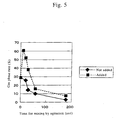
- Fig. 5 is a graph wherein the time of mixing by agitation is plotted on the horizontal axis and the gas phase rate is plotted on the longitudinal axis.
- the gas phase rate decreased as the soil was mixed by agitation when no soil-improving materials were added
- the water content ratio of the clay or silt decreased due to the water-absorbing action of the soil-improving materials, so that the clay or silt changed from having the property of a plastic body to having the property of a non-plastic semisolid.
- the gas phase rate reached its maximum value within approximately 10 seconds after the start of mixing by agitation, and then decreased again. This may be caused by the fact that the crumbed structure enlarged by mixing the soil by agitation had changed again to a small crumbed structure, leaving fewer vacant spaces.
- pore water in the clay or silt is absorbed by soil-improving materials.
- the water content ratio of the entirety of the contaminated soil does not change, but the water content ratio of the clay or silt itself decreases, so that the clay or silt changes from having the property of a plastic body to having the property of a non-plastic semisolid.
- clods of the clay or silt are peptized apart by mixing the soil by agitation under such circumstances, so that the soil structure changes from an initial small crumbed structure to a larger crumbed structure. Along with this change, larger voids come to be formed.
- the gas phase rate within the clay or silt is greatly improved.
- an aerobic environment is formed within the contaminated soil, and it becomes possible to rapidly degrade contaminants contained in the contaminated soil by degradation enzymes of the degradation microbes.
Landscapes
- Engineering & Computer Science (AREA)
- Life Sciences & Earth Sciences (AREA)
- Microbiology (AREA)
- Biomedical Technology (AREA)
- Biotechnology (AREA)
- General Health & Medical Sciences (AREA)
- Health & Medical Sciences (AREA)
- Molecular Biology (AREA)
- Mycology (AREA)
- Soil Sciences (AREA)
- Environmental & Geological Engineering (AREA)
- Processing Of Solid Wastes (AREA)
- Micro-Organisms Or Cultivation Processes Thereof (AREA)
- Soil Conditioners And Soil-Stabilizing Materials (AREA)
Abstract
Description
Claims (10)
- A method of purifying contaminated soil by microorganisms, comprising adding a soil-improving material having water-absorbing properties and being capable of maintaining a non-swelling property and non-viscosity after water absorption to contaminated soil containing clay or silt, and then mixing the soil by agitation, so as to cause the soil-improving material to absorb pore water contained in the clay or silt, while adding microbes degrading contaminants contained in the contaminated soil to the contaminated soil, or utilizing degradation microbes inhabiting the contaminated soil, thereby microbially degrading the contaminants.
- The method of purifying contaminated soil by microorganisms according to claim 1, wherein the degradation microbes are added to the contaminated soil while not being contained by the soil-improving material.
- The method of purifying contaminated soil by microorganisms according to claim 1, wherein aeration is performed for the contaminated soil when the contaminant is microbially degraded.
- The method of purifying contaminated soil by microorganisms according to any one of claims 1 to 3, wherein the soil-improving material is an inorganic soil-improving material.
- The method of purifying contaminated soil by microorganisms according to claim 4, wherein the inorganic soil-improving material is perlite.
- A method of purifying contaminated soil by microorganisms, comprising the steps of:adding a soil-improving material having water-absorbing properties and being capable of maintaining a non-swelling property and non-viscosity after water absorption to contaminated soil containing clay or silt, followed by mixing the soil by agitation; anddegrading contaminants contained in the contaminated soil by adding microbes that degrade the contaminants to the contaminated soil and/or utilizing degradation microbes inhabiting the contaminated soil.
- The method of purifying contaminated soil by microorganisms according to claim 6, wherein the degradation microbes and the soil-improving material are separately added to the contaminated soil.
- The method of purifying contaminated soil by microorganisms according to claim 6, wherein aeration is performed for the contaminated soil in the step of degrading the contaminants.
- The method of purifying contaminated soil by microorganisms according to any one of claims 6 to 8, wherein the soil-improving material mainly comprises an inorganic soil-improving material.
- The method of purifying contaminated soil by microorganisms according to claim 9, wherein the inorganic soil-improving material is perlite.
Applications Claiming Priority (3)
| Application Number | Priority Date | Filing Date | Title |
|---|---|---|---|
| JP2002008367A JP4767472B2 (en) | 2002-01-17 | 2002-01-17 | Purification method of contaminated soil by microorganisms |
| JP2002008367 | 2002-01-17 | ||
| PCT/JP2002/013065 WO2003059544A1 (en) | 2002-01-17 | 2002-12-13 | Method of purifying contaminated soil using microorganism |
Publications (3)
| Publication Number | Publication Date |
|---|---|
| EP1473093A1 true EP1473093A1 (en) | 2004-11-03 |
| EP1473093A4 EP1473093A4 (en) | 2005-02-02 |
| EP1473093B1 EP1473093B1 (en) | 2006-10-18 |
Family
ID=19191417
Family Applications (1)
| Application Number | Title | Priority Date | Filing Date |
|---|---|---|---|
| EP02788822A Expired - Lifetime EP1473093B1 (en) | 2002-01-17 | 2002-12-13 | Method of purifying contaminated soil using microorganism |
Country Status (7)
| Country | Link |
|---|---|
| US (1) | US20050152746A1 (en) |
| EP (1) | EP1473093B1 (en) |
| JP (1) | JP4767472B2 (en) |
| KR (1) | KR100586916B1 (en) |
| AU (1) | AU2002354481A1 (en) |
| DE (1) | DE60215549T2 (en) |
| WO (1) | WO2003059544A1 (en) |
Families Citing this family (11)
| Publication number | Priority date | Publication date | Assignee | Title |
|---|---|---|---|---|
| JP2007029860A (en) * | 2005-07-27 | 2007-02-08 | Dna Future:Kk | Method for decomposing or concentrating harmful substances in soil |
| JP2007229601A (en) * | 2006-02-28 | 2007-09-13 | Kubota Corp | Purification method for viscous soil contaminated with volatile chlorinated organic compounds |
| JP2010221087A (en) * | 2009-03-19 | 2010-10-07 | Ohbayashi Corp | Purification method for contaminated clay soil |
| RU2496820C2 (en) * | 2011-12-02 | 2013-10-27 | Федеральное государственное бюджетное образовательное учреждение высшего профессионального образования "Грозненский государственный нефтяной технический университет имени академика М.Д. Миллионщикова" | Sorbent-ameliorant for cleaning oil-contaminated soil |
| JP6161408B2 (en) * | 2013-05-29 | 2017-07-12 | 株式会社熊谷組 | Contaminated soil mixing method |
| CN103495594B (en) * | 2013-09-21 | 2015-05-27 | 北京工业大学 | Method for inhibiting volatilization of organic matters in low-temperature burning process of polluted soil by utilizing diatomite |
| CN106077078B (en) * | 2016-08-17 | 2022-06-03 | 中化学土木工程有限公司 | Method and mechanism for repairing petroleum-polluted soil |
| CN109438088A (en) * | 2018-12-27 | 2019-03-08 | 天津天丰泽田生物科技有限公司 | A kind of microbe soil conditioner and preparation method thereof for remedying oil-polluted soils |
| JP7334932B2 (en) * | 2019-05-30 | 2023-08-29 | 有限会社エコルネサンス・エンテック | Method for recycling contaminated soil |
| CN111218287B (en) * | 2020-01-19 | 2020-11-06 | 红河创新技术研究院 | Formula, method and application of combined remediation agent for heavy metals of tin and lead in soil |
| CN112812779A (en) * | 2020-12-16 | 2021-05-18 | 青岛理工大学 | Coastal petroleum polluted soil remediation agent and application thereof |
Family Cites Families (10)
| Publication number | Priority date | Publication date | Assignee | Title |
|---|---|---|---|---|
| US5593888A (en) * | 1992-07-21 | 1997-01-14 | H&H Eco Systems, Inc. | Method for accelerated bioremediation and method of using an apparatus therefor |
| DE4243627A1 (en) * | 1992-12-22 | 1994-06-23 | Leca Deutschland Gmbh | Open pored mineral bulk material carrying immobilised microorganisms |
| AU697852B2 (en) * | 1993-04-06 | 1998-10-15 | H&H Eco Systems, Inc. | Method for accelerated bioremediation and method of using an apparatus therefor |
| DE4311636C1 (en) * | 1993-04-08 | 1994-06-01 | Otavi Minen Ag | Soil-improving granules - based on perlite coated with uncalcined clay |
| JPH07188659A (en) * | 1993-12-27 | 1995-07-25 | Kowa Chem Ind Co Ltd | Soil improvement composition |
| JP3586841B2 (en) * | 1994-10-18 | 2004-11-10 | 大成建設株式会社 | How to clean the soil |
| US5627133A (en) * | 1996-05-31 | 1997-05-06 | Sorbent Technologies Corporation | Environmentally beneficial soil amendment |
| US6171844B1 (en) * | 1996-08-19 | 2001-01-09 | Toyota Jidosha Kabushiki Kaisha | Microorganism and method for environmental purification using the same |
| JP3581603B2 (en) * | 1999-09-10 | 2004-10-27 | 王子木材緑化株式会社 | Soil modification / improvement method |
| JP2001232344A (en) * | 2000-02-23 | 2001-08-28 | Kurita Water Ind Ltd | Method of forming sand layer in contaminated soil and method of treating contaminated soil |
-
2002
- 2002-01-17 JP JP2002008367A patent/JP4767472B2/en not_active Expired - Fee Related
- 2002-12-13 KR KR1020047010759A patent/KR100586916B1/en not_active Expired - Fee Related
- 2002-12-13 AU AU2002354481A patent/AU2002354481A1/en not_active Abandoned
- 2002-12-13 US US10/501,323 patent/US20050152746A1/en not_active Abandoned
- 2002-12-13 EP EP02788822A patent/EP1473093B1/en not_active Expired - Lifetime
- 2002-12-13 DE DE60215549T patent/DE60215549T2/en not_active Expired - Lifetime
- 2002-12-13 WO PCT/JP2002/013065 patent/WO2003059544A1/en not_active Ceased
Also Published As
| Publication number | Publication date |
|---|---|
| DE60215549D1 (en) | 2006-11-30 |
| WO2003059544A1 (en) | 2003-07-24 |
| KR100586916B1 (en) | 2006-06-08 |
| DE60215549T2 (en) | 2007-07-19 |
| US20050152746A1 (en) | 2005-07-14 |
| JP2003211147A (en) | 2003-07-29 |
| AU2002354481A1 (en) | 2003-07-30 |
| EP1473093B1 (en) | 2006-10-18 |
| EP1473093A4 (en) | 2005-02-02 |
| KR20040071303A (en) | 2004-08-11 |
| JP4767472B2 (en) | 2011-09-07 |
Similar Documents
| Publication | Publication Date | Title |
|---|---|---|
| Riser-Roberts | Remediation of petroleum contaminated soils: biological, physical, and chemical processes | |
| US10737959B2 (en) | Compositions for removing hydrocarbons and halogenated hydrocarbons from contaminated environments | |
| EP2390234B1 (en) | Compositions for removing hydrocarbons and halogenated hydrocarbons from contaminated environments | |
| US6258589B1 (en) | Methods for providing a chemical to a microorganism | |
| EP1473093B1 (en) | Method of purifying contaminated soil using microorganism | |
| US7413383B2 (en) | Chemical-biological stabilization process for repairing soils and cuttings contaminated with oils and petroleum derivatives | |
| CN1245452A (en) | In situ remediation of contaminated soils | |
| Mohammed et al. | State‐of‐the‐art review of bioremediation studies | |
| US6121040A (en) | Process for remediation of contaminated soil | |
| Brown et al. | The evolution of a technology: hydrogen peroxide in in-situ bioremediation | |
| Ward et al. | In situ technologies | |
| WO2010002907A1 (en) | Method of chemical treatment of soils containing nitroaromatic compounds | |
| JP2006007182A (en) | In-situ bioremediation method with pre-culture and its system | |
| JP3401660B2 (en) | How to restore contaminated groundwater and soil | |
| JP3374229B2 (en) | How to restore contaminated groundwater and soil | |
| Kamil et al. | Treatment of petroleum sludge | |
| Irvine | BIOREMEDIATION OF SOILS CONTAMINATED WITH CUTTING OILS AND TNT: REPORT ON THE STATE-OF-THE-ART IN BIOREMEDIATION | |
| JP2005144404A (en) | Soil pollution repair method | |
| Kastánek et al. | Biodegradation of petroleum hydrocarbons after the departure of the Soviet army | |
| Irvine et al. | [Proceedings of the 2000 Annual Conference of the Korea Solid Waste Engineering Society AUTUMN] IN-situ and Ex-situ Bioremediation: General Policies and Trends of Engineered Biotreatment Systems | |
| Edition | Synopses of Federal Demonstrations of Innovative Site Remediation Technologies | |
| HK1077289B (en) | Compositions for removing hydrocarbons and halogenated hydrocarbons from contaminated environments |
Legal Events
| Date | Code | Title | Description |
|---|---|---|---|
| PUAI | Public reference made under article 153(3) epc to a published international application that has entered the european phase |
Free format text: ORIGINAL CODE: 0009012 |
|
| 17P | Request for examination filed |
Effective date: 20040730 |
|
| AK | Designated contracting states |
Kind code of ref document: A1 Designated state(s): AT BE BG CH CY CZ DE DK EE ES FI FR GB GR IE IT LI LU MC NL PT SE SI SK TR |
|
| AX | Request for extension of the european patent |
Extension state: AL LT LV MK RO |
|
| A4 | Supplementary search report drawn up and despatched |
Effective date: 20041217 |
|
| GRAP | Despatch of communication of intention to grant a patent |
Free format text: ORIGINAL CODE: EPIDOSNIGR1 |
|
| GRAS | Grant fee paid |
Free format text: ORIGINAL CODE: EPIDOSNIGR3 |
|
| GRAA | (expected) grant |
Free format text: ORIGINAL CODE: 0009210 |
|
| AK | Designated contracting states |
Kind code of ref document: B1 Designated state(s): DE GB NL |
|
| REG | Reference to a national code |
Ref country code: GB Ref legal event code: FG4D |
|
| REF | Corresponds to: |
Ref document number: 60215549 Country of ref document: DE Date of ref document: 20061130 Kind code of ref document: P |
|
| PLBE | No opposition filed within time limit |
Free format text: ORIGINAL CODE: 0009261 |
|
| STAA | Information on the status of an ep patent application or granted ep patent |
Free format text: STATUS: NO OPPOSITION FILED WITHIN TIME LIMIT |
|
| 26N | No opposition filed |
Effective date: 20070719 |
|
| REG | Reference to a national code |
Ref country code: GB Ref legal event code: 746 Effective date: 20130923 |
|
| REG | Reference to a national code |
Ref country code: DE Ref legal event code: R084 Ref document number: 60215549 Country of ref document: DE Effective date: 20130919 |
|
| PGFP | Annual fee paid to national office [announced via postgrant information from national office to epo] |
Ref country code: DE Payment date: 20171206 Year of fee payment: 16 Ref country code: NL Payment date: 20171115 Year of fee payment: 16 |
|
| PGFP | Annual fee paid to national office [announced via postgrant information from national office to epo] |
Ref country code: GB Payment date: 20171213 Year of fee payment: 16 |
|
| REG | Reference to a national code |
Ref country code: DE Ref legal event code: R119 Ref document number: 60215549 Country of ref document: DE |
|
| REG | Reference to a national code |
Ref country code: NL Ref legal event code: MM Effective date: 20190101 |
|
| GBPC | Gb: european patent ceased through non-payment of renewal fee |
Effective date: 20181213 |
|
| PG25 | Lapsed in a contracting state [announced via postgrant information from national office to epo] |
Ref country code: NL Free format text: LAPSE BECAUSE OF NON-PAYMENT OF DUE FEES Effective date: 20190101 |
|
| PG25 | Lapsed in a contracting state [announced via postgrant information from national office to epo] |
Ref country code: DE Free format text: LAPSE BECAUSE OF NON-PAYMENT OF DUE FEES Effective date: 20190702 |
|
| PG25 | Lapsed in a contracting state [announced via postgrant information from national office to epo] |
Ref country code: GB Free format text: LAPSE BECAUSE OF NON-PAYMENT OF DUE FEES Effective date: 20181213 |