EP1471490A2 - Display panel driving method - Google Patents
Display panel driving method Download PDFInfo
- Publication number
- EP1471490A2 EP1471490A2 EP04006449A EP04006449A EP1471490A2 EP 1471490 A2 EP1471490 A2 EP 1471490A2 EP 04006449 A EP04006449 A EP 04006449A EP 04006449 A EP04006449 A EP 04006449A EP 1471490 A2 EP1471490 A2 EP 1471490A2
- Authority
- EP
- European Patent Office
- Prior art keywords
- sub
- light emission
- display
- fields
- field
- Prior art date
- Legal status (The legal status is an assumption and is not a legal conclusion. Google has not performed a legal analysis and makes no representation as to the accuracy of the status listed.)
- Withdrawn
Links
Images





Classifications
-
- G—PHYSICS
- G09—EDUCATION; CRYPTOGRAPHY; DISPLAY; ADVERTISING; SEALS
- G09G—ARRANGEMENTS OR CIRCUITS FOR CONTROL OF INDICATING DEVICES USING STATIC MEANS TO PRESENT VARIABLE INFORMATION
- G09G3/00—Control arrangements or circuits, of interest only in connection with visual indicators other than cathode-ray tubes
- G09G3/20—Control arrangements or circuits, of interest only in connection with visual indicators other than cathode-ray tubes for presentation of an assembly of a number of characters, e.g. a page, by composing the assembly by combination of individual elements arranged in a matrix no fixed position being assigned to or needed to be assigned to the individual characters or partial characters
- G09G3/22—Control arrangements or circuits, of interest only in connection with visual indicators other than cathode-ray tubes for presentation of an assembly of a number of characters, e.g. a page, by composing the assembly by combination of individual elements arranged in a matrix no fixed position being assigned to or needed to be assigned to the individual characters or partial characters using controlled light sources
- G09G3/28—Control arrangements or circuits, of interest only in connection with visual indicators other than cathode-ray tubes for presentation of an assembly of a number of characters, e.g. a page, by composing the assembly by combination of individual elements arranged in a matrix no fixed position being assigned to or needed to be assigned to the individual characters or partial characters using controlled light sources using luminous gas-discharge panels, e.g. plasma panels
- G09G3/288—Control arrangements or circuits, of interest only in connection with visual indicators other than cathode-ray tubes for presentation of an assembly of a number of characters, e.g. a page, by composing the assembly by combination of individual elements arranged in a matrix no fixed position being assigned to or needed to be assigned to the individual characters or partial characters using controlled light sources using luminous gas-discharge panels, e.g. plasma panels using AC panels
- G09G3/291—Control arrangements or circuits, of interest only in connection with visual indicators other than cathode-ray tubes for presentation of an assembly of a number of characters, e.g. a page, by composing the assembly by combination of individual elements arranged in a matrix no fixed position being assigned to or needed to be assigned to the individual characters or partial characters using controlled light sources using luminous gas-discharge panels, e.g. plasma panels using AC panels controlling the gas discharge to control a cell condition, e.g. by means of specific pulse shapes
- G09G3/293—Control arrangements or circuits, of interest only in connection with visual indicators other than cathode-ray tubes for presentation of an assembly of a number of characters, e.g. a page, by composing the assembly by combination of individual elements arranged in a matrix no fixed position being assigned to or needed to be assigned to the individual characters or partial characters using controlled light sources using luminous gas-discharge panels, e.g. plasma panels using AC panels controlling the gas discharge to control a cell condition, e.g. by means of specific pulse shapes for address discharge
- G09G3/2937—Control arrangements or circuits, of interest only in connection with visual indicators other than cathode-ray tubes for presentation of an assembly of a number of characters, e.g. a page, by composing the assembly by combination of individual elements arranged in a matrix no fixed position being assigned to or needed to be assigned to the individual characters or partial characters using controlled light sources using luminous gas-discharge panels, e.g. plasma panels using AC panels controlling the gas discharge to control a cell condition, e.g. by means of specific pulse shapes for address discharge being addressed only once per frame
-
- B—PERFORMING OPERATIONS; TRANSPORTING
- B62—LAND VEHICLES FOR TRAVELLING OTHERWISE THAN ON RAILS
- B62K—CYCLES; CYCLE FRAMES; CYCLE STEERING DEVICES; RIDER-OPERATED TERMINAL CONTROLS SPECIALLY ADAPTED FOR CYCLES; CYCLE AXLE SUSPENSIONS; CYCLE SIDECARS, FORECARS, OR THE LIKE
- B62K17/00—Cycles not otherwise provided for
-
- B—PERFORMING OPERATIONS; TRANSPORTING
- B61—RAILWAYS
- B61D—BODY DETAILS OR KINDS OF RAILWAY VEHICLES
- B61D15/00—Other railway vehicles, e.g. scaffold cars; Adaptations of vehicles for use on railways
- B61D15/08—Railway inspection trolleys
- B61D15/10—Railway inspection trolleys hand or foot propelled
-
- G—PHYSICS
- G01—MEASURING; TESTING
- G01S—RADIO DIRECTION-FINDING; RADIO NAVIGATION; DETERMINING DISTANCE OR VELOCITY BY USE OF RADIO WAVES; LOCATING OR PRESENCE-DETECTING BY USE OF THE REFLECTION OR RERADIATION OF RADIO WAVES; ANALOGOUS ARRANGEMENTS USING OTHER WAVES
- G01S19/00—Satellite radio beacon positioning systems; Determining position, velocity or attitude using signals transmitted by such systems
- G01S19/38—Determining a navigation solution using signals transmitted by a satellite radio beacon positioning system
- G01S19/39—Determining a navigation solution using signals transmitted by a satellite radio beacon positioning system the satellite radio beacon positioning system transmitting time-stamped messages, e.g. GPS [Global Positioning System], GLONASS [Global Orbiting Navigation Satellite System] or GALILEO
- G01S19/42—Determining position
-
- B—PERFORMING OPERATIONS; TRANSPORTING
- B60—VEHICLES IN GENERAL
- B60K—ARRANGEMENT OR MOUNTING OF PROPULSION UNITS OR OF TRANSMISSIONS IN VEHICLES; ARRANGEMENT OR MOUNTING OF PLURAL DIVERSE PRIME-MOVERS IN VEHICLES; AUXILIARY DRIVES FOR VEHICLES; INSTRUMENTATION OR DASHBOARDS FOR VEHICLES; ARRANGEMENTS IN CONNECTION WITH COOLING, AIR INTAKE, GAS EXHAUST OR FUEL SUPPLY OF PROPULSION UNITS IN VEHICLES
- B60K16/00—Arrangements in connection with power supply of propulsion units in vehicles from forces of nature, e.g. sun or wind
- B60K2016/006—Arrangements in connection with power supply of propulsion units in vehicles from forces of nature, e.g. sun or wind wind power driven
-
- G—PHYSICS
- G09—EDUCATION; CRYPTOGRAPHY; DISPLAY; ADVERTISING; SEALS
- G09G—ARRANGEMENTS OR CIRCUITS FOR CONTROL OF INDICATING DEVICES USING STATIC MEANS TO PRESENT VARIABLE INFORMATION
- G09G2310/00—Command of the display device
- G09G2310/02—Addressing, scanning or driving the display screen or processing steps related thereto
- G09G2310/0202—Addressing of scan or signal lines
- G09G2310/0218—Addressing of scan or signal lines with collection of electrodes in groups for n-dimensional addressing
-
- G—PHYSICS
- G09—EDUCATION; CRYPTOGRAPHY; DISPLAY; ADVERTISING; SEALS
- G09G—ARRANGEMENTS OR CIRCUITS FOR CONTROL OF INDICATING DEVICES USING STATIC MEANS TO PRESENT VARIABLE INFORMATION
- G09G2330/00—Aspects of power supply; Aspects of display protection and defect management
- G09G2330/02—Details of power systems and of start or stop of display operation
- G09G2330/021—Power management, e.g. power saving
-
- G—PHYSICS
- G09—EDUCATION; CRYPTOGRAPHY; DISPLAY; ADVERTISING; SEALS
- G09G—ARRANGEMENTS OR CIRCUITS FOR CONTROL OF INDICATING DEVICES USING STATIC MEANS TO PRESENT VARIABLE INFORMATION
- G09G3/00—Control arrangements or circuits, of interest only in connection with visual indicators other than cathode-ray tubes
- G09G3/20—Control arrangements or circuits, of interest only in connection with visual indicators other than cathode-ray tubes for presentation of an assembly of a number of characters, e.g. a page, by composing the assembly by combination of individual elements arranged in a matrix no fixed position being assigned to or needed to be assigned to the individual characters or partial characters
- G09G3/2007—Display of intermediate tones
- G09G3/2018—Display of intermediate tones by time modulation using two or more time intervals
- G09G3/2022—Display of intermediate tones by time modulation using two or more time intervals using sub-frames
- G09G3/2029—Display of intermediate tones by time modulation using two or more time intervals using sub-frames the sub-frames having non-binary weights
-
- G—PHYSICS
- G09—EDUCATION; CRYPTOGRAPHY; DISPLAY; ADVERTISING; SEALS
- G09G—ARRANGEMENTS OR CIRCUITS FOR CONTROL OF INDICATING DEVICES USING STATIC MEANS TO PRESENT VARIABLE INFORMATION
- G09G3/00—Control arrangements or circuits, of interest only in connection with visual indicators other than cathode-ray tubes
- G09G3/20—Control arrangements or circuits, of interest only in connection with visual indicators other than cathode-ray tubes for presentation of an assembly of a number of characters, e.g. a page, by composing the assembly by combination of individual elements arranged in a matrix no fixed position being assigned to or needed to be assigned to the individual characters or partial characters
- G09G3/22—Control arrangements or circuits, of interest only in connection with visual indicators other than cathode-ray tubes for presentation of an assembly of a number of characters, e.g. a page, by composing the assembly by combination of individual elements arranged in a matrix no fixed position being assigned to or needed to be assigned to the individual characters or partial characters using controlled light sources
- G09G3/28—Control arrangements or circuits, of interest only in connection with visual indicators other than cathode-ray tubes for presentation of an assembly of a number of characters, e.g. a page, by composing the assembly by combination of individual elements arranged in a matrix no fixed position being assigned to or needed to be assigned to the individual characters or partial characters using controlled light sources using luminous gas-discharge panels, e.g. plasma panels
- G09G3/288—Control arrangements or circuits, of interest only in connection with visual indicators other than cathode-ray tubes for presentation of an assembly of a number of characters, e.g. a page, by composing the assembly by combination of individual elements arranged in a matrix no fixed position being assigned to or needed to be assigned to the individual characters or partial characters using controlled light sources using luminous gas-discharge panels, e.g. plasma panels using AC panels
- G09G3/291—Control arrangements or circuits, of interest only in connection with visual indicators other than cathode-ray tubes for presentation of an assembly of a number of characters, e.g. a page, by composing the assembly by combination of individual elements arranged in a matrix no fixed position being assigned to or needed to be assigned to the individual characters or partial characters using controlled light sources using luminous gas-discharge panels, e.g. plasma panels using AC panels controlling the gas discharge to control a cell condition, e.g. by means of specific pulse shapes
- G09G3/293—Control arrangements or circuits, of interest only in connection with visual indicators other than cathode-ray tubes for presentation of an assembly of a number of characters, e.g. a page, by composing the assembly by combination of individual elements arranged in a matrix no fixed position being assigned to or needed to be assigned to the individual characters or partial characters using controlled light sources using luminous gas-discharge panels, e.g. plasma panels using AC panels controlling the gas discharge to control a cell condition, e.g. by means of specific pulse shapes for address discharge
- G09G3/2935—Addressed by erasing selected cells that are in an ON state
Definitions
- the present invention relates to a driving method for driving a display panel such as an AC driven plasma display panel or an electroluminescence display panel.
- PDP plasma display panel
- ELP electroluminescence display panel
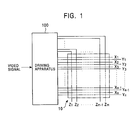
- Fig. 1 generally shows such a plasma display panel which has a PDP as a display panel (see, for example, Japanese Patent Kokai No. 2002-156941).
- a PDP 10 as a plasma display panel comprises row electrodes Y 1 - Y n and X 1 - X n which form pairs of row electrodes X, Y, each of which corresponds to each line (first to n-th rows) of one screen.
- the PDP 10 is further formed of column electrodes Z 1 - Z m corresponding to respective columns (first to m-th columns) of one screen, which are orthogonal to the row electrode pairs and across a dielectric layer and a discharge space, not shown.
- a discharge cell serving as a pixel is formed at the intersection of a pair of row electrodes (X, Y) with a column electrode Z.
- each discharge cell since each discharge cell emits light by discharging, it has only two states: a light emitting state at the highest luminance and an unlit state.
- the discharge cell can represent only two levels of luminance, i.e., the lowest luminance and highest luminance if no measures are taken therefor.
- a driving apparatus 100 conducts a gradation driving scheme which employs a sub-field method for providing halftone luminance levels corresponding to an input video signal for the PDP 10 which is comprised of such a light emitting element as each pixel cell.
- the sub-field method involves converting an input video signal into N-bit pixel data corresponding to each pixel, and dividing one field display period into N sub-fields corresponding to respective bit digits of the N bits.
- Each of the sub-fields is assigned the number of times of discharge generated corresponding to a weighting coefficient applied to the sub-field, so that this discharge is selectively generated only in sub-fields in accordance with the video signal.
- a halftone luminance corresponding to the video signal can be accomplished by a total number of times the discharge is generated in each sub-field (within one field display period).
- a selective erasure addressing method is known as a method of driving a PDP to provide halftone luminance by use of the sub-field method.
- Fig. 2 is a timing chart showing applying timings at which the driving apparatus 100 applies a variety of driving pulses to the column electrodes and the row electrode pairs of the PDP 10 in one sub-field based on the selective erasure addressing method (see, for example, Fig. 2 in Japanese Patent Kokai No. 2002-156941).
- the driving apparatus 100 first applies a reset pulse RP x of negative polarity to the row electrodes X 1 - X n , and a reset pulse RP Y of positive polarity to the row electrodes Y 1 - Y n (simultaneous reset stage Rc).
- a reset pulse RP x of negative polarity to the row electrodes X 1 - X n
- RP Y of positive polarity to the row electrodes Y 1 - Y n
- all the discharge cells in the PDP 10 are reset or discharged to uniformly form a predetermined amount of wall charge in each of the discharge cells. In this way, all the discharge cells are initially set once into a light emission mode.
- the driving apparatus 100 converts the input video signal, for example, into 8-bit pixel data for each pixel.
- the driving apparatus 100 divides the pixel data for each bit digit to generate pixel data bits, and generates a pixel data pulse having a pulse voltage in accordance with the logical level of each of the pixel data bits. For example, the driving apparatus 100 generates the pixel data pulse DP at a high voltage when the pixel data bit is at logical level "1" and at a low voltage (zero volt) when the pixel data bit is at logical level "0.” Then, the driving apparatus 100 sequentially applies the column electrodes Z 1 - Z m with the pixel data pulses DP for one line (m pulses).
- the driving apparatus 100 sequentially applies the row electrodes Y 1 - Y n with a scanning pulse SP as shown in Fig. 2 in synchronism with the timings of applying the pixel data pulses DP (pixel data writing stage Wc).
- a discharge occurs only in discharge cells at intersections of those row electrodes which have been applied with the scanning pulse SP and those column electrodes which have been applied with the pixel data pulses at high voltage (selective writing discharge) to erase wall charges remaining in these discharge cells.
- those discharge cells which have been initialized to the light emission mode in the simultaneous reset stage Rc, proceed to a light extinction mode.
- those discharge cells which have been applied with the scanning pulse SP but also applied with low voltage image data pulses do not undergo the selective writing discharge, and remain in the initialized state in the simultaneous reset stage Rc, i.e., the light emission mode.
- the driving apparatus 100 repeatedly applies a sustain pulse IP x of positive polarity to the row electrodes X 1 - X n , and repeatedly applies a sustain pulse IP Y of positive polarity to the row electrodes Y 1 - Y n (light emission sustaining stage Ic).
- a sustain pulse IP x of positive polarity to the row electrodes X 1 - X n
- a sustain pulse IP Y of positive polarity
- the driving apparatus 100 applies the row electrodes X 1 - X n with an erasure pulse EP as shown in Fig. 2 (erasure stage E). In this way, all the discharge cells are simultaneously erased or discharged to extinguish the wall charges remaining in the respective discharge cells.
- the application of the pixel data pulse DP results in charging and discharging of not only display lines for which a data write is intended, but also display lines for which the data write is not intended, and the capacitance must further be charged and discharged between adjacent column electrodes.
- a display panel driving method drives a display panel formed with a plurality of pixel cells serving as pixels on each of n display lines every plural sub-fields which make up each field of an input video signal for providing a gradation display, wherein each of the sub-field includes an addressing stage for scanning each of pixel cells formed on each of the n display lines from one display line to another to set the pixel cells into either a light emission mode or a light extinction mode based on the input video signal, and a sustain stage for forcing only the pixel cells set in the light emission mode to emit light for a duration corresponding to said sub-field, and each of the n display lines is scanned in the addressing stage in each of the at least two sub-fields in each of the sub-fields in an order different from a scanning order in the addressing stage of each of the other sub-fields.
- a display panel driving method drives a display panel formed with a plurality of pixel cells serving as pixels on each of n display lines in accordance with an input video signal for providing a gradation display.
- the method comprising the step of performing an addressing stage for scanning each of the pixel cells formed on each of the n display lines from one display line to another to set the pixel cell into a light emission mode or a light extinction mode based on the input video signal, and a sustain stage for forcing only the pixel cells set in the light emission mode to emit light for a duration corresponding to the sub-field, wherein each of the n display lines is scanned in the addressing stage in the field or in a field group comprised of a plurality of the fields in an order different from a scanning order in the addressing stage in other fields or other field groups.
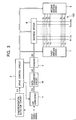
- Fig. 3 is a diagram showing the configuration of a display device which drives a display panel in accordance with a driving method according to the present invention.
- the display device shown in Fig. 3 is made up of a plasma display panel 100 (hereinafter referred to as the "PDP 100") as the display panel, and a driving unit for driving the PDP 100.
- the driving unit comprises a synchronization detector circuit 1, a drive control circuit 2, an A/D converter 4, a data converter circuit 30, a memory 5, an address driver 6, a first sustain driver 7, and a second sustain driver 8.
- the PDP 100 comprises m column electrodes D 1 - D m as address electrodes, and n row electrodes X 1 - X n and n row electrodes Y 1 - Y n which are arranged to intersect with each of the column electrodes.
- a discharge cell serving as a pixel is formed at the intersection of each column electrode D and a pair of low electrodes X, Y adjacent to each other.
- PDP 100 is provided with a first to an n-th display line, each of which has m discharge cells arranged thereon.
- the synchronization detector circuit 1 generates a vertical synchronization signal V when it detects a vertical synchronization signal from an analog input video signal, and generates a horizontal synchronization signal H when it detects a horizontal synchronization signal from this input video signal, and supplies these to the drive control circuit 2.
- the A/D converter 4 samples the analog input video signal in response to a clock signal supplied from the drive control circuit 2, and converts the sampled input video signal to, for example, 8-bit pixel data PD for each pixel which is supplied to the data converter circuit 30.
- the pixel data PD represents the luminance level of each pixel indicated by the input video signal by a value from "0" to "255.”
- Fig. 4 is a diagram showing the internal configuration of the data converter circuit 30.
- the data converter circuit 30 comprises a first data converter circuit 32, a multi-gradation processing circuit 33, and a second data converter circuit 34.
- the first data converter circuit 32 converts the luminance level of each pixel indicated by the 8-bit pixel data PD into luminance conversion pixel data PD L which represents the luminance level from "0" to "192" in eight bits in accordance with conversion characteristics as shown in Fig. 5, and supplies the luminance conversion pixel data PD L to the multi-gradation processing circuit 33.
- the data conversion performed by the first data converter circuit 32 prevents a saturated luminance caused by the multi-gradation processing in the multi-gradation processing circuit 33, and a flat portion (i.e., distortion in gradation) in the display characteristic which would be produced when a display gradation is not on a bit boundary.
- the multi-gradation processing circuit 33 applies error diffusion processing and dither processing to the 8-bit luminance conversion pixel data PD L to generate multi-gradation pixel data PD S which has its number of bits compressed to four bits while maintaining the number of current gradation representation levels, and supplies the multi-gradation pixel data PD S to the second data converter circuit 34.
- the pixel data PD is first separated into upper six bits regarded as display data and the remaining lower two bits regarded as error data. Then, the error data derived from the pixel data PD corresponding to respective peripheral pixels are added with weighting. The resulting data is reflected to the display data.
- This operation causes the luminance of the lower two bits in the original pixel to be virtually represented by the peripheral pixel, so that a luminance gradation representation equivalent to that provided by the 8-bit pixel data can be accomplished by the display data comprised of six bits which are less than eight bits.
- the 6-bit error diffusion processed pixel data resulting from the error diffusion processing is applied with the dither processing.
- the dither processing involves treating a plurality of adjacent pixels as one pixel unit, and assigning dither coefficients having coefficient values different from one another to pixel data corresponding to the respective pixels in this pixel unit, and adding the resulting pixel data to derive dither addition pixel data.
- a luminance corresponding to eight bits can be represented even with only the upper four bits of the dither addition pixel data, when viewed in the pixel unit.
- the multi-gradation processing circuit 33 extracts upper four bits of the dither addition pixel data as multi-gradation pixel data PD S which is supplied to the second data converter circuit 34.
- the second data converter circuit 34 converts the 4-bit multi-gradation pixel data PD S to pixel drive data GD comprised of a first to a twelfth bit in accordance with a conversion table as shown in Fig. 6, and supplies the pixel drive data GD to the memory 5.
- the pixel drive data GD is sequentially written into the memory 5 for storage in response to a write signal supplied from the drive control circuit 2.
- the memory 5 performs a read operation in response to a read signal supplied from the drive control circuit 2 in the following manner. Specifically, the memory 5 reads only the first bit of each of the pixel drive data GD( 1,1) - GD( n,m ) as a pixel drive data bit DB1, and supplies the pixel drive data bits DB1 to the address driver 6 from one display line to another.
- the memory 5 reads only the second bit of each of the pixel drive data GD (1,1) - GD (n,m) as a pixel drive data bit DB2, and supplies the pixel drive data bits DB2 to the address driver 6 from one display line to another.
- the memory 5 reads only the third bit of each of the pixel drive data GD (1,1) - GD (n,m) as a pixel drive data bit DB3, and supplies the pixel drive data bits DB3 to the address driver 6 from one display line to another.
- the memory 5 similarly separates the fourth to the twelfth bits of each of the pixel drive data GD( 1,1 ) - GD( n,m) for reading as pixel drive data bits DB4, - DB12, and supplies each of the pixel drive data bits DB4 - DB12 to the address driver 6 from one display line to another.
- the memory 5 performs the read operation for each of the pixel drive data bits DB1 - DB12 at the timing of each of sub-fields SF1 - SF12, later described. Specifically, the memory 5 reads the pixel drive data bit DB1 in the sub-field SF1, and reads the pixel drive data bit DB2 in the sub-field SF2.
- the drive control circuit 2 supplies a variety of timing signals for driving the PDP 100 to each of the address driver 6, first sustain driver 7, and second sustain driver 8 in accordance with a light emission driving sequence based on the sub-field method as shown in Fig. 7.
- the addressing stage W (W1, W2 1 - W2 2 , W3 1 - W3 4 ) is executed for setting each of the discharge cells into either the light emission mode or the light extinction mode in accordance with the pixel drive data bit DB.
- a sustain stage I is executed for forcing only those discharge cells set in the light emission mode to continuously emit light for a duration corresponding to a weighting coefficient applied to each sub-field.
- discharge cells set in the light emission mode are forced to continuously emit light for the following durations in the sustain stage I of each of the sub-fields SF1 - SF12:
- the reset stage R is executed prior to the addressing stage to initialize all the discharge cells to the light emission mode.
- the erasure stage E is executed after the sustain stage I for changing all the discharge cells to the light extinction mode.
- each of the discharge cells belonging to each of the first to the n-th lines on the PDP 100 is sequentially set into the light emission mode or light extinction mode from one display line to another.
- each of the sub-fields SF3 - SF10 only discharge cells belonging to each of odd-numbered display lines within the first to the n-th display lines on the PDP 100, i.e., the first, third, fifth, ..., (n-1)th display lines are sequentially set into the light emission mode or light extinction mode from one display line to another.
- the addressing stage W2 2 of each of the sub-fields SF3 - SF10 only discharge cells belonging to each of even-numbered display lines, i.e., the second, fourth, sixth, ..., n-th display lines are sequentially set into the light emission mode or light extinction mode from one display line to another.
- discharge cells belonging to each of (4N-3)th display lines are sequentially set into the light emission mode or light extinction mode from one display line to another.
- discharge cells belonging to each of (4N-2)th display lines are sequentially set into the light emission mode or light extinction mode from one display line to another.
- discharge cells belonging to each of (4N-1)th display lines (where N is a natural number), i.e., the third, seventh, eleventh, ..., (n-1)th display lines are sequentially set into the light emission mode or light extinction mode from one display line to another.
- discharge cells belonging to each of (4N)th display lines (where N is a natural number), i.e., the fourth, eighth, twelfth, ..., n-th display lines are sequentially set into the light emission mode or light extinction mode from one display line to another.
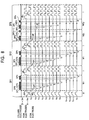
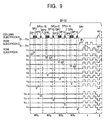
- FIG. 8 and 9 are diagrams respectively showing a variety of pulses applied to the row electrodes and column electrodes of the PDP 100 by the address driver 6, first sustain driver 7, and second sustain driver 8 in accordance with the light emission driving sequence shown in Fig. 7, and timings at which the pulses are applied.
- Fig. 8 only shows the sub-fields SF1 - SF3 extracted from SF1 - SF12
- Fig. 9 only shows the sub-field SF12 extracted from SF1 - SF12.
- the first sustain driver 7 applies the row electrodes X 1 - X n with the reset pulse RP X of negative polarity.
- the second sustain driver 8 applies the row electrodes Y 1 - Y 2 with the reset pulse RP Y of positive polarity.
- all discharge cells in the PDP 100 are reset or discharged to uniformly form a predetermined amount of wall charge in each of the discharge cells. In this way, all the discharge cells are initialized to a state in which a sustain discharge is generated in the sustain stage I, later described (hereinafter referred to as the "light emission mode").
- the address driver 6 In the addressing stage W1 of each of the sub-fields SF1 and SF2, the address driver 6 generates a pixel data pulse which has a voltage corresponding to the logical level of a pixel drive data bit DB supplied from the memory 5. For example, the address driver 6 generates a pixel data pulse at high voltage when the pixel drive data bit DB is at logical level "1," and a pixel data pulse at low voltage (zero volt) when the pixel drive data bit DB is at logical level "0.” Then, the address driver 6 sequentially applies the column electrodes D 1 - D m with the pixel data pulses once for one display line (by m pixel data pulses).
- the address driver 6 first applies the column electrodes D 1 - D m with a pixel data pulse group DP1 comprised of m pixel data pulses corresponding to the first display line. Subsequently, the address driver 6 applies the column electrodes D 1 - D m with the pixel data pulses once for one display line in the order of a pixel data pulse group DP2 corresponding to the second display line, a pixel data pulse group DP3 corresponding to the third display line, ..., a pixel data pulse group DPn corresponding to the n-th display line.
- the second sustain driver 8 generates a scanning pulse SP of negative polarity as shown in Fig. 8 at the same timing at which each of the pixel data pulse groups DP as mentioned above is applied, and sequentially applies the row electrodes Y 1 - Y n with the scanning pulse SP.
- discharge is generated only in those discharge cells positioned at intersections of the row electrodes applied with the scanning pulse SP with the column electrodes applied with the pixel data pulse at high voltage (selective erasure discharge), thereby selectively erasing the wall charges which have remained in these discharge cells.
- discharge cells which have undergone the selective erasure discharge transition to a state in which the sustain discharge is not generated in the sustain stage I, later described (hereinafter referred to as the "light extinction mode").
- discharge cells which do not undergo the selective erasure discharge maintain the previous state. Specifically, discharge cells in the light emission mode maintain the light emission mode without transition, while discharge cells in the light extinction mode maintain the light extinction mode without transition.
- each of discharge cells is set into either the light emission mode or the light extinction mode based on an input video signal from the first display line to the n-th display line on the PDP 100 on a line-by-line basis.
- pixel data is sequentially written from the first display line to the n-th display line on the PDP 100 on a line-by-line basis.
- the address driver 6 sequentially applies the column electrodes D 1 - D m with a pixel data pulse group corresponding to each of odd-numbered display lines once for one display line (by six pixel data pulses). For example, in the addressing stage W2 1 of the sub-field SF3, the address driver 6 first applies the column electrodes D 1 - D m with a pixel data pulse group DP1 comprised of m pixel data pulses corresponding to the first display line of the DPD 100.
- the address driver 6 sequentially applies the column electrodes D 1 - D m with each of pixel data pulse groups DP3, DP5, DP7, ..., DP(n-1) respectively corresponding to the third, fifth, seventh, ..., (n-1)th display lines.
- the second sustain driver 8 sequentially applies the odd-numbered row electrodes Y 1 , Y 3 , Y 5 , ..., Y (n-1) with the scanning pulse SP of negative polarity as shown in Fig. 8 at the same timing at which each of the pixel data pulse groups DP as mentioned above is applied.
- the selective erasure discharge occurs only in those discharge cells at the intersections of the row electrodes applied with the scanning pulse SP with the column electrodes applied with the pixel data pulse at high voltage, thereby selectively erasing the wall charges which have remained in these discharge cells.
- the discharge cells which have undergone the selective erasure discharge transition to the light extinction mode.
- discharge cells which have not undergone the selective erasure discharge maintain the previous state. Specifically, discharge cells in the light emission mode maintain the light emission mode without transition, while discharge cells in the light extinction mode maintain the light extinction mode without transition.
- the address driver 6 sequentially applies the column electrodes D 1 - D m with a pixel data pulse group corresponding to each of even-numbered display lines once for one display line (by six pixel data pulses). For example, in the addressing stage W2 2 of the sub-field SF3, the address driver 6 first applies the column electrodes D 1 - D m with a pixel data pulse group DP2 comprised of m pixel data pulses corresponding to the second display line of the PDP 100.
- the address driver 6 sequentially applies the column electrodes D 1 - D m with each of pixel data pulse groups DP4, DP6, DP8, ..., DPn respectively corresponding to the fourth, sixth, eighth, ..., n-th display lines.
- the second sustain driver 8 sequentially applies the even-numbered row electrodes Y 2 , Y 4 , Y 6 , ..., Y n with the scanning pulse SP of negative polarity as shown in Fig. 8 at the same timing at which each of the pixel data pulse groups DP as mentioned above is applied.
- the selective erasure discharge occurs only in those discharge cells at the intersections of the row electrodes applied with the scanning pulse SP with the column electrodes applied with the pixel data pulse at high voltage, thereby selectively erasing the wall charges which have remained in these discharge cells.
- the discharge cells which have undergone the selective erasure discharge transition to the light extinction mode.
- discharge cells which have not undergone the selective erasure discharge maintain the previous state. Specifically, discharge cells in the light emission mode maintain the light emission mode without transition, while discharge cells in the light extinction mode maintain the light extinction mode without transition.
- the column electrodes D 1 - D m are sequentially applied with a pixel data pulse group corresponding to each of the (4N-3)th display lines on the PDP 100 once for one display line (by m pixel data pulses).
- the address driver 6 first applies the column electrodes D 1 - D m with a pixel data pulse group DP1 comprised of m pixel data pulses corresponding to the first display line on the PDP 100.
- the address driver 6 sequentially applies the column electrodes D 1 - D m with each of pixel data pulse groups DP5, DP9, ..., DP(n-3) respectively corresponding to the fifth, ninth, ..., (n-3)th display lines.
- the second sustain driver 8 sequentially applies the (4N-3)th row electrodes Y 1 , Y 5 , Y 9 , ..., Y (n-3) with the scanning pulse SP of negative polarity as shown in Fig. 9 at the same timing at which each of the pixel data pulse groups DP as mentioned above is applied.
- the selective erasure discharge occurs only in those discharge cells at the intersections of the row electrodes applied with the scanning pulse SP with the column electrodes applied with the pixel data pulse at high voltage, thereby selectively erasing the wall charges which have remained in these discharge cells.
- the discharge cells which have undergone the selective erasure discharge transition to the light extinction mode.
- discharge cells which have not undergone the selective erasure discharge maintain the previous state. Specifically, discharge cells in the light emission mode maintain the light emission mode without transition, while discharge cells in the light extinction mode maintain the light extinction mode without transition.
- the column electrodes D 1 - D m are sequentially applied with a pixel data pulse group corresponding to each of the (4N-2)th display lines on the PDP 100 once for one display line (by m pixel data pulses).
- the address driver 6 first applies the column electrodes D 1 - D m with a pixel data pulse group DP2 comprised of m pixel data pulses corresponding to the second display line on the PDP 100.
- the address driver 6 sequentially applies the column electrodes D 1 - D m with each of pixel data pulse groups DP6, DP10, ..., DP(n-2) respectively corresponding to the sixth, tenth, ..., (n-2)th display lines.
- the second sustain driver 8 sequentially applies the (4N-2)th row electrodes Y 2 , Y 6 , Y 10 , ..., Y (n-2) with the scanning pulse SP of negative polarity as shown in Fig. 9 at the same timing at which each of the pixel data pulse groups DP as mentioned above is applied.
- the selective erasure discharge occurs only in those discharge cells at the intersections of the row electrodes applied with the scanning pulse SP with the column electrodes applied with the pixel data pulse at high voltage, thereby selectively erasing the wall charges which have remained in these discharge cells.
- the discharge cells which have undergone the selective erasure discharge transition to the light extinction mode.
- discharge cells which have not undergone the selective erasure discharge maintain the previous state. Specifically, discharge cells in the light emission mode maintain the light emission mode without transition, while discharge cells in the light extinction mode maintain the light extinction mode without transition.
- the column electrodes D 1 - D m are sequentially applied with a pixel data pulse group corresponding to each of the (4N-1)th display lines on the PDP 100 once for one display line (by m pixel data pulses).
- the address driver 6 first applies the column electrodes D 1 - D m with a pixel data pulse group DP3 comprised of m pixel data pulses corresponding to the third display line on the PDP 100.
- the address driver 6 sequentially applies the column electrodes D 1 - D m with each of pixel data pulse groups DP7, DP11, ..., DP(n-1) respectively corresponding to the seventh, eleventh, ..., (n-1)th display lines.
- the second sustain driver 8 sequentially applies the (4N-1) th row electrodes Y 3 , Y 7 , Y 11 , ..., Y (n-1) with the scanning pulse SP of negative polarity as shown in Fig. 9 at the same timing at which each of the pixel data pulse groups DP as mentioned above is applied.
- the selective erasure discharge occurs only in those discharge cells at the intersections of the row electrodes applied with the scanning pulse SP with the column electrodes applied with the pixel data pulse at high voltage, thereby selectively erasing the wall charges which have remained in these discharge cells.
- the discharge cells which have undergone the selective erasure discharge transition to the light extinction mode.
- discharge cells which have not undergone the selective erasure discharge maintain the previous state. Specifically, discharge cells in the light emission mode maintain the light emission mode without transition, while discharge cells in the light extinction mode maintain the light extinction mode without transition.
- the column electrodes D 1 - D m are sequentially applied with a pixel data pulse group corresponding to each of the (4N)th display lines on the PDP 100 once for one display line (by m pixel data pulses).
- the address driver 6 first applies the column electrodes D 1 - D m with a pixel data pulse group DP4 comprised of m pixel data pulses corresponding to the fourth display line on the PDP 100.
- the address driver 6 sequentially applies the column electrodes D 1 - D m with each of pixel data pulse groups DP8, DP12, ..., DP(n) respectively corresponding to the eighth, twelfth, ..., n-th display lines.
- the second sustain driver 8 sequentially applies the (4N)th row electrodes Y 4 , Y 8 , Y 12 , ..., Y (n) with the scanning pulse SP of negative polarity as shown in Fig. 9 at the same timing at which each of the pixel data pulse groups DP as mentioned above is applied.
- the selective erasure discharge occurs only in those discharge cells at the intersections of the row electrodes applied with the scanning pulse SP with the column electrodes applied with the pixel data pulse at high voltage, thereby selectively erasing the wall charges which have remained in these discharge cells.
- the discharge cells which have undergone the selective erasure discharge transition to the light extinction mode.
- discharge cells which have not undergone the selective erasure discharge maintain the previous state. Specifically, discharge cells in the light emission mode maintain the light emission mode without transition, while discharge cells in the light extinction mode maintain the light extinction mode without transition.
- the addressing stage W3 1 of each of the sub-fields SF11 and SF12 only discharge cells belonging to the (4N-3)th display lines on the PDP 100 are set into either the light emission mode or the light extinction mode based on an input video signal.
- the addressing stage W3 2 in turn, only discharge cells belonging to the (4N-2)th display lines on the PDP 100 are set into either the light emission mode or the light extinction mode based on the input video signal.
- only discharge cells belonging to the (4N-1)th display lines on the PDP 100 are set into either the light emission mode or the light extinction mode based on the input video signal.
- the addressing stage W3 4 only discharge cells belonging to the (4N)th display lines on the PDP 100 are set into either the light emission mode or the light extinction mode based on the input video signal.
- pixel data is written into every third display line from the first display line to the n-th display line through the addressing stages W3 1 - W3 4 .
- the first sustain driver 7 and second sustain driver 8 alternately and repeatedly apply the row electrodes X 1 - X n and Y 1 - Y n with sustain pulses IP X and IP Y as shown in Fig. 8 or 9.
- the number of times the sustain pulses IP X , IP Y are applied in the sustain stage I of each of the sub-fields SF1 - SF12 corresponds to a light emission duration assigned to each of the sub-fields, as previously described.
- the address driver 6 In the erasure stage E performed only in the last sub-field SF12, the address driver 6 generates an erasure pulse AP of positive polarity as shown in Fig. 9 which is applied to the column electrodes D 1 - D m . Further, the second sustain driver 8 generates an erasure pulse EP of negative polarity as shown in Fig. 9 simultaneously with the timing at which the erasure pulse AP is applied, and applies the erasure pulse EP to each of the row electrodes Y 1 - Y n . The simultaneous application of the erasure pulses AP and EP causes an erasure discharge to occur in all the discharge cells within the PDP 100, resulting in extinction of the wall charges remaining in all the discharge cells.
- each discharge cell is set into the light emission mode or the light extinction mode depends on the pixel drive data GD as shown in Fig. 6. Specifically, when each bit of the pixel drive data GD is at logical level "1," the selective erasure discharge (represented by a black circle) is generated in the addressing stage Wc in the sub-field corresponding to the bit digit, thereby setting the discharge cell into the light extinction mode. On the other hand, when the bit is at logical level "0,” the selective erasure discharge is not generated, so that the discharge cell maintains the current state.
- a discharge cell which has remained in the light emission mode immediately before the addressing stage W maintains the light emission mode
- a discharge cell which has remained in the light extinction mode maintains the light extinction mode.
- the number of bits which are at logical level "1" is one at most within the first to twelfth bits.
- the selective erasure discharge is generated once or less without fail in one field period.
- discharge cells can be set into the light emission mode only in the simultaneous reset stage R in the first sub-field SF1.
- each discharge cell continuously remains in the light emission mode from the beginning of each field until the selective erasure discharge is generated in the sub-field marked with a black circle in Fig. 6. Then, the light emission is repeated associated with the sustain discharge for a duration corresponding to each sub-field in the sustain stage I of each of sub-fields represented by white circles existing in between. In this event, a halftone luminance is viewed in accordance with the total number of times of light emission associated with the sustain discharge performed in each of the sub-fields SF1 - SF12 within one field period.
- the 13 different values of pixel drive data GD as shown in Fig. 6 provide representations of 13 intermediate luminance levels respectively having the following light emission luminance: [0 : 2 : 5 : 8 : 18 : 29 : 46 : 68 : 96 : 131 : 174 : 225 : 255]
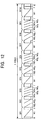
- the power consumed in the addressing stages increases as the discharge cells are switched from the light emission mode to the light extinction mode or from the light extinction mode to the light emission mode on each column electrode D a larger number of times (per unit time). For example, for sequentially setting each discharge cell into the light emission mode (represented by a white circle) or into the light extinction mode (represented by a black circle) in a form shown in Fig.
- discharge cells are switched from the light emission mode to the light extinction mode (or vice versa) on each column electrode D from one display line to another.
- discharge cells on the first display line are first set into the light extinction mode; discharge cells on the second display line into the light emission mode; discharge cells on the third display line into the light extinction mode; and discharge cells on the fourth display line into the light emission mode.
- the column electrode D 1 is applied with a pixel data pulse at high voltage for setting the discharge cells on the first and third display lines into the light extinction mode, whereas the column electrode D 1 is applied with a pixel data pulse at low voltage for setting the discharge cells on the second and fourth display lines into the light emission mode.
- the PDP 100 comprised of capacitive light emission elements, as the column electrode D 1 is applied with a pixel data pulse at high voltage for setting the discharge cells on the first display line into the light extinction mode, a load capacitance of the PDP 100 is charged in response to the applied pixel data pulse.
- the column electrode D 1 is applied with a pixel data pulse at low voltage for setting the discharge cells on the second display line into the light emission mode, the charge accumulated by the foregoing charging is discharged.
- the column electrode D 1 is next applied with a pixel data pulse at low voltage for setting the discharge cells on the third display line into the light extinction mode, the load capacitance of the PDP 100 is again charged. In other words, the load capacitance of the PDP 100 is charged each time the light emission mode setting for setting each discharge cell into the light emission mode is switched into the light extinction mode setting for setting each discharge cell into the light extinction mode, thereby consuming useless power due to the charging.
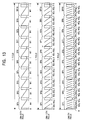
- pixel data is written into every other display lines from the first display line to the n-th display line on the PDP 100 in the addressing stages W2 1 and W2 2 of each of the sub-fields SF3 - SF10.
- the discharge cells belonging to each of the first, third, fifth, ..., (n-1)th display lines are first set into the light extinction mode from one display line to another in the addressing stage W2 1 .
- the column electrode D 1 is applied with a pixel data pulse at high voltage for setting the discharge cells into the light extinction mode.
- the load capacitance of the PDP 100 is charged when pixel data is written into the first display line. However, the load capacitance of the PDP 100 is not charged when pixel data is next written into the third display line because the load capacitance has already been charged. Likewise, such charging is avoided as well in the operation for the fifth display line onward.
- discharge cells belonging to each of the second, fourth, sixth, ..., n-th display lines are set into the light emission mode from one display line to another. In this event, the column electrode D 1 is applied with a pixel data pulse at low voltage for setting the discharge cells into the light emission mode. However, the load capacitance of the PDP 100 is not charged even if the column electrode D 1 is applied with a low voltage pixel data pulse.
- the light emission mode setting is frequently switched to the light extinction mode setting on each column electrode D in the addressing stages (W2 1 , W2 2 ) of each of the sub-fields SF3 - SF10.
- the light emission mode setting is switched to the light extinction mode setting in the addressing stage W1 of each of the sub-fields SF1 and SF2 a number of times half as much as that in the addressing stages W2 1 and W2 2 (per unit time). This results in a reduced number of times the load capacitance is charged, leading to limitations to the wasteful power consumption for the charging.
- the discharge cells belonging to each of the first to the n-th display lines on the PDP 100 are sequentially scanned from one display line to another to set them into either the light emission mode or the light extinction mode in the addressing stage W1 of each of the sub-fields SF1 and SF2.
- the discharge cells belonging to each of the first to the n-th display lines of the PDP 100 are scanned every other display line to set them into either the light emission mode or the light extinction mode.
- the discharge cells belonging to each of the first to the n-th display lines of the PDP 100 are scanned every fourth display line to set them into either the light emission mode or the light extinction mode.
- the discharge cells are scanned from one display line to another in different orders.
- the present invention can be applied as well to a display device equipped with an electroluminescence panel as long as it is a capacitive display panel.
- the display lines may be scanned in different orders from one sub-field to another or from one sub-field group to another.
- the sustain stage in a sub-field which involves a large number of times of light emission may be divided into a plurality of divided sustain stages, and each of these divided sustain stages may be performed immediately after each addressing stage of the sub-field.
- the sustain stage I of the sub-field SF11 which is allocated a light emission duration "47" as shown in Fig.
- sustain stages I 1 - I 3 may be divided into sustain stages I 1 - I 3 , each of which is allocated a light emission duration "12," and a sustain stage I 4 which is allocated a light emission duration "11."
- the PDP 100 is driven in the order of the addressing stage W3 1 , sustain stage I 1 , addressing stage W3 2 , sustain stage I 2 , addressing stage W3 3 , sustain stage I 3 , addressing stage W3 4 , and sustain stage I 4 .
- each field is divided into 12 sub-fields SF1 - SF12 as shown in Fig. 7 for driving in the foregoing embodiment
- the number of sub-fields into which one field is divided is not limited to 12.
- the addressing stage W 1 is performed in SF1 and SF2; the addressing stages W2 1 and W2 2 in SF3 - SF10; and addressing stages W3 1 , W3 2 , W3 3 , W3 4 in SF11 and SF12, but the present invention is not limited to this driving sequence.
- each field may be comprised of ten sub-fields SF1 - SF10.
- the addressing stage W1 is performed to sequentially scan the discharge cells belonging to each of the first to the n-th display lines from one display line to another to set the discharge cells into either the light emission mode or the light extinction mode.
- the addressing stages W2 1 and W2 2 are performed to scan the discharge cells belonging to each of the first to the n-th display lines every other display line to set the discharge cells into either the light emission mode or the light extinction mode.
- the addressing stages W3 1 , W3 2 , W3 3 , and W3 4 are performed to scan the discharge cells belonging to each of the first to the n-th display lines every fourth display line to set the discharge cells into either the light emission mode or the light extinction mode.
- addressing stages W1, W2 1 , W2 2 , W3 1 , W3 2 , W3 3 , and W3 4 are mixedly performed in each field, they may be performed in units of fields.
- the addressing stage W1 is performed in each sub-field of this field.
- a (3M-1)th field such as the second field, fifth field, and eighth field
- the addressing stages W2 1 and W2 2 are preformed in each sub-field of this field.
- a (3M)th field such as the third field, sixth field, and ninth field
- the addressing stages W3 1 , W3 2 , W3 3 , and W3 4 are performed in each sub-field of this field.
- the first to the n-th display lines are scanned in the addressing stage in a field or in a field group comprised of a plurality of fields in an order different from those in the addressing stages in other fields or in other field groups.
Landscapes
- Engineering & Computer Science (AREA)
- Physics & Mathematics (AREA)
- General Physics & Mathematics (AREA)
- Remote Sensing (AREA)
- Radar, Positioning & Navigation (AREA)
- Mechanical Engineering (AREA)
- Power Engineering (AREA)
- Plasma & Fusion (AREA)
- Computer Hardware Design (AREA)
- Theoretical Computer Science (AREA)
- Computer Networks & Wireless Communication (AREA)
- Transportation (AREA)
- Control Of Indicators Other Than Cathode Ray Tubes (AREA)
- Control Of Gas Discharge Display Tubes (AREA)
- Transforming Electric Information Into Light Information (AREA)
Abstract
Description
Fig. 4 is a diagram showing the internal configuration of the
In Fig. 4, the first
Figs. 8 and 9 are diagrams respectively showing a variety of pulses applied to the row electrodes and column electrodes of the
Fig. 8 only shows the sub-fields SF1 - SF3 extracted from SF1 - SF12, while Fig. 9 only shows the sub-field SF12 extracted from SF1 - SF12.
In the addressing stage W32 of each of the sub-fields SF11 and SF12, the column electrodes D1 - Dm are sequentially applied with a pixel data pulse group corresponding to each of the (4N-2)th display lines on the
In the addressing stage W33 of each of the sub-fields SF11 and SF12, the column electrodes D1 - Dm are sequentially applied with a pixel data pulse group corresponding to each of the (4N-1)th display lines on the
Specifically, discharge cells in the light emission mode maintain the light emission mode without transition, while discharge cells in the light extinction mode maintain the light extinction mode without transition.
Next, in the sustain stage I of each sub-field, the first sustain
[0 : 2 : 5 : 8 : 18 : 29 : 46 : 68 : 96 : 131 : 174 : 225 : 255]
Claims (3)
- A display panel driving method for driving a display panel formed with a plurality of pixel cells serving as pixels on each of n display lines every plural sub-fields which make up each field of an input video signal for providing a gradation display,
wherein:each of said sub-field includes:an addressing stage for scanning each of pixel cells formed on each of said n display lines from one display line to another to set said pixel cells into either a light emission mode or a light extinction mode based on the input video signal, and a sustain stage for forcing only said pixel cells set in the light emission mode to emit light for a duration corresponding to said sub-field; andeach of said n display lines is scanned in said addressing stage in each of at least two sub-fields in each of said sub-fields in an order different from a scanning order in said addressing stage of each of the other sub-fields. - A display panel driving method according to claim 1, wherein each of said n display lines is sequentially scanned one by one in said addressing stage in each of said at least two sub-fields in each of said sub-fields, while each of said n display line is scanned at intervals of k display lines (k is a natural number) in said addressing stage in each of the other sub-fields.
- A display panel driving method for driving a display panel formed with a plurality of pixel cells serving as pixels on each of n display lines in accordance with an input video signal for providing a gradation display, said method comprising the step of:wherein each of said n display lines is scanned in said addressing stage in said field or in a field group comprised of a plurality of said fields in an order different from a scanning order in said addressing stage in other fields or in other field groups.performing an addressing stage for scanning each of said pixel cells formed on each of said n display lines from one display line to another to set said pixel cell into a light emission mode or a light extinction mode based on the input video signal, and a sustain stage for forcing only said pixel cells set in the light emission mode to emit light for a duration corresponding to said sub-field,
Applications Claiming Priority (4)
| Application Number | Priority Date | Filing Date | Title |
|---|---|---|---|
| JP2003113651 | 2003-04-18 | ||
| JP2003113651 | 2003-04-18 | ||
| JP2003180709 | 2003-06-25 | ||
| JP2003180709A JP4434639B2 (en) | 2003-04-18 | 2003-06-25 | Driving method of display panel |
Publications (2)
| Publication Number | Publication Date |
|---|---|
| EP1471490A2 true EP1471490A2 (en) | 2004-10-27 |
| EP1471490A3 EP1471490A3 (en) | 2009-02-25 |
Family
ID=32964964
Family Applications (1)
| Application Number | Title | Priority Date | Filing Date |
|---|---|---|---|
| EP04006449A Withdrawn EP1471490A3 (en) | 2003-04-18 | 2004-03-17 | Display panel driving method |
Country Status (6)
| Country | Link |
|---|---|
| US (1) | US7053872B2 (en) |
| EP (1) | EP1471490A3 (en) |
| JP (1) | JP4434639B2 (en) |
| KR (1) | KR100553335B1 (en) |
| CN (1) | CN1538369A (en) |
| TW (1) | TWI247265B (en) |
Families Citing this family (11)
| Publication number | Priority date | Publication date | Assignee | Title |
|---|---|---|---|---|
| US7333100B2 (en) * | 2004-06-08 | 2008-02-19 | Au Optronics Corporation | Apparatus, method, and system for driving flat panel display devices |
| JP4828840B2 (en) | 2004-07-08 | 2011-11-30 | パナソニック株式会社 | Driving method of display panel |
| JP4731939B2 (en) * | 2005-02-10 | 2011-07-27 | パナソニック株式会社 | Driving method of display panel |
| JP2007133291A (en) * | 2005-11-14 | 2007-05-31 | Matsushita Electric Ind Co Ltd | Driving method of plasma display panel |
| JP5134264B2 (en) * | 2007-03-02 | 2013-01-30 | パナソニック株式会社 | Driving method of plasma display panel |
| TWI425485B (en) | 2007-04-12 | 2014-02-01 | Au Optronics Corp | Driving method of a display panel |
| JP5615480B2 (en) * | 2007-05-10 | 2014-10-29 | ルネサスエレクトロニクス株式会社 | Display device and display panel driver |
| WO2009081510A1 (en) * | 2007-12-25 | 2009-07-02 | Panasonic Corporation | Apparatus and method for driving plasma display panel, and plasma display device |
| CN101911163A (en) * | 2007-12-26 | 2010-12-08 | 松下电器产业株式会社 | Driving device and driving method of plasma display panel, and plasma display device |
| CN102881250B (en) * | 2012-09-25 | 2015-09-16 | 四川长虹电器股份有限公司 | A kind of method reducing the power consumption of PDP screen when showing low gray scale image |
| KR20240164704A (en) | 2023-05-12 | 2024-11-20 | 삼성디스플레이 주식회사 | Display device and method of driving the same |
Family Cites Families (4)
| Publication number | Priority date | Publication date | Assignee | Title |
|---|---|---|---|---|
| JP3403635B2 (en) * | 1998-03-26 | 2003-05-06 | 富士通株式会社 | Display device and method of driving the display device |
| KR100337882B1 (en) * | 1999-10-26 | 2002-05-23 | 김순택 | Method for driving plasma display panel |
| KR100383044B1 (en) * | 2001-01-19 | 2003-05-09 | 엘지전자 주식회사 | A Driving Method Of Plasma Display Panel |
| KR100477602B1 (en) * | 2002-04-22 | 2005-03-18 | 엘지전자 주식회사 | Method for driving of plasma display panel |
-
2003
- 2003-06-25 JP JP2003180709A patent/JP4434639B2/en not_active Expired - Fee Related
-
2004
- 2004-03-17 US US10/801,638 patent/US7053872B2/en not_active Expired - Fee Related
- 2004-03-17 EP EP04006449A patent/EP1471490A3/en not_active Withdrawn
- 2004-03-31 TW TW093108876A patent/TWI247265B/en not_active IP Right Cessation
- 2004-04-16 CN CNA2004100327575A patent/CN1538369A/en active Pending
- 2004-04-19 KR KR1020040026677A patent/KR100553335B1/en not_active Expired - Fee Related
Also Published As
| Publication number | Publication date |
|---|---|
| US20040233129A1 (en) | 2004-11-25 |
| TWI247265B (en) | 2006-01-11 |
| US7053872B2 (en) | 2006-05-30 |
| JP4434639B2 (en) | 2010-03-17 |
| JP2005004148A (en) | 2005-01-06 |
| KR20040090935A (en) | 2004-10-27 |
| TW200425047A (en) | 2004-11-16 |
| KR100553335B1 (en) | 2006-02-20 |
| EP1471490A3 (en) | 2009-02-25 |
| CN1538369A (en) | 2004-10-20 |
Similar Documents
| Publication | Publication Date | Title |
|---|---|---|
| JP3767791B2 (en) | Driving method of display panel | |
| KR100362694B1 (en) | Method for driving a plasma display panel | |
| US6448960B1 (en) | Driving method of plasma display panel | |
| EP0952569A2 (en) | Method of driving a plasma display panel | |
| US6479943B2 (en) | Display panel driving method | |
| JP2000259118A (en) | Display panel driving method | |
| US20020005842A1 (en) | Display panel driving method | |
| US6642911B2 (en) | Plasma display panel driving method | |
| JP2002023693A (en) | Driving method for plasma display device | |
| JP3761132B2 (en) | Driving method of display panel | |
| EP1471490A2 (en) | Display panel driving method | |
| JP2000231362A (en) | Driving method for plasma display panel | |
| US6052101A (en) | Circuit of driving plasma display device and gray scale implementing method | |
| US20020012075A1 (en) | Plasma display panel driving method | |
| JP4071382B2 (en) | Driving method of plasma display panel | |
| JP2000242227A (en) | Method for driving plasma display panel | |
| US7187348B2 (en) | Driving method for plasma display panel | |
| JP2000315069A (en) | Driving method of display panel | |
| KR100781214B1 (en) | Method for driving display panel | |
| US7142174B2 (en) | Driving method of plasma display panel | |
| US6472825B2 (en) | Method for driving a plasma display panel | |
| US7109950B2 (en) | Display apparatus | |
| JP3868457B2 (en) | Display panel drive method | |
| JP2000276103A (en) | Driving method for plasma display panel | |
| JP2000338931A (en) | Driving method of display panel |
Legal Events
| Date | Code | Title | Description |
|---|---|---|---|
| PUAI | Public reference made under article 153(3) epc to a published international application that has entered the european phase |
Free format text: ORIGINAL CODE: 0009012 |
|
| AK | Designated contracting states |
Kind code of ref document: A2 Designated state(s): AT BE BG CH CY CZ DE DK EE ES FI FR GB GR HU IE IT LI LU MC NL PL PT RO SE SI SK TR |
|
| AX | Request for extension of the european patent |
Extension state: AL LT LV MK |
|
| PUAL | Search report despatched |
Free format text: ORIGINAL CODE: 0009013 |
|
| AK | Designated contracting states |
Kind code of ref document: A3 Designated state(s): AT BE BG CH CY CZ DE DK EE ES FI FR GB GR HU IE IT LI LU MC NL PL PT RO SE SI SK TR |
|
| AX | Request for extension of the european patent |
Extension state: AL LT LV MK |
|
| AKX | Designation fees paid | ||
| STAA | Information on the status of an ep patent application or granted ep patent |
Free format text: STATUS: THE APPLICATION IS DEEMED TO BE WITHDRAWN |
|
| 18D | Application deemed to be withdrawn |
Effective date: 20090826 |
|
| REG | Reference to a national code |
Ref country code: DE Ref legal event code: 8566 |