EP1471106A1 - Foamed polyimide shaped article and process for production of same - Google Patents
Foamed polyimide shaped article and process for production of same Download PDFInfo
- Publication number
- EP1471106A1 EP1471106A1 EP04009467A EP04009467A EP1471106A1 EP 1471106 A1 EP1471106 A1 EP 1471106A1 EP 04009467 A EP04009467 A EP 04009467A EP 04009467 A EP04009467 A EP 04009467A EP 1471106 A1 EP1471106 A1 EP 1471106A1
- Authority
- EP
- European Patent Office
- Prior art keywords
- shaped article
- foamed polyimide
- foamed
- heat resistant
- set forth
- Prior art date
- Legal status (The legal status is an assumption and is not a legal conclusion. Google has not performed a legal analysis and makes no representation as to the accuracy of the status listed.)
- Withdrawn
Links
Images


Classifications
-
- C—CHEMISTRY; METALLURGY
- C08—ORGANIC MACROMOLECULAR COMPOUNDS; THEIR PREPARATION OR CHEMICAL WORKING-UP; COMPOSITIONS BASED THEREON
- C08J—WORKING-UP; GENERAL PROCESSES OF COMPOUNDING; AFTER-TREATMENT NOT COVERED BY SUBCLASSES C08B, C08C, C08F, C08G or C08H
- C08J9/00—Working-up of macromolecular substances to porous or cellular articles or materials; After-treatment thereof
- C08J9/22—After-treatment of expandable particles; Forming foamed products
- C08J9/228—Forming foamed products
- C08J9/236—Forming foamed products using binding agents
-
- C—CHEMISTRY; METALLURGY
- C08—ORGANIC MACROMOLECULAR COMPOUNDS; THEIR PREPARATION OR CHEMICAL WORKING-UP; COMPOSITIONS BASED THEREON
- C08G—MACROMOLECULAR COMPOUNDS OBTAINED OTHERWISE THAN BY REACTIONS ONLY INVOLVING UNSATURATED CARBON-TO-CARBON BONDS
- C08G73/00—Macromolecular compounds obtained by reactions forming a linkage containing nitrogen with or without oxygen or carbon in the main chain of the macromolecule, not provided for in groups C08G12/00 - C08G71/00
- C08G73/06—Polycondensates having nitrogen-containing heterocyclic rings in the main chain of the macromolecule
- C08G73/10—Polyimides; Polyester-imides; Polyamide-imides; Polyamide acids or similar polyimide precursors
- C08G73/1003—Preparatory processes
- C08G73/1007—Preparatory processes from tetracarboxylic acids or derivatives and diamines
- C08G73/101—Preparatory processes from tetracarboxylic acids or derivatives and diamines containing chain terminating or branching agents
-
- C—CHEMISTRY; METALLURGY
- C08—ORGANIC MACROMOLECULAR COMPOUNDS; THEIR PREPARATION OR CHEMICAL WORKING-UP; COMPOSITIONS BASED THEREON
- C08J—WORKING-UP; GENERAL PROCESSES OF COMPOUNDING; AFTER-TREATMENT NOT COVERED BY SUBCLASSES C08B, C08C, C08F, C08G or C08H
- C08J2379/00—Characterised by the use of macromolecular compounds obtained by reactions forming in the main chain of the macromolecule a linkage containing nitrogen with or without oxygen, or carbon only, not provided for in groups C08J2361/00 - C08J2377/00
- C08J2379/04—Polycondensates having nitrogen-containing heterocyclic rings in the main chain; Polyhydrazides; Polyamide acids or similar polyimide precursors
- C08J2379/08—Polyimides; Polyester-imides; Polyamide-imides; Polyamide acids or similar polyimide precursors
Definitions
- the present invention relates to a foamed polyimide shaped article and a process for production of the same, more particularly relates to a foamed polyimide shaped article having heat resistance and molded into any shape and a process for production of the same.
- a foam As a foam, a urethane-based, polystyrene-based, or polyolefin-based one has been well known. When making shaped articles from these foams, the foam is converted into chips and utilized again as cushions for seats or industrial insulating materials by being shaped with a binder. These foamed shaped articles have heat resistances of about 100°C and therefore have been limited in range of used temperature.
- foamed polyimide shaped articles are obtained by simultaneous foaming and molding. There are therefore limits on the shapes and sizes and limits on the applications of the polyimide foamed shaped articles.
- An object of the present invention is to provide a foamed polyimide shaped article having heat resistance and molded to any shape and a process for production of the same.
- a foamed polyimide shaped article having heat resistance and molded to any shape obtained by molding and then calcining a mixture of pulverized pieces of a pre-foamed polyimide resin mass and a heat resistant binder.
- a process for production of the same comprising pulverizing a pre-foamed polyimide resin mass, mixing the pulverized pieces with a heat resistant binder, molding the mixture to a predetermined shape, then calcining it at a temperature of at least 350°C to cure the binder and strongly bond the pieces of polyimide foam.
- a heat resistant binder means one where no deterioration is substantially recognized after a heat treatment test at 300°C for 60 minutes.
- foamed polyimide shaped article light in weight, high in heat resistance, and superior in cushioning and heat insulation.
- the foamed polyimide shaped article is also superior in audio characteristics.
- the pre-foamed polyimide resin mass preferably is obtained by evaporating to dryness a polyimide foam precursor mixture containing a half ester of an aromatic tetracarboxylic acid obtained by reacting an aromatic tetracarboxylic acid dianhydride and an alcohol, diamine, and an alcohol, powdering it, then premolding it to prepare a suitable green body and further heating it to cause foaming. Before this heating, it is also possible to perform microwave heating.
- aromatic tetracarboxylic acid dianhydride 2,3,3',4'-biphenyl-tetracarboxylic acid dianhydride, 3,3',4,4'-biphenyl-tetracarboxylic acid dianhydride, pyromellitic acid dianhydride, 3,3',4,4'-benzophenone-tetracarboxylic acid dianhydride, bis(3,4-dicarboxyphenyl)ether dianhydride, 2,3,6,7-naphthalene-tetracarboxylic acid dianhydride, 1,2,5,6-naphthalene-tetracarboxylic acid dianhydride, 1,2,4,5-naphthalene-tetracarboxylic acid dianhydride, 1,4,5,8-naphthalene-tetracarboxylic acid dianhydride, 2,2-bis(2,5-dicarboxyphenyl)propane dianhydride, 1,1-bis(2,3-dicarbox
- the diamine up to two aromatic diamines may be used as main components.
- a Tg of foamed polyimide of at least 300°C can be easily reached.
- the poly-substituted amine component is not essential, but is preferably partially included for preventing shrinkage of the foam at a high temperature and increasing the foam strength (resistance to cracks in foam).
- Diamine disiloxane acts like a surfactant.
- a range of 0.1 to 10 mol%, preferably 0.2 to 5 mol% is necessary. In small amounts, uniform foaming is difficult, while in large amounts, a drop in Tg or a drop in thermal stability is invited.
- polyimide foam precursor mixture preferably a half ester of 2,3,3',4'-biphenyl-tetracarboxylic acid dianhydride (hereinafter sometimes abbreviated as a-BPDA), an aromatic diamine, for example, p-phenylene diamine (hereinafter sometimes abbreviated as PPD), and/or 4,4'-diaminodiphenyl ether (hereinafter sometimes abbreviated as ODA), and an component for realizing uniform foaming, for example, diamino disiloxane, and further if necessary an amine compound having at least three amino groups in a molecule, for example, an aromatic triamine compound or aromatic tetraamine compound, in particular tetraaminobiphenyl, may be uniformly mixed and dissolved with an esterification solvent, for example, methanol, ethanol, n-propanol, n-butanol, or other lower primary alcohol, preferably methanol or ethanol to obtain a mixture having an ester
- the polyimide foam precursor mixture may have 1,2-dimethylimidazole, benzimidazole, isoquinoline, substituted pyridine, or another imidization catalyst added to it. Further, it is also possible to add another known additive, for example, an inorganic filler, an inorganic or organic pigment, etc.
- the step of evaporating to dryness the mixture and powdering it it is possible to use an evaporator on the laboratory scale or a spray drier etc. on an industrial scale.
- the evaporation temperature is lower than 100°C, preferably held at not higher than 80°C. With high temperature drying, the foamability drops sharply.
- the drying may be performed at ordinary temperature, under pressure, or under vacuum.
- the suitable green body for example, it is for example compression molded at room temperature, flow cast and dried as a slurry solution, and filled in a container inert to microwaves. At this time, the lid need not be attached (that is, it is not necessary to completely fasten it). If the green body is substantially uniform in state, uniformity at the time of foaming can be achieved.
- the heating by microwave heating is in general preferably performed at about 2.45 GHz under Japanese law for example. It is preferable to aim at the microwave output per weight powder. This should be defined by repeated experiments. For example, foaming is started at a rate of 100 g/l kW or so for about 1 minute. The foaming winds up in 2 to 3 minutes. In this state, the foam is extremely brittle.
- the microwave heated article is gradually raised in temperature from about 200°C by heating by hot air etc (as one target, a rate of rise of temperature of 100°C/10 min or so). Finally, it is heated to a temperature of the glass transition temperature (Tg) of the polyimide produced + ⁇ by the heating for 5 to 60 min, preferably for 10 min. Due to the heating and foaming by the above steps, the shape becomes indeterminate
- the polyimide precursor in the solid state is preferably heated in two stages of heating for foaming and heating for heat fixing (increasing the molecular weight).
- the heating for foaming is preferably performed by microwave heating so improve the uniformity of heating.
- the heating for heat fixing is preferably performed by heating to a temperature of at least the glass transition temperature (Tg) of the polyimide foam, preferably a temperature of not more than 500°C higher than 310°C, for 5 to 60 minutes.
- the pre-foamed polyimide resin mass obtained by the above foaming step can be adjusted to any expansion rate, but preferably it has a density of 0.0005 to 0.1 g/cm 3 .
- the pre-foamed polyimide resin mass is pulverized, the pulverized pieces are mixed with a heat resistant binder, the mixture is charged into a mold having a predetermined shape, then this is pressed and calcined to a predetermined density so as to obtain a foamed polyimide shaped article.
- the method for pulverizing the polyimide resin foam mass in the above process is not particularly limited.
- a crusher for plastic shaped articles By the above method, it is preferable to obtain pulverized pieces of a size of a diameter of about 1 mm to 50 mm converted to a sphere (i.e., a maximum diameter) from the polyimide resin foam mass.
- the polyamic acid of the binder may be used in a powdered state of polyamic acid or may be used in a solvent solution.
- the concentration of the polyamic acid is suitably about 1 to 20 wt% or so.
- aromatic tetracarboxylic acid component 3,3',4,4'-biphenyl-tetracarboxylic acid dianhydride, 3,3',4,4'-benzophenone-tetracarboxylic acid dianhydride, 2,3,3',4'-biphenyl-tetracarboxylic acid dianhydride, 1,2,3',4'-benzophenone-tetracarboxylic acid dianhydride, 1,2,3',4'-diphenyl ether-tetracarboxylic acid dianhydride, 1,2,3',4'-diphenylmethane-tetracarboxylic acid dianhydride, or acids or esters of the same, preferably an asymmetric aromatic tetracarboxylic acid component, for example, 2,3,3',4'-biphenyl-tetracarboxylic acid dianhydride, 1,2,3',4'-benzophenone-tetracarboxylic acid dian
- the aromatic diamine reacted with the aromatic tetracarboxylic acid component is not particularly limited, but an aromatic diamine having three to four benzene rings, for example, 1,3-bis(4-aminophenoxybenzene), 1,3-bis(4-aminophenoxy)biphenyl, preferably 1,3-bis(4-aminophenoxybenzene) may be mentioned. It is also possible to replace up to 80 mol% of the asymmetric aromatic tetracarboxylic acid dianhydride with a symmetric aromatic tetracarboxylic acid component or possible to replace up to 80 mol% of the aromatic diamine having three to four benzene rings with an aromatic diamine having one to two benzene rings.
- an end-modified imide oligomer As the heat resistant binder, due to the need to maintain the heat resistance of the polyimide and function as a binder, an end-modified imide oligomer is preferable.
- An end-modified imide oligomer obtained by reacting a biphenyl-tetracarboxylic acid, an aromatic diamine compound, and 4-(2-phenylethynyl)anhydrous phthalic acid and having a logarithmic viscosity ( ⁇ inh, 30°C, 0.5 g/100 ml solvent, solvent: N-methyl-2-pyrrolidone) of 0.05 to 1 is more preferable.
- biphenyl-tetracarboxylic acid 2,3,3',4'-biphenyl-tetracarboxylic acid dianhydride or 2,2' ,3,3'-biphenyl-tetracarboxylic acid dianhydride is suitable.
- the amount of the heat resistant binder used is preferably 2 to 30 parts by weight with respect to 100 parts by weight of pulverized pieces of polyimide resin foam mass converted to solid content.
- the method of mixing the pulverized pieces of polyimide resin foam mass and heat resistant binder is not particularly limited.
- the method of mixing the pulverized pieces of the polyimide resin foam mass and powder of the heat resistant binder by a kneader or the method of spraying a solution of a heat resistant binder to the pulverized pieces of polyimide resin foam mass may be mentioned.
- a mixture of pulverized pieces of a polyimide foam mass and heat resistant binder into a mold having a predetermined shape, then pressing and calcining the same under a predetermined density so as to obtain a foamed polyimide shaped article.
- the "calcining” includes curing by heating.
- the mold one made of a heat resistant material, for example, a metal, preferably a stainless steel mold can be used.
- the pressing and calcining are preferably performed for example by charging pulverized pieces of polyimide resin foam mass into which a heat resistant binder is mixed into a stainless steel mold provided with a gas vent, compressing it to predetermined dimensions (for example, height) by a pressing lid, fixing the pressing lid, then placing it for 10 to 120 minutes in an oven heated to a temperature of at least 250°C and not more than the glass transition temperature of the polyimide foam, preferably at least 300°C to not more than 400°C.
- the polyimide shaped article of the present invention preferably has no change in appearance or has a heat resistance having a loss in mass of not more than 1%, in a heat resistance test at 300°C for 60 minutes. Further, the foamed polyimide shaped article of the present invention has a density of 0.01 to 0.8 g/cm 3 depending on the molding conditions selected. Further, the foamed polyimide shaped article preferably has a density of 1.2 to 20 times the pre-foamed polyimide resin mass and pulverized pieces of the same.
- the polyimide shaped article of the present invention preferably has a tensile strength of not less than 10 PKa, more preferably of not less than 25 PKa.
- the foamed polyimide shaped article of the present invention can be made a foamed polyimide shaped article of any of a sheet shape, pipe shape, column shape, cube shape, or box shape depending on the mold selected.
- it may be made a foamed polyimide shaped article of a pipe shape having an inside diameter of 10 to 1000 mm and outer diameter of 15 to 2000 mm or a block shape having sides A, B, and C, where A, B, and C are independently from 10 to 3000 mm.
- a 500 ml eggplant-shaped flask was charged with 180 mmol of a-BPDA, 70 g of methanol, and 2.44 g of DMZ as a catalyst. The contents were heated and stirred for 90 minutes while being refluxed in a 90°C oil bath to obtain a homogeneous solution. Next, the solution was cooled to not higher than 30°C, then 189 mmol of PPD, 2 mmol of DADSi, and 30 g of methanol were added to obtain a homogeneous solution. The solution was condensed by an evaporator and dried at 60°C in vacuo to obtain solid matter. This solid matter was pulverized and powdered and molded into a green body using a compression molding machine.
- the green body was made to foam by a microwave heating apparatus at an expansion rate of 130X (density: 0.011 g/cm 3 ) to obtain a foam.
- the foam was heated at 450°C for 15 minutes to obtain a polyimide foam.
- This polyimide foam was crushed by a crusher to chips of a size of about 5 mm diameter.
- the chips were sprayed, while stirring the chips, using as a heat resistant binder a polyamic acid solution having a viscosity of 9 cp obtained by polymerization of a-BPDA and 1,3-bis(4-aminophenoxy)benzene in dimethyl acetoamide at a concentration of 5.5 wt%, in an amount of 27 g of heat resistant binder solution with respect to 15 g of chips and mixed and agitated for about 10 minutes to obtain a mixture of chips and heat resistant binder.
- the chips of the mixture were charged into a stainless steel mold of a height of 250 mm, a width of 150 mm, and a length of 200 mm and compressed to a height of 200 mm by a pressing lid provided with a gas vent, then the pressing lid was fixed in place.
- the container was placed in an oven and the content fired at 350°C for 30 minutes.
- the content was cooled, then the mold was opened and the foamed polyimide shaped article was taken out from the mold.
- the foamed polyimide shaped article was examined for density (g/cm 3 ), tensile strength, and appearance and change in mass after standing in a 300°C oven for 60 minutes. The results are shown together in Table 1.
- Example 1 The same procedure was followed as in Example 1 to obtain a polyimide foam of an expansion rate of 140X except for using DADE as the diamine component. The same procedure was followed as in Example 1 to obtain a foamed polyimide shaped article except for using this polyimide foam. The foamed polyimide shaped article was examined for density, tensile strength, and appearance and change in mass after standing in a 300°C oven for 60 minutes. The results are shown together in Table 1.
- Example 1 The same procedure was followed as in Example 1 to obtain a foamed polyimide shaped article except for changing the expansion rate.
- the foamed polyimide shaped article was examined for density, tensile strength, and appearance and change in mass after standing in a 300°C oven for 60 minutes. The results are shown together in Table 1.
- Example 1 The same procedure was followed as in Example 1 to obtain a foamed polyimide shaped article except for using a polyamic acid solution obtained in the same way as Example 1 except for using as the heat resistant binder a composition of an aromatic tetracarboxylic acid component constituted by 80 mol% of a-BPDA and 20 mol% of s-BPDA.
- the foamed polyimide shaped article was examined for density, tensile strength, and appearance and change in mass (change in weight) after standing in a 300°C oven for 60 minutes. The results are shown together in Table 1.
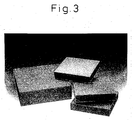
- Example 2 The same procedure was followed as in Example 1 to obtain a foamed polyimide shaped article of the dimensions shown in FIG. 2 except for changing the shape of the mold.
- the foamed polyimide shaped article was examined for density, tensile strength, and appearance and change in mass after standing in a 300°C oven for 60 minutes. The results are shown together in Table 1.
- foamed polyimide shaped articles having a density of at least 0.01 g/cm 3 to not more than 0.1 g/cm 3 and no change in appearance by a heat resistance test at 300°C for 60 minutes, in particular no loss of mass, and having a heat resistance of not more than 1% can be obtained.
- a foamed polyimide shaped article partially carburized and changing in appearance and having a loss of mass of more than 1% due to the above heat resistance test and not having heat resistance can be obtained.
- Example 2 The same procedure was followed as in Example 1 to obtain an expansion rate of 130X.
- the foam was heated at 450°C for 15 minutes to obtain a polyimide foam.
- This polyimide foam was pulverized to a size of about 5 mm diameter by a crushed to obtain chips.
- the end-modified imide oligomer was heat cured (380°C x 2 hours) to prepare a cured article (test piece) of a thickness of 3 mm.
- the flexural strength found by a bending test performed based on ASTM D-790 was 1490 kgf/cm 2 .
- This cured article had a Tg (DSC) of 375°C and exhibited no heat generation peak. Further, it was insoluble in DMAc, had a modulus of elasticity of 290 kg/mm 2 , a tensile strength of 11.5 kg/mm 2 , an elongation of 20%, and a 5% weight loss temperature by TGA of about 520°C.
- the end-modified imide oligomer was used as the heat resistant binder, 3 g of heat resistant binder powder was blended with respect to 15 g of chips, then the chips in which the heat resistant binder were charged into a stainless steel mold of a height of 250 mm, a width of 150 mm, and a length of 200 mm, the height of the chips was compressed to 20 mm by a pressing lid provided with a gas vent, and the pressing lid was fixed in place.
- the container was placed in an oven and the content fired at 400°C for 30 minutes.
- the content was cooled, then the foamed polyimide shaped article was taken out from the mold.
- the foamed polyimide shaped article was examined for density, tensile strength, and appearance and change in mass after standing in a 300°C oven for 60 minutes. The results are shown below:
- Example 6 The same procedure was followed as in Example 6 to obtain a foamed polyimide shaped article except for changing the amount of the heat resistant binder added from 3 g to 2 g.
- the foamed polyimide shaped article was examined for density, tensile strength, and appearance and change in mass after standing in a 300°C oven for 60 minutes. The results are shown below:
- Example 7 The same procedure was followed as in Example 7 to obtain a foamed polyimide shaped article except for using a mold similar to Example 5 as the mold. This foamed polyimide shaped article exhibited similar performance as in Example 7.
Landscapes
- Chemical & Material Sciences (AREA)
- Health & Medical Sciences (AREA)
- Chemical Kinetics & Catalysis (AREA)
- Medicinal Chemistry (AREA)
- Polymers & Plastics (AREA)
- Organic Chemistry (AREA)
- Engineering & Computer Science (AREA)
- Materials Engineering (AREA)
- Manufacture Of Porous Articles, And Recovery And Treatment Of Waste Products (AREA)
- Macromolecular Compounds Obtained By Forming Nitrogen-Containing Linkages In General (AREA)
- Compositions Of Macromolecular Compounds (AREA)
Abstract
A foamed polyimide shaped article is obtained, by molding and calcining a mixture of pulverized pieces of a prefoamed polyimide resin mass and a heat resistant binder.
Description
The present invention relates to a foamed
polyimide shaped article and a process for production of
the same, more particularly relates to a foamed polyimide
shaped article having heat resistance and molded into any
shape and a process for production of the same.
In the past, as a foam, a urethane-based,
polystyrene-based, or polyolefin-based one has been well
known. When making shaped articles from these foams, the
foam is converted into chips and utilized again as
cushions for seats or industrial insulating materials by
being shaped with a binder. These foamed shaped articles
have heat resistances of about 100°C and therefore have
been limited in range of used temperature.
Therefore, an industrial heating insulating
foam material having a heat resistance enabling use at a
high temperature, in particular a temperature of at least
300°C, has been sought. Therefore, a polyimide-based
article has been studied as a heat resistant foam and a
polyimide shaped article has been proposed (U.S. Patent
No. 4,241,193, Japanese Unexamined Patent Publication
(Kokai) No. 61-195126, Japanese Unexamined Patent
Publication (Kokai) No. 1-313537, Japanese Unexamined
Patent Publication (Kokai) No. 2-24326, and Japanese
Unexamined Patent Publication (Kokai) No. 4-211440).
Such foamed polyimide shaped articles, however,
are obtained by simultaneous foaming and molding. There
are therefore limits on the shapes and sizes and limits
on the applications of the polyimide foamed shaped
articles.
An object of the present invention is to
provide a foamed polyimide shaped article having heat
resistance and molded to any shape and a process for
production of the same.
To attain the above object, according to a
first aspect of the invention, there is provided a foamed
polyimide shaped article having heat resistance and
molded to any shape obtained by molding and then
calcining a mixture of pulverized pieces of a pre-foamed
polyimide resin mass and a heat resistant binder.
According to a second aspect of the invention, there is
provided a process for production of the same comprising
pulverizing a pre-foamed polyimide resin mass, mixing the
pulverized pieces with a heat resistant binder, molding
the mixture to a predetermined shape, then calcining it
at a temperature of at least 350°C to cure the binder and
strongly bond the pieces of polyimide foam. In this
specification, a heat resistant binder means one where no
deterioration is substantially recognized after a heat
treatment test at 300°C for 60 minutes.
According to the present invention, it is
possible to obtain a foamed polyimide shaped article
light in weight, high in heat resistance, and superior in
cushioning and heat insulation. The foamed polyimide
shaped article is also superior in audio characteristics.
According to the method of the present invention, it is
possible to produce foamed polyimide having the above
features and molded to any shape by a simple operation.
These and other objects and features of the
present invention will become clearer from the following
description of the preferred embodiments given with
reference to the attached drawings, wherein:
Preferred embodiments of the present invention
are described below:

In the present invention, the pre-foamed
polyimide resin mass preferably is obtained by
evaporating to dryness a polyimide foam precursor mixture
containing a half ester of an aromatic tetracarboxylic
acid obtained by reacting an aromatic tetracarboxylic
acid dianhydride and an alcohol, diamine, and an alcohol,
powdering it, then premolding it to prepare a suitable
green body and further heating it to cause foaming.
Before this heating, it is also possible to perform
microwave heating.
As the aromatic tetracarboxylic acid
dianhydride, 2,3,3',4'-biphenyl-tetracarboxylic acid
dianhydride, 3,3',4,4'-biphenyl-tetracarboxylic acid
dianhydride, pyromellitic acid dianhydride, 3,3',4,4'-benzophenone-tetracarboxylic
acid dianhydride, bis(3,4-dicarboxyphenyl)ether
dianhydride, 2,3,6,7-naphthalene-tetracarboxylic
acid dianhydride, 1,2,5,6-naphthalene-tetracarboxylic
acid dianhydride, 1,2,4,5-naphthalene-tetracarboxylic
acid dianhydride, 1,4,5,8-naphthalene-tetracarboxylic
acid dianhydride, 2,2-bis(2,5-dicarboxyphenyl)propane
dianhydride, 1,1-bis(2,3-dicarboxyphenyl)ethane
dianhydride, 1,1-bis(3,4-dicarboxyphenyl)sulfonic
acid dianhydride, 1,3-bis(3,4-dicarboxyphenyl)-1,1,3,3-tetramethyl-disiloxane
dianhydride, etc. may be mentioned. In particular,
2,3,3',4'-biphenyl-tetracarboxylic acid dianhydride is
preferably contained in an amount of at least 50%.
As the diamine, up to two aromatic diamines may
be used as main components. By this, a Tg of foamed
polyimide of at least 300°C can be easily reached. The
poly-substituted amine component is not essential, but is
preferably partially included for preventing shrinkage of
the foam at a high temperature and increasing the foam
strength (resistance to cracks in foam). Diamine
disiloxane acts like a surfactant. To ensure uniform
foam, a range of 0.1 to 10 mol%, preferably 0.2 to 5 mol%
is necessary. In small amounts, uniform foaming is
difficult, while in large amounts, a drop in Tg or a drop
in thermal stability is invited.
As the polyimide foam precursor mixture,
preferably a half ester of 2,3,3',4'-biphenyl-tetracarboxylic
acid dianhydride (hereinafter sometimes
abbreviated as a-BPDA), an aromatic diamine, for example,
p-phenylene diamine (hereinafter sometimes abbreviated as
PPD), and/or 4,4'-diaminodiphenyl ether (hereinafter
sometimes abbreviated as ODA), and an component for
realizing uniform foaming, for example, diamino
disiloxane, and further if necessary an amine compound
having at least three amino groups in a molecule, for
example, an aromatic triamine compound or aromatic
tetraamine compound, in particular tetraaminobiphenyl,
may be uniformly mixed and dissolved with an
esterification solvent, for example, methanol, ethanol,
n-propanol, n-butanol, or other lower primary alcohol,
preferably methanol or ethanol to obtain a mixture having
a ratio of nonvolatile components in the total weight of
10% to 50% or so.
The polyimide foam precursor mixture may have
1,2-dimethylimidazole, benzimidazole, isoquinoline,
substituted pyridine, or another imidization catalyst
added to it. Further, it is also possible to add another
known additive, for example, an inorganic filler, an
inorganic or organic pigment, etc.
In the step of evaporating to dryness the
mixture and powdering it, it is possible to use an
evaporator on the laboratory scale or a spray drier etc.
on an industrial scale. The evaporation temperature is
lower than 100°C, preferably held at not higher than
80°C. With high temperature drying, the foamability drops
sharply. The drying may be performed at ordinary
temperature, under pressure, or under vacuum.
In the step of molding the suitable green body,
for example, it is for example compression molded at room
temperature, flow cast and dried as a slurry solution,
and filled in a container inert to microwaves. At this
time, the lid need not be attached (that is, it is not
necessary to completely fasten it). If the green body is
substantially uniform in state, uniformity at the time of
foaming can be achieved.
The heating by microwave heating is in general
preferably performed at about 2.45 GHz under Japanese law
for example. It is preferable to aim at the microwave
output per weight powder. This should be defined by
repeated experiments. For example, foaming is started at
a rate of 100 g/l kW or so for about 1 minute. The
foaming winds up in 2 to 3 minutes. In this state, the
foam is extremely brittle.
Next, the microwave heated article is gradually
raised in temperature from about 200°C by heating by hot
air etc (as one target, a rate of rise of temperature of
100°C/10 min or so). Finally, it is heated to a
temperature of the glass transition temperature (Tg) of
the polyimide produced + α by the heating for 5 to 60
min, preferably for 10 min. Due to the heating and
foaming by the above steps, the shape becomes
indeterminate
In the above process, the polyimide precursor
in the solid state is preferably heated in two stages of
heating for foaming and heating for heat fixing
(increasing the molecular weight). Further, in the
process for production of a polyimide foam, the heating
for foaming is preferably performed by microwave heating
so improve the uniformity of heating. Further, the
heating for heat fixing (increasing the molecular weight)
is preferably performed by heating to a temperature of at
least the glass transition temperature (Tg) of the
polyimide foam, preferably a temperature of not more than
500°C higher than 310°C, for 5 to 60 minutes.
In the present invention, the pre-foamed
polyimide resin mass obtained by the above foaming step
can be adjusted to any expansion rate, but preferably it
has a density of 0.0005 to 0.1 g/cm3.
In the present invention, the pre-foamed
polyimide resin mass is pulverized, the pulverized pieces
are mixed with a heat resistant binder, the mixture is
charged into a mold having a predetermined shape, then
this is pressed and calcined to a predetermined density
so as to obtain a foamed polyimide shaped article.
The method for pulverizing the polyimide resin
foam mass in the above process is not particularly
limited. For example, it is possible to suitably use a
crusher for plastic shaped articles. By the above method,
it is preferable to obtain pulverized pieces of a size of
a diameter of about 1 mm to 50 mm converted to a sphere
(i.e., a maximum diameter) from the polyimide resin foam
mass.
In the present invention, it is important to
mix the pulverized pieces with a heat resistant binder.
As the heat resistant binder, a polyamic acid is
preferred from the need of maintaining the heat
resistance of the polyimide and functioning as a binder.
In particular, as a polyamic acid for a binder, a
polyamic acid obtained from an aromatic tetracarboxylic
acid component, preferably an asymmetric aromatic
tetracarboxylic acid component and aromatic diamine, or a
polyamic acid obtained from an aromatic tetracarboxylic
acid component and meta-substituted aromatic diamine or
other polyamic acid giving a heat resistant heat fusing
polyimide is suitable. In this method, the polyamic acid
of the binder may be used in a powdered state of polyamic
acid or may be used in a solvent solution. When used as a
solvent solution of polyamic acid, the concentration of
the polyamic acid is suitably about 1 to 20 wt% or so.
As the aromatic tetracarboxylic acid component,
3,3',4,4'-biphenyl-tetracarboxylic acid dianhydride,
3,3',4,4'-benzophenone-tetracarboxylic acid dianhydride,
2,3,3',4'-biphenyl-tetracarboxylic acid dianhydride,
1,2,3',4'-benzophenone-tetracarboxylic acid dianhydride,
1,2,3',4'-diphenyl ether-tetracarboxylic acid
dianhydride, 1,2,3',4'-diphenylmethane-tetracarboxylic
acid dianhydride, or acids or esters of the same,
preferably an asymmetric aromatic tetracarboxylic acid
component, for example, 2,3,3',4'-biphenyl-tetracarboxylic
acid dianhydride, 1,2,3',4'-benzophenone-tetracarboxylic
acid dianhydride, 1,2,3',4'-diphenyl
ether-tetracarboxylic acid dianhydride, 1,2,3',4'-diphenylmethane-tetracarboxylic
acid dianhydride or acids
or esters of the same, in particular 2,3,3',4'-biphenyl-tetracarboxylic
acid dianhydride may be mentioned.
The aromatic diamine reacted with the aromatic
tetracarboxylic acid component is not particularly
limited, but an aromatic diamine having three to four
benzene rings, for example, 1,3-bis(4-aminophenoxybenzene),
1,3-bis(4-aminophenoxy)biphenyl,
preferably 1,3-bis(4-aminophenoxybenzene) may be
mentioned. It is also possible to replace up to 80 mol%
of the asymmetric aromatic tetracarboxylic acid
dianhydride with a symmetric aromatic tetracarboxylic
acid component or possible to replace up to 80 mol% of
the aromatic diamine having three to four benzene rings
with an aromatic diamine having one to two benzene rings.
As the heat resistant binder, due to the need
to maintain the heat resistance of the polyimide and
function as a binder, an end-modified imide oligomer is
preferable. An end-modified imide oligomer obtained by
reacting a biphenyl-tetracarboxylic acid, an aromatic
diamine compound, and 4-(2-phenylethynyl)anhydrous
phthalic acid and having a logarithmic viscosity (ηinh,
30°C, 0.5 g/100 ml solvent, solvent: N-methyl-2-pyrrolidone)
of 0.05 to 1 is more preferable. As the
biphenyl-tetracarboxylic acid, 2,3,3',4'-biphenyl-tetracarboxylic
acid dianhydride or 2,2' ,3,3'-biphenyl-tetracarboxylic
acid dianhydride is suitable.
In this method, the amount of the heat
resistant binder used is preferably 2 to 30 parts by
weight with respect to 100 parts by weight of pulverized
pieces of polyimide resin foam mass converted to solid
content. The method of mixing the pulverized pieces of
polyimide resin foam mass and heat resistant binder is
not particularly limited. For example, the method of
mixing the pulverized pieces of the polyimide resin foam
mass and powder of the heat resistant binder by a kneader
or the method of spraying a solution of a heat resistant
binder to the pulverized pieces of polyimide resin foam
mass may be mentioned.
In the present invention, it is possible to
charge a mixture of pulverized pieces of a polyimide foam
mass and heat resistant binder into a mold having a
predetermined shape, then pressing and calcining the same
under a predetermined density so as to obtain a foamed
polyimide shaped article. The "calcining" includes curing
by heating. As the mold, one made of a heat resistant
material, for example, a metal, preferably a stainless
steel mold can be used.
The pressing and calcining are preferably
performed for example by charging pulverized pieces of
polyimide resin foam mass into which a heat resistant
binder is mixed into a stainless steel mold provided with
a gas vent, compressing it to predetermined dimensions
(for example, height) by a pressing lid, fixing the
pressing lid, then placing it for 10 to 120 minutes in an
oven heated to a temperature of at least 250°C and not
more than the glass transition temperature of the
polyimide foam, preferably at least 300°C to not more
than 400°C.
The polyimide shaped article of the present
invention preferably has no change in appearance or has a
heat resistance having a loss in mass of not more than
1%, in a heat resistance test at 300°C for 60 minutes.
Further, the foamed polyimide shaped article of the
present invention has a density of 0.01 to 0.8 g/cm3
depending on the molding conditions selected. Further,
the foamed polyimide shaped article preferably has a
density of 1.2 to 20 times the pre-foamed polyimide resin
mass and pulverized pieces of the same. The polyimide
shaped article of the present invention preferably has a
tensile strength of not less than 10 PKa, more preferably
of not less than 25 PKa. Further, the foamed polyimide
shaped article of the present invention can be made a
foamed polyimide shaped article of any of a sheet shape,
pipe shape, column shape, cube shape, or box shape
depending on the mold selected. In particular, it may be
made a foamed polyimide shaped article of a pipe shape
having an inside diameter of 10 to 1000 mm and outer
diameter of 15 to 2000 mm or a block shape having sides
A, B, and C, where A, B, and C are independently from 10
to 3000 mm.
The methods of measurement of the physical
properties in the examples and comparative example are
shown below:
In the following description, the abbreviations
mean the following compounds:
A 500 ml eggplant-shaped flask was charged with
180 mmol of a-BPDA, 70 g of methanol, and 2.44 g of DMZ
as a catalyst. The contents were heated and stirred for
90 minutes while being refluxed in a 90°C oil bath to
obtain a homogeneous solution. Next, the solution was
cooled to not higher than 30°C, then 189 mmol of PPD, 2
mmol of DADSi, and 30 g of methanol were added to obtain
a homogeneous solution. The solution was condensed by an
evaporator and dried at 60°C in vacuo to obtain solid
matter. This solid matter was pulverized and powdered and
molded into a green body using a compression molding
machine. The green body was made to foam by a microwave
heating apparatus at an expansion rate of 130X (density:
0.011 g/cm3) to obtain a foam. The foam was heated at
450°C for 15 minutes to obtain a polyimide foam. This
polyimide foam was crushed by a crusher to chips of a
size of about 5 mm diameter.
The chips were sprayed, while stirring the
chips, using as a heat resistant binder a polyamic acid
solution having a viscosity of 9 cp obtained by
polymerization of a-BPDA and 1,3-bis(4-aminophenoxy)benzene
in dimethyl acetoamide at a
concentration of 5.5 wt%, in an amount of 27 g of heat
resistant binder solution with respect to 15 g of chips
and mixed and agitated for about 10 minutes to obtain a
mixture of chips and heat resistant binder. The chips of
the mixture were charged into a stainless steel mold of a
height of 250 mm, a width of 150 mm, and a length of 200
mm and compressed to a height of 200 mm by a pressing lid
provided with a gas vent, then the pressing lid was fixed
in place. The container was placed in an oven and the
content fired at 350°C for 30 minutes. The content was
cooled, then the mold was opened and the foamed polyimide
shaped article was taken out from the mold. The foamed
polyimide shaped article was examined for density
(g/cm3), tensile strength, and appearance and change in
mass after standing in a 300°C oven for 60 minutes. The
results are shown together in Table 1.
The same procedure was followed as in Example 1
to obtain a polyimide foam of an expansion rate of 140X
except for using DADE as the diamine component. The same
procedure was followed as in Example 1 to obtain a foamed
polyimide shaped article except for using this polyimide
foam. The foamed polyimide shaped article was examined
for density, tensile strength, and appearance and change
in mass after standing in a 300°C oven for 60 minutes.
The results are shown together in Table 1.
The same procedure was followed as in Example 1
to obtain a foamed polyimide shaped article except for
changing the expansion rate. The foamed polyimide shaped
article was examined for density, tensile strength, and
appearance and change in mass after standing in a 300°C
oven for 60 minutes. The results are shown together in
Table 1.
The same procedure was followed as in Example 1
to obtain a foamed polyimide shaped article except for
using a polyamic acid solution obtained in the same way
as Example 1 except for using as the heat resistant
binder a composition of an aromatic tetracarboxylic acid
component constituted by 80 mol% of a-BPDA and 20 mol% of
s-BPDA. The foamed polyimide shaped article was examined
for density, tensile strength, and appearance and change
in mass (change in weight) after standing in a 300°C oven
for 60 minutes. The results are shown together in Table
1.
The same procedure was followed as in Example 1
to obtain a foamed polyimide shaped article of the
dimensions shown in FIG. 2 except for changing the shape
of the mold. The foamed polyimide shaped article was
examined for density, tensile strength, and appearance
and change in mass after standing in a 300°C oven for 60
minutes. The results are shown together in Table 1.
As the heat resistant binder, a urethane-based
binder was used, 10 wt% of binder was sprayed on the
chips, the mold described in Example 1 was used to mold
an article of a density of 0.03 g/cm3, then 100°C steam
was used for heating to cure the urethane binder and
obtain a urethane binder foamed polyimide shaped article.
The result was dried according to an ordinary method in a
60°C atmosphere, then evaluated. The results are shown
together in Table 1.
| Ex. | Density | Tensile strength (kPa) | Tensile elongation (%) | 300°C x 60 min heat resistance test | |
| Appearance | Change in weight | ||||
| Ex. 1 | 0.031 | 32.5 | 12.2 | No change | No change |
| Ex. 2 | 0.030 | 30.5 | 11.9 | No change | No change |
| Ex. 3 | 0.016 | 28.1 | 10.8 | No change | No change |
| Ex. 4 | 0.033 | 47.2 | 10.1 | No change | No change |
| Ex. 5 | 0.035 | 48.1 | 10.0 | No change | No change |
| Comp. Ex. 1 | 0.035 | 20.3 | 7.4 | Binder carburization | 10.5% weight loss |
| "No change" refers to 0% loss in mass. |
From Table 1, according to Examples 1 to 5,
foamed polyimide shaped articles having a density of at
least 0.01 g/cm3 to not more than 0.1 g/cm3 and no change
in appearance by a heat resistance test at 300°C for 60
minutes, in particular no loss of mass, and having a heat
resistance of not more than 1% can be obtained. As
opposed to this, according to Comparative Example 1 using
a binder with a low heat resistance, a foamed polyimide
shaped article partially carburized and changing in
appearance and having a loss of mass of more than 1% due
to the above heat resistance test and not having heat
resistance can be obtained.
The same procedure was followed as in Example 1
to obtain an expansion rate of 130X. The foam was heated
at 450°C for 15 minutes to obtain a polyimide foam. This
polyimide foam was pulverized to a size of about 5 mm
diameter by a crushed to obtain chips.
On the other hand, 11.77 g (0.04 mole) of a-BPDA,
10.01 g (0.05 mole) of 4,4-ODA, and 4.964 g (0.02
mole) of PEPA were heated in 62 g of NMP at 180°C for 4
hours for heat imidization to obtain a powdery end-modified
imide oligomer. This oligomer had a theoretical
Mn of 2490, an ηinh of 0.10, a Tg (DSC) of 200°C, and a
curing heat generation peak of 357°C. The minimum melt
viscosity before curing of the end-modified imide
oligomer was 14000 poise (316°C). Note that the end-modified
imide oligomer was heat cured (380°C x 2 hours)
to prepare a cured article (test piece) of a thickness of
3 mm. The flexural strength found by a bending test
performed based on ASTM D-790 was 1490 kgf/cm2. This
cured article had a Tg (DSC) of 375°C and exhibited no
heat generation peak. Further, it was insoluble in DMAc,
had a modulus of elasticity of 290 kg/mm2, a tensile
strength of 11.5 kg/mm2, an elongation of 20%, and a 5%
weight loss temperature by TGA of about 520°C.
For the chips obtained by pulverization of the
polyimide foam, the end-modified imide oligomer was used
as the heat resistant binder, 3 g of heat resistant
binder powder was blended with respect to 15 g of chips,
then the chips in which the heat resistant binder were
charged into a stainless steel mold of a height of 250
mm, a width of 150 mm, and a length of 200 mm, the height
of the chips was compressed to 20 mm by a pressing lid
provided with a gas vent, and the pressing lid was fixed
in place. The container was placed in an oven and the
content fired at 400°C for 30 minutes. The content was
cooled, then the foamed polyimide shaped article was
taken out from the mold. The foamed polyimide shaped
article was examined for density, tensile strength, and
appearance and change in mass after standing in a 300°C
oven for 60 minutes. The results are shown below:
Appearance: No change
Change in weight: No change
The same procedure was followed as in Example 6
to obtain a foamed polyimide shaped article except for
changing the amount of the heat resistant binder added
from 3 g to 2 g. The foamed polyimide shaped article was
examined for density, tensile strength, and appearance
and change in mass after standing in a 300°C oven for 60
minutes. The results are shown below:
Appearance: No change
Change in weight: No change
The same procedure was followed as in Example 7
to obtain a foamed polyimide shaped article except for
using a mold similar to Example 5 as the mold. This
foamed polyimide shaped article exhibited similar
performance as in Example 7.
While the invention has been described with
reference to specific embodiments chosen for purpose of
illustration, it should be apparent that numerous
modifications could be made thereto by those skilled in
the art without departing from the basic concept and
scope of the invention.
Claims (15)
- A foamed polyimide shaped article obtained by molding and then calcining a mixture of pulverized pieces of a pre-foamed polyimide resin mass and a heat resistant binder.
- A foamed polyimide shaped article as set forth in claim 1, wherein the pre-foamed polyimide resin mass is comprised of a polymer obtained using as an essential component a 2,3,3',4'-biphenyl tetracarboxylic acid component as an aromatic tetracarboxylic acid component.
- A foamed polyimide shaped article as set forth in claim 1, wherein the pre-foamed polyimide resin mass is obtained using as a diamine component a diamine having two amino groups in a molecule or an amine compound comprised of a mixture of diamine having two groups and ones having three or more groups.
- A foamed polyimide shaped article as set forth in claim 1, wherein said heat resistant binder is an end-modified imide oligomer.
- A foamed polyimide shaped article as set forth in claim 1, wherein said heat resistant binder is an end-modified imide oligomer obtained by reacting a biphenyl tetracarboxylic acid, an aromatic diamine compound, and 4-(2-phenylethynyl)anhydrous phthalic acid and having a logarithmic viscosity (ηinh, 30°C, 0.5 g/100 ml solvent, solvent: N-methyl-2-pyrrolidone) of 0.05 to 1.
- A foamed polyimide shaped article as set forth in claim 1, wherein the heat resistant binder is an end-modified imide oligomer of the formula:(wherein, X is an aromatic diamine residual group and n is an integer).

- A foamed polyimide shaped article as set forth in claim 1, wherein the heat resistant binder has a melt viscosity at the temperature of use of 1 to 1000000 poise.
- A foamed polyimide shaped article as set forth in claim 1, wherein the heat resistant binder has a glass transition temperature (Tg) of at least 300°C after calcining (curing by heating) and a flexural strength of at least 1300 kgf/cm2.
- A foamed polyimide shaped article as set forth in claim 1, wherein the heat resistant binder is mixed into the pulverized pieces of the pre-foamed polyimide resin mass at a ratio of 2 to 30 wt%.
- A foamed polyimide shaped article as set forth in claim 1, having a heat resistance free from changes in appearance after a heat resistance test at 300°C for 60 minutes.
- A foamed polyimide shaped article as set forth in claim 1, wherein the density is 0.01 to 0.8 g/cm3.
- A process for production of a foamed polyimide shaped article comprising pulverizing a pre-foamed polyimide resin mass, mixing the pulverized pieces with a heat resistant binder, molding the mixture to a predetermined shape, then calcining it at a temperature of at least 350°C to cure the binder and strongly bond the polyimide foam mass.
- A process for production of a foamed polyimide shaped article as set forth in claim 12, wherein the heat resistant binder has a melt viscosity at the temperature of use of 1 to 1000000 poise.
- A process for production of a foamed polyimide shaped article as set forth in claim 12, wherein the heat resistant binder is a polyamic acid obtained using as an essential component a 2,3,3',4'-biphenyl tetracarboxylic acid component as an aromatic tetracarboxylic acid component.
- A process for production of a foamed polyimide shaped article as set forth in claim 12, wherein the pre-foamed polyimide resin mass has a density of 0.0005 to 0.1 g/cm3.
Applications Claiming Priority (4)
| Application Number | Priority Date | Filing Date | Title |
|---|---|---|---|
| JP2003121373 | 2003-04-25 | ||
| JP2003121373A JP4096798B2 (en) | 2003-04-25 | 2003-04-25 | Foamed polyimide molding and its production method |
| JP2004099270 | 2004-03-30 | ||
| JP2004099270A JP2005281573A (en) | 2004-03-30 | 2004-03-30 | Foamed polyimide molding and its production method |
Publications (1)
| Publication Number | Publication Date |
|---|---|
| EP1471106A1 true EP1471106A1 (en) | 2004-10-27 |
Family
ID=32964980
Family Applications (1)
| Application Number | Title | Priority Date | Filing Date |
|---|---|---|---|
| EP04009467A Withdrawn EP1471106A1 (en) | 2003-04-25 | 2004-04-22 | Foamed polyimide shaped article and process for production of same |
Country Status (2)
| Country | Link |
|---|---|
| US (1) | US20040229969A1 (en) |
| EP (1) | EP1471106A1 (en) |
Cited By (1)
| Publication number | Priority date | Publication date | Assignee | Title |
|---|---|---|---|---|
| CN102268118A (en) * | 2011-07-18 | 2011-12-07 | 浙江理工大学 | Method for producing imide group-containing polymer foam material |
Families Citing this family (3)
| Publication number | Priority date | Publication date | Assignee | Title |
|---|---|---|---|---|
| US6077792A (en) * | 1997-07-14 | 2000-06-20 | Micron Technology, Inc. | Method of forming foamed polymeric material for an integrated circuit |
| JP5742724B2 (en) * | 2009-12-16 | 2015-07-01 | 宇部興産株式会社 | Polyimide short fiber and heat-resistant paper using the same |
| CN109438743B (en) * | 2018-11-24 | 2022-05-27 | 浙江中科恒泰新材料科技有限公司 | Polymethacrylimide foam prepared by microwave heating in-mold foaming and preparation method thereof |
Citations (3)
| Publication number | Priority date | Publication date | Assignee | Title |
|---|---|---|---|---|
| US4980102A (en) * | 1989-06-30 | 1990-12-25 | Sorrento Engineering, Inc. | Method of manufacturing polyimide foam shapes having improved density and cell size uniformity |
| EP1018507A1 (en) * | 1998-11-25 | 2000-07-12 | Ube Industries, Ltd. | Terminal-modified imide oligomers and cured products thereof |
| EP1167427A1 (en) * | 2000-06-28 | 2002-01-02 | Ube Industries, Ltd. | Aromatic polyimide foam |
Family Cites Families (2)
| Publication number | Priority date | Publication date | Assignee | Title |
|---|---|---|---|---|
| US4241193A (en) * | 1978-08-21 | 1980-12-23 | International Harvester Company | Polyimides |
| US4546115A (en) * | 1985-02-25 | 1985-10-08 | John Gagliani | Polyimide compositions and foams and methods of making same |
-
2004
- 2004-04-21 US US10/828,772 patent/US20040229969A1/en not_active Abandoned
- 2004-04-22 EP EP04009467A patent/EP1471106A1/en not_active Withdrawn
Patent Citations (3)
| Publication number | Priority date | Publication date | Assignee | Title |
|---|---|---|---|---|
| US4980102A (en) * | 1989-06-30 | 1990-12-25 | Sorrento Engineering, Inc. | Method of manufacturing polyimide foam shapes having improved density and cell size uniformity |
| EP1018507A1 (en) * | 1998-11-25 | 2000-07-12 | Ube Industries, Ltd. | Terminal-modified imide oligomers and cured products thereof |
| EP1167427A1 (en) * | 2000-06-28 | 2002-01-02 | Ube Industries, Ltd. | Aromatic polyimide foam |
Cited By (1)
| Publication number | Priority date | Publication date | Assignee | Title |
|---|---|---|---|---|
| CN102268118A (en) * | 2011-07-18 | 2011-12-07 | 浙江理工大学 | Method for producing imide group-containing polymer foam material |
Also Published As
| Publication number | Publication date |
|---|---|
| US20040229969A1 (en) | 2004-11-18 |
Similar Documents
| Publication | Publication Date | Title |
|---|---|---|
| CN108348871B (en) | Highly branched non-crosslinked aerogels, methods for their preparation and uses | |
| JP3551846B2 (en) | Terminal-modified imide oligomer and cured product thereof | |
| JP4133561B2 (en) | Polyamic acid oligomers, polyimide oligomers, solution compositions, and fiber reinforced composite materials | |
| EP2333004B1 (en) | Soluble terminally modified imide oligomer using 2-phenyl-4,4'-diaminodiphenyl ether, varnish, cured product thereof, imide prepreg thereof, and fiber-reinforced laminate having excellent heat resistance | |
| EP1167427B1 (en) | Aromatic polyimide foam | |
| EP0941272B1 (en) | POLYIMIDES HAVING HIGH Tg, HIGH TOS, AND LOW MOISTURE REGAIN | |
| US8277605B2 (en) | Thermosetting solution composition and prepreg | |
| EP3144338B1 (en) | Varnish including 2-phenyl-4,4'-diaminodiphenyl ether, imide resin composition having excellent moldability, cured resin molded article having excellent breaking elongation, prepreg thereof, imide prepreg thereof, and fiber-reinforced material thereof having high heat resistance and excellent mechanical strength | |
| US6262223B1 (en) | Triamine-modified polymides having improved processability and low melt flow viscocity | |
| US20140011950A1 (en) | Resin-transfer-moldable terminal-modified imide oligomer using 2-phenyl-4,4' diaminodiphenyl ether and having excellent moldability, mixture thereof, varnish containing same, and cured resin thereof and fiber-reinforced cured resin thereof made by resin transfer molding and having excellent heat resistance | |
| JP2003526704A (en) | High-performance resin composition for press-fitting and transfer molding and method for producing the same | |
| WO2013141132A1 (en) | Heat-curable solution composition, and cured product, prepreg and fiber-reinforced composite material using same | |
| US6180746B1 (en) | Polyimide precursor solid residuum | |
| CN112888726B (en) | Novel amic acid oligomer process for molded polyimide composites | |
| US20040229969A1 (en) | Foamed polyimide shaped article and process for production of same | |
| JPH04213325A (en) | Polyimide resin prepared by addition reaction | |
| JP4192451B2 (en) | Foamed polyimide and process for producing the same | |
| JP2004323715A (en) | Foamed polyimide molded article and method for producing the same | |
| JP2006312699A (en) | Soluble end-modified imide oligomer and varnish and cured product thereof | |
| JP2006312700A (en) | Imido prepreg and laminate | |
| JP2004143378A (en) | Foamed polyimide structure and manufacturing method thereof | |
| US20230109481A1 (en) | Aromatic polyimide powder for molded body, molded body using same, method for improving mechanical strength of molded body | |
| JPH0551455A (en) | Thermosetting resin composition | |
| JP2005281573A (en) | Foamed polyimide molding and its production method | |
| US12305003B2 (en) | Polyamic acid having specific composition, varnish, cured product, and composite material |
Legal Events
| Date | Code | Title | Description |
|---|---|---|---|
| PUAI | Public reference made under article 153(3) epc to a published international application that has entered the european phase |
Free format text: ORIGINAL CODE: 0009012 |
|
| AK | Designated contracting states |
Kind code of ref document: A1 Designated state(s): AT BE BG CH CY CZ DE DK EE ES FI FR GB GR HU IE IT LI LU MC NL PL PT RO SE SI SK TR |
|
| AX | Request for extension of the european patent |
Extension state: AL HR LT LV MK |
|
| 17P | Request for examination filed |
Effective date: 20041021 |
|
| AKX | Designation fees paid |
Designated state(s): DE ES FR |
|
| 17Q | First examination report despatched |
Effective date: 20061128 |
|
| STAA | Information on the status of an ep patent application or granted ep patent |
Free format text: STATUS: THE APPLICATION HAS BEEN WITHDRAWN |
|
| 18W | Application withdrawn |
Effective date: 20100819 |