EP0941272B1 - POLYIMIDES HAVING HIGH Tg, HIGH TOS, AND LOW MOISTURE REGAIN - Google Patents
POLYIMIDES HAVING HIGH Tg, HIGH TOS, AND LOW MOISTURE REGAIN Download PDFInfo
- Publication number
- EP0941272B1 EP0941272B1 EP97954121A EP97954121A EP0941272B1 EP 0941272 B1 EP0941272 B1 EP 0941272B1 EP 97954121 A EP97954121 A EP 97954121A EP 97954121 A EP97954121 A EP 97954121A EP 0941272 B1 EP0941272 B1 EP 0941272B1
- Authority
- EP
- European Patent Office
- Prior art keywords
- dianhydride
- structural units
- units derived
- polyimide polymer
- polyimide
- Prior art date
- Legal status (The legal status is an assumption and is not a legal conclusion. Google has not performed a legal analysis and makes no representation as to the accuracy of the status listed.)
- Expired - Lifetime
Links
- 229920001721 polyimide Polymers 0.000 title claims description 84
- 239000004642 Polyimide Substances 0.000 title claims description 83
- 150000004985 diamines Chemical class 0.000 claims description 34
- 229920000642 polymer Polymers 0.000 claims description 34
- 239000002253 acid Substances 0.000 claims description 32
- 239000000203 mixture Substances 0.000 claims description 27
- CBCKQZAAMUWICA-UHFFFAOYSA-N 1,4-phenylenediamine Chemical compound NC1=CC=C(N)C=C1 CBCKQZAAMUWICA-UHFFFAOYSA-N 0.000 claims description 26
- 229940018564 m-phenylenediamine Drugs 0.000 claims description 25
- WZCQRUWWHSTZEM-UHFFFAOYSA-N 1,3-phenylenediamine Chemical compound NC1=CC=CC(N)=C1 WZCQRUWWHSTZEM-UHFFFAOYSA-N 0.000 claims description 24
- GTDPSWPPOUPBNX-UHFFFAOYSA-N ac1mqpva Chemical compound CC12C(=O)OC(=O)C1(C)C1(C)C2(C)C(=O)OC1=O GTDPSWPPOUPBNX-UHFFFAOYSA-N 0.000 claims description 18
- 239000002243 precursor Substances 0.000 claims description 14
- 230000009477 glass transition Effects 0.000 claims description 13
- VQVIHDPBMFABCQ-UHFFFAOYSA-N 5-(1,3-dioxo-2-benzofuran-5-carbonyl)-2-benzofuran-1,3-dione Chemical compound C1=C2C(=O)OC(=O)C2=CC(C(C=2C=C3C(=O)OC(=O)C3=CC=2)=O)=C1 VQVIHDPBMFABCQ-UHFFFAOYSA-N 0.000 claims description 12
- 239000002131 composite material Substances 0.000 claims description 12
- 230000001590 oxidative effect Effects 0.000 claims description 12
- 239000003795 chemical substances by application Substances 0.000 claims description 11
- 239000000758 substrate Substances 0.000 claims description 11
- 150000004984 aromatic diamines Chemical class 0.000 claims description 8
- 238000000034 method Methods 0.000 claims description 8
- JWRLKLYWXKMAFL-UHFFFAOYSA-N 4-[4-(4-aminophenoxy)-3-phenylphenoxy]aniline Chemical compound C1=CC(N)=CC=C1OC(C=C1C=2C=CC=CC=2)=CC=C1OC1=CC=C(N)C=C1 JWRLKLYWXKMAFL-UHFFFAOYSA-N 0.000 claims description 3
- RTZKZFJDLAIYFH-UHFFFAOYSA-N Diethyl ether Chemical compound CCOCC RTZKZFJDLAIYFH-UHFFFAOYSA-N 0.000 claims description 3
- 125000006159 dianhydride group Chemical group 0.000 claims description 3
- 238000010438 heat treatment Methods 0.000 claims description 2
- 239000003880 polar aprotic solvent Substances 0.000 claims 1
- WKDNYTOXBCRNPV-UHFFFAOYSA-N bpda Chemical compound C1=C2C(=O)OC(=O)C2=CC(C=2C=C3C(=O)OC(C3=CC=2)=O)=C1 WKDNYTOXBCRNPV-UHFFFAOYSA-N 0.000 description 46
- 239000011347 resin Substances 0.000 description 29
- 229920005989 resin Polymers 0.000 description 29
- LFQSCWFLJHTTHZ-UHFFFAOYSA-N Ethanol Chemical compound CCO LFQSCWFLJHTTHZ-UHFFFAOYSA-N 0.000 description 11
- 239000000523 sample Substances 0.000 description 10
- 230000004580 weight loss Effects 0.000 description 9
- SECXISVLQFMRJM-UHFFFAOYSA-N N-Methylpyrrolidone Chemical compound CN1CCCC1=O SECXISVLQFMRJM-UHFFFAOYSA-N 0.000 description 7
- 208000021017 Weight Gain Diseases 0.000 description 5
- 239000000463 material Substances 0.000 description 5
- 239000000843 powder Substances 0.000 description 5
- 230000004584 weight gain Effects 0.000 description 5
- 235000019786 weight gain Nutrition 0.000 description 5
- IJGRMHOSHXDMSA-UHFFFAOYSA-N Atomic nitrogen Chemical compound N#N IJGRMHOSHXDMSA-UHFFFAOYSA-N 0.000 description 4
- 230000002411 adverse Effects 0.000 description 4
- ZUOUZKKEUPVFJK-UHFFFAOYSA-N diphenyl Chemical compound C1=CC=CC=C1C1=CC=CC=C1 ZUOUZKKEUPVFJK-UHFFFAOYSA-N 0.000 description 4
- 239000004615 ingredient Substances 0.000 description 4
- VLDPXPPHXDGHEW-UHFFFAOYSA-N 1-chloro-2-dichlorophosphoryloxybenzene Chemical compound ClC1=CC=CC=C1OP(Cl)(Cl)=O VLDPXPPHXDGHEW-UHFFFAOYSA-N 0.000 description 3
- 238000006243 chemical reaction Methods 0.000 description 3
- 238000004132 cross linking Methods 0.000 description 3
- -1 laminates Substances 0.000 description 3
- 239000011159 matrix material Substances 0.000 description 3
- 238000005259 measurement Methods 0.000 description 3
- AXMANIZPMQZKTG-UHFFFAOYSA-N 4-(2-phenylethynyl)-2-benzofuran-1,3-dione Chemical compound O=C1OC(=O)C2=C1C=CC=C2C#CC1=CC=CC=C1 AXMANIZPMQZKTG-UHFFFAOYSA-N 0.000 description 2
- LFBALUPVVFCEPA-UHFFFAOYSA-N 4-(3,4-dicarboxyphenyl)phthalic acid Chemical compound C1=C(C(O)=O)C(C(=O)O)=CC=C1C1=CC=C(C(O)=O)C(C(O)=O)=C1 LFBALUPVVFCEPA-UHFFFAOYSA-N 0.000 description 2
- OKTJSMMVPCPJKN-UHFFFAOYSA-N Carbon Chemical compound [C] OKTJSMMVPCPJKN-UHFFFAOYSA-N 0.000 description 2
- 238000013019 agitation Methods 0.000 description 2
- 229910052782 aluminium Inorganic materials 0.000 description 2
- XAGFODPZIPBFFR-UHFFFAOYSA-N aluminium Chemical compound [Al] XAGFODPZIPBFFR-UHFFFAOYSA-N 0.000 description 2
- 239000004760 aramid Substances 0.000 description 2
- 229920006231 aramid fiber Polymers 0.000 description 2
- 235000010290 biphenyl Nutrition 0.000 description 2
- 239000004305 biphenyl Substances 0.000 description 2
- 229910052799 carbon Inorganic materials 0.000 description 2
- 239000011521 glass Substances 0.000 description 2
- RBYAGNRAPXMZGZ-UHFFFAOYSA-N n-(2-phenylethynyl)aniline Chemical compound C=1C=CC=CC=1NC#CC1=CC=CC=C1 RBYAGNRAPXMZGZ-UHFFFAOYSA-N 0.000 description 2
- 229910052757 nitrogen Inorganic materials 0.000 description 2
- 239000002245 particle Substances 0.000 description 2
- 238000002360 preparation method Methods 0.000 description 2
- 239000002904 solvent Substances 0.000 description 2
- XLYOFNOQVPJJNP-UHFFFAOYSA-N water Substances O XLYOFNOQVPJJNP-UHFFFAOYSA-N 0.000 description 2
- PAYRUJLWNCNPSJ-UHFFFAOYSA-N Aniline Chemical compound NC1=CC=CC=C1 PAYRUJLWNCNPSJ-UHFFFAOYSA-N 0.000 description 1
- 229920000049 Carbon (fiber) Polymers 0.000 description 1
- 229920000914 Metallic fiber Polymers 0.000 description 1
- LGRFSURHDFAFJT-UHFFFAOYSA-N Phthalic anhydride Natural products C1=CC=C2C(=O)OC(=O)C2=C1 LGRFSURHDFAFJT-UHFFFAOYSA-N 0.000 description 1
- 125000003118 aryl group Chemical group 0.000 description 1
- 239000011230 binding agent Substances 0.000 description 1
- 230000015572 biosynthetic process Effects 0.000 description 1
- JHIWVOJDXOSYLW-UHFFFAOYSA-N butyl 2,2-difluorocyclopropane-1-carboxylate Chemical compound CCCCOC(=O)C1CC1(F)F JHIWVOJDXOSYLW-UHFFFAOYSA-N 0.000 description 1
- 239000004917 carbon fiber Substances 0.000 description 1
- 230000000052 comparative effect Effects 0.000 description 1
- 150000001875 compounds Chemical class 0.000 description 1
- 230000006835 compression Effects 0.000 description 1
- 238000007906 compression Methods 0.000 description 1
- 238000007596 consolidation process Methods 0.000 description 1
- 238000001816 cooling Methods 0.000 description 1
- 238000004090 dissolution Methods 0.000 description 1
- 230000000694 effects Effects 0.000 description 1
- 150000002148 esters Chemical class 0.000 description 1
- 230000001747 exhibiting effect Effects 0.000 description 1
- 239000000835 fiber Substances 0.000 description 1
- 125000000524 functional group Chemical group 0.000 description 1
- 239000003365 glass fiber Substances 0.000 description 1
- 238000002955 isolation Methods 0.000 description 1
- 229910052751 metal Inorganic materials 0.000 description 1
- 239000002184 metal Substances 0.000 description 1
- 150000002739 metals Chemical class 0.000 description 1
- 238000002156 mixing Methods 0.000 description 1
- 238000000465 moulding Methods 0.000 description 1
- 239000009719 polyimide resin Substances 0.000 description 1
- 238000006116 polymerization reaction Methods 0.000 description 1
- 238000010926 purge Methods 0.000 description 1
- 230000003014 reinforcing effect Effects 0.000 description 1
- 239000012488 sample solution Substances 0.000 description 1
- 239000011877 solvent mixture Substances 0.000 description 1
- 238000003860 storage Methods 0.000 description 1
- 150000000000 tetracarboxylic acids Chemical class 0.000 description 1
- 239000003039 volatile agent Substances 0.000 description 1
Classifications
-
- B—PERFORMING OPERATIONS; TRANSPORTING
- B32—LAYERED PRODUCTS
- B32B—LAYERED PRODUCTS, i.e. PRODUCTS BUILT-UP OF STRATA OF FLAT OR NON-FLAT, e.g. CELLULAR OR HONEYCOMB, FORM
- B32B27/00—Layered products comprising a layer of synthetic resin
- B32B27/28—Layered products comprising a layer of synthetic resin comprising synthetic resins not wholly covered by any one of the sub-groups B32B27/30 - B32B27/42
- B32B27/281—Layered products comprising a layer of synthetic resin comprising synthetic resins not wholly covered by any one of the sub-groups B32B27/30 - B32B27/42 comprising polyimides
-
- C—CHEMISTRY; METALLURGY
- C08—ORGANIC MACROMOLECULAR COMPOUNDS; THEIR PREPARATION OR CHEMICAL WORKING-UP; COMPOSITIONS BASED THEREON
- C08G—MACROMOLECULAR COMPOUNDS OBTAINED OTHERWISE THAN BY REACTIONS ONLY INVOLVING UNSATURATED CARBON-TO-CARBON BONDS
- C08G73/00—Macromolecular compounds obtained by reactions forming a linkage containing nitrogen with or without oxygen or carbon in the main chain of the macromolecule, not provided for in groups C08G12/00 - C08G71/00
- C08G73/06—Polycondensates having nitrogen-containing heterocyclic rings in the main chain of the macromolecule
- C08G73/10—Polyimides; Polyester-imides; Polyamide-imides; Polyamide acids or similar polyimide precursors
-
- B—PERFORMING OPERATIONS; TRANSPORTING
- B32—LAYERED PRODUCTS
- B32B—LAYERED PRODUCTS, i.e. PRODUCTS BUILT-UP OF STRATA OF FLAT OR NON-FLAT, e.g. CELLULAR OR HONEYCOMB, FORM
- B32B27/00—Layered products comprising a layer of synthetic resin
- B32B27/34—Layered products comprising a layer of synthetic resin comprising polyamides
-
- C—CHEMISTRY; METALLURGY
- C08—ORGANIC MACROMOLECULAR COMPOUNDS; THEIR PREPARATION OR CHEMICAL WORKING-UP; COMPOSITIONS BASED THEREON
- C08G—MACROMOLECULAR COMPOUNDS OBTAINED OTHERWISE THAN BY REACTIONS ONLY INVOLVING UNSATURATED CARBON-TO-CARBON BONDS
- C08G73/00—Macromolecular compounds obtained by reactions forming a linkage containing nitrogen with or without oxygen or carbon in the main chain of the macromolecule, not provided for in groups C08G12/00 - C08G71/00
- C08G73/06—Polycondensates having nitrogen-containing heterocyclic rings in the main chain of the macromolecule
- C08G73/10—Polyimides; Polyester-imides; Polyamide-imides; Polyamide acids or similar polyimide precursors
- C08G73/1003—Preparatory processes
- C08G73/1007—Preparatory processes from tetracarboxylic acids or derivatives and diamines
- C08G73/101—Preparatory processes from tetracarboxylic acids or derivatives and diamines containing chain terminating or branching agents
-
- C—CHEMISTRY; METALLURGY
- C08—ORGANIC MACROMOLECULAR COMPOUNDS; THEIR PREPARATION OR CHEMICAL WORKING-UP; COMPOSITIONS BASED THEREON
- C08G—MACROMOLECULAR COMPOUNDS OBTAINED OTHERWISE THAN BY REACTIONS ONLY INVOLVING UNSATURATED CARBON-TO-CARBON BONDS
- C08G73/00—Macromolecular compounds obtained by reactions forming a linkage containing nitrogen with or without oxygen or carbon in the main chain of the macromolecule, not provided for in groups C08G12/00 - C08G71/00
- C08G73/06—Polycondensates having nitrogen-containing heterocyclic rings in the main chain of the macromolecule
- C08G73/10—Polyimides; Polyester-imides; Polyamide-imides; Polyamide acids or similar polyimide precursors
- C08G73/1042—Copolyimides derived from at least two different tetracarboxylic compounds or two different diamino compounds
-
- B—PERFORMING OPERATIONS; TRANSPORTING
- B32—LAYERED PRODUCTS
- B32B—LAYERED PRODUCTS, i.e. PRODUCTS BUILT-UP OF STRATA OF FLAT OR NON-FLAT, e.g. CELLULAR OR HONEYCOMB, FORM
- B32B2260/00—Layered product comprising an impregnated, embedded, or bonded layer wherein the layer comprises an impregnation, embedding, or binder material
- B32B2260/04—Impregnation, embedding, or binder material
- B32B2260/046—Synthetic resin
-
- B—PERFORMING OPERATIONS; TRANSPORTING
- B32—LAYERED PRODUCTS
- B32B—LAYERED PRODUCTS, i.e. PRODUCTS BUILT-UP OF STRATA OF FLAT OR NON-FLAT, e.g. CELLULAR OR HONEYCOMB, FORM
- B32B2262/00—Composition or structural features of fibres which form a fibrous or filamentary layer or are present as additives
- B32B2262/02—Synthetic macromolecular fibres
- B32B2262/0207—Elastomeric fibres
- B32B2262/0215—Thermoplastic elastomer fibers
-
- B—PERFORMING OPERATIONS; TRANSPORTING
- B32—LAYERED PRODUCTS
- B32B—LAYERED PRODUCTS, i.e. PRODUCTS BUILT-UP OF STRATA OF FLAT OR NON-FLAT, e.g. CELLULAR OR HONEYCOMB, FORM
- B32B2305/00—Condition, form or state of the layers or laminate
- B32B2305/08—Reinforcements
-
- B—PERFORMING OPERATIONS; TRANSPORTING
- B32—LAYERED PRODUCTS
- B32B—LAYERED PRODUCTS, i.e. PRODUCTS BUILT-UP OF STRATA OF FLAT OR NON-FLAT, e.g. CELLULAR OR HONEYCOMB, FORM
- B32B2379/00—Other polymers having nitrogen, with or without oxygen or carbon only, in the main chain
- B32B2379/08—Polyimides
-
- Y—GENERAL TAGGING OF NEW TECHNOLOGICAL DEVELOPMENTS; GENERAL TAGGING OF CROSS-SECTIONAL TECHNOLOGIES SPANNING OVER SEVERAL SECTIONS OF THE IPC; TECHNICAL SUBJECTS COVERED BY FORMER USPC CROSS-REFERENCE ART COLLECTIONS [XRACs] AND DIGESTS
- Y10—TECHNICAL SUBJECTS COVERED BY FORMER USPC
- Y10S—TECHNICAL SUBJECTS COVERED BY FORMER USPC CROSS-REFERENCE ART COLLECTIONS [XRACs] AND DIGESTS
- Y10S525/00—Synthetic resins or natural rubbers -- part of the class 520 series
- Y10S525/928—Polyimide or polyamide-acid formed by condensation of a polyamine with a polycarboxylic acid having at least three carboxyl groups or derivatives thereof
-
- Y—GENERAL TAGGING OF NEW TECHNOLOGICAL DEVELOPMENTS; GENERAL TAGGING OF CROSS-SECTIONAL TECHNOLOGIES SPANNING OVER SEVERAL SECTIONS OF THE IPC; TECHNICAL SUBJECTS COVERED BY FORMER USPC CROSS-REFERENCE ART COLLECTIONS [XRACs] AND DIGESTS
- Y10—TECHNICAL SUBJECTS COVERED BY FORMER USPC
- Y10T—TECHNICAL SUBJECTS COVERED BY FORMER US CLASSIFICATION
- Y10T428/00—Stock material or miscellaneous articles
- Y10T428/31504—Composite [nonstructural laminate]
-
- Y—GENERAL TAGGING OF NEW TECHNOLOGICAL DEVELOPMENTS; GENERAL TAGGING OF CROSS-SECTIONAL TECHNOLOGIES SPANNING OVER SEVERAL SECTIONS OF THE IPC; TECHNICAL SUBJECTS COVERED BY FORMER USPC CROSS-REFERENCE ART COLLECTIONS [XRACs] AND DIGESTS
- Y10—TECHNICAL SUBJECTS COVERED BY FORMER USPC
- Y10T—TECHNICAL SUBJECTS COVERED BY FORMER US CLASSIFICATION
- Y10T428/00—Stock material or miscellaneous articles
- Y10T428/31504—Composite [nonstructural laminate]
- Y10T428/31721—Of polyimide
Definitions
- the current invention relates to polyimide polymers characterized by high glass transition temperatures, high thermal oxidative stabilities, and low moisture regain.
- the current invention also relates to the process of making these polyimides and their use in applications such as composites, films, laminates, and other products.
- Polymers comprised of polyimides have been found to have a variety of desirable qualities that are useful in high temperature applications.
- the desirable qualities include a high glass transition temperature (Tg), high thermal oxidative stability (TOS), low moisture regain, and low conversion costs. While polyimide polymers exhibiting one or some of these qualities are known, there is a need for polyimide polymers that have all of these advantages.
- Suitable composite systems having desirable characteristics include systems designated as Avimid® K and Avimid® N (E.I. du Pont de Nemours and Co.).
- Avimid® K described in A.R. Wedgewood, SAMPE Tech. Conf. 24, p. T385, 1992, employs a matrix based on pyromellitic dianhydride and extended ether diamines. These polymers are compatible with composite molding processes featuring melt consolidation of devolatilized prepreg plies.
- the glass transition temperature range of the polyimide component of Avimid® K is in the range of from 220 to 255°C.
- Avimid® N utilizes a polyimide polymer prepared from 2,2'-bis(3,4-dicarboxyphenyl)-hexafluoropropane tetracarboxylic acid (6FTA), the dianhydride form of which is referred to as 6FDA, along with a mix of p-phenylenediamine (PPD) and m-phenylenediamine (MPD).
- 6FTA 2,2'-bis(3,4-dicarboxyphenyl)-hexafluoropropane tetracarboxylic acid
- MPD m-phenylenediamine
- This polyimide polymer designated and known in the art as NR-150, has a glass transition temperature range of about equal to or greater than 340°C., with a reported moisture regain of about 3.7% by weight. See R.J. Boyce and T.P. Gannett, HIGH TEMPLE WORKSHOP XV, N , January 1995.
- polyimide polymer is comprised of biphenyl dianhydride and optionally pyromellitic dianhydride (PMDA) with 1,4-bis(4-aminophenoxy)-2-phenylbenzene (2PhAPB144) and MPD or PPD.
- PMDA pyromellitic dianhydride
- 2PhAPB144 1,4-bis(4-aminophenoxy)-2-phenylbenzene
- MPD or PPD MPD or PPD
- the current invention provides novel polyimides which have relatively high Tg and with thermal oxidative stability and moisture regain characteristics significantly better than those exhibited by 6FTA or 6FDA based resins.
- the polyimide polymers of the current invention have good mechanical properties, making them useful in a wide variety of applications.
- the invention has the potential of cost savings over the polyimides of the state of the art because the acid functional components of the current invention are relatively less expensive than the acid functional components of known polyimide polymers.
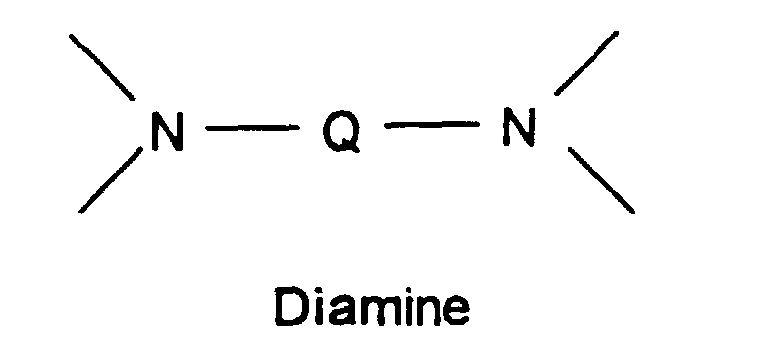
- the current invention provides novel polyimide polymers having a high glass transition temperature (Tg), high thermal oxidative stability (TOS), and very low moisture regain, comprising the following recurring structural units: and wherein the mole ratio of BTDA to BPDA in the polymer is from more than 30 to less than 70 (>30: ⁇ 70) to 80 to 20 (80:20), and Q is a suitable aromatic moiety.
- Tg glass transition temperature
- TOS high thermal oxidative stability
- Q is a suitable aromatic moiety.
- polyimides formed from a precursor solution having a stoichiometric excess of either the diamine or dianhydride (or derivatives thereof) components as a means of controlling the molecular weight of the polyimide polymers formed.
- the current invention also includes the use of end-capping agents.
- the end-capping agents may be non-reactive, reactive (if, for example, cross-linking is desired), or a mixture of both.
- the current invention also encompasses the resins which can be formed therefrom, and composites and prepregs reinforced with substrates.
- the substrates may be any of those known in the art, including but not limited to materials such as glass, carbon, metallic, and aramid fibers or particles. See , e.g. , U.S. Patent No. 5,138,028.
- the invention likewise encompasses, but is not limited to, the use of the polyimides of the current invention in applications such as films and laminates.
- the polyimides of the current invention are prepared by reacting 3,4,3',4'-biphenyltetracarboxylic dianhydride (biphenyl dianhydride or BPDA) and 3,4,3',4',-benzophenone-tetracarboxylic dianhydride (BTDA) with a suitable diamine component, or a mixture of suitable diamine components, such as p-phenylenediamine (PPD) and m-phenylenediamine (MPD).
- BTDA and BPDA are acid functional components of the polyimides of the current invention.
- BTDA, BPDA, or acid functional components is intended to include all of the functional equivalent forms thereof, that is, such reference includes but is not limited to the dianhydride, tetracarboxylic acid, ester, or diester-diacid forms, other common derivatives known in the art, or any mixtures thereof.
- the specific acid functional components of the current invention may be initially added as any of the forms or equivalents as defined.
- a reactive or non-reactive end-capping agent can be employed if desired, for example, as disclosed in U.S. Patent No. 5,478,913.
- Polymerization according to the current invention is accomplished by adding BPDA and BTDA in the appropriate ratios to a solution of N-methylpyrrolidone (NMP) and ethanol, forming the diethylester diacid, and then adding the diamine component.
- NMP N-methylpyrrolidone
- the diamine or diamine mixture is chosen from the group comprising aromatic diamines, such as a mixture of p-phenylenediamine (PPD) and m-phenylenediamine (MPD), PPD alone, or other diamines chosen to enhance, or at least not adversely affect, the desired characteristics achieved by use of the disclosed ratio of BTDA to BPDA in the acid functional component of the polyimide.
- the desired polyimide of the current invention is formed by the subsequent heating, and removal of the volatiles.
- the resulting material can be ground and formed into a desired shape under heat and pressure.
- the precursor solution can also be used to form composites by impregnating a fibrous reinforcing substrate with the precursor solution, or to form other structures by mixing the precursor solution with other types of substrates. In the case of using fibrous substrates for the creation of composites, the impregnated substrate is heated to form the polyimide, and the resulting material can then be shaped using heat and pressure.
- the resulting polyimides of the current invention exhibit excellent Tg, TOS, and moisture regain characteristics when compared to previously known polyimides, and are formed of readily available, economical ingredients.
- the mixture of the acid functional components of the resulting polyimides of the current invention should be such that the mole ratio of BTDA to BPDA is within a defined range.
- the BTDA/BPDA mixture whether comprising the entirety of the acid functional component or a major portion of the acid functional component of the polyimides, should be comprised of a mixture wherein the amount of BTDA should be higher than 30 mole percent of the BTDA/BPDA mixture, up to 80 mole percent of BTDA, while the amount of BPDA should be in the range of from less than 70 mole percent to 20 mole percent. Excellent results are achieved where BTDA constitutes about 70 mole percent of the BTDA/BPDA mixture.
- the current invention can be characterized as being a polyimide having a glass transition temperature greater than about 300 degrees Centigrade comprising structural units derived from 3,4,3',4'-benzophenonetetracarboxylic dianhydride (BTDA), 3,4,3',4'-biphenyltetracarboxylic dianhydride, and one or more aromatic diamines wherein the mole ratio of the structural units derived from BTDA to the structural units derived from BPDA is more than 3/7 up to 4.0.
- BTDA 3,4,3',4'-benzophenonetetracarboxylic dianhydride
- BPDA 3,4,3',4'-biphenyltetracarboxylic dianhydride
- a more preferred form of the polyimide polymer is the polymer wherein BTDA comprises from 60 to 80 mole percent of the BTDA/BPDA acid functional component, with the amount of BPDA ranging from 20 to 40 mole percent of the BTDA/BPDA component. In the most preferred form, the ratio of BTDA to BPDA is 70 mole percent BTDA to 30 mole percent BPDA.
- a preferred diamine component for forming the polyimides of the current invention is comprised of PPD in the range of from 95 to 100 mole percent of the diamine component, and MPD in the range of up to 5 mole percent of the diamine component, with a preferred ratio of 95 mole percent PPD and 5 mole percent MPD.
- the resulting polyimide will have a Tg of about 338°C., a thermal oxidative stability in terms of percent weight loss of about 4.3 percent, and a moisture regain characteristic in terms of percent weight gain of about 1.1 percent, all these characteristics determined and measured as described herein.
- the diamine component used in forming polyimides of the current invention is chosen from the group comprising aromatic diamines or other diamines chosen to enhance, or at least not adversely affect, the desired characteristics achieved by use of the disclosed ratio of BTDA to BPDA in the acid functional component of the polyimide.
- a suitable diamine component for use in forming the polyimide polymers of the current invention is a mixture of p-phenylenediamine (PPD) and m-phenylenediamine (MPD). When this mixture of diamine components is used to form the polyimides, the diamine mixture should be such that PPD constitutes from 95 to 100 mole percent of the diamine component, with MPD constituting from 0 to 5 mole percent.
- Another suitable diamine component used alone or as part of a mixture, is 1,4-bis(4-aminophenoxy)-2-phenylbenzene (2PhAPB144).
- the functional equivalents of the diamines may be used, as is known in the art.
- the specific diamines chosen as the diamine components of the polyimides of the current invention should be chosen so as to enhance, or at least not adversely affect, the desired Tg, TOS, and moisture regain characteristics achieved by use of the disclosed BTDA/BPDA ratios.
- Either the diamine mixture or the acid functional mixture may be added in amounts calculated to provide slight stoichiometric excess over the other component. Generally, the excess is chosen to be not more than 40 mole percent more than the amount of the acid or diamine component needed for an equimolar reaction of acid and diamine.
- End-capping agents can be used as is known in the art to control characteristics of the polyimide such as the molecular weight of the resulting polyimide polymers, to provide cross-linking capability, or both. Either reactive or non-reactive end-capping agents, or a selected mixture of both, may be used. Phthalic anhydride or phenyl amine, for example, can be used as non-reactive end-capping agents. Suitable reactive end-capping agents include, for example, phenylethynylaniline (PEA) and phenylethynyl phthalic anhydride (PEPA). The use of a reactive end-capping agent enables cross-linking to take place when the polyimide is heated during the curing process. The end-capping agents, whether reactive or non-reactive, can be introduced with either the diamine or acid functional components.
- PEA phenylethynylaniline
- PEPA phenylethynyl phthalic anhydride
- the glass transition temperatures (Tg) of the resins in the following examples were determined by forming a resin plaque, that is, a plaque made of only the polyimide polymer, of the resin to be tested.
- a Dynamic Mechanical Analysis (DMA) was performed by plotting storage modulus values against temperature. Tangents to the curve before and after the inflection point were drawn and the temperature value of the intersection of these tangents was used as the Tg value. Measurements were taken using a TA Instruments 9900 system with a heat-up rate of 10°C. per minute in air with a maximum temperature of 500°C.
- Thermal oxidative stability (TOS) values for the resins in the following examples were determined as follows. Resins were formed into 3" x 6" (0.176m x 0.152m) resin plaques. coupons measuring 1" x 1" (0.025m x 0.025m) were cut from the plaques and dried at 120°C. for sixteen hours. The dry weight of the coupons was measured. The coupons were then exposed to flowing air at 750°F. (399°C.) for one hundred hours in a Grieve Class "A” oven. The weight of the samples was then determined and weight losses were calculated in weight percent. Samples were usually run in duplicates from which average values were calculated.
- TOS Thermal oxidative stability
- Moisture regain for the resins in the examples were measured as follows. Coupons of resin plaques were prepared as described above for the TOS measurements. Duplicate coupons were placed in a humidity chamber maintained at 60°C. and 95% relative humidity (R.H.). Weight gains as weight percent were measured on a regular time basis until saturation was achieved. The humidity chamber used was a Blue M Humid-Flow combination temperature and humidity cabinet.
- Various polyimides were prepared in accordance with the current invention. All of the polyimides of the current invention were made in the same general way, with additional polyimides being prepared to illustrate and compare the characteristics of the polyimides made in accordance with the current invention.
- the relative proportions of the BTDA and BPDA were varied to produce polyimides from precursor solutions in which the ratio of BTDA was varied in increments of from about 20 to about 80 mole percent with respect to the proportion of BPDA, while the amount of BPDA used was accordingly varied in increments of from about 20 to about 80 mole percent with respect to the proportion of BTDA. All of the examples shown here were made with the diamine component comprising a mixture of about 95 mole percent PPD and about 5 mole percent MPD.
- NR-150 resin was prepared by the method described herein. This resin was prepared using 100 mole percent of 6FTA as the acid functional or dianhydride component, while the diamine component was the same mixture (PPD:MPD: : 95:5) used in preparation of the polyimides of the current invention. The particular amounts used are set forth in the tables.
- the samples were prepared as follows.
- a glass reaction vessel for example, a 500 ml. 4-necked round bottomed flask, was fitted with a water condenser having an N 2 purge set-up at the top.
- An agitator and a thermocouple were fitted to the vessel also.
- the vessel was thoroughly purged with nitrogen.
- NMP N-methylpyrrolidone
- E anhydrous ethanol
- This solvent mixture was then heated to 30°C.
- BTDA and BPDA as either the dianhydrides or diacids were added, and the solution was agitated while the solution was raised to a temperature of 90 +/- 2°C. and held for two hours to effect complete dissolution.
- the solution was then cooled to 75 +/- 2°C.
- the diamine components were then added to the vessel, and this solution was held for 1.5 hours with continued agitation.
- the solution thus formed was then transferred to a container and stored until needed.
- the solution is known in the art as a precursor or binder solution. It may be used to impregnate various substrates, such as fibers, to form prepregs, or may be further processed as in its pure, or neat, form for other uses.
- the polyimide resins used in the plaques and coupons from which the data in the tables were derived were prepared as follows. Approximately 100 grams of the sample solution prepared as described above was placed into a 2" deep aluminum pan. The pan with the solution was then placed into a vacuum oven, which was maintained at a temperature of 110°C, and a pressure of 10" (0.25m) Hg. A dry nitrogen bleed was maintained throughout the entire process. The sample was held at 110°C. for about one hour or until the flow of volatilized solvent to the oven's condenser had substantially stopped. The oven temperature was then raised to 200°C. and held there for one hour.
- the resulting partially devolatilized and partially cured material was then removed from the oven, cooled in a dessicator, and then ground in a Waring type blender.
- the resulting powder was then placed in an aluminum pan, and heated in a Class A oven and held at 330°C. (625°F.) for two hours.
- the material was then removed from the oven, cooled in a dessicator, and ground into a fine powder.
- the powder was placed in an airtight container for storing.
- the neat resin plaques from which the sample coupons were cut were formed by utilizing a compression press.
- the press was preheated to 490°C.
- a mold measuring 3" x 6" (0.176m x 0.152m) was placed on the press platen, and 60 grams of the selected resin powder was placed in the mold and held with minimal pressure.
- the temperature of the mold in the press reached 430'C.
- the pressure on the mold was gradually increased over a period of two minutes to a final pressure of 3,300 pounds per square inch (224.55 atm.) and then held at this value.
- the temperature of the mold reached 480°C.
- the press was allowed to cool to about 300°C. After cooling, the pressure was released, the mold was removed from the press, and the neat resin plaque was removed from the mold and subjected to the tests as described above.
- Table 1 shows the components used in the foregoing procedures for preparing a precursor solution in which the ratio of BTDA to BPDA was 70 to 30.
- the acid functional component was comprised of only BTDA and BPDA, and the ratio was therefore 70 mole percent BTDA and 30 percent BPDA.
- This acid functional component was mixed with a diamine solution of 95 mole percent PPD and 5 mole percent MPD in the NMP and ethanol solvent.
- the table shows the ingredients, the molar amounts of BTDA, BPDA, PPD, and MPD used, and the respective weights in grams of all the ingredients used to produce the precursor solution.
- Table 2 sets forth the mole percent amounts and equivalent weights used in preparing samples in which the ratio of BTDA was varied from about 20 to about 80, and the corresponding ratio of BPDA was varied respectively from about 80 to about 20.
- BTDA and BPDA comprised the acid functional component, so that the ratios are shown as mole percent ratios.
- the table also shows the use of 100 mole percent and the equivalent weight of 6FTA used to prepare the resin designated as NR-150 used for comparison.
- the amounts of NMP, ethanol, PPD, and MPD were the same as are set forth in Table 1 for the samples prepared, the PPD/MPD diamine component mix thus being in the ratio of PPD:MPD: :95:5.
- Table 3 sets forth the characteristics measured for the polyimide polymers made from each sample mixture shown in Table 2, including the comparative sample of NR-150 prepared.
- the density of the polyimide is provided in grams per cubic centimeter (Density, gms/cc) and the glass transition temperature as measured by Dynamic Mechanical analysis is given in degrees Centigrade (Tg°C).
- the thermal oxidative stability (TOS) for the samples and the standard is given in the table as the percent weight loss determined as set forth above, that is after 100 hours in air at 750°F. (399°C.). It should be noted that, measured in this way, higher thermal oxidative stability is shown by a lower percent weight loss.
- Table 3 amply illustrates the advantages of the polyimides of the current invention over those known in the art.
- the respective glass transition temperatures of the resins particularly those made with BTDA/BPDA ratios ranging from about BTDA:BPDA: :40:60 to about 80:20 compare favorably with the Tg shown for NR-150.
- these resins particularly the 70:30 resin, can be advantageously used in making composites for high temperature applications.
- the TOS of each sample is greater in each instance than that of NR-150, that is, the percent weight losses of the samples of the current invention are lower than the percent weight loss measured for NR-150, and the TOS of the 70:30 resin is significantly better than that of the NR-150 TOS, the disclosed 70:30 suffering a weight loss of only 4.3% compared to the weight loss for NR-150 of 10.7%.
- the measured moisture regain, measured as percent weight gain at saturation, for each sample resin is better than that for NR-150, the 70:30 resin again showing a moisture regain value of less than half of the NR-150 control.
- novel polyimides made in accordance with the current invention show superior TOS and moisture regain characteristics, while at the same time having Tg characteristics which make them useful in a wide variety of applications.
- the characteristics of the polyimides of the current invention are unexpected. Those of ordinary skill in this art, considering the compounds 6FTA, BPDA, and BTDA used as acid functional components in polyimides, would generally expect that as the ratio of BTDA present is increased in polyimides, the resulting polyimide would exhibit lower thermal oxidative stability and a higher moisture regain characteristic. It has been reported, for example, that the thermal oxidative stability of BPDA should be greater than that of BTDA. See Bessonov et al., Polyimides: Thermally Stable Polymers , trans. ed. W.W. Wright, pp. 103-108 (Consultants Bureau, N.Y., N.Y. 1987).
- the components used in making the disclosed polyimides are readily available and economical. This, and the desirable characteristics of the polyimides of the current invention as shown herein, will make use of these polyimides advantageous in a number of applications.
- the high Tg and TOS characteristics provide excellent mechanical properties, making the polyimides of the current invention useful in applications requiring resin alone or as a component of composite structures.
- These and the other properties also make use of the resins of the current invention advantageous in the form of reinforced or unreinforced films and laminates.
- Products made utilizing the resins of the current invention are expected to have a relatively long life in applications where exposure to water is expected because of the low moisture regain characteristics as compared to other polyimides having relatively higher moisture regain properties.
- the polyimides of the current invention may also be advantageously used as the resin matrices for composites.
- the high Tg should enable use in high-temperature applications such as machine or engine parts, and the TOS and moisture regain properties should contribute to providing a longer life-span for such composites.
- the substrates for which the resins of the current invention can be used as the polymer matrix can be any of those known in the art, including but not limited to fibrous substrates, metals, carbon or glass fibers or particles, and aramid fibers.
Landscapes
- Chemical & Material Sciences (AREA)
- Health & Medical Sciences (AREA)
- Chemical Kinetics & Catalysis (AREA)
- Medicinal Chemistry (AREA)
- Polymers & Plastics (AREA)
- Organic Chemistry (AREA)
- Macromolecular Compounds Obtained By Forming Nitrogen-Containing Linkages In General (AREA)
- Reinforced Plastic Materials (AREA)
- Manufacture Of Macromolecular Shaped Articles (AREA)
- Laminated Bodies (AREA)
- Polymers With Sulfur, Phosphorus Or Metals In The Main Chain (AREA)
Description


| RECIPE FOR 70/30 MOLE % BTDA/BPDA AND 95/5 MOLE % PPD/MPD POLYIMIDE SOLUTION | ||
| INGREDIENT | MOLES | GMS |
| NMP | - | 128 |
| ETHANOL | - | 128 |
| BTDA | 0.369 | 118.8 |
| BPDA | 0.158 | 46.5 |
| PPD | 0.499 | 54.0 |
| MPD | 0.027 | 30 |
| RECIPE FOR BTDA/BPDA POLYIMIDE SOLUTIONS | ||||
| Sample | Mole Percent | Weight (gms) | ||
| BTDA | BPDA | BTDA | BPDA | |
| 1 | 80 | 20 | 136.0 | 31.0 |
| 2 | 75 | 25 | 127.3 | 39.0 |
| 3 | 70 | 30 | 118.8 | 46.5 |
| 4 | 60 | 40 | 101.8 | 62.4 |
| 5 | 40 | 60 | 67.9 | 93.6 |
| 6 | 30 | 70 | 50.9 | 109.2 |
| 7 | 20 | 80 | 33.9 | 124.8 |
| Control (NR-150) | 100(6FTA) | 253(6FTA) | ||
| Note: The amounts of NMP, ethanol, PPD, and MPD are the same as in Table 1. |
| BTDA/BPDA POLYMERS AND THEIR PROPERTIES | |||||
| BTDA/BPDA RATIO | DENSITY Gms/cc | Tg°C. | TOS | Moisture Regain | |
| Sample | |||||
| 1 | 80/20 | 1.42 | 345 | 6.5 | 1.8 |
| 3 | 70/30 | 1.43 | 338 | 4.3 | 1.1 |
| 4 | 60/40 | 1.37 | 317 | - | 1.2 |
| 5 | 40/60 | 1.43 | 302 | 2.1 | 0.5 |
| 6 | 30/70 | 1.43 | 299 | 2.4 | 0.6 |
| 7 | 20/80 | 1.43 | 305 | 2.0 | 1.1 |
| Control (NR-150) | 100(6FTA) | 1.45 | 379 | 10.7 | 2.4 |
| Note: The diamine component for all of the above was PPD:MPD::95:5 by mole percent |
Claims (13)
- A polyimide polymer having a glass transition temperature of greater than 300 degrees Centigrade comprising structural units derived from 3,4,3',4'-benzophenonetetracarboxylic dianhydride, 3,4,3',4'-biphenyltetracarboxlyic dianhydride and one or more aromatic diamines, wherein the mole ratio of the structural units derived from 3,4,3',4'-benzophenonetetracarboxylic dianhydride to the structural units derived from 3,4,3',4',-biphenyltetracarboxylic dianhydride is in the range of from more than 3.0/7.0 and up to 4.0/1.0.
- A polyimide polymer according to claim 1 wherein the aromatic diamines are selected from the group comprising m-phenylenediamine, p-phenylenediamine, 1,4-bis(4-aminophenoxy)-2-phenylbenzene, and mixtures thereof.
- A process of preparing a polyimide polymer having a glass transition temperature of greater than 300 degrees Centigrade comprising:a. forming a precursor solution by preparing a solution of an acid functional component containing 3,4,3',4'-benzophenonetetracarboxylic dianhydride and 3,4,3',4'-biphenyltetracarboxlyic dianhydride in a polar aprotic solvent to form the diethylester diacid forms of the dianhydrides, wherein the mole ratio of the structural units derived from 3,4,3',4'-benzophenonetetracarboxylic dianhydride to the structural units derived from 3,4,3',4',-biphenyltetracarboxylic dianhydride is in the range of from more than 3.0/7.0 and up to 4.0/1.0 and reacting with a diamine component containing one or more aromatic diamines andb. heating the precursor solution to devolatilize and polymerize the precursor solution to the polyimide.
- The process of claim 3 wherein either the acid functional component or the diamine component contains an endcapping agent and there is a stoichiometric excess of either component with respect to the other of up to 40 mole percent.
- A polyimide polymer according to claim 1, wherein the mole ratio of the structural units derived from 3,4,3',4'-benzophenonetetracarboxylic dianhydride to the structural units derived from 3,4,3',4',-biphenyltetracarboxylic dianhydride is in the range of from 3.0/2.0 to 4.0/1.0.
- A polyimide polymer according to claim 1, wherein the mole ratio of the structural units derived from 3,4,3',4'-benzophenonetetracarboxylic dianhydride to the structural units derived from 3,4,3',4',-biphenyltetracarboxylic dianhydride is about 7.0/3.0.
- A composite comprising the polyimide polymer of claim 1 reinforced with a substrate.
- A precursor composition for preparing a solution containing the polyimide polymer of claim 1 comprising as the acid functional component 3,4,3',4'-benzophenonetetracarboxylic dianhydride and 3,4,3',4',-biphenyltetracarboxylic dianhydride and as the diamine component aromatic diamines, wherein the mole ratio of the structural units derived from 3,4,3',4'-benzophenonetetracarboxylic dianhydride to the structural units derived from 3,4,3',4',-biphenyltetracarboxylic dianhydride is in the range of from more than 3.0/7.0 and up to 4.0/1.0.
- A prepreg comprising a fibrous substrate impregnated with the precursor composition of claim 8.
- A polyimide polymer comprising an acid functional component containing structural units derived from 3,4,3',4'-benzophenonetetracarboxylic dianhydride and 3,4,3',4'-biphenyltetracarboxlyic dianhydride wherein the mole ratio of the structural units derived from 3,4,3',4'-benzophenonetetracarboxylic dianhydride to the structural units derived from 3,4,3',4',-biphenyltetracarboxylic dianhydride is in the range of from more than 3.0/7.0 and up to 4.0/1.0; a diamine component containing one or more aromatic diamines; and an endcapping agent.
- A polyimide having a glass transition temperature of about 338 degrees Centigrade, a thermal oxidative stability of about 4.3 percent, and a moisture regain of about 1.1 percent comprising; an acid functional component of 70 mole percent 3,4,3',4'-benzophenonetetracarboxylic dianhydride and 30 mole percent 3,4,3',4',-biphenyltetracarboxylic dianhydride, and a diamine component of from 95 to 100 mole percent p-phenylenediamine and from 0 to 5 mole percent m-phenylenediamine.
- A film comprising the polyimide polymer of Claim 1.
- A laminate comprising the polyimide polymer of claim 1.
Applications Claiming Priority (5)
| Application Number | Priority Date | Filing Date | Title |
|---|---|---|---|
| US3158396P | 1996-12-05 | 1996-12-05 | |
| US31583P | 1996-12-05 | ||
| US3893897P | 1997-02-24 | 1997-02-24 | |
| US38938P | 1997-02-24 | ||
| PCT/US1997/023043 WO1998024830A1 (en) | 1996-12-05 | 1997-12-04 | POLYIMIDES HAVING HIGH Tg, HIGH TOS, AND LOW MOISTURE REGAIN |
Publications (2)
| Publication Number | Publication Date |
|---|---|
| EP0941272A1 EP0941272A1 (en) | 1999-09-15 |
| EP0941272B1 true EP0941272B1 (en) | 2000-08-02 |
Family
ID=26707410
Family Applications (1)
| Application Number | Title | Priority Date | Filing Date |
|---|---|---|---|
| EP97954121A Expired - Lifetime EP0941272B1 (en) | 1996-12-05 | 1997-12-04 | POLYIMIDES HAVING HIGH Tg, HIGH TOS, AND LOW MOISTURE REGAIN |
Country Status (9)
| Country | Link |
|---|---|
| US (1) | US6127509A (en) |
| EP (1) | EP0941272B1 (en) |
| JP (2) | JP3942642B2 (en) |
| KR (1) | KR20000057392A (en) |
| CN (1) | CN1244879A (en) |
| CA (1) | CA2274264C (en) |
| DE (1) | DE69702717T2 (en) |
| EA (1) | EA199900519A1 (en) |
| WO (1) | WO1998024830A1 (en) |
Families Citing this family (22)
| Publication number | Priority date | Publication date | Assignee | Title |
|---|---|---|---|---|
| US5792044A (en) * | 1996-03-22 | 1998-08-11 | Danek Medical, Inc. | Devices and methods for percutaneous surgery |
| CN1157284C (en) * | 1999-06-30 | 2004-07-14 | 松下电器产业株式会社 | Vacuum thermal insulating material, insulated equipment and electric water heater using said material |
| US6303744B1 (en) * | 2000-03-23 | 2001-10-16 | The United States Of America As Represented By The Administrator Of The National Aeronautics And Space Administration | Polyimides and process for preparing polyimides having improved thermal-oxidative stability |
| US6777525B2 (en) * | 2001-07-03 | 2004-08-17 | The United States Of America As Represented By The Administrator Of The National Aeronautics And Space Administration | Heat, moisture, and chemical resistant polyimide compositions and methods for making and using them |
| US6713597B2 (en) * | 2002-03-19 | 2004-03-30 | General Electric Company | Preparation of polyimide polymers |
| US7041778B1 (en) | 2003-06-05 | 2006-05-09 | The United States Of America As Represented By The Secretary Of The Air Force | Processable thermally stable addition polyimide for composite applications |
| US6945974B2 (en) * | 2003-07-07 | 2005-09-20 | Aesculap Inc. | Spinal stabilization implant and method of application |
| US7335608B2 (en) | 2004-09-22 | 2008-02-26 | Intel Corporation | Materials, structures and methods for microelectronic packaging |
| US8633284B2 (en) | 2006-05-12 | 2014-01-21 | General Electric Company | Tailorable polyimide prepolymer blends, crosslinked polymides and articles formed therefrom |
| CN1958649B (en) * | 2006-10-26 | 2010-12-01 | 同济大学 | A kind of polyimide film containing chromophore and preparation method thereof |
| US20090093608A1 (en) * | 2007-10-04 | 2009-04-09 | Saint-Gobain Performance Plastics Corporation | Polyimide material with improved thermal and mechanical properties |
| KR101430974B1 (en) * | 2007-12-27 | 2014-08-19 | 에스케이씨코오롱피아이 주식회사 | Polyimide film and manufacturing method thereof |
| WO2009086479A1 (en) * | 2007-12-28 | 2009-07-09 | Saint-Gobain Performance Plastics Corporation | Etch resistant polymer composition |
| CN103003069B (en) * | 2010-07-22 | 2015-12-16 | 宇部兴产株式会社 | Method for producing polyimide film laminate, polyimide film laminate |
| CN102604092B (en) * | 2012-02-20 | 2014-04-16 | 中国科学院化学研究所 | Polyimide resin as well as preparation method and application thereof |
| JP6410716B2 (en) * | 2013-05-31 | 2018-10-24 | 株式会社カネカ | Insulation coating material and use thereof |
| JP5829697B2 (en) * | 2014-01-17 | 2015-12-09 | 株式会社デンソー | Insulated wire |
| JP5829696B2 (en) * | 2014-01-17 | 2015-12-09 | 株式会社デンソー | Insulated wire |
| CN105566630B (en) * | 2014-10-14 | 2018-03-02 | 株洲时代电气绝缘有限责任公司 | A kind of Kapton and preparation method thereof |
| WO2016084661A1 (en) | 2014-11-27 | 2016-06-02 | 株式会社カネカ | Insulating coating material having excellent wear resistance |
| WO2016084662A1 (en) | 2014-11-27 | 2016-06-02 | 株式会社カネカ | Insulating coating material having excellent wear resistance |
| CN107778484B (en) * | 2016-08-31 | 2019-08-13 | 北京化工大学 | A kind of polyimide hollow fiber and its preparation method and application |
Family Cites Families (24)
| Publication number | Priority date | Publication date | Assignee | Title |
|---|---|---|---|---|
| GB2101137B (en) * | 1981-04-14 | 1984-09-26 | Ube Industries | Producing porous aromatic imide polymer membranes |
| JPS59204619A (en) * | 1983-05-09 | 1984-11-20 | Ube Ind Ltd | Aromatic polyamic acid solution composition |
| JPS60206639A (en) * | 1984-03-31 | 1985-10-18 | 日東電工株式会社 | Manufacture of polyimide-metallic foil composite film |
| FR2568258B1 (en) * | 1984-07-25 | 1987-02-13 | Inst Francais Du Petrole | POLYIMIDE PRECURSOR COMPOSITIONS, THEIR PREPARATION, THE POLYIMIDES DERIVATIVE THEREOF AND THEIR USES, IN PARTICULAR IN THE MANUFACTURE OF ENAMELING VARNISHES FOR ELECTRICAL CONDUCTORS |
| AU576675B2 (en) * | 1985-06-20 | 1988-09-01 | National Aeronautics And Space Administration - Nasa | Copolyimides |
| JPH062828B2 (en) * | 1986-05-15 | 1994-01-12 | 宇部興産株式会社 | Method for manufacturing polyimide film |
| JPH0745580B2 (en) * | 1986-05-16 | 1995-05-17 | 宇部興産株式会社 | Aromatic polyimide film |
| JP2622678B2 (en) * | 1987-01-12 | 1997-06-18 | チッソ株式会社 | Melt-moldable crystalline polyimide polymer |
| JP2609279B2 (en) * | 1988-04-19 | 1997-05-14 | 宇部興産株式会社 | Polyimide powder compact |
| US5304626A (en) * | 1988-06-28 | 1994-04-19 | Amoco Corporation | Polyimide copolymers containing 3,3',4,4'-tetracarboxybiphenyl dianhydride (BPDA) moieties |
| JPH03137124A (en) * | 1989-10-20 | 1991-06-11 | Kanegafuchi Chem Ind Co Ltd | Polyimide resin powder, production thereof and molding the same |
| US5077382A (en) * | 1989-10-26 | 1991-12-31 | Occidental Chemical Corporation | Copolyimide odpa/bpda/4,4'-oda or p-pda |
| DE69115076T2 (en) * | 1990-02-20 | 1996-05-09 | Nat Starch Chem Invest | Diarylacetylene end-capped polyimides. |
| US5177180A (en) * | 1990-08-07 | 1993-01-05 | General Electric Company | High temperature mixed polyimides and composites formed therefrom |
| DE69115171T2 (en) * | 1990-08-27 | 1996-05-15 | Du Pont | Flexible polyimide multilayer laminates and their production. |
| US5243024A (en) * | 1990-12-21 | 1993-09-07 | Amoco Corporation | High moduli polyimides |
| JPH04256394A (en) * | 1991-02-08 | 1992-09-11 | Toray Ind Inc | Manufacture of flexible wiring board |
| US5252700A (en) * | 1991-04-30 | 1993-10-12 | Mitsui Toatsu Chemicals, Inc. | Heat-resistant adhesive and method of adhesion by using adhesive |
| DE4135058A1 (en) * | 1991-10-24 | 1993-04-29 | Basf Lacke & Farben | SOLUTIONS OF POLYIMIDE-BASED MATERIALS |
| JPH0641305A (en) * | 1991-10-25 | 1994-02-15 | Internatl Business Mach Corp <Ibm> | Polyamic acid and polyimide from fluorinated reactant |
| US5478913A (en) * | 1993-12-22 | 1995-12-26 | E. I. Du Pont De Nemours And Company | Melt-processible polyimides with high Tg |
| US5412066A (en) * | 1994-03-03 | 1995-05-02 | Ther United States Of America As Represented By The Administrator Of The National Aeronautics And Space Administration | Phenylethynyl terminated imide oligomers |
| US5493002A (en) * | 1994-07-06 | 1996-02-20 | Virginia Tech Intellectual Properties, Inc. | Aryl ethynyl phthalic anhydrides and polymers with terminal or pendant amines prepared with aryl ethynyl phthalic anhydrides |
| US5830564A (en) * | 1996-03-01 | 1998-11-03 | Ube Industries, Ltd. | Aromatic polyimide film |
-
1997
- 1997-12-04 EP EP97954121A patent/EP0941272B1/en not_active Expired - Lifetime
- 1997-12-04 KR KR1019990704948A patent/KR20000057392A/en not_active Withdrawn
- 1997-12-04 JP JP52590798A patent/JP3942642B2/en not_active Expired - Lifetime
- 1997-12-04 DE DE69702717T patent/DE69702717T2/en not_active Expired - Lifetime
- 1997-12-04 CA CA 2274264 patent/CA2274264C/en not_active Expired - Lifetime
- 1997-12-04 EA EA199900519A patent/EA199900519A1/en unknown
- 1997-12-04 WO PCT/US1997/023043 patent/WO1998024830A1/en not_active Ceased
- 1997-12-04 US US09/319,218 patent/US6127509A/en not_active Expired - Lifetime
- 1997-12-04 CN CN97180288A patent/CN1244879A/en active Pending
-
2006
- 2006-11-09 JP JP2006304334A patent/JP4825112B2/en not_active Expired - Lifetime
Also Published As
| Publication number | Publication date |
|---|---|
| JP2001505612A (en) | 2001-04-24 |
| WO1998024830A1 (en) | 1998-06-11 |
| CA2274264A1 (en) | 1998-06-11 |
| KR20000057392A (en) | 2000-09-15 |
| JP4825112B2 (en) | 2011-11-30 |
| CA2274264C (en) | 2006-11-07 |
| DE69702717D1 (en) | 2000-09-07 |
| EP0941272A1 (en) | 1999-09-15 |
| JP2007046065A (en) | 2007-02-22 |
| CN1244879A (en) | 2000-02-16 |
| EA199900519A1 (en) | 2000-02-28 |
| US6127509A (en) | 2000-10-03 |
| JP3942642B2 (en) | 2007-07-11 |
| DE69702717T2 (en) | 2001-03-29 |
Similar Documents
| Publication | Publication Date | Title |
|---|---|---|
| EP0941272B1 (en) | POLYIMIDES HAVING HIGH Tg, HIGH TOS, AND LOW MOISTURE REGAIN | |
| US5478913A (en) | Melt-processible polyimides with high Tg | |
| JP2518568B2 (en) | High temperature mixed polyimides and composites made therefrom | |
| US4576857A (en) | Melt-fusible polyimides | |
| JPS59170122A (en) | Melt-fusable polyimide | |
| US5149772A (en) | Halogenated polyimide resins prepared by addition reactions | |
| EP1002006B1 (en) | Aromatic polyimide foam | |
| US6262223B1 (en) | Triamine-modified polymides having improved processability and low melt flow viscocity | |
| US6784276B1 (en) | High-solids polyimide precursor solutions | |
| US5770676A (en) | Process for controlling morphology and improving thermal mechanical performance of high performance interpenetrating and semiinterpenetrating polymer networks | |
| EP0379131A2 (en) | Thermosetting resin composition | |
| JP2675679B2 (en) | Polyimide resin prepared by addition reaction and its prepolymer | |
| US5322924A (en) | Addition polyimides with enhanced processability | |
| EP1854829A1 (en) | Method for making copolymeric polyimide resins | |
| US5081196A (en) | Terminal-modified aromatic imide oligomer composition | |
| EP2083037B1 (en) | RTM and RI Processible Tailorable Polyimide Resin Systems and Composite Articles Formed Therefrom | |
| ES2386484T3 (en) | Procedures for forming composite articles from adaptive polyimide resin systems using MTR and IR techniques | |
| EP1854824A1 (en) | Crosslinked polyimide copolymer material | |
| US12305003B2 (en) | Polyamic acid having specific composition, varnish, cured product, and composite material | |
| EP1854825B1 (en) | A fiber reinforced gas turbine engine component | |
| JPH01247430A (en) | Production of fiber-reinforced polyimide composite material | |
| JPS63175025A (en) | Novel polyamic acid composition | |
| EP1854830A2 (en) | Polyimide blend with tailorable properties |
Legal Events
| Date | Code | Title | Description |
|---|---|---|---|
| PUAI | Public reference made under article 153(3) epc to a published international application that has entered the european phase |
Free format text: ORIGINAL CODE: 0009012 |
|
| 17P | Request for examination filed |
Effective date: 19990519 |
|
| AK | Designated contracting states |
Kind code of ref document: A1 Designated state(s): DE FR GB IT NL |
|
| GRAG | Despatch of communication of intention to grant |
Free format text: ORIGINAL CODE: EPIDOS AGRA |
|
| 17Q | First examination report despatched |
Effective date: 19991012 |
|
| GRAG | Despatch of communication of intention to grant |
Free format text: ORIGINAL CODE: EPIDOS AGRA |
|
| GRAH | Despatch of communication of intention to grant a patent |
Free format text: ORIGINAL CODE: EPIDOS IGRA |
|
| GRAH | Despatch of communication of intention to grant a patent |
Free format text: ORIGINAL CODE: EPIDOS IGRA |
|
| GRAA | (expected) grant |
Free format text: ORIGINAL CODE: 0009210 |
|
| AK | Designated contracting states |
Kind code of ref document: B1 Designated state(s): DE FR GB IT NL |
|
| REF | Corresponds to: |
Ref document number: 69702717 Country of ref document: DE Date of ref document: 20000907 |
|
| ET | Fr: translation filed | ||
| ITF | It: translation for a ep patent filed | ||
| PLBE | No opposition filed within time limit |
Free format text: ORIGINAL CODE: 0009261 |
|
| STAA | Information on the status of an ep patent application or granted ep patent |
Free format text: STATUS: NO OPPOSITION FILED WITHIN TIME LIMIT |
|
| 26N | No opposition filed | ||
| REG | Reference to a national code |
Ref country code: GB Ref legal event code: IF02 |
|
| PGFP | Annual fee paid to national office [announced via postgrant information from national office to epo] |
Ref country code: IT Payment date: 20121212 Year of fee payment: 16 |
|
| PGFP | Annual fee paid to national office [announced via postgrant information from national office to epo] |
Ref country code: NL Payment date: 20121208 Year of fee payment: 16 |
|
| REG | Reference to a national code |
Ref country code: NL Ref legal event code: V1 Effective date: 20140701 |
|
| PG25 | Lapsed in a contracting state [announced via postgrant information from national office to epo] |
Ref country code: NL Free format text: LAPSE BECAUSE OF NON-PAYMENT OF DUE FEES Effective date: 20140701 |
|
| PG25 | Lapsed in a contracting state [announced via postgrant information from national office to epo] |
Ref country code: IT Free format text: LAPSE BECAUSE OF NON-PAYMENT OF DUE FEES Effective date: 20131231 |
|
| REG | Reference to a national code |
Ref country code: FR Ref legal event code: PLFP Year of fee payment: 19 |
|
| PG25 | Lapsed in a contracting state [announced via postgrant information from national office to epo] |
Ref country code: IT Free format text: LAPSE BECAUSE OF NON-PAYMENT OF DUE FEES Effective date: 20131204 |
|
| REG | Reference to a national code |
Ref country code: FR Ref legal event code: PLFP Year of fee payment: 20 |
|
| PGFP | Annual fee paid to national office [announced via postgrant information from national office to epo] |
Ref country code: FR Payment date: 20161111 Year of fee payment: 20 Ref country code: GB Payment date: 20161130 Year of fee payment: 20 Ref country code: DE Payment date: 20161129 Year of fee payment: 20 |
|
| REG | Reference to a national code |
Ref country code: DE Ref legal event code: R071 Ref document number: 69702717 Country of ref document: DE |
|
| REG | Reference to a national code |
Ref country code: GB Ref legal event code: PE20 Expiry date: 20171203 |
|
| PG25 | Lapsed in a contracting state [announced via postgrant information from national office to epo] |
Ref country code: GB Free format text: LAPSE BECAUSE OF EXPIRATION OF PROTECTION Effective date: 20171203 |