EP1470114B1 - Peptide nucleic acid oligomers from 1-benzenesulfonyl-3-amino acid side chain-4-(2-nucleobase(acetyl))-piperazin-2-ones - Google Patents
Peptide nucleic acid oligomers from 1-benzenesulfonyl-3-amino acid side chain-4-(2-nucleobase(acetyl))-piperazin-2-ones Download PDFInfo
- Publication number
- EP1470114B1 EP1470114B1 EP03700408A EP03700408A EP1470114B1 EP 1470114 B1 EP1470114 B1 EP 1470114B1 EP 03700408 A EP03700408 A EP 03700408A EP 03700408 A EP03700408 A EP 03700408A EP 1470114 B1 EP1470114 B1 EP 1470114B1
- Authority
- EP
- European Patent Office
- Prior art keywords
- nitro
- compound
- alkyl
- halogenated
- alkoxy
- Prior art date
- Legal status (The legal status is an assumption and is not a legal conclusion. Google has not performed a legal analysis and makes no representation as to the accuracy of the status listed.)
- Expired - Lifetime
Links
- 125000000218 acetic acid group Chemical group C(C)(=O)* 0.000 title claims description 11
- 108091093037 Peptide nucleic acid Proteins 0.000 title abstract description 6
- 125000000449 nitro group Chemical group [O-][N+](*)=O 0.000 claims abstract description 54
- 239000002253 acid Substances 0.000 claims abstract description 30
- 125000006239 protecting group Chemical group 0.000 claims abstract description 27
- 229910052736 halogen Inorganic materials 0.000 claims abstract description 18
- 150000002367 halogens Chemical class 0.000 claims abstract description 18
- 150000007513 acids Chemical class 0.000 claims abstract description 17
- 150000001370 alpha-amino acid derivatives Chemical class 0.000 claims abstract description 17
- 235000008206 alpha-amino acids Nutrition 0.000 claims abstract description 17
- 150000002825 nitriles Chemical class 0.000 claims abstract description 13
- 125000002924 primary amino group Chemical group [H]N([H])* 0.000 claims abstract description 10
- 150000001875 compounds Chemical class 0.000 claims description 151
- 238000005859 coupling reaction Methods 0.000 claims description 52
- -1 benzhydryloxycarbonyl Chemical group 0.000 claims description 42
- 239000003153 chemical reaction reagent Substances 0.000 claims description 37
- 230000008878 coupling Effects 0.000 claims description 36
- 238000010168 coupling process Methods 0.000 claims description 36
- 150000007530 organic bases Chemical class 0.000 claims description 36
- 125000004178 (C1-C4) alkyl group Chemical group 0.000 claims description 30
- 230000000269 nucleophilic effect Effects 0.000 claims description 30
- 125000000229 (C1-C4)alkoxy group Chemical group 0.000 claims description 24
- OPTASPLRGRRNAP-UHFFFAOYSA-N cytosine Chemical compound NC=1C=CNC(=O)N=1 OPTASPLRGRRNAP-UHFFFAOYSA-N 0.000 claims description 18
- UYTPUPDQBNUYGX-UHFFFAOYSA-N guanine Chemical compound O=C1NC(N)=NC2=C1N=CN2 UYTPUPDQBNUYGX-UHFFFAOYSA-N 0.000 claims description 18
- 229910052801 chlorine Inorganic materials 0.000 claims description 16
- 238000010647 peptide synthesis reaction Methods 0.000 claims description 16
- RWQNBRDOKXIBIV-UHFFFAOYSA-N thymine Chemical group CC1=CNC(=O)NC1=O RWQNBRDOKXIBIV-UHFFFAOYSA-N 0.000 claims description 16
- 125000002496 methyl group Chemical group [H]C([H])([H])* 0.000 claims description 15
- 125000001584 benzyloxycarbonyl group Chemical group C(=O)(OCC1=CC=CC=C1)* 0.000 claims description 14
- 238000004519 manufacturing process Methods 0.000 claims description 13
- 125000005931 tert-butyloxycarbonyl group Chemical group [H]C([H])([H])C(OC(*)=O)(C([H])([H])[H])C([H])([H])[H] 0.000 claims description 13
- PIINGYXNCHTJTF-UHFFFAOYSA-N 2-(2-azaniumylethylamino)acetate Chemical class NCCNCC(O)=O PIINGYXNCHTJTF-UHFFFAOYSA-N 0.000 claims description 11
- UYWQUFXKFGHYNT-UHFFFAOYSA-N phenylmethyl ester of formic acid Natural products O=COCC1=CC=CC=C1 UYWQUFXKFGHYNT-UHFFFAOYSA-N 0.000 claims description 11
- 150000008064 anhydrides Chemical class 0.000 claims description 10
- 229930024421 Adenine Natural products 0.000 claims description 9
- GFFGJBXGBJISGV-UHFFFAOYSA-N Adenine Chemical compound NC1=NC=NC2=C1N=CN2 GFFGJBXGBJISGV-UHFFFAOYSA-N 0.000 claims description 9
- 229960000643 adenine Drugs 0.000 claims description 9
- 229940104302 cytosine Drugs 0.000 claims description 9
- 238000010511 deprotection reaction Methods 0.000 claims description 9
- 125000002023 trifluoromethyl group Chemical group FC(F)(F)* 0.000 claims description 9
- 229940113082 thymine Drugs 0.000 claims description 8
- 125000003118 aryl group Chemical group 0.000 claims description 6
- LMBFAGIMSUYTBN-MPZNNTNKSA-N teixobactin Chemical compound C([C@H](C(=O)N[C@@H]([C@@H](C)CC)C(=O)N[C@@H](CO)C(=O)N[C@H](CCC(N)=O)C(=O)N[C@H]([C@@H](C)CC)C(=O)N[C@@H]([C@@H](C)CC)C(=O)N[C@@H](CO)C(=O)N[C@H]1C(N[C@@H](C)C(=O)N[C@@H](C[C@@H]2NC(=N)NC2)C(=O)N[C@H](C(=O)O[C@H]1C)[C@@H](C)CC)=O)NC)C1=CC=CC=C1 LMBFAGIMSUYTBN-MPZNNTNKSA-N 0.000 claims description 5
- 229910052794 bromium Inorganic materials 0.000 claims description 4
- 238000010534 nucleophilic substitution reaction Methods 0.000 claims description 4
- 125000001495 ethyl group Chemical group [H]C([H])([H])C([H])([H])* 0.000 claims description 3
- 150000007522 mineralic acids Chemical class 0.000 claims description 3
- 150000007524 organic acids Chemical group 0.000 claims description 3
- 125000000999 tert-butyl group Chemical group [H]C([H])([H])C(*)(C([H])([H])[H])C([H])([H])[H] 0.000 claims description 2
- NUKDFOGRUWKTCS-UHFFFAOYSA-N n-(2-aminoethyl)thiohydroxylamine Chemical class NCCNS NUKDFOGRUWKTCS-UHFFFAOYSA-N 0.000 claims 2
- YBBRCQOCSYXUOC-UHFFFAOYSA-N sulfuryl dichloride Chemical class ClS(Cl)(=O)=O YBBRCQOCSYXUOC-UHFFFAOYSA-N 0.000 claims 2
- 238000000034 method Methods 0.000 abstract description 85
- 239000000178 monomer Substances 0.000 abstract description 78
- 230000015572 biosynthetic process Effects 0.000 abstract description 48
- 238000003786 synthesis reaction Methods 0.000 abstract description 48
- 238000002360 preparation method Methods 0.000 abstract description 12
- 125000000217 alkyl group Chemical group 0.000 abstract description 4
- 125000003545 alkoxy group Chemical group 0.000 abstract 2
- IAZDPXIOMUYVGZ-WFGJKAKNSA-N Dimethyl sulfoxide Chemical compound [2H]C([2H])([2H])S(=O)C([2H])([2H])[2H] IAZDPXIOMUYVGZ-WFGJKAKNSA-N 0.000 description 146
- YMWUJEATGCHHMB-UHFFFAOYSA-N Dichloromethane Chemical compound ClCCl YMWUJEATGCHHMB-UHFFFAOYSA-N 0.000 description 81
- 238000005160 1H NMR spectroscopy Methods 0.000 description 73
- 238000006243 chemical reaction Methods 0.000 description 56
- WYURNTSHIVDZCO-UHFFFAOYSA-N Tetrahydrofuran Chemical compound C1CCOC1 WYURNTSHIVDZCO-UHFFFAOYSA-N 0.000 description 54
- 239000000243 solution Substances 0.000 description 45
- XEKOWRVHYACXOJ-UHFFFAOYSA-N Ethyl acetate Chemical compound CCOC(C)=O XEKOWRVHYACXOJ-UHFFFAOYSA-N 0.000 description 37
- 239000011541 reaction mixture Substances 0.000 description 37
- JGFZNNIVVJXRND-UHFFFAOYSA-N N,N-Diisopropylethylamine (DIPEA) Chemical compound CCN(C(C)C)C(C)C JGFZNNIVVJXRND-UHFFFAOYSA-N 0.000 description 36
- ZMANZCXQSJIPKH-UHFFFAOYSA-N Triethylamine Chemical compound CCN(CC)CC ZMANZCXQSJIPKH-UHFFFAOYSA-N 0.000 description 36
- SJRJJKPEHAURKC-UHFFFAOYSA-N N-Methylmorpholine Chemical compound CN1CCOCC1 SJRJJKPEHAURKC-UHFFFAOYSA-N 0.000 description 34
- 239000002904 solvent Substances 0.000 description 34
- WMFOQBRAJBCJND-UHFFFAOYSA-M Lithium hydroxide Chemical compound [Li+].[OH-] WMFOQBRAJBCJND-UHFFFAOYSA-M 0.000 description 32
- 239000007787 solid Substances 0.000 description 29
- ZMXDDKWLCZADIW-UHFFFAOYSA-N N,N-Dimethylformamide Chemical compound CN(C)C=O ZMXDDKWLCZADIW-UHFFFAOYSA-N 0.000 description 26
- RTZKZFJDLAIYFH-UHFFFAOYSA-N Diethyl ether Chemical compound CCOCC RTZKZFJDLAIYFH-UHFFFAOYSA-N 0.000 description 24
- XLYOFNOQVPJJNP-UHFFFAOYSA-N water Substances O XLYOFNOQVPJJNP-UHFFFAOYSA-N 0.000 description 22
- WEVYAHXRMPXWCK-UHFFFAOYSA-N Acetonitrile Chemical compound CC#N WEVYAHXRMPXWCK-UHFFFAOYSA-N 0.000 description 21
- HEDRZPFGACZZDS-UHFFFAOYSA-N Chloroform Chemical compound ClC(Cl)Cl HEDRZPFGACZZDS-UHFFFAOYSA-N 0.000 description 20
- 238000003756 stirring Methods 0.000 description 20
- TZDMCKHDYUDRMB-UHFFFAOYSA-N 2-(5-methyl-2,4-dioxopyrimidin-1-yl)acetic acid Chemical compound CC1=CN(CC(O)=O)C(=O)NC1=O TZDMCKHDYUDRMB-UHFFFAOYSA-N 0.000 description 18
- YLQBMQCUIZJEEH-UHFFFAOYSA-N tetrahydrofuran Natural products C=1C=COC=1 YLQBMQCUIZJEEH-UHFFFAOYSA-N 0.000 description 17
- 150000001732 carboxylic acid derivatives Chemical class 0.000 description 16
- 239000012044 organic layer Substances 0.000 description 16
- 108020004414 DNA Proteins 0.000 description 15
- LFQSCWFLJHTTHZ-UHFFFAOYSA-N Ethanol Chemical compound CCO LFQSCWFLJHTTHZ-UHFFFAOYSA-N 0.000 description 15
- CSNNHWWHGAXBCP-UHFFFAOYSA-L Magnesium sulfate Chemical compound [Mg+2].[O-][S+2]([O-])([O-])[O-] CSNNHWWHGAXBCP-UHFFFAOYSA-L 0.000 description 14
- 230000004913 activation Effects 0.000 description 14
- 229910052731 fluorine Inorganic materials 0.000 description 14
- 239000000047 product Substances 0.000 description 14
- 239000000706 filtrate Substances 0.000 description 13
- KRKNYBCHXYNGOX-UHFFFAOYSA-N citric acid Chemical compound OC(=O)CC(O)(C(O)=O)CC(O)=O KRKNYBCHXYNGOX-UHFFFAOYSA-N 0.000 description 12
- 229940093499 ethyl acetate Drugs 0.000 description 12
- 235000019439 ethyl acetate Nutrition 0.000 description 12
- YOETUEMZNOLGDB-UHFFFAOYSA-N 2-methylpropyl carbonochloridate Chemical compound CC(C)COC(Cl)=O YOETUEMZNOLGDB-UHFFFAOYSA-N 0.000 description 11
- 125000003277 amino group Chemical group 0.000 description 11
- 239000000203 mixture Substances 0.000 description 11
- 238000007363 ring formation reaction Methods 0.000 description 11
- VEXZGXHMUGYJMC-UHFFFAOYSA-N Hydrochloric acid Chemical compound Cl VEXZGXHMUGYJMC-UHFFFAOYSA-N 0.000 description 10
- XLYOFNOQVPJJNP-UHFFFAOYSA-M hydroxide Chemical compound [OH-] XLYOFNOQVPJJNP-UHFFFAOYSA-M 0.000 description 10
- WPHUUIODWRNJLO-UHFFFAOYSA-N 2-nitrobenzenesulfonyl chloride Chemical compound [O-][N+](=O)C1=CC=CC=C1S(Cl)(=O)=O WPHUUIODWRNJLO-UHFFFAOYSA-N 0.000 description 9
- UHOVQNZJYSORNB-UHFFFAOYSA-N Benzene Chemical compound C1=CC=CC=C1 UHOVQNZJYSORNB-UHFFFAOYSA-N 0.000 description 9
- XTHFKEDIFFGKHM-UHFFFAOYSA-N Dimethoxyethane Chemical compound COCCOC XTHFKEDIFFGKHM-UHFFFAOYSA-N 0.000 description 9
- YXFVVABEGXRONW-UHFFFAOYSA-N Toluene Chemical compound CC1=CC=CC=C1 YXFVVABEGXRONW-UHFFFAOYSA-N 0.000 description 9
- 239000002243 precursor Substances 0.000 description 9
- 125000003088 (fluoren-9-ylmethoxy)carbonyl group Chemical group 0.000 description 8
- QTBSBXVTEAMEQO-UHFFFAOYSA-N Acetic acid Chemical compound CC(O)=O QTBSBXVTEAMEQO-UHFFFAOYSA-N 0.000 description 8
- 239000012267 brine Substances 0.000 description 8
- 125000006575 electron-withdrawing group Chemical group 0.000 description 8
- HPALAKNZSZLMCH-UHFFFAOYSA-M sodium;chloride;hydrate Chemical compound O.[Na+].[Cl-] HPALAKNZSZLMCH-UHFFFAOYSA-M 0.000 description 8
- RODJOXOTVPLJKB-UHFFFAOYSA-N 2-[2-[benzenesulfonyl(nitro)amino]ethylamino]acetic acid Chemical class OC(=O)CNCCN([N+]([O-])=O)S(=O)(=O)C1=CC=CC=C1 RODJOXOTVPLJKB-UHFFFAOYSA-N 0.000 description 7
- HVCNXQOWACZAFN-UHFFFAOYSA-N 4-ethylmorpholine Chemical compound CCN1CCOCC1 HVCNXQOWACZAFN-UHFFFAOYSA-N 0.000 description 7
- SECXISVLQFMRJM-UHFFFAOYSA-N N-Methylpyrrolidone Chemical compound CN1CCCC1=O SECXISVLQFMRJM-UHFFFAOYSA-N 0.000 description 7
- PMZURENOXWZQFD-UHFFFAOYSA-L Sodium Sulfate Chemical compound [Na+].[Na+].[O-]S([O-])(=O)=O PMZURENOXWZQFD-UHFFFAOYSA-L 0.000 description 7
- FAPWRFPIFSIZLT-UHFFFAOYSA-M Sodium chloride Chemical compound [Na+].[Cl-] FAPWRFPIFSIZLT-UHFFFAOYSA-M 0.000 description 7
- 235000019441 ethanol Nutrition 0.000 description 7
- 229910052943 magnesium sulfate Inorganic materials 0.000 description 7
- PIKUAWXLDKAWPH-UHFFFAOYSA-N 1-(2-nitrophenyl)sulfonylpiperazin-2-one;hydrochloride Chemical compound Cl.[O-][N+](=O)C1=CC=CC=C1S(=O)(=O)N1C(=O)CNCC1 PIKUAWXLDKAWPH-UHFFFAOYSA-N 0.000 description 6
- DSXIOUJBLGKUBI-UHFFFAOYSA-N 1-(4-chloro-2-nitrophenyl)sulfonylpiperazin-2-one;hydrochloride Chemical compound Cl.[O-][N+](=O)C1=CC(Cl)=CC=C1S(=O)(=O)N1C(=O)CNCC1 DSXIOUJBLGKUBI-UHFFFAOYSA-N 0.000 description 6
- 0 Cc(c(C)c1*)c(C)c(*)c1S(NCCNC(*)C(O*)=O)(=O)=O Chemical compound Cc(c(C)c1*)c(C)c(*)c1S(NCCNC(*)C(O*)=O)(=O)=O 0.000 description 6
- OKKJLVBELUTLKV-UHFFFAOYSA-N Methanol Chemical compound OC OKKJLVBELUTLKV-UHFFFAOYSA-N 0.000 description 6
- KWYUFKZDYYNOTN-UHFFFAOYSA-M Potassium hydroxide Chemical compound [OH-].[K+] KWYUFKZDYYNOTN-UHFFFAOYSA-M 0.000 description 6
- HEMHJVSKTPXQMS-UHFFFAOYSA-M Sodium hydroxide Chemical compound [OH-].[Na+] HEMHJVSKTPXQMS-UHFFFAOYSA-M 0.000 description 6
- 150000001735 carboxylic acids Chemical class 0.000 description 6
- 239000010410 layer Substances 0.000 description 6
- IWELDVXSEVIIGI-UHFFFAOYSA-N piperazin-2-one Chemical compound O=C1CNCCN1 IWELDVXSEVIIGI-UHFFFAOYSA-N 0.000 description 6
- VZGDMQKNWNREIO-UHFFFAOYSA-N tetrachloromethane Chemical compound ClC(Cl)(Cl)Cl VZGDMQKNWNREIO-UHFFFAOYSA-N 0.000 description 6
- WSLDOOZREJYCGB-UHFFFAOYSA-N 1,2-Dichloroethane Chemical compound ClCCCl WSLDOOZREJYCGB-UHFFFAOYSA-N 0.000 description 5
- SFYDWLYPIXHPML-UHFFFAOYSA-N 3-nitro-1-(2,4,6-trimethylphenyl)sulfonyl-1,2,4-triazole Chemical compound CC1=CC(C)=CC(C)=C1S(=O)(=O)N1N=C([N+]([O-])=O)N=C1 SFYDWLYPIXHPML-UHFFFAOYSA-N 0.000 description 5
- QOSSAOTZNIDXMA-UHFFFAOYSA-N Dicylcohexylcarbodiimide Chemical compound C1CCCCC1N=C=NC1CCCCC1 QOSSAOTZNIDXMA-UHFFFAOYSA-N 0.000 description 5
- 239000007821 HATU Substances 0.000 description 5
- 239000012317 TBTU Substances 0.000 description 5
- CLZISMQKJZCZDN-UHFFFAOYSA-N [benzotriazol-1-yloxy(dimethylamino)methylidene]-dimethylazanium Chemical compound C1=CC=C2N(OC(N(C)C)=[N+](C)C)N=NC2=C1 CLZISMQKJZCZDN-UHFFFAOYSA-N 0.000 description 5
- 150000001412 amines Chemical class 0.000 description 5
- 239000007864 aqueous solution Substances 0.000 description 5
- 239000002585 base Substances 0.000 description 5
- 238000004440 column chromatography Methods 0.000 description 5
- 239000002244 precipitate Substances 0.000 description 5
- 229910052938 sodium sulfate Inorganic materials 0.000 description 5
- 235000011152 sodium sulphate Nutrition 0.000 description 5
- 238000004809 thin layer chromatography Methods 0.000 description 5
- DTQVDTLACAAQTR-UHFFFAOYSA-N trifluoroacetic acid Substances OC(=O)C(F)(F)F DTQVDTLACAAQTR-UHFFFAOYSA-N 0.000 description 5
- YFTHZRPMJXBUME-UHFFFAOYSA-N tripropylamine Chemical compound CCCN(CCC)CCC YFTHZRPMJXBUME-UHFFFAOYSA-N 0.000 description 5
- VPWKJWIKZUONJA-UHFFFAOYSA-N 2-[4-(benzhydryloxycarbonylamino)-2-oxopyrimidin-1-yl]acetic acid Chemical compound O=C1N(CC(=O)O)C=CC(NC(=O)OC(C=2C=CC=CC=2)C=2C=CC=CC=2)=N1 VPWKJWIKZUONJA-UHFFFAOYSA-N 0.000 description 4
- ZAFNJMIOTHYJRJ-UHFFFAOYSA-N Diisopropyl ether Chemical compound CC(C)OC(C)C ZAFNJMIOTHYJRJ-UHFFFAOYSA-N 0.000 description 4
- FPQVGDGSRVMNMR-JCTPKUEWSA-N [[(z)-(1-cyano-2-ethoxy-2-oxoethylidene)amino]oxy-(dimethylamino)methylidene]-dimethylazanium;tetrafluoroborate Chemical compound F[B-](F)(F)F.CCOC(=O)C(\C#N)=N/OC(N(C)C)=[N+](C)C FPQVGDGSRVMNMR-JCTPKUEWSA-N 0.000 description 4
- 125000002777 acetyl group Chemical group [H]C([H])([H])C(*)=O 0.000 description 4
- 125000001797 benzyl group Chemical group [H]C1=C([H])C([H])=C(C([H])=C1[H])C([H])([H])* 0.000 description 4
- 229960004132 diethyl ether Drugs 0.000 description 4
- 150000002148 esters Chemical class 0.000 description 4
- 235000019341 magnesium sulphate Nutrition 0.000 description 4
- 230000004048 modification Effects 0.000 description 4
- 238000012986 modification Methods 0.000 description 4
- 238000010532 solid phase synthesis reaction Methods 0.000 description 4
- DYHSDKLCOJIUFX-UHFFFAOYSA-N tert-butoxycarbonyl anhydride Chemical compound CC(C)(C)OC(=O)OC(=O)OC(C)(C)C DYHSDKLCOJIUFX-UHFFFAOYSA-N 0.000 description 4
- FPGGTKZVZWFYPV-UHFFFAOYSA-M tetrabutylammonium fluoride Chemical compound [F-].CCCC[N+](CCCC)(CCCC)CCCC FPGGTKZVZWFYPV-UHFFFAOYSA-M 0.000 description 4
- 238000005406 washing Methods 0.000 description 4
- HERAEBOULJYVSZ-UHFFFAOYSA-N 1-(4-fluoro-2-nitrophenyl)sulfonylpiperazin-2-one;hydrochloride Chemical compound Cl.[O-][N+](=O)C1=CC(F)=CC=C1S(=O)(=O)N1C(=O)CNCC1 HERAEBOULJYVSZ-UHFFFAOYSA-N 0.000 description 3
- PJFWBSLAJQMJJS-UHFFFAOYSA-N 2-(2-amino-6-oxo-3h-purin-9-yl)acetic acid Chemical class O=C1NC(N)=NC2=C1N=CN2CC(O)=O PJFWBSLAJQMJJS-UHFFFAOYSA-N 0.000 description 3
- KBCRUFBERFZWQS-UHFFFAOYSA-N 2-(4-amino-2-oxopyrimidin-1-yl)acetic acid Chemical class NC=1C=CN(CC(O)=O)C(=O)N=1 KBCRUFBERFZWQS-UHFFFAOYSA-N 0.000 description 3
- HHVNWGFYTKKIJO-UHFFFAOYSA-N 2-(6-aminopurin-9-yl)acetic acid Chemical class NC1=NC=NC2=C1N=CN2CC(O)=O HHVNWGFYTKKIJO-UHFFFAOYSA-N 0.000 description 3
- FTKPROASZKHXHB-UHFFFAOYSA-N 2-[6-(benzhydryloxycarbonylamino)purin-9-yl]acetic acid Chemical compound N1=CN=C2N(CC(=O)O)C=NC2=C1NC(=O)OC(C=1C=CC=CC=1)C1=CC=CC=C1 FTKPROASZKHXHB-UHFFFAOYSA-N 0.000 description 3
- WFDIJRYMOXRFFG-UHFFFAOYSA-N Acetic anhydride Chemical compound CC(=O)OC(C)=O WFDIJRYMOXRFFG-UHFFFAOYSA-N 0.000 description 3
- WVDDGKGOMKODPV-UHFFFAOYSA-N Benzyl alcohol Chemical compound OCC1=CC=CC=C1 WVDDGKGOMKODPV-UHFFFAOYSA-N 0.000 description 3
- IAZDPXIOMUYVGZ-UHFFFAOYSA-N Dimethylsulphoxide Chemical compound CS(C)=O IAZDPXIOMUYVGZ-UHFFFAOYSA-N 0.000 description 3
- KFZMGEQAYNKOFK-UHFFFAOYSA-N Isopropanol Chemical compound CC(C)O KFZMGEQAYNKOFK-UHFFFAOYSA-N 0.000 description 3
- 125000004122 cyclic group Chemical group 0.000 description 3
- PSXWNITXWWECNY-LPVGZGSHSA-N dTDP-4-dehydro-beta-L-rhamnose Chemical compound O[C@@H]1[C@H](O)C(=O)[C@H](C)O[C@@H]1OP(O)(=O)OP(O)(=O)OC[C@@H]1[C@@H](O)C[C@H](N2C(NC(=O)C(C)=C2)=O)O1 PSXWNITXWWECNY-LPVGZGSHSA-N 0.000 description 3
- QUPDWYMUPZLYJZ-UHFFFAOYSA-N ethyl Chemical group C[CH2] QUPDWYMUPZLYJZ-UHFFFAOYSA-N 0.000 description 3
- 238000001914 filtration Methods 0.000 description 3
- 229910052740 iodine Inorganic materials 0.000 description 3
- 108020004707 nucleic acids Proteins 0.000 description 3
- 150000007523 nucleic acids Chemical class 0.000 description 3
- 102000039446 nucleic acids Human genes 0.000 description 3
- 238000011160 research Methods 0.000 description 3
- 239000011347 resin Substances 0.000 description 3
- 229920005989 resin Polymers 0.000 description 3
- 229920006395 saturated elastomer Polymers 0.000 description 3
- 150000003335 secondary amines Chemical class 0.000 description 3
- 238000007086 side reaction Methods 0.000 description 3
- 239000011780 sodium chloride Substances 0.000 description 3
- 239000000126 substance Substances 0.000 description 3
- 150000003573 thiols Chemical class 0.000 description 3
- ITMCEJHCFYSIIV-UHFFFAOYSA-N triflic acid Chemical compound OS(=O)(=O)C(F)(F)F ITMCEJHCFYSIIV-UHFFFAOYSA-N 0.000 description 3
- JVSFQJZRHXAUGT-UHFFFAOYSA-N 2,2-dimethylpropanoyl chloride Chemical compound CC(C)(C)C(Cl)=O JVSFQJZRHXAUGT-UHFFFAOYSA-N 0.000 description 2
- NGNBDVOYPDDBFK-UHFFFAOYSA-N 2-[2,4-di(pentan-2-yl)phenoxy]acetyl chloride Chemical compound CCCC(C)C1=CC=C(OCC(Cl)=O)C(C(C)CCC)=C1 NGNBDVOYPDDBFK-UHFFFAOYSA-N 0.000 description 2
- PLQMFGXJLNMTQH-UHFFFAOYSA-N 2-[6-oxo-2-(phenylmethoxycarbonylamino)-3h-purin-9-yl]acetic acid Chemical compound OC(=O)CN1C=NC(C(N=2)=O)=C1NC=2NC(=O)OCC1=CC=CC=C1 PLQMFGXJLNMTQH-UHFFFAOYSA-N 0.000 description 2
- LYESTQKHIPXVIK-UHFFFAOYSA-N 4-chloro-2-nitrobenzenesulfonyl chloride Chemical compound [O-][N+](=O)C1=CC(Cl)=CC=C1S(Cl)(=O)=O LYESTQKHIPXVIK-UHFFFAOYSA-N 0.000 description 2
- KDCGOANMDULRCW-UHFFFAOYSA-N 7H-purine Chemical compound N1=CNC2=NC=NC2=C1 KDCGOANMDULRCW-UHFFFAOYSA-N 0.000 description 2
- PIICEJLVQHRZGT-UHFFFAOYSA-N Ethylenediamine Chemical compound NCCN PIICEJLVQHRZGT-UHFFFAOYSA-N 0.000 description 2
- 239000004471 Glycine Substances 0.000 description 2
- 241000764238 Isis Species 0.000 description 2
- AFVFQIVMOAPDHO-UHFFFAOYSA-N Methanesulfonic acid Chemical compound CS(O)(=O)=O AFVFQIVMOAPDHO-UHFFFAOYSA-N 0.000 description 2
- 108091034117 Oligonucleotide Proteins 0.000 description 2
- NQRYJNQNLNOLGT-UHFFFAOYSA-N Piperidine Chemical compound C1CCNCC1 NQRYJNQNLNOLGT-UHFFFAOYSA-N 0.000 description 2
- 239000004793 Polystyrene Substances 0.000 description 2
- UIIMBOGNXHQVGW-UHFFFAOYSA-M Sodium bicarbonate Chemical class [Na+].OC([O-])=O UIIMBOGNXHQVGW-UHFFFAOYSA-M 0.000 description 2
- QAOWNCQODCNURD-UHFFFAOYSA-N Sulfuric acid Chemical compound OS(O)(=O)=O QAOWNCQODCNURD-UHFFFAOYSA-N 0.000 description 2
- 229910052770 Uranium Inorganic materials 0.000 description 2
- DRTQHJPVMGBUCF-XVFCMESISA-N Uridine Chemical compound O[C@@H]1[C@H](O)[C@@H](CO)O[C@H]1N1C(=O)NC(=O)C=C1 DRTQHJPVMGBUCF-XVFCMESISA-N 0.000 description 2
- 150000001242 acetic acid derivatives Chemical class 0.000 description 2
- IMRIDVVWDHCUDE-UHFFFAOYSA-N acetic acid;n-(2-aminoethyl)-2-nitrobenzenesulfonamide Chemical compound CC(O)=O.NCCNS(=O)(=O)C1=CC=CC=C1[N+]([O-])=O IMRIDVVWDHCUDE-UHFFFAOYSA-N 0.000 description 2
- 125000002252 acyl group Chemical group 0.000 description 2
- ORILYTVJVMAKLC-UHFFFAOYSA-N adamantane Chemical compound C1C(C2)CC3CC1CC2C3 ORILYTVJVMAKLC-UHFFFAOYSA-N 0.000 description 2
- 229910001573 adamantine Inorganic materials 0.000 description 2
- 235000001014 amino acid Nutrition 0.000 description 2
- 150000001413 amino acids Chemical class 0.000 description 2
- NRDQFWXVTPZZAZ-UHFFFAOYSA-N butyl carbonochloridate Chemical compound CCCCOC(Cl)=O NRDQFWXVTPZZAZ-UHFFFAOYSA-N 0.000 description 2
- XJHCXCQVJFPJIK-UHFFFAOYSA-M caesium fluoride Chemical compound [F-].[Cs+] XJHCXCQVJFPJIK-UHFFFAOYSA-M 0.000 description 2
- 239000003054 catalyst Substances 0.000 description 2
- AOGYCOYQMAVAFD-UHFFFAOYSA-N chlorocarbonic acid Chemical compound OC(Cl)=O AOGYCOYQMAVAFD-UHFFFAOYSA-N 0.000 description 2
- 238000003776 cleavage reaction Methods 0.000 description 2
- DQYBDCGIPTYXML-UHFFFAOYSA-N ethoxyethane;hydrate Chemical compound O.CCOCC DQYBDCGIPTYXML-UHFFFAOYSA-N 0.000 description 2
- HTJYWHZUOCYJBL-UHFFFAOYSA-N ethyl 2-(2-amino-6-iodopurin-9-yl)acetate Chemical compound N1=C(N)N=C2N(CC(=O)OCC)C=NC2=C1I HTJYWHZUOCYJBL-UHFFFAOYSA-N 0.000 description 2
- WSTFUOFVFCDMNQ-UHFFFAOYSA-N ethyl 2-[2-[(2-nitrophenyl)sulfonylamino]ethylamino]acetate Chemical compound CCOC(=O)CNCCNS(=O)(=O)C1=CC=CC=C1[N+]([O-])=O WSTFUOFVFCDMNQ-UHFFFAOYSA-N 0.000 description 2
- OZSJPGSPDACIEV-UHFFFAOYSA-N ethyl 2-[2-[(4-chloro-2-nitrophenyl)sulfonylamino]ethylamino]acetate Chemical compound CCOC(=O)CNCCNS(=O)(=O)C1=CC=C(Cl)C=C1[N+]([O-])=O OZSJPGSPDACIEV-UHFFFAOYSA-N 0.000 description 2
- GUJUWHOWLZTSAF-UHFFFAOYSA-N ethyl 2-[2-[(4-fluoro-2-nitrophenyl)sulfonylamino]ethylamino]acetate Chemical compound CCOC(=O)CNCCNS(=O)(=O)C1=CC=C(F)C=C1[N+]([O-])=O GUJUWHOWLZTSAF-UHFFFAOYSA-N 0.000 description 2
- SVHGSFHIUYPUIT-UHFFFAOYSA-N ethyl 2-[2-[[2-nitro-4-(trifluoromethyl)phenyl]sulfonylamino]ethylamino]acetate Chemical compound CCOC(=O)CNCCNS(=O)(=O)C1=CC=C(C(F)(F)F)C=C1[N+]([O-])=O SVHGSFHIUYPUIT-UHFFFAOYSA-N 0.000 description 2
- PQJJJMRNHATNKG-UHFFFAOYSA-N ethyl bromoacetate Chemical compound CCOC(=O)CBr PQJJJMRNHATNKG-UHFFFAOYSA-N 0.000 description 2
- RIFGWPKJUGCATF-UHFFFAOYSA-N ethyl chloroformate Chemical compound CCOC(Cl)=O RIFGWPKJUGCATF-UHFFFAOYSA-N 0.000 description 2
- 238000006460 hydrolysis reaction Methods 0.000 description 2
- GLXDVVHUTZTUQK-UHFFFAOYSA-M lithium;hydroxide;hydrate Chemical compound [Li+].O.[OH-] GLXDVVHUTZTUQK-UHFFFAOYSA-M 0.000 description 2
- XMJHPCRAQCTCFT-UHFFFAOYSA-N methyl chloroformate Chemical compound COC(Cl)=O XMJHPCRAQCTCFT-UHFFFAOYSA-N 0.000 description 2
- RGMKKCWDLKMPGQ-UHFFFAOYSA-N n,n-dipropylpropan-1-amine;n-ethyl-n-propan-2-ylpropan-2-amine Chemical compound CCN(C(C)C)C(C)C.CCCN(CCC)CCC RGMKKCWDLKMPGQ-UHFFFAOYSA-N 0.000 description 2
- 229920002223 polystyrene Polymers 0.000 description 2
- BWHMMNNQKKPAPP-UHFFFAOYSA-L potassium carbonate Chemical compound [K+].[K+].[O-]C([O-])=O BWHMMNNQKKPAPP-UHFFFAOYSA-L 0.000 description 2
- QQKDTTWZXHEGAQ-UHFFFAOYSA-N propyl carbonochloridate Chemical compound CCCOC(Cl)=O QQKDTTWZXHEGAQ-UHFFFAOYSA-N 0.000 description 2
- 230000007017 scission Effects 0.000 description 2
- 239000000725 suspension Substances 0.000 description 2
- RIOQSEWOXXDEQQ-UHFFFAOYSA-N triphenylphosphine Chemical compound C1=CC=CC=C1P(C=1C=CC=CC=1)C1=CC=CC=C1 RIOQSEWOXXDEQQ-UHFFFAOYSA-N 0.000 description 2
- DNYWZCXLKNTFFI-UHFFFAOYSA-N uranium Chemical compound [U][U][U][U][U][U][U][U][U][U][U][U][U][U][U][U][U][U][U][U][U][U][U][U][U][U][U][U][U][U][U][U][U][U][U][U][U][U][U][U][U][U][U][U][U][U][U][U][U][U][U][U][U][U][U][U][U][U][U][U][U][U][U][U][U][U][U][U][U][U][U][U][U][U][U][U][U][U][U][U][U][U][U][U][U][U][U][U][U][U][U][U][U][U][U][U][U][U][U][U][U][U][U][U][U][U][U][U][U][U][U][U][U][U] DNYWZCXLKNTFFI-UHFFFAOYSA-N 0.000 description 2
- QGFQCEFSTLHZIA-NSHDSACASA-N (2s)-2-[(2-methylpropan-2-yl)oxycarbonyl-[2-[(2-nitrophenyl)sulfonylamino]ethyl]amino]propanoic acid Chemical compound CC(C)(C)OC(=O)N([C@@H](C)C(O)=O)CCNS(=O)(=O)C1=CC=CC=C1[N+]([O-])=O QGFQCEFSTLHZIA-NSHDSACASA-N 0.000 description 1
- GKQXPTHQTXCXEV-UHFFFAOYSA-N (4-chlorophenyl)methanethiol Chemical compound SCC1=CC=C(Cl)C=C1 GKQXPTHQTXCXEV-UHFFFAOYSA-N 0.000 description 1
- RYHBNJHYFVUHQT-UHFFFAOYSA-N 1,4-Dioxane Chemical compound C1COCCO1 RYHBNJHYFVUHQT-UHFFFAOYSA-N 0.000 description 1
- FPYDHFOBRVQASD-UHFFFAOYSA-N 1-(2,4-dichloro-6-nitrophenyl)sulfonylpiperazin-2-one;hydrochloride Chemical compound Cl.[O-][N+](=O)C1=CC(Cl)=CC(Cl)=C1S(=O)(=O)N1C(=O)CNCC1 FPYDHFOBRVQASD-UHFFFAOYSA-N 0.000 description 1
- BZPLYSPBIBKDCI-UHFFFAOYSA-N 1-(2-nitrophenyl)sulfonyl-3-phenylpiperazin-2-one;hydrochloride Chemical compound Cl.[O-][N+](=O)C1=CC=CC=C1S(=O)(=O)N1C(=O)C(C=2C=CC=CC=2)NCC1 BZPLYSPBIBKDCI-UHFFFAOYSA-N 0.000 description 1
- QTBOMTOGERPOLS-UHFFFAOYSA-N 1-(2-nitrophenyl)sulfonylpiperazin-2-one Chemical class [O-][N+](=O)C1=CC=CC=C1S(=O)(=O)N1C(=O)CNCC1 QTBOMTOGERPOLS-UHFFFAOYSA-N 0.000 description 1
- DSYMOFVXRIJXLP-UHFFFAOYSA-N 1-(4-chloro-2-methyl-6-nitrophenyl)sulfonylpiperazin-2-one;hydrochloride Chemical compound Cl.CC1=CC(Cl)=CC([N+]([O-])=O)=C1S(=O)(=O)N1C(=O)CNCC1 DSYMOFVXRIJXLP-UHFFFAOYSA-N 0.000 description 1
- ZHHVUDUONFZSMK-UHFFFAOYSA-N 1-(4-methyl-2-nitrophenyl)sulfonylpiperazin-2-one;hydrochloride Chemical compound Cl.[O-][N+](=O)C1=CC(C)=CC=C1S(=O)(=O)N1C(=O)CNCC1 ZHHVUDUONFZSMK-UHFFFAOYSA-N 0.000 description 1
- LJVWYSPFSVRRFH-UHFFFAOYSA-N 1-[2-nitro-4-(trifluoromethyl)phenyl]sulfonylpiperazin-2-one;hydrochloride Chemical compound Cl.[O-][N+](=O)C1=CC(C(F)(F)F)=CC=C1S(=O)(=O)N1C(=O)CNCC1 LJVWYSPFSVRRFH-UHFFFAOYSA-N 0.000 description 1
- ABEXEQSGABRUHS-UHFFFAOYSA-N 16-methylheptadecyl 16-methylheptadecanoate Chemical compound CC(C)CCCCCCCCCCCCCCCOC(=O)CCCCCCCCCCCCCCC(C)C ABEXEQSGABRUHS-UHFFFAOYSA-N 0.000 description 1
- MCZHNTYAIXGENI-UHFFFAOYSA-N 2,4-dichloro-6-nitrobenzenesulfonyl chloride Chemical compound [O-][N+](=O)C1=CC(Cl)=CC(Cl)=C1S(Cl)(=O)=O MCZHNTYAIXGENI-UHFFFAOYSA-N 0.000 description 1
- OLQRWXOOESLRQN-UHFFFAOYSA-N 2-(2-aminoethylamino)-2-phenylacetic acid Chemical compound NCCNC(C(O)=O)C1=CC=CC=C1 OLQRWXOOESLRQN-UHFFFAOYSA-N 0.000 description 1
- KQWZYARJRXPHDN-UHFFFAOYSA-N 2-(8-amino-2-benzhydryloxycarbonyl-6-iodopurin-9-yl)acetic acid Chemical compound N1=C2N(CC(O)=O)C(N)=NC2=C(I)N=C1C(=O)OC(C=1C=CC=CC=1)C1=CC=CC=C1 KQWZYARJRXPHDN-UHFFFAOYSA-N 0.000 description 1
- CSKXTRQJSFGHCC-UHFFFAOYSA-N 2-(8-amino-6-iodo-2-phenylmethoxycarbonylpurin-9-yl)acetic acid Chemical compound N1=C2N(CC(O)=O)C(N)=NC2=C(I)N=C1C(=O)OCC1=CC=CC=C1 CSKXTRQJSFGHCC-UHFFFAOYSA-N 0.000 description 1
- GYGXHEWOEZKCRF-UHFFFAOYSA-N 2-[(2-methylpropan-2-yl)oxycarbonyl-[2-[(2-nitrophenyl)sulfonylamino]ethyl]amino]-2-phenylacetic acid Chemical compound C=1C=CC=CC=1C(C(O)=O)N(C(=O)OC(C)(C)C)CCNS(=O)(=O)C1=CC=CC=C1[N+]([O-])=O GYGXHEWOEZKCRF-UHFFFAOYSA-N 0.000 description 1
- VVYRTGGSRKRFJX-UHFFFAOYSA-N 2-[(2-methylpropan-2-yl)oxycarbonyl-[2-[(2-nitrophenyl)sulfonylamino]ethyl]amino]acetic acid Chemical compound CC(C)(C)OC(=O)N(CC(O)=O)CCNS(=O)(=O)C1=CC=CC=C1[N+]([O-])=O VVYRTGGSRKRFJX-UHFFFAOYSA-N 0.000 description 1
- LNWPNXPCVDXXPE-UHFFFAOYSA-N 2-[(2-methylpropan-2-yl)oxycarbonyl-[2-[(4-nitrophenyl)sulfonylamino]ethyl]amino]acetic acid Chemical compound CC(C)(C)OC(=O)N(CC(O)=O)CCNS(=O)(=O)C1=CC=C([N+]([O-])=O)C=C1 LNWPNXPCVDXXPE-UHFFFAOYSA-N 0.000 description 1
- MHTFRXANUGOTFM-UHFFFAOYSA-N 2-[(2-methylpropan-2-yl)oxycarbonyl-[2-[[2-nitro-4-(trifluoromethyl)phenyl]sulfonylamino]ethyl]amino]acetic acid Chemical compound CC(C)(C)OC(=O)N(CC(O)=O)CCNS(=O)(=O)C1=CC=C(C(F)(F)F)C=C1[N+]([O-])=O MHTFRXANUGOTFM-UHFFFAOYSA-N 0.000 description 1
- WLKHIOOTSNVKSA-UHFFFAOYSA-N 2-[2-[(2,4-dichloro-6-nitrophenyl)sulfonylamino]ethyl-[(2-methylpropan-2-yl)oxycarbonyl]amino]acetic acid Chemical compound CC(C)(C)OC(=O)N(CC(O)=O)CCNS(=O)(=O)C1=C(Cl)C=C(Cl)C=C1[N+]([O-])=O WLKHIOOTSNVKSA-UHFFFAOYSA-N 0.000 description 1
- DSCWSDASPPJMAO-UHFFFAOYSA-N 2-[2-[(2-chloro-4-nitrophenyl)sulfonylamino]ethyl-[(2-methylpropan-2-yl)oxycarbonyl]amino]acetic acid Chemical compound CC(C)(C)OC(=O)N(CC(O)=O)CCNS(=O)(=O)C1=CC=C([N+]([O-])=O)C=C1Cl DSCWSDASPPJMAO-UHFFFAOYSA-N 0.000 description 1
- GACNBSMIFYNCMC-UHFFFAOYSA-N 2-[2-[(2-nitrophenyl)sulfonylamino]ethyl-[2-[2-oxo-4-(phenylmethoxycarbonylamino)pyrimidin-1-yl]acetyl]amino]acetic acid Chemical compound C1=CC(NC(=O)OCC=2C=CC=CC=2)=NC(=O)N1CC(=O)N(CC(=O)O)CCNS(=O)(=O)C1=CC=CC=C1[N+]([O-])=O GACNBSMIFYNCMC-UHFFFAOYSA-N 0.000 description 1
- GWNLRKQPAPRTOG-UHFFFAOYSA-N 2-[2-[(4-chloro-2-methyl-6-nitrophenyl)sulfonylamino]ethyl-[(2-methylpropan-2-yl)oxycarbonyl]amino]acetic acid Chemical compound CC1=CC(Cl)=CC([N+]([O-])=O)=C1S(=O)(=O)NCCN(CC(O)=O)C(=O)OC(C)(C)C GWNLRKQPAPRTOG-UHFFFAOYSA-N 0.000 description 1
- WJXWNFYTBWIMJH-UHFFFAOYSA-N 2-[2-[(4-chloro-2-nitrophenyl)sulfonylamino]ethyl-[(2-methylpropan-2-yl)oxycarbonyl]amino]acetic acid Chemical compound CC(C)(C)OC(=O)N(CC(O)=O)CCNS(=O)(=O)C1=CC=C(Cl)C=C1[N+]([O-])=O WJXWNFYTBWIMJH-UHFFFAOYSA-N 0.000 description 1
- RKFHGMUGNOXUJK-UHFFFAOYSA-N 2-[2-[(4-fluoro-2-nitrophenyl)sulfonylamino]ethyl-[(2-methylpropan-2-yl)oxycarbonyl]amino]acetic acid Chemical compound CC(C)(C)OC(=O)N(CC(O)=O)CCNS(=O)(=O)C1=CC=C(F)C=C1[N+]([O-])=O RKFHGMUGNOXUJK-UHFFFAOYSA-N 0.000 description 1
- UVJLZVUDDHPERK-UHFFFAOYSA-N 2-[2-[(4-fluoro-2-nitrophenyl)sulfonylamino]ethyl-[2-(5-methyl-2,4-dioxopyrimidin-1-yl)acetyl]amino]acetic acid Chemical compound O=C1NC(=O)C(C)=CN1CC(=O)N(CC(O)=O)CCNS(=O)(=O)C1=CC=C(F)C=C1[N+]([O-])=O UVJLZVUDDHPERK-UHFFFAOYSA-N 0.000 description 1
- UIAFKDLKDNUKGY-UHFFFAOYSA-N 2-[2-[(4-methyl-2-nitrophenyl)sulfonylamino]ethyl-[(2-methylpropan-2-yl)oxycarbonyl]amino]acetic acid Chemical compound CC1=CC=C(S(=O)(=O)NCCN(CC(O)=O)C(=O)OC(C)(C)C)C([N+]([O-])=O)=C1 UIAFKDLKDNUKGY-UHFFFAOYSA-N 0.000 description 1
- ZBOVBYTWJJUTEO-UHFFFAOYSA-N 2-[6-(phenylmethoxycarbonylamino)purin-9-yl]acetic acid Chemical compound N1=CN=C2N(CC(=O)O)C=NC2=C1NC(=O)OCC1=CC=CC=C1 ZBOVBYTWJJUTEO-UHFFFAOYSA-N 0.000 description 1
- SGGDRMWZZROIRJ-UHFFFAOYSA-N 2-[[2-(5-methyl-2,4-dioxopyrimidin-1-yl)acetyl]-[2-[(2-nitrophenyl)sulfonylamino]ethyl]amino]acetic acid Chemical compound O=C1NC(=O)C(C)=CN1CC(=O)N(CC(O)=O)CCNS(=O)(=O)C1=CC=CC=C1[N+]([O-])=O SGGDRMWZZROIRJ-UHFFFAOYSA-N 0.000 description 1
- NADIMTXNNCHYGB-UHFFFAOYSA-N 2-[[2-(5-methyl-2,4-dioxopyrimidin-1-yl)acetyl]-[2-[[2-nitro-4-(trifluoromethyl)phenyl]sulfonylamino]ethyl]amino]acetic acid Chemical compound O=C1NC(=O)C(C)=CN1CC(=O)N(CC(O)=O)CCNS(=O)(=O)C1=CC=C(C(F)(F)F)C=C1[N+]([O-])=O NADIMTXNNCHYGB-UHFFFAOYSA-N 0.000 description 1
- RAESQZSCTZDHRK-UHFFFAOYSA-N 2-[[2-[4-(benzhydryloxycarbonylamino)-2-oxopyrimidin-1-yl]acetyl]-[2-[(2-nitrophenyl)sulfonylamino]ethyl]amino]acetic acid Chemical compound C1=CC(NC(=O)OC(C=2C=CC=CC=2)C=2C=CC=CC=2)=NC(=O)N1CC(=O)N(CC(=O)O)CCNS(=O)(=O)C1=CC=CC=C1[N+]([O-])=O RAESQZSCTZDHRK-UHFFFAOYSA-N 0.000 description 1
- MVQXBXLDXSQURK-UHFFFAOYSA-N 2-aminoethanesulfonamide Chemical class NCCS(N)(=O)=O MVQXBXLDXSQURK-UHFFFAOYSA-N 0.000 description 1
- QTWJRLJHJPIABL-UHFFFAOYSA-N 2-methylphenol;3-methylphenol;4-methylphenol Chemical compound CC1=CC=C(O)C=C1.CC1=CC=CC(O)=C1.CC1=CC=CC=C1O QTWJRLJHJPIABL-UHFFFAOYSA-N 0.000 description 1
- KXEMVGQZZLRLBE-UHFFFAOYSA-N 2-nitro-4-(trifluoromethyl)benzenesulfonyl chloride Chemical compound [O-][N+](=O)C1=CC(C(F)(F)F)=CC=C1S(Cl)(=O)=O KXEMVGQZZLRLBE-UHFFFAOYSA-N 0.000 description 1
- WSGYTJNNHPZFKR-UHFFFAOYSA-N 3-hydroxypropanenitrile Chemical compound OCCC#N WSGYTJNNHPZFKR-UHFFFAOYSA-N 0.000 description 1
- GRYYYLIUUFLBBZ-UHFFFAOYSA-N 3-methyl-1-(2-nitrophenyl)sulfonylpiperazin-2-one;hydrochloride Chemical compound Cl.O=C1C(C)NCCN1S(=O)(=O)C1=CC=CC=C1[N+]([O-])=O GRYYYLIUUFLBBZ-UHFFFAOYSA-N 0.000 description 1
- RJPINXVUQZSYHJ-UHFFFAOYSA-N 4-chloro-2-methyl-6-nitrobenzenesulfonyl chloride Chemical compound CC1=CC(Cl)=CC([N+]([O-])=O)=C1S(Cl)(=O)=O RJPINXVUQZSYHJ-UHFFFAOYSA-N 0.000 description 1
- BHSUAEKACYUVJP-UHFFFAOYSA-N 4-fluoro-2-nitrobenzenesulfonyl chloride Chemical compound [O-][N+](=O)C1=CC(F)=CC=C1S(Cl)(=O)=O BHSUAEKACYUVJP-UHFFFAOYSA-N 0.000 description 1
- UIVWXNPUCAHAJX-UHFFFAOYSA-N 4-hydroxy-1,1-dioxo-2,5-diphenylthiophen-3-one Chemical compound O=S1(=O)C(C=2C=CC=CC=2)C(=O)C(O)=C1C1=CC=CC=C1 UIVWXNPUCAHAJX-UHFFFAOYSA-N 0.000 description 1
- NIFAOMSJMGEFTQ-UHFFFAOYSA-N 4-methoxybenzenethiol Chemical compound COC1=CC=C(S)C=C1 NIFAOMSJMGEFTQ-UHFFFAOYSA-N 0.000 description 1
- HEVNLMSJUFKWBS-UHFFFAOYSA-N 4-methyl-2-nitrobenzenesulfonyl chloride Chemical compound CC1=CC=C(S(Cl)(=O)=O)C([N+]([O-])=O)=C1 HEVNLMSJUFKWBS-UHFFFAOYSA-N 0.000 description 1
- WLHCBQAPPJAULW-UHFFFAOYSA-N 4-methylbenzenethiol Chemical compound CC1=CC=C(S)C=C1 WLHCBQAPPJAULW-UHFFFAOYSA-N 0.000 description 1
- JXRGUPLJCCDGKG-UHFFFAOYSA-N 4-nitrobenzenesulfonyl chloride Chemical compound [O-][N+](=O)C1=CC=C(S(Cl)(=O)=O)C=C1 JXRGUPLJCCDGKG-UHFFFAOYSA-N 0.000 description 1
- UYXGQGDQDFFSGE-UHFFFAOYSA-N 5-methoxy-2-methylbenzenethiol Chemical compound COC1=CC=C(C)C(S)=C1 UYXGQGDQDFFSGE-UHFFFAOYSA-N 0.000 description 1
- CQYPNVKLVHHOSJ-UHFFFAOYSA-N 6-iodo-7h-purin-2-amine Chemical compound NC1=NC(I)=C2NC=NC2=N1 CQYPNVKLVHHOSJ-UHFFFAOYSA-N 0.000 description 1
- MSSXOMSJDRHRMC-UHFFFAOYSA-N 9H-purine-2,6-diamine Chemical compound NC1=NC(N)=C2NC=NC2=N1 MSSXOMSJDRHRMC-UHFFFAOYSA-N 0.000 description 1
- ZHGNHOOVYPHPNJ-UHFFFAOYSA-N Amigdalin Chemical compound FC(F)(F)C(=O)OCC1OC(OCC2OC(OC(C#N)C3=CC=CC=C3)C(OC(=O)C(F)(F)F)C(OC(=O)C(F)(F)F)C2OC(=O)C(F)(F)F)C(OC(=O)C(F)(F)F)C(OC(=O)C(F)(F)F)C1OC(=O)C(F)(F)F ZHGNHOOVYPHPNJ-UHFFFAOYSA-N 0.000 description 1
- 108020004635 Complementary DNA Proteins 0.000 description 1
- GSNUFIFRDBKVIE-UHFFFAOYSA-N DMF Natural products CC1=CC=C(C)O1 GSNUFIFRDBKVIE-UHFFFAOYSA-N 0.000 description 1
- PWKSKIMOESPYIA-BYPYZUCNSA-N L-N-acetyl-Cysteine Chemical compound CC(=O)N[C@@H](CS)C(O)=O PWKSKIMOESPYIA-BYPYZUCNSA-N 0.000 description 1
- 125000003047 N-acetyl group Chemical group 0.000 description 1
- GRYLNZFGIOXLOG-UHFFFAOYSA-N Nitric acid Chemical compound O[N+]([O-])=O GRYLNZFGIOXLOG-UHFFFAOYSA-N 0.000 description 1
- 101710163270 Nuclease Proteins 0.000 description 1
- 108091005804 Peptidases Proteins 0.000 description 1
- YGYAWVDWMABLBF-UHFFFAOYSA-N Phosgene Chemical compound ClC(Cl)=O YGYAWVDWMABLBF-UHFFFAOYSA-N 0.000 description 1
- 239000004952 Polyamide Substances 0.000 description 1
- 239000004365 Protease Substances 0.000 description 1
- CZPWVGJYEJSRLH-UHFFFAOYSA-N Pyrimidine Chemical compound C1=CN=CN=C1 CZPWVGJYEJSRLH-UHFFFAOYSA-N 0.000 description 1
- 102100037486 Reverse transcriptase/ribonuclease H Human genes 0.000 description 1
- UIIMBOGNXHQVGW-DEQYMQKBSA-M Sodium bicarbonate-14C Chemical compound [Na+].O[14C]([O-])=O UIIMBOGNXHQVGW-DEQYMQKBSA-M 0.000 description 1
- 239000007983 Tris buffer Substances 0.000 description 1
- 238000009825 accumulation Methods 0.000 description 1
- ZICBOVASUBDQAK-UHFFFAOYSA-N acetic acid;n-(2-aminoethyl)-2-chloro-4-nitrobenzenesulfonamide Chemical compound CC(O)=O.NCCNS(=O)(=O)C1=CC=C([N+]([O-])=O)C=C1Cl ZICBOVASUBDQAK-UHFFFAOYSA-N 0.000 description 1
- NUYMGJHRPMHEDL-UHFFFAOYSA-N acetic acid;n-(2-aminoethyl)-2-nitro-4-(trifluoromethyl)benzenesulfonamide Chemical compound CC(O)=O.NCCNS(=O)(=O)C1=CC=C(C(F)(F)F)C=C1[N+]([O-])=O NUYMGJHRPMHEDL-UHFFFAOYSA-N 0.000 description 1
- PLFLCRXJYUMQGW-UHFFFAOYSA-N acetic acid;n-(2-aminoethyl)-4-chloro-2-nitrobenzenesulfonamide Chemical compound CC(O)=O.NCCNS(=O)(=O)C1=CC=C(Cl)C=C1[N+]([O-])=O PLFLCRXJYUMQGW-UHFFFAOYSA-N 0.000 description 1
- PFSXVPQDVONWCB-UHFFFAOYSA-N acetic acid;n-(2-aminoethyl)-4-nitrobenzenesulfonamide Chemical compound CC(O)=O.NCCNS(=O)(=O)C1=CC=C([N+]([O-])=O)C=C1 PFSXVPQDVONWCB-UHFFFAOYSA-N 0.000 description 1
- 229960004308 acetylcysteine Drugs 0.000 description 1
- WRYNUJYAXVDTCB-UHFFFAOYSA-M acetyloxymercury Chemical compound CC(=O)O[Hg] WRYNUJYAXVDTCB-UHFFFAOYSA-M 0.000 description 1
- 238000010306 acid treatment Methods 0.000 description 1
- 230000003213 activating effect Effects 0.000 description 1
- 230000010933 acylation Effects 0.000 description 1
- 238000005917 acylation reaction Methods 0.000 description 1
- 125000005076 adamantyloxycarbonyl group Chemical group C12(CC3CC(CC(C1)C3)C2)OC(=O)* 0.000 description 1
- 229910001854 alkali hydroxide Inorganic materials 0.000 description 1
- 150000008044 alkali metal hydroxides Chemical class 0.000 description 1
- 238000004458 analytical method Methods 0.000 description 1
- 238000004873 anchoring Methods 0.000 description 1
- 230000000692 anti-sense effect Effects 0.000 description 1
- 238000013459 approach Methods 0.000 description 1
- 125000003236 benzoyl group Chemical group [H]C1=C([H])C([H])=C(C([H])=C1[H])C(*)=O 0.000 description 1
- AAPWABDZHCQYJY-UHFFFAOYSA-N benzyl 8-amino-9-(2-ethoxy-2-oxoethyl)-6-iodopurine-2-carboxylate Chemical compound N1=C2N(CC(=O)OCC)C(N)=NC2=C(I)N=C1C(=O)OCC1=CC=CC=C1 AAPWABDZHCQYJY-UHFFFAOYSA-N 0.000 description 1
- 235000019445 benzyl alcohol Nutrition 0.000 description 1
- UENWRTRMUIOCKN-UHFFFAOYSA-N benzyl thiol Chemical compound SCC1=CC=CC=C1 UENWRTRMUIOCKN-UHFFFAOYSA-N 0.000 description 1
- KFSZGBHNIHLIAA-UHFFFAOYSA-M benzyl(trimethyl)azanium;fluoride Chemical compound [F-].C[N+](C)(C)CC1=CC=CC=C1 KFSZGBHNIHLIAA-UHFFFAOYSA-M 0.000 description 1
- DRTQHJPVMGBUCF-PSQAKQOGSA-N beta-L-uridine Natural products O[C@H]1[C@@H](O)[C@H](CO)O[C@@H]1N1C(=O)NC(=O)C=C1 DRTQHJPVMGBUCF-PSQAKQOGSA-N 0.000 description 1
- 230000027455 binding Effects 0.000 description 1
- 239000006227 byproduct Substances 0.000 description 1
- 238000010804 cDNA synthesis Methods 0.000 description 1
- 150000001768 cations Chemical class 0.000 description 1
- 230000008859 change Effects 0.000 description 1
- 230000000295 complement effect Effects 0.000 description 1
- 239000002299 complementary DNA Substances 0.000 description 1
- 239000005289 controlled pore glass Substances 0.000 description 1
- 229930003836 cresol Natural products 0.000 description 1
- 230000000368 destabilizing effect Effects 0.000 description 1
- UXGNZZKBCMGWAZ-UHFFFAOYSA-N dimethylformamide dmf Chemical compound CN(C)C=O.CN(C)C=O UXGNZZKBCMGWAZ-UHFFFAOYSA-N 0.000 description 1
- QILSFLSDHQAZET-UHFFFAOYSA-N diphenylmethanol Chemical compound C=1C=CC=CC=1C(O)C1=CC=CC=C1 QILSFLSDHQAZET-UHFFFAOYSA-N 0.000 description 1
- 239000003814 drug Substances 0.000 description 1
- 230000000694 effects Effects 0.000 description 1
- KKCRDZLWPYUWLW-ILKKLZGPSA-N ethyl (2S)-2-(2-aminoethylamino)propanoate dihydrochloride Chemical compound Cl.Cl.CCOC(=O)[C@H](C)NCCN KKCRDZLWPYUWLW-ILKKLZGPSA-N 0.000 description 1
- AKIVBPMKPCQWFD-UHFFFAOYSA-N ethyl 2-(2-aminoethylamino)acetate Chemical compound CCOC(=O)CNCCN AKIVBPMKPCQWFD-UHFFFAOYSA-N 0.000 description 1
- HVBVERKHKVYESQ-UHFFFAOYSA-N ethyl 2-[2-[(2,4-dichloro-6-nitrophenyl)sulfonylamino]ethylamino]acetate Chemical compound CCOC(=O)CNCCNS(=O)(=O)C1=C(Cl)C=C(Cl)C=C1[N+]([O-])=O HVBVERKHKVYESQ-UHFFFAOYSA-N 0.000 description 1
- ICWLMWIBTPQQOX-UHFFFAOYSA-N ethyl 2-[2-[(2-chloro-4-nitrophenyl)sulfonylamino]ethylamino]acetate Chemical compound CCOC(=O)CNCCNS(=O)(=O)C1=CC=C([N+]([O-])=O)C=C1Cl ICWLMWIBTPQQOX-UHFFFAOYSA-N 0.000 description 1
- OFKGTFXJPJULRW-UHFFFAOYSA-N ethyl 2-[2-[(2-nitrophenyl)sulfonylamino]ethyl-[2-[2-oxo-4-(phenylmethoxycarbonylamino)pyrimidin-1-yl]acetyl]amino]acetate Chemical compound C1=CC(NC(=O)OCC=2C=CC=CC=2)=NC(=O)N1CC(=O)N(CC(=O)OCC)CCNS(=O)(=O)C1=CC=CC=C1[N+]([O-])=O OFKGTFXJPJULRW-UHFFFAOYSA-N 0.000 description 1
- NINQYGZIZYLFJJ-UHFFFAOYSA-N ethyl 2-[2-[(4-chloro-2-methyl-6-nitrophenyl)sulfonylamino]ethylamino]acetate Chemical compound CCOC(=O)CNCCNS(=O)(=O)C1=C(C)C=C(Cl)C=C1[N+]([O-])=O NINQYGZIZYLFJJ-UHFFFAOYSA-N 0.000 description 1
- MPGWFTPSZLASGH-UHFFFAOYSA-N ethyl 2-[2-[(4-chloro-2-nitrophenyl)sulfonylamino]ethyl-[2-(5-methyl-2,4-dioxopyrimidin-1-yl)acetyl]amino]acetate Chemical compound C1=C(C)C(=O)NC(=O)N1CC(=O)N(CC(=O)OCC)CCNS(=O)(=O)C1=CC=C(Cl)C=C1[N+]([O-])=O MPGWFTPSZLASGH-UHFFFAOYSA-N 0.000 description 1
- HSTINCBTGHMYME-UHFFFAOYSA-N ethyl 2-[2-[(4-fluoro-2-nitrophenyl)sulfonylamino]ethyl-[2-(5-methyl-2,4-dioxopyrimidin-1-yl)acetyl]amino]acetate Chemical compound C1=C(C)C(=O)NC(=O)N1CC(=O)N(CC(=O)OCC)CCNS(=O)(=O)C1=CC=C(F)C=C1[N+]([O-])=O HSTINCBTGHMYME-UHFFFAOYSA-N 0.000 description 1
- FDDXAJCMCGDBMR-UHFFFAOYSA-N ethyl 2-[2-[(4-methyl-2-nitrophenyl)sulfonylamino]ethylamino]acetate Chemical compound CCOC(=O)CNCCNS(=O)(=O)C1=CC=C(C)C=C1[N+]([O-])=O FDDXAJCMCGDBMR-UHFFFAOYSA-N 0.000 description 1
- XFHAQCFYXKEHKS-UHFFFAOYSA-N ethyl 2-[2-[(4-nitrophenyl)sulfonylamino]ethylamino]acetate Chemical compound CCOC(=O)CNCCNS(=O)(=O)C1=CC=C([N+]([O-])=O)C=C1 XFHAQCFYXKEHKS-UHFFFAOYSA-N 0.000 description 1
- ASJJIGQRMKDMAI-UHFFFAOYSA-N ethyl 2-[[2-(5-methyl-2,4-dioxopyrimidin-1-yl)acetyl]-[2-[(2-nitrophenyl)sulfonylamino]ethyl]amino]acetate Chemical compound C1=C(C)C(=O)NC(=O)N1CC(=O)N(CC(=O)OCC)CCNS(=O)(=O)C1=CC=CC=C1[N+]([O-])=O ASJJIGQRMKDMAI-UHFFFAOYSA-N 0.000 description 1
- RXKVKNWHYCJCPZ-UHFFFAOYSA-N ethyl 2-[[2-(5-methyl-2,4-dioxopyrimidin-1-yl)acetyl]-[2-[[2-nitro-4-(trifluoromethyl)phenyl]sulfonylamino]ethyl]amino]acetate Chemical compound C1=C(C)C(=O)NC(=O)N1CC(=O)N(CC(=O)OCC)CCNS(=O)(=O)C1=CC=C(C(F)(F)F)C=C1[N+]([O-])=O RXKVKNWHYCJCPZ-UHFFFAOYSA-N 0.000 description 1
- PNGKYLZMBHFBQV-UHFFFAOYSA-N ethyl 2-[[2-[4-(benzhydryloxycarbonylamino)-2-oxopyrimidin-1-yl]acetyl]-[2-[(2-nitrophenyl)sulfonylamino]ethyl]amino]acetate Chemical compound C1=CC(NC(=O)OC(C=2C=CC=CC=2)C=2C=CC=CC=2)=NC(=O)N1CC(=O)N(CC(=O)OCC)CCNS(=O)(=O)C1=CC=CC=C1[N+]([O-])=O PNGKYLZMBHFBQV-UHFFFAOYSA-N 0.000 description 1
- 238000000605 extraction Methods 0.000 description 1
- 230000002349 favourable effect Effects 0.000 description 1
- 125000005843 halogen group Chemical group 0.000 description 1
- 231100001261 hazardous Toxicity 0.000 description 1
- 238000009396 hybridization Methods 0.000 description 1
- 230000007062 hydrolysis Effects 0.000 description 1
- 125000004356 hydroxy functional group Chemical group O* 0.000 description 1
- 238000005417 image-selected in vivo spectroscopy Methods 0.000 description 1
- 238000011534 incubation Methods 0.000 description 1
- 238000012739 integrated shape imaging system Methods 0.000 description 1
- 125000005647 linker group Chemical group 0.000 description 1
- 239000000463 material Substances 0.000 description 1
- 229960001913 mecysteine Drugs 0.000 description 1
- 229940098779 methanesulfonic acid Drugs 0.000 description 1
- IPEZHDCKGJNAEO-UHFFFAOYSA-N methyl 2-[2-[(2-nitrophenyl)sulfonylamino]ethylamino]-2-phenylacetate Chemical compound COC(C(NCCNS(=O)(=O)C1=C(C=CC=C1)[N+](=O)[O-])C1=CC=CC=C1)=O IPEZHDCKGJNAEO-UHFFFAOYSA-N 0.000 description 1
- MOVBJUGHBJJKOW-UHFFFAOYSA-N methyl 2-amino-5-methoxybenzoate Chemical compound COC(=O)C1=CC(OC)=CC=C1N MOVBJUGHBJJKOW-UHFFFAOYSA-N 0.000 description 1
- LDTLDBDUBGAEDT-UHFFFAOYSA-N methyl 3-sulfanylpropanoate Chemical compound COC(=O)CCS LDTLDBDUBGAEDT-UHFFFAOYSA-N 0.000 description 1
- MCYHPZGUONZRGO-VKHMYHEASA-N methyl L-cysteinate Chemical compound COC(=O)[C@@H](N)CS MCYHPZGUONZRGO-VKHMYHEASA-N 0.000 description 1
- 150000004702 methyl esters Chemical class 0.000 description 1
- 230000005012 migration Effects 0.000 description 1
- 238000013508 migration Methods 0.000 description 1
- 238000012544 monitoring process Methods 0.000 description 1
- VSEAAEQOQBMPQF-UHFFFAOYSA-N morpholin-3-one Chemical compound O=C1COCCN1 VSEAAEQOQBMPQF-UHFFFAOYSA-N 0.000 description 1
- DQVQLYCGILMLII-UHFFFAOYSA-N n-(2-aminoethyl)-4-fluoro-2-nitrobenzenesulfonamide Chemical compound NCCNS(=O)(=O)C1=CC=C(F)C=C1[N+]([O-])=O DQVQLYCGILMLII-UHFFFAOYSA-N 0.000 description 1
- 229910017604 nitric acid Inorganic materials 0.000 description 1
- 125000000371 nucleobase group Chemical group 0.000 description 1
- 238000006384 oligomerization reaction Methods 0.000 description 1
- RGSFGYAAUTVSQA-UHFFFAOYSA-N pentamethylene Natural products C1CCCC1 RGSFGYAAUTVSQA-UHFFFAOYSA-N 0.000 description 1
- 239000012071 phase Substances 0.000 description 1
- 125000002467 phosphate group Chemical group [H]OP(=O)(O[H])O[*] 0.000 description 1
- RHDXSLLGPJSSGW-VEGRVEBRSA-N phosphoric acid;(2r,3r,4r)-2,3,4,5-tetrahydroxypentanal Chemical group OP(O)(O)=O.OC[C@@H](O)[C@@H](O)[C@@H](O)C=O RHDXSLLGPJSSGW-VEGRVEBRSA-N 0.000 description 1
- 229920002647 polyamide Polymers 0.000 description 1
- 229910000027 potassium carbonate Inorganic materials 0.000 description 1
- 150000003141 primary amines Chemical class 0.000 description 1
- 230000008569 process Effects 0.000 description 1
- 239000002516 radical scavenger Substances 0.000 description 1
- 150000003254 radicals Chemical class 0.000 description 1
- 230000009257 reactivity Effects 0.000 description 1
- 125000000548 ribosyl group Chemical group C1([C@H](O)[C@H](O)[C@H](O1)CO)* 0.000 description 1
- 150000003839 salts Chemical class 0.000 description 1
- 125000000467 secondary amino group Chemical group [H]N([*:1])[*:2] 0.000 description 1
- AKHNMLFCWUSKQB-UHFFFAOYSA-L sodium thiosulfate Chemical compound [Na+].[Na+].[O-]S([O-])(=O)=S AKHNMLFCWUSKQB-UHFFFAOYSA-L 0.000 description 1
- 235000019345 sodium thiosulphate Nutrition 0.000 description 1
- 239000007790 solid phase Substances 0.000 description 1
- 230000009870 specific binding Effects 0.000 description 1
- HXJUTPCZVOIRIF-UHFFFAOYSA-N sulfolane Chemical compound O=S1(=O)CCCC1 HXJUTPCZVOIRIF-UHFFFAOYSA-N 0.000 description 1
- 229940124530 sulfonamide Drugs 0.000 description 1
- 150000003456 sulfonamides Chemical class 0.000 description 1
- 125000000472 sulfonyl group Chemical group *S(*)(=O)=O 0.000 description 1
- 238000005694 sulfonylation reaction Methods 0.000 description 1
- 238000010189 synthetic method Methods 0.000 description 1
- 230000009897 systematic effect Effects 0.000 description 1
- QSUJAUYJBJRLKV-UHFFFAOYSA-M tetraethylazanium;fluoride Chemical compound [F-].CC[N+](CC)(CC)CC QSUJAUYJBJRLKV-UHFFFAOYSA-M 0.000 description 1
- WROMPOXWARCANT-UHFFFAOYSA-N tfa trifluoroacetic acid Chemical compound OC(=O)C(F)(F)F.OC(=O)C(F)(F)F WROMPOXWARCANT-UHFFFAOYSA-N 0.000 description 1
- 125000003294 thymin-1-yl group Chemical group [H]N1C(=O)N(*)C([H])=C(C1=O)C([H])([H])[H] 0.000 description 1
- 238000006276 transfer reaction Methods 0.000 description 1
- TUQOTMZNTHZOKS-UHFFFAOYSA-N tributylphosphine Chemical compound CCCCP(CCCC)CCCC TUQOTMZNTHZOKS-UHFFFAOYSA-N 0.000 description 1
- UCPYLLCMEDAXFR-UHFFFAOYSA-N triphosgene Chemical compound ClC(Cl)(Cl)OC(=O)OC(Cl)(Cl)Cl UCPYLLCMEDAXFR-UHFFFAOYSA-N 0.000 description 1
- DRTQHJPVMGBUCF-UHFFFAOYSA-N uracil arabinoside Natural products OC1C(O)C(CO)OC1N1C(=O)NC(=O)C=C1 DRTQHJPVMGBUCF-UHFFFAOYSA-N 0.000 description 1
- 229940045145 uridine Drugs 0.000 description 1
- 238000010626 work up procedure Methods 0.000 description 1
Images


Classifications
-
- C—CHEMISTRY; METALLURGY
- C07—ORGANIC CHEMISTRY
- C07H—SUGARS; DERIVATIVES THEREOF; NUCLEOSIDES; NUCLEOTIDES; NUCLEIC ACIDS
- C07H19/00—Compounds containing a hetero ring sharing one ring hetero atom with a saccharide radical; Nucleosides; Mononucleotides; Anhydro-derivatives thereof
-
- C—CHEMISTRY; METALLURGY
- C07—ORGANIC CHEMISTRY
- C07D—HETEROCYCLIC COMPOUNDS
- C07D403/00—Heterocyclic compounds containing two or more hetero rings, having nitrogen atoms as the only ring hetero atoms, not provided for by group C07D401/00
- C07D403/02—Heterocyclic compounds containing two or more hetero rings, having nitrogen atoms as the only ring hetero atoms, not provided for by group C07D401/00 containing two hetero rings
- C07D403/06—Heterocyclic compounds containing two or more hetero rings, having nitrogen atoms as the only ring hetero atoms, not provided for by group C07D401/00 containing two hetero rings linked by a carbon chain containing only aliphatic carbon atoms
-
- C—CHEMISTRY; METALLURGY
- C07—ORGANIC CHEMISTRY
- C07D—HETEROCYCLIC COMPOUNDS
- C07D473/00—Heterocyclic compounds containing purine ring systems
- C07D473/02—Heterocyclic compounds containing purine ring systems with oxygen, sulphur, or nitrogen atoms directly attached in positions 2 and 6
- C07D473/18—Heterocyclic compounds containing purine ring systems with oxygen, sulphur, or nitrogen atoms directly attached in positions 2 and 6 one oxygen and one nitrogen atom, e.g. guanine
-
- C—CHEMISTRY; METALLURGY
- C07—ORGANIC CHEMISTRY
- C07D—HETEROCYCLIC COMPOUNDS
- C07D473/00—Heterocyclic compounds containing purine ring systems
- C07D473/26—Heterocyclic compounds containing purine ring systems with an oxygen, sulphur, or nitrogen atom directly attached in position 2 or 6, but not in both
- C07D473/28—Oxygen atom
- C07D473/30—Oxygen atom attached in position 6, e.g. hypoxanthine
-
- C—CHEMISTRY; METALLURGY
- C07—ORGANIC CHEMISTRY
- C07D—HETEROCYCLIC COMPOUNDS
- C07D473/00—Heterocyclic compounds containing purine ring systems
- C07D473/26—Heterocyclic compounds containing purine ring systems with an oxygen, sulphur, or nitrogen atom directly attached in position 2 or 6, but not in both
- C07D473/32—Nitrogen atom
- C07D473/34—Nitrogen atom attached in position 6, e.g. adenine
-
- C—CHEMISTRY; METALLURGY
- C07—ORGANIC CHEMISTRY
- C07K—PEPTIDES
- C07K14/00—Peptides having more than 20 amino acids; Gastrins; Somatostatins; Melanotropins; Derivatives thereof
- C07K14/001—Peptides having more than 20 amino acids; Gastrins; Somatostatins; Melanotropins; Derivatives thereof by chemical synthesis
- C07K14/003—Peptide-nucleic acids (PNAs)
-
- Y—GENERAL TAGGING OF NEW TECHNOLOGICAL DEVELOPMENTS; GENERAL TAGGING OF CROSS-SECTIONAL TECHNOLOGIES SPANNING OVER SEVERAL SECTIONS OF THE IPC; TECHNICAL SUBJECTS COVERED BY FORMER USPC CROSS-REFERENCE ART COLLECTIONS [XRACs] AND DIGESTS
- Y02—TECHNOLOGIES OR APPLICATIONS FOR MITIGATION OR ADAPTATION AGAINST CLIMATE CHANGE
- Y02P—CLIMATE CHANGE MITIGATION TECHNOLOGIES IN THE PRODUCTION OR PROCESSING OF GOODS
- Y02P20/00—Technologies relating to chemical industry
- Y02P20/50—Improvements relating to the production of bulk chemicals
- Y02P20/55—Design of synthesis routes, e.g. reducing the use of auxiliary or protecting groups
Definitions
- the present invention relates to monomers suitable for the preparation of PNA oligomers.
- the present invention also relates to precursors to the monomers and methods of making the PNA monomers from the precursors. Further, the invention relates to methods of making PNA oligomers using the PNA monomers.
- PNA DNA analogue in which an N-(2-aminoethyl)glycine polyamide replaces the phosphate-ribose ring backbone, and methylene-carbonyl linker connects natural as well as unnatural nucleo-bases to central amine of N-(2-aminoethyl)glycine.
- PNA is capable of sequence specific binding to DNA as well as RNA obeying the Watson-Crick base pairing rule.
- PNAs bind with higher affinity to complementary nucleic acids than their natural counterparts, partly due to the lack of negative charge on backbone, a consequently reduced charge-charge repulsion, and favorable geometrical factors ( S. K. Kim et al., J. Am. Chem. Soc., 1993,115, 6477-6481 ; B. Hyrup et al., J. Am. Chem. Soc., 1994,116, 7964-7970 ; M. Egholm et al., Nature, 1993, 365, 566-568 ; K. L.
- PNAs can bind in either parallel or antiparallel fashion, with antiparallel mode being preferred ( E. Uhlman et al., Angew. Chem. Int. Ed. Engl., 1996, 35, 2632-2635 .).
- a mismatch in a PNA/DNA duplex is much more destabilizing than a mismatch in a DNA/DNA duplex.
- a single base mismatch results in 15 °C and 11 °C lowering of the Tm of PNA/DNA and DNA/DNA, respectively.
- Homopyrimidine PNA oligomers and PNA oligomers with a high pyrimidine/purine ratio can bind to complementary DNA forming unusually stable PNA2/DNA triple helices ( P. E. Nielsen et al., Science, 1991, 254, 1497-1500 ; L. Betts et al., Science, 1995, 270, 1838-1841 ; H.
- PNAs have amide bond and nucleobases
- PNAs show great resistance to both nuclease and protease.
- DNA which depurinates on treatment with strong acids and hydrolyses in alkali hydroxides, PNAs are completely acid stable and sufficiently stable to weak bases.
- PNA oligomers are synthesized using the well established solid phase peptide synthesis protocol. New strategies for monomers have been developed independently by several groups to optimize PNA oligomer synthesis.
- the preparation of PNA monomers can be divided into the synthesis of a suitably protected N-aminoethylglycine and a suitably protected nucleobase acetic acid derivatives, which is followed by coupling both.
- the first synthetic strategy reported for PNA oligomer synthesis was Merrifield solid phase synthesis using t-Boc/benzyloxycarbonyl protecting group strategy wherein the backbone amino group protected with the t-Boc and the exocyclic amino groups of the nucleobases are protected with the benzyloxycarbonyl ( P. E. Nielsen et al., Science, 1991, 254, 1497-1500 ; M. Egholm et al., J. Am. Chem. Soc.,1992,114, 9677-9678 ; M. Egholm et al., J. Am. Chem. Soc., 1992, 114, 1895-1897 ; M. Egholm et al., J. Chem.
- t-Boc/benzyloxycarbonyl protection strategy is differential strategy which is defined as a system of protecting groups wherein the protecting groups are removed by the same type of reagent or condition, but rely on the different relative rates of reaction to remove one group over the other.
- both protecting groups are acid labile, but benzyloxycarbonyl group requires a stronger acid for efficient removal.
- acid is used to completely remove the more acid labile t-Boc group, there is a potential that a percentage of benzyloxycarbonyl group will also be removed contemporaneously.
- the t-Boc group must be removed from amino group of backbone during each synthetic cycle for the synthesis of oligomer.
- TFA is strong enough to prematurely deprotect a percentage of the side chain benzyloxycarbonyl group, thereby introducing the possibility of oligomer branching and reducing the overall yield of desired product.
- the most important side reaction is the migration of the nucleobase acetyl group from the secondary amino function to the free N-terminal amino function of aminoethylglycine backbone under Fmoc deprotection condition ( L.Christensen et al., J. Pept. Sci. 1995, 1,175-183 ).
- the N-acetyl transfer reactions in every cycles during oligomer synthesis result in accumulation of side products which are hard to separate due to similar polarity and same molecular weight.
- the Fmoc protecting group is very unstable in the presence of trace amine.
- the selection of the solvent for the PNA monomers should be cautious.
- N-methylpyrrolidone of high quality is recommended. This requires higher cost in the synthesis of PNA oligomer.
- the present invention provides novel monomers for increased efficiency and convenience during synthesis of PNA oligomers. Another object is to provide PNA monomers that can be conveniently applied to instrumentation such as automated synthesizer for synthesis of PNA oligomers.
- the novel monomers according to the present invention are compounds having general formula I:
- R1, R2, R3, R4, R5 may be independently H, halogen such as F, Cl, Br or I, C 1 -C 4 alkyl, nitro, nitrile, C 1 -C 4 alkoxy, halogenated (such as F and Cl) C 1 -C 4 alkyl, or halogenated (such as F and Cl) C 1 -C 4 alkoxy, wherein
- R1, R3 and R5 are nitro
- R6 may be H or protected or unprotected side chain of natural or unnatural ⁇ -amino acid
- B is a natural or unnatural nucleobase, wherein when said nucleobase has an exocyclic amino function, said function is protected by protecting group which is labile to acids but stable to weak to medium bases.
- the present invention further provides for methods of preparing compounds of general formula I from compounds of general formula V.
- the invention provides for compounds of general formula V and their preparation methods from compounds of general formula II.
- R1, R2, R3, R4, R5 may be independently H, halogen such as F, Cl, Br or I, C 1 -C 4 alkyl, nitro, nitrile, C 1 -C 4 alkoxy, halogenated (such as F and Cl) C 1 -C 4 alkyl, or halogenated (such as F and Cl) C 1 -C 4 alkoxy, wherein
- At least one among R1, R3, and R5 is nitro
- R6 may be H or protected or unprotected side chain of natural or unnatural ⁇ -amino acid
- R7 may be (C 1 -C 4 ) alkyl, or aryl, and
- B is a natural or unnatural nucleobase, wherein when said nucleobase has an exocyclic amino function, said function is protected by protecting group which is labile to acids but stable to weak to medium bases.
- the present invention further provides methods of preparing compounds of formula I from compounds of general formula IV.
- the present invention also provides compounds of general formula IV and their free acid form, and their preparation methods:
- R1, R2, R3, R4, R5, and R6 are as defined above, and
- HY is organic or inorganic acid.
- the present invention further provides methods of preparing compounds of general formula IV from compounds of general formula II.
- R1 R2, R3, R4, R5, R6, and R7 are as defined above.
- the invention is directed to a compound of formula I, for which its residues are defined above.
- the R6 residue may be H or protected or unprotected side chain of natural ⁇ -amino acid.
- B may be thymine (T), cytosine (C), adenine (A), or guanine (G).
- the protecting group of B may be benzyloxycarbonyl or benzhydryloxycarbonyl.
- the monomer compound of formula I may have the following configuration: R1 is nitro and R3 is halogen, trifluoromethyl, or methyl; and R2, R4, R5 are H.
- R1 is nitro, R3 is Cl, R5 is Cl or methyl, and R2 and R4 are H. Still further, R3 is nitro, and R1, R2, R4 and R5 are H. Yet further, R3 is nitro, R1 is Cl, and R2, R4 and R5 are H.
- the invention is also directed to a method of making the compound of formula I, comprising cyclizing a compound of formula VI ( FIG. 6 ) in the presence of a coupling reagent that is customarily used in peptide synthesis or mixed anhydride.
- a coupling reagent that is customarily used in peptide synthesis or mixed anhydride.
- the invention is also directed to a method of making the compound of formula I, comprising coupling reaction of a compound of formula IV with a nucleobase acetic acid moiety in the presence of non-nucleophilic organic base and a coupling reagent that is customarily used in peptide synthesis.
- the invention is directed to a compound of formula V, for which its residues are defined above.
- the R6 residue may be H or protected or unprotected side chain of natural ⁇ -amino acid.
- B may be thymine (T), cytosine (C), adenine (A), or guanine (G).
- the protecting group of B may be benzyloxycarbonyl or benzhydryloxycarbonyl.
- the compound of formula V may have the following configuration: R1 is nitro and R3 is halogen, trifluoromethyl, or methyl; and R2, R4, R5 are H.
- R1 is nitro, R3 is Cl, R5 is Cl or methyl, and R2 and R4 are H. Still further, R3 is nitro, and R1, R2, R4 and R5 are H. Yet further, R3 is nitro, R1 is Cl, and R2, R4 and R5 are H. And yet further, R7 may be methyl, ethyl, or t-butyl.
- the invention is directed to a method of making the compound of formula V, comprising coupling reaction of a compound of formula II with a nucleobase acetic acid moiety in the presence of non-nucleophilic organic base and a coupling reagent that is customarily used in peptide synthesis.
- the invention is directed to a compound of formula II, for which its residues are defined above.
- the R6 residue may be H or protected or unprotected side chain of natural ⁇ -amino acid.
- the compound of formula II may have the following configuration: R1 is nitro and R3 is halogen, trifluoromethyl, or methyl; and R2, R4, R5 are H.
- R1 is nitro, R3 is Cl, R5 is Cl or methyl, and R2 and R4 are H.
- R3 is nitro, and R1, R2, R4 and R5 are H.
- R3 is nitro, R1 is Cl, and R2, R4 and R5 are H.
- the invention is also directed to a method of making the compound of formula II, comprising reacting 2-aminoethyl sulfonylamide derivative with haloacetate derivative by a nucleophilic substitution reaction in the presence of non-nucleophilic organic base.
- the invention is further directed to a compound having formula IV and its free acid form.
- the residues for formula IV are defined above. But in particular, the R6 residue may be H or protected or unprotected side chain of natural ⁇ -amino acid.
- the compound of formula IV may have the following configuration: R1 is nitro and R3 is halogen, trifluoromethyl, or methyl; and R2, R4, R5 are H. Or, R1 is nitro, R3 is Cl, R5 is Cl or methyl, and R2 and R4 are H. Still further, R3 is nitro, and R1, R2, R4 and R5 are H. Yet further, R3 is nitro, R1 is Cl, and R2, R4 and R5 are H. Further, HY may be HCl or TFA.
- the invention is further directed to a method of making the compound of formula IV, comprising cyclizing a compound of formula III in the presence of a coupling reagent that is customarily used in peptide synthesis or mixed anhydride, followed by deprotection of t-Boc in acid.
- the invention is also directed to a method of making PNA oligomer, comprising linking together the compound of formula I.
- FIGURE 1 shows a chart of the chemical structures of naturally and non-naturally occurring nucleobases useful for DNA recognition.
- FIGURE 2 shows another chart of the chemical structures of naturally and non-naturally occurring nucleobases useful for DNA recognition.
- FIGURE 3 shows a schematic representation of the synthesis of protected backbone.
- FIGURE 4 shows a schematic representation of the alternative synthesis of protected backbone.
- FIGURE 5 shows a schematic representation of the synthesis of protected piperazinone as a precursor for monomer
- FIGURE 6 shows a schematic representation of the synthesis of PNA monomer.
- FIGURE 7 shows a schematic representation of the alternative synthesis of PNA monomer.
- FIGURE 8 shows a schematic representation of the synthesis of PNA thymine monomer.
- FIGURE 9 shows a schematic representation of the alternative synthesis of PNA thymine monomer.
- FIGURE 10 shows a schematic representation of the synthesis of PNA cytosine monomer
- FIGURE 11 shows a schematic representation of the alternative synthesis of PNA cytosine monomer.
- FIGURE 12 shows a schematic representation of the synthesis of PNA adenine monomer.
- FIGURE 13 shows a schematic representation of the alternative synthesis of PNA adenine monomer.
- FIGURE 14 shows a schematic representation of the synthesis of PNA guanine monomer.
- FIGURE 15 shows a schematic representation of the alternative synthesis of PNA guanine monomer.
- FIGURE 16 shows a schematic representation of the PNA oligomer synthesis from PNA monomers.
- nitrobenzenesulfonyl group of a compound having general formula I plays an important role not only as a protecting group of amine of backbone but also as activating group for coupling reaction.
- the monomers having described characteristics are useful for the synthesis of PNA oligomers by manual or automated synthesizer and the preparation of PNA oligomer library by combinatorial chemistry.
- Nucleobase B in the general formula I is naturally attached at the position found in nature, i.e., position 1 for thymine or cytosine, and position 9 for adenine or guanine, as well as for non-naturally occurring nucleobase (nucleobase analog), or nucleobase binding moiety.
- the first step for the preparation of novel monomers having general formula I is synthesis of N-[2-(nitrobenzenesulfonylamino)-ethyl]-glycine derivatives having the formula II:
- R1, R2, R3, R4, R5, R6, and R7 are as defined above.
- N-(2-(nitrobenzenesulfonylamino)-ethyl)-glycine derivative is synthesized by mono-protection reaction of ethylenediamine with nitrobenzenesulfonyl chloride, followed by nucleophilic substitution reaction of the resultant product with haloacetate in the presence of non-nucleophilic organic base.
- Nitrobenzenesulfonyl chlorides are obtained commercially or prepared by known methods such as described in U. S. Pat. No. 4,204,870 . Nitrobenzenesulfonyl chlorides the compound of the general formula:
- R1, R2, R3, R4, and R5 are as defined above.
- Haloacetate is a compound of the general formula:
- X is a halogen group, such as Cl, Br and I, and
- R7 is as defined above.
- the mono-sulfonylation reaction can be conducted by slow addition of nitrobenzenesulfonyl chloride to a solution of excess ethylenediamine in appropriate solvent without organic base.
- solvents of above reaction are toluene, benzene, ethylacetate, tetrahydrofuran, diisopropylether, diethylether, dichloromethane, chloroform, carbon tetrachloride, and acetonitrile.
- Preferred solvent is dichloromethane.
- Nucleophilic substitution reaction is carried out by adding haloacetate to the mixture of the mono-sulfonylated product and non-nucleophilic organic base in appropriate solvent.
- solvents of above reaction are ethylacetate, tetrahydrofuran, dichloromethane, chloroform, DMF, and N-methylpyrrolidone.
- Preferred solvent is dichlomethane.
- non-nucleophilic organic bases include, but are not limited to, triethylamine, tripropylamine N,N-diisopropylethylamine, N-methylmorpholine, and N-ethylmorpholine.
- Preferred non-nucleophilic organic base is triethylamine.
- N-[2-(nitrobenzenesulfonylamino)-ethyl]-glycine derivative is synthesized by selective reaction of primary amine of N-(2-aminoethyl)glycine derivatives, prepared by known methods (for instance, where R1 is H, see S. A. Thomson et al., Tetrahedron, 1995, 6179-6194 ; where R1 is a side chain of a protected or unprotected natural or unnatural a amino acids, see A. Puschl et al., Tetrahedron Lett., 1995, 39, 4707-4710 ), with nitrobenzenesulfonyl chloride ( FIG. 4 ).
- the coupling reaction for the preparation of N-[2-(nitrobenzenesulfonylamino)-ethyl]-glycine derivatives is performed by slow addition of nitrobenzenesulfonyl chloride to a solution of N-(2-aminoethyl)-glycine derivatives in the presence of non-nucleophilic organic base at ambient temperature.
- solvents of above reaction are water, toluene, benzene, ethylacetate, tetrahydrofuran, diisopropylether, diethylether, dichloromethane, chloroform, carbon tetrachloride, and acetonitrile.
- Preferred solvent is dichloromethane.
- non-nucleophilic organic bases include, but are not limited to, triethylamine, tripropylamine N,N-diisopropylethylamine, N-methylmorpholine, and N-ethylmorpholine.
- Preferred non-nucleophilic organic base is triethylamine.
- the first precursory synthons having formula IV for synthesis of monomers having general formula I are prepared from N-[2-(nitrobenzenesulfonylamino)-ethyl]-glycine derivatives having the formula II by hydrolysis, protection of secondary amine, cyclization, and deprotection of protecting group of secondary amine ( FIG. 5 ).
- R1, R2, R3, R4, R5, R6, and HY are as defined above.
- N-[2-(nitrobenzenesulfonylamino)-ethyl]-glycine derivatives having the formula II are converted to corresponding acids by adding excess hydroxide ion source.
- R7 is methyl or ethyl radical.
- hydroxide ion sources include, but are not limited to, lithium hydroxide, sodium hydroxide, and potassium hydroxide. Preferred hydroxide ion source is lithium hydroxide. Then the reaction mixture without work-up is treated with di-t-butyl dicarbonate to protect secondary amine to afford having the general formula:
- R1, R2, R3, R4, R5, and R6 are as defined above.
- Preferred hydrolysis reaction is carried out by adding an aqueous solution of lithium hydroxide (2 equivalent) to a solution of N-[2-(nitrobenzenesulfonylamino)-ethyl]-glycine derivative at ambient temperature. After completion of the reaction by TLC analysis, an aqueous solution of lithium hydroxide (additional 1 equivalent) is added to the reaction mixture. The reaction mixture is stirred for sufficient time. Then the excess di-t-butyl dicarbonate is removed by extraction with ethylacetate. Then the aqueous solution is acidified, extracted with dichloromethane, dried, and evaporated in reduced pressure to yield a solid.
- solvents of above reaction are aqueous tetrahydrofuran, aqueous dioxane, and aqueous 1,2-dimethoxyethane.
- Preferred solvent is aqueous tetrahydrofuran.
- the cyclization reaction of carboxylic acids having general formula III and followed by deprotection of t-Boc produces piperazinone derivatives having general formula IV .
- the cyclization reaction occurs simultaneously during activation of carboxylic acid.
- the activation of carboxylic acid can be conducted by general coupling reagent for peptide synthesis at ambient temperature.
- Examples of coupling reagents include, but are not limited to, HATU ( L. A. Carpino et al., J. Am. Chem. Soc., 1993, 115, 4397-4398 ), HAPyU, TAPipU ( A. Ehrlich et al., Tetrahedron Lett., 1993, 4781-4784 ), HBTU ( V.
- the solvents can be selected from tetrahydrofuran, dichloromethane, chloroform, DMF, and N-methylpyrrolidone. Preferred solvent is DMF.
- the activation of carboxylic acid can be conducted by formation of mixed anhydride using alkyl chloroformate or alkanoyl chloride with non-nucleophilic organic base.
- alkyl haloformates or alkanoyl chlorides include, but are not limited to, methyl chloroformate, ethyl chloroformate, propyl chloroformate, butyl chloroformate, isobutyl chloroformate, pivaloyl chloride, and adamantine carboxyl chloride.
- the most preferred acid chloride is isobutyl chloroformate.
- the cyclization reaction using isobutyl chloroformate is carried out by slowly adding isobutyl chloroformate to a reaction solution of carboxylic acid having general formula III and non-nucleophilic organic base in an anhydrous appropriate solvent at the temperature between -20 °C and 0 °C.
- non-nucleophilic organic bases include, but are not limited to, triethylamine, tripropylamine, N,N-diisopropylethylamine, N-methylmorpholine, and N-ethylmorpholine.
- Preferred non-nucleophilic organic base is N-methylmorpholine.
- anhydrous appropriate solvents include, but are not limited to, acetonitrile, chloroform, dichloromethane, 1,2-dimethoxy ethane, diethyl ether, diisoproyl ether, and tetrahydrofuran.
- Preferred solvents are dichloromethane and tetrahydrofuran.
- the most preferred reaction temperature is that the reaction mixture is allowed to slowly warm to 0 °C after completing addition of isobutyl chloroformate at -20 °C.
- the t-Boc group is deprotected in the presence of acid.
- acids include, but are not limited to, HCl, HBr, HF, HI, nitric acid, sulfuric acid, methanesulfonic acid, TFA, and trifluoromethanesulfonic acid.
- Preferred acid is HCl.
- the solvents of deprotecting reaction include dichloromethane, chloroform, carbon tetrachloride, ethyl acetate, toluene, and benzene. The most preferred solvent is dichloromethane.
- PNA monomers having general formula I can be synthesized by at least two methods.
- the first approach to PNA monomers is a method that introduces protected or unprotected nucleobase acetic acid moieties to protected linear backbone prior to cyclization reaction.
- PNA monomers can be synthesized by beginning with cylization of protected linear backbone, followed by coupling of protected or unprotected nucleobase acetic acid moieties to create desired products.
- linear moieties having general formula V are prepared from protected linear backbone having general formula II by acylation of nucleobase acetic acid moieties using coupling reagents as shown in FIG. 6 .
- the coupling reaction was conducted by addition of coupling reagent to the mixture of protected linear backbone having general formula II, nucleobase acetic acid moieties, and non-nucleophilic organic base in anhydrous appropriate solvent.
- Examples of coupling reagents include, but are not limited to, HATU HAPyU, TAPip, HBTU, TBTU, TPTU, TSTU, TNTU, TOTU, BOP, PyBOP, BroP, MSNT, TDO, DCC, EDC.
- Preferred coupling reagent is PyBOP.
- non-nucleophilic organic bases include, but are not limited to, triethylamine, tripropylamine, N,N-diisopropylethylamine, N-methylmorpholine, and N-ethylmorpholine.
- Preferred non-nucleophilic organic base is diisopropylethylamine.
- anhydrous appropriate solvents include, but are not limited to, chloroform, dichloromethane, 1,2-dimethoxyethane, tetrahydrofuran, DMF, and N-methylpyrrolidone. Preferred solvent is DMF.
- hydroxide ion source is methyl or ethyl radical.
- hydroxide ion sources include, but are not limited to, lithium hydroxide, sodium hydroxide, and potassium hydroxide. Preferred hydroxide ion source is lithium hydroxide.
- R1, R2, R3, R4, R5, R6, and B are as defined above.
- the cyclization reaction of carboxylic acids produces PNA monomers general formula I by simultaneous reaction during activation of carboxylic acid.
- the activation of carboxylic acid can be conducted by general coupling reagent for peptide synthesis at ambient temperature.
- coupling reagents include, but are not limited to, HATU, HAPyU, TAPip, HBTU, TBTU, TPTU, TSTU, TNTU, TOTU, BOP, PyBOP, BroP, MSNT, TDO, DCC, EDC.
- Preferred coupling reagent is PyBOP.
- non-nucleophilic organic bases include, but are not limited to, triethylamine, tripropylamine, N,N-diisopropylethylamine, N-methylmorpholine, and N-ethylmorpholine.
- Preferred non-nucleophilic organic base is N,N-diisopropylethylamine.
- the solvents can be selected from tetrahydrofuran, dichloromethane, chloroform, DMF, and N-methylpyrrolidone. Preferred solvent is DMF.
- the activation of carboxylic acid can be conducted by formation of mixed anhydride using alkyl chloroformate or alkanoyl chloride with non-nucleophilic organic base.
- alkyl haloformates or alkanoyl chlorides include, but are not limited to, methyl chloroformate, ethyl chloroformate, propyl chloroformate, butyl chloroformate, isobutyl chloroformate, pivaloyl chloride, and adamantine carboxyl chloride.
- the most preferred acid chloride is isobutyl chloroformate.
- the cyclization reaction using isobutyl chloroformate is carried out by slowly adding isobutyl chloroformate to a reaction solution of carboxylic acid and non-nucleophilic organic base in an anhydrous appropriate solvent at a temperature between -20 °C and 0 °C.
- non-nucleophilic organic bases include, but are not limited to, triethylamine, tripropylamine, N,N-diisopropylethylamine, N-methylmorpholine, and N-ethylmorpholine.
- Preferred non-nucleophilic organic base is N-methylmorpholine.
- anhydrous appropriate solvents include, but are not limited to, acetonitrile, chloroform, dichloromethane, 1,2-dimethoxyethane, diethyl ether, diisoproyl ether, and tetrahydrofuran.
- Preferred solvents are dichloromethane and tetrahydrofuran.
- the most preferred reaction temperature is that the reaction mixture is allowed to slowly warm to 0 °C after completing addition of isobutyl chloroformate at -20 °C.
- PNA monomers according to this invention may be prepared by coupling of protected or unprotected nucleobase acetic acid moieties to cyclic precursor having general formula IV:
- R1, R2, R3, R4, R5, and R6 are as defined above.
- the coupling reaction of cyclic precursor with protected or unprotected nucleobase acetic acid moieties is carried out by using general coupling reagent for peptide synthesis and non-nucleophilic organic bases at ambient temperature.
- general coupling reagents include, but are not limited to, HATU, HAPyU, TAPip, HBTU, TBTU, TPTU, TSTU, TNTU, TOTU, BOP, PyBOP, BroP, MSNT, TDO, DCC, EDC.
- Preferred coupling reagent is PyBOP.
- non-nucleophilic organic bases include, but are not limited to, triethylamine, tripropylamine, N,N-diisopropylethylamine, N-methylmorpholine, and N-ethylmorpholine.
- Preferred non-nucleophilic organic base is N,N-diisopropylethylamine.
- the solvents can be selected from tetrahydrofuran, dichloromethane, chloroform, DMF, and N-methylpyrrolidone. Preferred solvent is DMF.
- nucleobases of this invention include, but are not limited to, adenine, cytosine, guanine, thymine, uridine, 2,6-diaminopurine, and naturally or non-naturally occurring nucleobases as depicted in FIG. 1 and FIG. 2 .
- Preferred nucleobases are adenine, cytosine, guanine, and thymine.
- Nucleobases may be protected by protecting group for the syntheses of PNA oligomers. Protecting groups may be, but are not limited to, Boc, adamantyloxycarbonyl, benzyloxycarbonyl ( P. E. Nielsen et al., Science, 1991, 254, 1497-1500 ; M.
- T-monomer is a compound having general formula I-t:
- R1, R2, R3, R4, R5, and R6 are as defined above.
- Preferred monomers are:
- R1 is nitro and R3 may be an electron withdrawing group such as F, Cl, or trifluoromethyl.
- R3 is nitro and R1 or R5 may be an electron withdrawing group such as F or Cl.
- T-monomer (thymin-1-yl)-acetic acid (shown below)
- thymin-1-yl)-acetic acid (shown below)
- K. L. Dueholm et. al., J. Org. Chem., 1994, 59, 5767-5773 ; WO 92/20702 The precursor for T-monomer, (thymin-1-yl)-acetic acid (shown below) is prepared by known method ( K. L. Dueholm et. al., J. Org. Chem., 1994, 59, 5767-5773 ; WO 92/20702 ).
- the compounds of general formula V-t are prepared by coupling reaction of (thymin-1-yl)-acetic acid with nitrobenzenesulfonyl group protected backbone ester having general formula II in the presence of coupling reagent to afford the compound having general formula:
- R1, R2, R3, R4, R5, R6, and R7 are as defined above.
- Preferred R7 is methyl or ethyl radical.
- the compounds having the general formula V-t are converted to corresponding acids by adding an excess hydroxide ion source to afford the compound having general formula VI-t.
- R1, R2, R3, R4, R5, and R6 are as defined above.
- the cyclization reaction of carboxylic acids produces PNA T-monomers having general formula I-t by simultaneous reaction during activation of carboxylic acid.
- the activation of carboxylic acid can be conducted by general coupling reagent for peptide synthesis or mixed anhydride.
- the reaction conditions and reagents are the same as described above.
- PNA T-monomers can be prepared by coupling (thymin-1-yl)-acetic acid to piperazinone derivatives having general formula IV.
- the reaction conditions and reagents are the same as described above.
- C- monomer is a compound having general formula I-c:
- R8 may be benzyl or benzhydryl group.
- R1, R2, R3, R4, R5, and R6 are as defined above.
- Preferred monomers are:
- R1 is nitro and R3 may be an electron withdrawing group such as F, Cl, or trifluoromethyl. Or,
- R3 is nitro and R1 or R5 may be an electron withdrawing group such as F or Cl.
- the precursors for PNA C-monomers are prepared by known methods such as described in U. S. Patent No. 6,133,444 ; U. S. Patent No. 6,063,569 ; Dueholm, et al., J. Org. Chem., 1994, 59, 5767-5773 ; WO 92/20702 , which are incorporated by reference herein in their entirety, or modifications thereof.
- R8 may be benzyl or benzhydryl group.
- PNA C-monomer is prepared by coupling reaction of suitably protected (cytosin-1-yl)-acetic acids with a nitrobenzenesulfonyl group protected backbone ester having general formula II in the presence of coupling reagent to afford the compound having general formula:
- R1, R2, R3, R4, R5, R6, R7, and R8 are as defined above.
- R1, R2, R3, R4, R5, R6, and R8 are as defined above.
- the cyclization reaction of carboxylic acids produces PNA monomers general formula I-c by simultaneous reaction during activation of carboxylic acid.
- the activation of carboxylic acid can be conducted by general coupling reagent for peptide synthesis or mixed anhydride.
- the reaction conditions and reagents are the same as described above.
- PNA C-monomer can be prepared by coupling suitably protected (cytosin-1-yl)-acetic acids to piperazinone derivatives having general formula IV.
- the reaction conditions and reagents are the same as described above.
- A-monomer is a compound having general formula I-a:
- R1, R2, R3, R4, R5, R6, and R8 are as defined above.
- Preferred monomers are:
- R1 is nitro and R3 may be an electron withdrawing group such as F, Cl, or trifluoromethyl. Or,
- R3 is nitro and R1 or R5 may be an electron withdrawing group such as F or Cl.
- PNA A-monomers suitably protected (adenin-9-yl)-acetic acids (shown below), are prepared by known methods such as described in U. S. Patent No. 6,133,444 ; and S. A. Thomson et al., Tetrahedron, 1995, 6179-6194 , which are incorporated by reference herein in their entirety, or modifications thereof.
- R8 is selected from benzyl or benzhydryl group.
- PNA C-monomer is prepared by coupling reaction of suitably protected (adenin-9-yl)-acetic acids with a nitrobenzenesulfonyl group protected backbone ester having general formula II in the presence of coupling reagent to afford the compound having general formula V-a:
- R1, R2, R3, R4, R5, R6, R7, and R8 are as defined above.
- R1, R2, R3, R4, R5, R6, and R8 are as defined above
- the cyclization reaction of carboxylic acids produces PNA monomers general formula I-a by simultaneous reaction during activation of carboxylic acid.
- the activation of carboxylic acid can be conducted by general coupling reagent for peptide synthesis or mixed anhydride.
- the reaction conditions and reagents are the same as described above.
- PNA A-monomer can be prepared by coupling suitably protected (adenin-9-yl)-acetic acids to piperazinone derivatives having general formula IV.
- the reaction conditions and reagents are the same as described above.
- G- monomer is a compound having general formula I-g:
- R1, R2, R3, R4, R5, R6, and R8 are as defined above.
- Preferred monomers are:
- R1 is nitro and R3 may be an electron withdrawing group such as F, Cl, or trifluoromethyl. Or,
- R3 is nitro and R1 or R5 may be an electron withdrawing group such as F or Cl.
- PNA G-monomers suitably protected (guanin-9-yl)-acetic acids (shown below), are prepared by known methods such as described in U. S. Patent No. 6,172,226 , or modifications thereof.
- R8 may be benzyl or benzhydryl group.
- PNA G-monomer is prepared by coupling reaction of suitably protected (guanin-9-yl)-acetic acids with a nitrobenzenesulfonyl group protected backbone ester having general formula II in the presence of coupling reagent to afford the compound having general formula V-g:
- R1, R2, R3, R4, R5, R6, R7, and R8 are as defined above
- R1, R2, R3, R4, R5, R6, and R8 are as defined above
- the cyclization reaction of carboxylic acids produces PNA monomers general formula I-g by simultaneous reaction during activation of carboxylic acid.
- the activation of carboxylic acid can be conducted by general coupling reagent for peptide synthesis or mixed anhydride.
- the reaction conditions and reagents are the same as described above.
- PNA G-monomer can be prepared by coupling suitably protected (guanin-9-yl)-acetic acids to piperazinone derivatives having general formula IV.
- the reaction conditions and reagents are the same as described above.
- PNA oligomers are constructed by solid phase synthesis on a suitable support material (example, but not limited to, polystyrene, polyoxyethylene-modified polystyrene, such as , for example Tentagel ® , Controlled Pore Glass), which is provided with anchoring group which latently contains cleavable amine functional group.
- a suitable support material example, but not limited to, polystyrene, polyoxyethylene-modified polystyrene, such as , for example Tentagel ® , Controlled Pore Glass
- the first PNA monomer of this invention is incorporated by coupling reaction to solid support.
- the acylating reaction can be accelerated by using catalyst such as mercury acetate, tetramethylammonium fluoride, tetraethylammonium fluoride, tetrabutylammonium fluoride, benzyltrimethylammonium fluoride, cesium fluoride, tributylphosphine, triphenylphosphine.
- catalyst is tetrabutylammonium fluoride.
- the reaction rate depends on solvent and temperature.
- solvents include, but are not limited to, DMF, N-methylpyrrolidone, dimethoxyethane, dichloromethane, 1,2-dichloroethane, DMSO, tetrahydrofuran, hexamethylphophoramide, tetramethylene sulfone, isopropyl alcohol, ethyl alcohol, and mixture of selected sovents.
- Preferred solvent is DMF.
- the N-terminal amino protecting group is cleaved by using thiol with organic base in solvent.
- thiols include, but are not limited to, C 2 ⁇ C 20 alkanethiol, 4-methoxytoluenethiol, 4-methylbenzenethiol, 3,6-dioxa-1,8-octanethiol, 4-chlorotoluenethiol, benzylmercaptane, N-acetylcysteine, N-(t-Boc)cysteine methyl ester, methyl 3-mercaptopropionate, 4-methoxybenzene thiol.
- organic bases include, but are not limited to, triethylamine, N,N-diisopropyethylamine, piperidine, N-methylmorpholine, and 1,8-diazabicyclo[5,4,0]undec-7-one.
- Preferred organic base is N,N-diisopropyethylamine.
- HAPyU O-(7-Azabenzotriazol-1-yl)-1,1,3,3-bis(tetramethylene)uranium hexafluorophosphate
- the title compound (1.72 g, 90 %) was synthesized by the reaction of N-(2-aminoethyl)-glycine, ethyl ester 2HCl (1.10 g, 5.0 mmol) with 4-chloro-6-methyl-2-nitro-benzenesulfonyl chloride (1.36 g, 5.0 mmol) as per the procedure of example 13.
- the title compound (1.83 g, 87 %) was synthesized by the reaction of N-(2-aminoethyl)-glycine, ethyl ester 2HCl (1.10 g, 5.0 mmol) with 4,6-dichloro-2-nitro-benzenesulfonyl chloride (1.46 g, 5.0 mmol) as per the procedure of example 13.
- N-(2-Aminoethyl)-alanine ethyl ester 2HCl (1.165 g, 5.0 mmol)
- Puschl A. Puschl et al., Tetrahedron, 1998, 39, 4707-4710 .
- 2-nitro-benzenesulfonyl chloride (1.11 g 5.0 mmol) as per the procedure of example 13 to give the title compound (1.64 g, 95 %).
- the title compound (12.42 g, 64.4%) was synthesized by the reaction of (2-amino-6-iodopurine-9-yl)-acetic acid ethyl ester (13.9 g, 40 mmol) and phosgene followed by benzyl alcohol treatment as per the procedure of example 41.
- 1 H-NMR 500MHz; DMSO-d 6 ) ⁇ 10.83 (bs,1H), 8.48 (s,1H), 7.50-7.30 (m, 5H), 5.18 (s, 2H), 5.11 (s, 2H), 4.19 (q, 2H), 1.21 (t, 3H).
- the title compound (2.46 g, 92 %) was synthesized by the reaction of N-[2-(4-chloro-2-nitro-benzenesulfonylamino)-ethyl]-glycine ethyl ester (1.84 g, 5 mmol) and (thymin-1-yl)-acetic acid (0.92 g, 5 mmol) as per the procedure of example 46.
- the title compound (2.35 g, 91 %) was synthesized by the reaction of N-[2-(4-fluoro-2-nitro-benzenesulfonylamino)-ethyl]-glycine ethyl ester (1.76 g, 5 mmol) and (thymin-1-yl)-acetic acid (0.92 g, 5 mmol) as per the procedure of example 46.
- the title compound (2.69 g, 95 %) was synthesized by the reaction of N-[2-(2-Nitro-4-trifluoromethyl-benzenesulfonylamino)-ethyl]-glycine ethyl ester (2.00 g, 5 mmol) and (thymin-1-yl)-acetic acid (0.92 g, 5 mmol) as per the procedure of example 46.
- the title compound (2.45g, 88 %) was synthesized by the reaction of N-[2-(2-nitro-benzenesulfonylamino)-ethyl]-glycine ethyl ester (1.33 g, 4 mmol) and 2-[4-N-(benzhydryloxycarbonyl)-cytosin-1-yl]-acetic acid (1.51 g, 4 mmol) as per the procedure of example 46.
- the title compound (1.40 g, 93 %) was synthesized from N-[2-(4-chloro-2-nitro-benzenesulfonylamino)-ethyl]-N-[(thymin-1-yl)-acetyl]-glycine ethyl ester (1.60 g, 3.0 mmol) as per the procedure of example 52.
- the title compound (0.92 g, 94 %) was synthesized from N-[2-(4-fluoro-2-nitro-benzenesulfonylamino)-ethyl]-N-[(thymin-1-yl)-acetyl]-glycine ethyl ester (1.03 g, 2.0 mmol) as per the procedure of example 52.
- the title compound (1.02 g, 95 %) was synthesized from N-[2-(2-nitro-4-trifluoromethyl-benzenesulfonylamino)-ethyl]-N-[(thymin-1-yl)-acetyl]-glycine ethyl ester (1.14 g, 2.0 mmol) as per the procedure of example 52.
- N- ⁇ [4-N-(benzhydryloxycarbonyl)-cytosin-1-yl]-acetyl)-N-[2-(2-nitro-benzenesulfonylamino)-ethyl]-glycine (1.20 g, 1.8 mmol) in THF (24 mL) was added N-methylmorpholine (0.6 mL, 5.42 mmol) and then the mixture was cooled to -20 °C. After stirring for 5 min at the same temperature, isobutyl chloroformate (0.30 mL, 2.31 mmol) was added to the reaction mixture. The resulting mixture was slowly warmed to 0 °C for 1 h.
- reaction mixture was evaporated in vacuo and dissolved in a mixture of ethyl acetate and acetonitrile.
- the solution was washed with saturated NaCl solution and dried over sodium sulfate and filtered.
- the filtrate was evaporated in vacuo and triturated with methanol to precipitate solid.
- the solid was filtered off, washed with methanol, and dried in vacuo to give the titled compound 0.9 g (77 %).
- EXAMPLE 63 4- ⁇ [4-N-(Benzyloxycarbonyl)-cytosin-1-yl]-acetyl ⁇ -1-(2-nitro-benzenesulfonyl)-piperazin-2-one
- the title compound (yield: 90 %) was synthesized from N- ⁇ [4-N-(benzyloxycarbonyl)-cytosin-1-yl]-acetyl ⁇ -N-[2-(2-nitro-benzenesulfonylamino)-ethyl]-glycine as per the procedure of example 62.
- the title compound (1.60 g, 94 %) was synthesized by reaction of 1-(4-chloro-2-nitro-benzenesulfonyl)-piperazin-2-one HCl salt (1.25 g, 3.5 mmol) with (thymin-1-yl)-acetic acid (0.64 g, 3.5 mmol) as per the procedure of example 64.
- the title compound (900 mg, 96 %) was synthesized by reaction of 1-(4-fluoro-2-nitro-benzenesulfonyl)-piperazin-2-one HCl salt (680 mg, 2.0 mmol) with (thymin-1-yl)-acetic acid (369 mg, 2.0 mmol) as per the procedure of example 64.
- the title compound (151 mg, 95 %) was synthesized by reaction of 1-(4-nitro-benzenesulfonyl)-piperazin-2-one HCl salt (113 mg, 0.35 mmol) with (thymin-1-yl)-acetic acid (64 mg, 0.35 mmol) as per the procedure of example 64.
- the title compound (159 mg, 94 %) was synthesized by reaction of 1-(4-chloro-2-nitro-benzenesulfonyl)-piperazin-2-one HCl salt (125 mg, 0.35 mmol) with (thymin-1-yl)-acetic acid (64 mg, 0.35 mmol) as per the procedure of example 64.
- the title compound (810 mg, 56 %) was synthesized by reaction of 1-(4-chloro-2-nitro-benzenesulfonyl)-piperazin-2-one HCl salt (712 mg, 2.0 mmol) with [6-N-(benzhydryloxycarbonyl)-adenin-9-yl]-acetic acid (779 mg, 2.0 mmol) as per the procedure of example 73.
- the title compound (805 mg, 58 %) was synthesized by reaction of 1-(4-fluoro-2-nitro-benzenesulfonyl)-piperazin-2-one HCl salt (679 mg, 2.0 mmol) with [6-N-(benzhydryloxycarbonyl)-adenin-9-yl]-acetic acid (807 mg, 2.0 mmol) as per the procedure of example 73.
- the title compound (0.56g, 27%) was synthesized by reaction of 1-(4-chloro-2-nitro-benzenesulfonyl)-piperazin-2-one HCl salt (1.07 g, 3.0 mmol) with [4-N-(benzhydryloxycarbonyl)-cytosin-l-yl]-acetic acid (1.14 g, 3.0 mmol), as per the procedure of example 77.
- the title compound (1.19 g, 60 %) was synthesized by reaction of 1-(4-fluoro-2-nitro-benzenesulfonyl)-piperazin-2-one HCl salt (1.02 g, 3.0 mmol) with [4-N-(benzhydryloxycarbonyl)-cytosin-1-yl]-acetic acid (1.14 g, 3.0 mmol), as per the procedure of example 77.
- the title compound (1.32 g, 60 %) was synthesized by reaction of 1-(4-chloro-2-nitro-benzenesulfonyl)-piperazin-2-one HCl salt (1.25 g, 3.5 mmol) with [2-N-(benzyloxycarbonyl)-guanin-9-yl]-acetic acid (1.15 g, 3.5 mmol) as per the procedure of example 82.
Landscapes
- Chemical & Material Sciences (AREA)
- Organic Chemistry (AREA)
- Life Sciences & Earth Sciences (AREA)
- Biochemistry (AREA)
- Health & Medical Sciences (AREA)
- General Health & Medical Sciences (AREA)
- Molecular Biology (AREA)
- Genetics & Genomics (AREA)
- General Chemical & Material Sciences (AREA)
- Biophysics (AREA)
- Gastroenterology & Hepatology (AREA)
- Medicinal Chemistry (AREA)
- Chemical Kinetics & Catalysis (AREA)
- Proteomics, Peptides & Aminoacids (AREA)
- Engineering & Computer Science (AREA)
- Biotechnology (AREA)
- Peptides Or Proteins (AREA)
- Organic Low-Molecular-Weight Compounds And Preparation Thereof (AREA)
- Plural Heterocyclic Compounds (AREA)
- Polyamides (AREA)
Abstract
Description
- 1. Field of the Invention:
- The present invention relates to monomers suitable for the preparation of PNA oligomers. The present invention also relates to precursors to the monomers and methods of making the PNA monomers from the precursors. Further, the invention relates to methods of making PNA oligomers using the PNA monomers.
- 2. General Background and State of the Art:
- In the last two decades, attempts to optimize the properties of oligonucleotide by modification of the phosphate group, the ribose ring, or the nucleobase have resulted in a lot of discoveries of new oligonucleotide derivatives for the application in the fields of DNA diagnostics, therapeutics in the form of antisense and antigene, and the basic research of molecular biology and biotechnology (U. Englisch and D. H. Gauss, Angew. Chem. Int. Ed. Engl. 1991, 30, 613-629; A. D. Mesmaeker et al. Curr. Opinion Struct. Biol. 1995, 5, 343-355; P. E. Nielsen, Curr. Opin. Biotech., 2001,12, 16-20.). The most remarkable discovery is peptide nucleic acid which was reported by the Danish group of Nielsen, Egholm, Buchardt, and Berg (P. E. Nielsen et al., Science, 1991, 254, 1497-1500). PNA is DNA analogue in which an N-(2-aminoethyl)glycine polyamide replaces the phosphate-ribose ring backbone, and methylene-carbonyl linker connects natural as well as unnatural nucleo-bases to central amine of N-(2-aminoethyl)glycine. Despite radical change to the natural structure, PNA is capable of sequence specific binding to DNA as well as RNA obeying the Watson-Crick base pairing rule. PNAs bind with higher affinity to complementary nucleic acids than their natural counterparts, partly due to the lack of negative charge on backbone, a consequently reduced charge-charge repulsion, and favorable geometrical factors (S. K. Kim et al., J. Am. Chem. Soc., 1993,115, 6477-6481; B. Hyrup et al., J. Am. Chem. Soc., 1994,116, 7964-7970; M. Egholm et al., Nature, 1993, 365, 566-568; K. L. Dueholm et al., New J. Chem.,1997, 21, 19-31; P. Wittung et al., J. Am. Chem. Soc., 1996,118, 7049-7054; M. Leijon et al., Biochemistry, 1994, 9820-9825.). Also it was demonstrated that the thermal stability of the resulting PNA/DNA duplex is independent of the salt concentration in the hybridization solution (H. Orum et al., BioTechniques, 1995, 19, 472-480; S. Tomac et al., J. Am. Chem. Soc.,1996,118, 5544-5552.). And PNAs can bind in either parallel or antiparallel fashion, with antiparallel mode being preferred (E. Uhlman et al., Angew. Chem. Int. Ed. Engl., 1996, 35, 2632-2635.).
- A mismatch in a PNA/DNA duplex is much more destabilizing than a mismatch in a DNA/DNA duplex. A single base mismatch results in 15 °C and 11 °C lowering of the Tm of PNA/DNA and DNA/DNA, respectively. Homopyrimidine PNA oligomers and PNA oligomers with a high pyrimidine/purine ratio can bind to complementary DNA forming unusually stable PNA2/DNA triple helices (P. E. Nielsen et al., Science, 1991, 254, 1497-1500; L. Betts et al., Science, 1995, 270, 1838-1841; H. Knudsen et al., Nucleic Acids Res., 1996, 24, 494-500.). Although PNAs have amide bond and nucleobases, PNAs show great resistance to both nuclease and protease. In contrast to DNA, which depurinates on treatment with strong acids and hydrolyses in alkali hydroxides, PNAs are completely acid stable and sufficiently stable to weak bases.
- Generally, PNA oligomers are synthesized using the well established solid phase peptide synthesis protocol. New strategies for monomers have been developed independently by several groups to optimize PNA oligomer synthesis. The preparation of PNA monomers can be divided into the synthesis of a suitably protected N-aminoethylglycine and a suitably protected nucleobase acetic acid derivatives, which is followed by coupling both.
- The first synthetic strategy reported for PNA oligomer synthesis was Merrifield solid phase synthesis using t-Boc/benzyloxycarbonyl protecting group strategy wherein the backbone amino group protected with the t-Boc and the exocyclic amino groups of the nucleobases are protected with the benzyloxycarbonyl (P. E. Nielsen et al., Science, 1991, 254, 1497-1500; M. Egholm et al., J. Am. Chem. Soc.,1992,114, 9677-9678; M. Egholm et al., J. Am. Chem. Soc., 1992, 114, 1895-1897; M. Egholm et al., J. Chem. Soc. Chem. Commun., 1993, 800-801; K.L. Dueholm et al., J. Org. Chem., 1994, 59, 5767-5773;
WO 92/20702 - In another effort to find a milder deprotecting method for PNA oligomer synthesis that would be compatible with DNA oligomer synthesis, several research groups have developed PNA monomers protected with Mmt/acyl wherein the backbone amino group protected with the Mmt and the exocyclic amino groups of the nucleobases are protected with an acyl group such as benzoyl, anisoyl, and t-butyl benzoyl for cytosine and adenine, or isobutyryl, acetyl for guanine (D. W. Will et al., Tetrahedron, 1995, 51, 12069-12082; P. J. Finn et al., Nucleic Acid Research, 1996, 24, 3357-3363; D. A. Stetsenko et al., Tetrahedron Lett. 1996, 3571-3574; G.. Breipohl et al., Tetrahedron, 1997, 14671-14686.).
- Alternative PNA monomers protected with Fmoc/benzhydryloxycarbonyl are also commercially available wherein the backbone amino group protected with the Fmoc and the exocyclic amino groups of the nucleobases are protected with the benzhydryloxycarbonyl (
J. M. Coull, et al., US 6,133,444 ). But Fmoc/benzhydryloxycarbonyl strategy has several drawbacks such as side reaction during Fmoc deprotection and instability of monomer in solution. The most important side reaction is the migration of the nucleobase acetyl group from the secondary amino function to the free N-terminal amino function of aminoethylglycine backbone under Fmoc deprotection condition (L.Christensen et al., J. Pept. Sci. 1995, 1,175-183 ). The N-acetyl transfer reactions in every cycles during oligomer synthesis result in accumulation of side products which are hard to separate due to similar polarity and same molecular weight. Also the Fmoc protecting group is very unstable in the presence of trace amine. Thus the selection of the solvent for the PNA monomers should be cautious. Generally, N-methylpyrrolidone of high quality is recommended. This requires higher cost in the synthesis of PNA oligomer. - The synthesis of PNA oligomers using Fmoc/benzyloxycarbonyl (S. A. Thomson et al., Tetrahedron, 1995, 6179-6194.) and Fmoc/Mmt (G.. Breipohl et al., Bioorg. Med. Chem. Lett., 1996, 6, 665-670.) protected monomer has also been reported. However, all of these methods have serious drawbacks in terms of monomer solubility and preparation, harsh reaction condition, and side reactions either during monomer synthesis and/or PNA oligomer synthesis.
- In other efforts to find new monomers, cyclic monomers were reported by ISIS and Biocept. The first strategy developed by ISIS replaces protected backbone by morpholinone (
U. S. Patent No. 5,539,083 ), but the strategy has serious drawback in that the hydroxy functional group generated by coupling reaction should be converted to amine functional group in every elongation step during oligomer synthesis. Alternatively, the protected aminoethylglycine part is replaced by N-t-Boc-piperazinone (WO 00/02899 - Despite recent advances, there remains a need for new monomer that increases yield, lowers synthetic cost, and is suitable for automatic and parallel synthesis.
- The present invention provides novel monomers for increased efficiency and convenience during synthesis of PNA oligomers. Another object is to provide PNA monomers that can be conveniently applied to instrumentation such as automated synthesizer for synthesis of PNA oligomers. The novel monomers according to the present invention are compounds having general formula I:
-

- wherein
- R1, R2, R3, R4, R5 may be independently H, halogen such as F, Cl, Br or I, C1-C4 alkyl, nitro, nitrile, C1-C4 alkoxy, halogenated (such as F and Cl) C1-C4 alkyl, or halogenated (such as F and Cl) C1-C4 alkoxy, wherein
- at least one among R1, R3 and R5 is nitro,
- R6 may be H or protected or unprotected side chain of natural or unnatural α-amino acid, and
- B is a natural or unnatural nucleobase, wherein when said nucleobase has an exocyclic amino function, said function is protected by protecting group which is labile to acids but stable to weak to medium bases.
- The present invention further provides for methods of preparing compounds of general formula I from compounds of general formula V.
- In another embodiment, the invention provides for compounds of general formula V and their preparation methods from compounds of general formula II.
-

- wherein
- R1, R2, R3, R4, R5 may be independently H, halogen such as F, Cl, Br or I, C1-C4 alkyl, nitro, nitrile, C1-C4 alkoxy, halogenated (such as F and Cl) C1-C4 alkyl, or halogenated (such as F and Cl) C1-C4 alkoxy, wherein
- at least one among R1, R3, and R5 is nitro,
- R6 may be H or protected or unprotected side chain of natural or unnatural α-amino acid,
- R7 may be (C1-C4) alkyl, or aryl, and
- B is a natural or unnatural nucleobase, wherein when said nucleobase has an exocyclic amino function, said function is protected by protecting group which is labile to acids but stable to weak to medium bases.
- The present invention further provides methods of preparing compounds of formula I from compounds of general formula IV.
- The present invention also provides compounds of general formula IV and their free acid form, and their preparation methods:
-

- wherein
- R1, R2, R3, R4, R5, and R6 are as defined above, and
- HY is organic or inorganic acid.
- The present invention further provides methods of preparing compounds of general formula IV from compounds of general formula II.
- Also, the present invention provides compounds of formula II and their preparation methods:
-

- wherein
- R1 R2, R3, R4, R5, R6, and R7 are as defined above.
- The invention is directed to a compound of formula I, for which its residues are defined above. In particular, the R6 residue may be H or protected or unprotected side chain of natural α-amino acid. In another embodiment, B may be thymine (T), cytosine (C), adenine (A), or guanine (G). Further in particular, the protecting group of B may be benzyloxycarbonyl or benzhydryloxycarbonyl. In other embodiments, the monomer compound of formula I may have the following configuration: R1 is nitro and R3 is halogen, trifluoromethyl, or methyl; and R2, R4, R5 are H. Or, R1 is nitro, R3 is Cl, R5 is Cl or methyl, and R2 and R4 are H. Still further, R3 is nitro, and R1, R2, R4 and R5 are H. Yet further, R3 is nitro, R1 is Cl, and R2, R4 and R5 are H.
- The invention is also directed to a method of making the compound of formula I, comprising cyclizing a compound of formula VI (
FIG. 6 ) in the presence of a coupling reagent that is customarily used in peptide synthesis or mixed anhydride. The residues for formula VI is defined above. - The invention is also directed to a method of making the compound of formula I, comprising coupling reaction of a compound of formula IV with a nucleobase acetic acid moiety in the presence of non-nucleophilic organic base and a coupling reagent that is customarily used in peptide synthesis.
- The invention is directed to a compound of formula V, for which its residues are defined above. In particular, the R6 residue may be H or protected or unprotected side chain of natural α-amino acid. In another embodiment, B may be thymine (T), cytosine (C), adenine (A), or guanine (G). Further in particular, the protecting group of B may be benzyloxycarbonyl or benzhydryloxycarbonyl. In other embodiments, the compound of formula V may have the following configuration: R1 is nitro and R3 is halogen, trifluoromethyl, or methyl; and R2, R4, R5 are H. Or, R1 is nitro, R3 is Cl, R5 is Cl or methyl, and R2 and R4 are H. Still further, R3 is nitro, and R1, R2, R4 and R5 are H. Yet further, R3 is nitro, R1 is Cl, and R2, R4 and R5 are H. And yet further, R7 may be methyl, ethyl, or t-butyl.
- In another embodiment, the invention is directed to a method of making the compound of formula V, comprising coupling reaction of a compound of formula II with a nucleobase acetic acid moiety in the presence of non-nucleophilic organic base and a coupling reagent that is customarily used in peptide synthesis.
- The invention is directed to a compound of formula II, for which its residues are defined above. In particular, the R6 residue may be H or protected or unprotected side chain of natural α-amino acid. In other embodiments, the compound of formula II may have the following configuration: R1 is nitro and R3 is halogen, trifluoromethyl, or methyl; and R2, R4, R5 are H. Or, R1 is nitro, R3 is Cl, R5 is Cl or methyl, and R2 and R4 are H. Still further, R3 is nitro, and R1, R2, R4 and R5 are H. Yet further, R3 is nitro, R1 is Cl, and R2, R4 and R5 are H.
- The invention is also directed to a method of making the compound of formula II, comprising reacting 2-aminoethyl sulfonylamide derivative with haloacetate derivative by a nucleophilic substitution reaction in the presence of non-nucleophilic organic base.
- The invention is further directed to a compound having formula IV and its free acid form. The residues for formula IV are defined above. But in particular, the R6 residue may be H or protected or unprotected side chain of natural α-amino acid. In other embodiments, the compound of formula IV may have the following configuration: R1 is nitro and R3 is halogen, trifluoromethyl, or methyl; and R2, R4, R5 are H. Or, R1 is nitro, R3 is Cl, R5 is Cl or methyl, and R2 and R4 are H. Still further, R3 is nitro, and R1, R2, R4 and R5 are H. Yet further, R3 is nitro, R1 is Cl, and R2, R4 and R5 are H. Further, HY may be HCl or TFA.
- The invention is further directed to a method of making the compound of formula IV, comprising cyclizing a compound of formula III in the presence of a coupling reagent that is customarily used in peptide synthesis or mixed anhydride, followed by deprotection of t-Boc in acid.
- The invention is also directed to a method of making PNA oligomer, comprising linking together the compound of formula I.
- It is to be understood that the "R" group designations cited above apply to all of the compounds of formulae I-VI, including the R groups that are cited as particular embodiments. It is also to be understood that the R group designations apply to the compounds as they undergo the processes of the invention.
- These and other objects of the invention will be more fully understood from the following description of the invention, the referenced drawings attached hereto and the claims appended hereto.
- The present invention will become more fully understood from the detailed description given herein below, and the accompanying drawings which are given by way of illustration only, and thus are not limitative of the present invention, and wherein;
-
FIGURE 1 shows a chart of the chemical structures of naturally and non-naturally occurring nucleobases useful for DNA recognition. -
FIGURE 2 shows another chart of the chemical structures of naturally and non-naturally occurring nucleobases useful for DNA recognition. -
FIGURE 3 shows a schematic representation of the synthesis of protected backbone. -
FIGURE 4 shows a schematic representation of the alternative synthesis of protected backbone. -
FIGURE 5 shows a schematic representation of the synthesis of protected piperazinone as a precursor for monomer -
FIGURE 6 shows a schematic representation of the synthesis of PNA monomer. -
FIGURE 7 shows a schematic representation of the alternative synthesis of PNA monomer. -
FIGURE 8 shows a schematic representation of the synthesis of PNA thymine monomer. -
FIGURE 9 shows a schematic representation of the alternative synthesis of PNA thymine monomer. -
FIGURE 10 shows a schematic representation of the synthesis of PNA cytosine monomer -
FIGURE 11 shows a schematic representation of the alternative synthesis of PNA cytosine monomer. -
FIGURE 12 shows a schematic representation of the synthesis of PNA adenine monomer. -
FIGURE 13 shows a schematic representation of the alternative synthesis of PNA adenine monomer. -
FIGURE 14 shows a schematic representation of the synthesis of PNA guanine monomer. -
FIGURE 15 shows a schematic representation of the alternative synthesis of PNA guanine monomer. -
FIGURE 16 shows a schematic representation of the PNA oligomer synthesis from PNA monomers. - In the present invention, nitrobenzenesulfonyl group of a compound having general formula I plays an important role not only as a protecting group of amine of backbone but also as activating group for coupling reaction. The monomers having described characteristics are useful for the synthesis of PNA oligomers by manual or automated synthesizer and the preparation of PNA oligomer library by combinatorial chemistry. Nucleobase B in the general formula I is naturally attached at the position found in nature, i.e.,
position 1 for thymine or cytosine, and position 9 for adenine or guanine, as well as for non-naturally occurring nucleobase (nucleobase analog), or nucleobase binding moiety. Some nucleobases and illustrative synthetic nucleobases are shown inFIG.1 andFIG. 2 . - Preparation of Protected Backbones
- The first step for the preparation of novel monomers having general formula I is synthesis of N-[2-(nitrobenzenesulfonylamino)-ethyl]-glycine derivatives having the formula II:
-

- The entities represented by R1, R2, R3, R4, R5, R6, and R7 are as defined above.
- With reference to
FIG. 3 , preferred N-(2-(nitrobenzenesulfonylamino)-ethyl)-glycine derivative is synthesized by mono-protection reaction of ethylenediamine with nitrobenzenesulfonyl chloride, followed by nucleophilic substitution reaction of the resultant product with haloacetate in the presence of non-nucleophilic organic base. Nitrobenzenesulfonyl chlorides are obtained commercially or prepared by known methods such as described inU. S. Pat. No. 4,204,870 . Nitrobenzenesulfonyl chlorides the compound of the general formula: -

- The entities represented by R1, R2, R3, R4, and R5 are as defined above.
- Haloacetate is a compound of the general formula:
-

- wherein
- X is a halogen group, such as Cl, Br and I, and
- R7 is as defined above.
- With reference to
FIG. 3 , the mono-sulfonylation reaction can be conducted by slow addition of nitrobenzenesulfonyl chloride to a solution of excess ethylenediamine in appropriate solvent without organic base. Examples of solvents of above reaction are toluene, benzene, ethylacetate, tetrahydrofuran, diisopropylether, diethylether, dichloromethane, chloroform, carbon tetrachloride, and acetonitrile. Preferred solvent is dichloromethane. After completion of the reaction, the reaction mixture is washed with brine, dried over anhydrous sodium sulfate, and filtered. The desired product is solidified by adding acetic acid to the filtrate. Nucleophilic substitution reaction is carried out by adding haloacetate to the mixture of the mono-sulfonylated product and non-nucleophilic organic base in appropriate solvent. Examples of solvents of above reaction are ethylacetate, tetrahydrofuran, dichloromethane, chloroform, DMF, and N-methylpyrrolidone. Preferred solvent is dichlomethane. Examples of non-nucleophilic organic bases include, but are not limited to, triethylamine, tripropylamine N,N-diisopropylethylamine, N-methylmorpholine, and N-ethylmorpholine. Preferred non-nucleophilic organic base is triethylamine. - Alternatively, preferred N-[2-(nitrobenzenesulfonylamino)-ethyl]-glycine derivative is synthesized by selective reaction of primary amine of N-(2-aminoethyl)glycine derivatives, prepared by known methods (for instance, where R1 is H, see S. A. Thomson et al., Tetrahedron, 1995, 6179-6194; where R1 is a side chain of a protected or unprotected natural or unnatural a amino acids, see A. Puschl et al., Tetrahedron Lett., 1995, 39, 4707-4710), with nitrobenzenesulfonyl chloride (
FIG. 4 ). The coupling reaction for the preparation of N-[2-(nitrobenzenesulfonylamino)-ethyl]-glycine derivatives is performed by slow addition of nitrobenzenesulfonyl chloride to a solution of N-(2-aminoethyl)-glycine derivatives in the presence of non-nucleophilic organic base at ambient temperature. Examples of solvents of above reaction are water, toluene, benzene, ethylacetate, tetrahydrofuran, diisopropylether, diethylether, dichloromethane, chloroform, carbon tetrachloride, and acetonitrile. Preferred solvent is dichloromethane. Examples of non-nucleophilic organic bases include, but are not limited to, triethylamine, tripropylamine N,N-diisopropylethylamine, N-methylmorpholine, and N-ethylmorpholine. Preferred non-nucleophilic organic base is triethylamine. After completion of the reaction by monitoring by thin layer chromatography (TLC), the reaction mixture is washed with water, dried, and evaporated in reduced pressure to give the desired product. - Preparation of 1- (Nitrobenzenesulfonyl)-piperazin-2-ones
- The first precursory synthons having formula IV for synthesis of monomers having general formula I are prepared from N-[2-(nitrobenzenesulfonylamino)-ethyl]-glycine derivatives having the formula II by hydrolysis, protection of secondary amine, cyclization, and deprotection of protecting group of secondary amine (
FIG. 5 ). -

- The entities represented by R1, R2, R3, R4, R5, R6, and HY are as defined above.
- First, N-[2-(nitrobenzenesulfonylamino)-ethyl]-glycine derivatives having the formula II are converted to corresponding acids by adding excess hydroxide ion source. Preferred R7 is methyl or ethyl radical. Examples of hydroxide ion sources include, but are not limited to, lithium hydroxide, sodium hydroxide, and potassium hydroxide. Preferred hydroxide ion source is lithium hydroxide. Then the reaction mixture without work-up is treated with di-t-butyl dicarbonate to protect secondary amine to afford having the general formula:
-

- The entities represented by R1, R2, R3, R4, R5, and R6 are as defined above.
- Preferred hydrolysis reaction is carried out by adding an aqueous solution of lithium hydroxide (2 equivalent) to a solution of N-[2-(nitrobenzenesulfonylamino)-ethyl]-glycine derivative at ambient temperature. After completion of the reaction by TLC analysis, an aqueous solution of lithium hydroxide (additional 1 equivalent) is added to the reaction mixture. The reaction mixture is stirred for sufficient time. Then the excess di-t-butyl dicarbonate is removed by extraction with ethylacetate. Then the aqueous solution is acidified, extracted with dichloromethane, dried, and evaporated in reduced pressure to yield a solid. Examples of solvents of above reaction are aqueous tetrahydrofuran, aqueous dioxane, and aqueous 1,2-dimethoxyethane. Preferred solvent is aqueous tetrahydrofuran.
- Second, the cyclization reaction of carboxylic acids having general formula III and followed by deprotection of t-Boc produces piperazinone derivatives having general formula IV .The cyclization reaction occurs simultaneously during activation of carboxylic acid. The activation of carboxylic acid can be conducted by general coupling reagent for peptide synthesis at ambient temperature. Examples of coupling reagents include, but are not limited to, HATU (L. A. Carpino et al., J. Am. Chem. Soc., 1993, 115, 4397-4398), HAPyU, TAPipU (A. Ehrlich et al., Tetrahedron Lett., 1993, 4781-4784), HBTU (V. Dourtoglou et al., Synthesis, 1984, 572-574), TBTU, TPTU, TSTU, TNTU (R. Knorr et al., Tetrahedron Lett., 1989, 1927-1930), TOTU, BOP (B. Castro et al., Tetrahedron Lett., 1975, 1219-1222), PyBOP (J. Coste et al., Tetrahedron Lett., 1990, 205-208), BroP (J. Coste et al., Tetrahedron Lett., 1990, 669-672), PyBroP (J. Coste et al., Tetrahedron Lett., 1991, 1967-1970), BOI (K.Akaji et al., Tetrahedron Lett., 1992, 3177-3180), MSNT (B. Blankemeyer-Menge et al., Tetrahedron Lett., 1990, 1701-1704), TDO (R. Kirstgen et al., J. Chem. Soc. Chem. Commun., 1987, 1870-1871), DCC, EDC. The solvents can be selected from tetrahydrofuran, dichloromethane, chloroform, DMF, and N-methylpyrrolidone. Preferred solvent is DMF.
- Alternatively, the activation of carboxylic acid can be conducted by formation of mixed anhydride using alkyl chloroformate or alkanoyl chloride with non-nucleophilic organic base. Examples of alkyl haloformates or alkanoyl chlorides include, but are not limited to, methyl chloroformate, ethyl chloroformate, propyl chloroformate, butyl chloroformate, isobutyl chloroformate, pivaloyl chloride, and adamantine carboxyl chloride. The most preferred acid chloride is isobutyl chloroformate. The cyclization reaction using isobutyl chloroformate is carried out by slowly adding isobutyl chloroformate to a reaction solution of carboxylic acid having general formula III and non-nucleophilic organic base in an anhydrous appropriate solvent at the temperature between -20 °C and 0 °C. Examples of non-nucleophilic organic bases include, but are not limited to, triethylamine, tripropylamine, N,N-diisopropylethylamine, N-methylmorpholine, and N-ethylmorpholine. Preferred non-nucleophilic organic base is N-methylmorpholine. Examples of anhydrous appropriate solvents include, but are not limited to, acetonitrile, chloroform, dichloromethane, 1,2-dimethoxy ethane, diethyl ether, diisoproyl ether, and tetrahydrofuran. Preferred solvents are dichloromethane and tetrahydrofuran. The most preferred reaction temperature is that the reaction mixture is allowed to slowly warm to 0 °C after completing addition of isobutyl chloroformate at -20 °C.
- With reference to
FIG. 5 , the t-Boc group is deprotected in the presence of acid. Examples of acids include, but are not limited to, HCl, HBr, HF, HI, nitric acid, sulfuric acid, methanesulfonic acid, TFA, and trifluoromethanesulfonic acid. Preferred acid is HCl. The solvents of deprotecting reaction include dichloromethane, chloroform, carbon tetrachloride, ethyl acetate, toluene, and benzene. The most preferred solvent is dichloromethane. - Synthesis of PNA Monomer
- According to a method of this invention, PNA monomers having general formula I can be synthesized by at least two methods. With reference to
FIG. 6 , the first approach to PNA monomers is a method that introduces protected or unprotected nucleobase acetic acid moieties to protected linear backbone prior to cyclization reaction. Alternatively, PNA monomers can be synthesized by beginning with cylization of protected linear backbone, followed by coupling of protected or unprotected nucleobase acetic acid moieties to create desired products. -
Method 1 - The linear moieties having general formula V are prepared from protected linear backbone having general formula II by acylation of nucleobase acetic acid moieties using coupling reagents as shown in
FIG. 6 . - With reference to
FIG. 6 , the coupling reaction was conducted by addition of coupling reagent to the mixture of protected linear backbone having general formula II, nucleobase acetic acid moieties, and non-nucleophilic organic base in anhydrous appropriate solvent. Examples of coupling reagents include, but are not limited to, HATU HAPyU, TAPip, HBTU, TBTU, TPTU, TSTU, TNTU, TOTU, BOP, PyBOP, BroP, MSNT, TDO, DCC, EDC. Preferred coupling reagent is PyBOP. Examples of non-nucleophilic organic bases include, but are not limited to, triethylamine, tripropylamine, N,N-diisopropylethylamine, N-methylmorpholine, and N-ethylmorpholine. Preferred non-nucleophilic organic base is diisopropylethylamine. Examples of anhydrous appropriate solvents include, but are not limited to, chloroform, dichloromethane, 1,2-dimethoxyethane, tetrahydrofuran, DMF, and N-methylpyrrolidone. Preferred solvent is DMF. - Compounds having the general formula V are converted to corresponding acids such as formula VI by adding an excess of hydroxide ion source. Preferred R7 is methyl or ethyl radical. Examples of hydroxide ion sources include, but are not limited to, lithium hydroxide, sodium hydroxide, and potassium hydroxide. Preferred hydroxide ion source is lithium hydroxide.
-

- The entities represented by R1, R2, R3, R4, R5, R6, and B are as defined above.
- With reference to
FIG. 6 , the cyclization reaction of carboxylic acids produces PNA monomers general formula I by simultaneous reaction during activation of carboxylic acid. The activation of carboxylic acid can be conducted by general coupling reagent for peptide synthesis at ambient temperature. Examples of coupling reagents include, but are not limited to, HATU, HAPyU, TAPip, HBTU, TBTU, TPTU, TSTU, TNTU, TOTU, BOP, PyBOP, BroP, MSNT, TDO, DCC, EDC. Preferred coupling reagent is PyBOP. Examples of non-nucleophilic organic bases include, but are not limited to, triethylamine, tripropylamine, N,N-diisopropylethylamine, N-methylmorpholine, and N-ethylmorpholine. Preferred non-nucleophilic organic base is N,N-diisopropylethylamine. The solvents can be selected from tetrahydrofuran, dichloromethane, chloroform, DMF, and N-methylpyrrolidone. Preferred solvent is DMF. - Alternatively, the activation of carboxylic acid can be conducted by formation of mixed anhydride using alkyl chloroformate or alkanoyl chloride with non-nucleophilic organic base. Examples of alkyl haloformates or alkanoyl chlorides include, but are not limited to, methyl chloroformate, ethyl chloroformate, propyl chloroformate, butyl chloroformate, isobutyl chloroformate, pivaloyl chloride, and adamantine carboxyl chloride. The most preferred acid chloride is isobutyl chloroformate. The cyclization reaction using isobutyl chloroformate is carried out by slowly adding isobutyl chloroformate to a reaction solution of carboxylic acid and non-nucleophilic organic base in an anhydrous appropriate solvent at a temperature between -20 °C and 0 °C. Examples of non-nucleophilic organic bases include, but are not limited to, triethylamine, tripropylamine, N,N-diisopropylethylamine, N-methylmorpholine, and N-ethylmorpholine. Preferred non-nucleophilic organic base is N-methylmorpholine. Examples of anhydrous appropriate solvents include, but are not limited to, acetonitrile, chloroform, dichloromethane, 1,2-dimethoxyethane, diethyl ether, diisoproyl ether, and tetrahydrofuran. Preferred solvents are dichloromethane and tetrahydrofuran. The most preferred reaction temperature is that the reaction mixture is allowed to slowly warm to 0 °C after completing addition of isobutyl chloroformate at -20 °C.
-
Method 2 - As an alternative method, PNA monomers according to this invention may be prepared by coupling of protected or unprotected nucleobase acetic acid moieties to cyclic precursor having general formula IV:
-

- The entities represented by R1, R2, R3, R4, R5, and R6 are as defined above.
- With reference to
FIG. 7 , the coupling reaction of cyclic precursor with protected or unprotected nucleobase acetic acid moieties is carried out by using general coupling reagent for peptide synthesis and non-nucleophilic organic bases at ambient temperature. Examples of coupling reagents include, but are not limited to, HATU, HAPyU, TAPip, HBTU, TBTU, TPTU, TSTU, TNTU, TOTU, BOP, PyBOP, BroP, MSNT, TDO, DCC, EDC. Preferred coupling reagent is PyBOP. Examples of non-nucleophilic organic bases include, but are not limited to, triethylamine, tripropylamine, N,N-diisopropylethylamine, N-methylmorpholine, and N-ethylmorpholine. Preferred non-nucleophilic organic base is N,N-diisopropylethylamine. The solvents can be selected from tetrahydrofuran, dichloromethane, chloroform, DMF, and N-methylpyrrolidone. Preferred solvent is DMF. - Nucleobases and Protecting Group
- Examples of nucleobases of this invention include, but are not limited to, adenine, cytosine, guanine, thymine, uridine, 2,6-diaminopurine, and naturally or non-naturally occurring nucleobases as depicted in
FIG. 1 andFIG. 2 . Preferred nucleobases are adenine, cytosine, guanine, and thymine. Nucleobases may be protected by protecting group for the syntheses of PNA oligomers. Protecting groups may be, but are not limited to, Boc, adamantyloxycarbonyl, benzyloxycarbonyl (P. E. Nielsen et al., Science, 1991, 254, 1497-1500; M. Egholm et al., J. Am. Chem. Soc., 1992, 114, 9677-9679; M. Egholm et al., J. Am. Chem. Soc., 1992,114, 1895-1897; M. Egholm et al., J. Chem. Soc. Chem. Commun., 1993, 800-801; K. L. Dueholm et al., J. Org. Chem., 1994, 59, 5767-5773;WO 92/20702 U. S. Patent No. 6,133,444 ), 2-methylthioethoxycarbonyl (U. S. Patent No. 6,063,569 ), Mmt (G. Breipohl et al., Bioorg. Med. Chem. Lett., 1996, 6, 665-670), or acid labile protecting group (T. W. Greene and P. G. M. Wuts, Protective Group in Organic Synthesis, 3rd Edition, pp 494-653). - Synthesis of T-Monomer
- T-monomer is a compound having general formula I-t:
-

- The entities represented by R1, R2, R3, R4, R5, and R6 are as defined above.
- Preferred monomers are:
- R1 is nitro and R3 may be an electron withdrawing group such as F, Cl, or trifluoromethyl.
- R3 is nitro and R1 or R5 may be an electron withdrawing group such as F or Cl.
- The precursor for T-monomer, (thymin-1-yl)-acetic acid (shown below), is prepared by known method (K. L. Dueholm et. al., J. Org. Chem., 1994, 59, 5767-5773;
WO 92/20702 - .

- With reference to
FIG. 8 , The compounds of general formula V-t are prepared by coupling reaction of (thymin-1-yl)-acetic acid with nitrobenzenesulfonyl group protected backbone ester having general formula II in the presence of coupling reagent to afford the compound having general formula: -

- The entities represented by R1, R2, R3, R4, R5, R6, and R7 are as defined above.
- Preferred R7 is methyl or ethyl radical.
- The compounds having the general formula V-t are converted to corresponding acids by adding an excess hydroxide ion source to afford the compound having general formula VI-t.
-

- The entities represented by R1, R2, R3, R4, R5, and R6 are as defined above.
- With reference to
FIG. 8 , the cyclization reaction of carboxylic acids produces PNA T-monomers having general formula I-t by simultaneous reaction during activation of carboxylic acid. The activation of carboxylic acid can be conducted by general coupling reagent for peptide synthesis or mixed anhydride. The reaction conditions and reagents are the same as described above. - Alternatively, as seen in
FIG. 9 , PNA T-monomers can be prepared by coupling (thymin-1-yl)-acetic acid to piperazinone derivatives having general formula IV. The reaction conditions and reagents are the same as described above. - Synthesis of C-Monomer
- C- monomer is a compound having general formula I-c:
-

- R8 may be benzyl or benzhydryl group.
- The entities represented by R1, R2, R3, R4, R5, and R6 are as defined above.
- Preferred monomers are:
- R1 is nitro and R3 may be an electron withdrawing group such as F, Cl, or trifluoromethyl. Or,
- R3 is nitro and R1 or R5 may be an electron withdrawing group such as F or Cl.
- The precursors for PNA C-monomers, suitably protected (cytosin-1-yl)-acetic acids (shown below), are prepared by known methods such as described in
U. S. Patent No. 6,133,444 ;U. S. Patent No. 6,063,569 ; Dueholm, et al., J. Org. Chem., 1994, 59, 5767-5773;WO 92/20702 -
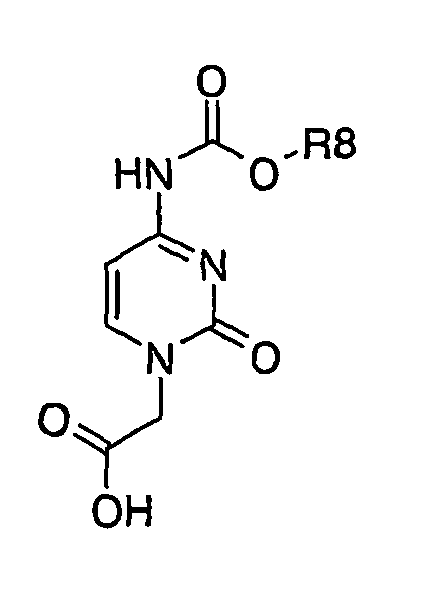
- R8 may be benzyl or benzhydryl group.
- With reference to
FIG. 10 , PNA C-monomer is prepared by coupling reaction of suitably protected (cytosin-1-yl)-acetic acids with a nitrobenzenesulfonyl group protected backbone ester having general formula II in the presence of coupling reagent to afford the compound having general formula: -

- The entities represented by R1, R2, R3, R4, R5, R6, R7, and R8 are as defined above.
- The compounds having the general formula V-c are converted to corresponding acids by adding an excess of hydroxide ion source to afford the compound having general formula VI-c:
-

- The entities represented by R1, R2, R3, R4, R5, R6, and R8 are as defined above.
- With reference to
FIG. 10 , the cyclization reaction of carboxylic acids produces PNA monomers general formula I-c by simultaneous reaction during activation of carboxylic acid. The activation of carboxylic acid can be conducted by general coupling reagent for peptide synthesis or mixed anhydride. The reaction conditions and reagents are the same as described above. - Alternatively, as seen in
FIG. 11 , PNA C-monomer can be prepared by coupling suitably protected (cytosin-1-yl)-acetic acids to piperazinone derivatives having general formula IV. The reaction conditions and reagents are the same as described above. - Synthesis of A-monomer
- A-monomer is a compound having general formula I-a:
-

- The entities represented by R1, R2, R3, R4, R5, R6, and R8 are as defined above.
- Preferred monomers are:
- R1 is nitro and R3 may be an electron withdrawing group such as F, Cl, or trifluoromethyl. Or,
- R3 is nitro and R1 or R5 may be an electron withdrawing group such as F or Cl.
- The precursors for PNA A-monomers, suitably protected (adenin-9-yl)-acetic acids (shown below), are prepared by known methods such as described in
U. S. Patent No. 6,133,444 ; and S. A. Thomson et al., Tetrahedron, 1995, 6179-6194, which are incorporated by reference herein in their entirety, or modifications thereof. -

- R8 is selected from benzyl or benzhydryl group.
- With reference to
FIG. 12 , PNA C-monomer is prepared by coupling reaction of suitably protected (adenin-9-yl)-acetic acids with a nitrobenzenesulfonyl group protected backbone ester having general formula II in the presence of coupling reagent to afford the compound having general formula V-a: -

- The entities represented by R1, R2, R3, R4, R5, R6, R7, and R8 are as defined above.
- The compounds having the general formula V-a are converted to corresponding acids by adding an excess hydroxide ion source to afford the compound having general formula VI-a:
-

- The entities represented by R1, R2, R3, R4, R5, R6, and R8 are as defined above
- With reference to
FIG. 12 , the cyclization reaction of carboxylic acids produces PNA monomers general formula I-a by simultaneous reaction during activation of carboxylic acid. The activation of carboxylic acid can be conducted by general coupling reagent for peptide synthesis or mixed anhydride. The reaction conditions and reagents are the same as described above. - Alternatively, as seen in
FIG. 13 , PNA A-monomer can be prepared by coupling suitably protected (adenin-9-yl)-acetic acids to piperazinone derivatives having general formula IV. The reaction conditions and reagents are the same as described above. - Synthesis of G-monomer
- G- monomer is a compound having general formula I-g:
-
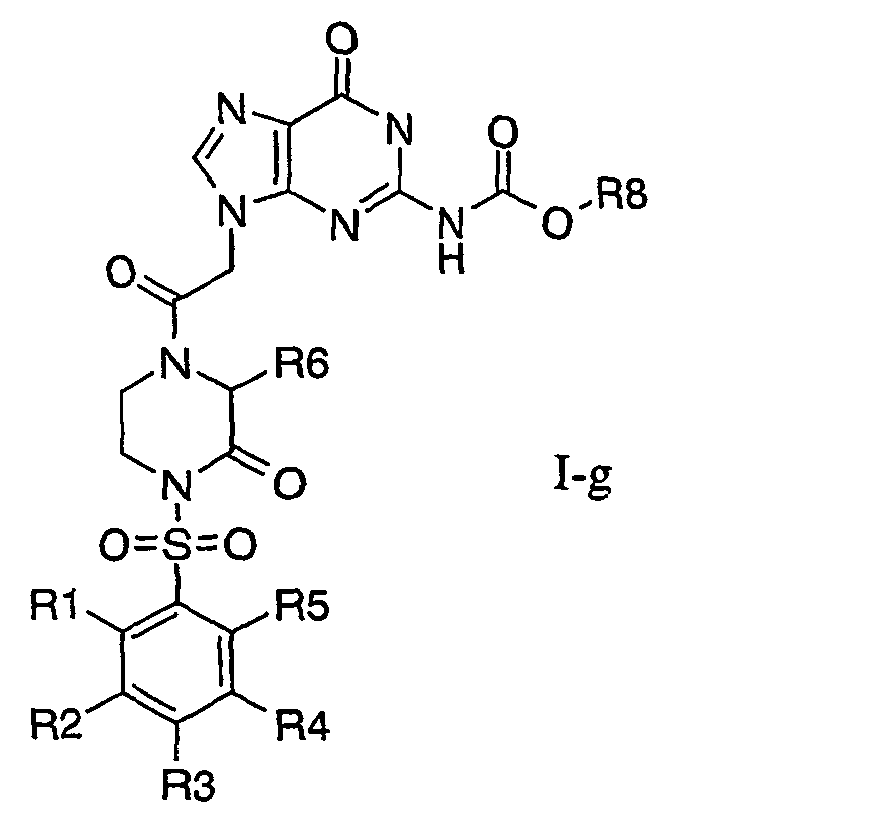
- The entities represented by R1, R2, R3, R4, R5, R6, and R8 are as defined above.
- Preferred monomers are:
- R1 is nitro and R3 may be an electron withdrawing group such as F, Cl, or trifluoromethyl. Or,
- R3 is nitro and R1 or R5 may be an electron withdrawing group such as F or Cl.
- The precursors for PNA G-monomers, suitably protected (guanin-9-yl)-acetic acids (shown below), are prepared by known methods such as described in
U. S. Patent No. 6,172,226 , or modifications thereof. -

- R8 may be benzyl or benzhydryl group.
- With reference to
FIG. 14 , PNA G-monomer is prepared by coupling reaction of suitably protected (guanin-9-yl)-acetic acids with a nitrobenzenesulfonyl group protected backbone ester having general formula II in the presence of coupling reagent to afford the compound having general formula V-g: -

- The entities represented by R1, R2, R3, R4, R5, R6, R7, and R8 are as defined above
- The compounds having the general formula V-g are converted to corresponding acids by adding an excess hydroxide ion source to afford the compound having general formula VI-g:
-

- The entities represented by R1, R2, R3, R4, R5, R6, and R8 are as defined above
- With reference to
FIG. 14 , the cyclization reaction of carboxylic acids produces PNA monomers general formula I-g by simultaneous reaction during activation of carboxylic acid. The activation of carboxylic acid can be conducted by general coupling reagent for peptide synthesis or mixed anhydride. The reaction conditions and reagents are the same as described above. - Alternatively, as seen in
FIG. 15 , PNA G-monomer can be prepared by coupling suitably protected (guanin-9-yl)-acetic acids to piperazinone derivatives having general formula IV. The reaction conditions and reagents are the same as described above. - Synthesis of PNA oligomers
- Various combinatorial synthetic methods already reported in chemical literature are generally applicable to PNA oligomer synthesis using the monomers of this invention. These methods include, but are not limited to, solid phase synthesis and solution phase synthesis. After the PNA monomers have been synthesized in the manner described above, PNA oligomers are constructed by solid phase synthesis on a suitable support material (example, but not limited to, polystyrene, polyoxyethylene-modified polystyrene, such as , for example Tentagel®, Controlled Pore Glass), which is provided with anchoring group which latently contains cleavable amine functional group. In solid phase synthesis, the first PNA monomer of this invention is incorporated by coupling reaction to solid support. Then the next sep is systematic elaboration of desired PNA oligomer sequence. This elaboration includes repeated deprotection/coupling/capping cycles. The backbone protecting group on the last coupled monomer, nitrobenzenesulfonyl group, is quantitatively removed by treatment with suitable thiol in the presence of organic base to liberate terminal free amine. Once the synthesis of PNA oligomer is completed, oligomers are cleaved from the solid support and nucleobase protecting groups are simultaneously removed by incubation for 1-2h at room temperature in TFA containing cresol as a cation scavenger.
- Following is the general cycle used for the synthesis of PNA oligomers:
- 1. Removing protecting group from resin to activate amine functional group.
- 2. Incorporating amino-acid, linker, or PNA monomer having terminal protected amine group to resin.
- 3. Washing.
- 4. Capping with acetic anhydride in the presence of organic base.
- 5. Washing.
- 6. Cleavage over reacted acetyl group in sulfonamide.
- 7. Washing.
- 8. Deprotecting sulfonyl group.
- 9. Washing.
- 10. Adding monomer.
- 11. Returning to No. 3 and repeat No. 4 - No. 11.
- In the course of coupling reaction of monomer for the oligomer synthesis, the acylating reaction can be accelerated by using catalyst such as mercury acetate, tetramethylammonium fluoride, tetraethylammonium fluoride, tetrabutylammonium fluoride, benzyltrimethylammonium fluoride, cesium fluoride, tributylphosphine, triphenylphosphine. Preferred catalyst is tetrabutylammonium fluoride. Also the reaction rate depends on solvent and temperature. Examples of solvents include, but are not limited to, DMF, N-methylpyrrolidone, dimethoxyethane, dichloromethane, 1,2-dichloroethane, DMSO, tetrahydrofuran, hexamethylphophoramide, tetramethylene sulfone, isopropyl alcohol, ethyl alcohol, and mixture of selected sovents. Preferred solvent is DMF. The N-terminal amino protecting group is cleaved by using thiol with organic base in solvent. Examples of thiols include, but are not limited to, C2∼C20 alkanethiol, 4-methoxytoluenethiol, 4-methylbenzenethiol, 3,6-dioxa-1,8-octanethiol, 4-chlorotoluenethiol, benzylmercaptane, N-acetylcysteine, N-(t-Boc)cysteine methyl ester, methyl 3-mercaptopropionate, 4-methoxybenzene thiol. Examples of organic bases include, but are not limited to, triethylamine, N,N-diisopropyethylamine, piperidine, N-methylmorpholine, and 1,8-diazabicyclo[5,4,0]undec-7-one. Preferred organic base is N,N-diisopropyethylamine.
- List of abbreviations.
- t-Boc tert-Butyloxycarbonyl
- BOI 2-(Benzotriazol-1-yl)oxy-1,3-dimethyl-imidazolinium hexafluorophosphate
- BOP Benzotriazolyl-1-oxy-tris(dimethylamino)phophonium hexafluorophosphate
- BroP Bromotris(dimethylamino)phophonium hexafluorophosphate
- DMF Dimethylformamide
- Fmoc 9-Fluorenylmethyloxycarbonyl
- HAPyU O-(7-Azabenzotriazol-1-yl)-1,1,3,3-bis(tetramethylene)uranium hexafluorophosphate
- HATU O-(7-Azabenzotriazol-1-yl)-1,1,3,3-tetramethyluranium hexafluorophosphate
- HBTU O-(Benzotriazol-1-yl)-1,1,3,3-tetramethyluranium hexafluorophosphate
-
MSNT 2,4,6-Mesitylenesulfonyl-3-nitro-1,2,4-triazolide - Mmt 4-Methoxyphenyldiphenylmethyl
- PyBOP Benzotriazolyl-1-oxy-tripyrrolidinophosphonium hexafluorophosphate
- PyBroP Bromotripyrrolidinophosphonium hexafluorophosphate
- TAPipU O-(7-Azabenzotriazol-1-yl)-1,1,3,3-bis(pentamethylene)uranium tetrafluoroborate
- TBTU O-(Benzotriazol-1-yl)-1,1,3,3-tetramethyluranium tetrafluoroborate
-
TDO 2,5-Diphenyl-2,3-dihydro-3-oxo-4-hydroxythiophene dioxide - TFA Trifluoroacetic acid
- TNTU O-[(5-Norbonene-2,3-dicarboximido)-1,1,3,3-tetramethyluronium tetrafluoroborate
- TOTU O-[(Cyano(ethoxycarbonyl)methylene)amino]-1,1,3.3-tetramethyluronium tetrafluoroborate
- TPTU O-(1,2-Dihydro-2-oxo-1-pyridyl-1,1,3,3-tetramethyluronium tetrafluoroborate
- TSTU O-(N-Succinimidyl)-1,1,3,3-tetramethyluronium tetrafluoroborate
- This invention is more specifically illustrated by following Examples, which are not meant limit the invention, unless otherwise noted.
- EXAMPLE 1 - N-(2-Aminoethyl)-2-nitro-benzenesulfonamide acetic acid salt
- 1.2-Diaminoethnae (60.1 g, 1.00 mol) was dissolved in dichloromethane (1 L). A solution of 2-nitro-benzenesulfonyl chloride (22.16 g, 0.100 mol) in dichloromethane (100 mL) was added dropwise over 3h. After additional stirring for 30 min, the reaction mixture was washed with brine (1 L X 4). The organic layer was dried over magnesium sulfate and filtered. To the filtrate was added acetic acid (6.0 g, 0.1 mol) to precipitate solid. The solid was filtered off, washed with dichloromethane (200 mL), and dried in vacuo to afford the title compound as a yellow solid (23.1 g, 76 %). 1H-NMR (500MHz ; DMSO-d6) δ 8.01∼7.95 (m, 2H), 7.88∼7.83 (m, 2H), 2.90 (t, 2H), 2.60 (t, 2H), 1.87 (s, 3H).
- EXAMPLE 2 - N-(2-Aminoethyl)-4-chloro-2-nitro-benzenesulfonamide acetic acid salt
- The title compound (22.5 g, 66 %) was synthesized from 4-chloro-2-nitrobenzenesulfonyl chloride (25.61 g, 0.1 mol) as per the procedure of example 1. 1H-NMR (500MHz ; DMSO-d6) δ 8.26 (d,1H), 8.01∼7.97 (m, 2H), 2.97 (t, 2H), 2.69 (t, 2H), 1.91 (s, 3H).
- EXAMPLE 3 - N-(2-Aminoethyl)-4-fluoro-2-nitro-benzenesulfonamide acetic acid salt
- The title compound (21.7 g, 67 %) was synthesized from 4-fluoro-2-nitrobenzenesulfonyl chloride (23.96 g, 0.10 mol) as per the procedure of example 1. 1H-NMR (500MHz; DMSO-d6) δ 8.11∼8.06 (m, 2H), 7.78 (m, 1H), 2.94 (t, 2H), 2.67 (t, 2H), 1,89 (s, 3H).
- EXAMPLE 4 - N-(2-Aminoethyl)-2-nitro-4-trifluoromethyl-benzenesulfonamide acetic acid salt
- The title compound (23.62 g, 63 %) was synthesized from 2-nitro-4-trifluoromethyl-benzenesulfonyl chloride (28.96 g, 0.10 mol) as per the procedure of example 1. 1H-NMR (500MHz; DMSO-d6) δ 8.56 (s, 1H), 8.28 (d, 1H), 8.24 (d, 1H), 2.92 (t, 2H), 2.65 (t, 2H), 1.87 (s, 3H).
- EXAMPLE 5 - N-(2-Aminoethyl)-4-nitro-benzenesulfonamide acetic acid salt
- The title compound (2.40 g, 78 %) was synthesized from 4-nitro-benzenesulfonyl chloride (2.22 g, 10 mmol) as per the procedure of example 1.
- EXAMPLE 6 - N-(2-Aminoethyl)-2-chloro-4-nitro-benzenesulfonamide acetic acid salt
- The title compound (2.38 g, 70 %) was synthesized from 4-chloro-2-nitro-benzenesulfonyl chloride (2.56 g, 0.1 mol) as per the procedure of example 1.
- EXAMPLE 7 - N-[2-(2-Nitro-benzenesulfonylamino)-ethyl]-glycine ethyl ester
- To a solution of N-(2-aminoethyl)-2-nitro-benzenesulfonamide acetic acid salt (15.15 g, 49.6 mmol) and triethylamine (15.16 g, 0.15 mol) in dichloromethane (100 mL) was added ethyl bromoacetate (16.7 g 0.100 mol) with stirring at room temperature. After additional stirring for 1h, the reaction mixture was washed with brine (100 mL). The organic layer was dried over magnesium sulfate and filtered. The filtrate was evaporated in vacuo and the residue was triturated in ethyl ether (100 mL) to afford the titled compound as a white solid (8.1 g, 49 %). 1H-NMR (500MHz ; DMSO-d6) δ 8.02∼7.96 (m, 2H), 7.87∼7.84 (m, 2H), 4.05 (q, 2H), 3.23 (s, 2H), 2.95 (t, 2H), 2.57 (t, 2H) 1.16 (t, 3H).
- EXAMPLE 8 - N-[2-(4-Chloro-2-nitro-benzenesulfonylamino)-ethyl]-glycine ethyl ester
- The title compound (8.3 g, 46 %) was synthesized from N-(2-aminoethyl)-4-chloro-2-nitro-benzenesulfonamide acetic acid salt (16.79 g, 49.4 mmol) as per the procedure of example 7. 1H-NMR (500MHz ; DMSO-d6) δ 8.26 (s,1H), 8.01 (d,1H), 7.96 (d, 1H), 4.06 (q, 2H), 3.23 (s, 2H), 2.95 (t, 2H), 2.57 (t, 2H), 1.16 (t, 3H).
- EXAMPLE 9 - N-[2-(4-Fluoro-2-nitro-benzenesulfonylamino)-ethyl]-glycine ethyl ester
- The title compound (7.7 g, 42 %) was synthesized from N-(2-aminoethyl)-4-fluoro-2-nitrobenzenesulfonamide, acetic acid salt (16.79 g, 51.9 mmol) as per the procedure of example 7. 1H-NMR (500MHz ; DMSO-d6) δ 8.08 (m, 2H), 7.76 (m,1H), 4.06 (q, 2H), 3.24 (s, 2H), 2.95 (t, 2H), 2.57 (t, 2H), 1.16 (t, 3H).
- EXAMPLE 10 - N-[2-(2-Nitro-4-trifluoromethyl-benzenesulfonylamino)-ethyl]-glycine ethyl ester .
- The title compound (9.23 g, 46 %) was synthesized from N-(2-aminoethyl)-2-nitro-4-trifluoromethyl-benzenesulfonamide acetic acid salt (18.76 g, 50.3 mmol) as per the procedure of example 7.1H-NMR (500MHz ; DMSO-d6) δ 8.55 (s, 1H), 8.27 d, 1H), 8.22 (d, 1H), 4.05 (q, 2H), 3.22 (s, 2H), 2.99 (t, 2H), 2.57 (t, 2H),1.16 (t, 3H).
- EXAMPLE 11 - N-[2-(4-Nitro-benzenesulfonylamino)-ethyl]-glycine ethyl ester
- The title compound (826 mg, 50 %) was synthesized from N-(2-aminoethyl)-4-nitrobenzenesulfonamide acetic acid salt (1.52 g, 5.2 mmol) as per the procedure of example 7.1H-NMR (500MHz ; DMSO-d6) δ 8.41 (d, 2H), 8.04 (d, 2H), 4.05 (q, 2H), 3.23 (s, 2H), 2.86 (t, 2H), 2.54 (t, 2H), 1.16 (t, 3H).
- EXAMPLE 12 - N-[2-(2-Chloro-4-nitro-benzenesulfonylamino)-ethyl]-glycine ethyl ester
- The title compound (885 mg, 48 %) was synthesized from N-(2-aminoethyl)-2-chloro-4-nitro-benzenesulfonamide acetic acid salt (1.68 g, 5 mmol) as per the procedure of example 7. 1H-NMR (500MHz ; DMSO-d6) δ 8.43 (d, 1H), 8.32 (dd, 1H), 8:22 (d, 1H), 4.04 (q, 2H), 3.20 (s, 2H), 2.96 (t, 2H), 2.54 (t, 2H), 1.16 (t, 3H).
- EXAMPLE 13 - N-[2-(4-Methyl-2-nitro-benzenesulfonylamino)-ethyl]-glycine ethyl ester
- To a solution of N-(2-aminoethyl)-glycine ethyl ester 2HCl (1.10 g, 5.0 mmol), prepared as described by Will (D. W. Will et al., Tetrahedron, 1995, 51, 12069-12802.), in dichloromethane (50 mL) was slowly added triethylamine (2.02 g, 20 mmol) at room temperature. Then 4-methyl-2-nitro-benzenesulfonyl chloride (1.19 g 5.0 mmol) in dichloromethane (10 mL) was added to the reaction mixture at room temperature for 5 min. The resulting reaction mixture was stirred for additional 2 h. at room temperature and washed with water (30 mL). The organic layer was dried over MgSO4 and filtered. The filtrate was evaporated in vacuo to give desired product (1.60 g, 92 %) as a solid. 1H-NMR (500MHz ; DMSO-d6) δ 7.87 (d, 1H), 7.81 (s, 1H), 7.66 (d, 1H), 4.06 (q, 2H), 3.24 (s, 2H), 2.91 (t, 2H), 2.57 (t, 2H), 2.44 (s, 3H), 1.17 (t, 3H).
- EXAMPLE 14 - N-[2-(4-Chloro-6-methyl-2-nitro-benzenesulfonylamino)-ethyl]-glycine ethyl ester
- The title compound (1.72 g, 90 %) was synthesized by the reaction of N-(2-aminoethyl)-glycine, ethyl ester 2HCl (1.10 g, 5.0 mmol) with 4-chloro-6-methyl-2-nitro-benzenesulfonyl chloride (1.36 g, 5.0 mmol) as per the procedure of example 13.
- EXAMPLE 15 - N-[2-(4,6-Dichloro-2-nitro-benzenesulfonylamino)-ethyl]-glycine ethyl ester
- The title compound (1.83 g, 87 %) was synthesized by the reaction of N-(2-aminoethyl)-glycine, ethyl ester 2HCl (1.10 g, 5.0 mmol) with 4,6-dichloro-2-nitro-benzenesulfonyl chloride (1.46 g, 5.0 mmol) as per the procedure of example 13.
- EXAMPLE 16 - N-[2-(2-Nitro-benzenesulfonylamino)-ethyl]-alanine ethyl ester
- N-(2-Aminoethyl)-alanine ethyl ester 2HCl (1.165 g, 5.0 mmol), prepared as described by Puschl (A. Puschl et al., Tetrahedron, 1998, 39, 4707-4710.), was reacted with 2-nitro-benzenesulfonyl chloride (1.11 g 5.0 mmol) as per the procedure of example 13 to give the title compound (1.64 g, 95 %). 1H-NMR (500MHz ; DMSO-d6) δ 8.02∼7.96 (m, 2H), 7.86 (m, 2H), 4.05 (q, 2H), 3.16 (q, 1H), 2.94 (t, 2H), 2.58 (m,1H), 2.43 (m,1H),1.17 (t, 3H),1.09 (d, 3H).
- EXAMPLE 17 - N-[2-(2-Nitro-benzenesulfonylamino)-ethyl]-phenylglycine methyl ester
- The title compound (716 mg, 91 %) was synthesized by the reaction of N-(2-aminoethyl)-phenylglycine, methyl ester 2HCl (416 mg, 2 mmol) 2-nitro-benzenesulfonyl chloride (592 mg, 2.0 mmol) as per the procedure of example 13. 1H-NMR (500MHz ; DMSO-d6) δ 8.00 ∼7.94 (m, 2H), 7.87∼7.81 (m, 2H), 7.34∼7.26 (m, 5H), 4.32 (s, 1H), 3.57 (s, 3H), 2.98 (t, 2H), 2.54∼2.41 (m, 2H).
- EXAMPLE 18 - N-t-Butyloxycarbonyl-N-[2-(2-nitro-benzenesulfonylamino)-ethyl]-glycine
- To a solution of N-[2-(2-nitro-benzenesulfonylamino)-ethyl]-glycine ethyl ester (6.66 g, 20.1 mmol) in tetrahydrofuran (50 mL) was added a solution of LiOH(1.64 g, 40 mmol) dissolved in water (30 mL). After stirring for 1 hour at room temperature, di-t-butyl dicarbonate (6.55 g, 30 mmol) was added to the reaction mixture. The resulting reaction mixture was stirred for 30 min, and then a solution of LiOH (0.82 g, 0.02 mol) in water (15 mL) was added. After completion of the reaction by TLC, the precipitate was removed by filtration and tetrahydrofurane was evaporated in vacuo. The residual solution was washed with ethyl ether (100 mL). The aqueous layer was acidified to pH=3 by adding 2N HCl and extracted with dichloromethane (100 mL). The organic layer was dried over MgSO4 and filtered. The filtrate was concentrated in vacuo to afford the desired product (7.9 g, 98 %). 1H-NMR (500MHz ; DMSO-d6) δ 8.00 (m, 2H), 7.86 (m, 2H), 3.80 (s, 1H), 3.76 (s, 1H), 3.24 (m, 2H), 3.05 (m, 2H), 1.35 (s, 4.5H), 1.31 (s, 4.5H).
- EXAMPLE 19 - N-t-Butyloxycarbonyl-N-[2-(4-chloro-2-nitro-benzenesulfonylamino)-ethyl]-glycine
- The title compound (8.1 g, 92 %) was synthesized from N-[2-(4-chloro-2-nitro-benzenesulfonylamino)-ethyl]-glycine ethyl ester (7.35 g, 20 mmol) as per the procedure of example 18.1H-NMR(500MHz ; DMSO-d6) δ 8.28 (s, 1H), 7.97 (s, 2H), 3.78 (s, 1H), 3.76 (s, 1H), 3.24 (m, 2H), 3.06 (m, 2H), 1.35 (s, 4.5H) 1.31 (s, 4.5H).
- EXAMPLE 20 - N-t-Butyloxycarbonyl-N-[2-(4-fluoro-2-nitro-benzenesulfonylamino)-ethyl]-glycine
- The title compound (7.9 g, 89 %) was synthesized from N-[2-(4-fluoro-2-nitro-benzenesulfonylamino)-ethyl]-glycine ethyl ester (7.35 g, 21 mmol) as per the procedure of example 18. 1H-NMR (500MHz ; DMSO-d6) δ 8.14∼8.02 (m, 2H), 7.76 (m, 1H), 3.82 (s, 1H), 3.77 (s,1H), 3.24 (m, 2H), 3.05 (m, 2H), 1.36 (s, 4.5H), 1.32 (s, 4.5H).
- EXAMPLE 21 - N-t-Butyloxycarbonyl-N-[2-(2-nitro-4-trifluoromethyl-benzenesulfonylamino)-ethyl]-glycine
- The title compound (8.62 g, 91 %) was synthesized from N-[2-(2-nitro-4-trifluoromethyl-benzenesulfonylamino)-ethyl]-glycine ethyl ester (8.00 g, 20 mmol) as per the procedure of example 18. 1H-NMR (500MHz; DMSO-d6) δ 8.57 (d, 1H), 8.41 (t, 0.5H), 8.35 (t, 0.5H), 8.19 (dd, 1H), 3.82 (s, 1H), 3.75 (s, 1H), 3.24 (t, 2H), 3.09 (m, 1H),1.34 (s, 4.5H), 1.30 (s, 4.5H).
- EXAMPLE 22 - N-t-Butyloxycarbonyl-[2-(4-methyl-2-nitro-benzenesulfonylamino)-ethyl]-glycine
- The title compound (7.80 g, 93 %) was synthesized from N-[2-(4-methyl-2-nitro-benzenesulfonylamino)-ethyl]-glycine ethyl ester (6.91 g, 0.02 mol) as per the procedure of example 18. 1H-NMR (500MHz ; DMSO-d6) δ 7.99∼7.93 (m, 1H), 7.85 (dd, 1H), 7.82 (s, 1H), 7.67 (d, 1H), 3.81 (s, 1H), 3.76 (s,1H), 3.23 (m, 2H), 3.05 (m, 2H), 2.44 (s, 3H), 1.36 (s, 4.5H),1.31 (s, 4.5H).
- EXAMPLE 23 - N-t-Butyloxycarbonyl-N-[2-(4-chloro-6-methyl-2-nitro-benzenesulfonylamino)-ethyl]-glycine
- The title compound (413 mg, 91 %) was synthesized from N-[2-(4-chloro-6-methyl-2-nitro-benzenesulfonylamino)-ethyl]-glycine ethyl ester (380 mg, 0.01 mol) as per the procedure of example 18.
- EXAMPLE 24 - N-t-Butyloxycarbonyl-N-[2-(4,6-dichloro-2-nitro-benzenesulfonylamino)-ethyl]-glycine
- The title compound (417 mg, 88 %) was synthesized from N-[2-(4,6-dichloro-2-nitro-benzenesulfonylamino)-ethyl]-glycine ethyl ester (400 mg, 1.0 mmol) as per the procedure of example 18.
- EXAMPLE 25 - N-t-Butyloxycarbonyl-N-[2-(4-nitro-benzenesulfonylamino)-ethyl]-glycine
- The title compound (362 mg, 90 %) was synthesized from N-[2-(4-nitro-benzenesulfonylamino)-ethyl]-glycine ethyl ester (331 mg, 1.0 mmol) as per the procedure of example 18. 1H-NMR (500MHz ; DMSO-d6) δ 8.42 (dd, 2H), 8.03 (d, 2H), 8.01 (br, 1H), 3.80 (s, 1H), 3.22 (m, 2H), 2.96 (m, 2H),1.34 (s, 4.5H), 1.31 (s, 4.5H).
- EXAMPLE 26 - N-t-Butyloxycarbonyl-N-[2-(2-chloro-4-nitro-benzenesulfonylamino)-ethyl]-glycine
- The title compound (371 mg, 85 %) was synthesized from N-[2-(2-chloro-4-nitro-benzenesulfonylamino)-ethyl]-glycine ethyl ester (366 mg, 20 mmol) as per the procedure of example 18. 1H-NMR (500MHz ; DMSO-d6) δ 8.44 (q, 1H), 8.35∼8.27 (m, 2H), 8.20 (d, 1H), 3.81 (s,1H), 3.73 (s, 1H), 3.22 (t, 2H), 3.06 (m, 2H), 1.35 (s, 4.5H), 1.30 (s, 4.5H).
- EXAMPLE 27 - N-(t-Butyloxycarbonyl)-N-[2-(2-nitro-benzenesulfonylamino)-ethyl]-alanine
- To a solution of N-[2-(2-nitro-benzenesulfonylamino-ethyl)-alanine ethyl ester(1.04 g, 3 mmol) in tetrahydrofuran (10 mL) was added a solution of LiOH (252 mg, 6 mmol) dissolved in water (10 mL). After stirring for 1 hour at room temperature, di-t-butyl dicarbonate (983 mg, 4.5 mmol) was added to the reaction mixture. The resulting reaction mixture was stirred for 5 h, and then a solution of LiOH (126 mg, 3 mmol) in water (15 mL) was added. After completion of the reaction by TLC, the precipitate was removed by filtration and tetrahydrofurane was evaporated in vacuo. The residual solution was washed with ethyl ether (20 mL). The aqueous layer was acidified to pH=3 by adding 2N HCl and extracted with dichloromethane (30 mL). The organic layer was dried over MgSO4 and filtered. The filtrate was concentrated in vacuo to afford the desired product (1.16 g, 93%). 1H-NMR (500MHz ; DMSO-d6) δ 7.99 (m, 2H), 7.87 (m, 2H), 4.31 (q, 0.4H), 4.03 (q, 0.6H), 3.37∼3.19 (m, 2H), 3.10-2.95 (m, 2H), 1.35 (s, 4.5H), 1.33 (s, 4.5H), 1.30 (d, 1.5H), 1.29 (d, 1.5H).
- EXAMPLE 28 - N-(t-Butyloxycarbonyl)-N-[2-(2-nitro-benzenesulfonylamino)-ethyl]-phenylglycine
- The title compound (583 mg, 81 %) was synthesized from N-[2-(2-nitro-benzenesulfonylamino)-ethyl]-phenylglycine methyl ester (590 mg, 1.5 mmol) as per the procedure of example 27. 1H-NMR (500MHz ; DMSO-d6) δ 7.97∼7.82 (m, 4H), 7.35∼7.30 (m, 3H), 7.23-7.21 (m, 2H), 5.58 (s, 0.6H), 5.40 (s, 0.4H), 3.20-2.85 (m, 4H), 1.46 (s, 4.5H),1.37 (s, 4.5H).
- EXAMPLE 29 - 1-(2-Nitrobenzenesulfonyl)-piperazin-2-one HCl salt
- To a solution of N-(t-butoxycarbonyl)-N-(2-(2-nitro-benzenesulfonylamino)-ethyl]-glycine (8.06 g, 20 mmol) in dichloromethane (100 ml) was added dicyclohexyl carbodiimide (5.16 g, 25 mmol). After stirring for 2 hours at room temperature, the precipitate was removed by filtration. The filtrate was concentrated and the residue was dissolved in ethyl actate (50 mL) and cooled to 0 °C. The precipitate solid was removed and to the filtrate was added 2N-HCl in ethyl acetate (100 mL). The mixture was stirred for additional 10 h at ambient temperature. The precipitate product was filtered off, washed with ethyl acetate (500 mL), and dried in vacuo to afford the title compound as a white solid 5.39 g (79 %). 1H-NMR (500MHz ; DMSO-d6) δ 9.95 (br.s, 2H), 8.38 (d, 1H), 8.04∼7.95 (m, 2H), 4.09 (dd, 2H), 3.96 (s, 2H), 3.56 (dd, 2H).
- EXAMPLE 30 - 1-(4-Chloro-2-nitrobenzenesulfonyl)-piperazin-2-one HCl salt
- The title compound (4.3 g, 67 %) was synthesized from N-(t-butyloxycarbonyl)-N-[2-(4-chloro-2-nitro-benzenesulfonylamino)-ethyl]-glycine (7.92 g, 18 mmol) as per the procedure of example 29. 1H-NMR (500MHz ; DMSO-d6) δ 10.01 (br.s, 2H), 8.42 (d, 1H), 8.35 (dd, 1H), 8.06 (dd, 1H), 4.07 (t, 2H), 3.95 (s, 2H), 3.55 (t, 2H).
- EXAMPLE 31 - 1-(4-Fluoro-2-nitro-benzenesulfonyl)-piperazin-2-one HCl salt
- The title compound (4.2 g, 69 %) was synthesized from N-(t-butyloxycarbonyl)-N-[2-(4-fluoro-2-nitro-benzenesulfonylamino)-ethyl]-glycine (7.61 g, 18 mmol) as per the procedure of example 29. 1H-NMR (500MHz ; DMSO-d6) δ 9.91 (br.s, 2H), 8.43 (m, 1H), 8.27 (m, 1H), 7.87 (m, 1H), 4.06 (dd, 2H), 3.96 (s, 2H), 3.55 (dd, 2H).
- EXAMPLE 32 - 1-(2-Nitro-4-trifluoromethyl-benzenesulfonyl)-piperazin-2-one HCl salt
- The title compound (2.55 g, 65 %) was synthesized from N-(t-butyloxycarbonyl)-N-[2-(2-nitro-4-trifluoromethyl-benzenesulfonylamino)-ethyl]-glycine (4.71 g, 10 mmol) as per the procedure of example 29. 1H-NMR (500MHz ; DMSO-d6) δ 10.16 (br.s, 2H), 8.71 (s, 1H), 8.60 (d, 1H), 8.35 (d, 1H), 4.13 (dd, 2H), 3.96 (s, 2H), 3.57 (dd, 2H).
- EXAMPLE 33 -1-(4-Methyl-2-nitro-benzenesulfonyl)-piperazin-2-one HCl salt
- The title compound (2.40 g, 71 %) was synthesized from N-(t-butyloxycarbonyl)-N-[2-(4-methyl-2-nitro-benzenesulfonylamino)-ethyl]-glycine (4.19 g, 10 mmol) as per the procedure of example 29. 1H-NMR (500MHz ; DMSO-d6) δ 9.87 (br.s, 1H), 8.23 (d, 1H), 7.98 (s, 1H), 7.77 (d, 1H), 4.06 (dd, 2H), 3.95 (s, 2H), 3.55 (dd, 2H), 2.49 (s, 3H).
- EXAMPLE 34 - 1-(4-Chloro-6-methyl-2-nitro-benzenesulfonyl)-piperazin-2-one HCl salt
- The title compound (2.53 g, 68 %) was synthesized from N-(t-butyloxycarbonyl)-N-[2-(4-chloro-6-methyl-2-nitro-benzenesulfonylamino)-ethyl]-glycine (4.54 g, 10 mmol) as per the procedure of example 29. 1H-NMR (500MHz ; DMSO-d6) δ 10.02 (br.s, 2H), 8.20 (s, 1H), 7.96 (s, 1H), 4.04 (dd, 2H), 3.96 (s, 2H), 3.53 (dd, 2H), 2.67 (s, 3H).
- EXAMPLE 35 - 1-(4,6-Dichloro-2-nitro-benzenesulfonyl)-piperazin-2-one HCl salt
- The title compound (2.51 g, 64 %) was synthesized from N-(t-butyloxycarbonyl)-N-[2-(4,6-dichloro-2-nitro-benzenesulfonylamino)-ethyl]-glycine (4.74 g, 10 mmol) as per the procedure of example 29. 1H-NMR (500MHz ; DMSO-d6) δ 10.06 (br.s, 2H), 8.43 (s, 1H), 8.32 (s,1H), 4.16 (t, 2H), 3.99 (s, 2H), 3.50 (t, 2H).
- EXAMPLE 36 - 1-(4-Nitrobenzenesulfonyl)-piperazin-2-one HCl salt
- The title compound (208 mg, 65 %) was synthesized from N-(t-butyloxycarbonyl)-N-[2-(4-nitro-benzenesulfonylamino)-ethyl]-glycine (403 mg, 1 mmol) as per the procedure of example 29. 1H-NMR (500MHz ; DMSO-d6) δ 9.92 (br.s, 2H), 8.43 (d, 2H), 8.29 (d, 2H), 4.17 (dd, 2H), 4.03 (s, 2H), 3.54 (dd, 2H).
- EXAMPLE 37 - 1-(2-Chloro-4-nitrobenzenesulfonyl)-piperazin-2-one HCl salt
- The title compound (239 mg, 67 %) was synthesized from N-(t-butyloxycarbonyl)-N-[2-(2-chloro-4-nitro-benzenesulfonylamino)-ethyl]-glycine (437 mg, 1 mmol) as per the procedure of example 29. 1H-NMR (500MHz ; DMSO-d6) δ 10.28 (br.s, 2H), 8.53 (d,1H), 8.45 (d,1H), 8.39 (dd, 1H), 4.25 (dd, 2H), 3.94 (s, 2H), 3.54 (dd, 2H).
- EXAMPLE 38 - 1-(2-Nitro-benzenesulfonyl)-3-methyl-piperazin-2-one HCl salt
- The title compound (450 mg, 67 %) was synthesized from N-(t-butyloxycarbonyl)-N-[2-(2-nitro-benzenesulfonylamino)-ethyl]-alanine (835 mg, 2 mmol) as per the procedure of example 29.1H-NMR (500MHz ; DMSO-d6) δ 8.38 (d, 1H), 8.14 (d, 1H), 8.03 (dd, 1H), 7.98 (dd, 1H), 4.30 (m, 1H), 4.13 (m, 2H), 3.70 (m, 1H), 3.51 (m,1H),1.39 (d, 3H).
- EXAMPLE 39 - 1-(2-Nitro-benzenesulfonyl)-3-phenyl-piperazin-2-one HCl salt
- The title compound (247 mg, 63 %) was synthesized from N-(t-butyloxycarbonyl)-N-[2-(2-nitro-benzenesulfonylamino)-ethyl]-phenylglycine (480 mg, 1 mmol) as per the procedure of example 29. 1H-NMR (500MHz ; DMSO-d6) δ 8.35 (d, 1H), 8.15 (d, 1H), 8.02 (t, 1H), 7.94 (t, 1H), 7.40 (m, 5H), 5.47 (br s, 1H), 4.24 (m, 2H), 3.69 (m, 1H), 3.60 (m, 1H).
- EXAMPLE 40 - (2-Amino-6-iodopurin-9-yl)-acetic acid ethyl ester
- To a solution of 2-amino-6-iodo-purine (78.3 g, 0.3 mol) in DMF (1960 mL) was added ethyl bromoacetate (55.1 g, 0.33 mol) and potassium carbonate (82.9 g, 0.6 mol). The resulting reaction mixture was stirred for 12 h at room temperature. The reaction mixture was concentrated to small volume (about 150 mL) in vacuo and the residue was dissolved in water The solid was filtered off, washed with water and ethyl ether, and dried in vacuo to give the titled compound (98.4 g, 95%). 1H-NMR (500MHz ; DMSO-d6) δ 8.06 (s, 1H), 6.90 (br.s, 2H), 4.94 (s, 2H), 4.17 (q, 2H), 1.22 (t, 3H).
- EXAMPLE 41 - [2-(Benzhydryloxycarbonyl)-amino-6-iodopurine-9-yl]-acetic acid ethyl ester
- To a solution of (2-amino-6-iodopurine-9-yl)-acetic acid ethyl ester (13.9 g, 40 mmol) in THF (280 mL) was added triphosgene (5.34 g, 18 mmol) at 0 °C. After stirring for additional 5 min, N,N-diisopropylethylamine (24.4 mL) was slowly added and the reaction mixture was stirred for 30 min at 0 °C. Then benzhydrol was added and the resulting reaction mixture was allowed to warm to room temperature and stirred for additional 13 h. The reaction mixture was neutralized by addition of 1N HCl solution and saturated with sodium chloride and sodium thiosulfate. The organic layer was separated and the aqueous layer was extracted with ethyl acetate (200 mL X 3). The combined organic layer was washed with brine (200 mL X 2), dried over sodium sulfate, and filtered. The filtrate was evaporated in reduced pressure and the residue was purified by column chromatography to afford the titled compound (15.15g, 68 %).1H-NMR (500MHz ; DMSO-d6) δ 10.88 (bs, 1H), 8.45 (s,1H), 7.60∼7.20 (m, 10H), 6.79 (s, 1H), 5.08 (s, 2H), 4.15 (q, 2H), 1.17 (t, 3H).
- EXAMPLE 42 - [2-N-(Benzhydryloxycarbonyl)-guanin-9-yl]-acetic acid
- To a suspension of 60% NaH (5.04 g, 126 mmol) in THF (110 mL) was slowly added 3-hydroxypropionitrile for a period of 10 min at 0 °C and the mixture was stirred for additional 12 min. To the resulting reaction mixture was slowly added [2-(benzhydryloxycarbonyl)-amino-6-iodo-purine-9-yl]-acetic acid (11.12 g, 21 mmol) portionwise in an ice bath. After the addition was completed, the ice bath was removed and stirring continued for additional 3.5 h. Then the reaction mixture was acidified by addition of 20 % aqueous solution of citric acid and saturated with sodium chloride. The organic layer was separated and the aqueous layer was extracted with THF (300 mL X 2). The combined organic layer was dried over sodium sulfate and filtered. The solvent was removed in vacuo and the residue was recrystallized in ethyl alcohol. The solid was filtered off, washed with cold ethyl acohol, and dried in vacuo to give the desired product (9.00 g).
- EXAMPLE 43 - [2-(Benzyloxycarbonyl)-amino-6-iodo-purine-9-yl]-acetic acid ethyl ester
- The title compound (12.42 g, 64.4%) was synthesized by the reaction of (2-amino-6-iodopurine-9-yl)-acetic acid ethyl ester (13.9 g, 40 mmol) and phosgene followed by benzyl alcohol treatment as per the procedure of example 41. 1H-NMR (500MHz; DMSO-d6) δ 10.83 (bs,1H), 8.48 (s,1H), 7.50-7.30 (m, 5H), 5.18 (s, 2H), 5.11 (s, 2H), 4.19 (q, 2H), 1.21 (t, 3H).
- EXAMPLE 44 - [2-(Benzyloxycarbonyl)-amino-6-iodopurin-9-yl]-acetic acid
- To a suspension of [2-(benzyloxycarbonyl)-amino-6-iodo-purine-9-yl]-acetic acid ethyl ester (10.02 g, 20.8 mmol) in tetrahydrofuran (50 mL) and water (50 mL) was added lithium hydroxide hydrate (2.83 g, 20.8 mmol) at 10 °C. The resulting reaction mixture was stirred for 30 min. Then the mixture was acidified to pH= 3 by adding 1N HCl. The precipitated solid was filtered off, washed with water and ethyl ether, and dried in vacuo to give the title compound (9.81 g). 1H-NMR (500MHz ; DMSO-d6) δ 10.75 (s, 1H), 8.44 (s, 1H), 7.50∼7.30 (m, 5H), 5.17 (s, 2H), 4.97 (s, 2H).
- EXAMPLE 45 - [2-N-(Benzyloxycarbonyl)-guanin-9-yl]-acetic acid
- The title compound (5.44 g, 79.2%) was synthesized from [2-(benzyloxycarbonyl)-amino-6-iodopurin-9-yl]-acetic acid (9.06 g, 20 mmol) as per the procedure of example 42. 1H NMR (DMSO-d6) δ 11.54 (s, 1H), 11.37 (s, 1H), 7.94 (s, 1H), 7.46-7.33 (m, 5H), 5.28 (s, 2H), 4.87 (s, 2H).
- EXAMPLE 46 - N-(2-(2-Nitro-benzenesulfonylamino)-ethyl]-N-[(thymin-1-yl)-acetyl]-glycine ethyl ester
- To the mixture of N-[2-(2-nitro-sulfonylamino)-ethyl]-glycine ethyl ester (1.67g, 5 mmol), (thymin-1-yl)-acetic acid (0.92 g, 5 mmol), and PyBOP (3.12 g, 6 mmol) in DMF (15 mL) was added N,N-diisopropylethylamine (1.31 mL, 7.5 mmol) at ambient temperature. The resulting reaction mixture was stirred for 7 h at the same temperature and the solvent was removed in vacuo. The residue was dissolved in ethyl acetate (50 mL) and washed with 1N HCl aqueous solution, saturated sodium bicarbonate solution, and brine. The organic layer was dried over magnesium sulfate and filtered. The filtrate was concentrated and the residue was triturated with ethyl alcohol. The resulting solid was filtered off and dried in vacuo to give the title compound as a white solid (2.35 g, 93 %). 1H-NMR (500MHz ; DMSO-d6) δ 11.29 (s, 0.6H), 11.26 (s, 0.4H), 8.25∼7.87 (m, 5H), 7.30 (s, 0.6H), 7.23 (s, 0.4H), 4.64 (s, 1.2H), 4.46 (s, 0.8H), 4.29 (s, 0.8H), 4.16 (q, 0.8H), 4.07 (q, 1.2H), 4.00 (s, 1.2H), 3.49 (t, 1.2H), 3.21 (q, 1.2H), 3.12-3.01 (m, 1.6H), 1.75 (s, 3H), 1.22 (t, 1.2H), 1.17 (t, 1.8H).
- EXAMPLE 47 - N-[2-(4-Chloro-2-nitro-benzenesulfonylamino)-ethyl]-N-[(thymin-2-yl)-acetyl]-glycine ethyl ester
- The title compound (2.46 g, 92 %) was synthesized by the reaction of N-[2-(4-chloro-2-nitro-benzenesulfonylamino)-ethyl]-glycine ethyl ester (1.84 g, 5 mmol) and (thymin-1-yl)-acetic acid (0.92 g, 5 mmol) as per the procedure of example 46. 1H-NMR (500MHz ; DMSO-d6) δ 11.31 (s, 0.6H), 11.28 (s, 0.4H), 8.31∼7.95 (m, 4H), 7.31 (s, 0.6H), 7.23 (s, 0.4H), 4.64 (s, 1.2H), 4.46 (s, 0.8H), 4.28 (s, 0.8H), 4.16 (q. 0.8H), 4.07 (q. 1.2H), 4.00 (s, 1.2H), 3.49 (t, 1.2H), 3.22 (q, 1.2H), 3.12~3.01 (m, 1.6H), 1.74 (s, 3H), 1.22 (t,1.2H), 1.17 (t, 1.8H).
- EXAMPLE 48 - N-[2-(4-Fluoro-2-nitro-benzenesulfonylamino)-ethyl]-N-[(thymin-1-yl)-acetyl]-glycine ethyl ester
- The title compound (2.35 g, 91 %) was synthesized by the reaction of N-[2-(4-fluoro-2-nitro-benzenesulfonylamino)-ethyl]-glycine ethyl ester (1.76 g, 5 mmol) and (thymin-1-yl)-acetic acid (0.92 g, 5 mmol) as per the procedure of example 46. 1H-NMR (500MHz ; DMSO-d6) δ 11.30 (s, 0.6H), 11.27 (s, 0.4H), 8.28∼8.05 (m, 2.8H), 7.78 (m, 1.2H), 7.31 (s, 0.6H), 7.23 (s, 0.4H), 4.65 (s, 1.2H), 4.47 (s, 0.8H), 4.30 (s, 0.8H), 4.16 (q. 0.8H), 4.07 (q. 1.2H), 4.00 (s, 1.2H), 3.49 (t, 1.2H), 3.22 (q, 1.2H), 3.12∼3.01 (m,1.6H),1.75 (s, 3H), 1.23 (t, 1.2H), 1.18 (t, 1.8H).
- EXAMPLE 49 - N-[2-(2-Nitro-4-trifluoromethyl-benzenesulfonylamino)-ethyl]-N-[(thymin-1-yl)-acetyl]- glycine ethyl ester
- The title compound (2.69 g, 95 %) was synthesized by the reaction of N-[2-(2-Nitro-4-trifluoromethyl-benzenesulfonylamino)-ethyl]-glycine ethyl ester (2.00 g, 5 mmol) and (thymin-1-yl)-acetic acid (0.92 g, 5 mmol) as per the procedure of example 46. 1H-NMR (500MHz ; DMSO-d6) δ 11.31 (s, 0.55H), 11.28 (s, 0.45H), 8.57 (s, 0.55H), 8.54 (s, 0.45H), 8.50 (t, 0.55H), 8.38 (t, 0.45H), 8.29∼8.18 (m, 2H), 7.31 (s, 0.55H), 7.22 (s, 0.45H), 4.64 (s, 1.1H), 4.46 (s, 0.9H), 4.21 (s, 0.9H), 4.16 (q. 0.9H), 4.07 (q. 1.1H), 3.95 (s, 1.1H), 3.49 (t, 1.1H), 3.37 (q, 1.1H), 3.25 (t, 0.9H), 3.09 (t, 0.9H), 1.75 (s, 3H), 1.23 (t, 1.35H), 1.18 (t, 1.65H).
- EXAMPLE 50 - N-{[4-N-(Benzhydryloxycarbonyl)-cytosin-1-yl]-acetyl}-N-[2-(2-nitro-benzenesulfonylamino)-ethyl]-glycine ethyl ester
- The title compound (2.45g, 88 %) was synthesized by the reaction of N-[2-(2-nitro-benzenesulfonylamino)-ethyl]-glycine ethyl ester (1.33 g, 4 mmol) and 2-[4-N-(benzhydryloxycarbonyl)-cytosin-1-yl]-acetic acid (1.51 g, 4 mmol) as per the procedure of example 46.1H-NMR (500MHz ; DMSO-d6) δ 10.99 (s, 0.6H), 10.98 (s, 0.4H), 8.30∼7.80 (m, 5H), 7.50∼7.25 (m, 10H), 6.94 (t, 1H), 6.79 (s, 1H), 4.79 (s, 1.2H), 4.61 (s, 0.8H), 4.33 (s, 0.8H), 4.15 (q, 0.8H), 4.05 (q, 1.2H), 4.01 (s, 1.2H),, 3.52 (t, 1.2H), 3.36 (t, 0.8H), 3.24 (q, 1.2H), 3.02 (q, 0.8H), 1.23 (t, 1.2H), 1.15 (t, 1.8H).
- EXAMPLE 51 - N-{[4-(Benzyloxycarbonyl)-cytosin-1-yl]-acetyl}-N-[2-(2-nitro-benzenesulfonylamino)-ethyl]-glycine ethyl ester
- The title compound ( yield : 78 %) was synthesized as per the procedure of example 46. 1H-NMR (500MHz ; DMSO-d6) δ 8.15∼8.06 (m, 1H), 7.84∼7.57 (m, 5H), 7.38~7.32 (m, 6H), 7.14 (t, 0.7H), 6.44 (t, 0.3H), 5.20 (s, 2H), 4.93 (s, 1.4H), 4.55 (s, 0.6H), 4.36 (s, 0.6H), 4.26 (q, 0.6H), 4.17 (q, 1.4H) 4.03 (s, 1.4H), 3.71 (t, 1.4H), 3.57 (t, 0.6H), 3.39 (q, 1.4H), 3.30 (q, 0.6H), 1.31 (t, 0.9H),1.24 (t, 2.1H).
- EXAMPLE 52 - N-[2-(2-Nitro-benzenesulfonylamino)-ethyl]-N-[(thymin-1-yl)-acetyl]-glycine
- To a solution of N-[2-(2-Nitro-benzenesulfonylamino)-ethyl]-N-[(thymin-1-yl)-acetyl]-glycine ethyl ester (1.00g, 2.0 mmol) in THF (10 mL) was added a solution of lithium hydroxide (210 mg, 5 mmol) in water (10 mL) at 10 °C. After stirring for 1.5 h, the reaction mixture was acidified to pH = 2∼3 by adding 1 N HCl solution. The precipitated solid was filtered off, washed with water, and dried in vacuo to give the tilted product as a white solid (896 mg, 95 %).1H-NMR (500MHz; DMSO-d6) δ 11.30 (s, 0.6H), 11.27 (s, 0.4H), 8.22∼7.85 (m, 5H), 7.31 (d, 0.6H), 7.23 (d, 0.4H), 4.63 (s, 1.2H), 4.45 (s, 0.8H), 4.19 (s, 0.8H), 4.16 (q. 0.8H), 3.93 (s, 1.2H), 3.47 (t, 1.2H), 3.34 (t, 0.8H), 3.20 (q, 1.2H), 3.04 (q. 0.8H), 1.75 (s, 3H).
- EXAMPLE 53 - N-[2-(4-Chloro-2-nitro-benzenesulfonylamino)-ethyl]-N-[(thymin-1-yl)-acetyl]-glycine
- The title compound (1.40 g, 93 %) was synthesized from N-[2-(4-chloro-2-nitro-benzenesulfonylamino)-ethyl]-N-[(thymin-1-yl)-acetyl]-glycine ethyl ester (1.60 g, 3.0 mmol) as per the procedure of example 52. 1H-NMR (500MHz ; DMSO-d6) δ 11.31 (s, 0.55H), 11.28 (s, 0.45H), 8.33∼7.95 (m, 4H), 7.31 (s, 0.55H), 7.23 (s, 0.45H), 4.63 (s, 1.1H), 4.44 (s, 0.9H), 4.20 (s, 0.9H), 4.00 (s, 1.1H), 3.47 (t, 1.1H), 3.34 (t, 0.9H), 3.19 (q, 1.1H), 3.04 (q, 0.9H), 1.75 (s, 3H).
- EXAMPLE 54 - N-[2-(4-Fluoro-2-nitro-benzenesulfonylamino)-ethyl]-N-[(thymin-1-yl)-acetyl]-glycine
- The title compound (0.92 g, 94 %) was synthesized from N-[2-(4-fluoro-2-nitro-benzenesulfonylamino)-ethyl]-N-[(thymin-1-yl)-acetyl]-glycine ethyl ester (1.03 g, 2.0 mmol) as per the procedure of example 52. 1H-NMR (500MHz ; DMSO-d6) δ 11.30 (s, 0.6H), 11.28 (s, 0.4H), 8.29∼8.05 (m, 2.8H), 7.78 (m, 1.2H), 7.31 (s, 0.6H), 7.23 (s, 0.4H), 4.63 (s, 1.2H), 4.44 (s, 0.8H), 4.20 (s, 0.8H), 3.94 (s, 1.2H), 3.46 (t, 1.2H), 3.34 (t, 0.8H), 3.20 (q, 1.2H), 3.04 (q. 0.8H), 1.75 (s, 3H).
- EXAMPLE 55 - N-[2-(2-Nitro-4-trifluoromethyl-benzenesulfonylamino)-ethyl]-N-[(thymin-1-yl)-acetyl]-glycine
- The title compound (1.02 g, 95 %) was synthesized from N-[2-(2-nitro-4-trifluoromethyl-benzenesulfonylamino)-ethyl]-N-[(thymin-1-yl)-acetyl]-glycine ethyl ester (1.14 g, 2.0 mmol) as per the procedure of example 52. 1H-NMR (500MHz ; DMSO-d6) δ 11.31 (s, 0.55H), 11.28 (s, 0.45H), 8.58 (s, 0.55H), 8.54 (s, 0.45H), 8.51 (t, 0.55H), 8.38 (t, 0.45H), 8.29∼8.18 (m, 2H), 7.31 (s, 0.55H), 7.22 (s, 0.45H), 4.63 (s, 1.1H), 4.45 (s, 0.9H), 4.20 (s, 0.9H), 3.94 (s, 1.1H), 3.48 (t, 1.1H), 3.37 (t, 0.9H), 3,24 (q, 1.1H), 3.09 (q, 0.9H), 1.75 (s, 3H).
- EXAMPLE 56 - N-{[4-N-(Benzhydryloxycarbonyl)-cytosin-1-yl]-acetyl}-N-[2-(2-nitro-benzenesulfonylamino)-ethyl]-glycine
- To a solution of N-{(4-N-(Benzhydryloxycarbonyl)-cytosin-1-yl]-acetyl}-N-(2-(2-nitro-benzenesulfonylamino)-ethyl]-glycine ethyl ester (1.91 g, 2.75 mmol) in THF (10 mL) was added a solution of lithium hydroxide (290 mg, 6.9 mmol) in water (9 mL) at 10 °C. After stirring for 1.5 h, the reaction mixture was acidified to pH = 3∼4 by adding 1 N HCl solution. The aqueous layer was saturated with sodium chloride and organic layer was separated. The aqueous layer was extracted with THF (15 mL X 2). The combined organic layer was dried over sodium sulfate and filtered. The filtrate was concentrated and triturated with ethyl alcohol to precipitate solid. The precipitated solid was filtered off, washed with water, and dried in vacuo to give the tilted product as a white solid (1.42 g, 78%). 1H-NMR (500MHz ; DMSO-d6) δ 8.25∼7.80 (m, 5H), 7.50∼7.25 (m, 10H), 6.94 (d, 0.6H), 6.92 (d, 0.4H), 6,79 (1H, s), 4.78 (s, 1.2H), 4.60 (s, 0.8H), 4.22 (s, 0.8H), 3.94 (s, 1.2H), 3.50 (t, 1.2H), 3.35 (t, 0.8H), 3.24 (q, 1.2H), 3.02 (q, 0.8H).
- EXAMPLE 57 - N-{[4-N-(Benzyloxycarbonyl)-cytosin-1-yl]-acetyl}-N-(2-(2-nitro-benzenesulfonylamino)-ethyl]-glycine
- The title compound (yield : 70 %) was synthesized from N-{[4-N-(Benzyloxycarbonyl)-cytosin-1-yl]-acetyl}-N-[2-(2-nitro-benzenesulfonylamino)-ethyl]-glycine ethyl ester as per the procedure of example 56. 1H-NMR (500MHz ; DMSO-d6) δ 8.26∼7.83 (m, 5H), 7.44∼7.33 (m, 5H), 7.02 (d, 0.6H), 7.00 (d, 0.4H), 5.19 (s, 2H) 4.80 (s, 1.2H), 4.61 (s, 0.8H), 4.23 (s, 0.8H), 3.94 (s, 1.2H), 3.50 (t, 1.2H), 3.35 (t, 0.8H), 3.24 (q, 1.2H), 3.02 (q, 0.8H).
- EXAMPLE 58 - 1-(2-Nitro-benzenesulfonyl)-4-[(thymin-1-yl)-acetyl]-piperazin-2-one To a solution of N-[2-(2-nitro-benzenesulfonylamino)-ethyl]-N-[(thymin-1-yl)-acetyl]-glycine (469 mg, 1.0 mmol) and N-mehtyl morpholine (330 µL, 3 mmol) in THF (10 mL) was added isobutylchloroformatre (205 mg, 1.5 mmol) at -20 °C. The reaction mixture was allowed to warm to 0 °C for a period of 1 h. Then water (10 mL) was added to the reaction mixture to precipitate solid. The solid was filtered off, washed with water, dried in vacuo to give the tiltled compound (442 mg, 98 %), 1H-NMR (500MHz ; DMSO-d6) δ 11.32 (s, 0.6H), 11.30 (s, 0.4H), 8.35 (m, 1H), 8.12 (dd, 1H), 8.04∼7.96 (m, 2H), 7.35 (s, 0.6H), 7.28 (s, 0.4H), 4.67 (s, 1.2H), 4.59 (s, 0.8H), 4.41 (s, 0.8H), 4.27 (s, 1.2H), 4.04 (m, 1.2H), 3.95 (m, 1.2H), 3.90∼3.85 (m,1.6H), 1.75 (s, 3H).
- EXAMPLE 59 - 1-(4-Chloro-2-nitro-benzenesulfonyl)-4-[(thymin-1-yl)-acetyl]-piperazin-2-one)
- The title compound (933 mg, 96 %) was synthesized from N-[2-(4-chloro-2-nitro-benzenesulfonylainino)-ethyl]-N-[(thymin-1-yl)-acetyl]-glycine (1.01 g, 2.0 mmol) as per the procedure of example 58. 1H-NMR (500MHz ; DMSO-d6) δ 11.33 (s, 0.6H), 11.31 (s, 0.4H), 8.40 (d, 1H), 8.33 (dd, 1H), 8.08 (dd, 1H), 7.34 (s, 0.6H), 7.28 (s, 0.4H), 4.66 (s, 1.2H), 4.59 (s, 0.8H), 4.41 (s, 0.8H), 4.26 (s, 1.2H), 4.02 (m, 1.2H), 3.94 (m, 1.2H), 3.89∼3.82 (m, 1.6H), 1.74 (s, 3H).
- EXAMPLE 60 - 1-(4-Fluoro-2-nitro-benzenesulfonyl)-4-[(thymin-1-yl)-acetyl]-piperazin-2-one
- The title compound (451 mg, 96 %) was synthesized from N-[2-(4-fluoro-2-nitro-benzenesulfonylamino)-ethyl]-N-[(thymin-1-yl)-acetyl]-glycine (487 mg, 1.0 mmol) as per the procedure of example 58. 1H-NMR (500MHz ; DMSO-d6) δ 11.33 (s, 0.6H), 11.31 (s, 0.4H), 8.41 (m, 1H), 8.25 (dd, 1H), 7.88 (m, 1H), 7.34 (s, 0.6H), 7.28 (s, 0.4H), 4.66 (s, 1.2H), 4.59 (s, 0.8H), 4.41 (s, 0.8H), 4.26 (s, 1.2H), 4.02 (m, 1.2H), 3.94 (m, 1.2H), 3.88-3.82 (m, 1.6H), 1.74 (s, 3H).
- Example 61 - 1-(2-Nitro-4-trifluoromethyl-benzenesulfonyl)-4-[(thymin-1-yl)-acetyl]-piperazin-2-one
- The title compound (493 mg, 95 %) was synthesized from N-[2-(2-nitro-4-trifluormethyl-benzenesulfonylamino)-ethyl]-N-[(thymin-1-yl)-acetyl]-glycine (537 mg, 1.0 mmol) as per the procedure of example 58. 1H-NMR(500MHz ; DMSO-d6) δ 11.33 (s, 0.6H), 11.31 (s, 0.4H), 8.69 (s, 1H), 8.56 (dd, 1H), 8.39 (dd, 1H), 7.34 (s, 0.6H), 7.28 (s, 0.4H), 4.67 (s, 1.2H), 4.59 (s, 0.8H), 4.42 (s, 0.8H), 4.27 (s, 1.2H), 4.05 (m, 1.2H), 3.95 (m, 1.2H), 3.91-3.85 (m, 1.6H), 1.75 (s, 3H).
- EXAMPLE 62 - 4-{[4-N-(Benzhydryloxycarbonyl)-cytosin-1-yl]-acetyl}-1-(2-nitro-benzenesulfonyl)-piperazin-2-one
- To a solution of N-{[4-N-(benzhydryloxycarbonyl)-cytosin-1-yl]-acetyl)-N-[2-(2-nitro-benzenesulfonylamino)-ethyl]-glycine (1.20 g, 1.8 mmol) in THF (24 mL) was added N-methylmorpholine (0.6 mL, 5.42 mmol) and then the mixture was cooled to -20 °C. After stirring for 5 min at the same temperature, isobutyl chloroformate (0.30 mL, 2.31 mmol) was added to the reaction mixture. The resulting mixture was slowly warmed to 0 °C for 1 h. Then the reaction mixture was evaporated in vacuo and dissolved in a mixture of ethyl acetate and acetonitrile. The solution was washed with saturated NaCl solution and dried over sodium sulfate and filtered. The filtrate was evaporated in vacuo and triturated with methanol to precipitate solid. The solid was filtered off, washed with methanol, and dried in vacuo to give the titled compound 0.9 g (77 %).1H-NMR (500MHz ; DMSO-d6) δ 8.35 (t, 1H), 8.12∼7.95 (m, 3H), 7.90 (d, 0.6H), 7.84 (d, 0.4H), 7.48∼7.28 (m, 10H), 6.95 (d, 0.6H), 6.94 (d, 0.4H), 6.79 (s, 1H), 4.82 (s, 1.2H), 4.73 (s, 0.8H), 4.45 (s, 0.8H), 4.27 (s, 1.2H), 4.10∼3.95 (m, 2.4H), 3.95∼3.80 (m, 1.6H).
- EXAMPLE 63 - 4-{[4-N-(Benzyloxycarbonyl)-cytosin-1-yl]-acetyl}-1-(2-nitro-benzenesulfonyl)-piperazin-2-one
The title compound (yield: 90 %) was synthesized from N-{[4-N-(benzyloxycarbonyl)-cytosin-1-yl]-acetyl}-N-[2-(2-nitro-benzenesulfonylamino)-ethyl]-glycine as per the procedure of example 62. 1H-NMR (500MHz ; DMSO-d6) δ 10.76 (s, 1H), 8.36 (t, 1H), 8.12 (dd, 1H), 8.02-7.81 (m, 3H), 7.41∼7.31 (m, 5H), 7.03 (s, 0.4H), 7.02 (s, 0.6H), 5.17 (s, 2H), 4.82 (s, 1.2H), 4.74 (s, 0.8H), 4.45 (s, 0.8H), 4.27 (s, 1.2H), 4.06 (m, 1.2H), 3.98 (m, 1.2H), 3.91 (m, 0.8H), 3.84 (m, 0.8H). - EXAMPLE 64 -1-(2-Nitro-benzenesulfonyl)-4-[(thymin-1-yl)-acetyl]-piperazin-2-one
- To a mixture of 1-(2-nitro-benzenesulfonyl)-piperazin-2-one HCl salt (1.13 g, 3.5 mmol), (thymin-1-yl)-acetic acid (0.64 g, 3.5 mmol), and PyBOP(2.00 g, 3.85 mmol) in DMF (11 mL) was addeed N,N-diisopropylethylamine (0.91 mL) at room temperature. After stirring for additional 2 h, the reaction mixture was slowly added to a solution of aqueous ethyl alcohol to precipitate solid. The solid was filtered off, washed with ethanol and ethyl ether, and dried in vacuo to give the titled compound (1.50 g, 95%).
- EXAMPLE 65 - 1-(4-Chloro-2-nitro-benzenesulfonyl)-4-[(thymin-1-yl)-acetyl]-piperazin-2-one
- The title compound (1.60 g, 94 %) was synthesized by reaction of 1-(4-chloro-2-nitro-benzenesulfonyl)-piperazin-2-one HCl salt (1.25 g, 3.5 mmol) with (thymin-1-yl)-acetic acid (0.64 g, 3.5 mmol) as per the procedure of example 64.
- EXAMPLE 66 - 1-(4-Fluoro-2-nitro-benzenesulfonyl)-4-[(thymin-1-yl)-acetyl]-piperazin-2-one
- The title compound (900 mg, 96 %) was synthesized by reaction of 1-(4-fluoro-2-nitro-benzenesulfonyl)-piperazin-2-one HCl salt (680 mg, 2.0 mmol) with (thymin-1-yl)-acetic acid (369 mg, 2.0 mmol) as per the procedure of example 64.
- EXAMPLE 67 - 1-(2-Nitro-4-trifluoromethyl-benzenesulfonyl)-4-[(thymin-1-yl)-acetyl]-piperazin-2-one
- The title compound (980 mg, 94 %) was synthesized by reaction of 1-(2-nitro-4-trifluoromethyl-benzenesulfonyl)-piperazin-2-one HCl salt (780 mg, 2 mmol) with (thymin-1-yl)-acetic acid (369 mg, 2 mmol) as per the procedure of example 64.
- EXAMPLE 68 - 1-(4-Methyl-2-nitro-benzenesulfonyl)-4-[(thymin-1-yl)-acetyl]-piperazin-2-one
- The title compound (888 mg, 95 %) was synthesized by reaction of 1-(4-methyl-2-nitro-benzenesulfonyl)-piperazin-2-one HCl salt (672 mg, 2.0 mmol) with (thymin-1-yl)-acetic acid (369 mg, 2.0 mmol) as per the procedure of example 64. 1H-NMR (500MHz ; DMSO-d6) δ 11.33 (s, 0.6H), 11.32(s, 0.4H), 8.22(m, 1H), 7.96(s, 1H), 7.78(m, 1H), 7.35(s, 0.6H), 7.28(s, 0.4H), 4.66(s, 1.2H), 4.58 (s, 0.8H), 4.39 (s, 0.8H), 4.24 (s, 1.2H), 4.01 (m, 1.2H), 3.93 (m, 1.2H), 3.88∼3.81 (m, 1.6H), 2.49 (s, 3H), 1.74 (s, 3H).
- EXAMPLE 69 - 1-(4-Chloro-6-methyl-2-nitro-benzenesulfonyl)-4-[(thymin-1-yl)-acetyl]-piperazin-2-one
- The title compound (913 mg, 91 %) was synthesized by reaction of 1-(4-chloro-6-methyl-2-nitro-benzenesulfonyl)-piperazin-2-one HCl salt (740 mg, 2.0 mmol) with (thymin-1-yl)-acetic acid (368 mg, 2.0 mmol) as per the procedure of example 64.1H-NMR (500MHz ; DMSO-d6) δ 11.34 (s, 0.6H), 11.32 (s, 0.4H), 8.19 (s, 1H), 7.95 (s, 1H), 7.34 (s, 0.6H), 7.28 (s, 0.4H), 4.67 (s, 1.2H), 4.59 (s, 0.8H), 4.40 (s, 0.8H), 4.26 (s, 1.2H), 3.99 (m, 1.2H), 3.92 (m, 1.2H), 3.82 (s, 1.6H), 2.64 (s, 3H), 1.74 (s, 3H).
- EXAMPLE 70 - 1-(4,6-Dichloro-2-nitro-benzenesulfonyl)-4-[(thymin-1-yl)acetyl]-piperazin-2-one
- The title compound (919 mg, 88 %) was synthesized by reaction of 1-(4,6-dichloro-2-nitro-benzenesulfonyl)-piperazin-2-one HCl salt (781 mg, 2.0 mmol) with (thymin-1-yl)-acetic acid (368 mg, 2.0 mmol) as per the procedure of example 64. 1H-NMR (500MHz ; DMSO-d6) δ 11.34 (s, 0.6H), 11.32 (s, 0.4H), 8.42 (d, 0.4H), 8.41 (d, 0.6H), 8.32 (d, 0.4H), 8.30 (d, 0.6H), 7.35 (s, 0.6H), 7.27 (s, 0.4H), 4.69 (s, 1.2H), 4.58 (s, 0.8H), 4.42 (s, 0.8H), 4.27 (s, 1.2H), 4.11 (t, 1.2H), 3.97 (t, 0.8H), 3.93 (t, 1.2H), 3.82 (t, 0.8H), 1.74 (s, 3H).
- EXAMPLE 71 - 1-(4-Nitro-benzenesulfonyl)-4-[(thymin-1-yl)-acetyl] -piperazin-2-one
- The title compound (151 mg, 95 %) was synthesized by reaction of 1-(4-nitro-benzenesulfonyl)-piperazin-2-one HCl salt (113 mg, 0.35 mmol) with (thymin-1-yl)-acetic acid (64 mg, 0.35 mmol) as per the procedure of example 64. 1H-NMR (500MHz ; DMSO-d6) δ 11.31 (s, 0.6H), 11.29 (s, 0.4H), 8.44 (d, 2H), 8.29 (d, 2H), 7.34 (s, 0.6H), 7.27 (s, 0.4H), 4.64 (s, 1.2H), 4.55 (s, 0.8H), 4.33 (s, 0.8H), 4.18 (s, 1.2H), 4.14 (t, 1.2H), 4.00 (t, 0.8H), 3.90 (t, 1.2H), 3.80 (t, 0.8H), 1.74 (s, 3H).
- EXAMPLE 72 - 1-(2-Chloro-4-nitro-benzenesulfonyl)-4-(thymin-1-yl)-acetyl]-piperazin-2-one
- The title compound (159 mg, 94 %) was synthesized by reaction of 1-(4-chloro-2-nitro-benzenesulfonyl)-piperazin-2-one HCl salt (125 mg, 0.35 mmol) with (thymin-1-yl)-acetic acid (64 mg, 0.35 mmol) as per the procedure of example 64. 1H-NMR(500MHz ; DMSO-d6) δ 11.32 (s, 0.6H), 11.30 (s, 0.4H), 8.53 (d, 1H), 8.47∼8.40 (m, 2H), 7.35 (s, 0.6H), 7.28 (s, 0.4H), 4.68 (s, 1.2H), 4.57 (s, 0.8H), 4.38 (s, 0.8H), 4.24 (s, 1.2H), 4.18 (t, 1.2H), 4.04 (t, 0.8H), 3.95 (t, 1.2H), 3.84 (t, 0.8H), 1.75 (s, 3H).
- EXAMPLE 73 - 4-{[6-N-(Benzhydryloxycarbonyl)-adenin-1-yl]acetyl}-1-(2-nitro-benzenesulfonyl)-piperazin-2-one
- To a solution of 1-(2-nitro-benzenesulfonyl)-piperazin-2-one HCl salt (0.76 g, 2.36 mmol), [6-N-(benzhydryloxycarbonyl)-adenin-9-yl]-acetic acid (1.0 g, 2.47 mmol), and PyBOP(1.35 g) in DMF (20 mL) was added N,N-diisopropylethylamine (0.95 mL) at 5 °C. After stirring for additional 2 h, the reaction mixture was diluted with ethyl acetate (200 mL) and water (150 mL). The organic layer was separated and washed with water, 5 % aqueous sodium bicarbonate, 10 % aqueous citric acid, and brine. The organic layer was dried over sodium sulfate and concentrated in reduced pressure. The residue was purified by column chromatography to give the title compound (830 mg, 58 %). 1H NMR (DMSO-d6) δ 10.95 (s, 1H), 8.59 (s, 0.6H), 8.58 (s, 0.4H), 8.40∼8.36 (m, 1H); 8.33 (s, 0.6H), 8.31 (s, 0.4H), 8.14 (d, 1H), 8.06∼7.96 (m, 2H), 7.54~7.27 (m, 10H), 6.82 (s, 1H), 5.39 (s, 1.2H), 5.30 (s, 0.8H), 4.56 (s, 0.8H), 4.27 (s, 1.2H), 4.12~4.08 (m, 2.4H), 3.92∼3.86 (m, 1.6H).
- EXAMPLE 74 - 4-{[6-N-(Benzhydryloxycarbonyl)-adenin-1-yl]-acetyl}-1-(4-chloro-2-nitro-benzenesulfonyl)-piperazin-2-one
- The title compound (810 mg, 56 %) was synthesized by reaction of 1-(4-chloro-2-nitro-benzenesulfonyl)-piperazin-2-one HCl salt (712 mg, 2.0 mmol) with [6-N-(benzhydryloxycarbonyl)-adenin-9-yl]-acetic acid (779 mg, 2.0 mmol) as per the procedure of example 73. 1H NMR (DMSO-d6) δ 11.05 (s, 1H), 8.60 (s, 0.6H), 8.59 (s, 0.4H), 8.43∼8.41 (m, 1H), 8.37∼8.32 (m, 2H), 8.08 (m, 1H), 7.53∼7.27 (m, 10H), 6.82 (s, 1H), 5.39 (s, 1.2H), 5.31 (s, 0.8H), 4.56 (s, 0.8H), 4.27 (s, 1.2H), 4.12∼4.08 (br. m, 2.4H), 3.90∼3.85 (m,1.6H).
- EXAMPLE 75 - 4-{[6-N-(Benzhydryloxycarbonyl)-adenin-9-yl]-acetyl}-1-(4-fluoro-2-nitro-benzenesulfonyl)-piperazin-2-one
- The title compound (805 mg, 58 %) was synthesized by reaction of 1-(4-fluoro-2-nitro-benzenesulfonyl)-piperazin-2-one HCl salt (679 mg, 2.0 mmol) with [6-N-(benzhydryloxycarbonyl)-adenin-9-yl]-acetic acid (807 mg, 2.0 mmol) as per the procedure of example 73. 1H NMR (DMSO-d6) δ 10.95 (s, 1H), 8.59 (s, 0.6H), 8.58 (s, 0.4H), 8.47∼8.40 (m, 1H), 8.33 (s, 0.6H), 8.30 (s, 0.4H), 8.26 (m,1H), 7.88 (m, 1H), 7.53∼7.27 (m, 10H), 6.82 (s, 1H), 5.38 (s, 1.2H), 5.30 (s, 0.8H), 4.56 (s, 0.8H), 4.27 (s, 1.2H), 4.12∼4.06 (m, 2.4H), 3.91∼3.85 (br. m, 1.6H).
- EXAMPLE 76 - 4-{[2-N-(Benzhydryloxycarbonyl)-guanin-9-yl]-acetyl}-1-(2-nitro-benzenesulfonyl)-piperazin-2-one
- To a solution of 4-[2-N-(bezhydryloxycarbonyl)-guanin-9-yl]-acetic acid (1.89 g, 4.5 mmol), 1-(2-nitro-benzenesulfonyl)-piperazin-2-one HCl salt (1.45 g, 4.5 mmol), and PyBOP (2.81 g, 5.4 mmol) in DMF (13 mL) was added N,N-diisopropylethylamine (1.96 mL, 13 mmol) at room temperature. After stirring for additional stirring for 1 h, the reaction mixture was acidified to pH = 3∼4 by adding 20 % aqueous citric acid solution. The precipitated solid was filtered off, washed with brine, and recrystallized from acetonitrile to give the titled compound (1.15g, 37 %). 1H NMR (DMSO-d6) δ 11.63 (s, 1H), 11.24 (s, 1H), 8.37 (m, 1H), 8.13 (dd, 1H), 8.06∼7.97 (m, 2H), 7.82 (s, 0.6H), 7.78 (s, 0.4H), 7.46~7.28 (m, 10H), 6.86 (s, 1H), 5.15 (s, 1.2H), 5.07 (s, 0.8H), 4.52 (s, 0.8H), 4.27 (s, 1.2H), 4.12∼4.02 (m, 2.4H), 3.94~3.83 (m, 1.6H).
- EXAMPLE 77 - -{[2-N-(Benzhydryloxycarbonyl)-guanin-1-yl]acetyl}-1-(4-chloro-2-nitro-benzenesulfonyl)-piperazin-2-one
- To a solution of 4-[2-N-(bezhydryloxycarbonyl)-guanin-9-yl]-acetic acid (1.26 g, 3.0 mmol), 1-(4-chloro-2-nitro-benzenesulfonyl)-piperazin-2-one HCl salt (1.07 g, 3.0 mmol), and PyBOP (1.87 g, 3.6 mmol) in DMF (10 mL) was added N,N-diisopropylethylamine (1.05ml, 6.0 mmol) at 10 °C. After stirring for additional stirring for 1 h, the reaction mixture was concentrated under reduced pressure and the residue was dissolved in ethyl acetate. The solution was washed with water, saturated sodium bicarbonate solution, 20 % aqueous citric acid solution, and brine. The organic layer was dried over magnesium sulfate and evaporated in reduced pressure. The residue was purified by column chromatography to afford the titled compound (1.25 g, 58 %). 1H NMR (DMSO-d6) δ 11.63 (br. s, 1H), 11.25 (br. s, 1H), 8.43∼8.32 (m, 2H), 8.09 (m, 1H), 7.81 (s, 0.6H), 7.76 (s, 0.4H), 7.46∼7.28 (m, 10H), 6.86 (s, 1H), 5.14 (s, 1.2H), 5.06 (s, 0.8H), 4.52 (s, 0.8H), 4.27 (s, 1.2H), 4.10∼4.00 (m, 2.4H), 3.92∼3.82 (m,1.6H)
- EXAMPLE 78 - 4-{[4-N-(Benzhydryloxycarbonyl)-cytosin-1-yl]-acetyl}-1-(2-nitro-benzenesulfonyl)-piperazin-2-one
- The title compound (2.53g, 78 %) was synthesized by reaction of 1-(2-nitro-benzenesulfonyl)-piperazin-2-one HCl salt (679 mg, 2.0 mmol) with [4-N-(benzhydryloxycarbonyl)-cytosin-1-yl]-acetic acid (1.90 g, 5.0 mmol)as per the procedure of example 77.
- EXAMPLE 79 - 4-{[4-N-(Benzhydryloxycarbonyl)-cytosin-1-yl]acetyl}-1-(4-chloro-2-nitro-benzenesulfonyl)-piperazin-2-one
- The title compound (0.56g, 27%) was synthesized by reaction of 1-(4-chloro-2-nitro-benzenesulfonyl)-piperazin-2-one HCl salt (1.07 g, 3.0 mmol) with [4-N-(benzhydryloxycarbonyl)-cytosin-l-yl]-acetic acid (1.14 g, 3.0 mmol), as per the procedure of example 77. 1H NMR(DMSO-d6) δ 10.98(s, 1H), 8.40(s, 1H), 8.32(m, 1H), 8.07(m, 1H), 7.89(d, 0.6H), 7.85(d, 0.4H), 7.46∼7.28(m, 1H), 6.96(m, 1H), 6.79(s, 1H), 4.81(s, 1.2H), 4.73(s, 0.8H), 4.45(s, 0.8H), 4.27(s, 1.2H), 4.07∼3.97(m, 2.4H), 3.90∼3.80(m, 1.6H).
- EXAMPLE 80 - 4-{[4-N-(Benzhydryloxycarbonyl)-cytosin-1-yl]acetyl}-1-(4-fluoro-2-nitro-benzenesulfonyl)-piperazin-2-one
- The title compound (1.19 g, 60 %) was synthesized by reaction of 1-(4-fluoro-2-nitro-benzenesulfonyl)-piperazin-2-one HCl salt (1.02 g, 3.0 mmol) with [4-N-(benzhydryloxycarbonyl)-cytosin-1-yl]-acetic acid (1.14 g, 3.0 mmol), as per the procedure of example 77. 1H NMR (DMSO-d6) δ 10.98 (s, 1H), 8.41 (m, 1H), 8.24 (dd, 1H), 7.87 (m, 2H), 7.50∼7.25 (m, 10H), 6.96 (m, 1H), 6.79 (s, 1H), 4.81 (s, 1.2H), 4.73 (s, 0.8H), 4.45 (s, 0.8H), 4.27 (s, 1.2H), 4.06∼3.95 (m, 2.4H), 3.90∼3.80 (m, 1.6H).
- EXAMPLE 81 - 4-{[6-N-(Benzyloxycarbonyl)-adenin-9-yl]acetyl}-1-(2-nitro-benzenesulfonyl)-piperazin-2-one
- The title compound (731 mg, 61 %) was synthesized by reaction of 1-(2-nitro-benzenesulfonyl)-piperazin-2-one HCl salt (644 mg, 2.0 mmol) with [6-N-(benzyloxycarbonyl)-adenin-9-yl]-acetic acid (655 mg, 2.0 mmol) as per the procedure of example 77. 1H NMR (DMSO-d6) δ 10.69 (s, 1H), 9.00 (m, 1H), 8.71 (m, 1H), 8.63∼8.58 (m, 2H), 8.31 (s, 0.6H), 8.29 (s, 0.4H), 7.47∼7.33 (m, 5H), 5.39 (s, 1.2H), 5.29 (s, 0.8H), 5.21 (s, 2H), 4.57 (s, 0.8H), 4.29 (s, 1.2H), 4.15∼4.09 (m, 2.4H), 3.93∼3.86 (m, 1.6H).
- EXAMPLE 82 - 4-{[2-N-(Benzyloxycarbonyl)-guanin-9-yl]acetyl}-1-(2-nitro-benzenesulfonyl)-piperazin-2-one
- To a solution of [2-N-(benzyloxycarbonyl)-guanin-9-yl]-acetic acid (1.48 g, 4.5 mmol), 1-(2-nitro-benzenesulfonyl)-piperazin-2-one HCl salt (1.45 g, 4.5 mmol), and PyBOP (2.81 g, 5.4 mmol) in DMF (13 mL) was added N,N-diisopropylethylamine (1.96 mL, 13 mmol) at room temperature. After stirring for additional 40 min, the reaction mixture was diluted with water (80 mL) to precipitate solid. The solid was filtered off, washed with ethyl alcohol and triturated with acetonitrile and THF to give pure product (1.56 g, 58 %). 1H NMR (DMSO-d6) δ 11.47 (s, 1H), 11.38 (s, 1H), 8.40∼7.96 (m, 4H), 7.82 (s, 0.6H), 7.78 (s, 0.4H), 7.45-7.35 (m, 5H), 5.25 (s, 2H), 5.13 (s, 1.2H), 5.04 (s, 0.8H), 4.51 (s, 0.8H), 4.26 (s, 1.2H), 4.10~4.02 (m, 2.4H), 3.93∼3.83 (m, 1.6H).
- EXAMPLE 83 - 4-{[2-N-(Benzyloxycarbonyl)-guanin-9-yl]acetyl}-1-(4-chloro-2-nitro-benzenesulfonyl)-piperazin-2-one
- The title compound (1.32 g, 60 %) was synthesized by reaction of 1-(4-chloro-2-nitro-benzenesulfonyl)-piperazin-2-one HCl salt (1.25 g, 3.5 mmol) with [2-N-(benzyloxycarbonyl)-guanin-9-yl]-acetic acid (1.15 g, 3.5 mmol) as per the procedure of example 82. 1H NMR (DMSO-d6): δ 11.46 (s, 1H), 11.37 (s, 1H), 8.44∼8.31 (m, 2H), 8.09 (m, 1H), 7.82 (s, 0.6H), 7.78 (s, 0.4H), 7.46∼7.33 (m, 5H), 5.25 (s, 2H), 5.12 (s, 1.2H), 5.04 (s, 0.8H), 4.51 (s, 0.8H), 4.26 (s, 1.2H), 4.10∼4.00 (m, 2.4H), 3.92∼3.82 (m, 1.6H).
- EXAMPLE 84 - 3-Methyl-1-(2-nitro-benzensulfonyl)-4-[(thymin-1-yl)acetyl]-piperazin-2-one
- To a solution of (thymin-1-yl)-acetic acid (55 mg, 0.30 mmol), 1-(2-nitro-benzenesulfonyl)-3-methyl-piperazin-2-one HCl salt (100 mg, 0.30 mmol), and PyBOP (156 mg, 0.45 mmol) in DMF (1 mL) was added N,N-diisopropylethylamine (0.08 mL) at room temperature. After stirring for additional 2 h at 40 °C, the reaction mixture was concentrated under reduced pressure. The residue was dissolved in dichloromethane and washed with water. The organic layer was dried over anhydrous sodium sulfate and filtered. The filtrate was concentrated in reduced pressure and the residue was purified by column chromatography to give the titled compound (100 mg, 72%). 1H NMR (500MHz ; DMSO-d6) δ 11.31 (s, 1H), 8.33 (d, 1H), 8.10 (d, 1H), 8.04∼7.93 (m, 2H), 7.35 (s, 1H), 4.85∼4.60 (m, 2.5H), 4.55∼4.40 (m, 0.5H), 4.20∼4.10 (m, 0.5H), 4.05∼3.90 (m, 1.5H), 3.78∼3.60 (m, 1H), 3.30 (m, 1H), 1.74 (s, 3H), 1.42 (d,1H), 1.27 (d, 2H).
- EXAMPLE 85 - 1-(2-Nitro-benzensulfonyl)-3-phenyl-4-[(thymin-1-yl)acetyl]-piperazin-2-one
- To a solution of (thymin-1-yl)-acetic acid (13 mg, 0.071 mmol), 1-(2-nitro-benzenesulfonyl)-3-phenyl-piperazin-2-one HCl salt (28 mg, 0.070 mmol), and PyBOP (40 mg, 0.077 mmol) in DMF (0.3 mL) was added N,N-diisopropylethylamine (0.018 mL) at room temperature. After stirring for additional 27 h, the reaction mixture was concentrated under reduced pressure. The residue was purified by column chromatography to give the titled compound (16 mg, 43%). 1H NMR(500MHz ; DMSO-d6) δ 11.33 (s, 1H), 8.36 (d, 1H), 8.13 (d, 1H), 8.05∼7.94 (m, 3H), 7.39∼7.29 (m, 5H), 5.93 (s, 1H), 4.87 (d, 1H), 4.67 (d, 1H), 4.22∼4.16 (m, 2H), 3.96 (m, 1H), 3.78 (m, 1H), 1.74 (s, 3H).
Claims (20)
- A compound having formula I:
 R1, R2, R3, R4, R5 is independently H, halogen, C1-C4 alkyl, nitro, nitrile, C1-C4 alkoxy, halogenated C1-C4 alkyl, or halogenated C1-C4 alkoxy, whereinat least one of R1, R3, and R5 is nitro;R6 is H or protected or unprotected side chain of natural or unnatural α-amino acid; andB is a natural or unnatural nucleobase, wherein when said nucleobase has an exocyclic amino function, said function is protected by protecting group which is labile to acids but stable to weak to medium bases.
 - The compound of claim 1, wherein R6 is H or protected or unprotected side chain of natural α-amino acid.
- The compound of claim 1, wherein B is thymine (T), cytosine (C), adenine (A), or guanine (G).
- The compound of claim 1, wherein the protecting group of B is benzyloxycarbonyl or benzhydryloxycarbonyl.
- The compound of claim 1, wherein R1 is nitro and R3 is halogen, trifluoromethyl, or methyl; and R2, R4, R5 are H.
- The compound of claim 1, wherein R1 is nitro, R3 is Cl, R5 is Cl or methyl, and R2 and R4 are H.
- The compound of claim 1, wherein R3 is nitro, and R1, R2, R4 and R5 are H.
- The compound of claim 1, wherein R3 is nitro, R1 is Cl, and R2, R4 and R5 are H.
- A method of making the compound of claim1 comprising cyclizing a compound of formula VI in the presence of a coupling reagent that is customarily used in peptide synthesis or cyclizing a mixed anhydride derivative of a compound of formula VI, wherein the formula VI is represented as follows:
 R1, R2, R3, R4, R5 is independently H, halogen, C1-C4 alkyl, nitro, nitrile, C1-C4 alkoxy, halogenated C1-C4 alkyl, or halogenated C1-C4 alkoxy, whereinat least one of R1, R3, and R5 is nitro;R6 is H or protected or unprotected side chain of natural or unnatural α-amino acid; andB is a natural or unnatural nucleobase, wherein when said nucleobase has an exocyclic amino function, said function is protected by protecting group which is labile to acids but stable to weak to medium bases.
 - A method of making the compound of claim 1, comprising coupling reaction of a compound of formula IV with a nucleobase acetic acid moiety in the presence of non-nucleophilic organic base and a coupling reagent that is customarily used in peptide synthesis, wherein said formula IV is represented as follows:
 R1, R2, R3, R4, R5 is independently H, halogen, C1-C4 alkyl, nitro, nitrile, C1-C4 alkoxy, halogenated C1-C4 alkyl, or halogenated C1-C4 alkoxy, whereinat least one of R1, R3, and R5 is nitro;R6 is H or protected or unprotected side chain of natural or unnatural α-amino acid; HY is organic or inorganic acid,wherein said nucleobase acetic moiety is represented as follows:
 wherein B is a natural or unnatural nucleobase, wherein when said nucleobase has an exocyclic amino function, said function is protected by protecting group which is labile to acids but stable to weak to medium bases.
 - A compound having formula V
 R1, R2, R3, R4, R5 is independently H, halogen, C1-C4 alkyl, nitro, nitrile, C1-C4 alkoxy, halogenated C1-C4 alkyl, or halogenated C1-C4 alkoxy, whereinat least one of R1, R3, and R5 is nitro;R6 is H or protected or unprotected side chain of natural or unnatural α-amino acid;R7 is (C1-C4) alkyl, or aryl; andB is a natural or unnatural nucleobase, wherein when said nucleobase has an exocyclic amino function, said function is protected by protecting group which is labile to acids but stable to weak to medium bases.
 - The compound of claim 11 wherein R7 is methyl, ethyl, or t-butyl.
- A method of making the compound of claim 11, comprising coupling reaction of a compound of formula II with a nucleobase acetic acid moiety in the presence of non-nucleophilic organic base and a coupling reagent that is customarily used in peptide synthesis, wherein formula II is represented as follows:
 R1, R2, R3, R4, R5 is independently H, halogen, C1-C4 alkyl, nitro, nitrile, C1-C4 alkoxy, halogenated C1-C4 alkyl, or halogenated C1-C4 alkoxy, whereinat least one of R1, R3, and R5 is nitro;R6 is H or protected or unprotected side chain of natural or unnatural α-amino acid;R7 is (C1-C4) alkyl, or aryl,wherein said nucleobase acetic moiety is represented as follows:
 wherein B is a natural or unnatural nucleobase, wherein when said nucleobase has an exocyclic amino function, said function is protected by protecting group which is labile to acids but stable to weak to medium bases.
 - A compound having formula II
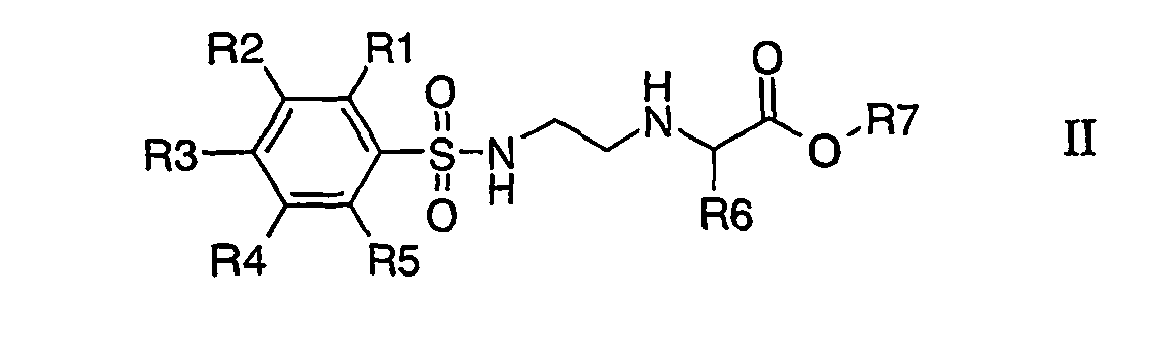 R1, R2, R3, R4, R5 is independently H, halogen, C1-C4 alkyl, nitro, nitrile, C1-C4 alkoxy, halogenated C1-C4 alkyl, or halogenated C1-C4 alkoxy, whereinat least one of R1, R3, and R5 is nitro;R6 is H or protected or unprotected side chain of natural or unnatural α-amino acid; andR7 is (C1-C4) alkyl, or aryl.
 - A method of making the compound of claim 14, comprising coupling reaction of N-(2-aminoethyl)-glycine derivative with sulfonyl chloride derivative in the presence of non-nucleophilic organic base, wherein the N-(2-aminoethyl)-glycine derivative is represented as follows:
 R6 is H or protected or unprotected side chain of natural or unnatural α-amino acid; andR7 is (C1-C4) alkyl, or aryl,wherein the sulfonyl chloride derivative is represented as follows:
 R1, R2, R3, R4, R5 is independently H, halogen, C1-C4 alkyl, nitro, nitrile, C1-C4 alkoxy, halogenated C1-C4 alkyl, or halogenated C1-C4 alkoxy, wherein at least one of R1, R3, and R5 is nitro.
 - A method of making the compound of claim 14, comprising reacting 2-aminoethyl sulfanylamide derivative with haloacetate derivative by a nucleophilic substitution reaction in the presence of non-nucleophilic organic base, wherein 2-aminoethyl sulfanylamide derivative is represented as follows:
 wherein R1, R2, R3, R4, R5 is independently H, halogen, C1-C4 alkyl, nitro, nitrile, C1-C4 alkoxy, halogenated C1-C4 alkyl, or halogenated C1-C4 alkoxy, wherein at least one of R1, R3, and R5 is nitro, andwherein the haloacetate derivative is represented as follows:
 R7 is (C1-C4) alkyl or aryl; andX is Cl, Br, or I.
 - A compound having formula IV and its free acid form
 whereinR1, R2, R3, R4, R5 is independently H, halogen, C1-C4 alkyl, nitro, nitrile, C1-C4 alkoxy, halogenated C1-C4 alkyl, or halogenated C1-C4 alkoxy, wherein at least one of R1, R3, and R5 is nitro;R6 is H or protected or unprotected side chain of natural or unnatural α-amino acid; andHY is organic or inorganic acid.
 - The compound of claim 17, wherein HY is HCl or TFA.
- A method of making the compound of claim 17, comprising cyclizing a compound of formula III in the presence of a coupling reagent that is customarily used in peptide synthesis or cyclizing mixed anhydride derivative of a compound of formula III, followed by deprotection of t-Boc in acid, wherein said formula III is represented as follows:
 R1, R2, R3, R4, R5 is independently H, halogen, C1-C4 alkyl, nitro, nitrile, C1-C4 alkoxy, halogenated C1-C4 alkyl, or halogenated C1-C4alkoxy, wherein at least one of R1, R3, and R5 is nitro; andR6 is H or protected or unprotected side chain of natural or unnatural α-amino acid.
 - A method of making a PNA oligomer, comprising linking together compounds of claim 1.
Applications Claiming Priority (3)
| Application Number | Priority Date | Filing Date | Title |
|---|---|---|---|
| KR2002004194 | 2002-01-24 | ||
| KR10-2002-0004194A KR100464261B1 (en) | 2002-01-24 | 2002-01-24 | A Novel Monomer For Synthesis of PNA Oligomer And A Process For Producing The Same |
| PCT/IB2003/000164 WO2003062212A1 (en) | 2002-01-24 | 2003-01-23 | Peptide nucleic acid oligomers from 1-benzenesulfonyl-3-amino acid side chain-4-(2-nucleobase(acetyl))-piperazin-2-ones |
Publications (3)
| Publication Number | Publication Date |
|---|---|
| EP1470114A1 EP1470114A1 (en) | 2004-10-27 |
| EP1470114A4 EP1470114A4 (en) | 2005-05-11 |
| EP1470114B1 true EP1470114B1 (en) | 2009-08-19 |
Family
ID=27607011
Family Applications (1)
| Application Number | Title | Priority Date | Filing Date |
|---|---|---|---|
| EP03700408A Expired - Lifetime EP1470114B1 (en) | 2002-01-24 | 2003-01-23 | Peptide nucleic acid oligomers from 1-benzenesulfonyl-3-amino acid side chain-4-(2-nucleobase(acetyl))-piperazin-2-ones |
Country Status (9)
| Country | Link |
|---|---|
| US (1) | US7022851B2 (en) |
| EP (1) | EP1470114B1 (en) |
| JP (1) | JP4394952B2 (en) |
| KR (1) | KR100464261B1 (en) |
| CN (1) | CN100351243C (en) |
| AT (1) | ATE440089T1 (en) |
| DE (1) | DE60328866D1 (en) |
| DK (1) | DK1470114T3 (en) |
| WO (1) | WO2003062212A1 (en) |
Cited By (4)
| Publication number | Priority date | Publication date | Assignee | Title |
|---|---|---|---|---|
| US11168365B2 (en) | 2017-05-26 | 2021-11-09 | Vibrant Holdings, Llc | Photoactive compounds and methods for biomolecule detection and sequencing |
| US11674956B2 (en) | 2012-09-28 | 2023-06-13 | Vibrant Holdings, Llc | Methods, systems, and arrays for biomolecular analysis |
| US12319712B2 (en) | 2018-05-09 | 2025-06-03 | Vibrant Holdings, Llc | Methods of synthesizing a polynucleotide array using photoactivated agents |
| US12454771B2 (en) | 2012-02-07 | 2025-10-28 | Vibrant Holdings Llc | Substrates, peptide arrays, and methods |
Families Citing this family (87)
| Publication number | Priority date | Publication date | Assignee | Title |
|---|---|---|---|---|
| KR100464264B1 (en) * | 2002-03-21 | 2005-01-03 | 주식회사 파나진 | Novel PNA Monomer Having Photo-labile Protecting Group |
| KR20030084444A (en) * | 2002-04-26 | 2003-11-01 | 주식회사 파나진 | A Novel Monomer For Synthesis of PNA Oligomer And A Process For Producing The Same |
| US7211668B2 (en) | 2003-07-28 | 2007-05-01 | Panagene, Inc. | PNA monomer and precursor |
| WO2005084672A1 (en) * | 2004-03-03 | 2005-09-15 | Boehringer Ingelheim International Gmbh | Selected cgrp-antagonists, method for the production and use thereof as medicaments |
| AU2006213686A1 (en) | 2005-02-09 | 2006-08-17 | Avi Bio Pharma, Inc. | Antisense composition and method for treating muscle atrophy |
| WO2006130872A2 (en) | 2005-06-02 | 2006-12-07 | Advandx, Inc. | Peptide nucleic acid probes for analysis of microorganisms |
| KR101072899B1 (en) | 2008-01-21 | 2011-10-17 | 주식회사 파나진 | Synthesis of peptide nucleic acids conjugated with amino acids and their application |
| US20110111416A1 (en) * | 2008-05-06 | 2011-05-12 | Panagene Inc. | Peptide Nucleic Acid Probes, Kits and Methods for Expression Profiling of Micrornas |
| GB0813144D0 (en) | 2008-07-17 | 2008-08-27 | Glaxo Group Ltd | Novel compounds |
| GB0813142D0 (en) | 2008-07-17 | 2008-08-27 | Glaxo Group Ltd | Novel compounds |
| CA2764158A1 (en) | 2009-06-01 | 2010-12-09 | Halo-Bio Rnai Therapeutics, Inc. | Polynucleotides for multivalent rna interference, compositions and methods of use thereof |
| JP5991922B2 (en) | 2009-11-13 | 2016-09-14 | サレプタ セラピューティクス, インコーポレイテッド | Antisense antiviral compounds and methods for treating influenza virus infection |
| US20120309684A1 (en) | 2009-11-30 | 2012-12-06 | Isis Innovation Limited | Conjugates for delivery of biologically active compounds |
| WO2011112516A1 (en) | 2010-03-08 | 2011-09-15 | Ico Therapeutics Inc. | Treating and preventing hepatitis c virus infection using c-raf kinase antisense oligonucleotides |
| EP2545173A2 (en) | 2010-03-12 | 2013-01-16 | Sarepta Therapeutics, Inc. | Antisense modulation of nuclear hormone receptors |
| AU2011248625B2 (en) | 2010-04-26 | 2017-01-05 | Pangu Biopharma Limited | Innovative discovery of therapeutic, diagnostic, and antibody compositions related to protein fragments of cysteinyl-tRNA synthetase |
| JP6294074B2 (en) | 2010-04-27 | 2018-03-14 | エータイアー ファーマ, インコーポレイテッド | Innovative discovery of therapeutic, diagnostic and antibody compositions related to protein fragments of isoleucyl-tRNA synthetase |
| CN103097524B (en) | 2010-04-28 | 2016-08-03 | Atyr医药公司 | The innovation for the treatment of, diagnosis and the antibody compositions relevant to the protein fragments of Alanyl-tRNA synthetase finds |
| WO2011150279A2 (en) | 2010-05-27 | 2011-12-01 | Atyr Pharma, Inc. | Innovative discovery of therapeutic, diagnostic, and antibody compositions related to protein fragments of glutaminyl-trna synthetases |
| AU2011248457B2 (en) | 2010-04-29 | 2017-02-16 | Pangu Biopharma Limited | Innovative discovery of therapeutic, diagnostic, and antibody compositions related to protein fragments of valyl tRNA synthetases |
| CA2797374C (en) | 2010-04-29 | 2021-02-16 | Pangu Biopharma Limited | Innovative discovery of therapeutic, diagnostic, and antibody compositions related to protein fragments of asparaginyl trna synthetases |
| WO2011139986A2 (en) | 2010-05-03 | 2011-11-10 | Atyr Pharma, Inc. | Innovative discovery of therapeutic, diagnostic, and antibody compositions related to protein fragments of arginyl-trna synthetases |
| CA2797977C (en) | 2010-05-03 | 2019-08-20 | Atyr Pharma, Inc. | Innovative discovery of therapeutic, diagnostic, and antibody compositions related to protein fragments of phenylalanyl-alpha-trna synthetases |
| WO2011140135A2 (en) | 2010-05-03 | 2011-11-10 | Atyr Pharma, Inc. | Innovative discovery of therapeutic, diagnostic, and antibody compositions related to protein fragments of methionyl-trna synthetases |
| CA2798139C (en) | 2010-05-04 | 2019-09-24 | Atyr Pharma, Inc. | Innovative discovery of therapeutic, diagnostic, and antibody compositions related to protein fragments of p38 multi-trna synthetase complex |
| ES2816898T3 (en) | 2010-05-13 | 2021-04-06 | Sarepta Therapeutics Inc | Compounds that modulate the signaling activity of interleukins 17 and 23 |
| CN103200953B (en) | 2010-05-14 | 2017-02-15 | Atyr 医药公司 | Innovative discovery of therapeutic, diagnostic, and antibody compositions related to protein fragments of phenylalanyl-beta-trna synthetases |
| CN103096914B (en) | 2010-05-17 | 2015-08-12 | Atyr医药公司 | Innovative discovery of therapeutic, diagnostic and antibody compositions related to protein fragments of leucyl-tRNA synthetase |
| AU2011289831C1 (en) | 2010-07-12 | 2017-06-15 | Pangu Biopharma Limited | Innovative discovery of therapeutic, diagnostic, and antibody compositions related to protein fragments of glycyl-tRNA synthetases |
| WO2012021144A1 (en) | 2010-08-12 | 2012-02-16 | New York University | Oligooxopiperazines and methods of making and using them |
| CN103108650A (en) | 2010-08-25 | 2013-05-15 | Atyr医药公司 | Innovative discovery of therapeutic, diagnostic, and antibody compositions related to protein fragments of tyrosyl-trna synthetases |
| EP2732035A2 (en) | 2011-07-15 | 2014-05-21 | Sarepta Therapeutics, Inc. | Methods and compositions for manipulating translation of protein isoforms from alternative initiation start sites |
| KR101303699B1 (en) | 2011-07-20 | 2013-09-09 | 대한민국 | Detecting method of several food-poisoning bacteria using PNA chip |
| US20130085139A1 (en) | 2011-10-04 | 2013-04-04 | Royal Holloway And Bedford New College | Oligomers |
| WO2013086441A2 (en) | 2011-12-08 | 2013-06-13 | Sarepta Therapeutics, Inc. | Oligonucleotide analogues targeting human lmna |
| CN105246481A (en) | 2013-01-19 | 2016-01-13 | 纽约大学 | Oligomeric oxopiperazines for p53 reactivation |
| KR102275504B1 (en) | 2013-09-05 | 2021-07-09 | 사렙타 쎄러퓨틱스, 인코퍼레이티드 | Antisense-induced exon2 inclusion in acid alpha-glucosidase |
| KR101830700B1 (en) | 2013-11-11 | 2018-02-21 | 주식회사 파나진 | Method for the detection of multiple target nucleic acids using clamping probes and detection probes |
| WO2015160914A1 (en) | 2014-04-15 | 2015-10-22 | New York University | OXOPIPERAZINE HELIX MIMETICS AS INHIBITORS OF THE p53-MDM2 INTERACTION |
| KR101951172B1 (en) | 2014-11-07 | 2019-02-22 | 주식회사 파나진 | Pna probes, kits and methods for detecting genotypes of human papillomavirus |
| EP3221445B1 (en) | 2014-11-20 | 2021-07-14 | The Regents of The University of California | Compositions and methods related to hematologic recovery |
| MA41795A (en) | 2015-03-18 | 2018-01-23 | Sarepta Therapeutics Inc | EXCLUSION OF AN EXON INDUCED BY ANTISENSE COMPOUNDS IN MYOSTATIN |
| US10849917B2 (en) | 2015-06-01 | 2020-12-01 | Sarepta Therapeutics, Inc. | Antisense-induced exon exclusion in type VII collagen |
| WO2017035278A1 (en) | 2015-08-24 | 2017-03-02 | Halo-Bio Rnai Therapeutics, Inc. | Polynucleotide nanoparticles for the modulation of gene expression and uses thereof |
| WO2017062835A2 (en) | 2015-10-09 | 2017-04-13 | Sarepta Therapeutics, Inc. | Compositions and methods for treating duchenne muscular dystrophy and related disorders |
| EP3377630A4 (en) | 2015-11-16 | 2020-01-01 | Olix Pharmaceuticals, Inc. | TREATMENT OF AGE-RELATED MACULAR DEGENERATION USING RNA COMPLEXES THAT TARGET MYD88 OR TLR3 |
| JP6944942B2 (en) | 2016-02-02 | 2021-10-06 | オリックス ファーマシューティカルズ,インコーポレーテッド | Treatment of atopic dermatitis and asthma with RNA complexes targeting IL4Rα, TRPA1, or F2RL1 |
| MY200252A (en) | 2016-04-18 | 2023-12-16 | Sarepta Therapeutics Inc | Antisense oligomers and methods of using the same for treating diseases associated with the acid alpha-glucosidase gene |
| WO2017190041A1 (en) | 2016-04-29 | 2017-11-02 | Sarepta Therapeutics, Inc. | Oligonucleotide analogues targeting human lmna |
| AU2017290231A1 (en) | 2016-06-30 | 2019-02-07 | Sarepta Therapeutics, Inc. | Exon skipping oligomers for muscular dystrophy |
| WO2018017814A1 (en) | 2016-07-20 | 2018-01-25 | President And Fellows Of Harvard College | Peptidoglycan glycosyltransferase inhibitors of sed proteins for treating bacterial infections |
| US11202818B2 (en) | 2016-09-14 | 2021-12-21 | President And Fellows Of Harvard College | Methods and compositions for modulating erythropoiesis |
| WO2018112033A1 (en) | 2016-12-13 | 2018-06-21 | President And Fellows Of Harvard College | Methods and compositions for targeting tumor-infiltrating tregs |
| LT3554553T (en) | 2016-12-19 | 2022-08-25 | Sarepta Therapeutics, Inc. | Exon skipping oligomer conjugates for muscular dystrophy |
| CN117298290A (en) | 2016-12-19 | 2023-12-29 | 萨勒普塔医疗公司 | Exon-skipping oligomer conjugates for muscular dystrophy |
| EP3554552B1 (en) | 2016-12-19 | 2022-08-17 | Sarepta Therapeutics, Inc. | Exon skipping oligomer conjugates for muscular dystrophy |
| CN110536694A (en) | 2017-04-20 | 2019-12-03 | Atyr 医药公司 | Compositions and methods for treating pulmonary inflammation |
| US10421728B2 (en) | 2017-06-08 | 2019-09-24 | Amrita Vishwa Vidyapeetham | Peptide nucleic acid monomer and a preparation method |
| EA201991450A1 (en) | 2017-09-22 | 2019-12-30 | Сарепта Терапьютикс, Инк. | OLIGOMER CONJUGATES FOR EXONISM SKIP IN MUSCULAR DYSTROPHY |
| JP2020536060A (en) | 2017-09-28 | 2020-12-10 | サレプタ セラピューティクス, インコーポレイテッド | Combination therapy to treat muscular dystrophy |
| JP2020536057A (en) | 2017-09-28 | 2020-12-10 | サレプタ セラピューティクス, インコーポレイテッド | Combination therapy to treat muscular dystrophy |
| EP3687577A1 (en) | 2017-09-28 | 2020-08-05 | Sarepta Therapeutics, Inc. | Combination therapies for treating muscular dystrophy |
| WO2019079637A2 (en) | 2017-10-18 | 2019-04-25 | Sarepta Therapeutics, Inc. | Antisense oligomer compounds |
| US10758629B2 (en) | 2018-05-29 | 2020-09-01 | Sarepta Therapeutics, Inc. | Exon skipping oligomer conjugates for muscular dystrophy |
| EP3806868A4 (en) | 2018-06-13 | 2022-06-22 | Sarepta Therapeutics, Inc. | EXON-SKIPPING OLIGOMERS FOR MUSCULAR DYSTROPHY |
| TW202020153A (en) | 2018-07-27 | 2020-06-01 | 美商薩羅塔治療公司 | Exon skipping oligomer for muscular dystrophy |
| US11273137B2 (en) | 2018-09-04 | 2022-03-15 | Board Of Trustees Of Michigan State University | Methods and compositions to prevent and treat disorders associated with mutations in the ODC1 gene |
| IL321667A (en) | 2018-12-13 | 2025-08-01 | Sarepta Therapeutics Inc | Axon-skipping oligomer complexes for muscular dystrophy |
| JP2022523779A (en) | 2019-03-12 | 2022-04-26 | プレジデント アンド フェローズ オブ ハーバード カレッジ | Methods and compositions for treating cancer |
| US20220193246A1 (en) | 2019-04-18 | 2022-06-23 | Sarepta Therapeutics, Inc. | Compositions for treating muscular dystrophy |
| WO2020252257A1 (en) | 2019-06-12 | 2020-12-17 | President And Fellows Of Harvard College | Methods and compositions for modulation of an interspecies gut bacterial pathway for levodopa metabolism |
| CA3167369A1 (en) | 2020-03-04 | 2021-09-10 | Tara YOUNG | Methods and compositions for sensitization of tumor cells to immune therapy |
| EP4157264A4 (en) | 2020-05-27 | 2024-06-19 | The Regents of the University of California | COMPOSITIONS AND METHODS FOR TRANSDIFFERENTIATION OF CELLS |
| WO2022056454A2 (en) | 2020-09-14 | 2022-03-17 | President And Fellows Of Harvard College | Methods and compositions for treating hpv-positive cancers |
| IL301306A (en) | 2020-09-16 | 2023-05-01 | Harvard College | Methods of treating an individual who has failed anti-PD-1/anti-PD-L1 therapy |
| JP2024537711A (en) | 2021-09-30 | 2024-10-16 | サレプタ セラピューティクス, インコーポレイテッド | Antisense oligonucleotides having one or more abasic units |
| WO2023070086A1 (en) | 2021-10-22 | 2023-04-27 | Sarepta Therapeutics, Inc. | Morpholino oligomers for treatment of peripheral myelin protein 22 related diseases |
| US20250011767A1 (en) | 2021-11-18 | 2025-01-09 | Circularis Biotechnologies, Inc. | Compositions and methods for production of circular nucleic acid molecules |
| WO2023150181A1 (en) | 2022-02-01 | 2023-08-10 | President And Fellows Of Harvard College | Methods and compositions for treating cancer |
| KR20250054842A (en) | 2022-07-29 | 2025-04-23 | 리제너론 파마슈티칼스 인코포레이티드 | Compositions and methods for transferrin receptor (TFR)-mediated delivery to brain and muscle |
| JP2025533454A (en) | 2022-09-21 | 2025-10-07 | サレプタ セラピューティクス, インコーポレイテッド | DMD antisense oligonucleotide-mediated exon skipping efficiency |
| CN120693347A (en) | 2022-11-04 | 2025-09-23 | 瑞泽恩制药公司 | Calcium voltage-gated channel auxiliary subunit gamma 1 (CACNG1) binding protein and CACNG1-mediated delivery to skeletal muscle |
| WO2024107765A2 (en) | 2022-11-14 | 2024-05-23 | Regeneron Pharmaceuticals, Inc. | Compositions and methods for fibroblast growth factor receptor 3-mediated delivery to astrocytes |
| JP2025539043A (en) | 2022-11-14 | 2025-12-03 | バイオンテック・エスイー | RNA capping efficiency assay |
| TW202442246A (en) | 2023-04-27 | 2024-11-01 | 美商薩羅塔治療公司 | Antisense oligomers for treatment of chronic kidney disease |
| WO2024231285A1 (en) | 2023-05-05 | 2024-11-14 | BioNTech SE | Method of analysing contaminants in rna products by ion-pair chromatography |
| AU2024362420A1 (en) | 2023-10-18 | 2026-04-23 | Murdoch University | Antisense oligomers for treatment of centronuclear myopathies |
Family Cites Families (13)
| Publication number | Priority date | Publication date | Assignee | Title |
|---|---|---|---|---|
| US4204870A (en) * | 1978-07-25 | 1980-05-27 | Eastman Kodak Company | Photographic products and processes employing novel nondiffusible heterocyclyazonaphthol dye-releasing compounds |
| DK51092D0 (en) | 1991-05-24 | 1992-04-15 | Ole Buchardt | OLIGONUCLEOTIDE ANALOGUE DESCRIBED BY PEN, MONOMERIC SYNTHONES AND PROCEDURES FOR PREPARING THEREOF, AND APPLICATIONS THEREOF |
| US5294713A (en) * | 1991-08-23 | 1994-03-15 | Takeda Chemical Industries, Ltd. | 2-piperazinone compounds and their use |
| US6133444A (en) * | 1993-12-22 | 2000-10-17 | Perseptive Biosystems, Inc. | Synthons for the synthesis and deprotection of peptide nucleic acids under mild conditions |
| US5539083A (en) * | 1994-02-23 | 1996-07-23 | Isis Pharmaceuticals, Inc. | Peptide nucleic acid combinatorial libraries and improved methods of synthesis |
| WO1996040709A1 (en) * | 1995-06-07 | 1996-12-19 | Perseptive Biosystems, Inc. | Pna-dna chimeras and pna synthons for their preparation |
| DE19620170A1 (en) * | 1996-05-20 | 1997-11-27 | Wolfgang Prof Dr Dr Pfleiderer | Nucleoside derivatives with photolabile protecting groups |
| AUPO008396A0 (en) * | 1996-05-27 | 1996-06-20 | Fujisawa Pharmaceutical Co., Ltd. | New piperazine compounds |
| US6403595B1 (en) * | 1998-02-05 | 2002-06-11 | Takeda Chemical Industries, Ltd. | Sulfonamide derivatives, processes for producing the same and utilization thereof |
| DE69933770D1 (en) | 1998-07-09 | 2006-12-07 | Biocept Inc | METHOD FOR USING A UNIVERSAL LIBRARY OF PEPTIDE NUCLEIC ACIDS FOR OPTIMIZING DNA HYBRIDIZATION |
| KR20030009903A (en) * | 2001-07-24 | 2003-02-05 | 삼성정밀화학 주식회사 | A preparation method of p-Nitrophenylsulfonylethoxycarbonyl protected PNA monomer as the amino protected group of 2-aminoethylglycine backbone |
| KR20030042180A (en) * | 2001-11-21 | 2003-05-28 | 주식회사 파나진 | A Method for Producing a Backbone of Peptide Nucleic Acid |
| KR20030084444A (en) * | 2002-04-26 | 2003-11-01 | 주식회사 파나진 | A Novel Monomer For Synthesis of PNA Oligomer And A Process For Producing The Same |
-
2002
- 2002-01-24 KR KR10-2002-0004194A patent/KR100464261B1/en not_active Expired - Fee Related
-
2003
- 2003-01-23 EP EP03700408A patent/EP1470114B1/en not_active Expired - Lifetime
- 2003-01-23 DE DE60328866T patent/DE60328866D1/en not_active Expired - Lifetime
- 2003-01-23 JP JP2003562092A patent/JP4394952B2/en not_active Expired - Lifetime
- 2003-01-23 DK DK03700408T patent/DK1470114T3/en active
- 2003-01-23 AT AT03700408T patent/ATE440089T1/en not_active IP Right Cessation
- 2003-01-23 WO PCT/IB2003/000164 patent/WO2003062212A1/en not_active Ceased
- 2003-01-23 CN CNB038064944A patent/CN100351243C/en not_active Expired - Lifetime
- 2003-01-24 US US10/351,173 patent/US7022851B2/en not_active Expired - Lifetime
Cited By (6)
| Publication number | Priority date | Publication date | Assignee | Title |
|---|---|---|---|---|
| US12454771B2 (en) | 2012-02-07 | 2025-10-28 | Vibrant Holdings Llc | Substrates, peptide arrays, and methods |
| US11674956B2 (en) | 2012-09-28 | 2023-06-13 | Vibrant Holdings, Llc | Methods, systems, and arrays for biomolecular analysis |
| US11815512B2 (en) | 2012-09-28 | 2023-11-14 | Vibrant Holdings, Llc | Methods, systems, and arrays for biomolecular analysis |
| US11168365B2 (en) | 2017-05-26 | 2021-11-09 | Vibrant Holdings, Llc | Photoactive compounds and methods for biomolecule detection and sequencing |
| US12152279B2 (en) | 2017-05-26 | 2024-11-26 | Vibrant Holdings, Llc | Photoactive compounds and methods for biomolecule detection and sequencing |
| US12319712B2 (en) | 2018-05-09 | 2025-06-03 | Vibrant Holdings, Llc | Methods of synthesizing a polynucleotide array using photoactivated agents |
Also Published As
| Publication number | Publication date |
|---|---|
| KR100464261B1 (en) | 2005-01-03 |
| JP2005538928A (en) | 2005-12-22 |
| KR20030063848A (en) | 2003-07-31 |
| US20030195332A1 (en) | 2003-10-16 |
| JP4394952B2 (en) | 2010-01-06 |
| US7022851B2 (en) | 2006-04-04 |
| WO2003062212A1 (en) | 2003-07-31 |
| ATE440089T1 (en) | 2009-09-15 |
| EP1470114A4 (en) | 2005-05-11 |
| DK1470114T3 (en) | 2009-11-02 |
| CN100351243C (en) | 2007-11-28 |
| DE60328866D1 (en) | 2009-10-01 |
| EP1470114A1 (en) | 2004-10-27 |
| CN1642923A (en) | 2005-07-20 |
Similar Documents
| Publication | Publication Date | Title |
|---|---|---|
| US7022851B2 (en) | PNA monomer and precursor | |
| JP4927105B2 (en) | PNA monomers and precursors | |
| KR100752552B1 (en) | Pna monomer and precursor | |
| US6172226B1 (en) | Synthons for the synthesis and deprotection of peptide nucleic acids under mild conditions | |
| KR100633010B1 (en) | P & A monomer and its precursor |
Legal Events
| Date | Code | Title | Description |
|---|---|---|---|
| PUAI | Public reference made under article 153(3) epc to a published international application that has entered the european phase |
Free format text: ORIGINAL CODE: 0009012 |
|
| 17P | Request for examination filed |
Effective date: 20040819 |
|
| AK | Designated contracting states |
Kind code of ref document: A1 Designated state(s): AT BE BG CH CY CZ DE DK EE ES FI FR GB GR HU IE IT LI LU MC NL PT SE SI SK TR |
|
| AX | Request for extension of the european patent |
Extension state: AL LT LV MK RO |
|
| RIN1 | Information on inventor provided before grant (corrected) |
Inventor name: LIM, JONG CHAN Inventor name: JEON, JAE HOON Inventor name: KIM, SUNG KEE Inventor name: LEE, HYUNIL Inventor name: CHOI, HOON Inventor name: LEE, SUNG HEE Inventor name: AHN, SANG YOUL C/O PANAGENE, INC. |
|
| RIN1 | Information on inventor provided before grant (corrected) |
Inventor name: LEE, SUNG HEE Inventor name: JEON, JAE HOON Inventor name: AHN, SANG YOULC/O PANAGENE, INC. Inventor name: CHOI, HOON Inventor name: LEE, HYUNIL Inventor name: KIM, SUNG KEE Inventor name: LIM, JONG CHAN |
|
| A4 | Supplementary search report drawn up and despatched |
Effective date: 20050331 |
|
| GRAP | Despatch of communication of intention to grant a patent |
Free format text: ORIGINAL CODE: EPIDOSNIGR1 |
|
| GRAC | Information related to communication of intention to grant a patent modified |
Free format text: ORIGINAL CODE: EPIDOSCIGR1 |
|
| GRAS | Grant fee paid |
Free format text: ORIGINAL CODE: EPIDOSNIGR3 |
|
| GRAA | (expected) grant |
Free format text: ORIGINAL CODE: 0009210 |
|
| AK | Designated contracting states |
Kind code of ref document: B1 Designated state(s): AT BE BG CH CY CZ DE DK EE ES FI FR GB GR HU IE IT LI LU MC NL PT SE SI SK TR |
|
| REG | Reference to a national code |
Ref country code: GB Ref legal event code: FG4D |
|
| REG | Reference to a national code |
Ref country code: CH Ref legal event code: EP |
|
| REG | Reference to a national code |
Ref country code: IE Ref legal event code: FG4D |
|
| REF | Corresponds to: |
Ref document number: 60328866 Country of ref document: DE Date of ref document: 20091001 Kind code of ref document: P |
|
| REG | Reference to a national code |
Ref country code: DK Ref legal event code: T3 |
|
| PG25 | Lapsed in a contracting state [announced via postgrant information from national office to epo] |
Ref country code: FI Free format text: LAPSE BECAUSE OF FAILURE TO SUBMIT A TRANSLATION OF THE DESCRIPTION OR TO PAY THE FEE WITHIN THE PRESCRIBED TIME-LIMIT Effective date: 20090819 Ref country code: SE Free format text: LAPSE BECAUSE OF FAILURE TO SUBMIT A TRANSLATION OF THE DESCRIPTION OR TO PAY THE FEE WITHIN THE PRESCRIBED TIME-LIMIT Effective date: 20090819 Ref country code: AT Free format text: LAPSE BECAUSE OF FAILURE TO SUBMIT A TRANSLATION OF THE DESCRIPTION OR TO PAY THE FEE WITHIN THE PRESCRIBED TIME-LIMIT Effective date: 20090819 Ref country code: ES Free format text: LAPSE BECAUSE OF FAILURE TO SUBMIT A TRANSLATION OF THE DESCRIPTION OR TO PAY THE FEE WITHIN THE PRESCRIBED TIME-LIMIT Effective date: 20091130 |
|
| NLV1 | Nl: lapsed or annulled due to failure to fulfill the requirements of art. 29p and 29m of the patents act | ||
| PG25 | Lapsed in a contracting state [announced via postgrant information from national office to epo] |
Ref country code: NL Free format text: LAPSE BECAUSE OF FAILURE TO SUBMIT A TRANSLATION OF THE DESCRIPTION OR TO PAY THE FEE WITHIN THE PRESCRIBED TIME-LIMIT Effective date: 20090819 Ref country code: SI Free format text: LAPSE BECAUSE OF FAILURE TO SUBMIT A TRANSLATION OF THE DESCRIPTION OR TO PAY THE FEE WITHIN THE PRESCRIBED TIME-LIMIT Effective date: 20090819 |
|
| PG25 | Lapsed in a contracting state [announced via postgrant information from national office to epo] |
Ref country code: BG Free format text: LAPSE BECAUSE OF FAILURE TO SUBMIT A TRANSLATION OF THE DESCRIPTION OR TO PAY THE FEE WITHIN THE PRESCRIBED TIME-LIMIT Effective date: 20091119 Ref country code: PT Free format text: LAPSE BECAUSE OF FAILURE TO SUBMIT A TRANSLATION OF THE DESCRIPTION OR TO PAY THE FEE WITHIN THE PRESCRIBED TIME-LIMIT Effective date: 20091221 Ref country code: CY Free format text: LAPSE BECAUSE OF FAILURE TO SUBMIT A TRANSLATION OF THE DESCRIPTION OR TO PAY THE FEE WITHIN THE PRESCRIBED TIME-LIMIT Effective date: 20090819 |
|
| PG25 | Lapsed in a contracting state [announced via postgrant information from national office to epo] |
Ref country code: EE Free format text: LAPSE BECAUSE OF FAILURE TO SUBMIT A TRANSLATION OF THE DESCRIPTION OR TO PAY THE FEE WITHIN THE PRESCRIBED TIME-LIMIT Effective date: 20090819 Ref country code: CZ Free format text: LAPSE BECAUSE OF FAILURE TO SUBMIT A TRANSLATION OF THE DESCRIPTION OR TO PAY THE FEE WITHIN THE PRESCRIBED TIME-LIMIT Effective date: 20090819 |
|
| PG25 | Lapsed in a contracting state [announced via postgrant information from national office to epo] |
Ref country code: SK Free format text: LAPSE BECAUSE OF FAILURE TO SUBMIT A TRANSLATION OF THE DESCRIPTION OR TO PAY THE FEE WITHIN THE PRESCRIBED TIME-LIMIT Effective date: 20090819 |
|
| PLBE | No opposition filed within time limit |
Free format text: ORIGINAL CODE: 0009261 |
|
| STAA | Information on the status of an ep patent application or granted ep patent |
Free format text: STATUS: NO OPPOSITION FILED WITHIN TIME LIMIT |
|
| PG25 | Lapsed in a contracting state [announced via postgrant information from national office to epo] |
Ref country code: BE Free format text: LAPSE BECAUSE OF FAILURE TO SUBMIT A TRANSLATION OF THE DESCRIPTION OR TO PAY THE FEE WITHIN THE PRESCRIBED TIME-LIMIT Effective date: 20090819 |
|
| 26N | No opposition filed |
Effective date: 20100520 |
|
| PG25 | Lapsed in a contracting state [announced via postgrant information from national office to epo] |
Ref country code: MC Free format text: LAPSE BECAUSE OF NON-PAYMENT OF DUE FEES Effective date: 20100131 |
|
| REG | Reference to a national code |
Ref country code: CH Ref legal event code: PL |
|
| PG25 | Lapsed in a contracting state [announced via postgrant information from national office to epo] |
Ref country code: GR Free format text: LAPSE BECAUSE OF FAILURE TO SUBMIT A TRANSLATION OF THE DESCRIPTION OR TO PAY THE FEE WITHIN THE PRESCRIBED TIME-LIMIT Effective date: 20091120 Ref country code: LI Free format text: LAPSE BECAUSE OF NON-PAYMENT OF DUE FEES Effective date: 20100131 Ref country code: CH Free format text: LAPSE BECAUSE OF NON-PAYMENT OF DUE FEES Effective date: 20100131 |
|
| PG25 | Lapsed in a contracting state [announced via postgrant information from national office to epo] |
Ref country code: IE Free format text: LAPSE BECAUSE OF NON-PAYMENT OF DUE FEES Effective date: 20100123 |
|
| PG25 | Lapsed in a contracting state [announced via postgrant information from national office to epo] |
Ref country code: IT Free format text: LAPSE BECAUSE OF FAILURE TO SUBMIT A TRANSLATION OF THE DESCRIPTION OR TO PAY THE FEE WITHIN THE PRESCRIBED TIME-LIMIT Effective date: 20090819 |
|
| PG25 | Lapsed in a contracting state [announced via postgrant information from national office to epo] |
Ref country code: HU Free format text: LAPSE BECAUSE OF FAILURE TO SUBMIT A TRANSLATION OF THE DESCRIPTION OR TO PAY THE FEE WITHIN THE PRESCRIBED TIME-LIMIT Effective date: 20100220 Ref country code: LU Free format text: LAPSE BECAUSE OF NON-PAYMENT OF DUE FEES Effective date: 20100123 |
|
| PG25 | Lapsed in a contracting state [announced via postgrant information from national office to epo] |
Ref country code: TR Free format text: LAPSE BECAUSE OF FAILURE TO SUBMIT A TRANSLATION OF THE DESCRIPTION OR TO PAY THE FEE WITHIN THE PRESCRIBED TIME-LIMIT Effective date: 20090819 |
|
| REG | Reference to a national code |
Ref country code: FR Ref legal event code: PLFP Year of fee payment: 14 |
|
| REG | Reference to a national code |
Ref country code: FR Ref legal event code: PLFP Year of fee payment: 15 |
|
| REG | Reference to a national code |
Ref country code: FR Ref legal event code: PLFP Year of fee payment: 16 |
|
| REG | Reference to a national code |
Ref country code: DE Ref legal event code: R082 Ref document number: 60328866 Country of ref document: DE Representative=s name: STOLMAR & PARTNER PATENTANWAELTE PARTG MBB, DE |
|
| PGFP | Annual fee paid to national office [announced via postgrant information from national office to epo] |
Ref country code: DK Payment date: 20211220 Year of fee payment: 20 Ref country code: FR Payment date: 20211223 Year of fee payment: 20 Ref country code: GB Payment date: 20211220 Year of fee payment: 20 |
|
| PGFP | Annual fee paid to national office [announced via postgrant information from national office to epo] |
Ref country code: DE Payment date: 20211220 Year of fee payment: 20 |
|
| REG | Reference to a national code |
Ref country code: DE Ref legal event code: R071 Ref document number: 60328866 Country of ref document: DE |
|
| REG | Reference to a national code |
Ref country code: DK Ref legal event code: EUP Expiry date: 20230123 |
|
| REG | Reference to a national code |
Ref country code: GB Ref legal event code: PE20 Expiry date: 20230122 |
|
| PG25 | Lapsed in a contracting state [announced via postgrant information from national office to epo] |
Ref country code: GB Free format text: LAPSE BECAUSE OF EXPIRATION OF PROTECTION Effective date: 20230122 |