EP1469090A2 - Ermittlung von Materialeigenschaften an mehrere Elemente enthaltenden Proben, welche einem Diffusionsglühen ausgesetzt werden - Google Patents
Ermittlung von Materialeigenschaften an mehrere Elemente enthaltenden Proben, welche einem Diffusionsglühen ausgesetzt werden Download PDFInfo
- Publication number
- EP1469090A2 EP1469090A2 EP04252139A EP04252139A EP1469090A2 EP 1469090 A2 EP1469090 A2 EP 1469090A2 EP 04252139 A EP04252139 A EP 04252139A EP 04252139 A EP04252139 A EP 04252139A EP 1469090 A2 EP1469090 A2 EP 1469090A2
- Authority
- EP
- European Patent Office
- Prior art keywords
- properties
- interdiffusion
- metals
- diffusion
- metal
- Prior art date
- Legal status (The legal status is an assumption and is not a legal conclusion. Google has not performed a legal analysis and makes no representation as to the accuracy of the status listed.)
- Ceased
Links
- 238000009792 diffusion process Methods 0.000 title claims abstract description 84
- 239000000203 mixture Substances 0.000 title claims abstract description 37
- 239000000463 material Substances 0.000 title claims abstract description 19
- 238000004519 manufacturing process Methods 0.000 title claims abstract description 6
- 238000000034 method Methods 0.000 claims abstract description 33
- 229910052751 metal Inorganic materials 0.000 claims abstract description 32
- 239000002184 metal Substances 0.000 claims abstract description 32
- 239000000956 alloy Substances 0.000 claims abstract description 24
- 229910044991 metal oxide Inorganic materials 0.000 claims abstract description 19
- 150000004706 metal oxides Chemical class 0.000 claims abstract description 19
- 150000002739 metals Chemical class 0.000 claims abstract description 19
- 229910052755 nonmetal Inorganic materials 0.000 claims abstract description 14
- 150000002843 nonmetals Chemical class 0.000 claims abstract description 12
- 229910001092 metal group alloy Inorganic materials 0.000 claims abstract description 11
- 229910045601 alloy Inorganic materials 0.000 claims description 16
- 239000000523 sample Substances 0.000 claims description 12
- 238000004453 electron probe microanalysis Methods 0.000 claims description 10
- 238000010587 phase diagram Methods 0.000 claims description 9
- 238000001887 electron backscatter diffraction Methods 0.000 claims description 7
- 239000000376 reactant Substances 0.000 claims description 7
- 238000010438 heat treatment Methods 0.000 claims description 6
- 238000001513 hot isostatic pressing Methods 0.000 claims description 3
- 238000013507 mapping Methods 0.000 claims description 3
- 230000003647 oxidation Effects 0.000 claims description 3
- 238000007254 oxidation reaction Methods 0.000 claims description 3
- 238000005260 corrosion Methods 0.000 claims description 2
- 230000007797 corrosion Effects 0.000 claims description 2
- 230000003287 optical effect Effects 0.000 claims description 2
- 229910002064 alloy oxide Inorganic materials 0.000 claims 1
- 230000004888 barrier function Effects 0.000 description 22
- BASFCYQUMIYNBI-UHFFFAOYSA-N platinum Substances [Pt] BASFCYQUMIYNBI-UHFFFAOYSA-N 0.000 description 18
- 239000010948 rhodium Substances 0.000 description 13
- 229910000601 superalloy Inorganic materials 0.000 description 12
- 229910052804 chromium Inorganic materials 0.000 description 9
- 239000011651 chromium Substances 0.000 description 9
- 238000000576 coating method Methods 0.000 description 9
- VYZAMTAEIAYCRO-UHFFFAOYSA-N Chromium Chemical compound [Cr] VYZAMTAEIAYCRO-UHFFFAOYSA-N 0.000 description 8
- 229910000943 NiAl Inorganic materials 0.000 description 8
- NPXOKRUENSOPAO-UHFFFAOYSA-N Raney nickel Chemical compound [Al].[Ni] NPXOKRUENSOPAO-UHFFFAOYSA-N 0.000 description 8
- 238000004458 analytical method Methods 0.000 description 8
- 229910052697 platinum Inorganic materials 0.000 description 8
- 239000000758 substrate Substances 0.000 description 7
- 230000006399 behavior Effects 0.000 description 6
- 229910002056 binary alloy Inorganic materials 0.000 description 6
- 239000011248 coating agent Substances 0.000 description 6
- 230000003993 interaction Effects 0.000 description 6
- 229910052707 ruthenium Inorganic materials 0.000 description 6
- 229910018967 Pt—Rh Inorganic materials 0.000 description 5
- KDLHZDBZIXYQEI-UHFFFAOYSA-N palladium Substances [Pd] KDLHZDBZIXYQEI-UHFFFAOYSA-N 0.000 description 5
- 229910052703 rhodium Inorganic materials 0.000 description 5
- KJTLSVCANCCWHF-UHFFFAOYSA-N Ruthenium Chemical compound [Ru] KJTLSVCANCCWHF-UHFFFAOYSA-N 0.000 description 4
- 238000005275 alloying Methods 0.000 description 4
- 239000000919 ceramic Substances 0.000 description 4
- 230000000694 effects Effects 0.000 description 4
- 229910000765 intermetallic Inorganic materials 0.000 description 4
- 238000005259 measurement Methods 0.000 description 4
- MHOVAHRLVXNVSD-UHFFFAOYSA-N rhodium atom Chemical compound [Rh] MHOVAHRLVXNVSD-UHFFFAOYSA-N 0.000 description 4
- 238000000137 annealing Methods 0.000 description 3
- 150000001875 compounds Chemical class 0.000 description 3
- 238000001816 cooling Methods 0.000 description 3
- 239000013078 crystal Substances 0.000 description 3
- 238000011161 development Methods 0.000 description 3
- 239000011888 foil Substances 0.000 description 3
- 229910052763 palladium Inorganic materials 0.000 description 3
- 238000001556 precipitation Methods 0.000 description 3
- 238000012360 testing method Methods 0.000 description 3
- 239000010409 thin film Substances 0.000 description 3
- IJGRMHOSHXDMSA-UHFFFAOYSA-N Atomic nitrogen Chemical compound N#N IJGRMHOSHXDMSA-UHFFFAOYSA-N 0.000 description 2
- 229910000555 a15 phase Inorganic materials 0.000 description 2
- 238000005520 cutting process Methods 0.000 description 2
- 238000002050 diffraction method Methods 0.000 description 2
- 238000002003 electron diffraction Methods 0.000 description 2
- 238000011156 evaluation Methods 0.000 description 2
- ZOXJGFHDIHLPTG-UHFFFAOYSA-N Boron Chemical compound [B] ZOXJGFHDIHLPTG-UHFFFAOYSA-N 0.000 description 1
- OKTJSMMVPCPJKN-UHFFFAOYSA-N Carbon Chemical compound [C] OKTJSMMVPCPJKN-UHFFFAOYSA-N 0.000 description 1
- 229910002848 Pt–Ru Inorganic materials 0.000 description 1
- 229910018879 Pt—Pd Inorganic materials 0.000 description 1
- 229910000831 Steel Inorganic materials 0.000 description 1
- RTAQQCXQSZGOHL-UHFFFAOYSA-N Titanium Chemical compound [Ti] RTAQQCXQSZGOHL-UHFFFAOYSA-N 0.000 description 1
- 229910052782 aluminium Inorganic materials 0.000 description 1
- XAGFODPZIPBFFR-UHFFFAOYSA-N aluminium Chemical compound [Al] XAGFODPZIPBFFR-UHFFFAOYSA-N 0.000 description 1
- 238000013459 approach Methods 0.000 description 1
- 125000004429 atom Chemical group 0.000 description 1
- QVGXLLKOCUKJST-UHFFFAOYSA-N atomic oxygen Chemical compound [O] QVGXLLKOCUKJST-UHFFFAOYSA-N 0.000 description 1
- 230000015572 biosynthetic process Effects 0.000 description 1
- 229910052796 boron Inorganic materials 0.000 description 1
- 229910052799 carbon Inorganic materials 0.000 description 1
- 238000013461 design Methods 0.000 description 1
- -1 e.g. Substances 0.000 description 1
- 238000010894 electron beam technology Methods 0.000 description 1
- UFZOPKFMKMAWLU-UHFFFAOYSA-N ethoxy(methyl)phosphinic acid Chemical compound CCOP(C)(O)=O UFZOPKFMKMAWLU-UHFFFAOYSA-N 0.000 description 1
- 230000001815 facial effect Effects 0.000 description 1
- 238000000227 grinding Methods 0.000 description 1
- 238000007542 hardness measurement Methods 0.000 description 1
- 229910052739 hydrogen Inorganic materials 0.000 description 1
- 239000001257 hydrogen Substances 0.000 description 1
- 125000004435 hydrogen atom Chemical class [H]* 0.000 description 1
- 238000003913 materials processing Methods 0.000 description 1
- 229910052757 nitrogen Inorganic materials 0.000 description 1
- 229910052760 oxygen Inorganic materials 0.000 description 1
- 239000001301 oxygen Substances 0.000 description 1
- 230000035515 penetration Effects 0.000 description 1
- 238000005498 polishing Methods 0.000 description 1
- 238000010248 power generation Methods 0.000 description 1
- 239000010970 precious metal Substances 0.000 description 1
- 238000004881 precipitation hardening Methods 0.000 description 1
- 238000012545 processing Methods 0.000 description 1
- 238000004626 scanning electron microscopy Methods 0.000 description 1
- 238000012216 screening Methods 0.000 description 1
- 239000006104 solid solution Substances 0.000 description 1
- 239000000243 solution Substances 0.000 description 1
- 238000000638 solvent extraction Methods 0.000 description 1
- 238000001228 spectrum Methods 0.000 description 1
- 239000010959 steel Substances 0.000 description 1
- 239000000126 substance Substances 0.000 description 1
- 230000009897 systematic effect Effects 0.000 description 1
- 239000010936 titanium Substances 0.000 description 1
- 229910052719 titanium Inorganic materials 0.000 description 1
- 238000003466 welding Methods 0.000 description 1
Images




Classifications
-
- C—CHEMISTRY; METALLURGY
- C22—METALLURGY; FERROUS OR NON-FERROUS ALLOYS; TREATMENT OF ALLOYS OR NON-FERROUS METALS
- C22C—ALLOYS
- C22C1/00—Making non-ferrous alloys
Definitions
- This disclosure generally relates to a process for the combinatorial production of material compositions from a single sample, and more particularly, to a process which employs the use of diffusion multiples to create large numbers of compositions in the single sample.
- Structural materials such as superalloys and steels provide the mechanical properties for building jet engines, power generation turbines, cars, and the like. Significant time and effort is typically required to discover and optimize new compounds.
- One of the problems affecting the rate of development is that it is oftentimes very difficult to predict the physical and chemical properties of various compounds or material combinations, particularly for compounds or material combinations that have been produced using different processing conditions.
- most of these properties and/or behaviors are evaluated one at a time from individual alloys or by the use of binary systems, i.e., diffusion couples.
- a diffusion couple generally comprises two dissimilar materials, e.g., metals, metal alloys, ceramics, and the like, that are placed in good thermodynamic contact with one another.
- the materials are then heated at an elevated temperature for a defined period of time.
- An alloy interdiffusion region will exist in location of the couple, where atoms have diffused into one another. Diffusion couples, which can provide greater amounts of data than analysis of individual alloys, have been used to determine phase diagrams and evaluate diffusion coefficients.
- a diffusion multiple is an assembly of three to four different metal (or ceramic) blocks, in intimate interfacial contact, and subjected to a high temperature to allow thermal interdiffusion.
- the diffusion multiple is typically fabricated by inserting quarter pie shapes of metals or metal oxides into a cylindrical sleeve of a pure metal. The cylindrical sleeve is then capped at both ends with the pure metal and the entire assembly is heated at an elevated temperature for a defined period of time to promote interdiffusion at the various interfaces defined by the quarter-pie shapes.
- the process comprises assembling a bulk diffusion multiple of at least three layers comprising metals, nonmetals, metal oxides or alloys, into an arrangement; heating the arrangement at an elevated temperature and for a period of time effective to form interdiffusion regions at interfacial locations of dissimilar metals, non-metals, metal oxides, or alloys in the arrangement; exposing the interdiffusion region; and evaluating properties of the single sample as a function of composition at the interdiffusion regions.
- a combinatorial process for production of material libraries from a single sample comprises forming a diffusion multiple in the single sample, wherein the diffusion multiple comprises a plurality of interdiffusion regions at interfacial locations of dissimilar metals, non-metals, metal oxides, or alloys, and wherein the diffusion multiple comprises at least three layers of the metals, non-metals, metal oxides, or alloys; and evaluating properties of the diffusion multiple as a function of composition at about the interdiffusion regions.
- a process for forming a diffusion multiple comprises layering at least three metals and/or non-metals and/or alloys and/or metal oxides to form a stack, wherein the stack comprises a plurality of interfacial contact surfaces of dissimilar metals, non-metals, metal alloys, and/or metal oxides; inserting the stack into a slot formed in a pure metal disk, wherein the stack accommodates dimensions of the slot; and heating the pure metal disk to a temperature and for a period of time to form a plurality of interdiffusion regions at about the interfacial contact surfaces of the dissimilar metals, non-metals, metal oxides, and/or alloys
- compositions includes metal, nonmetals, alloys, intermetallics, and/or ceramics.
- the process employs the use of bulk diffusion multiples of various structural materials to create large libraries of compositions in the diffusion multiple for a fast and systematic survey of properties for these compositions.
- properties obtained for the compositions using the process correspond with bulk property behavior. That is, unlike thin film approaches, properties such as precipitation kinetics and diffusion coefficients can be evaluated using bulk diffusion multiples having layers at a thickness effective to correspond with bulk property behavior.
- the usually small grain size of thin films is known to confound solution-hardening and precipitation-hardening effects.
- the intermetallic compounds formed in the bulk diffusion multiples are more often the equilibrium phases, whereas those in thin film are quite often metastable phases.
- the term “bulk diffusion multiple” refers to an assembly of three or more different structural material blocks or layers, in intimate facial contact, arranged as a triple, quadruple, or higher order, and subjected to a high temperature to allow thermal interdiffusion.
- the arrangement and geometry of the bulk diffusion multiple provides greater amounts of information than previously possible.
- the term diffusion multiple refers to an assembly of three or more structural metal blocks or layers or foils arranged as a triple, quadruple, or higher order arrangement.
- the properties for the various compositions produced in the bulk diffusion multiple can be analyzed using microanalytical techniques such as electron probe microanalysis, electron backscattering pattern diffraction analysis, nanoindentation tests, and the like.
- the results can then be used to provide an efficient survey of the various crystal phases for the compositions, equilibria, precipitation kinetics, properties, as well as insight into composition-structure-property relationships for accelerated development of multi-component alloys and ceramics.
- the data can provide compositional information for electrical conductivity properties, magnetic properties, piezoelectric properties, optical properties, lattice parameters, thermal conductivity properties, corrosion properties, oxidation properties, carburization rates, or combinations comprising at least one of the foregoing properties.
- the process generally comprises annealing the bulk diffusion multiples of dissimilar metals, metal oxides, or metal alloys at an elevated temperature and for a defined period of time to form interdiffusion regions; and cooling the annealed sample to room temperature at a defined cooling rate.
- the annealing temperatures and times will depend on the bulk diffusion multiple configurations, the material types, and the extent of interdiffusion desired.
- the bulk diffusion multiple is sealed under vacuum of about 1 nanotorr to about 1 millitorr.
- the various alloy compositions formed by thermal interdiffusion between the dissimilar materials at the couple locations can be microanalytically inspected, e.g., electron probe microanalysis, electron backscattering pattern diffraction analysis, nanoindentation tests, and the like. Phase regions and equilibria information can then be obtained for the various compositions that occur as a function of distance from the couple location.
- the term "couple location" refers to a region within the diffusion multiple about where dissimilar metals initially contact another metal.
- Crystal structure identification of all phases can be made using electron backscatter diffraction (EBSD) and electron probe microanalysis (EPMA), and trends in mechanical behavior can be mapped using nanoindentation techniques, which techniques are generally known by those skilled in the art.
- EBSD is an electron diffraction technique that allows rapid electron diffraction collection from small microstructural features using scanning electron microscopy.
- Phase identification can then be accomplished by a direct match of the diffraction bands (similar to Kikuchi bands) in the experimental pattern with simulated patterns generated using known structure types and lattice parameters.
- intermetallic compound analysis can be made.
- Nanoindentation is suitable for load and penetration depth measurements at nanometer length scales, thereby providing measurement of properties such as hardness and Young's Modulus.
- the solution hardening and softening effects, as well as the modulus behavior contain a great amount of information about the elemental interaction, i.e., bonding, nonlinear solid-state interaction, and the like.
- a bulk diffusion multiple was made by cutting a slot 1.8 millimeter (mm) wide and 12.7 mm long from a 25 mm diameter pure chromium disc of 3 mm thickness. Pure palladium, platinum, and rhodium foils of 0.25 mm thickness were arranged in the geometry as shown in Figure 1 and put into the slot in the chromium disc along with a pure ruthenium piece with two steps on it. The ruthenium piece had a thickness of 1 mm on one side and 0.5 mm on the other.
- the annealed bulk diffusion multiple was then cut into halves parallel to the broad (25 mm diameter) faces of the slotted chromium piece and in the middle of the thickness direction.
- the sample was then ground and polished for electron probe microanalysis, electron backscatter diffraction analysis, and nanoindentation tests. Nanoindentation was performed using a Hysitron instrumented indenter, commercially available from Hysitron, Inc., Minneapolis.
- Figure 2 pictorially illustrates a top plan view of the diffusion multiple.
- the interdiffusion region may then be treated with a reactant to provide a new spectrum of compositions.
- the reactants interact with the phases and compositions in the interdiffusion region to produce new compositions.
- the types and amounts of reactants are not intended to be limited. Suitable reactants include oxygen, nitrogen, hydrogen, carbon, boron, aluminum and the like.
- the properties of the reactants can be examined in the same manner as the multiples formed by the combinatorial process, provided the reactant layer is thick enough to be characterized by the evaluation techniques.
- the interdiffusion of elements at the tri-junction regions of the diffusion multiple allows the formation of all the intermetallic compounds and the generation of composition variations for all the single-phase regions.
- the interdiffusion of chromium and platinum formed the A15 phase
- that of chromium and ruthenium formed the ⁇ phase as shown.
- ternary interdiffusion took place.
- the phases are identified using both compositional information from EPMA and crystal structure identification using EBSD techniques.
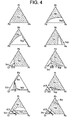
- EPMA allowed rapid mapping of the Cr-Pt-Ru ternary phase diagram.
- Results for hardness and elastic modulus survey across the entire ternary system can also be provided.
- Nanoindentation is first made at various locations.
- An EMPA analysis is performed after nanoindentation in order to correlate the composition to the locations of the indents.
- Figures 6 and 7 graphically illustrate hardness and elastic modulus for a Pt-Pd-Rh ternary system of the diffusion multiple. With regard to Figure 6, a two-dimensional contour plot shows the chemistries determined adjacent to each nanoindentation hardness measurement site, and the contour lines representing hardness levels interpolated from the individual measurements.
- the binary diffusion profiles such as those shown in Figure 8 allow evaluation of diffusion coefficients as a function of composition.
- the diffusivity data can then be used for simulating the kinetics of materials processing and precipitation.
- the shapes of the diffusion profiles can be used to determine relative diffusivities. For example, the data presented in Figure 8 indicates that the diffusivity of rhodium is much slower than that of palladium. As such, it is now possible to draw inferences and conclusion about ternary diffusion effects.
- Bulk diffusion multiples can be designed with many different shapes and forms to achieve different purposes.
- a bulk diffusion multiple was arranged to screen effective diffusion barriers for high temperature coating applications.
- Al from Al-rich coatings on Ni-based superalloys diffused into the superalloy substrate during high temperature service, thus consuming the substrate and reducing the Al content in the coating. Reducing the Al content also degraded the oxidation resistance of the coatings.
- three diffusion multiples were fabricated, each containing as many as 12 different coating/substrate/barrier combinations. The geometry and arrangement of the diffusion multiples is shown in Figure 9.
- thermodynamic stability against both superalloy substrates and coatings which usually contain NiAl ( ⁇ ) phase
- low Al solubility 3) low diffusion coefficients
- high elemental partitioning among the coating, substrate, and the diffusion barrier It was not previously known which of these attributes were most critical.
- the available thermodynamic and kinetic databases were insufficient for designing the diffusion barriers.
Landscapes
- Chemical & Material Sciences (AREA)
- Engineering & Computer Science (AREA)
- Materials Engineering (AREA)
- Mechanical Engineering (AREA)
- Metallurgy (AREA)
- Organic Chemistry (AREA)
- Analysing Materials By The Use Of Radiation (AREA)
- Investigating, Analyzing Materials By Fluorescence Or Luminescence (AREA)
- Investigating And Analyzing Materials By Characteristic Methods (AREA)
- Sampling And Sample Adjustment (AREA)
- Turbine Rotor Nozzle Sealing (AREA)
Applications Claiming Priority (2)
| Application Number | Priority Date | Filing Date | Title |
|---|---|---|---|
| US10/249,548 US7392927B2 (en) | 2003-04-17 | 2003-04-17 | Combinatorial production of material compositions from a single sample |
| US249548 | 2003-04-17 |
Publications (2)
| Publication Number | Publication Date |
|---|---|
| EP1469090A2 true EP1469090A2 (de) | 2004-10-20 |
| EP1469090A3 EP1469090A3 (de) | 2004-11-10 |
Family
ID=32907511
Family Applications (1)
| Application Number | Title | Priority Date | Filing Date |
|---|---|---|---|
| EP04252139A Ceased EP1469090A3 (de) | 2003-04-17 | 2004-04-08 | Ermittlung von Materialeigenschaften an mehrere Elemente enthaltenden Proben, welche einem Diffusionsglühen ausgesetzt werden |
Country Status (3)
| Country | Link |
|---|---|
| US (1) | US7392927B2 (de) |
| EP (1) | EP1469090A3 (de) |
| JP (1) | JP2004347592A (de) |
Cited By (1)
| Publication number | Priority date | Publication date | Assignee | Title |
|---|---|---|---|---|
| CN114505479A (zh) * | 2022-02-15 | 2022-05-17 | 中南大学 | 基于扩散多元节技术的ods合金成分设计方法 |
Families Citing this family (5)
| Publication number | Priority date | Publication date | Assignee | Title |
|---|---|---|---|---|
| JP4688668B2 (ja) * | 2005-10-07 | 2011-05-25 | 独立行政法人物質・材料研究機構 | ライブラリ分析方法及びライブラリ分析装置 |
| CN112557136B (zh) * | 2020-11-16 | 2023-05-23 | 上海大学 | 多元合金扩散偶装置及多元合金扩散系数测定实验方法 |
| CN113189127B (zh) * | 2021-04-13 | 2023-01-24 | 昆明贵金属研究所 | 一种制备高熔点金属三元扩散偶的方法 |
| WO2025115333A1 (ja) * | 2023-11-30 | 2025-06-05 | 国立研究開発法人物質・材料研究機構 | 合金組成探索の自動評価装置および自動評価方法 |
| CN117845026B (zh) * | 2024-01-16 | 2026-04-10 | 北京科技大学 | 一种高强度合金钢的扩散多元节制备方法 |
Family Cites Families (19)
| Publication number | Priority date | Publication date | Assignee | Title |
|---|---|---|---|---|
| US3708866A (en) * | 1968-11-25 | 1973-01-09 | Northrop Corp | Thin film diffusion brazing of nickel and nickel base alloys |
| US3894677A (en) * | 1971-03-24 | 1975-07-15 | Nasa | Method of preparing graphite reinforced aluminum composite |
| US4890784A (en) * | 1983-03-28 | 1990-01-02 | Rockwell International Corporation | Method for diffusion bonding aluminum |
| US4529452A (en) * | 1984-07-30 | 1985-07-16 | United Technologies Corporation | Process for fabricating multi-alloy components |
| US4847044A (en) * | 1988-04-18 | 1989-07-11 | Rockwell International Corporation | Method of fabricating a metal aluminide composite |
| US5106012A (en) * | 1989-07-10 | 1992-04-21 | Wyman-Gordon Company | Dual-alloy disk system |
| DE60028281T2 (de) * | 1999-03-23 | 2007-05-24 | Ngk Insulators, Ltd., Nagoya | Verfahren zur Herstellung eines durch heissisostatisches Pressen verbundenen Beryllium-Kupfer Körpers und der durch heissisostatisches Pressen verbundener Körper |
| DE10012847A1 (de) | 2000-03-16 | 2001-09-27 | Hte Gmbh | Verfahren und Vorrichtung zur kombinatorischen Herstellung und Testung von Materialbibliotheken durch Anwendung mindestens zweier Analysemethoden |
| US20020176927A1 (en) | 2001-03-29 | 2002-11-28 | Kodas Toivo T. | Combinatorial synthesis of material systems |
| US6746782B2 (en) * | 2001-06-11 | 2004-06-08 | General Electric Company | Diffusion barrier coatings, and related articles and processes |
| US6720088B2 (en) * | 2002-02-05 | 2004-04-13 | General Electric Company | Materials for protection of substrates at high temperature, articles made therefrom, and method for protecting substrates |
| US7261753B2 (en) * | 2002-07-26 | 2007-08-28 | Mitsubishi Materials Corporation | Bonding structure and bonding method for cemented carbide element and diamond element, cutting tip and cutting element for drilling tool, and drilling tool |
| JP4136648B2 (ja) * | 2002-12-26 | 2008-08-20 | 日本碍子株式会社 | 異種材料接合体及びその製造方法 |
| US7425093B2 (en) * | 2003-07-16 | 2008-09-16 | Cabot Corporation | Thermography test method and apparatus for bonding evaluation in sputtering targets |
| US8882914B2 (en) * | 2004-09-17 | 2014-11-11 | Intermolecular, Inc. | Processing substrates using site-isolated processing |
| US20060292846A1 (en) * | 2004-09-17 | 2006-12-28 | Pinto Gustavo A | Material management in substrate processing |
| US7540084B2 (en) * | 2004-09-30 | 2009-06-02 | Brother Kogyo Kabushiki Kaisha | Method for manufacturing ink-jet heads |
| US7182510B2 (en) * | 2005-04-04 | 2007-02-27 | David Gerard Cahill | Apparatus and method for measuring thermal conductivity |
| US20070269611A1 (en) * | 2006-03-31 | 2007-11-22 | Intematix Corporation | Systems and methods of combinatorial synthesis |
-
2003
- 2003-04-17 US US10/249,548 patent/US7392927B2/en not_active Expired - Lifetime
-
2004
- 2004-04-08 EP EP04252139A patent/EP1469090A3/de not_active Ceased
- 2004-04-16 JP JP2004120949A patent/JP2004347592A/ja active Pending
Non-Patent Citations (3)
| Title |
|---|
| ZHAO, J. ET AL: "Diffusion Quadruples for the Determination of Quaternary Phase Diagrams Applied to FeCoNiCr System." SCR. METALL. (DEC. 1988) 22, (12), 1825-1829 ISSN: 0036-9748, 1988, XP002289849 * |
| ZHAO, J.-C. (GENERAL ELECTRIC) ET AL: "Alloying and phase stability in niobium silicide in-situ composites ." STRUCTURAL INTERMETALLICS 2001 , 483-491, PHASE DIAGRAMS, 42 REF. . USA CONFERENCE: THIRD INTERNATIONAL SYMPOSIUM ON STRUCTURAL INTERMETALLICS, JACKSON HOLE, WY, USA, 23-27 SEPT. 2001 ISBN: 0-87339-511-5, 2001, XP002289850 * |
| ZHAO, J.-C. ET AL: "A diffusion multiple approach for the accelerated design of structural materials." MRS BULLETIN 27, (4), 324-329, PHOTOMICROGRAPHS, PHASE DIAGRAMS, GRAPHS, 38 REF. ISSN: 0883-7694, 2002, XP002289848 * |
Cited By (1)
| Publication number | Priority date | Publication date | Assignee | Title |
|---|---|---|---|---|
| CN114505479A (zh) * | 2022-02-15 | 2022-05-17 | 中南大学 | 基于扩散多元节技术的ods合金成分设计方法 |
Also Published As
| Publication number | Publication date |
|---|---|
| JP2004347592A (ja) | 2004-12-09 |
| US20040206803A1 (en) | 2004-10-21 |
| EP1469090A3 (de) | 2004-11-10 |
| US7392927B2 (en) | 2008-07-01 |
Similar Documents
| Publication | Publication Date | Title |
|---|---|---|
| Zhao et al. | High-throughput diffusion multiples | |
| Zhao | The diffusion-multiple approach to designing alloys | |
| Zhao et al. | A diffusion-multiple approach for mapping phase diagrams, hardness, and elastic modulus | |
| Hahn et al. | Mechanistic study of superlattice-enabled high toughness and hardness in MoN/TaN coatings | |
| Dada et al. | Investigating the elastic modulus and hardness properties of a high entropy alloy coating using nanoindentation | |
| Zhao et al. | A diffusion multiple approach for the accelerated design of structural materials | |
| Polatidis et al. | Residual stresses and tetragonal phase fraction characterisation of corrosion tested Zircaloy-4 using energy dispersive synchrotron X-ray diffraction | |
| Goto et al. | High-throughput evaluation of stress–strain relationships in Ni–Co–Cr ternary systems via indentation testing of diffusion couples | |
| US7392927B2 (en) | Combinatorial production of material compositions from a single sample | |
| Zhao et al. | Open-cell tungsten nanofoams: Scaling behavior and structural disorder dependence of Young’s modulus and flow strength | |
| de Caro et al. | Micro‐Raman innovative methodology to identify Ag–Cu mixed sulphides as tarnishing corrosion products | |
| Wieczerzak et al. | Unlocking the Potential of CuAgZr Metallic Glasses: A Comprehensive Exploration with Combinatorial Synthesis, High‐Throughput Characterization, and Machine Learning | |
| Riethmüller et al. | Microstructure and mechanical behavior of Pt-modified NiAl diffusion coatings | |
| Duhamel et al. | Intergranular oxidation of nickel-base alloys: potentialities of focused ion beam tomography | |
| Idrissi et al. | Point defect clusters and dislocations in FIB irradiated nanocrystalline aluminum films: an electron tomography and aberration-corrected high-resolution ADF-STEM study | |
| Medina et al. | Magnetron sputtered high entropy alloy/amorphous carbon nanocomposite coatings | |
| Boehlert et al. | Effect of thermomechanical processing on the creep behaviour of Udimet alloy 188 | |
| Duran et al. | Atom probe study of the miscibility gap in CuNi thin films and microstructure development | |
| Mao et al. | Kinetic diffusion multiple: A high-throughput approach to screening the composition-microstructure-micromechanical properties relationships | |
| Webler et al. | Local fracture toughness and residual stress measurements on NiAl bond coats by micro cantilever and FIB based bar milling tests | |
| Payne et al. | Assessment of a high-throughput methodology for the study of alloy oxidation using Al x Fe y Ni1–x–y composition gradient thin films | |
| Egger et al. | Fatigue and fracture-induced defect structures of metals investigated by positron microscopy | |
| Cho et al. | Microstructure and mechanical properties of open-cell Ni-foams with hollow struts and NiO oxide layers | |
| Rahman et al. | Nanomechanical and nanoscratch behavior of oxides formed on inconel 617 at 950° C | |
| Zhao et al. | High-throughput |
Legal Events
| Date | Code | Title | Description |
|---|---|---|---|
| PUAI | Public reference made under article 153(3) epc to a published international application that has entered the european phase |
Free format text: ORIGINAL CODE: 0009012 |
|
| PUAL | Search report despatched |
Free format text: ORIGINAL CODE: 0009013 |
|
| AK | Designated contracting states |
Kind code of ref document: A2 Designated state(s): AT BE BG CH CY CZ DE DK EE ES FI FR GB GR HU IE IT LI LU MC NL PL PT RO SE SI SK TR |
|
| AX | Request for extension of the european patent |
Extension state: AL HR LT LV MK |
|
| AK | Designated contracting states |
Kind code of ref document: A3 Designated state(s): AT BE BG CH CY CZ DE DK EE ES FI FR GB GR HU IE IT LI LU MC NL PL PT RO SE SI SK TR |
|
| AX | Request for extension of the european patent |
Extension state: AL HR LT LV MK |
|
| 17P | Request for examination filed |
Effective date: 20050510 |
|
| 17Q | First examination report despatched |
Effective date: 20050609 |
|
| AKX | Designation fees paid |
Designated state(s): DE FR GB |
|
| STAA | Information on the status of an ep patent application or granted ep patent |
Free format text: STATUS: THE APPLICATION HAS BEEN REFUSED |
|
| 18R | Application refused |
Effective date: 20090217 |