EP1467291A2 - Vorrichtung, Verfahren, Programm und Aufzeichnungsmedium zur Webseiten-Erzeugung - Google Patents
Vorrichtung, Verfahren, Programm und Aufzeichnungsmedium zur Webseiten-Erzeugung Download PDFInfo
- Publication number
- EP1467291A2 EP1467291A2 EP04008773A EP04008773A EP1467291A2 EP 1467291 A2 EP1467291 A2 EP 1467291A2 EP 04008773 A EP04008773 A EP 04008773A EP 04008773 A EP04008773 A EP 04008773A EP 1467291 A2 EP1467291 A2 EP 1467291A2
- Authority
- EP
- European Patent Office
- Prior art keywords
- request
- related information
- web page
- management unit
- page creation
- Prior art date
- Legal status (The legal status is an assumption and is not a legal conclusion. Google has not performed a legal analysis and makes no representation as to the accuracy of the status listed.)
- Ceased
Links
Images










Classifications
-
- G—PHYSICS
- G06—COMPUTING OR CALCULATING; COUNTING
- G06F—ELECTRIC DIGITAL DATA PROCESSING
- G06F3/00—Input arrangements for transferring data to be processed into a form capable of being handled by the computer; Output arrangements for transferring data from processing unit to output unit, e.g. interface arrangements
- G06F3/12—Digital output to print unit, e.g. line printer, chain printer
- G06F3/1201—Dedicated interfaces to print systems
- G06F3/1278—Dedicated interfaces to print systems specifically adapted to adopt a particular infrastructure
- G06F3/1285—Remote printer device, e.g. being remote from client or server
- G06F3/1288—Remote printer device, e.g. being remote from client or server in client-server-printer device configuration
-
- G—PHYSICS
- G06—COMPUTING OR CALCULATING; COUNTING
- G06F—ELECTRIC DIGITAL DATA PROCESSING
- G06F3/00—Input arrangements for transferring data to be processed into a form capable of being handled by the computer; Output arrangements for transferring data from processing unit to output unit, e.g. interface arrangements
- G06F3/12—Digital output to print unit, e.g. line printer, chain printer
- G06F3/1201—Dedicated interfaces to print systems
- G06F3/1202—Dedicated interfaces to print systems specifically adapted to achieve a particular effect
- G06F3/1203—Improving or facilitating administration, e.g. print management
- G06F3/1204—Improving or facilitating administration, e.g. print management resulting in reduced user or operator actions, e.g. presetting, automatic actions, using hardware token storing data
-
- G—PHYSICS
- G06—COMPUTING OR CALCULATING; COUNTING
- G06F—ELECTRIC DIGITAL DATA PROCESSING
- G06F3/00—Input arrangements for transferring data to be processed into a form capable of being handled by the computer; Output arrangements for transferring data from processing unit to output unit, e.g. interface arrangements
- G06F3/12—Digital output to print unit, e.g. line printer, chain printer
- G06F3/1201—Dedicated interfaces to print systems
- G06F3/1223—Dedicated interfaces to print systems specifically adapted to use a particular technique
- G06F3/1229—Printer resources management or printer maintenance, e.g. device status, power levels
-
- G—PHYSICS
- G06—COMPUTING OR CALCULATING; COUNTING
- G06F—ELECTRIC DIGITAL DATA PROCESSING
- G06F9/00—Arrangements for program control, e.g. control units
- G06F9/06—Arrangements for program control, e.g. control units using stored programs, i.e. using an internal store of processing equipment to receive or retain programs
- G06F9/44—Arrangements for executing specific programs
- G06F9/451—Execution arrangements for user interfaces
-
- Y—GENERAL TAGGING OF NEW TECHNOLOGICAL DEVELOPMENTS; GENERAL TAGGING OF CROSS-SECTIONAL TECHNOLOGIES SPANNING OVER SEVERAL SECTIONS OF THE IPC; TECHNICAL SUBJECTS COVERED BY FORMER USPC CROSS-REFERENCE ART COLLECTIONS [XRACs] AND DIGESTS
- Y10—TECHNICAL SUBJECTS COVERED BY FORMER USPC
- Y10S—TECHNICAL SUBJECTS COVERED BY FORMER USPC CROSS-REFERENCE ART COLLECTIONS [XRACs] AND DIGESTS
- Y10S707/00—Data processing: database and file management or data structures
- Y10S707/99931—Database or file accessing
Definitions
- the present invention relates to a Web page creation apparatus, a Web page creation method, a Web page creation program and a recording medium for creating a Web page which is displayed on a computer connected through a network.
- the URL is generally comprised of a relatively large number of characters, and it is difficult to memorize such URLs of various Web pages. Therefore, as for the URLs of the Web page that are frequently used again, they may be memorized using the bookmark function currently provided by the web browser.
- the bookmark function By using the bookmark function, the user does not need to memorize the long URLs, and the previously used Web page can be displayed on the web browser easy operations (e.g., selection of the menu, etc.).
- An object of the present invention is to provide an improved Web page creation apparatus and method in which the above-described problems are eliminated.
- Another object of the present invention is to provide a Web page creation apparatus and method which creates a Web page with which the processing related to the previously used function can be easily performed.
- a Web page creation apparatus comprising: a request-related information management unit managing request-related information items related to processing requests received from an external device which is connected with the Web page creation apparatus through a network; a request-related information recording unit recording a request-related information item in the request-related information management unit in response to a processing request; and a Web page creation unit creating a Web page with which a user interface corresponding to the request-related information item concerned is displayed based on the request-related information item recorded in the request-related information management unit by the request-related information recording unit.
- the Web page is created based on the request-related information stored when the request-related information relevant to the predetermined processing request of the external device is stored and there is the request of the Web page separately, and the Web page can be created with which the processing relevant to the previously used function can be easily performed.
- the Web page creation apparatus may be stopped, the predetermined information processor connected through the Web page creation apparatus and the network concerned may have it, and it should just be in the state which can access the Web page creation management device.
- a Web page creation system including a Web page creation apparatus which creates a Web page displayed on an external device, and the external device which is connected with the Web page creation apparatus through a network
- the Web page creation apparatus comprising: a request-related information management unit managing request-related information items related to processing requests received from the external device; a request-related information recording unit recording a request-related information item in the request-related information management unit in response to a processing request; and a Web page creation unit creating a Web page with which a user interface corresponding to the request-related information item concerned is displayed based on the request-related information item recorded in the request-related information management unit by the request-related information recording unit, the external device comprising a display unit which displays the Web page created by the Web page creation apparatus, on the display unit.
- a method of controlling Web page creation of a Web page creation apparatus comprising steps of: recording a request-related information item in a request-related information management unit in response to a processing request, the request-related information management unit managing request-related information items related to processing requests received from an external device which is connected with the Web page creation apparatus through a network; and creating a Web page, in response to a request of acquisition of the Web page from the external device, with which a user interface corresponding to the request-related information item concerned is displayed based on the request-related information item recorded in the request-related information management unit in the recording step.
- a computer program product embodied therein for causing a computer to execute a Web page creation method which creates a Web page, the method comprising steps of: recording a request-related information item in a request-related information management unit in response to a processing request, the related-related information management unit managing request-related information items related to processing requests received from an external device which is connected with the Web page creation apparatus through a network; and creating a Web page, in response to a request of acquisition of the Web page from the external device, with which a user interface corresponding to the request-related information item concerned is displayed based on the request-related information item recorded in the request-related information management unit in the recording step.
- an information processing apparatus including a built-in communication device which communicates with an external device connected via a network, the apparatus comprising: a request-related information management unit managing request-related information items related to processing requests received from the external device; a request-related information recording unit causing the external device to perform processing related to a processing request through the communication device, and recording a request-related information item in the request-related information management unit in response to the processing request; a display data creation unit creating a display page with which a user interface corresponding to the request-related information item concerned is displayed based on the request-related information item recorded in the request-related information management unit by the request-related information recording unit; and a display unit displaying the display page created by the display data creation unit, on the display unit.
- FIG. 1 shows the composition of a Web system to which an embodiment of the Web page creation apparatus of the present invention is applied.
- the Web system 1 in this embodiment includes the Web server 10, the client 20, the document managing server 30 and the print server 40, and each component is connected through the network 70, such as the Internet or LAN (local area network).
- the network 70 such as the Internet or LAN (local area network).
- the Web server 10 is the computer which creates a Web page with which the information requested by the client 20 is displayed, and provides the created Web page to the client 20.
- the Web page in this meaning is the data of HTML or XML (extendible markup language) format which can be displayed by the general-purpose web browser, and extends to the structured document data for displaying data items described in a predetermined language, such as CHTML (compact HTML), WML (wireless markup language), etc.
- a predetermined language such as CHTML (compact HTML), WML (wireless markup language), etc.
- the client 20 is a PC (personal computer), a PDA (personal digital assistant) or a communication terminal, such as a mobile phone, which is provided with the web browser for viewing the Web page provided by the Web server 10.
- PC personal computer
- PDA personal digital assistant
- communication terminal such as a mobile phone
- the document managing server 30 is the server provided with the document DB (database) 31 which is the database which manages document data, and provides the functions, such as the retrieval and updating of the document DB 31.
- the document data in the document DB 31 are managed in a hierarchical structure using the concept of cabinets and folders as in a general-purpose document management system.
- the cabinet is the concept of the uppermost layer (root) of the document data in the hierarchical structure.
- Two or more cabinets can be defined in the document DB 31, and one or more folders can be defined in each cabinet.
- the folder is the concept for managing a set of one or more document data. Other folders may be further defined in each folder.
- the document information is defined as the document DB (database) 31 as shown in FIG. 2.
- FIG. 2 shows a composition of the document information of the document database 31 in the present embodiment.
- the document DB 31 in the present embodiment contains the four cabinets: cabinet-A, cabinet-B, cabinet-C, and cabinet-D, and each cabinet further contains one or more folders.
- the document data recorded in each folder of the document DB 31 are omitted for the sake of convenience.
- the print server 40 is the server which provides the printing function of document data.
- the print server 40 When a printing request of document data is received from the network 70, the print server 40 causes the printer (or an image forming apparatus), designated by the printing request concerned among the printer-A 41, the printer-B 42, the printer-C 43, and the printer-D 44, to perform the printing of the document data concerned.
- the document managing server 30 and the print server 40 provide the respective functions as the Web services to the network 70. Therefore, the client 20 can call the functions of the document managing server 30 and the print server 40 over the network 70 by using the RPC (remote procedure call) of the SOAP (simple object access protocol).
- RPC remote procedure call
- SOAP simple object access protocol
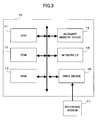
- FIG. 3 shows a hardware composition of the Web server in the present embodiment of the invention.
- the Web server 10 comprises the CPU 11, the ROM 12, the RAM 13, the auxiliary memory device 14, the network interface (I/F) 15, and the drive device 16.
- the CPU 11 is a control unit which controls the entire Web server 10.
- the CPU 11 performs various control programs and application programs stored in the ROM 12 or the auxiliary memory device 14, and carries out the control of the device, the communicative control, and the acquisition and editing of data.
- the ROM 12 is a storage device which mainly stores the control programs of the device
- the RAM 13 is a storage unit which is used as the work memory of the CPU 11 and the temporary data storage.
- the auxiliary memory device 14 is a storage device which stores the various application programs and data, and stores the files if needed.
- the network I/F 15 is the interface for connecting the Web server 10 to the network 70.
- the drive device 16 is the device for reading the recording medium 17, such as a CD-ROM on which the program which executes the function of the invention is recorded.
- the Web server 10 may be provided with the operation unit, such as the keyboard, the mouse, etc. and the display device, such as the LCD (liquid crystal display), and the CRT (cathode ray tube) display, etc.
- the receiving of the input from the user and the displaying of the operational results can be realized.
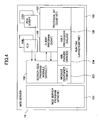
- FIG. 4 shows a software composition of the Web server in the preferred embodiment of the invention.
- the Web server 10 is provided with the software including the Web server program 101, the runtime 102, the module container 103, the XML parser 104, the XSLT processor 105, the client program 106, the protocol kit 107, and the server side program module 108.
- the above-described software is stored in the auxiliary memory device 14 or the ROM 12, and when the CPU 11 is requested, it is read and performed. Alternatively, it is possible to make it acquire such software from the exterior through the network I/F 15.
- the Web server program 101 is the software for transmitting the Web page according to the request from the client 20 in the Web system 1.
- the Apache currently provided by the Apache Software Foundation may be used as the Web server program 101.
- the runtime 102 is the software module needed when the application program is executed, and the Java2 (registered trademark) runtime is used for performing the application program created by the programming language called the Java2 provided by the Sun Microsystems Co.
- the module container 103 is the software which provides the execution environment for performing the server side program module 108.
- the Tomcat currently provided by the Apache Software Foundation can be used as the module container 103.
- the XML (extensible markup language) parser 104 is the software provided to develop the XML data described in text into the memory in a tree structure, and it is made easy to deal with other application programs.
- the Xerces currently provided by the Apache Software Foundation can be used as the XML parser 104.
- the XSLT (extensible stylesheet language transformation) processor 105 is the software for transforming the XML data according to the XSL data.
- the Xalan currently provided by the Apache Software Foundation can be used as the XSLT processor 105.
- the client program 106 is the software for requesting the processing to the SOAP server, such as the document managing server 30.
- the software which performs the communication procedure by the SOAP can be used as the client program 106.
- the protocol kit 107 is the software for actually performing the communications according to the request.
- the server-side program module 108 is the program which is performed on the Web server and arranged in the module formation.
- the Servlet created using the Java2 language is used as the server-side program module 108.
- the server side program module 108 serves as the program for carrying out the calling of the functions of the document managing server 30 and the Web page creation according to the request from the client 20.
- the codes by the Java Script for specifying the error operation in the pop-up, and the Cascading StyleSheet (CSS) data for specifying the displaying method not covered by the specifications of HTML and XSL may be used collectively.
- the required CSS data and Java Script codes may be included directly in the XSL data, or the reference information of such data and codes may be included in the XSL data. Hence, the required CSS data and Java Script codes maybe included in the XSL data which are the transformed data.
- the functions to create the Web page which is provided to the client 20 are incorporated in the Web server 10 of the present embodiment based on the hardware and software composition described above.
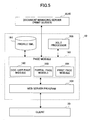
- FIG. 5 is an example of the Web page creation function of the Web server in the present embodiment.
- the Web page creation function of FIG. 5 is realized by the server side program module 108 of FIG. 3 in the present embodiment.
- the Web page creation function of the Web server 10 mainly includes the Web server program 101, the page module 181, the XSLT processor 105 and the profile XML 191.
- the page module 181 is the module which controls the processing to create a Web page.
- the page module 181 is provided to include two or more instances of the page module 181 each of which controls the processing to create each Web page.
- the document list page module 182 the portal page module 183, and the print page module 184 are provided as the instances of the page module 181.
- the document list page module 182 is an instance of the page module 181 which acquires the document information (the document data list, the folder path, etc.), managed by the document DB 31, from the document managing server 30, and creates a Web page (in this case, "document list page") with which the acquired document information is displayed on the client 20.
- the portal page module 183 is an instance of the page module 181 which creates the portal page that is used to show the portal site in the Web server 10. With the display of the portal page, the personalized information prepared per user is displayed in each of a plurality of division regions of the portal page.
- the above-mentioned document list page can also be displayed by using the link included in the display of the portal page.
- the print page module 184 is an instance of the page module 181 which performs the creation processing of the Web page (in this case, "print page") for requesting the printing of document data, and performs the printing processing requested in the print page.
- the profile XML 191 is the file of XML format which describes the predetermined information which is retrieved by each page module 181 when creating the Web page.
- the predetermined information in the file of XML format is managed per user.
- the profile XML 191 may be arranged at any node of the network 70 if it can be accessed by the Web server 10 (retrieval, updating, etc.) through the network 70.
- the Web server 101 and the XSLT processor 105 have already been described with reference to FIG. 4, and a description thereof will be omitted.
- the document list page is a Web page which is displayed as shown in FIG. 6.
- FIG. 6 shows an example of the display of the document list page.
- the document list page 210 includes the folder viewing area 211 and the document list viewing area 212.
- the cabinets in the document DB 31 are arranged in the horizontal direction of the page.
- the folders under each cabinet, and further the folders under each folder, etc., which are arranged in a hierarchical tree structure similar to a general tree structure, are displayed in the folder viewing area 211.
- the thumbnail indication of the list of the document data recorded within the folder which is selected in the folder viewing area 211 is given.
- the rectangular portion in which one document data is displayed is called "cell".
- Each cell includes the check button for choosing the document data, the document name viewing area for displaying the name (document name) of the document data, and the icon viewing area.
- the cell includes the check button 213, the document name viewing area 214, and the icon viewing area 215.
- the four cabinets are included in the document DB 31.
- the two cabinets are displayed in the folder viewing area 211 of FIG. 6. This is because the definition that the displaying of cabinet-A and cabinet-B is made active is given in the profile XML 191.
- the cabinets as the displayed objects of the folder viewing area 211 are defined according to the definition of the profile XML 191.
- FIG. 7 shows an example of the definition of the profile XML in the Web server in the present embodiment.
- the information concerning the cabinets displayed in the folder viewing area 211 of the document list page 210 as a root node of the hierarchical tree structure is defined in the profile XML 191.
- the description 1911 surrounded with the RootNode tag includes the information concerning cabinet-A
- the description 1912 surrounded with the RootNode tag includes the information concerning cabinet-B.
- the value of the ServiceURI attribute of the RootNode tag indicates the URI of the cabinet concerned. That is, it is indicated that the URI of cabinet-A is "http://xxx/cabinetA", and the URI of cabinet-B is "http://xxx/cabinetB".
- the value of the ServiceURI attribute is used as the information for identifying the cabinet (resource) which is made applicable to the retrieval when the root node of the tree structure is clicked on the document list page 210.
- the value (description 1911 a, description 1912a) of the RootNode element indicates a set of characters which is displayed in the folder viewing area 211 at the node corresponding to the cabinet concerned as being the name of the cabinet concerned. Therefore, the definition of the profile XML 191 in this example indicates that the characters "Cabinet-A" and "Cabinet-B" are displayed in the folder viewing area 211 at the node corresponding to each cabinet as being the name of each cabinet.
- the cabinets displayed in the folder viewing area 211 as the root node cabinets are the cabinet-A and the cabinet-B only. Therefore, as shown in FIG. 6, only cabinet-A and cabinet-B are displayed in the folder viewing area 211 of the document list page 210 which is created according to the profile XML 191.
- the document information recorded in the folders under cabinet-C and cabinet-D cannot be accessed by performing the clicking operations on the tree structure display in the folder viewing area 211, in the state where only cabinet-A and cabinet-B are displayed in the folder viewing area 211.
- the folder ID specified in the arguments is the folder identifier that is uniquely assigned to each folder.
- a unique folder ID of the folder "cabinet-C/folder-C2/folder-C21" is specified as the argument information.
- the URL (1) above is displayed in the URL input area of the web browser when the other user opens the folder concerned in the document list page 210, and this URL (1) is transferred without change.
- FIG. 8 is a sequence diagram for explaining the processing of the Web server in the first preferred embodiment of the invention.
- step S11 if the user of the client 20 who has received the e-mail from the other user double-clicks the URL (1) indicated in the e-mail, the client 20 transmits the request of acquisition (HTTP request) of the information 210 determined by the URL (1) (i.e., the document list page) to the Web server 10.
- HTTP request the request of acquisition
- the Web server program 101 of the Web server 10 interprets the HTTP request, and calls the document list page module 182.
- the document list page module 182 requests, to the document managing server 30, the transmission of both the information of the document list data under the folder (folder-C21) determined by the folder ID specified in the arguments of the HTTP request, and the path information of the folder concerned (the list of parent folders of folder-C21) from the document managing server 30 to the document list page module 182.
- this request is performed by the document list page module 182 through the calling of the document-retrieval method mounted in the document managing server 30 using the RPC of the SOAP.
- the document managing server 30 retrieves the document list information under the "folder-C21" and the path information of the "folder-C21" in the document DB 31, and transmits the document list information and the path information to the Web server 10.
- the path information is described in a form that the parent folders of "folder-C21" are sequentially listed, such as "folder-C2, cabinet-C”.
- the document list page module 182 reads the profile XML 191 corresponding to the user, and determines whether the displaying of the cabinet (cabinet-C) to which the folder (folder-C21) concerned belongs is made active in the profile XML 191.
- the cabinet to which the folder concerned belongs is determined based on the path information received in the step S13.
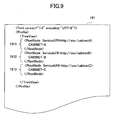
- FIG. 9 showing an example of the definition of the profile XML to which the information corresponding to cabinet-C is added.
- the description 1913 contains the information related to the newly added cabinet-C.
- the document list page module 182 creates the document list page 210.
- the document list page module 182 arranges cabinet-A and cabinet-B as the root nodes in the folder viewing area 211 of the document list page 210 according to the definition of the profile XML 191.
- the document list page module 182 adds cabinet-C as a new root node, and arranges each node to "the folder-C21" in the folder viewing area 211 so that the path to "the folder-C21" made applicable to the display may be known.
- the document list page module 182 stretches the link for each node performing retrieval processing to the cabinet or folder corresponding to each node made applicable to the display in the folder viewing area 211.
- the URL registered into the profile XML 191 is specified as a link place to the node corresponding to the cabinet.
- the document list page module 182 creates the document list page 210 so that the document list information acquired from the document managing server 30 may be displayed on the document list viewing area 212.
- the Web server program 101 transmits the document list page 210 created by the document list page module 182, to the client 20, and the document list page 210 is displayed by the web browser of the client 20.
- FIG. 10 shows an example of the display of the document list page in which the displaying of the folder-C21 is newly activated.
- the root node 2113 corresponding to cabinet-C is newly added to the folder viewing area 211, and each node (the node 2114 and the node 2115) corresponding to the "folder-C21" the displaying of which is activated is also displayed in the folder viewing area 211.
- the document list information of the document data recorded in the "folder-C21" is displayed in the document list viewing area 212.
- cabinet-C is added to the profile XML 191 by the above processing.
- the same processing as the above steps S11 -S17 of FIG. 8 is performed again.
- the root node corresponding to cabinet-C is displayed in the folder viewing area 211 as a user interface for performing the retrieval to cabinet-C even when the displaying of the folders under cabinet-C is not activated.
- the root node of the cabinet in which the folders under that cabinet are retrieved once is automatically displayed in the Web page, and the user can perform the retrieval operation to the cabinet concerned easily.
- the Web server 10 in the present embodiment adds the root node corresponding to the cabinet concerned to the profile XML 119, adds each node to the folders which serve as the candidate for the displaying further to the profile XML 119, and displays the document list page 210 in the folder viewing area 211.
- the document list page 210 is displayed while the compatibility in the display between the folder viewing area 211 and the document list page viewing area 212 is taken, and therefore the operability of the document list page 210 can be raised.
- FIG. 11 shows an example of the display of the portal page.
- the portal page 230 is the Web page which is used to show the portal site in the Web server 10, and two or more information items are displayed on one page so that the user can view the two or more information items together at a time.
- the icons (printer-A 41, printer-B 42, printer-C 43) corresponding to the printers frequently used by the user are displayed in the printer list viewing area 231.
- the calendar information is displayed in the calendar viewing area 232.
- the document list data is displayed in the document list viewing area 233.
- the HTTP request will be transmitted to the printer corresponding to the icon, and the Web page ("printer state page") with which the status information of the printer concerned is displayed will be transmitted.
- each icon in the printer list viewing area 231 of the portal page 230 corresponds to a user interface for performing the processing for displaying the status information of the corresponding printer on the client 20.
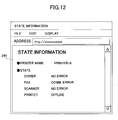
- FIG. 12 shows an example of the display of the printer state page. As shown in FIG. 12, the various information items about the printer concerned are displayed in the printer state page 240. The printer which serves as the candidate for the display in the printer list viewing area 231 is recorded in the profile XML 191.
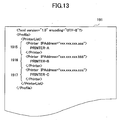
- FIG. 13 shows an example of the definition of the profile XML in the second preferred embodiment of the invention.
- the description 1915, the description 1916, and the description 1917, surrounded with the Printer tag are the information items corresponding to the printer-A 41, the printer-B 42, and the printer-C 43, respectively.
- the value of the IPAddress attribute of the Printer tag indicates the IP address of the printer concerned.
- the value of the IPAddress attribute is used as the information item for identifying the printer (resource) which is made to the object of the processing needed when the icon of the printer concerned is clicked on the printer state page 240.
- the printers the icons of which are displayed in the printer list viewing area 231 are the printer-A 41, the printer-B 42, and the printer-C 43.
- the print page for setting up the printing conditions is displayed on the web browser.
- FIG. 14 shows an example of the display of the print page. As shown in FIG. 14, the print page 220 is divided into two major portions: the printed document list viewing area 221 and the printing condition setting area 222.
- the list of the document names of the document data chosen as the candidates for printing in the document list page 210 is displayed in the printed document list viewing area 221.
- the printing condition setting area 222 is the region for setting up the printing conditions. With the printing condition setting area 222, the setting of the printing conditions including the printer name of the printing place, the number of copies being printed, the document size, the printing direction and the image printing can be performed.
- the option of the print-start position and the option of reduction of the image to the paper size can be set up.
- the setting of the printing conditions is performed so that the printer name of the printing place is "Printer-D", the number of copies being printed is "1", the document size is "A4", the printing direction is "Vertical”, the option of the print-start position is "centering”, and the option of reduction of the image to the paper size is "On”.
- the O.K. button 223 of the print page 220 is the button which is clicked by the user when the printing is performed. If the user clicks the O.K. button 223, then the processing of FIG. 15 is started.
- FIG. 15 is a sequence diagram for explaining the processing of the Web server in the present embodiment.
- the client 20 at step S21 transmits the HTTP request, which requests the printing of the document data to the printer-D 44, to the Web server 10.
- the Web server program 101 of the Web server 10 interprets the HTTP request and calls the print page module 184.
- the print page module 184 requests the printing of the document data to the printer-D 44 of the print server 40 by calling the printing method of the print server 40 using the RPC of the SOAP.
- the print server 40 causes the printer-D 44 to print the document data, and transmits the processing result information, indicating whether the printing processing of the printer of the printing place (printer-D 44) is successfully completed or not, to the Web server 10.
- the print page module 184 determines whether the information item corresponding to the printer of the printing place (printer-D 44), included in the processing result information received from the print server 40, is recorded in the profile XML 191 corresponding to the user concerned (the retrieval of the profile XML 191). When the information item is not recorded in the profile XML 191, the print page module 184 at step S24 records the information item corresponding to the printer-D 44 in the profile XML 191 (the updating of the profile XML 191).
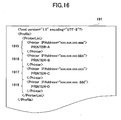
- FIG. 16 shows an example of the definition of the profile XML after the updating in the present embodiment.
- the description 1918 contains the information item corresponding to the newly added printer-D 44.
- the print page module 184 creates the Web page for notifying the completion of printing. For example, a message indicating that the printing of the document data is successfully completed is displayed with the Web page.
- the Web page including this message is called "print-end notice page”.
- step S26 the Web server program 101 transmits the print-end notice page to the client 20, so that the print-end notice page indicating the completion of the printing will be displayed on the web browser of the client 20.
- the user recognizes that the printing of the document data is completed, by making reference to the print-end notice page displayed on the web browser of the client 20.
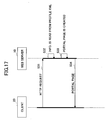
- FIG. 17 is a sequence diagram for explaining the processing of the Web server to create the portal page in the present embodiment.
- the client 20 If the user inputs the URL of the portal page 230 into the web browser of the client 20 as the portal page 230 to be accessed, the client 20 transmits the HTTP request of acquisition of the portal page, to the Web server 10 (S31).
- the portal page module 183 acquires the information on the printer made applicable to the display in the printer list viewing area 231 of the portal page 230 from the profile XML 191 corresponding to the user.
- the profile XML 191 used as the informational acquisition place is defined as shown in FIG. 16. Hence, the printer-A 41, the printer-B 42, the printer-C 43, and the printer-D 44 become the candidates for the display.
- the portal page module 183 creates the portal page 230. Specifically, the portal page module 183 creates the portal page 230 so that the icons corresponding to the four printers (the printer-A 41 through the printer-D 44) may be displayed on the printer list viewing area 231.
- the portal page module 183 stretches the link to the IP address (what is recorded in the profile XML 191) corresponding to that icon so that the status information of the printer corresponding to the icon may be displayed.
- step S34 the Web server program 101 transmits'the portal page 230 to the client 20, so that the portal page 230 will be displayed on the web browser of the client 20.
- FIG. 18 shows an example of the display of the portal page to which the icon of printer-D is added.
- the icon 2311 corresponding to the printer-D 44 is added as a user interface for performing the processing to newly display the status information of the printer-D 44 on the client 20, when compared with the portal page before the printing is performed using the printer-D 44 (FIG. 11).
- the user can easily check the status information of the printer-D 44 on the portal page 230.
- the Web server 10 is provided to include the profile XML 191. However, it is not necessary to arrange the profile XML 191 in the Web server 10.
- the Web system 1 may be constituted as shown in FIG. 19.
- FIG. 19 shows an example of the Web system in which the profile XML is arranged in an external server that is separate from the Web server 10.
- FIG. 19 the elements that are essentially the same as corresponding elements in FIG. 1 are designated by the same reference numerals, and a description thereof will be omitted.
- the profile XML managing server 70 and the Web server 50 are additionally provided in the composition of the Web system in FIG. 1.
- the profile XML managing server 70 has the profile XML 191, and performs transmission of the information, recorded in the profile XML 181, to the Web server 10, or updating of the profile XML 191, in response to the request received from Web server 10 or the Web server 50 via the network 70.
- the Web server 50 is a Web server that has the functions equivalent to those of the Web server 10 described above.
- the profile XML 191 is arranged in the profile XML managing server 60, and the profile XML 191 can be shared by the Web server 10 and the Web server 50.
- the client 20 can display the document list page 210 and the portal page 230 in the same display mode either when the Web server 10 is used or when the Web server 50 is used.
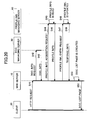
- FIG. 20 is a sequence diagram for explaining the processing of the external server to manage the profile XML.
- FIG. 20 corresponds to the processing (the creation of the document list page 210) of FIG. 8. Therefore, the processing of FIG. 20 is essentially the same as the processing of FIG. 8, and exceptionally the processing of step S 14 and step S 15 in FIG. 8 is modified to the processing of steps S44-S46 and steps S47-49 in FIG. 20 respectively.
- the retrieval or updating of the profile XML 191 which is locally performed in the processing of FIG. 8, is performed remotely by means of the profile XML managing server 60.
- an image forming apparatus having a plurality of application programs which perform the processing specific to the multiple services, including the printer, the copier and the facsimile functions, is provided, which is called the multi-function peripheral system.
- Some of the recent image forming apparatuses are provided with the Web server function and the document-management function.
- the document-management function By using the document-management function, the copied information or the information of the received facsimile data can be accumulated and managed as the document data.
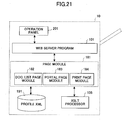
- FIG. 21 shows an image forming apparatus which is provided with the Web page creation function of the present invention.
- FIG. 21 the elements which are essentially the same as corresponding elements in FIG. 5 are designated by the same reference numerals, and a description thereof will be omitted.
- the operation panel 201 is the panel which provides the user interface for allowing the user to operate the image forming apparatus 200.
- the operation panel 201 has the web browser function.
- the operation panel can send a request of acquisition of the Web page to the Web server program 101 based on the input by the user, and can display the Web page outputted by the Web server program 101 as the response to the request concerned.
- the software of the image forming apparatus 200 is configured to have the composition as shown in FIG. 21, and using the page module 181 and the XSLT processor 105, the image forming apparatus 200 can create the Web page in the same logic as the Web server 10. It is possible for the image forming apparatus 200 that the Web page is displayed on the operation panel 201 with which the processing related to the previously used function can be easily performed.
- the information displayed on the Web page concerned may be provided to include not only the information concerning the printer function, the copier function, the fax function and the document-management function, mounted in the image forming apparatus 200, but also the information acquired through the network by the page module 181 as in the Web server 10.
Landscapes
- Engineering & Computer Science (AREA)
- Theoretical Computer Science (AREA)
- Human Computer Interaction (AREA)
- Physics & Mathematics (AREA)
- General Engineering & Computer Science (AREA)
- General Physics & Mathematics (AREA)
- Software Systems (AREA)
- Information Transfer Between Computers (AREA)
- Information Retrieval, Db Structures And Fs Structures Therefor (AREA)
Applications Claiming Priority (4)
| Application Number | Priority Date | Filing Date | Title |
|---|---|---|---|
| JP2003108300 | 2003-04-11 | ||
| JP2003108300 | 2003-04-11 | ||
| JP2004074963A JP2004326740A (ja) | 2003-04-11 | 2004-03-16 | Webページ生成装置、組み込み装置、Webページ生成システム、Webページ生成の制御方法、Webページ生成プログラム及び記録媒体 |
| JP2004074963 | 2004-03-16 |
Publications (4)
| Publication Number | Publication Date |
|---|---|
| EP1467291A2 true EP1467291A2 (de) | 2004-10-13 |
| EP1467291A3 EP1467291A3 (de) | 2004-10-20 |
| EP1467291A8 EP1467291A8 (de) | 2005-01-19 |
| EP1467291A9 EP1467291A9 (de) | 2005-01-26 |
Family
ID=32871262
Family Applications (1)
| Application Number | Title | Priority Date | Filing Date |
|---|---|---|---|
| EP04008773A Ceased EP1467291A3 (de) | 2003-04-11 | 2004-04-13 | Vorrichtung, Verfahren, Programm und Aufzeichnungsmedium zur Webseiten-Erzeugung |
Country Status (4)
| Country | Link |
|---|---|
| US (1) | US7464327B2 (de) |
| EP (1) | EP1467291A3 (de) |
| JP (1) | JP2004326740A (de) |
| CN (1) | CN1536851A (de) |
Families Citing this family (6)
| Publication number | Priority date | Publication date | Assignee | Title |
|---|---|---|---|---|
| US7370273B2 (en) * | 2004-06-30 | 2008-05-06 | International Business Machines Corporation | System and method for creating dynamic folder hierarchies |
| JP2006235735A (ja) * | 2005-02-22 | 2006-09-07 | Ricoh Co Ltd | 情報処理装置、ファイル操作プログラム及び記録媒体 |
| US20070239726A1 (en) * | 2006-03-29 | 2007-10-11 | Mathew Girard Weiss | Systems and methods of transforming data for web communities and web applications |
| US20080222168A1 (en) * | 2007-03-07 | 2008-09-11 | Altep, Inc. | Method and System for Hierarchical Document Management in a Document Review System |
| US20080218808A1 (en) * | 2007-03-07 | 2008-09-11 | Altep, Inc. | Method and System For Universal File Types in a Document Review System |
| CN105450471A (zh) * | 2015-12-03 | 2016-03-30 | 四川长虹电器股份有限公司 | 一种监测Tomcat状态的方法和主服务器 |
Citations (2)
| Publication number | Priority date | Publication date | Assignee | Title |
|---|---|---|---|---|
| EP1209851A2 (de) | 2000-11-24 | 2002-05-29 | Xerox Corporation | System und Verfahren zur Metrik- und Statusdarstellung |
| JP2004013414A (ja) * | 2002-06-05 | 2004-01-15 | Ricoh Co Ltd | 情報管理方法及び情報管理プログラム |
Family Cites Families (8)
| Publication number | Priority date | Publication date | Assignee | Title |
|---|---|---|---|---|
| JP3570154B2 (ja) * | 1996-08-08 | 2004-09-29 | 富士ゼロックス株式会社 | データ中継装置、及びデータ中継方法 |
| US7177040B2 (en) | 1998-03-20 | 2007-02-13 | Océ-Technologies B.V. | Remote printer control |
| JP3792405B2 (ja) | 1998-08-10 | 2006-07-05 | 富士通株式会社 | ファイル操作装置およびファイル操作プログラムを記録した記録媒体 |
| US6476833B1 (en) * | 1999-03-30 | 2002-11-05 | Koninklijke Philips Electronics N.V. | Method and apparatus for controlling browser functionality in the context of an application |
| JP4629263B2 (ja) * | 2000-05-16 | 2011-02-09 | 富士通株式会社 | ポータルサーバ、および、情報処理プログラム |
| US6990574B2 (en) * | 2001-05-01 | 2006-01-24 | General Electric Company | Object oriented framework for scanner/workstation configuration |
| US7190467B2 (en) | 2001-07-12 | 2007-03-13 | Hewlett-Packard Development Company, L.P. | Print option configurations specific to a service or device for printing in a distributed environment |
| US7552189B2 (en) * | 2002-01-18 | 2009-06-23 | Bea Systems, Inc. | System and method for using virtual directories to service URL requests URL requests in application servers |
-
2004
- 2004-03-16 JP JP2004074963A patent/JP2004326740A/ja active Pending
- 2004-04-08 US US10/820,028 patent/US7464327B2/en not_active Expired - Fee Related
- 2004-04-09 CN CNA2004100325851A patent/CN1536851A/zh active Pending
- 2004-04-13 EP EP04008773A patent/EP1467291A3/de not_active Ceased
Patent Citations (2)
| Publication number | Priority date | Publication date | Assignee | Title |
|---|---|---|---|---|
| EP1209851A2 (de) | 2000-11-24 | 2002-05-29 | Xerox Corporation | System und Verfahren zur Metrik- und Statusdarstellung |
| JP2004013414A (ja) * | 2002-06-05 | 2004-01-15 | Ricoh Co Ltd | 情報管理方法及び情報管理プログラム |
Non-Patent Citations (1)
| Title |
|---|
| ANDREW M: "Oracle9iAS Portal Release 2 - Technical Overview", INTERNET ARTICLE. ORACLE CORP. WHITE PAPER, April 2002 (2002-04-01), pages 1 - 30, XP002293377 |
Also Published As
| Publication number | Publication date |
|---|---|
| US20040205665A1 (en) | 2004-10-14 |
| EP1467291A9 (de) | 2005-01-26 |
| EP1467291A8 (de) | 2005-01-19 |
| CN1536851A (zh) | 2004-10-13 |
| EP1467291A3 (de) | 2004-10-20 |
| US7464327B2 (en) | 2008-12-09 |
| JP2004326740A (ja) | 2004-11-18 |
Similar Documents
| Publication | Publication Date | Title |
|---|---|---|
| US20040261010A1 (en) | Web page creation apparatus, Web page creation method, Web page creation program and recording method | |
| US6421716B1 (en) | System for generating context-sensitive hierarchically ordered document service menus | |
| US7185007B2 (en) | Information processing apparatus, information processing method, information processing program service providing apparatus, service providing method, service providing program and recording medium | |
| US7190467B2 (en) | Print option configurations specific to a service or device for printing in a distributed environment | |
| JP4178769B2 (ja) | サービスへのアクセス提供プログラム | |
| JP4122733B2 (ja) | ウェブページ情報フォーマッティングプログラム | |
| RU2464639C2 (ru) | Управление ссылками на web-страницы, использующие структурированные данные | |
| US8972865B2 (en) | Method and device for providing easy access to pre-selected data resources | |
| US7406664B1 (en) | System for integrating HTML Web site views into application file dialogs | |
| US7272390B1 (en) | Method and system for sending facsimile transmissions from mobile devices | |
| US20040205620A1 (en) | Information distributing program, computer-readable recording medium recorded with information distributing program, information distributing apparatus and information distributing method | |
| US20040057076A1 (en) | Operation-screen display device, method, and recording medium containing a program for display of an operation-screen | |
| EP1247167A1 (de) | Verfahren und vorrichtung zum empfang von informationen als antwort auf von einem kunden mittels e-mail gegebenen anfraget | |
| JP2004164623A (ja) | 表示データ生成装置、表示データ生成システム、表示データ生成方法、表示データ生成プログラム及び記録媒体 | |
| US20080120394A1 (en) | Network apparatus, data provision location providing method, and recording medium | |
| US20050024355A1 (en) | Selecting items displayed on respective areas on a screen | |
| EP1457899B1 (de) | System zur Erzeugung und zur Übertragung einer Web-Seite zur Anzeige auf einem Client-Computer | |
| US7079291B2 (en) | Method for hard-copying web pages, method for printing display screens, system for hard-copying web pages, and internet connection device equipped with current-position detection capabilities | |
| US20040059716A1 (en) | Linking information making device, linking information making method, recording medium having recorded a linking information making program, and document processing system therewith | |
| US20020184370A1 (en) | System and method for providing links to available services over a network | |
| JP4625282B2 (ja) | 情報処理装置、ファイル操作方法、ファイル操作プログラム及び記録媒体 | |
| US7464327B2 (en) | Web page creation apparatus, web page creation method, web page creation program, and recording medium | |
| US6934912B2 (en) | System and method for providing a history list of existing imaging compositions | |
| JP2006235735A (ja) | 情報処理装置、ファイル操作プログラム及び記録媒体 | |
| US20030038977A1 (en) | Browser-controlled faxing system and method |
Legal Events
| Date | Code | Title | Description |
|---|---|---|---|
| PUAI | Public reference made under article 153(3) epc to a published international application that has entered the european phase |
Free format text: ORIGINAL CODE: 0009012 |
|
| PUAL | Search report despatched |
Free format text: ORIGINAL CODE: 0009013 |
|
| 17P | Request for examination filed |
Effective date: 20040413 |
|
| AK | Designated contracting states |
Kind code of ref document: A2 Designated state(s): AT BE BG CH CY CZ DE DK EE ES FI FR GB GR HU IE IT LI LU MC NL PL PT RO SE SI SK TR |
|
| AX | Request for extension of the european patent |
Extension state: AL HR LT LV MK |
|
| AK | Designated contracting states |
Kind code of ref document: A3 Designated state(s): AT BE BG CH CY CZ DE DK EE ES FI FR GB GR HU IE IT LI LU MC NL PL PT RO SE SI SK TR |
|
| AX | Request for extension of the european patent |
Extension state: AL HR LT LV MK |
|
| RAP1 | Party data changed (applicant data changed or rights of an application transferred) |
Owner name: RICOH COMPANY LTD. |
|
| 17Q | First examination report despatched |
Effective date: 20050113 |
|
| AKX | Designation fees paid |
Designated state(s): DE ES FR GB IT NL |
|
| STAA | Information on the status of an ep patent application or granted ep patent |
Free format text: STATUS: THE APPLICATION HAS BEEN REFUSED |
|
| 18R | Application refused |
Effective date: 20140402 |