EP1466905A1 - Process for producing optically active oxoheptenoic acid ester - Google Patents
Process for producing optically active oxoheptenoic acid ester Download PDFInfo
- Publication number
- EP1466905A1 EP1466905A1 EP02780087A EP02780087A EP1466905A1 EP 1466905 A1 EP1466905 A1 EP 1466905A1 EP 02780087 A EP02780087 A EP 02780087A EP 02780087 A EP02780087 A EP 02780087A EP 1466905 A1 EP1466905 A1 EP 1466905A1
- Authority
- EP
- European Patent Office
- Prior art keywords
- optically active
- lithium
- chloride
- mol
- quinolin
- Prior art date
- Legal status (The legal status is an assumption and is not a legal conclusion. Google has not performed a legal analysis and makes no representation as to the accuracy of the status listed.)
- Granted
Links
- 238000000034 method Methods 0.000 title claims abstract description 18
- 239000002253 acid Substances 0.000 title description 4
- 150000002148 esters Chemical class 0.000 title description 2
- 239000010936 titanium Substances 0.000 claims abstract description 21
- 229910052719 titanium Inorganic materials 0.000 claims abstract description 21
- VXUYXOFXAQZZMF-UHFFFAOYSA-N titanium(IV) isopropoxide Chemical compound CC(C)O[Ti](OC(C)C)(OC(C)C)OC(C)C VXUYXOFXAQZZMF-UHFFFAOYSA-N 0.000 claims abstract description 20
- 150000003839 salts Chemical class 0.000 claims abstract description 17
- 229910052751 metal Inorganic materials 0.000 claims abstract description 14
- 239000002184 metal Substances 0.000 claims abstract description 14
- 150000001412 amines Chemical class 0.000 claims abstract description 13
- PPTXVXKCQZKFBN-UHFFFAOYSA-N (S)-(-)-1,1'-Bi-2-naphthol Chemical compound C1=CC=C2C(C3=C4C=CC=CC4=CC=C3O)=C(O)C=CC2=C1 PPTXVXKCQZKFBN-UHFFFAOYSA-N 0.000 claims abstract description 11
- WULPWIFGZFQFEQ-HWKANZROSA-N (e)-3-[2-cyclopropyl-4-(4-fluorophenyl)quinolin-3-yl]prop-2-enal Chemical compound C1=CC(F)=CC=C1C1=C(\C=C\C=O)C(C2CC2)=NC2=CC=CC=C12 WULPWIFGZFQFEQ-HWKANZROSA-N 0.000 claims abstract description 10
- 239000007795 chemical reaction product Substances 0.000 claims abstract description 6
- -1 (E)-7-[2-cyclopropyl-4-(4-fluorophenyl) quinolin-3-yl]-5-hydroxy-3-oxohept-6-enoic acid ester Chemical class 0.000 claims abstract description 5
- 238000005828 desilylation reaction Methods 0.000 claims abstract description 4
- KWGKDLIKAYFUFQ-UHFFFAOYSA-M lithium chloride Chemical group [Li+].[Cl-] KWGKDLIKAYFUFQ-UHFFFAOYSA-M 0.000 claims description 32
- KWYHDKDOAIKMQN-UHFFFAOYSA-N N,N,N',N'-tetramethylethylenediamine Chemical group CN(C)CCN(C)C KWYHDKDOAIKMQN-UHFFFAOYSA-N 0.000 claims description 17
- ZMANZCXQSJIPKH-UHFFFAOYSA-N Triethylamine Chemical compound CCN(CC)CC ZMANZCXQSJIPKH-UHFFFAOYSA-N 0.000 claims description 9
- FAPWRFPIFSIZLT-UHFFFAOYSA-M Sodium chloride Chemical compound [Na+].[Cl-] FAPWRFPIFSIZLT-UHFFFAOYSA-M 0.000 claims description 8
- VHYFNPMBLIVWCW-UHFFFAOYSA-N 4-Dimethylaminopyridine Chemical compound CN(C)C1=CC=NC=C1 VHYFNPMBLIVWCW-UHFFFAOYSA-N 0.000 claims description 6
- WMFOQBRAJBCJND-UHFFFAOYSA-M Lithium hydroxide Chemical compound [Li+].[OH-] WMFOQBRAJBCJND-UHFFFAOYSA-M 0.000 claims description 6
- JGFZNNIVVJXRND-UHFFFAOYSA-N N,N-Diisopropylethylamine (DIPEA) Chemical compound CCN(C(C)C)C(C)C JGFZNNIVVJXRND-UHFFFAOYSA-N 0.000 claims description 6
- JUJWROOIHBZHMG-UHFFFAOYSA-N Pyridine Chemical compound C1=CC=NC=C1 JUJWROOIHBZHMG-UHFFFAOYSA-N 0.000 claims description 6
- 125000000217 alkyl group Chemical group 0.000 claims description 5
- 125000004432 carbon atom Chemical group C* 0.000 claims description 5
- TWRXJAOTZQYOKJ-UHFFFAOYSA-L Magnesium chloride Chemical compound [Mg+2].[Cl-].[Cl-] TWRXJAOTZQYOKJ-UHFFFAOYSA-L 0.000 claims description 4
- YNAVUWVOSKDBBP-UHFFFAOYSA-N Morpholine Chemical compound C1COCCN1 YNAVUWVOSKDBBP-UHFFFAOYSA-N 0.000 claims description 4
- WCUXLLCKKVVCTQ-UHFFFAOYSA-M Potassium chloride Chemical compound [Cl-].[K+] WCUXLLCKKVVCTQ-UHFFFAOYSA-M 0.000 claims description 4
- VSCWAEJMTAWNJL-UHFFFAOYSA-K aluminium trichloride Chemical compound Cl[Al](Cl)Cl VSCWAEJMTAWNJL-UHFFFAOYSA-K 0.000 claims description 4
- AMXOYNBUYSYVKV-UHFFFAOYSA-M lithium bromide Chemical compound [Li+].[Br-] AMXOYNBUYSYVKV-UHFFFAOYSA-M 0.000 claims description 4
- UMJSCPRVCHMLSP-UHFFFAOYSA-N pyridine Natural products COC1=CC=CN=C1 UMJSCPRVCHMLSP-UHFFFAOYSA-N 0.000 claims description 3
- ORTQZVOHEJQUHG-UHFFFAOYSA-L copper(II) chloride Chemical compound Cl[Cu]Cl ORTQZVOHEJQUHG-UHFFFAOYSA-L 0.000 claims description 2
- XIXADJRWDQXREU-UHFFFAOYSA-M lithium acetate Chemical compound [Li+].CC([O-])=O XIXADJRWDQXREU-UHFFFAOYSA-M 0.000 claims description 2
- 229910001386 lithium phosphate Inorganic materials 0.000 claims description 2
- 229910001629 magnesium chloride Inorganic materials 0.000 claims description 2
- 239000001103 potassium chloride Substances 0.000 claims description 2
- 235000011164 potassium chloride Nutrition 0.000 claims description 2
- 239000011780 sodium chloride Substances 0.000 claims description 2
- RIUWBIIVUYSTCN-UHFFFAOYSA-N trilithium borate Chemical compound [Li+].[Li+].[Li+].[O-]B([O-])[O-] RIUWBIIVUYSTCN-UHFFFAOYSA-N 0.000 claims description 2
- TWQULNDIKKJZPH-UHFFFAOYSA-K trilithium;phosphate Chemical compound [Li+].[Li+].[Li+].[O-]P([O-])([O-])=O TWQULNDIKKJZPH-UHFFFAOYSA-K 0.000 claims description 2
- 230000002194 synthesizing effect Effects 0.000 abstract description 4
- 229940079593 drug Drugs 0.000 abstract 1
- 239000003814 drug Substances 0.000 abstract 1
- 150000001875 compounds Chemical class 0.000 description 35
- 238000006243 chemical reaction Methods 0.000 description 25
- WYURNTSHIVDZCO-UHFFFAOYSA-N Tetrahydrofuran Chemical compound C1CCOC1 WYURNTSHIVDZCO-UHFFFAOYSA-N 0.000 description 24
- 239000000243 solution Substances 0.000 description 23
- 239000007864 aqueous solution Substances 0.000 description 19
- XEKOWRVHYACXOJ-UHFFFAOYSA-N Ethyl acetate Chemical compound CCOC(C)=O XEKOWRVHYACXOJ-UHFFFAOYSA-N 0.000 description 18
- 230000003287 optical effect Effects 0.000 description 16
- YMWUJEATGCHHMB-UHFFFAOYSA-N Dichloromethane Chemical compound ClCCl YMWUJEATGCHHMB-UHFFFAOYSA-N 0.000 description 15
- YLQBMQCUIZJEEH-UHFFFAOYSA-N tetrahydrofuran Natural products C=1C=COC=1 YLQBMQCUIZJEEH-UHFFFAOYSA-N 0.000 description 12
- 239000002904 solvent Substances 0.000 description 11
- VLKZOEOYAKHREP-UHFFFAOYSA-N n-Hexane Chemical compound CCCCCC VLKZOEOYAKHREP-UHFFFAOYSA-N 0.000 description 10
- 239000003960 organic solvent Substances 0.000 description 10
- RTZKZFJDLAIYFH-UHFFFAOYSA-N Diethyl ether Chemical compound CCOCC RTZKZFJDLAIYFH-UHFFFAOYSA-N 0.000 description 9
- YXFVVABEGXRONW-UHFFFAOYSA-N Toluene Chemical compound CC1=CC=CC=C1 YXFVVABEGXRONW-UHFFFAOYSA-N 0.000 description 9
- 238000004519 manufacturing process Methods 0.000 description 9
- CDBYLPFSWZWCQE-UHFFFAOYSA-L Sodium Carbonate Chemical compound [Na+].[Na+].[O-]C([O-])=O CDBYLPFSWZWCQE-UHFFFAOYSA-L 0.000 description 8
- UIIMBOGNXHQVGW-UHFFFAOYSA-M Sodium bicarbonate Chemical compound [Na+].OC([O-])=O UIIMBOGNXHQVGW-UHFFFAOYSA-M 0.000 description 8
- XLYOFNOQVPJJNP-UHFFFAOYSA-N water Substances O XLYOFNOQVPJJNP-UHFFFAOYSA-N 0.000 description 8
- 239000012299 nitrogen atmosphere Substances 0.000 description 7
- 239000011541 reaction mixture Substances 0.000 description 7
- QAOWNCQODCNURD-UHFFFAOYSA-N Sulfuric acid Chemical compound OS(O)(=O)=O QAOWNCQODCNURD-UHFFFAOYSA-N 0.000 description 6
- 238000004128 high performance liquid chromatography Methods 0.000 description 6
- 238000001704 evaporation Methods 0.000 description 5
- 238000002474 experimental method Methods 0.000 description 5
- 239000012044 organic layer Substances 0.000 description 5
- ZDWGZGPHSIVTHX-UHFFFAOYSA-N (1-ethoxy-3-trimethylsilyloxybuta-1,3-dienoxy)-trimethylsilane Chemical compound CCOC(O[Si](C)(C)C)=CC(=C)O[Si](C)(C)C ZDWGZGPHSIVTHX-UHFFFAOYSA-N 0.000 description 4
- IJOOHPMOJXWVHK-UHFFFAOYSA-N chlorotrimethylsilane Chemical compound C[Si](C)(C)Cl IJOOHPMOJXWVHK-UHFFFAOYSA-N 0.000 description 4
- IIEWJVIFRVWJOD-UHFFFAOYSA-N ethylcyclohexane Chemical compound CCC1CCCCC1 IIEWJVIFRVWJOD-UHFFFAOYSA-N 0.000 description 4
- 229910003002 lithium salt Inorganic materials 0.000 description 4
- 239000000843 powder Substances 0.000 description 4
- 235000017557 sodium bicarbonate Nutrition 0.000 description 4
- 229910000030 sodium bicarbonate Inorganic materials 0.000 description 4
- 229910000029 sodium carbonate Inorganic materials 0.000 description 4
- WEVYAHXRMPXWCK-UHFFFAOYSA-N Acetonitrile Chemical compound CC#N WEVYAHXRMPXWCK-UHFFFAOYSA-N 0.000 description 3
- 206010003210 Arteriosclerosis Diseases 0.000 description 3
- UHOVQNZJYSORNB-UHFFFAOYSA-N Benzene Chemical compound C1=CC=CC=C1 UHOVQNZJYSORNB-UHFFFAOYSA-N 0.000 description 3
- LFQSCWFLJHTTHZ-UHFFFAOYSA-N Ethanol Chemical compound CCO LFQSCWFLJHTTHZ-UHFFFAOYSA-N 0.000 description 3
- 208000031226 Hyperlipidaemia Diseases 0.000 description 3
- UIIMBOGNXHQVGW-DEQYMQKBSA-M Sodium bicarbonate-14C Chemical compound [Na+].O[14C]([O-])=O UIIMBOGNXHQVGW-DEQYMQKBSA-M 0.000 description 3
- HEMHJVSKTPXQMS-UHFFFAOYSA-M Sodium hydroxide Chemical compound [OH-].[Na+] HEMHJVSKTPXQMS-UHFFFAOYSA-M 0.000 description 3
- 208000011775 arteriosclerosis disease Diseases 0.000 description 3
- 230000000052 comparative effect Effects 0.000 description 3
- UAOMVDZJSHZZME-UHFFFAOYSA-N diisopropylamine Chemical compound CC(C)NC(C)C UAOMVDZJSHZZME-UHFFFAOYSA-N 0.000 description 3
- TYQSGJQIXZTWHI-UHFFFAOYSA-N ethyl 3-trimethylsilyloxybut-2-enoate Chemical compound CCOC(=O)C=C(C)O[Si](C)(C)C TYQSGJQIXZTWHI-UHFFFAOYSA-N 0.000 description 3
- 239000000706 filtrate Substances 0.000 description 3
- 238000005342 ion exchange Methods 0.000 description 3
- 159000000002 lithium salts Chemical class 0.000 description 3
- VGYFMXBACGZSIL-MCBHFWOFSA-N pitavastatin Chemical class OC(=O)C[C@H](O)C[C@H](O)\C=C\C1=C(C2CC2)N=C2C=CC=CC2=C1C1=CC=C(F)C=C1 VGYFMXBACGZSIL-MCBHFWOFSA-N 0.000 description 3
- 230000002265 prevention Effects 0.000 description 3
- 229920006395 saturated elastomer Polymers 0.000 description 3
- MNQDQKPGBOCXNP-VAWYXSNFSA-N (e)-7-[2-cyclopropyl-4-(4-fluorophenyl)quinolin-3-yl]-5-hydroxy-3-oxohept-6-enoic acid Chemical class OC(=O)CC(=O)CC(O)\C=C\C1=C(C2CC2)N=C2C=CC=CC2=C1C1=CC=C(F)C=C1 MNQDQKPGBOCXNP-VAWYXSNFSA-N 0.000 description 2
- VHUUQVKOLVNVRT-UHFFFAOYSA-N Ammonium hydroxide Chemical compound [NH4+].[OH-] VHUUQVKOLVNVRT-UHFFFAOYSA-N 0.000 description 2
- XKRFYHLGVUSROY-UHFFFAOYSA-N Argon Chemical compound [Ar] XKRFYHLGVUSROY-UHFFFAOYSA-N 0.000 description 2
- 0 C*=[N+](C(*)=C)[O-] Chemical compound C*=[N+](C(*)=C)[O-] 0.000 description 2
- VEXZGXHMUGYJMC-UHFFFAOYSA-N Hydrochloric acid Chemical compound Cl VEXZGXHMUGYJMC-UHFFFAOYSA-N 0.000 description 2
- CSNNHWWHGAXBCP-UHFFFAOYSA-L Magnesium sulfate Chemical compound [Mg+2].[O-][S+2]([O-])([O-])[O-] CSNNHWWHGAXBCP-UHFFFAOYSA-L 0.000 description 2
- MZRVEZGGRBJDDB-UHFFFAOYSA-N N-Butyllithium Chemical compound [Li]CCCC MZRVEZGGRBJDDB-UHFFFAOYSA-N 0.000 description 2
- QAOWNCQODCNURD-UHFFFAOYSA-L Sulfate Chemical compound [O-]S([O-])(=O)=O QAOWNCQODCNURD-UHFFFAOYSA-L 0.000 description 2
- HEDRZPFGACZZDS-MICDWDOJSA-N Trichloro(2H)methane Chemical compound [2H]C(Cl)(Cl)Cl HEDRZPFGACZZDS-MICDWDOJSA-N 0.000 description 2
- 239000012670 alkaline solution Substances 0.000 description 2
- QGZKDVFQNNGYKY-UHFFFAOYSA-N ammonia Natural products N QGZKDVFQNNGYKY-UHFFFAOYSA-N 0.000 description 2
- 230000015572 biosynthetic process Effects 0.000 description 2
- 238000001514 detection method Methods 0.000 description 2
- 230000000694 effects Effects 0.000 description 2
- DPBQVLWVWXLRGW-FBRRREGBSA-N ethyl (e,5s)-7-[2-cyclopropyl-4-(4-fluorophenyl)quinolin-3-yl]-5-hydroxy-3-oxohept-6-enoate Chemical compound CCOC(=O)CC(=O)C[C@H](O)\C=C\C1=C(C2CC2)N=C2C=CC=CC2=C1C1=CC=C(F)C=C1 DPBQVLWVWXLRGW-FBRRREGBSA-N 0.000 description 2
- 239000007789 gas Substances 0.000 description 2
- 239000010410 layer Substances 0.000 description 2
- 238000000746 purification Methods 0.000 description 2
- 125000003808 silyl group Chemical group [H][Si]([H])([H])[*] 0.000 description 2
- 238000003756 stirring Methods 0.000 description 2
- 239000000126 substance Substances 0.000 description 2
- 238000003786 synthesis reaction Methods 0.000 description 2
- 238000005160 1H NMR spectroscopy Methods 0.000 description 1
- WDJHALXBUFZDSR-UHFFFAOYSA-N Acetoacetic acid Natural products CC(=O)CC(O)=O WDJHALXBUFZDSR-UHFFFAOYSA-N 0.000 description 1
- USFZMSVCRYTOJT-UHFFFAOYSA-N Ammonium acetate Chemical compound N.CC(O)=O USFZMSVCRYTOJT-UHFFFAOYSA-N 0.000 description 1
- 239000005695 Ammonium acetate Substances 0.000 description 1
- IJGRMHOSHXDMSA-UHFFFAOYSA-N Atomic nitrogen Chemical compound N#N IJGRMHOSHXDMSA-UHFFFAOYSA-N 0.000 description 1
- ONAZXLNVHPBHOA-UHFFFAOYSA-N CC[NH+](C(C)(C)C)[O-] Chemical compound CC[NH+](C(C)(C)C)[O-] ONAZXLNVHPBHOA-UHFFFAOYSA-N 0.000 description 1
- BVKZGUZCCUSVTD-UHFFFAOYSA-L Carbonate Chemical compound [O-]C([O-])=O BVKZGUZCCUSVTD-UHFFFAOYSA-L 0.000 description 1
- FEWJPZIEWOKRBE-JCYAYHJZSA-N Dextrotartaric acid Chemical compound OC(=O)[C@H](O)[C@@H](O)C(O)=O FEWJPZIEWOKRBE-JCYAYHJZSA-N 0.000 description 1
- ZAFNJMIOTHYJRJ-UHFFFAOYSA-N Diisopropyl ether Chemical compound CC(C)OC(C)C ZAFNJMIOTHYJRJ-UHFFFAOYSA-N 0.000 description 1
- DGAQECJNVWCQMB-PUAWFVPOSA-M Ilexoside XXIX Chemical compound C[C@@H]1CC[C@@]2(CC[C@@]3(C(=CC[C@H]4[C@]3(CC[C@@H]5[C@@]4(CC[C@@H](C5(C)C)OS(=O)(=O)[O-])C)C)[C@@H]2[C@]1(C)O)C)C(=O)O[C@H]6[C@@H]([C@H]([C@@H]([C@H](O6)CO)O)O)O.[Na+] DGAQECJNVWCQMB-PUAWFVPOSA-M 0.000 description 1
- WHXSMMKQMYFTQS-UHFFFAOYSA-N Lithium Chemical compound [Li] WHXSMMKQMYFTQS-UHFFFAOYSA-N 0.000 description 1
- 239000002262 Schiff base Substances 0.000 description 1
- 150000004753 Schiff bases Chemical class 0.000 description 1
- RTAQQCXQSZGOHL-UHFFFAOYSA-N Titanium Chemical compound [Ti] RTAQQCXQSZGOHL-UHFFFAOYSA-N 0.000 description 1
- 150000001299 aldehydes Chemical class 0.000 description 1
- 229940043376 ammonium acetate Drugs 0.000 description 1
- 235000019257 ammonium acetate Nutrition 0.000 description 1
- 238000004458 analytical method Methods 0.000 description 1
- 229910052786 argon Inorganic materials 0.000 description 1
- 239000000872 buffer Substances 0.000 description 1
- 239000007810 chemical reaction solvent Substances 0.000 description 1
- 238000003776 cleavage reaction Methods 0.000 description 1
- 239000013078 crystal Substances 0.000 description 1
- 229940043279 diisopropylamine Drugs 0.000 description 1
- WASQWSOJHCZDFK-UHFFFAOYSA-N diketene Chemical compound C=C1CC(=O)O1 WASQWSOJHCZDFK-UHFFFAOYSA-N 0.000 description 1
- 229910001873 dinitrogen Inorganic materials 0.000 description 1
- 238000004821 distillation Methods 0.000 description 1
- 239000004210 ether based solvent Substances 0.000 description 1
- XYIBRDXRRQCHLP-UHFFFAOYSA-N ethyl acetoacetate Chemical compound CCOC(=O)CC(C)=O XYIBRDXRRQCHLP-UHFFFAOYSA-N 0.000 description 1
- 125000001495 ethyl group Chemical group [H]C([H])([H])C([H])([H])* 0.000 description 1
- 238000011156 evaluation Methods 0.000 description 1
- 238000000605 extraction Methods 0.000 description 1
- 239000001307 helium Substances 0.000 description 1
- 229910052734 helium Inorganic materials 0.000 description 1
- SWQJXJOGLNCZEY-UHFFFAOYSA-N helium atom Chemical compound [He] SWQJXJOGLNCZEY-UHFFFAOYSA-N 0.000 description 1
- 239000011261 inert gas Substances 0.000 description 1
- 239000002198 insoluble material Substances 0.000 description 1
- 238000002955 isolation Methods 0.000 description 1
- 229910052744 lithium Inorganic materials 0.000 description 1
- NRUBUZBAZRTHHX-UHFFFAOYSA-N lithium;propan-2-ylazanide Chemical compound [Li+].CC(C)[NH-] NRUBUZBAZRTHHX-UHFFFAOYSA-N 0.000 description 1
- 238000002844 melting Methods 0.000 description 1
- 230000008018 melting Effects 0.000 description 1
- 125000002496 methyl group Chemical group [H]C([H])([H])* 0.000 description 1
- 150000007522 mineralic acids Chemical class 0.000 description 1
- 239000011259 mixed solution Substances 0.000 description 1
- 239000012046 mixed solvent Substances 0.000 description 1
- 239000002808 molecular sieve Substances 0.000 description 1
- 238000002360 preparation method Methods 0.000 description 1
- 230000035484 reaction time Effects 0.000 description 1
- 230000007017 scission Effects 0.000 description 1
- 229910052708 sodium Inorganic materials 0.000 description 1
- 239000011734 sodium Substances 0.000 description 1
- URGAHOPLAPQHLN-UHFFFAOYSA-N sodium aluminosilicate Chemical compound [Na+].[Al+3].[O-][Si]([O-])=O.[O-][Si]([O-])=O URGAHOPLAPQHLN-UHFFFAOYSA-N 0.000 description 1
- BDHFUVZGWQCTTF-UHFFFAOYSA-M sulfonate Chemical compound [O-]S(=O)=O BDHFUVZGWQCTTF-UHFFFAOYSA-M 0.000 description 1
- 229940095064 tartrate Drugs 0.000 description 1
- 150000003609 titanium compounds Chemical class 0.000 description 1
Classifications
-
- C—CHEMISTRY; METALLURGY
- C07—ORGANIC CHEMISTRY
- C07D—HETEROCYCLIC COMPOUNDS
- C07D215/00—Heterocyclic compounds containing quinoline or hydrogenated quinoline ring systems
- C07D215/02—Heterocyclic compounds containing quinoline or hydrogenated quinoline ring systems having no bond between the ring nitrogen atom and a non-ring member or having only hydrogen atoms or carbon atoms directly attached to the ring nitrogen atom
- C07D215/12—Heterocyclic compounds containing quinoline or hydrogenated quinoline ring systems having no bond between the ring nitrogen atom and a non-ring member or having only hydrogen atoms or carbon atoms directly attached to the ring nitrogen atom with substituted hydrocarbon radicals attached to ring carbon atoms
- C07D215/14—Radicals substituted by oxygen atoms
-
- A—HUMAN NECESSITIES
- A61—MEDICAL OR VETERINARY SCIENCE; HYGIENE
- A61P—SPECIFIC THERAPEUTIC ACTIVITY OF CHEMICAL COMPOUNDS OR MEDICINAL PREPARATIONS
- A61P3/00—Drugs for disorders of the metabolism
- A61P3/06—Antihyperlipidemics
Definitions
- the present invention relates to a process for producing an optically active (E)-7-[2-cyclopropyl-4-(4-fluorophenyl) quinolin-3-yl]-5-hydroxy-3-oxohept-6-enoic acid ester which is an intermediate for synthesizing (3R, 5S, 6E)-7-[2-cyclopropyl-4-(4-fluorophenyl) quinolin-3-yl]-3,5-dihydroxyhept-6-enoic acid salt useful for prevention and treatment of hyperlipidemia, arteriosclerosis or the like.
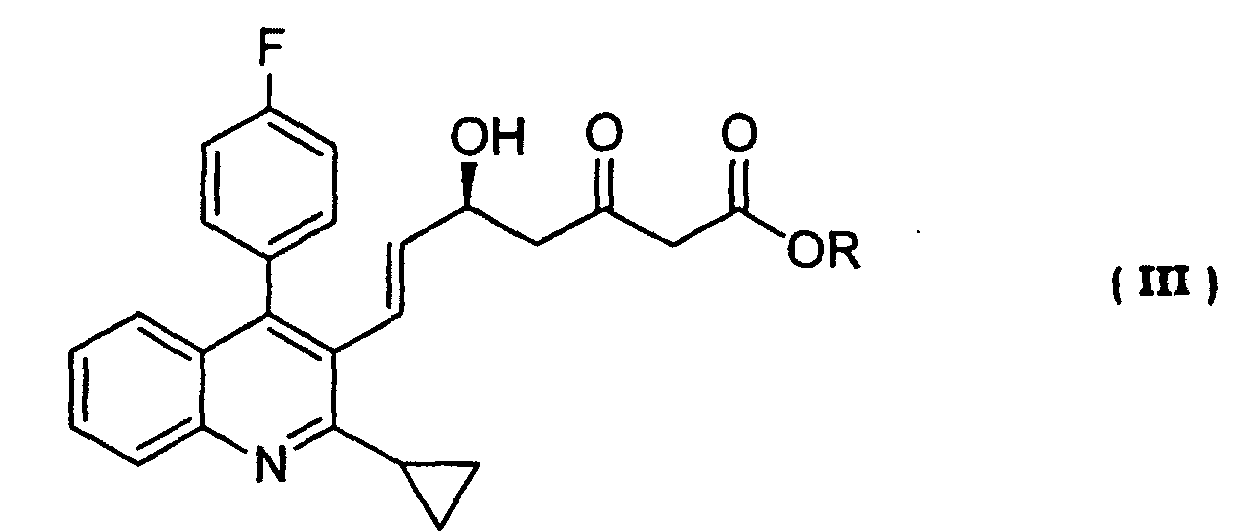
- an optically active (E)-7-[2-cyclopropyl-4-(4-fluorophenyl) quinolin-3-yl]-5-hydroxy-3-oxohept-6-enoic acid ester (hereinafter referred to as compound (III)) of formula (III) wherein R is an alkyl having 1 to 4 carbon atoms which is a desired compound of the present invention, is produced by reacting (E)-3-[2-cyclopropyl-4-(4-fluorophenyl)-quinolin-3-yl]-prop-2-en-1-al (hereinafter referred to as compound (II)) of formula (II) with diketene in an organic solvent in the presence of an optically active Schiff base-titanium complex prepared by reacting an optically active Schiff base with a titanium compound (Japanese Patent Laid-open No. Hei 8-92217).
- Tetrahedron Asymmetry, Vol. 11, 2255-2258 (2000) and Tetrahedron Asymmetry, Vol. 12, 959-963 (2001) describe processes for producing an optically active alcohol by reacting 1,3-bis(trimethylsifyloxy)-1-alkoxybuta-1,3-diene (hereinafter referred to as compound (I)) of formula (I) wherein R is an alkyl having 1 to 4 carbon atoms, with an aldehyde in the presence of an optically active binaphthol-titanium complex.
- compound (I) 1,3-bis(trimethylsifyloxy)-1-alkoxybuta-1,3-diene
- Tetrahedron Asymmetry, Vol. 11, 2255-2258 (2000) and Tetrahedron Asymmetry, Vol. 12, 959-963 (2001) give desired compounds in a relatively high yield and optical purity, but it requires not only strict reaction conditions, such as distillation and purification of a solvent to be used but also an addition of a molecular sieve dried at a high temperature during the preparation of the complex. Thus, it is hard to regard the process as a practical one.
- the present inventors have made extensive research and have found out that the optical purity and reaction yield are greatly improved by adding a metal salt and various amines in a reaction system between compound (I) and compound (II) in the presence of an optically active binaphthol-titanium complex which can be easily prepared by reacting 1,1'-bi-2-naphthol with titanium tetraisopropoxide. Further, it was found out that desired compounds (III) are produced in an optical purity of 99% ee or more and a yield of 85% or more by subjecting the reaction mixture to desilylation in the reaction system as it is.
- the present invention relates to a process for producing an optically active (E)-7-[2-cyclopropyl-4-(4-fluorophenyl) quinolin-3-yl]-5-hydroxy-3-oxohept-6-enoic acid ester of formula (III) wherein R is an alkyl having 1 to 4 carbon atoms, which comprises reacting 1,3-bis(trimethylsilyloxy)-1-alkoxybuta-1,3-diene of formula (I) wherein R is as defined above, with (E)-3-[2-cyclopropyl-4-(4-fluorophenyl)-quinolin-3-yl]-prop-2-en-1-al of formula (II) in the presence of an optically active binaphthol-titanium complex prepared by reacting 1,1'-bi-2-naphthol with titanium tetraisopropoxide, a metal salt and an amine, and then subjecting the resulting reaction product to desilylation.
- the optically active binaphthol-titanium complex used in the production process according to the present invention can be easily prepared by for example reacting (S)-(-)- or (R)-(+)-1,1'-bi-2-naphthol with titanium tetraisopropoxide in an organic solvent such as toluene, benzene, methylene chloride or diethyl ether according to the method of Ji-Tao Wang et al. (Synthesis, 291-292 (1989)).
- the compounds prepared as above can be used in the next step without isolation.
- the titanium tetraisoproxide used for preparing the optically active binaphthol-titanium complex is used in an amount of 0.5 to 2.3 mol, preferably 0.85 to 1.15 mol based on 1 mol of optically active 1,1'-bi-2-naphthol.
- optically active binaphthol-titanium complex for producing compound (III) is used in an amount of 0.001 to 1 mol, preferably 0.02 to 0.06 mol based on 1 mol of compound (II).
- R in formula (I) is an alkyl having 1 to 4 carbon atoms, and preferably compounds of formula (I) wherein R is methyl or ethyl can be used.
- Compound (I) can be produced based on the process of Tsuji et al. (Chem. Letter., 649 (1978)) according to a process comprising reacting an acetoacetic acid alkyl ester with trimethylsilyl chloride to produce 3-(trimethylsilyloxy) but-2-enoic acid alkyl ester, and reacting the ester at first with lithium isopropylamide and then with trimethylsilyl chloride.
- Compound (I) in the production of compound (III) is used in an amount of 1 to 5 mol, preferably 1 to 3 mol based on 1 mol of compound (II).
- the metal salt added in the production of compound (III) includes lithium salts such as lithium chloride, lithium bromide, lithium acetate, lithium hydroxide, lithium borate or lithium phosphate, and salts of metal other than lithium, such as sodium chloride, potassium chloride, magnesium chloride, aluminum chloride or copper chloride.
- the metal salt is selected depending on the amount and kind of amines used, the concentration of optically active binaphthol-titanium complex or the concentration of compound (II), lithium salts among these salts afford preferable results, and lithium chloride is more preferable among the lithium salts.
- the amount used of the metal salt depends on the amount of optically active binaphthol-titanium complex and amine which are added together, or the concentration of reaction solution, but in a case where lithium chloride is used, it is used in an amount of 0.03 to 1.0 mol, preferably 0.1 to 0.4 mol based on 1 mol of compound (II).
- the amine added in the production of compound (III) includes N,N,N',N'-tetramethylethylenediamine, diisopropylethylamine, pyridine, 4-dimethylaminopyridine, triethylamine, morpholine and the like.
- N,N,N',N'-tetramethylethylenediamine, diisopropylethylamine, pyridine and 4-dimethylaminopyridine afford preferable results, and among them N,N,N',N'-tetramethylethylenediamine is more preferable.
- the amount used of the amine depends on the kind of amine used, the amount of optically active binaphthol-titanium complex and the metal salt which are added together, or the concentration of reaction solution, but in a case where N,N,N',N'-tetramethylethylenediamine is used, it is used in an amount of 0.03 to 2.0 mol, preferably 0.1 to 1.2 mol from a viewpoint of effect on the post-treatment of the reaction based on 1 mol of compound (II).
- lithium chloride and N,N,N',N'-tetramethylethylenediamine are used for producing compound (III) according to the present invention
- the amount used of them depends on the amount of optically active binaphthol-titanium complex added together or the concentration of the reaction solution, but is 0.03 to 1.0 mol of lithium chloride and 0.03 to 2.0 mol of N,N,N',N'-tetramethylethylenediamine, preferably 0.1 to 0.4 mol of lithium chloride and 0.1 to 1.2 mol of N,N,N',N'-tetramethylethylenediamine based on 1 mol of compound (II).
- the process of the present invention can be carried out by reacting compound (I) with compound (II) under a flow of an inert gas such as nitrogen gas, helium gas or argon gas, in the presence of an optically active binaphthol-titanium complex, a metal salt and an amine, in organic solvents.
- an inert gas such as nitrogen gas, helium gas or argon gas
- the organic solvent used is not specifically limited unless it takes part in the reaction, and generally ether solvents such as tetrahydrofuran, diethyl ether or diisopropyl ether can be used, and tetrahydrofuran is preferable.
- the amount used of the organic solvent is not specifically limited, and is generally 1 to 100 times (mass ratio), preferably 5 to 30 times (mass ratio) based on compound (II).
- the reaction temperature depends on the kind and amount of the organic solvent used, and is generally -20 to 55°C, preferably 0 to 45°C.
- the reaction time depends on the concentration of compound (II) used, the kind and amount of optically active binaphthol-titanium complex and solvent used, the reaction temperature and the like, and is generally 2 to 12 hours, preferably 2 to 6 hours.
- the reaction Upon completion of the reaction, the reaction is ceased by adding water or various aqueous solutions to the reaction mixture and stirring.
- water, aqueous solution of sodium bicarbonate, saline solution, aqueous solution of sodium carbonate, aqueous ammonia, aqueous solution of tartrate or the like can be used, and aqueous solution of sodium bicarbonate or saline solution is preferable.
- concentration thereof is not specifically limited, but aqueous solution of sodium bicarbonate is preferably used in a concentration of 3.5% to saturation, and saline solution is preferably used in a concentration of 10% to saturation.
- the amount used of the aqueous solution depends on the concentration and kind thereof, but in a case where a saturated aqueous solution of sodium bicarbonate is used, it is generally used in amount of 0.1 to 10 times (volume ratio), preferably 0.1 to 5 times (volume ratio) based on the reaction mixture.
- the method for extracting the reaction product from the reaction mixture depends on the kind of the reaction solvent.
- the reaction product is extracted with an organic solvent after evaporating tetrahydrofuran under a reduced pressure.
- the organic solvent is not specifically limited unless it is freely miscible with water, and ethyl acetate, diethyl ether, toluene and the like can be used, and ethyl acetate is preferable.
- the amount used of the organic solvent is not specifically limited, and is generally 0.1 to 10 times (volume ratio), preferably 0.5 to 2 times (volume ratio) based on the reaction mixture.
- a salt of compound (III) with an acid is precipitated by adding the acid to the above-mentioned extraction solution and stirring, and the precipitated salt is filtered off.
- the acid used may be an inorganic acid such as sulfuric acid or hydrochloric acid, and is preferably sulfuric acid.
- the salt filtered off is neutralized with an aqueous alkaline solution, extracted with an organic solvent and crystallized to obtain a desired compound.
- the aqueous alkaline solution used for the cleavage of salt includes aqueous solution of alkaline metal carbonate, such as aqueous solution of sodium bicarbonate or aqueous solution of sodium carbonate, aqueous solution of alkaline metal such as aqueous solution of sodium hydroxide, aqueous ammonia and the like, and is preferably aqueous solution of sodium carbonate.
- alkaline metal carbonate such as aqueous solution of sodium bicarbonate or aqueous solution of sodium carbonate
- alkaline metal such as aqueous solution of sodium hydroxide, aqueous ammonia and the like
- compound (III) produced as mentioned above has a high optical purity of 99% ee, it has a quality for making it fully possible to use as such as an intermediate for synthesizing (3R, 5S, 6E)-7-[2-cyclopropyl-4-(4-fluorophenyl) quinolin-3-yl]-3,5-dihydroxyhept-6-enoic acid salt useful for prevention and treatment of hyperlipidemia, arteriosclerosis or the like.
- the reaction was ceased by adding an aqueous solution comprising 32.5 mL of ion exchange water and 32.5 mL of saturated aqueous solution of sodium bicarbonate, tetrahydrofuran was evaporated under a reduced pressure, and an organic layer was extracted with 675 mL of ethyl acetate. The extracted solution was washed with 125 mL of ion exchange water and 125 mL of saturated aqueous solution of sodium bicarbonate, dried over 20 g of anhydrous magnesium sulfate and filtered.
- the obtained sulfate in wet state was dispersed into a two-layer solvent comprising 250 mL of ethyl acetate and 100 mL of ion exchange water, 150 mL of 10% by weight sodium carbonate aqueous solution was added, and stirred at a temperature of 26 to 28°C for 30 minutes. An organic layer was separated off, and 200 mL of ethyl acetate was added to an aqueous layer and then re-extracted. The extract together with the organic layer was washed with 125 mL of saturated saline solution, dried over 20 g of anhydrous sodium sulfonate and then filtered.
- the filtrate was concentrated under a reduced pressure to about 70 g in a total mass, then 125 g of ethylcyclohexane was added and 60 g of the solvent was evaporated.
- the solution was cooled to 0 to 5°C and further 250 g of ethylcyclohexane was added, and stirred for 2 hours.
- the precipitated crystal was filtered off, and dried under a reduced pressure to obtain 30.06 g of (5S,6E)-7-[2-cyclopropyl-4-(4-fluorophenyl)-quinolin-3-yl]-5-hydroxy-3-oxohept-6-enoic acid ethyl ester.
- optically active binaphthol-titanium complex powder prepared by reacting (S)-(-)-1,1'-bi-2-naphthol with titanium tetraisopropoxide in dichloromethane and then evaporating the solvent was added at first, and then 40.1 mg (0.945 mmol) of lithium chloride and 292.9 mg (2.52 mmol) of N,N,N',N'-tetramethylethylenediamine were added, and 1.73 g (6.3 mmol) of 1,3-bis(trimethylsilyloxy)-1-alkoxybuta-1,3-diene as concentrated residue obtained according to Reference Example 1 was added dropwise to the solution, and stirred at a temperature of 27 to 30°C.
- optically active binaphthol-titanium complex powder prepared by reacting (S)-(-)-1,1'-bi-2-naphthol with titanium tetraisopropoxide in dichloromethane and then evaporating the solvent was added at first, and then 1.73 g (6.3 mmol) of 1,3-bis(trimethylsilyloxy)-1-alkoxybuta-1,3-diene as concentrated residue obtained according to Reference Example 1 was added dropwise to the solution, and stirred at a temperature of 27 to 30°C.
- optically active binaphthol-titanium complex powder prepared by reacting (S)-(-)-1,1'-bi-2-naphthol with titanium tetraisopropoxide in dichloromethane and then evaporating the solvent was added at first, and then 40.2 mg (0.945 mmol) of lithium chloride was added, and 1.73 g (6.3 mmol) of 1,3-bis(trimethylsilyloxy)-1-alkoxybuta-1,3-diene as concentrated residue obtained according to Reference Example 1 was added dropwise to the solution, and stirred at a temperature of 27 to 30°C.
- optically active binaphthol-titanium complex powder prepared by reacting (S)-(-)-1,1'-bi-2-naphthol with titanium tetraisopropoxide in dichloromethane and then evaporating the solvent was added at first, and then 292.92 mg (2.52 mmol) of N,N,N',N'-tetramethylethylenediamine were added, and 1.73 g (6.3 mmol) of 1,3-bis(trimethylsilyloxy)-1-alkoxybuta-1,3-diene as concentrated residue obtained according to Reference Example 1 was added dropwise to the solution, and stirred at a temperature of 27 to 30°C.
- optically active (E)-7-[2-cyclopropyl-4-(4-fluorophenyl) quinolin-3-yl]-5-hydroxy-3-oxohept-6-enoic acid esters which have high optical purity of 99% ee or more can be obtained in a high yield of 90% or more, and therefore can be sufficiently used as an intermediate for synthesizing (3R, 5S, 6E)-7-[2-cyclopropyl-4-(4-fluorophenyl) quinolin-3-yl]-3,5-dihydroxyhept-6-enoic acid salt useful for prevention and treatment of hyperlipidemia, arteriosclerosis or the like.
- optically active (E)-7-[2-cyclopropyl-4-(4-fluorophenyl) quinolin-3-yl]-5-hydroxy-3-oxohept-6-enoic acid esters obtained according to the present invention are industrially useful.
Landscapes
- Chemical & Material Sciences (AREA)
- Organic Chemistry (AREA)
- Health & Medical Sciences (AREA)
- Nuclear Medicine, Radiotherapy & Molecular Imaging (AREA)
- Pharmacology & Pharmacy (AREA)
- Obesity (AREA)
- Diabetes (AREA)
- Chemical Kinetics & Catalysis (AREA)
- General Chemical & Material Sciences (AREA)
- Medicinal Chemistry (AREA)
- Bioinformatics & Cheminformatics (AREA)
- Engineering & Computer Science (AREA)
- Hematology (AREA)
- Life Sciences & Earth Sciences (AREA)
- Animal Behavior & Ethology (AREA)
- General Health & Medical Sciences (AREA)
- Public Health (AREA)
- Veterinary Medicine (AREA)
- Organic Low-Molecular-Weight Compounds And Preparation Thereof (AREA)
- Investigating Or Analysing Materials By Optical Means (AREA)
- Measurement Of The Respiration, Hearing Ability, Form, And Blood Characteristics Of Living Organisms (AREA)
Abstract
Description
- The present invention relates to a process for producing an optically active (E)-7-[2-cyclopropyl-4-(4-fluorophenyl) quinolin-3-yl]-5-hydroxy-3-oxohept-6-enoic acid ester which is an intermediate for synthesizing (3R, 5S, 6E)-7-[2-cyclopropyl-4-(4-fluorophenyl) quinolin-3-yl]-3,5-dihydroxyhept-6-enoic acid salt useful for prevention and treatment of hyperlipidemia, arteriosclerosis or the like.
- It is known that an optically active (E)-7-[2-cyclopropyl-4-(4-fluorophenyl) quinolin-3-yl]-5-hydroxy-3-oxohept-6-enoic acid ester (hereinafter referred to as compound (III)) of formula (III)wherein R is an alkyl having 1 to 4 carbon atoms which is a desired compound of the present invention, is produced by reacting (E)-3-[2-cyclopropyl-4-(4-fluorophenyl)-quinolin-3-yl]-prop-2-en-1-al (hereinafter referred to as compound (II)) of formula (II)
 with diketene in an organic solvent in the presence of an optically active Schiff base-titanium complex prepared by reacting an optically active Schiff base with a titanium compound (Japanese Patent Laid-open No. Hei 8-92217).
- In addition, Tetrahedron Asymmetry, Vol. 11, 2255-2258 (2000) and Tetrahedron Asymmetry, Vol. 12, 959-963 (2001) describe processes for producing an optically active alcohol by reacting 1,3-bis(trimethylsifyloxy)-1-alkoxybuta-1,3-diene (hereinafter referred to as compound (I)) of formula (I)wherein R is an alkyl having 1 to 4 carbon atoms, with an aldehyde in the presence of an optically active binaphthol-titanium complex.

- However, the process disclosed in Japanese Patent Laid-open No. Hei 8-92217 is troublesome as it requires a plurality of steps for preparing the optically active Schiff base-titanium complex. Further, the optical purity of compound (III) produced by the process is about 78% ee, therefore a further optical resolution is required for obtaining compound (III) having such a high optical purity that it can be used as an intermediate for synthesis.
- In addition, the process disclosed in Tetrahedron Asymmetry, Vol. 11, 2255-2258 (2000) and Tetrahedron Asymmetry, Vol. 12, 959-963 (2001) give desired compounds in a relatively high yield and optical purity, but it requires not only strict reaction conditions, such as distillation and purification of a solvent to be used but also an addition of a molecular sieve dried at a high temperature during the preparation of the complex. Thus, it is hard to regard the process as a practical one.
- To dissolve the above-mentioned problems, the present inventors have made extensive research and have found out that the optical purity and reaction yield are greatly improved by adding a metal salt and various amines in a reaction system between compound (I) and compound (II) in the presence of an optically active binaphthol-titanium complex which can be easily prepared by reacting 1,1'-bi-2-naphthol with titanium tetraisopropoxide. Further, it was found out that desired compounds (III) are produced in an optical purity of 99% ee or more and a yield of 85% or more by subjecting the reaction mixture to desilylation in the reaction system as it is.
- That is, the present invention relates to a process for producing an optically active (E)-7-[2-cyclopropyl-4-(4-fluorophenyl) quinolin-3-yl]-5-hydroxy-3-oxohept-6-enoic acid ester of formula (III)wherein R is an alkyl having 1 to 4 carbon atoms, which comprises reacting 1,3-bis(trimethylsilyloxy)-1-alkoxybuta-1,3-diene of formula (I)
 wherein R is as defined above, with (E)-3-[2-cyclopropyl-4-(4-fluorophenyl)-quinolin-3-yl]-prop-2-en-1-al of formula (II)
 in the presence of an optically active binaphthol-titanium complex prepared by reacting 1,1'-bi-2-naphthol with titanium tetraisopropoxide, a metal salt and an amine, and then subjecting the resulting reaction product to desilylation.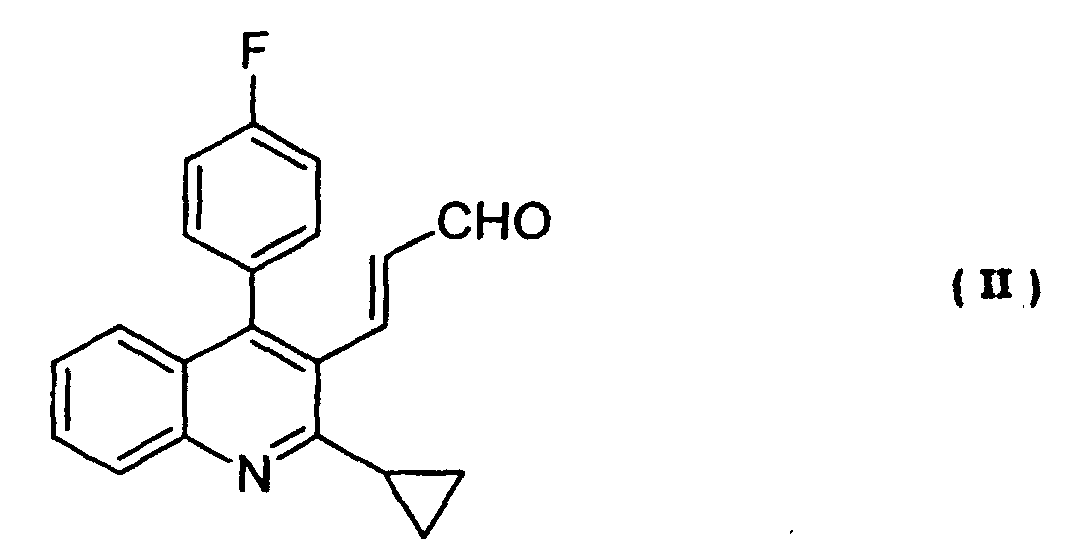
- The optically active binaphthol-titanium complex used in the production process according to the present invention can be easily prepared by for example reacting (S)-(-)- or (R)-(+)-1,1'-bi-2-naphthol with titanium tetraisopropoxide in an organic solvent such as toluene, benzene, methylene chloride or diethyl ether according to the method of Ji-Tao Wang et al. (Synthesis, 291-292 (1989)). The compounds prepared as above can be used in the next step without isolation.
- The titanium tetraisoproxide used for preparing the optically active binaphthol-titanium complex is used in an amount of 0.5 to 2.3 mol, preferably 0.85 to 1.15 mol based on 1 mol of optically active 1,1'-bi-2-naphthol.
- The optically active binaphthol-titanium complex for producing compound (III) is used in an amount of 0.001 to 1 mol, preferably 0.02 to 0.06 mol based on 1 mol of compound (II).
- In compound (I) used in the production process according to the present invention, R in formula (I) is an alkyl having 1 to 4 carbon atoms, and preferably compounds of formula (I) wherein R is methyl or ethyl can be used.
- Compound (I) can be produced based on the process of Tsuji et al. (Chem. Letter., 649 (1978)) according to a process comprising reacting an acetoacetic acid alkyl ester with trimethylsilyl chloride to produce 3-(trimethylsilyloxy) but-2-enoic acid alkyl ester, and reacting the ester at first with lithium isopropylamide and then with trimethylsilyl chloride.
- Compound (I) in the production of compound (III) is used in an amount of 1 to 5 mol, preferably 1 to 3 mol based on 1 mol of compound (II).
- The metal salt added in the production of compound (III) includes lithium salts such as lithium chloride, lithium bromide, lithium acetate, lithium hydroxide, lithium borate or lithium phosphate, and salts of metal other than lithium, such as sodium chloride, potassium chloride, magnesium chloride, aluminum chloride or copper chloride. Although the metal salt is selected depending on the amount and kind of amines used, the concentration of optically active binaphthol-titanium complex or the concentration of compound (II), lithium salts among these salts afford preferable results, and lithium chloride is more preferable among the lithium salts.
- The amount used of the metal salt depends on the amount of optically active binaphthol-titanium complex and amine which are added together, or the concentration of reaction solution, but in a case where lithium chloride is used, it is used in an amount of 0.03 to 1.0 mol, preferably 0.1 to 0.4 mol based on 1 mol of compound (II).
- The amine added in the production of compound (III) includes N,N,N',N'-tetramethylethylenediamine, diisopropylethylamine, pyridine, 4-dimethylaminopyridine, triethylamine, morpholine and the like. N,N,N',N'-tetramethylethylenediamine, diisopropylethylamine, pyridine and 4-dimethylaminopyridine afford preferable results, and among them N,N,N',N'-tetramethylethylenediamine is more preferable.
- The amount used of the amine depends on the kind of amine used, the amount of optically active binaphthol-titanium complex and the metal salt which are added together, or the concentration of reaction solution, but in a case where N,N,N',N'-tetramethylethylenediamine is used, it is used in an amount of 0.03 to 2.0 mol, preferably 0.1 to 1.2 mol from a viewpoint of effect on the post-treatment of the reaction based on 1 mol of compound (II).
- If the amine does not take part in the reaction, it can be added in the step for producing compound (I).
- When lithium chloride and N,N,N',N'-tetramethylethylenediamine are used for producing compound (III) according to the present invention, the amount used of them depends on the amount of optically active binaphthol-titanium complex added together or the concentration of the reaction solution, but is 0.03 to 1.0 mol of lithium chloride and 0.03 to 2.0 mol of N,N,N',N'-tetramethylethylenediamine, preferably 0.1 to 0.4 mol of lithium chloride and 0.1 to 1.2 mol of N,N,N',N'-tetramethylethylenediamine based on 1 mol of compound (II).
- The process of the present invention can be carried out by reacting compound (I) with compound (II) under a flow of an inert gas such as nitrogen gas, helium gas or argon gas, in the presence of an optically active binaphthol-titanium complex, a metal salt and an amine, in organic solvents.
- The organic solvent used is not specifically limited unless it takes part in the reaction, and generally ether solvents such as tetrahydrofuran, diethyl ether or diisopropyl ether can be used, and tetrahydrofuran is preferable. The amount used of the organic solvent is not specifically limited, and is generally 1 to 100 times (mass ratio), preferably 5 to 30 times (mass ratio) based on compound (II).
- The reaction temperature depends on the kind and amount of the organic solvent used, and is generally -20 to 55°C, preferably 0 to 45°C.
- The reaction time depends on the concentration of compound (II) used, the kind and amount of optically active binaphthol-titanium complex and solvent used, the reaction temperature and the like, and is generally 2 to 12 hours, preferably 2 to 6 hours.
- Upon completion of the reaction, the reaction is ceased by adding water or various aqueous solutions to the reaction mixture and stirring. In general, water, aqueous solution of sodium bicarbonate, saline solution, aqueous solution of sodium carbonate, aqueous ammonia, aqueous solution of tartrate or the like can be used, and aqueous solution of sodium bicarbonate or saline solution is preferable. The concentration thereof is not specifically limited, but aqueous solution of sodium bicarbonate is preferably used in a concentration of 3.5% to saturation, and saline solution is preferably used in a concentration of 10% to saturation. The amount used of the aqueous solution depends on the concentration and kind thereof, but in a case where a saturated aqueous solution of sodium bicarbonate is used, it is generally used in amount of 0.1 to 10 times (volume ratio), preferably 0.1 to 5 times (volume ratio) based on the reaction mixture.
- The method for extracting the reaction product from the reaction mixture depends on the kind of the reaction solvent. In a case where tetrahydrofuran is used as solvent for reaction, the reaction product is extracted with an organic solvent after evaporating tetrahydrofuran under a reduced pressure. The organic solvent is not specifically limited unless it is freely miscible with water, and ethyl acetate, diethyl ether, toluene and the like can be used, and ethyl acetate is preferable. The amount used of the organic solvent is not specifically limited, and is generally 0.1 to 10 times (volume ratio), preferably 0.5 to 2 times (volume ratio) based on the reaction mixture.
- For the removal of silyl group from the reaction product and the purification of compound (III) produced by the removal of the silyl group, a salt of compound (III) with an acid is precipitated by adding the acid to the above-mentioned extraction solution and stirring, and the precipitated salt is filtered off. The acid used may be an inorganic acid such as sulfuric acid or hydrochloric acid, and is preferably sulfuric acid. The salt filtered off is neutralized with an aqueous alkaline solution, extracted with an organic solvent and crystallized to obtain a desired compound. The aqueous alkaline solution used for the cleavage of salt includes aqueous solution of alkaline metal carbonate, such as aqueous solution of sodium bicarbonate or aqueous solution of sodium carbonate, aqueous solution of alkaline metal such as aqueous solution of sodium hydroxide, aqueous ammonia and the like, and is preferably aqueous solution of sodium carbonate.
- As compound (III) produced as mentioned above has a high optical purity of 99% ee, it has a quality for making it fully possible to use as such as an intermediate for synthesizing (3R, 5S, 6E)-7-[2-cyclopropyl-4-(4-fluorophenyl) quinolin-3-yl]-3,5-dihydroxyhept-6-enoic acid salt useful for prevention and treatment of hyperlipidemia, arteriosclerosis or the like.
- Hereinafter, the present invention will be illustrated based on examples to which the present invention is not limited.
- In the meanwhile, the optical purity (% ee) of each optical isomer was measured with high performance liquid chromatography (HPLC) under the following conditions:
- Column: CHIRALPAK AD (manufactured by Daicel Chemical Industries, Ltd.)
- Mobile phase: hexane : ethanol = 95 : 5
- Flow rate: 1.0 mL/min.
- Detection wavelength: 254 nm
-
- In addition, the progress level of the reaction in examples was measured with high performance liquid chromatography (HPLC) under the following conditions:
- Column: L-Column-ODS (manufactured by Japan Chemicals Evaluation and Research Institute)
- Mobile phase: gradient condition (analysis is started from 0.01 M ammonium acetate
- buffer (pH 5.3) : acetonitrile = 60 : 40, and 40 minutes later the ratio is 10 : 90)
- Flow rate: 1.0 mL/min.
- Detection wavelength: 254 nm
-
- 182.21 g (1.4 mol) of ethyl acetoacetate and 169.98 g (1.4 mol) of triethylamine were dissolved in a mixed solvent of 182 mL of tetrahydrofuran and 1.64 L of hexane under nitrogen atmosphere. To this solution, 167.3 g (1.54 mol) of trimethylsilyl chloride was added dropwise at a temperature of 21 to 45°C, and then the solution was stirred at 25°C for 3 hours. The reaction mixture was cooled to 10°C, the reaction was ceased by adding 547 mL of water thereto and an organic layer was separated. The organic layer was washed two times with 273 mL of water, dried over 54.7 g of anhydrous magnesium sulfate, and then filtered. The solvent was evaporated to obtain 301.3 g (crude yield 106.4%) of 3-(trimethylsilyloxy) but-2-enoic acid ethyl ester.
- Under nitrogen atmosphere, 28.13 g (0.28 mol) of diisopropylamine was dissolved in 240 mL of tetrahydrofuran, and the resulting solution was cooled to -20°C. To the solution, 100.3 mL (0.27 mol) of n-butyl lithium/n-hexane solution with a concentration of 2.66 mol/L was added dropwise, and stirred at -30 to -20°C for 30 minutes. The reaction mixture was cooled to -80°C, and 45.0 g (0.22 mol) of 3-(trimethylsilyloxy) but-2-enoic acid ethyl ester was added dropwise to the solution at -80 to -93°C, stirred at -90°C for 1 hour, and then 31.4 g (0.29 mol) of trimethylsilyl chloride was added dropwise thereto at -100°C and stirred for 3 hours. The solvent was evaporated at a room temperature under a reduced pressure, the residue was dissolved in 585 mL of n-hexane. The solution was stirred at a temperature of 0 to 5°C for 1 hour, allowed to stand for 14 hours and the precipitated insoluble material was filtered off. The filtrate was concentrated under a reduced pressure to obtain 59.85 g of 1,3-bis(trimethylsilyloxy)-1-ethoxybuta-1,3-diene as concentrated residue.
- Under nitrogen atmosphere, 25.0 (0.079 mol) of (E)-3-[2-cyclopropyl-4-(4-fluorophenyl)-quinolin-3-yl]-prop-2-en-1-al was dissolved in 305.0 g of tetrahydrofuran. To the solution, 6.35 g (0.0016 mol) of a mixed solution prepared by dissolving (S)-(-)-1,1'-bi-2-naphthol and titanium tetraisopropoxide to toluene was added at first, and then 1.10 g (0.026 mol) of lithium chloride and 6.14 g (0.053 mol) of N,N,N',N'-tetramethylethylenediamine were added, and 51.34 g of 1,3-bis(trimethylsilyloxy)-1-ethoxybuta-1,3-diene as concentrated residue obtained according to Reference Example 1 was added dropwise to the solution, and then stirred at a temperature of 27 to 30°C for 4 hours.
- The reaction was ceased by adding an aqueous solution comprising 32.5 mL of ion exchange water and 32.5 mL of saturated aqueous solution of sodium bicarbonate, tetrahydrofuran was evaporated under a reduced pressure, and an organic layer was extracted with 675 mL of ethyl acetate. The extracted solution was washed with 125 mL of ion exchange water and 125 mL of saturated aqueous solution of sodium bicarbonate, dried over 20 g of anhydrous magnesium sulfate and filtered.
- The filtrate was cooled to 0°C, 23.9 g (0.118 mol) of 50% by weight sulfuric acid aqueous solution was added dropwise and stirred at a temperature of 0 to 5°C for 2 hours. The resulting sulfate was filtered off, and washed two times with 25 mL of ethyl acetate.
- The obtained sulfate in wet state was dispersed into a two-layer solvent comprising 250 mL of ethyl acetate and 100 mL of ion exchange water, 150 mL of 10% by weight sodium carbonate aqueous solution was added, and stirred at a temperature of 26 to 28°C for 30 minutes. An organic layer was separated off, and 200 mL of ethyl acetate was added to an aqueous layer and then re-extracted. The extract together with the organic layer was washed with 125 mL of saturated saline solution, dried over 20 g of anhydrous sodium sulfonate and then filtered.
- The filtrate was concentrated under a reduced pressure to about 70 g in a total mass, then 125 g of ethylcyclohexane was added and 60 g of the solvent was evaporated. The solution was cooled to 0 to 5°C and further 250 g of ethylcyclohexane was added, and stirred for 2 hours. The precipitated crystal was filtered off, and dried under a reduced pressure to obtain 30.06 g of (5S,6E)-7-[2-cyclopropyl-4-(4-fluorophenyl)-quinolin-3-yl]-5-hydroxy-3-oxohept-6-enoic acid ethyl ester.
Optical purity: 99% ee
yield based on (E)-3-[2-cyclopropyl-4-(4-fluorophenyl)-quinolin-3-yl]-prop-2-en-1-al: 85.2%
Melting point: 90.5-92.0°C
1H-NMR (CDCl3, 400 MHz, ppm) δ:1.0-1.1 (m, 2H), 1.28 (t, J=7.3 Hz, 3H), 1.3-1.4 (m, 2H), 2.3-2.4 (s, 1H), 2.53 (s, 1 H), 2.53 (d, J=3.0 Hz, 1H). 2.6-2.8 (m, 1H), 3.43 (s, 2H), 4.21 (q, J=7.3 Hz, 2H), 4.5-4.7 (m, 1 H), 5.58 (dd, J=5.9 Hz, 16.1 Hz, 1H), 6.67 (dd, J=1.5 Hz, 16.1 Hz, 1H), 7.1-7.3 (m, 4H), 7.2-7.4 (m, 2H), 7.5-7.7 (m, 1 H), 7.95 (d, J=8.3 Hz, 1H). - The following experiments were carried out in order to investigate an effect of the addition of lithium chloride and N,N,N',N'-tetramethylethylenediamine on reaction rate and optical purity.
- Under nitrogen atmosphere, 1.0 g (3.15 mol) of (E)-3-[2-cyclopropyl-4-(4-fluorophenyl)-quinolin-3-yl]-prop-2-en-1-al was dissolved in 12 mL of tetrahydrofuran. To the solution, 42.57 mg (0.0945 mmol) of optically active binaphthol-titanium complex powder prepared by reacting (S)-(-)-1,1'-bi-2-naphthol with titanium tetraisopropoxide in dichloromethane and then evaporating the solvent was added at first, and then 40.1 mg (0.945 mmol) of lithium chloride and 292.9 mg (2.52 mmol) of N,N,N',N'-tetramethylethylenediamine were added, and 1.73 g (6.3 mmol) of 1,3-bis(trimethylsilyloxy)-1-alkoxybuta-1,3-diene as concentrated residue obtained according to Reference Example 1 was added dropwise to the solution, and stirred at a temperature of 27 to 30°C.
- The end point of the reaction was confirmed on 5 hours after the reaction was started in HPLC analysis with L-Column-ODS, and the optical purity based on CHIRALPAK AD was 99.9% ee or more.
- Under nitrogen atmosphere, 1.0 g (3.15 mol) of (E)-3-[2-cyclopropyl-4-(4-fluorophenyl)-quinolin-3-yl]-prop-2-en-1-al was dissolved in 12 mL of tetrahydrofuran. To the solution, 42.57 mg (0.0945 mmol) of optically active binaphthol-titanium complex powder prepared by reacting (S)-(-)-1,1'-bi-2-naphthol with titanium tetraisopropoxide in dichloromethane and then evaporating the solvent was added at first, and then 1.73 g (6.3 mmol) of 1,3-bis(trimethylsilyloxy)-1-alkoxybuta-1,3-diene as concentrated residue obtained according to Reference Example 1 was added dropwise to the solution, and stirred at a temperature of 27 to 30°C.
- The reaction took 31 hours until the end point thereof was confirmed in HPLC analysis with L-Column-ODS, and the optical purity based on CHIRALPAK AD was 7.2% ee.
- Under nitrogen atmosphere, 1.0 g (3.15 mol) of (E)-3-[2-cyclopropyl-4-(4-fluorophenyl)-quinolin-3-yl]-prop-2-en-1-al was dissolved in 12 mL of tetrahydrofuran. To the solution, 42.57 mg (0.0945 mmol) of optically active binaphthol-titanium complex powder prepared by reacting (S)-(-)-1,1'-bi-2-naphthol with titanium tetraisopropoxide in dichloromethane and then evaporating the solvent was added at first, and then 40.2 mg (0.945 mmol) of lithium chloride was added, and 1.73 g (6.3 mmol) of 1,3-bis(trimethylsilyloxy)-1-alkoxybuta-1,3-diene as concentrated residue obtained according to Reference Example 1 was added dropwise to the solution, and stirred at a temperature of 27 to 30°C.
- The reaction took 70 hours until the end point thereof was confirmed in HPLC analysis with L-Column-ODS, and the optical purity based on CHIRALPAK AD was 92.7% ee or more.
- Under nitrogen atmosphere, 1.0 g (3.15 mol) of (E)-3-[2-cyclopropyl-4-(4-fluorophenyl)-quinolin-3-yl)-prop-2-en-1-al was dissolved in 12 mL of tetrahydrofuran. To the solution, 42.57 mg (0.0945 mmol) of optically active binaphthol-titanium complex powder prepared by reacting (S)-(-)-1,1'-bi-2-naphthol with titanium tetraisopropoxide in dichloromethane and then evaporating the solvent was added at first, and then 292.92 mg (2.52 mmol) of N,N,N',N'-tetramethylethylenediamine were added, and 1.73 g (6.3 mmol) of 1,3-bis(trimethylsilyloxy)-1-alkoxybuta-1,3-diene as concentrated residue obtained according to Reference Example 1 was added dropwise to the solution, and stirred at a temperature of 27 to 30°C.
- The end point of the reaction could not be confirmed by 94 hours after the reaction was started in HPLC analysis with L-Column-ODS, and the optical purity based on CHIRALPK AD was 94.3% ee or more.
- According to the present invention, optically active (E)-7-[2-cyclopropyl-4-(4-fluorophenyl) quinolin-3-yl]-5-hydroxy-3-oxohept-6-enoic acid esters which have high optical purity of 99% ee or more can be obtained in a high yield of 90% or more, and therefore can be sufficiently used as an intermediate for synthesizing (3R, 5S, 6E)-7-[2-cyclopropyl-4-(4-fluorophenyl) quinolin-3-yl]-3,5-dihydroxyhept-6-enoic acid salt useful for prevention and treatment of hyperlipidemia, arteriosclerosis or the like. Consequently, the optically active (E)-7-[2-cyclopropyl-4-(4-fluorophenyl) quinolin-3-yl]-5-hydroxy-3-oxohept-6-enoic acid esters obtained according to the present invention are industrially useful.
Claims (4)
- A process for producing an optically active (E)-7-[2-cyclopropyl-4-(4-fluorophenyl) quinolin-3-yl]-5-hydroxy-3-oxohept-6-enoic acid ester of formula (III)wherein R is an alkyl having 1 to 4 carbon atoms, which comprises reacting 1,3-bis(trimethylsilyloxy)-1-alkoxybuta-1,3-diene of formula (I)
 wherein R is as defined above, with (E)-3-[2-cyclopropyl-4-(4-fluorophenyl)-quinolin-3-yl]-prop-2-en-1-al of formula (II)
 in the presence of an optically active binaphthol-titanium complex prepared by reacting 1,1'-bi-2-naphthol with titanium tetraisopropoxide, a metal salt and an amine, and then subjecting the resulting reaction product to desilylation.
- A process according to claim 1, wherein the metal salt is lithium chloride, lithium bromide, lithium acetate, lithium hydroxide, lithium borate, lithium phosphate, sodium chloride, potassium chloride, magnesium chloride, aluminum chloride or copper chloride.
- A process according to claim 1, wherein the amine is N,N,N',N'-tetramethylethylenediamine, diisopropylethylamine, pyridine, 4-dimethylaminopyridine, triethylamine or morpholine.
- A process according to claim 1, wherein the metal salt is lithium chloride and the amine is N,N,N',N'-tetramethylethylenediamine.
Priority Applications (1)
| Application Number | Priority Date | Filing Date | Title |
|---|---|---|---|
| CY20111100748T CY1112350T1 (en) | 2001-11-14 | 2011-08-04 | MANUFACTURING PROCEDURE OF AN OPTIVE ACTIVE OXOEPOENIC ACID OPTICS |
Applications Claiming Priority (3)
| Application Number | Priority Date | Filing Date | Title |
|---|---|---|---|
| JP2001348569 | 2001-11-14 | ||
| JP2001348569 | 2001-11-14 | ||
| PCT/JP2002/011870 WO2003042180A1 (en) | 2001-11-14 | 2002-11-14 | Process for producing optically active oxoheptenoic acid ester |
Publications (3)
| Publication Number | Publication Date |
|---|---|
| EP1466905A1 true EP1466905A1 (en) | 2004-10-13 |
| EP1466905A4 EP1466905A4 (en) | 2006-04-12 |
| EP1466905B1 EP1466905B1 (en) | 2011-05-18 |
Family
ID=19161371
Family Applications (1)
| Application Number | Title | Priority Date | Filing Date |
|---|---|---|---|
| EP02780087A Expired - Lifetime EP1466905B1 (en) | 2001-11-14 | 2002-11-14 | Process for producing optically active oxoheptenoic acid ester |
Country Status (14)
| Country | Link |
|---|---|
| US (1) | US7064209B2 (en) |
| EP (1) | EP1466905B1 (en) |
| JP (1) | JP4433156B2 (en) |
| KR (1) | KR100919941B1 (en) |
| CN (1) | CN1288136C (en) |
| AT (1) | ATE509914T1 (en) |
| CA (1) | CA2485580C (en) |
| CY (1) | CY1112350T1 (en) |
| DK (1) | DK1466905T3 (en) |
| ES (1) | ES2364632T3 (en) |
| PT (1) | PT1466905E (en) |
| TW (1) | TWI243165B (en) |
| WO (1) | WO2003042180A1 (en) |
| ZA (1) | ZA200403722B (en) |
Cited By (3)
| Publication number | Priority date | Publication date | Assignee | Title |
|---|---|---|---|---|
| EP1904456A1 (en) | 2005-07-08 | 2008-04-02 | AstraZeneca UK Limited | Processes for the manufacture of rosuvastatin and intermediates |
| WO2008065410A1 (en) * | 2006-12-01 | 2008-06-05 | Astrazeneca Uk Limited | Process for the preparation of rosuvastatin |
| WO2011155689A3 (en) * | 2010-06-08 | 2012-02-02 | 에이치 엘 지노믹스(주) | Method for preparing an intermediate of pitavastatin or of the salt thereof |
Families Citing this family (10)
| Publication number | Priority date | Publication date | Assignee | Title |
|---|---|---|---|---|
| US6835838B2 (en) * | 2002-01-28 | 2004-12-28 | Novartis Ag | Process for the manufacture of organic compounds |
| PL370658A1 (en) * | 2002-01-31 | 2005-05-30 | Novartis Ag | Process for the manufacture of hmg-coa reductase inhibitors |
| US8912333B2 (en) * | 2010-11-12 | 2014-12-16 | Hetero Research Foundation | Polymorphs of pitavastatin calcium |
| US9701642B2 (en) | 2013-08-30 | 2017-07-11 | Nissan Chemical Industries, Ltd. | Method for producing optically active 5-hydroxy-3-ketoester |
| JP2016188175A (en) * | 2013-08-30 | 2016-11-04 | 日産化学工業株式会社 | Method for producing optically active 5-hydroxy-3-ketoester compound |
| JP7331058B2 (en) * | 2017-02-20 | 2023-08-22 | 株式会社トプコン | Measuring device, measuring method and measuring device control program |
| JP6953142B2 (en) * | 2017-02-20 | 2021-10-27 | 株式会社トプコン | Measuring device, measuring method and control program of measuring device |
| DE102018215091A1 (en) | 2018-09-05 | 2020-03-05 | Robert Bosch Gmbh | Projection device |
| SG10201911412TA (en) * | 2019-11-29 | 2021-06-29 | Nat Univ Singapore | Wearable Sweat Sensor |
| CN116514656A (en) * | 2023-04-26 | 2023-08-01 | 江苏阿尔法药业股份有限公司 | Synthesis process of sitagliptin intermediate |
Family Cites Families (2)
| Publication number | Priority date | Publication date | Assignee | Title |
|---|---|---|---|---|
| JP3554036B2 (en) * | 1994-09-06 | 2004-08-11 | 宇部興産株式会社 | Method for producing optically active 7-substituted quinolyl-3,5-dihydroxy-hept-6-enoic acid ester derivatives |
| US6835838B2 (en) * | 2002-01-28 | 2004-12-28 | Novartis Ag | Process for the manufacture of organic compounds |
-
2002
- 2002-11-14 PT PT02780087T patent/PT1466905E/en unknown
- 2002-11-14 AT AT02780087T patent/ATE509914T1/en active
- 2002-11-14 CA CA002485580A patent/CA2485580C/en not_active Expired - Lifetime
- 2002-11-14 CN CNB028227344A patent/CN1288136C/en not_active Expired - Lifetime
- 2002-11-14 DK DK02780087.9T patent/DK1466905T3/en active
- 2002-11-14 US US10/495,268 patent/US7064209B2/en not_active Expired - Lifetime
- 2002-11-14 EP EP02780087A patent/EP1466905B1/en not_active Expired - Lifetime
- 2002-11-14 KR KR1020047007262A patent/KR100919941B1/en not_active Expired - Lifetime
- 2002-11-14 WO PCT/JP2002/011870 patent/WO2003042180A1/en not_active Ceased
- 2002-11-14 ES ES02780087T patent/ES2364632T3/en not_active Expired - Lifetime
- 2002-11-14 JP JP2003544016A patent/JP4433156B2/en not_active Expired - Lifetime
- 2002-11-14 TW TW091133400A patent/TWI243165B/en not_active IP Right Cessation
-
2004
- 2004-05-14 ZA ZA200403722A patent/ZA200403722B/en unknown
-
2011
- 2011-08-04 CY CY20111100748T patent/CY1112350T1/en unknown
Non-Patent Citations (3)
| Title |
|---|
| DATABASE CAPLUS [Online] CHEMICAL ABSTRACTS SERVICE, COLUMBUS, OHIO, US; 1996, Database accession no. 1996:409680 * |
| No further relevant documents disclosed * |
| See also references of WO03042180A1 * |
Cited By (3)
| Publication number | Priority date | Publication date | Assignee | Title |
|---|---|---|---|---|
| EP1904456A1 (en) | 2005-07-08 | 2008-04-02 | AstraZeneca UK Limited | Processes for the manufacture of rosuvastatin and intermediates |
| WO2008065410A1 (en) * | 2006-12-01 | 2008-06-05 | Astrazeneca Uk Limited | Process for the preparation of rosuvastatin |
| WO2011155689A3 (en) * | 2010-06-08 | 2012-02-02 | 에이치 엘 지노믹스(주) | Method for preparing an intermediate of pitavastatin or of the salt thereof |
Also Published As
| Publication number | Publication date |
|---|---|
| ES2364632T3 (en) | 2011-09-08 |
| CA2485580A1 (en) | 2003-05-22 |
| WO2003042180A9 (en) | 2003-07-31 |
| JP4433156B2 (en) | 2010-03-17 |
| KR20050044442A (en) | 2005-05-12 |
| PT1466905E (en) | 2011-07-14 |
| TW200300085A (en) | 2003-05-16 |
| US20050054853A1 (en) | 2005-03-10 |
| CY1112350T1 (en) | 2015-12-09 |
| WO2003042180A1 (en) | 2003-05-22 |
| US7064209B2 (en) | 2006-06-20 |
| CN1589263A (en) | 2005-03-02 |
| EP1466905B1 (en) | 2011-05-18 |
| ATE509914T1 (en) | 2011-06-15 |
| KR100919941B1 (en) | 2009-10-05 |
| EP1466905A4 (en) | 2006-04-12 |
| CA2485580C (en) | 2009-11-03 |
| TWI243165B (en) | 2005-11-11 |
| JPWO2003042180A1 (en) | 2005-03-10 |
| CN1288136C (en) | 2006-12-06 |
| ZA200403722B (en) | 2005-05-16 |
| DK1466905T3 (en) | 2011-08-22 |
Similar Documents
| Publication | Publication Date | Title |
|---|---|---|
| EP0520406B1 (en) | Diastereomer salt of optically active quinolinemevalonic acid | |
| EP1466905B1 (en) | Process for producing optically active oxoheptenoic acid ester | |
| CA2472776C (en) | Process for the manufacture of hmg-coa reductase inhibitors | |
| US20100179319A1 (en) | Process for production of optically active mirtazapine | |
| JP2005516064A (en) | Method for producing organic compound | |
| AU2003226971A1 (en) | Process for the manufacture of HMG-CoA reductase inhibitors | |
| JPWO2003042180A6 (en) | Process for producing optically active oxoheptenoic acid ester | |
| JP2003506425A (en) | Method for producing nitroxyalkyl ester of naproxen | |
| WO2021254896A1 (en) | Process for preparing (4s)-4-(4-cyano-2-methoxyphenyl)-5-ethoxy-2,8-dimethyl-1,4-dihydro-1,6-naphthyridine-3-carboxamide enabled by a catalytic asymmetric hantzsch ester reduction | |
| JP5485138B2 (en) | Method for purifying ethynylthymidine compounds | |
| US20100217004A1 (en) | Process for the production of tertiary alcohols | |
| JP2003335756A (en) | Method for producing aromatic aldehyde and chiral diol | |
| WO2002092570A1 (en) | Process for producing (3r,5s)-7-substituted-3,5-dihydroxyhept-6-enoic acid | |
| US5856497A (en) | Asymmetric synthesis of α-cycloalkylalkyl substituted methanamines | |
| JP3481325B2 (en) | Method for producing optically active 3-oxy-5-oxo-6-heptenoic acid derivative | |
| JPH0892217A (en) | Process for producing optically active 7-substituted quinolyl-3,5-dihydroxy-hept-6-enoic acid ester derivative | |
| EP1375485B1 (en) | Method for preparing 7-quinolinyl-3,5-dihydroxyhept-6-enoate | |
| JP3006748B2 (en) | Process for producing optically active 7-substituted pyridyl-3,5-dihydroxy-hept-6-enoic acid ester derivatives | |
| EP2174940A1 (en) | Process for production of optically active mirtazapine | |
| JP3965704B2 (en) | Process for producing optically active 5-hydroxy-3-oxo-6-heptynoic acid ester derivative | |
| JP4686466B2 (en) | Method for producing cyclic N-substituted α-iminocarboxylic acid | |
| JP2003055357A (en) | Method for producing 3,4-epoxybutanoic acid ester | |
| EP2014650A1 (en) | Process and intermediate for the production of an intermediate in the production of montelukast | |
| JP2004244362A (en) | Method for producing 1,2-disubstituted-1,4-dihydro-oxoquinoline derivative | |
| JP2003137870A (en) | Process for producing 3,5-dioxo-6-heptenoic acid derivatives and intermediates thereof |
Legal Events
| Date | Code | Title | Description |
|---|---|---|---|
| PUAI | Public reference made under article 153(3) epc to a published international application that has entered the european phase |
Free format text: ORIGINAL CODE: 0009012 |
|
| 17P | Request for examination filed |
Effective date: 20040607 |
|
| AK | Designated contracting states |
Kind code of ref document: A1 Designated state(s): AT BE BG CH CY CZ DE DK EE ES FI FR GB GR IE IT LI LU MC NL PT SE SK TR |
|
| AX | Request for extension of the european patent |
Extension state: AL LT LV MK RO SI |
|
| A4 | Supplementary search report drawn up and despatched |
Effective date: 20060224 |
|
| RAP1 | Party data changed (applicant data changed or rights of an application transferred) |
Owner name: NISSAN CHEMICAL INDUSTRIES, LTD. |
|
| GRAP | Despatch of communication of intention to grant a patent |
Free format text: ORIGINAL CODE: EPIDOSNIGR1 |
|
| GRAS | Grant fee paid |
Free format text: ORIGINAL CODE: EPIDOSNIGR3 |
|
| GRAA | (expected) grant |
Free format text: ORIGINAL CODE: 0009210 |
|
| AK | Designated contracting states |
Kind code of ref document: B1 Designated state(s): AT BE BG CH CY CZ DE DK EE ES FI FR GB GR IE IT LI LU MC NL PT SE SK TR |
|
| REG | Reference to a national code |
Ref country code: GB Ref legal event code: FG4D |
|
| REG | Reference to a national code |
Ref country code: CH Ref legal event code: EP |
|
| REG | Reference to a national code |
Ref country code: IE Ref legal event code: FG4D |
|
| REG | Reference to a national code |
Ref country code: DE Ref legal event code: R096 Ref document number: 60240100 Country of ref document: DE Effective date: 20110630 |
|
| REG | Reference to a national code |
Ref country code: PT Ref legal event code: SC4A Free format text: AVAILABILITY OF NATIONAL TRANSLATION Effective date: 20110707 |
|
| REG | Reference to a national code |
Ref country code: CH Ref legal event code: NV Representative=s name: NOVAGRAAF INTERNATIONAL SA |
|
| REG | Reference to a national code |
Ref country code: NL Ref legal event code: T3 |
|
| REG | Reference to a national code |
Ref country code: DK Ref legal event code: T3 |
|
| REG | Reference to a national code |
Ref country code: SE Ref legal event code: TRGR |
|
| REG | Reference to a national code |
Ref country code: ES Ref legal event code: FG2A Ref document number: 2364632 Country of ref document: ES Kind code of ref document: T3 Effective date: 20110908 |
|
| REG | Reference to a national code |
Ref country code: GR Ref legal event code: EP Ref document number: 20110401928 Country of ref document: GR Effective date: 20110916 |
|
| REG | Reference to a national code |
Ref country code: SK Ref legal event code: T3 Ref document number: E 9843 Country of ref document: SK |
|
| PLBE | No opposition filed within time limit |
Free format text: ORIGINAL CODE: 0009261 |
|
| STAA | Information on the status of an ep patent application or granted ep patent |
Free format text: STATUS: NO OPPOSITION FILED WITHIN TIME LIMIT |
|
| 26N | No opposition filed |
Effective date: 20120221 |
|
| REG | Reference to a national code |
Ref country code: DE Ref legal event code: R097 Ref document number: 60240100 Country of ref document: DE Effective date: 20120221 |
|
| REG | Reference to a national code |
Ref country code: FR Ref legal event code: PLFP Year of fee payment: 14 |
|
| REG | Reference to a national code |
Ref country code: FR Ref legal event code: PLFP Year of fee payment: 15 |
|
| REG | Reference to a national code |
Ref country code: FR Ref legal event code: PLFP Year of fee payment: 16 |
|
| REG | Reference to a national code |
Ref country code: FR Ref legal event code: PLFP Year of fee payment: 17 |
|
| PGFP | Annual fee paid to national office [announced via postgrant information from national office to epo] |
Ref country code: GB Payment date: 20210930 Year of fee payment: 20 |
|
| PGFP | Annual fee paid to national office [announced via postgrant information from national office to epo] |
Ref country code: NL Payment date: 20211014 Year of fee payment: 20 |
|
| PGFP | Annual fee paid to national office [announced via postgrant information from national office to epo] |
Ref country code: IE Payment date: 20211012 Year of fee payment: 20 Ref country code: MC Payment date: 20211026 Year of fee payment: 20 Ref country code: LU Payment date: 20211025 Year of fee payment: 20 Ref country code: DK Payment date: 20211109 Year of fee payment: 20 Ref country code: ES Payment date: 20211202 Year of fee payment: 20 Ref country code: FI Payment date: 20211109 Year of fee payment: 20 Ref country code: EE Payment date: 20211026 Year of fee payment: 20 Ref country code: SE Payment date: 20211012 Year of fee payment: 20 Ref country code: PT Payment date: 20211110 Year of fee payment: 20 Ref country code: SK Payment date: 20211013 Year of fee payment: 20 Ref country code: TR Payment date: 20211110 Year of fee payment: 20 Ref country code: AT Payment date: 20211025 Year of fee payment: 20 Ref country code: BG Payment date: 20211012 Year of fee payment: 20 Ref country code: CZ Payment date: 20211027 Year of fee payment: 20 Ref country code: DE Payment date: 20210929 Year of fee payment: 20 |
|
| PGFP | Annual fee paid to national office [announced via postgrant information from national office to epo] |
Ref country code: IT Payment date: 20211012 Year of fee payment: 20 Ref country code: GR Payment date: 20211014 Year of fee payment: 20 Ref country code: FR Payment date: 20211018 Year of fee payment: 20 Ref country code: CH Payment date: 20211014 Year of fee payment: 20 Ref country code: BE Payment date: 20211018 Year of fee payment: 20 |
|
| PGFP | Annual fee paid to national office [announced via postgrant information from national office to epo] |
Ref country code: CY Payment date: 20211109 Year of fee payment: 20 |
|
| REG | Reference to a national code |
Ref country code: DE Ref legal event code: R071 Ref document number: 60240100 Country of ref document: DE |
|
| REG | Reference to a national code |
Ref country code: CH Ref legal event code: PL |
|
| REG | Reference to a national code |
Ref country code: NL Ref legal event code: MK Effective date: 20221113 |
|
| REG | Reference to a national code |
Ref country code: DK Ref legal event code: EUP Expiry date: 20221114 |
|
| REG | Reference to a national code |
Ref country code: ES Ref legal event code: FD2A Effective date: 20221125 |
|
| REG | Reference to a national code |
Ref country code: SK Ref legal event code: MK4A Ref document number: E 9843 Country of ref document: SK Expiry date: 20221114 Ref country code: BE Ref legal event code: MK Effective date: 20221114 Ref country code: GB Ref legal event code: PE20 Expiry date: 20221113 |
|
| REG | Reference to a national code |
Ref country code: SE Ref legal event code: EUG |
|
| REG | Reference to a national code |
Ref country code: IE Ref legal event code: MK9A |
|
| REG | Reference to a national code |
Ref country code: AT Ref legal event code: MK07 Ref document number: 509914 Country of ref document: AT Kind code of ref document: T Effective date: 20221114 |
|
| PG25 | Lapsed in a contracting state [announced via postgrant information from national office to epo] |
Ref country code: SK Free format text: LAPSE BECAUSE OF EXPIRATION OF PROTECTION Effective date: 20221114 Ref country code: PT Free format text: LAPSE BECAUSE OF EXPIRATION OF PROTECTION Effective date: 20221123 Ref country code: IE Free format text: LAPSE BECAUSE OF EXPIRATION OF PROTECTION Effective date: 20221114 Ref country code: GB Free format text: LAPSE BECAUSE OF EXPIRATION OF PROTECTION Effective date: 20221113 Ref country code: ES Free format text: LAPSE BECAUSE OF EXPIRATION OF PROTECTION Effective date: 20221115 Ref country code: CZ Free format text: LAPSE BECAUSE OF EXPIRATION OF PROTECTION Effective date: 20221114 |