EP1465765B1 - Selbst-ventilierende abziehbare mikrowellenerhitzbare vakuumverpackung - Google Patents
Selbst-ventilierende abziehbare mikrowellenerhitzbare vakuumverpackung Download PDFInfo
- Publication number
- EP1465765B1 EP1465765B1 EP03702106A EP03702106A EP1465765B1 EP 1465765 B1 EP1465765 B1 EP 1465765B1 EP 03702106 A EP03702106 A EP 03702106A EP 03702106 A EP03702106 A EP 03702106A EP 1465765 B1 EP1465765 B1 EP 1465765B1
- Authority
- EP
- European Patent Office
- Prior art keywords
- web
- package
- food product
- ethylene
- support member
- Prior art date
- Legal status (The legal status is an assumption and is not a legal conclusion. Google has not performed a legal analysis and makes no representation as to the accuracy of the status listed.)
- Expired - Lifetime
Links
- 238000013022 venting Methods 0.000 title description 9
- 235000013305 food Nutrition 0.000 claims abstract description 52
- 229920001577 copolymer Polymers 0.000 claims abstract description 39
- VGGSQFUCUMXWEO-UHFFFAOYSA-N Ethene Chemical compound C=C VGGSQFUCUMXWEO-UHFFFAOYSA-N 0.000 claims abstract description 38
- 239000005977 Ethylene Substances 0.000 claims abstract description 38
- 239000000565 sealant Substances 0.000 claims abstract description 37
- 238000000034 method Methods 0.000 claims abstract description 26
- -1 polypropylene Polymers 0.000 claims abstract description 26
- 239000000203 mixture Substances 0.000 claims abstract description 25
- 239000004743 Polypropylene Substances 0.000 claims abstract description 20
- 229920001155 polypropylene Polymers 0.000 claims abstract description 17
- 239000004711 α-olefin Substances 0.000 claims abstract description 12
- 229920000089 Cyclic olefin copolymer Polymers 0.000 claims abstract description 10
- 238000009460 vacuum skin packaging Methods 0.000 claims description 21
- 230000008569 process Effects 0.000 claims description 14
- 239000004952 Polyamide Substances 0.000 claims description 13
- 229920002647 polyamide Polymers 0.000 claims description 13
- 230000004888 barrier function Effects 0.000 claims description 11
- 239000000463 material Substances 0.000 claims description 10
- 229920000642 polymer Polymers 0.000 claims description 8
- QVGXLLKOCUKJST-UHFFFAOYSA-N atomic oxygen Chemical compound [O] QVGXLLKOCUKJST-UHFFFAOYSA-N 0.000 claims description 7
- 229910052760 oxygen Inorganic materials 0.000 claims description 7
- 239000001301 oxygen Substances 0.000 claims description 7
- 229920000728 polyester Polymers 0.000 claims description 5
- 229920002239 polyacrylonitrile Polymers 0.000 claims description 4
- 239000004793 Polystyrene Substances 0.000 claims description 3
- 229920000139 polyethylene terephthalate Polymers 0.000 claims description 3
- 239000005020 polyethylene terephthalate Substances 0.000 claims description 3
- 229920000306 polymethylpentene Polymers 0.000 claims description 3
- 239000011116 polymethylpentene Substances 0.000 claims description 3
- 229920002223 polystyrene Polymers 0.000 claims description 3
- 230000000063 preceeding effect Effects 0.000 claims 3
- 239000010410 layer Substances 0.000 description 68
- 239000000047 product Substances 0.000 description 28
- 229920005989 resin Polymers 0.000 description 13
- 239000011347 resin Substances 0.000 description 13
- 238000010411 cooking Methods 0.000 description 10
- NAQMVNRVTILPCV-UHFFFAOYSA-N hexane-1,6-diamine Chemical compound NCCCCCCN NAQMVNRVTILPCV-UHFFFAOYSA-N 0.000 description 10
- 238000003475 lamination Methods 0.000 description 10
- 238000001125 extrusion Methods 0.000 description 9
- 238000010438 heat treatment Methods 0.000 description 9
- 239000004594 Masterbatch (MB) Substances 0.000 description 8
- 230000000052 comparative effect Effects 0.000 description 8
- 239000000126 substance Substances 0.000 description 8
- 239000004698 Polyethylene Substances 0.000 description 7
- 239000007789 gas Substances 0.000 description 7
- 229920001519 homopolymer Polymers 0.000 description 7
- 229920001684 low density polyethylene Polymers 0.000 description 7
- 229920000573 polyethylene Polymers 0.000 description 7
- 229920000219 Ethylene vinyl alcohol Polymers 0.000 description 6
- JBKVHLHDHHXQEQ-UHFFFAOYSA-N epsilon-caprolactam Chemical compound O=C1CCCCCN1 JBKVHLHDHHXQEQ-UHFFFAOYSA-N 0.000 description 6
- UFRKOOWSQGXVKV-UHFFFAOYSA-N ethene;ethenol Chemical compound C=C.OC=C UFRKOOWSQGXVKV-UHFFFAOYSA-N 0.000 description 6
- 239000004715 ethylene vinyl alcohol Substances 0.000 description 6
- 238000007765 extrusion coating Methods 0.000 description 6
- 229920000092 linear low density polyethylene Polymers 0.000 description 6
- 239000004707 linear low-density polyethylene Substances 0.000 description 6
- 239000004702 low-density polyethylene Substances 0.000 description 6
- QQONPFPTGQHPMA-UHFFFAOYSA-N Propene Chemical compound CC=C QQONPFPTGQHPMA-UHFFFAOYSA-N 0.000 description 5
- 239000004840 adhesive resin Substances 0.000 description 5
- 229920006223 adhesive resin Polymers 0.000 description 5
- 238000010030 laminating Methods 0.000 description 5
- 239000000853 adhesive Substances 0.000 description 4
- 230000001070 adhesive effect Effects 0.000 description 4
- WNLRTRBMVRJNCN-UHFFFAOYSA-N adipic acid Chemical compound OC(=O)CCCCC(O)=O WNLRTRBMVRJNCN-UHFFFAOYSA-N 0.000 description 4
- CXMXRPHRNRROMY-UHFFFAOYSA-N sebacic acid Chemical compound OC(=O)CCCCCCCCC(O)=O CXMXRPHRNRROMY-UHFFFAOYSA-N 0.000 description 4
- 239000007787 solid Substances 0.000 description 4
- VXNZUUAINFGPBY-UHFFFAOYSA-N 1-Butene Chemical compound CCC=C VXNZUUAINFGPBY-UHFFFAOYSA-N 0.000 description 3
- LIKMAJRDDDTEIG-UHFFFAOYSA-N 1-hexene Chemical compound CCCCC=C LIKMAJRDDDTEIG-UHFFFAOYSA-N 0.000 description 3
- 229920001328 Polyvinylidene chloride Polymers 0.000 description 3
- VYPSYNLAJGMNEJ-UHFFFAOYSA-N Silicium dioxide Chemical compound O=[Si]=O VYPSYNLAJGMNEJ-UHFFFAOYSA-N 0.000 description 3
- XTXRWKRVRITETP-UHFFFAOYSA-N Vinyl acetate Chemical compound CC(=O)OC=C XTXRWKRVRITETP-UHFFFAOYSA-N 0.000 description 3
- 230000001464 adherent effect Effects 0.000 description 3
- 150000008064 anhydrides Chemical class 0.000 description 3
- 239000011248 coating agent Substances 0.000 description 3
- 238000000576 coating method Methods 0.000 description 3
- 239000012141 concentrate Substances 0.000 description 3
- 229920001903 high density polyethylene Polymers 0.000 description 3
- 239000004700 high-density polyethylene Substances 0.000 description 3
- 238000004519 manufacturing process Methods 0.000 description 3
- 229920001179 medium density polyethylene Polymers 0.000 description 3
- 239000005022 packaging material Substances 0.000 description 3
- 238000004806 packaging method and process Methods 0.000 description 3
- 235000021485 packed food Nutrition 0.000 description 3
- 239000005033 polyvinylidene chloride Substances 0.000 description 3
- 239000002356 single layer Substances 0.000 description 3
- 229920001897 terpolymer Polymers 0.000 description 3
- 238000003856 thermoforming Methods 0.000 description 3
- XLYOFNOQVPJJNP-UHFFFAOYSA-N water Chemical compound O XLYOFNOQVPJJNP-UHFFFAOYSA-N 0.000 description 3
- PBLZLIFKVPJDCO-UHFFFAOYSA-N 12-aminododecanoic acid Chemical compound NCCCCCCCCCCCC(O)=O PBLZLIFKVPJDCO-UHFFFAOYSA-N 0.000 description 2
- 229920013665 Ampacet Polymers 0.000 description 2
- JHWNWJKBPDFINM-UHFFFAOYSA-N Laurolactam Chemical compound O=C1CCCCCCCCCCCN1 JHWNWJKBPDFINM-UHFFFAOYSA-N 0.000 description 2
- BAPJBEWLBFYGME-UHFFFAOYSA-N Methyl acrylate Chemical compound COC(=O)C=C BAPJBEWLBFYGME-UHFFFAOYSA-N 0.000 description 2
- 229920002292 Nylon 6 Polymers 0.000 description 2
- 229920000305 Nylon 6,10 Polymers 0.000 description 2
- 229920002302 Nylon 6,6 Polymers 0.000 description 2
- 229920000572 Nylon 6/12 Polymers 0.000 description 2
- SMEGJBVQLJJKKX-HOTMZDKISA-N [(2R,3S,4S,5R,6R)-5-acetyloxy-3,4,6-trihydroxyoxan-2-yl]methyl acetate Chemical compound CC(=O)OC[C@@H]1[C@H]([C@@H]([C@H]([C@@H](O1)O)OC(=O)C)O)O SMEGJBVQLJJKKX-HOTMZDKISA-N 0.000 description 2
- 235000011037 adipic acid Nutrition 0.000 description 2
- 239000001361 adipic acid Substances 0.000 description 2
- 230000005540 biological transmission Effects 0.000 description 2
- 239000000356 contaminant Substances 0.000 description 2
- 238000003851 corona treatment Methods 0.000 description 2
- 230000032798 delamination Effects 0.000 description 2
- POULHZVOKOAJMA-UHFFFAOYSA-N dodecanoic acid Chemical compound CCCCCCCCCCCC(O)=O POULHZVOKOAJMA-UHFFFAOYSA-N 0.000 description 2
- 230000000694 effects Effects 0.000 description 2
- 229920001971 elastomer Polymers 0.000 description 2
- 229920001038 ethylene copolymer Polymers 0.000 description 2
- 238000011156 evaluation Methods 0.000 description 2
- 238000004880 explosion Methods 0.000 description 2
- 235000012054 meals Nutrition 0.000 description 2
- 239000004701 medium-density polyethylene Substances 0.000 description 2
- 238000002844 melting Methods 0.000 description 2
- 230000008018 melting Effects 0.000 description 2
- BDJRBEYXGGNYIS-UHFFFAOYSA-N nonanedioic acid Chemical compound OC(=O)CCCCCCCC(O)=O BDJRBEYXGGNYIS-UHFFFAOYSA-N 0.000 description 2
- 235000015277 pork Nutrition 0.000 description 2
- 125000004805 propylene group Chemical group [H]C([H])([H])C([H])([*:1])C([H])([H])[*:2] 0.000 description 2
- 229920005653 propylene-ethylene copolymer Polymers 0.000 description 2
- 238000003303 reheating Methods 0.000 description 2
- 235000015067 sauces Nutrition 0.000 description 2
- 238000007789 sealing Methods 0.000 description 2
- 238000010025 steaming Methods 0.000 description 2
- 239000000758 substrate Substances 0.000 description 2
- 238000012360 testing method Methods 0.000 description 2
- 238000010257 thawing Methods 0.000 description 2
- 229920001169 thermoplastic Polymers 0.000 description 2
- 239000004416 thermosoftening plastic Substances 0.000 description 2
- 229920001862 ultra low molecular weight polyethylene Polymers 0.000 description 2
- 229920001866 very low density polyethylene Polymers 0.000 description 2
- 230000037303 wrinkles Effects 0.000 description 2
- GUOSQNAUYHMCRU-UHFFFAOYSA-N 11-Aminoundecanoic acid Chemical compound NCCCCCCCCCCC(O)=O GUOSQNAUYHMCRU-UHFFFAOYSA-N 0.000 description 1
- OEPOKWHJYJXUGD-UHFFFAOYSA-N 2-(3-phenylmethoxyphenyl)-1,3-thiazole-4-carbaldehyde Chemical compound O=CC1=CSC(C=2C=C(OCC=3C=CC=CC=3)C=CC=2)=N1 OEPOKWHJYJXUGD-UHFFFAOYSA-N 0.000 description 1
- 239000004953 Aliphatic polyamide Substances 0.000 description 1
- UAUDZVJPLUQNMU-UHFFFAOYSA-N Erucasaeureamid Natural products CCCCCCCCC=CCCCCCCCCCCCC(N)=O UAUDZVJPLUQNMU-UHFFFAOYSA-N 0.000 description 1
- 229920000181 Ethylene propylene rubber Polymers 0.000 description 1
- 239000005909 Kieselgur Substances 0.000 description 1
- 229920010126 Linear Low Density Polyethylene (LLDPE) Polymers 0.000 description 1
- VVQNEPGJFQJSBK-UHFFFAOYSA-N Methyl methacrylate Chemical compound COC(=O)C(C)=C VVQNEPGJFQJSBK-UHFFFAOYSA-N 0.000 description 1
- 229920000571 Nylon 11 Polymers 0.000 description 1
- 229920000299 Nylon 12 Polymers 0.000 description 1
- 241000220010 Rhode Species 0.000 description 1
- 229910000831 Steel Inorganic materials 0.000 description 1
- 239000004708 Very-low-density polyethylene Substances 0.000 description 1
- BZHJMEDXRYGGRV-UHFFFAOYSA-N Vinyl chloride Chemical compound ClC=C BZHJMEDXRYGGRV-UHFFFAOYSA-N 0.000 description 1
- 229920003231 aliphatic polyamide Polymers 0.000 description 1
- 125000005250 alkyl acrylate group Chemical group 0.000 description 1
- 229910052782 aluminium Inorganic materials 0.000 description 1
- XAGFODPZIPBFFR-UHFFFAOYSA-N aluminium Chemical compound [Al] XAGFODPZIPBFFR-UHFFFAOYSA-N 0.000 description 1
- 229920006020 amorphous polyamide Polymers 0.000 description 1
- 125000003118 aryl group Chemical group 0.000 description 1
- 235000021168 barbecue Nutrition 0.000 description 1
- 230000008901 benefit Effects 0.000 description 1
- IAQRGUVFOMOMEM-UHFFFAOYSA-N butene Natural products CC=CC IAQRGUVFOMOMEM-UHFFFAOYSA-N 0.000 description 1
- 235000014121 butter Nutrition 0.000 description 1
- 229910052799 carbon Inorganic materials 0.000 description 1
- 239000006229 carbon black Substances 0.000 description 1
- 235000013351 cheese Nutrition 0.000 description 1
- 239000007795 chemical reaction product Substances 0.000 description 1
- 229920006018 co-polyamide Polymers 0.000 description 1
- 238000004132 cross linking Methods 0.000 description 1
- 230000008021 deposition Effects 0.000 description 1
- 230000001627 detrimental effect Effects 0.000 description 1
- 238000011161 development Methods 0.000 description 1
- KPUWHANPEXNPJT-UHFFFAOYSA-N disiloxane Chemical class [SiH3]O[SiH3] KPUWHANPEXNPJT-UHFFFAOYSA-N 0.000 description 1
- 239000006185 dispersion Substances 0.000 description 1
- 239000000806 elastomer Substances 0.000 description 1
- UAUDZVJPLUQNMU-KTKRTIGZSA-N erucamide Chemical compound CCCCCCCC\C=C/CCCCCCCCCCCC(N)=O UAUDZVJPLUQNMU-KTKRTIGZSA-N 0.000 description 1
- 235000011194 food seasoning agent Nutrition 0.000 description 1
- 238000009472 formulation Methods 0.000 description 1
- 235000011389 fruit/vegetable juice Nutrition 0.000 description 1
- 231100001261 hazardous Toxicity 0.000 description 1
- 229920006017 homo-polyamide Polymers 0.000 description 1
- 239000007788 liquid Substances 0.000 description 1
- 238000011068 loading method Methods 0.000 description 1
- 235000013372 meat Nutrition 0.000 description 1
- 150000002734 metacrylic acid derivatives Chemical class 0.000 description 1
- 229910052751 metal Inorganic materials 0.000 description 1
- 239000002184 metal Substances 0.000 description 1
- 238000002156 mixing Methods 0.000 description 1
- 238000012986 modification Methods 0.000 description 1
- 230000004048 modification Effects 0.000 description 1
- 239000000178 monomer Substances 0.000 description 1
- 210000003205 muscle Anatomy 0.000 description 1
- 235000019198 oils Nutrition 0.000 description 1
- 239000008188 pellet Substances 0.000 description 1
- 239000004014 plasticizer Substances 0.000 description 1
- 229920005629 polypropylene homopolymer Polymers 0.000 description 1
- 229920002635 polyurethane Polymers 0.000 description 1
- 239000004814 polyurethane Substances 0.000 description 1
- 230000002028 premature Effects 0.000 description 1
- 238000002360 preparation method Methods 0.000 description 1
- 238000004321 preservation Methods 0.000 description 1
- 235000020991 processed meat Nutrition 0.000 description 1
- 229920001384 propylene homopolymer Polymers 0.000 description 1
- 230000001681 protective effect Effects 0.000 description 1
- 230000000306 recurrent effect Effects 0.000 description 1
- 235000020989 red meat Nutrition 0.000 description 1
- 230000009467 reduction Effects 0.000 description 1
- 238000007127 saponification reaction Methods 0.000 description 1
- 235000013580 sausages Nutrition 0.000 description 1
- 229920006012 semi-aromatic polyamide Polymers 0.000 description 1
- 239000000377 silicon dioxide Substances 0.000 description 1
- 238000004088 simulation Methods 0.000 description 1
- 239000003381 stabilizer Substances 0.000 description 1
- 238000010561 standard procedure Methods 0.000 description 1
- 239000010959 steel Substances 0.000 description 1
- 238000003860 storage Methods 0.000 description 1
- 238000010998 test method Methods 0.000 description 1
- 239000012815 thermoplastic material Substances 0.000 description 1
- 229920001567 vinyl ester resin Polymers 0.000 description 1
- 238000003466 welding Methods 0.000 description 1
- 235000014101 wine Nutrition 0.000 description 1
Images

Classifications
-
- B—PERFORMING OPERATIONS; TRANSPORTING
- B32—LAYERED PRODUCTS
- B32B—LAYERED PRODUCTS, i.e. PRODUCTS BUILT-UP OF STRATA OF FLAT OR NON-FLAT, e.g. CELLULAR OR HONEYCOMB, FORM
- B32B27/00—Layered products comprising a layer of synthetic resin
- B32B27/06—Layered products comprising a layer of synthetic resin as the main or only constituent of a layer, which is next to another layer of the same or of a different material
-
- B—PERFORMING OPERATIONS; TRANSPORTING
- B32—LAYERED PRODUCTS
- B32B—LAYERED PRODUCTS, i.e. PRODUCTS BUILT-UP OF STRATA OF FLAT OR NON-FLAT, e.g. CELLULAR OR HONEYCOMB, FORM
- B32B3/00—Layered products comprising a layer with external or internal discontinuities or unevennesses, or a layer of non-planar shape; Layered products comprising a layer having particular features of form
- B32B3/02—Layered products comprising a layer with external or internal discontinuities or unevennesses, or a layer of non-planar shape; Layered products comprising a layer having particular features of form characterised by features of form at particular places, e.g. in edge regions
-
- B—PERFORMING OPERATIONS; TRANSPORTING
- B65—CONVEYING; PACKING; STORING; HANDLING THIN OR FILAMENTARY MATERIAL
- B65D—CONTAINERS FOR STORAGE OR TRANSPORT OF ARTICLES OR MATERIALS, e.g. BAGS, BARRELS, BOTTLES, BOXES, CANS, CARTONS, CRATES, DRUMS, JARS, TANKS, HOPPERS, FORWARDING CONTAINERS; ACCESSORIES, CLOSURES, OR FITTINGS THEREFOR; PACKAGING ELEMENTS; PACKAGES
- B65D75/00—Packages comprising articles or materials partially or wholly enclosed in strips, sheets, blanks, tubes or webs of flexible sheet material, e.g. in folded wrappers
- B65D75/28—Articles or materials wholly enclosed in composite wrappers, i.e. wrappers formed by associating or interconnecting two or more sheets or blanks
- B65D75/30—Articles or materials enclosed between two opposed sheets or blanks having their margins united, e.g. by pressure-sensitive adhesive, crimping, heat-sealing, or welding
- B65D75/305—Skin packages
-
- B—PERFORMING OPERATIONS; TRANSPORTING
- B65—CONVEYING; PACKING; STORING; HANDLING THIN OR FILAMENTARY MATERIAL
- B65D—CONTAINERS FOR STORAGE OR TRANSPORT OF ARTICLES OR MATERIALS, e.g. BAGS, BARRELS, BOTTLES, BOXES, CANS, CARTONS, CRATES, DRUMS, JARS, TANKS, HOPPERS, FORWARDING CONTAINERS; ACCESSORIES, CLOSURES, OR FITTINGS THEREFOR; PACKAGING ELEMENTS; PACKAGES
- B65D75/00—Packages comprising articles or materials partially or wholly enclosed in strips, sheets, blanks, tubes or webs of flexible sheet material, e.g. in folded wrappers
- B65D75/52—Details
- B65D75/58—Opening or contents-removing devices added or incorporated during package manufacture
- B65D75/5855—Peelable seals
-
- B—PERFORMING OPERATIONS; TRANSPORTING
- B65—CONVEYING; PACKING; STORING; HANDLING THIN OR FILAMENTARY MATERIAL
- B65D—CONTAINERS FOR STORAGE OR TRANSPORT OF ARTICLES OR MATERIALS, e.g. BAGS, BARRELS, BOTTLES, BOXES, CANS, CARTONS, CRATES, DRUMS, JARS, TANKS, HOPPERS, FORWARDING CONTAINERS; ACCESSORIES, CLOSURES, OR FITTINGS THEREFOR; PACKAGING ELEMENTS; PACKAGES
- B65D81/00—Containers, packaging elements, or packages, for contents presenting particular transport or storage problems, or adapted to be used for non-packaging purposes after removal of contents
- B65D81/34—Containers, packaging elements, or packages, for contents presenting particular transport or storage problems, or adapted to be used for non-packaging purposes after removal of contents for packaging foodstuffs or other articles intended to be cooked or heated within the package
- B65D81/3446—Containers, packaging elements, or packages, for contents presenting particular transport or storage problems, or adapted to be used for non-packaging purposes after removal of contents for packaging foodstuffs or other articles intended to be cooked or heated within the package specially adapted to be heated by microwaves
- B65D81/3453—Rigid containers, e.g. trays, bottles, boxes, cups
Definitions
- the present invention relates to a vacuum skin package suitable for the presentation and preservation of a food product and suitable for use in cooking, re-heating and/or thawing the packaged food product in a microwave oven without the need for prior removal of the top web or prior manual opening of the package.
- a wide variety of products are being offered in visually attractive packages made from two thermoplastic webs using the vacuum skin packaging process.
- VSP Vacuum skin packaging
- a packaged food product needs to be thawed and/or cooked and/or re-heated before eating, this is sometimes done by using a microwaveable support member, typically a tray, and removing the top web just before putting the tray in the microwave oven.
- a microwaveable support member typically a tray
- food processed in this way tends to become dry in texture and consistency rather than remaining tender and moist.
- the product to be thawed and/or cooked, or re-heated contains some sort of sauce, juice, oil, butter, wine, seasoning, marinating liquid, etc., this will often splatter on the inner surfaces of the microwave oven.
- the possibility of putting the package into the oven without removing the top web would therefore be highly desirable.
- the food product will be cooked in a healthy manner, e.g. by steaming, and the inner surfaces of the oven will be kept clean.
- the control of vapor pressure in microwave ovenable packages is achieved by creating at least one venting hole just before cooking, either by piercing the top web of the package before inserting it in the oven, or by removing the protective label covering a venting hole created during the packaging step.
- the sealed area is narrowed in a limited zone to create at that point a weakness in the seal. The seal will thus open up in that zone upon the generation of the overpressure.
- Another alternative is the use of a valve inserted into the top web of a microwaveable package.
- venting hole would in fact be required to be positioned in that part of the top web that covers the food product.
- the presence of a venting hole would be ineffective if it were located in the seal area, i.e. where the top web is sealed to the bottom web or the tray.
- Creating a venting hole in the package could damage the packaged product. If the top web were punctured before packaging (to avoid damaging the product), creating the hole may give problems during the stretching step, because the top web could tear in the hole area, and the tear could propagate out from the hole.
- a food product is packaged in a VSP package made with certain microwaveable thermoplastic materials, preferably materials that are substantially transparent to microwave energy
- the package maintains its integrity before microwaving, i.e. the seal between the top web and the bottom web or support member is sufficiently strong to avoid premature peeling of the top web from the bottom web or support member.
- microwaving i.e. the seal between the top web and the bottom web or support member is sufficiently strong to avoid premature peeling of the top web from the bottom web or support member.
- the top web will in fact rise above the product, caused by the pressure of the vapor released by the product or by the sauce, oil, etc. accompanying the product.
- the top web will not be overstretched, because a channel for the excess vapor to vent off will then be created, between the top web and the bottom web or support member, from the packaged product to the outermost edge of the package.
- the top web will remain raised over the product until the heating is done allowing the steaming of the product, and will then return to its original position as soon as the heating is over. After the microwaving of the package is completed, the top web is peelably adhered to the bottom web or support member. This allows the top web to be easily peeled away.
- a microwaveable vacuum skin package comprises
- a method of preparing a microwaveable vacuum skin package comprises
- EAO Ethylene/alpha-olefin copolymer
- comonomers selected from C 3 to C 10 alpha-olefins such as propene, butene-1,hexene-1, octene-1, etc. in which the molecules of the copolymers comprise long polymer chains with relatively few side chain branches arising from the alpha-olefin which was reacted with ethylene.
- This molecular structure is to be contrasted with conventional high pressure low or medium density polyethylenes which are highly branched with respect to EAOs and which high pressure polyethylenes contain both long chain and short chain branches.
- EAO includes such heterogeneous materials as linear medium density polyethylene (LMDPE), linear low density polyethylene (LLDPE), and very low and ultra low density polyethylene (VLDPE and ULDPE), such as DOWLEXTM or ATTANETM resins supplied by Dow, ESCORENETM or EXCEEDTM resins supplied by Exxon; as well as linear homogeneous ethylene/alpha olefin copolymers (HEAO) such as TAFMERTM resins supplied by Mitsui Petrochemical Corporation, EXACTTM resins supplied by Exxon, or long chain branched (HEAO) AFFINITYTM resins supplied by the Dow Chemical Company, or ENGAGETM resins supplied by DuPont Dow Elastomers.
- LMDPE linear medium density polyethylene
- LLDPE linear low density polyethylene
- VLDPE and ULDPE very low and ultra low density polyethylene
- DOWLEXTM or ATTANETM resins supplied by Dow ESCORENETM or EXCEEDTM resins supplied by Exx
- Linear low density polyethylene herein refers to polyethylene having a density between 0.917 and 0.925 grams per cubic centimeter.
- Linear medium density polyethylene herein refers to polyethylene having a density between 0.926 grams per cubic centimeter and 0.939 grams per cubic centimeter.
- Microwaveable when used in connection with the structures useful for the manufacture of the VSP package of the present invention, herein refers to those structures that are “substantially microwave-transparent” as well as those that are “microwave-active". While substantially microwave-transparent are those capable of being crossed by at least 80%, preferably at least 90% of the microwaves generated by a microwave oven without any sort of interference therewith, the microwave-active are those that incorporate microwave reflective components intended to modify the energy deposition within the adjacent foodstuff. To be “microwaveable” in both cases, under the conditions of use, the packaging material should not be degraded or deformed and it should not release more than 60 ppm of global contaminants to the packaged food in contact therewith.
- packaging materials that withstand a heat treatment at 121°C for 1 ⁇ 2 hour (conditions that are drastic enough not to be reached normally in microwave cooking) without deforming and releasing less than 60 ppm of contaminants, are considered to be "microwaveable" according to most of the food laws.
- Polymer herein refers to homopolymer, copolymer, terpolymer, etc.
- Copolymer herein includes copolymer, terpolymer, etc.
- “Vacuum skin packaging” is in one sense a type of thermoforming process in which the article to be packaged serves as the mold for the forming web.
- the article may be placed on a rigid or semi-rigid support member, that can be flat or shaped, e.g., tray-shaped, bowl-shaped or cup-shaped, such as a solid or expanded (foamed) polymeric tray, and the supported article is then passed to a chamber where a top web (such as a polymeric film or laminate) is drawn upward against a heated dome and the softened top web is then draped over the article.
- the movement of the web is controlled by vacuum and/or air pressure, and the interior of the container is vacuumized before final welding of the top web to the support web.
- the heated top web thus forms a tight skin around the product and is sealed to the support.
- the product is thus packaged under vacuum, and the space containing the product is evacuated from gases. It is therefore desirable that both the top web formed around the product and that used for the support member present a barrier to oxygen and other gases detrimental to the shelf or storage life of a food product. Also desirable is a high degree of formability and stretchability, to avoid a common and recurrent problem in such operations: the occurrence of wrinkles and other irregularities in the final packaged product.
- a microwaveable package 10 includes a support member 20, a bottom web 30, a food product 40, and a top web 50.
- Support member 20 is preferably rigid or semi-rigid and, in case it is shaped, is preferably thermoformed.
- Support member 20 can be in the form of a flat or shaped tray, and can be made from any suitable material, including solid or expanded embodiments, such as polypropylene, polystyrene, polyamide, 1,4-polymethylpentene (e.g. TPXTM available from Mitsui), or crystallized polyethylene terephthalate (CPET).
- Solid polypropylene is preferred because of its strength, its ability to support a food product, and its relatively high melting point. Other materials will be more or less desirable for microwave applications depending on their physical characteristics such as those described above.
- a preferred formulation for support member 20 comprises a blend of 97%, by weight of the support member, of a polypropylene impact copolymer, and 3%, by weight of the support member, of a black color concentrate.
- a commercial example of the polypropylene impact copolymer is ACCTUF® 10-3119 available from BP Amoco. This material is believed to be a homopolymer polypropylene with a uniform dispersion therein of an ethylene propylene rubber.
- support member 20 is preferably between 254 and 1270 ⁇ m (10 and 50 mils) thick, more preferably between 762 and 1016 ⁇ m (30 and 40 mils) thick, such as 940 ⁇ m (37 mils) thick. If thermoformed into a tray, support member 20 will have different thicknesses in different regions of the tray.
- the tray flange 21 will typically have a thickness of between 762 and 1016 ⁇ m (30 and 40 mils), such as 889 ⁇ m (35 mils); the tray sides 22 will typically have a thickness of between 381 and 635 ⁇ m (15 and 25 mils), such as 508 ⁇ m (20 mils); and the tray bottom 23 will typically have a thickness of between 508 and 762 ⁇ m (20 and 30 mils), such as 635 ⁇ m (25 mils).
- the depth of the tray and other factors result in the thinning of the tray sides and tray bottom, accounting for the variations in thickness in different regions of the tray.
- the bottom web 30 preferably comprises a multi-layer structure, and preferably comprises at least one layer with gas-barrier properties.
- the bottom web 30 should adhere adequately to the support member 20 so that delamination of bottom web 30 from the support member 20 will not ordinarily occur during ambient conditions, as well as during microwaving of the package.
- Bottom web 30 can be adhered to support member 20 by any suitable means, but preferred is heat lamination. Other means for adhering include extrusion lamination, extrusion coating, lamination with adhesives, corona treatment, coextrusion (where the support member and the bottom web form separate layers of a coextrudate), etc.
- Bottom web 30 can be manufactured by a blown or cast film extrusion process well known in the art.
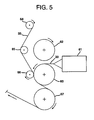
- FIG. 5 A preferred method of adhering bottom web 30 to support member 20, and the method used in making samples of the bottom web and support member of the invention, is shown in Figure 5.
- the support member 20 was extruded, as a polypropylene sheet, from an extrusion die 61. Chill rolls 62, 63 and 67 were arranged to advance and cool the support member 20 past a laminating roll 66.
- bottom web 30, comprising a blown film was fed from feed roll 64, past bow roll 65, to join with support member 20 at middle chill roll 63 as shown in the drawing. Web and roll movement was in the direction indicated by the arrows in Figure 5.
- the chill roll temperatures were 32.2°C (90°F) (chill roll 62), 110°C (230°F) (chill roll 63) and 76.7°C (170°F) (chill roll 67).
- the laminating roll was not water cooled for the lab line, as the line speed was only 1.83 to 2.44 m/minute (6 to 8 feet/minute (fpm)). In the case of the production line, the laminating roll 66 was coated with a rubber sleeve. The line haul off speed was about 9.45 m/minute (31 fpm).
- the bottom web is a monolayer film, it will comprise a sealant layer that will seal the bottom web at its lower surface to the upper surface of the support member, and also seal the bottom web at its upper surface to the lower surface of the top web. If the bottom web is a multilayer film, it will comprise a sealant layer that will seal the bottom web at its upper surface to the lower surface of the top web.
- the sealant layer of the bottom web comprises, and preferably consists essentially of, a blend of between 60% and 90%, more preferably between 70% and 80%, and most preferably 75%, by weight of the sealant layer, of ethylene/vinyl acetate copolymer; and between 10% and 40%, more preferably between 20% and 30%, and most preferably 25%, by weight of the sealant layer, of polypropylene.
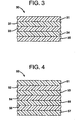
- FIG. 3 A preferred multilayer embodiment of bottom web 30 is shown in Figure 3, and described in Table 1 below.
- Table 1 Example 1
- Slip/Antiblock masterbatch #1 was FSU93ETM, having 9% silica and 3% erucamide carried in a low density polyethylene (LDPE) resin, available from A. Schulman Corp. of Cuyahoga Falls, Ohio.
- LDPE low density polyethylene
- a microwaveable package of the invention will preferably include layer 35, which will be adhered by heat lamination, extrusion lamination, extrusion coating, lamination with adhesives, corona treatment, coextrusion, or other suitable means to the upper surface of support member 20.
- the bond between these two elements should be strong enough to maintain its integrity before, during, and after cooking and microwaving.
- bottom web 30 will form an integral part of support member 20, and will result from e.g. a coextrusion or extrusion coating process.
- support member 20 should be viewed, as depicted in the drawings and Table 1, as a substrate, or a portion of a coextrudate, onto which bottom web 30 adheres as part of a coextrudate, or as a result of an extrusion coating or like process.
- a support member can be provided that includes, as an integral component, a inner liner or layer or plurality of layers, or a treated surface, that effectively functions like the bottom web just described.
- a liner, layer or plurality of layers, etc. can form an integral part of the support member, instead of being a discrete member which has been adhered in some fashion, such as by lamination, to the upper surface of the support member.
- the support member 20 can be made in the form of a coextruded sheet, web, or film that includes an outer liner, layer or layers, or coating that provides the same sealing functionality, with respect to the lower surface of the top web, as that described herein for the upper surface of bottom web 30.
- bottom web should be read to include either equivalent alternative: a discrete web or film or coating that is separately made and then laminated, extrusion laminated, or otherwise adhered to a substrate tray, sheet, or other support member (this mode being the primary one described herein); or alternatively a layer, liner, or coating that is integral with the support member, and generally manufactured at the same time as the support member, by e.g. a coextrusion or extrusion coating process.
- the composition of the sealant layer of the bottom web includes a propylene homopolymer.
- a propylene copolymer having an ethylenic moiety can be used.
- the percent of the propylene/ethylene copolymer (PER) used in the blend should be increased generally in proportion to the weight percent of ethylene comonomer in the PER, since the presence of ethylene in the PER will, all things being equal, tend to strengthen the seal between the top and bottom webs.
- Bottom web 30 is preferably between 12.7 and 254 ⁇ m (0.5 and 10 mils) thick, more preferably between 2.54 and 152.4 ⁇ m (1 and 6 mils) thick, most preferably between 38.1 and 101.6 ⁇ m (1.5 and 4 mils) thick, such as 50.8 ⁇ m (2 mils) or 76.2 ⁇ m (3 mils) thick.
- the top web 50 preferably comprises a multi-layer structure, and also preferably comprises at least one layer with gas-barrier properties.
- the top web 50 should adhere adequately to the upper surface of the bottom web 30 so that delamination of top web 50 from the bottom web 30 will not ordinarily occur during ambient conditions. After microwaving, the upper surface of bottom web 30 and the lower surface of top web 50 form a peelable interface, which is discussed in more detail below.
- Top web 50 adheres to bottom web 30 when the top web, in heated condition during a VSP operation, is draped down over the food product and makes contact with the exposed portion of the food product, as well as with the upper surface of the bottom web 30 in locations of the package outside the periphery of the food product.
- top web 50 is a monolayer or multilayer film, it will comprise a sealant layer that will seal the top web at its lower surface to the upper surface of the bottom web 30.
- the sealant layer of the bottom web comprises, and preferably consists essentially of, an ethylene/alpha olefin copolymer.
- a preferred multilayer embodiment of top web 50 is shown in Figure 4, and described in Table 2 below. This material is a commercially available VSP film available from Cryovac, and sold as CRYO-VACTM V836HB.
- Top web 50 can be manufactured by a blown or cast film extrusion process well known in the art.
- Layer 57 is the sealant layer of the top web that will contact the food product 40, and will seal, in areas outside the periphery of the food product, to sealant layer 31 of bottom web 30.
- Top web 50 is preferably between 2.54 and 304.8 ⁇ m (1 and 12 mils) thick, more preferably between 76.2 and 254 ⁇ m (3 and 10 mils) thick, most preferably between 127 and 203.2 ⁇ m (5 and 8 mils) thick, such as 177.8 ⁇ m (7 mils) thick.
- Both bottom web 30 and top web 50 can be made by any suitable process, including coextrusion, extrusion coating, extrusion lamination, and conventional lamination using polyurethane or other adhesives. This manufacturing processes are well known in the art. Extrusion can be done in annular or flat dies. The extrudate can be hot blown or stretch oriented as desired. Chemical or electronic crosslinking of one or more layers of the webs can be done.
- Food product 40 can be any food product that lends itself to microwave cooking, thawing, or reheating. Of particular utility is the microwaving of whole muscle or processed or emulsified meats.
- Both the bottom web and the top web preferably comprise a gas barrier layer. This is shown as layer 33 of bottom web 30 ( Figure 3 and Table 1) and layer 54 of top web 50 ( Figure 4 and Table 2).
- the gas barrier layer generally includes a polymeric material with low oxygen transmission characteristics, such as PVDC, EVOH, polyamides, polyesters, polyacrylonitrile (available as BarexTM resin), or blends thereof.
- PVDC is any vinylidene chloride copolymer wherein a major amount of the copolymer comprises vinylidene chloride and a minor amount of the copolymer comprises one or more unsaturated monomers copolymerizable therewith, typically vinyl chloride, and alkyl acrylates or methacrylates (e.g. methyl acrylate or methyl methacrylate) and the blends thereof in different proportions.
- a PVDC barrier layer will contain plasticizers and/or stabilizers as known in the art.
- EVOH is the saponified product of ethylene/vinyl ester copolymer, generally of ethylene/vinyl acetate copolymer, wherein the ethylene content is typically between 20 and 60 mole % of the copolymer, and the degree of saponification is generally higher than 85%, preferably higher than 95%.
- Polyamides used as gas barrier layer can be homo- or co-polyamides. This term specifically includes those aliphatic polyamides or copolyamides commonly referred to as e.g. polyamide 6 (homopolymer based on ⁇ - caprolactam), polyamide 69 (homopolycondensate based on hexamethylene diamine and azelaic acid), polyamide 610 (homopolycondensate based on hexamethylene diamine and sebacic acid), polyamide 612 (homopolycondensate based on hexamethylene diamine and dodecanoic acid), polyamide 11 (homopolymer based on 11-aminoundecanoic acid), polyamide 12 (homopolymer based on ⁇ -aminododecanoic acid or on laurolactam), polyamide 6/12 (polyamide copolymer based on ⁇ -caprolactam and laurolactam), polyamide 6/66 (polyamide
- the thickness and composition of the gas barrier layer will be suitably selected in order to provide the overall structure with an oxygen transmission rate (evaluated by ASTM D3985) of less than 150 cm 3 /m 2 .atm.d, at room temperature and 0% relative humidity, preferably less than 100, and even more preferably less than 50 cm 3 /m 2 .atm.d, such as less than 25, less than 15, and less than 5 cm 3 /m 2 .atm.d.
- Additional layers can be present in both the bottom and top webs. Said additional layers can serve the purpose of providing the necessary bulk to the webs, or improving their mechanical properties, i.e. increased puncture resistance, increased abuse resistance, etc., or to better tie the various layers one to the other. Any type of microwaveable resin can be employed for these purposes.
- the top and bottom web samples were in each case brought together in face to face relationship.
- One edge of the two adjoining webs was sealed together to form a one inch wide seal along the length of the two juxtaposed sheets.
- the seal was made using a seal bar at a temperature of 162.8°C, at 0.28 N/mm 2 (325°F, at 40 psi), for 1.0 second.
- Seals were made using a Sencorp Sealer Model No. 12ASL/1, using a 2.54 cm (one inch) strip cutter. Strips of each sealed sample, about 2.54 cm (one inch) wide and 22.9 cm (nine inches) long, including the sealed edge, were then tested on an INSTRONTM tensile tester.
- the samples were tested using a standard ASTM T peel test method (ASTM F 904-98) with a crosshead speed of 25.4 cm (10 inches)/minute and a jaw gap of 2.54 cm (one inch).
- ASTM F 904-98 ASTM T peel test method
- the unsealed edges of the two webs are gripped by separate clamps, and then pulled apart.
- the sealed edge is thus gradually pulled apart, while a dynamometer registers readings of the force involved.
- Strong seals will result in some thinning (mechanical yielding) of the webs, followed by a relatively abrupt failure of the seal at e.g. 0.7 to 1.40 N/mm (4 to 8 pounds per inch). If the seal is peelable, the seal will slowly and steadily pull apart at a force of e.g. 0,53 N/mm (3 pounds per inch).
- the following internal standard procedure can be employed: strips having a width of 2.54 cm (one inch) and a length of 30.48 cm (12 inches) are cut from the VSP packages prepared starting from the suitably selected top and bottom webs sealed together in a VSP packaging cycle (e.g., using a MULTIVAC® T570 machine) under the setting conditions of actual use. The strips are manually separated until the bottom web can be fixed into the lower clamp of a dynamometer, and the top web can be fixed into the upper clamp of a dynamometer. The area to be tested should lie in the middle of the two clamps, and an adequate tensioning between the two extremities of the fixed sample should be obtained. The peel strength is measured with a crosshead speed of 25.4 cm (10 inches)/min and a jaw distance of 2.54 cm (1 inch.
- the VSP package according to the present invention does riot require any puncturing of the .top web nor any loosening of the top web in order to effect releasing of the vapor overpressure that builds up during the microwave treatment.
- the package can placed in the microwave oven, subject to conventional microwave energy, and thus heated without any problem.
- the water vapor released by the food product during the microwave step will raise the top web over the product, in a ballooning effect, thus creating a vapor cushion around the product that maintains the product texture and taste.
- a rigid support member such as a rigid tray, the tray will distort only minimally during this "ballooning" phase of the microwave step.
- a semi-rigid or flexible support member is used, more extensive distortion of the support member will occur.
- the package opens up and the excess vapor is vented off between the upper and lower webs of the package around the periphery of the package.
- the top web lowers on the food product with few wrinkles or plies, because it has not been overstretched during microwaving.
- the package can then be withdrawn from the microwave oven, the top web removed, and the food product can be served, if desired, directly on the support member. Because the hot vapor has been vented off during the microwave step, removing the top web from the package after microwaving is less hazardous than with conventional packages.
- the present invention provides that the top web, before microwaving, is sealed to the bottom web with a seal having a peel force of at least 0.7 N/mm (4 pounds per linear inch), preferably at least 0.79 N/mm (4.5 pounds per linear inch), and most preferably at least 0.88 N/mm (5 pounds per linear inch), such as at least 1.05, 1.23 or 1.40 N/mm (6, 7, or 8 pounds per linear inch).
- the top web is peelably sealed to the bottom web with a seal having a peel force of less than 0.44 N/mm (2.5 pounds per linear inch), preferably less than 0.35 N/mm (2 pounds per linear inch), and most preferably less than 0.26 N/mm (1.5 pounds per linear inch), such as less than 0.18 N/mm (1 pound per linear inch).
- the present invention provides that the top web, before microwaving, is sealed to the bottom web with a seal having a peel force of between 0.7 and 1.75 N/mm (4 and 10 pounds per linear inch), and preferably between 0.79 and 1.58 N/mm (4.5 and 9 pounds per linear inch), such as between 0.88 and 1.40 N/mm (5 and 8), and between 1.05 and 1.23 N/mm (6 and 7 pounds per linear inch).
- the top web is peelably sealed to the bottom web with a seal having a peel force of between 0.09 and 0.44 N/mm (0.5 and 2.5 pounds per linear inch), such as between 0.18 and 0.35 N/mm (1 and 2 pounds per linear inch).
- Figure 2 shows the microwaveable package of the invention after the microwaving step has been completed.
- Reference numbers in Figure 2 correspond to like numbers in Figure 1, but with a "1" prefix added.
- the top web is shown being partially peeled away from the bottom web along the seal interface defined by sealant layer 31 of bottom web 30, and sealant layer 57 of top web 50.
- An advantage of the present invention is that a food product can be placed on the bottom web of a package of the invention, and covered with a top web as disclosed herein, and in this condition can be cooked by a food processor, distributed to a retailer, purchased by a consumer, microwaved, and served, without the need for transferring the food product at any time during this marketing sequence.
- the initial cook time by the food processor, which cooking can be done in steam ovens, would typically be at about 71.1 to 82.2°C (160° to 180°F) for 4 to 10 hours.
- Comparative Example 1 having 100% ELTEXTM P KS 409 propylene/ethylene copolymer, showed only weak adhesion 0.56 N/mm; (3.17 pounds/inch) to the top web 50. It is believed that a seal strength of at least 0.7 N/mm (4 pounds/inch) is required for many applications. Comparative Example 2 and Example 2 showed relatively high seal strengths (1.09 and 1.14 N/mm) (6.21 and 6.50) respectively) at the bottom web/top web seal interface.
- Comparative Example 1 On the adherent side (i.e. the bottom web/support member interface), Comparative Example 1 showed limited adhesion to the support member 20. Comparative Example 2 and Example 2 each showed better adhesion to the support member 20 (0.36 and 0.42 N/mm (2.08 and 2.44 pounds/inch) respectively) than Comparative Example 1.
- the estimated peel strength of the sealant of Comparative Example 2 after microwaving was between about 0.52 and 0.7 N/mm (3 and 4 pounds/inch). This is believed to be too strong a seal to be considered peelable for this application.
- Example 2 had an estimated post-microwave peel strength of between about 0.26 and 0.35 N/mm (1.5 and 2 pounds/inch).
- Comparative Example 1 had an estimated peel strength, after microwaving, of less than 0.18 N/mm (1 pound/inch)).
- the peel strengths after microwaving are only estimated.
- a subjective analysis of ease of peel was done for each sample, after a simulation of a microwaving step, with the scoring ranging from 1 (extremely easy peel, almost no seal) to 5 (very difficult or impossible to manually peel).
- column 4 of Table 3, marked "ease of peel after microwaving” expresses the subjective values for the seal strength between the bottom web and top web, after microwaving, for each example.
- Peelable blends were tested at varying sealing temperatures.
- the samples tested were monolayer films about 152.4 ⁇ m (6 mil) in thickness. They were prepared on a Leistritz twin-screw extruder in the lab using a slot die. The films were about 10.16 cm (4 inch) wide. The specimens prepared for testing were 2.54 cm (one inch) wide. The film samples were heat sealed to a VSP top web (2.54 cm (1") wide) at 162.8°C (325°F). The seal strength data are shown in Table 4. The peel strength data showed the reduction of the PP in a PP/EVA blend helped to improve peel strength values. Table 4 Seal Strength Results N/mm (pounds/inch) Seal Temp. 162.8°C (325°F) # Average Minimum Maximum Comp. Ex.
- a lab thermoformer was used to form trays. This was a one-up forming machine. The sheet sample was heated first and then formed using an aluminum mold with a syntactic plug. The formed sample was trimmed using a steel rule knife on a clicker press.
- the tray samples were filled with a selected food (e.g. sliced barbecue pork) and then sealed with a VSP top web on a Multivac machine.
- the meal was cooked in the sealed trays for 8 hrs at 87.8°C (190°F) using a steam heated chamber. Then the trays were refrigerated. The adhesion of the top web was still very good or not easy to open.
- the trays were heated in a microwave for 3 to 4 minutes on a high setting (1000 watts) of a microwave. This was to evaluate how the top web allows for self-venting and easy peel after cooking. With sealants of the invention, self-venting was noticed within one minute of microwave heating. The trays were then removed from microwave. The top web peeled easily from the bottom web.
- seal strength and “peel strength” are used interchangeably, and reflect the strength of the bond between adjacent webs (the bottom and top web) or between the bottom web and the support member.
- the seal or peel strength is determined by the T-peel method of ASTM F 904-98.
Landscapes
- Engineering & Computer Science (AREA)
- Mechanical Engineering (AREA)
- Chemical & Material Sciences (AREA)
- Composite Materials (AREA)
- Packages (AREA)
- Package Specialized In Special Use (AREA)
- Laminated Bodies (AREA)
Claims (12)
- Mikrowellenfähige Vakuumhautverpackung, diea) ein Trägerelement mit einer Oberseite und einer Unterseite;b) eine untere Bahn mit einer Oberseite und einer Unterseite, wobei die Unterseite der unteren Bahn an die Oberseite des Trägerelements geklebt ist;c) ein Nahrungsmittelprodukt, das auf der Oberseite der unteren Bahn angeordnet ist, undd) eine obere Bahn, die auf dem Nahrungsmittelprodukt angeordnet ist,umfasst, wobei die obere Bahn durch ein Vakuumhautverpakkungsverfahren über dem Nahrungsmittelprodukt drapiert wird, so dass sich die obere Bahn der Form des Nahrungsmittelprodukts im Wesentlichen anpasst und dadurch eine Vakuumhautverpackung produziert wird;
wobei die obere Bahn der Vakuumhautverpackung an ihrer Unterseite an die Oberseite der unteren Bahn der Vakuumhautverpackung gesiegelt wird, um eine Siegelung an einer Position außerhalb der Peripherie des Nahrungsmittelprodukts zu bilden;
wobei die obere Bahn der Vakuumhautverpackung eine Siegelschicht umfasst, die ein Ethylen/α-Olefin-Copolymer umfasst, und
wobei die untere Bahn der Vakuumhautverpackung eine Siegelschicht umfasst, die ein Gemisch ausi) zwischen 60 % und 80 % des Gewichts der Siegelschicht an Ethylen/Vinylacetat-Copolymer undii) zwischen 20 % und 40 % des Gewichts der Siegelschicht an Polypropylen umfasst. - Verpackung nach Anspruch 1, bei der das Trägerelement ein Material ausgewählt aus der Gruppe bestehend aus Polypropylen, Polystyrol, Polyamid, 1,4-Polymethylpenten und kristallisiertem Polyethylenterephthalat umfasst.
- Verpackung nach Anspruch 1 oder 2, bei der die untere Bahn eine Sauerstoffbarriereschicht umfasst, die ein Polymer ausgewählt aus der Gruppe bestehend aus Ethylen/Vinylalkohol-Copolymer, Vinylidenchloridcopolymer, Polyamid, Polyacrylnitril und Polyester umfasst.
- Verpackung nach einem der vorhergehenden Ansprüche, bei der die obere Bahn eine Sauerstoffbarriereschicht umfasst, die ein Polymer ausgewählt aus der Gruppe bestehend aus Ethylen/Vinylalkohol-Copolymer, Vinylidenchloridcopolymer, Polyamid und Polyester umfasst.
- Verpackung nach einem der vorhergehenden Ansprüche, bei der das Ethylen/α-Olefin-Copolymer Ethylen/1-Octen-Copolymer umfasst.
- Verpackung nach einem der vorhergehenden Ansprüche, bei der das Nahrungsmittelprodukt ein gegartes Nahrungsmittelprodukt ist.
- Verfahren zur Herstellung einer mikrowellenfähigen Vakuumhautverpackung, bei dema) ein Trägerelement mit einer Oberseite und einer Unterseite bereitgestellt wird;b) eine untere Bahn mit einer Oberseite und einer Unterseite bereitgestellt wird;c) die Unterseite der unteren Bahn an die Oberseite des Trägerelements geklebt wird;d) ein auf der Oberseite der untere Bahn angeordnetes Nahrungsmittelprodukt positioniert wird, unde) eine obere Bahn in einem Vakuumhautverpackungsverfahren so über dem Nahrungsmittelprodukt drapiert wird, dass sich die obere Bahn der Form des Nahrungsmittelprodukts im Wesentlichen anpasst und dadurch eine Vakuumhautverpackung hergestellt wird und dass die obere Bahn der Vakuumhautverpackung an ihrer Unterseite an die Oberseite der unteren Bahn der Vakuumhautverpackung gesiegelt wird, um eine Siegelung an einer Position außerhalb der Peripherie des Nahrungsmittelprodukts zu bilden;
wobei die obere Bahn der Vakuumhautverpackung eine Siegelschicht umfasst, die ein Ethylen/α-Olefin-Copolymer umfasst, und
wobei die untere Bahn der Vakuumhautverpackung eine Siegelschicht umfasst, die ein Gemisch ausi) zwischen 60 % und 80 % des Gewichts der Siegelschicht an Ethylen/Vinylacetat-Copolymer undii) zwischen 20 % und 40 % des Gewichts der Siegelschicht an Polypropylen umfasst. - Verfahren nach Anspruch 7, bei dem das Trägerelement ein Material ausgewählt aus der Gruppe bestehend aus Polypropylen, Polystyrol, Polyamid, 1,4-Polymethylpenten und kristallisiertem Polyethylenterephthalat umfasst.
- Verfahren nach Anspruch 7 oder 8, bei dem die untere Bahn eine Sauerstoffbarriereschicht umfasst, die Polymer ausgewählt aus der Gruppe bestehend aus Ethylen/Vinylalkohol-Copolymer, Vinylidenchloridcopolymer, Polyamid, Polyacrylnitril und Polyester umfasst.
- Verfahren nach einem der Ansprüche 7 bis 9, bei dem die obere Bahn eine Sauerstoffbarriereschicht umfasst, die Polymer ausgewählt aus der Gruppe bestehend aus Ethylen/Vinylalkohol-Copolymer, Vinylidenchloridcopolymer, Polyamid, Polyacrylnitril und Polyester umfasst.
- Verfahren nach einem der Ansprüche 7 bis 10, bei dem das Ethylen/α-Olefin-Copolymer Ethylen/1-Octen-Copolymer umfasst.
- Verfahren nach einem der Ansprüche 7 bis 11, bei dem das Nahrungsmittelprodukt ein gegartes Nahrungsmittelprodukt ist.
Priority Applications (1)
| Application Number | Priority Date | Filing Date | Title |
|---|---|---|---|
| EP07015621.1A EP1854623B1 (de) | 2002-01-18 | 2003-01-14 | Selbst-ventilierende abziehbare mikrowellenerhitzbare Vakuumverpackung |
Applications Claiming Priority (3)
| Application Number | Priority Date | Filing Date | Title |
|---|---|---|---|
| US10/051,584 US20030152669A1 (en) | 2002-01-18 | 2002-01-18 | Self venting peelable microwaveable vacuum skin package |
| US51584 | 2002-01-18 | ||
| PCT/US2003/001016 WO2003061959A1 (en) | 2002-01-18 | 2003-01-14 | Self-venting peelable microwaveable vacuum skin package |
Related Child Applications (1)
| Application Number | Title | Priority Date | Filing Date |
|---|---|---|---|
| EP07015621.1A Division EP1854623B1 (de) | 2002-01-18 | 2003-01-14 | Selbst-ventilierende abziehbare mikrowellenerhitzbare Vakuumverpackung |
Publications (2)
| Publication Number | Publication Date |
|---|---|
| EP1465765A1 EP1465765A1 (de) | 2004-10-13 |
| EP1465765B1 true EP1465765B1 (de) | 2007-08-15 |
Family
ID=27609090
Family Applications (2)
| Application Number | Title | Priority Date | Filing Date |
|---|---|---|---|
| EP07015621.1A Expired - Lifetime EP1854623B1 (de) | 2002-01-18 | 2003-01-14 | Selbst-ventilierende abziehbare mikrowellenerhitzbare Vakuumverpackung |
| EP03702106A Expired - Lifetime EP1465765B1 (de) | 2002-01-18 | 2003-01-14 | Selbst-ventilierende abziehbare mikrowellenerhitzbare vakuumverpackung |
Family Applications Before (1)
| Application Number | Title | Priority Date | Filing Date |
|---|---|---|---|
| EP07015621.1A Expired - Lifetime EP1854623B1 (de) | 2002-01-18 | 2003-01-14 | Selbst-ventilierende abziehbare mikrowellenerhitzbare Vakuumverpackung |
Country Status (9)
| Country | Link |
|---|---|
| US (1) | US20030152669A1 (de) |
| EP (2) | EP1854623B1 (de) |
| AT (1) | ATE369976T1 (de) |
| AU (1) | AU2003202990B2 (de) |
| CA (1) | CA2471033C (de) |
| DE (1) | DE60315593T2 (de) |
| ES (2) | ES2288595T3 (de) |
| NZ (1) | NZ533355A (de) |
| WO (1) | WO2003061959A1 (de) |
Families Citing this family (30)
| Publication number | Priority date | Publication date | Assignee | Title |
|---|---|---|---|---|
| JP4738342B2 (ja) * | 2003-10-22 | 2011-08-03 | クライオバック・インコーポレイテツド | 再閉鎖が可能な剛体容器アセンブリ |
| US8597746B2 (en) * | 2005-05-31 | 2013-12-03 | Curwood, Inc. | Peelable vacuum skin packages |
| EP1746046A1 (de) * | 2005-07-19 | 2007-01-24 | Cryovac, Inc. | Vakuumverpackung für Käse |
| JP2010508171A (ja) * | 2006-11-01 | 2010-03-18 | デュポン テイジン フィルムス ユーエス リミテッド パートナーシップ | ヒートシール可能な複合ポリエステルフィルム |
| FR2913230A1 (fr) * | 2007-03-01 | 2008-09-05 | Europ D Emballage Et De Condit | Plateau de presentation en materiau composite et son procede de fabrication. |
| US20080260305A1 (en) * | 2007-04-20 | 2008-10-23 | Shah Gautam P | Easy-open/reclosable bag and package |
| US20090047394A1 (en) * | 2007-08-17 | 2009-02-19 | Neil Willcocks | Vacuum packed pet food |
| WO2009032627A2 (en) * | 2007-08-30 | 2009-03-12 | Dupont Teijin Films U.S. Limited Partership | Dual ovenable food package having a thermoformable polyester film lid |
| US20100266732A1 (en) * | 2009-04-20 | 2010-10-21 | Fres-Co System Usa, Inc. | Microwavable self-venting package |
| FR2945282B1 (fr) * | 2009-05-07 | 2013-11-22 | Charal | Emballage a conditionnement confine |
| US8622618B2 (en) | 2009-08-14 | 2014-01-07 | Cryovac, Inc. | Easy open and reclosable package with discrete laminate having panel section with easy-open sealant |
| US8646975B2 (en) | 2009-08-14 | 2014-02-11 | Cryovac, Inc. | Easy open and reclosable package with discrete tape and die-cut web |
| US9221591B2 (en) | 2009-08-14 | 2015-12-29 | Cryovac, Inc. | Easy open and reclosable package with discrete laminate with die-cut |
| EP2319675A1 (de) | 2009-11-06 | 2011-05-11 | Cryovac, Inc. | Verfahren zur Herstellung einer Behälteranordnung und eine Behälteranordnung |
| US20120195526A1 (en) | 2011-01-28 | 2012-08-02 | Cryovac, Inc. | Easy Open and Reclosable Package with Discrete Strip and Die-Cut Web |
| US20120195527A1 (en) | 2011-01-28 | 2012-08-02 | Cryovac, Inc. | Easy Open and Reclosable Package with Discrete Laminate Having a Panel Section with a Sealant |
| US8979370B2 (en) | 2011-01-28 | 2015-03-17 | Cryovac, Inc. | Easy open and reclosable package with discrete laminate with die-cut |
| US20120241336A1 (en) | 2011-03-21 | 2012-09-27 | Cryovac, Inc. | On-Demand Marination Package |
| DE202011110798U1 (de) | 2011-05-03 | 2016-08-09 | Flexopack S.A. | Abfallverpackungssystem und Folie |
| JP6425870B2 (ja) * | 2011-09-30 | 2018-11-21 | 大日本印刷株式会社 | シーラント、それを用いた積層体および電子レンジ用包装袋 |
| EP2923963A1 (de) | 2014-03-26 | 2015-09-30 | Cryovac, Inc. | Verpackungsanordnung und Verfahren zum Verpacken von Produkten |
| GB201409031D0 (en) * | 2014-05-21 | 2014-07-02 | Icelandic Group Uk Ltd | Improvements in or relating to the packaging of food |
| EP3188903B1 (de) | 2014-07-28 | 2021-04-07 | Cryovac, LLC | Ausgabesystem, verpackungssystem, verpackung, verschlusssystem, ausgabepistolensystem, verfahren zur herstellung einer verpackung und verfahren zur ausgabe eines produkts |
| AU2015258191B2 (en) * | 2014-11-19 | 2020-02-27 | Flexopack S.A. | Oven skin packaging process |
| WO2018075629A1 (en) | 2016-10-19 | 2018-04-26 | Cryovac, Inc. | Dispensing system |
| MX2019011407A (es) | 2017-03-29 | 2019-12-16 | Cryovac Llc | Sistema de dispensacion y metodo para hacer y usar el mismo. |
| WO2019002107A1 (en) * | 2017-06-30 | 2019-01-03 | Cryovac, Inc. | VACUUM PELLPLAID ENVELOPES FOR SOFT PRODUCTS AND METHOD FOR PACKAGING VACUUM PACKAGING |
| EP3501822A1 (de) | 2017-12-22 | 2019-06-26 | Flexopack S.A. | Fibc-auskleidungsfolie |
| GB2575865A (en) * | 2018-07-27 | 2020-01-29 | Youngs Seafood Ltd | Packaging for frozen food items |
| US11292654B2 (en) * | 2019-06-20 | 2022-04-05 | Sonoco Development, Inc. | Venting system for ovenable containers |
Family Cites Families (22)
| Publication number | Priority date | Publication date | Assignee | Title |
|---|---|---|---|---|
| US30009A (en) * | 1860-09-11 | Spring-dividers | ||
| US3491504A (en) * | 1967-10-02 | 1970-01-27 | William E Young | Method and apparatus for vacuum skin packaging |
| US3681092A (en) * | 1968-10-25 | 1972-08-01 | Dow Chemical Co | Fresh meat packaging |
| US3574642A (en) * | 1969-05-15 | 1971-04-13 | American Can Co | Package for and method of packaging meats |
| US3713849A (en) * | 1970-04-15 | 1973-01-30 | Mayer & Co Inc O | Meat package |
| US4055672A (en) * | 1972-04-10 | 1977-10-25 | Standard Packaging Corporation | Controlled atmosphere package |
| JPS5734145A (en) * | 1980-08-07 | 1982-02-24 | Mitsui Petrochem Ind Ltd | Ethylene-alpha-olefin copolymer composition |
| US4666778A (en) * | 1984-08-31 | 1987-05-19 | Shell Oil Company | Packaging film and sheet capable of forming peelable seals with good optics |
| US4729476A (en) * | 1985-02-21 | 1988-03-08 | W.R. Grace & Co., Cryovac Div. | Easy open shrinkable laminate |
| US5407751A (en) * | 1985-11-29 | 1995-04-18 | American National Can Company | Easy peel film structure especially for retortable lidstock |
| US4705707A (en) * | 1985-12-17 | 1987-11-10 | Presto Products, Incorporated | Polyethylene/polyester nonoriented heat sealable moisture barrier film and bag |
| US5178293A (en) * | 1986-04-08 | 1993-01-12 | Idemitsu Petrochemical Co., Ltd. | Easily-openable packaging container |
| US4759984A (en) * | 1986-06-27 | 1988-07-26 | Shell Oil Company | Peelable seals using polybutylene-1 |
| US4859514A (en) * | 1987-06-12 | 1989-08-22 | W. R. Grace & Co. | Laminate for an easily opened package |
| US4925684A (en) * | 1988-08-19 | 1990-05-15 | Campbell Soup Company | Food package with a microwave releasable sealed closure |
| US4911938A (en) * | 1988-08-22 | 1990-03-27 | E. I. Du Pont De Nemours And Company | Conformable wrap susceptor with releasable seal for microwave cooking |
| US5023121A (en) * | 1990-04-12 | 1991-06-11 | W. R. Grace & Co.-Conn. | Coextruded film with peelable sealant |
| US5346735A (en) * | 1992-08-14 | 1994-09-13 | W. R. Grace & Co.-Conn | Peelable barrier film for vacuum skin packages and the like |
| US6054698A (en) * | 1996-11-01 | 2000-04-25 | Mast; Roy Lee | Microwave retaining package for microwave cooking |
| JPH11139465A (ja) | 1997-11-05 | 1999-05-25 | Toppan Printing Co Ltd | 電子レンジ用包装体 |
| US6358622B1 (en) * | 1999-12-16 | 2002-03-19 | M.S.I. Technology L.L.C. | Heat sealable films |
| JP2001310433A (ja) * | 2000-04-28 | 2001-11-06 | Dainippon Ink & Chem Inc | 易開封性複合フィルム及び包装容器 |
-
2002
- 2002-01-18 US US10/051,584 patent/US20030152669A1/en not_active Abandoned
-
2003
- 2003-01-14 NZ NZ533355A patent/NZ533355A/en not_active IP Right Cessation
- 2003-01-14 EP EP07015621.1A patent/EP1854623B1/de not_active Expired - Lifetime
- 2003-01-14 WO PCT/US2003/001016 patent/WO2003061959A1/en not_active Ceased
- 2003-01-14 AU AU2003202990A patent/AU2003202990B2/en not_active Expired
- 2003-01-14 AT AT03702106T patent/ATE369976T1/de not_active IP Right Cessation
- 2003-01-14 ES ES03702106T patent/ES2288595T3/es not_active Expired - Lifetime
- 2003-01-14 DE DE60315593T patent/DE60315593T2/de not_active Expired - Lifetime
- 2003-01-14 EP EP03702106A patent/EP1465765B1/de not_active Expired - Lifetime
- 2003-01-14 ES ES07015621.1T patent/ES2522284T3/es not_active Expired - Lifetime
- 2003-01-14 CA CA002471033A patent/CA2471033C/en not_active Expired - Lifetime
Also Published As
| Publication number | Publication date |
|---|---|
| EP1465765A1 (de) | 2004-10-13 |
| EP1854623A3 (de) | 2008-04-23 |
| ATE369976T1 (de) | 2007-09-15 |
| US20030152669A1 (en) | 2003-08-14 |
| DE60315593D1 (de) | 2007-09-27 |
| DE60315593T2 (de) | 2008-05-08 |
| EP1854623B1 (de) | 2014-09-10 |
| CA2471033A1 (en) | 2003-07-31 |
| NZ533355A (en) | 2008-03-28 |
| CA2471033C (en) | 2006-11-07 |
| EP1854623A2 (de) | 2007-11-14 |
| ES2522284T3 (es) | 2014-11-14 |
| WO2003061959A1 (en) | 2003-07-31 |
| ES2288595T3 (es) | 2008-01-16 |
| AU2003202990B2 (en) | 2007-05-24 |
Similar Documents
| Publication | Publication Date | Title |
|---|---|---|
| EP1854623B1 (de) | Selbst-ventilierende abziehbare mikrowellenerhitzbare Vakuumverpackung | |
| AU2003202990A1 (en) | Self-venting peelable microwaveable vacuum skin package | |
| US6042862A (en) | Lidded package having a tab to facilitate peeling | |
| US7569276B2 (en) | Thermoformable polyester-containing laminates | |
| EP1488924B1 (de) | Lebensmittelverpackung | |
| AU779090B2 (en) | Irradiated biaxially oriented film | |
| US20090041912A1 (en) | Microwaveable vacuum skin package | |
| EP2156949B1 (de) | Für Vakuumhautverpackungsanwendungen geeigneter Film und damit hergestelltes einfach zu öffnendes Vakuumhautpaket | |
| US5979653A (en) | Peel mechanism for peelable barrier film for vacuum skin packages and the like | |
| AU2002325877A1 (en) | Microwaveable vacuum skin package | |
| AU2015258191B2 (en) | Oven skin packaging process | |
| US20110048998A1 (en) | Film suitable for vacuum skin packaging applications and easy-to-open vacuum skin package obtained therewith | |
| EP1871597B1 (de) | Durch mikrowellen erhitzbarer film oder solche folie für vakuum-skin-verpackungsanwendungen und damit erhaltene abziehbare durch mikrowellen erhitzbare vakuum-skin-verpackung | |
| AU2007202193B2 (en) | Self-venting peelable microwaveable vacuum skin package |
Legal Events
| Date | Code | Title | Description |
|---|---|---|---|
| PUAI | Public reference made under article 153(3) epc to a published international application that has entered the european phase |
Free format text: ORIGINAL CODE: 0009012 |
|
| 17P | Request for examination filed |
Effective date: 20040630 |
|
| AK | Designated contracting states |
Kind code of ref document: A1 Designated state(s): AT BE BG CH CY CZ DE DK EE ES FI FR GB GR HU IE IT LI LU MC NL PT SE SI SK TR |
|
| AX | Request for extension of the european patent |
Extension state: AL LT LV MK RO |
|
| RIN1 | Information on inventor provided before grant (corrected) |
Inventor name: WOMACK, JEFF Inventor name: OWENSBY, JOSEPH Inventor name: BRADY, SEAN Inventor name: ROSINSKI, MICHAEL Inventor name: VADHAR, PARIMAL |
|
| 17Q | First examination report despatched |
Effective date: 20041129 |
|
| GRAP | Despatch of communication of intention to grant a patent |
Free format text: ORIGINAL CODE: EPIDOSNIGR1 |
|
| GRAS | Grant fee paid |
Free format text: ORIGINAL CODE: EPIDOSNIGR3 |
|
| GRAA | (expected) grant |
Free format text: ORIGINAL CODE: 0009210 |
|
| AK | Designated contracting states |
Kind code of ref document: B1 Designated state(s): AT BE BG CH CY CZ DE DK EE ES FI FR GB GR HU IE IT LI LU MC NL PT SE SI SK TR |
|
| REG | Reference to a national code |
Ref country code: GB Ref legal event code: FG4D |
|
| REG | Reference to a national code |
Ref country code: CH Ref legal event code: EP |
|
| REG | Reference to a national code |
Ref country code: IE Ref legal event code: FG4D |
|
| REF | Corresponds to: |
Ref document number: 60315593 Country of ref document: DE Date of ref document: 20070927 Kind code of ref document: P |
|
| REG | Reference to a national code |
Ref country code: ES Ref legal event code: FG2A Ref document number: 2288595 Country of ref document: ES Kind code of ref document: T3 |
|
| PG25 | Lapsed in a contracting state [announced via postgrant information from national office to epo] |
Ref country code: NL Free format text: LAPSE BECAUSE OF FAILURE TO SUBMIT A TRANSLATION OF THE DESCRIPTION OR TO PAY THE FEE WITHIN THE PRESCRIBED TIME-LIMIT Effective date: 20070815 Ref country code: BG Free format text: LAPSE BECAUSE OF FAILURE TO SUBMIT A TRANSLATION OF THE DESCRIPTION OR TO PAY THE FEE WITHIN THE PRESCRIBED TIME-LIMIT Effective date: 20071115 Ref country code: FI Free format text: LAPSE BECAUSE OF FAILURE TO SUBMIT A TRANSLATION OF THE DESCRIPTION OR TO PAY THE FEE WITHIN THE PRESCRIBED TIME-LIMIT Effective date: 20070815 |
|
| NLV1 | Nl: lapsed or annulled due to failure to fulfill the requirements of art. 29p and 29m of the patents act | ||
| PG25 | Lapsed in a contracting state [announced via postgrant information from national office to epo] |
Ref country code: CH Free format text: LAPSE BECAUSE OF FAILURE TO SUBMIT A TRANSLATION OF THE DESCRIPTION OR TO PAY THE FEE WITHIN THE PRESCRIBED TIME-LIMIT Effective date: 20070815 Ref country code: AT Free format text: LAPSE BECAUSE OF FAILURE TO SUBMIT A TRANSLATION OF THE DESCRIPTION OR TO PAY THE FEE WITHIN THE PRESCRIBED TIME-LIMIT Effective date: 20070815 Ref country code: LI Free format text: LAPSE BECAUSE OF FAILURE TO SUBMIT A TRANSLATION OF THE DESCRIPTION OR TO PAY THE FEE WITHIN THE PRESCRIBED TIME-LIMIT Effective date: 20070815 |
|
| REG | Reference to a national code |
Ref country code: CH Ref legal event code: PL |
|
| ET | Fr: translation filed | ||
| PG25 | Lapsed in a contracting state [announced via postgrant information from national office to epo] |
Ref country code: BE Free format text: LAPSE BECAUSE OF FAILURE TO SUBMIT A TRANSLATION OF THE DESCRIPTION OR TO PAY THE FEE WITHIN THE PRESCRIBED TIME-LIMIT Effective date: 20070815 |
|
| PG25 | Lapsed in a contracting state [announced via postgrant information from national office to epo] |
Ref country code: DK Free format text: LAPSE BECAUSE OF FAILURE TO SUBMIT A TRANSLATION OF THE DESCRIPTION OR TO PAY THE FEE WITHIN THE PRESCRIBED TIME-LIMIT Effective date: 20070815 Ref country code: GR Free format text: LAPSE BECAUSE OF FAILURE TO SUBMIT A TRANSLATION OF THE DESCRIPTION OR TO PAY THE FEE WITHIN THE PRESCRIBED TIME-LIMIT Effective date: 20071116 |
|
| PG25 | Lapsed in a contracting state [announced via postgrant information from national office to epo] |
Ref country code: PT Free format text: LAPSE BECAUSE OF FAILURE TO SUBMIT A TRANSLATION OF THE DESCRIPTION OR TO PAY THE FEE WITHIN THE PRESCRIBED TIME-LIMIT Effective date: 20080115 Ref country code: SK Free format text: LAPSE BECAUSE OF FAILURE TO SUBMIT A TRANSLATION OF THE DESCRIPTION OR TO PAY THE FEE WITHIN THE PRESCRIBED TIME-LIMIT Effective date: 20070815 Ref country code: CZ Free format text: LAPSE BECAUSE OF FAILURE TO SUBMIT A TRANSLATION OF THE DESCRIPTION OR TO PAY THE FEE WITHIN THE PRESCRIBED TIME-LIMIT Effective date: 20070815 |
|
| PLBE | No opposition filed within time limit |
Free format text: ORIGINAL CODE: 0009261 |
|
| STAA | Information on the status of an ep patent application or granted ep patent |
Free format text: STATUS: NO OPPOSITION FILED WITHIN TIME LIMIT |
|
| PG25 | Lapsed in a contracting state [announced via postgrant information from national office to epo] |
Ref country code: SE Free format text: LAPSE BECAUSE OF FAILURE TO SUBMIT A TRANSLATION OF THE DESCRIPTION OR TO PAY THE FEE WITHIN THE PRESCRIBED TIME-LIMIT Effective date: 20071115 |
|
| 26N | No opposition filed |
Effective date: 20080516 |
|
| PG25 | Lapsed in a contracting state [announced via postgrant information from national office to epo] |
Ref country code: MC Free format text: LAPSE BECAUSE OF NON-PAYMENT OF DUE FEES Effective date: 20080131 |
|
| PG25 | Lapsed in a contracting state [announced via postgrant information from national office to epo] |
Ref country code: EE Free format text: LAPSE BECAUSE OF FAILURE TO SUBMIT A TRANSLATION OF THE DESCRIPTION OR TO PAY THE FEE WITHIN THE PRESCRIBED TIME-LIMIT Effective date: 20070815 Ref country code: IE Free format text: LAPSE BECAUSE OF NON-PAYMENT OF DUE FEES Effective date: 20080114 |
|
| PG25 | Lapsed in a contracting state [announced via postgrant information from national office to epo] |
Ref country code: SI Free format text: LAPSE BECAUSE OF FAILURE TO SUBMIT A TRANSLATION OF THE DESCRIPTION OR TO PAY THE FEE WITHIN THE PRESCRIBED TIME-LIMIT Effective date: 20070815 |
|
| PG25 | Lapsed in a contracting state [announced via postgrant information from national office to epo] |
Ref country code: CY Free format text: LAPSE BECAUSE OF FAILURE TO SUBMIT A TRANSLATION OF THE DESCRIPTION OR TO PAY THE FEE WITHIN THE PRESCRIBED TIME-LIMIT Effective date: 20070815 |
|
| PG25 | Lapsed in a contracting state [announced via postgrant information from national office to epo] |
Ref country code: LU Free format text: LAPSE BECAUSE OF NON-PAYMENT OF DUE FEES Effective date: 20080114 Ref country code: HU Free format text: LAPSE BECAUSE OF FAILURE TO SUBMIT A TRANSLATION OF THE DESCRIPTION OR TO PAY THE FEE WITHIN THE PRESCRIBED TIME-LIMIT Effective date: 20080216 |
|
| PG25 | Lapsed in a contracting state [announced via postgrant information from national office to epo] |
Ref country code: TR Free format text: LAPSE BECAUSE OF FAILURE TO SUBMIT A TRANSLATION OF THE DESCRIPTION OR TO PAY THE FEE WITHIN THE PRESCRIBED TIME-LIMIT Effective date: 20070815 |
|
| REG | Reference to a national code |
Ref country code: FR Ref legal event code: PLFP Year of fee payment: 14 |
|
| REG | Reference to a national code |
Ref country code: FR Ref legal event code: PLFP Year of fee payment: 15 |
|
| REG | Reference to a national code |
Ref country code: FR Ref legal event code: PLFP Year of fee payment: 16 |
|
| PGFP | Annual fee paid to national office [announced via postgrant information from national office to epo] |
Ref country code: GB Payment date: 20220127 Year of fee payment: 20 Ref country code: DE Payment date: 20220127 Year of fee payment: 20 |
|
| PGFP | Annual fee paid to national office [announced via postgrant information from national office to epo] |
Ref country code: IT Payment date: 20220119 Year of fee payment: 20 Ref country code: FR Payment date: 20220125 Year of fee payment: 20 Ref country code: ES Payment date: 20220201 Year of fee payment: 20 |
|
| REG | Reference to a national code |
Ref country code: DE Ref legal event code: R071 Ref document number: 60315593 Country of ref document: DE |
|
| REG | Reference to a national code |
Ref country code: GB Ref legal event code: PE20 Expiry date: 20230113 |
|
| REG | Reference to a national code |
Ref country code: ES Ref legal event code: FD2A Effective date: 20230428 |
|
| PG25 | Lapsed in a contracting state [announced via postgrant information from national office to epo] |
Ref country code: GB Free format text: LAPSE BECAUSE OF EXPIRATION OF PROTECTION Effective date: 20230113 |
|
| PG25 | Lapsed in a contracting state [announced via postgrant information from national office to epo] |
Ref country code: ES Free format text: LAPSE BECAUSE OF EXPIRATION OF PROTECTION Effective date: 20230115 |