EP1465367A1 - Gleichartigenverkehrsgeneratoreinrichtung - Google Patents
Gleichartigenverkehrsgeneratoreinrichtung Download PDFInfo
- Publication number
- EP1465367A1 EP1465367A1 EP04251177A EP04251177A EP1465367A1 EP 1465367 A1 EP1465367 A1 EP 1465367A1 EP 04251177 A EP04251177 A EP 04251177A EP 04251177 A EP04251177 A EP 04251177A EP 1465367 A1 EP1465367 A1 EP 1465367A1
- Authority
- EP
- European Patent Office
- Prior art keywords
- self
- similar traffic
- telecommunications network
- mimicking
- distributed
- Prior art date
- Legal status (The legal status is an assumption and is not a legal conclusion. Google has not performed a legal analysis and makes no representation as to the accuracy of the status listed.)
- Granted
Links
- 238000009826 distribution Methods 0.000 claims abstract description 115
- 238000000034 method Methods 0.000 claims abstract description 85
- 230000015654 memory Effects 0.000 claims abstract description 62
- 230000008569 process Effects 0.000 claims description 24
- 230000006399 behavior Effects 0.000 claims description 11
- 230000005540 biological transmission Effects 0.000 claims description 6
- 230000002596 correlated effect Effects 0.000 claims description 5
- 238000004590 computer program Methods 0.000 claims 41
- 238000004891 communication Methods 0.000 description 11
- 238000013459 approach Methods 0.000 description 8
- 238000010586 diagram Methods 0.000 description 7
- 230000006855 networking Effects 0.000 description 5
- 230000002776 aggregation Effects 0.000 description 4
- 238000004220 aggregation Methods 0.000 description 4
- 238000004364 calculation method Methods 0.000 description 4
- 238000012360 testing method Methods 0.000 description 4
- 238000004458 analytical method Methods 0.000 description 3
- 230000001276 controlling effect Effects 0.000 description 3
- 230000000875 corresponding effect Effects 0.000 description 3
- 230000007246 mechanism Effects 0.000 description 3
- 238000012986 modification Methods 0.000 description 3
- 230000004048 modification Effects 0.000 description 3
- 238000012545 processing Methods 0.000 description 3
- 238000004088 simulation Methods 0.000 description 3
- 230000004931 aggregating effect Effects 0.000 description 2
- 230000004075 alteration Effects 0.000 description 2
- 238000003491 array Methods 0.000 description 2
- 230000000739 chaotic effect Effects 0.000 description 2
- 238000012937 correction Methods 0.000 description 2
- 230000001419 dependent effect Effects 0.000 description 2
- 238000013461 design Methods 0.000 description 2
- 238000007619 statistical method Methods 0.000 description 2
- 230000003044 adaptive effect Effects 0.000 description 1
- 230000015572 biosynthetic process Effects 0.000 description 1
- 230000001186 cumulative effect Effects 0.000 description 1
- 230000001934 delay Effects 0.000 description 1
- 238000003870 depth resolved spectroscopy Methods 0.000 description 1
- 238000005315 distribution function Methods 0.000 description 1
- 208000009743 drug hypersensitivity syndrome Diseases 0.000 description 1
- 230000000694 effects Effects 0.000 description 1
- 238000011156 evaluation Methods 0.000 description 1
- 239000000835 fiber Substances 0.000 description 1
- 230000006870 function Effects 0.000 description 1
- 230000002045 lasting effect Effects 0.000 description 1
- 230000005923 long-lasting effect Effects 0.000 description 1
- 239000000463 material Substances 0.000 description 1
- 238000003012 network analysis Methods 0.000 description 1
- 230000003287 optical effect Effects 0.000 description 1
- 239000013307 optical fiber Substances 0.000 description 1
- 230000002093 peripheral effect Effects 0.000 description 1
- 230000002085 persistent effect Effects 0.000 description 1
- 230000001105 regulatory effect Effects 0.000 description 1
- 238000011160 research Methods 0.000 description 1
- 230000004044 response Effects 0.000 description 1
- 230000035945 sensitivity Effects 0.000 description 1
- 230000011664 signaling Effects 0.000 description 1
- 230000003319 supportive effect Effects 0.000 description 1
- 238000003786 synthesis reaction Methods 0.000 description 1
- 230000001052 transient effect Effects 0.000 description 1
- 238000010200 validation analysis Methods 0.000 description 1
- 238000005406 washing Methods 0.000 description 1
Images


Classifications
-
- H—ELECTRICITY
- H04—ELECTRIC COMMUNICATION TECHNIQUE
- H04B—TRANSMISSION
- H04B17/00—Monitoring; Testing
- H04B17/0082—Monitoring; Testing using service channels; using auxiliary channels
- H04B17/0085—Monitoring; Testing using service channels; using auxiliary channels using test signal generators
-
- H—ELECTRICITY
- H04—ELECTRIC COMMUNICATION TECHNIQUE
- H04L—TRANSMISSION OF DIGITAL INFORMATION, e.g. TELEGRAPHIC COMMUNICATION
- H04L41/00—Arrangements for maintenance, administration or management of data switching networks, e.g. of packet switching networks
-
- H—ELECTRICITY
- H04—ELECTRIC COMMUNICATION TECHNIQUE
- H04L—TRANSMISSION OF DIGITAL INFORMATION, e.g. TELEGRAPHIC COMMUNICATION
- H04L41/00—Arrangements for maintenance, administration or management of data switching networks, e.g. of packet switching networks
- H04L41/14—Network analysis or design
- H04L41/142—Network analysis or design using statistical or mathematical methods
-
- H—ELECTRICITY
- H04—ELECTRIC COMMUNICATION TECHNIQUE
- H04L—TRANSMISSION OF DIGITAL INFORMATION, e.g. TELEGRAPHIC COMMUNICATION
- H04L41/00—Arrangements for maintenance, administration or management of data switching networks, e.g. of packet switching networks
- H04L41/14—Network analysis or design
- H04L41/145—Network analysis or design involving simulating, designing, planning or modelling of a network
-
- H—ELECTRICITY
- H04—ELECTRIC COMMUNICATION TECHNIQUE
- H04L—TRANSMISSION OF DIGITAL INFORMATION, e.g. TELEGRAPHIC COMMUNICATION
- H04L43/00—Arrangements for monitoring or testing data switching networks
- H04L43/50—Testing arrangements
Definitions
- the present invention relates to traffic generation for network analysis and network testing.
- Fractal phenomena are common in both natural and human-made scenarios, including natural landscapes, ocean waves, earthquake distributions, stock market behavior, and packet-network traffic. As used herein, fractal and self-similar behavior are considered synonyms.
- Heavy-tail distributions are those whose tails decay with a power law (which is a much slower decay than exponential), indicating non-negligible probability even for extremely large observations. They describe long-memory processes with robust time dependence configurations that vanish very slowly.
- the "heavy-tailedness" of a random variable puts in evidence the combination of numerous small observations mixed with a few large observations, where most of the contributions to the sample mean and variance of the dataset comes from the few large observations.
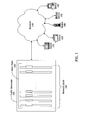
- FIG. 1 is a block diagram of an environment in accordance with the invention.
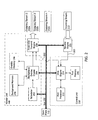
- FIG. 2 is a block diagram of an apparatus according to one aspect of the invention.
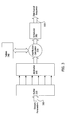
- FIG. 3 is a functional block diagram in accordance with the invention.
- FIG. 4 is a flow chart of a method in accordance with another aspect of the invention.
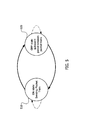
- FIG. 5 is a state machine modeling a TCP flow in accordance with the invention.
- FIG. 6 is a graph of ON/OFF properties of a sample of TCP traffic.
- the superposition of multiple ON/OFF sources also known as "packet trains" with high variability and infinite variance results in an aggregate self-similar sequence (network traffic). Therefore producing and aggregating ON/OFF sources with heavy-tailed distributions is a feasible approach for self-similar traffic generation.
- the invention uses the ability of aggregated heavy-tailed distributions to generate self-similar sequences.
- a traffic distribution is set to be heavy tailed in the ON periods, the OFF periods, or both.
- Each ON state corresponds to the period when a packet train is being transmitted, and each OFF state corresponds to the quiescent period between packet trains.
- FIG. 5 there is shown a simple state machine describing this basic structure. In state 510, a packet train is sent. In state 520, there is a quiescent period between trains.
- FIG. 6 shows a schematic traffic plot, with sequences of ON periods when data is being sent, followed by OFF periods of silence in between them.
- ON/OFF heavy tailed distributions for traffic generation may be applied in different ways.
- a sequence of natural numbers is generated that is self-similar, where the meaning of those integers is irrelevant from the generation point of view.
- the integers may correspond to the number of packets, to the number of bytes per unit time (or specified time-bin), or to anything else.
- the use of the self-similar sequence is to be determined a posteriori.
- One approach employs the aggregation of competing TCP flows in the same channel.
- a second approach uses the aggregation of several Pareto-distributed pseudo-random number generators into one multiplexed output.
- a third approach uses truncated Pareto distributions. Each one or a combination may be utilized to produce self-similar sequences.
- TCP flows can be modeled as ON/OFF sources with heavy-tail distributions
- competing TCP flows can be used to generate the desired scaling structure of the traffic.
- the chaotic mechanisms of TCP can generate scaling behavior on large timescales.
- TCP's congestion window size is one of the multiple aspects that characterize the dynamics of competing "greedy" TCP flows on the same link. Depending on a few parameters, such as link rate, buffer size, and delay, the individual behavior of the flows is modified as well as the aggregated performance.
- a traffic distribution may be used to modulate a stream.
- the minimum number of competing TCP flows needed to generate fractal behavior may be implemented using two full TCP stacks talking to each other, under certain loss-rate and other conditions.
- a pair of TCP stacks may be used to create one self-similar sequence.
- PRNG Pseudo-Random Number Generator
- the lengths of the ON and OFF periods may be regulated by adjusting the ⁇ ON and ⁇ OFF parameters.
- ⁇ ON > ⁇ OFF for real traffic since usually the probability of a very large OFF period is higher than the probability of an equally large ON period.
- This approach may be applied for floating point exponents by including the point in the binary representation of the exponent and adjusting the bit to be set to one accordingly, for example.
- Pseudo random numbers may be first generated with a uniformly distributed PRNG, and then shaped as Pareto using the above equations, implemented in a table. Having a resolution in the table below the number of potentially different number of inputs to the table (the Uniform values) would mean that some end up getting mapped to the same output value. Therefore, it is necessary to have a resolution given by the self-similar maximum length, and the desired granularity.
- the environment includes a traffic generator 100, a network 140 and plural network devices 150.
- the traffic generator 100 may be a network testing device, performance analyzer, conformance validation system, network analyzer, network management system, or programmed general purpose computer (e.g., a PC).
- the traffic generator 100 may include one or more network cards 120 and a back plane 110. Traffic generator 100 may be in the form of a card rack, as shown in FIG. 1, or may be an integrated unit. Alternatively, the traffic generator may comprise a number of separate units cooperative to provide traffic generation.
- the traffic generator 100 and the network cards 120 may support one or more well known standards or protocols such as the 10 Gigabit Ethernet and Fibre Channel standards, and may support proprietary protocols as well.
- the network cards 120 may include one or more field programmable gate arrays (FPGA), application specific integrated circuits (ASIC), programmable logic devices (PLD), programmable logic arrays (PLA), processors and other kinds of devices.
- the network cards 120 may include software and firmware.
- the term network card encompasses line cards, test cards, analysis cards, network line cards, load modules, interface cards, network interface cards, data interface cards, packet engine cards, service cards, smart cards, switch cards, relay access cards, and the like.
- Each network card 120 may provide one or more network ports.
- the ports of the network cards 120 may be connected to the network through wire, optical fiber, wirelessly or otherwise.
- Each network card 120 may support a single communications protocol, may support a number of related protocols, or may support a number of unrelated protocols.
- the network cards 120 may be permanently installed in the traffic generator 100 or field removable. Each network card 120 may provide one or more ports.
- the back plane 110 may serve as a bus or communications medium for the network cards 120.
- the back plane 110 may also provide power to the network cards 120.
- the network devices 150 may be any devices capable of communicating over the network 140.
- the network devices 150 may be computing devices such as workstations, personal computers, servers, portable computers, personal digital assistants (PDAs), computing tablets, and the like; peripheral devices such as printers, scanners, facsimile machines and the like; network capable storage devices including disk drives such as network attached storage (NAS) and storage area network (SAN) devices; networking devices such as routers, relays, hubs, switches, bridges, and multiplexers.
- the network devices 150 may include appliances such as refrigerators, washing machines, and the like as well as residential or commercial HVAC systems, alarm systems, and any other device or system capable of communicating over a network.
- the network 140 may be a LAN, a WAN, a SAN, wired, wireless, or a combination of these, and may include or be the Internet. Communications on the network 140 may take various forms, including frames, cells, datagrams, packets or other units of information, all of which are referred to herein as data units.
- the traffic generator 100 and the network devices 150 may communicate simultaneously with one another, and there may be plural logical communications between the traffic generator 100 and a given network device 150.
- the network itself may be comprised of numerous nodes providing numerous physical and logical paths for data to travel.
- a flow of data units originating from a single source on the network having a specific type of data unit and a specific rate will be referred to herein as a "stream.”
- a source may support multiple outgoing and incoming streams simultaneously and concurrently, for example to accommodate multiple data unit types or rates.
- a source may be, for example, a port on a network interface. "Simultaneously” means “at exactly the same time.” “Concurrently” means “within the same time.”
- a single stream may represent one or more concurrent "sessions.”
- a “session” is a lasting connection between a fixed, single source, and a fixed, single destination comprising a sequence of one or more data units.
- the sessions within a stream share the data rate of the stream through interleaving.
- the interleaving may be balanced, unbalanced, and distributed among the represented sessions. Two or more sessions represented by the same stream may transmit data units from a source concurrently, but not simultaneously.
- a session may include multiple paths within the network 140.
- sessions may be broken apart and reconstituted to allow for greater data rates, better error control, better network utilization, lower costs or otherwise.
- the sessions may include one or more intermediary paths, channels, or routes between one or more intermediary devices.
- the multiple intermediary paths, channels or routes may be aligned in parallel and/or serially with respect to one another within the network 140.
- the apparatus may be the traffic generator 100 (FIG. 1), the network card 120 (FIG. 1), or one or more components of the traffic generator 100 (FIG.1) or the network card 120 (FIG. 1), such as a port.
- the apparatus includes a control unit 210, a blaster unit 240, a receive engine 220, a front end/transmit engine 250, a bus 230 and communication paths 260, 265.
- the bus 230 provides a communications path between the control unit 210, the receive engine 220, the blaster unit 240, the front end/transmit engine 250 and the back plane 110.
- the bus 230 may be used for communicating control and status information, and also data.
- Communication paths 260, 265 may be used for communicating data, and also control and status information.
- the control unit 210 includes a port processor 212, a DMA engine 214, and a port memory 216.
- the control unit 210 may provide PRNG.
- the port processor 212 may be a microprocessor or other programmable processor. From outside the apparatus, the port processor 212 receives control instructions such as patterns of traffic which the apparatus is to generate. The control instructions may be received from a network device over an incoming stream 222. Alternatively, the control instructions may be provided directly to the apparatus via the bus 230, for example via the back plane 110.
- the port processor 212 may have an application program interface (API) for external control of the apparatus. A user may use a software program on a host to enter commands which create the control instructions that are sent to the port processor 212.
- the control unit 210 may store the control instructions in port memory 216 before, after, and during their execution.
- the DMA engine 214 comprises an interface and control logic providing demand memory access.
- the DMA engine 214 is coupled to the port processor 212, the port memory 216, the receive engine 220 and the bus 230. In response to requests from the port processor 212, the DMA engine 214 fetches data units and data from the port memory 216.
- the DMA engine 214 also provides a path from the port processor 212 to the blaster unit 240 and the front end/transmit engine 250.
- the receive engine 220 receives incoming data streams, such as stream 222.
- the receive engine 220 may process incoming data units according to a filter provided by or controlled by the port processor 212. After receiving the incoming data units, the receive engine 220 passes the data units to the DMA engine 214, which may store the data units in the port memory 216 or pass them directly to the port processor 212.
- the receive engine may communicate with the DMA engine 214 via bus 230 and/or communication line 265.
- Incoming data units may also be discarded, for example by either the receive engine 220 (e.g., filtered out) or the DMA engine 214.
- Incoming data units may include control data from a network device, e.g., for negotiating, setting up, tearing down or controlling a session. Incoming data units may also include data from a network device.
- the front end/transmit engine 250 transmits outgoing data units as one or more streams 252a, 252b, ... 252n.
- the data units, which the front end/transmit engine 250 transmits, may originate from the control unit 210 or the blaster unit 240.
- the control unit 210 originates control data for negotiating, setting up, tearing down and controlling streams and sessions.
- the front end/transmit engine 250 is coupled to the bus 230 and communications line 265 for receiving control information and data units.
- the blaster unit 240 includes a scheduler 242, a background overlay engine 244, a background memory 246, an overlay memory 248, and a front end/transmit engine 250.
- the scheduler 242, the background overlay engine 244 and the background memory 246 cooperate to form data units and to pass these data units to the front end/transmit engine 250.
- the blaster unit 240 uses session configuration information, comprising instructions for forming and timing transmission of the outgoing data units.
- the blaster unit 240 may receive the session configuration information from the port processor 212.
- the components of the session configuration information may be communicated as a unit or separately.
- At least some of the session configuration information - templates and overlays-- may be stored in the two memories 246, 248 of the blaster unit 240.
- the background memory 246 stores a template for the data units of each outgoing stream 252.
- the overlay memory 248 stores an overlay for each outgoing session 254. Whereas the template provides a basic layout of what will be an outgoing data unit, the overlay memory 248 dictates how the template will be modified or completed to produce the data units of the session.
- the overlay memory 248 and the background memory 246 are shown as separate units, they may be combined into a single memory.
- the port memory 216 may be combined with one or both of the background memory 246 and the overlay memory 248.
- the scheduler 242 manages a schedule of transmission times for each of the outgoing streams, such as streams 252a, 252b, 252n.
- the scheduler 242 operates like a metronome or clock to ensure that the outgoing streams conform to their respective data rates.
- the scheduler 242 sends a next transmit signal to the background overlay engine 244 when a data unit for the corresponding stream is to be transmitted.
- the scheduler 242 may signal to the background overlay engine 244 when the background overlay engine 244 should form an outgoing data unit, and the background overlay engine 244 implicitly passes the formed data units to the front end/transmit engine 250 for transmission.
- the scheduler 242 is connected to the bus 230 is coupled to the bus 230 for receiving control information.
- the background overlay engine 244 forms outgoing data units.
- the background overlay engine 244 is coupled to the scheduler 242, the background memory 246, the overlay memory 248 and the front end/transmit engine 250.
- the background overlay engine 244 uses the templates in the background memory 246 and overlays in the overlay memory 248, combining them to form outgoing data units.
- the background overlay engine 244 passes a formed outgoing data unit for a session of the signaled stream to the front end/transmit unit 250.
- the diagram includes a buffer 310, an arbitrator 320, tables 340, a distribution calculator 330 and a scheduler 350.
- the buffer 310 may comprise plural shift registers, a memory, or other device.
- the buffer 310 receives self-similarity parameters for the streams to be generated. These parameters may include the Hurst parameter, and may correspond to the ON or OFF period for the corresponding stream.
- the arbitrator 320 comprises logic for selecting at least one of the streams to service next.
- the number of streams which may be selected may be dependent on the processing and/or logic capabilities of the arbitrator 320 and other components.
- the tables 340 store distributed sequences for self-similar traffic.
- the tables 340 may be stored in a memory. These distributed sequences may correlate to a range of values for the Hurst parameter.
- the distribution calculator 330 comprises logic for generating a self-similar traffic distribution for the selected stream based on the self similarity parameters for the selected stream.
- the distribution calculator 330 retrieves a distributed sequence (or other values as described herein) from the tables 340 based upon the self-similarity parameters for the selected stream.
- the distribution calculator 330 produces the traffic distribution for the stream according to a formula which uses the retrieved distributed sequence.
- the self-similar traffic distribution is based upon distributed sequences described by a formula having a shape parameter, a minimum value for the respective distributed sequence and a uniformly distributed random variable.
- the shape parameter has a fixed value.
- the minimum value for the distributed sequences is fixed.
- the tables 340 store logarithms of values of the uniformly distributed random variable.
- the scheduler 350 may be the scheduler 242 (FIG. 2).
- the scheduler 350 may allocate rate for each packet within a train, without overflowing packets to any later ON (or OFF) periods.
- the scheduler 350 may incorporate some notion of duration of the packets.
- FIG. 4 there is shown a flow chart of a method in accordance with another aspect of the invention.
- the tables or memory may store distributed sequences for self-similar traffic correlated to a range of values for the Hurst parameter and/or other parameters.
- the stored values may be logarithms of values of a uniformly distributed random integer.
- steps may be performed at the start of the method (step 405), although they may also be performed subsequent to the start (step 405).
- the formula and pre-calculations may be dynamically changed during the course of traffic generation. In this way, different patterns or degrees of self-similarity may be obtained.
- one step is to provide values for at least one self-similarity parameter for the streams (step 410).
- the self-similarity parameters may include the Hurst parameter, an average arrival time and a fractal onset time.
- step 425 If all streams are generated, (step 425), then no further processing is necessary (step 495).
- a next stream is selected (step 430). More than one stream may be selected, for example for processing in a pipelined or parallel manner.
- a distribution is generated for the selected streams (step 435).
- the self similar traffic distributions may be based upon distributed sequences retrieved from memory or the tables 340 (FIG. 3).
- the value of the Hurst parameter for the respective streams may alone be used to retrieve the distributions.
- the values of the average arrival time, the fractal onset time, and or other parameters may be used for retrieving the distributed sequences from the table 340 (FIG. 3), in conjunction with the Hurst parameter.
- the retrieved values may be the pre-calculated logarithms.
- the distributed sequences may be described by many different approaches.
- the distributed sequences may comprise superposition of plural independent and probabilistically identical fractal renewal processes.
- the distributed sequences may be described by a formula having a shape parameter and a minimum value for the respective distributed sequence and a uniformly distributed random variable.
- the value for the shape parameter may be fixed and the minimum value for the distributed sequences may be fixed. If so, then the tables 340 (FIG. 3) may comprise logarithms of values of the uniformly distributed random variable.
- the selected streams may be generated (step 440). Steps 430, 435 and 440 repeat until all the streams have been generated (step 425), unless of course the process is interrupted.
- the generated streams of self-similar traffic may then be applied to a portion of a telecommunications network.
- the generated streams may also be used to simulate a behavior of a portion of the telecommunications network.
Landscapes
- Engineering & Computer Science (AREA)
- Computer Networks & Wireless Communication (AREA)
- Signal Processing (AREA)
- Physics & Mathematics (AREA)
- Mathematical Optimization (AREA)
- Algebra (AREA)
- General Physics & Mathematics (AREA)
- Mathematical Analysis (AREA)
- Electromagnetism (AREA)
- Mathematical Physics (AREA)
- Probability & Statistics with Applications (AREA)
- Pure & Applied Mathematics (AREA)
- Data Exchanges In Wide-Area Networks (AREA)
- Traffic Control Systems (AREA)
- Photoreceptors In Electrophotography (AREA)
- Aeration Devices For Treatment Of Activated Polluted Sludge (AREA)
- Management, Administration, Business Operations System, And Electronic Commerce (AREA)
Applications Claiming Priority (2)
| Application Number | Priority Date | Filing Date | Title |
|---|---|---|---|
| US10/404,864 US7257082B2 (en) | 2003-03-31 | 2003-03-31 | Self-similar traffic generation |
| US404864 | 2003-03-31 |
Publications (2)
| Publication Number | Publication Date |
|---|---|
| EP1465367A1 true EP1465367A1 (de) | 2004-10-06 |
| EP1465367B1 EP1465367B1 (de) | 2007-01-17 |
Family
ID=32850602
Family Applications (1)
| Application Number | Title | Priority Date | Filing Date |
|---|---|---|---|
| EP04251177A Expired - Lifetime EP1465367B1 (de) | 2003-03-31 | 2004-03-01 | Generator zur Erzeugung von selbstähnlichem Verkehr |
Country Status (5)
| Country | Link |
|---|---|
| US (1) | US7257082B2 (de) |
| EP (1) | EP1465367B1 (de) |
| JP (1) | JP3902606B2 (de) |
| AT (1) | ATE352143T1 (de) |
| DE (1) | DE602004004303D1 (de) |
Cited By (3)
| Publication number | Priority date | Publication date | Assignee | Title |
|---|---|---|---|---|
| EP1993221A1 (de) * | 2007-04-20 | 2008-11-19 | NetHawk Oyj | Verfahren, Vorrichtung, Testgerät und Programm zum Testen von Multimediakommunikationsgeräten und -software |
| US10776535B2 (en) | 2016-07-11 | 2020-09-15 | Keysight Technologies Singapore (Sales) Pte. Ltd. | Methods, systems and computer readable media for testing network devices using variable traffic burst profiles |
| US11388078B1 (en) | 2019-06-10 | 2022-07-12 | Keysight Technologies, Inc. | Methods, systems, and computer readable media for generating and using statistically varying network traffic mixes to test network devices |
Families Citing this family (18)
| Publication number | Priority date | Publication date | Assignee | Title |
|---|---|---|---|---|
| EP1766864A1 (de) * | 2004-06-30 | 2007-03-28 | Nokia Corporation | Ausfalldetektion von einem üebrtragungsweg entsprechenden weginformationen |
| US7376550B1 (en) | 2005-10-26 | 2008-05-20 | Juniper Networks, Inc. | Simulation of network traffic using non-deterministic user behavior models |
| US7958387B2 (en) | 2008-05-30 | 2011-06-07 | Spirent Communications, Inc. | Realtime test result promulgation from network component test device |
| US7826381B1 (en) | 2008-05-30 | 2010-11-02 | Spirent Communications, Inc. | Method and device test data streams bound to emulated devices |
| US8264972B2 (en) * | 2008-05-30 | 2012-09-11 | Spirent Communications, Inc. | Method and apparatus for emulating network devices |
| US20090319906A1 (en) * | 2008-06-18 | 2009-12-24 | Eads Na Defense Security And Systems Solutions Inc | Systems and methods for reconstitution of network elements in a simulated network |
| US9210050B2 (en) * | 2009-07-09 | 2015-12-08 | Centurylink Intellectual Property Llc | System and method for a testing vector and associated performance map |
| US8660424B2 (en) | 2010-08-26 | 2014-02-25 | Cisco Technology, Inc. | Scalable high speed gigabit active bundle link and tester |
| WO2011116716A2 (zh) * | 2011-04-28 | 2011-09-29 | 华为技术有限公司 | 网络流量的人工合成方法和装置 |
| US8942119B1 (en) | 2011-11-15 | 2015-01-27 | Sprint Spectrum L.P. | Determining a burstiness profile of a wireless communication system |
| EP2840861B1 (de) * | 2012-04-16 | 2020-11-04 | ZTE Corporation | Auf drahtloser peer-to-peer-kommunikation basierendes übertragungsverfahren und vorrichtung |
| US9680904B2 (en) * | 2013-09-30 | 2017-06-13 | Verizon Patent And Licensing Inc. | Adaptive buffers for media players |
| US20160283859A1 (en) * | 2015-03-25 | 2016-09-29 | Cisco Technology, Inc. | Network traffic classification |
| US11070451B2 (en) | 2017-12-11 | 2021-07-20 | Spirent Communications, Inc. | Method and system for inducing pseudo HTTPS communications between one or more emulated servers and emulated clients to test a device therebetween |
| RU2677373C1 (ru) * | 2017-12-13 | 2019-01-16 | Федеральное казенное военное образовательное учреждение высшего образования "Военная академия Ракетных войск стратегического назначения имени Петра Великого" МО РФ | Способ повышения качества передачи фрактального телекоммуникационного трафика |
| US11182399B2 (en) | 2018-09-04 | 2021-11-23 | Spirent Communications, Inc. | Effective correlation of multiple time-series result sets |
| US11374973B2 (en) | 2018-12-20 | 2022-06-28 | Spirent Communications, Inc. | Streamlining cryptographic processes in a test environment |
| US12101229B2 (en) | 2020-11-23 | 2024-09-24 | Spirent Communications, Inc. | Generation of data packets for high speed network testing using range variable field modifiers |
Citations (2)
| Publication number | Priority date | Publication date | Assignee | Title |
|---|---|---|---|---|
| EP0895375A2 (de) * | 1997-07-31 | 1999-02-03 | Hewlett-Packard Company | Mehrfach-Verkehrsstromemulator |
| US20020037008A1 (en) * | 2000-09-26 | 2002-03-28 | Atsushi Tagami | Traffic generation apparatus |
Family Cites Families (26)
| Publication number | Priority date | Publication date | Assignee | Title |
|---|---|---|---|---|
| US5671351A (en) | 1995-04-13 | 1997-09-23 | Texas Instruments Incorporated | System and method for automated testing and monitoring of software applications |
| JP3574231B2 (ja) | 1995-08-21 | 2004-10-06 | 富士通株式会社 | 計算機ネットワークのシミュレータ装置 |
| US5568471A (en) | 1995-09-06 | 1996-10-22 | International Business Machines Corporation | System and method for a workstation monitoring and control of multiple networks having different protocols |
| US5787147A (en) | 1995-12-21 | 1998-07-28 | Ericsson Inc. | Test message generator in a telecommunications network |
| US5905713A (en) | 1996-04-15 | 1999-05-18 | Hughes Electronics Corporation | Method and apparatus for analyzing digital multi-program transmission packet streams |
| JPH10190705A (ja) | 1996-10-22 | 1998-07-21 | Sony Corp | 伝送装置および方法、並びに、受信装置および方法 |
| WO1999004343A1 (en) | 1997-07-18 | 1999-01-28 | Interprophet Corporation | Tcp/ip network accelerator system and method |
| JPH1198143A (ja) | 1997-09-17 | 1999-04-09 | Toshiba Corp | Atm中継装置 |
| US6148277A (en) | 1997-12-18 | 2000-11-14 | Nortel Networks Corporation | Apparatus and method for generating model reference tests |
| US6321264B1 (en) | 1998-08-28 | 2001-11-20 | 3Com Corporation | Network-performance statistics using end-node computer systems |
| US6389449B1 (en) | 1998-12-16 | 2002-05-14 | Clearwater Networks, Inc. | Interstream control and communications for multi-streaming digital processors |
| US6507923B1 (en) | 1999-04-19 | 2003-01-14 | I-Tech Corporation | Integrated multi-channel fiber channel analyzer |
| US6526259B1 (en) * | 1999-05-27 | 2003-02-25 | At&T Corp. | Portable self-similar traffic generation models |
| US6621805B1 (en) | 1999-10-25 | 2003-09-16 | Hrl Laboratories, Llc | Method and apparatus for multicasting real-time variable bit-rate traffic in wireless Ad-Hoc networks |
| US6477483B1 (en) | 2000-01-17 | 2002-11-05 | Mercury Interactive Corporation | Service for load testing a transactional server over the internet |
| US6990529B2 (en) * | 2000-02-24 | 2006-01-24 | Zarlink Semiconductor V.N., Inc. | Unified algorithm for frame scheduling and buffer management in differentiated services networks |
| JP3799948B2 (ja) | 2000-03-30 | 2006-07-19 | ブラザー工業株式会社 | Ipアドレス設定装置、ipアドレス設定方法、及びネットワークシステム |
| US6601020B1 (en) | 2000-05-03 | 2003-07-29 | Eureka Software Solutions, Inc. | System load testing coordination over a network |
| US6343078B1 (en) | 2000-05-12 | 2002-01-29 | 3Com Corporation | Compression of forwarding decisions in a network device |
| US7002918B1 (en) * | 2000-05-22 | 2006-02-21 | Northrop Grumman Corporation | Method and apparatus for real time scheduling in a satellite communications network |
| SE0004804L (sv) | 2000-12-21 | 2002-06-22 | Ericsson Telefon Ab L M | Metod och anordning avseende dataöverföring |
| US20020138226A1 (en) | 2001-03-26 | 2002-09-26 | Donald Doane | Software load tester |
| US6950405B2 (en) | 2001-07-16 | 2005-09-27 | Agilent Technologies, Inc. | Traffic stream generator having a non-consecutive addressing mechanism |
| US7161902B2 (en) * | 2001-08-08 | 2007-01-09 | Nortel Networks Limited | Reducing network traffic congestion |
| EP1289212A1 (de) | 2001-08-28 | 2003-03-05 | Lucent Technologies Inc. | Electro-optisches Interface für parallele Datenübertragung |
| KR100434335B1 (ko) * | 2001-11-27 | 2004-06-04 | 학교법인 한국정보통신학원 | 광 버스트 스위칭 네트워크의 제어패킷과 데이터 버스트생성방법 |
-
2003
- 2003-03-31 US US10/404,864 patent/US7257082B2/en not_active Expired - Lifetime
-
2004
- 2004-03-01 AT AT04251177T patent/ATE352143T1/de not_active IP Right Cessation
- 2004-03-01 DE DE602004004303T patent/DE602004004303D1/de not_active Expired - Lifetime
- 2004-03-01 EP EP04251177A patent/EP1465367B1/de not_active Expired - Lifetime
- 2004-03-31 JP JP2004107997A patent/JP3902606B2/ja not_active Expired - Fee Related
Patent Citations (2)
| Publication number | Priority date | Publication date | Assignee | Title |
|---|---|---|---|---|
| EP0895375A2 (de) * | 1997-07-31 | 1999-02-03 | Hewlett-Packard Company | Mehrfach-Verkehrsstromemulator |
| US20020037008A1 (en) * | 2000-09-26 | 2002-03-28 | Atsushi Tagami | Traffic generation apparatus |
Non-Patent Citations (4)
| Title |
|---|
| GLEN KRAMER: "The notions and effects of self-similarity and long-range dependence", SELF-SIMILAR NETWORK TRAFFIC, 21 May 2001 (2001-05-21), XP002283695, Retrieved from the Internet <URL:http://wwwcsif.cs.ucdavis.edu/~kramer/papers/ss_trf_present2.pdf> [retrieved on 20040607] * |
| MONDRAGON R J ET AL: "Chaotic maps for traffic modelling and queueing performance analysis", PERFORM. EVAL. (NETHERLANDS), PERFORMANCE EVALUATION, MARCH 2001, ELSEVIER, NETHERLANDS, vol. 43, no. 4, 4 March 2001 (2001-03-04), pages 223 - 240, XP002283697, ISSN: 0166-5316 * |
| SIKDAR B ET AL: "On the contribution of TCP to the self-similarity of network traffic", 2001, BERLIN, GERMANY, SPRINGER-VERLAG, GERMANY, 20 September 2001 (2001-09-20), pages 596 - 613, XP002283696, ISBN: 3-540-42592-6 * |
| WILLINGER W ET AL: "SELF-SIMILARITY THROUGH HIGH-VARIABILITY: STATISTICAL ANALYSIS OF ETHERNET LAN TRAFFIC AT THE SOURCE LEVEL", IEEE / ACM TRANSACTIONS ON NETWORKING, IEEE INC. NEW YORK, US, vol. 5, no. 1, 1 February 1997 (1997-02-01), pages 71 - 86, XP000678917, ISSN: 1063-6692 * |
Cited By (3)
| Publication number | Priority date | Publication date | Assignee | Title |
|---|---|---|---|---|
| EP1993221A1 (de) * | 2007-04-20 | 2008-11-19 | NetHawk Oyj | Verfahren, Vorrichtung, Testgerät und Programm zum Testen von Multimediakommunikationsgeräten und -software |
| US10776535B2 (en) | 2016-07-11 | 2020-09-15 | Keysight Technologies Singapore (Sales) Pte. Ltd. | Methods, systems and computer readable media for testing network devices using variable traffic burst profiles |
| US11388078B1 (en) | 2019-06-10 | 2022-07-12 | Keysight Technologies, Inc. | Methods, systems, and computer readable media for generating and using statistically varying network traffic mixes to test network devices |
Also Published As
| Publication number | Publication date |
|---|---|
| US7257082B2 (en) | 2007-08-14 |
| ATE352143T1 (de) | 2007-02-15 |
| DE602004004303D1 (de) | 2007-03-08 |
| US20040190519A1 (en) | 2004-09-30 |
| JP2004304811A (ja) | 2004-10-28 |
| JP3902606B2 (ja) | 2007-04-11 |
| EP1465367B1 (de) | 2007-01-17 |
Similar Documents
| Publication | Publication Date | Title |
|---|---|---|
| US7257082B2 (en) | Self-similar traffic generation | |
| US7885803B2 (en) | System and method for simulating traffic loads in packetized communication networks | |
| Pruthi et al. | Heavy-tailed on/off source behavior and self-similar traffic | |
| Klivansky et al. | On long-range dependence in NSFNET tra c | |
| Lübben et al. | Stochastic bandwidth estimation in networks with random service | |
| Nuzman et al. | A compound model for TCP connection arrivals for LAN and WAN applications | |
| Wang et al. | Timing is everything: Accurate, minimum overhead, available bandwidth estimation in high-speed wired networks | |
| US7339899B2 (en) | Method and system for network emulation using packet reorder emulation techniques | |
| CN105577473A (zh) | 一种基于网络流量模型的多业务流量生成系统 | |
| Morin | The impact of self-similarity on network performance analysis | |
| De Souza e Silva et al. | The TANGRAMII integrated modeling environment for computer systems and networks | |
| Popoola et al. | Empirical performance of weibull selfsimilar tele-traffic model | |
| CN100370766C (zh) | 分布式无线通信传输技术测试平台的设计方法 | |
| US7805287B1 (en) | Node emulator | |
| Geyer12 et al. | RENETO, a realistic network traffic generator for OMNeT++/INET | |
| Sanlı et al. | FPGEN: A fast, scalable and programmable traffic generator for the performance evaluation of high-speed computer networks | |
| Raj et al. | Stochastic network calculus for rician fading in underwater wireless networks | |
| Quan et al. | Impact of self-similarity on performance evaluation in differential service networks | |
| Li | Background traffic modeling for large-scale network simulation | |
| Papadopoulos et al. | Performance preserving network downscaling | |
| Tagami et al. | OC-48c traffic tester for generating and analyzing long-range dependence traffic | |
| Strengbom | Mobile services based traffic modeling | |
| Yang et al. | GenNP: A low-threshold and powerful network performance data generator | |
| Yuan et al. | Time-dependent collective behavior in a computer network model | |
| Klivansky et al. | The NSFNET Simulation Platform |
Legal Events
| Date | Code | Title | Description |
|---|---|---|---|
| PUAI | Public reference made under article 153(3) epc to a published international application that has entered the european phase |
Free format text: ORIGINAL CODE: 0009012 |
|
| AK | Designated contracting states |
Kind code of ref document: A1 Designated state(s): AT BE BG CH CY CZ DE DK EE ES FI FR GB GR HU IE IT LI LU MC NL PL PT RO SE SI SK TR |
|
| AX | Request for extension of the european patent |
Extension state: AL HR LT LV MK |
|
| 17P | Request for examination filed |
Effective date: 20050302 |
|
| AKX | Designation fees paid |
Designated state(s): AT BE BG CH CY CZ DE DK EE ES FI FR GB GR HU IE IT LI LU MC NL PL PT RO SE SI SK TR |
|
| 17Q | First examination report despatched |
Effective date: 20050602 |
|
| GRAP | Despatch of communication of intention to grant a patent |
Free format text: ORIGINAL CODE: EPIDOSNIGR1 |
|
| GRAS | Grant fee paid |
Free format text: ORIGINAL CODE: EPIDOSNIGR3 |
|
| GRAA | (expected) grant |
Free format text: ORIGINAL CODE: 0009210 |
|
| AK | Designated contracting states |
Kind code of ref document: B1 Designated state(s): AT BE BG CH CY CZ DE DK EE ES FI FR GB GR HU IE IT LI LU MC NL PL PT RO SE SI SK TR |
|
| PG25 | Lapsed in a contracting state [announced via postgrant information from national office to epo] |
Ref country code: CH Free format text: LAPSE BECAUSE OF FAILURE TO SUBMIT A TRANSLATION OF THE DESCRIPTION OR TO PAY THE FEE WITHIN THE PRESCRIBED TIME-LIMIT Effective date: 20070117 Ref country code: FI Free format text: LAPSE BECAUSE OF FAILURE TO SUBMIT A TRANSLATION OF THE DESCRIPTION OR TO PAY THE FEE WITHIN THE PRESCRIBED TIME-LIMIT Effective date: 20070117 Ref country code: AT Free format text: LAPSE BECAUSE OF FAILURE TO SUBMIT A TRANSLATION OF THE DESCRIPTION OR TO PAY THE FEE WITHIN THE PRESCRIBED TIME-LIMIT Effective date: 20070117 Ref country code: DK Free format text: LAPSE BECAUSE OF FAILURE TO SUBMIT A TRANSLATION OF THE DESCRIPTION OR TO PAY THE FEE WITHIN THE PRESCRIBED TIME-LIMIT Effective date: 20070117 Ref country code: SI Free format text: LAPSE BECAUSE OF FAILURE TO SUBMIT A TRANSLATION OF THE DESCRIPTION OR TO PAY THE FEE WITHIN THE PRESCRIBED TIME-LIMIT Effective date: 20070117 Ref country code: PL Free format text: LAPSE BECAUSE OF FAILURE TO SUBMIT A TRANSLATION OF THE DESCRIPTION OR TO PAY THE FEE WITHIN THE PRESCRIBED TIME-LIMIT Effective date: 20070117 Ref country code: LI Free format text: LAPSE BECAUSE OF FAILURE TO SUBMIT A TRANSLATION OF THE DESCRIPTION OR TO PAY THE FEE WITHIN THE PRESCRIBED TIME-LIMIT Effective date: 20070117 Ref country code: NL Free format text: LAPSE BECAUSE OF FAILURE TO SUBMIT A TRANSLATION OF THE DESCRIPTION OR TO PAY THE FEE WITHIN THE PRESCRIBED TIME-LIMIT Effective date: 20070117 |
|
| REG | Reference to a national code |
Ref country code: GB Ref legal event code: FG4D |
|
| REG | Reference to a national code |
Ref country code: CH Ref legal event code: EP |
|
| REG | Reference to a national code |
Ref country code: IE Ref legal event code: FG4D |
|
| REF | Corresponds to: |
Ref document number: 602004004303 Country of ref document: DE Date of ref document: 20070308 Kind code of ref document: P |
|
| PG25 | Lapsed in a contracting state [announced via postgrant information from national office to epo] |
Ref country code: SE Free format text: LAPSE BECAUSE OF FAILURE TO SUBMIT A TRANSLATION OF THE DESCRIPTION OR TO PAY THE FEE WITHIN THE PRESCRIBED TIME-LIMIT Effective date: 20070417 |
|
| PG25 | Lapsed in a contracting state [announced via postgrant information from national office to epo] |
Ref country code: BG Free format text: LAPSE BECAUSE OF FAILURE TO SUBMIT A TRANSLATION OF THE DESCRIPTION OR TO PAY THE FEE WITHIN THE PRESCRIBED TIME-LIMIT Effective date: 20070418 |
|
| PG25 | Lapsed in a contracting state [announced via postgrant information from national office to epo] |
Ref country code: ES Free format text: LAPSE BECAUSE OF FAILURE TO SUBMIT A TRANSLATION OF THE DESCRIPTION OR TO PAY THE FEE WITHIN THE PRESCRIBED TIME-LIMIT Effective date: 20070428 |
|
| PG25 | Lapsed in a contracting state [announced via postgrant information from national office to epo] |
Ref country code: PT Free format text: LAPSE BECAUSE OF FAILURE TO SUBMIT A TRANSLATION OF THE DESCRIPTION OR TO PAY THE FEE WITHIN THE PRESCRIBED TIME-LIMIT Effective date: 20070618 |
|
| NLV1 | Nl: lapsed or annulled due to failure to fulfill the requirements of art. 29p and 29m of the patents act | ||
| REG | Reference to a national code |
Ref country code: CH Ref legal event code: PL |
|
| PLBE | No opposition filed within time limit |
Free format text: ORIGINAL CODE: 0009261 |
|
| STAA | Information on the status of an ep patent application or granted ep patent |
Free format text: STATUS: NO OPPOSITION FILED WITHIN TIME LIMIT |
|
| PG25 | Lapsed in a contracting state [announced via postgrant information from national office to epo] |
Ref country code: SK Free format text: LAPSE BECAUSE OF FAILURE TO SUBMIT A TRANSLATION OF THE DESCRIPTION OR TO PAY THE FEE WITHIN THE PRESCRIBED TIME-LIMIT Effective date: 20070117 |
|
| 26N | No opposition filed |
Effective date: 20071018 |
|
| PG25 | Lapsed in a contracting state [announced via postgrant information from national office to epo] |
Ref country code: BE Free format text: LAPSE BECAUSE OF FAILURE TO SUBMIT A TRANSLATION OF THE DESCRIPTION OR TO PAY THE FEE WITHIN THE PRESCRIBED TIME-LIMIT Effective date: 20070117 Ref country code: CZ Free format text: LAPSE BECAUSE OF FAILURE TO SUBMIT A TRANSLATION OF THE DESCRIPTION OR TO PAY THE FEE WITHIN THE PRESCRIBED TIME-LIMIT Effective date: 20070117 Ref country code: RO Free format text: LAPSE BECAUSE OF FAILURE TO SUBMIT A TRANSLATION OF THE DESCRIPTION OR TO PAY THE FEE WITHIN THE PRESCRIBED TIME-LIMIT Effective date: 20070117 |
|
| PG25 | Lapsed in a contracting state [announced via postgrant information from national office to epo] |
Ref country code: IE Free format text: LAPSE BECAUSE OF NON-PAYMENT OF DUE FEES Effective date: 20070301 Ref country code: MC Free format text: LAPSE BECAUSE OF NON-PAYMENT OF DUE FEES Effective date: 20070331 Ref country code: DE Free format text: LAPSE BECAUSE OF FAILURE TO SUBMIT A TRANSLATION OF THE DESCRIPTION OR TO PAY THE FEE WITHIN THE PRESCRIBED TIME-LIMIT Effective date: 20070418 |
|
| PG25 | Lapsed in a contracting state [announced via postgrant information from national office to epo] |
Ref country code: GR Free format text: LAPSE BECAUSE OF FAILURE TO SUBMIT A TRANSLATION OF THE DESCRIPTION OR TO PAY THE FEE WITHIN THE PRESCRIBED TIME-LIMIT Effective date: 20070418 Ref country code: FR Free format text: LAPSE BECAUSE OF FAILURE TO SUBMIT A TRANSLATION OF THE DESCRIPTION OR TO PAY THE FEE WITHIN THE PRESCRIBED TIME-LIMIT Effective date: 20070907 Ref country code: IT Free format text: LAPSE BECAUSE OF FAILURE TO SUBMIT A TRANSLATION OF THE DESCRIPTION OR TO PAY THE FEE WITHIN THE PRESCRIBED TIME-LIMIT Effective date: 20070117 |
|
| PG25 | Lapsed in a contracting state [announced via postgrant information from national office to epo] |
Ref country code: FR Free format text: LAPSE BECAUSE OF FAILURE TO SUBMIT A TRANSLATION OF THE DESCRIPTION OR TO PAY THE FEE WITHIN THE PRESCRIBED TIME-LIMIT Effective date: 20070117 |
|
| PG25 | Lapsed in a contracting state [announced via postgrant information from national office to epo] |
Ref country code: EE Free format text: LAPSE BECAUSE OF FAILURE TO SUBMIT A TRANSLATION OF THE DESCRIPTION OR TO PAY THE FEE WITHIN THE PRESCRIBED TIME-LIMIT Effective date: 20070117 |
|
| PG25 | Lapsed in a contracting state [announced via postgrant information from national office to epo] |
Ref country code: CY Free format text: LAPSE BECAUSE OF FAILURE TO SUBMIT A TRANSLATION OF THE DESCRIPTION OR TO PAY THE FEE WITHIN THE PRESCRIBED TIME-LIMIT Effective date: 20070117 |
|
| PG25 | Lapsed in a contracting state [announced via postgrant information from national office to epo] |
Ref country code: LU Free format text: LAPSE BECAUSE OF NON-PAYMENT OF DUE FEES Effective date: 20070301 |
|
| PG25 | Lapsed in a contracting state [announced via postgrant information from national office to epo] |
Ref country code: TR Free format text: LAPSE BECAUSE OF FAILURE TO SUBMIT A TRANSLATION OF THE DESCRIPTION OR TO PAY THE FEE WITHIN THE PRESCRIBED TIME-LIMIT Effective date: 20070117 Ref country code: HU Free format text: LAPSE BECAUSE OF FAILURE TO SUBMIT A TRANSLATION OF THE DESCRIPTION OR TO PAY THE FEE WITHIN THE PRESCRIBED TIME-LIMIT Effective date: 20070718 |
|
| REG | Reference to a national code |
Ref country code: GB Ref legal event code: 732E Free format text: REGISTERED BETWEEN 20171130 AND 20171206 |
|
| REG | Reference to a national code |
Ref country code: GB Ref legal event code: 732E Free format text: REGISTERED BETWEEN 20181018 AND 20181024 |
|
| PGFP | Annual fee paid to national office [announced via postgrant information from national office to epo] |
Ref country code: GB Payment date: 20230119 Year of fee payment: 20 |
|
| REG | Reference to a national code |
Ref country code: GB Ref legal event code: PE20 Expiry date: 20240229 |
|
| PG25 | Lapsed in a contracting state [announced via postgrant information from national office to epo] |
Ref country code: GB Free format text: LAPSE BECAUSE OF EXPIRATION OF PROTECTION Effective date: 20240229 |