EP1465196B1 - Generating visually representative video thumbnails - Google Patents
Generating visually representative video thumbnails Download PDFInfo
- Publication number
- EP1465196B1 EP1465196B1 EP04007833.9A EP04007833A EP1465196B1 EP 1465196 B1 EP1465196 B1 EP 1465196B1 EP 04007833 A EP04007833 A EP 04007833A EP 1465196 B1 EP1465196 B1 EP 1465196B1
- Authority
- EP
- European Patent Office
- Prior art keywords
- video
- frame
- goodness
- recited
- thumbnail
- Prior art date
- Legal status (The legal status is an assumption and is not a legal conclusion. Google has not performed a legal analysis and makes no representation as to the accuracy of the status listed.)
- Expired - Lifetime
Links
Images



Classifications
-
- G—PHYSICS
- G06—COMPUTING OR CALCULATING; COUNTING
- G06F—ELECTRIC DIGITAL DATA PROCESSING
- G06F16/00—Information retrieval; Database structures therefor; File system structures therefor
- G06F16/70—Information retrieval; Database structures therefor; File system structures therefor of video data
- G06F16/73—Querying
- G06F16/738—Presentation of query results
- G06F16/739—Presentation of query results in form of a video summary, e.g. the video summary being a video sequence, a composite still image or having synthesized frames
-
- E—FIXED CONSTRUCTIONS
- E03—WATER SUPPLY; SEWERAGE
- E03D—WATER-CLOSETS OR URINALS WITH FLUSHING DEVICES; FLUSHING VALVES THEREFOR
- E03D9/00—Sanitary or other accessories for lavatories ; Devices for cleaning or disinfecting the toilet room or the toilet bowl; Devices for eliminating smells
- E03D9/08—Devices in the bowl producing upwardly-directed sprays; Modifications of the bowl for use with such devices ; Bidets; Combinations of bowls with urinals or bidets; Hot-air or other devices mounted in or on the bowl, urinal or bidet for cleaning or disinfecting
-
- G—PHYSICS
- G06—COMPUTING OR CALCULATING; COUNTING
- G06F—ELECTRIC DIGITAL DATA PROCESSING
- G06F18/00—Pattern recognition
- G06F18/20—Analysing
- G06F18/28—Determining representative reference patterns, e.g. by averaging or distorting; Generating dictionaries
-
- G—PHYSICS
- G06—COMPUTING OR CALCULATING; COUNTING
- G06V—IMAGE OR VIDEO RECOGNITION OR UNDERSTANDING
- G06V10/00—Arrangements for image or video recognition or understanding
- G06V10/70—Arrangements for image or video recognition or understanding using pattern recognition or machine learning
- G06V10/77—Processing image or video features in feature spaces; using data integration or data reduction, e.g. principal component analysis [PCA] or independent component analysis [ICA] or self-organising maps [SOM]; Blind source separation
- G06V10/772—Determining representative reference patterns, e.g. averaging or distorting patterns; Generating dictionaries
-
- G—PHYSICS
- G06—COMPUTING OR CALCULATING; COUNTING
- G06V—IMAGE OR VIDEO RECOGNITION OR UNDERSTANDING
- G06V20/00—Scenes; Scene-specific elements
- G06V20/40—Scenes; Scene-specific elements in video content
-
- G—PHYSICS
- G11—INFORMATION STORAGE
- G11B—INFORMATION STORAGE BASED ON RELATIVE MOVEMENT BETWEEN RECORD CARRIER AND TRANSDUCER
- G11B27/00—Editing; Indexing; Addressing; Timing or synchronising; Monitoring; Measuring tape travel
- G11B27/10—Indexing; Addressing; Timing or synchronising; Measuring tape travel
- G11B27/102—Programmed access in sequence to addressed parts of tracks of operating record carriers
-
- G—PHYSICS
- G11—INFORMATION STORAGE
- G11B—INFORMATION STORAGE BASED ON RELATIVE MOVEMENT BETWEEN RECORD CARRIER AND TRANSDUCER
- G11B27/00—Editing; Indexing; Addressing; Timing or synchronising; Monitoring; Measuring tape travel
- G11B27/10—Indexing; Addressing; Timing or synchronising; Measuring tape travel
- G11B27/19—Indexing; Addressing; Timing or synchronising; Measuring tape travel by using information detectable on the record carrier
- G11B27/28—Indexing; Addressing; Timing or synchronising; Measuring tape travel by using information detectable on the record carrier by using information signals recorded by the same method as the main recording
Definitions
- the present disclosure generally relates to video presentation technology, and more particularly, to generating a video thumbnail that represents the salient content of a video sequence.
- Video data conveys video and audio information whose spatial and temporal expression and sheer volume make it beyond adequate description using mere words.
- a video "abstracts" i.e., representative still pictures extracted from video sequences
- a video shot is a contiguous sequence of video frames recorded from a single camera. Video shots form the building blocks of a video sequence.
- the purpose of shot boundary detection is to segment a video sequence into multiple video shots from which key frames can be extracted.
- a key frame is a video frame that provides a thumbnail representation of the salient content of a shot. The use of key frames reduces the amount of data required in video indexing and provides a way to organize and browse video content.
- Key frame extraction continues to be an important topic to which significant effort is devoted.
- One easy technique often used for key frame extraction is to select the first frame of each video shot as the shot's key frame. This technique is computationally inexpensive, but typically fails to effectively capture salient visual content for a video shot.
- Other techniques for key frame extraction include the use and analysis of various visual criteria such as color features and motion between video frames. Such techniques may improve the capturing of salient visual content, but they tend to be computationally expensive.
- key frame extraction techniques have improved, they continue to suffer disadvantages including their significant computational expense and their inability to effectively capture salient visual content from video data.
- EP 0 690 413 A discloses an automatic content-based key frame extraction method using a temporal variation of video content.
- the temporal variation of the video content is analyzed and a key frame is selected once the difference of content between a current frame and a preceding selected key frame exceeds a set of preselected thresholds.
- a system and methods are disclosed for generating a video thumbnail for a video sequence by identifying a video frame that visually represents the salient content of the video sequence.
- a video thumbnail algorithm calculates a frame goodness measure as a function of the weighted combination of a histogram entropy and a histogram standard deviation for a video frame.
- a particular frame is selected as a video thumbnail based on a comparison of frame goodness measures for various frames within a video sequence.
- a frame goodness measure is calculated for each video frame in a video sequence.
- Calculating a frame goodness measure includes calculating a histogram for a frame. An entropy and a standard deviation are then calculated for the histogram. The frame goodness measure is then calculated as a weighted combination of the entropy and the standard deviation. Frame goodness measures for each video frame are compared to one another to determine which video frame is most salient. The frame having the highest value of frame goodness measure is chosen as a video thumbnail.
- a video sequence is temporally segmented and frame goodness measures are calculated for frames within a particular segment of the video sequence (e.g., the beginning, middle, or end of the video sequence).
- a local maximum frame goodness measure is determined for the particular video segment. Then, the video frame associated with the local maximum frame goodness measure is selected as a video thumbnail for the video sequence.
- a video sequence is segmented into video shots, and frame goodness measures are calculated for frames within each shot. Local maximum frame goodness measures are determined for each video shot. A video thumbnail for the video sequence is selected as the video frame associated with the highest valued local maximum frame goodness measure.
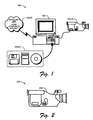
- Figs. 1 and 2 illustrate exemplary environments that are suitable for identifying video thumbnails for video files.
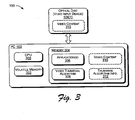
- Fig. 3 is a block diagram representation of a computer and video input source as might be implemented in the environment of Fig. 1 .
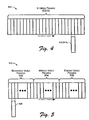
- Fig. 4 is a high-level representation of a video sequence.
- Fig. 5 illustrates an embodiment of a video thumbnail algorithm that segments a video sequence temporally before applying a frame goodness measure.
- Fig. 6 illustrates representative video shots that each contain a number of video frames from a video sequence.
- Fig. 7 illustrates a video frame broken into blocks.
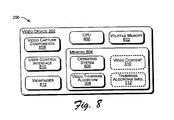
- Fig. 8 is a block diagram representation of a stand alone video recording device as might be implemented in the environment of Fig. 2 .
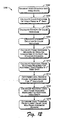
- Figs. 9 , 10 , 11 and 12 are flow diagrams illustrating exemplary methods for identifying salient, content-rich video thumbnails that represent video sequences.
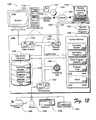
- Fig. 13 illustrates an example of a suitable computing environment that may be used to implement a computer.
- the systems and methods described herein implement a thumbnail identification algorithm to identify a salient video frame from a video sequence for use as a video thumbnail.
- the identification of a video thumbnail is based on a frame goodness measure.
- the algorithm calculates a color histogram of a frame, and then calculates the entropy and standard deviation of the color histogram.
- the frame goodness measure is a weighted combination of the entropy and the standard deviation.
- a video frame having the highest value of goodness measure for a video sequence is determined as the video thumbnail for a video sequence. Benefits of the disclosed systems and methods include the generation of video thumbnails that accurately represent the content of video files.
- Figs. 1 and 2 illustrate exemplary environments that are suitable for identifying video thumbnails for video files.
- the exemplary environment 100 of Fig. 1 includes a computer 102 and one or more video input sources 104.
- Video input sources 104 can be any type of device or communication network capable of transferring video content to computer 102, including for example, portable storage media 104(1) (e.g., magnetic discs, media cards, optical discs), a video recording device 104(2), or a network 104(3) such as the Internet, a corporate network, or a home network.
- portable storage media 104(1) e.g., magnetic discs, media cards, optical discs
- video recording device 104(2) e.g., a video recording device 104(2)
- a network 104(3) such as the Internet, a corporate network, or a home network.
- Video recording device 104(2) can be any of various digital recording devices capable of recording live-motion video and audio for later replay through, for example, VCRs, TVs, and personal computers such as computer 102.
- a video recording device 104(2) is typically capable of being connected directly to computer 102 using an i.LINK (IEEE 1394) or FireWire digital interface, so that video content can be edited directly on the computer 102.
- i.LINK IEEE 1394
- FireWire digital interface so that video content can be edited directly on the computer 102.
- Computer 102 may be implemented as various computing devices generally capable of receiving video content from various sources 104 and manipulating the video content for playback through, for example, a media player.
- Computer 102 is otherwise typically capable of performing common computing functions, such as email, calendaring, task organization, word processing, Web browsing, and so on.
- computer 102 runs an open platform operating system, such as the Windows® brand operating systems from Microsoft®.
- Computer 102 may be implemented, for example, as a desktop computer, a server computer, a laptop computer, or other form of personal computer (PC).
- PC personal computer
- computer 102 is generally configured to receive a video sequence or file (i.e., video content) from a video content source 104, and to identify a video frame within the video sequence that is suitable for use as a video thumbnail whose visual content substantially represents the whole video sequence.
- a video sequence or file i.e., video content
- the exemplary environment 200 of Fig. 2 includes a stand alone video recording device 202.
- the video recording device 202 may be configured in substantially the same manner as the video recording device 104(2) of Fig. 1 .
- video recording device 202 is typically capable of being connected directly to a computer using an i.LINK (IEEE 1394) or FireWire digital interface.
- the stand alone video. recording device 202 of Fig. 2 is intended to illustrate that such a device may be generally configured (like computer 102) to identify a video frame from a captured video sequence that is suitable for use as a video thumbnail whose visual content substantially represents the whole video sequence.
- Fig. 3 is a block diagram representation of a computer 102 and video input source 104 as might be implemented in the environment 100 of Fig. 1 .
- Computer 102 is implemented as a PC (personal computer), such as a desktop or laptop PC.
- Video input source 104 is implemented as an optical disc 104(1).
- PC 102 includes a processor 300, a volatile memory 302 (i.e., RAM), and a nonvolatile memory 304 (e.g., ROM, hard disk, floppy disk, CD-ROM, etc.).
- Nonvolatile memory 304 generally provides storage of computer/processor-readable instructions, data structures, program modules and other data for PC 102.
- PC 102 typically implements various application programs 306 stored in memory 304 and executed on processor 300.
- Such applications 306 may include software programs implementing, for example, word processors, spread sheets, browsers, multimedia players, illustrators, computer-aided design tools and the like.
- One exemplary implementation of a PC 102 is described in more detail below with reference to Fig. 13 .
- PC 102 implements a video thumbnail algorithm 308.
- video thumbnail algorithm 308 may well be implemented as a function of a higher level application 306.
- Such applications 306 might typically include, but are not limited to, browsers, video software editing products, VCR control systems, MPEG ripper applications, and so forth.
- video thumbnail algorithm 308 is configured to analyze video content 310 received from a video input device 104 (e.g., optical disc 104(1)), such as the video sequence 400 shown in Fig. 4 , and to identify (i.e., extract) a video frame 402 from the video sequence 400 as a salient video thumbnail that substantially represents the content of the whole video sequence 400.
- video thumbnail algorithm 308 generates and uses thumbnail algorithm information 312. It is noted that although video content 310 and thumbnail algorithm information 312 are illustrated as residing in nonvolatile memory 304, they may additionally reside in whole or in part in volatile memory 302.
- Fig. 4 is a high-level representation showing a video sequence 400.
- the video sequence 400 represents any number of frames 402(N) (one through N), that represent the entire length of a video content 310. Shown below the video frame sequence 400 is a particular video frame 402(N - R) that-represents a video frame that has been selected by video thumbnail algorithm 308 ( Fig. 3 ) as a video thumbnail to represent the salient content of the whole video sequence 400.
- the video thumbnail algorithm 308 determines a video thumbnail by calculating a frame goodness measure for each frame in the video sequence 400.
- the frame goodness measure represents a measure of the extent to which a given video frame visually represents the salient content of the whole video sequence 400.
- the frame goodness measure represents a way to extract the most representative and visually satisfactory frame 402 as a video thumbnail to represent the whole video sequence 400.
- video thumbnail algorithm 308 To calculate a frame goodness measure for a video frame 402, video thumbnail algorithm 308 first makes two calculations (i.e., entropy and standard deviation) on a video frame's color histogram.
- a color histogram is an important and well-known image analysis tool that provides a statistical representation of the pixels of an image. The statistical representation shows what color pixels are present in an image and how many pixels of each color are present in the image.
- a color histogram can be represented as a bar graph where each entry on the horizontal axis is one of the possible colors that pixel could have.
- the first calculation that the video thumbnail algorithm 308 performs on a video frame's color histogram is an entropy calculation.
- Entropy is the measure of uncertainty of a random variable.
- the probability mass function of the random variable X is p(x).
- the outcome is uncertain and the entropy is at a maximum. More specifically, if there is a maximum number of color values in a color image (i.e., a color video frame 402) and those colors are uniformly distributed, then the entropy of the image is maximized. Such an image is deemed to be the most colorful image. In addition, such an image usually contains better visual effects than other images with less colors.
- the outcome is likely to fall within a small set of outcomes, so the outcome is more certain (i.e., the uncertainty is low) and the entropy is low.
- the entropy of the image is minimized.
- the entropy of the image histogram is zero.
- Such an image usually contains worse visual effects than other images with more colors.
- the entropy of the color histogram of a video frame 402 is useful as a first part of the measure of frame goodness.
- the second calculation that the video thumbnail algorithm 308 performs on a video frame's color histogram is a standard deviation calculation.
- the standard deviation of an image histogram indicates the color range of the image.
- the larger range of color values in a image the larger the contrast of the image. Images having larger contrast tend to be visually more interesting to the. human visual system than those with lesser contrast.
- the standard deviation of the color histogram of a video frame 402 is useful as a second part of the measure of frame goodness.
- both 'Entropy' and 'SD' are normalized to the range of [0,1] using formula (6) before using formula (5) to calculate the frame goodness.
- the frame goodness measure is a weighted combination of the entropy and standard deviation of the color histogram so that either can be emphasized if desired.
- the video thumbnail algorithm 308 in addition to calculating a frame goodness measure for each frame in the video sequence 400, the video thumbnail algorithm 308 also compares the frame goodness measures to one another and determines which is the greatest in value. The video thumbnail algorithm 308 then selects the video frame (e.g., 402(N-R)) with the largest calculated frame goodness measure as a video thumbnail that significantly visually represents the content of video sequence 400.
- the frame goodness measure described above can be used in various ways to determine a video frame as a representative video thumbnail for a video sequence.
- the video thumbnail algorithm 308 determines a video thumbnail by calculating a frame goodness measure for each frame in the video sequence 400, and then comparing all of the frame goodness measures to locate the frame having the highest calculated value of frame goodness. Additional examples for applying the frame goodness measure to a video sequence are discussed below with respect to Figs. 5 - 7 .
- the video thumbnail algorithm 308 segments a video sequence 500 ( Fig. 5 ) prior to applying the frame goodness measure to individual video frames.
- Fig. 5 illustrates an embodiment of a video thumbnail algorithm 308 that segments a video sequence temporally before applying the frame goodness measure to video frames within a particular segment of the video sequence 500.
- the video sequence 500 has been temporally segmented into a beginning segment of video frames 502, a middle segment of video frames 504, and an ending segment of video frames 506.
- Each segment typically has a number of frames that corresponds to the length in time of the segment. For example, a 10 second segment of a video sequence that has 30 frames per second would have 300 frames in the segment.
- the temporal segmentation shown in Fig. 5 is shown by way of example, and not by way of limitation. Thus, any manner of segmentation of a video sequence is possible and may be useful to facilitate the application of frame goodness measures to individual video frames within a segment.
- Fig. 5 illustrates the case where the video thumbnail algorithm 308 applies the frame goodness measure to video frames from a beginning set of video frames 502.
- the video thumbnail algorithm 308 compares the frame goodness measures from the beginning video frames 502 to one another and determines a local maximum frame goodness measure associated with the beginning segment 502.
- Video frame 508 is illustrated as having the highest frame goodness measure (i.e., the local maximum) within the beginning frame segment 502. Therefore, video frame 508 is selected (i.e., extracted) as the video thumbnail that best represents the video sequence 500.
- limiting the search for a video thumbnail to a particular temporal segment e.g., 502, 504, 506 by calculating and comparing frame goodness measures for video frames within that temporal segment does not reduce the visual quality of the resulting video thumbnail 508 to a significant degree from the quality of a video thumbnail that would otherwise result from calculating and comparing frame goodness measures for all the frames over the entire video sequence 500.
- the video thumbnail algorithm 308 segments a video sequence 600 ( Fig. 6 ) into video shots prior to applying the frame goodness measure to individual video frames.
- a video shot is an unbroken sequence or segment of frames in a video sequence, and it often defines building blocks of a video.
- Fig. 6 illustrates representative video shots 602, 604, 606, and 608, each containing a number of video frames from the video sequence 600.
- the video shots 602, 604, 606, and 608 make up the video sequence 600.
- a video shot can represent any particular video content. Most video shots have defined boundaries that can be distinguished by threshold deviations in the video content.
- Various effective shot boundary detection techniques currently exist that may be implemented by video thumbnail algorithm 308. Such detection techniques are generally well-known to those skilled in the art, however, and will therefore not be discussed in further detail.
- video thumbnail algorithm 308 generally determines a local maximum frame goodness measure for each video shot (e.g., 602, 604, 606, 608) and then compares the local maximum goodness measures from the various video shots to determine a global maximum goodness measure for the entire video sequence 600.
- the global maximum goodness measure indicates which video frame from the video sequence 600 is most visually representative of the whole video sequence 600, and thus, which video frame is selected (i.e., extracted) by the video thumbnail algorithm 308 as the video thumbnail for the entire sequence 600.
- Fig. 7 illustrates yet another embodiment in which video thumbnail algorithm 308 breaks a video frame 700 into blocks 702 and calculates a goodness measure for each block 702 within the video frame 700.
- the overall goodness measure for the video frame 700 is determined to be the minimum valued block goodness measure.
- block 702(1) has the highest block goodness measure in the frame 700 and block 702(2) has the lowest block goodness measure
- the goodness measure for the frame 700 is determined to be the goodness measure calculated for the lowest valued block 702(2).
- This technique ensures that the goodness measure for an individual video frame 700 will always be at least as good as the minimum goodness measure for any block 702 within the video frame 700.
- This technique is applicable to each of the embodiments described above. That is, each time a frame goodness measure is determined in the embodiments described above, it can be determined based on a selection of a minimum block goodness measure from a plurality of blocks in the video frame.
- a frame goodness measure is calculated for a given frame by first calculating an entropy of the frame's color histogram and a standard deviation of the frame's color histogram, and then combining the entropy and standard deviation.
- Fig. 7 illustrates how the video thumbnail algorithm 308 breaks up a given frame 700 into a plurality of blocks 702 and then performs the entropy, standard deviation, and goodness measure calculations on each block 702 of the frame. The video thumbnail algorithm 308 then selects the block goodness measure that has the minimum value to be the overall frame goodness measure for the frame 700.
- Fig. 8 is a block diagram representation of a stand alone video recording device 202 as might be implemented in the environment 200 of Fig. 2 .
- Video device 202 may be configured in substantially the same manner as the video recording device 104(2) of Fig. 1 .
- the block diagram representation of Fig. 8 is intended to illustrate that video recording device 202 of Fig. 2 may be generally configured (like computer 102) to identify a video thumbnail from a video sequence such that the visual content of the video thumbnail substantially represents the whole video sequence in a manner similar to that described herein above with respect to computer 102.
- video device 202 is yet another exemplary environment in which the systems and methods of the present disclosure may be implemented.
- video device 202 generally includes a processor 800, a volatile memory 802 (i.e., RAM), and a nonvolatile memory 804 (e.g., ROM).
- Video device 202 also generally includes a portable storage media capability (not shown) and/or a digital interface such as i.LINK (IEEE 1394) or FireWire digital interface (not shown) to enable the transfer of recorded video content.
- Operating system software 806 is stored in memory 804 and executable on processor 800 to control various functions and video components such as video capture components 808.
- Video capture components 808 include typical video components such as focusing lenses, charge-coupled devices (CCDs), and an analog to digital converter.
- the operating software 806 generally responds to user input entered via a user control interface 810 to perform functions such as receiving visual information, converting the information to an electronic signal, and storing it as video content 310.
- Viewfinder 812 generally permits a user to view video content 310 and other information as controlled through interface 810.
- the general operation and functionality of a video recording device 202 is well-known.
- the video thumbnail algorithm 308 on video device 202 is configured to function in a manner similar to that discussed above with respect to computer 102. Thus, the descriptions above regarding Figs. 4 - 7 are equally applicable to video device 202. Accordingly, when video content 310 is recorded via the typical operation of video device 202, video thumbnail algorithm 308 operates to determine video thumbnails that visually represent recorded video sequences (i.e., video files). Calculations and other algorithm information are temporarily stored as thumbnail algorithm information 312. The video thumbnails generated by video thumbnail algorithm 308 can be viewed/browsed through viewfinder 812 and manipulated via user control interface 810.
- a "processor-readable medium” as used herein, can be any means that can contain, store, communicate, propagate, or transport instructions for use by or execution by a processor.
- a processor-readable medium can be, without limitation, an electronic, magnetic, optical, electromagnetic, infrared, or semiconductor system, apparatus, device, or propagation medium. More specific examples of a processor-readable medium include, among others, an electrical connection having one or more wires, a portable computer diskette, a random access memory (RAM), a read-only memory (ROM), an erasable programmable-read-only memory (EPROM or Flash memory), an optical fiber, and a portable compact disc read-only memory (CDROM).
- RAM random access memory
- ROM read-only memory
- EPROM or Flash memory erasable programmable-read-only memory
- CDROM portable compact disc read-only memory
- Fig. 9 shows an exemplary method 900 for identifying a video thumbnail that visually represents the salient content of an entire video sequence.
- a color histogram is calculated on a video frame from a video sequence.
- the video sequence may be video content received by a computer from various video sources (e.g., portable storage media, a network connection, a video camera) or it may be video content recorded by a video recording device.
- the calculations discussed in method 900 may be performed on a computer, a video recording device, or any similar device.
- the entropy of the color histogram is calculated according to equations (1) and (2) as discussed above.
- the standard deviation of the color histogram is calculated according to equations (3) and (4) as discussed above.
- a frame goodness measure is calculated.
- the frame goodness measure for the frame is calculated as a weighted combination of the entropy and standard deviation according to equations (5) and (6) as discussed above.
- additional frame goodness measures are calculated in a like manner for additional video frames in the video sequence.
- a maximum frame goodness measure is identified from all of the calculated frame goodness measures.
- a video frame that corresponds with the maximum valued frame goodness measure is selected as a video thumbnail that visually represents the salient content of the whole video sequence.
- Fig. 10 shows an alternate method 1000 for calculating a goodness measure for a video frame in a video sequence.
- a video frame is subdivided into a plurality of blocks.
- the number of blocks may be any appropriate number including, for example, a 16 by 16 group of blocks that make up the video frame.
- a goodness measure is calculated for each block in the group of blocks.
- the block goodness measures are calculated in the same manner (i.e., using the same equations) as discussed above regarding the frame goodness measure, except that the calculations are applied to only a portion of a video frame rather than the whole video frame.
- the minimum block goodness measure is determined, as shown at block 1006.
- the minimum block goodness measure is selected to be the overall goodness measure for the video frame.
- Fig. 11 shows an alternate exemplary method 1100 for identifying a video thumbnail that visually represents the salient content of an entire video sequence.
- a video sequence is temporally segmented.
- the video sequence can be temporally segmented on any basis, such as, for example, segmenting the sequence into beginning, middle, and ending segments.
- a frame goodness measures are calculated for frames within a particular segment of the video sequence. The goodness measures are calculated as discussed above, on the basis of frame histogram entropies and histogram standard deviations.
- a local maximum goodness measure is determined for the particular segment.
- a video thumbnail is selected as the frame associated with the local maximum goodness measure.
- Fig. 12 shows another alternate exemplary method 1200 for identifying a video thumbnail that visually represents the salient content of an entire video sequence.
- a video sequence is segmented into video shots.
- a color histogram is calculated on a video frame within the first video shot.
- the entropy of the color histogram is calculated according to equations (1) and (2) as discussed above.
- the standard deviation of the color histogram is calculated according to equations (3) and (4) as discussed above.
- a frame goodness measure is calculated. The frame goodness measure for the frame is calculated as a weighted combination of the entropy and standard deviation according to equations (5) and (6) as discussed above.
- additional frame goodness measures are calculated for additional video frames within the first video shot.
- a local maximum goodness measure is then determined for the first video shot at block 1214.
- additional local maximum frame goodness measures are calculated for additional video shots in the same manner as for the first video shot.
- the video frame having the local maximum frame goodness measure with the highest value is selected as the video thumbnail frame that visually represents the salient content of the whole video sequence.
- Fig. 13 illustrates an example of a suitable computing environment 1300 that may be used to implement computer 102.
- computer 102 is intended to represent any of a class of general or special purpose computing platforms which, when endowed with the video thumbnail algorithm 308, implement the teachings presently disclosed in accordance with the first exemplary embodiment introduced above with respect to Fig. 3 .
- the video thumbnail algorithm 308 is depicted in the context of Fig. 3 as a software application, computer 102 may alternatively support a hardware implementation of video thumbnail algorithm 308 as well.
- the following description of computer 102 is intended to be merely illustrative, as computers of greater or lesser capability may well be substituted.
- computer 102 may be implemented as any video observation device capable of viewing videos such as computers, personal computers, server computers, hand-held or laptop devices, portable communication devices, multiprocessor systems, microprocessor systems, microprocessor-based systems, consumer electronics devices, VCRs, video media players, video-on-demand devices, and other related devices.
- the computing environment 1300 includes a general-purpose computing system in the form of a computer 1302.
- the components of computer 1302 can include, but are not limited to, one or more processors or processing units 1304, a system memory 1306, and a system bus 1308 that couples various system components including the processor 1304 to the system memory 1306.
- the system bus 1308 represents one or more of any of several types of bus structures, including a memory bus or memory controller, a peripheral bus, an accelerated graphics port, and a processor or local bus using any of a variety of bus architectures.
- bus architectures can include an Industry Standard Architecture (ISA) bus, a Micro Channel Architecture (MCA) bus, an Enhanced ISA (EISA) bus, a Video Electronics Standards Association (VESA) local bus, and a Peripheral Component Interconnects (PCI) bus also known as a Mezzanine bus.
- Computer 1302 typically includes a variety of computer readable media. Such media can be any available media that is accessible by computer 1302 and includes both volatile and non-volatile media, removable and non-removable media.
- the system memory 1306 includes computer readable media in the form of volatile memory, such as random access memory (RAM) 1310, and/or non-volatile memory, such as read only memory (ROM) 1312.
- RAM 1310 typically contains data and/or program modules that are immediately accessible to and/or presently operated on by the processing unit 1304.
- Computer 1302 can also include other removable/non-removable, volatile/non-volatile computer storage media.
- Fig. 13 illustrates a hard disk drive 1316 for reading from and writing to a non-removable, non-volatile magnetic media (not shown), a magnetic disk drive 1318 for reading from and writing to a removable, non-volatile magnetic disk 1320 (e.g., a "floppy disk"), and an optical disk drive 1322 for reading from and/or writing to a removable, non-volatile optical disk 1324 such as a CD-ROM, DVD-ROM, or other optical media.
- a hard disk drive 1316 for reading from and writing to a non-removable, non-volatile magnetic media (not shown)
- a magnetic disk drive 1318 for reading from and writing to a removable, non-volatile magnetic disk 1320 (e.g., a "floppy disk")
- an optical disk drive 1322 for reading from and/or writing to a removable, non-volatile optical
- the hard disk drive 1316, magnetic disk drive 1318, and optical disk drive 1322 are each connected to the system bus 1308 by one or more data media interfaces 1326.
- the hard disk drive 1316, magnetic disk drive 1318, and optical disk drive 1322 can be connected to the system bus 1308 by a SCSI interface (not shown).
- the disk drives and their associated computer-readable media provide non-volatile storage of computer readable instructions, data structures, program modules, and other data for computer 1302.
- a hard disk 1316 a removable magnetic disk 1320, and a removable optical disk 1324
- other types of computer readable media which can store data that is accessible by a computer, such as magnetic cassettes or other magnetic storage devices, flash memory cards, CD-ROM, digital versatile disks (DVD) or other optical storage, random access memories (RAM), read only memories (ROM), electrically erasable programmable read-only memory (EEPROM), and the like, can also be utilized to implement the exemplary computing system and environment.
- RAM random access memories
- ROM read only memories
- EEPROM electrically erasable programmable read-only memory
- Any number of program modules can be stored on the hard disk 1316, magnetic disk 1320, optical disk 1324, ROM 1312, and/or RAM 1310, including by way of example, an operating system 1326, one or more application programs 1328, other program modules 1330, and program data 1332.
- an operating system 1326 one or more application programs 1328, other program modules 1330, and program data 1332.
- Each .of such operating system 1326, one or more application programs 1328, other program modules 1330, and program data 1332 may include an embodiment of a caching scheme for user network access information.
- Computer 1302 can include a variety of computer/processor readable media identified as communication media.
- Communication media typically embodies computer readable instructions, data structures, program modules, or other data in a modulated data signal such as a carrier wave or other transport mechanism and includes any information delivery media.
- modulated data signal means a signal that has one or more of its characteristics set or changed in such a manner as to encode information in the signal.
- communication media includes wired media such as a wired network or direct-wired connection, and wireless media such as acoustic, RF, infrared, and other wireless media. Combinations of any of the above are also included within the scope of computer readable media.
- a user can enter commands and information into computer system 1302 via input devices such as a keyboard 1334 and a pointing device 1336 (e.g., a "mouse").
- Other input devices 1338 may include a microphone, joystick, game pad, satellite dish, serial port, scanner, and/or the like.
- input/output interfaces 1340 are coupled to the system bus 1308, but may be connected by other interface and bus structures, such as a parallel port, game port, or a universal serial bus (USB).
- a monitor 1342 or other type of display device can also be connected to the system bus 1308 via an interface, such as a video adapter 1344.
- other output peripheral devices can include components such as speakers (not shown) and a printer 1346 which can be connected to computer 1302 via the input/output interfaces 1340.
- Computer 1302 can operate in a networked environment using logical connections to one or more remote computers, such as a remote computing device 1348.
- the remote computing device 1348 can be a personal computer, portable computer, a server, a router, a network computer, a peer device or other common network node, and the like.
- the remote computing device 1348 is illustrated as a portable computer that can include many or all of the elements and features described herein relative to computer system 1302.
- Logical connections between computer 1302 and the remote computer 1348 are depicted as a local area network (LAN) 1350 and a general wide area network (WAN) 1352.
- LAN local area network
- WAN wide area network
- Such networking environments are commonplace in offices, enterprise-wide computer networks, intranets, and the Internet.
- the computer 1302 When implemented in a LAN networking environment, the computer 1302 is connected to a local network 1350 via a network interface or adapter 1354.
- the computer 1302 When implemented in a WAN networking environment, the computer 1302 typically includes a modem 1356 or other means for establishing communications over the wide network 1352.
- the modem 1356 which can be internal or external to computer 1302, can be connected to the system bus 1308 via the input/output interfaces 1340 or other appropriate mechanisms. It is to be appreciated that the illustrated network connections are exemplary and that other means of establishing communication link(s) between the computers 1302 and 1348 can be employed.
- remote application programs 1358 reside on a memory device of remote computer 1348.
- application programs and other executable program components such as the operating system, are illustrated herein as discrete blocks, although it is recognized that such programs and components reside at various times in different storage components of the computer system 1302, and are executed by the data processor(s) of the computer.
Landscapes
- Engineering & Computer Science (AREA)
- Theoretical Computer Science (AREA)
- Multimedia (AREA)
- Physics & Mathematics (AREA)
- General Physics & Mathematics (AREA)
- Health & Medical Sciences (AREA)
- Data Mining & Analysis (AREA)
- Databases & Information Systems (AREA)
- Artificial Intelligence (AREA)
- Computer Vision & Pattern Recognition (AREA)
- General Engineering & Computer Science (AREA)
- Public Health (AREA)
- Evolutionary Computation (AREA)
- Computing Systems (AREA)
- General Health & Medical Sciences (AREA)
- Software Systems (AREA)
- Medical Informatics (AREA)
- Life Sciences & Earth Sciences (AREA)
- Computational Linguistics (AREA)
- Molecular Biology (AREA)
- Epidemiology (AREA)
- Hydrology & Water Resources (AREA)
- Water Supply & Treatment (AREA)
- Bioinformatics & Cheminformatics (AREA)
- Bioinformatics & Computational Biology (AREA)
- Evolutionary Biology (AREA)
- Television Signal Processing For Recording (AREA)
Applications Claiming Priority (2)
| Application Number | Priority Date | Filing Date | Title |
|---|---|---|---|
| US10/405,971 US7212666B2 (en) | 2003-04-01 | 2003-04-01 | Generating visually representative video thumbnails |
| US405971 | 2009-03-17 |
Publications (2)
| Publication Number | Publication Date |
|---|---|
| EP1465196A1 EP1465196A1 (en) | 2004-10-06 |
| EP1465196B1 true EP1465196B1 (en) | 2013-10-16 |
Family
ID=32850631
Family Applications (1)
| Application Number | Title | Priority Date | Filing Date |
|---|---|---|---|
| EP04007833.9A Expired - Lifetime EP1465196B1 (en) | 2003-04-01 | 2004-03-31 | Generating visually representative video thumbnails |
Country Status (5)
| Country | Link |
|---|---|
| US (1) | US7212666B2 (https=) |
| EP (1) | EP1465196B1 (https=) |
| JP (1) | JP4580183B2 (https=) |
| KR (1) | KR101015365B1 (https=) |
| CN (1) | CN1538351B (https=) |
Families Citing this family (61)
| Publication number | Priority date | Publication date | Assignee | Title |
|---|---|---|---|---|
| US20050058431A1 (en) * | 2003-09-12 | 2005-03-17 | Charles Jia | Generating animated image file from video data file frames |
| JP4230402B2 (ja) * | 2004-03-31 | 2009-02-25 | パイオニア株式会社 | サムネイル画像抽出方法、装置、プログラム |
| JP4438994B2 (ja) * | 2004-09-30 | 2010-03-24 | ソニー株式会社 | 動画像データの編集装置および動画像データの編集方法 |
| KR101114110B1 (ko) * | 2005-02-01 | 2012-02-21 | 엘지전자 주식회사 | 압축률을 이용한 애니메이션 파일의 썸네일 생성 방법 |
| JP4588642B2 (ja) * | 2005-03-15 | 2010-12-01 | 富士フイルム株式会社 | アルバム作成装置、アルバム作成方法、及びプログラム |
| US8787967B2 (en) | 2005-08-23 | 2014-07-22 | Sony Corporation | Communication terminals with pull-based digital information distribution capability and pull-based methods for digital information distribution |
| GB2432064B (en) * | 2005-10-31 | 2011-01-19 | Hewlett Packard Development Co | Method of triggering a detector to detect a moving feature within a video stream |
| US8032840B2 (en) * | 2006-01-10 | 2011-10-04 | Nokia Corporation | Apparatus, method and computer program product for generating a thumbnail representation of a video sequence |
| US7603434B2 (en) * | 2006-04-13 | 2009-10-13 | Domingo Enterprises, Llc | Central system providing previews of a user's media collection to a portable media player |
| US20070245378A1 (en) * | 2006-04-13 | 2007-10-18 | Concert Technology Corporation | User system providing previews to an associated portable media player |
| US8316081B2 (en) | 2006-04-13 | 2012-11-20 | Domingo Enterprises, Llc | Portable media player enabled to obtain previews of a user's media collection |
| KR100706404B1 (ko) * | 2006-05-12 | 2007-04-10 | 주식회사 팬택 | 이동 통신 단말기에서 동영상 파일 관리 방법 |
| US9142253B2 (en) * | 2006-12-22 | 2015-09-22 | Apple Inc. | Associating keywords to media |
| US20080288869A1 (en) * | 2006-12-22 | 2008-11-20 | Apple Inc. | Boolean Search User Interface |
| US8276098B2 (en) | 2006-12-22 | 2012-09-25 | Apple Inc. | Interactive image thumbnails |
| KR20080065044A (ko) * | 2007-01-08 | 2008-07-11 | 삼성전자주식회사 | 썸네일 생성 장치 및 방법 |
| US8671346B2 (en) * | 2007-02-09 | 2014-03-11 | Microsoft Corporation | Smart video thumbnail |
| US20090158157A1 (en) * | 2007-12-14 | 2009-06-18 | Microsoft Corporation | Previewing recorded programs using thumbnails |
| KR101071015B1 (ko) * | 2007-12-27 | 2011-10-06 | 삼성메디슨 주식회사 | 초음파 진단 장치 및 영상 디스플레이 방법 |
| KR100911059B1 (ko) * | 2008-01-29 | 2009-08-06 | 주식회사 다음커뮤니케이션 | 썸네일 생성 시스템 및 생성 방법 |
| KR100917926B1 (ko) * | 2008-01-29 | 2009-09-16 | 주식회사 다음커뮤니케이션 | 썸네일 생성 시스템 및 생성 방법 |
| KR100916854B1 (ko) * | 2008-01-29 | 2009-09-14 | 주식회사 다음커뮤니케이션 | 썸네일 생성 시스템 및 생성 방법 |
| US8422731B2 (en) * | 2008-09-10 | 2013-04-16 | Yahoo! Inc. | System, method, and apparatus for video fingerprinting |
| JP2011130279A (ja) * | 2009-12-18 | 2011-06-30 | Sony Corp | コンテンツ提供サーバ、コンテンツ再生装置、コンテンツ提供方法、コンテンツ再生方法、プログラムおよびコンテンツ提供システム |
| US8988458B2 (en) * | 2010-04-13 | 2015-03-24 | At&T Intellectual Property I, L.P. | System and method for generating media thumbscapes |
| FR2959037A1 (fr) * | 2010-04-14 | 2011-10-21 | Orange Vallee | Procede de creation d'une sequence media par groupes coherents de fichiers medias |
| US8605221B2 (en) * | 2010-05-25 | 2013-12-10 | Intellectual Ventures Fund 83 Llc | Determining key video snippets using selection criteria to form a video summary |
| US8786597B2 (en) | 2010-06-30 | 2014-07-22 | International Business Machines Corporation | Management of a history of a meeting |
| EP2599083B1 (en) * | 2010-07-26 | 2016-01-27 | Koninklijke Philips N.V. | Determining representative images for a video |
| US8682136B2 (en) | 2010-08-03 | 2014-03-25 | Blackberry Limited | Representing video content |
| US9171578B2 (en) * | 2010-08-06 | 2015-10-27 | Futurewei Technologies, Inc. | Video skimming methods and systems |
| US8798400B2 (en) * | 2010-10-21 | 2014-08-05 | International Business Machines Corporation | Using near-duplicate video frames to analyze, classify, track, and visualize evolution and fitness of videos |
| US8687941B2 (en) | 2010-10-29 | 2014-04-01 | International Business Machines Corporation | Automatic static video summarization |
| US8959071B2 (en) | 2010-11-08 | 2015-02-17 | Sony Corporation | Videolens media system for feature selection |
| US8938393B2 (en) | 2011-06-28 | 2015-01-20 | Sony Corporation | Extended videolens media engine for audio recognition |
| CN102332001B (zh) * | 2011-07-26 | 2013-06-26 | 深圳万兴信息科技股份有限公司 | 一种视频缩略图生成方法及装置 |
| US11314405B2 (en) * | 2011-10-14 | 2022-04-26 | Autodesk, Inc. | Real-time scrubbing of online videos |
| US8914452B2 (en) | 2012-05-31 | 2014-12-16 | International Business Machines Corporation | Automatically generating a personalized digest of meetings |
| KR20130134546A (ko) * | 2012-05-31 | 2013-12-10 | 삼성전자주식회사 | 동영상의 섬네일 이미지 생성 방법 및 그 전자 장치 |
| KR101323369B1 (ko) * | 2012-09-21 | 2013-10-30 | 한양대학교 에리카산학협력단 | 영상 프레임 군집화 장치 및 방법 |
| US20140157096A1 (en) * | 2012-12-05 | 2014-06-05 | International Business Machines Corporation | Selecting video thumbnail based on surrounding context |
| EP2801919A1 (en) * | 2013-05-10 | 2014-11-12 | LG Electronics, Inc. | Mobile terminal and controlling method thereof |
| KR102185131B1 (ko) * | 2014-03-27 | 2020-12-01 | 삼성전자주식회사 | 썸네일 생성 방법 및 그 전자 장치 |
| KR102217186B1 (ko) * | 2014-04-11 | 2021-02-19 | 삼성전자주식회사 | 요약 컨텐츠 서비스를 위한 방송 수신 장치 및 방법 |
| US9398326B2 (en) | 2014-06-11 | 2016-07-19 | Arris Enterprises, Inc. | Selection of thumbnails for video segments |
| KR102340196B1 (ko) * | 2014-10-16 | 2021-12-16 | 삼성전자주식회사 | 동영상 처리 장치 및 방법 |
| US9466001B1 (en) * | 2015-04-07 | 2016-10-11 | Toshiba Tec Kabushiki Kaisha | Image processing apparatus and computer-readable storage medium |
| US10140259B2 (en) * | 2016-04-28 | 2018-11-27 | Wipro Limited | Method and system for dynamically generating multimedia content file |
| CN105893631B (zh) * | 2016-05-31 | 2020-10-16 | 努比亚技术有限公司 | 一种视频缩略图的获取方法、装置及终端 |
| US10108861B2 (en) | 2016-09-20 | 2018-10-23 | Motorola Solutions, Inc. | Systems and methods of providing content differentiation between thumbnails |
| US10068616B2 (en) | 2017-01-11 | 2018-09-04 | Disney Enterprises, Inc. | Thumbnail generation for video |
| AU2018271424A1 (en) | 2017-12-13 | 2019-06-27 | Playable Pty Ltd | System and Method for Algorithmic Editing of Video Content |
| KR102061104B1 (ko) * | 2018-03-13 | 2019-12-31 | 한국도로공사 | 개별문자 신뢰도를 통한 차량번호판 인식 시스템 및 그 동작 방법 |
| US11080532B2 (en) * | 2019-01-16 | 2021-08-03 | Mediatek Inc. | Highlight processing method using human pose based triggering scheme and associated system |
| CN110392306B (zh) * | 2019-07-29 | 2021-11-05 | 腾讯科技(深圳)有限公司 | 一种数据处理方法以及设备 |
| CN112445921B (zh) * | 2019-08-28 | 2024-10-15 | 华为技术有限公司 | 摘要生成方法和装置 |
| CN110856037B (zh) * | 2019-11-22 | 2021-06-22 | 北京金山云网络技术有限公司 | 一种视频封面确定方法、装置、电子设备及可读存储介质 |
| CN112437343B (zh) | 2020-05-15 | 2021-09-17 | 上海哔哩哔哩科技有限公司 | 基于浏览器的封面生成方法和系统 |
| CN112954450B (zh) * | 2021-02-02 | 2022-06-17 | 北京字跳网络技术有限公司 | 视频处理方法、装置、电子设备和存储介质 |
| CN114915831B (zh) * | 2022-04-19 | 2024-08-09 | 秦皇岛泰和安科技有限公司 | 预览图确定方法、装置、终端设备及存储介质 |
| CN117812440B (zh) * | 2024-02-28 | 2024-06-04 | 南昌理工学院 | 一种监控视频摘要生成方法、系统、计算机及存储介质 |
Family Cites Families (12)
| Publication number | Priority date | Publication date | Assignee | Title |
|---|---|---|---|---|
| KR960012475B1 (ko) * | 1994-01-18 | 1996-09-20 | 대우전자 주식회사 | 디지탈 오디오 부호화장치의 채널별 비트 할당 장치 |
| US5635982A (en) | 1994-06-27 | 1997-06-03 | Zhang; Hong J. | System for automatic video segmentation and key frame extraction for video sequences having both sharp and gradual transitions |
| MX9700385A (es) * | 1994-07-14 | 1998-05-31 | Johnson Grace Company | Metodo y aparato para comprimir imagenes. |
| US5881176A (en) * | 1994-09-21 | 1999-03-09 | Ricoh Corporation | Compression and decompression with wavelet style and binary style including quantization by device-dependent parser |
| CN1108023C (zh) * | 1995-01-27 | 2003-05-07 | 大宇电子株式会社 | 自适应数字音频编码装置及其一种位分配方法 |
| US5835163A (en) * | 1995-12-21 | 1998-11-10 | Siemens Corporate Research, Inc. | Apparatus for detecting a cut in a video |
| US5956026A (en) * | 1997-12-19 | 1999-09-21 | Sharp Laboratories Of America, Inc. | Method for hierarchical summarization and browsing of digital video |
| US6970602B1 (en) * | 1998-10-06 | 2005-11-29 | International Business Machines Corporation | Method and apparatus for transcoding multimedia using content analysis |
| JP2001197405A (ja) * | 2000-01-14 | 2001-07-19 | Sharp Corp | インデックス画像作成装置および方法 |
| JP4431923B2 (ja) * | 2000-07-13 | 2010-03-17 | ソニー株式会社 | 映像信号記録再生装置および方法、並びに記録媒体 |
| JP2002027411A (ja) | 2000-07-13 | 2002-01-25 | Sony Corp | 映像信号記録装置および方法、映像信号再生装置および方法、並びに記録媒体 |
| US20020133486A1 (en) | 2001-03-15 | 2002-09-19 | Kddi Corporation | Video retrieval and browsing apparatus, video retrieval, browsing and editing apparatus, and recording medium |
-
2003
- 2003-04-01 US US10/405,971 patent/US7212666B2/en not_active Expired - Lifetime
-
2004
- 2004-03-30 CN CN2004100323593A patent/CN1538351B/zh not_active Expired - Fee Related
- 2004-03-31 KR KR1020040021965A patent/KR101015365B1/ko not_active Expired - Fee Related
- 2004-03-31 EP EP04007833.9A patent/EP1465196B1/en not_active Expired - Lifetime
- 2004-04-01 JP JP2004109416A patent/JP4580183B2/ja not_active Expired - Fee Related
Also Published As
| Publication number | Publication date |
|---|---|
| KR20040088351A (ko) | 2004-10-16 |
| CN1538351B (zh) | 2010-06-09 |
| US7212666B2 (en) | 2007-05-01 |
| CN1538351A (zh) | 2004-10-20 |
| KR101015365B1 (ko) | 2011-02-16 |
| JP2005328105A (ja) | 2005-11-24 |
| JP4580183B2 (ja) | 2010-11-10 |
| EP1465196A1 (en) | 2004-10-06 |
| US20040197071A1 (en) | 2004-10-07 |
Similar Documents
| Publication | Publication Date | Title |
|---|---|---|
| EP1465196B1 (en) | Generating visually representative video thumbnails | |
| US8503523B2 (en) | Forming a representation of a video item and use thereof | |
| US10311913B1 (en) | Summarizing video content based on memorability of the video content | |
| US10867183B2 (en) | Selecting and presenting representative frames for video previews | |
| US7487524B2 (en) | Method and apparatus for presenting content of images | |
| EP0729117B1 (en) | Method and apparatus for detecting a point of change in moving images | |
| US8699806B2 (en) | Method and apparatus for automatically summarizing video | |
| JP4981128B2 (ja) | 映像からのキーフレーム抽出 | |
| US8316301B2 (en) | Apparatus, medium, and method segmenting video sequences based on topic | |
| US20070237225A1 (en) | Method for enabling preview of video files | |
| EP0590759A1 (en) | System and method for locating video segment boundaries | |
| US20120027295A1 (en) | Key frames extraction for video content analysis | |
| CN101281540A (zh) | 用于处理信息的设备、方法和计算机程序 | |
| JP2005535018A (ja) | メディアオブジェクトのコレクションの提示 | |
| US7263660B2 (en) | System and method for producing a video skim | |
| US20040181545A1 (en) | Generating and rendering annotated video files | |
| JP3323842B2 (ja) | 映像の要約方法及び装置 | |
| KR100687732B1 (ko) | 내용 기반 멀티 모달 특징값을 이용한 유해 동영상 차단방법 및 그 장치 | |
| Yang et al. | Key frame extraction using unsupervised clustering based on a statistical model | |
| JP2005115952A (ja) | キーフレーム識別選択方法、この方法をコンピュータに実行させるプログラム、およびキーフレーム識別選択システム | |
| WO2004013857A1 (en) | Method, system and program product for generating a content-based table of contents | |
| KR20050033075A (ko) | 비디오 이미지들의 시퀀스에서 콘텐트 속성을 검출하는 유닛 및 방법 | |
| US20070061727A1 (en) | Adaptive key frame extraction from video data | |
| JP4930364B2 (ja) | 映像文字検出方法、装置、およびプログラム | |
| US10489654B1 (en) | Video analysis method and system |
Legal Events
| Date | Code | Title | Description |
|---|---|---|---|
| PUAI | Public reference made under article 153(3) epc to a published international application that has entered the european phase |
Free format text: ORIGINAL CODE: 0009012 |
|
| AK | Designated contracting states |
Kind code of ref document: A1 Designated state(s): AT BE BG CH CY CZ DE DK EE ES FI FR GB GR HU IE IT LI LU MC NL PL PT RO SE SI SK TR |
|
| AX | Request for extension of the european patent |
Extension state: AL LT LV MK |
|
| 17P | Request for examination filed |
Effective date: 20050309 |
|
| AKX | Designation fees paid |
Designated state(s): AT BE BG CH CY CZ DE DK EE ES FI FR GB GR HU IE IT LI LU MC NL PL PT RO SE SI SK TR |
|
| 17Q | First examination report despatched |
Effective date: 20100930 |
|
| REG | Reference to a national code |
Ref country code: DE Ref legal event code: R079 Ref document number: 602004043569 Country of ref document: DE Free format text: PREVIOUS MAIN CLASS: G11B0027280000 Ipc: G11B0027100000 |
|
| GRAP | Despatch of communication of intention to grant a patent |
Free format text: ORIGINAL CODE: EPIDOSNIGR1 |
|
| INTG | Intention to grant announced |
Effective date: 20130424 |
|
| RIC1 | Information provided on ipc code assigned before grant |
Ipc: G11B 27/28 20060101ALI20130415BHEP Ipc: G06F 17/30 20060101ALI20130415BHEP Ipc: G06K 9/62 20060101ALI20130415BHEP Ipc: G11B 27/10 20060101AFI20130415BHEP Ipc: G06K 9/00 20060101ALI20130415BHEP |
|
| GRAS | Grant fee paid |
Free format text: ORIGINAL CODE: EPIDOSNIGR3 |
|
| GRAA | (expected) grant |
Free format text: ORIGINAL CODE: 0009210 |
|
| AK | Designated contracting states |
Kind code of ref document: B1 Designated state(s): AT BE BG CH CY CZ DE DK EE ES FI FR GB GR HU IE IT LI LU MC NL PL PT RO SE SI SK TR |
|
| REG | Reference to a national code |
Ref country code: GB Ref legal event code: FG4D |
|
| REG | Reference to a national code |
Ref country code: CH Ref legal event code: EP |
|
| REG | Reference to a national code |
Ref country code: IE Ref legal event code: FG4D |
|
| REG | Reference to a national code |
Ref country code: AT Ref legal event code: REF Ref document number: 636839 Country of ref document: AT Kind code of ref document: T Effective date: 20131115 |
|
| REG | Reference to a national code |
Ref country code: DE Ref legal event code: R096 Ref document number: 602004043569 Country of ref document: DE Effective date: 20131212 |
|
| REG | Reference to a national code |
Ref country code: NL Ref legal event code: T3 |
|
| REG | Reference to a national code |
Ref country code: AT Ref legal event code: MK05 Ref document number: 636839 Country of ref document: AT Kind code of ref document: T Effective date: 20131016 |
|
| PG25 | Lapsed in a contracting state [announced via postgrant information from national office to epo] |
Ref country code: SE Free format text: LAPSE BECAUSE OF FAILURE TO SUBMIT A TRANSLATION OF THE DESCRIPTION OR TO PAY THE FEE WITHIN THE PRESCRIBED TIME-LIMIT Effective date: 20131016 Ref country code: BE Free format text: LAPSE BECAUSE OF FAILURE TO SUBMIT A TRANSLATION OF THE DESCRIPTION OR TO PAY THE FEE WITHIN THE PRESCRIBED TIME-LIMIT Effective date: 20131016 Ref country code: FI Free format text: LAPSE BECAUSE OF FAILURE TO SUBMIT A TRANSLATION OF THE DESCRIPTION OR TO PAY THE FEE WITHIN THE PRESCRIBED TIME-LIMIT Effective date: 20131016 |
|
| PG25 | Lapsed in a contracting state [announced via postgrant information from national office to epo] |
Ref country code: CY Free format text: LAPSE BECAUSE OF FAILURE TO SUBMIT A TRANSLATION OF THE DESCRIPTION OR TO PAY THE FEE WITHIN THE PRESCRIBED TIME-LIMIT Effective date: 20131016 Ref country code: ES Free format text: LAPSE BECAUSE OF FAILURE TO SUBMIT A TRANSLATION OF THE DESCRIPTION OR TO PAY THE FEE WITHIN THE PRESCRIBED TIME-LIMIT Effective date: 20131016 Ref country code: AT Free format text: LAPSE BECAUSE OF FAILURE TO SUBMIT A TRANSLATION OF THE DESCRIPTION OR TO PAY THE FEE WITHIN THE PRESCRIBED TIME-LIMIT Effective date: 20131016 |
|
| PG25 | Lapsed in a contracting state [announced via postgrant information from national office to epo] |
Ref country code: PT Free format text: LAPSE BECAUSE OF FAILURE TO SUBMIT A TRANSLATION OF THE DESCRIPTION OR TO PAY THE FEE WITHIN THE PRESCRIBED TIME-LIMIT Effective date: 20140217 |
|
| REG | Reference to a national code |
Ref country code: DE Ref legal event code: R097 Ref document number: 602004043569 Country of ref document: DE |
|
| PG25 | Lapsed in a contracting state [announced via postgrant information from national office to epo] |
Ref country code: EE Free format text: LAPSE BECAUSE OF FAILURE TO SUBMIT A TRANSLATION OF THE DESCRIPTION OR TO PAY THE FEE WITHIN THE PRESCRIBED TIME-LIMIT Effective date: 20131016 |
|
| PLBE | No opposition filed within time limit |
Free format text: ORIGINAL CODE: 0009261 |
|
| STAA | Information on the status of an ep patent application or granted ep patent |
Free format text: STATUS: NO OPPOSITION FILED WITHIN TIME LIMIT |
|
| PG25 | Lapsed in a contracting state [announced via postgrant information from national office to epo] |
Ref country code: RO Free format text: LAPSE BECAUSE OF FAILURE TO SUBMIT A TRANSLATION OF THE DESCRIPTION OR TO PAY THE FEE WITHIN THE PRESCRIBED TIME-LIMIT Effective date: 20131016 Ref country code: CZ Free format text: LAPSE BECAUSE OF FAILURE TO SUBMIT A TRANSLATION OF THE DESCRIPTION OR TO PAY THE FEE WITHIN THE PRESCRIBED TIME-LIMIT Effective date: 20131016 Ref country code: SK Free format text: LAPSE BECAUSE OF FAILURE TO SUBMIT A TRANSLATION OF THE DESCRIPTION OR TO PAY THE FEE WITHIN THE PRESCRIBED TIME-LIMIT Effective date: 20131016 Ref country code: IT Free format text: LAPSE BECAUSE OF FAILURE TO SUBMIT A TRANSLATION OF THE DESCRIPTION OR TO PAY THE FEE WITHIN THE PRESCRIBED TIME-LIMIT Effective date: 20131016 Ref country code: PL Free format text: LAPSE BECAUSE OF FAILURE TO SUBMIT A TRANSLATION OF THE DESCRIPTION OR TO PAY THE FEE WITHIN THE PRESCRIBED TIME-LIMIT Effective date: 20131016 |
|
| 26N | No opposition filed |
Effective date: 20140717 |
|
| PG25 | Lapsed in a contracting state [announced via postgrant information from national office to epo] |
Ref country code: DK Free format text: LAPSE BECAUSE OF FAILURE TO SUBMIT A TRANSLATION OF THE DESCRIPTION OR TO PAY THE FEE WITHIN THE PRESCRIBED TIME-LIMIT Effective date: 20131016 |
|
| REG | Reference to a national code |
Ref country code: DE Ref legal event code: R097 Ref document number: 602004043569 Country of ref document: DE Effective date: 20140717 |
|
| PG25 | Lapsed in a contracting state [announced via postgrant information from national office to epo] |
Ref country code: LU Free format text: LAPSE BECAUSE OF FAILURE TO SUBMIT A TRANSLATION OF THE DESCRIPTION OR TO PAY THE FEE WITHIN THE PRESCRIBED TIME-LIMIT Effective date: 20140331 |
|
| REG | Reference to a national code |
Ref country code: CH Ref legal event code: PL |
|
| REG | Reference to a national code |
Ref country code: IE Ref legal event code: MM4A |
|
| REG | Reference to a national code |
Ref country code: DE Ref legal event code: R082 Ref document number: 602004043569 Country of ref document: DE Representative=s name: GRUENECKER, KINKELDEY, STOCKMAIR & SCHWANHAEUS, DE |
|
| PG25 | Lapsed in a contracting state [announced via postgrant information from national office to epo] |
Ref country code: LI Free format text: LAPSE BECAUSE OF NON-PAYMENT OF DUE FEES Effective date: 20140331 Ref country code: CH Free format text: LAPSE BECAUSE OF NON-PAYMENT OF DUE FEES Effective date: 20140331 Ref country code: IE Free format text: LAPSE BECAUSE OF NON-PAYMENT OF DUE FEES Effective date: 20140331 |
|
| REG | Reference to a national code |
Ref country code: GB Ref legal event code: 732E Free format text: REGISTERED BETWEEN 20150115 AND 20150121 |
|
| REG | Reference to a national code |
Ref country code: FR Ref legal event code: PLFP Year of fee payment: 12 |
|
| PG25 | Lapsed in a contracting state [announced via postgrant information from national office to epo] |
Ref country code: SI Free format text: LAPSE BECAUSE OF FAILURE TO SUBMIT A TRANSLATION OF THE DESCRIPTION OR TO PAY THE FEE WITHIN THE PRESCRIBED TIME-LIMIT Effective date: 20131016 |
|
| REG | Reference to a national code |
Ref country code: DE Ref legal event code: R082 Ref document number: 602004043569 Country of ref document: DE Representative=s name: GRUENECKER PATENT- UND RECHTSANWAELTE PARTG MB, DE Effective date: 20150126 Ref country code: DE Ref legal event code: R081 Ref document number: 602004043569 Country of ref document: DE Owner name: MICROSOFT TECHNOLOGY LICENSING, LLC, REDMOND, US Free format text: FORMER OWNER: MICROSOFT CORP., REDMOND, WASH., US Effective date: 20131018 Ref country code: DE Ref legal event code: R081 Ref document number: 602004043569 Country of ref document: DE Owner name: MICROSOFT TECHNOLOGY LICENSING, LLC, REDMOND, US Free format text: FORMER OWNER: MICROSOFT CORP., REDMOND, WASH., US Effective date: 20150126 |
|
| PGFP | Annual fee paid to national office [announced via postgrant information from national office to epo] |
Ref country code: NL Payment date: 20150310 Year of fee payment: 12 |
|
| PGFP | Annual fee paid to national office [announced via postgrant information from national office to epo] |
Ref country code: GB Payment date: 20150224 Year of fee payment: 12 Ref country code: FR Payment date: 20150224 Year of fee payment: 12 |
|
| REG | Reference to a national code |
Ref country code: NL Ref legal event code: SD Effective date: 20150706 |
|
| PGFP | Annual fee paid to national office [announced via postgrant information from national office to epo] |
Ref country code: DE Payment date: 20150331 Year of fee payment: 12 |
|
| REG | Reference to a national code |
Ref country code: FR Ref legal event code: TP Owner name: MICROSOFT TECHNOLOGY LICENSING, LLC, US Effective date: 20150724 |
|
| PG25 | Lapsed in a contracting state [announced via postgrant information from national office to epo] |
Ref country code: MC Free format text: LAPSE BECAUSE OF FAILURE TO SUBMIT A TRANSLATION OF THE DESCRIPTION OR TO PAY THE FEE WITHIN THE PRESCRIBED TIME-LIMIT Effective date: 20131016 Ref country code: BG Free format text: LAPSE BECAUSE OF FAILURE TO SUBMIT A TRANSLATION OF THE DESCRIPTION OR TO PAY THE FEE WITHIN THE PRESCRIBED TIME-LIMIT Effective date: 20131016 |
|
| PG25 | Lapsed in a contracting state [announced via postgrant information from national office to epo] |
Ref country code: GR Free format text: LAPSE BECAUSE OF FAILURE TO SUBMIT A TRANSLATION OF THE DESCRIPTION OR TO PAY THE FEE WITHIN THE PRESCRIBED TIME-LIMIT Effective date: 20140117 |
|
| PG25 | Lapsed in a contracting state [announced via postgrant information from national office to epo] |
Ref country code: TR Free format text: LAPSE BECAUSE OF FAILURE TO SUBMIT A TRANSLATION OF THE DESCRIPTION OR TO PAY THE FEE WITHIN THE PRESCRIBED TIME-LIMIT Effective date: 20131016 Ref country code: HU Free format text: LAPSE BECAUSE OF FAILURE TO SUBMIT A TRANSLATION OF THE DESCRIPTION OR TO PAY THE FEE WITHIN THE PRESCRIBED TIME-LIMIT; INVALID AB INITIO Effective date: 20040331 |
|
| REG | Reference to a national code |
Ref country code: DE Ref legal event code: R119 Ref document number: 602004043569 Country of ref document: DE |
|
| REG | Reference to a national code |
Ref country code: NL Ref legal event code: MM Effective date: 20160401 |
|
| GBPC | Gb: european patent ceased through non-payment of renewal fee |
Effective date: 20160331 |
|
| REG | Reference to a national code |
Ref country code: FR Ref legal event code: ST Effective date: 20161130 |
|
| PG25 | Lapsed in a contracting state [announced via postgrant information from national office to epo] |
Ref country code: GB Free format text: LAPSE BECAUSE OF NON-PAYMENT OF DUE FEES Effective date: 20160331 Ref country code: NL Free format text: LAPSE BECAUSE OF NON-PAYMENT OF DUE FEES Effective date: 20160401 Ref country code: DE Free format text: LAPSE BECAUSE OF NON-PAYMENT OF DUE FEES Effective date: 20161001 Ref country code: FR Free format text: LAPSE BECAUSE OF NON-PAYMENT OF DUE FEES Effective date: 20160331 |