EP1464856A1 - Sealing device for rolling bearing - Google Patents
Sealing device for rolling bearing Download PDFInfo
- Publication number
- EP1464856A1 EP1464856A1 EP04006452A EP04006452A EP1464856A1 EP 1464856 A1 EP1464856 A1 EP 1464856A1 EP 04006452 A EP04006452 A EP 04006452A EP 04006452 A EP04006452 A EP 04006452A EP 1464856 A1 EP1464856 A1 EP 1464856A1
- Authority
- EP
- European Patent Office
- Prior art keywords
- filler
- weight
- sealing member
- parts
- less
- Prior art date
- Legal status (The legal status is an assumption and is not a legal conclusion. Google has not performed a legal analysis and makes no representation as to the accuracy of the status listed.)
- Granted
Links
- 238000007789 sealing Methods 0.000 title claims abstract description 76
- 238000005096 rolling process Methods 0.000 title claims abstract description 18
- 239000000945 filler Substances 0.000 claims abstract description 44
- 239000011347 resin Substances 0.000 claims abstract description 24
- 229920005989 resin Polymers 0.000 claims abstract description 24
- 125000001153 fluoro group Chemical group F* 0.000 claims abstract description 22
- VYPSYNLAJGMNEJ-UHFFFAOYSA-N Silicium dioxide Chemical compound O=[Si]=O VYPSYNLAJGMNEJ-UHFFFAOYSA-N 0.000 claims description 21
- 239000006229 carbon black Substances 0.000 claims description 8
- 239000000377 silicon dioxide Substances 0.000 claims description 5
- 229910052681 coesite Inorganic materials 0.000 claims description 3
- 229910052906 cristobalite Inorganic materials 0.000 claims description 3
- 229910052682 stishovite Inorganic materials 0.000 claims description 3
- 229910052905 tridymite Inorganic materials 0.000 claims description 3
- 238000012360 testing method Methods 0.000 description 21
- 238000002156 mixing Methods 0.000 description 11
- 229920001973 fluoroelastomer Polymers 0.000 description 10
- 239000000463 material Substances 0.000 description 9
- OKTJSMMVPCPJKN-UHFFFAOYSA-N Carbon Chemical compound [C] OKTJSMMVPCPJKN-UHFFFAOYSA-N 0.000 description 7
- 239000000203 mixture Substances 0.000 description 7
- 239000006057 Non-nutritive feed additive Substances 0.000 description 6
- 239000000314 lubricant Substances 0.000 description 6
- 238000004073 vulcanization Methods 0.000 description 6
- 239000004971 Cross linker Substances 0.000 description 4
- 229910052799 carbon Inorganic materials 0.000 description 4
- 230000000052 comparative effect Effects 0.000 description 4
- 229920001971 elastomer Polymers 0.000 description 4
- 239000004615 ingredient Substances 0.000 description 4
- XLYOFNOQVPJJNP-UHFFFAOYSA-N water Substances O XLYOFNOQVPJJNP-UHFFFAOYSA-N 0.000 description 4
- 229910052751 metal Inorganic materials 0.000 description 3
- 239000002184 metal Substances 0.000 description 3
- 238000000465 moulding Methods 0.000 description 3
- 239000012763 reinforcing filler Substances 0.000 description 3
- BQCIDUSAKPWEOX-UHFFFAOYSA-N 1,1-Difluoroethene Chemical compound FC(F)=C BQCIDUSAKPWEOX-UHFFFAOYSA-N 0.000 description 2
- VTYYLEPIZMXCLO-UHFFFAOYSA-L Calcium carbonate Chemical compound [Ca+2].[O-]C([O-])=O VTYYLEPIZMXCLO-UHFFFAOYSA-L 0.000 description 2
- 239000005909 Kieselgur Substances 0.000 description 2
- 229920006172 Tetrafluoroethylene propylene Polymers 0.000 description 2
- -1 acryl Chemical group 0.000 description 2
- 230000003712 anti-aging effect Effects 0.000 description 2
- 239000003963 antioxidant agent Substances 0.000 description 2
- 230000003078 antioxidant effect Effects 0.000 description 2
- 235000006708 antioxidants Nutrition 0.000 description 2
- 239000003795 chemical substances by application Substances 0.000 description 2
- 239000004927 clay Substances 0.000 description 2
- 239000003086 colorant Substances 0.000 description 2
- 229920001577 copolymer Polymers 0.000 description 2
- 239000004519 grease Substances 0.000 description 2
- 230000013011 mating Effects 0.000 description 2
- 238000003825 pressing Methods 0.000 description 2
- 230000003014 reinforcing effect Effects 0.000 description 2
- 239000000454 talc Substances 0.000 description 2
- 229910052623 talc Inorganic materials 0.000 description 2
- 239000006234 thermal black Substances 0.000 description 2
- KRHYYFGTRYWZRS-UHFFFAOYSA-M Fluoride anion Chemical compound [F-] KRHYYFGTRYWZRS-UHFFFAOYSA-M 0.000 description 1
- 229920000459 Nitrile rubber Polymers 0.000 description 1
- GFAPTLCTNJPCKS-UHFFFAOYSA-N O.O=O.[Si] Chemical compound O.O=O.[Si] GFAPTLCTNJPCKS-UHFFFAOYSA-N 0.000 description 1
- 229920006169 Perfluoroelastomer Polymers 0.000 description 1
- 239000000654 additive Substances 0.000 description 1
- 230000015572 biosynthetic process Effects 0.000 description 1
- 229910000019 calcium carbonate Inorganic materials 0.000 description 1
- 229910052570 clay Inorganic materials 0.000 description 1
- 230000003247 decreasing effect Effects 0.000 description 1
- 230000002542 deteriorative effect Effects 0.000 description 1
- 239000000428 dust Substances 0.000 description 1
- 230000000694 effects Effects 0.000 description 1
- 238000001125 extrusion Methods 0.000 description 1
- 230000002349 favourable effect Effects 0.000 description 1
- 239000006232 furnace black Substances 0.000 description 1
- HCDGVLDPFQMKDK-UHFFFAOYSA-N hexafluoropropylene Chemical group FC(F)=C(F)C(F)(F)F HCDGVLDPFQMKDK-UHFFFAOYSA-N 0.000 description 1
- 238000001746 injection moulding Methods 0.000 description 1
- 238000004898 kneading Methods 0.000 description 1
- 238000005461 lubrication Methods 0.000 description 1
- 239000002075 main ingredient Substances 0.000 description 1
- 238000004519 manufacturing process Methods 0.000 description 1
- 238000000034 method Methods 0.000 description 1
- 239000010445 mica Substances 0.000 description 1
- 229910052618 mica group Inorganic materials 0.000 description 1
- 238000010068 moulding (rubber) Methods 0.000 description 1
- 230000000704 physical effect Effects 0.000 description 1
- 239000004014 plasticizer Substances 0.000 description 1
- 229920005862 polyol Polymers 0.000 description 1
- 150000003077 polyols Chemical class 0.000 description 1
- 239000000843 powder Substances 0.000 description 1
- QQONPFPTGQHPMA-UHFFFAOYSA-N propylene Natural products CC=C QQONPFPTGQHPMA-UHFFFAOYSA-N 0.000 description 1
- 125000004805 propylene group Chemical group [H]C([H])([H])C([H])([*:1])C([H])([H])[*:2] 0.000 description 1
- 230000002787 reinforcement Effects 0.000 description 1
- RMAQACBXLXPBSY-UHFFFAOYSA-N silicic acid Chemical compound O[Si](O)(O)O RMAQACBXLXPBSY-UHFFFAOYSA-N 0.000 description 1
- 235000012239 silicon dioxide Nutrition 0.000 description 1
- 229910021384 soft carbon Inorganic materials 0.000 description 1
- 239000007787 solid Substances 0.000 description 1
- 239000003381 stabilizer Substances 0.000 description 1
- 238000003786 synthesis reaction Methods 0.000 description 1
- BFKJFAAPBSQJPD-UHFFFAOYSA-N tetrafluoroethene Chemical group FC(F)=C(F)F BFKJFAAPBSQJPD-UHFFFAOYSA-N 0.000 description 1
- 239000010456 wollastonite Substances 0.000 description 1
- 229910052882 wollastonite Inorganic materials 0.000 description 1
Images

Classifications
-
- F—MECHANICAL ENGINEERING; LIGHTING; HEATING; WEAPONS; BLASTING
- F16—ENGINEERING ELEMENTS AND UNITS; GENERAL MEASURES FOR PRODUCING AND MAINTAINING EFFECTIVE FUNCTIONING OF MACHINES OR INSTALLATIONS; THERMAL INSULATION IN GENERAL
- F16C—SHAFTS; FLEXIBLE SHAFTS; ELEMENTS OR CRANKSHAFT MECHANISMS; ROTARY BODIES OTHER THAN GEARING ELEMENTS; BEARINGS
- F16C33/00—Parts of bearings; Special methods for making bearings or parts thereof
- F16C33/72—Sealings
- F16C33/76—Sealings of ball or roller bearings
- F16C33/78—Sealings of ball or roller bearings with a diaphragm, disc, or ring, with or without resilient members
- F16C33/784—Sealings of ball or roller bearings with a diaphragm, disc, or ring, with or without resilient members mounted to a groove in the inner surface of the outer race and extending toward the inner race
- F16C33/7843—Sealings of ball or roller bearings with a diaphragm, disc, or ring, with or without resilient members mounted to a groove in the inner surface of the outer race and extending toward the inner race with a single annular sealing disc
- F16C33/7853—Sealings of ball or roller bearings with a diaphragm, disc, or ring, with or without resilient members mounted to a groove in the inner surface of the outer race and extending toward the inner race with a single annular sealing disc with one or more sealing lips to contact the inner race
-
- F—MECHANICAL ENGINEERING; LIGHTING; HEATING; WEAPONS; BLASTING
- F16—ENGINEERING ELEMENTS AND UNITS; GENERAL MEASURES FOR PRODUCING AND MAINTAINING EFFECTIVE FUNCTIONING OF MACHINES OR INSTALLATIONS; THERMAL INSULATION IN GENERAL
- F16C—SHAFTS; FLEXIBLE SHAFTS; ELEMENTS OR CRANKSHAFT MECHANISMS; ROTARY BODIES OTHER THAN GEARING ELEMENTS; BEARINGS
- F16C33/00—Parts of bearings; Special methods for making bearings or parts thereof
- F16C33/72—Sealings
- F16C33/76—Sealings of ball or roller bearings
- F16C33/78—Sealings of ball or roller bearings with a diaphragm, disc, or ring, with or without resilient members
- F16C33/7816—Details of the sealing or parts thereof, e.g. geometry, material
-
- F—MECHANICAL ENGINEERING; LIGHTING; HEATING; WEAPONS; BLASTING
- F16—ENGINEERING ELEMENTS AND UNITS; GENERAL MEASURES FOR PRODUCING AND MAINTAINING EFFECTIVE FUNCTIONING OF MACHINES OR INSTALLATIONS; THERMAL INSULATION IN GENERAL
- F16C—SHAFTS; FLEXIBLE SHAFTS; ELEMENTS OR CRANKSHAFT MECHANISMS; ROTARY BODIES OTHER THAN GEARING ELEMENTS; BEARINGS
- F16C33/00—Parts of bearings; Special methods for making bearings or parts thereof
- F16C33/72—Sealings
- F16C33/76—Sealings of ball or roller bearings
- F16C33/78—Sealings of ball or roller bearings with a diaphragm, disc, or ring, with or without resilient members
- F16C33/784—Sealings of ball or roller bearings with a diaphragm, disc, or ring, with or without resilient members mounted to a groove in the inner surface of the outer race and extending toward the inner race
- F16C33/7859—Sealings of ball or roller bearings with a diaphragm, disc, or ring, with or without resilient members mounted to a groove in the inner surface of the outer race and extending toward the inner race with a further sealing element
-
- F—MECHANICAL ENGINEERING; LIGHTING; HEATING; WEAPONS; BLASTING
- F16—ENGINEERING ELEMENTS AND UNITS; GENERAL MEASURES FOR PRODUCING AND MAINTAINING EFFECTIVE FUNCTIONING OF MACHINES OR INSTALLATIONS; THERMAL INSULATION IN GENERAL
- F16C—SHAFTS; FLEXIBLE SHAFTS; ELEMENTS OR CRANKSHAFT MECHANISMS; ROTARY BODIES OTHER THAN GEARING ELEMENTS; BEARINGS
- F16C19/00—Bearings with rolling contact, for exclusively rotary movement
- F16C19/02—Bearings with rolling contact, for exclusively rotary movement with bearing balls essentially of the same size in one or more circular rows
- F16C19/04—Bearings with rolling contact, for exclusively rotary movement with bearing balls essentially of the same size in one or more circular rows for radial load mainly
- F16C19/06—Bearings with rolling contact, for exclusively rotary movement with bearing balls essentially of the same size in one or more circular rows for radial load mainly with a single row or balls
Definitions
- the present invention concerns a sealing device for a rolling bearing capable of maintaining a high sealing performance for a long time even under high speed rotation and high temperature circumstances.
- a sealing device for a rolling bearing is disposed for preventing leakage of a lubricant sealed in the inside of the bearing and preventing intrusion of obstacles from the outside of the bearing.
- a sealing for a bearing having a worry of splash of water containing fine solids such as muddy water
- a bearing device used for auxiliary equipments of automobile engines (alternators, etc.) high water proofness and dust proofness are required.
- a resilient annular sealing member is used for the sealing device and it has been adopted a structure of bringing a lip formed at the end of the sealing member into contact with a lateral side of a circumferential step (sealing groove) formed to the shoulder of a raceway groove in a rotational ring.
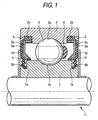
- Fig. 1 is a cross sectional view showing the structure of an existent rolling bearing device used, for example, in an alternator.
- the rolling bearing comprises an inner ring (rotational ring) 1 having a side raceway groove 1u for an inner ring, an outer ring (fixed ring) 2 having a side raceway groove 2u for an outer ring, a plurality of balls 3 and a cage 4 for holding the balls 3 circumferentially each at a predetermined distance.
- a seal mounting groove 2x and a circumferential step (sealing groove) 1s are formed to the shoulder of the raceway groove 1u for the inner 1 ring and the shoulder of the raceway groove 2u for the outer ring 2 respectively.
- a lubricant such as grease not illustrated is sealed in an annular space defined between the inner ring 1 and the outer ring 2, and annular seal members 5, 5 are disposed to the openings on both ends thereof for sealing the annular space.
- the sealing member 5 constituting the sealing device comprises a core metal 5c made of a thin metal plate, a seal main body 5a made of rubber (or resin) formed so as to cover the core metal 5c and a lip 5b formed integrally so as to protrude to the inner circumference of the seal main body 5a. Further, the lip 5b is formed such that when the base of the seal main body 5a is fit into a seal mounting groove 2x, the top end thereof is in contact with the lateral side 1t of the circumferential step 1s formed to the inner ring 1.
- a slinger 12 in contact with the end face of the bearing inner ring is disposed to form a labyrinth between the sealing member 5 and the slinger 12 to improve the muddy water proofness (refer to Patent Document 1 and Patent Document 2).
- nitrile rubber, acryl rubber or the like is used generally, and materials mainly comprising a fluoro rubber or fluoro resin excellent in heat resistance and wear resistance are used suitably for bearing rotating at high speed under high temperature circumstance (for example, a highest working temperature of 170°C or higher) such as bearings for use in alternators.
- Patent Document 1
- Patent Document 2
- the present invention has been achieved in view of the foregoing situations and intends to provide a sealing device for a rolling bearing using a fluoro resin excellent in heat resistance for the material of the sealing member constituting the sealing device, and yet suffering from less wear for the circumferential step on the side of the bearing ring in sliding contact with the lip of the sealing member and capable of maintaining a favorable sealing performance for a long time even under a high temperature circumstance.
- a sealing device for a rolling bearing comprising: a fixed ring including raceway groove; a seal mounting groove formed to a shoulder of the raceway groove; a rotational ring including raceway groove; a circumferential step formed to a shoulder of the raceway groove of the rotational ring; and an annular resilient sealing member fit into the seal mounting groove, a sealing lip of the sealing member being brought into contact with a lateral surface of the circumferential step, in which the sealing member includes a fluoro resin and 10 parts by weight or more and 60 parts by weight or less of a filler based on 100 parts by weight of the fluoro resin, and the filler includes a first filler having a Mohs hardness of 6 or more and 8 or less in amount of 25% by weight or more and 75% by weight or less of the filler, and a second filler having a Mohs hardness of less than 6 as the remaining portion.
- SiO 2 ⁇ nH 2 O as a specific example of the first filler having the Mohs hardness of 6 or more and 8 or less and carbon black as a specific example of the second filler having a Mohs hardness of less than 6.
- the fluoro resin (or fluoro) rubber used as the sealing member required for heat resistance has a property being excellent in heat resistance but tending to cause wear for the mating sliding member.
- the material used for the sealing member also includes processing aids such as vulcanizes, colorants, lubricants or anti-aging agents, or fillers.
- the filler is blended for reinforcement and cost down of the resin (so-called reinforcing filler) and includes carbon black such as furnace black and thermal black, and white carbon, clay, talc, calcium carbonate, diatomaceous earth and wollastonite generally referred to as white fillers.
- the carbon black and the white filler described above are often used in admixture in actual blend.
- white carbon having higher reinforcing effect (Mohs hardness of about 7) has higher hardness compared with relatively soft carbon black (Mohs hardness 1 to 2) and is considered to have a great concern with the wear of the bearing ring (Mohs hardness 6 to 7).
- the present inventors have made studies taking notice on the reinforcing filler, particularly, white carbon and have found that wear in both of the sliding mating member and the sealing member per se can be decreased by making the blending amount appropriate.
- the total amount of the filler blended with the resilient sealing member is determined while considering the soft and flexibility and dynamic physical property of the sealing member.
- the amount of the filler is from 10 parts by weight or more and 60 parts by weight or less, preferably, 20 parts by weight or more and 50 parts by weight or less based on 100 parts by weight of the fluoro resin. In a case where the total amount of the filler is less than 10 parts by weight based on 100 parts by weight of the fluoro resin, it can not satisfy trackability, tensile strength, tear strength, and hardness required for the sealing member.
- the total amount of the filler exceeds 60 parts by weight based on 100 parts by weight of the fluoro resin, it lacks in the soft and flexibility as the sealing member and trackability, mountability and sealing performance are deteriorated.
- the ratio of the relatively hard ingredient (first filler having Mohs hardness of 6 or more and 8 or less) blended in the filler is determined while considering the wear in the lip of the sealing member and the circumferential step on the side of the bearing ring. In a case where the ratio of the first filler is less than 25% by weight, the sealing lip is worn in an early stage. On the other hand, in a case where the ratio of the first filler exceeds 75% by weight, it causes wear in the bearing ring.
- the remaining ingredient of the filler (that is, second filler) is preferably a relatively soft filler having a Mohs hardness of less than 6.
- SiO 2 ⁇ nH 2 O silicon dioxide n-hydrate, referred to as “white carbon”, “synthesis silicic acid” or “hydrate silica”, or sometimes simply as “silica” is preferred considering dispersibility and reinforcing effect to the fluoro resin, the wear resistance and the cost of the fluoro resin as the first filler having the Mohs hardness of 6 or more and 8 or less.
- carbon black, talc (Mohs hardness 1 to 2), clay (Mohs hardness about 2), diatomaceous earth (Mohs hardness 1 to 1.5) and mica (Mohs hardness about 3), etc. can be used as the second filler having the Mohs hardness of less than 6.
- carbon black particularly, thermal black such as "FT carbon” and "MT carbon
- the feature of the resilient sealing member 5 in this embodiment resides in a blending ratio of materials constituting the sealing member 5.
- the sealing member 5 is formed, for example, of a fluoro rubber comprising a copolymer of vinyldene fluoride and hexafluro propylene as a main ingredient, in which 35 parts by weight of a filler and 10 parts by weight of a processing aid (vulcanization aid) are added based on 100 parts by weight of the fluoro rubber in the material.
- the filler comprises a mixture of white carbon (Mohs hardness 7) and MT black (Mohs hardness 1 - 2) at a weight ratio of 10:25.
- the sealing member 5 can be prepared by adding a filler and various kinds of processing aids required for vulcanization or fabrication to a fluoro rubber ingredient, then mixing them by a known kneading method such as roll mixing, kneader mixing, banbury mixing or the like and then molding the resultant composition under vulcanization into a desired shape. Further, a known molding method such as injection molding, heat pressing or extrusion molding can be used for the molding.
- the sealing member 5 can prevent wear on the lateral surface 1t of the circumferential step 1s for the inner ring in sliding contact with the sealing member 5 even under the conditions liable to cause wear such as low lubrication and high surface pressure. Further, the sealing member is formed of the fluoro rubber of excellent heat resistance and the lip 5b of the seal member 5 per se suffer from less wear. Accordingly, the sealing device in this embodiment can maintain satisfactory sealing performance for a long time even in a rolling bearing that rotates at a high speed under high temperature circumstance.
- the material for the sealing member comprises a vinylidene fluoride type rubber (FKM), but the fluoro resin material constituting the sealing device is not restricted only thereto in the invention.
- FKM vinylidene fluoride type rubber
- the fluoro resin material constituting the sealing device is not restricted only thereto in the invention.
- FEPM tetrafluoroethylene - propylene rubber
- FFKM tetrafluoroethylene - perfluoro methyl ether rubber
- other binary or ternary fluoro resins, or resins comprising the combination thereof can also be used.
- sealing member of the invention may be incorporated with known additives such as vulcanizer (crosslinker), vulcanization aid, plasticizer, anti-aging agent, colorant, lubricant and stabilizer within range not deteriorating the excellent wear resistance or sealing performance thereof.
- vulcanizer crosslinker
- vulcanization aid plasticizer
- anti-aging agent colorant
- lubricant lubricant
- stabilizer within range not deteriorating the excellent wear resistance or sealing performance thereof.
- Fig. 2 is a partially cross sectioned view showing a structure of a testing equipment used for the wear test.
- the testing equipment is adapted to relatively rotate a test piece 21 and a friction plate 22 disposed coaxially under a predetermined load, thereby measuring the wear amount respectively.
- the test piece 21 comprising the fluoro rubber is formed as an annular shape having a protrusion substantially of a trigonal cross section such that it is in contact at the top end of the protrusion with the friction plate 22 comprising SUS 304.
- a rotational shaft 23, a fixed shaft 24 and a weight 25 are shown.
- the test piece 21 is located on a turn table 23 disposed at one end of the rotational shaft 23, and the other end (not illustrated) of the rotational shaft 23 is connected with a rotational driving source such as a motor.
- Table 1 shows the blending composition for each of the test specimens.
- Each of the test specimens was vulcanized (crosslinked) by a primary pressing vulcanization at 180°C for 5 min and a secondary oven vulcanization at 230°C for 24 hours to obtain rubber molding products.
- Example 1 weight ratio 100 (68.03 wt%) 10 (6.80 wt%) 25 (17.01 wt%) 2 (1.36 wt%) 10 (6.80 wt%) Comp.
- Example 1 (weight ratio) 100 (68.03 wt%) 30 (20.41 wt%) 5 (3.40 wt%) 2 (1.36 wt%) 10 (6.80 wt%) Comp.
- Example 2 (weight ratio) 100 (68.03 wt%) 0 (0.00 wt%) 35 (23.81 wt%) 2 (1.36 wt%) 10 (6.80 wt%)
- each of the test specimens 35 parts by weight of the filler, 2 parts by weight of the crosslinker and 10 parts by weight of the processing aid (anti-oxidant, etc.) are added respectively based on 100 parts by weight of the fluoro resin comprising a copolymer of vinylidene fluoride and hexafluoro propylene.
- the composition of the crosslinker and the processing aid is identical in each of the test specimens and the ratio of the white carbon based on the entire amount of the filler for the sum of white carbon and MT carbon is about 28.6% by weight in Example 1, about 85.7% by weight in Comparative Example 1 and 0% by weight in Comparative Example 2.
- the wear amount (change in the thickness) at the portion of contact was measured for the test specimen 11 and the friction plate 22 after the end of the test respectively. The result is shown in Table 2.
- Example 2 As apparent from Table 2, in a case where the filler only consists of MT carbon (carbon black) (Comparative Example 2), the fluoro rubber corresponding to the sealing member is worn greatly. Further, in a case where the blending amount of white carbon is excessive (Comparative Example 1), wear occurs in the friction plate corresponding to the bearing ring of a rolling bearing. In comparison with them, in Example 1 applied with the blend of the invention, it is observed that the friction plate suffers from no wear and the wear is reduced also for the fluoro rubber.
- both the sealing member per se and the circumferential step of the rolling ring less suffer from wear and satisfactory sealing performance can be maintained for a long time.
Landscapes
- Engineering & Computer Science (AREA)
- General Engineering & Computer Science (AREA)
- Mechanical Engineering (AREA)
- Sealing Of Bearings (AREA)
- Compositions Of Macromolecular Compounds (AREA)
- Sealing Material Composition (AREA)
- Sealing With Elastic Sealing Lips (AREA)
Abstract
Description
- The present invention concerns a sealing device for a rolling bearing capable of maintaining a high sealing performance for a long time even under high speed rotation and high temperature circumstances.
- A sealing device for a rolling bearing is disposed for preventing leakage of a lubricant sealed in the inside of the bearing and preventing intrusion of obstacles from the outside of the bearing. Particularly, in a sealing for a bearing having a worry of splash of water containing fine solids such as muddy water, for example, a bearing device used for auxiliary equipments of automobile engines (alternators, etc.) high water proofness and dust proofness are required. Accordingly, a resilient annular sealing member is used for the sealing device and it has been adopted a structure of bringing a lip formed at the end of the sealing member into contact with a lateral side of a circumferential step (sealing groove) formed to the shoulder of a raceway groove in a rotational ring.
- Fig. 1 is a cross sectional view showing the structure of an existent rolling bearing device used, for example, in an alternator. The rolling bearing comprises an inner ring (rotational ring) 1 having a
side raceway groove 1u for an inner ring, an outer ring (fixed ring) 2 having aside raceway groove 2u for an outer ring, a plurality ofballs 3 and acage 4 for holding theballs 3 circumferentially each at a predetermined distance. Aseal mounting groove 2x and a circumferential step (sealing groove) 1s are formed to the shoulder of theraceway groove 1u for the inner 1 ring and the shoulder of theraceway groove 2u for theouter ring 2 respectively. Further, a lubricant such as grease not illustrated is sealed in an annular space defined between theinner ring 1 and theouter ring 2, andannular seal members - The sealing
member 5 constituting the sealing device comprises acore metal 5c made of a thin metal plate, a sealmain body 5a made of rubber (or resin) formed so as to cover thecore metal 5c and alip 5b formed integrally so as to protrude to the inner circumference of the sealmain body 5a. Further, thelip 5b is formed such that when the base of the sealmain body 5a is fit into aseal mounting groove 2x, the top end thereof is in contact with thelateral side 1t of thecircumferential step 1s formed to theinner ring 1. - In some bearing devices, a
slinger 12 in contact with the end face of the bearing inner ring is disposed to form a labyrinth between the sealingmember 5 and theslinger 12 to improve the muddy water proofness (refer toPatent Document 1 and Patent Document 2). - For the material constituting the sealing
member 5, nitrile rubber, acryl rubber or the like is used generally, and materials mainly comprising a fluoro rubber or fluoro resin excellent in heat resistance and wear resistance are used suitably for bearing rotating at high speed under high temperature circumstance (for example, a highest working temperature of 170°C or higher) such as bearings for use in alternators. - JP-A No. 10-26143
- JP-A No. 2001-304280
- However, in the sealing device for a rolling bearing described above, when a fluoro resin (or fluoro rubber) is used for the material of the sealing
member 5,lateral surface 1t of the circumferential step on the side of the raceway track of the bearing ring in sliding contact with thelip 5b of the sealing member is sometimes worn to lower the sealing performance in an early stage. - Further, in a case where the worn powder intrudes inside the bearing, it may be a worry of causing wear in the raceway leading to fracture of the bearing.
- The present invention has been achieved in view of the foregoing situations and intends to provide a sealing device for a rolling bearing using a fluoro resin excellent in heat resistance for the material of the sealing member constituting the sealing device, and yet suffering from less wear for the circumferential step on the side of the bearing ring in sliding contact with the lip of the sealing member and capable of maintaining a favorable sealing performance for a long time even under a high temperature circumstance.
- For attaining the foregoing object, the present invention provides, in a first feature, a sealing device for a rolling bearing comprising: a fixed ring including raceway groove; a seal mounting groove formed to a shoulder of the raceway groove; a rotational ring including raceway groove;
a circumferential step formed to a shoulder of the raceway groove of the rotational ring; and an annular resilient sealing member fit into the seal mounting groove, a sealing lip of the sealing member being brought into contact with a lateral surface of the circumferential step, in which the sealing member includes a fluoro resin and 10 parts by weight or more and 60 parts by weight or less of a filler based on 100 parts by weight of the fluoro resin, and the filler includes a first filler having a Mohs hardness of 6 or more and 8 or less in amount of 25% by weight or more and 75% by weight or less of the filler, and a second filler having a Mohs hardness of less than 6 as the remaining portion. - In a preferred embodiment of the invention, it is preferred to use SiO2·nH2O as a specific example of the first filler having the Mohs hardness of 6 or more and 8 or less and carbon black as a specific example of the second filler having a Mohs hardness of less than 6.
- The fluoro resin (or fluoro) rubber used as the sealing member required for heat resistance has a property being excellent in heat resistance but tending to cause wear for the mating sliding member. The material used for the sealing member also includes processing aids such as vulcanizes, colorants, lubricants or anti-aging agents, or fillers. The filler is blended for reinforcement and cost down of the resin (so-called reinforcing filler) and includes carbon black such as furnace black and thermal black, and white carbon, clay, talc, calcium carbonate, diatomaceous earth and wollastonite generally referred to as white fillers. The carbon black and the white filler described above are often used in admixture in actual blend. Among the white fillers, white carbon having higher reinforcing effect (Mohs hardness of about 7) has higher hardness compared with relatively soft carbon black (
Mohs hardness 1 to 2) and is considered to have a great concern with the wear of the bearing ring (Mohs hardness 6 to 7). - In view of the above, the present inventors have made studies taking notice on the reinforcing filler, particularly, white carbon and have found that wear in both of the sliding mating member and the sealing member per se can be decreased by making the blending amount appropriate.
- That is, in the invention, the total amount of the filler blended with the resilient sealing member is determined while considering the soft and flexibility and dynamic physical property of the sealing member. The amount of the filler is from 10 parts by weight or more and 60 parts by weight or less, preferably, 20 parts by weight or more and 50 parts by weight or less based on 100 parts by weight of the fluoro resin. In a case where the total amount of the filler is less than 10 parts by weight based on 100 parts by weight of the fluoro resin, it can not satisfy trackability, tensile strength, tear strength, and hardness required for the sealing member. On the other hand, in a case where the total amount of the filler exceeds 60 parts by weight based on 100 parts by weight of the fluoro resin, it lacks in the soft and flexibility as the sealing member and trackability, mountability and sealing performance are deteriorated.
- Further, the ratio of the relatively hard ingredient (first filler having Mohs hardness of 6 or more and 8 or less) blended in the filler is determined while considering the wear in the lip of the sealing member and the circumferential step on the side of the bearing ring. In a case where the ratio of the first filler is less than 25% by weight, the sealing lip is worn in an early stage. On the other hand, in a case where the ratio of the first filler exceeds 75% by weight, it causes wear in the bearing ring.
- Accordingly, it is desirable that the remaining ingredient of the filler (that is, second filler) is preferably a relatively soft filler having a Mohs hardness of less than 6. By applying the blending ratio described above to the resilient sealing member comprising the fluoro resin, even in a rolling bearing rotating at high speed under high temperature circumstance, both the sealing member per se and the circumferential step on the side of the bearing ring suffer from less wear and satisfactory sealing performance can be kept for a long time.
- While here is no particular restriction on the kind of the reinforcing filler, SiO2·nH2O (silicon dioxide n-hydrate, referred to as "white carbon", "synthesis silicic acid" or "hydrate silica", or sometimes simply as "silica") is preferred considering dispersibility and reinforcing effect to the fluoro resin, the wear resistance and the cost of the fluoro resin as the first filler having the Mohs hardness of 6 or more and 8 or less. Further, carbon black, talc (
Mohs hardness 1 to 2), clay (Mohs hardness about 2), diatomaceous earth (Mohs hardness 1 to 1.5) and mica (Mohs hardness about 3), etc. can be used as the second filler having the Mohs hardness of less than 6. Among them, carbon black (particularly, thermal black such as "FT carbon" and "MT carbon") is preferred -
- Fig. 1 is a cross sectional view showing the structure of a sealing device for a rolling bearing.
- Fig. 2 is a partially cross sectioned view showing the outline of a testing equipment used for a wear test.
-
- Preferred embodiments of the invention are to be described. Since the structure of the sealing device for a rolling bearing in this embodiment is identical with that of the existent example shown in Fig. 1, detailed descriptions are to be omitted.
- The feature of the resilient sealing
member 5 in this embodiment resides in a blending ratio of materials constituting the sealingmember 5. The sealingmember 5 is formed, for example, of a fluoro rubber comprising a copolymer of vinyldene fluoride and hexafluro propylene as a main ingredient, in which 35 parts by weight of a filler and 10 parts by weight of a processing aid (vulcanization aid) are added based on 100 parts by weight of the fluoro rubber in the material. Further, the filler comprises a mixture of white carbon (Mohs hardness 7) and MT black (Mohs hardness 1 - 2) at a weight ratio of 10:25. - The sealing
member 5 can be prepared by adding a filler and various kinds of processing aids required for vulcanization or fabrication to a fluoro rubber ingredient, then mixing them by a known kneading method such as roll mixing, kneader mixing, banbury mixing or the like and then molding the resultant composition under vulcanization into a desired shape. Further, a known molding method such as injection molding, heat pressing or extrusion molding can be used for the molding. - With the constitution described above, the sealing
member 5 can prevent wear on thelateral surface 1t of thecircumferential step 1s for the inner ring in sliding contact with the sealingmember 5 even under the conditions liable to cause wear such as low lubrication and high surface pressure. Further, the sealing member is formed of the fluoro rubber of excellent heat resistance and thelip 5b of theseal member 5 per se suffer from less wear. Accordingly, the sealing device in this embodiment can maintain satisfactory sealing performance for a long time even in a rolling bearing that rotates at a high speed under high temperature circumstance. - In the embodiment described above, the material for the sealing member comprises a vinylidene fluoride type rubber (FKM), but the fluoro resin material constituting the sealing device is not restricted only thereto in the invention. For example, tetrafluoroethylene - propylene rubber (FEPM), tetrafluoroethylene - perfluoro methyl ether rubber (FFKM), other binary or ternary fluoro resins, or resins comprising the combination thereof can also be used.
- Further, the sealing member of the invention may be incorporated with known additives such as vulcanizer (crosslinker), vulcanization aid, plasticizer, anti-aging agent, colorant, lubricant and stabilizer within range not deteriorating the excellent wear resistance or sealing performance thereof.
- Then, in order to confirm the effect of the sealing device for a rolling bearing in the embodiment described above, a wear test was conducted by using test specimens having same blending composition as that for the sealing member, and the result is to be described.
- Fig. 2 is a partially cross sectioned view showing a structure of a testing equipment used for the wear test. The testing equipment is adapted to relatively rotate a
test piece 21 and afriction plate 22 disposed coaxially under a predetermined load, thereby measuring the wear amount respectively. Thetest piece 21 comprising the fluoro rubber is formed as an annular shape having a protrusion substantially of a trigonal cross section such that it is in contact at the top end of the protrusion with thefriction plate 22 comprising SUS 304. In the drawing, are shown arotational shaft 23, a fixedshaft 24 and aweight 25. Further, thetest piece 21 is located on a turn table 23 disposed at one end of therotational shaft 23, and the other end (not illustrated) of therotational shaft 23 is connected with a rotational driving source such as a motor. - Table 1 shows the blending composition for each of the test specimens. Each of the test specimens was vulcanized (crosslinked) by a primary pressing vulcanization at 180°C for 5 min and a secondary oven vulcanization at 230°C for 24 hours to obtain rubber molding products.
unit: PHR Blending ingredient Parts by weight Fluoro resin White carbon MT black Crosslinker
(polyol)Processing aid
(antioxidant etc)Example 1 (weight ratio) 100
(68.03 wt%)10
(6.80 wt%)25
(17.01 wt%)2
(1.36 wt%)10
(6.80 wt%)Comp. Example 1 (weight ratio) 100
(68.03 wt%)30
(20.41 wt%)5
(3.40 wt%)2
(1.36 wt%)10
(6.80 wt%)Comp. Example 2 (weight ratio) 100
(68.03 wt%)0
(0.00 wt%)35
(23.81 wt%)2
(1.36 wt%)10
(6.80 wt%) - In each of the test specimens, 35 parts by weight of the filler, 2 parts by weight of the crosslinker and 10 parts by weight of the processing aid (anti-oxidant, etc.) are added respectively based on 100 parts by weight of the fluoro resin comprising a copolymer of vinylidene fluoride and hexafluoro propylene. The composition of the crosslinker and the processing aid is identical in each of the test specimens and the ratio of the white carbon based on the entire amount of the filler for the sum of white carbon and MT carbon is about 28.6% by weight in Example 1, about 85.7% by weight in Comparative Example 1 and 0% by weight in Comparative Example 2.
-
Load 9.8 N Number of rotation 2625 rpm Lubricant Coated thinly on the surface of test specimen before starting test (lubricant: Fluoro grease). Not supplemented during test Test time 3.6 hours Temperature room temperature - For the wear amount, the wear amount (change in the thickness) at the portion of contact was measured for the
test specimen 11 and thefriction plate 22 after the end of the test respectively. The result is shown in Table 2.
- As apparent from Table 2, in a case where the filler only consists of MT carbon (carbon black) (Comparative Example 2), the fluoro rubber corresponding to the sealing member is worn greatly. Further, in a case where the blending amount of white carbon is excessive (Comparative Example 1), wear occurs in the friction plate corresponding to the bearing ring of a rolling bearing. In comparison with them, in Example 1 applied with the blend of the invention, it is observed that the friction plate suffers from no wear and the wear is reduced also for the fluoro rubber.
- As has been described above specifically, according to the sealing device for a rolling bearing of the present invention, both the sealing member per se and the circumferential step of the rolling ring less suffer from wear and satisfactory sealing performance can be maintained for a long time.
Claims (3)
- A sealing device for a rolling bearing comprising:wherein the sealing member includes a fluoro resin and 10 parts by weight or more and 60 parts by weight or less of a filler based on 100 parts by weight of the fluoro resin,a fixed ring including raceway groove;a seal mounting groove formed to a shoulder of the raceway groove;a rotational ring rotatable with respect to the fixed ring, including raceway groove;a circumferential step formed to a shoulder of the raceway groove of the rotational ring; andan annular resilient sealing member fit into the seal mounting groove, a sealing lip of the sealing member being brought into contact with a lateral surface of the circumferential step,
wherein the filler includes a first filler having a Mohs hardness of 6 or more and 8 or less in amount of 25% by weight or more and 75% by weight or less of the filler, and a second filler having a Mohs hardness of less than 6 as the remaining portion. - The sealing device according to claim 1, wherein the first filler includes SiO2·nH2O and the second filler is a carbon black.
- The sealing device according to claim 1, wherein the sealing member includes 20 parts by weight or more and 50 parts by weight or less of a filler based on 100 parts by weight of the fluoro resin,
Applications Claiming Priority (2)
| Application Number | Priority Date | Filing Date | Title |
|---|---|---|---|
| JP2003095810 | 2003-03-31 | ||
| JP2003095810A JP2004301254A (en) | 2003-03-31 | 2003-03-31 | Sealing device for roller bearing |
Publications (2)
| Publication Number | Publication Date |
|---|---|
| EP1464856A1 true EP1464856A1 (en) | 2004-10-06 |
| EP1464856B1 EP1464856B1 (en) | 2006-08-23 |
Family
ID=32844634
Family Applications (1)
| Application Number | Title | Priority Date | Filing Date |
|---|---|---|---|
| EP04006452A Expired - Lifetime EP1464856B1 (en) | 2003-03-31 | 2004-03-17 | Sealing device for rolling bearing |
Country Status (4)
| Country | Link |
|---|---|
| US (1) | US6966558B2 (en) |
| EP (1) | EP1464856B1 (en) |
| JP (1) | JP2004301254A (en) |
| DE (1) | DE602004002014T2 (en) |
Cited By (2)
| Publication number | Priority date | Publication date | Assignee | Title |
|---|---|---|---|---|
| EP2312176A1 (en) * | 2005-03-01 | 2011-04-20 | NTN Corporation | Sealed rolling bearing |
| IT202300013119A1 (en) * | 2023-06-26 | 2024-12-26 | Skf Ab | THIN SECTION BEARING UNIT |
Families Citing this family (6)
| Publication number | Priority date | Publication date | Assignee | Title |
|---|---|---|---|---|
| DE102006020114A1 (en) * | 2006-05-02 | 2007-11-22 | Burgmann Industries Gmbh & Co. Kg | Mechanical seal with bellows seal |
| EP3230608B1 (en) * | 2014-09-17 | 2020-01-29 | Schaeffler Technologies AG & Co. KG | Variable torque bearing |
| FR3035929B1 (en) * | 2015-05-04 | 2017-11-03 | Skf Ab | BEARING COMPRISING AN ELASTIC SEALING FLANGE |
| WO2019100286A1 (en) * | 2017-11-23 | 2019-05-31 | 舍弗勒技术股份两合公司 | Sealing device and bearing having same |
| JP7243710B2 (en) * | 2018-03-19 | 2023-03-22 | 日本ゼオン株式会社 | Method for producing fibrous carbon nanostructure dispersion and method for producing composite material |
| JP6881541B2 (en) * | 2019-10-09 | 2021-06-02 | ダイキン工業株式会社 | Compositions and crosslinked products containing fluoropolymers |
Citations (5)
| Publication number | Priority date | Publication date | Assignee | Title |
|---|---|---|---|---|
| JPH1026143A (en) | 1996-07-05 | 1998-01-27 | Koyo Seiko Co Ltd | Device for sealing up rolling bearing |
| JP2001304280A (en) | 2000-04-18 | 2001-10-31 | Koyo Seiko Co Ltd | Sealing structure of rolling bearing |
| US6334615B1 (en) * | 1997-03-18 | 2002-01-01 | Nsk Ltd. | Seal for rolling bearing |
| US20020154838A1 (en) * | 2000-11-30 | 2002-10-24 | Nsk Ltd. | Bearing apparatus |
| US20030127803A1 (en) * | 2001-07-23 | 2003-07-10 | Nsk Ltd. | Seal |
Family Cites Families (1)
| Publication number | Priority date | Publication date | Assignee | Title |
|---|---|---|---|---|
| US6874942B2 (en) * | 2001-03-02 | 2005-04-05 | Nsk Ltd. | Rolling device |
-
2003
- 2003-03-31 JP JP2003095810A patent/JP2004301254A/en active Pending
-
2004
- 2004-03-17 EP EP04006452A patent/EP1464856B1/en not_active Expired - Lifetime
- 2004-03-17 DE DE602004002014T patent/DE602004002014T2/en not_active Expired - Lifetime
- 2004-03-25 US US10/808,355 patent/US6966558B2/en not_active Expired - Lifetime
Patent Citations (5)
| Publication number | Priority date | Publication date | Assignee | Title |
|---|---|---|---|---|
| JPH1026143A (en) | 1996-07-05 | 1998-01-27 | Koyo Seiko Co Ltd | Device for sealing up rolling bearing |
| US6334615B1 (en) * | 1997-03-18 | 2002-01-01 | Nsk Ltd. | Seal for rolling bearing |
| JP2001304280A (en) | 2000-04-18 | 2001-10-31 | Koyo Seiko Co Ltd | Sealing structure of rolling bearing |
| US20020154838A1 (en) * | 2000-11-30 | 2002-10-24 | Nsk Ltd. | Bearing apparatus |
| US20030127803A1 (en) * | 2001-07-23 | 2003-07-10 | Nsk Ltd. | Seal |
Non-Patent Citations (2)
| Title |
|---|
| PATENT ABSTRACTS OF JAPAN vol. 1998, no. 05 30 April 1998 (1998-04-30) * |
| PATENT ABSTRACTS OF JAPAN vol. 2002, no. 02 2 April 2002 (2002-04-02) * |
Cited By (3)
| Publication number | Priority date | Publication date | Assignee | Title |
|---|---|---|---|---|
| EP2312176A1 (en) * | 2005-03-01 | 2011-04-20 | NTN Corporation | Sealed rolling bearing |
| IT202300013119A1 (en) * | 2023-06-26 | 2024-12-26 | Skf Ab | THIN SECTION BEARING UNIT |
| US12540644B2 (en) | 2023-06-26 | 2026-02-03 | Aktiebolaget Skf | Bearing unit of thin section |
Also Published As
| Publication number | Publication date |
|---|---|
| US6966558B2 (en) | 2005-11-22 |
| JP2004301254A (en) | 2004-10-28 |
| DE602004002014D1 (en) | 2006-10-05 |
| DE602004002014T2 (en) | 2006-12-14 |
| EP1464856B1 (en) | 2006-08-23 |
| US20040188951A1 (en) | 2004-09-30 |
Similar Documents
| Publication | Publication Date | Title |
|---|---|---|
| US6966558B2 (en) | Sealing device for rolling bearing | |
| JP2001065578A5 (en) | ||
| KR102401850B1 (en) | Hydrogenated nitrile rubber composition and drivetrain oil seal | |
| JP2003314700A (en) | sticker | |
| US10377932B2 (en) | Sealing rubber composition and seal member | |
| JP2006083878A (en) | Rolling bearings for wheels | |
| US11512188B2 (en) | Sealing member | |
| JP2006200616A (en) | Bearing sealing device and rolling bearing with cold-resistant sealing device | |
| JP2020070383A (en) | Rubber composition for oil seal and oil seal | |
| JP2003148628A (en) | Rubber seal device | |
| EP1529975A2 (en) | Sealing member for use in rolling bearing and rolling bearing | |
| JP2011140976A (en) | Seal for rolling support device | |
| JPH07179846A (en) | Oil seal ring | |
| JPH093249A (en) | Lubricating rubber composition | |
| JP2012172778A (en) | Sealing device for rolling device and rolling device | |
| JP2002275312A (en) | Rubber material composition | |
| JP2021178907A (en) | Seal member | |
| JP2006300131A (en) | Railway vehicle bearing device | |
| JP2006029347A (en) | Rolling bearing for automobile electric auxiliary machine | |
| JP2009156362A (en) | Creep prevention type rolling bearing | |
| JP2007177949A (en) | Rolling bearing | |
| JP2010163479A (en) | Rubber composition and rubber molded item | |
| JP2014084979A (en) | Seal for rolling bearing | |
| WO2024166523A1 (en) | Rolling bearing | |
| JP2004238475A (en) | Sealing rubber composition and seal |
Legal Events
| Date | Code | Title | Description |
|---|---|---|---|
| PUAI | Public reference made under article 153(3) epc to a published international application that has entered the european phase |
Free format text: ORIGINAL CODE: 0009012 |
|
| AK | Designated contracting states |
Kind code of ref document: A1 Designated state(s): AT BE BG CH CY CZ DE DK EE ES FI FR GB GR HU IE IT LI LU MC NL PL PT RO SE SI SK TR |
|
| AX | Request for extension of the european patent |
Extension state: AL LT LV MK |
|
| 17P | Request for examination filed |
Effective date: 20041105 |
|
| AKX | Designation fees paid |
Designated state(s): DE FR GB IT |
|
| GRAP | Despatch of communication of intention to grant a patent |
Free format text: ORIGINAL CODE: EPIDOSNIGR1 |
|
| RAP1 | Party data changed (applicant data changed or rights of an application transferred) |
Owner name: JTEKT CORPORATION |
|
| GRAS | Grant fee paid |
Free format text: ORIGINAL CODE: EPIDOSNIGR3 |
|
| GRAA | (expected) grant |
Free format text: ORIGINAL CODE: 0009210 |
|
| AK | Designated contracting states |
Kind code of ref document: B1 Designated state(s): DE FR GB IT |
|
| PG25 | Lapsed in a contracting state [announced via postgrant information from national office to epo] |
Ref country code: IT Free format text: LAPSE BECAUSE OF FAILURE TO SUBMIT A TRANSLATION OF THE DESCRIPTION OR TO PAY THE FEE WITHIN THE PRESCRIBED TIME-LIMIT;WARNING: LAPSES OF ITALIAN PATENTS WITH EFFECTIVE DATE BEFORE 2007 MAY HAVE OCCURRED AT ANY TIME BEFORE 2007. THE CORRECT EFFECTIVE DATE MAY BE DIFFERENT FROM THE ONE RECORDED. Effective date: 20060823 |
|
| REG | Reference to a national code |
Ref country code: GB Ref legal event code: FG4D |
|
| REF | Corresponds to: |
Ref document number: 602004002014 Country of ref document: DE Date of ref document: 20061005 Kind code of ref document: P |
|
| ET | Fr: translation filed | ||
| PLBE | No opposition filed within time limit |
Free format text: ORIGINAL CODE: 0009261 |
|
| STAA | Information on the status of an ep patent application or granted ep patent |
Free format text: STATUS: NO OPPOSITION FILED WITHIN TIME LIMIT |
|
| 26N | No opposition filed |
Effective date: 20070524 |
|
| PGFP | Annual fee paid to national office [announced via postgrant information from national office to epo] |
Ref country code: GB Payment date: 20080312 Year of fee payment: 5 Ref country code: IT Payment date: 20080321 Year of fee payment: 5 |
|
| GBPC | Gb: european patent ceased through non-payment of renewal fee |
Effective date: 20090317 |
|
| PG25 | Lapsed in a contracting state [announced via postgrant information from national office to epo] |
Ref country code: GB Free format text: LAPSE BECAUSE OF NON-PAYMENT OF DUE FEES Effective date: 20090317 |
|
| REG | Reference to a national code |
Ref country code: FR Ref legal event code: PLFP Year of fee payment: 12 |
|
| PGFP | Annual fee paid to national office [announced via postgrant information from national office to epo] |
Ref country code: FR Payment date: 20150309 Year of fee payment: 12 |
|
| REG | Reference to a national code |
Ref country code: FR Ref legal event code: ST Effective date: 20161130 |
|
| PG25 | Lapsed in a contracting state [announced via postgrant information from national office to epo] |
Ref country code: FR Free format text: LAPSE BECAUSE OF NON-PAYMENT OF DUE FEES Effective date: 20160331 |
|
| PGFP | Annual fee paid to national office [announced via postgrant information from national office to epo] |
Ref country code: DE Payment date: 20210302 Year of fee payment: 18 |
|
| REG | Reference to a national code |
Ref country code: DE Ref legal event code: R119 Ref document number: 602004002014 Country of ref document: DE |
|
| PG25 | Lapsed in a contracting state [announced via postgrant information from national office to epo] |
Ref country code: DE Free format text: LAPSE BECAUSE OF NON-PAYMENT OF DUE FEES Effective date: 20221001 |