EP1464680A2 - Pigment interférentiel et composition cosmétique comportant un tel pigment - Google Patents

Pigment interférentiel et composition cosmétique comportant un tel pigment Download PDF

Info

Publication number
EP1464680A2
EP1464680A2 EP03292288A EP03292288A EP1464680A2 EP 1464680 A2 EP1464680 A2 EP 1464680A2 EP 03292288 A EP03292288 A EP 03292288A EP 03292288 A EP03292288 A EP 03292288A EP 1464680 A2 EP1464680 A2 EP 1464680A2
Authority
EP
European Patent Office
Prior art keywords
spectral reflectance
composition
pigment
multilayer structure
skin
Prior art date
Legal status (The legal status is an assumption and is not a legal conclusion. Google has not performed a legal analysis and makes no representation as to the accuracy of the status listed.)
Withdrawn
Application number
EP03292288A
Other languages
German (de)
English (en)
Other versions
EP1464680A3 (fr
Inventor
Jean-Christophe Simon
Current Assignee (The listed assignees may be inaccurate. Google has not performed a legal analysis and makes no representation or warranty as to the accuracy of the list.)
LOreal SA
Original Assignee
LOreal SA
Priority date (The priority date is an assumption and is not a legal conclusion. Google has not performed a legal analysis and makes no representation as to the accuracy of the date listed.)
Filing date
Publication date
Application filed by LOreal SA filed Critical LOreal SA
Publication of EP1464680A2 publication Critical patent/EP1464680A2/fr
Publication of EP1464680A3 publication Critical patent/EP1464680A3/fr
Withdrawn legal-status Critical Current

Links

Images

Classifications

    • AHUMAN NECESSITIES
    • A61MEDICAL OR VETERINARY SCIENCE; HYGIENE
    • A61KPREPARATIONS FOR MEDICAL, DENTAL OR TOILETRY PURPOSES
    • A61K8/00Cosmetics or similar toiletry preparations
    • A61K8/02Cosmetics or similar toiletry preparations characterised by special physical form
    • A61K8/11Encapsulated compositions
    • AHUMAN NECESSITIES
    • A61MEDICAL OR VETERINARY SCIENCE; HYGIENE
    • A61KPREPARATIONS FOR MEDICAL, DENTAL OR TOILETRY PURPOSES
    • A61K8/00Cosmetics or similar toiletry preparations
    • A61K8/18Cosmetics or similar toiletry preparations characterised by the composition
    • A61K8/19Cosmetics or similar toiletry preparations characterised by the composition containing inorganic ingredients
    • A61K8/26Aluminium; Compounds thereof
    • AHUMAN NECESSITIES
    • A61MEDICAL OR VETERINARY SCIENCE; HYGIENE
    • A61KPREPARATIONS FOR MEDICAL, DENTAL OR TOILETRY PURPOSES
    • A61K8/00Cosmetics or similar toiletry preparations
    • A61K8/18Cosmetics or similar toiletry preparations characterised by the composition
    • A61K8/30Cosmetics or similar toiletry preparations characterised by the composition containing organic compounds
    • A61K8/58Cosmetics or similar toiletry preparations characterised by the composition containing organic compounds containing atoms other than carbon, hydrogen, halogen, oxygen, nitrogen, sulfur or phosphorus
    • A61K8/585Organosilicon compounds
    • AHUMAN NECESSITIES
    • A61MEDICAL OR VETERINARY SCIENCE; HYGIENE
    • A61KPREPARATIONS FOR MEDICAL, DENTAL OR TOILETRY PURPOSES
    • A61K8/00Cosmetics or similar toiletry preparations
    • A61K8/18Cosmetics or similar toiletry preparations characterised by the composition
    • A61K8/72Cosmetics or similar toiletry preparations characterised by the composition containing organic macromolecular compounds
    • A61K8/84Cosmetics or similar toiletry preparations characterised by the composition containing organic macromolecular compounds obtained by reactions otherwise than those involving only carbon-carbon unsaturated bonds
    • A61K8/89Polysiloxanes
    • A61K8/891Polysiloxanes saturated, e.g. dimethicone, phenyl trimethicone, C24-C28 methicone or stearyl dimethicone
    • AHUMAN NECESSITIES
    • A61MEDICAL OR VETERINARY SCIENCE; HYGIENE
    • A61QSPECIFIC USE OF COSMETICS OR SIMILAR TOILETRY PREPARATIONS
    • A61Q1/00Make-up preparations; Body powders; Preparations for removing make-up
    • A61Q1/02Preparations containing skin colorants, e.g. pigments
    • CCHEMISTRY; METALLURGY
    • C09DYES; PAINTS; POLISHES; NATURAL RESINS; ADHESIVES; COMPOSITIONS NOT OTHERWISE PROVIDED FOR; APPLICATIONS OF MATERIALS NOT OTHERWISE PROVIDED FOR
    • C09CTREATMENT OF INORGANIC MATERIALS, OTHER THAN FIBROUS FILLERS, TO ENHANCE THEIR PIGMENTING OR FILLING PROPERTIES ; PREPARATION OF CARBON BLACK  ; PREPARATION OF INORGANIC MATERIALS WHICH ARE NO SINGLE CHEMICAL COMPOUNDS AND WHICH ARE MAINLY USED AS PIGMENTS OR FILLERS
    • C09C1/00Treatment of specific inorganic materials other than fibrous fillers; Preparation of carbon black
    • C09C1/0015Pigments exhibiting interference colours, e.g. transparent platelets of appropriate thinness or flaky substrates, e.g. mica, bearing appropriate thin transparent coatings
    • CCHEMISTRY; METALLURGY
    • C09DYES; PAINTS; POLISHES; NATURAL RESINS; ADHESIVES; COMPOSITIONS NOT OTHERWISE PROVIDED FOR; APPLICATIONS OF MATERIALS NOT OTHERWISE PROVIDED FOR
    • C09CTREATMENT OF INORGANIC MATERIALS, OTHER THAN FIBROUS FILLERS, TO ENHANCE THEIR PIGMENTING OR FILLING PROPERTIES ; PREPARATION OF CARBON BLACK  ; PREPARATION OF INORGANIC MATERIALS WHICH ARE NO SINGLE CHEMICAL COMPOUNDS AND WHICH ARE MAINLY USED AS PIGMENTS OR FILLERS
    • C09C3/00Treatment in general of inorganic materials, other than fibrous fillers, to enhance their pigmenting or filling properties
    • C09C3/06Treatment with inorganic compounds
    • C09C3/063Coating
    • AHUMAN NECESSITIES
    • A61MEDICAL OR VETERINARY SCIENCE; HYGIENE
    • A61KPREPARATIONS FOR MEDICAL, DENTAL OR TOILETRY PURPOSES
    • A61K2800/00Properties of cosmetic compositions or active ingredients thereof or formulation aids used therein and process related aspects
    • A61K2800/40Chemical, physico-chemical or functional or structural properties of particular ingredients
    • A61K2800/41Particular ingredients further characterized by their size
    • A61K2800/412Microsized, i.e. having sizes between 0.1 and 100 microns
    • AHUMAN NECESSITIES
    • A61MEDICAL OR VETERINARY SCIENCE; HYGIENE
    • A61KPREPARATIONS FOR MEDICAL, DENTAL OR TOILETRY PURPOSES
    • A61K2800/00Properties of cosmetic compositions or active ingredients thereof or formulation aids used therein and process related aspects
    • A61K2800/40Chemical, physico-chemical or functional or structural properties of particular ingredients
    • A61K2800/42Colour properties
    • A61K2800/43Pigments; Dyes
    • A61K2800/436Interference pigments, e.g. Iridescent, Pearlescent
    • CCHEMISTRY; METALLURGY
    • C01INORGANIC CHEMISTRY
    • C01PINDEXING SCHEME RELATING TO STRUCTURAL AND PHYSICAL ASPECTS OF SOLID INORGANIC COMPOUNDS
    • C01P2004/00Particle morphology
    • C01P2004/30Particle morphology extending in three dimensions
    • C01P2004/32Spheres
    • CCHEMISTRY; METALLURGY
    • C01INORGANIC CHEMISTRY
    • C01PINDEXING SCHEME RELATING TO STRUCTURAL AND PHYSICAL ASPECTS OF SOLID INORGANIC COMPOUNDS
    • C01P2004/00Particle morphology
    • C01P2004/60Particles characterised by their size
    • C01P2004/61Micrometer sized, i.e. from 1-100 micrometer
    • CCHEMISTRY; METALLURGY
    • C01INORGANIC CHEMISTRY
    • C01PINDEXING SCHEME RELATING TO STRUCTURAL AND PHYSICAL ASPECTS OF SOLID INORGANIC COMPOUNDS
    • C01P2006/00Physical properties of inorganic compounds
    • C01P2006/60Optical properties, e.g. expressed in CIELAB-values
    • C01P2006/62L* (lightness axis)
    • CCHEMISTRY; METALLURGY
    • C09DYES; PAINTS; POLISHES; NATURAL RESINS; ADHESIVES; COMPOSITIONS NOT OTHERWISE PROVIDED FOR; APPLICATIONS OF MATERIALS NOT OTHERWISE PROVIDED FOR
    • C09CTREATMENT OF INORGANIC MATERIALS, OTHER THAN FIBROUS FILLERS, TO ENHANCE THEIR PIGMENTING OR FILLING PROPERTIES ; PREPARATION OF CARBON BLACK  ; PREPARATION OF INORGANIC MATERIALS WHICH ARE NO SINGLE CHEMICAL COMPOUNDS AND WHICH ARE MAINLY USED AS PIGMENTS OR FILLERS
    • C09C2200/00Compositional and structural details of pigments exhibiting interference colours
    • C09C2200/10Interference pigments characterized by the core material
    • C09C2200/1004Interference pigments characterized by the core material the core comprising at least one inorganic oxide, e.g. Al2O3, TiO2 or SiO2
    • CCHEMISTRY; METALLURGY
    • C09DYES; PAINTS; POLISHES; NATURAL RESINS; ADHESIVES; COMPOSITIONS NOT OTHERWISE PROVIDED FOR; APPLICATIONS OF MATERIALS NOT OTHERWISE PROVIDED FOR
    • C09CTREATMENT OF INORGANIC MATERIALS, OTHER THAN FIBROUS FILLERS, TO ENHANCE THEIR PIGMENTING OR FILLING PROPERTIES ; PREPARATION OF CARBON BLACK  ; PREPARATION OF INORGANIC MATERIALS WHICH ARE NO SINGLE CHEMICAL COMPOUNDS AND WHICH ARE MAINLY USED AS PIGMENTS OR FILLERS
    • C09C2200/00Compositional and structural details of pigments exhibiting interference colours
    • C09C2200/10Interference pigments characterized by the core material
    • C09C2200/102Interference pigments characterized by the core material the core consisting of glass or silicate material like mica or clays, e.g. kaolin
    • CCHEMISTRY; METALLURGY
    • C09DYES; PAINTS; POLISHES; NATURAL RESINS; ADHESIVES; COMPOSITIONS NOT OTHERWISE PROVIDED FOR; APPLICATIONS OF MATERIALS NOT OTHERWISE PROVIDED FOR
    • C09CTREATMENT OF INORGANIC MATERIALS, OTHER THAN FIBROUS FILLERS, TO ENHANCE THEIR PIGMENTING OR FILLING PROPERTIES ; PREPARATION OF CARBON BLACK  ; PREPARATION OF INORGANIC MATERIALS WHICH ARE NO SINGLE CHEMICAL COMPOUNDS AND WHICH ARE MAINLY USED AS PIGMENTS OR FILLERS
    • C09C2200/00Compositional and structural details of pigments exhibiting interference colours
    • C09C2200/10Interference pigments characterized by the core material
    • C09C2200/102Interference pigments characterized by the core material the core consisting of glass or silicate material like mica or clays, e.g. kaolin
    • C09C2200/1025Interference pigments characterized by the core material the core consisting of glass or silicate material like mica or clays, e.g. kaolin comprising at least one metal layer adjacent to core material, e.g. core-M or M-core-M
    • CCHEMISTRY; METALLURGY
    • C09DYES; PAINTS; POLISHES; NATURAL RESINS; ADHESIVES; COMPOSITIONS NOT OTHERWISE PROVIDED FOR; APPLICATIONS OF MATERIALS NOT OTHERWISE PROVIDED FOR
    • C09CTREATMENT OF INORGANIC MATERIALS, OTHER THAN FIBROUS FILLERS, TO ENHANCE THEIR PIGMENTING OR FILLING PROPERTIES ; PREPARATION OF CARBON BLACK  ; PREPARATION OF INORGANIC MATERIALS WHICH ARE NO SINGLE CHEMICAL COMPOUNDS AND WHICH ARE MAINLY USED AS PIGMENTS OR FILLERS
    • C09C2200/00Compositional and structural details of pigments exhibiting interference colours
    • C09C2200/30Interference pigments characterised by the thickness of the core or layers thereon or by the total thickness of the final pigment particle
    • C09C2200/303Thickness of a layer with low refractive material
    • CCHEMISTRY; METALLURGY
    • C09DYES; PAINTS; POLISHES; NATURAL RESINS; ADHESIVES; COMPOSITIONS NOT OTHERWISE PROVIDED FOR; APPLICATIONS OF MATERIALS NOT OTHERWISE PROVIDED FOR
    • C09CTREATMENT OF INORGANIC MATERIALS, OTHER THAN FIBROUS FILLERS, TO ENHANCE THEIR PIGMENTING OR FILLING PROPERTIES ; PREPARATION OF CARBON BLACK  ; PREPARATION OF INORGANIC MATERIALS WHICH ARE NO SINGLE CHEMICAL COMPOUNDS AND WHICH ARE MAINLY USED AS PIGMENTS OR FILLERS
    • C09C2200/00Compositional and structural details of pigments exhibiting interference colours
    • C09C2200/30Interference pigments characterised by the thickness of the core or layers thereon or by the total thickness of the final pigment particle
    • C09C2200/304Thickness of intermediate layers adjacent to the core, e.g. metallic layers, protective layers, rutilisation enhancing layers or reflective layers
    • YGENERAL TAGGING OF NEW TECHNOLOGICAL DEVELOPMENTS; GENERAL TAGGING OF CROSS-SECTIONAL TECHNOLOGIES SPANNING OVER SEVERAL SECTIONS OF THE IPC; TECHNICAL SUBJECTS COVERED BY FORMER USPC CROSS-REFERENCE ART COLLECTIONS [XRACs] AND DIGESTS
    • Y10TECHNICAL SUBJECTS COVERED BY FORMER USPC
    • Y10TTECHNICAL SUBJECTS COVERED BY FORMER US CLASSIFICATION
    • Y10T428/00Stock material or miscellaneous articles
    • Y10T428/29Coated or structually defined flake, particle, cell, strand, strand portion, rod, filament, macroscopic fiber or mass thereof
    • Y10T428/2982Particulate matter [e.g., sphere, flake, etc.]
    • Y10T428/2991Coated

Definitions

  • the present invention relates to cosmetic or care compositions intended to be applied to the skin, including the mucous membranes, and the integuments.
  • pigments interference having a multilayer structure, exhibiting spectral reflectance close to a reference spectral reflectance corresponding to a skin type predetermined, for at least part of the visible spectrum.
  • These pigments can be obtained by depositing on a polymer soluble in a given solvent, present on a flexible support, the successive layers of the structure multilayer, by a vacuum deposition technique. Then the multilayer film is fragmented to form small platelets constituting the particles of the pigment.
  • Such pigments make it possible to produce compositions imitating the color of the skin, for example to cover and hide blemishes.
  • the pads have a shape that promotes reflection specular light and their brightness should be dimmed by introducing into the composition a mattifying filler.
  • the invention aims in particular to further improve the pigments described in WO 00/75240 and in producing cosmetic or care compositions allowing by example of best imitating the appearance of the skin or the integuments, in order for example to correct defects, in particular discolouration, or allowing attenuate an undesirable chromatic dominant.
  • the invention relates, according to one of its aspects, to an interference pigment having a multilayer structure, this pigment having a spectral reflectance deviating by at most 20% from the spectral reflectance of a type of keratinous material for at least part of the visible spectrum of 200 nm in extent, this pigment possibly characterized by the fact that the multilayer structure comprises at least one layer completely coating an underlying layer.
  • Such a pigment differs from the pigments obtained according to the recalled method above and described in WO 00/75240, for which the different layers do not coat not the underlying layers at the breaking zones of the multilayer film having leads to platelet formation.
  • the invention makes it possible in particular to more easily produce particles of pigment with a more "rounded" shape, which may decrease their ability to reflect the specular light and give them better dullness, so allow them for example to more faithfully recreate the appearance of the skin.
  • the pigment particles each have a generally globular shape, in particular spherical.
  • the particles pigment may include a substrate which may also have a globular shape, in particular spherical, on which the different layers of the structure are deposited multilayer.
  • the substrate may in particular comprise a microsphere of a material organic or mineral, for example a glass or a metal, in particular aluminum.
  • the substrate can be hollow or solid, and advantageously has a shape symmetrical with respect to a center of symmetry, for example a spherical shape or polyhedral.
  • the keratinous material may for example be a skin, in particular a skin Caucasian, mixed race, Asian or black.
  • the spectral reflectance of the pigment is close to the spectral reflectance of the type of keratinous material considered over the entire visible spectrum, i.e. over the wavelength range extending from 400 nm to 700 nm, 300 nm in range.
  • the spectral reflectance of the multilayer pigment may deviate, for a range of the spectrum considered, for example for at least a range of 200 nm in extent, for example for at least the range from 500 nm to 700 nm, at most 10% of the spectral reflectance of the type of keratinous material, or even at most 5%, or at most 2%.
  • the multilayer pigment is configured so as to present a clarity value L *, measured in the CIE 1976 space, substantially constant for incidences between -45 ° and 45 °.
  • the particle size of the pigment can be between 10 and 150 ⁇ m, better between 10 and 50 ⁇ m.
  • dimension is meant the given dimension by the statistical particle size distribution to half the population, called D50.
  • the particles of the pigment do not are not perceptible at all to the naked eye on the surface of the composition applied to its support. It is also desirable that the pigment particles are not of dimension such that they create a feeling of discomfort on the skin.
  • the size of the particles may depend on the nature of the support on which the composition is intended to be applied; parts of the body and face can for example more easily than others tolerate a larger dimension without generate discomfort.
  • the pigment can comprise at least one layer produced from a material chosen from MgF 2 , CeF 3 , ZnS, ZnSe, Si, Ge, Te, SiO 2 , Al 2 O 3 , MgO, Y 2 O 3 , S 2 O 3 , SiO, HfO 2 , ZrO 2 , CeO 2 , Nb 2 O 5 , Ta 2 O 5 , TiO 2 , Ag, Al, Au, Cu, Rb, Fe 2 O 3 , Pt, Va, Ti, Ta, Zn, la cryolite, alloys, polymers and their associations.
  • a material chosen from MgF 2 , CeF 3 , ZnS, ZnSe, Si, Ge, Te, SiO 2 , Al 2 O 3 , MgO, Y 2 O 3 , S 2 O 3 , SiO, HfO 2 , ZrO 2 , CeO 2 , Nb 2 O 5 , Ta 2 O 5 , TiO 2 , Ag, Al, Au
  • compositions comprising, in a physiologically acceptable medium, at least one interference pigment having a multilayer structure, the spectral reflectance of the composition deviating by at most 20% from the spectral reflectance of a type of material keratin for at least part of the visible spectrum of 200 nm in range, this composition being characterized in that the multilayer structure comprises at least a layer completely coating an underlying layer.
  • Such a composition may include an interference pigment having a multilayer structure as defined above.
  • Such a composition can also comprise a plurality of pigments having different structures, the pigments may or may not all be of the interference type to multilayer structure.
  • the composition may in particular comprise a mixture of pigments, the proportions of the different pigments being chosen so as to obtain the reflectance spectral desired for the composition.
  • the composition can in particular comprise a mixture of pigments which provides a spectral reflectance close to the spectral reflectance of reference even if the refractive index of a phase of the composition, to take into account for example the absorption of sebum by the composition or evaporation of an ingredient.
  • the pigment interference maintains a spectral reflectance which is close to the spectral reflectance benchmark, even if the refractive index changes.
  • the multilayer structure is advantageously configured so that the composition is substantially non-goniochromatic for incidences included between -45 ° and 45 °, which can more faithfully recreate the appearance of the skin.
  • non-goniochromatic composition is meant within the meaning of this invention a composition for obtaining, when spread on a support, a color path in plane a *, b * of the CIE 1976 color space which corresponds to a variation Dh of the hue angle h of at most 20 °, when the angle is varied observation with respect to normal between 0 ° and 80 °, for an angle of incidence of the 45 ° light.
  • the color path can be measured for example using a Instrument Systems brand and GON 360 reference spectrogoniorflectometer GONIOMETER, after the composition has been spread in the fluid state with a thickness 300 ⁇ m by means of an automatic spreader on a brand contrast card ERICHSEN and TYP 24/5 reference, the measurement being carried out on the black background of the menu.
  • the clarity parameter L * can also be substantially constant for incidences ranging from 0 ° to 50 °.
  • the spectral reflectance of the composition applied to its support deviates, for a range of the spectrum considered, for example for a range of at least minus 200 nm in range, for example for at least the range from 500 nm to 700 nm, at most 10% of the reference spectral reflectance and, better still, at most 5%, or even even better at most 2% when trying to imitate the color of the skin as well as possible.
  • Another subject of the invention is the use of a composition such as defined above to hide skin imperfections, especially wrinkles, pimples, spots, rosacea, veins and blackheads.
  • compositions such as defined above to attenuate a dominant color of the skin, for example the yellow.
  • the reference spectral reflectance can be determined for example at from information linked to the person intended to receive the composition, for example example following a response to a questionnaire or a measurement carried out on the skin.
  • the Reference spectral reflectance can also be determined experimentally or hypothetically using composite data extracted from a plurality of questionnaires, skin measurements, empirical measurements, calculations and the like.
  • the Reference spectral reflectance can also be set arbitrarily. However, it will be selected from the colors of human skin and / or hair.
  • This method can also include the step of predefining the reference spectral reflectance.
  • the latter can be used as a target on which can be based on the properties desired for the interference pigment.
  • Figure 1 is only a representation schematic and the actual number of intermediate layers can be different without that is within the scope of the present invention, the number of intermediate layers being function of the optical properties which are desired for the pigment and which can be between 3 and 50, for example.
  • the substrate 2 has a spherical shape, being for example constituted by a full glass microsphere.
  • the substrate has a shape other than spherical, for example a wafer shape, as illustrated in the FIG. 2.
  • wafer-shaped substrate denotes a substrate for which the ratio of the largest dimension to the thickness is greater than or equal to 5 or even 10 or 15.
  • the thickness of a substrate in the form of a wafer is for example between about 0.5 ⁇ m and about 5 ⁇ m.
  • the substrate 2 can be mono-material or multi-material, solid or hollow.
  • the substrate 2 can be organic or inorganic.
  • the substrate can be natural but of preferably a synthetic substrate is used, which makes it easier to have a determined form.
  • the substrate can be chosen from glasses, ceramics, graphite, metal oxides, aluminas, silicas, silicates, especially aluminosilicates and borosilicates and synthetic mica, this list not being exhaustive.
  • FIG. 3 shows a particle 5 of pigment according to the prior art.
  • the different layers 3a, 3b and 3c can be deposited on the substrate 2 by means of an installation, not shown, comprising a chamber for exposing the particles to a material to be deposited, a chamber in which the particles are set in motion by a vibrating device.
  • an installation not shown, comprising a chamber for exposing the particles to a material to be deposited, a chamber in which the particles are set in motion by a vibrating device.
  • the refractive indices of the different layers 3a, 3b and 3c as well as their respective thicknesses are chosen by applying the well known filter theory interference, so that the spectral reflectance of the multilayer structure has the desired properties, under the conditions of use.
  • the multilayer structure can be formed of a succession of layers of high and low refractive indices, the high index layers being constituted by example by a metal oxide and the low index layers by a metal.
  • the spectral reflectance is relatively close to that of a predetermined skin type, Caucasian or other, for example to achieve natural makeup.
  • the spectral reflectance of a type of skin for example Caucasian
  • the spectral reflectance R of the composition which comprises the pigment is between minimum limits R min and maximum R max , these curves R min and R max and not deviating for example by more than 10% from curve C over the entire visible spectrum, curve C serving in the example considered as spectral reflectance reference.
  • the reference spectral reflectance can thus be chosen so as to have a lower reflectance than that of the skin type selected in the yellow, for example.
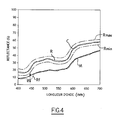
  • FIG. 4 shows a reference spectral reflectance R f which deviates appreciably from the curve M for the part of the spectrum between 450 and 500 nm, in order to attenuate the yellow chromatic dominant of a Brown skin.
  • the difference between the spectral reference of the composition and the curve M can for example be greater than approximately 5% for at least one value of the spectrum.
  • a pigment having a multilayer structure according to the invention can enter in the formulation of a large number of compositions comprising a medium physiologically acceptable, and intended for example for making up the skin, body or face.
  • the pigment can represent between 0.01 and 50% by weight relative to the weight total of the composition, preferably between 0.5 and 25%.
  • physiologically acceptable medium will be adapted to the nature of the support. to which the composition should be applied as well as the form in which the composition is intended to be packaged, in particular solid or fluid at temperature ambient and atmospheric pressure.
  • composition can in particular comprise an aqueous cosmetic medium and / or an oily phase.
  • the composition may include water or a mixture of water and solvent hydrophilic organic, for example an alcohol.
  • the composition can, in addition, comprise fillers.
  • charge we denotes particles of all forms, insoluble in the medium of the composition, regardless of the temperature at which the composition is produced. These charges can be used in particular to modify the rheology or the texture of the composition.
  • the nature and quantity of solid bodies will depend on the mechanical properties and sought textures.
  • fillers include, among others, talc, mica, silica, kaolin and polyamide powders, for example Nylon® or Orgasol®.
  • composition may also contain one or more cosmetic active agents, dermatological, hygienic or pharmaceutical.
  • moisturizers polyol like glycerin
  • vitamins C, A, E, F, B, or PP
  • essential fatty acids oils essential, ceramides, sphingolipids, liposoluble sunscreens or in the form of nanoparticles
  • sunscreens or in the form of nanoparticles
  • These assets can be used for example at concentrations from 0 to 20% and in particular from 0.001 to 15%, relative to the total weight of the composition.
  • the cosmetic composition may also contain ingredients commonly used in cosmetics, such as for example thickeners, surfactants, trace elements, moisturizers, softeners, sequestrants, perfumes, alkalizing or acidifying agents, preservatives, antioxidants, UV filters, or mixtures thereof.
  • ingredients commonly used in cosmetics such as for example thickeners, surfactants, trace elements, moisturizers, softeners, sequestrants, perfumes, alkalizing or acidifying agents, preservatives, antioxidants, UV filters, or mixtures thereof.
  • the cosmetic composition can, moreover, comprise, depending on the type of application envisaged, the constituents conventionally used in the fields considered, which are present in an amount appropriate to the desired dosage form.
  • the cosmetic composition can be in any dosage form normally used for topical application and in particular in anhydrous form, in the form of an oily or aqueous solution, an oily or aqueous gel, a oil-in-water or water-in-oil emulsion, of a multiple emulsion, of a dispersion oil in water through vesicles located at the oil / water interface.
  • composition of the invention may be in the form of powder, liquid, solid or semi-solid, in particular of product cast in stick or in cup, stick, paste or cream more or less fluid.
  • the composition can constitute, inter alia, a solid or fluid foundation, a concealer or eye contour product, a body makeup product or another sunscreen or skin treatment product.
  • composition of the invention can be obtained according to the methods of preparation conventionally used.
  • the interference pigment has the following structure: LAYER MATERIAL REFRACTION INDEX n THICKNESS (nm) 1 (outermost) Al 2 O 3 1.6726 92.1 2 At .7382 23.6 3 Al 2 O 3 1.6726 81.4 4 At .7382 1.8 5 Al 2 O 3 1.6726 76.0 6 At .7382 13.6 7 Al 2 O 3 1.6726 94.6 8 At .7382 12.6 SUBSTRATE Glass microbead 10 ⁇ m diameter 1.5
  • the invention makes it possible to produce compositions having a high power. covering while giving the make-up skin, for example, of Caucasian type, an appearance natural, making the presence of the composition difficult to detect.
  • the invention makes it possible to produce different colors by means of a set of pigments which differ from each other only by the number and the thicknesses of the layers of the multilayer structure.
  • the formulation of the compositions cosmetic and / or dermatological is easier to establish for a range of shades only with pigments of the prior art.
  • the invention is not limited to the examples which have just been described.
  • the tailor-made composition can be produced if necessary after having measured the spectral reflectance of the skin of the subject on which it is intended to be applied.
  • the multilayer structure is calculated so that the composition incorporating the pigment best approximates the reflectance of the skin of the subject, or even deviates from it for certain values of the spectrum in order to correct a dominant chromatic.

Landscapes

  • Health & Medical Sciences (AREA)
  • Life Sciences & Earth Sciences (AREA)
  • Animal Behavior & Ethology (AREA)
  • General Health & Medical Sciences (AREA)
  • Public Health (AREA)
  • Veterinary Medicine (AREA)
  • Birds (AREA)
  • Epidemiology (AREA)
  • Chemical & Material Sciences (AREA)
  • Organic Chemistry (AREA)
  • Inorganic Chemistry (AREA)
  • Cosmetics (AREA)
  • Pigments, Carbon Blacks, Or Wood Stains (AREA)

Abstract

La présente invention concerne un pigment interférentiel ayant une structure multicouche, caractérisé par le fait qu'il présente une réflectance spectrale s'écartant d'au plus 20 % de la réflectance spectrale d'un type de matière kératinique pour au moins une partie du spectre visible de 200 nm d'étendue, ce pigment étant caractérisé par le fait que la structure multicouche comporte au moins une couche (3b ; 3c) enrobant en totalité une couche sous-jacente (3a ; 3b). <IMAGE>

Description

La présente invention concerne les compositions cosmétiques ou de soin destinées à être appliquées sur la peau, y compris les muqueuses, et les phanères.
On connaít par la demande internationale WO 00/75240 des pigments interférentiels ayant une structure multicouche, présentant une réflectance spectrale proche d'une réflectance spectrale de référence correspondant à un type de peau prédéterminé, pour au moins une partie du spectre visible.
Ces pigments peuvent être obtenus en déposant sur un polymère soluble dans un solvant donné, présent sur un support flexible, les couches successives de la structure multicouche, par une technique de dépôt sous vide. Ensuite, le film multicouche est fragmenté pour former des plaquettes de petites dimensions constituant les particules du pigment.
De tels pigments permettent de réaliser des compositions imitant la couleur de la peau, afin d'en couvrir et masquer des défauts, par exemple.
Néanmoins, les plaquettes présentent une forme qui favorise la réflexion spéculaire de la lumière et leur brillance doit être atténuée en introduisant dans la composition une charge matifiante.
L'invention vise notamment à perfectionner encore les pigments décrits dans WO 00/75240 et à réaliser des compostions cosmétiques ou de soin permettant par exemple d'imiter au mieux l'aspect de la peau ou des phanères, afin par exemple d'en corriger des défauts, notamment des inhomogénéités de coloration, ou permettant d'atténuer une dominante chromatique indésirable.
L'invention a pour objet, selon l'un de ses aspects, un pigment interférentiel ayant une structure multicouche, ce pigment présentant une réflectance spectrale s'écartant d'au plus 20 % de la réflectance spectrale d'un type de matière kératinique pour au moins une partie du spectre visible de 200 nm d'étendue, ce pigment pouvant se caractériser par le fait que la structure multicouche comporte au moins une couche enrobant en totalité une couche sous-jacente.
Un tel pigment se différencie des pigments obtenus selon la méthode rappelée plus haut et décrite dans WO 00/75240, pour lesquels les différentes couches n'enrobent pas les couches sous-jacentes au niveau des zones de cassure du film multicouche ayant conduit à la formation des plaquettes.
L'invention permet notamment de réaliser plus facilement des particules de pigment avec une forme plus « arrondie », ce qui peut diminuer leur aptitude à réfléchir la lumière de manière spéculaire et leur conférer une meilleure matité, donc leur permettre par exemple de recréer plus fidèlement l'aspect de la peau.
Dans un exemple de mise en oeuvre de l'invention, les particules de pigment présentent chacune une forme générale globulaire, notamment sphérique. Les particules de pigment peuvent comporter un substrat pouvant lui aussi avoir une forme globulaire, notamment sphérique, sur lequel sont déposées les différentes couches de la structure multicouche. Le substrat peut notamment comporter une microsphère d'une matière organique ou minérale, par exemple un verre ou un métal, notamment de l'aluminium.
Le substrat peut être creux ou plein, et présente avantageusement une forme symétrique par rapport à un centre de symétrie, par exemple une forme sphérique ou polyédrique.
La matière kératinique peut être par exemple une peau, notamment une peau caucasienne, métisse, asiatique ou noire.
Dans un exemple de mise en oeuvre de l'invention, la réflectance spectrale du pigment est proche de la réflectance spectrale du type de matière kératinique considéré sur la totalité du spectre visible, c'est-à-dire sur la gamme de longueur d'ondes s'étendant de 400 nm à 700 nm, de 300 nm d'étendue.
La réflectance spectrale du pigment multicouche peut s'écarter, pour une plage du spectre considérée, par exemple pour au moins une plage de 200 nm d'étendue, par exemple pour au moins la plage allant de 500 nm à 700 nm, d'au plus 10 % de la réflectance spectrale du type de matière kératinique, voire d'au plus 5 %, ou d'au plus 2 %.
De préférence, le pigment multicouche est configuré de manière à présenter une valeur de clarté L*, mesurée dans l'espace CIE 1976, sensiblement constante pour des incidences comprises entre -45° et 45°.
La dimension des particules du pigment peut être comprise entre 10 et 150 µm, mieux entre 10 et 50 µm. Par « dimension », on désigne la dimension donnée par la distribution granulométrique statistique à la moitié de la population, dite D50.
Dans un souci d'esthétique, il est préférable que les particules du pigment ne soient pas perceptibles du tout à l'oeil nu à la surface de la composition appliquée sur son support. Il est également souhaitable que les particules de pigment ne soient pas de dimension telle qu'elles créent une sensation d'inconfort sur la peau. L'utilisation de particules de taille inférieure ou égale à 250 µm, et mieux inférieure ou égale à 150 µm, est ainsi privilégiée. La taille des particules pourra dépendre de la nature du support sur lequel la composition est destinée à être appliquée ; certaines parties du corps et du visage pourront par exemple plus facilement que d'autres tolérer une dimension plus grande sans générer d'inconfort.
Le pigment peut comporter au moins une couche réalisée dans un matériau choisi parmi MgF2, CeF3, ZnS, ZnSe, Si, Ge, Te, SiO2, Al2O3, MgO, Y2O3, S2O3, SiO, HfO2, ZrO2, CeO2, Nb2O5, Ta2O5, TiO2, Ag, Al, Au, Cu, Rb, Fe2O3, Pt, Va, Ti, Ta, Zn, la cryolithe, les alliages, les polymères et leurs associations.
L'invention a encore pour objet, selon un autre de ses aspects, une composition comportant, dans un milieu physiologiquement acceptable, au moins un pigment interférentiel ayant une structure multicouche, la réflectance spectrale de la composition s'écartant d'au plus 20 % de la réflectance spectrale d'un type de matière kératinique pour au moins une partie du spectre visible de 200 nm d'étendue, cette composition étant caractérisée par le fait que la structure multicouche comporte au moins une couche enrobant en totalité une couche sous-jacente.
Une telle composition peut comporter un pigment interférentiel ayant une structure multicouche telle que définie précédemment.
Une telle composition peut encore comporter une pluralité de pigments ayant des structures différentes, les pigments pouvant être ou non tous de type interférentiel à structure multicouche.
La composition peut notamment comporter un mélange de pigments, les proportions des différents pigments étant choisies de manière à obtenir la réflectance spectrale souhaitée pour la composition.
La composition peut notamment comporter un mélange de pigments qui permette d'obtenir une réflectance spectrale proche de la réflectance spectrale de référence même en cas de variation de l'indice de réfraction d'une phase de la composition, afin de tenir compte par exemple de l'absorption de sébum par la composition ou de l'évaporation d'un ingrédient. En d'autres termes, le pigment interférentiel maintient une réflectance spectrale qui est proche de la réflectance spectrale de référence, même en cas de variation de l'indice de réfraction.
La structure multicouche est avantageusement configurée de manière à ce que la composition soit sensiblement non goniochromatique pour des incidences comprises entre -45° et 45°, ce qui peut permettre de recréer plus fidèlement l'aspect de la peau.
Par « composition non goniochromatique », on désigne au sens de la présente invention une composition permettant d'obtenir, lorsqu'elle est étalée sur un support, un trajet de couleur dans le plan a*, b* de l'espace colorimétrique CIE 1976 qui correspond à une variation Dh de l'angle de teinte h d'au plus 20°, lorsque l'on fait varier l'angle d'observation par rapport à la normale entre 0° et 80°, pour un angle d'incidence de la lumière de 45°. Le trajet de couleur peut être mesuré par exemple au moyen d'un spectrogonioréflectomètre de marque Instrument Systems et de référence GON 360 GONIOMETER, après que la composition ait été étalée à l'état fluide avec une épaisseur de 300 µm au moyen d'un étaleur automatique sur une carte de contraste de marque ERICHSEN et de référence TYP 24/5, la mesure étant effectuée sur le fond noir de la carte. Le paramètre de clarté L* peut être également sensiblement constant pour des incidences allant de 0° à 50°.
De préférence, la réflectance spectrale de la composition appliquée sur son support s'écarte, pour une plage du spectre considérée, par exemple pour une plage d'au moins 200 nm d'étendue, par exemple pour au moins la plage allant de 500 nm à 700 nm, d'au plus 10 % de la réflectance spectrale de référence et, mieux, d'au plus 5 %, voire encore mieux d'au plus 2 % lorsque l'on cherche à imiter au mieux la couleur de la peau.
L'invention a encore pour objet l'utilisation d'une composition telle que définie plus haut pour dissimuler des imperfections de la peau, notamment des rides, boutons, taches, couperose, veines et points noirs.
L'invention a encore pour objet l'utilisation d'une composition telle que définie plus haut pour atténuer une dominante chromatique de la peau, par exemple le jaune.
L'invention a encore pour objet un procédé de fabrication d'un pigment interférentiel ayant une structure multicouche, caractérisé par le fait qu'il comporte les étapes suivantes :
  • définir une réflectance spectrale de référence ayant au moins une portion sensiblement confondue avec la réflectance spectrale d'un type de matière kératinique,
  • réaliser la structure multicouche de telle sorte qu'elle comporte au moins une couche enrobant en totalité une couche sous-jacente et que la réflectance spectrale du pigment résultant s'écarte pour au moins une partie du spectre visible de 200 nm d'étendue, d'au plus 20 % de la réflectance spectrale de référence, mieux d'au plus 10 % et encore mieux d'au plus 2 %.
L'invention a encore pour objet un procédé de fabrication d'une composition à appliquer sur la peau ou les phanères, cette composition comportant, dans un milieu physiologiquement acceptable, au moins un pigment interférentiel ayant une structure multicouche, caractérisé par le fait qu'il comporte les étapes suivantes :
  • définir une réflectance spectrale de référence ayant au moins une portion sensiblement confondue avec la réflectance spectrale d'un type de matière kératinique,
  • réaliser la structure multicouche de telle sorte qu'elle comporte au moins une couche enrobant en totalité une couche sous-jacente et que la réflectance spectrale de la composition, appliquée sur son support, s'écarte pour au moins une partie du spectre visible de 200 nm d'étendue, d'au plus 20 % de la réflectance spectrale de référence, mieux d'au plus 10 % et encore mieux d'au plus 2 %.
La réflectance spectrale de référence peut être déterminée par exemple à partir d'une information liée à la personne destinée à recevoir la composition, par exemple suite à une réponse à un questionnaire ou à une mesure effectuée sur la peau. La réflectance spectrale de référence peut également être déterminée expérimentalement ou hypothétiquement en utilisant des données composites extraites d'une pluralité de questionnaires, des mesures de la peau, des mesures empiriques, des calculs et autres. La réflectance spectrale de référence peut également être définie arbitrairement. Cependant, elle sera sélectionnée parmi les couleurs de la peau humaine et/ou des cheveux.
L'invention a encore pour objet un procédé de fabrication d'une composition à appliquer sur la peau ou les phanères, cette composition comportant, dans un milieu physiologiquement acceptable, au moins un pigment interférentiel ayant une structure multicouche, caractérisé par le fait qu'il comporte l'étape suivante :
  • réaliser la structure multicouche de telle sorte qu'elle comporte au moins une couche enrobant en totalité une couche sous-jacente et que la réflectance spectrale du pigment résultant s'écarte pour au moins une partie du spectre visible de 200 nm d'étendue, d'au plus 20 % de la réflectance spectrale de référence, mieux d'au plus 10 % et encore mieux d'au plus 2 %.
Ce procédé peut également comporter l'étape consistant à prédéfinir la réflectance spectrale de référence. Cette dernière peut être utilisée comme une cible sur laquelle peuvent se fonder les propriétés désirées pour le pigment interférentiel.
L'invention a encore pour objet une composition qui peut comporter :
  • un milieu physiologiquement acceptable et, mélangé à ce milieu, au moins un pigment interférentiel ayant une structure multicouche ayant une réflectance spectrale ne s'écartant pas de plus de 20 % d'une réflectance spectrale de référence pour au moins une portion du spectre visible ayant 200 nm d'étendue, ladite structure multicouche comportant au moins une couche enrobant en totalité une couche sous-jacente. La réflectance spectrale de référence peut présenter au moins une portion qui est sensiblement identique à la réflectance spectrale d'un type de matière kératinique.
L'invention pourra être mieux comprise à la lecture de la description détaillée qui va suivre, d'exemples de mise en oeuvre non limitatifs de celle-ci, et à l'examen du dessin annexé, sur lequel :
  • la figure 1 représente isolément et de manière très schématique, un exemple de particule à structure multicouche conforme à un exemple de mise en oeuvre de l'invention,
  • la figure 2 représente isolément, de manière très schématique, un autre exemple de particule à structure multicouche selon l'invention,
  • la figure 3 représente isolément, de manière très schématique, un exemple de particule à structure multicouche de l'art antérieur, et
  • la figure 4 représente la réflectance spectrale de différents types de peau, le pourcentage de lumière réfléchie étant donné en ordonnées et la longueur d'onde en nm en abscisses, ainsi que la réflectance spectrale de différentes compositions cosmétiques réalisées conformément à l'invention.
Sur les figures 1 à 3, les proportions relatives réelles des différents éléments n'ont pas été respectées, dans un souci de clarté du dessin.
On a représenté sur la figure 1 une particule 1 de pigment comportant un substrat 2 entouré par une pluralité de couches concentriques, à savoir :
  • une couche extrême intérieure 3a déposée sur le substrat 2,
  • une couche extrême extérieure 3c, et
  • une pluralité de couches intermédiaires 3b entre les couches extrêmes 3a et 3c.
Dans un souci de clarté du dessin, seules trois couches intermédiaires 3b ont été représentées sur la figure 1. Bien entendu, la figure 1 n'est qu'une représentation schématique et le nombre réel de couches intermédiaires peut être différent sans que l'on sorte du cadre de la présente invention, le nombre de couches intermédiaires étant fonction des propriétés optiques que l'on souhaite pour le pigment et pouvant être compris entre 3 et 50, par exemple.
Dans l'exemple considéré, le substrat 2 présente une forme sphérique, étant par exemple constituée par une microsphère pleine en verre.
On ne sort pas du cadre de la présente invention lorsque le substrat présente une forme autre que sphérique, par exemple une forme de plaquette, comme illustré à la figure 2. Par l'expression « substrat en forme de plaquette », on désigne un substrat dont le rapport de la plus grande dimension à l'épaisseur est supérieur ou égal à 5, voire 10 ou 15. L'épaisseur d'un substrat en forme en plaquette est par exemple comprise entre environ 0,5 µm et environ 5 µm.
Le substrat 2 peut être mono-matière ou multi-matériaux, plein ou creux. Le substrat 2 peut être organique ou inorganique. Le substrat peut être naturel mais de préférence on utilise un substrat synthétique, ce qui permet d'avoir plus facilement une forme déterminée.
Le substrat peut être choisi parmi les verres, les céramiques, le graphite, les oxydes métalliques, les alumines, les silices, les silicates, notamment les alumino-silicates et les boro-silicates et le mica synthétique, cette liste n'étant pas limitative.
On a représenté à la figure 3 une particule 5 de pigment selon l'art antérieur.
On voit que celle-ci comporte deux couches extrêmes 6a et 6c et, entre elles, une pluralité de couches intermédiaires 6b, l'empilage des différentes couches 6a, 6b et 6c s'effectuant sans qu'une couche donnée ne recouvre entièrement une couche adjacente, les différentes couches 6a, 6b et 6c ne s'étendant pas sur la tranche 7 de la particule.
En revenant aux figures 1 et 2, les différentes couches 3a, 3b et 3c peuvent être déposées sur le substrat 2 au moyen d'une installation non représentée comportant une chambre d'exposition des particules à un matériau à déposer, chambre dans laquelle les particules sont mises en mouvement par un dispositif vibratoire. Une telle installation est décrite dans l'article « Overcoated Microspheres for Specific Optical Powders » de la revue « Applied Optics », vol. 41, n° 6 du 1er juin 2002.
Bien entendu, le procédé décrit dans cet article n'est qu'un exemple parmi d'autres de procédés qui peuvent être utilisés pour déposer les différentes couches 3a, 3b et 3c d'une particule de pigment.
Les indices de réfraction des différentes couches 3a, 3b et 3c ainsi que leurs épaisseurs respectives sont choisis en appliquant la théorie bien connue des filtres interférentiels, de manière à ce que la réflectance spectrale de la structure multicouche présente les propriétés souhaitées, dans les conditions d'utilisation.
La structure multicouche peut être formée d'une succession de couches de haut et de bas indices de réfraction, les couches de haut indice étant constituées par exemple par un oxyde métallique et les couches de bas indice par un métal.
Il est possible de réaliser avec un nombre relativement faible de couches un pigment interférentiel permettant de réaliser une composition cosmétique ou de soin dont la réflectance spectrale est relativement proche de celle d'un type de peau prédéterminé, caucasien ou autre, afin par exemple de réaliser un maquillage naturel.
Il faut savoir que d'une manière générale les propriétés optiques de la peau sont différentes selon l'origine du sujet et à titre d'exemple on a représenté à la figure 4 la réflectance spectrale in vivo de la peau pour un sujet de type caucasien (courbe C) et métisse (courbe M), en fonction de la longueur d'onde du rayonnement incident. Les mesures sont effectuées à l'aide d'une sphère intégrante disposée sur la peau. On pourra utilement se reporter à l'article « Spectral Reflectance of human skin in vivo » P.H. ANDERSEN, P. BJERRING - Photodermatol - Photo imuno - Photomed 1990 : 5-12.
Si l'on cherche à reproduire au mieux la réflectance spectrale d'un type de peau, par exemple caucasien, on réalisera la structure multicouche de telle sorte que la réflectance spectrale R de la composition qui comporte le pigment soit comprise entre des limites minimum Rmin et maximum Rmax, ces courbes Rmin et Rmax et ne s'écartant par exemple pas de plus de 10 % de la courbe C sur l'ensemble du spectre visible, la courbe C servant dans l'exemple considéré de réflectance spectrale de référence.
Sur la figure 4, on peut ainsi voir que la réflectance R de la composition s'étend dans un « tunnel » délimité par les courbes Rmin et Rmax.
Toutefois, on ne sort pas du cadre de la présente invention lorsque la réflectance spectrale de référence que l'on cherche à reproduire s'écarte sensiblement de la réflectance spectrale d'un type de peau dans une partie donnée du spectre visible, afin d'en corriger certaines dominances chromatiques, par exemple.
La réflectance spectrale de référence peut ainsi être choisie de manière à présenter une réflectance plus faible que celle du type de peau sélectionnée dans le jaune, par exemple.
On a représenté à titre d'illustration sur la figure 4 une réflectance spectrale de référence Rf s'écartant sensiblement de la courbe M pour la partie du spectre comprise entre 450 et 500 nm, afin d'atténuer la dominante chromatique jaune d'une peau métisse. L'écart entre la référence spectrale de la composition et la courbe M peut être par exemple supérieur à 5 % environ pour une valeur au moins du spectre.
Un pigment ayant une structure multicouche selon l'invention peut entrer dans la formulation d'un grand nombre de compositions comportant un milieu physiologiquement acceptable, et destinées par exemple au maquillage de la peau, du corps ou du visage.
Le pigment peut représenter entre 0,01 et 50 % en poids par rapport au poids total de la composition, de préférence entre 0,5 et 25 %.
Le milieu physiologiquement acceptable sera adapté à la nature du support sur lequel doit être appliqué la composition ainsi que la forme sous laquelle la composition est destinée à être conditionnée, notamment solide ou fluide à température ambiante et pression atmosphérique.
La composition peut notamment comprendre un milieu cosmétique aqueux et/ou une phase grasse.
La composition peut comprendre de l'eau ou un mélange d'eau et de solvant organique hydrophile, par exemple un alcool.
La composition peut, en outre, comporter des charges. Par « charge », on désigne des particules de toutes formes, insolubles dans le milieu de la composition, quelle que soit la température à laquelle la composition est fabriquée. Ces charges peuvent servir notamment à modifier la rhéologie ou la texture de la composition. La nature et la quantité des corps solides seront fonction des propriétés mécaniques et des textures recherchées. A titre d'exemple de charges, on peut citer entre autres, le talc, le mica, la silice, le kaolin et les poudres de polyamide, par exemple le Nylon® ou l' Orgasol® .
La composition peut également contenir un ou plusieurs actifs cosmétiques, dermatologiques, hygiéniques ou pharmaceutiques.
Comme actifs utilisables dans la composition, on peut citer les hydratants (polyol comme glycérine), vitamines (C, A, E, F, B, ou PP), acides gras essentiels, huiles essentielles, céramides, sphingolipides, filtres solaires liposolubles ou sous forme de nano-particules, les actifs spécifiques de traitement de la peau (agents de protection, anti-bactériens, anti-rides...). Ces actifs peuvent être utilisés par exemple à des concentrations de 0 à 20 % et notamment de 0,001 à 15 %, par rapport au poids total de la composition.
La composition cosmétique peut également contenir des ingrédients couramment utilisés en cosmétique, tels que par exemple les épaississants, les tensioactifs, les oligo-éléments, les hydratants, les adoucissants, les séquestrants, les parfums, les agents alcalinisants ou acidifiants, les conservateurs, les antioxydants, les filtres UV, ou leurs mélanges.
La composition cosmétique peut, de plus, comprendre, selon le type d'application envisagée, les constituants classiquement utilisés dans les domaines considérés, qui sont présents en une quantité appropriée à la forme galénique souhaitée.
La composition cosmétique peut se présenter sous toute forme galénique normalement utilisée pour une application topique et notamment sous forme anhydre, sous forme d'une solution huileuse ou aqueuse, d'un gel huileux ou aqueux, d'une émulsion huile-dans-l'eau ou eau-dans-l'huile, d'une émulsion multiple, d'une dispersion d'huile dans de l'eau grâce à des vésicules situées à l'interface huile/eau.
La composition de l'invention peut être sous forme de poudre, de liquide, de solide ou de semi-solide, notamment de produit coulé en stick ou en coupelle, de bâtonnet, de pâte ou de crème plus ou moins fluide.
La composition peut constituer, entre autres, un fond de teint solide ou fluide, un produit anti-cernes ou de contour des yeux, un produit de maquillage du corps ou encore un produit solaire ou de traitement de la peau.
La composition de l'invention peut être obtenue selon les procédés de préparation classiquement utilisés.
L'exemple soumis ci-après est présenté à titre illustratif et non limitatif de l'invention.
On a réalisé un fond de teint destiné à approcher la couleur de peau caucasienne ayant la formulation suivante, en mélangeant de manière classique :
Polydiméthyl organosiloxane réticulée dans du polydiméthylsiloxane 6 cs (agent gélifiant et matifiant) 20 g
Cyclopenta-diméthyl siloxane (huile) 29 g
Isoparaffine hydrogénée (huile) 10g
Talc (charge) 6 g
Pigment interférentiel 10g
Hectorite modifiée (argile gélifiant) q.s.p. 100 g
Le pigment interférentiel a par exemple la structure suivante :
COUCHE MATERIAU INDICE DE INDICE DE REFRACTION n EPAISSEUR (nm)
1 (la plus extérieure) Al2O3 1,6726 92,1
2 Au 0,7382 23,6
3 Al2O3 1,6726 81,4
4 Au 0,7382 1,8
5 Al2O3 1,6726 76,0
6 Au 0,7382 13,6
7 Al2O3 1,6726 94,6
8 Au 0,7382 12,6
SUBSTRAT Microbille verre 10µm diamètre 1,5
L'invention permet de réaliser des compositions ayant un fort pouvoir couvrant tout en conférant à la peau maquillée, par exemple, de type caucasien, un aspect naturel, rendant la présence de la composition difficile à détecter.
Il est possible de jouer non seulement sur la réflectance spectrale mais également sur la transmittance spectrale, en choisissant de manière appropriée les différentes couches de la structure multicouche du pigment.
L'invention permet de réaliser des couleurs différentes au moyen d'un ensemble de pigments qui ne diffèrent les uns des autres que par le nombre et les épaisseurs des couches de la structure multicouche. La formulation des compositions cosmétiques et/ou dermatologiques s'en trouve plus facile à établir pour une gamme de teintes qu'avec les pigments de l'art antérieur.
Bien entendu, l'invention n'est pas limitée aux exemples qui viennent d'être décrits. En particulier, on peut réaliser le cas échéant la composition sur-mesure après avoir mesuré la réflectance spectrale de la peau du sujet sur lequel elle est destinée à être appliquée. Dans ce cas, la structure multicouche est calculée de manière à ce que la composition incorporant le pigment s'approche au mieux de la réflectance de la peau du sujet, voire s'en écarte pour certaines valeurs du spectre afin de corriger une dominante chromatique.
Dans toute la description, y compris les revendications, l'expression « comportant un » doit être comprise comme étant synonyme de « comportant au moins un », sauf si le contraire est spécifié.

Claims (24)

  1. Pigment interférentiel ayant une structure multicouche, caractérisé par le fait qu'il présente une réflectance spectrale s'écartant d'au plus 20 % de la réflectance spectrale (C ; M) d'un type de matière kératinique pour au moins une partie du spectre visible de 200 nm d'étendue, ce pigment étant caractérisé par le fait que la structure multicouche comporte au moins une couche (3b ; 3c) enrobant en totalité une couche sous-jacente (3a ; 3b).
  2. Pigment selon la revendication 1, caractérisé par le fait que le pigment comporte des particules (1) présentant une forme générale globulaire, notamment sphérique.
  3. Pigment selon la revendication 2, caractérisé par le fait que les particules (1) de pigment comportent un substrat (2) ayant une forme globulaire, notamment sphérique, sur lequel sont déposées les différentes couches de la structure multicouche.
  4. Pigment selon la revendication précédente, caractérisé par le fait que les particules de pigment comportent un substrat (2) composé de microsphères, notamment en verre ou en métal.
  5. Pigment selon l'une quelconque des revendications 2 à 4, caractérisé par le fait que les particules de pigment présentent une forme symétrique par rapport à un centre de symétrie.
  6. Pigment selon l'une quelconque des revendications 2 à 5, caractérisé par le fait que la dimension des particules de pigment est comprise entre 10 et 150 µm, mieux entre 10 et 50 µm.
  7. Pigment selon l'une quelconque des revendications précédentes, caractérisé par le fait que sa réflectance spectrale s'écarte, pour au moins une plage de 200 nm d'étendue, notamment la plage 500-700 nm, d'au plus 10 % de la réflectance spectrale du type de matière kératinique, et mieux d'au plus 2 %.
  8. Pigment selon l'une quelconque des revendications précédentes, caractérisé par le fait qu'il est configuré de manière à présenter une valeur de clarté L*, mesurée dans l'espace CIE 1976, sensiblement constante pour des incidences comprises entre -45° et 45°.
  9. Pigment selon l'une quelconque des revendications précédentes, caractérisé par le fait que la matière kératinique est une peau humaine.
  10. Composition caractérisée par le fait qu'elle comporte, dans un milieu physiologiquement acceptable, au moins un pigment interférentiel ayant une structure multicouche, la réflectance spectrale de la composition s'écartant d'au plus 20 % d'une réflectance spectrale d'un type de matière kératinique pour au moins une partie du spectre visible de 200 nm d'étendue, la structure multicouche comportant au moins une couche (3b ; 3c) enrobant en totalité une couche sous-jacente (3a ; 3c).
  11. Composition selon la revendication précédente, caractérisée par le fait qu'elle est sensiblement non goniochromatique.
  12. Composition selon l'une quelconque des deux revendications immédiatement précédentes, caractérisée par le fait que sa réflectance spectrale s'écarte d'au plus 20 % de la réflectance spectrale du type de matière kératinique sur la totalité du spectre visible.
  13. Composition selon l'une quelconque des revendications 10 à 12, caractérisée par le fait que la composition comporte un pigment tel que défini dans l'une quelconque des revendications 1 à 9.
  14. Composition selon l'une quelconque des revendications 10 à 13, caractérisée par le fait qu'elle comporte un mélange de pigments, les proportions des différents pigments étant choisies de manière à obtenir la réflectance spectrale souhaitée pour la composition.
  15. Composition selon la revendication 14, caractérisée par le fait qu'elle comporte un mélange de pigments permettant d'obtenir une réflectance spectrale proche de la réflectance spectrale du type de matière kératinique même en cas de variation de l'indice de réfraction d'une phase de la composition, afin de tenir compte par exemple de l'absorption de sébum par la composition ou de l'évaporation d'un ingrédient.
  16. Composition selon l'une quelconque des revendications 10 à 15, caractérisée par le fait que la structure multicouche est configurée de manière à ce que la composition soit sensiblement non goniochromatique pour des incidences comprises entre -45° et 45°.
  17. Composition selon l'une quelconque des revendications 10 à 16, caractérisée par le fait que la réflectance spectrale de la composition appliquée sur son support s'écarte, pour une plage du spectre considérée, notamment pour une plage d'au moins 200 nm d'étendue, notamment pour au moins la plage allant de 500 nm à 700 nm, d'au plus 10 % de la réflectance spectrale de référence et, mieux, d'au plus 5 %, voire encore mieux d'au plus 2 %.
  18. Utilisation d'une composition telle que définie dans l'une quelconque des revendications 10 à 17 pour dissimuler des imperfections de la peau, notamment des rides, boutons, taches, couperose, veines et points noirs.
  19. Utilisation d'une composition telle que définie dans l'une quelconque des revendications 10 à 17 pour atténuer une dominante chromatique.
  20. Utilisation selon la revendication 19, caractérisée par le fait que la dominante chromatique qui est atténuée est le jaune.
  21. Procédé de fabrication d'un pigment interférentiel ayant une structure multicouche, caractérisé par le fait qu'il comporte les étapes suivantes :
    définir une réflectance spectrale de référence ayant au moins une portion sensiblement confondue avec la réflectance spectrale d'un type de matière kératinique,
    réaliser la structure multicouche de telle sorte qu'elle comporte au moins une couche enrobant en totalité une couche sous-jacente et que la réflectance spectrale du pigment s'écarte pour au moins une partie du spectre visible de 200 nm d'étendue, d'au plus 20 % de la réflectance spectrale de référence, mieux d'au plus 10 % et encore mieux d'au plus 2 %.
  22. Procédé de fabrication d'une composition à appliquer sur la peau ou les phanères, cette composition comportant, dans un milieu physiologiquement acceptable, au moins un pigment interférentiel ayant une structure multicouche, caractérisé par le fait qu'il comporte les étapes suivantes :
    définir une réflectance spectrale de référence ayant au moins une portion sensiblement confondue avec la réflectance spectrale d'un type de matière kératinique,
    réaliser la structure multicouche de telle sorte qu'elle comporte au moins une couche enrobant en totalité une couche sous-jacente et que la réflectance spectrale de la composition, appliquée sur son support, s'écarte pour au moins une partie du spectre visible de 200 nm d'étendue, d'au plus 20 % de la réflectance spectrale de référence, mieux d'au plus 10 % et encore mieux d'au plus 2 %.
  23. Procédé de fabrication selon la revendication 22, caractérisé par le fait que la réflectance spectrale de référence est déterminée à partir d'une information liée à la personne destinée à recevoir la composition.
  24. Procédé de fabrication selon la revendication 23, caractérisé par le fait que la réflectance spectrale de référence est déterminée à partir d'une mesure effectuée sur la peau.
EP03292288A 2002-09-18 2003-09-17 Pigment interférentiel et composition cosmétique comportant un tel pigment Withdrawn EP1464680A3 (fr)

Applications Claiming Priority (2)

Application Number Priority Date Filing Date Title
FR0211579 2002-09-18
FR0211579A FR2844516B1 (fr) 2002-09-18 2002-09-18 Pigment interferentiel et composition cosmetique comportant un tel pigment

Publications (2)

Publication Number Publication Date
EP1464680A2 true EP1464680A2 (fr) 2004-10-06
EP1464680A3 EP1464680A3 (fr) 2007-06-06

Family

ID=31897492

Family Applications (1)

Application Number Title Priority Date Filing Date
EP03292288A Withdrawn EP1464680A3 (fr) 2002-09-18 2003-09-17 Pigment interférentiel et composition cosmétique comportant un tel pigment

Country Status (4)

Country Link
US (1) US20040258640A1 (fr)
EP (1) EP1464680A3 (fr)
JP (1) JP2004107669A (fr)
FR (1) FR2844516B1 (fr)

Cited By (2)

* Cited by examiner, † Cited by third party
Publication number Priority date Publication date Assignee Title
EP1457192A3 (fr) * 2003-03-14 2005-01-05 Beiersdorf AG Composition cosmétique de maquillage contenant des pigments à effets
FR2879440A1 (fr) * 2004-12-20 2006-06-23 Oreal Composition cosmetique comprenant une matiere colorante metallique

Families Citing this family (13)

* Cited by examiner, † Cited by third party
Publication number Priority date Publication date Assignee Title
US20060013838A1 (en) * 2004-07-13 2006-01-19 Qinyun Peng Cosmetic powder compositions having large particle size color travel effect pigments
US20060159643A1 (en) * 2004-12-20 2006-07-20 Isabelle Jacquier Cosmetic composition comprising at least one metallic dyestuff
US8088212B2 (en) * 2005-04-01 2012-01-03 Basf Corporation Sparkle effect of unique particle size distribution
US20070141002A1 (en) * 2005-11-23 2007-06-21 Montezinos David L Compositions and methods for imparting vibrancy
EP1897529A1 (fr) * 2006-07-21 2008-03-12 L'oreal Composition cosmétique
US20080019933A1 (en) * 2006-07-21 2008-01-24 L'oreal Method of making-up dark skin
FR2910272A1 (fr) * 2006-11-17 2008-06-27 Oreal Gammme de compositions cosmetiques
US20090148393A1 (en) * 2007-12-11 2009-06-11 Avon Products, Inc. Multistep Cosmetic Compositions
FR2944701B1 (fr) * 2009-04-28 2012-11-16 Oreal Composition coloree.
US9168393B2 (en) 2013-03-13 2015-10-27 Johnson & Johnson Consumer Inc. Pigmented skin-care compositions
US9168394B2 (en) 2013-03-13 2015-10-27 Johnson & Johnson Consumer Inc. Pigmented skin-care compositions
US9168209B2 (en) 2013-03-13 2015-10-27 Johnson & Johnson Consumer Inc. Pigmented skin-care compositions
US9320687B2 (en) 2013-03-13 2016-04-26 Johnson & Johnson Consumer Inc. Pigmented skin-care compositions

Citations (1)

* Cited by examiner, † Cited by third party
Publication number Priority date Publication date Assignee Title
WO2000075240A1 (fr) 1999-06-09 2000-12-14 L'oreal Pigment interferentiel et composition cosmetique comprenant un tel pigment

Family Cites Families (10)

* Cited by examiner, † Cited by third party
Publication number Priority date Publication date Assignee Title
US5082660A (en) * 1990-10-26 1992-01-21 Revlon, Inc. Invisible foundation composition
JPH07179504A (ja) * 1993-12-22 1995-07-18 Fujimori Kogyo Kk 微粒子ポリマーおよびその製造方法
CA2258115A1 (fr) * 1996-06-10 1997-12-18 Nittetsu Mining Co., Ltd. Poudre revetue de couches multiples
AU715053B2 (en) * 1996-06-13 2000-01-13 Pola Chemical Industries Inc. Method for evaluating make-up cosmetic product and powder composition
US6740315B2 (en) * 1996-09-17 2004-05-25 Pola Chemical Industries, Inc. Coated powder and cosmetic prepared by blending the same
EP0898955B1 (fr) * 1997-08-09 2006-06-14 MERCK PATENT GmbH Moyen de protection solaire avec une protection ultra-spectrale
JP3188906B2 (ja) * 1997-12-01 2001-07-16 株式会社資生堂 複合粉末及びこれを含む着色用組成物、並びにこの複合粉末乃至着色用組成物の使用方法
JP2003055573A (ja) * 2001-08-14 2003-02-26 Nippon Shikizai Inc 積層型干渉性球状顔料及びそれを配合した化粧料
FR2829022B1 (fr) * 2001-09-03 2004-09-24 Oreal Composition de fond de teint comprenant des pigments interferentiels
JP2003268260A (ja) * 2002-02-01 2003-09-25 Merck Patent Gmbh 真珠光沢顔料

Patent Citations (1)

* Cited by examiner, † Cited by third party
Publication number Priority date Publication date Assignee Title
WO2000075240A1 (fr) 1999-06-09 2000-12-14 L'oreal Pigment interferentiel et composition cosmetique comprenant un tel pigment

Cited By (2)

* Cited by examiner, † Cited by third party
Publication number Priority date Publication date Assignee Title
EP1457192A3 (fr) * 2003-03-14 2005-01-05 Beiersdorf AG Composition cosmétique de maquillage contenant des pigments à effets
FR2879440A1 (fr) * 2004-12-20 2006-06-23 Oreal Composition cosmetique comprenant une matiere colorante metallique

Also Published As

Publication number Publication date
JP2004107669A (ja) 2004-04-08
FR2844516B1 (fr) 2006-06-02
FR2844516A1 (fr) 2004-03-19
US20040258640A1 (en) 2004-12-23
EP1464680A3 (fr) 2007-06-06

Similar Documents

Publication Publication Date Title
EP1382323B1 (fr) Composition cosmétique pour le maquillage
CA2393716C (fr) Pigment interferentiel et composition cosmetique comprenant un tel pigment
EP1382322B1 (fr) Composition cosmétique de maquillage
EP1799068B1 (fr) Procede de maquillage au moyen d&#39;une composition magnetique, comportant au moins un pigment interferentiel
EP1464680A2 (fr) Pigment interférentiel et composition cosmétique comportant un tel pigment
EP1895976A2 (fr) Compositions de maquillage des matieres keratinioues
EP1925278A1 (fr) Gamme de compositions cosmétiques
FR2902647A1 (fr) Compositions de maquillage des matieres keratiniques
EP1913933A1 (fr) Composition cosmétique de particules monodisperses
FR2854795A1 (fr) Composition cosmetique visant a creer une variation de couleur avec l&#39;angle d&#39;observation
FR2973225A1 (fr) Particules de pigment
EP4465951A1 (fr) Nouvelle utilisation cosmetique de spheres poreuses a porosite fermee d&#39;oxyde metallique
FR2908644A1 (fr) Ensemble comportant deux compositions cosmetiques et procede de maquillage
EP1897591A2 (fr) Composition cosmétique, notamment à effet chatoyant
EP1889599A1 (fr) Composition et procédé de maquillage des peaux foncées
FR3133754A1 (fr) Composition comprenant de l’éthyl cellulose, un mono-alcool, une huile hydrocarbonée volatile, une huile alcane non volatile, un mono- ou diester d’acide gras et de polyglycérol et un alkyl benzoate
FR3133753A1 (fr) Composition comprenant l’éthyl cellulose, un mono-alcool, une huile hydrocarbonée volatile, une huile alcane non volatile, un mono- ou diester d’acide gras et de polyglycérol et un dialkyl carbonate
FR2903892A1 (fr) Ensemble comportant deux compositions cosmetiques a appliquer successivement.
FR2903895A1 (fr) Procede de maquillage des peaux foncees.
FR2908637A1 (fr) Ensemble comportant deux compositions cosmetiques et procede de maquillage
FR2908641A1 (fr) Composition cosmetique comportant au moins un pigment interferentiel multicouche et au moins un pigment reflechissant a reflet metallique
FR2907008A1 (fr) Composition cosmetique
FR2903897A1 (fr) Composition cosmetique comportant un pigment interferentiel et un agent de coloration generant une couleur par un phenomene d&#39;absorption
FR2908640A1 (fr) Composition cosmetique couvrante
FR2908635A1 (fr) Composition cosmetique comportant au moins un pigment interferentiel multicouche et au moins un pigment reflechissant a reflet metallique

Legal Events

Date Code Title Description
PUAI Public reference made under article 153(3) epc to a published international application that has entered the european phase

Free format text: ORIGINAL CODE: 0009012

17P Request for examination filed

Effective date: 20030922

AK Designated contracting states

Kind code of ref document: A2

Designated state(s): AT BE BG CH CY CZ DE DK EE ES FI FR GB GR HU IE IT LI LU MC NL PT RO SE SI SK TR

AX Request for extension of the european patent

Extension state: AL LT LV MK

PUAL Search report despatched

Free format text: ORIGINAL CODE: 0009013

AK Designated contracting states

Kind code of ref document: A3

Designated state(s): AT BE BG CH CY CZ DE DK EE ES FI FR GB GR HU IE IT LI LU MC NL PT RO SE SI SK TR

AX Request for extension of the european patent

Extension state: AL LT LV MK

17Q First examination report despatched

Effective date: 20071126

AKX Designation fees paid

Designated state(s): DE ES FR GB IT

STAA Information on the status of an ep patent application or granted ep patent

Free format text: STATUS: THE APPLICATION IS DEEMED TO BE WITHDRAWN

18D Application deemed to be withdrawn

Effective date: 20100401