Technical Field
-
The present invention relates to a prize-lottery system
for implementing interactive prize (such as goods, money or
other economic gain) offering lotteries with client terminals
connected to the Internet.
Background Art
-
A lottery which undertakes to award a given prize to a
winner (that is, a prize offering lottery) is one of widely used
means for attracting customers and improving visibility. In
the past, application means was practically limited to mail,
and given application forms filled out as required were
generally mailed to organizers or the like by an applicant (it
is still the main way at present). Today, the Internet has been
developed, and it is possible to access organizers' websites
opened on the Internet for application.
-
In almost prize offering lotteries operated via the
Internet today, however, the Internet has only replaced the
existing mail as a means of application by applicants to
organizers or the like. The prize offering lotteries do not
seem to make full use of immediacy and interactivity of the
Internet. Also, the lottery result notifying method is nothing
but the notification of lottery results, adding no interest.
-
It is thus an object of the present invention to provide
a prize-lottery system in which a result of the lottery can be
instantly obtained and the notification of a result of the
lottery can be enjoyed.
Disclosure of the Invention
-
The present invention has been made in view of the above
problems, and proposes a prize-lottery system for providing a
prize offering lottery function to a qualified participant, by
using a client terminal connected to the Internet as an
input/output device. The prize-lottery system includes the
following functional means.
-
That is, the prize-lottery system includes (1) a random
number selection executing means for executing random number
selection processing based on information received from the
client terminal; and (2) a winning mode notifying means for
causing the client terminal to display effect images (either
moving images or still images) constituting a story based on
a winning mode determined as a result of the random number
selection processing. The winning mode is a "Loss" or a "Win
of some prize". The winning mode may be "Win of an additional
lottery right" in some system.)
-
According to the present invention, a winning mode
determined as a result of random number selection processing
is immediately given as effect images constituting a story on
a display screen of the client terminal connected via the
Internet. Thus, a lottery participant can instantly check a
result of the lottery on his or her terminal (client terminal).
Brief Description of Drawings
-
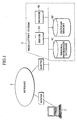
- FIG. 1 is a schematic diagram of a network system of a
prize-lottery system in the present invention;
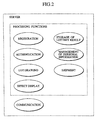
- FIG. 2 is a schematic diagram illustrating functions of
a server;
- FIG. 3 is a diagram illustrating a data structure stored
in a personal information database;
- FIG. 4 is a diagram illustrating an outline of execution
sequence of a lottery operation;
- FIG. 5 is a diagram illustrating a display image for use
in receiving a lottery executive instruction by a qualified
participant;
- FIG. 6 is a diagram illustrating a display image for use
in receiving an instruction of a selected moving direction of
a lottery character by a qualified participant;
- FIG. 7 is a diagram illustrating a prize selection
accepting image;
- FIG. 8 is a diagram illustrating a prize remaining number
display image 1;
- FIG. 9 is a diagram illustrating a prize remaining number
display image 2;
- FIG. 10 is a diagram illustrating a story development
selection accepting image 1;
- FIG. 11 is a diagram illustrating a story development
selection accepting image 2;
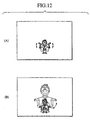
- FIG. 12 is a diagram illustrating li-zhi images in which
a change in motion of a character is used;
- FIG. 13 is a diagram illustrating li-zhi images in which
a change in shape of a character is used;
- FIG. 14 is a diagram illustrating a li-zhi image 1 in which
a dedicated bar area is used;
- FIG. 15 is a diagram illustrating a li-zhi image 2 in which
a dedicated bar area is used;
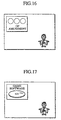
- FIG. 16 is a diagram illustrating a sponsor's
advertisement image;
- FIG. 17 is a diagram illustrating an exemplary prize
advertisement image;
- FIG. 18 is a diagram illustrating a full view of a virtual
scene for use in the notification of a result of the lottery;
- FIG. 19 is a diagram illustrating a story development
prepared for each story and a probability of development and
a winning probability at each stage;
- FIG. 20 is a diagram illustrating a normal game initial
image;
- FIG. 21 is a diagram illustrating a story development when
the loss of a normal game is decided;
- FIG. 22 is a diagram illustrating a story development when
the win of a normal game is decided;
- FIG. 23 is a diagram illustrating four li-zhi images
prepared for a "room fight scene";
- FIG. 24 is a diagram illustrating two representative
li-zhi images prepared for an "upstairs fight scene";
- FIG. 25 is a diagram illustrating two representative
li-zhi images prepared for a "corridor/toilet fight scene"; and
- FIG. 26 is a diagram illustrating two representative
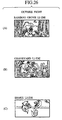
li-zhi images prepared for an "outside fight scene".
-
Best Mode for Carrying Out the Invention
-
An embodiment of the present invention will be described
below with reference to the accompanying drawings.
(A-1) Network System Configuration
-
FIG. 1 shows an entire configuration of a network system
according to this invention. As shown in FIG. 1, the network
system includes, as basic elements, the Internet 1 as a
communication medium, a client terminal 2 as an input/output
device, and a lottery system 3 for executing a prize offering
lottery. Although only a single client terminal 2 is
illustrated in FIG. 1, it is for the simplification of
description. To a practically operated system, a large number
of client terminals are connected.
-
The client terminal 2 has at least a function of connecting
to the Internet 1, a function of inputting instructions and the
like, and a function of displaying a lottery process (from the
start to the decision of a result).
-
As the client terminal, a computer terminal (including
a display function), a game terminal with an Internet function,
a mobile phone with an Internet function, a mobile information
terminal with an Internet function, or a composite terminal of
an Internet-dedicated terminal contained in a household
appliance or the like and a display function (e.g., a television
receiver) may be used. Hereinafter, they are referred to also
as Internet terminals.
-
For the connection between the client terminal 2 and the
Internet 1, a modem, a terminal adapter, a router or the like
may be used. The connection between the client terminal 2 and
the Internet 1 is not limited to a wire connection (such as a
phone line, an ISDN line or a cable television line), and may
be a wireless connection.
(A-2) Prize-Lottery System Configuration
-
The prize-lottery system 3 is configured with a server
3A, a monitor 3B, a personal information database 3C, a program
memory 3D and other components, which are connected to one
another via buses. A printer and an input device such as a
keyboard, which are not shown in FIG. 1 showing the schematic
configuration, are disposed when necessary.
-
Although FIG. 1 shows the configuration in which the
prize-lottery system 3 is directly connected to the Internet
1 via a router, a firewall for protecting personal information
and maintaining the fairness of the lottery is disposed at an
appropriate location.
-
The server 3A is configured with a computer device with
a server function. The server 3A is used for providing a series
of functions required for the execution of the prize offering
lottery (e.g., registration, authentication, lot drawing,
effect display, storage of lottery results, management of
personal information, shipment etc. as shown in FIG. 2). In
place of the server 3A, it is also possible to prepare dedicated
servers for different specific functions (or function groups)
for load sharing.
-
The registration function is the function of registering
qualified participants to enter the lottery in the personal
information database 3C. The authentication function is the
function of identifying participants by accessing the personal
database 3C. In this embodiment, the authentication function
decides whether a participant has certain qualifications for
entry of the lottery or not.
-
The lot drawing function is the function of determining
a winning mode by random number selection. A winning mode is
in principle a "win (winning of some prize)" or a "loss".
However, it may be "winning of an additional lottery right",
depending on an operator's system design. The reason why a
random number selection scheme is adopted for random number
drawing is to guarantee fairness.
-
The effect display function is the function of notifying
a lottery participant of a determined winning mode through
effect images constituting a story. At that time, the client
terminal 2 becomes an output device. In order to enable a
lottery participant to enjoy effect images provided by the
effect display function, it is desirable that the client
terminal 2 has a relatively large display screen and a certain
degree of communication speed.
-
However, when a mobile phone or the like constitutes a
client terminal, it is likely that the display area,
communication speed and so on are limited. Thus, the effect
display function also includes the function of transmitting
simplified images so as to enable a lottery participant to enjoy
the lottery process under such limitations. This function
allows the client terminal 2 to implement a pleasant execution
even when there are limitations in display area, communication
speed and so on.
-
The lottery result storage function is the function of
storing the results of the lottery, that is, wins or losses in
the personal information database 3C. Prize information
includes information as to which prize is won, the time and date
of the lottery and so on.
-
The personal information management function is the
function of managing information on qualified participants
(such as identification numbers, passwords, names, prize
shipment locations, past histories and so on). The shipment
function is the function of implementing arrangements for
shipping prizes won. The shipment function manages whether
shipment is done or not, the time and date of shipment and the
like.
-
The monitor 3B is provided as a means for monitoring the
progress of lottery processing and the like. The personal
information database 3C is, as shown in FIG. 3, a memory means
for storing identification numbers, passwords, names,
addresses, lottery results, past histories, whether shipment
is done or not and the like. The program memory 3D is a memory
means for storing programs such as a lottery program and effect
programs, data files required for the execution of the programs,
and the like. Specifically, the memory means is implemented
by a hard disk, a readable/writable optical disk or the like.
(A-3) Provision of Prize Offering Lottery Function
-
As a method of providing a prize offering lottery service,
a variety of forms (charge-free, charged, exclusive and the
like) are possible according to the objects, strategies and the
like of operations considered by operators, which do not share
all details in execution sequence and execution contents.
However, it is impractical to individually describe all the
contents of operations unique to those systems. Thus, in this
embodiment, description will be made on an exemplary basic
execution sequence which will be adopted in a lottery service
of this kind. FIG. 4 illustrates the outline of the execution
sequence.
-
Display of prizes to be awarded for wins is provided on
a website of the operator running the lottery.
(a) Registration of Qualified Participant
-
When a qualified participant to the virtual lottery
enters the lottery for the first time, processing for
registering personal information on the applicant is initially
executed (step S1). For example, a mail address,
identification number (ID), password, name, address, location
to which a prize for a win is shipped, and so on, are registered.
The personal information entered through the client terminal
2 by the qualified participant is registered in the personal
information database 3C via the server 3A.
(b) Authentication Operation
-
On the other hand, when a qualified participant has ever
entered the lottery or has ever entered another lottery operated
on the same website, processing for authenticating the
participant is executed (step S2). For the authentication, the
prize-lottery system 3 requires the qualified participant to
input the "mail address and password" or "ID and password".
-
When information corresponding to the input information
has been registered in the personal information database 3C,
the prize-lottery system 3 notifies the qualified participant
of the result of the authentication (such as the participant's
name), and moves to a lottery execution stage.
-
Input of authentication information may be required each
time a qualified participant enters the lottery, or may be done
by using an automatic transmission function of the client
terminal 2.
-
In a case where the lottery is opened only to people
meeting a given condition, it is also checked whether an
applicant has qualifications for entry or not. For example,
when everyone can enter the lottery but is limited in the number
of times he or she can enter, it is determined whether the number
of times of entry into the lottery meets a given condition.
-
In another case where a questionnaire or an application
to a prize-offered advertisement is a condition, it is
determined whether there is an input of necessary information
or not. In still another case where it is opened only to
purchasers of a given product, it is determined whether
information used for entry attached to a product or the like
(an ID number or the like) is right or wrong.
-
In still another case where an entry into a lottery is
charged, it is determined whether an entry fee can be paid or
not. For example, it is determined whether an applicant has
an account to which the entry fee can be charged (the account
becomes the destination of transfer of prize money in a certain
case), or whether the entry fee has already been collected (when
the entry fee for the lottery is included in a selling price
of some kind of software, for example, it is determined whether
a qualified participant is the user of the software and whether
a necessary amount of money for the entry into the lottery is
left in the personal information database 3C of the user.
-
In this connection, in a possible method, an entry right
to enter the lottery can be purchased at a convenience store
or the like, and information becoming effective by the purchase
is entered through a client terminal to be permitted the entry
into the lottery. It is also possible to adopt a method in which
the entry fee is collected from an advertising company. Another
method of charging the entry fee as a part of communication
expenses may also be possible.
(c) Lottery Operation
-
When the predetermined authentication operation is
completed, the prize-lottery system 3 executes random number
selection according to the lottery program (step S3). Random
number selection may be executed automatically or may be
executed based on a predetermined lottery execution operation
done by a qualified participant (e.g., clicking a lottery
execution button on a screen as shown in FIG. 5).
-
The random number selection is performed by checking a
winning probability table for a random number value selected
from among random number values generated by a random number
generation means (e.g., a sampling circuit). The winning
probability table stores data which associates selected random
number values with the respective winning modes.
-
A result of a lower frequency of appearance (lower
probability) is generally allocated a more valuable prize,
though the way of allocating prizes is not limited thereto.
-
Normally, a single lottery operation determines a winning
mode. That is, it determines a win or loss, and also determines
which prize is won for a win. When the winning mode is
determined, an effect program and a data file corresponding to
the determined winning mode are read, and the lottery
participant is notified of the winning mode. The details will
be described below.
-
Generally, for a valuable prize, an effect display of a
low frequency of appearance is selected, and for a relatively
low-cost prize, an effect display of a high frequency of
appearance is selected. This enables the participant to have
not only a sense of superiority that he or she has won a valuable
prize but also a sense of achievement that he or she was able
to see an effect display of a low frequency of appearance at
the same time.
-
In the case of a lose, an effect display of a high frequency
of appearance is often selected. However, an effect display
of a high frequency of appearance is not necessarily always
selected, and an effect display of a low frequency of appearance
can be selected. Thus, even upon a lose, an effect display of
a low frequency of appearance can be selected so that the lottery
participant can fully enjoy the process before a result of the
lottery is decided.
-
Specifically, the participant can see a story development
of effect images, anticipating winning a valuable prize. At
the same time, it is possible to cause the participant to have
a feeling of making another try because he or she might have
almost won.
-
The above is the basic random number selection execution
function. However, depending on the operation strategy of an
operator, there is a case where a single random number selection
does not determine a win or loss, and an additional lottery right
is given. The additional lottery right is different from a
second lottery, and is a conditional lottery right included in
the ongoing lottery operation. In the description, such a
lottery is referred to as an additional lottery or an additional
lottery right. The additional lottery function can be used for
providing a chance of winning a valuable prize.
-
A lottery participant may be or may not be notified of
the fact that an additional lottery will be done. In the case
where a lottery participant is not notified of the fact, the
server 3A automatically executes an additional lottery. The
number of possible occurrences of additional lotteries is set
by an operator.
-
In the case where a lottery participant is notified of
an additional lottery, in a possible method, a lottery execution
button is displayed on the screen seen by the lottery
participant at a scene where a story development of effect
images to be described below comes to the end of the first stage
for click operation, or a simple game is provided so that a
lottery is executed based on the result, or it is linked to the
selection of a moving direction of a character appearing in an
effect image.
-
As an input means for instructing a character's moving
direction, a method of using an input image as shown in FIG.
6, for example, is possible. Alternatively, independently of
these selection operations, the random number selection may be
executed by the server 3A automatically.
-
Incidentally, when a prize corresponding to a result of
random number selection is not left (the prize has already been
won a predetermined number of times set by the operator), and
when the prize to be delivered to the lottery participant cannot
be delivered, a method of immediately executing a second random
number selection to determine a winning mode may be adopted,
or it may be determined as win of a prize lower by one rank than
the original winning prize (if that prize has also already been
won a predetermined number of times, a prize lower by one more
rank). The provision of such a function can prevent such a
situation that after notification to a lottery participant, it
is found that the prize to be delivered is out of stock.
-
In the above, a lottery participant has no right to select
a prize and a prize is uniquely determined based on a result
of random number selection, and a lottery participant has no
right of selection. Alternatively, as shown in FIGS. 7(A) and
7(B), it is also possible to let a participant to select one
or more prizes he or she wants before the execution of random
number selection. In this case, a image for selecting a prize
before the execution of random number selection is displayed,
so that a lottery participant can also specify only a prize he
or she wants for a win for the lottery.
-
When a prize only meets a particular taste, many people
do not want such a prize other than that they want. Some of
prize collectors want to get a prize they do not have. Such
needs would not be small.
-
It is also possible to fix an order of priority in prize
selection, so that when a higher priority prize is won but the
prize has already been won a predetermined number of times, a
prize directly below in priority is selected as a win for the
notification of the result of the lottery.
-
When such prize selection is enabled, a lottery
participant has a great interest in the remaining amounts of
prizes to be offered. Thus, a function of displaying prizes
(in photographs or pictures) and the remaining amounts on the
entire screen as shown in FIG. 8, or a function of displaying
the names of prizes and the remaining amounts on a part of the
screen as shown in FIG. 9, may be provided to implement a more
user-friendly lottery system.
-
Such display allows a qualified participant to foresee
a result. Therefore, the participants can enter the lottery
with conviction. Such display enables a change of selection
to a prize of a higher winning probability. As a result, a
user-friendly lottery system capable of reflecting a qualified
participant's will more in the lottery operation. Is
implemented.
-
In the above-described example, description has been made
with winning probabilities basically fixed. Alternatively,
referring to participation histories stored in the personal
information database 3C, processing to increase a winning
probability for a person who has entered a large number of times
or to increase a winning probability for a person having little
winning experience may be performed according to setting by an
operator.
-
Especially when the lottery system is offered upon
payment, such a function can benefit a lottery participant and
can be an incentive for the participant to enter the lottery.
In such a case, it is also possible to fix winning probability
for fairness, and to perform adjustments by increasing lottery
opportunities (offering lottery rights free of charge),
offering free prizes or the like.
-
It is also possible to provide a scheme enabling changing
winning probability or the kinds of prizes (including
additional free prizes) or the like arbitrarily by a lottery
operator. For example, it is also possible to set a winning
probability relatively higher in a courtesy campaign than in
other cases.
-
For example, the courtesy campaign may be conditional in
time such as one provided for a limited period of time or one
provided only in a season, or conditional in location such as
one provided in a limited location, or conditional in the number
of entries such as one accepting the first some people, some
people weekly, or some people monthly, or conditional in things
such as one accepting purchasers of specific goods (to mark out
them from other target goods with lottery rights). It is also
a possible method to change winning probability according to
the total amount of purchase of (all or part of or individual)
target goods registered with respect to each lottery
participant.
-
It is also possible to provide a scheme enabling changing
winning probability or the kinds of prizes (including
additional free prizes) or the like, according to information
on a lottery participant normally unrelated to the lottery. For
example, winning probability or the like may be changed
according to the fact that a character (such as a main character)
has got a specific item in a game played before the lottery,
or the fact that the value of an ability count (such as an
experience count or a power count) of a character has reached
a predetermined value in a game played before the lottery, or
the fact that a hidden character has been discovered in a game
played before the lottery, or the fact that a bonus stage in
a game consisting of a plurality of stages is cleared, or the
fact that the score of a game exceeds some points, or the like.
-
A game may be one played independently of a lottery to
which a lottery participant can enter on a website of a lottery
operator (entry is made at the will of a lottery participant) ,
or may be one played in the internet terminal 2. In the latter
case, a game is not necessarily limited to one played in the
internet terminal 2, and all that needs to be done is that the
history and the result of a game played in a dedicated game
terminal or the like is read into or is ready to be read into
the internet terminal 2 before the execution of a lottery.
(d) Winning Mode Registration
-
When the lottery operation is executed to determine the
presence or absence of a win, the sever 3A registers the
determined result in the personal information database 3C, so
as to make it available for management thereafter (step S4).
For example, the time and date when the lottery participant
enters the lottery, the presence or absence of a win or loss,
a winning prize for a win and so on are registered. The
registered information is used for the shipment of the prize
to be described below.
-
The number of entries into the lottery or a winning history
may be reflected in qualifications to enter subsequent
lotteries. For example, it is possible to disqualify a
participant having entered a predetermined number of times from
entering the lottery, or to increase the number of times a
participant having entered a predetermined number of times can
enter the lottery. The registration information can also be
used in processing to increase winning probability for a
participant having always been losing without winning history
(e.g., in a lottery unit or in a certain period of time) so that
the participant is likely to win.
-
When a winning prize is various in color or a printed
character is various in design, and when a lottery participant
can select one of the different colors or the different designs
at will, it is also possible at the registration to prompt the
participant to select a desired prize via the client terminal
2 and to register the prize of the finally selected color or
design.
-
The selection may be made not only after a win is decided,
but also before the execution of random number selection, or
at the stage where a win is not decided after the execution of
random number selection (e.g., at the stage before the execution
of a possible additional drawing).
-
The provision of the interactive selection function can
further increase willingness to enter into the lottery as
compared with the case where a prize cannot be selected.
Further, it is possible to target only a really desired prize,
which satisfies the need of a lottery participant who is
particular about a minute difference in prize design.
(e) Notification via Effect Images
-
Concurrently with the above-described winning mode
registration operation, a winning mode notification operation
is executed (step S5). For the notification, effect images
constituting a story corresponding to a winning mode are used.
Functions involved in the notification operation will be
described below.
<Effect Function>
-
The prize-lottery system uses effect images constituting
a story for the notification of a winning mode. This is for
making a process before provision of a result of the lottery
more enjoyable than in a conventional method of notifying a
lottery participant of a result only or immediately.
-
A result of the lottery is only a win or loss, and the
result of the lottery is quickly decided. The current scheme
of directly notifying a participant of a lottery result using
the Internet lacks spice, and is just for checking whether a
prize is won or not. Thus, both a participant and an operator
or sponsor do not make full use of the rare chance of meeting.
-
Thus proposed is a method of combining the notification
of a winning mode with effect images constituting a story to
enable a lottery participant to enjoy a story development
displayed on the screen. That is, the method allows a lottery
participant to superimpose the story development on his or her
luck to enjoy fluctuation between hope and despair in the
process of notification.
-
Suppose that effect images constituting a story are
provided through a role-playing game. For example, a story
development is prepared in which a main character in an
imaginary story fights against an enemy on a stage set on the
image, and when the character conquers the enemy, a prize is
won, and when the character is defeated by the enemy, no prize
is won. Provision of effect images constituting a story is not
limited to the roll-playing game scheme.
-
The link between the activity of the main character in
a story and a prize can create an illusion that the lottery
operation proceeds in real time, so as to provide the fun of
leaving win to the activity of the main character.
-
If the above-described example of the roll-playing game
is set to provide a more valuable prize as the main character
defeats a larger number of enemies to finally survive the fight
(the efforts of the main character are greater) (the effect
images are images of a lower frequency of appearance, that is,
of lower probability), a story development (in which enemies
are defeated) and an increased chance of getting a valuable
prize provide a more enjoyable notification through effect
images.
-
If the main character is finally defeated by an enemy,
no matter how many enemies the main character has beaten, the
result is a "loss". However, many of lottery participants can
feel that a valuable prize was almost won, instead of just
finding the loss. Thus it is possible to create meaning to the
lottery and provide a certain kind of satisfaction.
-
Alternatively, the game may be used to award a prize or
to give a second lottery right (another lottery), according to
the number of enemies or the type of an enemy the main character
has defeated before being finally defeated.
-
Incidentally, concerning a connection between a winning
mode and provided effect images, it is the simplest method to
provide a story development corresponding to a random number
value selected as a result of random number selection. That
is, a story development corresponding to a random number value
is provided, and if the random number value corresponds to a
win, the development is ended with a winning image, and if the
random number value corresponds to a loss, the development is
ended with a losing image. In the case of a loss, it is also
possible to only select a story development so as to provide
unpredictability of story development.
<Main Character Selection Function>
-
It is also possible to prepare multiple main characters
to appear in a story so that a participant can select one of
them to enjoy seeing how a selected main character acts. In
this case, it is possible to cause the participant to have a
feeling that he or she is actively involved in the lottery,
resulting in a strong sense of achievement when he or she wins.
-
In this connection, various methods are possible, in
which random number selection is independent of the selection
of a main character, winning probability is slightly changed,
and a prize of a high winning probability is changed and so on.
-
If the different abilities, arms and the like of different
main characters are displayed on the screen so that a
participant can select a main character based on the information,
it is possible to further increase lottery participants'
willingness to enter the lottery.
<Story Development Selection Function>
-
If a number of story developments are prepared, a lottery
participant can encounter a different story development in each
lottery, so that the participant can be looking forward to a
story development provided by entering the lottery, thinking
of "What are other story developments like?" or "What kind of
ending is prepared after this scene?". Thus, in addition to
the result of the lottery, the process of notification of the
lottery result can be of interest.
-
As shown in FIG. 10, it is also possible to display the
kinds of story developments prepared by an operator on the
screen before the execution of a lottery so that a lottery
participant can select one of the story developments.
-
The provision of this function allows a participant to
enjoy both an entry into a lottery and a story development,
thinking like "this time I will see Story B because I saw Story
A last time", "I will try Story C this time also because Story
C tried last time was interesting", or "a friend won Prize X
in Story D, so I will select Story D".
-
With respect to the lottery operation in the case where
the above selection is possible, the lottery operation may be
unique to a selected story development. In that case,
individual winning probability may be set for each story
development. For example, it is possible to set winning
probability of development A higher than that of development
B which provides a more valuable prize.
-
On the other hand, the lottery operation may be
independent of a selected story development so that selection
of any story development leads to win of the same prize with
the same winning probability. In this case, it is also possible
to associate different prizes with different story
developments.
-
It is also possible that the server 3A arbitrarily
determines the story development when a lottery participant
especially has no desire while the selection of a story
development is possible. The effect images viewed by the
lottery participant in this case are the same. However, the
effect images are different in meaning between the case where
the story development is determined based on the result of
random number selection and then its notification is performed
(a lottery is executed under the state where there is a
possibility of winning one of all prizes) and the case where
the story development is determined to specify a prize to win
and then random number selection is performed.
-
Each story development may be allocated a single prize
or multiple prizes. It is also possible to allocate different
numbers of or different kinds of prizes to different story
developments.
-
As shown in FIG. 11, it is also possible to display
connections between story developments and the corresponding
prizes in a list to be used for reference when selecting a story
development.
-
Such display allows a lottery participant to fully make
sense of the selection of a story development in making the
selection. Thus, a more user-friendly prize offering lottery
can be provided than before.
<Character Moving Function>
-
Interactivity of the Internet is utilized to enable
directly determining the moving direction of a main character,
so that a lottery participant can feel active participation in
a lottery and have increased fun other than a result of the
lottery.
-
This function can be used in the above-described story
selection and can increase the degree of freedom in effect
contents such as the discovery of a hidden character buried in
the image and the selection of an opponent.
-
When the story is developed by the movement of the
character in a direction determined by the participant, the
lottery result can be strongly identified with the selection.
-
It is also possible to prevent the selection of movement
of the character by the lottery participant from influencing
a winning mode determined by the execution of the lottery
operation independently of the movement of the character. On
the other hand, it is also possible to re-execute the lottery
operation or change winning probability, depending on the
direction of movement of the character.
<Li-zhi Image Function>
-
A combination of the above-described various functions
can provide more diversified amusing effect images for use in
the notification of a winning mode. Preparation of a li-zhi
image function for indicating that the winning probability is
further increased (a special mode image display function) can
make the notification of a lottery result more amusing. For
example, the following special mode images are prepared:
(1) A scene to be displayed only when the winning probability
is high is prepared.
-
For example, a story development is provided with a depth
(several images are prepared) so that when the winning
probability is increased, a scene at that time is switched to
the next scene. A participant seeing the switching of the
scenes can find the fact that the winning probability is
increased.
-
For increased amusement, it is also possible to prepare
a win and loss of a prize at each scene according to the depth
of the scene (the frequency of appearance or the order of
appearance), so that when neither of them is drawn, the scene
is switched to the next scene where a more valuable prize can
be got.
-
Needless to say, it is arbitrary whether to prepare wins
and losses for all scenes. There may be a scene only with an
effect image associated with no prize win regardless of
expectations of a participant.
(2) A main character is caused to make a specific movement.
-
As shown in FIG. 12(A), for example, a character is caused
to move her arms up and down repeatedly, or, as shown in FIG.
12(B), the main character is made larger or smaller in size
repeatedly, so that a participant can sense the occurrence of
some change, finding an increased winning probability. A
combination of different facial expressions such as repeated
switching between a laughing face and a crying face can also
be possible.
-
In any case, the attention of a lottery participant to
the main character is increased. Such changes in movement are
suitable for the notification of a li-zhi state.
(3) The shape of a main character is changed.
-
It is also effective to change the shape of a main
character into the shape of a prize to win in a li-zhi state
at that time and return it to the original shape. Since the
attention of a lottery participant to a main character in the
image is great, a change of the shape can easily make the
participant aware of the li-zhi state.
-
When the prize is a CD as shown in FIG. 13, for example,
a head of a main character can be changed into an image of the
CD and then returned to the original shape, so as to increase
anticipation of winning the CD.
(4) A character is changed in color.
-
Since the attention of a lottery participant to a main
character is great, changing the color of the character into
a predetermined color can be the notification of the fact that
the winning probability is increased.
(5) Special sound effects are generated.
-
The above is the case of using changes on the screen. It
is also effective to generate special sound effects used only
when there is a probability of win, for increasing a
participant's anticipation. If it is combined with other
changes on the screen, a participant will be more easily aware
of it.
(6) A dedicated display section provided on the margin or the
like is used.
-
For example, development of a story and modification of
a character are amusing, but lottery participants include all
ages from children to elderly people. It is thus important that
everyone can understand the content.
-
For that purpose, as shown in FIG. 14, for example, a
display area (color bar in the figure) only for displaying
winning probability is provided at the bottom of effect images
in which a story is developed or on the margin. The color of
the display can be changed in connection with the winning
probability, so as to allow a participant to easily determine
whether the state at that time is a li-zhi state or not.
-
In Example 1 in FIG. 14, an initial state is displayed
in "green", and through a state of "yellow" as a li-zhi state,
a final state is displayed in one of different colors.
Specifically, a win is displayed in "blue", and a loss is
displayed in "red".
-
On the other hand, in Example 2 in FIG. 14, an initial
state is displayed in "green", and "yellow" is displayed only
in a true li-zhi state. The preparation of the display mode
only for the li-zhi state allows everyone to easily find that
he or she is in a li-zhi state. Finally, "red" is displayed
upon both a win and lose, showing that the result is decided.
The displays in both Example 1 and Example 2 also have the purpose
of notifying a participant of the degree of progress of a
lottery.
-
As shown in FIG. 15, the degree of expectancy can be
displayed with a bar graph in such a manner that when the degree
of expectancy is increased, the bar is extended to the right
in the figure, and when the degree of expectancy is reduced,
the bar is shortened to the left in the figure, so that an
increase in the degree of expectancy can be easily found.
Needless to say, a combination of changes in the length of the
bar and color is more effective. Instead of the bar graph,
another display form such as a pie graph may be used.
<Advertising Function>
-
An effect image using the above functions attracts much
attention and is visible to a lottery participant.
(1) Thus, this characteristic can be utilized to provide a
function of displaying an advertisement of a sponsor in an
effect image as shown in FIG. 16, expecting a great advertising
effect.
-
In the case of FIG. 16, an advertisement is displayed as
a back image. It is also possible to use a main character or
another character of high visibility for an advertisement (to
put clothes with an advertisement on a character or to switch
the face of a character to an advertisement image), so as to
obtain a great advertising effect.
-
It is also possible to bury an advertisement in a moving
path of a main character so that the advertisement is displayed
when the main character passes the point, drawing much attention
of a lottery participant taken by surprise. In this case, a
treasure hunt feature is added, providing the fun of looking
for a buried advertisement.
(2) Although FIG. 16 shows an advertisement of a sponsor, it
may alternatively be used for advertising a product to be
offered as a prize.
-
For example, in order to advertise game software, the
title of the game software, its package and the like can be
displayed in the effect image as shown in FIG. 17, thereby
attracting much attention of a lottery participant.
-
The advertisement of a prize can also be used for the
notification of a li-zhi state. In the case where a story
development can be changed according to the destination of
movement of a character and the story development is allocated
a specific prize, when the character stands at the entrance of
the story development on a story development selection image,
an advertisement of a prize to win when the story development
is selected is displayed. In this manner, the advertisement
of a product can be provided in response to the selection of
the story development.
-
It is also possible to switch advertisements of prizes
according to the moving direction of the character, thereby to
notify a lottery participant which prize can be won at the
destination in the moving direction, increasing the advertising
effect. Alternatively, it is also possible to change the shape
of the character into the shape of a product to be advertised.
(f) Shipment of Prize
-
The above operations are executed in real time through
the Internet 1. On the other hand, the function of shipping
prizes is for shipping a winning prize to a winner. A result
of the lottery is registered by the server 3A in the personal
information database 3C as personal data of the lottery
participant.
-
The operator accesses the personal information database
3C, so as to search for cases requiring prize shipment. At the
stage where a person in charge has shipped a prize, the
completion of the shipment, the date of shipment and the like
are registered in the corresponding section in the personal
information database 3C, completing the series of operations.
(A-3) Concrete Example of Prize Offering Lottery
-
Now description will be made, using a concrete example,
on effect images for use in the case where a roll-playing game
feature is adopted for the notification of a lottery result.
An imaginary prize-lottery system entitled "Haunted House
(tentative title)" will be described.
-
Needless to say, this is only an example, and there are
a variety of possible notification methods of increasing
effects. Suppose that authentication and the like have already
been executed using existing methods.
-
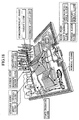
FIG. 18 is a panoramic view of a "haunted house" as the
stage of effect images. In the prize-lottery system, six story
developments are prepared for the notification of winning
modes.
-
The six story developments are a "normal game", a "room
fight scene", an "upstairs fight scene", a "corridor/toilet
fight scene", an "outside fight scene", and a "pond scene". FIG.
18 shows connections between the story developments and scenes
in which they are made (the locations of the stages).
-
The panoramic view is an initial effect image displayed.
It depends on an operator's strategy whether or not to let a
participant see which story development is associated with
which location. In order to let a lottery participant select
a story development, it is possible to let the participant make
a selection from a list of story developments displayed on the
image of the panoramic view. In this connection, it is possible
to hide prepared li-zhi contents.
-
In the "haunted house", the story development is fixed
and a lottery participant cannot make a selection of the story
development. That is, the story development is automatically
executed based on a winning mode obtained as a result of the
lottery.
-
FIG. 19 illustrates the connection between the
probability of development of each stage (li-zhi scene)
constituting part of a story development and the probability
of win at the stage. In FIG. 19, a percentage expression within
a block designating a li-zhi state gives the probability of
development from a previous stage, and a percentage expression
below a block gives a winning probability at the stage.
-
Referring to FIG. 19, it is found that the "room fight
scene" is developed from the "normal game" with a 10%
probability, and a win is decided with a 5% probability in the
first stage. Likewise, it is found that the "upstairs fight
scene" is developed from the "normal game" with a 6% probability,
but no win occurs in the first stage (a 0% winning probability).
That is, a stage for increasing scenic effects is prepared.
This is true for other stages with the expression of 0% in FIG.
19.
-
The "corridor/toilet fight scene" is also developed from
the "normal game" with a 6% probability. In this case also,
no win occurs in the first stage (a 0% winning probability).
A 'pond premium li-zhi scene" is hidden behind the
"corridor/toilet fight scene", and a scene of "corridor long
li-zhi 1" develops into the "pond scene" with a probability of
less than 1%. However, when it develops into the "pond scene",
a win occurs with a 100% probability.
-
The "outside fight scene" is also developed from the
"normal game" with a 6% probability. No win occurs in the first
stage (a 0% winning probability).
-
Now, description will be made on the effect content at
each stage prepared for each story development. The "normal
game" as a starting story has a corridor surrounding the house
set as the stage. FIG. 20 shows an exemplary initial image.
Characters are a grandma and a girl. The main character is the
grandma. In this story development, three endings are
prepared.
-
In a first ending, the grandma fails to fight off a first
evil spirit and is ended up being counterattacked (a losing
case). In a second ending, the grandma fights off first and
second evil spirits to enter a normal li-zhi, and then fights
off a third evil spirit in the end (a winning case). In a third
ending, the grandma fights off first and second evil spirits
to enter a normal li-zhi, but then fails to catch a third evil
spirit (a case to develop into the next story).
-
FIG. 21 shows an exemplary story development when the
normal game is ended up being lost. FIG. 22 shows an exemplary
story development when the normal game is ended up being won.
In either exemplary development, a color bar is displayed below
the image so that the development of the story and the occurrence
of the li-zhi state are easily visible. The color bar is green
in the initial state (FIGS. 21(A) and 22(A)). When the two
characters start walking, effect display for notification of
a winning mode is started. When the normal game is finished,
the color bar on the image is turned red (FIGS. 21(F) and 22(G)).
-
At the same time, a lantern held by the girl is lighted
and starts swinging, on the surface of which letters of "WIN"
and "LOSS" are alternately seen off and on. The letters
appearing on the surface of the lantern also function as an
effect image for the notification of a winning mode. They are
also used for notification when the result is decided (FIGS.
21(F) and 22(G)).
-
When the result of the lottery is loss, the story is
developed as follows. First, a first evil spirit appears from
the left (FIG. 21(B)), and the grandma swings a fauchard down
(FIG. 21(C)). The evil spirit, however, wards off the fauchard,
moving to the right (FIG. 21(D)). Thereafter, the evil spirit
counterattacks (FIG. 21(E)), and the evil spirit goes away (FIG.
21(F)). At that time, the light of the lantern held by the girl
goes out, the letters of the lantern becomes "LOSS", and the
loss is decided.
-
On the other hand, when the lottery result is a win in
the normal mode, the story is developed as follows. First, a
first evil spirit appears from the left, and the grandma cuts
it down with the fauchard (FIG. 22(B)). The evil spirit
disappears. Next, two evil spirits appear from the right (FIG.
22(C)). The grandma swings the fauchard down to get rid of one,
but another one runs off (FIG. 22(D)). The cut evil spirit also
disappears.
-
After that, the story moves to a li-zhi state (the color
bar changes into yellow), and the grandma starts chasing after
the evil spirit at a terrific speed (FIG. 22(E)). The grandma
is gradually catching up with the evil spirit (FIG. 22(F)), and
then cuts it down. The lantern is lighted brighter and the
letters on the lantern are "WIN" and the win is decided (FIG.
22(G)).
-
In a case where a winning mode corresponds to the
development into another story, the grandma fails to catch the
evil spirit on the scene of FIG. 22(G), and the display of the
story development is switched to a scene into which the evil
spirit has disappeared. When probability of development is as
shown in FIG. 19, it is most probable that the evil spirit runs
into a "large room". Its development probability is 10%. Into
the "upstairs", "corridor/toilet", or "outside", the evil
spirit runs with a 6% probability.
-
Here, the probability of running into the large room is
the largest. The "room fight scene" has the large room on the
first floor of the house set as the stage. In this story, "mat
turning li-zhi", "hanging scroll li-zhi", "under floor li-zhi" ,
or "mechanical doll li-zhi" is prepared according to the degree
of progress of the story (FIG. 23).
-
The "mat turning li-zhi" (FIG. 23(A)) appears first in
the story. It is started when the grandma enters the large loom,
running after the evil spirit. In this scene, a mat is flying
in the air, and the evil spirit is running under the floor. If
the grandma fights off the evil spirit before it disappears
thereinto, a win is decided (a 5% winning probability). If the
grandma bumps into the mat and the evil spirit runs off, a loss
is decided.
-
However, the mat turning li-zhi is developed into the
following "mechanical doll li-zhi" with a 1% development
probability. If the grandma chases under the floor without
bumping into the mat, the mat turning li-zhi is developed into
the following "under floor li-zhi" with a 4% development
probability.
-
When the mat turning li-zhi is developed into the
"mechanical doll li-zhi" (FIG. 23(B)), a story follows in which
a sliding door opens after the grandma bumps into the mat, and
then a mechanical doll is coming for the grandma. If the grandma
defeats the mechanical doll, a win is decided (a 50% winning
probability), and if not, a loss is decided.
-
On the other hand, when the mat turning li-zhi is developed
into the "under floor li-zhi" (FIG. 23(C)), a story follows in
which the evil spirit transformed into a giant spider comes at
the grandma. If the grandma gets rid of the giant spider, a
win is decided (a 20% winning probability), and if not, a loss
is decided.
-
In the large room, another place is prepared for the evil
spirit to run into. It is the back of the hanging scroll. When
the evil spirit chased by the grandma runs into the back of the
hanging scroll, the mat turning li-zhi is developed into the
"hanging scroll li-zhi" (FIG. 23(D)).
-
The probability of development from the "mat turning
li-zhi" is 2%. The back of the hanging scroll constitutes
another dimension in which they fight . If the grandma fights
off the evil spirit, a win is decided (a 15% winning probability),
and if not, a loss is decided.
-
Now, a story development of the case where the evil spirit
runs from a "gallery" into the "upstairs" will be described.
In this story, two-stage "stairs li-zhi (li-zhi 1, li-zhi 2)"
and "nest li-zhi" with a second-floor room as the stage (FIG.
24) are prepared.
-
The stairs li-zhi 1 and the stairs li-zhi 2 are different
as to where the grandma reaches. When a loss is decided in the
"stairs li-zhi 1", the grandma slips off from a relatively low
position of the stairs. When a loss is decided in the "stairs
li-zhi 2", the grandma is in a relatively high position of the
stairs and almost reaches the top, but slips off therefrom.
-
Either li-zhi scene is an effect image with no winning
probability (a 0% winning probability). Only 4% of lottery
participants who clear the "stairs li-zhi 1" can reach the
"stairs li-zhi 2".
-
Only 2% of lottery participants who proceed to the "stairs
li-zhi 2" can reach the "nest li-zhi" (FIG. 24(B)). It is
supposed that the second floor is the nest of evil spirits, in
which a fight between combined evil spirits and the grandma
develops. If the grandma fights off the evil spirits, a win
is decided (a 50% winning probability), and if not, a loss is
decided.
-
On the other hand, when the evil spirit runs from the
"gallery" into the "corridor/toilet", the story develops as
described below. In this story, two-stage "corridor long
li-zhi (li-zhi 1, li-zhi 2)" and two-stage "toilet li-zhi
(li-zhi 1, li-zhi 2)" are prepared (FIG. 25).
-
In the "corridor long li-zhi", a scene in which the grandma
chases after the evil spirit running along a long corridor
extending to the toilet is produced. The grandma turns corners
again and again to catch up with the evil spirit to get rid of
it.
-
If the grandma loses track of the evil spirit at a corner,
a loss is decided in the "corridor long li-zhi 1". If the
grandma does not negotiate a turn in the corridor and falls into
a pond, it develops into the "pond premium li-zhi" and a win
is decided. The probability of development from the "corridor
long li-zhi 1" to the "pond premium li-zhi" is less than 1%,
but the winning probability is 100%.
-
If the "corridor long li-zhi 1" is cleared with a 4%
development probability, it moves to the "corridor long li-zhi
2". In the "corridor long li-zhi 2", the grandma is
continuously chasing. If the grandma can catch up with the evil
spirit and get rid of it, a win (a 5% winning probability) is
decided. If the grandma loses track of the evil spirit, a loss
is decided (FIG. 25(A)).
-
If the "corridor long li-zhi 2" is cleared at a development
probability of 5%, it moves to the "toilet li-zhi 1". In the
"toilet li-zhi 1", a battle between the evil spirit trying to
run into the toilet and the grandma trying to get rid of the
evil spirit is developed. If the grandma can intercept the evil
spirit running into the toilet and get rid of it, a win is decided
(a 10% winning probability). If the evil spirit managed to run
into the toilet, a loss is decided. However, even when the evil
spirit managed to get away, at a development probability of 2%,
it moves from the "toilet li-zhi 1" to the "toilet li-zhi 2"
(FIG. 25(B)).
-
In the "toilet li-zhi 2", the evil spirit having run into
the toilet appears in a different shape from a toilet bowl. If
the grandma can get rid of the evil spirit (a 40% winning
probability), a win is decided. If the grandma is dragged down
into the toilet bowl, a loss is decided.
-
Finally, description will be made on the development of
a story when the evil spirit runs from the "gallery" to the
"outside". In this story, "bamboo grove li-zhi", "graveyard
li-zhi", and "snake li-zhi" are prepared (FIG. 26).
-
In the "bamboo grove li-zhi" (FIG. 26(A)), a battle
between the evil spirit trying to run into the bamboo grove and
the grandma trying to get rid of the evil spirit is developed.
If the evil spirit managed to run into the bamboo grove, a loss
is decided. In the "bamboo grove li-zhi", there is no winning
probability (a 0% winning probability).
-
If the grandma passes through the bamboo grove, running
after the evil spirit trying to disappearing into the bamboo
grove, it moves to the "graveyard li-zhi". The probability of
development is 3%. In the "graveyard li-zhi" (FIG. 26(B)), the
evil spirit becomes monstrously large, coming at the grandma,
and fighting with the grandma. If the grandma fights off the
evil spirit (a 35% winning probability), a win is decided. If
the grandma is swallowed by the evil spirit, a loss is decided.
-
However, even if the grandma is swallowed by the evil
spirit, at a probability of less than 1%, it develops from the
"graveyard li-zhi" to the "snake li-zhi".
-
In the "snake li-zhi" (FIG. 26(C)), a "snake" crawling
on the ground is transformed into a big snake, faces the evil
spirit, and fights off the evil spirit. The grandma is rescued
and a win is decided. The winning probability is 100%.
-
The preparation of the thrilling story developments
enables many of lottery participants to get a lot of fun from
effect images used in notification of a result of the lottery
as well as having interests in the result. Also, the
preparation of a number of li-zhi images directly irrespective
of a win (a 0% winning probability) can provide effects such
as to increase the degree of satisfaction of a lottery
participant through a number of scenes even when the participant
is losing.
-
Likewise, if a lottery participant can reach a scene of
a very low probability of appearance while the final result is
a loss, the participant can have a feeling that "I almost won"
(the participant can have a sense of superiority more than in
the case where he or she instantly knows the loss), and further,
the participant can have a satisfaction with the fact that he
or she can see a very rare scene (an active feeling of
superiority).
-
As described above, according to the present invention,
a prise-lottery system using a client terminal connected to the
Internet as an input/output device for providing a prize
offering lottery function to a qualified participant is
equipped with a random number selection executing means for
implementing random number processing based on information
received from the client terminal and a winning mode notifying
means for displaying effect images constituting a story on the
client terminal based on a winning mode determined as a result
of the random number selection processing, so that a lottery
participant can enjoy the process of notification before a
result of the lottery becomes clear.
-
Further, a lottery result managing means for storing
information about a winning mode determined as a result of
random number selection processing in association with
information on a qualified participant is provided, so that
information required for shipping a prize won as a result of
the lottery can be collected, and also a past history of entering
the lottery, a winning history and the like can be managed all
together, enabling the collection of useful personal
information.
-
The inclusion of special mode images indicating the
probability of win as the effect images allows a lottery
participant to more strongly anticipate a win, so as to make
the process before the final decision of a win more enjoyable.
-
Even if a losing result of the lottery is decided, it is
possible to leave an impression that it was almost won to make
losing enjoyable.
-
Since only a single lottery operation is required before
the final determination of a winning mode, a relatively small
computer system can process a large number of lottery operations.
Many of resources can be spared for processing of effect images,
so as to increase effects.
-
The notification of a winning mode finally determined has
no relation to the number of times of lottery operation, so that
the notification method may be any. For example, if the number
of times of the lottery operation is one, special mode images
indicating the possibility of a win can be brought into sight
several times in the effect images, so as to provide expectation
for the notification of a result of the lottery.
-
It is also possible to set such that a lottery operation
is required several times to finally determine a winning mode,
and a winning operation at each time except one at the first
time is executed during special mode images indicating the
possibility of win are being displayed or immediately after the
display, thereby to correspond to many winning modes even when
the random number selection executing means has a small range
of random number values. Unless the winning mode determined
as a result of the lottery is a "loss", another lottery operation
can provide a lottery participant a chance of "winning some
prize".
-
Since a qualified participant can select a predetermined
prize or prize group he or she wants before the execution of
a lottery operation, a more user-friendly system enabling
active participation in the lottery can be provided.
-
Thus, the needs of some qualified participants who do not
want other prizes than those they want can be satisfied. It
is not necessary to change winning probability when a prize or
a prize group is specified, but it is possible to change it.
-
When there is a link between a specified prize and a story
development, the same story development is repeated. In this
case, however, it is also possible to eliminate the link with
the story development.
-
Further, a qualified participant can select a range of
story development of effect images before the execution of a
lottery operation, thereby to be able to actively participate
in the lottery, resulting in the provision of a more
user-friendly system. In particular, the story development
can be provided with depth to allow a qualified participant to
have a fun of selecting a story development he or she does not
know.
-
A qualified participant can select the direction of
advancement of a character appearing in an effect image within
the screen, so that a more user-friendly system enabling an
active participation in the lottery can be provided.
-
It is possible to set such that a story development
corresponding to a place within the image is started when a
character moves to that place, so as to actively create a chance
of getting a specific prize or prize group linked to the story
development, and thereby to implement a highly amusing lottery
system with a high rate of entry.
-
Further, an advertisement of a sponsor offering a prize
can be displayed while an effect image is displayed, that is,
a sponsor advertisement can be displayed within an effect image
attracting much attention of a lottery participant, thereby to
expect a higher advertising effect than before.
-
It is also possible to bury an advertisement in a path
along which a character is movable to display the advertisement
when the character passes through the place so as to add a
treasure hunt feature.
-
An advertisement of a prize can be displayed while an
effect image is displayed, that is, an advertisement of a prize
can be displayed in an effect image attracting much attention
of a lottery participant, thereby to expect a higher
advertisement effect than before.
-
It is also possible to bury an advertisement in a path
along which a character is movable to display the advertisement
of a prize when the character passes through the place, thereby
to add a treasure hunt feature with which a prize displayed can
be won depending on the destination of movement of the character
or a story development started thereafter.
-
The shape of a character can be changed into the shape
of a prize according to a final winning mode, thereby to further
increase a prize advertising effect with the transformation of
the character watched by a lottery participant.
-
The shape, color and/or movement of a character can be
changed according to a winning mode, thereby to further increase
expectation for a result of the lottery with the change of the
character watched by a lottery participant.
-
When a final winning mode is allocated several styles of
or several kinds of prizes, a qualified participant can select
a prize he or she wants before the execution of a lottery
operation, or before the determination of a winning mode, or
after the determination of a winning mode, thereby to fully
satisfy even particular tastes of lottery participants with
respect to the specifics of prizes.
-
A partial area of an effect image or a dedicated display
area can be used to notify a qualified participant of the
probability of win in stages, thereby to easily notify lottery
participants of all ages of the probability of win.
-
Several-stage sound effects can be used to notify a
qualified participant of the probability of win, thereby to
easily notify lottery participants of all ages of the
probability of win.
-
A qualified participant is sequentially notified of the
remaining numbers of prizes to win to be able to predict a result
to enter the lottery with conviction. Further, it is possible
to preselect a prize or the like desired to perform a lottery
of a higher winning probability, resulting in a lottery system
capable of reflecting the intension of a qualified participant
in a lottery operation.
-
A qualified participant can desirably select a main
character to appear in effect images, so that an effect of
causing the qualified participant to have a feeling of creating
the effect images by himself or herself can be provided. Also,
the qualified participant can have a feeling of leaving his or
her win in charge of the selected main character, enjoying a
feeling of active participation in the lottery at the same time.
It is also possible to allow the ability, outfit or the like
of the main character to be changed.
Industrial Applicability
-
As described above, the present invention can make
lotteries via the Internet more attractive and amusing than
before. In particular, the prize-lottery system can fully
utilize the immediacy and interactivity of the Internet (e.g.,
in prize selection, story development selection, and main
character selection), resulting in a more user-friendly and
flexible lottery system.