EP1462091A1 - Composition de teinture des fibres kératiniques comprenant un dérivé de para-phénylènediamine cationique substitué par un cycle diazacyclohexane ou diazacycloheptane - Google Patents
Composition de teinture des fibres kératiniques comprenant un dérivé de para-phénylènediamine cationique substitué par un cycle diazacyclohexane ou diazacycloheptane Download PDFInfo
- Publication number
- EP1462091A1 EP1462091A1 EP04290711A EP04290711A EP1462091A1 EP 1462091 A1 EP1462091 A1 EP 1462091A1 EP 04290711 A EP04290711 A EP 04290711A EP 04290711 A EP04290711 A EP 04290711A EP 1462091 A1 EP1462091 A1 EP 1462091A1
- Authority
- EP
- European Patent Office
- Prior art keywords
- radical
- amino
- methyl
- phenyl
- piperazin
- Prior art date
- Legal status (The legal status is an assumption and is not a legal conclusion. Google has not performed a legal analysis and makes no representation as to the accuracy of the status listed.)
- Withdrawn
Links
- 0 C*C1=CC(C)(C)C=C(*(C)(CC2)CC(C)(C)C*2N)C=C1 Chemical compound C*C1=CC(C)(C)C=C(*(C)(CC2)CC(C)(C)C*2N)C=C1 0.000 description 3
Classifications
-
- A—HUMAN NECESSITIES
- A61—MEDICAL OR VETERINARY SCIENCE; HYGIENE
- A61Q—SPECIFIC USE OF COSMETICS OR SIMILAR TOILETRY PREPARATIONS
- A61Q5/00—Preparations for care of the hair
- A61Q5/10—Preparations for permanently dyeing the hair
-
- A—HUMAN NECESSITIES
- A61—MEDICAL OR VETERINARY SCIENCE; HYGIENE
- A61K—PREPARATIONS FOR MEDICAL, DENTAL OR TOILETRY PURPOSES
- A61K8/00—Cosmetics or similar toiletry preparations
- A61K8/18—Cosmetics or similar toiletry preparations characterised by the composition
- A61K8/30—Cosmetics or similar toiletry preparations characterised by the composition containing organic compounds
- A61K8/49—Cosmetics or similar toiletry preparations characterised by the composition containing organic compounds containing heterocyclic compounds
- A61K8/494—Cosmetics or similar toiletry preparations characterised by the composition containing organic compounds containing heterocyclic compounds with more than one nitrogen as the only hetero atom
-
- C—CHEMISTRY; METALLURGY
- C07—ORGANIC CHEMISTRY
- C07D—HETEROCYCLIC COMPOUNDS
- C07D243/00—Heterocyclic compounds containing seven-membered rings having two nitrogen atoms as the only ring hetero atoms
- C07D243/06—Heterocyclic compounds containing seven-membered rings having two nitrogen atoms as the only ring hetero atoms having the nitrogen atoms in positions 1 and 4
- C07D243/08—Heterocyclic compounds containing seven-membered rings having two nitrogen atoms as the only ring hetero atoms having the nitrogen atoms in positions 1 and 4 not condensed with other rings
-
- C—CHEMISTRY; METALLURGY
- C07—ORGANIC CHEMISTRY
- C07D—HETEROCYCLIC COMPOUNDS
- C07D295/00—Heterocyclic compounds containing polymethylene-imine rings with at least five ring members, 3-azabicyclo [3.2.2] nonane, piperazine, morpholine or thiomorpholine rings, having only hydrogen atoms directly attached to the ring carbon atoms
- C07D295/04—Heterocyclic compounds containing polymethylene-imine rings with at least five ring members, 3-azabicyclo [3.2.2] nonane, piperazine, morpholine or thiomorpholine rings, having only hydrogen atoms directly attached to the ring carbon atoms with substituted hydrocarbon radicals attached to ring nitrogen atoms
- C07D295/12—Heterocyclic compounds containing polymethylene-imine rings with at least five ring members, 3-azabicyclo [3.2.2] nonane, piperazine, morpholine or thiomorpholine rings, having only hydrogen atoms directly attached to the ring carbon atoms with substituted hydrocarbon radicals attached to ring nitrogen atoms substituted by singly or doubly bound nitrogen atoms
- C07D295/125—Heterocyclic compounds containing polymethylene-imine rings with at least five ring members, 3-azabicyclo [3.2.2] nonane, piperazine, morpholine or thiomorpholine rings, having only hydrogen atoms directly attached to the ring carbon atoms with substituted hydrocarbon radicals attached to ring nitrogen atoms substituted by singly or doubly bound nitrogen atoms with the ring nitrogen atoms and the substituent nitrogen atoms attached to the same carbon chain, which is not interrupted by carbocyclic rings
- C07D295/13—Heterocyclic compounds containing polymethylene-imine rings with at least five ring members, 3-azabicyclo [3.2.2] nonane, piperazine, morpholine or thiomorpholine rings, having only hydrogen atoms directly attached to the ring carbon atoms with substituted hydrocarbon radicals attached to ring nitrogen atoms substituted by singly or doubly bound nitrogen atoms with the ring nitrogen atoms and the substituent nitrogen atoms attached to the same carbon chain, which is not interrupted by carbocyclic rings to an acyclic saturated chain
-
- C—CHEMISTRY; METALLURGY
- C07—ORGANIC CHEMISTRY
- C07D—HETEROCYCLIC COMPOUNDS
- C07D295/00—Heterocyclic compounds containing polymethylene-imine rings with at least five ring members, 3-azabicyclo [3.2.2] nonane, piperazine, morpholine or thiomorpholine rings, having only hydrogen atoms directly attached to the ring carbon atoms
- C07D295/04—Heterocyclic compounds containing polymethylene-imine rings with at least five ring members, 3-azabicyclo [3.2.2] nonane, piperazine, morpholine or thiomorpholine rings, having only hydrogen atoms directly attached to the ring carbon atoms with substituted hydrocarbon radicals attached to ring nitrogen atoms
- C07D295/12—Heterocyclic compounds containing polymethylene-imine rings with at least five ring members, 3-azabicyclo [3.2.2] nonane, piperazine, morpholine or thiomorpholine rings, having only hydrogen atoms directly attached to the ring carbon atoms with substituted hydrocarbon radicals attached to ring nitrogen atoms substituted by singly or doubly bound nitrogen atoms
- C07D295/135—Heterocyclic compounds containing polymethylene-imine rings with at least five ring members, 3-azabicyclo [3.2.2] nonane, piperazine, morpholine or thiomorpholine rings, having only hydrogen atoms directly attached to the ring carbon atoms with substituted hydrocarbon radicals attached to ring nitrogen atoms substituted by singly or doubly bound nitrogen atoms with the ring nitrogen atoms and the substituent nitrogen atoms separated by carbocyclic rings or by carbon chains interrupted by carbocyclic rings
-
- C—CHEMISTRY; METALLURGY
- C07—ORGANIC CHEMISTRY
- C07D—HETEROCYCLIC COMPOUNDS
- C07D295/00—Heterocyclic compounds containing polymethylene-imine rings with at least five ring members, 3-azabicyclo [3.2.2] nonane, piperazine, morpholine or thiomorpholine rings, having only hydrogen atoms directly attached to the ring carbon atoms
- C07D295/04—Heterocyclic compounds containing polymethylene-imine rings with at least five ring members, 3-azabicyclo [3.2.2] nonane, piperazine, morpholine or thiomorpholine rings, having only hydrogen atoms directly attached to the ring carbon atoms with substituted hydrocarbon radicals attached to ring nitrogen atoms
- C07D295/14—Heterocyclic compounds containing polymethylene-imine rings with at least five ring members, 3-azabicyclo [3.2.2] nonane, piperazine, morpholine or thiomorpholine rings, having only hydrogen atoms directly attached to the ring carbon atoms with substituted hydrocarbon radicals attached to ring nitrogen atoms substituted by carbon atoms having three bonds to hetero atoms with at the most one bond to halogen, e.g. ester or nitrile radicals
- C07D295/145—Heterocyclic compounds containing polymethylene-imine rings with at least five ring members, 3-azabicyclo [3.2.2] nonane, piperazine, morpholine or thiomorpholine rings, having only hydrogen atoms directly attached to the ring carbon atoms with substituted hydrocarbon radicals attached to ring nitrogen atoms substituted by carbon atoms having three bonds to hetero atoms with at the most one bond to halogen, e.g. ester or nitrile radicals with the ring nitrogen atoms and the carbon atoms with three bonds to hetero atoms attached to the same carbon chain, which is not interrupted by carbocyclic rings
- C07D295/15—Heterocyclic compounds containing polymethylene-imine rings with at least five ring members, 3-azabicyclo [3.2.2] nonane, piperazine, morpholine or thiomorpholine rings, having only hydrogen atoms directly attached to the ring carbon atoms with substituted hydrocarbon radicals attached to ring nitrogen atoms substituted by carbon atoms having three bonds to hetero atoms with at the most one bond to halogen, e.g. ester or nitrile radicals with the ring nitrogen atoms and the carbon atoms with three bonds to hetero atoms attached to the same carbon chain, which is not interrupted by carbocyclic rings to an acyclic saturated chain
Definitions
- the subject of the invention is a fiber dyeing composition.
- keratin in particular human keratin fibers such as hair, comprising as oxidation base at least one paraphenylenediamine derivative substituted with a diazacyclohexane ring or diazacycloheptane whose nitrogen in position 4 is a quaternary ammonium.
- Oxidation dye precursors, or oxidation bases are colorless or weakly colored compounds which, when combined with oxidants, can give rise to a condensation process oxidative to colored or coloring compounds.
- couplers or color modifiers the latter being chosen in particular from meta-phenylenediamines, meta-aminophenols, meta-hydroxyphenols and certain heterocyclic compounds such as for example derivatives of pyrazolo [1,5-b] -1,2,4-triazole, derivatives of pyrazolo [3,2-c] -1,2,4-triazole, pyrazolo [1,5-a] pyrimidine derivatives, pyridine derivatives, derivatives pyrazol-5-one, indoline derivatives and indole derivatives.
- couplers or color modifiers the latter being chosen in particular from meta-phenylenediamines, meta-aminophenols, meta-hydroxyphenols and certain heterocyclic compounds such as for example derivatives of pyrazolo [1,5-b] -1,2,4-triazole, derivatives of pyrazolo [3,2-c] -1,2,4-triazole, pyrazolo [1,5-a] pyrimidine derivative
- the dyes should also cover the hair white, and finally be the least selective possible, that is to say allow to obtain the smallest possible color differences throughout a same keratin fiber, which can be sensitized differently (i.e. damaged) between its tip and its root. They must also submit a good chemical stability in formulations. They must present a good toxicological profile.
- paraphenylenediamine and para-toluenediamine are oxidation bases widely used. They allow to obtain with oxidation couplers various nuances.
- the aim of the present invention is to develop new dye compositions not having the disadvantages of bases oxidation of the prior art by providing new dye compositions for dyeing keratin fibers which do not not degrade keratin fibers while being able to generate intense colorings in varied, not very selective shades, particularly resistant and with a good toxicological profile.
- the present invention makes it possible in particular to obtain a coloring chromatic, powerful, not very selective and tenacious keratin fibers.
- Another object of the invention is the use of these derivatives of formula (I) for dyeing keratin fibers as well as the process for dyeing of keratin fibers using the composition of the present invention.
- the subject of the invention is also new derivatives of paraphenylenediamine substituted with a diazacyclohexane ring or diazacycloheptane whose nitrogen in position 4 is a quaternary ammonium.
- the invention also relates to para-nitroaniline derivatives substituted by a diazacyclohexane or diazacycloheptane ring whose nitrogen in position 4 is a quaternary ammonium allowing the synthesis of derivatives of formula (I) described above.
- the compounds of formula (I) are para-phenylenediamines an amine of which is included in a 1,4-diazacycloheptane type cycle, cycle also called in the literature 1,4-diazepane, or of which an amine is included in a 1,4-diazacyclohexane type cycle also called in the 1,4-piperazine literature.
- alkyl radicals are linear or branched and comprise, unless otherwise indicated, from 1 to 10 carbon atoms, preferably from 1 to 6 carbon atoms.
- An alkoxy radical is a radical alkyl-O-, the alkyl radical being as defined above.
- unsaturated alkyl radical means an alkyl of 2 to 10 atoms of carbon and comprising one or more double and / or triple bonds.
- a substituted alkyl radical is a mono or polysubstituted alkyl.
- hydroxyalkyl or aminoalkyl is alkyl which may be substituted by one or more hydroxy or amino groups.
- the radical R 1 is for example chosen from a chlorine atom; a methyl radical; an ethyl radical; an isopropyl radical; a vinyl radical; an allyl radical; a methoxymethyl radical; a hydroxymethyl radical; a 1-carboxymethyl radical; a 1-aminomethyl radical; a 2-carboxyethyl radical; a 2-hydroxyethyl radical; a 3-hydroxypropyl radical; a 1,2-dihydroxyethyl radical; a 1-hydroxy-2-aminoethyl radical; a 1-amino-2-hydroxyethyl radical; a 1,2-diaminoethyl radical; a methoxy radical; an ethoxy radical; an allyloxy radical; a 2-hydroxyethyloxy radical.
- n is equal to 0 or R 1 is chosen from an alkyl radical; a hydroxyalkyl radical; an aminoalkyl radical; an alkoxy radical; a hydroxyalkoxy radical.
- the radical R 1 can be a methyl radical; a hydroxymethyl radical; a 2-hydroxyethyl radical; a 1,2-dihydroxyethyl radical; a methoxy radical; an isopropyloxy radical; a 2-hydroxyethoxy radical and more preferably a methyl radical; a hydroxymethyl radical; a 1,2-dihydroxyethyl radical.
- the bases of oxidation of formula (I) are such that n is equal to 0 or to 1.
- the radical R 2 is chosen from an alkyl radical; an alkyl radical substituted by a heterocyclic radical with 4, 5, 6 or 7 atoms, saturated or unsaturated, in which the heteroatom or atoms are chosen from nitrogen, oxygen and sulfur; a radical -CH 2 R where R is an alkyl radical substituted by one or more hydroxy radicals.
- the radical R 2 is preferably chosen from a 2-hydroxyethyl radical; a 2,3-dihydroxypropyl radical; a 3- (1-pyrrolidinyl) propyl radical; a methyl radical and more preferably a 2-hydroxyethyl radical and a methyl radical.
- the radical R ' 2 is chosen from an alkyl radical; a radical -CH 2 R where R is an alkyl radical substituted by one or more hydroxy, amino, mono or dialkylamino.
- the radical R ′ 2 is preferably chosen from a methyl radical; an ethyl radical; a 2-hydroxyethyl radical.
- the radical R 3 is chosen from a hydrogen atom; an alkyl radical; a hydroxyalkyl radical; an aminoalkyl radical; a carboxyl radical; a carbamoyl radical; a hydroxyl radical; an alkoxy radical; an amino radical; a mono or dialkylamino radical.
- the radical R 3 is chosen from a hydrogen atom; a hydroxyl radical; a carboxyl radical; a carbamoyl radical; an amino radical; a hydroxymethyl radical; an aminomethyl radical and more preferably represents a hydrogen atom.
- m is equal to 0 or R 4 is chosen from an alkyl radical; a hydroxyalkyl radical; an aminoalkyl radical; a carboxyl radical; a carbamoyl radical; a mono or dialkylcarbamoyl radical.
- R 4 is chosen from an alkyl radical; a hydroxyalkyl radical; an aminoalkyl radical; a carboxyl radical; a carbamoyl radical; a mono or dialkylcarbamoyl radical.
- m is equal to 0 or 1.
- the compounds of formula (I) can be optionally salified with strong mineral acids such as for example HCl, HBr, H 2 SO 4 , or organic acids such as, for example, acetic, lactic, tartaric, citric or succinic.
- strong mineral acids such as for example HCl, HBr, H 2 SO 4
- organic acids such as, for example, acetic, lactic, tartaric, citric or succinic.
- counterions X - there may be mentioned the halide ions such as the chloride ion, bromide, fluoride or iodide, the hydroxide ion, the hydrogen sulphate ion, the C 1 alkyl sulphate ions - C 6 such as methyl sulfate or ethyl sulfate.
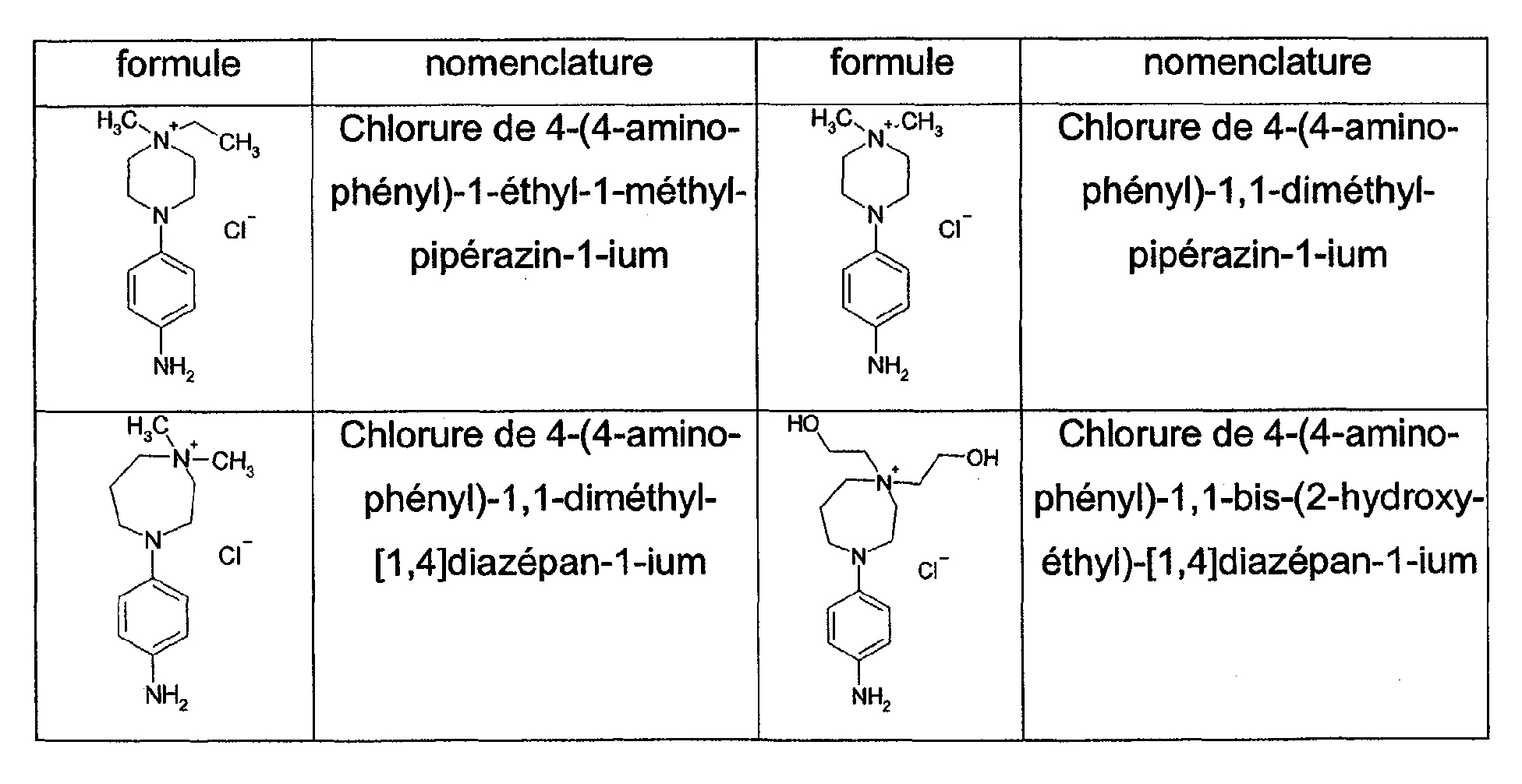
- the derivatives of formula (I) particularly preferred are 4- (4-amino-phenyl) -1,1-dimethyl- [1,4] diazepan-1-ium chloride, 4- (4-amino-phenyl) -1,1-dimethyl-piperazin-1-ium chloride, 4- (4-amino-phenyl) -1- (2-hydroxy-ethyl) -1-methyl-piperazin-1-ium chloride.
- the carbon substituted by R 3 or by R 4 may be of configuration (R) and / or (S).
- the oxidation base (s) of the invention are generally each present in an amount between 0.001 to 10% by weight approximately of the total weight of the dye composition, preferably between 0.005 and 6%.
- the dye composition of the invention may contain one or more several couplers conventionally used for dyeing fibers keratin.
- couplers conventionally used for dyeing fibers keratin.
- couplers mention may in particular be made of meta-phenylenediamines, meta-aminophenols, meta-diphenols, naphthalene couplers, heterocyclic couplers and their salts addition.
- the coupler (s) are each generally present in an amount between 0.001 and 10% by weight approximately of the total weight of the dye composition, preferably between 0.005 and 6%.
- composition of the present invention may further comprise one or more additional oxidation bases conventionally used in oxidation dye other than those described above.
- additional oxidation bases are chosen from para-phenylenediamines other than those described above, bis-phenylalkylenediamines, para-aminophenols, bis-para-aminophenols, ortho-aminophenols, ortho-phenylenediamines, bases heterocyclics and their addition salts.
- para-phenylenediamines that may be mentioned by way of example, paraphenylenediamine, paratoluylenediamine, 2-chloro paraphenylenediamine, 2,3-dimethyl paraphenylenediamine, 2,6-dimethyl paraphenylenediamine, 2,6-diethyl paraphenylenediamine, 2,5-dimethyl paraphenylenediamine, N, N-dimethyl paraphenylenediamine, N, N-diethyl paraphenylenediamine, N, N-dipropyl paraphenylenediamine, 4-amino N, N-diethyl 3-methyl aniline, N, N-bis- ( ⁇ -hydroxyethyl) paraphenylenediamine, 4-N, N-bis- ( ⁇ -hydroxyethyl) amino 2-methyl aniline, 4-N, N-bis- ( ⁇ -hydroxyethyl) amino 2-chloro aniline, 2- ⁇ -hydroxyethyl paraphenylened
- paraphenylenediamine paratoluylenediamine, 2-isopropyl paraphenylenediamine, 2- ⁇ -hydroxyethyl paraphenylenediamine, 2- ⁇ -hydroxyethyloxy paraphenylene diamine, 2,6-dimethyl paraphenylenediamine, 2,6-diethyl paraphenylenediamine, 2,3-dimethyl paraphenylenediamine, N, N-bis- ( ⁇ -hydroxyethyl) paraphenylenediamine, 2-chloro paraphenylenediamine, 2- ⁇ -acetylaminoethyloxy paraphenylenediamine, and their acid addition salts are particularly preferred.
- bis-phenylalkylenediamines mention may be made of for example, N, N'-bis- ( ⁇ -hydroxyethyl) N, N'-bis- (4'-aminophenyl) 1,3-diamino propanol, N, N'-bis- ( ⁇ -hydroxyethyl) N, N'-bis- (4'-aminophenyl) ethylenediamine, N, N'-bis- (4-aminophenyl) tetramethylenediamine, N, N'-bis- ( ⁇ -hydroxyethyl) N, N'-bis- (4-aminophenyl) tetramethylenediamine, the N, N'-bis- (4-methyl-aminophenyl) tetramethylenediamine, N, N'-bis- (ethyl) N, N'-bis- (4'-amino, 3'-methylphenyl) ethylenediamine, 1,8-bis- (2,5-di
- para-aminophenols there may be mentioned by way of example, the para-aminophenol, 4-amino 3-methyl phenol, 4-amino 3-fluoro phenol, 4-amino 3-hydroxymethyl phenol, 4-amino 2-methyl phenol, 4-amino 2-hydroxymethyl phenol, 4-amino 2-methoxymethyl phenol, 4-amino 2-aminomethyl phenol, 4-amino 2- ( ⁇ -hydroxyethyl aminomethyl) phenol, 4-amino 2-fluoro phenol, and their addition salts with an acid.
- ortho-aminophenols mention may be made, for example, of 2-amino phenol, 2-amino 5-methyl phenol, 2-amino 6-methyl phenol, 5-acetamido 2-amino phenol, and their addition salts with an acid.
- heterocyclic bases there may be mentioned by way of example, the pyridine derivatives, pyrimidine derivatives and pyrazole derivatives.
- pyridine derivatives mention may be made of the compounds described for example in patent applications GB 1 026 978 and GB 1 153 196, such as 2,5-diamino pyridine, 2- (4-methoxyphenyl) amino 3-amino pyridine, 2,3-diamino 6-methoxy pyridine, 2- ( ⁇ -methoxyethylamino 3-amino 6-methoxy pyridine, 3,4-diamino pyridine, and their addition salts with an acid.
- pyridine oxidation bases useful herein invention are the oxidation bases 3-amino pyrazolo- [1,5-a] -pyridines or their addition salts described for example in patent application FR 2 801 308.
- pyrazolo [1,5-a] pyridin-3-ylamine 2-acetylamino pyrazolo- [1,5-a] pyridin-3-ylamine; 2-morpholin-4-yl-pyrazolo [1,5-a] pyridin-3-ylamine ; 3-amino-pyrazolo [1,5-a] pyridin-2-carboxylic acid ; 2-methoxy-pyrazolo [1,5-a] pyridine-3-ylamino; (3-amino-pyrazolo [1,5-a] pyridine-7-yl) -methanol ; 2- (3-amino-pyrazolo [1,5-a] pyridine-5-yl)
- pyrimidine derivatives mention may be made of the compounds described for example in patent applications DE 23 59 399; JP 88-169571; JP 05-63124; EP 0 770 375 or WO patent application 96/15765 such as 2,4,5,6-tetra-aminopyrimidine, 4-hydroxy 2,5,6-triaminopyrimidine, 2-hydroxy 4,5,6-triaminopyrimidine, 2,4-dihydroxy 5,6-diaminopyrimidine, 2,5,6-triaminopyrimidine, and pyrazolo-pyrimidine derivatives such as those mentioned in patent application FR-A-2,750 048 and among which mention may be made of pyrazolo- [1,5-a] -pyrimidine-3,7-diamine ; 2,5-dimethyl pyrazolo- [1,5-a] -pyrimidine-3,7-diamine; pyrazolo- [1,5-a] -pyrimidine-3,5-d
- pyrazole derivatives mention may be made of the compounds described in patent applications DE 38 43 892, DE 41 33 957 and applications for WO 94/08969, WO 94/08970, FR-A-2 733 749 and DE 195 43 988 such as 4,5-diamino 1-methyl pyrazole, 4,5-diamino 1- ( ⁇ -hydroxyethyl) pyrazole, 3,4-diamino pyrazole, 4,5-diamino 1- (4'-chlorobenzyl) pyrazole, 4,5-diamino 1,3-dimethyl pyrazole, 4,5-diamino 3-methyl 1-phenyl pyrazole, 4,5-diamino 1-methyl 3-phenyl pyrazole, 4-amino 1,3-dimethyl 5-hydrazino pyrazole, 1-benzyl 4,5-diamino 3-methyl pyrazole, 4,5-diamino 3-tert-but
- the oxidation base (s) present in the composition of the invention are generally present each in an amount between 0.001 to 10% by weight approximately of the total weight of the dye composition, preferably between 0.005 and 6%.
- addition salts of the oxidation bases and couplers which can be used in the context of the invention are in particular chosen from acid addition salts such as hydrochlorides, hydrobromides, sulfates, citrates, succinates, tartrates, lactates, tosylates, benzenesulfonates, phosphates and acetates and addition salts with a base such as soda, potash, ammonia, amines or alkanolamines.
- acid addition salts such as hydrochlorides, hydrobromides, sulfates, citrates, succinates, tartrates, lactates, tosylates, benzenesulfonates, phosphates and acetates
- a base such as soda, potash, ammonia, amines or alkanolamines.
- the dye composition according to the invention can also contain one or more direct dyes which can in particular be chosen among the nitro dyes of the benzene series, direct dyes azo, methine direct dyes. These direct dyes can be non-ionic, anionic or cationic in nature.
- the medium suitable for dyeing also called dye support, generally consists of water or of a mixture of water and at least one organic solvent to dissolve the compounds which are not sufficiently soluble in water.
- organic solvent mention may, for example, be made of lower C 1 -C 4 alkanols, such as ethanol and isopropanol; polyols and polyol ethers such as 2-butoxyethanol, propylene glycol, propylene glycol monomethyl ether, monoethyl ether and diethylene glycol monomethyl ether, as well as aromatic alcohols such as benzyl alcohol or phenoxyethanol, and mixtures thereof.
- the solvents are preferably present in proportions preferably between 1 and 40% by weight approximately relative to the total weight of the dye composition, and even more preferably between 5 and 30% by weight approximately.
- the dye composition according to the invention can also contain various adjuvants conventionally used in compositions for hair dye, such as anionic surfactants, cationic, non-ionic, amphoteric, zwitterionic or their mixtures, anionic, cationic, nonionic, amphoteric polymers, zwitterionics or their mixtures, mineral thickening agents or organic, and in particular polymer associative thickeners anionic, cationic, nonionic and amphoteric, agents antioxidants, penetration agents, sequestering agents, perfumes, tampons, dispersing agents, packaging such as, for example, volatile or non-volatile silicones, modified or unmodified, film-forming agents, ceramides, preservatives, clouding agents.
- adjuvants conventionally used in compositions for hair dye such as anionic surfactants, cationic, non-ionic, amphoteric, zwitterionic or their mixtures, anionic, cationic, nonionic, amphoteric polymers
- the above adjuvants are generally present in quantity for each of them between 0.01 and 20% by weight relative to the weight of composition.
- the pH of the dye composition according to the invention is generally between 3 and 12 approximately, and preferably between 5 and 11 about. It can be adjusted to the desired value using acidifying agents or basifying agents usually used in dyeing keratin fibers or well again using conventional buffer systems.
- the mineral or organic acids like hydrochloric acid, acid orthophosphoric, sulfuric acid, carboxylic acids like acid acetic, tartaric acid, citric acid, lactic acid, acids sulfonic.
- the basifying agents there may be mentioned, by way of example, ammonia, alkali carbonates, alkanolamines such as mono-, di- and triethanolamines as well as their derivatives, sodium or potassium hydroxides and compounds of formula (III) below: in which W is a propylene residue optionally substituted by a hydroxyl group or a C 1 -C 4 alkyl radical; R a, R b, R c and R d, identical or different, represent a hydrogen atom, an alkyl radical in C 1 -C 4 hydroxyalkyl or C 1 -C 4.
- the dye composition according to the invention can be in various forms, such as in the form of liquids, creams, gels, or in any other form suitable for dyeing keratin fibers, and in particular human hair.
- the present invention also relates to the use for the oxidation dye of keratin fibers, and in particular fibers human keratin such as hair, a derivative of paraphenylenediamine of formula (I) as defined above.
- the process of the present invention is a process in which apply to the fibers the composition according to the present invention such that defined above, and the color is revealed using an oxidizing agent.
- the color can be revealed at acidic, neutral or alkaline pH and the oxidizing agent can be added to the composition of the invention just at the time of use or can be used from an oxidizing composition containing it, applied simultaneously or sequentially to the composition of the invention.
- the composition according to the present invention is mixed, preferably at the time of use, with a composition containing, in a medium suitable for dyeing, minus an oxidizing agent, this oxidizing agent being present in an amount sufficient to develop coloration.
- the mixture obtained is then applied to keratin fibers. After an exposure time of 3 to 50 about 5 minutes, preferably about 5 to 30 minutes, the keratin fibers are rinsed, washed with shampoo, rinsed again and then dried.
- the oxidizing agents conventionally used for dyeing of oxidation of keratin fibers are for example peroxide hydrogen, urea peroxide, alkali metal bromates, parsley such as perborates and persulfates, peracids and oxidase enzymes among which there may be mentioned peroxidases, oxidoreductases with 2 electrons such as uricases and 4-electron oxygenases such as laccases. Hydrogen peroxide is particularly preferred.
- the oxidizing composition may also contain various adjuvants conventionally used in compositions for dyeing hair and as defined above.
- the pH of the oxidizing composition containing the oxidizing agent is such that after mixing with the dye composition, the pH of the composition resultant applied to the keratin fibers preferably varies between 3 and 12 approximately, and even more preferably between 5 and 11. It can be adjusted at the desired value using acidifying or basifying agents usually used in dyeing keratin fibers and as defined previously.
- the ready-to-use composition which is finally applied to the keratin fibers can come in various forms, such as in the form of liquids, creams, gels or any other form suitable for dyeing keratin fibers, and in particular human hair.
- the invention also relates to a device with several compartments or dye "kit” in which a first compartment contains the dye composition of the present invention defined above and a second compartment contains an oxidizing composition.
- This device can be equipped with a means for delivering to the hair the desired mixture, such as the devices described in patent FR-2,586 913 in the name of the plaintiff.
- a subject of the invention is also the para-phenylenediamine derivatives of formula (I), with the exception of the para-phenylenediamine derivative substituted by a diazacyclohexane ring in which n is equal to 0, m is equal to 0 and R 2 and R ′ 2 represent a methyl radical, as well as their addition salts.
- the para-phenylenediamine derivatives of formula (I) are obtained by reduction of the para-nitroaniline derivatives of formula (II) below: in which the radicals R 1 , R 2 , R ' 2 , R 3 and R 4 and the integers n and m are as defined above.
- the subject of the invention is also the para-nitroaniline derivatives of formula (II), with the exception of 4- (4-nitro-phenyl) -1,1-dimethyl-piperazin-1-ium.
- Example 1 synthesis of 4- (4-amino-phenyl) -1,1-dimethyl- [1,4] diazepan-1-ium, chloride, dihydrochloride (4)
- the anion exchange is carried out by passing a solution of 35.2 g (0.0974 1,1-dimethyl-4- (4-nitro-phenyl) - [1,4] diazepan-1-ium, methylsulfate (2) obtained above in the previous step in a water / ethanol mixture on 190 g of Amberlite IRA402 resin.
- each composition is mixed with an equal weight of hydrogen peroxide at 20 volumes (6% by weight). A final pH of 7 is obtained.
- Each mixture obtained is applied to locks of gray hair containing 90% white hairs. After 30 min of laying, the locks are rinsed, washed with a standard shampoo, rinsed again and then dried. The following dye results were obtained. Examples 1 2 3 4 5 Nuance observed Blue purple Purple Beige purple Beige purple Beige
- each composition is mixed with an equal weight of hydrogen peroxide at 20 volumes (6% by weight). A final pH of 9.5 is obtained.
- Each mixture obtained is applied to locks of gray hair containing 90% white hairs. After 30 min of laying, the locks are rinsed, washed with a standard shampoo, rinsed again and then dried. The following dye results were obtained. Examples 6 7 8 Nuance observed Blue purple Red violet Purple
- each composition is mixed with an equal weight of hydrogen peroxide at 20 volumes (6% by weight). A final pH of 7 is obtained.
- Each mixture obtained is applied to locks of gray hair containing 90% white hairs. After 30 min of laying, the locks are rinsed, washed with a standard shampoo, rinsed again and then dried. The following dye results were obtained. Examples 9 10 11 Nuance observed Beige Orange Orange gray
- each composition is mixed with an equal weight of hydrogen peroxide at 20 volumes (6% by weight). A final pH of 9.5 is obtained.
- Each mixture obtained is applied to locks of gray hair containing 90% white hairs. After 30 min of laying, the locks are rinsed, washed with a standard shampoo, rinsed again and then dried. The following dye results were obtained. Examples 12 Nuance observed Beige
- each composition is mixed with an equal weight of hydrogen peroxide at 20 volumes (6% by weight). A final pH of 7 is obtained.
- Each mixture obtained is applied to locks of gray hair containing 90% white hairs. After 30 min of laying, the locks are rinsed, washed with a standard shampoo, rinsed again and then dried. The following dye results were obtained. Examples 13 14 15 Nuance observed Beige Orange Orange gray
- each composition is mixed with an equal weight of hydrogen peroxide at 20 volumes (6% by weight). A final pH of 9.5 is obtained.
- Each mixture obtained is applied to locks of gray hair containing 90% white hairs. After 30 min of laying, the locks are rinsed, washed with a standard shampoo, rinsed again and then dried. The following dye results were obtained. Examples 16 Nuance observed Beige
Landscapes
- Chemical & Material Sciences (AREA)
- Organic Chemistry (AREA)
- Health & Medical Sciences (AREA)
- Life Sciences & Earth Sciences (AREA)
- Animal Behavior & Ethology (AREA)
- General Health & Medical Sciences (AREA)
- Public Health (AREA)
- Veterinary Medicine (AREA)
- Birds (AREA)
- Epidemiology (AREA)
- Cosmetics (AREA)
Abstract
Description

- R1 représente :
- un atome d'halogène ;
- une chaíne hydrocarbonée en C1-C8, aliphatique ou alicyclique, saturée ou insaturée, un ou plusieurs atomes de carbone pouvant être remplacés par un ou plusieurs atomes d'oxygène, d'azote, de silicium, de soufre ou groupements SO2 ; le radical R1 ne comportant pas de liaison peroxyde, ni de radicaux diazo, nitro ou nitroso ;
- n est compris entre 0 et 4, étant entendu que lorsque n est supérieur à 1 alors les radicaux R1 peuvent être identiques ou différents ;
- R2 et R'2, identiques ou différents, représentent :
- un radical alkyle pouvant être insaturé, non substitué ou substitué par un ou plusieurs radicaux carboxyle, alkylcarbonyle, alcoxycarbonyle, carbamoyle, mono- ou di-alkylcarbamoyle, hétérocycliques à 4, 5, 6 ou 7 atomes, saturés ou insaturés, dont le ou les hétéroatomes sont choisis parmi l'azote, l'oxygène et le soufre ;
- un radical -CH2 R où R est un radical alkyle pouvant être insaturé, substitué par un ou plusieurs radicaux hydroxy, alcoxy, cyano, hydrogénothio, halogéno, amino, mono- ou di-alkylamino, amino avec l'amine substituée par un radical alkylcarbonyle, carbamyle ou alkylsulfonyle ;
- un radical aryle ;
- un radical benzyle ;
- R3 représente :
- un atome d'hydrogène ;
- un radical alkyle pouvant être insaturé ;
- un radical hydroxy ;
- un radical hydroxyalkyle ;
- un radical alcoxy ;
- un radical alcoxyalkyle ;
- un radical alkylcarbonyle ;
- un radical hydroxyalcoxyalkyle ;
- un radical amino, l'amine pouvant être mono ou disubstituée par un radical alkyle, acétyle ou hydroxyalkyle ;
- un radical monoalkylamino ou dialkylamino ;
- un radical aminoalkyle, l'amine pouvant être mono ou disubstitué par un radical alkyle, acétyle ou hydroxyalkyle ;
- un radical hydroxy- et amino- alkyle ;
- un radical carboxyle ;
- un radical carboxyalkyle ;
- un radical carbamoyle ;
- un radical carbamoylalkyle ;
- un radical alcoxycarbonyle ;
- un radical mono- ou dialkyl- aminocarbonyle ;
- un radical mono- ou dialkyl- aminocarbonylalkyle ;
- R4 représente :
- un radical alkyle pouvant être insaturé ;
- un radical hydroxyalkyle ;
- un radical alcoxyalkyle ;
- un radical alkylcarbonyle ;
- un radical hydroxyalcoxyalkyle ;
- un radical aminoalkyle, l'amine pouvant être mono ou disubstitué par un radical alkyle, acétyle, hydroxyalkyle ;
- un radical hydroxy- et amino- alkyle ;
- un radical carboxyle ;
- un radical carboxyalkyle ;
- un radical carbamoyle ;
- un radical carbamoylalkyle ;
- un radical alcoxycarbonyle ;
- un radical mono- ou dialkyl- aminocarbonyle ;
- un radical mono- ou dialkyl- aminocarbonylalkyle ;
- m est compris entre 0 et 4, étant entendu que lorsque m est supérieur à 1 alors les radicaux R4 peuvent être identiques ou différents ;
- X- représente un contre-ion.


La composition tinctoriale selon l'invention peut se présenter sous des formes diverses, telles que sous forme de liquides, de crèmes, de gels, ou sous toute autre forme appropriée pour réaliser une teinture des fibres kératiniques, et notamment des cheveux humains.


11,4 ml (0,12 mole) de sulfate de méthyle sont ajoutés goutte à goutte puis l'agitation est maintenue à température ambiante pendant quatre heures. La réaction est exothermique (28 °C) et un précipité jaune cristallisé se forme.
Le solide est filtré sous vide puis recristallisé dans l'acétate d'éthyle. Les cristaux obtenus sont séchés sous vide à 40 °C sur anhydride phosphorique. 35,6 g de cristaux jaunes sont obtenus (rendement = 98 %).
L'analyse élémentaire pour C14H23N3SO4 est la suivante :
| C % | H % | N % | O % | S% | |
| Calculé | 46,53 | 6,41 | 11,63 | 26,56 | 8,87 |
| Trouvé | 46,23 | 6,42 | 11,64 | 26,77 | 8,88 |
Les résultats obtenus par RMN 1H sont les suivants :
1H (400 MHz, DMSO, D6) : 2,31 (m, 2H), 3,25 (s, 6H), 3,6 (m, 2H), 3,65 (m, 2H), 3,72 (m, 2H), 3,97 (m 2H), 6,93 (m, 2H), 8,07 (m, 2H)
La réduction se fait en une heure sous une pression d'hydrogène d'environ cinq bars et à une température de 55 °C.
Après filtration du catalyseur sous azote, le milieu réactionnel est versé sur de l'acide chlorhydrique aqueux. Le filtrat est évaporé à sec sous pression réduite. Après recristallisation dans un mélange d'éthanol, acide chlorhydrique et eau et séchage à 45 °C sous vide et sur potasse, 17,8 g de cristaux blancs (rendement = 67 %).
L'analyse élémentaire pour C13H24N3Cl3 + H2O est la suivante :
| C % | H % | N % | O % | Cl% | |
| Calculé | 45,03 | 7,56 | 12,12 | 4,61 | 30,68 |
| Trouvé | 45,19 | 7,58 | 12,14 | 4,67 | 30,19 |
1H (400 MHz, D2O): 2,23 (m, 2H), 3,11 (s, 6H), 3,5 (m ,2H), 3,54 (m, 2H),
3,64 (m,2H), 3,78 (m, 2H), 6,99 (m, 2H), 7,3 (m, 2H).
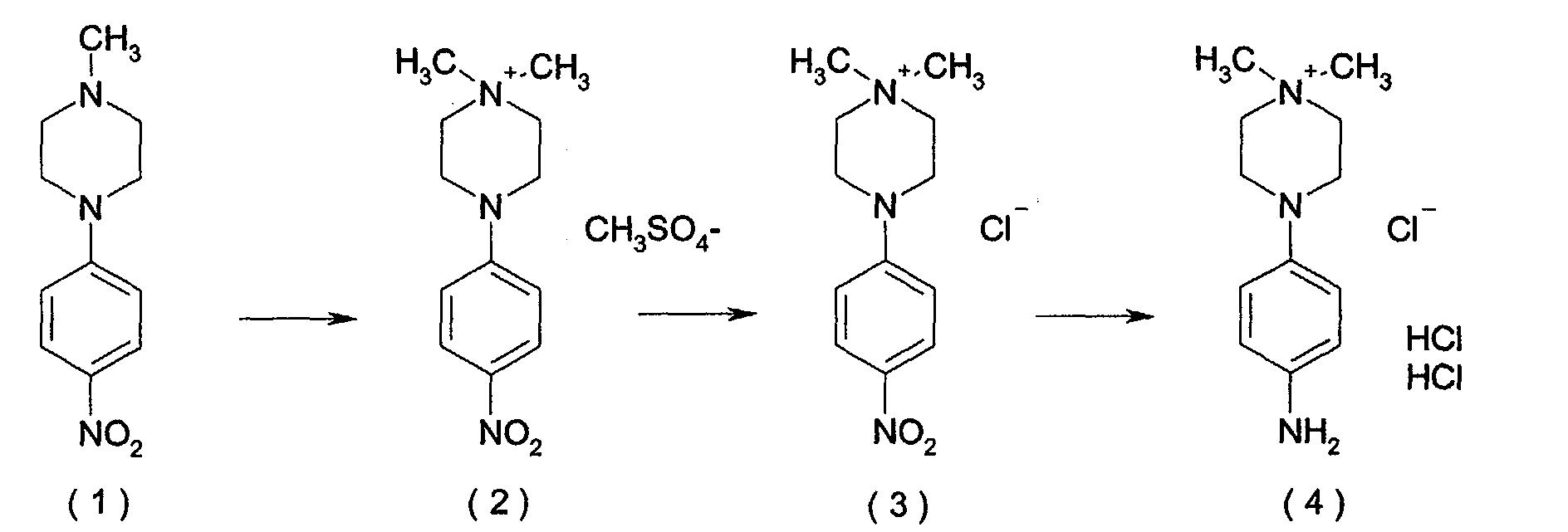
Sous agitation sont ajoutés goutte à goutte 11,4 ml (0,12 mole) de sulfate de méthyle puis l'agitation est maintenue à température ambiante pendant quatre heures. Le précipité jaune formé est filtré sous vide, recristallisé dans l'acétate d'éthyle et séché sous vide à 35 °C sur anhydride phosphorique. 34,3 g de cristaux jaunes sont obtenus (rendement = 99 %).
Après évaporation à sec sous pression réduite, 20,0 g d'un composé cristallisé jaune sont obtenus (rendement = 77 %).
Les résultats obtenus par RMN 1H sont les suivants :
1H RMN (400 MHz, DMSO, D6) : 3,235 (s, 6H, N-(CH3)2) ; 3,37 ( s, 3H, CH3OSO3-); 3,58 (m, 4H, CH2) ; 3,829 (m, 4H, CH2) ; 7,15 (d, 2 H ,ortho de N) ; 8,14 (d, 2 H, ortho de NO2).
La réduction se fait en une heure et demi sous une pression d'hydrogène d'environ six bars et à une température de 50 °C.
Après filtration du catalyseur sous azote, le milieu réactionnel est versé sur de l'acide chlorhydrique aqueux. Le filtrat est évaporé à sec sous pression réduite. Après séchage à 45 °C sous vide et sur potasse, 20,2 g de cristaux blancs sont obtenus (rendement = 67 %).
L'analyse élémentaire pour C12H22N3Cl3 + 1,5H2O est la suivante :
| C% | H % | N % | O% | Cl% | |
| Calculé : | 42,18 | 7,37 | 12,30 | 7,02 | 31,13 |
| Trouvé : | 42,46 | 7,14 | 12,43 | 7,86 | 30,09 |
1H RMN (400 MHz, D2O) : 3,33 (s, 6H, CH3); 3,71 (m, 8H, CH2); 7,32 (m, 2H, ortho de N); 7,49 (m, 2H, ortho de NH2).

Sous agitation sont ajoutés goutte à goutte 11,4 ml (0,12 mole) de sulfate de méthyle puis l'agitation est maintenue à température ambiante pendant cinq heures. Le précipité jaune formé est filtré sous vide, recristallisé dans l'acétate d'éthyle et séché sous vide à 40 °C sur anhydride phosphorique. 38,0 g (rendement quantitatif) de cristaux jaunes sont obtenus.
L'analyse élémentaire pour C14H23N3SO7 est la suivante :
| C % | H % | N % | O % | S% | |
| Calculé | 44,55 | 6,14 | 11,13 | 29,67 | 8,50 |
| Trouvé | 44,63 | 6,14 | 11,20 | 29,55 | 8,56 |
Après évaporation à sec sous pression réduite et recristallisation de 220 ml d'éthanol 96 au reflux, 27,0 g d'un composé cristallisé jaune sont obtenus (rendement = 71 %).
Les résultats obtenus par RMN 1H sont les suivants :
1H RMN (400 MHz, DMSO, D6): 3,25 (s, 3H, CH3N) ; 3,373 (s, 3H, CH3OSO3-) ; 3,615- 3,925 (m, 12H, CH2) ; 5,52 (t, 1H, OH) ; 7,148 (d, 2 H, ortho de N); 8,146 (d, 2 H, ortho de NO2).
La réduction se fait en deux heures sous une pression d'hydrogène d'environ cinq bars et à une température de 50 °C.
Après filtration du catalyseur sous azote, le milieu réactionnel est versé sur de l'acide chlorhydrique aqueux. Le filtrat est évaporé à sec sous pression réduite. Après séchage à 45 °C sous vide et sur potasse, 23,2 g de cristaux blancs sont obtenus (rendement = 80 %).
Les résultats obtenus par RMN 1H sont les suivants :
1H RMN (400 MHz, DMSO, D6) : 3,24 (s, 3H, CH3) ; 3,53 (m, 10H, CH2); 3,87 (m, 2H, CH2); 7,08 (d, 2H, ortho de N) ; 7,31 (d, 2H, ortho de NH2); 9,25 (m, 1H, OH); 10,52 (m, 2H, NH2).
| Exemples | 1 | 2 | 3 | 4 | 5 |
| 4-(4-amino-phényl)-1,1-diméthyl-[1,4]diazépan-1-ium ; chlorure ; dichlorhydrate (base) | 10-3 mole | 10-3 mole | 10-3 mole | 10-3 mole | 10-3 mole |
| 2-(2,4-Diamino-phénoxy)-éthanol, dichlorhydrate (coupleur) | 10-3 mole - | - | - | ||
| 3-Amino-2-chloro-6-méthylphénol, chlorhydrate -(coupleur) | 10-3 mole - | - | |||
| 2-méthyl-5-aminophénol (coupleur) | - | - | 10-3 mole | ||
| 2-amino-pyridin-3-ol (coupleur) - | - | - | 10-3 mole | ||
| 1H-indol-6-ol (coupleur) | 10-3 mole | ||||
| Support de teinture (2) | (*) | (*) | (*) | (*) | (*) |
| Eau déminéralisée q.s.p. | 100 g | 100 g | 100 g | 100 g | 100 g |
| (*) Support de teinture (2) pH 7 |
| Alcool éthylique à 96° | 20,8 g |
| Métabisulfite de sodium en solution aqueuse à 35% | 0,23 g M.A |
| Sel pentasodique de l'acide diéthylène-triamine-pentaacétique en solution aqueuse à 40% | 0,48 g M.A |
| Alkyl en C8-C10 polyglucoside en solution aqueuse à 60% | 3,6 g M.A |
| Alcool benzylique | 2,0 g |
| Polyéthylène glycol à 8 motifs d'oxyde d'éthylène | 3,0 g |
| Na2HPO4 | 0,28 g |
| KH2PO4 | 0,46 g |
Les résultats de teinture suivants ont été obtenus.
| Exemples | 1 | 2 | 3 | 4 | 5 |
| Nuance observée | Bleu violet | Violet | Beige violet | Beige violet | Beige |
| Exemples | 6 | 7 | 8 |
| 4-(4-amino-phényl)-1,1-diméthyl-[1,4]diazépan-1-ium ; chlorure ; dichlorhydrate (base) | 10-3 mole | 10-3 mole | 10-3 mole |
| 2-(2,4-Diamino-phénoxy)-éthanol, dichlorhydrate (coupleur) | 10-3 mole | - | - |
| 4,6-diméthyl-2H-pyrazolo[3,2c] -[1,2,4] triazole (coupleur) | 10-3 Mole - | ||
| 3-Amino-2-chloro-6-méthylphénol, chlorhydrate (coupleur) | - | - | 10-3 mole |
| Support de teinture (1) | (*) | (*) | (*) |
| Eau déminéralisée q.s.p. | 100 g | 100 g | 100 g |
| (*) Support de teinture (1) pH 9,5 |
| Alcool éthylique à 96° | 20,8 g |
| Métabisulfite de sodium en solution aqueuse à 35% | 0,23 g M.A |
| Sel pentasodique de l'acide diéthylène-triamine-pentaacétique en solution aqueuse à 40% | 0,48 g M.A |
| Alkyl en C8-C10 polyglucoside en solution aqueuse à 60% | 3,6 g M.A |
| Alcool benzylique | 2,0 g |
| Polyéthylène glycol à 8 motifs d'oxyde d'éthylène | 3,0 g |
| NH4Cl | 4,32 g |
| Ammoniaque à 20% de NH3 | 2,94 g |
Les résultats de teinture suivants ont été obtenus.
| Exemples | 6 | 7 | 8 |
| Nuance observée | Bleu violet | Violet rouge | Violet |
| Exemples | 9 | 10 | 11 |
| 4-(4-amino-phényl)-1,1-diméthyl-pipérazin-1-ium ; chlorure ; dichlorhydrate (base) | 10-3 mole | 10-3 mole | 10-3 mole |
| 2-(2,4-diamino-phénoxy)-éthanol ; dichlorhydrate (coupleur) | 10-3 Mole | - | |
| 2-amino-pyridin-3-ol (coupleur) | - | 10-3 mole - | |
| 1 H-indol-6-ol (coupleur) | - | - | 10-3 mole |
| Support de teinture (2) | (*) | (*) | (*) |
| Eau déminéralisée q.s.p. | 100 g | 100 g | 100 g |
| (*) Support de teinture (2) pH 7 |
| Alcool éthylique à 96° | 20,8 g |
| Métabisulfite de sodium en solution aqueuse à 35% | 0,23 g M.A |
| Sel pentasodique de l'acide diéthylène-triamine-pentaacétique en solution aqueuse à 40% | 0,48 g M.A |
| Alkyl en C8-C10 polyglucoside en solution aqueuse à 60% | 3,6 g M.A |
| Alcool benzylique | 2,0 g |
| Polyéthylène glycol à 8 motifs d'oxyde d'éthylène | 3,0 g |
| Na2HPO4 | 0,28 g |
| KH2PO4 | 0,46 g |
Chaque mélange obtenu est appliqué sur des mèches de cheveux gris à 90 % de blancs. Après 30 min de pose, les mèches sont rinçées, lavées avec un shampooing standard, rinçées à nouveau puis séchées.
Les résultats de teinture suivants ont été obtenus.
| Exemples | 9 | 10 | 11 |
| Nuance observée | Beige | Orangé | Gris orangé |
| Exemples | 12 |
| 4-(4-amino-phényl)-1,1-diméthyl-pipérazin-1-ium ; chlorure ; dichlorhydrate (base d'oxydation) | 10-3 mole |
| 2-(2,4-Diamino-phénoxy)-éthanol, dichlorhydrate (coupleur) | 10-3 mole |
| Support de teinture (1) | (*) |
| Eau déminéralisée q.s.p. | 100 g |
| (*) Support de teinture (1) pH 9,5 |
| Alcool éthylique à 96° | 20,8 g |
| Métabisulfite de sodium en solution aqueuse à 35% | 0,23 g M.A |
| Sel pentasodique de l'acide diéthylène-triamine-pentaacétique en solution aqueuse à 40% | 0,48 g M.A |
| Alkyl en C8-C10 polyglucoside en solution aqueuse à 60% | 3,6 g M.A |
| Alcool benzylique | 2,0 g |
| Polyéthylène glycol à 8 motifs d'oxyde d'éthylène | 3,0 g |
| NH4Cl | 4,32 g |
| Ammoniaque à 20% de NH3 | 2,94 g |
Les résultats de teinture suivants ont été obtenus.
| Exemples | 12 |
| Nuance observée | Beige |
| Exemples | 13 | 14 | 15 |
| 4-(4-amino-phényl)-1-(2-hydroxy-éthyl)-1-méthyl-pipérazin-1-ium ; chlorure ; dichlorhydrate (base) | 10-3 mole | 10-3 mole | 10-3 mole |
| 2-(2,4-Diamino-phénoxy)-éthanol, dichlorhydrate (coupleur) | 10-3 mole - | - | |
| 2-amino-pyridin-3-ol (coupleur) | - | 10-3 mole | - |
| 1 H-indol-6-ol (coupleur) | - | - | 10-3 mole |
| Support de teinture (2) | (*) | (*) | (*) |
| Eau déminéralisée q.s.p. | 100 g | 100 g | 100 g |
| (*) Support de teinture (2) pH 7 |
| Alcool éthylique à 96° | 20,8 g |
| Métabisulfite de sodium en solution aqueuse à 35% | 0,23 g M.A |
| Sel pentasodique de l'acide diéthylène-triamine-pentaacétique en solution aqueuse à 40% | 0,48 g M.A |
| Alkyl en C8-C10 polyglucoside en solution aqueuse à 60% | 3,6 g M.A |
| Alcool benzylique | 2,0 g |
| Polyéthylène glycol à 8 motifs d'oxyde d'éthylène | 3,0 g |
| Na2HPO4 | 0,28 g |
| KH2PO4 | 0,46 g |
Les résultats de teinture suivants ont été obtenus.
| Exemples | 13 | 14 | 15 |
| Nuance observée | Beige | Orangé | Gris orangé |
| Exemples | 16 |
| 4-(4-amino-phényl)-1-(2-hydroxy-éthyl)-1-méthyl-pipérazin-1-ium ; chlorure ; dichlorhydrate (base) | 10-3 mole |
| 2-(2,4-Diamino-phénoxy)-éthanol, dichlorhydrate (coupleur) | 10-3 mole |
| Support de teinture (1) | (*) |
| Eau déminéralisée q.s.p. | 100 g |
| (*) Support de teinture (1) pH 9,5 |
| Alcool éthylique à 96° | 20,8 g |
| Métabisulfite de sodium en solution aqueuse à 35% | 0,23 g M.A |
| Sel pentasodique de l'acide diéthylène-triamine-pentaacétique en solution aqueuse à 40% | 0,48 g M.A |
| Alkyl en C8-C10 polyglucoside en solution aqueuse à 60% | 3,6 g M.A |
| Alcool benzylique | 2,0 g |
| Polyéthylène glycol à 8 motifs d'oxyde d'éthylène | 3,0 g |
| NH4Cl | 4,32 g |
| Ammoniaque à 20% de NH3 | 2,94 g |
Les résultats de teinture suivants ont été obtenus.
| Exemples | 16 |
| Nuance observée | Beige |
Claims (24)
- Composition tinctoriale des fibres kératiniques comprenant, dans un milieu cosmétique approprié à la teinture, à titre de base d'oxydation, au moins un dérivé de para-phénylènediamine de formule (I) ou un de ses sels d'addition :dans laquelle :
 R1 représente :un atome d'halogène ;une chaíne hydrocarbonée en C1-C8, aliphatique ou alicyclique, saturée ou insaturée, un ou plusieurs atomes de carbone pouvant être remplacés par un ou plusieurs atomes d'oxygène, d'azote, de silicium, de soufre ou groupements SO2; le radical R1 ne comportant pas de liaison peroxyde, ni de radicaux diazo, nitro ou nitroso ;n est compris entre 0 et 4, étant entendu que lorsque n est supérieu à 1 alors les radicaux R1 peuvent être identiques ou différents ;R2 et R'2, identiques ou différents, représentent :un radical alkyle pouvant être insaturé, non substitué ou substitué par un ou plusieurs radicaux carboxyle, alkylcarbonyle, alcoxycarbonyle, carbamoyle, mono- ou di-alkylcarbamoyle, hétérocycliques à 4, 5, 6 ou 7 atomes, saturés ou insaturés, dont le ou les hétéroatomes sont choisis parmi l'azote, l'oxygène et le soufre ;un radical -CH2 R où R est un radical alkyle pouvant être insaturé, substitué par un ou plusieurs radicaux hydroxy, alcoxy, hydrogénothio, halogéno, amino, mono- ou di-alkylamino, amino avec l'amine substituée par un radical alkylcarbonyle, carbamyle ou alkylsulfonyle ;un radical aryle ;un radical benzyle ;R3 représente :un atome d'hydrogène ;un radical alkyle pouvant être insaturé ;un radical hydroxy ;un radical hydroxyalkyle ;un radical alcoxy ;un radical alcoxyalkyle ;un radical alkylcarbonyle ;un radical hydroxyalcoxyalkyle ;un radical amino, l'amine pouvant être mono ou disubstituée par un radical alkyle, acétyle ou hydroxyalkyle ;un radical monoalkylamino ou dialkylamino ;un radical aminoalkyle, l'amine pouvant être mono ou disubstituée par un radical alkyle, acétyle ou hydroxyalkyle ;un radical hydroxy- et amino- alkyle ;un radical carboxyle ;un radical carboxyalkyle ;un radical carbamoyle ;un radical carbamoylalkyle ;un radical alcoxycarbonyle ;un radical mono- ou dialkyl- aminocarbonyle ;un radical mono- ou dialkyl- aminocarbonylalkyle ;R4 représente :un radical alkyle pouvant être insaturé ;un radical hydroxyalkyle ;un radical alcoxyalkyle ;un radical alkylcarbonyle ;un radical hydroxyalcoxyalkyle ;un radical aminoalkyle, l'amine pouvant être mono ou disubstituée par un radical alkyle, acétyle, hydroxyalkyle ;un radical hydroxy- et amino- alkyle ;un radical carboxyle ;un radical carboxyalkyle ;un radical carbamoyle ;un radical carbamoylalkyle ;un radical alcoxycarbonyle ;un radical mono- ou dialkyl- aminocarbonyle ;un radical mono- ou dialkyl- aminocarbonylalkyle ;m est compris entre 0 et 4, étant entendu que lorsque m est supérieur à 1 alors les radicaux R4 peuvent être identiques ou différents ;X- représente un contre-ion.
 - Composition selon la revendication 1 dans laquelle n est égal à 0 ou R1 est choisi parmi un radical alkyle ; un radical hydroxyalkyle ; un radical aminoalkyle ; un radical alcoxy ; un radical hydroxyalcoxy.
- Composition selon la revendication 2 dans laquelle n est égal à 0 ou R1 est choisi parmi un radical méthyle ; un radical hydroxyméthyle ; un radical 2-hydroxyéthyle ; un radical 1,2-dihydroxyéthyle ; un radical méthoxy ; un radical isopropyloxy ; un radical 2-hydroxyéthoxy.
- Composition selon l'une quelconque des revendications précédentes dans laquelle n est égal à 0 ou à 1.
- Composition selon l'une quelconque des revendications précédentes dans laquelle R2 est choisi parmi un radical alkyle ; un radical alkyle substitué par un radical hétérocyclique à 4, 5, 6 ou 7 atomes, saturé ou insaturé, dont le ou les hétéroatomes sont choisis parmi l'azote, l'oxygène et le soufre; un radical -CH2R où R est un radical alkyle substitué par un ou plusieurs radicaux hydroxy.
- Composition selon la revendication 5 dans laquelle R2 est choisi parmi un radical 2-hydroxyéthyle ; un radical 2,3-dihydroxypropyle ; un radical 3-(1-pyrrolidinyl)propyle ; un radical méthyle.
- Composition selon l'une quelconque des revendications précédentes dans laquelle R'2 est choisi parmi un radical alkyle ; un radical -CH2R où R est un radical alkyle substitué par un ou plusieurs hydroxy, amino, mono ou dialkylamino.
- Composition selon la revendication 7 dans lesquels R'2 est choisi parmi un radical méthyle ; un radical éthyle ; un radical 2-hydroxyéthyle.
- Composition selon l'une quelconque des revendications précédentes dans laquelle R3 est choisi parmi un atome d'hydrogène ; un radical alkyle ; un radical hydroxyalkyle ; un radical aminoalkyle ; un radical carboxyle ; un radical carbamoyle ; un radical hydroxyle ; un radical alcoxy ; un radical amino ; un radical mono ou dialkylamino.
- Composition selon la revendication 9 dans laquelle R3 est choisi parmi un atome d'hydrogène ; un radical hydroxyle ; un radical carboxyle ; un radical carbamoyle ; un radical amino ; un radical hydroxyméthyle ; un radical aminométhyle.
- Composition selon l'une quelconque des revendications précédentes dans laquelle m est égal à 0 ou R4 est choisi parmi un radical alkyle ; un radical hydroxyalkyle ; un radical aminoalkyle ; un radical carboxyle ; un radical carbamoyle ; un radical mono ou dialkylcarbamoyle.
- Composition selon la revendication 11 dans laquelle m est égal à 0 ou 1.
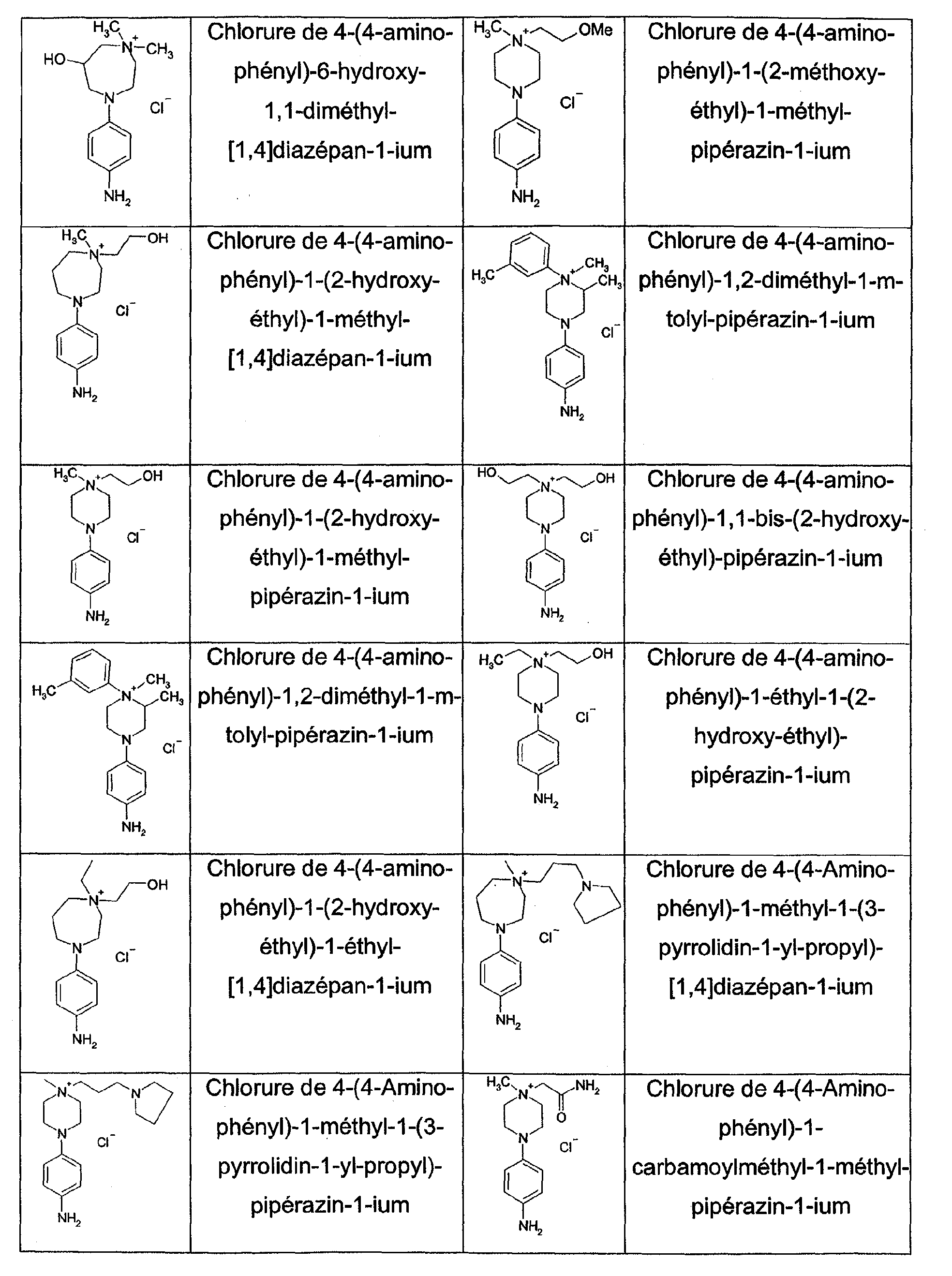
- Composition selon l'une quelconque des revendications précédentes dans laquelle le composé de formule (I) est choisi parmi le chlorure de 4-(4-amino-phényl)-1-éthyl-1-méthyl-pipérazin-1-ium ; le chlorure de 4-(4-amino-phényl)-1,1-diméthyl-pipérazin-1-ium ; le chlorure de 4-(4-amino-phényl)-1,1-diméthyl-[1,4]diazépan-1-ium ; le chlorure de 4-(4-aminophényl)-1,1-bis-(2-hydroxy-éthyl)-[1,4]diazépan-1-ium ; le chlorure de 4-(4-amino-phényl)-6-hydroxy-1,1-diméthyl-[1,4]diazépan-1-ium ; le chlorure de 4-(4-amino-phényl)-1-(2-méthoxy-éthyl)-1-méthyl-pipérazin-1-ium ; le chlorure de 4-(4-amino-phényl)-1-(2-hydroxy-éthyl)-1-méthyl-[1,4]diazépan-1-ium ; le chlorure de 4-(4-amino-phényl)-1,2-diméthyl-1-m-tolyl-pipérazin-1-ium ; le chlorure de 4-(4-amino-phényl)-1-(2-hydroxy-éthyl)-1-méthyl-pipérazin-1-ium ; le chlorure de 4-(4-amino-phényl)-1,1-bis-(2-hydroxy-éthyl)-pipérazin-1-ium ; le chlorure de 4-(4-amino-phényl)-1 ,2-diméthyl-1-m-tolyl-pipérazin-1-ium ; le chlorure de 4-(4-amino-phényl)-1-éthyl-1-(2-hydroxy-éthyl)-pipérazin-1-ium ; le chlorure de 4-(4-amino-phényl)-1-(2-hydroxy-éthyl)-1-éthyl-[1,4]diazépan-1-ium ; le chlorure de 4-(4-amino-phényl)-1-méthyl-1-(3-pyrrolidin-1-yl-propyl)-[1,4]diazépan-1-ium ; le chlorure de 4-(4-amino-phényl)-1-méthyl-1-(3-pyrrolidin-1-yl-propyl)-pipérazin-1-ium ; le chlorure de 4-(4-amino-phényl)-1-carbamoylméthyl-1-méthyl-pipérazin-1-ium ; le chlorure de 4-(4-amino-3-méthyl-phényl)-1-éthyl-1-méthyl-pipérazin-1-ium ; le chlorure de 4-(4-amino-3-méthyl-phényl)-1,1-diméthyl-pipérazin-1-ium ; le chlorure de 4-(4-amino-3-méthyl-phényl)-1,1-diméthyl-[1,4]diazépan-1-ium ; le chlorure de 4-(4-amino-3-méthyl-phényl)-1,1-bis-(2-hydroxy-éthyl)-[1,4]diazépan-1-ium ; le chlorure de 4-(4-amino-3-méthyl-phényl)-6-hydroxy-1,1-diméthyl-[1,4]diazépan-1-ium ; le chlorure de 4-(4-amino-3-méthyl-phényl)-1-(2-méthoxy-éthyl)-1-méthyl-pipérazin-1-ium ; le chlorure de 4-(4-amino-3-méthyl-phényl)-1-(2-hydroxy-éthyl)-1-méthyl-[1,4]diazépan-1-ium ; le chlorure de 4-(4-amino-3-méthyl-phényl)-1,2-diméthyl-1-m-tolyl-pipérazin-1-ium ; le chlorure de 4-(4-amino-3-méthyl-phényl)-1-(2-hydroxy-éthyl)-1-méthyl-pipérazin-1-ium ; le chlorure de 4-(4-amino-3-méthy)-phényl)-1,1-bis-(2-hydroxy-éthyl)-pipérazin-1-ium ; le chlorure de 4-(4-amino-3-méthyl-phényl)-1,2-diméthyl-1-m-tolyl-pipérazin-1-ium ; le chlorure de 4-(4-amino-3-méthyl-phényl)-1-éthyl-1-(2-hydroxy-éthyl)-pipérazin-1-ium ; le chlorure de 4-(4-amino-3-méthyl-phényl)-1-(2-hydroxy-éthyl)-1-éthyl-[1,4]diazépan-1-ium ; le chlorure de 4-(4-amino-3-méthyl-phényl)-1-méthyl-1-(3-pyrrolidin-1-yl-propyl)-[1 ,4]diazépan-1-ium ; le chlorure de 4-(4-amino-3-méthyl-phényl)-1-méthyl-1-(3-pyrrolidin-1-yl-propyl)-pipérazin-1-ium ; le chlorure de 4-(4-amino-3-amino-phényl)-1-carbamoylméthyl-1-méthyl-pipérazin-1-ium.
- Composition selon la revendication 13 dans laquelle le composé de formule (I) est choisi parmi le chlorure de 4-(4-amino-phényl)-1,1-diméthyl-[1,4]diazépan-1-ium ; le chlorure de 4-(4-amino-phényl)-1,1-diméthyl-pipérazin-1-ium ; le chlorure de 4-(4-amino-phényl)-1-(2-hydroxy-éthyl)-1-méthyl-pipérazin-1-ium.
- Composition selon l'une quelconque des revendications précédentes comprenant de plus un coupleur choisi parmi les méta-phénylènediamines, les méta-aminophénols, les méta-diphénols, les coupleurs naphtaléniques, les coupleurs hétérocycliques et leurs sels d'addition.
- Composition selon la revendication 15 dans laquelle la quantité de chacun des coupleurs est comprise entre 0,001 et 10 % en poids du poids total de la composition tinctoriale, de préférence entre 0,005 et 6 %.
- Composition selon l'une quelconque des revendications précédentes comprenant une base d'oxydation additionnelle autre que les bases d'oxydation de formule (I) choisie parmi les para-phénylènediamines, les bis-phénylalkylènediamines, les para-aminophénols, les bis-para-aminophénols, les ortho-aminophénols, les ortho-phénylènediamines, les bases hétérocycliques et leurs sels d'addition.
- Composition selon la revendication 17 dans laquelle la quantité de chacune des bases d'oxydation est comprise entre 0,001 et 10 % en poids du poids total de la composition tinctoriale, de préférence entre 0,005 et 6 %.
- Utilisation pour la teinture d'oxydation des fibres kératiniques d'un composé de formule (I) tel que défini dans l'une quelconque des revendications 1 à 14.
- Procédé de teinture des fibres kératiniques, caractérisé en ce qu'une composition telle que définie dans l'une quelconque des revendications 1 à 18 est appliquée sur les fibres kératiniques en présence d'un agent oxydant pendant un temps suffisant pour développer la coloration désirée.
- Procédé selon la revendication 20 dans lequel l'agent oxydant est choisi parmi le peroxyde d'hydrogène, le peroxyde d'urée, les bromates de métaux alcalins, les persels, les peracides et les enzymes oxydases.
- Dispositif à plusieurs compartiments dans lequel un premier compartiment contient une composition tinctoriale telle que définie dans l'une quelconque des revendications 1 à 18 et un deuxième compartiment contient un agent oxydant.
- Dérivés de paraphénylènediamine de formule (I) tels que définis dans l'une quelconque des revendications 1 à 14, à l'exception du dérivé de para-phénylènediamine substitué par un cycle diazacyclohexane dans lequel n est égal à 0, m est égal à 0 et R2 et R'2 représentent un radical méthyle, ainsi que leurs sels d'addition.
- Dérivés de para-nitroaniline de formule (II) suivante :dans laquelle les radicaux R1, R2, R'2, R3 et R4 et les entiers n et m sont tels que définis dans les revendications 1 à 14, à l'exception du 4-(4-nitro-phényl)-1,1-diméthyl-pipérazin-1-ium.

Applications Claiming Priority (2)
| Application Number | Priority Date | Filing Date | Title |
|---|---|---|---|
| FR0303547 | 2003-03-24 | ||
| FR0303547A FR2852830B1 (fr) | 2003-03-24 | 2003-03-24 | Composition de teinture des fibres keratiniques comprenant un derive de para-phenylenediamine cationique substitue par un cycle diazacyclohexane ou diazacycloheptane |
Publications (1)
| Publication Number | Publication Date |
|---|---|
| EP1462091A1 true EP1462091A1 (fr) | 2004-09-29 |
Family
ID=32799718
Family Applications (1)
| Application Number | Title | Priority Date | Filing Date |
|---|---|---|---|
| EP04290711A Withdrawn EP1462091A1 (fr) | 2003-03-24 | 2004-03-16 | Composition de teinture des fibres kératiniques comprenant un dérivé de para-phénylènediamine cationique substitué par un cycle diazacyclohexane ou diazacycloheptane |
Country Status (3)
| Country | Link |
|---|---|
| EP (1) | EP1462091A1 (fr) |
| JP (1) | JP2004285069A (fr) |
| FR (1) | FR2852830B1 (fr) |
Cited By (4)
| Publication number | Priority date | Publication date | Assignee | Title |
|---|---|---|---|---|
| WO2006005195A1 (fr) * | 2004-07-15 | 2006-01-19 | UNIVERSITé LAVAL | Agonistes du recepteur de nicotine pour le traitement de maladies inflammatoires |
| US7601720B2 (en) | 2001-03-23 | 2009-10-13 | Universite Laval | Nicotinic receptor agonists for the treatment of inflammatory diseases |
| CN101440073B (zh) * | 2007-11-23 | 2011-02-02 | 北京大学 | 芳香氮芥类哌嗪季铵盐衍生物及其制备方法和应用 |
| US8557804B2 (en) | 2002-03-25 | 2013-10-15 | Universite Laval | Nicotinic receptor agonists for the treatment of inflammatory diseases |
Citations (4)
| Publication number | Priority date | Publication date | Assignee | Title |
|---|---|---|---|---|
| FR2288093A1 (fr) * | 1974-10-15 | 1976-05-14 | Kodak Pathe | Nouveaux composes chimiques du groupe des anilines para-substituees et leurs applications, notamment en photographie |
| EP0327763A2 (fr) * | 1988-02-08 | 1989-08-16 | Minnesota Mining And Manufacturing Company | Sels colorés de polyanions sulfonés polymères et de cations colorants ainsi que des couches préparées avec ceux-ci absorbant la lumière |
| US6165230A (en) * | 1997-02-26 | 2000-12-26 | Henkel Kommanditgesellschaft Auf Aktien | 1,4-diazacycloheptane derivatives and their use in hair oxidation dyes |
| FR2828488A1 (fr) * | 2001-08-08 | 2003-02-14 | Oreal | Composition pour la teinture de fibres keratiniques contenant une paraphenylenediamine substituee par un radical diazacycloheptane |
Family Cites Families (1)
| Publication number | Priority date | Publication date | Assignee | Title |
|---|---|---|---|---|
| WO2002102250A1 (fr) * | 1999-10-22 | 2002-12-27 | Glaxo Group Limited | Imagerie $g(in vivo) |
-
2003
- 2003-03-24 FR FR0303547A patent/FR2852830B1/fr not_active Expired - Fee Related
-
2004
- 2004-03-16 EP EP04290711A patent/EP1462091A1/fr not_active Withdrawn
- 2004-03-23 JP JP2004085681A patent/JP2004285069A/ja active Pending
Patent Citations (4)
| Publication number | Priority date | Publication date | Assignee | Title |
|---|---|---|---|---|
| FR2288093A1 (fr) * | 1974-10-15 | 1976-05-14 | Kodak Pathe | Nouveaux composes chimiques du groupe des anilines para-substituees et leurs applications, notamment en photographie |
| EP0327763A2 (fr) * | 1988-02-08 | 1989-08-16 | Minnesota Mining And Manufacturing Company | Sels colorés de polyanions sulfonés polymères et de cations colorants ainsi que des couches préparées avec ceux-ci absorbant la lumière |
| US6165230A (en) * | 1997-02-26 | 2000-12-26 | Henkel Kommanditgesellschaft Auf Aktien | 1,4-diazacycloheptane derivatives and their use in hair oxidation dyes |
| FR2828488A1 (fr) * | 2001-08-08 | 2003-02-14 | Oreal | Composition pour la teinture de fibres keratiniques contenant une paraphenylenediamine substituee par un radical diazacycloheptane |
Cited By (9)
| Publication number | Priority date | Publication date | Assignee | Title |
|---|---|---|---|---|
| US7601720B2 (en) | 2001-03-23 | 2009-10-13 | Universite Laval | Nicotinic receptor agonists for the treatment of inflammatory diseases |
| US8377936B2 (en) | 2001-03-23 | 2013-02-19 | Universite Laval | Nicotinic receptor agonists for the treatment of inflammatory diseases |
| US8557804B2 (en) | 2002-03-25 | 2013-10-15 | Universite Laval | Nicotinic receptor agonists for the treatment of inflammatory diseases |
| WO2006005195A1 (fr) * | 2004-07-15 | 2006-01-19 | UNIVERSITé LAVAL | Agonistes du recepteur de nicotine pour le traitement de maladies inflammatoires |
| KR100860903B1 (ko) * | 2004-07-15 | 2008-09-29 | 유니버시티 라발 | 염증성 질환 치료용 니코틴성 수용체 효능제 |
| AU2005262174B2 (en) * | 2004-07-15 | 2009-10-08 | Universite Laval | Nicotinic receptor agonists for the treatment of inflammatory diseases |
| AU2005262174C1 (en) * | 2004-07-15 | 2010-05-06 | Universite Laval | Nicotinic receptor agonists for the treatment of inflammatory diseases |
| CN101001843B (zh) * | 2004-07-15 | 2014-08-27 | 拉瓦尔大学 | 用于治疗炎性疾病的烟碱受体激动剂 |
| CN101440073B (zh) * | 2007-11-23 | 2011-02-02 | 北京大学 | 芳香氮芥类哌嗪季铵盐衍生物及其制备方法和应用 |
Also Published As
| Publication number | Publication date |
|---|---|
| FR2852830B1 (fr) | 2008-04-18 |
| FR2852830A1 (fr) | 2004-10-01 |
| JP2004285069A (ja) | 2004-10-14 |
Similar Documents
| Publication | Publication Date | Title |
|---|---|---|
| EP1764082B1 (fr) | Dérivés de 4-5-diamino-N,N-dihydro-pyrazol-3-one utilisés pour la teinture des fibres keratiniques | |
| EP1348695B1 (fr) | Dérivés de paraphénylènediamine à groupement pyrrolidinyle substitués par un radical cationique et utilisation de ces dérivés pour la coloration de fibres kératiniques | |
| WO2001035917A1 (fr) | COMPOSITIONS DE TEINTURE DES FIBRES KERATINIQUES CONTENANT DES 3-AMINO PYRAZOLO-[1,5-a]-PYRIDINES, PROCEDE DE TEINTURE, NOUVELLES 3-AMINO PYRAZOLO-[1,5-a]-PYRIDINES | |
| WO2002045669A1 (fr) | Composition de teinture a base de 1-(4-aminophenyl) pyrrolidines substituees au moins en position 2 et 3 | |
| EP1341509A1 (fr) | Composition de teinture d'oxydation a base de 1-(4-aminophenyl) pyrrolidines substituees en position 2 | |
| WO2002045672A1 (fr) | Composition de teinture d'oxydation a base de 1-(4-aminophenyl)pyrrolidines substituees en position 2 et 4 | |
| EP1417184B1 (fr) | Composition pour la teinture de fibre keratiniques contenant une paraphenylenediamine substituee par un radical diazacycloheptane | |
| EP1396486A1 (fr) | Dérivés bis-paraphénylènediamine à groupement pyrrolidinyle et utilisation de ces dérivés pour la coloration de fibres kératiniques | |
| FR2817470A1 (fr) | Composition de teinture d'oxydation a base de 1-(aminophenyl)pyrrolidines substituees en position 2 et 5 et procede de teinture de mise en oeuvre | |
| EP1334713A1 (fr) | Composition tinctoriale comprenant une base d'oxydation du type diaminopyrazole, une base d'oxidation cationique et un coupleur | |
| EP1462091A1 (fr) | Composition de teinture des fibres kératiniques comprenant un dérivé de para-phénylènediamine cationique substitué par un cycle diazacyclohexane ou diazacycloheptane | |
| EP1457199A1 (fr) | Nouveaux coupleurs du type 2,3,5-triaminopyridine et utilisation de ces coupleurs pour la teinture des fibres kératiniques | |
| EP1739084B1 (fr) | Para-phénylènediamines doubles reliées par un bras de liaison comportant un radical cyclique saturé et utilisation en coloration | |
| EP1484049A1 (fr) | Nouveaux composés imidazoles et utilisation de ces composés pour la teinture de fibres kératiniques | |
| EP1518860A1 (fr) | Dérivés de triazacyclononane substitué sur l'un au moins des atomes d'azote par un groupement 4-aminophényle substitué ou non substitué pour la teinture des fibres kératiniques | |
| EP1462445B1 (fr) | Dérivés de paraphénylènediamine à groupement cyclique diaza substitué par un radical cationique et utilisation de ces dérivés pour la coloration de fibres kératiniques | |
| EP1378230B1 (fr) | Dérivés de para-phénylènediamine à groupement pyrrolidinyle substitué par un radical cyclique et leur utilisation pour la coloration de fibres kératiniques | |
| EP1375480A1 (fr) | Dérivés de para-phénylènediamine à groupement pyrrolidinyle substitué par un radical silyle et utilisation de ces dérives pour la coloration de fibres kératiniques | |
| FR2939137A1 (fr) | Derives de la 2,3-diamino-5,10-dihydro-1h-pyrazolo°1,2-b! phthalazin-1-one et leur utilisation pour la coloration d'oxidation des fibres keratiniques. | |
| EP2184050A1 (fr) | Composition comprenant la 2,3-diamino-6,7-dihydro-1h,5h-pyrazolo[1,2-a]pyrazol-1-one, le 4,5-diamino 1-(ß-hydroxyethyl) pyrazole et le 2-chloro 6-methyl 3-amino phenol | |
| EP1512684A1 (fr) | Utilisation, pour la teinture des fibres kératiniques, d'un dérivés de para-phénylènediamine substituée par un noyau homopiperidine | |
| FR2864957A1 (fr) | Composition pour la teinture des fibres keratiniques comprenant au moins un derive de para-phenylenediamine substitue par un noyau heptamethylenediamine | |
| FR2856059A1 (fr) | Derives de para-phenylenediamine comportant un cycle diazacycloheptane substitue par un radical silyle pour la teinture des fibres keratiniques | |
| EP1462453A1 (fr) | Dérivés de paraphénylènediamine à groupement pyrrolidinyle disubstitué et porteur d'un radical cationique et utilisation de ces dérivés pour la coloration de fibres kératiniques | |
| WO2004031152A1 (fr) | Coupleurs 6-alcoxy- 2,3-diaminopyridine et utilisation de ces coupleurs pour la teinture des fibres keratiniques |
Legal Events
| Date | Code | Title | Description |
|---|---|---|---|
| PUAI | Public reference made under article 153(3) epc to a published international application that has entered the european phase |
Free format text: ORIGINAL CODE: 0009012 |
|
| AK | Designated contracting states |
Kind code of ref document: A1 Designated state(s): AT BE BG CH CY CZ DE DK EE ES FI FR GB GR HU IE IT LI LU MC NL PL PT RO SE SI SK TR |
|
| AX | Request for extension of the european patent |
Extension state: AL HR LT LV MK |
|
| 17P | Request for examination filed |
Effective date: 20050329 |
|
| AKX | Designation fees paid |
Designated state(s): AT BE BG CH CY CZ DE DK EE ES FI FR GB GR HU IE IT LI LU MC NL PL PT RO SE SI SK TR |
|
| RIC1 | Information provided on ipc code assigned before grant |
Ipc: C07D 295/15 20060101ALI20091023BHEP Ipc: C07D 295/135 20060101ALI20091023BHEP Ipc: C07D 295/13 20060101ALI20091023BHEP Ipc: C07D 243/08 20060101ALI20091023BHEP Ipc: A61Q 5/10 20060101ALI20091023BHEP Ipc: A61K 8/49 20060101AFI20091023BHEP |
|
| STAA | Information on the status of an ep patent application or granted ep patent |
Free format text: STATUS: THE APPLICATION IS DEEMED TO BE WITHDRAWN |
|
| 18D | Application deemed to be withdrawn |
Effective date: 20091001 |