EP1458047A2 - Bipolar battery and electric vehicle - Google Patents
Bipolar battery and electric vehicle Download PDFInfo
- Publication number
- EP1458047A2 EP1458047A2 EP03022181A EP03022181A EP1458047A2 EP 1458047 A2 EP1458047 A2 EP 1458047A2 EP 03022181 A EP03022181 A EP 03022181A EP 03022181 A EP03022181 A EP 03022181A EP 1458047 A2 EP1458047 A2 EP 1458047A2
- Authority
- EP
- European Patent Office
- Prior art keywords
- active material
- electrode active
- changeable
- voltage
- material layer
- Prior art date
- Legal status (The legal status is an assumption and is not a legal conclusion. Google has not performed a legal analysis and makes no representation as to the accuracy of the status listed.)
- Withdrawn
Links
Images





Classifications
-
- H—ELECTRICITY
- H01—ELECTRIC ELEMENTS
- H01M—PROCESSES OR MEANS, e.g. BATTERIES, FOR THE DIRECT CONVERSION OF CHEMICAL ENERGY INTO ELECTRICAL ENERGY
- H01M4/00—Electrodes
- H01M4/02—Electrodes composed of, or comprising, active material
- H01M4/13—Electrodes for accumulators with non-aqueous electrolyte, e.g. for lithium-accumulators; Processes of manufacture thereof
- H01M4/131—Electrodes based on mixed oxides or hydroxides, or on mixtures of oxides or hydroxides, e.g. LiCoOx
-
- B—PERFORMING OPERATIONS; TRANSPORTING
- B60—VEHICLES IN GENERAL
- B60L—PROPULSION OF ELECTRICALLY-PROPELLED VEHICLES; SUPPLYING ELECTRIC POWER FOR AUXILIARY EQUIPMENT OF ELECTRICALLY-PROPELLED VEHICLES; ELECTRODYNAMIC BRAKE SYSTEMS FOR VEHICLES IN GENERAL; MAGNETIC SUSPENSION OR LEVITATION FOR VEHICLES; MONITORING OPERATING VARIABLES OF ELECTRICALLY-PROPELLED VEHICLES; ELECTRIC SAFETY DEVICES FOR ELECTRICALLY-PROPELLED VEHICLES
- B60L53/00—Methods of charging batteries, specially adapted for electric vehicles; Charging stations or on-board charging equipment therefor; Exchange of energy storage elements in electric vehicles
-
- H—ELECTRICITY
- H01—ELECTRIC ELEMENTS
- H01M—PROCESSES OR MEANS, e.g. BATTERIES, FOR THE DIRECT CONVERSION OF CHEMICAL ENERGY INTO ELECTRICAL ENERGY
- H01M10/00—Secondary cells; Manufacture thereof
- H01M10/04—Construction or manufacture in general
- H01M10/0413—Large-sized flat cells or batteries for motive or stationary systems with plate-like electrodes
- H01M10/0418—Large-sized flat cells or batteries for motive or stationary systems with plate-like electrodes with bipolar electrodes
-
- H—ELECTRICITY
- H01—ELECTRIC ELEMENTS
- H01M—PROCESSES OR MEANS, e.g. BATTERIES, FOR THE DIRECT CONVERSION OF CHEMICAL ENERGY INTO ELECTRICAL ENERGY
- H01M10/00—Secondary cells; Manufacture thereof
- H01M10/05—Accumulators with non-aqueous electrolyte
- H01M10/052—Li-accumulators
- H01M10/0525—Rocking-chair batteries, i.e. batteries with lithium insertion or intercalation in both electrodes; Lithium-ion batteries
-
- H—ELECTRICITY
- H01—ELECTRIC ELEMENTS
- H01M—PROCESSES OR MEANS, e.g. BATTERIES, FOR THE DIRECT CONVERSION OF CHEMICAL ENERGY INTO ELECTRICAL ENERGY
- H01M10/00—Secondary cells; Manufacture thereof
- H01M10/05—Accumulators with non-aqueous electrolyte
- H01M10/058—Construction or manufacture
-
- H—ELECTRICITY
- H01—ELECTRIC ELEMENTS
- H01M—PROCESSES OR MEANS, e.g. BATTERIES, FOR THE DIRECT CONVERSION OF CHEMICAL ENERGY INTO ELECTRICAL ENERGY
- H01M10/00—Secondary cells; Manufacture thereof
- H01M10/42—Methods or arrangements for servicing or maintenance of secondary cells or secondary half-cells
-
- H—ELECTRICITY
- H01—ELECTRIC ELEMENTS
- H01M—PROCESSES OR MEANS, e.g. BATTERIES, FOR THE DIRECT CONVERSION OF CHEMICAL ENERGY INTO ELECTRICAL ENERGY
- H01M4/00—Electrodes
- H01M4/02—Electrodes composed of, or comprising, active material
- H01M4/36—Selection of substances as active materials, active masses, active liquids
- H01M4/58—Selection of substances as active materials, active masses, active liquids of inorganic compounds other than oxides or hydroxides, e.g. sulfides, selenides, tellurides, halogenides or LiCoFy; of polyanionic structures, e.g. phosphates, silicates or borates
- H01M4/583—Carbonaceous material, e.g. graphite-intercalation compounds or CFx
- H01M4/587—Carbonaceous material, e.g. graphite-intercalation compounds or CFx for inserting or intercalating light metals
-
- H—ELECTRICITY
- H02—GENERATION; CONVERSION OR DISTRIBUTION OF ELECTRIC POWER
- H02J—ELECTRIC POWER NETWORKS; CIRCUIT ARRANGEMENTS OR SYSTEMS FOR SUPPLYING OR DISTRIBUTING ELECTRIC POWER; SYSTEMS FOR STORING ELECTRIC ENERGY
- H02J7/00—Circuit arrangements for charging or discharging batteries or for supplying loads from batteries
- H02J7/90—Regulation of charging or discharging current or voltage
- H02J7/96—Regulation of charging or discharging current or voltage in response to battery voltage
- H02J7/963—Regulation of charging or discharging current or voltage in response to battery voltage in response to battery voltage gradient
-
- Y—GENERAL TAGGING OF NEW TECHNOLOGICAL DEVELOPMENTS; GENERAL TAGGING OF CROSS-SECTIONAL TECHNOLOGIES SPANNING OVER SEVERAL SECTIONS OF THE IPC; TECHNICAL SUBJECTS COVERED BY FORMER USPC CROSS-REFERENCE ART COLLECTIONS [XRACs] AND DIGESTS
- Y02—TECHNOLOGIES OR APPLICATIONS FOR MITIGATION OR ADAPTATION AGAINST CLIMATE CHANGE
- Y02E—REDUCTION OF GREENHOUSE GAS [GHG] EMISSIONS, RELATED TO ENERGY GENERATION, TRANSMISSION OR DISTRIBUTION
- Y02E60/00—Enabling technologies; Technologies with a potential or indirect contribution to GHG emissions mitigation
- Y02E60/10—Energy storage using batteries
-
- Y—GENERAL TAGGING OF NEW TECHNOLOGICAL DEVELOPMENTS; GENERAL TAGGING OF CROSS-SECTIONAL TECHNOLOGIES SPANNING OVER SEVERAL SECTIONS OF THE IPC; TECHNICAL SUBJECTS COVERED BY FORMER USPC CROSS-REFERENCE ART COLLECTIONS [XRACs] AND DIGESTS
- Y02—TECHNOLOGIES OR APPLICATIONS FOR MITIGATION OR ADAPTATION AGAINST CLIMATE CHANGE
- Y02P—CLIMATE CHANGE MITIGATION TECHNOLOGIES IN THE PRODUCTION OR PROCESSING OF GOODS
- Y02P70/00—Climate change mitigation technologies in the production process for final industrial or consumer products
- Y02P70/50—Manufacturing or production processes characterised by the final manufactured product
-
- Y—GENERAL TAGGING OF NEW TECHNOLOGICAL DEVELOPMENTS; GENERAL TAGGING OF CROSS-SECTIONAL TECHNOLOGIES SPANNING OVER SEVERAL SECTIONS OF THE IPC; TECHNICAL SUBJECTS COVERED BY FORMER USPC CROSS-REFERENCE ART COLLECTIONS [XRACs] AND DIGESTS
- Y02—TECHNOLOGIES OR APPLICATIONS FOR MITIGATION OR ADAPTATION AGAINST CLIMATE CHANGE
- Y02T—CLIMATE CHANGE MITIGATION TECHNOLOGIES RELATED TO TRANSPORTATION
- Y02T10/00—Road transport of goods or passengers
- Y02T10/60—Other road transportation technologies with climate change mitigation effect
- Y02T10/70—Energy storage systems for electromobility, e.g. batteries
-
- Y—GENERAL TAGGING OF NEW TECHNOLOGICAL DEVELOPMENTS; GENERAL TAGGING OF CROSS-SECTIONAL TECHNOLOGIES SPANNING OVER SEVERAL SECTIONS OF THE IPC; TECHNICAL SUBJECTS COVERED BY FORMER USPC CROSS-REFERENCE ART COLLECTIONS [XRACs] AND DIGESTS
- Y02—TECHNOLOGIES OR APPLICATIONS FOR MITIGATION OR ADAPTATION AGAINST CLIMATE CHANGE
- Y02T—CLIMATE CHANGE MITIGATION TECHNOLOGIES RELATED TO TRANSPORTATION
- Y02T10/00—Road transport of goods or passengers
- Y02T10/60—Other road transportation technologies with climate change mitigation effect
- Y02T10/7072—Electromobility specific charging systems or methods for batteries, ultracapacitors, supercapacitors or double-layer capacitors
-
- Y—GENERAL TAGGING OF NEW TECHNOLOGICAL DEVELOPMENTS; GENERAL TAGGING OF CROSS-SECTIONAL TECHNOLOGIES SPANNING OVER SEVERAL SECTIONS OF THE IPC; TECHNICAL SUBJECTS COVERED BY FORMER USPC CROSS-REFERENCE ART COLLECTIONS [XRACs] AND DIGESTS
- Y02—TECHNOLOGIES OR APPLICATIONS FOR MITIGATION OR ADAPTATION AGAINST CLIMATE CHANGE
- Y02T—CLIMATE CHANGE MITIGATION TECHNOLOGIES RELATED TO TRANSPORTATION
- Y02T90/00—Enabling technologies or technologies with a potential or indirect contribution to GHG emissions mitigation
- Y02T90/10—Technologies relating to charging of electric vehicles
- Y02T90/14—Plug-in electric vehicles
Definitions
- the present invention relates to a bipolar battery which prevents overcharge of single cell layers and is capable of charging each of the single cell layers without variations, an assembled battery in which a plurality of the bipolar batteries are connected. Further, the present invention relates to a charge control system which controls charge of the bipolar battery or the assembled battery. Furthermore, the present invention relates to a vehicle on which the bipolar battery, the assembled battery or the charge control system is mounted.
- a chargeable and dischargeable bipolar battery has a construction in which a plurality of single cell layers is connected in series within a battery.
- this type of bipolar battery it is impossible to manufacture strictly identical single cell layers. Therefore, charging capacities and internal resistance vary among these single cell layers. Such variations result in different states of charge of the respective single cell layers when charging the bipolar battery.
- the present invention was made in consideration of the above-described problems. It is an object of the present invention to provide a bipolar battery which prevents overcharge of single cell layers and is capable of charging each of the single cell layers without variations, an assembled battery in which a plurality of the bipolar batteries is connected, a charge control system which controls charge of the bipolar battery or the assembled battery, and a vehicle on which the bipolar battery, the assembled battery or the charge control system is mounted.
- the first aspect of the present invention provides a bipolar battery, comprising: at least one bipolar electrode in which a positive electrode active material layer is formed on one surface of a collector, and a negative electrode active material layer is formed on another surface of the collector; and at least one electrolyte layer placed between the bipolar electrodes, wherein any one of the positive electrode active material layer and the negative electrode active material layer is made of a changeable electrode active material, and the other is made of an unchangeable electrode active material, the changeable electrode active material is an active material having a characteristic in which, once a maximum charging capacity of the changeable electrode active material is almost reached during charge, a change in voltage of the changeable electrode active material becomes greater than that before the maximum charging capacity thereof is almost reached, and the unchangeable electrode active material is an active material having a characteristic in which, even when the maximum charging capacity of the changeable electrode active material is almost reached during the charge, a voltage of the unchangeable electrode active material is almost the same as that before the maximum charging capacity of the changeable electrode active material is almost reached.
- the second aspect of the present invention provides an assembled battery, comprising: a plurality of bipolar battery, the bipolar battery, comprising: at least one bipolar electrode in which a positive electrode active material layer is formed on one surface of a collector, and a negative electrode active material layer is formed on another surface of the collector; and at least one electrolyte layer placed between the bipolar electrodes, wherein any one of the positive electrode active material layer and the negative electrode active material layer is made of a changeable electrode active material, and the other is made of an unchangeable electrode active material, the changeable electrode active material is an active material having a characteristic in which, once a maximum charging capacity of the changeable electrode active material is almost reached during charge, a change in voltage of the changeable electrode active material becomes greater than that before the maximum charging capacity thereof is almost reached, and the unchangeable electrode active material is an active material having a characteristic in which, even when the maximum charging capacity of the changeable electrode active material is almost reached during the charge, a voltage of the unchangeable electrode active material is almost the same as that before the
- the third aspect of the present invention provides a charge control system, comprising: a bipolar battery including at least one bipolar electrode in which a positive electrode active material layer is formed on one surface of a collector and a negative electrode active material layer is formed on another surface of the collector, and at least one electrolyte layer placed between the bipolar electrodes; an electric power supply unit which supplies electric power to the bipolar battery; a measuring unit which measures a voltage of the bipolar battery when electric power supply by the electric power supply unit is stopped; and a control unit which controls the supply or stopping of supply of the electric power by the electric power supply unit on the basis of a measurement result by the measuring unit, wherein any one of the positive electrode active material layer and the negative electrode active material layer is made of a changeable electrode active material, and the other is made of an unchangeable electrode active material, the changeable electrode active material is an active material having a characteristic in which, once a maximum charging capacity of the changeable electrode active material is almost reached during charge, a change in voltage of the changeable electrode active material becomes greater than that
- the fourth aspect of the present invention provides a charge control system, comprising: an assembled battery having a bipolar battery including at least one bipolar electrode in which a positive electrode active material layer is formed on one surface of a collector and a negative electrode active material layer is formed on another surface of the collector, and at least one electrolyte layer placed between the bipolar electrodes; an electric power supply unit which supplies electric power to the bipolar battery; a measuring unit which measures a voltage of the bipolar battery when electric power supply by the electric power supply unit is stopped; and a control unit which controls the supply or stopping of supply of the electric power by the electric power supply unit on the basis of a measurement result by the measuring unit, wherein any one of the positive electrode active material layer and the negative electrode active material layer is made of a changeable electrode active material, and the other is made of an unchangeable electrode active material, the changeable electrode active material is an active material having a characteristic in which, once a maximum charging capacity of the changeable electrode active material is almost reached during charge, a change in voltage of the changeable electrode active material
- the fifth aspect of the present invention provides a vehicle, comprising: a bipolar battery including at least one bipolar electrode in which a positive electrode active material layer is formed on one surface of a collector, and a negative electrode active material layer is formed on another surface of the collector; and at least one electrolyte layer placed between the bipolar electrodes, wherein any one of the positive electrode active material layer and the negative electrode active material layer is made of a changeable electrode active material, and the other is made of an unchangeable electrode active material, the changeable electrode active material is an active material having a characteristic in which, once a maximum charging capacity of the changeable electrode active material is almost reached during charge, a change in voltage of the changeable electrode active material becomes greater than that before the maximum charging capacity thereof is almost reached, and the unchangeable electrode active material is an active material having a characteristic in which, even when the maximum charging capacity of the changeable electrode active material is almost reached during the charge, a voltage of the unchangeable electrode active material is almost the same as that before the maximum charging capacity of the changeable electrode active material is
- the sixth aspect of the present invention provides a vehicle, comprising: a charge control system comprising: a bipolar battery including at least one bipolar electrode in which a positive electrode active material layer is formed on one surface of a collector and a negative electrode active material layer is formed on another surface of the collector, and at least one electrolyte layer placed between the bipolar electrodes; an electric power supply unit which supplies electric power to the bipolar battery; a measuring unit which measures a voltage of the bipolar battery when electric power supply by the electric power supply unit is stopped; and a control unit which controls the supply or stopping of supply of the electric power by the electric power supply unit on the basis of a measurement result by the measuring unit, wherein any one of the positive electrode active material layer and the negative electrode active material layer is made of a changeable electrode active material, and the other is made of an unchangeable electrode active material, the changeable electrode active material is an active material having a characteristic in which, once a maximum charging capacity of the changeable electrode active material is almost reached during charge, a change in voltage of the changeable electrode
- a first embodiment of the present invention is a bipolar battery which prevents overcharge of single cell layers and is capable of charging each of the single cell layers without variations.
- the following sets forth the case where the bipolar battery is a bipolar lithium ion secondary battery.
- the bipolar lithium ion secondary battery is simply refered to as a bipolar battery.
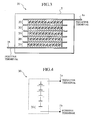
- a sheet-shaped bipolar electrode 10 which constructs a bipolar battery has a construction in which a positive electrode active material layer 2 is placed on one surface of a collector 1, and a negative electrode active material layer 3 is place on the other side of the collector.
- the bipolar electrode 10 has a construction in which the negative electrode active material layer 3, the collector 1 and the positive electrode active material layer 2 are stacked in this order.
- the bipolar electrodes 10 having the abovementioned construction are placed so that all the stacking orders thereof are the same, and are stacked while sandwiching a polymer electrolyte layer 4 therebetween.
- a polymer electrolyte layer 4 By filling the polymer electrolyte layers 4 between the positive and negative electrode active material layers 2 and 3, smooth ionic conduction is realized and the power of the bipolar battery as a whole is improved.
- the polymer electrolyte layer 4 is a solid layer, no liquid leakage of an electrolyte occurs and no construction for preventing the electrolyte from being dissolved is required. Thus, the construction of the bipolar battery can be simplified. Further, since the polymer electrolyte layer 4 is a solid layer, it has strength against some overcharge and is difficult to decompose, compared with a liquid layer.
- a combined layer of the negative electrode active material layer 3, the polymer electrolyte layer 4 and the positive electrode active material layer 2, sandwiched between the collectors 1, is called a single cell layer 20.
- the stacked bipolar electrodes 10 sandwiching the polymer electrolyte layers 4 therebetween as above is entirely encapsulated within an outer package 5 except for the collectors 1 on both ends of the electrode stacked body, which are led out as a negative terminal 1a and a positive terminal 1b.
- a bipolar battery 30 is formed.
- the bipolar battery 30 has a plurality of stacked single cell layers 20 therein. This means that the bipolar battery 30 has the same construction as a construction in which a plurality of cells is connected in series. Therefore, when charging the bipolar battery 30, the negative terminal 1a and the positive terminal 1b are connected to a power source, and all of the single cell layers 20 are respectively charged at the same time.
- the present invention provides a bipolar battery 30 which is capable of preventing the overcharge of the single cell layers without measuring the states of charge of each of the single cell layers 20.
- the positive electrode active material layer 2 and the negative electrode active material layer 3 which construct the single cell layer 20 have the following characteristics in the bipolar battery 30 of the present invention.
- the positive electrode active material layer 2 is made of spinel lithium manganate (LiMn 2 O 4 ) and the negative electrode material layer 3 is made of lithium titanate (Li 4 Ti 5 O 12 ).
- the spinel lithium manganate is a material which follows a voltage-charging rate curve shown in FIG. 5.
- the voltage-charging rate curve is a curve which shows an amount of voltage flowing in spinel lithium manganate with respect to a charging rate (%).
- spinel lithium manganate when used for the positive electrode active material layer 2, spinel lithium manganate has a characteristic that, at the moment when the charging rate reaches 100%, the voltage greatly increases compared with the voltage before. Therefore, as the voltage rapidly increases when the charging rate reaches 100%, the charging rate does not increase much from 100%. This is a characteristic whereby the charging rate is unlikely to increase even when the voltage becomes even higher after the charge is finished as the charging rate reaches 100%, and thereby, overcharge can be prevented.
- a tolerance that variations in voltage are acceptable is within a range from 4.2V to 4.5V in the case of spinel lithium manganate, and the charging rate hardly changes even when the voltage rises by 0.1V within this tolerance. For example, if the voltage rises by 0.1V when the charging rate is about 50%, the charging rate increases by as much as about 30%. In comparison with this, it is understood that the voltage increase of 0.1V within the tolerance has little influence on the charging rate.
- the single cell layers 20 are not overcharged with the voltage within the tolerance.
- the charging rate of each of the single cell layers 20 has reached 100%, and thereby the charge of the bipolar battery 30 can be considered as being completed.
- the voltage within the tolerance is set as a completion voltage with which completion of the charge of the single cell layers 20 is recognized, and can be used as a standard in judging completion of the charge. The details thereof will be described later.
- lithium titanate has a characteristic that, at the moment when the charging rate reaches about 100%, the voltage is greatly decreased compared with the voltage before, when used for the negative electrode active material layer 3.
- the difference between lithium titanate and the material of the positive electrode active material layer 2 shown in FIG. 5 is that the voltage is greatly decreased when the charging rate reaches about 100%.
- the increase and decrease of the voltage is merely a difference between applications to the positive electrode active material layer 2 or to the negative electrode active material layer 3, and lithium titanate has no difference from spinel lithium manganate in terms of the characteristic that the change of the voltage is little after the charging rate exceeds about 100%.
- the use of lithium titanate for the negative electrode active material layer 3 to utilize this characteristic can prevent overcharge due to the variations, and thereby breakage and short circuit of the single cell layers 20 can be prevented.
- a tolerance in which the voltage variations are acceptable is within a range from 1.0V to 1.5V in the case of lithium titanate.
- the characteristics that the voltage greatly changes when the charging rate reaches about 100% can be utilized for the bipolar battery 30.
- the respective single cell layers 20, even with different charging capacities, can have charging rates of about 100% by being charged until power within the foregoing tolerance is obtained.
- the single cell layers 20 are not overcharged even when the voltages vary within the tolerances.
- the characteristics of the positive and negative electrode active material layers 2 and 3 were individually described. However, in practice, when the single cell is constructed applying the spinel lithium manganate and the lithium titanate to the positive and negative electrode active material layers 2 and 3, respectively, the characteristics of these materials are combined and appears as the overall characteristic of the bipolar battery 30. Further, the overall characteristic of the bipolar battery 30 changes depending on the applied amounts of the materials.
- the positive electrode active material layer 2 contains the spinel lithium manganate as a changeable electrode active material
- the negative electrode active material layer 3 contains lithium titanate as an unchangeable electrode active material.
- the changeable electrode active material is an active material having a characteristic in which, once a maximum charging capacity of the changeable electrode active material is almost reached during charge, a change in voltage of the changeable electrode active material becomes greater than that before the maximum charging capacity thereof is almost reached
- the unchangeable electrode active material is an active material having a characteristic in which, even when the maximum charging capacity of the changeable electrode active material is almost reached during the charge, a voltage of the unchangeable electrode active material is almost the same as that before the maximum charging capacity of the changeable electrode active material is almost reached.
- the changeable electrode active material is an active material having a characteristic in which, once a charging rate of the changeable electrode active material reaches about 100% during charge, a change in the voltage of the changeable electrode active material becomes greater than that before the charging rate thereof reaches about 100%
- the unchangeable electrode active material is an active material having a characteristic in which, even when the charging rate of the changeable electrode active material reaches about 100% during charge, a voltage of the unchangeable electrode active material is almost the same as that before the charging rate of the changeable electrode active material reaches about 100%.
- the characteristic of the changeable electrode active material appears as the overall characteristic of the bipolar battery 30.
- the definitions of the changeable and unchangeable electrode active materials are the same in Examples 2 and 3 below.
- Example 1 as shown in FIG. 7, the positive and negative electrode active material layers 2 and 3 are adjusted such that the charging capacity of the negative electrode active material layer 3 as the unchangeable electrode active material becomes 120% of that of the positive electrode active material layer 2 as the changeable electrode active material.
- the charging capacity of the positive electrode active material layer 2 or the negative electrode active material layer 3 is uniquely decided depending on the content of the spinel lithium manganate or the lithium titanate. Therefore, by adjusting the contents of these materials, the charging capacity of the negative electrode active material layer 3 can be set to 120% of that of the positive electrode active material layer 2.
- the single cell layers 20 show a characteristic of the voltage-charging rate curve shown in FIG. 8.
- the voltage-charging rate curve of the whole bipolar battery 30 has a similar characteristic to the voltage-charging rate curve of the positive electrode active material layer 2, apart from that the overall voltage is lower. This is because the voltage rapidly changes once the charging rate of the positive electrode active material layer 2 reaches about 100%, whereas the voltage of the negative electrode active material layer 3 does not change. Thus, the characteristic of the positive electrode active material layer 2 that the voltage rapidly changes also appears after the two characteristics are combined.
- the charging rate is about 100%. Therefore, if the completion voltage used as a standard of charge completion of the single cell layer 20 is set within the tolerance, for example, 2.9V, the charge of the single cell layer 20 can be considered as completed when it is charged until the voltage reaches 2.9V.
- the voltage thereof may be different from 2.9V while being charged. Nevertheless, if the voltages vary within the tolerance, the charging rates are about 100%. Once the charge is stopped, the charging rates converge to the maximum charging capacity, that is, the charging rates converge to the completion voltage. Therefore, when each of the single cell layers 20 discharges, output power of 2.9V is obtained from each of these single cell layers 20.
- the power obtained by multiplying the number of single cell layers 20 in the bipolar battery 30 by 2.9V that is power from each of the single cell layers 20 when the charging rate is 100%, is obtained as the overall power of the bipolar battery 30.
- the positive electrode active material layer 2 contains the spinel lithium manganate as the unchangeable electrode active material
- the negative electrode active material layer 3 contains lithium titanium as the changeable electrode active material.
- the spinel lithium manganate contained as the changeable electrode active material in Example 1 is contained as the unchangeable electrode active material in Example 2.
- the lithium titanate contained as the unchangeable electrode active material in Example 1 is contained as the changeable electrode active material in Example 2.
- the characteristic of the negative electrode active material layer 3 appears as the overall characteristic of the bipolar battery 30.
- Example 2 since the negative electrode active material layer 3 is changeable electrode active material, the positive and negative electrode active material layers 2 and 3 are adjusted such that, in contrast to Example 1, the charging capacity of the positive electrode active material layer 2 is 120% of that of the negative electrode active material layer 3.
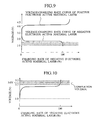
- FIGS. 9 and 10 voltage is plotted on the vertical axis and the charging rate of the negative electrode active material layer 3 is plotted on the horizontal axis. Therefore, at the point when the charging rate reaches 100%, the voltage of the voltage-charging rate curve of the negative electrode active material layer 3 rapidly decreases, whereas the voltage-charging rate curve of the positive electrode active material layer 2 shows no change. Thereafter, the voltage-charging rate curve of the positive electrode active material layer 2 rapidly increases at the point when the charging rate of the negative electrode active material layer 3 reaches 120%.
- the single cell layers 20 as a whole show a characteristic of voltage-charging rate curve shown in FIG. 10.
- the voltage rapidly decreases near the charging rate of 100% in the negative electrode active material layer 3.
- the rapid decrease of the voltage of the negative electrode active material layer 3 results in a rapid increase of the voltage of the whole bipolar battery 3 near the charging rate of 100%. Therefore, as shown in FIG. 10, the characteristic of the voltage-charging rate curve in which the voltage increases near 100% is obtained.
- the charging rate is about 100%. Therefore, if the completion voltage used as the standard of charge completion of each of the single cell layers 20 is set within the tolerance, for example, 3.0V, the charge of the single cell layer 20 can be considered as completed when the single cell layer 20 is charged until the voltage reaches 3.0V.
- the voltage thereof may be different from 3.0V while being charged. Nevertheless, if the voltages vary within the tolerance, the charging rates are about 100%. Once the charge is stopped, the charging rates converge to the maximum charging capacity, that is, the charging rates converge to the completion voltage. Therefore, when each of the single cell layers 20 discharges, output power of 3.0V is obtained from each of these single cell layers 20.
- the power obtained by multiplying the number of single cell layers 20 in the bipolar battery 30 by 3.0V that is power from each of the single cell layers 20 when the charging rate is 100%, is obtained as the overall power of the bipolar battery 30.
- the positive electrode active material layer 2 contains the spinel lithium manganate as the changeable electrode active electrode
- the negative electrode active material layer 3 contains graphite as the unchangeable electrode active material.
- the present invention realized by the use of lithium titanate for the negative electrode, but the lithium titanate is replaced by graphite in Example 3. In the case of replacing with graphite, the same effects as Examples 1 and 2 can also be obtained.
- Example 3 the positive and negative electrode active material layers 2 and 3 are adjusted such that the charging capacity of the negative electrode active material layer 3 as the unchangeable electrode active material is 120% of that of the positive electrode active material layer 2 as the changeable electrode active material.
- FIGS. 11 and 12 voltage is plotted on the vertical axis and the charging rate of the positive electrode active material layer 2 is plotted on the horizontal axis. Therefore, at the point when the charging rate reaches 100%, the voltage-charging rate curve of the positive electrode active material layer 2 rapidly increases, whereas that of the negative electrode active material layer 3 shows no change. Thereafter, at the point when the charging rate of the positive electrode active material layer 2 reaches 120%, the voltage-charging rate curve of the negative electrode active material layer 3 rapidly decreases.
- the single cell layers 20 as a whole show the characteristic of the voltage-charging rate curve as shown in FIG. 12.
- the charging rate is about 100%. Therefore, if the completion voltage used as the standard of charge completion of the single cell layer 20 is set within this tolerance, for example, 4.4V, the charge of the single cell layer 20 can be considered as completed when the charge thereof is continued until the voltage reaches 4.4V.
- the voltage thereof may be different from 4.4V while being charged. Nevertheless, if the voltages vary within the tolerance, the charging rates are about 100%. Once the charge is stopped, the charging rates converge to the maximum charging capacity, that is, the charging rates converge to the completion voltage. Therefore, when each of the single cell layers 20 discharges, output power of 4.4V is obtained from each of these single cell layers 20.
- the power obtained by multiplying the number of single cell layers 20 in the bipolar battery 30 by 4.4V that is power from each of the single cell layers 20 when the charging rate is 100%, is obtained as the overall power of the bipolar battery 30.
- the charging capacity of the unchangeable electrode active material is 120% of that of the changeable electrode active material with which the charging rate reaches 100% first and then the voltage greatly changes, so that the voltage does not change so much even when the charging rate of the changeable electrode active material reaches 100%.
- the present invention is not limited thereto. Any cases are applicable as long as the charging rate of the unchangeable electrode active material does not reach 100% and no change is seen in the voltage when the charging rate of the changeable electrode active material reaches 100%. Specifically, 110% or more of the charging capacity of the negative electrode active material layer 3 as the unchangeable electrode active material relative to the positive electrode active material layer 2 as the changeable electrode active material is sufficient.
- the changeable electrode active material and the unchangeable electrode active material are used in the bipolar battery 30 of the present invention.
- the changeable electrode active material has the characteristic in which, once a maximum charging capacity of the changeable electrode active material is almost reached during charge, a change in voltage of the changeable electrode active material becomes greater than that before the maximum charging capacity thereof is almost reached.
- the unchangeable electrode active material has the characteristic that, even when the maximum charging capacity of the changeable electrode active material is almost reached during the charge, a voltage of the unchangeable electrode active material is almost the same as that before the maximum charging capacity of the changeable electrode active material is almost reached.
- the bipolar battery 30 itself can have the characteristic that, once a maximum charging capacity of the bipolar battery 30 is almost reached during charge, a change in voltage of the bipolar battery 30 becomes greater than that before the maximum charging capacity thereof is almost reached.
- the single cell layers 20 are uniformly charged by charging them so as to have a completion voltage within the tolerance, even when charging capacities of the respective single cell layers 20 vary. Therefore, charging variation can be prevented. Moreover, there is almost no increase in the charging rate even if the voltage is different from the completion voltage, as long as the voltage is within the tolerance. Thus, breakage of the single cell layers 20 due to overcharge thereof can be prevented.
- the overcharge can be prevented by the properties of the materials contained in the positive and negative electrode active material layers 2 and 3. Therefore, it is not required to provide the bipolar battery 30 with a special construction, thus enabling easy and inexpensive manufacturing thereof.
- the bipolar battery 30 of the present invention has been described above. Next, a brief description is given of the ingredient of the collector 1, the electrode active material layer 2, the negative electrode active material layer 3, and the electrolysis layer 4 in the bipolar battery 30 of the present invention. But the present invention should not be limited to these.
- the collector which can be used in the present invention is not particularly limited, and for example, an aluminum foil, a stainless steel foil, a clad material of nickel and aluminum, a clad material of copper and aluminum, or a plated material of a combination of these metals can be preferably used.
- a collector having a metal surface covered with aluminum may be used.
- a collector, in which the surface of the metal such as copper, titanium, nickel, stainless steel and alloy thereof is covered with aluminum may be used. If the surface material is aluminum, the electrode active material layer having excellent mechanical strength can be prepared even when including the solid polymer electrolyte.
- a collector composed of two or more metal foils bonded together may be used. In the light of corrosion resistance, manufacturability, and cost efficiency, it is preferable to use an aluminum foil as the collector.
- the thickness of the collector is not particularly limited but is usually about 1 to 100 ⁇ m.
- the collectors 1a and 1b which function as the terminal are similarly constituted by the above-mentioned material.
- the positive electrode active material layer contains positive electrode active material and a solid polymer electrolyte.
- lithium salt to increase ion conductivity and a conductive material to increase electron conductivity can be included.
- Li-Mn based composite oxide such as spinel LiMn 2 O 4 as mentioned above can be used. Further, examples thereof include LiFePO 4 .
- the diameter of the positive electrode active material particles is smaller than that of the particles generally used in the lithium ion battery with a liquid electrolyte in order to reduce the electrode resistance of the bipolar battery.
- the preferable mean particle size of the positive electrode active material is usually about 0.1 to 10 ⁇ m.
- the solid polymer electrolyte is not particularly limited as long as the polymer has ion conductivity.
- the polymer with ion conductivity include polyethylene oxide (PEO), polypropylene oxide (PPO), and a copolymer thereof.
- PEO polyethylene oxide
- PPO polypropylene oxide
- Such a polyalkylene oxide based polymer can dissolve well lithium salts such as LiBF 4 , LiPF 6 , LiN(SO 2 CF 3 ) 2 , and LiN(SO 2 C 2 F 5 ) 2 .
- the solid polymer electrolyte is contained in at least one of the positive and negative electrode layers. However, to improve the battery properties of the bipolar battery, it is preferable that the solid polymer electrolyte is contained in both.
- lithium salt LiBF 4 , LiPF 6 , LiN(SO 2 CF 3 ) 2 , LiN(SO 2 C 2 F 5 ) 2 , mixtures thereof, and the like can be used, but the lithium salt is not limited to these.
- the conductive material can be acetylene black, carbon black, graphite, or the like, but is not limited to these.
- the blending amount of positive electrode active material, solid polymer electrolyte, lithium salt, and conductive material should be determined taking into consideration the intended use (prioritizing output power, energy, etc.) of the battery and the ion conductivity. For example, if the blending amount of the solid polymer electrolyte in the positive electrode active material layer is excessively small, the resistance to ion conduction and diffusion increases within the positive electrode active material layer and reduces the battery performance. In contrast, if the blending amount of solid polymer electrolyte in the positive electrode active material layer is excessively large, the energy density of the battery is reduced. Accordingly, the amount of solid polymer electrolyte is determined taking into consideration these factors so as to be appropriate to the intended use.
- the bipolar battery giving priority to the battery reactivity by using a solid polymer electrolyte (ion conductivity: 10 -5 to 10 -4 S/cm) of a current level.
- a solid polymer electrolyte ion conductivity: 10 -5 to 10 -4 S/cm
- the resistance to ion conduction between the active material particles is maintained relatively low by increasing the conductive material or reducing the bulk density of the active material.
- the voids are increased and filled with the solid polymer electrolyte.
- the proportion of the solid polymer electrolyte is preferably increased by such a process.
- the thickness of the positive electrode active material layer is not particularly limited and determined taking into consideration the intended use of the battery and the ion conductivity, as described in terms of the blending amount.
- the thickness of the general positive electrode active material layer is about 10 to 500 ⁇ m.
- the negative electrode active material layer contains negative electrode active material and solid polymer electrolyte.
- a lithium salt to increase the ion conductivity a conductive material to increase the electron conductivity, N-methyl-2-pyrrolidone (NMP) to adjust slurry viscosity, azobisisobutyronitrile (AIBN) as a polymerization initiator, and the like can be included.
- NMP N-methyl-2-pyrrolidone
- AIBN azobisisobutyronitrile
- the negative electrode active material layer has basically the same contents as described in terms of the positive electrode active material layer other than the types of the negative electrode active material, and description thereof is omitted.
- negative electrode active material negative electrode active material used also in the liquid lithium ion battery can be used.
- the negative electrode active material are preferably carbon, or a composite oxide of metal and lithium. More preferably, the negative electrode active material are carbon, or a composite oxide of transition metal and lithium, and still more preferably, a composite oxide of titanium and lithium such as lithium titanate.
- the reactivity and the cycle durability of the bipolar battery can be improved, and the bipolar battery can be made at low costs.
- the electrolyte layer is constituted of a polymer having ion conductivity.
- the material thereof is not limited as long as the ion conductivity is provided.
- the solid electrolyte examples include a solid polymer electrolyte such as polyethylene oxide (PEO), polypropylene oxide (PPO), and a copolymer thereof.
- lithium salt to increase the ion conductivity can be contained in the solid polymer electrolyte.
- LiBF 4 , LiPF 6 , LiN(SO 2 CF 3 ) 2 , LiN(SO 2 C 2 F 5 ) 2 , mixtures thereof, and the like can be used, but the lithium salt is not limited to these.
- a polyalkylene oxide based polymer such as PEO and PPO can dissolve well lithium salts such as LiBF 4 , LiPF 6 , LiN(SO 2 CF 3 ) 2 , and LiN(SO 2 C 2 F 5 ) 2 . Moreover, by forming a cross-linking structure, excellent mechanical strength is developed.
- the solid polymer electrolyte can be contained in the solid polymer electrolyte layer, the positive electrode active material layer, and the negative electrode active material layer.
- the same solid polymer electrolyte may be used or a different solid polymer electrolyte may be used for each layer.
- a second embodiment of the present invention is an assembled battery in which a plurality of the bipolar batteries 30 of the first embodiment is connected.
- the plurality of bipolar batteries 30 shown in the first embodiment is prepared and connected in parallel by connecting positive electrode terminals thereof to each other and negative electrode terminals thereof to each other.
- the assembled battery 40 having the aforementioned effects and a long life can be obtained.
- the assembled battery 40 of the present invention can be formed by connecting the bipolar batteries 30 in parallel in a simple construction.
- the assembled battery 40 is formed by the plurality of bipolar batteries 30. Therefore, even when a defective bipolar battery 30 is found therein, the rest of the good batteries can be used by merely replacing the defective one, which is highly cost effective.
- the figure shows only the case of connecting the bipolar batteries 30 in parallel. However, the negative electrode terminal of the bipolar battery and the positive electrode terminal of another bipolar battery are continuously connected, and the bipolar batteries 30 are connected to each other in series, thus forming the assembled battery. By connecting the bipolar batteries 30 in series, the assembled battery having the aforementioned effects and high power can be obtained.
- the third embodiment of the present invention is a charge control system which controls the charge of the bipolar battery 30 of the first embodiment or the assembled battery 40 of the second embodiment.
- This charge control system includes an electric power supply unit (electric power supply means) which supplies or stops supplying electric power to the bipolar batteries 30 or the assembled battery 40, a measuring unit (measuring means) which measures the voltage of the bipolar battery 30 or the assembled battery 40 when the electric power supply unit stops supplying electric power, and a control unit (control means) which controls the supply and stop of supply of electric power by the electric power supply unit based on a measurement result by the measuring unit.
- the charge control system of the present invention is a system which is capable of charging the bipolar battery 30 of the first embodiment or the assembled battery 40 of the second embodiment to about 100% so as not to cause variations in the state of charge among the single cell layers 20 therein.
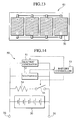
- the construction of the charge control system is shown in FIG. 14.
- the charge control system 50 of the present invention includes the bipolar battery 30, an electric generator 51 as the electric power supply unit, a voltmeter 52 as the measuring unit, a battery controller 53 as the control unit, a resistor 54 and a switch 55.
- the bipolar battery 30 is the same as the battery described in the first embodiment, and has the characteristic of the voltage-charging rate curves shown in FIGs. 8, 10 and 12.
- the electric generator 51 is connected to the battery controller 53, and supplies or stops supplying electric power to the bipolar battery 30 by the control of the battery controller 53.
- the voltmeter 52 measures the voltage on both ends of the resistor 54, that is, the voltage of the bipolar battery 30, in the condition in which the switch 55 is on and the power supply by the electric generator 51 is stopped.
- the battery controller 53 monitors the measurement result of the voltmeter 52 and controls the electric generator 51 and the switch 55 based on the result.
- the resistor 54 is provided for bypassing currents from bipolar battery 30 when the switch is on.
- the switch 55 is connected to the battery controller 53, and controlled to be turned on/off as appropriate.
- the bipolar battery 30 is provided with an output terminal 56, which is connected to an external load.
- the charge of the bipolar battery 30 is started (step S1).
- specific operations of the respective constituents are as follows.
- the battery controller 53 controls the switch 55 to be turned off, and further controls the electric generator 51 to supply electric power to the bipolar battery 30.
- step S2 the time since the start of charge is measured, and whether or not a definite period of time has elapsed is judged.
- the measurement of the time is realized by a timer in the battery controller 53, and whether or not the certain period of time has elapsed is judged by the battery controller 53. If the certain period of time has not elapsed (step S2: NO), the procedure returns to step S1, and the charge is continued until the certain period of time has elapsed.
- step S3 the voltage of the bipolar battery 30 is measured (step S3).
- the battery controller 53 controls the electric generator 51 to stop the electric power supply to the bipolar battery 30, and further controls the switch 55 to be turned on. In this manner, a closed circuit of the bipolar battery 30 and the resistor 54 is formed, and currents flow from the bipolar battery 30 to the resistor 54. Thereafter, the voltmeter 52 can measure the voltage of the bipolar battery 30 by measuring the voltage on both ends of the resistor 54.
- step S4 it is judged whether or not the measured voltage is equal to or larger than the value obtained by multiplying the completion voltage of the single cell layer by the number of the single cell layers in the bipolar battery 30 (step S4).
- step S4 NO
- the procedure returns to step S1 and the charge is continued.
- step S4: YES all of the single cell layers 20 are charged without variations, thus finishing the charge.
- the charge control system 50 judges the completion or incompletion of the charge, using the voltage equal to the completion voltage x the number of stacked layers of the single cell layers 20 as the standard. Regardless of the states of charge of the respective single cell layers 20, the voltage equal to the completion voltage x the number of stacked layers can be used as the standard for the single cell layers. This is because, as described in the first embodiment, the voltage greatly changes after the single cell layer 20 is almost charged to the maximum charging capacity thereof, and, In contrast, the charging rate shows almost no change when the voltage increases within the predetermined tolerance, thereby causing no overcharge. In other words, if the single cell layer 20 is charged within the tolerance, the discharging power of the single cell layer 20 becomes almost equal to the completion voltage. Thus, if the charge of all the single cell layers 20 is completed, each of the single cell layers 20 outputs the completion voltage. Therefore, the power of the whole bipolar battery 30 becomes a voltage equal to the completion voltage x the number of single cell layers 20.
- the charge control system 50 of the present invention utilizes the characteristic of the bipolar battery 30 of the present invention, in which the charge of the single cell layer 20 is completed when charged up to the completion voltage, and breakage of the single cell layer 20 does not occur even when the single cell layer 20 is charged up to the completion voltage, since the completion voltage is within the tolerance. Therefore, it is not necessary to measure the voltage of every single cell layer 20 in order to judge whether or not all of the single cell layers 20 are charged without variations. Once a certain power is provided by the bipolar battery 30, all of the single cell layers 20 are judged as having been charged without variations, and the charge thereof can be finished.
- the charge control system 50 shown in FIG. 14 controls the charge of the bipolar battery 30, but may also control the charge of the assembled battery 40 of the second embodiment.
- a fourth embodiment of the present invention is a vehicle 60 which mounts the bipolar battery 30 of the first embodiment, the assembled battery 40 of the second embodiment, and/or the charge control system 50 of the third embodiment.
- the vehicle By mounting the foregoing bipolar battery 30 or the assembled battery 40 on the vehicle, the vehicle can be provided with a power source from which a stable power can be obtained. Additionally, by mounting the charge control system 50 on the vehicle, the bipolar battery 30 can be adequately charged, preventing overcharge thereof caused by the charge exceeding the tolerance of the voltage of the single cell layer 20. Consequently, the durability of the bipolar battery 30 or the assembled battery 40 can be improved.
Landscapes
- Chemical & Material Sciences (AREA)
- Engineering & Computer Science (AREA)
- General Chemical & Material Sciences (AREA)
- Chemical Kinetics & Catalysis (AREA)
- Electrochemistry (AREA)
- Manufacturing & Machinery (AREA)
- Materials Engineering (AREA)
- Power Engineering (AREA)
- Transportation (AREA)
- Mechanical Engineering (AREA)
- Inorganic Chemistry (AREA)
- Secondary Cells (AREA)
- Battery Electrode And Active Subsutance (AREA)
- Electric Propulsion And Braking For Vehicles (AREA)
Abstract
In the bipolar battery, any one of a positive electrode active material layer and a negative electrode active material layer is made of a changeable electrode active material, and the other is made of an unchangeable electrode active material. The changeable electrode active material is an active material having a characteristic in which, once a maximum charging capacity of the changeable electrode active material is almost reached during charge, a change in voltage of the changeable electrode active material becomes greater than that before the maximum charging capacity thereof is almost reached, and the unchangeable electrode active material is an active material having a characteristic in which, even when the maximum charging capacity of the changeable electrode active material is almost reached during the charge, a voltage of the unchangeable electrode active material is almost the same as that before the maximum charging capacity of the changeable electrode active material is almost reached. <IMAGE>
Description
The present invention relates to a bipolar battery which prevents
overcharge of single cell layers and is capable of charging each of the single
cell layers without variations, an assembled battery in which a plurality of the
bipolar batteries are connected. Further, the present invention relates to a
charge control system which controls charge of the bipolar battery or the
assembled battery. Furthermore, the present invention relates to a vehicle on
which the bipolar battery, the assembled battery or the charge control system is
mounted.
A chargeable and dischargeable bipolar battery has a construction in
which a plurality of single cell layers is connected in series within a battery.
When manufacturing this type of bipolar battery, it is impossible to manufacture
strictly identical single cell layers. Therefore, charging capacities and internal
resistance vary among these single cell layers. Such variations result in
different states of charge of the respective single cell layers when charging the
bipolar battery.
Specifically, charge of a single cell layer with a small capacity is
completed more quickly than the other single cell layers, and this single cell
layer is thereafter overcharged as the charging capacity thereof is exceeded.
This results in a problem that breakage of a positive electrode active material
layer or decomposition of an electrolyte layer occurs in the overcharged single
cell layer, causing a local short circuit.
In order to solve this problem, there is a disclosed technology which
prevents overcharge of a single cell layer caused by variations in the state of
charge among the single cell layers. In this technology, overcharge is
prevented by a direct electrical connection between collectors of the single cell
layers using leads. These collectors are symmetrically located with respect to
a collector located in the middle of an electrode stacked body as a center (see
Japanese Patent Application Laid-Open No. 2000-195495).
However, in the above technology, overcharge still occurs when both of
the single cell layers connected by the lead have small capacities, and breakage
of the single cell cannot be avoided. Moreover, it is difficult to apply the
connection between the symmetrically located single cell layers using the lead
to extremely thin and numerous single cell layers. Thus, manufacture thereof
becomes complicated.
The present invention was made in consideration of the above-described
problems. It is an object of the present invention to provide a bipolar battery
which prevents overcharge of single cell layers and is capable of charging each
of the single cell layers without variations, an assembled battery in which a
plurality of the bipolar batteries is connected, a charge control system which
controls charge of the bipolar battery or the assembled battery, and a vehicle on
which the bipolar battery, the assembled battery or the charge control system is
mounted.
The first aspect of the present invention provides a bipolar battery,
comprising: at least one bipolar electrode in which a positive electrode active
material layer is formed on one surface of a collector, and a negative electrode
active material layer is formed on another surface of the collector; and at least
one electrolyte layer placed between the bipolar electrodes, wherein any one of
the positive electrode active material layer and the negative electrode active
material layer is made of a changeable electrode active material, and the other is
made of an unchangeable electrode active material, the changeable electrode
active material is an active material having a characteristic in which, once a
maximum charging capacity of the changeable electrode active material is
almost reached during charge, a change in voltage of the changeable electrode
active material becomes greater than that before the maximum charging capacity
thereof is almost reached, and the unchangeable electrode active material is an
active material having a characteristic in which, even when the maximum
charging capacity of the changeable electrode active material is almost reached
during the charge, a voltage of the unchangeable electrode active material is
almost the same as that before the maximum charging capacity of the
changeable electrode active material is almost reached.
The second aspect of the present invention provides an assembled
battery, comprising: a plurality of bipolar battery, the bipolar battery,
comprising: at least one bipolar electrode in which a positive electrode active
material layer is formed on one surface of a collector, and a negative electrode
active material layer is formed on another surface of the collector; and at least
one electrolyte layer placed between the bipolar electrodes, wherein any one of
the positive electrode active material layer and the negative electrode active
material layer is made of a changeable electrode active material, and the other is
made of an unchangeable electrode active material, the changeable electrode
active material is an active material having a characteristic in which, once a
maximum charging capacity of the changeable electrode active material is
almost reached during charge, a change in voltage of the changeable electrode
active material becomes greater than that before the maximum charging capacity
thereof is almost reached, and the unchangeable electrode active material is an
active material having a characteristic in which, even when the maximum
charging capacity of the changeable electrode active material is almost reached
during the charge, a voltage of the unchangeable electrode active material is
almost the same as that before the maximum charging capacity of the
changeable electrode active material is almost reached.
The third aspect of the present invention provides a charge control
system, comprising: a bipolar battery including at least one bipolar electrode in
which a positive electrode active material layer is formed on one surface of a
collector and a negative electrode active material layer is formed on another
surface of the collector, and at least one electrolyte layer placed between the
bipolar electrodes; an electric power supply unit which supplies electric power
to the bipolar battery; a measuring unit which measures a voltage of the bipolar
battery when electric power supply by the electric power supply unit is stopped;
and a control unit which controls the supply or stopping of supply of the electric
power by the electric power supply unit on the basis of a measurement result by
the measuring unit, wherein any one of the positive electrode active material
layer and the negative electrode active material layer is made of a changeable
electrode active material, and the other is made of an unchangeable electrode
active material, the changeable electrode active material is an active material
having a characteristic in which, once a maximum charging capacity of the
changeable electrode active material is almost reached during charge, a change
in voltage of the changeable electrode active material becomes greater than that
before the maximum charging capacity thereof is almost reached, and the
unchangeable electrode active material is an active material having a
characteristic in which, even when the maximum charging capacity of the
changeable electrode active material is almost reached during the charge, a
voltage of the unchangeable electrode active material is almost the same as that
before the maximum charging capacity of the changeable electrode active
material is almost reached.
The fourth aspect of the present invention provides a charge control
system, comprising: an assembled battery having a bipolar battery including at
least one bipolar electrode in which a positive electrode active material layer is
formed on one surface of a collector and a negative electrode active material
layer is formed on another surface of the collector, and at least one electrolyte
layer placed between the bipolar electrodes; an electric power supply unit which
supplies electric power to the bipolar battery; a measuring unit which measures
a voltage of the bipolar battery when electric power supply by the electric power
supply unit is stopped; and a control unit which controls the supply or stopping
of supply of the electric power by the electric power supply unit on the basis of
a measurement result by the measuring unit, wherein any one of the positive
electrode active material layer and the negative electrode active material layer is
made of a changeable electrode active material, and the other is made of an
unchangeable electrode active material, the changeable electrode active material
is an active material having a characteristic in which, once a maximum charging
capacity of the changeable electrode active material is almost reached during
charge, a change in voltage of the changeable electrode active material becomes
greater than that before the maximum charging capacity thereof is almost
reached, and the unchangeable electrode active material is an active material
having a characteristic in which, even when the maximum charging capacity of
the changeable electrode active material is almost reached during the charge, a
voltage of the unchangeable electrode active material is almost the same as that
before the maximum charging capacity of the changeable electrode active
material is almost reached.
The fifth aspect of the present invention provides a vehicle, comprising:
a bipolar battery including at least one bipolar electrode in which a positive
electrode active material layer is formed on one surface of a collector, and a
negative electrode active material layer is formed on another surface of the
collector; and at least one electrolyte layer placed between the bipolar
electrodes, wherein any one of the positive electrode active material layer and
the negative electrode active material layer is made of a changeable electrode
active material, and the other is made of an unchangeable electrode active
material, the changeable electrode active material is an active material having a
characteristic in which, once a maximum charging capacity of the changeable
electrode active material is almost reached during charge, a change in voltage of
the changeable electrode active material becomes greater than that before the
maximum charging capacity thereof is almost reached, and the unchangeable
electrode active material is an active material having a characteristic in which,
even when the maximum charging capacity of the changeable electrode active
material is almost reached during the charge, a voltage of the unchangeable
electrode active material is almost the same as that before the maximum
charging capacity of the changeable electrode active material is almost reached.
The sixth aspect of the present invention provides a vehicle, comprising:
a charge control system comprising: a bipolar battery including at least one
bipolar electrode in which a positive electrode active material layer is formed
on one surface of a collector and a negative electrode active material layer is
formed on another surface of the collector, and at least one electrolyte layer
placed between the bipolar electrodes; an electric power supply unit which
supplies electric power to the bipolar battery; a measuring unit which measures
a voltage of the bipolar battery when electric power supply by the electric power
supply unit is stopped; and a control unit which controls the supply or stopping
of supply of the electric power by the electric power supply unit on the basis of
a measurement result by the measuring unit, wherein any one of the positive
electrode active material layer and the negative electrode active material layer is
made of a changeable electrode active material, and the other is made of an
unchangeable electrode active material, the changeable electrode active material
is an active material having a characteristic in which, once a maximum charging
capacity of the changeable electrode active material is almost reached during
charge, a change in voltage of the changeable electrode active material becomes
greater than that before the maximum charging capacity thereof is almost
reached, and the unchangeable electrode active material is an active material
having a characteristic in which, even when the maximum charging capacity of
the changeable electrode active material is almost reached during the charge, a
voltage of the unchangeable electrode active material is almost the same as that
before the maximum charging capacity of the changeable electrode active
material is almost reached.
The invention will now be described with reference to the accompanying
drawings wherein;
Hereinafter, description will be made of embodiments of the present
invention with reference to the drawings.
A first embodiment of the present invention is a bipolar battery which
prevents overcharge of single cell layers and is capable of charging each of the
single cell layers without variations. The following sets forth the case where
the bipolar battery is a bipolar lithium ion secondary battery. Hereinafter the
bipolar lithium ion secondary battery is simply refered to as a bipolar battery.
As shown in FIG. 1, a sheet-shaped bipolar electrode 10 which
constructs a bipolar battery has a construction in which a positive electrode
active material layer 2 is placed on one surface of a collector 1, and a negative
electrode active material layer 3 is place on the other side of the collector. In
other words, the bipolar electrode 10 has a construction in which the negative
electrode active material layer 3, the collector 1 and the positive electrode
active material layer 2 are stacked in this order.
As shown in FIG. 2, the bipolar electrodes 10 having the
abovementioned construction are placed so that all the stacking orders thereof
are the same, and are stacked while sandwiching a polymer electrolyte layer 4
therebetween. By filling the polymer electrolyte layers 4 between the positive
and negative electrode active material layers 2 and 3, smooth ionic conduction
is realized and the power of the bipolar battery as a whole is improved.
Since the polymer electrolyte layer 4 is a solid layer, no liquid leakage
of an electrolyte occurs and no construction for preventing the electrolyte from
being dissolved is required. Thus, the construction of the bipolar battery can
be simplified. Further, since the polymer electrolyte layer 4 is a solid layer, it
has strength against some overcharge and is difficult to decompose, compared
with a liquid layer.
A combined layer of the negative electrode active material layer 3, the
polymer electrolyte layer 4 and the positive electrode active material layer 2,
sandwiched between the collectors 1, is called a single cell layer 20.
As shown in FIG. 3, the stacked bipolar electrodes 10 sandwiching the
polymer electrolyte layers 4 therebetween as above is entirely encapsulated
within an outer package 5 except for the collectors 1 on both ends of the
electrode stacked body, which are led out as a negative terminal 1a and a
positive terminal 1b. Thus, a bipolar battery 30 is formed.
Conceptually illustrating the bipolar battery 30 as shown in FIG. 4, the
bipolar battery 30 has a plurality of stacked single cell layers 20 therein. This
means that the bipolar battery 30 has the same construction as a construction in
which a plurality of cells is connected in series. Therefore, when charging the
bipolar battery 30, the negative terminal 1a and the positive terminal 1b are
connected to a power source, and all of the single cell layers 20 are respectively
charged at the same time.
In that event, variations in charging capacity of the respective single
cell layers 20 result in a state where the charge of the single cell layers 20 with
smaller charging capacities is completed quickly, and the charge of those with
larger charging capacities is not yet completed. Since the charge of the bipolar
battery 30 continues until the charge of the single cell layers 20 which have not
yet been charged completely, is completed, therefore, current flows into the
completely charged single cell layers 20 as well, and thereby overcharge thereof
occurs. In order to prevent this, there is a method of measuring the states of
charge or the charging rates of the single cell layers one by one. However,
measuring every single charging capacity of each of the single cell layers 20
requires enormous cost and time. Application of this method is therefore not
practical.
Considering the above, the present invention provides a bipolar battery
30 which is capable of preventing the overcharge of the single cell layers
without measuring the states of charge of each of the single cell layers 20. In
order to prevent overcharge, the positive electrode active material layer 2 and
the negative electrode active material layer 3 which construct the single cell
layer 20 have the following characteristics in the bipolar battery 30 of the
present invention.
Description is provided hereinbelow regarding the positive electrode
active material layer 2 and the negative electrode active material layer 3 of the
bipolar battery 30 of the present invention.
The positive electrode active material layer 2 is made of spinel lithium
manganate (LiMn2O4) and the negative electrode material layer 3 is made of
lithium titanate (Li4Ti5O12). It is known that the spinel lithium manganate is a
material which follows a voltage-charging rate curve shown in FIG. 5. The
voltage-charging rate curve is a curve which shows an amount of voltage
flowing in spinel lithium manganate with respect to a charging rate (%).
As shown in FIG. 5, when used for the positive electrode active material
layer 2, spinel lithium manganate has a characteristic that, at the moment when
the charging rate reaches 100%, the voltage greatly increases compared with the
voltage before. Therefore, as the voltage rapidly increases when the charging
rate reaches 100%, the charging rate does not increase much from 100%. This
is a characteristic whereby the charging rate is unlikely to increase even when
the voltage becomes even higher after the charge is finished as the charging rate
reaches 100%, and thereby, overcharge can be prevented.
Even if charging capacities of the respective single cell layers 20 vary,
and the voltage becomes even higher due to charge to the other single cell layers
20 after the charging rates of some of the single cell layers 20 reach 100%,
overcharge does not occur with the voltage within a certain range when the
aforementioned characteristic is utilized. Thus, breakage of the completely
charged single cell layers 20 can be prevented. Specifically, variations in
voltage among single cell layers 20 are acceptable.
A tolerance that variations in voltage are acceptable is within a range
from 4.2V to 4.5V in the case of spinel lithium manganate, and the charging rate
hardly changes even when the voltage rises by 0.1V within this tolerance. For
example, if the voltage rises by 0.1V when the charging rate is about 50%, the
charging rate increases by as much as about 30%. In comparison with this, it is
understood that the voltage increase of 0.1V within the tolerance has little
influence on the charging rate.
Using such a characteristic of spinel lithium manganate, the single cell
layers 20 are not overcharged with the voltage within the tolerance. In contrast,
by the time when each of the single cell layers 20 is charged until it becomes
capable of discharging at the voltage within the tolerance, the charging rate of
each of the single cell layers 20 has reached 100%, and thereby the charge of the
bipolar battery 30 can be considered as being completed. The voltage within
the tolerance is set as a completion voltage with which completion of the charge
of the single cell layers 20 is recognized, and can be used as a standard in
judging completion of the charge. The details thereof will be described later.
Meanwhile, as shown in FIG. 6, lithium titanate has a characteristic that,
at the moment when the charging rate reaches about 100%, the voltage is greatly
decreased compared with the voltage before, when used for the negative
electrode active material layer 3. The difference between lithium titanate and
the material of the positive electrode active material layer 2 shown in FIG. 5 is
that the voltage is greatly decreased when the charging rate reaches about 100%.
However, the increase and decrease of the voltage is merely a difference
between applications to the positive electrode active material layer 2 or to the
negative electrode active material layer 3, and lithium titanate has no difference
from spinel lithium manganate in terms of the characteristic that the change of
the voltage is little after the charging rate exceeds about 100%.
Accordingly, even when there are some variations in voltage among the
respective single cell layers 20, the use of lithium titanate for the negative
electrode active material layer 3 to utilize this characteristic can prevent
overcharge due to the variations, and thereby breakage and short circuit of the
single cell layers 20 can be prevented. A tolerance in which the voltage
variations are acceptable is within a range from 1.0V to 1.5V in the case of
lithium titanate.
As described above, by using the foregoing spinel lithium manganate
and lithium titanate for the positive and negative electrode active material layers
2 and 3, respectively, the characteristics that the voltage greatly changes when
the charging rate reaches about 100% can be utilized for the bipolar battery 30.
In virtue of this, the respective single cell layers 20, even with different
charging capacities, can have charging rates of about 100% by being charged
until power within the foregoing tolerance is obtained. Thus, the single cell
layers 20 are not overcharged even when the voltages vary within the tolerances.
In the foregoing, the characteristics of the positive and negative
electrode active material layers 2 and 3 were individually described. However,
in practice, when the single cell is constructed applying the spinel lithium
manganate and the lithium titanate to the positive and negative electrode active
material layers 2 and 3, respectively, the characteristics of these materials are
combined and appears as the overall characteristic of the bipolar battery 30.
Further, the overall characteristic of the bipolar battery 30 changes depending
on the applied amounts of the materials.
Next, the overall characteristic of the bipolar battery 30 when actually
applying the foregoing spinel lithium manganate and the lithium titanate will be
specifically described in Examples 1 to 3. Note that the other materials
contained in the positive and negative electrode active material layer 2 and 3
and the electrolyte layer 4 will be collectively described at the end of Example 3,
and the description thereof is omitted below.
In Example 1, the positive electrode active material layer 2 contains the
spinel lithium manganate as a changeable electrode active material, and the
negative electrode active material layer 3 contains lithium titanate as an
unchangeable electrode active material. The changeable electrode active
material is an active material having a characteristic in which, once a maximum
charging capacity of the changeable electrode active material is almost reached
during charge, a change in voltage of the changeable electrode active material
becomes greater than that before the maximum charging capacity thereof is
almost reached, and the unchangeable electrode active material is an active
material having a characteristic in which, even when the maximum charging
capacity of the changeable electrode active material is almost reached during the
charge, a voltage of the unchangeable electrode active material is almost the
same as that before the maximum charging capacity of the changeable electrode
active material is almost reached. In other words, the changeable electrode
active material is an active material having a characteristic in which, once a
charging rate of the changeable electrode active material reaches about 100%
during charge, a change in the voltage of the changeable electrode active
material becomes greater than that before the charging rate thereof reaches
about 100%, and the unchangeable electrode active material is an active material
having a characteristic in which, even when the charging rate of the changeable
electrode active material reaches about 100% during charge, a voltage of the
unchangeable electrode active material is almost the same as that before the
charging rate of the changeable electrode active material reaches about 100%.
As a result of these, the characteristic of the changeable electrode active
material appears as the overall characteristic of the bipolar battery 30. The
definitions of the changeable and unchangeable electrode active materials are
the same in Examples 2 and 3 below.
In Example 1, as shown in FIG. 7, the positive and negative electrode
active material layers 2 and 3 are adjusted such that the charging capacity of the
negative electrode active material layer 3 as the unchangeable electrode active
material becomes 120% of that of the positive electrode active material layer 2
as the changeable electrode active material. Here, the charging capacity of the
positive electrode active material layer 2 or the negative electrode active
material layer 3 is uniquely decided depending on the content of the spinel
lithium manganate or the lithium titanate. Therefore, by adjusting the contents
of these materials, the charging capacity of the negative electrode active
material layer 3 can be set to 120% of that of the positive electrode active
material layer 2.
In FIGS. 7 and 8, voltage is plotted on the vertical axis and the charging
rate of the positive electrode active material layer 2 is plotted on the horizontal
axis. Hence, at the point when the charging rate of the positive electrode
active material layer 2 reaches 100%, the voltage rapidly increases in the
voltage-charging rate curve of the positive electrode active material layer 2,
whereas the voltage-charging rate curve of the negative electrode active material
layer 3 shows no change. Thereafter, the voltage-charging rate curve of the
negative electrode active material layer 3 rapidly decreases at the point when
the charging rate of the positive electrode active material layer 2 reaches 120%,
that is, the point when the charging rate of the negative electrode material layer
3 reaches 100%.
When the positive and negative electrode active material layers 2 and 3
are combined as constituents of each of the single cell layers 20, the single cell
layers 20 show a characteristic of the voltage-charging rate curve shown in FIG.
8.
As shown in FIG. 8, the voltage-charging rate curve of the whole bipolar
battery 30 has a similar characteristic to the voltage-charging rate curve of the
positive electrode active material layer 2, apart from that the overall voltage is
lower. This is because the voltage rapidly changes once the charging rate of
the positive electrode active material layer 2 reaches about 100%, whereas the
voltage of the negative electrode active material layer 3 does not change. Thus,
the characteristic of the positive electrode active material layer 2 that the
voltage rapidly changes also appears after the two characteristics are combined.
Referring to FIG. 8, when the charge is continued until the voltage
reaches the tolerance from 2.7V to 3.0V, the charging rate is about 100%.
Therefore, if the completion voltage used as a standard of charge completion of
the single cell layer 20 is set within the tolerance, for example, 2.9V, the charge
of the single cell layer 20 can be considered as completed when it is charged
until the voltage reaches 2.9V.
When each of the single cell layers 20 is observed, the voltage thereof
may be different from 2.9V while being charged. Nevertheless, if the voltages
vary within the tolerance, the charging rates are about 100%. Once the charge
is stopped, the charging rates converge to the maximum charging capacity, that
is, the charging rates converge to the completion voltage. Therefore, when
each of the single cell layers 20 discharges, output power of 2.9V is obtained
from each of these single cell layers 20.
Accordingly, for a condition when actually judging the completion of
the charge, it is possible to use a fact that the power, obtained by multiplying
the number of single cell layers 20 in the bipolar battery 30 by 2.9V that is
power from each of the single cell layers 20 when the charging rate is 100%, is
obtained as the overall power of the bipolar battery 30. In Example 1, if five
of the single cell layers 20 are stacked in the bipolar battery 30, the charge is
continued until the power of 2.9(v) x 5(layers) = 14.5(V) is obtained as the
overall power of the bipolar battery 30, and thereby all of the single cell layers
20 can be charged without variations until the bipolar battery 30 is charged to
the maximum charging capacities thereof.
In Example 2, the positive electrode active material layer 2 contains the
spinel lithium manganate as the unchangeable electrode active material, and the
negative electrode active material layer 3 contains lithium titanium as the
changeable electrode active material. The spinel lithium manganate contained
as the changeable electrode active material in Example 1 is contained as the
unchangeable electrode active material in Example 2. The lithium titanate
contained as the unchangeable electrode active material in Example 1 is
contained as the changeable electrode active material in Example 2. As a
result, the characteristic of the negative electrode active material layer 3
appears as the overall characteristic of the bipolar battery 30.
In Example 2, since the negative electrode active material layer 3 is
changeable electrode active material, the positive and negative electrode active
material layers 2 and 3 are adjusted such that, in contrast to Example 1, the
charging capacity of the positive electrode active material layer 2 is 120% of
that of the negative electrode active material layer 3.
In FIGS. 9 and 10, voltage is plotted on the vertical axis and the
charging rate of the negative electrode active material layer 3 is plotted on the
horizontal axis. Therefore, at the point when the charging rate reaches 100%,
the voltage of the voltage-charging rate curve of the negative electrode active
material layer 3 rapidly decreases, whereas the voltage-charging rate curve of
the positive electrode active material layer 2 shows no change. Thereafter, the
voltage-charging rate curve of the positive electrode active material layer 2
rapidly increases at the point when the charging rate of the negative electrode
active material layer 3 reaches 120%.
When these positive and negative electrode active material layers 2 and
3 are combined as constituents of each of the single cell layers 20, the single
cell layers 20 as a whole show a characteristic of voltage-charging rate curve
shown in FIG. 10. Here, the voltage rapidly decreases near the charging rate of
100% in the negative electrode active material layer 3. However, the rapid
decrease of the voltage of the negative electrode active material layer 3 results
in a rapid increase of the voltage of the whole bipolar battery 3 near the
charging rate of 100%. Therefore, as shown in FIG. 10, the characteristic of
the voltage-charging rate curve in which the voltage increases near 100% is
obtained.
Referring to FIG. 10, when the charge is continued until the voltage
reaches the tolerance from 2.7V to 3.2V, the charging rate is about 100%.
Therefore, if the completion voltage used as the standard of charge completion
of each of the single cell layers 20 is set within the tolerance, for example, 3.0V,
the charge of the single cell layer 20 can be considered as completed when the
single cell layer 20 is charged until the voltage reaches 3.0V.
When each of the single cell layers 20 is observed, the voltage thereof
may be different from 3.0V while being charged. Nevertheless, if the voltages
vary within the tolerance, the charging rates are about 100%. Once the charge
is stopped, the charging rates converge to the maximum charging capacity, that
is, the charging rates converge to the completion voltage. Therefore, when
each of the single cell layers 20 discharges, output power of 3.0V is obtained
from each of these single cell layers 20.
Accordingly, for a condition when actually judging the completion of
the charge, it is possible to use a fact that the power, obtained by multiplying
the number of single cell layers 20 in the bipolar battery 30 by 3.0V that is
power from each of the single cell layers 20 when the charging rate is 100%, is
obtained as the overall power of the bipolar battery 30. In Example 2, if five
of the single cell layers 20 are stacked in the bipolar battery 30, the charge is
continued until the power of 3.0(v) x 5(layers) = 15.0(V) is obtained as the
overall power of the bipolar battery 30, and thereby all of the single cell layers
20 can be charged without variations until the bipolar battery 30 is charged to
the maximum charging capacities thereof.
In the Example 3, the positive electrode active material layer 2 contains
the spinel lithium manganate as the changeable electrode active electrode, and
the negative electrode active material layer 3 contains graphite as the
unchangeable electrode active material. In the first embodiment described
earlier, description was given regarding the present invention realized by the use
of lithium titanate for the negative electrode, but the lithium titanate is replaced
by graphite in Example 3. In the case of replacing with graphite, the same
effects as Examples 1 and 2 can also be obtained.
In Example 3, the positive and negative electrode active material layers
2 and 3 are adjusted such that the charging capacity of the negative electrode
active material layer 3 as the unchangeable electrode active material is 120% of
that of the positive electrode active material layer 2 as the changeable electrode
active material.
In FIGS. 11 and 12, voltage is plotted on the vertical axis and the
charging rate of the positive electrode active material layer 2 is plotted on the
horizontal axis. Therefore, at the point when the charging rate reaches 100%,
the voltage-charging rate curve of the positive electrode active material layer 2
rapidly increases, whereas that of the negative electrode active material layer 3
shows no change. Thereafter, at the point when the charging rate of the
positive electrode active material layer 2 reaches 120%, the voltage-charging
rate curve of the negative electrode active material layer 3 rapidly decreases.
When these positive and negative electrode active material layers 2 and
3 are combined as constituents of each of the single cell layers 20, the single
cell layers 20 as a whole show the characteristic of the voltage-charging rate
curve as shown in FIG. 12.
Referring to FIG. 12, if the charge is continued until the voltage reaches
the tolerance from 4.2V to 4.5V, the charging rate is about 100%. Therefore, if
the completion voltage used as the standard of charge completion of the single
cell layer 20 is set within this tolerance, for example, 4.4V, the charge of the
single cell layer 20 can be considered as completed when the charge thereof is
continued until the voltage reaches 4.4V.
When each of the single cell layers 20 is observed, the voltage thereof
may be different from 4.4V while being charged. Nevertheless, if the voltages
vary within the tolerance, the charging rates are about 100%. Once the charge
is stopped, the charging rates converge to the maximum charging capacity, that
is, the charging rates converge to the completion voltage. Therefore, when
each of the single cell layers 20 discharges, output power of 4.4V is obtained
from each of these single cell layers 20.
Accordingly, for a condition when actually judging the completion of
the charge, it is possible to use a fact that the power, obtained by multiplying
the number of single cell layers 20 in the bipolar battery 30 by 4.4V that is
power from each of the single cell layers 20 when the charging rate is 100%, is
obtained as the overall power of the bipolar battery 30. In Example 3, if five
of the single cell layers 20 are stacked in the bipolar battery 30, the charge is
continued until the power of 4.4(v) x 5(layers) = 22.0(V) is obtained as the
overall power of the bipolar battery 30, and thereby all of the single cell layers
20 can be charged without variations until the bipolar battery 30 is charged to
the maximum charging capacities thereof.
In Examples 1 to 3, description was given regarding the case where the
charging capacity of the unchangeable electrode active material is 120% of that
of the changeable electrode active material with which the charging rate reaches
100% first and then the voltage greatly changes, so that the voltage does not
change so much even when the charging rate of the changeable electrode active
material reaches 100%. However, the present invention is not limited thereto.
Any cases are applicable as long as the charging rate of the unchangeable
electrode active material does not reach 100% and no change is seen in the
voltage when the charging rate of the changeable electrode active material
reaches 100%. Specifically, 110% or more of the charging capacity of the
negative electrode active material layer 3 as the unchangeable electrode active
material relative to the positive electrode active material layer 2 as the
changeable electrode active material is sufficient.
As described in the foregoing, the changeable electrode active material
and the unchangeable electrode active material are used in the bipolar battery 30
of the present invention. The changeable electrode active material has the
characteristic in which, once a maximum charging capacity of the changeable
electrode active material is almost reached during charge, a change in voltage of
the changeable electrode active material becomes greater than that before the
maximum charging capacity thereof is almost reached. The unchangeable
electrode active material has the characteristic that, even when the maximum
charging capacity of the changeable electrode active material is almost reached
during the charge, a voltage of the unchangeable electrode active material is
almost the same as that before the maximum charging capacity of the
changeable electrode active material is almost reached. By using these
materials for the positive and negative electrode active material layers 2 and 3,
the bipolar battery 30 itself can have the characteristic that, once a maximum
charging capacity of the bipolar battery 30 is almost reached during charge, a
change in voltage of the bipolar battery 30 becomes greater than that before the
maximum charging capacity thereof is almost reached.
Accordingly, in charging the bipolar battery 30 having this
characteristic, the single cell layers 20 are uniformly charged by charging them
so as to have a completion voltage within the tolerance, even when charging
capacities of the respective single cell layers 20 vary. Therefore, charging
variation can be prevented. Moreover, there is almost no increase in the
charging rate even if the voltage is different from the completion voltage, as
long as the voltage is within the tolerance. Thus, breakage of the single cell
layers 20 due to overcharge thereof can be prevented.
Furthermore, the overcharge can be prevented by the properties of the
materials contained in the positive and negative electrode active material layers
2 and 3. Therefore, it is not required to provide the bipolar battery 30 with a
special construction, thus enabling easy and inexpensive manufacturing thereof.
The bipolar battery 30 of the present invention has been described above.
Next, a brief description is given of the ingredient of the collector 1, the
electrode active material layer 2, the negative electrode active material layer 3,
and the electrolysis layer 4 in the bipolar battery 30 of the present invention.
But the present invention should not be limited to these.
The collector which can be used in the present invention is not
particularly limited, and for example, an aluminum foil, a stainless steel foil, a
clad material of nickel and aluminum, a clad material of copper and aluminum,
or a plated material of a combination of these metals can be preferably used.
Alternatively, a collector having a metal surface covered with aluminum may be
used. In other words, a collector, in which the surface of the metal such as
copper, titanium, nickel, stainless steel and alloy thereof is covered with
aluminum, may be used. If the surface material is aluminum, the electrode
active material layer having excellent mechanical strength can be prepared even
when including the solid polymer electrolyte. In some cases, a collector
composed of two or more metal foils bonded together may be used. In the light
of corrosion resistance, manufacturability, and cost efficiency, it is preferable to
use an aluminum foil as the collector. The thickness of the collector is not
particularly limited but is usually about 1 to 100 µm.
The collectors 1a and 1b which function as the terminal are similarly
constituted by the above-mentioned material.
The positive electrode active material layer contains positive electrode
active material and a solid polymer electrolyte. In addition, lithium salt to
increase ion conductivity and a conductive material to increase electron
conductivity can be included.
As the positive electrode active material, Li-Mn based composite oxide
such as spinel LiMn2O4 as mentioned above can be used. Further, examples
thereof include LiFePO4.
Preferably, the diameter of the positive electrode active material
particles is smaller than that of the particles generally used in the lithium ion
battery with a liquid electrolyte in order to reduce the electrode resistance of the
bipolar battery. Specifically, the preferable mean particle size of the positive
electrode active material is usually about 0.1 to 10 µm.
The solid polymer electrolyte is not particularly limited as long as the
polymer has ion conductivity. Examples of the polymer with ion conductivity
include polyethylene oxide (PEO), polypropylene oxide (PPO), and a copolymer
thereof. Such a polyalkylene oxide based polymer can dissolve well lithium
salts such as LiBF4, LiPF6, LiN(SO2CF3)2, and LiN(SO2C2F5)2. Moreover, by
forming a cross-linking structure, excellent mechanical strength is developed.
In the present invention, the solid polymer electrolyte is contained in at least
one of the positive and negative electrode layers. However, to improve the
battery properties of the bipolar battery, it is preferable that the solid polymer
electrolyte is contained in both.
As the lithium salt, LiBF4, LiPF6, LiN(SO2CF3)2, LiN(SO2C2F5)2,
mixtures thereof, and the like can be used, but the lithium salt is not limited to
these.
The conductive material can be acetylene black, carbon black, graphite,
or the like, but is not limited to these.
The blending amount of positive electrode active material, solid polymer
electrolyte, lithium salt, and conductive material should be determined taking
into consideration the intended use (prioritizing output power, energy, etc.) of
the battery and the ion conductivity. For example, if the blending amount of
the solid polymer electrolyte in the positive electrode active material layer is
excessively small, the resistance to ion conduction and diffusion increases
within the positive electrode active material layer and reduces the battery
performance. In contrast, if the blending amount of solid polymer electrolyte
in the positive electrode active material layer is excessively large, the energy
density of the battery is reduced. Accordingly, the amount of solid polymer
electrolyte is determined taking into consideration these factors so as to be
appropriate to the intended use.
Herein, specific consideration will be given to the case of manufacturing
the bipolar battery giving priority to the battery reactivity by using a solid
polymer electrolyte (ion conductivity: 10-5 to 10-4 S/cm) of a current level. In
order to obtain the bipolar battery with such a characteristic, the resistance to
ion conduction between the active material particles is maintained relatively low
by increasing the conductive material or reducing the bulk density of the active
material. Simultaneously, the voids are increased and filled with the solid
polymer electrolyte. The proportion of the solid polymer electrolyte is
preferably increased by such a process.
The thickness of the positive electrode active material layer is not
particularly limited and determined taking into consideration the intended use of
the battery and the ion conductivity, as described in terms of the blending
amount. The thickness of the general positive electrode active material layer is
about 10 to 500 µm.
The negative electrode active material layer contains negative electrode
active material and solid polymer electrolyte. In addition, a lithium salt to
increase the ion conductivity, a conductive material to increase the electron
conductivity, N-methyl-2-pyrrolidone (NMP) to adjust slurry viscosity,
azobisisobutyronitrile (AIBN) as a polymerization initiator, and the like can be
included. The negative electrode active material layer has basically the same
contents as described in terms of the positive electrode active material layer
other than the types of the negative electrode active material, and description
thereof is omitted.
As the negative electrode active material, negative electrode active
material used also in the liquid lithium ion battery can be used. However,
since the bipolar battery of the present invention uses the solid polymer
electrolyte, in consideration of reactivity in the solid polymer electrolyte, the
negative electrode active material are preferably carbon, or a composite oxide of
metal and lithium. More preferably, the negative electrode active material are
carbon, or a composite oxide of transition metal and lithium, and still more
preferably, a composite oxide of titanium and lithium such as lithium titanate.
By using carbon, or a composite oxide of transition metal and lithium as
the negative electrode active material, the reactivity and the cycle durability of
the bipolar battery can be improved, and the bipolar battery can be made at low
costs.
The electrolyte layer is constituted of a polymer having ion conductivity.
The material thereof is not limited as long as the ion conductivity is provided.
In order to prevent liquid leakage, it is preferable to use a solid electrolyte. By
using the solid electrolyte as the electrolyte layer, it is not required to provide
the bipolar battery with a special construction for preventing liquid leakage,
thus enabling a simple structure thereof.
Examples of the solid electrolyte include a solid polymer electrolyte
such as polyethylene oxide (PEO), polypropylene oxide (PPO), and a copolymer
thereof. In addition, lithium salt to increase the ion conductivity can be
contained in the solid polymer electrolyte. As the lithium salt, LiBF4, LiPF6,
LiN(SO2CF3)2, LiN(SO2C2F5)2, mixtures thereof, and the like can be used, but
the lithium salt is not limited to these. A polyalkylene oxide based polymer
such as PEO and PPO can dissolve well lithium salts such as LiBF4, LiPF6,
LiN(SO2CF3)2, and LiN(SO2C2F5)2. Moreover, by forming a cross-linking
structure, excellent mechanical strength is developed.
The solid polymer electrolyte can be contained in the solid polymer
electrolyte layer, the positive electrode active material layer, and the negative
electrode active material layer. The same solid polymer electrolyte may be
used or a different solid polymer electrolyte may be used for each layer.
A second embodiment of the present invention is an assembled battery
in which a plurality of the bipolar batteries 30 of the first embodiment is
connected.
As shown in FIG. 13, the plurality of bipolar batteries 30 shown in the
first embodiment is prepared and connected in parallel by connecting positive
electrode terminals thereof to each other and negative electrode terminals
thereof to each other. Thus, the assembled battery 40 having the
aforementioned effects and a long life can be obtained.
As mentioned above, the assembled battery 40 of the present invention
can be formed by connecting the bipolar batteries 30 in parallel in a simple
construction.
The assembled battery 40 is formed by the plurality of bipolar batteries
30. Therefore, even when a defective bipolar battery 30 is found therein, the
rest of the good batteries can be used by merely replacing the defective one,
which is highly cost effective.
The figure shows only the case of connecting the bipolar batteries 30 in
parallel. However, the negative electrode terminal of the bipolar battery and
the positive electrode terminal of another bipolar battery are continuously
connected, and the bipolar batteries 30 are connected to each other in series,
thus forming the assembled battery. By connecting the bipolar batteries 30 in
series, the assembled battery having the aforementioned effects and high power
can be obtained.
The third embodiment of the present invention is a charge control
system which controls the charge of the bipolar battery 30 of the first
embodiment or the assembled battery 40 of the second embodiment. This
charge control system includes an electric power supply unit (electric power
supply means) which supplies or stops supplying electric power to the bipolar
batteries 30 or the assembled battery 40, a measuring unit (measuring means)
which measures the voltage of the bipolar battery 30 or the assembled battery 40
when the electric power supply unit stops supplying electric power, and a
control unit (control means) which controls the supply and stop of supply of
electric power by the electric power supply unit based on a measurement result
by the measuring unit.
The charge control system of the present invention is a system which is
capable of charging the bipolar battery 30 of the first embodiment or the
assembled battery 40 of the second embodiment to about 100% so as not to
cause variations in the state of charge among the single cell layers 20 therein.
The construction of the charge control system is shown in FIG. 14.
As shown in FIG. 14, the charge control system 50 of the present
invention includes the bipolar battery 30, an electric generator 51 as the electric
power supply unit, a voltmeter 52 as the measuring unit, a battery controller 53
as the control unit, a resistor 54 and a switch 55.
The bipolar battery 30 is the same as the battery described in the first
embodiment, and has the characteristic of the voltage-charging rate curves
shown in FIGs. 8, 10 and 12.
The electric generator 51 is connected to the battery controller 53, and
supplies or stops supplying electric power to the bipolar battery 30 by the
control of the battery controller 53. The voltmeter 52 measures the voltage on
both ends of the resistor 54, that is, the voltage of the bipolar battery 30, in the
condition in which the switch 55 is on and the power supply by the electric
generator 51 is stopped.
The battery controller 53 monitors the measurement result of the
voltmeter 52 and controls the electric generator 51 and the switch 55 based on
the result.
The resistor 54 is provided for bypassing currents from bipolar battery
30 when the switch is on. The switch 55 is connected to the battery controller
53, and controlled to be turned on/off as appropriate. The bipolar battery 30 is
provided with an output terminal 56, which is connected to an external load.
Next, a procedure of controlling the charge of the bipolar battery 30
using the aforementioned charging control system 50 will be specifically
described with reference to FIG. 15.
First of all, the charge of the bipolar battery 30 is started (step S1).
Here, specific operations of the respective constituents are as follows. The
battery controller 53 controls the switch 55 to be turned off, and further controls
the electric generator 51 to supply electric power to the bipolar battery 30.
Next, the time since the start of charge is measured, and whether or not
a definite period of time has elapsed is judged (step S2). The measurement of
the time is realized by a timer in the battery controller 53, and whether or not
the certain period of time has elapsed is judged by the battery controller 53.
If the certain period of time has not elapsed (step S2: NO), the procedure returns
to step S1, and the charge is continued until the certain period of time has
elapsed.
When the certain period of time has elapsed (step S2: YES), the voltage
of the bipolar battery 30 is measured (step S3). Here, when the voltage is
measured, the battery controller 53 controls the electric generator 51 to stop the
electric power supply to the bipolar battery 30, and further controls the switch
55 to be turned on. In this manner, a closed circuit of the bipolar battery 30
and the resistor 54 is formed, and currents flow from the bipolar battery 30 to
the resistor 54. Thereafter, the voltmeter 52 can measure the voltage of the
bipolar battery 30 by measuring the voltage on both ends of the resistor 54.
Next, it is judged whether or not the measured voltage is equal to or
larger than the value obtained by multiplying the completion voltage of the
single cell layer by the number of the single cell layers in the bipolar battery 30
(step S4). The completion voltage is decided for each of the single cell layers
20 in advance and stored in the battery controller 53. For example, in Example
1 of the first embodiment described earlier, the completion voltage is 2.9V
within the tolerance. If the number of the single cell layers 20 stacked in the
bipolar battery 30 is five, the battery controller 53 judges whether or not the
measured voltage is equal to or larger than 2.9(V) x 5 (layers) = 14.5(V).
When the measured voltage is not equal to or larger than the voltage
obtained by the completion voltage x the number of stacked layers (step S4:
NO), the procedure returns to step S1 and the charge is continued. When the
measured voltage is equal to or larger than the voltage obtained by the
completion voltage x the number of stacked layers (step S4: YES), all of the
single cell layers 20 are charged without variations, thus finishing the charge.
As described so far, the charge control system 50 judges the completion
or incompletion of the charge, using the voltage equal to the completion voltage
x the number of stacked layers of the single cell layers 20 as the standard.
Regardless of the states of charge of the respective single cell layers 20, the
voltage equal to the completion voltage x the number of stacked layers can be
used as the standard for the single cell layers. This is because, as described in
the first embodiment, the voltage greatly changes after the single cell layer 20 is
almost charged to the maximum charging capacity thereof, and, In contrast, the
charging rate shows almost no change when the voltage increases within the
predetermined tolerance, thereby causing no overcharge. In other words, if the
single cell layer 20 is charged within the tolerance, the discharging power of the
single cell layer 20 becomes almost equal to the completion voltage. Thus, if
the charge of all the single cell layers 20 is completed, each of the single cell
layers 20 outputs the completion voltage. Therefore, the power of the whole
bipolar battery 30 becomes a voltage equal to the completion voltage x the
number of single cell layers 20.
As described above, the charge control system 50 of the present
invention utilizes the characteristic of the bipolar battery 30 of the present
invention, in which the charge of the single cell layer 20 is completed when
charged up to the completion voltage, and breakage of the single cell layer 20
does not occur even when the single cell layer 20 is charged up to the
completion voltage, since the completion voltage is within the tolerance.
Therefore, it is not necessary to measure the voltage of every single cell layer
20 in order to judge whether or not all of the single cell layers 20 are charged
without variations. Once a certain power is provided by the bipolar battery 30,
all of the single cell layers 20 are judged as having been charged without
variations, and the charge thereof can be finished.
The charge control system 50 shown in FIG. 14 controls the charge of
the bipolar battery 30, but may also control the charge of the assembled battery
40 of the second embodiment.
A fourth embodiment of the present invention is a vehicle 60 which
mounts the bipolar battery 30 of the first embodiment, the assembled battery 40
of the second embodiment, and/or the charge control system 50 of the third
embodiment.
By mounting the foregoing bipolar battery 30 or the assembled battery
40 on the vehicle, the vehicle can be provided with a power source from which a
stable power can be obtained. Additionally, by mounting the charge control
system 50 on the vehicle, the bipolar battery 30 can be adequately charged,
preventing overcharge thereof caused by the charge exceeding the tolerance of
the voltage of the single cell layer 20. Consequently, the durability of the
bipolar battery 30 or the assembled battery 40 can be improved.
The entire content of a Japanese Patent Application No. P2002-336955
with a filing date of November 20, 2002 is herein incorporated by reference.
Although the invention has been described above by reference to certain
embodiments of the invention, the invention is not limited to the embodiments
described above will occur to these skilled in the art, in light of the teachings.
The scope of the invention is defined with reference to the following claims.
Claims (14)
- A bipolar battery, comprising:wherein any one of the positive electrode active material layer (2) and the negative electrode active material layer (3) is made of a changeable electrode active material, and the other is made of an unchangeable electrode active material,at least one bipolar electrode (10) in which a positive electrode active material layer (2) is formed on one surface of a collector (1), and a negative electrode active material layer (3) is formed on another surface of the collector (1); andat least one electrolyte layer (4) placed between the bipolar electrodes (10),
the changeable electrode active material is an active material having a characteristic in which, once a maximum charging capacity of the changeable electrode active material is almost reached during charge, a change in voltage of the changeable electrode active material becomes greater than that before the maximum charging capacity thereof is almost reached, and
the unchangeable electrode active material is an active material having a characteristic in which, even when the maximum charging capacity of the changeable electrode active material is almost reached during the charge, a voltage of the unchangeable electrode active material is almost the same as that before the maximum charging capacity of the changeable electrode active material is almost reached. - A bipolar battery according to claim 1,
wherein a charging capacity of the unchangeable electrode active material is 110% or more relative to the charging capacity of the changeable electrode active material. - A bipolar battery according to claims 1 or 2,
wherein a single cell layer (20) is made of the positive electrode active material layer (2), the electrolyte layer (4) and the negative electrode active material layer (3),
a completion voltage with which the charge of the single cell layer (20) is recognized as completed is decided on the basis of the characteristic of the change in voltage of the changeable electrode active material, and
during the charge, whether or not the charge is completed is judged on the basis of the completion voltage. - A bipolar battery according to claim 3,
wherein the changeable electrode active material is spinel lithium manganate included in the positive electrode active material layer (2), and the unchangeable electrode active material is lithium titanate included in the negative electrode active material layer (3), and
the completion voltage is decided within a range from 2.7V to 3.0V. - A bipolar battery according to claim 3,
wherein the changeable electrode active material is spinel lithium manganate included in the positive electrode active material layer (2), and the unchangeable electrode active material is graphite included in the negative electrode active material layer (3), and
the completion voltage is decided within a range from 4.2V to 4.5V. - A bipolar battery according to claim 3,
wherein the changeable electrode active material is lithium titanate included in the negative electrode active material layer (3), and the unchangeable electrode active material is spinel lithium manganate included in the positive electrode active material layer (2), and
the completion voltage is decided within a range from 2.7V to 3.0V. - A bipolar battery according to any of claims 1 through 6,
wherein the electrolyte layer (4) is constituted of a solid polymer electrolyte. - An assembled battery, comprising:wherein any one of the positive electrode active material layer (2) and the negative electrode active material layer (3) is made of a changeable electrode active material, and the other is made of an unchangeable electrode active material,a plurality of bipolar battery (30),the bipolar battery (30), comprising:at least one bipolar electrode (10) in which a positive electrode active material layer (2) is formed on one surface of a collector (1), and a negative electrode active material layer (3) is formed on another surface of the collector (1); andat least one electrolyte layer (4) placed between the bipolar electrodes (10),
the changeable electrode active material is an active material having a characteristic in which, once a maximum charging capacity of the changeable electrode active material is almost reached during charge, a change in voltage of the changeable electrode active material becomes greater than that before the maximum charging capacity thereof is almost reached, and
the unchangeable electrode active material is an active material having a characteristic in which, even when the maximum charging capacity of the changeable electrode active material is almost reached during the charge, a voltage of the unchangeable electrode active material is almost the same as that before the maximum charging capacity of the changeable electrode active material is almost reached. - A charge control system, comprising:wherein any one of the positive electrode active material layer (2) and the negative electrode active material layer (3) is made of a changeable electrode active material, and the other is made of an unchangeable electrode active material,a bipolar battery (30) including at least one bipolar electrode (10) in which a positive electrode active material layer (2) is formed on one surface of a collector (1) and a negative electrode active material layer (3) is formed on another surface of the collector (1), and at least one electrolyte layer (4) placed between the bipolar electrodes (10);an electric power supply unit (51) which supplies electric power to the bipolar battery (30);a measuring unit (52) which measures a voltage of the bipolar battery (30) when electric power supply by the electric power supply unit (51) is stopped; anda control unit (53) which controls the supply or stopping of supply of the electric power by the electric power supply unit (51) on the basis of a measurement result by the measuring unit (52),
the changeable electrode active material is an active material having a characteristic in which, once a maximum charging capacity of the changeable electrode active material is almost reached during charge, a change in voltage of the changeable electrode active material becomes greater than that before the maximum charging capacity thereof is almost reached, and
the unchangeable electrode active material is an active material having a characteristic in which, even when the maximum charging capacity of the changeable electrode active material is almost reached during the charge, a voltage of the unchangeable electrode active material is almost the same as that before the maximum charging capacity of the changeable electrode active material is almost reached. - A charge control system, comprising:wherein any one of the positive electrode active material layer (2) and the negative electrode active material layer (3) is made of a changeable electrode active material, and the other is made of an unchangeable electrode active material,an assembled battery(40) having a bipolar battery (30) including at least one bipolar electrode (10) in which a positive electrode active material layer (2) is formed on one surface of a collector (1) and a negative electrode active material layer (3) is formed on another surface of the collector (1), and at least one electrolyte layer (4) placed between the bipolar electrodes (10);an electric power supply unit (51) which supplies electric power to the bipolar battery (30);a measuring unit (52) which measures a voltage of the bipolar battery (30) when electric power supply by the electric power supply unit (51) is stopped; anda control unit (53) which controls the supply or stopping of supply of the electric power by the electric power supply unit (51) on the basis of a measurement result by the measuring unit (52),
the changeable electrode active material is an active material having a characteristic in which, once a maximum charging capacity of the changeable electrode active material is almost reached during charge, a change in voltage of the changeable electrode active material becomes greater than that before the maximum charging capacity thereof is almost reached, and
the unchangeable electrode active material is an active material having a characteristic in which, even when the maximum charging capacity of the changeable electrode active material is almost reached during the charge, a voltage of the unchangeable electrode active material is almost the same as that before the maximum charging capacity of the changeable electrode active material is almost reached. - A charge control system according to claims 9 or 10,
wherein a single cell layer (20) is made of the positive electrode active material layer (2), the electrolyte layer (4) and the negative electrode active material layer (3), and
the control unit (53) judges whether or not the charge is completed on the basis of a completion voltage with which the charge of the single cell layer (20) is recognized as completed, the completion voltage being decided on the basis of the characteristic of the change in voltage of the changeable electrode active material, and
the control unit (53) adjusts a state of charge of each of the single cell layers (20) by controlling the electric power supply unit (51). - A charge control system according to claim 11,
wherein the control unit (53) judges whether or not the charge is completed on the basis of a voltage obtained by multiplying the completion voltage by the number of the single cell layers (20) stacked in the bipolar battery (30). - A vehicle, comprising:wherein any one of the positive electrode active material layer (2) and the negative electrode active material layer (3) is made of a changeable electrode active material, and the other is made of an unchangeable electrode active material,a bipolar battery (30) including at least one bipolar electrode (10) in which a positive electrode active material layer (2) is formed on one surface of a collector (1), and a negative electrode active material layer (3) is formed on another surface of the collector (1); and at least one electrolyte layer (4) placed between the bipolar electrodes (10),
the changeable electrode active material is an active material having a characteristic in which, once a maximum charging capacity of the changeable electrode active material is almost reached during charge, a change in voltage of the changeable electrode active material becomes greater than that before the maximum charging capacity thereof is almost reached, and
the unchangeable electrode active material is an active material having a characteristic in which, even when the maximum charging capacity of the changeable electrode active material is almost reached during the charge, a voltage of the unchangeable electrode active material is almost the same as that before the maximum charging capacity of the changeable electrode active material is almost reached. - A vehicle, comprising:wherein any one of the positive electrode active material layer (2) and the negative electrode active material layer (3) is made of a changeable electrode active material, and the other is made of an unchangeable electrode active material,a charge control system (50) comprising:a bipolar battery (30) including at least one bipolar electrode (10) in which a positive electrode active material layer (2) is formed on one surface of a collector (1) and a negative electrode active material layer (3) is formed on another surface of the collector (1), and at least one electrolyte layer (4) placed between the bipolar electrodes (10);an electric power supply unit (51) which supplies electric power to the bipolar battery (30);a measuring unit (52) which measures a voltage of the bipolar battery (30) when electric power supply by the electric power supply unit (51) is stopped; anda control unit (53) which controls the supply or stopping of supply of the electric power by the electric power supply unit (51) on the basis of a measurement result by the measuring unit (52),
the changeable electrode active material is an active material having a characteristic in which, once a maximum charging capacity of the changeable electrode active material is almost reached during charge, a change in voltage of the changeable electrode active material becomes greater than that before the maximum charging capacity thereof is almost reached, and
the unchangeable electrode active material is an active material having a characteristic in which, even when the maximum charging capacity of the changeable electrode active material is almost reached during the charge, a voltage of the unchangeable electrode active material is almost the same as that before the maximum charging capacity of the changeable electrode active material is almost reached.
Applications Claiming Priority (2)
| Application Number | Priority Date | Filing Date | Title |
|---|---|---|---|
| JP2002336955 | 2002-11-20 | ||
| JP2002336955A JP2004171955A (en) | 2002-11-20 | 2002-11-20 | Bipolar battery, assembled battery having a plurality of the bipolar batteries connected thereto, charge control system for controlling charging of the bipolar battery or the assembled battery, vehicle equipped with the bipolar battery, the assembled battery or the charging system |
Publications (1)
| Publication Number | Publication Date |
|---|---|
| EP1458047A2 true EP1458047A2 (en) | 2004-09-15 |
Family
ID=32290375
Family Applications (1)
| Application Number | Title | Priority Date | Filing Date |
|---|---|---|---|
| EP03022181A Withdrawn EP1458047A2 (en) | 2002-11-20 | 2003-09-30 | Bipolar battery and electric vehicle |
Country Status (3)
| Country | Link |
|---|---|
| US (1) | US20040096740A1 (en) |
| EP (1) | EP1458047A2 (en) |
| JP (1) | JP2004171955A (en) |
Cited By (2)
| Publication number | Priority date | Publication date | Assignee | Title |
|---|---|---|---|---|
| US10903669B2 (en) | 2016-01-29 | 2021-01-26 | Toyota Motor Europe | Control device and method for charging a rechargeable battery |
| US11411421B2 (en) | 2016-02-02 | 2022-08-09 | Toyota Motor Europe | Control device and method for charging a rechargeable battery |
Families Citing this family (18)
| Publication number | Priority date | Publication date | Assignee | Title |
|---|---|---|---|---|
| EP1716610B1 (en) * | 2004-02-06 | 2011-08-24 | A 123 Systems, Inc. | Lithium secondary cell with high charge and discharge rate capability |
| US8617745B2 (en) * | 2004-02-06 | 2013-12-31 | A123 Systems Llc | Lithium secondary cell with high charge and discharge rate capability and low impedance growth |
| KR101326118B1 (en) * | 2004-10-29 | 2013-11-06 | 메드트로닉 인코포레이티드 | Method of charging lithium-ion battery |
| JP4439456B2 (en) | 2005-03-24 | 2010-03-24 | 株式会社東芝 | Battery pack and automobile |
| WO2006108302A1 (en) * | 2005-04-15 | 2006-10-19 | Avestor Limited Partnership | LITHIUM RECHARGEABLE CELL HAVING AN EXCESS OF LiFePO4 BASED CATHODE RELATIVE TO A Li4Ti5O12 BASED ANODE |
| US20060240290A1 (en) * | 2005-04-20 | 2006-10-26 | Holman Richard K | High rate pulsed battery |
| JP4557920B2 (en) | 2006-03-30 | 2010-10-06 | 株式会社東芝 | Non-aqueous electrolyte battery |
| JP4461114B2 (en) * | 2006-03-30 | 2010-05-12 | 株式会社東芝 | Battery assembly system, battery assembly charging method and rechargeable vacuum cleaner |
| JP2008186691A (en) * | 2007-01-30 | 2008-08-14 | Gs Yuasa Corporation:Kk | Usage and system of nonaqueous electrolyte battery |
| JP4884404B2 (en) * | 2007-09-07 | 2012-02-29 | 日立ビークルエナジー株式会社 | Method and apparatus for detecting internal information of secondary battery |
| US9893377B2 (en) | 2009-09-25 | 2018-02-13 | Kabushiki Kaisha Toshiba | Nonaqueous electrolyte battery, battery pack and vehicle |
| JP2012129095A (en) * | 2010-12-16 | 2012-07-05 | Kaneka Corp | Bipolar electrode for nonaqueous electrolyte secondary battery, and nonaqueous electrolyte secondary battery using the same |
| CN104137320B (en) * | 2012-04-17 | 2017-08-29 | 株式会社Lg 化学 | Lithium secondary battery with excellent performance |
| WO2014142078A1 (en) * | 2013-03-14 | 2014-09-18 | 株式会社 東芝 | Battery system |
| JP2016092877A (en) * | 2014-10-30 | 2016-05-23 | 株式会社カネカ | Power storage system including battery pack |
| AU2016318213B2 (en) | 2016-03-15 | 2018-09-13 | Kabushiki Kaisha Toshiba | Nonaqueous electrolyte battery and battery system |
| JP6958316B2 (en) * | 2017-12-14 | 2021-11-02 | トヨタ自動車株式会社 | Battery system and lithium-ion secondary battery capacity recovery method |
| KR20240054262A (en) | 2021-09-14 | 2024-04-25 | 맥셀 주식회사 | Battery, method of using the same, and battery system |
Family Cites Families (3)
| Publication number | Priority date | Publication date | Assignee | Title |
|---|---|---|---|---|
| JP3538500B2 (en) * | 1996-06-12 | 2004-06-14 | 日機装株式会社 | Non-aqueous electrolyte secondary battery |
| US5766796A (en) * | 1997-05-06 | 1998-06-16 | Eic Laboratories, Inc. | Passivation-free solid state battery |
| JP2000228196A (en) * | 1998-11-30 | 2000-08-15 | Matsushita Electric Ind Co Ltd | Non-aqueous electrolyte secondary battery |
-
2002
- 2002-11-20 JP JP2002336955A patent/JP2004171955A/en active Pending
-
2003
- 2003-09-30 EP EP03022181A patent/EP1458047A2/en not_active Withdrawn
- 2003-10-06 US US10/678,125 patent/US20040096740A1/en not_active Abandoned
Cited By (2)
| Publication number | Priority date | Publication date | Assignee | Title |
|---|---|---|---|---|
| US10903669B2 (en) | 2016-01-29 | 2021-01-26 | Toyota Motor Europe | Control device and method for charging a rechargeable battery |
| US11411421B2 (en) | 2016-02-02 | 2022-08-09 | Toyota Motor Europe | Control device and method for charging a rechargeable battery |
Also Published As
| Publication number | Publication date |
|---|---|
| JP2004171955A (en) | 2004-06-17 |
| US20040096740A1 (en) | 2004-05-20 |
Similar Documents
| Publication | Publication Date | Title |
|---|---|---|
| EP1458047A2 (en) | Bipolar battery and electric vehicle | |
| US7914917B2 (en) | Hybrid power supply unit | |
| US8859124B2 (en) | Integrated circuit and battery pack using the same | |
| KR101454828B1 (en) | Apparatus for estimating voltage of secondary battery including blended cathode material and Method thereof | |
| US7609029B2 (en) | Battery, assembled battery unit, vehicle equipped with battery, and battery voltage adjusting method | |
| US8502494B2 (en) | Battery charging apparatus and method | |
| US20180083265A1 (en) | Method for determining state of charge in lithium batteries through use of a novel electrode | |
| US8323822B2 (en) | Power storage device with different electrolyte layers in stack | |
| JP2019517722A (en) | High energy density, high power density, high capacity and room temperature compatible "anode free" secondary battery | |
| JP2016051570A (en) | Lithium ion battery system | |
| US8012614B2 (en) | Non-aqueous electrolyte battery, and power supply unit | |
| US8102155B2 (en) | Discharge controller | |
| US20240291292A1 (en) | Multiplexing systems for batteries of electrochemical cells | |
| JP5705046B2 (en) | Power system | |
| JP5122899B2 (en) | Discharge control device | |
| KR101608125B1 (en) | Secondary battery system and control apparatus for secondary battery | |
| KR20030090919A (en) | Composition of non-aqueous electrolytes useful for batteries and capacitors | |
| JP2000195558A (en) | Charge / discharge control device for non-aqueous electrolyte secondary battery | |
| JP3491473B2 (en) | Battery pack | |
| EP4726964A2 (en) | Battery protection circuit module and method of protecting battery using the same | |
| JP2013120680A (en) | Water electrolysis hybrid storage battery | |
| Dorval et al. | Lithium-metal-polymer batteries: from the electrochemical cell to the integrated energy storage system | |
| CN116601795A (en) | The positive electrode that makes fast charging possible | |
| Gozdz et al. | E-mail: agozdz@ telcordia. com |
Legal Events
| Date | Code | Title | Description |
|---|---|---|---|
| PUAI | Public reference made under article 153(3) epc to a published international application that has entered the european phase |
Free format text: ORIGINAL CODE: 0009012 |
|
| 17P | Request for examination filed |
Effective date: 20030930 |
|
| AK | Designated contracting states |
Kind code of ref document: A2 Designated state(s): AT BE BG CH CY CZ DE DK EE ES FI FR GB GR HU IE IT LI LU MC NL PT RO SE SI SK TR |
|
| AX | Request for extension of the european patent |
Extension state: AL LT LV MK |
|
| STAA | Information on the status of an ep patent application or granted ep patent |
Free format text: STATUS: THE APPLICATION HAS BEEN WITHDRAWN |
|
| 18W | Application withdrawn |
Effective date: 20071221 |