EP1457703A1 - Faserverstärkter Keramik-Werkstoff - Google Patents
Faserverstärkter Keramik-Werkstoff Download PDFInfo
- Publication number
- EP1457703A1 EP1457703A1 EP20040005204 EP04005204A EP1457703A1 EP 1457703 A1 EP1457703 A1 EP 1457703A1 EP 20040005204 EP20040005204 EP 20040005204 EP 04005204 A EP04005204 A EP 04005204A EP 1457703 A1 EP1457703 A1 EP 1457703A1
- Authority
- EP
- European Patent Office
- Prior art keywords
- fibers
- fiber
- reinforced ceramic
- carbon
- ceramic material
- Prior art date
- Legal status (The legal status is an assumption and is not a legal conclusion. Google has not performed a legal analysis and makes no representation as to the accuracy of the status listed.)
- Granted
Links
Classifications
-
- F—MECHANICAL ENGINEERING; LIGHTING; HEATING; WEAPONS; BLASTING
- F16—ENGINEERING ELEMENTS AND UNITS; GENERAL MEASURES FOR PRODUCING AND MAINTAINING EFFECTIVE FUNCTIONING OF MACHINES OR INSTALLATIONS; THERMAL INSULATION IN GENERAL
- F16D—COUPLINGS FOR TRANSMITTING ROTATION; CLUTCHES; BRAKES
- F16D69/00—Friction linings; Attachment thereof; Selection of coacting friction substances or surfaces
- F16D69/02—Composition of linings ; Methods of manufacturing
- F16D69/023—Composite materials containing carbon and carbon fibres or fibres made of carbonizable material
-
- C—CHEMISTRY; METALLURGY
- C04—CEMENTS; CONCRETE; ARTIFICIAL STONE; CERAMICS; REFRACTORIES
- C04B—LIME, MAGNESIA; SLAG; CEMENTS; COMPOSITIONS THEREOF, e.g. MORTARS, CONCRETE OR LIKE BUILDING MATERIALS; ARTIFICIAL STONE; CERAMICS; REFRACTORIES; TREATMENT OF NATURAL STONE
- C04B35/00—Shaped ceramic products characterised by their composition; Ceramics compositions; Processing powders of inorganic compounds preparatory to the manufacturing of ceramic products
- C04B35/515—Shaped ceramic products characterised by their composition; Ceramics compositions; Processing powders of inorganic compounds preparatory to the manufacturing of ceramic products based on non-oxide ceramics
- C04B35/56—Shaped ceramic products characterised by their composition; Ceramics compositions; Processing powders of inorganic compounds preparatory to the manufacturing of ceramic products based on non-oxide ceramics based on carbides or oxycarbides
- C04B35/565—Shaped ceramic products characterised by their composition; Ceramics compositions; Processing powders of inorganic compounds preparatory to the manufacturing of ceramic products based on non-oxide ceramics based on carbides or oxycarbides based on silicon carbide
-
- C—CHEMISTRY; METALLURGY
- C04—CEMENTS; CONCRETE; ARTIFICIAL STONE; CERAMICS; REFRACTORIES
- C04B—LIME, MAGNESIA; SLAG; CEMENTS; COMPOSITIONS THEREOF, e.g. MORTARS, CONCRETE OR LIKE BUILDING MATERIALS; ARTIFICIAL STONE; CERAMICS; REFRACTORIES; TREATMENT OF NATURAL STONE
- C04B35/00—Shaped ceramic products characterised by their composition; Ceramics compositions; Processing powders of inorganic compounds preparatory to the manufacturing of ceramic products
- C04B35/515—Shaped ceramic products characterised by their composition; Ceramics compositions; Processing powders of inorganic compounds preparatory to the manufacturing of ceramic products based on non-oxide ceramics
- C04B35/56—Shaped ceramic products characterised by their composition; Ceramics compositions; Processing powders of inorganic compounds preparatory to the manufacturing of ceramic products based on non-oxide ceramics based on carbides or oxycarbides
- C04B35/565—Shaped ceramic products characterised by their composition; Ceramics compositions; Processing powders of inorganic compounds preparatory to the manufacturing of ceramic products based on non-oxide ceramics based on carbides or oxycarbides based on silicon carbide
- C04B35/571—Shaped ceramic products characterised by their composition; Ceramics compositions; Processing powders of inorganic compounds preparatory to the manufacturing of ceramic products based on non-oxide ceramics based on carbides or oxycarbides based on silicon carbide obtained from Si-containing polymer precursors or organosilicon monomers
-
- C—CHEMISTRY; METALLURGY
- C04—CEMENTS; CONCRETE; ARTIFICIAL STONE; CERAMICS; REFRACTORIES
- C04B—LIME, MAGNESIA; SLAG; CEMENTS; COMPOSITIONS THEREOF, e.g. MORTARS, CONCRETE OR LIKE BUILDING MATERIALS; ARTIFICIAL STONE; CERAMICS; REFRACTORIES; TREATMENT OF NATURAL STONE
- C04B35/00—Shaped ceramic products characterised by their composition; Ceramics compositions; Processing powders of inorganic compounds preparatory to the manufacturing of ceramic products
- C04B35/515—Shaped ceramic products characterised by their composition; Ceramics compositions; Processing powders of inorganic compounds preparatory to the manufacturing of ceramic products based on non-oxide ceramics
- C04B35/56—Shaped ceramic products characterised by their composition; Ceramics compositions; Processing powders of inorganic compounds preparatory to the manufacturing of ceramic products based on non-oxide ceramics based on carbides or oxycarbides
- C04B35/565—Shaped ceramic products characterised by their composition; Ceramics compositions; Processing powders of inorganic compounds preparatory to the manufacturing of ceramic products based on non-oxide ceramics based on carbides or oxycarbides based on silicon carbide
- C04B35/573—Shaped ceramic products characterised by their composition; Ceramics compositions; Processing powders of inorganic compounds preparatory to the manufacturing of ceramic products based on non-oxide ceramics based on carbides or oxycarbides based on silicon carbide obtained by reaction sintering or recrystallisation
-
- C—CHEMISTRY; METALLURGY
- C04—CEMENTS; CONCRETE; ARTIFICIAL STONE; CERAMICS; REFRACTORIES
- C04B—LIME, MAGNESIA; SLAG; CEMENTS; COMPOSITIONS THEREOF, e.g. MORTARS, CONCRETE OR LIKE BUILDING MATERIALS; ARTIFICIAL STONE; CERAMICS; REFRACTORIES; TREATMENT OF NATURAL STONE
- C04B35/00—Shaped ceramic products characterised by their composition; Ceramics compositions; Processing powders of inorganic compounds preparatory to the manufacturing of ceramic products
- C04B35/71—Ceramic products containing macroscopic reinforcing agents
- C04B35/78—Ceramic products containing macroscopic reinforcing agents containing non-metallic materials
- C04B35/80—Fibres, filaments, whiskers, platelets, or the like
-
- C—CHEMISTRY; METALLURGY
- C04—CEMENTS; CONCRETE; ARTIFICIAL STONE; CERAMICS; REFRACTORIES
- C04B—LIME, MAGNESIA; SLAG; CEMENTS; COMPOSITIONS THEREOF, e.g. MORTARS, CONCRETE OR LIKE BUILDING MATERIALS; ARTIFICIAL STONE; CERAMICS; REFRACTORIES; TREATMENT OF NATURAL STONE
- C04B35/00—Shaped ceramic products characterised by their composition; Ceramics compositions; Processing powders of inorganic compounds preparatory to the manufacturing of ceramic products
- C04B35/71—Ceramic products containing macroscopic reinforcing agents
- C04B35/78—Ceramic products containing macroscopic reinforcing agents containing non-metallic materials
- C04B35/80—Fibres, filaments, whiskers, platelets, or the like
- C04B35/83—Carbon fibres in a carbon matrix
-
- C—CHEMISTRY; METALLURGY
- C04—CEMENTS; CONCRETE; ARTIFICIAL STONE; CERAMICS; REFRACTORIES
- C04B—LIME, MAGNESIA; SLAG; CEMENTS; COMPOSITIONS THEREOF, e.g. MORTARS, CONCRETE OR LIKE BUILDING MATERIALS; ARTIFICIAL STONE; CERAMICS; REFRACTORIES; TREATMENT OF NATURAL STONE
- C04B2235/00—Aspects relating to ceramic starting mixtures or sintered ceramic products
- C04B2235/02—Composition of constituents of the starting material or of secondary phases of the final product
- C04B2235/30—Constituents and secondary phases not being of a fibrous nature
- C04B2235/34—Non-metal oxides, non-metal mixed oxides, or salts thereof that form the non-metal oxides upon heating, e.g. carbonates, nitrates, (oxy)hydroxides, chlorides
- C04B2235/3418—Silicon oxide, silicic acids or oxide forming salts thereof, e.g. silica sol, fused silica, silica fume, cristobalite, quartz or flint
-
- C—CHEMISTRY; METALLURGY
- C04—CEMENTS; CONCRETE; ARTIFICIAL STONE; CERAMICS; REFRACTORIES
- C04B—LIME, MAGNESIA; SLAG; CEMENTS; COMPOSITIONS THEREOF, e.g. MORTARS, CONCRETE OR LIKE BUILDING MATERIALS; ARTIFICIAL STONE; CERAMICS; REFRACTORIES; TREATMENT OF NATURAL STONE
- C04B2235/00—Aspects relating to ceramic starting mixtures or sintered ceramic products
- C04B2235/02—Composition of constituents of the starting material or of secondary phases of the final product
- C04B2235/30—Constituents and secondary phases not being of a fibrous nature
- C04B2235/38—Non-oxide ceramic constituents or additives
- C04B2235/3852—Nitrides, e.g. oxynitrides, carbonitrides, oxycarbonitrides, lithium nitride, magnesium nitride
- C04B2235/386—Boron nitrides
-
- C—CHEMISTRY; METALLURGY
- C04—CEMENTS; CONCRETE; ARTIFICIAL STONE; CERAMICS; REFRACTORIES
- C04B—LIME, MAGNESIA; SLAG; CEMENTS; COMPOSITIONS THEREOF, e.g. MORTARS, CONCRETE OR LIKE BUILDING MATERIALS; ARTIFICIAL STONE; CERAMICS; REFRACTORIES; TREATMENT OF NATURAL STONE
- C04B2235/00—Aspects relating to ceramic starting mixtures or sintered ceramic products
- C04B2235/02—Composition of constituents of the starting material or of secondary phases of the final product
- C04B2235/30—Constituents and secondary phases not being of a fibrous nature
- C04B2235/38—Non-oxide ceramic constituents or additives
- C04B2235/3891—Silicides, e.g. molybdenum disilicide, iron silicide
-
- C—CHEMISTRY; METALLURGY
- C04—CEMENTS; CONCRETE; ARTIFICIAL STONE; CERAMICS; REFRACTORIES
- C04B—LIME, MAGNESIA; SLAG; CEMENTS; COMPOSITIONS THEREOF, e.g. MORTARS, CONCRETE OR LIKE BUILDING MATERIALS; ARTIFICIAL STONE; CERAMICS; REFRACTORIES; TREATMENT OF NATURAL STONE
- C04B2235/00—Aspects relating to ceramic starting mixtures or sintered ceramic products
- C04B2235/02—Composition of constituents of the starting material or of secondary phases of the final product
- C04B2235/30—Constituents and secondary phases not being of a fibrous nature
- C04B2235/42—Non metallic elements added as constituents or additives, e.g. sulfur, phosphor, selenium or tellurium
- C04B2235/422—Carbon
-
- C—CHEMISTRY; METALLURGY
- C04—CEMENTS; CONCRETE; ARTIFICIAL STONE; CERAMICS; REFRACTORIES
- C04B—LIME, MAGNESIA; SLAG; CEMENTS; COMPOSITIONS THEREOF, e.g. MORTARS, CONCRETE OR LIKE BUILDING MATERIALS; ARTIFICIAL STONE; CERAMICS; REFRACTORIES; TREATMENT OF NATURAL STONE
- C04B2235/00—Aspects relating to ceramic starting mixtures or sintered ceramic products
- C04B2235/02—Composition of constituents of the starting material or of secondary phases of the final product
- C04B2235/30—Constituents and secondary phases not being of a fibrous nature
- C04B2235/42—Non metallic elements added as constituents or additives, e.g. sulfur, phosphor, selenium or tellurium
- C04B2235/422—Carbon
- C04B2235/425—Graphite
-
- C—CHEMISTRY; METALLURGY
- C04—CEMENTS; CONCRETE; ARTIFICIAL STONE; CERAMICS; REFRACTORIES
- C04B—LIME, MAGNESIA; SLAG; CEMENTS; COMPOSITIONS THEREOF, e.g. MORTARS, CONCRETE OR LIKE BUILDING MATERIALS; ARTIFICIAL STONE; CERAMICS; REFRACTORIES; TREATMENT OF NATURAL STONE
- C04B2235/00—Aspects relating to ceramic starting mixtures or sintered ceramic products
- C04B2235/02—Composition of constituents of the starting material or of secondary phases of the final product
- C04B2235/30—Constituents and secondary phases not being of a fibrous nature
- C04B2235/42—Non metallic elements added as constituents or additives, e.g. sulfur, phosphor, selenium or tellurium
- C04B2235/428—Silicon
-
- C—CHEMISTRY; METALLURGY
- C04—CEMENTS; CONCRETE; ARTIFICIAL STONE; CERAMICS; REFRACTORIES
- C04B—LIME, MAGNESIA; SLAG; CEMENTS; COMPOSITIONS THEREOF, e.g. MORTARS, CONCRETE OR LIKE BUILDING MATERIALS; ARTIFICIAL STONE; CERAMICS; REFRACTORIES; TREATMENT OF NATURAL STONE
- C04B2235/00—Aspects relating to ceramic starting mixtures or sintered ceramic products
- C04B2235/02—Composition of constituents of the starting material or of secondary phases of the final product
- C04B2235/30—Constituents and secondary phases not being of a fibrous nature
- C04B2235/44—Metal salt constituents or additives chosen for the nature of the anions, e.g. hydrides or acetylacetonate
- C04B2235/446—Sulfides, tellurides or selenides
-
- C—CHEMISTRY; METALLURGY
- C04—CEMENTS; CONCRETE; ARTIFICIAL STONE; CERAMICS; REFRACTORIES
- C04B—LIME, MAGNESIA; SLAG; CEMENTS; COMPOSITIONS THEREOF, e.g. MORTARS, CONCRETE OR LIKE BUILDING MATERIALS; ARTIFICIAL STONE; CERAMICS; REFRACTORIES; TREATMENT OF NATURAL STONE
- C04B2235/00—Aspects relating to ceramic starting mixtures or sintered ceramic products
- C04B2235/02—Composition of constituents of the starting material or of secondary phases of the final product
- C04B2235/30—Constituents and secondary phases not being of a fibrous nature
- C04B2235/48—Organic compounds becoming part of a ceramic after heat treatment, e.g. carbonising phenol resins
-
- C—CHEMISTRY; METALLURGY
- C04—CEMENTS; CONCRETE; ARTIFICIAL STONE; CERAMICS; REFRACTORIES
- C04B—LIME, MAGNESIA; SLAG; CEMENTS; COMPOSITIONS THEREOF, e.g. MORTARS, CONCRETE OR LIKE BUILDING MATERIALS; ARTIFICIAL STONE; CERAMICS; REFRACTORIES; TREATMENT OF NATURAL STONE
- C04B2235/00—Aspects relating to ceramic starting mixtures or sintered ceramic products
- C04B2235/02—Composition of constituents of the starting material or of secondary phases of the final product
- C04B2235/50—Constituents or additives of the starting mixture chosen for their shape or used because of their shape or their physical appearance
- C04B2235/52—Constituents or additives characterised by their shapes
- C04B2235/5208—Fibers
- C04B2235/526—Fibers characterised by the length of the fibers
-
- C—CHEMISTRY; METALLURGY
- C04—CEMENTS; CONCRETE; ARTIFICIAL STONE; CERAMICS; REFRACTORIES
- C04B—LIME, MAGNESIA; SLAG; CEMENTS; COMPOSITIONS THEREOF, e.g. MORTARS, CONCRETE OR LIKE BUILDING MATERIALS; ARTIFICIAL STONE; CERAMICS; REFRACTORIES; TREATMENT OF NATURAL STONE
- C04B2235/00—Aspects relating to ceramic starting mixtures or sintered ceramic products
- C04B2235/02—Composition of constituents of the starting material or of secondary phases of the final product
- C04B2235/50—Constituents or additives of the starting mixture chosen for their shape or used because of their shape or their physical appearance
- C04B2235/52—Constituents or additives characterised by their shapes
- C04B2235/5208—Fibers
- C04B2235/5264—Fibers characterised by the diameter of the fibers
-
- C—CHEMISTRY; METALLURGY
- C04—CEMENTS; CONCRETE; ARTIFICIAL STONE; CERAMICS; REFRACTORIES
- C04B—LIME, MAGNESIA; SLAG; CEMENTS; COMPOSITIONS THEREOF, e.g. MORTARS, CONCRETE OR LIKE BUILDING MATERIALS; ARTIFICIAL STONE; CERAMICS; REFRACTORIES; TREATMENT OF NATURAL STONE
- C04B2235/00—Aspects relating to ceramic starting mixtures or sintered ceramic products
- C04B2235/02—Composition of constituents of the starting material or of secondary phases of the final product
- C04B2235/50—Constituents or additives of the starting mixture chosen for their shape or used because of their shape or their physical appearance
- C04B2235/52—Constituents or additives characterised by their shapes
- C04B2235/5208—Fibers
- C04B2235/5272—Fibers of the same material with different length or diameter
-
- C—CHEMISTRY; METALLURGY
- C04—CEMENTS; CONCRETE; ARTIFICIAL STONE; CERAMICS; REFRACTORIES
- C04B—LIME, MAGNESIA; SLAG; CEMENTS; COMPOSITIONS THEREOF, e.g. MORTARS, CONCRETE OR LIKE BUILDING MATERIALS; ARTIFICIAL STONE; CERAMICS; REFRACTORIES; TREATMENT OF NATURAL STONE
- C04B2235/00—Aspects relating to ceramic starting mixtures or sintered ceramic products
- C04B2235/02—Composition of constituents of the starting material or of secondary phases of the final product
- C04B2235/50—Constituents or additives of the starting mixture chosen for their shape or used because of their shape or their physical appearance
- C04B2235/54—Particle size related information
- C04B2235/5418—Particle size related information expressed by the size of the particles or aggregates thereof
- C04B2235/5436—Particle size related information expressed by the size of the particles or aggregates thereof micrometer sized, i.e. from 1 to 100 micron
-
- C—CHEMISTRY; METALLURGY
- C04—CEMENTS; CONCRETE; ARTIFICIAL STONE; CERAMICS; REFRACTORIES
- C04B—LIME, MAGNESIA; SLAG; CEMENTS; COMPOSITIONS THEREOF, e.g. MORTARS, CONCRETE OR LIKE BUILDING MATERIALS; ARTIFICIAL STONE; CERAMICS; REFRACTORIES; TREATMENT OF NATURAL STONE
- C04B2235/00—Aspects relating to ceramic starting mixtures or sintered ceramic products
- C04B2235/60—Aspects relating to the preparation, properties or mechanical treatment of green bodies or pre-forms
- C04B2235/616—Liquid infiltration of green bodies or pre-forms
-
- C—CHEMISTRY; METALLURGY
- C04—CEMENTS; CONCRETE; ARTIFICIAL STONE; CERAMICS; REFRACTORIES
- C04B—LIME, MAGNESIA; SLAG; CEMENTS; COMPOSITIONS THEREOF, e.g. MORTARS, CONCRETE OR LIKE BUILDING MATERIALS; ARTIFICIAL STONE; CERAMICS; REFRACTORIES; TREATMENT OF NATURAL STONE
- C04B2235/00—Aspects relating to ceramic starting mixtures or sintered ceramic products
- C04B2235/70—Aspects relating to sintered or melt-casted ceramic products
- C04B2235/80—Phases present in the sintered or melt-cast ceramic products other than the main phase
-
- F—MECHANICAL ENGINEERING; LIGHTING; HEATING; WEAPONS; BLASTING
- F16—ENGINEERING ELEMENTS AND UNITS; GENERAL MEASURES FOR PRODUCING AND MAINTAINING EFFECTIVE FUNCTIONING OF MACHINES OR INSTALLATIONS; THERMAL INSULATION IN GENERAL
- F16D—COUPLINGS FOR TRANSMITTING ROTATION; CLUTCHES; BRAKES
- F16D2200/00—Materials; Production methods therefor
- F16D2200/0034—Materials; Production methods therefor non-metallic
- F16D2200/0039—Ceramics
- F16D2200/0047—Ceramic composite, e.g. C/C composite infiltrated with Si or B, or ceramic matrix infiltrated with metal
-
- Y—GENERAL TAGGING OF NEW TECHNOLOGICAL DEVELOPMENTS; GENERAL TAGGING OF CROSS-SECTIONAL TECHNOLOGIES SPANNING OVER SEVERAL SECTIONS OF THE IPC; TECHNICAL SUBJECTS COVERED BY FORMER USPC CROSS-REFERENCE ART COLLECTIONS [XRACs] AND DIGESTS
- Y10—TECHNICAL SUBJECTS COVERED BY FORMER USPC
- Y10S—TECHNICAL SUBJECTS COVERED BY FORMER USPC CROSS-REFERENCE ART COLLECTIONS [XRACs] AND DIGESTS
- Y10S264/00—Plastic and nonmetallic article shaping or treating: processes
- Y10S264/90—Direct application of fluid pressure differential to shape, reshape, i.e. distort, or sustain an article or preform and heat-setting, i.e. crystallizing of stretched or molecularly oriented portion thereof
- Y10S264/904—Maintaining article in fixed shape during heat-setting
-
- Y—GENERAL TAGGING OF NEW TECHNOLOGICAL DEVELOPMENTS; GENERAL TAGGING OF CROSS-SECTIONAL TECHNOLOGIES SPANNING OVER SEVERAL SECTIONS OF THE IPC; TECHNICAL SUBJECTS COVERED BY FORMER USPC CROSS-REFERENCE ART COLLECTIONS [XRACs] AND DIGESTS
- Y10—TECHNICAL SUBJECTS COVERED BY FORMER USPC
- Y10T—TECHNICAL SUBJECTS COVERED BY FORMER US CLASSIFICATION
- Y10T428/00—Stock material or miscellaneous articles
- Y10T428/21—Circular sheet or circular blank
- Y10T428/213—Frictional
-
- Y—GENERAL TAGGING OF NEW TECHNOLOGICAL DEVELOPMENTS; GENERAL TAGGING OF CROSS-SECTIONAL TECHNOLOGIES SPANNING OVER SEVERAL SECTIONS OF THE IPC; TECHNICAL SUBJECTS COVERED BY FORMER USPC CROSS-REFERENCE ART COLLECTIONS [XRACs] AND DIGESTS
- Y10—TECHNICAL SUBJECTS COVERED BY FORMER USPC
- Y10T—TECHNICAL SUBJECTS COVERED BY FORMER US CLASSIFICATION
- Y10T428/00—Stock material or miscellaneous articles
- Y10T428/249921—Web or sheet containing structurally defined element or component
- Y10T428/249924—Noninterengaged fiber-containing paper-free web or sheet which is not of specified porosity
- Y10T428/249927—Fiber embedded in a metal matrix
-
- Y—GENERAL TAGGING OF NEW TECHNOLOGICAL DEVELOPMENTS; GENERAL TAGGING OF CROSS-SECTIONAL TECHNOLOGIES SPANNING OVER SEVERAL SECTIONS OF THE IPC; TECHNICAL SUBJECTS COVERED BY FORMER USPC CROSS-REFERENCE ART COLLECTIONS [XRACs] AND DIGESTS
- Y10—TECHNICAL SUBJECTS COVERED BY FORMER USPC
- Y10T—TECHNICAL SUBJECTS COVERED BY FORMER US CLASSIFICATION
- Y10T428/00—Stock material or miscellaneous articles
- Y10T428/249921—Web or sheet containing structurally defined element or component
- Y10T428/249924—Noninterengaged fiber-containing paper-free web or sheet which is not of specified porosity
- Y10T428/249928—Fiber embedded in a ceramic, glass, or carbon matrix
-
- Y—GENERAL TAGGING OF NEW TECHNOLOGICAL DEVELOPMENTS; GENERAL TAGGING OF CROSS-SECTIONAL TECHNOLOGIES SPANNING OVER SEVERAL SECTIONS OF THE IPC; TECHNICAL SUBJECTS COVERED BY FORMER USPC CROSS-REFERENCE ART COLLECTIONS [XRACs] AND DIGESTS
- Y10—TECHNICAL SUBJECTS COVERED BY FORMER USPC
- Y10T—TECHNICAL SUBJECTS COVERED BY FORMER US CLASSIFICATION
- Y10T428/00—Stock material or miscellaneous articles
- Y10T428/249921—Web or sheet containing structurally defined element or component
- Y10T428/249953—Composite having voids in a component [e.g., porous, cellular, etc.]
- Y10T428/249955—Void-containing component partially impregnated with adjacent component
- Y10T428/249956—Void-containing component is inorganic
- Y10T428/249957—Inorganic impregnant
-
- Y—GENERAL TAGGING OF NEW TECHNOLOGICAL DEVELOPMENTS; GENERAL TAGGING OF CROSS-SECTIONAL TECHNOLOGIES SPANNING OVER SEVERAL SECTIONS OF THE IPC; TECHNICAL SUBJECTS COVERED BY FORMER USPC CROSS-REFERENCE ART COLLECTIONS [XRACs] AND DIGESTS
- Y10—TECHNICAL SUBJECTS COVERED BY FORMER USPC
- Y10T—TECHNICAL SUBJECTS COVERED BY FORMER US CLASSIFICATION
- Y10T428/00—Stock material or miscellaneous articles
- Y10T428/29—Coated or structually defined flake, particle, cell, strand, strand portion, rod, filament, macroscopic fiber or mass thereof
- Y10T428/2913—Rod, strand, filament or fiber
- Y10T428/2915—Rod, strand, filament or fiber including textile, cloth or fabric
-
- Y—GENERAL TAGGING OF NEW TECHNOLOGICAL DEVELOPMENTS; GENERAL TAGGING OF CROSS-SECTIONAL TECHNOLOGIES SPANNING OVER SEVERAL SECTIONS OF THE IPC; TECHNICAL SUBJECTS COVERED BY FORMER USPC CROSS-REFERENCE ART COLLECTIONS [XRACs] AND DIGESTS
- Y10—TECHNICAL SUBJECTS COVERED BY FORMER USPC
- Y10T—TECHNICAL SUBJECTS COVERED BY FORMER US CLASSIFICATION
- Y10T428/00—Stock material or miscellaneous articles
- Y10T428/29—Coated or structually defined flake, particle, cell, strand, strand portion, rod, filament, macroscopic fiber or mass thereof
- Y10T428/2913—Rod, strand, filament or fiber
- Y10T428/2927—Rod, strand, filament or fiber including structurally defined particulate matter
-
- Y—GENERAL TAGGING OF NEW TECHNOLOGICAL DEVELOPMENTS; GENERAL TAGGING OF CROSS-SECTIONAL TECHNOLOGIES SPANNING OVER SEVERAL SECTIONS OF THE IPC; TECHNICAL SUBJECTS COVERED BY FORMER USPC CROSS-REFERENCE ART COLLECTIONS [XRACs] AND DIGESTS
- Y10—TECHNICAL SUBJECTS COVERED BY FORMER USPC
- Y10T—TECHNICAL SUBJECTS COVERED BY FORMER US CLASSIFICATION
- Y10T428/00—Stock material or miscellaneous articles
- Y10T428/29—Coated or structually defined flake, particle, cell, strand, strand portion, rod, filament, macroscopic fiber or mass thereof
- Y10T428/2913—Rod, strand, filament or fiber
- Y10T428/2933—Coated or with bond, impregnation or core
- Y10T428/2962—Silane, silicone or siloxane in coating
Definitions
- the invention relates to fiber-reinforced ceramic materials which are used as a material for brake pads Combination with brake discs with ceramic friction layers are suitable.
- Organically bonded brake pads in combination with cast iron brake discs are used because of the higher temperatures when braking Brake discs with ceramic pads are not suitable.
- a friction pairing in which the same material for the pads as for the friction layer of the brake disc has the disadvantage that it wears the disc to the same extent as that coverings; this excludes use of the brake disc over the entire service life of the latter containing aggregate.
- a brake unit is known in which a brake disc made of a metal-ceramic composite, whose friction surface has a Vickers hardness (HV 0.5) of 1600 to 2500 must have, is combined with a friction lining with a coefficient of friction of 0.3 to 0.5, and the Fastener and the brake disc cup must be made of stainless material.
- HV 0.5 Vickers hardness
- the task is to provide materials for brake pads, the one have higher wear resistance even at elevated temperatures, and which does not adversely affect that Wear behavior of the combined brake disc.
- the material of the Brake pads show greater wear and tear than the friction layer of the disc during operation Composition (matrix, reinforcing fibers) should be variable and based on the intended Have the purpose of use adapted in a simple manner.
- the reinforcing fibers are available in at least one form selected from fabrics, short fibers and long fibers, the mass fractions of the fibers in the form of fabrics, short fibers and long fibers behave as 0 to 35 to 25 to 80 to 0 to 45, preferably 2 to 30 to 30 to 75 to 5 to 40.
- At least part of the reinforcing fibers namely preferably at least 10% of the mass of the Reinforcing fibers, particularly preferably at least 25%, and in particular at least 50%, has at least one protective layer made of carbon by pyrolysis thereon deposited resins or pitches, boron compounds or phosphorus compounds or Combinations of these.
- the reinforcing fibers are, in particular, carbon fibers, preferred those with at least one protective layer of carbon produced by pyrolysis thereon deposited resins or pitches, boron compounds or phosphorus compounds, Compounds containing boron and phosphorus and optionally third elements, or Combinations of these.
- Such coated carbon fibers are referred to below as "Conditioned fibers" referred to.
- the short fibers used are too are at least 50% conditioned fibers. It is also preferred that at least 50% of the Long fibers are conditioned fibers, the proportion being the mass fraction in each case. It can however also silicon carbide fibers, silicon carbide nitride fibers and fibers from compounds of Silicon, boron, carbon and nitrogen can be used in any ratio can also be coated.
- Short fibers are fibers with a length of up to 5 mm, long fibers Fibers whose length is at least 5.1 mm, preferably at least 6 mm and in particular at least 7.5 mm.
- the matrix of the materials according to the invention contains the so-called CFC materials ("carbon fiber reinforced carbon", CFRC) carbon, or preferably carbide Ceramics, particularly preferably silicon carbide, optionally in a mixture with not implemented carbon and silicon.
- CFC materials carbon fiber reinforced carbon
- CFRC carbon fiber reinforced carbon
- the matrix can also contain inorganic polymers, such as polysilazanes, substituted polysilazanes, the substituents of which are preferably boron and / or phosphorus.
- the matrix preferably contains mass fractions of 20 to 99.8% SiC, 0.1 to 40% silicon and 0.1 to 70% carbon. Mass fractions of 25 to 80% SiC, 5 to 25% Si and 5 to 65% C are particularly preferred. Further constituents can be SiO 2 (1 to 20%), lamellar boron nitride (0.5 to 20%), manganese sulfide (0, 5 to 20%) and metal silicides (0.5 to 20%). The substances mentioned are preferably used in amounts such that the mass fractions mentioned add up to 100%.
- the masses of reinforcing fibers and matrix in the materials according to the invention behave as 5 to 50 to 95 to 50, preferably 10 to 45 to 90 to 55; in particular 20 to 40 to 80 to 60.
- the invention also relates to a method for producing the ceramic composite materials, wherein a molding composition containing reinforcing fibers and carbonizable materials selected from thermosetting and thermoplastic plastics, resins and pitches as well as fabrics from Reinforcing fibers are formed into shaped bodies (green bodies). This formation will preferably made by pressing. It is preferred that the molding compound reinforcing fibers in the form of short fibers, long fibers or their mixtures and optionally fabrics contains, the mass fraction of these reinforcing fibers in the molding composition being 5 to 50%.
- Substances which are called carbonisable are those which, when heated to the exclusion of Form oxygen to a temperature of approx. 750 to approx. 1100 ° C carbon, the mass of the carbon formed is at least 10% of the mass of the substance used.
- the porous Carbon body at a temperature that is at least as high as the melting temperature of silicon, infiltrated with liquid silicon or an alloy containing silicon, wherein the carbon is at least partially converted to silicon carbide.
- Suitable silicon-containing Alloys are especially ferrosilicon, alloys of silicon with other metals Iron group, with chrome, molybdenum, titanium, vanadium, aluminum and magnesium.
- the fabrics are oriented in the materials according to the invention so that their surface is preferably parallel to the friction layer in combination with the lining.
- P refers at least 20% of the surfaces of the fabrics are aligned so that their surface is parallel to the Is friction layers.
- the ceramic composite materials used for the brake linings are preferred provide protection against oxidation, d. H. they will be before the last thermal treatment (Burning to the porous carbon body or infiltration with molten silicon or an alloy containing this) with an aqueous solution of a salt or a mixture soaked in salts that form a glass at elevated temperature. Be preferred for this Phosphates, silicates, aluminates and / or borates of alkali metals, alkaline earth metals or Earth metals.
- the ceramic composite materials are after burning to the porous carbon body or after infiltration with melted Silicon or an alloy containing it infiltrated with metals, with preference at least a mass fraction of 1%, based on the mass of the composite materials, as not further converted metal remains, which may be due to thermal stress on the Covering material with the oxygen in the air to form oxides or mixed oxides can react together with other components of the composite material and so the can suppress oxidative attack on other components of the composite material.
- Prefers are considered as metals copper, silver, aluminum, titanium and the elements of the iron group.
- composite materials are produced according to these preferred procedures, then contains whose matrix has a mass fraction of 0.1 to 25% of a glass phase formed from the salt or a mass fraction of 0.1 to 20% of the metals introduced by infiltration.
- a mixture of mass fractions of 40% conditioned carbon fibers, each half in the form of short fibers with an average length of 3 mm and a diameter of 8 to 10 ⁇ m and of long fibers with an average length of 50 mm and an average Diameters from 8 to 10 ⁇ m were present, 20% petroleum coke with an average particle diameter of maximum 45 ⁇ m, 30% of a phenolic resin composition (Novolak, ®Bakelite SP 222, with a B time according to DIN ISO 8987 A at 150 ° C of 120 s and a mass fraction Hexamethylenetetramine of 9%), 1% manganese sulfide, 0.5% lamellar boron nitride powder with a average particle size of maximum 45 ⁇ m, 1.5% natural graphite (graphite mining Kaisersberg, particle size below 45 ⁇ m) and 7% pitch (®Carbores, Rütgers, coal tar pitch with high carbon yield, softening temperature above 220 ° C) was in a mixer intimately
- a blend of 45% conditioned carbon fibers each half in the form of Short fibers with an average length of 4 mm and a diameter of 8 to 10 ⁇ m and of Long fibers with an average length of 50 mm and an average diameter of 8 to 10 ⁇ m, 10% petroleum coke with an average grain size of less than 45 ⁇ m), 35% one Phenolic resin composition (Novolak, ® Bakelite SP 222, as above), 1% silicon carbide powder with a grain size of less than 45 ⁇ m, 0.5% lamellar boron nitride powder with a grain size of less than 45 ⁇ m, 3.5% graphite powder (graphite mining Kaisersberg, with a grain size of less than 45 ⁇ m) and 5% pitch (®Carbores, Hintgers, as above) were intimately mixed in a mixer mixed and pressed with the aid of a hydraulic press into sheets with a thickness of 20 mm and then heated in an oven in the absence of air for five hours at 700 ° C.
- the resulting plate-shaped molded parts were machined according to the desired final contour, and subjected to a siliconization reaction with liquid silicon, carbon partially to SiC was implemented.
- the panels were first ground on one side and with the machined side applied to ceramic and metal backing plates and plane-parallel to the free surface ground the lower level of the beam.
- the resulting plate-shaped molded parts were first ground on one side and applied with the machined side to carrier plates made of ceramic and metal and ground plane-parallel to the lower plane of the carrier.
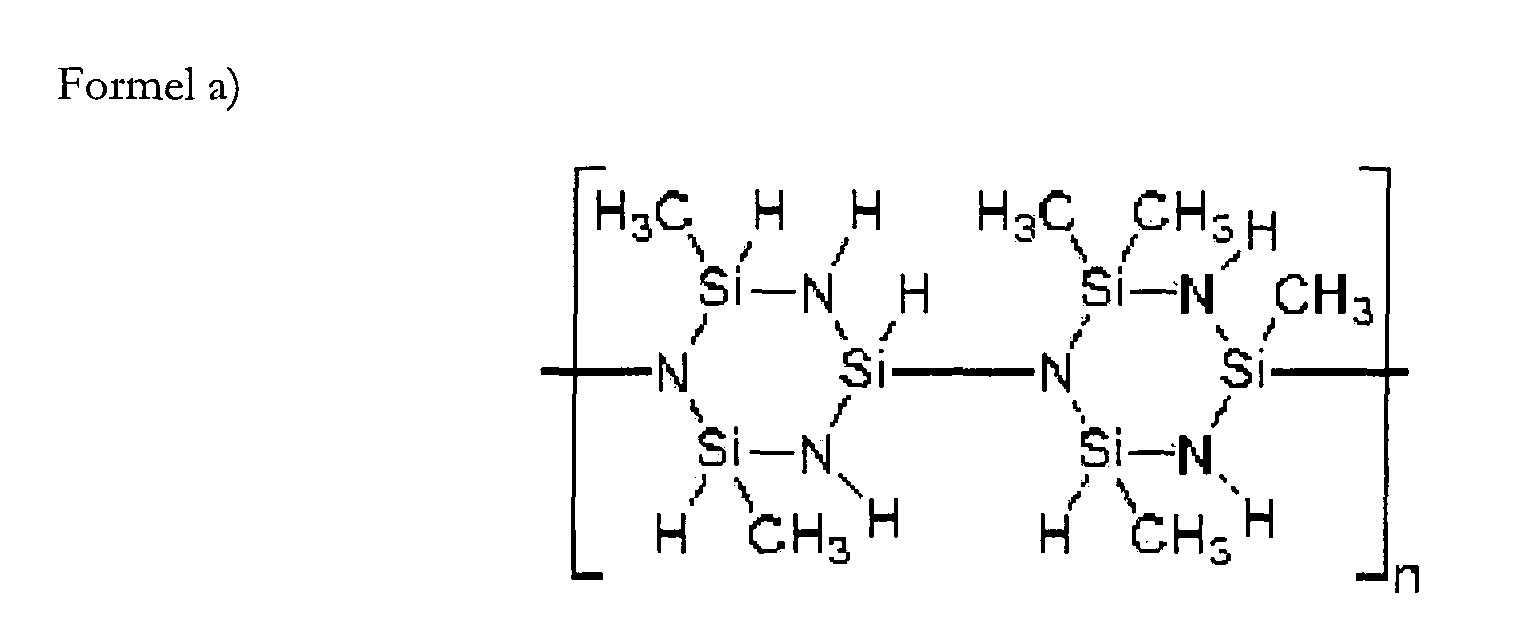
- the plates obtained were processed in accordance with the desired final contour and subjected to infiltration with a precursor polymer of the formula a), the infiltration taking place under reduced pressure (approx. 10 hPa) at temperatures of approx. 60 to approx. 80 ° C.
- the polymer converts to an amorphous ceramic by subsequent heating to 1000 ° C.
- the plates were then ground on one surface and applied to ceramic and metal carrier plates with this, and the unprocessed surface was then ground plane-parallel to the underside of the carrier.
- a blend of 45% conditioned carbon fibers each half in the form of Short fibers with an average length of 4 mm and a diameter of 8 to 10 ⁇ m and of Long fibers with an average length of 50 mm and an average diameter of 8 to 10 ⁇ m, 10% petroleum coke with an average grain size of less than 45 ⁇ m), 35% one Phenolic resin composition (Novolak, ® Bakelite SP 222, as above), 1% silicon carbide powder with a grain size of less than 45 ⁇ m, 0.5% lamellar boron nitride powder with a grain size of less than 45 ⁇ m, 3.5% graphite powder (graphite mining Kaisersberg, with a grain size of less than 45 ⁇ m) and 5% pitch (®Carbores, Hintgers, as above) were intimately mixed in a mixer mixed and pressed with the aid of a hydraulic press into sheets with a thickness of 20 mm and then heated in an oven in the absence of air for five hours at 700 ° C.
- the resulting plate-shaped molded parts were machined according to the desired final contour, and subjected to a siliconization reaction with liquid silicon, carbon partially to SiC was implemented.
- the plates were first ground on one side and with the machined side applied to ceramic and metal backing plates and plane-parallel to the free surface ground lower level of the beam.
Landscapes
- Chemical & Material Sciences (AREA)
- Engineering & Computer Science (AREA)
- Ceramic Engineering (AREA)
- Materials Engineering (AREA)
- Structural Engineering (AREA)
- Manufacturing & Machinery (AREA)
- Organic Chemistry (AREA)
- Chemical Kinetics & Catalysis (AREA)
- General Engineering & Computer Science (AREA)
- Composite Materials (AREA)
- Mechanical Engineering (AREA)
- Ceramic Products (AREA)
- Reinforced Plastic Materials (AREA)
- Compositions Of Macromolecular Compounds (AREA)
- Braking Arrangements (AREA)
Abstract
Description
Die Massen von Verstärkungsfasern und Matrix in den erfindungsgemäßen Werkstoffen verhalten sich wie 5 bis 50 zu 95 bis 50, bevorzugt 10 bis 45 zu 90 bis 55; insbesondere 20 bis 40 zu 80 bis 60.
Claims (11)
- Faserverstärkter Keramik-Werkstoff, dessen Verstärkungsfasern in mindestens einer Form ausgewählt aus Geweben, Kurzfasern und Langfasern vorliegen, wobei als Kurzfasern Fasern mit einer Länge von bis zu 5 mm und als Langfasern Fasern mit einer Länge mindestens 5,1 mm bezeichnet werden, dadurch gekennzeichnet, daß die Massenanteile der Fasern in Form von Geweben, Kurzfasern und Langfasern sich verhalten wie 0 bis 35 zu 25 bis 80 zu 0 bis 45, und daß zumindest ein Teil der Verstärkungsfasern mindestens eine Schutzschicht aufweist aus Kohlenstoff erzeugt durch Pyrolyse von darauf abgeschiedenen Harzen oder Pechen, Borverbindungen oder Phosphorverbindungen oder Kombinationen hiervon.
- Faserverstärkter Keramik-Werkstoff nach Anspruch 1, dadurch gekennzeichnet, daß mindestens 50 % der Masse der Fasern Kohlenstoffasern sind.
- Faserverstärkter Keramik-Werkstoff nach Anspruch 1, dadurch gekennzeichnet, daß die Matrix Kohlenstoff enthält.
- Faserverstärkter Keramik-Werkstoff nach Anspruch 1, dadurch gekennzeichnet, daß die Matrix Siliciumcarbid enthält.
- Faserverstärkter Keramik-Werkstoff nach Anspruch 4, dadurch gekennzeichnet, daß die Matrix Massenanteile von 20 bis 99,8 % SiC, 0,1 bis 40 % Silicium und 0,1 bis 70 % Kohlenstoff enthält.
- Faserverstärkter Keramik-Werkstoff nach Anspruch 2, dadurch gekennzeichnet, daß die Kohlenstoffasern mindestens eine Schutzschicht aufweisen aus Kohlenstoff erzeugt durch Pyrolyse von darauf abgeschiedenen Harzen oder Pechen.
- Faserverstärkter Keramik-Werkstoff nach Anspruch 1, dadurch gekennzeichnet, daß in der Matrix Zusatzstoffe ausgewählt aus SiO2, Silciumcarbidpulver, lamellarem Bornitrid, Mangansulfid und Metallsiliciden enthalten sind.
- Faserverstärkter Keramik-Werkstoff nach Anspruch 1, dadurch gekennzeichnet, daß die Matrix ein Glas auf Basis von Phosphaten, Silicaten, Aluminaten und/oder Boraten von Alkalimetallen, Erdalkalimetallen oder Erdmetallen enthält.
- Faserverstärkter Keramik-Werkstoff nach Anspruch 1, dadurch gekennzeichnet, daß die Matrix Metalle enthält ausgewählt aus Kupfer, Silber, Aluminium, Titan und den Elementen der Eisengruppe.
- Verfahren zur Herstellung von faserverstärkten Keramik-Werkstoffen nach Anspruch 1, dadurch gekennzeichnet, daß Gewebe aus Verstärkungsfasern mit einer Formmasse, enthaltend Verstärkungsfasern in Form von Kurz- und/oder Langfasern sowie carbonisierbare Stoffe ausgewählt aus thermoplastischen Kunststoffen, Harzen und Pechen zu Formkörpern geformt werden, die durch Erhitzen unter Ausschluß von Sauerstoff auf eine Temperatur von ca. 750 bis ca. 1100 °C zu porösen faserverstärkten Kohlenstoff-Körpern gebrannt werden, und die anschließend gegebenenfalls bei einer Temperatur, die mindestens so hoch ist wie die Schmelztemperatur von Silicium, mit flüssigem Silicium oder einer Silicium enthaltenden Legierung infiltriert werden, wobei der Kohlenstoff zumindest teilweise zu Siliciumcarbid umgesetzt wird.
- Verwendung von faserverstärkten Keramik-Werkstoffen nach Anspruch 1 als Material für Bremsbeläge.
Applications Claiming Priority (2)
| Application Number | Priority Date | Filing Date | Title |
|---|---|---|---|
| DE2003110945 DE10310945A1 (de) | 2003-03-13 | 2003-03-13 | Faserverstärkter Keramik-Werkstoff |
| DE10310945 | 2003-03-13 |
Publications (2)
| Publication Number | Publication Date |
|---|---|
| EP1457703A1 true EP1457703A1 (de) | 2004-09-15 |
| EP1457703B1 EP1457703B1 (de) | 2008-07-30 |
Family
ID=32748223
Family Applications (1)
| Application Number | Title | Priority Date | Filing Date |
|---|---|---|---|
| EP20040005204 Expired - Lifetime EP1457703B1 (de) | 2003-03-13 | 2004-03-04 | Faserverstärkter Keramik-Werkstoff |
Country Status (3)
| Country | Link |
|---|---|
| US (1) | US6936341B2 (de) |
| EP (1) | EP1457703B1 (de) |
| DE (2) | DE10310945A1 (de) |
Cited By (5)
| Publication number | Priority date | Publication date | Assignee | Title |
|---|---|---|---|---|
| EP1440955A3 (de) * | 2003-01-24 | 2007-06-20 | Eagle Industry Co., Ltd. | Gleitelement für Dichtungen und Verfahren zu dessen Herstellung |
| EP1864959A1 (de) | 2006-06-08 | 2007-12-12 | Audi Ag | Kohlenstoff-Teilchen mit kugelförmiger Gestalt enthaltende keramische Werkstoffe |
| WO2008009261A1 (de) * | 2006-07-21 | 2008-01-24 | Luk Lamellen Und Kupplungsbau Beteiligungs Kg | Reibsystem |
| EP1874709A4 (de) * | 2005-04-27 | 2011-09-07 | Graftech Int Holdings Inc | Herstellung von kohlefaserverstärkten keramiken als bremsscheiben |
| EP3056756A1 (de) * | 2015-02-13 | 2016-08-17 | Schunk Hoffmann Carbon Technology AG | Reibbelagwerkstoff sowie Verfahren zur Herstellung eines Reibbelagwerkstoffs |
Families Citing this family (18)
| Publication number | Priority date | Publication date | Assignee | Title |
|---|---|---|---|---|
| US20050188831A1 (en) * | 2003-07-11 | 2005-09-01 | Us Global Nanospace, Inc. | Ballistic resistant turret and method of making same |
| DE102004062082A1 (de) * | 2004-12-23 | 2006-07-06 | Audi Ag | Bremsvorrichtung für ein Fahrzeug, insbesondere für ein Kraftfahrzeug |
| WO2006101799A2 (en) * | 2005-03-16 | 2006-09-28 | Honeywell International Inc. | Carbon fiber containing ceramic particles |
| DE102005052802A1 (de) * | 2005-11-05 | 2007-05-10 | Audi Ag | Bremsscheibe mit Zwischenschicht |
| CN100497089C (zh) * | 2006-09-27 | 2009-06-10 | 北京航空航天大学 | 纤维增强的金属/陶瓷层状复合包容机匣及其制造方法 |
| CN102138022B (zh) * | 2008-08-08 | 2015-06-10 | 福乐尼·乐姆宝公开有限公司 | 用于制动器的摩擦组件的陶瓷基体材料的制备方法及其制得的陶瓷基体材料 |
| FI20105048A7 (fi) * | 2010-01-21 | 2011-07-22 | Runtech Systems Oy | Menetelmä radiaalikompressorin juoksupyörän valmistamiseksi |
| CN103158876B (zh) * | 2013-03-01 | 2015-06-10 | 溧阳市科技开发中心 | 一种飞机发动机外壳 |
| CN103158879B (zh) * | 2013-03-01 | 2015-02-25 | 溧阳市科技开发中心 | 一种飞机发动机吊舱 |
| CN103144759B (zh) * | 2013-03-01 | 2015-06-10 | 溧阳市科技开发中心 | 一种抗冲击复合机身面板 |
| CN103144760B (zh) * | 2013-03-01 | 2015-06-10 | 溧阳市科技开发中心 | 一种飞机机身外壳 |
| CN103158877B (zh) * | 2013-03-01 | 2015-02-25 | 溧阳市科技开发中心 | 一种用于飞机发动机的包容机舱 |
| CN103144762B (zh) * | 2013-03-01 | 2015-11-25 | 溧阳市科技开发中心 | 一种机身蒙皮 |
| JP6070332B2 (ja) * | 2013-03-25 | 2017-02-01 | 新日鐵住金株式会社 | 炭素繊維強化複合材料の製造方法 |
| KR101543218B1 (ko) * | 2014-02-25 | 2015-08-10 | (주) 데크카본 | 항공기 브레이크 디스크 및 이를 만드는 방법 |
| RU2741981C1 (ru) * | 2020-04-23 | 2021-02-01 | Публичное акционерное общество «Авиационная корпорация «Рубин» | Способ получения основы для изготовления фрикционного композиционного углерод-карбидокремниевого материала. |
| TWI865856B (zh) * | 2021-04-19 | 2024-12-11 | 仁寶電腦工業股份有限公司 | 複合材料結構 |
| CN116693312B (zh) * | 2023-05-30 | 2025-02-07 | 长沙市萨普新材料有限公司 | 一种c/c复合阴极板、组合电极及制备方法和应用 |
Citations (4)
| Publication number | Priority date | Publication date | Assignee | Title |
|---|---|---|---|---|
| EP1273818A1 (de) * | 2001-06-30 | 2003-01-08 | Sgl Carbon Ag | Bremssystem mit Verbundwerkstoff Bremsscheibe |
| DE10148659C1 (de) * | 2001-10-02 | 2003-02-06 | Sgl Carbon Ag | Verfahren zur Herstellung von Hohlkörpern aus faserverstärkten keramischen Materialien und Verwendung dieser Hohlkörper |
| EP1319640A2 (de) * | 2001-12-13 | 2003-06-18 | Sgl Carbon Ag | Verfahren zum Oxidationsschutz faserverstärkter Verbundwerkstoffe |
| EP1386896A2 (de) * | 2002-07-29 | 2004-02-04 | Sgl Carbon Ag | Verfahren zur Herstellung von Hohlkörpern aus faserverstärkten keramischen Materialien |
Family Cites Families (5)
| Publication number | Priority date | Publication date | Assignee | Title |
|---|---|---|---|---|
| EP0623571A4 (de) * | 1992-11-26 | 1997-07-02 | Tonen Corp | Verfahren zur herstellung keramischer produkte. |
| US6418973B1 (en) * | 1996-10-24 | 2002-07-16 | Boeing North American, Inc. | Integrally woven ceramic composites |
| DE19859840B4 (de) | 1998-12-23 | 2006-01-12 | Daimlerchrysler Ag | Bremseinheit |
| DE10133635A1 (de) * | 2001-07-11 | 2003-02-06 | Sgl Carbon Ag | Mehrschichtiger Keramik-Verbund |
| DE10157583C1 (de) * | 2001-11-23 | 2002-12-19 | Sgl Carbon Ag | Reibkörper aus faserverstärkten Keramik-Verbundwerkstoffen |
-
2003
- 2003-03-13 DE DE2003110945 patent/DE10310945A1/de not_active Ceased
-
2004
- 2004-03-04 EP EP20040005204 patent/EP1457703B1/de not_active Expired - Lifetime
- 2004-03-04 DE DE200450007710 patent/DE502004007710D1/de not_active Expired - Lifetime
- 2004-03-12 US US10/799,313 patent/US6936341B2/en not_active Expired - Lifetime
Patent Citations (4)
| Publication number | Priority date | Publication date | Assignee | Title |
|---|---|---|---|---|
| EP1273818A1 (de) * | 2001-06-30 | 2003-01-08 | Sgl Carbon Ag | Bremssystem mit Verbundwerkstoff Bremsscheibe |
| DE10148659C1 (de) * | 2001-10-02 | 2003-02-06 | Sgl Carbon Ag | Verfahren zur Herstellung von Hohlkörpern aus faserverstärkten keramischen Materialien und Verwendung dieser Hohlkörper |
| EP1319640A2 (de) * | 2001-12-13 | 2003-06-18 | Sgl Carbon Ag | Verfahren zum Oxidationsschutz faserverstärkter Verbundwerkstoffe |
| EP1386896A2 (de) * | 2002-07-29 | 2004-02-04 | Sgl Carbon Ag | Verfahren zur Herstellung von Hohlkörpern aus faserverstärkten keramischen Materialien |
Cited By (7)
| Publication number | Priority date | Publication date | Assignee | Title |
|---|---|---|---|---|
| EP1440955A3 (de) * | 2003-01-24 | 2007-06-20 | Eagle Industry Co., Ltd. | Gleitelement für Dichtungen und Verfahren zu dessen Herstellung |
| EP1874709A4 (de) * | 2005-04-27 | 2011-09-07 | Graftech Int Holdings Inc | Herstellung von kohlefaserverstärkten keramiken als bremsscheiben |
| EP1864959A1 (de) | 2006-06-08 | 2007-12-12 | Audi Ag | Kohlenstoff-Teilchen mit kugelförmiger Gestalt enthaltende keramische Werkstoffe |
| WO2008009261A1 (de) * | 2006-07-21 | 2008-01-24 | Luk Lamellen Und Kupplungsbau Beteiligungs Kg | Reibsystem |
| EP3056756A1 (de) * | 2015-02-13 | 2016-08-17 | Schunk Hoffmann Carbon Technology AG | Reibbelagwerkstoff sowie Verfahren zur Herstellung eines Reibbelagwerkstoffs |
| WO2016128186A3 (de) * | 2015-02-13 | 2016-10-06 | Schunk Hoffmann Carbon Technology Ag | Reibbelagwerkstoff sowie verfahren zur herstellung eines reibbelagwerkstoffs |
| US10591010B2 (en) | 2015-02-13 | 2020-03-17 | Schunk Hoffman Carbon Technology Ag | Friction lining material and method for producing a friction lining material |
Also Published As
| Publication number | Publication date |
|---|---|
| DE10310945A1 (de) | 2004-10-07 |
| US6936341B2 (en) | 2005-08-30 |
| DE502004007710D1 (de) | 2008-09-11 |
| US20040204533A1 (en) | 2004-10-14 |
| EP1457703B1 (de) | 2008-07-30 |
Similar Documents
| Publication | Publication Date | Title |
|---|---|---|
| EP1457703B1 (de) | Faserverstärkter Keramik-Werkstoff | |
| EP1357310B1 (de) | Verbundwerkstoff mit Verstärkungsfasern aus Kohlenstoff | |
| DE10233729B4 (de) | Faserverstärkte keramische Bremsbeläge | |
| DE10164229B4 (de) | Reibscheiben, Verfahren zu ihrer Herstellung und ihre Verwendung | |
| DE10131769C5 (de) | Bremssystem mit Verbundwerkstoff-Bremsscheibe | |
| WO2017089494A1 (de) | 3d drucken von einem keramischen bauteil | |
| DE10157483C2 (de) | Formkörper aus faserverstärkten Verbundwerkstoffen mit segmentierter Deckschicht, seine Herstellung und seine Verwendung | |
| EP1323686B1 (de) | Verfahren zur Herstellung von Hohlkörpern aus faserverstärkten keramischen Materialien | |
| EP1489331B1 (de) | Reibkörper aus metallinfiltriertem, mit Fasern verstärktem porösem Kohlenstoff | |
| EP1342932B1 (de) | Keramische Werkstoffe für Reibbeläge | |
| EP1323685A2 (de) | Verfahren zur Herstellung von Formkörpern aus faserverstärkten keramischen Materialien | |
| DE29724077U1 (de) | Bremseinheit | |
| DE19711830A1 (de) | Gesinterter Reibkörper und Verfahren zum Herstellen eines solchen | |
| EP1508718B1 (de) | Kupplungsbeläge aus faserverstärkten keramischen Werkstoffen | |
| DE19727585A1 (de) | Bremseinheit aus Bremsscheibe und Bremsbelag | |
| EP1783395A2 (de) | Bremsscheibe mit Zwischenschicht und Verfahren zur Herstellung derselbe | |
| EP2012038B1 (de) | Trockenlaufreibbelag | |
| EP2047135B1 (de) | Reibsystem | |
| DE102019107368B3 (de) | Bindemittelfreie Reibbeläge, Verfahren zu ihrer Herstellung und ihre Verwendung | |
| EP0987464B1 (de) | Bremseinheit aus Bremsscheibe und Bremsbelag | |
| EP1876159B1 (de) | Verfahren zur herstellung eines carbidkeramischen kontaktkörpers und carbidkeramischer kontaktkörper | |
| EP1536156A1 (de) | Reibpaarungen für Feststellbremsen in Kraftfahrzeugen |
Legal Events
| Date | Code | Title | Description |
|---|---|---|---|
| PUAI | Public reference made under article 153(3) epc to a published international application that has entered the european phase |
Free format text: ORIGINAL CODE: 0009012 |
|
| AK | Designated contracting states |
Kind code of ref document: A1 Designated state(s): AT BE BG CH CY CZ DE DK EE ES FI FR GB GR HU IE IT LI LU MC NL PL PT RO SE SI SK TR |
|
| AX | Request for extension of the european patent |
Extension state: AL LT LV MK |
|
| 17P | Request for examination filed |
Effective date: 20050315 |
|
| AKX | Designation fees paid |
Designated state(s): DE FR GB IT |
|
| RAP1 | Party data changed (applicant data changed or rights of an application transferred) |
Owner name: AUDI AG |
|
| 17Q | First examination report despatched |
Effective date: 20070315 |
|
| GRAP | Despatch of communication of intention to grant a patent |
Free format text: ORIGINAL CODE: EPIDOSNIGR1 |
|
| GRAS | Grant fee paid |
Free format text: ORIGINAL CODE: EPIDOSNIGR3 |
|
| GRAA | (expected) grant |
Free format text: ORIGINAL CODE: 0009210 |
|
| AK | Designated contracting states |
Kind code of ref document: B1 Designated state(s): DE FR GB IT |
|
| REG | Reference to a national code |
Ref country code: GB Ref legal event code: FG4D Free format text: NOT ENGLISH |
|
| REF | Corresponds to: |
Ref document number: 502004007710 Country of ref document: DE Date of ref document: 20080911 Kind code of ref document: P |
|
| PLBE | No opposition filed within time limit |
Free format text: ORIGINAL CODE: 0009261 |
|
| STAA | Information on the status of an ep patent application or granted ep patent |
Free format text: STATUS: NO OPPOSITION FILED WITHIN TIME LIMIT |
|
| 26N | No opposition filed |
Effective date: 20090506 |
|
| REG | Reference to a national code |
Ref country code: FR Ref legal event code: PLFP Year of fee payment: 13 |
|
| REG | Reference to a national code |
Ref country code: FR Ref legal event code: PLFP Year of fee payment: 14 |
|
| REG | Reference to a national code |
Ref country code: FR Ref legal event code: PLFP Year of fee payment: 15 |
|
| PGFP | Annual fee paid to national office [announced via postgrant information from national office to epo] |
Ref country code: FR Payment date: 20230322 Year of fee payment: 20 |
|
| PGFP | Annual fee paid to national office [announced via postgrant information from national office to epo] |
Ref country code: GB Payment date: 20230322 Year of fee payment: 20 Ref country code: DE Payment date: 20230331 Year of fee payment: 20 |
|
| P01 | Opt-out of the competence of the unified patent court (upc) registered |
Effective date: 20230529 |
|
| PGFP | Annual fee paid to national office [announced via postgrant information from national office to epo] |
Ref country code: IT Payment date: 20230331 Year of fee payment: 20 |
|
| REG | Reference to a national code |
Ref country code: DE Ref legal event code: R071 Ref document number: 502004007710 Country of ref document: DE |
|
| REG | Reference to a national code |
Ref country code: GB Ref legal event code: PE20 Expiry date: 20240303 |
|
| PG25 | Lapsed in a contracting state [announced via postgrant information from national office to epo] |
Ref country code: GB Free format text: LAPSE BECAUSE OF EXPIRATION OF PROTECTION Effective date: 20240303 |