EP0987464B1 - Bremseinheit aus Bremsscheibe und Bremsbelag - Google Patents
Bremseinheit aus Bremsscheibe und Bremsbelag Download PDFInfo
- Publication number
- EP0987464B1 EP0987464B1 EP98117425A EP98117425A EP0987464B1 EP 0987464 B1 EP0987464 B1 EP 0987464B1 EP 98117425 A EP98117425 A EP 98117425A EP 98117425 A EP98117425 A EP 98117425A EP 0987464 B1 EP0987464 B1 EP 0987464B1
- Authority
- EP
- European Patent Office
- Prior art keywords
- brake
- accordance
- brake unit
- ceramic
- sic
- Prior art date
- Legal status (The legal status is an assumption and is not a legal conclusion. Google has not performed a legal analysis and makes no representation as to the accuracy of the status listed.)
- Expired - Lifetime
Links
Images


Classifications
-
- F—MECHANICAL ENGINEERING; LIGHTING; HEATING; WEAPONS; BLASTING
- F16—ENGINEERING ELEMENTS AND UNITS; GENERAL MEASURES FOR PRODUCING AND MAINTAINING EFFECTIVE FUNCTIONING OF MACHINES OR INSTALLATIONS; THERMAL INSULATION IN GENERAL
- F16D—COUPLINGS FOR TRANSMITTING ROTATION; CLUTCHES; BRAKES
- F16D69/00—Friction linings; Attachment thereof; Selection of coacting friction substances or surfaces
- F16D69/02—Composition of linings ; Methods of manufacturing
- F16D69/023—Composite materials containing carbon and carbon fibres or fibres made of carbonizable material
-
- F—MECHANICAL ENGINEERING; LIGHTING; HEATING; WEAPONS; BLASTING
- F16—ENGINEERING ELEMENTS AND UNITS; GENERAL MEASURES FOR PRODUCING AND MAINTAINING EFFECTIVE FUNCTIONING OF MACHINES OR INSTALLATIONS; THERMAL INSULATION IN GENERAL
- F16D—COUPLINGS FOR TRANSMITTING ROTATION; CLUTCHES; BRAKES
- F16D65/00—Parts or details
- F16D65/02—Braking members; Mounting thereof
- F16D65/12—Discs; Drums for disc brakes
-
- F—MECHANICAL ENGINEERING; LIGHTING; HEATING; WEAPONS; BLASTING
- F16—ENGINEERING ELEMENTS AND UNITS; GENERAL MEASURES FOR PRODUCING AND MAINTAINING EFFECTIVE FUNCTIONING OF MACHINES OR INSTALLATIONS; THERMAL INSULATION IN GENERAL
- F16D—COUPLINGS FOR TRANSMITTING ROTATION; CLUTCHES; BRAKES
- F16D69/00—Friction linings; Attachment thereof; Selection of coacting friction substances or surfaces
- F16D69/02—Composition of linings ; Methods of manufacturing
-
- F—MECHANICAL ENGINEERING; LIGHTING; HEATING; WEAPONS; BLASTING
- F16—ENGINEERING ELEMENTS AND UNITS; GENERAL MEASURES FOR PRODUCING AND MAINTAINING EFFECTIVE FUNCTIONING OF MACHINES OR INSTALLATIONS; THERMAL INSULATION IN GENERAL
- F16D—COUPLINGS FOR TRANSMITTING ROTATION; CLUTCHES; BRAKES
- F16D69/00—Friction linings; Attachment thereof; Selection of coacting friction substances or surfaces
- F16D69/02—Composition of linings ; Methods of manufacturing
- F16D69/027—Compositions based on metals or inorganic oxides
-
- F—MECHANICAL ENGINEERING; LIGHTING; HEATING; WEAPONS; BLASTING
- F16—ENGINEERING ELEMENTS AND UNITS; GENERAL MEASURES FOR PRODUCING AND MAINTAINING EFFECTIVE FUNCTIONING OF MACHINES OR INSTALLATIONS; THERMAL INSULATION IN GENERAL
- F16D—COUPLINGS FOR TRANSMITTING ROTATION; CLUTCHES; BRAKES
- F16D69/00—Friction linings; Attachment thereof; Selection of coacting friction substances or surfaces
- F16D2069/003—Selection of coacting friction materials
-
- F—MECHANICAL ENGINEERING; LIGHTING; HEATING; WEAPONS; BLASTING
- F16—ENGINEERING ELEMENTS AND UNITS; GENERAL MEASURES FOR PRODUCING AND MAINTAINING EFFECTIVE FUNCTIONING OF MACHINES OR INSTALLATIONS; THERMAL INSULATION IN GENERAL
- F16D—COUPLINGS FOR TRANSMITTING ROTATION; CLUTCHES; BRAKES
- F16D2200/00—Materials; Production methods therefor
- F16D2200/0034—Materials; Production methods therefor non-metallic
- F16D2200/0039—Ceramics
Definitions
- the invention relates to a brake unit comprising a Brake disc made of thermally highly resilient material and one with her tribologically working brake pad.
- a new generation of brake discs consists of thermal heavy-duty material. These include ceramic materials, in particular short fiber reinforced C / SiC ceramic materials, such as they are described in German patent application 197 11 829.1 are.
- Another generic brake disc is from DE 43 22 113 known. It is a brake disc with a support body made of a steel, cast iron or Aluminum material, depending on the outside ring sections an annular layer made of a thermally highly resilient Material, namely a ceramic material or a metal, Metal sintered or metal ceramic sintered material applied are. This material is temperature resistant up to over 1500 ° Celsius. To prevent the Brake disc heated so much that the brake pad damage takes, it is provided that the ceramic material Has heat-conductive metal filling that the heat to the metal support body and that the brake disc as ventilated brake disc is constructed.
- brake pads are not stable enough.
- German utility model DE 298 04 229 U1 is a sintered brake pad for a short fiber reinforced C / SiC brake disc described, the metal powder, primary Carbon and possibly additives.
- This brake pad is characterized by the fact that carbon powder, Metal powder and optionally binders with each other are mixed and sintered. There is one Reaction bond between the carbon and the metal, where ceramic phases are formed, which are ultimately one form a binding matrix. This creates a very hard one Friction lining that is not optimal for all braking applications Shows properties.
- the object of the invention is a brake unit of the above to provide the above-mentioned type Temperature ranges is stable, but is easier to manufacture and has good comfort behavior.
- the solution is a brake unit with the characteristics of Claim 1.
- the brake pad is made a metal-ceramic material or a series sintered metal covering consists.
- Sintered metal coverings have so far only been used in commercial vehicles or used in the train. They were suitable for the car sector in connection with the previously used cast iron brake discs not because the comfort behavior (rubbing, squeaking, stuttering) is not sufficient. It has now surprisingly and unexpectedly for the expert that the previous usual inconveniences when pairing common Cast iron brake discs with sintered metal brake pads at the Use of ceramic brake discs does not occur. In the Combination of a ceramic brake disc with a Sintered metal coating has also been found to be very good coefficients of friction from 0.3 to 0.5 and one Temperature resistance up to 900 to 1000 ° C can be achieved.
- the brake unit according to the invention is an optimal one Combination for increased thermal Resilience on the part of the ceramic brake disc with regard on a reasonable service life of the brake pad and on other tribological requirements such as coefficient of friction or Temperature dependence of the coefficient of friction.
- the invention Brake unit is due to its material nature thermally more resilient and also more wear resistant than conventional brake units.
- the ceramic binding phase is preferably created by pyrolysis at least one preceramic polymer.
- preceramic polymer For example. can conventional base mixes for organically bound standard car coverings are used, the conventional organic binder replaced by a preceramic polymer is.
- the composition of these conventional series coverings is well known to those skilled in the art. It can be a C precursor such as. Vinyl resins or silicon-containing polymers act.
- the binding phase can be carried out by a so-called polymer pyrolysis process (PP process) introduced and manufactured become.
- PP process polymer pyrolysis process
- the individual components are mixed and pressed and at temperatures up to 1200 ° Celsius approx. 60 minutes pyrolyzed and finished if necessary.
- the mixture of rubber and Binder resulting ceramic binder phase is mostly amorphous, i.e. glassy. It is temperature resistant, depending on the type up to to 1600 ° Celsius.
- the metal portion of the brake pad is selected, for example, from the group consisting of copper and copper alloys as well as iron and iron alloys.
- the metals are used in the form of chips, metal wool or metal powder as an embedding phase.
- the friction lining also contains carbon, coke or graphite, solid lubricants such as SbS 3 , MoS 2 , CaF 2 and fillers, for example made of ceramic, aluminum oxide, glass, mica powder, heavy spar and / or iron oxide, which serve as cleaning agents.
- the brake disc advantageously consists of a ceramic material, especially oxide ceramic or fiber reinforced Ceramics, such as C / C ceramics, SiC / SiC ceramics or C / SiC ceramic. It is preferred that the fibers be isotropic are oriented, since this ensures a uniformly high Thermal conductivity also in the cross section of the brake disc is achieved. This will cause the surface temperature in the Lowered load case.
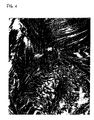
- the brake disc shown in Figure 1 consists of approximately 35-45 Vol .-% fibers, approx. 40-50 Vol .-% silicon carbide and max. approx. 15 Vol .-% silicon.
- the German Patent application 197 11 829.1 care was taken that the Starting substances were mixed as homogeneously as possible. Thereby one obtained isotropically oriented fibers and only a few, small ones Pores in which pure liquid silication Silicon can collect (see. DE 197 11 829.1, on the hereby Is referenced).
- the isotropic fiber arrangement and theshrinking the pores to almost zero increases the Thermal conductivity of the resulting ceramic.
- the brake pads were a mix of metals and Cleaning agents gradually mixed with graphite and homogenized.
- the polysiloxane was then added.
- the mixture was hot pressed, sintered and pyrolyzed. at the use of other preceramic polymers
- Pellet be pyrolysed under protective gas.
- the finished one The covering may still be finished. At least it contains one partly ceramic binding phase.
- the degree of ceramization influences comfort behavior.
- An incomplete one Ceramization e.g. between 20 and 80%, in particular between 40 and 60% is required. It can be useful be to do without pyrolysis and the pellet directly use as a brake pad. The brake maneuvers developing frictional heat causes pyrolysis during of running in.
- a C / SiC brake disk with a 285 mm diameter with a brake lining made of metal and 5-15% by weight polysiloxane H62C from Wacker was used as the preceramic binding phase.
- the metal surcharge contains 2/3 steel wool and 1/3 copper powder. 1/2 wt .-% Al 2 O 3 served as a cleaning agent.
- As a solid lubricant max. 5% by weight of molybdenum sulfide and / or calcium fluoride and / or graphite were added.
- the brake pressure was 15 bar at a speed of 60-200 km / h.
- the measured friction values were between 0.35 and 0.55.
- the temperature in the middle of the window rose to over 600 ° C. The is because between the individual braking cycles not to waited for the test arrangement to cool completely has been. In practice, however, these temperatures are not reached.
- the measured wear was on the brake disc. 0.2-0.3 mm and about 1-1.5 g for the brake pad.
- the brake disc used in the tests short fiber reinforced C / SiC ceramic showed a good Thermal conductivity. This helped the Do not apply temperatures excessively.
Landscapes
- Engineering & Computer Science (AREA)
- General Engineering & Computer Science (AREA)
- Mechanical Engineering (AREA)
- Chemical & Material Sciences (AREA)
- Inorganic Chemistry (AREA)
- Composite Materials (AREA)
- Materials Engineering (AREA)
- Braking Arrangements (AREA)
Description
- Figur 1
- ein lichtmikroskopisches Gefügebild einer erfindungsgemäßen Bremsscheibe mit hoher Wärmeleitfähigkeit;
- Figuren 2a, b
- Ergebnisse eines Bremsversuchs mit einer Bremsscheibe gemäß Figur 1 und einem Bremsbelag mit anorganisch gebundener Matrix;
- Figuren 3a, b
- Ergebnisse eines weiteren Bremsversuchs, diesmal mit einem konventionellen Sintermetall-Bremsbelag.
Claims (13)
- Bremseinheit umfassend eine Bremsscheibe aus einem thermisch hochbelastbarem Material und einen mit ihr tribologisch zusammenarbeitenden Bremsbelag, wobei der Bremsbelag einen anorganisch gebundenen Werkstoff mit einer keramischen Binderphase und Metallpartikeln enthält
dadurch gekennzeichnet,dass die keramische Bindephase durch teilweise Pyrolyse mindestens eines präkeramischen Polymers erhältlich ist, wobeidie teilweise Pyrolyse des Polymers zwischen 20 % und 80 % beträgt. - Bremseinheit nach Anspruch 1, dadurch gekennzeichnet, dass die keramische Bindephase durch teilweise Umwandlung des präkeramischen Polymers während des Betriebs der Bremseinheit erhältlich ist.
- Bremseinheit nach Anspruch 1 oder 2, dadurch gekennzeichnet, dass das mindestens eine präkeramische Polymer aus der Gruppe bestehend aus C-Precursoren wie z.B. Vinylharzen und/oder präkeramischen Polymeren auf Siliziumbasis wie z.B. Polysilanen, Polysiloxanen, Polysilazanen, Polyborocarbosilanen, Polyborosilazanen, Polyborosilanen, Polycarbosilazanen und Polycarbosilanen ausgewählt ist.
- Bremseinheit nach einem der vorhergehenden Ansprüche, dadurch gekennzeichnet, dass der Bremsbelag ferner anorganische Schmierstoffe enthält.
- Bremseinheit nach einem der vorhergehenden Ansprüche, dadurch gekennzeichnet, dass die Metallpartikel aus der Gruppe bestehend aus Kupfer und Kupferlegierungen wie Bronze oder Messing sowie Eisen und Eisenlegierungen wie Grauguß oder Stahl ausgewählt sind.
- Bremseinheit nach einem vorhergehenden Ansprüche, dadurch gekennzeichnet, dass die Metallpartikel in Form von Spänen und/oder von Metallwolle und/oder in Pulverform zugesetzt sind.
- Bremseinheit nach einem der vorhergehenden Ansprüche, dadurch gekennzeichnet, dass im Bremsbelag ferner Kohlenstoff vorzugsweise in Faserform enthalten ist.
- Bremseinheit nach einem der vorhergehenden Ansprüche, dadurch gekennzeichnet, dass im Bremsbelag als feste Schmiermittel Calciumfluorid, Graphit und/oder Sulfide, insbesondere Molybdänsulfid oder Antimonsulfid enthalten sind.
- Bremseinheit nach einem der vorhergehenden Ansprüche, dadurch gekennzeichnet, dass im Bremsbelag ferner Hartpartikel aus Keramik, vorzugsweise aus Carbiden wie Borcarbid, Siliziumcarbid, Titancarbid und/oder Metallcarbide enthalten sind.
- Bremseinheit nach einem der vorhergehenden Ansprüche, dadurch gekennzeichnet, dass im Bremsbelag Hartpartikel aus Aluminiumoxid und/oder Glas enthalten sind.
- Bremseinheit nach einem der vorhergehenden Ansprüche, dadurch gekennzeichnet, dass die Bremsscheibe aus Keramik, insbesondere Oxidkeramik, C/SiC-Werkstoff, C/C-SiC-Werkstoff, SiC/SiC-Werkstoff oder aus C/C-Werkstoff besteht.
- Bremseinheit nach Anspruch 11, dadurch gekennzeichnet dass die Fasern der faserverstärkten Verbundkeramik im Wesentlichen isotrop orientiert sind.
- Bremseinheit nach einem der vorhergehenden Ansprüche, dadurch gekennzeichnet, dass die Bremsscheibe aus einer kurzfaserverstärkten C/SiC-Verbundkeramik besteht, vorzugsweise mit ca. 35-45 Vol.-% Kohlenstofffasern, ca. 40-50 Vol.-% Siliziumcarbid und max. ca. 15 Vol.-% Silizium.
Priority Applications (2)
| Application Number | Priority Date | Filing Date | Title |
|---|---|---|---|
| EP98117425A EP0987464B1 (de) | 1998-09-15 | 1998-09-15 | Bremseinheit aus Bremsscheibe und Bremsbelag |
| ES98117425T ES2185099T3 (es) | 1998-09-15 | 1998-09-15 | Unidad de freno consistente en disco de freno y forro de freno. |
Applications Claiming Priority (1)
| Application Number | Priority Date | Filing Date | Title |
|---|---|---|---|
| EP98117425A EP0987464B1 (de) | 1998-09-15 | 1998-09-15 | Bremseinheit aus Bremsscheibe und Bremsbelag |
Publications (2)
| Publication Number | Publication Date |
|---|---|
| EP0987464A1 EP0987464A1 (de) | 2000-03-22 |
| EP0987464B1 true EP0987464B1 (de) | 2002-10-30 |
Family
ID=8232634
Family Applications (1)
| Application Number | Title | Priority Date | Filing Date |
|---|---|---|---|
| EP98117425A Expired - Lifetime EP0987464B1 (de) | 1998-09-15 | 1998-09-15 | Bremseinheit aus Bremsscheibe und Bremsbelag |
Country Status (2)
| Country | Link |
|---|---|
| EP (1) | EP0987464B1 (de) |
| ES (1) | ES2185099T3 (de) |
Cited By (2)
| Publication number | Priority date | Publication date | Assignee | Title |
|---|---|---|---|---|
| DE102009022112A1 (de) | 2009-05-20 | 2010-11-25 | Audi Ag | Bremsbelag, Verfahren zur Herstellung eines solchen Bremsbelags sowie Bremseinheit umfassend einen solchen Bremsbelag |
| DE102009053737A1 (de) | 2009-11-18 | 2011-05-19 | Audi Ag | Bremsbelag, Verfahren zur Herstellung eines solchen Bremsbelags sowie Bremseinheit umfassend einen solchen Bremsbelag |
Families Citing this family (3)
| Publication number | Priority date | Publication date | Assignee | Title |
|---|---|---|---|---|
| ES2202283T3 (es) | 2000-02-28 | 2004-04-01 | Hydro Aluminium Deutschland Gmbh | Componente en forma de cilindro, cilindro parcial o cilindro hueco, con aleacion superficial. |
| DE10338201C5 (de) * | 2003-08-20 | 2008-11-13 | Audi Ag | Reibpaarung für Kupplungssysteme |
| CN110983208B (zh) * | 2019-10-24 | 2021-08-31 | 中南大学 | 一种C/C-SiC-Cu复合材料及其制备方法和应用 |
Family Cites Families (5)
| Publication number | Priority date | Publication date | Assignee | Title |
|---|---|---|---|---|
| DE4306721A1 (de) | 1993-03-04 | 1994-09-08 | Ruetgers Pagid Ag | Reibbelag |
| DE4322113A1 (de) | 1993-05-27 | 1994-12-01 | Knorr Bremse Ag | Bremsscheibe für Scheibenbremsen |
| FR2748790B1 (fr) * | 1996-05-14 | 1998-08-21 | Usines Dehousse | Element de friction en materiau fritte, procede pour sa fabrication et application a un systeme de freinage notamment ferroviaire |
| DE19711830C2 (de) | 1997-03-21 | 2003-05-08 | Daimler Chrysler Ag | Gesinterter Reibkörper und Verfahren zum Herstellen eines solchen |
| DE19711829C1 (de) * | 1997-03-21 | 1998-09-03 | Daimler Benz Ag | Verfahren zur Herstellung einer faserverstärkten Verbundkeramik |
-
1998
- 1998-09-15 EP EP98117425A patent/EP0987464B1/de not_active Expired - Lifetime
- 1998-09-15 ES ES98117425T patent/ES2185099T3/es not_active Expired - Lifetime
Cited By (2)
| Publication number | Priority date | Publication date | Assignee | Title |
|---|---|---|---|---|
| DE102009022112A1 (de) | 2009-05-20 | 2010-11-25 | Audi Ag | Bremsbelag, Verfahren zur Herstellung eines solchen Bremsbelags sowie Bremseinheit umfassend einen solchen Bremsbelag |
| DE102009053737A1 (de) | 2009-11-18 | 2011-05-19 | Audi Ag | Bremsbelag, Verfahren zur Herstellung eines solchen Bremsbelags sowie Bremseinheit umfassend einen solchen Bremsbelag |
Also Published As
| Publication number | Publication date |
|---|---|
| EP0987464A1 (de) | 2000-03-22 |
| ES2185099T3 (es) | 2003-04-16 |
Similar Documents
| Publication | Publication Date | Title |
|---|---|---|
| DE10131769C5 (de) | Bremssystem mit Verbundwerkstoff-Bremsscheibe | |
| DE10233729B4 (de) | Faserverstärkte keramische Bremsbeläge | |
| EP1357310B1 (de) | Verbundwerkstoff mit Verstärkungsfasern aus Kohlenstoff | |
| DE29724077U1 (de) | Bremseinheit | |
| EP1457703B1 (de) | Faserverstärkter Keramik-Werkstoff | |
| EP3380324A1 (de) | 3d drucken von einem keramischen bauteil | |
| DE10161218A1 (de) | Verfahren zum Oxidationsschutz faserverstärkter kohlenstoffhaltiger Verbundwerkstoffe | |
| DE19727585C2 (de) | Bremseinheit aus Bremsscheibe und Bremsbelag | |
| EP1342932B1 (de) | Keramische Werkstoffe für Reibbeläge | |
| DE10222258A1 (de) | Verbundkeramikkörper sowie Verfahren zum Herstellen eines solchen | |
| DE19727587C2 (de) | Bremseinheit aus Bremsscheibe und Bremsbelag | |
| EP1323686B1 (de) | Verfahren zur Herstellung von Hohlkörpern aus faserverstärkten keramischen Materialien | |
| EP1323944A1 (de) | Reibscheiben aus faserverstärkten keramischen Verbundswerkstoffen | |
| EP0987464B1 (de) | Bremseinheit aus Bremsscheibe und Bremsbelag | |
| DE10324691A1 (de) | Reibkörper aus metallinfiltriertem, mit Fasern verstärktem porösem Kohlenstoff | |
| DE29804229U1 (de) | Gesinterter Bremsbelag | |
| EP1783395B1 (de) | Verfahren zur Herstellung von Bremsscheiben | |
| AT505425B1 (de) | Trockenlaufreibbelag | |
| EP1536156B1 (de) | Reibpaarungen für Feststellbremsen in Kraftfahrzeugen | |
| DE69708766T2 (de) | Reibungsmaterial | |
| DE102009022112A1 (de) | Bremsbelag, Verfahren zur Herstellung eines solchen Bremsbelags sowie Bremseinheit umfassend einen solchen Bremsbelag | |
| EP0657401B1 (de) | Kohlenstoff-Graphit-Werkstoff, Verfahren zur Herstellung eines solchen sowie dessen Verwendung | |
| EP1079137A1 (de) | Reibpaarung für Scheibenbremsen | |
| EP0987460B1 (de) | Bremseinheit aus Bremsscheibe und Bremsbelag | |
| DE69514405T2 (de) | Reibungsmaterial |
Legal Events
| Date | Code | Title | Description |
|---|---|---|---|
| PUAI | Public reference made under article 153(3) epc to a published international application that has entered the european phase |
Free format text: ORIGINAL CODE: 0009012 |
|
| 17P | Request for examination filed |
Effective date: 19990423 |
|
| AK | Designated contracting states |
Kind code of ref document: A1 Designated state(s): ES FR GB IT SE |
|
| AX | Request for extension of the european patent |
Free format text: AL;LT;LV;MK;RO;SI |
|
| AKX | Designation fees paid |
Free format text: ES FR GB IT SE |
|
| 17Q | First examination report despatched |
Effective date: 20010920 |
|
| GRAG | Despatch of communication of intention to grant |
Free format text: ORIGINAL CODE: EPIDOS AGRA |
|
| GRAG | Despatch of communication of intention to grant |
Free format text: ORIGINAL CODE: EPIDOS AGRA |
|
| GRAH | Despatch of communication of intention to grant a patent |
Free format text: ORIGINAL CODE: EPIDOS IGRA |
|
| GRAH | Despatch of communication of intention to grant a patent |
Free format text: ORIGINAL CODE: EPIDOS IGRA |
|
| GRAA | (expected) grant |
Free format text: ORIGINAL CODE: 0009210 |
|
| AK | Designated contracting states |
Kind code of ref document: B1 Designated state(s): ES FR GB IT SE |
|
| REG | Reference to a national code |
Ref country code: GB Ref legal event code: FG4D Free format text: NOT ENGLISH |
|
| GBT | Gb: translation of ep patent filed (gb section 77(6)(a)/1977) |
Effective date: 20021230 |
|
| ET | Fr: translation filed | ||
| REG | Reference to a national code |
Ref country code: ES Ref legal event code: FG2A Ref document number: 2185099 Country of ref document: ES Kind code of ref document: T3 |
|
| PLBE | No opposition filed within time limit |
Free format text: ORIGINAL CODE: 0009261 |
|
| STAA | Information on the status of an ep patent application or granted ep patent |
Free format text: STATUS: NO OPPOSITION FILED WITHIN TIME LIMIT |
|
| 26N | No opposition filed |
Effective date: 20030731 |
|
| PGFP | Annual fee paid to national office [announced via postgrant information from national office to epo] |
Ref country code: FR Payment date: 20050823 Year of fee payment: 8 |
|
| PGFP | Annual fee paid to national office [announced via postgrant information from national office to epo] |
Ref country code: GB Payment date: 20050905 Year of fee payment: 8 |
|
| PGFP | Annual fee paid to national office [announced via postgrant information from national office to epo] |
Ref country code: SE Payment date: 20050914 Year of fee payment: 8 |
|
| PGFP | Annual fee paid to national office [announced via postgrant information from national office to epo] |
Ref country code: ES Payment date: 20050921 Year of fee payment: 8 |
|
| PG25 | Lapsed in a contracting state [announced via postgrant information from national office to epo] |
Ref country code: SE Free format text: LAPSE BECAUSE OF NON-PAYMENT OF DUE FEES Effective date: 20060916 |
|
| PGFP | Annual fee paid to national office [announced via postgrant information from national office to epo] |
Ref country code: IT Payment date: 20060930 Year of fee payment: 9 |
|
| EUG | Se: european patent has lapsed | ||
| GBPC | Gb: european patent ceased through non-payment of renewal fee |
Effective date: 20060915 |
|
| REG | Reference to a national code |
Ref country code: FR Ref legal event code: ST Effective date: 20070531 |
|
| PG25 | Lapsed in a contracting state [announced via postgrant information from national office to epo] |
Ref country code: GB Free format text: LAPSE BECAUSE OF NON-PAYMENT OF DUE FEES Effective date: 20060915 |
|
| REG | Reference to a national code |
Ref country code: ES Ref legal event code: FD2A Effective date: 20060916 |
|
| PG25 | Lapsed in a contracting state [announced via postgrant information from national office to epo] |
Ref country code: ES Free format text: LAPSE BECAUSE OF NON-PAYMENT OF DUE FEES Effective date: 20060916 |
|
| PG25 | Lapsed in a contracting state [announced via postgrant information from national office to epo] |
Ref country code: FR Free format text: LAPSE BECAUSE OF NON-PAYMENT OF DUE FEES Effective date: 20061002 |
|
| PG25 | Lapsed in a contracting state [announced via postgrant information from national office to epo] |
Ref country code: IT Free format text: LAPSE BECAUSE OF NON-PAYMENT OF DUE FEES Effective date: 20070915 |