EP1457382A2 - Anti-trap device for a lift platform - Google Patents
Anti-trap device for a lift platform Download PDFInfo
- Publication number
- EP1457382A2 EP1457382A2 EP04251447A EP04251447A EP1457382A2 EP 1457382 A2 EP1457382 A2 EP 1457382A2 EP 04251447 A EP04251447 A EP 04251447A EP 04251447 A EP04251447 A EP 04251447A EP 1457382 A2 EP1457382 A2 EP 1457382A2
- Authority
- EP
- European Patent Office
- Prior art keywords
- platform
- sensing means
- assembly according
- vehicle
- edge
- Prior art date
- Legal status (The legal status is an assumption and is not a legal conclusion. Google has not performed a legal analysis and makes no representation as to the accuracy of the status listed.)
- Withdrawn
Links
Images



Classifications
-
- B—PERFORMING OPERATIONS; TRANSPORTING
- B60—VEHICLES IN GENERAL
- B60P—VEHICLES ADAPTED FOR LOAD TRANSPORTATION OR TO TRANSPORT, TO CARRY, OR TO COMPRISE SPECIAL LOADS OR OBJECTS
- B60P1/00—Vehicles predominantly for transporting loads and modified to facilitate loading, consolidating the load, or unloading
- B60P1/44—Vehicles predominantly for transporting loads and modified to facilitate loading, consolidating the load, or unloading having a loading platform thereon raising the load to the level of the load-transporting element
- B60P1/4471—General means for controlling movements of the loading platform, e.g. hydraulic systems
- B60P1/4478—Safety stops, switches
Definitions
- the invention to which this application relates is to an improvement in the provision of lifting platforms of a type which are typically mounted on vehicles or trailers such as mounted on the rear of goods vehicles, ambulances and trailers for towing by vehicles and hereinafter referred to in a non limiting manner as vehicles and trailers.
- the lifting platform, or tail lift as it is commonly known is typically provided to move between at least a horizontal position substantially in line with the floor of the vehicle or trailer and a horizontal position substantially in line with a lower surface to allow the transfer of goods between the vehicle or trailer and the said lower surface.
- the platform is also provided to be movable between the horizontal in-use conditions, and a storage condition.
- a cantilever platform in which the platform is supported by one or more arms which are provided in a cantilever arrangement from the underside of the vehicle or trailer. In a storage position, the platform is stored under or adjacent to the end of the vehicle or trailer and can be moved to an in-use position by the arms extending outwardly from the end of the trailer and then upwardly or downwardly as required to move the platform between different horizontal positions.
- Lift platforms are used extensively for loading and unloading of goods to and from the vehicle or trailer and, due to their extensive use, the use and provision of the same are covered by European and British Safety Standards to which the manufacturers of the tail lifts are obliged to conform.
- a relatively recent safety standard has been introduced which attempts to minimise, amongst many other issues, the danger of a person using the tail lift having their feet or toes trapped between the edge of the tail lift platform adjacent the vehicle or trailer and the vehicle or trailer itself. It is known that this is a particularly dangerous area and that there have been occurrences of persons suffering severe injury to their feet due to such trapping.
- the Standards documents set out recommendations to the tail-lift manufacturers some of which are shown with reference to the prior art illustrated with respect to Figures 1A to C
- FIG. 1A there is illustrated a first known system whereby a mechanical toeguard (a) is provided which, when the tail-lift platform is moved to be positioned relatively close to the edge of the vehicle or trailer (b), is actuated to lie at an angled or vertical position between the edge of the tail lift (c) and the vehicle or trailer (b) so as to close the gap (e) between the two and hence prevent the passage of a foot into the gap.
- a mechanical toeguard (a) is provided which, when the tail-lift platform is moved to be positioned relatively close to the edge of the vehicle or trailer (b), is actuated to lie at an angled or vertical position between the edge of the tail lift (c) and the vehicle or trailer (b) so as to close the gap (e) between the two and hence prevent the passage of a foot into the gap.
- this is found to be effective with regard to some models or makes of tail-lift platform but has the disadvantage in that it is not possible to utilise the same as a solution for all platform designs.
- Figures 1B-C illustrates a further embodiment of the known system whereby a sensing means (f) is mounted on the vehicle or trailer (b) such that when the sensing means is contacted by a foot (g) or other item, the drive means for movement of the platform is sent a signal and, as a result, movement of the platform is subsequently prevented.
- this system is found to be unworkable in that by the time the person's foot has come into contact with the sensing means mounted on the vehicle or trailer, the gap (e) is so small that, due to the inertia and inevitable time lag between the sensing and stopping of the drive means, severe injury will already have been caused to the person's foot as the drive means cannot be stopped sufficiently quickly to prevent the gap from closing further.
- FIG. 1D A yet further embodiment is illustrated in Figure 1D wherein the controls (1) for control of movement of the platform (c) are mounted in a recessed position at a location on the platform (c) which is remote from the platform edge and hence gap (e) adjacent the vehicle or trailer (b).
- the idea behind this system is that by forcing the person using the controls to stand at a position where the foot controls are provided on the platform, they subsequently have no risk of having their feet positioned at the edge of the platform adjacent the vehicle or trailer and indeed, in practise, this is found to be the case.
- the aim of the present invention is to provide a tail-lift system whereby the risk of injury to the feet of persons on the platform during use, can be minimised to an extent so as to allow the tail-lift platform and indeed the tail-lift itself to meet the British and European Standards for operation.
- a lift platform assembly for a vehicle, said assembly including a platform, which is movable, said platform mounted at the rear or side of the vehicle and having a top surface on which a person(s) and/or goods can stand and/or be placed, and control means to allow operator control of drive means which drive the movement of the platform and characterised in that the platform is provided with sensing means to detect the presence of part of a person's anatomy and/or article at a predetermined location on said platform.
- the sensing means are linked to the control means for the drive for the platform such that when the sensing means are inactive, the drive means can operate in response to the user control selections but, when the sensing means is activated, a signal is transmitted to the control means, which signal is converted and causes the drive means to stop movement.
- the movement of the drive means is stopped instantaneously upon receiving a signal from the sensing means.
- the sensing means are provided so as to be operative substantially continuously across the width of the platform.
- the sensing means are offset a distance from the said edge of the platform with the distance of the offset being calculated such that the sensing means lie at the most easily activated and/or sensitive position.
- the sensing means are activated by the application of pressure thereon and the sensing means are substantially flush with the upper surface of the platform thereby preventing the same from causing an obstruction and minimising the possibility of damage to the same.
- the extrusion includes a recessed channel into which the sensing means can be located and retained.
- the platform is formed from sheet material such as sheet steel or the like, then a channel or location means for the sensing means is formed on the platform fabrication.
- the signal transmitted from the sensing means when activated is an electrical data signal which passes to the control means via cable connection or remote signal transmission.
- the drive means utilised is typically a hydraulic drive with a hydraulic control system which is stopped once the signal is received from the sensing means.
- the sensing means comprises an elongate member or series of portions so provided to form an elongate member, said elongate member having therein a housing along the length thereof for the reception of electrical contact means, said contact means being normally held in an open position but, upon pressure being applied to deform the elongate member, the electrical contact means are moved together to close the same and cause the generation of the signal to the drive means.
- a lift platform assembly for a vehicle or trailer, said assembly including a platform, which is movable between at least two substantially horizontal planes, said platform mounted at the rear or side of the goods storage trailer and control means to allow operator control of the drive means which drive the movement of the platform between the at least two horizontal planes and wherein the platform has mounted thereon, sensing means, said sensing means provided to detect the presence of a person's anatomy and/or article at or in the vicinity of that edge of the platform which lies adjacent the vehicle or trailer.
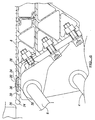
- FIG. 2 there is illustrated a typical cantilever tail-lift assembly, said assembly comprising hydraulically actuated arms 2, 4 which, as indicated by broken lines, can move outwardly from the rear of a goods storage trailer 6 to move a platform 8 between different horizontal planes.
- the platform can move between a horizontal plane substantially in line with the floor 10 of the goods storage trailer and a horizontal plane adjacent the surface 12 so as to allow goods to be mounted on the platform and the surface 12 so as to allow goods to be mounted on the platform and then moved between the two positions or indeed any other positions within the range of movement of the platform.
- the platform can also be moved to a retracted position either lying vertically at the end of the vehicle or trailer or may fold to lie at or under the vehicle or trailer and this can occur in a conventional manner.
- the arms are typically activated by a hydraulic drive system which is controlled by control means 16 mounted on the vehicle or trailer.
- the actual use controls can be any of a range of devices and can be selected to suit particular user requirements and are therefore not described in any particular detail.
- the lift platform further includes a sensing means 20, said sensing means running along the width of the platform as indicated in both Figures 2 and 3 and, preferably in a continuous manner so as to ensure that the entire width of the trailer is covered by the sensing means.
- the sensing means are in turn connected to the control means by cabling, not shown, which allows the transfer of a data signal from the sensing means to the control means when activated. Upon receiving the control signal, the movement of the platform by the hydraulic drive system is immediately stopped.
- FIG. 4 there is provided a cross section through the line A-A of the edge portion 24 of the platform which lies adjacent the end 26 of the vehicle or trailer.
- this cross section which is a cross section of a platform formed from aluminium extrusion, there is illustrated the sensing means 20, also in cross section, and it is shown how the same are mounted in a recess channel 28.
- This recess channel serves to retain the sensing means in position and also allows the sensing means to be substantially flush with the top surface 30 of the platform.
- there is a raised portion in the form of part of the housing 34 of the sensing means which is typically formed of rubber or other similarly resilient but deformable material.
- electrical contacts 36, 38 Positioned within the housing are electrical contacts 36, 38 which, in the position shown, are in an open position thereby ensuring that no electrical contact is made between the two contacts and hence no signal is transmitted from the sensing means to the control means. However, if the top surface of the sensing means is depressed and deformed as indicated by the broken lines 40, pressure is applied to the electrical contacts 36, 38 which causes the same to come together and form the electrical contact and hence generate the signal to the control means.
- FIGS 5a and b illustrate the invention in use showing, in schematic form, the lift system in accordance with the invention in one embodiment.
- the feet of a person standing on the platform are shown, the edge of the platform adjacent the vehicle or trailer edge and the sensing means are also shown.
- the persons feet are well spaced away from the edge of the platform and therefore are well removed from the gap 42 which exists between the edge of the vehicle or trailer and the edge of the platform.
- the feet do not lie on the sensing means 20 and the control means for the platform allow the normal and conventional movement of the platform to occur but at the same time, ensuring that the operator's position on the platform is safe.
- This pressure causes an electrical contact to be made as described previously and causes a signal to be transmitted to the control means.
- the control means receives the signal, the movement of the platform is immediately stopped and will not be recommenced until the operator moves their feet away from the edge and hence off the sensing means 20 and subsequently keeps away from the edge of the platform.
- the invention therefore provides an effective and efficient manner of minimising injury risk to operators on a tail lift platform.
Landscapes
- Engineering & Computer Science (AREA)
- Transportation (AREA)
- Mechanical Engineering (AREA)
- Body Structure For Vehicles (AREA)
- Vehicle Step Arrangements And Article Storage (AREA)
Abstract
Description
Claims (18)
- A lift platform assembly for a vehicle, said assembly including a platform, which is movable, said platform mounted at the rear or side of the vehicle and having a top surface on which a person(s) and/or goods can stand and/or be placed, and control means to allow operator control of drive means which drive the movement of the platform and characterised in that the platform is provided with sensing means to detect the presence of part of a person's anatomy and/or article at a predetermined location on said platform.
- An assembly according to claim 1 characterised in that the sensing means are linked to the control means for the drive means such that when the sensing means are inactive, the platform is movable in response to the user control selections but when the sensing means are activated, the platform is immobilised.
- An assembly according to claim 2 characterised in that the movement of the drive means is stopped instantaneously upon receiving a signal from the sensing means.
- An assembly according to claim 1 characterised in that the sensing means are provided to be operative substantially continuously across the width of the platform.
- An assembly according to claim 1 characterised in that the sensing means are positioned so as to sense the presence of a person or article at or in proximity to the edge of the platform which is adjacent to the vehicle.
- An assembly according to claim 5 characterised in that the sensing means is offset from the edge by a predetermined distance.
- An assembly according to claim 1 characterised in that the sensing means are activated by the application of pressure thereon.
- An assembly according to claim 1 characterised in that the sensing means are substantially flush with the top surface of the platform.
- An assembly according to claim 1 characterised in that the platform is manufactured from aluminium extrusions joined edge to edge and at least one extrusion includes a recessed channel in which the sensing means are located and retained.
- An assembly according to claim 1 characterised in that the platform is formed from sheet material and a channel or location means for the sensing means is formed on the platform fabrication.
- An assembly according to claim 1 characterised in that the signal transmitted from the sensing means is an electrical data signal which passes to the control means via a cable connection or remote signal transmission.
- An assembly according to claim 1 characterised in that the drive means is a hydraulic drive with a hydraulic control system which is stopped once a signal is received from the sensing means.
- An assembly according to claim 1 characterised in that the sensing means comprises an elongate member or series of portions so provided to form an elongate member.
- An assembly according to claim 13 characterised in that the elongate member has a housing along the length thereof for the reception of electrical contact means.
- An assembly according to claim 1 wherein the platform is fitted to a goods vehicle and at an opening into the goods storage area.
- An assembly according to claim 15 characterised in that the goods storage area is integral with the vehicle.
- An assembly according to claim 15 characterised in that the goods storage area is a trailer couple to a tractor unit to form the vehicle.
- An assembly according to any of the preceding claims
Applications Claiming Priority (2)
| Application Number | Priority Date | Filing Date | Title |
|---|---|---|---|
| GB0305761A GB0305761D0 (en) | 2003-03-13 | 2003-03-13 | Lift platform |
| GB0305761 | 2003-03-13 |
Publications (2)
| Publication Number | Publication Date |
|---|---|
| EP1457382A2 true EP1457382A2 (en) | 2004-09-15 |
| EP1457382A3 EP1457382A3 (en) | 2006-07-19 |
Family
ID=9954704
Family Applications (1)
| Application Number | Title | Priority Date | Filing Date |
|---|---|---|---|
| EP04251447A Withdrawn EP1457382A3 (en) | 2003-03-13 | 2004-03-12 | Anti-trap device for a lift platform |
Country Status (2)
| Country | Link |
|---|---|
| EP (1) | EP1457382A3 (en) |
| GB (1) | GB0305761D0 (en) |
Cited By (2)
| Publication number | Priority date | Publication date | Assignee | Title |
|---|---|---|---|---|
| DE102008060767A1 (en) | 2008-12-05 | 2009-09-03 | Daimler Ag | Protective device for use in loading arrangement of transport vehicle, has laser sensors arranged at lower side on transport vehicle and/or loading arrangement of vehicle to detect person or object located in danger zone |
| US20220176861A1 (en) * | 2020-12-04 | 2022-06-09 | Cornerstone Manufacturing Company LLC | Lifting device mounted to a vehicle |
Family Cites Families (7)
| Publication number | Priority date | Publication date | Assignee | Title |
|---|---|---|---|---|
| DE3101877A1 (en) * | 1981-01-22 | 1982-08-05 | Fa. Manfred Ronig, 4200 Oberhausen | Rear wall for a lorry which can be used as a loading platform |
| DE3152422A1 (en) * | 1981-04-16 | 1983-03-24 | Emil Dautel GmbH, 7105 Leingarten | Foot-switch unit for an elevating loading platform |
| DE3538188A1 (en) * | 1985-03-28 | 1986-10-09 | Aluminium-Walzwerke Singen Gmbh, 7700 Singen | Coupled element of two connected profile elements |
| DE29607785U1 (en) * | 1996-04-30 | 1996-09-12 | MBB Liftsystems AG, 27777 Ganderkesee | Switch cover |
| DE19823535A1 (en) * | 1998-05-26 | 1999-12-02 | Gerd Baer | Foot control for a tail lift |
| FR2800333A1 (en) * | 1999-11-03 | 2001-05-04 | Cie Erhel Hydris | AUTOMATIC CONTROL DEVICE OF FUNCTIONAL DEVICES OF TRANSPORT VEHICLE |
| FR2807370A1 (en) * | 2000-04-10 | 2001-10-12 | Cie Erhel Hydris | Safety feature, for vehicle lifting door, comprises pivoted pressure plate attached to the leading edge of the platform such that when depressed an electrical contact is operated to stop the platform movement |
-
2003
- 2003-03-13 GB GB0305761A patent/GB0305761D0/en not_active Ceased
-
2004
- 2004-03-12 EP EP04251447A patent/EP1457382A3/en not_active Withdrawn
Cited By (2)
| Publication number | Priority date | Publication date | Assignee | Title |
|---|---|---|---|---|
| DE102008060767A1 (en) | 2008-12-05 | 2009-09-03 | Daimler Ag | Protective device for use in loading arrangement of transport vehicle, has laser sensors arranged at lower side on transport vehicle and/or loading arrangement of vehicle to detect person or object located in danger zone |
| US20220176861A1 (en) * | 2020-12-04 | 2022-06-09 | Cornerstone Manufacturing Company LLC | Lifting device mounted to a vehicle |
Also Published As
| Publication number | Publication date |
|---|---|
| EP1457382A3 (en) | 2006-07-19 |
| GB0305761D0 (en) | 2003-04-16 |
Similar Documents
| Publication | Publication Date | Title |
|---|---|---|
| US6431819B1 (en) | Power-up vehicle restraint | |
| US4865507A (en) | Dock leveler assembly and latch mechanism therefor | |
| US4122629A (en) | Dock safety apparatus | |
| JP4430663B2 (en) | Slide step | |
| EP0597009B1 (en) | Vehicle restraint | |
| US4830563A (en) | Multi-condition responsive vehicle restraining apparatus | |
| CA2666921C (en) | Vehicle restraint with bi-directional sensor | |
| US4124130A (en) | Safety barrier for a wheelchair lift | |
| US5096359A (en) | Vehicle restraint actuator | |
| CA1250106A (en) | Truck restraint system | |
| US4531248A (en) | Dockboard assembly | |
| US5465807A (en) | Safety guard for hand trucks or lift gates | |
| US5203663A (en) | Vehicle restraining mechanism | |
| US20060266275A1 (en) | Lead-in bumper for a loading dock | |
| US4556129A (en) | Trip mechanism for de-activating elevator platforms | |
| JP3132418B2 (en) | Elevator boarding type forklift | |
| US8816225B2 (en) | Static pressure anti-stow logic for platform wheelchair lifts | |
| US20010039687A1 (en) | Recycle control system for dock levelers | |
| EP1457382A2 (en) | Anti-trap device for a lift platform | |
| US6439823B1 (en) | Vehicle restraint device | |
| SK45693A3 (en) | Vehicle for removal of rubbish | |
| JPH02503187A (en) | Freight vehicle positioning device | |
| US6179544B1 (en) | Underride protection | |
| US20050077111A1 (en) | Threshold switch apparatus for a mobility access device | |
| JP3669846B2 (en) | Safety device for vehicles with cargo receiving lift |
Legal Events
| Date | Code | Title | Description |
|---|---|---|---|
| PUAI | Public reference made under article 153(3) epc to a published international application that has entered the european phase |
Free format text: ORIGINAL CODE: 0009012 |
|
| AK | Designated contracting states |
Kind code of ref document: A2 Designated state(s): AT BE BG CH CY CZ DE DK EE ES FI FR GB GR HU IE IT LI LU MC NL PL PT RO SE SI SK TR |
|
| AX | Request for extension of the european patent |
Extension state: AL HR LT LV MK |
|
| PUAL | Search report despatched |
Free format text: ORIGINAL CODE: 0009013 |
|
| AK | Designated contracting states |
Kind code of ref document: A3 Designated state(s): AT BE BG CH CY CZ DE DK EE ES FI FR GB GR HU IE IT LI LU MC NL PL PT RO SE SI SK TR |
|
| AX | Request for extension of the european patent |
Extension state: AL LT LV MK |
|
| AKX | Designation fees paid |
Designated state(s): AT BE BG CH CY CZ DE DK EE ES FI FR GB GR HU IE IT LI LU MC NL PL PT RO SE SI SK TR |
|
| STAA | Information on the status of an ep patent application or granted ep patent |
Free format text: STATUS: THE APPLICATION IS DEEMED TO BE WITHDRAWN |
|
| 18D | Application deemed to be withdrawn |
Effective date: 20070120 |