EP1454937A2 - Epoxy resin curing agent, curable epoxy resin composition and cured products - Google Patents
Epoxy resin curing agent, curable epoxy resin composition and cured products Download PDFInfo
- Publication number
- EP1454937A2 EP1454937A2 EP04250260A EP04250260A EP1454937A2 EP 1454937 A2 EP1454937 A2 EP 1454937A2 EP 04250260 A EP04250260 A EP 04250260A EP 04250260 A EP04250260 A EP 04250260A EP 1454937 A2 EP1454937 A2 EP 1454937A2
- Authority
- EP
- European Patent Office
- Prior art keywords
- epoxy resin
- formula
- curing agent
- resin curing
- alkyl group
- Prior art date
- Legal status (The legal status is an assumption and is not a legal conclusion. Google has not performed a legal analysis and makes no representation as to the accuracy of the status listed.)
- Withdrawn
Links
Classifications
-
- B—PERFORMING OPERATIONS; TRANSPORTING
- B63—SHIPS OR OTHER WATERBORNE VESSELS; RELATED EQUIPMENT
- B63J—AUXILIARIES ON VESSELS
- B63J2/00—Arrangements of ventilation, heating, cooling, or air-conditioning
- B63J2/12—Heating; Cooling
-
- C—CHEMISTRY; METALLURGY
- C08—ORGANIC MACROMOLECULAR COMPOUNDS; THEIR PREPARATION OR CHEMICAL WORKING-UP; COMPOSITIONS BASED THEREON
- C08G—MACROMOLECULAR COMPOUNDS OBTAINED OTHERWISE THAN BY REACTIONS ONLY INVOLVING UNSATURATED CARBON-TO-CARBON BONDS
- C08G59/00—Polycondensates containing more than one epoxy group per molecule; Macromolecules obtained by polymerising compounds containing more than one epoxy group per molecule using curing agents or catalysts which react with the epoxy groups
- C08G59/18—Macromolecules obtained by polymerising compounds containing more than one epoxy group per molecule using curing agents or catalysts which react with the epoxy groups ; e.g. general methods of curing
- C08G59/40—Macromolecules obtained by polymerising compounds containing more than one epoxy group per molecule using curing agents or catalysts which react with the epoxy groups ; e.g. general methods of curing characterised by the curing agents used
- C08G59/62—Alcohols or phenols
- C08G59/621—Phenols
-
- B—PERFORMING OPERATIONS; TRANSPORTING
- B01—PHYSICAL OR CHEMICAL PROCESSES OR APPARATUS IN GENERAL
- B01F—MIXING, e.g. DISSOLVING, EMULSIFYING OR DISPERSING
- B01F23/00—Mixing according to the phases to be mixed, e.g. dispersing or emulsifying
- B01F23/40—Mixing liquids with liquids; Emulsifying
-
- B—PERFORMING OPERATIONS; TRANSPORTING
- B01—PHYSICAL OR CHEMICAL PROCESSES OR APPARATUS IN GENERAL
- B01F—MIXING, e.g. DISSOLVING, EMULSIFYING OR DISPERSING
- B01F27/00—Mixers with rotary stirring devices in fixed receptacles; Kneaders
- B01F27/80—Mixers with rotary stirring devices in fixed receptacles; Kneaders with stirrers rotating about a substantially vertical axis
-
- H—ELECTRICITY
- H05—ELECTRIC TECHNIQUES NOT OTHERWISE PROVIDED FOR
- H05B—ELECTRIC HEATING; ELECTRIC LIGHT SOURCES NOT OTHERWISE PROVIDED FOR; CIRCUIT ARRANGEMENTS FOR ELECTRIC LIGHT SOURCES, IN GENERAL
- H05B3/00—Ohmic-resistance heating
- H05B3/02—Details
Definitions
- the present invention relates to an epoxy resin curing agent and a curable epoxy resin composition containing the epoxy resin curing agent and an epoxy resin.
- the curable resin composition containing the epoxy resin curing agent of the present invention and an epoxy resin can provide a polymer material excellent in heat resistance and low dielectric characteristics and low in water absorptivity by curing it.
- the curable resin composition of the present invention can be widely used for applications such as a semiconductor-sealing material, an electrical insulating material, a resin for a copper-clad laminate, a resist, a sealing resin for electronic parts, a resin for a color filter of a liquid crystal, a coating composition, various coating agents, an adhesive, a material for a buildup laminate and FRP.
- Epoxy resins have been used as a raw material for a functional polymer material.
- physical properties required as a functional polymer material become severer increasingly.
- physical properties for example, heat resistance, weather resistance, chemical resistance, low water absorptivity, high fracture toughness, low dielectric constant and low dielectric loss tangent are required.
- epoxy resin cured products are widely used as an insulating material in a printed circuit board field.
- the conventional epoxy resin cured products are becoming insufficient in dielectric characteristics from a signal fade problem attendant upon a recent increase in the frequency of a signal, so that a material having further lower dielectric characteristics is desired.
- a semiconductor-sealing material is required to have high heat resistance and low moisture absorptivity, since cracks occur in the semiconductor-sealing material because of exposure to a high temperature during soldering and because of swelling of an absorbed water content. It can not be said that epoxy resin sealing materials using a cresol novolak type epoxy resin and a phenol novolak type resin curing agent, which sealing materials are chiefly used now, are sufficient in both heat resistance and moisture absorptivity.
- JP-A-9-208673 proposes a method using, for example, an epoxy resin curing agent and indene as an additive.
- an epoxy resin curing agent and indene as an additive.
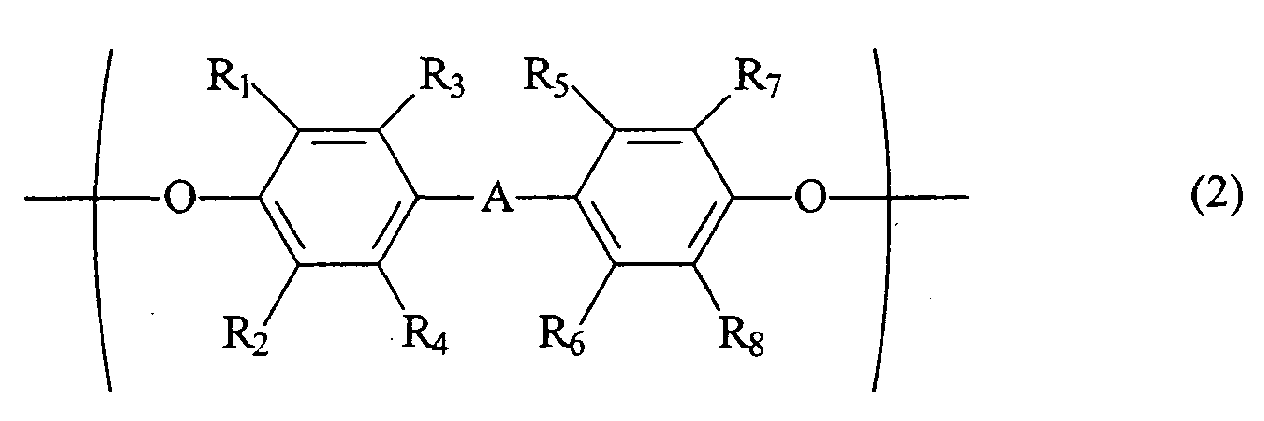
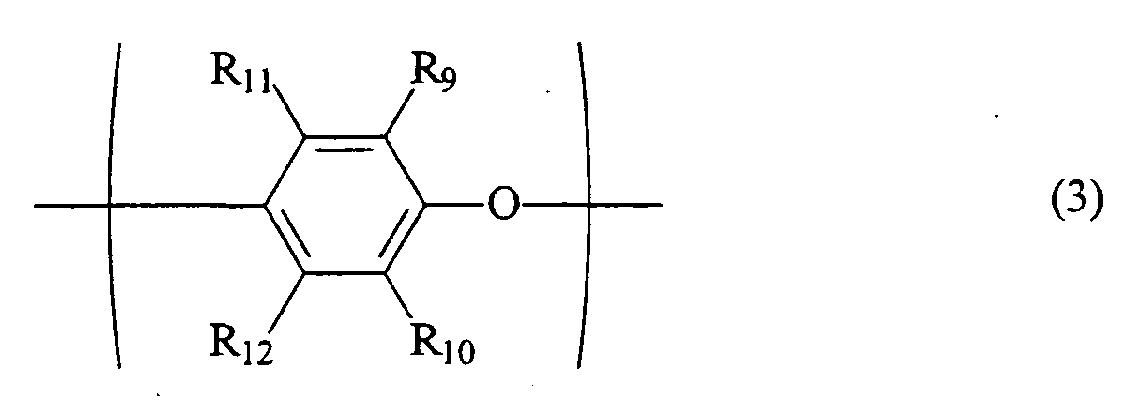
- an epoxy resin curing agent having a number average molecular weight of 500 to 3,000, represented by the formula (1), wherein -(O-X-O)- is represented by the formula (2) (in which R 1 , R 2 , R 7 and R 8 may be the same or different and are a halogen atom, an alkyl group having 6 or less carbon atoms or a phenyl group, R 3 , R 4 , R 5 and R 6 may be the same or different and are a hydrogen atom, a halogen atom, an alkyl group having 6 or less carbon atoms or a phenyl group, and A is a direct bond or a linear, branched or cyclic hydrocarbon having 20 or less carbon atoms), -(Y-O)- is an arrangement of one kind of structure defined by the formula (3) or a random arrangement of at least two kinds of structures defined by the formula (3) (in which R 9 and R 10 may be the same or different and are a halogen
- a curable epoxy resin composition containing an epoxy resin and the above epoxy resin curing agent.
- a cured product obtainable by curing the above resin composition.
- the present inventors have made diligent studies and as a result found that, when a bifunctional phenylene ether oligomer having the excellent dielectric characteristics and heat resistance of a polyphenylene ether (to be sometimes referred to as "PPE" hereinafter) structure and having a number average molecular weight of 500 to 3,000 is used as an epoxy resin curing agent and the above oligomer and an epoxy resin are combined and cured, there can be obtained a cured product having excellent heat resistance, low dielectric characteristics and low water absorptivity.
- PPE polyphenylene ether
- R 1 , R 2 , R 7 and R 8 may be the same or different and are a halogen atom, an alkyl group having 6 or less carbon atoms or a phenyl group.
- R 3 , R 4 , R 5 and R 6 may be the same or different and are a hydrogen atom, a halogen atom, an alkyl group having 6 or less carbon atoms or a phenyl group.
- A is a direct bond or a linear, branched or cyclic hydrocarbon having 20 or less carbon atoms.
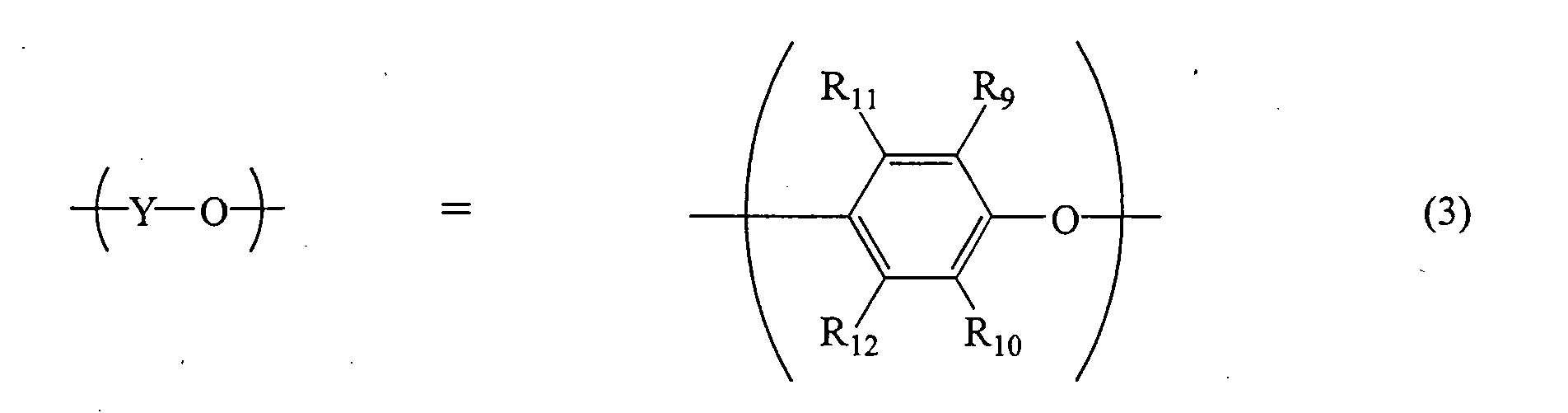
- -(Y-O-) is represented by the formula (3) and is an arrangement of one kind of structure defined by the formula (3) or a random arrangement of at least two kinds of structures defined by the formula (3).
- R 9 and R 10 may be the same or different and are a halogen atom, an alkyl group having 6 or less carbon atoms or a phenyl group and R 11 and R 12 may be the same or different and are a hydrogen atom, a halogen atom, an alkyl group having 6 or less carbon atoms or a phenyl group.
- Each of a and b is an integer of 0 to 30, provided that at least either a or b is not 0.
- R 1 , R 2 , R 7 and R 8 are an alkyl group having 3 or less carbon atoms
- R 3 , R 4 , R 5 and R 6 are a hydrogen atom or an alkyl group having 3 or less carbon atoms
- R 9 and R 10 are an alkyl group having 3 or less carbon atoms
- R 11 and R 12 are a hydrogen atom or an alkyl group having 3 or less carbon atoms.
- an epoxy resin curing agent wherein R 1 , R 2 , R 7 and R 8 in -(O-X-O)- of the formula (2) are a methyl group and -(Y-O)- has a structure of an arrangement of the formula (4) or the formula (5) or a random arrangement of the formula (4) and the formula (5), Particularly preferred are an epoxy resin curing agent according to the above epoxy resin curing agent, wherein R 3 , R 4 , R 5 and R 6 in -(O-X-O)- of the formula (2) are a hydrogen group, and an epoxy resin curing agent according to the above epoxy resin curing agent, wherein, in -(O-X-O)- of the formula (2), R 3 and R 6 are a hydrogen group and R 4 and R 5 are a methyl group.
- epoxy resin curing agents wherein -(Y-O)- is represented by the formula (5).
- the process for producing the epoxy resin curing agent represented by the formula (1) is not specially limited.
- the above epoxy resin curing agent can be produced by any process. For example, it can be produced by oxidatively coupling a bifunctional phenol compound and a monofunctional phenol compound in the presence of copper and an amine according to the method disclosed in JP-A-2003-212990.
- the epoxy resin curing agent represented by the formula (1) When the epoxy resin curing agent represented by the formula (1) is used to produce the curable epoxy resin composition, it is preferred to incorporate the epoxy resin curing agent and the epoxy resin such that the molar ratio (B/A) of the mole (A) of hydroxyl group of the epoxy resin curing agent and the mole (B) of epoxy group of the epoxy resin becomes 0.5 to 10.
- the above molar ratio (B/A) is particularly preferably 1 to 5.
- the epoxy resin used in the present invention can be selected from known epoxy resins. Examples thereof include a bisphenol A type epoxy resin, a bisphenol F type epoxy resin, a biphenyl type epoxy resin, a phenol novolak type epoxy resin, a cresol novolak type epoxy resin, a xylene novolak type epoxy resin, triglycidyl isocyanurate, an alicyclic epoxy resin, a dicyclopentadiene novolak type epoxy resin, a biphenyl novolak type epoxy resin and epoxy resins having a PPE structure disclosed in JP-A-2003-155340 and JP-A-2003-212990. These epoxy resins may be used alone or in combination.
- the curable epoxy resin composition of the present invention contains the above epoxy resin curing agent as an essential component.
- Other components to be contained are not specially limited, and a known epoxy curing agent may be used in combination. Examples thereof include phenols such as a phenol novolak resin, a cresol novolak resin, bisphenol A and bisphenol F, acid anhydrides such as methyl tetrahydro phthalic anhydride, hexahydro phthalic anhydride and pyromellitic anhydride, and amines such as diaminodiphenyl methane, diaminodiphenyl sulfone and dicyandiamide.
- phenols such as a phenol novolak resin, a cresol novolak resin, bisphenol A and bisphenol F
- acid anhydrides such as methyl tetrahydro phthalic anhydride, hexahydro phthalic anhydride and pyromellitic anhydride
- amines such as diamino
- the curable epoxy resin composition of the present invention contains the epoxy resin curing agent of the present invention in an amount of at least 5 wt%, preferably at least 10 wt%, based on. the total amount of all curing agents.
- the above amount is small, an effect of improving physical properties is small in some cases.
- the curable epoxy resin composition of the present invention may contain a known curing accelerator as required.
- a known curing accelerator examples thereof include imidazoles such as 2-methylimidazole, 2-ethyl-4-methylimidazole, 2-phenylimidazole, 1-cyanoethyl-2-phenylimidazole, 1-cyanoethyl-2-ethyl-4-methylimidazole, 2-phenyl-4,5-dihydroxymethylimidazole and 2-phenyl-4-methyl-5-hydroxymethylimidazole, phosphines such as tributyl phosphine, triphenylphosphine and tris(dimethoxyphenyl)phosphine, phosphonium salts such as tetraphenyl phosphonium borate and methyltributyl phosphonium tetraphenylborate, amines such as 2,4,6-tris(dimethylaminomethyl)phenol, benzyldimethylamine and
- the curable resin composition of the present invention may contain a curable resin other than the epoxy resin, as required.
- a curable resin other than the epoxy resin examples thereof include a cyanate resin, an oxetane resin and a resin having an ethylenic unsaturated group.
- the curable resin composition of the present invention when the curable resin composition of the present invention is produced, there may be added, as required, a known additive such as a glass fiber, an organic base material, an inorganic filler, a color pigment, an antifoamer, a surface conditioner, a flame retardant, an ultraviolet absorber, an antioxidant, a polymerization inhibitor, a flow regulator or a thermoplastic resin.
- a known additive such as a glass fiber, an organic base material, an inorganic filler, a color pigment, an antifoamer, a surface conditioner, a flame retardant, an ultraviolet absorber, an antioxidant, a polymerization inhibitor, a flow regulator or a thermoplastic resin.
- the inorganic filler examples include silicas such as natural silica, fused silica and amorphous silica, white carbon, titanium white, aerosil, alumina, talc, natural mica, synthetic mica, kaolin, clay, aluminum hydroxide, barium sulfate, E-glass, A-glass, C-glass, L-glass, D-glass, S-glass, NE glass and M-glass G20.
- silicas such as natural silica, fused silica and amorphous silica, white carbon, titanium white, aerosil, alumina, talc, natural mica, synthetic mica, kaolin, clay, aluminum hydroxide, barium sulfate, E-glass, A-glass, C-glass, L-glass, D-glass, S-glass, NE glass and M-glass G20.
- the so-obtained curable resin composition is suitable for various uses such as semiconductor-sealing material, an electrical insulating material, a resin for a copper-clad laminate, a resist, a sealing resin for electronic parts, a resin for a color filter of a liquid crystal, a coating composition, various coating agents, an adhesive, a material for a buildup laminate and FRP.
- the cured product of the present invention can be obtained by curing the curable resin composition of the present invention, obtained by the above method, according to a known method such as a curing method using an electron beam, ultraviolet light or heat.
- the epoxy resin curing agent of the present invention can provide a cured product having a higher glass transition temperature and having low dielectric constant, low dielectric loss tangent and low water absorptivity. Therefore, it is remarkably useful as a high-functional polymer material and it can be widely used, as a thermally and electrically excellent material, for various applications such as a semiconductor-sealing material, an electrical insulating material, a resin for a copper-clad laminate, a resist, a sealing resin for electronic parts, a resin for a color filter of a liquid crystal, a coating composition, various coating agents, an adhesive, a material for a buildup laminate and FRP.
- a longitudinally long reactor having a volume of 12 liters and equipped with a stirrer, a thermometer, an air-introducing tube and baffleplates was charged with 2.77 g (12.5 mmol) of CuBr 2 , 0.54 g (3.1 mmol) of N,N'-di-t-butylethylenediamine, 20.03 g (198.3 mmol) of n-butyldimethylamine and 2,600 g of toluene.
- the components were stirred at a reaction temperature of 40 °C.
- HMBP 2,2',3,3',5,5'-hexamethyl-(1,1'-biphenyl)-4,4'-diol
- the obtained mixed solution was dropwise added to the mixture in the reactor over 230 minutes while carrying out bubbling with 5.2L/min of a mixed gas of nitrogen and air which gas had an oxygen concentration of 8 %, and stirring was carried out.
- 1,500 g of water in which 14.20 g (37.4 mmol) of tetrasodium ethylenediamine tetraacetate was dissolved was added to the stirred mixture to terminate the reaction.
- An aqueous layer and an organic layer were separated. Then, the organic layer was washed with 1.0N hydrochloric acid aqueous solution and then washed with pure water.
- the thus-obtained solution was concentrated by an evaporator and then dried under a reduced pressure, to obtain 295.6 g of a curing agent of the present invention.
- the curing agent had a number average molecular weight of 650, a weight average molecular weight of 1,040 and a hydroxyl group equivalent of 325.
- a longitudinally long reactor having a volume of 12 liters and equipped with a stirrer, a thermometer, an air-introducing tube and baffleplates was charged with 6.64 g (29.9 mmol) of CuBr 2 , 1.29 g (7.5 mmol) of N,N'-di-t-butylethylenediamine, 48.07 g (475.9 mmol) of n-butyldimethylamine and 2,600 g of toluene.
- the components were stirred at a reaction temperature of 40 °C.
- the obtained mixed solution was dropwise added to the mixture in the reactor over 230 minutes while carrying out bubbling with 5.2L/min of a mixed gas of nitrogen and air which gas had an oxygen concentration of 8 %, and stirring was carried out.
- a longitudinally long reactor having a volume of 12 liters and equipped with a stirrer, a thermometer, an air-introducing tube and baffleplates was charged with 9.36 g (42.1 mmol) of CuBr 2 , 1.81 g (10.5 mmol) of N,N'-di-t-butylethylenediamine, 67.77 g (671.0 mmol) of n-butyldimethylamine and 2,600 g of toluene.
- the components were stirred at a reaction temperature of 40 °C.
- the obtained mixed solution was dropwise added to the mixture in the reactor over 230 minutes while carrying out bubbling with 5.2L/min of a mixed gas of nitrogen and air which gas had an oxygen concentration of 8 %, and stirring was carried out.
- the curing agent obtained in Synthesis Example 1 an epoxy resin and a curing accelerator were mixed as shown in Table 1, such that the molar ratio (epoxy group/hydroxyl group) of a hydroxyl group and an epoxy group became 2.
- the mixture was molten, degassed and molded at 120 °C, and then it was cured at 180 °C for 10 hours, whereby a cured product was obtained.
- Each of the curing agents of the present invention obtained in Synthesis Examples 1, 2 and 3 was respectively mixed with an epoxy resin and a curing accelerator as shown in Table 1 such that the molar ratio (epoxy group/hydroxyl group) of a hydroxyl group and an epoxy group became 1, the mixture was molten, degassed and molded at 120 °C and then it was cured at 180 °C for 10 hours, whereby cured products were obtained.
- An epoxy resin, an epoxy curing agent and a curing accelerator were mixed as shown in Table 1, and the mixture was molten, degassed and molded at 120 °C and then cured at 180 °C for 10 hours, whereby a cured product was obtained.
- Bisphenol A type epoxy Epikote 828 (supplied by Japan epoxy resin) Cresol novolak type Epoxy: EOCN102S (supplied by Nippon Kayaku Co., Ltd.) Dicyclopentadiene novolak type Epoxy: HP7200 (supplied by DAINIPPON INK AND CHEMICALS, INCORPORATED) Phenol novolak resin: TD2093 (supplied by DAINIPPON INK AND CHEMICALS, INCORPORATED)
- the cured products obtained in Examples 1 to 5 and Comparative Examples 1 to 3 were evaluated for properties by the following methods.
- Glass transition temperature (Tg) Obtained according to a dynamic viscoelasticity measurement (DMA). The measurement was carried out at an oscillation frequency of 10 Hz.
- Dielectric constant and dielectric loss tangent Obtained according to a cavity resonant oscillation method.
- Water absorption rate A water absorption rate after a treatment of 121°C, 100%Rh and 100 hours was measured.
- a longitudinally long reactor having a volume of 2 liters and equipped with a stirrer, a thermometer, an air-introducing tube and baffleplates was charged with 1.3 g (0.012 mol) of CuCl, 70.7 g (0.55 mol) of di-n-butylamine and 400 g of methyl ethyl ketone. The components were stirred at a reaction temperature of 40 °C.
- the resin curing agent had a number average molecular weight of 845, a weight average molecular weight of 1,106 and a hydroxyl group equivalent of 451.
- a longitudinally long reactor having a volume of 2 liters and equipped with a stirrer, a thermometer, an air-introducing tube and baffleplates was charged with 1.3 g (0.012 mol) of CuCl, 70.7 g (0.55 mol) of di-n-butylamine and 400 g of methyl ethyl ketone. The components were stirred at a reaction temperature of 40 °C.
- the epoxy resin curing agent had a number average molecular weight of 877, a weight average molecular weight of 1,183 and a hydroxyl group equivalent of 477.
- a longitudinally long reactor having a volume of 2 liters and equipped with a stirrer, a thermometer, an air-introducing tube and baffleplates was charged with 1.3 g (0.012 mol) of CuCl, 70.7 g (0.55 mol) of di-n-butylamine and 400 g of methyl ethyl ketone. The components were stirred at a reaction temperature of 40 °C.
- the epoxy resin curing agent had a number average molecular weight of 852, a weight average molecular weight of 1,133 and a hydroxyl group equivalent of 460.
- a longitudinally long reactor having a volume of 2 liters and equipped with a stirrer, a thermometer, an air-introducing tube and baffleplates was charged with 1.3 g (0.012 mol) of CuCl, 70.7 g (0.55 mol) of di-n-butylamine and 400 g of methyl ethyl ketone. The components were stirred at a reaction temperature of 40 °C.
- the epoxy resin curing agent had a number average molecular weight of 934, a weight average molecular weight of 1,223 and a hydroxyl group equivalent of 496.
- a longitudinally long reactor having a volume of 2 liters and equipped with a stirrer, a thermometer, an air-introducing tube and baffleplates was charged with 1.3 g (0.012 mol) of CuCl, 70.7 g (0.55 mol) of di-n-butylamine and 400 g of methyl ethyl ketone. The components were stirred at a reaction temperature of 40 °C.
- the epoxy resin curing agent had a number average molecular weight of 801, a weight average molecular weight of 1,081 and a hydroxyl group equivalent of 455.
- a longitudinally long reactor having a volume of 5 liters and equipped with a stirrer, a thermometer, an air-introducing tube and baffleplates was charged with 2.8 g (0.028 mol ) of CuCl, 169.7 g (1.32 mol) of di-n-butylamine and 1,000 g of methyl ethyl ketone. The components were stirred at a reaction temperature of 40 °C.
- the thus-obtained solution was concentrated by an evaporator and then dried under a reduced pressure, to obtain 212.5 g of an epoxy resin curing agent of the present invention represented by the formula (1).
- the epoxy resin curing agent had a number average molecular weight of 1,613, a weight average molecular weight of 2,420 and a hydroxyl group equivalent of 834.
- a longitudinally long reactor having a volume of 5 liters and equipped with a stirrer, a thermometer, an air-introducing tube and baffleplates was charged with 3.9 g (0.039 mol) of CuCl, 237.5 g (1.84 mol) of di-n-butylamine and 1,300 g of methyl ethyl ketone. The components were stirred at a reaction temperature of 40 °C.
- the thus-obtained solution was concentrated by an evaporator and then dried under a reduced pressure, to obtain 305 g of an epoxy resin curing agent of the present invention represented by the formula (1).
- the epoxy resin curing agent had a number average molecular weight of 2,150, a weight average molecular weight of 3,256 and a hydroxyl group equivalent of 1,093.
- the epoxy resin curing agent obtained in Synthesis Example 4 an epoxy resin and a curing accelerator were mixed as shown in Table 3 such that the molar ratio (epoxy group/hydroxyl group) of hydroxyl group and epoxy group became 2.6, the mixture was molten, degassed and molded at 120 °C, and then it was cured at 180 °C for 10 hours, whereby a cured product was obtained.
- Each of the epoxy resin curing agents obtained in Synthesis Examples 4 to 10 was respectively mixed with an epoxy resin and a curing accelerator as shown in Table 3 such that the molar ratio (epoxy group/hydroxyl group) of a hydroxyl group and an epoxy group became 1, the mixture was molten, degassed and molded at 120 °C and then it was cured at 180 °C for 10 hours, whereby cured products were obtained.
- An epoxy resin, an epoxy curing agent and a curing accelerator were mixed as shown in Table 3, and the mixture was molten, degassed and molded at 120 °C and then cured at 180 °C for 10 hours, whereby a cured product was obtained.
- An epoxy resin, an epoxy curing agent and a curing accelerator were mixed as shown in Table 3 such that the molar ratio (epoxy group/hydroxyl group) of a hydroxyl group and an epoxy group became 1, the mixture was molten, degassed and molded at 120 °C, and then it was cured at 180 °C for 10 hours, whereby cured products were obtained.
- Bisphenol A type epoxy Epikote 828 (supplied by Japan epoxy resin) Cresol novolak type Epoxy: EOCN102S (supplied by Nippon Kayaku Co., Ltd.) Dicyclopentadiene novolak type Epoxy: HP7200 (supplied by DAINIPPON INK AND CHEMICALS, INCORPORATED) Phenol novolak resin: TD2093 (supplied by DAINIPPON INK AND CHEMICALS, INCORPORATED)
- Table 4 shows evaluation results of physical properties of the cured products.
- -(Y-O)- is a moiety of the formula (3) or a random arrangement of from 2 to 10, preferably 2 to 5, more preferably 2 to 3 moieties of the formula (3).
- -(Y-O)- is a moiety of the formula (4) or (5), or a random arrangement of from 2 to 10, preferably 2 to 5, more preferably 2 to 3 moieties of the formula (4) or (5).
Landscapes
- Chemical & Material Sciences (AREA)
- Chemical Kinetics & Catalysis (AREA)
- Health & Medical Sciences (AREA)
- Medicinal Chemistry (AREA)
- Polymers & Plastics (AREA)
- Organic Chemistry (AREA)
- Engineering & Computer Science (AREA)
- Combustion & Propulsion (AREA)
- Mechanical Engineering (AREA)
- Ocean & Marine Engineering (AREA)
- Epoxy Resins (AREA)
- Epoxy Compounds (AREA)
Abstract

- -(O-X-O)- represents a moiety of the formula (2
- -(Y-O)- is a moiety of the formula (3),
- each of a and b is an integer of 0 to 30, provided that at least either a or b is not 0.
Description




| Ex.1 | Ex.2 | Ex.3 | Ex.4 | Ex.5 | CEx. 1 | CEx. 2 | CEx. 3 | ||
| Epoxy resin | Bisphenol A type epoxy | 100 | - | - | - | - | 100 | - | - |
| Cresol novolak type epoxy | - | 100 | 100 | 100 | - | - | 100 | - | |
| Dicyclopentadiene novolak type epoxy | - | - | - | - | 100 | - | - | 100 | |
| Curing agent | Oligomer of Syn-Ex.1 | 100 | 171 | - | - | 118 | - | - | - |
| Oligomer of Syn-Ex.2 | - | - | 395 | - | - | - | - | - | |
| Oligomer of Syn-Ex.3 | - | - | - | 521 | - | - | - | - | |
| Phenol novolak resin | - | - | - | - | - | - | 54 | 37 | |
| Curing accelerator | 2-ethyl-4-methyl imidazole | 0.5 | 0.2 | 0.2 | 0.2 | 0.2 | 2 | 0.2 | 0.2 |
| Ex. = Example, CEx. = Comparative Example, Syn-Ex.=Synthesis Example |
Cresol novolak type Epoxy: EOCN102S (supplied by Nippon Kayaku Co., Ltd.)
Dicyclopentadiene novolak type Epoxy: HP7200 (supplied by DAINIPPON INK AND CHEMICALS, INCORPORATED)
Phenol novolak resin: TD2093 (supplied by DAINIPPON INK AND CHEMICALS, INCORPORATED)
Glass transition temperature (Tg): Obtained according to a dynamic viscoelasticity measurement (DMA). The measurement was carried out at an oscillation frequency of 10 Hz.
Dielectric constant and dielectric loss tangent: Obtained according to a cavity resonant oscillation method.
Water absorption rate: A water absorption rate after a treatment of 121°C, 100%Rh and 100 hours was measured.
| Ex.1 | Ex.2 | Ex.3 | Ex.4 | Ex.5 | CEx.1 | CEx.2 | CEx.3 | |
| Tg (°C) | 155 | 151 | 154 | 155 | 151 | 108 | 157 , | 160 |
| Dielectric constant (1GHz) | 2.85 | 2.83 | 2.80 | 2.79 | 2.83 | 3.26 | 3.22 | 3.17 |
| Dielectric loss tangent (1GHz) | 0.017 | 0.015 | 0.012 | 0.011 | 0.014 | 0.035 | 0.031 | 0.031 |
| Water absorption rate | 0.9 | 0.7 | 0.5 | 0.4 | 0.6 | 1.7 | 1.9 | 1.7 |
| Ex. = Example, CEx. = Comparative Example |

Cresol novolak type Epoxy: EOCN102S (supplied by Nippon Kayaku Co., Ltd.)
Dicyclopentadiene novolak type Epoxy: HP7200 (supplied by DAINIPPON INK AND CHEMICALS, INCORPORATED)
Phenol novolak resin: TD2093 (supplied by DAINIPPON INK AND CHEMICALS, INCORPORATED)

Claims (10)
- An epoxy resin curing agent having a number average molecular weight of 500 to 3,000, represented by the formula (1),wherein:
 -(O-X-O)- represents a moiety of the formula (2)in which R1, R2, R7 and R8 are the same or different and represent a halogen atom, a C1-C6 alkyl group or a phenyl group, R3, R4, R5 and R6 are the same or different and represent a hydrogen atom, a halogen atom, a C1-C6 alkyl group or a phenyl group, and A is a direct bond or a linear, branched or cyclic C1-C20 hydrocarbon group;
 -(Y-O)- is a moiety of the formula (3),in which R9 and R10 are the same or different and represent a halogen atom, a C1-C6 alkyl group or a phenyl group and R11 and R12 are the same or different and represent a hydrogen atom, a halogen atom; a C1-C6 alkyl group or a phenyl group or -(Y-O)- is a random arrangement of at least two kinds of moieties of the formula (3); and
 each of a and b is an integer of 0 to 30, provided that at least either a or b is not 0.
 - An epoxy resin curing agent according to claim 1, wherein R1, R2, R7 and R8 are methyl groups and -(Y-O)- is a moiety of the formula (4) or the formula (5) or a random arrangement of at least two moieties of the formula (4) and the formula (5),

- An epoxy resin curing agent according to claim 1 or 2, wherein R3, R4, R5 and R6 are hydrogen atoms.
- An epoxy resin curing agent according to claim 1 or 2, wherein R3 and R6 are hydrogen atoms and R4 and R5 are methyl groups.
- An epoxy resin curing agent according to any one of the preceding claims, wherein at least one -(Y-O)- is a moiety of the formula (5).
- An epoxy resin curing agent according to claim 5, wherein each -(Y-O)- is a moiety of the formula (5).
- Use of a compound of the formula (1), as defined in any one of the preceding claims to cure an epoxy resin.
- A curable epoxy resin composition containing an epoxy resin and a compound of the formula (1), as defined in any one of claims 1 to 6.
- A cured product obtainable by curing the curable epoxy resin according to claim 8.
- A printed circuit board containing, as a substrate, a cured product according to claim 9.
Applications Claiming Priority (4)
| Application Number | Priority Date | Filing Date | Title |
|---|---|---|---|
| JP2003012119 | 2003-01-21 | ||
| JP2003012119A JP2004224860A (en) | 2003-01-21 | 2003-01-21 | Epoxy resin curing agent and curable epoxy resin composition and cured product |
| JP2003020149 | 2003-01-29 | ||
| JP2003020149A JP2004231728A (en) | 2003-01-29 | 2003-01-29 | Epoxy resin curing agent and curable epoxy resin composition and cured product |
Publications (2)
| Publication Number | Publication Date |
|---|---|
| EP1454937A2 true EP1454937A2 (en) | 2004-09-08 |
| EP1454937A3 EP1454937A3 (en) | 2005-01-12 |
Family
ID=32737709
Family Applications (1)
| Application Number | Title | Priority Date | Filing Date |
|---|---|---|---|
| EP04250260A Withdrawn EP1454937A3 (en) | 2003-01-21 | 2004-01-20 | Epoxy resin curing agent, curable epoxy resin composition and cured products |
Country Status (5)
| Country | Link |
|---|---|
| US (1) | US20040147715A1 (en) |
| EP (1) | EP1454937A3 (en) |
| KR (1) | KR20040068012A (en) |
| CN (1) | CN1517379A (en) |
| TW (1) | TW200416243A (en) |
Families Citing this family (20)
| Publication number | Priority date | Publication date | Assignee | Title |
|---|---|---|---|---|
| US7235192B2 (en) | 1999-12-01 | 2007-06-26 | General Electric Company | Capped poly(arylene ether) composition and method |
| US7148296B2 (en) * | 2003-10-03 | 2006-12-12 | General Electric Company | Capped poly(arylene ether) composition and process |
| US7329708B2 (en) * | 2004-08-18 | 2008-02-12 | General Electric Company | Functionalized poly(arylene ether) composition and method |
| JP4867217B2 (en) * | 2004-08-19 | 2012-02-01 | 三菱瓦斯化学株式会社 | Curable resin composition and curable film and film |
| KR100641358B1 (en) * | 2004-09-23 | 2006-11-01 | 삼성전자주식회사 | Manufacturing method of inkjet print head using photocurable resin composition |
| US7429800B2 (en) * | 2005-06-30 | 2008-09-30 | Sabic Innovative Plastics Ip B.V. | Molding composition and method, and molded article |
| US20070004871A1 (en) * | 2005-06-30 | 2007-01-04 | Qiwei Lu | Curable composition and method |
| US7378455B2 (en) * | 2005-06-30 | 2008-05-27 | General Electric Company | Molding composition and method, and molded article |
| US20080071035A1 (en) * | 2006-09-15 | 2008-03-20 | Delsman Erik R | Curable poly(arylene ether) composition and method |
| CN102702680A (en) * | 2006-09-15 | 2012-10-03 | 沙伯基础创新塑料知识产权有限公司 | Poly(arylene ether) composition, method, and article |
| US20080071036A1 (en) * | 2006-09-15 | 2008-03-20 | Delsman Erik R | Cured poly(arylene ether) composition, method, and article |
| US9070509B2 (en) * | 2007-01-11 | 2015-06-30 | Tyco Electronics Corporation | Method for manufacturing a planar electronic device having a magnetic component |
| US7655278B2 (en) * | 2007-01-30 | 2010-02-02 | Sabic Innovative Plastics Ip B.V. | Composite-forming method, composites formed thereby, and printed circuit boards incorporating them |
| EP2412740B1 (en) | 2009-03-26 | 2015-04-01 | Panasonic Corporation | Epoxy resin composition, prepreg, metal foil with resin, resin sheet, laminate and multi-layer board |
| JP5736718B2 (en) * | 2010-10-18 | 2015-06-17 | Jsr株式会社 | Radiation-sensitive resin composition, cured film and method for forming the same |
| JP5771944B2 (en) * | 2010-10-18 | 2015-09-02 | Jsr株式会社 | Manufacturing method of color filter |
| JP5899496B2 (en) * | 2011-08-05 | 2016-04-06 | パナソニックIpマネジメント株式会社 | Resin composition, resin varnish, prepreg, metal-clad laminate, and printed wiring board |
| JP5681951B2 (en) * | 2011-08-05 | 2015-03-11 | パナソニックIpマネジメント株式会社 | Resin composition, resin varnish, prepreg, metal-clad laminate, and printed wiring board |
| CN105542128A (en) * | 2015-12-15 | 2016-05-04 | 广东广山新材料有限公司 | Curing agent for epoxy resin as well as preparation method and application thereof |
| US10995182B2 (en) | 2018-04-30 | 2021-05-04 | Shpp Global Technologies B.V. | Phenylene ether oligomer, curable composition comprising the phenylene ether oligomer, and thermoset composition derived therefrom |
Family Cites Families (4)
| Publication number | Priority date | Publication date | Assignee | Title |
|---|---|---|---|---|
| DE3308421A1 (en) * | 1983-03-09 | 1984-09-13 | Bayer Ag, 5090 Leverkusen | METHOD FOR THE PRODUCTION OF BIFUNCTIONAL POLYPHENYLENE ETHERS |
| CN1101420C (en) * | 1997-11-25 | 2003-02-12 | 通用电气公司 | Poly (phenylene ether) thermoset compositions |
| JP4736254B2 (en) * | 2001-06-28 | 2011-07-27 | 三菱瓦斯化学株式会社 | Bifunctional phenylene ether oligomer and its production method |
| US7071266B2 (en) * | 2003-01-17 | 2006-07-04 | Mitsubishi Gas Chemical Company, Inc. | Curable resin composition and cured product thereof |
-
2004
- 2004-01-19 TW TW093101353A patent/TW200416243A/en unknown
- 2004-01-20 EP EP04250260A patent/EP1454937A3/en not_active Withdrawn
- 2004-01-20 KR KR1020040004279A patent/KR20040068012A/en not_active Withdrawn
- 2004-01-20 CN CNA2004100390371A patent/CN1517379A/en active Pending
- 2004-01-20 US US10/759,157 patent/US20040147715A1/en not_active Abandoned
Also Published As
| Publication number | Publication date |
|---|---|
| EP1454937A3 (en) | 2005-01-12 |
| KR20040068012A (en) | 2004-07-30 |
| US20040147715A1 (en) | 2004-07-29 |
| CN1517379A (en) | 2004-08-04 |
| TW200416243A (en) | 2004-09-01 |
Similar Documents
| Publication | Publication Date | Title |
|---|---|---|
| US20040147715A1 (en) | Epoxy resin curing agent, curable epoxy resin composition and cured product | |
| EP1439209B1 (en) | Curable resin composition and cured product thereof | |
| US9199434B2 (en) | Resin composition, prepreg and their uses | |
| US6900269B2 (en) | Halogen-free resin composition | |
| JP6025952B1 (en) | Vinyl benzylated phenol compound, method for producing vinyl benzylated phenol compound, active ester resin, method for producing active ester resin, thermosetting resin composition, cured product of thermosetting resin composition, interlayer insulating material, Prepreg and method for producing prepreg | |
| JP5186221B2 (en) | Flame retardant resin composition, prepreg, laminate, metal-clad laminate, printed wiring board and multilayer printed wiring board using the same | |
| KR101903431B1 (en) | Vinyl-benzylated phenol compound, method for manufacturing the vinyl-benzylated phenol compound, active ester resin, method for manufacturing the active ester resin, thermosetting resin composition, cured product of the thermosetting resin composition, interlayer insulating material, prepreg, and method for manufacturing the prepreg | |
| KR20090105859A (en) | Resin Compositions, Prepregs and Metal-Foil-Clad Laminates | |
| WO2013047041A1 (en) | Resin composition, prepreg, and metal foil-clad laminate | |
| TWI742643B (en) | Resin composition, prepreg sheet and insulating board using the same | |
| JP5234962B2 (en) | Prepreg, laminated board and printed wiring board | |
| JP2004231728A (en) | Epoxy resin curing agent and curable epoxy resin composition and cured product | |
| JP3895694B2 (en) | Oligomer-modified epoxy resin, composition thereof, and printed wiring board using the composition | |
| JP3664124B2 (en) | Flame retardant resin composition, prepreg, laminate, metal-clad laminate, printed wiring board and multilayer printed wiring board using the same | |
| CN102134431B (en) | Composition of low dielectric resin varnish for laminate and its preparation method | |
| JP4300401B2 (en) | Curable resin composition and cured product thereof | |
| JP2004224860A (en) | Epoxy resin curing agent and curable epoxy resin composition and cured product | |
| JP4410619B2 (en) | Electrical laminates and printed wiring boards | |
| JP4198935B2 (en) | Bifunctional epoxy resin and epoxy resin composition | |
| CN100365035C (en) | Phosphorus-containing polymer with phenolic structure and application thereof | |
| CN100489027C (en) | Flame-retardant epoxy resin composition and phosphorus-containing compound | |
| JP4359746B2 (en) | Curable resin composition and cured product thereof | |
| JP2796737B2 (en) | Laminate resin composition | |
| JPH0830123B2 (en) | A cloth-like or mat-like substrate for an electric insulating material impregnated with an epoxy resin composition | |
| CN117164818A (en) | Epoxy resin containing polytetrafluoroethylene structure and epoxy resin composition |
Legal Events
| Date | Code | Title | Description |
|---|---|---|---|
| PUAI | Public reference made under article 153(3) epc to a published international application that has entered the european phase |
Free format text: ORIGINAL CODE: 0009012 |
|
| AK | Designated contracting states |
Kind code of ref document: A2 Designated state(s): AT BE BG CH CY CZ DE DK EE ES FI FR GB GR HU IE IT LI LU MC NL PT RO SE SI SK TR |
|
| AX | Request for extension of the european patent |
Extension state: AL LT LV MK |
|
| PUAL | Search report despatched |
Free format text: ORIGINAL CODE: 0009013 |
|
| AK | Designated contracting states |
Kind code of ref document: A3 Designated state(s): AT BE BG CH CY CZ DE DK EE ES FI FR GB GR HU IE IT LI LU MC NL PT RO SE SI SK TR |
|
| AX | Request for extension of the european patent |
Extension state: AL LT LV MK |
|
| 17P | Request for examination filed |
Effective date: 20050518 |
|
| AKX | Designation fees paid |
Designated state(s): DE FR GB |
|
| STAA | Information on the status of an ep patent application or granted ep patent |
Free format text: STATUS: THE APPLICATION IS DEEMED TO BE WITHDRAWN |
|
| 18D | Application deemed to be withdrawn |
Effective date: 20060627 |