EP1454906A1 - Conductive compound, electrode and sensor containing the same, and target molecule detection method using the sensor - Google Patents
Conductive compound, electrode and sensor containing the same, and target molecule detection method using the sensor Download PDFInfo
- Publication number
- EP1454906A1 EP1454906A1 EP04005433A EP04005433A EP1454906A1 EP 1454906 A1 EP1454906 A1 EP 1454906A1 EP 04005433 A EP04005433 A EP 04005433A EP 04005433 A EP04005433 A EP 04005433A EP 1454906 A1 EP1454906 A1 EP 1454906A1
- Authority
- EP
- European Patent Office
- Prior art keywords
- integer
- formula
- group
- compound
- probe
- Prior art date
- Legal status (The legal status is an assumption and is not a legal conclusion. Google has not performed a legal analysis and makes no representation as to the accuracy of the status listed.)
- Granted
Links
- 0 CC(C(C)=O)c1ccc(*(C)C)[s]1 Chemical compound CC(C(C)=O)c1ccc(*(C)C)[s]1 0.000 description 2
Images


Classifications
-
- C—CHEMISTRY; METALLURGY
- C07—ORGANIC CHEMISTRY
- C07D—HETEROCYCLIC COMPOUNDS
- C07D409/00—Heterocyclic compounds containing two or more hetero rings, at least one ring having sulfur atoms as the only ring hetero atoms
- C07D409/14—Heterocyclic compounds containing two or more hetero rings, at least one ring having sulfur atoms as the only ring hetero atoms containing three or more hetero rings
-
- B—PERFORMING OPERATIONS; TRANSPORTING
- B82—NANOTECHNOLOGY
- B82Y—SPECIFIC USES OR APPLICATIONS OF NANOSTRUCTURES; MEASUREMENT OR ANALYSIS OF NANOSTRUCTURES; MANUFACTURE OR TREATMENT OF NANOSTRUCTURES
- B82Y15/00—Nanotechnology for interacting, sensing or actuating, e.g. quantum dots as markers in protein assays or molecular motors
-
- B—PERFORMING OPERATIONS; TRANSPORTING
- B82—NANOTECHNOLOGY
- B82Y—SPECIFIC USES OR APPLICATIONS OF NANOSTRUCTURES; MEASUREMENT OR ANALYSIS OF NANOSTRUCTURES; MANUFACTURE OR TREATMENT OF NANOSTRUCTURES
- B82Y30/00—Nanotechnology for materials or surface science, e.g. nanocomposites
-
- C—CHEMISTRY; METALLURGY
- C07—ORGANIC CHEMISTRY
- C07D—HETEROCYCLIC COMPOUNDS
- C07D333/00—Heterocyclic compounds containing five-membered rings having one sulfur atom as the only ring hetero atom
- C07D333/02—Heterocyclic compounds containing five-membered rings having one sulfur atom as the only ring hetero atom not condensed with other rings
- C07D333/04—Heterocyclic compounds containing five-membered rings having one sulfur atom as the only ring hetero atom not condensed with other rings not substituted on the ring sulphur atom
- C07D333/06—Heterocyclic compounds containing five-membered rings having one sulfur atom as the only ring hetero atom not condensed with other rings not substituted on the ring sulphur atom with only hydrogen atoms, hydrocarbon or substituted hydrocarbon radicals, directly attached to the ring carbon atoms
- C07D333/24—Radicals substituted by carbon atoms having three bonds to hetero atoms with at the most one bond to halogen, e.g. ester or nitrile radicals
-
- G—PHYSICS
- G01—MEASURING; TESTING
- G01N—INVESTIGATING OR ANALYSING MATERIALS BY DETERMINING THEIR CHEMICAL OR PHYSICAL PROPERTIES
- G01N33/00—Investigating or analysing materials by specific methods not covered by groups G01N1/00 - G01N31/00
- G01N33/48—Biological material, e.g. blood, urine; Haemocytometers
- G01N33/50—Chemical analysis of biological material, e.g. blood, urine; Testing involving biospecific ligand binding methods; Immunological testing
- G01N33/53—Immunoassay; Biospecific binding assay; Materials therefor
- G01N33/543—Immunoassay; Biospecific binding assay; Materials therefor with an insoluble carrier for immobilising immunochemicals
- G01N33/54366—Apparatus specially adapted for solid-phase testing
- G01N33/54373—Apparatus specially adapted for solid-phase testing involving physiochemical end-point determination, e.g. wave-guides, FETS, gratings
-
- H—ELECTRICITY
- H01—ELECTRIC ELEMENTS
- H01B—CABLES; CONDUCTORS; INSULATORS; SELECTION OF MATERIALS FOR THEIR CONDUCTIVE, INSULATING OR DIELECTRIC PROPERTIES
- H01B1/00—Conductors or conductive bodies characterised by the conductive materials; Selection of materials as conductors
- H01B1/06—Conductors or conductive bodies characterised by the conductive materials; Selection of materials as conductors mainly consisting of other non-metallic substances
- H01B1/12—Conductors or conductive bodies characterised by the conductive materials; Selection of materials as conductors mainly consisting of other non-metallic substances organic substances
- H01B1/124—Intrinsically conductive polymers
- H01B1/127—Intrinsically conductive polymers comprising five-membered aromatic rings in the main chain, e.g. polypyrroles, polythiophenes
-
- H—ELECTRICITY
- H01—ELECTRIC ELEMENTS
- H01M—PROCESSES OR MEANS, e.g. BATTERIES, FOR THE DIRECT CONVERSION OF CHEMICAL ENERGY INTO ELECTRICAL ENERGY
- H01M4/00—Electrodes
- H01M4/02—Electrodes composed of, or comprising, active material
- H01M4/36—Selection of substances as active materials, active masses, active liquids
- H01M4/60—Selection of substances as active materials, active masses, active liquids of organic compounds
-
- H—ELECTRICITY
- H01—ELECTRIC ELEMENTS
- H01M—PROCESSES OR MEANS, e.g. BATTERIES, FOR THE DIRECT CONVERSION OF CHEMICAL ENERGY INTO ELECTRICAL ENERGY
- H01M4/00—Electrodes
- H01M4/02—Electrodes composed of, or comprising, active material
- H01M4/36—Selection of substances as active materials, active masses, active liquids
- H01M4/60—Selection of substances as active materials, active masses, active liquids of organic compounds
- H01M4/602—Polymers
- H01M4/606—Polymers containing aromatic main chain polymers
- H01M4/608—Polymers containing aromatic main chain polymers containing heterocyclic rings
-
- Y—GENERAL TAGGING OF NEW TECHNOLOGICAL DEVELOPMENTS; GENERAL TAGGING OF CROSS-SECTIONAL TECHNOLOGIES SPANNING OVER SEVERAL SECTIONS OF THE IPC; TECHNICAL SUBJECTS COVERED BY FORMER USPC CROSS-REFERENCE ART COLLECTIONS [XRACs] AND DIGESTS
- Y02—TECHNOLOGIES OR APPLICATIONS FOR MITIGATION OR ADAPTATION AGAINST CLIMATE CHANGE
- Y02E—REDUCTION OF GREENHOUSE GAS [GHG] EMISSIONS, RELATED TO ENERGY GENERATION, TRANSMISSION OR DISTRIBUTION
- Y02E60/00—Enabling technologies; Technologies with a potential or indirect contribution to GHG emissions mitigation
- Y02E60/10—Energy storage using batteries
Definitions
- the present invention relates to a novel conductive compound, an electrode coated with the compound, a sensor including the electrode, and a target molecule detection method using the sensor.
- conductive polymer sensors In conductive polymer sensors, only a few representative monomers capable of being polymerized on electrodes are available, and it is difficult to control the physical properties of polymers. As a result, research into the conductive polymer sensor has been relatively slow.
- Representative conductive polymer sensor materials include pyrroles, thiophenes, anilines, and the like. However, because anilines can only be used in acidic conditions, pyrroles and thiophenes have been the main focus of research.
- pyrroles cannot be used for a long duration due to low redox potential (U.S. Patent No. 6,201,086).
- Thiophenes have a higher redox potential but are more hydrophobic than pyrroles, so they are unsuitable for water-based biomolecule systems (Bauerle P. and Emge A., Adv. Materi., 3:324 (1998)).
- conductive polymer sensors Another problem arising with conductive polymer sensors lies in that the chain length of polypyrroles or polythiophenes cannot be controlled, disabling formation of an even, thin polymer layer. Therefore, such conductive polymer sensors are unsuitable for detecting trace of a target molecule, such as DNA, which is essentially dispersed. Moreover, due to the difficulty in controlling the chain length of the conductive polymers, signals generated as a result of a reaction between the target molecule and the conductive polymer layer are not reproducible.
- the present invention provides a novel conductive compound capable of forming a self-assembled monolayer having a uniform thickness.
- the present invention also provides an electrode coated with the conductive compound and a sensor including the electrode.
- the present invention also provides a target molecule detection method using the sensor.
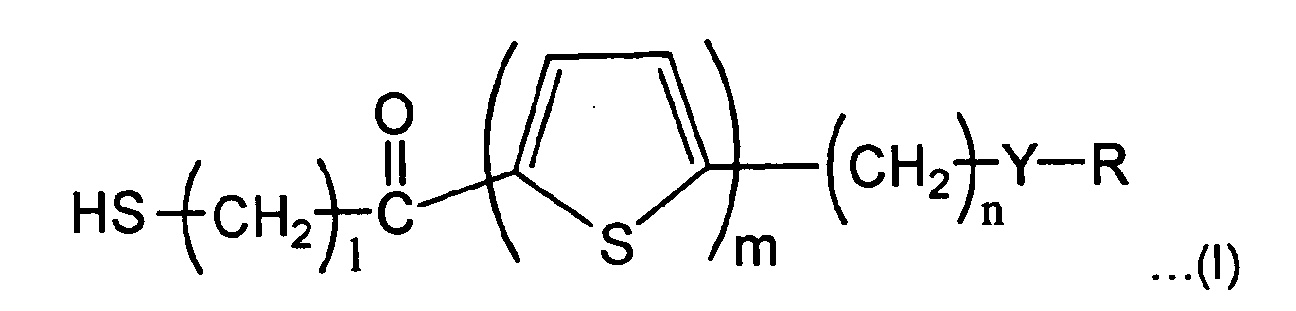
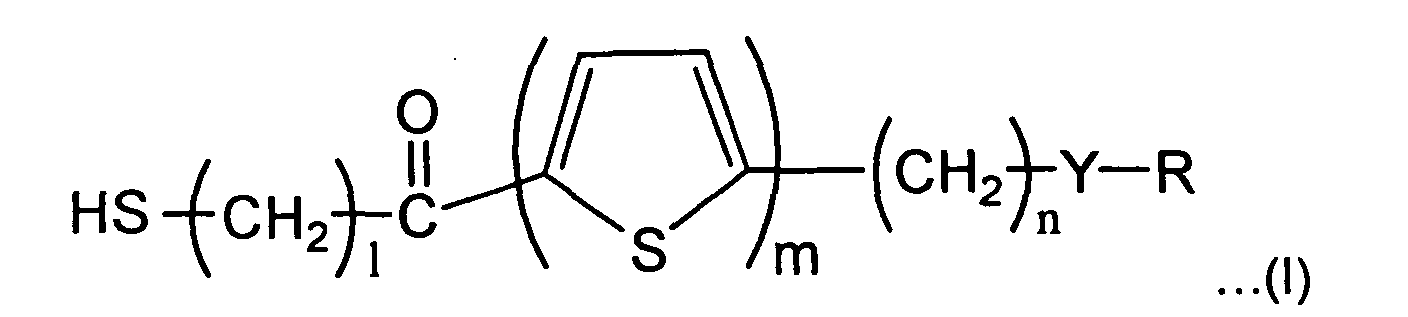
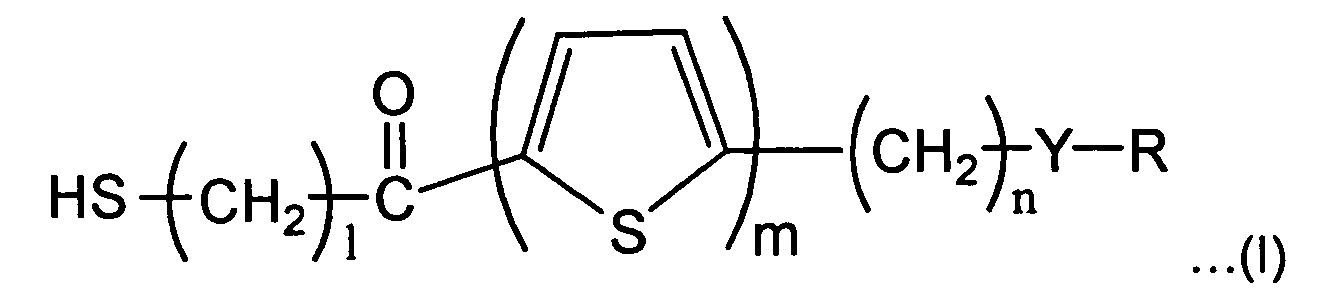
- a conductive compound of formula (1) below is provided: wherein Y is a carbonyl or -NH-; R is one of H, OH, a leaving group, and a probe group; I is an integer from 3 to 6; m is an integer from 1 to 4; and n is an integer from 0 to 3.
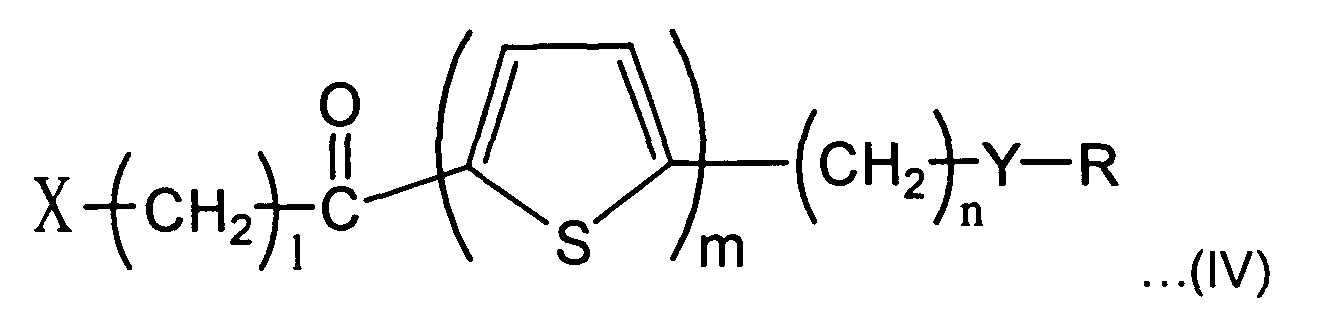
- a method of synthesizing the conductive compound of said formula (I) by reacting a compound of formula (IV) below with thiourea is provided: wherein Y is carbonyl or -NH-, R is one of H, OH, a leaving group, and a probe group, X is halogen atom, I is an integer from 3 to 6, m is an integer from 1 to 4, and n is an integer from 0 to 3.
- a method of synthesizing the conductive compound of formula (I), comprising reacting a compound of formula (V) below with a compound of formula (VI) below is provided: wherein R1, R2, and R3 are independently C 1 -C 8 alkyl groups; Y is carbonyl or -NH-group; R is one of H, OH, a leaving group, and a probe group; X is a halogen atom; I is an integer from 3 to 6; m1 and m2 are integers from 1 to 4 and 2 ⁇ m1 + m2 ⁇ 4; and n is an integer from 0 to 3.
- an electrode coated with the conductive compound of said formula (I), wherein the electrode being made of gold is provided.
- a sensor including an electrode coated with the conductive compound of said formula (I), wherein the electrode being made of gold is provided.
- a target molecule detection method comprising the following steps:
- a target molecule detection method comprising the following steps:
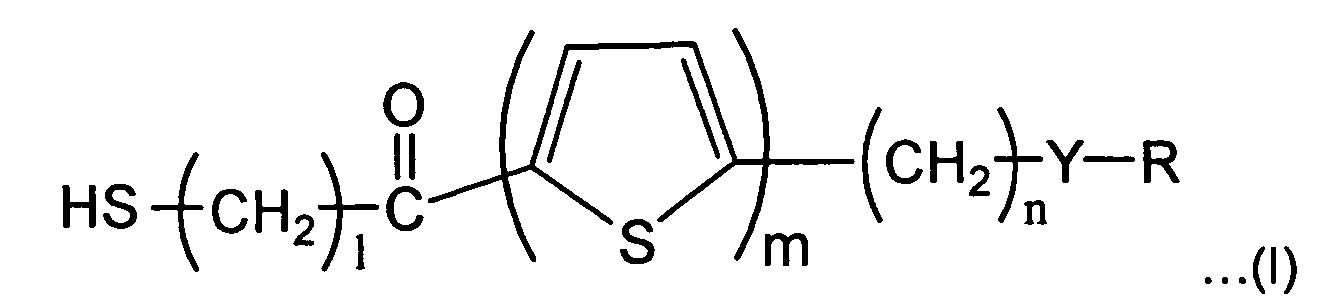
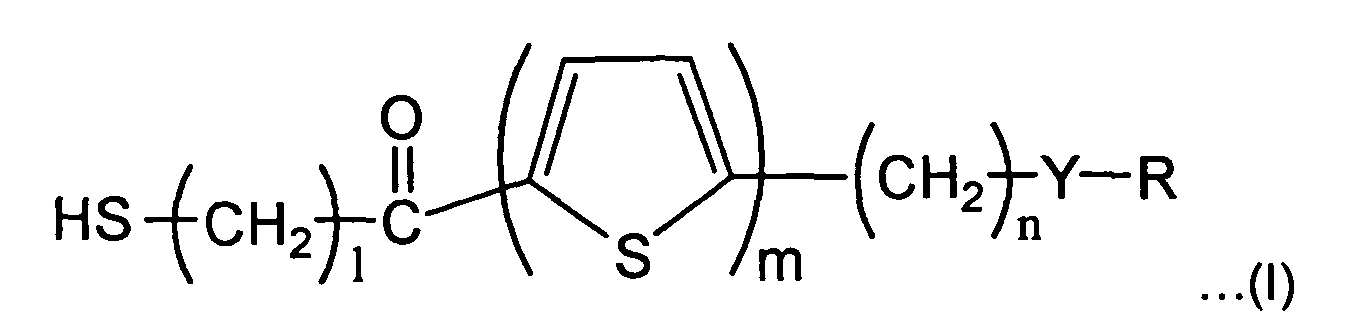
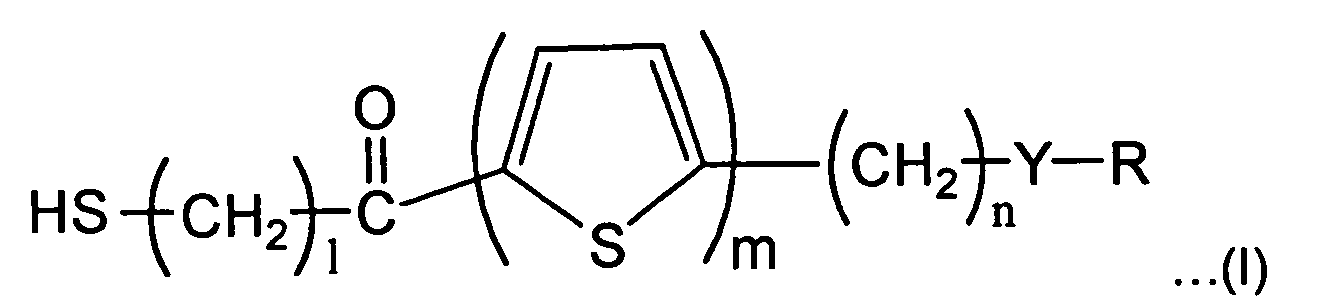
- the present invention provides a conductive compound of formula (I) below: wherein Y is a carbonyl or -NH-; R is one of H, OH, a leaving group, and a probe group; I is an integer from 3 to 6; m is an integer from 1 to 4; and n is an integer from 0 to 3.
- leaving group refers to a group that is highly liable to leave due to a nucleophilic substitution reaction.
- leaving groups include a hydroxysuccinimidyl group, a hydroxyphthalimidyl group, a pentafluorophenolyl group, a 4-chlorobenzyl alcoholic group, TsO - , I - , Br - , and Cl - .
- probe refers to a compound capable of specifically binding to a target compound.
- examples of such probes includes a nucleic acid and a protein, and more particularly, a deoxyribonucleic acid (DNA), a ribonucleic acid (RNA), a peptide nucleic acid (PNA), an antibody, an antigen, an enzyme, a cofactor, and a substrate.
- DNA deoxyribonucleic acid
- RNA ribonucleic acid
- PNA peptide nucleic acid
- the conductive compound of the present invention of formula (1) which is electrically conductive, may be coated on a gold electrode and may be used in a sensor.
- the electrode or sensor may be used in detecting a particular compound using an electrical signal generated from a target molecule-probe complex.
- the compound may also be used in a target molecule detecting method using the electrode or the sensor.
- the compound of formula (II) may be synthesized as follows.
- the compound of formula (III) may be synthesized as follows.
- the present invention provides a method of synthesizing the compound of formula (I) above by reacting a compound of formula (IV) below with thiourea.
- Y is a carbonyl or -NH- group
- R is one of H, OH, a leaving group, and a probe group
- X is halogen atom
- I is an integer from 3 to 6
- m is an integer from 1 to 4
- n is an integer from 0 to 3.
- Preferred examples of the leaving group in formula (IV) include a hydroxysuccinimidyl group, a hydroxyphthalimidyl group, a pentafluorophenolyl group, and a 4-chlorobenzyl alcoholic group.
- the compound of formula (IV) may be reacted with thiourea in a basic condition, followed by neutralization.
- the present invention also provides a method of synthesizing the compound of formula (I) above by reacting a compound of formula (V) below and a compound of formula (VI) below.
- R1, R2, and R3 are independently C 1 -C 8 alkyl groups; Y is a carbonyl or - NH- group; R is one of H, OH, a leaving group, and a probe group; X is a halogen atom; I is an integer from 3 to 6; m1 and m2 are integers from 1 to 4 and 2 ⁇ m1 + m2 ⁇ 4; and n is an integer from 0 to 3.
- Preferred examples of the leaving group include a hydroxysuccinimidyl group, a hydroxyphthalimidyl group, a pentafluorophenolyl group, and a 4-chlorobenzyl alcoholic group.
- the present invention also provide an electrode coated with the conductive compound.
- Materials commonly used for electrodes, such as gold, may be used to manufacture the electrode according to the present invention.
- the present invention provides a sensor including the electrode coated with the conductive compound.
- the sensor according to the present invention comprises common sensor components, for example, a working electrode, a counter electrode, and a reference electrode, in addition to the electrode coated with the conductive compound.
- FIG. 1 illustrates an example of a sensor including an electrode coated with the conductive compound according to the present invention.
- the sensor includes a working electrode 4, which is coated with a conductive compound 6 according to the present invention and to which probes 8 are covalently bonded, a counter electrode 12, a reference electrode 14, and an electrostatic voltmeter 2.
- the working electrode 4, which is coated with the conductive compound according to the present invention and to which the probes 8 are covalently bonded, may be formed as follows.
- a method of manufacturing an electrode according to the present invention, which is coated with the conductive compound and probes, such as DNA, are immobilized on includes immobilizing the conductive compound of formula (I) with R selected from among H, -OH, a hydroxysuccinimidyl group, a hydroxyphthalimidyl group, a pentafluorophenolyl group, and a 4-chlorobenzyl alcoholic group to form a self-assembled monolayer on a substrate, and covalently binding the probes 8, which may be DNA, to the self-assembled monolayer.
- the electrode according to the present invention may be manufactured by just immobilizing on a substrate a conductive compound of formula (I) above with R that is a probe group to form a self-assembled monolayer.
- a target molecule 10 in a sample can be detected using the sensor according to the present invention.
- the probes 8 immobilized on the working electrode 4 of the sensor are made to contact the sample and hybridized with the target molecule 10, a voltage or current level read by the sensor varies depending on the hybridized result so that the target molecule 10 can be detected from the variation.
- the electrical current at a particular redox potential depends on the delocalization in the electrically conductive polymer on the substrate.
- the degree of delocalization in the electrically conductive polymer after a target molecule hybridizes to the probe that is covalently bonded to the electrically conductive polymer according to the present invention is smaller than before the hybridization. Accordingly, when a target molecule hybridizes to a probe, the electrical current decreases. Therefore, a target molecule in a sample can be detected by measuring a decrease in the amount of redox potential that occurs when the target molecule hybridizes to a probe or an increase when not.
- FIG. 2 illustrates another example of a sensor including an electrode coated with the conductive compound according to the present invention.
- the sensor includes a working electrode 4, a counter electrode 12, and a reference electrode 14.
- the working electrode 4 is coated with the conductive compound according to the present invention.
- the present invention provides a method of detecting a target molecule using the conductive compound of the present invention.
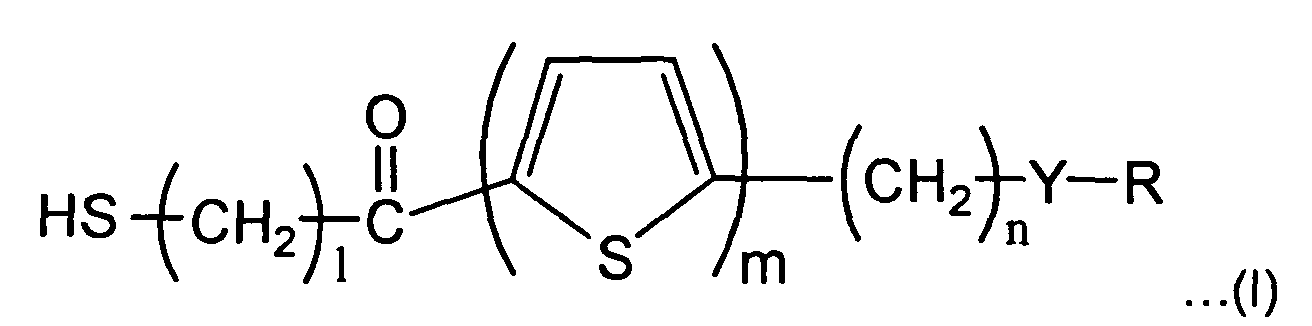
- the method includes: (a) immobilizing a compound of formula (I) below on a gold substrate to form a self-assembled monolayer; wherein Y is a carbonyl or -NH-; R is one of H, OH, a leaving group, and a probe group; I is an integer from 3 to 6; m is an integer from 1 to 4; and n is an integer from 0 to 3;
- Suitable examples of the leaving group include a hydroxysuccinimidyl group, a hydroxyphthalimidyl group, a pentafluorophenolyl group, and a 4-chlorobenzyl alcoholic group.
- the target molecule-probe complex may generated by a specific interaction between the target molecule and the probe molecule immobilized on the electrode.
- the specific interaction includes noncovalent interactions such as hydrophobic bond, hydrogen bond, Van der Wals interactions, and ionic interaction, but not limited to these examples, as well as covalent bond.
- the specific interaction between probe DNA and target DNA are caused to occur via way of hybridization reaction between the two ssDNA molecules.
- the two ssDNA molecules in the above case generally have a perfect or partially matched complementary nucleotide sequences.
- the conditions for hybridizations for example, salt concentration and temperature, may be adjusted depending on the sequences.
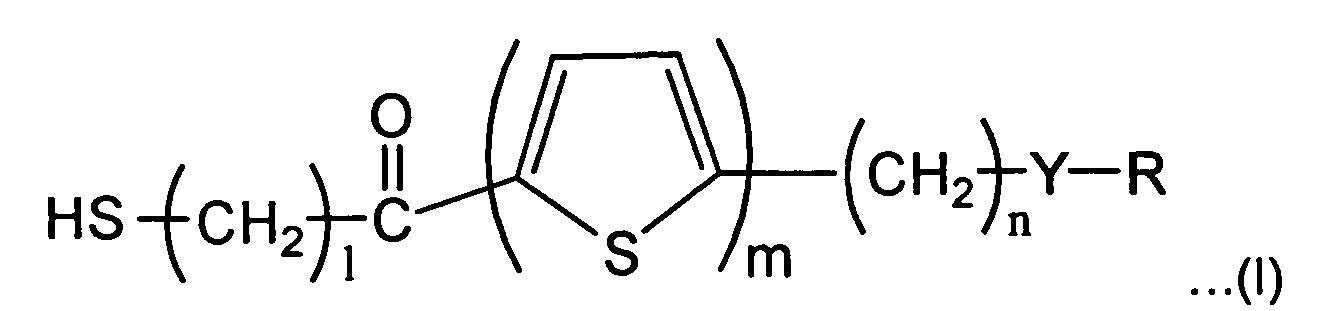
- Another method of detecting a target molecule using the conductive compound of the present invention according to the present invention includes: (a) immobilizing a compound of formula (I) below on a gold substrate to form a self-assembled monolayer; wherein Y is a carbonyl or -NH-; R is one of H, OH, a leaving group, and a probe group; I is an integer from 3 to 6; m is an integer from 1 to 4; and n is an integer from 0 to 3;
- the target molecule-probe complex may generated by a specific interaction between the target molecule and the probe molecule immobilized on the electrode.
- the specific interaction includes noncovalent interactions such as hydrophobic bond, hydrogen bond, Van der Wals interactions, and ionic interaction, but not limited to these examples, as well as covalent bond.
- the specific interaction between probe DNA and target DNA are caused to occur via way of hybridization reaction between the two ssDNA molecules.
- the two ssDNA molecules in the above case generally have a perfect or partially matched complementary nucleotide sequences.
- the conditions for hybridizations for example, salt concentration and temperature, may be adjusted depending on the sequences.
- the electrical signal refers to, but is not limited to, a signal measured from voltage or current variations.
- the probes or the probe group may be nucleic acids or proteins.
- Specified examples of the probes or the probe group R include a DNA, a RNA, a PNA, an antibody, an antigen, an enzyme, a cofactor, and a substrate.
- a compound of formula (II) was synthesized as follows.
- a compound of formula (II) was synthesized as follows.
- the conductive compound of the present invention can be used in the manufature of an electrode and a sensor having a resposivity and stability.
- the electrode and sensor of the present invention can be used in the detection of a target molecule with high sensitivity and reproducibility.
- the method of detecting a target molecule can efficiently detect a target molecule in a sample.
Landscapes
- Chemical & Material Sciences (AREA)
- Engineering & Computer Science (AREA)
- Organic Chemistry (AREA)
- Health & Medical Sciences (AREA)
- Life Sciences & Earth Sciences (AREA)
- Immunology (AREA)
- Nanotechnology (AREA)
- Physics & Mathematics (AREA)
- Molecular Biology (AREA)
- General Health & Medical Sciences (AREA)
- Crystallography & Structural Chemistry (AREA)
- General Chemical & Material Sciences (AREA)
- Hematology (AREA)
- General Physics & Mathematics (AREA)
- Electrochemistry (AREA)
- Biomedical Technology (AREA)
- Chemical Kinetics & Catalysis (AREA)
- Urology & Nephrology (AREA)
- Biotechnology (AREA)
- Microbiology (AREA)
- Cell Biology (AREA)
- Food Science & Technology (AREA)
- Medicinal Chemistry (AREA)
- Analytical Chemistry (AREA)
- Biochemistry (AREA)
- Spectroscopy & Molecular Physics (AREA)
- Pathology (AREA)
- Composite Materials (AREA)
- Condensed Matter Physics & Semiconductors (AREA)
- Materials Engineering (AREA)
- Measuring Or Testing Involving Enzymes Or Micro-Organisms (AREA)
- Heterocyclic Compounds Containing Sulfur Atoms (AREA)
- Plural Heterocyclic Compounds (AREA)
Abstract
Description
- The present invention relates to a novel conductive compound, an electrode coated with the compound, a sensor including the electrode, and a target molecule detection method using the sensor.
- There have been many studies on the development of biomolecule detecting sensors based on the electrochemical principles. One advantage of using the electrochemical principles lies in that sensors can be miniaturized. Accordingly, there have been great advances in research into electrochemical sensors, such as ionic sensors, gas sensors, biosensors, etc. In the fields of genomics and proteomics, it is very important to monitor information on the hybridization of DNA, among other biological molecules, and to monitor conformational changes of proteins. To this end, there have been developed sensors using electrochemically active organic substance and sensors using conductive polymers. In particular, intercalator-based sensors are ready to be released on the market as a result of extensive research thereon.
- In conductive polymer sensors, only a few representative monomers capable of being polymerized on electrodes are available, and it is difficult to control the physical properties of polymers. As a result, research into the conductive polymer sensor has been relatively slow. Representative conductive polymer sensor materials include pyrroles, thiophenes, anilines, and the like. However, because anilines can only be used in acidic conditions, pyrroles and thiophenes have been the main focus of research.
- However, pyrroles cannot be used for a long duration due to low redox potential (U.S. Patent No. 6,201,086). Thiophenes have a higher redox potential but are more hydrophobic than pyrroles, so they are unsuitable for water-based biomolecule systems (Bauerle P. and Emge A., Adv. Materi., 3:324 (1998)).
- Another problem arising with conductive polymer sensors lies in that the chain length of polypyrroles or polythiophenes cannot be controlled, disabling formation of an even, thin polymer layer. Therefore, such conductive polymer sensors are unsuitable for detecting trace of a target molecule, such as DNA, which is essentially dispersed. Moreover, due to the difficulty in controlling the chain length of the conductive polymers, signals generated as a result of a reaction between the target molecule and the conductive polymer layer are not reproducible.
- The present invention provides a novel conductive compound capable of forming a self-assembled monolayer having a uniform thickness.
- The present invention also provides an electrode coated with the conductive compound and a sensor including the electrode.
- The present invention also provides a target molecule detection method using the sensor.
- According to an aspect of the present invention, a conductive compound of formula (1) below is provided:wherein Y is a carbonyl or -NH-; R is one of H, OH, a leaving group, and a probe group; I is an integer from 3 to 6; m is an integer from 1 to 4; and n is an integer from 0 to 3.
- According to one aspect of the present invention, a method of synthesizing the conductive compound of said formula (I) by reacting a compound of formula (IV) below with thiourea is provided:wherein Y is carbonyl or -NH-, R is one of H, OH, a leaving group, and a probe group, X is halogen atom, I is an integer from 3 to 6, m is an integer from 1 to 4, and n is an integer from 0 to 3.
- According to another aspect of the present invention, a method of synthesizing the conductive compound of formula (I), comprising reacting a compound of formula (V) below with a compound of formula (VI) below is provided:
 wherein R1, R2, and R3 are independently C1-C8 alkyl groups; Y is carbonyl or -NH-group; R is one of H, OH, a leaving group, and a probe group; X is a halogen atom; I is an integer from 3 to 6; m1 and m2 are integers from 1 to 4 and 2 ≤ m1 + m2 ≤ 4; and n is an integer from 0 to 3.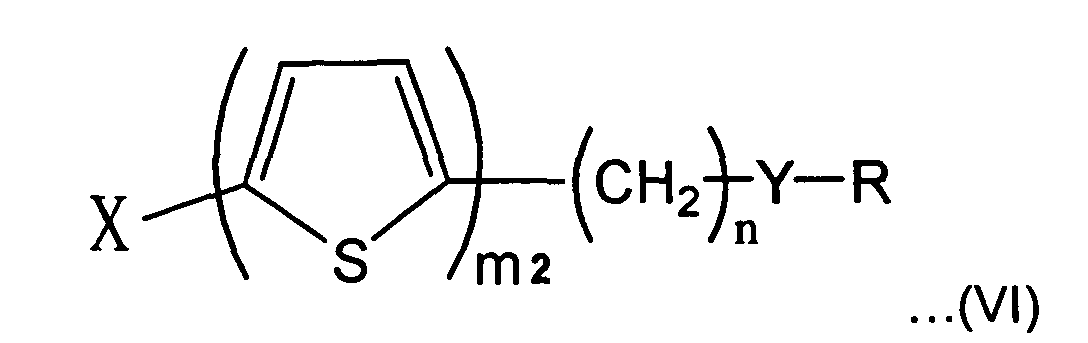
- According to still another aspect of the present invention, an electrode coated with the conductive compound of said formula (I), wherein the electrode being made of gold is provided.
- According to still another aspect of the present invention, a sensor including an electrode coated with the conductive compound of said formula (I), wherein the electrode being made of gold is provided.
- According to still another aspect of the present invention, a target molecule detection method comprising the following steps is provided:
- (a) immobilizing a compound of formula (I) below on a gold substrate to form
a self-assembled monolayer;
wherein Y is a carbonyl or -NH-; R is one of H, OH, a leaving group, and a probe group; I is an integer from 3 to 6; m is an integer from 1 to 4; and n is an integer from 0 to 3;

- (b) reacting a surface of the self-assembled monolayer with probes;
- (c) contacting a target molecule capable of specifically binding to the probes with the probes in the self-assembled monolayer; and
- (d) measuring an electrical signal from the target molecule-probe complex.
-
- According to still another aspect of the present invention, a target molecule detection method comprising the following steps is provided:
- (a) immobilizing a compound of formula (I) below on a gold substrate to form
a self-assembled monolayer;
wherein Y is a carbonyl or -NH-; R is one of H, OH, a leaving group, and a probe group; I is an integer from 3 to 6; m is an integer from 1 to 4; and n is an integer from 0 to 3;
- (b) contacting a target molecule capable of specifically binding to a probe group R in formula (I) with the probes in the self-assembled monolayer; and
- (c) measuring an electrical signal from the target molecule-probe comlex.
-
- The above and other features and advantages of the present invention will become more apparent by describing in detail exemplary embodiments thereof with reference to the attached drawings in which:
- FIG. 1 illustrates an example of a sensor employing an electrode coated with a conductive compound according to the present invention;
- FIG. 2 illustrates another example of a sensor employing an electrode coated with the conductive compound according to the present invention;
- FIG. 3 is a graph illustrating the result of FTIR analysis on an MTPAA monolayer on a gold thin layer;
- FIG. 4 is a sensogram of resonance angle versus time, which was measured through formation of a monolayer, immobilization of probes, and hybridization of DNA;
- FIG. 5 is a cyclic voltammogram of an MTPAA monolayer; and
- FIG. 6 is a cyclic voltammogram measured after the immobilization of ssDNA probes, following the treatment of an electrochemically stabilized MTPAA monolayer with HNS/EDC.
-
- The present invention provides a conductive compound of formula (I) below:wherein Y is a carbonyl or -NH-; R is one of H, OH, a leaving group, and a probe group; I is an integer from 3 to 6; m is an integer from 1 to 4; and n is an integer from 0 to 3.
- The terms "leaving group" used throughout the specification refers to a group that is highly liable to leave due to a nucleophilic substitution reaction. Examples of such leaving groups include a hydroxysuccinimidyl group, a hydroxyphthalimidyl group, a pentafluorophenolyl group, a 4-chlorobenzyl alcoholic group, TsO-, I-, Br-, and Cl-.
- The term "probe" used throughout the specification refers to a compound capable of specifically binding to a target compound. Examples of such probes includes a nucleic acid and a protein, and more particularly, a deoxyribonucleic acid (DNA), a ribonucleic acid (RNA), a peptide nucleic acid (PNA), an antibody, an antigen, an enzyme, a cofactor, and a substrate.
- The conductive compound of the present invention of formula (1), which is electrically conductive, may be coated on a gold electrode and may be used in a sensor. The electrode or sensor may be used in detecting a particular compound using an electrical signal generated from a target molecule-probe complex. The compound may also be used in a target molecule detecting method using the electrode or the sensor.
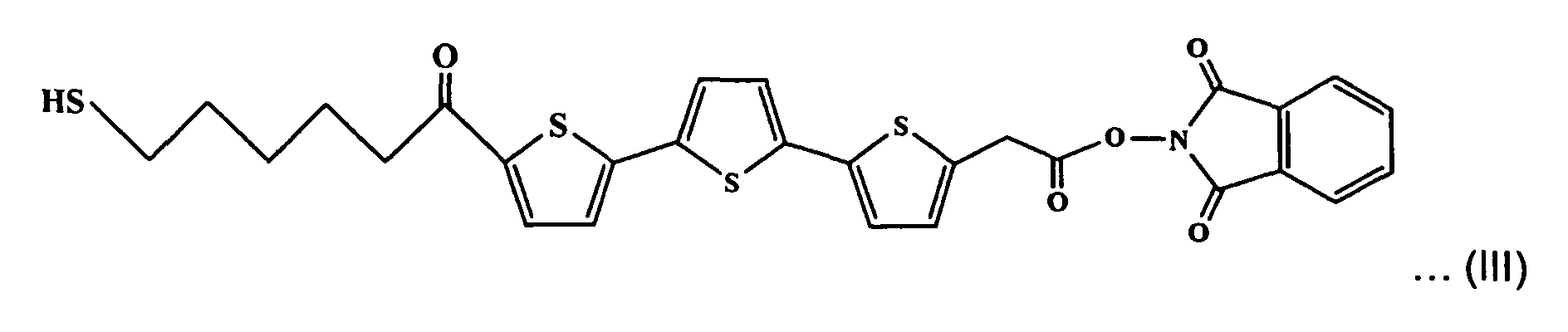
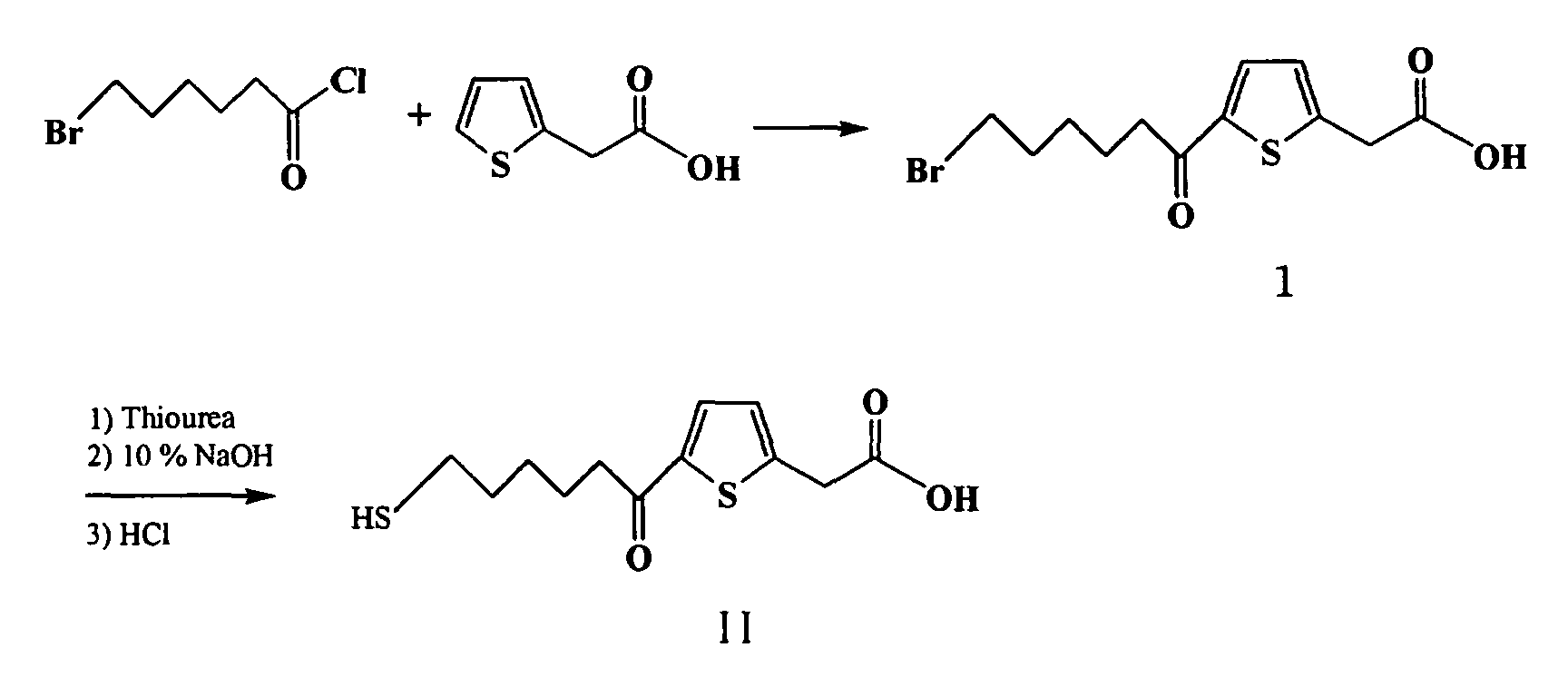
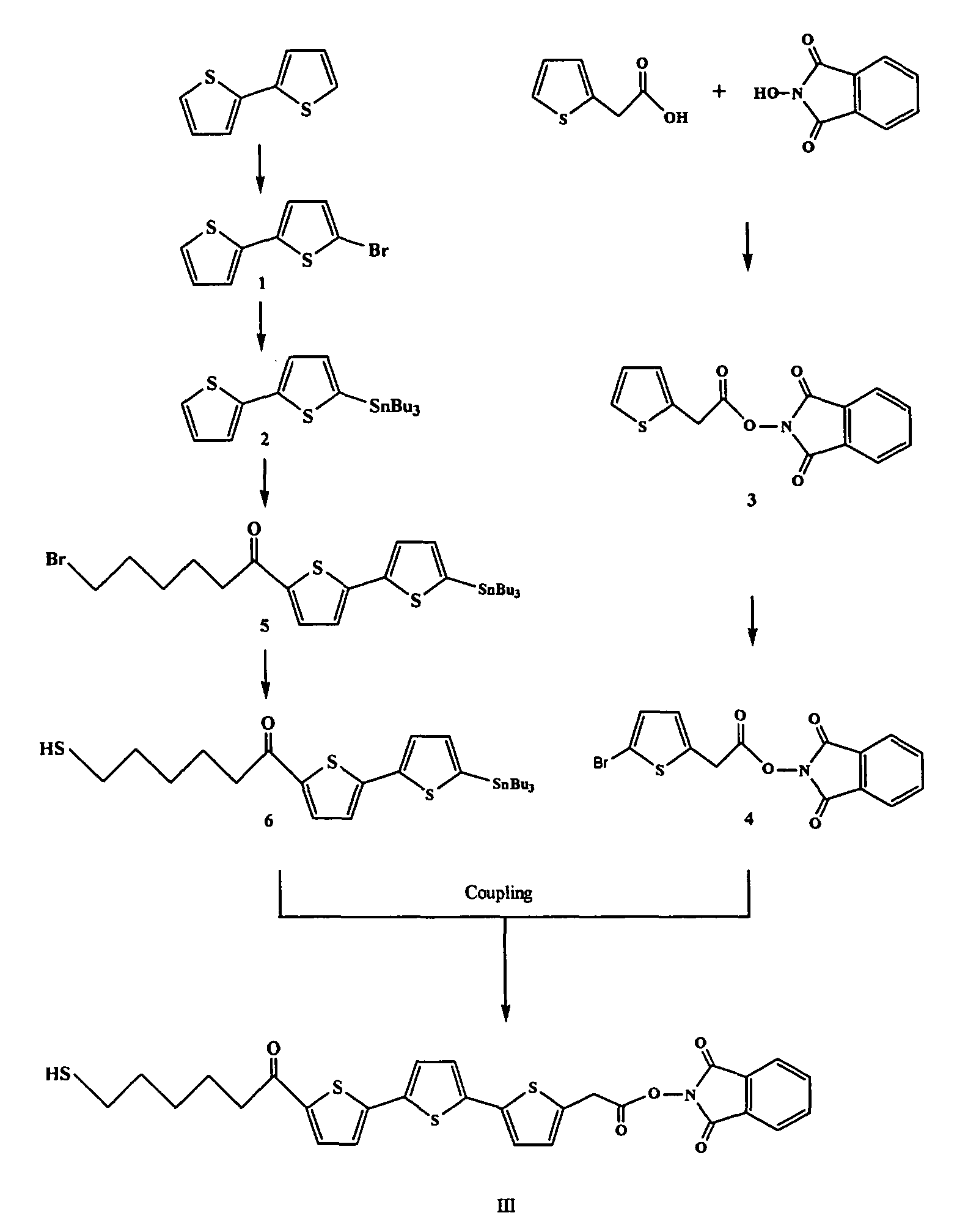
- Preferred conductive compounds according to the present invention include a compound of formula (II) below, which is correspond to a compound of formula (1) wherein Y is carbonyl group, R is OH, I = 5, m = 1 and n = 1 and a compound of formula (II) below, which is correspond to a compound of formula (1) wherein Y is carbonyl group, R is a hydroxyphthalimidyl group, I = 5, m = 3 and n = 1.
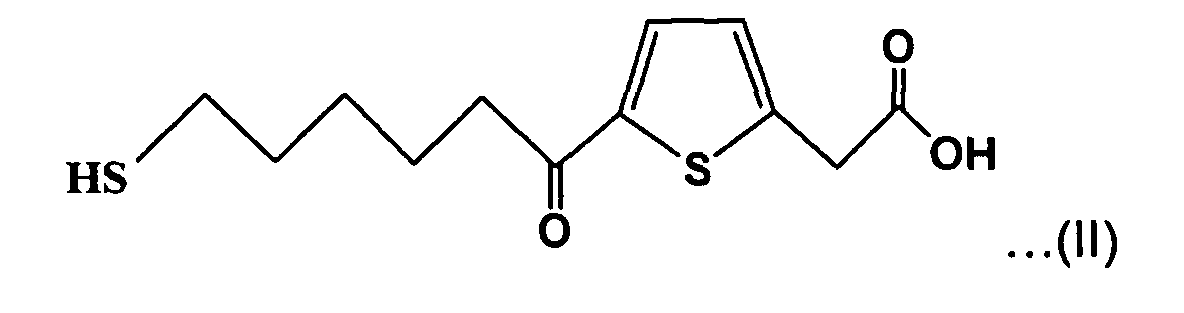
- The compound of formula (II) may be synthesized as follows.
- The compound of formula (III) may be synthesized as follows.
- The present invention provides a method of synthesizing the compound of formula (I) above by reacting a compound of formula (IV) below with thiourea.wherein Y is a carbonyl or -NH- group, R is one of H, OH, a leaving group, and a probe group, X is halogen atom, I is an integer from 3 to 6, m is an integer from 1 to 4, and n is an integer from 0 to 3.

- Preferred examples of the leaving group in formula (IV) include a hydroxysuccinimidyl group, a hydroxyphthalimidyl group, a pentafluorophenolyl group, and a 4-chlorobenzyl alcoholic group. The compound of formula (IV) may be reacted with thiourea in a basic condition, followed by neutralization.
- The present invention also provides a method of synthesizing the compound of formula (I) above by reacting a compound of formula (V) below and a compound of formula (VI) below.


- R1, R2, and R3 are independently C1-C8 alkyl groups; Y is a carbonyl or - NH- group; R is one of H, OH, a leaving group, and a probe group; X is a halogen atom; I is an integer from 3 to 6; m1 and m2 are integers from 1 to 4 and 2 ≤ m1 + m2 ≤ 4; and n is an integer from 0 to 3. Preferred examples of the leaving group include a hydroxysuccinimidyl group, a hydroxyphthalimidyl group, a pentafluorophenolyl group, and a 4-chlorobenzyl alcoholic group.
- The present invention also provide an electrode coated with the conductive compound. Materials commonly used for electrodes, such as gold, may be used to manufacture the electrode according to the present invention.
- The present invention provides a sensor including the electrode coated with the conductive compound. The sensor according to the present invention comprises common sensor components, for example, a working electrode, a counter electrode, and a reference electrode, in addition to the electrode coated with the conductive compound.
- FIG. 1 illustrates an example of a sensor including an electrode coated with the conductive compound according to the present invention. As illustrated in FIG. 1, the sensor includes a working
electrode 4, which is coated with aconductive compound 6 according to the present invention and to which probes 8 are covalently bonded, acounter electrode 12, areference electrode 14, and anelectrostatic voltmeter 2. The workingelectrode 4, which is coated with the conductive compound according to the present invention and to which theprobes 8 are covalently bonded, may be formed as follows. - A method of manufacturing an electrode according to the present invention, which is coated with the conductive compound and probes, such as DNA, are immobilized on, includes immobilizing the conductive compound of formula (I) with R selected from among H, -OH, a hydroxysuccinimidyl group, a hydroxyphthalimidyl group, a pentafluorophenolyl group, and a 4-chlorobenzyl alcoholic group to form a self-assembled monolayer on a substrate, and covalently binding the
probes 8, which may be DNA, to the self-assembled monolayer. Alternatively, the electrode according to the present invention may be manufactured by just immobilizing on a substrate a conductive compound of formula (I) above with R that is a probe group to form a self-assembled monolayer. - A
target molecule 10 in a sample can be detected using the sensor according to the present invention. When theprobes 8 immobilized on the workingelectrode 4 of the sensor are made to contact the sample and hybridized with thetarget molecule 10, a voltage or current level read by the sensor varies depending on the hybridized result so that thetarget molecule 10 can be detected from the variation. - Voltage or current variations occurring from hybridization are thought to follow, though not absolutely, the mechanism described below. The electrical current at a particular redox potential depends on the delocalization in the electrically conductive polymer on the substrate. The degree of delocalization in the electrically conductive polymer after a target molecule hybridizes to the probe that is covalently bonded to the electrically conductive polymer according to the present invention is smaller than before the hybridization. Accordingly, when a target molecule hybridizes to a probe, the electrical current decreases. Therefore, a target molecule in a sample can be detected by measuring a decrease in the amount of redox potential that occurs when the target molecule hybridizes to a probe or an increase when not.
- FIG. 2 illustrates another example of a sensor including an electrode coated with the conductive compound according to the present invention. The sensor includes a working
electrode 4, acounter electrode 12, and areference electrode 14. The workingelectrode 4 is coated with the conductive compound according to the present invention. - The present invention provides a method of detecting a target molecule using the conductive compound of the present invention. The method includes: (a) immobilizing a compound of formula (I) below on a gold substrate to form a self-assembled monolayer;wherein Y is a carbonyl or -NH-; R is one of H, OH, a leaving group, and a probe group; I is an integer from 3 to 6; m is an integer from 1 to 4; and n is an integer from 0 to 3;
- (b) reacting a surface of the self-assembled monolayer with probes;
- (c) contacting a target molecule capable of specifically binding to the probes with the probes in the self-assembled monolayer; and
- (d) measuring an electrical signal from the target molecule-probe.
-
- Suitable examples of the leaving group include a hydroxysuccinimidyl group, a hydroxyphthalimidyl group, a pentafluorophenolyl group, and a 4-chlorobenzyl alcoholic group.
- Regarding (d) in the above-described method, the target molecule-probe complex may generated by a specific interaction between the target molecule and the probe molecule immobilized on the electrode. The specific interaction includes noncovalent interactions such as hydrophobic bond, hydrogen bond, Van der Wals interactions, and ionic interaction, but not limited to these examples, as well as covalent bond. For example, with the assumption that the target molecule is a DNA having a particular nucleotide sequence, the specific interaction between probe DNA and target DNA are caused to occur via way of hybridization reaction between the two ssDNA molecules. The two ssDNA molecules in the above case generally have a perfect or partially matched complementary nucleotide sequences. When the two DNA molecules have partially matched nucleotide sequences, the conditions for hybridizations, for example, salt concentration and temperature, may be adjusted depending on the sequences.
- Another method of detecting a target molecule using the conductive compound of the present invention according to the present invention includes: (a) immobilizing a compound of formula (I) below on a gold substrate to form a self-assembled monolayer;wherein Y is a carbonyl or -NH-; R is one of H, OH, a leaving group, and a probe group; I is an integer from 3 to 6; m is an integer from 1 to 4; and n is an integer from 0 to 3;

- (b) contacting a target molecule capable of specifically binding to the probe group R in formula (I) with the probes in the self-assembled monolayer; and
- (c) measuring an electrical signal from the target molecule-probe complex.
-
- Regarding (c) in the above-described method, the target molecule-probe complex may generated by a specific interaction between the target molecule and the probe molecule immobilized on the electrode. The specific interaction includes noncovalent interactions such as hydrophobic bond, hydrogen bond, Van der Wals interactions, and ionic interaction, but not limited to these examples, as well as covalent bond. For example, with the assumption that the target molecule is a DNA having a particular nucleotide sequence, the specific interaction between probe DNA and target DNA are caused to occur via way of hybridization reaction between the two ssDNA molecules. The two ssDNA molecules in the above case generally have a perfect or partially matched complementary nucleotide sequences. When the two DNA molecules have partially matched nucleotide sequences, the conditions for hybridizations, for example, salt concentration and temperature, may be adjusted depending on the sequences.
- Regarding the above-described two methods of detecting a target molecule using a conductive compound according to the present invention, the electrical signal refers to, but is not limited to, a signal measured from voltage or current variations. The probes or the probe group may be nucleic acids or proteins. Specified examples of the probes or the probe group R include a DNA, a RNA, a PNA, an antibody, an antigen, an enzyme, a cofactor, and a substrate.
- The present invention will be described in greater detail with reference to the following examples. The following examples are for illustrative purposes and are not intended to limit the scope of the invention.
- A compound of formula (II) was synthesized as follows.

- 1. Synthesis of Intermediate (1)
312 mg (2.34 mmole) of AlCl3 was added to a mixed solvent of 6 mL of
dichlomethane and 6 mL of CS2 in a 30-mL, 2-neck round-bottomed flask and stirred
in an argon gas atmosphere. 277 mg (1.95 mmole) of 2-thiopheneacetic acid was
dropwise added to A solution of 2 mL of dichloromethane and 2 mL of CS2 over 5
minutes in a water bath to prevent excess heat generation. This mixture was stirred
at room temperature for 20 minutes and refluxed for 3 hours.The resulting product was purified through column chromatography using a
4:1 mixed solvent of chloroform and methanol to provide 410 mg of a white solid
intermediate (1) with a yield of 52. 7%. The resulting purified intermediate was
identified by NMR and FT-IR. The results are as follows.
1 H-NMR(CDCl3, 400 MHz): δ 7.51 (d, J=4.0 Hz, 1 H), 6.92(d, J=4.0 Hz, 1 H), 3.82(s, 2H), 3.33(t, J=6.8 Hz, 2H), 2.81(t, J=7.3 Hz, 2H), 1.80(m, 2H), 1.66(m, 2H), 1.43(m, 2H)
FT-IR ( KBr ): 3430(CO2H), 2950, 2845(C-H), 1650(C=O), 1590, 1450 cm-1 - 2. Synthesis of Compound (II)
204 mg (0.511 mmole) of the intermediate (1) and 78 mg (1.02 mmole) of
thiourea were added to 2.0 mL of DMSO contained in a 30-mL, 2-neck
round-bottomed flask and stirred in an argon gas atmosphere at room temperature
for 12 hours. 3.2 mL of 10% NaOH was added to the mixture and stirred further for
1 hour, followed by pH adjustment to pH =2 or 3 using about 8 mL of 1 M HCl and
extraction using ethyl acetate (EtOAc). The extracted product was purified through
column chromatography to provide 105 mg of compound (II) with a yield of 75.4%.
This compound (II) was identified to be 5-(6-mercapto-hexanoyl)-thiophen-2-yl]-acetic
acid (MTPAA) by NMR and FT-IR. The results are as follows.
1H-NMR(CDCl3, 400 MHz): δ7.35(d, J=3.3 Hz, 1H), 6.92(s, 1H), 3.60(s, 2H), 2.70(t, J=7.1 Hz, 2H), 2.42(m, 2H), 1.25- 1.65(m, 6H)
FT-IR (KBr): 3430(CO2H), 2950, 2840(C-H), 1650(C=O), 1580, 1450 cm-1 -
- A compound of formula (II) was synthesized as follows.
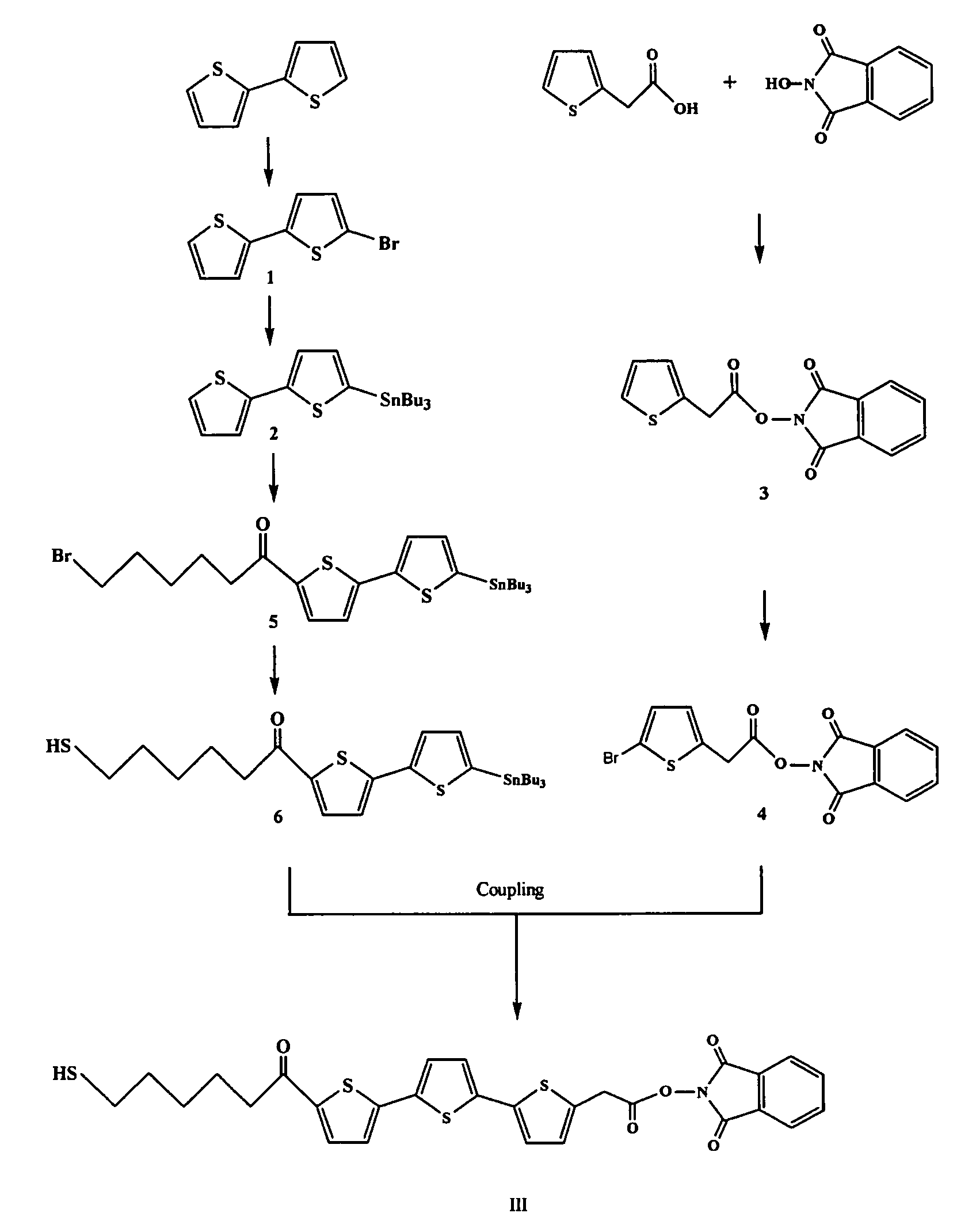
- 1. Synthesis of Intermediate (1)
3 g (18 mmol) of 2'2-bithiophene and 50 mL of DMF were placed in a 250-mL,
2-neck round-bottomed flask and stirred. A solution of 3.2 g (18 mmol) of
N-bromsuccimide (NBS) in 10 mL of DMF was dropwise added to the mixture in an
ice bath.After completion of the reaction, the reaction product was extracted using
methylene chloride and recrystallized using methanol (MeOH) to obtain 2.5 g of a
light yellow solid compound with a yield of 56%. This intermediate (1) was identified
by NMR. The results are as follows.
1HNMR (CDCl3 400MHz ): δ=6.91 (1H, d), 6.96(1H, d), 7.00(1H, dd), 7.22(1H) - 2. Synthesis of Intermediate (2)
3 g (12 mmol) of the intermediate (1) and tetrakis triphenyl phosphine
palladium (Pd(PPh3)4) were dissolved in 50 mL of purified toluene while stirring it.
4.76 g (12 mmol) of tributyltin chloride was dropwise added to the mixture and
reacted at 80°C for 4 hours. After completion of the reaction, the reaction product
was purified through column chromatography using hexane to provide 4.2 g of a light
green solid compound with a yield of 78%. This intermediate compound (2) was
identified by NMR and FR-IR. The results are as follows.
1HNMR (CDCl3 400MHz): δ=7.19(1H, d), 7.10(1H, d), 6.98(1H, d), 6.85(1H, d), 6.82(1 H, d), 1.60(6H, m), 1.30(12H, m ), 0.90(9H, t)
FT-IR (KBr): 2950, 2850(C-H), 1590(C=C), 1450(C-H), 1375(C-H) cm-1 - 3. Synthesis of Intermediate (3)
3 g (21.1 mmol) of 2-thiophene acetic acid and 3.44 g (21.1 mmol) of
N-hydroxyphalimide were added to 50 mL of chloroform and stirred. 4.35 g (21.1
mmol) of 1,3-Dicyclohexylcarbodiimide (DCC) was added to the mixture and stirred
for 3 hours. After completion of the reaction, trituration was performed with hexane
to obtain 5.8 g of a white solid compound with a yield of 91 %. This intermediate (2)
was identified by NMR and FT-IR. The results are as follows.
1HNMR (CDCl3 400MHz ): δ=7.80(4H, dd), 7.25(1H, d), 7.10(1H, d), 7.00(1H, d), 4.20(2H, s)
FT-IR(KBr): v = 1741, 1359,1139 cm-1 - 4. Synthesis of Intermediate (4)
5.4 g (17.9 mmol) of the intermediate (3) was placed in 50 mL of DMF and
stirred. 3.17 g (17.8 mmol) of NBS was added to the mixture and stirred further for
3 hours. After completion of the reaction, extraction with methylene chloride and
column chromatography with methylene chloride were performed to obtain 3.57 g of
yellowish white solid with a yield of 52%. This intermediate (4) was identified by
NMR and FT-IR. The results are as follows.
1HNMR(CDCl3 400MHz ): δ=7.80(4H, dd), 6.90(1H, d), 6.80(1H, d) 4.10(2H,s)
FT-IR(KBr): v = 1743, 1363, 1074 cm-1 - 5. Synthesis of Intermediate (5)
0.7 g (5.3 mmol) of AlCl3 was dissolved in 10 mL of CS2 and 10 mL of
methylene chloride and stirred. 2 g (5.55 mmol) of intermediate (2) was dissolved
in a mixture of 3 mL of CS2 and 3 mL of methylene chloride and dropwise added to
the stirred solution. 0.67 mL of 6-bromohexaonyl chloride was dropwise added to
the mixture and refluxed overnight. After completion of the reaction, column
chromatography with methyleno chloride was performed to obtain 1.7 g of a yellow
solid compound with a yield of 70%. This intermediate (5) was identified by NMR
and FT-IR. The results are as follows.
1HNMR(CDCl3 400MHz ): δ = 8.0(1H, s), 7.5(1H, d ), 7.15-6.95(2H, t), 3.40(2H, t), 1.9(2H, t), 1.8-1.25(26H, m), 0.9(9H, t)
FT-IR(KBr): 2950, 2850(C-H), 1650(C=O), 1590(C=O), 1450(C-H), 1375(C-H) cm-1 - 6. Synthesis of Intermediate (6)
1.7 g (3.16 mmol) of intermediate (5) and 0.48 g (6.32 mmol) of thiourea
were dissolved in 30 mL of DMSO and stirred at room temperature for 12 hours. 10
mL of 10% NaOH was added to the mixture and stirred further for 1 hour, followed by
pH adjustment to pH 2-3 using 1 M HCl. Extraction with ethyl acetate (EtOAc) and
recrystallization with hexane were performed to obtain 0.9 g of a yellow solid
compound with a yield of 58%. This intermediate (6) was identified by NMR and
FT-IR. The results are as follows.
1HNMR(CDCl3 400MHz ): δ= 7.5(1H, s), 7.3(1H, d), 7.15-6.95(2H, t), 2.85(2H, t), 2,7(2H, t), 2.5(1 H,t) 1.8-1.1 (24H, m), 0.9(9H, t)
FT-IR (KBr): 2950, 2850(C-H), 1645(C=O), 1588(C=O), 1450(C-H), 1375(C-H) cm-1 -
-
- 1. Formation of self-assembled monolayer A self-assembled monolayer (SAM) was formed by immobilizing the compound (MTPAA) of formula (I) on a gold (Au) plate. Initially, the Au electrode plate was polished using an alumina slurry having particle diameters of 0.05µm, 0.3µm, and 0.5µm, respectively and subjected to 80 times of electrochemical surface activation treatments (-0.1 ~ +1.5 V, 200 mv/s) in a 1.0M H2SO4 solution. Next, the Au electrode plate was immersed in a solution of 1mM thiophene dissolved in dimethylsulfoxide (DMSO) for 15 hours to form the SAM. Due to a greater refractive index (nD20=1.479) of DMSO, a resonance angle could not be measured to confirm the formation of the SAM. Instead, the formation of the SAM of the MTPAA on the Au plate was confirmed using an electrochemical method and FTI R-RAS.According to the FTIR-RAS spectrum analyzed at an angle of incidence of 80 degrees, peaks from the SAM were shifted toward a lower frequency domain than a KBr pellet. The C-H stretching mode was observed near 2850-2060 cm-1 in the spectrum, confirming the formation of the SAM of MTPAA in a regular pattern on a surface of the Au plate. The formation of the SAM as a regular pattern was confirmed using a relative band intensity between symmetry and asymmetry C-H stretching modes. The results are shown in FIG. 3.
- 2. Immobilization of Probes
ssDNA (5'-NH2-GTTCTTCTCATCATC-3': SEQ. NO: 1) with an amino group
at the 5'-terminal was immobilized as probes on the SAM of MTPAA and analyzed
using surface plasmon resonance (SPR). The probe DNA was immobilized using
N-hydroxysuccinimide (NHS) and 1-(3-Dimethylaminopropyl)-3- ethylcarbodiimide
hydrochloride (EDC) to substitute the carboxyl group of the MTPAA with NHS,
known as a good leaving group, and form amide bonds. This single process of
immobilization using NHS, EDC, and ssDNA is known (
Langmuir 16, 3272, 2000).FIG. 4 is a graph of resonance angle versus time obtained through the formation of the SAM, immobilization of the probes, and hybridization with a target DNA. In FIG. 4, 1 ○ indicates the resonance angle of the Au plate in a plain PBS buffer after the formation of the SAM of MTPAA, 2 ○ indicates the resonance angle of the Au plate with the SAM in a PBS buffer containing NHS and EDC, 3 ○ indicates the resonance angle of the Au plate in a PBS buffer containing the probe ssDNA for immobilization, (4) indicates the resonance angle of the Au plate washed with a PBS buffer after the immobilization of the probe ssDNA, (5) indicates the resonance angle of the Au plate when a plain TE buffer was injected, 6 ○ indicates the resonance angle of the Au plate when a TE buffer containing a target ssDNA was injected, 7 ○ indicates the resonance angle of the Au plate when a TE buffer was injected for washing after the hybridization, and 8 ○ indicates the resonance angle of the Au plate when the TE buffer was replaced with a PBS buffer.As shown in FIG. 4, the resonance angle was 51.560 when the plain PBS buffer was injected to stabilize the Au plate having the SAM of MTPAA and 51.620 when the PBS buffer containing NHS and EDC was injected. The resonance angle increased to 51.732 when the PBS buffer containing the probe ssDNA was injected. The resonance angle decreased slowly after reaction with the probe ssDNA, increased gradually with time, and was saturated at 51.762 degrees. This tendency of resonance angle variations is attributed to that the probe ssDNA physically adsorbed into the SAM of MTPAA being more stabilized due to chemical adsorption.The resonance angle was shifted by 0.141 degrees after the immobilization of the probe ssDNA, from 51.560 degrees after the formation of the SAM of MTPAA to 51.701 degrees after the immobilization of the probe ssDNA and washing with the PBS buffer. This shift of the resonance angle results from variations in the refractive index and the thickness of the SAM of MTPAA, indicating that the probe ssDNA was immobilized on the SAM of MTPAA.The resonance angle increased to 52.017 when the TE buffer was injected and to 52.269, when the target ssDNA was injected. The resonance angle increased gradually and saturated at 52.285, due to hybridization. The resonance angle dropped to 52.221 after washing with the TE buffer, which was performed to remove non-specific bonds. To compare the resonance angle after the hybridization of the target ssDNA to the probe DNA with the resonance angle after - the immobilization of the probe DNA, the TE buffer was replaced with the PBS buffer. The resonance angle of the Au plate in the PBS buffer after the hybridization of the target ssDNA to the probe DNA was 51.802, indicating that the resonance angle was shifted to the right by 0.252 degrees due to the TE buffer. It is confirmed from the shift of the resonance angle from 51.701 after the immobilization of the probe DNA in the PBS buffer to 51.802 in the PBS buffer after the hybridization that complementary bonds were formed between the probe DNA and the target ssDNA. -
-
- 1. Formation of Compound of formula (I) A self-assembled monolayer (SAM) was formed by immobilizing the compound (MTPAA) of formula (I) on an Au electrode. Initially, the Au electrode plate was polished using an alumina slurry having particle diameters of 0.05µm, 0.3µm, and 0.5µm, respectively and subjected to 80 times of electrochemical surface activation treatments (-0.1 ~ +1.5 V, 200 mv/s) in a 1.0M H2SO4 solution. Next, the Au electrode plate was immersed in a solution of 1 mM thiophene dissolved in DMSO for 15 hours to form the SAM.
- 2. Immobilization of ssDNA
ssDNA was immobilized on the SAM as follows.
- 1) The SAM on the Au electrode was reacted with a 50 mM phosphate buffer solution (pH 7.40) containing 2 mM EDC and 5 mM NHS to form linkers.
- 2) The Au electrode was washed with 50 mM phosphate buffer (pH 7.40).
- 3) 20µℓ of a 0.5M acetate buffer solution (pH 4.8) containing 100 ppm of probe ss DNA was dropped onto a surface of the SAM with the linkers.
- 4) The resulting structure was dried overnight in air, immersed in distilled water for 2 hours, and washed with distilled water.
- 3. Hybridization of target DNA
- 1) 20µℓ of a 20mM Tris buffer solution (pH 7.00) containing 100 ppm of a target DNA was dropped onto a surface of the Au electrode on which the probe ssDNA had been immobilized.
- 2) The resulting Au electrode was dried in air for 30 minutes.
- 4. Cyclic Voltammetry
The Au electrode was washed with a phosphate buffer and methanol after
reaction in each step, dried using a N2 gas, without using dopants conventionally
used together with conductive polymers, and washed with dichloromethane (CH2Cl2).Cyclic voltammetry was performed in an electrolyte solution of 0.1 M
Et4NBF4/CH2Cl2 using an Ag/AgCl electrode as a reference electrode and a Pt-wire
electrode as a counter electrode in a potential range of 100-1200 mV at a scan rate
of 200 mV/s. After each measurement and before a next process, the Au electrode
was washed with CH2Cl2 three times, dried, and washed again with the phosphate
buffer. Use of the organic solvent CH2Cl2 and the electrolyte Et4NBF4/CH2Cl2
avoids unwanted reactions in a voltage range of measurement of -0.1-1.2V, such as
oxidation and reduction occurring when using water at a voltage of 1 V or greater.FIG. 5 is a cyclic voltammogram of the SAM of MTPAA obtained through 13
measurements. In a cyclic voltammogram measured first, an anodic peak
appeared at 980mV and a cathodic peak appeared at 420mV. The anodic peak at
980 mV decreased while the cathodic peak at 420 mV increased with increasing
number of measurements. A new cathodic peak appeared at 480 mV. Stabilized,
constant cyclic voltammograms were obtained after 13 measurements.FIG. 6 is a cyclic voltammogram measured using the same method described
above after the immobilization of the probe ssDNA on the SAM of MTPAA
electrochemically stabilized and treated with NHS and EDC. Comparing with the
cyclic voltammogram of the SAM of MTPAA before hybridization shown in FIG. 5, an
anodic peak a1 had a smaller current value of 180 nA and a smaller voltage value of
89 mV, an anodic peak a2 had a larger current value of 110 nA and a larger voltage
value of 24 mV, and a cathodic peak c1 had a smaller current value of 680 nA and a
smaller voltage value of 51 mV.Comparing a cyclic voltammogram measured after the hybridization of a
target DNA to the probe ssDNA, in FIG. 6, with the above-described cyclic
voltammogram measured after the immobilization of the probe ssDNA, the current
value of the anodic peak a1 increased to 190 nA, and the voltage value thereof
increased to 89 mV. The anodic peak c2 which had appeared when probe ssDNA
had been immobilized disappeared after the hybridization of the target DNA to the
probe ssDNA, and a new cathodic peak c2 having a current value of 100 nA
appeared at 155 mV. No variation appeared in the cathodic peak c1.The above-described results of the cyclic voltammograpy are tabled in Table
5 below. The reproducibility of the cyclic voltammography was confirmed by
performing 4 measurements on each of three sets of electrodes.
Voltage values and current values of anodic peaks and cathodic peaks measured in each step Anodic Peak Cathodic Peak a1 a2 c1 c2 Ep Ip Ep ip Ep ip Ep ip AuE/MTPAA 483 270 957 220 409 -1280 X X AuE/MTPAA/SD 394 90 981 330 358 -680 X X AuE/MTPAA/SD-SD 483 280 X X 360 -670 155 100 -
- Thus, the conductive compound of the present invention can be used in the manufature of an electrode and a sensor having a resposivity and stability.
- The electrode and sensor of the present invention can be used in the detection of a target molecule with high sensitivity and reproducibility.
- The method of detecting a target molecule can efficiently detect a target molecule in a sample.
- While the present invention has been particularly shown and described with reference to exemplary embodiments thereof, it will be understood by those of ordinary skill in the art that various changes in form and details may be made therein without departing from the spirit and scope of the present invention as defined by the following claims.

Claims (12)
- A conductive compound of formula (I) below:wherein Y is a carbonyl or -NH-; R is one of H, OH, a leaving group, and a probe group; l is an integer from 3 to 6; m is an integer from 1 to 4; and n is an integer from 0 to 3.
- The conductive compound of claim 1, wherein the probe group is a nucleic acid or a protein.
- The conductive compound of claim 2, wherein the probe group is selected from the group consisting of a deoxyribonucleic acid (DNA), a ribonucleic acid (RNA), a peptide nucleic acid (PNA), an antibody, an antigen, an enzyme, a cofactor, and a substrate.
- A method of synthesizing the conductive compound of said formula (I) of claim 1 by reacting a compound of formula (IV) below with thiourea:wherein Y is carbonyl or -NH-, R is one of H, OH, a leaving group, and a probe group, X is halogen atom, I is an integer from 3 to 6, m is an integer from 1 to 4, and n is an integer from 0 to 3.

- A method of synthesizing the conductive compound of formula (I) of claim 1, comprising reacting a compound of formula (V) below with a compound of formula (VI) below:
 wherein R1, R2, and R3 are independently C1-C8 alkyl groups; Y is carbonyl or -NH-group; R is one of H, OH, a leaving group, and a probe group; X is a halogen atom; I is an integer from 3 to 6; m1 and m2 are integers from 1 to 4 and 2 ≤ m1 + m2 ≤4; and n is an integer from 0 to 3.
- An electrode coated with the conductive compound of said formula (I) of claim 1, the electrode being made of gold.
- A sensor including an electrode coated with the conductive compound of said formula (I) of claim 1, the electrode being made of gold.
- A target molecule detection method comprising:(a) immobilizing a compound of formula (I) below on a gold substrate to form a self-assembled monolayer;wherein Y is a carbonyl or -NH-; R is one of H, OH, a leaving group, and a probe group; I is an integer from 3 to 6; m is an integer from 1 to 4; and n is an integer from 0 to 3;
 (b) reacting a surface of the self-assembled monolayer with probes;(c) contacting a target molecule capable of specifically binding to the probes with the probes in the self-assembled monolayer; and(d) measuring an electrical signal from the target molecule-probe complex.
 - A target molecule detection method comprising:(a) immobilizing a compound of formula (I) below on a gold substrate to form a self-assembled monolayer;wherein Y is a carbonyl or -NH-; R is one of H, OH, a leaving group, and a probe group; I is an integer from 3 to 6; m is an integer from 1 to 4; and n is an integer from 0 to 3;
 (b) contacting a target molecule capable of specifically binding to a probe group R in formula (I) with the probes in the self-assembled monolayer; and(c) measuring an electrical signal from the target molecule-probe comlex.
 - The method of claim 8 or 9, wherein the electrical signal is measured from voltage or current variations.
- The method of claim 8 or 9, wherein the probes or the probe group is selected from the group consisting of a deoxyribonucleic acid (DNA), a ribonucleic acid (RNA), a peptide nucleic acid (PNA), an antibody, an antigen, an enzyme, a cofactor, and a substrate.
- The method of claim 8 or 9, wherein the target molecule is a nucleic acid or a protein.
Applications Claiming Priority (2)
| Application Number | Priority Date | Filing Date | Title |
|---|---|---|---|
| KR1020030014482A KR100580621B1 (en) | 2003-03-07 | 2003-03-07 | Electroconductive compounds, electrodes and sensors containing the same, and method for detecting a target substance using the sensor |
| KR2003014482 | 2003-03-07 |
Publications (2)
| Publication Number | Publication Date |
|---|---|
| EP1454906A1 true EP1454906A1 (en) | 2004-09-08 |
| EP1454906B1 EP1454906B1 (en) | 2008-06-25 |
Family
ID=32822724
Family Applications (1)
| Application Number | Title | Priority Date | Filing Date |
|---|---|---|---|
| EP04005433A Expired - Lifetime EP1454906B1 (en) | 2003-03-07 | 2004-03-08 | Conductive compound, electrode and sensor containing the same, and target molecule detection method using the sensor |
Country Status (6)
| Country | Link |
|---|---|
| US (1) | US7129363B2 (en) |
| EP (1) | EP1454906B1 (en) |
| JP (1) | JP4588336B2 (en) |
| KR (1) | KR100580621B1 (en) |
| CN (1) | CN1250538C (en) |
| DE (1) | DE602004014549D1 (en) |
Cited By (1)
| Publication number | Priority date | Publication date | Assignee | Title |
|---|---|---|---|---|
| EP2538219B1 (en) * | 2011-06-21 | 2020-05-27 | National Taiwan University | Biosensor |
Families Citing this family (6)
| Publication number | Priority date | Publication date | Assignee | Title |
|---|---|---|---|---|
| JP3874772B2 (en) * | 2004-07-21 | 2007-01-31 | 株式会社日立製作所 | Biologically related substance measuring apparatus and measuring method |
| JP5196517B2 (en) * | 2006-05-30 | 2013-05-15 | 国立大学法人 東京大学 | Oligothiophene-based liquid crystal compounds, columnar liquid crystal materials and uses thereof |
| JP5181386B2 (en) * | 2008-02-01 | 2013-04-10 | 国立大学法人 新潟大学 | Chemical biosensor |
| KR101127075B1 (en) * | 2008-05-30 | 2012-03-23 | 성균관대학교산학협력단 | Method for forming biomaterial pattern and manufacturing biosensor by using inkjet printing of self-assembly monolayer |
| TWI453282B (en) * | 2010-09-17 | 2014-09-21 | Univ Nat Taiwan | Linker,impedance biochip,and method of quantitatively detecting target analyte in fluid sample using the biochip |
| CN105353015B (en) * | 2015-12-02 | 2019-04-12 | 厦门大学 | A kind of preparation method and application of poly- dioxyethylene thiophene composite membrane |
Citations (2)
| Publication number | Priority date | Publication date | Assignee | Title |
|---|---|---|---|---|
| WO2000031750A1 (en) * | 1998-11-19 | 2000-06-02 | Bio Merieux | Electrically conductive electroactive functionalized conjugated polymers, and uses thereof |
| EP1347463A2 (en) * | 2002-03-09 | 2003-09-24 | Samsung Electronics Co., Ltd. | Novel electrically conductive polymer, sensor using the same, and method for detecting target molecule using the sensor |
Family Cites Families (14)
| Publication number | Priority date | Publication date | Assignee | Title |
|---|---|---|---|---|
| JPS6028970A (en) * | 1983-07-25 | 1985-02-14 | Hidefumi Hirai | Oligo ester containing tetrahydrofuran ring in main chain |
| US6320200B1 (en) * | 1992-06-01 | 2001-11-20 | Yale University | Sub-nanoscale electronic devices and processes |
| FR2720832A1 (en) | 1994-04-22 | 1995-12-08 | Francis Garnier | Electroactive electrodes and membranes based on bioactive peptides, for the recognition, extraction or release of biologically active species. |
| DE4430023A1 (en) * | 1994-08-24 | 1996-02-29 | Boehringer Mannheim Gmbh | Electrochemical sensor |
| US6878801B2 (en) * | 1999-03-11 | 2005-04-12 | Japan Science And Technology | Optically active polythiophenes |
| US6890715B1 (en) * | 1999-08-18 | 2005-05-10 | The California Institute Of Technology | Sensors of conducting and insulating composites |
| DE10002424A1 (en) * | 2000-01-20 | 2001-07-26 | Siemens Ag | Di (het) arylaminothiophene derivatives |
| US6414164B1 (en) * | 2000-07-12 | 2002-07-02 | International Business Machines Corporation | Synthesis of soluble derivatives of sexithiophene and their use as the semiconducting channels in thin-film filed-effect transistors |
| WO2002008215A1 (en) * | 2000-07-24 | 2002-01-31 | University Of Washington | Hyperpolarizable organic chromophores |
| JP4025920B2 (en) * | 2001-03-05 | 2007-12-26 | 入江 正浩 | Photochromic material |
| JP3963693B2 (en) * | 2001-10-15 | 2007-08-22 | 富士通株式会社 | Conductive organic compound and electronic device |
| DE60305570T2 (en) * | 2002-04-24 | 2007-05-03 | Merck Patent Gmbh | Reactive mesogenic benzodithiophenes |
| JP4253486B2 (en) * | 2002-09-25 | 2009-04-15 | 富士フイルム株式会社 | Positive or negative resist composition, acid generator and pattern forming method |
| AU2003217219A1 (en) * | 2003-01-15 | 2004-08-13 | University Of Washington | Nonlinear optical compounds and methods for their preparation |
-
2003
- 2003-03-07 KR KR1020030014482A patent/KR100580621B1/en not_active Expired - Lifetime
-
2004
- 2004-03-01 US US10/791,524 patent/US7129363B2/en not_active Expired - Lifetime
- 2004-03-05 JP JP2004063010A patent/JP4588336B2/en not_active Expired - Lifetime
- 2004-03-07 CN CNB2004100352793A patent/CN1250538C/en not_active Expired - Fee Related
- 2004-03-08 EP EP04005433A patent/EP1454906B1/en not_active Expired - Lifetime
- 2004-03-08 DE DE602004014549T patent/DE602004014549D1/en not_active Expired - Lifetime
Patent Citations (2)
| Publication number | Priority date | Publication date | Assignee | Title |
|---|---|---|---|---|
| WO2000031750A1 (en) * | 1998-11-19 | 2000-06-02 | Bio Merieux | Electrically conductive electroactive functionalized conjugated polymers, and uses thereof |
| EP1347463A2 (en) * | 2002-03-09 | 2003-09-24 | Samsung Electronics Co., Ltd. | Novel electrically conductive polymer, sensor using the same, and method for detecting target molecule using the sensor |
Non-Patent Citations (2)
| Title |
|---|
| LI G ET AL: "REACTIVE GROUPS ON POLYMER COATED ELECTRODES, 8. NOVEL CONDUCTING POLYMER INTERFACES PRODUCED BY ELECTROCHEMICAL COPOLYMERIZATION OF FUNCTIONALIZED THIOPHENE ACTIVATED ESTERS WITH 3-METHYLTHIPHENE", MACROMOLECULAR CHEMISTRY AND PHYSICS, WILEY VCH, WEINHEIM, DE, vol. 199, no. 10, 1 October 1998 (1998-10-01), pages 2255 - 2266, XP000787914, ISSN: 1022-1352 * |
| P. BÄUERLE ET AL: "Specific recognition of nucleobase-functionalized polythiophenes", ADVANCED MATERIALS, vol. 3, no. 4, 1998, pages 324 - 330, XP002282999 * |
Cited By (1)
| Publication number | Priority date | Publication date | Assignee | Title |
|---|---|---|---|---|
| EP2538219B1 (en) * | 2011-06-21 | 2020-05-27 | National Taiwan University | Biosensor |
Also Published As
| Publication number | Publication date |
|---|---|
| KR100580621B1 (en) | 2006-05-16 |
| JP4588336B2 (en) | 2010-12-01 |
| KR20040079308A (en) | 2004-09-14 |
| CN1250538C (en) | 2006-04-12 |
| JP2004269532A (en) | 2004-09-30 |
| EP1454906B1 (en) | 2008-06-25 |
| DE602004014549D1 (en) | 2008-08-07 |
| US20040175747A1 (en) | 2004-09-09 |
| CN1535963A (en) | 2004-10-13 |
| US7129363B2 (en) | 2006-10-31 |
Similar Documents
| Publication | Publication Date | Title |
|---|---|---|
| US7601503B2 (en) | Detection of negatively charged polymers using water-soluble, cationic, polythiophene derivatives | |
| AU2002252868A1 (en) | Detection of negatively charged polymers using water-soluble, cationic, polythiophene derivatives | |
| US6987164B2 (en) | Electrically conductive polymer, sensor using the same, and method for detecting target molecule using the sensor | |
| EP1454906B1 (en) | Conductive compound, electrode and sensor containing the same, and target molecule detection method using the sensor | |
| JP2009515002A (en) | Novel electropolymerizable monomer soluble in aqueous solution and containing metalloporphyrin | |
| Bognár et al. | Novel functional monomer for the electrochemical synthesis of highly affine epitope‐imprinted polymers | |
| Yilmaz et al. | Synthesis and application of a novel poly-L-phenylalanine electroactive macromonomer as matrix for the biosensing of ‘Abused Drug’model | |
| JP2008201782A (en) | Novel terthiophene-3-carboxylic acid compound and production method thereof, functional conductive terthiophene polymer using the compound as a monomer, DNA hybridization detection method using the polymer, and probe DNA production method | |
| KR100601999B1 (en) | Target material detection method using novel conductive polymer | |
| KR100580620B1 (en) | Novel electrically conductive polymer, sensor using the same and a method for detecting a target molecule using the same | |
| US20090053826A1 (en) | Electropolymerisable monomers that are soluble in aqueous solution and electroactive probes that can be obtained with such monomers | |
| PL239699B1 (en) | A new bisbitiophene analog of an octane nucleotide with the nucleotide sequence CGCCGCCG, a method of its preparation, an electrochemical sensor containing this analog, a method of producing this sensor and the use of an electrochemical sensor |
Legal Events
| Date | Code | Title | Description |
|---|---|---|---|
| PUAI | Public reference made under article 153(3) epc to a published international application that has entered the european phase |
Free format text: ORIGINAL CODE: 0009012 |
|
| 17P | Request for examination filed |
Effective date: 20040308 |
|
| AK | Designated contracting states |
Kind code of ref document: A1 Designated state(s): AT BE BG CH CY CZ DE DK EE ES FI FR GB GR HU IE IT LI LU MC NL PL PT RO SE SI SK TR |
|
| AX | Request for extension of the european patent |
Extension state: AL LT LV MK |
|
| AKX | Designation fees paid |
Designated state(s): DE FR GB |
|
| 17Q | First examination report despatched |
Effective date: 20060629 |
|
| GRAP | Despatch of communication of intention to grant a patent |
Free format text: ORIGINAL CODE: EPIDOSNIGR1 |
|
| GRAS | Grant fee paid |
Free format text: ORIGINAL CODE: EPIDOSNIGR3 |
|
| GRAA | (expected) grant |
Free format text: ORIGINAL CODE: 0009210 |
|
| AK | Designated contracting states |
Kind code of ref document: B1 Designated state(s): DE FR GB |
|
| REG | Reference to a national code |
Ref country code: GB Ref legal event code: FG4D |
|
| REF | Corresponds to: |
Ref document number: 602004014549 Country of ref document: DE Date of ref document: 20080807 Kind code of ref document: P |
|
| PLBE | No opposition filed within time limit |
Free format text: ORIGINAL CODE: 0009261 |
|
| STAA | Information on the status of an ep patent application or granted ep patent |
Free format text: STATUS: NO OPPOSITION FILED WITHIN TIME LIMIT |
|
| 26N | No opposition filed |
Effective date: 20090326 |
|
| PGFP | Annual fee paid to national office [announced via postgrant information from national office to epo] |
Ref country code: FR Payment date: 20090316 Year of fee payment: 6 |
|
| REG | Reference to a national code |
Ref country code: FR Ref legal event code: ST Effective date: 20101130 |
|
| PG25 | Lapsed in a contracting state [announced via postgrant information from national office to epo] |
Ref country code: FR Free format text: LAPSE BECAUSE OF NON-PAYMENT OF DUE FEES Effective date: 20100331 |
|
| PGFP | Annual fee paid to national office [announced via postgrant information from national office to epo] |
Ref country code: DE Payment date: 20150216 Year of fee payment: 12 |
|
| PGFP | Annual fee paid to national office [announced via postgrant information from national office to epo] |
Ref country code: GB Payment date: 20150216 Year of fee payment: 12 |
|
| REG | Reference to a national code |
Ref country code: DE Ref legal event code: R119 Ref document number: 602004014549 Country of ref document: DE |
|
| GBPC | Gb: european patent ceased through non-payment of renewal fee |
Effective date: 20160308 |
|
| PG25 | Lapsed in a contracting state [announced via postgrant information from national office to epo] |
Ref country code: DE Free format text: LAPSE BECAUSE OF NON-PAYMENT OF DUE FEES Effective date: 20161001 Ref country code: GB Free format text: LAPSE BECAUSE OF NON-PAYMENT OF DUE FEES Effective date: 20160308 |