EP1454775A2 - An arrangement for the suspension of wheels in a working machine - Google Patents
An arrangement for the suspension of wheels in a working machine Download PDFInfo
- Publication number
- EP1454775A2 EP1454775A2 EP04102455A EP04102455A EP1454775A2 EP 1454775 A2 EP1454775 A2 EP 1454775A2 EP 04102455 A EP04102455 A EP 04102455A EP 04102455 A EP04102455 A EP 04102455A EP 1454775 A2 EP1454775 A2 EP 1454775A2
- Authority
- EP
- European Patent Office
- Prior art keywords
- joints
- suspension
- wheels
- wheel
- frame part
- Prior art date
- Legal status (The legal status is an assumption and is not a legal conclusion. Google has not performed a legal analysis and makes no representation as to the accuracy of the status listed.)
- Granted
Links
Images


Classifications
-
- B—PERFORMING OPERATIONS; TRANSPORTING
- B60—VEHICLES IN GENERAL
- B60G—VEHICLE SUSPENSION ARRANGEMENTS
- B60G17/00—Resilient suspensions having means for adjusting the spring or vibration-damper characteristics, for regulating the distance between a supporting surface and a sprung part of vehicle or for locking suspension during use to meet varying vehicular or surface conditions, e.g. due to speed or load
- B60G17/005—Suspension locking arrangements
-
- B—PERFORMING OPERATIONS; TRANSPORTING
- B60—VEHICLES IN GENERAL
- B60G—VEHICLE SUSPENSION ARRANGEMENTS
- B60G13/00—Resilient suspensions characterised by arrangement, location or type of vibration dampers
- B60G13/001—Arrangements for attachment of dampers
-
- B—PERFORMING OPERATIONS; TRANSPORTING
- B60—VEHICLES IN GENERAL
- B60G—VEHICLE SUSPENSION ARRANGEMENTS
- B60G17/00—Resilient suspensions having means for adjusting the spring or vibration-damper characteristics, for regulating the distance between a supporting surface and a sprung part of vehicle or for locking suspension during use to meet varying vehicular or surface conditions, e.g. due to speed or load
- B60G17/015—Resilient suspensions having means for adjusting the spring or vibration-damper characteristics, for regulating the distance between a supporting surface and a sprung part of vehicle or for locking suspension during use to meet varying vehicular or surface conditions, e.g. due to speed or load the regulating means comprising electric or electronic elements
- B60G17/016—Resilient suspensions having means for adjusting the spring or vibration-damper characteristics, for regulating the distance between a supporting surface and a sprung part of vehicle or for locking suspension during use to meet varying vehicular or surface conditions, e.g. due to speed or load the regulating means comprising electric or electronic elements characterised by their responsiveness, when the vehicle is travelling, to specific motion, a specific condition, or driver input
-
- B—PERFORMING OPERATIONS; TRANSPORTING
- B60—VEHICLES IN GENERAL
- B60G—VEHICLE SUSPENSION ARRANGEMENTS
- B60G3/00—Resilient suspensions for a single wheel
- B60G3/18—Resilient suspensions for a single wheel with two or more pivoted arms, e.g. parallelogram
- B60G3/20—Resilient suspensions for a single wheel with two or more pivoted arms, e.g. parallelogram all arms being rigid
-
- B—PERFORMING OPERATIONS; TRANSPORTING
- B60—VEHICLES IN GENERAL
- B60G—VEHICLE SUSPENSION ARRANGEMENTS
- B60G5/00—Resilient suspensions for a set of tandem wheels or axles having interrelated movements
- B60G5/04—Resilient suspensions for a set of tandem wheels or axles having interrelated movements with two or more pivoted arms, the movements of which are resiliently interrelated, e.g. the arms being rigid
-
- B—PERFORMING OPERATIONS; TRANSPORTING
- B60—VEHICLES IN GENERAL
- B60G—VEHICLE SUSPENSION ARRANGEMENTS
- B60G7/00—Pivoted suspension arms; Accessories thereof
- B60G7/02—Attaching arms to sprung part of vehicle
-
- B—PERFORMING OPERATIONS; TRANSPORTING
- B60—VEHICLES IN GENERAL
- B60G—VEHICLE SUSPENSION ARRANGEMENTS
- B60G2200/00—Indexing codes relating to suspension types
- B60G2200/10—Independent suspensions
- B60G2200/14—Independent suspensions with lateral arms
- B60G2200/144—Independent suspensions with lateral arms with two lateral arms forming a parallelogram
-
- B—PERFORMING OPERATIONS; TRANSPORTING
- B60—VEHICLES IN GENERAL
- B60G—VEHICLE SUSPENSION ARRANGEMENTS
- B60G2200/00—Indexing codes relating to suspension types
- B60G2200/30—Rigid axle suspensions
- B60G2200/32—Rigid axle suspensions pivoted
- B60G2200/322—Rigid axle suspensions pivoted with a single pivot point and a straight axle
-
- B—PERFORMING OPERATIONS; TRANSPORTING
- B60—VEHICLES IN GENERAL
- B60G—VEHICLE SUSPENSION ARRANGEMENTS
- B60G2202/00—Indexing codes relating to the type of spring, damper or actuator
- B60G2202/40—Type of actuator
- B60G2202/41—Fluid actuator
- B60G2202/413—Hydraulic actuator
-
- B—PERFORMING OPERATIONS; TRANSPORTING
- B60—VEHICLES IN GENERAL
- B60G—VEHICLE SUSPENSION ARRANGEMENTS
- B60G2204/00—Indexing codes related to suspensions per se or to auxiliary parts
- B60G2204/10—Mounting of suspension elements
- B60G2204/12—Mounting of springs or dampers
- B60G2204/128—Damper mount on vehicle body or chassis
-
- B—PERFORMING OPERATIONS; TRANSPORTING
- B60—VEHICLES IN GENERAL
- B60G—VEHICLE SUSPENSION ARRANGEMENTS
- B60G2204/00—Indexing codes related to suspensions per se or to auxiliary parts
- B60G2204/10—Mounting of suspension elements
- B60G2204/12—Mounting of springs or dampers
- B60G2204/129—Damper mount on wheel suspension or knuckle
-
- B—PERFORMING OPERATIONS; TRANSPORTING
- B60—VEHICLES IN GENERAL
- B60G—VEHICLE SUSPENSION ARRANGEMENTS
- B60G2204/00—Indexing codes related to suspensions per se or to auxiliary parts
- B60G2204/10—Mounting of suspension elements
- B60G2204/14—Mounting of suspension arms
- B60G2204/148—Mounting of suspension arms on the unsprung part of the vehicle, e.g. wheel knuckle or rigid axle
-
- B—PERFORMING OPERATIONS; TRANSPORTING
- B60—VEHICLES IN GENERAL
- B60G—VEHICLE SUSPENSION ARRANGEMENTS
- B60G2204/00—Indexing codes related to suspensions per se or to auxiliary parts
- B60G2204/40—Auxiliary suspension parts; Adjustment of suspensions
- B60G2204/422—Links for mounting suspension elements
-
- B—PERFORMING OPERATIONS; TRANSPORTING
- B60—VEHICLES IN GENERAL
- B60G—VEHICLE SUSPENSION ARRANGEMENTS
- B60G2204/00—Indexing codes related to suspensions per se or to auxiliary parts
- B60G2204/40—Auxiliary suspension parts; Adjustment of suspensions
- B60G2204/43—Fittings, brackets or knuckles
- B60G2204/4302—Fittings, brackets or knuckles for fixing suspension arm on the vehicle body or chassis
-
- B—PERFORMING OPERATIONS; TRANSPORTING
- B60—VEHICLES IN GENERAL
- B60G—VEHICLE SUSPENSION ARRANGEMENTS
- B60G2300/00—Indexing codes relating to the type of vehicle
- B60G2300/07—Off-road vehicles
-
- B—PERFORMING OPERATIONS; TRANSPORTING
- B60—VEHICLES IN GENERAL
- B60G—VEHICLE SUSPENSION ARRANGEMENTS
- B60G2300/00—Indexing codes relating to the type of vehicle
- B60G2300/08—Agricultural vehicles
-
- B—PERFORMING OPERATIONS; TRANSPORTING
- B60—VEHICLES IN GENERAL
- B60G—VEHICLE SUSPENSION ARRANGEMENTS
- B60G2300/00—Indexing codes relating to the type of vehicle
- B60G2300/08—Agricultural vehicles
- B60G2300/083—Boom carrying vehicles, e.g. for crop spraying
-
- B—PERFORMING OPERATIONS; TRANSPORTING
- B60—VEHICLES IN GENERAL
- B60G—VEHICLE SUSPENSION ARRANGEMENTS
- B60G2500/00—Indexing codes relating to the regulated action or device
- B60G2500/30—Height or ground clearance
Definitions
- the invention relates to an arrangement for the suspension of wheels in a working machine movable on a terrain.
- a harvesting device is provided at the end of a boom assembly, a so-called harvester head for cutting and felling a tree stem and sawing it to pieces of desired length.
- the sawn tree stems are collected by a loading apparatus, i.e. a forwarder equipped with a grapple, and transported in the load space.
- Publication WO 89/00928 discloses a working machine which comprises two frames connected to each other by means of a joint.
- the joint is used to control the direction of motion, wherein the working machine is provided with articulated steering.
- a swivel base is mounted on the frame to swivel around a vertical axis and is equipped with a cabin and, by its side, a boom assembly, a harvester head being mounted at the end of the boom assembly.
- the boom assembly can also be mounted in front of the cabin or on a swivel base separate from the cabin.
- one of the frames is equipped with a load space where the tree stems are collected from the ground by means of a grapple mounted on the frame.
- the other frame is equipped with a cabin and a power source for the working machine.
- So-called combined machines are also known, combining the functions of a harvester and a forwarder.
- the rear frame in the harvester is equipped with a load space.
- the suspension of wheels is implemented with a joint parallelogram comprising articulated, parallel upper and lower suspension arms.
- a cylinder for controlling the position of the wheel is coupled between the joint of the upper suspension arm on the frame side and the joint of the lower suspension arm on the wheel side.
- the joint parallelogram also keeps the wheel vertical in different positions.
- the suspension of wheels according to prior art is problematic particularly when there is a need to limit the dimensions of the working machine, particularly its width and height, without affecting the other properties, particularly the capability to proceed on the terrain.
- the problem is that the cylinder is mounted at a point where the piston stroke of the cylinder becomes very long for moving the wheel from the upper position to the lower position. For this reason, the arms also become long, to fit the cylinder in between, both short and long, which affects particularly the width of the working machine, and it is particularly difficult to make the long suspension arms steadfast.
- the moment arm of the cylinder must be made shorter, wherein said suspension arms must be made shorter.
- the moment arm is formed by the transverse distance between the cylinder and the joint of the lower suspension arm on the frame side. Reducing the length of the suspension arms will also cause that the play between the upper position and the lower position is reduced. In particular, the moment arm is reduced when the joints of the lower and upper suspension arms on the frame side are brought closer to each other to limit the height of the frame.
- the reduction of the length of the tension arm increases the power required of the cylinder, leading to a larger cylinder and/or a higher pressure level, which is not always preferred. Consequently, a modification of the presented wheel suspension, particularly a modification of the length of and distance between the suspension arms, will strongly affect the moment arm, wherein it is difficult to modify the structure, particularly the mountings.
- the main principle in the invention is that the corresponding joints of the joint parallelograms of the wheels placed on different sides of the frame, on the frame side, are placed on the same axis of rotation.
- the joints of the upper suspension arms are placed on the same axis of rotation and/or the joints of the lower suspension arms are placed on the same axis of rotation.
- the rotation axes are preferably placed on the centre line of the working machine.
- Another central principle of the invention is that the width of the machine can be further reduced in such a way that at least some of the joints on the frame side, preferably the joints of the suspension arms pairwise, are placed on the other side of the central line, opposite to the wheels.
- the suspension arms are thus placed diagonally with respect to each other and seen from the direction of the rotation axis.
- the joints of the other suspension arms can thus be located on the central line or closer to the wheel.
- the cylinder By placing the cylinder in a vertical position and mounting its one end to the lower suspension arm and its other end to the frame, it is possible to reduce the piston stroke of the cylinder when compared with prior art.
- the moment arm of the cylinder can be kept substantially the same as in prior art, but the mounting point in the lower arm can be shifted closer to the frame.
- the vertical cylinder does not harmfully increase the height of the structure.
- a change in the length of the suspension arm will not necessarily affect the structure of the cylinder, the pressure levels used, or particularly the moment arm.
- the moment arm formed by the suspension arms in different positions will be less changed when the wheel moves up and down.
- Figures 1 and 2 illustrate an arrangement according to the invention for the suspension of wheels.
- Figure 1 shows, in a reduced view, one joint parallelogram applied in the invention, and its different arms in the middle position.
- Figure 1 also shows the positions of suspension arms 6a and 7a and a cylinder actuator 12a for controlling the position of a mounting arm 5a in the vertical direction.
- a wheel is mounted to the mounting arm 5a as shown in Fig. 2.
- the prior art placement of a cylinder C is also illustrated with a broken line. If the suspension arms of the joint parallelogram are parallel and equal in length, the position of the mounting arm and thereby the position of the wheel are changed as little as possible in the different positions of the joint parallelogram. Normally, the arms are unequal at least in length.
- the arrangement according to the invention comprises a frame part 1 placed on a vertical central line CL and forming part of a frame in a working machine intended to move on a terrain, such as a harvester, a forwarder or a combined machine.
- a working machine for handling and transportation of timber comprises a front frame and a rear frame arranged to be movable by means of one or several pairs of wheels. The wheels are connected to the frame by means of a suspension according to the invention.
- the front frame is also equipped with a power source for the working machine, typically a diesel engine.
- the working machine is equipped with a mechanic hydrostatic transmission system.
- a swivel base is mounted, onto which are also mounted a cabin and a boom assembly.
- the boom assembly is arranged for example in front of the cabin, and the end of the boom assembly can be connected to a tool, such as a harvester head.
- the frames are connected to each other by means of a joint which allows the turning of the frames with respect to each other around an axis in the longitudinal direction of the frame.
- a load space is provided for the transportation of timber, such as delimbed and cut tree stems.
- the arrangement according to Fig. 2 is further equipped with two substantially U-shaped bunks which are mounted on the frame part 1, wherein it forms part of said rear frame.
- a corresponding construction without the bunks can constitute a part of the front frame.
- the front end of the rear frame is also equipped with a timber shield which prevents timber loaded in the load space from gliding and colliding with the cabin.
- the timber shield and the bunks can also be arranged to be removable, to modify the load space.
- the frame part 1 is supported by wheels 2a and 2b placed on its each side.
- the wheels 2a and 2b are normally pneumatic rubber tyres fitted on a removable rim.
- the rim is mounted, in a rotatable manner, on bearings, and in a way known as such, on a wheel centre which is equipped with a motor, known as such, for rotating the rim with the wheel and thereby to move the working machine.
- the wheel rotates around a substantially horizontal axis.
- the wheel centre is arranged to rotate around a substantially vertical axis, wherein the direction of movement of the working machine can be controlled by steering the wheel.
- the wheel centre is rotated by means of cylinders driven by a pressurized medium.
- the arrangement comprises a substantially vertical mounting arm 5a where also the joints 3a and 3b are arranged.
- the mounting arm 5a is mounted to the frame by means of an upper suspension arm 6a and an upper suspension arm 7a, which are substantially parallel.
- Each suspension arm 6a, 7a is mounted to the mounting arm 5a by means of a joint 8a or 9a, the joints allowing the rotation of the suspension arm in relation to the mounting arm around a substantially horizontal axis.
- Each suspension arm 6a, 7a is mounted to the frame 1 by means of a joint 10a or 11 a, the joints allowing the swivelling of the suspension arm around a substantially horizontal axis.
- the suspension arms 6a and 7a as well as the joints 8a, 9a, 10a and 11 a constitute a parallelogram-like structure, wherein in spite of the swivelling of the suspension arms, the mounting arm remains substantially vertical and the wheel 2a remains substantially in the same position, elevated to a different height.
- the wheel centre is mounted close to the lower part of the mounting arm, and the suspension arms are mounted close to the upper part of the mounting arm.
- the suspension arms 6a and 6b placed on each side of the frame 1, are arranged to swivel around the same axis R1, by means of joints 10a and 10b, respectively.
- the joints 10a and 10b are thus preferably placed on said centre line CL.
- the joint 10b of the suspension 1b corresponds to the joint 10a of the suspension 1a, and the suspensions correspond to each other also in other respects.
- the wheels 2a and 2b are preferably spaced by the same distance from the centre line CL, and the corresponding arms of the different suspensions are preferably equal in length, wherein the suspensions of the wheels operate in the same way.
- suspension arms 7a and 7b placed on each side of the frame 1, are arranged to swivel around the same rotation axis R2, by means of joints 11 a and 11 b, respectively.
- the joints 11 a and 11 b are thus preferably placed on said centre line CL and above the joints 10a and 10b.
- the joints 10a and 10b as well as the joints 11a and 11b are further placed one after the other in the direction of the axes R1 and R2.
- the suspension arms on different sides of the frame 1 for example the suspension arms 6a and 6b, are placed on different lines, wherein they can also be placed diagonally.
- an actuator 12a operated by a pressurized medium preferably a hydraulic cylinder, is coupled between the frame 1 and the lower suspension arm 6a, by means of joints 13a and 14a.
- the cylinder 12a is mounted above the upper suspension arm 7a and substantially in the vertical direction.
- the cylinder 12a is mounted between the joints 8a and 10a, wherein the cylinder 12a is placed in the free space between the frame 1 and the mounting arm 5a.
- the actuator 12a By means of the actuator 12a, the suspension 1a is held in a desired position to support the frame 1 at a desired height.
- the actuators 12a and 12b of the suspensions 1 a and 1b the frame 1 can also be kept horizontal on an uneven terrain. With the arrangement according to the invention, it is possible to reduce the total width of the working machine and thereby the module M according to Fig. 2.
- the joint 10a of the suspension arm 6a, and its axis are placed at a determined distance on the left side of the centre line CL.
- the joint 10b of the suspension arm 6b, and its axis line are placed at a corresponding distance but on the right side of the centre line CL, wherein the suspension arms 6a and 6b can move diagonally.
- the total width can be further reduced. Without reducing the width, it is, however, possible to increase the moment arm of the cylinder without changing the mounting points of the cylinder.
- the suspensions preferably comply with Fig. 2, wherein the axes are joined and placed on the centre line CL. Accordingly, the width of the frame 1 can be made as narrow as possible, particularly at the joints 10a, 10b and 11a, 11b.
- the frame part 1 of the module M can be made in a desired length, wherein it can be directly connected to another corresponding module M to form the frame of the working machine.
- the module M can also be connected by means of a frame connector to another module M.
- Fig. 3 also shows the left wheel 2b in its uppermost position, wherein the cylinder 12b is steered to its shortened position, and the right wheel 2a is in its lowermost position, wherein the cylinder 12a is stereed to its elongated position.
- the frame 1 can be kept in balance, if the wheel 2b hits a bump on the terrain or if the wheel 2a hits a pit on the terrain.
- both of the wheels 2a and 2b are shown in their lowermost position, wherein the ground clearance of the working machine can be increased by adjusting the suspension.
Landscapes
- Engineering & Computer Science (AREA)
- Mechanical Engineering (AREA)
- Vehicle Body Suspensions (AREA)
- Transplanting Machines (AREA)
- Body Structure For Vehicles (AREA)
- Harvester Elements (AREA)
- Handcart (AREA)
Abstract
Description
- The invention relates to an arrangement for the suspension of wheels in a working machine movable on a terrain.
- For harvesting, working machines are known which move on a terrain by means of wheels, including harvesters in which a harvesting device is provided at the end of a boom assembly, a so-called harvester head for cutting and felling a tree stem and sawing it to pieces of desired length. The sawn tree stems are collected by a loading apparatus, i.e. a forwarder equipped with a grapple, and transported in the load space.
- Publication WO 89/00928 discloses a working machine which comprises two frames connected to each other by means of a joint. The joint is used to control the direction of motion, wherein the working machine is provided with articulated steering. A swivel base is mounted on the frame to swivel around a vertical axis and is equipped with a cabin and, by its side, a boom assembly, a harvester head being mounted at the end of the boom assembly. In a known manner, the boom assembly can also be mounted in front of the cabin or on a swivel base separate from the cabin. In forwarders of prior art, one of the frames is equipped with a load space where the tree stems are collected from the ground by means of a grapple mounted on the frame. The other frame is equipped with a cabin and a power source for the working machine. So-called combined machines are also known, combining the functions of a harvester and a forwarder. In this case, for example, the rear frame in the harvester is equipped with a load space. The advantage is that the harvesting and the collection of the tree stems can be performed simultaneously, wherein the need for several machines in the forest is reduced, which also reduces damage caused to growing stock.
- For example in forest thinning, several growing trees are left by the side of the logging road used by the working machine, which limits the space available for the working machine, particularly in the width direction. In the working machine according to the WO publication, the suspension of wheels is implemented with a joint parallelogram comprising articulated, parallel upper and lower suspension arms. A cylinder for controlling the position of the wheel is coupled between the joint of the upper suspension arm on the frame side and the joint of the lower suspension arm on the wheel side. The joint parallelogram also keeps the wheel vertical in different positions.
- The suspension of wheels according to prior art is problematic particularly when there is a need to limit the dimensions of the working machine, particularly its width and height, without affecting the other properties, particularly the capability to proceed on the terrain. The problem is that the cylinder is mounted at a point where the piston stroke of the cylinder becomes very long for moving the wheel from the upper position to the lower position. For this reason, the arms also become long, to fit the cylinder in between, both short and long, which affects particularly the width of the working machine, and it is particularly difficult to make the long suspension arms steadfast.
- Another problem is that when there is a need to reduce the width of the working machine, the moment arm of the cylinder must be made shorter, wherein said suspension arms must be made shorter. The moment arm is formed by the transverse distance between the cylinder and the joint of the lower suspension arm on the frame side. Reducing the length of the suspension arms will also cause that the play between the upper position and the lower position is reduced. In particular, the moment arm is reduced when the joints of the lower and upper suspension arms on the frame side are brought closer to each other to limit the height of the frame. The reduction of the length of the tension arm increases the power required of the cylinder, leading to a larger cylinder and/or a higher pressure level, which is not always preferred. Consequently, a modification of the presented wheel suspension, particularly a modification of the length of and distance between the suspension arms, will strongly affect the moment arm, wherein it is difficult to modify the structure, particularly the mountings.
- It is an aim of the present invention to eliminate the above-presented problems by means of a wheel suspension without increasing the width of the working machine, decreasing the steerability and complicating the constructions. To attain this purpose, the arrangement according to the invention is primarily characterized in what will be presented in the appended claims.
- The main principle in the invention is that the corresponding joints of the joint parallelograms of the wheels placed on different sides of the frame, on the frame side, are placed on the same axis of rotation. In other words, the joints of the upper suspension arms are placed on the same axis of rotation and/or the joints of the lower suspension arms are placed on the same axis of rotation. The rotation axes are preferably placed on the centre line of the working machine. Thus, the width of the working machine can be reduced, particularly at the location of the wheels, without reducing the length of the moment arms and in comparison with the prior art. Without affecting the width, the working machine can also be equipped with wider tyres, or the wheels can be equipped with large turning cylinders for steering the wheels.
- Another central principle of the invention is that the width of the machine can be further reduced in such a way that at least some of the joints on the frame side, preferably the joints of the suspension arms pairwise, are placed on the other side of the central line, opposite to the wheels. The suspension arms are thus placed diagonally with respect to each other and seen from the direction of the rotation axis. The joints of the other suspension arms can thus be located on the central line or closer to the wheel. With this arrangement and the same machine width, it is possible to achieve a longer adjustment of the wheels in the height direction or a smaller dish of the wheels. In prior art, the joints and the wheels are located on the same side of the centre line.
- By placing the cylinder in a vertical position and mounting its one end to the lower suspension arm and its other end to the frame, it is possible to reduce the piston stroke of the cylinder when compared with prior art. However, the moment arm of the cylinder can be kept substantially the same as in prior art, but the mounting point in the lower arm can be shifted closer to the frame. Thus, there will be more space for other structures at the outermost end of the suspension arms. Thanks to the shorter piston stroke, the vertical cylinder does not harmfully increase the height of the structure. As the mounting point is placed in the suspension arm and not in its joint, a change in the length of the suspension arm will not necessarily affect the structure of the cylinder, the pressure levels used, or particularly the moment arm. With the vertical position, also the moment arm formed by the suspension arms in different positions will be less changed when the wheel moves up and down.
- It is also an aim of the invention to provide a compact module structure for the wheel suspension and the frame structure in various working machines.
- In the following, the invention will be described in more detail by using as an example an advantageous embodiment of the invention with reference to the appended drawings, in which
- Fig. 1
- shows the structure of a joint parallelogram in a reduced view and the suspension of a cylinder seen from the direction of the rotation axis,
- Fig. 2
- shows a module according to an advantageous embodiment of the invention in a perspective view in the middle position of the wheels,
- Fig. 3
- shows the module of Fig. 1 in the upper and lower positions of the wheels, and
- Fig. 4
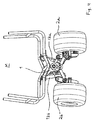
- shows the module of Fig. 1 in the lower position of the wheels.
- Figures 1 and 2 illustrate an arrangement according to the invention for the suspension of wheels. Figure 1 shows, in a reduced view, one joint parallelogram applied in the invention, and its different arms in the middle position. Figure 1 also shows the positions of
suspension arms 6a and 7a and acylinder actuator 12a for controlling the position of amounting arm 5a in the vertical direction. A wheel is mounted to themounting arm 5a as shown in Fig. 2. For comparison, the prior art placement of a cylinder C is also illustrated with a broken line. If the suspension arms of the joint parallelogram are parallel and equal in length, the position of the mounting arm and thereby the position of the wheel are changed as little as possible in the different positions of the joint parallelogram. Normally, the arms are unequal at least in length. - With reference to Fig. 2, the arrangement according to the invention comprises a
frame part 1 placed on a vertical central line CL and forming part of a frame in a working machine intended to move on a terrain, such as a harvester, a forwarder or a combined machine. For example, a working machine for handling and transportation of timber comprises a front frame and a rear frame arranged to be movable by means of one or several pairs of wheels. The wheels are connected to the frame by means of a suspension according to the invention. The front frame is also equipped with a power source for the working machine, typically a diesel engine. The working machine is equipped with a mechanic hydrostatic transmission system. - Onto the front frame, a swivel base is mounted, onto which are also mounted a cabin and a boom assembly. The boom assembly is arranged for example in front of the cabin, and the end of the boom assembly can be connected to a tool, such as a harvester head. The frames are connected to each other by means of a joint which allows the turning of the frames with respect to each other around an axis in the longitudinal direction of the frame. Furthermore, on the rear frame, a load space is provided for the transportation of timber, such as delimbed and cut tree stems.
- The arrangement according to Fig. 2 is further equipped with two substantially U-shaped bunks which are mounted on the
frame part 1, wherein it forms part of said rear frame. A corresponding construction without the bunks can constitute a part of the front frame. The front end of the rear frame is also equipped with a timber shield which prevents timber loaded in the load space from gliding and colliding with the cabin. The timber shield and the bunks can also be arranged to be removable, to modify the load space. - The
frame part 1 is supported by wheels 2a and 2b placed on its each side. The wheels 2a and 2b are normally pneumatic rubber tyres fitted on a removable rim. The rim is mounted, in a rotatable manner, on bearings, and in a way known as such, on a wheel centre which is equipped with a motor, known as such, for rotating the rim with the wheel and thereby to move the working machine. The wheel rotates around a substantially horizontal axis. Furthermore, the wheel centre is arranged to rotate around a substantially vertical axis, wherein the direction of movement of the working machine can be controlled by steering the wheel. The wheel centre is rotated by means of cylinders driven by a pressurized medium. The arrangement comprises a substantially vertical mountingarm 5a where also the joints 3a and 3b are arranged. - The mounting
arm 5a is mounted to the frame by means of an upper suspension arm 6a and anupper suspension arm 7a, which are substantially parallel. Eachsuspension arm 6a, 7a is mounted to the mountingarm 5a by means of a joint 8a or 9a, the joints allowing the rotation of the suspension arm in relation to the mounting arm around a substantially horizontal axis. Eachsuspension arm 6a, 7a is mounted to theframe 1 by means of a joint 10a or 11 a, the joints allowing the swivelling of the suspension arm around a substantially horizontal axis. Thesuspension arms 6a and 7a as well as thejoints - According to an advantageous embodiment of the invention, the
suspension arms 6a and 6b, placed on each side of theframe 1, are arranged to swivel around the same axis R1, by means ofjoints 10a and 10b, respectively. Thejoints 10a and 10b are thus preferably placed on said centre line CL. The joint 10b of the suspension 1b corresponds to the joint 10a of the suspension 1a, and the suspensions correspond to each other also in other respects. The wheels 2a and 2b are preferably spaced by the same distance from the centre line CL, and the corresponding arms of the different suspensions are preferably equal in length, wherein the suspensions of the wheels operate in the same way. Correspondingly, thesuspension arms 7a and 7b, placed on each side of theframe 1, are arranged to swivel around the same rotation axis R2, by means ofjoints 11 a and 11 b, respectively. Thejoints 11 a and 11 b are thus preferably placed on said centre line CL and above thejoints 10a and 10b. - The more detailed structure of the joints may vary within the scope of the invention, but in the structure of Fig. 2, the
joints 10a and 10b as well as thejoints 11a and 11b are further placed one after the other in the direction of the axes R1 and R2. Thus, the suspension arms on different sides of theframe 1, for example thesuspension arms 6a and 6b, are placed on different lines, wherein they can also be placed diagonally. For moving thesuspension arms 6a and 6b, anactuator 12a operated by a pressurized medium, preferably a hydraulic cylinder, is coupled between theframe 1 and the lower suspension arm 6a, by means ofjoints cylinder 12a is mounted above theupper suspension arm 7a and substantially in the vertical direction. Thecylinder 12a is mounted between thejoints cylinder 12a is placed in the free space between theframe 1 and the mountingarm 5a. By means of theactuator 12a, the suspension 1a is held in a desired position to support theframe 1 at a desired height. By means of theactuators 12a and 12b of the suspensions 1 a and 1b, theframe 1 can also be kept horizontal on an uneven terrain. With the arrangement according to the invention, it is possible to reduce the total width of the working machine and thereby the module M according to Fig. 2. - According to an advantageous embodiment of the invention, the joint 10a of the suspension arm 6a, and its axis, are placed at a determined distance on the left side of the centre line CL. The joint 10b of the
suspension arm 6b, and its axis line, are placed at a corresponding distance but on the right side of the centre line CL, wherein thesuspension arms 6a and 6b can move diagonally. By this arrangement, the total width can be further reduced. Without reducing the width, it is, however, possible to increase the moment arm of the cylinder without changing the mounting points of the cylinder. For the simplicity of the construction, the suspensions preferably comply with Fig. 2, wherein the axes are joined and placed on the centre line CL. Accordingly, the width of theframe 1 can be made as narrow as possible, particularly at thejoints - The
frame part 1 of the module M can be made in a desired length, wherein it can be directly connected to another corresponding module M to form the frame of the working machine. The module M can also be connected by means of a frame connector to another module M. - To illustrate the operation of the suspension of the wheel according to the invention, Fig. 3 also shows the left wheel 2b in its uppermost position, wherein the cylinder 12b is steered to its shortened position, and the right wheel 2a is in its lowermost position, wherein the
cylinder 12a is stereed to its elongated position. In the presented manner, theframe 1 can be kept in balance, if the wheel 2b hits a bump on the terrain or if the wheel 2a hits a pit on the terrain. In Fig. 4, both of the wheels 2a and 2b are shown in their lowermost position, wherein the ground clearance of the working machine can be increased by adjusting the suspension. - The invention is not limited solely to the above-presented embodiment, but it can be modified within the scope of the appended claims.
Claims (15)
- An arrangement for the suspension of wheels of a working machine moving on a terrain, the arrangement comprising:characterized in that:a pair of adjacent wheels (2a, 2b) arranged to support a frame part (1) placed on a centre line (CL) between the wheels (2a, 2b), andsuspensions (1a, 1b) arranged between each wheel (2a, 2b) and the frame part (1) to elevate and descend each wheel (2a, 2b) with respect to the frame part (1), wherein each suspension (1a, 1b) comprises a lower suspension arm (6a, 6b) and an upper suspension arm (7a, 7b), which lower suspension arms (6a, 6b) are mounted by means of first joints (10a, 10b) to the frame part (1) and by means of second joints (8a, 8b) to mounting arms (5a, 5b), in which the wheels (2a, 2b) are mounted, and which upper suspension arms (7a, 7b) are fixed by means of third joints (11 a, 11b) to the frame part (1) and by means of fourth joints (9a, 9b) to the mounting arms (5a, 5b),in each suspension (1 a, 1 b), the first joint (10a, 10b) and/or the third joint (11a, 11b) is placed on said centre line (CL).
- The arrangement according to claim 1, characterized in that the first joints (10a, 10b) and/or the third joints (11a, 11b) are arranged to be swivelled around the same axis (R1, R2).
- The arrangement according to claim 1 or 2, characterized in that the first joints (10a, 10b) and/or the third joints (11a, 11b) of the suspensions (1a, 1b) are arranged one after the other in the longitudinal direction of the frame part (1).
- The arrangement according to any of the claims 1 to 3, characterized in that a cylinder actuator (12a, 12b) for lifting and descending the wheel (2a, 2b) is mounted between the lower suspension arm (6a, 6b) and the frame (1).
- The arrangement according to claim 4, characterized in that the cylinder actuator (12a, 12b) is mounted by means of a joint to the lower suspension arm (6a, 6b) between the first joint (10a, 10b) and the second joint (8a, 8b).
- The arrangement according to any of the claims 1 to 5, characterized in that the wheels (2a, 2b) are mounted to the mounting arm (5a, 5b) in a turnable manner, wherein they are arranged to be turnable around a substantially vertical axis.
- The arrangement according to any of the claims 1 to 6, characterized in that the wheel (2a, 2b) is arranged to be turned by means of a cylinder actuator (4a, 4b) coupled between the mounting arm (5a, 5b) and the wheel.
- The arrangement according to any of the claims 1 to 7, characterized in that each wheel (2a, 2b) is provided with a hub motor, driven by a pressurized medium, to rotate the wheel (2a, 2b).
- The arrangement according to any of the claims 1 to 8, characterized in that the frame part (1) is arranged to form a part of the frame of the working machine, consisting of module structures.
- The arrangement according to any of the claims 1 to 9, characterized in that the working machine is a harvester, a forwarder, or a combination of these, intended for the handling of tree stems.
- An arrangement for the suspension of wheels of a working machine moving on a terrain, the arrangement comprising:characterized in that:a pair of adjacent wheels (2a, 2b) arranged to support a frame part (1) placed on a centre line (CL) between the wheels (2a, 2b), andsuspensions (1a, 1b) arranged between each wheel (2a, 2b) and the frame part (1) to elevate and descend each wheel (2a, 2b) with respect to the frame part (1), wherein each suspension (1a, 1b) comprises a lower suspension arm (6a, 6b) and an upper suspension arm (7a, 7b), which lower suspension arms (6a, 6b) are mounted by means of first joints (10a, 10b) to the frame part (1) and by means of second joints (8a, 8b) to mounting arms (5a, 5b), in which the wheels (2a, 2b) are mounted, and which upper suspension arms (7a, 7b) are fixed by means of third joints (11a, 11b) to the frame part (1) and by means of fourth joints (9a, 9b) to the mounting arms (5a, 5b),in each suspension (1 a, 1 b), the first joint (10a, 10b) and/or the third joint (11 a, 11 b) is placed farther than said centre line (CL) such that the wheel is located on the other side of said centre line (CL).
- The arrangement according to claim 11, characterized in that the first joints (10a, 10b) or the third joints (11a, 11b) are arranged to be swivelled around the same axis (R1, R2).
- The arrangement according to claim 11 or 12, characterized in that the first joints (10a, 10b) and/or the third joints (11a, 11b) of the suspensions (1a, 1b) are arranged one after the other in the longitudinal direction of the frame part (1).
- The arrangement according to any of the claims 11 to 13, characterized in that the wheels (2a, 2b) are mounted to the mounting arm (5a, 5b) in a turnable manner, wherein they are arranged to be turnable around a substantially vertical axis.
- The arrangement according to any of the claims 11 to 14, characterized in that the working machine is a harvester, a forwarder, or a combination of these, intended for the handling of tree stems.
Applications Claiming Priority (3)
| Application Number | Priority Date | Filing Date | Title |
|---|---|---|---|
| FI20000547A FI110077B (en) | 2000-03-10 | 2000-03-10 | Arrangement for suspension of the wheels of the working machine |
| FI20000547 | 2000-03-10 | ||
| EP01909878A EP1261503B1 (en) | 2000-03-10 | 2001-02-19 | An arrangement for the suspension of wheels in a working machine |
Related Parent Applications (1)
| Application Number | Title | Priority Date | Filing Date |
|---|---|---|---|
| EP01909878A Division EP1261503B1 (en) | 2000-03-10 | 2001-02-19 | An arrangement for the suspension of wheels in a working machine |
Publications (3)
| Publication Number | Publication Date |
|---|---|
| EP1454775A2 true EP1454775A2 (en) | 2004-09-08 |
| EP1454775A3 EP1454775A3 (en) | 2004-12-22 |
| EP1454775B1 EP1454775B1 (en) | 2006-04-26 |
Family
ID=8557887
Family Applications (2)
| Application Number | Title | Priority Date | Filing Date |
|---|---|---|---|
| EP04102455A Expired - Lifetime EP1454775B1 (en) | 2000-03-10 | 2001-02-19 | An arrangement for the suspension of wheels in a working machine |
| EP01909878A Expired - Lifetime EP1261503B1 (en) | 2000-03-10 | 2001-02-19 | An arrangement for the suspension of wheels in a working machine |
Family Applications After (1)
| Application Number | Title | Priority Date | Filing Date |
|---|---|---|---|
| EP01909878A Expired - Lifetime EP1261503B1 (en) | 2000-03-10 | 2001-02-19 | An arrangement for the suspension of wheels in a working machine |
Country Status (8)
| Country | Link |
|---|---|
| US (2) | US6962359B2 (en) |
| EP (2) | EP1454775B1 (en) |
| AT (2) | ATE324279T1 (en) |
| AU (1) | AU2001237480A1 (en) |
| CA (1) | CA2401519A1 (en) |
| DE (2) | DE60119178D1 (en) |
| FI (1) | FI110077B (en) |
| WO (1) | WO2001066369A1 (en) |
Families Citing this family (11)
| Publication number | Priority date | Publication date | Assignee | Title |
|---|---|---|---|---|
| EP1330385B1 (en) | 2000-10-30 | 2005-12-28 | John Deere Forestry Oy | Chassis structure for a forest machine |
| EP1953075B1 (en) * | 2005-11-02 | 2012-03-14 | Equos Research Co., Ltd. | Vehicle |
| CA2645252A1 (en) * | 2008-11-26 | 2010-05-26 | Dennis Gazarek | Wheeled tilting apparatus |
| US8794641B2 (en) * | 2012-04-12 | 2014-08-05 | Christopher Muller | Multi use recreational utility vehicle |
| US8985610B2 (en) * | 2013-03-08 | 2015-03-24 | Gogoro Inc. | Suspension structure and driving assembly comprising the same |
| US11596092B2 (en) * | 2016-12-15 | 2023-03-07 | Agco Corporation | In-line tandem axle assembly |
| CN107719551B (en) * | 2017-10-30 | 2021-05-18 | 深圳市未来狗科技有限公司 | All-terrain balance car |
| US10766300B2 (en) | 2017-11-09 | 2020-09-08 | Michael Goren | Expandable and retractable wheel assembly |
| EP3765315A4 (en) * | 2018-03-12 | 2021-12-08 | Zohar, Gil | Vehicle axle |
| CN113264111B (en) * | 2021-06-22 | 2025-08-29 | 上饶市勤富信息科技有限公司 | Self-balancing device for self-propelled off-road RV box |
| FR3142319A1 (en) * | 2022-11-24 | 2024-05-31 | Naïo-Technologies | Agricultural vehicle including a stabilization bridge |
Citations (1)
| Publication number | Priority date | Publication date | Assignee | Title |
|---|---|---|---|---|
| WO1989000928A1 (en) | 1987-07-24 | 1989-02-09 | Karlin, Gunvor (Legal Representative For The Estat | Cross-country vehicle |
Family Cites Families (11)
| Publication number | Priority date | Publication date | Assignee | Title |
|---|---|---|---|---|
| BE334848A (en) | 1926-02-06 | |||
| FR2153221B1 (en) | 1971-09-23 | 1976-09-17 | Jamer Jacques | |
| US4186815A (en) * | 1977-12-27 | 1980-02-05 | Caterpillar Tractor Co. | Suspension and drive for tandem wheel vehicle |
| US4565486A (en) * | 1982-09-29 | 1986-01-21 | Timbco Hydraulics Inc. | Device for handling material |
| DE3632416A1 (en) | 1986-09-24 | 1988-04-07 | Schaeff Karl Gmbh & Co | Centre pivot-steered work vehicle with height adjustable wheels |
| FR2651741A1 (en) | 1989-09-12 | 1991-03-15 | Innovations Atel Const | Four-wheel drive vehicle such as an agricultural tractor or the like |
| FR2651751B1 (en) | 1989-09-13 | 1991-10-18 | Plateau Bernard | AIR CUSHION FOR THE PROTECTION OF A CONTENT IN A CONTAINER. |
| FR2652313B1 (en) | 1989-09-26 | 1992-01-24 | Neyrinck Marc | BASIC VEHICLE WITH TWO INDEPENDENT WHEELS AND COMPLEX VEHICLE COMPRISING AT LEAST ONE SUCH BASIC VEHICLE. |
| FR2688465B1 (en) * | 1992-03-10 | 1994-04-29 | Patin Pierre | STABILIZATION DEVICE FOR VEHICLE. |
| US5337847A (en) * | 1993-01-15 | 1994-08-16 | Risley Fluidic Power Ltd. | Four-way levelling mechanism for off-road vehicle |
| IT1287898B1 (en) | 1996-05-14 | 1998-08-26 | Carraro Spa | SPRING AND VARIABILITY SYSTEM OF A DIFFERENTIAL BRIDGE |
-
2000
- 2000-03-10 FI FI20000547A patent/FI110077B/en not_active IP Right Cessation
-
2001
- 2001-02-19 EP EP04102455A patent/EP1454775B1/en not_active Expired - Lifetime
- 2001-02-19 AT AT04102455T patent/ATE324279T1/en not_active IP Right Cessation
- 2001-02-19 EP EP01909878A patent/EP1261503B1/en not_active Expired - Lifetime
- 2001-02-19 AU AU2001237480A patent/AU2001237480A1/en not_active Abandoned
- 2001-02-19 DE DE60119178T patent/DE60119178D1/en not_active Expired - Lifetime
- 2001-02-19 US US10/221,063 patent/US6962359B2/en not_active Expired - Fee Related
- 2001-02-19 AT AT01909878T patent/ATE268697T1/en not_active IP Right Cessation
- 2001-02-19 DE DE60103741T patent/DE60103741T2/en not_active Expired - Lifetime
- 2001-02-19 CA CA002401519A patent/CA2401519A1/en not_active Abandoned
- 2001-02-19 WO PCT/FI2001/000157 patent/WO2001066369A1/en not_active Ceased
-
2005
- 2005-06-27 US US11/167,876 patent/US7077412B2/en not_active Expired - Fee Related
Patent Citations (1)
| Publication number | Priority date | Publication date | Assignee | Title |
|---|---|---|---|---|
| WO1989000928A1 (en) | 1987-07-24 | 1989-02-09 | Karlin, Gunvor (Legal Representative For The Estat | Cross-country vehicle |
Also Published As
| Publication number | Publication date |
|---|---|
| WO2001066369A1 (en) | 2001-09-13 |
| US20030038430A1 (en) | 2003-02-27 |
| CA2401519A1 (en) | 2001-09-13 |
| DE60103741D1 (en) | 2004-07-15 |
| US7077412B2 (en) | 2006-07-18 |
| EP1454775A3 (en) | 2004-12-22 |
| EP1454775B1 (en) | 2006-04-26 |
| ATE324279T1 (en) | 2006-05-15 |
| EP1261503A1 (en) | 2002-12-04 |
| US6962359B2 (en) | 2005-11-08 |
| AU2001237480A1 (en) | 2001-09-17 |
| US20050248115A1 (en) | 2005-11-10 |
| FI20000547A0 (en) | 2000-03-10 |
| EP1261503B1 (en) | 2004-06-09 |
| FI20000547A7 (en) | 2001-09-11 |
| ATE268697T1 (en) | 2004-06-15 |
| FI110077B (en) | 2002-11-29 |
| DE60103741T2 (en) | 2005-07-21 |
| DE60119178D1 (en) | 2006-06-01 |
Similar Documents
| Publication | Publication Date | Title |
|---|---|---|
| US8602137B2 (en) | Linkage lift mechanism for off-road vehicle | |
| EP1261503B1 (en) | An arrangement for the suspension of wheels in a working machine | |
| CN1273344C (en) | Height-adjustable chassis with adjustable chassis section orientation relative to a reference direction | |
| EP2854510B1 (en) | Arrangement in a forestry machine and a forestry machine equipped with a corresponding arrangement | |
| US4350190A (en) | Self propelled, off road vehicle | |
| US6299181B1 (en) | Vehicle having steerable wheels | |
| CA2695708A1 (en) | Extendable frame work vehicle | |
| US10967695B2 (en) | Steerable suspension system | |
| EP3595961B1 (en) | Suspension device for tracked vehicles | |
| RU2297756C2 (en) | Wheel support of agricultural machine | |
| US20160096407A1 (en) | Agricultural vehicle with ride height adjustment | |
| EP1330385B1 (en) | Chassis structure for a forest machine | |
| SE537571C2 (en) | Apparatus for adjusting the ground pressure of an off-road motor vehicle and an off-road motor vehicle equipped with such a device | |
| WO1992010390A1 (en) | A device in vehicles | |
| EP3097771B1 (en) | Forestry machine | |
| US4940110A (en) | Mobile work unit with raisable and lowerable support legs | |
| JP2010070164A (en) | Working machine | |
| US4872700A (en) | Self-propelled vehicle having bogie-type running gear | |
| FI98287C (en) | Working machine | |
| FI110419B (en) | Tree cutting and felling machine wheels suspension comprising lower and upper suspension arms | |
| US20040244868A1 (en) | Forest machine | |
| US11737401B2 (en) | Stump grinder with helical rotary actuator | |
| WO1992010391A1 (en) | A device in vehicles | |
| FI119628B (en) | Forest machine, cargo space in a forest machine and protective screen for a forest machine |
Legal Events
| Date | Code | Title | Description |
|---|---|---|---|
| PUAI | Public reference made under article 153(3) epc to a published international application that has entered the european phase |
Free format text: ORIGINAL CODE: 0009012 |
|
| AC | Divisional application: reference to earlier application |
Ref document number: 1261503 Country of ref document: EP Kind code of ref document: P |
|
| AK | Designated contracting states |
Kind code of ref document: A2 Designated state(s): AT BE CH CY DE DK ES FI FR GB GR IE IT LI LU MC NL PT |
|
| PUAL | Search report despatched |
Free format text: ORIGINAL CODE: 0009013 |
|
| AK | Designated contracting states |
Kind code of ref document: A3 Designated state(s): AT BE CH CY DE DK ES FI FR GB GR IE IT LI LU MC NL PT |
|
| 17P | Request for examination filed |
Effective date: 20050617 |
|
| AKX | Designation fees paid |
Designated state(s): AT BE CH CY DE DK ES FI FR GB GR IE IT LI LU MC NL PT |
|
| GRAP | Despatch of communication of intention to grant a patent |
Free format text: ORIGINAL CODE: EPIDOSNIGR1 |
|
| RAP1 | Party data changed (applicant data changed or rights of an application transferred) |
Owner name: JOHN DEERE FORESTRY OY |
|
| RBV | Designated contracting states (corrected) |
Designated state(s): AT BE CH CY DE DK ES FI FR GB GR IE IT LI LU MC NL PT SE TR |
|
| GRAS | Grant fee paid |
Free format text: ORIGINAL CODE: EPIDOSNIGR3 |
|
| GRAA | (expected) grant |
Free format text: ORIGINAL CODE: 0009210 |
|
| AC | Divisional application: reference to earlier application |
Ref document number: 1261503 Country of ref document: EP Kind code of ref document: P |
|
| AK | Designated contracting states |
Kind code of ref document: B1 Designated state(s): AT BE CH CY DE DK ES FI FR GB GR IE IT LI LU MC NL PT SE TR |
|
| PG25 | Lapsed in a contracting state [announced via postgrant information from national office to epo] |
Ref country code: IT Free format text: LAPSE BECAUSE OF FAILURE TO SUBMIT A TRANSLATION OF THE DESCRIPTION OR TO PAY THE FEE WITHIN THE PRESCRIBED TIME-LIMIT;WARNING: LAPSES OF ITALIAN PATENTS WITH EFFECTIVE DATE BEFORE 2007 MAY HAVE OCCURRED AT ANY TIME BEFORE 2007. THE CORRECT EFFECTIVE DATE MAY BE DIFFERENT FROM THE ONE RECORDED. Effective date: 20060426 Ref country code: CH Free format text: LAPSE BECAUSE OF FAILURE TO SUBMIT A TRANSLATION OF THE DESCRIPTION OR TO PAY THE FEE WITHIN THE PRESCRIBED TIME-LIMIT Effective date: 20060426 Ref country code: FI Free format text: LAPSE BECAUSE OF FAILURE TO SUBMIT A TRANSLATION OF THE DESCRIPTION OR TO PAY THE FEE WITHIN THE PRESCRIBED TIME-LIMIT Effective date: 20060426 Ref country code: AT Free format text: LAPSE BECAUSE OF FAILURE TO SUBMIT A TRANSLATION OF THE DESCRIPTION OR TO PAY THE FEE WITHIN THE PRESCRIBED TIME-LIMIT Effective date: 20060426 Ref country code: BE Free format text: LAPSE BECAUSE OF FAILURE TO SUBMIT A TRANSLATION OF THE DESCRIPTION OR TO PAY THE FEE WITHIN THE PRESCRIBED TIME-LIMIT Effective date: 20060426 Ref country code: LI Free format text: LAPSE BECAUSE OF FAILURE TO SUBMIT A TRANSLATION OF THE DESCRIPTION OR TO PAY THE FEE WITHIN THE PRESCRIBED TIME-LIMIT Effective date: 20060426 Ref country code: NL Free format text: LAPSE BECAUSE OF FAILURE TO SUBMIT A TRANSLATION OF THE DESCRIPTION OR TO PAY THE FEE WITHIN THE PRESCRIBED TIME-LIMIT Effective date: 20060426 |
|
| REG | Reference to a national code |
Ref country code: GB Ref legal event code: FG4D |
|
| REG | Reference to a national code |
Ref country code: IE Ref legal event code: FG4D |
|
| REF | Corresponds to: |
Ref document number: 60119178 Country of ref document: DE Date of ref document: 20060601 Kind code of ref document: P |
|
| REG | Reference to a national code |
Ref country code: SE Ref legal event code: TRGR |
|
| PG25 | Lapsed in a contracting state [announced via postgrant information from national office to epo] |
Ref country code: DK Free format text: LAPSE BECAUSE OF FAILURE TO SUBMIT A TRANSLATION OF THE DESCRIPTION OR TO PAY THE FEE WITHIN THE PRESCRIBED TIME-LIMIT Effective date: 20060726 |
|
| PG25 | Lapsed in a contracting state [announced via postgrant information from national office to epo] |
Ref country code: DE Free format text: LAPSE BECAUSE OF FAILURE TO SUBMIT A TRANSLATION OF THE DESCRIPTION OR TO PAY THE FEE WITHIN THE PRESCRIBED TIME-LIMIT Effective date: 20060727 |
|
| PG25 | Lapsed in a contracting state [announced via postgrant information from national office to epo] |
Ref country code: ES Free format text: LAPSE BECAUSE OF FAILURE TO SUBMIT A TRANSLATION OF THE DESCRIPTION OR TO PAY THE FEE WITHIN THE PRESCRIBED TIME-LIMIT Effective date: 20060806 |
|
| PG25 | Lapsed in a contracting state [announced via postgrant information from national office to epo] |
Ref country code: PT Free format text: LAPSE BECAUSE OF FAILURE TO SUBMIT A TRANSLATION OF THE DESCRIPTION OR TO PAY THE FEE WITHIN THE PRESCRIBED TIME-LIMIT Effective date: 20060926 |
|
| REG | Reference to a national code |
Ref country code: CH Ref legal event code: PL |
|
| NLV1 | Nl: lapsed or annulled due to failure to fulfill the requirements of art. 29p and 29m of the patents act | ||
| PG25 | Lapsed in a contracting state [announced via postgrant information from national office to epo] |
Ref country code: MC Free format text: LAPSE BECAUSE OF NON-PAYMENT OF DUE FEES Effective date: 20070228 |
|
| PLBE | No opposition filed within time limit |
Free format text: ORIGINAL CODE: 0009261 |
|
| STAA | Information on the status of an ep patent application or granted ep patent |
Free format text: STATUS: NO OPPOSITION FILED WITHIN TIME LIMIT |
|
| 26N | No opposition filed |
Effective date: 20070129 |
|
| EN | Fr: translation not filed | ||
| GBPC | Gb: european patent ceased through non-payment of renewal fee |
Effective date: 20070219 |
|
| PG25 | Lapsed in a contracting state [announced via postgrant information from national office to epo] |
Ref country code: IE Free format text: LAPSE BECAUSE OF NON-PAYMENT OF DUE FEES Effective date: 20070219 |
|
| PG25 | Lapsed in a contracting state [announced via postgrant information from national office to epo] |
Ref country code: GB Free format text: LAPSE BECAUSE OF NON-PAYMENT OF DUE FEES Effective date: 20070219 Ref country code: GR Free format text: LAPSE BECAUSE OF FAILURE TO SUBMIT A TRANSLATION OF THE DESCRIPTION OR TO PAY THE FEE WITHIN THE PRESCRIBED TIME-LIMIT Effective date: 20060727 Ref country code: FR Free format text: LAPSE BECAUSE OF FAILURE TO SUBMIT A TRANSLATION OF THE DESCRIPTION OR TO PAY THE FEE WITHIN THE PRESCRIBED TIME-LIMIT Effective date: 20070309 |
|
| PG25 | Lapsed in a contracting state [announced via postgrant information from national office to epo] |
Ref country code: FR Free format text: LAPSE BECAUSE OF FAILURE TO SUBMIT A TRANSLATION OF THE DESCRIPTION OR TO PAY THE FEE WITHIN THE PRESCRIBED TIME-LIMIT Effective date: 20060426 |
|
| PG25 | Lapsed in a contracting state [announced via postgrant information from national office to epo] |
Ref country code: LU Free format text: LAPSE BECAUSE OF NON-PAYMENT OF DUE FEES Effective date: 20070219 Ref country code: CY Free format text: LAPSE BECAUSE OF FAILURE TO SUBMIT A TRANSLATION OF THE DESCRIPTION OR TO PAY THE FEE WITHIN THE PRESCRIBED TIME-LIMIT Effective date: 20060426 |
|
| PG25 | Lapsed in a contracting state [announced via postgrant information from national office to epo] |
Ref country code: TR Free format text: LAPSE BECAUSE OF FAILURE TO SUBMIT A TRANSLATION OF THE DESCRIPTION OR TO PAY THE FEE WITHIN THE PRESCRIBED TIME-LIMIT Effective date: 20060426 |
|
| PGFP | Annual fee paid to national office [announced via postgrant information from national office to epo] |
Ref country code: SE Payment date: 20160226 Year of fee payment: 16 |
|
| REG | Reference to a national code |
Ref country code: SE Ref legal event code: EUG |
|
| PG25 | Lapsed in a contracting state [announced via postgrant information from national office to epo] |
Ref country code: SE Free format text: LAPSE BECAUSE OF NON-PAYMENT OF DUE FEES Effective date: 20170220 |