EP1454635B1 - Geschmacklose, direkt verpressbare, schnelllösliche Komplexe und ihre pharmazeutischen Zusammensetzungen. - Google Patents
Geschmacklose, direkt verpressbare, schnelllösliche Komplexe und ihre pharmazeutischen Zusammensetzungen. Download PDFInfo
- Publication number
- EP1454635B1 EP1454635B1 EP04005469A EP04005469A EP1454635B1 EP 1454635 B1 EP1454635 B1 EP 1454635B1 EP 04005469 A EP04005469 A EP 04005469A EP 04005469 A EP04005469 A EP 04005469A EP 1454635 B1 EP1454635 B1 EP 1454635B1
- Authority
- EP
- European Patent Office
- Prior art keywords
- fexofenadine
- complex
- carbomer
- pharmaceutical formulation
- process according
- Prior art date
- Legal status (The legal status is an assumption and is not a legal conclusion. Google has not performed a legal analysis and makes no representation as to the accuracy of the status listed.)
- Expired - Lifetime
Links
Images





Classifications
-
- A—HUMAN NECESSITIES
- A61—MEDICAL OR VETERINARY SCIENCE; HYGIENE
- A61K—PREPARATIONS FOR MEDICAL, DENTAL OR TOILETRY PURPOSES
- A61K9/00—Medicinal preparations characterised by special physical form
- A61K9/20—Pills, tablets, discs, rods
- A61K9/2095—Tabletting processes
-
- A—HUMAN NECESSITIES
- A61—MEDICAL OR VETERINARY SCIENCE; HYGIENE
- A61K—PREPARATIONS FOR MEDICAL, DENTAL OR TOILETRY PURPOSES
- A61K47/00—Medicinal preparations characterised by the non-active ingredients used, e.g. carriers or inert additives; Targeting or modifying agents chemically bound to the active ingredient
- A61K47/50—Medicinal preparations characterised by the non-active ingredients used, e.g. carriers or inert additives; Targeting or modifying agents chemically bound to the active ingredient the non-active ingredient being chemically bound to the active ingredient, e.g. polymer-drug conjugates
- A61K47/51—Medicinal preparations characterised by the non-active ingredients used, e.g. carriers or inert additives; Targeting or modifying agents chemically bound to the active ingredient the non-active ingredient being chemically bound to the active ingredient, e.g. polymer-drug conjugates the non-active ingredient being a modifying agent
- A61K47/56—Medicinal preparations characterised by the non-active ingredients used, e.g. carriers or inert additives; Targeting or modifying agents chemically bound to the active ingredient the non-active ingredient being chemically bound to the active ingredient, e.g. polymer-drug conjugates the non-active ingredient being a modifying agent the modifying agent being an organic macromolecular compound, e.g. an oligomeric, polymeric or dendrimeric molecule
- A61K47/58—Medicinal preparations characterised by the non-active ingredients used, e.g. carriers or inert additives; Targeting or modifying agents chemically bound to the active ingredient the non-active ingredient being chemically bound to the active ingredient, e.g. polymer-drug conjugates the non-active ingredient being a modifying agent the modifying agent being an organic macromolecular compound, e.g. an oligomeric, polymeric or dendrimeric molecule obtained by reactions only involving carbon-to-carbon unsaturated bonds, e.g. poly[meth]acrylate, polyacrylamide, polystyrene, polyvinylpyrrolidone, polyvinylalcohol or polystyrene sulfonic acid resin
-
- A—HUMAN NECESSITIES
- A61—MEDICAL OR VETERINARY SCIENCE; HYGIENE
- A61K—PREPARATIONS FOR MEDICAL, DENTAL OR TOILETRY PURPOSES
- A61K9/00—Medicinal preparations characterised by special physical form
- A61K9/20—Pills, tablets, discs, rods
- A61K9/2004—Excipients; Inactive ingredients
- A61K9/2013—Organic compounds, e.g. phospholipids, fats
- A61K9/2018—Sugars, or sugar alcohols, e.g. lactose, mannitol; Derivatives thereof, e.g. polysorbates
-
- A—HUMAN NECESSITIES
- A61—MEDICAL OR VETERINARY SCIENCE; HYGIENE
- A61K—PREPARATIONS FOR MEDICAL, DENTAL OR TOILETRY PURPOSES
- A61K9/00—Medicinal preparations characterised by special physical form
- A61K9/20—Pills, tablets, discs, rods
- A61K9/2004—Excipients; Inactive ingredients
- A61K9/2022—Organic macromolecular compounds
- A61K9/205—Polysaccharides, e.g. alginate, gums; Cyclodextrin
- A61K9/2054—Cellulose; Cellulose derivatives, e.g. hydroxypropyl methylcellulose
Definitions
- the present invention relates to fexofenadine-carbomer complexes, pharmaceutical formulations thereof, and processes for producing the complexes and the formulations. More particularly, this invention relates to novel, tasteless, directly compressible, and fast-dissolving complexes of bitter salts of basic drugs and oral dosage forms thereof.
- the pharmaceutical formulations comprising the fexofenadine-carbomer complexes according to this invention can be used for treating symptoms associated with seasonal allergic rhinitis or with chronic idiopathic urticaria.
- Fexofenadine hydrochloride is a histamine H 1 -receptor antagonist with the chemical name ( ⁇ )-4-[1-hydroxy-4-[4-(hydroxydiphenylmethyl)-1-piperidinyl]-butyl]- ⁇ , ⁇ -dimethylbenzene acetic acid hydrochloride.
- the molecular weight of this histamine H 1 -receptor antagonist is 538.13, and its empirical formula is C 32 H 39 NO 4 HCl.
- Fexofenadine hydrochloride is indicated for the relief of symptoms associated with seasonal allergic rhinitis and with chronic idiopathic urticaria in adults and in children of and above the age of 6 years.
- the recommended dose of fexofenadine hydrochloride is 30 mg twice daily for children between 6 and 11 years and 60 mg twice daily for adults and children above 11 years.
- the solid dosage forms available are either 60 mg capsules or 30/60 mg film coated tablets, which are to be swallowed orally, thus making the drug administration difficult, especially for children, elderly patients and during travel. Therefore it would be useful to devise a taste masked, granular, directly compressible, fast dissolving, stable complex of fexofenadine hydrochloride, which can be used in orally-disintegrating, mouth-dissolving, dispersible or chewable tablets.
- cation-exchange resins such as polysulfonic acid and polycarboxylic acid polymers and their potassium salts
- These resins form insoluble adsorbates or resinates through weak ionic bonding with oppositely charged drugs.
- the adsorbates thus maintain a low solution concentration of drug in a suspension free of soluble counterions. They dissociate only at an acidic pH and hence remain in complexed form in the neutral pH of saliva, providing no or very little bitter taste in the mouth. After ingestion and exposure to ions in stomach, the resinate dissociates and drug is eluted to be absorbed.
- HPMCP hydroxypropyl methylcellulose phthalate
- the mechanism of macrolide-Carbopol complex like that of ion-exchange resins, involves ionic bonding of the amine macrolide to the high molecular weight polyacrylic acid, such as Carbopol 934 P, thereby removing the drug from the solution phase in an ion-free suspension.
- CLAR + + R-COO - ⁇ R-COO - CLAR + After ingestion, endogenous cations displace the drug from the polymer complex in the gastrointestinal tract to achieve bioavailability.
- R-COO - CLAR + + H + or Na + ⁇ CLAR + + R-COOH or R-COO - Na + Carbopol is advantageous over conventional ion-exchange resins in this application. It readily swells, allowing rapid cation exchange. Another advantage is that it dissolves in neutral buffers.
- United States Patent No. 4,916,161 to Patell, et al discloses a process for wet granulating a mixture of ibuprofen and HPMCP with an aqueous composition in which the HPMCP is at least partly soluble to affect an improvement in the taste of ibuprofen.
- HPMCP provides an enteric effect, releasing the drug in the intestines.
- United States Patent No. 5,188,839 to Pearmain, et al. discloses a taste-masked chewable tablet of cimetidine containing a copolymer of dimethyl ethyl methacrylate and neutral methacrylic acid ester as a granulating and binding agent, again involving the use of organic solvents.
- PCT International Publication No. WO 00/76479 discloses a taste-masked composition comprising a bitter tasting drug with a combination of two enteric polymers, a methacryclic acid copolymer and a phthalate polymer, in an organic solvent and recovering the composition from the solution thereof.
- United States Patent No. 4,865,851 to James, et al. discloses a lipid-based microencapsulation for taste-masking of cefuroxime axetil in particulate form coated with an integral coating of lipid or a mixture of lipids. It requires a highly sophisticated hot-melt granulation technique and may have an adverse effect on heat-sensitive molecules and on drug release.
- PCT International Publication No. WO 2000009639 describes the formation of microspheres, which are then coated in a fluidized bed coater with a non-aqueous solution of certain polymers such as ethylcellulose and hydroxypropylcellulose.
- United States Patent No. 6,027,746 to Lech, et. al. describes a chewable soft gelatin-encapsulated pharmaceutical adsorbate containing the drug absorbed onto the flakes of Mg trisilicate or SiO 2 , which are then dispersed in a solid or liquid fill material containing flavorings, sweeteners, emulsifiers and the like.
- a fexofenadine-carbomer complex which is a tasteless complex of a bitter acid salt of a basic drug with an acidic polymer.
- the bitter salt of a basic drug is fexofenadine hydrochloride
- the acidic polymer is carbomer.
- the complex of the basic drug is a tasteless, granular, directly compressible, fast dissolving and stable fexofenadine-carbomer complex.
- a pharmaceutical formulation comprising the fexofenadine-carbomer complex.
- the formulation further comprises a diluent, a sweetening agent, a flavoring agent, a coloring agent, a disintegrating agent, a disintegration enhancer, a dissolution enhancer and/or a lubricant.
- the complex can be obtained by removing an acid salt of fexofenadine employing an alkali, reacting the fexofenadine with an acidic polymer such as a carbomer, to enable complexation, and isolating the complex, and drying and sieving the same.
- the pharmaceutical formulation further comprises mannitol as a preferred diluent, aspartame as a preferred sweetening agent, fruit flavor as a preferred flavoring agent, sunset yellow as a preferred coloring agent and microcrystalline cellulose as a preferred disintegrating agent, citric acid, sodium bicarbonate or crosscarmellose sodium as preferred disintegration and dissolution enhancers, and talcum or magnesium stearate, colloidal silicon dioxide, glyceryl behenate, or glyceryl palmitostearate as preferred lubricants.
- the pharmaceutical formulation preferably is in a solid oral dosage form selected from tablets, capsules, pills, granules and dry syrups.
- the pharmaceutical formulation comprises a tasteless complex of a basic drug, fexofenadine, wherein the tasteless complex is a fexofenadine-carbomer complex.
- the formulation can be adapted for a twice daily dose regimen.
- the formulation preferably comprises a potency equivalent to 30 mg to 180 mg of fexofenadine hydrochloride.
- the formulation can comprise a potency equivalent to 30 mg of fexofenadine hydrochloride, which is desirably adapted for a twice daily dose regimen for children of 6 to 11 years, a potency equivalent to 60 mg of fexofenadine hydrochloride, which is desirably adapted for a twice daily dose regimen for children above 11 years and adults, a potency equivalent to 120 mg of fexofenadine hydrochloride, which is desirably adapted for a twice daily dose regimen for adults as the maximum dose, or a potency equivalent to 180 mg of fexofenadine hydrochloride, which is desirably adapted for a once daily dose regimen for children above 11 years and adults.
- a solid oral dosage form of a pharmaceutical formulation comprises a tasteless complex of a basic drug, fexofenadine, wherein the solid oral dosage form is a tablet.
- the tablet can be chewable, orally disintegrating, mouth dissolving and/or dispersible.
- a process for producing a pharmaceutical formulation comprising a fexofenadine-carbomer complex which is a tasteless complex of a basic drug, fexofenadine.
- the process comprises sieving a dried tasteless, granular complex of a basic drug through suitable meshes in order to get a desired particle size, mixing it with one or more components selected from diluents, disintegrating agents, coloring agents, disintegration and dissolution enhancers, sweetening agents, flavoring agents and lubricants thoroughly for a predetermined period of time under controlled temperature and humidity conditions to form an oral solid dosage formulation.
- the tasteless complex of the basic drug is a fexofenadine-carbomer complex
- the diluent is mannitol
- the sweetening agent is aspartame
- the disintegrating agent is microcrystalline cellulose
- the disintegration and dissolution enhancers are selected from citric acid, sodium bicarbonate and crosscarmellose sodium
- the coloring agent is sunset yellow lake
- the flavoring agent is fruit flavor
- the lubricant is talcum, magnesium stearate, colloidal silicon dioxide, glyceryl behenate, glyceryl palmitostearate or a mixture thereof.
- a mixture of these ingredients with a tasteless, granular, directly compressible fexofenadine-carbomer complex may also be compressed to form a dispersible or mouth-dissolving or orally-disintegrating or chewable tablet.
- a process for producing tasteless complex of a basic drug by removing an acidic salt of the basic drug employing an alkali, reacting the basic drug with an acidic polymer to enable complexation, and isolating, drying and sieving the complex to produce a tasteless, granular, directly compressible, fast-dissolving and stable complex of the basic drug.
- the basic drug is fexofenadine
- the acidic salt of the basic drug is the hydrochloride salt of fexofenadine
- the basic drug is reacted with the acidic polymer in an aqueous medium
- the alkali employed is a hydroxide of an alkali metal, such as NaOH or KOH, used in an equimolar quantity of the salt of the basic drug.
- the acidic polymer used is a carbomer and the drug-polymer ratio ranges from 1:0.25 to 1:1. More preferably, the drug-polymer ratio ranges from 1:0.5 to 1:0.6.
- the complex is isolated by centrifugation and filtration and is dried at 40°-45°C.
- a process for characterizing a tasteless complex of a basic drug can be realized by analyzing at least one property of the isolated complex of the basic drug.
- the basic drug is fexofenadine
- the acidic salt of the basic drug is the hydrochloride salt of fexofenadine.
- the analyzing at least one property of the isolated complex of the basic drug comprises at least one analysis selected from the group consisting of pH-solubility profiling, assessing its melting point, assessing its water content, analyzing the complex by high performance liquid chromatography (HPLC), and analyzing the complex by differential scanning calorimetry (DSC).
- HPLC high performance liquid chromatography
- DSC differential scanning calorimetry
- the tasteless, granular, directly compressible complex of the basic drug thus isolated and characterized is a fexofenadine-carbomer complex.
- a tasteless, directly compressible, granular, stable and fast-dissolving complex of fexofenadine can be produced.
- the process comprises dispersing an equimolar quantity of fexofenadine hydrochloride in an aqueous solution of sodium hydroxide, stirring the composition sufficiently, thus changing the nature of the drug dispersion, adding slowly carbomer in the form of an aqueous gel while stirring in an amount such that the drug:polymer concentration ratio ranges from 1:0.5 to 1:0.6, enabling thickening of the dispersion of drug upon gradual addition of carbomer gel until complete complexation takes place; enabling separation of two phases, one containing the tasteless complex of the basic drug, fexofenadine, and carbomer, and the other containing water.
- the solid phase is separated by centrifugation and filtration and dried at 40-45°C until a moisture content of 2-5% is achieved.
- the tasteless, directly compressible and granular complex of fexofenadine thus obtained is forced through suitable meshes to get a desired particle size for use in dispersible, chewable, mouth-dissolving and/or orally disintegrating tablets.
- the stage of complexation is reached and phase separation starts with the addition of carbomer in an amount slightly less than 50% of drug and continues until 60%. Further quantities of carbomer greater than 60% do not make much difference in taste, but instead makes the two phases miscible with each other, making the separation, filtration and drying of the complex all the more difficult.
- the quantity of sodium hydroxide and the quantity of carbomer used affect the formation of a tasteless, easily separable, filterable, stable, granular, directly compressible and fast-dissolving complex of fexofenadine.
- Fexofenadine an H 1 -histamine antagonist drug
- MW-538 the pharmaceutically acceptable hydrochloride salt
- the nitrogen atom present in the ring is being utilized by the HCl moiety, leaving nothing for the carboxyl group of polyacrylic acid or carbomer to react with.
- carbomer gel when an aqueous dispersion of fexofenadine hydrochloride is mixed with carbomer gel as such, even in a ratio of 1:1, nothing happens, and no taste masking occurs. It was discovered to free only the nitrogen atom of fexofenadine hydrochloride by first adding just a sufficient amount of sodium hydroxide, and then adding carbomer gel.
- carbomer refers to a polymer of acrylic acid crosslinked with allyl ethers of sugars, such as sucrose, or polyalcohols, such as penta erythritol.
- carbomers are typically high molecular weight polymers.
- the carbomers contain not less than 56% and not more than 68% of carboxylic acid (-COOH) groups.
- exemplary carbomers useful in the invention are commercially available from B.F. Goodrich under the name Carbopol®.
- the amount of sodium hydroxide is preferably carefuly controlled. If less sodium hydroxide is used than what is required to free only the nitrogen of fexofenadine, then the complete reaction does not take place between fexofenadine and carbomer and proper taste masking does not occur. On the other hand, if excess sodium hydroxide is used, it makes the carbomer swell and its gel very thick, thus not allowing proper stirring and separation of the tasteless complex of fexofenadine to occur. Further, while the taste of the complex thus formed is not bitter, when kept in the mouth, it has a slimy and sticky feel and does not disintegrate or dissolve quickly.
- Fexofenadine hydrochloride was dispersed in an aqueous solution of sodium hydroxide, the latter in an equimolar quantity. After sufficient stirring, which changed the nature of the drug dispersion, a carbomer was added slowly in the form of an aqueous gel with simultaneous proper stirring. The carbomer was added in a concentration sufficient to provide a drug:polymer ratio ranging from 1:0.5 to 1:0.6. The dispersion of drug thickened more and more with the gradual addition of carbomer gel until a stage was reached where complete complexation took place and separation of two phases occured, one phase containing the tasteless complex of the basic drug-fexofenadine and a carbomer, and the other one containing water.
- the solid phase was separated by centrifugation and filtration and dried at 40-45°C until a moisture content of 2-5% was achieved.
- the tasteless, directly compressible and granular complex of fexofenadine thus obtained was forced through suitable meshes to get a desired particle size for use in dispersible, chewable, mouth dissolving and/or orally disintegrating tablets described further.
- the stage of complexation is reached and phase separation starts when the amount of carbomer added is slightly less than 50% of the amount of drug present and continues until the amount of carbomer is about 60% of the amount of drug.
- the complex of fexofenadine with carbomer is better than fexofenadine hydrochloride in many respects.
- it has a pH-independent solubility up to pH 6.0, and then at pH 7.0 the solubility increases and becomes equal or more than that of fexofenadine hydrochloride.
- the latter has significantly less solubility at pH 1.2 and at pH 5.0 (less than that of the complex) and high solubility at pH 3.0 & 4.0, making its absorption in the gastrointestinal tract pH-dependent.
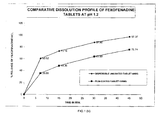
- the reason for the better dissolution profile at pH 1.2 may be the quick dissociation of the fexofenadine-carbomer complex at an acidic pH and subsequent solubility of the fexofenadine base in acid.
- the carbomer dissolves readily, and the drug is released again. This means that the onset of action of the oral dosage form made out of the fexofenadine-carbomer complex will be faster than the tablet of fexofenadine hydrochloride, and more so if it is a dispersible or chewable or orally disintegrating or mouth dissolving tablet, while not compromising with the percentage of drug available to the body.
- the fexofenadine-carbomer complex is obtained directly in granular and directly compressible form after it is separated, dried and passed through suitable meshes. There is no need for further granulation using binders, as is required for fexofenadine hydrochloride film coated tablets.
- the dispersible or orally disintegrating or mouth-dissolving tablet of fexofenadine prepared from the above tasteless, granular, directly compressible, stable and fast-dissolving complex has further advantages of ease of administration with or without water, ease of providing accurate and divisible doses and patient compliance.
- the stability studies carried out with the above pure complex as well as with its dispersible, orally disintegrating and mouth dissolving tablet using different flavors and sweetening agents do not show any significant degradation of the drug at any of the stability conditions with all impurities well within the limits. Even the physical properties and dissolution profiles are least affected during the shelf life.
- a fexofenadine-carbomer complex prepared, isolated and characterized as described above was obtained directly in a tasteless, granular, directly compressible, fast-dissolving and stable form, so it was used as such with a desired particle size for the preparation of the above-mentioned tablet.
- a quantity of the complex equivalent to the desired dose of fexofenadine hydrochloride (30mg/60mg/120mg) was taken (15-40% by weight of composition) and dry mixed with the standard pharmaceutical excipients used for a mouth dissolving/orally disintegrating tablet, e.g., diluents like directly compressible mannitol (30 - 60% by weight of composition); sweetening agent like aspartame; flavoring agents; coloring agents; disintegrating agents like microcrystalline cellulose (5-20% by weight of tablet); disintegration and dissolution enhancers like citric acid, sodium bicarbonate and crosscarmellose sodium; and lubricants like talcum, magnesium stearate, colloidal silicon dioxide, glyceryl behenate, and glyceryl palmitostearate.
- diluents like directly compressible mannitol (30 - 60% by weight of composition
- sweetening agent like aspartame
- flavoring agents coloring agents
- disintegrating agents like microcrystalline cellulose
- the tasteless, granular and directly compressible fexofenadine-carbomer complex of a desired particle size was used in a quantity equivalent to the desired dose of fexofenadine hydrochloride (30mg/60mg/120mg), 15-40% by weight of the composition, and dry mixed geometrically with the standard pharmaceutical excipients used for a dispersible tablet, for example, a diluent and disintegrating agent like directly compressible microcrystalline cellulose (30-60% by weight of tablet); a sweetening agent like aspartame; flavoring agents; a coloring agent; disintegration enhancers like crosscarmellose sodium; and lubricants like talcum and magnesium stearate.
- the mixture was compressed like an ordinary tablet.
- the tablet thus formed dispersed in 30-60 seconds in 10-15ml water at 25 °C, which when swallowed gave a pleasant taste and left no residue in the oral cavity.
- a single dose, pharmacokinetic study of a fexofenadine orally disintegrating uncoated tablet containing fexofenadine-carbomer complex equivalent to 120mg of fexofenadine hydrochloride prepared as described above was carried out in healthy adult male human volunteers under fasting conditions.
- the orally disintegrating tablet was not swallowed but was allowed to dissolve/disperse in the mouth during administration of the drug to the volunteers.
- Plasma samples collected at different time intervals up to 48 hrs. were assayed for fexofenadine using a validated high-performance liquid chromatographic procedure using a fluorescence detector described in " Determination of Terfenadine and Terfenadine acid metabolite in plasma using solid phase extraction and HPLC with fluorescence detection" J. Chromatogr 1991 (570), p. 139-148 .
- a preferred composition according to the invention is as follows: INGREDIENTS QTY. (MG/TAB.) QTY. (MG/TAB.) QTY. (MG/TAB.) FOR 30MG FOR 60MG FOR 120MG (1) (2) (3) Fexofenadine-carbomer Complex (having a potency of about 60%) equivalent to 30/ 60/120mg of Fexofenadine HCl -Directly compressible 50 100 200 Mannitol - Directly Compressible 157 289 213 Microcrystalline Cellulose - Directly Compressible 35 70 70 Crosscarmellose Sodium 9 18 18 Aspartame 12 24 24 Flavor - Mixed Fruit 20 40 40 Talcum 3 6 6 6 Magnesium Stearate 3 6 6 Color - Sunset Yellow Lake 3 6 6 Citric Acid 6 12 12 Sodium Bicarbonate 2.5 5 5 5 Aerosil (Colloidal silicon dioxide) -- 6 -- Glyceryl Behenate/ Palmitostearate -- 18 -- 300.5mg 600mg 600mg
- a fexofenadine-carbomer complex was passed through suitable meshes. It was mixed with mannitol and microcrystalline cellulose one by one after sifting each diluent through a 44# mesh. Sunset yellow lake was passed through an 85# mesh and geometrically mixed with the above portion. Then citric acid and sodium bicarbonate were added one by one to the above mixture after passing each through a 60# mesh and protecting from moisture. Lubricants (talc, magnesium stearate, colloidal silicon dioxide, glyceryl behenate, and glyceryl palmitostearate) were mixed separately with aspartame, crosscarmellose sodium and then flavor after sifting each of them through a 60# mesh. This was then geometrically added to the above mixture, mixed thoroughly for 20-30 minutes and compressed at a pressure slightly less than that used for conventional tablets and under controlled temperature and humidity conditions. They were then strip-packed after complete testing.
- Lubricants talc, magnesium stearate, colloidal silicon dioxide, glyce
- INGREDIENTS QUANTITY (MG/TABLET) QUANTITY (MG/TABLET) FOR 60MG STRENGTH FOR 120MG STRENGTH Fexofenadine-Carbomer Complex 100 200 (having a potency of about 60%) equivalent to 60/120mg of Fexofenadine HCl- Directly Compressible Microcrystalline Cellulose - 157 314 Directly Compressible Aspartame 10 20 Crosscarmellose Sodium 9 18 Talcum 3 6 Magnesium Stearate 3 6 Flavor - Mixed Fruit 15 30 Color - Sunset Yellow Lake 3 6 300mg 600mg
- a fexofenadine-carbomer complex was passed through 44 BSS No. mesh and retained on a 60# mesh. It was then mixed with directly compressible microcrystalline cellulose, sifted through a 44# mesh. Color was sifted through a fine mesh and geometrically mixed with the above.
- Lubricants talcum and magnesium stearate
- aspartame, crosscarmellose sodium and flavor one by one after sifting each through a 60# mesh. This was then geometrically mixed with the above mixture for 20-30 minutes and then compressed like ordinary tablets, which were then strip-packed after complete testing.
- the pharmacokinetic study of a single dose of an orally disintegrating uncoated fexofenadine tablet containing a fexofenadine-carbomer complex equivalent to 120mg of fexofenadine hydrochloride was carried out in healthy adult male human subjects under fasting conditions.
- the human volunteers were selected from males ranging in age from 18-45 years. They were medically fit persons with a normal weight to height ratio, with no history of allergy to the drug or any infectious disease or any liver, kidney or cardiovascular disorder or alcoholism or drug dependence. They were screened after a complete physical, biochemical and haematological examination.
- Each subject received a single dose of 120mg equivalent of fexofenadine hydrochloride after overnight fasting.
- the orally disintegrating tablet was kept in the mouth without water so as to allow it to disperse or dissolve, and the saliva was then swallowed. No food was allowed for 2 hours after administering the drug.
- a standard diet was provided to the volunteers during the study. Blood samples were collected prior to dosing (0 hr.) and at 0.5, 1.0, 1.5, 2.0, 2.5, 3.0, 4.0, 6.0, 8.0, 12.0, 24.0 and 48.0 hrs. after dosing. The collected blood samples were transferred to heparinised collection tubes and centrifuged to be stored at - 20°C till the time of analysis. Plasma samples were analysed using HPLC and a fluorescence detector, the results of which showed the plasma concentration - time curve for fexofenadine hydrochloride as shown in Fig. 3. The pharmacokinetic parameters are shown in Table II.
- PH-solubility profile (mg of Fexofenadine HCl/ml) PH 1.2 (KCl Buffer) 0.281 0.663 PH 3.0 (KCl Buffer) 0.858 0.456 PH 4.0 (KCl Buffer) 0.846 0.454 PH 5.0 (KH 2 PO 4 Buffer) 0.266 0.403 PH 6.0 (KH 2 PO 4 Buffer) 0.724 0.503 PH 7.0 (KH 2 PO 4 Buffer) 0.732 1.042 08.
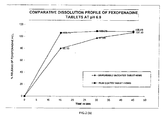
- Dissolution Profile at pH 1.2 Conventional Fexofenadine HCl 120mg film coated tablet Present Invention Orally disintegrating Uncoated Tablet-120mg Dispersible Uncoated Tablet-60mg Mouth dissolving Tablet-60mg 35.66% 7 min. 48.36% 54.28% 60.52% 81.44% 15 min. 63.99% 72.87% 73.16% 95.21% 30 min. 75.74% 90.19% 87.92% 100.69% 45 min. 98.25% 97.37% 106.35% 09. Dissolution profile at pH 6.8 15 min. 106.15% 85.68% 80.15% 102.81% 30 min. 109.20% 105.62% 97.68% 108.39% 45 min. 108.89% 111.74% 107.10% 108.24% 10.
Landscapes
- Health & Medical Sciences (AREA)
- Epidemiology (AREA)
- Animal Behavior & Ethology (AREA)
- Chemical & Material Sciences (AREA)
- Medicinal Chemistry (AREA)
- Pharmacology & Pharmacy (AREA)
- Veterinary Medicine (AREA)
- Life Sciences & Earth Sciences (AREA)
- Public Health (AREA)
- General Health & Medical Sciences (AREA)
- Bioinformatics & Cheminformatics (AREA)
- Engineering & Computer Science (AREA)
- Medicinal Preparation (AREA)
- Medicines That Contain Protein Lipid Enzymes And Other Medicines (AREA)
- Pharmaceuticals Containing Other Organic And Inorganic Compounds (AREA)
Claims (55)
- Fexofenadin-Carbomer-Komplex, mit einem Carbomer komplexiertes Fexofenadin umfassend.
- Fexofenadin-Carbomer-Komplex nach Anspruch 1, wobei das Verhältnis des Fexofenadins zu dem Carbomer in dem Komplex in einem Bereich von 1:0,25 bis 1:1 liegt.
- Fexofenadin-Carbomer-Komplex nach Anspruch 1, wobei das Verhältnis des Fexofenadins zu dem Carbomer in dem Komplex in einem Bereich von 1:0,5 bis 1:0,6 liegt.
- Fexofenadin-Carbomer-Komplex nach Anspruch 1, wobei der Komplex geschmacksneutral ist.
- Fexofenadin-Carbomer-Komplex nach Anspruch 4, wobei der Komplex direkt pressbar und schnell löslich ist.
- Fexofenadin-Carbomer-Komplex nach Anspruch 1, wobei der Komplex erhalten wird durch:in Kontakt bringen eines Fexofenadin-Säuresalzes mit einer Lauge; undUmsetzen des Fexofenadins mit einem Carbomer unter Bedingungen, die ausreichend sind eine Komplexierung zu ermöglichen.
- Fexofenadin-Carbomer-Komplex nach Anspruch 6, wobei die Schritte des in Kontakt bringens und des Umsetzens in einem wässrigen Medium durchgeführt werden.
- Verfahren zum Herstellen eines Komplexes eines basischen Arzneimittels umfassend:Entfernen eines Säuresalzes von einem basischen Arzneimittel unter Verwenden einer Lauge; undUmsetzen des basischen Arzneimittels mit einem sauren Polymer unter Bedingungen, die ausreichen einen Komplex des basischen Arzneimittels mit dem sauren Polymer zu bilden.
- Verfahren nach Anspruch 8, wobei die Schritte des Entfernens und des Umsetzens in einem wässrigen Medium durchgeführt werden.
- Verfahren nach Anspruch 8, ferner das Isolieren, Trocknen und Sieben des Komplexes umfassend.
- Verfahren nach Anspruch 10, wobei der Komplex durch Zentrifugieren und Filtrieren isoliert wird.
- Verfahren nach Anspruch 10, wobei der isolierte Komplex bei 40°-45°C getrocknet wird.
- Verfahren nach Anspruch 10, ferner das Charakterisieren des Komplexes umfassend.
- Verfahren Anspruch 13, wobei der Komplex durch Analysieren wenigstens einer der Eigenschaften des Komplexes charakterisiert wird.
- Verfahren nach Anspruch 13, wobei der Komplex durch Festlegen seines pH-Löslichkeitsprofils, Festlegen seines Schmelzpunkts, Festlegen seines Wassergehalts, Analyse desselben durch Hochleistungs-Flüssigkeitschromatographie (HPLC) und/oder Analyse desselben durch Differenzialraster-Kalorimetrie (DSC) charakterisiert wird.
- Verfahren nach Anspruch 8, wobei das basische Arzneimittel Fexofenadin ist.
- Verfahren nach Anspruch 8, wobei das Säuresalz des basischen Arzneimittels ein Chlorhydratsalz von Fexofenadin ist.
- Verfahren nach Anspruch 8, wobei der Komplex ein Fexofenadin-Carbomer-Komplex ist.
- Verfahren nach Anspruch 8, wobei die eingesetzte Lauge ein Hydroxid eines Alkalimetalls ist.
- Verfahren nach Anspruch 8, wobei die Lauge NaOH oder KOH ist.
- Verfahren nach Anspruch 8, wobei die Lauge und das Salz des basischen Arzneimittels in äquimolaren Mengen bereitgestellt werden.
- Verfahren nach Anspruch 8, wobei das saure Polymer ein Carbomer ist.
- Verfahren nach Anspruch 8, wobei das Verhältnis des basischen Arzneimittels zu dem sauren Polymer in einem Bereich von 1:0,25 bis 1:1 liegt.
- Verfahren nach Anspruch 8, wobei das Verhältnis des basischen Arzneimittels zu dem sauren Polymer in einem Bereich von 1:0,5 bis 1:0,6 liegt.
- Verfahren nach Anspruch 8, ferner den Erhalt des Komplexes in einer geschmacksneutralen, granulären, direkt pressbaren, schnell löslichen und stabilen Form umfassend.
- Verfahren nach Anspruch 8, umfassend
Entfernen eines Säuresalzes von Fexofenadin unter Verwenden einer Lauge in einem wässrigen Medium, wobei die Lauge und das Säuresalz von Fexofenadin in äquimolaren Mengen bereitgestellt werden; und
Umsetzen des Fexofenadins mit einem Carbomer in einem wässrigen Medium unter Bedingungen, die ausreichen einen Fexofenadin-Carbomer-Komplex zu bilden. - Pharmazeutische Formulierung, einen Fexofenadin-Carbomer-Komplex und einen pharmazeutisch verträglichen Arzneistoffträger umfassend.
- Pharmazeutische Formulierung nach Anspruch 27, ferner wenigstens ein Mittel umfassend, ausgewählt aus Süßstoffen und Aromastoffen.
- Pharmazeutische Formulierung nach Anspruch 27, ferner einen Süßstoff, ausgewählt aus der Gruppe, bestehend aus Sacchariden, Aspartam, Neotam und Steviosid, umfassend.
- Pharmazeutische Formulierung nach Anspruch 27, ferner einen Aromastoff umfassend.
- Pharmazeutische Formulierung nach Anspruch 27, ferner wenigstens ein Zerfallsmittel oder einen Zerfalls-/Lösungsverstärker umfassend.
- Pharmazeutische Formulierung nach Anspruch 27, ferner wenigstens einen Zerfallsstoff, ausgewählt aus der Gruppe, bestehend aus Stärkederivaten, Cellulosen und Cellulosederivaten, umfassend.
- Pharmazeutische Formulierung nach Anspruch 27, ferner einen Lösungs-/Zerfallsverstärker umfassend.
- Pharmazeutische Formulierung nach Anspruch 27, feiner wenigstens einen Lösungs-/Zerfallsverstärker, ausgewählt aus der Gruppe, bestehend aus Zitronensäure, Natriumbicarbonat und Crosscarmellose-Natrium, umfassend.
- Pharmazeutische Formulierung nach Anspruch 27, ferner einen Farbstoff umfassend.
- Pharmazeutische Formulierung nach Anspruch 27, ferner ein Verdünnungsmittel, ausgewählt aus der Gruppe bestehend aus Mannitol, Stärken, Laktose, Saccharose, Sorbitol, Cellulosen und Mischung derselben, umfassend.
- Pharmazeutische Formulierung nach Anspruch 27, ferner ein Schmiermittel umfassend.
- Pharmazeutische Formulierung nach Anspruch 37, wobei das Schmiermittel ausgewählt ist aus der Gruppe, bestehend aus Talk, Magnesiumstearat, Calciumstearat, Polyethylenglykolen, kolloidem Siliciumdioxid, Fettsäuren, Glycerylestern von Fettsäuren und Mischungen derselben.
- Pharmazeutische Formulierung nach Anspruch 27, wobei der Fexofenadin-Carbomer-Komplex in einer Menge in einem Bereich von 15 bis 40 Gewichtsprozent, basierend auf dem Gesamtgewicht der Formulierung, vorliegt.
- Pharmazeutische Formulierung nach Anspruch 39, ferner ein Verdünnungsmittel umfassend, dass in einer Menge in einem Bereich von 30 bis 60 Gewichtsprozent, basierend auf dem Gesamtgewicht der Formulierung, vorliegt.
- Pharmazeutische Formulierung nach Anspruch 27, wobei der Fexofenadin-Carbomer-Komplex geschmacksneutral, direkt pressbar und schnell löslich ist.
- Pharmazeutische Formulierung nach Anspruch 27, wobei der Fexofenadin-Carbomer-Komplex erhalten wird durch:in Kontakt bringen eines Fexofenadin-Säuresalzes mit einer Lauge; undUmsetzen des Fexofenadins mit einem Carbomer unter Bedingungen, die ausreichend sind eine Komplexierung zu ermöglichen.
- Pharmazeutische Formulierung nach Anspruch 42, wobei die Schritte des in Kontakt bringens und des Umsetzens in einem wässrigen Medium durchgeführt werden.
- Pharmazeutische Formulierung nach Anspruch 27, wobei die Formulierung in einer festen oralen Dosierungsform besteht.
- Pharmazeutische Formulierung nach Anspruch 44, wobei die feste orale Dosierungsform ausgewählt ist aus der Gruppe, bestehend aus Tabletten, Kapseln, Dragees, Granulat und Trockensirupen.
- Pharmazeutische Formulierung nach Anspruch 27, wobei die Formulierung eine Wirksamkeit umfasst, die Fexofenadin-Hydrochlorid in einem Bereich von 30 mg bis 180 mg entspricht.
- Pharmazeutische Formulierung nach Anspruch 27, wobei die Formulierung eine Wirksamkeit umfasst, die 30 mg Fexofenadin-Hydrochlorid entspricht.
- Pharmazeutische Formulierung nach Anspruch 27, wobei die Formulierung eine Wirksamkeit umfasst, die 60 mg Fexofenadin-Hydrochlorid entspricht.
- Pharmazeutische Formulierung nach Anspruch 27, wobei die Formulierung eine Wirksamkeit umfasst, die 120 mg Fexofenadin-Hydrochlorid entspricht.
- Pharmazeutische Formulierung nach Anspruch 27, wobei die Formulierung eine Wirksamkeit umfasst, die 180 mg Fexofenadin-Hydrochlorid entspricht.
- Pharmazeutische Formulierung nach Anspruch 27, wobei die Formulierung in Form einer Tablette besteht, die kaubar ist, zerlegbar ist, im Mund zerfällt und/oder sich auflöst.
- Pharmazeutische Formulierung nach Anspruch 27, ferner ein Verdünnungsmittel, einen Süßstoff, einen Aromastoff, einen Farbstoff, ein Zerfallsmittel, einen Zerfallsverstärker, einen Löslichkeitsverstärker und/oder ein Schmiermittel umfassend.
- Verfahren zum Herstellen einer einen Fexofenadin-Carbomer-Komplex und einen pharmazeutisch verträglichen Arzneistoffträger umfassenden pharmazeutischen Formulierung, wobei das Verfahren das Sieben des Fexofenadin-Carbomer-Komplexes in getrockneter Form durch ein oder mehrere Siebgewebe, zum Erhalt des Fexofenadin-Carbomer-Komplexes in granulärer Form mit einer gewünschten Partikelgröße und das Mischen des gesiebten Fexofenadin-Carbomer-Komplexes mit dem Arzneistoffträger für eine vorherbestimmte Zeitdauer unter gesteuerten Temperatur- und Feuchtigkeitsbedingungen, zum Bilden einer oralen festen Dosierungsformulierung, umfasst.
- Verfahren nach Anspruch 53, ferner das Sieben des Arzneistoffträgers umfassend, bevor der gesiebte Fexofenadin-Carbomer-Komplex mit dem Arzneistoffsträger gemischt wird.
- Verfahren nach Anspruch 53, ferner das Pressen der Mischung des Fexofenadin-Carbomer-Komplexes und des Arzneistoffsträgers, zum Herstellen der oralen festen Dosierungsformulierung in Form von Tabletten, umfassend.
Applications Claiming Priority (2)
| Application Number | Priority Date | Filing Date | Title |
|---|---|---|---|
| US383433 | 1982-06-01 | ||
| US10/383,433 US20030170310A1 (en) | 2002-03-08 | 2003-03-07 | Tasteless, directly compressible, fast-dissolving complexes and pharmaceutical formulations thereof |
Publications (2)
| Publication Number | Publication Date |
|---|---|
| EP1454635A1 EP1454635A1 (de) | 2004-09-08 |
| EP1454635B1 true EP1454635B1 (de) | 2007-12-19 |
Family
ID=32824799
Family Applications (1)
| Application Number | Title | Priority Date | Filing Date |
|---|---|---|---|
| EP04005469A Expired - Lifetime EP1454635B1 (de) | 2003-03-07 | 2004-03-08 | Geschmacklose, direkt verpressbare, schnelllösliche Komplexe und ihre pharmazeutischen Zusammensetzungen. |
Country Status (4)
| Country | Link |
|---|---|
| EP (1) | EP1454635B1 (de) |
| AT (1) | ATE381350T1 (de) |
| DE (1) | DE602004010732T2 (de) |
| ES (1) | ES2298637T3 (de) |
Families Citing this family (2)
| Publication number | Priority date | Publication date | Assignee | Title |
|---|---|---|---|---|
| FR2999937B1 (fr) * | 2012-12-21 | 2015-01-09 | Sanofi Sa | Unite solide a haute teneur en fexofenadine et son procede de preparation |
| CN115721613B (zh) * | 2021-08-27 | 2024-02-09 | 长春澜江医药科技有限公司 | 一种含有盐酸非索非那定的药物组合物及其制剂 |
Family Cites Families (1)
| Publication number | Priority date | Publication date | Assignee | Title |
|---|---|---|---|---|
| US6723348B2 (en) * | 2001-11-16 | 2004-04-20 | Ethypharm | Orodispersible tablets containing fexofenadine |
-
2004
- 2004-03-08 ES ES04005469T patent/ES2298637T3/es not_active Expired - Lifetime
- 2004-03-08 DE DE602004010732T patent/DE602004010732T2/de not_active Expired - Lifetime
- 2004-03-08 AT AT04005469T patent/ATE381350T1/de not_active IP Right Cessation
- 2004-03-08 EP EP04005469A patent/EP1454635B1/de not_active Expired - Lifetime
Also Published As
| Publication number | Publication date |
|---|---|
| DE602004010732T2 (de) | 2008-12-24 |
| EP1454635A1 (de) | 2004-09-08 |
| ES2298637T3 (es) | 2008-05-16 |
| ATE381350T1 (de) | 2008-01-15 |
| DE602004010732D1 (de) | 2008-01-31 |
Similar Documents
| Publication | Publication Date | Title |
|---|---|---|
| AU2003209673B2 (en) | Tasteless directly compressible fast-dissolving complexes and pharmaceutical formulations thereof | |
| US11013761B1 (en) | Pharmaceutical compositions | |
| KR0163056B1 (ko) | 피모벤단의 경구용 약제학적 투여형 | |
| RU2436576C2 (ru) | Пероральная композиция, содержащая 3-{5-[4-(циклопентилокси)-2-гидроксибензоил]-2-[(3-гидрокси-1,2-бензизоксазол-6-ил)метокси]фенил}пропионовую кислоту или ее соль | |
| JP2026503212A (ja) | 25-ヒドロキシ-コレスタ-5-エン-3-硫酸コリン、その製剤、並びにこれを調製する方法及び医学的使用 | |
| EP2500016A1 (de) | Doxylamineresinatkomplex | |
| EP1454635A1 (de) | Geschmacklose, direkt verpressbare, schnelllösliche Komplexe und ihre pharmazeutischen Zusammensetzungen. | |
| JPH08198761A (ja) | ポリカルボフィルカルシウム含有製剤 | |
| JP3899522B2 (ja) | 苦味が低減されたプランルカスト水和物を含有する製剤 | |
| WO1999020277A1 (en) | Rapidly soluble drug composition | |
| HK40041908A (en) | Pharmaceutical compositions | |
| JP2006316051A (ja) | 苦味が低減されたプランルカスト水和物を含有する製剤 | |
| JP2007246539A (ja) | 速溶性医薬組成物 |
Legal Events
| Date | Code | Title | Description |
|---|---|---|---|
| PUAI | Public reference made under article 153(3) epc to a published international application that has entered the european phase |
Free format text: ORIGINAL CODE: 0009012 |
|
| AK | Designated contracting states |
Kind code of ref document: A1 Designated state(s): AT BE BG CH CY CZ DE DK EE ES FI FR GB GR HU IE IT LI LU MC NL PL PT RO SE SI SK TR |
|
| AX | Request for extension of the european patent |
Extension state: AL LT LV MK |
|
| 17P | Request for examination filed |
Effective date: 20050210 |
|
| AKX | Designation fees paid |
Designated state(s): AT BE BG CH CY CZ DE DK EE ES FI FR GB GR HU IE IT LI LU MC NL PL PT RO SE SI SK TR |
|
| 17Q | First examination report despatched |
Effective date: 20060405 |
|
| GRAP | Despatch of communication of intention to grant a patent |
Free format text: ORIGINAL CODE: EPIDOSNIGR1 |
|
| GRAS | Grant fee paid |
Free format text: ORIGINAL CODE: EPIDOSNIGR3 |
|
| GRAA | (expected) grant |
Free format text: ORIGINAL CODE: 0009210 |
|
| AK | Designated contracting states |
Kind code of ref document: B1 Designated state(s): AT BE BG CH CY CZ DE DK EE ES FI FR GB GR HU IE IT LI LU MC NL PL PT RO SE SI SK TR |
|
| REG | Reference to a national code |
Ref country code: GB Ref legal event code: FG4D |
|
| REG | Reference to a national code |
Ref country code: IE Ref legal event code: FG4D |
|
| REG | Reference to a national code |
Ref country code: CH Ref legal event code: EP |
|
| REF | Corresponds to: |
Ref document number: 602004010732 Country of ref document: DE Date of ref document: 20080131 Kind code of ref document: P |
|
| PG25 | Lapsed in a contracting state [announced via postgrant information from national office to epo] |
Ref country code: LI Free format text: LAPSE BECAUSE OF FAILURE TO SUBMIT A TRANSLATION OF THE DESCRIPTION OR TO PAY THE FEE WITHIN THE PRESCRIBED TIME-LIMIT Effective date: 20071219 Ref country code: SE Free format text: LAPSE BECAUSE OF FAILURE TO SUBMIT A TRANSLATION OF THE DESCRIPTION OR TO PAY THE FEE WITHIN THE PRESCRIBED TIME-LIMIT Effective date: 20080319 Ref country code: CH Free format text: LAPSE BECAUSE OF FAILURE TO SUBMIT A TRANSLATION OF THE DESCRIPTION OR TO PAY THE FEE WITHIN THE PRESCRIBED TIME-LIMIT Effective date: 20071219 |
|
| REG | Reference to a national code |
Ref country code: ES Ref legal event code: FG2A Ref document number: 2298637 Country of ref document: ES Kind code of ref document: T3 |
|
| PG25 | Lapsed in a contracting state [announced via postgrant information from national office to epo] |
Ref country code: FI Free format text: LAPSE BECAUSE OF FAILURE TO SUBMIT A TRANSLATION OF THE DESCRIPTION OR TO PAY THE FEE WITHIN THE PRESCRIBED TIME-LIMIT Effective date: 20071219 Ref country code: PL Free format text: LAPSE BECAUSE OF FAILURE TO SUBMIT A TRANSLATION OF THE DESCRIPTION OR TO PAY THE FEE WITHIN THE PRESCRIBED TIME-LIMIT Effective date: 20071219 Ref country code: SI Free format text: LAPSE BECAUSE OF FAILURE TO SUBMIT A TRANSLATION OF THE DESCRIPTION OR TO PAY THE FEE WITHIN THE PRESCRIBED TIME-LIMIT Effective date: 20071219 |
|
| REG | Reference to a national code |
Ref country code: CH Ref legal event code: PL |
|
| PG25 | Lapsed in a contracting state [announced via postgrant information from national office to epo] |
Ref country code: AT Free format text: LAPSE BECAUSE OF FAILURE TO SUBMIT A TRANSLATION OF THE DESCRIPTION OR TO PAY THE FEE WITHIN THE PRESCRIBED TIME-LIMIT Effective date: 20071219 |
|
| PG25 | Lapsed in a contracting state [announced via postgrant information from national office to epo] |
Ref country code: CZ Free format text: LAPSE BECAUSE OF FAILURE TO SUBMIT A TRANSLATION OF THE DESCRIPTION OR TO PAY THE FEE WITHIN THE PRESCRIBED TIME-LIMIT Effective date: 20071219 |
|
| ET | Fr: translation filed | ||
| PG25 | Lapsed in a contracting state [announced via postgrant information from national office to epo] |
Ref country code: BE Free format text: LAPSE BECAUSE OF FAILURE TO SUBMIT A TRANSLATION OF THE DESCRIPTION OR TO PAY THE FEE WITHIN THE PRESCRIBED TIME-LIMIT Effective date: 20071219 Ref country code: SK Free format text: LAPSE BECAUSE OF FAILURE TO SUBMIT A TRANSLATION OF THE DESCRIPTION OR TO PAY THE FEE WITHIN THE PRESCRIBED TIME-LIMIT Effective date: 20071219 Ref country code: RO Free format text: LAPSE BECAUSE OF FAILURE TO SUBMIT A TRANSLATION OF THE DESCRIPTION OR TO PAY THE FEE WITHIN THE PRESCRIBED TIME-LIMIT Effective date: 20071219 |
|
| PG25 | Lapsed in a contracting state [announced via postgrant information from national office to epo] |
Ref country code: PT Free format text: LAPSE BECAUSE OF FAILURE TO SUBMIT A TRANSLATION OF THE DESCRIPTION OR TO PAY THE FEE WITHIN THE PRESCRIBED TIME-LIMIT Effective date: 20080519 |
|
| PLBE | No opposition filed within time limit |
Free format text: ORIGINAL CODE: 0009261 |
|
| STAA | Information on the status of an ep patent application or granted ep patent |
Free format text: STATUS: NO OPPOSITION FILED WITHIN TIME LIMIT |
|
| PG25 | Lapsed in a contracting state [announced via postgrant information from national office to epo] |
Ref country code: MC Free format text: LAPSE BECAUSE OF NON-PAYMENT OF DUE FEES Effective date: 20080331 Ref country code: DK Free format text: LAPSE BECAUSE OF FAILURE TO SUBMIT A TRANSLATION OF THE DESCRIPTION OR TO PAY THE FEE WITHIN THE PRESCRIBED TIME-LIMIT Effective date: 20071219 |
|
| 26N | No opposition filed |
Effective date: 20080922 |
|
| PG25 | Lapsed in a contracting state [announced via postgrant information from national office to epo] |
Ref country code: GR Free format text: LAPSE BECAUSE OF FAILURE TO SUBMIT A TRANSLATION OF THE DESCRIPTION OR TO PAY THE FEE WITHIN THE PRESCRIBED TIME-LIMIT Effective date: 20080320 Ref country code: EE Free format text: LAPSE BECAUSE OF FAILURE TO SUBMIT A TRANSLATION OF THE DESCRIPTION OR TO PAY THE FEE WITHIN THE PRESCRIBED TIME-LIMIT Effective date: 20071219 Ref country code: IE Free format text: LAPSE BECAUSE OF NON-PAYMENT OF DUE FEES Effective date: 20080310 |
|
| PG25 | Lapsed in a contracting state [announced via postgrant information from national office to epo] |
Ref country code: BG Free format text: LAPSE BECAUSE OF FAILURE TO SUBMIT A TRANSLATION OF THE DESCRIPTION OR TO PAY THE FEE WITHIN THE PRESCRIBED TIME-LIMIT Effective date: 20080319 |
|
| PG25 | Lapsed in a contracting state [announced via postgrant information from national office to epo] |
Ref country code: CY Free format text: LAPSE BECAUSE OF FAILURE TO SUBMIT A TRANSLATION OF THE DESCRIPTION OR TO PAY THE FEE WITHIN THE PRESCRIBED TIME-LIMIT Effective date: 20071219 |
|
| PG25 | Lapsed in a contracting state [announced via postgrant information from national office to epo] |
Ref country code: LU Free format text: LAPSE BECAUSE OF NON-PAYMENT OF DUE FEES Effective date: 20080308 Ref country code: HU Free format text: LAPSE BECAUSE OF FAILURE TO SUBMIT A TRANSLATION OF THE DESCRIPTION OR TO PAY THE FEE WITHIN THE PRESCRIBED TIME-LIMIT Effective date: 20080620 |
|
| PG25 | Lapsed in a contracting state [announced via postgrant information from national office to epo] |
Ref country code: TR Free format text: LAPSE BECAUSE OF FAILURE TO SUBMIT A TRANSLATION OF THE DESCRIPTION OR TO PAY THE FEE WITHIN THE PRESCRIBED TIME-LIMIT Effective date: 20071219 |
|
| PG25 | Lapsed in a contracting state [announced via postgrant information from national office to epo] |
Ref country code: IT Free format text: LAPSE BECAUSE OF NON-PAYMENT OF DUE FEES Effective date: 20100308 |
|
| PGRI | Patent reinstated in contracting state [announced from national office to epo] |
Ref country code: IT Effective date: 20110616 |
|
| PGFP | Annual fee paid to national office [announced via postgrant information from national office to epo] |
Ref country code: IT Payment date: 20120322 Year of fee payment: 9 |
|
| PGFP | Annual fee paid to national office [announced via postgrant information from national office to epo] |
Ref country code: GB Payment date: 20130325 Year of fee payment: 10 Ref country code: ES Payment date: 20130319 Year of fee payment: 10 Ref country code: DE Payment date: 20130322 Year of fee payment: 10 |
|
| PGFP | Annual fee paid to national office [announced via postgrant information from national office to epo] |
Ref country code: FR Payment date: 20130425 Year of fee payment: 10 Ref country code: NL Payment date: 20130318 Year of fee payment: 10 |
|
| REG | Reference to a national code |
Ref country code: DE Ref legal event code: R119 Ref document number: 602004010732 Country of ref document: DE |
|
| REG | Reference to a national code |
Ref country code: NL Ref legal event code: V1 Effective date: 20141001 |
|
| GBPC | Gb: european patent ceased through non-payment of renewal fee |
Effective date: 20140308 |
|
| REG | Reference to a national code |
Ref country code: FR Ref legal event code: ST Effective date: 20141128 |
|
| REG | Reference to a national code |
Ref country code: DE Ref legal event code: R119 Ref document number: 602004010732 Country of ref document: DE Effective date: 20141001 |
|
| PG25 | Lapsed in a contracting state [announced via postgrant information from national office to epo] |
Ref country code: FR Free format text: LAPSE BECAUSE OF NON-PAYMENT OF DUE FEES Effective date: 20140331 Ref country code: GB Free format text: LAPSE BECAUSE OF NON-PAYMENT OF DUE FEES Effective date: 20140308 Ref country code: DE Free format text: LAPSE BECAUSE OF NON-PAYMENT OF DUE FEES Effective date: 20141001 |
|
| PG25 | Lapsed in a contracting state [announced via postgrant information from national office to epo] |
Ref country code: NL Free format text: LAPSE BECAUSE OF NON-PAYMENT OF DUE FEES Effective date: 20141001 |
|
| PG25 | Lapsed in a contracting state [announced via postgrant information from national office to epo] |
Ref country code: IT Free format text: LAPSE BECAUSE OF NON-PAYMENT OF DUE FEES Effective date: 20140308 |
|
| REG | Reference to a national code |
Ref country code: ES Ref legal event code: FD2A Effective date: 20151127 |
|
| PG25 | Lapsed in a contracting state [announced via postgrant information from national office to epo] |
Ref country code: ES Free format text: LAPSE BECAUSE OF NON-PAYMENT OF DUE FEES Effective date: 20140309 |