EP1454617A1 - Hair dye composition - Google Patents
Hair dye composition Download PDFInfo
- Publication number
- EP1454617A1 EP1454617A1 EP02788825A EP02788825A EP1454617A1 EP 1454617 A1 EP1454617 A1 EP 1454617A1 EP 02788825 A EP02788825 A EP 02788825A EP 02788825 A EP02788825 A EP 02788825A EP 1454617 A1 EP1454617 A1 EP 1454617A1
- Authority
- EP
- European Patent Office
- Prior art keywords
- group
- substituted
- alkyl
- hair
- carbon atoms
- Prior art date
- Legal status (The legal status is an assumption and is not a legal conclusion. Google has not performed a legal analysis and makes no representation as to the accuracy of the status listed.)
- Granted
Links
- 0 CCN1C(C*)CCC1 Chemical compound CCN1C(C*)CCC1 0.000 description 8
- NNUKRRYVXLLTPJ-UHFFFAOYSA-N CCN(CCC1)C1(C1)C1NCCO Chemical compound CCN(CCC1)C1(C1)C1NCCO NNUKRRYVXLLTPJ-UHFFFAOYSA-N 0.000 description 1
- UNRBEYYLYRXYCG-ZETCQYMHSA-N CCN1[C@H](CN)CCC1 Chemical compound CCN1[C@H](CN)CCC1 UNRBEYYLYRXYCG-ZETCQYMHSA-N 0.000 description 1
- PTPQOZAKZURBSW-ZCFIWIBFSA-N C[IH]N1[C@@H](CN)CCC1 Chemical compound C[IH]N1[C@@H](CN)CCC1 PTPQOZAKZURBSW-ZCFIWIBFSA-N 0.000 description 1
Classifications
-
- A—HUMAN NECESSITIES
- A61—MEDICAL OR VETERINARY SCIENCE; HYGIENE
- A61K—PREPARATIONS FOR MEDICAL, DENTAL OR TOILETRY PURPOSES
- A61K8/00—Cosmetics or similar toiletry preparations
- A61K8/18—Cosmetics or similar toiletry preparations characterised by the composition
- A61K8/30—Cosmetics or similar toiletry preparations characterised by the composition containing organic compounds
- A61K8/49—Cosmetics or similar toiletry preparations characterised by the composition containing organic compounds containing heterocyclic compounds
- A61K8/4906—Cosmetics or similar toiletry preparations characterised by the composition containing organic compounds containing heterocyclic compounds with one nitrogen as the only hetero atom
- A61K8/4913—Cosmetics or similar toiletry preparations characterised by the composition containing organic compounds containing heterocyclic compounds with one nitrogen as the only hetero atom having five membered rings, e.g. pyrrolidone carboxylic acid
-
- A—HUMAN NECESSITIES
- A61—MEDICAL OR VETERINARY SCIENCE; HYGIENE
- A61K—PREPARATIONS FOR MEDICAL, DENTAL OR TOILETRY PURPOSES
- A61K8/00—Cosmetics or similar toiletry preparations
- A61K8/18—Cosmetics or similar toiletry preparations characterised by the composition
- A61K8/30—Cosmetics or similar toiletry preparations characterised by the composition containing organic compounds
- A61K8/40—Cosmetics or similar toiletry preparations characterised by the composition containing organic compounds containing nitrogen
- A61K8/41—Amines
-
- A—HUMAN NECESSITIES
- A61—MEDICAL OR VETERINARY SCIENCE; HYGIENE
- A61Q—SPECIFIC USE OF COSMETICS OR SIMILAR TOILETRY PREPARATIONS
- A61Q5/00—Preparations for care of the hair
- A61Q5/08—Preparations for bleaching the hair
-
- A—HUMAN NECESSITIES
- A61—MEDICAL OR VETERINARY SCIENCE; HYGIENE
- A61Q—SPECIFIC USE OF COSMETICS OR SIMILAR TOILETRY PREPARATIONS
- A61Q5/00—Preparations for care of the hair
- A61Q5/10—Preparations for permanently dyeing the hair
Definitions
- the present invention relates to a hair bleach composition and hair dye composition, each being less damaging to the hair and less irritating to the scalp during and after treatment therewith and at the same time, having excellent bleaching power and dyeing power; and an additive to be used for these compositions.
- two-part bleaches or permanent hair dyes composed of a first component part containing an alkali agent and a second component part containing an oxidizing agent have been used widely.
- the oxidizing agent of the second component part is added in order to heighten the hair dyeing effect by utilizing the coupling reaction of an intermediate for an oxidation dye and at the same time, cause the hair to turn bright color by promoting oxidative decomposition of melanin granules in the hair.
- the alkali agent of the first component part is added in order to activate the oxidizing agent and thereby enhance the hair dyeing and bleaching effects.
- the hair bleaching power usually depends on the amounts of the alkali and oxidizing agent.
- both alkali and oxidizing agents must be incorporated in sufficient amounts.
- the present invention therefore provides a hair bleach composition and a hair dye composition, each having an excellent dyeing power, capable of dyeing the hair into beautiful bright color, and is less damaging to the hair and less irritating to the scalp.
- the present invention provides a novel additive to be incorporated for attaining the above-described object.
- a hair bleach composition to be used after mixing a first component part containing an alkali agent and a second component part containing an oxidizing agent which comprises, after mixing, the following components (a) to (c):
- a hair dye composition to be used after mixing a first component part containing an alkali agent and a second component part containing an oxidizing agent which comprises, after mixing, the following components (A) and (b) to (d);
- an additive for attaining an excellent performance, to the above-described hair bleach composition or hair dye composition to be used after mixing a first component part containing an alkali agent and a second component part containing an oxidizing agent, which comprises a nitrogenous compound satisfying either one of the following conditions:
- the additive By satisfying at least one of the above-described conditions relating to physical properties and chemical structure and thereby causing the alkali agent and oxidizing agent to act efficiently in the hair, the additive contributes to improvements in bleaching power and hair dyeing power. Accordingly, without lowering bleaching power and hair dyeing power, the amounts of the alkali agent and oxidizing agent can be decreased, leading to alleviation of the hair damage and irritation to the scalp. In other words, it is possible to improve hair bleaching or dyeing power without increasing the hair damage or irritation to the scalp.
- the present inventors have found that the above-described problem can be overcome by incorporating, in a hair bleach or a hair dye, a nitrogenous compound having predetermined physical properties or a nitrogenous compound having a predetermined structure.
- the first requirement is a remaining ratio of hydrogen peroxide.
- the remaining ratio of hydrogen peroxide is determined by measuring the remaining amount of hydrogen peroxide in a virtual hair bleach composition after a predetermined time. The remaining ratio exceeding a predetermined value allows existence of hydrogen peroxide which can be used for hair bleaching or dyeing and promotes the hair bleaching action. The remaining ratio below a predetermined value, on the other hand, prevents excessive stabilization of hydrogen peroxide, whereby the oxidizing agent acts to emit adequate -O 2 H (perhydroxy anion).
- the hydrogen peroxide remaining ratio in the present invention is from 5% to 90%, preferably from 10 to 87%, more preferably 15 to 70% under the measurement conditions of the hydrogen peroxide remaining ratio which will be described later.
- Compounds exhibiting a hydrogen peroxide remaining ratio at or above the lower limit 5% can suppress decomposition of hydrogen peroxide serving as an oxidizing agent, while compounds exhibiting a hydrogen peroxide remaining ratio not greater than the upper limit 90% promotes the action (emission of -O 2 H or the like) of hydrogen peroxide as an oxidizing agent, which contributes to the appearance of a bleaching effect.
- the logP value can be determined by various methods such as measurement and calculation. In this application, utilized was the value "clogP" calculated by a computer soft program which will be described later.
- the solubility parameter logP must be -1 or greater but not greater than 4 (from -1 to 4).
- the logP value is preferably from -1 to 3, more preferably from -1 to 2.5.
- the compound having the logP of -1 or greater penetrates into the hair well, while that having the logP of 4 or less exhibits good solubility upon mixing and is not easily separated or precipitated.
- Model compounds as described below can be given as the nitrogenous compounds satisfying the conditions of the present invention. The present invention will next be described based on these model compounds.
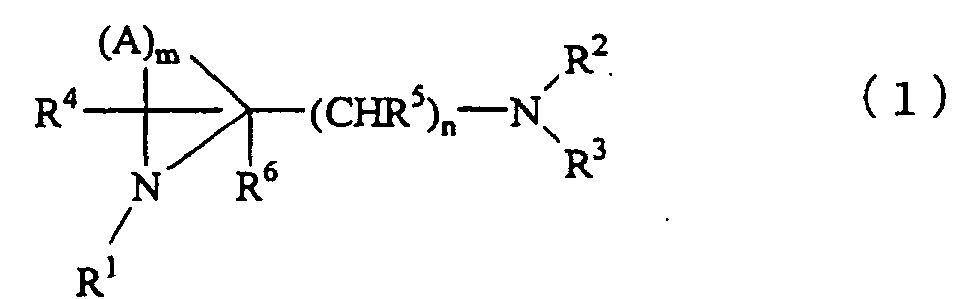
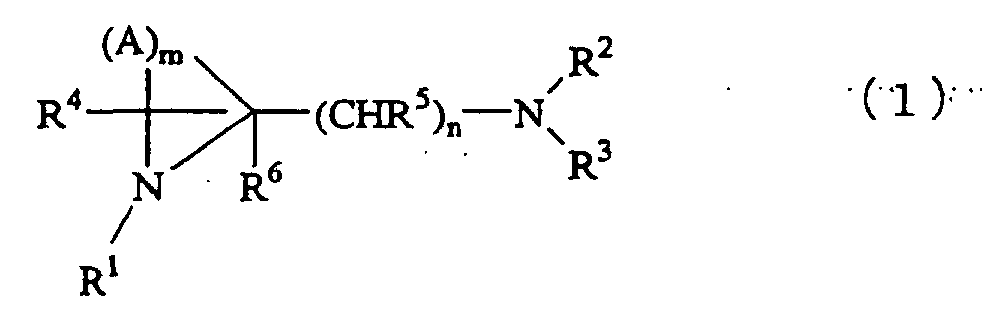
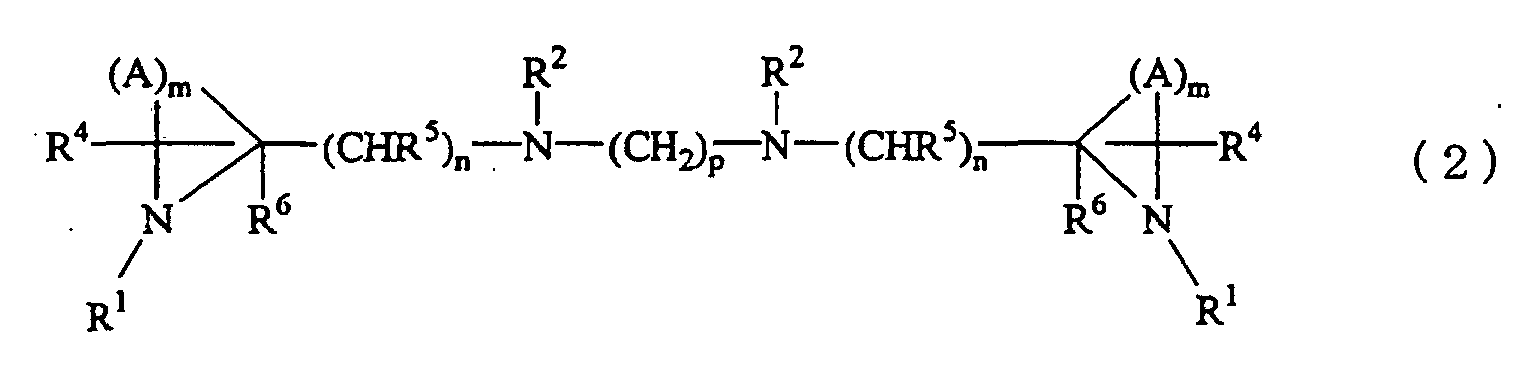
- the cyclic nitrogen in the compound represented by the formula (1) or (2) is preferably tertiary. More specifically, the compound of the formula (1) or (2) wherein R 1 does not represent a hydrogen atom is preferred, of which the compound of the formula (1) or (2) wherein R 1 represents an alkyl or alkenyl group is especially preferred.
- the hydrogen peroxide remaining ratio in the present invention is measured in the following manner. Measurement of hydrogen peroxide remaining ratio %: In a 50 mL screw tube are charged 20.0 mg of Compound (A) and 5.98 g of deionized water to dissolve the former in the latter. To the resulting solution are added a 2.00 g portion of an aqueous Cu solution obtained by adding deionized water to 26.8 mg of CuCl 2 ⁇ 2H 2 O to give a total amount of 100 g, 2.00 g of 15% aqueous ammonia and 10.00 g of 2% aqueous hydrogen peroxide. A magnetic stirrer is put into the tube and the mixture therein is stirred for 10 minutes in a 30°C water bath.
- Hydrogen peroxide amount % Titration amount (mL) ⁇ titer of 0.02N sodium thiosulfate ⁇ 0.34014 Amount of stirred solution weighed (mg) ⁇ 100
- the amino group on the side chain in the formula (1) is preferably a primary or tertiary one.
- at least one of R 2 and R 3 represents a hydrogen atom, and especially preferred that both represent a hydrogen atom.
- the logP is a balance between hydrophilicity and lipophilicity so that compounds may be selected or designed in consideration of its balance in the whole compound.
- Examples of a measure for improving lipophilicity include introduction of a lipophilic group such as hydrocarbon and a reduction in the hydrophilic moiety. More specifically, lipophilicity is improved by introducing a hydrocarbon group into R 4 , R 5 and/or R 6 .
- Examples of a measure for improving hydrophilicity include introduction of a hetero atom and, in a hydrocarbon atom, substitution of the hydrogen atom of the alkyl group or alkylene group with a group having a hydrophilic moiety such as aminoalkyl group or hydroxy group.
- the solubility parameter logP is calculated using a computer software program.
- Examples of the nitrogenous compound or salt thereof capable of satisfying the conditions of physical properties that is, a solubility parameter logP value in octanol/water ranging from -1 to 4 and a hydrogen peroxide remaining ratio ranging from 5 to 90% include 2-aminoethyl-1-methylpyrrolidine, 2-aminomethyl-1-ethylpyrrolidine, 2-aminomehtyl-1-butylpyrrolidine, 2-aminomethyl-1-hydroxyethylpyrrolidine, 2-N-ethylaminomethyl-1-ethylpyrrolidine and 1-ethyl-2-(N-hydroxyethyl)aminomethylpyrrolidine.
- a constituting a ring is composed principally of -CH 2 - and in some cases, it may have, instead of one or two -CH 2 -, -O-, -S- and/or -NH-. Specific examples include:
- R 1 represents a hydrogen atom; an alkyl, cycloalkyl, alkenyl, aminoalkyl, hydroxyalkyl, alkoxyalkyl, thioetheralkyl, amide-substituted alkyl or ester-substituted alkyl group, each having 12 or less, preferably 6 or less carbon atoms; an alkyl halide group having 12 or less carbon atoms; a benzyl or phenyl group which may be substituted by a halogen atom; and a cyclic aminoalkyl group.
- alkyl group having 12 or less carbon atoms examples include methyl, ethyl, propyl, butyl, pentyl, hexyl, isopropyl, isobutyl, and isopentyl group.
- R 1 preferred is an alkyl or alkenyl group having 1 to 6 carbon atoms, with methyl, ethyl, butyl or hydroxyethyl group being especially preferred from the viewpoints of bleaching power ⁇ dyeing power.
- R 2 and R 3 each represents a hydrogen atom; an alkyl, alkenyl, hydroxyalkyl, aminoalkyl, acyl or alkylsulfonyl group having 12 or less, preferably 1 to 6 carbon atoms; a phenylsulfonyl group; or a cyclic amino group, of which alkyl, hydroxyalkyl or alkenyl group having 12 or less carbon atoms is preferred, with a methyl, ethyl or hydroxyethyl group being more preferred from the viewpoints of bleaching power ⁇ dyeing power. It is especially preferred that at least one of R 2 and R 3 represents a hydrogen atom, and most preferred that both represent a hydrogen atom.
- R 4 , R 5 and R 6 each represents a hydrogen atom; a hydroxy group; and an alkyl, alkenyl, hydroxyalkyl or aminoalkyl group having 12 or less carbon atoms, of which alkyl or alkenyl group having 12 or less, especially 1 to 6 carbon atoms is preferred.
- the methyl or ethyl group is especially preferred from the viewpoint of the bleaching power ⁇ dyeing power. It is more preferred that any one of R 4 , R 5 and R 6 represents a hydrogen atom, and most preferred that R 6 represents a hydrogen atom.
- examples of the alkyl or alkenyl group having 12 or less carbon atoms which is represented by R 1 , R 2 , R 3 , R 4 , R 5 or R 6 , include methyl, ethyl, propyl, butyl, pentyl, hexyl, isopropyl, isobutyl, isopentyl, vinyl and allyl groups, with methyl and ethyl groups being especially preferred from the viewpoint of bleaching power ⁇ dyeing power.
- examples of the aminoalkyl group having 12 or less carbon atoms which is represented by R 1 , R 2 , R 3 , R 4 , R 5 or R 6 , include aminomethyl, aminoethyl, aminopropyl, aminobutyl, aminopentyl and aminohexyl groups, with aminomethyl, aminoethyl and aminopropyl groups are preferred.
- the poly(alkoxy) group represented by R 1 means a polyalkoxy group to which an alkoxy or alkyleneoxide has been linked.
- examples of the acyl group having 12 or less carbon atoms which is represented by R 2 or R 3 , include formyl, acetyl, propionyl, butanoyl, pentanoyl and hexanoyl groups, with acetyl and propionyl groups being especially preferred.
- examples of the alkylsulfonyl group having 12 or less carbon atoms which is represented by R 2 or R 3 , include methanesulfonyl and ethanesulfonyl groups.
- examples of the phenylsulfonyl group which may be substituted by an alkyl group, which is represented by R 2 or R 3 include phenylsulfonyl and tosyl groups.
- examples of the 4- to 7-membered ring cyclic amino group which may be formed by coupling of R 2 and R 3 include pyrrolidinyl, piperidino and piperazinyl groups.
- examples of the amino group which may be substituted by at least one alkyl group having 12 or less carbon atoms which is represented by R 1 , R 2 , R 3 or R 4 , include amino, methylamino, dimethylamine, ethylamino and diethylamino groups.
- examples of the C 1-6 alkoxy group which may be substituted for an alkyl group as R 1 having 12 or less carbon atoms include methoxy, ethoxy, propyloxy, isopropyloxy and butoxy groups, of which methoxy and ethoxy groups are preferred.
- examples of the benzyl group as R 1 which may be substituted by a halogen atom include benzyl, chlorobenzyl, bromobenzyl and dichorobenzyl groups, with benzyl group being especially preferred.
- examples of the phenyl group which may. be substituted by a halogen atom include phenyl, chlorophenyl, bromophenyl and dichlorophenyl groups, with a phenyl group being especially preferred.
- the integer m is preferably 2 to 4, with 3 being especially preferred.
- the integer n stands for 1 to 4, of which 1 or 2 is preferred and 1 is especially preferred.
- the integer p is especially preferred from the viewpoint of bleaching power ⁇ dyeing power when it stands for 2 or 3.
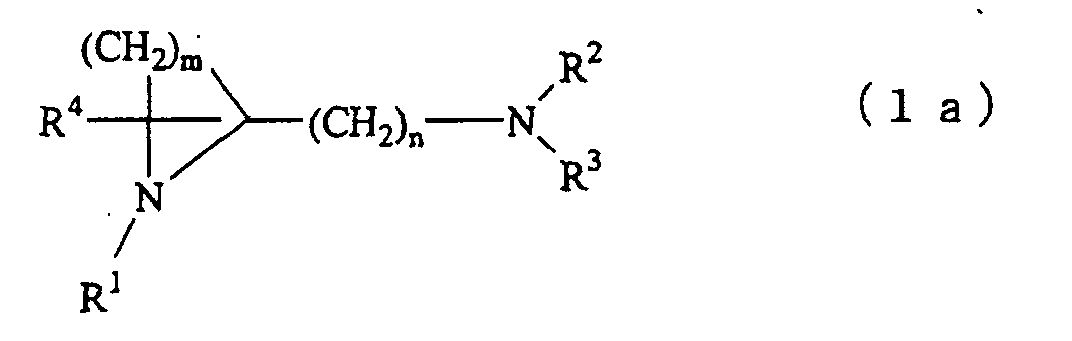
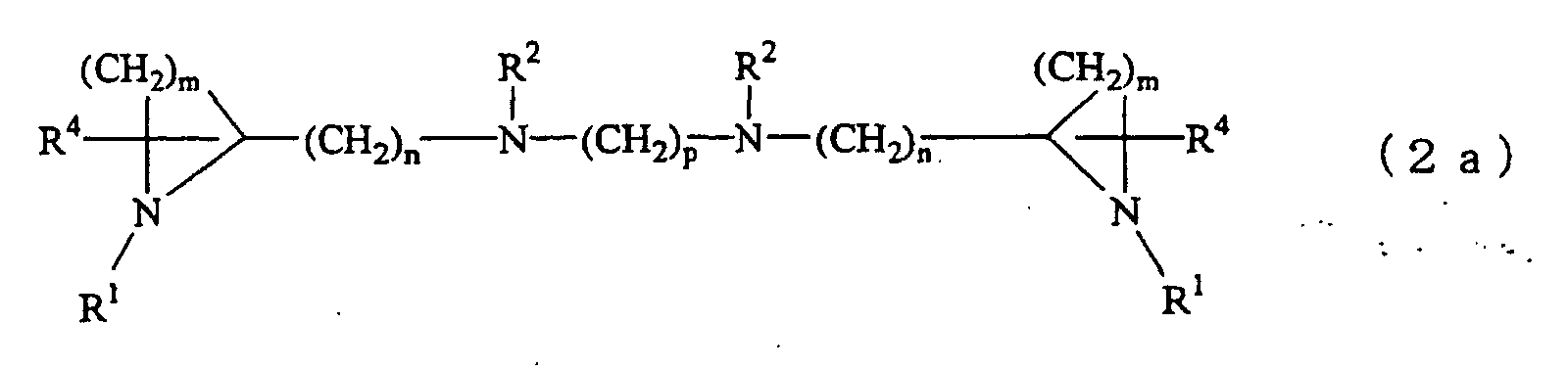
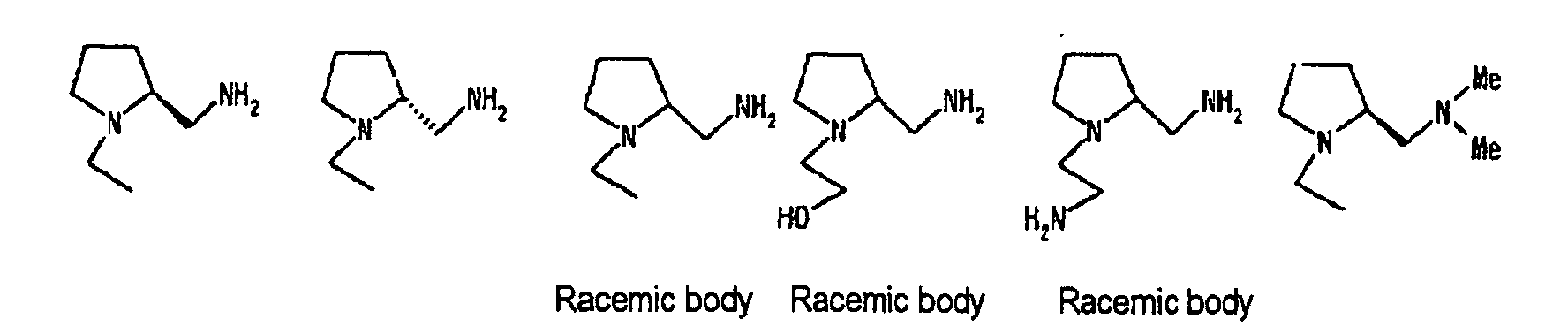
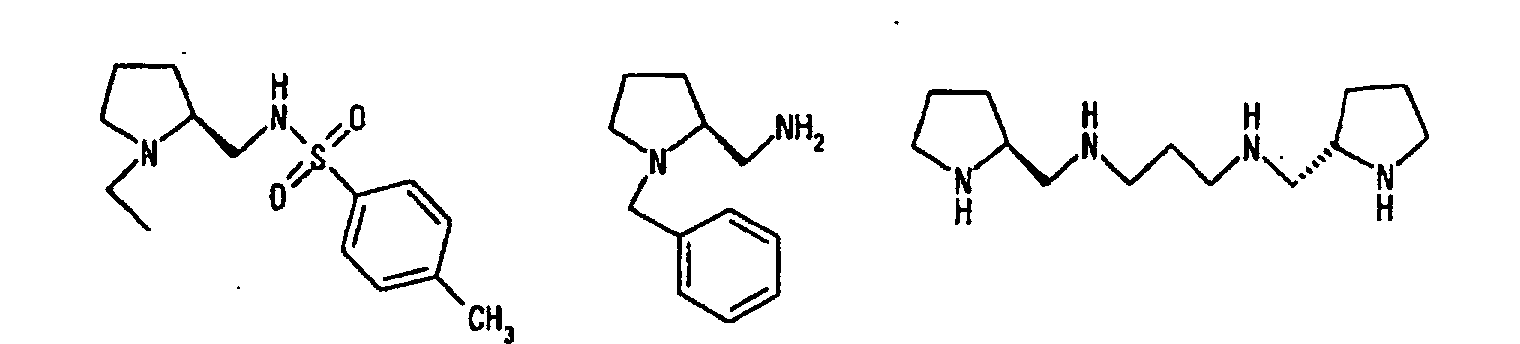
- a compound effective for hair bleaching is a cyclic amine compound represented by the following formula (1a) or (2a): (wherein, R 1 represents a hydrogen atom; an alkyl, cycloalkyl or alkenyl group which has 12 or less carbon atoms and may be substituted by at least one group selected from a hydroxy group, an amino group which may be substituted by at least one alkyl group, an amide group which may be substituted by at least one alkyl group, a C 1-6 (poly)alkoxy or benzyloxy group which may be substituted by a hydroxy or amino group, a thioether group and an ester group; an alkyl halide group, or a benzyl, pyridylmethyl or phenyl group which may be substituted by at least one halogen atom;
- R 2 and R 3 each represents a hydrogen atom, a C 1-6 alkyl group which may substituted by an amino group which may be substituted by at least one hydroxy or alkyl group; a C 1-6 acyl group; a C 1-6 alkylsulfonyl group; or a phenylsulfonyl group which may be substituted by an alkyl group; or R 2 and R 3 may form a 4- to 7-membered ring cyclic amino group together with a nitrogen atom adjacent thereto,
- R 4 represents a hydrogen atom; or a C 1-6 alkyl group which may be substituted by an amino group which may be substituted by at least one hydroxy or alkyl group,
- n stands for an integer of from 1 to 4
- p stands for an integer of from 2 to 6).
- cyclic amine compounds (1a) and (2a) are known compounds and can be prepared, for example, by the process as described in Japanese Patent Publication No. Sho 46-37589, Japanese Patent Publication No. Sho 48-13551, Japanese Patent Publication No. Sho 49-24067, Japanese Patent Publication No. Sho 54-7792, Japanese Patent Publication No. Sho 46-27457, Japanese Patent Publication No. Sho 60-56706, International Publication No. 87/07271 pamphlet, and Japanese Patent Publication No. Hei 7-103098.
- the cyclic amine compound (1a) may be in the form of an optically active (S) form or (R) form, or any mixture thereof.
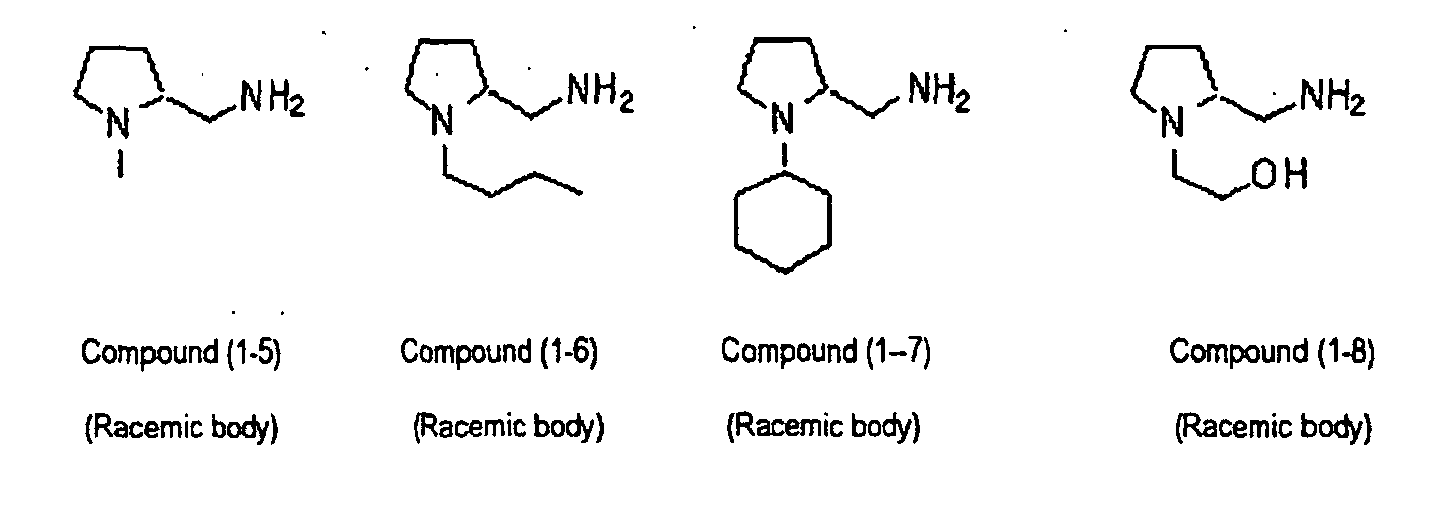
- the cyclic amine compound (2a) may be any diastereomer or a mixture thereof at any ratio. Specific examples of the cyclic amine compounds (1a) and (2a) will next be shown.
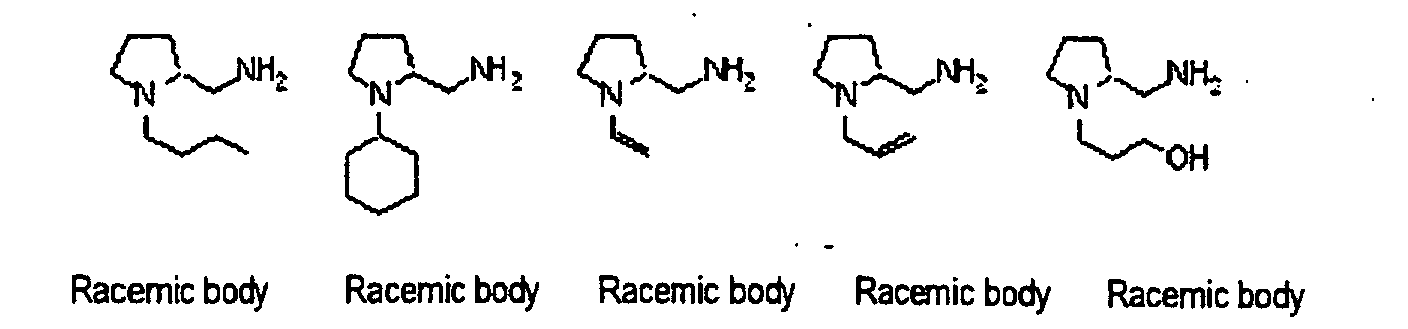
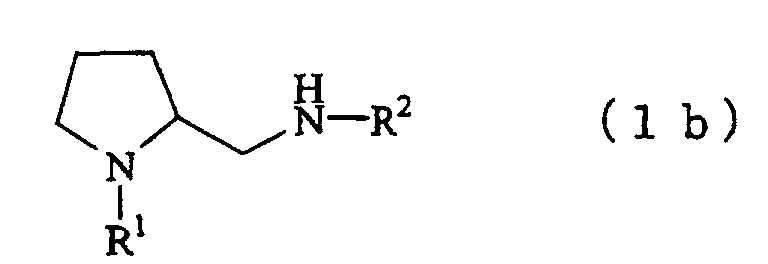
- a compound effective for hair bleaching is a 2-aminomethylpyrrolidine derivative represented by the following formula (1b): (in the formula (1b), R 1 and R 2 each represents a C 1-6 alkyl or C 3-6 cycloalkyl group which may be substituted by at least one group selected from hydroxy group, tertiary amino groups and C 1-6 alkoxy groups).
- the above-described 2-aminomethylpyrrolidine derivative is a novel compound.
- the compound can be prepared, for example, in the following manner:
- the primary amine (4) is used in an amount ranging from 0.5 to 20 equivalents relative to the raw material proline derivative (4).
- alcoholate such as sodium methoxide (NaOMe), iodine ion such as sodium iodide and cyan ion such as sodium cyanide may be added.
- solvents ordinarily employed in organic synthesis for example, an alcohol solvent such as methanol, halogen solvent such as chloroform, aromatic solvent such as benzene, ether solvent such as diethyl ether, hydrocarbon solvent such as hexane, acetonitrile, DMF, DMSO, N-methylpyrrolidone or water, or mixture thereof may be used.
- the reaction can be effected within a temperature range of from 0 to 220°C. The reaction is usually carried out under normal pressure.
- a hydrogenation reagent may be used as the reducing agent.
- Examples include LiAlH 4 and NaAlH 4 .
- the amount of the hydrogenation reagent falls within a range of from 0.5 to 20 equivalents relative to the amidated proline derivative represented by the formula (5).
- the reduction is conducted in an inert solvent, for example, an aromatic solvent such as benzene, an ether solvent such as diethyl ether, or hydrocarbon solvent such as hexane.
- the reaction is effected within a range of from -20°C to reflux temperature.
- the aminomethylpyrrolidine derivative (1b) has at least one asymmetric hydrocarbon.
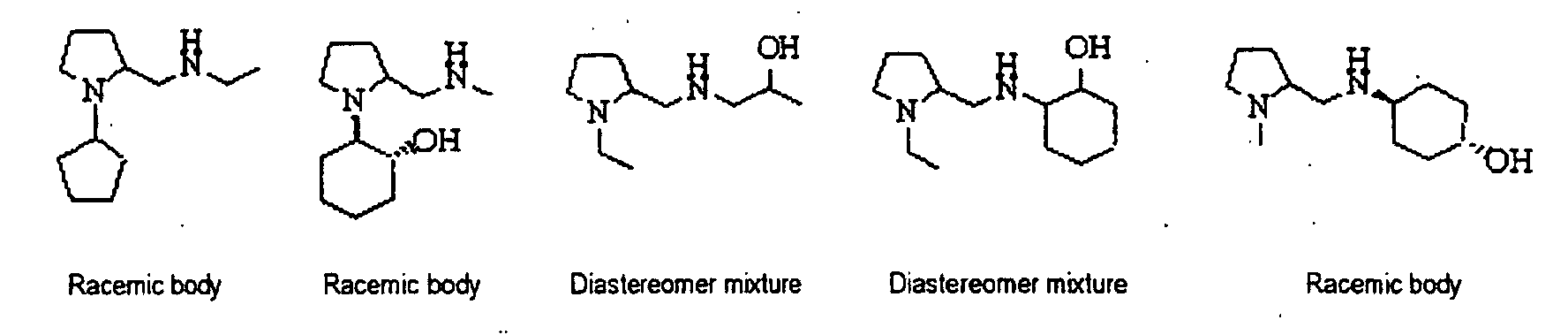
- Each asymmetric hydrocarbon may be an optically active substance or racemic body, or a mixture thereof at any ratio. In view of a production cost, a racemic body or a mixture of diastereomers at any ratio is preferred.
- aminomethylpyrrolidine derivative (1b) include the compounds represented by the following chemical structures:
- Preferred examples of the salt of the nitrogenous compound (Compound(1) or (2)) of the formula (1) or (2) include salts of an inorganic acid or organic acid such as hydrochloric acid, sulfuric acid, phosphoric acid, acetic acid, propionic acid, lactic acid, citric acid, succinic acid, hydrobromic acid, hydroiodic acid, methanesulfonic acid and perchloric acid.
- an inorganic acid or organic acid such as hydrochloric acid, sulfuric acid, phosphoric acid, acetic acid, propionic acid, lactic acid, citric acid, succinic acid, hydrobromic acid, hydroiodic acid, methanesulfonic acid and perchloric acid.
- the compound (1) or (2) serving as component (a) two or more compounds may be used in combination and their content is not particularly limited. From the viewpoints of sufficient bleaching ⁇ hair dyeing effects, the content is preferably from 0.01 to 20 wt.%, more preferably from 0.02 to 10 wt.%, still more preferably from 0.05 to 8 wt.%, especially preferably from 0.1 to 5 wt.% in the whole composition composed of the first component part and the second component part.
- hydrogen peroxide and hydrogen peroxide generators such as urea peroxide, melamine peroxide, sodium perborate, potassium perborate, sodium percarbonate and potassium percarbonate can be given as examples, of which hydrogen peroxide is especially preferred. Its using amount can be selected as needed insofar as it does not cause the pH to exceed the required range.
- the content of the oxidizing agent in terms of hydrogen peroxide is preferably from 0.1 to 12 wt.%, more preferably from 0.5 to 9 wt.%, especially preferably from 1 to 6 wt.% in the whole composition having the first and second component parts.
- alkali agent examples include ammonia, alkanolamines such as monoethanolamine, isopropanolamine, 2-amino-2-methylpropanol and 2-aminobutanol, alkanediamines such as 1,3-propanediamine, and carbonates such as ammonium carbonate, ammonium bicarbonate, guanidine carbonate, sodium carbonate, potassium carbonate, sodium bicarbonate and potassium bicarbonate. Of these, ammonia and alkanolamines are preferred. Of the alkanolamines, monoethanolamine is more preferred. As the alkali agent, two or more of the above-described ones may be used in combination. Its content can be selected as needed within a range satisfying the necessary pH.
- the content of the alkali agent is preferably from 0.05 to 10 wt.%, more preferably from 0.1 to 5 wt.%, especially preferably from 0.2 to 3 wt.% in the whole composition composed of the first component part and the second component part.
- the hair bleach composition or hair dye composition according to the present invention can bring about sufficient bleaching ⁇ dyeing effects without using ammonia as an alkali agent. Without any ammonia-derived irritating odor and unpleasant feeling during use, the composition is preferably employed.
- a first component part containing an alkali agent and a second component part containing an oxidizing agent are mixed at a ratio ranging from 1:0.5 to 1:3 in terms of first component part : second component part (weight ratio) in consideration of practical utility.
- the first component part and the second component part preferably have a pH of from 8 to 12 and from 2 to 5, respectively, at 25°C.
- the hair dye composition after mixture of the first and second component parts has a pH of from 7.5 to 12, but in view of the bleaching ⁇ hair dyeing effects and reduction in the skin irritation, the pH from 8 to 11 is preferred.
- an inorganic acid such as hydrochloric acid or phosphoric acid, an organic acid such as citric acid, glycolic acid or lactic acid, a hydrochloride salt such as ammonium chloride or monoethanolamine hydrochloride, or phosphate salt such as monopotassium dihydrogenphosphate or disodium monohydrogen phosphate can be used.
- the hair bleach composition or hair dye composition of the present invention further contains, as a chelating agent which is known to be used for hair bleaching and hair dye compositions, at least one selected from ethylenediaminetetraacetic acid, ethylenediaminehydroxyethyltriacetic acid, diethylenetriaminepentaacetic acid and salts thereof, the oxidizing agent and alkali agent act in the hair more efficiently. Addition of the chelating agent is therefore preferred.
- the content of the chelating agent preferably falls within a range of from 0.01 to 5 wt.% in the whole composition composed of the first component and second component parts from the viewpoints of sufficient bleaching ⁇ hair dyeing effects.
- the chelating agent can be incorporated in either one or both of the first and second component parts.
- water and/or organic solvent is used as a medium.
- the organic solvent include lower alkanols such as ethanol and 2-propanol, aromatic alcohols such as benzyl alcohol and benzyloxyethanol, polyols such as propylene glycol, 1,3-butanediol, diethylene glycol and glycerin, cellosolves such as ethyl cellosolve, butyl cellosolve and benzyl cellosolve, and carbitols such as ethyl carbitol and butyl carbitol.
- lower alkanols such as ethanol and 2-propanol
- aromatic alcohols such as benzyl alcohol and benzyloxyethanol
- polyols such as propylene glycol, 1,3-butanediol, diethylene glycol and glycerin
- cellosolves such as ethyl cellosolve, butyl cellosolve and benzyl cellosolv
- the hair dye composition of the present invention further contains, as Component (d), an intermediate for oxidation dye or a direct dye.
- developer and couplers which are ordinarily employed for hair dyes can be used.
- the developer include paraphenylenediamine, toluene-2,5-diamine, 2-chloro-paraphenylenediamine, N-methoxyethyl-paraphenylenediamine, N,N-bis(2-hydroxyethyl)-paraphenylenediamine, 2-(2-hydroxyethyl)-paraphenylenediamine, 2,6-dimethyl-para-phenylenediamine, 4,4'-diaminodiphenylamine, 1,3-bis(N-(2-hydroxyethyl)-N-(4-aminophenyl)amino)-2-propanol, PEG-3,2,2'-paraphenylenediamine, paraaminophenol, paramethylaminophenol, 3-methyl-4-aminophenol, 2-aminomethyl-4-aminophenol, 2-(2-hydroxyethyla), paraphenylenediamine, para
- coupler examples include metaphenylenediamine, 2,4-diaminophenoxyethanol, 2-amino-4-(2-hydroxyethylamino)anisole, 2,4-diamino-5-methylphenetole, 2,4-diamino-5-(2-hydroxyethoxy)toluene, 2,4-dimethoxy-1,3-diaminobenzene, 2,6-bis(2-hydroxyethylamino)toluene, 2,4-diamino-5-fluorotoluene, 1,3-bis(2,4-diaminophenoxy)propane, metaaminophenol, 2-methyl-5-aminophenol, 2-methyl-5-(2-hydroxyethylamino)phenol, 2,4-dichloro-3-aminophenol, 2-chloro-3-amino-6-methylphenol, 2-methyl-4-chloro-5-aminophenol, N-cyclopentyl-metaaminophenol, 2-methyl-4-
- the content of the developer or coupler is preferably from 0.01 to 5 wt.%, especially preferably from 0.1 to 4 wt.% in the whole composition composed of first component and second component parts.
- the acidic dyes include Red No. 2 (C.I. 16185), Red No. 3 (C.I. 45430), Red No. 102 (C.I. 16255), Red No. 104 (1) (C.I. 45410), Red No. 105 (1) (C.I. 45440), Red No. 106 (C.I. 45100), Yellow No. 4 (C.I. 19140), Yellow No. 5 (C.I. 15985), Green No. 3 (C.I. 42053), Blue No. 1 (C.I. 42090), Blue No. 2 (C.I. 16185), Red No. 3 (C.I. 45430), Red No. 102 (C.I. 16255), Red No. 104 (1) (C.I. 45410), Red No. 105 (1) (C.I. 45440), Red No. 106 (C.I. 45100), Yellow No. 4 (C.I. 19140), Yellow No. 5 (C.I. 15985), Green No. 3 (C.I. 42053), Blue No.
- Brown No. 201 C.I. 20170
- Red No. 401. C.I. 45190
- Red No. 502 C.I. 16155
- Red No. 503 C.I. 16150
- Red No. 504 C.I. 14700
- Red No. 506 C.I. 15620
- Orange No. 402 C.I. 14600
- Yellow No. 402 C.I. 18950
- Yellow No. 403 (1) (C.I. 10316), Yellow No. 406 (C.I. 13065), Yellow No. 407 (C.I. 18820), Green No. 401 (C.I. 10020), Green No. 402 (C.I. 42085), Violet No. 401 (C.I.
- the basic dyes include Basic Blue 7 (C.I. 42595), Basic Black 16 (C.I. 12210), Basic Blue 22 (C.I. 61512), Basic Blue 26 (C.I. 44045), Basic Blue 99 (C.I. 56059), Basic Blue 117, Basic Violet 10 (C.I. 45170), Basic Violet 14 (C.I. 42515), Basic Brown 16 (C.I. 12250), Basic Brown 17 (C.I. 12251), Basic Red 2 (C.I. 50240), Basic Red 12 (C.I. 48070), Basic Red 22 (C.I. 11055), Basic Red 51, Basic Red 76 (C.I. 12245), Basic Red 118 (C.I.
- Examples of direct dyes other than acidic dyes or basic dyes include 2-amino-3-nitrophenol, 2-amino-4-nitrophenol, 2-amino-5-nitrophenol, 4-amino-3-nitrophenol, 2-amino-6-chloro-4-nitrophenol, 4-hydroxypropylamino-3-nitrophenol, 3-nitro-para-hydroxyethylaminophenol, 2-nitro-para-phenylenediamine, 4-nitro-ortho-phenylenediamine, 4-nitro-meta-phenylenediamine, 6-nitro-ortho-toludine, 6-nitro-para-toluidine, hydroxyethyl-2-nitro-para-toluidine, N,N'-bis(2-hydroxyethyl)-2-nitro-para-phenylenediamine, 2-chloro-5-nitro-N-hydroxyethyl-para-phenylenediamine, 2-nitro-5-glycerylmethylaniline, 3-methylamino-4-nitrophenoxyethanol, N-ethyl-3
- HC Blue No. 2 HC Blue No. 8, HC Orange No. 1, HC Orange No. 2, HC Red No. 1, HC Red No. 3, HC Red No. 7, HC Red No. 8, HC Red No. 10, HC Red No. 11, HC Red No. 13, HC Red No. 16, HC Violet No. 2, HC Yellow No. 2, HC Yellow No. 5, HC Yellow No. 6, HC Yellow No. 7, HC Yellow No. 9, and HC Yellow No. 12.
- These direct dyes may be used in combination of two or more thereof. Its content is preferably from 0.001 to 5 wt.%, especially preferably from 0.01 to 4 wt.% in the whole composition composed of the first component and second component parts.
- the oxidation dye and direct dye may be used in combination.
- ingredients commonly employed as cosmetic raw materials can be added, in addition to the above-described ingredients.
- optional ingredients are hydrocarbons, animal or vegetable oils and fats, higher fatty acids, penetration enhancers, cationic surfactants, natural or synthetic polymers, higher alcohols, ethers, amphoteric surfactants, nonionic surfactants, protein derivatives, amino acids, antiseptics, chelating agents, stabilizers, antioxidants, plant extracts, crude drug extracts, vitamins, colorants, fragrances and ultraviolet absorbers.
- the hair bleach composition or hair dye composition of the present invention is provided, similar to oxidation type hair bleaches or hair dyes widely employed now, as a two-part type having a first component part containing an alkali agent and a second component part containing an oxidizing agent.
- first and second component parts can be provided in the form, for example, of liquid, emulsion, cream, gel, paste, or mousse. It may also be provided in the form of an aerosol.
- the mixture of the first component part and second component part has preferably a viscosity enough not to cause sagging when applied to the hair. It preferably has a viscosity of 2000 to 100000 mPa ⁇ s when measured at 25°C by a Brookfield rotating viscometer. The viscosity here is a value measured after rotation using Rotor No. 3 for 1 minute at 12 rpm.
- the hair bleach composition or hair dye composition of the present invention it is only necessary to mix the first component part and second component part of the hair dye composition of the present invention, apply the mixture to the hair at 15 to 45°C, causing it to act on the hair for 1 to 60 minutes, preferably from 3 to 45 minutes, washing the hair and then drying.
- Oxidation type hair bleach compositions as shown in Table 2 were prepared in a conventional manner.
- oxidation type hair bleach compositions as shown in Tables 4 and 5 were prepared. Examples 15 16 17 18 19 First comp. part Compound (1-2) 0.1 2 Compound (1-3) 1 Compound (1-4) 1 Compound (2-1) 1 28 wt.% Aqueous ammonia 6 6 3 Monoethanolamine 5 3 5 Propylene glycol 10 10 2 2 2 Ethanol 15 15 Polyoxyethylene (20) octyldodecyl ether 10 10 Polyoxyethylene (40) cetyl ether 2 2 2 2 Polyoxyethylene (2) cetyl ether 2.5 2.5 2.5 Oleic acid diethanolamide 8 8 Oleyl alcohol 2 2 Stearyl trimethylammonium chloride 1.5 1.5 1.5 Cetanol 1 1 1 1 Liquid paraffin 0.5 0.5 0.5 Ammonium chloride q.s.
- oxidation type hair dyes as shown in Tables 6 and 7 were prepared.
- the mixture was applied to the black hair (1 g) of the Japanese at 30°C.
- the mixture was allowed to act on the hair for 30 minutes, followed by washing with a conventional shampoo and drying.
- the color tone of the hair thus dyed was measured by a colorimeter of Konica Minolta and a difference in the color hue from the untreated hair was observed.
- the hair treated with any one of the compositions obtained in Examples 25 to 32 was superior to that treated with the composition to which any one of the compound (1-2), (1-3), (1-4) and (2-1) had not been added.
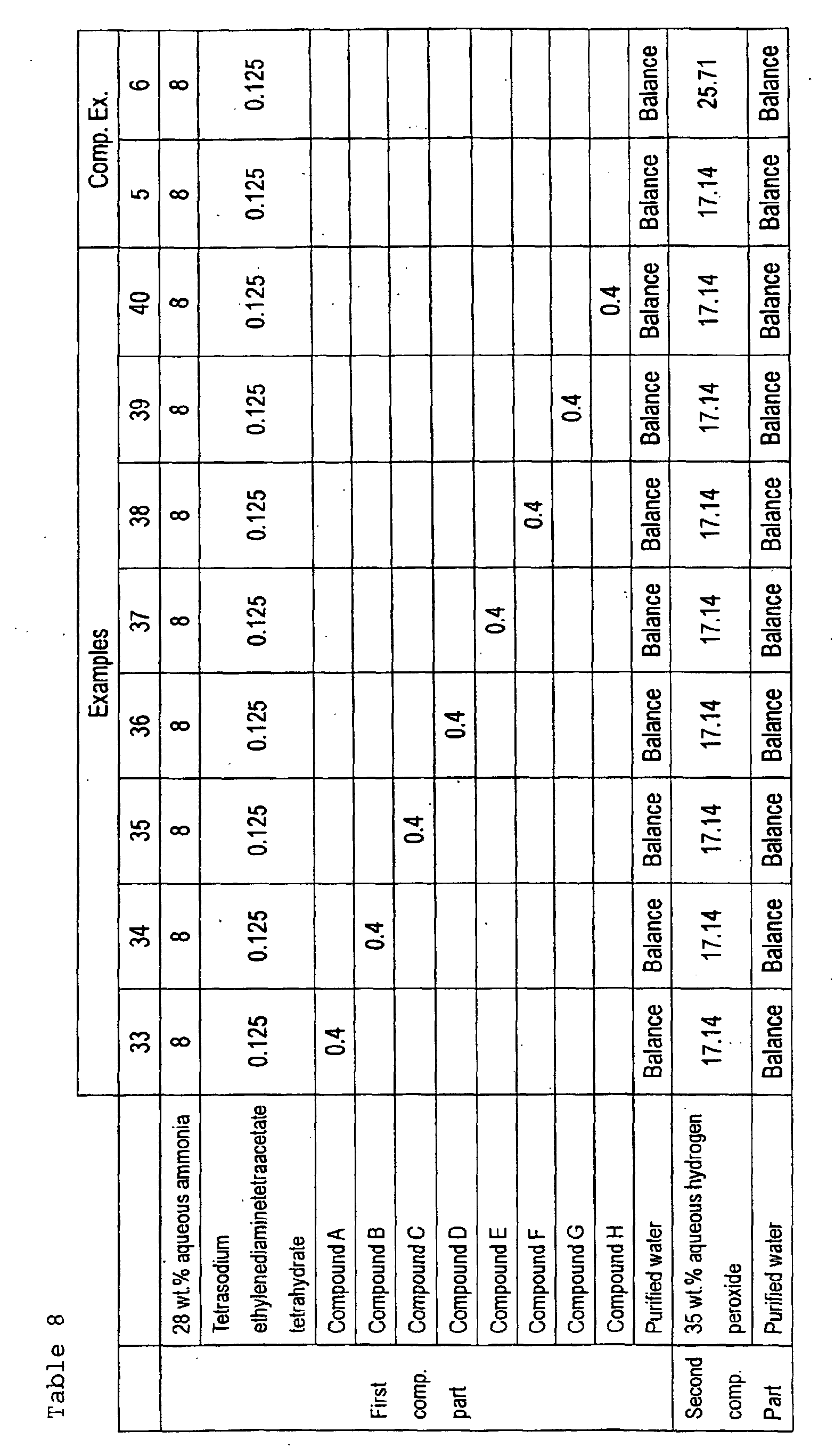
- the oxidation type hair bleach compositions as shown in Table 8 were prepared.
- the mixture was applied to the black hair (1 g tress) of the Japanese at 30°C.
- the mixture was allowed to act on the hair for 30 minutes, followed by washing with a conventional shampoo and drying.
- the color tone of the hair thus dyed was measured by a colorimeter of Konica Minolta and a difference in the color hue from the untreated hair was observed.
- the hair treated with any one of the compositions obtained in Examples 33 to 40 was superior in bleaching property to that treated with the composition obtained in Comparative Example 5 and was comparable to Comparative Example 6.
- the hair dye composition of the present invention has excellent bleaching power, is capable of dyeing the hair with a bright color tone and good color hue and is less damaging to the hair and less irritating to the scalp.
Landscapes
- Health & Medical Sciences (AREA)
- Life Sciences & Earth Sciences (AREA)
- Animal Behavior & Ethology (AREA)
- General Health & Medical Sciences (AREA)
- Public Health (AREA)
- Veterinary Medicine (AREA)
- Birds (AREA)
- Epidemiology (AREA)
- Cosmetics (AREA)
Abstract
Description
R1 represents a hydrogen atom; an alkyl, cycloalkyl or alkenyl group which has 12 or less carbon atoms and may be substituted by at least one group selected from a hydroxy group, an amino group which may be substituted by at least one alkyl group, an amide group which may be substituted by at least one alkyl group, a C1-6 (poly)alkoxy or benzyloxy group which may be substituted by a hydroxy or amino group, a thioether group and an ester group; an alkyl halide group; or a benzyl, pyridylmethyl or phenyl group which may be substituted by at least one halogen atom;
R2 and R3 each represents a hydrogen atom, an alkyl, alkenyl or cycloalkyl group which has 12 or less carbon atoms and may be substituted by at least one group selected from a hydroxy group, an amino group which may be substituted by at least one alkyl group and a C1-6 alkoxy group; an acyl group having 12 or less carbon atoms, an alkylsulfonyl group having 12 or less carbon atoms, or a phenylsulfonyl group which may be substituted by at least one alkyl group; or R2 and R3 may form a 4- to 7-membered ring cyclic amino group together with a nitrogen atom adjacent thereto,
R4, R5 and R6 each represents a hydrogen atom; a hydroxy group; an amino group; an alkyl ether group; or an alkyl or alkenyl group which has 12 or less carbon atoms and may be substituted by at least one group selected from a hydroxy group, and an amino group which may be substituted by at least one alkyl group,
m stands for an integer of from 2 to 5, n stands for an integer of from 1 to 4 and p stands for an integer of from 2 to 6,
Measurement of hydrogen peroxide remaining ratio %: In a 50 mL screw tube are charged 20.0 mg of Compound (A) and 5.98 g of deionized water to dissolve the former in the latter. To the resulting solution are added a 2.00 g portion of an aqueous Cu solution obtained by adding deionized water to 26.8 mg of CuCl2·2H2O to give a total amount of 100 g, 2.00 g of 15% aqueous ammonia and 10.00 g of 2% aqueous hydrogen peroxide. A magnetic stirrer is put into the tube and the mixture therein is stirred for 10 minutes in a 30°C water bath. Ten minutes later, 0.5 g of the resulting stirred solution is weighed precisely in a 200 mL Erlenmeyer flask with ground-in stopper. After addition thereto of 50 mL of a 10% aqueous solution of sulfuric acid, 10 mL of dichloromethane and 10 mL of a 10% aqueous solution of potassium iodide, the mixture is vigorously shaken and then allowed to stand in the dark for about 15 minutes. Then, the reaction mixture is titrated with a 0.02N aqueous solution of sodium thiosulfate. When the yellow color becomes pale during titration, 1 mL of 1% aqueous starch (suspension) is added. The point when a violet color (bluish violet to reddish violet) disappears completely is designated as a terminal point and hydrogen peroxide % is determined in accordance with the below-described equation. The amount of hydrogen peroxide in an aqueous solution obtained by diluting 10.00 of 2% aqueous hydrogen peroxide with 10.00 g of deionized water is also measured and the hydrogen peroxide amount at this time is taken as a hydrogen peroxide remaining ratio of 100%.
| Compound Name | Purchased from, or purity (GC area%) | LogP Value | Hydrogen peroxide remaining ratio | |
| Example Compound | 2-Aminomethyl-1-hydroxyethylpyrrolidine | 98.6 | -0.35 | 85.1 |
| 2-Aminomethyl-1-methylpyrrolidine | 99.4 | 0.31 | 63.1 | |
| 1-Ethyl-2-(N-hydroxyethyl)aminomethylpyrrolidine | 99.0 | 0.66 | 30.5 | |
| 2-Aminomethyl-1-ethylpyrrolidine | 98.8 | 0.84 | 43.4 | |
| 2-N-Ethylaminomethyl-1-ethylpyrrolidine | 99.4 | 1.53 | 32.9 | |
| 2-Aminomethyl-1-butylpyrrolidine | 98.2 | 1.9 | 45.3 | |
| 2-Aminomethyl-1-cyclohexylpyrrolidine | 94.6 | 2.12 | 17.0 | |
| Comparative Compound | Ethylenediaminetetraacetic acid | Wako Pure Chemical (2Na salt) | -1.93 | 100 |
| Monoethanolamine | Wako Pure Chemical | -1.3. | 5.9 | |
| Diethanolamine | Tokyo Kasei | -1.46 | 2.9 | |
| 1,4,7-Triazacyclononane | Tokyo Kasei (3HCl salt) | -2.23 | 96.6 | |
| 1,4,7-Trimethyl-1,4,7-triazacyclononane | Aldrich | -1.23 | 64.8 | |
| 1,3-Propanediamine | Tokyo Kasei | -1.49 | 19.3 | |
| 2-Hydroxy-1,3-propanediamine | Tokyo Kasei | -2.05 | 33.6 |













Illustrative of such optional ingredients are hydrocarbons, animal or vegetable oils and fats, higher fatty acids, penetration enhancers, cationic surfactants, natural or synthetic polymers, higher alcohols, ethers, amphoteric surfactants, nonionic surfactants, protein derivatives, amino acids, antiseptics, chelating agents, stabilizers, antioxidants, plant extracts, crude drug extracts, vitamins, colorants, fragrances and ultraviolet absorbers.



| Examples | Comparative Examples | |||||||
| 10 | 11 | 12 | 13 | 14 | 3 | 4 | ||
| First Comp. part | Monoethanolamine | 5 | 5 | 5 | 5 | 5 | 5 | 5 |
| Tetrasodium EDTA tetrahydrate | 0 | 0 | 0 | 0 | 0 | 0 | 0 | |
| Compound (1-1) | 0.4 | |||||||
| Compound (1-2) | 0.4 | |||||||
| Compound (1-3) | 0.4 | |||||||
| Compound (1-4) | 0.4 | |||||||
| Compound (2-1) | 0.4 | |||||||
| Purified water | Balance | Balance | Balance | Balance | Balance | Balance | Balance | |
| Second Comp. part | 35 wt.% Aqueous hydrogen peroxide | 17.14 | 17.14 | 17.14 | 17.14 | 17.14 | 17.14 | 25.71 |
| Purified water | Balance | Balance | Balance | Balance | Balance | Balance | Balance |
| Examples | ||||||
| 15 | 16 | 17 | 18 | 19 | ||
| First comp. part | Compound (1-2) | 0.1 | 2 | |||
| Compound (1-3) | 1 | |||||
| Compound (1-4) | 1 | |||||
| Compound (2-1) | 1 | |||||
| 28 wt.% Aqueous ammonia | 6 | 6 | 3 | |||
| Monoethanolamine | 5 | 3 | 5 | |||
| Propylene glycol | 10 | 10 | 2 | 2 | 2 | |
| Ethanol | 15 | 15 | ||||
| Polyoxyethylene (20) octyldodecyl ether | 10 | 10 | ||||
| Polyoxyethylene (40) cetyl ether | 2 | 2 | 2 | |||
| Polyoxyethylene (2) cetyl ether | 2.5 | 2.5 | 2.5 | |||
| Oleic acid diethanolamide | 8 | 8 | ||||
| Oleyl alcohol | 2 | 2 | ||||
| Stearyl trimethylammonium chloride | 1.5 | 1.5 | 1.5 | |||
| Cetanol | 1 | 1 | 1 | |||
| Liquid paraffin | 0.5 | 0.5 | 0.5 | |||
| Ammonium chloride | q.s. | q.s. | q.s. | q.s. | q.s. | |
| Purified water | Balance | Balance | Balance | Balance | Balance | |
| Second comp. part | Hydrogen peroxide | 6 | 3 | 3 | 6 | 9 |
| Methylparaben | 0.1 | 0.1 | 0.1 | 0.1 | 0.1 | |
| Phosphoric acid | q.s. | q.s. | q.s. | q.s. | q.s. | |
| Purified water | Balance | Balance | Balance | Balance | Balance |
| Examples | ||||||
| 20 | 21 | 22 | 23 | 24 | ||
| First comp. part | Compound (1-1) | 0.1 | 2 | |||
| Compound (1-2) | 1 | |||||
| Compound (1-4) | 1 | |||||
| Compound (2-1) | 0.1 | 1 | ||||
| Tetrasodium ethylenediaminetetraacetate tetrahydrate | 1 | 0.5 | ||||
| Trisodium ethylenediaminehydroxyethyltriacetate | 2 | |||||
| Pentasodium Diethylenetriaminepentaacetate | 1 | |||||
| 28 wt% Aqueous ammonia | 6 | 6 | 3 | |||
| Monoethanolamine | 5 | 3 | 5 | |||
| Propylene glycol | 10 | 10 | 2 | 2 | 2 | |
| Ethanol | 15 | 15 | ||||
| Polyoxyethylene (20) octyldodecyl ether | 10 | 10 | ||||
| Polyoxyethylene (40) cetyl ether | 2 | 2 | 2 | |||
| Polyoxyethylene (2) cetyl ether | 2.5 | 2.5 | 2.5 | |||
| Oleic acid diethanolamide | 8 | 8 | ||||
| Oleyl alcohol | 2 | 2 | ||||
| Stearyltrimethylammonium chloride | 1.5 | 1.5 | 1.5 | |||
| Cetanol | 1 | 1 | ||||
| Liquid paraffin | 0.5 | 0.5 | 0.5 | |||
| Ammonium chloride | q.s. | q.s. | q.s. | q.s. | q.s. | |
| Purified water | Balance | Balance | Balance | Balance | Balance | |
| Second comp. part | Hydrogen peroxide | 6 | 3 | 3 | 6 | 9 |
| Methyparaben | 0.1 | 0.1 | 0.1 | 0.1 | 0.1 | |
| Phosphoric acid | q.s. | q.s. | q.s. | q.s. | q.s. | |
| Purified water | Balance | Balance | Balance | Balance | Balance |
| Examples | |||||
| 25 | 26 | 27 | 28 | ||
| First Comp. Part | Compound (1-2) | 0.1 | |||
| Compound (1-3) | 1 | ||||
| Compound (1-4) | 1 | ||||
| Compound (2-1) | 0.1 | 1 | |||
| Tetrasodium ethylenediaminetetraacetate tetrahydrate | 0.5 | ||||
| Trisodium ethylenediaminehydroxyethyltriacetate | 2 | ||||
| Pentasodium diethylenetriaminepentaacetate | 1 | ||||
| Toluene-2,5-diamine | 1.9 | 1.9 | 1 | ||
| Para-aminophenol | 1 | ||||
| Resorcin | 2 | 2 | |||
| Para-aminoorthocresol | 1.1 | ||||
| 2,4-Diaminophenoxyethanol | 1.37 | ||||
| 28 wt.% Aqueous ammonia | 5 | 5 | 5 | 5 | |
| Monoethanolamine | 2 | 2 | 2 | 2 | |
| Propylene glycol | 8 | 8 | 8 | 8 | |
| Polyoxyethylene (20) isostearyl ether | 24 | 24 | 24 | 24 | |
| Polyoxyethylene (2) isostearyl ether | 20 | 20 | 20 | 20 | |
| Merquat (product of Calgon, 35wt.% aq. soln.) | 8 | 8 | |||
| Polymer JR400 (product of Union Carbide) | 0.5 | ||||
| Amodimethicone SM8702C (product of Dow Coming Toray Silicone) | 2 | ||||
| Sodium sulfite | 0.05 | 0.05 | 0.05 | 0.05 | |
| Ascorbic acid | 0.5 | 0.5 | 0.5 | 0.5 | |
| Fragrance | q.s. | q.s. | q.s. | q.s. | |
| Ammonium chloride | q.s.c) | q.s.c) | q.s.c) | q.s.c) | |
| Purified water | Balance | Balance | Balance | Balance | |
| Second comp. part | Hydrogen peroxide | 6 | 3 | 3 | 3 |
| Methylparaben | 0.5 | 0.5 | 0.5 | 0.5 | |
| Phosphoric acid | q.s.d) | q.s.d) | q.s.d) | q.s.d) | |
| Purified water | Balance | Balance | Balance | Balance | |
| a) amount to adjust the pH to 10 | |||||
| b) amount to adjust the pH to 3.5 |
| Examples | |||||
| 29 | 30 | 31 | 32 | ||
| First Comp. Part | Compound (1-2) | 0.1 | |||
| Compound (1-3) | 1 | ||||
| Compound (1-4) | 1 | ||||
| Compound (2-1) | 0.1 | 1 | |||
| Tetrasodium ethylenediaminetetraacetate tetrahydrate | 0.5 | ||||
| Trisodium ethylenediaminehydroxyethyltriacetate | 2 | ||||
| Pentasodium Diethylenetriaminepentaacetate | 1 | ||||
| Toluene-2,5-diamine | 1.9 | ||||
| Para-aminophenol | 1 | ||||
| Resorcin | 2 | ||||
| Para-aminoorthocresol | 1.1 | ||||
| 2,4-Diaminophenoxyethanol | 1.37 | ||||
| Basic Red 12 | 0.2 | 0.2 | |||
| Basic Red 76 | 0.1 | 0.2 | |||
| HC Red 3 | 0.1 | 0.2 | |||
| Monoethanolamine | 5 | 5 | 5 | 5 | |
| Propylene glycol | 8 | 8 | 8 | 8 | |
| Polyoxyethylene (20) isostearyl ether | 24 | 24 | 24 | 24 | |
| Polyoxyethylene (2) isostearyl ether | 20 | 20 | 20 | 20 | |
| Merquat (product of Calgon, 35wt.% aq. soln.) | 8 | 8 | |||
| Polymer JR400 (product of Union Carbide) | 0.5 | ||||
| Amodimethicone SM8702C (product of Dow Coming Toray Silicone) | 2 | ||||
| Sodium sulfite | 0.05 | 0.05 | 0.05 | 0.05 | |
| Ascorbic acid | 0.5 | 0.5 | 0.5 | 0.5 | |
| Fragrance | q.s. | q.s. | q.s. | q.s. | |
| Ammonium chloride | q.s.c) | q.s.c) | q.s.c) | q.s.c) | |
| Purified water | Balance | Balance | Balance | Balance | |
| Second comp. part | Hydrogen peroxide | 6 | 3 | 3 | 3 |
| Methylparaben | 0.5 | 0.5 | 0.5 | 0.5 | |
| Phosphoric acid | q.s.d) | q.s.d) | q.s.d) | q.s.d) | |
| Purified water | Balance | Balance | Balance | Balance | |
| a) amount to adjust the pH to 10 | |||||
| b) amount to adjust the pH to 3.5 |


Claims (8)
- A hair bleach composition to be used after mixing a first component part containing an alkali agent and a second component part containing an oxidizing agent, which comprises, after mixing, the following components (a) and (b):(a) a nitrogenous compound represented by the following formula (1) or (2), or salt thereof:
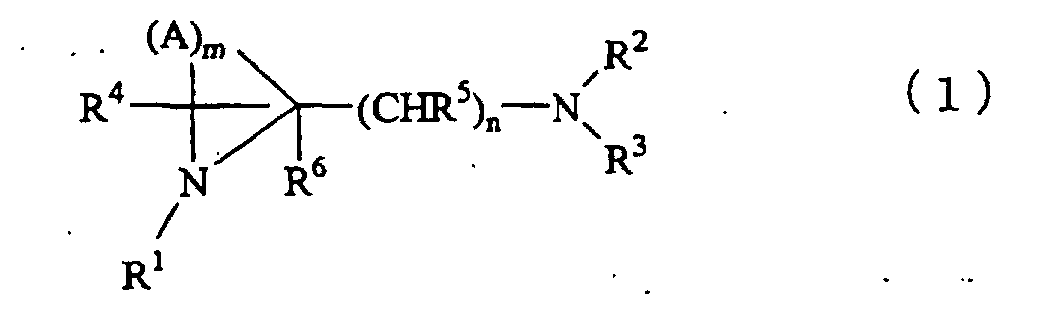 (wherein, one or two of As each represents CH2 which may be substituted by one or two selected from O, S and NH,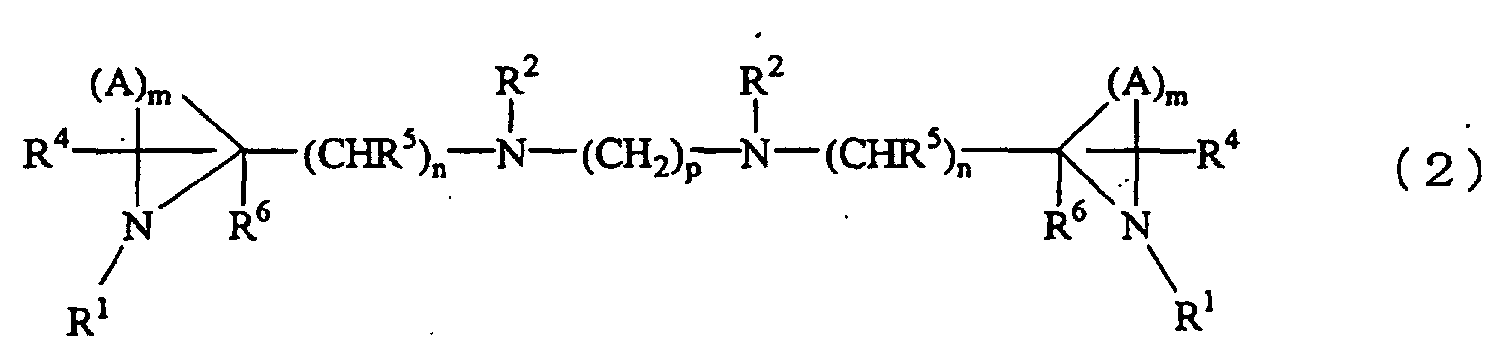
R1 represents a hydrogen atom; an alkyl, cycloalkyl or alkenyl group which has 12 or less carbon atoms and may be substituted by at least one group selected from a hydroxy group, an amino group which may be substituted by at least one alkyl group, an amide group which may be substituted by at least one alkyl group, a C1-6 (poly)alkoxy or benzyloxy group which may be substituted by a hydroxy group or an amino group, a thioether group and an ester group; an alkyl halide group; or a benzyl, pyridylmethyl or phenyl group which may be substituted by at least one halogen atom;
R2 and R3 each represents a hydrogen atom; an alkyl, alkenyl or cycloalkyl group which has 12 or less carbon atoms and may substituted by at least one group selected from hydroxy group, amino group which may be substituted by at least one alkyl group and C1-6 alkoxy group; an acyl group having 12 or less carbon atoms; an alkylsulfonyl group having 12 or less carbon atoms; or a phenylsulfonyl group which may be substituted by at least one alkyl group; or R2 and R3 may form a 4- to 7-membered ring cyclic amino group together with a nitrogen atom adjacent thereto,
R4, R5 and R6 each represents a hydrogen atom; a hydroxy group; an amino group; an alkyl ether group; or an alkyl or alkenyl group which has 12 or less carbon atoms and may be substituted by at least one group selected from a hydroxy group, and an amino group which may be substituted by at least one alkyl group,
m stands for an integer of from 2 to 5, n stands for an integer of from 1 to 4 and p stands for an integer of from 2 to 6,(b) an oxidizing agent; and(c) an alkali agent; and has, after mixing, a pH of from 7.5 to 12. - A hair bleach composition to be used after mixing a first component part containing an alkali agent and a second component part containing an oxidizing agent, which comprises, after mixing, the following components (A) and (b) :(A) a nitrogenous compound having a solubility parameter logP in octanol/water ranging from -1 to 4, and a hydrogen peroxide remaining ratio from 5 to 90%; or salt of the compound, and(b) an oxidizing agent; and has, after mixing, a pH of from 7.5 to 12.
- The hair bleach composition of Claim 1 or 2, further comprising ethylenediaminetetraacetic acid, ethylenediaminehydroxyethyltriacetic acid or diethylenetriaminepentaacetic acid or salt thereof.
- A hair dye composition to be used after mixing a first component part containing an alkali agent and a second component part containing an oxidizing agent, which comprises, after mixing, comprises the following components (a) to (d):(a) a nitrogenous compound represented by the following formula (1) or (2):
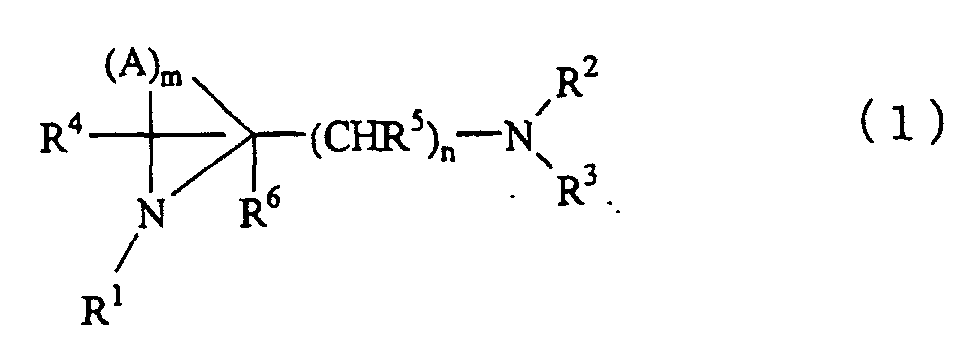 (wherein, one or two of As each represents CH2 which may be substituted by one or two selected from O, S and NH,
R1 represents a hydrogen atom; an alkyl, cycloalkyl or alkenyl group which has 12 or less carbon atoms and may be substituted by at least one group selected from a hydroxy group, an amino group which may be substituted by at least one alkyl group, an amide group which may be substituted by at least one alkyl group, a C1-6 (poly)alkoxy or benzyloxy group which may be substituted by a hydroxy or amino group, a thioether group and an ester group; an alkyl halide group; or a benzyl, pyridylmethyl or phenyl group which may be substituted by at least one halogen atom;
R2 and R3 each represents a hydrogen atom; an alkyl, alkenyl or cycloalkyl group which has 12 or less carbon atoms and may substituted by at least one group selected from hydroxy group, amino group which may be substituted by at least one alkyl group and C1-6 alkoxy group; an acyl group having 12 or less carbon atoms; an alkylsulfonyl group having 12 or less carbon atoms; or a phenylsulfonyl group which may be substituted by at least one alkyl group; or R2 and R3 may form a 4- to 7-membered ring cyclic amino group together with a nitrogen atom adjacent thereto,
R4, R5 and R6 each represents a hydrogen atom; a hydroxy group; an amino group; an alkyl ether group; or an alkyl or alkenyl group which has 12 or less carbon atoms and may be substituted by at least one group selected from a hydroxy group, and an amino group which may be substituted by at least one alkyl group,
m stands for an integer of from 2 to 5, n stands for an integer of from 1 to 4 and p stands for an integer of from 2 to 6, or salt thereof,(b) an oxidizing agent;(c) an alkali agent; and(d) an intermediate for'oxidation dye, or a direct dye; and has, after mixing, a pH of from 7.5 to 12. - A hair dye composition to be used after mixing a first component part containing an alkali agent and a second component part containing an oxidizing agent, which comprises, after mixing, the following components (A) and (b) to (d):(A) a nitrogenous compound having a solubility parameter logP in octanol/water ranging from -1 to 4, and a hydrogen peroxide remaining ratio from 5 to 90%; or salt of the compound,(b) an oxidizing agent;(c) an alkali agent; and(d) an intermediate for oxidation dye, or a direct dye; and has, after mixing, a pH of from 7.5 to 12.
- The hair dye composition of Claim 4 or 5, further comprising ethylenediaminetetraacetic acid, ethylenediaminehydroxyethyltriacetic acid or diethylenetriaminepentaacetic acid or salt thereof.
- A hair treatment additive which comprises a nitrogenous compound represented by the following formula (1) or (2):
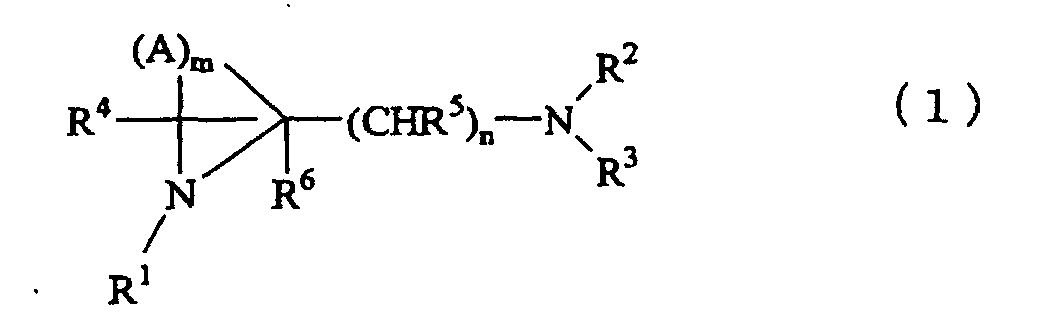 (wherein, one or two of As each represents CH2 which may be substituted by one or two selected from O, S and NH,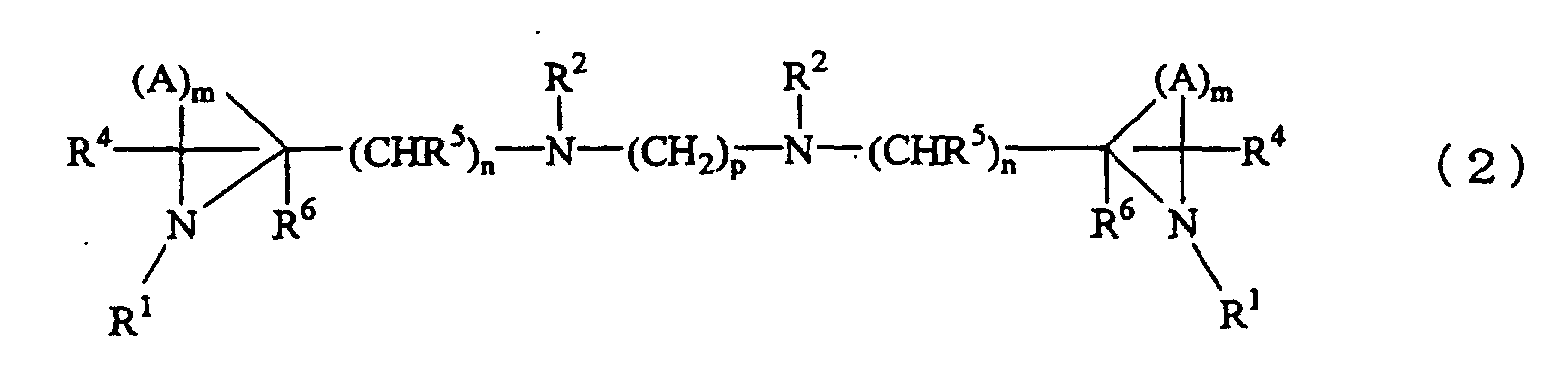
R1 represents a hydrogen atom; an alkyl, cycloalkyl or alkenyl group which has 12 or less carbon atoms and may be substituted by at least one group selected from a hydroxy group, an amino group which may be substituted by at least one alkyl group, an amide group which may be substituted by at least one alkyl group, a C1-6 (poly)alkoxy or benzyloxy group which may be substituted by a hydroxy group or an amino group, a thioether group and an ester group; an alkyl halide group; or a benzyl, pyridylmethyl or phenyl group which may be substituted by at least one halogen atom;
R2 and R3 each represents a hydrogen atom; an alkyl, alkenyl or cycloalkyl group which has 12 or less carbon atoms and may substituted by at least one group selected from hydroxy group, amino group which may be substituted by at least one alkyl group and C1-6 alkoxy group; an acyl group having 12 or less carbon atoms; an alkylsulfonyl group having 12 or less carbon atoms; or a phenylsulfonyl group which may be substituted by at least one alkyl group; or R2 and R3 may form a 4- to 7-membered ring cyclic amino group together with a nitrogen atom adjacent thereto,
R4, R5 and R6 each represents a hydrogen atom; a hydroxy group; an amino group; an alkyl ether group; or an alkyl or alkenyl group which has 12 or less carbon atoms and may be substituted by at least one group selected from a hydroxy group, and an amino group which may be substituted by at least one alkyl group,
m stands for an integer of from 2 to 5, n stands for an integer of from 1 to 4 and p stands for an integer of from 2 to 6); or salt thereof. - A hair treatment additive comprising a nitrogenous compound having a solubility parameter logP value in octanol/water ranging from -1 to 4, and has a hydrogen peroxide remaining ratio of from 5 to 90%, or salt thereof.
Applications Claiming Priority (5)
| Application Number | Priority Date | Filing Date | Title |
|---|---|---|---|
| JP2001380949 | 2001-12-14 | ||
| JP2001380949 | 2001-12-14 | ||
| JP2002135939 | 2002-05-10 | ||
| JP2002135939 | 2002-05-10 | ||
| PCT/JP2002/013068 WO2003051322A1 (en) | 2001-12-14 | 2002-12-13 | Hair dye composition |
Publications (3)
| Publication Number | Publication Date |
|---|---|
| EP1454617A1 true EP1454617A1 (en) | 2004-09-08 |
| EP1454617A4 EP1454617A4 (en) | 2007-07-11 |
| EP1454617B1 EP1454617B1 (en) | 2010-05-05 |
Family
ID=26625052
Family Applications (1)
| Application Number | Title | Priority Date | Filing Date |
|---|---|---|---|
| EP02788825A Expired - Lifetime EP1454617B1 (en) | 2001-12-14 | 2002-12-13 | Hair bleach and dye compositions |
Country Status (6)
| Country | Link |
|---|---|
| US (1) | US7211116B2 (en) |
| EP (1) | EP1454617B1 (en) |
| JP (1) | JP3977811B2 (en) |
| AU (1) | AU2002354482A1 (en) |
| DE (1) | DE60236315D1 (en) |
| WO (1) | WO2003051322A1 (en) |
Cited By (5)
| Publication number | Priority date | Publication date | Assignee | Title |
|---|---|---|---|---|
| EP1669106A1 (en) * | 2004-12-02 | 2006-06-14 | The Procter and Gamble Company | High level carbonate and/or oxidant hair colouring compositions |
| EP1669107A1 (en) * | 2004-12-02 | 2006-06-14 | The Procter and Gamble Company | Hair colouring compositions |
| WO2006060565A3 (en) * | 2004-12-02 | 2006-08-03 | Procter & Gamble | High level carbonate and/or oxidant hair colouring compositions |
| WO2006060567A3 (en) * | 2004-12-02 | 2006-08-10 | Procter & Gamble | Hair colouring compositions |
| EP2047841A4 (en) * | 2006-07-31 | 2013-03-27 | Kao Corp | Hair dye composition |
Families Citing this family (13)
| Publication number | Priority date | Publication date | Assignee | Title |
|---|---|---|---|---|
| US7452386B2 (en) * | 2004-12-03 | 2008-11-18 | L'oreal S.A. | Composition for bleaching and simultaneously dyeing keratin fibers, comprising meta-substituted ortho-nitroaniline |
| JP4652079B2 (en) * | 2005-02-15 | 2011-03-16 | 花王株式会社 | Process for producing 2,2-disubstituted ethylenediamine derivatives |
| JP4823654B2 (en) * | 2005-11-18 | 2011-11-24 | ホーユー株式会社 | Oxidative hair dye |
| US7736396B2 (en) * | 2006-03-16 | 2010-06-15 | Kao Corporation | Hair dyeing composition |
| EP2000125B1 (en) * | 2006-03-16 | 2015-06-10 | Kao Corporation | Hair dyeing composition |
| JP5114011B2 (en) * | 2006-03-16 | 2013-01-09 | 花王株式会社 | Hair dye composition |
| JP5114010B2 (en) * | 2006-03-16 | 2013-01-09 | 花王株式会社 | Hair dye composition |
| JP2014009159A (en) * | 2012-06-27 | 2014-01-20 | Fujifilm Corp | Hair dye composition |
| JP6077344B2 (en) * | 2013-03-12 | 2017-02-08 | 花王株式会社 | Bleach composition comprising a piperazine derivative |
| JP6057785B2 (en) * | 2013-03-12 | 2017-01-11 | 花王株式会社 | Pyrrolidine derivatives |
| US10874185B2 (en) | 2013-05-10 | 2020-12-29 | Kao Corporation | Process for one-step colouring and straightening hair |
| US11123281B2 (en) | 2018-10-22 | 2021-09-21 | Pwai, Llc | Oxydation dye delivery product or process |
| DE102019211505A1 (en) * | 2019-08-01 | 2021-02-04 | Henkel Ag & Co. Kgaa | A method for coloring keratin material, comprising the use of an organic C1-C6 alkoxysilane and an alkalizing agent |
Family Cites Families (8)
| Publication number | Priority date | Publication date | Assignee | Title |
|---|---|---|---|---|
| JP2659740B2 (en) * | 1988-02-22 | 1997-09-30 | ホーユー株式会社 | Hair dye composition |
| DE19618595A1 (en) * | 1996-05-09 | 1997-11-13 | Wella Ag | dye |
| US6613313B2 (en) * | 1997-11-28 | 2003-09-02 | Fuji Photo Film Co., Ltd. | Aniline compound-containing hair dye composition and method of dyeing hair |
| US5993491A (en) | 1998-05-13 | 1999-11-30 | Bristol-Myers Squibb Company | Oxidative hair dye compositions and methods containing 1-(4-aminophenyl)-2-pyrrolidinemethanols |
| FR2807650B1 (en) | 2000-04-18 | 2002-05-24 | Oreal | KERATIN FIBER OXIDATION DYE COMPOSITION COMPRISING 1- (4-AMINOPHENYL) -PYRROLIDINE AND A PARTICULAR DIRECT DYE |
| JP2003535876A (en) | 2000-06-20 | 2003-12-02 | ヘンケル・コマンディットゲゼルシャフト・アウフ・アクチエン | Vitamin B6 derivative as protective ingredient in hair oxidation treatment |
| FR2817474B1 (en) | 2000-12-06 | 2003-01-03 | Oreal | OXIDATION DYE COMPOSITION BASED ON 1- (4-AMINOPHENYL) PYRROLIDINES SUBSTITUTED IN POSITION 2 AND METHOD OF IMPLEMENTING DYEING |
| JP2002255759A (en) | 2001-03-02 | 2002-09-11 | Kao Corp | Hair dye composition |
-
2002
- 2002-12-13 US US10/497,538 patent/US7211116B2/en not_active Expired - Fee Related
- 2002-12-13 AU AU2002354482A patent/AU2002354482A1/en not_active Abandoned
- 2002-12-13 WO PCT/JP2002/013068 patent/WO2003051322A1/en not_active Ceased
- 2002-12-13 EP EP02788825A patent/EP1454617B1/en not_active Expired - Lifetime
- 2002-12-13 JP JP2003552255A patent/JP3977811B2/en not_active Expired - Fee Related
- 2002-12-13 DE DE60236315T patent/DE60236315D1/en not_active Expired - Lifetime
Cited By (5)
| Publication number | Priority date | Publication date | Assignee | Title |
|---|---|---|---|---|
| EP1669106A1 (en) * | 2004-12-02 | 2006-06-14 | The Procter and Gamble Company | High level carbonate and/or oxidant hair colouring compositions |
| EP1669107A1 (en) * | 2004-12-02 | 2006-06-14 | The Procter and Gamble Company | Hair colouring compositions |
| WO2006060565A3 (en) * | 2004-12-02 | 2006-08-03 | Procter & Gamble | High level carbonate and/or oxidant hair colouring compositions |
| WO2006060567A3 (en) * | 2004-12-02 | 2006-08-10 | Procter & Gamble | Hair colouring compositions |
| EP2047841A4 (en) * | 2006-07-31 | 2013-03-27 | Kao Corp | Hair dye composition |
Also Published As
| Publication number | Publication date |
|---|---|
| JP3977811B2 (en) | 2007-09-19 |
| AU2002354482A1 (en) | 2003-06-30 |
| US20050102770A1 (en) | 2005-05-19 |
| US7211116B2 (en) | 2007-05-01 |
| JPWO2003051322A1 (en) | 2005-04-21 |
| EP1454617B1 (en) | 2010-05-05 |
| WO2003051322A1 (en) | 2003-06-26 |
| EP1454617A4 (en) | 2007-07-11 |
| DE60236315D1 (en) | 2010-06-17 |
Similar Documents
| Publication | Publication Date | Title |
|---|---|---|
| EP1454617B1 (en) | Hair bleach and dye compositions | |
| US5578087A (en) | Dyeing compositions for keratinous fibres based on para-phenylene-diamines, meta-phenylenediamine and benzimidazole derivatives, and dyeing process employing them | |
| JP4456959B2 (en) | Hair treatment agent | |
| FR2830194A1 (en) | COMPOSITION CONTAINING A PYRAZINE DERIVATIVE AND USE FOR DIRECT DYE OR OXIDATION AND / OR OPTICAL ENHANCEMENT OF KERATIN FIBERS | |
| EP0663814A1 (en) | Process for dyeing keratin fibres using an acid ph alcoxymetephenylenediamine and compositions therefor | |
| US20020046430A1 (en) | Hair dye composition | |
| EP0684035A1 (en) | Keratineous fibres oxidation dyeing composition containing a derivative of paraphenylenediamine and a 6-hydroxy 1,4-benzoxazine | |
| US7270683B2 (en) | Hairdye composition | |
| JP2004217672A (en) | Hair dye composition | |
| FR2776288A1 (en) | Novel cationic monobenzene coupling agents for use in oxidation dyeing of keratinous fibers | |
| JP3638519B2 (en) | Hair dye composition | |
| JP2002226340A (en) | Hair dye composition | |
| US6878169B2 (en) | Hair dye composition | |
| US6814762B2 (en) | Hair dye composition | |
| JP5016181B2 (en) | Hair dye composition | |
| US20010054205A1 (en) | Pyrazoline-3, 5-dione-containing compositions for dyeing keratin fibres; their use in dyeing as couplers; dyeing process | |
| US6093219A (en) | Composition for the oxidation dyeing of keratin fibers, comprising at least two oxidation bases and an indole coupler, and dyeing process | |
| EP1495751B1 (en) | Hairdye composition | |
| JP3683505B2 (en) | Hair dye composition | |
| JP3754295B2 (en) | Hair dye composition | |
| JP2003012479A (en) | Hair dye composition | |
| JP2004196812A (en) | Hair dye composition | |
| JP2004131510A (en) | Hair dye composition | |
| JP2004123759A (en) | Hair dye composition | |
| JP4865987B2 (en) | Hair dye composition |
Legal Events
| Date | Code | Title | Description |
|---|---|---|---|
| PUAI | Public reference made under article 153(3) epc to a published international application that has entered the european phase |
Free format text: ORIGINAL CODE: 0009012 |
|
| 17P | Request for examination filed |
Effective date: 20040614 |
|
| AK | Designated contracting states |
Kind code of ref document: A1 Designated state(s): AT BE BG CH CY CZ DE DK EE ES FI FR GB GR IE IT LI LU MC NL PT SE SI SK TR |
|
| AX | Request for extension of the european patent |
Extension state: AL LT LV MK RO |
|
| A4 | Supplementary search report drawn up and despatched |
Effective date: 20070611 |
|
| 17Q | First examination report despatched |
Effective date: 20090225 |
|
| GRAP | Despatch of communication of intention to grant a patent |
Free format text: ORIGINAL CODE: EPIDOSNIGR1 |
|
| RIC1 | Information provided on ipc code assigned before grant |
Ipc: A61Q 5/10 20060101ALI20091022BHEP Ipc: A61Q 5/08 20060101ALI20091022BHEP Ipc: A61K 8/49 20060101ALI20091022BHEP Ipc: A61K 8/41 20060101AFI20091022BHEP |
|
| RTI1 | Title (correction) |
Free format text: HAIR BLEACH AND DYE COMPOSITIONS |
|
| GRAS | Grant fee paid |
Free format text: ORIGINAL CODE: EPIDOSNIGR3 |
|
| GRAA | (expected) grant |
Free format text: ORIGINAL CODE: 0009210 |
|
| AK | Designated contracting states |
Kind code of ref document: B1 Designated state(s): DE FR GB |
|
| REG | Reference to a national code |
Ref country code: GB Ref legal event code: FG4D |
|
| REF | Corresponds to: |
Ref document number: 60236315 Country of ref document: DE Date of ref document: 20100617 Kind code of ref document: P |
|
| PLBE | No opposition filed within time limit |
Free format text: ORIGINAL CODE: 0009261 |
|
| STAA | Information on the status of an ep patent application or granted ep patent |
Free format text: STATUS: NO OPPOSITION FILED WITHIN TIME LIMIT |
|
| 26N | No opposition filed |
Effective date: 20110208 |
|
| REG | Reference to a national code |
Ref country code: DE Ref legal event code: R097 Ref document number: 60236315 Country of ref document: DE Effective date: 20110207 |
|
| REG | Reference to a national code |
Ref country code: FR Ref legal event code: PLFP Year of fee payment: 14 |
|
| REG | Reference to a national code |
Ref country code: FR Ref legal event code: PLFP Year of fee payment: 15 |
|
| PGFP | Annual fee paid to national office [announced via postgrant information from national office to epo] |
Ref country code: FR Payment date: 20161111 Year of fee payment: 15 Ref country code: GB Payment date: 20161207 Year of fee payment: 15 Ref country code: DE Payment date: 20161206 Year of fee payment: 15 |
|
| REG | Reference to a national code |
Ref country code: DE Ref legal event code: R119 Ref document number: 60236315 Country of ref document: DE |
|
| GBPC | Gb: european patent ceased through non-payment of renewal fee |
Effective date: 20171213 |
|
| REG | Reference to a national code |
Ref country code: FR Ref legal event code: ST Effective date: 20180831 |
|
| PG25 | Lapsed in a contracting state [announced via postgrant information from national office to epo] |
Ref country code: DE Free format text: LAPSE BECAUSE OF NON-PAYMENT OF DUE FEES Effective date: 20180703 Ref country code: FR Free format text: LAPSE BECAUSE OF NON-PAYMENT OF DUE FEES Effective date: 20180102 |
|
| PG25 | Lapsed in a contracting state [announced via postgrant information from national office to epo] |
Ref country code: GB Free format text: LAPSE BECAUSE OF NON-PAYMENT OF DUE FEES Effective date: 20171213 |