EP1452950A1 - Mobile communication terminal, method for controlling execution state of application program, application program, and recording medium wherein application program has been recorded - Google Patents
Mobile communication terminal, method for controlling execution state of application program, application program, and recording medium wherein application program has been recorded Download PDFInfo
- Publication number
- EP1452950A1 EP1452950A1 EP02783785A EP02783785A EP1452950A1 EP 1452950 A1 EP1452950 A1 EP 1452950A1 EP 02783785 A EP02783785 A EP 02783785A EP 02783785 A EP02783785 A EP 02783785A EP 1452950 A1 EP1452950 A1 EP 1452950A1
- Authority
- EP
- European Patent Office
- Prior art keywords
- application program
- active state
- state
- control
- execution
- Prior art date
- Legal status (The legal status is an assumption and is not a legal conclusion. Google has not performed a legal analysis and makes no representation as to the accuracy of the status listed.)
- Withdrawn
Links
Images




Classifications
-
- G—PHYSICS
- G06—COMPUTING OR CALCULATING; COUNTING
- G06F—ELECTRIC DIGITAL DATA PROCESSING
- G06F3/00—Input arrangements for transferring data to be processed into a form capable of being handled by the computer; Output arrangements for transferring data from processing unit to output unit, e.g. interface arrangements
- G06F3/01—Input arrangements or combined input and output arrangements for interaction between user and computer
- G06F3/03—Arrangements for converting the position or the displacement of a member into a coded form
- G06F3/033—Pointing devices displaced or positioned by the user, e.g. mice, trackballs, pens or joysticks; Accessories therefor
- G06F3/038—Control and interface arrangements therefor, e.g. drivers or device-embedded control circuitry
-
- G—PHYSICS
- G06—COMPUTING OR CALCULATING; COUNTING
- G06F—ELECTRIC DIGITAL DATA PROCESSING
- G06F3/00—Input arrangements for transferring data to be processed into a form capable of being handled by the computer; Output arrangements for transferring data from processing unit to output unit, e.g. interface arrangements
- G06F3/01—Input arrangements or combined input and output arrangements for interaction between user and computer
- G06F3/02—Input arrangements using manually operated switches, e.g. using keyboards or dials
- G06F3/023—Arrangements for converting discrete items of information into a coded form, e.g. arrangements for interpreting keyboard generated codes as alphanumeric codes, operand codes or instruction codes
-
- H—ELECTRICITY
- H04—ELECTRIC COMMUNICATION TECHNIQUE
- H04M—TELEPHONIC COMMUNICATION
- H04M1/00—Substation equipment, e.g. for use by subscribers
- H04M1/72—Mobile telephones; Cordless telephones, i.e. devices for establishing wireless links to base stations without route selection
- H04M1/724—User interfaces specially adapted for cordless or mobile telephones
- H04M1/72403—User interfaces specially adapted for cordless or mobile telephones with means for local support of applications that increase the functionality
-
- H—ELECTRICITY
- H04—ELECTRIC COMMUNICATION TECHNIQUE
- H04W—WIRELESS COMMUNICATION NETWORKS
- H04W52/00—Power management, e.g. Transmission Power Control [TPC] or power classes
- H04W52/02—Power saving arrangements
- H04W52/0209—Power saving arrangements in terminal devices
- H04W52/0261—Power saving arrangements in terminal devices managing power supply demand, e.g. depending on battery level
- H04W52/0264—Power saving arrangements in terminal devices managing power supply demand, e.g. depending on battery level by selectively disabling software applications
-
- Y—GENERAL TAGGING OF NEW TECHNOLOGICAL DEVELOPMENTS; GENERAL TAGGING OF CROSS-SECTIONAL TECHNOLOGIES SPANNING OVER SEVERAL SECTIONS OF THE IPC; TECHNICAL SUBJECTS COVERED BY FORMER USPC CROSS-REFERENCE ART COLLECTIONS [XRACs] AND DIGESTS
- Y02—TECHNOLOGIES OR APPLICATIONS FOR MITIGATION OR ADAPTATION AGAINST CLIMATE CHANGE
- Y02D—CLIMATE CHANGE MITIGATION TECHNOLOGIES IN INFORMATION AND COMMUNICATION TECHNOLOGIES [ICT], I.E. INFORMATION AND COMMUNICATION TECHNOLOGIES AIMING AT THE REDUCTION OF THEIR OWN ENERGY USE
- Y02D30/00—Reducing energy consumption in communication networks
- Y02D30/70—Reducing energy consumption in communication networks in wireless communication networks
Definitions
- the present invention relates to a mobile communications terminal, application program execution state control method, application program, and storage medium storing application programs.
- resident application programs have been developed as application programs which can be executed on a mobile communications terminal, principally mobile telephones.
- a resident application program is automatically started up when the power supply is turned on, and it continues in an active state until the power supply is switched off or until the user shuts it down.
- residential application programs include, for example, application programs for displaying a standby screen for awaiting a telephone call or incoming electronic mail (hereinafter, called "standby screen").
- a resident application program has only one execution state. In this execution state, the application program receives all the key events (process commands based on key inputs), and in order to release this reception of key events, it is necessary to close down the application program whilst it is running. Consequently, if a call is made whist the application program is running, for example, then the user must temporarily close down the application program.
- the mobile communications terminal relating to the present invention is characterized in that it comprises: control means for performing control, when an application program is being executed, for switching between: a non-active state in which key inputs to the application program being executed are refused, and an active state in which key input to the application program are permitted.
- the application program execution state control method is an application program execution state control method whereby a mobile communications terminal controls the execution state of an application program stored in the mobile communications terminal, characterized in that it comprises: a control step for performing control, when the application program is being executed, whereby the mobile communications terminal switches between: a non-active state in which key inputs to the application program being executed are refused, and an active state in which key input to the application program are permitted.
- the application program relating to the present invention is an application program which is executed in a mobile communications terminal and the execution state of which is controlled by the mobile communications terminal, characterized in that it comprises functions for switching between a non-active state in which key inputs to the application program being executed are refused, and an active state in which key input to the application program are permitted.
- the mobile communications terminal relating to the present invention further comprises: instructing means for instructing a state transition between the non-active state and the active state; wherein the control means executes control for switching the execution state of the application program between the non-active state and the active state, in accordance with the instructions from the instructing means.
- the application program execution control method relating to the present invention further comprises: an instructing step for instructing a state transition of the mobile communications terminal between the non-active state and the active state; wherein, in the control step, control is executed for switching the execution state of the application program between the non-active state and the active state, in accordance with the instructions from the instructing step.
- the application program relating to the present invention comprises functions for switching between the non-active state in which key inputs to the application program being executed are refused, and the active state in which key input to the application program are permitted.
- the user is able readily to cause a transition of the execution state of the application program by means of a simple operation, such as pressing a switching key, or the like.
- a simple operation such as pressing a switching key, or the like.
- control means performs control for switching the execution state of the application program between the active state and the non-active state in accordance with a function contained in the application program.
- control is executed for switching the execution state of the application program between the non-active state and the active state in accordance with a function contained in the application program.
- switching can be performed in the mobile communications terminal whereby key inputs to an application program being executed are refused, and key inputs to another application program for implementing basic telephone functions are received preferentially. In this, it is not necessary for the user to perform an operation for switching the execution state.
- the mobile communications terminal relating to the present invention comprises instructing means for instructing a state transition between the non-active state and the active state; wherein the control means executes control for switching the execution state of the application program from the non-active state to the active state in accordance with the instructions from the instructing means, and for switching the execution state of the application program from the active state to the non-active state, in accordance with a function contained in the application program.
- the application program execution state control method further comprises an instructing step for instructing a state transition of the mobile communications terminal from the non-active state to the active state; wherein the control step executes control for switching the execution state of the application program from the non-active state to the active state in accordance with the instructions from the instructing step, and for switching the execution state of the application program from the active state to the non-active state, in accordance with a function contained in the application program.
- the state transitions are shared between the instructing means and the application program, there is no occurrence of infinite loops of state transitions, due to bugs, or the like, in the application program. Furthermore, by automatically switching the execution state of the application program from an active state to a non-active state, it is possible to receive key inputs to a native application for mobile communications, in a preferential manner.
- control means in the non-active state, permits key inputs to a native application program which is different to the application program.
- the control step permits key inputs to a native application program which is different to the application program.
- the user in the non-active state, the user is able to use native applications, such as basic telephone functions of the mobile communications terminal, mail, browsing, and the like, in an appropriate manner.
- native applications such as basic telephone functions of the mobile communications terminal, mail, browsing, and the like
- control means executes the application program while partially limiting the functions thereof.
- the application program is executed with the functions of thereof being partially limited in the non-active state.
- the application program relating to the present invention comprises specific functions which are not executed in the non-active state.
- the functions of an application program in a non-active state are executed in a partially limited fashion.
- a limited execution of this kind is implemented by prohibiting reading of specific functions contained in an application.
- functions with a low requirement for execution are set as specific functions, thereby restricting the functions of the application program.
- Fig. 1 is a block diagram showing the functional composition of a mobile telephone 1.
- the mobile telephone 1 (corresponding to a mobile communications terminal), is constituted by a control section 2 (corresponding to control means), an input section 3 (corresponding to instruction means), a RAM 4, a display section 5, a memory section 6, a radio communications section 7, and a voice processing section 8, each section being connected via a bus 9 in such a manner that various types of signals can be input and output to and from same.
- the control section 2 has a built in ROM (Read Only Memory) 2a, reads a program previously stored in the ROM 2a, opens the program into the RAM 4, and controls each section centrally in accordance with the program.
- the control section 2 executes various types of processing in accordance with input signal from the input section 3 and the program opened in the RAM 4, and the results of this processing are stored temporarily in the RAM 4 and also displayed on the display section 5.
- the processing results stored in the RAM 4 are also stored in a prescribed region of the memory section 6, according to requirements.
- the input section 3 comprises various operating keys which instruct operations, such as switching on of the power supply, selection and execution of an application program, switching to a execution state, as described hereinafter, setting a rest time, as described hereinafter, or the like, and each of these respective operating keys outputs an input signal corresponding to the instruction content, to the control section 2, by means of the keys being pressed independently or jointly.
- the RAM (Random Access Memory) 4 is constituted by a semiconductor, or the like, and temporarily stores programs read from the ROM 2a or data read from the memory section 6, in each of the various processes executed by the control section 2. For example, when executing the execution state transition processing described hereinafter, the RAM 4 stores data relating to the rest time and time settings specified by the control section 2. Moreover, the RAM 4 stores the display data when transfer to the rest state, described hereinafter.
- the display section 5 is constituted by an LCD (Liquid Crystal Display) or EL (Electro Luminescence) display, or the like, and displays display data in a prescribed region in accordance with signals input from the control section 2.
- the display data is data used as the application program is executed, and it includes not only static image data, but also moving image data for elements such as a stock price board, games, or the like.
- the memory section 6 is constituted by a volatile semiconductor memory, such as an EEPROM (Electrically Erasable and Programmable ROM), or the like, and it stores data required by the control section 2 in order to execute various processes, and data generated as a result of executing processes, and the like. Moreover, the memory section 6 stores application programs 61 and ADFs (Attribute Definition Files), in a mutually corresponding fashion.
- An ADF is a file consisting of data relating to the attributes of an application program 61.
- the data relating to attributes is, for example, data indicating that the application program 61 has an execution state transition function (My Concierge key).
- the application program 61 may be stored in a storage medium, such as an IC card, or the like, which can be inserted into and removed from the mobile telephone 1.
- the radio communications section 7 is a circuit having a modulating and demodulating section (not illustrated) for modulating and demodulating signals, and an encoding and decoding section (not illustrated) for encoding and decoding signals, and it is also provided with an antenna 7a.
- the antenna 7a is provided in an extendable and retractable fashion with respect to the upper part of the casing of the mobile telephone 1, and it sends and receives data to and from a base station B.
- the modulating and demodulating section When receiving, the modulating and demodulating section performs processing for demodulating signals input via the antenna 7a, into signal which can be processed by the encoding and decoding section. On the other hand, when transmitting, it performs processing for modulating digital signals converted by the encoding and decoding section into signal which can be transmitted by radio waves.
- the encoding and decoding section is constituted by a codec, and when receiving, it performs processing (decoding) for converting digital signals input from the modulating and demodulating section into analogue signals.
- processing (encoding) for converting analogue signals, such as voice signals, into digital signals, and compressing the converted digital signals into a data volume that is suitable for transmission.
- the voice processing section 8 comprises a converter and an amplifier, and the like, and is also provided with a microphone 8a, and speaker 8b.
- the voice processing section 8 converts voice data input via the control section 2 into an analogue signal, by means of the converter, passes the signal via the amplifier and emits it from the speaker 8b.
- the voice processing section 8 converts a voice signal input via the microphone 8a into a digital signal suitable for radio transmission, by means of the converter, and outputs the converted signal to the radio communications section 7.
- Fig. 2 is a state transition diagram for describing the execution state transition processing.
- the mobile telephone 1 is switchable between three execution states of the resident application, namely, non-active state, active state, and rest state.
- the non-activated state is an execution state which rejects key inputs to the resident application. These inputs include indirect inputs made by selecting software keys displayed on the display section 5.
- the resident application performs display operations and data transmission and reception, updating, and the like, by means of radio communications, similarly to a conventional standby screen.
- the display operations also include updating of display data.
- processing for reception of key events processing commands implemented by the control section 2 on the basis of key inputs
- display of software keys is not performed by the resident application, but is only performed by the native application.
- the native application in the non-active state, when a signal is received indicating reception of a mail from base station B by the mobile telephone 1, then the native application is able automatically receive the contents of the mail from the mail server.
- the active state is an execution state which permits key inputs to the resident application.
- the resident application executes all processing in order to realize the functions thereof.
- processing for reception of key events and display of software keys, and the like is executed by the resident application only.
- the rest state is an execution state where the resident application is halted temporarily.
- the resident application waits for a key event which indicates transition to a non-active state or active state.
- the resident application does not execute any processing, such as reception of key events, display operations, or the like, except for a state transmission instruction, and processing is executed by the native application only.
- the display operations include updating of display data. For example, in a resident application displaying an animated standby screen, or the like, the display data during rest state becomes static image data, and the application functions only as a wallpaper display. Therefore, the mobile telephone 1 is able to achieve lower power consumption than in the non-active state.
- software such us KVM (K Virtual Machine) and JAM (Java Application Manager), and the like, of the resident application also halts.
- execution state transition processing is described in detail. Firstly, when the execution of a resident application is instructed via the input section 3, then the control section 2 reads out and starts up the resident application from the memory section 6 (S1). Upon starting up, a notification indicating that the application is a resident application having an execution state transition function is sent to the control section 2. This notification processing is performed by means of the control section 2 consulting the My Concierge key of the ADF stored in the memory section 6.
- the resident application may be started up automatically when the mobile telephone 1 has entered a standby state (hereinafter, called "standby start-up").
- This standby start-up is only executed when the ADF contains a My Concierge key and the standby setting has been made on the menu.
- an application for displaying a moving image standby screen is supposed as the resident application, and the execution state immediately after start-up is taken to be a non-active state (S2).
- the state transition from non-active state to active state (T1) is executed by the control section 2 on the basis of an execution state switching instruction from the input section 3.
- the user is able readily to cause the resident application to transfer from a non-active state to an active state, by means of a simple operation, such as pressing a switch key, or the like.
- the state transition in T1 may be executed by the control section 2 in accordance with a function contained in the resident application.
- This processing includes, for example, display of a ticker (indicator board with flowing and flashing text), playing back of media resources, such as sound and images, and the like, operation of a timer, HTTP (Hyper Text Transfer Protocol) communications, access to a scratch pad (region where data created by an application or data received via the network is saved), operation of the vibrator, switching on and off of the backlight, and the like.
- ticker indicator board with flowing and flashing text
- media resources such as sound and images, and the like
- HTTP Hyper Text Transfer Protocol
- the state transition (T2) from active state to non-active state is performed automatically by the control section 2 on the basis of a function (for example, "deactivate") contained in the resident application.
- a function for example, "deactivate"
- the input frequency is generally higher than that of a resident application, and therefore it is suitable for the active state of a native application to be continued as long as possible. Therefore, key inputs to a native application are treated preferentially, by automatically switching the execution state of the resident application from an active state to a non-active state.
- the state transition shown in T2 can be executed by the control section 2 on the basis of a execution state switching instruction from the input section 3.
- the processing, that is continuously executed even after the state transition in T2 includes, for example, display of a ticker, playing back of media resources, such as sound and images, and the like, operation of a timer, HTTP communications, access to a scratch pad, operation of the vibrator, switching on of the backlight, switching off of the backlight, and the like.
- the state transition from a non-active state to a rest state is executed automatically by the control section 2, on the basis of a function (for example, "sleep") contained in the resident application.
- a function for example, "sleep" contained in the resident application.
- the display screen shown at the time of the state transition from non-active state to rest state is displayed continuously on the display section 5.
- the display data in the rest state is static image data, which does not change over time.
- the state transition at T3 may be performed by control section 2 on the basis of an execution state switching instruction from the input section 3.
- the processing halted by the resident application after the state transition in T3 is as described below. Specifically, the operations which are halted are the display of the ticker scroll section (the display of the ticker itself continues), the playing back of media resources, operation of the timer, and operation of the vibrator. Furthermore, HTTP communications are disconnected.
- the state transfers to a rest state after writing has completed.
- the state transfers directly to a rest state.
- the switching on and switching off of the backlight are conducted similarly to a non-active state. In other words, if the backlight was switched on in the non-active state then it will remain turned on, and if the backlight was switched off in the non-active state, then it will remain turned off.
- the state transition (T4) from rest state to non-active state is executed by the control section 2 when a prescribed condition is satisfied.
- the prescribed condition is the operation of opening the call section of the casing.
- the condition may be the elapsing of a rest time (for example, 5 minutes) set in the active state, or the reaching of a set time (for example, 17:00) according to the timer, or the like.
- the control section 2 holds at RAM 4 the program code of the resident application that was already being executed when the state was transferred to the rest state. Therefore, in the case of a state transition from the rest state to the non-active state, processing for reading again from the start of the program code is not required.
- the state transition at T4 may be executed by the control section 2 in accordance with a function contained in the resident application.
- the state transition at T4 may be executed by the control section 2 on the basis of an execution state switching instruction from the input section 3.
- the detailed behaviour of the resident application after the state transition at T4 is as follows. Namely, in a ticker display, the scrolling text will restart from the display state which was halted when the device transferred to the execution state. In HTTP communications, the communications are restarted. If exception processing was generated when the communications were disconnected, then execution is restarted from the exception processing. The scratchpad reverts to a state where writing and reading of data can be performed. A vibrator operation halted by a rest state is not restarted automatically. Playing back of media resources and timer operation are not restarted. Switching on and switching off of the backlight are conducted similarly to the rest state. In other words, if the backlight was switched on in the rest state, then it remains switched on, and if the backlight was switched off in the rest state, then it remains switched off.
- the detailed behaviour of the resident application after the state transition at T4 is as follows. Namely, in a ticker display, the scrolling text will restart from the display state which was halted when the device transferred to the execution state. In HTTP communications, the communications are restarted. If exception processing was generated when the communications were disconnected, then execution is restarted from the exception processing. The scratchpad reverts to a state where writing and reading of data can be performed. A vibrator operation halted by a rest state is not restarted automatically. Playing back of media resources and timer operation are not restarted. Switching on and switching off of the backlight are conducted similarly to the rest state. In other words, if the backlight was switched on in the rest state, then it remains switched on, and if the backlight was switched off in the rest state, then it remains switched off.
- the state transition from rest state to active state (T5) is executed by the control section 2 on the basis of an execution state switching instruction from the input section 3.
- the control section 2 holds the program code of the resident application that was already executed when the transition to rest state was made in the RAM 4. Therefore, when the state transition from the rest state to the active state is made, processing for reading out again from the start of the program code is not necessary. As a result of this, the time required to revert to the resident application is shortened compared to cases where the temporarily halted resident application is restarted.
- the state transition at T5 may also be executed by the control section 2 in accordance with a function contained in the resident application.
- the detailed behaviour of the resident application after the state transition at T5 is as follows. Namely, in a ticker display, the scrolling text will restart from the display state which was halted when the device transferred to the execution state. In HTTP communications, the communications are restarted. If exception processing was generated when the communications were disconnected, then execution is restarted from the exception processing. The scratchpad reverts to a state where writing and reading of data can be performed. A vibrator operation halted by a rest state is not restarted automatically. Playing back of media resources and timer operation are not restarted. Switching on and switching off of the backlight are conducted similarly to the rest state. In other words, if the backlight was switched on in the rest state, then it remains switched on, and if the backlight was switched off in the rest state, then it remains switched off.
- the resident application does not make a state transition from the active state to the rest state for the following reasons. Namely, when the resident application performs an execution state transition, then if an application (rogue application) has been created which always sets the resident application to a rest state, the user will become unable to control the execution state. Therefore, state transitions from the active state to the rest state are prohibited.
- State transitions based on functions previously included in the resident application are essentially determined by the resident application and do not give rise to problems of the kind described above. Therefore, state transitions of this kind may be executed as exceptions, regardless of whether or not there is a corresponding instruction from the input section 3.
- the execution state is transferred on the basis of an instruction from the input section 3, it is possible to save power in a precise manner according to the wishes of the user.
- the execution state is transferred in accordance with a function contained in a resident application, then it is possible to prevent the wasteful power consumption of the mobile telephone 1 over a long time, without an instruction from the input section 3.
- control section 2 can terminate the resident application in accordance with a shutdown instruction from the input section 3 (S5).
- the resident application can also be terminated forcibly by means of an operation by the user.
- the control section 2 causes the display section 5 to display a confirmation screen.
- the user is able to select a desired instruction from the following three types of instructions. Namely, the user can select a desired instruction from: an instruction for terminating the resident application and cancelling the standby start-up setting, an instruction for cancelling the forced termination and continuing execution of the resident application, and an instruction for temporarily closing down- and then restarting the resident application.
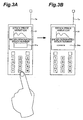
- Fig. 3A shows one example of a display screen prior to key input in an active state.
- display data 51 indicating changes in stock prices is shown on the display section 5.
- the display data 51 is moving image data that is updated automatically at prescribed intervals (for example, every 10 seconds).
- the display data 51 comprises a designated stock input region 51a in the lower part of the screen.
- the designated stock input region 51a is used to input a number for identifying the stock required by a user in monitoring changes in stock prices (hereinafter, called "designated stock number").
- the display data 51 When the display data 51 is shown, and the user inputs numerical data, such as "12345678", as a designated stock number, to the designated stock input region 51a, then the display state illustrated by the display data 52 in Fig. 3B will be obtained. In other words, in the active state, since normal key inputs are accepted, the control section 2 will execute processing for displaying the input data in the prescribed region of the display section 5, in accordance with key events received from the input section 3.
- Fig. 4A is a diagram showing one example of a display screen before key input in a non-active state.
- display data 53 indicating changes in stock prices is shown on the display section 5.
- the display data 53 is moving image data that is updated automatically at prescribed intervals (for example, every 10 seconds).
- the display data 53 comprises a designated stock input region 53a in the lower part of the screen.
- the control section 2 In the non-active state, the control section 2 only displays the resident application and does not accept key events. Therefore, the designated stock number cannot be input to the designated stock input region 53a.
- the display data 53 When the display data 53 is displayed, if the user performs a key operation which calls up a function for making a telephone call, then the display data 54 illustrated in Fig. 4B is shown on the display section 5. In other words, in the non-active state, key input to the resident application is refused, and key input to the native application is permitted. Therefore, in response to key events receive from the input section 3, the control section 2 executes processing for reading out display data for an outgoing call screen, from the memory section 6, and displaying same. As a result, an outgoing call screen as illustrated in Fig. 4B is displayed on the display section 5.
- Fig. 5A shows one example of a display screen immediately prior to transition to a rest state.
- display data 55 indicating changes in stock prices is shown on the display section 5.
- the display data 55 is updated automatically at prescribed time intervals (for example, every 10 seconds).
- Fig. 5B shows one example of a display screen after transferring to a rest state.
- the control section 2 continues to display the same display data 56 as the display data 55 at the time of the transition to the rest state, on the display section 5.
- the control section 2 does not accept key events from the input section 3 and does not perform update processing for the display data.
- the control section 2 performs processing for switching between a non-active state in which inputs to the resident application are refused, and an active state in which inputs can be made to the resident application. Consequently, even if a native application is used whilst a resident application is being executed, the user does not have to temporarily halt the resident application being executed. Thereby, operations for restarting the resident application and operations for returning to the display screen after terminating become unnecessary. As a result, the user tasks and operating time are reduced and the convenience of use of the mobile telephone 1 can be improved.
- the aforementioned embodiment may be implemented as follows. Namely, read out is permitted in the active state with respect to a portion of the functions contained in the resident application, and read out is prohibited, or read out is permitted but execution is prohibited, with respect to said portion of functions, in the non-active state. Below, these functions are called "specific functions".
- the function indicating use of the backlight is set as a specific function, for example. Namely, in the active state, since the resident application accepts key inputs, user input operations can be facilitated by using the backlight to brighten the display screen. However, in the non-active state, since key inputs to the resident application are refused, there is little need to brighten the display screen. If reading of functions instructing use of the backlight is permitted even in this case, then it is possible that the backlight may light up against the user's wishes, due to malfunction or roguery. Therefore, by prohibiting read out of functions instructing the use of the backlight when in the non-active state, it is possible to prevent wasteful power consumption, in advance.
- functions instructing use of the backlight it is also possible to specify, for example, functions which prompt the user for text input, functions which instruct external transmission of data, functions which play back a incoming call melody, functions which instruct start-up of a browser, functions for accessing the network, functions for calling up telephone functions, and the like.
- the foregoing embodiment was described with respect to the example of a mobile telephone as a mobile communications terminal, but the present invention can also be applied to information equipment, such as PHS (Personal Handyphone System), PDA (Personal Digital Assistance), and the like.
- PHS Personal Handyphone System
- PDA Personal Digital Assistance
- a storage medium is a medium which generates a varying state of energy, such as magnetism, light, electricity, or the like, in accordance with the contents of a program, for a reading device provided in a hardware resource, such as generic computers, or the like, whereby the contents of the program can be transmitted to the reading device in a corresponding signal format.
- Examples of such a storage medium include not only media which are insertable in a computer, such as magnetic disks, optical disks, and magneto-optical disks, but also hard disks (HD) built permanently into a computer or a non-volatile semiconductor memory, such as integrally fitted firmware, or the like.
- HD hard disks
- Fig. 6 is a compositional diagram of a storage medium relating to the present embodiment.
- the storage medium 20 is, for example, an optical disk, such as a CD (Compact Disk), magnetic disk, such as a floppy disk (FD), or magneto-optical disk (MO), or the like.
- the storage medium 20 comprises a program storage region 20a for storing programs. As shown in Fig. 6, an application program 61 is stored in this program storage region 20a.
- the application program 61 is constituted by a main module 61a for controlling processing, and an execution state control module 61b for executing processing for switching between a non-active state for refusing key inputs during execution and an active state for permitting key inputs. Furthermore, the execution state control module 61b performs processing for switching the execution state between a non-active state and an active state, in accordance with state transition instructions between a non-active state and an active state. Moreover, the execution state control module 61b performs processing for switching the execution state between a non-active state and an active state, in accordance with functions.
- the application program 61 also comprises specific functions which are not executed in the non-active state.
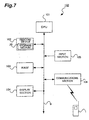
- Fig. 7 is a block diagram showing the composition of a computer for sending an application program 61 stored on a storage medium 20 to the mobile telephone 1 (for example, a server device).
- the computer 100 comprises a CPU 101, reading device 102, RAM (Random Access Memory) 103, which is a volatile semiconductor memory in which an OS (Operating System) is resident, a display section 104, such as a display, an input section 105, such as a mouse, keyboard, or the like, a communications section 106, such as a communications board, and a CPU 101 for controlling execution of the application program 61, and the like.
- RAM Random Access Memory
- a display section 104 such as a display
- an input section 105 such as a mouse, keyboard, or the like
- a communications section 106 such as a communications board
- CPU 101 for controlling execution of the application program 61, and the like.
- the information recorded on the storage medium 20 can be accessed via the reading device 102.
- the application program 61 stored in the program storage region 20a of the storage medium 20 is transmitted from the call section 106 to the mobile telephone 1, and can be executed by the mobile telephone 1.
- composition may be adopted wherein the a part or all of the application program 61 is received and stored by the radio communications section 7, from another device, via a transmission medium, such as a communications circuit, or the like.
- a transmission medium such as a communications circuit, or the like.
- the application program 61 is transmitted via a transmission medium and installed in another device.
- the present invention it is possible to perform control for switching between a non-active state for refusing key inputs to an application program being executed and an active state for permitting key inputs to said application program. Therefore, even if another application program is used in order to realize basic telephone functions, whilst the application program is being executed, the user is not required to temporarily closed the application program that is being executed. Consequently, no labour or time is required is restart a temporarily closed application program. As a result, the convenience of use during execution of an application program can be improved.
Landscapes
- Engineering & Computer Science (AREA)
- General Engineering & Computer Science (AREA)
- Theoretical Computer Science (AREA)
- Human Computer Interaction (AREA)
- Computer Networks & Wireless Communication (AREA)
- Signal Processing (AREA)
- Physics & Mathematics (AREA)
- General Physics & Mathematics (AREA)
- Telephone Function (AREA)
- Mobile Radio Communication Systems (AREA)
- Calculators And Similar Devices (AREA)
- Stored Programmes (AREA)
Abstract
In the mobile telephone 1 relating to the present
invention, a control section 2 performs control for
switching between a non-active state which refuses
inputs to an application program, and an active
state which permits inputs to an application program.
Moreover, the control section 2 performs control for
switching the execution state of the application
program from the non-active state to the active
state, in accordance with instructions from an input
section 3. The control section 2 further performs
control for switching the execution state of the
application program from the non-active state to the
active state, in accordance with a function
contained in an application program.
Description
The present invention relates to a mobile
communications terminal, application program
execution state control method, application program,
and storage medium storing application programs.
Conventionally, resident application programs
have been developed as application programs which
can be executed on a mobile communications terminal,
principally mobile telephones. A resident
application program is automatically started up when
the power supply is turned on, and it continues in
an active state until the power supply is switched
off or until the user shuts it down. Examples of
residential application programs include, for
example, application programs for displaying a
standby screen for awaiting a telephone call or
incoming electronic mail (hereinafter, called
"standby screen").
However, in a conventional mobile
communications terminal, a resident application
program has only one execution state. In this
execution state, the application program receives
all the key events (process commands based on key
inputs), and in order to release this reception of
key events, it is necessary to close down the
application program whilst it is running.
Consequently, if a call is made whist the
application program is running, for example, then
the user must temporarily close down the application
program.
In order to restart the temporarily closed down
application program, the user must perform an
operation of selecting and executing the application
program. Moreover, since the execution state after
close down is not reflected in the temporarily
closed down application program, it is necessary to
perform an operation in order to return to the
screen displayed before the call was made.
Operations of this kind are bothersome and time-consuming
for the user, and impair the usability of
the mobile communications terminal. They are
particularly inconvenient if a resident application
program is running which uses moving image data,
such as a stock market board, game, or the like.
In view of the aforementioned problems, it is
an object of the present invention to provide a
mobile communications terminal, an application
program execution state control method, an
application program, and a storage medium storing an
application program with improved usability during
execution of application programs.
The mobile communications terminal relating to
the present invention is characterized in that it
comprises: control means for performing control,
when an application program is being executed, for
switching between: a non-active state in which key
inputs to the application program being executed are
refused, and an active state in which key input to
the application program are permitted.
The application program execution state control
method according to the present invention is an
application program execution state control method
whereby a mobile communications terminal controls
the execution state of an application program stored
in the mobile communications terminal, characterized
in that it comprises: a control step for performing
control, when the application program is being
executed, whereby the mobile communications terminal
switches between: a non-active state in which key
inputs to the application program being executed are
refused, and an active state in which key input to
the application program are permitted.
The application program relating to the present
invention is an application program which is
executed in a mobile communications terminal and the
execution state of which is controlled by the mobile
communications terminal, characterized in that it
comprises functions for switching between a non-active
state in which key inputs to the application
program being executed are refused, and an active
state in which key input to the application program
are permitted.
According to these inventions, it is possible
to provide control for switching between a non-active
state which refuses key inputs to an
application program being executed, and an active
state which permits key inputs to said application
program. Consequently, even if another application
program for executing basic telephone functions,
such as outgoing call processing, or the like, is
used whilst an application program is being
processed, it is not necessary for the user to
temporarily close down the application program being
executed. Consequently, no labour or time is
required to restart a temporarily closed down
application program. Therefore, it is possible to
improve the convenience of use of the mobile
communications terminal.
Desirably, the mobile communications terminal
relating to the present invention further comprises:
instructing means for instructing a state transition
between the non-active state and the active state;
wherein the control means executes control for
switching the execution state of the application
program between the non-active state and the active
state, in accordance with the instructions from the
instructing means.
Desirably, the application program execution
control method relating to the present invention
further comprises: an instructing step for
instructing a state transition of the mobile
communications terminal between the non-active state
and the active state; wherein, in the control step,
control is executed for switching the execution
state of the application program between the non-active
state and the active state, in accordance
with the instructions from the instructing step.
Desirably, the application program relating to
the present invention comprises functions for
switching between the non-active state in which key
inputs to the application program being executed are
refused, and the active state in which key input to
the application program are permitted.
According to these inventions, the user is able
readily to cause a transition of the execution state
of the application program by means of a simple
operation, such as pressing a switching key, or the
like. In other words, it is possible readily to
perform switching of an application program being
executed to a execution state which permits input to
the program, whilst continuing an execution state in
which essential telephone functions can be used
immediately. As a result, the convenience of use of
the mobile communications terminal can be improved
further.
Desirably, in the mobile communications
terminal relating to the present invention, the
control means performs control for switching the
execution state of the application program between
the active state and the non-active state in
accordance with a function contained in the
application program.
Desirably, in the control step of the
application program execution control method
relating to the present invention, control is
executed for switching the execution state of the
application program between the non-active state and
the active state in accordance with a function
contained in the application program.
According to these inventions, switching can be
performed in the mobile communications terminal
whereby key inputs to an application program being
executed are refused, and key inputs to another
application program for implementing basic telephone
functions are received preferentially. In this, it
is not necessary for the user to perform an
operation for switching the execution state.
Desirably, the mobile communications terminal
relating to the present invention comprises
instructing means for instructing a state transition
between the non-active state and the active state;
wherein the control means executes control for
switching the execution state of the application
program from the non-active state to the active state
in accordance with the instructions from the
instructing means, and for switching the execution
state of the application program from the active state
to the non-active state, in accordance with a function
contained in the application program.
Desirably, the application program execution
state control method according to the present
invention further comprises an instructing step for
instructing a state transition of the mobile
communications terminal from the non-active state to
the active state; wherein the control step executes
control for switching the execution state of the
application program from the non-active state to the
active state in accordance with the instructions
from the instructing step, and for switching the
execution state of the application program from the
active state to the non-active state, in accordance
with a function contained in the application program.
According to these inventions, since the state
transitions are shared between the instructing means
and the application program, there is no occurrence of
infinite loops of state transitions, due to bugs, or
the like, in the application program. Furthermore, by
automatically switching the execution state of the
application program from an active state to a non-active
state, it is possible to receive key inputs to
a native application for mobile communications, in a
preferential manner.
Desirably, in a mobile communications terminal
relating to the present invention, in the non-active
state, the control means permits key inputs to a
native application program which is different to the
application program.
Desirably, in the application program execution
state control method relating to the present
invention, in the non-active state, the control step
permits key inputs to a native application program
which is different to the application program.
According to these inventions, in the non-active
state, the user is able to use native applications,
such as basic telephone functions of the mobile
communications terminal, mail, browsing, and the like,
in an appropriate manner.
More desirably, in the mobile communications
terminal relating to the present invention, in the
non-active state, the control means executes the
application program while partially limiting the
functions thereof.
More desirably, in the control step of the
application program execution control method relating
to the present invention, the application program is
executed with the functions of thereof being partially
limited in the non-active state.
More desirably, the application program relating
to the present invention comprises specific functions
which are not executed in the non-active state.
According to these inventions, the functions of
an application program in a non-active state are
executed in a partially limited fashion. A limited
execution of this kind is implemented by prohibiting
reading of specific functions contained in an
application. In other words, in the non-active state,
functions with a low requirement for execution are set
as specific functions, thereby restricting the
functions of the application program. Thereby, by
restricting functions using a backlight, for example,
it is possible to prevent the backlight from switching
on due to malfunction, roguery, or the like. As a
result, the power consumption can be reduced.
Furthermore, if a storage medium storing an
application program as described above is sold or
distributed, independently or as a peripheral product,
then it is possible to implement the execution state
control technology relating to the present invention,
inexpensively, over a broad range.
Below, embodiments of the present invention are
described in details with respect to the
accompanying drawings. Firstly, the composition
will be described. Fig. 1 is a block diagram
showing the functional composition of a mobile
telephone 1. As shown in Fig. 1, the mobile
telephone 1 (corresponding to a mobile
communications terminal), is constituted by a
control section 2 (corresponding to control means),
an input section 3 (corresponding to instruction
means), a RAM 4, a display section 5, a memory
section 6, a radio communications section 7, and a
voice processing section 8, each section being
connected via a bus 9 in such a manner that various
types of signals can be input and output to and from
same.
The control section 2 has a built in ROM (Read
Only Memory) 2a, reads a program previously stored
in the ROM 2a, opens the program into the RAM 4, and
controls each section centrally in accordance with
the program. In other words, the control section 2
executes various types of processing in accordance
with input signal from the input section 3 and the
program opened in the RAM 4, and the results of this
processing are stored temporarily in the RAM 4 and
also displayed on the display section 5. The
processing results stored in the RAM 4 are also
stored in a prescribed region of the memory section
6, according to requirements.
The input section 3 comprises various operating
keys which instruct operations, such as switching on
of the power supply, selection and execution of an
application program, switching to a execution state,
as described hereinafter, setting a rest time, as
described hereinafter, or the like, and each of
these respective operating keys outputs an input
signal corresponding to the instruction content, to
the control section 2, by means of the keys being
pressed independently or jointly.
The RAM (Random Access Memory) 4 is constituted
by a semiconductor, or the like, and temporarily
stores programs read from the ROM 2a or data read
from the memory section 6, in each of the various
processes executed by the control section 2. For
example, when executing the execution state
transition processing described hereinafter, the RAM
4 stores data relating to the rest time and time
settings specified by the control section 2.
Moreover, the RAM 4 stores the display data when
transfer to the rest state, described hereinafter.
The display section 5 is constituted by an LCD
(Liquid Crystal Display) or EL (Electro
Luminescence) display, or the like, and displays
display data in a prescribed region in accordance
with signals input from the control section 2. The
display data is data used as the application program
is executed, and it includes not only static image
data, but also moving image data for elements such
as a stock price board, games, or the like.
The memory section 6 is constituted by a
volatile semiconductor memory, such as an EEPROM
(Electrically Erasable and Programmable ROM), or the
like, and it stores data required by the control
section 2 in order to execute various processes, and
data generated as a result of executing processes,
and the like. Moreover, the memory section 6 stores
application programs 61 and ADFs (Attribute
Definition Files), in a mutually corresponding
fashion. An ADF is a file consisting of data
relating to the attributes of an application program
61. The data relating to attributes is, for example,
data indicating that the application program 61 has
an execution state transition function (My Concierge
key). The application program 61 may be stored in a
storage medium, such as an IC card, or the like,
which can be inserted into and removed from the
mobile telephone 1.
The radio communications section 7 is a circuit
having a modulating and demodulating section (not
illustrated) for modulating and demodulating signals,
and an encoding and decoding section (not
illustrated) for encoding and decoding signals, and
it is also provided with an antenna 7a. The antenna
7a is provided in an extendable and retractable
fashion with respect to the upper part of the casing
of the mobile telephone 1, and it sends and receives
data to and from a base station B.
When receiving, the modulating and demodulating
section performs processing for demodulating signals
input via the antenna 7a, into signal which can be
processed by the encoding and decoding section. On
the other hand, when transmitting, it performs
processing for modulating digital signals converted
by the encoding and decoding section into signal
which can be transmitted by radio waves. Moreover,
the encoding and decoding section is constituted by
a codec, and when receiving, it performs processing
(decoding) for converting digital signals input from
the modulating and demodulating section into
analogue signals. On the other hand, when
transmitting, it performs processing (encoding) for
converting analogue signals, such as voice signals,
into digital signals, and compressing the converted
digital signals into a data volume that is suitable
for transmission.
The voice processing section 8 comprises a
converter and an amplifier, and the like, and is
also provided with a microphone 8a, and speaker 8b.
During a call, the voice processing section 8
converts voice data input via the control section 2
into an analogue signal, by means of the converter,
passes the signal via the amplifier and emits it
from the speaker 8b. Furthermore, during a call,
the voice processing section 8 converts a voice
signal input via the microphone 8a into a digital
signal suitable for radio transmission, by means of
the converter, and outputs the converted signal to
the radio communications section 7.
Next, the operation of the present embodiment
will be described with reference to Fig. 2. As a
basic premise in the description of the operation,
in order to distinguish clearly between an
application program having an execution state
transition function, and an application program for
realizing basic functions of the mobile telephone 1
(telephone function, mail function, browsing
function, and the like), the former is called
"resident application" and the latter is called
"native application".
Fig. 2 is a state transition diagram for
describing the execution state transition processing.
As shown in Fig. 2, the mobile telephone 1 is
switchable between three execution states of the
resident application, namely, non-active state, active
state, and rest state.
The non-activated state is an execution state which rejects key inputs to the resident application. These inputs include indirect inputs made by selecting software keys displayed on thedisplay
section 5. In the non-active state, the resident
application performs display operations and data
transmission and reception, updating, and the like,
by means of radio communications, similarly to a
conventional standby screen. Moreover, the display
operations also include updating of display data.
Furthermore, in the non-active state, processing for
reception of key events (process commands
implemented by the control section 2 on the basis of
key inputs) and display of software keys is not
performed by the resident application, but is only
performed by the native application.
The non-activated state is an execution state which rejects key inputs to the resident application. These inputs include indirect inputs made by selecting software keys displayed on the
Moreover, in the non-active state, when a signal
is received indicating reception of a mail from base
station B by the mobile telephone 1, then the native
application is able automatically receive the contents
of the mail from the mail server.
The active state is an execution state which
permits key inputs to the resident application. In
the active state, the resident application executes
all processing in order to realize the functions
thereof. In other words, in the active state,
processing for reception of key events and display of
software keys, and the like, is executed by the
resident application only.
Furthermore, it is possible to implement a
setting whereby, in the active state, if a signal is
received indicating reception of a mail by the mobile
telephone 1 from the base station B, then the native
application only displays, in the display section 5, a
pictogram indicating that a mail has been received,
but does not perform reception of the mail contents
from the mail server. In this way, by applying a
difference to the operation of the native application
when a signal indicating reception of a mail from the
base station B is received, in the active state and
the non-active state, it is possible to prevent
obstruction of the execution of the resident
application each time that a mail is received, when a
resident application such as a game, or the like, has
been activated, and furthermore, mail can be received
automatically if the game or the like has been
interrupted and the resident application, or the like,
has been set to a non-active state.
The rest state is an execution state where the
resident application is halted temporarily. In the
rest state, the resident application waits for a key
event which indicates transition to a non-active
state or active state. In other words, in the rest
state, the resident application does not execute any
processing, such as reception of key events, display
operations, or the like, except for a state
transmission instruction, and processing is executed
by the native application only. The display
operations include updating of display data. For
example, in a resident application displaying an
animated standby screen, or the like, the display
data during rest state becomes static image data,
and the application functions only as a wallpaper
display. Therefore, the mobile telephone 1 is able
to achieve lower power consumption than in the non-active
state. In the rest state, software such us
KVM (K Virtual Machine) and JAM (Java Application
Manager), and the like, of the resident application
also halts.
Below, execution state transition processing is
described in detail. Firstly, when the execution of
a resident application is instructed via the input
section 3, then the control section 2 reads out and
starts up the resident application from the memory
section 6 (S1). Upon starting up, a notification
indicating that the application is a resident
application having an execution state transition
function is sent to the control section 2. This
notification processing is performed by means of the
control section 2 consulting the My Concierge key of
the ADF stored in the memory section 6.
The resident application may be started up
automatically when the mobile telephone 1 has
entered a standby state (hereinafter, called
"standby start-up"). This standby start-up is only
executed when the ADF contains a My Concierge key
and the standby setting has been made on the menu.
In the present embodiment, an application for
displaying a moving image standby screen is supposed
as the resident application, and the execution state
immediately after start-up is taken to be a non-active
state (S2).
The state transition from non-active state to
active state (T1) is executed by the control section
2 on the basis of an execution state switching
instruction from the input section 3. Thereby, the
user is able readily to cause the resident
application to transfer from a non-active state to
an active state, by means of a simple operation,
such as pressing a switch key, or the like. In
other words, it is possible readily to implement
switching of the resident application to an
execution state which permits input, whilst
maintaining the native application in an execution
state in which it is immediately usable. Moreover,
the state transition in T1 may be executed by the
control section 2 in accordance with a function
contained in the resident application.
Furthermore, the processing implemented
consecutively after the state transition in T1 is as
follows. This processing includes, for example,
display of a ticker (indicator board with flowing
and flashing text), playing back of media resources,
such as sound and images, and the like, operation of
a timer, HTTP (Hyper Text Transfer Protocol)
communications, access to a scratch pad (region
where data created by an application or data
received via the network is saved), operation of the
vibrator, switching on and off of the backlight, and
the like.
The state transition (T2) from active state to
non-active state is performed automatically by the
control section 2 on the basis of a function (for
example, "deactivate") contained in the resident
application. For example, since a resident
application for displaying an animated standby
screen, or the like, has a low input frequency in
comparison to the monitoring frequency, it is
suitable for this application to continue in a non-active
state unless the user executes a switching
instruction. On the other hand, in the case of a
native application, the input frequency is generally
higher than that of a resident application, and
therefore it is suitable for the active state of a
native application to be continued as long as
possible. Therefore, key inputs to a native
application are treated preferentially, by
automatically switching the execution state of the
resident application from an active state to a non-active
state.
Moreover, since the state transition between an
active state and a non-active state is divided
between the input section 3 and a function contained
in the application program, there is not occurrence
of infinite loops of state transitions, due to bugs
in the application program, or the like.
The state transition shown in T2 can be
executed by the control section 2 on the basis of a
execution state switching instruction from the input
section 3.
The processing, that is continuously executed even after the state transition in T2, includes, for example, display of a ticker, playing back of media resources, such as sound and images, and the like, operation of a timer, HTTP communications, access to a scratch pad, operation of the vibrator, switching on of the backlight, switching off of the backlight, and the like.
The processing, that is continuously executed even after the state transition in T2, includes, for example, display of a ticker, playing back of media resources, such as sound and images, and the like, operation of a timer, HTTP communications, access to a scratch pad, operation of the vibrator, switching on of the backlight, switching off of the backlight, and the like.
The state transition from a non-active state to
a rest state (T3) is executed automatically by the
control section 2, on the basis of a function (for
example, "sleep") contained in the resident
application. In the rest state, the display screen
shown at the time of the state transition from non-active
state to rest state is displayed continuously
on the display section 5. In other words, the
display data in the rest state is static image data,
which does not change over time. Moreover, the
state transition at T3 may be performed by control
section 2 on the basis of an execution state
switching instruction from the input section 3.
The processing halted by the resident
application after the state transition in T3 is as
described below. Specifically, the operations
which are halted are the display of the ticker
scroll section (the display of the ticker itself
continues), the playing back of media resources,
operation of the timer, and operation of the
vibrator. Furthermore, HTTP communications are
disconnected. During writing of data to the
scratchpad, the state transfers to a rest state
after writing has completed. During reading of data
from the scratchpad, the state transfers directly to
a rest state. The switching on and switching off of
the backlight are conducted similarly to a non-active
state. In other words, if the backlight was
switched on in the non-active state then it will
remain turned on, and if the backlight was switched
off in the non-active state, then it will remain
turned off.
The state transition (T4) from rest state to
non-active state is executed by the control section
2 when a prescribed condition is satisfied. In the
case that the mobile telephone 1 is a folding type
or flip-type portable phone, then the prescribed
condition is the operation of opening the call
section of the casing. Alternatively, the condition
may be the elapsing of a rest time (for example, 5
minutes) set in the active state, or the reaching of
a set time (for example, 17:00) according to the
timer, or the like. The control section 2 holds at
RAM 4 the program code of the resident application
that was already being executed when the state was
transferred to the rest state. Therefore, in the
case of a state transition from the rest state to
the non-active state, processing for reading again
from the start of the program code is not required.
As a result of this, the time required to revert to
the resident application is shortened compared to
cases where the temporarily halted resident
application is restarted. It is also possible for
the state transition at T4 to be executed by the
control section 2 in accordance with a function
contained in the resident application.
Alternatively, the state transition at T4 may be
executed by the control section 2 on the basis of an
execution state switching instruction from the input
section 3.
The detailed behaviour of the resident
application after the state transition at T4 is as
follows. Namely, in a ticker display, the scrolling
text will restart from the display state which was
halted when the device transferred to the execution
state. In HTTP communications, the communications
are restarted. If exception processing was
generated when the communications were disconnected,
then execution is restarted from the exception
processing. The scratchpad reverts to a state where
writing and reading of data can be performed. A
vibrator operation halted by a rest state is not
restarted automatically. Playing back of media
resources and timer operation are not restarted.
Switching on and switching off of the backlight are
conducted similarly to the rest state. In other
words, if the backlight was switched on in the rest
state, then it remains switched on, and if the
backlight was switched off in the rest state, then
it remains switched off.
The detailed behaviour of the resident
application after the state transition at T4 is as
follows. Namely, in a ticker display, the scrolling
text will restart from the display state which was
halted when the device transferred to the execution
state. In HTTP communications, the communications
are restarted. If exception processing was
generated when the communications were disconnected,
then execution is restarted from the exception
processing. The scratchpad reverts to a state where
writing and reading of data can be performed. A
vibrator operation halted by a rest state is not
restarted automatically. Playing back of media
resources and timer operation are not restarted.
Switching on and switching off of the backlight are
conducted similarly to the rest state. In other
words, if the backlight was switched on in the rest
state, then it remains switched on, and if the
backlight was switched off in the rest state, then
it remains switched off.
The state transition from rest state to active
state (T5) is executed by the control section 2 on
the basis of an execution state switching
instruction from the input section 3. The control
section 2 holds the program code of the resident
application that was already executed when the
transition to rest state was made in the RAM 4.
Therefore, when the state transition from the rest
state to the active state is made, processing for
reading out again from the start of the program code
is not necessary. As a result of this, the time
required to revert to the resident application is
shortened compared to cases where the temporarily
halted resident application is restarted. Moreover,
the state transition at T5 may also be executed by
the control section 2 in accordance with a function
contained in the resident application.
The detailed behaviour of the resident
application after the state transition at T5 is as
follows. Namely, in a ticker display, the scrolling
text will restart from the display state which was
halted when the device transferred to the execution
state. In HTTP communications, the communications
are restarted. If exception processing was
generated when the communications were disconnected,
then execution is restarted from the exception
processing. The scratchpad reverts to a state where
writing and reading of data can be performed. A
vibrator operation halted by a rest state is not
restarted automatically. Playing back of media
resources and timer operation are not restarted.
Switching on and switching off of the backlight are
conducted similarly to the rest state. In other
words, if the backlight was switched on in the rest
state, then it remains switched on, and if the
backlight was switched off in the rest state, then
it remains switched off.
The resident application does not make a state
transition from the active state to the rest state
for the following reasons. Namely, when the
resident application performs an execution state
transition, then if an application (rogue
application) has been created which always sets the
resident application to a rest state, the user will
become unable to control the execution state.
Therefore, state transitions from the active state
to the rest state are prohibited.
State transitions based on functions previously
included in the resident application are essentially
determined by the resident application and do not
give rise to problems of the kind described above.
Therefore, state transitions of this kind may be
executed as exceptions, regardless of whether or not
there is a corresponding instruction from the input
section 3. Thereby, if the execution state is
transferred on the basis of an instruction from the
input section 3, it is possible to save power in a
precise manner according to the wishes of the user.
Furthermore, if the execution state is transferred
in accordance with a function contained in a
resident application, then it is possible to prevent
the wasteful power consumption of the mobile
telephone 1 over a long time, without an instruction
from the input section 3.
Furthermore, similarly to T6 - T8, in any one
of the execution states, namely, the non-active
state, active state or rest state, the control
section 2 can terminate the resident application in
accordance with a shutdown instruction from the
input section 3 (S5).
The resident application can also be terminated
forcibly by means of an operation by the user. In
the case of forced termination, the control section
2 causes the display section 5 to display a
confirmation screen. On this confirmation screen,
the user is able to select a desired instruction
from the following three types of instructions.
Namely, the user can select a desired instruction
from: an instruction for terminating the resident
application and cancelling the standby start-up
setting, an instruction for cancelling the forced
termination and continuing execution of the resident
application, and an instruction for temporarily
closing down- and then restarting the resident
application.
Fig. 3A shows one example of a display screen
prior to key input in an active state. As shown in
Fig. 3A, display data 51 indicating changes in stock
prices is shown on the display section 5. The
display data 51 is moving image data that is updated
automatically at prescribed intervals (for example,
every 10 seconds). The display data 51 comprises a
designated stock input region 51a in the lower part
of the screen. The designated stock input region
51a is used to input a number for identifying the
stock required by a user in monitoring changes in
stock prices (hereinafter, called "designated stock
number").
When the display data 51 is shown, and the user
inputs numerical data, such as "12345678", as a
designated stock number, to the designated stock
input region 51a, then the display state illustrated
by the display data 52 in Fig. 3B will be obtained.
In other words, in the active state, since normal
key inputs are accepted, the control section 2 will
execute processing for displaying the input data in
the prescribed region of the display section 5, in
accordance with key events received from the input
section 3.
Fig. 4A is a diagram showing one example of a
display screen before key input in a non-active
state. As shown in Fig. 4A, display data 53
indicating changes in stock prices is shown on the
display section 5. The display data 53 is moving
image data that is updated automatically at
prescribed intervals (for example, every 10 seconds).
The display data 53 comprises a designated stock
input region 53a in the lower part of the screen.
In the non-active state, the control section 2 only
displays the resident application and does not
accept key events. Therefore, the designated stock
number cannot be input to the designated stock input
region 53a.
When the display data 53 is displayed, if the
user performs a key operation which calls up a
function for making a telephone call, then the
display data 54 illustrated in Fig. 4B is shown on
the display section 5. In other words, in the non-active
state, key input to the resident application
is refused, and key input to the native application
is permitted. Therefore, in response to key events
receive from the input section 3, the control
section 2 executes processing for reading out
display data for an outgoing call screen, from the
memory section 6, and displaying same. As a result,
an outgoing call screen as illustrated in Fig. 4B is
displayed on the display section 5.
Fig. 5A shows one example of a display screen
immediately prior to transition to a rest state. As
illustrated in Fig. 5A, display data 55 indicating
changes in stock prices is shown on the display
section 5. In the execution state before
transferring to the rest state (in other words, the
non-active state or active state), the display data
55 is updated automatically at prescribed time
intervals (for example, every 10 seconds).
Even if a function is executed and the resident
application is transferred to a rest state whilst
the display data 55 is being shown, the display data
55 immediately before this transition continues to
be shown after the transition. Fig. 5B shows one
example of a display screen after transferring to a
rest state. In other words, in the rest state, the
control section 2 continues to display the same
display data 56 as the display data 55 at the time
of the transition to the rest state, on the display
section 5. In other words, the control section 2
does not accept key events from the input section 3
and does not perform update processing for the
display data.
As described above, according to the mobile
telephone 1 of the present embodiment, the control
section 2 performs processing for switching between
a non-active state in which inputs to the resident
application are refused, and an active state in
which inputs can be made to the resident application.
Consequently, even if a native application is used
whilst a resident application is being executed, the
user does not have to temporarily halt the resident
application being executed. Thereby, operations for
restarting the resident application and operations
for returning to the display screen after
terminating become unnecessary. As a result, the
user tasks and operating time are reduced and the
convenience of use of the mobile telephone 1 can be
improved.
The description of the present embodiment
related to a preferred example of a mobile telephone
1 relating to the present invention, but the
invention is not limited to this embodiment.
For example, the aforementioned embodiment may
be implemented as follows. Namely, read out is
permitted in the active state with respect to a
portion of the functions contained in the resident
application, and read out is prohibited, or read out
is permitted but execution is prohibited, with
respect to said portion of functions, in the non-active
state. Below, these functions are called
"specific functions".
Thereby, the following merits are obtained when
the function indicating use of the backlight is set
as a specific function, for example. Namely, in the
active state, since the resident application accepts
key inputs, user input operations can be facilitated
by using the backlight to brighten the display
screen. However, in the non-active state, since key
inputs to the resident application are refused,
there is little need to brighten the display screen.
If reading of functions instructing use of the
backlight is permitted even in this case, then it is
possible that the backlight may light up against the
user's wishes, due to malfunction or roguery.
Therefore, by prohibiting read out of functions
instructing the use of the backlight when in the
non-active state, it is possible to prevent wasteful
power consumption, in advance.
As specific functions, besides functions
instructing use of the backlight, it is also
possible to specify, for example, functions which
prompt the user for text input, functions which
instruct external transmission of data, functions
which play back a incoming call melody, functions
which instruct start-up of a browser, functions for
accessing the network, functions for calling up
telephone functions, and the like.
Moreover, the foregoing embodiment was
described with respect to the example of a mobile
telephone as a mobile communications terminal, but
the present invention can also be applied to
information equipment, such as PHS (Personal
Handyphone System), PDA (Personal Digital
Assistance), and the like.
Finally, a computer-readable storage medium on
which an application program 61 relating to the
present invention is stored (hereinafter, simply
called "storage medium") will be described. Here, a
storage medium is a medium which generates a varying
state of energy, such as magnetism, light,
electricity, or the like, in accordance with the
contents of a program, for a reading device provided
in a hardware resource, such as generic computers,
or the like, whereby the contents of the program can
be transmitted to the reading device in a
corresponding signal format. Examples of such a
storage medium include not only media which are
insertable in a computer, such as magnetic disks,
optical disks, and magneto-optical disks, but also
hard disks (HD) built permanently into a computer or
a non-volatile semiconductor memory, such as
integrally fitted firmware, or the like.
Fig. 6 is a compositional diagram of a storage
medium relating to the present embodiment. The
storage medium 20 is, for example, an optical disk,
such as a CD (Compact Disk), magnetic disk, such as
a floppy disk (FD), or magneto-optical disk (MO), or
the like. The storage medium 20 comprises a program
storage region 20a for storing programs. As shown
in Fig. 6, an application program 61 is stored in
this program storage region 20a.
As shown in Fig. 6, the application program 61
is constituted by a main module 61a for controlling
processing, and an execution state control module
61b for executing processing for switching between a
non-active state for refusing key inputs during
execution and an active state for permitting key
inputs. Furthermore, the execution state control
module 61b performs processing for switching the
execution state between a non-active state and an
active state, in accordance with state transition
instructions between a non-active state and an
active state. Moreover, the execution state control
module 61b performs processing for switching the
execution state between a non-active state and an
active state, in accordance with functions. The
application program 61 also comprises specific
functions which are not executed in the non-active
state.
Fig. 7 is a block diagram showing the
composition of a computer for sending an application
program 61 stored on a storage medium 20 to the
mobile telephone 1 (for example, a server device).
As shown in Fig. 7, the computer 100 comprises a CPU
101, reading device 102, RAM (Random Access Memory)
103, which is a volatile semiconductor memory in
which an OS (Operating System) is resident, a
display section 104, such as a display, an input
section 105, such as a mouse, keyboard, or the like,
a communications section 106, such as a
communications board, and a CPU 101 for controlling
execution of the application program 61, and the
like. Here, when a storage medium 20 is inserted
into the reading device 102, the information
recorded on the storage medium 20 can be accessed
via the reading device 102. The application program
61 stored in the program storage region 20a of the
storage medium 20 is transmitted from the call
section 106 to the mobile telephone 1, and can be
executed by the mobile telephone 1.
Moreover, a composition may be adopted wherein
the a part or all of the application program 61 is
received and stored by the radio communications
section 7, from another device, via a transmission
medium, such as a communications circuit, or the
like. Conversely, it is also possible to adopt a
composition wherein the application program 61 is
transmitted via a transmission medium and installed
in another device.
According to the present invention, it is
possible to perform control for switching between a
non-active state for refusing key inputs to an
application program being executed and an active
state for permitting key inputs to said application
program. Therefore, even if another application
program is used in order to realize basic telephone
functions, whilst the application program is being
executed, the user is not required to temporarily
closed the application program that is being
executed. Consequently, no labour or time is
required is restart a temporarily closed application
program. As a result, the convenience of use during
execution of an application program can be improved.
Claims (16)
- A mobile communications terminal characterized in comprising control means for performing control, when an application program is being executed, for switching between a non-active state in which key inputs to the application program being executed are refused, and an active state in which key inputs to said application program are permitted.
- The mobile communications terminal according to claim 1, characterized in further comprising instructing means for instructing a state transition between said non-active state and said active state,
wherein said control means executes control for switching the execution state of said application program between the non-active state and the active state, in accordance with said instructions from said instructing means. - The mobile communications terminal according to claim 1 or 2, characterized in that said control means performs control for switching the execution state of said application program between the active state and the non-active state in accordance with a function contained in said application program.
- The mobile communications terminal according to claim 1, characterized in further comprising instructing means for instructing a state transition between said non-active state and said active state,
wherein said control means executes control for switching the execution state of said application program from the non-active state to the active state in accordance with said instructions from said instructing means, and for switching the execution state of said application program from the active state to the non-active state, in accordance with a function contained in said application program. - The mobile communications terminal according to any one of claims 1 to 4, characterized in that, in said non-active state, said control means permits said key inputs to a native application program which is different to said application program.
- The mobile communications terminal according to any one of claim 1 to 5, characterized in that, in said non-active state, said control means executes the application program while partially limiting the functions thereof.
- An application program execution state control method whereby a mobile communications terminal controls the execution state of an application program stored in said mobile communications terminal, characterized in comprising a control step for performing control, when the application program is being executed, whereby the mobile communications terminal switches between a non-active state in which key inputs to the application program being executed are refused, and an active state in which key inputs to said application program are permitted.
- The application program execution state control method according to claim 7, characterized in further comprising an instructing step for instructing a state transition of said mobile communications terminal between said non-active state and said active state,
wherein, in said control step, control is executed for switching the execution state of said application program between the non-active state and the active state, in accordance with said instructions from said instructing step. - The application program execution state control method according to claim 7 or 8, characterized in that, in said control step, control is executed for switching the execution state of said application program between the non-active state and the active state in accordance with a function contained in said application program.
- The application program execution state control method according to claim 7, characterized in further comprising an instructing step for instructing a state transition of said mobile communications terminal from said non-active state to said active state,
wherein said control step executes control for switching the execution state of said application program from the non-active state to the active state in accordance with said instructions from said instructing step, and for switching the execution state of said application program from the active state to the non-active state, in accordance with a function contained in said application program. - The application program execution state control method according to any one of claims 7 to 10, characterized in that, in said non-active state, said control step permits said key inputs to a native application program which is different to said application program.
- The application program execution state control method according to any one of claim 7 to 11, characterized in that, in said control step, the application program is executed with the functions thereof being partially limited in said non-active state.
- An application program which is executed in a mobile communications terminal and the execution state of which is controlled by said mobile communications terminal, characterized in comprising functions for switching between a non-active state in which key inputs to said application program being executed are refused, and an active state in which key inputs to said application program are permitted.
- The application program according to claim 13, characterized in comprising functions for switching the execution state between the non-active state and the active state, on the basis of state transition instructions input from an external source.
- The application program according to claim 13 or 14, characterized in comprising specific functions which are not executed in said non-active state.
- A storage medium characterized in storing an application program according to any one of claims 13 to 15.
Applications Claiming Priority (3)
| Application Number | Priority Date | Filing Date | Title |
|---|---|---|---|
| JP2001374667 | 2001-12-07 | ||
| JP2001374667 | 2001-12-07 | ||
| PCT/JP2002/012776 WO2003048915A1 (en) | 2001-12-07 | 2002-12-05 | Mobile communication terminal, method for controlling execution state of application program, application program, and recording medium wherein application program has been recorded |
Publications (2)
| Publication Number | Publication Date |
|---|---|
| EP1452950A1 true EP1452950A1 (en) | 2004-09-01 |
| EP1452950A4 EP1452950A4 (en) | 2009-07-08 |
Family
ID=19183199
Family Applications (1)
| Application Number | Title | Priority Date | Filing Date |
|---|---|---|---|
| EP02783785A Withdrawn EP1452950A4 (en) | 2001-12-07 | 2002-12-05 | MOBILE COMMUNICATION TERMINAL, METHOD FOR CONTROLLING THE EXECUTION STATE OF AN APPLICATION PROGRAM, APPLICATION PROGRAM, AND RECORDING MEDIUM ON WHICH THE APPLICATION PROGRAM IS RECORDED |
Country Status (7)
| Country | Link |
|---|---|
| US (1) | US7349688B2 (en) |
| EP (1) | EP1452950A4 (en) |
| JP (1) | JP3869828B2 (en) |
| CN (1) | CN1332292C (en) |
| AU (1) | AU2002349472A1 (en) |
| TW (1) | TWI251777B (en) |
| WO (1) | WO2003048915A1 (en) |
Cited By (1)
| Publication number | Priority date | Publication date | Assignee | Title |
|---|---|---|---|---|
| EP1840743A4 (en) * | 2004-12-01 | 2009-03-25 | Vodafone Plc | LINK OPERATION METHOD AND MOBILE TERMINAL DEVICE |
Families Citing this family (25)
| Publication number | Priority date | Publication date | Assignee | Title |
|---|---|---|---|---|
| JP4039851B2 (en) * | 2001-12-07 | 2008-01-30 | 株式会社エヌ・ティ・ティ・ドコモ | Mobile communication terminal, application program execution state control method, application program, and record recording application program |
| CN101197175A (en) * | 2003-10-10 | 2008-06-11 | 皇家飞利浦电子股份有限公司 | Playback of audio-video content and an associated JAVA application from an optical disc |
| WO2006003835A1 (en) * | 2004-06-30 | 2006-01-12 | Vodafone K.K. | Linkage operation method and mobile communication terminal |
| US7266370B2 (en) * | 2004-09-20 | 2007-09-04 | Trilibis Inc. | System and method for developing and deploying device independent applications |
| US20070061488A1 (en) * | 2004-09-20 | 2007-03-15 | Trilibis Inc. | System and method for flexible user interfaces |
| US20060077941A1 (en) * | 2004-09-20 | 2006-04-13 | Meyyappan Alagappan | User interface system and method for implementation on multiple types of clients |
| US7522915B2 (en) * | 2005-02-22 | 2009-04-21 | Motorola, Inc. | Method and apparatus to facilitate alternative modes of operation for a portable communication device |
| CN100435103C (en) * | 2005-12-30 | 2008-11-19 | 英业达股份有限公司 | Application program switching system and method of electronic communication device |
| US7574591B2 (en) * | 2006-01-12 | 2009-08-11 | Microsoft Corporation | Capturing and restoring application state after unexpected application shutdown |
| US7716461B2 (en) * | 2006-01-12 | 2010-05-11 | Microsoft Corporation | Capturing and restoring application state after unexpected application shutdown |
| JP2010517161A (en) * | 2007-01-23 | 2010-05-20 | アギア システムズ インコーポレーテッド | Application switching in single-threaded architecture for devices |
| CN101267619A (en) * | 2007-03-13 | 2008-09-17 | 鸿富锦精密工业(深圳)有限公司 | Mobile communication method and device, and communication method corresponding to base station |
| WO2009034609A1 (en) * | 2007-09-11 | 2009-03-19 | Panasonic Corporation | Portable terminal device and application execution control method |
| JP2009217388A (en) * | 2008-03-07 | 2009-09-24 | Toshiba Corp | Information processor |
| JP2012516342A (en) | 2009-01-28 | 2012-07-19 | スマートセルズ・インコーポレイテツド | Crystalline insulin complex |
| WO2010088286A1 (en) | 2009-01-28 | 2010-08-05 | Smartcells, Inc. | Synthetic conjugates and uses thereof |
| BRPI1007457A2 (en) | 2009-01-28 | 2015-08-25 | Smartcells Inc | Conjugate, extended release formulation, and pump distribution system. |
| CA2750223A1 (en) | 2009-01-28 | 2010-08-05 | Smartcells, Inc. | Exogenously triggered controlled release materials and uses thereof |
| CA2754950A1 (en) | 2009-03-20 | 2010-09-23 | Smartcells, Inc. | Terminally-functionalized conjugates and uses thereof |
| EP2408470A4 (en) | 2009-03-20 | 2012-08-29 | Smartcells Inc | Soluble non-soluble insulin conjugates and their uses |
| US9068013B2 (en) | 2010-07-28 | 2015-06-30 | Smart Cells, Inc. | Recombinant lectins, binding-site modified lectins and uses thereof |
| US9074015B2 (en) | 2010-07-28 | 2015-07-07 | Smartcells, Inc. | Recombinantly expressed insulin polypeptides and uses thereof |
| EP2598170A4 (en) | 2010-07-28 | 2016-07-06 | Smartcells Inc | MEDICAMENT-LIGAND CONJUGATES, THEIR SYNTHESIS AND CORRESPONDING INTERMEDIATES |
| JP5653714B2 (en) * | 2010-10-27 | 2015-01-14 | 株式会社Nttドコモ | Mobile communication terminal |
| AU2014329567B2 (en) | 2013-10-04 | 2019-07-25 | Merck Sharp & Dohme Corp. | Glucose-responsive insulin conjugates |
Family Cites Families (16)
| Publication number | Priority date | Publication date | Assignee | Title |
|---|---|---|---|---|
| JPH02173914A (en) * | 1988-12-26 | 1990-07-05 | Fuji Elelctrochem Co Ltd | Magnetic head and its production |
| GB2243117B (en) * | 1990-04-20 | 1994-04-20 | Technophone Ltd | Portable radio telephone |
| JP3133419B2 (en) | 1991-09-30 | 2001-02-05 | 株式会社リコー | Input device |
| JPH05173914A (en) | 1991-12-26 | 1993-07-13 | Hokuriku Nippon Denki Software Kk | Collective terminal system |
| JPH05204582A (en) | 1992-01-30 | 1993-08-13 | Hitachi Ltd | Display device |
| JP2949318B2 (en) | 1993-07-28 | 1999-09-13 | 京セラ株式会社 | Optical isolator with lens |
| JP3081524B2 (en) * | 1995-06-23 | 2000-08-28 | 三洋電機株式会社 | Communication equipment |
| US5870683A (en) * | 1996-09-18 | 1999-02-09 | Nokia Mobile Phones Limited | Mobile station having method and apparatus for displaying user-selectable animation sequence |
| GB2323245A (en) * | 1997-03-14 | 1998-09-16 | Nokia Mobile Phones Ltd | Mobile phone |
| JPH11272480A (en) | 1998-03-24 | 1999-10-08 | Nippon Telegr & Teleph Corp <Ntt> | On-chip real-time OS |
| JP3312728B2 (en) | 1999-04-08 | 2002-08-12 | 沖電気工業株式会社 | Operation processing control system |
| JP3334681B2 (en) * | 1999-06-08 | 2002-10-15 | 日本電気株式会社 | Wireless terminal and control method in wireless terminal |
| US6522894B1 (en) * | 1999-07-27 | 2003-02-18 | Ericsson Inc. | Simplified speaker mode selection for wireless communications device |
| GB2355145B (en) * | 1999-10-08 | 2003-12-31 | Nokia Mobile Phones Ltd | A portable device |
| US6615033B1 (en) * | 2000-01-11 | 2003-09-02 | International Business Machines Corporation | Synchronized-timed-reminded communications for family radios |
| JP2001333153A (en) * | 2000-05-23 | 2001-11-30 | Yamaha Corp | Method of processing incoming call in mobile phone with game function |
-
2002
- 2002-12-05 WO PCT/JP2002/012776 patent/WO2003048915A1/en not_active Ceased
- 2002-12-05 CN CNB02826858XA patent/CN1332292C/en not_active Expired - Fee Related
- 2002-12-05 EP EP02783785A patent/EP1452950A4/en not_active Withdrawn
- 2002-12-05 AU AU2002349472A patent/AU2002349472A1/en not_active Abandoned
- 2002-12-05 JP JP2003550040A patent/JP3869828B2/en not_active Expired - Lifetime
- 2002-12-05 US US10/497,657 patent/US7349688B2/en not_active Expired - Lifetime
- 2002-12-06 TW TW091135464A patent/TWI251777B/en not_active IP Right Cessation
Cited By (1)
| Publication number | Priority date | Publication date | Assignee | Title |
|---|---|---|---|---|
| EP1840743A4 (en) * | 2004-12-01 | 2009-03-25 | Vodafone Plc | LINK OPERATION METHOD AND MOBILE TERMINAL DEVICE |
Also Published As
| Publication number | Publication date |
|---|---|
| TWI251777B (en) | 2006-03-21 |
| JP3869828B2 (en) | 2007-01-17 |
| US20050009510A1 (en) | 2005-01-13 |
| WO2003048915A1 (en) | 2003-06-12 |
| EP1452950A4 (en) | 2009-07-08 |
| AU2002349472A1 (en) | 2003-06-17 |
| CN1613048A (en) | 2005-05-04 |
| CN1332292C (en) | 2007-08-15 |
| JPWO2003048915A1 (en) | 2005-04-14 |
| US7349688B2 (en) | 2008-03-25 |
| TW200300905A (en) | 2003-06-16 |
Similar Documents
| Publication | Publication Date | Title |
|---|---|---|
| EP1453286B1 (en) | Mobile communication terminal, method for controlling execution state of application program, application program, and recording medium wherein application program has been recorded | |
| US7349688B2 (en) | Mobile communications terminal, application program execution state control method, and execution state control computer program product | |
| US7123945B2 (en) | Task display switching method, portable apparatus and portable communications apparatus | |
| JP3908944B2 (en) | Mobile communication device | |
| US20080139190A1 (en) | Method and Device for Inhibiting Interruption of a Running Application by an Event | |
| CN100361551C (en) | terminal device | |
| EP1821207B1 (en) | Method and apparatus for reducing booting time of mobile communication terminal | |
| JPWO2004102932A1 (en) | Mobile communication terminal and application program suspension method | |
| WO2006035658A1 (en) | Mobile communication device, application execution environment software for mobile communication device | |
| JP4833146B2 (en) | Mobile communication terminal | |
| JP4044487B2 (en) | Communication equipment | |
| KR100389831B1 (en) | Method for executing start application in mobile station | |
| US7379709B2 (en) | Bluetooth smart mode switching for security and privacy | |
| JP2006018535A (en) | Mobile communication terminal device and program | |
| KR100621340B1 (en) | Mobile communication terminal having work state storage / playback function and work state storage / playback method | |
| KR20050055798A (en) | Method for operating memopad during conversation in mobile communication terminal | |
| KR100646032B1 (en) | Method and device for providing spin home function of mobile communication terminal | |
| KR20070027027A (en) | Apparatus and method for providing hierarchical user interface using multi-dimensional graphics in mobile communication terminal | |
| JP2007158819A (en) | Electronic device, display control method and program | |
| KR20070029986A (en) | Common Hotkey Support Method in User Interface of Mobile Communication Terminal | |
| JP2004274443A (en) | Portable terminal device, control method therefor, and control program therefor |
Legal Events
| Date | Code | Title | Description |
|---|---|---|---|
| PUAI | Public reference made under article 153(3) epc to a published international application that has entered the european phase |
Free format text: ORIGINAL CODE: 0009012 |
|
| 17P | Request for examination filed |
Effective date: 20040604 |
|
| AK | Designated contracting states |
Kind code of ref document: A1 Designated state(s): AT BE BG CH CY CZ DE DK EE ES FI FR GB GR IE IT LI LU MC NL PT SE SI SK TR |
|
| A4 | Supplementary search report drawn up and despatched |
Effective date: 20090605 |
|
| 17Q | First examination report despatched |
Effective date: 20091016 |
|
| STAA | Information on the status of an ep patent application or granted ep patent |
Free format text: STATUS: THE APPLICATION IS DEEMED TO BE WITHDRAWN |
|
| 18D | Application deemed to be withdrawn |
Effective date: 20190515 |