EP1452099A1 - Verfahren zur herstellung von blockförmigen gefriergetrockneten lebensmitteln - Google Patents
Verfahren zur herstellung von blockförmigen gefriergetrockneten lebensmitteln Download PDFInfo
- Publication number
- EP1452099A1 EP1452099A1 EP02783647A EP02783647A EP1452099A1 EP 1452099 A1 EP1452099 A1 EP 1452099A1 EP 02783647 A EP02783647 A EP 02783647A EP 02783647 A EP02783647 A EP 02783647A EP 1452099 A1 EP1452099 A1 EP 1452099A1
- Authority
- EP
- European Patent Office
- Prior art keywords
- tray
- drying
- block
- freeze
- metal plate
- Prior art date
- Legal status (The legal status is an assumption and is not a legal conclusion. Google has not performed a legal analysis and makes no representation as to the accuracy of the status listed.)
- Withdrawn
Links
- 235000013305 food Nutrition 0.000 title claims abstract description 38
- 238000000034 method Methods 0.000 title description 8
- 229910052751 metal Inorganic materials 0.000 claims abstract description 45
- 239000002184 metal Substances 0.000 claims abstract description 45
- 238000010438 heat treatment Methods 0.000 claims abstract description 34
- 238000004519 manufacturing process Methods 0.000 claims abstract description 12
- 239000007788 liquid Substances 0.000 claims abstract description 10
- 238000001035 drying Methods 0.000 abstract description 81
- 239000004033 plastic Substances 0.000 description 58
- 229920003023 plastic Polymers 0.000 description 58
- 239000000047 product Substances 0.000 description 36
- 229910052782 aluminium Inorganic materials 0.000 description 12
- XAGFODPZIPBFFR-UHFFFAOYSA-N aluminium Chemical compound [Al] XAGFODPZIPBFFR-UHFFFAOYSA-N 0.000 description 12
- 235000014347 soups Nutrition 0.000 description 11
- 230000008014 freezing Effects 0.000 description 9
- 238000007710 freezing Methods 0.000 description 9
- 239000004411 aluminium Substances 0.000 description 7
- 238000004904 shortening Methods 0.000 description 7
- 238000000638 solvent extraction Methods 0.000 description 6
- 238000009777 vacuum freeze-drying Methods 0.000 description 6
- 238000009413 insulation Methods 0.000 description 5
- 235000012054 meals Nutrition 0.000 description 4
- 238000000859 sublimation Methods 0.000 description 4
- 230000008022 sublimation Effects 0.000 description 4
- XLYOFNOQVPJJNP-UHFFFAOYSA-N water Substances O XLYOFNOQVPJJNP-UHFFFAOYSA-N 0.000 description 4
- 241000209094 Oryza Species 0.000 description 3
- 235000007164 Oryza sativa Nutrition 0.000 description 3
- 230000005540 biological transmission Effects 0.000 description 3
- 230000000694 effects Effects 0.000 description 3
- 238000004108 freeze drying Methods 0.000 description 3
- -1 generally Substances 0.000 description 3
- 235000021056 liquid food Nutrition 0.000 description 3
- 235000009566 rice Nutrition 0.000 description 3
- 108010085603 SFLLRNPND Proteins 0.000 description 2
- 230000003247 decreasing effect Effects 0.000 description 2
- 238000001704 evaporation Methods 0.000 description 2
- 239000012530 fluid Substances 0.000 description 2
- 230000006872 improvement Effects 0.000 description 2
- 239000000463 material Substances 0.000 description 2
- 238000003825 pressing Methods 0.000 description 2
- 230000008569 process Effects 0.000 description 2
- 230000009467 reduction Effects 0.000 description 2
- 230000000717 retained effect Effects 0.000 description 2
- 235000001674 Agaricus brunnescens Nutrition 0.000 description 1
- 241001474374 Blennius Species 0.000 description 1
- FBPFZTCFMRRESA-FSIIMWSLSA-N D-Glucitol Natural products OC[C@H](O)[C@H](O)[C@@H](O)[C@H](O)CO FBPFZTCFMRRESA-FSIIMWSLSA-N 0.000 description 1
- 235000001715 Lentinula edodes Nutrition 0.000 description 1
- 240000000599 Lentinula edodes Species 0.000 description 1
- 239000004743 Polypropylene Substances 0.000 description 1
- 239000004793 Polystyrene Substances 0.000 description 1
- 241000269851 Sarda sarda Species 0.000 description 1
- 229920002472 Starch Polymers 0.000 description 1
- 241001261505 Undaria Species 0.000 description 1
- 238000013459 approach Methods 0.000 description 1
- 230000015572 biosynthetic process Effects 0.000 description 1
- 238000004891 communication Methods 0.000 description 1
- 238000012790 confirmation Methods 0.000 description 1
- 239000012467 final product Substances 0.000 description 1
- 235000013611 frozen food Nutrition 0.000 description 1
- 238000011835 investigation Methods 0.000 description 1
- JEIPFZHSYJVQDO-UHFFFAOYSA-N iron(III) oxide Inorganic materials O=[Fe]O[Fe]=O JEIPFZHSYJVQDO-UHFFFAOYSA-N 0.000 description 1
- 235000013372 meat Nutrition 0.000 description 1
- 238000002844 melting Methods 0.000 description 1
- 230000008018 melting Effects 0.000 description 1
- 239000000203 mixture Substances 0.000 description 1
- 238000012986 modification Methods 0.000 description 1
- 230000004048 modification Effects 0.000 description 1
- LPUQAYUQRXPFSQ-DFWYDOINSA-M monosodium L-glutamate Chemical compound [Na+].[O-]C(=O)[C@@H](N)CCC(O)=O LPUQAYUQRXPFSQ-DFWYDOINSA-M 0.000 description 1
- 235000013923 monosodium glutamate Nutrition 0.000 description 1
- 239000004223 monosodium glutamate Substances 0.000 description 1
- 239000005022 packaging material Substances 0.000 description 1
- 238000012856 packing Methods 0.000 description 1
- 230000035699 permeability Effects 0.000 description 1
- 229920000139 polyethylene terephthalate Polymers 0.000 description 1
- 239000005020 polyethylene terephthalate Substances 0.000 description 1
- 229920001155 polypropylene Polymers 0.000 description 1
- 229920002223 polystyrene Polymers 0.000 description 1
- 239000011148 porous material Substances 0.000 description 1
- 235000013324 preserved food Nutrition 0.000 description 1
- 230000002265 prevention Effects 0.000 description 1
- 238000012545 processing Methods 0.000 description 1
- 150000003839 salts Chemical class 0.000 description 1
- 239000000600 sorbitol Substances 0.000 description 1
- 229910001220 stainless steel Inorganic materials 0.000 description 1
- 239000010935 stainless steel Substances 0.000 description 1
- 235000019698 starch Nutrition 0.000 description 1
- 239000008107 starch Substances 0.000 description 1
- 238000012360 testing method Methods 0.000 description 1
- 229920005992 thermoplastic resin Polymers 0.000 description 1
Images


Classifications
-
- A—HUMAN NECESSITIES
- A23—FOODS OR FOODSTUFFS; TREATMENT THEREOF, NOT COVERED BY OTHER CLASSES
- A23B—PRESERVATION OF FOODS, FOODSTUFFS OR NON-ALCOHOLIC BEVERAGES; CHEMICAL RIPENING OF FRUIT OR VEGETABLES
- A23B2/00—Preservation of foods or foodstuffs, in general
- A23B2/90—Preservation of foods or foodstuffs, in general by drying or kilning; Subsequent reconstitution
- A23B2/92—Freeze drying
Definitions
- the present invention relates to a method for producing a freeze-dried food product molded in a block shape.
- freeze-dried food products molded in block shapes are sealed in pouches for single meal packages to be introduced on market for sale.
- the method for producing such block-shaped freeze-dried food products generally includes filling liquid foods or paste foods such as cooked soup and rice gruel in a block-shaped cast tray with the flat bottom as shown in Fig. 6, placing the cast tray in a freezer at -40 °C, supplying the resulting frozen block-shaped foods to be dried in a drying chamber inside a vacuum freeze dryer to freeze-dry the foods in vacuum.
- Fig.7 shows a view of the whole structure of the vacuum freeze dryer.
- a plurality of a pair of upper and lower heating shelves 3, 3 are mounted at a given interval along the vertical direction in the drying chamber 2 arranged inside the vacuum freeze dryer 1. These heating shelves 3 , 3 , --- are heated to a given temperature with heating unit 4.
- the tray 5 of a shape corresponding to the final product shape is placed in between the heating shelves, while metal plate 6 is overlaid on the bottom of the tray. Via the radiant heat from the heating shelves, the tray is heated together with the metal plate, to induce the sublimation of ice in the product in the tray.
- the inside of the drying chamber 2 is vacuumed with vacuum unit 7 until the pressure reaches a given pressure or less. Subsequently, evaporating steam is again back to ice with trap 9 cooled with freezer unit 8, for cold trapping.
- a block-molded freeze-dried product for single meal package of an egg soup of the recipe used in Examples below is of the following rectangular paralleropiped shape and of a weight of about 10 g as a dry product: a lateral width of about 40 to 60 mm, a width of about 20 to 40 mm and a thickness of about 20 to 30 mm.
- Such freeze-dried food of single meal type is generally heated with upper radiant heat and transmitted heat from the bottom, so that the food consequently needs a time more than 20 hours for drying.
- the surface of the food not yet dried is back toward the block center, more apart from the heating area. Therefore, a dried layer is formed between the heating area and the part not yet dried.
- the dried layer functions as an insulation layer to avoid sufficient transmission of thermal energy required for drying.
- the drying velocity at the late drying stage significantly influencing the total drying time is distinctly decreased. This will possibly be the cause.
- spike plate to retain a heat source inside by pricking the inside of block-shaped frozen meat to be dried with spike is applied as a technical approach for shortening the drying time for freeze-dried products [Journal of Food Science, Vol. 36, pp 899-905 (1971)].
- Themethodin cludes insertingaheatingmedium in a product to be dried from the sublimation direction of the product to be dried. By the method, the distance between the part to be dried and the heating medium can be shorter.
- the drying area and the heating area occur on the same surface, while the thermal energy given by the heating medium is used as the sublimation energy in the proximity of the heating medium, so that a dried part is formed as an insulation layer between the heating medium and the part not yet dried. Accordingly, no sufficient effect on the decrease of the drying time can be recovered. Furthermore, an additional work is required to remove spike from the dried product. Still furthermore, the pore resulting from the removal of the spike is not preferable from the respect of product appearance.
- JP-A- Hei 7-294118 including reducing the tray area in contact to a product as much as possible by using a tray with a net bottom to expose the product surface, so that the evaporating area can be increased to shorten the drying time.
- the method is effective at the early stage of drying, but can never improve the decrease of the drying velocity at the late stage of drying, which seriously influences the total drying time due to the formation of insulation layer.
- fluid products such as liquid or paste foods should be packed in bags prior to freezing and then be mounted on the tray so as to prevent the overflow of the fluid products from the porous tray during freezing. Therefore, the presence of such bags prior to freezing requires works such as detachment of dried products from the bags, unpreferably.
- the inventors have made investigations so as to overcome the problems.
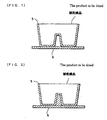
- the inventors have found that the drying time can be shortened and the removal of the resulting product after freeze-drying from trays can be done in a smooth manner without any trouble, by filling a cooked liquid food or paste food in block-shaped cast tray 5 with the bottom with a recess part as shown in Fig.1, overlaying metal plate 6 capable of adhering to the bottom of the tray thereon and placing the tray in between heating shelves in a drying chamber, more preferably overlaying metal plate 6 with a protrusion part at a corresponding position so that the protrusion part can be inserted in and adhere to the recess part of the bottom of the tray as shown in Fig. 2 and placing the tray in between heating shelves in a drying chamber.
- the radiant heat from the heating shelves directly acts on the recess part of the metal plate 6, through which a heat source can be retained inside the product to be dried.
- the distance between a part not yet dried therein and the heat source can be shortened. Consequently, no sublimation area exists between the heating area and the part not yet dried. Therefore, the dried area working as an insulation layer is hardly formed, consequently, involving easier transmission of thermal energy from the heating area to the part not yet dried.
- the invention has been attained.
- the invention relates to a method for producing a freeze-dried food product molded in a block shape, including a step of producing a block-shaped dry food by filling a cooked liquid food or paste food in block-shaped cast tray 5 with the bottom with a recess part as shown in Fig.1, overlaying metal plate 6 capable of adhering to the bottom of the tray thereon and placing the tray in between heating shelves in a drying chamber or overlaying metal plate with a protrusion part at a corresponding position so that the protrusion part can be inserted in and adhere to the recess part of the bottom of the tray and placing the tray in between heating shelves in a drying chamber.
- the tray 5 to be used in accordance with the invention is of a block shape allowed to adapt to the shape of an intended freeze-dry food product of single meal type, and has a recess part arranged on the bottom, characteristically.
- Concerning the material generally, plastic trays are preferably used. From the respects of thermal resistance, intensity and moisture permeability, specifically, trays made of thermoplastic resins such as polyethylene terephthalate, polypropylene and polystyrene are listed. Generally, thermoresistant plastic trays with melting points above 150 °C are satisfactory.
- the height of the recess part is a height corresponding to about 25 % or more of the product thickness along the direction from the bottom to the top.
- an insulation layer may eventually be formed.
- the height of the recess part is a height corresponding to the proximity of the inner center of the product, preferably, in view of intensity. Additionally, the overall drying time can then be shortened because the heat source can be closer to a part not yet dried inside the product to be dried.
- the shape of the recess part is a steric shape including steric pyramids such as cone, triangle pyramid, rectangular pyramid, and hexagonal pyramid; modified shapes thereof, such as truncated pyramids; poles such as triangle pole and rectangular pole; and cylindrical pole. These shapes are not specifically limited. These shapes are preferably shapes in light of subsequent processing, namely product handling and product release from such trays.
- metal plate 6 has a protrusion part at a corresponding position so that the protrusion part can adhere to the recess part of tray 5 when the metal plate 6 is overlaid on the tray 5 in contact to the bottom of the tray 5.
- the protrusion part functions as a heat source when the protrusion part receives the radiant heat from the heating shelves 3, to exert an effect on the shortening of the drying time.
- the material of the metal plate is preferably stainless steel and aluminium, from the respect of thermal transmission and rust prevention. Aluminium is the most preferable because aluminum is readily molded and processed.
- the drying time can substantially be shortened.
- the protrusion part of the metal plate is allowed to adhere to the recess part of the plastic tray, so that a heat source for inner food can be procured to further shorten the drying time, leading to the productivity improvement and the reduction of production cost.
- a liquid or paste food such as cooked soup and rice gruel is filled in plastic tray 5 with a recess part arranged therein. Then, the tray is arranged on metal plate 6 (for example, an aluminium plate with a thickness of 2 mm) with a protrusion part, which is then placed as it is in a freezer at -40 °C for freezing.
- the metal plate 6 together with the tray 5 containing the frozen block- shaped product to be dried is then fed to drying chamber 2 of vacuum freeze-dryer 1.
- the overall structure of the vacuum freeze-dryer is almost the same as that of the unit shown in Fig. 7. Inside the drying chamber 2 are arranged plural steps of heating shelf 3.
- the metal plate 6 together with the tray 5 containing the product to be dried is arranged. So as to vacuum the inside of the drying chamber, subsequently, the drying chamber is sealed, until the pressure reaches a given pressure. Just then, the tray 5 and the metal plate 6 are heated via the radiant heat from the heating shelf 3 heated to a given temperature with heating unit 4, to sublime water in the product in the tray from the frozen state, while the steam is cold trapped in the drying chamber or with trap 9 in communication with the inside of the drying chamber.
- the drying conditions then are as follows: the peak temperature of the heating shelf is 80 °C to 130 °C and the vacuum level inside the drying chamber is below a given pressure (1 Torr) permitting vacuum freeze-drying. As the shelf temperature namely heating temperature during drying is higher, the drying time can be more shortened, under provisions of restrictions in terms of quality, i.e. no occurrence of burning and the like.
- drying is terminated.
- the inside of the drying chamber is devacuumed, to draw out the metal plate together with the tray.
- the dried food product then passes through processes including release from the tray and individual packing with an aluminium packaging material.
- a plastic tray with flat bottom (of the related art), a plastic tray with the bottom with a conical recess part arranged thereon (of the invention), aluminum plates capable of adhering to the bottoms of the plastic trays, a freezer, and a freeze-dryer were prepared.
- the plastic tray of the related art was of an opening inner dimension of a 51-mm lateral side ⁇ a 43-mm width and a bottom inner dimension of a 46-mm lateral side ⁇ a 39-mm width and with the depth of 22.5 mm.
- the plastic tray modified in accordance with the invention was of an opening inner dimension of a 51-mm lateral side ⁇ a 43-mm width and a bottom inner dimension of a 45-mm lateral side ⁇ a 37-mm width and with the depth of 24 mm.
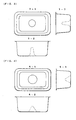
- the plastic tray has a recess part of a cone with a bottom circle of ⁇ 16-mm and a 15-mm height. The shape is shown in Fig.3.
- the egg soup prepared by the recipe in the following table was filled in the plastic trays, while the liquid surface was adjusted in parallel to the openings of the plastic trays.
- the filled-in trays were mounted on the metal plates, for freezing in the freezer adjusted to -40 °C for 12 hours or longer.
- Drying ratio [%] [post-drying weight (G)] ⁇ [filled-in weight (G)] ⁇ 100
- the combination of the inventive plastic tray with the metal plate was at a smaller drying ratio, which indicates the promotion of the drying velocity.
- a plastic tray with flat bottom as in the related art, a plastic tray with the bottom with a conical recess part of a different shape from the shape as in Example 1 (the invention) aluminum plates capable of adhering to the bottoms of the plastic trays for dryer feeding, a freezer, and a freeze-dryer were prepared.
- the plastic tray of the related art was of an opening inner dimension of a 51-mm lateral side ⁇ a 43-mm width and a bottom inner dimension of a 46-mm lateral side ⁇ a 39-mm width and with the depth of 22.5 mm.
- the plastic tray modified in accordance with the invention was of an opening inner dimension of a 51-mm lateral side ⁇ a 43-mmwidth and a bottom inner dimension of a 46-mm lateral side ⁇ a 38-mm width and with the depth of 22.5 mm.
- the plastic tray has a recess part of a cone shape with the bottom circle of ⁇ 24-mm and 10-mm height (Fig.4).
- the egg soup prepared by the same recipe as in Example 1 was filled in the plastic trays.
- the individual liquid surfaces were adjusted in parallel to the openings of the plastic trays.
- the filled-in trays were mounted on the metal plates, for freezing in the freezer adjusted to -40 °C for 12 hours or longer.
- the combination of the inventive plastic tray with the metal plate was at a smaller drying ratio, which indicates the promotion of the drying velocity.
- a plastic tray of the related art a plastic tray with a partitioning recess part (the invention), aluminum plates capable of adhering to the bottoms of the plastic trays for dryer feeding, a freezer, and a freeze-dryer were prepared.
- the plastic tray of the related art was of an opening inner dimension of a 51-mm lateral side ⁇ a 43-mm width and a bottom inner dimension of a 46-mm lateral side ⁇ a 39-mm width and with the depth of 22.5 mm.
- the plastic tray modified in accordance with the invention was of an opening inner dimension of a 51-mm lateral side ⁇ a 43 -mmwidth and abottom inner dimension of a 46-mm lateral side ⁇ a 39-mm width and with the depth of 26.5 mm.
- the plastic tray has a partitioning recess part with a 10-mm width, a 13-mm height and 7 ° slope of sloped side (Fig. 5).
- the egg soup prepared by the same recipe as in Examples 1 and 2 was manually filled in the plastic trays.
- the liquid surface was adjusted in parallel to the openings of the plastic trays.
- the filled-in trays were mounted on the metal plates, for freezing in the freezer adjusted to -40 °C for 12 hours or longer.
- the combination of the inventive plastic tray with the metal plate was at a smaller drying ratio, which indicates the promotion of the drying velocity.
- Partitioned product bottom width of 10 mm, 7 ° slope of bottom sloped side, height of 13 mm + metal plate
- a plastic tray of the related art For the purpose of shortening the drying time of block-shaped instant food products as in Example 3, a plastic tray of the related art, a modified plastic tray with a partitioning recess part, aluminum plates for dryer feeding, a freezer, and a freeze-dryer were prepared.
- the plastic tray of the related art was of an opening inner dimension of a 51-mm lateral side ⁇ a 43-mm width and a bottom inner dimension of a 46-mm lateral side ⁇ a 39-mm width and with the depth of 22.5 mm.
- the plastic tray modified in accordance with the invention was of an opening inner dimension of a 51-mm lateral side ⁇ a 43-mm width and abottom inner dimension of a 46-mm lateral side ⁇ a 39-mm width and with the depth of 26.5 mm.
- the plastic tray has a partitioning recess part with a 10-mm width, a 13-mm height and 7 ° slope of sloped side (Fig. 5).
- the egg soup prepared by the same recipe as in Example 3 was filled in the plastic trays.
- the liquid surface was made parallel to the openings of the plastic trays.
- the filled-in trays were mounted on the metal plates, for freezing in the freezer adjusted to -40 °C for 12 hours or longer.
- the trays together with the metal plate were taken out of the freezer, which were fed as they were to the vacuum freeze-dryer, for vacuum freeze-drying for 14 hours.
- the combination of the inventive plastic tray (with the metal plate) was at a smaller drying ratio, which indicates the promotion of the drying velocity.
- the results are inferior to the test results in Example 3.
- the drying ratio was further increased, compared with that of the related art.
- the different protrusion type aluminium plates were made by different production methods. One was made by pressing one plate, so the inside of the protrusion was hollow. The other was made by a process of opening a hole in a plain plate, inserting a protrusion member in the resulting hole and calking the hole part. These are shown in Figs. 8 and 9.
- the egg soup prepared by the same recipe as in Examples 1 to 4 was filled in the plastic trays by hands.
- the liquid surface was adjusted in parallel to the openings of the plastic trays.
- the filled-in trays were mounted on the two protrusion type aluminium plates, for freezing in the freezer adjusted to -40 °C for 12 hours or longer.
- the protrusion type aluminium plates were taken out of the freezer, which were fed as they were to the vacuum freeze-dryer, for vacuum freeze-drying for 14 hours.
- the drying ratio was decreased when the inventive plastic tray and the press product of the metal plate of the protrusion shape and with the hollow cone part were used, compared with the calked product with no hollow cone part when used.
- the drying velocity was increased.
- a plastic tray with a recess part on the bottom is placed in between heating shelves in a drying chamber for freeze-drying, while the plastic tray is at a state in adhesion to a metal plate preferably having a protrusion part corresponding to the recess part, so that the drying time can be greatly shortened.
- great contributions can be made to the improvement of the productivity and the reduction of the production cost.
Landscapes
- Life Sciences & Earth Sciences (AREA)
- Engineering & Computer Science (AREA)
- Wood Science & Technology (AREA)
- Zoology (AREA)
- Chemical & Material Sciences (AREA)
- Food Science & Technology (AREA)
- Polymers & Plastics (AREA)
- Drying Of Solid Materials (AREA)
- Freezing, Cooling And Drying Of Foods (AREA)
- Seeds, Soups, And Other Foods (AREA)
Applications Claiming Priority (3)
| Application Number | Priority Date | Filing Date | Title |
|---|---|---|---|
| JP2001369650A JP4042394B2 (ja) | 2001-12-04 | 2001-12-04 | ブロック状凍結乾燥食品類の製造法 |
| JP2001369650 | 2001-12-04 | ||
| PCT/JP2002/012376 WO2003047368A1 (fr) | 2001-12-04 | 2002-11-27 | Procede de production d'aliments lyophilises en forme de blocs |
Publications (2)
| Publication Number | Publication Date |
|---|---|
| EP1452099A1 true EP1452099A1 (de) | 2004-09-01 |
| EP1452099A4 EP1452099A4 (de) | 2005-11-09 |
Family
ID=19179009
Family Applications (1)
| Application Number | Title | Priority Date | Filing Date |
|---|---|---|---|
| EP02783647A Withdrawn EP1452099A4 (de) | 2001-12-04 | 2002-11-27 | Verfahren zur herstellung von blockförmigen gefriergetrockneten lebensmitteln |
Country Status (5)
| Country | Link |
|---|---|
| US (1) | US20050019456A1 (de) |
| EP (1) | EP1452099A4 (de) |
| JP (1) | JP4042394B2 (de) |
| CN (1) | CN1555230A (de) |
| WO (1) | WO2003047368A1 (de) |
Cited By (3)
| Publication number | Priority date | Publication date | Assignee | Title |
|---|---|---|---|---|
| US20120077971A1 (en) * | 2010-09-28 | 2012-03-29 | Baxter Healthcare S.A. | Optimization of Nucleation and Crystallization for Lyophilization Using Gap Freezing |
| US8900525B2 (en) | 2006-09-18 | 2014-12-02 | Ge Healthcare Bio-Sciences Corp. | Preparation of glassified biological reagents |
| US9528761B2 (en) | 2010-09-28 | 2016-12-27 | Baxter International Inc. | Optimization of nucleation and crystallization for lyophilization using gap freezing |
Families Citing this family (6)
| Publication number | Priority date | Publication date | Assignee | Title |
|---|---|---|---|---|
| JP4520431B2 (ja) * | 2005-09-06 | 2010-08-04 | 株式会社永谷園 | 凍結乾燥ブロック状味噌の製造方法 |
| US20070212465A1 (en) * | 2006-03-13 | 2007-09-13 | Visram Shahzar A | Methods and apparatus for processing food |
| US20080113070A1 (en) * | 2006-11-15 | 2008-05-15 | Mansour Nagi A | Fresh ready onion and spice mix |
| US7943189B2 (en) * | 2007-10-26 | 2011-05-17 | Lee Ferrell | Food preservation packaging system |
| WO2013065067A1 (en) * | 2011-11-03 | 2013-05-10 | Daga Radha | A process to reduce the processing time and recostitutable time for indian food products including sweets |
| CN116249235A (zh) * | 2021-12-08 | 2023-06-09 | 惠而浦公司 | 用于微波器具的热阻加热板 |
Family Cites Families (9)
| Publication number | Priority date | Publication date | Assignee | Title |
|---|---|---|---|---|
| US3545097A (en) * | 1968-12-09 | 1970-12-08 | Pennwalt Corp | High thermal conductivity plastic tray for freeze drying of products |
| US4521975A (en) * | 1981-05-04 | 1985-06-11 | Marquest Medical Products, Inc. | Lyophilizing and forming biologicals having a predetermined unit dosage |
| IE53696B1 (en) * | 1981-12-02 | 1989-01-18 | Wyeth John & Brother Ltd | Solid shaped articles |
| JP2562189B2 (ja) * | 1988-11-07 | 1996-12-11 | 日本真空技術株式会社 | 凍結乾燥装置 |
| JPH06261679A (ja) * | 1993-03-17 | 1994-09-20 | Nissin Food Prod Co Ltd | 成型乾燥具材の製造方法 |
| US5457895A (en) * | 1993-10-01 | 1995-10-17 | R. P. Scherer Corporation | Method of identifying freeze-dried dosage forms |
| JP2632787B2 (ja) * | 1994-06-15 | 1997-07-23 | 坂本香料株式会社 | 乾燥食品およびその製造方法 |
| JP3654685B2 (ja) * | 1995-05-26 | 2005-06-02 | 株式会社ミューチュアル | 薬液の凍結乾燥方法及び凍結乾燥薬剤の充填包装方法 |
| JP3798883B2 (ja) * | 1997-05-29 | 2006-07-19 | アスザックフーズ株式会社 | かき卵ブロックの製造方法 |
-
2001
- 2001-12-04 JP JP2001369650A patent/JP4042394B2/ja not_active Expired - Lifetime
-
2002
- 2002-11-27 US US10/495,215 patent/US20050019456A1/en not_active Abandoned
- 2002-11-27 CN CNA028179684A patent/CN1555230A/zh active Pending
- 2002-11-27 WO PCT/JP2002/012376 patent/WO2003047368A1/ja not_active Ceased
- 2002-11-27 EP EP02783647A patent/EP1452099A4/de not_active Withdrawn
Cited By (7)
| Publication number | Priority date | Publication date | Assignee | Title |
|---|---|---|---|---|
| US8900525B2 (en) | 2006-09-18 | 2014-12-02 | Ge Healthcare Bio-Sciences Corp. | Preparation of glassified biological reagents |
| US20120077971A1 (en) * | 2010-09-28 | 2012-03-29 | Baxter Healthcare S.A. | Optimization of Nucleation and Crystallization for Lyophilization Using Gap Freezing |
| US8689460B2 (en) * | 2010-09-28 | 2014-04-08 | Baxter International Inc. | Optimization of nucleation and crystallization for lyophilization using gap freezing |
| US9279615B2 (en) | 2010-09-28 | 2016-03-08 | Baxter International, Inc. | Optimization of nucleation and crystallization for lyophilization using gap freezing |
| US9528761B2 (en) | 2010-09-28 | 2016-12-27 | Baxter International Inc. | Optimization of nucleation and crystallization for lyophilization using gap freezing |
| US9625210B2 (en) | 2010-09-28 | 2017-04-18 | Baxter International Inc. | Optimization of nucleation and crystallization for lyophilization using gap freezing |
| US9869513B2 (en) | 2010-09-28 | 2018-01-16 | Baxter International Inc. | Optimization of nucleation and crystallization for lyophilization using gap freezing |
Also Published As
| Publication number | Publication date |
|---|---|
| JP2003169639A (ja) | 2003-06-17 |
| EP1452099A4 (de) | 2005-11-09 |
| WO2003047368A1 (fr) | 2003-06-12 |
| CN1555230A (zh) | 2004-12-15 |
| JP4042394B2 (ja) | 2008-02-06 |
| US20050019456A1 (en) | 2005-01-27 |
Similar Documents
| Publication | Publication Date | Title |
|---|---|---|
| US2364049A (en) | Process for preserving food and product | |
| US8012313B2 (en) | Drying process and apparatus | |
| EP1452099A1 (de) | Verfahren zur herstellung von blockförmigen gefriergetrockneten lebensmitteln | |
| IE43155L (en) | Freeze-drying process | |
| US3615646A (en) | Food package and process | |
| US3152915A (en) | Method of freezing, packing and breading shrimp, and article resulting therefrom | |
| US3358379A (en) | Process for freeze-drying frozen blocks of material containing water | |
| US2509681A (en) | Process of desiccating fruit juices | |
| EP1997350A2 (de) | Verpackung für gefrorene lebensmittel und verwendungsverfahren dafür | |
| US6093920A (en) | Method of microwave heating of food | |
| KR20160111137A (ko) | 전달 효율이 향상된 트레이를 가지는 동결건조장치 | |
| JPH07121354B2 (ja) | 粒状乾燥物製造方法及び真空凍結乾燥装置 | |
| US7370436B2 (en) | Dual apparatus and process for quick freezing and/or freeze drying produce | |
| JPH02110281A (ja) | 粘稠溶液の凍結乾燥方法及び装置 | |
| US20160107780A1 (en) | Tray meals with heat staked lidding film | |
| US2471677A (en) | Process of desiccating orange juice involving freeze drying | |
| Sivamma et al. | Applications of vacuum technology in food processing | |
| JPH01218554A (ja) | 凍結乾燥アイスクリームの製造法 | |
| JPH0563151B2 (de) | ||
| JP2003018981A (ja) | 成型加工食品の真空凍結乾燥方法および成型加工食品の真空凍結乾燥装置 | |
| KR900006865B1 (ko) | 포장식품의 제조방법 | |
| JPS61152239A (ja) | 乾燥固形茶類の製造法 | |
| US2539726A (en) | Tray | |
| US3185581A (en) | Process for producing a friable, readily reconstitutable dehydrated food product | |
| Roos | Freeze-drying |
Legal Events
| Date | Code | Title | Description |
|---|---|---|---|
| PUAI | Public reference made under article 153(3) epc to a published international application that has entered the european phase |
Free format text: ORIGINAL CODE: 0009012 |
|
| 17P | Request for examination filed |
Effective date: 20040624 |
|
| AK | Designated contracting states |
Kind code of ref document: A1 Designated state(s): AT BE BG CH CY CZ DE DK EE ES FI FR GB GR IE IT LI LU MC NL PT SE SK TR |
|
| RIN1 | Information on inventor provided before grant (corrected) |
Inventor name: FUKAZAWA, MASAHIRO Inventor name: INOUE, TSUGUO,AJINOMOTO CO., INC. Inventor name: SAGARA, YASUYUKI,UNIVERSITY OF TOKYO Inventor name: IWASAKI, ISSEI,AJINOMOTO CO., INC. |
|
| A4 | Supplementary search report drawn up and despatched |
Effective date: 20050922 |
|
| RIC1 | Information provided on ipc code assigned before grant |
Ipc: 7A 23L 3/44 A Ipc: 7F 26B 5/06 B Ipc: 7F 26B 25/10 B Ipc: 7A 61J 3/00 B |
|
| STAA | Information on the status of an ep patent application or granted ep patent |
Free format text: STATUS: THE APPLICATION IS DEEMED TO BE WITHDRAWN |
|
| 18D | Application deemed to be withdrawn |
Effective date: 20040706 |
|
| R18D | Application deemed to be withdrawn (corrected) |
Effective date: 20051209 |