EP1449882A1 - Impact-resistant cyclic olefin based resin composition and moldings - Google Patents
Impact-resistant cyclic olefin based resin composition and moldings Download PDFInfo
- Publication number
- EP1449882A1 EP1449882A1 EP02777895A EP02777895A EP1449882A1 EP 1449882 A1 EP1449882 A1 EP 1449882A1 EP 02777895 A EP02777895 A EP 02777895A EP 02777895 A EP02777895 A EP 02777895A EP 1449882 A1 EP1449882 A1 EP 1449882A1
- Authority
- EP
- European Patent Office
- Prior art keywords
- cyclic olefin
- based resin
- olefin based
- component
- resin composition
- Prior art date
- Legal status (The legal status is an assumption and is not a legal conclusion. Google has not performed a legal analysis and makes no representation as to the accuracy of the status listed.)
- Granted
Links
Classifications
-
- C—CHEMISTRY; METALLURGY
- C08—ORGANIC MACROMOLECULAR COMPOUNDS; THEIR PREPARATION OR CHEMICAL WORKING-UP; COMPOSITIONS BASED THEREON
- C08L—COMPOSITIONS OF MACROMOLECULAR COMPOUNDS
- C08L23/00—Compositions of homopolymers or copolymers of unsaturated aliphatic hydrocarbons having only one carbon-to-carbon double bond; Compositions of derivatives of such polymers
- C08L23/02—Compositions of homopolymers or copolymers of unsaturated aliphatic hydrocarbons having only one carbon-to-carbon double bond; Compositions of derivatives of such polymers not modified by chemical after-treatment
- C08L23/04—Homopolymers or copolymers of ethene
- C08L23/08—Copolymers of ethene
- C08L23/0807—Copolymers of ethene with unsaturated hydrocarbons only containing four or more carbon atoms
- C08L23/0823—Copolymers of ethene with unsaturated hydrocarbons only containing four or more carbon atoms with aliphatic cyclic olefins
-
- C—CHEMISTRY; METALLURGY
- C08—ORGANIC MACROMOLECULAR COMPOUNDS; THEIR PREPARATION OR CHEMICAL WORKING-UP; COMPOSITIONS BASED THEREON
- C08L—COMPOSITIONS OF MACROMOLECULAR COMPOUNDS
- C08L45/00—Compositions of homopolymers or copolymers of compounds having no unsaturated aliphatic radicals in side chain, and having one or more carbon-to-carbon double bonds in a carbocyclic or in a heterocyclic ring system; Compositions of derivatives of such polymers
-
- C—CHEMISTRY; METALLURGY
- C08—ORGANIC MACROMOLECULAR COMPOUNDS; THEIR PREPARATION OR CHEMICAL WORKING-UP; COMPOSITIONS BASED THEREON
- C08L—COMPOSITIONS OF MACROMOLECULAR COMPOUNDS
- C08L2205/00—Polymer mixtures characterised by other features
- C08L2205/02—Polymer mixtures characterised by other features containing two or more polymers of the same C08L -group
-
- C—CHEMISTRY; METALLURGY
- C08—ORGANIC MACROMOLECULAR COMPOUNDS; THEIR PREPARATION OR CHEMICAL WORKING-UP; COMPOSITIONS BASED THEREON
- C08L—COMPOSITIONS OF MACROMOLECULAR COMPOUNDS
- C08L23/00—Compositions of homopolymers or copolymers of unsaturated aliphatic hydrocarbons having only one carbon-to-carbon double bond; Compositions of derivatives of such polymers
- C08L23/02—Compositions of homopolymers or copolymers of unsaturated aliphatic hydrocarbons having only one carbon-to-carbon double bond; Compositions of derivatives of such polymers not modified by chemical after-treatment
- C08L23/04—Homopolymers or copolymers of ethene
- C08L23/08—Copolymers of ethene
- C08L23/0846—Copolymers of ethene with unsaturated hydrocarbons containing atoms other than carbon or hydrogen
- C08L23/0869—Copolymers of ethene with unsaturated hydrocarbons containing atoms other than carbon or hydrogen with unsaturated acids, e.g. [meth]acrylic acid; with unsaturated esters, e.g. [meth]acrylic acid esters
- C08L23/0884—Epoxide-containing esters
-
- C—CHEMISTRY; METALLURGY
- C08—ORGANIC MACROMOLECULAR COMPOUNDS; THEIR PREPARATION OR CHEMICAL WORKING-UP; COMPOSITIONS BASED THEREON
- C08L—COMPOSITIONS OF MACROMOLECULAR COMPOUNDS
- C08L23/00—Compositions of homopolymers or copolymers of unsaturated aliphatic hydrocarbons having only one carbon-to-carbon double bond; Compositions of derivatives of such polymers
- C08L23/02—Compositions of homopolymers or copolymers of unsaturated aliphatic hydrocarbons having only one carbon-to-carbon double bond; Compositions of derivatives of such polymers not modified by chemical after-treatment
- C08L23/16—Ethylene-propylene or ethylene-propylene-diene copolymers
Definitions
- the present invention relates to a cyclic olefin based resin composition which contains a cyclic olefin based resin, a modified cyclic olefin based resin prepared by grafting an unsaturated carboxylic acid or an unsaturated carboxylic acid anhydride to the cyclic olefin based resin, an olefinic elastomer, and a modified polyolefin having an epoxy group, and a molding thereof.
- the molding of the cyclic olefin based resin composition of the present invention is excellent in impact resistance, resistance to flaking off, and the like.
- Cyclic olefin based resins are amorphous and thermoplastic olefin based resins each having a cyclic olefin skeleton in its backbone, are excellent in transparency, low birefringence, heat resistance, light weight property, dimensional stability, low water absorption, hydrolyzability resistance, and chemical resistance, and each include characteristics such as a low dielectric constant, low dielectric loss, and no inclusion of environmental load substances.
- the cyclic olefin based resins have been used for widely intended purposes including: medicine related instruments such as prefilled syringes, and containers and stopper cocks for infusions; high frequency electronic parts; and packages and containers of chemicals and foods as well as optical uses such as optical discs, lenses, and optical waveguides.
- JP 01-163236 A proposes a cyclic olefin based resin composition with high impact resistance where an olefinic elastomer is combined to a cyclic olefin based resin.
- the olefinic elastomer is extremely effective for improving the impact resistance but is inferior in affinity with the cyclic olefin based resin, and there is a drawback in that the surface of a molding of the composition flakes off.
- JP 01-256548 A proposes a cyclic olefin based resin composition with high impact resistance where a styrenic elastomer is combined to a cyclic olefin based resin.
- Surface flaking is difficult to occur on a molding of the composition because the styrenic elastomer has a high affinity with the cyclic olefin based resin, but the styrenic elastomer is inferior in improvement effect on impact resistance to the olefinic elastomer.
- An object of the present invention is to provide a cyclic olefin based resin composition for moldings which are excellent in impact resistance, resistance to surface flaking off, and the like.
- a cyclic olefin based resin composition where a cyclic olefin based resin (A), a modified cyclic olefin based resin (B) prepared by grafting an unsaturated carboxylic acid or an unsaturated carboxylic acid anhydride, an olefinic elastomer (C), and a modified polyolefin (D) having an epoxy group are in a specified ratio, and the inventors have completed the present invention.
- a cyclic olefin based resin composition including:
- a cyclic olefin based resin composition according to the first aspect of the present invention, in which the component C is a copolymer of ethylene and an ⁇ -olefin.
- a cyclic olefin based resin composition according to the first or second aspect of the present invention, in which the component D is a copolymer of ethylene and glycidyl (meth)acrylate.
- a cyclic olefin based resin composition according to any one of the first to third aspects of the present invention, in which the component B is a modified cyclic olefin based resin which is obtained by a cyclic olefin based resin being grafted with (meth)acrylic acid or maleic anhydride.
- a cyclic olefin based resin composition according to any one of the first to fourth aspects of the present invention, in which a cyclic olefin based resin of the component A and a cyclic olefin based resin used as a base resin prior to modification in the component B are independently a copolymer of ethylene and a cyclic olefin.
- a molding of cyclic olefin based resin obtained by injection molding, compression molding, injection compression molding, extrusion, or blow molding of the cyclic olefin based resin composition according to any one of the first to fifth aspects of the present invention.
- a cyclic olefin based resin (A) (referred to as component A) is a high molecular compound the backbone of which is made up of carbon-carbon bonds and which has a cyclic hydrocarbon structure in at least a part of the backbone.
- This cyclic hydrocarbon structure is introduced by using as a monomer a compound (cyclic olefin) having at least one olefinic double bond in the cyclic hydrocarbon structure typified by norbornene or tetracyclododecene.
- Cyclic olefin based resins (A) are classified into addition (co)polymers of cyclic olefins or hydrogenates thereof (A1), addition copolymers of cyclic olefins and ⁇ -olefins or hydrogenates thereof (A2), and ring-opening (co)polymers of cyclic olefins or hydrogenates thereof (A3) depending on methods of manufacturing the resins.
- cyclic olefins include: monocyclic olefins such as cyclopentene, cyclohexene, cyclooctane, cyclopentadiene, and 1,3-cyclohexadiene; bicyclic olefins such as bicyclo[2.2.1]hepta-2-ene(conventional name: norbornene), 5-methyl-bicyclo[2.2.1]hepta-2-ene, 5,5-dimethyl-bicyclo[2.2.1]hepta-2-ene, 5-ethyl-bicyclo[2.2.1]hepta-2-ene, 5-butyl-bicyclo[2.2.1]hepta-2-ene, 5-ethylidene-bicyclo[2.2.1]hepta-2-ene, 5-hexyl-bicyclo[2.2.1]hepta-2-ene, 5-octyl-bicyclo[2.2.1]hepta-2-ene, 5-octyl
- the above ⁇ -olefins may be used singly or two or more of them may be used in combination.
- Polymerization methods for the cyclic olefin or for the cyclic olefin and an ⁇ -olefin, and methods of hydrogenating the resultant polymers are not particularly limited, and the hydrogenation can be performed according to methods known in the art.
- the addition copolymers of cyclic olefins and ⁇ -olefins or hydrogenates thereof (A2) are particularly preferable because a balance between properties and costs is kept.
- the cyclic olefin based resins are industrially available as commercially available articles such as brands names, Topas (supplied from Ticona GmbH), Apel (supplied from Mitsui Chemical Co., Ltd.), Zeonex (supplied from Zeon Corporation), Zeonor (supplied from Zeon Corporation), and Arton (supplied from JSR Corporation).
- a modified cyclic olefin based resin (B) (referred to as component B) is one modified by grafting and/or copolymerizing an unsaturated carboxylic acid or an unsaturated carboxylic acid anhydride (uc) to one of or a mixture of two or more of the cyclic olefin based resins (A) described above.
- the cyclic olefin based resin (A) used for the component B before the modification and the cyclic olefin based resin (A) as the component A may be the same or different.
- the unsaturated carboxylic acid or unsaturated carboxylic acid anhydride (uc) (referred to as a component uc) used for modifying the component B is an organic compound having one or more carboxyl groups or acid anhydride groups and having one or more ethylenic unsaturated bonds in the molecule.
- Examples of the unsaturated carboxylic acid in the component uc include: aliphatic unsaturated monocarboxylic acids such as (meth)acrylic acid and crotonic acid; aromatic unsaturated monocarboxylic acids such as cinnamic acid; aliphatic unsaturated dicarboxylic acids such as maleic acid, fumaric acid, itaconic acid, and citraconic acid; and monoesters of the aliphatic unsaturated dicarboxylic acids with aliphatic alcohols each having 1 to 10 carbon atoms including monoester maleates such as monomethyl maleate, monoethyl maleate, monobutyl maleate, monohexyl maleate, monooctyl maleate, and mono(2-ethylhexyl) maleate, and corresponding monoester fumarates thereof.
- monoester maleates such as monomethyl maleate, monoethyl maleate, monobutyl maleate, monohexyl maleate, monooctyl
- (meth)acrylic acid, maleic acid, and monoalkyl maleates are preferable as the unsaturated carboxylic acids.
- the unsaturated carboxylic acid anhydride in the component uc include maleic anhydride, itaconic anhydride, citraconic anhydride, and himic anhydride, of which maleic anhydride is preferable.
- the above components uc may be used singly or two or more of them may be used in combination.
- Modification of the cyclic olefin based resin is accomplished by reacting a component A and a component uc in the presence of a radical generator and binding (grafting) the component uc to the component A.
- the modified cyclic olefin based resin (B) may be obtained by copolymerizing the above unsaturated carboxylic acid or the unsaturated carboxylic acid anhydride (uc) with the cyclic olefin.
- the radical generator is a compound which generates a free radical and has a function as a polymerization initiator which initiates the polymerization of a polymerizable compound, and an organic peroxide is suitably used as the radical generator.
- radical generator examples include: alkyl hydroperoxides such as t-butyl hydroperoxide, p-menthane hydroperoxide, cumene hydroperoxide, diisopropylbenzene hydroperoxide, and 2,5-dimethylhexane-2,5-dihydroperoxide; dialkyl peroxides such as di-t-butyl peroxide, t-butylcumyl peroxide, t-butylperoxycumene, dicumyl peroxide, 2,5-dimethyl-2,5-di(t-butylperoxy)hexane, 2,5-dimethyl-2,5-di(t-butylperoxy)hexene-3, and ⁇ , ⁇ '-bis(t-butylperoxy-m-isopropyl)benzene; diacyl peroxides such as benzoyl peroxide, lauroyl peroxide, and p-chlorobenzoyl
- a graft reaction can be performed by kneading the component A, the component uc, and the radical generator in melting states or by dissolving them in an appropriate solvent and mixing and heating the solution, but industrially the method of mixing in the melting states is suitable because of its high productivity.
- a kneading temperature can be selected from the range of a melting temperature to a decomposing temperature of the component A used, and for example is a temperature which is 30 to 200°C higher than a glass transition temperature (Tg) of the component A.
- Tg glass transition temperature
- a kneading time period is for example from 20 sec to 1 hour, preferably from about 30 sec to 30 min, and frequently from about 30 sec to 10 min.
- a use amount of the component uc used for the modification is dependent on a type of the component, but is approximately from 0.1 to 20 parts by weight and preferably from 0.5 to 10 parts by weight based on 100 parts by weight of the component A which is a base resin.
- An excessively small use amount of the component uc is not preferable because the desired physical properties of the composition according to the present invention such as prevention of flaking off are not accomplished.
- An excessively large use amount of the component uc is not preferable because an amount of unreacted compounds in the modified cyclic olefin based resin (B) becomes too large, and thus various adverse effects on the composition occur, which include exudation of the unreacted compounds, reduction of mechanical strength, and nasty odor at molding.
- a use amount of the radical generator is dependent on types of the component A, the component uc, and the radical generator used, but is approximately from 0.01 to 5 parts by weight and preferably from 0.1 to 2 parts by weight based on 100 parts by weight of the total amount of the component A and the component uc.
- An excessively small use amount of the radical generator is not preferable because efficiency of a graft reaction is low, and thus the amount of carboxylic acid or acid anhydride which is not bound to the cyclic olefin based resin becomes large.
- An excessively large addition amount of the radical generator is not preferable because a crosslinking reaction of the cyclic olefin based resin occurs to coagulate the resin, thereby making it impossible to mix with the other components which compose the composition of the present invention.
- a number average molecular weight of the modified cyclic olefin based resin (B) is from 1000 to 1,000,000, and preferably from 10,000 to 100,000.
- An olefinic elastomer (C) (referred to as component C) is a soft polymer exclusively composed of carbon and hydrogen atoms and having no aromatic ring.
- component C examples include: ⁇ -olefin copolymers such as copolymers of ethylene, propylene, 1-butene, and 1-octene; diene (such as butadiene and isoprene) based polymers; and copolymers of ⁇ -olefins and dienes.
- ⁇ -olefin copolymers have high heat resistance stability and thus are suitable because they have no unsaturated bonds in their molecules.
- examples of the ⁇ -olefin copolymers include ethylene-propylene copolymers, ethylene-butene copolymers, and ethylene-octene copolymers.
- Shore A hardness is 95 or less, and preferably 85 or less.
- a modified polyolefin (D) (referred to as component D) having an epoxy group according to the present invention is a polymer the backbone of which is made up of carbon-carbon bonds and which has no aromatic ring in the backbone and has an epoxy group in its side chain.
- copolymers of an unsaturated epoxy compound (ue) and an ⁇ -olefin and a modified polyolefin prepared by grafting the unsaturated epoxy compound (ue) to polyolefin are exemplified.
- An unsaturated epoxy compound (ue) (referred to as component ue) is an organic compound containing one or more ethylenic unsaturated bonds and one or more epoxy groups within its molecule.
- the unsaturated epoxy compound (ue) include: unsaturated glycidyl ethers such as allylglycidyl ether, and chalcone glycidyl ether; glycidyl esters and epoxyesters such as glycidyl (meth)acrylate, vinylbenzoic glycidyl ester, allylbenzoic glycidyl ester, cinnamate glycidyl ester, cinnamylidene acetic acid glycidyl ester, dimer acid glycidyl ester, and esters of epoxydized stearyl alcohol and (meth)acrylic acid; and epoxydized unsaturated chained and cyclic olefins such as epoxyhexene, and
- Examples of an ⁇ -olefin copolymerized with the component ue include ⁇ -olefins each having 2 to 10 carbons such as ethylene, propylene, butene, hexene, and octene.
- the copolymer of the component ue and the ⁇ -olefin which is one representative example of the component (D) is obtained by copolymerizing one or two or more of the components ue and one or two or more of ⁇ -olefins.
- the copolymer include an ethylene-glycidyl (meth) acrylate copolymer, ethylene-propylene-glycidyl (meth)acrylate copolymer, and ethylene-octene-glycidyl (meth)acrylate copolymer.
- the ethylene-glycidyl (meth)acrylate copolymer is easily available industrially and suitable.
- a copolymerized amount of the component ue in the copolymer of the component ue and the ⁇ -olefin is dependent on types of the component ue and the ⁇ -olefin used, but is typically from 0.1 to 30% by weight, and preferably from 1 to 15% by weight.
- An excessively small copolymerized amount of the component ue is not preferable because the desired physical properties of the composition according to the present invention such as prevention of flaking off are not accomplished.
- An excessively large copolymerized amount of the component ue is not preferable because cost of the copolymer becomes high.
- an unsaturated group is grafted to polyolefin to produce a modified polyolefin having an epoxy group by reacting an unsaturated epoxy compound (ue) and polyolefin in the presence of a radical generator using the similar method to the method of manufacturing the modified cyclic olefin based resin (B) previously shown.
- polyolefin which becomes a base of the above modified polyolefin examples include: homopolymers or copolymers of ⁇ -olefins such as ethylene, propylene, 1-butene, and 1-octene; diene (such as butadiene and isoprene) based polymers; and copolymers of ⁇ -olefins and dienes.
- Polyolefin which becomes the base of the modified polyolefin may be the same as or different from the olefinic elastomer (C), but it is preferred that they be the same.
- a use amount of the component ue used for the graft reaction is dependent on the type of the component ue, but is approximately from 0.1 to 20 parts by weight, and preferably from 0.5 to 10 parts by weight based on 100 parts by weight of the polyolefin which is the base resin.
- An excessively small use amount of the component ue is not preferable because the desired physical properties of the composition according to the present invention such as prevention of flaking off are not accomplished.
- An excessively large use amount of the component ue is not preferable because the amount of the component ue which is not bound to polyolefin becomes too large, and thus various adverse effects on the composition occur, which include exudation, reduction of mechanical strength, and nasty odor at molding.
- the use amount of the radical generator added at the graft reaction is dependent on types of the polyolefin, the component ue, and the radical generator used, but is approximately from 0.01 to 5 parts by weight, and preferably from 0.1 to 2 parts by weight based on 100 parts by weight of the total amount of the polyolefin and the component ue.
- An excessively small use amount of the radical generator is not preferable because efficiency of the graft reaction is low, and thus the amount of the component ue which is not bound to polyolefin becomes large.
- An excessively large addition amount of the radical generator is not preferable because the crosslinking reaction of the polyolefin occurs to coagulate the polyolefin, thereby making it impossible to mix with the other components which compose the composition of the present invention.
- the construction ratio of each component which constructs the composition of the present invention is as follows.
- the weight ratio A/B of the component A to the component B is in the range of 98/2 to 2/98 and preferably 98/2 to 50/50.
- the weight ratio C/D of the component C to the component D is in the range of 98/2 to 2/98 and preferably 98/2 to 50/50.
- the ratio (A+B)/(C+D) of the total weight of the component A and the component B to the total weight of the component C and the component D is in the range of 95/5 to 50/50, and preferably 90/10 to 60/40.
- thermoplastic resins (f), inorganic or organic fillers (g), various compounding agents (h), and the like can be added to the cyclic olefin based resin composition if necessary in the range where the properties of the cyclic olefin based resin composition are not impaired.
- thermoplastic resins (f) examples include: polyphenylene sulfide; polyphenylene ether; polyether sulfone; polysulfone; polycarbonate; polyacetal; polyester based polymers such as a liquid crystal polymer, aromatic polyester, polyallylate, polyethylene terephthalate, and polybutylene terephthalate; polyolefin based polymers such as polyethylene, polypropylene, and poly4-methylpentene-1; polyamide based polymers such as nylon 6, nylon 66, and aromatic nylon; polymethyl methacrylate; polyacrylonitrilestyrene (AS resin); and polystyrene.
- polyphenylene sulfide polyphenylene ether
- polyether sulfone examples include polycarbonate; polyacetal; polyester based polymers such as a liquid crystal polymer, aromatic polyester, polyallylate, polyethylene terephthalate, and polybutylene terephthalate; polyolefin based polymers such as polyethylene
- examples of the inorganic fillers include, but are not particularly limited to: calcium carbonate powder such as precipitated calcium carbonate light, calcium carbonate heavy or pulverized calcium carbonate, and special calcium type fillers; monchique fine powder; clays such as montmorillonite and bentonite and clays (aluminium silicate powder) such as fired clay and silane modified clay; talc; silica (silicon dioxide) powder such as melted silica and crystal silica; silicate-containing compounds such as diatom earth and silica sand; natural minerals such as pumice stone powder, slate powder, mica, micaceous powder, and asbestos, and pulverized articles thereof; alumina-containing compounds such as alumina, alumina colloid (alumina sol), alumina white, and aluminium sulfate; minerals such as barium sulfate, lithopone, calcium sulfate, molybdenum disulfide, and graphite (black
- examples of the organic fillers include polyethylene fibers, polypropylene fibers, polyester fibers, polyamide fibers, fluorine fibers, ebonite powder, thermosetting resin hollow spheres, thermosetting resin fillers, epoxy resin fillers, silicone type fillers, saran hollow spheres, shellac, wood flour, cork powder, polyvinyl alcohol fibers, cellulose powder, and wood pulp.
- the above various compounding agents (h) are not particularly limited so long as they are typically used as thermoplastic resin materials, and examples thereof include compounding agents such as an anti-oxidant, ultraviolet ray absorber, light stabilizer, plasticizer, lubricant, anti-static agent, fire retardant, coloring agent such as a dye or pigment, near infrared ray absorber, and fluorescent brightening agent.
- the cyclic olefin based resin composition of the present invention is prepared by mixing the above ingredients according to needs.
- a method of mixing is not particularly limited so long as it is the method by which those ingredients are thoroughly dispersed.
- a temperature at melting and kneading varies depending on the type of the cyclic olefin based resin used, but is typically from 100 to 400°C, and preferably from 200 to 350°C.
- a molding can be obtained as it is and preferably as the above pellet shape by injection molding, injection compression molding, compression molding, extrusion molding, blow molding, or the like.
- the glass transition temperature was measured with a differential scanning colorimeter (DSC) at a rate of temperature increase of 20°C/min.
- Topas 5013 were 2 parts by weight of acrylic acid as an unsaturated carboxylic acid and 0.4 parts by weight of 2,5-dimethyl-2,5-di(t-butylperoxy)hexyne-3 (trade name: Perhexyne 25B (supplied from NOF corporation)) as a radical generator, and a graft reaction was performed by melting and kneading the mixture at a cylinder temperature of 200°C using a 30 mm biaxial extruder to yield a modified cyclic olefin based resin B1.
- a modified cyclic olefin based resin B2 was obtained in the totally same manner as in Reference Example 1 except for using 0.4 parts by weight of ⁇ , ⁇ '-bis(t-butylperoxy-m-isopropyl)benzene (trade name: Perbutyl P (supplied from NOF corporation)) as a radical generator.
- a modified cyclic olefin based resin B4 was obtained in the totally same manner as in Reference Example 1 except for using APL 6013T as a cyclic olefin based resin.
- a modified cyclic olefin based resin B5 was obtained in the totally same manner as in Reference Example 1 except for using Zeonor 1420R as a cyclic olefin based resin.
- olefinic elastomer C1 Precedently mixed with 100 parts by weight of olefinic elastomer C1 were 2 parts by weight of glycidyl acrylate as an unsaturated epoxy compound and 0.4 parts by weight of 2,5-di(t-butylperoxy)hexyne-3 used in Reference Example 1 as the radical generator, and a graft reaction was performed by melting and kneading the mixture at a cylinder temperature of 200°C using a 30 mm biaxial extruder to yield a modified polyolefin D2.
- Precedently mixed with 70% by weight of the cyclic olefin based resin A1 was 30% by weight of the above elastomer, and the mixture was melted and kneaded, and pelletized at a cylinder temperature of 300°C using a 30 mm biaxial extruder to yield compositions.
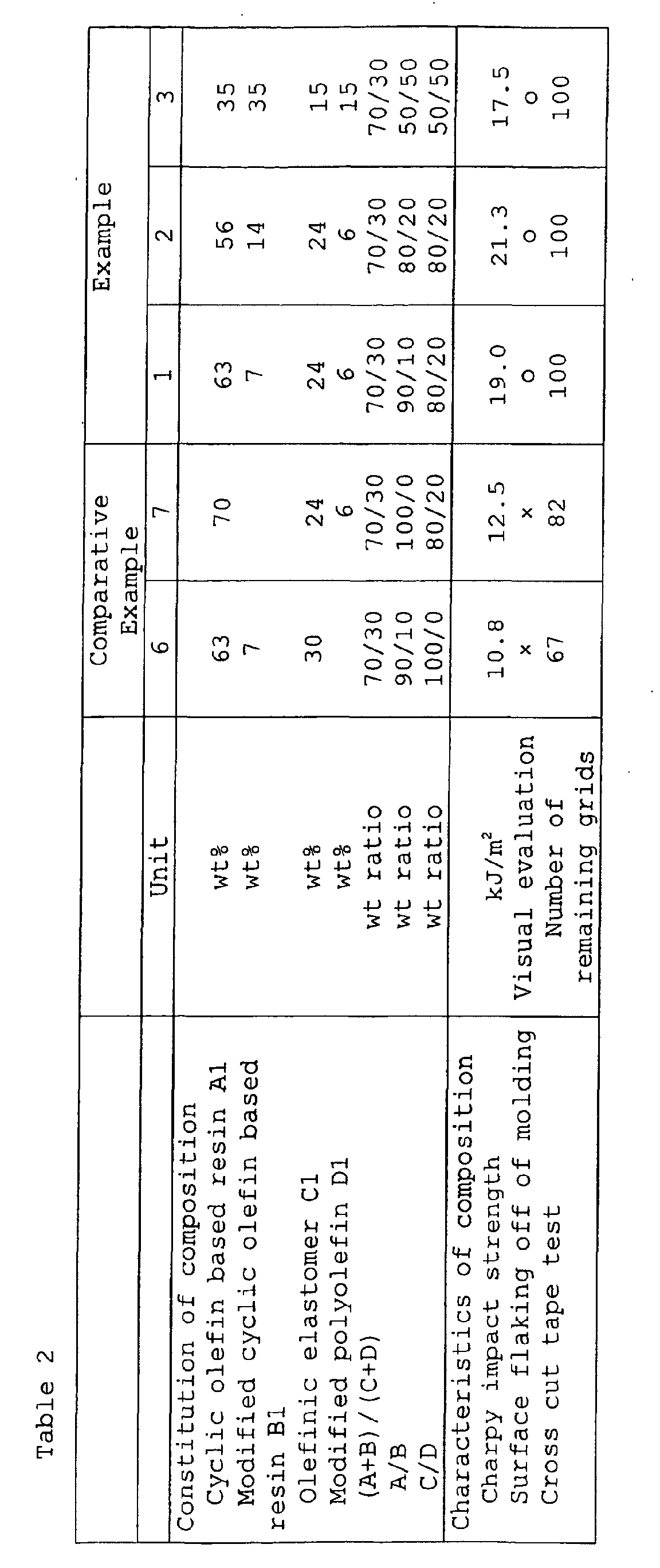
- the cyclic olefin based resin A1, the olefinic elastomer C1, the modified polyolefin D1, and the pellets of the modified olefin based resin B1 manufactured in Reference Example 1 were precedently mixed in constitutions shown in Table 2, and these mixtures were melted and kneaded, and pelletized at a cylinder temperature of 300°C using a 30 mm biaxial extruder to yield compositions. Those compositions were injection-molded at the cylinder temperature of 300°C to make test pieces, and the test pieces were evaluated for impact strength and surface flaking off. The results were shown in Table 2.
- the olefinic elastomer (C) is effective for the improvement of impact strength of the cyclic olefin based resin (A), but has a drawback of causing the surface flaking off.
- the impact strength is improved without causing the surface flaking off by the addition of the modified cyclic olefin based resin (B) and the modified polyolefin (D).
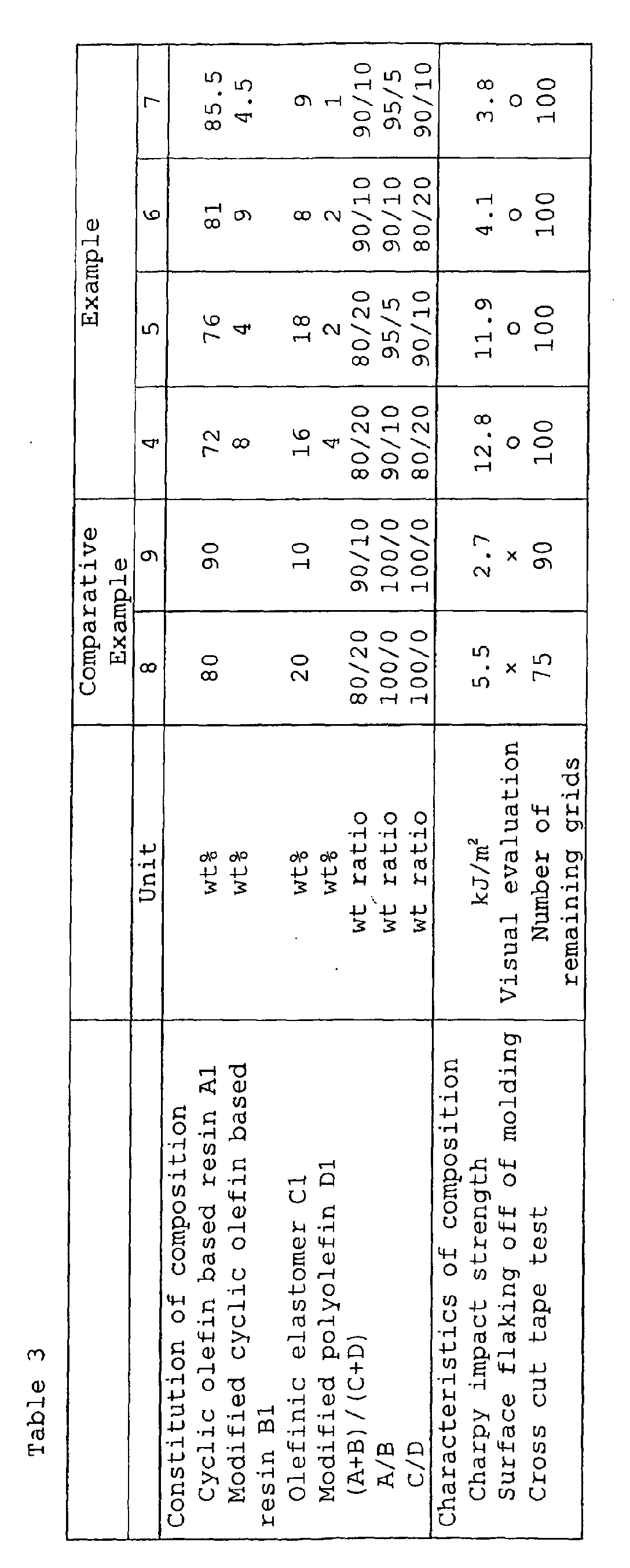
- Example 3 The results shown in Table 3 were obtained by making constitutions shown in Table 3, and performing the molding and the evaluation as is the case with Example 1. Even when the content of the component C is from 20% to 10%, flaking off of a molding occurs (Comparative Examples 8 and 9), but it is possible to eliminate the flaking off by adding the components B and D (Examples 4 to 7).
- a molding of a cyclic olefin based resin composition which is excellent in impact resistance, resistance to flaking off, and the like is obtained.
Landscapes
- Chemical & Material Sciences (AREA)
- Health & Medical Sciences (AREA)
- Chemical Kinetics & Catalysis (AREA)
- Medicinal Chemistry (AREA)
- Polymers & Plastics (AREA)
- Organic Chemistry (AREA)
- Compositions Of Macromolecular Compounds (AREA)
- Manufacture Of Macromolecular Shaped Articles (AREA)
- Dental Preparations (AREA)
- Materials For Medical Uses (AREA)
Abstract
Description
a weight ratio C/D of the component C to the component D is in the range of 98/2 to 2/98, and
a ratio (A+B)/(C+D) of the total weight of the component A and the component B to the total weight of the component C and the component D is in the range of 95/5 to 50/50.
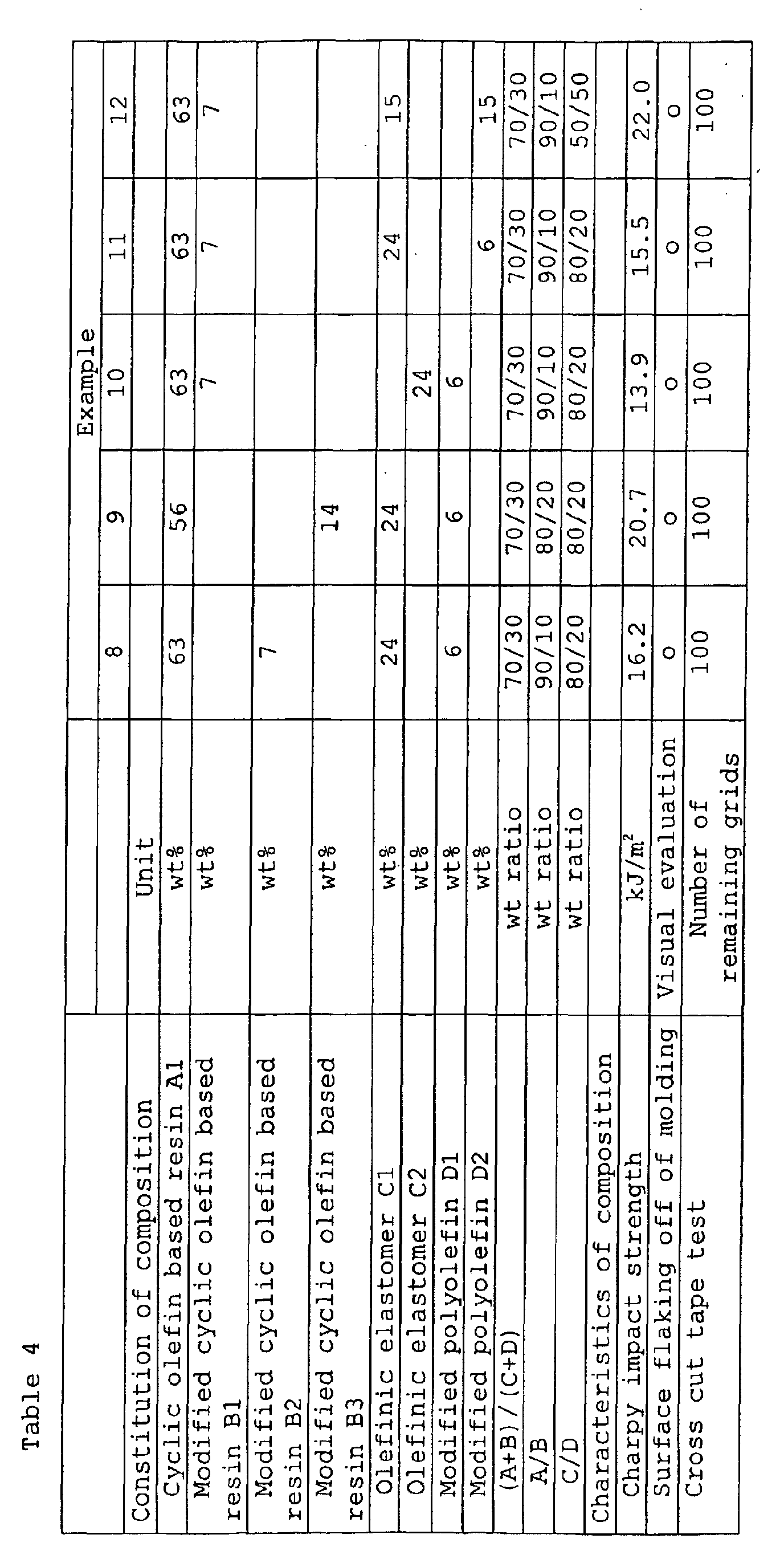
Charpy impact strength: It was measured according to JIS K7111. Surface flaking off of molding: the presence or absence of flaking off was visually determined using No. 1 test piece used for a tensile test, or the evaluation was performed by a cross cut tape test.
| Comparative Example | ||||||
| 1 | 2 | 3 | 4 | 5 | ||
| Constitution of composition | Unit | |||||
| Cyclic olefin based resin A1 | wt% | 100 | 70 | 70 | 70 | 70 |
| Olefinic elastomer C1 | wt% | 30 | ||||
| Olefinic elastomer C2 | wt% | 30 | ||||
| Styrenic elastomer C3 | wt% | 30 | ||||
| Styrenic elastomer C4 | wt% | 30 | ||||
| Characteristics of composition | ||||||
| Charpy impact strength | kJ/m2 | 1.0 | 10.1 | 8.2 | 2.1 | 5.0 |
| Surface flaking off of molding | Visual evaluation | N/A | × | × | ○ | × |
| Cross cut tape test | Number of remaining grids | N/A | 54 | 42 | 100 | 93 |

Claims (6)
- A cyclic olefin based resin composition comprising:wherein a weight ratio A/B of the component A to the component B is in a range of 98/2 to 2/98,a cyclic olefin based resin (A);a modified cyclic olefin based resin (B) prepared by grafting and/or copolymerizing an unsaturated carboxylic acid or an unsaturated carboxylic acid anhydride to the cyclic olefin based resin (A);an olefinic elastomer (C); anda modified polyolefin (D) having an epoxy group,
a weight ratio C/D of the component C to the component D is in a range of 98/2 to 2/98, and
a ratio (A+B)/(C+D) of a total weight of the component A and the component B to a total weight of the component C and the component D is in a range of 95/5 to 50/50. - The cyclic olefin based resin composition according to claim 1, wherein the component C is a copolymer of ethylene and an α-olefin.
- The cyclic olefin based resin composition according to claim 1 or 2, wherein the component D is a copolymer of ethylene and glycidyl (meth)acrylate.
- The cyclic olefin based resin composition according to any one of claims 1 - 3, wherein the component B is a modified cyclic olefin based resin which is obtained by a cyclic olefin based resin being grafted with (meth)acrylic acid or maleic anhydride.
- The cyclic olefin based resin composition according to any one of claims 1 - 4, wherein a cyclic olefin based resin of the component A and a cyclic olefin based resin used as a base resin prior to modification in the component B are independently a copolymer of ethylene and a cyclic olefin.
- A molding of cyclic olefin based resin obtained by injection molding, compression molding, injection compression molding, extrusion, or blow molding of the cyclic olefin based resin composition according to any one of claims 1 - 5.
Applications Claiming Priority (3)
| Application Number | Priority Date | Filing Date | Title |
|---|---|---|---|
| JP2001324006A JP3847599B2 (en) | 2001-10-22 | 2001-10-22 | Impact resistant cyclic olefin resin composition and molded article |
| JP2001324006 | 2001-10-22 | ||
| PCT/JP2002/010887 WO2003035751A1 (en) | 2001-10-22 | 2002-10-21 | Impact-resistant cyclic olefin based resin composition and moldings |
Publications (3)
| Publication Number | Publication Date |
|---|---|
| EP1449882A1 true EP1449882A1 (en) | 2004-08-25 |
| EP1449882A4 EP1449882A4 (en) | 2006-08-23 |
| EP1449882B1 EP1449882B1 (en) | 2010-06-02 |
Family
ID=19140813
Family Applications (1)
| Application Number | Title | Priority Date | Filing Date |
|---|---|---|---|
| EP02777895A Expired - Lifetime EP1449882B1 (en) | 2001-10-22 | 2002-10-21 | Impact-resistant cyclic olefin based resin composition and moldings |
Country Status (9)
| Country | Link |
|---|---|
| US (1) | US20050014898A1 (en) |
| EP (1) | EP1449882B1 (en) |
| JP (1) | JP3847599B2 (en) |
| KR (1) | KR100859826B1 (en) |
| CN (1) | CN1279111C (en) |
| AT (1) | ATE469944T1 (en) |
| DE (1) | DE60236613D1 (en) |
| TW (1) | TWI233443B (en) |
| WO (1) | WO2003035751A1 (en) |
Cited By (2)
| Publication number | Priority date | Publication date | Assignee | Title |
|---|---|---|---|---|
| EP2022825A4 (en) * | 2006-05-09 | 2009-05-27 | Polyplastics Co | Material for electronic part for high-frequency use and electronic part for high-frequency use comprising the material |
| WO2012022409A1 (en) * | 2010-08-17 | 2012-02-23 | Topas Advanced Polymers Gmbh | Cycloolefin polymer compositions, molded bodies, and use of said molded bodies |
Families Citing this family (26)
| Publication number | Priority date | Publication date | Assignee | Title |
|---|---|---|---|---|
| WO2004080370A1 (en) * | 2003-03-12 | 2004-09-23 | Fujimori Kogyo Co., Ltd. | Multiple compartment container |
| JP4869566B2 (en) * | 2004-06-04 | 2012-02-08 | 三井化学株式会社 | Polylactic acid resin composition |
| JP5216326B2 (en) * | 2005-12-06 | 2013-06-19 | ポリプラスチックス株式会社 | Anti-fogging agent for amorphous cyclic olefin resin, resin composition, and optical component |
| WO2008018952A1 (en) * | 2006-08-04 | 2008-02-14 | Exxonmobil Chemical Patents Inc. | Polymer compositions comprising cyclic olefin copolymers and polyolefin modifiers |
| EP2052023A1 (en) * | 2006-08-04 | 2009-04-29 | ExxonMobil Chemical Patents, Inc., A Corporation of the State of Delaware | Polymer compositions comprising cyclic olefin polymers, polyolefin modifiers, and fillers |
| US8148472B1 (en) | 2006-08-04 | 2012-04-03 | Exxonmobil Research And Engineering Company | Polymer compositions comprising cyclic olefin polymers, polyolefin modifiers and non-functionalized plasticizers |
| JP2008208357A (en) * | 2007-02-02 | 2008-09-11 | Jsr Corp | Optical film manufacturing method, optical film, retardation film, and polarizing plate |
| US20080188607A1 (en) * | 2007-02-07 | 2008-08-07 | Nova Chemicals Inc. | Low odor resin compositions |
| US8519056B2 (en) | 2007-06-01 | 2013-08-27 | Exxonmobil Chemical Patents Inc. | Blends of co-precipitated hydrogenated ethylene-dicyclpentadiene and elastomeric polymers to provide impact modified structural polyolefins |
| KR101288499B1 (en) * | 2007-10-12 | 2013-07-26 | 주식회사 엘지화학 | CYCLIC OLEFFIN-BASED RESIN FILM INCLUDING Si-FILLER AND ELECTRONIC DEVICE USING THE SAME |
| WO2010096106A1 (en) * | 2009-02-20 | 2010-08-26 | Dow Global Technologies Inc. | Cyclic block copolymer composition and thin wall guide plate made thereof |
| US9452593B2 (en) | 2010-04-15 | 2016-09-27 | Topas Advanced Polymers, Inc. | Melt blends of amorphous cycloolefin polymers and partially crystalline cycloolefin elastomers with improved toughness |
| CN102229225A (en) * | 2010-08-27 | 2011-11-02 | 上海海昌医用塑胶厂 | Method for manufacturing anti-dropping COC (cycloolefin copolymer) plastic bottle |
| KR101012829B1 (en) * | 2010-09-24 | 2011-02-08 | 최희선 | Composition for manufacturing synthetic wood and method for producing synthetic wood using same |
| CN103391835A (en) * | 2011-02-25 | 2013-11-13 | 宝理塑料株式会社 | Process of producing molding, and molding |
| JP5691719B2 (en) * | 2011-03-25 | 2015-04-01 | 日本ゼオン株式会社 | Resin composition and power cable covering material |
| JP6565680B2 (en) * | 2013-12-20 | 2019-08-28 | 日本ゼオン株式会社 | Resin material and resin film |
| JP6430788B2 (en) * | 2014-11-17 | 2018-11-28 | デクセリアルズ株式会社 | Resin composition and method for producing the same |
| EP3245255B1 (en) * | 2015-01-12 | 2019-05-15 | PolyOne Corporation | Support material for 3d printing of polymer compounds |
| WO2017223276A1 (en) | 2016-06-24 | 2017-12-28 | Polyone Corporation | Coc polymer compounds for 3d printing |
| CN111393783B (en) * | 2020-03-31 | 2022-04-26 | 金旸(厦门)新材料科技有限公司 | Transparent toughened cycloolefin copolymer |
| CN111978665A (en) * | 2020-08-03 | 2020-11-24 | 宁波拓烯新材料科技有限公司 | High-toughness COC material and preparation method thereof |
| CN113956595A (en) * | 2021-10-15 | 2022-01-21 | 云南博仁科技有限公司 | Method for preparing high-strength safety helmet material by cyclic olefin structure copolymer |
| CN116396433A (en) * | 2022-09-30 | 2023-07-07 | 安捷利(番禺)电子实业有限公司 | A kind of modified polyolefin and its preparation of low dielectric build-up adhesive film |
| CN116082582A (en) * | 2022-09-30 | 2023-05-09 | 安捷利(番禺)电子实业有限公司 | A kind of modified plastic and its prepared low-dielectric pure rubber film |
| CN117903372A (en) * | 2024-03-19 | 2024-04-19 | 拓烯科技(衢州)有限公司 | Polar cycloolefin copolymer and composite film and preparation method thereof |
Family Cites Families (13)
| Publication number | Priority date | Publication date | Assignee | Title |
|---|---|---|---|---|
| EP0274744A3 (en) * | 1987-01-16 | 1989-12-06 | General Electric Company | Epoxy containing impact modifiers for thermoplastic resins |
| TW212809B (en) * | 1991-09-03 | 1993-09-11 | Hoechst Ag | |
| JPH05306311A (en) * | 1992-04-30 | 1993-11-19 | Mitsubishi Petrochem Co Ltd | Production of graft-modified copolymer |
| WO1994011420A1 (en) * | 1992-11-06 | 1994-05-26 | Daicel Chemical Industries, Ltd. | Easily tearable film and method of manufacturing the same |
| JPH06313068A (en) * | 1993-03-02 | 1994-11-08 | Mitsui Petrochem Ind Ltd | Olefinic polymer composition and its production |
| DE69434935D1 (en) * | 1994-02-01 | 2007-04-12 | Asahi Chemical Ind | NEW POLYMER CONTAINING MODIFIED CYCLIC STRUCTURE |
| JPH0859906A (en) * | 1994-08-22 | 1996-03-05 | Mitsui Petrochem Ind Ltd | Thermoplastic resin composition |
| CN1182440A (en) * | 1995-02-24 | 1998-05-20 | 钟渊化学工业株式会社 | Grafted polyolefinic resin and composition thereof |
| JPH09118811A (en) * | 1995-10-24 | 1997-05-06 | Nippon Zeon Co Ltd | Thermoplastic norbornene resin composition and molded article |
| DE19610415A1 (en) * | 1996-03-16 | 1997-09-18 | Schulman A Gmbh | Thermoplastic molding composition, process for its production and its use |
| JPH10195282A (en) * | 1997-01-10 | 1998-07-28 | Jsr Corp | Resin composition |
| JP2000000310A (en) * | 1998-06-15 | 2000-01-07 | Toshiba Corp | Intervention therapy system |
| JP2000310240A (en) * | 1999-04-26 | 2000-11-07 | Nsk Ltd | Bearing unit for clutch release |
-
2001
- 2001-10-22 JP JP2001324006A patent/JP3847599B2/en not_active Expired - Fee Related
-
2002
- 2002-10-21 US US10/493,104 patent/US20050014898A1/en not_active Abandoned
- 2002-10-21 WO PCT/JP2002/010887 patent/WO2003035751A1/en not_active Ceased
- 2002-10-21 DE DE60236613T patent/DE60236613D1/en not_active Expired - Lifetime
- 2002-10-21 EP EP02777895A patent/EP1449882B1/en not_active Expired - Lifetime
- 2002-10-21 KR KR1020047005806A patent/KR100859826B1/en not_active Expired - Fee Related
- 2002-10-21 CN CNB028207297A patent/CN1279111C/en not_active Expired - Fee Related
- 2002-10-21 AT AT02777895T patent/ATE469944T1/en not_active IP Right Cessation
- 2002-10-22 TW TW091124285A patent/TWI233443B/en not_active IP Right Cessation
Cited By (2)
| Publication number | Priority date | Publication date | Assignee | Title |
|---|---|---|---|---|
| EP2022825A4 (en) * | 2006-05-09 | 2009-05-27 | Polyplastics Co | Material for electronic part for high-frequency use and electronic part for high-frequency use comprising the material |
| WO2012022409A1 (en) * | 2010-08-17 | 2012-02-23 | Topas Advanced Polymers Gmbh | Cycloolefin polymer compositions, molded bodies, and use of said molded bodies |
Also Published As
| Publication number | Publication date |
|---|---|
| CN1571815A (en) | 2005-01-26 |
| EP1449882A4 (en) | 2006-08-23 |
| KR20040048424A (en) | 2004-06-09 |
| JP2003128865A (en) | 2003-05-08 |
| CN1279111C (en) | 2006-10-11 |
| JP3847599B2 (en) | 2006-11-22 |
| KR100859826B1 (en) | 2008-09-23 |
| EP1449882B1 (en) | 2010-06-02 |
| WO2003035751A1 (en) | 2003-05-01 |
| ATE469944T1 (en) | 2010-06-15 |
| DE60236613D1 (en) | 2010-07-15 |
| US20050014898A1 (en) | 2005-01-20 |
| TWI233443B (en) | 2005-06-01 |
Similar Documents
| Publication | Publication Date | Title |
|---|---|---|
| EP1449882B1 (en) | Impact-resistant cyclic olefin based resin composition and moldings | |
| TW290555B (en) | ||
| ES2311514T3 (en) | FLEXIBLE RESIN GRANLE AND PROCEDURE FOR PRODUCTION. | |
| CA1252239A (en) | Thermoplastic resin composition | |
| AU606387B2 (en) | Single step bulk process for high impact polyester masterbatches, products thereof and blends with polyesters | |
| JP4015001B2 (en) | Polyarylene sulfide resin composition and molded article | |
| JP3949542B2 (en) | Polyarylene sulfide resin composition and molded article | |
| EP0612800A1 (en) | Propylene polymer compositions | |
| CN101010378B (en) | Method for producing resin composition | |
| JP4509293B2 (en) | Method for producing soft resin pellets with excellent non-adhesiveness | |
| KR19980042491A (en) | Impact resistant styrene resin composition and molded article thereof | |
| JP2795500B2 (en) | Polycarbonate resin composition | |
| JP2003128885A (en) | Glass fiber reinforced cyclic olefin resin composition and molded article | |
| JPH0859906A (en) | Thermoplastic resin composition | |
| JP2768519B2 (en) | Polyester resin composition | |
| JP3456489B2 (en) | Container made of cyclic olefin resin composition | |
| EP0409601B1 (en) | Polyolefin resin composition, and crosslinked molded article and process for the production thereof | |
| JP2010280768A (en) | Polylactic acid-based resin composition | |
| JP3255722B2 (en) | Modified cyclic olefin copolymer composition and method for producing the same | |
| JP3255721B2 (en) | Cyclic olefin copolymer composition and method for producing the same | |
| JPH0820681A (en) | Polyethylene resin composition for automobile side molding | |
| JPH0551512A (en) | Polyolefin resin composition | |
| JPH0395230A (en) | Method of bonding cyclic olefin polymer | |
| JPH06313068A (en) | Olefinic polymer composition and its production | |
| JPH06306256A (en) | Olefin resin composition and method for producing the same |
Legal Events
| Date | Code | Title | Description |
|---|---|---|---|
| PUAI | Public reference made under article 153(3) epc to a published international application that has entered the european phase |
Free format text: ORIGINAL CODE: 0009012 |
|
| 17P | Request for examination filed |
Effective date: 20040519 |
|
| AK | Designated contracting states |
Kind code of ref document: A1 Designated state(s): AT BE BG CH CY CZ DE DK EE ES FI FR GB GR IE IT LI LU MC NL PT SE SK TR |
|
| A4 | Supplementary search report drawn up and despatched |
Effective date: 20060725 |
|
| RIC1 | Information provided on ipc code assigned before grant |
Ipc: C08L 23/08 20060101ALI20060719BHEP Ipc: C08L 45/00 20060101AFI20030506BHEP |
|
| RAP1 | Party data changed (applicant data changed or rights of an application transferred) |
Owner name: POLYPLASTICS CO., LTD. |
|
| GRAP | Despatch of communication of intention to grant a patent |
Free format text: ORIGINAL CODE: EPIDOSNIGR1 |
|
| GRAS | Grant fee paid |
Free format text: ORIGINAL CODE: EPIDOSNIGR3 |
|
| GRAA | (expected) grant |
Free format text: ORIGINAL CODE: 0009210 |
|
| AK | Designated contracting states |
Kind code of ref document: B1 Designated state(s): AT BE BG CH CY CZ DE DK EE ES FI FR GB GR IE IT LI LU MC NL PT SE SK TR |
|
| REG | Reference to a national code |
Ref country code: GB Ref legal event code: FG4D |
|
| REG | Reference to a national code |
Ref country code: CH Ref legal event code: EP |
|
| REG | Reference to a national code |
Ref country code: IE Ref legal event code: FG4D |
|
| REF | Corresponds to: |
Ref document number: 60236613 Country of ref document: DE Date of ref document: 20100715 Kind code of ref document: P |
|
| REG | Reference to a national code |
Ref country code: NL Ref legal event code: VDEP Effective date: 20100602 |
|
| PG25 | Lapsed in a contracting state [announced via postgrant information from national office to epo] |
Ref country code: SE Free format text: LAPSE BECAUSE OF FAILURE TO SUBMIT A TRANSLATION OF THE DESCRIPTION OR TO PAY THE FEE WITHIN THE PRESCRIBED TIME-LIMIT Effective date: 20100602 |
|
| PG25 | Lapsed in a contracting state [announced via postgrant information from national office to epo] |
Ref country code: AT Free format text: LAPSE BECAUSE OF FAILURE TO SUBMIT A TRANSLATION OF THE DESCRIPTION OR TO PAY THE FEE WITHIN THE PRESCRIBED TIME-LIMIT Effective date: 20100602 Ref country code: FI Free format text: LAPSE BECAUSE OF FAILURE TO SUBMIT A TRANSLATION OF THE DESCRIPTION OR TO PAY THE FEE WITHIN THE PRESCRIBED TIME-LIMIT Effective date: 20100602 |
|
| PG25 | Lapsed in a contracting state [announced via postgrant information from national office to epo] |
Ref country code: GR Free format text: LAPSE BECAUSE OF FAILURE TO SUBMIT A TRANSLATION OF THE DESCRIPTION OR TO PAY THE FEE WITHIN THE PRESCRIBED TIME-LIMIT Effective date: 20100903 Ref country code: CY Free format text: LAPSE BECAUSE OF FAILURE TO SUBMIT A TRANSLATION OF THE DESCRIPTION OR TO PAY THE FEE WITHIN THE PRESCRIBED TIME-LIMIT Effective date: 20100602 |
|
| PG25 | Lapsed in a contracting state [announced via postgrant information from national office to epo] |
Ref country code: NL Free format text: LAPSE BECAUSE OF FAILURE TO SUBMIT A TRANSLATION OF THE DESCRIPTION OR TO PAY THE FEE WITHIN THE PRESCRIBED TIME-LIMIT Effective date: 20100602 Ref country code: EE Free format text: LAPSE BECAUSE OF FAILURE TO SUBMIT A TRANSLATION OF THE DESCRIPTION OR TO PAY THE FEE WITHIN THE PRESCRIBED TIME-LIMIT Effective date: 20100602 |
|
| PG25 | Lapsed in a contracting state [announced via postgrant information from national office to epo] |
Ref country code: SK Free format text: LAPSE BECAUSE OF FAILURE TO SUBMIT A TRANSLATION OF THE DESCRIPTION OR TO PAY THE FEE WITHIN THE PRESCRIBED TIME-LIMIT Effective date: 20100602 Ref country code: BE Free format text: LAPSE BECAUSE OF FAILURE TO SUBMIT A TRANSLATION OF THE DESCRIPTION OR TO PAY THE FEE WITHIN THE PRESCRIBED TIME-LIMIT Effective date: 20100602 Ref country code: CZ Free format text: LAPSE BECAUSE OF FAILURE TO SUBMIT A TRANSLATION OF THE DESCRIPTION OR TO PAY THE FEE WITHIN THE PRESCRIBED TIME-LIMIT Effective date: 20100602 Ref country code: PT Free format text: LAPSE BECAUSE OF FAILURE TO SUBMIT A TRANSLATION OF THE DESCRIPTION OR TO PAY THE FEE WITHIN THE PRESCRIBED TIME-LIMIT Effective date: 20101004 |
|
| PLBE | No opposition filed within time limit |
Free format text: ORIGINAL CODE: 0009261 |
|
| STAA | Information on the status of an ep patent application or granted ep patent |
Free format text: STATUS: NO OPPOSITION FILED WITHIN TIME LIMIT |
|
| PG25 | Lapsed in a contracting state [announced via postgrant information from national office to epo] |
Ref country code: DK Free format text: LAPSE BECAUSE OF FAILURE TO SUBMIT A TRANSLATION OF THE DESCRIPTION OR TO PAY THE FEE WITHIN THE PRESCRIBED TIME-LIMIT Effective date: 20100602 |
|
| 26N | No opposition filed |
Effective date: 20110303 |
|
| PG25 | Lapsed in a contracting state [announced via postgrant information from national office to epo] |
Ref country code: MC Free format text: LAPSE BECAUSE OF NON-PAYMENT OF DUE FEES Effective date: 20101031 |
|
| REG | Reference to a national code |
Ref country code: CH Ref legal event code: PL |
|
| REG | Reference to a national code |
Ref country code: DE Ref legal event code: R097 Ref document number: 60236613 Country of ref document: DE Effective date: 20110302 |
|
| PG25 | Lapsed in a contracting state [announced via postgrant information from national office to epo] |
Ref country code: CH Free format text: LAPSE BECAUSE OF NON-PAYMENT OF DUE FEES Effective date: 20101031 Ref country code: LI Free format text: LAPSE BECAUSE OF NON-PAYMENT OF DUE FEES Effective date: 20101031 Ref country code: FR Free format text: LAPSE BECAUSE OF NON-PAYMENT OF DUE FEES Effective date: 20101102 |
|
| REG | Reference to a national code |
Ref country code: FR Ref legal event code: ST Effective date: 20110630 |
|
| PG25 | Lapsed in a contracting state [announced via postgrant information from national office to epo] |
Ref country code: IE Free format text: LAPSE BECAUSE OF NON-PAYMENT OF DUE FEES Effective date: 20101021 |
|
| PG25 | Lapsed in a contracting state [announced via postgrant information from national office to epo] |
Ref country code: BG Free format text: LAPSE BECAUSE OF FAILURE TO SUBMIT A TRANSLATION OF THE DESCRIPTION OR TO PAY THE FEE WITHIN THE PRESCRIBED TIME-LIMIT Effective date: 20100602 Ref country code: LU Free format text: LAPSE BECAUSE OF NON-PAYMENT OF DUE FEES Effective date: 20101021 |
|
| PG25 | Lapsed in a contracting state [announced via postgrant information from national office to epo] |
Ref country code: TR Free format text: LAPSE BECAUSE OF FAILURE TO SUBMIT A TRANSLATION OF THE DESCRIPTION OR TO PAY THE FEE WITHIN THE PRESCRIBED TIME-LIMIT Effective date: 20100602 |
|
| PGFP | Annual fee paid to national office [announced via postgrant information from national office to epo] |
Ref country code: DE Payment date: 20121017 Year of fee payment: 11 |
|
| PGFP | Annual fee paid to national office [announced via postgrant information from national office to epo] |
Ref country code: IT Payment date: 20121013 Year of fee payment: 11 Ref country code: GB Payment date: 20121017 Year of fee payment: 11 |
|
| PG25 | Lapsed in a contracting state [announced via postgrant information from national office to epo] |
Ref country code: BG Free format text: LAPSE BECAUSE OF FAILURE TO SUBMIT A TRANSLATION OF THE DESCRIPTION OR TO PAY THE FEE WITHIN THE PRESCRIBED TIME-LIMIT Effective date: 20100902 |
|
| PG25 | Lapsed in a contracting state [announced via postgrant information from national office to epo] |
Ref country code: ES Free format text: LAPSE BECAUSE OF FAILURE TO SUBMIT A TRANSLATION OF THE DESCRIPTION OR TO PAY THE FEE WITHIN THE PRESCRIBED TIME-LIMIT Effective date: 20100913 |
|
| GBPC | Gb: european patent ceased through non-payment of renewal fee |
Effective date: 20131021 |
|
| PG25 | Lapsed in a contracting state [announced via postgrant information from national office to epo] |
Ref country code: GB Free format text: LAPSE BECAUSE OF NON-PAYMENT OF DUE FEES Effective date: 20131021 |
|
| REG | Reference to a national code |
Ref country code: DE Ref legal event code: R119 Ref document number: 60236613 Country of ref document: DE Effective date: 20140501 |
|
| PG25 | Lapsed in a contracting state [announced via postgrant information from national office to epo] |
Ref country code: IT Free format text: LAPSE BECAUSE OF NON-PAYMENT OF DUE FEES Effective date: 20131021 Ref country code: DE Free format text: LAPSE BECAUSE OF NON-PAYMENT OF DUE FEES Effective date: 20140501 |