EP1449873A1 - Rubber composition comprising nitrile copolymer rubber, metal salt of ethylenically unsaturated carboxylic acid, and organic peroxide, and vulcanizate thereof - Google Patents
Rubber composition comprising nitrile copolymer rubber, metal salt of ethylenically unsaturated carboxylic acid, and organic peroxide, and vulcanizate thereof Download PDFInfo
- Publication number
- EP1449873A1 EP1449873A1 EP02800015A EP02800015A EP1449873A1 EP 1449873 A1 EP1449873 A1 EP 1449873A1 EP 02800015 A EP02800015 A EP 02800015A EP 02800015 A EP02800015 A EP 02800015A EP 1449873 A1 EP1449873 A1 EP 1449873A1
- Authority
- EP
- European Patent Office
- Prior art keywords
- monomer units
- ethylenically unsaturated
- rubber
- carboxylic acid
- unsaturated carboxylic
- Prior art date
- Legal status (The legal status is an assumption and is not a legal conclusion. Google has not performed a legal analysis and makes no representation as to the accuracy of the status listed.)
- Granted
Links
- 229920001971 elastomer Polymers 0.000 title claims abstract description 109
- 239000005060 rubber Substances 0.000 title claims abstract description 109
- 239000000203 mixture Substances 0.000 title claims abstract description 41
- 229920001577 copolymer Polymers 0.000 title claims abstract description 39
- 229910052751 metal Inorganic materials 0.000 title claims abstract description 29
- 239000002184 metal Substances 0.000 title claims abstract description 29
- 150000001732 carboxylic acid derivatives Chemical class 0.000 title claims abstract description 28
- 150000003839 salts Chemical class 0.000 title claims abstract description 26
- 150000001451 organic peroxides Chemical class 0.000 title claims abstract description 23
- 239000000178 monomer Substances 0.000 claims abstract description 126
- 230000009477 glass transition Effects 0.000 claims abstract description 22
- 125000002560 nitrile group Chemical group 0.000 claims abstract description 18
- 150000001993 dienes Chemical class 0.000 claims abstract description 15
- 230000000977 initiatory effect Effects 0.000 claims abstract description 11
- 229920006395 saturated elastomer Polymers 0.000 claims abstract description 8
- 238000000113 differential scanning calorimetry Methods 0.000 claims abstract description 6
- 150000002825 nitriles Chemical class 0.000 claims description 6
- 150000002978 peroxides Chemical class 0.000 claims description 4
- 125000004185 ester group Chemical group 0.000 claims description 2
- 125000003262 carboxylic acid ester group Chemical class [H]C([H])([*:2])OC(=O)C([H])([H])[*:1] 0.000 claims 2
- 230000006835 compression Effects 0.000 abstract description 16
- 238000007906 compression Methods 0.000 abstract description 16
- 150000001733 carboxylic acid esters Chemical class 0.000 abstract description 6
- 150000002826 nitrites Chemical class 0.000 abstract description 2
- 238000004073 vulcanization Methods 0.000 description 28
- 238000000034 method Methods 0.000 description 23
- 238000006116 polymerization reaction Methods 0.000 description 23
- 125000004432 carbon atom Chemical group C* 0.000 description 13
- KAKZBPTYRLMSJV-UHFFFAOYSA-N Butadiene Chemical compound C=CC=C KAKZBPTYRLMSJV-UHFFFAOYSA-N 0.000 description 8
- 238000010438 heat treatment Methods 0.000 description 8
- 239000004615 ingredient Substances 0.000 description 8
- 150000001252 acrylic acid derivatives Chemical class 0.000 description 7
- 230000000052 comparative effect Effects 0.000 description 7
- 150000002734 metacrylic acid derivatives Chemical class 0.000 description 7
- VTYYLEPIZMXCLO-UHFFFAOYSA-L Calcium carbonate Chemical compound [Ca+2].[O-]C([O-])=O VTYYLEPIZMXCLO-UHFFFAOYSA-L 0.000 description 6
- VYPSYNLAJGMNEJ-UHFFFAOYSA-N Silicium dioxide Chemical compound O=[Si]=O VYPSYNLAJGMNEJ-UHFFFAOYSA-N 0.000 description 6
- 238000006243 chemical reaction Methods 0.000 description 6
- 238000005984 hydrogenation reaction Methods 0.000 description 6
- 238000012360 testing method Methods 0.000 description 6
- 238000005160 1H NMR spectroscopy Methods 0.000 description 5
- 238000005259 measurement Methods 0.000 description 5
- NLHHRLWOUZZQLW-UHFFFAOYSA-N Acrylonitrile Chemical compound C=CC#N NLHHRLWOUZZQLW-UHFFFAOYSA-N 0.000 description 4
- 125000000217 alkyl group Chemical group 0.000 description 4
- 239000003963 antioxidant agent Substances 0.000 description 4
- CQEYYJKEWSMYFG-UHFFFAOYSA-N butyl acrylate Chemical compound CCCCOC(=O)C=C CQEYYJKEWSMYFG-UHFFFAOYSA-N 0.000 description 4
- 150000001990 dicarboxylic acid derivatives Chemical class 0.000 description 4
- 239000007788 liquid Substances 0.000 description 4
- FYYHWMGAXLPEAU-UHFFFAOYSA-N Magnesium Chemical compound [Mg] FYYHWMGAXLPEAU-UHFFFAOYSA-N 0.000 description 3
- HCHKCACWOHOZIP-UHFFFAOYSA-N Zinc Chemical compound [Zn] HCHKCACWOHOZIP-UHFFFAOYSA-N 0.000 description 3
- 238000004458 analytical method Methods 0.000 description 3
- 230000003078 antioxidant effect Effects 0.000 description 3
- 229910000019 calcium carbonate Inorganic materials 0.000 description 3
- 239000004927 clay Substances 0.000 description 3
- 229910052570 clay Inorganic materials 0.000 description 3
- 238000002474 experimental method Methods 0.000 description 3
- 238000010348 incorporation Methods 0.000 description 3
- 238000004898 kneading Methods 0.000 description 3
- 239000004816 latex Substances 0.000 description 3
- 229920000126 latex Polymers 0.000 description 3
- 229910052749 magnesium Inorganic materials 0.000 description 3
- 239000011777 magnesium Substances 0.000 description 3
- 150000002763 monocarboxylic acids Chemical class 0.000 description 3
- 239000000377 silicon dioxide Substances 0.000 description 3
- 229910052725 zinc Inorganic materials 0.000 description 3
- 239000011701 zinc Substances 0.000 description 3
- UBRWPVTUQDJKCC-UHFFFAOYSA-N 1,3-bis(2-tert-butylperoxypropan-2-yl)benzene Chemical compound CC(C)(C)OOC(C)(C)C1=CC=CC(C(C)(C)OOC(C)(C)C)=C1 UBRWPVTUQDJKCC-UHFFFAOYSA-N 0.000 description 2
- SDJHPPZKZZWAKF-UHFFFAOYSA-N 2,3-dimethylbuta-1,3-diene Chemical compound CC(=C)C(C)=C SDJHPPZKZZWAKF-UHFFFAOYSA-N 0.000 description 2
- ZCYVEMRRCGMTRW-UHFFFAOYSA-N 7553-56-2 Chemical compound [I] ZCYVEMRRCGMTRW-UHFFFAOYSA-N 0.000 description 2
- NIXOWILDQLNWCW-UHFFFAOYSA-M Acrylate Chemical compound [O-]C(=O)C=C NIXOWILDQLNWCW-UHFFFAOYSA-M 0.000 description 2
- IJGRMHOSHXDMSA-UHFFFAOYSA-N Atomic nitrogen Chemical compound N#N IJGRMHOSHXDMSA-UHFFFAOYSA-N 0.000 description 2
- SOGAXMICEFXMKE-UHFFFAOYSA-N Butylmethacrylate Chemical compound CCCCOC(=O)C(C)=C SOGAXMICEFXMKE-UHFFFAOYSA-N 0.000 description 2
- OYPRJOBELJOOCE-UHFFFAOYSA-N Calcium Chemical compound [Ca] OYPRJOBELJOOCE-UHFFFAOYSA-N 0.000 description 2
- XLYMOEINVGRTEX-ARJAWSKDSA-N Ethyl hydrogen fumarate Chemical compound CCOC(=O)\C=C/C(O)=O XLYMOEINVGRTEX-ARJAWSKDSA-N 0.000 description 2
- VZCYOOQTPOCHFL-OWOJBTEDSA-N Fumaric acid Chemical compound OC(=O)\C=C\C(O)=O VZCYOOQTPOCHFL-OWOJBTEDSA-N 0.000 description 2
- 238000004566 IR spectroscopy Methods 0.000 description 2
- XEEYBQQBJWHFJM-UHFFFAOYSA-N Iron Chemical compound [Fe] XEEYBQQBJWHFJM-UHFFFAOYSA-N 0.000 description 2
- RRHGJUQNOFWUDK-UHFFFAOYSA-N Isoprene Chemical compound CC(=C)C=C RRHGJUQNOFWUDK-UHFFFAOYSA-N 0.000 description 2
- 238000007696 Kjeldahl method Methods 0.000 description 2
- BAPJBEWLBFYGME-UHFFFAOYSA-N Methyl acrylate Chemical compound COC(=O)C=C BAPJBEWLBFYGME-UHFFFAOYSA-N 0.000 description 2
- PXHVJJICTQNCMI-UHFFFAOYSA-N Nickel Chemical compound [Ni] PXHVJJICTQNCMI-UHFFFAOYSA-N 0.000 description 2
- 239000004793 Polystyrene Substances 0.000 description 2
- WYURNTSHIVDZCO-UHFFFAOYSA-N Tetrahydrofuran Chemical compound C1CCOC1 WYURNTSHIVDZCO-UHFFFAOYSA-N 0.000 description 2
- XLOMVQKBTHCTTD-UHFFFAOYSA-N Zinc monoxide Chemical compound [Zn]=O XLOMVQKBTHCTTD-UHFFFAOYSA-N 0.000 description 2
- 125000004183 alkoxy alkyl group Chemical group 0.000 description 2
- 229910052782 aluminium Inorganic materials 0.000 description 2
- XAGFODPZIPBFFR-UHFFFAOYSA-N aluminium Chemical compound [Al] XAGFODPZIPBFFR-UHFFFAOYSA-N 0.000 description 2
- 125000004103 aminoalkyl group Chemical group 0.000 description 2
- 230000009286 beneficial effect Effects 0.000 description 2
- 229910052791 calcium Inorganic materials 0.000 description 2
- 239000011575 calcium Substances 0.000 description 2
- 239000006229 carbon black Substances 0.000 description 2
- 239000011203 carbon fibre reinforced carbon Substances 0.000 description 2
- 239000003054 catalyst Substances 0.000 description 2
- 230000001112 coagulating effect Effects 0.000 description 2
- 125000004966 cyanoalkyl group Chemical group 0.000 description 2
- 239000012933 diacyl peroxide Substances 0.000 description 2
- 150000001991 dicarboxylic acids Chemical class 0.000 description 2
- DMBHHRLKUKUOEG-UHFFFAOYSA-N diphenylamine Chemical class C=1C=CC=CC=1NC1=CC=CC=C1 DMBHHRLKUKUOEG-UHFFFAOYSA-N 0.000 description 2
- 239000006185 dispersion Substances 0.000 description 2
- 230000000694 effects Effects 0.000 description 2
- 150000002148 esters Chemical class 0.000 description 2
- 125000003709 fluoroalkyl group Chemical group 0.000 description 2
- XLYMOEINVGRTEX-UHFFFAOYSA-N fumaric acid monoethyl ester Natural products CCOC(=O)C=CC(O)=O XLYMOEINVGRTEX-UHFFFAOYSA-N 0.000 description 2
- 238000005227 gel permeation chromatography Methods 0.000 description 2
- XLYOFNOQVPJJNP-UHFFFAOYSA-M hydroxide Chemical compound [OH-] XLYOFNOQVPJJNP-UHFFFAOYSA-M 0.000 description 2
- 125000002768 hydroxyalkyl group Chemical group 0.000 description 2
- 239000011630 iodine Substances 0.000 description 2
- 229910052740 iodine Inorganic materials 0.000 description 2
- IOVCWXUNBOPUCH-UHFFFAOYSA-M nitrite group Chemical group N(=O)[O-] IOVCWXUNBOPUCH-UHFFFAOYSA-M 0.000 description 2
- 230000000704 physical effect Effects 0.000 description 2
- 239000004014 plasticizer Substances 0.000 description 2
- 239000003505 polymerization initiator Substances 0.000 description 2
- 229920002223 polystyrene Polymers 0.000 description 2
- 239000002904 solvent Substances 0.000 description 2
- VZCYOOQTPOCHFL-UHFFFAOYSA-N trans-butenedioic acid Natural products OC(=O)C=CC(O)=O VZCYOOQTPOCHFL-UHFFFAOYSA-N 0.000 description 2
- LWIHDJKSTIGBAC-UHFFFAOYSA-K tripotassium phosphate Chemical compound [K+].[K+].[K+].[O-]P([O-])([O-])=O LWIHDJKSTIGBAC-UHFFFAOYSA-K 0.000 description 2
- XLYOFNOQVPJJNP-UHFFFAOYSA-N water Substances O XLYOFNOQVPJJNP-UHFFFAOYSA-N 0.000 description 2
- PIMBTRGLTHJJRV-UHFFFAOYSA-L zinc;2-methylprop-2-enoate Chemical compound [Zn+2].CC(=C)C([O-])=O.CC(=C)C([O-])=O PIMBTRGLTHJJRV-UHFFFAOYSA-L 0.000 description 2
- KDGNCLDCOVTOCS-UHFFFAOYSA-N (2-methylpropan-2-yl)oxy propan-2-yl carbonate Chemical compound CC(C)OC(=O)OOC(C)(C)C KDGNCLDCOVTOCS-UHFFFAOYSA-N 0.000 description 1
- RIPYNJLMMFGZSX-UHFFFAOYSA-N (5-benzoylperoxy-2,5-dimethylhexan-2-yl) benzenecarboperoxoate Chemical compound C=1C=CC=CC=1C(=O)OOC(C)(C)CCC(C)(C)OOC(=O)C1=CC=CC=C1 RIPYNJLMMFGZSX-UHFFFAOYSA-N 0.000 description 1
- PMJHHCWVYXUKFD-SNAWJCMRSA-N (E)-1,3-pentadiene Chemical compound C\C=C\C=C PMJHHCWVYXUKFD-SNAWJCMRSA-N 0.000 description 1
- UUGXDEDGRPYWHG-UHFFFAOYSA-N (dimethylamino)methyl 2-methylprop-2-enoate Chemical compound CN(C)COC(=O)C(C)=C UUGXDEDGRPYWHG-UHFFFAOYSA-N 0.000 description 1
- VMEZXMFPKOMWHR-UHFFFAOYSA-N (dimethylamino)methyl prop-2-enoate Chemical compound CN(C)COC(=O)C=C VMEZXMFPKOMWHR-UHFFFAOYSA-N 0.000 description 1
- GWYSWOQRJGLJPA-UHFFFAOYSA-N 1,1,2,2-tetrafluoropropyl 2-methylprop-2-enoate Chemical compound CC(=C)C(=O)OC(F)(F)C(C)(F)F GWYSWOQRJGLJPA-UHFFFAOYSA-N 0.000 description 1
- KOMNUTZXSVSERR-UHFFFAOYSA-N 1,3,5-tris(prop-2-enyl)-1,3,5-triazinane-2,4,6-trione Chemical compound C=CCN1C(=O)N(CC=C)C(=O)N(CC=C)C1=O KOMNUTZXSVSERR-UHFFFAOYSA-N 0.000 description 1
- XSZYESUNPWGWFQ-UHFFFAOYSA-N 1-(2-hydroperoxypropan-2-yl)-4-methylcyclohexane Chemical compound CC1CCC(C(C)(C)OO)CC1 XSZYESUNPWGWFQ-UHFFFAOYSA-N 0.000 description 1
- IPJGAEWUPXWFPL-UHFFFAOYSA-N 1-[3-(2,5-dioxopyrrol-1-yl)phenyl]pyrrole-2,5-dione Chemical compound O=C1C=CC(=O)N1C1=CC=CC(N2C(C=CC2=O)=O)=C1 IPJGAEWUPXWFPL-UHFFFAOYSA-N 0.000 description 1
- BYPVCBHIAXNJPC-UHFFFAOYSA-N 1-cyanoethyl 2-methylprop-2-enoate Chemical compound N#CC(C)OC(=O)C(C)=C BYPVCBHIAXNJPC-UHFFFAOYSA-N 0.000 description 1
- CQDDDLREQHQBRR-UHFFFAOYSA-N 1-cyanoethyl prop-2-enoate Chemical compound N#CC(C)OC(=O)C=C CQDDDLREQHQBRR-UHFFFAOYSA-N 0.000 description 1
- 238000001644 13C nuclear magnetic resonance spectroscopy Methods 0.000 description 1
- YAJYJWXEWKRTPO-UHFFFAOYSA-N 2,3,3,4,4,5-hexamethylhexane-2-thiol Chemical compound CC(C)C(C)(C)C(C)(C)C(C)(C)S YAJYJWXEWKRTPO-UHFFFAOYSA-N 0.000 description 1
- BJELTSYBAHKXRW-UHFFFAOYSA-N 2,4,6-triallyloxy-1,3,5-triazine Chemical compound C=CCOC1=NC(OCC=C)=NC(OCC=C)=N1 BJELTSYBAHKXRW-UHFFFAOYSA-N 0.000 description 1
- ODBCKCWTWALFKM-UHFFFAOYSA-N 2,5-bis(tert-butylperoxy)-2,5-dimethylhex-3-yne Chemical compound CC(C)(C)OOC(C)(C)C#CC(C)(C)OOC(C)(C)C ODBCKCWTWALFKM-UHFFFAOYSA-N 0.000 description 1
- DMWVYCCGCQPJEA-UHFFFAOYSA-N 2,5-bis(tert-butylperoxy)-2,5-dimethylhexane Chemical compound CC(C)(C)OOC(C)(C)CCC(C)(C)OOC(C)(C)C DMWVYCCGCQPJEA-UHFFFAOYSA-N 0.000 description 1
- SMZOUWXMTYCWNB-UHFFFAOYSA-N 2-(2-methoxy-5-methylphenyl)ethanamine Chemical compound COC1=CC=C(C)C=C1CCN SMZOUWXMTYCWNB-UHFFFAOYSA-N 0.000 description 1
- XMNIXWIUMCBBBL-UHFFFAOYSA-N 2-(2-phenylpropan-2-ylperoxy)propan-2-ylbenzene Chemical compound C=1C=CC=CC=1C(C)(C)OOC(C)(C)C1=CC=CC=C1 XMNIXWIUMCBBBL-UHFFFAOYSA-N 0.000 description 1
- JAHNSTQSQJOJLO-UHFFFAOYSA-N 2-(3-fluorophenyl)-1h-imidazole Chemical compound FC1=CC=CC(C=2NC=CN=2)=C1 JAHNSTQSQJOJLO-UHFFFAOYSA-N 0.000 description 1
- SJIXRGNQPBQWMK-UHFFFAOYSA-N 2-(diethylamino)ethyl 2-methylprop-2-enoate Chemical compound CCN(CC)CCOC(=O)C(C)=C SJIXRGNQPBQWMK-UHFFFAOYSA-N 0.000 description 1
- QHVBLSNVXDSMEB-UHFFFAOYSA-N 2-(diethylamino)ethyl prop-2-enoate Chemical compound CCN(CC)CCOC(=O)C=C QHVBLSNVXDSMEB-UHFFFAOYSA-N 0.000 description 1
- BMFMTNROJASFBW-UHFFFAOYSA-N 2-(furan-2-ylmethylsulfinyl)acetic acid Chemical compound OC(=O)CS(=O)CC1=CC=CO1 BMFMTNROJASFBW-UHFFFAOYSA-N 0.000 description 1
- NIXOWILDQLNWCW-UHFFFAOYSA-N 2-Propenoic acid Natural products OC(=O)C=C NIXOWILDQLNWCW-UHFFFAOYSA-N 0.000 description 1
- CMPIGRYBIGUGTH-UHFFFAOYSA-N 2-bromoprop-2-enenitrile Chemical compound BrC(=C)C#N CMPIGRYBIGUGTH-UHFFFAOYSA-N 0.000 description 1
- OYUNTGBISCIYPW-UHFFFAOYSA-N 2-chloroprop-2-enenitrile Chemical compound ClC(=C)C#N OYUNTGBISCIYPW-UHFFFAOYSA-N 0.000 description 1
- VKNASXZDGZNEDA-UHFFFAOYSA-N 2-cyanoethyl 2-methylprop-2-enoate Chemical compound CC(=C)C(=O)OCCC#N VKNASXZDGZNEDA-UHFFFAOYSA-N 0.000 description 1
- AEPWOCLBLLCOGZ-UHFFFAOYSA-N 2-cyanoethyl prop-2-enoate Chemical compound C=CC(=O)OCCC#N AEPWOCLBLLCOGZ-UHFFFAOYSA-N 0.000 description 1
- OMIGHNLMNHATMP-UHFFFAOYSA-N 2-hydroxyethyl prop-2-enoate Chemical compound OCCOC(=O)C=C OMIGHNLMNHATMP-UHFFFAOYSA-N 0.000 description 1
- YXYJVFYWCLAXHO-UHFFFAOYSA-N 2-methoxyethyl 2-methylprop-2-enoate Chemical compound COCCOC(=O)C(C)=C YXYJVFYWCLAXHO-UHFFFAOYSA-N 0.000 description 1
- HFCUBKYHMMPGBY-UHFFFAOYSA-N 2-methoxyethyl prop-2-enoate Chemical compound COCCOC(=O)C=C HFCUBKYHMMPGBY-UHFFFAOYSA-N 0.000 description 1
- TVONJMOVBKMLOM-UHFFFAOYSA-N 2-methylidenebutanenitrile Chemical compound CCC(=C)C#N TVONJMOVBKMLOM-UHFFFAOYSA-N 0.000 description 1
- RPBWMJBZQXCSFW-UHFFFAOYSA-N 2-methylpropanoyl 2-methylpropaneperoxoate Chemical compound CC(C)C(=O)OOC(=O)C(C)C RPBWMJBZQXCSFW-UHFFFAOYSA-N 0.000 description 1
- DYYFCJRYZVHEKQ-UHFFFAOYSA-N 3-butoxycarbonylbut-3-enoic acid Chemical compound CCCCOC(=O)C(=C)CC(O)=O DYYFCJRYZVHEKQ-UHFFFAOYSA-N 0.000 description 1
- QZPSOSOOLFHYRR-UHFFFAOYSA-N 3-hydroxypropyl prop-2-enoate Chemical compound OCCCOC(=O)C=C QZPSOSOOLFHYRR-UHFFFAOYSA-N 0.000 description 1
- UJAWGGOCYUPCPS-UHFFFAOYSA-N 4-(2-phenylpropan-2-yl)-n-[4-(2-phenylpropan-2-yl)phenyl]aniline Chemical compound C=1C=C(NC=2C=CC(=CC=2)C(C)(C)C=2C=CC=CC=2)C=CC=1C(C)(C)C1=CC=CC=C1 UJAWGGOCYUPCPS-UHFFFAOYSA-N 0.000 description 1
- ZNBNBTIDJSKEAM-UHFFFAOYSA-N 4-[7-hydroxy-2-[5-[5-[6-hydroxy-6-(hydroxymethyl)-3,5-dimethyloxan-2-yl]-3-methyloxolan-2-yl]-5-methyloxolan-2-yl]-2,8-dimethyl-1,10-dioxaspiro[4.5]decan-9-yl]-2-methyl-3-propanoyloxypentanoic acid Chemical compound C1C(O)C(C)C(C(C)C(OC(=O)CC)C(C)C(O)=O)OC11OC(C)(C2OC(C)(CC2)C2C(CC(O2)C2C(CC(C)C(O)(CO)O2)C)C)CC1 ZNBNBTIDJSKEAM-UHFFFAOYSA-N 0.000 description 1
- DENHXEKPORGHGI-UHFFFAOYSA-N 4-cyanobutyl 2-methylprop-2-enoate Chemical compound CC(=C)C(=O)OCCCCC#N DENHXEKPORGHGI-UHFFFAOYSA-N 0.000 description 1
- MPWJQUQJUOCDIR-UHFFFAOYSA-N 4-cyanobutyl prop-2-enoate Chemical compound C=CC(=O)OCCCCC#N MPWJQUQJUOCDIR-UHFFFAOYSA-N 0.000 description 1
- RTTAGBVNSDJDTE-UHFFFAOYSA-N 4-ethoxy-2-methylidene-4-oxobutanoic acid Chemical compound CCOC(=O)CC(=C)C(O)=O RTTAGBVNSDJDTE-UHFFFAOYSA-N 0.000 description 1
- OIYTYGOUZOARSH-UHFFFAOYSA-N 4-methoxy-2-methylidene-4-oxobutanoic acid Chemical compound COC(=O)CC(=C)C(O)=O OIYTYGOUZOARSH-UHFFFAOYSA-N 0.000 description 1
- 239000004342 Benzoyl peroxide Substances 0.000 description 1
- OMPJBNCRMGITSC-UHFFFAOYSA-N Benzoylperoxide Chemical compound C=1C=CC=CC=1C(=O)OOC(=O)C1=CC=CC=C1 OMPJBNCRMGITSC-UHFFFAOYSA-N 0.000 description 1
- UXVMQQNJUSDDNG-UHFFFAOYSA-L Calcium chloride Chemical compound [Cl-].[Cl-].[Ca+2] UXVMQQNJUSDDNG-UHFFFAOYSA-L 0.000 description 1
- OKTJSMMVPCPJKN-UHFFFAOYSA-N Carbon Chemical compound [C] OKTJSMMVPCPJKN-UHFFFAOYSA-N 0.000 description 1
- BVKZGUZCCUSVTD-UHFFFAOYSA-L Carbonate Chemical compound [O-]C([O-])=O BVKZGUZCCUSVTD-UHFFFAOYSA-L 0.000 description 1
- VYZAMTAEIAYCRO-UHFFFAOYSA-N Chromium Chemical compound [Cr] VYZAMTAEIAYCRO-UHFFFAOYSA-N 0.000 description 1
- JIGUQPWFLRLWPJ-UHFFFAOYSA-N Ethyl acrylate Chemical compound CCOC(=O)C=C JIGUQPWFLRLWPJ-UHFFFAOYSA-N 0.000 description 1
- WOBHKFSMXKNTIM-UHFFFAOYSA-N Hydroxyethyl methacrylate Chemical compound CC(=C)C(=O)OCCO WOBHKFSMXKNTIM-UHFFFAOYSA-N 0.000 description 1
- CERQOIWHTDAKMF-UHFFFAOYSA-M Methacrylate Chemical compound CC(=C)C([O-])=O CERQOIWHTDAKMF-UHFFFAOYSA-M 0.000 description 1
- CERQOIWHTDAKMF-UHFFFAOYSA-N Methacrylic acid Chemical compound CC(=C)C(O)=O CERQOIWHTDAKMF-UHFFFAOYSA-N 0.000 description 1
- NTIZESTWPVYFNL-UHFFFAOYSA-N Methyl isobutyl ketone Chemical compound CC(C)CC(C)=O NTIZESTWPVYFNL-UHFFFAOYSA-N 0.000 description 1
- UIHCLUNTQKBZGK-UHFFFAOYSA-N Methyl isobutyl ketone Natural products CCC(C)C(C)=O UIHCLUNTQKBZGK-UHFFFAOYSA-N 0.000 description 1
- VVQNEPGJFQJSBK-UHFFFAOYSA-N Methyl methacrylate Chemical compound COC(=O)C(C)=C VVQNEPGJFQJSBK-UHFFFAOYSA-N 0.000 description 1
- GYCMBHHDWRMZGG-UHFFFAOYSA-N Methylacrylonitrile Chemical compound CC(=C)C#N GYCMBHHDWRMZGG-UHFFFAOYSA-N 0.000 description 1
- CBENFWSGALASAD-UHFFFAOYSA-N Ozone Chemical compound [O-][O+]=O CBENFWSGALASAD-UHFFFAOYSA-N 0.000 description 1
- KDLHZDBZIXYQEI-UHFFFAOYSA-N Palladium Chemical compound [Pd] KDLHZDBZIXYQEI-UHFFFAOYSA-N 0.000 description 1
- OFOBLEOULBTSOW-UHFFFAOYSA-N Propanedioic acid Natural products OC(=O)CC(O)=O OFOBLEOULBTSOW-UHFFFAOYSA-N 0.000 description 1
- ATJFFYVFTNAWJD-UHFFFAOYSA-N Tin Chemical compound [Sn] ATJFFYVFTNAWJD-UHFFFAOYSA-N 0.000 description 1
- RTAQQCXQSZGOHL-UHFFFAOYSA-N Titanium Chemical compound [Ti] RTAQQCXQSZGOHL-UHFFFAOYSA-N 0.000 description 1
- OKKRPWIIYQTPQF-UHFFFAOYSA-N Trimethylolpropane trimethacrylate Chemical compound CC(=C)C(=O)OCC(CC)(COC(=O)C(C)=C)COC(=O)C(C)=C OKKRPWIIYQTPQF-UHFFFAOYSA-N 0.000 description 1
- 239000012190 activator Substances 0.000 description 1
- 239000000654 additive Substances 0.000 description 1
- 230000000996 additive effect Effects 0.000 description 1
- 229910052788 barium Inorganic materials 0.000 description 1
- DSAJWYNOEDNPEQ-UHFFFAOYSA-N barium atom Chemical compound [Ba] DSAJWYNOEDNPEQ-UHFFFAOYSA-N 0.000 description 1
- 235000019400 benzoyl peroxide Nutrition 0.000 description 1
- 239000001110 calcium chloride Substances 0.000 description 1
- 229910001628 calcium chloride Inorganic materials 0.000 description 1
- 239000000378 calcium silicate Substances 0.000 description 1
- 229910052918 calcium silicate Inorganic materials 0.000 description 1
- OYACROKNLOSFPA-UHFFFAOYSA-N calcium;dioxido(oxo)silane Chemical compound [Ca+2].[O-][Si]([O-])=O OYACROKNLOSFPA-UHFFFAOYSA-N 0.000 description 1
- 229910052799 carbon Inorganic materials 0.000 description 1
- CREMABGTGYGIQB-UHFFFAOYSA-N carbon carbon Chemical compound C.C CREMABGTGYGIQB-UHFFFAOYSA-N 0.000 description 1
- 150000005323 carbonate salts Chemical class 0.000 description 1
- 125000003178 carboxy group Chemical group [H]OC(*)=O 0.000 description 1
- 150000001735 carboxylic acids Chemical class 0.000 description 1
- 229910052804 chromium Inorganic materials 0.000 description 1
- 239000011651 chromium Substances 0.000 description 1
- 239000000701 coagulant Substances 0.000 description 1
- 229910017052 cobalt Inorganic materials 0.000 description 1
- 239000010941 cobalt Substances 0.000 description 1
- GUTLYIVDDKVIGB-UHFFFAOYSA-N cobalt atom Chemical compound [Co] GUTLYIVDDKVIGB-UHFFFAOYSA-N 0.000 description 1
- 230000002950 deficient Effects 0.000 description 1
- LSXWFXONGKSEMY-UHFFFAOYSA-N di-tert-butyl peroxide Chemical compound CC(C)(C)OOC(C)(C)C LSXWFXONGKSEMY-UHFFFAOYSA-N 0.000 description 1
- ZEFVHSWKYCYFFL-UHFFFAOYSA-N diethyl 2-methylidenebutanedioate Chemical compound CCOC(=O)CC(=C)C(=O)OCC ZEFVHSWKYCYFFL-UHFFFAOYSA-N 0.000 description 1
- ZWWQRMFIZFPUAA-UHFFFAOYSA-N dimethyl 2-methylidenebutanedioate Chemical compound COC(=O)CC(=C)C(=O)OC ZWWQRMFIZFPUAA-UHFFFAOYSA-N 0.000 description 1
- LDCRTTXIJACKKU-ONEGZZNKSA-N dimethyl fumarate Chemical compound COC(=O)\C=C\C(=O)OC LDCRTTXIJACKKU-ONEGZZNKSA-N 0.000 description 1
- 229960004419 dimethyl fumarate Drugs 0.000 description 1
- LDCRTTXIJACKKU-ARJAWSKDSA-N dimethyl maleate Chemical compound COC(=O)\C=C/C(=O)OC LDCRTTXIJACKKU-ARJAWSKDSA-N 0.000 description 1
- GMSCBRSQMRDRCD-UHFFFAOYSA-N dodecyl 2-methylprop-2-enoate Chemical compound CCCCCCCCCCCCOC(=O)C(C)=C GMSCBRSQMRDRCD-UHFFFAOYSA-N 0.000 description 1
- 239000003995 emulsifying agent Substances 0.000 description 1
- 238000007720 emulsion polymerization reaction Methods 0.000 description 1
- SUPCQIBBMFXVTL-UHFFFAOYSA-N ethyl 2-methylprop-2-enoate Chemical compound CCOC(=O)C(C)=C SUPCQIBBMFXVTL-UHFFFAOYSA-N 0.000 description 1
- 230000001747 exhibiting effect Effects 0.000 description 1
- 239000011790 ferrous sulphate Substances 0.000 description 1
- 235000003891 ferrous sulphate Nutrition 0.000 description 1
- 239000000945 filler Substances 0.000 description 1
- 239000001530 fumaric acid Substances 0.000 description 1
- NKHAVTQWNUWKEO-UHFFFAOYSA-N fumaric acid monomethyl ester Natural products COC(=O)C=CC(O)=O NKHAVTQWNUWKEO-UHFFFAOYSA-N 0.000 description 1
- 238000004817 gas chromatography Methods 0.000 description 1
- 238000001864 heat-flux differential scanning calorimetry Methods 0.000 description 1
- 229910000378 hydroxylammonium sulfate Inorganic materials 0.000 description 1
- 238000007654 immersion Methods 0.000 description 1
- 229910052742 iron Inorganic materials 0.000 description 1
- BAUYGSIQEAFULO-UHFFFAOYSA-L iron(2+) sulfate (anhydrous) Chemical compound [Fe+2].[O-]S([O-])(=O)=O BAUYGSIQEAFULO-UHFFFAOYSA-L 0.000 description 1
- 229910000359 iron(II) sulfate Inorganic materials 0.000 description 1
- PBOSTUDLECTMNL-UHFFFAOYSA-N lauryl acrylate Chemical compound CCCCCCCCCCCCOC(=O)C=C PBOSTUDLECTMNL-UHFFFAOYSA-N 0.000 description 1
- 239000000314 lubricant Substances 0.000 description 1
- VZCYOOQTPOCHFL-UPHRSURJSA-N maleic acid Chemical compound OC(=O)\C=C/C(O)=O VZCYOOQTPOCHFL-UPHRSURJSA-N 0.000 description 1
- 239000011976 maleic acid Substances 0.000 description 1
- 238000004519 manufacturing process Methods 0.000 description 1
- 239000000463 material Substances 0.000 description 1
- 229910000000 metal hydroxide Inorganic materials 0.000 description 1
- 229910044991 metal oxide Inorganic materials 0.000 description 1
- 150000004706 metal oxides Chemical class 0.000 description 1
- 150000002739 metals Chemical class 0.000 description 1
- LVQPBIMCRZQQBC-UHFFFAOYSA-N methoxymethyl 2-methylprop-2-enoate Chemical compound COCOC(=O)C(C)=C LVQPBIMCRZQQBC-UHFFFAOYSA-N 0.000 description 1
- SINFYWWJOCXYFD-UHFFFAOYSA-N methoxymethyl prop-2-enoate Chemical compound COCOC(=O)C=C SINFYWWJOCXYFD-UHFFFAOYSA-N 0.000 description 1
- NKHAVTQWNUWKEO-IHWYPQMZSA-N methyl hydrogen fumarate Chemical compound COC(=O)\C=C/C(O)=O NKHAVTQWNUWKEO-IHWYPQMZSA-N 0.000 description 1
- LVHBHZANLOWSRM-UHFFFAOYSA-N methylenebutanedioic acid Natural products OC(=O)CC(=C)C(O)=O LVHBHZANLOWSRM-UHFFFAOYSA-N 0.000 description 1
- 239000003607 modifier Substances 0.000 description 1
- 150000002762 monocarboxylic acid derivatives Chemical class 0.000 description 1
- 238000000465 moulding Methods 0.000 description 1
- 229910052759 nickel Inorganic materials 0.000 description 1
- 229910052757 nitrogen Inorganic materials 0.000 description 1
- 238000012856 packing Methods 0.000 description 1
- PNJWIWWMYCMZRO-UHFFFAOYSA-N pent‐4‐en‐2‐one Natural products CC(=O)CC=C PNJWIWWMYCMZRO-UHFFFAOYSA-N 0.000 description 1
- 125000000864 peroxy group Chemical group O(O*)* 0.000 description 1
- 150000002989 phenols Chemical class 0.000 description 1
- 239000000049 pigment Substances 0.000 description 1
- PMJHHCWVYXUKFD-UHFFFAOYSA-N piperylene Natural products CC=CC=C PMJHHCWVYXUKFD-UHFFFAOYSA-N 0.000 description 1
- 239000004033 plastic Substances 0.000 description 1
- 229940096992 potassium oleate Drugs 0.000 description 1
- 229910000160 potassium phosphate Inorganic materials 0.000 description 1
- 235000011009 potassium phosphates Nutrition 0.000 description 1
- MLICVSDCCDDWMD-KVVVOXFISA-M potassium;(z)-octadec-9-enoate Chemical compound [K+].CCCCCCCC\C=C/CCCCCCCC([O-])=O MLICVSDCCDDWMD-KVVVOXFISA-M 0.000 description 1
- 230000002028 premature Effects 0.000 description 1
- 239000012744 reinforcing agent Substances 0.000 description 1
- 238000011160 research Methods 0.000 description 1
- 229920005989 resin Polymers 0.000 description 1
- 239000011347 resin Substances 0.000 description 1
- 238000004088 simulation Methods 0.000 description 1
- 239000003381 stabilizer Substances 0.000 description 1
- 239000000454 talc Substances 0.000 description 1
- 229910052623 talc Inorganic materials 0.000 description 1
- YLQBMQCUIZJEEH-UHFFFAOYSA-N tetrahydrofuran Natural products C=1C=COC=1 YLQBMQCUIZJEEH-UHFFFAOYSA-N 0.000 description 1
- 238000005979 thermal decomposition reaction Methods 0.000 description 1
- 229910052718 tin Inorganic materials 0.000 description 1
- 229910052719 titanium Inorganic materials 0.000 description 1
- 239000010936 titanium Substances 0.000 description 1
- 230000007704 transition Effects 0.000 description 1
- 239000011787 zinc oxide Substances 0.000 description 1
- PGNWIWKMXVDXHP-UHFFFAOYSA-L zinc;1,3-benzothiazole-2-thiolate Chemical compound [Zn+2].C1=CC=C2SC([S-])=NC2=C1.C1=CC=C2SC([S-])=NC2=C1 PGNWIWKMXVDXHP-UHFFFAOYSA-L 0.000 description 1
- XKMZOFXGLBYJLS-UHFFFAOYSA-L zinc;prop-2-enoate Chemical compound [Zn+2].[O-]C(=O)C=C.[O-]C(=O)C=C XKMZOFXGLBYJLS-UHFFFAOYSA-L 0.000 description 1
Classifications
-
- C—CHEMISTRY; METALLURGY
- C08—ORGANIC MACROMOLECULAR COMPOUNDS; THEIR PREPARATION OR CHEMICAL WORKING-UP; COMPOSITIONS BASED THEREON
- C08K—Use of inorganic or non-macromolecular organic substances as compounding ingredients
- C08K5/00—Use of organic ingredients
- C08K5/04—Oxygen-containing compounds
- C08K5/14—Peroxides
-
- C—CHEMISTRY; METALLURGY
- C08—ORGANIC MACROMOLECULAR COMPOUNDS; THEIR PREPARATION OR CHEMICAL WORKING-UP; COMPOSITIONS BASED THEREON
- C08F—MACROMOLECULAR COMPOUNDS OBTAINED BY REACTIONS ONLY INVOLVING CARBON-TO-CARBON UNSATURATED BONDS
- C08F279/00—Macromolecular compounds obtained by polymerising monomers on to polymers of monomers having two or more carbon-to-carbon double bonds as defined in group C08F36/00
- C08F279/02—Macromolecular compounds obtained by polymerising monomers on to polymers of monomers having two or more carbon-to-carbon double bonds as defined in group C08F36/00 on to polymers of conjugated dienes
-
- C—CHEMISTRY; METALLURGY
- C08—ORGANIC MACROMOLECULAR COMPOUNDS; THEIR PREPARATION OR CHEMICAL WORKING-UP; COMPOSITIONS BASED THEREON
- C08K—Use of inorganic or non-macromolecular organic substances as compounding ingredients
- C08K5/00—Use of organic ingredients
- C08K5/04—Oxygen-containing compounds
- C08K5/09—Carboxylic acids; Metal salts thereof; Anhydrides thereof
- C08K5/098—Metal salts of carboxylic acids
Definitions
- This invention relates to a rubber composition, and a vulcanizate made therefrom which has good cold resistance and oil resistance, and reduced compression set.
- a vulcanizate of a nitrite group-containing copolymer rubber having a low proportion of unsaturated bonds in the main chain has good heat resistance, oil resistance and ozone resistance, and therefore, is widely used in various fields (Japanese Unexamined Patent Publication No. H2-109449).
- Japanese Unexamined Patent Publication No. H2-109449 Japanese Unexamined Patent Publication No. H2-109449.
- Japanese Unexamined Patent Publication No. 2001-114940 which comprises 10 to 40% by weight of (a) ⁇ , ⁇ -ethylenically unsaturated nitrile monomer units, 10 to 60% by weight of (b) ⁇ , ⁇ -ethylenically unsaturated carboxylic acid ester monomer units, 0.01 to 56% by weight of (c) conjugated diene monomer units, and 14 to 69.99% by weight of (d) saturated conjugated diene monomer units; the difference between the extrapolated glass transition initiation temperature (Tig) and the extrapolated glass transition ending temperature (Teg) as measured on the copolymer rubber (A) by differential scanning calorimetry is not larger than 10°C.
- a metal salt of an ⁇ , ⁇ -ethylenically unsaturated carboxylic acid in the nitrile group-containing copolymer rubber causes a problem such that a vulcanizate made from the metal salt-added nitrile group-containing copolymer rubber exhibits an undesirably increased compression set.
- a metal salt of ⁇ , ⁇ -ethylenically unsaturated carboxylic acid has been widely recognized as not suitable as an additive for improving the properties of a nitrile group-containing copolymer rubber having a reduced proportion of unsaturated bonds.
- An object of the present invention is to provide a rubber composition giving a vulcanizate having improved cold resistance and oil resistance, and a reduced compression set.
- the present inventors made extensive researches, and found that, in the case when a metal salt of ⁇ , ⁇ -ethylenically unsaturated carboxylic acid is added to a combination of a specific nitrile group-containing copolymer rubber having a reduced proportion of unsaturated bonds with an organic peroxide, the resulting rubber composition surprisingly gives a vulcanizate having improved cold resistance and oil resistance, and a reduced compression set.
- a rubber composition comprising (A) a nitrile group-containing copolymer rubber, (B) a metal salt of an ethylenically unsaturated carboxylic acid and (C) an organic peroxide, wherein the nitrile group-containing copolymer rubber (A) comprises 10 to 40% by weight of (a) ⁇ , ⁇ -ethylenically unsaturated nitrile monomer units, 10 to 60% by weight of (b) ⁇ , ⁇ -ethylenically unsaturated carboxylic acid ester monomer units, 0.01 to 56% by weight of (c) conjugated diene monomer units, and 14 to 69.99% by weight of (d) saturated conjugated diene monomer units; the sum of the monomer units (c) and the monomer units (d) is 20 to 70% by weight, and the ratio of the monomer units (d) to the sum of the monomer units (c) and the monomer units (d) is at least 70%
- a vulcanizate obtained by vulcanizing the above-mentioned rubber composition.
- the nitrile group-containing copolymer rubber used in the present invention (which rubber is hereinafter abbreviated to as "rubber (A)”) comprises 10 to 40% by weight of (a) ⁇ , ⁇ -ethylenically unsaturated nitrile monomer units, 10 to 60% by weight of (b) ⁇ , ⁇ -ethylenically unsaturated carboxylic acid ester monomer units, 0.01 to 56% by weight of (c) conjugated diene monomer units, and 14 to 69.99% by weight of (d) saturated conjugated diene monomer units, wherein the sum of the monomer units (c) and the monomer units (d) is 20 to 70% by weight, and the ratio of the monomer units (d) to the sum of the monomer units (c) and the monomer units (d) is at least 70% by weight; and the difference between the extrapolated glass transition initiation temperature (Tig) and the extrapolated glass transition ending temperature (Teg) as measured on the nitrile group-containing cop
- ⁇ , ⁇ -ethylenically unsaturated nitrile monomer hereinafter abbreviated to as "monomer (1)" when appropriate
- acrylonitrile ⁇ -halogenoacrylonitriles such as ⁇ -chloroacrylonitrile and ⁇ -bromoacrylonitrile
- ⁇ -alkylacrylonitriles such as methacrylonitrile and ethacrylonitrile.
- acrylonitrile is preferable.
- the content of ⁇ , ⁇ -ethylenically unsaturated nitrite monomer units (a) (hereinafter abbreviated to as "monomer units (a)" when appropriate) in rubber (A) is in the range of 10 to 40% by weight, preferably 12 to 35% by weight and more preferably 15 to 30% by weight.
- monomer units (a) When the content of monomer units (a) is too small, the resulting vulcanizate has a poor oil resistance. In contrast, when the content of monomer units (a) is too large, the resulting vulcanizate has a poor cold resistance.
- acrylates having an alkyl group with 1 to 18 carbon atoms such as methyl acrylate, ethyl acrylate, n-dodecyl acrylate and butyl acrylate
- acrylates having an alkoxyalkyl group with 2 to 18 carbon atoms such as methoxymethyl acrylate and methoxyethyl acrylate
- acrylates having a cyanoalkyl group with 2 to 18 carbon atoms such as ⁇ -cyanoethyl acrylate, ⁇ -cyanoethyl acrylate and cyanobutyl acrylate
- acrylates having a hydroxyalkyl group with 1 to 18 carbon atoms such as 2-hydroxyethyl acrylate and hydroxypropyl acrylate
- the content of ⁇ , ⁇ -ethylenically unsaturated carboxylic acid ester monomer units (b) (hereinafter abbreviated to as "monomer units (b)" when appropriate)
- rubber (A) is in the range of 10 to 60% by weight, preferably 15 to 55% by weight and more preferably 20 to 45% by weight.
- monomer units (b) When the content of monomer units (b) is too small, the resulting vulcanizate has a poor cold resistance. In contrast, when the content of monomer units (b) is too large, the resulting vulcanizate has poor oil resistance and dynamic properties.
- conjugated diene monomer (3) As specific examples of the conjugated diene monomer (hereinafter abbreviated to as "monomer (3)" When appropriate), there can be mentioned 1,3-butadiene, isoprene, 2,3-dimethyl-1,3-butadiene and 1,3-pentadiene. Of these, 1,3-butadiene is preferable.
- the content of conjugated diene monomer units (c) (hereinafter abbreviated to as "monomer units (c)" when appropriate) in rubber (A) is in the range of 0.01 to 56% by weight, preferably 0.05 to 35% by weight and more preferably 0.1 to 20% by weight.
- monomer units (c) When the content of monomer units (c) is too small, the resulting rubber composition is difficult to vulcanize, and the resulting vulcanizate has a poor mechanical strength. In contrast, when the content of monomer units (c) is too large, the resulting vulcanizate has poor heat resistance.
- the saturated conjugated diene monomer units (d) (hereinafter abbreviated to as "monomer units (d)" when appropriate) contained in rubber (A) used in the present invention have a structure such that carbon-carbon double bonds in monomer units (c) are saturated by hydrogenation.
- the content of monomer units (d) in rubber (A) is in the range of 14 to 69.99% by weight, preferably 35 to 69.95% by weight and more preferably 50 to 69.9% by weight.
- the content of monomer units (d) is too small, the resulting vulcanizate has a poor heat resistance.
- the content of monomer units (d) is too large, the resulting vulcanizate has poor dynamic properties and a large compression set.
- the total content of monomer units ( ⁇ ) plus monomer units (d) in rubber (A) is in the range of 20 to 70% by weight, preferably 25 to 65% by weight and more preferably 35 to 60% by weight.
- the total content of monomer units (c) plus monomer units (d) is too small, the resulting vulcanizate has poor dynamic properties.
- the total content of monomer units (c) plus monomer units (d) is too large, the resulting vulcanizate has poor cold resistance and oil resistance.
- the ratio of monomer units (d) to the sum of monomer units (c) and monomer units (d) is at least 70% by weight, preferably at least 75% by weight and more preferably at least 80% by weight.
- the ratio of monomer units (d) to the sum of monomer units (c) and monomer units (d) is too small, the resulting vulcanizate has a poor heat resistance.
- the number average molecular weight of rubber (A) is not particularly limited, but is preferably in the range of 10,000 to 2, 000, 000, more preferably 30,000 to 1, 500, 000 and especially preferably 50,000 to 1,000,000, as measured by gel permeation chromatography and as expressed in terms of polystyrene.
- rubber (A) has too low viscosity and the resulting vulcanizate tends to be poor in tensile strength and other mechanical strengths.
- rubber (A) has too large viscosity and the resulting vulcanizate tends to have poor processability.
- Rubber (A) has a difference ( ⁇ T) between the extrapolated glass transition initiation temperature (Tig) and the extrapolated glass transition ending temperature (Teg) of not larger than 10°C, preferably not larger than 8°C and more preferably not larger than 7°C.
- the extrapolated glass transition initiation temperature and the extrapolated glass transition ending tempsrature are measured by differential scanning calorimetry according to JIS K7121 "Method of Measuring Transition Temperatures of Plastic Materials".
- ⁇ T glass transition temperature difference
- Each of monomer units (a), monomer units (b) monomer units (c), and the sum of monomer units (c) plus monomer units (d) in rubber (A) preferably has a compositional distribution width of not larger than 20% by weight, more preferably not larger than 15% by weight, and especially preferably not larger than 10% by weight.
- ⁇ T glass transition temperature difference
- compositional distribution width we mean the ratio [S/(S'-S")] of the content (S) of specified monomer units in rubber (A) to the difference (S'-S") between the maximum content (S') of the specified monomer units and the minimum content (S") of the specified monomer units among minute portions of rubber (A).
- the contents of monomer units (a), monomer units (b), monomer units (c) and monomer (d) can be determined by appropriately combining a plurality of methods which are selected from a nitrogen content-determining method using a semi-micro Kjeldahl method, an unsaturated bond content-determining method using infrared spectrophotometry or iodine value-determining method, and methods of determining partial structures and determining content ratios, for example, by analyses such as infrared spectrophotometry, H-NMR, 13 C-NMR and thermal decomposition gas chromatography.
- H-NMR In general, methods of determining partial structures and determining content ratios by H-NMR are most reliable, but, in some cases, the analysis by these methods is difficult because a plurality of peaks lie upon another in an H-NMR chart, and therefore, H-NMR is preferably adopted in combination with other analyzing methods.
- Rubber (A) used in the present invention has a small glass transition temperature difference ( ⁇ T), and the respective monomer units have a small compositional distribution width, and thus, rubber (A) has characteristics different from those of the conventional nitrile group-containing copolymer rubbers having a reduced number of unsaturated bonds in the main chain. For this reason, it is presumed that, when a metal salt of an ethylenically unsaturated carboxylic acid is incorporated in a rubber composition comprising rubber (A), a rubber vulcanizate made from the rubber composition exhibits beneficial properties, namely improved cold resistance and oil resistance, and reduced compression set, which are unexpected from the conventional nitrile group-containing copolymer rubbers.
- the process for producing rubber (A) is not particularly limited, but, it is expedient and preferable to adopt a method wherein monomer (1), monomer (2) and monomer (3) are copolymerized, and, apart of the carbon-carbon unsaturated bonds in the main chain of monomer units (c) in the thus-produced copolymer is hydrogenated to thereby convert to monomer units (d).
- suitable polymerization conditions are preferably determined by previous experiments. More specifically previous experiments are carried out in a manner such that the amounts of the respective monomers in polymerization liquid are measured preferably at every increase in conversion of 1 to 5% by weight, more preferably 2 to 4% by weight during the progress of polymerization whereby the contents of the respective monomer units in minute portions of the copolymer are determined.
- the examination of the polymerization conditions can be carried by simulation using a computer, and the results can be confirmed by experiments.
- the copolymer before hydrogenation does not contain monomer units (d), but, the compositional distribution width of monomer units (c) in the copolymer before hydrogenation is substantially equal to the compositional distribution width of the sum of compositional distribution width of the sum of monomer units (c) and monomer units (d).
- the polymerization conditions adopted for obtaining a copolymer rubber (A) having the intended compositional distribution width are not particularly limited. However, the respective monomers are preferably additionally incorporated midway in the progress of polymerization. The time of additional incorporation of monomers and the amounts of monomers additionally incorporated should preferably be determined. The time of additional incorporation of monomers can be determined, for example, depending upon the conversion of polymerization.
- the other polymerization conditions such as, for example, a polymerization solvent, a concentration of polymerization liquid, kind and amount of a polymerization initiator, a polymerization temperature, polymerization conversion at the termination of polymerization, kind and amount of a hydrogenation catalyst, and a hydrogenation temperature can be determined by the conventional procedures.
- the metal salt of an ethylenically unsaturated carboxylic acid (B), used in the present invention, is a salt of metal with an ethylenically unsaturated carboxylic acid.
- the ethylenically unsaturated carboxylic acid has at least univalent free carboxyl group, and includes, for example, an unsaturated monocarboxylic acid, an unsaturated dicarboxylic acid, and a monoester of an unsaturated dicarboxylic acid.
- ethylenically unsaturated carboxylic acid there can be mentioned unsaturated monocarboxylic acids such as acrylic acid and methacrylic acid, unsaturated dicarboxylic acids such as maleic acid, fumaric acid and itaconic acid, and monoesters of unsaturated dicarboxylic acid such as monomethyl maleate, monoethyl maleate, monomethyl itaconate and monoethyl itaconate.
- unsaturated monocarboxylic acids such as acrylic acid and methacrylic acid
- unsaturated dicarboxylic acids such as maleic acid, fumaric acid and itaconic acid
- monoesters of unsaturated dicarboxylic acid such as monomethyl maleate, monoethyl maleate, monomethyl itaconate and monoethyl itaconate.
- unsaturated monocarboxylic acids having no ester group are preferable.
- Unsaturated monocarboxylic acids and unsaturated dicarboxylic acids are more preferable.
- the metal for forming the salt together with an ethylenically unsaturated carboxylic acid is not particularly limited, but preferably includes. zinc, magnesium, calcium, barium, titanium, chromium, iron, cobalt, nickel, aluminum, tin and lead. Zinc, magnesium, calcium and aluminum are more preferable. Divalent metals, more specifically zinc and magnesium, are especially preferable.
- the metal salt (B) of an ethylenically unsaturated carboxylic acid there can be mentioned zinc dimethacrylate and zinc diacrylate.
- Zinc methacrylate is especially preferable in view of a rubber composition having improved processability.
- the metal salt of an ethylenically unsaturated carboxylic acid can be incorporated in the form of a metal salt together with other ingredients to form a rubber composition.
- an ethylenically unsaturated carboxylic acid, and an oxide, hydroxide or carbonate salt of the above-mentioned metal can be incorporated in combination, together with other ingredients, and, the carboxylic acid and the metal oxide, hydroxide or carbonate are reacted with each other to form a metal salt of an ethylenically unsaturated carboxylic acid during kneading these ingredients.
- the amount of the metal salt (B) of an ethylnically unsaturated carboxylic acid is not particularly limited, but is preferably in the range of 3 to 200 parts by weight, more preferably 5 to 150 parts by weight and especially preferably 10 to 100 parts by weight, based on 100 parts by weight of rubber (A).
- the amount of the metal salt (B) of an ethylenically unsaturated carboxylic acid is too small, the resulting vulcanizate has poor strengths. In contrast, when the metal salt (B) is too large, the vulcanizate has a poor elongation.
- the organic peroxide (C) used in the present invention has a function of vulcanizing rubber (A).
- the organic peroxide (C) includes, for example, dialkyl peroxides, diacyl peroxides and peroxyesters. Of these, dialkyl peroxides are preferable.
- dialkyl peroxides such as dicumyl peroxide, di-t-butyl peroxide, 2,5-dimethyl-2,5-di(t-butylperoxy)-3-hexyne, 2,5-dimethyl-2,5-di(t-butylperoxy)hexane and 1,3-bis(t-butylperoxyisopropyl)benzene; diacyl peroxides such as benzoyl peroxide and isobutyryl peroxide; and peroxy esters such as 2,5-dimethyl-2,5-bis(benzoylperoxy)hexane and t-butylperoxyisopropyl carbonate.
- dialkyl peroxides such as dicumyl peroxide, di-t-butyl peroxide, 2,5-dimethyl-2,5-di(t-butylperoxy)-3-hexyne, 2,5-dimethyl-2,5-di(t-buty
- the amount of organic peroxide (C) is preferably in the range of 0.5 to 10 parts by weight, more preferably 0.8 to 8 parts by weight and especially preferably 1 to 6 parts by weight, based on 100 parts by weight of rubber (A).
- the amount of organic peroxide (C) is too small, the vulcanization density tends to be lowered and the resulting vulpanizate is liable to have a large compression set.
- Organic peroxide (C) may be added in the form of a dispersion in, for example, clay, calcium carbonate or silica to give a rubber composition having enhanced processability.
- Organic peroxide (C) is preferably used in combination with a vulcanization aid, and, as specific examples of the vulcanization aid, there can be mentioned triallyl cyanurate, triallyl isocyanurate, trimethylolpropane trimethacrylate and N,N'-m-phenylene bismaleimide.
- the vulcanization aid may be added in the form of a dispersion in, for example, clay, calcium carbonate or silica to give a rubber composition having enhanced processability.
- the amount of vulcanization aid is not particularly limited and can be appropriately determined depending upon the particular use of a vulcanizate, the properties required for a vulcanizate, the kind of organic peroxide, and the kind of vulcanization aid.
- ingredients generally used in rubbers can be incorporated in the rubber composition of the present invention, provided that the effect of the present invention can be substantially obtained.
- the ingredient includes, for example, reinforcing agents such as carbon black and silica, fillers such as calcium carbonate, clay, talc and calcium silicate, antioxidants, vulcanization retarders, plasticizers and pigments.
- Rubbers other than rubber (A), or resins can be incorporated in the rubber composition of the present invention, provided that the effect of the present invention can be substantially obtained.
- the rubber composition of the present invention is a mixture of rubber (A), metal salt of (B) an ethylenically unsaturated carboxylic acid, organic peroxide (C) and optional other ingredients.
- the procedures by which the rubber composition is prepared is not particularly limited, and procedures generally adopted for rubber compositions can be adopted. For example, a procedure wherein the above-mentioned ingredients are kneaded together by using a closed type mixer or an open roll.
- organic peroxide (C) and a vulcanization aid are added, the rubber composition is generally maintained at a temperature lower than the vulcanization initiation temperature upon and after the addition of organic peroxide (C) and the vulcanization aid so as to avoid premature vulcanization during kneading.
- the vulcanzate of the present invention is obtained by vulcanizing the above-mentioned rubber composition of the present invention.
- the method of vulcanization is not particularly limited, and usually heating is conducted.
- the vulcanization temperature is preferably in the range of 100 to 200°C, more preferably 130 to 180°C.
- the vulcanization temperature is too low, a substantially long time is required for vulcanization or vulcanization density of the vulcanizate is liable to be reduced.
- the vulcanization temperature is too high, moldability is reduced and defective moldings tend to be occasionally produced.
- the vulcanization time varies depending upon the particular vulcanization method, vulcanization temperature and shape of a vulcanizate, and an adequate vulcanization density and enhanced efficiency for production of a vulcanizate can be obtained at a vulcanization time preferably in the range of at least one minute and not longer than one hour.
- the heating for vulcanization can be effected by a procedure appropriately chosen from those which are generally adopted for vulcanization of rubber, such as press heating, steam heating, oven heating and hot-air heating.
- the extrapolated glass transition initiation temperature (Tig) and the extrapolated glass transition ending temperature (Teg) of rubber (A) were determined by heat flux differential scanning calorimetry according to JIS K7121. In this measurement, the rate of heating was changed from 20°C/min to 10°C/min to enhance the degree of accuracy for measurement.
- the difference ( ⁇ T) as stipulated in the present invention is a difference between Tig and Teg.
- the number average molecular weight (Mn) and molecular weight distribution (Mw/Mn) of rubber (A) were determined by gel permeation chromatography using tetrahydrofuran as a solvent and expressed in terms of standard polystyrene.
- a rubber composition was vulcanized at 170°C for 20 minutes under a press pressure of 10 MPa to prepare a vulcanizate sheet having a thickness of 2 mm.
- the sheet was out by a #3 dumbbell die to prepare a specimen.
- Tensile strength, 100% tensile stress and elongation of the specimen were measured according to Japanese Industrial Standard (JIS) K6251, and hardness of the specimen was measured by a durometer hardness tester type A according to JIS K6253.
- a specimen prepared by the same procedure as mentioned in (3) above was immersed for 168 hours in lubricant oil "IRM 903" maintained at 150°C according to JIS K6258.
- the volume of specimen was measured before and after the immersion in hot oil, and the test results were expressed by the change (%) in volume.
- Twist angle of the specimen prepared by the same procedure as mentioned in (3) above was measured by a Gehman tortion tester according to JIS K6261.
- the cold resistance was expressed in terms of a temperature (T 10 ) at which the twist angle is ten times of the twist angle as measured at 23°C.
- a vulcanizable rubber composition was subjected to press-vulcanization at 170°C for 25 minutes under a press pressure of 10 MPa by using a mold having a diameter of 29 mm and a thickness of 12.5 mm to prepare a cyclindrical specimen. Compression set of the specimen was evaluated according to JIS K6262 wherein the measurement was carried out after the specimen was 25% pressed and maintained in the 25% pressed state at 150°C for 70 hours and also for 168 hours.
- a reactor was charged with 2 parts of potassium oleate as an emulsifier, 0.1 part of potassium phosphate as a stabilizer, and 150 parts of water. Further, 20 parts of acrylonitrile as monomer (1), 15 parts of butyl acrylate as monomer (2), 35 parts of 1,3-butadiene as monomer (3) and 0.45 part of t-dodecyl mercaptan as a molecular weight modifier were added. Emulsion polymerization was initiated at 10°C in the presence of 0.015 part of ferrous sulfate as an activator and 0.05 part of p-menthane hydroperoxide as a polymerization initiator.
- the thus-obtained copolymer was dissolved in methyl isobutyl ketone, and then subjected to hydrogenation using a palladium/silica catalyst in a pressure-resistant vessel to prepare rubber (A).
- the contents of the respective monomer units in the entire copolymer rubber, the maximum value and the minimum value in the contents of the respective monomer units in minute portions of the copolymer rubber, compositional distribution width, and properties of a vulcanizate are shown in Table 1 and Table 2. These contents of the respective monomer units were determined by 1 H-NMR analysis, iodine value measurement, and nitrogen-content measurement according to the semi-micro Kjeldahl method. It was confirmed that the contents of the monomer units in the copolymer rubber were the same as the differenece between the amounts of the monomers used and the amounts of unreacted monomers.
- Example 1 The procedures described in Example 1 were repeated wherein the amounts of monomers initially charged and monomers additionally incorporated in the midway of polymerization were varied as shown in Table 1 and Table 2 to prepare rubber compositions comprising rubber (A), and vulcanizates from the rubber compositions. Properties of rubber (A) and the vulcanizates were evaluated. The results are shown in Tables 1, 2, 3 and 4. In comparative Examples 1 through 9, the additional incorporation of monomers in the midway of polymerization was not conducted.
- a rubber composition comprising a copolymer rubber having a difference between the extrapolated glass transition initiation temperature (Tig) and the extrapolated glass transition ending temperature (Teg) of larger than 10°C, and having a compositional distribution width of each of the monomer units is large, gives a vulcanizate having a large compression set.
- a rubber composition comprising a copolymer rubber having a monomer unit composition not satisfying the requirement of the present invention gives a vulcanizate which has poor cold resistance and/or poor oil resistance.
- a rubber composition comprising a copolymer rubber (A), a metal salt (B) of an ethylenically unsaturated carboxylic acid and an organic peroxide (C) gives a vulcanizate having excellent cold resistance and oil resistance, and, as compared with those of comparative examples having similar monomer compositions, gives a vulcanizate exhibiting a reduced compression set.
- the vulvanizate of the present invention has excellent cold resistance and oil resistance, and exhibits a reduced compression set.
- the vulcanizate can be used as rubber components including, for example, belts such as toothed belts and V ribbed belts, seals such as packings and gaskets, boots, diaphragms, hoses and rolls.
Landscapes
- Chemical & Material Sciences (AREA)
- Health & Medical Sciences (AREA)
- Chemical Kinetics & Catalysis (AREA)
- Medicinal Chemistry (AREA)
- Polymers & Plastics (AREA)
- Organic Chemistry (AREA)
- Compositions Of Macromolecular Compounds (AREA)
- Polymerisation Methods In General (AREA)
- Graft Or Block Polymers (AREA)
Abstract
Description
- This invention relates to a rubber composition, and a vulcanizate made therefrom which has good cold resistance and oil resistance, and reduced compression set.
- A vulcanizate of a nitrite group-containing copolymer rubber having a low proportion of unsaturated bonds in the main chain has good heat resistance, oil resistance and ozone resistance, and therefore, is widely used in various fields (Japanese Unexamined Patent Publication No. H2-109449). However, there is an increasing demand in recent years for giving enhanced cold resistance and reduced compression set to the vulcanizate of a nitrite group-containing copolymer rubber.
- To enhance the cold resistance, an improved nitrile group-containing copolymer rubber has been proposed in Japanese Unexamined Patent Publication No. 2001-114940 which comprises 10 to 40% by weight of (a) α,β-ethylenically unsaturated nitrile monomer units, 10 to 60% by weight of (b) α,β-ethylenically unsaturated carboxylic acid ester monomer units, 0.01 to 56% by weight of (c) conjugated diene monomer units, and 14 to 69.99% by weight of (d) saturated conjugated diene monomer units; the difference between the extrapolated glass transition initiation temperature (Tig) and the extrapolated glass transition ending temperature (Teg) as measured on the copolymer rubber (A) by differential scanning calorimetry is not larger than 10°C.
- It is known that the tenacity of a nitrile group-containing copolymer rubber having a reduced proportion of unsaturated bonds and having incorporated therein an organic peroxide can be enhanced by the addition of a metal salt of an α,β-ethylenically unsaturated carboxylic acid in the nitrile group-containing copolymer rubber(Japanese Unexamined Patent Publication No. S63-270753). However, the addition of a metal salt of an α,β-ethylenically unsaturated carboxylic acid in the nitrile group-containing copolymer rubber causes a problem such that a vulcanizate made from the metal salt-added nitrile group-containing copolymer rubber exhibits an undesirably increased compression set. Thus, a metal salt of α,β-ethylenically unsaturated carboxylic acid has been widely recognized as not suitable as an additive for improving the properties of a nitrile group-containing copolymer rubber having a reduced proportion of unsaturated bonds.
- An object of the present invention is to provide a rubber composition giving a vulcanizate having improved cold resistance and oil resistance, and a reduced compression set.
- To achieve the above-mentioned object, the present inventors made extensive researches, and found that, in the case when a metal salt of α,β-ethylenically unsaturated carboxylic acid is added to a combination of a specific nitrile group-containing copolymer rubber having a reduced proportion of unsaturated bonds with an organic peroxide, the resulting rubber composition surprisingly gives a vulcanizate having improved cold resistance and oil resistance, and a reduced compression set.
- Thus, in accordance with the present invention, there is provided a rubber composition comprising (A) a nitrile group-containing copolymer rubber, (B) a metal salt of an ethylenically unsaturated carboxylic acid and (C) an organic peroxide, wherein the nitrile group-containing copolymer rubber (A) comprises 10 to 40% by weight of (a) α,β-ethylenically unsaturated nitrile monomer units, 10 to 60% by weight of (b) α,β-ethylenically unsaturated carboxylic acid ester monomer units, 0.01 to 56% by weight of (c) conjugated diene monomer units, and 14 to 69.99% by weight of (d) saturated conjugated diene monomer units; the sum of the monomer units (c) and the monomer units (d) is 20 to 70% by weight, and the ratio of the monomer units (d) to the sum of the monomer units (c) and the monomer units (d) is at least 70% by weight; the difference between the extrapolated glass transition initiation temperature (Tig) and the extrapolated glass transition ending temperature (Teg) as measured on said nitrile group-containing copolymer rubber (A) by differential scanning calorimetry is not larger than 10°C.
- In accordance with the present invention, there is further provided a vulcanizate obtained by vulcanizing the above-mentioned rubber composition.
- The nitrile group-containing copolymer rubber used in the present invention (which rubber is hereinafter abbreviated to as "rubber (A)") comprises 10 to 40% by weight of (a) α,β-ethylenically unsaturated nitrile monomer units, 10 to 60% by weight of (b) α,β-ethylenically unsaturated carboxylic acid ester monomer units, 0.01 to 56% by weight of (c) conjugated diene monomer units, and 14 to 69.99% by weight of (d) saturated conjugated diene monomer units, wherein the sum of the monomer units (c) and the monomer units (d) is 20 to 70% by weight, and the ratio of the monomer units (d) to the sum of the monomer units (c) and the monomer units (d) is at least 70% by weight; and the difference between the extrapolated glass transition initiation temperature (Tig) and the extrapolated glass transition ending temperature (Teg) as measured on the nitrile group-containing copolymer rubber (A) by differential scanning calorimetry is not larger than 10°C.
- As specific examples of the α,β-ethylenically unsaturated nitrile monomer (hereinafter abbreviated to as "monomer (1)" when appropriate), there can be mentioned acrylonitrile; α-halogenoacrylonitriles such as α-chloroacrylonitrile and α-bromoacrylonitrile; and α-alkylacrylonitriles such as methacrylonitrile and ethacrylonitrile. Of these, acrylonitrile is preferable.
- The content of α,β-ethylenically unsaturated nitrite monomer units (a) (hereinafter abbreviated to as "monomer units (a)" when appropriate) in rubber (A) is in the range of 10 to 40% by weight, preferably 12 to 35% by weight and more preferably 15 to 30% by weight. When the content of monomer units (a) is too small, the resulting vulcanizate has a poor oil resistance. In contrast, when the content of monomer units (a) is too large, the resulting vulcanizate has a poor cold resistance.
- As specific examples of the α,β-ethylenically unsaturated carboxylic acid ester monomer (hereinafter abbreviated to as "monomer (2)" when appropriate), there can be mentioned acrylates having an alkyl group with 1 to 18 carbon atoms such as methyl acrylate, ethyl acrylate, n-dodecyl acrylate and butyl acrylate; acrylates having an alkoxyalkyl group with 2 to 18 carbon atoms such as methoxymethyl acrylate and methoxyethyl acrylate; acrylates having a cyanoalkyl group with 2 to 18 carbon atoms such as α-cyanoethyl acrylate, β-cyanoethyl acrylate and cyanobutyl acrylate; acrylates having a hydroxyalkyl group with 1 to 18 carbon atoms such as 2-hydroxyethyl acrylate and hydroxypropyl acrylate; acrylates having an aminoalkyl group with 1 to 18 carbon atoms such as dimethylaminomethyl acrylate and diethylaminoethyl acrylate; acrylates having a fluoroalkyl group with 1 to 18 carbon atoms such as trifluoroetyl acrylate and tetrafluoropropyl acrylate; methacrylates having an alkyl group with 1 to 18 carbon atoms such as methyl methacrylate, ethyl methacrylate, n-dodecyl methacrylate and butyl methacrylate; methacrylates having an alkoxyalkyl group with 2 to 18 carbon atoms such as methoxymethyl methacrylate and methoxyethyl methacrylate; methacrylates having a cyanoalkyl group with 2 to 18 carbon atoms such as α-cyanoethyl methacrylate, β-cyanoethyl methacrylate and cyanobutyl methacrylate; methacrylates having a hydroxyalkyl group with 1 to 18 carbon atoms such as 2-hydroxyethyl methacrylate and hydroxyprogyhinethacrylate; methacrylates having an aminoalkyl group with 1 to 18 carbon atoms such as dimethylaminomethyl methacrylate and diethylaminoethyl methacrylate; methacrylates having a fluoroalkyl group With 1 to 18 carbon atoms such as trifluoroetyl methacrylate and tetrafluoropropyl methacrylate; and monoalkyl esters and dialkyl esters of an unsaturated dicarboxylic acid, wherein the monoalkyl group or each of the dialkyl groups has 1 to 18 carbon atoms, such as monoethyl maleate, dimethyl maleate, dimethyl fumarate, dimethyl itaconate, n-butyl itaconate and diethyl itaconate. Of these, acrylates having an alkyl group and methacrylates having an alkyl group are preferable. Butyl acrylate is especially preferable.
- The content of α,β-ethylenically unsaturated carboxylic acid ester monomer units (b) (hereinafter abbreviated to as "monomer units (b)" when appropriate) In rubber (A) is in the range of 10 to 60% by weight, preferably 15 to 55% by weight and more preferably 20 to 45% by weight. When the content of monomer units (b) is too small, the resulting vulcanizate has a poor cold resistance. In contrast, when the content of monomer units (b) is too large, the resulting vulcanizate has poor oil resistance and dynamic properties.
- As specific examples of the conjugated diene monomer (hereinafter abbreviated to as "monomer (3)" When appropriate), there can be mentioned 1,3-butadiene, isoprene, 2,3-dimethyl-1,3-butadiene and 1,3-pentadiene. Of these, 1,3-butadiene is preferable.
- The content of conjugated diene monomer units (c) (hereinafter abbreviated to as "monomer units (c)" when appropriate) in rubber (A) is in the range of 0.01 to 56% by weight, preferably 0.05 to 35% by weight and more preferably 0.1 to 20% by weight. When the content of monomer units (c) is too small, the resulting rubber composition is difficult to vulcanize, and the resulting vulcanizate has a poor mechanical strength. In contrast, when the content of monomer units (c) is too large, the resulting vulcanizate has poor heat resistance.
- The saturated conjugated diene monomer units (d) (hereinafter abbreviated to as "monomer units (d)" when appropriate) contained in rubber (A) used in the present invention have a structure such that carbon-carbon double bonds in monomer units (c) are saturated by hydrogenation.
- The content of monomer units (d) in rubber (A) is in the range of 14 to 69.99% by weight, preferably 35 to 69.95% by weight and more preferably 50 to 69.9% by weight. When the content of monomer units (d) is too small, the resulting vulcanizate has a poor heat resistance. In contrast, when the content of monomer units (d) is too large, the resulting vulcanizate has poor dynamic properties and a large compression set.
- The total content of monomer units (σ) plus monomer units (d) in rubber (A) is in the range of 20 to 70% by weight, preferably 25 to 65% by weight and more preferably 35 to 60% by weight. When the total content of monomer units (c) plus monomer units (d) is too small, the resulting vulcanizate has poor dynamic properties. In contrast, when the total content of monomer units (c) plus monomer units (d) is too large, the resulting vulcanizate has poor cold resistance and oil resistance.
- The ratio of monomer units (d) to the sum of monomer units (c) and monomer units (d) is at least 70% by weight, preferably at least 75% by weight and more preferably at least 80% by weight. When the ratio of monomer units (d) to the sum of monomer units (c) and monomer units (d) is too small, the resulting vulcanizate has a poor heat resistance.
- The number average molecular weight of rubber (A) is not particularly limited, but is preferably in the range of 10,000 to 2, 000, 000, more preferably 30,000 to 1, 500, 000 and especially preferably 50,000 to 1,000,000, as measured by gel permeation chromatography and as expressed in terms of polystyrene. When the number average molecular weight is too small, rubber (A) has too low viscosity and the resulting vulcanizate tends to be poor in tensile strength and other mechanical strengths. In contrast, when the number average molecular weight is too large, rubber (A) has too large viscosity and the resulting vulcanizate tends to have poor processability.
- Rubber (A) has a difference (ΔT) between the extrapolated glass transition initiation temperature (Tig) and the extrapolated glass transition ending temperature (Teg) of not larger than 10°C, preferably not larger than 8°C and more preferably not larger than 7°C. The extrapolated glass transition initiation temperature and the extrapolated glass transition ending tempsrature are measured by differential scanning calorimetry according to JIS K7121 "Method of Measuring Transition Temperatures of Plastic Materials". When the glass transition temperature difference (ΔT) is too large, the resulting vulcanizate has poor dynamic properties.
- Each of monomer units (a), monomer units (b) monomer units (c), and the sum of monomer units (c) plus monomer units (d) in rubber (A) preferably has a compositional distribution width of not larger than 20% by weight, more preferably not larger than 15% by weight, and especially preferably not larger than 10% by weight. When the compositional distribution width is too large, the above-mentioned glass transition temperature difference (ΔT) tends to becomes too large. By the term "compositional distribution width" as herein used, we mean the ratio [S/(S'-S")] of the content (S) of specified monomer units in rubber (A) to the difference (S'-S") between the maximum content (S') of the specified monomer units and the minimum content (S") of the specified monomer units among minute portions of rubber (A). The contents of monomer units (a), monomer units (b), monomer units (c) and monomer (d) can be determined by appropriately combining a plurality of methods which are selected from a nitrogen content-determining method using a semi-micro Kjeldahl method, an unsaturated bond content-determining method using infrared spectrophotometry or iodine value-determining method, and methods of determining partial structures and determining content ratios, for example, by analyses such as infrared spectrophotometry, H-NMR, 13C-NMR and thermal decomposition gas chromatography. In general, methods of determining partial structures and determining content ratios by H-NMR are most reliable, but, in some cases, the analysis by these methods is difficult because a plurality of peaks lie upon another in an H-NMR chart, and therefore, H-NMR is preferably adopted in combination with other analyzing methods.
- Rubber (A) used in the present invention has a small glass transition temperature difference (ΔT), and the respective monomer units have a small compositional distribution width, and thus, rubber (A) has characteristics different from those of the conventional nitrile group-containing copolymer rubbers having a reduced number of unsaturated bonds in the main chain. For this reason, it is presumed that, when a metal salt of an ethylenically unsaturated carboxylic acid is incorporated in a rubber composition comprising rubber (A), a rubber vulcanizate made from the rubber composition exhibits beneficial properties, namely improved cold resistance and oil resistance, and reduced compression set, which are unexpected from the conventional nitrile group-containing copolymer rubbers.
- The process for producing rubber (A) is not particularly limited, but, it is expedient and preferable to adopt a method wherein monomer (1), monomer (2) and monomer (3) are copolymerized, and, apart of the carbon-carbon unsaturated bonds in the main chain of monomer units (c) in the thus-produced copolymer is hydrogenated to thereby convert to monomer units (d).
- To obtain the intended compositional distribution width of rubber (A), suitable polymerization conditions are preferably determined by previous experiments. More specifically previous experiments are carried out in a manner such that the amounts of the respective monomers in polymerization liquid are measured preferably at every increase in conversion of 1 to 5% by weight, more preferably 2 to 4% by weight during the progress of polymerization whereby the contents of the respective monomer units in minute portions of the copolymer are determined. The examination of the polymerization conditions can be carried by simulation using a computer, and the results can be confirmed by experiments.
- The copolymer before hydrogenation does not contain monomer units (d), but, the compositional distribution width of monomer units (c) in the copolymer before hydrogenation is substantially equal to the compositional distribution width of the sum of compositional distribution width of the sum of monomer units (c) and monomer units (d).
- The polymerization conditions adopted for obtaining a copolymer rubber (A) having the intended compositional distribution width are not particularly limited. However, the respective monomers are preferably additionally incorporated midway in the progress of polymerization. The time of additional incorporation of monomers and the amounts of monomers additionally incorporated should preferably be determined. The time of additional incorporation of monomers can be determined, for example, depending upon the conversion of polymerization.
- The other polymerization conditions such as, for example, a polymerization solvent, a concentration of polymerization liquid, kind and amount of a polymerization initiator, a polymerization temperature, polymerization conversion at the termination of polymerization, kind and amount of a hydrogenation catalyst, and a hydrogenation temperature can be determined by the conventional procedures.
- The metal salt of an ethylenically unsaturated carboxylic acid (B), used in the present invention, is a salt of metal with an ethylenically unsaturated carboxylic acid. The ethylenically unsaturated carboxylic acid has at least univalent free carboxyl group, and includes, for example, an unsaturated monocarboxylic acid, an unsaturated dicarboxylic acid, and a monoester of an unsaturated dicarboxylic acid. As specific examples of the ethylenically unsaturated carboxylic acid, there can be mentioned unsaturated monocarboxylic acids such as acrylic acid and methacrylic acid, unsaturated dicarboxylic acids such as maleic acid, fumaric acid and itaconic acid, and monoesters of unsaturated dicarboxylic acid such as monomethyl maleate, monoethyl maleate, monomethyl itaconate and monoethyl itaconate. Of these, ethylenically unsaturated carboxylic acids having no ester group are preferable. Unsaturated monocarboxylic acids and unsaturated dicarboxylic acids are more preferable. Unsaturated monocarboxylic acids are especially preferable because the resulting vuloanizate has excellent strengths.
- The metal for forming the salt together with an ethylenically unsaturated carboxylic acid is not particularly limited, but preferably includes. zinc, magnesium, calcium, barium, titanium, chromium, iron, cobalt, nickel, aluminum, tin and lead. Zinc, magnesium, calcium and aluminum are more preferable. Divalent metals, more specifically zinc and magnesium, are especially preferable.
- As specific examples of the metal salt (B) of an ethylenically unsaturated carboxylic acid, there can be mentioned zinc dimethacrylate and zinc diacrylate. Zinc methacrylate is especially preferable in view of a rubber composition having improved processability.
- The metal salt of an ethylenically unsaturated carboxylic acid can be incorporated in the form of a metal salt together with other ingredients to form a rubber composition. Alternatively an ethylenically unsaturated carboxylic acid, and an oxide, hydroxide or carbonate salt of the above-mentioned metal can be incorporated in combination, together with other ingredients, and, the carboxylic acid and the metal oxide, hydroxide or carbonate are reacted with each other to form a metal salt of an ethylenically unsaturated carboxylic acid during kneading these ingredients.
- The amount of the metal salt (B) of an ethylnically unsaturated carboxylic acid is not particularly limited, but is preferably in the range of 3 to 200 parts by weight, more preferably 5 to 150 parts by weight and especially preferably 10 to 100 parts by weight, based on 100 parts by weight of rubber (A). When the amount of the metal salt (B) of an ethylenically unsaturated carboxylic acid is too small, the resulting vulcanizate has poor strengths. In contrast, when the metal salt (B) is too large, the vulcanizate has a poor elongation.
- The organic peroxide (C) used in the present invention has a function of vulcanizing rubber (A). The organic peroxide (C) includes, for example, dialkyl peroxides, diacyl peroxides and peroxyesters. Of these, dialkyl peroxides are preferable. As specific examples of the organic peroxides (C), there can be mentioned dialkyl peroxides such as dicumyl peroxide, di-t-butyl peroxide, 2,5-dimethyl-2,5-di(t-butylperoxy)-3-hexyne, 2,5-dimethyl-2,5-di(t-butylperoxy)hexane and 1,3-bis(t-butylperoxyisopropyl)benzene; diacyl peroxides such as benzoyl peroxide and isobutyryl peroxide; and peroxy esters such as 2,5-dimethyl-2,5-bis(benzoylperoxy)hexane and t-butylperoxyisopropyl carbonate.
- The amount of organic peroxide (C) is preferably in the range of 0.5 to 10 parts by weight, more preferably 0.8 to 8 parts by weight and especially preferably 1 to 6 parts by weight, based on 100 parts by weight of rubber (A). When the amount of organic peroxide (C) is too small, the vulcanization density tends to be lowered and the resulting vulpanizate is liable to have a large compression set. In contrast, when the amount of organic peroxide (C) is too large, the resulting vulcanizate is liable to have a poor rubber elasticity. Organic peroxide (C) may be added in the form of a dispersion in, for example, clay, calcium carbonate or silica to give a rubber composition having enhanced processability.
- Organic peroxide (C) is preferably used in combination with a vulcanization aid, and, as specific examples of the vulcanization aid, there can be mentioned triallyl cyanurate, triallyl isocyanurate, trimethylolpropane trimethacrylate and N,N'-m-phenylene bismaleimide. The vulcanization aid may be added in the form of a dispersion in, for example, clay, calcium carbonate or silica to give a rubber composition having enhanced processability. The amount of vulcanization aid is not particularly limited and can be appropriately determined depending upon the particular use of a vulcanizate, the properties required for a vulcanizate, the kind of organic peroxide, and the kind of vulcanization aid.
- Ingredients generally used in rubbers can be incorporated in the rubber composition of the present invention, provided that the effect of the present invention can be substantially obtained. The ingredient includes, for example, reinforcing agents such as carbon black and silica, fillers such as calcium carbonate, clay, talc and calcium silicate, antioxidants, vulcanization retarders, plasticizers and pigments. Rubbers other than rubber (A), or resins, can be incorporated in the rubber composition of the present invention, provided that the effect of the present invention can be substantially obtained.
- The rubber composition of the present invention is a mixture of rubber (A), metal salt of (B) an ethylenically unsaturated carboxylic acid, organic peroxide (C) and optional other ingredients. The procedures by which the rubber composition is prepared is not particularly limited, and procedures generally adopted for rubber compositions can be adopted. For example, a procedure wherein the above-mentioned ingredients are kneaded together by using a closed type mixer or an open roll. When organic peroxide (C) and a vulcanization aid are added, the rubber composition is generally maintained at a temperature lower than the vulcanization initiation temperature upon and after the addition of organic peroxide (C) and the vulcanization aid so as to avoid premature vulcanization during kneading. Usually a procedure is adopted wherein ingredients other than organic peroxide (C) and the vulcanization aid are mixed together, and thereafter, organic peroxide (C) and the vulcanization aid are added at a temperature lower than the vulcanization initiation temperature, followed by kneading.
- The vulcanzate of the present invention is obtained by vulcanizing the above-mentioned rubber composition of the present invention. The method of vulcanization is not particularly limited, and usually heating is conducted. The vulcanization temperature is preferably in the range of 100 to 200°C, more preferably 130 to 180°C. When the vulcanization temperature is too low, a substantially long time is required for vulcanization or vulcanization density of the vulcanizate is liable to be reduced. In contrast, when the vulcanization temperature is too high, moldability is reduced and defective moldings tend to be occasionally produced. The vulcanization time varies depending upon the particular vulcanization method, vulcanization temperature and shape of a vulcanizate, and an adequate vulcanization density and enhanced efficiency for production of a vulcanizate can be obtained at a vulcanization time preferably in the range of at least one minute and not longer than one hour.
- The heating for vulcanization can be effected by a procedure appropriately chosen from those which are generally adopted for vulcanization of rubber, such as press heating, steam heating, oven heating and hot-air heating.
- The invention will be described by the following examples and comparative examples. In these examples, parts and % are by weight unless otherwise specified.
- Properties of rubbers and vulcanizates were evaluated by the following methods.
- The extrapolated glass transition initiation temperature (Tig) and the extrapolated glass transition ending temperature (Teg) of rubber (A) were determined by heat flux differential scanning calorimetry according to JIS K7121. In this measurement, the rate of heating was changed from 20°C/min to 10°C/min to enhance the degree of accuracy for measurement. The difference (ΔT) as stipulated in the present invention is a difference between Tig and Teg.
- The number average molecular weight (Mn) and molecular weight distribution (Mw/Mn) of rubber (A) were determined by gel permeation chromatography using tetrahydrofuran as a solvent and expressed in terms of standard polystyrene.
- A rubber composition was vulcanized at 170°C for 20 minutes under a press pressure of 10 MPa to prepare a vulcanizate sheet having a thickness of 2 mm. The sheet was out by a #3 dumbbell die to prepare a specimen. Tensile strength, 100% tensile stress and elongation of the specimen were measured according to Japanese Industrial Standard (JIS) K6251, and hardness of the specimen was measured by a durometer hardness tester type A according to JIS K6253.
- A specimen prepared by the same procedure as mentioned in (3) above was immersed for 168 hours in lubricant oil "IRM 903" maintained at 150°C according to JIS K6258. The volume of specimen was measured before and after the immersion in hot oil, and the test results were expressed by the change (%) in volume.
- Twist angle of the specimen prepared by the same procedure as mentioned in (3) above was measured by a Gehman tortion tester according to JIS K6261. The cold resistance was expressed in terms of a temperature (T10) at which the twist angle is ten times of the twist angle as measured at 23°C.
- A vulcanizable rubber composition was subjected to press-vulcanization at 170°C for 25 minutes under a press pressure of 10 MPa by using a mold having a diameter of 29 mm and a thickness of 12.5 mm to prepare a cyclindrical specimen. Compression set of the specimen was evaluated according to JIS K6262 wherein the measurement was carried out after the specimen was 25% pressed and maintained in the 25% pressed state at 150°C for 70 hours and also for 168 hours.
- A reactor was charged with 2 parts of potassium oleate as an emulsifier, 0.1 part of potassium phosphate as a stabilizer, and 150 parts of water. Further, 20 parts of acrylonitrile as monomer (1), 15 parts of butyl acrylate as monomer (2), 35 parts of 1,3-butadiene as monomer (3) and 0.45 part of t-dodecyl mercaptan as a molecular weight modifier were added. Emulsion polymerization was initiated at 10°C in the presence of 0.015 part of ferrous sulfate as an activator and 0.05 part of p-menthane hydroperoxide as a polymerization initiator. When the polymerization conversion reached 60%, 10 parts of acrylonitrile, 10 parts of butyl acrylate and 10 parts of 1,3-butadiene were added. When the polymerization conversion reached 85%, 0.2 part of hydroxylamine sulfate was added per 100 parts of the monomers to terminate the polymerization. At every 3% increase of polymerization conversion, a minute amount of polymerization liquid was taken during the polymerization to measure the contents of respective monomer units in the minute portion of the copolymer. After the termination of polymerization, the polymerization liquid was heated and steam-distilled at 70°C under a reduced pressure to recover unreacted monomers. Then 2 parts of an alkylated phenol as antioxidant was added to obtain a copolymer latex.
- 3,000 parts of an aqueous coagulating solution containing 3 parts of calcium chloride as a coagulant was maintained at 50°C, and, into this coagulating solution, the above-mentioned copolymer latex was dropwise added whereby the copolymer latex was coagulated to yield a crumb. The crumb was washed with water and then dried at 50°C under a reduced pressure.
- The thus-obtained copolymer was dissolved in methyl isobutyl ketone, and then subjected to hydrogenation using a palladium/silica catalyst in a pressure-resistant vessel to prepare rubber (A).
- The contents of the respective monomer units in the entire copolymer rubber, the maximum value and the minimum value in the contents of the respective monomer units in minute portions of the copolymer rubber, compositional distribution width, and properties of a vulcanizate are shown in Table 1 and Table 2. These contents of the respective monomer units were determined by 1H-NMR analysis, iodine value measurement, and nitrogen-content measurement according to the semi-micro Kjeldahl method. It was confirmed that the contents of the monomer units in the copolymer rubber were the same as the differenece between the amounts of the monomers used and the amounts of unreacted monomers.
- To 100 parts of the obtained rubber (A), 40 parts of zinc dimethacrylate as metal salt (B) of an ethylenically unsaturated carboxylic acid, 15 parts of #1 zinc oxide, 35 parts of SRF carbon black ("Asahi #50" available from Asahi Carbon K.K.), 15 parts of polyether-ester plasticizer ("Adekasizer RS-700" available from Asahi Dehka Co., Ltd.), 2 parts of substituted diphenylamine ("Naugard 445" antioxidant available from Uhiroyal Co.), 2 parts of 2-mercaptobenzothiazole zinc salt as antioxidant, and 8 parts of 40% 1,3-bis(t-butylperoxyisopropyl)benzene ("Valcup 40KE" available from Hercules Co.) as organic peroxide (C) were added, and the mixture was kneaded together to prepare a rubber composition. The rubber composition was vulcanized to give a vulcanizate specimen. The above-mentioned properties (3) through (6) of the specimen were evaluated. The results are shown in Table 3.
- The procedures described in Example 1 were repeated wherein the amounts of monomers initially charged and monomers additionally incorporated in the midway of polymerization were varied as shown in Table 1 and Table 2 to prepare rubber compositions comprising rubber (A), and vulcanizates from the rubber compositions. Properties of rubber (A) and the vulcanizates were evaluated. The results are shown in Tables 1, 2, 3 and 4. In comparative Examples 1 through 9, the additional incorporation of monomers in the midway of polymerization was not conducted.
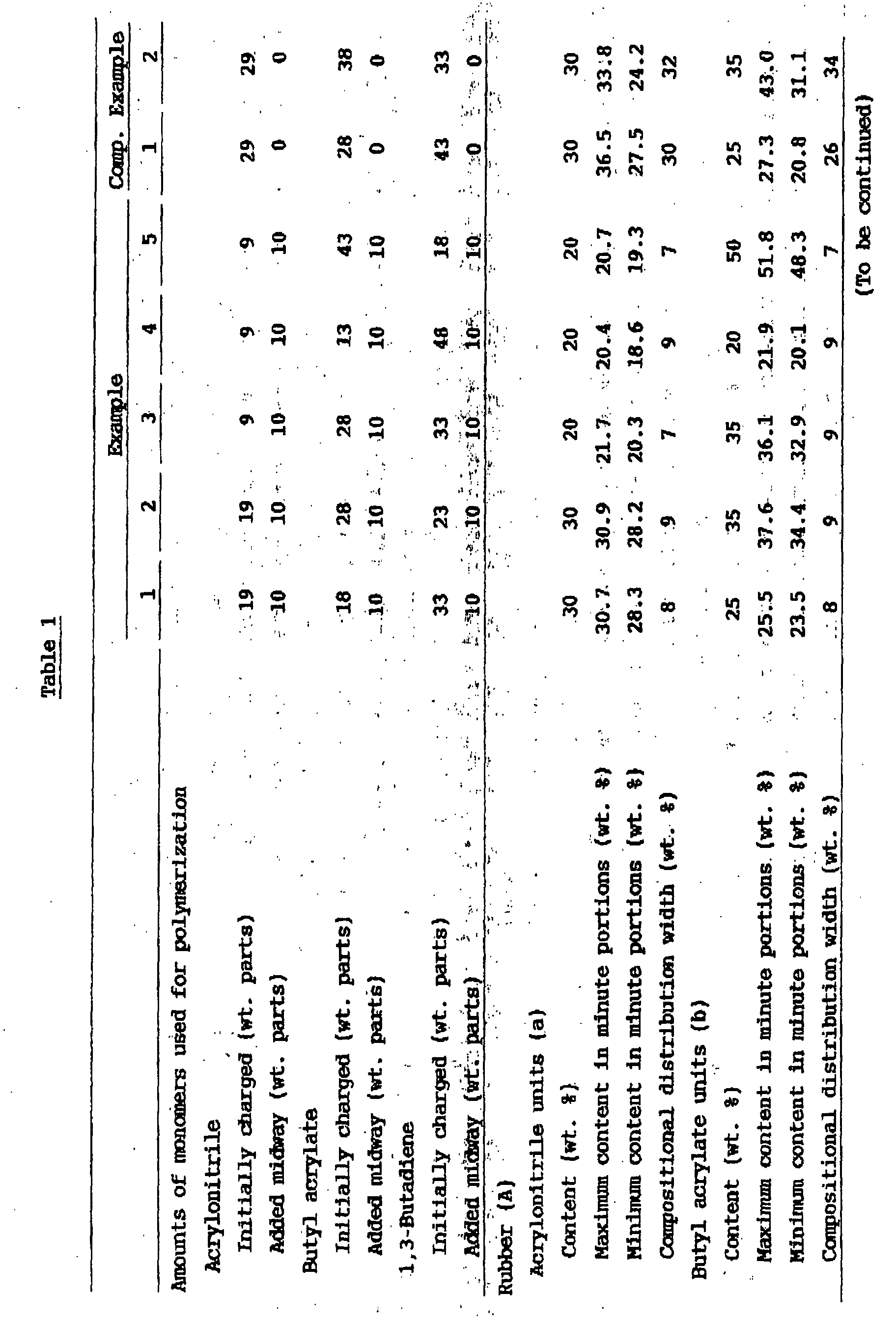
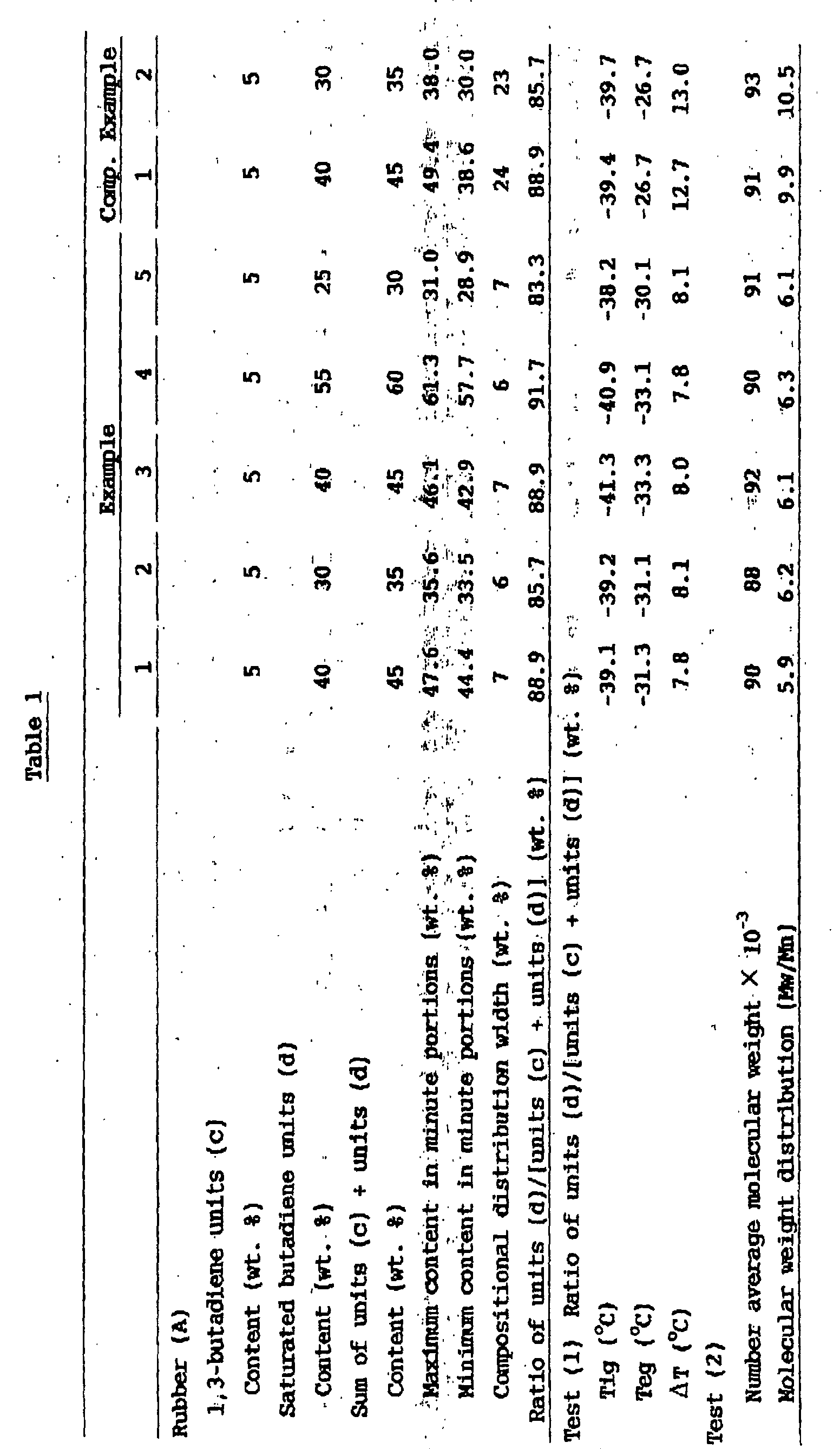

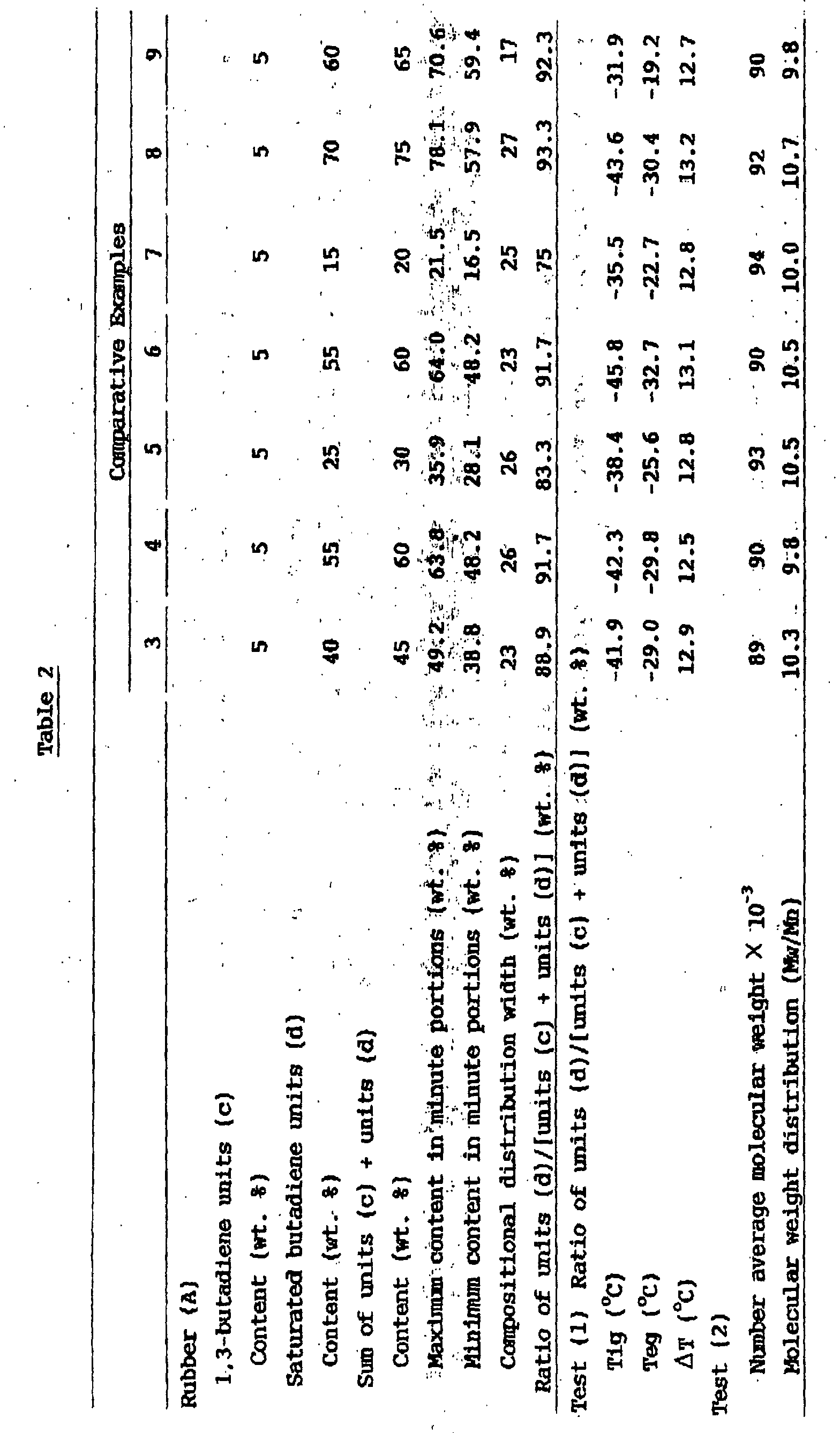
Example Comp. Ex. 1 2 3 4 5 1 2 (3) Physical Properties of Vulcanizate Tensile strength (MPa) 20.7 17.9 18.6 20.4 17.1 18.2 15.0 Elongation (%) 450 400 440 440 470 440 390 100% Tensile stress (MPa) 5.0 4.8 4.4 4.3 4.0 4.6 4.4 Hardness 71 71 70 70 69 70 70 (4) Heat Load in Oil Test of Vulcanizate Volume change (%) 13 12 27 32 26 17 16 (5) Cold Resistance Test of Vulcanizate T10 (°C) -40 -40 -42 -42 -39 -37 -38 (6) Compression set of Vulcanizate Load, 150 °C, 70H (%) 65 72 71 67 75 75 82 Load, 150 °C, 168H (%) 71 79 78 74 82 84 91 Comparative Example 3 4 5 6 7 8 9 (3) Physical Properties of Vulcanizate Tensile strength (MPa) 15.8 17.5 14.3 17.9 15.8 23.6 25.3 Elongation (%) 430 430 470 480 380 460 490 100% Tensile stress (MPa) 4.0 3.9 3.6 3.6 5.2 4.9 5.0 Hardness 69 69 68 70 72 73 74 (4) Heat Load in Oil Test of Vulcanizate Volume change (%) 31 36 30 52 4 43 9 (5) Cold Resistance Test of Vulcanizate T10 (°C) -40 -39 -36 -42 -35 -36 -33 (6) Compression Set of Vulcanizate Load, 150 °C, 70H (%) 81 77 86 78 82 73 60 Load, 150 °C, 168H (%) 90 86 95 87 91 82 69 - As seen from Comparative Examples 1 to 5, a rubber composition comprising a copolymer rubber having a difference between the extrapolated glass transition initiation temperature (Tig) and the extrapolated glass transition ending temperature (Teg) of larger than 10°C, and having a compositional distribution width of each of the monomer units is large, gives a vulcanizate having a large compression set.
- As seen from Comparative Examples 6 to 9, a rubber composition comprising a copolymer rubber having a monomer unit composition not satisfying the requirement of the present invention gives a vulcanizate which has poor cold resistance and/or poor oil resistance.
- In contrast, as seen from Examples 1 to 5, a rubber composition comprising a copolymer rubber (A), a metal salt (B) of an ethylenically unsaturated carboxylic acid and an organic peroxide (C) gives a vulcanizate having excellent cold resistance and oil resistance, and, as compared with those of comparative examples having similar monomer compositions, gives a vulcanizate exhibiting a reduced compression set.
- The vulvanizate of the present invention has excellent cold resistance and oil resistance, and exhibits a reduced compression set. In view of these beneficial properties, the vulcanizate can be used as rubber components including, for example, belts such as toothed belts and V ribbed belts, seals such as packings and gaskets, boots, diaphragms, hoses and rolls.
Claims (6)
- A rubber composition comprising (A) a nitrile group-containing copolymer rubber, (B) a metal salt of an ethylenically unsaturated carboxylic acid and (C) an organic peroxide, wherein the nitrile group-containing copolymer rubber (A) comprises 10 to 40% by weight of (a) α,β-ethylenically unsaturated nitrile monomer units, 10 to 60% by weight of (b) α,β-ethylenically unsaturated carboxylic acid ester monomer units, 0.01 to 56% by weight of (c) conjugated diene monomer units, and 14 to 69.99% by weight of (d) saturated conjugated diene monomer units; the sum of the monomer units (c) and the monomer units (d) is 20 to 70% by weight, and the ratio of the monomer units (d) to the sum of the monomer units (c) and the monomer units (d) is at least 70% by weight; the difference between the extrapolated glass transition initiation temperature (Tig) and the extrapolated glass transition ending temperature (Teg) as measured on the copolymer rubber (A) by differential scanning calorimetry is not larger than 10°C.
- The rubber composition according to claim 1, wherein compositional distribution width of each of (a) α,β-ethylenically unsaturated nitrile monomer units, (b) α,β-ethylenically unsaturated carboxylic acid ester monomer units, and (c) conjugated diene monomer units plus (d) saturated conjugated diene monomer units in the nitrile group-containing copolymer rubber (A) is not larger than 20% by weight.
- The rubber composition according to claim 1, wherein the metal salt (B) of an ethylenically unsaturated carboxylic acid is a metal salt of an ethylenically unsaturated carboxylic acid having no ester group.
- The rubber composition according to claim 1, wherein the metal salt (B) of an ethylenically unsaturated carboxylic acid is a divalent metal salt of an ethylenically unsaturated carboxylic acid.
- The rubber composition according to claim 1, wherein the organic peroxide (C) is selected from dialkyl peroxides.
- A vulcanizate obtained by vulcanizing the rubber composition as claimed in claim 1.
Applications Claiming Priority (3)
| Application Number | Priority Date | Filing Date | Title |
|---|---|---|---|
| JP2001299279A JP4442072B2 (en) | 2001-09-28 | 2001-09-28 | Vulcanizable rubber composition and vulcanized product |
| JP2001299279 | 2001-09-28 | ||
| PCT/JP2002/009963 WO2003029341A1 (en) | 2001-09-28 | 2002-09-26 | Rubber composition comprising nitrile copolymer rubber, metal salt of ethylenically unsaturated carboxylic acid, and organic peroxide, and vulcanizate thereof |
Publications (3)
| Publication Number | Publication Date |
|---|---|
| EP1449873A1 true EP1449873A1 (en) | 2004-08-25 |
| EP1449873A4 EP1449873A4 (en) | 2005-08-10 |
| EP1449873B1 EP1449873B1 (en) | 2007-08-01 |
Family
ID=19120055
Family Applications (1)
| Application Number | Title | Priority Date | Filing Date |
|---|---|---|---|
| EP02800015A Expired - Lifetime EP1449873B1 (en) | 2001-09-28 | 2002-09-26 | Rubber composition comprising nitrile copolymer rubber, metal salt of ethylenically unsaturated carboxylic acid, and organic peroxide, and vulcanizate thereof |
Country Status (5)
| Country | Link |
|---|---|
| US (1) | US20050085593A1 (en) |
| EP (1) | EP1449873B1 (en) |
| JP (1) | JP4442072B2 (en) |
| DE (1) | DE60221560T2 (en) |
| WO (1) | WO2003029341A1 (en) |
Cited By (2)
| Publication number | Priority date | Publication date | Assignee | Title |
|---|---|---|---|---|
| EP1852447A4 (en) * | 2005-02-23 | 2008-04-23 | Zeon Corp | NITRILE COPOLYMER RUBBER AND VULCANIZABLE NITRILE COPOLYMER RUBBER COMPOSITION |
| EP3075776A4 (en) * | 2013-11-28 | 2017-11-01 | Zeon Corporation | Nitrile group-containing highly-saturated copolymer rubber composition and crosslinked rubber |
Families Citing this family (6)
| Publication number | Priority date | Publication date | Assignee | Title |
|---|---|---|---|---|
| JP4729887B2 (en) * | 2004-04-21 | 2011-07-20 | ユニマテック株式会社 | Acrylic elastomer composition |
| DE102005059625A1 (en) * | 2005-12-14 | 2007-06-21 | Lanxess Deutschland Gmbh | Microgel-containing vulcanizable composition based on hydrogenated nitrile rubber |
| KR101606988B1 (en) * | 2013-07-09 | 2016-03-28 | 주식회사 엘지화학 | Nitrile rubbers and method of preparing them |
| EP2868677A1 (en) | 2013-10-30 | 2015-05-06 | LANXESS Deutschland GmbH | Copolymer rubber containing nitrile groups |
| CN112852033A (en) * | 2021-01-25 | 2021-05-28 | 安徽欣鼎高分子材料有限公司 | High-pressure-resistant low-temperature-resistant rubber composition and preparation method thereof |
| JP7387664B2 (en) * | 2021-03-05 | 2023-11-28 | バンドー化学株式会社 | V-ribbed belt |
Family Cites Families (5)
| Publication number | Priority date | Publication date | Assignee | Title |
|---|---|---|---|---|
| JP2657823B2 (en) * | 1988-06-09 | 1997-09-30 | 日本ゼオン株式会社 | Vulcanizable rubber composition |
| JPH044240A (en) * | 1990-04-23 | 1992-01-08 | Sumitomo Rubber Ind Ltd | Oil-resistant rubber composition with excellent compression set |
| JPH06145423A (en) * | 1992-11-11 | 1994-05-24 | Sumitomo Rubber Ind Ltd | Rubber composition |
| JPH09241436A (en) * | 1996-03-06 | 1997-09-16 | Nippon Zeon Co Ltd | Vulcanizable rubber composition |
| JP4081938B2 (en) * | 1999-10-15 | 2008-04-30 | 日本ゼオン株式会社 | Rubber, crosslinkable rubber composition and cross-linked product, and method for producing rubber |
-
2001
- 2001-09-28 JP JP2001299279A patent/JP4442072B2/en not_active Expired - Lifetime
-
2002
- 2002-09-26 WO PCT/JP2002/009963 patent/WO2003029341A1/en not_active Ceased
- 2002-09-26 DE DE60221560T patent/DE60221560T2/en not_active Expired - Lifetime
- 2002-09-26 US US10/490,635 patent/US20050085593A1/en not_active Abandoned
- 2002-09-26 EP EP02800015A patent/EP1449873B1/en not_active Expired - Lifetime
Non-Patent Citations (2)
| Title |
|---|
| No further relevant documents disclosed * |
| See also references of WO03029341A1 * |
Cited By (4)
| Publication number | Priority date | Publication date | Assignee | Title |
|---|---|---|---|---|
| EP1852447A4 (en) * | 2005-02-23 | 2008-04-23 | Zeon Corp | NITRILE COPOLYMER RUBBER AND VULCANIZABLE NITRILE COPOLYMER RUBBER COMPOSITION |
| US8044147B2 (en) | 2005-02-23 | 2011-10-25 | Zeon Corporation | Nitrile group-containing copolymer rubber and a vulcanizable nitrile group-containing copolymer rubber composition |
| EP3075776A4 (en) * | 2013-11-28 | 2017-11-01 | Zeon Corporation | Nitrile group-containing highly-saturated copolymer rubber composition and crosslinked rubber |
| US10442918B2 (en) | 2013-11-28 | 2019-10-15 | Zeon Corporation | Nitrile group-containing highly saturated copolymer rubber composition and cross-linked rubber |
Also Published As
| Publication number | Publication date |
|---|---|
| JP2003105037A (en) | 2003-04-09 |
| DE60221560T2 (en) | 2008-04-17 |
| JP4442072B2 (en) | 2010-03-31 |
| EP1449873B1 (en) | 2007-08-01 |
| EP1449873A4 (en) | 2005-08-10 |
| WO2003029341A1 (en) | 2003-04-10 |
| DE60221560D1 (en) | 2007-09-13 |
| US20050085593A1 (en) | 2005-04-21 |
Similar Documents
| Publication | Publication Date | Title |
|---|---|---|
| JP4081938B2 (en) | Rubber, crosslinkable rubber composition and cross-linked product, and method for producing rubber | |
| JP6412123B2 (en) | Nitrile group-containing copolymer rubber | |
| EP2292667B1 (en) | Nitrile group-containing highly saturated copolymer rubber | |
| KR102488924B1 (en) | Hydrogenated nitrile-diene-carboxylic acid ester copolymer | |
| CN105555809B (en) | Lonitrile copolymer rubber and its manufacture method | |
| US6933339B2 (en) | Nitrile rubber composition, vulcanizable nitrile rubber composition, and vulcanizate | |
| EP1449873B1 (en) | Rubber composition comprising nitrile copolymer rubber, metal salt of ethylenically unsaturated carboxylic acid, and organic peroxide, and vulcanizate thereof | |
| US11046799B2 (en) | Hydrogenated nitrile-butadiene-PEG-acrylate co-polymers | |
| JP5319114B2 (en) | Nitrile group-containing copolymer rubber and vulcanizable nitrile group-containing copolymer rubber composition | |
| JP3981845B2 (en) | Acrylic rubber composition and vulcanizate | |
| US10266682B2 (en) | Cross-linked rubber for liquefied gas seal | |
| JP3543388B2 (en) | Vulcanizable acrylic rubber composition | |
| JP4623280B2 (en) | Rubber composition, vulcanizable rubber composition and vulcanized product | |
| JP7816166B2 (en) | Carboxyl group-containing acrylic rubber, rubber composition, and cross-linked rubber | |
| EP4501991A1 (en) | Acrylic rubber, acrylic rubber-containing composition and crosslinked rubber product | |
| JP2000302917A (en) | Rubber composition and crosslinked product |
Legal Events
| Date | Code | Title | Description |
|---|---|---|---|
| PUAI | Public reference made under article 153(3) epc to a published international application that has entered the european phase |
Free format text: ORIGINAL CODE: 0009012 |
|
| 17P | Request for examination filed |
Effective date: 20040428 |
|
| AK | Designated contracting states |
Kind code of ref document: A1 Designated state(s): AT BE BG CH CY CZ DE DK EE ES FI FR GB GR IE IT LI LU MC NL PT SE SK TR |
|
| A4 | Supplementary search report drawn up and despatched |
Effective date: 20050628 |
|
| RIC1 | Information provided on ipc code assigned before grant |
Ipc: 7C 08F 220/18 B Ipc: 7C 08L 15/00 B Ipc: 7C 08F 279/00 B Ipc: 7C 08K 5/14 B Ipc: 7C 08C 19/02 B Ipc: 7C 08L 9/02 A |
|
| GRAP | Despatch of communication of intention to grant a patent |
Free format text: ORIGINAL CODE: EPIDOSNIGR1 |
|
| GRAS | Grant fee paid |
Free format text: ORIGINAL CODE: EPIDOSNIGR3 |
|
| GRAA | (expected) grant |
Free format text: ORIGINAL CODE: 0009210 |
|
| AK | Designated contracting states |
Kind code of ref document: B1 Designated state(s): DE FR GB |
|
| REG | Reference to a national code |
Ref country code: GB Ref legal event code: FG4D |
|
| REF | Corresponds to: |
Ref document number: 60221560 Country of ref document: DE Date of ref document: 20070913 Kind code of ref document: P |
|
| PLBE | No opposition filed within time limit |
Free format text: ORIGINAL CODE: 0009261 |
|
| STAA | Information on the status of an ep patent application or granted ep patent |
Free format text: STATUS: NO OPPOSITION FILED WITHIN TIME LIMIT |
|
| 26N | No opposition filed |
Effective date: 20080506 |
|
| REG | Reference to a national code |
Ref country code: FR Ref legal event code: PLFP Year of fee payment: 14 |
|
| REG | Reference to a national code |
Ref country code: FR Ref legal event code: PLFP Year of fee payment: 15 |
|
| REG | Reference to a national code |
Ref country code: FR Ref legal event code: PLFP Year of fee payment: 16 |
|
| REG | Reference to a national code |
Ref country code: FR Ref legal event code: PLFP Year of fee payment: 17 |
|
| PGFP | Annual fee paid to national office [announced via postgrant information from national office to epo] |
Ref country code: FR Payment date: 20210812 Year of fee payment: 20 |
|
| PGFP | Annual fee paid to national office [announced via postgrant information from national office to epo] |
Ref country code: GB Payment date: 20210818 Year of fee payment: 20 Ref country code: DE Payment date: 20210818 Year of fee payment: 20 |
|
| REG | Reference to a national code |
Ref country code: DE Ref legal event code: R071 Ref document number: 60221560 Country of ref document: DE |
|
| REG | Reference to a national code |
Ref country code: GB Ref legal event code: PE20 Expiry date: 20220925 |
|
| PG25 | Lapsed in a contracting state [announced via postgrant information from national office to epo] |
Ref country code: GB Free format text: LAPSE BECAUSE OF EXPIRATION OF PROTECTION Effective date: 20220925 |